<?xml version="1.0" encoding="ISO-8859-1"?><article xmlns:mml="http://www.w3.org/1998/Math/MathML" xmlns:xlink="http://www.w3.org/1999/xlink" xmlns:xsi="http://www.w3.org/2001/XMLSchema-instance">
<front>
<journal-meta>
<journal-id>0034-7507</journal-id>
<journal-title><![CDATA[Revista Cubana de Estomatología]]></journal-title>
<abbrev-journal-title><![CDATA[Rev Cubana Estomatol]]></abbrev-journal-title>
<issn>0034-7507</issn>
<publisher>
<publisher-name><![CDATA[Editorial Ciencias Médicas]]></publisher-name>
</publisher>
</journal-meta>
<article-meta>
<article-id>S0034-75072015000100006</article-id>
<title-group>
<article-title xml:lang="en"><![CDATA[Trend and polarization of dental caries in pre-schoolers]]></article-title>
<article-title xml:lang="es"><![CDATA[Tendencia y polarización de la caries dental en preescolares]]></article-title>
</title-group>
<contrib-group>
<contrib contrib-type="author">
<name>
<surname><![CDATA[dos Santos Junior]]></surname>
<given-names><![CDATA[Valdeci Elias]]></given-names>
</name>
<xref ref-type="aff" rid="A01"/>
</contrib>
<contrib contrib-type="author">
<name>
<surname><![CDATA[Rodriguez Diaz]]></surname>
<given-names><![CDATA[Joan Manuel]]></given-names>
</name>
<xref ref-type="aff" rid="A01"/>
</contrib>
<contrib contrib-type="author">
<name>
<surname><![CDATA[de Alencar Filho]]></surname>
<given-names><![CDATA[Arnoldo Vasconcelos]]></given-names>
</name>
<xref ref-type="aff" rid="A01"/>
</contrib>
<contrib contrib-type="author">
<name>
<surname><![CDATA[Félix de Figueiredo]]></surname>
<given-names><![CDATA[Maria das Graças]]></given-names>
</name>
<xref ref-type="aff" rid="A01"/>
</contrib>
<contrib contrib-type="author">
<name>
<surname><![CDATA[Rabelo de Morais Guerra]]></surname>
<given-names><![CDATA[Candida Augusta]]></given-names>
</name>
<xref ref-type="aff" rid="A01"/>
</contrib>
<contrib contrib-type="author">
<name>
<surname><![CDATA[França Caldas Junior]]></surname>
<given-names><![CDATA[Arnaldo]]></given-names>
</name>
<xref ref-type="aff" rid="A01"/>
</contrib>
<contrib contrib-type="author">
<name>
<surname><![CDATA[Vilela Heimer]]></surname>
<given-names><![CDATA[Monica]]></given-names>
</name>
<xref ref-type="aff" rid="A01"/>
</contrib>
<contrib contrib-type="author">
<name>
<surname><![CDATA[Rosenblatt]]></surname>
<given-names><![CDATA[Aronita]]></given-names>
</name>
<xref ref-type="aff" rid="A01"/>
</contrib>
</contrib-group>
<aff id="A01">
<institution><![CDATA[,University of Pernambuco  ]]></institution>
<addr-line><![CDATA[ ]]></addr-line>
<country>Brazil</country>
</aff>
<pub-date pub-type="pub">
<day>00</day>
<month>03</month>
<year>2015</year>
</pub-date>
<pub-date pub-type="epub">
<day>00</day>
<month>03</month>
<year>2015</year>
</pub-date>
<volume>52</volume>
<numero>1</numero>
<fpage>0</fpage>
<lpage>0</lpage>
<copyright-statement/>
<copyright-year/>
<self-uri xlink:href="http://scielo.sld.cu/scielo.php?script=sci_arttext&amp;pid=S0034-75072015000100006&amp;lng=en&amp;nrm=iso"></self-uri><self-uri xlink:href="http://scielo.sld.cu/scielo.php?script=sci_abstract&amp;pid=S0034-75072015000100006&amp;lng=en&amp;nrm=iso"></self-uri><self-uri xlink:href="http://scielo.sld.cu/scielo.php?script=sci_pdf&amp;pid=S0034-75072015000100006&amp;lng=en&amp;nrm=iso"></self-uri><kwd-group>
<kwd lng="en"><![CDATA[dental caries]]></kwd>
<kwd lng="en"><![CDATA[children]]></kwd>
<kwd lng="en"><![CDATA[epidemiology]]></kwd>
<kwd lng="en"><![CDATA[oral health]]></kwd>
<kwd lng="en"><![CDATA[comparative study]]></kwd>
<kwd lng="es"><![CDATA[caries dental]]></kwd>
<kwd lng="es"><![CDATA[niños]]></kwd>
<kwd lng="es"><![CDATA[epidemiología]]></kwd>
<kwd lng="es"><![CDATA[salud oral]]></kwd>
</kwd-group>
</article-meta>
</front><body><![CDATA[ <p align="right"> <font face="Verdana, Arial, Helvetica, sans-serif" size="2"><b>ART&#205;CULO    ORIGINAL</b> </font></p>     <p>&nbsp;</p>     <p><font face="Verdana, Arial, Helvetica, sans-serif" size="2"><b><font size="4">Trend    and polarization of dental caries in pre-schoolers</font></b></font></p>     <p>&nbsp;</p>     <p><font face="Verdana, Arial, Helvetica, sans-serif" size="2"> <b><font size="3">Tendencia    y polarizaci&#243;n de la caries dental en preescolares</font></b></font></p>     <p>&nbsp;</p>     <p>&nbsp;</p>     <p><font face="Verdana, Arial, Helvetica, sans-serif" size="2"><b>Valdeci Elias    dos Santos Junior, Joan Manuel Rodriguez Diaz, Arnoldo Vasconcelos de Alencar    Filho, Maria das Gra&#231;as F&#233;lix de Figueiredo, Candida Augusta Rabelo    de Morais Guerra, Arnaldo Fran&#231;a Caldas Junior, Monica Vilela Heimer, Aronita    Rosenblatt</b> </font></p>     <p>     <p><font face="Verdana, Arial, Helvetica, sans-serif" size="2">University of Pernambuco,    Brazil.</font></p>     ]]></body>
<body><![CDATA[<p>&nbsp;</p>     <p><font face="Verdana, Arial, Helvetica, sans-serif" size="2"></font></p> <font face="Verdana, Arial, Helvetica, sans-serif" size="2"> <hr noshade size="1"> </font>      <p> <font face="Verdana, Arial, Helvetica, sans-serif" size="2"><b>ABSTRACT</b>    </font></p>     <p> <font face="Verdana, Arial, Helvetica, sans-serif" size="2"><b>Objective:</b>    to evaluate the tendency and polarization of dental caries in children 4-5 years    of age, between 2006 and 2014.    <br>   <b>Method:</b>    this is a comparison of two similar cross-sectional studies that included 226    children each year. Clinical data were collected according to the criteria proposed    by the World Health Organization (WHO). A previously validated questionnaire    was administered to parents or guardians of children, in order to obtain data    related to family income.    <br>   <b>Results:</b>    32.7% of children in 2006 and 35% in 2014 had at least one decayed tooth. The    dmft index was 1.25 in 2006 and 1.40 in 2014, with no statistically significant    difference (p&gt; 0.05). It was verified that there is a higher concentration    of dental caries in populations of lower economic status (p &lt;0.05) for the    years of analysis.    <br>   <b>Conclusion:</b> the caries prevalence showed a tendency to remain constant    after eight years of the baseline. Thus, the disease showed polarized, indicating    a higher concentration of children whose families had worse socioeconomic conditions.</font></p>     <p> <font face="Verdana, Arial, Helvetica, sans-serif" size="2"><b>Keywords</b><b>:</b>    dental caries, children, epidemiology, oral health, comparative study.<hr noshade size="1"></font>      <p><font face="Verdana, Arial, Helvetica, sans-serif" size="2"><b>RESUMEN </b>    </font></p>     <p> <font face="Verdana, Arial, Helvetica, sans-serif" size="2"><b>Objetivo:</b>    evaluar la tendencia y la polarizaci&#243;n de la caries dental en ni&#241;os    de 4-5 a&#241;os de edad, entre 2006 y 2014.    ]]></body>
<body><![CDATA[<br>   <b>M&#233;todo:</b> se trata de la comparaci&#243;n de dos estudios transversales    similares que incluy&#243; a 226 ni&#241;os en cada a&#241;o. Los datos cl&#237;nicos    fueron recogidos de acuerdo con los criterios propuestos por la Organizaci&#243;n    Mundial de la Salud (OMS). un cuestionario previamente validado, fue aplicado    a los padres o responsables de los ni&#241;os, con la finalidad de obtener datos    relacionados con los ingresos financieros familiar.    <br>   <b>Resultados:</b>    el 32,7% de los ni&#241;os en 2006 y 35% en el 2014, ten&#237;an al menos un    diente cariado. El &#237;ndice ceod en 2006 fue de 1,25 y en 2014, de 1,40,    no se encontr&oacute; diferencia estad&#237;sticamente significativa (p&gt;    0,05). Fue verificado que hay una mayor concentraci&#243;n de caries dental    en poblaciones de menor estatus econ&#243;mico (p&lt;0,05) para los a&#241;os    de an&#225;lisis.    <br>   </font><font face="Verdana, Arial, Helvetica, sans-serif" size="2"><b>Conclusi&#243;n:</b>    la prevalencia de caries dental present&#243; una tendencia a mantenerse constante    despu&#233;s de ocho a&#241;os del momento de la evaluaci&#243;n inicial. Con    esto, la enfermedad se mostr&#243; polarizada, evidenciando una mayor concentraci&#243;n    en ni&#241;os cuya familia pose&#237;a peores condiciones socioecon&#243;micas.    </font></p>     <p> <font face="Verdana, Arial, Helvetica, sans-serif" size="2"><b>Palabras clave:</b>  caries dental, ni&#241;os, epidemiolog&#237;a, salud oral. <hr noshade size="1"></font>      <p><font face="Verdana, Arial, Helvetica, sans-serif" size="2"></font> </p>     <p>&nbsp;</p>     <p><font face="Verdana, Arial, Helvetica, sans-serif" size="2"><b><font size="3">INTRODUCCI&Oacute;N</font></b>    </font></p>     <p><font face="Verdana, Arial, Helvetica, sans-serif" size="2"> The modern world    has seen a declining trend in caries prevalence in both developing and developed    countries.<sup>1</sup> In Brazil, this has also been reported, although there    are marked differences in the distribution of the prevalence of this disease    in different regions of the country and among various population groups.<sup>2</sup>    Thus, caries remains a public health problem and toothache still a major cause    for school absenteeism.<sup>1,3</sup> </font></p>     <p><font face="Verdana, Arial, Helvetica, sans-serif" size="2"> The last Brazilian    national report on oral health held in 2010 showed that 54.3% of children under    5 years of age had on average 2.43 carious teeth, and dental decay made up for    about 80% of the index of decayed, extracted and filled teeth for the primary    dentition (dmft).<sup>2</sup> The same report indicated that in the northeastern    part of the country, this situation appears to be more severe, the mean dmft    was 2.89, of which, 88.2% makes up for to the decay component of the index.    The World Health Organization goal of oral health for the year 2000 had already    proposed that 50% of children aged 5 and 6 years should be caries free. For    the year 2010, this target was increased to 90% and in less bold perspective,    the goal was reduced to 80% for 2020.<sup>4</sup> </font></p>     <p><font face="Verdana, Arial, Helvetica, sans-serif" size="2"> By analyzing the    process of epidemiological transition of dental caries in children in developed    countries, it is clear that there is a phenomenon known as polarization of the    disease, characterized by the social vulnerability of social groups that still    have a great effect on preventing the decline of dental caries. Corroborating    this, it appears that a greater burden of caries affects populations less economically    favored.<sup>5</sup> </font></p>     ]]></body>
<body><![CDATA[<p><font face="Verdana, Arial, Helvetica, sans-serif" size="2"> This way, it is    essential to monitor changes in the distribution and severity of disease in    society and assess the risk factors over time.<sup>6</sup> Thus, the aim of    this study was to evaluate the trend and polarization of dental caries in children    4-5 years between 2006 and 2014. </font></p>     <p>&nbsp; </p>     <p> <font face="Verdana, Arial, Helvetica, sans-serif" size="2"><b><font size="3">METHOD</font></b>    </font></p>     <p><font face="Verdana, Arial, Helvetica, sans-serif" size="2"> This study was    approved by the Ethics Committee in Research of the University of Pernambuco    under the Protocol 044/06 and conducted in accordance with the ethical principles    that pertain to the Declaration of Helsinki. </font></p>     <p><font face="Verdana, Arial, Helvetica, sans-serif" size="2"> The two cross-sectional    studies were conducted in the years 2006 and 2014, in the city capital of the    State of Pernambuco, Recife, Brazil, which has an area of 217 km<sup>2 </sup>and    population of 1.561,659 inhabitants, representing 18% of the State population.<sup>7</sup>    </font></p>     <p><font face="Verdana, Arial, Helvetica, sans-serif" size="2"> The sample size    calculation was based on a pilot study in which dental caries had a prevalence    of 29.7%, considering a confidence interval of 90% and type I error of 5%, using    a formula for cross-sectional studies in the program Epi info Version 2000 (Atlanta,    Georgia, USA). It was soon established one sample calculation of 226 children    for each year of analysis, totaling 452 children. </font></p>     <p><font face="Verdana, Arial, Helvetica, sans-serif" size="2"> The Clinical exam    for the detection of caries was conducted by four calibrated examiners according    to the guidelines of the World Health Organization. <sup>8</sup> The Kappa coefficients    for inter- and intraexaminer calibration were 0.89 and 0.83, respectively. </font></p>     <p><font face="Verdana, Arial, Helvetica, sans-serif" size="2"> All children were    examined at the knee to knee position, in a place with good natural lighting.    The examiners wore appropriate clothing and personal protective equipment (PPE):    gown, cap, mask, goggles and disposable gloves. The standards of biosecurity,    both for infection control and for the elimination of waste followed the Manual    recommended by the National Health Surveillance Agency: Dental Services: Prevention    and Risk Control (BRAZIL / MS / ANVISA , 2006). Children with motor and mental    disorders were excluded from the sample to assure better reliability for the    data. </font></p>     <p><font face="Verdana, Arial, Helvetica, sans-serif" size="2"> Dental caries    was assessed by the index of decayed, extracted and filled teeth for the primary    dentition (dmft). To assess the polarization of caries family income was registered    for each examined child, based on the minimum Brazilian wage salary. A previously    validated questionnaire was administered to parents or guardians of children,    in order to obtain data related to family income. </font></p>     <p><font face="Verdana, Arial, Helvetica, sans-serif" size="2"> Data was analyzed    using absolute and percentage values of statistical measures: mean, standard    deviation, confidence interval of 95,0%. The normal distribution of quantitative    data was verified by the Kolmogorov-Smirnov test. The inferential statistics    was assessed by the Pearson chi-square test to verify the association between    categorical variables. The Mann-Whitney and Kruskal-Wallis tests assessed the    association between categorical and numerical values (dmft). The margin of error    used in the decision of the statistical tests was 5.0%. Statistical calculations    were performed using SPSS (Statistical Package for Social Sciences) version    21. </font></p>     ]]></body>
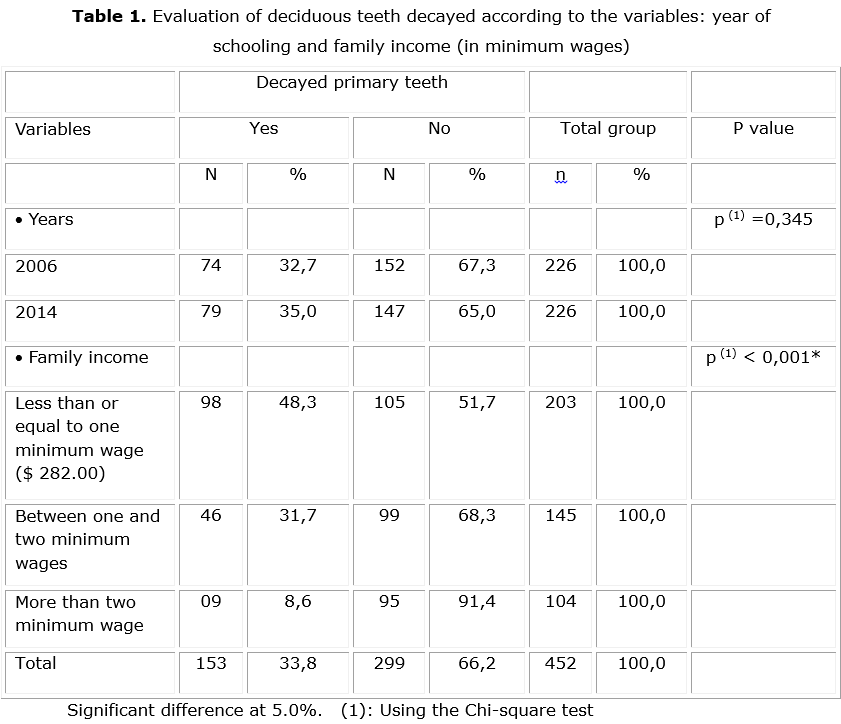
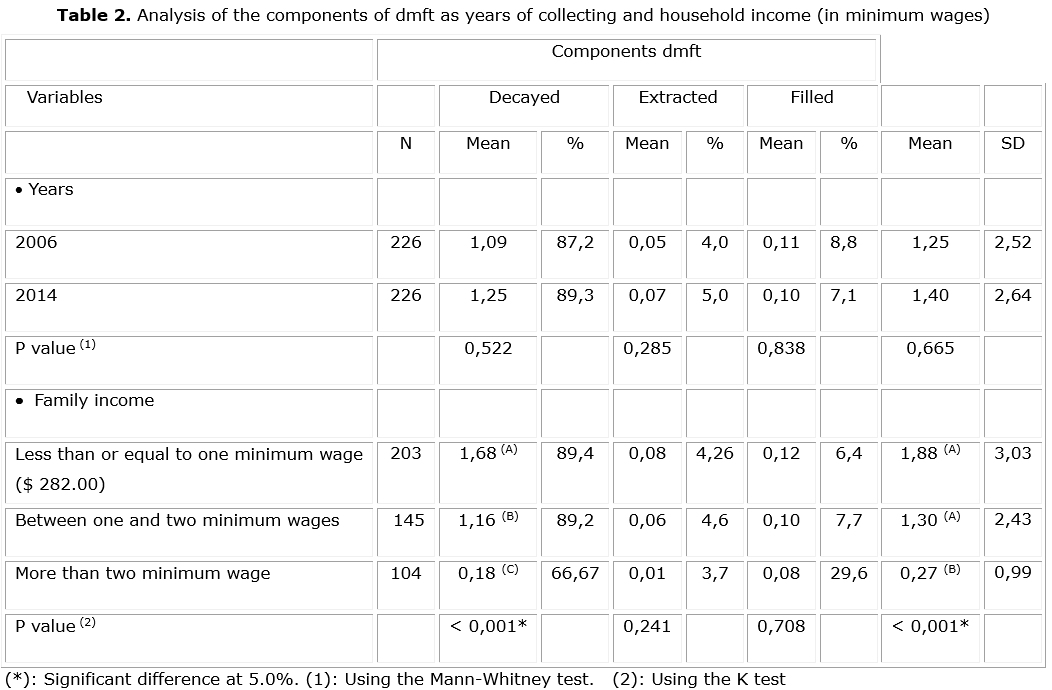
<body><![CDATA[<p>&nbsp; </p>     <p><font face="Verdana, Arial, Helvetica, sans-serif" size="2"><b><font size="3">RESULTS</font></b>    </font></p>     <p><font face="Verdana, Arial, Helvetica, sans-serif" size="2"> Of the participating    children, 32.7% in 2006 and 35% in 2014 had at least one decayed tooth (<a href="/img/revistas/est/v52n1/t0106115.gif">Table    1</a>), and no statistically significant difference was found in relation to    sex and age. </font></p>     <p align="left"><font face="Verdana, Arial, Helvetica, sans-serif" size="2"> The    dmft index was 1.25 for the year 2006 and 1.40 for the year 2014, with no statistically    significant difference (p&gt; 0.05) between the two years. Furthermore, the    decay component of the dmft index (decayed, missing and filled teeth) separately    did not indicate statistically significant difference between the years of study    (p&gt; 0.05) (<a href="/img/revistas/est/v52n1/t0206115.gif">Table 2</a>). </font></p>     <p align="left"><font face="Verdana, Arial, Helvetica, sans-serif" size="2"> The    component "d" (decayed) accounted for 87.2% of the index in 2006 and 89.2% in    2014, the component &#8220;e&#8221; (extracted) in 2006 accounted for 4% of    the dmft and in 2014 to 5%. Finally, polarization looked at the socioeconomic    features of the population, based on family income, values ranging from 1 to    2 minimum Brazilian wage, indicating that children who had dental decay belonged    to the lower wage income wage group (p &lt;0.05) for both years of analysis    (<a href="/img/revistas/est/v52n1/t0206115.gif">Table 2</a>). </font></p>     <p>&nbsp; </p>     <p><font face="Verdana, Arial, Helvetica, sans-serif" size="2"><b><font size="3">DISCUSSION</font></b>    </font></p>     <p><font face="Verdana, Arial, Helvetica, sans-serif" size="2"> In Brazil and    most part of the developed and developing countries, tooth decay is still a    public health problem.<sup>9</sup> Therefore, trends to analyze by comparing    different time frames of the state of the art of the problem are valuable for    producing useful knowledge for planning and decision making in health care policies.    The analysis of the prevalence of dental caries over time allows health planners    to learn the relationship of health / disease process, in particular those related    to socioeconomic factors and the effectiveness of national public health policies.<sup>5,10-12</sup>    </font></p>     <p><font face="Verdana, Arial, Helvetica, sans-serif" size="2"> The dmft indices    in this time frame, from the year of 2006 to 2014 increased by 7%, though there    has not statistically significant difference (p&gt; 0.05), the trend of dental    caries in this population did not follow either the national tendency for reduction,<sup>2,5,13</sup>    nor the international features.<sup>14-16</sup> </font></p>     <p><font face="Verdana, Arial, Helvetica, sans-serif" size="2"> Among the components    of the dmft index, component "d" (decayed) increased by 2.1% between 2006 and    2014, revealing a worrisome scenario due to the increased burden of the disease    in this population sample. The component "e" (extracted) also increased by 1%    between the years evaluated. Finally the component "f" (filled) declined in    this time frame, 8.8% to 7.1%, meaning that more children presented with untreated    decay. This result is consistent with the data from the IBGE (Brazilian Institute    of Geography and Statistics)<sup>7</sup> which revealed that the poor have more    disease and less access to dental care which by brazilian low it should be public    and free. Therefore, although there was no statistically significant difference    in any of the components of dmft between the years (<a href="/img/revistas/est/v52n1/t0106115.gif">Table    1</a>) this data set should be useful for helping health authorities on making    decisions towards public dental health policies to ensure that preventive measures    in respect to health promotion could result on greater collective impact. </font></p>     ]]></body>
<body><![CDATA[<p><font face="Verdana, Arial, Helvetica, sans-serif" size="2"> Among the factors    attributed to the reduction of dental caries in most parts of the developing    countries like Brazil, fluoride plays an important role, since it is effective    on reducing dental caries on public water supplies, on toothpaste, and the creation    and implementation of prevention programs.<sup>17-19</sup> However, since it    is predicted by state law that water supplies in Pernambuco should be fluoridated    and it is still not available, the population can only count on fluoridated    tooth paste to help prevent decay. The importance of the implementation of water    fluoridation can be verified by the latest report of the Brazilian Oral Health    Survey. This survey reveals that in regions where there is the addition of fluoride    in the water, children 5-12 years have the double amount of carious teeth than    those where water is already treated with fluoride,<sup>2</sup> which may reduce    by 60% the prevalence of dental caries.<sup>20</sup> </font></p>     <p><font face="Verdana, Arial, Helvetica, sans-serif" size="2"> The distribution    of dental caries among the years has definitely changed from a uniform distribution    to an increasing level of inequality. It also appears that despite advances    in oral health status of the population, mainly for tooth decay, not all individuals    are equally favored and some carry a greater burden of disease.<sup>5,18,21</sup>    </font></p>     <p><font face="Verdana, Arial, Helvetica, sans-serif" size="2"> According to the    Brazilian Institute of Geography and Statistics-IBGE,<sup>7</sup> 53.9 million    Brazilians live in extreme poverty, which represents 31.7% of the population.    In the Northeast, 76.5% of households earn less than one minimum wage. However,    the results found in this sample showed that about 45% of the population of    the metropolitan area of Recife may survive from a wage of one minimum salary    per month, about U$300.00 for an average family of 4 members. </font></p>     <p><font face="Verdana, Arial, Helvetica, sans-serif" size="2"> According to <i>Marmot,    Bell</i> and <i>Goldblatt</i><sup>10</sup> there is a convergence between unfavorable    socioeconomic status and the presence of disease. The findings of this study    show the existence of a greater disease burden among those who have a more unfavorable    economic condition. Children whose family owned less than one minimum wage dmft,    was 9.3 times greater than those from families that earned more than two minimum    wages (<a href="/img/revistas/est/v52n1/t0206115.gif">Table 2</a>). </font></p>     <p><font face="Verdana, Arial, Helvetica, sans-serif" size="2"> Thus, it is evident    that the more unfavorable is the socioeconomic condition of the family, more    precarious is the condition of oral health of children. <sup>1,3,6,9,12</sup>    Therefore, it would be inappropriate to refer dental caries by the uniqueness    of its primary etiologic factors, such as microbe, host and substrate due to    its multifactorial features that include the economic, social and comportamental.<sup>22</sup>    Thus, it is necessary to report to the multidimensional perspectives of oral    health to explain these differences and understand the factors that may contribute    to its maintenance in the individual&#180;s life contexts.<sup>23</sup> </font></p>     <p>&nbsp; </p>     <p> <font face="Verdana, Arial, Helvetica, sans-serif" size="2"><b><font size="3">CONCLUSION</font></b>    </font></p>     <p><font face="Verdana, Arial, Helvetica, sans-serif" size="2"> The caries prevalence    showed a tendency to remain constant after eight years of the baseline. Thus,    the disease showed polarized, indicating a higher concentration of children    whose families had worse socioeconomic conditions. </font></p>     <p> <font face="Verdana, Arial, Helvetica, sans-serif" size="2"><b>Statement of    conflict of interest </b> </font></p>     <p><font face="Verdana, Arial, Helvetica, sans-serif" size="2"> All authors agree    to publication of the article and declare no conflict of interest whatsoever.    </font></p>     ]]></body>
<body><![CDATA[<p>&nbsp; </p>     <p><font face="Verdana, Arial, Helvetica, sans-serif" size="2"><b><font size="3">REFERENCES</font></b>    </font></p>     <!-- ref --><p><font face="Verdana, Arial, Helvetica, sans-serif" size="2"> 1. Petersen PE,    Yamamoto T. Improving the oral health of older people: the approach of the WHO    Global Oral Health Programme. Community Dent Oral Epidemiol. 2005 Apr;33(2):81-92.        </font></p>     <!-- ref --><p><font face="Verdana, Arial, Helvetica, sans-serif" size="2"> 2. Brasil. Minist&#233;rio    da Sa&#250;de. Projeto SB Brasil 2010: condi&#231;&#245;es de sa&#250;de bucal    da popula&#231;&#227;o brasileira 2010 &#8211; resultados principais. Bras&#237;lia:    Minist&#233;rio da Sa&#250;de; 2011.     </font></p>     <!-- ref --><p><font face="Verdana, Arial, Helvetica, sans-serif" size="2"> 3. Scavuzzi AI,    De Fran&#231;a Caldas Junior A, Couto GB, De Vasconcelos MM, De Freitas Soares    RP, Valen&#231;a PA. Longitudinal study of dental caries in Brazilian children    aged from 12 to 30 months. Int J Paediatr Dent. 2007 Mar;17(2):123-8.     </font></p>     <!-- ref --><p><font face="Verdana, Arial, Helvetica, sans-serif" size="2"> 4. Hobdell MH,    Myburgh NG, Kelman M, Hausen H. Setting global goals for oral health for the    year 2010. Int Dent J. 2000 Oct;50(5):245-9.     </font></p>     ]]></body>
<body><![CDATA[<!-- ref --><p><font face="Verdana, Arial, Helvetica, sans-serif" size="2"> 5. Narvai PC,    Fraz&#227;o P, Roncalli AG, Antunes JL. Dental caries in Brazil: decline, polarization,    inequality and social exclusion. Rev Panam Salud Publica. 2006 Jun;19(6):385-93.        </font></p>     <!-- ref --><p><font face="Verdana, Arial, Helvetica, sans-serif" size="2"> 6. Costa SM, Martins    CC, Bonfim M de L, Zina LG, Paiva SM, Pordeus IA, et al. A systematic review    of socioeconomic indicators and dental caries in adults. Int J Environ Res Public    Health. 2012 Oct 10;9(10):3540-74.     </font></p>     <!-- ref --><p><font face="Verdana, Arial, Helvetica, sans-serif" size="2"> 7. Instituto Brasileiro    de Geografia e Estat&#237;stica (IBGE). PNAP. Pesquisa Nacional. Amostra de    Domic&#237;lios [online] 2010 [citado 2012 Jul dia]. Disponible en URL: <a href="http://www.ibge.gov.br/">http://www.ibge.gov.br/</a>    </font><!-- ref --><p><font face="Verdana, Arial, Helvetica, sans-serif" size="2"> 8. WHO: World    Health Organization Basic Epidemiological survey of oral health. Manual. 4th    Ed. Geneva: World Health Organization, 1997.    </font></p>     <!-- ref --><p><font face="Verdana, Arial, Helvetica, sans-serif" size="2">9. Scarpelli AC,    Paiva SM, Viegas CM, Carvalho AC, Ferreira FM, Pordeus IA. Oral health-related    quality of life among Brazilian preschool children. Community Dent Oral Epidemiol.    2014 Aug;41(4):336-44.     </font></p>     <!-- ref --><p><font face="Verdana, Arial, Helvetica, sans-serif" size="2"> 10. Marmot M,    Bell R, Goldblatt P. Action on the social determinants of health. Rev Epidemiol    Sante Publique. 2014 Aug;61 Suppl 3:S127-32.     </font></p>     <!-- ref --><p><font face="Verdana, Arial, Helvetica, sans-serif" size="2"> 11. Dawani N,    Nisar N, Khan N, Syed S, Tanwee N. Prevalence and factors related to dental    caries among pre-school children of Saddar town, Karachi, Pakistan: a cross-sectional    study. BMC Oral Health. 2012;12:59.     </font></p>     <!-- ref --><p><font face="Verdana, Arial, Helvetica, sans-serif" size="2"> 12. Dye BA, Li    X, Thorton-Evans G. Oral health disparities as determined by selected healthy    people 2020 oral health objectives for the United States, 2009-2010. NCHS Data    Brief. 2012 Aug;(104):1-8.     </font></p>     <!-- ref --><p><font face="Verdana, Arial, Helvetica, sans-serif" size="2"> 13. B&#246;necker    M1, Ardenghi TM, Oliveira LB, Sheiham A, Marcenes W. Trends in dental caries    in 1- to 4-year-old children in a Brazilian city between 1997 and 2008. Int    J Paediatr Dent. 2010 Mar;20(2):125-31.     </font></p>     <!-- ref --><p><font face="Verdana, Arial, Helvetica, sans-serif" size="2"> 14. Bernab&#233;    E, Sheiham A. Age, period and cohort trends in caries of permanent teeth in    four developed countries. Am J Public Health. 2014 Jul;104(7):e115-21. doi:    0.2105/AJPH.2014.301869. Epub 2014 May 15.     </font></p>     <!-- ref --><p><font face="Verdana, Arial, Helvetica, sans-serif" size="2"> 15. Achembong    LN, Kranz AM, Rozier RG. Office-based preventive dental program and statewide    trends in dental caries. Pediatrics. 2014 Apr;133(4):e827-34.     </font></p>     <!-- ref --><p><font face="Verdana, Arial, Helvetica, sans-serif" size="2"> 16. Schuller AA,    Van Dommelen P, Poorterman JH. Trends in oral health in young people in the    Netherlands over the past 20 years: a study in a changing context. Community    Dent Oral Epidemiol. 2014 Apr;42(2):178-84.     </font></p>     <!-- ref --><p><font face="Verdana, Arial, Helvetica, sans-serif" size="2"> 17. Basting RT,    Pereira AC, Meneghim MC. Avalia&#231;&#227;o da preval&#234;ncia de c&#225;rie    dent&#225;ria em escolares do Munic&#237;pio de Piracicaba, SP, Brasil, ap&#243;s    25 anos de fluoreta&#231;&#227;o das &#225;guas de abastecimento p&#250;blico.    Rev Odontol Univ S&#227;o Paulo. 1997;11(4):287-92.     </font></p>     <!-- ref --><p><font face="Verdana, Arial, Helvetica, sans-serif" size="2"> 18. Narvai PC,    Fraz&#227;o P, Castellanos RA. Decl&#237;nio na experi&#234;ncia de c&#225;rie    em dentes permanentes de escolares brasileiros no final do s&#233;culo XX. Rev    Odontol e Sociedade. 1999;1(1/2):25-9.     </font></p>     <!-- ref --><p><font face="Verdana, Arial, Helvetica, sans-serif" size="2"> 19. Pernambuco,    Secretaria Estadual de Sa&#250;de, Relat&#243;rio anual de gest&#227;o 2009.    [citado 2010 Maio]. Disponible en URL: <a href="http://portal.saude.pe.gov.br/sites/portal.saude.pe.gov.br/files/uploads/2012/08/RAG-2009.pdf" target="_blank">    http://portal.saude.pe.gov.br/sites/portal.saude.pe.gov.br/files/uploads/2012/08/RAG-2009.pdf    </a> </font><!-- ref --><p><font face="Verdana, Arial, Helvetica, sans-serif" size="2"> 20. Ramires I,    Buzalaf MA. Fifty years of fluoridation of public water supplies in Brazil:    benefits for the control of dental caries. Cien Saude Colet. 2007 Jul-Aug;12(4):1057-65.        </font></p>     ]]></body>
<body><![CDATA[<!-- ref --><p><font face="Verdana, Arial, Helvetica, sans-serif" size="2"> 21. Macek MD,    Heller KE, Selwitz RH, Manz MC. Is 75 percent of dental caries really found    in 25 percent of the population? J Public Health Dent. 2004; 64(1):20-25.     </font></p>     <!-- ref --><p><font face="Verdana, Arial, Helvetica, sans-serif" size="2"> 22. Dos Santos    Junior VE, Filho AVA, Sousa RMB, Cavalcanti F, Heimer MV, Rosenblatt A. O impacto    de um programa social brasileiro sobre a sa&#250;de bucal de crian&#231;as.    RFO, Passo Fundo. 2014;18(1):61-6.     </font></p>     <!-- ref --><p><font face="Verdana, Arial, Helvetica, sans-serif" size="2"> 23. Lindmark U,    Hakeberg M, Hugoson A. Sense of coherence and oral health status in an adult    Swedish population. Acta Odontol Scand. 2010;69(1):12-20.     </font></p>     <p>&nbsp;</p>     <p>&nbsp;</p>     <p><font face="Verdana, Arial, Helvetica, sans-serif" size="2">Recibido: 6 de    octubre de 2014.    <br>   </font><font face="Verdana, Arial, Helvetica, sans-serif" size="2">Aprobado:    27 de diciembre de 2014.</font></p>     ]]></body>
<body><![CDATA[<p>&nbsp;</p>     <p>&nbsp;</p>     <p><font face="Verdana, Arial, Helvetica, sans-serif" size="2">Corresponding author:    <i>Valdeci Elias dos Santos Junior</i>. Rua S&#227;o Sebasti&#227;o 417 #101    CEP 54410500. Jaboat&#227;o dos Guararapes PE, Brazil. <a href="mailto:valdeciodonto@gmail.com">valdeciodonto@gmail.com</a>    </font></p>      ]]></body>
<back>
<ref-list>
<ref id="B1">
<label>1</label><nlm-citation citation-type="journal">
<person-group person-group-type="author">
<name>
<surname><![CDATA[Petersen]]></surname>
<given-names><![CDATA[PE]]></given-names>
</name>
<name>
<surname><![CDATA[Yamamoto]]></surname>
<given-names><![CDATA[T]]></given-names>
</name>
</person-group>
<article-title xml:lang="en"><![CDATA[Improving the oral health of older people: the approach of the WHO Global Oral Health Programme]]></article-title>
<source><![CDATA[Community Dent Oral Epidemiol]]></source>
<year>2005</year>
<month>04</month>
<volume>33</volume>
<numero>2</numero>
<issue>2</issue>
<page-range>81-92</page-range></nlm-citation>
</ref>
<ref id="B2">
<label>2</label><nlm-citation citation-type="book">
<collab>Ministério da Saúde</collab>
<source><![CDATA[Projeto SB Brasil 2010: condições de saúde bucal da população brasileira 2010 - resultados principais]]></source>
<year>2011</year>
<publisher-loc><![CDATA[Brasília ]]></publisher-loc>
<publisher-name><![CDATA[Ministério da Saúde]]></publisher-name>
</nlm-citation>
</ref>
<ref id="B3">
<label>3</label><nlm-citation citation-type="journal">
<person-group person-group-type="author">
<name>
<surname><![CDATA[Scavuzzi]]></surname>
<given-names><![CDATA[AI]]></given-names>
</name>
<name>
<surname><![CDATA[De França Caldas Junior]]></surname>
<given-names><![CDATA[A]]></given-names>
</name>
<name>
<surname><![CDATA[Couto]]></surname>
<given-names><![CDATA[GB]]></given-names>
</name>
<name>
<surname><![CDATA[De Vasconcelos]]></surname>
<given-names><![CDATA[MM]]></given-names>
</name>
<name>
<surname><![CDATA[De Freitas Soares]]></surname>
<given-names><![CDATA[RP]]></given-names>
</name>
<name>
<surname><![CDATA[Valença]]></surname>
<given-names><![CDATA[PA]]></given-names>
</name>
</person-group>
<article-title xml:lang="en"><![CDATA[Longitudinal study of dental caries in Brazilian children aged from 12 to 30 months]]></article-title>
<source><![CDATA[Int J Paediatr Dent]]></source>
<year>2007</year>
<month>03</month>
<volume>17</volume>
<numero>2</numero>
<issue>2</issue>
<page-range>123-8</page-range></nlm-citation>
</ref>
<ref id="B4">
<label>4</label><nlm-citation citation-type="journal">
<person-group person-group-type="author">
<name>
<surname><![CDATA[Hobdell]]></surname>
<given-names><![CDATA[MH]]></given-names>
</name>
<name>
<surname><![CDATA[Myburgh]]></surname>
<given-names><![CDATA[NG]]></given-names>
</name>
<name>
<surname><![CDATA[Kelman]]></surname>
<given-names><![CDATA[M]]></given-names>
</name>
<name>
<surname><![CDATA[Hausen]]></surname>
<given-names><![CDATA[H]]></given-names>
</name>
</person-group>
<article-title xml:lang="en"><![CDATA[Setting global goals for oral health for the year 2010]]></article-title>
<source><![CDATA[Int Dent J]]></source>
<year>2000</year>
<month>10</month>
<volume>50</volume>
<numero>5</numero>
<issue>5</issue>
<page-range>245-9</page-range></nlm-citation>
</ref>
<ref id="B5">
<label>5</label><nlm-citation citation-type="journal">
<person-group person-group-type="author">
<name>
<surname><![CDATA[Narvai]]></surname>
<given-names><![CDATA[PC]]></given-names>
</name>
<name>
<surname><![CDATA[Frazão]]></surname>
<given-names><![CDATA[P]]></given-names>
</name>
<name>
<surname><![CDATA[Roncalli]]></surname>
<given-names><![CDATA[AG]]></given-names>
</name>
<name>
<surname><![CDATA[Antunes]]></surname>
<given-names><![CDATA[JL]]></given-names>
</name>
</person-group>
<article-title xml:lang="en"><![CDATA[Dental caries in Brazil: decline, polarization, inequality and social exclusion]]></article-title>
<source><![CDATA[Rev Panam Salud Publica]]></source>
<year>2006</year>
<month>06</month>
<volume>19</volume>
<numero>6</numero>
<issue>6</issue>
<page-range>385-93</page-range></nlm-citation>
</ref>
<ref id="B6">
<label>6</label><nlm-citation citation-type="journal">
<person-group person-group-type="author">
<name>
<surname><![CDATA[Costa]]></surname>
<given-names><![CDATA[SM]]></given-names>
</name>
<name>
<surname><![CDATA[Martins]]></surname>
<given-names><![CDATA[CC]]></given-names>
</name>
<name>
<surname><![CDATA[Bonfim M de]]></surname>
<given-names><![CDATA[L]]></given-names>
</name>
<name>
<surname><![CDATA[Zina]]></surname>
<given-names><![CDATA[LG]]></given-names>
</name>
<name>
<surname><![CDATA[Paiva]]></surname>
<given-names><![CDATA[SM]]></given-names>
</name>
<name>
<surname><![CDATA[Pordeus]]></surname>
<given-names><![CDATA[IA]]></given-names>
</name>
</person-group>
<article-title xml:lang="en"><![CDATA[A systematic review of socioeconomic indicators and dental caries in adults]]></article-title>
<source><![CDATA[Int J Environ Res Public Health]]></source>
<year>2012</year>
<month>10</month>
<day>10</day>
<volume>9</volume>
<numero>10</numero>
<issue>10</issue>
<page-range>3540-74</page-range></nlm-citation>
</ref>
<ref id="B7">
<label>7</label><nlm-citation citation-type="">
<collab>Instituto Brasileiro de Geografia e Estatística (IBGE)</collab>
<source><![CDATA[PNAP. Pesquisa Nacional. Amostra de Domicílios]]></source>
<year>2010</year>
</nlm-citation>
</ref>
<ref id="B8">
<label>8</label><nlm-citation citation-type="book">
<collab>WHO: World Health Organization Basic Epidemiological survey of oral health</collab>
<source><![CDATA[Manual]]></source>
<year>1997</year>
<edition>4th</edition>
<publisher-loc><![CDATA[Geneva ]]></publisher-loc>
<publisher-name><![CDATA[World Health Organization]]></publisher-name>
</nlm-citation>
</ref>
<ref id="B9">
<label>9</label><nlm-citation citation-type="journal">
<person-group person-group-type="author">
<name>
<surname><![CDATA[Scarpelli]]></surname>
<given-names><![CDATA[AC]]></given-names>
</name>
<name>
<surname><![CDATA[Paiva]]></surname>
<given-names><![CDATA[SM]]></given-names>
</name>
<name>
<surname><![CDATA[Viegas]]></surname>
<given-names><![CDATA[CM]]></given-names>
</name>
<name>
<surname><![CDATA[Carvalho]]></surname>
<given-names><![CDATA[AC]]></given-names>
</name>
<name>
<surname><![CDATA[Ferreira]]></surname>
<given-names><![CDATA[FM]]></given-names>
</name>
<name>
<surname><![CDATA[Pordeus]]></surname>
<given-names><![CDATA[IA]]></given-names>
</name>
</person-group>
<article-title xml:lang="en"><![CDATA[Oral health-related quality of life among Brazilian preschool children]]></article-title>
<source><![CDATA[Community Dent Oral Epidemiol]]></source>
<year>2014</year>
<month>08</month>
<volume>41</volume>
<numero>4</numero>
<issue>4</issue>
<page-range>336-44</page-range></nlm-citation>
</ref>
<ref id="B10">
<label>10</label><nlm-citation citation-type="journal">
<person-group person-group-type="author">
<name>
<surname><![CDATA[Marmot]]></surname>
<given-names><![CDATA[M]]></given-names>
</name>
<name>
<surname><![CDATA[Bell]]></surname>
<given-names><![CDATA[R]]></given-names>
</name>
<name>
<surname><![CDATA[Goldblatt]]></surname>
<given-names><![CDATA[P]]></given-names>
</name>
</person-group>
<article-title xml:lang="en"><![CDATA[Action on the social determinants of health]]></article-title>
<source><![CDATA[Rev Epidemiol Sante Publique]]></source>
<year>2014</year>
<month>08</month>
<volume>61</volume>
<numero>^s3</numero>
<issue>^s3</issue>
<supplement>3</supplement>
<page-range>S127-32</page-range></nlm-citation>
</ref>
<ref id="B11">
<label>11</label><nlm-citation citation-type="journal">
<person-group person-group-type="author">
<name>
<surname><![CDATA[Dawani]]></surname>
<given-names><![CDATA[N]]></given-names>
</name>
<name>
<surname><![CDATA[Nisar]]></surname>
<given-names><![CDATA[N]]></given-names>
</name>
<name>
<surname><![CDATA[Khan]]></surname>
<given-names><![CDATA[N]]></given-names>
</name>
<name>
<surname><![CDATA[Syed]]></surname>
<given-names><![CDATA[S]]></given-names>
</name>
<name>
<surname><![CDATA[Tanwee]]></surname>
<given-names><![CDATA[N]]></given-names>
</name>
</person-group>
<article-title xml:lang="en"><![CDATA[Prevalence and factors related to dental caries among pre-school children of Saddar town, Karachi, Pakistan: a cross-sectional study]]></article-title>
<source><![CDATA[BMC Oral Health]]></source>
<year>2012</year>
<volume>12</volume>
<page-range>59</page-range></nlm-citation>
</ref>
<ref id="B12">
<label>12</label><nlm-citation citation-type="journal">
<person-group person-group-type="author">
<name>
<surname><![CDATA[Dye]]></surname>
<given-names><![CDATA[BA]]></given-names>
</name>
<name>
<surname><![CDATA[Li]]></surname>
<given-names><![CDATA[X]]></given-names>
</name>
<name>
<surname><![CDATA[Thorton-Evans]]></surname>
<given-names><![CDATA[G]]></given-names>
</name>
</person-group>
<article-title xml:lang="en"><![CDATA[Oral health disparities as determined by selected healthy people 2020 oral health objectives for the United States, 2009-2010]]></article-title>
<source><![CDATA[NCHS Data Brief]]></source>
<year>2012</year>
<month>08</month>
<numero>104</numero>
<issue>104</issue>
<page-range>1-8</page-range></nlm-citation>
</ref>
<ref id="B13">
<label>13</label><nlm-citation citation-type="journal">
<person-group person-group-type="author">
<name>
<surname><![CDATA[Bönecker]]></surname>
<given-names><![CDATA[M]]></given-names>
</name>
<name>
<surname><![CDATA[Ardenghi]]></surname>
<given-names><![CDATA[TM]]></given-names>
</name>
<name>
<surname><![CDATA[Oliveira]]></surname>
<given-names><![CDATA[LB]]></given-names>
</name>
<name>
<surname><![CDATA[Sheiham]]></surname>
<given-names><![CDATA[A]]></given-names>
</name>
<name>
<surname><![CDATA[Marcenes]]></surname>
<given-names><![CDATA[W]]></given-names>
</name>
</person-group>
<article-title xml:lang="en"><![CDATA[Trends in dental caries in 1- to 4-year-old children in a Brazilian city between 1997 and 2008]]></article-title>
<source><![CDATA[Int J Paediatr Dent]]></source>
<year>2010</year>
<month>03</month>
<volume>20</volume>
<numero>2</numero>
<issue>2</issue>
<page-range>125-31</page-range></nlm-citation>
</ref>
<ref id="B14">
<label>14</label><nlm-citation citation-type="journal">
<person-group person-group-type="author">
<name>
<surname><![CDATA[Bernabé]]></surname>
<given-names><![CDATA[E]]></given-names>
</name>
<name>
<surname><![CDATA[Sheiham]]></surname>
<given-names><![CDATA[A]]></given-names>
</name>
</person-group>
<article-title xml:lang="en"><![CDATA[Age, period and cohort trends in caries of permanent teeth in four developed countries]]></article-title>
<source><![CDATA[Am J Public Health]]></source>
<year>2014</year>
<month>07</month>
<volume>104</volume>
<numero>7</numero>
<issue>7</issue>
<page-range>e115-21</page-range></nlm-citation>
</ref>
<ref id="B15">
<label>15</label><nlm-citation citation-type="journal">
<person-group person-group-type="author">
<name>
<surname><![CDATA[Achembong]]></surname>
<given-names><![CDATA[LN]]></given-names>
</name>
<name>
<surname><![CDATA[Kranz]]></surname>
<given-names><![CDATA[AM]]></given-names>
</name>
<name>
<surname><![CDATA[Rozier]]></surname>
<given-names><![CDATA[RG]]></given-names>
</name>
</person-group>
<article-title xml:lang="en"><![CDATA[Office-based preventive dental program and statewide trends in dental caries]]></article-title>
<source><![CDATA[Pediatrics]]></source>
<year>2014</year>
<month>04</month>
<volume>133</volume>
<numero>4</numero>
<issue>4</issue>
<page-range>e827-34</page-range></nlm-citation>
</ref>
<ref id="B16">
<label>16</label><nlm-citation citation-type="journal">
<person-group person-group-type="author">
<name>
<surname><![CDATA[Schuller]]></surname>
<given-names><![CDATA[AA]]></given-names>
</name>
<name>
<surname><![CDATA[Van Dommelen]]></surname>
<given-names><![CDATA[P]]></given-names>
</name>
<name>
<surname><![CDATA[Poorterman]]></surname>
<given-names><![CDATA[JH]]></given-names>
</name>
</person-group>
<article-title xml:lang="en"><![CDATA[Trends in oral health in young people in the Netherlands over the past 20 years: a study in a changing context]]></article-title>
<source><![CDATA[Community Dent Oral Epidemiol]]></source>
<year>2014</year>
<month>04</month>
<volume>42</volume>
<numero>2</numero>
<issue>2</issue>
<page-range>178-84</page-range></nlm-citation>
</ref>
<ref id="B17">
<label>17</label><nlm-citation citation-type="journal">
<person-group person-group-type="author">
<name>
<surname><![CDATA[Basting]]></surname>
<given-names><![CDATA[RT]]></given-names>
</name>
<name>
<surname><![CDATA[Pereira]]></surname>
<given-names><![CDATA[AC]]></given-names>
</name>
<name>
<surname><![CDATA[Meneghim]]></surname>
<given-names><![CDATA[MC]]></given-names>
</name>
</person-group>
<article-title xml:lang="pt"><![CDATA[Avaliação da prevalência de cárie dentária em escolares do Município de Piracicaba, SP, Brasil, após 25 anos de fluoretação das águas de abastecimento público]]></article-title>
<source><![CDATA[Rev Odontol Univ São Paulo]]></source>
<year>1997</year>
<volume>11</volume>
<numero>4</numero>
<issue>4</issue>
<page-range>287-92</page-range></nlm-citation>
</ref>
<ref id="B18">
<label>18</label><nlm-citation citation-type="journal">
<person-group person-group-type="author">
<name>
<surname><![CDATA[Narvai]]></surname>
<given-names><![CDATA[PC]]></given-names>
</name>
<name>
<surname><![CDATA[Frazão]]></surname>
<given-names><![CDATA[P]]></given-names>
</name>
<name>
<surname><![CDATA[Castellanos]]></surname>
<given-names><![CDATA[RA]]></given-names>
</name>
</person-group>
<article-title xml:lang="pt"><![CDATA[Declínio na experiência de cárie em dentes permanentes de escolares brasileiros no final do século XX]]></article-title>
<source><![CDATA[Rev Odontol e Sociedade]]></source>
<year>1999</year>
<volume>1</volume>
<numero>1/2</numero>
<issue>1/2</issue>
<page-range>25-9</page-range></nlm-citation>
</ref>
<ref id="B19">
<label>19</label><nlm-citation citation-type="">
<collab>Secretaria Estadual de Saúde</collab>
<source><![CDATA[Relatório anual de gestão]]></source>
<year>2009</year>
</nlm-citation>
</ref>
<ref id="B20">
<label>20</label><nlm-citation citation-type="journal">
<person-group person-group-type="author">
<name>
<surname><![CDATA[Ramires]]></surname>
<given-names><![CDATA[I]]></given-names>
</name>
<name>
<surname><![CDATA[Buzalaf]]></surname>
<given-names><![CDATA[MA]]></given-names>
</name>
</person-group>
<article-title xml:lang="en"><![CDATA[Fifty years of fluoridation of public water supplies in Brazil: benefits for the control of dental caries]]></article-title>
<source><![CDATA[Cien Saude Colet]]></source>
<year>2007</year>
<month> J</month>
<day>ul</day>
<volume>12</volume>
<numero>4</numero>
<issue>4</issue>
<page-range>1057-65</page-range></nlm-citation>
</ref>
<ref id="B21">
<label>21</label><nlm-citation citation-type="journal">
<person-group person-group-type="author">
<name>
<surname><![CDATA[Macek]]></surname>
<given-names><![CDATA[MD]]></given-names>
</name>
<name>
<surname><![CDATA[Heller]]></surname>
<given-names><![CDATA[KE]]></given-names>
</name>
<name>
<surname><![CDATA[Selwitz]]></surname>
<given-names><![CDATA[RH]]></given-names>
</name>
<name>
<surname><![CDATA[Manz]]></surname>
<given-names><![CDATA[MC]]></given-names>
</name>
</person-group>
<article-title xml:lang="en"><![CDATA[Is 75 percent of dental caries really found in 25 percent of the population]]></article-title>
<source><![CDATA[J Public Health Dent]]></source>
<year>2004</year>
<volume>64</volume>
<numero>1</numero>
<issue>1</issue>
<page-range>20-25</page-range></nlm-citation>
</ref>
<ref id="B22">
<label>22</label><nlm-citation citation-type="journal">
<person-group person-group-type="author">
<name>
<surname><![CDATA[Dos Santos Junior]]></surname>
<given-names><![CDATA[VE]]></given-names>
</name>
<name>
<surname><![CDATA[Filho]]></surname>
<given-names><![CDATA[AVA]]></given-names>
</name>
<name>
<surname><![CDATA[Sousa]]></surname>
<given-names><![CDATA[RMB]]></given-names>
</name>
<name>
<surname><![CDATA[Cavalcanti]]></surname>
<given-names><![CDATA[F]]></given-names>
</name>
<name>
<surname><![CDATA[Heimer]]></surname>
<given-names><![CDATA[MV]]></given-names>
</name>
<name>
<surname><![CDATA[Rosenblatt]]></surname>
<given-names><![CDATA[A]]></given-names>
</name>
</person-group>
<article-title xml:lang="pt"><![CDATA[O impacto de um programa social brasileiro sobre a saúde bucal de crianças]]></article-title>
<source><![CDATA[RFO, Passo Fundo]]></source>
<year>2014</year>
<volume>18</volume>
<numero>1</numero>
<issue>1</issue>
<page-range>61-6</page-range></nlm-citation>
</ref>
<ref id="B23">
<label>23</label><nlm-citation citation-type="journal">
<person-group person-group-type="author">
<name>
<surname><![CDATA[Lindmark]]></surname>
<given-names><![CDATA[U]]></given-names>
</name>
<name>
<surname><![CDATA[Hakeberg]]></surname>
<given-names><![CDATA[M]]></given-names>
</name>
<name>
<surname><![CDATA[Hugoson]]></surname>
<given-names><![CDATA[A]]></given-names>
</name>
</person-group>
<article-title xml:lang="en"><![CDATA[Sense of coherence and oral health status in an adult Swedish population]]></article-title>
<source><![CDATA[Acta Odontol Scand]]></source>
<year>2010</year>
<volume>69</volume>
<numero>1</numero>
<issue>1</issue>
<page-range>12-20</page-range></nlm-citation>
</ref>
</ref-list>
</back>
</article>