<?xml version="1.0" encoding="ISO-8859-1"?><article xmlns:mml="http://www.w3.org/1998/Math/MathML" xmlns:xlink="http://www.w3.org/1999/xlink" xmlns:xsi="http://www.w3.org/2001/XMLSchema-instance">
<front>
<journal-meta>
<journal-id>0034-7507</journal-id>
<journal-title><![CDATA[Revista Cubana de Estomatología]]></journal-title>
<abbrev-journal-title><![CDATA[Rev Cubana Estomatol]]></abbrev-journal-title>
<issn>0034-7507</issn>
<publisher>
<publisher-name><![CDATA[Editorial Ciencias Médicas]]></publisher-name>
</publisher>
</journal-meta>
<article-meta>
<article-id>S0034-75072016000200012</article-id>
<title-group>
<article-title xml:lang="en"><![CDATA[Ameloblastic fibrosarcoma arising in the mandible]]></article-title>
<article-title xml:lang="es"><![CDATA[Fibrosarcoma ameloblástico en la mandíbula]]></article-title>
</title-group>
<contrib-group>
<contrib contrib-type="author">
<name>
<surname><![CDATA[Marcucci]]></surname>
<given-names><![CDATA[Marcelo]]></given-names>
</name>
<xref ref-type="aff" rid="A01"/>
</contrib>
<contrib contrib-type="author">
<name>
<surname><![CDATA[Panelli Santos]]></surname>
<given-names><![CDATA[Karina Cecília]]></given-names>
</name>
<xref ref-type="aff" rid="A02"/>
</contrib>
<contrib contrib-type="author">
<name>
<surname><![CDATA[Pirágine Araújo]]></surname>
<given-names><![CDATA[Juliane]]></given-names>
</name>
<xref ref-type="aff" rid="A02"/>
</contrib>
<contrib contrib-type="author">
<name>
<surname><![CDATA[Pinto Junior]]></surname>
<given-names><![CDATA[Décio Santos]]></given-names>
</name>
<xref ref-type="aff" rid="A02"/>
</contrib>
<contrib contrib-type="author">
<name>
<surname><![CDATA[Oliveira]]></surname>
<given-names><![CDATA[Jefferson Xavier]]></given-names>
</name>
<xref ref-type="aff" rid="A02"/>
</contrib>
</contrib-group>
<aff id="A01">
<institution><![CDATA[,Heliópolis Hospital Department of Stomatology ]]></institution>
<addr-line><![CDATA[São Paulo SP]]></addr-line>
<country>Brazil</country>
</aff>
<aff id="A02">
<institution><![CDATA[,University of Sao Paulo School of Dentistry Department of Stomatology]]></institution>
<addr-line><![CDATA[ SP]]></addr-line>
<country>Brazil</country>
</aff>
<pub-date pub-type="pub">
<day>00</day>
<month>06</month>
<year>2016</year>
</pub-date>
<pub-date pub-type="epub">
<day>00</day>
<month>06</month>
<year>2016</year>
</pub-date>
<volume>53</volume>
<numero>2</numero>
<fpage>71</fpage>
<lpage>76</lpage>
<copyright-statement/>
<copyright-year/>
<self-uri xlink:href="http://scielo.sld.cu/scielo.php?script=sci_arttext&amp;pid=S0034-75072016000200012&amp;lng=en&amp;nrm=iso"></self-uri><self-uri xlink:href="http://scielo.sld.cu/scielo.php?script=sci_abstract&amp;pid=S0034-75072016000200012&amp;lng=en&amp;nrm=iso"></self-uri><self-uri xlink:href="http://scielo.sld.cu/scielo.php?script=sci_pdf&amp;pid=S0034-75072016000200012&amp;lng=en&amp;nrm=iso"></self-uri><abstract abstract-type="short" xml:lang="en"><p><![CDATA[Ameloblastic fibrosarcoma is a rare odontogenic neoplasm and is considered the malignant counterpart of ameloblastic fibroma. The diagnosis is made by histopathological and immunohistochemical evaluation, since the epithelial component remains benign and the mesenchymal component becomes malignant. Until 2012, only 72 cases were published in English-literature. This article presents a case of intraoral mass at the posterior mandible of a 23 year-old female patient. Panoramic radiography showed a multilocular radiolucent lesion with ill-defined borders and tooth involvement. The mandibular canal presented loss of architecture also. The computed tomography images (bone window) showed hypodense lesion leading to expansion, tapering and irregular destruction of cortical, and tooth involvement. Incisional biopsy was performed for histopathological evaluation. The results revealed a mixed lesion with epithelial and mesenchymal cellular proliferation. At immunohistochemical analysis, the mesenchymal portion was vimentin positive and the epithelial component was positive for cytokeratin AE1-AE3. It also showed p53 intense labeling in all tumorous cells. The final diagnosis was ameloblastic fibrosarcoma. The lesion was surgically excised with clear margins. The radiographic appearance, even imperative for treatment planning, poorly contributed to final diagnosis, which was reached by histopathological and immunohistochemical evaluations. The treatment is still controversial, without a definition regarding chemotherapy and radiotherapy as coadjutant treatment.]]></p></abstract>
<abstract abstract-type="short" xml:lang="es"><p><![CDATA[El fibrosarcoma ameloblástico es una neoplasia odontogénica poco frecuente y es considerada la contraparte maligna del fibroma ameloblástico. El diagnóstico se realiza mediante la evaluación histopatológica e inmunohistoquímica, ya que el componente epitelial sigue siendo benigno y el componente mesenquimal se convierte en maligno. Hasta 2012, solo 72 casos fueron publicados en la literatura inglesa. En este artículo se presenta un caso de masa intraoral en la mandíbula parte posterior, de una paciente de 23 años de edad. La radiografía panorámica mostró una lesión radiolúcida multilocular con bordes mal definidos y con un diente incluso en la lesión. El canal mandibular también presentaba pérdida de la arquitectura. La tomografía computarizada (TC) (ventana de hueso) presentó lesión hipodensa que provocaba una expansión que se estrechaba y destruía irregularmente la cortical, además envolvía la pieza dentaria. Se realizó biopsia incisional para evaluación histopatológica. Los resultados revelaron una lesión mixta con proliferación celular epitelial y mesenquimal. En el análisis inmunohistoquímico, la porción mesenquimal fue positivo para vimentina y el componente epitelial fue positivo para citoqueratina AE1-AE3. También mostró marcación intensa para p53 en todas las células tumorales. El diagnóstico final fue de fibrosarcoma ameloblástico. La lesión fue extirpada quirúrgicamente con márgenes de seguridad. El aspecto radiológico, aunque imprescindible para la planificación del tratamiento, poco contribuyó al diagnóstico final, que fue alcanzado por las evaluaciones histopatológicas e inmunohistoquímicas. El tratamiento sigue siendo controvertido, sin una definición respecto de la quimioterapia y la radioterapia como tratamiento coadyuvante.]]></p></abstract>
<kwd-group>
<kwd lng="en"><![CDATA[oral cancer]]></kwd>
<kwd lng="en"><![CDATA[odontogenic tumor]]></kwd>
<kwd lng="en"><![CDATA[maxillary neoplasms]]></kwd>
<kwd lng="es"><![CDATA[cáncer bucal]]></kwd>
<kwd lng="es"><![CDATA[tumor odontogénico]]></kwd>
<kwd lng="es"><![CDATA[neoplasia maxilar]]></kwd>
</kwd-group>
</article-meta>
</front><body><![CDATA[ <p align="right"> <font face="Verdana" size="2"><b>PRESENTACI&#211;N DE CASO</b></font></p>     <p>&nbsp; </p>     <p><font face="Verdana" size="2"><b><font size="4">Ameloblastic fibrosarcoma arising    in the mandible<a href="#ras">*</a><a name="as"></a></font></b> </font></p>     <p>&nbsp; </p>     <p> <font face="Verdana" size="2"><b><font size="3">Fibrosarcoma amelobl&#225;stico    en la mand&#237;bula</font></b> </font></p>     <p>&nbsp;</p>     <p>&nbsp;</p>     <p><font face="Verdana" size="2"> <b>Marcelo Marcucci,<sup> I</sup> Karina Cec&#237;lia    Panelli Santos,<sup> II</sup> Juliane Pir&#225;gine Ara&#250;jo,<sup>II</sup>    D&#233;cio Santos Pinto Junior,<sup> II</sup> Jefferson Xavier Oliveira<sup>II</sup>    </b> </font></p>     <p> <font face="Verdana" size="2"><sup>I </sup> Department of Stomatology. Heli&#243;polis    Hospital, S&#227;o Paulo. SP, Brazil. </font>    <br>   <font face="Verdana" size="2"><sup>II </sup> Department of Stomatology. School    of Dentistry. University of S&#227;o Paulo. SP, Brazil. </font></p>     ]]></body>
<body><![CDATA[<p>&nbsp;</p>     <p>&nbsp;</p> <hr>     <p><font face="Verdana" size="2"><b>ABSTRACT</b> </font></p>     <p><font face="Verdana" size="2"> Ameloblastic fibrosarcoma is a rare odontogenic    neoplasm and is considered the malignant counterpart of ameloblastic fibroma.    The diagnosis is made by histopathological and immunohistochemical evaluation,    since the epithelial component remains benign and the mesenchymal component    becomes malignant. Until 2012, only 72 cases were published in English-literature.    This article presents a case of intraoral mass at the posterior mandible of    a 23 year-old female patient. Panoramic radiography showed a multilocular radiolucent    lesion with ill-defined borders and tooth involvement. The mandibular canal    presented loss of architecture also. The computed tomography images (bone window)    showed hypodense lesion leading to expansion, tapering and irregular destruction    of cortical, and tooth involvement. Incisional biopsy was performed for histopathological    evaluation. The results revealed a mixed lesion with epithelial and mesenchymal    cellular proliferation. At immunohistochemical analysis, the mesenchymal portion    was vimentin positive and the epithelial component was positive for cytokeratin    AE1-AE3. It also showed p53 intense labeling in all tumorous cells. The final    diagnosis was ameloblastic fibrosarcoma. The lesion was surgically excised with    clear margins. The radiographic appearance, even imperative for treatment planning,    poorly contributed to final diagnosis, which was reached by histopathological    and immunohistochemical evaluations. The treatment is still controversial, without    a definition regarding chemotherapy and radiotherapy as coadjutant treatment.    </font></p>     <p> <font face="Verdana" size="2"><b>Keywords:</b> oral cancer; odontogenic tumor;    maxillary neoplasms.</font></p> <hr>     <p><font face="Verdana" size="2"><b>RESUMEN</b> </font></p>     <p><font face="Verdana" size="2"> El fibrosarcoma amelobl&#225;stico es una neoplasia    odontog&#233;nica poco frecuente y es considerada la contraparte maligna del    fibroma amelobl&#225;stico. El diagn&#243;stico se realiza mediante la evaluaci&#243;n    histopatol&#243;gica e inmunohistoqu&#237;mica, ya que el componente epitelial    sigue siendo benigno y el componente mesenquimal se convierte en maligno. Hasta    2012, solo 72 casos fueron publicados en la literatura inglesa. En este art&#237;culo    se presenta un caso de masa intraoral en la mand&#237;bula parte posterior,    de una paciente de 23 a&#241;os de edad. La radiograf&#237;a panor&#225;mica    mostr&#243; una lesi&#243;n radiol&#250;cida multilocular con bordes mal definidos    y con un diente incluso en la lesi&#243;n. El canal mandibular tambi&#233;n    presentaba p&#233;rdida de la arquitectura. La tomograf&#237;a computarizada    (TC) (ventana de hueso) present&#243; lesi&#243;n hipodensa que provocaba una    expansi&#243;n que se estrechaba y destru&#237;a irregularmente la cortical,    adem&#225;s envolv&#237;a la pieza dentaria. Se realiz&#243; biopsia incisional    para evaluaci&#243;n histopatol&#243;gica. Los resultados revelaron una lesi&#243;n    mixta con proliferaci&#243;n celular epitelial y mesenquimal. En el an&#225;lisis    inmunohistoqu&#237;mico, la porci&#243;n mesenquimal fue positivo para vimentina    y el componente epitelial fue positivo para citoqueratina AE1-AE3. Tambi&#233;n    mostr&#243; marcaci&#243;n intensa para p53 en todas las c&#233;lulas tumorales.    El diagn&#243;stico final fue de fibrosarcoma amelobl&#225;stico. La lesi&#243;n    fue extirpada quir&#250;rgicamente con m&#225;rgenes de seguridad. El aspecto    radiol&#243;gico, aunque imprescindible para la planificaci&#243;n del tratamiento,    poco contribuy&#243; al diagn&#243;stico final, que fue alcanzado por las evaluaciones    histopatol&#243;gicas e inmunohistoqu&#237;micas. El tratamiento sigue siendo    controvertido, sin una definici&#243;n respecto de la quimioterapia y la radioterapia    como tratamiento coadyuvante. </font></p>     <p> <font face="Verdana" size="2"><b>Palabras clave:</b> c&#225;ncer bucal; tumor    odontog&#233;nico; neoplasia maxilar.</font></p> <hr>     <p>&nbsp;</p>     <p>&nbsp; </p>     ]]></body>
<body><![CDATA[<p> <font face="Verdana" size="2"><b><font size="3">INTRODUCTION</font></b> </font></p>     <p><font face="Verdana" size="2"> Ameloblastic Fibrosarcoma (AFS) is a rare odontogenic    neoplasm and is considered the malignant counterpart of Ameloblastic Fibroma    (AF). Histologically, AFS' mesenchymal portion shows malignant features of sarcoma,    which is mixed to a benign ameloblastomatous epithelial component. This tumor    either presents de novo or arises from a pre-existing AF.<sup>1-7</sup> </font></p>     <p><font face="Verdana" size="2"> There is a predilection for males between 26    and 27 years, and posterior mandible area as the most frequent site of occurrence,    being locally aggressive.<sup>1,6-11 </sup>Until 2012, only 72 cases were published    in English-literature, which indicate strong tendency to recur but rare metastases    of AFS.<sup>1</sup> </font></p>     <p><font face="Verdana" size="2"> The objective of this report is to present a    rare case of Ameloblastic Fibrosarcoma. </font></p>     <p>&nbsp;</p>     <p><font face="Verdana" size="2"><b><font size="3">CASE REPORT</font></b> </font>  </p>     <p><font face="Verdana" size="2"> 23-year-old female patient was refered to Heli&#243;polis    Hospital (S&#227;o Paulo-Brazil presenting painful intraoral mass at the posterior    left side of the mandible (<a href="#fig1_11">Fig. 1A</a>). She couldn't explain    when she first noticed the lesion and how fast it grew, but she reported it    has grown fast.</font></p>     <p><font face="Verdana" size="2">Patient's medical and dental histories were unremarkable,    except for the absence of the first and second molars in the left side of the    mandible. At clinical examination the mass was found to be a necrotic tissue    added to an erythematous covering mucosa (<a href="#fig1_11">Fig. 1A</a>). Extraoral    examination revealed a painful lymph node at left submandibular area. </font></p>     <p><font face="Verdana" size="2"> Panoramic radiography showed a multilocular    radiolucent lesion with ill-defined borders, tooth involvement, and loss of    the architecture of the mandibular canal (<a href="#fig1_11">Fig. 1B</a>). The    computed tomography (CT) images (bone window) showed hypodense and expansive    lesion involving an irrupted element. Destruction of cortical was detectable    (<a href="#fig1_11">Fig. 1C</a>, <a href="#fig1_11">1D</a>). The CT images (soft    tissue window) highlighted hypodense areas within an infiltrative lesion. Moreover,    contrast-enhanced images presented low contrast penetration, and, in some areas,    it overflows the lesion (<a href="#fig1_11">Fig. 1E</a>, <a href="#fig1_11">1F</a>).    </font></p>     <p align="center"> <font face="Verdana" size="2"><b><a name="fig1_11"></a><img src="/img/revistas/est/v53n2/f0111216.jpg" width="575" height="504"></b></font></p>     ]]></body>
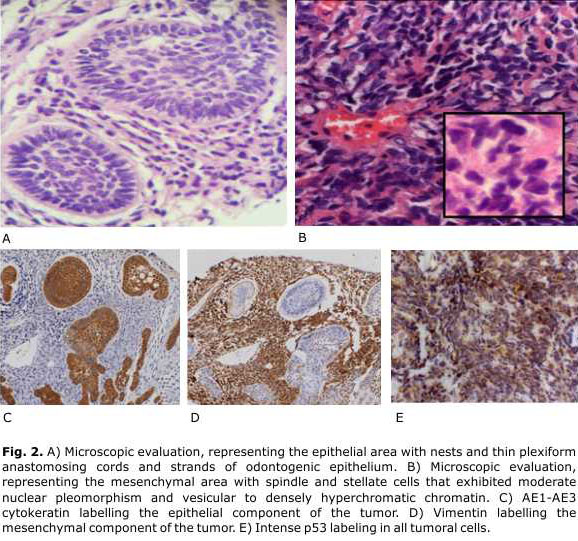
<body><![CDATA[<p>    <br>   <font face="Verdana" size="2">Incisional biopsy was performed under local anesthesia.    The histopathological evaluation revealed a mixed lesion with epithelial and    mesenchymal cellular proliferation. The epithelial portion was composed by nests    and thin plexiform anastomosing cords and strands of odontogenic epithelium    exhibiting peripheral palisading and reverses nuclear polarity, as well as small    central areas of stellate reticulum-like areas (<a href="#Fig2_11">Fig. 2A</a>).    The mesenchymal proliferation consisted on spindle and stellate cells that exhibited    moderate nuclear pleomorphism and vesicular to densely hyperchromatic chromatin.    Typical sarcomatous perivascular cellular concentration was also noted (<a href="#Fig2_11">Fig.    2B</a>). </font></p>     <p align="left"> <font face="Verdana" size="2">By immunohistoquemical analisys,    vimentin and cytokeratin AE1-AE3 were positive in mesenchymal and epithelial    components, respectively. Tumoral cells showed intense labeling by p53 (<a href="#Fig2_11">Fig.    2C</a>, <a href="#Fig2_11">2D</a>, <a href="#Fig2_11">2E</a>) The final diagnosis    was ameloblastic fibrosarcoma.</font></p>     <p align="center">    <br>   <a name="Fig2_11"></a><img src="/img/revistas/est/v53n2/f0211216.jpg" width="578" height="541"></p>     <p><font face="Verdana" size="2">     <br>   The treatment consisted in surgical excision followed by area reconstruction.    The lesion was accessed through submandibular approach under general anesthesia,    and hemimandibulectomy and selective neck dissection (level I) were preformed.    A titanium plate was placed for mandibular reconstruction. One month after surgery,    the patient returned for routine evaluation. Eight months after surgery, patient    presented a good recover without complications or recurrence signals (<a href="#fig3_11">Fig.    3</a>). </font></p>     <p align="center"><a name="fig3_11"></a> <img src="/img/revistas/est/v53n2/f0311216.jpg" width="421" height="444"></p>     <p>&nbsp; </p>     <p><font face="Verdana" size="2"><b><font size="3">DISCUSSION</font></b> </font></p>     ]]></body>
<body><![CDATA[<p><font face="Verdana" size="2"> Head and neck sarcoma are rare tumors, corresponding    to 4 %-10 % of all sarcoma. In maxillofacial area, these tumors are even rarer,    representing less than 5 % of all odontogenic tumors, and AFS is the less frequent    from all types of sarcoma <sup>9,12-14</sup>. Only a third of currently published    cases of AFS have originated from a recurrent AF, and this may be the cause    of doubtful etiology.<sup>8,10,11</sup> </font></p>     <p><font face="Verdana" size="2"> Clinically, the tumor presents painful swelling    and fast growth as.<sup>8-11 </sup>The case hereby presented seems to be even    rarer, since the patient is a woman. However, except for paresthesia, all clinical    symptoms were observed. </font></p>     <p><font face="Verdana" size="2"> A substantial number of conditions affecting    the jaws may present tumor radiographic appearance. The differential diagnosis    includes other odontogenic sarcomas, specifically those entities that present    similar histological features, such as ameloblastic fibrodentinosarcoma and    fibro-odontosarcoma.<sup>13</sup> Because of the rapid growth, and intraoral    and images aspects the lesion was thought to be a malignant odontogenic tumor.    These entities are rare as primary head and neck lesions arising within the    jaws, less than 2-3% of all oral and maxillofacial specimens sent for diagnosis    to oral pathology services and 0.002-0.003 % is the estimate rate comparing    to hole body tumors.<sup>15,16</sup> This rarity makes the specific diagnosis    really challenging.<sup>15</sup> </font></p>     <p><font face="Verdana" size="2"> Radiographically, AFS appear as a radiolucent    lesion with ill-defined borders.<sup>2,3,5,13,14</sup> Cortical may be eroded.<sup>2,3,9</sup>    Images from CT exam usually present an invasive mass with cortical expansion    and perforation.<sup>2,3,11</sup> CT is the method of choice for AFS evaluation,    since it allows the observation of lesion's real expansion and adjacent structures    involvement without image superimposition or distortions.<sup>11</sup> The panoramic    radiography from the patient revealed the same features described in the literature.    Besides that, CT images clearly showed cortical expansion and destruction, tooth    involvement and loss of architecture of mandibular canal. Moreover, the low    penetration of contrast during CT exam emphasizes the solid aspect of the lesion.    </font></p>     <p><font face="Verdana" size="2"> The microscopic features can be divided into    two parts: the benign epithelial part, similar to ameloblastic lesion, and malignant    mesenchymal part, with sarcomatous aspects.<sup>5,6,8-11,14</sup> The epithelium    presents columnar cells, with hyperchromatic nucleus. At mesenchymal tissue    the cells are fusiform, with marked pleomorphism, hyperchromatism and abnormal    mitotic figures.<sup>5,8-11,13</sup> The importance and relevance of imunohistochemical    analysis was also addressed, especially in cases of recurrence, with mitotic    activity increased at mesenchyme and decreased epithelial evidences <sup>17</sup>.    Despite the fact that there was no previous lesion, we have decided to investigate    the lesion by imunohistochemical approach. The evaluation included vimentin    and citokeratins AE1-AE3, and the results revealed the mixed outline of the    lesion. The p53 evaluation also proved the alterations are well noticed at sarcomatous    lesion. </font></p>     <p><font face="Verdana" size="2"> The treatment of choice is surgical excision    with clear margins, because AFS is a very invasive and recurrent lesion.<sup>1,3,4,6-11,13</sup>    Some authors also include a combination of chemotherapy, radiotherapy.<sup>4,7,14    </sup>In the current case, the surgical excision was performed, without any    recommendations of chemotherapy or radiotherapy as coadjutant treatment. After    eight months from surgery, the patient didn't show any evidence of recurrence.    </font></p>     <p><font face="Verdana" size="2"> In conclusion, a rare case of an AFS is presented.    The radiographic appearance, even imperative for treatment planning, poorly    contributed to final diagnosis, which was reached by histopathological and immunohistochemical    evaluations. The treatment is still controversial, without a definition regarding    chemotherapy and radiotherapy as coadjutant treatment. </font></p>     <p>    <br>       <br>   <font face="Verdana" size="2"><b><font size="3">Conflictos de intereses</font></b>    </font></p>     ]]></body>
<body><![CDATA[<p><font face="Verdana" size="2"> Los autores no declaran conflictos de intereses.    </font></p>     <p>&nbsp; </p>     <p><font face="Verdana" size="2"><b><font size="3">BIBLIOGRAPHIC REFERENCES</font></b>    </font></p>     <!-- ref --><p><font face="Verdana" size="2">1. Noordhoek R, Pizer ME, Laskin DM. Ameloblastic    fibrosarcoma of the mandible: treatment, long-term follow-up, and subsequent    reconstruction of a case. J Oral Maxillofac Surg. 2012 Dec;70(12):2930-5.     </font></p>     <!-- ref --><p><font face="Verdana" size="2"> 2. Khalili M, Shakib PA. Ameloblastic fibrosarcoma    of the upper jaw: Report of a rare case with long-term follow-up. Dent Res J    (Isfahan). 2013 Jan;10(1):112-5.     </font></p>     <!-- ref --><p><font face="Verdana" size="2"> 3. Wang BY. Head and neck pathology: SS13-1    Ameloblastic fibrosarcoma of mandible. Pathology. 2014 Oct;46 Suppl 2:S18.     </font></p>     <!-- ref --><p><font face="Verdana" size="2"> 4. Hu YY, Deng MH, Yuan LL, Niu YM. Ameloblastic    fibrosarcoma of the mandible: A case report and mini review. Exp Ther Med. 2014    Nov;8(5):1463-6.     </font></p>     <!-- ref --><p><font face="Verdana" size="2"> 5. Loya-Solis A, Gonz&#225;lez-Colunga KJ, P&#233;rez-Rodr&#237;guez    CM, Ram&#237;rez-Ochoa NS, Cece&#241;as-Falc&#243;n L, Barboza-Quintana O. Ameloblastic    fibrosarcoma of the mandible: a case report and brief review of the literature.    Case Rep Pathol. 2015;2015:245026. doi: 10.1155/2015/245026. Epub 2015 Mar 10.        </font></p>     <!-- ref --><p><font face="Verdana" size="2"> 6. Al Shetawi H, Alpert EH, Buchbinder D, Urken    ML. Ameloblastic Fibrosarcoma of the Mandible: A Case Report and a Review of    the Literature. J Oral Maxillofac Surg. 2015 Aug;73(8):1661.e1-7.     </font></p>     <!-- ref --><p><font face="Verdana" size="2"> 7. Pourdanesh F, Mohamadi M, Moshref M, Soltaninia    O. Ameloblastic Fibrosarcoma of the Mandible With Distant Metastases. J Oral    Maxillofac Surg. 2015 Jul 11.     </font></p>     <!-- ref --><p><font face="Verdana" size="2"> 8. Barnes L, Eveson JW, Reichart P, Sidransky    D (Eds.): World Health Organization Classification of Tumours. Pathology and    Genetics of Head and Neck Tumours. Lyon: IARC Press; 2005.     </font></p>     <!-- ref --><p><font face="Verdana" size="2"> 9. Kousar A, Hosein MM, Ahmed Z, Minhas K. Rapid    sarcomatous transformation of an ameloblastic fibroma of the mandible: case    report and literature review. Oral Surg Oral Med Oral Pathol Oral Radiol Endod.    2009 Sep;108(3):e80-5.     </font></p>     <!-- ref --><p><font face="Verdana" size="2"> 10. Kobayashi K, Murakami R, Fujii T, Hirano    A. Malignant transformation of ameloblastic fibroma to ameloblastic fibrosarcoma:    case report and review of the literature. J Craniomaxillofac Surg. 2005 Oct;33(5):352-5.        </font></p>     <!-- ref --><p><font face="Verdana" size="2"> 11. Zabolinejad N, Hiradfar M, Anvari K, Razavi    AS. Ameloblastic fibrosarcoma of the maxillary sinus in an infant: a case report    with long-term follow-up. J Pediatr Surg. 2008 Feb;43(2):e5-8.     </font></p>     <!-- ref --><p><font face="Verdana" size="2"> 12. Yamaguchi S, Nagasawa H, Suzuki T, Fujii    E, Iwaki H, Takagi M, et al. Sarcomas of the oral and maxillofacial region:    a review of 32 cases in 25 years. Clin Oral Investig. 2004 Jun;8(2):52-5.     </font></p>     <!-- ref --><p><font face="Verdana" size="2"> 13. Chaisuparat R, Sawangarun W, Scheper MA.    A clinicopathological study of malignant odontogenic tumours. Histopathology.    2012 Jul;61(1):107-12.     </font></p>     <!-- ref --><p><font face="Verdana" size="2"> 14. Philipsen HP, Reichart PA. Classification    of odontogenic tumours. A historical review. J Oral Pathol Med. 2006 Oct;35(9):525-9.        </font></p>     <!-- ref --><p><font face="Verdana" size="2"> 15. Gupta N, Barwad A, Kumar R, Rijuneeta, Vaiphei    K. Ameloblastic fibrosarcoma: A cytologist's perspective. Diagn Cytopathol.    2011 Aug;39(8):598-602.     </font></p>     <!-- ref --><p><font face="Verdana" size="2"> 16. Gilani SM, Raza A, Al-Khafaji BM. Ameloblastic    fibrosarcoma: a rare malignant odontogenic tumor. Eur Ann Otorhinolaryngol Head    Neck Dis. 2014 Feb;131(1):53-6.     </font></p>     <!-- ref --><p><font face="Verdana" size="2"> 17. Akinyamoju AO, Olusanya AA, Adeyemi BF,    Kolude B. Ameloblastic fibrosarcoma: Report of a case. J Oral Maxillofac Pathol.    2013 Sep;17(3):424-6.     </font></p>     <p>&nbsp;</p>     <p>&nbsp;</p>     <p><font face="Verdana" size="2">Recibido: 3 de diciembre de 2012. </font>    ]]></body>
<body><![CDATA[<br>   <font face="Verdana" size="2">Aprobado: 4 de febrero de 2016. </font></p>     <p>&nbsp; </p>     <p>&nbsp;</p>     <p><font face="Verdana" size="2"><i>Marcelo Marcucci.</i> Department of Stomatology,    Heli&#243;polis Hospital, S&#227;o Paulo, SP, Brazil. </font>    <br>   <font face="Verdana" size="2">Correo electr&#243;nico: <a href="mailto:marcucci21@gmail.com">marcucci21@gmail.com</a>    </font></p>     <p>&nbsp;</p>     <p>&nbsp;</p>     <p><font face="Verdana" size="2">__________________________ </font></p>     <p><font face="Verdana" size="2"> <a name="ras"></a><a href="#as">*</a> This case    was presented at 59<sup>th</sup> Annual Session of the American Academy of Oral    and Maxillofacial Radiology (Pittsburgh, PA/USA - 2008) as an Oral Presentation.    </font></p>        ]]></body><back>
<ref-list>
<ref id="B1">
<label>1</label><nlm-citation citation-type="journal">
<person-group person-group-type="author">
<name>
<surname><![CDATA[Noordhoek]]></surname>
<given-names><![CDATA[R]]></given-names>
</name>
<name>
<surname><![CDATA[Pizer]]></surname>
<given-names><![CDATA[ME]]></given-names>
</name>
<name>
<surname><![CDATA[Laskin]]></surname>
<given-names><![CDATA[DM]]></given-names>
</name>
</person-group>
<article-title xml:lang="en"><![CDATA[Ameloblastic fibrosarcoma of the mandible: treatment, long-term follow-up, and subsequent reconstruction of a case]]></article-title>
<source><![CDATA[J Oral Maxillofac Surg]]></source>
<year>2012</year>
<month>12</month>
<volume>70</volume>
<numero>12</numero>
<issue>12</issue>
<page-range>2930-5</page-range></nlm-citation>
</ref>
<ref id="B2">
<label>2</label><nlm-citation citation-type="journal">
<person-group person-group-type="author">
<name>
<surname><![CDATA[Khalili]]></surname>
<given-names><![CDATA[M]]></given-names>
</name>
<name>
<surname><![CDATA[Shakib]]></surname>
<given-names><![CDATA[PA]]></given-names>
</name>
</person-group>
<article-title xml:lang="en"><![CDATA[Ameloblastic fibrosarcoma of the upper jaw: Report of a rare case with long-term follow-up]]></article-title>
<source><![CDATA[Dent Res J (Isfahan)]]></source>
<year>2013</year>
<month>01</month>
<volume>10</volume>
<numero>1</numero>
<issue>1</issue>
<page-range>112-5</page-range></nlm-citation>
</ref>
<ref id="B3">
<label>3</label><nlm-citation citation-type="journal">
<person-group person-group-type="author">
<name>
<surname><![CDATA[Wang]]></surname>
<given-names><![CDATA[BY]]></given-names>
</name>
</person-group>
<article-title xml:lang="en"><![CDATA[Head and neck pathology: SS13-1 Ameloblastic fibrosarcoma of mandible]]></article-title>
<source><![CDATA[Pathology]]></source>
<year>2014</year>
<month>10</month>
<volume>46</volume>
<numero>^s2</numero>
<issue>^s2</issue>
<supplement>2</supplement>
<page-range>S18</page-range></nlm-citation>
</ref>
<ref id="B4">
<label>4</label><nlm-citation citation-type="journal">
<person-group person-group-type="author">
<name>
<surname><![CDATA[Hu]]></surname>
<given-names><![CDATA[YY]]></given-names>
</name>
<name>
<surname><![CDATA[Deng]]></surname>
<given-names><![CDATA[MH]]></given-names>
</name>
<name>
<surname><![CDATA[Yuan]]></surname>
<given-names><![CDATA[LL]]></given-names>
</name>
<name>
<surname><![CDATA[Niu]]></surname>
<given-names><![CDATA[YM]]></given-names>
</name>
</person-group>
<article-title xml:lang="en"><![CDATA[Ameloblastic fibrosarcoma of the mandible: A case report and mini review]]></article-title>
<source><![CDATA[Exp Ther Med]]></source>
<year>2014</year>
<month>11</month>
<volume>8</volume>
<numero>5</numero>
<issue>5</issue>
<page-range>1463-6</page-range></nlm-citation>
</ref>
<ref id="B5">
<label>5</label><nlm-citation citation-type="journal">
<person-group person-group-type="author">
<name>
<surname><![CDATA[Loya-Solis]]></surname>
<given-names><![CDATA[A]]></given-names>
</name>
<name>
<surname><![CDATA[González-Colunga]]></surname>
<given-names><![CDATA[KJ]]></given-names>
</name>
<name>
<surname><![CDATA[Pérez-Rodríguez]]></surname>
<given-names><![CDATA[CM]]></given-names>
</name>
<name>
<surname><![CDATA[Ramírez-Ochoa]]></surname>
<given-names><![CDATA[NS]]></given-names>
</name>
<name>
<surname><![CDATA[Ceceñas-Falcón]]></surname>
<given-names><![CDATA[L]]></given-names>
</name>
<name>
<surname><![CDATA[Barboza-Quintana]]></surname>
<given-names><![CDATA[O]]></given-names>
</name>
</person-group>
<article-title xml:lang="en"><![CDATA[Ameloblastic fibrosarcoma of the mandible: a case report and brief review of the literature]]></article-title>
<source><![CDATA[Case Rep Pathol]]></source>
<year>2015</year>
<volume>2015</volume>
<page-range>245026</page-range></nlm-citation>
</ref>
<ref id="B6">
<label>6</label><nlm-citation citation-type="journal">
<person-group person-group-type="author">
<name>
<surname><![CDATA[Al Shetawi]]></surname>
<given-names><![CDATA[H]]></given-names>
</name>
<name>
<surname><![CDATA[Alpert]]></surname>
<given-names><![CDATA[EH]]></given-names>
</name>
<name>
<surname><![CDATA[Buchbinder]]></surname>
<given-names><![CDATA[D]]></given-names>
</name>
<name>
<surname><![CDATA[Urken]]></surname>
<given-names><![CDATA[ML]]></given-names>
</name>
</person-group>
<article-title xml:lang="en"><![CDATA[Ameloblastic Fibrosarcoma of the Mandible: A Case Report and a Review of the Literature]]></article-title>
<source><![CDATA[J Oral Maxillofac Surg]]></source>
<year>2015</year>
<month> A</month>
<day>ug</day>
<volume>73</volume>
<numero>8</numero>
<issue>8</issue>
<page-range>1661.e1-7</page-range></nlm-citation>
</ref>
<ref id="B7">
<label>7</label><nlm-citation citation-type="journal">
<person-group person-group-type="author">
<name>
<surname><![CDATA[Pourdanesh]]></surname>
<given-names><![CDATA[F]]></given-names>
</name>
<name>
<surname><![CDATA[Mohamadi]]></surname>
<given-names><![CDATA[M]]></given-names>
</name>
<name>
<surname><![CDATA[Moshref]]></surname>
<given-names><![CDATA[M]]></given-names>
</name>
<name>
<surname><![CDATA[Soltaninia]]></surname>
<given-names><![CDATA[O]]></given-names>
</name>
</person-group>
<article-title xml:lang="en"><![CDATA[Ameloblastic Fibrosarcoma of the Mandible With Distant Metastases]]></article-title>
<source><![CDATA[J Oral Maxillofac Surg]]></source>
<year>2015</year>
<month> J</month>
<day>ul</day>
</nlm-citation>
</ref>
<ref id="B8">
<label>8</label><nlm-citation citation-type="book">
<person-group person-group-type="author">
<name>
<surname><![CDATA[Barnes]]></surname>
<given-names><![CDATA[L]]></given-names>
</name>
<name>
<surname><![CDATA[Eveson]]></surname>
<given-names><![CDATA[JW]]></given-names>
</name>
<name>
<surname><![CDATA[Reichart]]></surname>
<given-names><![CDATA[P]]></given-names>
</name>
<name>
<surname><![CDATA[Sidransky]]></surname>
<given-names><![CDATA[D]]></given-names>
</name>
</person-group>
<source><![CDATA[World Health Organization Classification of Tumours: Pathology and Genetics of Head and Neck Tumours]]></source>
<year>2005</year>
<publisher-loc><![CDATA[Lyon ]]></publisher-loc>
<publisher-name><![CDATA[IARC Press]]></publisher-name>
</nlm-citation>
</ref>
<ref id="B9">
<label>9</label><nlm-citation citation-type="journal">
<person-group person-group-type="author">
<name>
<surname><![CDATA[Kousar]]></surname>
<given-names><![CDATA[A]]></given-names>
</name>
<name>
<surname><![CDATA[Hosein]]></surname>
<given-names><![CDATA[MM]]></given-names>
</name>
<name>
<surname><![CDATA[Ahmed]]></surname>
<given-names><![CDATA[Z]]></given-names>
</name>
<name>
<surname><![CDATA[Minhas]]></surname>
<given-names><![CDATA[K]]></given-names>
</name>
</person-group>
<article-title xml:lang="en"><![CDATA[Rapid sarcomatous transformation of an ameloblastic fibroma of the mandible: case report and literature review]]></article-title>
<source><![CDATA[Oral Surg Oral Med Oral Pathol Oral Radiol Endod]]></source>
<year>2009</year>
<month>09</month>
<volume>108</volume>
<numero>3</numero>
<issue>3</issue>
<page-range>e80-5</page-range></nlm-citation>
</ref>
<ref id="B10">
<label>10</label><nlm-citation citation-type="journal">
<person-group person-group-type="author">
<name>
<surname><![CDATA[Kobayashi]]></surname>
<given-names><![CDATA[K]]></given-names>
</name>
<name>
<surname><![CDATA[Murakami]]></surname>
<given-names><![CDATA[R]]></given-names>
</name>
<name>
<surname><![CDATA[Fujii]]></surname>
<given-names><![CDATA[T]]></given-names>
</name>
<name>
<surname><![CDATA[Hirano]]></surname>
<given-names><![CDATA[A]]></given-names>
</name>
</person-group>
<article-title xml:lang="en"><![CDATA[Malignant transformation of ameloblastic fibroma to ameloblastic fibrosarcoma: case report and review of the literature]]></article-title>
<source><![CDATA[J Craniomaxillofac Surg]]></source>
<year>2005</year>
<month>10</month>
<volume>33</volume>
<numero>5</numero>
<issue>5</issue>
<page-range>352-5</page-range></nlm-citation>
</ref>
<ref id="B11">
<label>11</label><nlm-citation citation-type="journal">
<person-group person-group-type="author">
<name>
<surname><![CDATA[Zabolinejad]]></surname>
<given-names><![CDATA[N]]></given-names>
</name>
<name>
<surname><![CDATA[Hiradfar]]></surname>
<given-names><![CDATA[M]]></given-names>
</name>
<name>
<surname><![CDATA[Anvari]]></surname>
<given-names><![CDATA[K]]></given-names>
</name>
<name>
<surname><![CDATA[Razavi]]></surname>
<given-names><![CDATA[AS]]></given-names>
</name>
</person-group>
<article-title xml:lang="en"><![CDATA[Ameloblastic fibrosarcoma of the maxillary sinus in an infant: a case report with long-term follow-up]]></article-title>
<source><![CDATA[J Pediatr Surg]]></source>
<year>2008</year>
<month>02</month>
<volume>43</volume>
<numero>2</numero>
<issue>2</issue>
<page-range>e5-8</page-range></nlm-citation>
</ref>
<ref id="B12">
<label>12</label><nlm-citation citation-type="journal">
<person-group person-group-type="author">
<name>
<surname><![CDATA[Yamaguchi]]></surname>
<given-names><![CDATA[S]]></given-names>
</name>
<name>
<surname><![CDATA[Nagasawa]]></surname>
<given-names><![CDATA[H]]></given-names>
</name>
<name>
<surname><![CDATA[Suzuki]]></surname>
<given-names><![CDATA[T]]></given-names>
</name>
<name>
<surname><![CDATA[Fujii]]></surname>
<given-names><![CDATA[E]]></given-names>
</name>
<name>
<surname><![CDATA[Iwaki]]></surname>
<given-names><![CDATA[H]]></given-names>
</name>
<name>
<surname><![CDATA[Takagi]]></surname>
<given-names><![CDATA[M]]></given-names>
</name>
</person-group>
<article-title xml:lang="en"><![CDATA[Sarcomas of the oral and maxillofacial region: a review of 32 cases in 25 years]]></article-title>
<source><![CDATA[Clin Oral Investig]]></source>
<year>2004</year>
<month>06</month>
<volume>8</volume>
<numero>2</numero>
<issue>2</issue>
<page-range>52-5</page-range></nlm-citation>
</ref>
<ref id="B13">
<label>13</label><nlm-citation citation-type="journal">
<person-group person-group-type="author">
<name>
<surname><![CDATA[Chaisuparat]]></surname>
<given-names><![CDATA[R]]></given-names>
</name>
<name>
<surname><![CDATA[Sawangarun]]></surname>
<given-names><![CDATA[W]]></given-names>
</name>
<name>
<surname><![CDATA[Scheper]]></surname>
<given-names><![CDATA[MA]]></given-names>
</name>
</person-group>
<article-title xml:lang="en"><![CDATA[A clinicopathological study of malignant odontogenic tumours]]></article-title>
<source><![CDATA[Histopathology]]></source>
<year>2012</year>
<month>07</month>
<volume>61</volume>
<numero>1</numero>
<issue>1</issue>
<page-range>107-12</page-range></nlm-citation>
</ref>
<ref id="B14">
<label>14</label><nlm-citation citation-type="journal">
<person-group person-group-type="author">
<name>
<surname><![CDATA[Philipsen]]></surname>
<given-names><![CDATA[HP]]></given-names>
</name>
<name>
<surname><![CDATA[Reichart]]></surname>
<given-names><![CDATA[PA]]></given-names>
</name>
</person-group>
<article-title xml:lang="en"><![CDATA[Classification of odontogenic tumours: A historical review]]></article-title>
<source><![CDATA[J Oral Pathol Med]]></source>
<year>2006</year>
<month>10</month>
<volume>35</volume>
<numero>9</numero>
<issue>9</issue>
<page-range>525-9</page-range></nlm-citation>
</ref>
<ref id="B15">
<label>15</label><nlm-citation citation-type="journal">
<person-group person-group-type="author">
<name>
<surname><![CDATA[Gupta]]></surname>
<given-names><![CDATA[N]]></given-names>
</name>
<name>
<surname><![CDATA[Barwad]]></surname>
<given-names><![CDATA[A]]></given-names>
</name>
<name>
<surname><![CDATA[Kumar]]></surname>
<given-names><![CDATA[R]]></given-names>
</name>
<name>
<surname><![CDATA[Rijuneeta]]></surname>
</name>
<name>
<surname><![CDATA[Vaiphei]]></surname>
<given-names><![CDATA[K]]></given-names>
</name>
</person-group>
<article-title xml:lang="en"><![CDATA[Ameloblastic fibrosarcoma: A cytologist's perspective]]></article-title>
<source><![CDATA[Diagn Cytopathol]]></source>
<year>2011</year>
<month>08</month>
<volume>39</volume>
<numero>8</numero>
<issue>8</issue>
<page-range>598-602</page-range></nlm-citation>
</ref>
<ref id="B16">
<label>16</label><nlm-citation citation-type="journal">
<person-group person-group-type="author">
<name>
<surname><![CDATA[Gilani]]></surname>
<given-names><![CDATA[SM]]></given-names>
</name>
<name>
<surname><![CDATA[Raza]]></surname>
<given-names><![CDATA[A]]></given-names>
</name>
<name>
<surname><![CDATA[Al-Khafaji]]></surname>
<given-names><![CDATA[BM]]></given-names>
</name>
</person-group>
<article-title xml:lang="en"><![CDATA[Ameloblastic fibrosarcoma: a rare malignant odontogenic tumor]]></article-title>
<source><![CDATA[Eur Ann Otorhinolaryngol Head Neck Dis]]></source>
<year>2014</year>
<month>02</month>
<volume>131</volume>
<numero>1</numero>
<issue>1</issue>
<page-range>53-6</page-range></nlm-citation>
</ref>
<ref id="B17">
<label>17</label><nlm-citation citation-type="journal">
<person-group person-group-type="author">
<name>
<surname><![CDATA[Akinyamoju]]></surname>
<given-names><![CDATA[AO]]></given-names>
</name>
<name>
<surname><![CDATA[Olusanya]]></surname>
<given-names><![CDATA[AA]]></given-names>
</name>
<name>
<surname><![CDATA[Adeyemi]]></surname>
<given-names><![CDATA[BF]]></given-names>
</name>
<name>
<surname><![CDATA[Kolude]]></surname>
<given-names><![CDATA[B]]></given-names>
</name>
</person-group>
<article-title xml:lang="en"><![CDATA[Ameloblastic fibrosarcoma: Report of a case]]></article-title>
<source><![CDATA[J Oral Maxillofac Pathol]]></source>
<year>2013</year>
<month>09</month>
<volume>17</volume>
<numero>3</numero>
<issue>3</issue>
<page-range>424-6</page-range></nlm-citation>
</ref>
</ref-list>
</back>
</article>