<?xml version="1.0" encoding="ISO-8859-1"?><article xmlns:mml="http://www.w3.org/1998/Math/MathML" xmlns:xlink="http://www.w3.org/1999/xlink" xmlns:xsi="http://www.w3.org/2001/XMLSchema-instance">
<front>
<journal-meta>
<journal-id>0034-7507</journal-id>
<journal-title><![CDATA[Revista Cubana de Estomatología]]></journal-title>
<abbrev-journal-title><![CDATA[Rev Cubana Estomatol]]></abbrev-journal-title>
<issn>0034-7507</issn>
<publisher>
<publisher-name><![CDATA[Editorial Ciencias Médicas]]></publisher-name>
</publisher>
</journal-meta>
<article-meta>
<article-id>S0034-75072018000100007</article-id>
<title-group>
<article-title xml:lang="en"><![CDATA[Alternatives of surface treatments for adhesion of lithium disilicate ceramics]]></article-title>
<article-title xml:lang="es"><![CDATA[Alternativas de tratamientos de superficie para adhesión de cerámica de disilicado de litio]]></article-title>
</title-group>
<contrib-group>
<contrib contrib-type="author">
<name>
<surname><![CDATA[Cruz González]]></surname>
<given-names><![CDATA[Alberto Carlos]]></given-names>
</name>
<xref ref-type="aff" rid="A1"/>
</contrib>
<contrib contrib-type="author">
<name>
<surname><![CDATA[Delgado Mejía]]></surname>
<given-names><![CDATA[Edgar]]></given-names>
</name>
<xref ref-type="aff" rid="A2"/>
</contrib>
</contrib-group>
<aff id="AA1">
<institution><![CDATA[,Universidad Nacional de Colombia Faculty of Dentistry Department of Oral Health]]></institution>
<addr-line><![CDATA[Bogotá ]]></addr-line>
<country>Colombia</country>
</aff>
<aff id="AA2">
<institution><![CDATA[,Universidad Nacional de Colombia Faculty of Sciences Department of Chemistry]]></institution>
<addr-line><![CDATA[Bogotá ]]></addr-line>
<country>Colombia</country>
</aff>
<pub-date pub-type="pub">
<day>00</day>
<month>03</month>
<year>2018</year>
</pub-date>
<pub-date pub-type="epub">
<day>00</day>
<month>03</month>
<year>2018</year>
</pub-date>
<volume>55</volume>
<numero>1</numero>
<fpage>59</fpage>
<lpage>72</lpage>
<copyright-statement/>
<copyright-year/>
<self-uri xlink:href="http://scielo.sld.cu/scielo.php?script=sci_arttext&amp;pid=S0034-75072018000100007&amp;lng=en&amp;nrm=iso"></self-uri><self-uri xlink:href="http://scielo.sld.cu/scielo.php?script=sci_abstract&amp;pid=S0034-75072018000100007&amp;lng=en&amp;nrm=iso"></self-uri><self-uri xlink:href="http://scielo.sld.cu/scielo.php?script=sci_pdf&amp;pid=S0034-75072018000100007&amp;lng=en&amp;nrm=iso"></self-uri><kwd-group>
<kwd lng="en"><![CDATA[glass ceramics]]></kwd>
<kwd lng="en"><![CDATA[IPS e.max Press]]></kwd>
<kwd lng="en"><![CDATA[IPS e.max CAD]]></kwd>
<kwd lng="en"><![CDATA[hydrofluoric acid]]></kwd>
<kwd lng="en"><![CDATA[lithium-disilicate-glass ceramic]]></kwd>
<kwd lng="en"><![CDATA[surface treatment]]></kwd>
<kwd lng="en"><![CDATA[silane]]></kwd>
<kwd lng="en"><![CDATA[universal adhesive]]></kwd>
<kwd lng="es"><![CDATA[cerámica vítrea]]></kwd>
<kwd lng="es"><![CDATA[IPS e.max Press]]></kwd>
<kwd lng="es"><![CDATA[IPS e.max CAD]]></kwd>
<kwd lng="es"><![CDATA[ácido fluorhídrico]]></kwd>
<kwd lng="es"><![CDATA[cerámica vítrea de disilicato de litio]]></kwd>
<kwd lng="es"><![CDATA[tratamiento de superficie]]></kwd>
<kwd lng="es"><![CDATA[silano]]></kwd>
<kwd lng="es"><![CDATA[adhesivo universal]]></kwd>
</kwd-group>
</article-meta>
</front><body><![CDATA[  <font face="Verdana, Arial, Helvetica, sans-serif" size="2"></font>     <p align="right"> <font face="Verdana, Arial, Helvetica, sans-serif" size="2"><b>ART&#205;CULO    DE REVISI&#211;N</b> </font></p>     <p>&nbsp; </p>     <p><font face="Verdana, Arial, Helvetica, sans-serif" size="2"><b><font size="4">Alternatives    of surface treatments for adhesion of lithium disilicate ceramics </font></b></font></p>     <p>&nbsp;</p>     <p> <font face="Verdana, Arial, Helvetica, sans-serif" size="2"><b><font size="3">Alternativas    de tratamientos de superficie para adhesi&#243;n de cer&#225;mica de disilicado    de litio</font></b> </font></p>     <p>&nbsp;</p>     <p align="center">&nbsp; </p>     <p><font face="Verdana, Arial, Helvetica, sans-serif" size="2"> <b>Alberto Carlos-Cruz    Gonz&#225;lez,<sup>I </sup>Edgar-Delgado Mej&#237;a<sup>II</sup> </b></font></p>     <p><font face="Verdana, Arial, Helvetica, sans-serif" size="2"><sup>I</sup> Department    of Oral Health, Faculty of Dentistry, Universidad Nacional de Colombia. Bogot&#225;,    Colombia.    ]]></body>
<body><![CDATA[<br>   </font><font face="Verdana, Arial, Helvetica, sans-serif" size="2"><sup>II</sup>    Department of Chemistry, Faculty of Sciences, Universidad Nacional de Colombia.    Bogot&#225;, Colombia.</font></p>     <p>&nbsp;</p>     <p>&nbsp; </p> <hr align="left">     <p> <font face="Verdana, Arial, Helvetica, sans-serif" size="2"><b>ABSTRACT</b>    </font></p>     <p> <font face="Verdana, Arial, Helvetica, sans-serif" size="2"><b>Introduction:</b>    the clinical success of a restoration is strongly associated with the quality    and durability of the ceramic-cement resin interface. In order to obtain an    adequate union between these materials of different nature surface treatments    are used and achieve mechanical retention or chemical interaction.     <br>   </font><font face="Verdana, Arial, Helvetica, sans-serif" size="2"><b>Objectives</b>:    to check if any method promotes a true chemical bond between lithium disilicate    ceramics and resin cement. As well as determineif there is any treatment that    reports bonding values comparable to hydrofluoric acid and silane (gold standard).    <br>   </font><font face="Verdana, Arial, Helvetica, sans-serif" size="2"><b>Methods:</b>    a systematic literature review was developed based on the PRISMA strategy, where    the databases were searched: Science Direct, Pubmed (MEDLINE), EMBASE, Springer    Journal, SciELO with MeSH and free terms from 2005 to November 2016 for articles    in English and Spanish on surface treatments for lithium disilicate.     <br>   </font><font face="Verdana, Arial, Helvetica, sans-serif" size="2"><b>Results:    </b> from 58 publications selected a sample of 21 articles. Two articles reported    high risk of bias.     <br>   </font><font face="Verdana, Arial, Helvetica, sans-serif" size="2"><b>Conclusions:    </b> hydrofluoric acid and silane continue to be the method with the highest    and most reliable adhesion values in the literature. Universal adhesives are    an alternative to promote chemical adhesion additional to the silane. Diamond    burs, Nd: YAG and Er: YAG laser are not recommended as surface treatments. </font></p>     <p> <font face="Verdana, Arial, Helvetica, sans-serif" size="2"><b>Keywords: </b>    glass ceramics; IPS e.max Press; IPS e.max CAD; hydrofluoric acid; lithium-disilicate-glass    ceramic; surface treatment; silane; universal adhesive.</font></p> <hr align="left">     ]]></body>
<body><![CDATA[<p><font face="Verdana, Arial, Helvetica, sans-serif" size="2"><b>RESUMEN </b>    </font></p>     <p><font size="2" face="Verdana, Arial, Helvetica, sans-serif"><b>Introducci&#243;n:</b>    el &#233;xito cl&#237;nico de una restauraci&#243;n se asocia fuertemente a    la calidad y duraci&#243;n de la interface cer&#225;mica-cemento resinoso. Para    que exista una adecuada uni&#243;n entre estos materiales de distinta naturaleza    se emplean tratamientos de superficie para lograr una buena retenci&#243;n mec&#225;nica    o interacci&#243;n qu&#237;mica.    <br>   </font><font size="2" face="Verdana, Arial, Helvetica, sans-serif"><b>Objetivos:</b>    revisar si alg&#250;n m&#233;todo promueve una verdadera adhesi&#243;n qu&#237;mica    entre la cer&#225;mica de disilicato de litio y el cemento resinoso, as&#237;    como determinar si existe alg&#250;n tratamiento que reporte valores de uni&#243;n    comparables al &#225;cido fluorh&#237;drico y silano (patr&#243;n de oro).    <br>   </font><font size="2" face="Verdana, Arial, Helvetica, sans-serif"><b>M&#233;todos:</b>    se desarroll&#243; una revisi&#243;n sistem&#225;tica de literatura basada en    la estrategia PRISMA, donde se busc&#243; en las bases de datos: Science Direct,    Pubmed (MEDLINE), EMBASE, Springer Journal, SciELO con t&#233;rminos MeSH y    libres desde el 2005 a noviembre de 2016 para art&#237;culos en ingl&#233;s    y espa&#241;ol sobre tratamientos de superficie para disilicato de litio.    <br>   </font><font size="2" face="Verdana, Arial, Helvetica, sans-serif"><b>Resultados:</b>    de 58 publicaciones, se seleccion&#243; una muestra de 21 art&#237;culos. Dos    art&#237;culos reportaron riesgo de sesgo alto.    <br>   </font><font size="2" face="Verdana, Arial, Helvetica, sans-serif"><b>Conclusiones:</b>    el &#225;cido fluorh&#237;drico y silano contin&#250;an siendo el m&#233;todo    con los valores de adhesi&#243;n m&#225;s altos y confiables de la literatura.    Los adhesivos universales son una alternativa para promover adhesi&#243;n qu&#237;mica    adicional al silano. Fresas diamantadas, laser Nd: YAG y Er:YAG no se recomienda    como tratamientos de superficie. </font></p>     <p> <font size="2" face="Verdana, Arial, Helvetica, sans-serif"><b>Palabras clave:</b>    cer&#225;mica v&#237;trea; IPS e.max Press; IPS e.max CAD; &#225;cido fluorh&#237;drico;    cer&#225;mica v&#237;trea de disilicato de litio; tratamiento de superficie;    silano; adhesivo universal. </font></p> <hr align="left">     <p>&nbsp;</p>     <p>&nbsp; </p>     <p> <font face="Verdana, Arial, Helvetica, sans-serif" size="2"><b><font size="3">INTRODUCTION</font></b>    </font></p>     ]]></body>
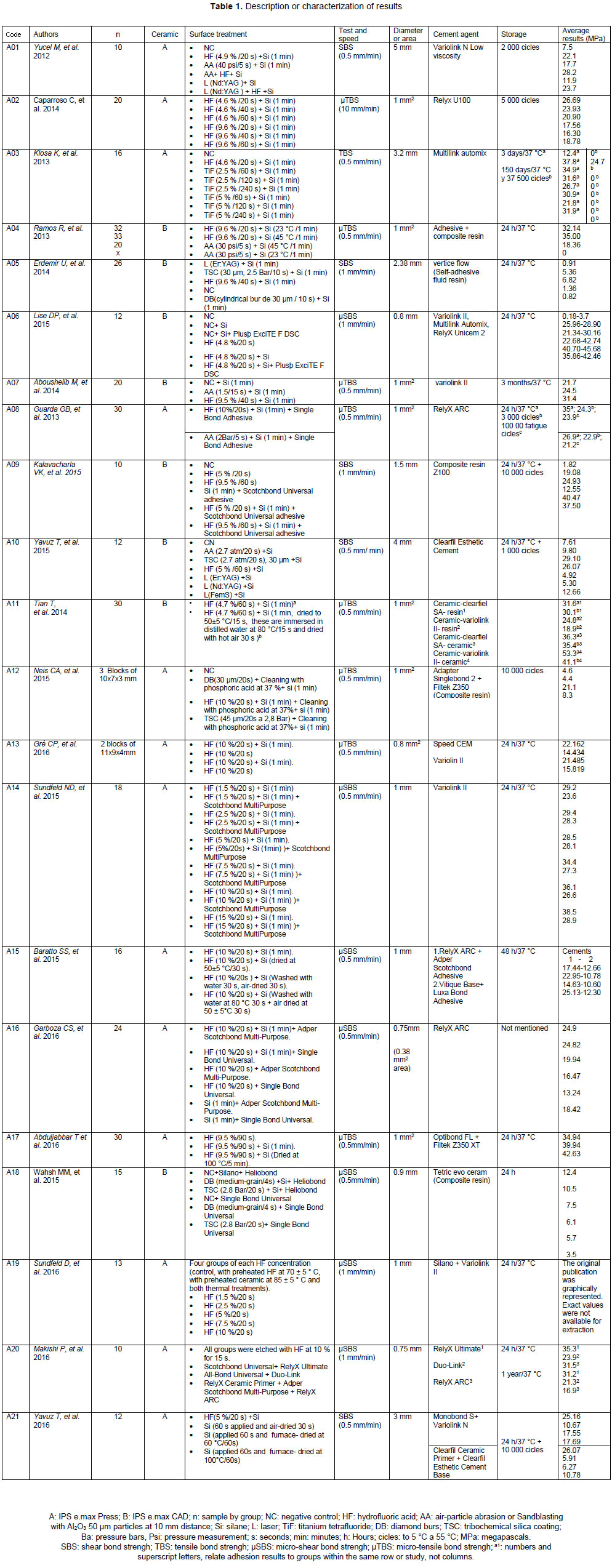
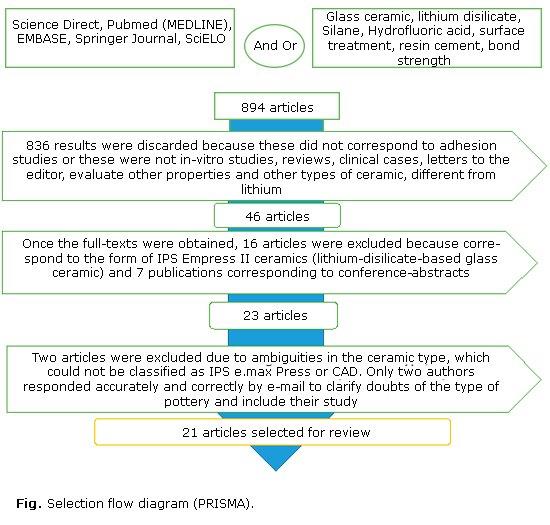
<body><![CDATA[<p><font face="Verdana, Arial, Helvetica, sans-serif" size="2"> There is a growing    demand for the use of all-ceramic restorations by dentists and patients, in    order to satisfy high needs as esthetic, biocompatibility and longevity.<sup>1</sup>    The lithium disilicate (Li <sub>2</sub>Si<sub>2</sub>O<sub>5</sub>) is a glassy    ceramic with a flexural strength average of 400 MPa and a favorable translucency,    indicating its to use in anterior and posterior sector.<sup>2</sup> This material    is recommended for inlays, veneers and anterior or posterior crowns supported    by teeth or implants.<sup>3</sup> The lithium disilicate system, IPS e.max<sup>TM</sup>,    reports a survival rate of 97.4 % and 94.8 % for five and nine years of use,    respectively, in anterior and posterior crowns.<sup>4</sup> For fixed prostheses    of three units, survival and success similar to metal-ceramic systems is reported    to 10-year old, with catastrophic failure only in molar teeth.<sup>5</sup> However,    the clinical success of a ceramic restoration does not only depend on the intrinsic    properties of the material, this is strongly associated with the quality and    duration of the resin cement-ceramic interface.<sup>6</sup> In order for there    to be an adequate bond between two materials of different nature, organic (resin    cement) and inorganic (ceramic), a conditioning is necessary to increase the    surface energy of the ceramic, and to improve its bonding to the cementing agent,    either by mechanical retention or chemical reaction.<sup>7</sup> </font></p>     <p><font face="Verdana, Arial, Helvetica, sans-serif" size="2"> The etching with    hydrofluoric acid followed by silanization is considered as the gold standard    surface treatment for vitreous ceramics.<sup>8</sup> Hydrofluoric acid, in concentrations    between 4.6 and 9.6 %, creates roughness on the surface by dissolving part of    the glass matrix, while the silane agent acts as a bifunctional molecule with    an organic and inorganic termination to promote chemical bonds.<sup>9</sup>    However, this etching is considered some controversial, as it is done with a    highly corrosive inorganic acid, which is a potential risk for those who manipulate.<sup>10</sup>    In addition, hydrofluoric acid may have a negative influence on the flexural    strength of the lithium disilicate, which decreases over time in contact and    concentration of the acid.<sup>11 </sup>Although, there are some reports of    the reinforcement of the mechanical properties once the cementing agent is applied    to the etched surface.<sup>12,13</sup> </font></p>     <p><font face="Verdana, Arial, Helvetica, sans-serif" size="2"> The objective    of this review was to check if any method promotes a true chemical bond between    lithium disilicate ceramics and resin cement, as well as to determine if among    the different methods proposed, there is one that reports bond values comparable    to those obtained with hydrofluoric acid and silane, currently considered as    the gold standard method. The review question was defined as: what methods exist    in the literature that promote adhesion by chemical and/or physical phenomena    similar or superior to the gold standard, defined as etching with hydrofluoric    acid and silane? </font></p>     <p>&nbsp;</p>     <p> <font face="Verdana, Arial, Helvetica, sans-serif" size="2"><b><font size="3">METHODOLOGY</font></b>    </font></p>     <p><font face="Verdana, Arial, Helvetica, sans-serif" size="2"> A systematic literature    review was developed based on the PRISMA strategy adapted forPereira et al.    en el 2016.<sup>14,15</sup> According to the PICOs strategy, the parameters    in this review were lithium disilicate ceramics, IPS e.max Press or CAD as the    population, surface treatments to define the intervention, without treatment    ceramic or surface treatment gold standard, etching with hydrofluoric acid and    silane as comparison, increase in adhesive or bond strength values as results    and <i>in vitro</i> experimental studies to define study design. </font></p>     <p><font face="Verdana, Arial, Helvetica, sans-serif" size="2"> An electronic    search was carried out in the databases Science Direct, Pubmed (MEDLINE), EMBASE,    Springer Journal, Scielowith the following MeSH and free terms: glass ceramic,    lithium disilicate, silane, hydrofluoric acid, surface treatment, resin cement,    bond strength by combining with the Boolean connectors AND and OR (<a href="#fig1">Fig.</a>).    For the Springer Journal database, "all words" were used to replace AND, "at    least one word" for OR and the exact phrase for quotation marks ("surface treatment").The    search combinations were as follows: glass ceramic AND silane OR hydrofluoric    acid OR "surface treatment" AND bond strength; lithium disilicate AND silane    OR hydrofluoric acid OR "surface treatment" AND bond strength; glass ceramic    AND "surface treatment" AND bond strength; lithium disilicate AND "surface treatment"    AND bond strength. For example in Em base the results added up to 644, 784,    39 and 8 with each search combination respectively. The cross-repeats were eliminated    in the search formulas and with the other databases, in order to finally select    five possible publications of Embase. A second example was the search in SciELO,    where we obtained 4, 1, 4, 1 publications respectively. Finally it filtered    to have only three possible publications to select.    <br>       <br>   </font></p>     <p align="center"><img src="/img/revistas/est/v55n1/f01-1525.jpg" width="550" height="525"><a name="fig1"></a></p>     ]]></body>
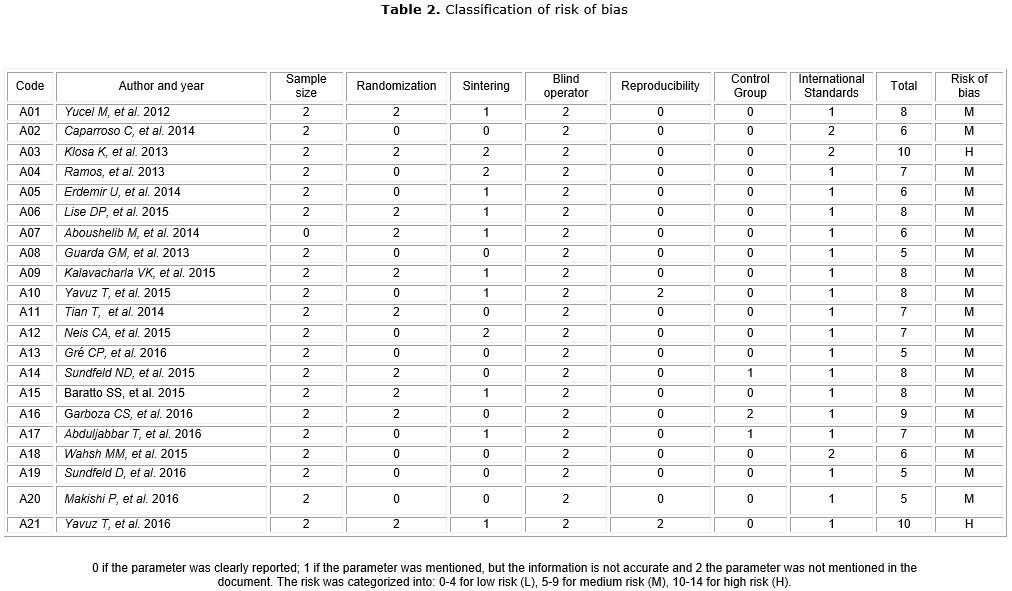
<body><![CDATA[<p><font face="Verdana, Arial, Helvetica, sans-serif" size="2"> Inclusion criteria    were defined as articles from experimental studies that evaluated the effect    of surface treatments on the bond strength of lithium disilicate ceramics (IPS    e.max Press and / or IPS e.max CAD), published in a period between 2005 and    November 2016, in English or Spanish. In addition, for inclusion in the sample    the publications should have a clear and reproducible methodology, a quantitative    measurement of the results, an inter-group comparative statistical analysis.    In contrast, clinical studies, literature reviews, clinical cases and letters    to the editor were excluded. In addition, publications with evaluation of only    IPS Empress II lithium disilicate ceramic or other form of disilicate than those    specified in this paper were excluded, publications in different period of established    range, confusing and non-specific methodologies, and studies with results that    did not report values bond strength. The selection and evaluation process of    all-articles was carried out by the two authors (A.C.C.G. and E.D.M.), but if    there were differences between evaluations, a third evaluator as a guest would    be used. </font></p>     <p><font face="Verdana, Arial, Helvetica, sans-serif" size="2"> For the evaluation    of the risk of bias of the publications, these were submitted to an instrument    that should answer the following questions: Was the size of the sample considered    representative?, randomization of ceramic samples?, ceramic sintering according    to manufacturer's specifications?, were the adhesive resistance tests performed    by an operator without risk of bias (blind)? the reproducible methodology?,    was there a positive and/or negative control group?, test executed following    International Standard Rules, as ISO, ASTM or other? The score for assessing    these questions was 0 to 2, where 0 if the parameter was clearly reported;1    if the parameter was mentioned, but the precision of the execution was not clear    and 2 the parameter was not mentioned in the document or the information was    not present. Finally, the risk was categorized into: 0-4 for low risk (L), 5-9    for medium risk (M), 10-14 for high risk (H).<sup>14 </sup>In the question of    norms for execution of tests, if the information was not observed in the study,    but the execution parameters correspond to the stipulated by the norms of adhesion    ISO were assigned value of 1 and not 2. If any author answered any questions    about the information in his study that would allow him to continue his selection,    the qualification of this study for risk of bias was made considering that such    missing or confusing information was not present (score 2). </font></p>     <p>&nbsp; </p>     <p><font face="Verdana, Arial, Helvetica, sans-serif" size="2"><b><font size="3">RESULTS</font></b>    </font></p>     <p><font face="Verdana, Arial, Helvetica, sans-serif" size="2"> The results of    the search determined 58 publications to review the full text, of which 21 articles    were finally selected for analysis in the review. The selection process is described    in <a href="#fig1">figure</a>. The characteristics of the information are described    in <a href="/img/revistas/est/v55n1/t01_1525.gif">table 1</a>. </font></p>     <p><font face="Verdana, Arial, Helvetica, sans-serif" size="2"> The results of    risk of bias reported two articles with high risk and the other 19 publications    presented an average risk. Only two publications (A10 and A21) were classified    as not reproducible because, although the author responded correctly on the    type of ceramic used and diameter dimensions of the adhesive area, the single    information within the article was not clear to identify those parameters. No    information was found on the knowledge or status of the operator of the tests    performed (blind operator). The results of risk of bias are described in <a href="/img/revistas/est/v55n1/t02_1525.gif">table    2</a>. </font></p>     <p align="center">&nbsp;</p>     <p> <font face="Verdana, Arial, Helvetica, sans-serif" size="2"><b><font size="3">DISCUSSION</font></b>    </font></p>     <p><font face="Verdana, Arial, Helvetica, sans-serif" size="2"> According to the    information obtained for this review, there are constant investigations of alternatives    for surface treatments or methods that optimize adhesion values, even by modifying    the established gold standard.In all the studies of the sample, the etching    with hydrofluoric acid followed by silane agent was evaluated, which allowed    to corroborate the affirmation that this association is considered as the positive    control group or gold standard in those investigations. </font></p>     <p><font face="Verdana, Arial, Helvetica, sans-serif" size="2">     ]]></body>
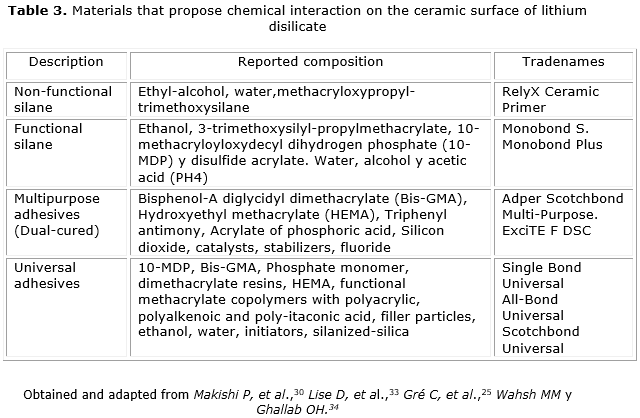
<body><![CDATA[<br>   HYDROFLUORIC ACID </font></p>     <p><font face="Verdana, Arial, Helvetica, sans-serif" size="2"> Hydrofluoric acid    etching followed by silane reports the best adhesive strength values compared    to other methods, such as sandblasting, lasers and roughening with diamond bur.<sup>16-20</sup>    Another alternative of etched agent for ceramics is titanium tetrafluoride.    It reported bond strength values similar to hydrofluoric acid, after a considerable    laboratory aging were observed in these samples debonded spontaneously, because    of this it does not yet allow to recommend the titanium tetrafluoride as a reasonable    substitute.<sup>21</sup> </font></p>     <p><font face="Verdana, Arial, Helvetica, sans-serif" size="2"> Hydrofluoric acid    etching is a protocol-sensitive method, with concentration and time of use as    variables that play a crucial role in bond strength values. The concentrations    currently available in the market are approximately 4.6 and 9.6 % and these    get to their best performance of bond strength in lithium disilicate between    20 and 60 s of etching.<sup>22</sup> Hydrofluoric acid concentrations influence    adhesion, such as assessed <i>Sundfeld et al.</i><sup>23 </sup>in 2015 where    they recorded for 20 s in concentrations of 1.5, 2.5, 5, 7.5, 10 and 15 %, determining    that 7.5 % presented better statistically significant values in relation to    the first three groups and without significant differences with higher concentrations.    The first three groups were statistically equal to each other.A second study    by the same authors evaluated the same model of the first five concentrations    of acid, but they added the temperature variable, heating the acid to 70 &#176;C    during etching or ceramic at 85 &#176;C with hot-air or a combination of both.    It was observed that the heat treatment in all its forms improved the adhesion    values for the first three groups, as for the groups of 7.5 and 10 % applying    the temperature methods separately had better result than when applied in combination,    values of the latter, which was even lower than the control groups.<sup>24</sup>    This opens the possibility of decreasing concentrations of the etching agent    by maintaining the levels of adhesion offered by this method, however these    variables require more research and evaluation in the long term to formulate    comparable results. </font></p>     <p><font face="Verdana, Arial, Helvetica, sans-serif" size="2">     <br>   SILANE </font></p>     <p><font face="Verdana, Arial, Helvetica, sans-serif" size="2"> On the other hand    is the silane coupling agents, it is preceded by a mechanical-retention method    such as hydrofluoric acid,the silane proved to increase the values of bond strength,    compared to the single action of roughness or mechanical-retention.<sup>25</sup>    A modification in the silanization protocol includesthe elevation of temperature    of the silane when drying it with hot air<sup>17,26,27 </sup>or in some cases    washed with hot water,<sup>28,29</sup> it in order to obtain an optimize the    adhesive results. According to the increase in temperature, drying at 45 &#176;C    associated with an non-functional silane does not appear to significantly increase    bond strength values.<sup>17</sup> <i>Abduljabbar et al.</i> <sup>26 </sup>reported    that a functional silane subsequent to etching with hydrofluoric acid increases    the adhesion values as compared to the etch alone, further the drying at 100    &#176;C for 5 min significantly improves the results compared to the two previous    groups. According to the limited information obtained, the drying at temperatures    between 45 to 100 &#176;C of silane agents can improve on average between 2    and 3 MPa the values of adhesive strength in lithium disilicate, compared to    drying at room temperature.<sup>17,26</sup> <i>Meanwhile Yavuz et al.</i><sup>27    </sup>tested temperatures of 60 and 100 &#176;C in two commercial functional    silane systems, where they reported higher differences (between about 4.7 and    6.8 MPa) of adhesive strength compared to drying at room temperature. However,    no differences were observed between both tested temperatures, but there were    commercial silane houses with this protocol. All of the above may mean that    the drying at higher temperatures of both functional and non-functional silanes,    is not a procedure as indispensable as the use of silane itself after the acid    etching in the dental ceramics analyzed in this review. But it is clear that    it can increase the adhesive bond strength. </font></p>     <p><font face="Verdana, Arial, Helvetica, sans-serif" size="2"> For the second    modification of the silane protocol, washing with distilled water at 80 &#176;C    for 15 or 30 s after application of silane, this proved to be a procedure without    significant influence for the adhesion as compared to the drying with hot air.<sup>28,29</sup>    Therefore, when it is decided to include a protocol with temperature associated    with the silane, it is sufficient to dry with hot air and it is not necessary    to add the washing with hot water to the protocol.<sup>29</sup> Elevating the    temperature of the silane, with hot air, it is conducted in order to remove    by-products and the vehicle (acetic acid, water and alcohol) in order to make    the reaction efficient, promoting the initiation of siloxanes.<sup>27,29</sup>    On the other hand, washing with hot water goes towards decreasing the layer    thickness, eliminating external layers of the silane that are covalently bonded    together, and this allows the reaction of the layer most strongly chemically-bonded    to the ceramic surface.<sup>29</sup> </font></p>     <p><font face="Verdana, Arial, Helvetica, sans-serif" size="2">     <br>   UNIVERSAL ADHESIVES AND MULTIPURPOSE ADHESIVES </font></p>     <p><font face="Verdana, Arial, Helvetica, sans-serif" size="2"> Another relatively    recently studied chemical alternative is multimodal or multipurpose adhesives    and universal adhesives (<a href="/img/revistas/est/v55n1/t03_1525.gif">table 3</a>). Universal adhesives    are simplified adhesives in a single bottle, suitable for different substrates    such as dentin, enamel, resins, alloys and ceramics.<sup>30</sup> Universal    adhesives contain silane and phosphate monomers called 10-methacryloxydecyl    dihydrogen phosphate (MDP), these monomers are responsible for the adhesive    capacity of these adhesives between the ceramic, polymeric and dental substrates.<sup>31</sup>    On the other hand, the multipurpose adhesives are systems with option of dual-polymerization,    or only chemical that are available in presentations of two bottles usually,    indicated in different clinical protocols, specifically when photopolymerization    is not an option. </font></p>     ]]></body>
<body><![CDATA[<p><font face="Verdana, Arial, Helvetica, sans-serif" size="2"> The use of adhesive    systems subsequent to the silane agent in the adhesion protocols, mainly in    ceramic-repair with composite resin,this to improve the penetration of adhesive    molecules into the ceramic irregularities.<sup>23,32</sup> <i>Sundfeld et al.</i><sup>23    </sup>evaluated the association of anon-functional silane with a multipurpose    or dual-cured adhesive, this process preceded by different concentrations of    hydrofluoric acid, and demonstrated a significant increase in bond strength    compared to silane alone. In addition they reported a better infiltration of    irregularities with this combination.In contrast, in another study there was    no increase in the bond strength values of three resin cementswith functional    silane followed by a dual-cured or multipurpose adhesive compared to the same    silane alone.<sup>33</sup> Probably these contradictory results are due to the    type of silane that was used in each study, the non-functional silane is mainly    composed of ethyl alcohol, water and methacryloxypropyl trimethoxysilane,<sup>30</sup>    while the functional silane is composed of ethanol, 3-trimethoxysilylpropyl    methacrylate, phosphoric acid methacrylate ester (MDP) and disulfide acrylate.    <sup>33</sup> The latter components suggest a higher layer thickness added to    the adhesive, where it is expected to find dimethacrylates, HEMA, and phosphoric    acid acrylate among other components (<a href="/img/revistas/est/v55n1/t03_1525.gif">table 3</a>). </font></p>     <p><font face="Verdana, Arial, Helvetica, sans-serif" size="2"> It is clear from    the revised information that the use of silane is an essential process following    a mechanical action method and can not be replaced by a universal or multipurpose    adhesive.<sup>30,31,34</sup> However, when it is decided to use universal or    multipurpose adhesive in the adhesion protocol, it may be more convenient to    use a non-functional silane,<sup>30,31</sup> and not resort to the synergy bewteen    activated silanes and universal or multipurpose adhesives. </font></p>     <p><font face="Verdana, Arial, Helvetica, sans-serif" size="2">     <br>   AIR-PARTICLE ABRASION OR SANDBLASTING </font></p>     <p><font face="Verdana, Arial, Helvetica, sans-serif" size="2"> It&#180;s clear    in the literature that the bond strength values reported by sandblasting with    particles of aluminum oxide are inferior when compared to etching, with or without    the use of silane.<sup>16-18,32,35</sup> However, <i>Guarda et al</i>.<sup>32</sup>    reported values of bond strenght comparable to that etched-hydrofluoric acid,    after subjecting two study groups to 3 000 thermal cycling and 100 000 fatigue    cycles. In contrast, another report suggests very low values compared to acid    etching to only 1 000 cycles.<sup>35</sup> </font></p>     <p><font face="Verdana, Arial, Helvetica, sans-serif" size="2"> In summary, sandblasting    is a surface treatment that fails to obtain union strength values similar to    acid etching, but is an option available when there is no access to hydrofluoric    acid. On the other hand, it is convenient to analyze the effects of this method    on the properties of lithium disilicate, but this was not an objective in this    review. </font></p>     <p><font face="Verdana, Arial, Helvetica, sans-serif" size="2">     <br>   DIAMOND BURS </font></p>     <p><font face="Verdana, Arial, Helvetica, sans-serif" size="2"> There are other    surface treatments proposed in the literature, such as diamond burs, tribological    treatment with cojet<sup> TM</sup> and lasers. <sup>16,19,20,34,35</sup> In    particular the use of medium-grain diamond burs (30 &#956;m grain size), such    as red halo, can produce roughness values comparable to those of hydrofluoric    acid but it does not provide sufficient bond strength values to be an alternative    to acid etching.<sup>19,20</sup> Using these burs and silane agents or universal    adhesives does not improve adhesion.<sup>34</sup> </font></p>     <p><font face="Verdana, Arial, Helvetica, sans-serif" size="2">     ]]></body>
<body><![CDATA[<br>   TRIBOCHEMICAL SILICA COATING </font></p>     <p><font face="Verdana, Arial, Helvetica, sans-serif" size="2"> For the cojet<sup>TM</sup>    or sandblasted with aluminum oxide particles (30 &#956;m) coated with silica,    only one of the articles that evaluated this method<sup>19,20,34</sup>, reported    values comparable to those obtained with etching with hydrofluoric acid (literature    review code A10).<sup>35 </sup>With these contradictory results it is advisable    to obtain more publications with comparable methodologies before establishing    a reliable recommendation.In addition, this treatment was evaluated under a    macro-shear bond strength test, it would be useful to execute micro-shear or    micro-tension bond-strength test to corroborate results. Therefore, tribochemical    silica coating, in the opinion of the authors in this review, can not yet be    recommended with an efficient alternative to etching and silanizing. </font></p>     <p><font face="Verdana, Arial, Helvetica, sans-serif" size="2">     <br>   LASERS </font></p>     <p><font face="Verdana, Arial, Helvetica, sans-serif" size="2"> The lasers reported    in this article include the Nd:YAG,<sup>16</sup> the Er:YAG<sup>19 </sup>and    a femtosecond laser, consisting of a titanium system: sapphire oscillator.<sup>35    </sup>The systems doped with neodymium and with erbium are used with the aim    of increasing the roughness of the ceramic material. The third system found    refers to an ultra-short pulse laser, used in medicine and the materials industry,    in order to cause ablation on the surface in a precise and reproducible way,    without the thermal collateral effects on the ceramics.<sup>35</sup> The Nd:    YAG and Er: YAG systems, with the limitations of the evaluated parameters of    power, duration, energy density, among others, did not show significant results    in comparison with the etching with hydrofluoric acid.<sup>16,19</sup> However,    when comparing the three laser systems with each other, the femtosecond laser    is considered to be significantly superior, offering almost double bond strength    values.<sup>35</sup> But when comparing these, with the cojet<sup>TM</sup> system,    a significant superiority of the cojet<sup>TM</sup> compared to the three laser    systems.<sup>19,35</sup> </font></p>     <p><font face="Verdana, Arial, Helvetica, sans-serif" size="2">    <br>   CONCLUSIONS    <br>   </font></p>     <p><font face="Verdana, Arial, Helvetica, sans-serif" size="2"> With the limitations    and heterogeneities of all the information previously analyzed, it can be concluded    that etching with hydrofluoric acid and silane, continues to be the method with    the highest bond strength values and reliable over time, according to the literature.    However, the modification in the etching and silanization protocols can achieve    optimization of bond strength results. </font></p>     <p><font face="Verdana, Arial, Helvetica, sans-serif" size="2"> The use of universal    and multipurpose adhesives is a useful alternative to promote chemical adhesion    in lithium disilicate,mainly at the time of a ceramic repair with composite    resin. However, the only molecules responsible for promoting true chemical adhesion    to lithium disilicate are silanes and phosphate monomers (MDP). </font></p>     ]]></body>
<body><![CDATA[<p><font face="Verdana, Arial, Helvetica, sans-serif" size="2"> The use of the    cojet<sup>TM</sup> and the femtosecond laser demonstrate possible future alternatives,    however, these require more research in order to establish a recommendation.    The mechanical retention by diamond burs, the Nd: YAG laser and the Er: YAG    laser are not recommended as surface treatments in lithium disilicate ceramics.    </font></p>     <p>&nbsp;</p>     <p> <font face="Verdana, Arial, Helvetica, sans-serif" size="2"><b><font size="3">Conflict    of interest </font></b> </font></p>     <p><font face="Verdana, Arial, Helvetica, sans-serif" size="2"> No conflict of    interest exists among the participants in the study. </font></p>     <p>&nbsp;</p>     <p> <font face="Verdana, Arial, Helvetica, sans-serif" size="2"><b><font size="3">BIBLIOGRAPHIC    REFERENCES</font></b> </font></p>     <!-- ref --><p><font face="Verdana, Arial, Helvetica, sans-serif" size="2">1. Guess PC, Schultheis    S, Bonfante E, Coelho PG, Ferencz JL, Silva NRF. All-ceramic systems: laboratory    and clinical performance. Dent Clin North Am. 2011 [cited 2016 Sep 2];55(2):333-52,ix.    Available from: <a href="http://www.ncbi.nlm.nih.gov/pubmed/21473997" target="_blank">http://www.ncbi.nlm.nih.gov/pubmed/21473997</a></font><!-- ref --><p><font face="Verdana, Arial, Helvetica, sans-serif" size="2"> 2. El-Meliegy    E, van Noort R. Lithium Disilicate Glass Ceramics. In: Glasses and Glass Ceramics    for Medical Applications SE - 12. New York: Springer; 2012. p. 209-18 [cited    2015 Sep 22]. Available from: <a href="http://dx.doi.org/10.1007/978-1-4614-1228-1_12" target="_blank">http://dx.doi.org/10.1007/978-1-4614-1228-1_12</a></font><!-- ref --><p><font face="Verdana, Arial, Helvetica, sans-serif" size="2"> 3. Li RWK, Chow    TW, Matinlinna JP. Ceramic dental biomaterials and CAD/CAM technology: State    of the art. J Prosthodont Res. 2014 Aug 26 [cited 2015 Sep 22];58(4):208-16.    Available from: <a href="http://www.ncbi.nlm.nih.gov/pubmed/25172234" target="_blank">http://www.ncbi.nlm.nih.gov/pubmed/25172234</a></font><!-- ref --><p><font face="Verdana, Arial, Helvetica, sans-serif" size="2"> 4. Gehrt M, Wolfart    S, Rafai N, Reich S, Edelhoff D. Clinical results of lithium-disilicate crowns    after up to 9 years of service. Clin Oral Investig. 2013;17(1):275-84.     </font></p>     <!-- ref --><p><font face="Verdana, Arial, Helvetica, sans-serif" size="2"> 5. Kern M, Sasse    M, Wolfart S. Ten-year outcome of three-unit fixed dental prostheses made from    monolithic lithium disilicate ceramic. J Am Dent Assoc. 2012 [cited 2015 Sep    22];143(3):234-40. Available from:<a href="http://www.ncbi.nlm.nih.gov/pubmed/22383203" target="_blank">    http://www.ncbi.nlm.nih.gov/pubmed/22383203 </a> </font><!-- ref --><p><font face="Verdana, Arial, Helvetica, sans-serif" size="2"> 6. Della Bona    A, Borba M, Benetti P, Pecho O, Alessandretti R, Mosele J, et al. Adhesion to    Dental Ceramics. Curr Oral Heal Reports. 2014 [cited 2015 Oct 12];1(4):232-8.    Available from:<a href="http://dx.doi.org/10.1007/s40496-014-0030-y" target="_blank">    http://dx.doi.org/10.1007/s40496-014-0030-y</a></font><!-- ref --><p><font face="Verdana, Arial, Helvetica, sans-serif" size="2"> 7. Lung CYK, Matinlinna    JP. Aspects of silane coupling agents and surface conditioning in dentistry:    an overview. Dent Mater. 2012 [cited 2015 Oct 12];28(5):467-77. Available from:<a href="http://www.ncbi.nlm.nih.gov/pubmed/22425571%20" target="_blank">    http://www.ncbi.nlm.nih.gov/pubmed/22425571 </a></font><!-- ref --><p><font face="Verdana, Arial, Helvetica, sans-serif" size="2"> 8. Tian T, Tsoi    JKH, Matinlinna JP, Burrow MF. Aspects of bonding between resin luting cements    and glass ceramic materials. Dent Mater. 2014 [cited 2015 Sep 22];30(7):e147-62.    Available from: <a href="http://dx.doi.org/10.1016/j.dental.2014.01.017" target="_blank">   http://dx.doi.org/10.1016/j.dental.2014.01.017</a></font><!-- ref --><p><font face="Verdana, Arial, Helvetica, sans-serif" size="2"> 9. Ho GW, Matinlinna    JP. Insights on Ceramics as Dental Materials. Part II: Chemical Surface Treatments.    Silicon. 2011 [cited 2015 Sep 22];3(3):117-23. Available from: <a href="http://link.springer.com/10.1007/s12633-011-9079-6" target="_blank">   http://link.springer.com/10.1007/s12633-011-9079-6</a></font><!-- ref --><p><font face="Verdana, Arial, Helvetica, sans-serif" size="2"> 10. Ozcan M, Allahbeickaraghi    A, D&#252;ndar M. Possible hazardous effects of hydrofluoric acid and recommendations    for treatment approach: a review. Clin Oral Investig. 2012;16(1):15-23.     </font></p>     <!-- ref --><p><font face="Verdana, Arial, Helvetica, sans-serif" size="2"> 11. Zogheib LV,    Bona AD, Kimpara ET, McCabe JF. Effect of Hydrofluoric Acid Etching Duration    on the Roughness and Flexural Strength of a Lithium Disilicate-Based Glass Ceramic.    Braz Dent J. 2011;22(1):45-50.     </font></p>     ]]></body>
<body><![CDATA[<!-- ref --><p><font face="Verdana, Arial, Helvetica, sans-serif" size="2"> 12. Sato P, Cotes    C, Yamamoto LT, Rossi NR, Macedo C. Flexural strength of a pressable lithium    disilicate ceramic&#8239;: influence of surface treatments. Appl Adhes Sci.    2013;1:3-7.     </font></p>     <!-- ref --><p><font face="Verdana, Arial, Helvetica, sans-serif" size="2"> 13. Xiaoping L,    Dongfeng R, Silikas N. Effect of etching time and resin bond on the flexural    strength of IPS e.max Press glass ceramic. Dent Mater. 2014 [cited 2015 Sep    2];1-7. Available from:<a href="http://www.ncbi.nlm.nih.gov/pubmed/25189110" target="_blank">    http://www.ncbi.nlm.nih.gov/pubmed/25189110</a></font><!-- ref --><p><font face="Verdana, Arial, Helvetica, sans-serif" size="2"> 14. Pereira GKR,    Fraga S, Montagner AF, Soares FZM, Kleverlaan CJ, Valandro LF. The effect of    grinding on the mechanical behavior of Y-TZP ceramics: A systematic review and    meta-analyses. J Mech Behav Biomed Mater. 2016 [cited 2015 Sep 2];63:417-42.    Available from: <a href="http://dx.doi.org/10.1016/j.jmbbm.2016.06.028" target="_blank">http://dx.doi.org/10.1016/j.jmbbm.2016.06.028</a></font><!-- ref --><p><font face="Verdana, Arial, Helvetica, sans-serif" size="2"> 15. Pereira GKR,    Venturini AB, Silvestri T, Dapieve KS, Montagner AF, Soares FZM, et al. Low-temperature    degradation of Y-TZP ceramics: A systematic review and meta-analysis. J Mech    Behav Biomed Mater. 2016 [cited 2015 Oct 12];55:151-63. Available from: <a href="http://dx.doi.org/10.1016/j.jmbbm.2015.10.017" target="_blank">http://dx.doi.org/10.1016/j.jmbbm.2015.10.017</a></font><!-- ref --><p><font face="Verdana, Arial, Helvetica, sans-serif" size="2"> 16. Yucel MT,    Aykent F, Akman S, Yondem I. Effect of surface treatment methods on the shear    bond strength between resin cement and all-ceramic core materials. J Non Cryst    Solids. 2012;358(5):925-30.     </font></p>     <!-- ref --><p><font face="Verdana, Arial, Helvetica, sans-serif" size="2"> 17. Colares RCR,    Neri JR, de Souza AMB, Pontes KMDF, Mendon&#231;a JS, Santiago SL. Effect of    surface pretreatments on the microtensile bond strength of lithium-disilicate    ceramic repaired with composite resin. Braz Dent J. 2013;24(4):349-52.     </font></p>     <!-- ref --><p><font face="Verdana, Arial, Helvetica, sans-serif" size="2"> 18. Aboushelib    MN, Sleem D. Microtensile bond strength of lithium disilicate ceramics to resin    adhesives. J Adhes Dent. 2014 [cited 2015 Oct 12];16(6):547-52. Available from:<a href="http://www.ncbi.nlm.nih.gov/pubmed/25516886" target="_blank">    http://www.ncbi.nlm.nih.gov/pubmed/25516886</a></font><!-- ref --><p><font face="Verdana, Arial, Helvetica, sans-serif" size="2"> 19. Erdemir U,    Sancakli HS, Sancakli E, Eren MM, Ozel S, Yucel T, et al. Shear bond strength    of a new self-adhering flowable composite resin for lithium disilicate- reinforced    CAD/CAM ceramic material. J Adv Prosthodont. 2014 [cited 2015 Sep 22];6:434-43.    Available from: <a href="http://dx.doi.org/10.4047/jap.2014.6.6.434%5Cnhttp://jap.or.kr" target="_blank">http://dx.doi.org/10.4047/jap.2014.6.6.434%5Cnhttp://jap.or.kr</a></font><!-- ref --><p><font face="Verdana, Arial, Helvetica, sans-serif" size="2"> 20. Neis CA, Albuquerque    NLG, de Souza Albuquerque I, Gomes EA, de Souza-Filho CB, Feitosa VP, et al.    Surface treatments for repair of feldspathic, leucite- and lithium disilicate-reinforced    glass ceramics using composite resin. Braz Dent J. 2015;26(2):152-5.     </font></p>     <!-- ref --><p><font face="Verdana, Arial, Helvetica, sans-serif" size="2"> 21. Klosa K, Boesch    I, Kern M. Long-term bond of glass ceramic and resin cement: evaluation of titanium    tetrafluoride as an alternative etching agent for lithium disilicate ceramics.    J Adhes Dent. 2013;15(4):377-83.     </font></p>     <!-- ref --><p><font face="Verdana, Arial, Helvetica, sans-serif" size="2"> 22. P&#233;rez    CC, Correa FL, Janeth LUZ, Hoyos A, Gaviria G. <i>In vitro </i>evaluation of    the effect of hydrofluoric acid concentration and application time on adhesion    to lithium disilicate. Rev Fac Odontol Univ Antioq. 2014 [cited 2015 Sep 22];26(1):62-75.    Available from: <a href="http://ref.scielo.org/3kbhxx" target="_blank">http://ref.scielo.org/3kbhxx</a></font><!-- ref --><p><font face="Verdana, Arial, Helvetica, sans-serif" size="2"> 23. Sundfeld Neto    D, Naves LZ, Costa AR, Correr AB, Consani S, Borges GA, et al. The Effect of    Hydrofluoric Acid Concentration on the Bond Strength and Morphology of the Surface    and Interface of Glass Ceramics to a Resin Cement. Oper Dent. 2015;40(5):470-9.        </font></p>     <!-- ref --><p><font face="Verdana, Arial, Helvetica, sans-serif" size="2"> 24. Sundfeld D,    Correr-Sobrinho L, Pini NIP, Costa AR, Sundfeld RH, Pfeifer CS, et al. Heat    treatment-improved bond strength of resin cement to lithium disilicate dental    glass-ceramic. Ceram Int. 2016 [cited 2015 Sep 2];42(8):10071-8. Available from:    <a href="http://dx.doi.org/10.1016/j.ceramint.2016.03.112" target="_blank">http://dx.doi.org/10.1016/j.ceramint.2016.03.112</a></font><!-- ref --><p><font face="Verdana, Arial, Helvetica, sans-serif" size="2"> 25. Gr&#233; C,    de R&#233; Silveira R, Shibata S, Lago C, Vieira L. Effect of Silanization on    Microtensile Bond Strength of Different Resin Cements to a Lithium Disilicate    Glass Ceramic. J Contemp Dent Pract. 2016;17(2):149-53.     </font></p>     <!-- ref --><p><font face="Verdana, Arial, Helvetica, sans-serif" size="2"> 26. Abduljabbar    T, Al-Qahtani MA, Jeaidi ZA, Vohra F. Influence of silane and heated silane    on the bond strength of lithium disilicate ceramics - An<i> in vitro</i> study.    Pakistan J Med Sci. 2016;32(3):550-4.     </font></p>     <!-- ref --><p><font face="Verdana, Arial, Helvetica, sans-serif" size="2"> 27. Yavuz T, Eraslan    O. The effect of silane applied to glass ceramics on surface structure and bonding    strength at different temperatures. J Adv Prosthodont. 2016 [cited 2015 Oct    12];8(2):75. Available from: <a href="http://synapse.koreamed.org/DOIx.php?id=10.4047/jap.2016.8.2.75" target="_blank">http://synapse.koreamed.org/DOIx.php?id=10.4047/jap.2016.8.2.75</a></font><!-- ref --><p><font face="Verdana, Arial, Helvetica, sans-serif" size="2"> 28. Tian T, Tsoi    JKH, Matinlinna JP, Burrow MF. Evaluation of microtensile bond strength on ceramic-resin    adhesion using two specimen testing substrates. Int J Adhes Adhes. 2014 [cited    2015 Oct 12];54:165-71. Available from:<a href="http://dx.doi.org/10.1016/j.ijadhadh.2014.06.003" target="_blank">    http://dx.doi.org/10.1016/j.ijadhadh.2014.06.003</a></font><!-- ref --><p><font face="Verdana, Arial, Helvetica, sans-serif" size="2"> 29. Baratto SSP,    Spina DRF, Gonzaga CC, da Cunha LF, Furuse AY, Filho FB, et al. Silanated surface    treatment: Effects on the bond strength to lithium disilicate glass-ceramic.    Braz Dent J. 2015;26(5):474-7.     </font></p>     <!-- ref --><p><font face="Verdana, Arial, Helvetica, sans-serif" size="2"> 30. Makishi P,    Andr&#233; C, Silva JL, Bacelar-S&#225; R, Correr-Sobrinho L, Giannini M. Effect    of Storage Time on Bond Strength Performance of Multimode Adhesives to Indirect    Resin Composite and Lithium Disilicate Glass Ceramic. Oper Dent. 2016 [cited    2015 Oct 12];15-187-L. Available from:<a href="http://www.jopdentonline.org/doi/10.2341/15-187-L%20" target="_blank">    http://www.jopdentonline.org/doi/10.2341/15-187-L </a></font><!-- ref --><p><font face="Verdana, Arial, Helvetica, sans-serif" size="2"> 31. Sebasti&#227;o    Garboza C, Berger SB, Guiraldo RD, Paula A, Fugolin P, Gonini-J&#250;nior A,    et al. Influence of Surface Treatments and Adhesive Systems on Lithium Disilicate    Microshear Bond Strength. 2016;27:458-62.     </font></p>     ]]></body>
<body><![CDATA[<!-- ref --><p><font face="Verdana, Arial, Helvetica, sans-serif" size="2"> 32. Guarda GB,    Correr AB, Goncalves LS, Costa AR, Borges GA, Sinhoreti MA, et al. Effects of    surface treatments, thermocycling, and cyclic loading on the bond strength of    a resin cement bonded to a lithium disilicate glass ceramic. Oper Dent. 2013    [cited 2015 Sep 2];38(2):208-17. Available from: <a href="http://www.ncbi.nlm.nih.gov/pubmed/22856682%5Cnhttp://www.jopdentonline.org/doi/abs/10.2341/11-076-L%20" target="_blank">http://www.ncbi.nlm.nih.gov/pubmed/22856682%5Cn</a></font><!-- ref --><p><font face="Verdana, Arial, Helvetica, sans-serif" size="2"> 33. Lise D, Perdig&#227;o    J, Van Ende A, Zidan O, Lopes G. Microshear Bond Strength of Resin Cements to    Lithium Disilicate Substrates as a Function of Surface Preparation. Oper Dent.    2015 [cited 2015 Sep 2];150306070625005. Available from: <a href="http://www.jopdentonline.org/doi/10.2341/14-240-L" target="_blank">http://www.jopdentonline.org/doi/10.2341/14-240-L</a></font><!-- ref --><p><font face="Verdana, Arial, Helvetica, sans-serif" size="2"> 34. Wahsh MM,    Ghallab OH. Influence of different surface treatments on microshear bond strength    of repair resin composite to two CAD/CAM esthetic restorative materials. Tanta    Dent J. 2015 [cited 2015 Sep 2];12(3):178-84. Available from: <a href="http://dx.doi.org/10.1016/j.tdj.2015.06.001" target="_blank">http://dx.doi.org/10.1016/j.tdj.2015.06.001</a></font><!-- ref --><p><font face="Verdana, Arial, Helvetica, sans-serif" size="2"> 35. Yavuz T, Ozyilmaz    OY, Dilber E, Tobi ES, Kilic HS. Effect of Different Surface Treatments on Porcelain-Resin    Bond Strength. J Prosthodont. 2015 [cited 2015 Sep 22]:1-9. Available from:    <a href="http://www.ncbi.nlm.nih.gov/pubmed/26480029" target="_blank">http://www.ncbi.nlm.nih.gov/pubmed/26480029</a></font><p>&nbsp;</p>     <p>&nbsp;</p>     <p><font face="Verdana, Arial, Helvetica, sans-serif" size="2">Recibido: 18 de    abril de 2017.     <br>   </font><font face="Verdana, Arial, Helvetica, sans-serif" size="2">Aprobado:    24 de mayo de 2017. </font></p>     <p>&nbsp;</p>     <p>&nbsp;</p>     ]]></body>
<body><![CDATA[ ]]></body><back>
<ref-list>
<ref id="B1">
<label>1</label><nlm-citation citation-type="journal">
<person-group person-group-type="author">
<name>
<surname><![CDATA[Guess]]></surname>
<given-names><![CDATA[PC]]></given-names>
</name>
<name>
<surname><![CDATA[Schultheis]]></surname>
<given-names><![CDATA[S]]></given-names>
</name>
<name>
<surname><![CDATA[Bonfante]]></surname>
<given-names><![CDATA[E]]></given-names>
</name>
<name>
<surname><![CDATA[Coelho]]></surname>
<given-names><![CDATA[PG]]></given-names>
</name>
<name>
<surname><![CDATA[Ferencz]]></surname>
<given-names><![CDATA[JL]]></given-names>
</name>
<name>
<surname><![CDATA[Silva]]></surname>
<given-names><![CDATA[NRF]]></given-names>
</name>
</person-group>
<article-title xml:lang="en"><![CDATA[All-ceramic systems: laboratory and clinical performance]]></article-title>
<source><![CDATA[Dent Clin North Am]]></source>
<year>2011</year>
<volume>55</volume>
<numero>2</numero>
<issue>2</issue>
<page-range>333-52,ix</page-range></nlm-citation>
</ref>
<ref id="B2">
<label>2</label><nlm-citation citation-type="book">
<person-group person-group-type="author">
<name>
<surname><![CDATA[El-Meliegy]]></surname>
<given-names><![CDATA[E]]></given-names>
</name>
<name>
<surname><![CDATA[van Noort]]></surname>
<given-names><![CDATA[R]]></given-names>
</name>
</person-group>
<article-title xml:lang="en"><![CDATA[Lithium Disilicate Glass Ceramics]]></article-title>
<source><![CDATA[Glasses and Glass Ceramics for Medical Applications SE - 12]]></source>
<year>2012</year>
<page-range>209-18</page-range><publisher-loc><![CDATA[New York ]]></publisher-loc>
<publisher-name><![CDATA[Springer]]></publisher-name>
</nlm-citation>
</ref>
<ref id="B3">
<label>3</label><nlm-citation citation-type="journal">
<person-group person-group-type="author">
<name>
<surname><![CDATA[Li]]></surname>
<given-names><![CDATA[RWK]]></given-names>
</name>
<name>
<surname><![CDATA[Chow]]></surname>
<given-names><![CDATA[TW]]></given-names>
</name>
<name>
<surname><![CDATA[Matinlinna]]></surname>
<given-names><![CDATA[JP]]></given-names>
</name>
</person-group>
<article-title xml:lang="en"><![CDATA[Ceramic dental biomaterials and CAD/CAM technology: State of the art]]></article-title>
<source><![CDATA[J Prosthodont Res]]></source>
<year>2014</year>
<month> A</month>
<day>ug</day>
<volume>58</volume>
<numero>4</numero>
<issue>4</issue>
<page-range>208-16</page-range></nlm-citation>
</ref>
<ref id="B4">
<label>4</label><nlm-citation citation-type="journal">
<person-group person-group-type="author">
<name>
<surname><![CDATA[Gehrt]]></surname>
<given-names><![CDATA[M]]></given-names>
</name>
<name>
<surname><![CDATA[Wolfart]]></surname>
<given-names><![CDATA[S]]></given-names>
</name>
<name>
<surname><![CDATA[Rafai]]></surname>
<given-names><![CDATA[N]]></given-names>
</name>
<name>
<surname><![CDATA[Reich]]></surname>
<given-names><![CDATA[S]]></given-names>
</name>
<name>
<surname><![CDATA[Edelhoff]]></surname>
<given-names><![CDATA[D]]></given-names>
</name>
</person-group>
<article-title xml:lang="en"><![CDATA[Clinical results of lithium-disilicate crowns after up to 9 years of service]]></article-title>
<source><![CDATA[Clin Oral Investig]]></source>
<year>2013</year>
<volume>17</volume>
<numero>1</numero>
<issue>1</issue>
<page-range>275-84</page-range></nlm-citation>
</ref>
<ref id="B5">
<label>5</label><nlm-citation citation-type="journal">
<person-group person-group-type="author">
<name>
<surname><![CDATA[Kern]]></surname>
<given-names><![CDATA[M]]></given-names>
</name>
<name>
<surname><![CDATA[Sasse]]></surname>
<given-names><![CDATA[M]]></given-names>
</name>
<name>
<surname><![CDATA[Wolfart]]></surname>
<given-names><![CDATA[S]]></given-names>
</name>
</person-group>
<article-title xml:lang="en"><![CDATA[Ten-year outcome of three-unit fixed dental prostheses made from monolithic lithium disilicate ceramic]]></article-title>
<source><![CDATA[J Am Dent Assoc]]></source>
<year>2012</year>
<volume>143</volume>
<numero>3</numero>
<issue>3</issue>
<page-range>234-40</page-range></nlm-citation>
</ref>
<ref id="B6">
<label>6</label><nlm-citation citation-type="journal">
<person-group person-group-type="author">
<name>
<surname><![CDATA[Della Bona]]></surname>
<given-names><![CDATA[A]]></given-names>
</name>
<name>
<surname><![CDATA[Borba]]></surname>
<given-names><![CDATA[M]]></given-names>
</name>
<name>
<surname><![CDATA[Benetti]]></surname>
<given-names><![CDATA[P]]></given-names>
</name>
<name>
<surname><![CDATA[Pecho]]></surname>
<given-names><![CDATA[O]]></given-names>
</name>
<name>
<surname><![CDATA[Alessandretti]]></surname>
<given-names><![CDATA[R]]></given-names>
</name>
<name>
<surname><![CDATA[Mosele]]></surname>
<given-names><![CDATA[J]]></given-names>
</name>
</person-group>
<article-title xml:lang="en"><![CDATA[Adhesion to Dental Ceramics]]></article-title>
<source><![CDATA[Curr Oral Heal Reports]]></source>
<year>2014</year>
<volume>1</volume>
<numero>4</numero>
<issue>4</issue>
<page-range>232-8</page-range></nlm-citation>
</ref>
<ref id="B7">
<label>7</label><nlm-citation citation-type="journal">
<person-group person-group-type="author">
<name>
<surname><![CDATA[Lung]]></surname>
<given-names><![CDATA[CYK]]></given-names>
</name>
<name>
<surname><![CDATA[Matinlinna]]></surname>
<given-names><![CDATA[JP]]></given-names>
</name>
</person-group>
<article-title xml:lang="en"><![CDATA[Aspects of silane coupling agents and surface conditioning in dentistry: an overview]]></article-title>
<source><![CDATA[Dent Mater]]></source>
<year>2012</year>
<volume>28</volume>
<numero>5</numero>
<issue>5</issue>
<page-range>467-77</page-range></nlm-citation>
</ref>
<ref id="B8">
<label>8</label><nlm-citation citation-type="journal">
<person-group person-group-type="author">
<name>
<surname><![CDATA[Tian]]></surname>
<given-names><![CDATA[T]]></given-names>
</name>
<name>
<surname><![CDATA[Tsoi]]></surname>
<given-names><![CDATA[JKH]]></given-names>
</name>
<name>
<surname><![CDATA[Matinlinna]]></surname>
<given-names><![CDATA[JP]]></given-names>
</name>
<name>
<surname><![CDATA[Burrow]]></surname>
<given-names><![CDATA[MF]]></given-names>
</name>
</person-group>
<article-title xml:lang="en"><![CDATA[Aspects of bonding between resin luting cements and glass ceramic materials]]></article-title>
<source><![CDATA[Dent Mater]]></source>
<year>2014</year>
<volume>30</volume>
<numero>7</numero>
<issue>7</issue>
<page-range>e147-62</page-range></nlm-citation>
</ref>
<ref id="B9">
<label>9</label><nlm-citation citation-type="journal">
<person-group person-group-type="author">
<name>
<surname><![CDATA[Ho]]></surname>
<given-names><![CDATA[GW]]></given-names>
</name>
<name>
<surname><![CDATA[Matinlinna]]></surname>
<given-names><![CDATA[JP]]></given-names>
</name>
</person-group>
<article-title xml:lang="en"><![CDATA[Insights on Ceramics as Dental Materials: Part II: Chemical Surface Treatments]]></article-title>
<source><![CDATA[Silicon]]></source>
<year>2011</year>
<volume>3</volume>
<numero>3</numero>
<issue>3</issue>
<page-range>117-23</page-range></nlm-citation>
</ref>
<ref id="B10">
<label>10</label><nlm-citation citation-type="journal">
<person-group person-group-type="author">
<name>
<surname><![CDATA[Ozcan]]></surname>
<given-names><![CDATA[M]]></given-names>
</name>
<name>
<surname><![CDATA[Allahbeickaraghi]]></surname>
<given-names><![CDATA[A]]></given-names>
</name>
<name>
<surname><![CDATA[Dündar]]></surname>
<given-names><![CDATA[M]]></given-names>
</name>
</person-group>
<article-title xml:lang="en"><![CDATA[Possible hazardous effects of hydrofluoric acid and recommendations for treatment approach: a review]]></article-title>
<source><![CDATA[Clin Oral Investig]]></source>
<year>2012</year>
<volume>16</volume>
<numero>1</numero>
<issue>1</issue>
<page-range>15-23</page-range></nlm-citation>
</ref>
<ref id="B11">
<label>11</label><nlm-citation citation-type="journal">
<person-group person-group-type="author">
<name>
<surname><![CDATA[Zogheib]]></surname>
<given-names><![CDATA[LV]]></given-names>
</name>
<name>
<surname><![CDATA[Bona]]></surname>
<given-names><![CDATA[AD]]></given-names>
</name>
<name>
<surname><![CDATA[Kimpara]]></surname>
<given-names><![CDATA[ET]]></given-names>
</name>
<name>
<surname><![CDATA[McCabe]]></surname>
<given-names><![CDATA[JF]]></given-names>
</name>
</person-group>
<article-title xml:lang="en"><![CDATA[Effect of Hydrofluoric Acid Etching Duration on the Roughness and Flexural Strength of a Lithium Disilicate-Based Glass Ceramic]]></article-title>
<source><![CDATA[Braz Dent J]]></source>
<year>2011</year>
<volume>22</volume>
<numero>1</numero>
<issue>1</issue>
<page-range>45-50</page-range></nlm-citation>
</ref>
<ref id="B12">
<label>12</label><nlm-citation citation-type="journal">
<person-group person-group-type="author">
<name>
<surname><![CDATA[Sato]]></surname>
<given-names><![CDATA[P]]></given-names>
</name>
<name>
<surname><![CDATA[Cotes]]></surname>
<given-names><![CDATA[C]]></given-names>
</name>
<name>
<surname><![CDATA[Yamamoto]]></surname>
<given-names><![CDATA[LT]]></given-names>
</name>
<name>
<surname><![CDATA[Rossi]]></surname>
<given-names><![CDATA[NR]]></given-names>
</name>
<name>
<surname><![CDATA[Macedo]]></surname>
<given-names><![CDATA[C]]></given-names>
</name>
</person-group>
<article-title xml:lang="en"><![CDATA[Flexural strength of a pressable lithium disilicate ceramic: : influence of surface treatments]]></article-title>
<source><![CDATA[Appl Adhes Sci]]></source>
<year>2013</year>
<volume>1</volume>
<page-range>3-7</page-range></nlm-citation>
</ref>
<ref id="B13">
<label>13</label><nlm-citation citation-type="journal">
<person-group person-group-type="author">
<name>
<surname><![CDATA[Xiaoping]]></surname>
<given-names><![CDATA[L]]></given-names>
</name>
<name>
<surname><![CDATA[Dongfeng]]></surname>
<given-names><![CDATA[R]]></given-names>
</name>
<name>
<surname><![CDATA[Silikas]]></surname>
<given-names><![CDATA[N]]></given-names>
</name>
</person-group>
<article-title xml:lang="en"><![CDATA[Effect of etching time and resin bond on the flexural strength of IPS e.max Press glass ceramic]]></article-title>
<source><![CDATA[Dent Mater]]></source>
<year>2014</year>
<page-range>1-7</page-range></nlm-citation>
</ref>
<ref id="B14">
<label>14</label><nlm-citation citation-type="journal">
<person-group person-group-type="author">
<name>
<surname><![CDATA[Pereira]]></surname>
<given-names><![CDATA[GKR]]></given-names>
</name>
<name>
<surname><![CDATA[Fraga]]></surname>
<given-names><![CDATA[S]]></given-names>
</name>
<name>
<surname><![CDATA[Montagner]]></surname>
<given-names><![CDATA[AF]]></given-names>
</name>
<name>
<surname><![CDATA[Soares]]></surname>
<given-names><![CDATA[FZM]]></given-names>
</name>
<name>
<surname><![CDATA[Kleverlaan]]></surname>
<given-names><![CDATA[CJ]]></given-names>
</name>
<name>
<surname><![CDATA[Valandro]]></surname>
<given-names><![CDATA[LF]]></given-names>
</name>
</person-group>
<article-title xml:lang="en"><![CDATA[The effect of grinding on the mechanical behavior of Y-TZP ceramics: A systematic review and meta-analyses]]></article-title>
<source><![CDATA[J Mech Behav Biomed Mater]]></source>
<year>2016</year>
<volume>63</volume>
<page-range>417-42</page-range></nlm-citation>
</ref>
<ref id="B15">
<label>15</label><nlm-citation citation-type="journal">
<person-group person-group-type="author">
<name>
<surname><![CDATA[Pereira]]></surname>
<given-names><![CDATA[GKR]]></given-names>
</name>
<name>
<surname><![CDATA[Venturini]]></surname>
<given-names><![CDATA[AB]]></given-names>
</name>
<name>
<surname><![CDATA[Silvestri]]></surname>
<given-names><![CDATA[T]]></given-names>
</name>
<name>
<surname><![CDATA[Dapieve]]></surname>
<given-names><![CDATA[KS]]></given-names>
</name>
<name>
<surname><![CDATA[Montagner]]></surname>
<given-names><![CDATA[AF]]></given-names>
</name>
<name>
<surname><![CDATA[Soares]]></surname>
<given-names><![CDATA[FZM]]></given-names>
</name>
</person-group>
<article-title xml:lang="en"><![CDATA[Low-temperature degradation of Y-TZP ceramics: A systematic review and meta-analysis]]></article-title>
<source><![CDATA[J Mech Behav Biomed Mater]]></source>
<year>2016</year>
<volume>55</volume>
<page-range>151-63</page-range></nlm-citation>
</ref>
<ref id="B16">
<label>16</label><nlm-citation citation-type="journal">
<person-group person-group-type="author">
<name>
<surname><![CDATA[Yucel]]></surname>
<given-names><![CDATA[MT]]></given-names>
</name>
<name>
<surname><![CDATA[Aykent]]></surname>
<given-names><![CDATA[F]]></given-names>
</name>
<name>
<surname><![CDATA[Akman]]></surname>
<given-names><![CDATA[S]]></given-names>
</name>
<name>
<surname><![CDATA[Yondem]]></surname>
<given-names><![CDATA[I]]></given-names>
</name>
</person-group>
<article-title xml:lang="en"><![CDATA[Effect of surface treatment methods on the shear bond strength between resin cement and all-ceramic core materials]]></article-title>
<source><![CDATA[J Non Cryst Solids]]></source>
<year>2012</year>
<volume>358</volume>
<numero>5</numero>
<issue>5</issue>
<page-range>925-30</page-range></nlm-citation>
</ref>
<ref id="B17">
<label>17</label><nlm-citation citation-type="journal">
<person-group person-group-type="author">
<name>
<surname><![CDATA[Colares]]></surname>
<given-names><![CDATA[RCR]]></given-names>
</name>
<name>
<surname><![CDATA[Neri]]></surname>
<given-names><![CDATA[JR]]></given-names>
</name>
<name>
<surname><![CDATA[de Souza]]></surname>
<given-names><![CDATA[AMB]]></given-names>
</name>
<name>
<surname><![CDATA[Pontes]]></surname>
<given-names><![CDATA[KMDF]]></given-names>
</name>
<name>
<surname><![CDATA[Mendonça]]></surname>
<given-names><![CDATA[JS]]></given-names>
</name>
<name>
<surname><![CDATA[Santiago]]></surname>
<given-names><![CDATA[SL]]></given-names>
</name>
</person-group>
<article-title xml:lang="en"><![CDATA[Effect of surface pretreatments on the microtensile bond strength of lithium-disilicate ceramic repaired with composite resin]]></article-title>
<source><![CDATA[Braz Dent J]]></source>
<year>2013</year>
<volume>24</volume>
<numero>4</numero>
<issue>4</issue>
<page-range>349-52</page-range></nlm-citation>
</ref>
<ref id="B18">
<label>18</label><nlm-citation citation-type="journal">
<person-group person-group-type="author">
<name>
<surname><![CDATA[Aboushelib]]></surname>
<given-names><![CDATA[MN]]></given-names>
</name>
<name>
<surname><![CDATA[Sleem]]></surname>
<given-names><![CDATA[D]]></given-names>
</name>
</person-group>
<article-title xml:lang="en"><![CDATA[Microtensile bond strength of lithium disilicate ceramics to resin adhesives]]></article-title>
<source><![CDATA[J Adhes Dent]]></source>
<year>2014</year>
<volume>16</volume>
<numero>6</numero>
<issue>6</issue>
<page-range>547-52</page-range></nlm-citation>
</ref>
<ref id="B19">
<label>19</label><nlm-citation citation-type="journal">
<person-group person-group-type="author">
<name>
<surname><![CDATA[Erdemir]]></surname>
<given-names><![CDATA[U]]></given-names>
</name>
<name>
<surname><![CDATA[Sancakli]]></surname>
<given-names><![CDATA[HS]]></given-names>
</name>
<name>
<surname><![CDATA[Sancakli]]></surname>
<given-names><![CDATA[E]]></given-names>
</name>
<name>
<surname><![CDATA[Eren]]></surname>
<given-names><![CDATA[MM]]></given-names>
</name>
<name>
<surname><![CDATA[Ozel]]></surname>
<given-names><![CDATA[S]]></given-names>
</name>
<name>
<surname><![CDATA[Yucel]]></surname>
<given-names><![CDATA[T]]></given-names>
</name>
</person-group>
<article-title xml:lang="en"><![CDATA[Shear bond strength of a new self-adhering flowable composite resin for lithium disilicate- reinforced CAD/CAM ceramic material]]></article-title>
<source><![CDATA[J Adv Prosthodont]]></source>
<year>2014</year>
<volume>6</volume>
<page-range>434-43</page-range></nlm-citation>
</ref>
<ref id="B20">
<label>20</label><nlm-citation citation-type="journal">
<person-group person-group-type="author">
<name>
<surname><![CDATA[Neis]]></surname>
<given-names><![CDATA[CA]]></given-names>
</name>
<name>
<surname><![CDATA[Albuquerque]]></surname>
<given-names><![CDATA[NLG]]></given-names>
</name>
<name>
<surname><![CDATA[de Souza Albuquerque]]></surname>
<given-names><![CDATA[I]]></given-names>
</name>
<name>
<surname><![CDATA[Gomes]]></surname>
<given-names><![CDATA[EA]]></given-names>
</name>
<name>
<surname><![CDATA[de Souza-Filho]]></surname>
<given-names><![CDATA[CB]]></given-names>
</name>
<name>
<surname><![CDATA[Feitosa]]></surname>
<given-names><![CDATA[VP]]></given-names>
</name>
</person-group>
<article-title xml:lang="en"><![CDATA[Surface treatments for repair of feldspathic, leucite- and lithium disilicate-reinforced glass ceramics using composite resin]]></article-title>
<source><![CDATA[Braz Dent J]]></source>
<year>2015</year>
<volume>26</volume>
<numero>2</numero>
<issue>2</issue>
<page-range>152-5</page-range></nlm-citation>
</ref>
<ref id="B21">
<label>21</label><nlm-citation citation-type="journal">
<person-group person-group-type="author">
<name>
<surname><![CDATA[Klosa]]></surname>
<given-names><![CDATA[K]]></given-names>
</name>
<name>
<surname><![CDATA[Boesch]]></surname>
<given-names><![CDATA[I]]></given-names>
</name>
<name>
<surname><![CDATA[Kern]]></surname>
<given-names><![CDATA[M]]></given-names>
</name>
</person-group>
<article-title xml:lang="en"><![CDATA[Long-term bond of glass ceramic and resin cement: evaluation of titanium tetrafluoride as an alternative etching agent for lithium disilicate ceramics]]></article-title>
<source><![CDATA[J Adhes Dent]]></source>
<year>2013</year>
<volume>15</volume>
<numero>4</numero>
<issue>4</issue>
<page-range>377-83</page-range></nlm-citation>
</ref>
<ref id="B22">
<label>22</label><nlm-citation citation-type="journal">
<person-group person-group-type="author">
<name>
<surname><![CDATA[Pérez]]></surname>
<given-names><![CDATA[CC]]></given-names>
</name>
<name>
<surname><![CDATA[Correa]]></surname>
<given-names><![CDATA[FL]]></given-names>
</name>
<name>
<surname><![CDATA[Janeth]]></surname>
<given-names><![CDATA[LUZ]]></given-names>
</name>
<name>
<surname><![CDATA[Hoyos]]></surname>
<given-names><![CDATA[A]]></given-names>
</name>
<name>
<surname><![CDATA[Gaviria]]></surname>
<given-names><![CDATA[G]]></given-names>
</name>
</person-group>
<article-title xml:lang="en"><![CDATA[In vitro evaluation of the effect of hydrofluoric acid concentration and application time on adhesion to lithium disilicate]]></article-title>
<source><![CDATA[Rev Fac Odontol Univ Antioq]]></source>
<year>2014</year>
<volume>26</volume>
<numero>1</numero>
<issue>1</issue>
<page-range>62-75</page-range></nlm-citation>
</ref>
<ref id="B23">
<label>23</label><nlm-citation citation-type="journal">
<person-group person-group-type="author">
<name>
<surname><![CDATA[Sundfeld Neto]]></surname>
<given-names><![CDATA[D]]></given-names>
</name>
<name>
<surname><![CDATA[Naves]]></surname>
<given-names><![CDATA[LZ]]></given-names>
</name>
<name>
<surname><![CDATA[Costa]]></surname>
<given-names><![CDATA[AR]]></given-names>
</name>
<name>
<surname><![CDATA[Correr]]></surname>
<given-names><![CDATA[AB]]></given-names>
</name>
<name>
<surname><![CDATA[Consani]]></surname>
<given-names><![CDATA[S]]></given-names>
</name>
<name>
<surname><![CDATA[Borges]]></surname>
<given-names><![CDATA[GA]]></given-names>
</name>
</person-group>
<article-title xml:lang="en"><![CDATA[The Effect of Hydrofluoric Acid Concentration on the Bond Strength and Morphology of the Surface and Interface of Glass Ceramics to a Resin Cement]]></article-title>
<source><![CDATA[Oper Dent]]></source>
<year>2015</year>
<volume>40</volume>
<numero>5</numero>
<issue>5</issue>
<page-range>470-9</page-range></nlm-citation>
</ref>
<ref id="B24">
<label>24</label><nlm-citation citation-type="journal">
<person-group person-group-type="author">
<name>
<surname><![CDATA[Sundfeld]]></surname>
<given-names><![CDATA[D]]></given-names>
</name>
<name>
<surname><![CDATA[Correr-Sobrinho]]></surname>
<given-names><![CDATA[L]]></given-names>
</name>
<name>
<surname><![CDATA[Pini]]></surname>
<given-names><![CDATA[NIP]]></given-names>
</name>
<name>
<surname><![CDATA[Costa]]></surname>
<given-names><![CDATA[AR]]></given-names>
</name>
<name>
<surname><![CDATA[Sundfeld]]></surname>
<given-names><![CDATA[RH]]></given-names>
</name>
<name>
<surname><![CDATA[Pfeifer]]></surname>
<given-names><![CDATA[CS]]></given-names>
</name>
</person-group>
<article-title xml:lang="en"><![CDATA[Heat treatment-improved bond strength of resin cement to lithium disilicate dental glass-ceramic]]></article-title>
<source><![CDATA[Ceram Int]]></source>
<year>2016</year>
<volume>42</volume>
<numero>8</numero>
<issue>8</issue>
<page-range>10071-8</page-range></nlm-citation>
</ref>
<ref id="B25">
<label>25</label><nlm-citation citation-type="journal">
<person-group person-group-type="author">
<name>
<surname><![CDATA[Gré]]></surname>
<given-names><![CDATA[C]]></given-names>
</name>
<name>
<surname><![CDATA[de Ré Silveira]]></surname>
<given-names><![CDATA[R]]></given-names>
</name>
<name>
<surname><![CDATA[Shibata]]></surname>
<given-names><![CDATA[S]]></given-names>
</name>
<name>
<surname><![CDATA[Lago]]></surname>
<given-names><![CDATA[C]]></given-names>
</name>
<name>
<surname><![CDATA[Vieira]]></surname>
<given-names><![CDATA[L]]></given-names>
</name>
</person-group>
<article-title xml:lang="en"><![CDATA[Effect of Silanization on Microtensile Bond Strength of Different Resin Cements to a Lithium Disilicate Glass Ceramic]]></article-title>
<source><![CDATA[J Contemp Dent Pract]]></source>
<year>2016</year>
<volume>17</volume>
<numero>2</numero>
<issue>2</issue>
<page-range>149-53</page-range></nlm-citation>
</ref>
<ref id="B26">
<label>26</label><nlm-citation citation-type="journal">
<person-group person-group-type="author">
<name>
<surname><![CDATA[Abduljabbar]]></surname>
<given-names><![CDATA[T]]></given-names>
</name>
<name>
<surname><![CDATA[Al-Qahtani]]></surname>
<given-names><![CDATA[MA]]></given-names>
</name>
<name>
<surname><![CDATA[Jeaidi]]></surname>
<given-names><![CDATA[ZA]]></given-names>
</name>
<name>
<surname><![CDATA[Vohra]]></surname>
<given-names><![CDATA[F]]></given-names>
</name>
</person-group>
<article-title xml:lang="en"><![CDATA[Influence of silane and heated silane on the bond strength of lithium disilicate ceramics: - An in vitro study]]></article-title>
<source><![CDATA[Pakistan J Med Sci]]></source>
<year>2016</year>
<volume>32</volume>
<numero>3</numero>
<issue>3</issue>
<page-range>550-4</page-range></nlm-citation>
</ref>
<ref id="B27">
<label>27</label><nlm-citation citation-type="journal">
<person-group person-group-type="author">
<name>
<surname><![CDATA[Yavuz]]></surname>
<given-names><![CDATA[T]]></given-names>
</name>
<name>
<surname><![CDATA[Eraslan]]></surname>
<given-names><![CDATA[O]]></given-names>
</name>
</person-group>
<article-title xml:lang="en"><![CDATA[The effect of silane applied to glass ceramics on surface structure and bonding strength at different temperatures]]></article-title>
<source><![CDATA[J Adv Prosthodont]]></source>
<year>2016</year>
<volume>8</volume>
<numero>2</numero>
<issue>2</issue>
<page-range>75</page-range></nlm-citation>
</ref>
<ref id="B28">
<label>28</label><nlm-citation citation-type="journal">
<person-group person-group-type="author">
<name>
<surname><![CDATA[Tian]]></surname>
<given-names><![CDATA[T]]></given-names>
</name>
<name>
<surname><![CDATA[Tsoi]]></surname>
<given-names><![CDATA[JKH]]></given-names>
</name>
<name>
<surname><![CDATA[Matinlinna]]></surname>
<given-names><![CDATA[JP]]></given-names>
</name>
<name>
<surname><![CDATA[Burrow]]></surname>
<given-names><![CDATA[MF]]></given-names>
</name>
</person-group>
<article-title xml:lang="en"><![CDATA[Evaluation of microtensile bond strength on ceramic-resin adhesion using two specimen testing substrates]]></article-title>
<source><![CDATA[Int J Adhes Adhes]]></source>
<year>2014</year>
<volume>54</volume>
<page-range>165-71</page-range></nlm-citation>
</ref>
<ref id="B29">
<label>29</label><nlm-citation citation-type="journal">
<person-group person-group-type="author">
<name>
<surname><![CDATA[Baratto]]></surname>
<given-names><![CDATA[SSP]]></given-names>
</name>
<name>
<surname><![CDATA[Spina]]></surname>
<given-names><![CDATA[DRF]]></given-names>
</name>
<name>
<surname><![CDATA[Gonzaga]]></surname>
<given-names><![CDATA[CC]]></given-names>
</name>
<name>
<surname><![CDATA[da Cunha]]></surname>
<given-names><![CDATA[LF]]></given-names>
</name>
<name>
<surname><![CDATA[Furuse]]></surname>
<given-names><![CDATA[AY]]></given-names>
</name>
<name>
<surname><![CDATA[Filho]]></surname>
<given-names><![CDATA[FB]]></given-names>
</name>
</person-group>
<article-title xml:lang="en"><![CDATA[Silanated surface treatment: Effects on the bond strength to lithium disilicate glass-ceramic]]></article-title>
<source><![CDATA[Braz Dent J]]></source>
<year>2015</year>
<volume>26</volume>
<numero>5</numero>
<issue>5</issue>
<page-range>474-7</page-range></nlm-citation>
</ref>
<ref id="B30">
<label>30</label><nlm-citation citation-type="journal">
<person-group person-group-type="author">
<name>
<surname><![CDATA[Makishi]]></surname>
<given-names><![CDATA[P]]></given-names>
</name>
<name>
<surname><![CDATA[André]]></surname>
<given-names><![CDATA[C]]></given-names>
</name>
<name>
<surname><![CDATA[Silva]]></surname>
<given-names><![CDATA[JL]]></given-names>
</name>
<name>
<surname><![CDATA[Bacelar-Sá]]></surname>
<given-names><![CDATA[R]]></given-names>
</name>
<name>
<surname><![CDATA[Correr-Sobrinho]]></surname>
<given-names><![CDATA[L]]></given-names>
</name>
<name>
<surname><![CDATA[Giannini]]></surname>
<given-names><![CDATA[M]]></given-names>
</name>
</person-group>
<article-title xml:lang="en"><![CDATA[Effect of Storage Time on Bond Strength Performance of Multimode Adhesives to Indirect Resin Composite and Lithium Disilicate Glass Ceramic]]></article-title>
<source><![CDATA[Oper Dent]]></source>
<year>2016</year>
<page-range>15-187-L</page-range></nlm-citation>
</ref>
<ref id="B31">
<label>31</label><nlm-citation citation-type="journal">
<person-group person-group-type="author">
<name>
<surname><![CDATA[Sebastião Garboza]]></surname>
<given-names><![CDATA[C]]></given-names>
</name>
<name>
<surname><![CDATA[Berger]]></surname>
<given-names><![CDATA[SB]]></given-names>
</name>
<name>
<surname><![CDATA[Guiraldo]]></surname>
<given-names><![CDATA[RD]]></given-names>
</name>
<name>
<surname><![CDATA[Paula]]></surname>
<given-names><![CDATA[A]]></given-names>
</name>
<name>
<surname><![CDATA[Fugolin]]></surname>
<given-names><![CDATA[P]]></given-names>
</name>
<name>
<surname><![CDATA[Gonini-Júnior]]></surname>
<given-names><![CDATA[A]]></given-names>
</name>
</person-group>
<article-title xml:lang="en"><![CDATA[Influence of Surface Treatments and Adhesive Systems on Lithium Disilicate Microshear Bond]]></article-title>
<source><![CDATA[Strength]]></source>
<year>2016</year>
<volume>27</volume>
<page-range>458-62</page-range></nlm-citation>
</ref>
<ref id="B32">
<label>32</label><nlm-citation citation-type="journal">
<person-group person-group-type="author">
<name>
<surname><![CDATA[Guarda]]></surname>
<given-names><![CDATA[GB]]></given-names>
</name>
<name>
<surname><![CDATA[Correr]]></surname>
<given-names><![CDATA[AB]]></given-names>
</name>
<name>
<surname><![CDATA[Goncalves]]></surname>
<given-names><![CDATA[LS]]></given-names>
</name>
<name>
<surname><![CDATA[Costa]]></surname>
<given-names><![CDATA[AR]]></given-names>
</name>
<name>
<surname><![CDATA[Borges]]></surname>
<given-names><![CDATA[GA]]></given-names>
</name>
<name>
<surname><![CDATA[Sinhoreti]]></surname>
<given-names><![CDATA[MA]]></given-names>
</name>
</person-group>
<article-title xml:lang="en"><![CDATA[Effects of surface treatments, thermocycling, and cyclic loading on the bond strength of a resin cement bonded to a lithium disilicate glass ceramic]]></article-title>
<source><![CDATA[Oper Dent]]></source>
<year>2013</year>
<volume>38</volume>
<numero>2</numero>
<issue>2</issue>
<page-range>208-17</page-range></nlm-citation>
</ref>
<ref id="B33">
<label>33</label><nlm-citation citation-type="journal">
<person-group person-group-type="author">
<name>
<surname><![CDATA[Lise]]></surname>
<given-names><![CDATA[D]]></given-names>
</name>
<name>
<surname><![CDATA[Perdigão]]></surname>
<given-names><![CDATA[J]]></given-names>
</name>
<name>
<surname><![CDATA[Van Ende]]></surname>
<given-names><![CDATA[A]]></given-names>
</name>
<name>
<surname><![CDATA[Zidan]]></surname>
<given-names><![CDATA[O]]></given-names>
</name>
<name>
<surname><![CDATA[Lopes]]></surname>
<given-names><![CDATA[G]]></given-names>
</name>
</person-group>
<article-title xml:lang="en"><![CDATA[Microshear Bond Strength of Resin Cements to Lithium Disilicate Substrates as a Function of Surface Preparation]]></article-title>
<source><![CDATA[Oper Dent]]></source>
<year>2015</year>
</nlm-citation>
</ref>
<ref id="B34">
<label>34</label><nlm-citation citation-type="journal">
<person-group person-group-type="author">
<name>
<surname><![CDATA[Wahsh]]></surname>
<given-names><![CDATA[MM]]></given-names>
</name>
<name>
<surname><![CDATA[Ghallab]]></surname>
<given-names><![CDATA[OH]]></given-names>
</name>
</person-group>
<article-title xml:lang="en"><![CDATA[Influence of different surface treatments on microshear bond strength of repair resin composite to two CAD/CAM esthetic restorative materials]]></article-title>
<source><![CDATA[Tanta Dent J]]></source>
<year>2015</year>
<volume>12</volume>
<numero>3</numero>
<issue>3</issue>
<page-range>178-84</page-range></nlm-citation>
</ref>
<ref id="B35">
<label>35</label><nlm-citation citation-type="journal">
<person-group person-group-type="author">
<name>
<surname><![CDATA[Yavuz]]></surname>
<given-names><![CDATA[T]]></given-names>
</name>
<name>
<surname><![CDATA[Ozyilmaz]]></surname>
<given-names><![CDATA[OY]]></given-names>
</name>
<name>
<surname><![CDATA[Dilber]]></surname>
<given-names><![CDATA[E]]></given-names>
</name>
<name>
<surname><![CDATA[Tobi]]></surname>
<given-names><![CDATA[ES]]></given-names>
</name>
<name>
<surname><![CDATA[Kilic]]></surname>
<given-names><![CDATA[HS]]></given-names>
</name>
</person-group>
<article-title xml:lang="en"><![CDATA[Effect of Different Surface Treatments on Porcelain-Resin Bond Strength]]></article-title>
<source><![CDATA[J Prosthodont]]></source>
<year>2015</year>
<page-range>1-9</page-range></nlm-citation>
</ref>
</ref-list>
</back>
</article>