<?xml version="1.0" encoding="ISO-8859-1"?><article xmlns:mml="http://www.w3.org/1998/Math/MathML" xmlns:xlink="http://www.w3.org/1999/xlink" xmlns:xsi="http://www.w3.org/2001/XMLSchema-instance">
<front>
<journal-meta>
<journal-id>0034-7515</journal-id>
<journal-title><![CDATA[Revista Cubana de Farmacia]]></journal-title>
<abbrev-journal-title><![CDATA[Rev Cubana Farm]]></abbrev-journal-title>
<issn>0034-7515</issn>
<publisher>
<publisher-name><![CDATA[Editorial Ciencias Médicas]]></publisher-name>
</publisher>
</journal-meta>
<article-meta>
<article-id>S0034-75152009000200010</article-id>
<title-group>
<article-title xml:lang="es"><![CDATA[Liberación de la teofilina a partir de matrices hidrófilas que contienen algfinato de sodio procedentes de Sargassum cymosum (Phaeofphyta)]]></article-title>
<article-title xml:lang="en"><![CDATA[Release of theophylline from hydrophilic matrices containing sodium alginate from seasonal Sargassum cymosum (Phaeophyta)]]></article-title>
</title-group>
<contrib-group>
<contrib contrib-type="author">
<name>
<surname><![CDATA[Andreazza]]></surname>
<given-names><![CDATA[Itamar Francisco]]></given-names>
</name>
<xref ref-type="aff" rid="A01"/>
</contrib>
<contrib contrib-type="author">
<name>
<surname><![CDATA[Maas]]></surname>
<given-names><![CDATA[Martha Maria]]></given-names>
</name>
<xref ref-type="aff" rid="A02"/>
</contrib>
<contrib contrib-type="author">
<name>
<surname><![CDATA[Pessatti]]></surname>
<given-names><![CDATA[Marcos Luiz]]></given-names>
</name>
<xref ref-type="aff" rid="A02"/>
</contrib>
<contrib contrib-type="author">
<name>
<surname><![CDATA[Bellé Bresolin]]></surname>
<given-names><![CDATA[Tania Mari]]></given-names>
</name>
<xref ref-type="aff" rid="A02"/>
</contrib>
</contrib-group>
<aff id="A01">
<institution><![CDATA[,Universidade Federal do Paraná (UFPR)  ]]></institution>
<addr-line><![CDATA[ ]]></addr-line>
<country>Brasil</country>
</aff>
<aff id="A02">
<institution><![CDATA[,Universidade do Vale do Itajaí (UNIVALI)  ]]></institution>
<addr-line><![CDATA[ ]]></addr-line>
<country>Brasil</country>
</aff>
<pub-date pub-type="pub">
<day>00</day>
<month>08</month>
<year>2009</year>
</pub-date>
<pub-date pub-type="epub">
<day>00</day>
<month>08</month>
<year>2009</year>
</pub-date>
<volume>43</volume>
<numero>2</numero>
<fpage>0</fpage>
<lpage>0</lpage>
<copyright-statement/>
<copyright-year/>
<self-uri xlink:href="http://scielo.sld.cu/scielo.php?script=sci_arttext&amp;pid=S0034-75152009000200010&amp;lng=en&amp;nrm=iso"></self-uri><self-uri xlink:href="http://scielo.sld.cu/scielo.php?script=sci_abstract&amp;pid=S0034-75152009000200010&amp;lng=en&amp;nrm=iso"></self-uri><self-uri xlink:href="http://scielo.sld.cu/scielo.php?script=sci_pdf&amp;pid=S0034-75152009000200010&amp;lng=en&amp;nrm=iso"></self-uri><abstract abstract-type="short" xml:lang="es"><p><![CDATA[The sodium alginate extracted from seasonal Sargassum cymosum samples (autumn, winter, spring and summer) in Paciência Beach (Penha- SC-Brazil) showed a viscosity of 18.3, 33.5, 62.6 and 34.2 mPa·s, respectively. Theophylline tablets(60 mg) containing 35 % of sodium alginate samples were analyzed by dissolution profile in a dissolution device at 100 rev×min-1 and 37 °C, using water as dissolution medium, during 6 h. Tablets with the lesser viscous sodium alginate sample (autumn) showed a complete disintegration and drug release after 1 h. Despite all others tablets have exhibited the same drug release mechanism, by diffusion, the winter sodium alginate tablets released > 90 % of theophylline after 3 h, while spring and summer sodium alginate tablets showed similar dissolution profile with a release > 90 % of drug after 6 h. In general, the less viscous polymers showed a faster drug release, but probably other characteristics beside viscosity have played role in this process.]]></p></abstract>
<abstract abstract-type="short" xml:lang="en"><p><![CDATA[El alginato de sodio extraído de muestras estacionales de Sargassum cymosum (otoño, invierno, primavera y verano) en la Playa de la Paciencia (Penha-SC-Brasil) mostró viscosidad de 18,3, 33,5, 62,6 y 34,2 mPa·s, respectivamente. Tabletas de teofilina (60 mg) que contenían 35 % de muestras de alginato de sodio fueron analizadas a través del perfil de disolución, en un disolutor a 100 rev×min-1 y 37 ºC, utilizando agua como medio de disolución, durante 6 h. Las tabletas con la muestra de alginato de sodio menos viscosa (otoño) mostraron completa desintegración y liberación del fármaco después de 1 h. A pesar de que todas las demás tabletas mostraron el mismo mecanismo de liberación del fármaco, por difusión, las tabletas con la muestra de alginato de sodio de invierno liberó > 90 % de la teofilina después de 3 h, mientras las tabletas de alginato de sodio de primavera y verano presentaron un perfil de disolución semejante con liberación > 90 % de fármaco después de 6 h. En general, los polímeros menos viscosos proporcionaron liberación más rápida del fármaco, pero otras características, además viscosidad probablemente desempeñaron alguna función en este proceso.]]></p></abstract>
<kwd-group>
<kwd lng="es"><![CDATA[Sodium alginate]]></kwd>
<kwd lng="es"><![CDATA[hydrophilic matrix]]></kwd>
<kwd lng="es"><![CDATA[theophylline]]></kwd>
<kwd lng="es"><![CDATA[drug release]]></kwd>
<kwd lng="en"><![CDATA[Alginato de sodio]]></kwd>
<kwd lng="en"><![CDATA[matriz hidrofílica]]></kwd>
<kwd lng="en"><![CDATA[teofilina]]></kwd>
<kwd lng="en"><![CDATA[liberación de fármacos]]></kwd>
</kwd-group>
</article-meta>
</front><body><![CDATA[ <div align="right">       <p><font face="Verdana, Arial, Helvetica, sans-serif" size="2"> <B>PRODUCTOS      NATURALES</B></font></p>       <p>&nbsp;</p>       <p align="left"><font face="Verdana, Arial, Helvetica, sans-serif" size="4"><b>Release      of theophylline from hydrophilic matrices containing sodium alginate from      seasonal <I>Sargassum cymosum (</I>Phaeophyta<I>)</I> </b></font></p>       <p align="left">&nbsp;</p>       <p align="left"><font face="Verdana, Arial, Helvetica, sans-serif" size="3"><b>Liberaci&oacute;n      de la teofilina a partir de matrices hidr&oacute;filas que contienen algfinato      de sodio procedentes de <I>Sargassum cymosum</I> (Phaeofphyta)</b></font>    </p> </div> <B>     <P>&nbsp;      <P>&nbsp;      <P><font face="Verdana, Arial, Helvetica, sans-serif" size="2">Itamar Francisco    Andreazza<SUP>I</SUP>; Martha Maria Maas<SUP>II</SUP>; Marcos Luiz Pessatti<SUP>III</SUP>;    Tania Mari Bell&eacute; Bresolin<SUP>IV</SUP></font>  </B>      <P><font face="Verdana, Arial, Helvetica, sans-serif" size="2"><SUP>I</sup>Doctor    en F&aacute;rmacos y Medicamentos. Profesor Curso Farmacia. Universidade Federal    do Paran&aacute; (UFPR). Brasil.    ]]></body>
<body><![CDATA[<br>   </font><font face="Verdana, Arial, Helvetica, sans-serif" size="2"><SUP>II</SUP>Licenciada    en Ciencias Farmac&eacute;uticas. Universidade do Vale do Itaja&iacute; (UNIVALI).    Brasil.    <br>   </font><font face="Verdana, Arial, Helvetica, sans-serif" size="2"><SUP>III</SUP>Doctor    en Bioqu&iacute;mica. Profesor Curso Biotecnologia-UNIVALI. Brasil.    <br>   </font><font face="Verdana, Arial, Helvetica, sans-serif" size="2"><SUP>IV</SUP>Doctora    en Bioqu&iacute;mica. Profesora Curso Farmacia-UNIVALI. Brasil. </font>     <P>&nbsp;     <P>&nbsp; <hr size="1" noshade>     <P><font face="Verdana, Arial, Helvetica, sans-serif" size="2"><B>ABSTRACT</B>    </font>     <P><font face="Verdana, Arial, Helvetica, sans-serif" size="2">The sodium alginate    extracted from seasonal <I>Sargassum cymosum</I> samples (autumn, winter, spring    and summer) in Paci&ecirc;ncia Beach (Penha- SC-Brazil) showed a viscosity of    18.3, 33.5, 62.6 and 34.2 mPa&#183;s, respectively. Theophylline tablets(60    mg) containing 35 % of sodium alginate samples were analyzed by dissolution    profile in a dissolution device at 100 rev&#215;min<SUP>-1</SUP> and 37 &#176;C,    using water as dissolution medium, during 6 h. Tablets with the lesser viscous    sodium alginate sample (autumn) showed a complete disintegration and drug release    after 1 h. Despite all others tablets have exhibited the same drug release mechanism,    by diffusion, the winter sodium alginate tablets released &gt; 90 % of theophylline    after 3 h, while spring and summer sodium alginate tablets showed similar dissolution    profile with a release &gt; 90 % of drug after 6 h. In general, the less viscous    polymers showed a faster drug release, but probably other characteristics beside    viscosity have played role in this process. </font>     <P><font face="Verdana, Arial, Helvetica, sans-serif" size="2"><B>Key words</B>:    Sodium alginate, hydrophilic matrix, theophylline, drug release. </font> <hr size="1" noshade>     <P><font face="Verdana, Arial, Helvetica, sans-serif" size="2"><B>RESUMEN</B>    </font>     <P><font face="Verdana, Arial, Helvetica, sans-serif" size="2">El alginato de    sodio extra&iacute;do de muestras estacionales de <I>Sargassum cymosum</I> (oto&ntilde;o,    invierno, primavera y verano) en la Playa de la Paciencia (Penha-SC-Brasil)    mostr&oacute; viscosidad de 18,3, 33,5, 62,6 y 34,2 mPa&#183;s, respectivamente.    Tabletas de teofilina (60 mg) que conten&iacute;an 35 % de muestras de alginato    de sodio fueron analizadas a trav&eacute;s del perfil de disoluci&oacute;n,    en un disolutor a 100 rev&#215;min<SUP>-1</SUP> y 37 &#186;C, utilizando agua    como medio de disoluci&oacute;n, durante 6 h. Las tabletas con la muestra de    alginato de sodio menos viscosa (oto&ntilde;o) mostraron completa desintegraci&oacute;n    y liberaci&oacute;n del f&aacute;rmaco despu&eacute;s de 1 h. A pesar de que    todas las dem&aacute;s tabletas mostraron el mismo mecanismo de liberaci&oacute;n    del f&aacute;rmaco, por difusi&oacute;n, las tabletas con la muestra de alginato    de sodio de invierno liber&oacute; &gt; 90 % de la teofilina despu&eacute;s    de 3 h, mientras las tabletas de alginato de sodio de primavera y verano presentaron    un perfil de disoluci&oacute;n semejante con liberaci&oacute;n &gt; 90 % de    f&aacute;rmaco despu&eacute;s de 6 h. En general, los pol&iacute;meros menos    viscosos proporcionaron liberaci&oacute;n m&aacute;s r&aacute;pida del f&aacute;rmaco,    pero otras caracter&iacute;sticas, adem&aacute;s viscosidad probablemente desempe&ntilde;aron    alguna funci&oacute;n en este proceso. </font>     ]]></body>
<body><![CDATA[<P> <font face="Verdana, Arial, Helvetica, sans-serif" size="2"><B>Palabras clave</B>:    Alginato de sodio, matriz hidrof&iacute;lica, teofilina, liberaci&oacute;n de    f&aacute;rmacos. </font> <hr size="1" noshade>     <p>&nbsp;</p>     <p>&nbsp;</p>     <p><font face="Verdana, Arial, Helvetica, sans-serif" size="2"><B><font size="3">INTRODUCTION</font></B>    </font></p>     <P><font face="Verdana, Arial, Helvetica, sans-serif" size="2">In Brazil, the    economical potential of macro algae is not exploited, despite the large coastal    extension and the algae variety. It was carried out, in Santa Catarina State    (South of Brazil), an evaluation of sustainable exploitation of <I>Sargassum    sp. </I>localized in Pi&ccedil;arras Beach and was observed the biomass seasonal    variation and the influence of the temperature and region in algae grow,<SUP>1</SUP>    and the influence of the temperature and season in algae growing.<SUP>1</SUP>    </font>     <P><font face="Verdana, Arial, Helvetica, sans-serif" size="2">The alginate is    the most skeletal component of all brown seaweeds (phylum <I>Phaeophyta</I>)    and it is a linear co-polymer of D-mannuronic (M) acid and L-guluronic (G) acid,    arranged in a block-wise fashion along the polymer chain. The ratio of M to    G and proportions of MM, GG or MG blocks varies from species to species, the    part of the plant, and the season of collection.<SUP>2</SUP> From commercial    point of view, the most important property of alginate is their ability to form    viscous solutions in water and is therefore of considerable practical importance    to characterize an alginate sample.<SUP>3</SUP> </font>     <P><font face="Verdana, Arial, Helvetica, sans-serif" size="2">Among industrial    application of these biopolymers there is the pharmaceutical use as hydrophilic    matrix, which have been used extensively to provide controlled release oral    drug delivery. A number of natural and modified polysaccharides, such as xanthan,    galactomannans, karaya gum, alginates and carrageenan have been shown to be    controlled drug release at controlled and perhaps time-independent rates.<SUP>4</SUP>    <I>Efentakis</I> and <I>Koutlis</I><SUP>5</SUP> studied the release of furosemide    (a rather poorly soluble drug) from hard gelatin capsules (single-unit) and    minitablets (multiple-units) filled in hard gelatin capsules, containing commercial    sodium alginate of different viscosity grades. These authors showed that the    lower viscosity formulations exhibited greater erosion and drug release in comparison    to the higher sustained drug release and lower erosion of high viscosity formulations,    with a rather aero-order release mechanism, attributed to swelling and erosion/dissolution    process. </font>     <P><font face="Verdana, Arial, Helvetica, sans-serif" size="2">The aim of this    study was to evaluate seasonal Brazilian sodium alginate (NaA) samples, with    different physical characteristics for sustained release purposes as matrix    tablet of theophylline, a soluble drug.</font>     <P><b><font size="3">    <br>   </font></b>     ]]></body>
<body><![CDATA[<P> <b><font face="Verdana, Arial, Helvetica, sans-serif" size="3">METHODS </font>      <P><font face="Verdana, Arial, Helvetica, sans-serif" size="2">Materials</font> </b>      <P><font face="Verdana, Arial, Helvetica, sans-serif" size="2">Theophylline (97-102    % assay) was purchased from All Chemistry (China, batch S991209). Lactose monohydrate    was purchased from Gerbr&aacute;s (Germany, batch 1073) both being of Pharmacopoeia    quality (USP, 2003). All algal samples were collected in Paci&ecirc;ncia Beach    (Penha, SC, Brazil) in autumn, winter, spring and summer, and brought fresh    to the laboratory. After the necessary separation of other contaminant seaweeds    the samples were washed in potable water and dried at 60 &#176;C, in a forced    air oven, for 48h. The algae were milled in a hammer mill (Marconi&acirc;).    The particle size analysis was carried out on a vibratory sieve shaker (Bertel,    Brasil) using 150, 180, 250, 355 and 425 </font><font face="Verdana" size="2">&#181;</font><font face="Verdana, Arial, Helvetica, sans-serif" size="2">m    sieves. After shaking for 15 min, the weight of retained samples in each sieve    was measured. From plots of powder weight (%) versus size (</font><font face="Verdana" size="2">&#181;</font><font face="Verdana, Arial, Helvetica, sans-serif" size="2">m)    typical parameters from a particle size distribution were determined: mean particle    diameter and standard deviation (sd). The moisture loss was determined in triplicate    using an infrared moisture analyzer (model LJ16, Mettler Toledo) until constant    weight and the dried yield was calculated in relation to fresh algal material.    </font>      <P>      <P> <font face="Verdana, Arial, Helvetica, sans-serif" size="2"><B>Extraction    and Analysis of Sodium alginate</B> </font>     <P><font face="Verdana, Arial, Helvetica, sans-serif" size="2">The sodium form    of alginate was obtained by an adaptation of <I>Hernand&eacute;z-Carmona</I>    <I>et al</I>.<SUP>6,7</SUP> Powder seaweeds (50 g) were boiled with 500 mL of    water for 10 min, for enzymatic inactivation and rapidly cooled with 500 mL    of freeze water to 10 &#176;C and filtered by nylon cloth (20 &#181;m of pore    size). The residue was stirred with 330 mL of 0.1 M HCl (pH 4.0) for 15 min    in order to remove laminaran and fucans<SUP>3</SUP> in the acid extract. The    remained alginic acid was convert to its soluble Na salt by treatment with 10    % aq. Na<SUB>2</SUB>CO<SUB>3 </SUB>in water (1.3 L), adjusting it to pH 10 with    10 %, during 3 h, at 80 &#176;C, under stirring. The suspension was filtrated    and the filtrate was cooled to 10 &#176;C and then submitted to a treatment    to whiten by the addition of NaOCl 10 %. After homogenization the sodium alginate    was precipitated with ethanol (final concentration of 60 % v/v). The precipitate    was then submitted to successive washings with water/ethanol from 30/70 to 0/100    to a progressive dehydration of polymer and finally dried under vacuum at 50    &#176;C for 3 h. </font>     <P><font face="Verdana, Arial, Helvetica, sans-serif" size="2">The 1 % solutions    of NaA seasonal samples in 0.1 M NaCl were analyzed by rotational viscosimeter    (Haake, VT 550) with a SV-DIN sensor, at 25 &#176;C, attached to a thermocontroler    (DC30, Haake). The viscosity curve was determined with the software Rheowin    and the viscosity values (n= 3) at the Newtonian plateau (80 s<SUP>-1</SUP>)    were taken to compare the seasonal samples. </font>     <P> <font face="Verdana, Arial, Helvetica, sans-serif" size="2"><B>Preparation    and Analysis of tablets</B> </font>     <P><font face="Verdana, Arial, Helvetica, sans-serif" size="2">The sodium alginate    seasonal samples and the lactose were maintained in a desiccator for 12 h and    the former was previously compacted in a rotative tabletting machine (Lawes,    2000 10 PSC) due to its elastic and fibrous aspect. The resulting NaA tablets    were triturated with the lactose and theophylline in a mixer. The granules resulting    were sifted (850 mm) and mixed in a mortar. Matrix tablets (200 mg) containing    30 % of drug, 35 % of lactose and 35 % of different seasonal NaA samples were    compressed in the above rotative tabletting machine, using at a speed of 5 r&#215;min<SUP>-1</SUP>    and flat-faced punches of 8 mm diameter. The hardness and friability of tablets    (n= 10) were measured in a Hardness Tester (Erweka, TBH 20) and in a friabilometer    (Erweka, TA 20), respectively. The drug content uniformity of batches (10 units    tablets) was analysed in a spectrophotometer (Shimadzu, UVPC 1601), in a 1 cm    quartz cell, at 272 nm.<SUP>8</SUP> The absorbance was read using the water    as blank. It was made a control batch, without theophylline (50 % of lactose    and 50 % of sodium alginate) for corrected the absorbance of gum during the    dissolution test. </font>     <P><font face="Verdana, Arial, Helvetica, sans-serif" size="2"><B>In vitro dissolution    method</B> </font>     ]]></body>
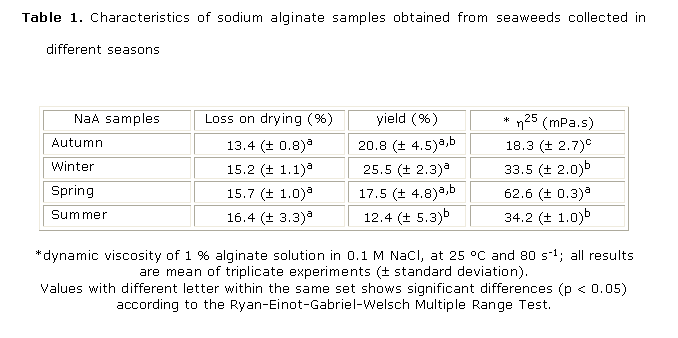
<body><![CDATA[<P><font face="Verdana, Arial, Helvetica, sans-serif" size="2"><I>In vitro</I>    dissolution was carried out with the rotating paddle method (apparatus 2 of    USP, 28, Erweka DT80 apparatus) at 100 r&#215;min<SUP>-1</SUP>. The medium used    was water (900 mL), maintained at 37 &#177; 0,5 &#176;C. Sampling was performed    over 8 h at predetermined time intervals. The amount of theophylline dissolved    in each sample was measured by UV detection at 272 nm (Shimadzu, UVPC160), after    filtration and dilution. The percentage of drug released was plotted versus    time. The results of physical and chemical properties among the different batches    were evaluated by ANOVA followed by &quot;<I>a posteriori</I>&quot; test (Ryan-Einot-Gabriel-Welsch    Multiple Range). Software Excel 6.0 was used, and the statistical significance    was considered at the 0.01 level. </font>     <P>    <br>     <P> <font face="Verdana, Arial, Helvetica, sans-serif" size="3"><B>RESULTS </B>    </font>     <P><font face="Verdana, Arial, Helvetica, sans-serif" size="2">The <I>S. cymosum</I>    samples collected in different seasons were washed, dried and milled. The mean    size of seaweed powder were: 283.0, 301.7, 268.4 and 290.4 mm for autumn, winter,    spring and summer, respectively. The powder may be classified as coarse powder    (USP, 2003) with a unimodal distribution.<SUP>9 </SUP> </font>     <P><font face="Verdana, Arial, Helvetica, sans-serif" size="2">The NaA obtained    from algal seasonal samples treated with NaOCl 0,8 % (w/v) resulting in a brownish    powder with fiber aspect and with a yield of 13 % (w/w). The analysis of characteristics    of seasonal NaA samples is show in <a href="/img/revistas/far/v43n2/t0110209.gif">table    1</a>. </font>      
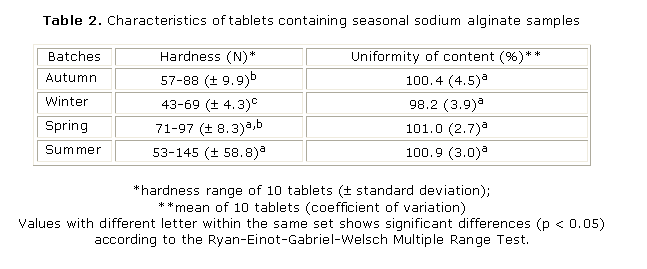
<P><font face="Verdana, Arial, Helvetica, sans-serif" size="2">The loss on drying    was about 15 % and the NaA yield was quite different for the season, with a    higher yield in winter. The viscosity of the samples was spring &gt; summer    = winter &gt; autumn. The viscosity curves of NaA samples showed a pseudoplastic    behaviour (date not show). </font>     <P><font face="Verdana, Arial, Helvetica, sans-serif" size="2">The matrix tablets    were elaborate with these sodium alginate samples and the characteristics of    tablet batches are show in <a href="/img/revistas/far/v43n2/t0210209.gif">table    2</a>. </font>      
<P><font face="Verdana, Arial, Helvetica, sans-serif" size="2">All matrix tablets    showed a hardness &gt; 40 N and are approved for uniformity of content, within    85-115 % of drug content and CV &lt; 6,0 %.<SUP>8</SUP> </font>     <P> <font face="Verdana, Arial, Helvetica, sans-serif" size="2"><B>In vitro dissolution</B>    </font>     ]]></body>
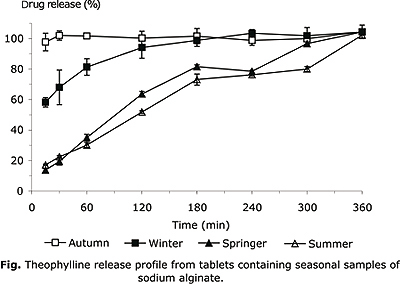
<body><![CDATA[<P><font face="Verdana, Arial, Helvetica, sans-serif" size="2">The release profiles    of theophylline from NaA matrix tablets are presented in <a href="/img/revistas/far/v43n2/f0110209.gif">figure</a>.    During the drug release studies, all the formulations were observed for physical    integrity at different time. </font>      
<P align="center"><a href="/img/revistas/far/v43n2/f0110209.gif"><img src="/img/revistas/far/v43n2/f0110209.gif" width="400" height="284" border="0"></a>      
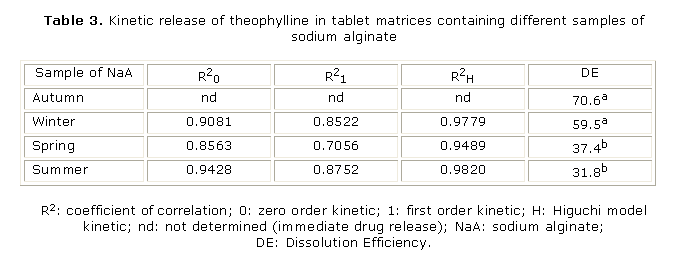
<P><font face="Verdana, Arial, Helvetica, sans-serif" size="2">Theophylline was    released in a controlled manner over 6 h from the winter, spring and summer    batches, but for the autumn matrix tablet the release was immediate, dissolving    completely after 1 h. The later contains the less viscous polymer. The other    formulations remained as gelatinous mass. The winter batch released 100 % of    drug after 3 h while the spring and summer matrix tablets presented a similar    profile, releasing around 100% of drug only at the end of experiment. </font>     <P><font face="Verdana, Arial, Helvetica, sans-serif" size="2">Although the more    viscous polymer (from spring) showed high drug retention, other polymer, as    summer sample, with a half of viscosity value, showed a similar behavior that    suggest the influence of other characteristics on the biopharmaceutical behavior    of the NaA hydrophilic matrices. </font>     <P><font face="Verdana, Arial, Helvetica, sans-serif" size="2">In order to describe    the dissolution profiles, mathematical models of zero order, first order and    Higuchi model (Eq.01) were applied to data. </font>     <P><font face="Verdana, Arial, Helvetica, sans-serif" size="2">Q(t)= K<SUB>H</SUB><SUP>1/2</SUP>    Eq. 01 </font>      <P><font face="Verdana, Arial, Helvetica, sans-serif" size="2">where Q is the    amount of drug released at time <I>t</I> and K<SUB>H</SUB> is the Higuchi constant.    <SUP>10</SUP> The regression analysis was performed and the best fit was found    to Higuchi model (table 3) suggesting a release mechanism controlled by diffusion.    </font>     <P><font face="Verdana, Arial, Helvetica, sans-serif" size="2">The dissolution    profiles for different tablets were compared with each other using dissolution    efficiency (DE) parameter <SUP>11</SUP> and the results are showed in table    3. </font>     <P>&nbsp;      <p><font face="Verdana, Arial, Helvetica, sans-serif" size="3"><b>DISCUSSION</b>    </font>      ]]></body>
<body><![CDATA[<P><font face="Verdana, Arial, Helvetica, sans-serif" size="2">The seasonal NaA    extracted from <I>S. cymosum</I> showed different viscosity and the results    indicate that polymer viscosity of seasonal NaA samples influenced the release    of drug from the matrix tablets. Low viscosity formulation (autumn) exhibited    a greater erosion &gt; 90 % of drug release at 1 h, while the drug deliver from    the intermediate viscosity samples (winter) showed intermediate drug release    (&gt; 90 % after 3 h) and the more viscosity sample (spring) showed more drug    retention releasing &gt; 90 % of drug after 6 h. As reported by <I>Efentakis</I>    and <I>Koutlis</I>,<SUP>5</SUP> low viscosity polymer results in a more rapid    erosion of the tablet and faster release of the drug, compared to high viscosity    NaA samples. However, another intermediate viscosity sample (summer) exhibited    similar drug release profile to higher viscosity NaA sample, pointing the need    of characterization of the alginate samples for the pharmaceutical applications.    The behaviour of the intermediate viscosity sample (summer) in the drug release    may be affected, beside viscosity, by other factors, as the aggregation state    of the polymer, and consequent cohesiveness. The more accuracy physical characterization    may be conducted to clarify this point. The Dissolution Efficiency (DE) of batches    shows statistical differences, in the order: autumn and winter &gt; summer and    spring (table 3). The tablets with more viscous polymers showed lower DE. </font>     <P><font face="Verdana, Arial, Helvetica, sans-serif" size="2">All formulations    showed the same drug release mechanism, by diffusion (<a href="/img/revistas/far/v43n2/t0310209.gif">table    3</a>). In the <I>Efentakis</I> and <I>Koutlis</I>,<SUP>5</SUP> study using    gelatine capsules and minitablets filled in a hard gelatine capsules containing    69 % of sodium alginate of low, medium and high viscosity, the authors observed    a rather zero-order release mechanism, attributed mainly to swelling and an    erosion/dissolution process. In the present work the tablets<FONT  COLOR="#ff0000"> </FONT>containing 35 % of NaA seasonal samples showed a different    mechanism, Higuchi model, probably due to the higher polymer concentration in    the tablets. In both studies the viscosity didn't show influence on the drug    release mechanism.</font>      
<P>    <br>     <P>  <font face="Verdana, Arial, Helvetica, sans-serif" size="3"><B>ACKNOWLEDGMENTS  </B></font>      <P><font face="Verdana, Arial, Helvetica, sans-serif" size="2">The authors wish    to thank Medicines Production and Analysis Laboratory - Laborat&oacute;rio de    Produ&ccedil;&atilde;o e An&aacute;lise de Medicamentos (UNIVALI-LAPAM) for    providing their facilities, to FAPESC (Funda&ccedil;&atilde;o de Apoio &agrave;    Pesquisa Cient&iacute;fica e Tecnol&oacute;gica do Estado de Santa Catarina)    and Probic-UNIVALI, for the financial support during this study.</font>     <P><b><font size="3">    <br>   </font></b>     <P> <b><font face="Verdana, Arial, Helvetica, sans-serif" size="3">REFERENCES    </font></b>     <!-- ref --><P><font face="Verdana, Arial, Helvetica, sans-serif" size="2">1 Mafra JrLL, Cunha    SR. Avalia&ccedil;&atilde;o da viabilidade da explora&ccedil;&atilde;o sustent&aacute;vel    de um banco de <I>Sargassum sp.</I> (Phaeophyta) na ilha Feia, Pi&ccedil;arras,    SC. XIII Semana Nacional de Oceanografia, Itajai-SC. 2000. p. 542-4. </font>    <!-- ref --><P><font face="Verdana, Arial, Helvetica, sans-serif" size="2">2. Painter TJ.    Algae polysaccharides. In: Aspinall GO. The polysaccharides. New York: Academic    Press; 1983. p. 95-285. </font>    <!-- ref --><P><font face="Verdana, Arial, Helvetica, sans-serif" size="2">3. Haug A, Smidsrod    O. The effect of divalent metals on the properties of alginate solutions. I.    Calcium ions. Acta Chem Scand. 1965;19:341-51. </font>    <!-- ref --><P><font face="Verdana, Arial, Helvetica, sans-serif" size="2">4. Bhardwaj TR,    Kanwar M, Lal R, Gupta A. Natural gums and modified Natural gums as sustained-release    carriers. Drug Dev Ind Pharm. 2000; 26(10):1025-38. </font>    <!-- ref --><P><font face="Verdana, Arial, Helvetica, sans-serif" size="2">5. Efentakis M,    Koutlis A. Release of Furosemide from multiple-unit and single-unit preparations    containing different viscosity grades of sodium alginate. Pharm Dev Technol.    2001;6(1):91-8. </font>    <!-- ref --><P><font face="Verdana, Arial, Helvetica, sans-serif" size="2">6. Hernand&eacute;z-Carmona    G, Mchugh DJ, Arvizu-Higuera DL, Rodr&iacute;guez-Montesinos E. Pilot plant    scale extraction of alginates from <I>Macrocystis pyrifera</I>. 1. Effect of    pre-extraction treatments on yield and quality of alginate. J Appl Phycology.    1999;10:507-13. </font>    <!-- ref --><P><font face="Verdana, Arial, Helvetica, sans-serif" size="2">7. Hernand&eacute;z-Carmona    G, Mchugh DJ L&oacute;pez-Guti&eacute;rrez F. Pilot plant scale extraction of    alginates from <I>Macrocystis pyrifera</I>. 2. Studies on extraction conditions    and methods for separating the alkaline-insoluble residue<B>. </B>J Appl Phycology.    1999;11:493-502. </font>    <!-- ref --><P><font face="Verdana, Arial, Helvetica, sans-serif" size="2">8. The United States    Pharmacopeial Convention. The National Formulary, USP XXVI, NF 21. Rockville:    Mack Printing; 2003. </font>    <!-- ref --><P><font face="Verdana, Arial, Helvetica, sans-serif" size="2">9. Brittain HG.    Particle size distribution. Part III Determination by analytical sieving. Pharmaceut    Technol North Am. 2002;1:56-64. </font>    <!-- ref --><P><font face="Verdana, Arial, Helvetica, sans-serif" size="2">10. Higuchi T.    Mechanism of sustained-release medication- theoretical analysis of rate of release    of solid drugs dispersed in solid matrices. J Pharm Sci. 1963;52(2):1145-9.    </font>    <P><font face="Verdana, Arial, Helvetica, sans-serif" size="2">11. Brasil. Minist&eacute;rio    da Sa&uacute;de. Ag&ecirc;ncia Nacional de Vigil&acirc;ncia Sanit&aacute;ria.    Resolu&ccedil;&atilde;o de Diretoria Colegiada RE n&#186; 310, de 01 de setembro    de 2004. Guia para realiza&ccedil;&atilde;o do estudo e elabora&ccedil;&atilde;o    do relat&oacute;rio de equival&ecirc;ncia farmac&ecirc;utica e perfil de dissolu&ccedil;&atilde;o.    Di&aacute;rio oficial da Uni&atilde;o<I>,</I> 03 set 2004. </font>     ]]></body>
<body><![CDATA[<P>&nbsp;     <P>&nbsp;     <P><font face="Verdana, Arial, Helvetica, sans-serif" size="2">Recibido: 12 de    enero de 2009.     <br>   </font><font face="Verdana, Arial, Helvetica, sans-serif" size="2">Aprobado:    17 de febrero de 2009. </font>     <P>&nbsp;     <P>&nbsp;     <P><font face="Verdana, Arial, Helvetica, sans-serif" size="2">Dr. <I>Itamar Francisco    Andreazza</I>. Rua Uruguai, 458, bloco 27, sala 301, centro, CEP 88302-202 CP    360 Itaja&iacute; (SC), Brazil. E-mail: <U><a href="mailto:itamar@ufpr.br">itamar@ufpr.br</a>    </U> </font>      ]]></body><back>
<ref-list>
<ref id="B1">
<label>1</label><nlm-citation citation-type="">
<person-group person-group-type="author">
<name>
<surname><![CDATA[Mafra]]></surname>
<given-names><![CDATA[JrLL]]></given-names>
</name>
<name>
<surname><![CDATA[Cunha]]></surname>
<given-names><![CDATA[SR]]></given-names>
</name>
</person-group>
<source><![CDATA[Avaliação da viabilidade da exploração sustentável de um banco de Sargassum sp. (Phaeophyta) na ilha Feia, Piçarras, SC: XIII Semana Nacional de Oceanografia]]></source>
<year>2000</year>
<page-range>542-4</page-range><publisher-loc><![CDATA[Itajai-SC ]]></publisher-loc>
</nlm-citation>
</ref>
<ref id="B2">
<label>2</label><nlm-citation citation-type="book">
<person-group person-group-type="author">
<name>
<surname><![CDATA[Painter]]></surname>
<given-names><![CDATA[TJ]]></given-names>
</name>
</person-group>
<article-title xml:lang="en"><![CDATA[Algae polysaccharides]]></article-title>
<person-group person-group-type="editor">
<name>
<surname><![CDATA[Aspinall]]></surname>
<given-names><![CDATA[GO]]></given-names>
</name>
</person-group>
<source><![CDATA[The polysaccharides]]></source>
<year>1983</year>
<page-range>95-285</page-range><publisher-loc><![CDATA[New York ]]></publisher-loc>
<publisher-name><![CDATA[Academic Press]]></publisher-name>
</nlm-citation>
</ref>
<ref id="B3">
<label>3</label><nlm-citation citation-type="journal">
<person-group person-group-type="author">
<name>
<surname><![CDATA[Haug]]></surname>
<given-names><![CDATA[A]]></given-names>
</name>
<name>
<surname><![CDATA[Smidsrod]]></surname>
<given-names><![CDATA[O]]></given-names>
</name>
</person-group>
<article-title xml:lang="en"><![CDATA[The effect of divalent metals on the properties of alginate solutions: I]]></article-title>
<source><![CDATA[Calcium ions. Acta Chem Scand.]]></source>
<year>1965</year>
<volume>19</volume>
<page-range>341-51</page-range></nlm-citation>
</ref>
<ref id="B4">
<label>4</label><nlm-citation citation-type="journal">
<person-group person-group-type="author">
<name>
<surname><![CDATA[Bhardwaj]]></surname>
<given-names><![CDATA[TR]]></given-names>
</name>
<name>
<surname><![CDATA[Kanwar]]></surname>
<given-names><![CDATA[M]]></given-names>
</name>
<name>
<surname><![CDATA[Lal]]></surname>
<given-names><![CDATA[R]]></given-names>
</name>
<name>
<surname><![CDATA[Gupta]]></surname>
<given-names><![CDATA[A]]></given-names>
</name>
</person-group>
<article-title xml:lang="en"><![CDATA[Natural gums and modified Natural gums as sustained-release carriers]]></article-title>
<source><![CDATA[Drug Dev Ind Pharm.]]></source>
<year>2000</year>
<volume>26</volume>
<numero>10</numero>
<issue>10</issue>
<page-range>1025-38</page-range></nlm-citation>
</ref>
<ref id="B5">
<label>5</label><nlm-citation citation-type="journal">
<person-group person-group-type="author">
<name>
<surname><![CDATA[Efentakis]]></surname>
<given-names><![CDATA[M]]></given-names>
</name>
<name>
<surname><![CDATA[Koutlis]]></surname>
<given-names><![CDATA[A]]></given-names>
</name>
</person-group>
<article-title xml:lang="en"><![CDATA[Release of Furosemide from multiple-unit and single-unit preparations containing different viscosity grades of sodium alginate]]></article-title>
<source><![CDATA[Pharm Dev Technol.]]></source>
<year>2001</year>
<volume>6</volume>
<numero>1</numero>
<issue>1</issue>
<page-range>91-8</page-range></nlm-citation>
</ref>
<ref id="B6">
<label>6</label><nlm-citation citation-type="journal">
<person-group person-group-type="author">
<name>
<surname><![CDATA[Hernandéz-Carmona]]></surname>
<given-names><![CDATA[G]]></given-names>
</name>
<name>
<surname><![CDATA[Mchugh]]></surname>
<given-names><![CDATA[DJ]]></given-names>
</name>
<name>
<surname><![CDATA[Arvizu-Higuera]]></surname>
<given-names><![CDATA[DL]]></given-names>
</name>
<name>
<surname><![CDATA[Rodríguez-Montesinos]]></surname>
<given-names><![CDATA[E]]></given-names>
</name>
</person-group>
<article-title xml:lang="en"><![CDATA[Pilot plant scale extraction of alginates from Macrocystis pyrifera. 1: Effect of pre-extraction treatments on yield and quality of alginate]]></article-title>
<source><![CDATA[J Appl Phycology.]]></source>
<year>1999</year>
<volume>10</volume>
<page-range>507-13</page-range></nlm-citation>
</ref>
<ref id="B7">
<label>7</label><nlm-citation citation-type="journal">
<person-group person-group-type="author">
<name>
<surname><![CDATA[Hernandéz-Carmona]]></surname>
<given-names><![CDATA[G]]></given-names>
</name>
<name>
<surname><![CDATA[Mchugh]]></surname>
<given-names><![CDATA[DJ]]></given-names>
</name>
<name>
<surname><![CDATA[López-Gutiérrez]]></surname>
<given-names><![CDATA[F]]></given-names>
</name>
</person-group>
<article-title xml:lang="en"><![CDATA[Pilot plant scale extraction of alginates from Macrocystis pyrifera. 2: Studies on extraction conditions and methods for separating the alkaline-insoluble residue]]></article-title>
<source><![CDATA[J Appl Phycology.]]></source>
<year>1999</year>
<volume>11</volume>
<page-range>493-502</page-range></nlm-citation>
</ref>
<ref id="B8">
<label>8</label><nlm-citation citation-type="book">
<collab>The United States Pharmacopeial Convention</collab>
<source><![CDATA[The National Formulary, USP XXVI, NF 21]]></source>
<year>2003</year>
<publisher-loc><![CDATA[Rockville ]]></publisher-loc>
<publisher-name><![CDATA[Mack Printing]]></publisher-name>
</nlm-citation>
</ref>
<ref id="B9">
<label>9</label><nlm-citation citation-type="journal">
<person-group person-group-type="author">
<name>
<surname><![CDATA[Brittain]]></surname>
<given-names><![CDATA[HG]]></given-names>
</name>
</person-group>
<article-title xml:lang="en"><![CDATA[Particle size distribution: Part III Determination by analytical sieving]]></article-title>
<source><![CDATA[Pharmaceut Technol North Am.]]></source>
<year>2002</year>
<volume>1</volume>
<page-range>56-64</page-range></nlm-citation>
</ref>
<ref id="B10">
<label>10</label><nlm-citation citation-type="journal">
<person-group person-group-type="author">
<name>
<surname><![CDATA[Higuchi]]></surname>
<given-names><![CDATA[T]]></given-names>
</name>
</person-group>
<article-title xml:lang="en"><![CDATA[Mechanism of sustained-release medication- theoretical analysis of rate of release of solid drugs dispersed in solid matrices]]></article-title>
<source><![CDATA[J Pharm Sci.]]></source>
<year>1963</year>
<volume>52</volume>
<numero>2</numero>
<issue>2</issue>
<page-range>1145-9</page-range></nlm-citation>
</ref>
<ref id="B11">
<label>11</label><nlm-citation citation-type="">
<collab>Ministério da Saúde</collab>
<collab>Agência Nacional de Vigilância Sanitária</collab>
<source><![CDATA[Guia para realização do estudo e elaboração do relatório de equivalência farmacêutica e perfil de dissolução: Resolução de Diretoria Colegiada RE nº 310, de 01 de setembro de 2004]]></source>
<year>03 s</year>
<month>et</month>
<day> 2</day>
</nlm-citation>
</ref>
</ref-list>
</back>
</article>