<?xml version="1.0" encoding="ISO-8859-1"?><article xmlns:mml="http://www.w3.org/1998/Math/MathML" xmlns:xlink="http://www.w3.org/1999/xlink" xmlns:xsi="http://www.w3.org/2001/XMLSchema-instance">
<front>
<journal-meta>
<journal-id>0252-8584</journal-id>
<journal-title><![CDATA[Economía y Desarrollo]]></journal-title>
<abbrev-journal-title><![CDATA[Econ. y Desarrollo]]></abbrev-journal-title>
<issn>0252-8584</issn>
<publisher>
<publisher-name><![CDATA[Dirección de Publicaciones Académicas de la Universidad de La Habana (Editorial UH) ]]></publisher-name>
</publisher>
</journal-meta>
<article-meta>
<article-id>S0252-85842017000200003</article-id>
<title-group>
<article-title xml:lang="es"><![CDATA[Determinantes del rendimiento de la innovación de producto: ¿por qué algunas innovaciones son más exitosas que otras?]]></article-title>
<article-title xml:lang="en"><![CDATA[Determinants of Product Innovation Performance: Why Are Some Innovations More Successful than Others?]]></article-title>
</title-group>
<contrib-group>
<contrib contrib-type="author">
<name>
<surname><![CDATA[Montero]]></surname>
<given-names><![CDATA[Rossana]]></given-names>
</name>
</contrib>
<contrib contrib-type="author">
<name>
<surname><![CDATA[Pennano]]></surname>
<given-names><![CDATA[Carla]]></given-names>
</name>
</contrib>
<contrib contrib-type="author">
<name>
<surname><![CDATA[Ortigueira-Sánchez]]></surname>
<given-names><![CDATA[Luis Camilo]]></given-names>
</name>
</contrib>
</contrib-group>
<aff id="A01">
<institution><![CDATA[,Universidad del Pacífico  ]]></institution>
<addr-line><![CDATA[ ]]></addr-line>
<country>Perú</country>
</aff>
<pub-date pub-type="pub">
<day>00</day>
<month>12</month>
<year>2017</year>
</pub-date>
<pub-date pub-type="epub">
<day>00</day>
<month>12</month>
<year>2017</year>
</pub-date>
<volume>158</volume>
<numero>2</numero>
<fpage>43</fpage>
<lpage>62</lpage>
<copyright-statement/>
<copyright-year/>
<self-uri xlink:href="http://scielo.sld.cu/scielo.php?script=sci_arttext&amp;pid=S0252-85842017000200003&amp;lng=en&amp;nrm=iso"></self-uri><self-uri xlink:href="http://scielo.sld.cu/scielo.php?script=sci_abstract&amp;pid=S0252-85842017000200003&amp;lng=en&amp;nrm=iso"></self-uri><self-uri xlink:href="http://scielo.sld.cu/scielo.php?script=sci_pdf&amp;pid=S0252-85842017000200003&amp;lng=en&amp;nrm=iso"></self-uri><abstract abstract-type="short" xml:lang="es"><p><![CDATA[Este artículo estudia la influencia de los factores determinantes del desempeño tales como factores estratégicos, factores de mercado, factores de desarrollo-proceso y factores organizativos sobre el desempeño de la innovación de productos y cómo esas relaciones pueden variar dependiendo del tipo de innovación -incremental o radical. Analiza las relaciones entre los factores estratégicos, factores de mercado, factores de desarrollo-proceso y factores organizativos que determinan el desempeño de innovación de producto para ambos tipos de innovación (radical e incremental), utilizando un Meta-Análisis previo incluido en la literatura para establecer qué dimensiones y componentes tienen más incidencia e importancia al medir la innovación del producto.]]></p></abstract>
<abstract abstract-type="short" xml:lang="en"><p><![CDATA[This paper examines what influence determining factors such as strategic factors, market forces factors, development and process factors, and organizational factors have on product innovation performance, and how the relations between them can change, depending on the type of innovation -whether incremental or radical. These relations are also examined for both types of innovation, by using a previous meta-analysis included in the literature to measure the most important and influential dimensions of product innovation performance -efficacy and efficiency.]]></p></abstract>
<kwd-group>
<kwd lng="es"><![CDATA[innovación]]></kwd>
<kwd lng="es"><![CDATA[determinantes del rendimiento]]></kwd>
<kwd lng="es"><![CDATA[desempeño de la innovación]]></kwd>
<kwd lng="en"><![CDATA[innovation]]></kwd>
<kwd lng="en"><![CDATA[performance determinants]]></kwd>
<kwd lng="en"><![CDATA[business innovation]]></kwd>
</kwd-group>
</article-meta>
</front><body><![CDATA[ <p align="right"><font face="Verdana, Arial, Helvetica, sans-serif" size="2">    <b><font size="4">ART&Iacute;CULO ORIGINAL    <br>   </font></b></font></p>     <p>&nbsp;</p>     <p><font face="Verdana, Arial, Helvetica, sans-serif" size="4"><b>Determinantes    del rendimiento de la innovaci&oacute;n de producto: &iquest;por qu&eacute;    algunas innovaciones son m&aacute;s exitosas que otras?    <br>   </b></font><font face="Verdana, Arial, Helvetica, sans-serif" size="2"><b> </b></font></p>     <p>&nbsp;</p>     <p><font face="Verdana, Arial, Helvetica, sans-serif" size="2"><b><font size="3">Determinants    of Product Innovation Performance: Why Are Some Innovations More Successful    than Others? </font></b></font> </p>     <p>&nbsp;</p>     <p>&nbsp;</p>     <p><b><font face="Verdana, Arial, Helvetica, sans-serif" size="2">Rossana Montero,    Carla Pennano y Luis Camilo Ortigueira-S&aacute;nchez</font></b></p>     ]]></body>
<body><![CDATA[<p>&nbsp;</p>     <p><font face="Verdana, Arial, Helvetica, sans-serif" size="2">Universidad del    Pac&iacute;fico, Per&uacute;.</font></p>     <p>&nbsp;</p>     <p>&nbsp;</p>     <p>&nbsp;</p>     <p>&nbsp;</p> <hr>     <p><font face="Verdana, Arial, Helvetica, sans-serif" size="2"><b>RESUMEN</b>    <br>   </font></p>     <p><font face="Verdana, Arial, Helvetica, sans-serif" size="2">Este art&iacute;culo    estudia la influencia de los factores determinantes del desempe&ntilde;o tales    como factores estrat&eacute;gicos, factores de mercado, factores de desarrollo-proceso    y factores organizativos sobre el desempe&ntilde;o de la innovaci&oacute;n de    productos y c&oacute;mo esas relaciones pueden variar dependiendo del tipo de    innovaci&oacute;n -incremental o radical. Analiza las relaciones entre los factores    estrat&eacute;gicos, factores de mercado, factores de desarrollo-proceso y factores    organizativos que determinan el desempe&ntilde;o de innovaci&oacute;n de producto    para ambos tipos de innovaci&oacute;n (radical e incremental), utilizando un    Meta-An&aacute;lisis previo incluido en la literatura para establecer qu&eacute;    dimensiones y componentes tienen m&aacute;s incidencia e importancia al medir    la innovaci&oacute;n del producto.</font></p>     <p><font face="Verdana, Arial, Helvetica, sans-serif" size="2"><b>PALABRAS CLAVE</b>:    innovaci&oacute;n, determinantes del rendimiento, desempe&ntilde;o de la innovaci&oacute;n.    </font></p> <hr>     ]]></body>
<body><![CDATA[<p><font face="Verdana, Arial, Helvetica, sans-serif" size="2"><b>ABSTRACT</b>    <br>   </font></p>     <p><font face="Verdana, Arial, Helvetica, sans-serif" size="2">This paper examines    what influence determining factors such as strategic factors, market forces    factors, development and process factors, and organizational factors have on    product innovation performance, and how the relations between them can change,    depending on the type of innovation -whether incremental or radical. These relations    are also examined for both types of innovation, by using a previous meta-analysis    included in the literature to measure the most important and influential dimensions    of product innovation performance -efficacy and efficiency. </font></p>     <p><font face="Verdana, Arial, Helvetica, sans-serif" size="2"><b>KEYWORDS</b>:    innovation, performance determinants, business innovation.</font></p> <hr>     <p>&nbsp;</p>     <p><font face="Verdana, Arial, Helvetica, sans-serif" size="2"><b><font size="3">INTRODUCTION</font></b>    <br>   </font></p>     <p><font face="Verdana, Arial, Helvetica, sans-serif" size="2">There has been    a considerable debate and concern about product innovation in both the academic    as well as the practitioner press in recent times. The primary reason for this    focus is the evidence that innovation improves performance of firms (Damanpour,    1991; Hult, Hurley and Knight, 2004). In this sense, there is no more fundamental    issue to new products managers than understanding the factors that separate    success from failure in product innovation (Cooper and Kleinschmidt, 1987a).    <br>   In the product innovation literature there is some extensive review that has    examined the determinants of new product success (Cooper, 1979; Montoya-Weiss    and Calantone, 1994). Previous empirical research on new product performance    has provided considerable evidence that a wide variety of antecedent factors    can influence the outcomes of new product development activity. The determinants    proposed usually involve some combination of strategic, development process,    organizational, and/or market environment factors as drivers of new product    performance (Montoya-Weiss and Calantone, 1994).     <br>   </font></p>     ]]></body>
<body><![CDATA[<p><font face="Verdana, Arial, Helvetica, sans-serif" size="2">Product superiority    is mentioned as &quot;the number one factor that influences commercial success    and that project definition and early predevelopment     <br>   activities are the most critical steps in the new products development process.    Success, they argue, is earned. It is not the ad hoc result of situational or    environmental influences. Synergy, both marketing and technical, is crucial&quot;    (Cooper and Kleinschmidt, 1987a. p. 169).     <br>   </font></p>     <p><font face="Verdana, Arial, Helvetica, sans-serif" size="2">Hence, evaluation    of Product Innovation Performance (PIP) is a critical issue on innovation management    research, and its measurement is gaining importance as its effectiveness and    efficiency not only determines an organization's competitive advantage (Barney,    1991; Castro, 2011), but also its very survival (Cedergren, Wall and Norstr&ouml;m,    2010). </font></p>     <p><font face="Verdana, Arial, Helvetica, sans-serif" size="2">&quot;Firms that    offer products that are adapted to the needs and wants of target customers and    that market them faster and more efficiently than their competitors are in a    better position to create a sustainable competitive advantage (Prahalad and    Hamel, 1990; Amit and Schoemaker, 1993; Nonaka and Takeuchi, 1995; Calantone    et al., 1995). Competitive advantage is increasingly derived from knowledge    and technological skills and experience in the creation of new products (Teece    et al., 1997; Tidd et al., 1997). Within this context, special attention needs    to be paid to the measurement of innovation performance. Both researchers and    practitioners require a good measurement instrument for this concept (Montoya-Weiss    and Calantone, 1994)&quot;. (Alegre, Lapiedra and Chiva, 2006. p. 333)</font></p>     <p><font face="Verdana, Arial, Helvetica, sans-serif" size="2">Innovation performance    measurement is an elusive subject due to the multiplicity of meanings associated    with performance measurement as well as the varied, (Arteche, et al. 2017),    but simultaneous, roles that performance measurement plays; and the numerous,    distinct customers of performance measurement (Hannachi, 2015). Given the importance    of product innovation performance, its measurement is a significant challenge.    In fact, both researchers and managers require a relevant measurement instrument    of PIP (Alegre, Lapiedra and Chiva, 2006).    <br>   &quot;In management research, general firm performance has traditionally been    the dependent variable of empirical studies&quot;. (Alegre, Lapiedra and Chiva,    2006.     <br>   p. 334). On the other hand, practitioners also need instruments to assess innovation    management and innovation outcomes (Arteche et al., 2017). Through this paper,    the reader will achieve to a better understanding about determinant factors    of product innovation performance. In this sense, the paper unfolds as follows:    first, the state of the art about business innovation is presented. It aims    to highlight the importance of innovation and performance in business and economics    research, and develop subsequently a measurement scale of the Product Innovation    Performance (PIP). Next, our expanded understanding of the PIP is described    and a model is proposed to study relationships between performance determinants    and outcomes. Finally, conclusions are presented.</font></p>     <p>&nbsp;</p>     <p><font face="Verdana, Arial, Helvetica, sans-serif" size="2"><b>1. From Business    Innovation to Product Innovation</b>    ]]></body>
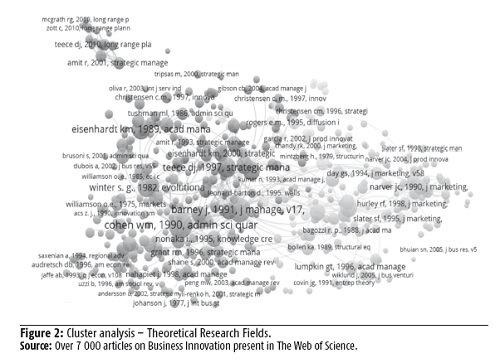
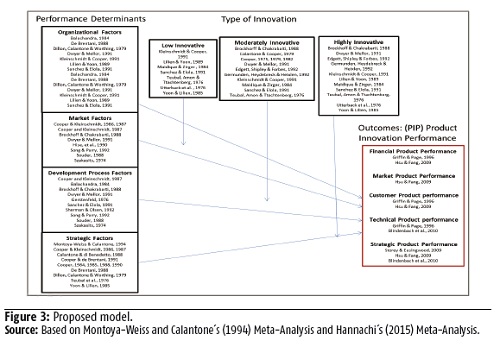
<body><![CDATA[<br>   </font></p>     <p><font face="Verdana, Arial, Helvetica, sans-serif" size="2">What makes a new    product a success? And what separates new product &quot;winners&quot; from &quot;losers&quot;?    The answers to these questions are critical to effective product innovation    management (Cooper and Kleinschmidt, 1987a). Being able to understand performance    determinants and new product success factors is important because it provides    guidelines to the screening of new product projects, that is which ones should    be left aside and which ones pursued; this leads to insights into the way the    new product project should be managed (Cooper and Kleinschmidt, 1987b).    <br>   In the past few years there has been a tremendous interest in business </font><font face="Verdana, Arial, Helvetica, sans-serif" size="2">innovation    and more specifically in product innovation. The Journal of Product Innovation    Management had a special issue on developing really new (as opposed to incremental)    products a few years back. On the other hand, the Marketing Science Institute    designated developing really innovative products as one of its top research    priorities. </font></p>     <p><font face="Verdana, Arial, Helvetica, sans-serif" size="2">This topic is important    for several reasons. On the one hand, product innovation provides great opportunities    for firms in terms of growth and expansion into new areas. Significant innovations    allow firms to establish competitively dominant positions, and afford newcomer    firms an opportunity to gain a foothold in the market (Danneels and Kleinschmidt,    2001). However, product innovation is also associated with high risks and management    challenges. Prior research has suggested that more innovative products require    more firm resources and a different development approach to be successful and    that many products fail in the process (Danneels and Kleinschmidt, 2001)</font></p>     <p><font face="Verdana, Arial, Helvetica, sans-serif" size="2">Based on a concurrence    analysis of terms, present in the titles and abstracts of over 7,000 published    articles, in the Web of Science in business and economics journals on business    innovation, we have obtained the terms that represent the themes of greatest    interest for researchers.     <br>   As shown in figure 1, a network image, the most relevant terms studied in these    topics are those corresponding to innovation and performance.</font></p>     <p align="center"><img src="/img/revistas/eyd/v158n2/f0103217.jpg" width="500" height="439"></p>     <p> </p>     <p><font face="Verdana, Arial, Helvetica, sans-serif" size="2">After that, we    did a cluster analysis. Figure 2 shows four clusters. The blue cluster (cluster    1) focuses on market aspects, whereas the purple cluster (cluster 2) focuses    on the contribution of technology in innovation; the aquamarine cluster (cluster    3) focuses on the capabilities associated with innovation and the final cluster    (cluster 4) to the economic aspects of the process.</font></p>     <p align="center"><img src="/img/revistas/eyd/v158n2/f0203217.jpg" width="500" height="363"></p>     ]]></body>
<body><![CDATA[<p><font face="Verdana, Arial, Helvetica, sans-serif" size="2">    <br>   Likewise, the network visualization on co-citation reveals the most relevant    authors for these topics (see figure 2). In this graph again four clusters can    be observed again: one of the groups contains articles on marketing, being Day    (1994), Hurley (1998), Slater (1995) and Bagozzi (1988) the most representative    authors; another cluster focused on strategy with Eisenhardt (1989) and Teece    (1997) as the most representative authors. The third cluster focused on management    with Cohen (1990), Barney (1991) and Nonaka (1995) as the most relevant authors;    and a fourth cluster with more scattered topics and not necessarily connected    topics.</font></p>     <p><font face="Verdana, Arial, Helvetica, sans-serif" size="2">In spite of the    importance of product innovation, it seems that we need a much better understanding    of exactly what it means, what factors determine product innovation performance    and how to measure it properly. We argue that scholars have not yet adequately    answered these questions and others related to product innovation performance    and we want to address these issues in this study.</font></p>     <p>&nbsp;</p>     <p></p>     <p><b><font face="Verdana, Arial, Helvetica, sans-serif" size="2">2. Importance    of Product of Innovation</font></b><font face="Verdana, Arial, Helvetica, sans-serif" size="2">    <br>   Managers today face a dilemma regarding product innovation. On the one hand,    there is increasing pressure to develop and launch more new products in order    to maintain competitive advantage. On the other hand, product innovation remains    a very high-risk effort, filled with difficulties and littered with failures    (Cooper and Kleinschmidt, 1987a). New product failure rates remain high while    almost half the resources that U.S. industry devotes to product innovation is    spent on innovation &quot;losers&quot;, that is, products that fail commercially    or even never make it to the marketplace (BoozAllen and Hamilton, 1982; Cooper,    1984).</font></p>     <p><font face="Verdana, Arial, Helvetica, sans-serif" size="2">Therefore, in our    time, if businesses are to survive and prosper, managers must become smarter    at selecting new product winners, and at effectively managing the new product    process from product idea through to launch (Cooper and Kleinschmidt, 1987a).    These two challenges; on the one hand better project selection and on the other    more effective process management, point to the need for a greater understanding    of the components of success in product innovation (Cooper and Kleinschmidt,    1987b).</font></p>     <p><font face="Verdana, Arial, Helvetica, sans-serif" size="2">From a researcher&acute;s    perspective, several general conclusions may be drawn regarding the content    and nature of empirical research on new product performance (Montoya-Weiss and    Calantone, 1994). First, although there is some consistency as to which factors    are considered by researchers, the range of factors included in the typical    set is indeed narrow. This indicates a need for more broad-based studies that    include multiple factors from diverse categories (Montoya-Weiss and Calantone,    1994). Second, some factors have not been studied extensively enough to draw    strong conclusions regarding their impact on performance (Montoya-Weiss and    Calantone, 1994) one of them being market and environment factors -hence the    importance to study and analyze them in order to draw better conclusions. Therefore,    we set out to gather evidence to help answer the question, &quot;Why are some    product innovations more successful than others?&quot; by looking at the new    product experiences (success and failures) of a number of firms.</font></p>     <p>&nbsp;</p>     ]]></body>
<body><![CDATA[<p><font face="Verdana, Arial, Helvetica, sans-serif" size="2"><b>3. Literature    Rewiew    <br>   3.1. What is Innovation?</b>    <br>   </font></p>     <p><font face="Verdana, Arial, Helvetica, sans-serif" size="2">The term &quot;innovation&quot;    has acquired various meanings over the years. In general terms, it is the process    of developing a new item, the new item itself, and the process of adopting the    new item (Zaltman et al., 1973). Other authors define innovation -as a broad    concept- as the ideation, development, and commercialization of substantially    new products, services or businesses which facilitates the development of new    sources of competitive advantage (Alegre, Lapiedra and Chiva, 2006).</font></p>     <p><font face="Verdana, Arial, Helvetica, sans-serif" size="2">On the other hand,    product innovation consists of the successful exploitation of new ideas (Myers    and Marquis, 1969) which implies two conditions: novelty and use (Gee, 1981).    More specifically, product innovation is a new technology or combination of    technologies introduced commercially to meet a user or a market need (Utterback    and Abernathy, 1975). Product innovation is considered by Freeman (1982) as    a process in the marketing of a new (or improved) product that includes: the    technical design, R&amp;D, manufacturing, management and commercial activities.    </font></p>     <p><font face="Verdana, Arial, Helvetica, sans-serif" size="2">Several authors    make distinctions according to different types of innovation. For example, Christensen    (1997) distinguishes between sustaining and disruptive technological change.    In his paper, he explains why firms that are successful innovators based on    sustaining technologies ignore crucial innovations based on disruptive technologies    (Christensen, 1997).</font></p>     <p><font face="Verdana, Arial, Helvetica, sans-serif" size="2">On the one hand,    what Christensen (1997) describes as sustaining technologies are the ones that    improve the performance of established products that are already known and valued    by customers, whereas what he calls disruptive technologies consist of products    with a new value proposition that only few customers know and value (Christensen,    1997). Elaborating on Christensen's (1997) argument (Meeus and Oerlemans, 2000),    conclude that in turbulent markets a focus on continuous innovation (adaptation)    is a better innovation policy than inertia and gradual innovation (selection)    and vice versa (Verhees and Meulenberg, 2004).</font></p>     <p><font face="Verdana, Arial, Helvetica, sans-serif" size="2">According to our    review of literature, we classify product innovations in two concepts: radical    and incremental innovations (Jansen, Van Den Bosch, and Volberda, 2006). On    the one hand, radical innovations are exploratory in nature and are designed    to meet the needs of emerging customers or markets (Benner and Tushman, 2003;    Danneels, 2002). These types of innovation offer new designs, create new markets    and develop new channels of distribution (Abernathy and Clark, 1985). They require    new knowledge or departure from existing knowledge (Benner and Tushman, 2002;    Child and McGrath, 2001; Levinthal and March, 1993).</font></p>     <p><font face="Verdana, Arial, Helvetica, sans-serif" size="2">Radical innovation    is not the only choice for new product introduction. Evidently, there can only    be one pioneer in any product market, therefore what some authors describe as    &quot;imitation&quot; remains a viable and sometimes more common strategy than    innovation (Golder and Tellis, 1993; Kerin, Varadarajan and Peterson, 1992;    Schnaars, 1994). This &quot;imitation&quot; strategy can take different degrees,    from pure clones, which represent &quot;me-too&quot; products, to creative imitation    or incremental innovation, which takes an existing product and improves on it    (Schnaars, 1994; Shankar et al., 1998). Product development accordingly can    take a mixed form between two extremes on a continuum, from brand new or radical,    disruptive innovation to pure imitation (Zhou, 2006).</font></p>     <p><font face="Verdana, Arial, Helvetica, sans-serif" size="2">This incremental    or exploitative innovation is that which is designed to meet the needs of existing    customers or markets (Benner and Tushman, 2003; Danneels, 2002). That is, they    broaden existing knowledge and skills, improve established designs, expand existing    products and services, and increase the efficiency of existing distribution    channels (Abernathy and Clark, 1985; Jansen, Van Den Bosch y Volberda, 2006).    Hence, incremental innovations build on existing knowledge and therefore reinforce    existing skills, processes, and structures (Abernathy and Clark, 1985; Benner    and Tushman, 2002; Levinthal and March, 1993; Lewin, Long, and Carroll, 1999).</font></p>     ]]></body>
<body><![CDATA[<p><font face="Verdana, Arial, Helvetica, sans-serif" size="2">According to several    marketing authors, incremental innovation refers to product line extensions    or adding modifications to existing platforms and products (Ali, 1994; Ali,    Kalwani, and Kovenock, 1993). Marketing managers design such products to satisfy    a perceived market need (Ali, 1994). These types of innovation are expected    to be developed in a relatively short period of time (Ali, 1994) and typically    they contribute to larger market share for firms (Banbury and Mitchell, 1995).    Therefore, the introduction of incremental innovation is critical for the long    time survival of firms (Iyer, Laplaca, and Sharma, 2006).</font></p>     <p><font face="Verdana, Arial, Helvetica, sans-serif" size="2">So, which type    of innovation determines a higher product innovation performance? Are disruptive    products successful whereas imitators fail? Or is it the other way around? According    to Ali and colleagues, the issue of incremental versus radical innovation has    been framed as an issue of low risk -low reward strategy for incremental innovations    as opposed to high risk- high reward strategy for radical innovations (Ali,    1994; Ali, Kalwani and Kovenock, 1993 1993), so perhaps the answer to the original    question needs to be analyzed depending on the context (Zhou, 2006).</font></p>     <p><font face="Verdana, Arial, Helvetica, sans-serif" size="2">Indeed, the success    of a new product introduction is contingent on external factors related to market    opportunities and environmental threats (Bowman and Gatignon, 1996; Green, Gavin,    and Aiman-Smith, 1995; Kerin, Varadarajan and Peterson, 1992). Contingency theory    posits that no strategic choice is universally beneficial in all cases and situations    therefore firms must &quot;fit&quot; their strategic decisions to their specific    environmental conditions (Ginsberg and Venkatraman, 1985), which in turn are    defined by suppliers, customers, and current and potential competitors and substitutes    (Porter and Linde, 1995; Zhou, 2006) and are not controllable by the firm (Zhou,    2006).</font></p>     <p><font face="Verdana, Arial, Helvetica, sans-serif" size="2">In reviewing the    literature available we noticed that in some situations being the first to bring    an innovative product to market can enable a firm to achieve a competitive advantage    (Lieberman and Montgomery, 1988, 1998). This is because unlike in incremental    innovations, radical innovators have the potential to create markets, shape    consumer preferences, and even change consumers' basic behavior (Pilzer, 1990).    However, an incremental innovation strategy may also lead to better new product    performance because incremental costs often are much lower than radical innovation    costs (Zhou, 2006). This is because in the case of incremental innovation there    is not a need to spend as many resources on market and product research; the    existing products already provide the company with information for its product    development and market (Schnaars, 1994; Zhou, 2006).</font></p>     <p><font face="Verdana, Arial, Helvetica, sans-serif" size="2">Various authors    argue that firms need to become ambidextrous (Gibson and Birkinshaw, 2004; He    and Wong, 2004; Zhou, 2006) in order to build capabilities to be able to develop    both incremental and radical innovation simultaneously in different organizational    units (Benner and Tushman, 2003; Tushman and O'Reilly III, 1996). This is because    the capabilities required to be able to innovate in each case are different.    For example, those firm units that engage in radical or exploratory innovation    have to be able to pursue new knowledge and develop new products and services    for emerging customers or markets, whereas units pursuing incremental or exploitative    innovation build on existing knowledge and extend existing products and services    for existing customers (Benner and Tushman, 2003; Zhou, 2006).</font></p>     <p><font face="Verdana, Arial, Helvetica, sans-serif" size="2">While the importance    of pursuing both types of innovation has often been highlighted, there is an    opportunity for researchers to explore the differences between both types of    innovation and how the influence of different determinants on product innovation    performance varies depending on the type of innovation - whereas it is a radical,    disruptive innovation or a more incremental, exploitation type of innovation.    From the practitioner standpoint, much more remains to be understood about how    ambidextrous organizations coordinate the development of incremental and radical    innovation in different organizational units.</font></p>     <p>&nbsp;</p>     <p><font face="Verdana, Arial, Helvetica, sans-serif" size="2"><b>3.2. Performance    Determinants</b>    <br>   </font></p>     <p><font face="Verdana, Arial, Helvetica, sans-serif" size="2">We have established    that being able to innovate and launch new products is important for a company's    success as companies cannot depend on their current product offerings alone    to meet their profit, sales and growth objectives. However important, still    many new products do not succeed in the marketplace, on the contrary, several    studies have shown that a majority of new products fail. For example, Booz Allen    and Hamilton, Inc. (1989) reported failure rates between </font><font face="Verdana, Arial, Helvetica, sans-serif" size="2">30    % and 40 % and American Demographics estimated that 17 000 new products were    introduced in the U.S. in 1993, and 85 % of them failed. A 1995 study by Information    Resources, Inc. found that 70-80 % of new product introductions fail, with each    failure resulting in a net loss of up to $ 25 million (Iyer, Laplaca y Sharma,    2006). For these reasons it is not surprising that researchers, managers and    consultants alike have shown an increasing interest in the determinants of product    innovation performance. </font></p>     ]]></body>
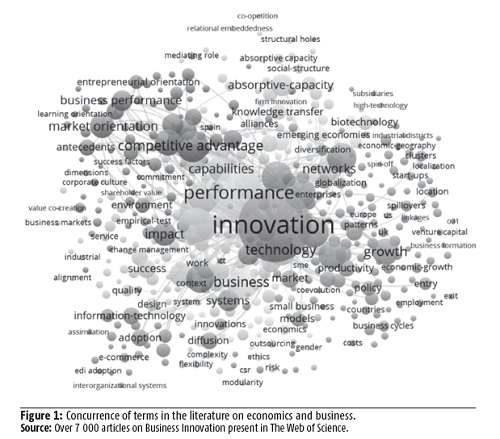
<body><![CDATA[<p><font face="Verdana, Arial, Helvetica, sans-serif" size="2">Previous empirical    research on product innovation performance has provided considerable evidence    that a wide variety of antecedent factors or determinants can influence the    outcomes of new product development activity (Montoya-Weiss and Calantone, 1994).    The list of determinants of new product performance considered in this study    was developed based on an examination of the literature, with special incidence    on the Meta-Analysis provided by (Montoya-Weiss and Calantone, 1994) due to    its relevance and recognition as one of the seminal papers on this topic.</font></p>     <p><font face="Verdana, Arial, Helvetica, sans-serif" size="2">The first study    to undertake this task was Project SAPPHO, which employed a pairwise comparison    methodology (Rothwell, 1972) where forty-three pairs of projects-success versus    failure were studied and 41 variables were found to be statistically significant    in their relationship to project outcomes. A similar study was undertaken in    Hungary and revealed a parallel set of success factors, notably market need    satisfaction; effective communication; efficient development; a market orientation;    and the role of key individuals (Rothwell, 1972; Rothwell et al., 1974). Kulvik's    success/failure study in Finland yielded similar results to the above, but identified    additional facilitators, including a good &quot;company/ product fit&quot;,    the utilization of technical &quot;knowhow&quot; of the company, and familiarity    with both the product's markets and technologies (Kulvik, 1977).</font></p>     <p><font face="Verdana, Arial, Helvetica, sans-serif" size="2">Utterback and his    colleagues investigated European and Japanese successes vs. failures and identified    marketing proficiency, product advantage, early market need recognition, a high    degree of customer contact, and top management initiation as the keys to success    (Utterback, Allen, Hollomon and Sirbu Jr., 1976), whereas Rubenstein's study    of U.S. new products (Rubenstein et al., 1976) identified fifty-four significant    facilitators for success including the existence of a product &quot;champion&quot;    as well as marketing factors such as need recognition, superior data collection    and analysis, planned approaches to venture management and strong internal communications    (Rubenstein et al., 1976). On the other hand, researchers from the Stanford    Innovation Project used a variety of methodologies to conclude that product    innovation success is likely to be greater if the firm introduces a product    with a high performance to cost ratio, if the firm is proficient in marketing    and commits a significant amount of resources to selling and promoting the product.    Also, if the product yields a high contribution margin to the firm and the R    and D process is well planned and executed with the product being introduced    into the market early and there is a high level of management support for the    project from the development stage through to launch (Maidique and Zirger, 1984).</font></p>     <p><font face="Verdana, Arial, Helvetica, sans-serif" size="2">In Project NewProd,    Cooper (1979) identified characteristics that separated 102 new product successes    from 93 failures in 102 firms (Cooper, 1979). The use of factor analysis and    multiple regression analysis revealed a set of success factors, the most important    being: having a unique, superior product with a real differential advantage    in the market, having strong market knowledge and market inputs, and undertaking    the market research and marketing tasks well and having technological and production    synergy and proficiency (Cooper, 1979). In a posterior study, Cooper and Kleinschmidt    (1987b) proposed that new product outcomes are determined by the interaction    of the market environment with new product strategy and development process    execution (Cooper and Kleinschmidt, 1987b). They identified ten constructs or    composite variables (derived from a larger set of variables) as determinants    of new product performance including: product advantage, market potential, market    competitiveness, marketing synergy, technological synergy, protocol, proficiency    of predevelopment activities, proficiency of market-related activities, proficiency    of technological activities and top management support (Cooper and Kleinschmidt,    1987b).</font></p>     <p><font face="Verdana, Arial, Helvetica, sans-serif" size="2">In their Meta-Analysis,    authors Montoya-Weiss and Calantone (1994) review all these studies together    with the three additional seminal studies by Maidique and Zirger (1984), Rothwell    et al. (1974) and Utterback et al. (1976) mentioned above and used them to develop    an initial inventory of determinants. In total, eighteen factors related to    four dimensions were identified including Strategic Factors such as product    advantage, marketing synergy, technological synergy, strategy and company resources,    Market Environment Factors including market potential, market competitiveness    and the environment (the general operating environment faced by the firm), Development    Process Factors including protocol (firm's knowledge and understanding of specific    marketing and technical aspects prior to product development), proficiency of    predevelopment activities, proficiency of market-related activities, proficiency    of technological activities, top management support, control and skills, speed    to market, project development costs and financial/business analysis and finally    Organizational Factors such as internal/external communication and organizational    factors (organizational structure of the firm, teams, new venture, matrix, organizational    climate, size, centralization, reward structure, and job design) (Montoya-Weiss    and     <br>   Calantone, 1994).</font></p>     <p><font face="Verdana, Arial, Helvetica, sans-serif" size="2">We selected Montoya-Weiss    andCalantone&acute;s Meta-Analysis as a reference for Performance Determinants    to measure PIP because it continues to be one of the most relevant and most    cited studies on Product Innovation Performance Determinants that includes the    criteria proposed by several seminal and relevant investigations on the topic.        <br>   For this study we have decided to focus our efforts in analyzing market factors    and development process factors only and how they influence product innovation    performance (PIP). This is because there is consensus in the marketing literature    that market knowledge, the firm's knowledge about its customers and competitors,    is one of the fundamental drivers for successful product innovation (De Luca    and Atuahene-Gima, 2007). However, few studies examine the dimensions or characteristics    of market knowledge and how and why these resources influence product innovation    performance (De Luca and Atuahene-Gima, 2007).</font></p>     <p>&nbsp;</p>     <p><font face="Verdana, Arial, Helvetica, sans-serif" size="2"><b>3.3. Product    Innovation Performance (PIP) Measurement</b>    ]]></body>
<body><![CDATA[<br>   </font></p>     <p><font face="Verdana, Arial, Helvetica, sans-serif" size="2">In management research,    general firm performance has traditionally been the dependent variable of empirical    studies (Alegre, Lapiedra y Chiva, 2006). On the other hand, practitioners also    need instruments to assess innovation management and innovation outcomes given    the amount of money, time and resources allocated to innovation activities (Alegre,    Lapiedra y Chiva, 2006;     <br>   Hannachi, 2015).</font></p>     <p><font face="Verdana, Arial, Helvetica, sans-serif" size="2">In order to achieve    product innovation performance, firms need a deep understanding of innovation    dynamics, a well thought innovation strategy, well-defined processes of innovation    strategy implementation and, above all, profound tools to measure innovation    performance (Hannachi, 2015). </font></p>     <p><font face="Verdana, Arial, Helvetica, sans-serif" size="2">Given the importance    of product innovation performance (PIP), its measurement might be an overwhelming    challenge for some. In fact, both researchers and managers require a relevant    measurement instrument of PIP (Alegre, Lapiedra y Chiva, 2006; Hannachi, 2015)    to facilitate its operationalization and measurement. With this study, we hope    to contribute to a better understanding of the concept of product innovation    performance (PIP) and how to measure it accordingly.</font></p>     <p><font face="Verdana, Arial, Helvetica, sans-serif" size="2">Product Innovation    Performance (PIP) is a broad, multidimensional concept with various definitions    and heterogeneous measurement procedures (Hannachi, 2015). Many authors have    attempted to provide several different tools to measure product innovation performance    and they vary because &quot;performance&quot; can be measured from many different    points of view: from commercial performance to technical performance, financial    performance, etc. Definitely, the most used criteria to asses and measure performance,    both by practitioners and researchers, are based on financial and market aspects    (Suomala, 2004) given that the primary objective of product innovation is to    generate profits for firms (Hannachi, 2015).</font></p>     <p><font face="Verdana, Arial, Helvetica, sans-serif" size="2">However, some authors    posit that using only these more quantitative criteria is too restrictive and    narrow since innovation benefits range is wider and richer (Hannachi, 2015).    Other product innovation benefits include more qualitative aspects such as improvement    loyalty of existing customers, improvement of the company image, grow into new    markets, etc (Hannachi, 2015; Storey and Easingwood, 1999). These authors argue    that these effects are of considerable importance to any firm and must be included    in the measurement process. However, these &quot;company benefits&quot; as named    by (Storey and Easingwood, 1999) are much less frequently used by firms and    researchers to measure the PIP concept (Hannachi, 2015). Driva, Pawar and Menon    (2000) posit that criteria such as customer satisfaction, reputation and competitive    advantage produced, despite being considered by managers to be the most useful    aspects, are rarely used to measure performance (Driva, Pawar and Menon, 2000).    A new product might achieve a limited financial return, yet be considered a    great success for managers because it had a major impact on the market, or introduced    a new technology to the industry, or opened up a new window of opportunity to    the firm (Cooper and Kleinschmidt, 1987a).</font></p>     <p><font face="Verdana, Arial, Helvetica, sans-serif" size="2">Reviewing the literature    on Product Innovation Performance (PIP) Measurement we found that it is a multidimensional    measurement and that practitioners use customer acceptance measures and financial    performance dimensions most frequently whereas researchers use slightly fewer    measures depending on their focus (Griffin and Page, 1993). Driva, Pawar and    Menon (2000) in a survey of PIP measurements in the U.S. and Europe compared    measures used by academics to those used by practitioners. They identified total    cost of the project, on-time delivery of development project, actual project    cost compared to budget, actual versus target time for project completion and    lead time to market as the criteria most commonly implemented (Driva, Pawar    and Menon, 2000).     <br>   On the other hand Blindenbach-Driessen, Van Dalen and Van Den Ende (2010) defined    PIP as the combination of two dimensions: operational performance and product    performance; the first including items on how the innovation project was executed,    whereas the second evaluated the commercial outcome of the project (Blindenbach-Driessen,    Van Dalen and Van Den Ende, 2010).    <br>   In their study from 1993, Griffin and Page (1993), identify several &quot;core&quot;    measures categorized in four different dimensions: Customer Acceptance Measures,    Financial Performance, Product-Level Measures and Firm-Level Measures. A few    years later and based on a survey among product development managers, the same    authors categorized PIP measurements in three dimensions: customer-based success,    financial success and technical performance success (Griffin and Page, 1996).</font></p>     ]]></body>
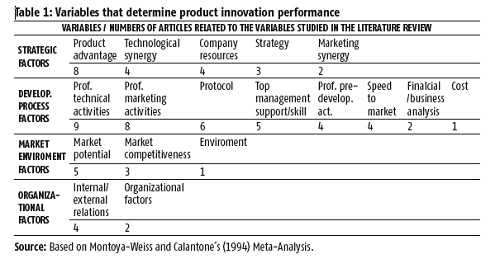
<body><![CDATA[<p><font face="Verdana, Arial, Helvetica, sans-serif" size="2">On a different    note, Alegre, Lapiedra and Chiva (2006) considered PIP as a combination of two    dimensions: efficacy and efficiency where efficacy evaluates the success of    an innovation, while efficiency assesses the effort carried out to achieve that    success (Hannachi, 2015). Alegre and colleagues were inspired by the instrument    proposed by the OECD's Oslo Manual (2005) to build the product innovation efficacy    construct while product innovation efficiency was based on a comparison with    firms' competitors on criteria such as average innovation project development    time, average cost per innovation project and global satisfaction degree with    innovation project efficiency (Alegre, Lapiedra and Chiva, 2006; Hannachi, 2015).</font></p>     <p><font face="Verdana, Arial, Helvetica, sans-serif" size="2">Cooper (1984) included    eight performance measures that capture different facets of a firm's performance.    Factor analysis of these eight measures resulted in three independent dimensions    of new product success, that is the impact or importance of the program on company    sales and profits, the success rate of the program and the relative performance,    which captures the overall performance of the program relative to objectives,    to competitors, and in terms of profits versus costs (Hultink and Robben, 1995).    Cooper and Kleinschmidt (1987) elaborated on the previous study with an updated    research that included 10 success measures. </font></p>     <p><font face="Verdana, Arial, Helvetica, sans-serif" size="2">They identified    three independent dimensions that characterize new product success, namely financial    performance, opportunity window (the degree to which the new product opened    up new opportunities to the firm in terms of a new category of products or/and    a new market area for the firm) and market impact (Hultink and Robben, 1995).        <br>   Conversely, Cordero (1990) distinguishes measures to evaluate overall performance,    measures to evaluate technical performance and measures to evaluate commercial    performance to assess new product success. Cordero recognizes that there is    no single measure that is entirely satisfactory (Hultink and Robben, 1995; Cordero,    1990).</font></p>     <p><font face="Verdana, Arial, Helvetica, sans-serif" size="2">Other relevant    authors include Hsu and Fang (2009) who identified four PIP dimensions including    market performance, financial performance, customer performance and product    performance (Hsu and Fang, 2009); and Cooper and Kleinschmidt (1995) who produced    three dimensions: financial performance, market impact and a final dimension    they termed &quot;opportunity window&quot;.     <br>   Finally, as per our literature review we found a study conducted by Storey and    Easingwood (1999) on consumer financial services sector in the UK who identified    three distinct dimensions of performance: sales performance, profitability and    enhanced opportunities (Hannachi, 2015; Storey and Easingwood, 1999).</font></p>     <p><font face="Verdana, Arial, Helvetica, sans-serif" size="2">There is no single    measurement that can evaluate PIP comprehensively, which is the reason why all    authors mentioned in this study have a multidimensional approach (Hannachi,    2015). We use Hannachi&acute;s meta-analysis as a reference to determine which    criteria to include when measuring PIP because it is one of the most recent    studies on Product Innovation Performance (PIP) Measurement that includes the    criteria proposed by several seminal and relevant investigations on the topic,    including the work by Cooper and Kleinschmidt (1987, 1995), Griffin and Page    (1993, 1996), Driva, Pawar and Menon (2000), Blindenbach-Driessen, Van Dalen    and Van Den Ende (2010), Alegre, Lapiedra and Chiva (2006), Hsu and Fang (2009)    and Storey and Easingwood (1999). </font></p>     <p><font face="Verdana, Arial, Helvetica, sans-serif" size="2">Hence, the constructs    we included to measure PIP are financial product performance, market product    performance, customer product performance, technical product performance and    strategic product performance (Hannachi, 2015). </font><font face="Verdana, Arial, Helvetica, sans-serif" size="2">From    the review of the literature on business innovation performance, we propose    a model to analyze and understand the most relevant factors that determine performance    in innovation (figure 3).</font></p>     <p align="center"><img src="/img/revistas/eyd/v158n2/f0303217.jpg" width="500" height="347"></p>     <p><font face="Verdana, Arial, Helvetica, sans-serif" size="2">    ]]></body>
<body><![CDATA[<br>   As per figure 3, there are four main determinants of product innovation performance:    strategic factors, market factors, development process factors and organizational    factors (Montoya-Weiss and Calantone, 1994; Hannachi, 2015). Each of these factors    has specific variables that need to be studied further in order to contribute    to the understanding of the relationship between the determinant factors and    innovation performance. These are included in table 1.</font></p>     <p align="center"><img src="/img/revistas/eyd/v158n2/t0103217.jpg" width="500" height="259"></p>     <p> </p>     <p> </p>     <p><font face="Verdana, Arial, Helvetica, sans-serif" size="2">Also, the authors    in our literature review recognize there are three types of product innovation:    highly innovative, moderately innovative and low innovative product innovation    (Hannachi, 2015), which in this case we posit moderate the relationship between    the determinant factors and the dependent variable in this case, innovation    performance.    <br>   Finally, we have innovation outcomes, in this specific case product innovation    performance which is measured from five different perspectives: financial product    performance, market product performance, customer product performance, technical    product performance and strategic product performance, all of which should be    analyzed further in posterior studies in order to clarify their relationships    and characteristics.</font></p>     <p>&nbsp;</p>     <p><font face="Verdana, Arial, Helvetica, sans-serif" size="2"><b><font size="3">CONCLUSIONS</font></b>    <br>   </font></p>     <p><font face="Verdana, Arial, Helvetica, sans-serif" size="2">Nowadays high competence    underline the importance of a better understanding of the concept of product    innovation, its performance and determinants. Both, the academic sector and    practitioners show this interest. In the academic sector this situation is reflected    in the literature published on innovation in economy and business journals,    being one of the main fields of research the relationship between innovation    and performance.</font></p>     ]]></body>
<body><![CDATA[<p><font face="Verdana, Arial, Helvetica, sans-serif" size="2">This paper has    reviewed and analyzed the relevance of factors that determine business performance    in process and product innovation, and contributes to innovation literature    by proposing an ordering of the determinants of product innovation performance    (PIP) and by placing a moderate relationship between the determinant factors    and the dependent variable, innovation performance, considering the three types    of product innovation proposed in the literature: highly innovative, moderately    innovative and low innovative product innovation. The multi-dimensional nature    of PIP shows the need for multidisciplinary investigations. Future research    should focus on the analysis of each of the factors; seeking consensus on concepts    as well as greater empirical evidence of the proposed relationships.    <br>   The world of practitioners demands better tools for the management of innovation    processes and the academy should respond not only with explanatory studies,    but also through the proposal of methodologies that help to overcome the current    ratios of success / failure in product innovation.</font></p>     <p>&nbsp;</p>     <p><font face="Verdana, Arial, Helvetica, sans-serif" size="3"><b>REFERENCES</b></font><font face="Verdana, Arial, Helvetica, sans-serif" size="2">    <br>   </font></p>     <!-- ref --><p><font face="Verdana, Arial, Helvetica, sans-serif" size="2">ABERNATHY, W. J.    &amp; K. B. CLARK (1985):&quot; Innovation: Mapping the Winds of Creative Destruction&quot;,    Research Policy, vol. 14, n.o 2, pp. 3-22, <a href="%3Chttp://doi.org/10.1016/0048-7333(93)90040-O%3E">&lt;http://doi.org/10.1016/0048-7333(93)90040-O&gt;</a>[23/4/2016].    <br>   </font></p>     <!-- ref --><p><font face="Verdana, Arial, Helvetica, sans-serif" size="2">ALEGRE, J.; R.    LAPIEDRA &amp; R. CHIVA (2006): &quot;A Measurement Scale for Product Innovation    Performance&quot;, European Journal of Innovation Management, vol. 9, n.o 4,    pp. 333-346,<a href="%3C%20http://doi.org/10.1108/14601060610707812%3E">&lt;    http://doi.org/10.1108/14601060610707812&gt;</a>[12/6/2016].    <br>   </font></p>     <!-- ref --><p><font face="Verdana, Arial, Helvetica, sans-serif" size="2">ALI, A. (1994):    &quot;Pioneering Versus Incremental Innovation: Review and Research Propositions&quot;,    Journal of Product Innovation Management, vol. 11, n.o 1, pp. 46-61, <a href="%3Chttp://doi.org/10.1016/0737-6782(94)90118-X%3E">&lt;http://doi.org/10.1016/0737-6782(94)90118-X&gt;</a>[23/4/2016].    <br>   </font></p>     <p><font face="Verdana, Arial, Helvetica, sans-serif" size="2">ALI, A.; M. KALWANI    &amp; D. KOVENOCK (1993): &quot;Selecting Product Development Projects: Pioneering    versus Incremental Innovation Strategies&quot;, Management Science, vol. 39,    n.o 3, pp. 255-274,    <br>   <a href="%3C%20http://doi.org/10.1287/mnsc.39.3.255%3E">&lt; http://doi.org/10.1287/mnsc.39.3.255&gt;</a>[14/5/2016].    <br>   </font></p>     <!-- ref --><p><font face="Verdana, Arial, Helvetica, sans-serif" size="2">ARTECHE, M. R.    D.; S. V. WELSH; M. N. SANTUCCI; A. F. CASTRO &amp; E. C. ZAMBRANO (2017): &quot;Knowledge    and Innovation Measurement in Mining and Life Sciences Sectors: Study in Chile,    Argentina, Peru and Colombia&quot;, International Journal of Business Innovation    and Research, vol. 12, n.o 2, pp. 206-223.    <br>   </font></p>     <!-- ref --><p><font face="Verdana, Arial, Helvetica, sans-serif" size="2">BANBURY, C. M.    &amp; W. MITCHELL (1995): &quot;The Effect of Introducing Important Incremental    Innovations on Market Share and Business Survival&quot;, Strategic Management    Journal, n.o 16, pp. 161-182.    <br>   </font></p>     <!-- ref --><p><font face="Verdana, Arial, Helvetica, sans-serif" size="2">BARNEY, J. (1991):    &quot;Firm Resources and Sustained Competitive Advantage, Journal of Management,    <a href="%3C%20http://doi.org/10.1177/014920639101700108%3E">&lt; http://doi.org/10.1177/014920639101700108&gt;</a>[18/9/2016].    <br>   </font></p>     ]]></body>
<body><![CDATA[<!-- ref --><p><font face="Verdana, Arial, Helvetica, sans-serif" size="2">BENNER, M. J. &amp;    M. L. TUSHMAN (2002): &quot;Process Management and Technological Innovation:    A Longitudinal Study of the Photography and Paint Industries&quot;, Administrative    Science Quarterly, vol. 47, n.o 4, pp. 676-706,<a href="%3Chttp://doi.org/10.2307/3094913%3E">&lt;http://doi.org/10.2307/3094913&gt;</a>[23/4/2016].    <br>   </font></p>     <!-- ref --><p><font face="Verdana, Arial, Helvetica, sans-serif" size="2">BENNER, M. J. &amp;    M. L. TUSHMAN (2003): &quot;Exploitation, Exploration, and Process Management:    The Productivity Dilemma Revisited&quot;, Academy of Management Review, vol.    28, n.o 2, pp. 238-256, <a href="%3Chttp://doi.org/10.5465/AMR.2003.9416096%3E">&lt;http://doi.org/10.5465/AMR.2003.9416096&gt;</a>    [28/7/2016].    <br>   </font></p>     <!-- ref --><p><font face="Verdana, Arial, Helvetica, sans-serif" size="2">BLINDENBACH-DRIESSEN,    F.; J. VAN DALEN &amp; J. VAN DEN ENDE (2010): &quot;Subjective Performance    Assessment of Innovation Projects&quot;, Journal of Product Innovation Management,    vol. 27, n.o 4, pp. 572-592, <a href="%3Chttp://doi.org/10.1111/j.1540-5885.2010.00736.x%3E%20">&lt;http://doi.org/10.1111/j.1540-5885.2010.00736.x&gt;    </a>[18/9/2016].    <br>   </font></p>     <!-- ref --><p><font face="Verdana, Arial, Helvetica, sans-serif" size="2">BOOZ, E.; J. ALLEN    &amp; R. HAMILTON (1982): New Products Management for the 1980s, Booz Allen    Hamilton, McLean, Virginia.    <br>   </font></p>     <p><font face="Verdana, Arial, Helvetica, sans-serif" size="2">BOWMAN, D. &amp;    H. GATIGNON (1996): &quot;Order of Entry as a Moderator of the Effect of the    Marketing Mix on Market Share&quot;, Marketing Science, vol. 15, n.o 3, pp.    222-242. <a href="%3Chttp://doi.org/10.1287/mksc.15.3.222%3E">&lt;http://doi.org/10.1287/mksc.15.3.222&gt;</a>    [23/4/2016].    <br>   </font></p>     ]]></body>
<body><![CDATA[<!-- ref --><p><font face="Verdana, Arial, Helvetica, sans-serif" size="2">CALANTONE, R. &amp;    A. DI BENEDETTO (1988): &quot;An Integrative Model of the New Product Ddevelopment    Process an Empiricial Validation&quot;, Journal of Product Innovation Management,    vol. 5, n.o 3, pp. 201-215.    <br>   </font></p>     <!-- ref --><p><font face="Verdana, Arial, Helvetica, sans-serif" size="2">CASTRO, A. F. (2011):    &quot;Innovaci&oacute;n incremental basada en capacidades din&aacute;micas.    Evidencia emp&iacute;rica en las empresas peruanas&quot;, Journal of Business,    vol. 3, n.o 2, pp. 3-15.    <br>   </font></p>     <!-- ref --><p><font face="Verdana, Arial, Helvetica, sans-serif" size="2">CEDERGREN, S.;    A. WALL &amp; C. NORSTR&Ouml;M (2010): &quot;Evaluation of Performance in a    Product Development Context&quot;, Business Horizons, vol. 53, n.o 4, pp. 359-369,    <a href="%3Chttp://doi.org/10.2307/3094913%3E">&lt;http://doi.org/10.1016/j.bushor.2010.03.001&gt;</a>    [18/9/2016].    <br>   </font></p>     <!-- ref --><p><font face="Verdana, Arial, Helvetica, sans-serif" size="2">CHILD, J. &amp;    R. G. MCGRATH (2001): &quot;Organizations Unfettered: Organizational Form in    an Information-Intensive Economy&quot;, The Academy of Management Journal, <a href="%3Chttp://doi.org/10.2307/3069393%3E">&lt;http://doi.org/10.2307/3069393&gt;</a>    [23/4/2016].    <br>   </font></p>     <!-- ref --><p><font face="Verdana, Arial, Helvetica, sans-serif" size="2">CHRISTENSEN, C.    (1997): &quot;Patterns in the Evolution of Product Competition&quot;, European    Management Journal, vol. 15, n.o 2, pp. 117-127.    <br>   </font></p>     ]]></body>
<body><![CDATA[<!-- ref --><p><font face="Verdana, Arial, Helvetica, sans-serif" size="2">COOPER, R. G. (1979):    &quot;The Dimensions of Industrial New Product Success and Failure&quot;, Journal    of Marketing, vol. 43, n.o 3, pp. 93-103.    <br>   </font></p>     <!-- ref --><p><font face="Verdana, Arial, Helvetica, sans-serif" size="2">COOPER, R. G. (1984):    &quot;New Product Strategies: What Distinguishes the Top Performers? &quot;,    Journal of Product Innovation Management, vol. 1, n. o 3, pp. 151-164.    <br>   </font></p>     <p><font face="Verdana, Arial, Helvetica, sans-serif" size="2"><a href="COOPER,%20R.%20G.%20&%20E.%20J.%20KLEINSCHMIDT%20(1987a):%20%22New%20Products:%20What%20Separates%20Winners%20from%20Losers?%22,%20Journal%20of%20Product%20Innovation%20Management,%20vol.%204,%20n.o%203,%20pp.169-184.%20%3Chttp://doi.org/10.1016/0737-6782(87)90002-6%3E">COOPER,    R. G. &amp; E. J. KLEINSCHMIDT (1987a): &quot;New Products: What Separates Winners    from Losers?&quot;, Journal of Product Innovation Management, vol. 4, n.o 3,    pp.169-184. &lt;http://doi.org/10.1016/0737-6782(87)90002-6&gt;</a> [18/9/2016].    <br>   </font></p>     <!-- ref --><p><font face="Verdana, Arial, Helvetica, sans-serif" size="2">COOPER, R. G. &amp;    E. J. KLEINSCHMIDT (1987b): &quot;Success Factors in Product Innovation&quot;,    Industrial Marketing Management, vol. 16, n.o 3, pp. 215-223, <a href="%3Chttp://doi.org/10.1016/0019-8501(87)90029-0%3E%20">&lt;http://doi.org/10.1016/0019-8501(87)90029-0&gt;    </a> [23/4/2016].    <br>   </font></p>     <!-- ref --><p><font face="Verdana, Arial, Helvetica, sans-serif" size="2">CORDERO, R. (1990):    &quot;The Measurement of Innovation Performance in the Firm: An Overview&quot;,    Research Policy, vol. 19, n. o 2, pp. 185-192, &lt;http://doi.org/10.1016/0048-7333(90)90048-B&gt;    [12/10/2016].    <br>   </font></p>     ]]></body>
<body><![CDATA[<!-- ref --><p><font face="Verdana, Arial, Helvetica, sans-serif" size="2">DAMANPOUR, F. (1991):    &quot;Organizational Innovation: A Meta-Analysis of Effects of Determinants    and Moderators&quot;, Academy of Management Journal, vol. 34, n.o 3, pp. 555-590.    <br>   </font></p>     <!-- ref --><p><font face="Verdana, Arial, Helvetica, sans-serif" size="2">DANNEELS, E. (2002):    &quot;The Dynamics of Product Innovation and Firm Competences&quot;, Strategic    Management Journal, vol. 23, n.o 12, pp. 1095-1121, <a href="%3Chttp://doi.org/10.1002/smj.275%3E">&lt;http://doi.org/10.1002/smj.275&gt;</a>    [23/4/2016].    <br>   </font></p>     <!-- ref --><p><font face="Verdana, Arial, Helvetica, sans-serif" size="2">DANNEELS, E. &amp;    E. J. KLEINSCHMIDT (2001): &quot;Product Innovativeness from the Firm's Perspective:    Its Dimensions and their Relation with Project Selection and Performance&quot;,    The Journal of Product Innovation Management, vol. 18, n.o 6, pp. 357-373.    <br>   </font></p>     <!-- ref --><p><font face="Verdana, Arial, Helvetica, sans-serif" size="2">DE LUCA, L. M.    &amp; K. ATUAHENE-GIMA (2007): &quot;Market Knowledge Dimensions and Cross-functional    Collaboration: Examining the Different Routes to Product Innovation Performance&quot;,    Journal of Marketing, vol. 71, n.o 1, pp. 95-112, &lt;http://doi.org/10.1509/jmkg.71.1.95&gt;    [12/10/2016].    <br>   </font></p>     <!-- ref --><p><font face="Verdana, Arial, Helvetica, sans-serif" size="2">DRIVA, H.; K. S.    PAWAR &amp; U. MENON (2000): &quot;Measuring Product Development Performance    in Manufacturing Organisations&quot;, International Journal of Production Economics,    vol. 63, n.o 2, pp. 147-159, <a href="%3Chttp://doi.org/10.1016/S0925-5273(99)00007-9%3E">&lt;http://doi.org/10.1016/S0925-5273(99)00007-9&gt;</a>    [18/9/2016].    <br>   </font></p>     ]]></body>
<body><![CDATA[<!-- ref --><p><font face="Verdana, Arial, Helvetica, sans-serif" size="2">FREEMAN, C. (1982):    The Economics of Industrial Innovation, Pinter, London.    <br>   </font></p>     <!-- ref --><p><font face="Verdana, Arial, Helvetica, sans-serif" size="2">GEE, S. (1981):    Technology Transfer, Innovation and International Competitiveness, John Wiley    &amp; Sons, New Jersey.    <br>   </font></p>     <!-- ref --><p><font face="Verdana, Arial, Helvetica, sans-serif" size="2">GIBSON, C. B. &amp;    J. BIRKINSHAW (2004): &quot;The Antecedents, Consequences, and Mediating Role    of Organizational Ambidexterity&quot;, The Academy of Management Journal, vol.    47, n.o 2, pp. 209-226, <a href="%3Chttp://doi.org/10.2307/20159573%3E">&lt;http://doi.org/10.2307/20159573&gt;</a>    [23/4/2016].    <br>   </font></p>     <!-- ref --><p><font face="Verdana, Arial, Helvetica, sans-serif" size="2">GINSBERG, A. &amp;    N. VENKATRAMAN (1985): &quot;Contingency Perspectives of Organizational Strategy?:    a Critical Review of the Empirical Research&quot;, Academy of Management Review,    vol. 10, n.o 3, pp. 421-434, <a href="%3C%20http://doi.org/10.2307/258125%3E">&lt;    http://doi.org/10.2307/258125&gt;</a> [28/7/2016].    <br>   </font></p>     <!-- ref --><p><font face="Verdana, Arial, Helvetica, sans-serif" size="2">GREEN, S. G.; M.    B. GAVIN &amp; L. AIMAN-SMITH (1995): &quot;Assessing a Multidimensional Measure    of Radical Technological Innovation&quot;, IEEE Transactions on Engineering    Management, vol. 42, n.o 3, pp. 203-214, <a href="%3Chttp://doi.org/10.1109/17.403738%3E">&lt;http://doi.org/10.1109/17.403738&gt;</a>    [23/4/2016].    <br>   </font></p>     ]]></body>
<body><![CDATA[<!-- ref --><p><font face="Verdana, Arial, Helvetica, sans-serif" size="2">GRIFFIN, A. &amp;    A. L. PAGE (1993): &quot;An Interim Report on Measuring Product Development    Success and Failure&quot;, Journal of Product Innovation Management, vol. 10,    n.o 4, pp. 291-308, <a href="%3Chttp://doi.org/10.1016/0737-6782(93)90072-X%3E">&lt;http://doi.org/10.1016/0737-6782(93)90072-X&gt;</a>    [12/10/2016].    <br>   </font></p>     <!-- ref --><p><font face="Verdana, Arial, Helvetica, sans-serif" size="2">GRIFFIN, A. &amp;    A. L. PAGE (1996): &quot;PDMA Success Measurement Project: Recommended Measures    for Product Development Success and Failure&quot;, Journal of Product Innovation    Management, vol. 13, n. o 6, pp. 478-496, <a href="%3Chttp://doi.org/10.1111/1540-5885.1360478%3E">&lt;http://doi.org/10.1111/1540-5885.1360478&gt;</a>    [12/10/2016].    <br>   </font></p>     <!-- ref --><p><font face="Verdana, Arial, Helvetica, sans-serif" size="2">GOLDER, P. N. &amp;    G. J. TELLIS (1993): &quot;Pioneer Advantage: Marketing Logic or Marketing Legend?    &quot;, Journal of Marketing Research, vol. 30, n. o 2, pp. 158-170.    <br>   </font></p>     <!-- ref --><p><font face="Verdana, Arial, Helvetica, sans-serif" size="2">HANNACHI, Y. (2015):    &quot;Development and Validation of a Measure for Product Innovation Performance?:    The PIP Scale&quot;, Journal of Business Studies Quarterly, vol. 6, n. o 3,    pp. 23-35.    <br>   </font></p>     <p><font face="Verdana, Arial, Helvetica, sans-serif" size="2">HE, Z. L. &amp;    P. K. WONG (2004): &quot;Exploration vs. Exploitation: An Empirical Test of    the Ambidexterity Hypothesis&quot;, Organization Science, vol. 15, n. o 4, pp.    481-494, <a href="%3Chttp://doi.org/10.1287/orsc.1040.0078%3E">&lt;http://doi.org/10.1287/orsc.1040.0078&gt;</a>    [23/4/2016].    <br>   </font></p>     ]]></body>
<body><![CDATA[<!-- ref --><p><font face="Verdana, Arial, Helvetica, sans-serif" size="2">HSU, Y. H. &amp;    W. FANG (2009): &quot;Intellectual Capital and New Product Development Performance:    The Mediating Role of Oganizational Learning Capability&quot;, Technological    Forecasting and Social Change, vol. 76, n. o 5, pp. 664-677, <a href="%3Chttp://doi.org/10.1287/orsc.1040.0078%3E">&lt;http://doi.org/10.1016/j.techfore.2008.03.012&gt;</a>    [18/9/2016].    <br>   </font></p>     <!-- ref --><p><font face="Verdana, Arial, Helvetica, sans-serif" size="2">HULT, G. T. M.;    R. F. HURLEY &amp; G. A. KNIGHT (2004): &quot;Innovativeness: Its Antecedents    and Impact on Business Performance&quot;, Industrial Marketing Management, vol.    33, n. o 5, pp. 429-438, <a href="%3Chttp://doi.org/10.1016/j.indmarman.2003.08.015%3E">&lt;http://doi.org/10.1016/j.indmarman.2003.08.015&gt;</a>    [18/9/2016].    <br>   </font></p>     <p><font face="Verdana, Arial, Helvetica, sans-serif" size="2">HULTINK, E. J.    &amp; H. S. J. ROBBEN (1995): &quot;Measuring New Product Success: The Difference    that Time Perspective Makes&quot;, The Journal of Product Innovation Management,    vol. 12, n. o 5, pp. 392-405, &lt;Retrieved from <a href="http://www.scopus.com/inward/record.url?eid=2-s2.0-0000575778&partnerID=40&md5=a9f77bc054c50475b520c23319a28775">http://www.scopus.com/inward/record.url?eid=2-s2.0-0000575778&amp;partnerID=40&amp;md5=a9f77bc054c50475b520c23319a28775</a>&gt;    [12/10/2016].    <br>   </font></p>     <!-- ref --><p><font face="Verdana, Arial, Helvetica, sans-serif" size="2">IYER, G. R.; P.    J. LAPLACA &amp; A. SHARMA (2006): &quot;Innovation and New Product Introductions    in Emerging Markets: Strategic Recommendations for the Indian Market&quot;,    Industrial Marketing Management, n.o 35, pp. 373-382,<a href="%3C%20http://doi.org/10.1016/j.indmarman.2005.02.007%3E">&lt;    http://doi.org/10.1016/j.indmarman.2005.02.007&gt;</a> [18/9/2016].    <br>   </font></p>     <p><font face="Verdana, Arial, Helvetica, sans-serif" size="2">JANSEN, J. J. P.;    F. A. J. VAN DEN BOSCH &amp; H. W. VOLBERDA (2006): &quot;Exploratory Innovation,    Exploitative Innovation, and Performance: Effects of Organizational Antecedents    and Environmental Moderators&quot;, Management Science, vol. 52, n. o 11, pp.    1661-1674, <a href="%3Chttp://doi.org/10.1287/mnsc.l060.0576%3E">&lt;http://doi.org/10.1287/mnsc.l060.0576&gt;</a>    [12/10/2016].    <br>   </font></p>     ]]></body>
<body><![CDATA[<!-- ref --><p><font face="Verdana, Arial, Helvetica, sans-serif" size="2">KERIN, R. A.; P.    R. VARADARAJAN &amp; R. A. PETERSON (1992): &quot;First-Mover Advantage: A Synthesis,    Conceptual Framework, and Research Propositions&quot;, Journal of Marketing,    vol. 56, n. o 4, pp. 33-52.    <br>   </font></p>     <!-- ref --><p><font face="Verdana, Arial, Helvetica, sans-serif" size="2">KULVIK, H. (1977):    Factors Underlying the Success or Failure of New Products, Helsinki University    of Technology.    <br>   </font></p>     <!-- ref --><p><font face="Verdana, Arial, Helvetica, sans-serif" size="2">LEVINTHAL, D. A.    &amp; J. G. MARCH (1993): &quot;The Myopia of Learning&quot;, Strategic Management    Journal, vol. 14, n. o S2, pp. 95-112, <a href="%3Chttp://doi.org/10.1002/smj.233%3E">&lt;http://doi.org/10.1002/smj.233&gt;</a>    [13/12/2016].    <br>   </font></p>     <!-- ref --><p><font face="Verdana, Arial, Helvetica, sans-serif" size="2">LEWIN, A. Y.; C.    P. LONG &amp; T. N. CARROLL (1999): &quot;The Coevolution of New Organizational    Forms&quot;, Organization Science, vol. 10, n. o 5, pp. 535-550, <a href="%3Chttp://doi.org/10.1287/orsc.10.5.535%3E">&lt;http://doi.org/10.1287/orsc.10.5.535&gt;</a>    [18/9/2016].    <br>   </font></p>     <!-- ref --><p><font face="Verdana, Arial, Helvetica, sans-serif" size="2">LIEBERMAN, M. B.    &amp; D. B. MONTGOMERY (1988):&quot;First-Mover Advantages&quot;, Strategic    Management Journal, n. o 9 (Special Issue: Strategy Content Research), pp. 41-58.    <br>   </font></p>     ]]></body>
<body><![CDATA[<!-- ref --><p><font face="Verdana, Arial, Helvetica, sans-serif" size="2">LIEBERMAN, M. B.    &amp; D. B. MONTGOMERY (1998): &quot;First-Mover ( Dis ) Advantages: Retrospective    and Link with the Resource-Based View&quot;, Strategic Management Journal, vol.    19, n. o 12, pp. 1111-1125.    <br>   </font></p>     <!-- ref --><p><font face="Verdana, Arial, Helvetica, sans-serif" size="2">MAIDIQUE, M. A.    &amp; B. J. ZIRGER (1984):&quot;A Study of Success and Failure in Product Innovation:    The Case of the U.S. Electronics Industry&quot;, IEEE Transactions on Engineering    Management, EM, vol. 31, n. o 4, pp. 192-203, <a href="%3C%20http://doi.org/10.1109/TEM.1984.6447537%3E">&lt;    http://doi.org/10.1109/TEM.1984.6447537&gt;</a> [13/12/2016].    <br>   </font></p>     <!-- ref --><p><font face="Verdana, Arial, Helvetica, sans-serif" size="2">MEEUS, M. T. H.    &amp; L. A. G. OERLEMANS (2000): &quot;Firm Behaviour and Innovative Performance    An Empirical Exploration of the Selection-Adaptive Debate&quot;, Research Policy,    vol. 29, n. o1, pp. 41-58,<a href="%3C%20http://doi.org/10.1016/S0048-7333(99)00032-3%3E">    &lt; http://doi.org/10.1016/S0048-7333(99)00032-3&gt;</a> [12/10/2016].    <br>   </font></p>     <p><font face="Verdana, Arial, Helvetica, sans-serif" size="2">MONTOYA-WEISS,    M. M. &amp; R. CALANTONE (1994): &quot;Determinants of New Product Performance:    A Review and Meta-Analysis&quot;, Journal of Product Innovation     <br>   Management, vol. 11, n.o 5, pp. 397-417, <a href="%3Chttp://doi.org/10.1016/0737-6782(94)90029-9%3E%20">&lt;http://doi.org/10.1016/0737-6782(94)90029-9&gt;    </a>[18/9/2016].    <br>   </font></p>     <!-- ref --><p><font face="Verdana, Arial, Helvetica, sans-serif" size="2">MYERS, S. &amp;    D. G. MARQUIS (1969): Successful Industrial Innovations. A Study of Factors    Underlying Innovation in Selected Firms, National Science Foundation, Washington,    D.C.    <br>   </font></p>     <!-- ref --><p><font face="Verdana, Arial, Helvetica, sans-serif" size="2">PILZER, P. Z. (1990):    Unlimited Wealth: The Theory and Practice of Economic Alchemy, Crown, Washington,    D.C.    <br>   </font></p>     <!-- ref --><p><font face="Verdana, Arial, Helvetica, sans-serif" size="2">PORTER, M. E. &amp;    C. VAN DER LINDE (1995): &quot;Toward a New Conception of the Environment-Competitiveness    Relationship&quot;, The Journal of Economic Perspectives, vol. 9, n. o 4, pp.    97-118.    <br>   </font></p>     <!-- ref --><p><font face="Verdana, Arial, Helvetica, sans-serif" size="2">PRAHALAD, C. K.    &amp; G. HAMEL (1990): &quot;The Core Competence of the Corporation&quot;, Harvard    Buisness Review, May-June, pp. 79-91.    <br>   </font></p>     <!-- ref --><p><font face="Verdana, Arial, Helvetica, sans-serif" size="2">ROTHWELL, R. (1972):    &quot;Factors for Success in Industrial Innovations from Project SAPPHO-A Comparative    Study of Success and Failure in Industrial Innovation&quot;, Science Policy    Research Unit, vol. 22, n.o 3, pp. 221-240, University of Sussex, Brighton.    <br>   </font></p>     <p><font face="Verdana, Arial, Helvetica, sans-serif" size="2">ROTHWELL, R.; C.    FREEMAN; A. HORLSEY; V. T. P. JERVIS; A. B. ROBERTSON &amp; J. TOWNSEND (1974):    &quot;SAPPHO Updated-Project SAPPHO Phase II&quot;, Research Policy, vol. 3,    n. o 3, 258-291.    ]]></body>
<body><![CDATA[<br>   </font></p>     <!-- ref --><p><font face="Verdana, Arial, Helvetica, sans-serif" size="2">SCHNAARS, S. P.    (1994): Managing Imitation Strategies: How Later Entrants Seize Markets from    Pioneers, Free Press, NewYork.    <br>   </font></p>     <!-- ref --><p><font face="Verdana, Arial, Helvetica, sans-serif" size="2">SHANKAR, V.; G.    S. CARPENTER &amp; L. KRISHNAMURTHI (1998): &quot;Late Mover Advantage: How    Innovative Late Entrants Outsell Pioneers, Journal of Marketing Research, pp.    54-70.    <br>   </font></p>     <!-- ref --><p><font face="Verdana, Arial, Helvetica, sans-serif" size="2">STOREY, C. &amp;    C. J. EASINGWOOD (1999): &quot;Types of New Product Performance: Evidence form    the Consumer Financial Services Sector&quot;, Journal of Business Research,    vol. 46, n.o 2, pp. 193-203, <a href="%3Chttp://doi.org/10.1016/S0148-2963(98)00022-8%3E">&lt;http://doi.org/10.1016/S0148-2963(98)00022-8&gt;</a>    [12/10/2016].    <br>   </font></p>     <!-- ref --><p><font face="Verdana, Arial, Helvetica, sans-serif" size="2">SUOMALA, P. (2004):    &quot;Multifaceted New Product development Performance: Survey on Utilization    of Performance Measures in Finnish Industry&quot;, Performance Measurement and    Management Control Superior Organizational Performance, pp. 1-27,<a href="%3Chttp://webhotel2.tut.fi/cmc/pdf/Suomala-Multifaceted_NPD_performance.pdf%3E">&lt;http://webhotel2.tut.fi/cmc/pdf/Suomala-Multifaceted_NPD_performance.pdf&gt;</a>    [18/9/2016].    <br>   </font></p>     <!-- ref --><p><font face="Verdana, Arial, Helvetica, sans-serif" size="2">TEECE, D. J.; G.    PISANO &amp; A. SHUEN(1997): &quot;Dynamic Capabilities and Strategic Management&quot;,    Strategic Management Journal, vol. 18, n. o 7, pp. 509-533, <a href="%3Chttp://doi.wiley.com/10.1002/(SICI)1097-0266(199708)18:7%3C509::AID-SMJ882%3E3.0.CO;2-Z%3E">&lt;http://doi.wiley.com/10.1002/(SICI)1097-0266(199708)18:7%3C509::AID-SMJ882%3E3.0.CO;2-Z&gt;</a>    [12/10/2016].    <br>   </font></p>     <!-- ref --><p><font face="Verdana, Arial, Helvetica, sans-serif" size="2">TIDD, J. &amp;    M. J. TREWHELLA (1997): &quot;Organizational and Technological Antecedents for    Knowledge Acquisition and Learning&quot;, R&amp;D Management, vol. 27, n.o 4,    pp. 359-375, <a href="%3Chttp://doi.org/10.1111/1467-9310.00071%3E">&lt;http://doi.org/10.1111/1467-9310.00071&gt;</a>    [18/9/2016].    <br>   </font></p>     <p><font face="Verdana, Arial, Helvetica, sans-serif" size="2">TUSHMAN, M. L.    &amp; C. A. O'REILLY III (1996): &quot;Ambidextrous Organizations: Managing    Evolutionary and Revolutionary Change&quot;, California Management Review, vol.    38, n. o 4, pp. 8-30, <a href="%3Chttp://doi.org/10.1080/09652540903536982%3E">&lt;http://doi.org/10.1080/09652540903536982&gt;</a>    [23/4/2016].    <br>   </font></p>     <!-- ref --><p><font face="Verdana, Arial, Helvetica, sans-serif" size="2">UTTERBACK, J. M.    &amp; W. J. ABERNATHY (1975): &quot;A Dynamic Model of Process and Product Innovation&quot;,    Omega, vol. 3, n. o 6, pp. 639-656, <a href="%3Chttp://doi.org/10.1016/0305-0483(75)90068-7%3E">&lt;http://doi.org/10.1016/0305-0483(75)90068-7&gt;</a>    [18/9/2016].    <br>   </font></p>     <!-- ref --><p><font face="Verdana, Arial, Helvetica, sans-serif" size="2">UTTERBACK, J. M.;    T. J. ALLEN; J. H. HOLLOMON &amp; M. A. SIRBU JR. (1976): &quot;The Process    of Innovation in Five Industries in Europe and Japan, IEEE Transactions on Engineering    Management, vol. 23, n.o 1, pp. 3-9.    <br>   </font></p>     <p><font face="Verdana, Arial, Helvetica, sans-serif" size="2">VERHEES, F. J.    H. M. &amp; M. T. G. MEULENBERG (2004): &quot;Market Orientation, Innovativeness,    Product Innovation, and Performance in Small Firms&quot;, Journal of Small Business    Management, vol. 42, n. o 2, pp. 134-154<a href=",%3C%20http://doi.org/10.1111/j.1540-627X.2004.00102.x%3E">,&lt;    http://doi.org/10.1111/j.1540-627X.2004.00102.x&gt;</a> [12/10/2016].    ]]></body>
<body><![CDATA[<br>   </font></p>     <!-- ref --><p><font face="Verdana, Arial, Helvetica, sans-serif" size="2">ZALTMAN, G.; R.    DUNCAN &amp; J. HOLBEK (1973): Innovations and organizations, John Wiley &amp;    Sons, New Jersey.    <br>   </font></p>     <!-- ref --><p><font face="Verdana, Arial, Helvetica, sans-serif" size="2">ZHOU, K. Z. (2006):    &quot;Innovation, Imitation, and New Product Performance: The Case of China&quot;,    Industrial Marketing Management, vol. 35, n.o 3, pp.394-402, <a href="%3Chttp://doi.org/10.1016/j.indmarman.2005.10.006%3E">&lt;http://doi.org/10.1016/j.indmarman.2005.10.006&gt;</a>    [18/9/2016].    </font></p>     <p>&nbsp;</p>     <p>&nbsp;</p>     <p><font face="Verdana, Arial, Helvetica, sans-serif" size="2">RECIBIDO: 13/03/2017    <br>   ACEPTADO: 26/04/2017</font></p>     <p>&nbsp;</p>     ]]></body>
<body><![CDATA[<p>&nbsp;</p>     <p><font face="Verdana, Arial, Helvetica, sans-serif" size="2"><i>Rossana Montero</i>.    Universidad del Pac&iacute;fico, Per&uacute;. Correo electr&oacute;nico: <a href="mailto:montero_gr@up.edu.pe">montero_gr@up.edu.pe</a></font></p>     <p><font face="Verdana, Arial, Helvetica, sans-serif" size="2"><i>Carla Pennano</i>.    Universidad del Pac&iacute;fico, Per&uacute;. Correo electr&oacute;nico: <a href="mailto:pennano_c@up.edu.pe">pennano_c@up.edu.pe</a></font></p>     <p><font face="Verdana, Arial, Helvetica, sans-serif" size="2"><i>Luis Camilo    Ortigueira-S&aacute;nchez</i>. Universidad del Pac&iacute;fico, Per&uacute;.    Correo electr&oacute;nico:<a href="mailto:lc.ortigueiras@up.edu.pe">lc.ortigueiras@up.edu.pe</a></font></p>     <p><font face="Verdana, Arial, Helvetica, sans-serif" size="2">    <br>   </font></p>      ]]></body><back>
<ref-list>
<ref id="B1">
<nlm-citation citation-type="">
<person-group person-group-type="author">
<name>
<surname><![CDATA[ABERNATHY]]></surname>
<given-names><![CDATA[W. J.]]></given-names>
</name>
<name>
<surname><![CDATA[CLARK]]></surname>
<given-names><![CDATA[K. B.]]></given-names>
</name>
</person-group>
<source><![CDATA["Innovation: Mapping the Winds of Creative Destruction"]]></source>
<year></year>
<volume>vol. 14</volume>
<page-range>pp. 3-22</page-range></nlm-citation>
</ref>
<ref id="B2">
<nlm-citation citation-type="">
<person-group person-group-type="author">
<name>
<surname><![CDATA[ALEGRE]]></surname>
<given-names><![CDATA[J.]]></given-names>
</name>
<name>
<surname><![CDATA[LAPIEDRA]]></surname>
<given-names><![CDATA[R.]]></given-names>
</name>
<name>
<surname><![CDATA[CHIVA]]></surname>
<given-names><![CDATA[R.]]></given-names>
</name>
</person-group>
<source><![CDATA["A Measurement Scale for Product Innovation Performance"]]></source>
<year></year>
<volume>vol. 9</volume>
<page-range>pp. 333-346</page-range></nlm-citation>
</ref>
<ref id="B3">
<nlm-citation citation-type="">
<person-group person-group-type="author">
<name>
<surname><![CDATA[ALI]]></surname>
<given-names><![CDATA[A.]]></given-names>
</name>
</person-group>
<source><![CDATA["Pioneering Versus Incremental Innovation: Review and Research Propositions"]]></source>
<year></year>
<volume>vol. 11</volume>
<page-range>pp. 46-61</page-range></nlm-citation>
</ref>
<ref id="B4">
<nlm-citation citation-type="">
<person-group person-group-type="author">
<name>
<surname><![CDATA[ALI]]></surname>
<given-names><![CDATA[A]]></given-names>
</name>
<name>
<surname><![CDATA[KALWANI]]></surname>
<given-names><![CDATA[M.]]></given-names>
</name>
<name>
<surname><![CDATA[KOVENOCK]]></surname>
<given-names><![CDATA[D.]]></given-names>
</name>
</person-group>
<source><![CDATA["Selecting Product Development Projects: Pioneering versus Incremental Innovation Strategies"]]></source>
<year></year>
<volume>vol. 39</volume>
<page-range>pp. 255-274</page-range></nlm-citation>
</ref>
<ref id="B5">
<nlm-citation citation-type="">
<person-group person-group-type="author">
<name>
<surname><![CDATA[ARTECHE]]></surname>
<given-names><![CDATA[M. R. D.]]></given-names>
</name>
<name>
<surname><![CDATA[WELSH]]></surname>
<given-names><![CDATA[S. V.]]></given-names>
</name>
<name>
<surname><![CDATA[SANTUCCI]]></surname>
<given-names><![CDATA[M. N.]]></given-names>
</name>
<name>
<surname><![CDATA[CASTRO]]></surname>
<given-names><![CDATA[A. F.]]></given-names>
</name>
<name>
<surname><![CDATA[ZAMBRANO]]></surname>
<given-names><![CDATA[E. C.]]></given-names>
</name>
</person-group>
<source><![CDATA["Knowledge and Innovation Measurement in Mining and Life Sciences Sectors: Study in Chile, Argentina, Peru and Colombia"]]></source>
<year></year>
<volume>vol. 12</volume>
<page-range>pp. 206-223</page-range></nlm-citation>
</ref>
<ref id="B6">
<nlm-citation citation-type="">
<person-group person-group-type="author">
<name>
<surname><![CDATA[BANBURY]]></surname>
<given-names><![CDATA[C. M.]]></given-names>
</name>
<name>
<surname><![CDATA[MITCHELL]]></surname>
<given-names><![CDATA[W.]]></given-names>
</name>
</person-group>
<source><![CDATA["The Effect of Introducing Important Incremental Innovations on Market Share and Business Survival"]]></source>
<year></year>
<page-range>pp. 161-182</page-range></nlm-citation>
</ref>
<ref id="B7">
<nlm-citation citation-type="">
<person-group person-group-type="author">
<name>
<surname><![CDATA[BARNEY]]></surname>
<given-names><![CDATA[J.]]></given-names>
</name>
</person-group>
<source><![CDATA[Firm Resources and Sustained Competitive Advantage]]></source>
<year></year>
</nlm-citation>
</ref>
<ref id="B8">
<nlm-citation citation-type="">
<person-group person-group-type="author">
<name>
<surname><![CDATA[BENNER]]></surname>
<given-names><![CDATA[M. J.]]></given-names>
</name>
<name>
<surname><![CDATA[TUSHMAN]]></surname>
<given-names><![CDATA[M. L.]]></given-names>
</name>
</person-group>
<source><![CDATA["Process Management and Technological Innovation: A Longitudinal Study of the Photography and Paint Industries"]]></source>
<year></year>
<volume>vol. 47</volume>
<page-range>pp. 676-706</page-range></nlm-citation>
</ref>
<ref id="B9">
<nlm-citation citation-type="">
<person-group person-group-type="author">
<name>
<surname><![CDATA[BENNER]]></surname>
<given-names><![CDATA[M. J.]]></given-names>
</name>
<name>
<surname><![CDATA[TUSHMAN]]></surname>
<given-names><![CDATA[M. L.]]></given-names>
</name>
</person-group>
<source><![CDATA["Exploitation, Exploration, and Process Management: The Productivity Dilemma Revisited"]]></source>
<year></year>
<volume>vol. 28</volume>
<page-range>pp. 238-256</page-range></nlm-citation>
</ref>
<ref id="B10">
<nlm-citation citation-type="">
<person-group person-group-type="author">
<name>
<surname><![CDATA[BLINDENBACH-DRIESSEN]]></surname>
<given-names><![CDATA[F.]]></given-names>
</name>
<name>
<surname><![CDATA[VAN DALEN]]></surname>
<given-names><![CDATA[J.]]></given-names>
</name>
<name>
<surname><![CDATA[VAN DEN ENDE]]></surname>
<given-names><![CDATA[J.]]></given-names>
</name>
</person-group>
<source><![CDATA["Subjective Performance Assessment of Innovation Projects"]]></source>
<year></year>
<volume>vol. 27</volume>
<page-range>pp. 572-592</page-range></nlm-citation>
</ref>
<ref id="B11">
<nlm-citation citation-type="">
<person-group person-group-type="author">
<name>
<surname><![CDATA[BOOZ]]></surname>
<given-names><![CDATA[E.]]></given-names>
</name>
<name>
<surname><![CDATA[ALLEN]]></surname>
<given-names><![CDATA[J.]]></given-names>
</name>
<name>
<surname><![CDATA[HAMILTON]]></surname>
<given-names><![CDATA[R.]]></given-names>
</name>
</person-group>
<source><![CDATA[New Products Management for the 1980s]]></source>
<year></year>
</nlm-citation>
</ref>
<ref id="B12">
<nlm-citation citation-type="">
<person-group person-group-type="author">
<name>
<surname><![CDATA[BOWMAN]]></surname>
<given-names><![CDATA[D.]]></given-names>
</name>
<name>
<surname><![CDATA[GATIGNON]]></surname>
<given-names><![CDATA[H.]]></given-names>
</name>
</person-group>
<source><![CDATA["Order of Entry as a Moderator of the Effect of the Marketing Mix on Market Share"]]></source>
<year></year>
<volume>vol. 15</volume>
<page-range>pp.222-242</page-range></nlm-citation>
</ref>
<ref id="B13">
<nlm-citation citation-type="">
<person-group person-group-type="author">
<name>
<surname><![CDATA[CALANTONE]]></surname>
<given-names><![CDATA[R.]]></given-names>
</name>
<name>
<surname><![CDATA[DI BENEDETTO]]></surname>
<given-names><![CDATA[A.]]></given-names>
</name>
</person-group>
<source><![CDATA["An Integrative Model of the New Product Ddevelopment Process an Empiricial Validation"]]></source>
<year></year>
<volume>vol. 5</volume>
<page-range>pp. 201-215</page-range></nlm-citation>
</ref>
<ref id="B14">
<nlm-citation citation-type="">
<person-group person-group-type="author">
<name>
<surname><![CDATA[CASTRO]]></surname>
<given-names><![CDATA[A. F.]]></given-names>
</name>
</person-group>
<source><![CDATA["Innovación incremental basada en capacidades dinámicas. Evidencia empírica en las empresas peruanas"]]></source>
<year></year>
<volume>vol. 3</volume>
<page-range>pp. 3-15</page-range></nlm-citation>
</ref>
<ref id="B15">
<nlm-citation citation-type="">
<person-group person-group-type="author">
<name>
<surname><![CDATA[CEDERGREN]]></surname>
<given-names><![CDATA[S.]]></given-names>
</name>
<name>
<surname><![CDATA[WALL]]></surname>
<given-names><![CDATA[A.]]></given-names>
</name>
<name>
<surname><![CDATA[NORSTRÖM]]></surname>
<given-names><![CDATA[C.]]></given-names>
</name>
</person-group>
<source><![CDATA["Evaluation of Performance in a Product Development Context"]]></source>
<year></year>
<volume>vol. 53</volume>
<page-range>pp. 359-369</page-range></nlm-citation>
</ref>
<ref id="B16">
<nlm-citation citation-type="">
<person-group person-group-type="author">
<name>
<surname><![CDATA[CHILD]]></surname>
<given-names><![CDATA[J.]]></given-names>
</name>
<name>
<surname><![CDATA[MCGRATH]]></surname>
<given-names><![CDATA[R. G.]]></given-names>
</name>
</person-group>
<source><![CDATA["Organizations Unfettered: Organizational Form in an Information-Intensive Economy"]]></source>
<year></year>
</nlm-citation>
</ref>
<ref id="B17">
<nlm-citation citation-type="">
<person-group person-group-type="author">
<name>
<surname><![CDATA[CHRISTENSEN]]></surname>
<given-names><![CDATA[C.]]></given-names>
</name>
</person-group>
<source><![CDATA["Patterns in the Evolution of Product Competition"]]></source>
<year></year>
<volume>vol. 15</volume>
<page-range>pp. 117-127</page-range></nlm-citation>
</ref>
<ref id="B18">
<nlm-citation citation-type="">
<person-group person-group-type="author">
<name>
<surname><![CDATA[COOPER]]></surname>
<given-names><![CDATA[R. G.]]></given-names>
</name>
</person-group>
<source><![CDATA["The Dimensions of Industrial New Product Success and Failure"]]></source>
<year></year>
<volume>vol. 43</volume>
<page-range>pp. 93-103</page-range></nlm-citation>
</ref>
<ref id="B19">
<nlm-citation citation-type="">
<person-group person-group-type="author">
<name>
<surname><![CDATA[COOPER]]></surname>
<given-names><![CDATA[R. G]]></given-names>
</name>
</person-group>
<source><![CDATA["New Product Strategies: What Distinguishes the Top Performers?"]]></source>
<year></year>
<volume>vol. 1</volume>
<page-range>pp. 151-164</page-range></nlm-citation>
</ref>
<ref id="B20">
<nlm-citation citation-type="">
<person-group person-group-type="author">
<name>
<surname><![CDATA[COOPER]]></surname>
<given-names><![CDATA[R. G.]]></given-names>
</name>
<name>
<surname><![CDATA[KLEINSCHMIDT]]></surname>
<given-names><![CDATA[E. J.]]></given-names>
</name>
</person-group>
<source><![CDATA["Success Factors in Product Innovation"]]></source>
<year></year>
<volume>vol. 16</volume>
<page-range>pp. 215-223</page-range></nlm-citation>
</ref>
<ref id="B21">
<nlm-citation citation-type="">
<person-group person-group-type="author">
<name>
<surname><![CDATA[CORDERO]]></surname>
<given-names><![CDATA[R.]]></given-names>
</name>
</person-group>
<source><![CDATA["The Measurement of Innovation Performance in the Firm: An Overview"]]></source>
<year></year>
<volume>vol. 19</volume>
<page-range>pp. 185-192</page-range></nlm-citation>
</ref>
<ref id="B22">
<nlm-citation citation-type="">
<person-group person-group-type="author">
<name>
<surname><![CDATA[DAMANPOUR]]></surname>
<given-names><![CDATA[F.]]></given-names>
</name>
</person-group>
<source><![CDATA["Organizational Innovation: A Meta-Analysis of Effects of Determinants and Moderators"]]></source>
<year></year>
<volume>vol. 34</volume>
<page-range>pp. 555-590</page-range></nlm-citation>
</ref>
<ref id="B23">
<nlm-citation citation-type="">
<person-group person-group-type="author">
<name>
<surname><![CDATA[DANNEELS]]></surname>
<given-names><![CDATA[E.]]></given-names>
</name>
</person-group>
<source><![CDATA["The Dynamics of Product Innovation and Firm Competences"]]></source>
<year></year>
<volume>vol. 23</volume>
<page-range>pp. 1095-1121</page-range></nlm-citation>
</ref>
<ref id="B24">
<nlm-citation citation-type="">
<person-group person-group-type="author">
<name>
<surname><![CDATA[DANNEELS]]></surname>
<given-names><![CDATA[E.]]></given-names>
</name>
<name>
<surname><![CDATA[KLEINSCHMIDT]]></surname>
<given-names><![CDATA[E. J.]]></given-names>
</name>
</person-group>
<source><![CDATA["Product Innovativeness from the Firm's Perspective: Its Dimensions and their Relation with Project Selection and Performance"]]></source>
<year></year>
<volume>vol. 18</volume>
<page-range>pp. 357-373</page-range></nlm-citation>
</ref>
<ref id="B25">
<nlm-citation citation-type="">
<person-group person-group-type="author">
<name>
<surname><![CDATA[DE LUCA]]></surname>
<given-names><![CDATA[L. M.]]></given-names>
</name>
<name>
<surname><![CDATA[ATUAHENE-GIMA]]></surname>
<given-names><![CDATA[K.]]></given-names>
</name>
</person-group>
<source><![CDATA["Market Knowledge Dimensions and Cross-functional Collaboration: Examining the Different Routes to Product Innovation Performance"]]></source>
<year></year>
<volume>vol. 71</volume>
<page-range>pp. 95-112</page-range></nlm-citation>
</ref>
<ref id="B26">
<nlm-citation citation-type="">
<person-group person-group-type="author">
<name>
<surname><![CDATA[DRIVA]]></surname>
<given-names><![CDATA[H.]]></given-names>
</name>
<name>
<surname><![CDATA[PAWAR]]></surname>
<given-names><![CDATA[K. S.]]></given-names>
</name>
<name>
<surname><![CDATA[MENON]]></surname>
<given-names><![CDATA[U.]]></given-names>
</name>
</person-group>
<source><![CDATA["Measuring Product Development Performance in Manufacturing Organisations"]]></source>
<year></year>
<volume>vol. 63</volume>
<page-range>pp. 147-159</page-range></nlm-citation>
</ref>
<ref id="B27">
<nlm-citation citation-type="">
<person-group person-group-type="author">
<name>
<surname><![CDATA[FREEMAN]]></surname>
<given-names><![CDATA[C]]></given-names>
</name>
</person-group>
<source><![CDATA[The Economics of Industrial Innovation]]></source>
<year></year>
<publisher-loc><![CDATA[London ]]></publisher-loc>
</nlm-citation>
</ref>
<ref id="B28">
<nlm-citation citation-type="">
<person-group person-group-type="author">
<name>
<surname><![CDATA[GEE]]></surname>
<given-names><![CDATA[S.]]></given-names>
</name>
</person-group>
<source><![CDATA[Technology Transfer, Innovation and International Competitiveness]]></source>
<year></year>
<publisher-loc><![CDATA[New Jersey ]]></publisher-loc>
</nlm-citation>
</ref>
<ref id="B29">
<nlm-citation citation-type="">
<person-group person-group-type="author">
<name>
<surname><![CDATA[GIBSON]]></surname>
<given-names><![CDATA[C. B.]]></given-names>
</name>
<name>
<surname><![CDATA[BIRKINSHAW]]></surname>
<given-names><![CDATA[J.]]></given-names>
</name>
</person-group>
<source><![CDATA["The Antecedents, Consequences, and Mediating Role of Organizational Ambidexterity"]]></source>
<year></year>
<volume>vol. 47</volume>
<page-range>pp. 209-226</page-range></nlm-citation>
</ref>
<ref id="B30">
<nlm-citation citation-type="">
<person-group person-group-type="author">
<name>
<surname><![CDATA[GINSBERG]]></surname>
<given-names><![CDATA[A.]]></given-names>
</name>
<name>
<surname><![CDATA[VENKATRAMAN]]></surname>
<given-names><![CDATA[N.]]></given-names>
</name>
</person-group>
<source><![CDATA["Contingency Perspectives of Organizational Strategy?: a Critical Review of the Empirical Research"]]></source>
<year></year>
<volume>vol. 10</volume>
<page-range>pp. 421-434</page-range></nlm-citation>
</ref>
<ref id="B31">
<nlm-citation citation-type="">
<person-group person-group-type="author">
<name>
<surname><![CDATA[GREEN]]></surname>
<given-names><![CDATA[S. G.]]></given-names>
</name>
<name>
<surname><![CDATA[GAVIN]]></surname>
<given-names><![CDATA[M. B.]]></given-names>
</name>
<name>
<surname><![CDATA[AIMAN-SMITH]]></surname>
<given-names><![CDATA[L.]]></given-names>
</name>
</person-group>
<source><![CDATA["Assessing a Multidimensional Measure of Radical Technological Innovation"]]></source>
<year></year>
<volume>vol. 42</volume>
<page-range>pp. 203-214</page-range></nlm-citation>
</ref>
<ref id="B32">
<nlm-citation citation-type="">
<person-group person-group-type="author">
<name>
<surname><![CDATA[GRIFFIN]]></surname>
<given-names><![CDATA[A.]]></given-names>
</name>
<name>
<surname><![CDATA[PAGE]]></surname>
<given-names><![CDATA[A. L.]]></given-names>
</name>
</person-group>
<source><![CDATA["An Interim Report on Measuring Product Development Success and Failure"]]></source>
<year></year>
<volume>vol. 10</volume>
<page-range>pp. 291-308</page-range></nlm-citation>
</ref>
<ref id="B33">
<nlm-citation citation-type="">
<person-group person-group-type="author">
<name>
<surname><![CDATA[GRIFFIN]]></surname>
<given-names><![CDATA[A.]]></given-names>
</name>
<name>
<surname><![CDATA[PAGE]]></surname>
<given-names><![CDATA[A. L.]]></given-names>
</name>
</person-group>
<source><![CDATA["PDMA Success Measurement Project: Recommended Measures for Product Development Success and Failure"]]></source>
<year></year>
<volume>vol. 13</volume>
<page-range>pp. 478-496</page-range></nlm-citation>
</ref>
<ref id="B34">
<nlm-citation citation-type="">
<person-group person-group-type="author">
<name>
<surname><![CDATA[GOLDER]]></surname>
<given-names><![CDATA[P. N.]]></given-names>
</name>
<name>
<surname><![CDATA[TELLIS]]></surname>
<given-names><![CDATA[G. J.]]></given-names>
</name>
</person-group>
<source><![CDATA["Pioneer Advantage: Marketing Logic or Marketing Legend? "]]></source>
<year></year>
<volume>vol. 30</volume>
<page-range>pp. 158-170</page-range></nlm-citation>
</ref>
<ref id="B35">
<nlm-citation citation-type="">
<person-group person-group-type="author">
<name>
<surname><![CDATA[HANNACHI]]></surname>
<given-names><![CDATA[Y]]></given-names>
</name>
</person-group>
<source><![CDATA["Development and Validation of a Measure for Product Innovation Performance?: The PIP Scale"]]></source>
<year></year>
<volume>vol. 6</volume>
<page-range>pp. 23-35</page-range></nlm-citation>
</ref>
<ref id="B36">
<nlm-citation citation-type="">
<person-group person-group-type="author">
<name>
<surname><![CDATA[HE]]></surname>
<given-names><![CDATA[Z. L.]]></given-names>
</name>
<name>
<surname><![CDATA[WONG]]></surname>
<given-names><![CDATA[P. K.]]></given-names>
</name>
</person-group>
<source><![CDATA["Exploration vs. Exploitation: An Empirical Test of the Ambidexterity Hypothesis"]]></source>
<year></year>
<volume>vol. 15</volume>
<page-range>pp. 481-494</page-range></nlm-citation>
</ref>
<ref id="B37">
<nlm-citation citation-type="">
<person-group person-group-type="author">
<name>
<surname><![CDATA[HSU]]></surname>
<given-names><![CDATA[Y. H.]]></given-names>
</name>
<name>
<surname><![CDATA[FANG]]></surname>
<given-names><![CDATA[W.]]></given-names>
</name>
</person-group>
<source><![CDATA["Intellectual Capital and New Product Development Performance: The Mediating Role of Oganizational Learning Capability"]]></source>
<year></year>
<volume>vol. 76</volume>
<page-range>pp. 664-677</page-range></nlm-citation>
</ref>
<ref id="B38">
<nlm-citation citation-type="">
<person-group person-group-type="author">
<name>
<surname><![CDATA[HULT]]></surname>
<given-names><![CDATA[G. T. M.]]></given-names>
</name>
<name>
<surname><![CDATA[HURLEY]]></surname>
<given-names><![CDATA[R. F.]]></given-names>
</name>
<name>
<surname><![CDATA[KNIGHT]]></surname>
<given-names><![CDATA[G. A.]]></given-names>
</name>
</person-group>
<source><![CDATA["Innovativeness: Its Antecedents and Impact on Business Performance"]]></source>
<year></year>
<volume>vol. 33</volume>
<page-range>pp. 429-438</page-range></nlm-citation>
</ref>
<ref id="B39">
<nlm-citation citation-type="">
<person-group person-group-type="author">
<name>
<surname><![CDATA[HULTINK]]></surname>
<given-names><![CDATA[E. J.]]></given-names>
</name>
<name>
<surname><![CDATA[J. ROBBEN]]></surname>
<given-names><![CDATA[H. S]]></given-names>
</name>
</person-group>
<source><![CDATA["Measuring New Product Success: The Difference that Time Perspective Makes"]]></source>
<year></year>
<volume>vol. 12</volume>
<page-range>pp. 392-405</page-range></nlm-citation>
</ref>
<ref id="B40">
<nlm-citation citation-type="">
<person-group person-group-type="author">
<name>
<surname><![CDATA[IYER]]></surname>
<given-names><![CDATA[G. R.]]></given-names>
</name>
<name>
<surname><![CDATA[LAPLACA]]></surname>
<given-names><![CDATA[P. J.]]></given-names>
</name>
<name>
<surname><![CDATA[SHARMA]]></surname>
<given-names><![CDATA[A.]]></given-names>
</name>
</person-group>
<source><![CDATA["Innovation and New Product Introductions in Emerging Markets: Strategic Recommendations for the Indian Market"]]></source>
<year></year>
<page-range>pp. 373-382</page-range></nlm-citation>
</ref>
<ref id="B41">
<nlm-citation citation-type="">
<person-group person-group-type="author">
<name>
<surname><![CDATA[JANSEN]]></surname>
<given-names><![CDATA[J.]]></given-names>
</name>
<name>
<surname><![CDATA[VAN DEN BOSCH]]></surname>
<given-names><![CDATA[J.]]></given-names>
</name>
<name>
<surname><![CDATA[VOLBERDA]]></surname>
<given-names><![CDATA[H. W.]]></given-names>
</name>
</person-group>
<source><![CDATA["Exploratory Innovation, Exploitative Innovation, and Performance: Effects of Organizational Antecedents and Environmental Moderators"]]></source>
<year></year>
<volume>vol. 52</volume>
<page-range>pp. 1661-1674</page-range></nlm-citation>
</ref>
<ref id="B42">
<nlm-citation citation-type="">
<person-group person-group-type="author">
<name>
<surname><![CDATA[KERIN]]></surname>
<given-names><![CDATA[R. A.]]></given-names>
</name>
<name>
<surname><![CDATA[VARADARAJAN]]></surname>
<given-names><![CDATA[P. R.]]></given-names>
</name>
<name>
<surname><![CDATA[PETERSON]]></surname>
<given-names><![CDATA[R. A.]]></given-names>
</name>
</person-group>
<source><![CDATA["First-Mover Advantage: A Synthesis, Conceptual Framework, and Research Propositions"]]></source>
<year></year>
<volume>vol. 56</volume>
<page-range>pp. 33-52</page-range></nlm-citation>
</ref>
<ref id="B43">
<nlm-citation citation-type="">
<person-group person-group-type="author">
<name>
<surname><![CDATA[KULVIK]]></surname>
<given-names><![CDATA[H.]]></given-names>
</name>
</person-group>
<source><![CDATA[Factors Underlying the Success or Failure of New Products]]></source>
<year></year>
</nlm-citation>
</ref>
<ref id="B44">
<nlm-citation citation-type="">
<person-group person-group-type="author">
<name>
<surname><![CDATA[LEVINTHAL]]></surname>
<given-names><![CDATA[D. A.]]></given-names>
</name>
<name>
<surname><![CDATA[MARCH]]></surname>
<given-names><![CDATA[J. G.]]></given-names>
</name>
</person-group>
<source><![CDATA["The Myopia of Learning"]]></source>
<year></year>
<volume>vol. 14</volume>
<page-range>pp. 95-112</page-range></nlm-citation>
</ref>
<ref id="B45">
<nlm-citation citation-type="">
<person-group person-group-type="author">
<name>
<surname><![CDATA[LEWIN]]></surname>
<given-names><![CDATA[A. Y.]]></given-names>
</name>
<name>
<surname><![CDATA[LONG]]></surname>
<given-names><![CDATA[C. P.]]></given-names>
</name>
<name>
<surname><![CDATA[CARROLL]]></surname>
<given-names><![CDATA[T. N.]]></given-names>
</name>
</person-group>
<source><![CDATA["The Coevolution of New Organizational Forms"]]></source>
<year></year>
<volume>vol. 10</volume>
<page-range>pp. 535-550</page-range></nlm-citation>
</ref>
<ref id="B46">
<nlm-citation citation-type="">
<person-group person-group-type="author">
<name>
<surname><![CDATA[LIEBERMAN]]></surname>
<given-names><![CDATA[M. B.]]></given-names>
</name>
<name>
<surname><![CDATA[MONTGOMERY]]></surname>
<given-names><![CDATA[D. B.]]></given-names>
</name>
</person-group>
<source><![CDATA["First-Mover Advantages"]]></source>
<year></year>
<page-range>pp. 41-58</page-range></nlm-citation>
</ref>
<ref id="B47">
<nlm-citation citation-type="">
<person-group person-group-type="author">
<name>
<surname><![CDATA[LIEBERMAN]]></surname>
<given-names><![CDATA[M. B.]]></given-names>
</name>
<name>
<surname><![CDATA[MONTGOMERY]]></surname>
<given-names><![CDATA[D. B.]]></given-names>
</name>
</person-group>
<source><![CDATA["First-Mover ( Dis ) Advantages: Retrospective and Link with the Resource-Based View"]]></source>
<year></year>
<volume>vol. 19</volume>
<page-range>pp. 1111-1125</page-range></nlm-citation>
</ref>
<ref id="B48">
<nlm-citation citation-type="">
<person-group person-group-type="author">
<name>
<surname><![CDATA[MAIDIQUE]]></surname>
<given-names><![CDATA[M. A.]]></given-names>
</name>
<name>
<surname><![CDATA[ZIRGER]]></surname>
<given-names><![CDATA[B. J.]]></given-names>
</name>
</person-group>
<source><![CDATA["A Study of Success and Failure in Product Innovation: The Case of the U.S. Electronics Industry"]]></source>
<year></year>
<volume>vol. 31</volume>
<page-range>pp. 192-203</page-range></nlm-citation>
</ref>
<ref id="B49">
<nlm-citation citation-type="">
<person-group person-group-type="author">
<name>
<surname><![CDATA[MEEUS]]></surname>
<given-names><![CDATA[M. T. H.]]></given-names>
</name>
<name>
<surname><![CDATA[G. OERLEMANS]]></surname>
<given-names><![CDATA[L. A.]]></given-names>
</name>
</person-group>
<source><![CDATA["Firm Behaviour and Innovative Performance An Empirical Exploration of the Selection-Adaptive Debate"]]></source>
<year></year>
<volume>vol. 29</volume>
<page-range>pp. 41-58</page-range></nlm-citation>
</ref>
<ref id="B50">
<nlm-citation citation-type="">
<person-group person-group-type="author">
<name>
<surname><![CDATA[MONTOYA-WEISS]]></surname>
<given-names><![CDATA[M.]]></given-names>
</name>
<name>
<surname><![CDATA[CALANTONE]]></surname>
<given-names><![CDATA[R.]]></given-names>
</name>
</person-group>
<source><![CDATA["Determinants of New Product Performance: A Review and Meta-Analysis"]]></source>
<year></year>
<volume>vol. 11</volume>
<page-range>pp. 397-417</page-range></nlm-citation>
</ref>
<ref id="B51">
<nlm-citation citation-type="">
<person-group person-group-type="author">
<name>
<surname><![CDATA[MYERS,]]></surname>
<given-names><![CDATA[S.]]></given-names>
</name>
<name>
<surname><![CDATA[MARQUIS]]></surname>
<given-names><![CDATA[D.G.]]></given-names>
</name>
</person-group>
<source><![CDATA[Successful Industrial Innovations: A Study of Factors Underlying Innovation in Selected Firms]]></source>
<year></year>
<publisher-loc><![CDATA[Washington, D.C ]]></publisher-loc>
</nlm-citation>
</ref>
<ref id="B52">
<nlm-citation citation-type="">
<person-group person-group-type="author">
<name>
<surname><![CDATA[PILZER]]></surname>
<given-names><![CDATA[P. Z.]]></given-names>
</name>
</person-group>
<source><![CDATA[Unlimited Wealth: The Theory and Practice of Economic Alchemy]]></source>
<year></year>
<publisher-loc><![CDATA[Washington, D.C. ]]></publisher-loc>
</nlm-citation>
</ref>
<ref id="B53">
<nlm-citation citation-type="">
<person-group person-group-type="author">
<name>
<surname><![CDATA[PORTER]]></surname>
<given-names><![CDATA[M. E.]]></given-names>
</name>
<name>
<surname><![CDATA[VAN DER LINDE]]></surname>
<given-names><![CDATA[C.]]></given-names>
</name>
</person-group>
<source><![CDATA["Toward a New Conception of the Environment-Competitiveness Relationship"]]></source>
<year></year>
<volume>vol. 9</volume>
<page-range>pp. 97-118</page-range></nlm-citation>
</ref>
<ref id="B54">
<nlm-citation citation-type="">
<person-group person-group-type="author">
<name>
<surname><![CDATA[PRAHALAD]]></surname>
<given-names><![CDATA[C. K.]]></given-names>
</name>
<name>
<surname><![CDATA[HAMEL]]></surname>
<given-names><![CDATA[G.]]></given-names>
</name>
</person-group>
<source><![CDATA["The Core Competence of the Corporation"]]></source>
<year></year>
<page-range>pp. 79-91</page-range></nlm-citation>
</ref>
<ref id="B55">
<nlm-citation citation-type="">
<person-group person-group-type="author">
<name>
<surname><![CDATA[ROTHWELL]]></surname>
<given-names><![CDATA[R.]]></given-names>
</name>
</person-group>
<source><![CDATA["Factors for Success in Industrial Innovations from Project SAPPHO-A Comparative Study of Success and Failure in Industrial Innovation"]]></source>
<year></year>
<volume>vol. 22</volume>
<page-range>pp. 221-240</page-range><publisher-loc><![CDATA[Brighton ]]></publisher-loc>
</nlm-citation>
</ref>
<ref id="B56">
<nlm-citation citation-type="">
<person-group person-group-type="author">
<name>
<surname><![CDATA[ROTHWELL]]></surname>
<given-names><![CDATA[R.]]></given-names>
</name>
<name>
<surname><![CDATA[FREEMAN]]></surname>
<given-names><![CDATA[C.]]></given-names>
</name>
<name>
<surname><![CDATA[HORLSEY]]></surname>
<given-names><![CDATA[A.]]></given-names>
</name>
<name>
<surname><![CDATA[P. JERVIS]]></surname>
<given-names><![CDATA[V. T.]]></given-names>
</name>
<name>
<surname><![CDATA[ROBERTSON]]></surname>
<given-names><![CDATA[A. B.]]></given-names>
</name>
<name>
<surname><![CDATA[TOWNSEND]]></surname>
<given-names><![CDATA[J.]]></given-names>
</name>
</person-group>
<source><![CDATA["SAPPHO Updated-Project SAPPHO Phase II"]]></source>
<year></year>
<volume>vol. 3</volume>
<page-range>pp. 258-291</page-range></nlm-citation>
</ref>
<ref id="B57">
<nlm-citation citation-type="book">
<person-group person-group-type="author">
<name>
<surname><![CDATA[SCHNAARS]]></surname>
<given-names><![CDATA[S. P.]]></given-names>
</name>
</person-group>
<source><![CDATA[Managing Imitation Strategies: How Later Entrants Seize Markets from Pioneers]]></source>
<year></year>
<publisher-loc><![CDATA[NewYork ]]></publisher-loc>
<publisher-name><![CDATA[Free Press]]></publisher-name>
</nlm-citation>
</ref>
<ref id="B58">
<nlm-citation citation-type="">
<person-group person-group-type="author">
<name>
<surname><![CDATA[SHANKAR]]></surname>
<given-names><![CDATA[V.]]></given-names>
</name>
<name>
<surname><![CDATA[CARPENTER]]></surname>
<given-names><![CDATA[G. S.]]></given-names>
</name>
<name>
<surname><![CDATA[KRISHNAMURTHI]]></surname>
<given-names><![CDATA[L.]]></given-names>
</name>
</person-group>
<source><![CDATA["Late Mover Advantage: How Innovative Late Entrants Outsell Pioneers]]></source>
<year></year>
<page-range>pp. 54-70</page-range></nlm-citation>
</ref>
<ref id="B59">
<nlm-citation citation-type="">
<person-group person-group-type="author">
<name>
<surname><![CDATA[STOREY]]></surname>
<given-names><![CDATA[C.]]></given-names>
</name>
<name>
<surname><![CDATA[EASINGWOOD]]></surname>
<given-names><![CDATA[C. J.]]></given-names>
</name>
</person-group>
<source><![CDATA["Types of New Product Performance: Evidence form the Consumer Financial Services Sector"]]></source>
<year></year>
<volume>vol. 46</volume>
<page-range>pp. 193-203</page-range></nlm-citation>
</ref>
<ref id="B60">
<nlm-citation citation-type="">
<person-group person-group-type="author">
<name>
<surname><![CDATA[SUOMALA]]></surname>
<given-names><![CDATA[P.]]></given-names>
</name>
</person-group>
<source><![CDATA["Multifaceted New Product development Performance: Survey on Utilization of Performance Measures in Finnish Industry"]]></source>
<year></year>
<page-range>, pp. 1-27</page-range></nlm-citation>
</ref>
<ref id="B61">
<nlm-citation citation-type="">
<person-group person-group-type="author">
<name>
<surname><![CDATA[TEECE]]></surname>
<given-names><![CDATA[D. J.]]></given-names>
</name>
<name>
<surname><![CDATA[PISANO]]></surname>
<given-names><![CDATA[G.]]></given-names>
</name>
<name>
<surname><![CDATA[SHUEN]]></surname>
<given-names><![CDATA[A.]]></given-names>
</name>
</person-group>
<source><![CDATA["Dynamic Capabilities and Strategic Management"]]></source>
<year></year>
<volume>vol. 18</volume>
<page-range>pp. 509-533</page-range></nlm-citation>
</ref>
<ref id="B62">
<nlm-citation citation-type="">
<person-group person-group-type="author">
<name>
<surname><![CDATA[TIDD]]></surname>
<given-names><![CDATA[J.]]></given-names>
</name>
<name>
<surname><![CDATA[TREWHELLA]]></surname>
<given-names><![CDATA[M. J.]]></given-names>
</name>
</person-group>
<source><![CDATA["Organizational and Technological Antecedents for Knowledge Acquisition and Learning"]]></source>
<year></year>
<volume>vol. 27</volume>
<page-range>pp. 359-375</page-range></nlm-citation>
</ref>
<ref id="B63">
<nlm-citation citation-type="">
<person-group person-group-type="author">
<name>
<surname><![CDATA[TUSHMAN]]></surname>
<given-names><![CDATA[M. L.]]></given-names>
</name>
<name>
<surname><![CDATA[O'REILLY]]></surname>
<given-names><![CDATA[C. A.]]></given-names>
</name>
</person-group>
<source><![CDATA["Ambidextrous Organizations: Managing Evolutionary and Revolutionary Change"]]></source>
<year></year>
<volume>vol. 38</volume>
<page-range>pp. 8-30</page-range></nlm-citation>
</ref>
<ref id="B64">
<nlm-citation citation-type="">
<person-group person-group-type="author">
<name>
<surname><![CDATA[UTTERBACK]]></surname>
<given-names><![CDATA[J. M.]]></given-names>
</name>
<name>
<surname><![CDATA[ABERNATHY]]></surname>
<given-names><![CDATA[W. J.]]></given-names>
</name>
</person-group>
<source><![CDATA["A Dynamic Model of Process and Product Innovation"]]></source>
<year></year>
<volume>vol. 3</volume>
<page-range>pp. 639-656</page-range></nlm-citation>
</ref>
<ref id="B65">
<nlm-citation citation-type="">
<person-group person-group-type="author">
<name>
<surname><![CDATA[UTTERBACK]]></surname>
<given-names><![CDATA[J. M.]]></given-names>
</name>
<name>
<surname><![CDATA[J. ALLEN]]></surname>
<given-names><![CDATA[T.]]></given-names>
</name>
<name>
<surname><![CDATA[HOLLOMON]]></surname>
<given-names><![CDATA[J. H.]]></given-names>
</name>
<name>
<surname><![CDATA[SIRBU JR]]></surname>
<given-names><![CDATA[M. A.]]></given-names>
</name>
</person-group>
<source><![CDATA["The Process of Innovation in Five Industries in Europe and Japan, IEEE Transactions on Engineering Management]]></source>
<year></year>
<volume>vol. 23</volume>
<page-range>pp. 3-9</page-range></nlm-citation>
</ref>
<ref id="B66">
<nlm-citation citation-type="">
<person-group person-group-type="author">
<name>
<surname><![CDATA[VERHEES]]></surname>
<given-names><![CDATA[F.]]></given-names>
</name>
<name>
<surname><![CDATA[G. MEULENBERG]]></surname>
<given-names><![CDATA[M. T.]]></given-names>
</name>
</person-group>
<source><![CDATA["Market Orientation, Innovativeness, Product Innovation, and Performance in Small Firms"]]></source>
<year></year>
<volume>vol. 42</volume>
<page-range>pp. 134-154</page-range></nlm-citation>
</ref>
<ref id="B67">
<nlm-citation citation-type="">
<person-group person-group-type="author">
<name>
<surname><![CDATA[ZALTMAN]]></surname>
<given-names><![CDATA[G.]]></given-names>
</name>
<name>
<surname><![CDATA[DUNCAN]]></surname>
<given-names><![CDATA[R.]]></given-names>
</name>
<name>
<surname><![CDATA[HOLBEK]]></surname>
<given-names><![CDATA[J.]]></given-names>
</name>
</person-group>
<source><![CDATA[Innovations and organizations]]></source>
<year></year>
<publisher-loc><![CDATA[New Jersey ]]></publisher-loc>
</nlm-citation>
</ref>
<ref id="B68">
<nlm-citation citation-type="">
<person-group person-group-type="author">
<name>
<surname><![CDATA[ZHOU]]></surname>
<given-names><![CDATA[K. Z.]]></given-names>
</name>
</person-group>
<source><![CDATA["Innovation, Imitation, and New Product Performance: The Case of China"]]></source>
<year></year>
<volume>vol. 35</volume>
<page-range>pp.394-402</page-range></nlm-citation>
</ref>
</ref-list>
</back>
</article>