<?xml version="1.0" encoding="ISO-8859-1"?><article xmlns:mml="http://www.w3.org/1998/Math/MathML" xmlns:xlink="http://www.w3.org/1999/xlink" xmlns:xsi="http://www.w3.org/2001/XMLSchema-instance">
<front>
<journal-meta>
<journal-id>0253-570X</journal-id>
<journal-title><![CDATA[Revista de Salud Animal]]></journal-title>
<abbrev-journal-title><![CDATA[Rev Salud Anim.]]></abbrev-journal-title>
<issn>0253-570X</issn>
<publisher>
<publisher-name><![CDATA[Centro Nacional de Sanidad Agropecuaria]]></publisher-name>
</publisher>
</journal-meta>
<article-meta>
<article-id>S0253-570X2009000100011</article-id>
<title-group>
<article-title xml:lang="en"><![CDATA[POLYMERASE CHAIN REACTION DETECTION OF AVIAN LEUKOSIS VIRUS DNA IN VACCINES USED IN POULTRY]]></article-title>
<article-title xml:lang="es"><![CDATA[REACCIÓN EN CADENA DE LA POLIMERASA PARA LA DETECCIÓN DE VIRUS DNA DE LEUCOSIS AVIAR EN VACUNAS USADAS EN LA AVICULTURA]]></article-title>
</title-group>
<contrib-group>
<contrib contrib-type="author">
<name>
<surname><![CDATA[Acevedo]]></surname>
<given-names><![CDATA[Ana María]]></given-names>
</name>
<xref ref-type="aff" rid="A01"/>
</contrib>
<contrib contrib-type="author">
<name>
<surname><![CDATA[Rodríguez]]></surname>
<given-names><![CDATA[Edisleidy]]></given-names>
</name>
<xref ref-type="aff" rid="A01"/>
</contrib>
<contrib contrib-type="author">
<name>
<surname><![CDATA[Uffo]]></surname>
<given-names><![CDATA[Odalys]]></given-names>
</name>
<xref ref-type="aff" rid="A01"/>
</contrib>
<contrib contrib-type="author">
<name>
<surname><![CDATA[Relova]]></surname>
<given-names><![CDATA[Damarys]]></given-names>
</name>
<xref ref-type="aff" rid="A01"/>
</contrib>
<contrib contrib-type="author">
<name>
<surname><![CDATA[Noda]]></surname>
<given-names><![CDATA[Julia]]></given-names>
</name>
<xref ref-type="aff" rid="A01"/>
</contrib>
<contrib contrib-type="author">
<name>
<surname><![CDATA[Díaz de Arce]]></surname>
<given-names><![CDATA[Heidy]]></given-names>
</name>
<xref ref-type="aff" rid="A01"/>
</contrib>
</contrib-group>
<aff id="A01">
<institution><![CDATA[,Centro Nacional de Sanidad Agropecuaria (CENSA) Dirección de Microbiología Departamento de Virología Animal]]></institution>
<addr-line><![CDATA[La Habana ]]></addr-line>
<country>Cuba</country>
</aff>
<pub-date pub-type="pub">
<day>00</day>
<month>04</month>
<year>2009</year>
</pub-date>
<pub-date pub-type="epub">
<day>00</day>
<month>04</month>
<year>2009</year>
</pub-date>
<volume>31</volume>
<numero>1</numero>
<fpage>55</fpage>
<lpage>58</lpage>
<copyright-statement/>
<copyright-year/>
<self-uri xlink:href="http://scielo.sld.cu/scielo.php?script=sci_arttext&amp;pid=S0253-570X2009000100011&amp;lng=en&amp;nrm=iso"></self-uri><self-uri xlink:href="http://scielo.sld.cu/scielo.php?script=sci_abstract&amp;pid=S0253-570X2009000100011&amp;lng=en&amp;nrm=iso"></self-uri><self-uri xlink:href="http://scielo.sld.cu/scielo.php?script=sci_pdf&amp;pid=S0253-570X2009000100011&amp;lng=en&amp;nrm=iso"></self-uri><abstract abstract-type="short" xml:lang="en"><p><![CDATA[Avian leukosis viruses (ALV) provoke a variety of trasmissible bening and malign tumoral diseases affecting birds. Chickens are affected by six subgroups of ALV designs A, B, C, D, E and J of more recent world dissemination. These viruses are potential contaminants of live vaccines used in poultry. In order to research the presence of DNA from ALVs as contaminants of viral commercial vaccines to be used in poultry, different Marek´s disease vaccines were screened by a reported polymerase chain reaction (PCR) assay designed to detect all subgroups of ALVs. DNA samples extracted from seven vaccines were submitted to PCR using primers for a conserved region of env gene of HPRS-103. ALV sequences were detected in seven samples (100%). The methodology employed proved to be useful for the detection of ALVs as contaminants of imported Marek´s disease vaccines. These data suggest a high occurrence of ALVs in commercial vaccines intended for poultry disease prevention.]]></p></abstract>
<abstract abstract-type="short" xml:lang="es"><p><![CDATA[Los virus de la leucosis aviar (ALV) provocan una variedad de enfermedades tumorales benignas y malignas transmisibles que afectan a las aves. Los pollos son afectados por seis subgrupos de ALV designados A, B, C, D, E y J de más reciente diseminación mundial. Estos virus son, además, potenciales contaminantes de vacunas vivas usadas en la avicultura. Para investigar la presencia de ADN de ALV como contaminante de vacunas virales comerciales usadas en la avicultura, monitoreamos diferentes vacunas de la enfermedad de Marek en un ensayo reportado por Reacción de la Cadena de la Polimerasa (PCR) diseñado para detectar todos los subgrupos del ALV. Las muestras de ADN extraídas de siete vacunas fueron evaluadas por PCR utilizando cebadores para una región conservada del gen de la envoltura (env) de HPRS-103. Las secuencias del ALV fueron detectadas en las siete muestras (100%). La metodología empleada resultó útil para la detección de ALV como contaminante de vacunas de Marek importadas. Nuestros datos sugieren una elevada presencia de ALV en vacunas comerciales destinadas a la prevención de enfermedad en la avicultura.]]></p></abstract>
<kwd-group>
<kwd lng="en"><![CDATA[avian leukosis virus (ALV)]]></kwd>
<kwd lng="en"><![CDATA[polymerase chain reaction (PCR)]]></kwd>
<kwd lng="en"><![CDATA[vaccine]]></kwd>
<kwd lng="en"><![CDATA[contamination]]></kwd>
<kwd lng="en"><![CDATA[poultry]]></kwd>
<kwd lng="es"><![CDATA[virus de la leucosis aviar (ALV)]]></kwd>
<kwd lng="es"><![CDATA[reacción en cadena de la polimerasa (PCR)]]></kwd>
<kwd lng="es"><![CDATA[vacuna]]></kwd>
<kwd lng="es"><![CDATA[contaminación]]></kwd>
<kwd lng="es"><![CDATA[avicultura]]></kwd>
</kwd-group>
</article-meta>
</front><body><![CDATA[ <p align="right"><font face="Verdana, Arial, Helvetica, sans-serif" size="2"><B>Short    communication</B></font></p>     <p>&nbsp;</p>     <p>&nbsp;</p>     <p><font face="Verdana, Arial, Helvetica, sans-serif" size="2"><B><font size="4">POLYMERASE    CHAIN REACTION DETECTION OF AVIAN LEUKOSIS VIRUS DNA IN VACCINES USED IN POULTRY</font></B></font></p>     <p>&nbsp;</p>     <p> <font face="Verdana, Arial, Helvetica, sans-serif" size="2"><b><font size="3">REACCI&Oacute;N    EN CADENA DE LA POLIMERASA PARA LA DETECCI&Oacute;N DE VIRUS DNA DE LEUCOSIS    AVIAR EN VACUNAS USADAS EN LA AVICULTURA</font></b></font>      <p>     <p>     <p><font face="Verdana, Arial, Helvetica, sans-serif" size="2"><B>Ana Mar&iacute;a    Acevedo, Edisleidy Rodr&iacute;guez, Odalys Uffo, Damarys Relova, Julia Noda    y Heidy D&iacute;az de Arce</B> </font>     <P>     ]]></body>
<body><![CDATA[<p><font face="Verdana, Arial, Helvetica, sans-serif" size="2"><I>Departamento    de Virolog&iacute;a Animal, Direcci&oacute;n de Microbiolog&iacute;a. Centro    Nacional de Sanidad Agropecuaria (CENSA), Apartado 10, San Jos&eacute; de las    Lajas, La Habana, Cuba. E-mail: <a href="mailto:acevedo@censa.edu.cu">acevedo@censa.edu.cu</a></I></font></p>     <p>&nbsp;</p>     <p>&nbsp;</p> <hr noshade size="1">     <p><font face="Verdana, Arial, Helvetica, sans-serif" size="2"><B>ABSTRACT</B></font></p>     <p><font face="Verdana, Arial, Helvetica, sans-serif" size="2">Avian leukosis    viruses (ALV) provoke a variety of trasmissible bening and malign tumoral diseases    affecting birds. Chickens are affected by six subgroups of ALV designs A, B,    C, D, E and J of more recent world dissemination. These viruses are potential    contaminants of live vaccines used in poultry. In order to research the presence    of DNA from ALVs as contaminants of viral commercial vaccines to be used in    poultry, different Marek&#180;s disease vaccines were screened by a reported    polymerase chain reaction (PCR) assay designed to detect all subgroups of ALVs.    DNA samples extracted from seven vaccines were submitted to PCR using primers    for a conserved region of env gene of HPRS-103. ALV sequences were detected    in seven samples (100%). The methodology employed proved to be useful for the    detection of ALVs as contaminants of imported Marek&#180;s disease vaccines.    These data suggest a high occurrence of ALVs in commercial vaccines intended    for poultry disease prevention. </font></p>     <P><font face="Verdana, Arial, Helvetica, sans-serif" size="2"><b>Key words:</b>    avian leukosis virus (ALV); polymerase chain reaction (PCR); vaccine; contamination;    poultry</font> <hr noshade size="1">     <P>      <P><font face="Verdana, Arial, Helvetica, sans-serif" size="2"><b>RESUMEN</b></font>     <P><font face="Verdana, Arial, Helvetica, sans-serif" size="2">Los virus de la    leucosis aviar (ALV) provocan una variedad de enfermedades tumorales benignas    y malignas transmisibles que afectan a las aves. Los pollos son afectados por    seis subgrupos de ALV designados A, B, C, D, E y J de m&aacute;s reciente diseminaci&oacute;n    mundial. Estos virus son, adem&aacute;s, potenciales contaminantes de vacunas    vivas usadas en la avicultura. Para investigar la presencia de ADN de ALV como    contaminante de vacunas virales comerciales usadas en la avicultura, monitoreamos    diferentes vacunas de la enfermedad de Marek en un ensayo reportado por Reacci&oacute;n    de la Cadena de la Polimerasa (PCR) dise&ntilde;ado para detectar todos los    subgrupos del ALV. Las muestras de ADN extra&iacute;das de siete vacunas fueron    evaluadas por PCR utilizando cebadores para una regi&oacute;n conservada del    gen de la envoltura (env) de HPRS-103. Las secuencias del ALV fueron detectadas    en las siete muestras (100%). La metodolog&iacute;a empleada result&oacute;    &uacute;til para la detecci&oacute;n de ALV como contaminante de vacunas de    Marek importadas. Nuestros datos sugieren una elevada presencia de ALV en vacunas    comerciales destinadas a la prevenci&oacute;n de enfermedad en la avicultura.    </font>     <P><font face="Verdana, Arial, Helvetica, sans-serif" size="2"><b>Palabras clave:</b>    virus de la leucosis aviar (ALV); reacci&oacute;n en cadena de la polimerasa    (PCR); vacuna; contaminaci&oacute;n; avicultura</font> <hr noshade size="1">     ]]></body>
<body><![CDATA[<P>     <P>     <P><font face="Verdana, Arial, Helvetica, sans-serif" size="2"><B><font size="3">INTRODUCTION</font></B>    </font>      <P><font face="Verdana, Arial, Helvetica, sans-serif" size="2">Avian leukosis    is a disease of the birds produced by the virus of the leukosis/sarcoma group    belonging to <I>alpharetrovirus </I>genus of the <I>Retroviridae</I> family    (1). The ALVs that infect chickens are divided in six subgroups: A, B, C, D,    E and J, which are differentiated for the antigen of the viral cover for seroneutralisation    (2). The last member discovered, J subgroup, emerged at the end of the 80s (3)    and it has continued in the last years with special characteristics which have    caused its spread all over the world, causing great losses and it attributes    a part of growth decrease in the world poultry (2,4). </font>     <P><font face="Verdana, Arial, Helvetica, sans-serif" size="2">These viruses are    potential contaminants of live vaccines used in poultry which could produce    infections in chicken populations of specific pathogens free (SPF) with the    contamination of a fertile eggs proportion due to ovotransmission. The viral    contamination results in the commitment of the quality of the seeds and vaccines    elaborated starting from embryos of chicken or their cellular cultivations.    Birds containing ALV vaccinated at very early age with biological products could    develop tumors, present immunosupression and decrease humilities; thus the evaluation    of the absence of contaminants from the master seed of production until the    final product is of great importance. </font>     <P><font face="Verdana, Arial, Helvetica, sans-serif" size="2">The viral isolation    in cell cultures as routine and the revealed of the viral multiplication by    complement fixation test (COFAL) or ELISA to detect the presence of specific    group of antigens (5,6) have been methods employed for the detection of contamination    with ALV. The PCR based technology have been described for the detection of    different viruses in vaccine preparations such as Newcastle disease virus (7),<I>    </I>infectious bronchitis virus (8) and canine parvovirus (9). Fadly <I>et al.</I>    (10,11) revealed contamination of vaccines with ALVs, specifically in two Marek&#180;s    vaccines, which confirms that these agents are potential contaminants of viral    vaccines applied in poultry. This assay has meant a considerable advance due    to a higher sensitivity and specificity upon differentiating the subgroups compared    with ELISA. It is quicker than the viral isolation, which requires until 10    days and it needs detection by ELISA for the identification result (12). </font>     <P><font face="Verdana, Arial, Helvetica, sans-serif" size="2">The purpose of    the present study was to research the possible presence of ALV DNA as contaminant    of Marek&#180;s disease vaccines intended to be used in poultry by ALV specific    PCR assay (13). </font>     <P><font face="Verdana, Arial, Helvetica, sans-serif" size="2">For the PCR assay    positive control, a strain of the ALV-J, the HPRS-103 donated by Dr. Venugopal    of the Animal Health Institute, Compton England, was used. Seven Marek&#180;s    disease vaccines from several commercial companies were evaluated. Primary cultures    of turkey&#180;s embryo fibroblast were prepared as referred by Payne <I>et    al.</I> (14). </font>      <P><font face="Verdana, Arial, Helvetica, sans-serif" size="2">To obtain cells    infected with AL-J virus in order to be used as positive control in the PCR    assay, cellular cultures of turkey&#180;s embryo fibroblast of 24 hours were    inoculated, as described by Fadly and Witter (5). </font>      <P><font face="Verdana, Arial, Helvetica, sans-serif" size="2">Such cultures were    placed in incubation at 37&#176;C and 0.5 % of CO<SUB>2</SUB> and the medium    changed at 24 hours, 7 days post-inoculation (PI). Observation was carried out    until 12 post-inoculation, and supernant samples of the cultures at 7 days and    cells and supernant were obtained at 12 days in order to evaluate viral multiplication.    </font>     ]]></body>
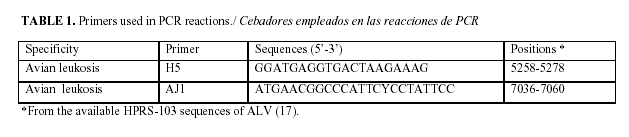
<body><![CDATA[<P><font face="Verdana, Arial, Helvetica, sans-serif" size="2">The presence of    ALV in infected cells was confirmed by an enzyme-linked immunosorbent assay    (<I>IDEXX, Laboratories, Inc.</I>) (15). </font>      <P><font face="Verdana, Arial, Helvetica, sans-serif" size="2">DNA extraction    from the cells infected with HPRS-103 strain was carried out according to the    method described by Maniatis <I>et al.</I> (16). Extracted DNA was resuspended    in 100 uL of TE buffer 1X and it was frozen to -20&#186;C until its evaluation.    </font>     <P><font face="Verdana, Arial, Helvetica, sans-serif" size="2">DNA extraction    of vaccine samples was carried out resuspending the vaccine bulb in 0.5 mL of    saline sterile solution (500 dose). </font>     <P><font face="Verdana, Arial, Helvetica, sans-serif" size="2">For the amplification    of all ALV subgroup, the oligonucleotides (H5/AJ1) were selected (Venugopal,    personnal communication) (<a href="/img/revistas/rsa/v31n1/f0111109.jpg">Table    1</a>). </font>      
<P><font face="Verdana, Arial, Helvetica, sans-serif" size="2">The mixtures for    PCR reaction in a total volume of 20 uL are as follows: 1X buffer (<I>Promega</I>)    (50 mM KCl, 10 mM Tris-HCl pH 9.0 y 0.1% Triton<SUP>&#174;</SUP> X-100), dNTP    (250 uM), magnesium chloride solution (2.0 mM, <I>Promega</I>), 0.5 uM of each    primer, 0.125 U/uL of the Taq polymerase enzyme (<I>Promega</I>). DNA yield    and purity were determined by spectrophotometry (Genesys<SUP>TM</SUP> 6, USA).    </font>     <P><font face="Verdana, Arial, Helvetica, sans-serif" size="2">As a negative control    for PCR assay, DNA template was replaced by the same amount of nuclease free    water (<I>Promega, Madison, WI, USA</I>). Amplifications were performed in MJ-Research<SUP>TM</SUP>    thermocycler. The temperature profile involved a first step at 94&#186;C for    3 min., 30 cycles of 1 min at 94&#186;C, 1 min. at 54&#186;C and 1 min. at 74&#186;C.    A final extension time was of 10 min. at 74&#186;C. </font>     <P><font face="Verdana, Arial, Helvetica, sans-serif" size="2">A 10 uL aliquot    of each PCR product was visualized by agarose gel electrophoresis (0.8 %), containing    0.8 mg/ml ethidium bromide solution. Gels were electrophoresed for 30 min at    100 V in buffer TBE 0.5X [Tris-Borato (Tris 50mM, borate acid 50 mM] and EDTA    10 mM, pH 8.4). For the determination of the size of PCR products, molecular    weight markers 1 Kb DNA ladder (<I>Promega</I>) with a size range from 100 to    10000 bp were included. Bands were visualized at a wave length of 312 nm and    photographed. </font>     <P><font face="Verdana, Arial, Helvetica, sans-serif" size="2">The use of turkey's    embryo fibroblast allowed to obtain virus stock of high titer according to Payne    <I>et al</I>. (14). </font>     <P><font face="Verdana, Arial, Helvetica, sans-serif" size="2">Bands of expected    size (1800 pb) were obtained in all Marek&#180;s disease vaccines evaluated    (<a href="/img/revistas/rsa/v31n1/f0211109.jpg">Fig.1</a>). </font>      
<P align="center"><img src="/img/revistas/rsa/v31n1/f0211109.jpg" width="328" height="335">      
]]></body>
<body><![CDATA[<P><font face="Verdana, Arial, Helvetica, sans-serif" size="2">These results coincide    with reports of Fadly <I>et al.</I> (10,11) and Silva (18) who revealed the    presence of ALVs in vaccines, specifically ALV-A in a commercial Marek&#180;s    disease vaccine and they alerted about the need of using sensitive and specific    methods for the detection of those viruses as contaminants of vaccines. Also,    later Zavala and Cheng (19) carried out the identification by PCR and the characterization    of ALVs in several commercial Marek&#180;s disease vaccines and evaluated their    effect in experimentally vaccinated chickens. These authors recommended the    employment of these methods as complementary procedures for the detection of    these viruses in the commercial vaccines destined to poultry. </font>     <P><font face="Verdana, Arial, Helvetica, sans-serif" size="2">Although at present,    subgroups A, B (19) and E (20) of the ALVs were only identified as contaminant    of vaccines, given the wide spread of the ALV-J also infecting leghorn chickens    and turkeys (21,22,23), it is very important to have more sensitive and specific    methods in order to reveal their presence in vaccinal products as well as in    imported birds in order to avoid the dissemination of the disease in the country.    </font>     <P><font face="Verdana, Arial, Helvetica, sans-serif" size="2">In our work, DNA    extraction was carried out directly from vaccine bulb, it is very important    because it reduces time to get the results. Authors like Fadly <I>et al.</I>    (24) reveled the presence of endogenous and exogenous viruses afterwards cellular    cultures from a commercial Marek&#180;s disease by PCR. </font>     <P><font face="Verdana, Arial, Helvetica, sans-serif" size="2">The results obtained    showed that the methodology described is a valuable tool for the detection of    leukosis viruses in veterinary vaccines and could become a practical alternative    for the current <I>in vivo</I> test for vaccine control imported or produced    in our country. Our data suggest a high occurrence of ALVs in commercial viral    vaccines intended for poultry disease prevention.</font>     <P>     <P><font face="Verdana, Arial, Helvetica, sans-serif" size="2"><B><font size="3">REFERENCES</font></B>    </font>      <!-- ref --><P><font face="Verdana, Arial, Helvetica, sans-serif" size="2">1. Payne LN, Fadly    AM. Leukosis/Sarcoma group. In: Diseases of Poultry, 10<SUP>th</SUP> ed., BW    Calnek, HJ Barnes, CW Beard, LR McDougald and YM Saif, eds. Iowa State University    Press, Ames, IA. 1997; 414-466. </font>    <!-- ref --><P><font face="Verdana, Arial, Helvetica, sans-serif" size="2">2. Payne LN. HPRS-103    a retrovirus strikes back. The emergence of Subgroup J Avian Leukosis Virus.    Avian Pathol. 1998;27:536-545. </font>    <!-- ref --><P><font face="Verdana, Arial, Helvetica, sans-serif" size="2">3. Payne LN, Brown    SR, Bumstead N, Howes K, Frazier JA, Thouless ME. A novel subgroup of exogenous    Avian Leukosis Virus in chickens. J Gen Virol. 1991;72:801-807. </font>    <!-- ref --><P><font face="Verdana, Arial, Helvetica, sans-serif" size="2">4. Venugopal K.    Avian Leukosis Virus Subgroup J: a rapidly evolving group of oncogenic retroviruses.    Review Res Vet Sci. 1999;67:113-119. </font>    <!-- ref --><P><font face="Verdana, Arial, Helvetica, sans-serif" size="2">5. Fadly AM, Witter    RL. Oncornaviruses: Leukosis/Sarcomas and Reticuloendotheliosis. In: SB Hitchner,    CH Domermuth, HG Purchase and JE Williams (eds.), Isolation and Identification    of </font><font face="Verdana, Arial, Helvetica, sans-serif" size="2">Avian    Pathogens. Am Assoc Avian Pathol.<I> </I>Kenneth Square, P.A.1998;185-195. </font>    <P><font face="Verdana, Arial, Helvetica, sans-serif" size="2">6. An&oacute;nimo.    British Farmacopeia An&oacute;nimo, 1994. World Health Organization Expert Committee    on Biological Standardization, requeriments for measles, mumps and rubella vaccines    and combined vaccines (live). Requeriment for biological substances 47, WHO    Tech Rep Ser. 1998;840:100-207. </font>     <!-- ref --><P><font face="Verdana, Arial, Helvetica, sans-serif" size="2">7. St&auml;uber    N, Brechtb&uuml;hl K, Hofmann MA. Detection of Newcastle disease virus in poultry    vaccines using the polymerase chain reaction and direct sequencing of amplified    cDNA. Vaccine. 1995;13:360-364. </font>    <!-- ref --><P><font face="Verdana, Arial, Helvetica, sans-serif" size="2">8. Falcone E, D&#180;Amore    E, Di Trani L, Puzelli S, Tollis M. Detection of avian infectious bronchitis    virus in poultry vaccines by polymerase chain reaction. ATLA. 1996;24<B>:</B>136<B>.</B>    </font>    <!-- ref --><P><font face="Verdana, Arial, Helvetica, sans-serif" size="2">9. Senda M, Parrish    CR, Harasawa R, Gamoh K, Muramatsu M, Hirayama N, Itoh O. Detection by PCR of    wild-type canine parvovirus which contaminates dog vaccines. J Clin Microbiol.    1995; 33:110-13. </font>    <!-- ref --><P><font face="Verdana, Arial, Helvetica, sans-serif" size="2">10.Fadly AM. Avian    tumor viruses and their economic impacts. Preceedings XII Moscow International    Congress of Small Animal Diseases. 2004a; 26. </font>    <!-- ref --><P><font face="Verdana, Arial, Helvetica, sans-serif" size="2">11.Fadly AM, Silva    RF, Hunt HD. Isolation of subgroup A avian leukosis virus from commercial Marek&#180;s    disease vaccines. In: International Marek&#180;s Disease. Symposium Abstracts    and Proceedings. 2004b; Paper No. p.8. </font>    <!-- ref --><P><font face="Verdana, Arial, Helvetica, sans-serif" size="2">12.Fadly AM. Isolation    and identification of avian leukosis viruses: a review. Avian Pathol. 2000;    29:529-535. </font>    <!-- ref --><P><font face="Verdana, Arial, Helvetica, sans-serif" size="2">13.Venugopal K,    Smith LM, Howes K, Payne LN. Antigenic variants of J subgroup avian leukosis    virus: sequence analysis reveals multiple changes in the env gene. Journal of    General Virology. 1998;79:757-766. </font>    <!-- ref --><P><font face="Verdana, Arial, Helvetica, sans-serif" size="2">14.Payne LN, Howes    K, Gillespie AM, Smith LM. Host range of Rous Sarcome virus pseudotype RSV (HPRS-103)    in 12 avian species: support for a new avian retrovirus envelope subgroup, designated    J. J. of Gen. Virol. 1992;73: 2995-2997. </font>    <P><font face="Verdana, Arial, Helvetica, sans-serif" size="2">15Payne LN, Gillespie    AM, Howes K. Unsuitability of chicken sera for detection of exogenous ALV     <BR>   by the group-specific antigen ELISA. Veterinary Record. 1993:555-557. </font>     <!-- ref --><P><font face="Verdana, Arial, Helvetica, sans-serif" size="2">16<B>.</B>Maniatis    TE, Fritsch EF, Sambrook J. Molecular cloning: a laboratory manual. Cold Spring    Harbor, New York. 1982. </font>    <!-- ref --><P><font face="Verdana, Arial, Helvetica, sans-serif" size="2">17.Bai J, Payne    LN, Skinner MA. HPRS-103 Exogenous avian leukosis virus subgroup J has env gene    related to those of endogenous elements EAV-0 and ES1 and B element found previously    only in sarcoma viruses. J. of Virology. 1995; 69:779-784. </font>    <!-- ref --><P><font face="Verdana, Arial, Helvetica, sans-serif" size="2">18.Silva RF, Fadly    AM, Taylor SP. Development of a Polymerase Chain Reaction to Differentiate Avian    Leukosis Virus (ALV) Subgroups: Detection of an ALV Contaminant in Commercial    Marek's Disease Vaccines. Avian Dis. 2007;51(3):663-667. </font>    <!-- ref --><P><font face="Verdana, Arial, Helvetica, sans-serif" size="2">19.Zavala G, Cheng    S. Detection and characterization of avian leukosis virus in Marek`s vaccines.    Avian Dis. 2006;50(2):209-15. </font>    <!-- ref --><P><font face="Verdana, Arial, Helvetica, sans-serif" size="2">20.Fadly AM, Silva    RF, Hunt HD, Pandiri A, Davis C. Isolation and characterization of an adventitious    avian leukosis virus isolation from commercial Marek&#180;s disease vaccines.    Avian Dis. 2006;50:380-385. </font>    <!-- ref --><P><font face="Verdana, Arial, Helvetica, sans-serif" size="2">21.Mays J, Bacon    LD, Pandiri AR, Fadly AM. Response of White Leghorn Chickens of Various <I>B</I>    Haplotypes to Infection at Hatch with Subgroup J Avian Leukosis Virus. Avian    Dis. 2005;49(2):214-219. </font>    <!-- ref --><P><font face="Verdana, Arial, Helvetica, sans-serif" size="2">22.Venugoplal K,    Howes K, Flanner Y, Payne LN. Subgroup J avian Leukosis viruses infection in    turkey: induction of rapid onset tumours by acutely transforming virus strain    966. Avian Pathol. 2000;29:319-25. </font>    <!-- ref --><P><font face="Verdana, Arial, Helvetica, sans-serif" size="2">23.Venugopal K,    Howes K, Payne LN. Isolation of acutely transforming subgroup J avian Leukosis    viruses that induce erythroblastosis and myelocytomatosis. Avian Pathol. 2000;    29:327-332. </font>    <!-- ref --><P><font face="Verdana, Arial, Helvetica, sans-serif" size="2">24.Fadly AM, Silva    RF, Hunt HD. Detection of exogenous and endogenous avian leukosis virus in commercial    Marek&#180;s disease vaccine. In: Proceeding of the 170 th Annual Meeting of    the United States Animal Health Association, October 9-16, San Diego, California.    2003;524-525. </font>    <P>      <P>      <P>      <P><font face="Verdana, Arial, Helvetica, sans-serif" size="2"><B>(Recibido 18-11-2008;    aceptado 20-1-2009)</B> </font>     <P><font face="Verdana, Arial, Helvetica, sans-serif" size="2"><I>Rev. Salud Anim.    Vol. 31 No. 3 (2009)</I> </font>      ]]></body><back>
<ref-list>
<ref id="B1">
<label>1</label><nlm-citation citation-type="book">
<person-group person-group-type="author">
<name>
<surname><![CDATA[Payne]]></surname>
<given-names><![CDATA[LN]]></given-names>
</name>
<name>
<surname><![CDATA[Fadly]]></surname>
<given-names><![CDATA[AM]]></given-names>
</name>
</person-group>
<article-title xml:lang="en"><![CDATA[Leukosis/Sarcoma group]]></article-title>
<person-group person-group-type="editor">
<name>
<surname><![CDATA[Calnek]]></surname>
<given-names><![CDATA[BW]]></given-names>
</name>
<name>
<surname><![CDATA[Barnes]]></surname>
<given-names><![CDATA[HJ]]></given-names>
</name>
<name>
<surname><![CDATA[Beard]]></surname>
<given-names><![CDATA[CW]]></given-names>
</name>
<name>
<surname><![CDATA[McDougald]]></surname>
<given-names><![CDATA[LR]]></given-names>
</name>
<name>
<surname><![CDATA[Saif]]></surname>
<given-names><![CDATA[YM]]></given-names>
</name>
</person-group>
<source><![CDATA[Diseases of Poultry]]></source>
<year>1997</year>
<edition>10th</edition>
<page-range>414-466</page-range><publisher-name><![CDATA[Iowa State University Press]]></publisher-name>
</nlm-citation>
</ref>
<ref id="B2">
<label>2</label><nlm-citation citation-type="journal">
<person-group person-group-type="author">
<name>
<surname><![CDATA[Payne]]></surname>
<given-names><![CDATA[LN]]></given-names>
</name>
</person-group>
<article-title xml:lang="en"><![CDATA[HPRS-103 a retrovirus strikes back: The emergence of Subgroup J Avian Leukosis Virus]]></article-title>
<source><![CDATA[Avian Pathol]]></source>
<year>1998</year>
<volume>27</volume>
<page-range>536-545</page-range></nlm-citation>
</ref>
<ref id="B3">
<label>3</label><nlm-citation citation-type="journal">
<person-group person-group-type="author">
<name>
<surname><![CDATA[Payne]]></surname>
<given-names><![CDATA[LN]]></given-names>
</name>
<name>
<surname><![CDATA[Brown]]></surname>
<given-names><![CDATA[SR]]></given-names>
</name>
<name>
<surname><![CDATA[Bumstead]]></surname>
<given-names><![CDATA[N]]></given-names>
</name>
<name>
<surname><![CDATA[Howes]]></surname>
<given-names><![CDATA[K]]></given-names>
</name>
<name>
<surname><![CDATA[Frazier]]></surname>
<given-names><![CDATA[JA]]></given-names>
</name>
<name>
<surname><![CDATA[Thouless]]></surname>
<given-names><![CDATA[ME]]></given-names>
</name>
</person-group>
<article-title xml:lang="en"><![CDATA[A novel subgroup of exogenous Avian Leukosis Virus in chickens]]></article-title>
<source><![CDATA[J Gen Virol]]></source>
<year>1991</year>
<volume>72</volume>
<page-range>801-807</page-range></nlm-citation>
</ref>
<ref id="B4">
<label>4</label><nlm-citation citation-type="journal">
<person-group person-group-type="author">
<name>
<surname><![CDATA[Venugopal]]></surname>
<given-names><![CDATA[K]]></given-names>
</name>
</person-group>
<article-title xml:lang="en"><![CDATA[Avian Leukosis Virus Subgroup J: a rapidly evolving group of oncogenic retroviruses]]></article-title>
<source><![CDATA[Review Res Vet Sci]]></source>
<year>1999</year>
<volume>67</volume>
<page-range>113-119</page-range></nlm-citation>
</ref>
<ref id="B5">
<label>5</label><nlm-citation citation-type="">
<person-group person-group-type="author">
<name>
<surname><![CDATA[Fadly]]></surname>
<given-names><![CDATA[AM]]></given-names>
</name>
<name>
<surname><![CDATA[Witter]]></surname>
<given-names><![CDATA[RL]]></given-names>
</name>
</person-group>
<article-title xml:lang="en"><![CDATA[Oncornaviruses: Leukosis/Sarcomas and Reticuloendotheliosis]]></article-title>
<person-group person-group-type="editor">
<name>
<surname><![CDATA[Hitchner]]></surname>
<given-names><![CDATA[SB]]></given-names>
</name>
<name>
<surname><![CDATA[Domermuth]]></surname>
<given-names><![CDATA[CH]]></given-names>
</name>
<name>
<surname><![CDATA[Purchase]]></surname>
<given-names><![CDATA[HG]]></given-names>
</name>
<name>
<surname><![CDATA[Williams]]></surname>
<given-names><![CDATA[JE]]></given-names>
</name>
</person-group>
<source><![CDATA[Isolation and Identification of Avian Pathogens. Am Assoc Avian Pathol. Kenneth Square]]></source>
<year>1998</year>
<page-range>185-195</page-range></nlm-citation>
</ref>
<ref id="B6">
<label>6</label><nlm-citation citation-type="journal">
<article-title xml:lang="en"><![CDATA[World Health Organization Expert Committee on Biological Standardization, requeriments for measles, mumps and rubella vaccines and combined vaccines (live): Requeriment for biological substances 47]]></article-title>
<source><![CDATA[WHO Tech Rep Ser]]></source>
<year>1998</year>
<volume>840</volume>
<page-range>100-207</page-range></nlm-citation>
</ref>
<ref id="B7">
<label>7</label><nlm-citation citation-type="journal">
<person-group person-group-type="author">
<name>
<surname><![CDATA[Stäuber]]></surname>
<given-names><![CDATA[N]]></given-names>
</name>
<name>
<surname><![CDATA[Brechtbühl]]></surname>
<given-names><![CDATA[K]]></given-names>
</name>
<name>
<surname><![CDATA[Hofmann]]></surname>
<given-names><![CDATA[MA]]></given-names>
</name>
</person-group>
<article-title xml:lang="en"><![CDATA[Detection of Newcastle disease virus in poultry vaccines using the polymerase chain reaction and direct sequencing of amplified cDNA]]></article-title>
<source><![CDATA[Vaccine]]></source>
<year>1995</year>
<volume>13</volume>
<page-range>360-364</page-range></nlm-citation>
</ref>
<ref id="B8">
<label>8</label><nlm-citation citation-type="journal">
<person-group person-group-type="author">
<name>
<surname><![CDATA[Falcone]]></surname>
<given-names><![CDATA[E]]></given-names>
</name>
<name>
<surname><![CDATA[D´Amore]]></surname>
<given-names><![CDATA[E]]></given-names>
</name>
<name>
<surname><![CDATA[Di Trani]]></surname>
<given-names><![CDATA[L]]></given-names>
</name>
<name>
<surname><![CDATA[Puzelli]]></surname>
<given-names><![CDATA[S]]></given-names>
</name>
<name>
<surname><![CDATA[Tollis]]></surname>
<given-names><![CDATA[M]]></given-names>
</name>
</person-group>
<article-title xml:lang="en"><![CDATA[Detection of avian infectious bronchitis virus in poultry vaccines by polymerase chain reaction]]></article-title>
<source><![CDATA[ATLA]]></source>
<year>1996</year>
<volume>24</volume>
<page-range>136</page-range></nlm-citation>
</ref>
<ref id="B9">
<label>9</label><nlm-citation citation-type="journal">
<person-group person-group-type="author">
<name>
<surname><![CDATA[Senda]]></surname>
<given-names><![CDATA[M]]></given-names>
</name>
<name>
<surname><![CDATA[Parrish]]></surname>
<given-names><![CDATA[CR]]></given-names>
</name>
<name>
<surname><![CDATA[Harasawa]]></surname>
<given-names><![CDATA[R]]></given-names>
</name>
<name>
<surname><![CDATA[Gamoh]]></surname>
<given-names><![CDATA[K]]></given-names>
</name>
<name>
<surname><![CDATA[Muramatsu]]></surname>
<given-names><![CDATA[M]]></given-names>
</name>
<name>
<surname><![CDATA[Hirayama]]></surname>
<given-names><![CDATA[N]]></given-names>
</name>
<name>
<surname><![CDATA[Itoh]]></surname>
<given-names><![CDATA[O]]></given-names>
</name>
</person-group>
<article-title xml:lang="en"><![CDATA[Detection by PCR of wild-type canine parvovirus which contaminates dog vaccines]]></article-title>
<source><![CDATA[J Clin Microbiol]]></source>
<year>1995</year>
<volume>33</volume>
<page-range>110-13</page-range></nlm-citation>
</ref>
<ref id="B10">
<label>10</label><nlm-citation citation-type="">
<person-group person-group-type="author">
<name>
<surname><![CDATA[Fadly]]></surname>
<given-names><![CDATA[AM]]></given-names>
</name>
</person-group>
<source><![CDATA[Avian tumor viruses and their economic impacts: Preceedings XII Moscow International Congress of Small Animal Diseases]]></source>
<year>2004</year>
<page-range>26</page-range></nlm-citation>
</ref>
<ref id="B11">
<label>11</label><nlm-citation citation-type="">
<person-group person-group-type="author">
<name>
<surname><![CDATA[Fadly]]></surname>
<given-names><![CDATA[AM]]></given-names>
</name>
<name>
<surname><![CDATA[Silva]]></surname>
<given-names><![CDATA[RF]]></given-names>
</name>
<name>
<surname><![CDATA[Hunt]]></surname>
<given-names><![CDATA[HD]]></given-names>
</name>
</person-group>
<article-title xml:lang="en"><![CDATA[Isolation of subgroup A avian leukosis virus from commercial Marek´s disease vaccines]]></article-title>
<source><![CDATA[International Marek´s Disease. Symposium Abstracts and Proceedings]]></source>
<year>2004</year>
</nlm-citation>
</ref>
<ref id="B12">
<label>12</label><nlm-citation citation-type="journal">
<person-group person-group-type="author">
<name>
<surname><![CDATA[Fadly]]></surname>
<given-names><![CDATA[AM]]></given-names>
</name>
</person-group>
<article-title xml:lang="en"><![CDATA[Isolation and identification of avian leukosis viruses: a review]]></article-title>
<source><![CDATA[Avian Pathol]]></source>
<year>2000</year>
<volume>29</volume>
<page-range>529-535</page-range></nlm-citation>
</ref>
<ref id="B13">
<label>13</label><nlm-citation citation-type="journal">
<person-group person-group-type="author">
<name>
<surname><![CDATA[Venugopal]]></surname>
<given-names><![CDATA[K]]></given-names>
</name>
<name>
<surname><![CDATA[Smith]]></surname>
<given-names><![CDATA[LM]]></given-names>
</name>
<name>
<surname><![CDATA[Howes]]></surname>
<given-names><![CDATA[K]]></given-names>
</name>
<name>
<surname><![CDATA[Payne]]></surname>
<given-names><![CDATA[LN]]></given-names>
</name>
</person-group>
<article-title xml:lang="en"><![CDATA[Antigenic variants of J subgroup avian leukosis virus: sequence analysis reveals multiple changes in the env gene]]></article-title>
<source><![CDATA[Journal of General Virology]]></source>
<year>1998</year>
<volume>79</volume>
<page-range>757-766</page-range></nlm-citation>
</ref>
<ref id="B14">
<label>14</label><nlm-citation citation-type="journal">
<person-group person-group-type="author">
<name>
<surname><![CDATA[Payne]]></surname>
<given-names><![CDATA[LN]]></given-names>
</name>
<name>
<surname><![CDATA[Howes]]></surname>
<given-names><![CDATA[K]]></given-names>
</name>
<name>
<surname><![CDATA[Gillespie]]></surname>
<given-names><![CDATA[AM]]></given-names>
</name>
<name>
<surname><![CDATA[Smith]]></surname>
<given-names><![CDATA[LM]]></given-names>
</name>
</person-group>
<article-title xml:lang="en"><![CDATA[Host range of Rous Sarcome virus pseudotype RSV (HPRS-103) in 12 avian species: support for a new avian retrovirus envelope subgroup, designated]]></article-title>
<source><![CDATA[J J of Gen Virol]]></source>
<year>1992</year>
<volume>73</volume>
<page-range>2995-2997</page-range></nlm-citation>
</ref>
<ref id="B15">
<label>15</label><nlm-citation citation-type="journal">
<person-group person-group-type="author">
<name>
<surname><![CDATA[Payne]]></surname>
<given-names><![CDATA[LN]]></given-names>
</name>
<name>
<surname><![CDATA[Gillespie]]></surname>
<given-names><![CDATA[AM]]></given-names>
</name>
<name>
<surname><![CDATA[Howes]]></surname>
<given-names><![CDATA[K]]></given-names>
</name>
</person-group>
<article-title xml:lang="en"><![CDATA[Unsuitability of chicken sera for detection of exogenous ALV by the group-specific antigen ELISA]]></article-title>
<source><![CDATA[Veterinary Record]]></source>
<year>1993</year>
<page-range>555-557</page-range></nlm-citation>
</ref>
<ref id="B16">
<label>16</label><nlm-citation citation-type="book">
<person-group person-group-type="author">
<name>
<surname><![CDATA[Maniatis]]></surname>
<given-names><![CDATA[TE]]></given-names>
</name>
<name>
<surname><![CDATA[Fritsch]]></surname>
<given-names><![CDATA[EF]]></given-names>
</name>
<name>
<surname><![CDATA[Sambrook]]></surname>
<given-names><![CDATA[J]]></given-names>
</name>
</person-group>
<source><![CDATA[Molecular cloning: a laboratory manual]]></source>
<year>1982</year>
<publisher-loc><![CDATA[New York ]]></publisher-loc>
<publisher-name><![CDATA[Cold Spring Harbor]]></publisher-name>
</nlm-citation>
</ref>
<ref id="B17">
<label>17</label><nlm-citation citation-type="journal">
<person-group person-group-type="author">
<name>
<surname><![CDATA[Bai]]></surname>
<given-names><![CDATA[J]]></given-names>
</name>
<name>
<surname><![CDATA[Payne]]></surname>
<given-names><![CDATA[LN]]></given-names>
</name>
<name>
<surname><![CDATA[Skinner]]></surname>
<given-names><![CDATA[MA]]></given-names>
</name>
</person-group>
<article-title xml:lang="en"><![CDATA[HPRS-103 Exogenous avian leukosis virus subgroup J has env gene related to those of endogenous elements EAV-0 and ES1 and B element found previously only in sarcoma viruses]]></article-title>
<source><![CDATA[J of Virology]]></source>
<year>1995</year>
<volume>69</volume>
<page-range>779-784</page-range></nlm-citation>
</ref>
<ref id="B18">
<label>18</label><nlm-citation citation-type="journal">
<person-group person-group-type="author">
<name>
<surname><![CDATA[Silva]]></surname>
<given-names><![CDATA[RF]]></given-names>
</name>
<name>
<surname><![CDATA[Fadly]]></surname>
<given-names><![CDATA[AM]]></given-names>
</name>
<name>
<surname><![CDATA[Taylor]]></surname>
<given-names><![CDATA[SP]]></given-names>
</name>
</person-group>
<article-title xml:lang="en"><![CDATA[Development of a Polymerase Chain Reaction to Differentiate Avian Leukosis Virus (ALV) Subgroups: Detection of an ALV Contaminant in Commercial Marek's Disease Vaccines]]></article-title>
<source><![CDATA[Avian Dis]]></source>
<year>2007</year>
<volume>51</volume>
<numero>3</numero>
<issue>3</issue>
<page-range>663-667</page-range></nlm-citation>
</ref>
<ref id="B19">
<label>19</label><nlm-citation citation-type="journal">
<person-group person-group-type="author">
<name>
<surname><![CDATA[Zavala]]></surname>
<given-names><![CDATA[G]]></given-names>
</name>
<name>
<surname><![CDATA[Cheng]]></surname>
<given-names><![CDATA[S]]></given-names>
</name>
</person-group>
<article-title xml:lang="en"><![CDATA[Detection and characterization of avian leukosis virus in Marek`s vaccines]]></article-title>
<source><![CDATA[Avian Dis]]></source>
<year>2006</year>
<volume>50</volume>
<numero>2</numero>
<issue>2</issue>
<page-range>209-15</page-range></nlm-citation>
</ref>
<ref id="B20">
<label>20</label><nlm-citation citation-type="journal">
<person-group person-group-type="author">
<name>
<surname><![CDATA[Fadly]]></surname>
<given-names><![CDATA[AM]]></given-names>
</name>
<name>
<surname><![CDATA[Silva]]></surname>
<given-names><![CDATA[RF]]></given-names>
</name>
<name>
<surname><![CDATA[Hunt]]></surname>
<given-names><![CDATA[HD]]></given-names>
</name>
<name>
<surname><![CDATA[Pandiri]]></surname>
<given-names><![CDATA[A]]></given-names>
</name>
<name>
<surname><![CDATA[Davis]]></surname>
<given-names><![CDATA[C]]></given-names>
</name>
</person-group>
<article-title xml:lang="en"><![CDATA[Isolation and characterization of an adventitious avian leukosis virus isolation from commercial Marek´s disease vaccines]]></article-title>
<source><![CDATA[Avian Dis]]></source>
<year>2006</year>
<volume>50</volume>
<page-range>380-385</page-range></nlm-citation>
</ref>
<ref id="B21">
<label>21</label><nlm-citation citation-type="journal">
<person-group person-group-type="author">
<name>
<surname><![CDATA[Mays]]></surname>
<given-names><![CDATA[J]]></given-names>
</name>
<name>
<surname><![CDATA[Bacon]]></surname>
<given-names><![CDATA[LD]]></given-names>
</name>
<name>
<surname><![CDATA[Pandiri]]></surname>
<given-names><![CDATA[AR]]></given-names>
</name>
<name>
<surname><![CDATA[Fadly]]></surname>
<given-names><![CDATA[AM]]></given-names>
</name>
</person-group>
<article-title xml:lang="en"><![CDATA[Response of White Leghorn Chickens of Various B Haplotypes to Infection at Hatch with Subgroup J Avian Leukosis Virus]]></article-title>
<source><![CDATA[Avian Dis]]></source>
<year>2005</year>
<volume>49</volume>
<numero>2</numero>
<issue>2</issue>
<page-range>214-219</page-range></nlm-citation>
</ref>
<ref id="B22">
<label>22</label><nlm-citation citation-type="journal">
<person-group person-group-type="author">
<name>
<surname><![CDATA[Venugoplal]]></surname>
<given-names><![CDATA[K]]></given-names>
</name>
<name>
<surname><![CDATA[Howes]]></surname>
<given-names><![CDATA[K]]></given-names>
</name>
<name>
<surname><![CDATA[Flanner]]></surname>
<given-names><![CDATA[Y]]></given-names>
</name>
<name>
<surname><![CDATA[Payne]]></surname>
<given-names><![CDATA[LN]]></given-names>
</name>
</person-group>
<article-title xml:lang="en"><![CDATA[Subgroup J avian Leukosis viruses infection in turkey: induction of rapid onset tumours by acutely transforming virus strain 966]]></article-title>
<source><![CDATA[Avian Pathol]]></source>
<year>2000</year>
<volume>29</volume>
<page-range>319-25</page-range></nlm-citation>
</ref>
<ref id="B23">
<label>23</label><nlm-citation citation-type="journal">
<person-group person-group-type="author">
<name>
<surname><![CDATA[Venugopal]]></surname>
<given-names><![CDATA[K]]></given-names>
</name>
<name>
<surname><![CDATA[Howes]]></surname>
<given-names><![CDATA[K]]></given-names>
</name>
<name>
<surname><![CDATA[Payne]]></surname>
<given-names><![CDATA[LN]]></given-names>
</name>
</person-group>
<article-title xml:lang="en"><![CDATA[Isolation of acutely transforming subgroup J avian Leukosis viruses that induce erythroblastosis and myelocytomatosis]]></article-title>
<source><![CDATA[Avian Pathol]]></source>
<year>2000</year>
<volume>29</volume>
<page-range>327-332</page-range></nlm-citation>
</ref>
<ref id="B24">
<label>24</label><nlm-citation citation-type="">
<person-group person-group-type="author">
<name>
<surname><![CDATA[Fadly]]></surname>
<given-names><![CDATA[AM]]></given-names>
</name>
<name>
<surname><![CDATA[Silva]]></surname>
<given-names><![CDATA[RF]]></given-names>
</name>
<name>
<surname><![CDATA[Hunt]]></surname>
<given-names><![CDATA[HD]]></given-names>
</name>
</person-group>
<article-title xml:lang="en"><![CDATA[Detection of exogenous and endogenous avian leukosis virus in commercial Marek´s disease vaccine]]></article-title>
<source><![CDATA[Proceeding of the 170 th Annual Meeting of the United States Animal Health Association]]></source>
<year>2003</year>
<page-range>524-525</page-range><publisher-loc><![CDATA[San Diego ]]></publisher-loc>
</nlm-citation>
</ref>
</ref-list>
</back>
</article>
