<?xml version="1.0" encoding="ISO-8859-1"?><article xmlns:mml="http://www.w3.org/1998/Math/MathML" xmlns:xlink="http://www.w3.org/1999/xlink" xmlns:xsi="http://www.w3.org/2001/XMLSchema-instance">
<front>
<journal-meta>
<journal-id>0253-570X</journal-id>
<journal-title><![CDATA[Revista de Salud Animal]]></journal-title>
<abbrev-journal-title><![CDATA[Rev Salud Anim.]]></abbrev-journal-title>
<issn>0253-570X</issn>
<publisher>
<publisher-name><![CDATA[Centro Nacional de Sanidad Agropecuaria]]></publisher-name>
</publisher>
</journal-meta>
<article-meta>
<article-id>S0253-570X2012000200003</article-id>
<title-group>
<article-title xml:lang="en"><![CDATA[Effect of cryopreservation of sheep semen related to its viability and acrosomal status]]></article-title>
<article-title xml:lang="es"><![CDATA[Efecto de la criopreservación de semen de ovino en relación a su viabilidad y estado acrosomal]]></article-title>
</title-group>
<contrib-group>
<contrib contrib-type="author">
<name>
<surname><![CDATA[Hernández]]></surname>
<given-names><![CDATA[P.J.E]]></given-names>
</name>
<xref ref-type="aff" rid="A01"/>
</contrib>
<contrib contrib-type="author">
<name>
<surname><![CDATA[Fernández]]></surname>
<given-names><![CDATA[R.F]]></given-names>
</name>
<xref ref-type="aff" rid="A01"/>
</contrib>
<contrib contrib-type="author">
<name>
<surname><![CDATA[Rodríguez]]></surname>
<given-names><![CDATA[S.J.L]]></given-names>
</name>
<xref ref-type="aff" rid="A01"/>
</contrib>
<contrib contrib-type="author">
<name>
<surname><![CDATA[Juárez]]></surname>
<given-names><![CDATA[R.E]]></given-names>
</name>
<xref ref-type="aff" rid="A02"/>
</contrib>
<contrib contrib-type="author">
<name>
<surname><![CDATA[Soto]]></surname>
<given-names><![CDATA[M.Y.G]]></given-names>
</name>
<xref ref-type="aff" rid="A02"/>
</contrib>
<contrib contrib-type="author">
<name>
<surname><![CDATA[García]]></surname>
<given-names><![CDATA[R.A.D]]></given-names>
</name>
<xref ref-type="aff" rid="A02"/>
</contrib>
</contrib-group>
<aff id="A01">
<institution><![CDATA[,Universidad Autónoma Metropolitana-Xochimilco Laboratorio Manejo de la Reproducción ]]></institution>
<addr-line><![CDATA[Coyoacán ]]></addr-line>
<country>México</country>
</aff>
<aff id="A02">
<institution><![CDATA[,Clínica privada. México  ]]></institution>
<addr-line><![CDATA[ ]]></addr-line>
<country>México</country>
</aff>
<pub-date pub-type="pub">
<day>00</day>
<month>08</month>
<year>2012</year>
</pub-date>
<pub-date pub-type="epub">
<day>00</day>
<month>08</month>
<year>2012</year>
</pub-date>
<volume>34</volume>
<numero>2</numero>
<fpage>78</fpage>
<lpage>83</lpage>
<copyright-statement/>
<copyright-year/>
<self-uri xlink:href="http://scielo.sld.cu/scielo.php?script=sci_arttext&amp;pid=S0253-570X2012000200003&amp;lng=en&amp;nrm=iso"></self-uri><self-uri xlink:href="http://scielo.sld.cu/scielo.php?script=sci_abstract&amp;pid=S0253-570X2012000200003&amp;lng=en&amp;nrm=iso"></self-uri><self-uri xlink:href="http://scielo.sld.cu/scielo.php?script=sci_pdf&amp;pid=S0253-570X2012000200003&amp;lng=en&amp;nrm=iso"></self-uri><abstract abstract-type="short" xml:lang="en"><p><![CDATA[In the present research, the effects of cryopreservation on the viability and acrosomal status of sheep sperms were analyzed. Forty five ejaculates were obtained by the artificial vagina method for analysis, evaluating in fresh semen the following characteristics: volume (Vol), progressive motility (PM), viability percentage (Viab), normal morphology (NM), spermatic concentration (Concentr); as well as its viability and acrosomal status, The last two parameters were evaluated staining with fluorescein isothiocyanate conjugated with Arachis hypogaea lectin and propidium iodide (FITC-PNA/IP), in which there were different patterns of staining: live sperms without acrosomal reaction (VsRA), live with acrosomal reaction (VcRA), dead without acrosomal reaction (MsRA) and dead with acrosomal reaction (McRA), obtaining averages of: 1.2±0.3 ml, 88.0±3.4%, 91.4±3.8%, 94.2±2.9%, 1768.1±5.5 x10⁶/ml, 76.7±5.5%, 7.6±2.7%, 11.2±4.1% and 4.5±2.6% respectively. Semen was frozen in a commercial diluent (Triladyl(r)) and packaged in 0.5 ml straws at a concentration of 150x106/ml in liquid nitrogen for 8 days, thawed at 37°C for 60 seconds. In post-thawed semen evaluation, the following values were determined: PM= 37.4±5.3%, Viab= 67.5±4.7, NM= 79.5±5.7, VsRA= 26.9±7.3%, VcRA= 29.2±6.4%, MsRA= 27.7±7% y McRA= 15.9±6.2%, obtaining statistically significant differences (p<0.05) caused by cryopreservation effects. It is concluded that although viability and acrosomal status of sperm are affected by cryopreservation, live sperm without acrosomal reaction can be used in assisted reproduction techniques.]]></p></abstract>
<abstract abstract-type="short" xml:lang="es"><p><![CDATA[En la presente investigación, se analizaron los efectos de la criopreservación sobre la viabilidad y el estado acrosomal de espermatozoides ovinos. Se obtuvieron 45 eyaculados por el método de vagina artificial para el análisis, evaluando en semen fresco las siguientes características: volumen (Vol), motilidad progresiva (MP), porcentaje de viabilidad (Viab), morfología normal (NM), concentración espermática (Concentr); así como su viabilidad y el estado acrosomal, Los dos últimos parámetros se evaluaron usando tinción con isotiocianato de fluoresceína conjugada con Arachis hypogaea lectina y yoduro de propidio (FITC-PNA/IP), en los que había diferentes patrones de tinción: espermatozoides vivos sin reacción acrosomal (VsRA), vivos con reacción acrosomal (VcRA), muertos sin reacción acrosomal (MsRA) y muertos con reacción acrosomal (McRA), obteniéndose un promedio de: 1,2 ± 0,3 mL 88,0 ± 3,4%, 91,4 ± 3,8%, 94,2 ± 2,9%, 1768,1 ± 5,5 x10⁶/mL 76,7 ± 5,5%, 7,6 ± 2,7%, 11,2 ± 4,1% y 4,5 ± 2,6%, respectivamente. El semen se congeló en un diluyente comercial (Triladyl (r)) y se empacó en pajuelas de 0,5 mL a una concentración de 150x106/ml en nitrógeno líquido durante 8 días, descongeladas a 37°C durante 60 segundos. En la post-evaluación del semen descongelado, se determinaron los valores siguientes: MP = 37,4 ± 5,3%, Viab = 67,5 ± 4,7, NM = 79,5 ± 5.7, VsRA = 26,9 ± 7,3%, VcRA = 29,2 ± 6,4%, MsRA = 27,7 ± 7% y McRA = 15,9 ± 6,2%, obteniéndose diferencias estadísticamente significativas (p <0,05) causadas por los efectos de la criopreservación. Se concluye que, a pesar de que la viabilidad y el estado acrosomal de los espermatozoides se ven afectado por la criopreservación. Los espermatozoides vivos sin reacción del acrosomal se pueden utilizar en las técnicas de reproducción asistida.]]></p></abstract>
<kwd-group>
<kwd lng="en"><![CDATA[cryopreservation]]></kwd>
<kwd lng="en"><![CDATA[viability]]></kwd>
<kwd lng="en"><![CDATA[acrosomal reaction]]></kwd>
<kwd lng="en"><![CDATA[FITC-PNA/IP]]></kwd>
<kwd lng="en"><![CDATA[sheep semen]]></kwd>
<kwd lng="es"><![CDATA[criopreservación]]></kwd>
<kwd lng="es"><![CDATA[viabilidad]]></kwd>
<kwd lng="es"><![CDATA[reacción acrosomal]]></kwd>
<kwd lng="es"><![CDATA[FITC-PNA/IP]]></kwd>
<kwd lng="es"><![CDATA[semen ovino]]></kwd>
</kwd-group>
</article-meta>
</front><body><![CDATA[ <p align="right"><font face="Verdana, Arial, Helvetica, sans-serif" size="2"><B>ART&Iacute;CULO    ORIGINAL</B></font></p>     <p>&nbsp;</p> <H1> <font face="Verdana, Arial, Helvetica, sans-serif" size="2"><B><font size="4">Effect    of cryopreservation of sheep semen related to its viability and acrosomal status</font></B></font></H1>     <P>&nbsp;     <P> <font face="Verdana, Arial, Helvetica, sans-serif" size="2"><b><font size="3">Efecto    de la criopreservaci&oacute;n de semen de ovino en relaci&oacute;n a su viabilidad    y estado acrosomal </font></b></font>      <P>&nbsp;     <P>&nbsp;     <P><font face="Verdana, Arial, Helvetica, sans-serif" size="2"><B>P.J.E. Hern&aacute;ndez<SUP>I</SUP>,    R.F. Fern&aacute;ndez<SUP>I</SUP>, S.J.L. Rodr&iacute;guez<SUP>I</SUP>, R.E.    Ju&aacute;rez<SUP>II</SUP>, M.Y.G. Soto<SUP>II</SUP>, R.A.D. Garc&iacute;a<SUP>II</SUP></B>    </font>     <P><font face="Verdana, Arial, Helvetica, sans-serif" size="2"><SUP>I</SUP>Laboratorio    Manejo de la Reproducci&oacute;n. Universidad Aut&oacute;noma Metropolitana-Xochimilco.    Calzada del Hueso 1100, Colonia Villa Quietud, Coyoac&aacute;n 04960. M&eacute;xico,    D.F. E-mail: <U><a href="mailto:ehernan@correo.xoc.uam.mx">ehernan@correo.xoc.uam.mx</a></U>;    <SUP>    <br>   II</SUP>Cl&iacute;nica privada. M&eacute;xico, D.F.</font>      <P>&nbsp;     ]]></body>
<body><![CDATA[<P>&nbsp; <hr noshade size="1">     <P><font face="Verdana, Arial, Helvetica, sans-serif" size="2"><B>ABSTRACT</B></font>     <P><font face="Verdana, Arial, Helvetica, sans-serif" size="2">In the present    research, the effects of cryopreservation on the viability and acrosomal status    of sheep sperms were analyzed. Forty five ejaculates were obtained by the artificial    vagina method for analysis, evaluating in fresh semen the following characteristics:    volume (Vol), progressive motility (PM), viability percentage (Viab), normal    morphology (NM), spermatic concentration (Concentr); as well as its viability    and acrosomal status, The last two parameters were evaluated staining with fluorescein    isothiocyanate conjugated with <I>Arachis hypogaea</I> lectin and propidium    iodide (FITC-PNA/IP), in which there were different patterns of staining: live    sperms without acrosomal reaction (VsRA), live with acrosomal reaction (VcRA),    dead without acrosomal reaction (MsRA) and dead with acrosomal reaction (McRA),    obtaining averages of: 1.2&#177;0.3 ml, 88.0&#177;3.4%, 91.4&#177;3.8%, 94.2&#177;2.9%,    1768.1&#177;5.5 x10<SUP>6</SUP>/ml, 76.7&#177;5.5%, 7.6&#177;2.7%, 11.2&#177;4.1%    and 4.5&#177;2.6% respectively. Semen was frozen in a commercial diluent (Triladyl&#174;)    and packaged in 0.5 ml straws at a concentration of 150x10<SUP>6</SUP>/ml in    liquid nitrogen for 8 days, thawed at 37&#176;C for 60 seconds. In post-thawed    semen evaluation, the following values were determined: PM= 37.4&#177;5.3%,    Viab= 67.5&#177;4.7, NM= 79.5&#177;5.7, VsRA= 26.9&#177;7.3%, VcRA= 29.2&#177;6.4%,    MsRA= 27.7&#177;7% y McRA= 15.9&#177;6.2%, obtaining statistically significant    differences (p&lt;0.05) caused by cryopreservation effects. It is concluded    that although viability and acrosomal status of sperm are affected by cryopreservation,    live sperm without acrosomal reaction can be used in assisted reproduction techniques.    </font>     <P><font face="Verdana, Arial, Helvetica, sans-serif" size="2"><B>Key words</B>:    cryopreservation, viability, acrosomal reaction, FITC-PNA/IP, sheep semen.</font> <hr noshade size="1">     <P><font face="Verdana, Arial, Helvetica, sans-serif" size="2"><B>RESUMEN</b></font>     <P><font face="Verdana, Arial, Helvetica, sans-serif" size="2">En la presente    investigaci&oacute;n, se analizaron los efectos de la criopreservaci&oacute;n    sobre la viabilidad y el estado acrosomal de espermatozoides ovinos. Se obtuvieron    45 eyaculados por el m&eacute;todo de vagina artificial para el an&aacute;lisis,    evaluando en semen fresco las siguientes caracter&iacute;sticas: volumen (Vol),    motilidad progresiva (MP), porcentaje de viabilidad (Viab), morfolog&iacute;a    normal (NM), concentraci&oacute;n esperm&aacute;tica (Concentr); as&iacute;    como su viabilidad y el estado acrosomal, Los dos &uacute;ltimos par&aacute;metros    se evaluaron usando tinci&oacute;n con isotiocianato de fluoresce&iacute;na    conjugada con <I>Arachis hypogaea</I> lectina y yoduro de propidio (FITC-PNA/IP),    en los que hab&iacute;a diferentes patrones de tinci&oacute;n: espermatozoides    vivos sin reacci&oacute;n acrosomal (VsRA), vivos con reacci&oacute;n acrosomal    (VcRA), muertos sin reacci&oacute;n acrosomal (MsRA) y muertos con reacci&oacute;n    acrosomal (McRA), obteni&eacute;ndose un promedio de: 1,2 &#177; 0,3 mL 88,0    &#177; 3,4%, 91,4 &#177; 3,8%, 94,2 &#177; 2,9%, 1768,1 &#177; 5,5 x10⁶/mL 76,7    &#177; 5,5%, 7,6 &#177; 2,7%, 11,2 &#177; 4,1% y 4,5 &#177; 2,6%, respectivamente.    El semen se congel&oacute; en un diluyente comercial (Triladyl &#174;) y se    empac&oacute; en pajuelas de 0,5 mL a una concentraci&oacute;n de 150x10<SUP>6</SUP>/ml    en nitr&oacute;geno l&iacute;quido durante 8 d&iacute;as, descongeladas a 37&#176;C    durante 60 segundos. En la post-evaluaci&oacute;n del semen descongelado, se    determinaron los valores siguientes: MP = 37,4 &#177; 5,3%, Viab = 67,5 &#177;    4,7, NM = 79,5 &#177; 5.7, VsRA = 26,9 &#177; 7,3%, VcRA = 29,2 &#177; 6,4%,    MsRA = 27,7 &#177; 7% y McRA = 15,9 &#177; 6,2%, obteni&eacute;ndose diferencias    estad&iacute;sticamente significativas (p &lt;0,05) causadas por los efectos    de la criopreservaci&oacute;n. Se concluye que, a pesar de que la viabilidad    y el estado acrosomal de los espermatozoides se ven afectado por la criopreservaci&oacute;n.    Los espermatozoides vivos sin reacci&oacute;n del acrosomal se pueden utilizar    en las t&eacute;cnicas de reproducci&oacute;n asistida. </font>     <P><font face="Verdana, Arial, Helvetica, sans-serif" size="2"><B>Palabras clave</B>:    criopreservaci&oacute;n, viabilidad, reacci&oacute;n acrosomal, FITC-PNA/IP,    semen ovino.</font> <hr noshade size="1">     <P><font face="Verdana, Arial, Helvetica, sans-serif" size="2"> </font>     <P>&nbsp;     <P><font face="Verdana, Arial, Helvetica, sans-serif" size="2"><B><font size="3">INTRODUCTION</font></B>    </font>     ]]></body>
<body><![CDATA[<P><font face="Verdana, Arial, Helvetica, sans-serif" size="2">The evaluation    of acrosomal integrity is often used as an indicator to compare different methods    for obtaining semen (1) and freezing in sheep (2). </font>     <P><font face="Verdana, Arial, Helvetica, sans-serif" size="2">It has been demonstrated    that after freezing and thawing cycle, the number of non-viable sperm undergoing    a false acrosome reaction (AR), as well as the percentage of acrosome reaction    viable sperm, increased (3). </font>     <P><font face="Verdana, Arial, Helvetica, sans-serif" size="2">AR is the true    fusion of the sperm plasma membrane with the outer acrosomal membrane, followed    by extensive blistering of the anterior segment of the acrosome. The fusion    and the acrosome vesiculation cause the release of acrosomal contents, allowing    the action of hydrolytic enzymes such as hyaluronidase and acrosin, which dissolve    the structure of the pellucide zone and allow penetration of the sperm to the    perivitelline space (4). </font>     <P><font face="Verdana, Arial, Helvetica, sans-serif" size="2">In order to determine    the acrosome structural damage, there has been a number of protocols such as    observation under light microscope, that although it shows in detail the acrosome    morphology, it presents disadvantages since fixation chemical treatments required    in these procedures cause AR in sperm which would lead to an overestimation    of the percentage of the acrosomes reacted (5). Another technique is the combination    of dyes (blue trypan and giemsa, neutral red and Giemsa, Bismarck brown and    Bengal red) which makes a more complicated implementation (6,7). Fluorescein    isothiocyanate staining conjugated <I>Arachis hypogaea</I> lectin and propidium    iodide (FITC-PNA/IP) has been currently used which indicates the viability and    acrosomal status of sperm (2). </font>     <P><font face="Verdana, Arial, Helvetica, sans-serif" size="2"><I>Arachis hypogaea</I>    lectin (PNA) is a plant from the peanut which binds galactose-b residues associated    outer acrosomal membrane, cells with the intact acrosome remain unstained by    the inability to penetrate the PNA (8). As to propidium iodide (IP), cells with    intact plasma membrane prevent its entrance, while when membranes are permeable,    it enters the cell, where it has the property of binding and cellular DNA staining,    indicating they are damaged when IP enters the cell, it emits a red fluorescence    in the sperm head (9). </font>     <P><font face="Verdana, Arial, Helvetica, sans-serif" size="2">After the thawing    of ram semen, the percentage of alive and AR must be known, which is of interest    for use in assisted reproduction such as artificial insemination (IA) in the    uterus by laparoscopy, in vitro fertilization (FIV) and intracytoplasmic sperm    injection (ICSI). </font>     <P><font face="Verdana, Arial, Helvetica, sans-serif" size="2">Based on the above    indicated, the objetive of this research was to determine the effect of cryopreservation    on the viability and acrosomal status of spermatozoa in sheep, by staining FITC-PNA/IP    evaluation, for possible use in assisted reproduction techniques. </font>     <P>&nbsp;     <P><font face="Verdana, Arial, Helvetica, sans-serif" size="2"><B><font size="3">MATERIALS    AND METHODS</font></B> </font>      <P><font face="Verdana, Arial, Helvetica, sans-serif" size="2">Two sexually mature    sire, breed Suffolk of two years of age were used with a diet based on alfalfa    hay and concentrate feed and water <I>ad libitum</I>. The ejaculates were obtained    by means of an artificial vagina (VA), moving the samples to the laboratory    Manejo de la Reproducci&oacute;n of UAM-Xochimilco in a thermal box at 37&#176;C    and placed in a water bath at 37&#176;C (10). The characteristics evaluated    were: volume, motility, viability, morphology, concentration and acrosome reaction    in fresh and post-thaw. </font>     ]]></body>
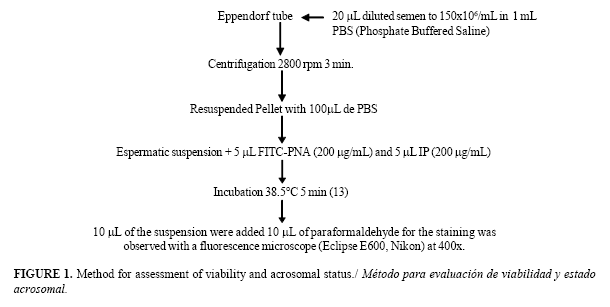
<body><![CDATA[<P><font face="Verdana, Arial, Helvetica, sans-serif" size="2"><B>Volume. </B>It    was determined using a graduated collection tube (1). </font>     <P><font face="Verdana, Arial, Helvetica, sans-serif" size="2"><B>Progressive    motility.</B> For evaluation, a drop of diluted semen was placed on a slide    tempered at 37 &#176;C., in warming plate, covered with a coverslip at the same    temperature and immediately observed in a light microscope at 10X (Eclipse E600,    Nikon) and evaluated on a scale from 0 to 100% (11). </font>     <P><font face="Verdana, Arial, Helvetica, sans-serif" size="2"><B>Viability and    sperm morphology.</B> They were evaluated by eosin-nigrosin staning, evaluating    100 spermatozoa with a 40X objective of a light microscope, considering as those    without viable sperm stained and dead who were stained (10). </font>     <P><font face="Verdana, Arial, Helvetica, sans-serif" size="2">Sperm morphology    was classified as follows: normal and abnormal sperm, observing 100 spermatozoa    from each sample (10). </font>     <P><font face="Verdana, Arial, Helvetica, sans-serif" size="2"><B>Sperm count.</B>    It was determined with a Neubauer chamber after dilution of 1:200, using a light    microscope at 40x (12). </font>     <P><font face="Verdana, Arial, Helvetica, sans-serif" size="2"><B>Viability and    acrosomal status.</B> Acrosomal status was determined from sheep spermatozoa,    fresh and post-thaw by lectin staining technique Peanut Aglutinin (PNA) coupled    with fluorescence isothiocyanate (FITC) and viability by propidium iodide (IP).    As shown in <a href="/img/revistas/rsa/v34n2/f0103212.gif">figure 1</a>.    </font>      
<P><font face="Verdana, Arial, Helvetica, sans-serif" size="2">The functional    status of 100 spermatozoa per sample was evaluated and classified according    to the following staining patterns: live sperm without AR (sperm without FITC-PNA    staining or IP) with AR live sperm (sperm acrosomal staining) dead sperm without    AR (sperm with nuclear staining) with AR dead sperm (sperm with nuclear staining    and acrosomal staining) (14). To determine the acrosomal status, a B-2A filter    with a degree of excitation of 450-490 nm. was used determining sperm viability    with G-2A filter with an excitation level of 510-560 nm. </font>     <P><font face="Verdana, Arial, Helvetica, sans-serif" size="2"><B>Cryopreservation.    </B>For freezing sheep semen, a diluent of 250 ml Triladyl&#174;, 250 ml egg    yolk and 750 ml distilled water was prepared (15), packing the semen in straws    of 0.5 ml at a concentration of 100 x 10<SUP>6</SUP>/ml and stored in liquid    nitrogen for one week (16), thawing at 37&#176;C, for 60 seconds (12). Once    the semen was thawed, the same characteristics were evaluated in fresh semen.    </font>     <P><font face="Verdana, Arial, Helvetica, sans-serif" size="2"><B>Statistical    analysis.</B> Data were analyzed with SPSS 13.0 to compare sperm characteristics    using statistical tests of ANOVA and &#171;t&#187; of Student, assessing the    significance degree of p &lt;0.05 (17). </font>     <P>&nbsp;     ]]></body>
<body><![CDATA[<P><font face="Verdana, Arial, Helvetica, sans-serif" size="2"><B><font size="3">RESULTS    AND DISCUSSION</font></B> </font>      <P><font face="Verdana, Arial, Helvetica, sans-serif" size="2">In fresh semen    obtained through AV , a volume (1.2 ml), higher than that reported by Hern&aacute;ndez    <I>et al</I>. (18), of 0.78 ml and similar to that reported by Guerrero <I>et    al.</I> (12) of 1.1 mL, was determined. </font>      <P><font face="Verdana, Arial, Helvetica, sans-serif" size="2">Sperm characteristics    of the 45 sheep fresh semen samples after freezing and expressed in % are shown    in <a href="/img/revistas/rsa/v34n2/t0103212.gif">Table 1</a>. It shows    the freezing effect on these indicators. </font>      
<P><font face="Verdana, Arial, Helvetica, sans-serif" size="2">The average motility    found in fresh semen (88.0%) was similar to that reported by Cabrera and Pantoja    (19) of 86.0%, and Guerrero et al., (12) with 87.0%, but higher than that reported    by Anel <I>et al.</I> (2) that was 70.8%, whose assessment was performed using    a computerized system. </font>     <P><font face="Verdana, Arial, Helvetica, sans-serif" size="2">In relation to    the mean percentage of live spermatozoa (91.4%), this is similar to that found    by Guerrero <I>et al.</I> (12) which was 90.2%, but higher than that reported    by Hernandez <I>et al.</I> (18) with 65.8%. This is possibly because in the    first two studies, the sample was obtained by AV while Hernandez <I>et al.</I>    (19) semen obtained by electroejaculation (EE). It is reported that the semen    collected by AV shows a higher percentage of live sperm and a higher concentration    than that collected by EE (20). </font>     <P><font face="Verdana, Arial, Helvetica, sans-serif" size="2">Regarding the average    of normal sperm , the result obtained in our assay 94.0% is considered more    appropriate but less than that reported by Guerrero <I>et al.</I> (12) of 98.2%    , which is similar to that reported by Cabrera and Pantoja (19), with 93.6%.    According to Diaz and Arancibia raises (21) is classified as optimal ejaculates    having less than 15% of abnormalities. </font>     <P><font face="Verdana, Arial, Helvetica, sans-serif" size="2">The average concentration    per milliliter was obtained 1768.0X10<SUP>6</SUP>, lower than that reported    by Guerrero <I>et al.</I> (12) who reported 3800.0X10<SUP>6</SUP>. It is noted    that the latter researches worked only ejaculates having a sperm concentration    greater than 2000 million sperm per mL. Mellisho and Gallegos (22), indicated    that sperm concentration in sheep semen is 1000.0 to 3000.0x10<SUP>6</SUP> sperm    per mL. </font>     <P><font face="Verdana, Arial, Helvetica, sans-serif" size="2">As for the viability    and acrosomal status evaluated FITC-PNA/IP staining was found in fresh sheep    semen with the following values: 76.7%, 7.6%, 11.2% and 4.5% for VsRA, VcRA,    MsRA and McRA, respectively. Most studies only report the percentage of sperm    with or without AR, regardless whether sperm is alive or dead. The case in this    research has 87.9% of sperm without RA, which is similar to that previously    reported by Hernandez <I>et al.</I> (18) and Sandoval <I>et al.</I> (11) with    85.6% and 86.6% of sperm without RA, respectively, using Coomassie blue staining    and double trypan blue and Giemsa techniques to determine these values. </font>     <P><font face="Verdana, Arial, Helvetica, sans-serif" size="2">The average percentage    of post-thaw motility in this study was 37.4%, however higher motilities were    reported by Sandoval <I>et al.</I> (11) and Brito <I>et al.</I> (23) with 69.2%    and 40.2% respectively. Considering that post-thaw motility may be affected    by the freezing method, the present study was performed with liquid nitrogen,    while in Brito <I>et al.</I> (23) study, it was frozen by dry ice. </font>     <P><font face="Verdana, Arial, Helvetica, sans-serif" size="2">Freezing in liquid    nitrogen vapor is performed by placing the straw containing the semen at a distance    of 4-5 cm. from the surface of liquid nitrogen (24), while freezing in dry ice    is accomplished by small holes in the surface thereof and depositing 0.1 ml    of diluted semen (23), which causes direct contact with the medium of freezing    providing a rapid freezing and tolerates a wide range of freezing (-79&#176;C    to -160&#176;C), relative to the vapors of liquid nitrogen (-60&#176;C to -86&#176;C),    which allows a greater recovery motile sperm at thawing (25). </font>     ]]></body>
<body><![CDATA[<P><font face="Verdana, Arial, Helvetica, sans-serif" size="2">Another reason    may be the temperature at which glycerol is added to the semen, since in this    research they were added at 37&#176;C , while Sandoval <I>et al.</I> (11), added    5&#176;C. there are reports that mention the best post-thaw motilities adding    it to 5&#176;C (24). In sheep semen, post-thaw motilities reported 40-60%, but    only 20-30% are functional (26). </font>     <P><font face="Verdana, Arial, Helvetica, sans-serif" size="2">Both living and    morphologically normal sperm are appropriate indicators after thawing. The percentage    of living sperm decreased only 23.9%, from the difference values before and    after freezing Table 1, which is considered favorable if one considers that    expressed by Stornelli <I>et al.</I> (27), who pointed out that during the freeze-thaw    process, about 50% of the initial population is lost. </font>     <P><font face="Verdana, Arial, Helvetica, sans-serif" size="2">Sperm percentage    with normal morphology post-thaw was 79.5%, representing a decrease of 14.5%    from the initial value. This result is within the range proposed by Diaz and    Arancibia (21), who established classification parameters for sheep semen as    indicating normal morphology and good values of 80-85%. </font>     <P><font face="Verdana, Arial, Helvetica, sans-serif" size="2">In this study,    the values of viability and acrosomal status in post-thawed sperm were 26.9%,    29.2%, 27.7% and 15.9% of sperm VsRA, VcRA, MsRA and McRA, respectively. Thus    there is a 26.9% of sperm fertilizing ability, as they are alive and have not    implemented its AR. This is similar to that reported by Anel <I>et al.</I> (2)    with 26.3%, but higher than that found by Marco-Jim&eacute;nez <I>et al.</I>    (1) with 21.2%, applying the same evaluation technique. Considering only the    acrosomal status of sperm, there is a 54.6% of sperm without AR, which is similar    to that reported by Joshi <I>et al.</I> (28) with 54.1%, assessed by a computerized    system, but less than that reported by Sandoval <I>et al.</I> (11) with 63.1%,    determined by double staining. </font>      <P><font face="Verdana, Arial, Helvetica, sans-serif" size="2">The cryopreservation    process allows to retrieve enough sperm under adequate conditions (26.9 million    sperm per straw) in order to carry out assisted reproductive techniques such    as intrauterine insemination by laparoscopy in which from 20 to 25 million motile    sperm is deposited (23, 29). <I>In vitro</I> fertilization, 1 million sperm    is required (30), and in ICSI, one sperm per oocyte is required (31). </font>      <P><font face="Verdana, Arial, Helvetica, sans-serif" size="2">It is concluded    that although viability and acrosomal status of sheep spermatozoa are affected    by cryopreservation, there is enough alive sperm without acrosome reaction potentially    useful that can be used in assisted reproduction techniques. </font>     <P>&nbsp;     <P><font face="Verdana, Arial, Helvetica, sans-serif" size="2"><B><font size="3">REFERENCES</font></B>    </font>      <!-- ref --><P><font face="Verdana, Arial, Helvetica, sans-serif" size="2">1. Marco-Jim&eacute;nez    F, Puchades S, Gadea J, Vicente JS, Viudes-de-Castro MP. Effect of semen collection    method on pre- and post-thaw Guirra ram spermatozoa. Theriogenology. 2005;64:1756-1765.        </font>     ]]></body>
<body><![CDATA[<!-- ref --><P><font face="Verdana, Arial, Helvetica, sans-serif" size="2">2. Anel L, de Paz    P, &Aacute;varez M, Chamorro CA, Boixo JC, Manso A, et al. Field and <I>in vitro</I>    assay of three methods for freezing ram semen. Theriogenology. 2003;60:1293-1308.        </font>      <!-- ref --><P><font face="Verdana, Arial, Helvetica, sans-serif" size="2">3. Martins CB.    Influencia en la calidad esperm&aacute;tica de la adici&oacute;n de distintas    concentraciones de cr&iacute;oprotectores para la conservaci&oacute;n del semen.    Tesis para obtener el grado de Doctor en Ciencias. Universidad Complutense de    Madrid. (UCM). 2005.     </font>     <!-- ref --><P><font face="Verdana, Arial, Helvetica, sans-serif" size="2">4. Tulsiani P,    Abou HA, Loeser CR, Pereira BM. The biological and functional significance of    the sperm acrosome and acrosomal enzymes in mammalian fertilization. Exp Cell    Res. 1998; 240:151-164.     </font>     <!-- ref --><P><font face="Verdana, Arial, Helvetica, sans-serif" size="2">5. Gonz&aacute;lez    UR. Valoraci&oacute;n de la capacidad de criopreservaci&oacute;n esperm&aacute;tica    del semen porcino mediante t&eacute;cnicas de choque fr&iacute;o y termoresistencia.    Tesis para obtener el Grado de Doctor en Veterinaria. Universidad de Le&oacute;n    Espa&ntilde;a. 2010.     </font>      <!-- ref --><P><font face="Verdana, Arial, Helvetica, sans-serif" size="2">6. V&aacute;zquez    JM, Mart&iacute;nez E, Roca J, Coy P, Ru&iacute;z S. Use of triple stain technique    for simultaneous assessment of vitality and acrosomal status in boar spermatozoa.    Theriogenology. 1992; 38(5):843-852.     </font>      ]]></body>
<body><![CDATA[<!-- ref --><P><font face="Verdana, Arial, Helvetica, sans-serif" size="2">7. Holt WV. Fundamental    aspect of sperm cryobiology: the importance of species and individual differences.    Theriogenology. 2000; 53:47-58.     </font>     <!-- ref --><P><font face="Verdana, Arial, Helvetica, sans-serif" size="2">8. Aboagla EME,    Terada T. Effects of supplementation of trehalose extender containing egg yolk    with sodium dodecyl sulfate on the freezability of goat spermatozoa. Theriogenology.    2003; 62:809-818.     </font>     <!-- ref --><P><font face="Verdana, Arial, Helvetica, sans-serif" size="2">9. Harrison RA,    Vickers ES. Use of fluorescent probes to assess membrane integrity in mammalian    spermatozoa. J Reprod Fertil. 1990; 88:343-352.     </font>     <!-- ref --><P><font face="Verdana, Arial, Helvetica, sans-serif" size="2">10.Cueto M, Garc&iacute;a    V, Gibbons A, Wolff M, Arrigon J. Obtenci&oacute;n, procesamiento y conservaci&oacute;n    del semen de ovino. Manual de divulgaci&oacute;n. Comunicaci&oacute;n T&eacute;cnica    de Producci&oacute;n Animal del INTA Bariloche. 1993; N&#176;200. Pp. 1-14.        </font>      <!-- ref --><P><font face="Verdana, Arial, Helvetica, sans-serif" size="2">11.Sandoval MR,    Santiani AA, Ruiz GL, Leyva VV, Coronado SL, Delgado CA. Criopreservaci&oacute;n    de semen ovino empleando tres dilutores y cuatro combinaciones de agentes cr&iacute;oprotectores    permeantes y no permeantes. Rev Investig Vet Peru. 2007;18(2):107-114.     </font>      ]]></body>
<body><![CDATA[<!-- ref --><P><font face="Verdana, Arial, Helvetica, sans-serif" size="2">12.Guerrero VH,    Huanta LW, Raymundo TF, Huerta OS, Daphne RD. Uso de dilutores hipert&oacute;nicos    en la criopreservaci&oacute;n de semen ovino. Rev Investig Vet Peru. 2009;20(1):41-46.        </font>      <!-- ref --><P><font face="Verdana, Arial, Helvetica, sans-serif" size="2">13.Garc&iacute;a-Rosell&oacute;    E, Matas C, C&aacute;novas S, Moreira PN, Gadea J, Coy P. Influence of sperm    pretreatment on the efficiency of intracytoplasmic sperm injection in pigs.    J Androl. 2006;27(2):268-275.     </font>      <!-- ref --><P><font face="Verdana, Arial, Helvetica, sans-serif" size="2">14.Garc&iacute;a    MR. Efecto de los inhibidores de H+-ATPasas durante la maduraci&oacute;n, capacitaci&oacute;n    y reacci&oacute;n acrosomal del espermatozoide de conejo. Tesis para obtener    el grado de Doctor en Ciencias Biol&oacute;gicas. Universidad Aut&oacute;noma    Metropolitana, Unidad Xochimilco, M&eacute;xico. 2000.     </font>     <!-- ref --><P><font face="Verdana, Arial, Helvetica, sans-serif" size="2">15.Mart&iacute;nez    RRD, Hern&aacute;ndez IJ, Fern&aacute;ndez HH, Aceves ACM, Valencia MJ. Inseminaci&oacute;n    artificial intrauterina en cabras criollas con semen refrigerado. Rev Vet M&eacute;x.    2006;40(001):71-76.     </font>      <!-- ref --><P><font face="Verdana, Arial, Helvetica, sans-serif" size="2">16.Guti&eacute;rrez    AJ, Palacios MM, Jim&eacute;nez CJA, Ram&iacute;rez GJA. Agua de coco, Opuntia    sp., leche y sus combinaciones para cr&iacute;opreservar semen ovino. Arch Zootec.    2006;55(209):97-100.     </font>      ]]></body>
<body><![CDATA[<!-- ref --><P><font face="Verdana, Arial, Helvetica, sans-serif" size="2">17.&Aacute;lvarez    R. Estad&iacute;stica aplicada a las ciencias de la salud. Ed. D&iacute;az de    Santos, Espa&ntilde;a. 2007.     </font>     <!-- ref --><P><font face="Verdana, Arial, Helvetica, sans-serif" size="2">18.Hern&aacute;ndez    PJE, Fern&aacute;ndez RF, Torres HJG. Capacitaci&oacute;n y reacci&oacute;n    acrosomal <I>in vitro </I>de espermatozoides post-descongelados de ovino. Rev    Salud Anim. 2005;27(1):41-47.     </font>      <!-- ref --><P><font face="Verdana, Arial, Helvetica, sans-serif" size="2">19.Cabrera VP,    Pantoja CA. Influencia de los dilutores tris y ovine freezing sobre la integridad    de la membrana citoplasm&aacute;tica durante la congelaci&oacute;n de semen    de ovinos en pajillas de 0.5 ml. Rev Inv Per&uacute;. 2008;19(2):152-159.     </font>     <!-- ref --><P><font face="Verdana, Arial, Helvetica, sans-serif" size="2">20.Matthews N,    Bester N, Schwalbach LMJ. A comparison of ram semen collected by artificial    vagina and electro-ejaculation. S Afr J Anim Sci. 2003;4:28-30.     </font>      <!-- ref --><P><font face="Verdana, Arial, Helvetica, sans-serif" size="2">21.D&iacute;az    H, Arancibia C. Calificaci&oacute;n de la fertilidad potencial de los animales    dom&eacute;sticos. Edit. Vera y Giannini. Chile. 1971.     </font>      ]]></body>
<body><![CDATA[<!-- ref --><P><font face="Verdana, Arial, Helvetica, sans-serif" size="2">22.Mell&iacute;sho    E, Gallegos A. Manual de Laboratorio de Reproducci&oacute;n Animal. Universidad    Agraria La Molina. Lima, Per&uacute;. 2006.     </font>     <!-- ref --><P><font face="Verdana, Arial, Helvetica, sans-serif" size="2">23.Brito FI, Valencia    MJ, Balc&aacute;zar SA, Angulo MR, Mej&iacute;a VO. Congelaci&oacute;n de semen    de carnero en pellets con los diluyentes tris-glucosa yema de huevo o lactosa-yema    de huevo. Redalyc. 2004;8(002):1-9.     </font>      <!-- ref --><P><font face="Verdana, Arial, Helvetica, sans-serif" size="2">24.Salamon S, Maxwell    WMC. Storage of ram semen. Anim Reprod Sci. 2000;62:77-111.     </font>      <!-- ref --><P><font face="Verdana, Arial, Helvetica, sans-serif" size="2">25.Maxwell WMC,    Landers AJ, Evans G. Survival and fertility of ram spermatozoa frozen in pellets,    straws and minitubes. Theriogenology 1995; 43:1201-1210.     </font>     <!-- ref --><P><font face="Verdana, Arial, Helvetica, sans-serif" size="2">26.Barbas JP, Mascarenhas    RD. Cryopreservation of domestic animal sperm cells. Cell Tissue Bank. 2009;10:49-62.        </font>      ]]></body>
<body><![CDATA[<!-- ref --><P><font face="Verdana, Arial, Helvetica, sans-serif" size="2">27.Stornelli MC,    Tittarelli CM, Savignone CA, Stornelli MA. Efecto de los procesos de criopreservaci&oacute;n    sobre la fertilidad seminal. Analecta Veterinaria. 2005;25(2):28-35.     </font>     <!-- ref --><P><font face="Verdana, Arial, Helvetica, sans-serif" size="2">28.Joshi A, Bag    S, Naqvi SMK, Sharma RC, Mittal JP. Effect of post-thawing incubation on sperm    motility and acrosomal integrity of cryopreserved Garole ram semen. Small Rumin    Res. 2005;56:231-238.     </font>     <!-- ref --><P><font face="Verdana, Arial, Helvetica, sans-serif" size="2">29.Luther JS, Grazul-Bilska    AT, Kirsch JD, Weigl RM, Kraft KC, Navanukraw C, et al. The effect of GnRH,    eCG and progestin type on estrous synchronization following laparoscopic AI    in ewes. Small Rumin Res. 2007;72:227-231.     </font>     <!-- ref --><P><font face="Verdana, Arial, Helvetica, sans-serif" size="2">30.Cognie Y, Baril    G, Poulin N, Mermillod P. Current status of embryo technologies in sheep and    goat. Theriogenology. 2003;59:171-188.     </font>     <!-- ref --><P><font face="Verdana, Arial, Helvetica, sans-serif" size="2">31.Pereyra-Bonnet    F, Gibbons A, Cueto M, Sipowicz P, Fern&aacute;ndez Mart&iacute;n R, Salamone    D. Efficiency of sperm-mediated gene transfer in the ovine by laparoscopic insemination,    <I>in vitro</I> and ICSI. J Reprod Dev. 2011;57:188-196.     </font>     ]]></body>
<body><![CDATA[<P>      <P>      <P>      <P>      <P>      <P>      <P>      <P>&nbsp;      <P>&nbsp;     <P><font face="Verdana, Arial, Helvetica, sans-serif" size="2">Recibido: 17-12-2011.</font>        ]]></body>
<body><![CDATA[<br>   <font face="Verdana, Arial, Helvetica, sans-serif" size="2">Aceptado: 21-5-2012.</font>      <P>&nbsp;     <P>&nbsp;     <P>&nbsp;       ]]></body><back>
<ref-list>
<ref id="B1">
<label>1</label><nlm-citation citation-type="journal">
<person-group person-group-type="author">
<name>
<surname><![CDATA[Marco-Jiménez]]></surname>
<given-names><![CDATA[F]]></given-names>
</name>
<name>
<surname><![CDATA[Puchades]]></surname>
<given-names><![CDATA[S]]></given-names>
</name>
<name>
<surname><![CDATA[Gadea]]></surname>
<given-names><![CDATA[J]]></given-names>
</name>
<name>
<surname><![CDATA[Vicente]]></surname>
<given-names><![CDATA[JS]]></given-names>
</name>
<name>
<surname><![CDATA[Viudes-de-Castro]]></surname>
<given-names><![CDATA[MP]]></given-names>
</name>
</person-group>
<article-title xml:lang="en"><![CDATA[Effect of semen collection method on pre- and post-thaw Guirra ram spermatozoa]]></article-title>
<source><![CDATA[Theriogenology]]></source>
<year>2005</year>
<volume>64</volume>
<page-range>1756-1765</page-range></nlm-citation>
</ref>
<ref id="B2">
<label>2</label><nlm-citation citation-type="journal">
<person-group person-group-type="author">
<name>
<surname><![CDATA[Anel]]></surname>
<given-names><![CDATA[L]]></given-names>
</name>
<name>
<surname><![CDATA[de Paz]]></surname>
<given-names><![CDATA[P]]></given-names>
</name>
<name>
<surname><![CDATA[Ávarez]]></surname>
<given-names><![CDATA[M]]></given-names>
</name>
<name>
<surname><![CDATA[Chamorro]]></surname>
<given-names><![CDATA[CA]]></given-names>
</name>
<name>
<surname><![CDATA[Boixo]]></surname>
<given-names><![CDATA[JC]]></given-names>
</name>
<name>
<surname><![CDATA[Manso]]></surname>
<given-names><![CDATA[A]]></given-names>
</name>
</person-group>
<article-title xml:lang="en"><![CDATA[Field and in vitro assay of three methods for freezing ram semen]]></article-title>
<source><![CDATA[Theriogenology]]></source>
<year>2003</year>
<volume>60</volume>
<page-range>1293-1308</page-range></nlm-citation>
</ref>
<ref id="B3">
<label>3</label><nlm-citation citation-type="">
<person-group person-group-type="author">
<name>
<surname><![CDATA[Martins]]></surname>
<given-names><![CDATA[CB]]></given-names>
</name>
</person-group>
<article-title xml:lang="es"><![CDATA[Influencia en la calidad espermática de la adición de distintas concentraciones de críoprotectores para la conservación del semen]]></article-title>
<source><![CDATA[]]></source>
<year></year>
</nlm-citation>
</ref>
<ref id="B4">
<label>4</label><nlm-citation citation-type="journal">
<person-group person-group-type="author">
<name>
<surname><![CDATA[Tulsiani]]></surname>
<given-names><![CDATA[P]]></given-names>
</name>
<name>
<surname><![CDATA[Abou]]></surname>
<given-names><![CDATA[HA]]></given-names>
</name>
<name>
<surname><![CDATA[Loeser]]></surname>
<given-names><![CDATA[CR]]></given-names>
</name>
<name>
<surname><![CDATA[Pereira]]></surname>
<given-names><![CDATA[BM]]></given-names>
</name>
</person-group>
<article-title xml:lang="en"><![CDATA[The biological and functional significance of the sperm acrosome and acrosomal enzymes in mammalian fertilization]]></article-title>
<source><![CDATA[Exp Cell Res]]></source>
<year>1998</year>
<volume>240</volume>
<page-range>151-164</page-range></nlm-citation>
</ref>
<ref id="B5">
<label>5</label><nlm-citation citation-type="">
<person-group person-group-type="author">
<name>
<surname><![CDATA[González]]></surname>
<given-names><![CDATA[UR]]></given-names>
</name>
</person-group>
<article-title xml:lang="es"><![CDATA[Valoración de la capacidad de criopreservación espermática del semen porcino mediante técnicas de choque frío y termoresistencia]]></article-title>
<source><![CDATA[]]></source>
<year></year>
</nlm-citation>
</ref>
<ref id="B6">
<label>6</label><nlm-citation citation-type="journal">
<person-group person-group-type="author">
<name>
<surname><![CDATA[Vázquez]]></surname>
<given-names><![CDATA[JM]]></given-names>
</name>
<name>
<surname><![CDATA[Martínez]]></surname>
<given-names><![CDATA[E]]></given-names>
</name>
<name>
<surname><![CDATA[Roca]]></surname>
<given-names><![CDATA[J]]></given-names>
</name>
<name>
<surname><![CDATA[Coy]]></surname>
<given-names><![CDATA[P]]></given-names>
</name>
<name>
<surname><![CDATA[Ruíz]]></surname>
<given-names><![CDATA[S]]></given-names>
</name>
</person-group>
<article-title xml:lang="en"><![CDATA[Use of triple stain technique for simultaneous assessment of vitality and acrosomal status in boar spermatozoa]]></article-title>
<source><![CDATA[Theriogenology]]></source>
<year>1992</year>
<volume>38</volume><volume>5</volume>
<page-range>843-852</page-range></nlm-citation>
</ref>
<ref id="B7">
<label>7</label><nlm-citation citation-type="journal">
<person-group person-group-type="author">
<name>
<surname><![CDATA[Holt]]></surname>
<given-names><![CDATA[WV]]></given-names>
</name>
</person-group>
<article-title xml:lang="en"><![CDATA[Fundamental aspect of sperm cryobiology: the importance of species and individual differences]]></article-title>
<source><![CDATA[Theriogenology]]></source>
<year>2000</year>
<volume>53</volume>
<page-range>47-58</page-range></nlm-citation>
</ref>
<ref id="B8">
<label>8</label><nlm-citation citation-type="journal">
<person-group person-group-type="author">
<name>
<surname><![CDATA[Aboagla]]></surname>
<given-names><![CDATA[EME]]></given-names>
</name>
<name>
<surname><![CDATA[Terada]]></surname>
<given-names><![CDATA[T]]></given-names>
</name>
</person-group>
<article-title xml:lang="en"><![CDATA[Effects of supplementation of trehalose extender containing egg yolk with sodium dodecyl sulfate on the freezability of goat spermatozoa]]></article-title>
<source><![CDATA[Theriogenology]]></source>
<year>2003</year>
<volume>62</volume>
<page-range>809-818</page-range></nlm-citation>
</ref>
<ref id="B9">
<label>9</label><nlm-citation citation-type="journal">
<person-group person-group-type="author">
<name>
<surname><![CDATA[Harrison]]></surname>
<given-names><![CDATA[RA]]></given-names>
</name>
<name>
<surname><![CDATA[Vickers]]></surname>
<given-names><![CDATA[ES]]></given-names>
</name>
</person-group>
<article-title xml:lang="en"><![CDATA[Use of fluorescent probes to assess membrane integrity in mammalian spermatozoa]]></article-title>
<source><![CDATA[J Reprod Fertil]]></source>
<year>1990</year>
<volume>88</volume>
<page-range>343-352</page-range></nlm-citation>
</ref>
<ref id="B10">
<label>10</label><nlm-citation citation-type="">
<person-group person-group-type="author">
<name>
<surname><![CDATA[Cueto]]></surname>
<given-names><![CDATA[M]]></given-names>
</name>
<name>
<surname><![CDATA[García]]></surname>
<given-names><![CDATA[V]]></given-names>
</name>
<name>
<surname><![CDATA[Gibbons]]></surname>
<given-names><![CDATA[A]]></given-names>
</name>
<name>
<surname><![CDATA[Wolff]]></surname>
<given-names><![CDATA[M]]></given-names>
</name>
<name>
<surname><![CDATA[Arrigon]]></surname>
<given-names><![CDATA[J]]></given-names>
</name>
</person-group>
<article-title xml:lang="es"><![CDATA[Obtención, procesamiento y conservación del semen de ovino]]></article-title>
<source><![CDATA[Manual de divulgación: Comunicación Técnica de Producción Animal del INTA Bariloche]]></source>
<year>1993</year>
<page-range>1-14</page-range></nlm-citation>
</ref>
<ref id="B11">
<label>11</label><nlm-citation citation-type="journal">
<person-group person-group-type="author">
<name>
<surname><![CDATA[Sandoval]]></surname>
<given-names><![CDATA[MR]]></given-names>
</name>
<name>
<surname><![CDATA[Santiani]]></surname>
<given-names><![CDATA[AA]]></given-names>
</name>
<name>
<surname><![CDATA[Ruiz]]></surname>
<given-names><![CDATA[GL]]></given-names>
</name>
<name>
<surname><![CDATA[Leyva]]></surname>
<given-names><![CDATA[VV]]></given-names>
</name>
<name>
<surname><![CDATA[Coronado]]></surname>
<given-names><![CDATA[SL]]></given-names>
</name>
<name>
<surname><![CDATA[Delgado]]></surname>
<given-names><![CDATA[CA]]></given-names>
</name>
</person-group>
<article-title xml:lang="es"><![CDATA[Criopreservación de semen ovino empleando tres dilutores y cuatro combinaciones de agentes críoprotectores permeantes y no permeantes]]></article-title>
<source><![CDATA[Rev Investig Vet Peru]]></source>
<year>2007</year>
<volume>18</volume>
<numero>2</numero>
<issue>2</issue>
<page-range>107-114</page-range></nlm-citation>
</ref>
<ref id="B12">
<label>12</label><nlm-citation citation-type="journal">
<person-group person-group-type="author">
<name>
<surname><![CDATA[Guerrero]]></surname>
<given-names><![CDATA[VH]]></given-names>
</name>
<name>
<surname><![CDATA[Huanta]]></surname>
<given-names><![CDATA[LW]]></given-names>
</name>
<name>
<surname><![CDATA[Raymundo]]></surname>
<given-names><![CDATA[TF]]></given-names>
</name>
<name>
<surname><![CDATA[Huerta]]></surname>
<given-names><![CDATA[OS]]></given-names>
</name>
<name>
<surname><![CDATA[Daphne]]></surname>
<given-names><![CDATA[RD]]></given-names>
</name>
</person-group>
<article-title xml:lang="es"><![CDATA[Uso de dilutores hipertónicos en la criopreservación de semen ovino]]></article-title>
<source><![CDATA[Rev Investig Vet Peru]]></source>
<year>2009</year>
<volume>20</volume>
<numero>1</numero>
<issue>1</issue>
<page-range>41-46</page-range></nlm-citation>
</ref>
<ref id="B13">
<label>13</label><nlm-citation citation-type="journal">
<person-group person-group-type="author">
<name>
<surname><![CDATA[García-Roselló]]></surname>
<given-names><![CDATA[E]]></given-names>
</name>
<name>
<surname><![CDATA[Matas]]></surname>
<given-names><![CDATA[C]]></given-names>
</name>
<name>
<surname><![CDATA[Cánovas]]></surname>
<given-names><![CDATA[S]]></given-names>
</name>
<name>
<surname><![CDATA[Moreira]]></surname>
<given-names><![CDATA[PN]]></given-names>
</name>
<name>
<surname><![CDATA[Gadea]]></surname>
<given-names><![CDATA[J]]></given-names>
</name>
<name>
<surname><![CDATA[Coy]]></surname>
<given-names><![CDATA[P]]></given-names>
</name>
</person-group>
<article-title xml:lang="en"><![CDATA[Influence of sperm pretreatment on the efficiency of intracytoplasmic sperm injection in pigs]]></article-title>
<source><![CDATA[J Androl]]></source>
<year>2006</year>
<volume>27</volume>
<numero>2</numero>
<issue>2</issue>
<page-range>268-275</page-range></nlm-citation>
</ref>
<ref id="B14">
<label>14</label><nlm-citation citation-type="">
<person-group person-group-type="author">
<name>
<surname><![CDATA[García]]></surname>
<given-names><![CDATA[MR]]></given-names>
</name>
</person-group>
<article-title xml:lang="es"><![CDATA[Efecto de los inhibidores de H+ATPasas durante la maduración, capacitación y reacción acrosomal del espermatozoide de conejo]]></article-title>
<source><![CDATA[]]></source>
<year></year>
</nlm-citation>
</ref>
<ref id="B15">
<label>15</label><nlm-citation citation-type="journal">
<person-group person-group-type="author">
<name>
<surname><![CDATA[Martínez]]></surname>
<given-names><![CDATA[RRD]]></given-names>
</name>
<name>
<surname><![CDATA[Hernández]]></surname>
<given-names><![CDATA[IJ]]></given-names>
</name>
<name>
<surname><![CDATA[Fernández]]></surname>
<given-names><![CDATA[HH]]></given-names>
</name>
<name>
<surname><![CDATA[Aceves]]></surname>
<given-names><![CDATA[ACM]]></given-names>
</name>
<name>
<surname><![CDATA[Valencia]]></surname>
<given-names><![CDATA[MJ]]></given-names>
</name>
</person-group>
<article-title xml:lang="es"><![CDATA[Inseminación artificial intrauterina en cabras criollas con semen refrigerado]]></article-title>
<source><![CDATA[Rev Vet Méx]]></source>
<year>2006</year>
<volume>40</volume>
<numero>001</numero>
<issue>001</issue>
<page-range>71-76</page-range></nlm-citation>
</ref>
<ref id="B16">
<label>16</label><nlm-citation citation-type="journal">
<person-group person-group-type="author">
<name>
<surname><![CDATA[Gutiérrez]]></surname>
<given-names><![CDATA[AJ]]></given-names>
</name>
<name>
<surname><![CDATA[Palacios]]></surname>
<given-names><![CDATA[MM]]></given-names>
</name>
<name>
<surname><![CDATA[Jiménez]]></surname>
<given-names><![CDATA[CJA]]></given-names>
</name>
<name>
<surname><![CDATA[Ramírez]]></surname>
<given-names><![CDATA[GJA]]></given-names>
</name>
</person-group>
<article-title xml:lang="es"><![CDATA[Agua de coco, Opuntia sp., leche y sus combinaciones para críopreservar semen ovino]]></article-title>
<source><![CDATA[Arch Zootec]]></source>
<year>2006</year>
<volume>55</volume>
<numero>209</numero>
<issue>209</issue>
<page-range>97-100</page-range></nlm-citation>
</ref>
<ref id="B17">
<label>17</label><nlm-citation citation-type="book">
<person-group person-group-type="author">
<name>
<surname><![CDATA[Álvarez]]></surname>
<given-names><![CDATA[R]]></given-names>
</name>
</person-group>
<source><![CDATA[Estadística aplicada a las ciencias de la salud]]></source>
<year>2007</year>
<publisher-loc><![CDATA[España ]]></publisher-loc>
<publisher-name><![CDATA[Díaz de Santos]]></publisher-name>
</nlm-citation>
</ref>
<ref id="B18">
<label>18</label><nlm-citation citation-type="journal">
<person-group person-group-type="author">
<name>
<surname><![CDATA[Hernández]]></surname>
<given-names><![CDATA[PJE]]></given-names>
</name>
<name>
<surname><![CDATA[Fernández]]></surname>
<given-names><![CDATA[RF]]></given-names>
</name>
<name>
<surname><![CDATA[Torres]]></surname>
<given-names><![CDATA[HJG]]></given-names>
</name>
</person-group>
<article-title xml:lang="es"><![CDATA[Capacitación y reacción acrosomal in vitro de espermatozoides post-descongelados de ovino]]></article-title>
<source><![CDATA[Rev Salud Anim]]></source>
<year>2005</year>
<volume>27</volume>
<numero>1</numero>
<issue>1</issue>
<page-range>41-47</page-range></nlm-citation>
</ref>
<ref id="B19">
<label>19</label><nlm-citation citation-type="journal">
<person-group person-group-type="author">
<name>
<surname><![CDATA[Cabrera]]></surname>
<given-names><![CDATA[VP]]></given-names>
</name>
<name>
<surname><![CDATA[Pantoja]]></surname>
<given-names><![CDATA[CA]]></given-names>
</name>
</person-group>
<article-title xml:lang="es"><![CDATA[Influencia de los dilutores tris y ovine freezing sobre la integridad de la membrana citoplasmática durante la congelación de semen de ovinos en pajillas de 0.5 ml]]></article-title>
<source><![CDATA[Rev Inv Perú]]></source>
<year>2008</year>
<volume>19</volume>
<numero>2</numero>
<issue>2</issue>
<page-range>152-159</page-range></nlm-citation>
</ref>
<ref id="B20">
<label>20</label><nlm-citation citation-type="journal">
<person-group person-group-type="author">
<name>
<surname><![CDATA[Matthews]]></surname>
<given-names><![CDATA[N]]></given-names>
</name>
<name>
<surname><![CDATA[Bester]]></surname>
<given-names><![CDATA[N]]></given-names>
</name>
<name>
<surname><![CDATA[Schwalbach]]></surname>
<given-names><![CDATA[LMJ]]></given-names>
</name>
</person-group>
<article-title xml:lang="en"><![CDATA[A comparison of ram semen collected by artificial vagina and electro-ejaculation]]></article-title>
<source><![CDATA[S Afr J Anim Sci]]></source>
<year>2003</year>
<volume>4</volume>
<page-range>28-30</page-range></nlm-citation>
</ref>
<ref id="B21">
<label>21</label><nlm-citation citation-type="book">
<person-group person-group-type="author">
<name>
<surname><![CDATA[Díaz]]></surname>
<given-names><![CDATA[H]]></given-names>
</name>
<name>
<surname><![CDATA[Arancibia]]></surname>
<given-names><![CDATA[C]]></given-names>
</name>
</person-group>
<source><![CDATA[Calificación de la fertilidad potencial de los animales domésticos]]></source>
<year>1971</year>
<publisher-loc><![CDATA[^eChile Chile]]></publisher-loc>
<publisher-name><![CDATA[Vera y Giannini]]></publisher-name>
</nlm-citation>
</ref>
<ref id="B22">
<label>22</label><nlm-citation citation-type="book">
<person-group person-group-type="author">
<name>
<surname><![CDATA[Mellísho]]></surname>
<given-names><![CDATA[E]]></given-names>
</name>
<name>
<surname><![CDATA[Gallegos]]></surname>
<given-names><![CDATA[A]]></given-names>
</name>
</person-group>
<source><![CDATA[Manual de Laboratorio de Reproducción Animal]]></source>
<year>2006</year>
<publisher-loc><![CDATA[Perú^eLima Lima]]></publisher-loc>
<publisher-name><![CDATA[Universidad Agraria La Molina]]></publisher-name>
</nlm-citation>
</ref>
<ref id="B23">
<label>23</label><nlm-citation citation-type="journal">
<person-group person-group-type="author">
<name>
<surname><![CDATA[Brito]]></surname>
<given-names><![CDATA[FI]]></given-names>
</name>
<name>
<surname><![CDATA[Valencia]]></surname>
<given-names><![CDATA[MJ]]></given-names>
</name>
<name>
<surname><![CDATA[Balcázar]]></surname>
<given-names><![CDATA[SA]]></given-names>
</name>
<name>
<surname><![CDATA[Angulo]]></surname>
<given-names><![CDATA[MR]]></given-names>
</name>
<name>
<surname><![CDATA[Mejía]]></surname>
<given-names><![CDATA[VO]]></given-names>
</name>
</person-group>
<article-title xml:lang="es"><![CDATA[Congelación de semen de carnero en pellets con los diluyentes tris-glucosa yema de huevo o lactosa-yema de huevo]]></article-title>
<source><![CDATA[Redalyc]]></source>
<year>2004</year>
<volume>8</volume>
<numero>002</numero>
<issue>002</issue>
<page-range>1-9</page-range></nlm-citation>
</ref>
<ref id="B24">
<label>24</label><nlm-citation citation-type="journal">
<person-group person-group-type="author">
<name>
<surname><![CDATA[Salamon]]></surname>
<given-names><![CDATA[S]]></given-names>
</name>
<name>
<surname><![CDATA[Maxwell]]></surname>
<given-names><![CDATA[WMC]]></given-names>
</name>
</person-group>
<article-title xml:lang="en"><![CDATA[Storage of ram semen]]></article-title>
<source><![CDATA[Anim Reprod Sci]]></source>
<year>2000</year>
<volume>62</volume>
<page-range>77-111</page-range></nlm-citation>
</ref>
<ref id="B25">
<label>25</label><nlm-citation citation-type="journal">
<person-group person-group-type="author">
<name>
<surname><![CDATA[Maxwell]]></surname>
<given-names><![CDATA[WMC]]></given-names>
</name>
<name>
<surname><![CDATA[Landers]]></surname>
<given-names><![CDATA[AJ]]></given-names>
</name>
<name>
<surname><![CDATA[Evans]]></surname>
<given-names><![CDATA[G]]></given-names>
</name>
</person-group>
<article-title xml:lang="en"><![CDATA[Survival and fertility of ram spermatozoa frozen in pellets, straws and minitubes]]></article-title>
<source><![CDATA[Theriogenology]]></source>
<year>1995</year>
<volume>43</volume>
<page-range>1201-1210</page-range></nlm-citation>
</ref>
<ref id="B26">
<label>26</label><nlm-citation citation-type="journal">
<person-group person-group-type="author">
<name>
<surname><![CDATA[Barbas]]></surname>
<given-names><![CDATA[JP]]></given-names>
</name>
<name>
<surname><![CDATA[Mascarenhas]]></surname>
<given-names><![CDATA[RD]]></given-names>
</name>
</person-group>
<article-title xml:lang="en"><![CDATA[Cryopreservation of domestic animal sperm cells]]></article-title>
<source><![CDATA[Cell Tissue Bank]]></source>
<year>2009</year>
<volume>10</volume>
<page-range>49-62</page-range></nlm-citation>
</ref>
<ref id="B27">
<label>27</label><nlm-citation citation-type="journal">
<person-group person-group-type="author">
<name>
<surname><![CDATA[Stornelli]]></surname>
<given-names><![CDATA[MC]]></given-names>
</name>
<name>
<surname><![CDATA[Tittarelli]]></surname>
<given-names><![CDATA[CM]]></given-names>
</name>
<name>
<surname><![CDATA[Savignone]]></surname>
<given-names><![CDATA[CA]]></given-names>
</name>
<name>
<surname><![CDATA[Stornelli]]></surname>
<given-names><![CDATA[MA]]></given-names>
</name>
</person-group>
<article-title xml:lang="es"><![CDATA[Efecto de los procesos de criopreservación sobre la fertilidad seminal]]></article-title>
<source><![CDATA[Analecta Veterinaria]]></source>
<year>2005</year>
<volume>25</volume>
<numero>2</numero>
<issue>2</issue>
<page-range>28-35</page-range></nlm-citation>
</ref>
<ref id="B28">
<label>28</label><nlm-citation citation-type="journal">
<person-group person-group-type="author">
<name>
<surname><![CDATA[Joshi]]></surname>
<given-names><![CDATA[A]]></given-names>
</name>
<name>
<surname><![CDATA[Bag]]></surname>
<given-names><![CDATA[S]]></given-names>
</name>
<name>
<surname><![CDATA[Naqvi]]></surname>
<given-names><![CDATA[SMK]]></given-names>
</name>
<name>
<surname><![CDATA[Sharma]]></surname>
<given-names><![CDATA[RC]]></given-names>
</name>
<name>
<surname><![CDATA[Mittal]]></surname>
<given-names><![CDATA[JP]]></given-names>
</name>
</person-group>
<article-title xml:lang="en"><![CDATA[Effect of post-thawing incubation on sperm motility and acrosomal integrity of cryopreserved Garole ram semen]]></article-title>
<source><![CDATA[Small Rumin Res]]></source>
<year>2005</year>
<volume>56</volume>
<page-range>231-238</page-range></nlm-citation>
</ref>
<ref id="B29">
<label>29</label><nlm-citation citation-type="journal">
<person-group person-group-type="author">
<name>
<surname><![CDATA[Luther]]></surname>
<given-names><![CDATA[JS]]></given-names>
</name>
<name>
<surname><![CDATA[Grazul-Bilska]]></surname>
<given-names><![CDATA[AT]]></given-names>
</name>
<name>
<surname><![CDATA[Kirsch]]></surname>
<given-names><![CDATA[JD]]></given-names>
</name>
<name>
<surname><![CDATA[Weigl]]></surname>
<given-names><![CDATA[RM]]></given-names>
</name>
<name>
<surname><![CDATA[Kraft]]></surname>
<given-names><![CDATA[KC]]></given-names>
</name>
<name>
<surname><![CDATA[Navanukraw]]></surname>
<given-names><![CDATA[C]]></given-names>
</name>
</person-group>
<article-title xml:lang="en"><![CDATA[The effect of GnRH, eCG and progestin type on estrous synchronization following laparoscopic AI in ewes]]></article-title>
<source><![CDATA[Small Rumin Res]]></source>
<year>2007</year>
<volume>72</volume>
<page-range>227-231</page-range></nlm-citation>
</ref>
<ref id="B30">
<label>30</label><nlm-citation citation-type="journal">
<person-group person-group-type="author">
<name>
<surname><![CDATA[Cognie]]></surname>
<given-names><![CDATA[Y]]></given-names>
</name>
<name>
<surname><![CDATA[Baril]]></surname>
<given-names><![CDATA[G]]></given-names>
</name>
<name>
<surname><![CDATA[Poulin]]></surname>
<given-names><![CDATA[N]]></given-names>
</name>
<name>
<surname><![CDATA[Mermillod]]></surname>
<given-names><![CDATA[P]]></given-names>
</name>
</person-group>
<article-title xml:lang="en"><![CDATA[Current status of embryo technologies in sheep and goat]]></article-title>
<source><![CDATA[Theriogenology]]></source>
<year>2003</year>
<volume>59</volume>
<page-range>171-188</page-range></nlm-citation>
</ref>
<ref id="B31">
<label>31</label><nlm-citation citation-type="journal">
<person-group person-group-type="author">
<name>
<surname><![CDATA[Pereyra-Bonnet]]></surname>
<given-names><![CDATA[F]]></given-names>
</name>
<name>
<surname><![CDATA[Gibbons]]></surname>
<given-names><![CDATA[A]]></given-names>
</name>
<name>
<surname><![CDATA[Cueto]]></surname>
<given-names><![CDATA[M]]></given-names>
</name>
<name>
<surname><![CDATA[Sipowicz]]></surname>
<given-names><![CDATA[P]]></given-names>
</name>
<name>
<surname><![CDATA[Fernández Martín]]></surname>
<given-names><![CDATA[R]]></given-names>
</name>
<name>
<surname><![CDATA[Salamone]]></surname>
<given-names><![CDATA[D]]></given-names>
</name>
</person-group>
<article-title xml:lang="en"><![CDATA[Efficiency of sperm-mediated gene transfer in the ovine by laparoscopic insemination, in vitro and ICSI]]></article-title>
<source><![CDATA[J Reprod Dev]]></source>
<year>2011</year>
<volume>57</volume>
<page-range>188-196</page-range></nlm-citation>
</ref>
</ref-list>
</back>
</article>