<?xml version="1.0" encoding="ISO-8859-1"?><article xmlns:mml="http://www.w3.org/1998/Math/MathML" xmlns:xlink="http://www.w3.org/1999/xlink" xmlns:xsi="http://www.w3.org/2001/XMLSchema-instance">
<front>
<journal-meta>
<journal-id>0253-570X</journal-id>
<journal-title><![CDATA[Revista de Salud Animal]]></journal-title>
<abbrev-journal-title><![CDATA[Rev Salud Anim.]]></abbrev-journal-title>
<issn>0253-570X</issn>
<publisher>
<publisher-name><![CDATA[Centro Nacional de Sanidad Agropecuaria]]></publisher-name>
</publisher>
</journal-meta>
<article-meta>
<article-id>S0253-570X2015000100008</article-id>
<title-group>
<article-title xml:lang="en"><![CDATA[Detection of a high prevalence of antibodies against Toxoplasma gondii in cattle in Northern and Midwestern Brazil]]></article-title>
<article-title xml:lang="es"><![CDATA[Detección de alta prevalencia de anticuerpos contra Toxoplasma gondii en bovinos del Norte y Medio Oeste de Brasil]]></article-title>
</title-group>
<contrib-group>
<contrib contrib-type="author">
<name>
<surname><![CDATA[Barbosa da Silva]]></surname>
<given-names><![CDATA[Jenevaldo]]></given-names>
</name>
<xref ref-type="aff" rid="A01"/>
</contrib>
<contrib contrib-type="author">
<name>
<surname><![CDATA[Nunes de Santana Castro]]></surname>
<given-names><![CDATA[Gustavo]]></given-names>
</name>
<xref ref-type="aff" rid="A02"/>
</contrib>
<contrib contrib-type="author">
<name>
<surname><![CDATA[Nunes dos Santos]]></surname>
<given-names><![CDATA[Priscilla]]></given-names>
</name>
<xref ref-type="aff" rid="A02"/>
</contrib>
<contrib contrib-type="author">
<name>
<surname><![CDATA[Henrique da Fonseca]]></surname>
<given-names><![CDATA[Adivaldo]]></given-names>
</name>
<xref ref-type="aff" rid="A02"/>
</contrib>
<contrib contrib-type="author">
<name>
<surname><![CDATA[Henrique da Silva Lima]]></surname>
<given-names><![CDATA[Danillo]]></given-names>
</name>
<xref ref-type="aff" rid="A03"/>
</contrib>
<contrib contrib-type="author">
<name>
<surname><![CDATA[dos Anjos Bomjardim]]></surname>
<given-names><![CDATA[Henrique]]></given-names>
</name>
<xref ref-type="aff" rid="A03"/>
</contrib>
<contrib contrib-type="author">
<name>
<surname><![CDATA[dos Santos Belo Reis]]></surname>
<given-names><![CDATA[Alessandra]]></given-names>
</name>
<xref ref-type="aff" rid="A03"/>
</contrib>
<contrib contrib-type="author">
<name>
<surname><![CDATA[de Oliveira Soares]]></surname>
<given-names><![CDATA[Susiane]]></given-names>
</name>
<xref ref-type="aff" rid="A03"/>
</contrib>
<contrib contrib-type="author">
<name>
<surname><![CDATA[Diomedes Barbosa]]></surname>
<given-names><![CDATA[José]]></given-names>
</name>
<xref ref-type="aff" rid="A03"/>
</contrib>
</contrib-group>
<aff id="A01">
<institution><![CDATA[,Faculdade de Ciências Agrárias e Veterinárias FCAV-UNESP Departamento de Patologia Veterinária Laboratório de Imunoparasitologia]]></institution>
<addr-line><![CDATA[Jaboticabal ]]></addr-line>
<country>Brazil</country>
</aff>
<aff id="A02">
<institution><![CDATA[,Universidade Federal Rural de Rio de Janeiro (UFRRJ) Departamento de Epidemiologia e Saúde Pública Laboratório de Doenças Parasitárias]]></institution>
<addr-line><![CDATA[Seropédica ]]></addr-line>
<country>Brazil</country>
</aff>
<aff id="A03">
<institution><![CDATA[,Universidade Federal do Pará Instituto de Medicina Veterinária ]]></institution>
<addr-line><![CDATA[Castanhal ]]></addr-line>
<country>Brazil</country>
</aff>
<pub-date pub-type="pub">
<day>00</day>
<month>04</month>
<year>2015</year>
</pub-date>
<pub-date pub-type="epub">
<day>00</day>
<month>04</month>
<year>2015</year>
</pub-date>
<volume>37</volume>
<numero>1</numero>
<fpage>52</fpage>
<lpage>56</lpage>
<copyright-statement/>
<copyright-year/>
<self-uri xlink:href="http://scielo.sld.cu/scielo.php?script=sci_arttext&amp;pid=S0253-570X2015000100008&amp;lng=en&amp;nrm=iso"></self-uri><self-uri xlink:href="http://scielo.sld.cu/scielo.php?script=sci_abstract&amp;pid=S0253-570X2015000100008&amp;lng=en&amp;nrm=iso"></self-uri><self-uri xlink:href="http://scielo.sld.cu/scielo.php?script=sci_pdf&amp;pid=S0253-570X2015000100008&amp;lng=en&amp;nrm=iso"></self-uri><abstract abstract-type="short" xml:lang="en"><p><![CDATA[The aim of this study was to determine the prevalence of Toxoplasma gondii in cattle from the Northern and Midwestern regions of Brazil. Serum samples were collected from 1789 animals and tested by indirect enzyme-linked immunosorbent assay (ELISA). The overall prevalence of T. gondii was 83.40% (1492/1789). The prevalence rates of T. gondii-seropositive animals observed in the states of Pará, Tocantins and, Mato Grosso were 87.45%, 87.79% and 73.06%, respectively. The detection of high prevalence rates of T. gondii in cattle deserves special attention because they are the main source of high biological value protein for humans. This finding indicates the need for further studies on the risk that these animals may pose to public health.]]></p></abstract>
<abstract abstract-type="short" xml:lang="es"><p><![CDATA[El objetivo del presente estudio fue determinar la prevalencia de Toxoplasma gondii en bovinos de las regiones del Norte y Medio Oeste de Brasil. Las muestras de suero se colectaron de 1789 animales y se testaron por ELISA. La prevalencia total de T. gondii fue de 83.40% (1492/1789). La proporción de animales seropositivos a T. gondii, observados en los estados de Pará, Tocantins y Mato Grosso, fue de 87.45%, 87.79% y 73.06%, respectivamente. La detección de alta prevalencia a T. gondii en bovinos merece atención especial, porque ellos son la principal fuente biológica de valor proteico para los humanos. Estos hallazgos indican la necesidad de estudios posteriores sobre el riesgo que estos animales pueden significar para la salud pública.]]></p></abstract>
<kwd-group>
<kwd lng="en"><![CDATA[cattle]]></kwd>
<kwd lng="en"><![CDATA[ELISA]]></kwd>
<kwd lng="en"><![CDATA[IFAT]]></kwd>
<kwd lng="en"><![CDATA[Toxoplasma gondii]]></kwd>
<kwd lng="es"><![CDATA[bovino]]></kwd>
<kwd lng="es"><![CDATA[ELISA]]></kwd>
<kwd lng="es"><![CDATA[IFAT]]></kwd>
<kwd lng="es"><![CDATA[Toxoplasma gondii]]></kwd>
</kwd-group>
</article-meta>
</front><body><![CDATA[ <P align="right"><font size="2" face="Verdana, Arial, Helvetica, sans-serif"><B>ORIGINAL    ARTICLE</B> </font>     <P>&nbsp; <H1> <font size="2" face="Verdana, Arial, Helvetica, sans-serif"><B><font size="4">Detection    of a high prevalence of antibodies against <I>Toxoplasma gondii</I> in cattle    in Northern and Midwestern Brazil</font></B></font></H1>     <p><font size="2" face="Verdana, Arial, Helvetica, sans-serif"><b></b> </font>      <p> <font size="2" face="Verdana, Arial, Helvetica, sans-serif"><b><font size="3">Detecci&oacute;n    de alta prevalencia de anticuerpos contra <i>Toxoplasma gondii</i> en bovinos    del Norte y Medio Oeste de Brasil</font></b> </font>      <p>&nbsp;     <p>&nbsp;  <h1> <font size="2" face="Verdana, Arial, Helvetica, sans-serif">Jenevaldo Barbosa    da Silva<SUP>I</SUP>, Gustavo Nunes de Santana Castro<SUP>II</SUP>, Priscilla    Nunes dos Santos<SUP>II</SUP>, Adivaldo Henrique da Fonseca<SUP>II</SUP>, Danillo    Henrique da Silva Lima<SUP>III</SUP>, Henrique dos Anjos Bomjardim<SUP>III</SUP>,    Alessandra dos Santos Belo Reis<SUP>III</SUP>, Susiane de Oliveira Soares<SUP>III</SUP>,    Jos&eacute; Diomedes Barbosa<SUP>III</SUP></font></h1>     <p><font size="2" face="Verdana, Arial, Helvetica, sans-serif"><SUP>I</SUP>Laborat&oacute;rio    de Imunoparasitologia, Departamento de Patologia Veterin&aacute;ria, Faculdade    de Ci&ecirc;ncias Agr&aacute;rias e Veterin&aacute;rias FCAV-UNESP, Via de Acesso    Prof. Paulo Donato Castellane s/n, 14884-900, Jaboticabal, SP, Brazil. E-mail:    <U><a href="mailto:jenevaldo@hotmail.com">jenevaldo@hotmail.com</a></U>. <SUP>    <br>   II</SUP>Laborat&oacute;rio de Doen&ccedil;as Parasit&aacute;rias, Departamento    de Epidemiologia e Sa&uacute;de P&uacute;blica, Universidade Federal Rural de    Rio de Janeiro (UFRRJ), Br 465, Km 7,&#160;23890-000, Serop&eacute;dica, RJ,    Brazil. E-mail: <U><a href="mailto:adivaldo@ufrrj.br">adivaldo@ufrrj.br</a></U>.    <br>   <SUP>III</SUP>Instituto de Medicina Veterin&aacute;ria, Universidade Federal    do Par&aacute;, Rodovia BR 316 Km 61, Bairro Saudade, 68740-970, Castanhal,    PA, Brazil. E-mail: <U><a href="mailto:diomedes@ufpa.br">diomedes@ufpa.br</a></U>.    </font></p>     <p>&nbsp;</p>     ]]></body>
<body><![CDATA[<p>&nbsp;</p> <hr size="1" noshade>     <p><font size="2" face="Verdana, Arial, Helvetica, sans-serif"><B>ABSTRACT</B></font></p>     <p><font size="2" face="Verdana, Arial, Helvetica, sans-serif">The aim of this    study was to determine the prevalence of <I>Toxoplasma gondii </I>in cattle    from the Northern and Midwestern regions of Brazil. Serum samples were collected    from 1789 animals and tested by indirect enzyme-linked immunosorbent assay (ELISA).    The overall prevalence of <I>T. gondii </I>was 83.40% (1492/1789). The prevalence    rates of <I>T. gondii-</I>seropositive animals<I> </I>observed in the states    of Par&aacute;, Tocantins and, Mato Grosso were 87.45%, 87.79% and 73.06%, respectively.    The detection of high prevalence rates of <I>T. gondii</I> in cattle deserves    special attention because they are the main source of high biological value    protein for humans. This finding indicates the need for further studies on the    risk that these animals may pose to public health. </font> </p>     <P><font size="2" face="Verdana, Arial, Helvetica, sans-serif"><B>Key words: </B>cattle,    ELISA, IFAT, <I>Toxoplasma gondii</I>. </font> <hr size="1" noshade>     <p><font size="2" face="Verdana, Arial, Helvetica, sans-serif"><B>RESUMEN</b></font></p>     <p><font size="2" face="Verdana, Arial, Helvetica, sans-serif"> El objetivo del    presente estudio fue determinar la prevalencia de <I>Toxoplasma gondii </I>en    bovinos de las regiones del Norte y Medio Oeste de Brasil. Las muestras de suero    se colectaron de 1789 animales y se testaron por ELISA. La prevalencia total    de <I>T. gondii </I>fue de 83.40% (1492/1789). La proporci&oacute;n de animales    seropositivos a <I>T. gondii, </I>observados en los estados de Par&aacute;,    Tocantins y Mato Grosso, fue de 87.45%, 87.79% y 73.06%, respectivamente. La    detecci&oacute;n de alta prevalencia a <I>T. gondii</I> en bovinos merece atenci&oacute;n    especial, porque ellos son la principal fuente biol&oacute;gica de valor proteico    para los humanos. Estos hallazgos indican la necesidad de estudios posteriores    sobre el riesgo que estos animales pueden significar para la salud p&uacute;blica.    </font> </p>     <P><font size="2" face="Verdana, Arial, Helvetica, sans-serif"><B>Palabras clave:    </B>bovino, ELISA, IFAT, <I>Toxoplasma gondii</I>. </font> <hr size="1" noshade>     <p>&nbsp;</p>    <P>&nbsp;  <H1><font size="2" face="Verdana, Arial, Helvetica, sans-serif"><B><font size="3">INTRODUCTION</font></B>    </font></H1>     <P><font size="2" face="Verdana, Arial, Helvetica, sans-serif"><I>Toxoplasma gondii</I>,    the etiological agent of toxoplasmosis (1), is a protozoan with a heteroxenous    life cycle that includes an asexual stage in omnivorous and herbivorous hosts    and a sexual stage in carnivorous hosts (2). The infection is normally asymptomatic    (3); however, clinical signs such as fever, adenopathy and apathy are observed    in immunosuppressed animals (4), and spontaneous abortion is an important detrimental    effect in both humans and ruminants. </font>     ]]></body>
<body><![CDATA[<P><font size="2" face="Verdana, Arial, Helvetica, sans-serif"><I>Toxoplasma gondii    </I>is transmitted by the ingestion of oocytes shed in the feces of definitive    hosts, or by the ingestion of meat from intermediate hosts containing bradyzoites    (4). Serological studies have shown <I>T. gondii </I>infection in several animal    species around the world (5-7). Brazil is the largest meat exporter in the world    (8) and serological studies for this important zoonosis must be pursued because    of the frequent reports on <I>T. gondii</I> circulation in livestock in many    regions of the country (9-11). However, there is still a shortage of epidemiological    data regarding <I>T. gondii</I> circulation in Brazilian beef cattle. </font>     <P><font size="2" face="Verdana, Arial, Helvetica, sans-serif">Beef cattle production    in Brazil is distributed across all the states, and the Midwestern and Northern    states alone hold approximately 115 million cattle, representing 55% of the    entire Brazilian cattle herd (12). Thus, this study was significant given that    its goal was to evaluate the seroprevalence of <I>T. gondii</I> in cattle from    the states in Northern and Midwestern Brazil. </font>     <P>&nbsp;  <H1> <font size="2" face="Verdana, Arial, Helvetica, sans-serif"><B><font size="3">MATERIALS    AND METHODS</font></B> </font></H1>     <P><font size="2" face="Verdana, Arial, Helvetica, sans-serif"><B>Animals and    areas studied</B> </font>     <P><font size="2" face="Verdana, Arial, Helvetica, sans-serif">The evaluated animals    were selected in Midwestern and Northern Brazil. All the animals were Nelore    cattle (<I>Bos indicus</I>) and of approximately three years of age. They were    raised predominantly in an extensive farming system, grazing pasture and receiving    supplementation in the feeding trough. The sample size was determined using    the Epi-Info software considering a 5% error margin and an infection frequency    of 50% in the cattle population of Brazil. </font>     <P><font size="2" face="Verdana, Arial, Helvetica, sans-serif"><B>Sampling</B>    </font>     <P><font size="2" face="Verdana, Arial, Helvetica, sans-serif">For this study,    1879 animals were selected. The samples were collected between January and March    2013. The farms selected were authorized for cattle export. These cattle routinely    undergo a rigorous health protocol involving screening for brucellosis (<I>Brucella    abortus</I>), tuberculosis (<I>Mycobacterium bovis</I>), leptospirosis (<I>Leptospira    </I>spp.) and bovine viral diarrhea (<I>Pestivirus</I> sp). </font>     <P><font size="2" face="Verdana, Arial, Helvetica, sans-serif">Blood samples were    collected from cattle from 15 towns in the state of Mato Grosso (Tangar&aacute;,    Denise, Nova Maril&acirc;ndia, S&atilde;o Felix do Araguaia, Santa Cruz do Xingu,    Castanheira, Primavera do Leste, Brasnorte, Canarana, Espig&atilde;o do Norte,    Campo Novo, Vila Rica, Ju&iacute;na, Luciara and S&atilde;o Jos&eacute; do Xingu),    8 towns in the state of Par&aacute; (Marab&aacute;, Itupiranga, Xinguara, Rio    Maria, &Aacute;gua Azul do Norte, Curion&oacute;polis, Santa Maria das Barreiras    and Bannach) and 14 towns in the state of Tocantins (Miranorte, Bernardo Say&atilde;o,    Porto Nacional, Santa F&eacute; do Araguaia, Alvorada, Talism&atilde;, Bandeirantes    do Tocantins, Colinas, Divin&oacute;polis do Tocantins, Araguan&atilde;, Pium,    Miracema, Couto Magalh&atilde;es and Gurupi). At least three different farms    were selected in each town, and at least 20 samples were taken from each farm.    </font>     <P><font size="2" face="Verdana, Arial, Helvetica, sans-serif"><B>Enzyme-linked    immunosorbent assay (ELISA)</B> </font>     <P><font size="2" face="Verdana, Arial, Helvetica, sans-serif">The blood of the    animals was collected by jugular venipuncture and later centrifuged to obtain    the serum. IgG antibodies against <I>T. gondii</I> were detected by ELISA as    described by Voller et al. (13). </font>     ]]></body>
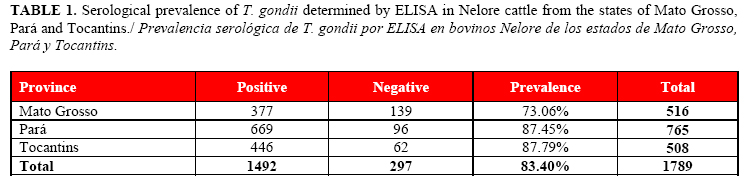
<body><![CDATA[<P><font size="2" face="Verdana, Arial, Helvetica, sans-serif">The anti-<I>Toxoplasma    gondii</I> antibodies were searched by ELISA. The ``RH'' strain was used to    obtain the antigens as described by Camargo (14). The ELISA test was established    using an optimal concentration of the <I>T. gondii</I> antigen (10 &#181;g/ml)    in a 0.05 M carbonate/bicarbonate buffer, pH 9.6. The single dilution of the    ELISA test was 1: 200 in PBS-Tween (phosphate buffered saline, pH 7.2, and 0.05%    Tween 20) for the positive- and negative-reference sera and test sera, and the    conjugate serum was used at a 1:25,000 dilution in PBS-Tween, according to the    manufacturer's guidelines (Sigma-Aldrich Chemical Company, St. Louis, Missouri,    U.S.A.). The plates were read by using an ELISA reader (Dynex-Technologies&#174;,    Virginia, U.S.A.) with a 405-nm filter. Under these conditions, the lowest mean    optical density (OD) of the negative sera was 0.90&#177;0.013. The highest mean    reactivity observed for the positive-reference sera was 1.13&#177;0.065. </font>     <P><font size="2" face="Verdana, Arial, Helvetica, sans-serif">Thirty positive    and 30 negative controls were used to determine the cut-off, which was calculated    based on the sera of negative animals and analyzed using the statistic software    MedCalc (version 11.4, <U><a href="http://www.medcalc.be">http://www.medcalc.be</a></U>).    Serological detection based on ELISA and IFAT test has been proven to provide    reliable results with high sensitivity and specificity in detection of <I>T.    gondii</I>, particularly when the parasitemia is very low. The tests showed    no cross-reaction with any other microorganism. </font>      <P><font size="2" face="Verdana, Arial, Helvetica, sans-serif"><B>Statistical    analysis</B> </font>     <P><font size="2" face="Verdana, Arial, Helvetica, sans-serif">The data were analyzed    using the chi-square and Kruskal-Wallis tests with a 95% confidence interval    using the R software, version 2.2.1 (R Development Core Team, 2005). </font>     <P>&nbsp;  <H1> <font size="2" face="Verdana, Arial, Helvetica, sans-serif"><B><font size="3">RESULTS    AND DISCUSSION</font></B></font></H1>     <P><font size="2" face="Verdana, Arial, Helvetica, sans-serif">Of the 1789 samples    evaluated by the ELISA test for <I>T. gondii</I>, 1492 were seropositive, which    corresponded to a prevalence of 83.40%. The prevalence rates for <I>T. gondii</I>    observed in Par&aacute;, Tocantins and Mato Grosso were 87.45%, 87.79% and 73.06%,    respectively (<a href="/img/revistas/rsa/v37n1/t0108115.jpg">Table 1</a>).    </font>      
<P><font size="2" face="Verdana, Arial, Helvetica, sans-serif">All of the farms    evaluated had at least one positive animal, and on some farms, 100% of the animals    were positive for <I>T. gondii. </I>Thus, considering the farm as an epidemiological    unit, the prevalence of <I>T. gondii</I> was 100%. The prevalence of <I>T. gondii</I>    was significantly higher (p&lt;0.05) in the states of Par&aacute; and Tocantins    compared with Mato Grosso. </font>     <P><font size="2" face="Verdana, Arial, Helvetica, sans-serif">Several studies    have been performed to investigate the serological prevalence of <I>T. gondii</I>    in cattle because they are one of the main sources of animal protein consumed    by humans around the world (9). A wide variation in the frequency of this agent    has been observed in cattle in Brazil (9, 10, 15, 16) and other parts of the    world (6, 17). </font>     <P><font size="2" face="Verdana, Arial, Helvetica, sans-serif">Recent studies    in Brazil have shown both a low (9) and a high (18) prevalence of <I>T. gondii    </I>in cattle. However, few studies have been performed in Midwestern and Northern    Brazil, where the largest cattle herd for export in the world is found. Because    these regions have a herd of 115 million cattle, studies in this area are more    than justifiable. The high prevalence of <I>T. gondii</I> in cattle observed    in the studied region constitutes a public health issue because this protozoan    is capable of causing infection through the ingestion of meat products containing    cysts. Our results showed a prevalence value higher than all those other values    reported for Brazil. </font>     <P><font size="2" face="Verdana, Arial, Helvetica, sans-serif">Garcia <I>et al.</I>    (19), Daguer <I>et al.</I> (20) and Santos <I>et al.</I> (18) reported <I>T.    gondii</I> prevalences of 25.8%, 41.4% and 17.4%, respectively, for Brazilian    cattle. In Southeastern Brazil, Fajardo et al. (9) observed that only 2.68%    of animals were positive, while Gondin et al. (21) reported that 1.03% of animals    were positive in the Northeastern region of Brazil. However, few studies have    been performed in Midwestern and Northern Brazil. A recent study performed in    Northern Brazil showed a prevalence of 41.6% for <I>T. gondii-</I>seropositive    buffalo (22). Other studies indicated a <I>T. gondii</I> prevalence of 71.0%    in cattle from Midwestern Brazil (23). </font>     ]]></body>
<body><![CDATA[<P><font size="2" face="Verdana, Arial, Helvetica, sans-serif">The prevalence    of <I>T. gondii</I> also varies greatly in other parts of the world. A total    of 83.3% of the cattle in Spain were diagnosed as positive (6), and 44.8% were    positive in Sudan (24); conversely, only 5.7% of the animals in China were seropositive    for <I>T. gondii</I> (25). These results demonstrate that the presence of this    agent is highly variable, and comprehensive health safety measures are necessary    in areas where the prevalence is higher because we still do not know the connection    between <I>T. gondii </I>seroprevalence in cattle and the potential infection    of other hosts such as humans. Cattle showed a significant serological prevalence    of <I>T. gondii</I> using both of the techniques evaluated. These results suggest    that cattle, when exposed to the same risks for <I>T. gondii</I> infection,    have a high antibody mediated response. </font>     <P>&nbsp;  <H1> <font size="2" face="Verdana, Arial, Helvetica, sans-serif"><B><font size="3">CONCLUSIONS</font></B>    </font></H1>     <P><font size="2" face="Verdana, Arial, Helvetica, sans-serif">The detection of    high prevalence rates of <I>T. gondii </I>in livestock deserves special attention    because cattle are the most important source of animal protein for humans. This    finding indicates the need for further studies on the risk that such animals    may pose to public health. </font> <H1> <font size="2" face="Verdana, Arial, Helvetica, sans-serif"><B>Conflict of    interest statement </B> </font></H1>     <P><font size="2" face="Verdana, Arial, Helvetica, sans-serif">None of the authors    of this work has a financial or personal relationship with other people or organizations    that could inappropriately influence or bias the contents of this paper. </font>      <P>&nbsp; <H1> <font size="2" face="Verdana, Arial, Helvetica, sans-serif"><B><font size="3">ACKNOWLEDGMENTS</font></B>    </font></H1>     <P><font size="2" face="Verdana, Arial, Helvetica, sans-serif">We are grateful    to the Office of the Dean for Research and Graduate Education of the Federal    University of Par&aacute; (Pr&oacute;-Reitoria de Pesquisa e P&oacute;s- Gradua&ccedil;&atilde;o    da Universidade Federal do Par&aacute; - PROPESP/UFPA) for typing the manuscript.    This study was supported by Par&aacute; State Research Foundation (Funda&ccedil;&atilde;o    de Amparo e Desenvolvimento da Pesquisa do Estado - FADESP). We also thank the    Brazilian Federal Agency for the Support and Evaluation of Graduate Education    (CAPES) and the National Council for Scientific and Technological Development    (CNPq) for financial support. </font>     <P>&nbsp;     <P><font size="2" face="Verdana, Arial, Helvetica, sans-serif"><B><font size="3">REFERENCES</font></B>    </font>      <!-- ref --><P><font size="2" face="Verdana, Arial, Helvetica, sans-serif">1. Uggla A. <I>Toxoplasma      gondii</I> in farm animals: some immunodiagnostic methods and their potential      use. Uppsala: Merkantil-Tryckeriet. 1986; pp. 1-56.     </font>       ]]></body>
<body><![CDATA[<!-- ref --><P><font size="2" face="Verdana, Arial, Helvetica, sans-serif">2. Tenter AM,      Heckeroth AR, Weiss LM. <I>Toxoplasma gondii</I>: from animals to humans.      Int J Parasitol. 2000;30(1):1217-1258.     </font>       <!-- ref --><P><font size="2" face="Verdana, Arial, Helvetica, sans-serif">3. Dubey JP.      <I>Toxoplasma, Neospora, Sarcocystis</I> and other tissue cyst-forming coccidia      of human and animals. In: Krier, J.P. Parasitic Protozoa<I>. 2<SUP>nd</SUP>      ed.</I> San Diego: Academic Press.1993:1-157.     </font>        <!-- ref --><P><font size="2" face="Verdana, Arial, Helvetica, sans-serif">4. Black MW, Boothroyd    JC. Lytic Cycle of <I>Toxoplasma gondii</I>. Microbiol Mol Biol R<I>. </I>2000;64(3):607.        </font>      <!-- ref --><P><font size="2" face="Verdana, Arial, Helvetica, sans-serif">5. Dubey JP,      Jones JL. <I>Toxoplasma gondii</I> infection in humans and animals in the      United States. Int J Parasitol. 2008;38:1257-1278.     </font>        <!-- ref --><P><font size="2" face="Verdana, Arial, Helvetica, sans-serif">6. Garc&iacute;a-Bocanegra    I, Cabez&oacute;n O, Hern&aacute;ndez E, Mart&iacute;nez-Cruz MS, Mart&iacute;nez-Moreno    &Aacute;, Mart&iacute;nez-Moreno J. <I>Toxoplasma gondii</I> in Ruminants Species    (Cattle, Sheep, and Goats) from Southern Spain. J Parasitol. 2013<I>;</I>99(3):438-440.        </font>      ]]></body>
<body><![CDATA[<!-- ref --><P><font size="2" face="Verdana, Arial, Helvetica, sans-serif">7. Yang N, Mu MY,    Yuan GM, Zhang GX, Li HK, He JB. Seroprevalence of <I>Toxoplasma gondii</I>    in slaughtered horses and donkeys in Liaoning province, northeastern China<I>.    </I>Parasite Vector<I>. 2013;</I>6:140-143.     </font>      <!-- ref --><P><font size="2" face="Verdana, Arial, Helvetica, sans-serif">8. Minist&eacute;rio    da Agricultura, Pecu&aacute;ria e Abastecimento (in Portuguese), <U><a href="http://www.agricultura.gov.br/animal/especies/bovinos-e%20-bubalinos/">http://www.agricultura.gov.br/animal/especies/bovinos-e    -bubalinos/</a></U>. Brasil, 2013.     <u><a href="http://www.agricultura.gov.br/animal/especies/bovinos-e%20-bubalinos/"></a></u></font>      <!-- ref --><P><font size="2" face="Verdana, Arial, Helvetica, sans-serif">9. Fajardo HV,      D'&aacute;vila S, Bastos RR, Cyrino CD, Detoni ML, <I>et al</I>. Seroprevalence      and risk factors of toxoplasmosis in cattle from extensive and semi-intensive      rearing systems at Zona da Mata, Minas Gerais state, Southern Brazil. Parasite      Vector<I>. </I>2013; 6:191-198.     </font>       <!-- ref --><P><font size="2" face="Verdana, Arial, Helvetica, sans-serif">10.Santos SL,      Costa KS, Gondim LQ, Silva MSA, Uz&ecirc;da RS, <I>et al.</I> Investigation      of <I>Neospora caninum, Hammondia </I>sp, and<I> Toxoplasma gondii</I> in      tissues from slaughtered beef cattle in Bahia, Brazil. Parasitol Res. 2010;106:457-461.          </font>        <!-- ref --><P><font size="2" face="Verdana, Arial, Helvetica, sans-serif">11.Andrade MMC,    Carneiro M, Medeiros AD, Andrade Neto V, Vitor RWA. Seroprevalence and risk    factors associated with ovine toxoplasmosis in Northeast Brazil. Parasite. 2013;    20:20-24.     </font>      ]]></body>
<body><![CDATA[<!-- ref --><P><font size="2" face="Verdana, Arial, Helvetica, sans-serif">12. Minist&eacute;rio    da Agricultura, Pecu&aacute;ria e Abastecimento. Dados de rebanho bovino e bubalino    do Brasil (Data pertaining to cattle and buffalo herds in Brazil) (in Portuguese).    Brasil,</font> <font size="2" face="Verdana, Arial, Helvetica, sans-serif">2012</font>.    <!-- ref --><P><font size="2" face="Verdana, Arial, Helvetica, sans-serif">13.Voller AD,      Bidwell DE, Bartlett A. Microplate immunoassay for the immunodiagnosis of      virus infections. Handbook of Clinical Immunology, American Society for Microbiology,      Washington, D.C. 1976:506-512.     </font>        <!-- ref --><P><font size="2" face="Verdana, Arial, Helvetica, sans-serif">14. Camargo ME.    Improved technique of indirect immunofluorescence for serological diagnosis    of toxoplasmosis. Rev Inst Med Trop Sa&atilde;o Paulo. 1974; 6:117-118.     </font>      <!-- ref --><P><font size="2" face="Verdana, Arial, Helvetica, sans-serif">15.Spagnol FH,      Paranhos EB, Oliveira LLS, Medeiros SM, Lopes CWG, Albuquerque GR. Preval&ecirc;ncia      de anticorpos anti-<I>Toxoplasma gondii</I> em bovinos abatidos em matadouros      do estado da Bahia, Brasil (Anti-<I>Toxoplasma gondii</I> antibody prevalence      in cattle slaughtered in slaughterhouses in the state of Bahia, Brazil). Rev      Bras Parasitol Vet. 2009;18:42-45.     </font>       <!-- ref --><P><font size="2" face="Verdana, Arial, Helvetica, sans-serif">16.Moura AB,      Osaki SC, Zulpo DL, Garcia JL, Teixeira EB. Detec&ccedil;&atilde;o de anticorpos      contra <I>Toxoplasma gondii</I> em bovinos de corte abatidos em Guarapuava,      PR, Brasil (Anti-<I>Toxoplasma gondii</I> antibody detection in beef cattle      slaughtered in Guarapuava, PR, Brazil) (in Portuguese with English abstract).      Arch Vet Sci<I>. 2010;</I>15(2):94-99.     </font>       <!-- ref --><P><font size="2" face="Verdana, Arial, Helvetica, sans-serif">17.Inpankaew      T, Pinyopanuwut N, Chimnoi W, Kengradomkit C, Sunuta C, Zhang G, <I>et al.      </I>Serodiagnosis of <I>Toxoplasma gondii</I> infection in dairy cows in Thailand.      Transbound Emerg Dis. 2010;57:42-45.     </font>       <!-- ref --><P><font size="2" face="Verdana, Arial, Helvetica, sans-serif">18.Santos LMJF,      Dam&eacute; MCF, Cademartori BG, Cunha Filho NA, Farias NAR, Ruas J L. Occurrence      of antibodies to <I>Toxoplasma gondii</I> in water buffaloes and meat cattle      in Rio Grande do Sul State, southern Brazil. Acta Parasitol. 2013;58(3):334-336.          </font>       <!-- ref --><P><font size="2" face="Verdana, Arial, Helvetica, sans-serif">19.Garcia JL,      Navarro IT, Ogawa L, Oliveira RC. Soropreval&ecirc;ncia do <I>Toxoplasma gondii</I>,      em su&iacute;nos, bovinos, ovinos e equinos, e sua correla&ccedil;&atilde;o      com humanos, felinos e caninos, oriundos de propriedades rurais do norte do      Paran&aacute;-Brasil (<I>Toxoplasma gondii</I> seroprevalence in pigs, cattle,      sheep and horses and its correlation with humans, cats and dogs from rural      areas of Northern Paran&aacute;, Brazil) (in Portuguese with English abstract).      Cienc Rural<I>. </I>1999;29(1):91-97.     </font>       <!-- ref --><P><font size="2" face="Verdana, Arial, Helvetica, sans-serif">20.Daguer H,      Vicente RT, Costa T, Virmond MP, Hamann W, Amendoeira MRR. Soropreval&ecirc;ncia      de anticorpos anti-<I>Toxoplasma gondii</I> em bovinos e funcion&aacute;rios      de matadouro da microrregi&atilde;o de Pato Branco, Paran&aacute;, Brasil      (Seroprevalence of anti-<I>Toxoplasma gondii</I> antibodies in cattle and      slaughterhouse workers in the region of Pato Branco, Paran&aacute;, Brazil)      (in Portuguese with English abstract). Cienc Rural<I>. </I>2004;34(4):1133-1137.          </font>       <!-- ref --><P><font size="2" face="Verdana, Arial, Helvetica, sans-serif">21.Gondim LFP,      Barbosa JrHV, Ribeiro Filho CHA, Sakei H. Serological survey of antibodies      to <I>Toxoplasma gondii</I> in goats, sheep, cattle and water buffaloes in      Bahia State, Brazil. Vet Parasitol. 1999; 82:273-276.     </font>       <!-- ref --><P><font size="2" face="Verdana, Arial, Helvetica, sans-serif">22.Silva JB,      Fonseca AH, Andrade SJT, Silva AGM, Oliveira CMC, Barbosa JD. Preval&ecirc;ncia      de anticorpos anti-<I>Toxoplasma gondii</I> em b&uacute;falos (<I>Bubalus      bubalis</I>) no Estado do Par&aacute; (Prevalence of anti-<I>Toxoplasma gondii</I>      antibodies in buffalo (<I>Bubalus bubalis</I>) in the state of Par&aacute;)      (in Portuguese with English abstract). Pesquisa Vet Brasil. 2013;5:581-585.          </font>       <!-- ref --><P><font size="2" face="Verdana, Arial, Helvetica, sans-serif">23.Santos TR,      Costa AJ, Toniollo GH, Luvizotto MCR, Benetti AH, <I>et al</I>. Prevalence      of anti-<I>Toxoplasma gondii</I> antibodies in dairy cattle, dogs, and humans      from the Jauru micro-region, Mato Grosso state, Brazil. Vet Parasitol. 2009;161:324-326.          </font>       <!-- ref --><P><font size="2" face="Verdana, Arial, Helvetica, sans-serif">24.Elfahal AM,      Hussien MO, Enan KA, Musa AB, El Hussein AM. Seroprevalence of <I>Toxoplasma      gondii</I> in Dairy Cattle with Reproductive Problems in Sudan. Vet Sci. 2013;1:1-4.          </font>        <!-- ref --><P><font size="2" face="Verdana, Arial, Helvetica, sans-serif">25.Zhou DH, Zhao    FR, Lu P, Xia HY, Xu MJ, <I>et al</I>. Seroprevalence of <I>Toxoplasma gondii</I>    infection in dairy cattle in southern China. Parasite Vector. 2012;5:48-51.        </font>     <P>&nbsp;     <P>&nbsp;      <P>      ]]></body>
<body><![CDATA[<P>      <P>      <P><font size="2" face="Verdana, Arial, Helvetica, sans-serif">Recibido: 7-2-2014.    <br>   </font><font size="2" face="Verdana, Arial, Helvetica, sans-serif">Aceptado:    27-8-2014. </font>       ]]></body><back>
<ref-list>
<ref id="B1">
<label>1</label><nlm-citation citation-type="book">
<person-group person-group-type="author">
<name>
<surname><![CDATA[Uggla]]></surname>
<given-names><![CDATA[A]]></given-names>
</name>
</person-group>
<source><![CDATA[Toxoplasma gondii in farm animals: some immunodiagnostic methods and their potential use]]></source>
<year>1986</year>
<page-range>1-56</page-range><publisher-loc><![CDATA[Uppsala ]]></publisher-loc>
<publisher-name><![CDATA[Merkantil-Tryckeriet]]></publisher-name>
</nlm-citation>
</ref>
<ref id="B2">
<label>2</label><nlm-citation citation-type="journal">
<person-group person-group-type="author">
<name>
<surname><![CDATA[Tenter]]></surname>
<given-names><![CDATA[AM]]></given-names>
</name>
<name>
<surname><![CDATA[Heckeroth]]></surname>
<given-names><![CDATA[AR]]></given-names>
</name>
<name>
<surname><![CDATA[Weiss]]></surname>
<given-names><![CDATA[LM]]></given-names>
</name>
</person-group>
<article-title xml:lang="en"><![CDATA[Toxoplasma gondii: from animals to humans]]></article-title>
<source><![CDATA[Int J Parasitol]]></source>
<year>2000</year>
<volume>30</volume>
<numero>1</numero>
<issue>1</issue>
<page-range>1217-1258</page-range></nlm-citation>
</ref>
<ref id="B3">
<label>3</label><nlm-citation citation-type="book">
<person-group person-group-type="author">
<name>
<surname><![CDATA[Dubey]]></surname>
<given-names><![CDATA[JP]]></given-names>
</name>
</person-group>
<article-title xml:lang="en"><![CDATA[Toxoplasma, Neospora, Sarcocystis and other tissue cyst-forming coccidia of human and animals]]></article-title>
<person-group person-group-type="editor">
<name>
<surname><![CDATA[Krier]]></surname>
<given-names><![CDATA[J.P]]></given-names>
</name>
</person-group>
<source><![CDATA[Parasitic Protozoa]]></source>
<year>1993</year>
<edition>2nd</edition>
<page-range>1-157</page-range><publisher-loc><![CDATA[San Diego ]]></publisher-loc>
<publisher-name><![CDATA[Academic Press]]></publisher-name>
</nlm-citation>
</ref>
<ref id="B4">
<label>4</label><nlm-citation citation-type="journal">
<person-group person-group-type="author">
<name>
<surname><![CDATA[Black]]></surname>
<given-names><![CDATA[MW]]></given-names>
</name>
<name>
<surname><![CDATA[Boothroyd]]></surname>
<given-names><![CDATA[JC]]></given-names>
</name>
</person-group>
<article-title xml:lang="en"><![CDATA[Lytic Cycle of Toxoplasma gondii]]></article-title>
<source><![CDATA[Microbiol Mol Biol R]]></source>
<year>2000</year>
<volume>64</volume>
<numero>3</numero>
<issue>3</issue>
<page-range>607</page-range></nlm-citation>
</ref>
<ref id="B5">
<label>5</label><nlm-citation citation-type="journal">
<person-group person-group-type="author">
<name>
<surname><![CDATA[Dubey]]></surname>
<given-names><![CDATA[JP]]></given-names>
</name>
<name>
<surname><![CDATA[Jones]]></surname>
<given-names><![CDATA[JL]]></given-names>
</name>
</person-group>
<article-title xml:lang="en"><![CDATA[Toxoplasma gondii infection in humans and animals in the United States]]></article-title>
<source><![CDATA[Int J Parasitol]]></source>
<year>2008</year>
<volume>38</volume>
<page-range>1257-1278</page-range></nlm-citation>
</ref>
<ref id="B6">
<label>6</label><nlm-citation citation-type="journal">
<person-group person-group-type="author">
<name>
<surname><![CDATA[García-Bocanegra]]></surname>
<given-names><![CDATA[I]]></given-names>
</name>
<name>
<surname><![CDATA[Cabezón]]></surname>
<given-names><![CDATA[O]]></given-names>
</name>
<name>
<surname><![CDATA[Hernández]]></surname>
<given-names><![CDATA[E]]></given-names>
</name>
<name>
<surname><![CDATA[Martínez-Cruz]]></surname>
<given-names><![CDATA[MS]]></given-names>
</name>
<name>
<surname><![CDATA[Martínez-Moreno]]></surname>
<given-names><![CDATA[Á]]></given-names>
</name>
<name>
<surname><![CDATA[Martínez-Moreno]]></surname>
<given-names><![CDATA[J]]></given-names>
</name>
</person-group>
<article-title xml:lang="en"><![CDATA[Toxoplasma gondii in Ruminants Species (Cattle, Sheep, and Goats) from Southern Spain]]></article-title>
<source><![CDATA[J Parasitol]]></source>
<year>2013</year>
<volume>99</volume>
<numero>3</numero>
<issue>3</issue>
<page-range>438-440</page-range></nlm-citation>
</ref>
<ref id="B7">
<label>7</label><nlm-citation citation-type="journal">
<person-group person-group-type="author">
<name>
<surname><![CDATA[Yang]]></surname>
<given-names><![CDATA[N]]></given-names>
</name>
<name>
<surname><![CDATA[Mu]]></surname>
<given-names><![CDATA[MY]]></given-names>
</name>
<name>
<surname><![CDATA[Yuan]]></surname>
<given-names><![CDATA[GM]]></given-names>
</name>
<name>
<surname><![CDATA[Zhang]]></surname>
<given-names><![CDATA[GX]]></given-names>
</name>
<name>
<surname><![CDATA[Li]]></surname>
<given-names><![CDATA[HK]]></given-names>
</name>
<name>
<surname><![CDATA[He]]></surname>
<given-names><![CDATA[JB]]></given-names>
</name>
</person-group>
<article-title xml:lang="en"><![CDATA[Seroprevalence of Toxoplasma gondii in slaughtered horses and donkeys in Liaoning province, northeastern China]]></article-title>
<source><![CDATA[Parasite Vector]]></source>
<year>2013</year>
<volume>6</volume>
<page-range>140-143</page-range></nlm-citation>
</ref>
<ref id="B8">
<label>8</label><nlm-citation citation-type="">
<collab>Ministério da Agricultura, Pecuária e Abastecimento</collab>
<source><![CDATA[]]></source>
<year>2013</year>
<publisher-loc><![CDATA[^eBrasil Brasil]]></publisher-loc>
</nlm-citation>
</ref>
<ref id="B9">
<label>9</label><nlm-citation citation-type="journal">
<person-group person-group-type="author">
<name>
<surname><![CDATA[Fajardo]]></surname>
<given-names><![CDATA[HV]]></given-names>
</name>
<name>
<surname><![CDATA[D'ávila]]></surname>
<given-names><![CDATA[S]]></given-names>
</name>
<name>
<surname><![CDATA[Bastos]]></surname>
<given-names><![CDATA[RR]]></given-names>
</name>
<name>
<surname><![CDATA[Cyrino]]></surname>
<given-names><![CDATA[CD]]></given-names>
</name>
<name>
<surname><![CDATA[Detoni]]></surname>
<given-names><![CDATA[ML]]></given-names>
</name>
</person-group>
<article-title xml:lang="en"><![CDATA[Seroprevalence and risk factors of toxoplasmosis in cattle from extensive and semi-intensive rearing systems at Zona da Mata, Minas Gerais state, Southern Brazil]]></article-title>
<source><![CDATA[Parasite Vector]]></source>
<year>2013</year>
<volume>6</volume>
<page-range>191-198</page-range></nlm-citation>
</ref>
<ref id="B10">
<label>10</label><nlm-citation citation-type="journal">
<person-group person-group-type="author">
<name>
<surname><![CDATA[Santos]]></surname>
<given-names><![CDATA[SL]]></given-names>
</name>
<name>
<surname><![CDATA[Costa]]></surname>
<given-names><![CDATA[KS]]></given-names>
</name>
<name>
<surname><![CDATA[Gondim]]></surname>
<given-names><![CDATA[LQ]]></given-names>
</name>
<name>
<surname><![CDATA[Silva]]></surname>
<given-names><![CDATA[MSA]]></given-names>
</name>
<name>
<surname><![CDATA[Uzêda]]></surname>
<given-names><![CDATA[RS]]></given-names>
</name>
</person-group>
<article-title xml:lang="en"><![CDATA[Investigation of Neospora caninum, Hammondia sp, and Toxoplasma gondii in tissues from slaughtered beef cattle in Bahia, Brazil]]></article-title>
<source><![CDATA[Parasitol Res]]></source>
<year>2010</year>
<volume>106</volume>
<page-range>457-461</page-range></nlm-citation>
</ref>
<ref id="B11">
<label>11</label><nlm-citation citation-type="journal">
<person-group person-group-type="author">
<name>
<surname><![CDATA[Andrade]]></surname>
<given-names><![CDATA[MMC]]></given-names>
</name>
<name>
<surname><![CDATA[Carneiro]]></surname>
<given-names><![CDATA[M]]></given-names>
</name>
<name>
<surname><![CDATA[Medeiros]]></surname>
<given-names><![CDATA[AD]]></given-names>
</name>
<name>
<surname><![CDATA[Andrade Neto]]></surname>
<given-names><![CDATA[V]]></given-names>
</name>
<name>
<surname><![CDATA[Vitor]]></surname>
<given-names><![CDATA[RWA]]></given-names>
</name>
</person-group>
<article-title xml:lang="en"><![CDATA[Seroprevalence and risk factors associated with ovine toxoplasmosis in Northeast Brazil]]></article-title>
<source><![CDATA[Parasite]]></source>
<year>2013</year>
<volume>20</volume>
<page-range>20-24</page-range></nlm-citation>
</ref>
<ref id="B12">
<label>12</label><nlm-citation citation-type="">
<collab>Ministério da Agricultura, Pecuária e Abastecimento</collab>
<source><![CDATA[Dados de rebanho bovino e bubalino do Brasil (Data pertaining to cattle and buffalo herds in Brazil) (in Portuguese)]]></source>
<year>2012</year>
<publisher-loc><![CDATA[^eBrasil Brasil]]></publisher-loc>
</nlm-citation>
</ref>
<ref id="B13">
<label>13</label><nlm-citation citation-type="">
<person-group person-group-type="author">
<name>
<surname><![CDATA[Voller]]></surname>
<given-names><![CDATA[AD]]></given-names>
</name>
<name>
<surname><![CDATA[Bidwell]]></surname>
<given-names><![CDATA[DE]]></given-names>
</name>
<name>
<surname><![CDATA[Bartlett]]></surname>
<given-names><![CDATA[A]]></given-names>
</name>
</person-group>
<source><![CDATA[Microplate immunoassay for the immunodiagnosis of virus infections: Handbook of Clinical Immunology]]></source>
<year>1976</year>
<page-range>506-512</page-range><publisher-loc><![CDATA[^eWashington Washington]]></publisher-loc>
</nlm-citation>
</ref>
<ref id="B14">
<label>14</label><nlm-citation citation-type="journal">
<person-group person-group-type="author">
<name>
<surname><![CDATA[Camargo]]></surname>
<given-names><![CDATA[ME]]></given-names>
</name>
</person-group>
<article-title xml:lang="en"><![CDATA[Improved technique of indirect immunofluorescence for serological diagnosis of toxoplasmosis]]></article-title>
<source><![CDATA[Rev Inst Med Trop Saão Paulo]]></source>
<year>1974</year>
<volume>6</volume>
<page-range>117-118</page-range></nlm-citation>
</ref>
<ref id="B15">
<label>15</label><nlm-citation citation-type="journal">
<person-group person-group-type="author">
<name>
<surname><![CDATA[Spagnol]]></surname>
<given-names><![CDATA[FH]]></given-names>
</name>
<name>
<surname><![CDATA[Paranhos]]></surname>
<given-names><![CDATA[EB]]></given-names>
</name>
<name>
<surname><![CDATA[Oliveira]]></surname>
<given-names><![CDATA[LLS]]></given-names>
</name>
<name>
<surname><![CDATA[Medeiros]]></surname>
<given-names><![CDATA[SM]]></given-names>
</name>
<name>
<surname><![CDATA[Lopes]]></surname>
<given-names><![CDATA[CWG]]></given-names>
</name>
<name>
<surname><![CDATA[Albuquerque]]></surname>
<given-names><![CDATA[GR]]></given-names>
</name>
</person-group>
<article-title xml:lang="pt"><![CDATA[Prevalência de anticorpos anti-Toxoplasma gondii em bovinos abatidos em matadouros do estado da Bahia, Brasil (Anti-Toxoplasma gondii antibody prevalence in cattle slaughtered in slaughterhouses in the state of Bahia, Brazil)]]></article-title>
<source><![CDATA[Rev Bras Parasitol Vet]]></source>
<year>2009</year>
<volume>18</volume>
<page-range>42-45</page-range></nlm-citation>
</ref>
<ref id="B16">
<label>16</label><nlm-citation citation-type="journal">
<person-group person-group-type="author">
<name>
<surname><![CDATA[Moura]]></surname>
<given-names><![CDATA[AB]]></given-names>
</name>
<name>
<surname><![CDATA[Osaki]]></surname>
<given-names><![CDATA[SC]]></given-names>
</name>
<name>
<surname><![CDATA[Zulpo]]></surname>
<given-names><![CDATA[DL]]></given-names>
</name>
<name>
<surname><![CDATA[Garcia]]></surname>
<given-names><![CDATA[JL]]></given-names>
</name>
<name>
<surname><![CDATA[Teixeira]]></surname>
<given-names><![CDATA[EB]]></given-names>
</name>
</person-group>
<article-title xml:lang="pt"><![CDATA[Detecção de anticorpos contra Toxoplasma gondii em bovinos de corte abatidos em Guarapuava, PR, Brasil (Anti-Toxoplasma gondii antibody detection in beef cattle slaughtered in Guarapuava, PR, Brazil) (in Portuguese with English abstract)]]></article-title>
<source><![CDATA[Arch Vet Sci]]></source>
<year>2010</year>
<volume>15</volume>
<numero>2</numero>
<issue>2</issue>
<page-range>94-99</page-range></nlm-citation>
</ref>
<ref id="B17">
<label>17</label><nlm-citation citation-type="journal">
<person-group person-group-type="author">
<name>
<surname><![CDATA[Inpankaew]]></surname>
<given-names><![CDATA[T]]></given-names>
</name>
<name>
<surname><![CDATA[Pinyopanuwut]]></surname>
<given-names><![CDATA[N]]></given-names>
</name>
<name>
<surname><![CDATA[Chimnoi]]></surname>
<given-names><![CDATA[W]]></given-names>
</name>
<name>
<surname><![CDATA[Kengradomkit]]></surname>
<given-names><![CDATA[C]]></given-names>
</name>
<name>
<surname><![CDATA[Sunuta]]></surname>
<given-names><![CDATA[C]]></given-names>
</name>
<name>
<surname><![CDATA[Zhang]]></surname>
<given-names><![CDATA[G]]></given-names>
</name>
</person-group>
<article-title xml:lang="en"><![CDATA[Serodiagnosis of Toxoplasma gondii infection in dairy cows in Thailand]]></article-title>
<source><![CDATA[Transbound Emerg Dis]]></source>
<year>2010</year>
<volume>57</volume>
<page-range>42-45</page-range></nlm-citation>
</ref>
<ref id="B18">
<label>18</label><nlm-citation citation-type="journal">
<person-group person-group-type="author">
<name>
<surname><![CDATA[Santos]]></surname>
<given-names><![CDATA[LMJF]]></given-names>
</name>
<name>
<surname><![CDATA[Damé]]></surname>
<given-names><![CDATA[MCF]]></given-names>
</name>
<name>
<surname><![CDATA[Cademartori]]></surname>
<given-names><![CDATA[BG]]></given-names>
</name>
<name>
<surname><![CDATA[Cunha Filho]]></surname>
<given-names><![CDATA[NA]]></given-names>
</name>
<name>
<surname><![CDATA[Farias]]></surname>
<given-names><![CDATA[NAR]]></given-names>
</name>
<name>
<surname><![CDATA[Ruas]]></surname>
<given-names><![CDATA[J L]]></given-names>
</name>
</person-group>
<article-title xml:lang="en"><![CDATA[Occurrence of antibodies to Toxoplasma gondii in water buffaloes and meat cattle in Rio Grande do Sul State, southern Brazil]]></article-title>
<source><![CDATA[Acta Parasitol]]></source>
<year>2013</year>
<volume>58</volume>
<numero>3</numero>
<issue>3</issue>
<page-range>334-336</page-range></nlm-citation>
</ref>
<ref id="B19">
<label>19</label><nlm-citation citation-type="journal">
<person-group person-group-type="author">
<name>
<surname><![CDATA[Garcia]]></surname>
<given-names><![CDATA[JL]]></given-names>
</name>
<name>
<surname><![CDATA[Navarro]]></surname>
<given-names><![CDATA[IT]]></given-names>
</name>
<name>
<surname><![CDATA[Ogawa]]></surname>
<given-names><![CDATA[L]]></given-names>
</name>
<name>
<surname><![CDATA[Oliveira]]></surname>
<given-names><![CDATA[RC]]></given-names>
</name>
</person-group>
<article-title xml:lang="pt"><![CDATA[Soroprevalência do Toxoplasma gondii, em suínos, bovinos, ovinos e equinos, e sua correlação com humanos, felinos e caninos, oriundos de propriedades rurais do norte do Paraná-Brasil (Toxoplasma gondii seroprevalence in pigs, cattle, sheep and horses and its correlation with humans, cats and dogs from rural areas of Northern Paraná, Brazil) (in Portuguese with English abstract)]]></article-title>
<source><![CDATA[Cienc Rural]]></source>
<year>1999</year>
<volume>29</volume>
<numero>1</numero>
<issue>1</issue>
<page-range>91-97</page-range></nlm-citation>
</ref>
<ref id="B20">
<label>20</label><nlm-citation citation-type="journal">
<person-group person-group-type="author">
<name>
<surname><![CDATA[Daguer]]></surname>
<given-names><![CDATA[H]]></given-names>
</name>
<name>
<surname><![CDATA[Vicente]]></surname>
<given-names><![CDATA[RT]]></given-names>
</name>
<name>
<surname><![CDATA[Costa]]></surname>
<given-names><![CDATA[T]]></given-names>
</name>
<name>
<surname><![CDATA[Virmond]]></surname>
<given-names><![CDATA[MP]]></given-names>
</name>
<name>
<surname><![CDATA[Hamann]]></surname>
<given-names><![CDATA[W]]></given-names>
</name>
<name>
<surname><![CDATA[Amendoeira]]></surname>
<given-names><![CDATA[MRR]]></given-names>
</name>
</person-group>
<article-title xml:lang="pt"><![CDATA[Soroprevalência de anticorpos anti-Toxoplasma gondii em bovinos e funcionários de matadouro da microrregião de Pato Branco, Paraná, Brasil (Seroprevalence of anti-Toxoplasma gondii antibodies in cattle and slaughterhouse workers in the region of Pato Branco, Paraná, Brazil) (in Portuguese with English abstract)]]></article-title>
<source><![CDATA[Cienc Rural]]></source>
<year>2004</year>
<volume>34</volume>
<numero>4</numero>
<issue>4</issue>
<page-range>1133-1137</page-range></nlm-citation>
</ref>
<ref id="B21">
<label>21</label><nlm-citation citation-type="journal">
<person-group person-group-type="author">
<name>
<surname><![CDATA[Gondim]]></surname>
<given-names><![CDATA[LFP]]></given-names>
</name>
<name>
<surname><![CDATA[Barbosa]]></surname>
<given-names><![CDATA[JrHV]]></given-names>
</name>
<name>
<surname><![CDATA[Ribeiro Filho]]></surname>
<given-names><![CDATA[CHA]]></given-names>
</name>
<name>
<surname><![CDATA[Sakei]]></surname>
<given-names><![CDATA[H]]></given-names>
</name>
</person-group>
<article-title xml:lang="en"><![CDATA[Serological survey of antibodies to Toxoplasma gondii in goats, sheep, cattle and water buffaloes in Bahia State, Brazil]]></article-title>
<source><![CDATA[Vet Parasitol]]></source>
<year>1999</year>
<volume>82</volume>
<page-range>273-276</page-range></nlm-citation>
</ref>
<ref id="B22">
<label>22</label><nlm-citation citation-type="journal">
<person-group person-group-type="author">
<name>
<surname><![CDATA[Silva]]></surname>
<given-names><![CDATA[JB]]></given-names>
</name>
<name>
<surname><![CDATA[Fonseca]]></surname>
<given-names><![CDATA[AH]]></given-names>
</name>
<name>
<surname><![CDATA[Andrade]]></surname>
<given-names><![CDATA[SJT]]></given-names>
</name>
<name>
<surname><![CDATA[Silva]]></surname>
<given-names><![CDATA[AGM]]></given-names>
</name>
<name>
<surname><![CDATA[Oliveira]]></surname>
<given-names><![CDATA[CMC]]></given-names>
</name>
<name>
<surname><![CDATA[Barbosa]]></surname>
<given-names><![CDATA[JD]]></given-names>
</name>
</person-group>
<article-title xml:lang="pt"><![CDATA[Prevalência de anticorpos anti-Toxoplasma gondii em búfalos (Bubalus bubalis) no Estado do Pará (Prevalence of anti-Toxoplasma gondii antibodies in buffalo (Bubalus bubalis) in the state of Pará) (in Portuguese with English abstract)]]></article-title>
<source><![CDATA[Pesquisa Vet Brasil]]></source>
<year>2013</year>
<volume>5</volume>
<page-range>581-585</page-range></nlm-citation>
</ref>
<ref id="B23">
<label>23</label><nlm-citation citation-type="journal">
<person-group person-group-type="author">
<name>
<surname><![CDATA[Santos]]></surname>
<given-names><![CDATA[TR]]></given-names>
</name>
<name>
<surname><![CDATA[Costa]]></surname>
<given-names><![CDATA[AJ]]></given-names>
</name>
<name>
<surname><![CDATA[Toniollo]]></surname>
<given-names><![CDATA[GH]]></given-names>
</name>
<name>
<surname><![CDATA[Luvizotto]]></surname>
<given-names><![CDATA[MCR]]></given-names>
</name>
<name>
<surname><![CDATA[Benetti]]></surname>
<given-names><![CDATA[AH]]></given-names>
</name>
</person-group>
<article-title xml:lang="en"><![CDATA[Prevalence of anti-Toxoplasma gondii antibodies in dairy cattle, dogs, and humans from the Jauru micro-region, Mato Grosso state, Brazil]]></article-title>
<source><![CDATA[Vet Parasitol]]></source>
<year>2009</year>
<volume>161</volume>
<page-range>324-326</page-range></nlm-citation>
</ref>
<ref id="B24">
<label>24</label><nlm-citation citation-type="journal">
<person-group person-group-type="author">
<name>
<surname><![CDATA[Elfahal]]></surname>
<given-names><![CDATA[AM]]></given-names>
</name>
<name>
<surname><![CDATA[Hussien]]></surname>
<given-names><![CDATA[MO]]></given-names>
</name>
<name>
<surname><![CDATA[Enan]]></surname>
<given-names><![CDATA[KA]]></given-names>
</name>
<name>
<surname><![CDATA[Musa]]></surname>
<given-names><![CDATA[AB]]></given-names>
</name>
<name>
<surname><![CDATA[El Hussein]]></surname>
<given-names><![CDATA[AM]]></given-names>
</name>
</person-group>
<article-title xml:lang="en"><![CDATA[Seroprevalence of Toxoplasma gondii in Dairy Cattle with Reproductive Problems in Sudan]]></article-title>
<source><![CDATA[Vet Sci]]></source>
<year>2013</year>
<volume>1</volume>
<page-range>1-4</page-range></nlm-citation>
</ref>
<ref id="B25">
<label>25</label><nlm-citation citation-type="journal">
<person-group person-group-type="author">
<name>
<surname><![CDATA[Zhou]]></surname>
<given-names><![CDATA[DH]]></given-names>
</name>
<name>
<surname><![CDATA[Zhao]]></surname>
<given-names><![CDATA[FR]]></given-names>
</name>
<name>
<surname><![CDATA[Lu]]></surname>
<given-names><![CDATA[P]]></given-names>
</name>
<name>
<surname><![CDATA[Xia]]></surname>
<given-names><![CDATA[HY]]></given-names>
</name>
<name>
<surname><![CDATA[Xu]]></surname>
<given-names><![CDATA[MJ]]></given-names>
</name>
</person-group>
<article-title xml:lang="en"><![CDATA[Seroprevalence of Toxoplasma gondii infection in dairy cattle in southern China]]></article-title>
<source><![CDATA[Parasite Vector]]></source>
<year>2012</year>
<volume>5</volume>
<page-range>48-51</page-range></nlm-citation>
</ref>
</ref-list>
</back>
</article>