<?xml version="1.0" encoding="ISO-8859-1"?><article xmlns:mml="http://www.w3.org/1998/Math/MathML" xmlns:xlink="http://www.w3.org/1999/xlink" xmlns:xsi="http://www.w3.org/2001/XMLSchema-instance">
<front>
<journal-meta>
<journal-id>0253-570X</journal-id>
<journal-title><![CDATA[Revista de Salud Animal]]></journal-title>
<abbrev-journal-title><![CDATA[Rev Salud Anim.]]></abbrev-journal-title>
<issn>0253-570X</issn>
<publisher>
<publisher-name><![CDATA[Centro Nacional de Sanidad Agropecuaria]]></publisher-name>
</publisher>
</journal-meta>
<article-meta>
<article-id>S0253-570X2016000100006</article-id>
<title-group>
<article-title xml:lang="en"><![CDATA[Spatiotemporal distribution of classical swine fever in Cuba, 2007 - 2013]]></article-title>
<article-title xml:lang="es"><![CDATA[Distribución espaciotemporal de la peste porcina clásica en Cuba, 2007 - 2013]]></article-title>
</title-group>
<contrib-group>
<contrib contrib-type="author">
<name>
<surname><![CDATA[Fonseca]]></surname>
<given-names><![CDATA[Osvaldo]]></given-names>
</name>
<xref ref-type="aff" rid="A01"/>
</contrib>
<contrib contrib-type="author">
<name>
<surname><![CDATA[Santoro]]></surname>
<given-names><![CDATA[Kleber R.]]></given-names>
</name>
<xref ref-type="aff" rid="A02"/>
</contrib>
<contrib contrib-type="author">
<name>
<surname><![CDATA[Abeledo]]></surname>
<given-names><![CDATA[María Antonia]]></given-names>
</name>
<xref ref-type="aff" rid="A01"/>
</contrib>
<contrib contrib-type="author">
<name>
<surname><![CDATA[Capdevila]]></surname>
<given-names><![CDATA[Yolanda]]></given-names>
</name>
<xref ref-type="aff" rid="A03"/>
</contrib>
<contrib contrib-type="author">
<name>
<surname><![CDATA[Fernández]]></surname>
<given-names><![CDATA[Octavio]]></given-names>
</name>
<xref ref-type="aff" rid="A01"/>
</contrib>
<contrib contrib-type="author">
<name>
<surname><![CDATA[Alfonso]]></surname>
<given-names><![CDATA[Pastor]]></given-names>
</name>
<xref ref-type="aff" rid="A01"/>
</contrib>
<contrib contrib-type="author">
<name>
<surname><![CDATA[Ayala]]></surname>
<given-names><![CDATA[Joel]]></given-names>
</name>
<xref ref-type="aff" rid="A01"/>
</contrib>
<contrib contrib-type="author">
<name>
<surname><![CDATA[Percedo]]></surname>
<given-names><![CDATA[María Irian]]></given-names>
</name>
<xref ref-type="aff" rid="A01"/>
</contrib>
</contrib-group>
<aff id="A01">
<institution><![CDATA[,National Center for Animal and Plant Health (CENSA) Epidemiology Group ]]></institution>
<addr-line><![CDATA[San José de las Lajas Mayabeque]]></addr-line>
<country>Cuba</country>
</aff>
<aff id="A02">
<institution><![CDATA[,Federal Rural University of Pernambuco (UFRPE)  ]]></institution>
<addr-line><![CDATA[Pernambuco ]]></addr-line>
<country>Brazil</country>
</aff>
<aff id="A03">
<institution><![CDATA[,Veterinary Medicine Institute  ]]></institution>
<addr-line><![CDATA[ ]]></addr-line>
<country>Cuba</country>
</aff>
<pub-date pub-type="pub">
<day>00</day>
<month>04</month>
<year>2016</year>
</pub-date>
<pub-date pub-type="epub">
<day>00</day>
<month>04</month>
<year>2016</year>
</pub-date>
<volume>38</volume>
<numero>1</numero>
<fpage>30</fpage>
<lpage>38</lpage>
<copyright-statement/>
<copyright-year/>
<self-uri xlink:href="http://scielo.sld.cu/scielo.php?script=sci_arttext&amp;pid=S0253-570X2016000100006&amp;lng=en&amp;nrm=iso"></self-uri><self-uri xlink:href="http://scielo.sld.cu/scielo.php?script=sci_abstract&amp;pid=S0253-570X2016000100006&amp;lng=en&amp;nrm=iso"></self-uri><self-uri xlink:href="http://scielo.sld.cu/scielo.php?script=sci_pdf&amp;pid=S0253-570X2016000100006&amp;lng=en&amp;nrm=iso"></self-uri><abstract abstract-type="short" xml:lang="en"><p><![CDATA[Classical swine fever (CSF) is an endemic disease in Cuba with significant economic impact on the swine industry, not only for the animal losses, but also for the operating expenses of the national coverage control program (technical staff, surveillance, diagnosis, vaccines, disinfectants, etc.). For implementing more effective control and eradication measures, the epidemiological analysis is necessary for a better understanding of the disease spatial and temporal distribution. With this aim, it was used the information about municipalities with CSF outbreaks during a seven-year period (2007-2013) registered by the Epizootiological Surveillance System. The spatiotemporal scan statistics analysis was performed; a Bernoulli probabilistic model was used to detect clusters of outbreak occurrence. Also, a temporal analysis was made through logistic regression. Three significant clusters (p<0.05) of high rates were detected, two of them from 2007 to 2009 with relative risks (RR) of 1.99 and 1.8, respectively. The third cluster had a RR=2.46 in 2008. Also two low rates clusters were observed, the first with a RR= 0.08 from 2009 to 2011, and the second with a RR= 0.43 from 2011to 2012. Furthermore, a tendency to a decreasing percentage of affected municipalities was observed in the studied period; a low risk of the municipalities to be affected were observed in 2011 (OR: 0.518, 0.332-0.809, I.C. 95%, p=0.004) and 2012 (OR: 0.577, 0.371-0.897, I.C 95%, p=0.015). Finally, to investigate the factors associated with the clusters of disease outbreak occurrence is the next step to progress in the CSF control and eradication campaign in the country.]]></p></abstract>
<abstract abstract-type="short" xml:lang="es"><p><![CDATA[La peste porcina clásica (PPC) es endémica en Cuba, con un impacto económico significativo en la industria porcina, no solo debido a la mortalidad, sino también a gastos operacionales (personal, vigilancia, diagnóstico, vacunas, desinfectantes, etc.). Para implementar medidas de control y erradicación más efectivas es necesario realizar análisis epidemiológicos para comprender mejor la distribución espacial y temporal de la enfermedad. Con este propósito, se utilizó la información registrada por el Sistema de Vigilancia Epizootiológica sobre los municipios con brotes de PPC durante un periodo de siete años (2007-2013). Se realizó un análisis espaciotemporal mediante scan statistics con el empleo del modelo probabilístico de Bernoulli para detectar conglomerados de ocurrencia de brotes. También, se realizó un análisis temporal a través de regresión logística. Se detectaron varios conglomerados significativos (p<0.05); dos de ellos, de altas tasas, desde el 2007-2009 con riesgo relativo (RR) de 1,99 y 1,8, respectivamente. El tercer clúster mostró un RR= 2,46 y ocurrió en 2008. Asimismo, se observaron dos conglomerados de bajas tasas: el primero con RR= 0,08, desde 2009-2011, y el segundo con RR= 0.43, desde 2011-2012. Además, en el periodo estudiado se observó una tendencia decreciente en el porcentaje de municipios afectados; y los años 2011 (OR: 0,518; 0,332-0,809; I.C. 95%; p=0,004) y 2012 (OR: 0,577; 0,371-0,897; I.C 95%; p=0,015) mostraron un riesgo bajo de afectación en los municipios. Finalmente, investigar los factores asociados con los conglomerados de ocurrencia de brotes es el primer paso para progresar en la campaña de control y erradicación de la enfermedad.]]></p></abstract>
<kwd-group>
<kwd lng="en"><![CDATA[Classical swine fever]]></kwd>
<kwd lng="en"><![CDATA[Cuba]]></kwd>
<kwd lng="en"><![CDATA[spatiotemporal distribution]]></kwd>
<kwd lng="en"><![CDATA[clusters]]></kwd>
<kwd lng="en"><![CDATA[tendency]]></kwd>
<kwd lng="es"><![CDATA[Peste porcina clásica]]></kwd>
<kwd lng="es"><![CDATA[Cuba]]></kwd>
<kwd lng="es"><![CDATA[distribución espaciotemporal]]></kwd>
<kwd lng="es"><![CDATA[conglomerados]]></kwd>
<kwd lng="es"><![CDATA[tendencia]]></kwd>
</kwd-group>
</article-meta>
</front><body><![CDATA[ <p align="right"><font face="Verdana, Arial, Helvetica, sans-serif" size="2"><B>ORIGINAL    ARTICLE</B></font></p>     <p>&nbsp;</p>     <p><font face="Verdana, Arial, Helvetica, sans-serif" size="2"><b><font size="4">Spatiotemporal    distribution of classical swine fever in Cuba, 2007 - 2013</font></b></font></p>     <p>&nbsp;</p>     <p><font face="Verdana, Arial, Helvetica, sans-serif" size="2"><b><font size="3">Distribuci&oacute;n    espaciotemporal de la peste porcina cl&aacute;sica en Cuba, 2007 - 2013</font>    </b></font> </p>     <p>&nbsp;</p>     <p>&nbsp; </p> <H1> <font face="Verdana, Arial, Helvetica, sans-serif" size="2"></font><B>        <P><font face="Verdana, Arial, Helvetica, sans-serif" size="2">Osvaldo Fonseca<SUP>I</SUP>,      Kleber R. Santoro<SUP>II</SUP>, Mar&iacute;a Antonia Abeledo<SUP>I</SUP>,      Yolanda Capdevila<SUP>III</SUP>, Octavio Fern&aacute;ndez<SUP>I</SUP>, Pastor      Alfonso<SUP>I</SUP>, Joel Ayala<SUP>I</SUP>, Mar&iacute;a Irian Percedo<SUP>I</SUP></font>   </B> </H1>     <P><font face="Verdana, Arial, Helvetica, sans-serif" size="2"><SUP>I</SUP>Epidemiology    Group, National Center for Animal and Plant Health (CENSA), San Jos&eacute;    de las Lajas, Mayabeque, Cuba. E-mail: <U><a href="mailto::osvaldo@censa.edu.cu">osvaldo@censa.edu.cu</a></U>;    <U><a href="mailto:osvaldo820601@gmail.com">osvaldo820601@gmail.com</a></U>.    <SUP>    <br>   II</SUP>Federal Rural University of Pernambuco (UFRPE), Pernambuco, Brazil.    <SUP>    ]]></body>
<body><![CDATA[<br>   III</SUP>Veterinary Medicine Institute, Cuba.</font>     <P>&nbsp;     <P>&nbsp; <hr noshade size="1">     <P><font face="Verdana, Arial, Helvetica, sans-serif" size="2"><B>ABSTRACT</B></font>     <P><font face="Verdana, Arial, Helvetica, sans-serif" size="2">Classical swine    fever (CSF) is an endemic disease in Cuba with significant economic impact on    the swine industry, not only for the animal losses, but also for the operating    expenses of the national coverage control program (technical staff, surveillance,    diagnosis, vaccines, disinfectants, etc.). For implementing more effective control    and eradication measures, the epidemiological analysis is necessary for a better    understanding of the disease spatial and temporal distribution. With this aim,    it was used the information about municipalities with CSF outbreaks during a    seven-year period (2007-2013) registered by the Epizootiological Surveillance    System. The spatiotemporal scan statistics analysis was performed; a Bernoulli    probabilistic model was used to detect clusters of outbreak occurrence. Also,    a temporal analysis was made through logistic regression. Three significant    clusters (p&lt;0.05) of high rates were detected, two of them from 2007 to 2009    with relative risks (RR) of 1.99 and 1.8, respectively. The third cluster had    a RR=2.46 in 2008. Also two low rates clusters were observed, the first with    a RR= 0.08 from 2009 to 2011, and the second with a RR= 0.43 from 2011to 2012.    Furthermore, a tendency to a decreasing percentage of affected municipalities    was observed in the studied period; a low risk of the municipalities to be affected    were observed in 2011 (OR: 0.518, 0.332-0.809, I.C. 95%, p=0.004) and 2012 (OR:    0.577, 0.371-0.897, I.C 95%, p=0.015). Finally, to investigate the factors associated    with the clusters of disease outbreak occurrence is the next step to progress    in the CSF control and eradication campaign in the country. </font>     <P><font face="Verdana, Arial, Helvetica, sans-serif" size="2"><B>Key words:</B>    Classical swine fever, Cuba, spatiotemporal distribution, clusters, tendency.</font> <hr noshade size="1">     <P><font face="Verdana, Arial, Helvetica, sans-serif" size="2"><B>RESUMEN</b></font>     <P><font face="Verdana, Arial, Helvetica, sans-serif" size="2">La peste porcina    cl&aacute;sica (PPC) es end&eacute;mica en Cuba, con un impacto econ&oacute;mico    significativo en la industria porcina, no solo debido a la mortalidad, sino    tambi&eacute;n a gastos operacionales (personal, vigilancia, diagn&oacute;stico,    vacunas, desinfectantes, etc.). Para implementar medidas de control y erradicaci&oacute;n    m&aacute;s efectivas es necesario realizar an&aacute;lisis epidemiol&oacute;gicos    para comprender mejor la distribuci&oacute;n espacial y temporal de la enfermedad.    Con este prop&oacute;sito, se utiliz&oacute; la informaci&oacute;n registrada    por el Sistema de Vigilancia Epizootiol&oacute;gica sobre los municipios con    brotes de PPC durante un periodo de siete a&ntilde;os (2007-2013). Se realiz&oacute;    un an&aacute;lisis espaciotemporal mediante <I>scan statistics </I>con el empleo    del modelo probabil&iacute;stico de Bernoulli para detectar conglomerados de    ocurrencia de brotes. Tambi&eacute;n, se realiz&oacute; un an&aacute;lisis temporal    a trav&eacute;s de regresi&oacute;n log&iacute;stica. Se detectaron varios conglomerados    significativos (p&lt;0.05); dos de ellos, de altas tasas, desde el 2007-2009    con riesgo relativo (RR) de 1,99 y 1,8, respectivamente. El tercer cl&uacute;ster    mostr&oacute; un RR= 2,46 y ocurri&oacute; en 2008. Asimismo, se observaron    dos conglomerados de bajas tasas: el primero con RR= 0,08, desde 2009-2011,    y el segundo con RR= 0.43, desde 2011-2012. Adem&aacute;s, en el periodo estudiado    se observ&oacute; una tendencia decreciente en el porcentaje de municipios afectados;    y los a&ntilde;os 2011 (OR: 0,518; 0,332-0,809; I.C. 95%; p=0,004) y 2012 (OR:    0,577; 0,371-0,897; I.C 95%; p=0,015) mostraron un riesgo bajo de afectaci&oacute;n    en los municipios. Finalmente, investigar los factores asociados con los conglomerados    de ocurrencia de brotes es el primer paso para progresar en la campa&ntilde;a    de control y erradicaci&oacute;n de la enfermedad.</font>     <P><font face="Verdana, Arial, Helvetica, sans-serif" size="2"><B>Palabras clave:</B>    Peste porcina cl&aacute;sica, Cuba, distribuci&oacute;n espaciotemporal, conglomerados,    tendencia.</font> <hr noshade size="1">     <P>&nbsp;     ]]></body>
<body><![CDATA[<P>&nbsp;     <P><font face="Verdana, Arial, Helvetica, sans-serif" size="2"><B><font size="3">INTRODUCTION</font></B>    </font>     <P><font face="Verdana, Arial, Helvetica, sans-serif" size="2">Classical swine    fever (CSF) is considered one of the most important and economically damaging    pig diseases worldwide(1). It is caused by CSF virus, a <I>Pestivirus</I> belonging    to the <I>Flaviviridae</I> family (2). The disease remains endemic in many countries    of South and Central America, Africa, and Southeast Asia, and sporadic outbreaks    have been affecting the European countries (3). </font>     <P><font face="Verdana, Arial, Helvetica, sans-serif" size="2">Economic losses    in the event of an outbreak are often very extensive, due to both direct and    indirect impacts. They can be experienced due to pig deaths, reduced reproductive    and growth performance, as well as implemented control strategies where compulsory    slaughter and movement restriction further increase costs (4). </font>     <P><font face="Verdana, Arial, Helvetica, sans-serif" size="2">In Cuba, after    a long period without CSF cases, the disease has become endemic since 1993 with    several outbreaks each year despite the implemented control program (5, 6).    Difficulties in vaccine production and conservation (cold chain) and the increase    of backyard producers with the well-known breaches on biosecurity have been    factors with a decisive influence on case occurrences. In 1996, it became necessary    to declare a national emergency and to activate the Civil Defense System and    its respective provincial offices(7). Until now, several human and financial    resources have been used without the expected success in the control of the    disease (8). </font>     <P><font face="Verdana, Arial, Helvetica, sans-serif" size="2">Pork meat is one    of the most important protein sources of animal origin for the Cuban population.    Every year, CSF outbreaks cause enormous losses to commercial farms, but also    to the economy of a great number of backyard pig producers for their own consumption    or sale of live animals or their products. Therefore, as CSF affects food security,    its control as soon as possible is considered a priority in Cuba. </font>     <P><font face="Verdana, Arial, Helvetica, sans-serif" size="2">The Cuban Official    Veterinary Service, along with pig producers and other organizations have developed    a CSF eradication strategy. This strategy proposes to start the campaign by    two provinces, Pinar del R&iacute;o, the most western province, and Guant&aacute;namo,    the most eastern province. The goal is to eradicate the disease in Cuba before    2020. </font>     <P><font face="Verdana, Arial, Helvetica, sans-serif" size="2">One of the first    steps for developing a control and eradication campaign is to analyze the spatial    and temporal distribution of the disease in the country to detect its geographical    patterns (e.g., clusters). Disease clusters can help in identifying common environmental    factors or sources of exposure (9). Scan statistics is an effective and accurate    method for analyzing spatial, temporal and space-time data (10). </font>     <P><font face="Verdana, Arial, Helvetica, sans-serif" size="2">The aim of this    study was to identify the spatial and temporal distribution of CSF outbreaks    in Cuba, detect high and low-risk areas, and support the control strategy for    the disease eradication.</font>     <P>&nbsp;     ]]></body>
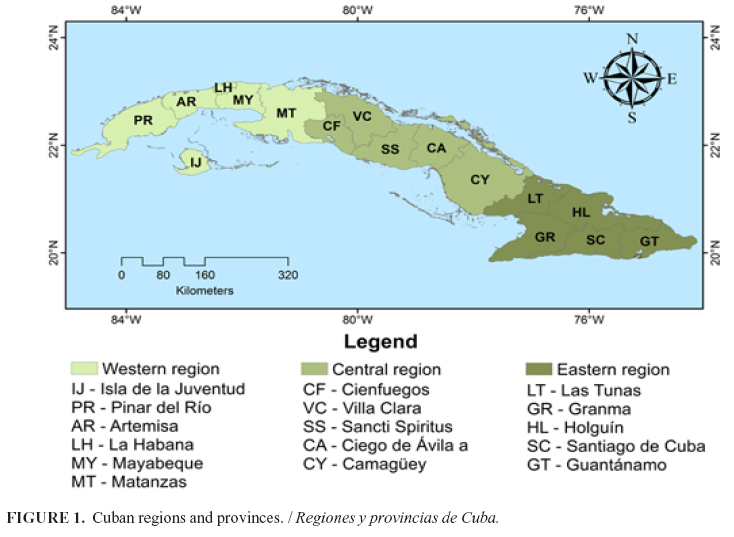
<body><![CDATA[<P><font face="Verdana, Arial, Helvetica, sans-serif" size="2"><B><font size="3">MATERIALS    AND METHODS</font></B> </font>     <P><font face="Verdana, Arial, Helvetica, sans-serif" size="2">- <I>Study area</I>    </font>     <P><font face="Verdana, Arial, Helvetica, sans-serif" size="2">The study area    was the entire country. Cuba is located in the entrance of the Gulf of Mexico,    in the western part of the Caribbean Sea, from 19<SUP>o</SUP>49&#180; - 23<SUP>o</SUP>16&#180;    north latitude and 74<SUP>o</SUP>08&#180; - 84<SUP>o</SUP>57&#180;west longitude,    and has a total surface of 109 884.1 km2. Cuba is divided into 15 provinces    and one special municipality (Isla de la Juventud). Each province is also divided    into municipalities (168 in the whole country). Furthermore, Cuba is geographically    divided into three regions (<a href="/img/revistas/rsa/v38n1/f0106116.jpg">Figure    1</a>), the Western region with five provinces (Pinar del R&iacute;o, Artemisa,    Mayabeque, La Habana, and Matanzas), Central region with five provinces (Cienfuegos,    Villa Clara, Sancti Spiritus, Ciego de &Aacute;vila, and Camag&uuml;ey), and    the Eastern region with five provinces (Las Tunas, Granma, Holgu&iacute;n, Santiago    de Cuba, and Guant&aacute;namo). </font>      
<P><font face="Verdana, Arial, Helvetica, sans-serif" size="2">- <I>Data sources    and case definition</I> </font>     <P><font face="Verdana, Arial, Helvetica, sans-serif" size="2">We used data of    CSF outbreaks compiled by the National Surveillance Epizootiological System    (Sistema de Vigilancia Epizootiol&oacute;gica, SIVE) during a seven-year period    (2007 - 2013). The cases considered were those municipalities where at least    one CSF outbreak occurred during each year, whereas those with no outbreaks    during each corresponding year were the controls. </font>     <P><font face="Verdana, Arial, Helvetica, sans-serif" size="2">- </font> <font face="Verdana, Arial, Helvetica, sans-serif" size="2"><I>Spatiotemporal  analysis </I></font>      <P><font face="Verdana, Arial, Helvetica, sans-serif" size="2"><I>Isla de la Juventud    </i>was excluded of the study because of the effect due to absence of geographical    continuity. We assume the centroid of municipalities as a location of cases    and controls. A retrospective spatiotemporal analysis for clustering detection    was made using the Bernoulli probabilistic model in SaTScan, Scan Statistics    Software, v 9.3 (10).The models assumed that the affected municipalities were    randomly distributed in space and time under the null hypothesis. The maximum    cluster size was set at 25% of the population at risk. The statistical significance    of clusters was evaluated through Monte Carlo simulation using 99999 repetitions.    The scan was made for detecting areas with high and low rates of outbreak occurrences    with no geographical overlap. The output was geographically represented through    ArcGIS 10.2 (ESRI). </font>     <P><font face="Verdana, Arial, Helvetica, sans-serif" size="2">- <I>Trend analysis</I>    </font>     <P><font face="Verdana, Arial, Helvetica, sans-serif" size="2">A logistic regression    was used to evaluate the temporal tendency of the proportion of affected municipalities    by years through IBM SPSS Statistic software (Version 21.0.0.0). As dependent    variable was used the presence (1) or absence (0) of outbreaks by year. Time    (years) was considered as an independent variable. In the first analysis, the    variable &#171;Years&#187; was included without categorization and in the second    analysis was analyzed as a categorical variable.</font>     <P>&nbsp;     ]]></body>
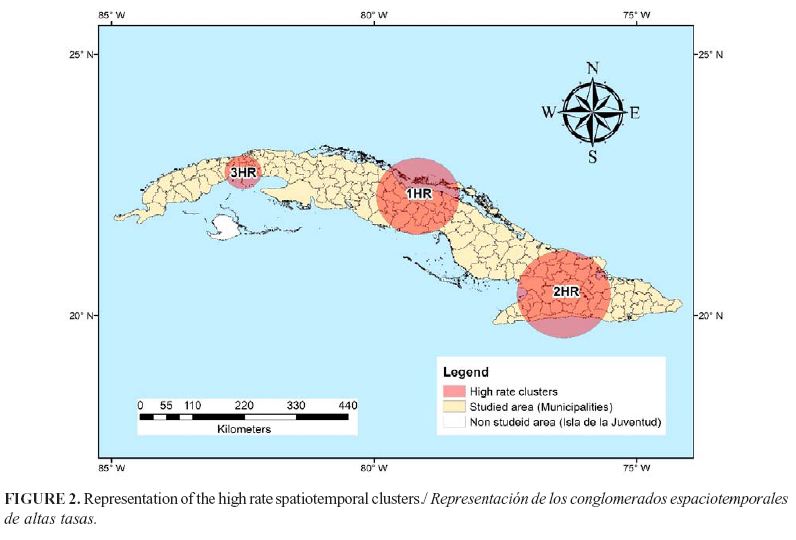
<body><![CDATA[<P><font face="Verdana, Arial, Helvetica, sans-serif" size="2"><B><font size="3">RESULTS</font></B>    </font>     <P><font face="Verdana, Arial, Helvetica, sans-serif" size="2">- <I>Space-time    scan statistics</I> </font>     <P><font face="Verdana, Arial, Helvetica, sans-serif" size="2">During the studied    period, an average of 41.4% of the municipalities was affected by CSF each year.    The highest percentage (53.9%) of the affected municipalities occurred in 2008,    and the lowest percentage (31.7%) was observed in 2011. </font>     <P><font face="Verdana, Arial, Helvetica, sans-serif" size="2">Scan statistics    identified three significant high rate spatiotemporal clusters, located each    one in the three different regions: central, eastern and western regions, respectively    (<a href="/img/revistas/rsa/v38n1/f0206116.jpg">Figure 2</a> and <a href="/img/revistas/rsa/v38n1/t0106116.jpg">Table    1</a>). Also, two low rate spatiotemporal clusters were detected in the western    and eastern regions (<a href="/img/revistas/rsa/v38n1/f0306116.jpg">Figure    3</a> and <a href="/img/revistas/rsa/v38n1/t0106116.jpg">Table 1</a>).    </font>      
<P><font face="Verdana, Arial, Helvetica, sans-serif" size="2">- <I>Temporal analysis</I>    </font>     <P><font face="Verdana, Arial, Helvetica, sans-serif" size="2">A maximum number    of affected municipalities was observed in 2008, and a minimum in 2011. A decreasing    tendency (OR: 0.891, 0.84 - 0.945, I.C. 95%, p=0.000121) was also exhibited    by the proportion of affected municipalities (<a href="/img/revistas/rsa/v38n1/f0406116.jpg">Figure    4</a>). The risk of a municipality to be affected was 10.9% less each year.    </font>      
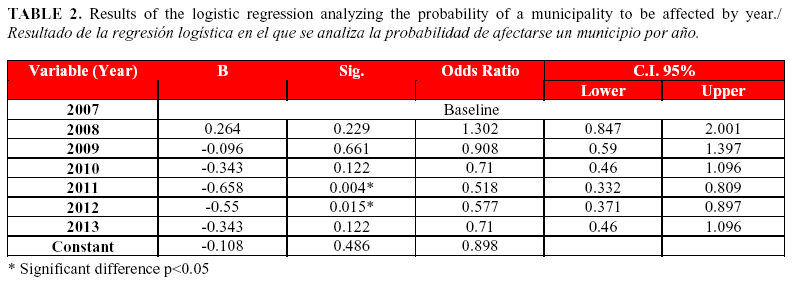
<P><font face="Verdana, Arial, Helvetica, sans-serif" size="2">Using as a reference    the first year (2007) of the studied period, the years 2011 (OR: 0.518, 0.332    - 0.809, I.C. 95%, p=0.004) and 2012 (OR: 0.577, 0.371 - 0.897, I.C 95%, p=0.015)    had the significantly lowest risk of a municipality to be affected by CSF (<a href="/img/revistas/rsa/v38n1/t0206116.jpg">Table    2</a>). </font>      
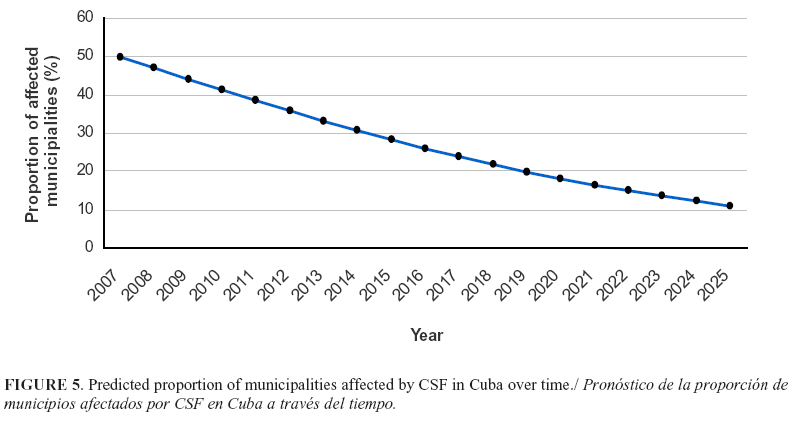
<P><font face="Verdana, Arial, Helvetica, sans-serif" size="2">Taking into account    the tendency of the CSF affected municipalities, it can be seen that, if this    tendency is maintained over time, approximately 18 % of the Cuban municipalities    will be affected in 2020 (<a href="/img/revistas/rsa/v38n1/f0506116.jpg">Figure    5</a>).</font>      
<P>&nbsp;     <P><font face="Verdana, Arial, Helvetica, sans-serif" size="2"><B><font size="3">DISCUSSION</font></B>    </font>     ]]></body>
<body><![CDATA[<P><font face="Verdana, Arial, Helvetica, sans-serif" size="2">So far as we know,    this is the first study describing the spatiotemporal distribution and clustering    of CSF outbreaks in Cuba. The results of this study allowed the identification    the geographical areas of high CSF occurrence making possible to target effors    for the disease control with further eradication purposes. Spatial statistics    in the analysis of disease spread or outbreak surveillance data are becoming    standard practice in the study of infectious diseases. Scan statistics have    been used with important results in many epidemiological investigations such    as the detection of tuberculosis outbreaks (11), the spatial distribution of    foot and mouth disease in Zambia (12), the identification and characterization    of space and space-time clusters of seroreactivity to individual Leptospira    serovars among dogs (13), the description of the spatial and temporal patterns    of the high pathogenic avian influenza H5N1 outbreaks (14). </font>     <P><font face="Verdana, Arial, Helvetica, sans-serif" size="2">The best method    is to analyze the data using the smallest area units for which data are available,    e.g., farms (15), or alternatively aggregate data using a regular frame (16).    The aggregation of cases to administrative divisions may negatively affect the    accuracy of the analysis (17). In the present study, the lack of information    in databases of many quadrants (around 50%) where outbreaks occurred made impossible    to perform the cluster detection analysis at a quadrant level. The municipality    was the smallest area unit for which the data were available. </font>     <P><font face="Verdana, Arial, Helvetica, sans-serif" size="2">Regardless of the    CSF endemism in Cuba for a very long period and outbreak occurrences in the    whole country(8), the results demonstrated the existence of high and low cluster    rates of municipalities and the years when they occur, and rejection of the    null hypothesis that the affected municipalities showed a random distribution    in space and time. </font>     <P><font face="Verdana, Arial, Helvetica, sans-serif" size="2">Detected high rate    clusters of affected municipalities in the three regions (western, central and    eastern) showed that the situation of CSF occurrence was complicated from the    epidemiological point of view. The presence of high-risk areas implies an important    threat to surrounding territories because of the dissemination of the disease.    </font>     <P><font face="Verdana, Arial, Helvetica, sans-serif" size="2">The endemic condition    of CSF in Cuba (6) could also have a certain influence on this result, with    cases in all provinces. It is interesting to say that the provinces of the geographical    extremes of the island, western (Pinar del R&iacute;o) and eastern (Guant&aacute;namo)    do not have any high rate cluster; it is important because the eradication campaign    is thought to be started by these two extreme provinces. Then, it could facilitate    the actions at the starting points for the absence of unfavorable epidemiological    conditions in these provinces. </font>     <P><font face="Verdana, Arial, Helvetica, sans-serif" size="2">The first low rate    cluster (LR1) was located in La Habana, and it occurred from 2009 to 2011. It    could be due to the low activity in terms of pig production and the low pig    population and number of farms because they are urban zones. The secondary low    rate cluster (LR2) placed in the eastern region was the highest cluster detected    and involved a great number of municipalities and it occurred during the period    from 2011 to 2012. It can be observed that the results by scan statistics from    the temporal point of view agreed with the results obtained by logistic regression,    and they showed that the municipalities had significantly less risk of been    affected during 2011 and 2012. </font>     <P><font face="Verdana, Arial, Helvetica, sans-serif" size="2">Moreover, all high    rate clusters were before 2010. On the contrary, the low rate clusters were    detected in the period from 2009 to 2012. Therefore, this observation and the    decreasing tendency of municipalities to be affected demonstrated the reduction    of cases in the period, which, in general, could indicate the positive effect    of the control measures. </font>     <P><font face="Verdana, Arial, Helvetica, sans-serif" size="2">The results obtained    in this work are interesting. However, factors like the sanitary measures or    actions taken in general to make them possible are not enough well known, and    they should be precisely analyzed to determine which factors influenced on this    reduction of CSF cases so that this knowledge could be used to enhance management    of the disease in the field. Factors such as inadequate vaccination or low vaccine    quality, vaccination coverage, movement of pigs without veterinary control,    low biosecurity in pig farms (18-20), among others, could have played an important    role in the clusters formed. The difference of risks between the areas located    inside and outside the clusters requires further investigation. </font>     <P><font face="Verdana, Arial, Helvetica, sans-serif" size="2">A decreasing tendency    of the proportion of municipalities affected with CSF was observed, but it was    not considered enough because our goal is to make Cuba free of CSF by 2020 (21).    Thus, the current strategy to control CSF must be profoundly analyzed to detect    its inaccuracies and find methods that allow accelerating this process because    the advances have been discrete. </font>     <P><font face="Verdana, Arial, Helvetica, sans-serif" size="2">In the high risk    clusters, some measures should be enhanced, e.g., disease surveillance intensification,    strengthening of biosecurity measures, etc. (22). On the other hand, the low    risk clusters identified must be taken into account since they could be others    starting points for the disease control and eradication campaign due to their    better epidemiological conditions. </font>     ]]></body>
<body><![CDATA[<P><font face="Verdana, Arial, Helvetica, sans-serif" size="2">The safest way    to prevent an infectious disease is by eradicating the pathogen. To achieve    eradication of a disease, good surveillance systems and monitoring, reliable    diagnostic techniques, and capability of identifying animals or infected farms    are essential. In addition, a correct technical infrastructure and an appropriate    management are indispensable to stop the infection spread and eliminate its    source; re-introduction of the infection into zones where the disease has already    been eradicated must also be prevented (22). </font>     <P><font face="Verdana, Arial, Helvetica, sans-serif" size="2">The identification    of the spatiotemporal distribution of CSF in Cuba is an important step that    could contribute to the decision-making process of our policy makers, in order    to achieve more successful actions in a near future, which is demanded by the    CSF eradication planned for 2020. An analysis to identify other risk factors    is recommended to be made, especially in areas with high and low risks. It must    include, among others, factors such as farm density, pig density, pig population,    density of roads, human population, percentage of non-vaccinated pig population,    proportion of farms with different technification levels (23, 24). This analysis    will undoubtedly help to a better understanding of CSF patterns.</font>     <P>&nbsp;     <P><font face="Verdana, Arial, Helvetica, sans-serif" size="2"><B><font size="3">ACKNOWLEDGEMENTS</font></B>    </font>     <P><font face="Verdana, Arial, Helvetica, sans-serif" size="2">Thanks are due    to CAPES (Brazilian Federal Agency for Support and Evaluation of Graduate Education)    and the International Cooperation Program CAPES/MES for supporting a scholarship    (CAPES/Brasil) at the UFRPE (Federal Rural University of Pernambuco). This study    is part of the project &#171;Applied statistical modeling to assess the sanitary    and economic impact of prevention and control programs in animal production.    Case study: avian influenza and classical swine fever&#187;, project number    213/13. The IMV (Instituto de Medicina Veterinaria de Cuba) is also gratefully    acknowledged for all the support provided for carrying out this study.</font>     <P>&nbsp;     <P><font face="Verdana, Arial, Helvetica, sans-serif" size="2"><B><font size="3">REFERENCES</font></B>    </font>      <!-- ref --><P><font face="Verdana, Arial, Helvetica, sans-serif" size="2">1. Boklund A,      Toft N, Alban L, Uttenthal &Aring;. Comparing the epidemiological and economic      effects of control strategies against classical swine fever in Denmark. Prev      Vet Med. 2009;90(3):180-193.     </font>        <!-- ref --><P><font face="Verdana, Arial, Helvetica, sans-serif" size="2">2. van Regenmortel      MH, Fauquet CM, Bishop DH, Carstens E, Estes M, Lemon S, et al. Virus taxonomy:      classification and nomenclature of viruses. Seventh report of the International      Committee on Taxonomy of Viruses: Academic Press; 2000.     </font>        <!-- ref --><P><font face="Verdana, Arial, Helvetica, sans-serif" size="2">3. Mart&iacute;nez-L&oacute;pez      B, Ivorra B, Ngom D, Ramos AM, S&aacute;nchez-Vizca&iacute;no JM. A novel      spatial and stochastic model to evaluate the within and between farm transmission      of classical swine fever virus: II Validation of the model. Vet Microb. 2012;155(1):21-32.          </font>        <!-- ref --><P><font face="Verdana, Arial, Helvetica, sans-serif" size="2">4. Schnyder M,      St&auml;rk K, Vanzetti T, Salman M, Thor B, Schleiss W, et al. Epidemiology      and control of an outbreak of classical swine fever in wild boar in Switzerland.      Vet Rec. 2002;150(4):102-109.     </font>        <!-- ref --><P><font face="Verdana, Arial, Helvetica, sans-serif" size="2">5. Perez LJ,      Diaz de Arce H, Perera CL, Rosell R, Frias MT, Percedo MI, et al. Positive      selection pressure on the B/C domains of the E2-gene of classical swine fever      virus in endemic areas under C-strain vaccination. Infect Genet Evol. 2012;12(7):1405-1412.          </font>        <!-- ref --><P><font face="Verdana, Arial, Helvetica, sans-serif" size="2">6. Postel A,      Schmeiser S, Perera CL, Rodr&iacute;guez LJP, Frias-Lepoureau MT, Becher P.      Classical swine fever virus isolates from Cuba form a new subgenotype 1.4.      Vet Microbiol. 2013;161(3-4):334-338.     </font>        <!-- ref --><P><font face="Verdana, Arial, Helvetica, sans-serif" size="2">7. Fr&iacute;as      Lepoureau M. Reemergence of Classical Swine Fever in Cuba 1993-1997. Rev Salud      Anim. 2003;25(1):1-4.     </font>        <!-- ref --><P><font face="Verdana, Arial, Helvetica, sans-serif" size="2">8. Percedo MI,      Alfonso P, Fr&iacute;as MT, D&iacute;az de Arce H, Barrera M, Fonseca O, et      al. Humoral response to different vaccination schemes against classical swine      fever (CSF) successively applied during an outbreak of the disease. Rev Salud      Anim. 2009;31(3):158-163.     </font>        <!-- ref --><P><font face="Verdana, Arial, Helvetica, sans-serif" size="2">9.Premashthira      S, Salman MD, Hill AE, Reich RM, Wagner BA. Epidemiological simulation modeling      and spatial analysis for foot-and-mouth disease control strategies: a comprehensive      review. Animal Health Research Reviews. 2011;12(02):225-234.     </font>        <!-- ref --><P><font face="Verdana, Arial, Helvetica, sans-serif" size="2">10.Kulldorff      M. SaTScan TM user guide for version 9.3. Institute NC, editor. 2014:106.          </font>        <!-- ref --><P><font face="Verdana, Arial, Helvetica, sans-serif" size="2">11.Kammerer JS,      Shang N, Althomsons SP, Haddad MB, Grant J, Navin TR. Using statistical methods      and genotyping to detect tuberculosis outbreaks. Int J Health Geogr. 2013;12(1):15.          </font>        <!-- ref --><P><font face="Verdana, Arial, Helvetica, sans-serif" size="2">12.Sinkala Y,      Simuunza M, Muma JB, Pfeiffer DU, Kasanga CJ, Mweene A. Foot and mouth disease      in Zambia: Spatial and temporal distributions of outbreaks, assessment of      clusters and implications for control. Onderstepoort J Vet. 2014;81(2):E1-6.          </font>        <!-- ref --><P><font face="Verdana, Arial, Helvetica, sans-serif" size="2">13.Gautam R,      Guptill LF, Wu CC, Potter A, Moore GE. Spatial and spatio-temporal clustering      of overall and serovar-specific Leptospira microscopic agglutination test      (MAT) seropositivity among dogs in the United States from 2000 through 2007.      Prev Vet Med. 2010;96(1-2):122-131.     </font>        <!-- ref --><P><font face="Verdana, Arial, Helvetica, sans-serif" size="2">14.Ekong PS,      Ducheyne E, Carpenter TE, Owolodun OA, Oladokun AT, Lombin LH, et al. Spatio-temporal      epidemiology of highly pathogenic avian influenza (H5N1) outbreaks in Nigeria,      2006-2008. Prev Vet Med. 2012;103(2-3):170-177.     </font>        <!-- ref --><P><font face="Verdana, Arial, Helvetica, sans-serif" size="2">15.Pfeiffer D,      Robinson T, Stevenson M, Stevens K, Rogers D, Clements A. Spatial variation      in risk. Spatial Analysis in Epidemiology. Oxford University press. 2008.          </font>        <!-- ref --><P><font face="Verdana, Arial, Helvetica, sans-serif" size="2">16.Abrial D,      Calavas D, Jarrige N, Ducrot C. Spatial heterogeneity of the risk of BSE in      France following the ban of meat and bone meal in cattle feed. Prev Vet Med.      2005;67(1):69-82.     </font>        <!-- ref --><P><font face="Verdana, Arial, Helvetica, sans-serif" size="2">17.Jones SG,      Kulldorff M. Influence of Spatial Resolution on Space-Time Disease Cluster      Detection. PLoS ONE. 2012;7(10).     </font>        <!-- ref --><P><font face="Verdana, Arial, Helvetica, sans-serif" size="2">18.Pinto J, Urcelay      S. Biosecurity practices on intensive pig production systems in Chile. Prev      Vet Med. 2003;59(3):139-145.     </font>        <!-- ref --><P><font face="Verdana, Arial, Helvetica, sans-serif" size="2">19.Moennig V.      Introduction to classical swine fever: virus, disease and control policy.      Vet Microb. 2000;73(2-3):93-102.     </font>         <!-- ref --><P><font face="Verdana, Arial, Helvetica, sans-serif" size="2">20.Mangen M, Nielen    M, Burrell A. Simulated epidemiological and economic effects of measures to    reduce piglet supply during a classical swine fever epidemic in the Netherlands.    Revue Scientifique et Technique. 2003;22(3):811-822.     </font>      <!-- ref --><P><font face="Verdana, Arial, Helvetica, sans-serif" size="2">21.FAO. Organizaci&oacute;n    de las Naciones Unidas para la Agricultura y la Alimentaci&oacute;n Santiago    de Chile. Plan continental para la erradicacion de la peste porcina clasica    de las americas. 2000:1-23.     </font>      <!-- ref --><P><font face="Verdana, Arial, Helvetica, sans-serif" size="2">22.Wierup M.      Principles and Strategies for the Prevention and Control of Infectious Diseases      in Livestock and Wildlife. En: Leif Norrgren, Jeffrey M. Levengood. Ecology      and Animal Health. 2012:203-211.     </font>        <!-- ref --><P><font face="Verdana, Arial, Helvetica, sans-serif" size="2">23.Leslie E.      Pig Movements Across Eastern Indonesia and Associated Risk of classical Swine      Fever: Thesis submitted for Doctor of Philosophy Faculty of Veterinary Science,      University of Sydney, New South Wales, Australia; 2012.     </font>         <!-- ref --><P><font face="Verdana, Arial, Helvetica, sans-serif" size="2">24.Mart&iacute;nez-L&oacute;pez    B, Alexandrov T, Mur L, S&aacute;nchez-Vizca&iacute;no F, S&aacute;nchez-Vizca&iacute;no    JM. Evaluation of the spatial patterns and risk factors, including backyard    pigs, for classical swine fever occurrence in Bulgaria using a Bayesian model.    Geospatial Health. 2014;8(2):489-501.     </font>      <P>&nbsp;     <P>&nbsp;     <P><font face="Verdana, Arial, Helvetica, sans-serif" size="2">Recibido: 20-1-2016.    <br>   </font><font face="Verdana, Arial, Helvetica, sans-serif" size="2">Aceptado:    20-2-2016.</font>       ]]></body><back>
<ref-list>
<ref id="B1">
<label>1</label><nlm-citation citation-type="journal">
<person-group person-group-type="author">
<name>
<surname><![CDATA[Boklund]]></surname>
<given-names><![CDATA[A]]></given-names>
</name>
<name>
<surname><![CDATA[Toft]]></surname>
<given-names><![CDATA[N]]></given-names>
</name>
<name>
<surname><![CDATA[Alban]]></surname>
<given-names><![CDATA[L]]></given-names>
</name>
<name>
<surname><![CDATA[Uttenthal]]></surname>
<given-names><![CDATA[Å]]></given-names>
</name>
</person-group>
<article-title xml:lang="en"><![CDATA[Comparing the epidemiological and economic effects of control strategies against classical swine fever in Denmark]]></article-title>
<source><![CDATA[Prev Vet Med]]></source>
<year>2009</year>
<volume>90</volume>
<numero>3</numero>
<issue>3</issue>
<page-range>180-193</page-range></nlm-citation>
</ref>
<ref id="B2">
<label>2</label><nlm-citation citation-type="book">
<person-group person-group-type="author">
<name>
<surname><![CDATA[van Regenmortel]]></surname>
<given-names><![CDATA[MH]]></given-names>
</name>
<name>
<surname><![CDATA[Fauquet]]></surname>
<given-names><![CDATA[CM]]></given-names>
</name>
<name>
<surname><![CDATA[Bishop]]></surname>
<given-names><![CDATA[DH]]></given-names>
</name>
<name>
<surname><![CDATA[Carstens]]></surname>
<given-names><![CDATA[E]]></given-names>
</name>
<name>
<surname><![CDATA[Estes]]></surname>
<given-names><![CDATA[M]]></given-names>
</name>
<name>
<surname><![CDATA[Lemon]]></surname>
<given-names><![CDATA[S]]></given-names>
</name>
</person-group>
<article-title xml:lang="en"><![CDATA[Virus taxonomy: classification and nomenclature of viruses]]></article-title>
<source><![CDATA[Seventh report of the International Committee on Taxonomy of Viruses]]></source>
<year>2000</year>
<publisher-name><![CDATA[Academic Press]]></publisher-name>
</nlm-citation>
</ref>
<ref id="B3">
<label>3</label><nlm-citation citation-type="journal">
<person-group person-group-type="author">
<name>
<surname><![CDATA[Martínez-López]]></surname>
<given-names><![CDATA[B]]></given-names>
</name>
<name>
<surname><![CDATA[Ivorra]]></surname>
<given-names><![CDATA[B]]></given-names>
</name>
<name>
<surname><![CDATA[Ngom]]></surname>
<given-names><![CDATA[D]]></given-names>
</name>
<name>
<surname><![CDATA[Ramos]]></surname>
<given-names><![CDATA[AM]]></given-names>
</name>
<name>
<surname><![CDATA[Sánchez-Vizcaíno]]></surname>
<given-names><![CDATA[JM]]></given-names>
</name>
</person-group>
<article-title xml:lang="en"><![CDATA[A novel spatial and stochastic model to evaluate the within and between farm transmission of classical swine fever virus: II Validation of the model]]></article-title>
<source><![CDATA[Vet Microb]]></source>
<year>2012</year>
<volume>155</volume>
<numero>1</numero>
<issue>1</issue>
<page-range>21-32</page-range></nlm-citation>
</ref>
<ref id="B4">
<label>4</label><nlm-citation citation-type="journal">
<person-group person-group-type="author">
<name>
<surname><![CDATA[Schnyder]]></surname>
<given-names><![CDATA[M]]></given-names>
</name>
<name>
<surname><![CDATA[Stärk]]></surname>
<given-names><![CDATA[K]]></given-names>
</name>
<name>
<surname><![CDATA[Vanzetti]]></surname>
<given-names><![CDATA[T]]></given-names>
</name>
<name>
<surname><![CDATA[Salman]]></surname>
<given-names><![CDATA[M]]></given-names>
</name>
<name>
<surname><![CDATA[Thor]]></surname>
<given-names><![CDATA[B]]></given-names>
</name>
<name>
<surname><![CDATA[Schleiss]]></surname>
<given-names><![CDATA[W]]></given-names>
</name>
</person-group>
<article-title xml:lang="en"><![CDATA[Epidemiology and control of an outbreak of classical swine fever in wild boar in Switzerland]]></article-title>
<source><![CDATA[Vet Rec]]></source>
<year>2002</year>
<volume>150</volume>
<numero>4</numero>
<issue>4</issue>
<page-range>102-109</page-range></nlm-citation>
</ref>
<ref id="B5">
<label>5</label><nlm-citation citation-type="journal">
<person-group person-group-type="author">
<name>
<surname><![CDATA[Perez]]></surname>
<given-names><![CDATA[LJ]]></given-names>
</name>
<name>
<surname><![CDATA[Diaz de Arce]]></surname>
<given-names><![CDATA[H]]></given-names>
</name>
<name>
<surname><![CDATA[Perera]]></surname>
<given-names><![CDATA[CL]]></given-names>
</name>
<name>
<surname><![CDATA[Rosell]]></surname>
<given-names><![CDATA[R]]></given-names>
</name>
<name>
<surname><![CDATA[Frias]]></surname>
<given-names><![CDATA[MT]]></given-names>
</name>
<name>
<surname><![CDATA[Percedo]]></surname>
<given-names><![CDATA[MI]]></given-names>
</name>
</person-group>
<article-title xml:lang="en"><![CDATA[Positive selection pressure on the B/C domains of the E2-gene of classical swine fever virus in endemic areas under C-strain vaccination]]></article-title>
<source><![CDATA[Infect Genet Evol]]></source>
<year>2012</year>
<volume>12</volume>
<numero>7</numero>
<issue>7</issue>
<page-range>1405-1412</page-range></nlm-citation>
</ref>
<ref id="B6">
<label>6</label><nlm-citation citation-type="journal">
<person-group person-group-type="author">
<name>
<surname><![CDATA[Postel]]></surname>
<given-names><![CDATA[A]]></given-names>
</name>
<name>
<surname><![CDATA[Schmeiser]]></surname>
<given-names><![CDATA[S]]></given-names>
</name>
<name>
<surname><![CDATA[Perera]]></surname>
<given-names><![CDATA[CL]]></given-names>
</name>
<name>
<surname><![CDATA[Rodríguez]]></surname>
<given-names><![CDATA[LJP]]></given-names>
</name>
<name>
<surname><![CDATA[Frias-Lepoureau]]></surname>
<given-names><![CDATA[MT]]></given-names>
</name>
<name>
<surname><![CDATA[Becher]]></surname>
<given-names><![CDATA[P]]></given-names>
</name>
</person-group>
<article-title xml:lang="en"><![CDATA[Classical swine fever virus isolates from Cuba form a new subgenotype 1.4]]></article-title>
<source><![CDATA[Vet Microbiol]]></source>
<year>2013</year>
<volume>161</volume>
<numero>3-4</numero>
<issue>3-4</issue>
<page-range>334-338</page-range></nlm-citation>
</ref>
<ref id="B7">
<label>7</label><nlm-citation citation-type="journal">
<person-group person-group-type="author">
<name>
<surname><![CDATA[Frías Lepoureau]]></surname>
<given-names><![CDATA[M]]></given-names>
</name>
</person-group>
<article-title xml:lang="en"><![CDATA[Reemergence of Classical Swine Fever in Cuba 1993-1997]]></article-title>
<source><![CDATA[Rev Salud Anim]]></source>
<year>2003</year>
<volume>25</volume>
<numero>1</numero>
<issue>1</issue>
<page-range>1-4</page-range></nlm-citation>
</ref>
<ref id="B8">
<label>8</label><nlm-citation citation-type="journal">
<person-group person-group-type="author">
<name>
<surname><![CDATA[Percedo]]></surname>
<given-names><![CDATA[MI]]></given-names>
</name>
<name>
<surname><![CDATA[Alfonso]]></surname>
<given-names><![CDATA[P]]></given-names>
</name>
<name>
<surname><![CDATA[Frías]]></surname>
<given-names><![CDATA[MT]]></given-names>
</name>
<name>
<surname><![CDATA[Díaz de Arce]]></surname>
<given-names><![CDATA[H]]></given-names>
</name>
<name>
<surname><![CDATA[Barrera]]></surname>
<given-names><![CDATA[M]]></given-names>
</name>
<name>
<surname><![CDATA[Fonseca]]></surname>
<given-names><![CDATA[O]]></given-names>
</name>
</person-group>
<article-title xml:lang="en"><![CDATA[Humoral response to different vaccination schemes against classical swine fever (CSF) successively applied during an outbreak of the disease]]></article-title>
<source><![CDATA[Rev Salud Anim]]></source>
<year>2009</year>
<volume>31</volume>
<numero>3</numero>
<issue>3</issue>
<page-range>158-163</page-range></nlm-citation>
</ref>
<ref id="B9">
<label>9</label><nlm-citation citation-type="journal">
<person-group person-group-type="author">
<name>
<surname><![CDATA[Premashthira]]></surname>
<given-names><![CDATA[S]]></given-names>
</name>
<name>
<surname><![CDATA[Salman]]></surname>
<given-names><![CDATA[MD]]></given-names>
</name>
<name>
<surname><![CDATA[Hill]]></surname>
<given-names><![CDATA[AE]]></given-names>
</name>
<name>
<surname><![CDATA[Reich]]></surname>
<given-names><![CDATA[RM]]></given-names>
</name>
<name>
<surname><![CDATA[Wagner]]></surname>
<given-names><![CDATA[BA]]></given-names>
</name>
</person-group>
<article-title xml:lang="en"><![CDATA[Epidemiological simulation modeling and spatial analysis for foot-and-mouth disease control strategies: a comprehensive review]]></article-title>
<source><![CDATA[Animal Health Research Reviews]]></source>
<year>2011</year>
<volume>12</volume>
<numero>02</numero>
<issue>02</issue>
<page-range>225-234</page-range></nlm-citation>
</ref>
<ref id="B10">
<label>10</label><nlm-citation citation-type="">
<person-group person-group-type="author">
<name>
<surname><![CDATA[Kulldorff]]></surname>
<given-names><![CDATA[M]]></given-names>
</name>
</person-group>
<source><![CDATA[SaTScan TM user guide for version 9.3]]></source>
<year>2014</year>
<page-range>106</page-range></nlm-citation>
</ref>
<ref id="B11">
<label>11</label><nlm-citation citation-type="journal">
<person-group person-group-type="author">
<name>
<surname><![CDATA[Kammerer]]></surname>
<given-names><![CDATA[JS]]></given-names>
</name>
<name>
<surname><![CDATA[Shang]]></surname>
<given-names><![CDATA[N]]></given-names>
</name>
<name>
<surname><![CDATA[Althomsons]]></surname>
<given-names><![CDATA[SP]]></given-names>
</name>
<name>
<surname><![CDATA[Haddad]]></surname>
<given-names><![CDATA[MB]]></given-names>
</name>
<name>
<surname><![CDATA[Grant]]></surname>
<given-names><![CDATA[J]]></given-names>
</name>
<name>
<surname><![CDATA[Navin]]></surname>
<given-names><![CDATA[TR]]></given-names>
</name>
</person-group>
<article-title xml:lang="en"><![CDATA[Using statistical methods and genotyping to detect tuberculosis outbreaks]]></article-title>
<source><![CDATA[Int J Health Geogr]]></source>
<year>2013</year>
<volume>12</volume>
<numero>1</numero>
<issue>1</issue>
<page-range>15</page-range></nlm-citation>
</ref>
<ref id="B12">
<label>12</label><nlm-citation citation-type="journal">
<person-group person-group-type="author">
<name>
<surname><![CDATA[Sinkala]]></surname>
<given-names><![CDATA[Y]]></given-names>
</name>
<name>
<surname><![CDATA[Simuunza]]></surname>
<given-names><![CDATA[M]]></given-names>
</name>
<name>
<surname><![CDATA[Muma]]></surname>
<given-names><![CDATA[JB]]></given-names>
</name>
<name>
<surname><![CDATA[Pfeiffer]]></surname>
<given-names><![CDATA[DU]]></given-names>
</name>
<name>
<surname><![CDATA[Kasanga]]></surname>
<given-names><![CDATA[CJ]]></given-names>
</name>
<name>
<surname><![CDATA[Mweene]]></surname>
<given-names><![CDATA[A]]></given-names>
</name>
</person-group>
<article-title xml:lang="en"><![CDATA[Foot and mouth disease in Zambia: Spatial and temporal distributions of outbreaks, assessment of clusters and implications for control]]></article-title>
<source><![CDATA[Onderstepoort J Vet]]></source>
<year>2014</year>
<volume>81</volume>
<numero>2</numero>
<issue>2</issue>
<page-range>E1-6</page-range></nlm-citation>
</ref>
<ref id="B13">
<label>13</label><nlm-citation citation-type="journal">
<person-group person-group-type="author">
<name>
<surname><![CDATA[Gautam]]></surname>
<given-names><![CDATA[R]]></given-names>
</name>
<name>
<surname><![CDATA[Guptill]]></surname>
<given-names><![CDATA[LF]]></given-names>
</name>
<name>
<surname><![CDATA[Wu]]></surname>
<given-names><![CDATA[CC]]></given-names>
</name>
<name>
<surname><![CDATA[Potter]]></surname>
<given-names><![CDATA[A]]></given-names>
</name>
<name>
<surname><![CDATA[Moore]]></surname>
<given-names><![CDATA[GE]]></given-names>
</name>
</person-group>
<article-title xml:lang="en"><![CDATA[Spatial and spatio-temporal clustering of overall and serovar-specific Leptospira microscopic agglutination test (MAT) seropositivity among dogs in the United States from 2000 through 2007]]></article-title>
<source><![CDATA[Prev Vet Med]]></source>
<year>2010</year>
<volume>96</volume>
<numero>1-2</numero>
<issue>1-2</issue>
<page-range>122-131</page-range></nlm-citation>
</ref>
<ref id="B14">
<label>14</label><nlm-citation citation-type="journal">
<person-group person-group-type="author">
<name>
<surname><![CDATA[Ekong]]></surname>
<given-names><![CDATA[PS]]></given-names>
</name>
<name>
<surname><![CDATA[Ducheyne]]></surname>
<given-names><![CDATA[E]]></given-names>
</name>
<name>
<surname><![CDATA[Carpenter]]></surname>
<given-names><![CDATA[TE]]></given-names>
</name>
<name>
<surname><![CDATA[Owolodun]]></surname>
<given-names><![CDATA[OA]]></given-names>
</name>
<name>
<surname><![CDATA[Oladokun]]></surname>
<given-names><![CDATA[AT]]></given-names>
</name>
<name>
<surname><![CDATA[Lombin]]></surname>
<given-names><![CDATA[LH]]></given-names>
</name>
</person-group>
<article-title xml:lang="en"><![CDATA[Spatio-temporal epidemiology of highly pathogenic avian influenza (H5N1) outbreaks in Nigeria, 2006-2008]]></article-title>
<source><![CDATA[Prev Vet Med]]></source>
<year>2012</year>
<volume>103</volume>
<numero>2-3</numero>
<issue>2-3</issue>
<page-range>170-177</page-range></nlm-citation>
</ref>
<ref id="B15">
<label>15</label><nlm-citation citation-type="book">
<person-group person-group-type="author">
<name>
<surname><![CDATA[Pfeiffer]]></surname>
<given-names><![CDATA[D]]></given-names>
</name>
<name>
<surname><![CDATA[Robinson]]></surname>
<given-names><![CDATA[T]]></given-names>
</name>
<name>
<surname><![CDATA[Stevenson]]></surname>
<given-names><![CDATA[M]]></given-names>
</name>
<name>
<surname><![CDATA[Stevens]]></surname>
<given-names><![CDATA[K]]></given-names>
</name>
<name>
<surname><![CDATA[Rogers]]></surname>
<given-names><![CDATA[D]]></given-names>
</name>
<name>
<surname><![CDATA[Clements]]></surname>
<given-names><![CDATA[A]]></given-names>
</name>
</person-group>
<source><![CDATA[Spatial variation in risk. Spatial Analysis in Epidemiology]]></source>
<year>2008</year>
<publisher-name><![CDATA[Oxford University press]]></publisher-name>
</nlm-citation>
</ref>
<ref id="B16">
<label>16</label><nlm-citation citation-type="journal">
<person-group person-group-type="author">
<name>
<surname><![CDATA[Abrial]]></surname>
<given-names><![CDATA[D]]></given-names>
</name>
<name>
<surname><![CDATA[Calavas]]></surname>
<given-names><![CDATA[D]]></given-names>
</name>
<name>
<surname><![CDATA[Jarrige]]></surname>
<given-names><![CDATA[N]]></given-names>
</name>
<name>
<surname><![CDATA[Ducrot]]></surname>
<given-names><![CDATA[C]]></given-names>
</name>
</person-group>
<article-title xml:lang="en"><![CDATA[Spatial heterogeneity of the risk of BSE in France following the ban of meat and bone meal in cattle feed]]></article-title>
<source><![CDATA[Prev Vet Med]]></source>
<year>2005</year>
<volume>67</volume>
<numero>1</numero>
<issue>1</issue>
<page-range>69-82</page-range></nlm-citation>
</ref>
<ref id="B17">
<label>17</label><nlm-citation citation-type="journal">
<person-group person-group-type="author">
<name>
<surname><![CDATA[Jones]]></surname>
<given-names><![CDATA[SG]]></given-names>
</name>
<name>
<surname><![CDATA[Kulldorff]]></surname>
<given-names><![CDATA[M]]></given-names>
</name>
</person-group>
<article-title xml:lang="en"><![CDATA[Influence of Spatial Resolution on Space-Time Disease Cluster Detection]]></article-title>
<source><![CDATA[PLoS ONE]]></source>
<year>2012</year>
<volume>7</volume>
<numero>10</numero>
<issue>10</issue>
</nlm-citation>
</ref>
<ref id="B18">
<label>18</label><nlm-citation citation-type="journal">
<person-group person-group-type="author">
<name>
<surname><![CDATA[Pinto]]></surname>
<given-names><![CDATA[J]]></given-names>
</name>
<name>
<surname><![CDATA[Urcelay]]></surname>
<given-names><![CDATA[S]]></given-names>
</name>
</person-group>
<article-title xml:lang="en"><![CDATA[Biosecurity practices on intensive pig production systems in Chile]]></article-title>
<source><![CDATA[Prev Vet Med]]></source>
<year>2003</year>
<volume>59</volume>
<numero>3</numero>
<issue>3</issue>
<page-range>139-145</page-range></nlm-citation>
</ref>
<ref id="B19">
<label>19</label><nlm-citation citation-type="journal">
<person-group person-group-type="author">
<name>
<surname><![CDATA[Moennig]]></surname>
<given-names><![CDATA[V]]></given-names>
</name>
</person-group>
<article-title xml:lang="en"><![CDATA[Introduction to classical swine fever: virus, disease and control policy]]></article-title>
<source><![CDATA[Vet Microb]]></source>
<year>2000</year>
<volume>73</volume>
<numero>2-3</numero>
<issue>2-3</issue>
<page-range>93-102</page-range></nlm-citation>
</ref>
<ref id="B20">
<label>20</label><nlm-citation citation-type="journal">
<person-group person-group-type="author">
<name>
<surname><![CDATA[Mangen]]></surname>
<given-names><![CDATA[M]]></given-names>
</name>
<name>
<surname><![CDATA[Nielen]]></surname>
<given-names><![CDATA[M]]></given-names>
</name>
<name>
<surname><![CDATA[Burrell]]></surname>
<given-names><![CDATA[A]]></given-names>
</name>
</person-group>
<article-title xml:lang="en"><![CDATA[Simulated epidemiological and economic effects of measures to reduce piglet supply during a classical swine fever epidemic in the Netherlands]]></article-title>
<source><![CDATA[Revue Scientifique et Technique]]></source>
<year>2003</year>
<volume>22</volume>
<numero>3</numero>
<issue>3</issue>
<page-range>811-822</page-range></nlm-citation>
</ref>
<ref id="B21">
<label>21</label><nlm-citation citation-type="">
<collab>FAO^dOrganización de las Naciones Unidas para la Agricultura y la Alimentación Santiago de Chile</collab>
<source><![CDATA[Plan continental para la erradicacion de la peste porcina clasica de las americas]]></source>
<year>2000</year>
<page-range>1-23</page-range></nlm-citation>
</ref>
<ref id="B22">
<label>22</label><nlm-citation citation-type="">
<person-group person-group-type="author">
<name>
<surname><![CDATA[Wierup]]></surname>
<given-names><![CDATA[M]]></given-names>
</name>
</person-group>
<article-title xml:lang="en"><![CDATA[Principles and Strategies for the Prevention and Control of Infectious Diseases in Livestock and Wildlife]]></article-title>
<person-group person-group-type="editor">
<name>
<surname><![CDATA[Norrgren]]></surname>
<given-names><![CDATA[Leif]]></given-names>
</name>
<name>
<surname><![CDATA[Levengood]]></surname>
<given-names><![CDATA[Jeffrey M.]]></given-names>
</name>
</person-group>
<source><![CDATA[Ecology and Animal Health]]></source>
<year>2012</year>
<page-range>203-211</page-range></nlm-citation>
</ref>
<ref id="B23">
<label>23</label><nlm-citation citation-type="">
<person-group person-group-type="author">
<name>
<surname><![CDATA[Leslie]]></surname>
<given-names><![CDATA[E]]></given-names>
</name>
</person-group>
<article-title xml:lang="en"><![CDATA[Pig Movements Across Eastern Indonesia and Associated Risk of classical Swine Fever]]></article-title>
<source><![CDATA[]]></source>
<year></year>
</nlm-citation>
</ref>
<ref id="B24">
<label>24</label><nlm-citation citation-type="journal">
<person-group person-group-type="author">
<name>
<surname><![CDATA[Martínez-López]]></surname>
<given-names><![CDATA[B]]></given-names>
</name>
<name>
<surname><![CDATA[Alexandrov]]></surname>
<given-names><![CDATA[T]]></given-names>
</name>
<name>
<surname><![CDATA[Mur]]></surname>
<given-names><![CDATA[L]]></given-names>
</name>
<name>
<surname><![CDATA[Sánchez-Vizcaíno]]></surname>
<given-names><![CDATA[F]]></given-names>
</name>
<name>
<surname><![CDATA[Sánchez-Vizcaíno]]></surname>
<given-names><![CDATA[JM]]></given-names>
</name>
</person-group>
<article-title xml:lang="en"><![CDATA[Evaluation of the spatial patterns and risk factors, including backyard pigs, for classical swine fever occurrence in Bulgaria using a Bayesian model]]></article-title>
<source><![CDATA[Geospatial Health]]></source>
<year>2014</year>
<volume>8</volume>
<numero>2</numero>
<issue>2</issue>
<page-range>489-501</page-range></nlm-citation>
</ref>
</ref-list>
</back>
</article>