<?xml version="1.0" encoding="ISO-8859-1"?><article xmlns:mml="http://www.w3.org/1998/Math/MathML" xmlns:xlink="http://www.w3.org/1999/xlink" xmlns:xsi="http://www.w3.org/2001/XMLSchema-instance">
<front>
<journal-meta>
<journal-id>0253-570X</journal-id>
<journal-title><![CDATA[Revista de Salud Animal]]></journal-title>
<abbrev-journal-title><![CDATA[Rev Salud Anim.]]></abbrev-journal-title>
<issn>0253-570X</issn>
<publisher>
<publisher-name><![CDATA[Centro Nacional de Sanidad Agropecuaria]]></publisher-name>
</publisher>
</journal-meta>
<article-meta>
<article-id>S0253-570X2016000200001</article-id>
<title-group>
<article-title xml:lang="en"><![CDATA[Genotyping of the kappa-casein and leptin genes in Cuban water buffalo by PCR-RFLP]]></article-title>
<article-title xml:lang="es"><![CDATA[Genotipado por PCR-RFLP de los genes de la kappa-caseína y la leptina en búfalos de agua de Cuba]]></article-title>
</title-group>
<contrib-group>
<contrib contrib-type="author">
<name>
<surname><![CDATA[Martínez Marrero]]></surname>
<given-names><![CDATA[Nadia]]></given-names>
</name>
<xref ref-type="aff" rid="A01"/>
</contrib>
<contrib contrib-type="author">
<name>
<surname><![CDATA[Amaral de Mascena]]></surname>
<given-names><![CDATA[Luciana]]></given-names>
</name>
<xref ref-type="aff" rid="A02"/>
</contrib>
<contrib contrib-type="author">
<name>
<surname><![CDATA[Lopes de Macedo]]></surname>
<given-names><![CDATA[Jamille]]></given-names>
</name>
<xref ref-type="aff" rid="A02"/>
</contrib>
<contrib contrib-type="author">
<name>
<surname><![CDATA[Mitat Valdés]]></surname>
<given-names><![CDATA[Alina]]></given-names>
</name>
<xref ref-type="aff" rid="A03"/>
</contrib>
<contrib contrib-type="author">
<name>
<surname><![CDATA[Gomes Filho]]></surname>
<given-names><![CDATA[Manoel Adrião]]></given-names>
</name>
<xref ref-type="aff" rid="A02"/>
</contrib>
<contrib contrib-type="author">
<name>
<surname><![CDATA[Uffo Reinosa]]></surname>
<given-names><![CDATA[Odalys]]></given-names>
</name>
<xref ref-type="aff" rid="A01"/>
</contrib>
</contrib-group>
<aff id="A01">
<institution><![CDATA[,Centro Nacional de Sanidad Agropecuaria (CENSA) Laboratorio de Genética Molecular ]]></institution>
<addr-line><![CDATA[San José de las Lajas Mayabeque]]></addr-line>
<country>Cuba</country>
</aff>
<aff id="A02">
<institution><![CDATA[,Universidade Federal Rural de Pernambuco (UFRPE) Departamento de Morfologia e Fisiologia Animal ]]></institution>
<addr-line><![CDATA[ Recife-PE]]></addr-line>
<country>Brazil</country>
</aff>
<aff id="A03">
<institution><![CDATA[,Universidad Agraria de La Habana (UNAH) Facultad de Medicina Veterinaria ]]></institution>
<addr-line><![CDATA[San José de las Lajas Mayabeque]]></addr-line>
<country>Cuba</country>
</aff>
<pub-date pub-type="pub">
<day>00</day>
<month>08</month>
<year>2016</year>
</pub-date>
<pub-date pub-type="epub">
<day>00</day>
<month>08</month>
<year>2016</year>
</pub-date>
<volume>38</volume>
<numero>2</numero>
<fpage>71</fpage>
<lpage>78</lpage>
<copyright-statement/>
<copyright-year/>
<self-uri xlink:href="http://scielo.sld.cu/scielo.php?script=sci_arttext&amp;pid=S0253-570X2016000200001&amp;lng=en&amp;nrm=iso"></self-uri><self-uri xlink:href="http://scielo.sld.cu/scielo.php?script=sci_abstract&amp;pid=S0253-570X2016000200001&amp;lng=en&amp;nrm=iso"></self-uri><self-uri xlink:href="http://scielo.sld.cu/scielo.php?script=sci_pdf&amp;pid=S0253-570X2016000200001&amp;lng=en&amp;nrm=iso"></self-uri><abstract abstract-type="short" xml:lang="en"><p><![CDATA[Genetic analysis of loci affecting production and reproduction traits in livestock animals make possible the evaluation of animal breeding values using molecular markers. The aim of this study was to detect polymorphisms in the leptin and k-casein genes of a Cuban water buffalo population to provide markers useful for associating studies. Genomic DNA from 68 unrelated Cuban buffaloes, uncontrolled crossbreds of river (Buffalypso) and swamp (Carabao) animals, was analyzed using PCR-RFLP. Fragments of leptin and ê-casein genes were amplified and digested with Bsa AI and Hind III/Taq I, respectively. All the amplified samples were monomorphic BB after digestion with Hind III/Taq I. Genotypic frequencies found in the leptin gene with Bsa AI were 0.47 (AA), 0.42 (AG) and 0.11 (GG). The population was in HWE (p=1.0000), possibly because there was not selection for this locus on it. The F IS estimate (0.0212) showed no inbreeding in the population regarding this locus. He (0.436) and Ho (0.426) values were below 0.5 (50%), indicating low genetic variation in this locus in the population. PCR-RFLP detected the two genetic variants described for the leptin gene A1620G. However, a higher number of animals and SNPs in the leptin and/or other genes should be analyzed for a more accurate estimate of the genetic diversity in this population. DNA sequencing should be assayed by nucleotide sequence analysis to detect the new A and B variants of k-casein reported in buffalo.]]></p></abstract>
<abstract abstract-type="short" xml:lang="es"><p><![CDATA[El análisis genético de loci, que controla caracteres productivos y reproductivos, hace posible la evaluación del valor genético en el ganado con el uso de marcadores moleculares. El objetivo de este estudio fue detectar polimorfismos en los genes de la leptina y la k-caseína en búfalos cubanos, para proveer marcadores útiles en estudios de asociación. Se amplificaron por PCR fragmentos de los genes de la leptina y la ê-caseína que se digirieron con Bsa AI y Hind III/Taq I, respectivamente. Todas las muestras amplificadas resultaron monomórficas BB tras la digestión con Hind III/Taq I. Las frecuencias genotípicas en el gen de la leptina fueron, 0.47 (AA), 0.42 (AG) y 0.11 (GG). La población se encontró en equilibrio de Hardy-Weinberg (p=1.0000), posiblemente, porque no está ocurriendo selección para dicho locus. El F IS estimado (0.0212) mostró que no existe endogamia en la población cuando se considera este locus. Los valores de He (0.436) y Ho (0.426) estaban por debajo de 0,5 (50%), lo que indica que existe una baja variabilidad genética para este locus en la población. La PCR-RFLP permitió detectar las variantes genéticas descritas para A1620G en el gen de la leptina. Sin embargo, se deben analizar un mayor número de animales y SNPs, en este u otros genes, para estimar con mayor certeza la diversidad genética en esta población. Es necesario el uso de la secuenciación para detectar las nuevas variantes A y B de la k-caseína que se han descrito en búfalos a través de esta técnica.]]></p></abstract>
<kwd-group>
<kwd lng="en"><![CDATA[leptin]]></kwd>
<kwd lng="en"><![CDATA[Casein]]></kwd>
<kwd lng="en"><![CDATA[buffaloes]]></kwd>
<kwd lng="en"><![CDATA[PCR-RFLP]]></kwd>
<kwd lng="en"><![CDATA[genetic variants]]></kwd>
<kwd lng="en"><![CDATA[Leptina]]></kwd>
<kwd lng="en"><![CDATA[Caseína]]></kwd>
<kwd lng="en"><![CDATA[búfalos]]></kwd>
<kwd lng="en"><![CDATA[PCR-RFLP]]></kwd>
<kwd lng="en"><![CDATA[variantes genéticas]]></kwd>
</kwd-group>
</article-meta>
</front><body><![CDATA[ <p align="right"><font face="Verdana, Arial, Helvetica, sans-serif" size="2"><B>ORIGINAL    ARTICLE</B> </font> </p>     <p>&nbsp;</p>     <p><font face="Verdana, Arial, Helvetica, sans-serif" size="2"><b><font size="4">Genotyping    of the <i>kappa-casein</i> and <i>leptin</i> genes in Cuban water buffalo by    PCR-RFLP</font></b></font></p>     <p>&nbsp;</p>     <p><font face="Verdana, Arial, Helvetica, sans-serif" size="2"><b><font size="3">Genotipado    por PCR-RFLP de los genes de la kappa-case&iacute;na y la leptina en b&uacute;falos    de agua de Cuba</font></b></font></p>     <p>&nbsp;</p>     <p>&nbsp;</p>     <p><font face="Verdana, Arial, Helvetica, sans-serif" size="2"><b>Nadia Mart&iacute;nez    Marrero<SUP>I</SUP>, Luciana Amaral de Mascena<SUP>II</SUP>, Jamille Lopes de    Macedo<SUP>II</SUP>, Alina Mitat Vald&eacute;s<SUP>III</SUP>, Manoel Adri&atilde;o    Gomes Filho<SUP>II</SUP>, Odalys Uffo Reinosa<SUP>I</SUP><a href="#autor">*</a><a name="pie"></a></b></font></p>     <p><font face="Verdana, Arial, Helvetica, sans-serif" size="2"><SUP>I</SUP>Centro    Nacional de Sanidad Agropecuaria (CENSA). Laboratorio de Gen&eacute;tica Molecular.    Apartado 10, San Jos&eacute; de las Lajas, Mayabeque, Cuba.    <br>   <SUP>II</SUP>Universidade Federal Rural de Pernambuco (UFRPE). Departamento    de Morfologia e Fisiologia Animal. Rua DomManoel de Medeiros, s/n, Dois Irm&atilde;os    - CEP: 52171-900. Recife-PE, Brazil. <SUP>    ]]></body>
<body><![CDATA[<br>   III</SUP>Universidad Agraria de La Habana (UNAH). Facultad de Medicina Veterinaria.    Carretera de Tapaste y Autopista Nacional. San Jos&eacute; de las Lajas. Mayabeque,    Cuba.</font></p>     <p>&nbsp;</p>     <p>&nbsp;</p> <hr noshade size="1">     <p><font face="Verdana, Arial, Helvetica, sans-serif" size="2"><B>ABSTRACT</B></font></p>     <p><font face="Verdana, Arial, Helvetica, sans-serif" size="2">Genetic analysis    of loci affecting production and reproduction traits in livestock animals make    possible the evaluation of animal breeding values using molecular markers. The    aim of this study was to detect polymorphisms in the <I>leptin</I> and k<I>-casein</I>    genes of a Cuban water buffalo population to provide markers useful for associating    studies. Genomic DNA from 68 unrelated Cuban buffaloes, uncontrolled crossbreds    of river (Buffalypso) and swamp (Carabao) animals, was analyzed using PCR-RFLP.    Fragments of <I>leptin</I> and &ecirc;-casein genes were amplified and digested    with <I>Bsa </I>AI and <I>Hind </I>III/<I>Taq </I>I, respectively. All the amplified    samples were monomorphic BB after digestion with <I>Hind </I>III/<I>Taq </I>I.    Genotypic frequencies found in the <I>leptin</I> gene with <I>Bsa </I>AI were    0.47 (AA), 0.42 (AG) and 0.11 (GG). The population was in HWE (p=1.0000), possibly    because there was not selection for this locus on it. The F<SUB>IS</SUB> estimate    (0.0212) showed no inbreeding in the population regarding this locus. He (0.436)    and Ho (0.426) values were below 0.5 (50%), indicating low genetic variation    in this locus in the population. PCR-RFLP detected the two genetic variants    described for the <I>leptin</I> gene A1620G. However, a higher number of animals    and SNPs in the <I>leptin</I> and/or other genes should be analyzed for a more    accurate estimate of the genetic diversity in this population. DNA sequencing    should be assayed by nucleotide sequence analysis to detect the new A and B    variants of k-casein reported in buffalo. </font></p>     <P><font face="Verdana, Arial, Helvetica, sans-serif" size="2"><B>Key words: </B>leptin,    Casein, buffaloes, PCR-RFLP, genetic variants.</font> <hr noshade size="1">     <P><font face="Verdana, Arial, Helvetica, sans-serif" size="2"><B>RESUMEN</B></font>     <P><font face="Verdana, Arial, Helvetica, sans-serif" size="2">El an&aacute;lisis    gen&eacute;tico de <I>loci,</I> que controla caracteres productivos y reproductivos,    hace posible la evaluaci&oacute;n del valor gen&eacute;tico en el ganado con    el uso de marcadores moleculares. El objetivo de este estudio fue detectar polimorfismos    en los genes de la leptina y la k-case&iacute;na en b&uacute;falos cubanos,    para proveer marcadores &uacute;tiles en estudios de asociaci&oacute;n. Se amplificaron    por PCR fragmentos de los genes de la leptina y la &ecirc;-case&iacute;na que    se digirieron con <I>Bsa </I>AI y <I>Hind </I>III/<I>Taq </I>I, respectivamente.    Todas las muestras amplificadas resultaron monom&oacute;rficas BB tras la digesti&oacute;n    con <I>Hind </I>III/<I>Taq </I>I. Las frecuencias genot&iacute;picas en el gen    de la leptina fueron, 0.47 (AA), 0.42 (AG) y 0.11 (GG). La poblaci&oacute;n    se encontr&oacute; en equilibrio de Hardy-Weinberg (p=1.0000), posiblemente,    porque no est&aacute; ocurriendo selecci&oacute;n para dicho <I>locus</I>. El    F<SUB>IS</SUB> estimado (0.0212) mostr&oacute; que no existe endogamia en la    poblaci&oacute;n cuando se considera este <I>locus</I>. Los valores de He (0.436)    y Ho (0.426) estaban por debajo de 0,5 (50%), lo que indica que existe una baja    variabilidad gen&eacute;tica para este <I>locus</I> en la poblaci&oacute;n.    La PCR-RFLP permiti&oacute; detectar las variantes gen&eacute;ticas descritas    para A1620G en el gen de la leptina. Sin embargo, se deben analizar un mayor    n&uacute;mero de animales y SNPs, en este u otros genes, para estimar con mayor    certeza la diversidad gen&eacute;tica en esta poblaci&oacute;n. Es necesario    el uso de la secuenciaci&oacute;n para detectar las nuevas variantes A y B de    la k-case&iacute;na que se han descrito en b&uacute;falos a trav&eacute;s de    esta t&eacute;cnica. </font>     <P><font face="Verdana, Arial, Helvetica, sans-serif" size="2"><B>Palabras clave:    </B>Leptina, Case&iacute;na, b&uacute;falos, PCR-RFLP, variantes gen&eacute;ticas.</font> <hr noshade size="1">     <P>&nbsp;     ]]></body>
<body><![CDATA[<P>&nbsp;     <P><font face="Verdana, Arial, Helvetica, sans-serif" size="2"><B><font size="3">INTRODUCTION</font></B>    </font>     <P><font face="Verdana, Arial, Helvetica, sans-serif" size="2">Identification    of <I>loci</I> affecting production and reproduction traits in livestock animals    would make possible the evaluation of animal breeding values using molecular    markers. In genetic animal studies, much attention has been focused on the identification    of single nucleotide polymorphism (SNP). These markers are extremely common    throughout the genome and their identification is the first step in association    studies (1). </font>     <P><font face="Verdana, Arial, Helvetica, sans-serif" size="2">Many studies in    bovine have reported association between SNPs and traits of economic interest    (2, 3, 4). Genetic polymorphism in milk proteins has raised great interest in    the animal breeding and dairy industry, due to the relationship between milk    proteins and milk production traits, composition, and quality (5, 6, 7). Kappa-casein    (k<I>-casein</I>, CSN3, K-Ca, kCn, CASK) is one of the most important and highly    studied milk protein genes. In cattle 13 protein variants and one synonymous    variant have been reported; however, the most frequent ones are A and B alleles    (8). The variants of k-<I>casein</I> affect casein content, protein content    and cheese yield, as well as curd firmness. </font>     <P><font face="Verdana, Arial, Helvetica, sans-serif" size="2">The <I>leptin</I>    gene is another important candidate gene that can be used to improve animal    reproduction and production. Leptin and its receptor have been mapped in several    species and a number of SNPs have been identified for further use in marker    assisted selection programs (9). Polymorphism in the bovine <I>leptin</I> gene    locus associated with genetic variation in energy balance, milk production,    live weight, and fertility trait have been reported by many researchers (10,    11, 12). </font>     <P><font face="Verdana, Arial, Helvetica, sans-serif" size="2">Before the use    of these genes for enhancing productivity and reproduction in farm animals,    studies with different populations are required for a proper characterization    of the robustness of their association with economically important traits across    dairy/beef livestock (13). Effective genotyping of the k<I>-casein</I> and <I>leptin</I>    genes of buffaloes requires fast, efficient, and low cost methods, independent    of age and sex. DNA based genotyping through polymerase chain reaction-restriction    fragment length polymorphism (PCR-RFLP) has made this evaluation possible as    well as simple for a large number of animals (14). Therefore, the aim of the    present study was to detect some SNPs, previously reported in cattle, in the    <I>leptin</I> and k<I>-casein</I> genes of a Cuban water buffalo population    by PCR-RFLP to provide markers useful for association studies in this population.</font>     <P>&nbsp;     <P><font face="Verdana, Arial, Helvetica, sans-serif" size="2"><B><font size="3">MATERIAL    AND METHODS</font></B> </font>     <P><font face="Verdana, Arial, Helvetica, sans-serif" size="2"><B>Genomic DNA    isolation</B> </font>     <P><font face="Verdana, Arial, Helvetica, sans-serif" size="2">Blood samples were    collected from 68 unrelated Cuban buffaloes, uncontrolled crossbreds of river    (Buffalypso) and swamp (Carabao) buffaloes belonging to a dairy herd at the    Empresa Pecuaria Gen&eacute;tica &#171;El Cangre&#187;, in Mayabeque Province.    </font>     ]]></body>
<body><![CDATA[<P><font face="Verdana, Arial, Helvetica, sans-serif" size="2">Genomic DNA was    extracted using Promega Wizard&#174; Genomic DNA purification kit (Promega,    Madison, WI, USA) in accordance with the manufacturer's suggested protocol.    </font>     <P><font face="Verdana, Arial, Helvetica, sans-serif" size="2">The quality and    quantity of DNA (ng/&#181;L) for each sample were analyzed in a spectrophotometer    <U>(</U>Nanodrop ND1000, Thermo Scientific). </font>     <P><font face="Verdana, Arial, Helvetica, sans-serif" size="2"><B>PCR amplification</B>    </font>     <P><font face="Verdana, Arial, Helvetica, sans-serif" size="2">A fragment of 522    bp located between intron 2 and exon 3 of the <I>leptin</I> gene was amplified    by PCR using the primers 5&#180;-GTC TGG AGG CAA AGG GCA GAG T-3&#180; and 5&#180;-CCA    CCA CCT CTG TGG AGT AG-3&#180; (15). The reaction mixture contained ~100 ng    of genomic DNA, 0.2 mM of dNTPs, 2mM of MgCl<SUB>2</SUB>, 0.4 &#181;M of each    primer, 1X of Taq Platinum DNA Polymerase Buffer, 0.75 U of Platinum<SUP>&#174;</SUP>Taq    DNA polymerase (Invitrogen&#153;/Life Technologies, Carlsbad, CA, USA), and    nuclease free water (Promega, Madison, WI, USA) to make a final volume of 25    &#181;l. Amplification conditions were as follow: 95&#176;C for 5 min, 30 cycles    at 94&#176;C for 15sec, 65&#176;C for 30 s and 72&#176;C for 1 min, followed    by a final extension step of 72&#176;C for 5 min. </font>     <P><font face="Verdana, Arial, Helvetica, sans-serif" size="2">A 379 bp fragment    from exon IV of k<I>-casein</I> gene was amplified using the primers K-F: 5&#180;-CACGTCACCCACACCCACATTTATC-3&#180;    and K-R: 5&#180;-TAATTAGCCCATTTCGCCTTCTCTGT-3&#180; (17). The PCR mixture was    composed of ~100 ng of genomic DNA, 1XPCR master mix (Promega, Madison, WI,    USA), 0,4 &#181;M from each primer, 2 mM of MgCl<SUB>2</SUB>, and nuclease free    water (Promega, Madison, WI, USA) to make a final volume of 25 &#181;l. The    PCR reaction included pre-denaturation for 4 min at 95&#176;C followed by 30    cycles at 94&#176;C for 1 min, 56&#176;C for 2min, 72&#176;C for 1 min and a    final extension of 7 min at 72&#176;C. </font>     <P><font face="Verdana, Arial, Helvetica, sans-serif" size="2">The amplified products    were stained with Blue Green Dye (LGC Biotecnologia, Cotia, SP, Brazil) and    electrophoresed in agarose gel (2 %) for 45 min at 100 V in 0.5 X TBE buffer.    The visualization was done under ultraviolet light and the gel was documented    by Gel-Doc (Bio-Rad) equipment. The presence of the expected bands and the quantity    of PCR products were assessed by comparing with a 100 bp DNA ladder (Promega,    Madison, WI, USA). </font>     <P><font face="Verdana, Arial, Helvetica, sans-serif" size="2"><B>Genotyping using    RFLP</B> </font>     <P><font face="Verdana, Arial, Helvetica, sans-serif" size="2">The PCR products    of the <I>leptin</I> gene amplification were digested with <I>Bsa</I> AI restriction    enzyme to discriminate A or G allelic variants (15, 16). The restriction digestion    was performed in a total volume of 15 &#181;l containing 1X of enzyme buffers    (ThermoScientific, Waltham, MA, USA) 0.1-0.5 &#181;g of amplified DNA, 10 U    <I>Bsa</I> AI (ThermoScientific, Waltham, MA, USA), and nuclease free water    (Promega, Madison, WI, USA). The reaction mixture was incubated at 30&#176;C    for 3 h. </font>     <P><font face="Verdana, Arial, Helvetica, sans-serif" size="2">In the case of    the k<I>-casein</I> gene, the 379 bp PCR products were digested with <I>Hind</I>    III or <I>Taq</I> I restriction enzymes to discriminate A or B allelic variants    (14). The restriction digestions were performed in a total volume of 25 &#181;l    containing 1X of enzyme buffers (Promega, Madison, WI, USA), 0.1-0.5 &#181;g    of amplified DNA, 10 U <I>Hind</I> III or <I>Taq</I> I (Promega, Madison, WI,    USA), and nuclease free water (Promega, Madison, WI, USA). The reaction mixture    was incubated at 37&#176;C (<I>Hind</I> III) or 65&#176;C (<I>Taq</I> I) for    3 h. </font>     <P><font face="Verdana, Arial, Helvetica, sans-serif" size="2">The restriction    products were stained with Blue Green Dye (LGC Biotecnologia, Cotia, SP, Brazil)    and electrophoresed in agarose gel (3 %) for 45 min at 100 V in 0.5 X TBE buffer.    The visualization was done under ultraviolet light and the gel was documented    by Gel-Doc (Bio-Rad) equipment. The size of the bands was estimated with a 50    bp (<I>leptin</I> gene) or 100 bp DNA ladder (Promega, Madison, WI, USA). </font>     ]]></body>
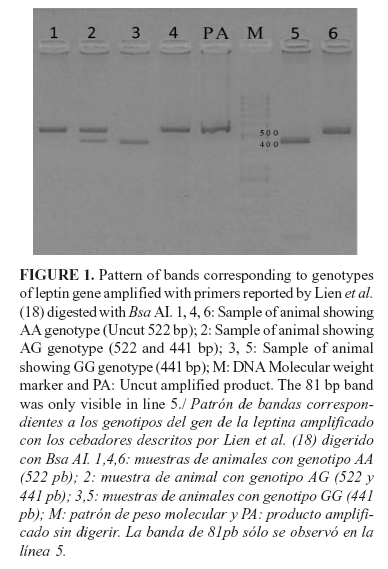
<body><![CDATA[<P><font face="Verdana, Arial, Helvetica, sans-serif" size="2"><B>Statistical    Analysis</B> </font>     <P><font face="Verdana, Arial, Helvetica, sans-serif" size="2">Direct counting    was used to estimate genotype frequencies of gene genetic variants. </font>     <P><font face="Verdana, Arial, Helvetica, sans-serif" size="2">Deviations from    Hardy-Weinberg Equilibrium (HWE) and Wright Fixation Index (F<SUB>IS</SUB>,    within population inbreeding estimate) were assed with GENEPOP v4.2 software    (17) using exact tests that employ the Markov Chain method to estimate p-values    (1000 dememorization steps, 100 batches and 1000 iterations). Allele frequencies    and observed (Ho) and unbiased expected (He) heterozygosities were calculated    using the Excell complement GenAlEx 6.5 (18).</font>     <P>&nbsp;     <P><font face="Verdana, Arial, Helvetica, sans-serif" size="2"><B><font size="3">RESULTS</font></B>    </font>     <P><font face="Verdana, Arial, Helvetica, sans-serif" size="2">All 68 samples    were amplified using specific primers for the <I>leptin</I> gene. After digestion    of PCR products with <I>Bsa</I> AI, an intact 522 bp fragment as AA genotype,    441 and 81 bp fragments as GG genotype, and 522, 441 and 81 bp fragments as    GA genotype were observed (<a href="#f1">Figure 1</a>). Genotypic frequencies    were 0.47 for genotype AA, 0.42 for AG, and 0.11 for GG. The allelic frequencies    found were 0.684 for the allele A and 0.316 for the allele G. The population    was in HWE (p-value =1.0000). F<SUB>IS</SUB> estimates were 0.0212. He value    was 0.436, and Ho was equal to 0.426.</font>      <P align="center"><img src="/img/revistas/rsa/v38n2/f0101216.gif" width="388" height="569">    <a name="f1"></a>     
<P><font face="Verdana, Arial, Helvetica, sans-serif" size="2">Sixty-five samples    were amplified with primers K-F and K-R for exon IV of k<I>-casein</I>. After    digestion of PCR products with <I>Hind</I> III, all animals were monomorphic,    showing two fragments of 225 and 154bp corresponding to BB genotype (<a href="#f2">Figure    2</a>). The 379bp amplified a fragment remained undigested by <I>Taq </I>I restriction    enzyme in all animals, also showing a monomorphic BB pattern.</font>      <P align="center"><img src="/img/revistas/rsa/v38n2/f0201216.gif" width="374" height="482">    <a name="f2"></a>     
<P>&nbsp;     ]]></body>
<body><![CDATA[<P><font face="Verdana, Arial, Helvetica, sans-serif" size="2"><B><font size="3">DISCUSSION</font></B>    </font>     <P><font face="Verdana, Arial, Helvetica, sans-serif" size="2">It has been demonstrated    by interspecies comparisons that k-<I>casein</I> possesses the highest degree    of conservation among the casein genes (19). The <I>leptin</I> gene structure,    intron/exon boundaries and amino acid sequence are highly conserved in mammalian    species. Comparative study of intron 2 of the <I>leptin</I> gene between bovines,    buffaloes and goats, revealed the sequence similarity of 95-98% and indicated    that bovine were closer to buffaloes (10). The former explains that buffalo    <I>leptin</I> and k<I>-casein</I> genes were successfully amplified by PCR using    primers designed for bovines. Failure of amplification in three samples in the    k<I>-casein</I> gene could be due to presence of PCR inhibitors in the DNA sample    or because of the existence of mismatches in the union site of primers in the    gene sequence. </font>     <P><font face="Verdana, Arial, Helvetica, sans-serif" size="2">Lien <I>et al</I>.    (15) first described a guanine (G) to adenine (A) substitution in position 1620    in intron 2 of the <I>leptin</I> gene of Norwegian cattle identified by <I>Bsa    </I>AI digestion. Chaudhary <I>et al</I>. (20) reported digestion of 522 bp    PCR products with the <I>Bsa </I>AI restriction enzyme and revealed three genotypes    in all the breeds of <I>Bos indicus, Bos taurus,</I> and Jersey cattle. Souza    <I>et al</I>. (5) determined <I>leptin</I> A1620G to be associated with weaning    weight (W) in three Nelore (<I>Bos indicus</I>) lines selected for growth. Significant    effects (p=0.03) of this polymorphism were observed for W<SUB>210</SUB>, with    the demonstration of greater mean values for AA animals compared with AG and    GG animals. There have been few studies on this SNP in water buffaloes. </font>     <P><font face="Verdana, Arial, Helvetica, sans-serif" size="2">The results of    the present study in a Cuban buffalo population showed the presence of the three    genotypes (AA, AG, and GG), with AA as the most frequent genotype. The genotype    GG was the least frequent. In accordance with that fact, allele A showed the    highest allele frequency. The population in HWE indicated that, possibly, there    was not selection for this locus in the population. F<SUB>IS</SUB> estimates    showed that no inbreeding occurred in the population regarding this locus. </font>     <P><font face="Verdana, Arial, Helvetica, sans-serif" size="2">Heterozygosity    value is the most accurate way to measure the genetic diversity of population    (21) and to get an overview of the genetic variability (22). He and Ho values    obtained in this study for the <I>leptin</I> gene were below 0.5 (50%). Javanmard    <I>et al</I>. (23) suggest that heterozygosity values below 0.5 (50%) indicate    low variation of a gene in the population. The number of samples, the number    of alleles, and the allele frequencies influence heterozygosity values. A higher    number of animals and SNPs in the <I>leptin</I> and/or other genes should be    analyzed for more accurate estimate F<SUB>IS</SUB> and genetic variation in    this population. </font>     <P><font face="Verdana, Arial, Helvetica, sans-serif" size="2">Comparing with    other researches made on water buffalo, Azari <I>et al.</I> (24) analyzed 53    Mazandarani native river buffaloes from Iran by PCR-RFLP in <I>leptin</I> gene    using <I>Bsa</I> AI. They also observed three genotypes. The highest genotype    frequency detected by the authors corresponded to AG (AB) (0.509) genotype,    different from the results of the present study. They reported frequency of    GG (BB) genotype as the lowest, in accordance with this work. The allelic frequencies    that Azari <I>et al.</I> (24) reported for A and G (B) alleles were 0.61 and    0.35, respectively. The first one was higher, and the second lower than the    allelic frequencies detected in the present study. The Mazandarani buffalo population    was in HWE for the locus analyzed as was observed in the Cuban population. The    Ho (0.509) was slightly superior to that observed in this study but it was still    near to 0.5. </font>     <P><font face="Verdana, Arial, Helvetica, sans-serif" size="2">In another research,    Zetouni <I>et al.</I> (16) studied a Brazilian buffalo population also by PCR-RFLP    in the <I>leptin</I> gene using <I>Bsa</I> AI. The authors identified the three    genotypes and reported the highest frequency for AG (0.54) genotype and the    lowest for GG (0.16). The allele frequency they found for the A allele (0.57)    was lower than that observed in this work and the allele frequency for the G    allele (0.43) was higher. The author informed that the population was in HWE    for this locus as the population study in this research. The Ho (0.54) was higher    than that obtained in the present work. </font>     <P><font face="Verdana, Arial, Helvetica, sans-serif" size="2">Kale <I>et al.</I>    (25) reported that digestion of the 522 bp fragment of Murrah buffalo <I>leptin</I>    gene with <I>Bsa </I>AI yielded an uncut fragment, which indicated the frequency    of AA genotype as 1. The polymorphic restriction site was absent in the Murrah    buffaloes studied exhibiting monomorphic pattern in the analyzed population.    </font>     <P><font face="Verdana, Arial, Helvetica, sans-serif" size="2">The analyzed Cuban    buffalos resulted from uncontrolled crossbred of Carabao and Bufallypso, which    is a composite breed formed by Murrah, Surti, Jaffarabadi, Nelli and Bhadawari    (26). Considering the results reported by Kale <I>et al.</I> (25), the contribution    made by the Murrah Indian riverine breed to the formation of Buffalypso could    explain why AA was the most frequent genotype in the studied Cuban population.    </font>     <P><font face="Verdana, Arial, Helvetica, sans-serif" size="2">In exon IV of cattle    k<I>-casein</I> gene, alleles A and B were detected by differences at codons    136 and 148 (27). Allele A has 136Thr (ACC)/148Asp (GAT), where as allele B    has 136Ile (ATC)/148Ala (GCT). All previous reports on genotyping of water buffalo    k<I>-casein</I> gene (exon IV) by PCR-RFLP analysis used restriction enzymes    <I>Hind </I>III, <I>Hinf </I>I, and <I>Taq </I>I, which successfully identify    cattle A and B genotypes. The results obtained in the analysis of Cuban buffalo    k<I>-casein</I> gene were in accordance with Mitra <I>et al</I>. (14), who reported    monomorphism (BB) for this gene, showing similar band pattern of 225 bp and    154 bp by using restriction endonuclease <I>Hind</I> III in Murrah and Nili-Ravi    buffalo breeds. In other researches using PCR-RFLP, Pipalia <I>et al.</I> (27),    Riaz <I>et al.</I> (28), Abbasi <I>et al.</I> (29), Ren <I>et al</I>. (30),    and Jaayid <I>et al.</I> (31) also found monomorphism (BB) for this gene in    diverse buffalo breeds from different countries. </font>     ]]></body>
<body><![CDATA[<P><font face="Verdana, Arial, Helvetica, sans-serif" size="2">However, Sing <I>et    al.</I> (32) found the two alleles A and B for k<I>-casein</I> locus in Murrah    and Bhadawari breeds by PCR-RFLP, but they reported monomorphism (BB) in Surti    and Mehsana breeds of buffalo. Similarly, Patel <I>et al.</I> (33) found alleles    A and B in Murrah, Surti, and Pandharpuri buffaloes. They observed BB and AB    genotypes in these three breeds and monomorphism (BB) in Jaffarabadi breed.    The authors found BB genotype frequency (0.968) very much higher than the AB    genotype (0.032). In another work, Gouda <I>et al.</I> (34) reported detection    of BB and AB genotypes in Egyptian buffalo, also with higher frequency of BB    genotype (0.75). Lin <I>et al.</I> (35) also studied a sample from different    breeds and crossbreds of buffalo in China by RFLP. They found the three k<I>-casein</I>    genotypes AA, AB, and BB, though the latter genotype occupied the largest proportion.    The authors detected that most of the AB genotype and all of the genotype AA    appeared in crossbred buffalo (Murrah + Nili-Ravi and river type + Chinese local    swamp), while just several AB and none of AA genotype were found in pure river    type buffalo (Murrah, Nili-Ravi). </font>     <P><font face="Verdana, Arial, Helvetica, sans-serif" size="2"> In the present    study, a population of uncontrolled crossbred animals (composite river breed    + swamp) was analyzed. Taking into account the presence of alleles A and B for    k<I>-casein</I> locus in Murrah reported by Sing <I>et al.</I> (32) and Patel    <I>et al.</I> (33), and the presence of AA and AB genotypes in crossbred buffalo    (Murrah + Nili-Ravi and river type + Chinese local swamp) and AB genotype in    pure Murrah, referred to by Lin <I>et al.</I> (35), it was expected that Cuban    buffaloes showed a polymorphic pattern in k<I>-casein</I> exon IV by PCR-RFLP.    However, the results are not in agreement with those of all these authors and    agree with those obtained by Otaviano <I>et al.</I> (36), who also found BB    monomorphism in k<I>-casein</I> exon IV when they studied Brazilian Murrah breed    and its crossbreds by PCR-RFLP. </font>     <P><font face="Verdana, Arial, Helvetica, sans-serif" size="2">Buffalo k<I>-casein</I>    polymorphism has also been investigated using nucleotide sequence analysis,    and two nucleotide variants at codons 135Thr (ACC)/Ile (ATC), and 136Thr (ACC/ACT)    (silent mutation) have been reported (14, 37-39). Allele A has 135ThrACC/136ThrACC,    whereas allele B has 135IleATC/136ThrACT. In comparing partial nucleotide sequences    (from codon 130 to 149) of alleles A and B in cattle and buffalo, Nahas <I>et    al.</I> (39) found that <I>Hind</I> III restriction site ``A&#094;AGCTT'' was present    in cattle allele B (148Ala) and in both buffalo alleles A and B, whereas <I>Hinf</I>    I restriction site ``G&#094;ANT'', contrary to <I>Hind</I> III, was present in cattle    allele A (148Asp) and was missing in cattle allele B as well as in both buffalo    alleles A and B. Since buffalo samples (both alleles A and B) followed cattle    BB pattern, they were mistakenly assumed as BB monomorphic where in fact they    would have been AA, BB or AB. <I>Taq</I> I restriction site T&#094;CGA is present    at codon 136 in cattle allele B (136Ile) but was absent in buffalo alleles A    and B. These findings are in contrast with those results referred to by Sing    <I>et al. </I>(32), Patel <I>et al.</I> (33), Gouda <I>et al.</I> (34) and Lin    <I>et al.</I> (35). </font>     <P><font face="Verdana, Arial, Helvetica, sans-serif" size="2">PCR-RFLP technology    has been extensively used in buffalo DNA analysis (14, 16, 20, 25, 31, 40-43).    In this study, PCR-RFLP with <I>Bsa</I> AI was able to detect the two genetic    variants described for the <I>leptin</I> gene A1620G. However, the monomorphism    BB finding in k<I>-casein</I> gen using <I>Hind</I> III and the absent of a    <I>Taq</I> I restriction site, indicates the necessity of DNA sequencing, as    a method with higher specificity and accuracy (44), to detect the new A and    B variants of k<I>-casein</I> reported in buffalo by nucleotide sequence analysis    (45, 47, 48). As it was referred by Caroli <I>et al.</I> (44), when funding    is limited, researchers may use RFLP analysis for screening of the total sample    set for polymorphism, after which, samples exhibiting different RFLP patterns    may be subjected to DNA sequencing analysis.</font>     <P>&nbsp;     <P><font face="Verdana, Arial, Helvetica, sans-serif" size="2"><B><font size="3">REFERENCES</font></B>    </font>     <!-- ref --><P><font face="Verdana, Arial, Helvetica, sans-serif" size="2">1. Anand VK, Sharma    V, Kumar A, Verma VK, Rana VP, Khirbat R, et al. PCR-RFLP based <I>leptin</I>    gene polymorphism and its association with mastitis in Murrah buffalo. J Cell    Tissue Res. 2015;15(2):5125-5132.     </font>      <!-- ref --><P><font face="Verdana, Arial, Helvetica, sans-serif" size="2">2. Alashawkany    AR, Shahroudi FE, Nassiry MR, Moussavi AH, Heydarpour M, Sadeghi B. Association    of SNP in the Exon II of <I>Leptin</I> gene with Milk and Reproduction Traits    in Holstein Iranian Cows. Biotechnology. 2008;7:347-350.     </font>     ]]></body>
<body><![CDATA[<!-- ref --><P><font face="Verdana, Arial, Helvetica, sans-serif" size="2">3. Deb R, Singh    U, Kumar S, Singh R, Sengar G, Sharma A. Genetic polymorphism and association    of <I>kappa-casein</I> gene with milk production traits among Frieswal (HF &#215;    Sahiwal) cross breed of Indian origin. Iran J Vet Res. 2014;15(4):406-408.     </font>      <!-- ref --><P><font face="Verdana, Arial, Helvetica, sans-serif" size="2">4. Schenkel FS,    Miller SP, Jiang Z, Mandell IB, Ye X, et al. Association of a single nucleotide    polymorphism in the <I>calpastatin</I> gene with carcass and meat quality traits    of beef cattle. J Anim Sci. 2006;84:291-299.     </font>      <!-- ref --><P><font face="Verdana, Arial, Helvetica, sans-serif" size="2">5. Souza FRP, Mercadante    MEZ, Fonseca LFS, Ferreira LMS, Regatieri IC, Ayres DR, et al. Assessment of    <I>DGAT1</I> and <I>LEP</I> gene polymorphisms in three Nelore (<I>Bos indicus</I>)    lines selected for growth and their relationship with growth and carcass traits.    J Anim Sci. 2010;88:435-441.     </font>      <!-- ref --><P><font face="Verdana, Arial, Helvetica, sans-serif" size="2">6. Caroli A, Chessa    S, Bolla P, Budelli E, Gandini GC. Genetic structure of milk protein polymorphisms    and effects on milk production traits in a local dairy cattle. J Anim Breed    Genet.2004;121:19-127.     </font>      <!-- ref --><P><font face="Verdana, Arial, Helvetica, sans-serif" size="2">7. De Marchi M,    Bittante G, Dal Zotto R, Dalvit C, Cassandro M. Effect of Holstein Friesian    and Brown Swiss breeds on quality of milk and cheese. J Dairy Sci. 2008;91:4092-4102.        </font>     ]]></body>
<body><![CDATA[<!-- ref --><P><font face="Verdana, Arial, Helvetica, sans-serif" size="2">8. Gallinat JL,    Qanbari S, Dr&ouml;gem&uuml;ller C, Pimentel ECG, Thaller G, Tetens J. DNA-based    identification of novel bovine <I>casein</I> gene variants. J Dairy Sci. 2013;96:699-709.        </font>      <!-- ref --><P><font face="Verdana, Arial, Helvetica, sans-serif" size="2">9. Gallegos MP,    Toca JA, Rodriguez P, Pinz&oacute;n CE, Reveles FA, Quintero JS. Role of leptin    gene in cattle production: review. J Anim Vet Adv. 2015;14(4):81-90.     </font>      <!-- ref --><P><font face="Verdana, Arial, Helvetica, sans-serif" size="2">10.Argawal P, Rout    PK, Singh SK. Leptin: A biomolecule for enhancing livestock productivity. Indian    J Biotechnol. 2009;8:169-176.     </font>      <!-- ref --><P><font face="Verdana, Arial, Helvetica, sans-serif" size="2">11.Nkrumah JD,    Li C, Yu J, Hansen C, Keisler DH, Moore SS. Polymorphisms in the bovine <I>leptin</I>    promoter associated with serum <I>leptin</I> concentration, growth, feed intake,    feeding behavior, and measures of carcass merit. J Anim Sci. 2005;83:20-28.        </font>      <!-- ref --><P><font face="Verdana, Arial, Helvetica, sans-serif" size="2">12.Haegeman A,    Van Zeveren A, Peelman LJ. New mutation in exon 2 of the bovine <I>leptin</I>    gene. Anim Genet. 2000;31:79.     </font>     ]]></body>
<body><![CDATA[<!-- ref --><P><font face="Verdana, Arial, Helvetica, sans-serif" size="2">13.Datta S, Adikari    AMJB, Chauhan A, Verma A, Gupta ID, Chauhan I, et al. Nucleotide sequence variation    in <I>leptin</I> gene of Murrah buffalo (<I>Bubalus bubalis</I>). Exper Anim    Med Res. 2012;2:130-136.     </font>     <!-- ref --><P><font face="Verdana, Arial, Helvetica, sans-serif" size="2">14.Mitra AP, Schlee    I, Krause J, Blusch T, Werner CR, et al. <I>Kappa casein</I> polymorphism in    the Indian dairy cattle and buffalo: A new genetic variant in buffalo. Anim    Biotechnol. 1998;9:81-87.     </font>      <!-- ref --><P><font face="Verdana, Arial, Helvetica, sans-serif" size="2">15.Lien S, Sundvold    H, Klungland H, Vage DI. Two novel polymorphisms in the bovine obesity gene    (OBS). Anim Genet. 1997;28:45.     </font>      <!-- ref --><P><font face="Verdana, Arial, Helvetica, sans-serif" size="2">16.Zetouni L, de    Camargo GMF, Fonseca PDS, Monsalves FMG, Hurtado NA, Aspilcueta-Borquis RR,    et al. Effects of a single nucleotide polymorphism in the <I>Leptin</I> gene    on the productive traits of dairy buffaloes (<I>Bubalus bubalis</I>). Mol Biol    Rep. 2013;40:5159-5163.     </font>     <!-- ref --><P><font face="Verdana, Arial, Helvetica, sans-serif" size="2">17.Rousset F. Genepop'007:    a complete reimplementation of the Genepop software for Windows and Linux. Mol    Ecol Resour. 2008;8:103-106.     </font>      ]]></body>
<body><![CDATA[<!-- ref --><P><font face="Verdana, Arial, Helvetica, sans-serif" size="2">18.Peakall R, Smouse    PE. GenAlEx 6.5: genetic analysis in Excel. Population genetic software for    teaching and research - an update. Bioinformatics. 2012;28:2537-2539.     </font>     <!-- ref --><P><font face="Verdana, Arial, Helvetica, sans-serif" size="2">19.Ahmed TJ, Yakoub    MY, Falih BZ, Mohammed JO. Genetic Polymorphism of <I>Kappa Casein</I> (k-CN)    in Iraqi Buffalo Using Polymerase Chain Reaction-Restriction Fragment Length    Polymorphism. J Agr Sci Tech. 2013;835-841.     </font>     <!-- ref --><P><font face="Verdana, Arial, Helvetica, sans-serif" size="2">20.Choudhary V,    Kumar P, Bhattacharya TK, Bhushan B, Sharma A. DNA polymorphism of <I>Leptin</I>    gene in <I>Bos indicus</I> and <I>Bos taurus</I> cattle. Genet Mol Biol. 2005;28:740-742.        </font>     <!-- ref --><P><font face="Verdana, Arial, Helvetica, sans-serif" size="2">21.Nei M, Kumar    S. Molecular Evolution and Phylogenetics. 2000. Oxford University Press, New    York.     </font>     <!-- ref --><P><font face="Verdana, Arial, Helvetica, sans-serif" size="2">22.Marson EP, Ferraz    JBS, Meirelles FV, Balieiro JCDC, Eler JP, et al. Genetic characterization of    European Zebu composite bovine using RFLP markers. Genet Mol Res. 2005;4:496-505.        </font>      ]]></body>
<body><![CDATA[<!-- ref --><P><font face="Verdana, Arial, Helvetica, sans-serif" size="2">23.Javanmard A,    Asadzadeh N, Banabazi MH, Tavakolian J. The allele and genotype frequencies    of bovine pituitary specific transcription factor and <I>Leptin</I> genes in    Iranian cattle and buffalo populations using PCR-RFLP. Iranian J Biotech. 2005;3:104-108.        </font>     <!-- ref --><P><font face="Verdana, Arial, Helvetica, sans-serif" size="2">24.Azari MA, Hasani    S, Heidari M, Yousefi S. Genetic polymorphism of <I>Leptin</I> gene using PCR-RFLP    method in three different populations. Slovak J Anim Sci. 2012;45:39-42.     </font>     <!-- ref --><P><font face="Verdana, Arial, Helvetica, sans-serif" size="2">25.Kale DS, Yadav    BR, Mukherjee A, Prasad J. Exploring DNA Polymorphisms of <I>Leptin</I> Gene    within Indian Water Buffaloes. J Adv Vet Res. 2013;3:20-26.     </font>     <!-- ref --><P><font face="Verdana, Arial, Helvetica, sans-serif" size="2">26.Robitaille G,    Britten M, Morisset J, Petitclerc D. Polymorphism in the bovine <I>kappa-casein</I>    (CSN3) gene and the 50-flanking region: sequence analysis of CSN3 A and B alleles.    J Anim Genet. 2005;36:184-185.     </font>     <!-- ref --><P><font face="Verdana, Arial, Helvetica, sans-serif" size="2">27.Pipalia D, Ladani    D, Brahmkshtri B, Rank D, Joshi C, et al. <I>Kappa-casein</I> genotyping of    Indian Buffalo breeds using PCR-RFLP. Buffalo J. 2001;17:195-202.     </font>      ]]></body>
<body><![CDATA[<!-- ref --><P><font face="Verdana, Arial, Helvetica, sans-serif" size="2">28.Riaz MN, Malik    NA, Nasreen F, Qureshi JA. Molecular marker assisted study of <I>kappa-casein</I>    gene in Nili-Ravi (buffalo) breed of Pakistan. Pakistan Vet J. 2008;28:103-106.        </font>      <!-- ref --><P><font face="Verdana, Arial, Helvetica, sans-serif" size="2">29.Abbasi B, Fayazi    J, Beigi Nasiri MT, Roshanfekr HA, Mirzadeh Kh, Sadr AS. Analysis of <I>kappa    casein</I> gene polymorphism by PCR-RFLP in Buffalo population in Khouzestan    Province. Res J Biol Sci. 2009;4:1073-1075.     </font>     <!-- ref --><P><font face="Verdana, Arial, Helvetica, sans-serif" size="2">30.Ren DX, Miao    SY, Chen YL, Zou CX, Liang XW, Liu JX. Genotyping of the k<I>-casein</I> and    b<I>-lactoglobulin</I> genes in Chinese Holstein, Jersey and water buffalo by    PCR-RFLP. J Genet. 2011; 90: e1-e5. (<U><a href="http://www.ias.ac.in/jgenet/OnlineResources/90/e1.pdf">http://www.ias.ac.in/jgenet/OnlineResources/90/e1.pdf</a></U>).        </font>      <!-- ref --><P><font face="Verdana, Arial, Helvetica, sans-serif" size="2">31.Jaayid TA, Muntaha    YY, Bashar FZ, Jaafer M. Genetic Polymorphism of <I>Kappa Casein</I> (b-CN)    in Iraqi Buffalo Using Polymerase Chain Reaction-Restriction Fragment Length    Polymorphism. J Agric Sci Technol. 2013; 835-841.     </font>      <!-- ref --><P><font face="Verdana, Arial, Helvetica, sans-serif" size="2">32.Singh S, Pushpendra    K, Bhattacharya TK. DNA polymorphism of k-CN and b-CN genes and its association    with milk production and quality traits in buffalo (<I>B. bubalis</I>). Proceeding    of National Symposium on Domestic Animals Diversity: Status, Opportunities and    Challenges, 2005. Karnal, India.     </font>     ]]></body>
<body><![CDATA[<!-- ref --><P><font face="Verdana, Arial, Helvetica, sans-serif" size="2">33.Patel JB, Chauhan    KMS, Soni KJ. Genotyping and allelic frequencies of k-CN and b-LG in Indian    river buffalo bulls. Buffalo Bull. 2007;26:63-66.     </font>      <!-- ref --><P><font face="Verdana, Arial, Helvetica, sans-serif" size="2">34.Gouda EM, Galal    MKh, Abdelaziz SA. Genetic Variants and Allele Frequencies of <I>Kappa Casein</I>    in Egyptian Cattle and Buffalo Using PCR-RFLP. J Agric Sci. 2013;5:197-203.        </font>      <!-- ref --><P><font face="Verdana, Arial, Helvetica, sans-serif" size="2">35.Lin B, Ren D,    Yang B, Li L, Yan T, et al. Compare of Phenotypic Variation with the Polymorphism    of One Coagulation Related Gene Locus in Buffalo <I>Kappa-Casein</I>. Proceeding    of the 10<SUP>th</SUP> World Buffalo Congress 2013. Puket, Thailand.     </font>      <!-- ref --><P><font face="Verdana, Arial, Helvetica, sans-serif" size="2">36.Otaviano R,    Tonhati H, Desiderio JA, Munoz FC. <I>Kappa-casein</I> gene study with molecular    marker in female buffalos. Genet Mol Biol. 2005;28:237-241.     </font>      <!-- ref --><P><font face="Verdana, Arial, Helvetica, sans-serif" size="2">37.Beneduci B,    Krastanov I, Maretto F, Oblakov N, Cassandro M. Molecular characterization of    <I>&ecirc;-casein</I> allelic variants in Bulgarian buffalo breed. Acta Agraria    Kaposvariensis. 2010;14:169-172.     </font>     ]]></body>
<body><![CDATA[<!-- ref --><P><font face="Verdana, Arial, Helvetica, sans-serif" size="2">38.Bonfatti V,    Giantin M, Gervaso M, Coletta A, Dacasto M, Carnier P. Effect of CSN1S1-CSN3    (a<SUB>S1</SUB>-k<I>-casein</I>) composite genotype on milk production traits    and milk coagulation properties in Mediterranean water buffalo. J Dairy Sci.    2012;95:3435-3443.     </font>     <!-- ref --><P><font face="Verdana, Arial, Helvetica, sans-serif" size="2">39.Nahas SM, Bibars    MA, Taha DA. Genetic characterization of Egyptian buffalo CSN3 gene. J Genet    Eng Biotechnol. 2013;11:123-127.     </font>     <!-- ref --><P><font face="Verdana, Arial, Helvetica, sans-serif" size="2">40.Jhala NB, Vataliya    PH, Rank DN, Ramani UV. <I>Leptin</I> gene exon-3 polymorphism in Gir cattle    and Mehsana buffalo. J Anim Sci Reporter. 2011;5:91-94.     </font>      <!-- ref --><P><font face="Verdana, Arial, Helvetica, sans-serif" size="2">41.Somayeh R, Vida    K, Sadr A, Moosavi M. Investigation of <I>leptin</I> polymorphism by PCR-RFLP    in Iranian buffalo. Intl Res J Appl Basic Sci. 2012;3(8):1658-1661.     </font>      <!-- ref --><P><font face="Verdana, Arial, Helvetica, sans-serif" size="2">42.Rini AO, Sumantri    C, Damayanthi E. <I>&ecirc;-casein</I> gene polymorphisms in riverine and swamp    buffalo in Indonesia. J Indonesian Trop Anim Agric. 2014;39:1-9.     </font>     ]]></body>
<body><![CDATA[<!-- ref --><P><font face="Verdana, Arial, Helvetica, sans-serif" size="2">43.Martin ET, Koelle    DM, Byrd B, Huang ML, Vieira J, et al. Sequence-based methods for identifying    epidemiologically linked herpes simplex virus Type 2 strains. J Clin Microbiol.    2006; 2541-2546.     </font>      <!-- ref --><P><font face="Verdana, Arial, Helvetica, sans-serif" size="2">44.Caroli A, Chiatti    F, Chessa S, Rignanese D, Bolla P, Pagnacco G. Focusing on the goat casein complex.    J Dairy Sci. 2006;89:3178-3191.    </font>     <P>&nbsp;     <P>&nbsp;     <P><font face="Verdana, Arial, Helvetica, sans-serif" size="2">Recibido: 5-1-2016.    <br>   </font><font face="Verdana, Arial, Helvetica, sans-serif" size="2">Aceptado:    3-6-2016.</font>     <P>&nbsp;     <P>&nbsp;     ]]></body>
<body><![CDATA[<P><font face="Verdana, Arial, Helvetica, sans-serif" size="2"><B><a href="#pie">*</a><a name="autor"></a></B>Corresponding    author: <I>Odalys Uffo Reinosa.</I> E-mail: <U><a href="mailto:uffo@censa.edu.cu">uffo@censa.edu.cu</a></U>    </font>       ]]></body><back>
<ref-list>
<ref id="B1">
<label>1</label><nlm-citation citation-type="journal">
<person-group person-group-type="author">
<name>
<surname><![CDATA[Anand]]></surname>
<given-names><![CDATA[VK]]></given-names>
</name>
<name>
<surname><![CDATA[Sharma]]></surname>
<given-names><![CDATA[V]]></given-names>
</name>
<name>
<surname><![CDATA[Kumar]]></surname>
<given-names><![CDATA[A]]></given-names>
</name>
<name>
<surname><![CDATA[Verma]]></surname>
<given-names><![CDATA[VK]]></given-names>
</name>
<name>
<surname><![CDATA[Rana]]></surname>
<given-names><![CDATA[VP]]></given-names>
</name>
<name>
<surname><![CDATA[Khirbat]]></surname>
<given-names><![CDATA[R]]></given-names>
</name>
</person-group>
<article-title xml:lang="en"><![CDATA[PCR-RFLP based leptin gene polymorphism and its association with mastitis in Murrah buffalo]]></article-title>
<source><![CDATA[J Cell Tissue Res]]></source>
<year>2015</year>
<volume>15</volume>
<numero>2</numero>
<issue>2</issue>
<page-range>5125-5132</page-range></nlm-citation>
</ref>
<ref id="B2">
<label>2</label><nlm-citation citation-type="journal">
<person-group person-group-type="author">
<name>
<surname><![CDATA[Alashawkany]]></surname>
<given-names><![CDATA[AR]]></given-names>
</name>
<name>
<surname><![CDATA[Shahroudi]]></surname>
<given-names><![CDATA[FE]]></given-names>
</name>
<name>
<surname><![CDATA[Nassiry]]></surname>
<given-names><![CDATA[MR]]></given-names>
</name>
<name>
<surname><![CDATA[Moussavi]]></surname>
<given-names><![CDATA[AH]]></given-names>
</name>
<name>
<surname><![CDATA[Heydarpour]]></surname>
<given-names><![CDATA[M]]></given-names>
</name>
<name>
<surname><![CDATA[Sadeghi]]></surname>
<given-names><![CDATA[B]]></given-names>
</name>
</person-group>
<article-title xml:lang="en"><![CDATA[Association of SNP in the Exon II of Leptin gene with Milk and Reproduction Traits in Holstein Iranian Cows]]></article-title>
<source><![CDATA[Biotechnology]]></source>
<year>2008</year>
<volume>7</volume>
<page-range>347-350</page-range></nlm-citation>
</ref>
<ref id="B3">
<label>3</label><nlm-citation citation-type="journal">
<person-group person-group-type="author">
<name>
<surname><![CDATA[Deb]]></surname>
<given-names><![CDATA[R]]></given-names>
</name>
<name>
<surname><![CDATA[Singh]]></surname>
<given-names><![CDATA[U]]></given-names>
</name>
<name>
<surname><![CDATA[Kumar]]></surname>
<given-names><![CDATA[S]]></given-names>
</name>
<name>
<surname><![CDATA[Singh]]></surname>
<given-names><![CDATA[R]]></given-names>
</name>
<name>
<surname><![CDATA[Sengar]]></surname>
<given-names><![CDATA[G]]></given-names>
</name>
<name>
<surname><![CDATA[Sharma]]></surname>
<given-names><![CDATA[A]]></given-names>
</name>
</person-group>
<article-title xml:lang="en"><![CDATA[Genetic polymorphism and association of kappa-casein gene with milk production traits among Frieswal (HF × Sahiwal) cross breed of Indian origin]]></article-title>
<source><![CDATA[Iran J Vet Res]]></source>
<year>2014</year>
<volume>15</volume>
<numero>4</numero>
<issue>4</issue>
<page-range>406-408</page-range></nlm-citation>
</ref>
<ref id="B4">
<label>4</label><nlm-citation citation-type="journal">
<person-group person-group-type="author">
<name>
<surname><![CDATA[Schenkel]]></surname>
<given-names><![CDATA[FS]]></given-names>
</name>
<name>
<surname><![CDATA[Miller]]></surname>
<given-names><![CDATA[SP]]></given-names>
</name>
<name>
<surname><![CDATA[Jiang]]></surname>
<given-names><![CDATA[Z]]></given-names>
</name>
<name>
<surname><![CDATA[Mandell]]></surname>
<given-names><![CDATA[IB]]></given-names>
</name>
<name>
<surname><![CDATA[Ye]]></surname>
<given-names><![CDATA[X]]></given-names>
</name>
</person-group>
<article-title xml:lang="en"><![CDATA[Association of a single nucleotide polymorphism in the calpastatin gene with carcass and meat quality traits of beef cattle]]></article-title>
<source><![CDATA[J Anim Sci]]></source>
<year>2006</year>
<volume>84</volume>
<page-range>291-299</page-range></nlm-citation>
</ref>
<ref id="B5">
<label>5</label><nlm-citation citation-type="journal">
<person-group person-group-type="author">
<name>
<surname><![CDATA[Souza]]></surname>
<given-names><![CDATA[FRP]]></given-names>
</name>
<name>
<surname><![CDATA[Mercadante]]></surname>
<given-names><![CDATA[MEZ]]></given-names>
</name>
<name>
<surname><![CDATA[Fonseca]]></surname>
<given-names><![CDATA[LFS]]></given-names>
</name>
<name>
<surname><![CDATA[Ferreira]]></surname>
<given-names><![CDATA[LMS]]></given-names>
</name>
<name>
<surname><![CDATA[Regatieri]]></surname>
<given-names><![CDATA[IC]]></given-names>
</name>
<name>
<surname><![CDATA[Ayres]]></surname>
<given-names><![CDATA[DR]]></given-names>
</name>
</person-group>
<article-title xml:lang="en"><![CDATA[Assessment of DGAT1 and LEP gene polymorphisms in three Nelore (Bos indicus) lines selected for growth and their relationship with growth and carcass traits]]></article-title>
<source><![CDATA[J Anim Sci]]></source>
<year>2010</year>
<volume>88</volume>
<page-range>435-441</page-range></nlm-citation>
</ref>
<ref id="B6">
<label>6</label><nlm-citation citation-type="journal">
<person-group person-group-type="author">
<name>
<surname><![CDATA[Caroli]]></surname>
<given-names><![CDATA[A]]></given-names>
</name>
<name>
<surname><![CDATA[Chessa]]></surname>
<given-names><![CDATA[S]]></given-names>
</name>
<name>
<surname><![CDATA[Bolla]]></surname>
<given-names><![CDATA[P]]></given-names>
</name>
<name>
<surname><![CDATA[Budelli]]></surname>
<given-names><![CDATA[E]]></given-names>
</name>
<name>
<surname><![CDATA[Gandini]]></surname>
<given-names><![CDATA[GC]]></given-names>
</name>
</person-group>
<article-title xml:lang="en"><![CDATA[Genetic structure of milk protein polymorphisms and effects on milk production traits in a local dairy cattle]]></article-title>
<source><![CDATA[J Anim Breed Genet]]></source>
<year>2004</year>
<volume>121</volume>
<page-range>19-127</page-range></nlm-citation>
</ref>
<ref id="B7">
<label>7</label><nlm-citation citation-type="journal">
<person-group person-group-type="author">
<name>
<surname><![CDATA[De Marchi]]></surname>
<given-names><![CDATA[M]]></given-names>
</name>
<name>
<surname><![CDATA[Bittante]]></surname>
<given-names><![CDATA[G]]></given-names>
</name>
<name>
<surname><![CDATA[Dal Zotto]]></surname>
<given-names><![CDATA[R]]></given-names>
</name>
<name>
<surname><![CDATA[Dalvit]]></surname>
<given-names><![CDATA[C]]></given-names>
</name>
<name>
<surname><![CDATA[Cassandro]]></surname>
<given-names><![CDATA[M]]></given-names>
</name>
</person-group>
<article-title xml:lang="en"><![CDATA[Effect of Holstein Friesian and Brown Swiss breeds on quality of milk and cheese]]></article-title>
<source><![CDATA[J Dairy Sci]]></source>
<year>2008</year>
<volume>91</volume>
<page-range>4092-4102</page-range></nlm-citation>
</ref>
<ref id="B8">
<label>8</label><nlm-citation citation-type="journal">
<person-group person-group-type="author">
<name>
<surname><![CDATA[Gallinat]]></surname>
<given-names><![CDATA[JL]]></given-names>
</name>
<name>
<surname><![CDATA[Qanbari]]></surname>
<given-names><![CDATA[S]]></given-names>
</name>
<name>
<surname><![CDATA[Drögemüller]]></surname>
<given-names><![CDATA[C]]></given-names>
</name>
<name>
<surname><![CDATA[Pimentel]]></surname>
<given-names><![CDATA[ECG]]></given-names>
</name>
<name>
<surname><![CDATA[Thaller]]></surname>
<given-names><![CDATA[G]]></given-names>
</name>
<name>
<surname><![CDATA[Tetens]]></surname>
<given-names><![CDATA[J]]></given-names>
</name>
</person-group>
<article-title xml:lang="en"><![CDATA[DNA-based identification of novel bovine casein gene variants]]></article-title>
<source><![CDATA[J Dairy Sci]]></source>
<year>2013</year>
<volume>96</volume>
<page-range>699-709</page-range></nlm-citation>
</ref>
<ref id="B9">
<label>9</label><nlm-citation citation-type="journal">
<person-group person-group-type="author">
<name>
<surname><![CDATA[Gallegos]]></surname>
<given-names><![CDATA[MP]]></given-names>
</name>
<name>
<surname><![CDATA[Toca]]></surname>
<given-names><![CDATA[JA]]></given-names>
</name>
<name>
<surname><![CDATA[Rodriguez]]></surname>
<given-names><![CDATA[P]]></given-names>
</name>
<name>
<surname><![CDATA[Pinzón]]></surname>
<given-names><![CDATA[CE]]></given-names>
</name>
<name>
<surname><![CDATA[Reveles]]></surname>
<given-names><![CDATA[FA]]></given-names>
</name>
<name>
<surname><![CDATA[Quintero]]></surname>
<given-names><![CDATA[JS]]></given-names>
</name>
</person-group>
<article-title xml:lang="en"><![CDATA[Role of leptin gene in cattle production: review]]></article-title>
<source><![CDATA[J Anim Vet Adv]]></source>
<year>2015</year>
<volume>14</volume>
<numero>4</numero>
<issue>4</issue>
<page-range>81-90</page-range></nlm-citation>
</ref>
<ref id="B10">
<label>10</label><nlm-citation citation-type="journal">
<person-group person-group-type="author">
<name>
<surname><![CDATA[Argawal]]></surname>
<given-names><![CDATA[P]]></given-names>
</name>
<name>
<surname><![CDATA[Rout]]></surname>
<given-names><![CDATA[PK]]></given-names>
</name>
<name>
<surname><![CDATA[Singh]]></surname>
<given-names><![CDATA[SK]]></given-names>
</name>
</person-group>
<article-title xml:lang="en"><![CDATA[Leptin: A biomolecule for enhancing livestock productivity]]></article-title>
<source><![CDATA[Indian J Biotechnol]]></source>
<year>2009</year>
<volume>8</volume>
<page-range>169-176</page-range></nlm-citation>
</ref>
<ref id="B11">
<label>11</label><nlm-citation citation-type="journal">
<person-group person-group-type="author">
<name>
<surname><![CDATA[Nkrumah]]></surname>
<given-names><![CDATA[JD]]></given-names>
</name>
<name>
<surname><![CDATA[Li]]></surname>
<given-names><![CDATA[C]]></given-names>
</name>
<name>
<surname><![CDATA[Yu]]></surname>
<given-names><![CDATA[J]]></given-names>
</name>
<name>
<surname><![CDATA[Hansen]]></surname>
<given-names><![CDATA[C]]></given-names>
</name>
<name>
<surname><![CDATA[Keisler]]></surname>
<given-names><![CDATA[DH]]></given-names>
</name>
<name>
<surname><![CDATA[Moore]]></surname>
<given-names><![CDATA[SS]]></given-names>
</name>
</person-group>
<article-title xml:lang="en"><![CDATA[Polymorphisms in the bovine leptin promoter associated with serum leptin concentration, growth, feed intake, feeding behavior, and measures of carcass merit]]></article-title>
<source><![CDATA[J Anim Sci]]></source>
<year>2005</year>
<volume>83</volume>
<page-range>20-28</page-range></nlm-citation>
</ref>
<ref id="B12">
<label>12</label><nlm-citation citation-type="journal">
<person-group person-group-type="author">
<name>
<surname><![CDATA[Haegeman]]></surname>
<given-names><![CDATA[A]]></given-names>
</name>
<name>
<surname><![CDATA[Van Zeveren]]></surname>
<given-names><![CDATA[A]]></given-names>
</name>
<name>
<surname><![CDATA[Peelman]]></surname>
<given-names><![CDATA[LJ]]></given-names>
</name>
</person-group>
<article-title xml:lang="en"><![CDATA[New mutation in exon 2 of the bovine leptin gene]]></article-title>
<source><![CDATA[Anim Genet]]></source>
<year>2000</year>
<volume>31</volume>
<page-range>79</page-range></nlm-citation>
</ref>
<ref id="B13">
<label>13</label><nlm-citation citation-type="journal">
<person-group person-group-type="author">
<name>
<surname><![CDATA[Datta]]></surname>
<given-names><![CDATA[S]]></given-names>
</name>
<name>
<surname><![CDATA[Adikari]]></surname>
<given-names><![CDATA[AMJB]]></given-names>
</name>
<name>
<surname><![CDATA[Chauhan]]></surname>
<given-names><![CDATA[A]]></given-names>
</name>
<name>
<surname><![CDATA[Verma]]></surname>
<given-names><![CDATA[A]]></given-names>
</name>
<name>
<surname><![CDATA[Gupta]]></surname>
<given-names><![CDATA[ID]]></given-names>
</name>
<name>
<surname><![CDATA[Chauhan]]></surname>
<given-names><![CDATA[I]]></given-names>
</name>
</person-group>
<article-title xml:lang="en"><![CDATA[Nucleotide sequence variation in leptin gene of Murrah buffalo (Bubalus bubalis)]]></article-title>
<source><![CDATA[Exper Anim Med Res]]></source>
<year>2012</year>
<volume>2</volume>
<page-range>130-136</page-range></nlm-citation>
</ref>
<ref id="B14">
<label>14</label><nlm-citation citation-type="journal">
<person-group person-group-type="author">
<name>
<surname><![CDATA[Mitra]]></surname>
<given-names><![CDATA[AP]]></given-names>
</name>
<name>
<surname><![CDATA[Schlee]]></surname>
<given-names><![CDATA[I]]></given-names>
</name>
<name>
<surname><![CDATA[Krause]]></surname>
<given-names><![CDATA[J]]></given-names>
</name>
<name>
<surname><![CDATA[Blusch]]></surname>
<given-names><![CDATA[T]]></given-names>
</name>
<name>
<surname><![CDATA[Werner]]></surname>
<given-names><![CDATA[CR]]></given-names>
</name>
</person-group>
<article-title xml:lang="en"><![CDATA[Kappa casein polymorphism in the Indian dairy cattle and buffalo: A new genetic variant in buffalo]]></article-title>
<source><![CDATA[Anim Biotechnol]]></source>
<year>1998</year>
<volume>9</volume>
<page-range>81-87</page-range></nlm-citation>
</ref>
<ref id="B15">
<label>15</label><nlm-citation citation-type="journal">
<person-group person-group-type="author">
<name>
<surname><![CDATA[Lien]]></surname>
<given-names><![CDATA[S]]></given-names>
</name>
<name>
<surname><![CDATA[Sundvold]]></surname>
<given-names><![CDATA[H]]></given-names>
</name>
<name>
<surname><![CDATA[Klungland]]></surname>
<given-names><![CDATA[H]]></given-names>
</name>
<name>
<surname><![CDATA[Vage]]></surname>
<given-names><![CDATA[DI]]></given-names>
</name>
</person-group>
<article-title xml:lang="en"><![CDATA[Two novel polymorphisms in the bovine obesity gene (OBS)]]></article-title>
<source><![CDATA[Anim Genet]]></source>
<year>1997</year>
<volume>28</volume>
<page-range>45</page-range></nlm-citation>
</ref>
<ref id="B16">
<label>16</label><nlm-citation citation-type="journal">
<person-group person-group-type="author">
<name>
<surname><![CDATA[Zetouni]]></surname>
<given-names><![CDATA[L]]></given-names>
</name>
<name>
<surname><![CDATA[de Camargo]]></surname>
<given-names><![CDATA[GMF]]></given-names>
</name>
<name>
<surname><![CDATA[Fonseca]]></surname>
<given-names><![CDATA[PDS]]></given-names>
</name>
<name>
<surname><![CDATA[Monsalves]]></surname>
<given-names><![CDATA[FMG]]></given-names>
</name>
<name>
<surname><![CDATA[Hurtado]]></surname>
<given-names><![CDATA[NA]]></given-names>
</name>
<name>
<surname><![CDATA[Aspilcueta-Borquis]]></surname>
<given-names><![CDATA[RR]]></given-names>
</name>
</person-group>
<article-title xml:lang="en"><![CDATA[Effects of a single nucleotide polymorphism in the Leptin gene on the productive traits of dairy buffaloes (Bubalus bubalis)]]></article-title>
<source><![CDATA[Mol Biol Rep]]></source>
<year>2013</year>
<volume>40</volume>
<page-range>5159-5163</page-range></nlm-citation>
</ref>
<ref id="B17">
<label>17</label><nlm-citation citation-type="journal">
<person-group person-group-type="author">
<name>
<surname><![CDATA[Rousset]]></surname>
<given-names><![CDATA[F]]></given-names>
</name>
</person-group>
<article-title xml:lang="en"><![CDATA[Genepop'007: a complete reimplementation of the Genepop software for Windows and Linux]]></article-title>
<source><![CDATA[Mol Ecol Resour]]></source>
<year>2008</year>
<volume>8</volume>
<page-range>103-106</page-range></nlm-citation>
</ref>
<ref id="B18">
<label>18</label><nlm-citation citation-type="journal">
<person-group person-group-type="author">
<name>
<surname><![CDATA[Peakall]]></surname>
<given-names><![CDATA[R]]></given-names>
</name>
<name>
<surname><![CDATA[Smouse]]></surname>
<given-names><![CDATA[PE]]></given-names>
</name>
</person-group>
<article-title xml:lang="en"><![CDATA[GenAlEx 6.5: genetic analysis in Excel: Population genetic software for teaching and research - an update]]></article-title>
<source><![CDATA[Bioinformatics]]></source>
<year>2012</year>
<volume>28</volume>
<page-range>2537-2539</page-range></nlm-citation>
</ref>
<ref id="B19">
<label>19</label><nlm-citation citation-type="journal">
<person-group person-group-type="author">
<name>
<surname><![CDATA[Ahmed]]></surname>
<given-names><![CDATA[TJ]]></given-names>
</name>
<name>
<surname><![CDATA[Yakoub]]></surname>
<given-names><![CDATA[MY]]></given-names>
</name>
<name>
<surname><![CDATA[Falih]]></surname>
<given-names><![CDATA[BZ]]></given-names>
</name>
<name>
<surname><![CDATA[Mohammed]]></surname>
<given-names><![CDATA[JO]]></given-names>
</name>
</person-group>
<article-title xml:lang="en"><![CDATA[Genetic Polymorphism of Kappa Casein (k-CN) in Iraqi Buffalo Using Polymerase Chain Reaction-Restriction Fragment Length Polymorphism]]></article-title>
<source><![CDATA[J Agr Sci Tech]]></source>
<year>2013</year>
<page-range>835-841</page-range></nlm-citation>
</ref>
<ref id="B20">
<label>20</label><nlm-citation citation-type="journal">
<person-group person-group-type="author">
<name>
<surname><![CDATA[Choudhary]]></surname>
<given-names><![CDATA[V]]></given-names>
</name>
<name>
<surname><![CDATA[Kumar]]></surname>
<given-names><![CDATA[P]]></given-names>
</name>
<name>
<surname><![CDATA[Bhattacharya]]></surname>
<given-names><![CDATA[TK]]></given-names>
</name>
<name>
<surname><![CDATA[Bhushan]]></surname>
<given-names><![CDATA[B]]></given-names>
</name>
<name>
<surname><![CDATA[Sharma]]></surname>
<given-names><![CDATA[A]]></given-names>
</name>
</person-group>
<article-title xml:lang="en"><![CDATA[DNA polymorphism of Leptin gene in Bos indicus and Bos taurus cattle]]></article-title>
<source><![CDATA[Genet Mol Biol]]></source>
<year>2005</year>
<volume>28</volume>
<page-range>740-742</page-range></nlm-citation>
</ref>
<ref id="B21">
<label>21</label><nlm-citation citation-type="book">
<person-group person-group-type="author">
<name>
<surname><![CDATA[Nei]]></surname>
<given-names><![CDATA[M]]></given-names>
</name>
<name>
<surname><![CDATA[Kumar]]></surname>
<given-names><![CDATA[S]]></given-names>
</name>
</person-group>
<source><![CDATA[Molecular Evolution and Phylogenetics]]></source>
<year>2000</year>
<publisher-loc><![CDATA[^eNew York New York]]></publisher-loc>
<publisher-name><![CDATA[Oxford University Press]]></publisher-name>
</nlm-citation>
</ref>
<ref id="B22">
<label>22</label><nlm-citation citation-type="journal">
<person-group person-group-type="author">
<name>
<surname><![CDATA[Marson]]></surname>
<given-names><![CDATA[EP]]></given-names>
</name>
<name>
<surname><![CDATA[Ferraz]]></surname>
<given-names><![CDATA[JBS]]></given-names>
</name>
<name>
<surname><![CDATA[Meirelles]]></surname>
<given-names><![CDATA[FV]]></given-names>
</name>
<name>
<surname><![CDATA[Balieiro]]></surname>
<given-names><![CDATA[JCDC]]></given-names>
</name>
<name>
<surname><![CDATA[Eler]]></surname>
<given-names><![CDATA[JP]]></given-names>
</name>
</person-group>
<article-title xml:lang="en"><![CDATA[Genetic characterization of European Zebu composite bovine using RFLP markers]]></article-title>
<source><![CDATA[Genet Mol Res]]></source>
<year>2005</year>
<volume>4</volume>
<page-range>496-505</page-range></nlm-citation>
</ref>
<ref id="B23">
<label>23</label><nlm-citation citation-type="journal">
<person-group person-group-type="author">
<name>
<surname><![CDATA[Javanmard]]></surname>
<given-names><![CDATA[A]]></given-names>
</name>
<name>
<surname><![CDATA[Asadzadeh]]></surname>
<given-names><![CDATA[N]]></given-names>
</name>
<name>
<surname><![CDATA[Banabazi]]></surname>
<given-names><![CDATA[MH]]></given-names>
</name>
<name>
<surname><![CDATA[Tavakolian]]></surname>
<given-names><![CDATA[J]]></given-names>
</name>
</person-group>
<article-title xml:lang="en"><![CDATA[The allele and genotype frequencies of bovine pituitary specific transcription factor and Leptin genes in Iranian cattle and buffalo populations using PCR-RFLP]]></article-title>
<source><![CDATA[Iranian J Biotech]]></source>
<year>2005</year>
<volume>3</volume>
<page-range>104-108</page-range></nlm-citation>
</ref>
<ref id="B24">
<label>24</label><nlm-citation citation-type="journal">
<person-group person-group-type="author">
<name>
<surname><![CDATA[Azari]]></surname>
<given-names><![CDATA[MA]]></given-names>
</name>
<name>
<surname><![CDATA[Hasani]]></surname>
<given-names><![CDATA[S]]></given-names>
</name>
<name>
<surname><![CDATA[Heidari]]></surname>
<given-names><![CDATA[M]]></given-names>
</name>
<name>
<surname><![CDATA[Yousefi]]></surname>
<given-names><![CDATA[S]]></given-names>
</name>
</person-group>
<article-title xml:lang="en"><![CDATA[Genetic polymorphism of Leptin gene using PCR-RFLP method in three different populations]]></article-title>
<source><![CDATA[Slovak J Anim Sci]]></source>
<year>2012</year>
<volume>45</volume>
<page-range>39-42</page-range></nlm-citation>
</ref>
<ref id="B25">
<label>25</label><nlm-citation citation-type="journal">
<person-group person-group-type="author">
<name>
<surname><![CDATA[Kale]]></surname>
<given-names><![CDATA[DS]]></given-names>
</name>
<name>
<surname><![CDATA[Yadav]]></surname>
<given-names><![CDATA[BR]]></given-names>
</name>
<name>
<surname><![CDATA[Mukherjee]]></surname>
<given-names><![CDATA[A]]></given-names>
</name>
<name>
<surname><![CDATA[Prasad]]></surname>
<given-names><![CDATA[J]]></given-names>
</name>
</person-group>
<article-title xml:lang="en"><![CDATA[Exploring DNA Polymorphisms of Leptin Gene within Indian Water Buffaloes]]></article-title>
<source><![CDATA[J Adv Vet Res]]></source>
<year>2013</year>
<volume>3</volume>
<page-range>20-26</page-range></nlm-citation>
</ref>
<ref id="B26">
<label>26</label><nlm-citation citation-type="journal">
<person-group person-group-type="author">
<name>
<surname><![CDATA[Robitaille]]></surname>
<given-names><![CDATA[G]]></given-names>
</name>
<name>
<surname><![CDATA[Britten]]></surname>
<given-names><![CDATA[M]]></given-names>
</name>
<name>
<surname><![CDATA[Morisset]]></surname>
<given-names><![CDATA[J]]></given-names>
</name>
<name>
<surname><![CDATA[Petitclerc]]></surname>
<given-names><![CDATA[D]]></given-names>
</name>
</person-group>
<article-title xml:lang="en"><![CDATA[Polymorphism in the bovine kappa-casein (CSN3) gene and the 50-flanking region: sequence analysis of CSN3 A and B alleles]]></article-title>
<source><![CDATA[J Anim Genet]]></source>
<year>2005</year>
<volume>36</volume>
<page-range>184-185</page-range></nlm-citation>
</ref>
<ref id="B27">
<label>27</label><nlm-citation citation-type="journal">
<person-group person-group-type="author">
<name>
<surname><![CDATA[Pipalia]]></surname>
<given-names><![CDATA[D]]></given-names>
</name>
<name>
<surname><![CDATA[Ladani]]></surname>
<given-names><![CDATA[D]]></given-names>
</name>
<name>
<surname><![CDATA[Brahmkshtri]]></surname>
<given-names><![CDATA[B]]></given-names>
</name>
<name>
<surname><![CDATA[Rank]]></surname>
<given-names><![CDATA[D]]></given-names>
</name>
<name>
<surname><![CDATA[Joshi]]></surname>
<given-names><![CDATA[C]]></given-names>
</name>
</person-group>
<article-title xml:lang="en"><![CDATA[Kappa-casein genotyping of Indian Buffalo breeds using PCR-RFLP]]></article-title>
<source><![CDATA[Buffalo J]]></source>
<year>2001</year>
<volume>17</volume>
<page-range>195-202</page-range></nlm-citation>
</ref>
<ref id="B28">
<label>28</label><nlm-citation citation-type="journal">
<person-group person-group-type="author">
<name>
<surname><![CDATA[Riaz]]></surname>
<given-names><![CDATA[MN]]></given-names>
</name>
<name>
<surname><![CDATA[Malik]]></surname>
<given-names><![CDATA[NA]]></given-names>
</name>
<name>
<surname><![CDATA[Nasreen]]></surname>
<given-names><![CDATA[F]]></given-names>
</name>
<name>
<surname><![CDATA[Qureshi]]></surname>
<given-names><![CDATA[JA]]></given-names>
</name>
</person-group>
<article-title xml:lang="en"><![CDATA[Molecular marker assisted study of kappa-casein gene in Nili-Ravi (buffalo) breed of Pakistan]]></article-title>
<source><![CDATA[Pakistan Vet J]]></source>
<year>2008</year>
<volume>28</volume>
<page-range>103-106</page-range></nlm-citation>
</ref>
<ref id="B29">
<label>29</label><nlm-citation citation-type="journal">
<person-group person-group-type="author">
<name>
<surname><![CDATA[Abbasi]]></surname>
<given-names><![CDATA[B]]></given-names>
</name>
<name>
<surname><![CDATA[Fayazi]]></surname>
<given-names><![CDATA[J]]></given-names>
</name>
<name>
<surname><![CDATA[Beigi Nasiri]]></surname>
<given-names><![CDATA[MT]]></given-names>
</name>
<name>
<surname><![CDATA[Roshanfekr]]></surname>
<given-names><![CDATA[HA]]></given-names>
</name>
<name>
<surname><![CDATA[Mirzadeh]]></surname>
<given-names><![CDATA[Kh]]></given-names>
</name>
<name>
<surname><![CDATA[Sadr]]></surname>
<given-names><![CDATA[AS]]></given-names>
</name>
</person-group>
<article-title xml:lang="en"><![CDATA[Analysis of kappa casein gene polymorphism by PCR-RFLP in Buffalo population in Khouzestan Province]]></article-title>
<source><![CDATA[Res J Biol Sci]]></source>
<year>2009</year>
<volume>4</volume>
<page-range>1073-1075</page-range></nlm-citation>
</ref>
<ref id="B30">
<label>30</label><nlm-citation citation-type="journal">
<person-group person-group-type="author">
<name>
<surname><![CDATA[Ren]]></surname>
<given-names><![CDATA[DX]]></given-names>
</name>
<name>
<surname><![CDATA[Miao]]></surname>
<given-names><![CDATA[SY]]></given-names>
</name>
<name>
<surname><![CDATA[Chen]]></surname>
<given-names><![CDATA[YL]]></given-names>
</name>
<name>
<surname><![CDATA[Zou]]></surname>
<given-names><![CDATA[CX]]></given-names>
</name>
<name>
<surname><![CDATA[Liang]]></surname>
<given-names><![CDATA[XW]]></given-names>
</name>
<name>
<surname><![CDATA[Liu]]></surname>
<given-names><![CDATA[JX]]></given-names>
</name>
</person-group>
<article-title xml:lang="en"><![CDATA[Genotyping of the k-casein and b-lactoglobulin genes in Chinese Holstein, Jersey and water buffalo by PCR-RFLP]]></article-title>
<source><![CDATA[J Genet]]></source>
<year>2011</year>
<volume>90</volume>
<page-range>e1-e5</page-range></nlm-citation>
</ref>
<ref id="B31">
<label>31</label><nlm-citation citation-type="journal">
<person-group person-group-type="author">
<name>
<surname><![CDATA[Jaayid]]></surname>
<given-names><![CDATA[TA]]></given-names>
</name>
<name>
<surname><![CDATA[Muntaha]]></surname>
<given-names><![CDATA[YY]]></given-names>
</name>
<name>
<surname><![CDATA[Bashar]]></surname>
<given-names><![CDATA[FZ]]></given-names>
</name>
<name>
<surname><![CDATA[Jaafer]]></surname>
<given-names><![CDATA[M]]></given-names>
</name>
</person-group>
<article-title xml:lang="en"><![CDATA[Genetic Polymorphism of Kappa Casein (b-CN) in Iraqi Buffalo Using Polymerase Chain Reaction-Restriction Fragment Length Polymorphism]]></article-title>
<source><![CDATA[J Agric Sci Technol]]></source>
<year>2013</year>
<page-range>835-841</page-range></nlm-citation>
</ref>
<ref id="B32">
<label>32</label><nlm-citation citation-type="">
<person-group person-group-type="author">
<name>
<surname><![CDATA[Singh]]></surname>
<given-names><![CDATA[S]]></given-names>
</name>
<name>
<surname><![CDATA[Pushpendra]]></surname>
<given-names><![CDATA[K]]></given-names>
</name>
<name>
<surname><![CDATA[Bhattacharya]]></surname>
<given-names><![CDATA[TK]]></given-names>
</name>
</person-group>
<article-title xml:lang="en"><![CDATA[DNA polymorphism of k-CN and b-CN genes and its association with milk production and quality traits in buffalo (B. bubalis)]]></article-title>
<source><![CDATA[Proceeding of National Symposium on Domestic Animals Diversity: Status, Opportunities and Challenges]]></source>
<year>2005</year>
<publisher-loc><![CDATA[Karnal^eIndia India]]></publisher-loc>
</nlm-citation>
</ref>
<ref id="B33">
<label>33</label><nlm-citation citation-type="journal">
<person-group person-group-type="author">
<name>
<surname><![CDATA[Patel]]></surname>
<given-names><![CDATA[JB]]></given-names>
</name>
<name>
<surname><![CDATA[Chauhan]]></surname>
<given-names><![CDATA[KMS]]></given-names>
</name>
<name>
<surname><![CDATA[Soni]]></surname>
<given-names><![CDATA[KJ]]></given-names>
</name>
</person-group>
<article-title xml:lang="en"><![CDATA[Genotyping and allelic frequencies of k-CN and b-LG in Indian river buffalo bulls]]></article-title>
<source><![CDATA[Buffalo Bull]]></source>
<year>2007</year>
<volume>26</volume>
<page-range>63-66</page-range></nlm-citation>
</ref>
<ref id="B34">
<label>34</label><nlm-citation citation-type="journal">
<person-group person-group-type="author">
<name>
<surname><![CDATA[Gouda]]></surname>
<given-names><![CDATA[EM]]></given-names>
</name>
<name>
<surname><![CDATA[Galal]]></surname>
<given-names><![CDATA[MKh]]></given-names>
</name>
<name>
<surname><![CDATA[Abdelaziz]]></surname>
<given-names><![CDATA[SA]]></given-names>
</name>
</person-group>
<article-title xml:lang="en"><![CDATA[Genetic Variants and Allele Frequencies of Kappa Casein in Egyptian Cattle and Buffalo Using PCR-RFLP]]></article-title>
<source><![CDATA[J Agric Sci]]></source>
<year>2013</year>
<volume>5</volume>
<page-range>197-203</page-range></nlm-citation>
</ref>
<ref id="B35">
<label>35</label><nlm-citation citation-type="">
<person-group person-group-type="author">
<name>
<surname><![CDATA[Lin]]></surname>
<given-names><![CDATA[B]]></given-names>
</name>
<name>
<surname><![CDATA[Ren]]></surname>
<given-names><![CDATA[D]]></given-names>
</name>
<name>
<surname><![CDATA[Yang]]></surname>
<given-names><![CDATA[B]]></given-names>
</name>
<name>
<surname><![CDATA[Li]]></surname>
<given-names><![CDATA[L]]></given-names>
</name>
<name>
<surname><![CDATA[Yan]]></surname>
<given-names><![CDATA[T]]></given-names>
</name>
</person-group>
<article-title xml:lang="en"><![CDATA[Compare of Phenotypic Variation with the Polymorphism of One Coagulation Related Gene Locus in Buffalo Kappa-Casein]]></article-title>
<source><![CDATA[Proceeding of the 10th World Buffalo Congress 2013]]></source>
<year></year>
<publisher-loc><![CDATA[Puket^eThailand Thailand]]></publisher-loc>
</nlm-citation>
</ref>
<ref id="B36">
<label>36</label><nlm-citation citation-type="journal">
<person-group person-group-type="author">
<name>
<surname><![CDATA[Otaviano]]></surname>
<given-names><![CDATA[R]]></given-names>
</name>
<name>
<surname><![CDATA[Tonhati]]></surname>
<given-names><![CDATA[H]]></given-names>
</name>
<name>
<surname><![CDATA[Desiderio]]></surname>
<given-names><![CDATA[JA]]></given-names>
</name>
<name>
<surname><![CDATA[Munoz]]></surname>
<given-names><![CDATA[FC]]></given-names>
</name>
</person-group>
<article-title xml:lang="en"><![CDATA[Kappa-casein gene study with molecular marker in female buffalos]]></article-title>
<source><![CDATA[Genet Mol Biol]]></source>
<year>2005</year>
<volume>28</volume>
<page-range>237-241</page-range></nlm-citation>
</ref>
<ref id="B37">
<label>37</label><nlm-citation citation-type="journal">
<person-group person-group-type="author">
<name>
<surname><![CDATA[Beneduci]]></surname>
<given-names><![CDATA[B]]></given-names>
</name>
<name>
<surname><![CDATA[Krastanov]]></surname>
<given-names><![CDATA[I]]></given-names>
</name>
<name>
<surname><![CDATA[Maretto]]></surname>
<given-names><![CDATA[F]]></given-names>
</name>
<name>
<surname><![CDATA[Oblakov]]></surname>
<given-names><![CDATA[N]]></given-names>
</name>
<name>
<surname><![CDATA[Cassandro]]></surname>
<given-names><![CDATA[M]]></given-names>
</name>
</person-group>
<article-title xml:lang="en"><![CDATA[Molecular characterization of ê-casein allelic variants in Bulgarian buffalo breed]]></article-title>
<source><![CDATA[Acta Agraria Kaposvariensis]]></source>
<year>2010</year>
<volume>14</volume>
<page-range>169-172</page-range></nlm-citation>
</ref>
<ref id="B38">
<label>38</label><nlm-citation citation-type="journal">
<person-group person-group-type="author">
<name>
<surname><![CDATA[Bonfatti]]></surname>
<given-names><![CDATA[V]]></given-names>
</name>
<name>
<surname><![CDATA[Giantin]]></surname>
<given-names><![CDATA[M]]></given-names>
</name>
<name>
<surname><![CDATA[Gervaso]]></surname>
<given-names><![CDATA[M]]></given-names>
</name>
<name>
<surname><![CDATA[Coletta]]></surname>
<given-names><![CDATA[A]]></given-names>
</name>
<name>
<surname><![CDATA[Dacasto]]></surname>
<given-names><![CDATA[M]]></given-names>
</name>
<name>
<surname><![CDATA[Carnier]]></surname>
<given-names><![CDATA[P]]></given-names>
</name>
</person-group>
<article-title xml:lang="en"><![CDATA[Effect of CSN1S1-CSN3 (aS1-k-casein) composite genotype on milk production traits and milk coagulation properties in Mediterranean water buffalo]]></article-title>
<source><![CDATA[J Dairy Sci]]></source>
<year>2012</year>
<volume>95</volume>
<page-range>3435-3443</page-range></nlm-citation>
</ref>
<ref id="B39">
<label>39</label><nlm-citation citation-type="journal">
<person-group person-group-type="author">
<name>
<surname><![CDATA[Nahas]]></surname>
<given-names><![CDATA[SM]]></given-names>
</name>
<name>
<surname><![CDATA[Bibars]]></surname>
<given-names><![CDATA[MA]]></given-names>
</name>
<name>
<surname><![CDATA[Taha]]></surname>
<given-names><![CDATA[DA]]></given-names>
</name>
</person-group>
<article-title xml:lang="en"><![CDATA[Genetic characterization of Egyptian buffalo CSN3 gene]]></article-title>
<source><![CDATA[J Genet Eng Biotechnol]]></source>
<year>2013</year>
<volume>11</volume>
<page-range>123-127</page-range></nlm-citation>
</ref>
<ref id="B40">
<label>40</label><nlm-citation citation-type="journal">
<person-group person-group-type="author">
<name>
<surname><![CDATA[Jhala]]></surname>
<given-names><![CDATA[NB]]></given-names>
</name>
<name>
<surname><![CDATA[Vataliya]]></surname>
<given-names><![CDATA[PH]]></given-names>
</name>
<name>
<surname><![CDATA[Rank]]></surname>
<given-names><![CDATA[DN]]></given-names>
</name>
<name>
<surname><![CDATA[Ramani]]></surname>
<given-names><![CDATA[UV]]></given-names>
</name>
</person-group>
<article-title xml:lang="en"><![CDATA[Leptin gene exon-3 polymorphism in Gir cattle and Mehsana buffalo]]></article-title>
<source><![CDATA[J Anim Sci Reporter]]></source>
<year>2011</year>
<volume>5</volume>
<page-range>91-94</page-range></nlm-citation>
</ref>
<ref id="B41">
<label>41</label><nlm-citation citation-type="journal">
<person-group person-group-type="author">
<name>
<surname><![CDATA[Somayeh]]></surname>
<given-names><![CDATA[R]]></given-names>
</name>
<name>
<surname><![CDATA[Vida]]></surname>
<given-names><![CDATA[K]]></given-names>
</name>
<name>
<surname><![CDATA[Sadr]]></surname>
<given-names><![CDATA[A]]></given-names>
</name>
<name>
<surname><![CDATA[Moosavi]]></surname>
<given-names><![CDATA[M]]></given-names>
</name>
</person-group>
<article-title xml:lang="en"><![CDATA[Investigation of leptin polymorphism by PCR-RFLP in Iranian buffalo]]></article-title>
<source><![CDATA[Intl Res J Appl Basic Sci]]></source>
<year>2012</year>
<volume>3</volume>
<numero>8</numero>
<issue>8</issue>
<page-range>1658-1661</page-range></nlm-citation>
</ref>
<ref id="B42">
<label>42</label><nlm-citation citation-type="journal">
<person-group person-group-type="author">
<name>
<surname><![CDATA[Rini]]></surname>
<given-names><![CDATA[AO]]></given-names>
</name>
<name>
<surname><![CDATA[Sumantri]]></surname>
<given-names><![CDATA[C]]></given-names>
</name>
<name>
<surname><![CDATA[Damayanthi]]></surname>
<given-names><![CDATA[E]]></given-names>
</name>
</person-group>
<article-title xml:lang="en"><![CDATA[ê-casein gene polymorphisms in riverine and swamp buffalo in Indonesia]]></article-title>
<source><![CDATA[J Indonesian Trop Anim Agric]]></source>
<year>2014</year>
<volume>39</volume>
<page-range>1-9</page-range></nlm-citation>
</ref>
<ref id="B43">
<label>43</label><nlm-citation citation-type="journal">
<person-group person-group-type="author">
<name>
<surname><![CDATA[Martin]]></surname>
<given-names><![CDATA[ET]]></given-names>
</name>
<name>
<surname><![CDATA[Koelle]]></surname>
<given-names><![CDATA[DM]]></given-names>
</name>
<name>
<surname><![CDATA[Byrd]]></surname>
<given-names><![CDATA[B]]></given-names>
</name>
<name>
<surname><![CDATA[Huang]]></surname>
<given-names><![CDATA[ML]]></given-names>
</name>
<name>
<surname><![CDATA[Vieira]]></surname>
<given-names><![CDATA[J]]></given-names>
</name>
</person-group>
<article-title xml:lang="en"><![CDATA[Sequence-based methods for identifying epidemiologically linked herpes simplex virus Type 2 strains]]></article-title>
<source><![CDATA[J Clin Microbiol]]></source>
<year>2006</year>
<page-range>2541-2546</page-range></nlm-citation>
</ref>
<ref id="B44">
<label>44</label><nlm-citation citation-type="journal">
<person-group person-group-type="author">
<name>
<surname><![CDATA[Caroli]]></surname>
<given-names><![CDATA[A]]></given-names>
</name>
<name>
<surname><![CDATA[Chiatti]]></surname>
<given-names><![CDATA[F]]></given-names>
</name>
<name>
<surname><![CDATA[Chessa]]></surname>
<given-names><![CDATA[S]]></given-names>
</name>
<name>
<surname><![CDATA[Rignanese]]></surname>
<given-names><![CDATA[D]]></given-names>
</name>
<name>
<surname><![CDATA[Bolla]]></surname>
<given-names><![CDATA[P]]></given-names>
</name>
<name>
<surname><![CDATA[Pagnacco]]></surname>
<given-names><![CDATA[G]]></given-names>
</name>
</person-group>
<article-title xml:lang="en"><![CDATA[Focusing on the goat casein complex]]></article-title>
<source><![CDATA[J Dairy Sci]]></source>
<year>2006</year>
<volume>89</volume>
<page-range>3178-3191</page-range></nlm-citation>
</ref>
</ref-list>
</back>
</article>
