<?xml version="1.0" encoding="ISO-8859-1"?><article xmlns:mml="http://www.w3.org/1998/Math/MathML" xmlns:xlink="http://www.w3.org/1999/xlink" xmlns:xsi="http://www.w3.org/2001/XMLSchema-instance">
<front>
<journal-meta>
<journal-id>0375-0760</journal-id>
<journal-title><![CDATA[Revista Cubana de Medicina Tropical]]></journal-title>
<abbrev-journal-title><![CDATA[Rev Cubana Med Trop]]></abbrev-journal-title>
<issn>0375-0760</issn>
<publisher>
<publisher-name><![CDATA[Centro Nacional de Información de Ciencias Médicas]]></publisher-name>
</publisher>
</journal-meta>
<article-meta>
<article-id>S0375-07602010000300014</article-id>
<title-group>
<article-title xml:lang="en"><![CDATA[Chromoblastomycosis in Santa Catarina state, Brazil]]></article-title>
<article-title xml:lang="es"><![CDATA[Cromoblastomicosis en el estado de Santa Catarina, Brasil]]></article-title>
</title-group>
<contrib-group>
<contrib contrib-type="author">
<name>
<surname><![CDATA[de Bona]]></surname>
<given-names><![CDATA[Elidiana]]></given-names>
</name>
<xref ref-type="aff" rid="A01"/>
</contrib>
<contrib contrib-type="author">
<name>
<surname><![CDATA[Canton]]></surname>
<given-names><![CDATA[Luciane Maria]]></given-names>
</name>
<xref ref-type="aff" rid="A01"/>
</contrib>
<contrib contrib-type="author">
<name>
<surname><![CDATA[Meneghello Fuentefria]]></surname>
<given-names><![CDATA[Alexandre]]></given-names>
</name>
<xref ref-type="aff" rid="A02"/>
</contrib>
</contrib-group>
<aff id="A01">
<institution><![CDATA[,Universidade Comunitária da Região de Chapecó Facultad de Farmacia Centro de Ciências da Saúde]]></institution>
<addr-line><![CDATA[ ]]></addr-line>
</aff>
<aff id="A02">
<institution><![CDATA[,Universidade Federal do Rio Grande do Sul Departamento de Análises ]]></institution>
<addr-line><![CDATA[Porto Alegre ]]></addr-line>
<country>RS Brasil</country>
</aff>
<pub-date pub-type="pub">
<day>00</day>
<month>12</month>
<year>2010</year>
</pub-date>
<pub-date pub-type="epub">
<day>00</day>
<month>12</month>
<year>2010</year>
</pub-date>
<volume>62</volume>
<numero>3</numero>
<fpage>254</fpage>
<lpage>256</lpage>
<copyright-statement/>
<copyright-year/>
<self-uri xlink:href="http://scielo.sld.cu/scielo.php?script=sci_arttext&amp;pid=S0375-07602010000300014&amp;lng=en&amp;nrm=iso"></self-uri><self-uri xlink:href="http://scielo.sld.cu/scielo.php?script=sci_abstract&amp;pid=S0375-07602010000300014&amp;lng=en&amp;nrm=iso"></self-uri><self-uri xlink:href="http://scielo.sld.cu/scielo.php?script=sci_pdf&amp;pid=S0375-07602010000300014&amp;lng=en&amp;nrm=iso"></self-uri><abstract abstract-type="short" xml:lang="en"><p><![CDATA[A case of chromoblastomycosis caused by Cladophialophora carrionii is reported. The diabetic and hypertensive patient presented serpiginous and verrucous lesions, with centrifugal evolution. The patient, with a history of disease for 59 years, had not been diagnosed or treated before. Dematiaceous septate hyphal and elliptical conidia were seen on microscopic observations. The isolated fungus was identified on the basis of micro-macromorphologic characteristics.]]></p></abstract>
<abstract abstract-type="short" xml:lang="es"><p><![CDATA[Se reportó un caso de cromoblastomicosis causado por Cladophialophora carrionii. El paciente, diabético e hipertenso, presentaba lesiones de apariencia verrugosa y serpiginosa, con evolución centrífuga. Tenía un historial de enfermedad hace 59 años sin haber sido diagnosticado hasta entonces. En el examen microscópico de observaron elementos hifales septados, pigmentados y con conidios elípticos. La identificación del hongo se basó en las características macromorfológicas y micromorfológicas.]]></p></abstract>
<kwd-group>
<kwd lng="en"><![CDATA[chromoblastomycosis]]></kwd>
<kwd lng="en"><![CDATA[Cladophialophora carrionii]]></kwd>
<kwd lng="en"><![CDATA[dematiaceous fungi]]></kwd>
<kwd lng="es"><![CDATA[cromoblastomicosis]]></kwd>
<kwd lng="es"><![CDATA[Cladophialophora carrionii]]></kwd>
<kwd lng="es"><![CDATA[hongos dematiáceos]]></kwd>
</kwd-group>
</article-meta>
</front><body><![CDATA[ <div align="right">       <p><font face="Verdana" size="2"><B>REPORTE DE CASO </B></font></p>       <p>&nbsp;</p> </div> <B>     <P>      <P><font face="Verdana" size="4">Chromoblastomycosis in Santa Catarina state,    Brazil </font>      <P>     <P>      <P><font face="Verdana" size="3">Cromoblastomicosis en el estado de Santa Catarina,    Brasil</font>     <P>     <P>      ]]></body>
<body><![CDATA[<P>      <P><font face="Verdana" size="2">Elidiana de Bona<SUP>I</SUP>; Luciane Maria Canton<SUP>I</SUP>;    Alexandre Meneghello Fuentefria<SUP>II</SUP></font> </B>      <P>      <P>      <P><font face="Verdana" size="2"><SUP>I</SUP> Especialista en Laboratorio Cl&iacute;nico.    Facultad de Farmacia, Centro de Ci&ecirc;ncias da Sa&uacute;de. Universidade    Comunit&aacute;ria da Regi&atilde;o de Chapec&oacute;, Brasil.    <br>   </font><font face="Verdana" size="2"><SUP>II</SUP> M&aacute;ster en Microbiolog&iacute;a.    Doctor en Ciencias. Profesor Adjunto. Facultad de Farmacia, Universidade Federal    do Rio Grande do Sul, Brasil. </font>      <P>     <P> <hr size="1" noshade> <font face="Verdana" size="2"><B>ABSTRACT</B> </font>      <P>      <P><font face="Verdana" size="2">A case of chromoblastomycosis caused by <I>Cladophialophora    carrionii</I> is reported. The diabetic and hypertensive patient presented serpiginous    and verrucous lesions, with centrifugal evolution. The patient, with a history    of disease for 59 years, had not been diagnosed or treated before. Dematiaceous    septate hyphal and elliptical conidia were seen on microscopic observations.    The isolated fungus was identified on the basis of micro-macromorphologic characteristics.    </font>     ]]></body>
<body><![CDATA[<P>      <P><font face="Verdana" size="2"><B>Key words</B>: chromoblastomycosis, <I>Cladophialophora    carrionii</I>, dematiaceous fungi.</font> <hr size="1" noshade> <font face="Verdana" size="2"><B>RESUMEN</B> </font>      <P>      <P><font face="Verdana" size="2">Se report&oacute; un caso de cromoblastomicosis    causado por <I>Cladophialophora carrionii</I>. El paciente, diab&eacute;tico    e hipertenso, presentaba lesiones de apariencia verrugosa y serpiginosa, con    evoluci&oacute;n centr&iacute;fuga. Ten&iacute;a un historial de enfermedad    hace 59 a&ntilde;os sin haber sido diagnosticado hasta entonces. En el examen    microsc&oacute;pico de observaron elementos hifales septados, pigmentados y    con conidios el&iacute;pticos. La identificaci&oacute;n del hongo se bas&oacute;    en las caracter&iacute;sticas macromorfol&oacute;gicas y micromorfol&oacute;gicas.    </font>     <P>      <P><font face="Verdana" size="2"><B>Palabras clave</B>: cromoblastomicosis, <I>Cladophialophora    carrionii</I>, hongos demati&aacute;ceos.</font> <hr size="1" noshade>     <P><font face="Verdana" size="2"> </font>     <P>      <P>      <P>      ]]></body>
<body><![CDATA[<P>      <P>      <P><font face="Verdana" size="3"><B>INTRODUCTION</B> </font>      <P>      <P><font face="Verdana" size="2">Chromoblastomycosis is a subcutaneous mycotic    disease, usually characterized by the development of verrucose, dyschromic and    ulcerative lesions.<SUP>1,2</SUP> The infection frequently occurs through the    trauma by contaminated organic material with conidia and mycelium of the fungus    that are distributed in soil, air and plants, with the highest incidence in    tropical and subtropical regions of Latin America, Africa and Asia. In Brazil,    the states of Rio Grande do Sul, S&atilde;o Paulo, Rio de Janeiro, Minas Gerais    and the entire Amazon region are reported as endemic regions.<SUP>2,3</SUP>    </font>     <P><font face="Verdana" size="2">Chromoblastomycosis, as well as phaeohyphomycosis,    are the major mycoses caused by dematiaceous fungi, characterized by agents    of black cottonous colonies, unlike of eumycetoma, which is also a fungal infection    characterized by the presence of granules which are dense aggregates of hyphae    and other vegetative components. The most common species associated in the epidemiological    context of chromoblastomycosis in Brazil are <I>Phialophora verrucosa, Cladophialophora    carrionii, Fonsecaea pedrosoi, Fonsecaea compacta, </I>and <I>Rhinocladiella    aquaspersa</I>.<SUP>4-6</SUP> </font>     <P><font face="Verdana" size="2">In the last years, about 150 cases of chromoblastomycosis    have been described in southern Brazil, but none in the state of Santa Catarina.    We add to the Brazilian casuistic one new and persistent case of chromoblastomycosis    with mycological diagnosis. </font>     <P>      <P>      <P><font face="Verdana" size="2"><B><font size="3">CASE PRESENTATION</font></B>    </font>      ]]></body>
<body><![CDATA[<P>      <P><font face="Verdana" size="2">Patient, male, 73 years old, rural worker, with    diabetes mellitus type 2 (DM2) and hypertension, a resident in Cunha Por&atilde;    city, located in the state of Santa Catarina in southern Brazil, with a nonspecific    erythematous papular and vegetating plaque on the feet and 2/3 of the lower    legs (<a href="/img/revistas/mtr/v62n3/f0114310.jpg">Fig. 1</a>). The patient reports that at age 14,    started with body aches and fever. After years arose red patches with edema    and later verrucous lesions, presenting evolution with centrifugal serpiginous    appearance and purulent draining. In culture grew a filamentous fungus, with    colony wrinkled, velvety and dark green, in addition of beige colonies, with    creamy aspect, typical of yeast. </font>      
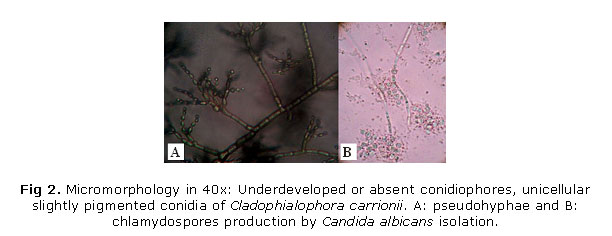
<P><font face="Verdana" size="2">Microscopy of the dark olive-green colonies showed    characteristic dematiaceous septate hyphae, 2 to 5 mm in width, with oval to    elliptical conidia also dark brown color, characteristic of <I>Cladophialophora    carrionii</I> (<a href="/img/revistas/mtr/v62n3/f0214310.jpg">Fig. 2A</a>). In turn, the microculture    of yeast colonies showed chlamydospores and conformation of pseudohyphae characteristic    of <I>Candida albicans</I> (<a href="/img/revistas/mtr/v62n3/f0214310.jpg">Fig. 2B</a>), performing    the role of opportunistic in injury. The characteristics of the lesion presented    also corroborate the description of chromoblastomycosis in accordance with Minotto    et al.<SUP>7</SUP> and Queiroz-Telles et al.<SUP>8</SUP></font>      
<P><font face="Verdana" size="2">The treatment suggested by the general practitioner    was on itraconazole 100 mg daily doses for 6 months. After 40 days of use there    was little improvement. </font>     <P>      <P>      <P><font face="Verdana" size="3"><B>DISCUSSION</B> </font>      <P>      <P><font face="Verdana" size="2">The real prevalence of chromoblastomycosis is    apparently more frequent in immunocompetent patients than in immunosuppressed,    such as those undergoing corticosteroid therapy, diabetes mellitus, transplant    recipients, patients with chronic infectious diseases, patients on chemotherapy,    among others.<SUP>3,9,10</SUP> The isolation of the causative fungi from nature    on several different occasions has added to the demonstration that fungi entry    into the host's body occurred through traumatic inoculation.<SUP>2,3</SUP> In    this condition, notes the prevalence of reported cases in rural workers clinically    healthy, therefore immunocompetent, but who have extensive contact with the    ground in endemic regions where the causative agents are found.<SUP>1</SUP>    </font>     <P><font face="Verdana" size="2">Regarding the geographical epidemiology of chromoblastomycosis,    the frequency of cases occurs in most regions of tropical and subtropical climate    of the planet because the biochemical and physiological characteristics of the    etiologic agents are more easily expressed when associated with these climates.<SUP>2,11,12</SUP>    Based on the correlation between the subtropical climate of the region of Santa    Catarina with the occupation of the patient reported, realizes the importance    of preventive measures against subcutaneous mycoses in any situation of risk,    such as a skin perforation, a tear, or even with scratches vegetable skin-piercing.    The location of the lesion in lower limbs of the patient in study, closely related    to the type of work activity performed, reinforces the hypothesis of traumatic    implantation of the fungus in the tissue to produce this infection.<SUP>1,9,13</SUP>    </font>     ]]></body>
<body><![CDATA[<P><font face="Verdana" size="2">Chromoblastomycosis caused by <I>Fonsecaea pedrosoi</I>    is responsible for most cases of the disease in the southern and southeastern    Brazil, and refractory to various treatments, which is characterized as a chronic    mycosis.<SUP>5,11,14</SUP> However, an incorrect diagnosis often occurs because    of similarities with other causative agents. In cases of more extensive lesions,    the flucytosine is the drug of choice for both etiologic agents, observing a    rapid remission of the disease. But when there are relapses or resistance, the    recommendation is the combination with other drugs, for example, amphotericin    B, itraconazole or thiabendazole, where for a long period (3 to 6 months).<SUP>1</SUP>    </font>     <P><font face="Verdana" size="2">This case is the first report described and discussed    of chromoblastomycosis in Santa Catarina state, southern Brazil. The importance    of the description of cases, as in this study, justified by the need to document    the different patterns of clinical signs that chromoblastomycosis presents.    Lesions are usually chronic for years and, of confusing laboratory diagnosis,    always accompanied by subtherapeutic treatment or by resistance of the etiologic    agent.</font>     <P>      <P>      <P>      <P>      <P>      <P><font face="Verdana" size="3"><B>REFERENCES</B> </font>      <P>      <!-- ref --><P><font face="Verdana" size="2">1. Ameen M. Managing chromoblastomycosis. Trop    Doct. 2010;40:65-7. </font>     <!-- ref --><P><font face="Verdana" size="2">2. Garnica M, Nucci M, Queiroz-Telles F. Difficult    mycoses of the skin: advances in the epidemiology and management of eumycetoma,    phaeohyphomycosis and chromoblastomycosis. Curr Opin Infect Dis. 2009;22:559-63.    </font>     <!-- ref --><P><font face="Verdana" size="2">3. Mart&iacute;nez RL, Tovar LJM. Chromoblastomycosis.    Clin Dermatol. 2007;25:188-94. </font>     <!-- ref --><P><font face="Verdana" size="2">4. Naggie S, Perfect JR. Molds: Hyalohyphomycosis,    phaeohyphomycosis, and zygomycosis. Clin Chest Med. 2009;30:337-53. </font>     <!-- ref --><P><font face="Verdana" size="2">5. Ribeiro EV, Soares AS, Ferreira WM, Cardoso    CG, Naves PLF, Silva Dias MS. Cromoblastomicose: doen&ccedil;a presente na realidade    populacional brasileira. Rev Bras Anal Clin. 2006;38:189-92. </font>     <!-- ref --><P><font face="Verdana" size="2">6. Wilhelmus KR. Climatology of dematiaceous    fungal keratitis. Am J Ophthalmol. 2005;140:1156-7. </font>     <!-- ref --><P><font face="Verdana" size="2">7. Minotto R, Bernardi CD, Mallmann LF, Edelweiss    MI, Scroferneker ML. Chromoblastomycosis: A review of 100 cases in the state    of Rio Grande do Sul, Brazil. J Am Acad Dermatol. 2001;44:585-92. </font>     <!-- ref --><P><font face="Verdana" size="2">8. Queiroz-Telles F, McGinnis MR, Salkin I, Graybill    JR. Subcutaneous mycoses. Infect Dis Clin N Am. 2003;17:59-85. </font>     <!-- ref --><P><font face="Verdana" size="2">9. Vijaya D, Kumar BH. Chromoblastomycosis. Mycoses.    2005;48:82-4. </font>     <!-- ref --><P><font face="Verdana" size="2">10. Esterre P, Queiroz-Telles F. Management of    chromoblastomycosis: novel perspectives. Curr Opin Infect Dis. 2006;19:148-52.    </font>     <!-- ref --><P><font face="Verdana" size="2">11. Lupi O, Tyring SK, McGinnis MR. Tropical    dermatology: fungal tropical diseases. J Am Acad Dermatol. 2005;53:931-51. </font>     <!-- ref --><P><font face="Verdana" size="2">12. Casado YJ, G&oacute;mez SE. Lesiones verrucosas    en la pierna. Piel. 2007;22:33-6. </font>     <!-- ref --><P><font face="Verdana" size="2">13. Najafzadeh MJ, Rezusta A, Cameo MI, Zubiri    ML, Yus MC, Badali H, et al. Successful treatment of chromoblastomycosis of    36 years duration caused by <I>Fonsecaea monophora</I>. Med Mycol. 2009;1:1-4.    </font>     <!-- ref --><P><font face="Verdana" size="2">14. Andrade T, Cury A., Castro L, Hirata M, Hirata    R. Rapid identification of <I>Fonsecaea</I> by duplex polymerase chain reaction    in isolates from patients with chromoblastomycosis. Diag Microbiol Inf Dis.    2007;57:267-72. </font>     <P>     <P>      <P>      <P><font face="Verdana" size="2">Recibido: 27 de enero de 2010.    <br>   </font><font face="Verdana" size="2">Aprobado: 14 de mayo de 2010.</font>     <P>     <P>      ]]></body>
<body><![CDATA[<P>      <P><font face="Verdana" size="2">Dr. <I>Alexandre Meneghello Fuentefria</I>.<I>    </I>Departamento de An&aacute;lises, Universidade Federal do Rio Grande do Sul.    Avenida Ipiranga 2752, Bairro Santana 90610-000 Porto Alegre, RS Brasil. E-mail:    <a href="mailto:alexmf77@gmail.com">alexmf77@gmail.com</a> </font>       ]]></body><back>
<ref-list>
<ref id="B1">
<label>1</label><nlm-citation citation-type="journal">
<person-group person-group-type="author">
<name>
<surname><![CDATA[Ameen]]></surname>
<given-names><![CDATA[M]]></given-names>
</name>
</person-group>
<article-title xml:lang="en"><![CDATA[Managing chromoblastomycosis]]></article-title>
<source><![CDATA[Trop Doct]]></source>
<year>2010</year>
<volume>40</volume>
<page-range>65-7</page-range></nlm-citation>
</ref>
<ref id="B2">
<label>2</label><nlm-citation citation-type="journal">
<person-group person-group-type="author">
<name>
<surname><![CDATA[Garnica]]></surname>
<given-names><![CDATA[M]]></given-names>
</name>
<name>
<surname><![CDATA[Nucci]]></surname>
<given-names><![CDATA[M]]></given-names>
</name>
<name>
<surname><![CDATA[Queiroz-Telles]]></surname>
<given-names><![CDATA[F]]></given-names>
</name>
</person-group>
<article-title xml:lang="en"><![CDATA[Difficult mycoses of the skin: advances in the epidemiology and management of eumycetoma, phaeohyphomycosis and chromoblastomycosis]]></article-title>
<source><![CDATA[Curr Opin Infect Dis]]></source>
<year>2009</year>
<volume>22</volume>
<page-range>559-63</page-range></nlm-citation>
</ref>
<ref id="B3">
<label>3</label><nlm-citation citation-type="journal">
<person-group person-group-type="author">
<name>
<surname><![CDATA[Martínez]]></surname>
<given-names><![CDATA[RL]]></given-names>
</name>
<name>
<surname><![CDATA[Tovar]]></surname>
<given-names><![CDATA[LJM]]></given-names>
</name>
</person-group>
<article-title xml:lang="en"><![CDATA[Chromoblastomycosis]]></article-title>
<source><![CDATA[Clin Dermatol]]></source>
<year>2007</year>
<volume>25</volume>
<page-range>188-94</page-range></nlm-citation>
</ref>
<ref id="B4">
<label>4</label><nlm-citation citation-type="journal">
<person-group person-group-type="author">
<name>
<surname><![CDATA[Naggie]]></surname>
<given-names><![CDATA[S]]></given-names>
</name>
<name>
<surname><![CDATA[Perfect]]></surname>
<given-names><![CDATA[JR]]></given-names>
</name>
</person-group>
<article-title xml:lang="en"><![CDATA[Molds: Hyalohyphomycosis, phaeohyphomycosis, and zygomycosis]]></article-title>
<source><![CDATA[Clin Chest Med]]></source>
<year>2009</year>
<volume>30</volume>
<page-range>337-53</page-range></nlm-citation>
</ref>
<ref id="B5">
<label>5</label><nlm-citation citation-type="journal">
<person-group person-group-type="author">
<name>
<surname><![CDATA[Ribeiro]]></surname>
<given-names><![CDATA[EV]]></given-names>
</name>
<name>
<surname><![CDATA[Soares]]></surname>
<given-names><![CDATA[AS]]></given-names>
</name>
<name>
<surname><![CDATA[Ferreira]]></surname>
<given-names><![CDATA[WM]]></given-names>
</name>
<name>
<surname><![CDATA[Cardoso]]></surname>
<given-names><![CDATA[CG]]></given-names>
</name>
<name>
<surname><![CDATA[Naves]]></surname>
<given-names><![CDATA[PLF]]></given-names>
</name>
<name>
<surname><![CDATA[Silva Dias]]></surname>
<given-names><![CDATA[MS]]></given-names>
</name>
</person-group>
<article-title xml:lang="en"><![CDATA[Cromoblastomicose: doença presente na realidade populacional brasileira]]></article-title>
<source><![CDATA[Rev Bras Anal Clin]]></source>
<year>2006</year>
<volume>38</volume>
<page-range>189-92</page-range></nlm-citation>
</ref>
<ref id="B6">
<label>6</label><nlm-citation citation-type="journal">
<person-group person-group-type="author">
<name>
<surname><![CDATA[Wilhelmus]]></surname>
<given-names><![CDATA[KR]]></given-names>
</name>
</person-group>
<article-title xml:lang="en"><![CDATA[Climatology of dematiaceous fungal keratitis]]></article-title>
<source><![CDATA[Am J Ophthalmol]]></source>
<year>2005</year>
<volume>140</volume>
<page-range>1156-7</page-range></nlm-citation>
</ref>
<ref id="B7">
<label>7</label><nlm-citation citation-type="journal">
<person-group person-group-type="author">
<name>
<surname><![CDATA[Minotto]]></surname>
<given-names><![CDATA[R]]></given-names>
</name>
<name>
<surname><![CDATA[Bernardi]]></surname>
<given-names><![CDATA[CD]]></given-names>
</name>
<name>
<surname><![CDATA[Mallmann]]></surname>
<given-names><![CDATA[LF]]></given-names>
</name>
<name>
<surname><![CDATA[Edelweiss]]></surname>
<given-names><![CDATA[MI]]></given-names>
</name>
<name>
<surname><![CDATA[Scroferneker]]></surname>
<given-names><![CDATA[ML]]></given-names>
</name>
</person-group>
<article-title xml:lang="en"><![CDATA[Chromoblastomycosis: A review of 100 cases in the state of Rio Grande do Sul, Brazil]]></article-title>
<source><![CDATA[J Am Acad Dermatol]]></source>
<year>2001</year>
<volume>44</volume>
<page-range>585-92</page-range></nlm-citation>
</ref>
<ref id="B8">
<label>8</label><nlm-citation citation-type="journal">
<person-group person-group-type="author">
<name>
<surname><![CDATA[Queiroz-Telles]]></surname>
<given-names><![CDATA[F]]></given-names>
</name>
<name>
<surname><![CDATA[McGinnis]]></surname>
<given-names><![CDATA[MR]]></given-names>
</name>
<name>
<surname><![CDATA[Salkin]]></surname>
<given-names><![CDATA[I]]></given-names>
</name>
<name>
<surname><![CDATA[Graybill]]></surname>
<given-names><![CDATA[JR]]></given-names>
</name>
</person-group>
<article-title xml:lang="en"><![CDATA[Subcutaneous mycoses]]></article-title>
<source><![CDATA[Infect Dis Clin N Am]]></source>
<year>2003</year>
<volume>17</volume>
<page-range>59-85</page-range></nlm-citation>
</ref>
<ref id="B9">
<label>9</label><nlm-citation citation-type="journal">
<person-group person-group-type="author">
<name>
<surname><![CDATA[Vijaya]]></surname>
<given-names><![CDATA[D]]></given-names>
</name>
<name>
<surname><![CDATA[Kumar]]></surname>
<given-names><![CDATA[BH]]></given-names>
</name>
</person-group>
<article-title xml:lang="en"><![CDATA[Chromoblastomycosis]]></article-title>
<source><![CDATA[Mycoses]]></source>
<year>2005</year>
<volume>48</volume>
<page-range>82-4</page-range></nlm-citation>
</ref>
<ref id="B10">
<label>10</label><nlm-citation citation-type="journal">
<person-group person-group-type="author">
<name>
<surname><![CDATA[Esterre]]></surname>
<given-names><![CDATA[P]]></given-names>
</name>
<name>
<surname><![CDATA[Queiroz-Telles]]></surname>
<given-names><![CDATA[F]]></given-names>
</name>
</person-group>
<article-title xml:lang="en"><![CDATA[Management of chromoblastomycosis: novel perspectives]]></article-title>
<source><![CDATA[Curr Opin Infect Dis.]]></source>
<year>2006</year>
<volume>19</volume>
<page-range>148-52</page-range></nlm-citation>
</ref>
<ref id="B11">
<label>11</label><nlm-citation citation-type="journal">
<person-group person-group-type="author">
<name>
<surname><![CDATA[Lupi]]></surname>
<given-names><![CDATA[O]]></given-names>
</name>
<name>
<surname><![CDATA[Tyring]]></surname>
<given-names><![CDATA[SK]]></given-names>
</name>
<name>
<surname><![CDATA[McGinnis]]></surname>
<given-names><![CDATA[MR]]></given-names>
</name>
</person-group>
<article-title xml:lang="en"><![CDATA[Tropical dermatology: fungal tropical diseases]]></article-title>
<source><![CDATA[J Am Acad Dermatol]]></source>
<year>2005</year>
<volume>53</volume>
<page-range>931-51</page-range></nlm-citation>
</ref>
<ref id="B12">
<label>12</label><nlm-citation citation-type="journal">
<person-group person-group-type="author">
<name>
<surname><![CDATA[Casado]]></surname>
<given-names><![CDATA[YJ]]></given-names>
</name>
<name>
<surname><![CDATA[Gómez]]></surname>
<given-names><![CDATA[SE]]></given-names>
</name>
</person-group>
<article-title xml:lang="es"><![CDATA[Lesiones verrucosas en la pierna]]></article-title>
<source><![CDATA[Piel]]></source>
<year>2007</year>
<volume>22</volume>
<page-range>33-6</page-range></nlm-citation>
</ref>
<ref id="B13">
<label>13</label><nlm-citation citation-type="journal">
<person-group person-group-type="author">
<name>
<surname><![CDATA[Najafzadeh]]></surname>
<given-names><![CDATA[MJ]]></given-names>
</name>
<name>
<surname><![CDATA[Rezusta]]></surname>
<given-names><![CDATA[A]]></given-names>
</name>
<name>
<surname><![CDATA[Cameo]]></surname>
<given-names><![CDATA[MI]]></given-names>
</name>
<name>
<surname><![CDATA[Zubiri]]></surname>
<given-names><![CDATA[ML]]></given-names>
</name>
<name>
<surname><![CDATA[Yus]]></surname>
<given-names><![CDATA[MC]]></given-names>
</name>
<name>
<surname><![CDATA[Badali]]></surname>
<given-names><![CDATA[H]]></given-names>
</name>
</person-group>
<article-title xml:lang="en"><![CDATA[Successful treatment of chromoblastomycosis of 36 years duration caused by Fonsecaea monophora]]></article-title>
<source><![CDATA[Med Mycol]]></source>
<year>2009</year>
<volume>1</volume>
<page-range>1-4</page-range></nlm-citation>
</ref>
<ref id="B14">
<label>14</label><nlm-citation citation-type="journal">
<person-group person-group-type="author">
<name>
<surname><![CDATA[Andrade]]></surname>
<given-names><![CDATA[T]]></given-names>
</name>
<name>
<surname><![CDATA[Cury]]></surname>
<given-names><![CDATA[A]]></given-names>
</name>
<name>
<surname><![CDATA[Castro]]></surname>
<given-names><![CDATA[L]]></given-names>
</name>
<name>
<surname><![CDATA[Hirata]]></surname>
<given-names><![CDATA[M]]></given-names>
</name>
<name>
<surname><![CDATA[Hirata]]></surname>
<given-names><![CDATA[R]]></given-names>
</name>
</person-group>
<article-title xml:lang="en"><![CDATA[Rapid identification of Fonsecaea by duplex polymerase chain reaction in isolates from patients with chromoblastomycosis]]></article-title>
<source><![CDATA[Diag Microbiol Inf Dis]]></source>
<year>2007</year>
<volume>57</volume>
<page-range>267-72</page-range></nlm-citation>
</ref>
</ref-list>
</back>
</article>