<?xml version="1.0" encoding="ISO-8859-1"?><article xmlns:mml="http://www.w3.org/1998/Math/MathML" xmlns:xlink="http://www.w3.org/1999/xlink" xmlns:xsi="http://www.w3.org/2001/XMLSchema-instance">
<front>
<journal-meta>
<journal-id>0864-0289</journal-id>
<journal-title><![CDATA[Revista Cubana de Hematología, Inmunología y Hemoterapia]]></journal-title>
<abbrev-journal-title><![CDATA[Rev Cubana Hematol Inmunol Hemoter]]></abbrev-journal-title>
<issn>0864-0289</issn>
<publisher>
<publisher-name><![CDATA[Centro Nacional de Información de Ciencias MédicasEditorial Ciencias Médicas]]></publisher-name>
</publisher>
</journal-meta>
<article-meta>
<article-id>S0864-02891999000200003</article-id>
<title-group>
<article-title xml:lang="es"><![CDATA[Aportes al estudio de la drepanocitosis: Análisis clínico y hematológico en los primeros 5 años de la vida]]></article-title>
<article-title xml:lang="en"><![CDATA[Contributions to the study of drepanocytosis: Clinical and hematological analysis in the first 5 years of life]]></article-title>
</title-group>
<contrib-group>
<contrib contrib-type="author">
<name>
<surname><![CDATA[García Peralta]]></surname>
<given-names><![CDATA[Tania]]></given-names>
</name>
<xref ref-type="aff" rid="A01"/>
</contrib>
<contrib contrib-type="author">
<name>
<surname><![CDATA[Nordet Carrera]]></surname>
<given-names><![CDATA[Ileana]]></given-names>
</name>
<xref ref-type="aff" rid="A02"/>
</contrib>
<contrib contrib-type="author">
<name>
<surname><![CDATA[Machín García]]></surname>
<given-names><![CDATA[Sergio]]></given-names>
</name>
</contrib>
<contrib contrib-type="author">
<name>
<surname><![CDATA[González Otero]]></surname>
<given-names><![CDATA[Alejandro]]></given-names>
</name>
</contrib>
<contrib contrib-type="author">
<name>
<surname><![CDATA[Muñiz Fernández]]></surname>
<given-names><![CDATA[Adriana]]></given-names>
</name>
</contrib>
<contrib contrib-type="author">
<name>
<surname><![CDATA[Martínez Antuña]]></surname>
<given-names><![CDATA[Gisela]]></given-names>
</name>
</contrib>
<contrib contrib-type="author">
<name>
<surname><![CDATA[Wade Mateo]]></surname>
<given-names><![CDATA[Maura]]></given-names>
</name>
</contrib>
<contrib contrib-type="author">
<name>
<surname><![CDATA[Svarch]]></surname>
<given-names><![CDATA[Eva]]></given-names>
</name>
</contrib>
</contrib-group>
<aff id="A01">
<institution><![CDATA[,Instituto de Hematología e Inmunología  ]]></institution>
<addr-line><![CDATA[Ciudad de La Habana ]]></addr-line>
<country>Cuba</country>
</aff>
<aff id="A02">
<institution><![CDATA[,Instituto Nacional de Higiene, Epidemiología y Microbiología  ]]></institution>
<addr-line><![CDATA[ ]]></addr-line>
</aff>
<pub-date pub-type="pub">
<day>00</day>
<month>08</month>
<year>1999</year>
</pub-date>
<pub-date pub-type="epub">
<day>00</day>
<month>08</month>
<year>1999</year>
</pub-date>
<volume>15</volume>
<numero>2</numero>
<fpage>96</fpage>
<lpage>104</lpage>
<copyright-statement/>
<copyright-year/>
<self-uri xlink:href="http://scielo.sld.cu/scielo.php?script=sci_arttext&amp;pid=S0864-02891999000200003&amp;lng=en&amp;nrm=iso"></self-uri><self-uri xlink:href="http://scielo.sld.cu/scielo.php?script=sci_abstract&amp;pid=S0864-02891999000200003&amp;lng=en&amp;nrm=iso"></self-uri><self-uri xlink:href="http://scielo.sld.cu/scielo.php?script=sci_pdf&amp;pid=S0864-02891999000200003&amp;lng=en&amp;nrm=iso"></self-uri><abstract abstract-type="short" xml:lang="es"><p><![CDATA[Se estudiaron 104 pacientes menores de 6 años de edad. En el 93,1 % el diagnóstico se hizo antes del primer año de la vida y en el 47,6 % fue prenatal. La mediana de seguimiento fue de 31 meses (1-108). La mayor incidencia de eventos clínicos en la anemia drepanocítica (AD) ocurrió entre 1y 3 años. El 91,6 % de las infecciones fueron pulmonares y el 21,7 % de los cuadros respiratorios se catalogaron como síndrome torácico agudo. Los eventos en la hemoglobinopatía SC (HSC) fueron menos frecuentes que en la AD. Sólo 1 paciente falleció en los casi 10 años transcurridos desde que se inició el estudio. La hemoglobina y la hemoglobina fetal (HbF) estuvieron más altas en el sexo femenino en la AD. Los haplotipos del bloque de genes b más frecuentes fueron el Benin y el Bantú. Se constató una frecuencia de a talasemia de 23,8 % en la AD y de 23,07 % en la HSC. No existió correlación entre los haplotipos Bantú y no Bantú y la a talasemia con las manifestaciones clínicas ni con los parámetros hematológicos. El seguimiento sistemático de los pacientes desde temprano en la vida disminuye la mortalidad en este período]]></p></abstract>
<abstract abstract-type="short" xml:lang="en"><p><![CDATA[104 patients under 6 were studied. In 93,1 % of them the diagnosis was made before the first year of life, whereas in 47.6 % it was prenatal. The median of follow-up was 31 months (1-108). The highest incidence of clinical events in sickle cell anemia (SCA) occurred between 1 and 3 years old. 91.6 % of the infections were pulmonary and 21.7 % of the respiratory episodes were considered as acute chest syndrome. The events in hemoglobinopathy SC (HSC) were less frequent than in sickle cell anemia. Only one patient died in a period of almost 10 years since the study began. Hemoglobin and fetal hemoglobin (HbF) were higher among females with SCA. The commonest haplotypes of the block of genes b were Benin and Bantu. It was observed a frequency of thalassemia of 23.8 % in sickle cell anemia and of 23.7 % in HSC. Bantu and non-Bantu haplotypes and a thalassemia were not associated with the clinical manifestations or with the hematological parameters. The systematic follow-up of the patients since the first years of life reduces mortality in this period]]></p></abstract>
<kwd-group>
<kwd lng="es"><![CDATA[ANEMIA DE CELULAS FALCIFORMES]]></kwd>
<kwd lng="es"><![CDATA[ENFERMEDAD DE LA HEMOGLOBINA SC]]></kwd>
<kwd lng="es"><![CDATA[BETATALASEMIA]]></kwd>
<kwd lng="en"><![CDATA[ANEMIA, SICKLE CELL]]></kwd>
<kwd lng="en"><![CDATA[HEMOGLOBIN C]]></kwd>
<kwd lng="en"><![CDATA[BETA-THALASSEMIA]]></kwd>
</kwd-group>
</article-meta>
</front><body><![CDATA[ <h3> Art&iacute;culos originales</h3>Instituto de Hematolog&iacute;a e Inmunolog&iacute;a  <h2> Aportes al estudio de la drepanocitosis. An&aacute;lisis cl&iacute;nico y  hematol&oacute;gico en los primeros 5 a&ntilde;os de la vida</h2><i><a href="*">Dra.  Tania Garc&iacute;a Peralta,<sup>1</sup> Dra. Ileana Nordet Carrera,<sup>1</sup>  Dr. Sergio Mach&iacute;n Garc&iacute;a,<sup>1</sup> Dr. Alejandro Gonz&aacute;lez  Otero,<sup>1</sup> Lic. Adriana Mu&ntilde;iz Fern&aacute;ndez,<sup>1</sup> Lic.  Gisela Mart&iacute;nez Antu&ntilde;a,<sup>1</sup> Dra. Maura Wade Mateo<sup>2</sup>  y Dra. Eva Svarch<sup>1</sup></a></i> <h4> Resumen</h4>Se estudiaron 104 pacientes  menores de 6 a&ntilde;os de edad. En el 93,1 % el diagn&oacute;stico se hizo antes  del primer a&ntilde;o de la vida y en el 47,6 % fue prenatal. La mediana de seguimiento  fue de 31 meses (1-108). La mayor incidencia de eventos cl&iacute;nicos en la  anemia drepanoc&iacute;tica (AD) ocurri&oacute; entre 1y 3 a&ntilde;os. El 91,6  % de las infecciones fueron pulmonares y el 21,7 % de los cuadros respiratorios  se catalogaron como s&iacute;ndrome tor&aacute;cico agudo. Los eventos en la hemoglobinopat&iacute;a  SC (HSC) fueron menos frecuentes que en la AD. S&oacute;lo 1 paciente falleci&oacute;  en los casi 10 a&ntilde;os transcurridos desde que se inici&oacute; el estudio.  La hemoglobina y la hemoglobina fetal (HbF) estuvieron m&aacute;s altas en el  sexo femenino en la AD. Los haplotipos del bloque de genes b m&aacute;s frecuentes  fueron el Benin y el Bant&uacute;. Se constat&oacute; una frecuencia de a talasemia  de 23,8 % en la AD y de 23,07 % en la HSC. No existi&oacute; correlaci&oacute;n  entre los haplotipos Bant&uacute; y no Bant&uacute; y la a talasemia con las manifestaciones  cl&iacute;nicas ni con los par&aacute;metros hematol&oacute;gicos. El seguimiento  sistem&aacute;tico de los pacientes desde temprano en la vida disminuye la mortalidad  en este per&iacute;odo.     <p><i>Descriptores DeCS</i>: ANEMIA DE CELULAS FALCIFORMES/sangre;  ENFERMEDAD DE LA HEMOGLOBINA SC/sangre; BETATALASEMIA/sangre.     <p>La drepanocitosis,  que incluye la anemia drepanoc&iacute;tica (AD), la hemoglo-binopat&iacute;a SC  (HSC) y la S b talasemia (Sbtal) y otras combinaciones de la hemoglobina S (HbS)  con hemoglobinas anormales, es la enfermedad de car&aacute;cter gen&eacute;tico  m&aacute;s frecuente en el mundo.     <p>Su prevalencia es alta en &Aacute;frica Ecuatorial,  pero se encuentra tambi&eacute;n en la cuenca del Mediterr&aacute;neo, en regiones  de la India y Arabia Saudita y en las poblaciones de origen africano de los Estados  Unidos de Norteam&eacute;rica, Am&eacute;rica Central, el Caribe y algunos pa&iacute;ses  de Am&eacute;rica del Sur. En Cuba, la incidencia del estado del portador (AS)  es del 3 % en la poblaci&oacute;n general y del 6 % en la negra y mestiza.1     <p>La  drepanocitosis es considerada un problema de salud p&uacute;blica en muchos pa&iacute;ses.      <p>Aunque su fisiopatolog&iacute;a se ha estudiado profundamente, no se conoce  en la actualidad ning&uacute;n tratamiento eficaz e inocuo que prevenga todas  las manifestaciones cl&iacute;nicas. S&oacute;lo con el trasplante de m&eacute;dula  &oacute;sea se puede lograr la curaci&oacute;n, pero este procedimiento tiene  todav&iacute;a una alta morbiletalidad y costo, por lo que es imposible su aplicaci&oacute;n  en todos los pacientes.     <p>El objetivo de este trabajo es exponer los datos cl&iacute;nicos  y hematol&oacute;gicos de los ni&ntilde;os con drepanocitosis atendidos en sus  primeros a&ntilde;os de vida en la consulta de hemoglobinopat&iacute;as del Instituto  de Hematolog&iacute;a e Inmunolog&iacute;a (IHI) y correlacionarlos con la hemoglobina  fetal (HbF), los haplotipos del bloque de genes b y la a talasemia.     <br>&nbsp;  <h4> M&eacute;todos</h4>En el per&iacute;odo comprendido entre junio de 1986 y  abril de 1995 se atendieron en la consulta de hemoglobinopat&iacute;as del IHI,  104 ni&ntilde;os menores de 6 a&ntilde;os de edad; 53 del sexo masculino y 51  del femenino; 69 con AD, 28 con HSC, 6 con Sb 0tal y con Sb +tal.     <p>En la mayor&iacute;a  de los pacientes se realiz&oacute; el diagn&oacute;stico prenatal y fueron enviados  por los m&eacute;dicos de la consulta de Gen&eacute;tica del Hospital Ginecoobst&eacute;trico  &laquo;Ram&oacute;n Gonz&aacute;lez Coro&raquo;.     <p>No se estudi&oacute; ning&uacute;n  ni&ntilde;o con m&aacute;s de 2 a&ntilde;os de edad en el momento de la primera  consulta. El seguimiento fue mensual en el primer a&ntilde;o de edad y despu&eacute;s  cada 3 meses.     ]]></body>
<body><![CDATA[<p>En cada consulta se realiz&oacute; un interrogatorio minucioso  sobre las manifestaciones cl&iacute;nicas ocurridas en el intervalo entre las  mismas.     <p>En los enfermos en quienes no se hizo el diagn&oacute;stico prenatal  y por lo tanto, comenzaron a ser atendidos en nuestra consulta en diferentes etapas  de su vida, en el primer encuentro se llev&oacute; a cabo un interrogatorio exhaustivo  sobre todos los eventos que ocurrieron en el per&iacute;odo anterior. No se incluy&oacute;  a ning&uacute;n paciente en el que no se hubiera podido determinar el cuadro cl&iacute;nico  anterior a su primera consulta.     <p>En cada entrevista se realiz&oacute; un examen  f&iacute;sico cuidadoso. A partir de los 3 meses de edad se administr&oacute;  &aacute;cido f&oacute;lico (5 mg al d&iacute;a) y penicilina oral profil&aacute;ctica  (125 mg 2 veces al d&iacute;a) a los ni&ntilde;os menores de 3 a&ntilde;os; en  los ni&ntilde;os entre 3 y 5 a&ntilde;os, la dosis de la penicilina oral fue de  250 mg 2 veces al d&iacute;a.     <p>En cada consulta se realiz&oacute; una labor  de educaci&oacute;n y en la primera entrevista se le entreg&oacute; a la madre  un folleto realizado en nuestra instituci&oacute;n en el que se explican las caracter&iacute;sticas  m&aacute;s importantes de la enfermedad y su manejo. Se ense&ntilde;&oacute; a  la madre a palpar el bazo y a que acudiera al centro asistencial si notaba un  aumento de tama&ntilde;o de &eacute;ste, acentuaci&oacute;n de la palidez, irritabilidad  y fiebre.     <p>Se insisti&oacute; en la importancia de la ingesti&oacute;n abundante  de l&iacute;quidos y de evitar esfuerzos f&iacute;sicos excesivos, as&iacute;  como los cambios bruscos de temperatura.     <p>Los ex&aacute;menes de laboratorio  de realizaron por las t&eacute;cnicas habituales y la HbF por el m&eacute;todo  de Betke.2     <p>En 96 pacientes se determinaron los haplotipos del bloque de genes  b3 (se excluyeron de este estudio los haplotipos sanos) y en 35 los genes a.4      <p>El hemograma y los reticulocitos se hicieron en cada consulta y la HbF se realiz&oacute;  anualmente. Todas las investigaciones de laboratorio se llevaron a cabo en condiciones  basales, sin crisis en los 15 d&iacute;as previos ni transfusiones en los 3 meses  anteriores.     <p>Para procesar los datos se utiliz&oacute; el paquete estad&iacute;stico  para computadora Epinfo versi&oacute;n 5 y el Statgraf versi&oacute;n 2.3. Se  emplearon los siguientes intervalos de edad en ni&ntilde;os: &lt; 1, 1, 2, 3,  4 y 5.     <p>El an&aacute;lisis estad&iacute;stico se realiz&oacute; por medio del  c&aacute;lculo de las distribuciones de frecuencia de las variables cualitativas:  sexo, haplotipos y genes a. Se correlacionaron los haplotipos divididos en 2 grupos:  Bant&uacute; y no Bant&uacute;; y los genes a con los eventos cl&iacute;nicos,  las cifras de hemoglobina y HbF, por medio del coeficiente de correlaci&oacute;n  de Pearson.     ]]></body>
<body><![CDATA[<p>Para las variables cuantitativas se calcul&oacute; la media (X)  y la desviaci&oacute;n est&aacute;ndar (DE). Se realiz&oacute; un resumen donde  se contabiliz&oacute; el total de eventos cl&iacute;nicos acumulados por cada  paciente desde el nacimiento hasta la &uacute;ltima consulta.     <p>Se aplic&oacute;  el an&aacute;lisis de varianza (Anova), clasificaci&oacute;n simple o la prueba  de Kruskell-Wallis5 para comparar los grupos con AD y HSC. No se incluy&oacute;  la Sbtal por el escaso n&uacute;mero de pacientes. El nivel de significaci&oacute;n  fue del 5 % en todos los casos. <h4> Resultados</h4>En el 93,1 % de los pacientes  se diagnostic&oacute; la enfermedad en el primer a&ntilde;o de la vida, en el  47,6 % &eacute;ste fue prenatal y el 55,8 % acudi&oacute; a la primera consulta  en ese per&iacute;odo.     <p>La mediana de seguimiento fue de 31 meses (1-108).     <p>En  la tabla 1 se muestra la media y la desviaci&oacute;n est&aacute;ndar de los eventos  cl&iacute;nicos por a&ntilde;o de edad en la AD. En los ni&ntilde;os menores de  1 a&ntilde;o hubo una cantidad menor de eventos que en el resto. En todos se encontraron  diferencias significativas, con una incidencia mayor de 1 a 3 a&ntilde;os en la  mayor&iacute;a de ellos. El 91,6 % de las infecciones fueron pulmonares y el 5,6  % fueron episodios febriles de m&aacute;s de 7 d&iacute;as de duraci&oacute;n,  sin signos de localizaci&oacute;n. El 21,7 % de los cuadros respiratorios agudos  se catalogaron como s&iacute;ndrome tor&aacute;cico agudo. Las crisis mano-pie  disminuyeron a los 4 a&ntilde;os y no se produjeron a los 5. Tampoco se comprobaron  crisis de secuestro espl&eacute;nico a los 4 y 5 a&ntilde;os y probablemente por  esta raz&oacute;n se registraron pocas transfusiones es ese lapso.     <p>     <center>Tabla  1<i>. Eventos cl&iacute;nicos por edad en 69 ni&ntilde;os con anemia drepanoc&iacute;tica</i></center>    <center><table CELLPADDING=5 >  <tr> <td VALIGN=TOP COLSPAN="20">     <center>Edad (a&ntilde;os)</center></td></tr>  <tr> <td VALIGN=TOP WIDTH="6%">&nbsp;</td><td VALIGN=TOP COLSPAN="2" WIDTH="12%">     <center>&lt;  1</center></td><td VALIGN=TOP COLSPAN="3" WIDTH="13%">     <center>1</center></td><td VALIGN=TOP COLSPAN="3" WIDTH="14%">      ]]></body>
<body><![CDATA[<center>2</center></td><td VALIGN=TOP COLSPAN="3" WIDTH="14%">     <center>3</center></td><td VALIGN=TOP COLSPAN="3" WIDTH="14%">      <center>4</center></td><td VALIGN=TOP COLSPAN="3" WIDTH="14%">     <center>5</center></td><td VALIGN=TOP COLSPAN="2" WIDTH="12%">&nbsp;</td></tr>  <tr> <td VALIGN=TOP WIDTH="6%">Eventos</td><td VALIGN=TOP WIDTH="6%"><img SRC="/img/revistas/hih/v15n2/x.gif" height=15 width=13></td><td VALIGN=TOP COLSPAN="2" WIDTH="7%">DE&nbsp;</td><td VALIGN=TOP WIDTH="7%"><img SRC="/img/revistas/hih/v15n2/x.gif" height=15 width=13></td><td VALIGN=TOP COLSPAN="2" WIDTH="6%">DE&nbsp;</td><td VALIGN=TOP WIDTH="7%"><img SRC="/img/revistas/hih/v15n2/x.gif" height=15 width=13></td><td VALIGN=TOP COLSPAN="2" WIDTH="7%">DE&nbsp;</td><td VALIGN=TOP WIDTH="7%"><img SRC="/img/revistas/hih/v15n2/x.gif" height=15 width=13></td><td VALIGN=TOP COLSPAN="2" WIDTH="7%">DE&nbsp;</td><td VALIGN=TOP WIDTH="7%"><img SRC="/img/revistas/hih/v15n2/x.gif" height=15 width=13></td><td VALIGN=TOP COLSPAN="2" WIDTH="7%">DE&nbsp;</td><td VALIGN=TOP WIDTH="7%"><img SRC="/img/revistas/hih/v15n2/x.gif" height=15 width=13></td><td VALIGN=TOP COLSPAN="2" WIDTH="7%">DE</td><td VALIGN=TOP WIDTH="11%">p</td></tr>  <tr> <td VALIGN=TOP WIDTH="6%">Ingresos</td><td VALIGN=TOP WIDTH="6%">     
<center>0,16</center></td><td VALIGN=TOP COLSPAN="2" WIDTH="7%">      <center>0,4</center></td><td VALIGN=TOP WIDTH="7%">     <center>0,48</center></td><td VALIGN=TOP COLSPAN="2" WIDTH="6%">      <center>0,9</center></td><td VALIGN=TOP WIDTH="7%">     <center>0,47</center></td><td VALIGN=TOP COLSPAN="2" WIDTH="7%">      <center>0,8</center></td><td VALIGN=TOP WIDTH="7%">     ]]></body>
<body><![CDATA[<center>0,51</center></td><td VALIGN=TOP COLSPAN="2" WIDTH="7%">      <center>2,0</center></td><td VALIGN=TOP WIDTH="7%">     <center>0,20</center></td><td VALIGN=TOP COLSPAN="2" WIDTH="7%">      <center>0,4</center></td><td VALIGN=TOP WIDTH="7%">     <center>0,45</center></td><td VALIGN=TOP COLSPAN="2" WIDTH="7%">      <center>1,7</center></td><td VALIGN=TOP WIDTH="11%">     <center>0,0003</center></td></tr>  <tr> <td VALIGN=TOP WIDTH="6%">Infecciones</td><td VALIGN=TOP WIDTH="6%">     <center>0,10</center></td><td VALIGN=TOP COLSPAN="2" WIDTH="7%">      <center>0,3</center></td><td VALIGN=TOP WIDTH="7%">     <center>0,20</center></td><td VALIGN=TOP COLSPAN="2" WIDTH="6%">      ]]></body>
<body><![CDATA[<center>0,4</center></td><td VALIGN=TOP WIDTH="7%">     <center>0,17</center></td><td VALIGN=TOP COLSPAN="2" WIDTH="7%">      <center>0,4</center></td><td VALIGN=TOP WIDTH="7%">     <center>0,16</center></td><td VALIGN=TOP COLSPAN="2" WIDTH="7%">      <center>0,4</center></td><td VALIGN=TOP WIDTH="7%">     <center>0,15</center></td><td VALIGN=TOP COLSPAN="2" WIDTH="7%">      <center>0,4</center></td><td VALIGN=TOP WIDTH="7%">     <center>0,07</center></td><td VALIGN=TOP COLSPAN="2" WIDTH="7%">      <center>0,2</center></td><td VALIGN=TOP WIDTH="11%">     <center>0,05</center></td></tr>  <tr> <td VALIGN=TOP WIDTH="6%">Crisis vasooclu-</td><td VALIGN=TOP WIDTH="6%">&nbsp;</td><td VALIGN=TOP COLSPAN="2" WIDTH="7%">&nbsp;</td><td VALIGN=TOP WIDTH="7%">&nbsp;</td><td VALIGN=TOP COLSPAN="2" WIDTH="6%">&nbsp;</td><td VALIGN=TOP WIDTH="7%">&nbsp;</td><td VALIGN=TOP COLSPAN="2" WIDTH="7%">&nbsp;</td><td VALIGN=TOP WIDTH="7%">&nbsp;</td><td VALIGN=TOP COLSPAN="2" WIDTH="7%">&nbsp;</td><td VALIGN=TOP WIDTH="7%">&nbsp;</td><td VALIGN=TOP COLSPAN="2" WIDTH="7%">&nbsp;</td><td VALIGN=TOP WIDTH="7%">&nbsp;</td><td VALIGN=TOP COLSPAN="2" WIDTH="7%">&nbsp;</td><td VALIGN=TOP WIDTH="11%">&nbsp;</td></tr>  <tr> <td VALIGN=TOP WIDTH="6%">sivas</td><td VALIGN=TOP WIDTH="6%">     ]]></body>
<body><![CDATA[<center>0,02</center></td><td VALIGN=TOP COLSPAN="2" WIDTH="7%">      <center>0,2</center></td><td VALIGN=TOP WIDTH="7%">     <center>0,18</center></td><td VALIGN=TOP COLSPAN="2" WIDTH="6%">      <center>0,7</center></td><td VALIGN=TOP WIDTH="7%">     <center>0,19</center></td><td VALIGN=TOP COLSPAN="2" WIDTH="7%">      <center>0,5</center></td><td VALIGN=TOP WIDTH="7%">     <center>0,25</center></td><td VALIGN=TOP COLSPAN="2" WIDTH="7%">      <center>0,6</center></td><td VALIGN=TOP WIDTH="7%">     <center>0,19</center></td><td VALIGN=TOP COLSPAN="2" WIDTH="7%">      <center>0,5</center></td><td VALIGN=TOP WIDTH="7%">     ]]></body>
<body><![CDATA[<center>0,25</center></td><td VALIGN=TOP COLSPAN="2" WIDTH="7%">      <center>0,4</center></td><td VALIGN=TOP WIDTH="11%">     <center>0,004</center></td></tr>  <tr> <td VALIGN=TOP WIDTH="6%">Crisis mano-pie</td><td VALIGN=TOP WIDTH="6%">      <center>0,02</center></td><td VALIGN=TOP COLSPAN="2" WIDTH="7%">     <center>0,2</center></td><td VALIGN=TOP WIDTH="7%">      <center>0,12</center></td><td VALIGN=TOP COLSPAN="2" WIDTH="6%">     <center>0,4</center></td><td VALIGN=TOP WIDTH="7%">      <center>0,15</center></td><td VALIGN=TOP COLSPAN="2" WIDTH="7%">     <center>0,5</center></td><td VALIGN=TOP WIDTH="7%">      <center>0,08</center></td><td VALIGN=TOP COLSPAN="2" WIDTH="7%">     ]]></body>
<body><![CDATA[<center>0,5</center></td><td VALIGN=TOP WIDTH="7%">      <center>0,01</center></td><td VALIGN=TOP COLSPAN="2" WIDTH="7%">     <center>0,2</center></td><td VALIGN=TOP WIDTH="7%">      <center>-</center></td><td VALIGN=TOP COLSPAN="2" WIDTH="7%">     <center>-</center></td><td VALIGN=TOP WIDTH="11%">      <center>0,00008</center></td></tr> <tr> <td VALIGN=TOP WIDTH="6%">Crisis de secues-</td><td VALIGN=TOP WIDTH="6%">&nbsp;</td><td VALIGN=TOP COLSPAN="2" WIDTH="7%">&nbsp;</td><td VALIGN=TOP WIDTH="7%">&nbsp;</td><td VALIGN=TOP COLSPAN="2" WIDTH="6%">&nbsp;</td><td VALIGN=TOP WIDTH="7%">&nbsp;</td><td VALIGN=TOP COLSPAN="2" WIDTH="7%">&nbsp;</td><td VALIGN=TOP WIDTH="7%">&nbsp;</td><td VALIGN=TOP COLSPAN="2" WIDTH="7%">&nbsp;</td><td VALIGN=TOP WIDTH="7%">&nbsp;</td><td VALIGN=TOP COLSPAN="2" WIDTH="7%">&nbsp;</td><td VALIGN=TOP WIDTH="7%">&nbsp;</td><td VALIGN=TOP COLSPAN="2" WIDTH="7%">&nbsp;</td><td VALIGN=TOP WIDTH="11%">&nbsp;</td></tr>  <tr> <td VALIGN=TOP WIDTH="6%">tro espl&eacute;nico</td><td VALIGN=TOP WIDTH="6%">      <center>0,03</center></td><td VALIGN=TOP COLSPAN="2" WIDTH="7%">     <center>0,2</center></td><td VALIGN=TOP WIDTH="7%">      <center>0,18</center></td><td VALIGN=TOP COLSPAN="2" WIDTH="6%">     <center>0,7</center></td><td VALIGN=TOP WIDTH="7%">      ]]></body>
<body><![CDATA[<center>0,13</center></td><td VALIGN=TOP COLSPAN="2" WIDTH="7%">     <center>0,6</center></td><td VALIGN=TOP WIDTH="7%">      <center>0,16</center></td><td VALIGN=TOP COLSPAN="2" WIDTH="7%">     <center>1,3</center></td><td VALIGN=TOP WIDTH="7%">      <center>0,01</center></td><td VALIGN=TOP COLSPAN="2" WIDTH="7%">     <center>0,1</center></td><td VALIGN=TOP WIDTH="7%">      <center>-</center></td><td VALIGN=TOP COLSPAN="2" WIDTH="7%">     <center>-</center></td><td VALIGN=TOP WIDTH="11%">      <center>0,0006</center></td></tr> <tr> <td VALIGN=TOP WIDTH="6%">Transfusiones</td><td VALIGN=TOP WIDTH="6%">      <center>0,06</center></td><td VALIGN=TOP COLSPAN="2" WIDTH="7%">     ]]></body>
<body><![CDATA[<center>0,3</center></td><td VALIGN=TOP WIDTH="7%">      <center>0,32</center></td><td VALIGN=TOP COLSPAN="2" WIDTH="6%">     <center>0,9</center></td><td VALIGN=TOP WIDTH="7%">      <center>0,23</center></td><td VALIGN=TOP COLSPAN="2" WIDTH="7%">     <center>0,7</center></td><td VALIGN=TOP WIDTH="7%">      <center>0,24</center></td><td VALIGN=TOP COLSPAN="2" WIDTH="7%">     <center>1,3</center></td><td VALIGN=TOP WIDTH="7%">      <center>0,04</center></td><td VALIGN=TOP COLSPAN="2" WIDTH="7%">     <center>0,2</center></td><td VALIGN=TOP WIDTH="7%">      <center>0,05</center></td><td VALIGN=TOP COLSPAN="2" WIDTH="7%">     ]]></body>
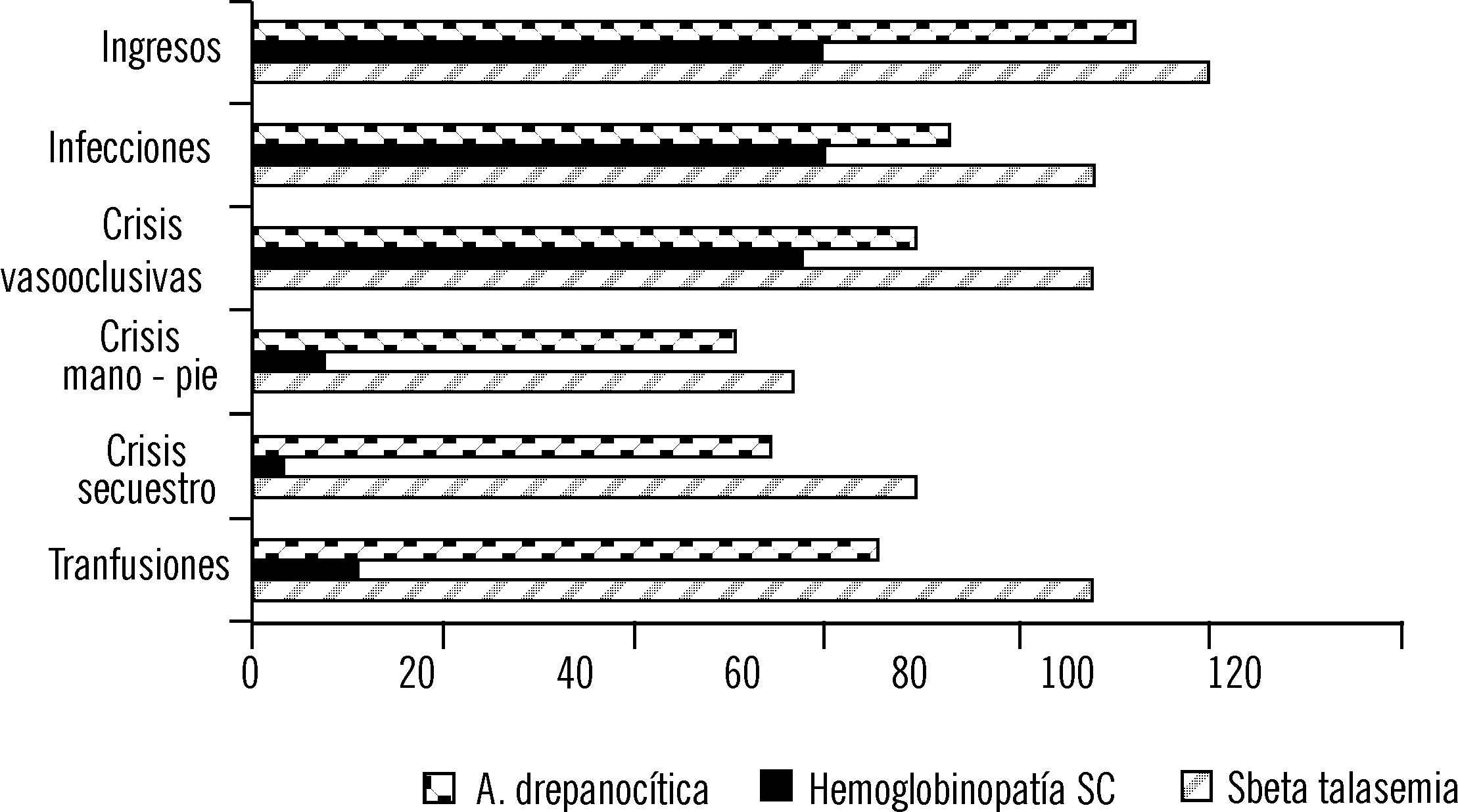
<body><![CDATA[<center>0,2</center></td><td VALIGN=TOP WIDTH="11%">      <center>0,00006</center></td></tr> </table></center>    <br>&nbsp;     <p>Los ingresos,  las manifestaciones cl&iacute;nicas y las transfusiones, fueron menos frecuentes  en la HSC que en la AD. El 98,7 % de los procesos infecciosos fueron pulmonares  y el diagn&oacute;stico de s&iacute;ndrome tor&aacute;cico agudo se plante&oacute;  en el 10 % de los ni&ntilde;os. Se produjeron pocas crisis mano-pie y s&oacute;lo  un paciente tuvo una crisis de secuestro espl&eacute;nico. Hubo variaciones entre  los a&ntilde;os, que no mostraron diferencias significativas, salvo las transfusiones.      <p>En la Sb tal no hubo pacientes menores de un a&ntilde;o ni de 4 y 5 a&ntilde;os;  los ni&ntilde;os de un a&ntilde;o no tuvieron manifestaciones cl&iacute;nicas.  No se produjeron crisis de secuestro espl&eacute;nico ni se indicaron transfusiones  a los 2 a&ntilde;os de edad. A los 3 a&ntilde;os no se registraron crisis vasooclusivas  (CVO) ni crisis mano-pie.     <p>Un resumen de todos los eventos en los primeros 5  a&ntilde;os de la vida se presenta en la figura 1. En ninguno de los 104 pacientes  se present&oacute; CVO del SNC en el per&iacute;odo del estudio.     <center>     <p><a href="/img/revistas/hih/v15n2/f0103299.gif"><img SRC="/img/revistas/hih/v15n2/f0103299.gif" ALT="Figura1" BORDER=1 height=126 width=226></a>      
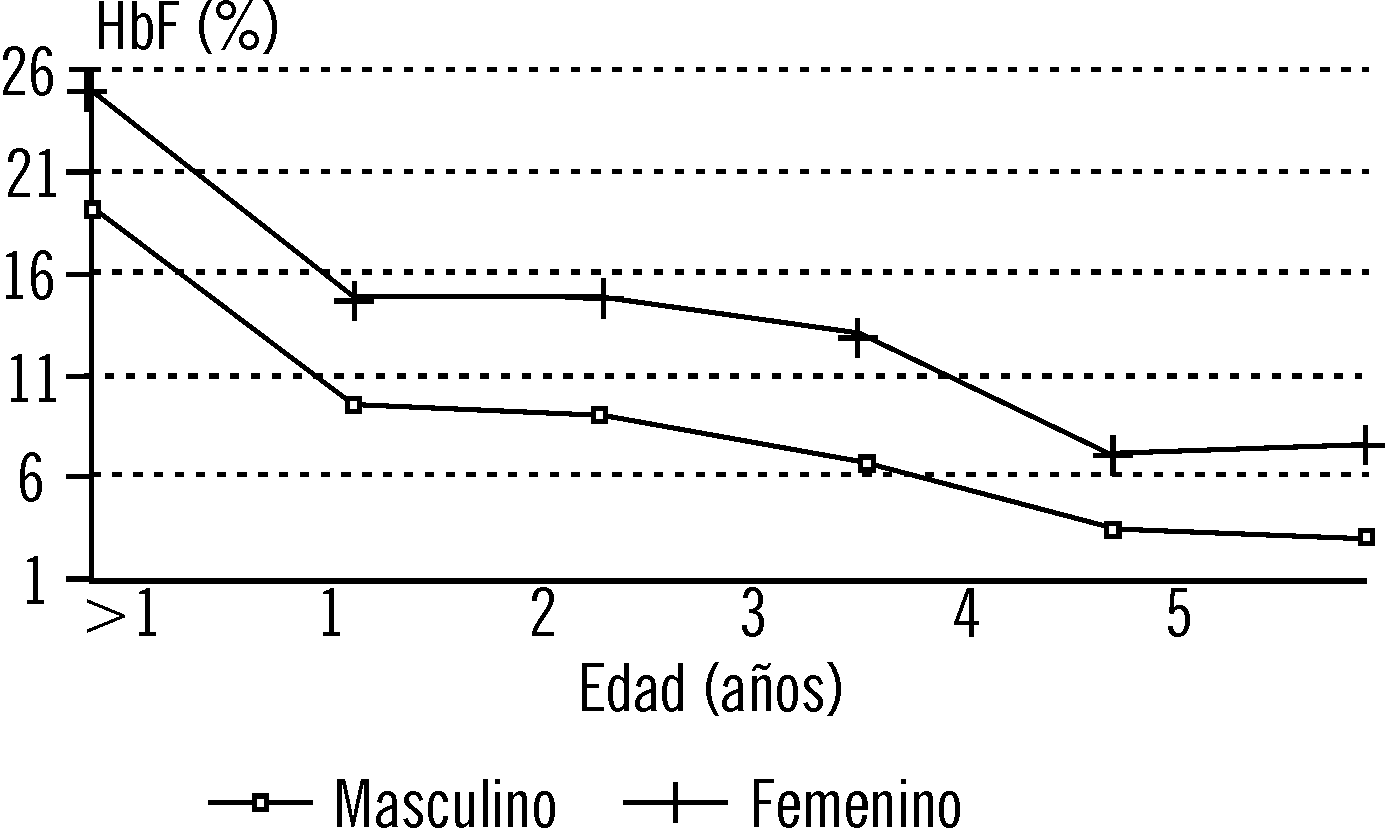
<p>Fig. 1: <i>Porcentaje de pacientes que presentaron eventos cl&iacute;nicos  en la drepanocitosis.</i></center>    <p>Los valores de hemoglobina en el sexo femenino  en los pacientes con AD estuvieron significativamente m&aacute;s elevados que  en el masculino (tabla 2). Tambi&eacute;n se encontraron diferencias significativas  entre los a&ntilde;os en el sexo femenino. No hubo diferencias entre los sexos  en lo que respecta a los reticulocitos (tabla 2). A pesar de que la HbF se encontr&oacute;  m&aacute;s elevada en el sexo femenino, las diferencias por a&ntilde;o de edad  no fueron significativas (fig. 2). Sin embargo, cuando se compararon los valores  globales de HbF: 11,8 &plusmn; 12,4 % en el sexo masculino y de 18,6 &plusmn;  12,7 % en el femenino, la diferencia fue estad&iacute;sticamente significativa  (p = 0,008).     ]]></body>
<body><![CDATA[<p>     <center>Tabla 2. <i>Hemoglobina, reticulocitos y HbF seg&uacute;n  edad y sexo en 69 ni&ntilde;os con anemia drepanoc&iacute;tica</i></center>    <center><table CELLPADDING=5 >  <tr> <td VALIGN=TOP WIDTH="6%">&nbsp;</td><td VALIGN=TOP WIDTH="6%">&nbsp;</td><td VALIGN=TOP WIDTH="6%">&nbsp;</td><td VALIGN=TOP WIDTH="6%">&nbsp;</td><td VALIGN=TOP WIDTH="6%">Hemoglobina&nbsp;</td><td VALIGN=TOP WIDTH="6%">&nbsp;</td><td VALIGN=TOP WIDTH="6%">&nbsp;</td><td VALIGN=TOP WIDTH="6%">Reticulocitos&nbsp;</td><td VALIGN=TOP WIDTH="6%">&nbsp;</td><td VALIGN=TOP WIDTH="6%">&nbsp;</td><td VALIGN=TOP WIDTH="6%">&nbsp;</td><td VALIGN=TOP WIDTH="6%">HbF</td><td VALIGN=TOP WIDTH="6%">&nbsp;</td><td VALIGN=TOP WIDTH="6%">&nbsp;</td><td VALIGN=TOP COLSPAN="2" WIDTH="4%">&nbsp;</td><td VALIGN=TOP WIDTH="6%">&nbsp;</td></tr>  <tr> <td VALIGN=TOP WIDTH="6%">&nbsp;</td><td VALIGN=TOP WIDTH="6%">&nbsp;</td><td VALIGN=TOP WIDTH="6%">&nbsp;</td><td VALIGN=TOP WIDTH="6%">&nbsp;</td><td VALIGN=TOP WIDTH="6%">(g/dL)&nbsp;</td><td VALIGN=TOP WIDTH="6%">&nbsp;</td><td VALIGN=TOP WIDTH="6%"></td><td VALIGN=TOP WIDTH="6%">(%)</td><td VALIGN=TOP WIDTH="6%">&nbsp;</td><td VALIGN=TOP WIDTH="6%">&nbsp;</td><td VALIGN=TOP WIDTH="6%">&nbsp;</td><td VALIGN=TOP WIDTH="6%">(%)</td><td VALIGN=TOP WIDTH="6%">&nbsp;</td><td VALIGN=TOP WIDTH="6%">&nbsp;</td><td VALIGN=TOP COLSPAN="2" WIDTH="4%">&nbsp;</td><td VALIGN=TOP WIDTH="6%">&nbsp;</td></tr>  <tr> <td VALIGN=TOP WIDTH="6%">Edad&nbsp;</td><td VALIGN=TOP WIDTH="6%">Masculino&nbsp;</td><td VALIGN=TOP WIDTH="6%">&nbsp;</td><td VALIGN=TOP WIDTH="6%">Femenino&nbsp;</td><td VALIGN=TOP WIDTH="6%">&nbsp;</td><td VALIGN=TOP WIDTH="6%">&nbsp;</td><td VALIGN=TOP WIDTH="6%">Masculino&nbsp;</td><td VALIGN=TOP WIDTH="6%">&nbsp;</td><td VALIGN=TOP WIDTH="6%">Femenino&nbsp;</td><td VALIGN=TOP WIDTH="6%">&nbsp;</td><td VALIGN=TOP WIDTH="6%">&nbsp;</td><td VALIGN=TOP WIDTH="6%">Masculino&nbsp;</td><td VALIGN=TOP WIDTH="6%">&nbsp;</td><td VALIGN=TOP WIDTH="6%">Femenino</td><td VALIGN=TOP COLSPAN="2" WIDTH="4%">&nbsp;</td><td VALIGN=TOP WIDTH="6%">&nbsp;</td></tr>  <tr> <td VALIGN=TOP WIDTH="6%">(a&ntilde;os)&nbsp;</td><td VALIGN=TOP WIDTH="6%">      <center><img SRC="/img/revistas/hih/v15n2/x.gif" height=15 width=13></center></td><td VALIGN=TOP WIDTH="6%">      
<center>DE</center></td><td VALIGN=TOP WIDTH="6%">     <center><img SRC="/img/revistas/hih/v15n2/x.gif" height=15 width=13></center></td><td VALIGN=TOP WIDTH="6%">      
<center>DE</center></td><td VALIGN=TOP WIDTH="6%">     <center>p</center></td><td VALIGN=TOP WIDTH="6%">      <center><img SRC="/img/revistas/hih/v15n2/x.gif" height=15 width=13></center></td><td VALIGN=TOP WIDTH="6%">      
<center>DE</center></td><td VALIGN=TOP WIDTH="6%">     ]]></body>
<body><![CDATA[<center>X</center></td><td VALIGN=TOP WIDTH="6%">      <center>DE</center></td><td VALIGN=TOP WIDTH="6%">     <center>p</center></td><td VALIGN=TOP WIDTH="6%">      <center>X</center></td><td VALIGN=TOP WIDTH="6%">     <center>DE</center></td><td VALIGN=TOP WIDTH="6%">      <center>X</center></td><td VALIGN=TOP COLSPAN="2" WIDTH="4%">     <center>DE</center></td><td VALIGN=TOP WIDTH="6%">      <center>p</center></td></tr> <tr> <td VALIGN=TOP WIDTH="6%">&lt; 1</td><td VALIGN=TOP WIDTH="6%">      <center>7,5</center></td><td VALIGN=TOP WIDTH="6%">     <center>1,1</center></td><td VALIGN=TOP WIDTH="6%">      ]]></body>
<body><![CDATA[<center>8,3</center></td><td VALIGN=TOP WIDTH="6%">     <center>1,3</center></td><td VALIGN=TOP WIDTH="6%">      <center>0,0001</center></td><td VALIGN=TOP WIDTH="6%">     <center>11,4</center></td><td VALIGN=TOP WIDTH="6%">      <center>5,9</center></td><td VALIGN=TOP WIDTH="6%">     <center>11,1</center></td><td VALIGN=TOP WIDTH="6%">      <center>6,7</center></td><td VALIGN=TOP WIDTH="6%">     <center>0,74</center></td><td VALIGN=TOP WIDTH="6%">      <center>19,1</center></td><td VALIGN=TOP WIDTH="6%">     <center>17,5</center></td><td VALIGN=TOP WIDTH="6%">      ]]></body>
<body><![CDATA[<center>25,3</center></td><td VALIGN=TOP WIDTH="4%">     <center>14,1</center></td><td VALIGN=TOP COLSPAN="2" WIDTH="6%">      <center>0,28</center></td></tr> <tr> <td VALIGN=TOP WIDTH="6%">1</td><td VALIGN=TOP WIDTH="6%">      <center>7,9</center></td><td VALIGN=TOP WIDTH="6%">     <center>1,8</center></td><td VALIGN=TOP WIDTH="6%">      <center>8,7</center></td><td VALIGN=TOP WIDTH="6%">     <center>1,4</center></td><td VALIGN=TOP WIDTH="6%">      <center>0,00002</center></td><td VALIGN=TOP WIDTH="6%">     <center>14,2</center></td><td VALIGN=TOP WIDTH="6%">      <center>6,1</center></td><td VALIGN=TOP WIDTH="6%">     ]]></body>
<body><![CDATA[<center>12,7</center></td><td VALIGN=TOP WIDTH="6%">      <center>6,6</center></td><td VALIGN=TOP WIDTH="6%">     <center>0,18</center></td><td VALIGN=TOP WIDTH="6%">      <center>10,0</center></td><td VALIGN=TOP WIDTH="6%">     <center>5,2</center></td><td VALIGN=TOP WIDTH="6%">      <center>14,0</center></td><td VALIGN=TOP WIDTH="4%">     <center>6,9</center></td><td VALIGN=TOP COLSPAN="2" WIDTH="6%">      <center>0,11</center></td></tr> <tr> <td VALIGN=TOP WIDTH="6%">2</td><td VALIGN=TOP WIDTH="6%">      <center>7,5</center></td><td VALIGN=TOP WIDTH="6%">     <center>1,3</center></td><td VALIGN=TOP WIDTH="6%">      ]]></body>
<body><![CDATA[<center>8,3</center></td><td VALIGN=TOP WIDTH="6%">     <center>1,3</center></td><td VALIGN=TOP WIDTH="6%">      <center>0,001</center></td><td VALIGN=TOP WIDTH="6%">     <center>14,6</center></td><td VALIGN=TOP WIDTH="6%">      <center>5,8</center></td><td VALIGN=TOP WIDTH="6%">     <center>16,8</center></td><td VALIGN=TOP WIDTH="6%">      <center>10,7</center></td><td VALIGN=TOP WIDTH="6%">     <center>0,14</center></td><td VALIGN=TOP WIDTH="6%">      <center>8,9</center></td><td VALIGN=TOP WIDTH="6%">     <center>5,0</center></td><td VALIGN=TOP WIDTH="6%">      ]]></body>
<body><![CDATA[<center>14,3</center></td><td VALIGN=TOP WIDTH="4%">     <center>10,2</center></td><td VALIGN=TOP COLSPAN="2" WIDTH="6%">      <center>0,25</center></td></tr> <tr> <td VALIGN=TOP WIDTH="6%">3</td><td VALIGN=TOP WIDTH="6%">      <center>7,4</center></td><td VALIGN=TOP WIDTH="6%">     <center>1,0</center></td><td VALIGN=TOP WIDTH="6%">      <center>8,3</center></td><td VALIGN=TOP WIDTH="6%">     <center>1,1</center></td><td VALIGN=TOP WIDTH="6%">      <center>0,001</center></td><td VALIGN=TOP WIDTH="6%">     <center>16,7</center></td><td VALIGN=TOP WIDTH="6%">      <center>7,2</center></td><td VALIGN=TOP WIDTH="6%">     ]]></body>
<body><![CDATA[<center>14,5</center></td><td VALIGN=TOP WIDTH="6%">      <center>6,1</center></td><td VALIGN=TOP WIDTH="6%">     <center>0,06</center></td><td VALIGN=TOP WIDTH="6%">      <center>6,5</center></td><td VALIGN=TOP WIDTH="6%">     <center>1,9</center></td><td VALIGN=TOP WIDTH="6%">      <center>12,9</center></td><td VALIGN=TOP WIDTH="4%">     <center>14,0</center></td><td VALIGN=TOP COLSPAN="2" WIDTH="6%">      <center>0,41</center></td></tr> <tr> <td VALIGN=TOP WIDTH="6%">4</td><td VALIGN=TOP WIDTH="6%">      <center>7,7</center></td><td VALIGN=TOP WIDTH="6%">     <center>0,8</center></td><td VALIGN=TOP WIDTH="6%">      ]]></body>
<body><![CDATA[<center>8,9</center></td><td VALIGN=TOP WIDTH="6%">     <center>1,1</center></td><td VALIGN=TOP WIDTH="6%">      <center>0,005</center></td><td VALIGN=TOP WIDTH="6%">     <center>13,5</center></td><td VALIGN=TOP WIDTH="6%">      <center>5,4</center></td><td VALIGN=TOP WIDTH="6%">     <center>14,6</center></td><td VALIGN=TOP WIDTH="6%">      <center>5,8</center></td><td VALIGN=TOP WIDTH="6%">     <center>0,29</center></td><td VALIGN=TOP WIDTH="6%">      <center>3,1</center></td><td VALIGN=TOP WIDTH="6%">     <center>1,4</center></td><td VALIGN=TOP WIDTH="6%">      ]]></body>
<body><![CDATA[<center>7,2</center></td><td VALIGN=TOP WIDTH="4%">     <center>5,1</center></td><td VALIGN=TOP COLSPAN="2" WIDTH="6%">      <center>0,25</center></td></tr> <tr> <td VALIGN=TOP WIDTH="6%">5</td><td VALIGN=TOP WIDTH="6%">      <center>7,7</center></td><td VALIGN=TOP WIDTH="6%">     <center>0,8</center></td><td VALIGN=TOP WIDTH="6%">      <center>8,3</center></td><td VALIGN=TOP WIDTH="6%">     <center>1,0</center></td><td VALIGN=TOP WIDTH="6%">      <center>0,06</center></td><td VALIGN=TOP WIDTH="6%">     <center>14,0</center></td><td VALIGN=TOP WIDTH="6%">      <center>5,5</center></td><td VALIGN=TOP WIDTH="6%">     ]]></body>
<body><![CDATA[<center>15,2</center></td><td VALIGN=TOP WIDTH="6%">      <center>5,4</center></td><td VALIGN=TOP WIDTH="6%">     <center>0,52</center></td><td VALIGN=TOP WIDTH="6%">      <center>2,9</center></td><td VALIGN=TOP WIDTH="6%">     <center>0,1</center></td><td VALIGN=TOP WIDTH="6%">      <center>7,7</center></td><td VALIGN=TOP WIDTH="4%">     <center>0,2</center></td><td VALIGN=TOP COLSPAN="2" WIDTH="6%">      <center>0,25</center></td></tr> </table></center>    <center>     <p><a href="/img/revistas/hih/v15n2/f0203299.gif"><img SRC="/img/revistas/hih/v15n2/f0203299.gif" ALT="Figura2" BORDER=1 height=92 width=155></a>      
]]></body>
<body><![CDATA[<br>Fig. 2. <i>Hemoglobina fetal (%) por edad y sexo en la anemia drepanoc&iacute;tica.</i></center>    <p>    <br>      <br>     <br>     <br>     <br>     <br>     <p>No se encontraron diferencias entre los sexos ni entre  los a&ntilde;os, en cuanto a las cifras de leucocitos y plaquetas (tabla 3).     <p>      ]]></body>
<body><![CDATA[<center>Tabla 3. <i>Leucocitos y plaquetas seg&uacute;n edad en 69 ni&ntilde;os  con anemia drepanoc&iacute;tica</i></center>    <center><table CELLPADDING=5 > <tr>  <td VALIGN=TOP COLSPAN="2" WIDTH="15%"></td><td VALIGN=TOP COLSPAN="2" WIDTH="42%">Leucocitos</td><td VALIGN=TOP COLSPAN="2" WIDTH="42%">Plaquetas</td></tr>  <tr> <td VALIGN=TOP COLSPAN="2" WIDTH="15%"></td><td VALIGN=TOP COLSPAN="2" WIDTH="42%">(x  109/L)</td><td VALIGN=TOP COLSPAN="2" WIDTH="42%">(x 109/L)</td></tr> <tr> <td VALIGN=TOP WIDTH="15%">Edad  (a&ntilde;os)&nbsp;</td><td VALIGN=TOP COLSPAN="2" WIDTH="23%"><img SRC="/img/revistas/hih/v15n2/x.gif" height=15 width=13></td><td VALIGN=TOP COLSPAN="2" WIDTH="21%">DE</td><td VALIGN=TOP WIDTH="41%"><img SRC="/img/revistas/hih/v15n2/x.gif" height=15 width=13></td></tr>  <tr> <td VALIGN=TOP WIDTH="15%">&lt; 1</td><td VALIGN=TOP COLSPAN="2" WIDTH="23%">10,2</td><td VALIGN=TOP COLSPAN="2" WIDTH="21%">2,7</td><td VALIGN=TOP WIDTH="41%">348</td></tr>  <tr> <td VALIGN=TOP WIDTH="15%">1</td><td VALIGN=TOP COLSPAN="2" WIDTH="23%">11,8</td><td VALIGN=TOP COLSPAN="2" WIDTH="21%">3,8</td><td VALIGN=TOP WIDTH="41%">309</td></tr>  <tr> <td VALIGN=TOP WIDTH="15%">2</td><td VALIGN=TOP COLSPAN="2" WIDTH="23%">13,4</td><td VALIGN=TOP COLSPAN="2" WIDTH="21%">5,4</td><td VALIGN=TOP WIDTH="41%">328</td></tr>  <tr> <td VALIGN=TOP WIDTH="15%">3</td><td VALIGN=TOP COLSPAN="2" WIDTH="23%">14,0</td><td VALIGN=TOP COLSPAN="2" WIDTH="21%">3,0</td><td VALIGN=TOP WIDTH="41%">348</td></tr>  <tr> <td VALIGN=TOP WIDTH="15%">4</td><td VALIGN=TOP COLSPAN="2" WIDTH="23%">13,3</td><td VALIGN=TOP COLSPAN="2" WIDTH="21%">3,7</td><td VALIGN=TOP WIDTH="41%">336</td></tr>  <tr> <td VALIGN=TOP WIDTH="15%">5</td><td VALIGN=TOP COLSPAN="2" WIDTH="23%">11,9</td><td VALIGN=TOP COLSPAN="2" WIDTH="21%">2,4</td><td VALIGN=TOP WIDTH="41%">3<img SRC="/img/revistas/hih/v15n2/x.gif" BORDER=0 height=15 width=13>49</td></tr>  <tr> <td VALIGN=TOP WIDTH="15%">p</td><td VALIGN=TOP COLSPAN="2" WIDTH="23%">0,07&nbsp;</td><td VALIGN=TOP COLSPAN="2" WIDTH="21%">&nbsp;</td><td VALIGN=TOP WIDTH="41%">0,1</td></tr>  </table></center>    
<br>&nbsp;     <p>En la tabla 4 se observan los datos hematol&oacute;gicos  en la HSC. No existieron diferencias significativas entre los sexos ni edades,  salvo en la HbF, que como era de esperar, disminuy&oacute; con la edad. Contrariamente  a lo que ocurri&oacute; en la AD, el porcentaje global de la HbF no mostr&oacute;  diferencias entre los sexos.     <center>     <p>Tabla 4. <i>Hemoglobina, reticulocitos,  HbF, leucocitos y plaquetas en 28 ni&ntilde;os con hemoglobinopat&iacute;a SC</i></center>    <p>    <br>      <center><table CELLPADDING=5 > <tr> <td VALIGN=TOP COLSPAN="14">     <center>Edad  (a&ntilde;os)</center></td></tr> <tr> <td VALIGN=TOP WIDTH="7%"></td><td VALIGN=TOP COLSPAN="2" WIDTH="14%">      ]]></body>
<body><![CDATA[<center>&lt; 1 1</center></td><td VALIGN=TOP COLSPAN="2" WIDTH="14%">     <center>2</center></td><td VALIGN=TOP COLSPAN="2" WIDTH="14%">      <center>3</center></td><td VALIGN=TOP COLSPAN="2" WIDTH="14%">     <center>4</center></td><td VALIGN=TOP COLSPAN="2" WIDTH="14%">      <center>5</center></td><td VALIGN=TOP WIDTH="7%">&nbsp;</td><td VALIGN=TOP WIDTH="7%">&nbsp;</td><td VALIGN=TOP WIDTH="7%">&nbsp;</td></tr>  <tr> <td VALIGN=TOP WIDTH="7%">Par&aacute;metros&nbsp;</td><td VALIGN=TOP WIDTH="7%">      <center><img SRC="/img/revistas/hih/v15n2/x.gif" height=15 width=13></center></td><td VALIGN=TOP WIDTH="7%">      
<center>DE&nbsp;</center></td><td VALIGN=TOP WIDTH="7%">     <center>X&nbsp;</center></td><td VALIGN=TOP WIDTH="7%">      <center>DE</center></td><td VALIGN=TOP WIDTH="7%">     <center><img SRC="/img/revistas/hih/v15n2/x.gif" height=15 width=13></center></td><td VALIGN=TOP WIDTH="7%">      
]]></body>
<body><![CDATA[<center>DE&nbsp;</center></td><td VALIGN=TOP WIDTH="7%">     <center><img SRC="/img/revistas/hih/v15n2/x.gif" height=15 width=13></center></td><td VALIGN=TOP WIDTH="7%">      
<center>DE&nbsp;</center></td><td VALIGN=TOP WIDTH="7%">     <center><img SRC="/img/revistas/hih/v15n2/x.gif" height=15 width=13></center></td><td VALIGN=TOP WIDTH="7%">      
<center>DE</center></td><td VALIGN=TOP WIDTH="7%">     <center>p</center></td></tr>  <tr> <td VALIGN=TOP WIDTH="7%">Hemoglobina (g/dL)</td><td VALIGN=TOP WIDTH="7%">      <center>10,3</center></td><td VALIGN=TOP WIDTH="7%">     <center>1,2</center></td><td VALIGN=TOP WIDTH="7%">      ]]></body>
<body><![CDATA[<center>9,6</center></td><td VALIGN=TOP WIDTH="7%">     <center>1,2</center></td><td VALIGN=TOP WIDTH="7%">      <center>10,1</center></td><td VALIGN=TOP WIDTH="7%">     <center>1,2</center></td><td VALIGN=TOP WIDTH="7%">      <center>10,4</center></td><td VALIGN=TOP WIDTH="7%">     <center>1,1</center></td><td VALIGN=TOP WIDTH="7%">      <center>10,8</center></td><td VALIGN=TOP WIDTH="7%">     <center>1,2</center></td><td VALIGN=TOP WIDTH="7%">      <center>10,5</center></td><td VALIGN=TOP WIDTH="7%">     <center>0,9</center></td><td VALIGN=TOP WIDTH="7%">      ]]></body>
<body><![CDATA[<center>-</center></td></tr> <tr> <td VALIGN=TOP WIDTH="7%">Reticulocitos (%)</td><td VALIGN=TOP WIDTH="7%">      <center>5,5</center></td><td VALIGN=TOP WIDTH="7%">     <center>3,8</center></td><td VALIGN=TOP WIDTH="7%">      <center>5,8</center></td><td VALIGN=TOP WIDTH="7%">     <center>3,8</center></td><td VALIGN=TOP WIDTH="7%">      <center>4,9</center></td><td VALIGN=TOP WIDTH="7%">     <center>2,5</center></td><td VALIGN=TOP WIDTH="7%">      <center>5,6</center></td><td VALIGN=TOP WIDTH="7%">     <center>2,4</center></td><td VALIGN=TOP WIDTH="7%">      <center>5,8</center></td><td VALIGN=TOP WIDTH="7%">     ]]></body>
<body><![CDATA[<center>2,7</center></td><td VALIGN=TOP WIDTH="7%">      <center>6,5</center></td><td VALIGN=TOP WIDTH="7%">     <center>3,3</center></td><td VALIGN=TOP WIDTH="7%">      <center>0,1</center></td></tr> <tr> <td VALIGN=TOP WIDTH="7%">HbF (%)</td><td VALIGN=TOP WIDTH="7%">      <center>8,6</center></td><td VALIGN=TOP WIDTH="7%">     <center>7,8</center></td><td VALIGN=TOP WIDTH="7%">      <center>4,6</center></td><td VALIGN=TOP WIDTH="7%">     <center>2,3</center></td><td VALIGN=TOP WIDTH="7%">      <center>4,2</center></td><td VALIGN=TOP WIDTH="7%">     <center>3,1</center></td><td VALIGN=TOP WIDTH="7%">      ]]></body>
<body><![CDATA[<center>2,1</center></td><td VALIGN=TOP WIDTH="7%">     <center>1,9</center></td><td VALIGN=TOP WIDTH="7%">      <center>1,5</center></td><td VALIGN=TOP WIDTH="7%">     <center>1,0</center></td><td VALIGN=TOP WIDTH="7%">      <center>1,5</center></td><td VALIGN=TOP WIDTH="7%">     <center>6,1</center></td><td VALIGN=TOP WIDTH="7%">      <center>0,0002</center></td></tr> <tr> <td VALIGN=TOP WIDTH="7%">Leucocitos (x  109/L)</td><td VALIGN=TOP WIDTH="7%">     <center>9,8</center></td><td VALIGN=TOP WIDTH="7%">      <center>3,1</center></td><td VALIGN=TOP WIDTH="7%">     <center>9,4</center></td><td VALIGN=TOP WIDTH="7%">      ]]></body>
<body><![CDATA[<center>3,1</center></td><td VALIGN=TOP WIDTH="7%">     <center>8,4</center></td><td VALIGN=TOP WIDTH="7%">      <center>4,0</center></td><td VALIGN=TOP WIDTH="7%">     <center>6,0</center></td><td VALIGN=TOP WIDTH="7%">      <center>2,5</center></td><td VALIGN=TOP WIDTH="7%">     <center>7,4</center></td><td VALIGN=TOP WIDTH="7%">      <center>2,5</center></td><td VALIGN=TOP WIDTH="7%">     <center>9,8</center></td><td VALIGN=TOP WIDTH="7%">      <center>2,7</center></td><td VALIGN=TOP WIDTH="7%">     <center>0,5</center></td></tr>  <tr> <td VALIGN=TOP WIDTH="7%">Plaquetas (x 109/L)</td><td VALIGN=TOP WIDTH="7%">      ]]></body>
<body><![CDATA[<center>334</center></td><td VALIGN=TOP WIDTH="7%">     <center>91</center></td><td VALIGN=TOP WIDTH="7%">      <center>326</center></td><td VALIGN=TOP WIDTH="7%">     <center>93</center></td><td VALIGN=TOP WIDTH="7%">      <center>327</center></td><td VALIGN=TOP WIDTH="7%">     <center>74</center></td><td VALIGN=TOP WIDTH="7%">      <center>303</center></td><td VALIGN=TOP WIDTH="7%">     <center>98</center></td><td VALIGN=TOP WIDTH="7%">      <center>338</center></td><td VALIGN=TOP WIDTH="7%">     <center>78</center></td><td VALIGN=TOP WIDTH="7%">      ]]></body>
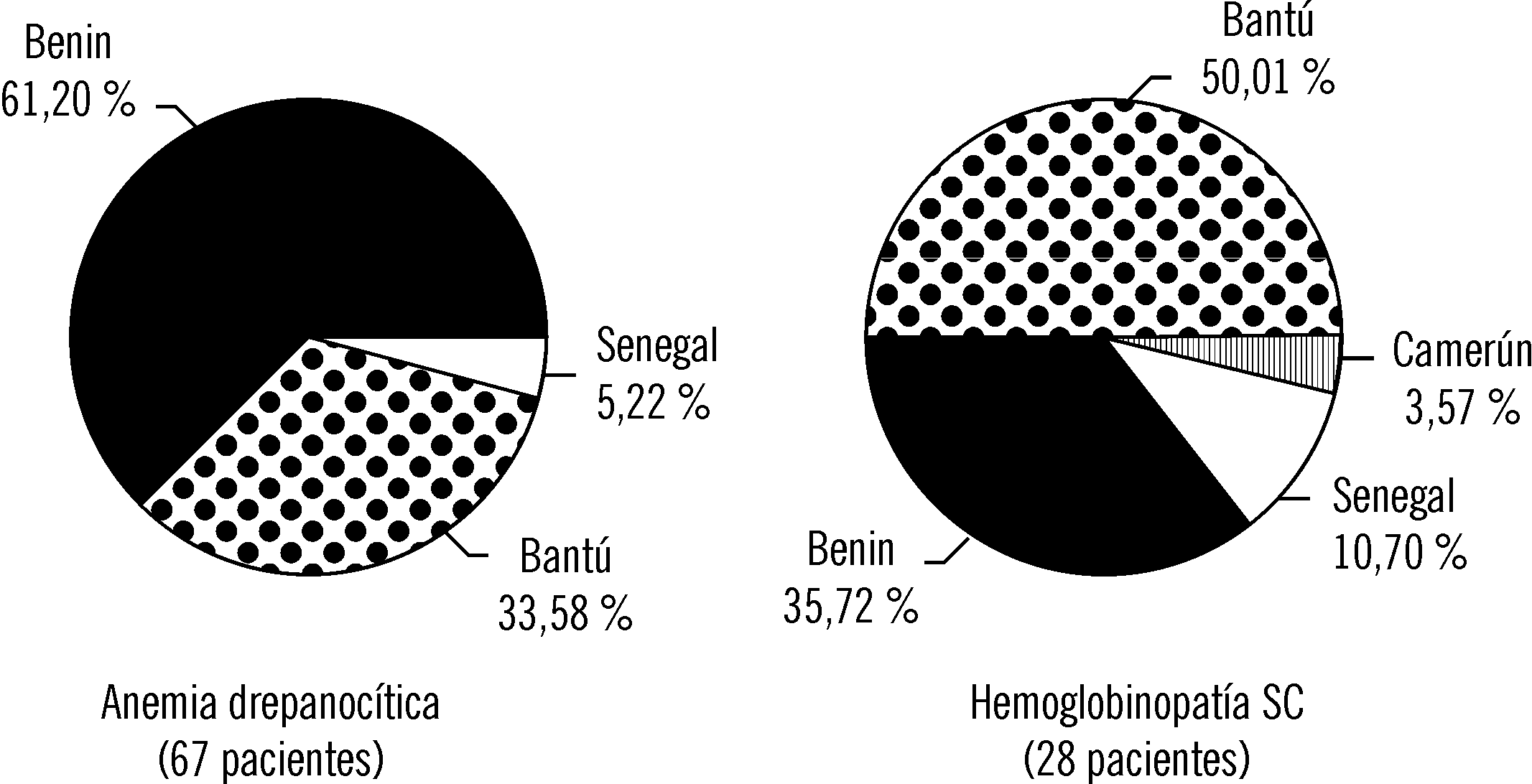
<body><![CDATA[<center>302</center></td><td VALIGN=TOP WIDTH="7%">     <center>69</center></td><td VALIGN=TOP WIDTH="7%">      <center>0,6</center></td></tr> </table></center>    <p>En la Sbtal hubo muy pocas  observaciones.     <p>Los haplotipos del bloque de genes b se muestran en la figura  3. Los m&aacute;s frecuentes fueron el Benin y el Bant&uacute;.     <center>     <p><a href="/img/revistas/hih/v15n2/f0303299.gif"><img SRC="/img/revistas/hih/v15n2/f0303299.gif" ALT="Figura3" BORDER=1 height=109 width=212></a>      
<p>Fig. 3. <i>Haplotipos del bloque de genes </i>b <i>n la drepanocito-sis.</i></center>    <p>La  frecuencia de a talasemia 2 en la AD fue del 23,8 % y en la HSC del 23,07 %. S&oacute;lo  1 ni&ntilde;o con AD y 1 con HSC tuvieron a talasemia 1. En ninguno con Sb tal  se comprob&oacute; la coexistencia de a talasemia. Los haplotipos Bant&uacute;  y no Bant&uacute; y los genes a no se correlacionaron de manera significativa  con ning&uacute;n evento cl&iacute;nico ni con los par&aacute;metros hematol&oacute;gicos.  <h4> Discusi&oacute;n</h4>En el cuadro cl&iacute;nico del ni&ntilde;o peque&ntilde;o  predominan los episodios agudos: infecciones, crisis mano-pie, crisis de secuestro  espl&eacute;nico y son poco frecuentes las lesiones de los &oacute;rganos ocasionadas  por la falciformaci&oacute;n cr&oacute;nica.     <p>En esta investigaci&oacute;n,  las manifestaciones cl&iacute;nicas de la AD fueron menos frecuentes en el ni&ntilde;o  menor de 1 a&ntilde;o de edad, lo que se debe al efecto protector de la HbF en  los primeros meses de la vida.1 En los a&ntilde;os siguientes se encontraron diferencias  significativas en todos los eventos en cada a&ntilde;o y se observ&oacute; un  aumento de &eacute;stos entre 1 y 3 a&ntilde;os. No es posible comparar estos  datos con otras observaciones, ya que hasta donde conocemos, no existen en la  literatura trabajos en los que se haya analizado el cuadro cl&iacute;nico por  a&ntilde;o de edad; sin embargo, se ha descrito una mortalidad m&aacute;s elevada  entre 1 y 3 a&ntilde;os.<sup>6</sup>     ]]></body>
<body><![CDATA[<p>El n&uacute;mero de ingresos refleja la  severidad del cuadro cl&iacute;nico. Un estudio realizado en Inglaterra en 113  pacientes con AD entre 1 y 17 a&ntilde;os mostr&oacute; un promedio anual de ingresos  de 0,53.<sup>7</sup> Los promedios en este trabajo fueron algo m&aacute;s bajos,  lo que puede deberse al rango diferente de edades.     <p>Las infecciones constituyen  la manifestaci&oacute;n cl&iacute;nica de mayor incidencia en el ni&ntilde;o peque&ntilde;o<sup>6  </sup>y la causa m&aacute;s frecuente de muerte en este per&iacute;odo de la vida.<sup>1  </sup>El germen m&aacute;s involucrado es el neumococo y la profilaxis con penicilina  ha disminuido el n&uacute;mero y gravedad de las infecciones producidas por este  microorganismo.<sup>8</sup> No encontramos datos en la literatura sobre el promedio  anual de infecciones en los primeros a&ntilde;os de la vida, pero el porcentaje  de nuestros enfermos que presentaron esta complicaci&oacute;n es semejante al  descrito por otros autores<sup>6</sup> y ning&uacute;n paciente falleci&oacute;  por esta causa.     <p>Posiblemente a consecuencia de la profilaxis con penicilina  han aparecido cepas de neumococo resistentes a este antibi&oacute;tico, e incluso,  resistentes a m&uacute;ltiples antimicrobianos, por lo que se aconseja utilizar  la vacuna antineumoc&oacute;ccica con reinmunizaci&oacute;n a los 6 u 8 a&ntilde;os  y cambiar la pol&iacute;tica de antibi&oacute;ticos utilizando una cefalosporina  de tercera generaci&oacute;n y vancomicina cuando se diagnostica una infecci&oacute;n  grave en &aacute;reas en las que se conoce que la resistencia del neumococo a  la penicilina es prevalente.<sup>9</sup>     <p>Se ha planteado que la causa m&aacute;s  frecuente de s&iacute;ndrome tor&aacute;cico agudo en el ni&ntilde;o peque&ntilde;o  es la infecci&oacute;n, ya que estos pacientes no han desarrollado a&uacute;n  anticuerpos contra muchos microorganismos.<sup>10</sup> Sin embargo, cuidadosos  estudios bacteriol&oacute;gicos y virales excluyeron la etiolog&iacute;a infecciosa  en la mayor parte de los ni&ntilde;os.<sup>11</sup>     <p>El n&uacute;mero de CVO  en el ni&ntilde;o es muy variable.<sup>12</sup> En el presente trabajo, el porcentaje  de ni&ntilde;os que las presentaron es semejante al descrito por otros autores.<sup>6</sup>  Recientemente se ha se&ntilde;alado que las CVO influyen en el da&ntilde;o de  los &oacute;rganos, e incluso, en la sobrevida.<sup>13</sup>     <p>En nuestros pacientes,  la crisis mano-pie fue frecuente al a&ntilde;o y 2 a&ntilde;os de edad, y el porcentaje  de ni&ntilde;os que la padecieron es semejante al que comunican en Jamaica (alrededor  del 40 %).<sup>14</sup>     <p>La crisis de secuestro espl&eacute;nico constituye  la segunda causa de muerte en los ni&ntilde;os menores de 5 a&ntilde;os.<sup>15</sup>  En este estudio, el n&uacute;mero de enfermos con esta complicaci&oacute;n fue  mayor que en otros,<sup>16 </sup>pero esto se debe a que muchos ni&ntilde;os peque&ntilde;os  fueron remitidos a nuestro servicio por crisis de secuestro espl&eacute;nico para  valorar esplenectom&iacute;a parcial y posteriormente, se incluyeron en el seguimiento.      <p>El porcentaje de enfermos que recibieron transfusiones de gl&oacute;bulos rojos  es semejante al que describen otros autores.<sup>17</sup> Sus indicaciones en  nuestros pacientes son muy precisas: crisis apl&aacute;stica o de secuestro, infecciones  graves y previas a la cirug&iacute;a con anestesia general, fundamentalmente.      <p>La mortalidad en la AD en los primeros a&ntilde;os de la vida hace pocos a&ntilde;os  era del 15 %.<sup>6</sup> En la actualidad es del 2,6 % y la sobrevida global  alcanza la cuarta d&eacute;cada de la vida.<sup>13</sup> S&oacute;lo falleci&oacute;  1 ni&ntilde;o en los m&aacute;s de 9 a&ntilde;os transcurridos desde que se inici&oacute;  esta investigaci&oacute;n.     <p>En la HSC se encontraron menos eventos cl&iacute;nicos  que en la AD, tal como lo se&ntilde;alan en la literatura<sup>16</sup> y &eacute;stos  aparecen m&aacute;s tard&iacute;amente. El 22 % se mantiene asintom&aacute;tico  en la primera d&eacute;cada de la vida<sup>18 </sup>y la sobrevida global alcanza  la cuarta y la quinta d&eacute;cadas.<sup>6</sup>     ]]></body>
<body><![CDATA[<p>En nuestro estudio el n&uacute;mero  de infecciones en la HSC fue algo menor que en la AD. Existen controversias en  cuanto a si las infecciones est&aacute;n aumentadas en la HSC. Algunos autores  no lo demuestran y no aconsejan la profilaxis con penicilina,<sup>19</sup> mientras  que otros no encuentran diferencias entre la HSC y la AD.<sup>20</sup>     <p>Los  valores de hemoglobina de nuestros pacientes fueron semejantes a los que se encontraron  en otras series.<sup>21 </sup>Se mantuvieron estables en los diferentes a&ntilde;os  en el sexo masculino y hubo algunas variaciones entre los a&ntilde;os en el sexo  femenino, en el cual las cifras se encontraron m&aacute;s elevadas que en el masculino  en todas las edades. Estos hallazgos concuerdan con lo que se describe en otros  trabajos<sup>21</sup> y posiblemente est&eacute; en relaci&oacute;n con una HbF  m&aacute;s elevada en las ni&ntilde;as.<sup>22</sup>     <p>Las cifras de reticulocitos  en la AD estuvieron dentro del rango que se describe en la literatura (del 10  al 20 %).<sup>23</sup> No existieron diferencias entre los a&ntilde;os ni entre  los sexos.     <p>Cuando analizamos los valores de HbF por a&ntilde;o de edad no se  demostraron diferencias entre los sexos, a pesar de que fueron m&aacute;s elevados  en el sexo femenino. La HbF depende de la edad, de los haplotipos del bloque de  genes b y del n&uacute;mero de genes a, pero los factores m&aacute;s importantes  parecen ser: un <i>locus</i> ligado al cromosoma X que regula la producci&oacute;n  de gl&oacute;bulos rojos con HbF (c&eacute;lulas F) y los haplotipos.<sup>22</sup>      <p>En este trabajo se comprob&oacute; un n&uacute;mero elevado de leucocitos en  todas las edades, lo que concuerda con otros estudios, en los que se plantea que  la leucocitosis puede deberse a estimulaci&oacute;n de la c&eacute;lula progenitora,  asplenia o demarginaci&oacute;n.<sup>24</sup>     <p>Las plaquetas estuvieron dentro  del rango normal en nuestro laboratorio. No hubo diferencias significativas en  los leucocitos y plaquetas entre las edades ni entre los sexos.     <p>En la HSC las  cifras de hemoglobina y reticulocitos fueron semejantes a las de otros trabajos.<sup>25</sup>  La HbF se encontr&oacute; m&aacute;s baja que en la AD y no se detectaron diferencias  entre los sexos. Los leucocitos y las plaquetas estuvieron dentro del rango normal,  lo que puede deberse a la menor intensidad del proceso hemol&iacute;tico en esta  hemoglobinopat&iacute;a.<sup>25</sup>     <p>En un estudio reciente realizado en Cuba  en adultos, en la AD se demostr&oacute; una disminuci&oacute;n del haplotipo Bant&uacute;  con la edad y un aumento del Senegal, lo que no ocurri&oacute; en la HSC. Esto  puede reflejar la sobrevida menor de los pacientes con el haplotipo Bant&uacute;,  en dependencia de la edad y del tipo de drepanocitosis.<sup>26</sup> La ausencia  de correlaci&oacute;n en nuestros enfermos, entre las manifestaciones cl&iacute;nicas  y hematol&oacute;gicas y los haplotipos, puede deberse a que el haplotipo Bant&uacute;  influye sobre todo en el da&ntilde;o irreversible de los &oacute;rganos que se  produce en el adulto.<sup>27</sup>     <p>No se encontr&oacute; en la presente investigaci&oacute;n  una correlaci&oacute;n entre la a talasemia y el cuadro cl&iacute;nico y hematol&oacute;gico,  aunque el n&uacute;mero de ni&ntilde;os estudiados fue peque&ntilde;o y algunos  autores se&ntilde;alan que la a talasemia mejora las manifestaciones cl&iacute;nicas  y hematol&oacute;gicas en la AD.<sup>28</sup>     <p>A pesar de los conocimientos  profundos sobre los aspectos gen&eacute;ticos, la fisiopatolog&iacute;a y el cuadro  cl&iacute;nico de la drepanocitosis, no existe todav&iacute;a un tratamiento eficaz  e inocuo para prevenir o tratar las m&uacute;ltiples complicaciones de la enfermedad.      ]]></body>
<body><![CDATA[<p>Algunas propuestas terap&eacute;uticas reentes son atractivas. La hidroxiurea  disminuye el n&uacute;mero de CVO tanto en adultos<sup>29</sup> como en los ni&ntilde;os.<sup>30</sup>  En el futuro existe la posibilidad de aplicar terapia g&eacute;nica, pero en la  actualidad el &uacute;nico tratamiento curativo es el trasplante de m&eacute;dula  &oacute;sea, que por su complejidad y alto costo s&oacute;lo es aplicable en pacientes  con un cuadro cl&iacute;nico grave y con un hermano HLA compatible.<sup>31</sup>      <p>La mejor&iacute;a de la calidad de la vida y la disminuci&oacute;n de la mortalidad  por la drepanocitosis en Cuba, no se deben solamente a una atenci&oacute;n m&eacute;dica  adecuada, sino tambi&eacute;n a una mejor&iacute;a en las condiciones socioecon&oacute;micas  y en la nutrici&oacute;n de los pacientes. <h4> Summary</h4>104 patients under  6 were studied. In 93,1 % of them the diagnosis was made before the first year  of life, whereas in 47.6 % it was prenatal. The median of follow-up was 31 months  (1-108). The highest incidence of clinical events in sickle cell anemia (SCA)  occurred between 1 and 3 years old. 91.6 % of the infections were pulmonary and  21.7 % of the respiratory episodes were considered as acute chest syndrome. The  events in hemoglobinopathy SC (HSC) were less frequent than in sickle cell anemia.  Only one patient died in a period of almost 10 years since the study began. Hemoglobin  and fetal hemoglobin (HbF) were higher among females with SCA. The commonest haplotypes  of the block of genes b were Benin and Bantu. It was observed a frequency of thalassemia  of 23.8 % in sickle cell anemia and of 23.7 % in HSC. Bantu and non-Bantu haplotypes  and a thalassemia were not associated with the clinical manifestations or with  the hematological parameters. The systematic follow-up of the patients since the  first years of life reduces mortality in this period.     <p><i>Subject headings</i>:  ANEMIA, SICKLE CELL/blood; HEMOGLOBIN C/blood; BETA-THALASSEMIA/blood. <h4> Referencias  Bibliogr&aacute;ficas</h4>    <!-- ref --><P> 1. Colombo B, Svarch E, Mart&iacute;nez G. Gen&eacute;tica  y cl&iacute;nica de las hemoglobinas humanas. La Habana: Editorial Pueblo y Educaci&oacute;n,  1994.<!-- ref --><P> 2. Betke K, Mart&iacute;n H, Schlicht I. Estimation of small percentages  of foetal hemoglobin. Nature 1959;184:1877.<!-- ref --><P> 3. Nagel RL, Rao SK, Dunda-Belkhodja  O, Connolly MM, Fabry ME, George A, et al. The hematological characteristics of  sickle cell anemia bearing the Bantu haplotype: the relationship between G and  HbF level. Blood 1987;69:1026-30.<!-- ref --><P> 4. Higgs D, Aldridge B, Lamb J, Hayes  RJ, Grandison I, Lowrie I, et al. The interaction of alpha thalassemia and homozygous  sickle cell disease. N Engl J Med 1982;306:1441-6.<!-- ref --><P> 5. Still R, Torrie J.  Principles and procedures of statistics. New York:McGraw Hill, 1960:406.<!-- ref --><P>  6. Powars DR. Natural history of sickle cell disease. The first ten years. Semin  Hematol 1975;12:267-85.<!-- ref --><P> 7. Murtaza LN, Strovd CE, Davis LR, Cooper DJ.  Admissions to hospital of children with sickle cell anaemia: a study in South  London. Br Med J 1981;282:1048-51.<!-- ref --><P> 8. Pegelow CH, Armstrong FD, Light S,  Toledano SR, Davis J. Experience with the use of prophylactic in children with  sickle cell anemia. J Pediatr 1991;118:736-8.<!-- ref --><P> 9. Leggiadro RJ. The clinical  impact of resistance in the management of pneumococcal disease. Infect Dis Clin  North Am 1997;11:867-74.<!-- ref --><P> 10. Castro O, Brambilla DJ, Thorington B, Reindorf  CA, Sott RB, Gillete Vera JC, et al. The acute chest syndrome in sickle cell disease.  Incidence and risk factors. Blood 1994;84:643-9.<!-- ref --><P> 11. Sprinkle RH, Cole  T, Smith S, Buchanan GR. Acute chest syndrome in children with sickle cell disease.  A retrospective analysis of 100 hospitalized cases. Am J Pediatr Hematol 1986;8:105-10.<!-- ref --><P>  12. Vishinsky EP. Comprehensive care in sickle cell disease: its impact on morbidity  and mortality. Semin Hematol 1991;28:220-6.<!-- ref --><P> 13. Platt OS, Brombilla DJ,  Rosse WF, Milner PF, Castro O, Steinberg MH, et al. Mortality in sickle cell disease.  Life expectancy and risk factors for early death. N Engl J Med 1994;330:1639-44.<!-- ref --><P>  14. Hvo MH, Friedlaender GE, Marsh JS. Orthopoedic manifestations of sickle cell  disease. Yale J Biol Med 1990;63:195-207.<!-- ref --><P> 15. Emond A, Collis R, Darvill  D, Higg DR, Maude Gtl, Serjeant GR. Acute splenic sequestration in homozygous  sickle cell disease: natural history and management. J Pediatr 1985;107:201-6.<!-- ref --><P>  16. De Montalembert M, Guilloud-Bataille M, Feinglod J, Girot R. Epidemiological  and clinical study of sickle cell disease in France, French Guiana and Algeria.  Eur J Haematol 1993;51:136-40.<!-- ref --><P> 17. Luban N. Variability in rates of alloinmunization  in different groups in children with sickle cell disease: effect of ethnic back  ground. Am J Pediatr Hematol Oncol 1989;11:314-9.<!-- ref --><P> 18. William S, Maude  GH, Serjeant GR. Clinical presentation of sickle cell hemoglobin C disease. J  Pediatr 1986;109:586-9.<!-- ref --><P> 19. Roger ZR, Buchanan GR. Bacteremia in children  with sickle cell hemoglobin C disease and sickle b+ thalassemia: is prophylactics  penicillin necessary? J Pediatr 1995;127:348-51.<!-- ref --><P> 20. Pearson HA, Gallagher  D, Chilcote R, Sulliran E, Willimas J, Espeland M, et al. Developmental pattern  of splenic dysfunction in sickle cell disorders. Pediatrics 1985;76:392-7.<!-- ref --><P>  21. Serjeant GR, Grandison Y, Lowrie Y, Vaidya S, Mason KP, et al. The development  of haemotological changes in homozygous sickle cell disease: a cohort study from  birth to 6 years. Br J Haematol 1981;48:533-43.<!-- ref --><P> 22. Chang YC, Maier-Redelsperger  M, Smith KD, Contul DR, De Montalembert M. The relative importance of X-linked  FCP locus and b-globin haplotypes in determining haemoglobin F levels: a study  of SS patients homozygous for S haplotypes. Br J Haematol 1997;96:806-14.<!-- ref --><P>  23. Hayes RJ, Beckford M, Grandison Y, Mason K, Serjeant GR. The haematology of  the steady state homozygous sickle cell disease: frequency distributions, variations  with age and sex, longitudinal observation. Br J Haematol 1985;59:369-82.<P>  24. West MS, Wethers D, Smith J, Steinberg M. The Cooperative Study of Sickle  Cell Disease. Laboratory profile of sickle cell disease: a cross-sectional analysis.  J Clin Epidemiol 1992;45:893-909.</P>    <!-- ref --><P> 25. Serjeant GR. Sickle cell disease.  Oxford: University, 1985;289-95.<!-- ref --><P> 26. Mu&ntilde;&iacute;z A, Corral L, Al&aacute;ez  C, Svarch E, Espinosa E, Carbonell N, et al. Sickle cell anemia and b-gene cluster  haplotype in Cuba. Am J Hematol 1995;49:163-4.<!-- ref --><P> 27. Nagel R, Fabry M, Pagrier  J. Hematological and genetic markers in sickle cell disease. Semin Hematol 1991;28:180-201.<!-- ref --><P>  28. Nagel RL. Severity, pathobiology, epistatic effect and genetic markers in  sickle cell anemia. Semin Hematol 1991;28:180-201.<!-- ref --><P> 29. Charache S, Teerin  ML, Moore RD, Dover GJ, Barton FB, Eckerts SV, et al. Study of hydroxyurea in  sickle cell anemia. N Eng J Med 1995;332:1317-32.<!-- ref --><P> 30. Rogers ZR. Hydroxyurea  therapy for diverse pediatric population with sickle cell disease. Semin Hematol  1997;34:42-7.<!-- ref --><P> 31. Walters MC, Patience M, Leisenring W, Eckman JR, Scott  JP, Mentzer WC, et al. Bone marrow tranplantion for sickle cell disease. N Engl  J Med 1996;335:369-76.Recibido: 10 de diciembre de 1998. Aprobado: 14 de diciembre  de 1998.     <br>Dra. <i>Tania Garc&iacute;a Peralta</i>. Instituto de Hematolog&iacute;a  e Inmunolog&iacute;a. Apartado 8070, CP 10800, Ciudad de La Habana, Cuba. Tel&eacute;fono  (537)578268. Fax (537)338979. <a href="mailtoe-mail:ihidir@hemato.sld.cu">e-mail:ihidir@hemato.sld.cu</a>      <br>&nbsp;     <br>&nbsp; <ol>     <li> <a NAME="*"></a>Instituto de Hematolog&iacute;a  e Inmunolog&iacute;a.</li>    <li> Instituto Nacional de Higiene, Epidemiolog&iacute;a  y Microbiolog&iacute;a</li>    ]]></body>
<body><![CDATA[</ol>           ]]></body>
<back>
<ref-list>
<ref id="B1">
<nlm-citation citation-type="book">
<person-group person-group-type="author">
<name>
<surname><![CDATA[Colombo]]></surname>
<given-names><![CDATA[B]]></given-names>
</name>
<name>
<surname><![CDATA[Svarch]]></surname>
<given-names><![CDATA[E]]></given-names>
</name>
<name>
<surname><![CDATA[Martínez]]></surname>
<given-names><![CDATA[G]]></given-names>
</name>
</person-group>
<source><![CDATA[Genética y clínica de las hemoglobinas humanas]]></source>
<year>1994</year>
<publisher-name><![CDATA[Editorial Pueblo y Educación]]></publisher-name>
</nlm-citation>
</ref>
<ref id="B2">
<label>2</label><nlm-citation citation-type="journal">
<person-group person-group-type="author">
<name>
<surname><![CDATA[Betke]]></surname>
<given-names><![CDATA[K]]></given-names>
</name>
<name>
<surname><![CDATA[Martín]]></surname>
<given-names><![CDATA[H]]></given-names>
</name>
<name>
<surname><![CDATA[Schlicht]]></surname>
<given-names><![CDATA[I]]></given-names>
</name>
</person-group>
<article-title xml:lang="en"><![CDATA[Estimation of small percentages of foetal hemoglobin]]></article-title>
<source><![CDATA[Nature]]></source>
<year>1959</year>
<volume>184</volume>
<page-range>1877</page-range></nlm-citation>
</ref>
<ref id="B3">
<label>3</label><nlm-citation citation-type="journal">
<person-group person-group-type="author">
<name>
<surname><![CDATA[Nagel]]></surname>
<given-names><![CDATA[RL]]></given-names>
</name>
<name>
<surname><![CDATA[Rao]]></surname>
<given-names><![CDATA[SK]]></given-names>
</name>
<name>
<surname><![CDATA[Dunda-Belkhodja]]></surname>
<given-names><![CDATA[O]]></given-names>
</name>
<name>
<surname><![CDATA[Connolly]]></surname>
<given-names><![CDATA[MM]]></given-names>
</name>
<name>
<surname><![CDATA[Fabry]]></surname>
<given-names><![CDATA[ME]]></given-names>
</name>
<name>
<surname><![CDATA[George]]></surname>
<given-names><![CDATA[A]]></given-names>
</name>
</person-group>
<article-title xml:lang="en"><![CDATA[The hematological characteristics of sickle cell anemia bearing the Bantu haplotype: the relationship between G and HbF level]]></article-title>
<source><![CDATA[Blood]]></source>
<year>1987</year>
<volume>69</volume>
<page-range>1026-30</page-range></nlm-citation>
</ref>
<ref id="B4">
<label>4</label><nlm-citation citation-type="journal">
<person-group person-group-type="author">
<name>
<surname><![CDATA[Higgs]]></surname>
<given-names><![CDATA[D]]></given-names>
</name>
<name>
<surname><![CDATA[Aldridge]]></surname>
<given-names><![CDATA[B]]></given-names>
</name>
<name>
<surname><![CDATA[Lamb]]></surname>
<given-names><![CDATA[J]]></given-names>
</name>
<name>
<surname><![CDATA[Hayes]]></surname>
<given-names><![CDATA[RJ]]></given-names>
</name>
<name>
<surname><![CDATA[Grandison]]></surname>
<given-names><![CDATA[I]]></given-names>
</name>
<name>
<surname><![CDATA[Lowrie]]></surname>
<given-names><![CDATA[I]]></given-names>
</name>
</person-group>
<article-title xml:lang="en"><![CDATA[The interaction of alpha thalassemia and homozygous sickle cell disease]]></article-title>
<source><![CDATA[N Engl J Med]]></source>
<year>1982</year>
<volume>306</volume>
<page-range>1441-6</page-range></nlm-citation>
</ref>
<ref id="B5">
<nlm-citation citation-type="">
<person-group person-group-type="author">
<name>
<surname><![CDATA[Still]]></surname>
<given-names><![CDATA[R]]></given-names>
</name>
<name>
<surname><![CDATA[Torrie]]></surname>
<given-names><![CDATA[J]]></given-names>
</name>
</person-group>
<source><![CDATA[Principles and procedures of statistics]]></source>
<year>1960</year>
<page-range>406</page-range></nlm-citation>
</ref>
<ref id="B6">
<label>6</label><nlm-citation citation-type="journal">
<person-group person-group-type="author">
<name>
<surname><![CDATA[Powars]]></surname>
<given-names><![CDATA[DR]]></given-names>
</name>
</person-group>
<article-title xml:lang="en"><![CDATA[Natural history of sickle cell disease: The first ten years]]></article-title>
<source><![CDATA[Semin Hematol]]></source>
<year>1975</year>
<volume>12</volume>
<page-range>267-85</page-range></nlm-citation>
</ref>
<ref id="B7">
<label>7</label><nlm-citation citation-type="journal">
<person-group person-group-type="author">
<name>
<surname><![CDATA[Murtaza]]></surname>
<given-names><![CDATA[LN]]></given-names>
</name>
<name>
<surname><![CDATA[Strovd]]></surname>
<given-names><![CDATA[CE]]></given-names>
</name>
<name>
<surname><![CDATA[Davis]]></surname>
<given-names><![CDATA[LR]]></given-names>
</name>
<name>
<surname><![CDATA[Cooper]]></surname>
<given-names><![CDATA[DJ]]></given-names>
</name>
</person-group>
<article-title xml:lang="en"><![CDATA[Admissions to hospital of children with sickle cell anaemia: a study in South London]]></article-title>
<source><![CDATA[Br Med J]]></source>
<year>1981</year>
<volume>282</volume>
<page-range>1048-51</page-range></nlm-citation>
</ref>
<ref id="B8">
<label>8</label><nlm-citation citation-type="journal">
<person-group person-group-type="author">
<name>
<surname><![CDATA[Pegelow]]></surname>
<given-names><![CDATA[CH]]></given-names>
</name>
<name>
<surname><![CDATA[Armstrong]]></surname>
<given-names><![CDATA[FD]]></given-names>
</name>
<name>
<surname><![CDATA[Light]]></surname>
<given-names><![CDATA[S]]></given-names>
</name>
<name>
<surname><![CDATA[Toledano]]></surname>
<given-names><![CDATA[SR]]></given-names>
</name>
<name>
<surname><![CDATA[Davis]]></surname>
<given-names><![CDATA[J]]></given-names>
</name>
</person-group>
<article-title xml:lang="en"><![CDATA[Experience with the use of prophylactic in children with sickle cell anemia]]></article-title>
<source><![CDATA[J Pediatr]]></source>
<year>1991</year>
<volume>118</volume>
<page-range>736-8</page-range></nlm-citation>
</ref>
<ref id="B9">
<label>9</label><nlm-citation citation-type="journal">
<person-group person-group-type="author">
<name>
<surname><![CDATA[Leggiadro]]></surname>
<given-names><![CDATA[RJ]]></given-names>
</name>
</person-group>
<article-title xml:lang="en"><![CDATA[The clinical impact of resistance in the management of pneumococcal disease]]></article-title>
<source><![CDATA[Infect Dis Clin North Am]]></source>
<year>1997</year>
<volume>11</volume>
<page-range>867-74</page-range></nlm-citation>
</ref>
<ref id="B10">
<label>10</label><nlm-citation citation-type="journal">
<person-group person-group-type="author">
<name>
<surname><![CDATA[Castro]]></surname>
<given-names><![CDATA[O]]></given-names>
</name>
<name>
<surname><![CDATA[Brambilla]]></surname>
<given-names><![CDATA[DJ]]></given-names>
</name>
<name>
<surname><![CDATA[Thorington]]></surname>
<given-names><![CDATA[B]]></given-names>
</name>
<name>
<surname><![CDATA[Reindorf]]></surname>
<given-names><![CDATA[CA]]></given-names>
</name>
<name>
<surname><![CDATA[Sott]]></surname>
<given-names><![CDATA[RB]]></given-names>
</name>
<name>
<surname><![CDATA[Gillete Vera]]></surname>
<given-names><![CDATA[JC]]></given-names>
</name>
<name>
<surname><![CDATA[et]]></surname>
<given-names><![CDATA[al]]></given-names>
</name>
</person-group>
<article-title xml:lang="en"><![CDATA[The acute chest syndrome in sickle cell disease: Incidence and risk factors]]></article-title>
<source><![CDATA[Blood]]></source>
<year>1994</year>
<volume>84</volume>
<page-range>643-9</page-range></nlm-citation>
</ref>
<ref id="B11">
<label>11</label><nlm-citation citation-type="journal">
<person-group person-group-type="author">
<name>
<surname><![CDATA[Sprinkle]]></surname>
<given-names><![CDATA[RH]]></given-names>
</name>
<name>
<surname><![CDATA[Cole]]></surname>
<given-names><![CDATA[T]]></given-names>
</name>
<name>
<surname><![CDATA[Smith]]></surname>
<given-names><![CDATA[S]]></given-names>
</name>
<name>
<surname><![CDATA[Buchanan]]></surname>
<given-names><![CDATA[GR]]></given-names>
</name>
</person-group>
<article-title xml:lang="en"><![CDATA[Acute chest syndrome in children with sickle cell disease: A retrospective analysis of 100 hospitalized cases]]></article-title>
<source><![CDATA[Am J Pediatr Hematol]]></source>
<year>1986</year>
<volume>8</volume>
<page-range>105-10</page-range></nlm-citation>
</ref>
<ref id="B12">
<label>12</label><nlm-citation citation-type="journal">
<person-group person-group-type="author">
<name>
<surname><![CDATA[Vishinsky]]></surname>
<given-names><![CDATA[EP]]></given-names>
</name>
</person-group>
<article-title xml:lang="en"><![CDATA[Comprehensive care in sickle cell disease: its impact on morbidity and mortality]]></article-title>
<source><![CDATA[Semin Hematol]]></source>
<year>1991</year>
<volume>28</volume>
<page-range>220-6</page-range></nlm-citation>
</ref>
<ref id="B13">
<label>13</label><nlm-citation citation-type="journal">
<person-group person-group-type="author">
<name>
<surname><![CDATA[Platt]]></surname>
<given-names><![CDATA[OS]]></given-names>
</name>
<name>
<surname><![CDATA[Brombilla]]></surname>
<given-names><![CDATA[DJ]]></given-names>
</name>
<name>
<surname><![CDATA[Rosse]]></surname>
<given-names><![CDATA[WF]]></given-names>
</name>
<name>
<surname><![CDATA[Milner]]></surname>
<given-names><![CDATA[PF]]></given-names>
</name>
<name>
<surname><![CDATA[Castro]]></surname>
<given-names><![CDATA[O]]></given-names>
</name>
<name>
<surname><![CDATA[Steinberg]]></surname>
<given-names><![CDATA[MH]]></given-names>
</name>
</person-group>
<article-title xml:lang="en"><![CDATA[Mortality in sickle cell disease: Life expectancy and risk factors for early death]]></article-title>
<source><![CDATA[N Engl J Med]]></source>
<year>1994</year>
<volume>330</volume>
<page-range>1639-44</page-range></nlm-citation>
</ref>
<ref id="B14">
<label>14</label><nlm-citation citation-type="journal">
<person-group person-group-type="author">
<name>
<surname><![CDATA[Hvo]]></surname>
<given-names><![CDATA[MH]]></given-names>
</name>
<name>
<surname><![CDATA[Friedlaender]]></surname>
<given-names><![CDATA[GE]]></given-names>
</name>
<name>
<surname><![CDATA[Marsh]]></surname>
<given-names><![CDATA[JS]]></given-names>
</name>
</person-group>
<article-title xml:lang="en"><![CDATA[Orthopoedic manifestations of sickle cell disease]]></article-title>
<source><![CDATA[Yale J Biol Med]]></source>
<year>1990</year>
<volume>63</volume>
<page-range>195-207</page-range></nlm-citation>
</ref>
<ref id="B15">
<label>15</label><nlm-citation citation-type="journal">
<person-group person-group-type="author">
<name>
<surname><![CDATA[Emond]]></surname>
<given-names><![CDATA[A]]></given-names>
</name>
<name>
<surname><![CDATA[Collis]]></surname>
<given-names><![CDATA[R]]></given-names>
</name>
<name>
<surname><![CDATA[Darvill]]></surname>
<given-names><![CDATA[D]]></given-names>
</name>
<name>
<surname><![CDATA[Higg]]></surname>
<given-names><![CDATA[DR]]></given-names>
</name>
<name>
<surname><![CDATA[Maude]]></surname>
<given-names><![CDATA[Gtl]]></given-names>
</name>
<name>
<surname><![CDATA[Serjeant]]></surname>
<given-names><![CDATA[GR]]></given-names>
</name>
</person-group>
<article-title xml:lang="en"><![CDATA[Acute splenic sequestration in homozygous sickle cell disease: natural history and management]]></article-title>
<source><![CDATA[J Pediatr]]></source>
<year>1985</year>
<volume>107</volume>
<page-range>201-6</page-range></nlm-citation>
</ref>
<ref id="B16">
<label>16</label><nlm-citation citation-type="journal">
<person-group person-group-type="author">
<name>
<surname><![CDATA[De Montalembert]]></surname>
<given-names><![CDATA[M]]></given-names>
</name>
<name>
<surname><![CDATA[Guilloud-Bataille]]></surname>
<given-names><![CDATA[M]]></given-names>
</name>
<name>
<surname><![CDATA[Feinglod]]></surname>
<given-names><![CDATA[J]]></given-names>
</name>
<name>
<surname><![CDATA[Girot]]></surname>
<given-names><![CDATA[R]]></given-names>
</name>
</person-group>
<article-title xml:lang="en"><![CDATA[Epidemiological and clinical study of sickle cell disease in France, French Guiana and Algeria]]></article-title>
<source><![CDATA[Eur J Haematol]]></source>
<year>1993</year>
<volume>51</volume>
<page-range>136-40</page-range></nlm-citation>
</ref>
<ref id="B17">
<label>17</label><nlm-citation citation-type="journal">
<person-group person-group-type="author">
<name>
<surname><![CDATA[Luban]]></surname>
<given-names><![CDATA[N]]></given-names>
</name>
</person-group>
<article-title xml:lang="en"><![CDATA[Variability in rates of alloinmunization in different groups in children with sickle cell disease: effect of ethnic back ground]]></article-title>
<source><![CDATA[Am J Pediatr Hematol Oncol]]></source>
<year>1989</year>
<volume>11</volume>
<page-range>314-9</page-range></nlm-citation>
</ref>
<ref id="B18">
<label>18</label><nlm-citation citation-type="journal">
<person-group person-group-type="author">
<name>
<surname><![CDATA[William]]></surname>
<given-names><![CDATA[S]]></given-names>
</name>
<name>
<surname><![CDATA[Maude]]></surname>
<given-names><![CDATA[GH]]></given-names>
</name>
<name>
<surname><![CDATA[Serjeant]]></surname>
<given-names><![CDATA[GR]]></given-names>
</name>
</person-group>
<article-title xml:lang="en"><![CDATA[Clinical presentation of sickle cell hemoglobin C disease]]></article-title>
<source><![CDATA[J Pediatr]]></source>
<year>1986</year>
<volume>109</volume>
<page-range>586-9</page-range></nlm-citation>
</ref>
<ref id="B19">
<label>19</label><nlm-citation citation-type="journal">
<person-group person-group-type="author">
<name>
<surname><![CDATA[Roger]]></surname>
<given-names><![CDATA[ZR]]></given-names>
</name>
<name>
<surname><![CDATA[Buchanan]]></surname>
<given-names><![CDATA[GR]]></given-names>
</name>
</person-group>
<article-title xml:lang="en"><![CDATA[Bacteremia in children with sickle cell hemoglobin C disease and sickle b+ thalassemia: is prophylactics penicillin necessary?]]></article-title>
<source><![CDATA[J Pediatr]]></source>
<year>1995</year>
<volume>127</volume>
<page-range>348-51</page-range></nlm-citation>
</ref>
<ref id="B20">
<label>20</label><nlm-citation citation-type="journal">
<person-group person-group-type="author">
<name>
<surname><![CDATA[Pearson]]></surname>
<given-names><![CDATA[HA]]></given-names>
</name>
<name>
<surname><![CDATA[Gallagher]]></surname>
<given-names><![CDATA[D]]></given-names>
</name>
<name>
<surname><![CDATA[Chilcote]]></surname>
<given-names><![CDATA[R]]></given-names>
</name>
<name>
<surname><![CDATA[Sulliran]]></surname>
<given-names><![CDATA[E]]></given-names>
</name>
<name>
<surname><![CDATA[Willimas]]></surname>
<given-names><![CDATA[J]]></given-names>
</name>
<name>
<surname><![CDATA[Espeland]]></surname>
<given-names><![CDATA[M]]></given-names>
</name>
</person-group>
<article-title xml:lang="en"><![CDATA[Developmental pattern of splenic dysfunction in sickle cell disorders]]></article-title>
<source><![CDATA[Pediatrics]]></source>
<year>1985</year>
<volume>76</volume>
<page-range>392-7</page-range></nlm-citation>
</ref>
<ref id="B21">
<label>21</label><nlm-citation citation-type="journal">
<person-group person-group-type="author">
<name>
<surname><![CDATA[Serjeant]]></surname>
<given-names><![CDATA[GR]]></given-names>
</name>
<name>
<surname><![CDATA[Grandison]]></surname>
<given-names><![CDATA[Y]]></given-names>
</name>
<name>
<surname><![CDATA[Lowrie]]></surname>
<given-names><![CDATA[Y]]></given-names>
</name>
<name>
<surname><![CDATA[Vaidya]]></surname>
<given-names><![CDATA[S]]></given-names>
</name>
<name>
<surname><![CDATA[Mason]]></surname>
<given-names><![CDATA[KP]]></given-names>
</name>
</person-group>
<article-title xml:lang="en"><![CDATA[The development of haemotological changes in homozygous sickle cell disease: a cohort study from birth to 6 years]]></article-title>
<source><![CDATA[Br J Haematol]]></source>
<year>1981</year>
<volume>48</volume>
<page-range>533-43</page-range></nlm-citation>
</ref>
<ref id="B22">
<label>22</label><nlm-citation citation-type="journal">
<person-group person-group-type="author">
<name>
<surname><![CDATA[Chang]]></surname>
<given-names><![CDATA[YC]]></given-names>
</name>
<name>
<surname><![CDATA[Maier-Redelsperger]]></surname>
<given-names><![CDATA[M]]></given-names>
</name>
<name>
<surname><![CDATA[Smith]]></surname>
<given-names><![CDATA[KD]]></given-names>
</name>
<name>
<surname><![CDATA[Contul]]></surname>
<given-names><![CDATA[DR]]></given-names>
</name>
<name>
<surname><![CDATA[De Montalembert]]></surname>
<given-names><![CDATA[M]]></given-names>
</name>
</person-group>
<article-title xml:lang="en"><![CDATA[The relative importance of X-linked FCP locus and b-globin haplotypes in determining haemoglobin F levels: a study of SS patients homozygous for S haplotypes]]></article-title>
<source><![CDATA[Br J Haematol]]></source>
<year>1997</year>
<volume>96</volume>
<page-range>806-14</page-range></nlm-citation>
</ref>
<ref id="B23">
<label>23</label><nlm-citation citation-type="journal">
<person-group person-group-type="author">
<name>
<surname><![CDATA[Hayes]]></surname>
<given-names><![CDATA[RJ]]></given-names>
</name>
<name>
<surname><![CDATA[Beckford]]></surname>
<given-names><![CDATA[M]]></given-names>
</name>
<name>
<surname><![CDATA[Grandison]]></surname>
<given-names><![CDATA[Y]]></given-names>
</name>
<name>
<surname><![CDATA[Mason]]></surname>
<given-names><![CDATA[K]]></given-names>
</name>
<name>
<surname><![CDATA[Serjeant]]></surname>
<given-names><![CDATA[GR]]></given-names>
</name>
</person-group>
<article-title xml:lang="en"><![CDATA[The haematology of the steady state homozygous sickle cell disease: frequency distributions, variations with age and sex, longitudinal observation]]></article-title>
<source><![CDATA[Br J Haematol]]></source>
<year>1985</year>
<volume>59</volume>
<page-range>369-82</page-range></nlm-citation>
</ref>
<ref id="B24">
<label>24</label><nlm-citation citation-type="journal">
<person-group person-group-type="author">
<name>
<surname><![CDATA[West]]></surname>
<given-names><![CDATA[MS]]></given-names>
</name>
<name>
<surname><![CDATA[Wethers]]></surname>
<given-names><![CDATA[D]]></given-names>
</name>
<name>
<surname><![CDATA[Smith]]></surname>
<given-names><![CDATA[J]]></given-names>
</name>
</person-group>
<article-title xml:lang="en"><![CDATA[The Cooperative Study of Sickle Cell Disease. Laboratory profile of sickle cell disease: a cross-sectional analysis]]></article-title>
<source><![CDATA[J Clin Epidemiol]]></source>
<year>1992</year>
<volume>45</volume>
<page-range>893-909</page-range></nlm-citation>
</ref>
<ref id="B25">
<nlm-citation citation-type="book">
<person-group person-group-type="author">
<name>
<surname><![CDATA[Serjeant]]></surname>
<given-names><![CDATA[GR]]></given-names>
</name>
</person-group>
<source><![CDATA[Sickle cell disease]]></source>
<year>1985</year>
<page-range>289-95</page-range><publisher-name><![CDATA[University]]></publisher-name>
</nlm-citation>
</ref>
<ref id="B26">
<label>26</label><nlm-citation citation-type="journal">
<person-group person-group-type="author">
<name>
<surname><![CDATA[Muñíz]]></surname>
<given-names><![CDATA[A]]></given-names>
</name>
<name>
<surname><![CDATA[Corral]]></surname>
<given-names><![CDATA[L]]></given-names>
</name>
<name>
<surname><![CDATA[Aláez]]></surname>
<given-names><![CDATA[C]]></given-names>
</name>
<name>
<surname><![CDATA[Svarch]]></surname>
<given-names><![CDATA[E]]></given-names>
</name>
<name>
<surname><![CDATA[Espinosa]]></surname>
<given-names><![CDATA[E]]></given-names>
</name>
<name>
<surname><![CDATA[Carbonell]]></surname>
<given-names><![CDATA[N]]></given-names>
</name>
</person-group>
<article-title xml:lang="en"><![CDATA[Sickle cell anemia and b-gene cluster haplotype in Cuba]]></article-title>
<source><![CDATA[Am J Hematol]]></source>
<year>1995</year>
<volume>49</volume>
<page-range>163-4</page-range></nlm-citation>
</ref>
<ref id="B27">
<label>27</label><nlm-citation citation-type="journal">
<person-group person-group-type="author">
<name>
<surname><![CDATA[Nagel]]></surname>
<given-names><![CDATA[R]]></given-names>
</name>
<name>
<surname><![CDATA[Fabry]]></surname>
<given-names><![CDATA[M]]></given-names>
</name>
<name>
<surname><![CDATA[Pagrier]]></surname>
<given-names><![CDATA[J]]></given-names>
</name>
</person-group>
<article-title xml:lang="en"><![CDATA[Hematological and genetic markers in sickle cell disease]]></article-title>
<source><![CDATA[Semin Hematol]]></source>
<year>1991</year>
<volume>28</volume>
<page-range>180-201</page-range></nlm-citation>
</ref>
<ref id="B28">
<label>28</label><nlm-citation citation-type="journal">
<person-group person-group-type="author">
<name>
<surname><![CDATA[Nagel]]></surname>
<given-names><![CDATA[RL]]></given-names>
</name>
</person-group>
<article-title xml:lang="en"><![CDATA[Severity, pathobiology, epistatic effect and genetic markers in sickle cell anemia]]></article-title>
<source><![CDATA[Semin Hematol]]></source>
<year>1991</year>
<volume>28</volume>
<page-range>180-201</page-range></nlm-citation>
</ref>
<ref id="B29">
<label>29</label><nlm-citation citation-type="journal">
<person-group person-group-type="author">
<name>
<surname><![CDATA[Charache]]></surname>
<given-names><![CDATA[S]]></given-names>
</name>
<name>
<surname><![CDATA[Teerin]]></surname>
<given-names><![CDATA[ML]]></given-names>
</name>
<name>
<surname><![CDATA[Moore]]></surname>
<given-names><![CDATA[RD]]></given-names>
</name>
<name>
<surname><![CDATA[Dover]]></surname>
<given-names><![CDATA[GJ]]></given-names>
</name>
<name>
<surname><![CDATA[Barton]]></surname>
<given-names><![CDATA[FB]]></given-names>
</name>
<name>
<surname><![CDATA[Eckerts]]></surname>
<given-names><![CDATA[SV]]></given-names>
</name>
</person-group>
<article-title xml:lang="en"><![CDATA[Study of hydroxyurea in sickle cell anemia]]></article-title>
<source><![CDATA[N Eng J Med]]></source>
<year>1995</year>
<volume>332</volume>
<page-range>1317-32</page-range></nlm-citation>
</ref>
<ref id="B30">
<label>30</label><nlm-citation citation-type="journal">
<person-group person-group-type="author">
<name>
<surname><![CDATA[Rogers]]></surname>
<given-names><![CDATA[ZR]]></given-names>
</name>
</person-group>
<article-title xml:lang="en"><![CDATA[Hydroxyurea therapy for diverse pediatric population with sickle cell disease]]></article-title>
<source><![CDATA[Semin Hematol]]></source>
<year>1997</year>
<volume>34</volume>
<page-range>42-7</page-range></nlm-citation>
</ref>
<ref id="B31">
<label>31</label><nlm-citation citation-type="journal">
<person-group person-group-type="author">
<name>
<surname><![CDATA[Walters]]></surname>
<given-names><![CDATA[MC]]></given-names>
</name>
<name>
<surname><![CDATA[Patience]]></surname>
<given-names><![CDATA[M]]></given-names>
</name>
<name>
<surname><![CDATA[Leisenring]]></surname>
<given-names><![CDATA[W]]></given-names>
</name>
<name>
<surname><![CDATA[Eckman]]></surname>
<given-names><![CDATA[JR]]></given-names>
</name>
<name>
<surname><![CDATA[Scott]]></surname>
<given-names><![CDATA[JP]]></given-names>
</name>
<name>
<surname><![CDATA[Mentzer]]></surname>
<given-names><![CDATA[WC]]></given-names>
</name>
</person-group>
<article-title xml:lang="en"><![CDATA[Bone marrow tranplantion for sickle cell disease]]></article-title>
<source><![CDATA[N Engl J Med]]></source>
<year>1996</year>
<volume>335</volume>
<page-range>369-76</page-range></nlm-citation>
</ref>
</ref-list>
</back>
</article>