<?xml version="1.0" encoding="ISO-8859-1"?><article xmlns:mml="http://www.w3.org/1998/Math/MathML" xmlns:xlink="http://www.w3.org/1999/xlink" xmlns:xsi="http://www.w3.org/2001/XMLSchema-instance">
<front>
<journal-meta>
<journal-id>0864-0289</journal-id>
<journal-title><![CDATA[Revista Cubana de Hematología, Inmunología y Hemoterapia]]></journal-title>
<abbrev-journal-title><![CDATA[Rev Cubana Hematol Inmunol Hemoter]]></abbrev-journal-title>
<issn>0864-0289</issn>
<publisher>
<publisher-name><![CDATA[Centro Nacional de Información de Ciencias MédicasEditorial Ciencias Médicas]]></publisher-name>
</publisher>
</journal-meta>
<article-meta>
<article-id>S0864-02892010000300008</article-id>
<title-group>
<article-title xml:lang="en"><![CDATA[Compound heterozygosity of Hb Q India (a64 (E13) ASP®HIS) and -a3,7 thalassemia. First report from Argentina]]></article-title>
<article-title xml:lang="es"><![CDATA[Heterocigosis de la Hb Q India (a64 (E13) ASP ®HIS) y -a3,7 thalassemia. Primer informe desde Argentina]]></article-title>
</title-group>
<contrib-group>
<contrib contrib-type="author">
<name>
<surname><![CDATA[Pérez]]></surname>
<given-names><![CDATA[Susana M.]]></given-names>
</name>
<xref ref-type="aff" rid="A01"/>
</contrib>
<contrib contrib-type="author">
<name>
<surname><![CDATA[Noguera]]></surname>
<given-names><![CDATA[Nélida I.]]></given-names>
</name>
<xref ref-type="aff" rid="A01"/>
</contrib>
<contrib contrib-type="author">
<name>
<surname><![CDATA[del Luján Acosta]]></surname>
<given-names><![CDATA[Irma]]></given-names>
</name>
<xref ref-type="aff" rid="A01"/>
</contrib>
<contrib contrib-type="author">
<name>
<surname><![CDATA[Calvo]]></surname>
<given-names><![CDATA[Karina Lucrecia]]></given-names>
</name>
<xref ref-type="aff" rid="A01"/>
</contrib>
<contrib contrib-type="author">
<name>
<surname><![CDATA[Bragós]]></surname>
<given-names><![CDATA[Irma Margarita]]></given-names>
</name>
<xref ref-type="aff" rid="A01"/>
</contrib>
<contrib contrib-type="author">
<name>
<surname><![CDATA[Rescia]]></surname>
<given-names><![CDATA[Virginia]]></given-names>
</name>
<xref ref-type="aff" rid="A02"/>
</contrib>
<contrib contrib-type="author">
<name>
<surname><![CDATA[Milani]]></surname>
<given-names><![CDATA[Ángela]]></given-names>
</name>
<xref ref-type="aff" rid="A01"/>
</contrib>
</contrib-group>
<aff id="A02">
<institution><![CDATA[,Fundación de la Hemofilia Sala IX, Hospital Provincial del Centenario Servicio de Hematología]]></institution>
<addr-line><![CDATA[Rosario ]]></addr-line>
<country>Argentina</country>
</aff>
<aff id="A01">
<institution><![CDATA[,Universidad Nacional de Rosario. Facultad de Ciencias Bioquímicas y Farmacéuticas. Cátedra de Hematología.]]></institution>
<addr-line><![CDATA[Rosario ]]></addr-line>
<country>Argentina</country>
</aff>
<pub-date pub-type="pub">
<day>00</day>
<month>12</month>
<year>2010</year>
</pub-date>
<pub-date pub-type="epub">
<day>00</day>
<month>12</month>
<year>2010</year>
</pub-date>
<volume>26</volume>
<numero>3</numero>
<fpage>236</fpage>
<lpage>240</lpage>
<copyright-statement/>
<copyright-year/>
<self-uri xlink:href="http://scielo.sld.cu/scielo.php?script=sci_arttext&amp;pid=S0864-02892010000300008&amp;lng=en&amp;nrm=iso"></self-uri><self-uri xlink:href="http://scielo.sld.cu/scielo.php?script=sci_abstract&amp;pid=S0864-02892010000300008&amp;lng=en&amp;nrm=iso"></self-uri><self-uri xlink:href="http://scielo.sld.cu/scielo.php?script=sci_pdf&amp;pid=S0864-02892010000300008&amp;lng=en&amp;nrm=iso"></self-uri><abstract abstract-type="short" xml:lang="en"><p><![CDATA[Hemoglobine (Hb) Q-India is an innocuous aglobin variant: a64 Asp ® His. DNA sequencing studies have shown that the Hb Q India mutation is GAC ® CAC in codon 64 of the a1 gene. Hb Q-India is a well-known hemoglobin variant in South-East Asia but only isolated case reports exist in literature to describe this rare entity in the rest of de world. The variant has been found with various forms of aand ß thalassemia. This hemoglobin has the same electrophoretic mobility as Hb S. We report, for the first time, the identification of Hb Q-India in an Argentinian woman (her parents came from Gibraltar), referred to our laboratory bearing a mild microcytic hypocromic anemia; a co-inherited a+ thalassemia (-a3.7 th) was also found.]]></p></abstract>
<abstract abstract-type="short" xml:lang="es"><p><![CDATA[La hemoglobina (Hb) Q India es una hemoglobina anormal e inocua que afecta la cadena a de esta. Los análisis de secuencia han demostrado que la mutación se encuentra en el codon 64 GAC ® CAC del gen a1. Si bien es una variante muy conocida en el sudeste asiático, solo se han reportado pocos casos en el resto del mundo. Esta hemoglobina anormal se ha encontrado asociada con diversas formas de a y ß talasemia y su posición electroforética es idéntica a la de la Hb S. Reportamos, por primera vez, la identificación de la Hb Q India en una mujer Argentina (cuyos padres procedían del Peñón de Gibraltar), enviada a nuestro laboratorio por padecer de anemia microcítica hipocrómica, en la que se encontró también la coexistencia de a+ talasemia (-a3,7 th).]]></p></abstract>
<kwd-group>
<kwd lng="en"><![CDATA[Abnormal hemoglobin (Hb)]]></kwd>
<kwd lng="en"><![CDATA[microcytic hypocromic anemia]]></kwd>
<kwd lng="en"><![CDATA[Hb Q India]]></kwd>
<kwd lng="es"><![CDATA[hemoglobinas anormales (Hb)]]></kwd>
<kwd lng="es"><![CDATA[anemia microcítica hipocrómica]]></kwd>
<kwd lng="es"><![CDATA[Hb Q India]]></kwd>
</kwd-group>
</article-meta>
</front><body><![CDATA[  <font size="2" face="Verdana"><B>     <div align="right">       <p>COMUNICACI&Oacute;N BREVE</p>       <p></p> </div> </B></font>      <P>      <P>      <P><font size="2" face="Verdana"><B><font size="4">Compound heterozygosity of    Hb Q<SUP>India </SUP>(</font><font size="4" face="Verdana"><font face="Symbol">a</font></font></b><font size="4"><B><SUP>64</SUP>    (E13) ASP</B><font face="Symbol">&reg;</font><B>HIS) and </B></font></font>    <font size="4" face="Verdana"><B>-</B><strong><font face="Symbol">a</font></strong><B><SUP>3,7    </SUP>thalassemia. First report from Argentina</B></font>      <p><B> </B></p> <B>     <P>  </B>      <P><font size="3" face="Verdana"><strong>Heterocigosis de la Hb Q<SUP>India</SUP>    (<font face="Symbol">a</font><SUP>64</SUP> (E13) ASP </strong></font><font size="2" face="Verdana"><font size="4"><font face="Symbol" size="2">&reg;</font></font></font><font size="3" face="Verdana"><strong>HIS)    y -<font face="Symbol">a</font><SUP>3,7</SUP> thalassemia. Primer informe desde    Argentina</strong></font>      ]]></body>
<body><![CDATA[<P>     <P>      <P> <B>     <P>      <P>      <P><font size="2" face="Verdana">Dr. Susana M. P&eacute;rez<SUP>I</SUP>; Dr.    N&eacute;lida I. Noguera<SUP>I</SUP>; Dr. Irma del Luj&aacute;n Acosta<SUP>I</SUP>; Dr. Karina Lucrecia Calvo<SUP>I</SUP>; Dr. Irma<FONT COLOR="#ff0000">    </FONT>Margarita Brag&oacute;s<SUP>I</SUP>; Dr. Virginia Rescia<SUP>II</SUP>;    Dr. &Aacute;ngela Milani<SUP>I</SUP></font> </B>      <P>      <P>      <P><font size="2" face="Verdana"><SUP>I</SUP>Departamento de Bioqu&iacute;mica    Cl&iacute;nica, C&aacute;tedra de Hematolog&iacute;a. Facultad de Ciencias Bioqu&iacute;micas    y Farmac&eacute;uticas. Universidad Nacional de Rosario. Rosario, Argentina.    <br>   </font><font size="2" face="Verdana"><SUP>II</SUP>Servicio de Hematolog&iacute;a.    Fundaci&oacute;n de la Hemofilia. Sala IX, Hospital Provincial del Centenario.    Rosario. Argentina.</font>      ]]></body>
<body><![CDATA[<P>     <P>     <P>     <P> <hr size="1" noshade>     <P>      <P>      <P><font size="2" face="Verdana"><B>ABSTRACT</B> </font>     <P>     <P><font size="2" face="Verdana">Hemoglobine (Hb) Q-India is an innocuous <font face="Symbol">a</font>globin    variant: <font face="Symbol">a</font>64 Asp<strong> </strong><font size="4"><font face="Symbol" size="2">&reg;</font></font>    His. DNA sequencing studies have shown that the Hb Q India mutation is GAC <font size="4"><font face="Symbol" size="2">&reg;</font></font>    CAC in codon 64 of the <font face="Symbol">a</font>1 gene. Hb Q-India is a well-known    hemoglobin variant in South-East Asia but only isolated case reports exist in    literature to describe this rare entity in the rest of de world. The variant    has been found with various forms of <font face="Symbol">a</font>and </font><FONT FACE="Verdana, Arial, Helvetica, sans-serif" SIZE="2">&szlig;</FONT><font size="2" face="Verdana">    thalassemia. This hemoglobin has the same electrophoretic mobility as Hb S.    We report, for the first time, the identification of Hb Q-India in an Argentinian    woman (her parents came from Gibraltar), referred to our laboratory bearing    a <I>mild microcytic hypocromic anemia; </I>a co-inherited </font><font size="2" face="Symbol">a</font><font size="2" face="Verdana"><SUP>+</SUP>    thalassemia (-<font face="Symbol">a</font><SUP>3.7</SUP> th) was also found.    </font>      <P>     ]]></body>
<body><![CDATA[<P><font size="2" face="Verdana"><I>Key words:</I> Abnormal hemoglobin (Hb), microcytic    hypocromic anemia, Hb Q India. </font> <hr size="1" noshade>     <P>     <P>      <P><font size="2" face="Verdana"><B>RESUMEN</B> </font>     <P>      <P><font size="2" face="Verdana">La hemoglobina (Hb) Q India es una hemoglobina    anormal e inocua que afecta la cadena <font face="Symbol">a</font> de esta.    Los an&aacute;lisis de secuencia han demostrado que la mutaci&oacute;n se encuentra    en el <I>codon</I> 64 GAC <font size="4"><font face="Symbol" size="2">&reg;</font></font>    CAC del gen <font face="Symbol">a</font>1. Si bien es una variante muy conocida    en el sudeste asi&aacute;tico, solo se han reportado pocos casos en el resto    del mundo. Esta hemoglobina anormal se ha encontrado asociada con diversas formas    de <font face="Symbol">a</font> y </font><FONT FACE="Verdana, Arial, Helvetica, sans-serif" SIZE="2">&szlig;</FONT><font size="2" face="Verdana">    talasemia y su posici&oacute;n electrofor&eacute;tica es id&eacute;ntica a la    de la Hb S. Reportamos, por primera vez, la identificaci&oacute;n de la Hb Q    India en una mujer Argentina (cuyos padres proced&iacute;an del Pe&ntilde;&oacute;n    de Gibraltar), enviada a nuestro laboratorio por padecer de anemia microc&iacute;tica    hipocr&oacute;mica, en la que se encontr&oacute; tambi&eacute;n la coexistencia    de <font face="Symbol">a</font><SUP>+</SUP> talasemia (-<font face="Symbol">a</font><SUP>3,7</SUP>    th). </font>      <P>      <P>      <P><font size="2" face="Verdana"><I>Palabras clave</I>: hemoglobinas anormales    (Hb), anemia microc&iacute;tica hipocr&oacute;mica, Hb Q India.</font> <hr size="1" noshade>     <p></p>     ]]></body>
<body><![CDATA[<p></p>     <P>      <P>     <P>     <P><font size="2" face="Verdana">Hemoglobin (Hb) Q disorders are an important    group of hemoglobinopathies. Several variants including Hb Q Thailand, Hb Q    Iran and Hb Q India are documented.<SUP>1</SUP> Only isolated case reports exist    in literature to describe this rare entity.<SUP>2</SUP> They occur normally    in the heterozygous form and could be associated with thalassemia.<SUP>3-7</SUP>    The three Hb Q variants do not cause hematological disorders because the residues    involved are on the surface of the hemoglobin tetramer and charge changes at    these positions do not affect the properties of the hemoglobin molecule. This    particular Hb Q variant, Hb Q-India, is an <font face="Symbol">a</font> chain    variant: <font face="Symbol">a</font>64 Asp <font size="4"><font face="Symbol" size="2">&reg;</font></font>    His. DNA sequencing studies have shown that the Hb Q India mutation is GAC <font size="4"><font face="Symbol" size="2">&reg;</font></font>    CAC in codon 64 of the <font face="Symbol">a</font>1 gene.<SUP>8,9</SUP> We    hereby report, for the first time, the identification of Hb Q-India in an Argentinian    women, in association with <font face="Symbol">a</font><SUP>+</SUP> thalassemia    (-<font face="Symbol">a</font><SUP>3.7</SUP> deletion), referred to our laboratory    bearing a <I>mild microcytic hypocromic anemia.</I> </font>      <P><font size="2" face="Verdana">Hematological data were obtained with a Coulter    Counter model ACT10 (Coulter Corporation, USA). Hb A<SUB>2</SUB> was measured    by elution post electrophoresis at alkaline pH, <SUP>10</SUP> and Hb F according    to the method described by <I>Betke</I> et al.<SUP>10 </SUP> </font>     <P><font size="2" face="Verdana">Isopropanol (<I>Carrell</I> &amp; <I>Kay</I>)<SUP>11</SUP> and heat stability tests were performed. Cellulose acetate electrophoresis    at alkaline pH; citrate agar electrophoresis at pH 6; and electrophoresis at    alkaline pH of globin chains, were carried out using standard methods. </font>     <P><font size="2" face="Verdana">Sickling test was negative. The isopropanol an    the heat test were also negative indicating the absence of an unstable Hb. </font>     <P><font size="2" face="Verdana">Cellulose acetate (alkaline pH) electrophoresis    detected Hb X moving to Hb S position and citrate agar (acid pH), moving Hb    X as a sharp band close to Hb A. Globin chain electrophoresis enables the identification    of an alpha chain alteration. </font>     <P><font size="2" face="Verdana">The hematological data of the patient are shown    in <a href="#t1">table</a>. </font>      ]]></body>
<body><![CDATA[<P align="center"><a name="t1"></a><a href="/img/revistas/hih/v26n3/t0108310.gif"><img src="/img/revistas/hih/v26n3/t0108310.gif" width="310" height="310" border="0"></a>      
<P><font size="2" face="Verdana">DNA was extracted from peripheral blood cells    by standard methods.<SUP>12</SUP> </font>     <P><font size="2" face="Verdana">The sample was analyzed by allele specific amplification    of -<font face="Symbol">a</font><SUP>3.7</SUP> deletion. <SUP>13</SUP> Selective    amplification of the <font face="Symbol">a</font><SUB>2</SUB>-globin gene was    performed in a thermal mini cycler (MJ Research, Watertown, MA). Amplification    was accomplished according to conditions already described.<SUP>13</SUP> </font>      <P><font size="2" face="Verdana">Polymerase chain reaction (PCR) was carried out    and then a direct DNA sequencing of the PCR products was performed. PCR amplification    of the <font face="Symbol">a</font>2- and <font face="Symbol">a</font>1-globin    genes was accomplished by using oligonucleotide primers (CyberSyn, Lenni, PA,    USA); the common forward primers FAa2: </font>      <P><font size="2" face="Verdana">5'-CGCGCTCGCGGCCCGGCAC-3', </font>     <P><font size="2" face="Verdana">and reverse specific primers for the <font face="Symbol">a</font>2    gene: </font>      <P><font size="2" face="Verdana">5'-GGGAGGCCCATCGGGCAGGAGGAAC-3' </font>     <P><font size="2" face="Verdana">and <font face="Symbol">a</font>1 gene: 5'-GGGGGGAGGCCCAAGGGGCAAGAA-3'.    </font>      <P><font size="2" face="Verdana">Reverse primers and reaction conditions used    are the ones described to detect <font face="Symbol">a</font>-thal-2 (-3.7 kb).<SUP>14</SUP>    Sequencing was done using a Big Dye Terminators Ready Reaction Kit (Perkin-Elmer    Cetus, Norwalk, CT, USA) in an ABI PRISM 310 sequencer (Perkin-Elmer Cetus).    Primers used for sequencing the two genes were the following: exon 1, common    forward primers FAa2; exon 2, primer S2 </font>      <P><font size="2" face="Verdana">(5'-CCCGCCCGGACCCACA-3'); exon 3, primer S3 </font>     ]]></body>
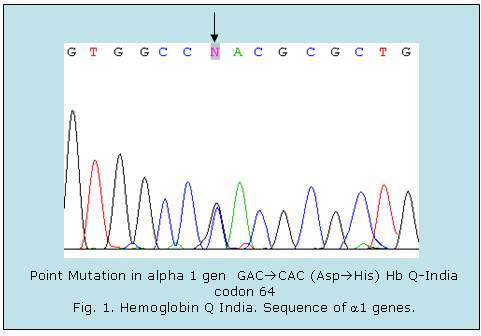
<body><![CDATA[<P><font size="2" face="Verdana">(5'-GCGGGTTGCGGGAGGT-3').<SUP>15 </SUP>The reverse    specific primers for the a1 gene were used to confirm the mutation (<a href="#fig1">fig.</a>).    </font>      <P align="center"><a name="fig1"></a><img src="/img/revistas/hih/v26n3/f0108310.gif" width="481" height="336">      
<P><font size="2" face="Verdana">Molecular biology studies (PCR) showed the presence    of -<font face="Symbol">a</font><SUP>3,7</SUP> deletion, and the sequencing    of <font face="Symbol">a</font>-1 gene showed a GAC <font size="4"><font face="Symbol" size="2">&reg;</font></font>    CAC (Asp <font size="4"><font face="Symbol" size="2">&reg;</font></font><strong>    </strong>His) substitution at codon 64, corresponding to Hb Q India (fig.).    Even though Hb Q India is detectable by electrophoresis its correct characterization    requires high-performance liquid chromatography (HPLC) or molecular analysis.    </font>      <P><font size="2" face="Verdana">It is the first time that this abnormal hemoglobin    is described in our country. The low red blood cell indexes observed in this    case could be due to co-inheritance of <font face="Symbol">a</font><SUP>+</SUP>    thalassaemia (-<font face="Symbol">a</font><SUP>3.7</SUP> deletion). </font>     <P>      <P>     <P>      <P>      <P><font size="3" face="Verdana"><B>REFERENCES</B> </font>     <P>      ]]></body>
<body><![CDATA[<!-- ref --><P><font size="2" face="Verdana">1. Lorkin PA, Charlesworth D, Lehman H, Rahbar    S, Tuchinda LI, Lie I, et al. Two haemoglobins Q, alpha-74 (EF3) and alpha-75 (EF4)    aspartic acid to histidine. Br J Haematol 1970;19:117-25. </font>     <P>      <!-- ref --><P><font size="2" face="Verdana">2. Desai DV, Dhanani H, Kapoor AK, Yeluri SV.    HbQ-India in a Sindhi family: An uncommon hemoglobin variant. [Case Reports].    J Lab Hematol 2004;10:212-4. </font>     <P>      <!-- ref --><P><font size="2" face="Verdana">3. Sukumaran PK, Merchant SM, Desai MP, Lehmann    H. Hemoglobin Q India (alpha 64(E13) aspartic acid to histidine) associated    with beta-thalassemia observed in three Sindhi families. J Med Genet 1972;9:436-42.    </font>      <P>      <!-- ref --><P><font size="2" face="Verdana">4. Dash S, Huisman TH. Hemoglobin-Q-India (64    (E13) Asp-His) and beta thalassemia: A case report from Punjab (North India).    Eur J Haematol 1988;40:281-3. </font>     <P>      <!-- ref --><P><font size="2" face="Verdana">5. Schmidt RM, Bechtel KC, Moo-Penn WF. Hemoglobin    Q India, alpha 64 (E13) Asp replaced by His, and beta-thalassemia in a Canadian    family. Am J Clin Pathol 1976;66:446-8. </font>     <P>      ]]></body>
<body><![CDATA[<!-- ref --><P><font size="2" face="Verdana">6. Sagnet H, Morineaud JP, Delprat J, Revil H,    Thomas J, Philibert E, et al. A rare hemoglobinosis: The association of hemoglobin Q and    alpha-thalassemia. Med Trop 1968;28:133-8. </font>     <P>      <!-- ref --><P><font size="2" face="Verdana">7. Viprakasit V, Chinchang W, Pung-Amritt P,    Tanphaichitr VS. Identification of Hb Q-India (alpha64 Asp&#151;&gt;His) in    Thailand. Hematology 2004;9:151-5. </font>      <P>      <!-- ref --><P><font size="2" face="Verdana">8. Abraham R, Thomas M, Britt R, Fisher C, Old    J. Hb Q-India: An uncommon variant diagnosed in three Punjabi patients with    diabetes is identified by a novel DNA analysis test. J Clin Pathol 2003;56:296-9. </font>     <P>      <!-- ref --><P><font size="2" face="Verdana">9. Chenna R, Sugawara H, Koike T, L&oacute;pez    R, Gibson T, Higgins D, et al. Multiple sequence alignment with the Clustal series of programs.    Nucleic Acids Res 2003;31:3497-500. </font>     <P>      <!-- ref --><P><font size="2" face="Verdana">10. Efremov GD, Huisman THF. Diagn&oacute;stico    de laboratorio de Hemoglobinopat&iacute;as en Hemoglobinas anormales. En: Weatherall    DJ. Cl&iacute;nica Hematol&oacute;gica 2/2. Barcelona: Salvat; 1976. p. A) 319-320    B) 322-323. </font>     <P>      ]]></body>
<body><![CDATA[<!-- ref --><P><font size="2" face="Verdana">11. Carrell RW, Kay R. A simple method for the    detection of unstable haemoglobins. Br J Haematol 1972;23:615-9. </font>     <P>      <!-- ref --><P><font size="2" face="Verdana">12. Miller SA, Dykes DD, Polesky HF. A simple    salting-out procedure for extracting DNA from human nucleated cells. Nuclei    Acids Res 1988;16:1215. </font>     <P>      <P><font size="2" face="Verdana">13. Smetanina NS, Huisman THJ. Detection of &alpha;-thalassemia-2    (-3.7 kb) and its corresponding triplication aaa (anti 3.7 kb) by PCR; an improved    technical change. Am J Hematol 1996;53,201-3. </font>     <P>      <P><font size="2" face="Verdana">14. Molchanova, TP, Pobedimskaya DD, Postnikov    VA. A simplified procedure for sequencing amplified DNA containing the &alpha;2- or    &alpha;1-globin gene. Hemoglobin 1994;18:251-5. </font>     <P>      <!-- ref --><P><font size="2" face="Verdana">15. Noguera NI, Gonz&aacute;lez FA, D&aacute;voli    RA, Milani AC, Villegas A. A novel splices acceptor site mutation of the alpha2-globin    gene causing alpha-thalassemia. Hemoglobin 2001;25:311-5. </font>     <P>     ]]></body>
<body><![CDATA[<P>      <P>      <P>      <P>      <P><font size="2" face="Verdana">Recibido: 24 de marzo del 2010.    <br>   </font> <font size="2" face="Verdana">Aprobado: 12 de abril del 2010. </font>     <P>     <P>      <P>      <P>      ]]></body>
<body><![CDATA[<P>      <P><font size="2" face="Verdana">Dra. <I>Susana M. P&eacute;rez</I>. Departamento    de Bioqu&iacute;mica Cl&iacute;nica, C&aacute;tedra de Hematolog&iacute;a. Facultad    de Ciencias Bioqu&iacute;micas y Farmac&eacute;uticas. Universidad Nacional    de Rosario. Rosario, Argentina. e-mail: <U><a href="mailto:sperez@fbioyf.unr.edu.ar">sperez@fbioyf.unr.edu.ar    <br>   </a></U></font><font size="2" face="Verdana">Corresponding author: +54-341-4804598; e-mail:    <a href="mailto:sperez@fbioyf.unr.edu.ar">sperez@fbioyf.unr.edu.ar</a></font>      ]]></body><back>
<ref-list>
<ref id="B1">
<label>1</label><nlm-citation citation-type="journal">
<person-group person-group-type="author">
<name>
<surname><![CDATA[Lorkin]]></surname>
<given-names><![CDATA[PA]]></given-names>
</name>
<name>
<surname><![CDATA[Charlesworth]]></surname>
<given-names><![CDATA[D]]></given-names>
</name>
<name>
<surname><![CDATA[Lehman]]></surname>
<given-names><![CDATA[H]]></given-names>
</name>
<name>
<surname><![CDATA[Rahbar]]></surname>
<given-names><![CDATA[S]]></given-names>
</name>
<name>
<surname><![CDATA[Tuchinda]]></surname>
<given-names><![CDATA[LI]]></given-names>
</name>
<name>
<surname><![CDATA[Lie]]></surname>
<given-names><![CDATA[I]]></given-names>
</name>
</person-group>
<article-title xml:lang="en"><![CDATA[Two haemoglobins Q, alpha-74 (EF3) and alpha-75 (EF4) aspartic acid to histidine]]></article-title>
<source><![CDATA[Br J Haematol]]></source>
<year>1970</year>
<volume>19</volume>
<page-range>117-25</page-range></nlm-citation>
</ref>
<ref id="B2">
<label>2</label><nlm-citation citation-type="journal">
<person-group person-group-type="author">
<name>
<surname><![CDATA[Desai]]></surname>
<given-names><![CDATA[DV]]></given-names>
</name>
<name>
<surname><![CDATA[Dhanani]]></surname>
<given-names><![CDATA[H]]></given-names>
</name>
<name>
<surname><![CDATA[Kapoor]]></surname>
<given-names><![CDATA[AK]]></given-names>
</name>
<name>
<surname><![CDATA[Yeluri]]></surname>
<given-names><![CDATA[SV]]></given-names>
</name>
</person-group>
<article-title xml:lang="en"><![CDATA[HbQ-India in a Sindhi family: An uncommon hemoglobin variant. [Case Reports]]]></article-title>
<source><![CDATA[J Lab Hematol]]></source>
<year>2004</year>
<volume>10</volume>
<page-range>212-4</page-range></nlm-citation>
</ref>
<ref id="B3">
<label>3</label><nlm-citation citation-type="journal">
<person-group person-group-type="author">
<name>
<surname><![CDATA[Sukumaran]]></surname>
<given-names><![CDATA[PK]]></given-names>
</name>
<name>
<surname><![CDATA[Merchant]]></surname>
<given-names><![CDATA[SM]]></given-names>
</name>
<name>
<surname><![CDATA[Desai]]></surname>
<given-names><![CDATA[MP]]></given-names>
</name>
<name>
<surname><![CDATA[Lehmann]]></surname>
<given-names><![CDATA[H]]></given-names>
</name>
</person-group>
<article-title xml:lang="en"><![CDATA[Hemoglobin Q India (alpha 64(E13) aspartic acid to histidine) associated with beta-thalassemia observed in three Sindhi families]]></article-title>
<source><![CDATA[J Med Genet]]></source>
<year>1972</year>
<volume>9</volume>
<page-range>436-42</page-range></nlm-citation>
</ref>
<ref id="B4">
<label>4</label><nlm-citation citation-type="journal">
<person-group person-group-type="author">
<name>
<surname><![CDATA[Dash]]></surname>
<given-names><![CDATA[S]]></given-names>
</name>
<name>
<surname><![CDATA[Huisman]]></surname>
<given-names><![CDATA[TH]]></given-names>
</name>
</person-group>
<article-title xml:lang="en"><![CDATA[Hemoglobin-Q-India (64 (E13) Asp-His) and beta thalassemia: A case report from Punjab (North India)]]></article-title>
<source><![CDATA[Eur J Haematol]]></source>
<year>1988</year>
<volume>40</volume>
<page-range>281-3</page-range></nlm-citation>
</ref>
<ref id="B5">
<label>5</label><nlm-citation citation-type="journal">
<person-group person-group-type="author">
<name>
<surname><![CDATA[Schmidt]]></surname>
<given-names><![CDATA[RM]]></given-names>
</name>
<name>
<surname><![CDATA[Bechtel]]></surname>
<given-names><![CDATA[KC]]></given-names>
</name>
<name>
<surname><![CDATA[Moo-Penn]]></surname>
<given-names><![CDATA[WF]]></given-names>
</name>
</person-group>
<article-title xml:lang="en"><![CDATA[Hemoglobin Q India, alpha 64 (E13) Asp replaced by His, and beta-thalassemia in a Canadian family]]></article-title>
<source><![CDATA[Am J Clin Pathol]]></source>
<year>1976</year>
<volume>66</volume>
<page-range>446-8</page-range></nlm-citation>
</ref>
<ref id="B6">
<label>6</label><nlm-citation citation-type="journal">
<person-group person-group-type="author">
<name>
<surname><![CDATA[Sagnet]]></surname>
<given-names><![CDATA[H]]></given-names>
</name>
<name>
<surname><![CDATA[Morineaud]]></surname>
<given-names><![CDATA[JP]]></given-names>
</name>
<name>
<surname><![CDATA[Delprat]]></surname>
<given-names><![CDATA[J]]></given-names>
</name>
<name>
<surname><![CDATA[Revil]]></surname>
<given-names><![CDATA[H]]></given-names>
</name>
<name>
<surname><![CDATA[Thomas]]></surname>
<given-names><![CDATA[J]]></given-names>
</name>
<name>
<surname><![CDATA[Philibert]]></surname>
<given-names><![CDATA[E]]></given-names>
</name>
</person-group>
<article-title xml:lang="en"><![CDATA[A rare hemoglobinosis: The association of hemoglobin Q and alpha-thalassemia]]></article-title>
<source><![CDATA[Med Trop]]></source>
<year>1968</year>
<volume>28</volume>
<page-range>133-8</page-range></nlm-citation>
</ref>
<ref id="B7">
<label>7</label><nlm-citation citation-type="journal">
<person-group person-group-type="author">
<name>
<surname><![CDATA[Viprakasit]]></surname>
<given-names><![CDATA[V]]></given-names>
</name>
<name>
<surname><![CDATA[Chinchang]]></surname>
<given-names><![CDATA[W]]></given-names>
</name>
<name>
<surname><![CDATA[Pung-Amritt]]></surname>
<given-names><![CDATA[P]]></given-names>
</name>
<name>
<surname><![CDATA[Tanphaichitr]]></surname>
<given-names><![CDATA[VS]]></given-names>
</name>
</person-group>
<article-title xml:lang="en"><![CDATA[Identification of Hb Q-India (alpha64 Asp->His) in Thailand]]></article-title>
<source><![CDATA[Hematology]]></source>
<year>2004</year>
<volume>9</volume>
<page-range>151-5</page-range></nlm-citation>
</ref>
<ref id="B8">
<label>8</label><nlm-citation citation-type="journal">
<person-group person-group-type="author">
<name>
<surname><![CDATA[Abraham]]></surname>
<given-names><![CDATA[R]]></given-names>
</name>
<name>
<surname><![CDATA[Thomas]]></surname>
<given-names><![CDATA[M]]></given-names>
</name>
<name>
<surname><![CDATA[Britt]]></surname>
<given-names><![CDATA[R]]></given-names>
</name>
<name>
<surname><![CDATA[Fisher]]></surname>
<given-names><![CDATA[C]]></given-names>
</name>
<name>
<surname><![CDATA[Old]]></surname>
<given-names><![CDATA[J]]></given-names>
</name>
</person-group>
<article-title xml:lang="en"><![CDATA[Hb Q-India: An uncommon variant diagnosed in three Punjabi patients with diabetes is identified by a novel DNA analysis test]]></article-title>
<source><![CDATA[J Clin Pathol]]></source>
<year>2003</year>
<volume>56</volume>
<page-range>296-9</page-range></nlm-citation>
</ref>
<ref id="B9">
<label>9</label><nlm-citation citation-type="journal">
<person-group person-group-type="author">
<name>
<surname><![CDATA[Chenna]]></surname>
<given-names><![CDATA[R]]></given-names>
</name>
<name>
<surname><![CDATA[Sugawara]]></surname>
<given-names><![CDATA[H]]></given-names>
</name>
<name>
<surname><![CDATA[Koike]]></surname>
<given-names><![CDATA[T]]></given-names>
</name>
<name>
<surname><![CDATA[López]]></surname>
<given-names><![CDATA[R]]></given-names>
</name>
<name>
<surname><![CDATA[Gibson]]></surname>
<given-names><![CDATA[T]]></given-names>
</name>
<name>
<surname><![CDATA[Higgins]]></surname>
<given-names><![CDATA[D]]></given-names>
</name>
</person-group>
<article-title xml:lang="en"><![CDATA[Multiple sequence alignment with the Clustal series of programs]]></article-title>
<source><![CDATA[Nucleic Acids Res]]></source>
<year>2003</year>
<volume>31</volume>
<page-range>3497-500</page-range></nlm-citation>
</ref>
<ref id="B10">
<label>10</label><nlm-citation citation-type="book">
<person-group person-group-type="author">
<name>
<surname><![CDATA[Efremov]]></surname>
<given-names><![CDATA[GD]]></given-names>
</name>
<name>
<surname><![CDATA[Huisman]]></surname>
<given-names><![CDATA[THF]]></given-names>
</name>
</person-group>
<article-title xml:lang="es"><![CDATA[Diagnóstico de laboratorio de Hemoglobinopatías en Hemoglobinas anormales]]></article-title>
<person-group person-group-type="editor">
<name>
<surname><![CDATA[Weatherall]]></surname>
<given-names><![CDATA[DJ]]></given-names>
</name>
</person-group>
<source><![CDATA[Clínica Hematológica]]></source>
<year>1976</year>
<page-range>A) 319-320 B) 322-323</page-range><publisher-loc><![CDATA[Barcelona ]]></publisher-loc>
<publisher-name><![CDATA[Salvat]]></publisher-name>
</nlm-citation>
</ref>
<ref id="B11">
<label>11</label><nlm-citation citation-type="journal">
<person-group person-group-type="author">
<name>
<surname><![CDATA[Carrell]]></surname>
<given-names><![CDATA[RW]]></given-names>
</name>
<name>
<surname><![CDATA[Kay]]></surname>
<given-names><![CDATA[R]]></given-names>
</name>
</person-group>
<article-title xml:lang="en"><![CDATA[A simple method for the detection of unstable haemoglobins]]></article-title>
<source><![CDATA[Br J Haematol]]></source>
<year>1972</year>
<volume>23</volume>
<page-range>615-9</page-range></nlm-citation>
</ref>
<ref id="B12">
<label>12</label><nlm-citation citation-type="journal">
<person-group person-group-type="author">
<name>
<surname><![CDATA[Miller]]></surname>
<given-names><![CDATA[SA]]></given-names>
</name>
<name>
<surname><![CDATA[Dykes]]></surname>
<given-names><![CDATA[DD]]></given-names>
</name>
<name>
<surname><![CDATA[Polesky]]></surname>
<given-names><![CDATA[HF]]></given-names>
</name>
</person-group>
<article-title xml:lang="en"><![CDATA[A simple salting-out procedure for extracting DNA from human nucleated cells]]></article-title>
<source><![CDATA[Nuclei Acids Res]]></source>
<year>1988</year>
<volume>16</volume>
<page-range>1215</page-range></nlm-citation>
</ref>
<ref id="B13">
<label>13</label><nlm-citation citation-type="journal">
<person-group person-group-type="author">
<name>
<surname><![CDATA[Smetanina]]></surname>
<given-names><![CDATA[NS]]></given-names>
</name>
<name>
<surname><![CDATA[Huisman]]></surname>
<given-names><![CDATA[THJ]]></given-names>
</name>
</person-group>
<article-title xml:lang="en"><![CDATA[Detection of &#945;-thalassemia-2 (-3.7 kb) and its corresponding triplication aaa (anti 3.7 kb) by PCR: an improved technical change]]></article-title>
<source><![CDATA[Am J Hematol]]></source>
<year>1996</year>
<volume>53</volume>
<page-range>201-3</page-range></nlm-citation>
</ref>
<ref id="B14">
<label>14</label><nlm-citation citation-type="journal">
<person-group person-group-type="author">
<name>
<surname><![CDATA[Molchanova]]></surname>
<given-names><![CDATA[TP]]></given-names>
</name>
<name>
<surname><![CDATA[Pobedimskaya]]></surname>
<given-names><![CDATA[DD]]></given-names>
</name>
<name>
<surname><![CDATA[Postnikov]]></surname>
<given-names><![CDATA[VA]]></given-names>
</name>
</person-group>
<article-title xml:lang="en"><![CDATA[A simplified procedure for sequencing amplified DNA containing the &#945;2- or &#945;1-globin gene]]></article-title>
<source><![CDATA[Hemoglobin]]></source>
<year>1994</year>
<volume>18</volume>
<page-range>251-5</page-range></nlm-citation>
</ref>
<ref id="B15">
<label>15</label><nlm-citation citation-type="journal">
<person-group person-group-type="author">
<name>
<surname><![CDATA[Noguera]]></surname>
<given-names><![CDATA[NI]]></given-names>
</name>
<name>
<surname><![CDATA[González]]></surname>
<given-names><![CDATA[FA]]></given-names>
</name>
<name>
<surname><![CDATA[Dávoli]]></surname>
<given-names><![CDATA[RA]]></given-names>
</name>
<name>
<surname><![CDATA[Milani]]></surname>
<given-names><![CDATA[AC]]></given-names>
</name>
<name>
<surname><![CDATA[Villegas]]></surname>
<given-names><![CDATA[A]]></given-names>
</name>
</person-group>
<article-title xml:lang="en"><![CDATA[A novel splices acceptor site mutation of the alpha2-globin gene causing alpha-thalassemia]]></article-title>
<source><![CDATA[Hemoglobin]]></source>
<year>2001</year>
<volume>25</volume>
<page-range>311-5</page-range></nlm-citation>
</ref>
</ref-list>
</back>
</article>