<?xml version="1.0" encoding="ISO-8859-1"?><article xmlns:mml="http://www.w3.org/1998/Math/MathML" xmlns:xlink="http://www.w3.org/1999/xlink" xmlns:xsi="http://www.w3.org/2001/XMLSchema-instance">
<front>
<journal-meta>
<journal-id>0864-0300</journal-id>
<journal-title><![CDATA[Revista Cubana de Investigaciones Biomédicas]]></journal-title>
<abbrev-journal-title><![CDATA[Rev Cubana Invest Bioméd]]></abbrev-journal-title>
<issn>0864-0300</issn>
<publisher>
<publisher-name><![CDATA[ECIMED]]></publisher-name>
</publisher>
</journal-meta>
<article-meta>
<article-id>S0864-03002004000200010</article-id>
<title-group>
<article-title xml:lang="es"><![CDATA[Participación del gen de la sintasa del óxido nítrico 1 en la patogénesis del asma]]></article-title>
<article-title xml:lang="en"><![CDATA[Involvement of type 1 nitric oxide synthase in the pathogenesis of asthma]]></article-title>
</title-group>
<contrib-group>
<contrib contrib-type="author">
<name>
<surname><![CDATA[Martínez Alfaro]]></surname>
<given-names><![CDATA[Beatriz]]></given-names>
</name>
<xref ref-type="aff" rid="A01"/>
</contrib>
<contrib contrib-type="author">
<name>
<surname><![CDATA[Trespalacio Romero]]></surname>
<given-names><![CDATA[María Angélica]]></given-names>
</name>
</contrib>
<contrib contrib-type="author">
<name>
<surname><![CDATA[Caraballo Gracia]]></surname>
<given-names><![CDATA[Luis]]></given-names>
</name>
</contrib>
</contrib-group>
<aff id="A01">
<institution><![CDATA[,Instituto de Investigaciones Inmunológicas de la Universidad de Cartagena  ]]></institution>
<addr-line><![CDATA[ ]]></addr-line>
</aff>
<pub-date pub-type="pub">
<day>00</day>
<month>06</month>
<year>2004</year>
</pub-date>
<pub-date pub-type="epub">
<day>00</day>
<month>06</month>
<year>2004</year>
</pub-date>
<volume>23</volume>
<numero>2</numero>
<fpage>121</fpage>
<lpage>127</lpage>
<copyright-statement/>
<copyright-year/>
<self-uri xlink:href="http://scielo.sld.cu/scielo.php?script=sci_arttext&amp;pid=S0864-03002004000200010&amp;lng=en&amp;nrm=iso"></self-uri><self-uri xlink:href="http://scielo.sld.cu/scielo.php?script=sci_abstract&amp;pid=S0864-03002004000200010&amp;lng=en&amp;nrm=iso"></self-uri><self-uri xlink:href="http://scielo.sld.cu/scielo.php?script=sci_pdf&amp;pid=S0864-03002004000200010&amp;lng=en&amp;nrm=iso"></self-uri><abstract abstract-type="short" xml:lang="es"><p><![CDATA[Se realizó una revisión que abarca los aspectos más importantes de la fisiología y genética del gen de la sintasa del óxido nítrico 1 así como su participación en la patogénesis del asma. El asma es una enfermedad común y compleja, caracterizada por obstrucción de las vías aéreas, hiperreactividad bronquial y en muchos casos atopia. Su causa aún no esta bien definida, pero se conoce que está influenciada por factores genéticos y ambientales. Para tratar de esclarecer la fuente precisa de la enfermedad, se realizan análisis de genes candidatos y al nivel ambiental la influencia de los alergenos de ácaros y otros factores de riesgo en el desarrollo de asma. Dentro de los genes candidatos, el gen de la sintasa del óxido nítrico 1 ha cobrado gran interés por su amplio papel en la patogénesis del asma, porque actúa como un neurotransmisor y broncodilatador que provoca una hiperrespuesta en las vías aéreas]]></p></abstract>
<abstract abstract-type="short" xml:lang="en"><p><![CDATA[A review of the most important aspects of physiology and genetics of type 1 nitric oxide synthase gene as well as its involvement in asthma pathogenesis was made. Asthma is a common and complex disease characterized by obstruction of airways, bronchial hyperreactivity and in many cases atopy. The fundamental cause of this disease is not yet well defined but it is known that genetic and environmental factors have their bearing on it. To clarify the exact origin of this disease, candidate genes, the influence of mite allergens at environmental level and other risk factors for asthma were all analyzed. Among candidate genes, type 1 nitric oxide synthase gene has aroused great interest due to its extensive role in asthma pathogenesis becuase it acts as a neurotransmitter and bronchodilator that provides hyperresponse in airways]]></p></abstract>
<kwd-group>
<kwd lng="es"><![CDATA[Óxido nítrico sintasa (NOS)]]></kwd>
<kwd lng="es"><![CDATA[asma, óxido nítrico (NO)]]></kwd>
<kwd lng="es"><![CDATA[isoformas]]></kwd>
<kwd lng="es"><![CDATA[patogénesis]]></kwd>
<kwd lng="es"><![CDATA[neurotransmisor]]></kwd>
<kwd lng="es"><![CDATA[hiperreactividad]]></kwd>
<kwd lng="es"><![CDATA[multifactorial]]></kwd>
<kwd lng="es"><![CDATA[splicing]]></kwd>
<kwd lng="es"><![CDATA[5' utr (un-translate region)]]></kwd>
<kwd lng="en"><![CDATA[Nitric oxide synthase]]></kwd>
<kwd lng="en"><![CDATA[asthma]]></kwd>
<kwd lng="en"><![CDATA[nitric oxide]]></kwd>
<kwd lng="en"><![CDATA[isoforms]]></kwd>
<kwd lng="en"><![CDATA[pathogenesis, neurotransmitter]]></kwd>
<kwd lng="en"><![CDATA[hyperreactivity]]></kwd>
<kwd lng="en"><![CDATA[multifactor]]></kwd>
<kwd lng="en"><![CDATA[splicing]]></kwd>
<kwd lng="en"><![CDATA[5´ utr (un-translate region)]]></kwd>
</kwd-group>
</article-meta>
</front><body><![CDATA[ <div class=Section1><h1><span lang=ES-MX>Trabajo de revisión</span></h1>    <p class=MsoNormal style='margin:0cm;margin-bottom:.0001pt'><span class=MsoHyperlink><span lang=ES-CO style='font-size:8.0pt; font-family:"CG Times";mso-ansi-language:ES-CO'><o:p></o:p></span></span></p>    <p><span lang=ES-CO style='font-size:11.0pt;mso-bidi-font-size:10.0pt; font-family:"CG Times";mso-ansi-language:ES-CO;mso-bidi-font-style:italic'>Instituto  de Investigaciones Inmunológicas de la Universidad de Cartagena</span><span lang=ES-CO style='mso-ansi-language:ES-CO'><o:p></o:p></span></p><h2><span lang=ES-CO>Participación  del gen de la sintasa del óxido nítrico 1 en la patogénesis del asma</span><span style='mso-ansi-language:ES'><o:p></o:p></span></h2>    <p class=MsoNormal style='text-align:justify'><i><span lang=ES-CO style='font-size:11.0pt;mso-bidi-font-size:10.0pt;font-family:"CG Times"; mso-ansi-language:ES-CO'>MSc. Beatriz Martínez Alfaro, Est. María Angélica Trespalacio  Romero y MD. Luis Caraballo Gracia</span></i><i><span style='mso-ansi-language:ES'><o:p></o:p></span></i></p>    <p class=MsoNormal><span style='mso-ansi-language:ES'>&nbsp;<o:p></o:p></span></p><h4><span lang=ES-MX style='font-size:11.0pt;mso-bidi-font-size:10.0pt'>Resumen</span><span lang=ES-MX style='font-size:11.0pt;mso-bidi-font-size:10.0pt;font-family:"CG Times"'>  </span></h4>    <p class=MsoNormal><span lang=ES-CO style='font-size:11.0pt;mso-bidi-font-size: 10.0pt;font-family:"CG Times";mso-ansi-language:ES-CO'>Se realizó una revisión  que abarca los aspectos más importantes de la fisiología y genética de</span><span lang=ES-MX style='font-size:11.0pt;mso-bidi-font-size:10.0pt;font-family:"CG Times"; mso-ansi-language:ES-MX'>l gen de la sintasa del óxido nítrico 1</span><span lang=ES-CO style='font-size:11.0pt;mso-bidi-font-size:10.0pt;font-family:"CG Times"; mso-ansi-language:ES-CO'> así como su participación en la patogénesis del asma.  </span><span lang=ES-MX style='font-size:11.0pt;mso-bidi-font-size:10.0pt; font-family:"CG Times";mso-ansi-language:ES-MX'>El asma es una enfermedad común  y compleja, caracterizada por obstrucción de las vías aéreas, </span><span lang=ES-CO style='font-size:11.0pt;mso-bidi-font-size:10.0pt;font-family:"CG Times"; mso-ansi-language:ES-CO'>hiperreactividad bronquial </span><span lang=ES-MX style='font-size:11.0pt;mso-bidi-font-size:10.0pt;font-family:"CG Times"; mso-ansi-language:ES-MX'>y en muchos casos atopia. Su causa aún no esta bien definida,  pero se conoce que está influenciada por factores genéticos y ambientales. Para  tratar de esclarecer la fuente precisa de la enfermedad,</span><span lang=ES-CO style='font-size:11.0pt;mso-bidi-font-size:10.0pt;font-family:"CG Times"; mso-ansi-language:ES-CO'> se realizan análisis de genes candidatos y al nivel  </span><span lang=ES-MX style='font-size:11.0pt;mso-bidi-font-size:10.0pt;font-family:"CG Times"; mso-ansi-language:ES-MX'>ambiental la influencia de los alergenos de ácaros y  otros factores de riesgo en el desarrollo de asma. Dentro de los genes candidatos,  el gen de la sintasa del óxido nítrico 1 ha cobrado gran interés por su amplio  papel en la patogénesis del asma, porque actúa como un </span><span lang=ES-CO style='font-size:11.0pt;mso-bidi-font-size:10.0pt;font-family:"CG Times"; mso-ansi-language:ES-CO'>neurotransmisor y broncodilatador que provoca una hiperrespuesta  en las vías aéreas. </span><span lang=ES-MX style='mso-ansi-language: ES-MX'><o:p></o:p></span></p>    <p class=MsoNormal><i><span lang=ES-CO style='font-size:11.0pt;mso-bidi-font-size: 10.0pt;font-family:"CG Times";mso-ansi-language:ES-CO'>Palabras clave</span></i><span lang=ES-CO style='font-size:11.0pt;mso-bidi-font-size:10.0pt;font-family:"CG Times"; mso-ansi-language:ES-CO'>: Óxido nítrico sintasa (NOS), asma, óxido nítrico (NO),  isoformas, patogénesis, neurotransmisor, hiperreactividad, multifactorial, splicing,  5' utr (un-translate region).</span><span lang=ES-CO style='font-size:11.0pt;mso-bidi-font-size:10.0pt;font-family:"CG Times"; mso-ansi-language:ES-MX'> </span><span lang=ES-CO style='mso-ansi-language: ES-CO'><o:p></o:p></span></p>    <p class=MsoNormal style='text-align:justify'><span lang=ES-CO style='mso-ansi-language:ES-CO'>&nbsp;<o:p></o:p></span></p>    <p class=MsoNormal style='margin-bottom:12.0pt;text-align:justify'><span lang=ES-CO style='mso-ansi-language:ES-CO'>&nbsp;<o:p></o:p></span></p>    <p class=MsoNormal style='text-align:justify'><span lang=ES-CO style='font-size:11.0pt;mso-bidi-font-size:10.0pt;font-family:"CG Times"; mso-ansi-language:ES-CO'>El óxido nítrico (NO) se sintetiza a partir del aminoácido  L-arginina por una familia de enzimas llamadas sintasas del óxido nítrico (NOS)  de la que se conocen 3 isoformas. En el humano una de estas isoformas es la nNOS,  denominada también NOS neuronal o NOS1 porque abunda en tejido nervioso, de donde  fue originalmente clonada; aunque también está presente en otros tejidos como  el riñón y las células del músculo esquelético.<sup>1</sup> Otra isoenzima es  la iNOS (NOS inducible; NOS2 en el humano) denominada así porque su expresión  se induce por un agente que activa el sistema inmune. La tercera isoforma es la  eNOS (NOS endotelial, NOS3 en el humano), denominada así porque es constitutiva  de las células del endotelio vascular, aunque está presente en otros tejidos como  el miocardio.<sup>2,3</sup> Las isoformas de la NOS se expresan al nivel de las  vías bronquiales y los genes que codifican cada una se encuentran ubicados en  cromosomas distintos, así la NOS1 se halla ubicada en el cromosoma 12q24, la NOS2  en el 17q12 y la NOS3 en el 7q35-36.<sup>4-6</sup> En esta revisión se describe  la fisiología de la NOS1, haciendo énfasis en su participación en la patogénesis  del asma. </span><span lang=ES-CO style='mso-ansi-language:ES-CO'><o:p></o:p></span></p>    ]]></body>
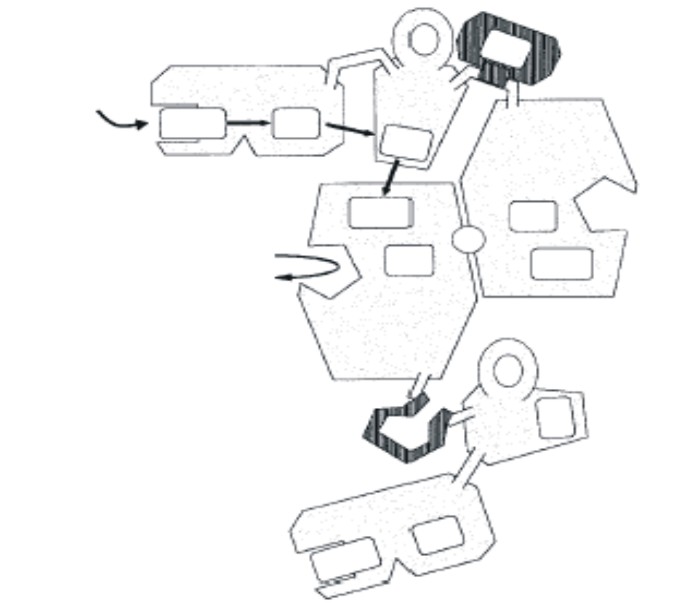
<body><![CDATA[<p><i><span lang=ES-MX style='font-size:11.0pt;mso-bidi-font-size:12.0pt; font-family:"CG Times";mso-ansi-language:ES-MX'>Fisiología y metabolismo de la  NOS1</span></i><i><span lang=ES-MX style='font-size:11.0pt;mso-bidi-font-size: 12.0pt;font-family:"Times New Roman";mso-ansi-language:ES-MX'> </span></i><i><span style='font-size:11.0pt;mso-bidi-font-size:12.0pt;font-family:"Times New Roman"'><o:p></o:p></span></i></p>    <p class=MsoNormal style='text-align:justify'><span lang=ES-CO style='font-size:11.0pt;mso-bidi-font-size:10.0pt;font-family:"CG Times"; mso-ansi-language:ES-CO'>El endotelio vascular produce y libera sustancias vasodilatadoras,  dentro de estas figura el oxido nítrico (NO) (antiguamente conocido como <i style='mso-bidi-font-style:normal'>factor  relajador derivado del endotelio</i> o EDRF). El NO es un gas liposoluble que  se difunde y atraviesa con facilidad las membranas celulares. Es un radical libre  muy inestable que reacciona rápidamente con el oxígeno para formar nitrito, esto  condiciona que su función como mediador de comunicación intercelular sea de tipo  paracrino y autocrino.<sup>3,7</sup> </span><span lang=ES-CO style='mso-ansi-language:ES-CO'><o:p></o:p></span></p>    <p class=MsoNormal style='text-align:justify'><span lang=ES-CO style='font-size:11.0pt;mso-bidi-font-size:10.0pt;font-family:"CG Times"; mso-ansi-language:ES-CO'>Su biosíntesis no está restringida a un tejido en particular,  pero se sabe que se produce de manera abundante en el Sistema Nervioso Central  y Periférico e igualmente se ha detectado en el endotelio vascular, debido a la  acción que ejercen las sintasas de óxido nítrico, especialmente la NOS1<span style='color:black'>.  </span>Esta última es miembro de un grupo de enzimas que cataliza la oxidación  del electrón 5 de la L-arginina para formar L-citrulina y NO; es dependiente de  la vía calcio/calmodulina para ejercer su mecanismo de acción, al igual que la  NOS3.<sup>3,8</sup><b style='mso-bidi-font-weight:normal'> </b>En el cerebro controla procesos como  la formación de la memoria e intensifica la respuesta ante la presencia de un  estímulo dañino.<sup>9</sup> <span style='color:black'>En el Sistema Nervioso  Periférico la NOS1 actúa como un neurotransmisor, neuromodulador o como una molécula  de transmisión de señales intracelular. Participa en la plasticidad sináptica,  regulación de la expresión de genes, desarrollo, diferenciación y regeneración;  desempeña un papel importante en los problemas neurodegenerativos y se comporta  como un mediador de neurotoxicidad.<sup>10,11</sup></span></span><span lang=ES-CO style='mso-ansi-language:ES-CO'><o:p></o:p></span></p>    <p class=MsoNormal style='text-align:justify'><span lang=ES-CO style='font-size:11.0pt;mso-bidi-font-size:10.0pt;font-family:"CG Times"; mso-ansi-language:ES-CO'>Por otro lado NOS1 está fisiológicamente ligada al asma  porque actúa como un neurotransmisor broncodilatador de terminaciones nerviosas  no adrenérgicas no colinérgicas.<sup>11</sup> Recientemente se ha demostrado la  importancia fisiológica del NOS1 en modelos murinos con asma alérgica. En este  estudio los ratones carentes del gen que codifica para la NOS1 presentan hiperrespuesta  al reto con metacolina en comparación con los ratones tipo silvestre.<sup>10</sup></span><span lang=ES-CO style='mso-ansi-language: ES-CO'><o:p></o:p></span></p>    <p class=MsoNormal style='text-align:justify'><span lang=ES-CO style='font-size:11.0pt;mso-bidi-font-size:10.0pt;font-family:"CG Times"; mso-ansi-language:ES-CO'>Más reciente <i>Lührs </i>y otros, demostraron que la  NOS1 en el pulmón humano es expresada predominantemente en células endoteliales  de los capilares de septos alveolares; lo que sugiere que el NO producido puede  actuar, entre otras cosas, como regulador de la permeabilidad capilar. Este hallazgo  es importante porque se ha demostrado que el NO producido endógenamente y el inhalado,  están implicados en varios procesos fisiológicos y fisiopatológicos en el pulmón  humano.<sup>12</sup>.</span><span lang=ES-CO style='mso-ansi-language:ES-CO'><o:p></o:p></span></p>    <p><i><span lang=ES-CO style='font-size:11.0pt;mso-bidi-font-size:10.0pt; font-family:"CG Times";mso-ansi-language:ES-CO'>Estructura de la proteína NOS1</span></i><span lang=ES-CO style='font-size:11.0pt;mso-bidi-font-size:10.0pt;mso-ansi-language: ES-CO'> </span><span style='font-size:11.0pt;mso-bidi-font-size:10.0pt'><o:p></o:p></span></p>    <p class=MsoNormal style='text-align:justify'><span lang=ES-CO style='font-size:11.0pt;mso-bidi-font-size:10.0pt;font-family:"CG Times"; mso-ansi-language:ES-CO'>Las sintasas de óxido nítrico humanas son flavocitocromos  diméricos que catalizan la síntesis de NO. Poseen 2 dominios catalíticos, uno  de actividad reductasa que está ubicado en la mitad de C-terminal de la enzima  y presenta los sitios de unión para los cofactores NADPH, FAD y FMN, el otro dominio  de actividad oxidasa está compuesto por un grupo hemo ubicado en la mitad del  N-terminal de la proteína, y determina la oxidación de la L-arginina. Ambos dominios  están separados por un sitio de unión para la calmodulina (fig.1).<sup>13</sup>  Por otra parte, recientes estudios realizados a partir del aislamiento de RNA  total de distintos tejidos de ratas, demuestran la existencia de 3 distintas especies  de mRNA de NOS1, designadas: NOS1a, que es la isoforma más abundante, encontrada  especialmente en el cerebro; NOS1b solo expresada en tejido embrionario y NOS1c  en el riñón.<sup>3</sup> El mARN de la NOS1 es expresado a altos niveles en el  músculo esquelético humano, y cuando es procesado alternativamente produce una  isoforma especifica del músculo llamada NOS1</span><span lang=ES-CO style='font-size:11.0pt; mso-bidi-font-size:10.0pt;font-family:Symbol;mso-ascii-font-family:"CG Times"; mso-hansi-font-family:"CG Times";mso-ansi-language:ES-CO;mso-char-type:symbol; mso-symbol-font-family:Symbol'><span style='mso-char-type:symbol;mso-symbol-font-family: Symbol'>m</span></span><span lang=ES-CO style='font-size:11.0pt;mso-bidi-font-size: 10.0pt;font-family:"CG Times";mso-ansi-language:ES-CO'>.<sup>14</sup> </span><span lang=ES-CO style='mso-ansi-language:ES-CO'><o:p></o:p></span></p>    <p class=MsoNormal align=center style='text-align:center'><span lang=EN-US><a href="/img/revistas/ibi/v23n2/fig0110204.jpg"><b><span style='font-size:8.0pt;font-family:Verdana'><img border=0 width=344 height=338 id="_x0000_i1026" src=/img/revistas/ibi/v23n2/fig0110204.jpg></span></b></a></span></p>    
<p class=MsoNormal align=center style='text-align:center'><i><span lang=ES-CO style='font-size:11.0pt;mso-bidi-font-size:10.0pt;font-family:"CG Times"; mso-ansi-language:ES-CO'>Fig. 1</span></i><span lang=ES-CO style='font-size: 11.0pt;mso-bidi-font-size:10.0pt;font-family:"CG Times";mso-ansi-language:ES-CO'>.  Representación esquemática de los dominios C y N- terminal de las NOS y el sitio  de unión a Calmodulina. </span><i><span lang=EN-US style='font-size:11.0pt; mso-bidi-font-size:10.0pt;font-family:"CG Times"'>Tomado de</span></i><span lang=EN-US style='font-size:11.0pt;mso-bidi-font-size:10.0pt;font-family:"CG Times"'>:  <span style='color:black'>Daff S, Noble MA, Craig DH, Rivers SL, Chapman SK, Munro  AW, et al. Control of electron transfer in neuronal NO synthase. Biochemical Society  Transaction 2001; 29: part 2: 147-152.</span></span></p>    <p><i><span lang=ES-MX style='font-size:11.0pt;mso-bidi-font-size:10.0pt; font-family:"CG Times";mso-ansi-language:ES-MX'>Estructura del gen NOS1</span></i><span lang=ES-MX style='font-family:"CG Times";mso-ansi-language:ES-MX'><o:p></o:p></span></p>    ]]></body>
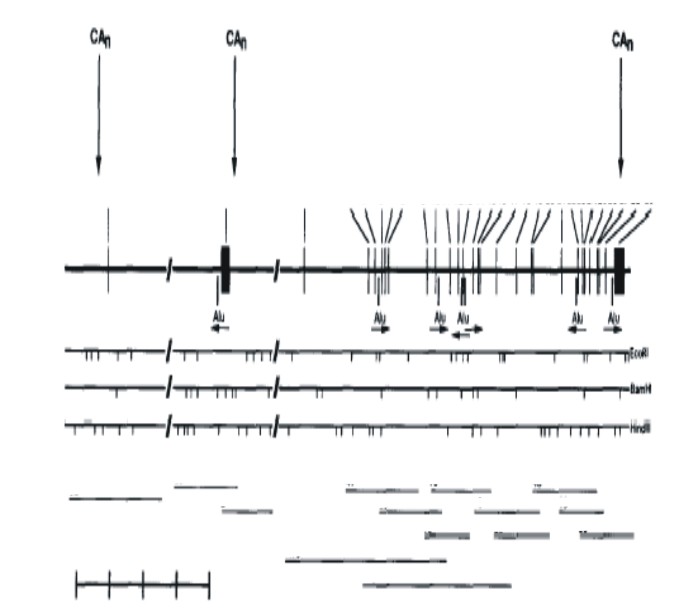
<body><![CDATA[<p class=MsoBodyText2><span lang=ES-CO style='font-size:11.0pt;mso-bidi-font-size: 10.0pt;font-family:"CG Times";mso-ansi-language:ES-CO'>El análisis de la secuencia  de nucleótidos de la región que codifica para la NOS1 reveló que es un <i>locus</i>  complejo formado por 29 exones y 28 intrones; abarca una región de aproximadamente  240 kb como una sola copia en el DNA genómico. Los exones tienen un tamaño promedio  que varía de 59 a 2 150 nucleótidos. El exon 2 es el sitio de iniciación de la  traducción y el exon 29 el sitio de terminación (fig. 2).<sup>6</sup><b style='mso-bidi-font-weight:normal'>  </b>La complejidad de este gen se debe a que durante la transcripción del RNA  mensajero se generan diferentes alternativas de empalme en el primer exon con  diferentes regiones 5 <i>Untranslated Region</i> (5' UTR). Recientemente <i>Newton</i>  y otros describieron 9 variantes en el exon 1, ubicadas en un fragmento de 105  kb aproximadamente, estas fueron designadas como variantes 1a hasta 1i. En un  estudio más reciente los mismos investigadores describen un mecanismo de empalme  alternativo que afecta la eficiencia en la traducción del gen NOS1, pero que no  modifica la secuencia de la proteína.<sup>14,15</sup> Estos resultados confirman  que el desarrollo y la expresión tejido-específica de la NOS1 está estrechamente  regulada por un patrón complejo de procesamiento alternativo, como lo había planteado  <i>Lee</i> y otros hace varios años.<sup>16</sup></span></p>    <p class=MsoBodyText2 align=center style='text-align:center'><span lang=ES-MX><a href="/img/revistas/ibi/v23n2/fig0210204.jpg"><b><span style='font-size:8.0pt;font-family:Verdana'><img border=0 width=363 height=341 id="_x0000_i1027" src=/img/revistas/ibi/v23n2/fig0210204.jpg></span></b></a></span></p>    
<p class=MsoBodyText2 align=center style='text-align:center'><i><span lang=ES-CO style='font-size:11.0pt;mso-bidi-font-size:10.0pt;font-family:"CG Times"; mso-ansi-language:ES-CO'>Fig. 2. </span></i><span lang=ES-CO style='font-size: 11.0pt;mso-bidi-font-size:10.0pt;font-family:"CG Times";mso-ansi-language:ES-CO'>Organización  de <i style='mso-bidi-font-style:normal'>NOS1</i>. El gen esta conformado por  29 exones y 28 intrones numerados en la gráfica. Las barras gruesas y oscuras  representan el sitio de iniciación (exon 2) y de terminación (exon 29) de la traducción.  <i>Tomado de</i>: Hall AV, Antoniou H, Wang Y, Cheung AH, Arbus A, Olson SL, et  al. </span><span lang=EN-US style='font-size:11.0pt;mso-bidi-font-size: 10.0pt;font-family:"CG Times";mso-ansi-language:EN-US'>Structural Organization  of the Human Neuronal Nitric Oxide Synthase gene (NOS1). J. Biol. Chem. 1994;  269(52): 33082-90.</span><span lang=EN-US style='mso-ansi-language:EN-US'><o:p></o:p></span></p>    <p class=MsoBodyText2><span lang=ES-CO style='font-size:11.0pt;mso-bidi-font-size: 10.0pt;font-family:"CG Times";mso-ansi-language:ES-CO'>Hasta el momento hay descritas  10 variantes alélicas en el exon 29 que corresponden a un polimorfismo repetido  del dinucleótido CA. Han sido reportadas, además, 9 variantes distintas en el  intron 20, en una unidad de repetición del tipo tri-nucleótido (AAT)n. Cabe anotar  que estos alelos fueron descritos en pacientes asmáticos provenientes de varias  poblaciones.<sup>17-19</sup>. </span></p>    <p class=MsoNormal><i><span lang=ES-CO style='font-size:11.0pt;mso-bidi-font-size: 10.0pt;font-family:"CG Times";mso-ansi-language:ES-CO'>Patogénesis del asma</span></i><span lang=ES-CO style='mso-ansi-language:ES-CO'><o:p></o:p></span></p>    <p class=MsoNormal><span lang=ES-CO style='font-size:11.0pt;mso-bidi-font-size: 10.0pt;font-family:"CG Times";mso-ansi-language:ES-CO'>El asma es una enfermedad  multifactorial influenciada por factores genéticos y ambientales. Es caracterizada  por obstrucción de las vías aéreas, hiperreactividad bronquial y en muchos casos  atopia. Además es un desorden inflamatorio en el que participan distintos tipos  de células que liberan gran cantidad de citoquinas y otros mediadores.<sup>20</sup>  </span><span lang=ES-CO style='mso-ansi-language:ES-CO'><o:p></o:p></span></p>    <p class=MsoNormal style='text-align:justify'><span lang=ES-CO style='font-size:11.0pt;mso-bidi-font-size:10.0pt;font-family:"CG Times"; mso-ansi-language:ES-CO'>A pesar de los intensos esfuerzos de los investigadores,  el asma sigue siendo un gran reto médico y científico. La prevalencia de esta  enfermedad ha aumentado 75 % entre 1980 y 1998. En el 2001 la <i>National Health  Interview Survey</i> estimó que en EE. UU.<span style="mso-spacerun: yes">  </span>6,9 % de adultos y 8,9 % de niños menores de  18 años, padecen asma. La razón por la que la prevalencia ha aumentado ha sido  materia de intensas especulaciones, además, los mecanismos patogénicos de la enfermedad  y la contribución de los factores genéticos también son poco entendidos.<sup>21</sup>  La exposición a alergenos y otros estímulos no específicos inducen la broncoconstricción  del músculo liso, con obstrucción aguda de las vías aéreas. La liberación de citoquinas  y mediadores inflamatorios producto de la estimulación de las células Th2 por  parte de las células presentadoras de antígenos, es otro de los mecanismos observados  en asma, porque esas citoquinas proinflamatorias estimulan la producción y liberación  de eosinófilos en la médula ósea y su reclutamiento en el tejido pulmonar.<sup>22</sup>  Recientemente <i>Wu</i> y otros, mostraron la primera evidencia directa de que  una reacción de brominación puede contribuir al daño del tejido pulmonar. La peroxidasa  de los eosinófilos que generan esas especies reactivas, y el reclutamiento y activación  de eosinófilos en el tejido pulmonar es una característica de esa enfermedad inflamatoria.<sup>23</sup></span><span lang=ES-CO style='mso-ansi-language:ES-CO'><o:p></o:p></span></p>    <p class=MsoNormal style='text-align:justify'><span lang=ES-CO style='font-size:11.0pt;mso-bidi-font-size:10.0pt;font-family:"CG Times"; mso-ansi-language:ES-CO'>La evidencia del incremento de los niveles de NO en pacientes  asmáticos, a pesar de que su mecanismo molecular y celular no esté aún bien entendido,  son mostrados en algunos estudios; los cuales sugieren que el NO relaja la musculatura  lisa, inhibe las proteínas de transmisión de señales de las células inflamatorias  y contribuye a la inflamación de las vías aéreas, porque actúa como un neurotransmisor,  vasodilatador y mediador inflamatorio.<sup>10,24</sup> </span><span lang=ES-CO style='mso-ansi-language: ES-CO'><o:p></o:p></span></p>    <p class=MsoNormal style='text-align:justify'><span lang=ES-CO style='font-size:11.0pt;mso-bidi-font-size:10.0pt;font-family:"CG Times"; mso-ansi-language:ES-CO'>NOS1 es un gen candidato<sup>25,26 </sup>atractivo para  asma por varias razones: Primero, la fracción de óxido nítrico en aire exhalado  (FENO) está proporcionalmente aumentada en pacientes con asma.<sup>27,28</sup>  Segundo, numerosos datos experimentales a partir de estudios tanto en humanos  como en animales indican que los factores neurogénicos tienen importancia en el  asma.<sup>29,30</sup> Y tercero, NOS1 es importante en modelos asmáticos con hiperrespuesta  de las vías aéreas: como lo demuestran ensayos realizados en ratones con deleción  de la NOS1, los cuales tienen valores bajos de FENO, fallando la enzima para generar  repuestas fuertes en las vías aéreas de dichos ratones, en comparación con los  de tipo silvestre después de la sensibilización y el reto con alergenos.<sup>10,31</sup>.Además,  la NOS1 es en parte la responsable de la producción de gran cantidad de moco que  obstruye las vías respiratorias, por tanto puede estar relacionada con enfermedades  alérgicas.</span><span lang=ES-CO style='mso-ansi-language:ES-CO'><o:p></o:p></span></p>    <p><span class=MsoPageNumber><i><span lang=ES-CO style='font-size:11.0pt; mso-bidi-font-size:10.0pt;font-family:"CG Times";mso-fareast-font-family:"Times New Roman"; mso-ansi-language:ES-CO'>Conclusiones</span></i></span></p>    ]]></body>
<body><![CDATA[<p class=MsoNormal style='margin-left:36.0pt;text-align:justify;text-indent: -18.0pt;mso-list:l0 level1 lfo2;tab-stops:list 18.0pt'><![if !supportLists]><span lang=ES-CO style='font-family:"Times New Roman";mso-ansi-language:ES-CO'>-<span style='font:7.0pt "Times New Roman"'>&nbsp;&nbsp;&nbsp;&nbsp;&nbsp;&nbsp;&nbsp;&nbsp;  </span></span><![endif]><span lang=ES-CO style='font-family:"Times New Roman"; mso-ansi-language:ES-CO'>-</span><span lang=ES-CO style='font-size:7.0pt; font-family:"Times New Roman";mso-ansi-language:ES-CO'>&nbsp;&nbsp;&nbsp;&nbsp;&nbsp;&nbsp;&nbsp;&nbsp;  </span><span lang=ES-CO style='font-size:11.0pt;mso-bidi-font-size:10.0pt; font-family:"CG Times";mso-ansi-language:ES-CO'>La NOS1 es una enzima que genera  óxido nítrico como producto final en la biosíntesis del aminoácido L-arginina.  Esta enzima es abundante en las vías aéreas y en neutrófilos, y está fisiológicamente  ligada a asma porque actúa como un neurotransmisor broncodilatador de terminaciones  nerviosas no adrenérgicas no colinérgicas, además de ser en parte la responsable  de la producción de gran cantidad de moco que obstruye las vías respiratorias;  por tanto, está relacionada con enfermedades alérgicas y es un gen candidato importante  y atractivo en estudios de asociación con asma.</span><span lang=ES-CO style='mso-ansi-language:ES-CO'><o:p></o:p></span></p>    <p class=MsoBodyText style='margin-left:36.0pt;text-align:justify;text-indent: -18.0pt;mso-list:l0 level1 lfo2;tab-stops:list 18.0pt'><![if !supportLists]><span lang=ES-MX>-<span style='font:7.0pt "Times New Roman"'>&nbsp;&nbsp;&nbsp;&nbsp;&nbsp;&nbsp;&nbsp;&nbsp;  </span></span><![endif]><span lang=ES-MX>-</span><span lang=ES-MX style='font-size:7.0pt'>&nbsp;&nbsp;&nbsp;&nbsp;&nbsp;&nbsp;&nbsp;&nbsp; </span><span lang=ES-CO style='font-size:11.0pt;mso-bidi-font-size:10.0pt;font-family:"CG Times"; color:windowtext;mso-ansi-language:ES-CO'>Existen muchos reportes del estudio  de múltiples genes y su participación en lal patogenésis del asma, aún se hace  necesaria la búsqueda de más genes con el fin de que esta información genética  sea útil para el desarrollo de nuevas estrategias terapéuticas y pruebas diagnósticas,  como por ejemplo la fabricación futura de drogas más eficaces y seguras para todos  los pacientes asmáticos. </span><span lang=ES-MX style='font-size:11.0pt;mso-bidi-font-size:10.0pt;font-family:"CG Times"; color:windowtext'>La información genética permitirá identificar sujetos con un  mayor riesgo y realizar intervenciones a tiempo; también identificará fenotipos  asmáticos específicos que puedan ser tratados de forma más precisa, y además brindará  una mejor comprensión de las bases fisiopatológicas de este padecimiento.</span></p>    <p class=MsoBodyText style='text-align:justify'><span lang=ES-MX style='font-size:11.0pt;mso-bidi-font-size:10.0pt;font-family:"CG Times"; mso-ansi-language:ES-CO'><span style="mso-spacerun: yes"> </span></span></p><h4><span lang=EN-US style='font-size:11.0pt;mso-bidi-font-size:10.0pt; font-family:"CG Times";mso-ansi-language:EN-US'>Summary</span><span lang=EN-US style='mso-ansi-language:EN-US'><o:p></o:p></span></h4>    <p class=MsoNormal><span lang=EN-US style='font-size:11.0pt;mso-bidi-font-size: 10.0pt;font-family:"CG Times"'>A review of the most important aspects of physiology  and genetics of type 1 nitric oxide synthase gene as well as its involvement in  asthma pathogenesis was made. Asthma is a common and complex disease characterized  by obstruction of airways, bronchial hyperreactivity and in many cases atopy.  The fundamental cause of this disease is not yet well defined but it is known  that genetic and environmental factors have their bearing on it. To clarify the  exact origin of this disease, candidate genes, the influence of mite allergens  at environmental level and other risk factors for asthma were all analyzed. Among  candidate genes, type 1 nitric oxide synthase gene has aroused great interest  due to its extensive role in asthma pathogenesis becuase it acts as a neurotransmitter  and bronchodilator that provides hyperresponse in airways. </span></p>    <p class=MsoNormal><i><span lang=EN-US style='font-size:11.0pt;mso-bidi-font-size: 10.0pt;font-family:"CG Times"'>Key words</span></i><span lang=EN-US style='font-size:11.0pt;mso-bidi-font-size:10.0pt;font-family:"CG Times"'>: Nitric  oxide synthase, asthma, nitric oxide, isoforms, pathogenesis, neurotransmitter,  hyperreactivity, multifactor, splicing, 5´ utr (un-translate region).</span></p>    <!-- ref --><p class=MsoNormal><span lang=EN-US>&nbsp;</span><!-- ref -->Nathan C. Inducible nitric oxide synthase: what difference does  it make? J Clin Invest 1997;100(10):2417-23.</span><span lang=EN-US      style='mso-bidi-font-size:12.0pt;font-family:"Times New Roman"'><o:p></o:p></span></li><li class=MsoNormal style='mso-list:l1 level1 lfo5;tab-stops:list 36.0pt'><span      lang=EN-US style='font-size:11.0pt;mso-bidi-font-size:10.0pt;font-family:      "CG Times"'>    <!-- ref -->Forstermann U, Boissel JP, Kleinert H. Expressional control of  the &quot;constitutive&quot; isoforms of nitric oxide synthase (NOS I and NOS  III). FASEB J 1998;12:775-90.</span><span lang=EN-US style='mso-bidi-font-size:      12.0pt;font-family:"Times New Roman"'><o:p></o:p></span></li><li class=MsoNormal style='mso-list:l1 level1 lfo5;tab-stops:list 36.0pt'><span      lang=EN-US style='font-size:11.0pt;mso-bidi-font-size:10.0pt;font-family:      "CG Times"'>    <!-- ref -->Marsden PA, Heng H, Scherer S, Stewart R, Hall AV, Shi X, et  al. <strong><span style='font-weight:normal'>Structure and chromosomal localization  of the human constitutive endothelial nitric oxide synthase gene</span></strong>.  J Biol Chem1993;268:17478-88.</span><span      lang=EN-US style='mso-bidi-font-size:12.0pt;font-family:"Times New Roman"'><o:p></o:p></span></li><li class=MsoNormal style='mso-list:l1 level1 lfo5;tab-stops:list 36.0pt'><span      lang=EN-US style='font-size:11.0pt;mso-bidi-font-size:10.0pt;font-family:      "CG Times"'>    <!-- ref -->Chartrain NA, Geller DA, Koty PP, Sitrin NF, Nussler AK, Hoffman  EP, et al. Molecular cloning, structure, and chromosomal localization of the human  inducible nitric oxide synthase gene. J Biol Chem 1994;269(9):6765-72. </span><span lang=EN-US style='mso-bidi-font-size:      12.0pt;font-family:"Times New Roman"'><o:p></o:p></span></li><li class=MsoNormal style='mso-list:l1 level1 lfo5;tab-stops:list 36.0pt'><span      lang=EN-US style='font-size:11.0pt;mso-bidi-font-size:10.0pt;font-family:      "CG Times"'>    <!-- ref -->Hall AV, Antoniou H, Wang Y, Cheung AH, Arbus A, Olson SL, et  al. Structural Organization of the Human Neuronal Nitric Oxide Synthase gene (NOS1).  J Biol. Chem 1994;269(52):33082-90.</span><span lang=EN-US      style='mso-bidi-font-size:12.0pt;font-family:"Times New Roman"'><o:p></o:p></span></li><li class=MsoNormal style='mso-list:l1 level1 lfo5;tab-stops:list 36.0pt'><span      lang=EN-US style='font-size:11.0pt;mso-bidi-font-size:10.0pt;font-family:      "CG Times";letter-spacing:-.15pt'>    <!-- ref -->Kanai AJ, Strauss HC, Truskey GA, Crews  AL, Grunfeld S, Malinski T. Shear</span><span lang=EN-US style='mso-bidi-font-size:      12.0pt;font-family:"Times New Roman"'> </span><span lang=EN-US      style='font-size:11.0pt;mso-bidi-font-size:10.0pt;font-family:"CG Times"'><span      style="mso-spacerun: yes"> </span>stress induces ATP-independent transient  nitric oxide release from vascular endothelial cells. measured directly with a  porphyrinic microsensor. Circ Res 1995;77:284-93.</span><span      lang=EN-US style='mso-bidi-font-size:12.0pt;font-family:"Times New Roman"'><o:p></o:p></span></li><li class=MsoNormal style='mso-list:l1 level1 lfo5;tab-stops:list 36.0pt'><span      lang=EN-US style='font-size:11.0pt;mso-bidi-font-size:10.0pt;font-family:      "CG Times";color:black'>    <!-- ref -->Bredt DS, Ferris CD, Synder SH. Nitric oxide synthase  regulatory sities. Phosphorylation by cyclic AMP dependent protein kinase, protein  kinase C, and calcium/calmodulin protein kinase; identification of flavin and  calmodulin binding sities. J Biol Chem 1991;267:10976-181.</span><span lang=EN-US style='mso-bidi-font-size:12.0pt;      font-family:"Times New Roman"'><o:p></o:p></span></li><li class=MsoNormal style='mso-list:l1 level1 lfo5;tab-stops:list 36.0pt'><span      lang=EN-US style='font-size:11.0pt;mso-bidi-font-size:10.0pt;font-family:      "CG Times"'>    <!-- ref -->Christopherson KS, Bredt DS. Nitric oxide in excitable tissues:  physiological roles and disease. J Clin Invest 1997;100(10):2424-9.</span><span lang=EN-US style='mso-bidi-font-size:      12.0pt;font-family:"Times New Roman"'><o:p></o:p></span></li><li class=MsoNormal style='mso-list:l1 level1 lfo5;tab-stops:list 36.0pt'><span      lang=EN-US style='font-size:11.0pt;mso-bidi-font-size:10.0pt;font-family:      "CG Times"'>    <!-- ref -->De Sanctis GT, MacLean JA, Hamada K, Mehta S, Scott A, Jiao A,  et al. Contribution of nitric oxide synthase 1,2 and 3 to airway hyperresponsiveness  and inflammation in a murine model of asthma. J Exp Med 1999;189:1621-30.</span><span lang=EN-US style='mso-bidi-font-size:      12.0pt;font-family:"Times New Roman"'><o:p></o:p></span></li><li class=MsoNormal style='mso-list:l1 level1 lfo5;tab-stops:list 36.0pt'><span      lang=EN-US style='font-size:11.0pt;mso-bidi-font-size:10.0pt;font-family:      "CG Times";color:black'>    <!-- ref -->Belvisi MG, Ward JK, Mitchell JA, Barnes PJ. Nitric  oxide as a Neurotransmitter in human airways. Arch Int Pharmacodyn Ther 1995;329:97.</span><span lang=EN-US style='mso-bidi-font-size:12.0pt;      font-family:"Times New Roman"'><o:p></o:p></span></li><li class=MsoNormal style='mso-list:l1 level1 lfo5;tab-stops:list 36.0pt'><span      lang=EN-US style='font-size:11.0pt;mso-bidi-font-size:10.0pt;font-family:      "CG Times"'>    <!-- ref -->Lührs H, Papadopoulos T, Schmidt H, Mendel T. Type I nitric oxide  synthase in the human lung is predominantly expressed in capillary endothelial  cells. Respir Physiol 2002;129:367-74.</span><span lang=EN-US      style='mso-bidi-font-size:12.0pt;font-family:"Times New Roman"'><o:p></o:p></span></li><li class=MsoNormal style='mso-list:l1 level1 lfo5;tab-stops:list 36.0pt'><span      lang=EN-US style='font-size:11.0pt;mso-bidi-font-size:10.0pt;font-family:      "CG Times";color:black'>    <!-- ref -->Daff S, Noble MA, Craig DH, Rivers SL, Chapman SK,  Munro AW, et al. Control of</span><span lang=EN-US style='mso-bidi-font-size:      12.0pt;font-family:"Times New Roman"'> </span><span lang=EN-US      style='font-size:11.0pt;mso-bidi-font-size:10.0pt;font-family:"CG Times";      color:black'>electron transfer in neuronal NO synthase. Biochem Soc Transact  2001;29(part 2):147-52.</span><span lang=EN-US style='mso-bidi-font-size:      12.0pt;font-family:"Times New Roman"'><o:p></o:p></span></li><li class=MsoNormal style='mso-list:l1 level1 lfo5;tab-stops:list 36.0pt'><span      lang=EN-US style='font-size:11.0pt;mso-bidi-font-size:10.0pt;font-family:      "CG Times"'>    <!-- ref -->Silvagno F, Xia H, Bredt DS. Structural Organization of the human  neuronal -</span><span lang=ES-CO style='font-size:11.0pt;      mso-bidi-font-size:10.0pt;font-family:Symbol;mso-ascii-font-family:"CG Times";      mso-hansi-font-family:"CG Times";mso-ansi-language:ES-CO;mso-char-type:      symbol;mso-symbol-font-family:Symbol'><span style='mso-char-type:symbol;      mso-symbol-font-family:Symbol'>m</span></span><span lang=EN-US      style='font-size:11.0pt;mso-bidi-font-size:10.0pt;font-family:"CG Times"'>,  an alternatively spliced isoform expressed in differentiated skeletal muscle.  J Biol Chem 1996;271:11204-8.</span><span lang=EN-US      style='mso-bidi-font-size:12.0pt;font-family:"Times New Roman"'><o:p></o:p></span></li><li class=MsoNormal style='mso-list:l1 level1 lfo5;tab-stops:list 36.0pt'><span      lang=EN-US style='font-size:11.0pt;mso-bidi-font-size:10.0pt;font-family:      "CG Times";color:black'>    <!-- ref -->Newton DC, Bevan SC, Choi S, Robb GB, Millar A, Wang  Y, et al. Translational regulation of human neuronal nitric oxide synthase by  an alternatively spliced 5'-untransleted region leader exon. J Biol Chem 2003;278(1):636-44.</span><span lang=EN-US style='mso-bidi-font-size:      12.0pt;font-family:"Times New Roman"'><o:p></o:p></span></li><li class=MsoNormal style='mso-list:l1 level1 lfo5;tab-stops:list 36.0pt'><span      lang=EN-US style='font-size:11.0pt;mso-bidi-font-size:10.0pt;font-family:      "CG Times"'>    <!-- ref -->Lee MA, Cai L, Hübner N, Lee YA, Lindpaintner R. Tissue and developmentspecific  expression of multiple alternatively spliced transcripts of rat neuronal nitric  oxide synthase. J Clin Immunol 1997;100(6):1507-12.</span><span lang=EN-US style='mso-bidi-font-size:      12.0pt;font-family:"Times New Roman"'><o:p></o:p></span></li><li class=MsoNormal style='mso-list:l1 level1 lfo5;tab-stops:list 36.0pt'><span      lang=ES-CO style='font-size:11.0pt;mso-bidi-font-size:10.0pt;font-family:      "CG Times";mso-ansi-language:ES-CO'>    <!-- ref -->Grasemann H, Drazen JM, Deykin A, Israel  E, De Sanctis GT, Pillari A, et al. </span><span lang=EN-US      style='font-size:11.0pt;mso-bidi-font-size:10.0pt;font-family:"CG Times"'>Simple  Tandem Repeat Polymorphisms in the Neuronal Nitric Oxide Synthase Gene in Different  Ethnic Populations. </span><span style='font-size:11.0pt;      mso-bidi-font-size:10.0pt;font-family:"CG Times";mso-ansi-language:ES'>Hum  Heredity 1999;49:139-41.</span><span style='mso-bidi-font-size:12.0pt;      font-family:"Times New Roman";mso-ansi-language:ES'><o:p></o:p></span></li><li class=MsoNormal style='mso-list:l1 level1 lfo5;tab-stops:list 36.0pt'><span      lang=ES-CO style='font-size:11.0pt;mso-bidi-font-size:10.0pt;font-family:      "CG Times";mso-ansi-language:ES-CO'>    <!-- ref -->Wechsler ME, Grasemann H, Deykin A, Silverman  EK, Yandava CN, Israel E, et al.<span style="mso-spacerun:      yes">  </span></span><span lang=EN-US style='font-size:11.0pt;mso-bidi-font-size:      10.0pt;font-family:"CG Times"'>Exhaled Nitric Oxide in Patients with Asthma.  <span style='layout-grid-mode:line'>Am J Respir Crit Care Med </span>2000;<span      style='layout-grid-mode:line'>162:2043–7.</span></span><span lang=EN-US      style='mso-bidi-font-size:12.0pt;font-family:"Times New Roman"'><o:p></o:p></span></li><li class=MsoNormal style='mso-list:l1 level1 lfo5;tab-stops:list 36.0pt'><span      lang=EN-US style='font-size:11.0pt;mso-bidi-font-size:10.0pt;font-family:      "CG Times"'>    <!-- ref -->Grasemann H, Yandava CN, Storm Van's K, Deykin A, Pillari A,  Ma J, et al. A neuronal NO synthase (NOS1) Gene Polymorphism is Associated with  Asthma. Biochem Biophys Res Commun 2000;272:391-4.</span><span      lang=EN-US style='mso-bidi-font-size:12.0pt;font-family:"Times New Roman"'><o:p></o:p></span></li><li class=MsoNormal style='mso-list:l1 level1 lfo5;tab-stops:list 36.0pt'><span      lang=EN-US style='font-size:11.0pt;mso-bidi-font-size:10.0pt;font-family:      "CG Times";layout-grid-mode:line'>    <!-- ref -->Barnes KC. Gene-environment and gene-gene  interaction studies in the molecular genetics analysis of asthma and atopy. Clin  Exp Allergy 1999;29(Suppl)4:47-51.</span><span lang=EN-US      style='mso-bidi-font-size:12.0pt;font-family:"Times New Roman"'><o:p></o:p></span></li><li class=MsoNormal style='mso-list:l1 level1 lfo5;tab-stops:list 36.0pt'><span      lang=EN-US style='font-size:11.0pt;mso-bidi-font-size:10.0pt;font-family:      "CG Times"'>    <!-- ref -->Verceli D. Arginase: marker, effector, or candidate gene for  asthma? J Clin</span><span lang=EN-US style='mso-bidi-font-size:12.0pt;      font-family:"Times New Roman"'> </span><span lang=EN-US style='font-size:      11.0pt;mso-bidi-font-size:10.0pt;font-family:"CG Times"'>Invest 2003;111:1815-7.</span><span lang=EN-US style='mso-bidi-font-size:12.0pt;      font-family:"Times New Roman"'><o:p></o:p></span></li><li class=MsoNormal style='mso-list:l1 level1 lfo5;tab-stops:list 36.0pt'><span      lang=EN-US style='font-size:11.0pt;mso-bidi-font-size:10.0pt;font-family:      "CG Times"'>    <!-- ref -->Heinecke JW. Eosinophil-dependent bromination in the pathogenesis  of asthma. J Clin Invest 2000;105(10):1331-2. </span><span      lang=EN-US style='mso-bidi-font-size:12.0pt;font-family:"Times New Roman"'><o:p></o:p></span></li><li class=MsoNormal style='mso-list:l1 level1 lfo5;tab-stops:list 36.0pt'><strong><span      lang=EN-US style='font-size:11.0pt;mso-bidi-font-size:10.0pt;font-family:      "CG Times";color:black;font-weight:normal'>    <!-- ref -->Wu</span></strong><span      lang=EN-US style='font-size:11.0pt;mso-bidi-font-size:10.0pt;font-family:      "CG Times"'> W, Samoszuk MK., Comhair SA, Thomassen MJ, Farver CF, Raed AM,  et al. <strong><span style='color:black;font-weight:normal'>Eosinophils generate  brominating oxidants in allergen-induced asthma. </span></strong><span      style='color:black'>J Clin</span> Invest 2000;105:1455-63.</span><span      lang=EN-US style='mso-bidi-font-size:12.0pt;font-family:"Times New Roman"'><o:p></o:p></span></li><li class=MsoNormal style='mso-list:l1 level1 lfo5;tab-stops:list 36.0pt'><span      lang=EN-US style='font-size:11.0pt;mso-bidi-font-size:10.0pt;font-family:      "CG Times";layout-grid-mode:line'>Sanders SP. Nitric Oxide in Asthma Pathogenic,  Therapeutic, or Diagnostic? Am J Respir Cell Mol Biol 1999;21:147-9.</span><span lang=EN-US style='mso-bidi-font-size:12.0pt;      font-family:"Times New Roman"'><o:p></o:p></span></li><li class=MsoNormal style='mso-list:l1 level1 lfo5;tab-stops:list 36.0pt'><span      lang=EN-US style='font-size:11.0pt;mso-bidi-font-size:10.0pt;font-family:      "CG Times"'>    <!-- ref -->Hakonorso H, Halapi E. Genetic analyses in asthma. Current concepts  and future direction. Am J Pharmacogenomics 2002;2(3):156-66.</span><span      lang=EN-US style='mso-bidi-font-size:12.0pt;font-family:"Times New Roman"'><o:p></o:p></span></li><li class=MsoNormal style='mso-list:l1 level1 lfo5;tab-stops:list 36.0pt'><span      lang=EN-US style='font-size:11.0pt;mso-bidi-font-size:10.0pt;font-family:      "CG Times"'>    <!-- ref -->Caraballo L. The influence of genes on the Etiology of Asthma.  ACI Int 1999;11(5):182-9.</span><span lang=EN-US style='mso-bidi-font-size:      12.0pt;font-family:"Times New Roman"'><o:p></o:p></span></li><li class=MsoNormal style='mso-list:l1 level1 lfo5;tab-stops:list 36.0pt'><span      lang=EN-US style='font-size:11.0pt;mso-bidi-font-size:10.0pt;font-family:      "CG Times"'>    <!-- ref -->Kharitonov SA, Yates D, Robbins RA, Logan-Sinclair R, Shinebourne  EA, Barnes, PJ. Increased nitric oxide in exhaled air of asthmatics patients.  Lancet 1994;343:133-5.</span><span lang=EN-US      style='mso-bidi-font-size:12.0pt;font-family:"Times New Roman"'><o:p></o:p></span></li><li class=MsoNormal style='mso-list:l1 level1 lfo5;tab-stops:list 36.0pt'><span      lang=EN-US style='font-size:11.0pt;mso-bidi-font-size:10.0pt;font-family:      "CG Times"'>    <!-- ref -->Kharitonov SA, Yates D, Springall DR, Buttery L, Polak J, Robbins  RA, et al. Exhaled nitric oxide is increased in asthma. Chest 1995;107:156S-7S.</span><span lang=EN-US style='mso-bidi-font-size:12.0pt;      font-family:"Times New Roman"'><o:p></o:p></span></li><li class=MsoNormal style='mso-list:l1 level1 lfo5;tab-stops:list 36.0pt'><span      lang=EN-US style='font-size:11.0pt;mso-bidi-font-size:10.0pt;font-family:      "CG Times"'>    <!-- ref -->Fernandes L, Ellis J, Undem B. Nitric oxide and VIP as co-transmitter  of neurogenic relaxation of human airways. Am J Respir Crit Care Med 1995;151:1689-90.</span><span lang=EN-US style='mso-bidi-font-size:      12.0pt;font-family:"Times New Roman"'><o:p></o:p></span></li><li class=MsoNormal style='mso-list:l1 level1 lfo5;tab-stops:list 36.0pt'><span      lang=EN-US style='font-size:11.0pt;mso-bidi-font-size:10.0pt;font-family:      "CG Times"'>    <!-- ref -->Barnes PJ. Is asthma a nervous disease? Chest 1995;107:119-21S.  </span><span lang=EN-US style='mso-bidi-font-size:12.0pt;font-family:"Times New Roman"'><o:p></o:p></span></li><li class=MsoNormal style='mso-list:l1 level1 lfo5;tab-stops:list 36.0pt'><span      lang=EN-US style='font-size:11.0pt;mso-bidi-font-size:10.0pt;font-family:      "CG Times"'>    <!-- ref -->De santics GT, Mehta S, kobzik L, Yandaba C, Jiao AP, Huang PL,  et al. Contributtion of type I NOS to expired gas NO and bronchial responsiveness  in mice. Am J Physiol 1997;17:L883-8.</span><span      lang=EN-US style='mso-bidi-font-size:12.0pt;font-family:"Times New Roman"'><o:p></o:p></span></li>    </ol>    <p class=MsoNormal><span lang=ES-CO style='font-size:11.0pt;mso-bidi-font-size: 10.0pt;font-family:"CG Times";mso-ansi-language:ES-CO;mso-bidi-font-style:italic'>Recibido:  27 de enero de 2004. Aprobado: 22 de marzo de 2004.    <br> Dra. </span><i style='mso-bidi-font-style:normal'><span lang=ES-CO style='font-size:11.0pt;mso-bidi-font-size:10.0pt;font-family:"CG Times"; mso-ansi-language:ES-CO'>Beatriz Martínez Alfaro</span></i><span lang=ES-CO style='font-size:11.0pt;mso-bidi-font-size:10.0pt;font-family:"CG Times"; mso-ansi-language:ES-CO;mso-bidi-font-style:italic'>. Centro, San Diego, Calle  de la Tablada 7-57. Cartagena, Bolivar, Colombia. Tel: 057 56 648993. Correo electrónico:  <a href="mailto:%20bmart%EDnez@enred.com"><b><span style='font-size:8.0pt;font-family:Verdana'>bmartínez@enred.com</span></b></a></span><span style='mso-ansi-language:ES'><o:p></o:p></span></p>    <p class=MsoNormal style='text-align:justify'><span style='mso-ansi-language: ES'>&nbsp;<o:p></o:p></span></p></div>       ]]></body><back>
<ref-list>
<ref id="B1">
<nlm-citation citation-type="journal">
<person-group person-group-type="author">
<name>
<surname><![CDATA[Michel]]></surname>
<given-names><![CDATA[T]]></given-names>
</name>
<name>
<surname><![CDATA[Feron]]></surname>
<given-names><![CDATA[O]]></given-names>
</name>
</person-group>
<article-title xml:lang="en"><![CDATA[Nitric oxide synthases: which, where, how and why?]]></article-title>
<source><![CDATA[J Clin Invest]]></source>
<year>1997</year>
<volume>9</volume>
<page-range>2146-52</page-range></nlm-citation>
</ref>
<ref id="B2">
<nlm-citation citation-type="journal">
<person-group person-group-type="author">
<name>
<surname><![CDATA[Nathan]]></surname>
<given-names><![CDATA[C]]></given-names>
</name>
</person-group>
<article-title xml:lang="en"><![CDATA[Inducible nitric oxide synthase: what difference does it make]]></article-title>
<source><![CDATA[J Clin Invest]]></source>
<year>1997</year>
<volume>100</volume>
<numero>10</numero>
<issue>10</issue>
<page-range>2417-23</page-range></nlm-citation>
</ref>
<ref id="B3">
<nlm-citation citation-type="journal">
<person-group person-group-type="author">
<name>
<surname><![CDATA[Forstermann]]></surname>
<given-names><![CDATA[U]]></given-names>
</name>
<name>
<surname><![CDATA[Boissel]]></surname>
<given-names><![CDATA[JP]]></given-names>
</name>
<name>
<surname><![CDATA[Kleinert]]></surname>
<given-names><![CDATA[H]]></given-names>
</name>
</person-group>
<article-title xml:lang="en"><![CDATA[Expressional control of the "constitutive" isoforms of nitric oxide synthase (NOS I and NOS III)]]></article-title>
<source><![CDATA[FASEB J]]></source>
<year>1998</year>
<volume>12</volume>
<page-range>775-90</page-range></nlm-citation>
</ref>
<ref id="B4">
<nlm-citation citation-type="journal">
<person-group person-group-type="author">
<name>
<surname><![CDATA[Marsden]]></surname>
<given-names><![CDATA[PA]]></given-names>
</name>
<name>
<surname><![CDATA[Heng]]></surname>
<given-names><![CDATA[H]]></given-names>
</name>
<name>
<surname><![CDATA[Scherer]]></surname>
<given-names><![CDATA[S]]></given-names>
</name>
<name>
<surname><![CDATA[Stewart]]></surname>
<given-names><![CDATA[R]]></given-names>
</name>
<name>
<surname><![CDATA[Hall]]></surname>
<given-names><![CDATA[AV]]></given-names>
</name>
<name>
<surname><![CDATA[Shi]]></surname>
<given-names><![CDATA[X]]></given-names>
</name>
</person-group>
<article-title xml:lang="en"><![CDATA[Structure and chromosomal localization of the human constitutive endothelial nitric oxide synthase gene]]></article-title>
<source><![CDATA[J Biol Chem]]></source>
<year>1993</year>
<volume>268</volume>
<page-range>17478-88</page-range></nlm-citation>
</ref>
<ref id="B5">
<nlm-citation citation-type="journal">
<person-group person-group-type="author">
<name>
<surname><![CDATA[Chartrain]]></surname>
<given-names><![CDATA[NA]]></given-names>
</name>
<name>
<surname><![CDATA[Geller]]></surname>
<given-names><![CDATA[DA]]></given-names>
</name>
<name>
<surname><![CDATA[Koty]]></surname>
<given-names><![CDATA[PP]]></given-names>
</name>
<name>
<surname><![CDATA[Sitrin]]></surname>
<given-names><![CDATA[NF]]></given-names>
</name>
<name>
<surname><![CDATA[Nussler]]></surname>
<given-names><![CDATA[AK]]></given-names>
</name>
<name>
<surname><![CDATA[Hoffman]]></surname>
<given-names><![CDATA[EP]]></given-names>
</name>
</person-group>
<article-title xml:lang="en"><![CDATA[Molecular cloning, structure, and chromosomal localization of the human inducible nitric oxide synthase gene]]></article-title>
<source><![CDATA[J Biol Chem]]></source>
<year>1994</year>
<volume>269</volume>
<numero>9</numero>
<issue>9</issue>
<page-range>6765-72</page-range></nlm-citation>
</ref>
<ref id="B6">
<nlm-citation citation-type="journal">
<person-group person-group-type="author">
<name>
<surname><![CDATA[Hall]]></surname>
<given-names><![CDATA[AV]]></given-names>
</name>
<name>
<surname><![CDATA[Antoniou]]></surname>
<given-names><![CDATA[H]]></given-names>
</name>
<name>
<surname><![CDATA[Wang]]></surname>
<given-names><![CDATA[Y]]></given-names>
</name>
<name>
<surname><![CDATA[Cheung]]></surname>
<given-names><![CDATA[AH]]></given-names>
</name>
<name>
<surname><![CDATA[Arbus]]></surname>
<given-names><![CDATA[A]]></given-names>
</name>
<name>
<surname><![CDATA[Olson]]></surname>
<given-names><![CDATA[SL]]></given-names>
</name>
</person-group>
<article-title xml:lang="en"><![CDATA[Structural Organization of the Human Neuronal Nitric Oxide Synthase gene (NOS1): J Biol]]></article-title>
<source><![CDATA[Chem]]></source>
<year>1994</year>
<volume>269</volume>
<numero>52</numero>
<issue>52</issue>
<page-range>33082-90</page-range></nlm-citation>
</ref>
<ref id="B7">
<nlm-citation citation-type="journal">
<person-group person-group-type="author">
<name>
<surname><![CDATA[Kanai]]></surname>
<given-names><![CDATA[AJ]]></given-names>
</name>
<name>
<surname><![CDATA[Strauss]]></surname>
<given-names><![CDATA[HC]]></given-names>
</name>
<name>
<surname><![CDATA[Truskey]]></surname>
<given-names><![CDATA[GA]]></given-names>
</name>
<name>
<surname><![CDATA[Crews]]></surname>
<given-names><![CDATA[AL]]></given-names>
</name>
<name>
<surname><![CDATA[Grunfeld]]></surname>
<given-names><![CDATA[S]]></given-names>
</name>
<name>
<surname><![CDATA[Malinski]]></surname>
<given-names><![CDATA[T]]></given-names>
</name>
</person-group>
<article-title xml:lang="en"><![CDATA[Shear  stress induces ATP-independent transient nitric oxide release from vascular endothelial cells: measured directly with a porphyrinic microsensor]]></article-title>
<source><![CDATA[Circ Res]]></source>
<year>1995</year>
<volume>77</volume>
<page-range>284-93</page-range></nlm-citation>
</ref>
<ref id="B8">
<nlm-citation citation-type="journal">
<person-group person-group-type="author">
<name>
<surname><![CDATA[Bredt]]></surname>
<given-names><![CDATA[DS]]></given-names>
</name>
<name>
<surname><![CDATA[Ferris]]></surname>
<given-names><![CDATA[CD]]></given-names>
</name>
<name>
<surname><![CDATA[Synder]]></surname>
<given-names><![CDATA[SH]]></given-names>
</name>
</person-group>
<article-title xml:lang="en"><![CDATA[Nitric oxide synthase regulatory sities: Phosphorylation by cyclic AMP dependent protein kinase, protein kinase C, and calcium/calmodulin protein kinase; identification of flavin and calmodulin binding sities]]></article-title>
<source><![CDATA[J Biol Chem]]></source>
<year>1991</year>
<volume>267</volume>
<page-range>10976-181</page-range></nlm-citation>
</ref>
<ref id="B9">
<nlm-citation citation-type="journal">
<person-group person-group-type="author">
<name>
<surname><![CDATA[Christopherson]]></surname>
<given-names><![CDATA[KS]]></given-names>
</name>
<name>
<surname><![CDATA[Bredt]]></surname>
<given-names><![CDATA[DS]]></given-names>
</name>
</person-group>
<article-title xml:lang="en"><![CDATA[Nitric oxide in excitable tissues: physiological roles and disease]]></article-title>
<source><![CDATA[J Clin Invest]]></source>
<year>1997</year>
<volume>100</volume>
<numero>10</numero>
<issue>10</issue>
<page-range>2424-9</page-range></nlm-citation>
</ref>
<ref id="B10">
<nlm-citation citation-type="journal">
<person-group person-group-type="author">
<name>
<surname><![CDATA[De Sanctis]]></surname>
<given-names><![CDATA[GT]]></given-names>
</name>
<name>
<surname><![CDATA[MacLean]]></surname>
<given-names><![CDATA[JA]]></given-names>
</name>
<name>
<surname><![CDATA[Hamada]]></surname>
<given-names><![CDATA[K]]></given-names>
</name>
<name>
<surname><![CDATA[Mehta]]></surname>
<given-names><![CDATA[S]]></given-names>
</name>
<name>
<surname><![CDATA[Scott]]></surname>
<given-names><![CDATA[A]]></given-names>
</name>
<name>
<surname><![CDATA[Jiao]]></surname>
<given-names><![CDATA[A]]></given-names>
</name>
</person-group>
<article-title xml:lang="en"><![CDATA[Contribution of nitric oxide synthase 1,2 and 3 to airway hyperresponsiveness and inflammation in a murine model of asthma]]></article-title>
<source><![CDATA[J Exp Med]]></source>
<year>1999</year>
<volume>189</volume>
<page-range>1621-30</page-range></nlm-citation>
</ref>
<ref id="B11">
<nlm-citation citation-type="journal">
<person-group person-group-type="author">
<name>
<surname><![CDATA[Belvisi]]></surname>
<given-names><![CDATA[MG]]></given-names>
</name>
<name>
<surname><![CDATA[Ward]]></surname>
<given-names><![CDATA[JK]]></given-names>
</name>
<name>
<surname><![CDATA[Mitchell]]></surname>
<given-names><![CDATA[JA]]></given-names>
</name>
<name>
<surname><![CDATA[Barnes]]></surname>
<given-names><![CDATA[PJ]]></given-names>
</name>
</person-group>
<article-title xml:lang="en"><![CDATA[Nitric oxide as a Neurotransmitter in human airways]]></article-title>
<source><![CDATA[Arch Int Pharmacodyn Ther]]></source>
<year>1995</year>
<volume>329</volume>
<page-range>97</page-range></nlm-citation>
</ref>
<ref id="B12">
<nlm-citation citation-type="journal">
<person-group person-group-type="author">
<name>
<surname><![CDATA[Lührs]]></surname>
<given-names><![CDATA[H]]></given-names>
</name>
<name>
<surname><![CDATA[Papadopoulos]]></surname>
<given-names><![CDATA[T]]></given-names>
</name>
<name>
<surname><![CDATA[Schmidt]]></surname>
<given-names><![CDATA[H]]></given-names>
</name>
<name>
<surname><![CDATA[Mendel]]></surname>
<given-names><![CDATA[T]]></given-names>
</name>
</person-group>
<article-title xml:lang="en"><![CDATA[Type I nitric oxide synthase in the human lung is predominantly expressed in capillary endothelial cells]]></article-title>
<source><![CDATA[Respir Physiol]]></source>
<year>2002</year>
<volume>129</volume>
<page-range>367-74</page-range></nlm-citation>
</ref>
<ref id="B13">
<nlm-citation citation-type="journal">
<person-group person-group-type="author">
<name>
<surname><![CDATA[Daff]]></surname>
<given-names><![CDATA[S]]></given-names>
</name>
<name>
<surname><![CDATA[Noble]]></surname>
<given-names><![CDATA[MA]]></given-names>
</name>
<name>
<surname><![CDATA[Craig]]></surname>
<given-names><![CDATA[DH]]></given-names>
</name>
<name>
<surname><![CDATA[Rivers]]></surname>
<given-names><![CDATA[SL]]></given-names>
</name>
<name>
<surname><![CDATA[Chapman]]></surname>
<given-names><![CDATA[SK]]></given-names>
</name>
<name>
<surname><![CDATA[Munro]]></surname>
<given-names><![CDATA[AW]]></given-names>
</name>
</person-group>
<article-title xml:lang="en"><![CDATA[Control of electron transfer in neuronal NO synthase]]></article-title>
<source><![CDATA[Biochem Soc Transact]]></source>
<year>2001</year>
<volume>29</volume>
<numero>part 2</numero>
<issue>part 2</issue>
<page-range>147-52</page-range></nlm-citation>
</ref>
<ref id="B14">
<nlm-citation citation-type="journal">
<person-group person-group-type="author">
<name>
<surname><![CDATA[Silvagno]]></surname>
<given-names><![CDATA[F]]></given-names>
</name>
<name>
<surname><![CDATA[Xia]]></surname>
<given-names><![CDATA[H]]></given-names>
</name>
<name>
<surname><![CDATA[Bredt]]></surname>
<given-names><![CDATA[DS]]></given-names>
</name>
</person-group>
<article-title xml:lang="en"><![CDATA[Structural Organization of the human neuronal -m, an alternatively spliced isoform expressed in differentiated skeletal muscle]]></article-title>
<source><![CDATA[J Biol Chem]]></source>
<year>1996</year>
<volume>271</volume>
<page-range>11204-8</page-range></nlm-citation>
</ref>
<ref id="B15">
<nlm-citation citation-type="journal">
<person-group person-group-type="author">
<name>
<surname><![CDATA[Newton]]></surname>
<given-names><![CDATA[DC]]></given-names>
</name>
<name>
<surname><![CDATA[Bevan]]></surname>
<given-names><![CDATA[SC]]></given-names>
</name>
<name>
<surname><![CDATA[Choi]]></surname>
<given-names><![CDATA[S]]></given-names>
</name>
<name>
<surname><![CDATA[Robb]]></surname>
<given-names><![CDATA[GB]]></given-names>
</name>
<name>
<surname><![CDATA[Millar]]></surname>
<given-names><![CDATA[A]]></given-names>
</name>
<name>
<surname><![CDATA[Wang]]></surname>
<given-names><![CDATA[Y]]></given-names>
</name>
</person-group>
<article-title xml:lang="en"><![CDATA[Translational regulation of human neuronal nitric oxide synthase by an alternatively spliced 5'-untransleted region leader exon]]></article-title>
<source><![CDATA[J Biol Chem]]></source>
<year>2003</year>
<volume>278</volume>
<numero>1</numero>
<issue>1</issue>
<page-range>636-44</page-range></nlm-citation>
</ref>
<ref id="B16">
<nlm-citation citation-type="journal">
<person-group person-group-type="author">
<name>
<surname><![CDATA[Lee]]></surname>
<given-names><![CDATA[MA]]></given-names>
</name>
<name>
<surname><![CDATA[Cai]]></surname>
<given-names><![CDATA[L]]></given-names>
</name>
<name>
<surname><![CDATA[Hübner]]></surname>
<given-names><![CDATA[N]]></given-names>
</name>
<name>
<surname><![CDATA[Lee]]></surname>
<given-names><![CDATA[YA]]></given-names>
</name>
<name>
<surname><![CDATA[Lindpaintner]]></surname>
<given-names><![CDATA[R]]></given-names>
</name>
</person-group>
<article-title xml:lang="en"><![CDATA[Tissue and developmentspecific expression of multiple alternatively spliced transcripts of rat neuronal nitric oxide synthase]]></article-title>
<source><![CDATA[J Clin Immunol]]></source>
<year>1997</year>
<volume>100</volume>
<numero>6</numero>
<issue>6</issue>
<page-range>1507-12</page-range></nlm-citation>
</ref>
<ref id="B17">
<nlm-citation citation-type="journal">
<person-group person-group-type="author">
<name>
<surname><![CDATA[Grasemann]]></surname>
<given-names><![CDATA[H]]></given-names>
</name>
<name>
<surname><![CDATA[Drazen]]></surname>
<given-names><![CDATA[JM]]></given-names>
</name>
<name>
<surname><![CDATA[Deykin]]></surname>
<given-names><![CDATA[A]]></given-names>
</name>
<name>
<surname><![CDATA[Israel]]></surname>
<given-names><![CDATA[E]]></given-names>
</name>
<name>
<surname><![CDATA[De Sanctis]]></surname>
<given-names><![CDATA[GT]]></given-names>
</name>
<name>
<surname><![CDATA[Pillari]]></surname>
<given-names><![CDATA[A]]></given-names>
</name>
</person-group>
<article-title xml:lang="en"><![CDATA[Simple Tandem Repeat Polymorphisms in the Neuronal Nitric Oxide Synthase Gene in Different Ethnic Populations]]></article-title>
<source><![CDATA[Hum Heredity]]></source>
<year>1999</year>
<volume>49</volume>
<page-range>139-41</page-range></nlm-citation>
</ref>
<ref id="B18">
<nlm-citation citation-type="journal">
<person-group person-group-type="author">
<name>
<surname><![CDATA[Wechsler]]></surname>
<given-names><![CDATA[ME]]></given-names>
</name>
<name>
<surname><![CDATA[Grasemann]]></surname>
<given-names><![CDATA[H]]></given-names>
</name>
<name>
<surname><![CDATA[Deykin]]></surname>
<given-names><![CDATA[A]]></given-names>
</name>
<name>
<surname><![CDATA[Silverman]]></surname>
<given-names><![CDATA[EK]]></given-names>
</name>
<name>
<surname><![CDATA[Yandava]]></surname>
<given-names><![CDATA[CN]]></given-names>
</name>
<name>
<surname><![CDATA[Israel]]></surname>
<given-names><![CDATA[E]]></given-names>
</name>
</person-group>
<article-title xml:lang="en"><![CDATA[Exhaled Nitric Oxide in Patients with Asthma]]></article-title>
<source><![CDATA[Am J Respir Crit Care Med]]></source>
<year>2000</year>
<volume>162</volume>
<page-range>2043-7</page-range></nlm-citation>
</ref>
<ref id="B19">
<nlm-citation citation-type="journal">
<person-group person-group-type="author">
<name>
<surname><![CDATA[Grasemann]]></surname>
<given-names><![CDATA[H]]></given-names>
</name>
<name>
<surname><![CDATA[Yandava]]></surname>
<given-names><![CDATA[CN]]></given-names>
</name>
<name>
<surname><![CDATA[Storm Van's]]></surname>
<given-names><![CDATA[K]]></given-names>
</name>
<name>
<surname><![CDATA[Deykin]]></surname>
<given-names><![CDATA[A]]></given-names>
</name>
<name>
<surname><![CDATA[Pillari]]></surname>
<given-names><![CDATA[A]]></given-names>
</name>
<name>
<surname><![CDATA[Ma]]></surname>
<given-names><![CDATA[J]]></given-names>
</name>
</person-group>
<article-title xml:lang="en"><![CDATA[A neuronal NO synthase (NOS1) Gene Polymorphism is Associated with Asthma]]></article-title>
<source><![CDATA[Biochem Biophys Res Commun]]></source>
<year>2000</year>
<volume>272</volume>
<page-range>391-4</page-range></nlm-citation>
</ref>
<ref id="B20">
<nlm-citation citation-type="journal">
<person-group person-group-type="author">
<name>
<surname><![CDATA[Barnes]]></surname>
<given-names><![CDATA[KC]]></given-names>
</name>
</person-group>
<article-title xml:lang="en"><![CDATA[Gene-environment and gene-gene interaction studies in the molecular genetics analysis of asthma and atopy]]></article-title>
<source><![CDATA[Clin Exp Allergy]]></source>
<year>1999</year>
<volume>29</volume>
<numero>^s4 </numero>
<issue>^s4 </issue>
<supplement>4 </supplement>
<page-range>47-51</page-range></nlm-citation>
</ref>
<ref id="B21">
<nlm-citation citation-type="journal">
<person-group person-group-type="author">
<name>
<surname><![CDATA[Verceli]]></surname>
<given-names><![CDATA[D]]></given-names>
</name>
</person-group>
<article-title xml:lang="en"><![CDATA[Arginase: marker, effector, or candidate gene for asthma?]]></article-title>
<source><![CDATA[J Clin Invest]]></source>
<year>2003</year>
<volume>111</volume>
<page-range>1815-7</page-range></nlm-citation>
</ref>
<ref id="B22">
<nlm-citation citation-type="journal">
<person-group person-group-type="author">
<name>
<surname><![CDATA[Heinecke]]></surname>
<given-names><![CDATA[JW]]></given-names>
</name>
</person-group>
<article-title xml:lang="en"><![CDATA[Eosinophil-dependent bromination in the pathogenesis of asthma]]></article-title>
<source><![CDATA[J Clin Invest]]></source>
<year>2000</year>
<volume>105</volume>
<numero>10</numero>
<issue>10</issue>
<page-range>1331-2</page-range></nlm-citation>
</ref>
<ref id="B23">
<nlm-citation citation-type="journal">
<person-group person-group-type="author">
<name>
<surname><![CDATA[Wu]]></surname>
<given-names><![CDATA[W]]></given-names>
</name>
<name>
<surname><![CDATA[Samoszuk]]></surname>
<given-names><![CDATA[MK]]></given-names>
</name>
</person-group>
<article-title xml:lang="en"><![CDATA[: Eosinophils generate brominating oxidants in allergen-induced asthma]]></article-title>
<source><![CDATA[J Clin Invest]]></source>
<year>2000</year>
<volume>105</volume>
<page-range>1455-63</page-range></nlm-citation>
</ref>
<ref id="B24">
<nlm-citation citation-type="journal">
<person-group person-group-type="author">
<name>
<surname><![CDATA[Sanders]]></surname>
<given-names><![CDATA[SP]]></given-names>
</name>
</person-group>
<article-title xml:lang="en"><![CDATA[Nitric Oxide in Asthma Pathogenic, Therapeutic, or Diagnostic]]></article-title>
<source><![CDATA[Am J Respir Cell Mol Biol]]></source>
<year>1999</year>
<volume>21</volume>
<page-range>147-9</page-range></nlm-citation>
</ref>
<ref id="B25">
<nlm-citation citation-type="journal">
<person-group person-group-type="author">
<name>
<surname><![CDATA[Hakonorso]]></surname>
<given-names><![CDATA[H]]></given-names>
</name>
<name>
<surname><![CDATA[Halapi]]></surname>
<given-names><![CDATA[E]]></given-names>
</name>
</person-group>
<article-title xml:lang="en"><![CDATA[Genetic analyses in asthma: Current concepts and future direction]]></article-title>
<source><![CDATA[Am J Pharmacogenomics]]></source>
<year>2002</year>
<volume>2</volume>
<numero>3</numero>
<issue>3</issue>
<page-range>156-66</page-range></nlm-citation>
</ref>
<ref id="B26">
<nlm-citation citation-type="journal">
<person-group person-group-type="author">
<name>
<surname><![CDATA[Caraballo]]></surname>
<given-names><![CDATA[L]]></given-names>
</name>
</person-group>
<article-title xml:lang="en"><![CDATA[The influence of genes on the Etiology of Asthma]]></article-title>
<source><![CDATA[ACI Int]]></source>
<year>1999</year>
<volume>11</volume>
<numero>5</numero>
<issue>5</issue>
<page-range>182-9</page-range></nlm-citation>
</ref>
<ref id="B27">
<nlm-citation citation-type="journal">
<person-group person-group-type="author">
<name>
<surname><![CDATA[Kharitonov]]></surname>
<given-names><![CDATA[SA]]></given-names>
</name>
<name>
<surname><![CDATA[Yates]]></surname>
<given-names><![CDATA[D]]></given-names>
</name>
<name>
<surname><![CDATA[Robbins]]></surname>
<given-names><![CDATA[RA]]></given-names>
</name>
<name>
<surname><![CDATA[Logan-Sinclair]]></surname>
<given-names><![CDATA[R]]></given-names>
</name>
<name>
<surname><![CDATA[Shinebourne]]></surname>
<given-names><![CDATA[EA]]></given-names>
</name>
<name>
<surname><![CDATA[Barnes]]></surname>
<given-names><![CDATA[PJ]]></given-names>
</name>
</person-group>
<article-title xml:lang="en"><![CDATA[Increased nitric oxide in exhaled air of asthmatics patients]]></article-title>
<source><![CDATA[Lancet]]></source>
<year>1994</year>
<numero>343</numero>
<issue>343</issue>
<page-range>133-5</page-range></nlm-citation>
</ref>
<ref id="B28">
<nlm-citation citation-type="journal">
<person-group person-group-type="author">
<name>
<surname><![CDATA[Kharitonov]]></surname>
<given-names><![CDATA[SA]]></given-names>
</name>
<name>
<surname><![CDATA[Yates]]></surname>
<given-names><![CDATA[D]]></given-names>
</name>
<name>
<surname><![CDATA[Springall]]></surname>
<given-names><![CDATA[DR]]></given-names>
</name>
<name>
<surname><![CDATA[Buttery]]></surname>
<given-names><![CDATA[L]]></given-names>
</name>
<name>
<surname><![CDATA[Polak]]></surname>
<given-names><![CDATA[J]]></given-names>
</name>
<name>
<surname><![CDATA[Robbins]]></surname>
<given-names><![CDATA[RA]]></given-names>
</name>
</person-group>
<article-title xml:lang="en"><![CDATA[Exhaled nitric oxide is increased in asthma]]></article-title>
<source><![CDATA[Chest]]></source>
<year>1995</year>
<volume>107</volume>
<page-range>156S-7S</page-range></nlm-citation>
</ref>
<ref id="B29">
<nlm-citation citation-type="journal">
<person-group person-group-type="author">
<name>
<surname><![CDATA[Fernandes]]></surname>
<given-names><![CDATA[L]]></given-names>
</name>
<name>
<surname><![CDATA[Ellis]]></surname>
<given-names><![CDATA[J]]></given-names>
</name>
<name>
<surname><![CDATA[Undem]]></surname>
<given-names><![CDATA[B]]></given-names>
</name>
</person-group>
<article-title xml:lang="en"><![CDATA[Nitric oxide and VIP as co-transmitter of neurogenic relaxation of human airways]]></article-title>
<source><![CDATA[Am J Respir Crit Care Med]]></source>
<year>1995</year>
<numero>151</numero>
<issue>151</issue>
<page-range>1689-90</page-range></nlm-citation>
</ref>
<ref id="B30">
<nlm-citation citation-type="journal">
<person-group person-group-type="author">
<name>
<surname><![CDATA[Barnes]]></surname>
<given-names><![CDATA[PJ]]></given-names>
</name>
</person-group>
<article-title xml:lang="en"><![CDATA[Is asthma a nervous disease]]></article-title>
<source><![CDATA[Chest]]></source>
<year>1995</year>
<numero>107</numero>
<issue>107</issue>
<page-range>119-21S</page-range></nlm-citation>
</ref>
<ref id="B31">
<nlm-citation citation-type="journal">
<person-group person-group-type="author">
<name>
<surname><![CDATA[De santics]]></surname>
<given-names><![CDATA[GT]]></given-names>
</name>
<name>
<surname><![CDATA[Mehta]]></surname>
<given-names><![CDATA[S]]></given-names>
</name>
<name>
<surname><![CDATA[kobzik]]></surname>
<given-names><![CDATA[L]]></given-names>
</name>
<name>
<surname><![CDATA[Yandaba]]></surname>
<given-names><![CDATA[C]]></given-names>
</name>
<name>
<surname><![CDATA[Jiao]]></surname>
<given-names><![CDATA[AP]]></given-names>
</name>
<name>
<surname><![CDATA[Huang]]></surname>
<given-names><![CDATA[PL]]></given-names>
</name>
</person-group>
<article-title xml:lang="en"><![CDATA[Contributtion of type I NOS to expired gas NO and bronchial responsiveness in mice]]></article-title>
<source><![CDATA[Am J Physiol]]></source>
<year>1997</year>
<volume>17</volume>
<page-range>L883-8</page-range></nlm-citation>
</ref>
</ref-list>
</back>
</article>