<?xml version="1.0" encoding="ISO-8859-1"?><article xmlns:mml="http://www.w3.org/1998/Math/MathML" xmlns:xlink="http://www.w3.org/1999/xlink" xmlns:xsi="http://www.w3.org/2001/XMLSchema-instance">
<front>
<journal-meta>
<journal-id>0864-084X</journal-id>
<journal-title><![CDATA[Nucleus]]></journal-title>
<abbrev-journal-title><![CDATA[Nucleus]]></abbrev-journal-title>
<issn>0864-084X</issn>
<publisher>
<publisher-name><![CDATA[CUBAENERGIA]]></publisher-name>
</publisher>
</journal-meta>
<article-meta>
<article-id>S0864-084X2009000100006</article-id>
<title-group>
<article-title xml:lang="en"><![CDATA[Uranium Enrichment Determination of the InSTEC Sub Critical Ensemble Fuel by Gamma Spectrometry]]></article-title>
<article-title xml:lang="es"><![CDATA[Determinación del grado de enriquecimiento del combustible nuclear del conjunto subcrítico del INSTEC por espectrometría gamma]]></article-title>
</title-group>
<contrib-group>
<contrib contrib-type="author">
<name>
<surname><![CDATA[Borrell Muñoz]]></surname>
<given-names><![CDATA[José L.]]></given-names>
</name>
</contrib>
<contrib contrib-type="author">
<name>
<surname><![CDATA[López Pino]]></surname>
<given-names><![CDATA[Neivy]]></given-names>
</name>
</contrib>
<contrib contrib-type="author">
<name>
<surname><![CDATA[Díaz Rizo]]></surname>
<given-names><![CDATA[Oscar]]></given-names>
</name>
</contrib>
<contrib contrib-type="author">
<name>
<surname><![CDATA[D´Alessandro Rodríguez]]></surname>
<given-names><![CDATA[Katia]]></given-names>
</name>
</contrib>
<contrib contrib-type="author">
<name>
<surname><![CDATA[Padilla Cabal]]></surname>
<given-names><![CDATA[Fátima]]></given-names>
</name>
</contrib>
<contrib contrib-type="author">
<name>
<surname><![CDATA[Arbelo Peña]]></surname>
<given-names><![CDATA[Yunieski]]></given-names>
</name>
</contrib>
<contrib contrib-type="author">
<name>
<surname><![CDATA[García Ríos]]></surname>
<given-names><![CDATA[Aczel R.]]></given-names>
</name>
</contrib>
<contrib contrib-type="author">
<name>
<surname><![CDATA[Quintas Muñoz]]></surname>
<given-names><![CDATA[Ernesto L.]]></given-names>
</name>
</contrib>
<contrib contrib-type="author">
<name>
<surname><![CDATA[Casanova Díaz]]></surname>
<given-names><![CDATA[Amaya O.]]></given-names>
</name>
</contrib>
</contrib-group>
<aff id="A01">
<institution><![CDATA[,Instituto Superior de Tecnologías y Ciencias Aplicadas (InSTEC)  ]]></institution>
<addr-line><![CDATA[Ciudad de La Habana ]]></addr-line>
<country>Cuba</country>
</aff>
<aff id="A02">
<institution><![CDATA[,Centro de Estudios Aplicados al Desarrollo Nuclear (CEADEN)  ]]></institution>
<addr-line><![CDATA[ ]]></addr-line>
</aff>
<pub-date pub-type="pub">
<day>00</day>
<month>06</month>
<year>2009</year>
</pub-date>
<pub-date pub-type="epub">
<day>00</day>
<month>06</month>
<year>2009</year>
</pub-date>
<numero>45</numero>
<fpage>37</fpage>
<lpage>43</lpage>
<copyright-statement/>
<copyright-year/>
<self-uri xlink:href="http://scielo.sld.cu/scielo.php?script=sci_arttext&amp;pid=S0864-084X2009000100006&amp;lng=en&amp;nrm=iso"></self-uri><self-uri xlink:href="http://scielo.sld.cu/scielo.php?script=sci_abstract&amp;pid=S0864-084X2009000100006&amp;lng=en&amp;nrm=iso"></self-uri><self-uri xlink:href="http://scielo.sld.cu/scielo.php?script=sci_pdf&amp;pid=S0864-084X2009000100006&amp;lng=en&amp;nrm=iso"></self-uri><abstract abstract-type="short" xml:lang="en"><p><![CDATA[ABSTRACT Lowbackground gamma spectrometry was applied to analyze the uranium enrichment of the nuclear fuel used in the InSTEC Sub Critical ensemble. The enrichment was calculated by two variants: an absolute method using the Monte Carlo method to simulated detector volumetric efficiency, and an iterative procedure without using standard sources. The results confirm that the nuclear fuel of the ensemble is natural uranium without any additional degree of enrichment.]]></p></abstract>
<abstract abstract-type="short" xml:lang="es"><p><![CDATA[RESUMEN Se analiza el grado de enriquecimiento del uranio del combustible nuclear usado en el Conjunto Subcrítico del InSTEC mediante espectrometría gamma de bajo fondo. El enriquecimiento se calcula tanto por vía absoluta, simulando la eficiencia del detector por Monte Carlo, como por un procedimiento iterativo que no requiere del empleo de muestras estándares. Los resultados confirman que el combustible nuclear es uranio natural sin ningún grado de enriquecimiento adicional.]]></p></abstract>
<kwd-group>
<kwd lng="en"><![CDATA[isotope separation]]></kwd>
<kwd lng="en"><![CDATA[gamma spectroscopy]]></kwd>
<kwd lng="en"><![CDATA[Monte Carlo method]]></kwd>
<kwd lng="en"><![CDATA[subcritical assemblies]]></kwd>
<kwd lng="en"><![CDATA[nuclear fuels]]></kwd>
</kwd-group>
</article-meta>
</front><body><![CDATA[ <p align="left"><font face="Verdana, Arial, Helvetica, sans-serif" size="2"><b>SALVAGUARDIAS    Y NO PROLIFERACI&Oacute;N</b></font></p>     <p align="right">&nbsp;</p>     <p align="left"><strong><font size="4" face="Verdana, Arial, Helvetica, sans-serif">Uranium    Enrichment Determination of the InSTEC Sub Critical Ensemble Fuel by Gamma Spectrometry</font></strong></p>     <p><font size="3" face="Verdana, Arial, Helvetica, sans-serif">Determinaci&oacute;n    del grado de enriquecimiento del combustible nuclear del conjunto subcr&iacute;tico    del INSTEC por espectrometr&iacute;a gamma    <br>   </font></p>     <p><font size="2" face="Verdana, Arial, Helvetica, sans-serif">Jos&eacute; L .    Borrell Mu&ntilde;oz, Neivy L&oacute;pez Pino, Oscar D&iacute;az Rizo, Katia    D&acute;Alessandro Rodr&iacute;guez, F&aacute;tima Padilla Cabal, Yunieski Arbelo    Pe&ntilde;a, Aczel R. Garc&iacute;a R&iacute;os, Ernesto L. Quintas Mu&ntilde;oz,    Amaya O. Casanova D&iacute;az    <br>   </font></p>     <p><font size="2" face="Verdana, Arial, Helvetica, sans-serif">Instituto Superior    de Tecnolog&iacute;as y Ciencias Aplicadas (InSTEC)    <br>   Ave. Salvador Allende, esq. Luaces, Ciudad de La Habana, Cuba    <br>   Centro de Estudios Aplicados al Desarrollo Nuclear (CEADEN)    ]]></body>
<body><![CDATA[<br>   <a href="mailto:odrizo@ins tec.cu">odrizo@ins tec.cu</a></font></p> <hr>     <p><font face="Verdana, Arial, Helvetica, sans-serif" size="2"><b>ABSTRACT</b></font></p>     <p><font size="2" face="Verdana, Arial, Helvetica, sans-serif">Lowbackground gamma    spectrometry was applied to analyze the uranium enrichment of the nuclear fuel    used in the InSTEC Sub Critical ensemble. The enrichment was calculated by two    variants: an absolute method using the Monte Carlo method to simulated detector    volumetric efficiency, and an iterative procedure without using standard sources.    The results confirm that the nuclear fuel of the ensemble is natural uranium    without any additional degree of enrichment.    <br>   </font></p> <hr>     <p><font face="Verdana, Arial, Helvetica, sans-serif" size="2"><b>RESUMEN</b></font></p>     <p><font size="2" face="Verdana, Arial, Helvetica, sans-serif">Se analiza el grado    de enriquecimiento del uranio del combustible nuclear usado en el Conjunto Subcr&iacute;tico    del InSTEC mediante espectrometr&iacute;a gamma de bajo fondo. El enriquecimiento    se calcula tanto por v&iacute;a absoluta, simulando la eficiencia del detector    por Monte Carlo, como por un procedimiento iterativo que no requiere del empleo    de muestras est&aacute;ndares. Los resultados confirman que el combustible nuclear    es uranio natural sin ning&uacute;n grado de enriquecimiento adicional.</font></p>     <p><font face="Verdana, Arial, Helvetica, sans-serif" size="2"><b>Key words:</b>    isotope separation, gamma spectroscopy, Monte Carlo method, subcritical assemblies,    nuclear fuels</font></p> <hr>     <p><font size="2" face="Verdana, Arial, Helvetica, sans-serif"><strong>INTRODUCCI&Oacute;N</strong></font></p>     <p><font size="2" face="Verdana, Arial, Helvetica, sans-serif">Gamma-ray spectrometry    is a non-destructive passive analytical method utilized in the uranium enrichment    determination. If secular equilibrium exists between the progeny radionuclides    and the long-lived parents <img src="/img/revistas/nuc/n45/e01064509.jpg" width="23" height="14">    and <img src="/img/revistas/nuc/n45/e02064509.jpg" width="22" height="14">,    then the rates of gamma-rays emitted by the progeny will be proportional to    the amounts of the uranium isotopes. Secular equilibrium is obvious for an early    daughter in the decay series, where the radioactive half-lives leading to and    including this daughter are very short compared with that of the parent.    
<br>   </font></p>     ]]></body>
<body><![CDATA[<p><font size="2" face="Verdana, Arial, Helvetica, sans-serif">The determination    of the amounts of uranium isotopes <img src="/img/revistas/nuc/n45/e01064509.jpg" width="23" height="14">    and <img src="/img/revistas/nuc/n45/e02064509.jpg" width="22" height="14">    present can be performed by gamma-ray spectrometry exploiting either a set of    uranium isotopic standards [1], or a set of radionuclide gamma-ray standards    used to calibrate the detection efficiency of the gamma-ray detector [2,3].    In the latter approach, the radioactivity of a parent nuclide is measured by    the calibrated detector, and hence its number of atoms is determined from the    gamma-ray emission probability and the parent half-life. Recently, an analytical    method for the absolute gamma spectrometric determination of uranium enrichment    without using calibration standards was described [4].    
<br>   </font></p>     <p><font size="2" face="Verdana, Arial, Helvetica, sans-serif">This &laquo;simple    method&#148; is based on finding the separation between two &#147;detection    efficiency curves&#148;, one derived from gamma-rays of <img src="/img/revistas/nuc/n45/e01064509.jpg" width="23" height="14">    within the 143.76 - 205.31 keV energy range and the other from gammarays of    <img src="/img/revistas/nuc/n45/e04064509.jpg" width="36" height="14">    (granddaughter in equilibrium with <img src="/img/revistas/nuc/n45/e02064509.jpg" width="22" height="14">)    in the 258.26 - 1001.03 keV range, assuming a similar amounts of <img src="/img/revistas/nuc/n45/e01064509.jpg" width="23" height="14">    and <img src="/img/revistas/nuc/n45/e02064509.jpg" width="22" height="14">    nuclides. Then, the enrichment is calculated from the curve&#146;s separation,    applying an iterative procedure to find the &#147;true efficiency curve&#148;.    
<br>   </font></p>     <p><font size="2" face="Verdana, Arial, Helvetica, sans-serif">The InSTEC Sub    Critical Ensemble is a neutron multiplier facility for teaching proposes, made    in the former USSR and installed in Cuba at the end of the 60&acute;s of last    century. It is an ensemble of 165 fuel elements using light water as moderator.    According to the fabricant [5], each fuel element is composed by 8 &#147;natural    uranium&#148; pellets with enrichments between 0.714 and 1.0%. As well known,    natural uranium is defined as uranium-containing materials in which the isotopic    composition of <img src="/img/revistas/nuc/n45/e01064509.jpg" width="23" height="14">    in uranium atoms is equal to natural isotopic abundance (0.72%). This value    differs with the enrichment reported by the ensemble fabricant.    
<br>   </font></p>     <p><font size="2" face="Verdana, Arial, Helvetica, sans-serif">Taking into the    account the actual IAEA Safeguard Regulations, the main objective of the present    work was    to measure the real isotopic composition of the InSTEC Sub Critical ensemble    fuel elements by gamma spectrometry. Two analytical methods are used: (1) an    absolute method, using a set of point radionuclide gamma-ray standards and a    Monte Carlo Simulation to evaluate the efficiency curve of measurement geometry    (fuel pellet - gamma-ray detector), and (2) the &#147;simple method&#148; without    the utilization of standards source.    <br>   </font></p>     <p><font size="2" face="Verdana, Arial, Helvetica, sans-serif"><b>Materials and    Methods</b>    <br>   </font></p>     ]]></body>
<body><![CDATA[<p><font size="2" face="Verdana, Arial, Helvetica, sans-serif">Absolute Method:    The uranium enrichment (<img src="/img/revistas/nuc/n45/e05064509.jpg" width="14" height="19">    ), expressed in %, is defined as: </font></p>     
<p><img src="/img/revistas/nuc/n45/e06064509.jpg" width="270" height="42"></p>     
<p><font size="2" face="Verdana, Arial, Helvetica, sans-serif">where N( <img src="/img/revistas/nuc/n45/e01064509.jpg" width="23" height="14">)    and N (<img src="/img/revistas/nuc/n45/e02064509.jpg" width="22" height="14">)    are the nuclide number of <img src="/img/revistas/nuc/n45/e01064509.jpg" width="23" height="14">    and <img src="/img/revistas/nuc/n45/e02064509.jpg" width="22" height="14">,    respectively. Generally the amount of <img src="/img/revistas/nuc/n45/e03064509.jpg" width="23" height="13">    is very small compared with the other two uranium isotopes and usually is neglected    in above equation.    

<br>   </font></p>     <p><font size="2" face="Verdana, Arial, Helvetica, sans-serif">The enrichment    can be expressed as a function of the activity values of <img src="/img/revistas/nuc/n45/e01064509.jpg" width="23" height="14">    and <img src="/img/revistas/nuc/n45/e02064509.jpg" width="22" height="14">.    Starting from the activity definition:</font></p>     
<p><img src="/img/revistas/nuc/n45/e07064509.jpg" width="267" height="41"></p>     
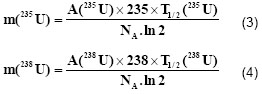
<p><font size="2" face="Verdana, Arial, Helvetica, sans-serif">where A is the    activity, N-the number of radioactive nuclei and <img src="/img/revistas/nuc/n45/e08064509.jpg" width="20" height="17">&#150;    the half-life, and the amounts in mass unit of both isotopes are:</font></p>     
<p><img src="/img/revistas/nuc/n45/e09064509.jpg" width="262" height="94"></p>     
<p><font size="2" face="Verdana, Arial, Helvetica, sans-serif">where A(<img src="/img/revistas/nuc/n45/e01064509.jpg" width="23" height="14">)    and A(<img src="/img/revistas/nuc/n45/e02064509.jpg" width="22" height="14">)    are the corresponding activity values; <img src="/img/revistas/nuc/n45/e08064509.jpg" width="20" height="17">    (<img src="/img/revistas/nuc/n45/e01064509.jpg" width="23" height="14">)    = 2,5706.<img src="/img/revistas/nuc/n45/e10064509.jpg" width="24" height="15">    years and <img src="/img/revistas/nuc/n45/e08064509.jpg" width="20" height="14">    (<img src="/img/revistas/nuc/n45/e02064509.jpg" width="22" height="14">)    = 1,633.<img src="/img/revistas/nuc/n45/e11064509.jpg" width="22" height="14">    years are their half-lives [6] and N A is the Avogadro&#146;s constant. Using    the formulae (1-4), the enrichment of a sample containing uranium can be computed    as:</font></p>     

<p><img src="/img/revistas/nuc/n45/e12064509.jpg" width="289" height="56"></p>     
]]></body>
<body><![CDATA[<p><font size="2" face="Verdana, Arial, Helvetica, sans-serif">where k = A (<img src="/img/revistas/nuc/n45/e02064509.jpg" width="22" height="14">)    A (<img src="/img/revistas/nuc/n45/e01064509.jpg" width="23" height="14">)    and <img src="/img/revistas/nuc/n45/e13064509.jpg" width="15" height="14">    is the corresponding decay constant for each nuclide. The activity values for    the nuclide <i>j</i> can be computed according to the formula:</font></p>     
<p><img src="/img/revistas/nuc/n45/e14064509.jpg" width="238" height="47"></p>     
<p><font size="2" face="Verdana, Arial, Helvetica, sans-serif">where <img src="/img/revistas/nuc/n45/e15064509.jpg" width="33" height="20">    is the ith photopeak area for the nuclide <i>j</i>, <i>t</i> the counting time,    <img src="/img/revistas/nuc/n45/e16064509.jpg" width="14" height="18">    the absolute emission probability corresponding to the <i>i</i>th gamma-ray    for the nuclide <i>j</i> and <img src="/img/revistas/nuc/n45/e18064509.jpg" width="10" height="14">    is the detection efficiency of the full-energy absorption peak considered, where    <img src="/img/revistas/nuc/n45/e17064509.jpg" width="16" height="16">    is the energy corresponding to the ith gamma-ray for the nuclide <i>j</i>.    
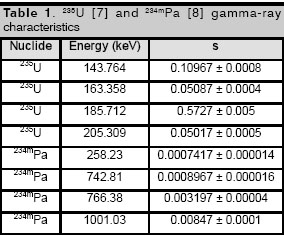
<br>   </font></p>     <p><font size="2" face="Verdana, Arial, Helvetica, sans-serif">The <img src="/img/revistas/nuc/n45/e01064509.jpg" width="23" height="14">    nuclide emits both alpha and gamma-rays. <img src="/img/revistas/nuc/n45/e02064509.jpg" width="22" height="14">    is practically a pure alpha emitter, with negligible gamma-ray emissions; however,    his granddaughter <img src="/img/revistas/nuc/n45/e04064509.jpg" width="36" height="14">    (<img src="/img/revistas/nuc/n45/e47064509.jpg" width="103" height="17">;    <img src="/img/revistas/nuc/n45/e08064509.jpg" width="20" height="18">    = 1.17 min, i.e., in secular equilibrium) have several important gamma-ray emissions.    The <img src="/img/revistas/nuc/n45/e01064509.jpg" width="23" height="14">    and <img src="/img/revistas/nuc/n45/e04064509.jpg" width="36" height="14">    gamma-rays main characteristics are present in <a href="#t1">table 1</a>.</font></p>     
<p><a name="t1"></a><img src="/img/revistas/nuc/n45/t01064509.jpg" width="284" height="236"></p>     
<p><font size="2" face="Verdana, Arial, Helvetica, sans-serif">The experimental    determination of the detector efficiency for volumetric samples is not a simple    problem. A set of volumetric certified gamma sources (with density, composition    and gamma energy range similar to the samples of interest) is needed. An alternative    way to find the energy-dependent volumetric efficiency (<img src="/img/revistas/nuc/n45/e19064509.jpg" width="20" height="14">( <img src="/img/revistas/nuc/n45/e17064509.jpg" width="19" height="17">)) is starting from the detector efficiency using a set of point standard sources    (for example, <img src="/img/revistas/nuc/n45/e20064509.jpg" width="34" height="14">,    <img src="/img/revistas/nuc/n45/e21064509.jpg" width="28" height="14">,    <img src="/img/revistas/nuc/n45/e22064509.jpg" width="30" height="13">,    <img src="/img/revistas/nuc/n45/e23064509.jpg" width="28" height="14">    and <img src="/img/revistas/nuc/n45/e24064509.jpg" width="27" height="14">),    compute the point (<img src="/img/revistas/nuc/n45/e25064509.jpg" width="37" height="16">    (<img src="/img/revistas/nuc/n45/e17064509.jpg" width="19" height="17">))    and volumetric (<img src="/img/revistas/nuc/n45/e48064509.jpg" width="21" height="17">    (<img src="/img/revistas/nuc/n45/e17064509.jpg" width="19" height="17">    )) energydependent solid angles by Monte Carlo Simulations [9] or a Semiempirical    Method [10], and calculate the volumetric efficiency as follow:</font></p>     
<p><img src="/img/revistas/nuc/n45/e27064509.jpg" width="268" height="48"></p>     
<p><font size="2" face="Verdana, Arial, Helvetica, sans-serif"><i><b>&#147;Simple    Method&#148;</b></i><b>:</b> This method is an original variant of the Absolute    Method. Reordering and applying natural logarithm to Eq. (6) we obtain</font></p>     <p><img src="/img/revistas/nuc/n45/e28064509.jpg" width="267" height="51"></p>     
]]></body>
<body><![CDATA[<p><font size="2" face="Verdana, Arial, Helvetica, sans-serif">As ln <img src="/img/revistas/nuc/n45/e18064509.jpg" width="10" height="14">(<img src="/img/revistas/nuc/n45/e17064509.jpg" width="16" height="19">)    can be expressed as function of the energy logarithm, <img src="/img/revistas/nuc/n45/e30064509.jpg" width="36" height="18">,    Eq. (8) becomes:</font></p>     
<p><img src="/img/revistas/nuc/n45/e31064509.jpg" width="268" height="51"></p>     
<p><font size="2" face="Verdana, Arial, Helvetica, sans-serif">For fixed experimental    conditions every nuclide has the same efficiency curve. In a sample containing    uranium we obtain:</font></p>     <p><img src="/img/revistas/nuc/n45/e32064509.jpg" width="287" height="30"></p>     
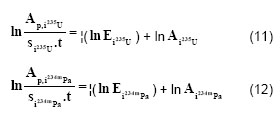
<p><font size="2" face="Verdana, Arial, Helvetica, sans-serif">where x is any    nuclide in the sample. In the cases of <img src="/img/revistas/nuc/n45/e01064509.jpg" width="23" height="14">    and <img src="/img/revistas/nuc/n45/e04064509.jpg" width="36" height="14">,    for a given energy, Eq. (9) can be written as follows:</font></p>     
<p><img src="/img/revistas/nuc/n45/e33064509.jpg" width="280" height="116"></p>     
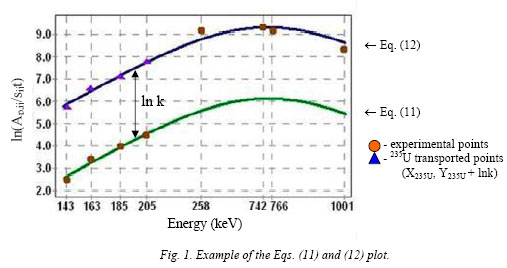
<p><font size="2" face="Verdana, Arial, Helvetica, sans-serif">Then, plotting    the experimental curves of <img src="/img/revistas/nuc/n45/e34064509.jpg" width="79" height="18">    versus ln(<img src="/img/revistas/nuc/n45/e17064509.jpg" width="19" height="17">)    for <img src="/img/revistas/nuc/n45/e01064509.jpg" width="23" height="14">    and <img src="/img/revistas/nuc/n45/e04064509.jpg" width="36" height="14">    using the energies given in <a href="#t1">table 1</a>, we obtain two parallel curves (see <a href="/img/revistas/nuc/n45/f01064509.jpg">figure    1</a>) separated by ln k. This can be easily verified by subtracting, for a given    energy, Eqs. (11) and (12), taking Eq. (10) into account. Then, we can calculate    the uranium enrichment (Eq. (5)) using the experimental k values.    
<br> </font></p>     <p><font size="2" face="Verdana, Arial, Helvetica, sans-serif">For <i>ln</i> k    calculation, the set of four experimental points obtained applying Eq. (11)    to <img src="/img/revistas/nuc/n45/e01064509.jpg" width="23" height="14"></font></p>     
<p><img src="/img/revistas/nuc/n45/e35064509.jpg" width="459" height="76"></p>     
]]></body>
<body><![CDATA[<p><font size="2" face="Verdana, Arial, Helvetica, sans-serif">and the set of    four experimental points obtained applying Eq. (12) to <img src="/img/revistas/nuc/n45/e04064509.jpg" width="36" height="14"></font></p>     
<p><img src="/img/revistas/nuc/n45/e36064509.jpg" width="539" height="73"></p>     
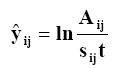
<p><font size="2" face="Verdana, Arial, Helvetica, sans-serif">are fitted by means    of a polynomial by least squares. With the selected polynomial using x = ln    <img src="/img/revistas/nuc/n45/e17064509.jpg" width="19" height="17">    (<a href="#t1">table 1</a>), eight values of</font></p>     
<p><img src="/img/revistas/nuc/n45/e37064509.jpg" width="115" height="69"></p>     
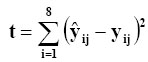
<p><font size="2" face="Verdana, Arial, Helvetica, sans-serif">are calculated.</font></p>     <p><font size="2" face="Verdana, Arial, Helvetica, sans-serif">The sum of the    squares from the residuals is calculated as follows:</font></p>     <p><img src="/img/revistas/nuc/n45/e38064509.jpg" width="148" height="62"></p>     
<p><font size="2" face="Verdana, Arial, Helvetica, sans-serif">A value of 0.001    is added to the experimental points of the ordinates of <img src="/img/revistas/nuc/n45/e01064509.jpg" width="23" height="14">    and eight new points are obtained, four points with coordinates <img src="/img/revistas/nuc/n45/e39064509.jpg" width="17" height="17">=    <img src="/img/revistas/nuc/n45/e40064509.jpg" width="15" height="17">    + 0:001, <img src="/img/revistas/nuc/n45/e41064509.jpg" width="50" height="18">    and four points of <img src="/img/revistas/nuc/n45/e04064509.jpg" width="36" height="14">    without modification.    
<br>   </font></p>     <p><font size="2" face="Verdana, Arial, Helvetica, sans-serif">These eight points    are fitted again and a new t is calculated. This process of increasing <img src="/img/revistas/nuc/n45/e01064509.jpg" width="23" height="14">    ordinates in 0.001 and calculating t is repeated until a minimum value of t    is obtained. The resulting curve is the best fit for Eq. (12), giving ln k =    0.001.n, where n is the number of iterations. The value of 0.001 was chosen    taking into account the ln k values [4].    
]]></body>
<body><![CDATA[<br>   </font></p>     <p><font size="2" face="Verdana, Arial, Helvetica, sans-serif">There is only one    condition to use this method: in the sample the radioactive chain <img src="/img/revistas/nuc/n45/e47064509.jpg" width="103" height="17">    must be in secular equilibrium. If this is true we have:</font></p>     
<p><img src="/img/revistas/nuc/n45/e42064509.jpg" width="489" height="54"></p>     
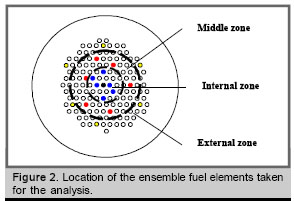
<p><font size="2" face="Verdana, Arial, Helvetica, sans-serif">Sample characteristics    like density, geometric shape, medium (liquid or solid) and type of detector    employed are not a restriction to use this method [4].     <br>   </font></p>     <p><font size="2" face="Verdana, Arial, Helvetica, sans-serif"><b>Sampling:</b>    Randomly, 17 fuel elements (10.9% of the total) from the internal, middle and    external zones of the Sub Critical Ensemble (see <a href="#f2">figure 2</a>) and 14 additional    uranium pellets (no used in the current ensemble configuration) were taken for    the analysis. The uranium pellets were fabricated as 1 mm thickness aluminium    cylinder (120 mm large,<img src="/img/revistas/nuc/n45/e44064509.jpg" width="16" height="12">=    31 mm) refilled with a compacted <img src="/img/revistas/nuc/n45/e43064509.jpg" width="31" height="18">    powder (2.1 kg total weight) [5].</font></p>     
<p><font size="2" face="Verdana, Arial, Helvetica, sans-serif"><a name="f2"></a><img src="/img/revistas/nuc/n45/f02064509.jpg" width="294" height="203">    
<br>   </font></p>     <p><font size="2" face="Verdana, Arial, Helvetica, sans-serif"><b>Gamma spectrometry    of uranium pellets:</b> The gamma spectra of 150 uranium pellets were acquired    in the Low-Background Chamber (LBC) of the Nuclear Analytical Lab at InSTEC,    using an n-type closed-end coaxial high-purity germanium detector (DSG, NGC-3018,    130<img src="/img/revistas/nuc/n45/e45064509.jpg" width="24" height="14">    , FHWM = 2.04 keV for 1332 keV <img src="/img/revistas/nuc/n45/e23064509.jpg" width="28" height="14">    gamma line) equipped w ith a 8192 channel multichannel analyzer (webMASTER TARGET    coupled to PC). The gamma spectra were processed using the Gamma-W version 18.03    code (Dr. Westmeier Gesellschaft f&uuml;r Kernspektrometrie mbH). The energy    and efficiency calibrations were carried out using point standard sources (    <img src="/img/revistas/nuc/n45/e20064509.jpg" width="34" height="14">,    <img src="/img/revistas/nuc/n45/e21064509.jpg" width="28" height="14">,    <img src="/img/revistas/nuc/n45/e22064509.jpg" width="30" height="13">,    <img src="/img/revistas/nuc/n45/e23064509.jpg" width="28" height="14">    and <img src="/img/revistas/nuc/n45/e24064509.jpg" width="27" height="14">),    produced by AEA Technology QSA GmbH. Fuel elements pellets were placed at 10    cm from the detector to minimize true coincidence summing [11] and measured    during one hour. The LBC is a detector shielded with 55 mm thickness of lead,    35 mm thickness of a steel frame, and an internal graded shielding consisting    of 12 mm thickness of cadmium, 17 mm of cooper and 9 mm of aluminium. The inner    dimensions of the LCB are 800 mm depth &acute; 718 mm width &acute; 736 mm height.</font></p>     
<p><font size="2" face="Verdana, Arial, Helvetica, sans-serif">Monte Carlo simulation:    Monte Carlo (MC) Simulations were carried out to compute the point (<img src="/img/revistas/nuc/n45/e25064509.jpg" width="44" height="19">    (<img src="/img/revistas/nuc/n45/e17064509.jpg" width="19" height="17">    )) and volumetric (<img src="/img/revistas/nuc/n45/e48064509.jpg" width="21" height="17">    (<img src="/img/revistas/nuc/n45/e17064509.jpg" width="19" height="17">))    energy-dependent solid angles of Eq. (7). The MCNPX 2.5 was used as simulation    code [12]. It has been used widely to estimate the efficiency curve of HPGe    detectors for volumetric samples [13-17]. The sample - detector configuration    were exactly reproduce in the MC simulation, taking as data the dimensions,    density and chemical elemental composition of the uranium pellets found in Sub    Critical Assemble documents [5], as well as the detector specifications (Ge    crystal dimensions, dead layer and Al thickness, distance Ge crystal to Al end    cap) provided by detector supplier.    
]]></body>
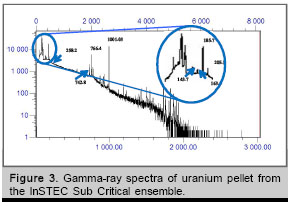
<body><![CDATA[<br>   </font></p>     <p><font size="2" face="Verdana, Arial, Helvetica, sans-serif"><b>Results and    Discussion</b>    <br>   </font></p>     <p><font size="2" face="Verdana, Arial, Helvetica, sans-serif">A typical fuel    element uranium pellet gamma-ray spectra measured in the InSTEC LBC is presented    in <a href="#f3">figure 3</a>. The <img src="/img/revistas/nuc/n45/e01064509.jpg" width="23" height="14">    and <img src="/img/revistas/nuc/n45/e04064509.jpg" width="36" height="14">    analytical lines (<a href="#t1">table 1</a>) are remarked. Due to the high count rate in one hour    of measurement, the obtained peak area statistical error was less than 1% for    all analytical lines.</font></p>     
<p><a name="f3"></a><img src="/img/revistas/nuc/n45/f03064509.jpg" width="292" height="206"></p>     
<p><font size="2" face="Verdana, Arial, Helvetica, sans-serif"><a name="f4"></a><img src="/img/revistas/nuc/n45/f04064509.jpg" width="289" height="250"></font></p>     
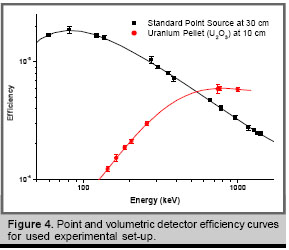
<p><font size="2" face="Verdana, Arial, Helvetica, sans-serif"><a href="#f4">Figure 4</a> shows    the efficiency curves for point sources located at 30 cm of height (experimental),    and for the uranium pellets at 10 cm. The last curve was obtained computing    the energy-dependent solid angles by MC simulations and taking the 30 cm point    efficiency as reference (Eq. 7). Strong gamma rays self-absorption inside the    pellets is clearly observed. These curves were well described (using Origin    6.1 code) by the following polynomials:</font></p>     <p><img src="/img/revistas/nuc/n45/e46064509.jpg" width="531" height="68"></p>     
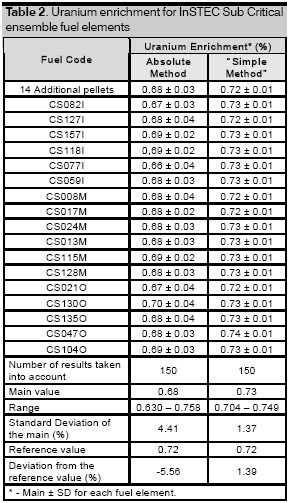
<p><font size="2" face="Verdana, Arial, Helvetica, sans-serif"><a href="#t2">Table 2</a> lists the    final results of the uranium enrichment of the 17 ensemble fuel elements and    14 additional uranium pellets determined by gamma spectrometry. Absolute method    shows bigger dispersion and deviation for the expected reference value (0.72%)    than the &#147;simple method&#148;. This agreed quiet well with the dispersion    (9.10%) and deviation for the expected values (-4.90%), obtained for Absolute    method during an international exercise for uranium enrichment measurements    celebrated in 2000 [18]. On the other hand, the precision and accuracy of the    &laquo;simethod&#148; results are excellent. The last one confirms the small    dependence of sample characteristics like density and geometric shape of this    method.    <br> </font></p>     ]]></body>
<body><![CDATA[<p><a name="t2"></a><img src="/img/revistas/nuc/n45/t02064509.jpg" width="289" height="503"></p>     
<p><font size="2" face="Verdana, Arial, Helvetica, sans-serif">Independently of    mentioned above criteria, the results obtained by both methods confirm that    the InSTEC Sub Critical ensemble nuclear fuel is natural uranium. Considering    the enrichment range reported in the 60&#146; by the ensemble fabricant (0.714    - 1.0%) [5], an idea about a possible small <img src="/img/revistas/nuc/n45/e01064509.jpg" width="23" height="14">    enrichment degree must be inferred, i.e., an enrichment higher than considered    as &#147;natural&#148; by actual IAEA Safeguard Regulations. The high resolution    gamma spectrometry carried out with modern HPGe detector rejects this possibility.</font></p>     
<p><font size="2" face="Verdana, Arial, Helvetica, sans-serif"><b>References</b></font></p>     <!-- ref --><p><font size="2" face="Verdana, Arial, Helvetica, sans-serif">[1] NIR-EL Y. Isotopic    analysis of uranium in U 3 O 8 by passive gamma-ray spectrometry. Applied Radiat.    Isot. 2000; 52(3) 753-757.    <!-- ref --><br>   [2] LUCA A. Experimental determination of the Uranium enrichment ratio. Rom.    Jour. Phys. 2008; 53 (1-2): 35-39.    <br>   [3] SHOJI M, HAMAJIMA Y, TAKATSIKA K , et. al. A convenient method for discriminating    between natural    <br>   and depleted uranium by g-ray spectrometry. Applied Radiat. Isot. 2001; 55(2):    221-227.    <br>   [4] KOROB RO, BLASIYH NU&Ntilde;O GA. A simple method for the absolute determination    of uranium enrichment by    <br>   high-resolution g spectrometry. Applied Radiat. Isot. 2006; 64(5): 525-531.    <!-- ref --><br>   [5] Documentaci&oacute;n T&eacute;cnica del Conjunto Subcritico. Laboratorio    del Conjunto Subcritico del InSTEC, 1968 (en Ruso).    <!-- ref --><br>   [6] FIRESTONE RB. Table of Isotopes. Eighth edition. Wiley Interscience, 1996.    <!-- ref --><br>   [7] SCHMORAK MR. Nuclear Data Sheets Update for A =235. Nuclear Data Sheets.    1993; 69(2): 375-428.    <!-- ref --><br>   [8] AKOVALI YA. Nuclear Data Sheets for A = 234. Nuclear Data Sheets. 1994;    71(1): 181-259.    <br>   [9] VIDMAR T, AUBINEAU-LANIECE I, ANAGNOSTAKIS MJ, et. al. An intercomparison    of Monte Carlo codes used    <br>   in gamma-ray spectrometry. Applied Radiat. Isot. 2008; 66(6-7): 764-768.    <!-- ref --><br>   [10] LEPY MC, ALTZITZOGLOU T, ARNOLD D, et. al. Intercomparison of efficiency    transfer software for gamma-ray spectrometry. Applied Radiat. Isot. 2001; 55(4):    493-503.    <br>   [11] GILMORE G, HEMINGWAY J. Practical Gamma-ray Spectrometry. Wiley, Chichester,    1995, pp. 137-138,    <br>   148-159.    <br>   [12] PELOWITZ DD. MCNPX TM User's manual. Version 2.5.0. Report LA-CP-05-0369.    Los Alamos National    <br>   Laboratory. 2005.    ]]></body>
<body><![CDATA[<br>   [13] R&Oacute;DENAS J, MARTINAVARRO A, RIUS V. Validation of the MCNP code for    the simulation of Ge-detector    <br>   calibration. Nucl. Inst. and Meth. in Phys. Res. 2000; A450(1): 88-97.    <br>   [14] KARAMANIS D. Efficiency simulation of HPGe and Si(Li) detectors in &atilde;-    and X-ray spectroscopy. Nucl. Inst.    <br>   and Meth. in Phys. Res. 2006; A505(1-2): 282-285.    <!-- ref --><br>   [15] MARQUES SALGADO C, CONTI CC, BECKER PHB. Determination of HPGe detector    response using MCNP5 for 20-150 keV X-rays. Applied Radiat. Isot. 2006; 64(6):    700-705.    <br>   [16] RODENAS J, GALLARDO S, BALLESTER S, et. al. Application of the Monte Carlo    method to the analysis    <br>   of measurement geometries for the calibration of a HP Ge detector in an environmental    radioactivity laboratory. Nucl. Instr. and Meth. B. 2007; 263(1). doi:10.1016/j.nimb.    2007.04.210.     <!-- ref --><br>   [17] SAEGUSA J. CREPT-MCNP code for efficiency calibration of HPGe detectors    with the representative point method. Applied Radiat. Isot. 2008; 66(6-7): 774-779.    <!-- ref --><br>   [18] MOREL J, HILL C, BICKEL M, et. al. Results from the international evaluation    exercise for uranium enrichment measurements. Applied Radiat. Isot. 2000; 52(3):    509-522.    <br>       ]]></body>
<body><![CDATA[<br>   </font></p>     <p><font size="2" face="Verdana, Arial, Helvetica, sans-serif">Recibido: 12 de    Julio de 2008.    <br>   Aceptado: 14 de mayo de 2009.</font></p>      ]]></body><back>
<ref-list>
<ref id="B1">
<label>[1]</label><nlm-citation citation-type="journal">
<person-group person-group-type="author">
<name>
<surname><![CDATA[NIR-EL]]></surname>
<given-names><![CDATA[Y]]></given-names>
</name>
</person-group>
<article-title xml:lang="en"><![CDATA[Isotopic analysis of uranium in U 3 O 8 by passive gamma-ray spectrometr]]></article-title>
<source><![CDATA[Applied Radiat. Isot]]></source>
<year>2000</year>
<volume>52</volume>
<numero>(3)</numero>
<issue>(3)</issue>
<page-range>753-757</page-range></nlm-citation>
</ref>
<ref id="B2">
<label>[2]</label><nlm-citation citation-type="journal">
<person-group person-group-type="author">
<name>
<surname><![CDATA[LUCA]]></surname>
<given-names><![CDATA[A]]></given-names>
</name>
</person-group>
<article-title xml:lang="en"><![CDATA[Experimental determination of the Uranium enrichment ratio]]></article-title>
<source><![CDATA[Rom. Jour. Phys]]></source>
<year>2008</year>
<volume>53</volume>
<numero>(1-2)</numero>
<issue>(1-2)</issue>
<page-range>35-39</page-range></nlm-citation>
</ref>
<ref id="B3">
<label>[3]</label><nlm-citation citation-type="journal">
<person-group person-group-type="author">
<name>
<surname><![CDATA[SHOJI]]></surname>
<given-names><![CDATA[M]]></given-names>
</name>
<name>
<surname><![CDATA[HAMAJIMA]]></surname>
<given-names><![CDATA[Y]]></given-names>
</name>
<name>
<surname><![CDATA[TAKATSIKA]]></surname>
<given-names><![CDATA[K]]></given-names>
</name>
</person-group>
<article-title xml:lang="en"><![CDATA[A convenient method for discriminating between natural and depleted uranium by g-ray spectrometry]]></article-title>
<source><![CDATA[Applied Radiat. Isot]]></source>
<year>2001</year>
<volume>55</volume>
<numero>(2)</numero>
<issue>(2)</issue>
<page-range>221-227</page-range></nlm-citation>
</ref>
<ref id="B4">
<label>[4]</label><nlm-citation citation-type="journal">
<person-group person-group-type="author">
<name>
<surname><![CDATA[KOROB]]></surname>
<given-names><![CDATA[RO]]></given-names>
</name>
<name>
<surname><![CDATA[BLASIYH NUÑO]]></surname>
<given-names><![CDATA[GA]]></given-names>
</name>
</person-group>
<article-title xml:lang="en"><![CDATA[A simple method for the absolute determination of uranium enrichment by high-resolution g spectrometry]]></article-title>
<source><![CDATA[Applied Radiat. Isot]]></source>
<year>2006</year>
<volume>64</volume>
<numero>(5)</numero>
<issue>(5)</issue>
<page-range>525-531</page-range></nlm-citation>
</ref>
<ref id="B5">
<label>[5]</label><nlm-citation citation-type="book">
<source><![CDATA[Documentación Técnica del Conjunto Subcritico]]></source>
<year>1968</year>
<publisher-name><![CDATA[Laboratorio del Conjunto Subcritico del InSTEC]]></publisher-name>
</nlm-citation>
</ref>
<ref id="B6">
<label>[6]</label><nlm-citation citation-type="book">
<person-group person-group-type="author">
<name>
<surname><![CDATA[FIRESTONE]]></surname>
<given-names><![CDATA[RB]]></given-names>
</name>
</person-group>
<source><![CDATA[Table of Isotopes]]></source>
<year>1996</year>
<edition>Eighth edition</edition>
<publisher-name><![CDATA[Wiley Interscience]]></publisher-name>
</nlm-citation>
</ref>
<ref id="B7">
<label>[7]</label><nlm-citation citation-type="journal">
<person-group person-group-type="author">
<name>
<surname><![CDATA[SCHMORAK]]></surname>
<given-names><![CDATA[MR]]></given-names>
</name>
</person-group>
<article-title xml:lang="en"><![CDATA[Nuclear Data Sheets Update for A =235]]></article-title>
<source><![CDATA[Nuclear Data Sheets]]></source>
<year>1993</year>
<volume>69</volume>
<numero>(2)</numero>
<issue>(2)</issue>
<page-range>375-428</page-range></nlm-citation>
</ref>
<ref id="B8">
<label>[8]</label><nlm-citation citation-type="journal">
<person-group person-group-type="author">
<name>
<surname><![CDATA[AKOVALI]]></surname>
<given-names><![CDATA[YA]]></given-names>
</name>
</person-group>
<article-title xml:lang="en"><![CDATA[Nuclear Data Sheets for A = 234]]></article-title>
<source><![CDATA[Nuclear Data Sheets]]></source>
<year>1994</year>
<volume>71</volume>
<numero>(1)</numero>
<issue>(1)</issue>
<page-range>181-259</page-range></nlm-citation>
</ref>
<ref id="B9">
<label>[9]</label><nlm-citation citation-type="journal">
<person-group person-group-type="author">
<name>
<surname><![CDATA[VIDMAR]]></surname>
<given-names><![CDATA[T]]></given-names>
</name>
<name>
<surname><![CDATA[AUBINEAU-LANIECE]]></surname>
<given-names><![CDATA[I]]></given-names>
</name>
<name>
<surname><![CDATA[ANAGNOSTAKIS]]></surname>
<given-names><![CDATA[MJ]]></given-names>
</name>
</person-group>
<article-title xml:lang="en"><![CDATA[An intercomparison of Monte Carlo codes used in gamma-ray spectrometry]]></article-title>
<source><![CDATA[Applied Radiat. Isot]]></source>
<year>2008</year>
<volume>66</volume>
<numero>(6-7)</numero>
<issue>(6-7)</issue>
<page-range>764-768</page-range></nlm-citation>
</ref>
<ref id="B10">
<label>[10]</label><nlm-citation citation-type="journal">
<person-group person-group-type="author">
<name>
<surname><![CDATA[LEPY]]></surname>
<given-names><![CDATA[MC]]></given-names>
</name>
<name>
<surname><![CDATA[ALTZITZOGLOU]]></surname>
<given-names><![CDATA[T]]></given-names>
</name>
<name>
<surname><![CDATA[ARNOLD]]></surname>
<given-names><![CDATA[D]]></given-names>
</name>
</person-group>
<article-title xml:lang="en"><![CDATA[Intercomparison of efficiency transfer software for gamma-ray spectrometry]]></article-title>
<source><![CDATA[Applied Radiat. Isot]]></source>
<year>2001</year>
<volume>55</volume>
<numero>(4)</numero>
<issue>(4)</issue>
<page-range>493-503</page-range></nlm-citation>
</ref>
<ref id="B11">
<label>[11]</label><nlm-citation citation-type="book">
<person-group person-group-type="author">
<name>
<surname><![CDATA[GILMORE]]></surname>
<given-names><![CDATA[G]]></given-names>
</name>
<name>
<surname><![CDATA[HEMINGWAY]]></surname>
<given-names><![CDATA[J]]></given-names>
</name>
</person-group>
<source><![CDATA[Practical Gamma-ray Spectrometry]]></source>
<year>1995</year>
<page-range>pp. 137-138, 148-159</page-range><publisher-loc><![CDATA[Chichester ]]></publisher-loc>
<publisher-name><![CDATA[Wiley]]></publisher-name>
</nlm-citation>
</ref>
<ref id="B12">
<label>[12]</label><nlm-citation citation-type="book">
<person-group person-group-type="author">
<name>
<surname><![CDATA[PELOWITZ]]></surname>
<given-names><![CDATA[DD]]></given-names>
</name>
</person-group>
<source><![CDATA[MCNPX TM User&#8217;s manual. Version 2.5.0. Report LA-CP-05-0369]]></source>
<year>2005</year>
<publisher-name><![CDATA[Los Alamos National Laboratory]]></publisher-name>
</nlm-citation>
</ref>
<ref id="B13">
<label>[13]</label><nlm-citation citation-type="journal">
<person-group person-group-type="author">
<name>
<surname><![CDATA[RÓDENAS]]></surname>
<given-names><![CDATA[J]]></given-names>
</name>
<name>
<surname><![CDATA[MARTINAVARRO]]></surname>
<given-names><![CDATA[A]]></given-names>
</name>
<name>
<surname><![CDATA[RIUS]]></surname>
<given-names><![CDATA[V]]></given-names>
</name>
</person-group>
<article-title xml:lang="en"><![CDATA[Validation of the MCNP code for the simulation of Ge-detector calibration]]></article-title>
<source><![CDATA[Phys. Res]]></source>
<year>2000</year>
<volume>A450</volume>
<numero>(1)</numero>
<issue>(1)</issue>
<page-range>88-97</page-range></nlm-citation>
</ref>
<ref id="B14">
<label>[14]</label><nlm-citation citation-type="journal">
<person-group person-group-type="author">
<name>
<surname><![CDATA[KARAMANIS]]></surname>
<given-names><![CDATA[D]]></given-names>
</name>
</person-group>
<article-title xml:lang="en"><![CDATA[Efficiency simulation of HPGe and Si(Li) detectors in ã- and X-ray spectroscopy]]></article-title>
<source><![CDATA[Nucl. Inst. and Meth. In Phys. Res]]></source>
<year>2006</year>
<volume>A505</volume>
<numero>(1-2)</numero>
<issue>(1-2)</issue>
<page-range>282-285</page-range></nlm-citation>
</ref>
<ref id="B15">
<label>[15]</label><nlm-citation citation-type="journal">
<person-group person-group-type="author">
<name>
<surname><![CDATA[MARQUES SALGADO]]></surname>
<given-names><![CDATA[C]]></given-names>
</name>
<name>
<surname><![CDATA[CONTI]]></surname>
<given-names><![CDATA[CC]]></given-names>
</name>
<name>
<surname><![CDATA[BECKER]]></surname>
<given-names><![CDATA[PHB]]></given-names>
</name>
</person-group>
<article-title xml:lang="en"><![CDATA[Determination of HPGe detector response using MCNP5 for 20-150 keV X-rays]]></article-title>
<source><![CDATA[Applied Radiat. Isot]]></source>
<year>2006</year>
<volume>64</volume>
<numero>(6)</numero>
<issue>(6)</issue>
<page-range>700-705</page-range></nlm-citation>
</ref>
<ref id="B16">
<label>[16]</label><nlm-citation citation-type="journal">
<person-group person-group-type="author">
<name>
<surname><![CDATA[RODENAS]]></surname>
<given-names><![CDATA[J]]></given-names>
</name>
<name>
<surname><![CDATA[GALLARDO]]></surname>
<given-names><![CDATA[S]]></given-names>
</name>
<name>
<surname><![CDATA[BALLESTER]]></surname>
<given-names><![CDATA[S]]></given-names>
</name>
</person-group>
<article-title xml:lang="en"><![CDATA[Application of the Monte Carlo method to the analysis of measurement geometries for the calibration of a HP Ge detector in an environmental radioactivity laboratory]]></article-title>
<source><![CDATA[Nucl. Instr. and Meth. B]]></source>
<year>2007</year>
<volume>263</volume>
<numero>(1)</numero>
<issue>(1)</issue>
</nlm-citation>
</ref>
<ref id="B17">
<label>[17]</label><nlm-citation citation-type="journal">
<person-group person-group-type="author">
<name>
<surname><![CDATA[SAEGUSA]]></surname>
<given-names><![CDATA[J]]></given-names>
</name>
</person-group>
<article-title xml:lang="en"><![CDATA[CREPT-MCNP code for efficiency calibration of HPGe detectors with the representative point method]]></article-title>
<source><![CDATA[Applied Radiat. Isot]]></source>
<year>2008</year>
<volume>66</volume>
<numero>(6-7)</numero>
<issue>(6-7)</issue>
<page-range>774-779</page-range></nlm-citation>
</ref>
<ref id="B18">
<label>[18]</label><nlm-citation citation-type="journal">
<person-group person-group-type="author">
<name>
<surname><![CDATA[MOREL]]></surname>
<given-names><![CDATA[J]]></given-names>
</name>
<name>
<surname><![CDATA[HILL]]></surname>
<given-names><![CDATA[C]]></given-names>
</name>
<name>
<surname><![CDATA[BICKEL]]></surname>
<given-names><![CDATA[M]]></given-names>
</name>
</person-group>
<article-title xml:lang="en"><![CDATA[Results from the international evaluation exercise for uranium enrichment measurements]]></article-title>
<source><![CDATA[Applied Radiat. Isot]]></source>
<year>2000</year>
<volume>52</volume>
<numero>(3)</numero>
<issue>(3)</issue>
<page-range>509-522</page-range></nlm-citation>
</ref>
</ref-list>
</back>
</article>