<?xml version="1.0" encoding="ISO-8859-1"?><article xmlns:mml="http://www.w3.org/1998/Math/MathML" xmlns:xlink="http://www.w3.org/1999/xlink" xmlns:xsi="http://www.w3.org/2001/XMLSchema-instance">
<front>
<journal-meta>
<journal-id>0864-084X</journal-id>
<journal-title><![CDATA[Nucleus]]></journal-title>
<abbrev-journal-title><![CDATA[Nucleus]]></abbrev-journal-title>
<issn>0864-084X</issn>
<publisher>
<publisher-name><![CDATA[CUBAENERGIA]]></publisher-name>
</publisher>
</journal-meta>
<article-meta>
<article-id>S0864-084X2009000200004</article-id>
<title-group>
<article-title xml:lang="en"><![CDATA[Characterization of the InSTEC&#8217;s low-background gamma spectrometer for environmental radioactivity studies]]></article-title>
<article-title xml:lang="es"><![CDATA[Caracterización del espectrómetro gamma de bajo fondo del INSTEC para estudios de radioactividad ambiental]]></article-title>
</title-group>
<contrib-group>
<contrib contrib-type="author">
<name>
<surname><![CDATA[Díaz Rizo]]></surname>
<given-names><![CDATA[Oscar]]></given-names>
</name>
</contrib>
<contrib contrib-type="author">
<name>
<surname><![CDATA[López Pino]]></surname>
<given-names><![CDATA[Neivy]]></given-names>
</name>
</contrib>
<contrib contrib-type="author">
<name>
<surname><![CDATA[D´Alessandro Rodríguez]]></surname>
<given-names><![CDATA[Katia]]></given-names>
</name>
</contrib>
<contrib contrib-type="author">
<name>
<surname><![CDATA[Reyes]]></surname>
<given-names><![CDATA[Henry]]></given-names>
</name>
</contrib>
<contrib contrib-type="author">
<name>
<surname><![CDATA[Ródenas Palomino]]></surname>
<given-names><![CDATA[Cármen]]></given-names>
</name>
</contrib>
<contrib contrib-type="author">
<name>
<surname><![CDATA[Padilla Cabal]]></surname>
<given-names><![CDATA[Fátima]]></given-names>
</name>
</contrib>
<contrib contrib-type="author">
<name>
<surname><![CDATA[Arado López]]></surname>
<given-names><![CDATA[Juana Orquídea]]></given-names>
</name>
</contrib>
<contrib contrib-type="author">
<name>
<surname><![CDATA[Casanova Díaz]]></surname>
<given-names><![CDATA[Amalia Ofelia]]></given-names>
</name>
</contrib>
<contrib contrib-type="author">
<name>
<surname><![CDATA[Gelen Rudnikas]]></surname>
<given-names><![CDATA[Alina]]></given-names>
</name>
</contrib>
<contrib contrib-type="author">
<name>
<surname><![CDATA[Gómez Arozamena]]></surname>
<given-names><![CDATA[José]]></given-names>
</name>
</contrib>
</contrib-group>
<aff id="A01">
<institution><![CDATA[,Instituto Superior de Tecnologías y Ciencias Aplicadas (InSTEC)  ]]></institution>
<addr-line><![CDATA[Habana ]]></addr-line>
<country>Cuba</country>
</aff>
<aff id="A02">
<institution><![CDATA[,Universidad de Cantabria (UC), Ave. Los Castros s/n, Santander, España  ]]></institution>
<addr-line><![CDATA[Santander ]]></addr-line>
<country>España</country>
</aff>
<pub-date pub-type="pub">
<day>00</day>
<month>12</month>
<year>2009</year>
</pub-date>
<pub-date pub-type="epub">
<day>00</day>
<month>12</month>
<year>2009</year>
</pub-date>
<numero>46</numero>
<fpage>21</fpage>
<lpage>26</lpage>
<copyright-statement/>
<copyright-year/>
<self-uri xlink:href="http://scielo.sld.cu/scielo.php?script=sci_arttext&amp;pid=S0864-084X2009000200004&amp;lng=en&amp;nrm=iso"></self-uri><self-uri xlink:href="http://scielo.sld.cu/scielo.php?script=sci_abstract&amp;pid=S0864-084X2009000200004&amp;lng=en&amp;nrm=iso"></self-uri><self-uri xlink:href="http://scielo.sld.cu/scielo.php?script=sci_pdf&amp;pid=S0864-084X2009000200004&amp;lng=en&amp;nrm=iso"></self-uri><abstract abstract-type="short" xml:lang="en"><p><![CDATA[ABSTRACT The capabilities of the LowBackground Gamma Spectrometer (LBGS) at InSTEC were studied for environmental purposes. Fifty three glines were identified in the LBGS background spectrum. The Minimum Detectable Activity for <img width=32 height=15 src="http:/img/revistas/nuc/n46/e01044609.jpg">, <img width=22 height=14 src="http:/img/revistas/nuc/n46/e04044609.jpg">, <img width=32 height=14 src="http:/img/revistas/nuc/n46/e02044609.jpg">, <img width=30 height=13 src="http:/img/revistas/nuc/n46/e05044609.jpg">, <img width=34 height=17 src="http:/img/revistas/nuc/n46/e03044609.jpg">and <img width=20 height=13 src="http:/img/revistas/nuc/n46/e06044609.jpg">were calculated using the detector&#8217;s volumetric efficiency simulated by Monte Carlo method. Validation was performed by absolute and relative analysis of radionuclide activities present in a marine sediment certified material.]]></p></abstract>
<abstract abstract-type="short" xml:lang="es"><p><![CDATA[RESUMEN Se determinan las potencialidades del Espectrómetro Gamma de Bajo Fondo del InSTEC con fines ambientales. Se identificaron 53 líneas gamma en el espectro de fondo natural del espectrómetro. Se calculan las actividades mínimas detectables para los radionucleidos <img width=32 height=15 src="http:/img/revistas/nuc/n46/e01044609.jpg">, <img width=22 height=14 src="http:/img/revistas/nuc/n46/e04044609.jpg">, <img width=32 height=14 src="http:/img/revistas/nuc/n46/e02044609.jpg">, <img width=30 height=13 src="http:/img/revistas/nuc/n46/e05044609.jpg">, <img width=34 height=17 src="http:/img/revistas/nuc/n46/e03044609.jpg">and <img width=20 height=13 src="http:/img/revistas/nuc/n46/e06044609.jpg">empleando la eficiencia volumétrica del detector simulada por Monte Carlo. Como validación se determinan, por vía absoluta y relativa, las actividades de los radionucleidos presentes en un estándar de sedimento marino.]]></p></abstract>
<kwd-group>
<kwd lng="en"><![CDATA[background radiation]]></kwd>
<kwd lng="en"><![CDATA[gamma spectroscopy]]></kwd>
<kwd lng="en"><![CDATA[Monte Carlo method]]></kwd>
<kwd lng="en"><![CDATA[gamma spectrometers]]></kwd>
</kwd-group>
</article-meta>
</front><body><![CDATA[ <p align="left"><font face="Verdana, Arial, Helvetica, sans-serif" size="2"><b>CIENCIAS    NUCLEARES</b></font></p>     <p align="left">&nbsp;</p>     <p><strong><font size="3" face="Verdana, Arial, Helvetica, sans-serif">Characterization    of the InSTEC&#146;s low-background gamma spectrometer for environmental radioactivity    studies</font></strong></p>     <p><font size="3" face="Verdana, Arial, Helvetica, sans-serif">Caracterizaci&oacute;n    del espectr&oacute;metro gamma de bajo fondo del INSTEC para estudios de radioactividad    ambiental</font></p>     <p><font size="2" face="Verdana, Arial, Helvetica, sans-serif">Oscar D&iacute;az    Rizo 1 , Neivy L&oacute;pez Pino 1 , Katia D&acute;Alessandro Rodr&iacute;guez    1 , Henry Reyes 1 , C&aacute;rmen R&oacute;denas Palomino 2 , F&aacute;tima    Padilla Cabal 1 , Juana Orqu&iacute;dea Arado L&oacute;pez, Amalia Ofelia Casanova    D&iacute;az 1 , Alina Gelen Rudnikas 1 , Jos&eacute; G&oacute;mez Arozamena    2 .    <br>   </font></p>     <p><font size="2" face="Verdana, Arial, Helvetica, sans-serif">1 Instituto Superior    de Tecnolog&iacute;as y Ciencias Aplicadas (InSTEC)    <br>   Ave. Salvador Allende y Luaces, POB 6163, Habana 10600, Cuba    <br>   2 Universidad de Cantabria (UC), Ave. Los Castros s/n, Santander, Espa&ntilde;a.    <br>   <a href="mailto:odrizo@instec.cu">odrizo@instec.cu</a></font></p> <hr>     ]]></body>
<body><![CDATA[<p><font face="Verdana, Arial, Helvetica, sans-serif" size="2"><b>ABSTRACT</b></font></p>     <p><font size="2" face="Verdana, Arial, Helvetica, sans-serif">The capabilities    of the LowBackground Gamma Spectrometer (LBGS) at InSTEC were studied for environmental    purposes. Fifty three glines were identified in the LBGS background spectrum.    The Minimum Detectable Activity for <img src="/img/revistas/nuc/n46/e01044609.jpg" width="32" height="15">,    <img src="/img/revistas/nuc/n46/e04044609.jpg" width="22" height="14">,    <img src="/img/revistas/nuc/n46/e02044609.jpg" width="32" height="14">,    <img src="/img/revistas/nuc/n46/e05044609.jpg" width="30" height="13">,    <img src="/img/revistas/nuc/n46/e03044609.jpg" width="34" height="17">    and <img src="/img/revistas/nuc/n46/e06044609.jpg" width="20" height="13">    were calculated using the detector&#146;s volumetric efficiency simulated by    Monte Carlo method. Validation was performed by absolute and relative analysis    of radionuclide activities present in a marine sediment certified material.</font></p> <hr>     
<p><font face="Verdana, Arial, Helvetica, sans-serif" size="2"><b>RESUMEN</b></font></p>     <p><font size="2" face="Verdana, Arial, Helvetica, sans-serif">Se determinan las    potencialidades del Espectr&oacute;metro Gamma de Bajo Fondo del InSTEC con    fines ambientales. Se identificaron 53 l&iacute;neas gamma en el espectro de    fondo natural del espectr&oacute;metro. Se calculan las actividades m&iacute;nimas    detectables para los radionucleidos <img src="/img/revistas/nuc/n46/e01044609.jpg" width="32" height="15">,    <img src="/img/revistas/nuc/n46/e04044609.jpg" width="22" height="14">,    <img src="/img/revistas/nuc/n46/e02044609.jpg" width="32" height="14">,    <img src="/img/revistas/nuc/n46/e05044609.jpg" width="30" height="13">,    <img src="/img/revistas/nuc/n46/e03044609.jpg" width="34" height="17">    and <img src="/img/revistas/nuc/n46/e06044609.jpg" width="20" height="13">    empleando la eficiencia volum&eacute;trica del detector simulada por Monte Carlo.    Como validaci&oacute;n se determinan, por v&iacute;a absoluta y relativa, las    actividades de los radionucleidos presentes en un est&aacute;ndar de sedimento    marino.</font></p>     
<p><font face="Verdana, Arial, Helvetica, sans-serif" size="2"><b>Key words:</b>    background radiation, gamma spectroscopy, Monte Carlo method, gamma spectrometers</font></p> <hr>     <p><font face="Verdana, Arial, Helvetica, sans-serif" size="2"><b><font size="3">Introduction</font></b>    <br>   </font></p>     <p><font face="Verdana, Arial, Helvetica, sans-serif" size="2">A large number    of users of gamma spectrometry are concerned with measuring low levels of radioactivity    such as those present in environmental samples (soils, sediments, water, food,    etc.). There is a constant pressure to resolve lower and lower concentration    levels. For this reason, the experimental set-up to be used for environmental    radioactivity studies needs as low as possible the Minimum Detectable Activity    (<b><img src="/img/revistas/nuc/n46/e07044609.jpg" width="24" height="17"></b>    ). The <b><img src="/img/revistas/nuc/n46/e07044609.jpg" width="24" height="17"></b>    is defined as the minimum amount of radioactive nuclide which can be determined    [1]. It may vary with the amount, type and geometry of the sample and nuclide    identity, as well regarding the detector (type, crystal dimension, energy resolution,    etc.), detector environment (background) and counting time, i.e. the <b><img src="/img/revistas/nuc/n46/e07044609.jpg" width="24" height="17"></b>    have a strong dependence with the detector efficiency and the radioactive background.    Taking these facts into account, to characterize a gamma spectrometer destined    to environmental studies, a detector efficiency well known and a radioactive    background minimization are indispensable.    
<br>   </font></p>     <p><font face="Verdana, Arial, Helvetica, sans-serif" size="2">The experimental    determination of the detector efficiency for volumetric samples (typical in    environmental studies) is not a simple problem. A set of volumetric certified    gamma sources (with density, composition and gamma energy range similar to the    samples of interest) is needed, but they are either too expensive or not for    sale. An alternative way is starting from the detector efficiency using a set    of point standard sources (for example, <img src="/img/revistas/nuc/n46/e17044609.jpg" width="34" height="14">,    <img src="/img/revistas/nuc/n46/e08044609.jpg" width="28" height="14">,    <img src="/img/revistas/nuc/n46/e05044609.jpg" width="30" height="13">,    <img src="/img/revistas/nuc/n46/e10044609.jpg" width="28" height="14">    and <img src="/img/revistas/nuc/n46/e11044609.jpg" width="27" height="14">),    compute the point (<img src="/img/revistas/nuc/n46/e12044609.jpg" width="44" height="21">(<img src="/img/revistas/nuc/n46/e09044609.jpg" width="16" height="19">))    and volumetric (<img src="/img/revistas/nuc/n46/e15044609.jpg" width="21" height="17">(<img src="/img/revistas/nuc/n46/e09044609.jpg" width="16" height="19">))    energy-dependent solid angles by Monte Carlo simulations [2] or by a Semiempirical    Method [3], and calculate the volumetric efficiency as follow:</font></p>     
]]></body>
<body><![CDATA[<p><img src="/img/revistas/nuc/n46/e24044609.jpg" width="291" height="56"></p>     
<p><font face="Verdana, Arial, Helvetica, sans-serif" size="2">On the other hand,    unwanted background radiation is originated from radionuclides in the detector    assembly and those in surround materials, radionuclides in air and cosmic ray    interactions with both the detector itself and with surrounding materials. Background    reduction methods have been categorized as &laquo;active&raquo; and &laquo;passive&raquo;.    &laquo;Active&raquo; procedures block potential background counts in the spectrum    dynamically on a pulse-by-pulse basis [1]; &laquo;passive&raquo; methods use    absorption in graded shields, by selecting low activity materials with different    atomic number (Z) in order to absorb the high and low energy gamma radiation,    X-rays from the shield materials and cosmic rays reaction products.    <br>   </font></p>     <p><font face="Verdana, Arial, Helvetica, sans-serif" size="2">The aim of the    present study is to evaluate the capabilities of the recently installed Low-Background    Gamma Spectrometer (LBGS) at InSTEC for environmental radioactivity studies    by the measure of the spectrometer background, the <b><img src="/img/revistas/nuc/n46/e07044609.jpg" width="24" height="17"></b>    and the detector efficiency; also the activity of the nuclides present in marine    sediment standard is determined.    
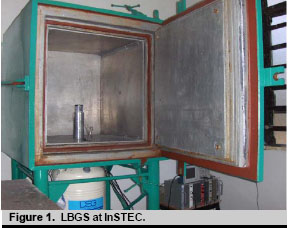
<br>   </font></p>     <p><font face="Verdana, Arial, Helvetica, sans-serif" size="2"><b><font size="3">Material    and Methods</font></b>    <br>   </font></p>     <p><font face="Verdana, Arial, Helvetica, sans-serif" size="2">Low-Background    Gamma Spectrometer: The LBGS of the Nuclear Analytical Laboratory at InSTEC    (<a href="#f1">figure 1</a>) is composed by a Low-Background Chamber (LBC), using an n-type closed-end    coaxial high-purity germanium detector (DSG, NGC-3018, 130 <img src="/img/revistas/nuc/n46/e14044609.jpg" width="24" height="14">,    FHWM = 2.04 keV for 1332 keV <img src="/img/revistas/nuc/n46/e10044609.jpg" width="28" height="14">    gamma line) equipped with an 8192 channel multichannel analyser (webMASTER TARGET    coupled to PC). The gamma spectra are processed using the Gamma-W version 18.    03 code (Dr. Westmeier Gesellschaft f&uuml;r Kernspektrometrie mbH). The LBC    is a detector shielded with 55 mm thickness of lead, 35 mm thickness of a steel    frame, and an internal graded shielding consisting of 12 mm thickness of cadmium,    17 mm of copper and 9 mm of aluminium. The inner dimensions of the LBC are 800    mm depth X&acute;718 mm width X&acute;736 mm height.</font></p>     
<p><font face="Verdana, Arial, Helvetica, sans-serif" size="2"><a name="f1"></a><img src="/img/revistas/nuc/n46/f01044609.jpg" width="288" height="228">    
<br> </font></p>     ]]></body>
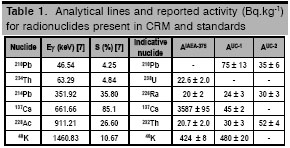
<body><![CDATA[<p><font face="Verdana, Arial, Helvetica, sans-serif" size="2"><b>Sample preparation:</b>    In the present study, we have used the certified reference material (CRM) IAEA-375    [4] and the marine sediment standards UC-1 and UC-2, prepared in the University    of Cantabria (Spain) [5]. Their radionuclide activities and main characteristics    of the corresponding analytical lines are presented in table 1. Sample preparation    was carried out by experimentally standardized the samples at 50 grams (dry    weight), and stored on a hermetic closed plastic carried out 28 days after sample    preparation (to guarantee the secular equilibrium of the U and Th daughters)    during 24 hours.</font></p>     <p><font face="Verdana, Arial, Helvetica, sans-serif" size="2"><img src="/img/revistas/nuc/n46/t01044609.jpg" width="290" height="148">    
<br>   </font></p>     <p><font face="Verdana, Arial, Helvetica, sans-serif" size="2"><b>Minimum Detectable    Activity (<img src="file:///E|/Nucleus/Nucleus-Scielo/n%2046/images/e07044609.jpg" width="24" height="17">):</b>    The LBGS background spectrum was measured during 72 hours for <b><img src="/img/revistas/nuc/n46/e07044609.jpg" width="24" height="17"></b>    determination. For each radionuclide, the <b><img src="/img/revistas/nuc/n46/e07044609.jpg" width="24" height="17"></b>    was calculated as:</font></p>     

<p><img src="/img/revistas/nuc/n46/e25044609.jpg" width="286" height="53"></p>     
<p><font face="Verdana, Arial, Helvetica, sans-serif" size="2">where <img src="/img/revistas/nuc/n46/e30044609.jpg" width="19" height="21">    is the spectrometer detection limit defined by Currie [6] equal to 3<img src="/img/revistas/nuc/n46/e31044609.jpg" width="9" height="11">,    where s is the standard deviation (in counts) of the area of the background    windows (peak window at 1.17 times the FWHM), <i>t</i> the counting time, <img src="/img/revistas/nuc/n46/e37044609.jpg" width="20" height="23">    the absolute emission probability corresponding to the i-th gamma-ray for the    nuclide j and <img src="/img/revistas/nuc/n46/e16044609.jpg" width="20" height="14">(<img src="/img/revistas/nuc/n46/e09044609.jpg" width="16" height="19">)    is the volumetric detection efficiency of the full-energy absorption peak considered.    <img src="/img/revistas/nuc/n46/e09044609.jpg" width="16" height="19">    is the energy corresponding to the <i>i</i>-th gamma-ray for the nuclide <i>j</i>.</font></p>     
<p><font face="Verdana, Arial, Helvetica, sans-serif" size="2">The volumetric    efficiency was determined by semiempirical method using Monte Carlo (MC) simulation    and point standard sources (<img src="/img/revistas/nuc/n46/e17044609.jpg" width="34" height="14">,    <img src="/img/revistas/nuc/n46/e08044609.jpg" width="28" height="14">,    <img src="/img/revistas/nuc/n46/e05044609.jpg" width="30" height="13">,    <img src="/img/revistas/nuc/n46/e10044609.jpg" width="28" height="14">    and <img src="/img/revistas/nuc/n46/e11044609.jpg" width="27" height="14">),    produced by AEA Technology QSA GmbH. Simulations were carried out to compute    the point (<img src="/img/revistas/nuc/n46/e12044609.jpg" width="44" height="21">  (<img src="/img/revistas/nuc/n46/e09044609.jpg" width="16" height="19">    )) and volumetric (<img src="/img/revistas/nuc/n46/e15044609.jpg" width="21" height="17">    (<img src="/img/revistas/nuc/n46/e09044609.jpg" width="16" height="19">))    energy dependent solid angles of Eq. (1). The MCNPX 2.5 was used as simulation    code [8]. It has been used widely to estimate the efficiency curve of HPGe detectors    for volumetric samples [9-12]. The sample-detector configuration was exactly    reproduced in the MC simulation, taking as data the dimensions, density and    chemical major elemental composition of CRM and standards, as well as the detector    specifications (Ge crystal dimensions, dead layer and Al thickness, distance    from Ge crystal to Al end cap) provided by detector supplier.    
<br> </font></p>     <p><font face="Verdana, Arial, Helvetica, sans-serif" size="2"><b>Activity Determination:</b>    For validation, the radionuclide activities present in UC-1 standard were determined    by absolute method as:</font></p>     <p><img src="/img/revistas/nuc/n46/e26044609.jpg" width="281" height="52"></p>     
]]></body>
<body><![CDATA[<p><font face="Verdana, Arial, Helvetica, sans-serif" size="2">where <img src="/img/revistas/nuc/n46/e32044609.jpg" width="33" height="20">is    the i-th photopeak area for the nuclide <i>j</i>; and by relative method calculated    as:</font></p>     
<p><img src="/img/revistas/nuc/n46/e27044609.jpg" width="281" height="50"></p>     
<p><font face="Verdana, Arial, Helvetica, sans-serif" size="2">using the CRM IAEA-375    and UC-2 standard for calibration. The accuracy was evaluated using the SR criterion,    proposed by McFarrell et al. [13]:</font></p>     <p><img src="/img/revistas/nuc/n46/e28044609.jpg" width="274" height="54"></p>     
<p><font face="Verdana, Arial, Helvetica, sans-serif" size="2">where <img src="/img/revistas/nuc/n46/e18044609.jpg" width="26" height="19">&#150;    experimental activity, <img src="/img/revistas/nuc/n46/e19044609.jpg" width="22" height="19">&#150;    certified value and <img src="/img/revistas/nuc/n46/e31044609.jpg" width="8" height="10">    is the standard deviation of <img src="/img/revistas/nuc/n46/e18044609.jpg" width="28" height="18">    . On the basis of this criterion the similarity between the certified value    and the analytical data obtained by proposed methods falls into three categories:    SR<img src="file:///E|/Nucleus/Nucleus-Scielo/N46/images/e33044609.jpg" width="11" height="13">    25% = excellent; 25 &lt; SR <img src="file:///E|/Nucleus/Nucleus-Scielo/N46/images/e33044609.jpg" width="11" height="13">    50%= acceptable, SR &gt; 50% = unacceptable.    
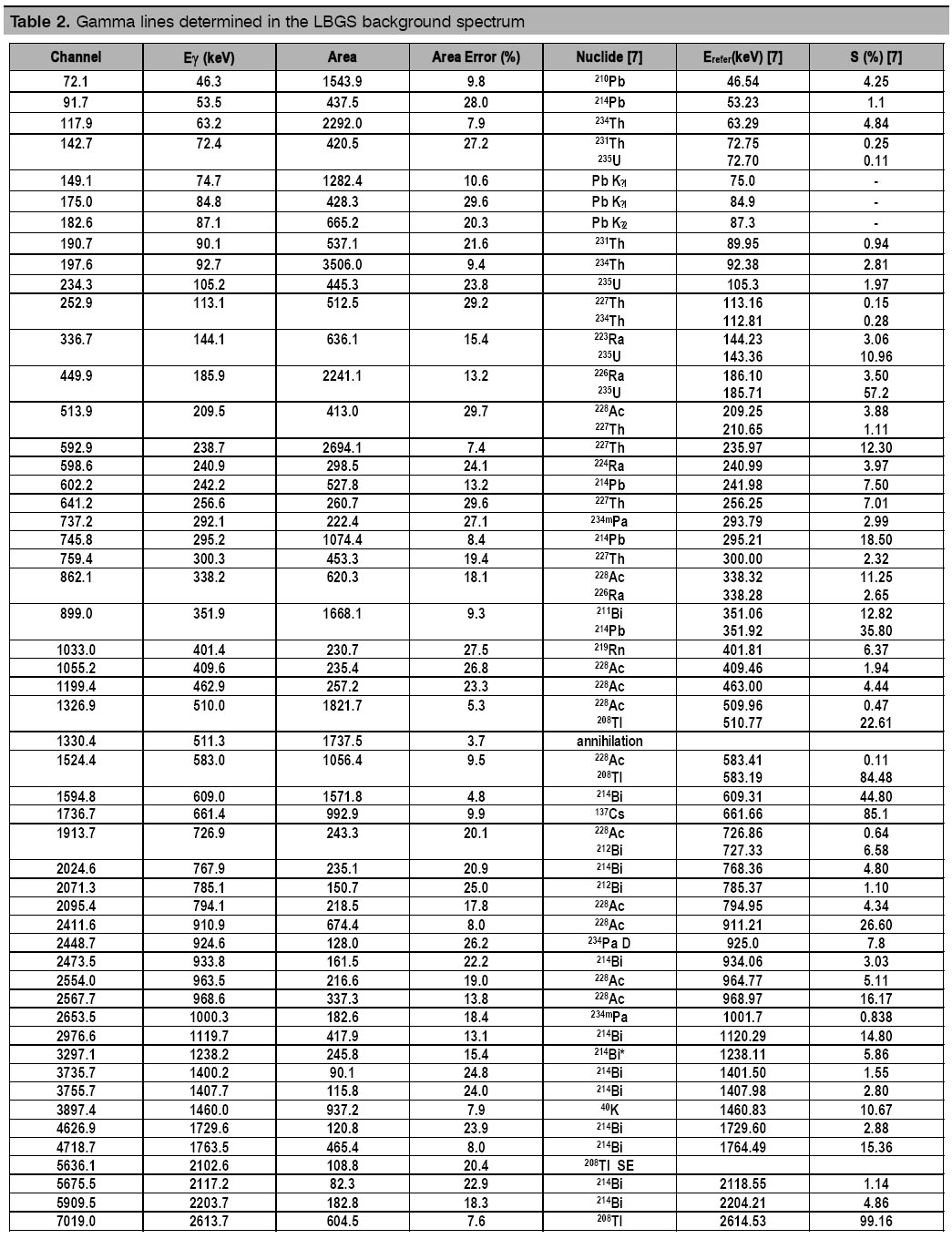
<br>   </font></p>     <p><font face="Verdana, Arial, Helvetica, sans-serif" size="2"><b><font size="3">Results    and Discussion</font></b>    <br>   </font></p>     <p><font face="Verdana, Arial, Helvetica, sans-serif" size="2"><a href="/img/revistas/nuc/n46/t02044609.jpg">Table 2</a> shows 52    gamma lines determined with an area error lesser than 30% in the 72 hours LBGS    background spectrum. All of them were very well identified. The origin of the    major percent of the observed <img src="/img/revistas/nuc/n46/e20044609.jpg" width="10" height="14">-lines    is the presence of different nuclides from U and Th decay families. A larger    contribution is caused by bremsstrahlung from the b decay of the daughter <img src="/img/revistas/nuc/n46/e35044609.jpg" width="36" height="17">    (<img src="/img/revistas/nuc/n46/e29044609.jpg" width="20" height="18">=    5.013 d, <img src="/img/revistas/nuc/n46/e21044609.jpg" width="46" height="23">=1161    keV), which is present in secular equilibrium. Independently of the copper and    aluminium shield present in the LBC, the <img src="/img/revistas/nuc/n46/e22044609.jpg" width="16" height="17">    and <img src="/img/revistas/nuc/n46/e23044609.jpg" width="23" height="18">    Pb X-ray lines are observed. The biggest count rate (0,013 cps) was determined    for the <img src="/img/revistas/nuc/n46/e34044609.jpg" width="29" height="15">    non-analytic 92.38 keV <img src="/img/revistas/nuc/n46/e20044609.jpg" width="10" height="14">-line.    </font></p>     
<p><font face="Verdana, Arial, Helvetica, sans-serif" size="2">During LBC construction,    a difficulty with normal commercial Pb is that it can probably contain some    <img src="/img/revistas/nuc/n46/e01044609.jpg" width="32" height="15">,    which originates in trace <img src="/img/revistas/nuc/n46/e04044609.jpg" width="22" height="14"> in lead ore, and it is important to mention that this lead isotope cannot be    removed chemically in lead purification. For this reason, the use of low-level    lead is more recommended. Verplancke [14] takes as &laquo;low-level lead&raquo;    that lead with less than 10 Bq of <img src="/img/revistas/nuc/n46/e01044609.jpg" width="32" height="15">    per Pb kg. Considering the count rate observed for 46.54 keV <img src="/img/revistas/nuc/n46/e01044609.jpg" width="32" height="15">    <img src="/img/revistas/nuc/n46/e20044609.jpg" width="10" height="14">-line    (0.006 cps) in the spectrometer background, the presence of low-level lead in    the LBGS is confirmed. On the other hand, the presence of the non-natural radionuclide    <img src="/img/revistas/nuc/n46/e05044609.jpg" width="30" height="13">    was unexpected. This isotope usually is associated with the nuclear explosions    occurred after 1945. Then, its presence must be associated to the use of non-sufficient  old steel in the LBC construction.</font></p>     
]]></body>
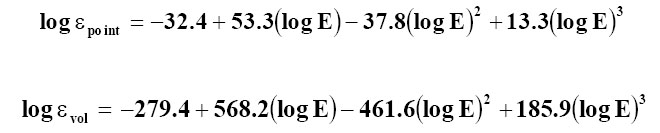
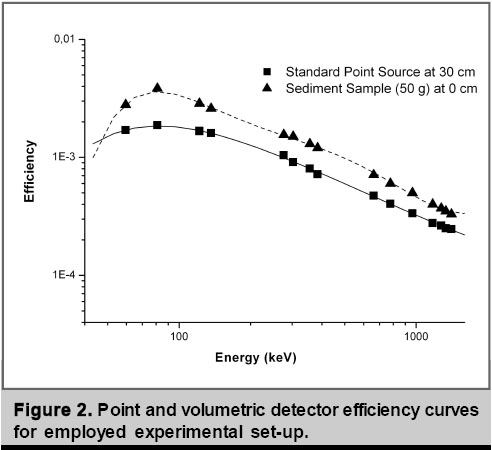
<body><![CDATA[<p><font face="Verdana, Arial, Helvetica, sans-serif" size="2"><a href="#f2">Figure 2</a> shows    the efficiency curves for point sources located at 30 cm of height (experimental),    and for the 50 grams sediment sample at 0 cm. The last curve was obtained computing    the energy-dependent solid angles by MC simulations and taking the 30 cm point    efficiency as reference (Eq. 1). The low energy gamma rays self-absorption inside    the volumetric sample is clearly observed. These curves were well fitted by    the following polynomials:</font></p>     <p><font face="Verdana, Arial, Helvetica, sans-serif" size="2"><img src="/img/revistas/nuc/n46/e36044609.jpg" width="660" height="133"></font></p>     
<p><a name="f2"></a><img src="/img/revistas/nuc/n46/f02044609.jpg" width="492" height="450"></p>     
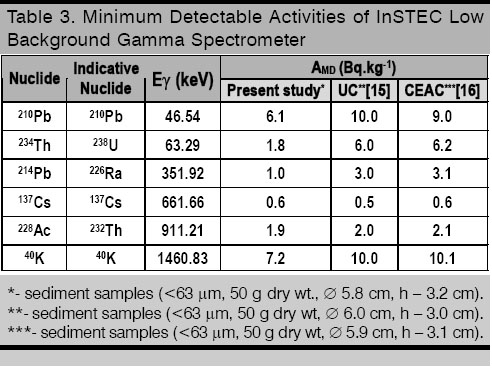
<p><font face="Verdana, Arial, Helvetica, sans-serif" size="2">The <b><img src="/img/revistas/nuc/n46/e07044609.jpg" width="24" height="17"></b>    calculated by Eq.(2) for each radionuclide of interest after the 72 hours of    background spectrum measurement are shown in <a href="#t3">table 3</a>. The comparison with other    similar gamma spectrometers (UC&#150;University of Cantabria, Spain; CEAC&#150;Center    for Environmental Studies of Cienfuegos, Cuba) used for environmental studies    shows that the InSTEC LBGS has the lowest detectable activities.</font></p>     
<p><a name="t3"></a><img src="/img/revistas/nuc/n46/t03044609.jpg" width="492" height="369"></p>     
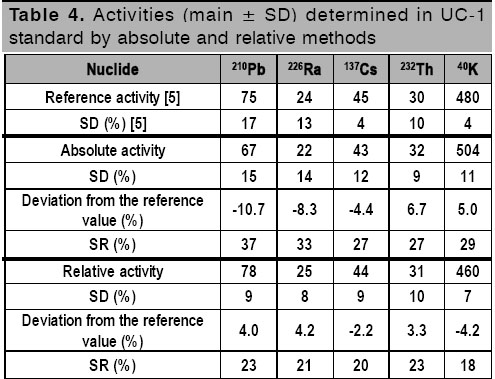
<p><font face="Verdana, Arial, Helvetica, sans-serif" size="2">The activities    of the UC-1 standard radionuclides determined in the InSTEC LBGS are shown in    <a href="#t4">table 4</a>.</font></p>     <p><a name="t4"></a><img src="/img/revistas/nuc/n46/t04044609.jpg" width="495" height="379"></p>     
<p><font face="Verdana, Arial, Helvetica, sans-serif" size="2">The bigger dispersion    (between 10-15%) and deviation from the reference value (between 4.4 &#150;    10.7%) are observed for absolute analysis. This is in correspondence with the    difficulties in detector volumetric efficiency calculation, especially for low    energies (the bigger dispersions are obtained for analytical lines with energy    less than 100 keV). To solve this problem, a finest data (for example, about    sample composition) and/or large calculations during Monte Carlo simulation    are necessary. Independently of the above criteria, the SR accuracy test shows    values between 25 and 50% for all determined activities, i.e., using the absolute    method we obtained &laquo;acceptable&raquo; results.    <br>   </font></p>     <p><font face="Verdana, Arial, Helvetica, sans-serif" size="2">On the other hand,    the application of the relative method shows &laquo;excellent&raquo; results    (SR &lt; 25% for all determined activities). For the studied radionuclides,    the obtained deviation from the reference values is always less than 5%. It    is an excellent precision for natural radioactivity measurements.    ]]></body>
<body><![CDATA[<br>   </font></p>     <p><font face="Verdana, Arial, Helvetica, sans-serif" size="2">According to the    obtained results, for environmental radioactive studies using InSTEC Low Background    Gamma Spectrometer, relative measurements are more recommended. Unfortunately,    this method requires certified standards with a matrix similar to the studied    sample matrix. For environmental studies many different certified standards    (soils, sediments, water, food, etc.) are needed. Therefore, the alternative    way is the use of absolute measurements expecting, until now,    <br>   acceptable activity accuracy.    <br>   </font></p>     <p><font face="Verdana, Arial, Helvetica, sans-serif" size="2"><b><font size="3">Conclusions</font></b>    <br>   </font></p>     <p><font face="Verdana, Arial, Helvetica, sans-serif" size="2">The Low-Background    Gamma Spectrometer at InSTEC is an accurate facility for environmental radioactivity    studies. The combination of low-level lead and Cd-Cu-Al internal graded shields    allow obtaining a very low minimum detectable activity for those radionuclides    of ecological interest. Relative and absolute activity measurements can be carried    out with excellent and acceptable accuracies, respectively.    <br>   </font></p>     <p><font face="Verdana, Arial, Helvetica, sans-serif" size="2"><b><font size="3">References</font></b><font size="3">    <br>   </font> </font></p>     ]]></body>
<body><![CDATA[<!-- ref --><p><font face="Verdana, Arial, Helvetica, sans-serif" size="2">[1] GILMORE G,    HEMINGWAY J. Practical Gamma-ray Spectrometry. John Wiley &amp; Sons, 1995.    <br>   [2] VIDMAR T, AUBINEAU-LANIECE I, ANAGNOSTAKIS, et. al. An intercomparison of    Monte Carlo codes used in gamma-ray spectrometry. Applied Radiat. Isot. 2008;    66(6-7): 764-768.    <!-- ref --><br>   [3] LEPY MC, ALTZITZOGLOU T, ARNOLD D, et. al. Intercomparison of efficiency    transfer software for gamma-ray spectrometry. Applied Radiat. Isot. 2001; 55(4):    493&#150;503.    <!-- ref --><br>   [4] IAEA. Intercomparison run IAEA-375: Determination of radionuclides in soil.    Report IAEA/AL/075. Vienna: IAEA, 1994.    <!-- ref --><br>   [5] G&Oacute;MEZ J, SOTO J. Ejercicio de intercomparaci&oacute;n de resultados    de medida de radiactividad en la Red de Vigilancia Radiol&oacute;gica Ambiental.    Madrid: Consejo de Seguridad Nuclear, 1998. (in Spanish).    <!-- ref --><br>   [6] CURRIE LA. Limits for quantitative detection and quantitative determination.    Anal. Chem. 1968; 40(3): 586.    <!-- ref --><br>   [7] FIRESTONE RB. Table of Isotopes. Wiley Interscience, 1996. Eighth edition.    <!-- ref --><br>   [8] PELOWITZ DD. MCNPX TM User&#146;s manual. LACP-05-0369. Version 2.5.0. Los    Alamos National Laboratory Report, 2005.    <!-- ref --><br>   [9] R&Oacute;DENAS J, MARTINAVARRO A, RIUS V. Validation of the MCNP code for    the simulation of Ge-detector calibration. Nucl. Instr. Methods Phys. Res. A.    2000; 450(1): 88-97.    <!-- ref --><br>   [10]KARAMANIS D. Efficiency simulation of HPGe and Si(Li) detectors in g- and    X-ray spectroscopy. Nucl. Inst. and Meth. in Phys. Res. A. 2003; 505(1-2): 282-285.    <!-- ref --><br>   [11]MARQUES SALGADO C, CONTI CC, BECKER PHB. Determination of HPGe detector    response using MCNP5 for 20&#150;150 keV X-rays. Applied Radiat. Isot. 2006;    64(6): 700&#150;705.    <!-- ref --><br>   [12]R&Oacute;DENAS J, GALLARDO S, BALLESTER S, et. al. Application of the Monte    Carlo method to the analysis of measurement geometries for the calibration of    a HP Ge detector in an environmental radioactivity laboratory. Nucl. Instr.    Methods Phys. Res. B. 2007; 263(1): 144-148.    <!-- ref --><br>   [13]QUEVAUVILLER PH, MARRIER E. Quality Assurance and Quality Control for Environmental    Monitoring. Weinheim: VCH, 1995.    <!-- ref --><br>   [14] VERPLANCKE V. Low level gamma spectroscopy: low, lower, lowest. Nucl. Instr.    Methods Phys. Res. A. 1992; 312(1-2): 174-182.    <br>   [15]GELEN A, SOTO J, D&Iacute;AZ RIZO O, SIMON MJ, BELTR&Aacute;N J, RAM&Iacute;REZ    M, HERRERA E, G&Oacute;MEZ J, R&Oacute;DENAS C. Radiological evaluation of sediments    from the bay of Havana. Nucleus. 2002; (32): 17-22.    <!-- ref --><br>   [16]ALONSO C. Environmental Radioactivity Sources, Distribution and Risk in    Cuban Marine Ecosystem, Ph. D. Thesis. La Habana: InSTEC, 2010. (in Spanish)    <br>   </font></p>     <p><font face="Verdana, Arial, Helvetica, sans-serif" size="2">Recibido: 3 de    agosto de 2009    <br>   Aceptado: 12 de noviembre de 2009</font></p>      ]]></body><back>
<ref-list>
<ref id="B1">
<label>[1]</label><nlm-citation citation-type="book">
<person-group person-group-type="author">
<name>
<surname><![CDATA[GILMORE]]></surname>
<given-names><![CDATA[G]]></given-names>
</name>
<name>
<surname><![CDATA[HEMINGWAY]]></surname>
<given-names><![CDATA[J]]></given-names>
</name>
</person-group>
<source><![CDATA[Practical Gamma-ray Spectrometry]]></source>
<year>1995</year>
<publisher-name><![CDATA[John Wiley & Sons]]></publisher-name>
</nlm-citation>
</ref>
<ref id="B2">
<label>[2]</label><nlm-citation citation-type="journal">
<person-group person-group-type="author">
<name>
<surname><![CDATA[VIDMAR]]></surname>
<given-names><![CDATA[T]]></given-names>
</name>
<name>
<surname><![CDATA[AUBINEAU-LANIECE]]></surname>
<given-names><![CDATA[I]]></given-names>
</name>
<name>
<surname><![CDATA[ANAGNOSTAKIS]]></surname>
<given-names><![CDATA[MJ]]></given-names>
</name>
</person-group>
<article-title xml:lang="en"><![CDATA[An intercomparison of Monte Carlo codes used in gamma-ray spectrometry]]></article-title>
<source><![CDATA[Applied Radiat. Isot]]></source>
<year>2008</year>
<volume>66</volume>
<numero>(6-7)</numero>
<issue>(6-7)</issue>
<page-range>764-768</page-range></nlm-citation>
</ref>
<ref id="B3">
<label>[3]</label><nlm-citation citation-type="journal">
<person-group person-group-type="author">
<name>
<surname><![CDATA[LEPY]]></surname>
<given-names><![CDATA[MC]]></given-names>
</name>
<name>
<surname><![CDATA[ALTZITZOGLOU]]></surname>
<given-names><![CDATA[T]]></given-names>
</name>
<name>
<surname><![CDATA[ARNOLD]]></surname>
<given-names><![CDATA[D]]></given-names>
</name>
</person-group>
<article-title xml:lang="en"><![CDATA[Intercomparison of efficiency transfer software for gamma-ray spectrometry]]></article-title>
<source><![CDATA[Applied Radiat. Isot]]></source>
<year>2001</year>
<volume>55</volume>
<numero>(4)</numero>
<issue>(4)</issue>
<page-range>493-503</page-range></nlm-citation>
</ref>
<ref id="B4">
<label>[4]</label><nlm-citation citation-type="book">
<collab>IAEA</collab>
<source><![CDATA[Intercomparison run IAEA-375: Determination of radionuclides in soil. Report IAEA/AL/075]]></source>
<year>1994</year>
<publisher-loc><![CDATA[Vienna ]]></publisher-loc>
<publisher-name><![CDATA[IAEA]]></publisher-name>
</nlm-citation>
</ref>
<ref id="B5">
<label>[5]</label><nlm-citation citation-type="book">
<person-group person-group-type="author">
<name>
<surname><![CDATA[GÓMEZ]]></surname>
<given-names><![CDATA[J]]></given-names>
</name>
<name>
<surname><![CDATA[SOTO]]></surname>
<given-names><![CDATA[J]]></given-names>
</name>
</person-group>
<source><![CDATA[Ejercicio de intercomparación de resultados de medida de radiactividad en la Red de Vigilancia Radiológica Ambiental]]></source>
<year>1998</year>
<publisher-loc><![CDATA[Madrid ]]></publisher-loc>
<publisher-name><![CDATA[Consejo de Seguridad Nuclear]]></publisher-name>
</nlm-citation>
</ref>
<ref id="B6">
<label>[6]</label><nlm-citation citation-type="journal">
<person-group person-group-type="author">
<name>
<surname><![CDATA[CURRIE]]></surname>
<given-names><![CDATA[LA]]></given-names>
</name>
</person-group>
<article-title xml:lang="en"><![CDATA[Limits for quantitative detection and quantitative determination]]></article-title>
<source><![CDATA[Anal. Chem]]></source>
<year>1968</year>
<volume>40</volume>
<numero>(3)</numero>
<issue>(3)</issue>
<page-range>586</page-range></nlm-citation>
</ref>
<ref id="B7">
<label>[7]</label><nlm-citation citation-type="book">
<person-group person-group-type="author">
<name>
<surname><![CDATA[FIRESTONE]]></surname>
<given-names><![CDATA[RB]]></given-names>
</name>
</person-group>
<source><![CDATA[Table of Isotopes]]></source>
<year>1996</year>
<edition>Eighth edition</edition>
<publisher-name><![CDATA[Wiley Interscience]]></publisher-name>
</nlm-citation>
</ref>
<ref id="B8">
<label>[8]</label><nlm-citation citation-type="book">
<person-group person-group-type="author">
<name>
<surname><![CDATA[PELOWITZ]]></surname>
<given-names><![CDATA[DD]]></given-names>
</name>
</person-group>
<source><![CDATA[MCNPX TM User&#8217;s manual. LACP-05-0369. Version 2.5.0]]></source>
<year>2005</year>
<publisher-name><![CDATA[Los Alamos National Laboratory Report]]></publisher-name>
</nlm-citation>
</ref>
<ref id="B9">
<label>[9]</label><nlm-citation citation-type="journal">
<person-group person-group-type="author">
<name>
<surname><![CDATA[RÓDENAS]]></surname>
<given-names><![CDATA[J]]></given-names>
</name>
<name>
<surname><![CDATA[MARTI NAVARRO]]></surname>
<given-names><![CDATA[A]]></given-names>
</name>
<name>
<surname><![CDATA[RIUS]]></surname>
<given-names><![CDATA[V]]></given-names>
</name>
</person-group>
<article-title xml:lang="en"><![CDATA[Validation of the MCNP code for the simulation of Ge-detector calibration]]></article-title>
<source><![CDATA[Nucl. Instr. Methods Phys. Res. A]]></source>
<year>2000</year>
<volume>450</volume>
<numero>(1)</numero>
<issue>(1)</issue>
<page-range>88-97</page-range></nlm-citation>
</ref>
<ref id="B10">
<label>[10]</label><nlm-citation citation-type="journal">
<person-group person-group-type="author">
<name>
<surname><![CDATA[KARAMANIS]]></surname>
<given-names><![CDATA[D]]></given-names>
</name>
</person-group>
<article-title xml:lang="en"><![CDATA[Efficiency simulation of HPGe and Si(Li) detectors in g- and X-ray spectroscopy]]></article-title>
<source><![CDATA[Nucl. Inst. and Meth. in Phys. Res. A]]></source>
<year>2003</year>
<volume>505</volume>
<numero>(1-2)</numero>
<issue>(1-2)</issue>
<page-range>282-285</page-range></nlm-citation>
</ref>
<ref id="B11">
<label>[11]</label><nlm-citation citation-type="journal">
<person-group person-group-type="author">
<name>
<surname><![CDATA[MARQUES SALGADO]]></surname>
<given-names><![CDATA[C]]></given-names>
</name>
<name>
<surname><![CDATA[CONTI]]></surname>
<given-names><![CDATA[CC]]></given-names>
</name>
<name>
<surname><![CDATA[BECKER]]></surname>
<given-names><![CDATA[PHB]]></given-names>
</name>
</person-group>
<article-title xml:lang="en"><![CDATA[Determination of HPGe detector response using MCNP5 for 20-150 keV X-rays]]></article-title>
<source><![CDATA[Applied Radiat. Isot]]></source>
<year>2006</year>
<volume>64</volume>
<numero>(6)</numero>
<issue>(6)</issue>
<page-range>700-705</page-range></nlm-citation>
</ref>
<ref id="B12">
<label>[12]</label><nlm-citation citation-type="journal">
<person-group person-group-type="author">
<name>
<surname><![CDATA[RÓDENAS]]></surname>
<given-names><![CDATA[J]]></given-names>
</name>
<name>
<surname><![CDATA[GALLARDO]]></surname>
<given-names><![CDATA[S]]></given-names>
</name>
<name>
<surname><![CDATA[BALLESTER]]></surname>
<given-names><![CDATA[S]]></given-names>
</name>
</person-group>
<article-title xml:lang="en"><![CDATA[Application of the Monte Carlo method to the analysis of measurement geometries for the calibration of a HP Ge detector in an environmental radioactivity laboratory]]></article-title>
<source><![CDATA[Nucl. Instr. Methods Phys. Res. B]]></source>
<year>2007</year>
<volume>263</volume>
<numero>(1)</numero>
<issue>(1)</issue>
<page-range>144-148</page-range></nlm-citation>
</ref>
<ref id="B13">
<label>[13]</label><nlm-citation citation-type="book">
<person-group person-group-type="author">
<name>
<surname><![CDATA[QUEVAUVILLER]]></surname>
<given-names><![CDATA[PH]]></given-names>
</name>
<name>
<surname><![CDATA[MARRIER]]></surname>
<given-names><![CDATA[E]]></given-names>
</name>
</person-group>
<source><![CDATA[Quality Assurance and Quality Control for Environmental Monitoring]]></source>
<year>1995</year>
<publisher-loc><![CDATA[Weinheim ]]></publisher-loc>
<publisher-name><![CDATA[VCH]]></publisher-name>
</nlm-citation>
</ref>
<ref id="B14">
<label>[14]</label><nlm-citation citation-type="journal">
<person-group person-group-type="author">
<name>
<surname><![CDATA[VERPLANCKE]]></surname>
<given-names><![CDATA[V]]></given-names>
</name>
</person-group>
<article-title xml:lang="en"><![CDATA[Low level gamma spectroscopy: low, lower, lowest]]></article-title>
<source><![CDATA[Nucl. Instr. Methods Phys. Res. A]]></source>
<year>1992</year>
<volume>312</volume>
<numero>(1-2)</numero>
<issue>(1-2)</issue>
<page-range>174-182</page-range></nlm-citation>
</ref>
<ref id="B15">
<label>[15]</label><nlm-citation citation-type="journal">
<person-group person-group-type="author">
<name>
<surname><![CDATA[GELEN]]></surname>
<given-names><![CDATA[A]]></given-names>
</name>
<name>
<surname><![CDATA[SOTO]]></surname>
<given-names><![CDATA[J]]></given-names>
</name>
<name>
<surname><![CDATA[DÍAZ RIZO]]></surname>
<given-names><![CDATA[O]]></given-names>
</name>
</person-group>
<article-title xml:lang="en"><![CDATA[Radiological evaluation of sediments from the bay of Havana]]></article-title>
<source><![CDATA[Nucleus]]></source>
<year>2002</year>
<numero>(32)</numero>
<issue>(32)</issue>
<page-range>17-22</page-range></nlm-citation>
</ref>
<ref id="B16">
<label>[16]</label><nlm-citation citation-type="">
<person-group person-group-type="author">
<name>
<surname><![CDATA[ALONSO]]></surname>
<given-names><![CDATA[C]]></given-names>
</name>
</person-group>
<source><![CDATA[Environmental Radioactivity Sources, Distribution and Risk in Cuban Marine Ecosystem]]></source>
<year></year>
</nlm-citation>
</ref>
</ref-list>
</back>
</article>