<?xml version="1.0" encoding="ISO-8859-1"?><article xmlns:mml="http://www.w3.org/1998/Math/MathML" xmlns:xlink="http://www.w3.org/1999/xlink" xmlns:xsi="http://www.w3.org/2001/XMLSchema-instance">
<front>
<journal-meta>
<journal-id>0864-084X</journal-id>
<journal-title><![CDATA[Nucleus]]></journal-title>
<abbrev-journal-title><![CDATA[Nucleus]]></abbrev-journal-title>
<issn>0864-084X</issn>
<publisher>
<publisher-name><![CDATA[CUBAENERGIA]]></publisher-name>
</publisher>
</journal-meta>
<article-meta>
<article-id>S0864-084X2011000200002</article-id>
<title-group>
<article-title xml:lang="en"><![CDATA[Evaluation of the hurricanes Gustav and Ike impact on healing mud from San Diego river using nuclear and geochemical techniques]]></article-title>
<article-title xml:lang="es"><![CDATA[Evaluación del impacto de los huracanes Gustav e Ike sobre los lodos medicinales del río San Diego mediante técnicas nucleares y geoquímicas]]></article-title>
</title-group>
<contrib-group>
<contrib contrib-type="author">
<name>
<surname><![CDATA[Díaz Rizo]]></surname>
<given-names><![CDATA[Oscar]]></given-names>
</name>
</contrib>
<contrib contrib-type="author">
<name>
<surname><![CDATA[Gelen Rudnikas]]></surname>
<given-names><![CDATA[Alina]]></given-names>
</name>
</contrib>
<contrib contrib-type="author">
<name>
<surname><![CDATA[González Hernández]]></surname>
<given-names><![CDATA[Patricia]]></given-names>
</name>
</contrib>
<contrib contrib-type="author">
<name>
<surname><![CDATA[Melián Rodríguez]]></surname>
<given-names><![CDATA[Clara M.]]></given-names>
</name>
</contrib>
<contrib contrib-type="author">
<name>
<surname><![CDATA[Suárez Muñoz]]></surname>
<given-names><![CDATA[Margaret]]></given-names>
</name>
</contrib>
<contrib contrib-type="author">
<name>
<surname><![CDATA[D´Alessandro Rodríguez]]></surname>
<given-names><![CDATA[Katia]]></given-names>
</name>
</contrib>
<contrib contrib-type="author">
<name>
<surname><![CDATA[Arado López]]></surname>
<given-names><![CDATA[Juana O.]]></given-names>
</name>
</contrib>
<contrib contrib-type="author">
<name>
<surname><![CDATA[Domínguez Rodríguez]]></surname>
<given-names><![CDATA[Roberto]]></given-names>
</name>
</contrib>
<contrib contrib-type="author">
<name>
<surname><![CDATA[Fagundo Castillo]]></surname>
<given-names><![CDATA[Juan R.]]></given-names>
</name>
</contrib>
<contrib contrib-type="author">
<name>
<surname><![CDATA[Blanco Padilla]]></surname>
<given-names><![CDATA[Dagoberto]]></given-names>
</name>
</contrib>
</contrib-group>
<aff id="A01">
<institution><![CDATA[,Instituto Superior de Tecnologías y Ciencias Aplicadas (InSTEC)  ]]></institution>
<addr-line><![CDATA[La Habana ]]></addr-line>
<country>Cuba</country>
</aff>
<aff id="A02">
<institution><![CDATA[,Centro Nacional de Medicina Natural y Tradicional  ]]></institution>
<addr-line><![CDATA[La Habana ]]></addr-line>
<country>Cuba</country>
</aff>
<aff id="A03">
<institution><![CDATA[,Sanatorio San Diego de los Baños  ]]></institution>
<addr-line><![CDATA[Pinar del Río ]]></addr-line>
<country>Cuba</country>
</aff>
<pub-date pub-type="pub">
<day>00</day>
<month>12</month>
<year>2011</year>
</pub-date>
<pub-date pub-type="epub">
<day>00</day>
<month>12</month>
<year>2011</year>
</pub-date>
<numero>50</numero>
<fpage>7</fpage>
<lpage>11</lpage>
<copyright-statement/>
<copyright-year/>
<self-uri xlink:href="http://scielo.sld.cu/scielo.php?script=sci_arttext&amp;pid=S0864-084X2011000200002&amp;lng=en&amp;nrm=iso"></self-uri><self-uri xlink:href="http://scielo.sld.cu/scielo.php?script=sci_abstract&amp;pid=S0864-084X2011000200002&amp;lng=en&amp;nrm=iso"></self-uri><self-uri xlink:href="http://scielo.sld.cu/scielo.php?script=sci_pdf&amp;pid=S0864-084X2011000200002&amp;lng=en&amp;nrm=iso"></self-uri><abstract abstract-type="short" xml:lang="en"><p><![CDATA[ABSTRACT Effects induced by hurricanes Gustav and Ike on the characteristics of the San Diego River mud have been studied. X-ray fluorescence analysis, gamma spectrometry and the measurement of some physical andchemical characteristics in mud samples, collected before and after the hurricanes, show that the hurricanes induced changes not only in mud major composition but also in some other mud characteristics. The average sedimentation rate determined by gamma spectrometry in San Diego River outlet allowed to estimate that the original mud characteristics will be recovered no sooner // earlier than after 5-7 years. Further studies on the influence of changes in mud characteristics and in its therapeutic properties as a result of the impact of hurricanes are recommended as well.]]></p></abstract>
<abstract abstract-type="short" xml:lang="es"><p><![CDATA[RESUMEN Se estudian los efectos inducidos por los huracanes Gustav e Ike en las características principales de los lodos del río San Diego. La fluorescencia de rayos X, la espectrometría gamma y la medición de varios parámetros físico-químicos de lodos, colectados antes y después del paso de los huracanes en septiembre del 2008 mostraron que los huracanes provocaron cambios en la composición mayoritaria y en otras características de los lodos. La tasa de sedimentación promedio determinada por espectrometría gamma en la desembocadura del río San Diego permitió estimar que las características originales de los lodos medicinales no se recobrarán hasta dentro de 5-7 años. Se recomienda estudiar cómo influyen en las propiedades terapéuticas de los lodos, los cambios ocurridos en sus características producto del impacto de los huracanes.]]></p></abstract>
<kwd-group>
<kwd lng="en"><![CDATA[X-ray fluorescence analysis]]></kwd>
<kwd lng="en"><![CDATA[Cuba]]></kwd>
<kwd lng="en"><![CDATA[gamma spectroscopy]]></kwd>
<kwd lng="en"><![CDATA[hurricanes]]></kwd>
<kwd lng="en"><![CDATA[sediments]]></kwd>
<kwd lng="en"><![CDATA[análisis por fluorescencia de rayos X]]></kwd>
<kwd lng="en"><![CDATA[Cuba]]></kwd>
<kwd lng="en"><![CDATA[espectroscopía gamma]]></kwd>
<kwd lng="en"><![CDATA[huracanes]]></kwd>
<kwd lng="en"><![CDATA[sedimentos]]></kwd>
</kwd-group>
</article-meta>
</front><body><![CDATA[ <p align="left"><font face="Verdana, Arial, Helvetica, sans-serif" size="2"><b>CIENCIAS    NUCLEARES</b></font></p>     <p><strong><font size="4" face="Verdana, Arial, Helvetica, sans-serif">Evaluation of the hurricanes Gustav  and Ike impact on healing mud from San    Diego river using nuclear and geochemical techniques</font></strong> </p>     <p><strong><font size="4"><font size="3" face="Verdana, Arial, Helvetica, sans-serif">Evaluaci&oacute;n del  impacto de los huracanes Gustav e Ike sobre los lodos medicinales del r&iacute;o San Diego mediante  t&eacute;cnicas nucleares y geoqu&iacute;micas</font></font></strong></p>     <p><font size="2" face="Verdana, Arial, Helvetica, sans-serif">Oscar D&iacute;az Rizo<SUP>1</SUP>, Alina Gelen Rudnikas<SUP>1</SUP>, Patricia Gonz&aacute;lez Hern&aacute;ndez<SUP>2</SUP>, Clara M. Meli&aacute;n Rodr&iacute;guez<SUP>2</SUP>,    Margaret Su&aacute;rez Mu&ntilde;oz<SUP>2</SUP>, Katia D&acute;Alessandro Rodr&iacute;guez<SUP>1</SUP>, Juana O. Arado L&oacute;pez<SUP>1</SUP>, Roberto Dom&iacute;nguez    Rodr&iacute;guez<SUP>1</SUP>, Juan R. Fagundo Castillo<SUP>2</SUP>, Dagoberto Blanco Padilla<SUP>3</SUP></font></p>     <p><font size="2" face="Verdana, Arial, Helvetica, sans-serif"><SUP>1</SUP>Instituto Superior de Tecnolog&iacute;as y Ciencias Aplicadas  (InSTEC), POB 6163. La Habana,  10600. Cuba    <br>     <SUP>2</SUP>Centro Nacional de Medicina Natural y Tradicional. Ave.  243, 19815. Fontanar, La   Habana. Cuba    <br>     <SUP>3</SUP>Sanatorio &ldquo;San Diego de los Ba&ntilde;os&rdquo;, Los Palacios. Pinar del  R&iacute;o, Cuba</font></p>     <p><font face="Verdana, Arial, Helvetica, sans-serif" size="2"><a href="mailto:odrizo@instec.cu">odrizo@instec.cu</a></font></p> <hr>     <p><font face="Verdana, Arial, Helvetica, sans-serif" size="2"><b>ABSTRACT</b></font></p>     <p><font size="2" face="Verdana, Arial, Helvetica, sans-serif">Effects induced by hurricanes Gustav and Ike on the characteristics of the San Diego River mud have    been studied. X-ray fluorescence analysis, gamma spectrometry and the measurement of some physical    andchemical characteristics in mud samples, collected before and after the hurricanes, show that    the hurricanes induced changes not only in mud major composition but also in some other mud characteristics.    The average sedimentation rate determined by gamma spectrometry in San Diego River outlet    allowed to estimate that the original mud characteristics will be recovered no sooner // earlier than    after 5-7 years. Further studies on the influence of changes in mud characteristics and in its therapeutic    properties as a result of the impact of hurricanes are recommended as well.</font></p>     ]]></body>
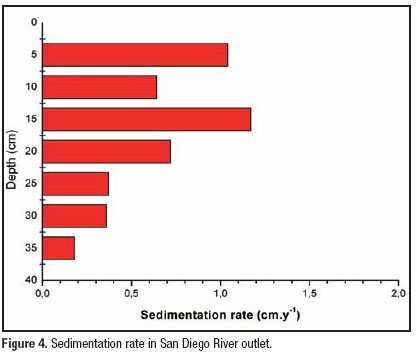
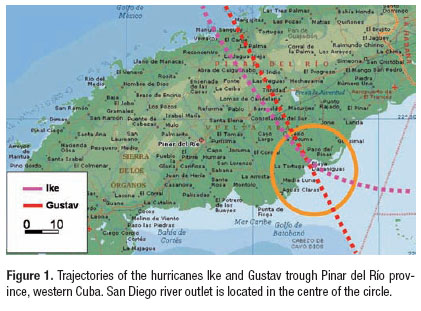
<body><![CDATA[<p><font size="2" face="Verdana, Arial, Helvetica, sans-serif"><b>Key words: </b>X-ray fluorescence analysis, Cuba, gamma spectroscopy, hurricanes, sediments</font>.</p> <hr>     <p><font face="Verdana, Arial, Helvetica, sans-serif" size="2"><b>RESUMEN</b></font></p>     <p><font size="2" face="Verdana, Arial, Helvetica, sans-serif">Se estudian los efectos inducidos por los huracanes Gustav e Ike en las caracter&iacute;sticas principales de    los lodos del r&iacute;o San Diego. La fluorescencia de rayos X, la espectrometr&iacute;a gamma y la medici&oacute;n de    varios par&aacute;metros f&iacute;sico-qu&iacute;micos de lodos, colectados antes y despu&eacute;s del paso de los huracanes    en septiembre del 2008 mostraron que los huracanes provocaron cambios en la composici&oacute;n mayoritaria    y en otras caracter&iacute;sticas de los lodos. La tasa de sedimentaci&oacute;n promedio determinada por    espectrometr&iacute;a gamma en la desembocadura del r&iacute;o San Diego permiti&oacute; estimar que las caracter&iacute;sticas    originales de los lodos medicinales no se recobrar&aacute;n hasta dentro de 5-7 a&ntilde;os. Se recomienda    estudiar c&oacute;mo influyen en las propiedades terap&eacute;uticas de los lodos, los cambios ocurridos en sus  caracter&iacute;sticas producto del impacto de los huracanes.</font></p>     <p><font face="Verdana, Arial, Helvetica, sans-serif" size="2"><strong>Palabras claves: </strong>an&aacute;lisis por fluorescencia de rayos X, Cuba, espectroscop&iacute;a gamma, huracanes, sedimentos</font>.</p> <hr>     <p><font size="3" face="Verdana, Arial, Helvetica, sans-serif"><strong>Introduction</strong></font></p>     <p><font size="2" face="Verdana, Arial, Helvetica, sans-serif">Extreme  natural event like hurricane (or series of hurricanes) can have substantial  ecological effects on coastal ecosystems. Physical effects of hurricanes on  estuaries include increased sedimentation, sudden short term changes in  salinity or dissolved oxygen [1], disturbance of shallow bottom habitats from  storm-surge scouring [2,3] and remobilization of sediment contaminants [4]. Independently  that hurricane impact is very local, usually, a long time is necessary to  recover the original ecological status of the impacted area [5].</font></p>     <p><font size="2" face="Verdana, Arial, Helvetica, sans-serif">Peloide  therapy have been used in medicine since ancient times and more recently such  old practice has received applications also for wellness and relax    purposes  [6,7] due to their physical properties (i.e. absorption/ adsorption capacity,  cation exchange capacity, water saturation, swelling index, grain size,  cooling index, etc.). The most important inorganic component of the peloide is  clay minerals, mixed with salty thermomineral waters and accompanied by organic  materials produced by the biological-metabolic activity of microorganisms  growing during the so-called &ldquo;maturation&rdquo;    process  [8].In  September 2008, the San Diego River outlet (main mud source of San Diego de los  Ba&ntilde;os Thermal Centre) was impacted by two sequential strong hurricanes (a  Category 4 on the Saffir-Simpson hurricane scale) named Gustav and Ike,  respectively (<a href="#f01025011">figure 1</a>).The aim of  the present study was the evaluation of the effects induced by the hurricanes  on San Diego River mud characteristics (major and heavy metal composition, radioactivity  levels, electric conductivity, DO, etc.) for its therapeutic purposes.</font></p>     <p><img src="/img/revistas/nuc/n50/f01025011.jpg" width="421" height="311"><a name="f01025011"></a></p>     
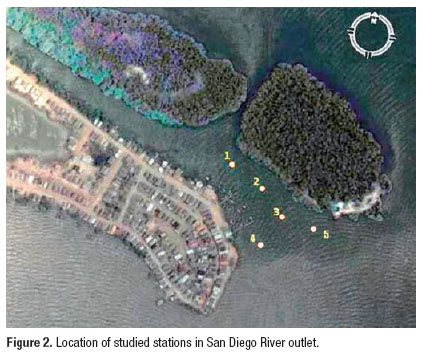
<p><font size="3" face="Verdana, Arial, Helvetica, sans-serif"><strong>Materials  and methods</strong></font></p>     <p><font size="2" face="Verdana, Arial, Helvetica, sans-serif">Samples  were collected in five stations in the San Diego River  outlet (<a href="#f02025011">figure 2</a>) during the same journey and two weeks after the second  hurricane. Stations were selected in the same places studied in 2007 when some  mud samples were collected for their toxicological analysis [9]. Additionally,  a 50 cm  core was collected in station 3 for sedimentation rate determination. The core  tube was cut in 5 cm  thick slices. All samples were dried at 60 </font>&ordm;<font size="2" face="Verdana, Arial, Helvetica, sans-serif">C. Large rock debris; mollusk  skeletons and organic debris were removed before sieving. The fraction smaller  than 1 mm  was ground to a fine powder (&lt;63 &mu;m) in an agate mortar. The pulverized samples were newly dried at 60 </font>&ordm;<font size="2" face="Verdana, Arial, Helvetica, sans-serif">C  until obtaining a constant weight.</font></p>     ]]></body>
<body><![CDATA[<p><img src="/img/revistas/nuc/n50/f02025011.jpg" width="424" height="362"><a name="f02025011"></a></p>     
<p><font size="2" face="Verdana, Arial, Helvetica, sans-serif">Elemental  concentrations were determined by external standard method X-ray fluorescence  analysis (XRF) using the Certified Refereznce Materials (CRM) IAEA-SL-1 &ldquo;Lake Sediment&rdquo;  [10], IAEA-Soil-5 [11], IAEA Soil-7 [12], BCR-2 &ldquo;Basalt Columbia River&rdquo; [13]  and BCSS-1 &ldquo;Marine sediment&rdquo; from the Canadian National Research Council as  standards. All samples and CRM were mixed with cellulose (analytical quality)  in proportion 4:1 and pressed at 15 tons into the pellets of 25 mm diameter and 4-5 mm height. Pellets were  measured using Canberra Si(Li) detector (150 eV energy resolution at 5,9 keV,  Be window thickness = 12.0 &mu;m) coupled to a MCA. A <img src="/img/revistas/nuc/n50/e01025011.jpg" width="31" height="12"> (1.1 GBq) excitation source with ring  geometry was used. All spectra were processed with WinAxil code [14]. Detection  Limits were determined according Padilla et. al. [15] (in concentration units)  as <img src="/img/revistas/nuc/n50/e02025011.jpg" width="15" height="18"> = 3<img src="/img/revistas/nuc/n50/e03025011.jpg" width="11" height="12">/mt, where m  is the sensibility in counts.<img src="/img/revistas/nuc/n50/e07025011.jpg" width="30" height="14"> per  concentration unit,   <img src="/img/revistas/nuc/n50/e03025011.jpg" width="11" height="12"> is the standard deviation of the area of the background windows (peak window at  1.17 times the FWHM) and <em>t</em> is the measuring time (6 hours).</font></p>     
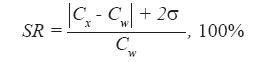
<p><font size="2" face="Verdana, Arial, Helvetica, sans-serif">The  accuracy was evaluated using the <a href="#e04025011">SR criterion</a>, proposed by McFarrell et. al. [16]:</font></p>     <p><img src="/img/revistas/nuc/n50/e04025011.jpg" width="261" height="62"><a name="e04025011"></a></p>     
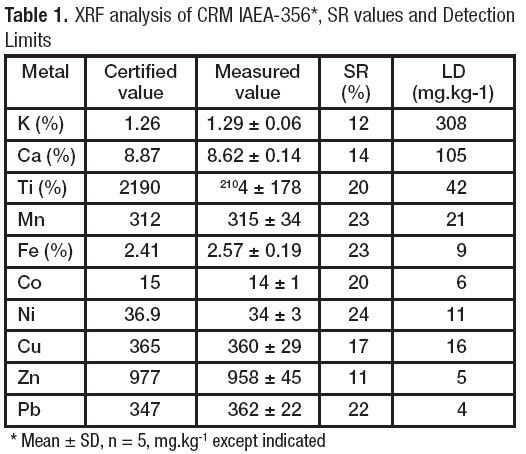
<p><font size="2" face="Verdana, Arial, Helvetica, sans-serif">where <img src="/img/revistas/nuc/n50/e05025011.jpg" width="19" height="18">&ndash;  experimental value, <img src="/img/revistas/nuc/n50/e06025011.jpg" width="19" height="18">&ndash; certified value and <img src="/img/revistas/nuc/n50/e03025011.jpg" width="11" height="12"> is the standard deviation of <img src="/img/revistas/nuc/n50/e05025011.jpg" width="19" height="18">. On the basis  of this criterion the similarity between the certified value and the  analytical data obtained by proposed methods is divided in three categories: SR  &le; 25% = excellent; 25 &lt; SR &le; 50% = ac-ceptable, SR &gt; 50% = unacceptable. The  analysis of five replica of the CRM IAEA-56 &ldquo;Polluted Marine Sediment&rdquo; [17] is  presented in <a href="#t01025011">table 1</a>. All heavy metals determined by XRF analysis are  &ldquo;excellent&rdquo; (SR &le; 25%) and the obtained results shows a very good correlation  (R = 0.9999) between certified and measured values.</font></p>     
<p><img src="/img/revistas/nuc/n50/t01025011.jpg" width="495" height="405"><a name="t01025011"></a></p>     
<p><font size="2" face="Verdana, Arial, Helvetica, sans-serif">In order to  assess the hurricane impact to sediment elemental composition and to mitigate  the grain-size dependence; the element enrichment (or impoverishment)    was  calculated by normalizing the results to a reference element, using the  <a href="#e08025011">Enrichment Factor</a> [18]:</font></p>     <p><img src="/img/revistas/nuc/n50/e08025011.jpg" width="208" height="38"><a name="e08025011"></a></p>     
<p><font size="2" face="Verdana, Arial, Helvetica, sans-serif">where X is  the concentration of potentially enriched element and Y is the concentration of  the reference element, using the corresponding to 2007 elemental concentrations  as background. If EF value of an element is close to unity, it means that  hurricanes do not induce to a concentration increment Then, Enrichment value  higher (lesser) than unity indicated a possible enrichment (impoverishment) of  the element content induced by the hurricanes. Iron was selected as reference  element. The use of Fe to normalize the results is recommended because the  natural high levels of this element in the environment [19,20].</font></p>     <p><font size="2" face="Verdana, Arial, Helvetica, sans-serif">In  radiometric study, CRM, standard and sample preparation was standardized as 50 grams (dry weight) and  putted in the hermetic closed plastic container during 30 days so that a  secular equilibrium between <img src="/img/revistas/nuc/n50/e09025011.jpg" width="29" height="15">, <img src="/img/revistas/nuc/n50/e10025011.jpg" width="30" height="14"> and shorter half lives daughters of  <img src="/img/revistas/nuc/n50/e10025011.jpg" width="30" height="14"> was assured. Samples, CRM and standards were measured during 24 hours in  the Low-Background Gamma Spectrometer (LBGS) of the Nuclear Analytical Lab at  InSTEC [21]. LBGS is composed by a Low-Background Chamber (LBC), using an  n-type closed-end coaxial high-purity germanium detector (DSG, NGC-3018, 130  <img src="/img/revistas/nuc/n50/e11025011.jpg" width="30" height="14">, FHWM = 2.04 keV for 1332 keV <img src="/img/revistas/nuc/n50/e12025011.jpg" width="28" height="14"> gamma line) equipped with an 8192  channel multichannel analyzer (webMASTER TARGET coupled to PC). The gamma  spectra were processed using the Gamma-W version 18.03 code (Dr. Westmeier  Gesellschaft f&uuml;r Kernspektrometrie mbH). The minimum detectable activity (MDA)  of the system for 24 hours count acquisition were 6.1 <img src="/img/revistas/nuc/n50/e13025011.jpg" width="39" height="14"> for <img src="/img/revistas/nuc/n50/e14025011.jpg" width="32" height="15">, 1.8  <img src="/img/revistas/nuc/n50/e13025011.jpg" width="39" height="14"> for <img src="/img/revistas/nuc/n50/e15025011.jpg" width="29" height="15">, 1.0 <img src="/img/revistas/nuc/n50/e13025011.jpg" width="39" height="14"> for <img src="/img/revistas/nuc/n50/e19025011.jpg" width="33" height="15">, 0.6 <img src="/img/revistas/nuc/n50/e13025011.jpg" width="39" height="14"> for <img src="/img/revistas/nuc/n50/e16025011.jpg" width="30" height="13">, 1.9 <img src="/img/revistas/nuc/n50/e13025011.jpg" width="39" height="14">  for <img src="/img/revistas/nuc/n50/e17025011.jpg" width="34" height="17"> and 7.1 <img src="/img/revistas/nuc/n50/e13025011.jpg" width="39" height="14"> for <img src="/img/revistas/nuc/n50/e18025011.jpg" width="20" height="13">. The Determination Limit was calculated  according Currie criteria [22].</font></p>     
]]></body>
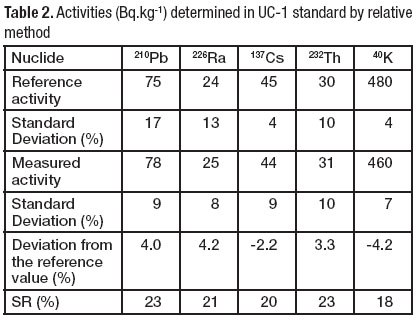
<body><![CDATA[<p><font size="2" face="Verdana, Arial, Helvetica, sans-serif">The  radionuclide activities present in sediment samples were determined by gamma  spectrometry using the CRM IAEA-375 [23] and UC-2 standard prepared in the University of Cantabria  (Spain)  [24] for calibration. The accuracy (<a href="#t02025011">table 2</a>) was evaluated by UC-1 standard  [24]. The application of relative method show&ldquo;excellent&rdquo; results (SR &lt; 25%  for all determined activities). The obtained deviation from the reference  values is always less than 5%. It is an excellent precision for environmental  radioactivity measurements.</font></p>     <p><img src="/img/revistas/nuc/n50/t02025011.jpg" width="409" height="305"><a name="t02025011"></a></p>     
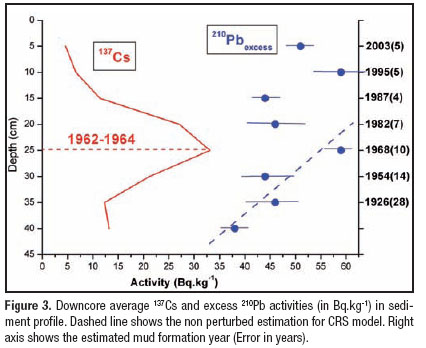
<p><font size="2" face="Verdana, Arial, Helvetica, sans-serif">The  sedimentation rate and age of recent sediments has been achieved starting from  the determination of the activity profile of <img src="/img/revistas/nuc/n50/e16025011.jpg" width="30" height="13"> and <img src="/img/revistas/nuc/n50/e14025011.jpg" width="32" height="15"> in Station 3. The <img src="/img/revistas/nuc/n50/e16025011.jpg" width="30" height="13"> isotope has an artifi cial origin; it results from the nuclear explosions  since the 50&acute;s, showing a characteristic activity maximum in sediments between  1962 and 1964 due to atmospheric nuclear weapon testing fallout maximum [25]. For  this reason <img src="/img/revistas/nuc/n50/e16025011.jpg" width="30" height="13"> activity maximum (see <a href="#f03015011">figure 3</a>) usually is used as data  marker, to verify the <img src="/img/revistas/nuc/n50/e14025011.jpg" width="32" height="15"> age determination [26]. <img src="/img/revistas/nuc/n50/e14025011.jpg" width="32" height="15"> isotope is a natural  radionuclide in the <img src="/img/revistas/nuc/n50/e21025011.jpg" width="22" height="14"> series which is deposited from the atmosphere. Taking  into account the possible perturbation of the sediments from more superficial  layers, the age of the sediments was calculated by the constant rate of supply  (CRS) model using the excess <img src="/img/revistas/nuc/n50/e14025011.jpg" width="32" height="15"> profile [27]. For each layer, the  sedimentation rate was calculated as layer-thickness/formation-time ratio (in  cm. <img src="/img/revistas/nuc/n50/e20025011.jpg" width="21" height="17">).</font></p>     
<p><img src="/img/revistas/nuc/n50/f03025011.jpg" width="426" height="348"><a name="f03015011"></a></p>     
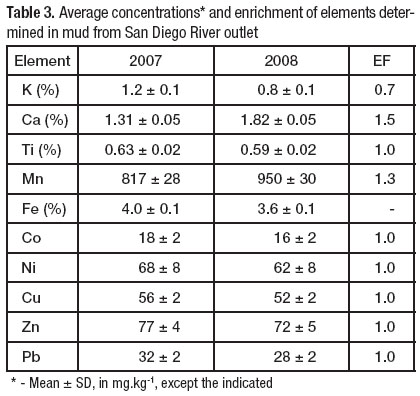
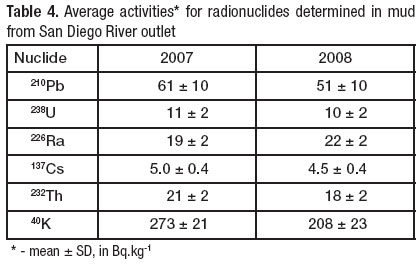
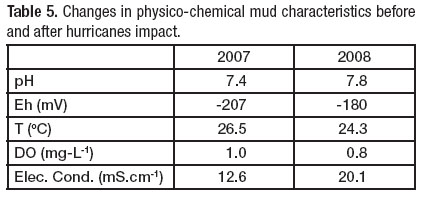
<p><font size="2" face="Verdana, Arial, Helvetica, sans-serif">Measurements  of mud physical properties (pH, temperature, redox, conductivity and dissolved  oxygen) were obtained at each station, with a WTW 315i pHmeter (WTW TFK 325  temperature sensor, WTW Sen- Tix 21 pH-electrode, SCHOTT Platinum Blue Line  32Rx redox-electrode), WTW LF 197 conductivity meter and HANNA Instruments HI  9142 DO-meter.</font></p>     <p><font size="3" face="Verdana, Arial, Helvetica, sans-serif"><strong>Results and  Discussion</strong></font></p>     <p><font size="2" face="Verdana, Arial, Helvetica, sans-serif">The average  concentrations of the elements determined by XRF analysis, average activities  of the radionuclides measured by gamma spectrometry and changes in mud  properties, before and after the hurricanes impact to the studied area, are  presented in <a href="#t03015011">tables 3</a>-<a href="#t05015011">5</a>, respectively.The must  significant differences in content are observed for K, Ca and Mn. In maturated  peloids, Ca and K are not come from the mineral&ndash;medicinal water. There contents  are mainly associated with the solid phase [28]. Potassium content usually is  associated with soil particles dragged by river waters, i.e., K is an indicator  of pluvial origin component in the sediment composition. On the  other hand, Ca content is associated with the presence of marine sediment. Then,  K impoverishment (EF = 0.7) and Ca enrichment (EF = 1.5) must be associated  with changes in the mud major composition because the hurricane impacts, which  can change the river sediment from pluvial nature to marine. The high Mn  content is usual in river outlets due it flocculation property in fresh-sea  water border. The invariability of heavy metal enrichment was expected, because  the historical low heavy metal content in San Diego River mud in the last 100  years [29], indicating a small anthropogenic heavy metal pollution in the area.</font> </p>     <p><img src="/img/revistas/nuc/n50/t03025011.jpg" width="420" height="396"><a name="t03015011"></a></p>     
<p><font size="2" face="Verdana, Arial, Helvetica, sans-serif">Radiometric  study confirms the potassium impoverishment. The <img src="/img/revistas/nuc/n50/e18025011.jpg" width="20" height="13"> activity determined in  mud, collected after hurricane impacts, decrease around a 25% respect before  one (<a href="#t04015011">table 4</a>). The activity of the rest of natural and artificial  radionuclides present in mud practically does not change.</font></p>     
<p><img src="/img/revistas/nuc/n50/t04025011.jpg" width="419" height="264"><a name="t04015011"></a></p>     
]]></body>
<body><![CDATA[<p><font size="2" face="Verdana, Arial, Helvetica, sans-serif">A several  increment in electric conductivity (~ 60%, see <a href="#t05015011">table 5</a>) must be a good  indicator of marine sediment increment in San Diego River  outlet. Usually, this increment is associated with salinity increment in the  area.</font></p>     <p><img src="/img/revistas/nuc/n50/t05025011.jpg" width="422" height="197"><a name="t05015011"></a></p>     
<p><font size="2" face="Verdana, Arial, Helvetica, sans-serif">The  behaviour of excess <img src="/img/revistas/nuc/n50/e14025011.jpg" width="32" height="15"> and <img src="/img/revistas/nuc/n50/e16025011.jpg" width="30" height="13"> activities measured in mud core collected  in station 3 and the mud formation-year estimated by CRS model are shown in <a href="#f03015011">figure 3</a>. The <img src="/img/revistas/nuc/n50/e16025011.jpg" width="30" height="13"> presence in Cuban sediments is only due to fallout from  nuclear explosions [30,31]. Then, its activity maximum (25 cm depth core slice)  corresponds to 1962-1964 period. The last is in correspondence with formation  year estimation by excess <img src="/img/revistas/nuc/n50/e14025011.jpg" width="32" height="15"> CRS model.</font></p>     
<p><img src="/img/revistas/nuc/n50/f03025011.jpg" width="426" height="348"></p>     
<p><font size="2" face="Verdana, Arial, Helvetica, sans-serif">A notable  sedimentation rate increment in San    Diego River  outlet is determined in the last 50 years (<a href="#f04015011">figure 4</a>). This increment must be  associated with some anthropogenic activities (principally, due a considerable  increment of cultivable areas along San    Diego River)  and natural ones (for example, soil erosion increment due an increment in rain  regimes in the area) in the last few decades. Taking into account the average  sedimentation rate in the last few decades (~ 0.7 cm.<img src="/img/revistas/nuc/n50/e20025011.jpg" width="19" height="16">), the original  mud characteristics in San Diego   River outlet will be  recovered never before than 5-7 years.</font></p>     
<p><img src="/img/revistas/nuc/n50/f04025011.jpg" width="417" height="356"><a name="f04015011"></a></p>     
<p><font size="3" face="Verdana, Arial, Helvetica, sans-serif"><strong>Conclusions</strong></font></p>     <p><font size="2" face="Verdana, Arial, Helvetica, sans-serif">Nuclear and  geochemical techniques permit to evaluate that the direct impact of the strong  hurricanes to San Diego River outlet in September 2008, induced changes in mud  major composition (Ca enrichment and K impoverishment) and in some mud  physic-chemical characteristics (electric conductivity, redox and DO).On the  other hand, the sedimentation rate in San    Diego river outlet, determined by gamma spectrometry,  permit to estimate that the original mud characteristics will be recovered  never before than 5-7 years.</font></p>     <p><font size="2" face="Verdana, Arial, Helvetica, sans-serif">Taking into  account the importance of peloide therapy for different diseases treatments,  further studies to quantitatively assess the changes within the mud main  characteristics due to the hurricane impacts are recommended, with particular  interest in its therapeutic properties and how these could result affected.</font></p>     <p><font size="3" face="Verdana, Arial, Helvetica, sans-serif"><strong>References</strong></font></p>     ]]></body>
<body><![CDATA[<!-- ref --><p><font size="2" face="Verdana, Arial, Helvetica, sans-serif">1. MALLIN  MA, CORBETT CA. How hurricane attributes extend of environmental effects:  Multiple hurricanes and different coastal systems. Estuaries and Coast. 2006;  29(6): 1046-1061.    <!-- ref --><br> 2. ENGLE  VD, HYLAND JL, COOKSEY C. Effects of Hurricane Katrina on benthic  macroin-vertebrate communities along the northern Gulf of Mexico coast. Environ.  Monit. Assess. 2009; 150(1-4): 193-204.    <!-- ref --><br> 3. JOHNSON  WE, KIMBROUGH KL, LAUENSTEIN GG, CHRISTENSEN J. Chemical con-tamination  assessment of Gulf of Mexico oysters in  response to hurricanes Katrina and Rita. Environ. Monit. Assess. 2009;  150(1-4): 211-225.    <!-- ref --><br> 4. VAN  METRE PC, HOROWITZ AJ, MAHLER BL, et. al. Effects of hurricanes Katrina and  Rita on the chemistry of bottom sediments in Lake Pontchartrain, Louisiana,   USA. Environ  Sci Technolog. 2006; 40(22): 6894-6902.    <br> 5. BALTHIS  WL, HYLAND JL, BEARDEN D. Ecosystem responses to extreme natural events:  impacts of three sequential hurricanes in fall 1999 on sediment quality and  condition of benthic fauna in the Neuse  River estuary, North Carolina. Environ. Monit. Assess.  2006; 119(1-3): 367&ndash;389.    <!-- ref --><br> 6.  CARRETERO MI. Clay minerals and their benefi cial effects upon human health. A  review. Appl. Clay Sci. 2002; 21(3-4): 155-163.    <br> 7. VENIALE  F, BARBERIS E, CARCANGIU G, et. al. Formulation of muds for pelotherapy:  effects of &ldquo;maturation&rdquo; by different mineral waters. Appl. Clay Sci. 2004;  25(3-4): 135-148.    <!-- ref --><br> 8. VENIALE  F. Thermal muds: perspectives of innovations. Appl. Clay Sci. 2007;  36(1-3): 141-147.    <br> 9. DOM&Iacute;NGUEZ RODR&Iacute;GUEZ R. Caracterizaci&oacute;n inorg&aacute;nica y  radiol&oacute;gica de los peloides utilizados en el Sanatorio de San Diego de los  Ba&ntilde;os, Pinar del R&iacute;o.    <br> Tesis de Licenciatura en Radioqu&iacute;mica. La Habana: InSTEC, 2008.     ]]></body>
<body><![CDATA[<br> 10. DYBCZYNSKI R, SUSCHNY O. Reference Material SL-1 &ldquo;Lake  sediment&rdquo;. Report IAEA/RL/64. Vienna: IAEA, 1974.    <!-- ref --><br> 11.  DYBCZYNSKI R, TUGSAVUL A, SUSCHNY O. Soil-5, a new IAEA certified reference material for  trace elements determinations. Geostand Geoanal Res. 2007; 3: 61-87.    <!-- ref --><br> 12. PSZONICKI  L. Reference Material IAEA Soil-7. Report IAEA/RL/112. Vienna: IAEA, 1984.    <!-- ref --><br> 13. WILSON  SA. The collection, preparation and testing of USGS reference material BCR-2,  Columbia River, Basalt, U.S. Geological Survey Open-File Report 98-00x, 1997.    <!-- ref --><br> 14. WinAxil. WinAxil Code.Version 4.5.2. CANBERRA-MiTAC. [software]. 2005.    <!-- ref --><br> 15. PADILLA R, MARKOWICZ A, WEGRZYNEK D, et. al. Quality management and method  validation in EDXRF analysis. X-Ray Spectrom. 2007; 36(1): 27-34    <!-- ref --><br> 16.  QUEVAUVILLER PH, MARRIER E. Quality assurance and quality control for  environmental monitoring. Weinheim: VCH, 1995.    <br> 17. IAEA  Reference Material 356 &ldquo;Polluted Marine Sediment&rdquo;. IAEA/AL/080 Report. Vienna: IAEA, 1994.    <!-- ref --><br> 18. SCHROPP  SJ, LEWIS FG, WINDOM HL, et. al. Interpretation of metal concentration in  es-tuarine sediments of Florida  using aluminum as reference element. Estuaries. 1990; 13(3): 227-235.    <!-- ref --><br> 19. MUCHA AP, VASCONCELOS MTSD, BORDALO AA. Macrobenthic community in the Douro estuary: relations with trace metals and natural  sediment characteristics. Environmental Pollution. 2003; 121(2): 169-180.    <!-- ref --><br> 20. VILLARES  R, PUENTE X, CARBALLEIRA A. Heavy metals in sandy sediments of the Rias Baixas  (NW Spain). Environ. Monit. Assess. 2003; 83: 129-144    <br> 21. DIAZ O, LOPEZ N, D'ALESSANDRO K, et al. Characterization of the INSTEC&rsquo;S  low-background gamma spectrometer for environmental radioactivity studies. Nucleus.  2009; 46: 21-26.    <!-- ref --><br> 22. CURRIE LA. Limits for quantitative detection  and quantitative determination. Anal. Chem. 1968; 40(3): 586.    <!-- ref --><br> 23.  IAEA-375 Intercomparison run. Determination of radionuclides in soil. Report  IAEA/AL/075. Vienna: IAEA, 1994.    <!-- ref --><br> 24. G&Oacute;MEZ J, SOTO J. Ejercicio de intercomparaci&oacute;n de  resultados de medida de radiactividad en la Red de Vigilancia Radiol&oacute;gica Ambiental. Madrid: Consejo de Seguridad Nuclear,  1998.    <!-- ref --><br> 25. WALLING  DE, HE Q. The global distribution of bomb-derives 137Cs reference inventories.  Final Report on IAEA Technical Contract 10361/ RO-R1. University of Exeter,  2000.    <!-- ref --><br> 26. JETER  HW. Determining the ages of recent sediments using measurements of trace  radioactivity. Terra et Aqua. 2000, 78: 21-28.    <!-- ref --><br> 27. GELEN  A, SOTO J, G&Oacute;MEZ J, D&Iacute;AZ O. Sediment dating of Santander Bay, Spain. J  Radioanal Nucl Chem. 2004; 261(2): 437-441.    <br> 28. CARRETERO MI, POZO M, MARTIN-RUBI JA, et. al. Mobility of elements in interaction  between artifi cial sweat and peloids used in Spanish spas. Appl Clay  Sci. 2010; 48(3): 506&ndash;515.    <!-- ref --><br> 29. DIAZ RIZO O, CARMONA BRITO D, GELEN RUDNIKAS A, et al. Assessment of heavy metal content in  mud profi les from San Diego River,   Cuba. Contrib.  Educ. Prot. Med. Amb. 2010; 9: E12-E16.    <!-- ref --><br> 30. ALONSO C, D&Iacute;AZ M, MU&Ntilde;OZ A, et. al. Levels of radioactivity in the Cuban Marine  Envi-ronment. Rad Prot Dosim. 1998; 75(1-4): 69-70.    <!-- ref --><br> 31. REYES H, LOPEZ-PINO N, DIAZ RIZO O, et. al. Environmental radioactivity study in  surface sediments of Guacanayabo gulf (Cuba). AIP Conf Proc. 2009;  1139: 156-157.    </font></p>     <p><font size="2" face="Verdana, Arial, Helvetica, sans-serif"><strong>Recibido: </strong>31 de marzo de 2011    <br>     <strong>Aceptado:</strong> 27 de octubre de 2011</font></p>     <p>&nbsp;</p>     <p>&nbsp;</p>      ]]></body><back>
<ref-list>
<ref id="B1">
<label>1</label><nlm-citation citation-type="journal">
<person-group person-group-type="author">
<name>
<surname><![CDATA[MALLIN]]></surname>
<given-names><![CDATA[MA]]></given-names>
</name>
<name>
<surname><![CDATA[CORBETT]]></surname>
<given-names><![CDATA[CA]]></given-names>
</name>
</person-group>
<article-title xml:lang="en"><![CDATA[How hurricane attributes extend of environmental effects: Multiple hurricanes and different coastal systems]]></article-title>
<source><![CDATA[Estuaries and Coast]]></source>
<year>2006</year>
<volume>29</volume>
<numero>(6)</numero>
<issue>(6)</issue>
<page-range>1046-1061</page-range></nlm-citation>
</ref>
<ref id="B2">
<label>2</label><nlm-citation citation-type="journal">
<person-group person-group-type="author">
<name>
<surname><![CDATA[ENGLE]]></surname>
<given-names><![CDATA[VD]]></given-names>
</name>
<name>
<surname><![CDATA[HYLAND]]></surname>
<given-names><![CDATA[JL]]></given-names>
</name>
<name>
<surname><![CDATA[COOKSEY]]></surname>
<given-names><![CDATA[C]]></given-names>
</name>
</person-group>
<article-title xml:lang="en"><![CDATA[Effects of Hurricane Katrina on benthic macroin-vertebrate communities along the northern Gulf of Mexico coast]]></article-title>
<source><![CDATA[Environ. Monit. Assess]]></source>
<year>2009</year>
<volume>150</volume>
<numero>(1-4)</numero>
<issue>(1-4)</issue>
<page-range>193-204</page-range></nlm-citation>
</ref>
<ref id="B3">
<label>3</label><nlm-citation citation-type="journal">
<person-group person-group-type="author">
<name>
<surname><![CDATA[JOHNSON]]></surname>
<given-names><![CDATA[WE]]></given-names>
</name>
<name>
<surname><![CDATA[KIMBROUGH]]></surname>
<given-names><![CDATA[KL]]></given-names>
</name>
<name>
<surname><![CDATA[LAUENSTEIN]]></surname>
<given-names><![CDATA[GG]]></given-names>
</name>
<name>
<surname><![CDATA[CHRISTENSEN]]></surname>
<given-names><![CDATA[J]]></given-names>
</name>
</person-group>
<article-title xml:lang="en"><![CDATA[Chemical con-tamination assessment of Gulf of Mexico oysters in response to hurricanes Katrina and Rita]]></article-title>
<source><![CDATA[Environ. Monit. Assess]]></source>
<year>2009</year>
<volume>150</volume>
<numero>(1-4)</numero>
<issue>(1-4)</issue>
<page-range>211-225</page-range></nlm-citation>
</ref>
<ref id="B4">
<label>4</label><nlm-citation citation-type="journal">
<person-group person-group-type="author">
<name>
<surname><![CDATA[VAN METRE]]></surname>
<given-names><![CDATA[PC]]></given-names>
</name>
<name>
<surname><![CDATA[HOROWITZ]]></surname>
<given-names><![CDATA[AJ]]></given-names>
</name>
<name>
<surname><![CDATA[MAHLER]]></surname>
<given-names><![CDATA[BL]]></given-names>
</name>
</person-group>
<article-title xml:lang="en"><![CDATA[Effects of hurricanes Katrina and Rita on the chemistry of bottom sediments in Lake Pontchartrain, Louisiana, USA]]></article-title>
<source><![CDATA[Environ Sci Technolog]]></source>
<year>2006</year>
<volume>40</volume>
<numero>(22)</numero>
<issue>(22)</issue>
<page-range>6894-6902</page-range></nlm-citation>
</ref>
<ref id="B5">
<label>5</label><nlm-citation citation-type="journal">
<person-group person-group-type="author">
<name>
<surname><![CDATA[BALTHIS]]></surname>
<given-names><![CDATA[WL]]></given-names>
</name>
<name>
<surname><![CDATA[HYLAND]]></surname>
<given-names><![CDATA[JL]]></given-names>
</name>
<name>
<surname><![CDATA[BEARDEN]]></surname>
<given-names><![CDATA[D]]></given-names>
</name>
</person-group>
<article-title xml:lang="en"><![CDATA[Ecosystem responses to extreme natural events: impacts of three sequential hurricanes in fall 1999 on sediment quality and condition of benthic fauna in the Neuse River estuary, North Carolina]]></article-title>
<source><![CDATA[Environ. Monit. Assess]]></source>
<year>2006</year>
<volume>119</volume>
<numero>(1-3)</numero>
<issue>(1-3)</issue>
<page-range>367-389</page-range></nlm-citation>
</ref>
<ref id="B6">
<label>6</label><nlm-citation citation-type="journal">
<person-group person-group-type="author">
<name>
<surname><![CDATA[CARRETERO]]></surname>
<given-names><![CDATA[MI]]></given-names>
</name>
</person-group>
<article-title xml:lang="en"><![CDATA[Clay minerals and their beneficial effects upon human health]]></article-title>
<source><![CDATA[A review. Appl. Clay Sci]]></source>
<year>2002</year>
<volume>21</volume>
<numero>(3-4)</numero>
<issue>(3-4)</issue>
<page-range>155-163</page-range></nlm-citation>
</ref>
<ref id="B7">
<label>7</label><nlm-citation citation-type="journal">
<person-group person-group-type="author">
<name>
<surname><![CDATA[VENIALE]]></surname>
<given-names><![CDATA[F]]></given-names>
</name>
<name>
<surname><![CDATA[BARBERIS]]></surname>
<given-names><![CDATA[E]]></given-names>
</name>
<name>
<surname><![CDATA[CARCANGIU]]></surname>
<given-names><![CDATA[G]]></given-names>
</name>
</person-group>
<article-title xml:lang="en"><![CDATA[Formulation of muds for pelotherapy: effects of &#8220;maturation&#8221; by different mineral waters]]></article-title>
<source><![CDATA[Appl. Clay Sci]]></source>
<year>2004</year>
<volume>25</volume>
<numero>(3-4)</numero>
<issue>(3-4)</issue>
<page-range>135-148</page-range></nlm-citation>
</ref>
<ref id="B8">
<label>8</label><nlm-citation citation-type="journal">
<person-group person-group-type="author">
<name>
<surname><![CDATA[VENIALE]]></surname>
<given-names><![CDATA[F]]></given-names>
</name>
</person-group>
<article-title xml:lang="en"><![CDATA[Thermal muds: perspectives of innovations]]></article-title>
<source><![CDATA[Appl. Clay Sci]]></source>
<year>2007</year>
<volume>36</volume>
<numero>(1-3)</numero>
<issue>(1-3)</issue>
<page-range>141-147</page-range></nlm-citation>
</ref>
<ref id="B9">
<label>9</label><nlm-citation citation-type="">
<person-group person-group-type="author">
<name>
<surname><![CDATA[DOMÍNGUEZ RODRÍGUEZ]]></surname>
<given-names><![CDATA[R]]></given-names>
</name>
</person-group>
<source><![CDATA[Caracterización inorgánica y radiológica de los peloides utilizados en el Sanatorio de San Diego de los Baños, Pinar del Río]]></source>
<year></year>
</nlm-citation>
</ref>
<ref id="B10">
<label>10</label><nlm-citation citation-type="book">
<person-group person-group-type="author">
<name>
<surname><![CDATA[DYBCZYNSKI]]></surname>
<given-names><![CDATA[R]]></given-names>
</name>
<name>
<surname><![CDATA[SUSCHNY]]></surname>
<given-names><![CDATA[O]]></given-names>
</name>
</person-group>
<source><![CDATA[Reference Material SL-1 &#8220;Lake sediment&#8221;. Report IAEA/RL/64]]></source>
<year>1974</year>
<publisher-loc><![CDATA[Vienna ]]></publisher-loc>
<publisher-name><![CDATA[IAEA]]></publisher-name>
</nlm-citation>
</ref>
<ref id="B11">
<label>11</label><nlm-citation citation-type="journal">
<person-group person-group-type="author">
<name>
<surname><![CDATA[DYBCZYNSKI]]></surname>
<given-names><![CDATA[R]]></given-names>
</name>
<name>
<surname><![CDATA[TUGSAVUL]]></surname>
<given-names><![CDATA[A]]></given-names>
</name>
<name>
<surname><![CDATA[SUSCHNY]]></surname>
<given-names><![CDATA[O]]></given-names>
</name>
</person-group>
<article-title xml:lang="en"><![CDATA[Soil-5, a new IAEA certified reference material for trace elements determinations]]></article-title>
<source><![CDATA[Geostand Geoanal Res]]></source>
<year>2007</year>
<volume>3</volume>
<page-range>61-87</page-range></nlm-citation>
</ref>
<ref id="B12">
<label>12</label><nlm-citation citation-type="book">
<person-group person-group-type="author">
<name>
<surname><![CDATA[PSZONICKI]]></surname>
<given-names><![CDATA[L]]></given-names>
</name>
</person-group>
<source><![CDATA[Reference Material IAEA Soil-7. Report IAEA/RL/112]]></source>
<year>1984</year>
<publisher-loc><![CDATA[Vienna ]]></publisher-loc>
<publisher-name><![CDATA[IAEA]]></publisher-name>
</nlm-citation>
</ref>
<ref id="B13">
<label>13</label><nlm-citation citation-type="">
<person-group person-group-type="author">
<name>
<surname><![CDATA[WILSON]]></surname>
<given-names><![CDATA[SA]]></given-names>
</name>
</person-group>
<source><![CDATA[The collection, preparation and testing of USGS reference material BCR-2, Columbia River, Basalt, U.S. Geological Survey Open-File Report 98-00x]]></source>
<year>1997</year>
</nlm-citation>
</ref>
<ref id="B14">
<label>14</label><nlm-citation citation-type="">
<source><![CDATA[WinAxil. WinAxil Code. Version 4.5.2. CANBERRA-MiTAC]]></source>
<year>2005</year>
</nlm-citation>
</ref>
<ref id="B15">
<label>15</label><nlm-citation citation-type="journal">
<person-group person-group-type="author">
<name>
<surname><![CDATA[PADILLA]]></surname>
<given-names><![CDATA[R]]></given-names>
</name>
<name>
<surname><![CDATA[MARKOWICZ]]></surname>
<given-names><![CDATA[A]]></given-names>
</name>
<name>
<surname><![CDATA[WEGRZYNEK]]></surname>
<given-names><![CDATA[D]]></given-names>
</name>
</person-group>
<article-title xml:lang="en"><![CDATA[Quality management and method validation in EDXRF analysis]]></article-title>
<source><![CDATA[X-Ray Spectrom]]></source>
<year>2007</year>
<volume>36</volume>
<numero>(1)</numero>
<issue>(1)</issue>
<page-range>27-34</page-range></nlm-citation>
</ref>
<ref id="B16">
<label>16</label><nlm-citation citation-type="book">
<person-group person-group-type="author">
<name>
<surname><![CDATA[QUEVAUVILLER]]></surname>
<given-names><![CDATA[PH]]></given-names>
</name>
<name>
<surname><![CDATA[MARRIER]]></surname>
<given-names><![CDATA[E]]></given-names>
</name>
</person-group>
<source><![CDATA[Quality assurance and quality control for environmental monitoring]]></source>
<year>1995</year>
<publisher-loc><![CDATA[Weinheim ]]></publisher-loc>
<publisher-name><![CDATA[VCH]]></publisher-name>
</nlm-citation>
</ref>
<ref id="B17">
<label>17</label><nlm-citation citation-type="book">
<source><![CDATA[IAEA Reference Material 356 &#8220;Polluted Marine Sediment&#8221;. IAEA/AL/080 Report]]></source>
<year>1994</year>
<publisher-loc><![CDATA[Vienna ]]></publisher-loc>
<publisher-name><![CDATA[IAEA]]></publisher-name>
</nlm-citation>
</ref>
<ref id="B18">
<label>18</label><nlm-citation citation-type="journal">
<person-group person-group-type="author">
<name>
<surname><![CDATA[SCHROPP]]></surname>
<given-names><![CDATA[SJ]]></given-names>
</name>
<name>
<surname><![CDATA[LEWIS]]></surname>
<given-names><![CDATA[FG]]></given-names>
</name>
<name>
<surname><![CDATA[WINDOM]]></surname>
<given-names><![CDATA[HL]]></given-names>
</name>
</person-group>
<article-title xml:lang="en"><![CDATA[Interpretation of metal concentration in es-tuarine sediments of Florida using aluminum as reference element]]></article-title>
<source><![CDATA[Estuaries]]></source>
<year>1990</year>
<volume>13</volume>
<numero>(3)</numero>
<issue>(3)</issue>
<page-range>227-235</page-range></nlm-citation>
</ref>
<ref id="B19">
<label>19</label><nlm-citation citation-type="journal">
<person-group person-group-type="author">
<name>
<surname><![CDATA[MUCHA]]></surname>
<given-names><![CDATA[AP]]></given-names>
</name>
<name>
<surname><![CDATA[VASCONCELOS]]></surname>
<given-names><![CDATA[MTSD]]></given-names>
</name>
<name>
<surname><![CDATA[BORDALO]]></surname>
<given-names><![CDATA[AA]]></given-names>
</name>
</person-group>
<article-title xml:lang="en"><![CDATA[Macrobenthic community in the Douro estuary: relations with trace metals and natural sediment characteristics]]></article-title>
<source><![CDATA[Environmental Pollution]]></source>
<year>2003</year>
<volume>121</volume>
<numero>(2)</numero>
<issue>(2)</issue>
<page-range>169-180</page-range></nlm-citation>
</ref>
<ref id="B20">
<label>20</label><nlm-citation citation-type="journal">
<person-group person-group-type="author">
<name>
<surname><![CDATA[VILLARES]]></surname>
<given-names><![CDATA[R]]></given-names>
</name>
<name>
<surname><![CDATA[PUENTE]]></surname>
<given-names><![CDATA[X]]></given-names>
</name>
<name>
<surname><![CDATA[CARBALLEIRA]]></surname>
<given-names><![CDATA[A]]></given-names>
</name>
</person-group>
<article-title xml:lang="en"><![CDATA[Heavy metals in sandy sediments of the Rias Baixas (NW Spain)]]></article-title>
<source><![CDATA[Environ. Monit. Assess]]></source>
<year>2003</year>
<volume>83</volume>
<page-range>129-144</page-range></nlm-citation>
</ref>
<ref id="B21">
<label>21</label><nlm-citation citation-type="journal">
<person-group person-group-type="author">
<name>
<surname><![CDATA[DIAZ]]></surname>
<given-names><![CDATA[O]]></given-names>
</name>
<name>
<surname><![CDATA[LOPEZ]]></surname>
<given-names><![CDATA[N]]></given-names>
</name>
<name>
<surname><![CDATA[D'ALESSANDRO]]></surname>
<given-names><![CDATA[K]]></given-names>
</name>
</person-group>
<article-title xml:lang="en"><![CDATA[Characterization of the INSTEC&#8217;S low-background gamma spectrometer for environmental radioactivity studies]]></article-title>
<source><![CDATA[Nucleus]]></source>
<year>2009</year>
<volume>46</volume>
<page-range>21-26</page-range></nlm-citation>
</ref>
<ref id="B22">
<label>22</label><nlm-citation citation-type="journal">
<person-group person-group-type="author">
<name>
<surname><![CDATA[CURRIE]]></surname>
<given-names><![CDATA[LA]]></given-names>
</name>
</person-group>
<article-title xml:lang="en"><![CDATA[Limits for quantitative detection and quantitative determination]]></article-title>
<source><![CDATA[Anal. Chem]]></source>
<year>1968</year>
<volume>40</volume>
<numero>(3)</numero>
<issue>(3)</issue>
<page-range>586</page-range></nlm-citation>
</ref>
<ref id="B23">
<label>23</label><nlm-citation citation-type="book">
<source><![CDATA[IAEA-375 Intercomparison run. Determination of radionuclides in soil. Report IAEA/AL/075]]></source>
<year>1994</year>
<publisher-loc><![CDATA[Vienna ]]></publisher-loc>
<publisher-name><![CDATA[IAEA]]></publisher-name>
</nlm-citation>
</ref>
<ref id="B24">
<label>24</label><nlm-citation citation-type="book">
<person-group person-group-type="author">
<name>
<surname><![CDATA[GÓMEZ]]></surname>
<given-names><![CDATA[J]]></given-names>
</name>
<name>
<surname><![CDATA[SOTO]]></surname>
<given-names><![CDATA[J]]></given-names>
</name>
</person-group>
<source><![CDATA[Ejercicio de intercomparación de resultados de medida de radiactividad en la Red de Vigilancia Radiológica Ambiental]]></source>
<year>1998</year>
<publisher-loc><![CDATA[Madrid ]]></publisher-loc>
<publisher-name><![CDATA[Consejo de Seguridad Nuclear]]></publisher-name>
</nlm-citation>
</ref>
<ref id="B25">
<label>25</label><nlm-citation citation-type="">
<person-group person-group-type="author">
<name>
<surname><![CDATA[WALLING]]></surname>
<given-names><![CDATA[DE]]></given-names>
</name>
<name>
<surname><![CDATA[HE]]></surname>
<given-names><![CDATA[Q]]></given-names>
</name>
</person-group>
<source><![CDATA[The global distribution of bomb-derives 137Cs reference inventories. Final Report on IAEA Technical Contract 10361/ RO-R1]]></source>
<year>2000</year>
<publisher-loc><![CDATA[University of Exeter ]]></publisher-loc>
</nlm-citation>
</ref>
<ref id="B26">
<label>26</label><nlm-citation citation-type="journal">
<person-group person-group-type="author">
<name>
<surname><![CDATA[JETER]]></surname>
<given-names><![CDATA[HW]]></given-names>
</name>
</person-group>
<article-title xml:lang="en"><![CDATA[Determining the ages of recent sediments using measurements of trace radioactivity]]></article-title>
<source><![CDATA[Terra et Aqua]]></source>
<year>2000</year>
<volume>78</volume>
<page-range>21-28</page-range></nlm-citation>
</ref>
<ref id="B27">
<label>27</label><nlm-citation citation-type="journal">
<person-group person-group-type="author">
<name>
<surname><![CDATA[GELEN]]></surname>
<given-names><![CDATA[A]]></given-names>
</name>
<name>
<surname><![CDATA[SOTO]]></surname>
<given-names><![CDATA[J]]></given-names>
</name>
<name>
<surname><![CDATA[GÓMEZ]]></surname>
<given-names><![CDATA[J]]></given-names>
</name>
<name>
<surname><![CDATA[DÍAZ]]></surname>
<given-names><![CDATA[O]]></given-names>
</name>
</person-group>
<article-title xml:lang="en"><![CDATA[Sediment dating of Santander Bay, Spain]]></article-title>
<source><![CDATA[J Radioanal Nucl Chem]]></source>
<year>2004</year>
<volume>261</volume>
<numero>(2)</numero>
<issue>(2)</issue>
<page-range>437-441</page-range></nlm-citation>
</ref>
<ref id="B28">
<label>28</label><nlm-citation citation-type="journal">
<person-group person-group-type="author">
<name>
<surname><![CDATA[CARRETERO]]></surname>
<given-names><![CDATA[MI]]></given-names>
</name>
<name>
<surname><![CDATA[POZO]]></surname>
<given-names><![CDATA[M]]></given-names>
</name>
<name>
<surname><![CDATA[MARTIN-RUBI]]></surname>
<given-names><![CDATA[JA]]></given-names>
</name>
</person-group>
<article-title xml:lang="en"><![CDATA[Mobility of elements in interaction between artificial sweat and peloids used in Spanish spas]]></article-title>
<source><![CDATA[Appl Clay Sci]]></source>
<year>2010</year>
<volume>48</volume>
<numero>(3)</numero>
<issue>(3)</issue>
<page-range>506-515</page-range></nlm-citation>
</ref>
<ref id="B29">
<label>29</label><nlm-citation citation-type="journal">
<person-group person-group-type="author">
<name>
<surname><![CDATA[DIAZ RIZO]]></surname>
<given-names><![CDATA[O]]></given-names>
</name>
<name>
<surname><![CDATA[CARMONA BRITO]]></surname>
<given-names><![CDATA[D]]></given-names>
</name>
<name>
<surname><![CDATA[GELEN RUDNIKAS]]></surname>
<given-names><![CDATA[A]]></given-names>
</name>
</person-group>
<article-title xml:lang="en"><![CDATA[Assessment of heavy metal content in mud profi les from San Diego River, Cuba]]></article-title>
<source><![CDATA[Contrib. Educ. Prot. Med. Amb]]></source>
<year>2010</year>
<volume>9</volume>
<page-range>E12-E1</page-range></nlm-citation>
</ref>
<ref id="B30">
<label>30</label><nlm-citation citation-type="journal">
<person-group person-group-type="author">
<name>
<surname><![CDATA[ALONSO]]></surname>
<given-names><![CDATA[C]]></given-names>
</name>
<name>
<surname><![CDATA[DÍAZ]]></surname>
<given-names><![CDATA[M]]></given-names>
</name>
<name>
<surname><![CDATA[MUÑOZ]]></surname>
<given-names><![CDATA[A]]></given-names>
</name>
</person-group>
<article-title xml:lang="en"><![CDATA[Levels of radioactivity in the Cuban Marine Environment]]></article-title>
<source><![CDATA[Rad Prot Dosim]]></source>
<year>1998</year>
<volume>75</volume>
<numero>(1-4)</numero>
<issue>(1-4)</issue>
<page-range>69-70</page-range></nlm-citation>
</ref>
<ref id="B31">
<label>31</label><nlm-citation citation-type="journal">
<person-group person-group-type="author">
<name>
<surname><![CDATA[REYES]]></surname>
<given-names><![CDATA[H]]></given-names>
</name>
<name>
<surname><![CDATA[LOPEZ-PINO]]></surname>
<given-names><![CDATA[N]]></given-names>
</name>
<name>
<surname><![CDATA[DIAZ RIZO]]></surname>
<given-names><![CDATA[O]]></given-names>
</name>
</person-group>
<article-title xml:lang="en"><![CDATA[Environmental radioactivity study in surface sediments of Guacanayabo gulf (Cuba)]]></article-title>
<source><![CDATA[AIP Conf Proc]]></source>
<year>2009</year>
<volume>1139</volume>
<page-range>156-157</page-range></nlm-citation>
</ref>
</ref-list>
</back>
</article>