<?xml version="1.0" encoding="ISO-8859-1"?><article xmlns:mml="http://www.w3.org/1998/Math/MathML" xmlns:xlink="http://www.w3.org/1999/xlink" xmlns:xsi="http://www.w3.org/2001/XMLSchema-instance">
<front>
<journal-meta>
<journal-id>0864-084X</journal-id>
<journal-title><![CDATA[Nucleus]]></journal-title>
<abbrev-journal-title><![CDATA[Nucleus]]></abbrev-journal-title>
<issn>0864-084X</issn>
<publisher>
<publisher-name><![CDATA[CUBAENERGIA]]></publisher-name>
</publisher>
</journal-meta>
<article-meta>
<article-id>S0864-084X2017000100001</article-id>
<title-group>
<article-title xml:lang="en"><![CDATA[Assessment of heavy metal content in peloids from some Cuban spas using X-ray fluorescence]]></article-title>
<article-title xml:lang="es"><![CDATA[Estimación del contenido de metales pesados en peloides provenientes de varios balnearios cubanos mediante Fluorescencia de rayos X]]></article-title>
</title-group>
<contrib-group>
<contrib contrib-type="author">
<name>
<surname><![CDATA[Díaz Rizo]]></surname>
<given-names><![CDATA[Oscar]]></given-names>
</name>
</contrib>
<contrib contrib-type="author">
<name>
<surname><![CDATA[Suárez Muñoz]]></surname>
<given-names><![CDATA[Margaret]]></given-names>
</name>
</contrib>
<contrib contrib-type="author">
<name>
<surname><![CDATA[González Hernández]]></surname>
<given-names><![CDATA[Patricia]]></given-names>
</name>
</contrib>
<contrib contrib-type="author">
<name>
<surname><![CDATA[Gelen Rudnikas]]></surname>
<given-names><![CDATA[Alina]]></given-names>
</name>
</contrib>
<contrib contrib-type="author">
<name>
<surname><![CDATA[D´Alessandro Rodríguez]]></surname>
<given-names><![CDATA[Katia]]></given-names>
</name>
</contrib>
<contrib contrib-type="author">
<name>
<surname><![CDATA[Melián Rodríguez]]></surname>
<given-names><![CDATA[Clara M.]]></given-names>
</name>
</contrib>
<contrib contrib-type="author">
<name>
<surname><![CDATA[Pérez Martín]]></surname>
<given-names><![CDATA[Alberto]]></given-names>
</name>
</contrib>
<contrib contrib-type="author">
<name>
<surname><![CDATA[Fagundo Castillo]]></surname>
<given-names><![CDATA[Juan R.]]></given-names>
</name>
</contrib>
<contrib contrib-type="author">
<name>
<surname><![CDATA[Martínez-Villegas]]></surname>
<given-names><![CDATA[Nadia V.]]></given-names>
</name>
</contrib>
</contrib-group>
<aff id="A01">
<institution><![CDATA[,Instituto Superior de Tecnologías y Ciencias Aplicadas (InSTEC)  ]]></institution>
<addr-line><![CDATA[Habana ]]></addr-line>
<country>Cuba</country>
</aff>
<aff id="A02">
<institution><![CDATA[,Facultad de Química Universidad de La Habana ]]></institution>
<addr-line><![CDATA[Habana ]]></addr-line>
<country>Cuba</country>
</aff>
<aff id="A03">
<institution><![CDATA[,Departamento de Geociencias Aplicadas . Instituto de Investigaciones Científicas y Tecnológicas ]]></institution>
<addr-line><![CDATA[San Juan Potosí ]]></addr-line>
<country>México</country>
</aff>
<pub-date pub-type="pub">
<day>00</day>
<month>06</month>
<year>2017</year>
</pub-date>
<pub-date pub-type="epub">
<day>00</day>
<month>06</month>
<year>2017</year>
</pub-date>
<numero>61</numero>
<fpage>1</fpage>
<lpage>5</lpage>
<copyright-statement/>
<copyright-year/>
<self-uri xlink:href="http://scielo.sld.cu/scielo.php?script=sci_arttext&amp;pid=S0864-084X2017000100001&amp;lng=en&amp;nrm=iso"></self-uri><self-uri xlink:href="http://scielo.sld.cu/scielo.php?script=sci_abstract&amp;pid=S0864-084X2017000100001&amp;lng=en&amp;nrm=iso"></self-uri><self-uri xlink:href="http://scielo.sld.cu/scielo.php?script=sci_pdf&amp;pid=S0864-084X2017000100001&amp;lng=en&amp;nrm=iso"></self-uri><abstract abstract-type="short" xml:lang="en"><p><![CDATA[Heavy metal (Co, Ni, Cu, Zn and Pb) content in muds from some Cuban spas (San Diego, Elguea, Santa Lucía and Cajío) have been studied using X-ray fluorescence. The measured metal contents are in the same order of magnitude as those reported for average Earth’s upper crust average shales and muds as well as with worldwide reported peloids. The comparison with sediment quality guidelines (SQGs) shows a different degree of pollution for peloids from each studied spa. Nevertheless, the estimated sum of metal/probable effect level value ratios (0.9 - 2.4) correspond to a low potential acute toxicity of contaminants. Therefore, the heavy metal content present in peloids from the studied Cuban spas is not an obstacle for its use with therapeutic purposes]]></p></abstract>
<abstract abstract-type="short" xml:lang="es"><p><![CDATA[Se estudia mediante la técnica de Fluorescencia de rayos X, el contenido de metales pesados (Co, Ni, Cu, Zn y Pb) en lodos terapéuticos provenientes de varios balnearios cubanos (San Diego, Elguea, Santa Lucía y Cajío). Los contenidos de metales pesados determinados en los lodos terapéuticos se encuentran en el mismo orden que los reportados para lodos y esquistos representativos de la corteza terrestre, así como para lodos utilizados en balnearios internacionalmente. La comparación con las Guías de Calidad de sedimentos muestran diferentes grados de polución para los lodos de cada balneario. Independientemente de ello, los valores de las razones suma de metales/nivel de efecto probable (0,9-2,4) corresponden a un bajo potencial agudo de toxicidad por contaminantes. De esta manera, el contenido de metales pesados presentes en los lodos de los balnearios estudiados no representa impedimento alguno para su uso con fines terapéuticos.]]></p></abstract>
<kwd-group>
<kwd lng="en"><![CDATA[sediment]]></kwd>
<kwd lng="en"><![CDATA[x-ray fluorescence analysis]]></kwd>
<kwd lng="en"><![CDATA[heavy metals]]></kwd>
<kwd lng="en"><![CDATA[Cuba]]></kwd>
<kwd lng="en"><![CDATA[therapeutic uses]]></kwd>
<kwd lng="es"><![CDATA[sedimentos]]></kwd>
<kwd lng="es"><![CDATA[analisis por fluorescencia de rayos x]]></kwd>
<kwd lng="es"><![CDATA[metales pesados]]></kwd>
<kwd lng="es"><![CDATA[Cuba]]></kwd>
<kwd lng="es"><![CDATA[usos terapéuticos]]></kwd>
</kwd-group>
</article-meta>
</front><body><![CDATA[ <p align="right"><font face="Verdana, Arial, Helvetica, sans-serif" size="2"><b>CIENCIAS NUCLEARES</b></font></p>     <p align="left">&nbsp;</p>     <p><font size="4"><strong><font face="Verdana, Arial, Helvetica, sans-serif">Assessment of heavy metal content in peloids from some  Cuban spas using X-ray fluorescence</font></strong></font></p>     <p align="left"><font size="3" face="Verdana, Arial, Helvetica, sans-serif"><strong>Estimaci&oacute;n del contenido de metales pesados en peloides provenientes de varios  balnearios cubanos mediante Fluorescencia de rayos X </strong>&nbsp;</font>&nbsp;&nbsp;&nbsp;&nbsp;&nbsp;&nbsp;&nbsp;&nbsp;&nbsp;&nbsp;&nbsp;&nbsp;&nbsp;&nbsp;&nbsp;&nbsp;&nbsp;&nbsp;&nbsp;&nbsp;&nbsp;&nbsp;&nbsp;&nbsp;&nbsp;&nbsp;&nbsp;&nbsp;&nbsp;&nbsp;&nbsp;&nbsp; <strong>    <br> </strong></p>     <p>&nbsp;</p>     <p><font size="2" face="Verdana, Arial, Helvetica, sans-serif"><strong>Oscar D&iacute;az Rizo1<sup>1</sup>, Margaret Su&aacute;rez Mu&ntilde;oz<sup>1</sup>, Patricia Gonz&aacute;lez  Hern&aacute;ndez<sup>2</sup>,</strong></font> <strong><font size="2" face="Verdana, Arial, Helvetica, sans-serif">Alina Gelen Rudnikas</font></strong><font size="2" face="Verdana, Arial, Helvetica, sans-serif"><strong><sup>1</sup>, Katia D&acute;Alessandro  Rodr&iacute;guez<sup>1</sup>,</strong></font> <strong><font size="2" face="Verdana, Arial, Helvetica, sans-serif">Clara M. Meli&aacute;n  Rodr&iacute;guez<strong><sup>1</sup>,</strong></font></strong> <strong><font size="2" face="Verdana, Arial, Helvetica, sans-serif">Alberto P&eacute;rez Mart&iacute;n<strong><sup>1</sup></strong>, Juan R. Fagundo Castillo<strong><sup>2</sup></strong>, Nadia V.  Mart&iacute;nez-Villegas<strong><sup>3</sup></strong></font></strong></p>     <p><font size="2"><font size="2" face="Verdana, Arial, Helvetica, sans-serif"><sup>1</sup></font><font face="Verdana, Arial, Helvetica, sans-serif"> Instituto Superior de Tecnolog&iacute;as y  Ciencias Aplicadas (InSTEC), Ave. Salvador Allende y Luaces, Habana 10600,  Cuba.    <br>   </font><font size="2" face="Verdana, Arial, Helvetica, sans-serif"><sup>2</sup></font><font face="Verdana, Arial, Helvetica, sans-serif"> Facultad de Qu&iacute;mica, Universidad de La  Habana, Zanja esq. a G, Habana 10600, Cuba    <br>   <font size="2" face="Verdana, Arial, Helvetica, sans-serif"><sup>3</sup></font> Departamento de Geociencias Aplicadas.  Instituto de Investigaciones Cient&iacute;ficas y Tecnol&oacute;gicas, San Juan Potos&iacute;,  M&eacute;xico</font></font></p>     ]]></body>
<body><![CDATA[<p><a href="mailto:odrizo@instec.cu"><font size="2" face="Verdana, Arial, Helvetica, sans-serif">odrizo@instec.cu</font></a>    <br> </p> <hr>     <p><font face="Verdana, Arial, Helvetica, sans-serif" size="2"><b>ABSTRACT</b></font></p>     <p><font size="2" face="Verdana, Arial, Helvetica, sans-serif">Heavy metal  (Co, Ni, Cu, Zn and Pb) content in muds from some Cuban spas (San Diego, Elguea, Santa Luc&iacute;a and Caj&iacute;o)  have been studied using X-ray fluorescence. The measured metal contents are in  the same order of magnitude as those reported for average Earth&rsquo;s upper crust  average shales and muds as well as with worldwide reported peloids. The comparison  with sediment  quality guidelines (SQGs) shows a different degree of pollution for peloids  from each studied spa. Nevertheless, the estimated sum of metal/probable effect  level value ratios (0.9 &ndash; 2.4) correspond to a low potential acute toxicity of  contaminants. Therefore,  the heavy metal content present in peloids from the studied Cuban spas is not  an obstacle for its use with therapeutic purposes. </font></p>     <p><font size="2" face="Verdana, Arial, Helvetica, sans-serif"><strong>Key words:</strong> sediment, x-ray  fluorescence analysis, heavy metals, Cuba, therapeutic uses.</font></p> <hr>     <p><font face="Verdana, Arial, Helvetica, sans-serif" size="2"><b>RESUMEN</b></font></p>     <p><font size="2" face="Verdana, Arial, Helvetica, sans-serif">Se estudia mediante la t&eacute;cnica de  Fluorescencia de rayos X, el contenido de metales pesados (Co, Ni, Cu, Zn y Pb)  en lodos terap&eacute;uticos provenientes de varios balnearios cubanos (San Diego,  Elguea, Santa Luc&iacute;a y Caj&iacute;o). Los contenidos de metales pesados determinados en  los lodos terap&eacute;uticos se encuentran en el mismo orden que los reportados para lodos  y esquistos representativos de la corteza terrestre, as&iacute; como para lodos  utilizados en balnearios internacionalmente. La comparaci&oacute;n con las Gu&iacute;as de  Calidad de sedimentos muestran diferentes grados de poluci&oacute;n para los lodos de  cada balneario. Independientemente de ello, los valores de las razones suma de  metales/nivel de efecto probable (0,9-2,4) corresponden a un bajo potencial  agudo de toxicidad por contaminantes. De esta manera, el contenido de metales  pesados presentes en los lodos de los balnearios estudiados no representa impedimento  alguno para su uso con fines terap&eacute;uticos.</font></p>     <p><font size="2" face="Verdana, Arial, Helvetica, sans-serif"><strong>Palabras claves:</strong> sedimentos, analisis por fluorescencia de rayos x,  metales pesados, Cuba, usos terap&eacute;uticos.</font></p> <hr> <h1>&nbsp;</h1>     <p>&nbsp;</p>     <p><font size="3" face="Verdana, Arial, Helvetica, sans-serif"><strong>Introduction</strong></font></p>     ]]></body>
<body><![CDATA[<p><font size="2" face="Verdana, Arial, Helvetica, sans-serif">Peloids  are defined as a maturated mud or muddy dispersion with healing and/or cosmetic  properties, composed of a complex mixture of fine-grained natural materials of  geologic and/or biologic origin, mineral water or sea water, and common organic  compounds from biological metabolic activity [1]. Peloids have been used in  medicine since ancient times and more recently, applications of this old  practice have been developed for wellness and relax purposes [2, 3]. The most  important inorganic components of the peloid are clay minerals, which make them  useful in spas due to their physical properties, i.e. rheology,  absorption/adsorption capacity, cation exchange capacity, water saturation,  swelling index, grain size, cooling index, etc. Some recent investigations  demonstrated the necessity of studying the geochemical abundance of potential hazardous  elements in peloids [3-7]. Although the use of healing mud is very old,  specific criteria for the evaluation of their contamination by some trace  elements (such as As, Pb, Hg, Cd, Zn or Cu), their toxicity are yet to be  established.</font></p>     <p><font size="2" face="Verdana, Arial, Helvetica, sans-serif">  In Cuba, mud application  in pelotherapy use started at the end of the 19th century. The reference peloid  user in Cuba is the San Diego de los Ba&ntilde;os  Thermal Center,  located in the Western Cuban province   of Pinar del R&iacute;o. The  peloid used there is a mud extracted directly from the estuary of San Diego  River, and enriched later with inorganic and organic components, as well as  with the microbiota of calcic sulfated, fluoric, radionic and sulfurous  mesothermal waters (33 &ordm;C) of San Diego de los Ba&ntilde;os Thermal Center. These waters,  show low oxidation-reduction (Eh) potential values (-226 to -270 mV) and their  electric conductivity (EC) values oscillate between 1 480 and 2 200 &micro;S/cm [8]. The maturation process of  the sediment is done using a static, open method during 15 days, and under  environmental conditions. The gray peloid produced in this way (with high  content in clays, and the presence of quartz, and Fe minerals) is classified as  a clayed slime by Pel&aacute;ez [9],  but according to the organic matter content can be classified as fangi or mud [8]. The peloid is routinely  used to palliate inflammatory and dermatological processes, as an analgesic, in  male and female infertility treatments, and in cosmetic products.  The San Diego  raw (non-maturated) mud was recently studied to assess the heavy metal content  [10], showing that those are not an obstacle for its use in medical purposes.  The rest of the Cuban spas use the so-called &ldquo;natural&rdquo; maturated peloids, i.e.  muds taken directly from thermal or sulphated water sources.</font></p>     <p><font size="2" face="Verdana, Arial, Helvetica, sans-serif">  The peloid used in Elguea  is dark gray. Elguea's waters are also hyperthermal (51 &ordm;C), calcic  sulfated, magnesic, sulfurous (<img src="/img/revistas/nuc/n61/e01016117.jpg" width="19" height="14"> <img src="/img/revistas/nuc/n61/e02016117.jpg" width="13" height="12">10 mg/L), brominated and  radioactive-radonic [11].  This peloid may be classified as fangi or mud, due to strong mineral  composition and hydrothermal origin and the predominantly phases are composed  by clay, carbonates and halite. The great tradition and  experience of Elguea   Thermal Center  is aimed at using &nbsp;its waters and peloids  in the treatment of different inflammatory and dermatological processes, both as  analgesic and as a cosmetic. </font></p>     
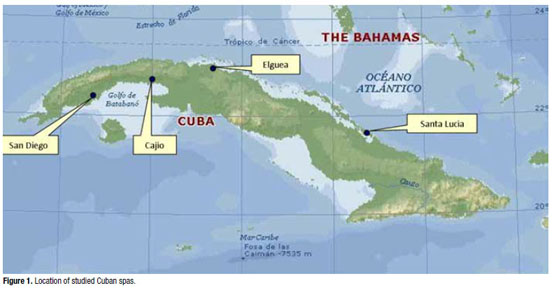
<p><font size="2" face="Verdana, Arial, Helvetica, sans-serif">  In Santa Luc&iacute;a, the  original sediment is extracted directly from El Real salt pond deposit and  later enriched with the sodium chlorine hypersaline waters (mineralization of  almost 250 g/l) of the salt pond. The obtained dark gray peloid can be  classified as sulfurous slime and the predominantly phases are composed by  gypsum, carbonates and halite. The main uses of this peloid are related with  psoriasis, acne, mycosis, seborrheic dermatitis, degenerative osteoarthritis  and rheumatoid arthritis [12]. </font></p>     <p><font size="2" face="Verdana, Arial, Helvetica, sans-serif">  On  the other hand, the Caj&iacute;o original sediment is extracted directly from the  coastal deposit. This gray mud is classified as sulfurous slime and is formed  by the waters with mineralization of 39,5 g/l of the Batabano Gulf. These  waters show Eh values of approximately 150 mV and their EC value is  approximately of 49 700 &mu;Sm [13].  The peloid has sandy particles with poor development of clayed phases and high  content of organic matter and carbonates. It is used in pathologies of SOMA,  arthritis, dermatological diseases (psoriasis), among others.</font></p>     <p><font size="2" face="Verdana, Arial, Helvetica, sans-serif"> The  aim of the present study is to determine heavy metal contents (Co, Ni, Cu, Zn  and Pb) in maturated peloids used in different Cuban spas, to assess the  potential pollution and radiological risks for the users of peloid therapeutic  practices.</font></p>     <p>&nbsp;</p>     <p>&nbsp;</p>     <p><font size="3" face="Verdana, Arial, Helvetica, sans-serif"><strong>Materials and methods</strong></font></p>     <p><font size="2" face="Verdana, Arial, Helvetica, sans-serif"> Five replicas were collected in each of the four main  peloid-users spas in Cuba,  located in four different Cuban provinces <a href="#f01016117">(see Figure 1)</a>. Samples for  non-natural maturated peloids were taken from the San Diego spa, while those of natural  maturated peloids were taken from spas in Elguea, Santa Luc&iacute;a and Caj&iacute;o. Every  sample used in this study was dried at 60 oC. Large rock debris,  mollusk skeletons and organic debris were removed before sieving. The fraction,  smaller than 1 mm,  was ground into a fine powder (&lt;63 mm)  in an agate mortar. The pulverized  samples were newly dried at 60 &ordm;C until obtaining a constant weight. </font></p>     ]]></body>
<body><![CDATA[<p align="center"><img src="/img/revistas/nuc/n61/f01016117.jpg" width="554" height="288"><a name="f01016117"></a></p>     
<p>&nbsp;</p>     <p><font size="2" face="Verdana, Arial, Helvetica, sans-serif">Heavy  metal concentrations were determined by <em>external  standard</em> method of X-Ray Fluorescence Analysis (XRF) using the Certified  Reference Materials (CRM) IAEA-SL-1 &ldquo;Lake   Sediment&rdquo;, IAEA-Soil-5,  IAEA Soil-7, BCR-2 &ldquo;Basalt Columbia River&rdquo; and BCSS-1 &ldquo;Marine sediment&rdquo; as  standards. All samples and CRM were mixed with cellulose (analytical quality)  in proportion 4:1 and pressed at 15 tons into the pellets of 25 mm diameter and 4 - 5 mm height. Pellets were  studied using Canberra Si(Li) detector (150 eV energy resolution at 5,9 keV, Be  window thickness = 12,0 mm) coupled to a multi  channel analyzer. A <img src="/img/revistas/nuc/n61/e03016117.jpg" width="35" height="15"> (1,1 GBq) excitation source with ring  geometry was used. All spectra were processed with WinAxil code [14]. Detection Limits were  determined according to Padilla et al. [15] (in concentration units)  as LD = 3<img src="/img/revistas/nuc/n61/e04016117.jpg" width="14" height="13">/mt, where <em>m </em> is the sensibility in <img src="/img/revistas/nuc/n61/e05016117.jpg" width="77" height="17">  per concentration unit,<em> <img src="/img/revistas/nuc/n61/e04016117.jpg" width="14" height="13"></em>&nbsp; is the standard deviation of the area of the  background windows (peak window at 1,17 times the FWHM) and <em>t </em>is the measuring time (4 hours).</font></p>     
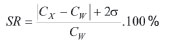
<p><font size="2" face="Verdana, Arial, Helvetica, sans-serif">The accuracy  was evaluated using the <a href="#e06016117">SR criterion</a>, proposed by McFarrell et al. [16]:</font></p>     <p align="center"><img src="/img/revistas/nuc/n61/e06016117.jpg" width="171" height="43"><a name="e06016117"></a></p>     
<p>&nbsp;</p>     <p><font size="2" face="Verdana, Arial, Helvetica, sans-serif">where <img src="/img/revistas/nuc/n61/e07016117.jpg" width="18" height="23">  is the experimentally determined concentration value, <img src="/img/revistas/nuc/n61/e08016117.jpg" width="23" height="20"> is  the certified concentration value and s is the standard deviation  of <img src="/img/revistas/nuc/n61/e07016117.jpg" width="18" height="23">. On the basis of this criterion the similarity between the  certified value and the analytical data obtained by proposed methods is divided  into three categories: SR <img src="/img/revistas/nuc/n61/e09016117.jpg" width="14" height="18"> 25 % = excellent; 25 &lt; SR  <img src="/img/revistas/nuc/n61/e09016117.jpg" width="14" height="18">50 % = acceptable,  SR &gt; 50 % = unacceptable. The analysis of five replica of the CRM IAEA-356  &ldquo;Polluted Marine Sediment&rdquo; [17]  is presented in <a href="#t01016117">Table 1</a>. All heavy metals determined by XRF analysis, using the  external standard method [17],  qualify as &ldquo;excellent&rdquo; (SR  <img src="/img/revistas/nuc/n61/e09016117.jpg" width="14" height="18"> 25 %) and the obtained results show a very good  correlation (R = 0.999) between the certified and measured values. </font></p>     
<p align="center"><img src="/img/revistas/nuc/n61/t01016117.jpg" width="396" height="237"><a name="t01016117"></a></p>     
<p><font size="2" face="Verdana, Arial, Helvetica, sans-serif">    <br>   Numerical sediment quality guidelines  (SQGs) have been used worldwide for both freshwater and marine ecosystems, and  to identify contaminants of concern in aquatic ecosystems as well [19]. SQGs have been developed  for many potentially toxic substances (i.e., trace elements, chlorinated  organics, and polynuclear aromatic hydrocarbons). SQGs were applied to this  study for the assessment of the ecotoxicological sense of metal concentrations  in peloids with the threshold effect level (TEL) and probable effect level  (PEL) values.</font></p>     ]]></body>
<body><![CDATA[<p>&nbsp;</p>     <p>&nbsp;</p>     <p><strong><font size="3" face="Verdana, Arial, Helvetica, sans-serif">Results and discussion</font></strong></p>     <p><font size="2" face="Verdana, Arial, Helvetica, sans-serif">The average  concentrations of heavy metals determined by XRF analysis in peloid samples  from the studied Cuban spas are shown in <a href="#t02016117">Table 2</a>, along with the concentrations  of the elements under consideration in representative shales and muds [20]. The  metal content ratios determined for peloid and raw healing mud [10] from San  Diego spa were 0,4 for Co, 0,7 Ni, 0,6 for Cu, 1,0 for Zn and 0,7 for Pb,  confirming that  peloid maturation processes do not change the heavy metal content present in  the raw mud, as it was also shown by Tateo and Summa [5].</font></p>     <p align="center"><img src="/img/revistas/nuc/n61/t02016117.jpg" width="571" height="501"><a name="t02016117"></a></p>     
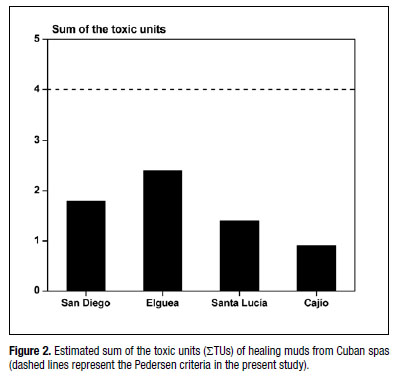
<p><font size="2" face="Verdana, Arial, Helvetica, sans-serif">  The levels of  the toxic metals examined in the Cuban spas peloids are, in general, in the  same order of magnitude as those previously reported for average shales, Argillaceous sediments  and muds [20, 21]. From a geochemical standpoint, the level of individual  elements in shales and muds can be considered as a good approximation to the  specific element in Earth&rsquo;s upper crust. In terms of potential toxicity of the  Cuban spas peloids, it is important to note that none of the values of toxic  element levels documented in the studied peloids are significantly higher than  the terrestrial background values [20]. The only exception is the Cu content in  Santa Luc&iacute;a peloid, since the geochemical values are exceeded by 1,8 &ndash; 3,6  folds. On the  other hand, except for Ni content in Elguea spa, the metal contents in the studied  peloids are in the range of the concentration limits established by the U.S.  Pharmacopeia [29] and the European Medicines Agency EMEA [30] for pharmaceutical  formulations and cosmetics <a href="#t02016117">(see  Table 2)</a>. The mentioned regulations were proposed by Quintela et al [28] for peloid chemical  composition, considering that both pharmaceutical products and cosmetics have  similarities with peloids. On the other hand, the comparison with metal contents  reported worldwide for peloids (natural and commercial) used for different  medical purposes, show that heavy metal concentrations in Cuban peloids are  also in the same concentration ranges. </font></p>     <p><font size="2" face="Verdana, Arial, Helvetica, sans-serif">The comparison with SQGs values <a href="#t02016117">(Table 2)</a>, show  that Ni contents in peloids from San    Diego and Elguea are above Ni PEL value, while Cu  content on peloids from Santa Luc&iacute;a is above the Cu TEL value. Furthermore, the  potential acute toxicity of contaminants in peloid samples could be estimated  as the sum of the toxic units (&Sigma;TUs), which is defined as the ratio of the  determined concentration to PEL  value [31]. A &Sigma;TUs value larger than the number of studied  metals, indicate the potential </font>     <font size="2" face="Verdana, Arial, Helvetica, sans-serif">toxicity by metal  content in the peloid sample. The estimated &Sigma;TUs values <a href="#f02016117">(Figure 2)</a>, based on concentrations of Ni, Cu,  Zn and Pb, are lower than 4 for all of the sampling spas, with the highest  value obtained for peloids from Elguea spa (&Sigma;TUs = 2,4) and the lowest (&Sigma;TUs =  0,9) for Caj&iacute;o&rsquo;s. </font></p>     <p align="center"><img src="/img/revistas/nuc/n61/f02016117.jpg" width="399" height="376"><a name="f02016117"></a></p>     
<p>&nbsp;</p>     <p>&nbsp;</p>     ]]></body>
<body><![CDATA[<p><font face="Verdana, Arial, Helvetica, sans-serif"><strong><font size="3">Conclusions</font></strong></font></p>     <p><font size="2" face="Verdana, Arial, Helvetica, sans-serif">Cuban  regulations do not specify a maximum allowable limit for heavy metal content in  peloids. However, according to the obtained results in the present study and  its comparison with existing and in force international regulations, we can  conclude that the heavy metal content determined in peloids from studied Cuban  spas is not an obstacle for its use with therapeutic purposes.</font></p>     <p>&nbsp;</p>     <p>&nbsp;</p>     <p><font size="3" face="Verdana, Arial, Helvetica, sans-serif"><strong>References </strong></font></p>     <!-- ref --><p><font size="2" face="Verdana, Arial, Helvetica, sans-serif">[1]  GOMES C, CARRETERO MI, POZO M, et. al. Peloids and pelotherapy: Historical evolution, classification and  glossary. App Clay Sci. 2013; 75-76: 28-38.    <!-- ref --><br> [2] CARRETERO MI. Clay minerals and their beneficial  effects upon human health: a review. App Clay Sci. 2002; 21(3-4): 155-163.    <br> [3] VENIALE F, BARBERIS E, CARCANGIU G, et. al.  Formulation of muds for pelotherapy: effects of &lsquo;&lsquo;maturation&rsquo;&rsquo; by different mineral  waters. App Clay Sci. 2004; 25(3-4): 135-148.    <!-- ref --><br> [4] MASCOLO N, SUMMA V, TATEO F. In vivo experimental  data on the mobility of hazardous chemical elements from clays. App Clay Sci.  2004; 25(1-2): 23-28.    <!-- ref --><br> [5] TATEO F, SUMMA V.  Element mobility in clays  for healing use. App Clay Sci. 2007; 36(1-3): 64-76.    <!-- ref --><br> [6] TATEO F, RAVAGLIOLI A, ANDREOLI C, et. al. The  in-vitro percutaneous migration of chemical elements from a thermal mud for  healing use. App  Clay Sci. 2009; 44(1-2): 83-94.    <!-- ref --><br> [7]  CARRETERO MI, POZO M, MART&Iacute;N-RUB&Iacute; JA, et. al. Mobility of elements in interaction between artificial sweat and peloids  used in Spanish spas. App  Clay Sci. 2010; 48: 506-515.    <!-- ref --><br> [8]  SU&Aacute;REZ MU&Ntilde;OZ M, MELI&Aacute;N RODR&Iacute;GUEZ C, GELEN RUDNIKAS A, et. al. Physicochemical characterization, elemental speciation and  hydrogeochemical modeling of river and peloid sediments used for therapeutic  uses. App  Clay Sci. 2015; 104: 36-47.    <!-- ref --><br> [9]  PEL&Aacute;EZ R. Proyecto de Explotaci&oacute;n Fangos Medicinales de Boca de San Diego,  Pinar del Rio. In: Uni&oacute;n Geol&oacute;gica. Fondo Geol&oacute;gico Nacional, MINBAS, 2003. 26  p.    <!-- ref --><br> [10]  D&Iacute;AZ RIZO O, GELEN RUDNIKAS A, D&acute;ALESSANDRO RODR&Iacute;GUEZ K, et. al. Assessment of historical heavy metal content in healing muds from San  Diego river (Cuba) using nuclear analytical techniques. Nucleus. 2013; (53):  19-23.    <!-- ref --><br> [11]  FAGUNDO JR, GONZ&Aacute;LEZ P, SU&Aacute;REZ M, et. al. Origen y composici&oacute;n qu&iacute;mica de las  aguas minerales sulfuradas de Cuba. Su relaci&oacute;n con el medio ambiente  geol&oacute;gico. In: Contribuci&oacute;n a la Educaci&oacute;n y la Protecci&oacute;n Ambiental. Vol. 3,  2002. Electronic Book. ISBN 959-7136-13-9     <br> [12]  MANCHADO A, CERVANTES P. InfoTER database. Version 1.0. Centro Nacional de  Termalismo &ldquo;Victor Santamarina&rdquo; (CENTERVISA). La Habana, 2003.     <!-- ref --><br> [13]  GONZ&Aacute;LEZ HERN&Aacute;NDEZ P. Contribuci&oacute;n al conocimiento hidroqu&iacute;mico de acu&iacute;feros  c&aacute;rsicos costeros con intrusi&oacute;n marina. Sector G&uuml;ira-Quivic&aacute;n, Cuenca sur de La  Habana [tesis para optar por el grado de Dr. en Ciencias T&eacute;cnicas]. La Habana:  ISPJAE,&nbsp;2003.    <!-- ref --><br> [14]  WinAxil code. Version 4.5.2 [software]. CANBERRA-MiTAC, 2005.    <!-- ref --><br> [15]  PADILLA R, MARKOWICZ A, WEGRZYNEK D, et. al. Quality management and method validation in EDXRF analysis. X-Ray  Spectrom. 2007; 36(1): 27-34.    <!-- ref --><br> [16] QUEVAUVILLER PH, MARRIER E. Quality assurance and  quality control for environmental monitoring. Weinheim:&nbsp;VCH, 1995.    <!-- ref --><br> [17] IAEA. Polluted marine sediment. Reference  material 356. IAEA/AL/080 Report. Vienna: International Atomic Energy Agency,  1994.    <!-- ref --><br> [18]  D&Iacute;AZ ARADO O, D&Iacute;AZ RIZO O, L&Oacute;PEZ PINO N, et. al. Evaluation of the InSTEC&acute;s EDXRF assembly for marine sediment pollution  studies. AIP Conf Proc. 2009; 1139(1): 158-159.    <!-- ref --><br> [19] McDONALD DD, INGERSOLL CG, BERGER TA. Development  and evaluation of consensus-based sediment quality guidelines for freshwater  ecosystems. Arch Environ Contam Toxicol. 2000; 39(1): 20-31.    <!-- ref --><br> [20] LI YH. A compendium of geochemistry: from solar  nebula to the human brain. Princeton: Princeton University Press, 2000.    <!-- ref --><br> [21]  KABATA-PENDIAS A, MUKHERJEE AB. Trace elements from  soil to human. Springer, 2009.    <!-- ref --><br> [22] SUMMA V, TATEO F. The use of pelitic raw  materials in thermal centres: mineralogy, geochemistry, grain size and leaching  test: examples from the Lucania area (southern Italy).App Clay Sci. 1998;  12(5): 403-417.    <!-- ref --><br> [23]  TERROSO D, ROCHA F, FERREIRA DA SILVA E, et. al. Chemical and physical characterization of mud/clay from Sao Miguel and  Terceira islands (Azores, Portugal) and possible application in pelotherapy.  9Th International Symposium on Metal Ions in Biology and Medicine. May 21-24,  2006. Metal vol 9. p. 85-92.    <!-- ref --><br> [24] BASCHINI MT, PETTINARI GR, VALLES JM, et. al.  Suitability of natural sulphur-rich muds from Copahue (Argentina) for use as  semisolid health care products.App Clay Sci. 2010; 49(3): 205-212.    <!-- ref --><br> [25] MIKO S, KOCH G, MESI&#262; S, et. al. Anthropogenic  influence on trace element geochemistry of healing mud (peloid) from Makirina  Cove (Croatia). Environ  Geol. 2008; 55(3): 517-537.    <!-- ref --><br> [26]  KOMAR D, DOLENEC T, DOLENEC M, et. al. Physico-chemical and geochemical characterization of Makirina Bay peloid  mud and its evaluation for potential use in balneotherapy (N Dalmatia, Republic  of Croatia). Indian Journal of Traditional Knowledge. 2015; 14(1): 5-12.    <!-- ref --><br> [27] ABDEL-FATTAH A, PINGITORE NE. Low levels of toxic  elements in Dead Sea black mud and mud-derived cosmetic products. Environ Geochem Hlth.  2009; 31(4): 487-492.    <!-- ref --><br> [28]  QUINTELA A, TERROSO D, FERREIRA DA SILVA E, et. al. Certification and quality criteria of peloids used for therapeutic  purposes. Clay Minerals. 2012; 47(4): 441-451.    <!-- ref --><br> [29] US Pharmacopeia 29-NF 24. Rockville: US  Pharmacopeial Convention, 2006.    <!-- ref --><br> [30] European Medicines Agency. Guideline on the  specification limits for residual metal catalysts for metal reagents. London,  2008. Available at:  http://www.ema.europa.eu/docs/en_GB/document_library/Scientific_guideline/2009/09/WC500003586.pdf  [accessed: november, 2015].    <!-- ref --><br> [31]  PEDERSEN F, BJ&Oslash;RNESTAD E, ANDERSEN HV, et. al. Characterizarion of sediments from Copenhagen harbour by use of  biotests. Wat.  Sci. Techn. 1998; 37(6-7): 233-240.    </font></p>     <p> <font size="2" face="Verdana, Arial, Helvetica, sans-serif"><strong>Recibido:</strong> 17 de octubre de  2016     <br> <strong>Aceptado:</strong></font> <font size="2" face="Verdana, Arial, Helvetica, sans-serif"> 31 de enero de 2017  </font></p>      ]]></body><back>
<ref-list>
<ref id="B1">
<label>1</label><nlm-citation citation-type="journal">
<person-group person-group-type="author">
<name>
<surname><![CDATA[GOMES]]></surname>
<given-names><![CDATA[C]]></given-names>
</name>
<name>
<surname><![CDATA[CARRETERO]]></surname>
<given-names><![CDATA[MI]]></given-names>
</name>
<name>
<surname><![CDATA[POZO]]></surname>
<given-names><![CDATA[M]]></given-names>
</name>
</person-group>
<article-title xml:lang="en"><![CDATA[Peloids and pelotherapy: Historical evolution, classification and glossary]]></article-title>
<source><![CDATA[App Clay Sci]]></source>
<year>2013</year>
<volume>75-76</volume>
<page-range>28-38</page-range></nlm-citation>
</ref>
<ref id="B2">
<label>2</label><nlm-citation citation-type="journal">
<person-group person-group-type="author">
<name>
<surname><![CDATA[CARRETERO]]></surname>
<given-names><![CDATA[MI]]></given-names>
</name>
</person-group>
<article-title xml:lang="en"><![CDATA[Clay minerals and their beneficial effects upon human health: a review]]></article-title>
<source><![CDATA[App Clay Sci]]></source>
<year>2002</year>
<volume>21</volume>
<numero>3-4</numero>
<issue>3-4</issue>
<page-range>155-163</page-range></nlm-citation>
</ref>
<ref id="B3">
<label>3</label><nlm-citation citation-type="journal">
<person-group person-group-type="author">
<name>
<surname><![CDATA[VENIALE]]></surname>
<given-names><![CDATA[F]]></given-names>
</name>
<name>
<surname><![CDATA[BARBERIS]]></surname>
<given-names><![CDATA[E]]></given-names>
</name>
<name>
<surname><![CDATA[CARCANGIU]]></surname>
<given-names><![CDATA[G]]></given-names>
</name>
</person-group>
<article-title xml:lang="en"><![CDATA[Formulation of muds for pelotherapy: effects of ‘‘maturation’’ by different mineral waters]]></article-title>
<source><![CDATA[App Clay Sci]]></source>
<year>2004</year>
<volume>25</volume>
<numero>3-4</numero>
<issue>3-4</issue>
<page-range>135-148</page-range></nlm-citation>
</ref>
<ref id="B4">
<label>4</label><nlm-citation citation-type="journal">
<person-group person-group-type="author">
<name>
<surname><![CDATA[MASCOLO]]></surname>
<given-names><![CDATA[N]]></given-names>
</name>
<name>
<surname><![CDATA[SUMMA]]></surname>
<given-names><![CDATA[V]]></given-names>
</name>
<name>
<surname><![CDATA[TATEO]]></surname>
<given-names><![CDATA[F]]></given-names>
</name>
</person-group>
<article-title xml:lang="en"><![CDATA[In vivo experimental data on the mobility of hazardous chemical elements from clays]]></article-title>
<source><![CDATA[App Clay Sci]]></source>
<year>2004</year>
<volume>25</volume>
<numero>1-2</numero>
<issue>1-2</issue>
<page-range>23-28</page-range></nlm-citation>
</ref>
<ref id="B5">
<label>5</label><nlm-citation citation-type="journal">
<person-group person-group-type="author">
<name>
<surname><![CDATA[TATEO]]></surname>
<given-names><![CDATA[F]]></given-names>
</name>
<name>
<surname><![CDATA[SUMMA]]></surname>
<given-names><![CDATA[V]]></given-names>
</name>
</person-group>
<article-title xml:lang="en"><![CDATA[Element mobility in clays for healing use]]></article-title>
<source><![CDATA[App Clay Sci]]></source>
<year>2007</year>
<volume>36</volume>
<numero>1-3</numero>
<issue>1-3</issue>
<page-range>64-76</page-range></nlm-citation>
</ref>
<ref id="B6">
<label>6</label><nlm-citation citation-type="journal">
<person-group person-group-type="author">
<name>
<surname><![CDATA[TATEO]]></surname>
<given-names><![CDATA[F]]></given-names>
</name>
<name>
<surname><![CDATA[RAVAGLIOLI]]></surname>
<given-names><![CDATA[A]]></given-names>
</name>
<name>
<surname><![CDATA[ANDREOLI]]></surname>
<given-names><![CDATA[C]]></given-names>
</name>
</person-group>
<article-title xml:lang="en"><![CDATA[The in-vitro percutaneous migration of chemical elements from a thermal mud for healing use]]></article-title>
<source><![CDATA[App Clay Sci]]></source>
<year>2009</year>
<volume>44</volume>
<numero>1-2</numero>
<issue>1-2</issue>
<page-range>83-94</page-range></nlm-citation>
</ref>
<ref id="B7">
<label>7</label><nlm-citation citation-type="journal">
<person-group person-group-type="author">
<name>
<surname><![CDATA[CARRETERO]]></surname>
<given-names><![CDATA[MI]]></given-names>
</name>
<name>
<surname><![CDATA[POZO]]></surname>
<given-names><![CDATA[M]]></given-names>
</name>
<name>
<surname><![CDATA[MARTÍN-RUBÍ]]></surname>
<given-names><![CDATA[JA]]></given-names>
</name>
</person-group>
<article-title xml:lang="en"><![CDATA[Mobility of elements in interaction between artificial sweat and peloids used in Spanish spas]]></article-title>
<source><![CDATA[App Clay Sci]]></source>
<year>2010</year>
<volume>48</volume>
<page-range>506-515</page-range></nlm-citation>
</ref>
<ref id="B8">
<label>8</label><nlm-citation citation-type="journal">
<person-group person-group-type="author">
<name>
<surname><![CDATA[SUÁREZ MUÑOZ]]></surname>
<given-names><![CDATA[M]]></given-names>
</name>
<name>
<surname><![CDATA[MELIÁN RODRÍGUEZ]]></surname>
<given-names><![CDATA[C]]></given-names>
</name>
<name>
<surname><![CDATA[GELEN RUDNIKAS]]></surname>
<given-names><![CDATA[A]]></given-names>
</name>
</person-group>
<article-title xml:lang="en"><![CDATA[Physicochemical characterization, elemental speciation and hydrogeochemical modeling of river and peloid sediments used for therapeutic uses]]></article-title>
<source><![CDATA[App Clay Sci]]></source>
<year>2015</year>
<volume>104</volume>
<page-range>36-47</page-range></nlm-citation>
</ref>
<ref id="B9">
<label>9</label><nlm-citation citation-type="book">
<person-group person-group-type="author">
<name>
<surname><![CDATA[PELÁEZ]]></surname>
<given-names><![CDATA[R]]></given-names>
</name>
</person-group>
<source><![CDATA[Proyecto de Explotación Fangos Medicinales de Boca de San Diego, Pinar del Rio]]></source>
<year>2003</year>
<page-range>26 p</page-range><publisher-name><![CDATA[Fondo Geológico Nacional, MINBAS]]></publisher-name>
</nlm-citation>
</ref>
<ref id="B10">
<label>10</label><nlm-citation citation-type="journal">
<person-group person-group-type="author">
<name>
<surname><![CDATA[DÍAZ RIZO]]></surname>
<given-names><![CDATA[O]]></given-names>
</name>
<name>
<surname><![CDATA[GELEN RUDNIKAS]]></surname>
<given-names><![CDATA[A]]></given-names>
</name>
<name>
<surname><![CDATA[D´ALESSANDRO RODRÍGUEZ]]></surname>
<given-names><![CDATA[K]]></given-names>
</name>
</person-group>
<article-title xml:lang="en"><![CDATA[Assessment of historical heavy metal content in healing muds from San Diego river (Cuba) using nuclear analytical techniques]]></article-title>
<source><![CDATA[Nucleus]]></source>
<year>2013</year>
<numero>53</numero>
<issue>53</issue>
<page-range>19-23</page-range></nlm-citation>
</ref>
<ref id="B11">
<label>11</label><nlm-citation citation-type="">
<person-group person-group-type="author">
<name>
<surname><![CDATA[FAGUNDO]]></surname>
<given-names><![CDATA[JR]]></given-names>
</name>
<name>
<surname><![CDATA[GONZÁLEZ]]></surname>
<given-names><![CDATA[P]]></given-names>
</name>
<name>
<surname><![CDATA[SUÁREZ]]></surname>
<given-names><![CDATA[M]]></given-names>
</name>
</person-group>
<source><![CDATA[Origen y composición química de las aguas minerales sulfuradas de Cuba. Su relación con el medio ambiente geológico]]></source>
<year>2002</year>
</nlm-citation>
</ref>
<ref id="B12">
<label>12</label><nlm-citation citation-type="book">
<person-group person-group-type="author">
<name>
<surname><![CDATA[MANCHADO]]></surname>
<given-names><![CDATA[A]]></given-names>
</name>
<name>
<surname><![CDATA[CERVANTES]]></surname>
<given-names><![CDATA[P]]></given-names>
</name>
</person-group>
<source><![CDATA[InfoTER database. Version 1.0]]></source>
<year>2003</year>
<publisher-loc><![CDATA[La Habana ]]></publisher-loc>
<publisher-name><![CDATA[Centro Nacional de Termalismo “Victor Santamarina” (CENTERVISA)]]></publisher-name>
</nlm-citation>
</ref>
<ref id="B13">
<label>13</label><nlm-citation citation-type="">
<person-group person-group-type="author">
<name>
<surname><![CDATA[GONZÁLEZ HERNÁNDEZ]]></surname>
<given-names><![CDATA[P]]></given-names>
</name>
</person-group>
<source><![CDATA[Contribución al conocimiento hidroquímico de acuíferos cársicos costeros con intrusión marina. Sector Güira-Quivicán, Cuenca sur de La Habana]]></source>
<year></year>
</nlm-citation>
</ref>
<ref id="B14">
<label>14</label><nlm-citation citation-type="book">
<source><![CDATA[WinAxil code. Version 4.5.2]]></source>
<year>2005</year>
<publisher-name><![CDATA[CANBERRA-MiTAC]]></publisher-name>
</nlm-citation>
</ref>
<ref id="B15">
<label>15</label><nlm-citation citation-type="journal">
<person-group person-group-type="author">
<name>
<surname><![CDATA[PADILLA]]></surname>
<given-names><![CDATA[R]]></given-names>
</name>
<name>
<surname><![CDATA[MARKOWICZ]]></surname>
<given-names><![CDATA[A]]></given-names>
</name>
<name>
<surname><![CDATA[WEGRZYNEK]]></surname>
<given-names><![CDATA[D]]></given-names>
</name>
</person-group>
<article-title xml:lang="en"><![CDATA[Quality management and method validation in EDXRF analysis]]></article-title>
<source><![CDATA[X-Ray Spectrom]]></source>
<year>2007</year>
<volume>36</volume>
<numero>1</numero>
<issue>1</issue>
<page-range>27-34</page-range></nlm-citation>
</ref>
<ref id="B16">
<label>16</label><nlm-citation citation-type="book">
<person-group person-group-type="author">
<name>
<surname><![CDATA[QUEVAUVILLER]]></surname>
<given-names><![CDATA[PH]]></given-names>
</name>
<name>
<surname><![CDATA[MARRIER]]></surname>
<given-names><![CDATA[E]]></given-names>
</name>
</person-group>
<source><![CDATA[Quality assurance and quality control for environmental monitoring]]></source>
<year>1995</year>
<publisher-loc><![CDATA[Weinheim ]]></publisher-loc>
<publisher-name><![CDATA[VCH]]></publisher-name>
</nlm-citation>
</ref>
<ref id="B17">
<label>17</label><nlm-citation citation-type="book">
<collab>IAEA</collab>
<source><![CDATA[Polluted marine sediment: Reference material 356. IAEA/AL/080 Report]]></source>
<year>1994</year>
<publisher-loc><![CDATA[Vienna ]]></publisher-loc>
<publisher-name><![CDATA[International Atomic Energy Agency]]></publisher-name>
</nlm-citation>
</ref>
<ref id="B18">
<label>18</label><nlm-citation citation-type="journal">
<person-group person-group-type="author">
<name>
<surname><![CDATA[DÍAZ ARADO]]></surname>
<given-names><![CDATA[O]]></given-names>
</name>
<name>
<surname><![CDATA[DÍAZ RIZO]]></surname>
<given-names><![CDATA[O]]></given-names>
</name>
<name>
<surname><![CDATA[LÓPEZ PINO]]></surname>
<given-names><![CDATA[N]]></given-names>
</name>
</person-group>
<article-title xml:lang="en"><![CDATA[Evaluation of the InSTEC´s EDXRF assembly for marine sediment pollution studies]]></article-title>
<source><![CDATA[AIP Conf Proc]]></source>
<year>2009</year>
<volume>1139</volume>
<numero>1</numero>
<issue>1</issue>
<page-range>158-159</page-range></nlm-citation>
</ref>
<ref id="B19">
<label>19</label><nlm-citation citation-type="journal">
<person-group person-group-type="author">
<name>
<surname><![CDATA[McDONALD]]></surname>
<given-names><![CDATA[DD]]></given-names>
</name>
<name>
<surname><![CDATA[INGERSOLL]]></surname>
<given-names><![CDATA[CG]]></given-names>
</name>
<name>
<surname><![CDATA[BERGER]]></surname>
<given-names><![CDATA[TA]]></given-names>
</name>
</person-group>
<article-title xml:lang="en"><![CDATA[Development and evaluation of consensus-based sediment quality guidelines for freshwater ecosystems]]></article-title>
<source><![CDATA[Arch Environ Contam Toxicol]]></source>
<year>2000</year>
<volume>39</volume>
<numero>1</numero>
<issue>1</issue>
<page-range>20-31</page-range></nlm-citation>
</ref>
<ref id="B20">
<nlm-citation citation-type="book">
<person-group person-group-type="author">
<name>
<surname><![CDATA[LI]]></surname>
<given-names><![CDATA[YH]]></given-names>
</name>
</person-group>
<source><![CDATA[A compendium of geochemistry: from solar nebula to the human brain]]></source>
<year>2000</year>
<publisher-loc><![CDATA[Princeton ]]></publisher-loc>
<publisher-name><![CDATA[Princeton University Press]]></publisher-name>
</nlm-citation>
</ref>
<ref id="B21">
<label>21</label><nlm-citation citation-type="book">
<person-group person-group-type="author">
<name>
<surname><![CDATA[KABATA-PENDIAS]]></surname>
<given-names><![CDATA[A]]></given-names>
</name>
<name>
<surname><![CDATA[MUKHERJEE]]></surname>
<given-names><![CDATA[AB]]></given-names>
</name>
</person-group>
<source><![CDATA[Trace elements from soil to human]]></source>
<year>2009</year>
<publisher-name><![CDATA[Springer]]></publisher-name>
</nlm-citation>
</ref>
<ref id="B22">
<label>22</label><nlm-citation citation-type="journal">
<person-group person-group-type="author">
<name>
<surname><![CDATA[SUMMA]]></surname>
<given-names><![CDATA[V]]></given-names>
</name>
<name>
<surname><![CDATA[TATEO]]></surname>
<given-names><![CDATA[F]]></given-names>
</name>
</person-group>
<article-title xml:lang="en"><![CDATA[The use of pelitic raw materials in thermal centres: mineralogy, geochemistry, grain size and leaching test: examples from the Lucania area (southern Italy)]]></article-title>
<source><![CDATA[App Clay Sci]]></source>
<year>1998</year>
<volume>12</volume>
<numero>5</numero>
<issue>5</issue>
<page-range>403-417</page-range></nlm-citation>
</ref>
<ref id="B23">
<label>23</label><nlm-citation citation-type="confpro">
<person-group person-group-type="author">
<name>
<surname><![CDATA[TERROSO]]></surname>
<given-names><![CDATA[D]]></given-names>
</name>
<name>
<surname><![CDATA[ROCHA]]></surname>
<given-names><![CDATA[F]]></given-names>
</name>
<name>
<surname><![CDATA[FERREIRA DA SILVA]]></surname>
<given-names><![CDATA[E]]></given-names>
</name>
</person-group>
<source><![CDATA[Chemical and physical characterization of mud/clay from Sao Miguel and Terceira islands (Azores, Portugal) and possible application in pelotherapy]]></source>
<year></year>
<conf-name><![CDATA[Metal vol 9 9Th International Symposium on Metal Ions in Biology and Medicine]]></conf-name>
<conf-date>May 21-24, 2006</conf-date>
<conf-loc> </conf-loc>
</nlm-citation>
</ref>
<ref id="B24">
<label>24</label><nlm-citation citation-type="journal">
<person-group person-group-type="author">
<name>
<surname><![CDATA[BASCHINI]]></surname>
<given-names><![CDATA[MT]]></given-names>
</name>
<name>
<surname><![CDATA[PETTINARI]]></surname>
<given-names><![CDATA[GR]]></given-names>
</name>
<name>
<surname><![CDATA[VALLES]]></surname>
<given-names><![CDATA[JM]]></given-names>
</name>
</person-group>
<article-title xml:lang="en"><![CDATA[Suitability of natural sulphur-rich muds from Copahue (Argentina) for use as semisolid health care products]]></article-title>
<source><![CDATA[App Clay Sci]]></source>
<year>2010</year>
<volume>49</volume>
<numero>3</numero>
<issue>3</issue>
<page-range>205-212</page-range></nlm-citation>
</ref>
<ref id="B25">
<label>25</label><nlm-citation citation-type="journal">
<person-group person-group-type="author">
<name>
<surname><![CDATA[MIKO]]></surname>
<given-names><![CDATA[S]]></given-names>
</name>
<name>
<surname><![CDATA[KOCH]]></surname>
<given-names><![CDATA[G]]></given-names>
</name>
<name>
<surname><![CDATA[MESI&#262;]]></surname>
<given-names><![CDATA[S]]></given-names>
</name>
</person-group>
<article-title xml:lang="en"><![CDATA[Anthropogenic influence on trace element geochemistry of healing mud (peloid) from Makirina Cove (Croatia)]]></article-title>
<source><![CDATA[Environ Geol]]></source>
<year>2008</year>
<volume>55</volume>
<numero>3</numero>
<issue>3</issue>
<page-range>517-537</page-range></nlm-citation>
</ref>
<ref id="B26">
<label>26</label><nlm-citation citation-type="journal">
<person-group person-group-type="author">
<name>
<surname><![CDATA[KOMAR]]></surname>
<given-names><![CDATA[D]]></given-names>
</name>
<name>
<surname><![CDATA[DOLENEC]]></surname>
<given-names><![CDATA[T]]></given-names>
</name>
<name>
<surname><![CDATA[DOLENEC]]></surname>
<given-names><![CDATA[M]]></given-names>
</name>
</person-group>
<article-title xml:lang="en"><![CDATA[Physico-chemical and geochemical characterization of Makirina Bay peloid mud and its evaluation for potential use in balneotherapy (N Dalmatia, Republic of Croatia)]]></article-title>
<source><![CDATA[Indian Journal of Traditional Knowledge]]></source>
<year>2015</year>
<volume>14</volume>
<numero>1</numero>
<issue>1</issue>
<page-range>5-12</page-range></nlm-citation>
</ref>
<ref id="B27">
<label>27</label><nlm-citation citation-type="journal">
<person-group person-group-type="author">
<name>
<surname><![CDATA[ABDEL-FATTAH]]></surname>
<given-names><![CDATA[A]]></given-names>
</name>
<name>
<surname><![CDATA[PINGITORE]]></surname>
<given-names><![CDATA[NE]]></given-names>
</name>
</person-group>
<article-title xml:lang="en"><![CDATA[Low levels of toxic elements in Dead Sea black mud and mud-derived cosmetic products]]></article-title>
<source><![CDATA[Environ Geochem Hlth]]></source>
<year>2009</year>
<volume>31</volume>
<numero>4</numero>
<issue>4</issue>
<page-range>487-492</page-range></nlm-citation>
</ref>
<ref id="B28">
<label>28</label><nlm-citation citation-type="journal">
<person-group person-group-type="author">
<name>
<surname><![CDATA[QUINTELA]]></surname>
<given-names><![CDATA[A]]></given-names>
</name>
<name>
<surname><![CDATA[TERROSO]]></surname>
<given-names><![CDATA[D]]></given-names>
</name>
<name>
<surname><![CDATA[FERREIRA DA SILVA]]></surname>
<given-names><![CDATA[E]]></given-names>
</name>
</person-group>
<article-title xml:lang="en"><![CDATA[Certification and quality criteria of peloids used for therapeutic purposes]]></article-title>
<source><![CDATA[Clay Minerals]]></source>
<year>2012</year>
<volume>47</volume>
<numero>4</numero>
<issue>4</issue>
<page-range>441-451</page-range></nlm-citation>
</ref>
<ref id="B29">
<label>29</label><nlm-citation citation-type="book">
<source><![CDATA[US Pharmacopeia 29-NF 24]]></source>
<year>2006</year>
<publisher-loc><![CDATA[Rockville ]]></publisher-loc>
<publisher-name><![CDATA[US Pharmacopeial Convention]]></publisher-name>
</nlm-citation>
</ref>
<ref id="B30">
<label>30</label><nlm-citation citation-type="">
<collab>European Medicines Agency</collab>
<source><![CDATA[Guideline on the specification limits for residual metal catalysts for metal reagents]]></source>
<year>2008</year>
<publisher-loc><![CDATA[London ]]></publisher-loc>
</nlm-citation>
</ref>
<ref id="B31">
<label>31</label><nlm-citation citation-type="journal">
<person-group person-group-type="author">
<name>
<surname><![CDATA[PEDERSEN]]></surname>
<given-names><![CDATA[F]]></given-names>
</name>
<name>
<surname><![CDATA[BJØRNESTAD]]></surname>
<given-names><![CDATA[E]]></given-names>
</name>
<name>
<surname><![CDATA[ANDERSEN]]></surname>
<given-names><![CDATA[HV]]></given-names>
</name>
</person-group>
<article-title xml:lang="en"><![CDATA[Characterizarion of sediments from Copenhagen harbour by use of biotests]]></article-title>
<source><![CDATA[Wat. Sci. Techn]]></source>
<year>1998</year>
<volume>37</volume>
<numero>6-7</numero>
<issue>6-7</issue>
<page-range>233-240</page-range></nlm-citation>
</ref>
</ref-list>
</back>
</article>