<?xml version="1.0" encoding="ISO-8859-1"?><article xmlns:mml="http://www.w3.org/1998/Math/MathML" xmlns:xlink="http://www.w3.org/1999/xlink" xmlns:xsi="http://www.w3.org/2001/XMLSchema-instance">
<front>
<journal-meta>
<journal-id>1010-2752</journal-id>
<journal-title><![CDATA[Revista de Protección Vegetal]]></journal-title>
<abbrev-journal-title><![CDATA[Rev. Protección Veg.]]></abbrev-journal-title>
<issn>1010-2752</issn>
<publisher>
<publisher-name><![CDATA[Centro Nacional de Sanidad Agropecuaria]]></publisher-name>
</publisher>
</journal-meta>
<article-meta>
<article-id>S1010-27522011000200002</article-id>
<title-group>
<article-title xml:lang="en"><![CDATA[INFLUENCE OF THE PHENOLOGICAL PHASE OF TWO PEPPER CULTIVARS ON THE BEHAVIOUR OF Polyphagotarsonemus latus (BANKS)]]></article-title>
<article-title xml:lang="es"><![CDATA[INFLUENCIA DE LA FASE FENOLÓGICA DE DOS CULTIVARES DE PIMIENTO EN EL COMPORTAMIENTO DE Polyphagotarsonemus latus (BANKS)]]></article-title>
</title-group>
<contrib-group>
<contrib contrib-type="author">
<name>
<surname><![CDATA[Rodríguez]]></surname>
<given-names><![CDATA[H]]></given-names>
</name>
<xref ref-type="aff" rid="A01"/>
</contrib>
<contrib contrib-type="author">
<name>
<surname><![CDATA[Montoya]]></surname>
<given-names><![CDATA[A]]></given-names>
</name>
<xref ref-type="aff" rid="A02"/>
</contrib>
<contrib contrib-type="author">
<name>
<surname><![CDATA[Miranda]]></surname>
<given-names><![CDATA[Ileana]]></given-names>
</name>
<xref ref-type="aff" rid="A01"/>
</contrib>
<contrib contrib-type="author">
<name>
<surname><![CDATA[Rodríguez]]></surname>
<given-names><![CDATA[Yaritza]]></given-names>
</name>
<xref ref-type="aff" rid="A03"/>
</contrib>
<contrib contrib-type="author">
<name>
<surname><![CDATA[Ramos]]></surname>
<given-names><![CDATA[Mayra]]></given-names>
</name>
<xref ref-type="aff" rid="A04"/>
</contrib>
</contrib-group>
<aff id="A01">
<institution><![CDATA[,Centro Nacional de Sanidad Agropecuaria (CENSA) Dirección de Protección de Plantas Grupo Plagas Agrícolas]]></institution>
<addr-line><![CDATA[Mayabeque Cuba]]></addr-line>
</aff>
<aff id="A02">
<institution><![CDATA[,Centro Universitario de Guantánamo (CUG) Facultad Agroforestal de Montaña (FAM) ]]></institution>
<addr-line><![CDATA[Guantánamo ]]></addr-line>
<country>Cuba</country>
</aff>
<aff id="A03">
<institution><![CDATA[,Instituto de Investigaciones Hortícolas Liliana Dimitrova (IIHLD)  ]]></institution>
<addr-line><![CDATA[Mayabeque ]]></addr-line>
<country>Cuba</country>
</aff>
<aff id="A04">
<institution><![CDATA[,Instituto Superior de Tecnologías y Ciencias Aplicadas (InSTEC) Facultad de Gestión de la Ciencia, la Tecnología y el Medio Ambiente Departamento de Medio Ambiente]]></institution>
<addr-line><![CDATA[La Habana ]]></addr-line>
<country>Cuba</country>
</aff>
<pub-date pub-type="pub">
<day>00</day>
<month>08</month>
<year>2011</year>
</pub-date>
<pub-date pub-type="epub">
<day>00</day>
<month>08</month>
<year>2011</year>
</pub-date>
<volume>26</volume>
<numero>2</numero>
<fpage>73</fpage>
<lpage>91</lpage>
<copyright-statement/>
<copyright-year/>
<self-uri xlink:href="http://scielo.sld.cu/scielo.php?script=sci_arttext&amp;pid=S1010-27522011000200002&amp;lng=en&amp;nrm=iso"></self-uri><self-uri xlink:href="http://scielo.sld.cu/scielo.php?script=sci_abstract&amp;pid=S1010-27522011000200002&amp;lng=en&amp;nrm=iso"></self-uri><self-uri xlink:href="http://scielo.sld.cu/scielo.php?script=sci_pdf&amp;pid=S1010-27522011000200002&amp;lng=en&amp;nrm=iso"></self-uri><abstract abstract-type="short" xml:lang="en"><p><![CDATA[The severity of the damages caused by Polyphagotarsonemus latus (Banks) in the protected production of pepper have been related to the phenological phases of the crop. The influence of the phenological phases on the damages produced by P. latus on two Cuban pepper cultivars is evaluated in the present work. Groups of eight pots were formed with plants of each of the cultivars. The treatments consisted in the infestation of the apical zone of the plants with ten females of the broad mite at 5, 7, 10 and 14 weeks of seed germination, time periods corresponding to the different phenological phases. A group of eight plants of both cultivars were left uninfested as controls. After infestation, one leaf was collected from the apical zone of each plant every seven days for eight weeks to determine the number of mites. In addition, the leaf fresh and dry weights and the leaf area were determined. The trial was concluded after 22 weeks, when the height and the fresh and dry weights of the plants were determined. The number of mites present in each of the pepper phenological phases was statistically different in both cultivars. Both cultivars showed significant differences in the plant height and fresh and dry weights in relation to the remaining treatments and the control only when the mite was released at the vegetative growth phase. These results suggest that the pepper crop is more vulnerable to the attack of the broad mite at the initial life cycle phases of the crop. Therefore, it is when the crop must be protected with greater emphasis.]]></p></abstract>
<abstract abstract-type="short" xml:lang="es"><p><![CDATA[La severidad de los daños que produce Polyphagotarsonemus latus (Banks) en la producción protegida de pimiento ha sido relacionada con las fases fenológicas del cultivo. En el presente trabajo se evalúa la influencia de las mismas en los daños producidos por P. latus sobre dos cultivares cubanos de pimiento. Con las plantas de cada cultivar se formaron grupos de ocho macetas. Los tratamientos consistieron en infestar las plantas en la zona apical con 10 hembras del ácaro blanco a las 5, 7, 10 y 14 semanas de germinadas las semillas, periodos que se corresponden con las diferentes fases fenológicas. Se dispuso de un grupo de ocho plantas como control que no fueron infestadas, para ambos cultivares. A partir de la infestación, se extrajo una hoja de cada planta de la zona apical cada siete días, para determinar la cantidad de ácaros presentes por espacio de ocho semanas. A cada hoja se le determinó además, la masa fresca y seca y el área foliar. A las 22 semanas, cuando se dio por concluido el experimento, se midió la altura de las plantas, su masa fresca y seca. El número de ácaros presentes en cada una de las fases fenológicas del pimiento fueron estadísticamente diferentes, en ambos cultivares. Para los indicadores altura, masa fresca y seca de la planta, solo se observaron diferencias significativas cuando el ácaro fue liberado en la fase de crecimiento vegetativo con relación al resto de los tratamientos y el control, para ambos cultivares. Estos resultados sugieren que el cultivo del pimiento es más vulnerable al ataque de ácaro blanco en las fases iniciales del cultivo. Por tanto, este es el momento en que el cultivo debe ser protegido con mayor énfasis.]]></p></abstract>
<kwd-group>
<kwd lng="en"><![CDATA[Capsicum annuum]]></kwd>
<kwd lng="en"><![CDATA[damage]]></kwd>
<kwd lng="en"><![CDATA[broad mite]]></kwd>
<kwd lng="en"><![CDATA[Tarsonemidae]]></kwd>
<kwd lng="en"><![CDATA[injury levels]]></kwd>
<kwd lng="es"><![CDATA[Capsicum annuum]]></kwd>
<kwd lng="es"><![CDATA[daño]]></kwd>
<kwd lng="es"><![CDATA[ácaro blanco]]></kwd>
<kwd lng="es"><![CDATA[Tarsonemidae]]></kwd>
<kwd lng="es"><![CDATA[nivel de daño]]></kwd>
</kwd-group>
</article-meta>
</front><body><![CDATA[  <H1 align="right"><font size="2" face="Verdana, Arial, Helvetica, sans-serif">TRABAJO    ORIGINAL</font></H1> <H1>&nbsp;</H1> <H1>&nbsp;</H1> <H1><font face="Verdana, Arial, Helvetica, sans-serif" size="2"><B><font size="4">INFLUENCE    OF THE PHENOLOGICAL PHASE OF TWO PEPPER CULTIVARS ON THE BEHAVIOUR OF <I>Polyphagotarsonemus    latus</I> (BANKS) </font></B></font></H1> <H1>&nbsp;</H1>     <p>      <p><font face="Verdana, Arial, Helvetica, sans-serif" size="2"><b><font size="3">INFLUENCIA    DE LA FASE FENOL&Oacute;GICA DE DOS CULTIVARES DE PIMIENTO EN EL COMPORTAMIENTO    DE <i>Polyphagotarsonemus latus</i> (BANKS) </font></b></font>  <H1>&nbsp;</H1>     <P>     <P><font face="Verdana, Arial, Helvetica, sans-serif" size="2"><B>H.    Rodr&iacute;guez*<SUP><a href="#hector">1</a><a name="volao"></a></SUP>, A. Montoya**, Ileana    Miranda*, Yaritza Rodr&iacute;guez***, Mayra Ramos****</B> </font>      <P>      <P>     <P><font face="Verdana, Arial, Helvetica, sans-serif" size="2"><I>* Grupo Plagas    Agr&iacute;colas, Direcci&oacute;n de Protecci&oacute;n de Plantas. Centro Nacional    de Sanidad Agropecuaria (CENSA). Carretera de Jamaica y Autopista Nacional.    Apdo. 10, San Jos&eacute; de las Lajas, Mayabeque, Cuba. Correo electr&oacute;nico:    <a href="mailto:morell_66@isch.edu.cu">morell_66@isch.edu.cu</a>, ** Facultad    Agroforestal de Monta&ntilde;a (FAM). Centro Universitario de Guant&aacute;namo    (CUG). El Salvador, Guant&aacute;namo, Cuba, ***<SUP> </SUP>Instituto de Investigaciones    Hort&iacute;colas &#171;Liliana Dimitrova&#187; (IIHLD). Carretera Bejucal-Quivic&aacute;n,    km 33&#189;, Quivic&aacute;n, Mayabeque, Cuba, **** Departamento de Medio Ambiente.    Facultad de Gesti&oacute;n de la Ciencia, la Tecnolog&iacute;a y el Medio Ambiente,    Instituto Superior de Tecnolog&iacute;as y Ciencias Aplicadas (InSTEC). Carlos    III y Luaces, Plaza de la Revoluci&oacute;n, La Habana, Cuba </I></font>     <P>     <P> <hr size="1" noshade>     ]]></body>
<body><![CDATA[<P><font face="Verdana, Arial, Helvetica, sans-serif" size="2"><B>ABSTRACT</B></font>     <P><font face="Verdana, Arial, Helvetica, sans-serif" size="2">The severity of    the damages caused by <I>Polyphagotarsonemus latus</I> (Banks) in the protected    production of pepper have been related to the phenological phases of the crop.    The influence of the phenological phases on the damages produced by <I>P. latus</I>    on two Cuban pepper cultivars is evaluated in the present work. Groups of eight    pots were formed with plants of each of the cultivars. The treatments consisted    in the infestation of the apical zone of the plants with ten females of the    broad mite at 5, 7, 10 and 14 weeks of seed germination, time periods corresponding    to the different phenological phases. A group of eight plants of both cultivars    were left uninfested as controls. After infestation, one leaf was collected    from the apical zone of each plant every seven days for eight weeks to determine    the number of mites. In addition, the leaf fresh and dry weights and the leaf    area were determined. The trial was concluded after 22 weeks, when the height    and the fresh and dry weights of the plants were determined. The number of mites    present in each of the pepper phenological phases was statistically different    in both cultivars. Both cultivars showed significant differences in the plant    height and fresh and dry weights in relation to the remaining treatments and    the control only when the mite was released at the vegetative growth phase.    These results suggest that the pepper crop is more vulnerable to the attack    of the broad mite at the initial life cycle phases of the crop. Therefore, it    is when the crop must be protected with greater emphasis. </font>      <P><font face="Verdana, Arial, Helvetica, sans-serif" size="2"><b>Key words:</b>    Capsicum annuum; damage; broad mite; Tarsonemidae; injury levels.</font> <hr noshade size="1">     <P><font face="Verdana, Arial, Helvetica, sans-serif" size="2"><b>RESUMEN</b></font>     <P><font face="Verdana, Arial, Helvetica, sans-serif" size="2"> La severidad de    los da&ntilde;os que produce <I>Polyphagotarsonemus latus</I> (Banks) en la    producci&oacute;n protegida de pimiento ha sido relacionada con las fases fenol&oacute;gicas    del cultivo. En el presente trabajo se eval&uacute;a la influencia de las mismas    en los da&ntilde;os producidos por <I>P. latus </I>sobre dos cultivares cubanos    de pimiento. Con las plantas de cada cultivar se formaron grupos de ocho macetas.    Los tratamientos consistieron en infestar las plantas en la zona apical con    10 hembras del &aacute;caro blanco a las 5, 7, 10 y 14 semanas de germinadas    las semillas, periodos que se corresponden con las diferentes fases fenol&oacute;gicas.    Se dispuso de un grupo de ocho plantas como control que no fueron infestadas,    para ambos cultivares. A partir de la infestaci&oacute;n, se extrajo una hoja    de cada planta de la zona apical cada siete d&iacute;as, para determinar la    cantidad de &aacute;caros presentes por espacio de ocho semanas. A cada hoja    se le determin&oacute; adem&aacute;s, la masa fresca y seca y el &aacute;rea    foliar. A las 22 semanas, cuando se dio por concluido el experimento, se midi&oacute;    la altura de las plantas, su masa fresca y seca. El n&uacute;mero de &aacute;caros    presentes en cada una de las fases fenol&oacute;gicas del pimiento fueron estad&iacute;sticamente    diferentes, en ambos cultivares. Para los indicadores altura, masa fresca y    seca de la planta, solo se observaron diferencias significativas cuando el &aacute;caro    fue liberado en la fase de crecimiento vegetativo con relaci&oacute;n al resto    de los tratamientos y el control, para ambos cultivares. Estos resultados sugieren    que el cultivo del pimiento es m&aacute;s vulnerable al ataque de &aacute;caro    blanco en las fases iniciales del cultivo. Por tanto, este es el momento en    que el cultivo debe ser protegido con mayor &eacute;nfasis. </font>  <B>      <P>  </B>     <P><font face="Verdana, Arial, Helvetica, sans-serif" size="2"><b>Palabras clave:</b>    Capsicum annuum; da&ntilde;o; &aacute;caro blanco; Tarsonemidae; nivel de da&ntilde;o.    </font>     <P>      <p>      <p>      ]]></body>
<body><![CDATA[<p>      <p>     <p><font face="Verdana, Arial, Helvetica, sans-serif" size="2"><b>(Recibido 3-1-2011;    Aceptado 13-5-2011) </b></font>  <hr noshade size="1">     <P>     <P>     <P><font face="Verdana, Arial, Helvetica, sans-serif" size="2"><B><font size="3">INTRODUCTION</font></B>    </font>      <P><font face="Verdana, Arial, Helvetica, sans-serif" size="2">Nowadays, the protected    agriculture system is worldwide recognized as an advanced agricultural technology    that can have an effective influence on the production of fresh vegetable around    all the year. The importance of this system has come increasing as the producer    has mastered the technology and reached satisfactory results (1). </font>     <P><font face="Verdana, Arial, Helvetica, sans-serif" size="2">The conditions    offered to the crop in these systems are also suitable for the development of    new pests and the rise of others to levels that may be incompatible with the    achievement of acceptable yields. In this context, an increase of the affectations    by nematodes, insects and mites has occurred, and the latter have been the cause    of considerable losses in some horticultural species grown under these systems    (2,3). </font>     <P><font face="Verdana, Arial, Helvetica, sans-serif" size="2">The broad mite,    <I>Polyphagotarsonemus latus</I> (Banks) (Acari: Tarsonemidae) is considered    one of the major pests in the pepper crop (<I>Capsicum annuum</I> L.) (4,5,6,7,8,9    ), which causes the decrease of the plantation useful time and yields. Monitoring    of this pest starts with the pepper seedlings and is maintained during the whole    cycle of the crop (1). However, it is unnoticed very often and its presence    is detected when the damage is irreversible. </font>     <P><font face="Verdana, Arial, Helvetica, sans-serif" size="2">Pepper production    has assumed new challenges in Cuba giving priority to the domestic consumption    (population and tourism); and in the search of solutions, the use of pepper    hybrids (F<SUB>1</SUB>) has been increased for their exploitation in protected    crops and in the open field as well. These hybrids offer the possibility of    showing the effect of heterosis, mainly under stress conditions; of accumulating    dominant genes of resistance to several pathogens and of conserving the fruits    in shelves; in addition of permitting the varietal protection and the profitability    of the selection work, as well as a better adaptation to adverse conditions    (10). </font>      ]]></body>
<body><![CDATA[<P><font face="Verdana, Arial, Helvetica, sans-serif" size="2">With this purpose,    plant improvers have worked on obtaining multiresistant lines to diseases, mainly    to viruses. The material derived from the improving process has been assessed    and promising results has been reached with the cultivars HIRAM F<SUB>1</SUB>    and LPD-5 F<SUB>1</SUB>, which are the hybrids mostly used in the protected    pepper production in Cuba at present (11). However, their behaviour when attacked    by <I>P. latus</I> is unknown. Bearing all these facts in mind, this work was    aimed to know the damages caused by <I>P. latus</I> and its relationship with    the phenological phases of the two pepper hybrids in greenhouses. </font>     <P>     <P><font face="Verdana, Arial, Helvetica, sans-serif" size="2"><B><font size="3">MATERIAL    AND METHODS</font></B> </font>      <P><font face="Verdana, Arial, Helvetica, sans-serif" size="2">The experiments    were carried out in a greenhouse of the Centro Nacional de Sanidad Agropecuaria    (CENSA, Mayabeque) with net walls and roof of plexiglass from November 2007    to April 2008. The pepper cultivars used were HIRAM F<SUB>1</SUB> and LPD-5    F<SUB>1</SUB>. After one month of germinated, the seedlings were transplanted    to 5 L plastic pots containing Compacted Red Ferralitic soil (12) and organic    matter (cattle manure) in a 3:1 proportion. Eight pots/hybrids/treatment were    used, which were the repetitions of the experiment. The temperature and the    relative humidity were maintained at 26.63 &#177; 6.5&#176;C and 64.08 &#177;    5.1%, respectively, measured with a digital thermo-hygrometer (Testo 608-H2).    </font>     <P><font face="Verdana, Arial, Helvetica, sans-serif" size="2">Five groups with    eight plants were formed of each cultivar. The treatments consisted in the infestation    of the plants with the broad mite at 5, 7, 10 and 14 weeks after seed germination.    Those time periods correspond with the plant phases: vegetative growth, blossoming,    early fruiting and late fruiting, respectively. </font>     <P><font face="Verdana, Arial, Helvetica, sans-serif" size="2">At each infestation    time, 10 broad mite females were released on the apical zone of each plant.    The females were taken with a paintbrush (00); they were placed with an entomological    pin on two pepper leaves (five on each leaf). For both cultivars, a group of    eight plants were left uninfested as a control. </font>      <P><font face="Verdana, Arial, Helvetica, sans-serif" size="2">After plant infestation,    they were sampled weekly during eight weeks. In each sampling, the number of    mites present on one leaf collected from the apical zone of each plant was determined    under a Zeiss Stemi SV-6 stereomicroscope. The area and the dry and fresh weights    of these leaves were also determined. </font>     <P><font face="Verdana, Arial, Helvetica, sans-serif" size="2">Each leaf image    was digitised with a NIKON D 200 digital camera at life-size and the same distance    between the lens and the leaf (0.5 m). The leaf area was determined with these    images using the Image Tool version 3 program .Then, the leaf fresh weight was    determined with a Sartorius electronic balance and the dry weight determined    after the leaves were placed in an ECOCELL stove at 70 &#186;C for seven days    until constant weights were reached. </font>     <P><font face="Verdana, Arial, Helvetica, sans-serif" size="2">After 22 weeks,    when the experiment was considered concluded, the plant height was determined    in cm, as well as the plant fresh and dry weights. Prior to plant removal, the    pots were abundantly watered to avoid damages to the root system. The roots    were washed with water and wiped with absorbent paper. Thereafter, a procedure    similar to the above described for the leaves was followed. </font>     <P><font face="Verdana, Arial, Helvetica, sans-serif" size="2">With the data recorded    and taking account of the phenological phases of the pepper crop for each cultivar    separately, the influence of the broad mite on each of the parameter assessed    was determined by Simple Analysis of Variance and means compared by Duncan's    Test. </font>     ]]></body>
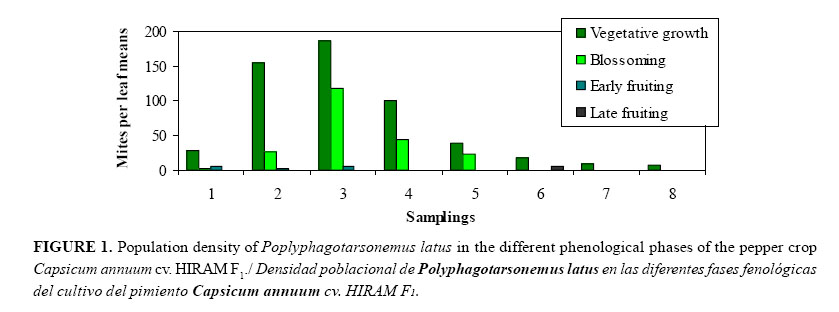
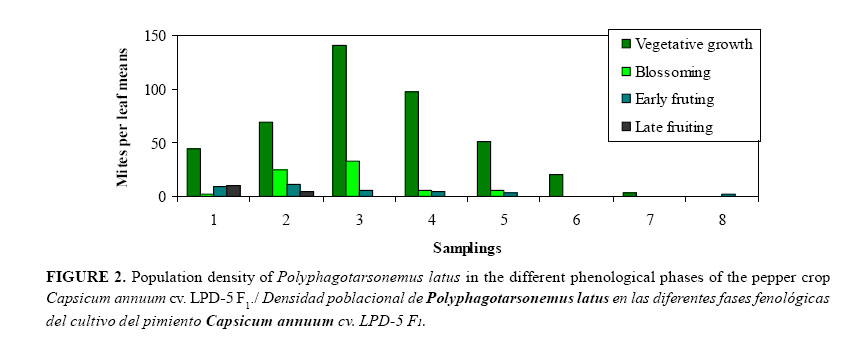
<body><![CDATA[<P>     <P><font face="Verdana, Arial, Helvetica, sans-serif" size="2"><B><font size="3">RESULTS    AND DISCUSSION </font></B> </font>      <P><font face="Verdana, Arial, Helvetica, sans-serif" size="2">In both cultivars,    the broad mite populations were preferably localized on the leaf underside.    But when the population levels increased, they could also be found on the leaf    upperside, mainly the females, which was the stage that migrated more easily.    This is the habitual behaviour of this phytophagous, which prefers the most    protected places of the young leaf underside for its development (4,5,13). A    similar behaviour was shown by both cultivars; the population levels of the    broad mite increased from the first to the third sampling, and then began to    decrease gradually until minimum values in the eighth sampling (<a href="/img/revistas/rpv/v26n2/f0102211.jpg">Fig. 1</a>-<a href="/img/revistas/rpv/v26n2/f0202211.jpg">2</a>).    It is known that when the leaves show severe symptoms, they become unsuitable    for the normal development of the pest and it tends to migrate towards more    favourable zones (5). </font>      
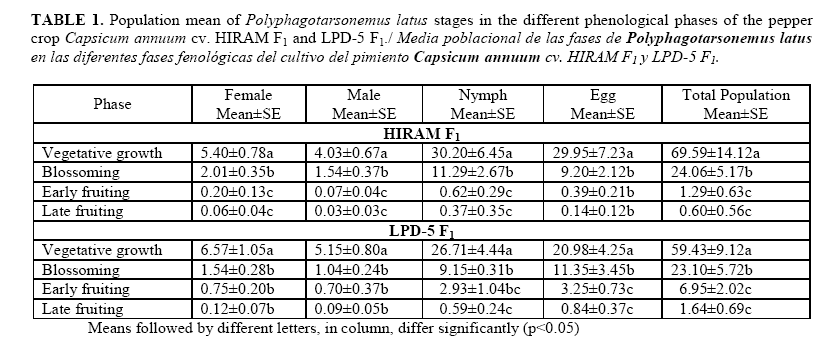
<P><font face="Verdana, Arial, Helvetica, sans-serif" size="2"><a href="/img/revistas/rpv/v26n2/t0102211.gif">Table    1</a> shows that the numbers of mites present in each of the pepper phenological    phases were statistically different. If the total population of the phytophagous    is considered, the highest population levels were reached by both cultivars    when the plants were infested at the vegetative growth phase, with values that    differed significantly from the remaining treatments The plants infested at    the blossoming phase were placed in a second group, although the population    levels did not exceed the 40% of the population observed in the vegetative growth    phase. The lowest population levels, with no significant difference among them,    were observed when the plants were infested at the early and late fruiting phases.    </font>      
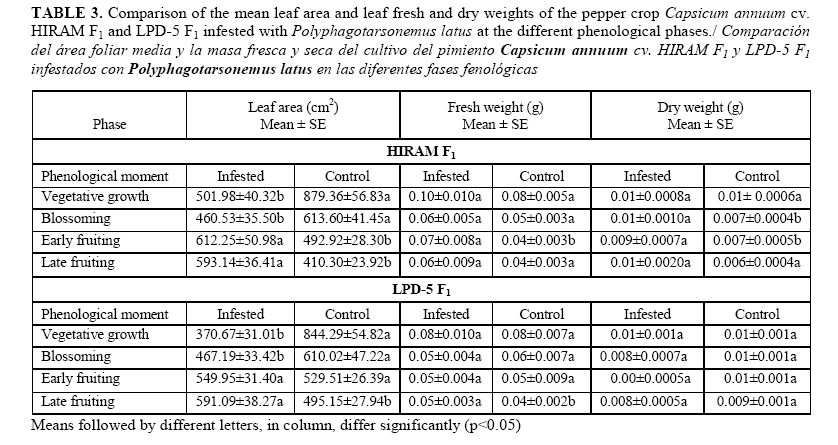
<P><font face="Verdana, Arial, Helvetica, sans-serif" size="2">This result is    not entirely consistent with that informed by de Coss-Romero and Pena (4) in    Florida. The highest mite levels were observed by these authors in the early    fruiting phase, what does not agree with the results of the present study, while    the lowest values were similarly detected in the late fruiting phase. It is    </font><font face="Verdana, Arial, Helvetica, sans-serif" size="2">known that,    due to the characteristic of their oral parts, the tarsonemids are less capable    of penetrating the lignified tissues (14), what is likely to happen with the    l4 week-old pepper plants. Both de Coss-Romero and Pena (4) and Echer <I>et    al</I>. (5) pointed out that it was a valuable result for the programs evaluating    pepper resistance to the broad mite, suggesting that this evaluation could be    carried out in early growth stages of the crop. </font>      <P><font face="Verdana, Arial, Helvetica, sans-serif" size="2">The leaf area values    observed for the phenological phases of vegetative growth and blossoming demonstrate    that they are the phases more affected by<I> P. latus </I>feeding since these    values are significantly different from those of the uninfested control in both    cultivars. All the phases showed a similar behaviour for the fresh and dry weight    evaluations as these were not significantly different excepting the fresh and    dry weights for the early fruiting phase in the cultivar HIRAM F<SUB>1</SUB>    and for the fresh weight in the late fruiting phase in the cultivar LPD-5 F<SUB>1</SUB>    (<a href="/img/revistas/rpv/v26n2/t0202211.gif">Table 2</a>). </font>      
<P><font face="Verdana, Arial, Helvetica, sans-serif" size="2">When the influence    of <I>P. latus</I> on plant height and plant fresh and dry weights was analysed,    significant differences in plant height could only be observed in both cultivars    when the mite was released at the vegetative growth phase in relation to the    remaining treatments and the control. In the LPD-1 F<SUB>1<B> </B></SUB>cultivar,    the fresh and dry weights showed a similar behaviour, as it was expected; the    lowest value was observed when the plants were infested with the mite at the    vegetative growth phase, which differed significantly from the remaining treatments.    In this cultivar, significant differences were not detected between the control    and the blossoming and late fruiting phases, whereas the highest value was shown    by the early fruiting phase (<a href="/img/revistas/rpv/v26n2/t0302211.gif">Table    3</a>). Significant differences among the treatments were found for the LPD-5    F<SUB>1 </SUB>cultivar. The lowest value was observed in the vegetative growth    phase; blossoming and early and late fruiting phases showed medium values and    with no significant differences among them and the highest value was for the    uninfested control. </font>      
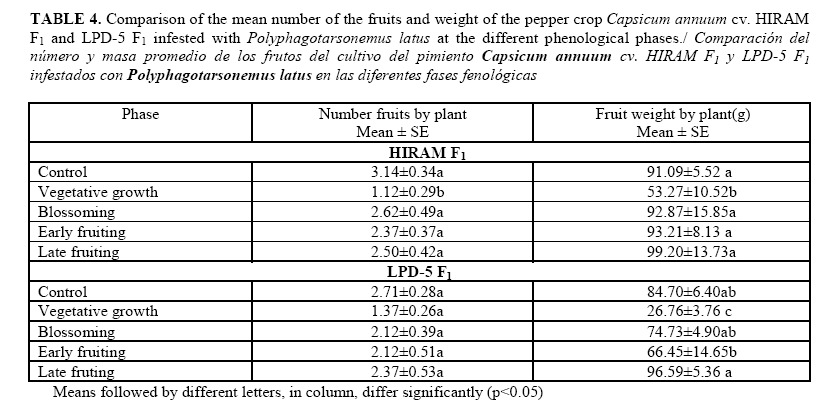
<P><font face="Verdana, Arial, Helvetica, sans-serif" size="2">The high stress    levels induced by <I>P. latus</I> feeding provoke a reduction in the fruit quantity    and quality, vegetative growth and differentiated blossoming development, due    to some anatomical, physiological or biochemical differences among the plants    in vegetative growth or reproductive stages. This reduction is caused by the    systematic feeding on leaf young tissues, which are more susceptible than the    plants with a higher number of mature leaves (4).     <BR>       <BR>   </font><font face="Verdana, Arial, Helvetica, sans-serif" size="2">This population    behaviour and the affectations of the normal plant development that they mean    were evident in the number and mean weight of fruits per plant (<a href="/img/revistas/rpv/v26n2/t0402211.gif">Table    4</a>). In the LPD-1 F<SUB>1 </SUB>cultivar, significant differences were only    observed between the vegetative growth phase, with the lowest values, and the    remaining phases and the control. This result is in agreement with that previously    described for this hybrid. In the case of the LPD-5 F<SUB>1</SUB> cultivar,    no differences were found in the mean of fruits per plant, but they were in    the fruit weight. For this parameter, the lowest value was found in the vegetative    growth phase differing from the remaining ones. </font>      
]]></body>
<body><![CDATA[<P><font face="Verdana, Arial, Helvetica, sans-serif" size="2">Regardless of the    existence or not of statistical differences among the treatments evaluated,    it is observed a clear tendency indicating that in the same extent in which    the mite delays its arrival at the pepper plant, the affectations it produces    are lesser. These results suggest that the pepper crop is more vulnerable to    the attack of the broad mite at the initial life cycle phases of the crop. Therefore,    it is when the crop must be protected with greater emphasis. </font>     <P><font face="Verdana, Arial, Helvetica, sans-serif" size="2">The understanding    of <I>P. latus</I> population behaviour in response to the phenological phases    of these two pepper cultivars contributes to improve the monitoring programs    and to the design of more effective management strategies. </font>     <P>     <P><font face="Verdana, Arial, Helvetica, sans-serif" size="2"><B><font size="3">ACKNOWLEDGEMENTS    </font> </B> </font>      <P><font face="Verdana, Arial, Helvetica, sans-serif" size="2">The authors thank    Eduardo Sistachs PhD. for improving the English text and Reynaldo Chico for    technical assistance. </font>     <P>     <P><font face="Verdana, Arial, Helvetica, sans-serif" size="2"><B><font size="3">REFERENCIAS    </font> </B> </font>      <P><font face="Verdana, Arial, Helvetica, sans-serif" size="2">1. Casanova AS,    G&oacute;mez O, Hern&aacute;ndez M, Chailloux M, Depestre T, et al. Manual para    la Producci&oacute;n Protegida de Hortalizas. Instituto de Investigaciones Hort&iacute;colas    &#171;Liliana Dimitrova&#187;. Segunda Edici&oacute;n. Editorial Liliana, Ministerio    de la Agricultura, 2007; 179 p. </font>     <!-- ref --><P><font face="Verdana, Arial, Helvetica, sans-serif" size="2">2. Hanafi A. Invasive    pests and diseases: a challenge to IPM in greenhouse crops. Phytoparasitica.    2005;33:423-426.     </font>     ]]></body>
<body><![CDATA[<!-- ref --><P><font face="Verdana, Arial, Helvetica, sans-serif" size="2">3. G&oacute;mez    L, Rodr&iacute;guez MG, Gonz&aacute;lez E, D&iacute;az-Viruliche L, Wagner F.    Evaluaci&oacute;n de materiales org&aacute;nicos para la biofumigaci&oacute;n    en instalaciones de Cultivos Protegidos. Rev Protecci&oacute;n Veg. 2006;21(3):178-175.        </font>     <!-- ref --><P><font face="Verdana, Arial, Helvetica, sans-serif" size="2">4. De Coss-Romero    M, Pena JE. Relationship of broad mite (Acari: Tarsonemidae) to host phenology    and injury levels in <I>Capsicum annuum</I>. Fla Entomologist. 1998;81(4):515-526.        </font>     <!-- ref --><P><font face="Verdana, Arial, Helvetica, sans-serif" size="2">5. Echer MM, Fernandes    MCA, Ribeiro RLD, Peracchi AL. Avalia&ccedil;&atilde;o de gen&oacute;tipos de    <I>Capsicum </I>para resist&ecirc;ncia ao &aacute;caro branco. Hort bras. 2002;20(2):217-221.        </font>      <!-- ref --><P><font face="Verdana, Arial, Helvetica, sans-serif" size="2">6. Weintraub PG.    Integrated control of pests in tropical and subtropical sweet pepper production.    Pest Management Sci. 2007;63:753-760.     </font>     <!-- ref --><P><font face="Verdana, Arial, Helvetica, sans-serif" size="2">7. Gerson U, Weintraub    PG. Mites for the control of pests in protected cultivation. Pest Management    Sci. 2007;63:658-676.     </font>     ]]></body>
<body><![CDATA[<!-- ref --><P><font face="Verdana, Arial, Helvetica, sans-serif" size="2">8. Tal C, Coll    M, Weintraub PG. Biological control of <I>Polyphagotarsonemus latus </I>(Acari:    Tarsonemidae) by the predaceous mite <I>Amblyseius swirskii </I>(Acari: Phytoseiidae).    IOBC/wprs Bull. 2007;30:25-36.     </font>     <!-- ref --><P><font face="Verdana, Arial, Helvetica, sans-serif" size="2">9. G&oacute;mez    L, Rodr&iacute;guez MG, Enrique R. Factores limitantes de la producci&oacute;n    protegida de hortalizas en Cuba. Rev Protecci&oacute;n Veg. 2009;24(1):23-28.        </font>     <!-- ref --><P><font face="Verdana, Arial, Helvetica, sans-serif" size="2">10.Rodr&iacute;guez    Y, Depestre T, Rodr&iacute;guez RM, Delgado A. Obtenci&oacute;n de cinco h&iacute;bridos    cubanos de pimiento. Temas de Ciencia y Tecnolog&iacute;a. 2004;8(23):25-27.        </font>     <!-- ref --><P><font face="Verdana, Arial, Helvetica, sans-serif" size="2">11.Rodr&iacute;guez    Y, Depestre T, Rodr&iacute;guez RM, Delgado A. Creaci&oacute;n varietal en pimiento    (<I>Capsicum annuum</I> L. Temas de Ciencia y Tecnolog&iacute;a. 2007;11(31    ):21-37.     </font>     <!-- ref --><P><font face="Verdana, Arial, Helvetica, sans-serif" size="2">12.MINAGRI (Ministerio    de la Agricultura). Instituto de Suelos. Nueva versi&oacute;n de la clasificaci&oacute;n    gen&eacute;tica de los suelos de Cuba. La Habana. AGRINFOR, 1999; 64 p.     </font>     ]]></body>
<body><![CDATA[<!-- ref --><P><font face="Verdana, Arial, Helvetica, sans-serif" size="2">13.Palevsky E,    Soroker V, Weintraub PG, Mansour F, Abo-Moch F, Gerson U. How species-specific    is the phoretic relationship between the broad mite, <I>Polyphagotarsonemus    latus</I> (Acari: Tarsonemidae), and its insect host? Exp Appl Acarol. 2001;25:217-224.        </font>     <!-- ref --><P><font face="Verdana, Arial, Helvetica, sans-serif" size="2">14.Jeppson LR,    Keifer HH, Baker EW. Mites injurious to economic plant. Univ. of California    Press, Berkeley, 1975; 614 p.     </font>     <P>     <P>     <P> <font face="Verdana, Arial, Helvetica, sans-serif" size="2"><sup><a href="#volao">1</a></sup>Current    address: Departamento Biolog&iacute;a-Sanidad Vegetal. Facultad de Agronom&iacute;a.    Universidad Agraria de La Habana (UNAH). Carretera de Tapaste. San Jos&eacute;    de las Lajas, Mayabeque. CP 32 700. Correo electr&oacute;nico: <u><a href="mailto:morell_66@isch.edu.cu">morell_66@isch.edu.cu</a> </u> </font>      ]]></body><back>
<ref-list>
<ref id="B1">
<label>1</label><nlm-citation citation-type="book">
<person-group person-group-type="author">
<name>
<surname><![CDATA[Casanova]]></surname>
<given-names><![CDATA[AS]]></given-names>
</name>
<name>
<surname><![CDATA[Gómez]]></surname>
<given-names><![CDATA[O]]></given-names>
</name>
<name>
<surname><![CDATA[Hernández]]></surname>
<given-names><![CDATA[M]]></given-names>
</name>
<name>
<surname><![CDATA[Chailloux]]></surname>
<given-names><![CDATA[M]]></given-names>
</name>
<name>
<surname><![CDATA[Depestre]]></surname>
<given-names><![CDATA[T]]></given-names>
</name>
</person-group>
<source><![CDATA[Manual para la Producción Protegida de Hortalizas. Instituto de Investigaciones Hortícolas «Liliana Dimitrova»]]></source>
<year>2007</year>
<edition>2da</edition>
<page-range>179</page-range><publisher-name><![CDATA[Ministerio de la Agricultura]]></publisher-name>
</nlm-citation>
</ref>
<ref id="B2">
<label>2</label><nlm-citation citation-type="journal">
<person-group person-group-type="author">
<name>
<surname><![CDATA[Hanafi]]></surname>
<given-names><![CDATA[A]]></given-names>
</name>
</person-group>
<article-title xml:lang="en"><![CDATA[Invasive pests and diseases: a challenge to IPM in greenhouse crops]]></article-title>
<source><![CDATA[Phytoparasitica]]></source>
<year>2005</year>
<volume>33</volume>
<page-range>423-426</page-range></nlm-citation>
</ref>
<ref id="B3">
<label>3</label><nlm-citation citation-type="journal">
<person-group person-group-type="author">
<name>
<surname><![CDATA[Gómez]]></surname>
<given-names><![CDATA[L]]></given-names>
</name>
<name>
<surname><![CDATA[Rodríguez]]></surname>
<given-names><![CDATA[MG]]></given-names>
</name>
<name>
<surname><![CDATA[González]]></surname>
<given-names><![CDATA[E]]></given-names>
</name>
<name>
<surname><![CDATA[Díaz-Viruliche]]></surname>
<given-names><![CDATA[L]]></given-names>
</name>
<name>
<surname><![CDATA[Wagner]]></surname>
<given-names><![CDATA[F]]></given-names>
</name>
</person-group>
<article-title xml:lang="es"><![CDATA[Evaluación de materiales orgánicos para la biofumigación en instalaciones de Cultivos Protegidos]]></article-title>
<source><![CDATA[Rev Protección Veg]]></source>
<year>2006</year>
<volume>21</volume>
<numero>3</numero>
<issue>3</issue>
<page-range>178-175</page-range></nlm-citation>
</ref>
<ref id="B4">
<label>4</label><nlm-citation citation-type="journal">
<person-group person-group-type="author">
<name>
<surname><![CDATA[De Coss-Romero]]></surname>
<given-names><![CDATA[M]]></given-names>
</name>
<name>
<surname><![CDATA[Pena]]></surname>
<given-names><![CDATA[JE]]></given-names>
</name>
</person-group>
<article-title xml:lang="en"><![CDATA[Relationship of broad mite (Acari: Tarsonemidae) to host phenology and injury levels in Capsicum annuum]]></article-title>
<source><![CDATA[Fla Entomologist]]></source>
<year>1998</year>
<volume>81</volume>
<numero>4</numero>
<issue>4</issue>
<page-range>515-526</page-range></nlm-citation>
</ref>
<ref id="B5">
<label>5</label><nlm-citation citation-type="journal">
<person-group person-group-type="author">
<name>
<surname><![CDATA[Echer]]></surname>
<given-names><![CDATA[MM]]></given-names>
</name>
<name>
<surname><![CDATA[Fernandes]]></surname>
<given-names><![CDATA[MCA]]></given-names>
</name>
<name>
<surname><![CDATA[Ribeiro]]></surname>
<given-names><![CDATA[RLD]]></given-names>
</name>
<name>
<surname><![CDATA[Peracchi]]></surname>
<given-names><![CDATA[AL]]></given-names>
</name>
</person-group>
<article-title xml:lang="pt"><![CDATA[Avaliação de genótipos de Capsicum para resistência ao ácaro branco]]></article-title>
<source><![CDATA[Hort bras]]></source>
<year>2002</year>
<volume>20</volume>
<numero>2</numero>
<issue>2</issue>
<page-range>217-221</page-range></nlm-citation>
</ref>
<ref id="B6">
<label>6</label><nlm-citation citation-type="journal">
<person-group person-group-type="author">
<name>
<surname><![CDATA[Weintraub]]></surname>
<given-names><![CDATA[PG]]></given-names>
</name>
</person-group>
<article-title xml:lang="en"><![CDATA[Integrated control of pests in tropical and subtropical sweet pepper production]]></article-title>
<source><![CDATA[Pest Management Sci]]></source>
<year>2007</year>
<volume>63</volume>
<page-range>753-760</page-range></nlm-citation>
</ref>
<ref id="B7">
<label>7</label><nlm-citation citation-type="journal">
<person-group person-group-type="author">
<name>
<surname><![CDATA[Gerson]]></surname>
<given-names><![CDATA[U]]></given-names>
</name>
<name>
<surname><![CDATA[Weintraub]]></surname>
<given-names><![CDATA[PG]]></given-names>
</name>
</person-group>
<article-title xml:lang="en"><![CDATA[Mites for the control of pests in protected cultivation]]></article-title>
<source><![CDATA[Pest Management Sci]]></source>
<year>2007</year>
<volume>63</volume>
<page-range>658-676</page-range></nlm-citation>
</ref>
<ref id="B8">
<label>8</label><nlm-citation citation-type="journal">
<person-group person-group-type="author">
<name>
<surname><![CDATA[Tal]]></surname>
<given-names><![CDATA[C]]></given-names>
</name>
<name>
<surname><![CDATA[Coll]]></surname>
<given-names><![CDATA[M]]></given-names>
</name>
<name>
<surname><![CDATA[Weintraub]]></surname>
<given-names><![CDATA[PG]]></given-names>
</name>
</person-group>
<article-title xml:lang="en"><![CDATA[Biological control of Polyphagotarsonemus latus (Acari: Tarsonemidae) by the predaceous mite Amblyseius swirskii (Acari: Phytoseiidae)]]></article-title>
<source><![CDATA[IOBC/wprs Bull]]></source>
<year>2007</year>
<volume>30</volume>
<page-range>25-36</page-range></nlm-citation>
</ref>
<ref id="B9">
<label>9</label><nlm-citation citation-type="journal">
<person-group person-group-type="author">
<name>
<surname><![CDATA[Gómez]]></surname>
<given-names><![CDATA[L]]></given-names>
</name>
<name>
<surname><![CDATA[Rodríguez]]></surname>
<given-names><![CDATA[MG]]></given-names>
</name>
<name>
<surname><![CDATA[Enrique]]></surname>
<given-names><![CDATA[R]]></given-names>
</name>
</person-group>
<article-title xml:lang="es"><![CDATA[Factores limitantes de la producción protegida de hortalizas en Cuba]]></article-title>
<source><![CDATA[Rev Protección Veg]]></source>
<year>2009</year>
<volume>24</volume>
<numero>1</numero>
<issue>1</issue>
<page-range>23-28</page-range></nlm-citation>
</ref>
<ref id="B10">
<label>10</label><nlm-citation citation-type="journal">
<person-group person-group-type="author">
<name>
<surname><![CDATA[Rodríguez]]></surname>
<given-names><![CDATA[Y]]></given-names>
</name>
<name>
<surname><![CDATA[Depestre]]></surname>
<given-names><![CDATA[T]]></given-names>
</name>
<name>
<surname><![CDATA[Rodríguez]]></surname>
<given-names><![CDATA[RM]]></given-names>
</name>
<name>
<surname><![CDATA[Delgado]]></surname>
<given-names><![CDATA[A]]></given-names>
</name>
</person-group>
<article-title xml:lang="es"><![CDATA[Obtención de cinco híbridos cubanos de pimiento]]></article-title>
<source><![CDATA[Temas de Ciencia y Tecnología]]></source>
<year>2004</year>
<volume>8</volume>
<numero>23</numero>
<issue>23</issue>
<page-range>25-27</page-range></nlm-citation>
</ref>
<ref id="B11">
<label>11</label><nlm-citation citation-type="journal">
<person-group person-group-type="author">
<name>
<surname><![CDATA[Rodríguez]]></surname>
<given-names><![CDATA[Y]]></given-names>
</name>
<name>
<surname><![CDATA[Depestre]]></surname>
<given-names><![CDATA[T]]></given-names>
</name>
<name>
<surname><![CDATA[Rodríguez]]></surname>
<given-names><![CDATA[RM]]></given-names>
</name>
<name>
<surname><![CDATA[Delgado]]></surname>
<given-names><![CDATA[A]]></given-names>
</name>
</person-group>
<article-title xml:lang="es"><![CDATA[Creación varietal en pimiento (Capsicum annuum L]]></article-title>
<source><![CDATA[Temas de Ciencia y Tecnología]]></source>
<year>2007</year>
<volume>11</volume>
<numero>31</numero>
<issue>31</issue>
<page-range>21-37</page-range></nlm-citation>
</ref>
<ref id="B12">
<label>12</label><nlm-citation citation-type="book">
<source><![CDATA[Nueva versión de la clasificación genética de los suelos de Cuba]]></source>
<year>1999</year>
<page-range>64</page-range><publisher-loc><![CDATA[La Habana ]]></publisher-loc>
<publisher-name><![CDATA[MINAGRI (Ministerio de la Agricultura). Instituto de Suelos]]></publisher-name>
</nlm-citation>
</ref>
<ref id="B13">
<label>13</label><nlm-citation citation-type="journal">
<person-group person-group-type="author">
<name>
<surname><![CDATA[Palevsky]]></surname>
<given-names><![CDATA[E]]></given-names>
</name>
<name>
<surname><![CDATA[Soroker]]></surname>
<given-names><![CDATA[V]]></given-names>
</name>
<name>
<surname><![CDATA[Weintraub]]></surname>
<given-names><![CDATA[PG]]></given-names>
</name>
<name>
<surname><![CDATA[Mansour]]></surname>
<given-names><![CDATA[F]]></given-names>
</name>
<name>
<surname><![CDATA[Abo-Moch]]></surname>
<given-names><![CDATA[F]]></given-names>
</name>
<name>
<surname><![CDATA[Gerson]]></surname>
<given-names><![CDATA[U]]></given-names>
</name>
</person-group>
<article-title xml:lang="en"><![CDATA[How species-specific is the phoretic relationship between the broad mite, Polyphagotarsonemus latus (Acari: Tarsonemidae), and its insect host?]]></article-title>
<source><![CDATA[Exp Appl Acarol]]></source>
<year>2001</year>
<volume>25</volume>
<page-range>217-224</page-range></nlm-citation>
</ref>
<ref id="B14">
<label>14</label><nlm-citation citation-type="book">
<person-group person-group-type="author">
<name>
<surname><![CDATA[Jeppson]]></surname>
<given-names><![CDATA[LR]]></given-names>
</name>
<name>
<surname><![CDATA[Keifer]]></surname>
<given-names><![CDATA[HH]]></given-names>
</name>
<name>
<surname><![CDATA[Baker]]></surname>
<given-names><![CDATA[EW]]></given-names>
</name>
</person-group>
<source><![CDATA[Mites injurious to economic plant]]></source>
<year>1975</year>
<page-range>614</page-range><publisher-loc><![CDATA[Berkeley ]]></publisher-loc>
<publisher-name><![CDATA[Univ. of California Press]]></publisher-name>
</nlm-citation>
</ref>
</ref-list>
</back>
</article>