<?xml version="1.0" encoding="ISO-8859-1"?><article xmlns:mml="http://www.w3.org/1998/Math/MathML" xmlns:xlink="http://www.w3.org/1999/xlink" xmlns:xsi="http://www.w3.org/2001/XMLSchema-instance">
<front>
<journal-meta>
<journal-id>1010-2752</journal-id>
<journal-title><![CDATA[Revista de Protección Vegetal]]></journal-title>
<abbrev-journal-title><![CDATA[Rev. Protección Veg.]]></abbrev-journal-title>
<issn>1010-2752</issn>
<publisher>
<publisher-name><![CDATA[Centro Nacional de Sanidad Agropecuaria]]></publisher-name>
</publisher>
</journal-meta>
<article-meta>
<article-id>S1010-27522013000200002</article-id>
<title-group>
<article-title xml:lang="en"><![CDATA[Plant secondary metabolites as alternatives in pest management. II: An overview of their potential in Cuba]]></article-title>
<article-title xml:lang="es"><![CDATA[Metabolitos secundarios de origen botánico como alternativas en el manejo de plagas. II: Visión general de su potencial en Cuba]]></article-title>
</title-group>
<contrib-group>
<contrib contrib-type="author">
<name>
<surname><![CDATA[Pino]]></surname>
<given-names><![CDATA[Oriela]]></given-names>
</name>
<xref ref-type="aff" rid="A01"/>
</contrib>
<contrib contrib-type="author">
<name>
<surname><![CDATA[Sánchez]]></surname>
<given-names><![CDATA[Yaíma]]></given-names>
</name>
<xref ref-type="aff" rid="A01"/>
</contrib>
<contrib contrib-type="author">
<name>
<surname><![CDATA[Rojas]]></surname>
<given-names><![CDATA[Miriam M]]></given-names>
</name>
<xref ref-type="aff" rid="A01"/>
</contrib>
</contrib-group>
<aff id="A01">
<institution><![CDATA[,Centro Nacional de Sanidad Agropecuaria (CENSA) Dirección de Sanidad Vegetal Grupo de Plagas Agrícolas]]></institution>
<addr-line><![CDATA[Mayabeque ]]></addr-line>
<country>Cuba</country>
</aff>
<pub-date pub-type="pub">
<day>00</day>
<month>08</month>
<year>2013</year>
</pub-date>
<pub-date pub-type="epub">
<day>00</day>
<month>08</month>
<year>2013</year>
</pub-date>
<volume>28</volume>
<numero>2</numero>
<fpage>95</fpage>
<lpage>108</lpage>
<copyright-statement/>
<copyright-year/>
<self-uri xlink:href="http://scielo.sld.cu/scielo.php?script=sci_arttext&amp;pid=S1010-27522013000200002&amp;lng=en&amp;nrm=iso"></self-uri><self-uri xlink:href="http://scielo.sld.cu/scielo.php?script=sci_abstract&amp;pid=S1010-27522013000200002&amp;lng=en&amp;nrm=iso"></self-uri><self-uri xlink:href="http://scielo.sld.cu/scielo.php?script=sci_pdf&amp;pid=S1010-27522013000200002&amp;lng=en&amp;nrm=iso"></self-uri><abstract abstract-type="short" xml:lang="en"><p><![CDATA[This review covers the historical use of plant secondary metabolites in agricultural practices in Cuba and their potential in pest management. The Cuban flora has not yet been fully studied as a source of pesticides, partly due to its great diversity. Nevertheless, up to date, several plants are used by Cuban farmers as repellents and/or as raw material for the preparation of botanical pesticides in an artisan manner, and more than 60 plants have demonstrated their pesticidal activity under laboratory, semicontrolled and field conditions. Meliaceae, Asteraceae, Fabaceae, Solanaceae, Clusiaceae, Piperaceae, Lamiaceae, Apiaceae, and Mirtaceae are among the most important involved plant families. From the chemical point of view, promising results have been achieved with alkaloids, terpenoids, coumarins and essential oils. The efficient practical application of pesticidal properties of plants in crop rotation, polycrops, and intercropping, and as barrier or traps requires further research from the chemical ecology point of view. As botanical pesticides, plant secondary metabolites may be applied in protected crops, nurseries, seed treatments in protected and field-grown crops, storage pest management among others. Innovative products can be developed by using them in mixtures with other phytosanitary products and as resistance inducers. The use of known botanicals and the identification of local candidates for developing new products offer alternatives that may combine efficiency and safety for the Cuban agriculture in pest management. Multidisciplinary and multiinstitucional research-development, and innovation programmes will play an important role in the increase of the scientific and socioeconomic impact of these phytosanitary products for contributing to a sustainable food production.]]></p></abstract>
<abstract abstract-type="short" xml:lang="es"><p><![CDATA[Esta revisión abarca el uso histórico de los metabolitos secundarios de origen botánico en prácticas agrícolas y su potencial en el manejo de plagas en Cuba. La flora cubana aún no se ha estudiado totalmente como fuente de plaguicidas, en parte debido a su gran diversidad. Sin embargo, hasta la fecha, numerosas plantas son utilizadas por los campesinos cubanos como repelentes y/o materia prima para la preparación de extractos de manera artesanal y se ha demostrado la actividad plaguicida de más de 60 plantas en condiciones de laboratorio, semicontroladas y campo. Entre las familias botánicas involucradas más importantes se encuentran: Meliaceae, Asteraceae, Fabaceae, Solanaceae, Clusiaceae, Piperaceae, Lamiaceae, Apiaceae y Mirtaceae. Desde el punto de vista químico, se han logrado resultados promisorios con alcaloides, terpenoides, cumarinas y aceites esenciales. La aplicación práctica eficiente de las propiedades plaguicidas de las plantas en la rotación, asociación y el intercalamiento de cultivos y como barreras y trampas requiere de la ejecución de investigaciones desde el punto de vista de la ecología química. Como plaguicidas botánicos se pueden aplicar en cultivos protegidos, viveros, tratamientos de semillas, manejo de plagas de almacén; entre otros. Productos novedosos se pueden desarrollar utilizando metabolitos secundarios en mezclas con otros productos fitosanitarios y como inductores de resistencia. El uso de extractos vegetales conocidos y la identificación de candidatos locales para el desarrollo de nuevos productos, ofrecen alternativas que pueden combinar eficiencia y seguridad en el manejo de plagas en la agricultura cubana. Programas de investigación-desarrollo e innovación multidisciplinarios y multiinstitucionales desempeñarán un rol importante en el incremento del impacto científico y socioeconómico de estos productos fitosanitarios para contribuir a una producción sostenible de alimentos.]]></p></abstract>
<kwd-group>
<kwd lng="en"><![CDATA[Cuban flora]]></kwd>
<kwd lng="en"><![CDATA[botanical pesticides]]></kwd>
<kwd lng="en"><![CDATA[pest management]]></kwd>
<kwd lng="en"><![CDATA[secondary metabolites]]></kwd>
<kwd lng="es"><![CDATA[flora cubana]]></kwd>
<kwd lng="es"><![CDATA[plaguicidas botánicos]]></kwd>
<kwd lng="es"><![CDATA[manejo de plagas]]></kwd>
<kwd lng="es"><![CDATA[metabolitos secundarios]]></kwd>
</kwd-group>
</article-meta>
</front><body><![CDATA[ <p align="right"><font size="2" face="Verdana, Arial, Helvetica, sans-serif"><B>REVIEW    ARTICLE</B></font></p>     <p>&nbsp;</p>     <p><font size="2" face="Verdana, Arial, Helvetica, sans-serif"><B><font size="4">Plant    secondary metabolites as alternatives in pest management. II: An overview of    their potential in Cuba</font></B></font></p>     <p>&nbsp;</p>     <p><font size="2" face="Verdana, Arial, Helvetica, sans-serif"><b><font size="3">Metabolitos    secundarios de origen bot&aacute;nico como alternativas en el manejo de plagas.    II: Visi&oacute;n general de su potencial en Cuba</font></b></font></p>     <p>&nbsp;</p>     <p>&nbsp;</p>     <p><font size="2" face="Verdana, Arial, Helvetica, sans-serif"><b>Oriela Pino,    Ya&iacute;ma S&aacute;nchez, Miriam M. Rojas</b></font><b> </b></p>     <P><font size="2" face="Verdana, Arial, Helvetica, sans-serif">Grupo de Plagas    Agr&iacute;colas, Direcci&oacute;n de Sanidad Vegetal, Centro Nacional de Sanidad    Agropecuaria (CENSA), Apartado 10, San Jos&eacute; de las Lajas, Mayabeque,    Cuba. Tel&eacute;fono: 863014 ext-148 Correo electr&oacute;nico: <U><a href="mailto:oriela@censa.edu.cu">oriela@censa.edu.cu</a></U></font>.     <P>&nbsp;     ]]></body>
<body><![CDATA[<P>&nbsp; <hr noshade size="1">     <p><font size="2" face="Verdana, Arial, Helvetica, sans-serif"><B>ABSTRACT</B></font></p>     <P><font size="2" face="Verdana, Arial, Helvetica, sans-serif">This review covers    the historical use of plant secondary metabolites in agricultural practices    in Cuba and their potential in pest management. The Cuban flora has not yet    been fully studied as a source of pesticides, partly due to its great diversity.    Nevertheless, up to date, several plants are used by Cuban farmers as repellents    and/or as raw material for the preparation of botanical pesticides in an artisan    manner, and more than 60 plants have demonstrated their pesticidal activity    under laboratory, semicontrolled and field conditions. <I>Meliaceae</I>, <I>Asteraceae</I>,    <I>Fabaceae</I>, <I>Solanaceae, Clusiaceae</I>, <I>Piperaceae</I>, <I>Lamiaceae</I>,    <I>Apiaceae</I>, and <I>Mirtaceae</I> are among the most important involved    plant families<I>.</I> From the chemical point of view, promising results have    been achieved with alkaloids, terpenoids, coumarins and essential oils. The    efficient practical application of pesticidal properties of plants in crop rotation,    polycrops, and intercropping, and as barrier or traps requires further research    from the chemical ecology point of view. As botanical pesticides, plant secondary    metabolites may be applied in protected crops, nurseries, seed treatments in    protected and field-grown crops, storage pest management among others. Innovative    products can be developed by using them in mixtures with other phytosanitary    products and as resistance inducers. The use of known botanicals and the identification    of local candidates for developing new products offer alternatives that may    combine efficiency and safety for the Cuban agriculture in pest management.    Multidisciplinary and multiinstitucional research-development, and innovation    programmes will play an important role in the increase of the scientific and    socioeconomic impact of these phytosanitary products for contributing to a sustainable    food production. </font>     <P><font size="2" face="Verdana, Arial, Helvetica, sans-serif"><B>Key words: </B>Cuban    flora, botanical pesticides, pest management, secondary metabolites.</font> <hr noshade size="1">     <P><font size="2" face="Verdana, Arial, Helvetica, sans-serif"><B>RESUMEN</B></font>     <P><font size="2" face="Verdana, Arial, Helvetica, sans-serif">Esta revisi&oacute;n    abarca el uso hist&oacute;rico de los metabolitos secundarios de origen bot&aacute;nico    en pr&aacute;cticas agr&iacute;colas y su potencial en el manejo de plagas en    Cuba. La flora cubana a&uacute;n no se ha estudiado totalmente como fuente de    plaguicidas, en parte debido a su gran diversidad. Sin embargo, hasta la fecha,    numerosas plantas son utilizadas por los campesinos cubanos como repelentes    y/o materia prima para la preparaci&oacute;n de extractos de manera artesanal    y se ha demostrado la actividad plaguicida de m&aacute;s de 60 plantas en condiciones    de laboratorio, semicontroladas y campo. Entre las familias bot&aacute;nicas    involucradas m&aacute;s importantes se encuentran: <I>Meliaceae</I>, <I>Asteraceae</I>,    <I>Fabaceae</I>, <I>Solanaceae, Clusiaceae</I>, <I>Piperaceae</I>, <I>Lamiaceae</I>,    <I>Apiaceae</I> y <I>Mirtaceae. </I>Desde el punto de vista qu&iacute;mico,    se han logrado resultados promisorios con alcaloides, terpenoides, cumarinas    y aceites esenciales. La aplicaci&oacute;n pr&aacute;ctica eficiente de las    propiedades plaguicidas de las plantas en la rotaci&oacute;n, asociaci&oacute;n    y el intercalamiento de cultivos y como barreras y trampas requiere de la ejecuci&oacute;n    de investigaciones desde el punto de vista de la ecolog&iacute;a qu&iacute;mica.    Como plaguicidas bot&aacute;nicos se pueden aplicar en cultivos protegidos,    viveros, tratamientos de semillas, manejo de plagas de almac&eacute;n; entre    otros. Productos novedosos se pueden desarrollar utilizando metabolitos secundarios    en mezclas con otros productos fitosanitarios y como inductores de resistencia.    El uso de extractos vegetales conocidos y la identificaci&oacute;n de candidatos    locales para el desarrollo de nuevos productos, ofrecen alternativas que pueden    combinar eficiencia y seguridad en el manejo de plagas en la agricultura cubana.    Programas de investigaci&oacute;n-desarrollo e innovaci&oacute;n multidisciplinarios    y multiinstitucionales desempe&ntilde;ar&aacute;n un rol importante en el incremento    del impacto cient&iacute;fico y socioecon&oacute;mico de estos productos fitosanitarios    para contribuir a una producci&oacute;n sostenible de alimentos. </font>     <P><font size="2" face="Verdana, Arial, Helvetica, sans-serif"><B>Palabras clave:    </B>flora cubana, plaguicidas bot&aacute;nicos, manejo de plagas, metabolitos    secundarios.</font> <hr noshade size="1">     <P>&nbsp;     <P>&nbsp;     <P><font size="2" face="Verdana, Arial, Helvetica, sans-serif"><B><font size="3">INTRODUCTION</font></B>    </font>     ]]></body>
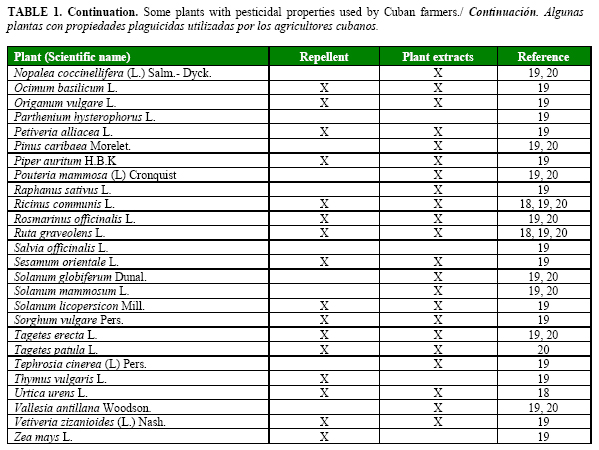
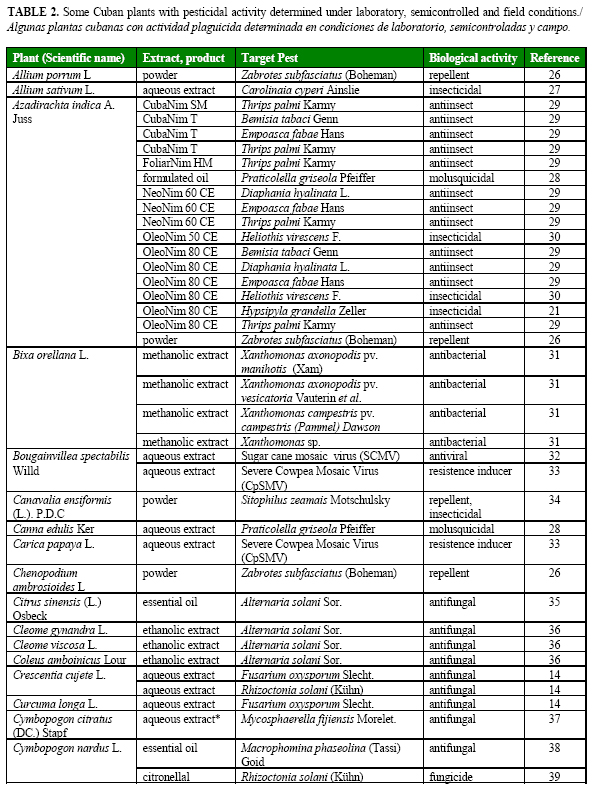
<body><![CDATA[<P><font size="2" face="Verdana, Arial, Helvetica, sans-serif">In Cuba, the search    for new alternatives for pest management is a first priority task in agricultural    sciences to reduce economic losses in crops, pest resistence development and    the agroecosystem pollution (1, 2). The country is engaged in developing a model    of agriculture where biopesticides (microorganisms, macroorganisms and botanicals)    play a key role in obtaining good yields with a high ecological value in a sustainable    food production (1, 2, 3, 4, 5). </font>     <P><font size="2" face="Verdana, Arial, Helvetica, sans-serif">In order to ensure    the practical achievement of such objectives, the Integrated Pest Management    was adopted as a policy of the Cuban State since the eighties; and in 1988,    the National Programme for the Production of Biopesticides established their    use within the Cuban strategy devised for a sustainable agricultural production    (1, 2, 3, 6, 7). In 1997, the Cuban Goverment policy was officially stated in    the Law of Environment (8). The ninth title of this law, &#171;Rules for a Sustainable    Agriculture&#187;, Article 132, subsections b and d, in relation with pest management,    expresses: b) the rational use of biological and chemical products, according    to the characteristics, conditions and local resources that minimize environment    pollution, d) preventive and integrated management of pests, with special attention    to the use of biodiversity resources for these purposes. The National Environmental    Strategy 2007-2010, approved by the Ministry of Science, Technology and Environment    (CITMA), established as goal that &#171;80% of pest and disease control in crops    in the country must be done using natural products or biopesticides&#187; and    that &#171;100% of the areas of agricultural production must be maintained under    integrated pest management schemes&#187; (5, 9). </font>     <P><font size="2" face="Verdana, Arial, Helvetica, sans-serif">On this basis in    many crops, the use of biological products (botanicals in a lesser proportion)    makes an important contribution to the reduction of the presence of the main    pests, the costs of importing large amounts of synthetic pesticides and their    polluting effects in agroecosystems (2, 3). During the last 20 years, several    changes in pest management led to reduce the national use of pesticides in more    than 50% (3, 4). </font>     <P><font size="2" face="Verdana, Arial, Helvetica, sans-serif">Tropical plants,    which grow under climatic conditions favouring microbial or insect attack, have    developed a great variety of defence molecules. They constitute therefore a    particularly rich source of substances which can find an application, directly    or as lead compounds, for the development of new pest control agents (10, 11).    It is thus highly likely that safe, efficient new molecules with new modes of    action will find a place in agriculture for many decades to come (12). </font>     <P><font size="2" face="Verdana, Arial, Helvetica, sans-serif">Cuba is considered    as one of the most biodiverse countries in the world in terms of sheer numbers    of species and has the richest plant biodiversity of all the islands in America,    with an estimated 6,500 vascular plant species of which 50% are endemic (6,    13). Partly due to its great diversity, the Cuban flora has not yet been closely    studied as a potential source of chemical pesticides (13, 14, 15, 16). To date,    only a small fraction of the plant species has undergone systematic phytochemical    or biochemical research, leaving valuable sources for commercial products undiscovered    (13). This review covers the historical use of plant secondary metabolites in    agricultural practices, and their potential in pest management in Cuba. </font>     <P><font size="2" face="Verdana, Arial, Helvetica, sans-serif"><B>Historical use    of plant secondary metabolites in agricultural practices and current researches    in Cuba</B> </font>     <P><font size="2" face="Verdana, Arial, Helvetica, sans-serif">There are many    anecdotes of the biological activity of several Cuban plants and their popular    use as natural pharmaceuticals and pesticides, but the active compounds have    not been studied in most cases. Also, the available information is often only    related to botanical data, medicinal use and for some plants it dates back to    many years (15, 17). </font>     <P><font size="2" face="Verdana, Arial, Helvetica, sans-serif">Nicotine, rotenone,    and pyrethrins, contained in extracts from plants belonging to <I>Nicotiana</I>,    <I>Tephrosia</I> and <I>Chrysanthemum</I> genera, can be mentioned among the    best known natural pesticides in Cuba since the 1940s. A common practice was    the use of aqueous extracts made from tobacco crop residues or other botanical    species to spray them over the crops for insect control; stored grains (for    food and seed) were also protected using tobacco powder (1). </font>     <P><font size="2" face="Verdana, Arial, Helvetica, sans-serif">Cuban farmers use    several plants as repellents and/or as raw material for the preparation of botanical    pesticides in an artisan manner (<a href="/img/revistas/rpv/v28n2/t1a02213.jpg">Table    1a</a>, <a href="/img/revistas/rpv/v28n2/t1b02213.jpg">1b</a>) (2, 18).    These plants are maintened in borders, live fences, gardens, organoponics, intensive    orchards and farms, standing out <I>Ocimum basilicum</I> L. (basil), <I>Tagetes    erecta</I> L. (African marigold), <I>Azadirachta indica</I> A. Juss (neem),    <I>Origanum vulgare</I> L. (origanum) and <I>Euphorbia lactea</I> Haw. (Mottled    Spurge, Frilled Fan or Elkhorn) as the most frequently reported (18, 19). </font>      
<P><font size="2" face="Verdana, Arial, Helvetica, sans-serif">Ethnobotanical    studies have shown that there is a level of plant biodiversity in urban agriculture    and small farms which are used by the farmers, but the capacity building and    dissemination actions about their use and pest control properties, as well as    the search of alternatives for <I>in situ</I> conservation must be increased    (2, 19). The effects of some of these plants have not been validated with scientific    rigour in our conditions and it is a disadvantage for recommending their use    (21). </font>     ]]></body>
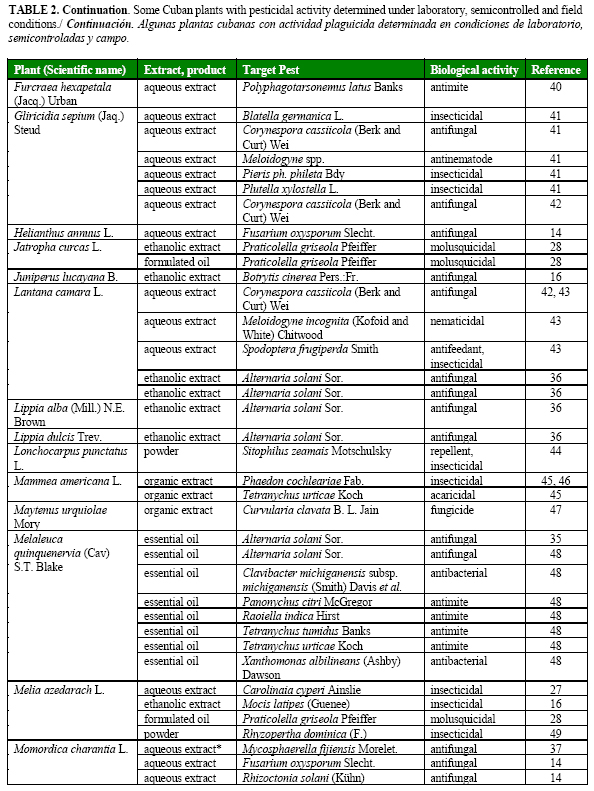
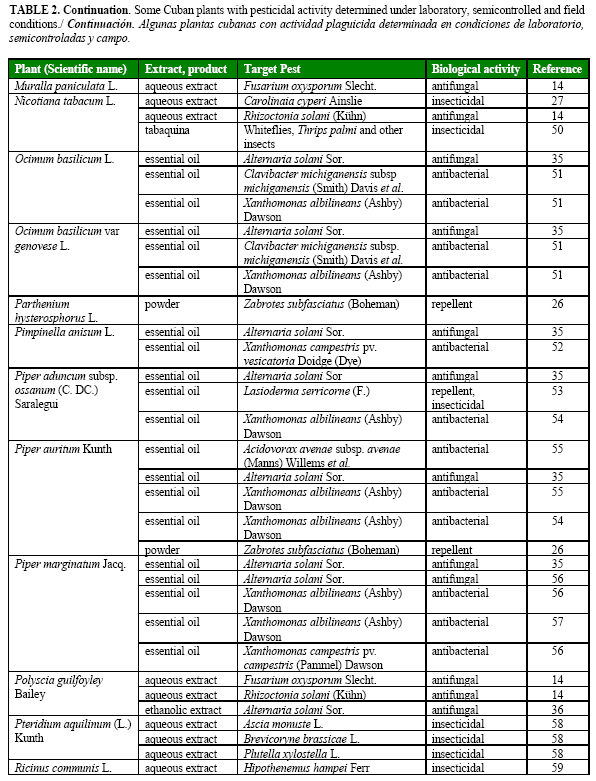
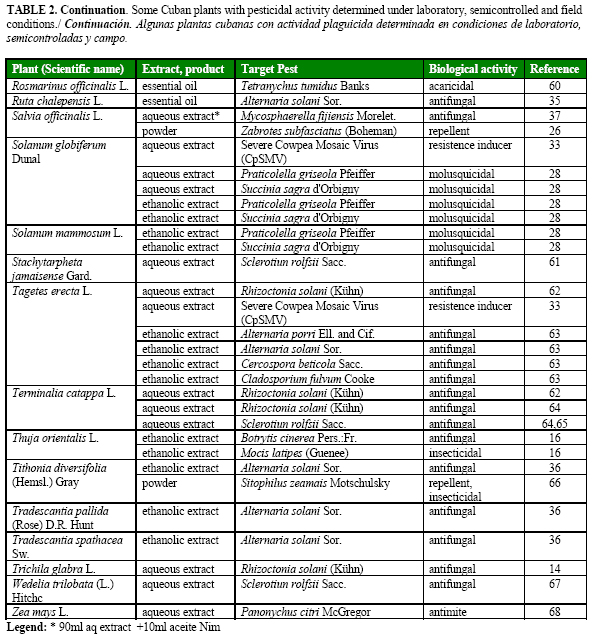
<body><![CDATA[<P><font size="2" face="Verdana, Arial, Helvetica, sans-serif">Considering the    influence of the whole plant diversity on insect pests and natural enemies,    some studies have been addressed to establish the effects of the direct sowing    (22) and the polycrops (23, 24, 25) on the entomophauna. The results showed    that the diversity in the crop systems (achieved by direct sowing of the plant    and the polycrops) reduced the incidence of the insect pests (22, 23, 24, 25)    and increased the species richness of bioregulators (23). The potential role    of the plant secondary metabolites in these interactions has not been established    and further research from the chemical ecology point of view should be done    in the frame of future multidisciplinary projects. </font>     <P><font size="2" face="Verdana, Arial, Helvetica, sans-serif">Endemic and exotic    species in the Cuban flora are potential sources of substances with regulatory    effect on populations of harmful organisms, but the real possibility of including    natural products extracted from plants into national programmes was not considered    until the end of the eighties and early nineties, when several research projects    on this subject were initiated (2, 7). Currently, several Cuban research institutes    and universities develope research lines related to bioactive secondary metabolites    with potential application in agriculture. <a href="/img/revistas/rpv/v28n2/t2a02213.jpg">Table    2a</a>, <a href="/img/revistas/rpv/v28n2/t2b02213.jpg">2b</a>, <a href="/img/revistas/rpv/v28n2/t2c02213.jpg">2c</a>,    <a href="/img/revistas/rpv/v28n2/t2d02213.jpg">2d</a> summarises the information    of some plants with a scientific description of their biological effectiveness    published in the main Cuban journals related to this topic (2). </font>      
<P><font size="2" face="Verdana, Arial, Helvetica, sans-serif">According to Alfonso    <I>et al.</I> (6), the biological activity of 52 species belonging to 30 botanical    families was reported until 2002. Considering both the number of species tested    with positive results and the bioactivity spectrum, the <I>Meliaceae</I>, <I>Asteraceae</I>,    <I>Fabaceae</I>, and <I>Solanaceae </I>were among the most important families<I>.</I>    The most significant species were the neem tree, the chinaberry (<I>Melia azedarach</I>    L.), the love apple (<I>Solanum mammosum</I> L) and the French marigold (<I>Tagetes    patula</I> L.) (2, 7, 69). Other botanical pesticides have been prepared from    <I>M. azedarach </I>(MELITOX 50, PARAISO-M), <I>Chrysanthemum cinense </I>Sabine,    <I>Tagetes erecta </I>L, <I>Solanum globiferum </I>Dunal (SOLASOL), <I>Gliricidia    sepium</I> J. (GLISEP 60) and <I>Indigofera suffruticosa </I>Mill (16, 18).    </font>     <P><font size="2" face="Verdana, Arial, Helvetica, sans-serif">In 1990, the agroindustrial    development of neem-based pesticides was begun in Cuba; this multidisciplinary    research programme included the widespread cultivation and production of bio-insecticides,    veterinary, and industrial products (1). The project for the industrial development    of neem and chinaberry as a second line considered 15 microforests (12 ha each,    six of neem and six of chinaberry), four semiindustrial processing plants (capacity    of 200 t.year<SUP>-1</SUP>) and a pilot plant for the industrial production    (7). The plantations were established in order to obtain natural products for    agricultural use in addition to contribute to recover unproductive marginal    land, increase the biomass and consequently improve the ecological environment    (1). </font>     <P><font size="2" face="Verdana, Arial, Helvetica, sans-serif">Till now, research    results have shown that the Cuban natural products based on neem are effective    in regulating insects, mites, nematodes, and molluscs that affect a large number    of economically important crops for our agriculture (vegetables, rice, tomato,    corn and beans) (1, 26, 28, 29, 30). Another advantage of using neem extracts    is their possible production in an artisan way (7). Up to date, the following    neem- based commercial products have been developed: CubaNim Sm (whole seed    aqueous extract), CubaNim-t (cake aqueous extract), FoliarNim HM (leaf aqueous    extract), CubaNim SM (whole grounded seed), CubaNim T (oilcake), OleoNim 80    EC and NeoNim 60 EC (seed oil emulsions), and DerNim P (cream to treat scabies)    (1). The last five products are in the Official List of Authorized Pesticides    in the Republic of Cuba (70) </font>     <P><font size="2" face="Verdana, Arial, Helvetica, sans-serif">As a result of    the problems caused by whiteflies in 1989-1990, simple technologies were developed    to extract nicotine from parts of leaves considered waste of the tobacco industry    (7, 50). Then the product known as &#171;tabaquina&#187; arose, which is now    widely used in the country (2). It is obtained by farmers and agricultural cooperatives    and has been used to control whitefly, thrips, and other pests (18, 50). The    tabaquina shows insecticidal activity and its residual effect is four days (7).    </font>     <P><font size="2" face="Verdana, Arial, Helvetica, sans-serif">During the last    years, the systematic research of more than 100 plants belonging to several    botanical families, such as <I>Clusiaceae</I> (genera <I>Calophyllum</I>, <I>Clusia</I>,    <I>Mammea</I>, and <I>Rheedia</I>) (13, 45, 46), <I>Piperaceae</I> (<I>Piper</I>,<I>    Lepianthes</I>) (35, 53, 54, 55, 56, 71), <I>Lamiaceae </I>(<I>Ocimum</I>) (35,    51), <I>Annonaceae</I> (<I>Annona</I>) (13), <I>Asteraceae</I> (<I>Lescaillea</I>,    <I>Vernonia</I>) (13), <I>Myrtaceae</I> (<I>Psidium</I>, <I>Melaleuca</I>) (35,    48), and <I>Poaceae</I> (<I>Arthrostilidium</I>, <I>Zea</I>) (13, 68), have    evolved using a chemotaxonomic approach. The protocol involves the establishment    of bioassay conditions, the isolation and characterisation of new bioactive    compounds, the determination of structural features related to biological activity,    and the semisynthesis of analogues (using classical or biotechnological techniques)    (13,45, 72). </font>     <P><font size="2" face="Verdana, Arial, Helvetica, sans-serif">In these studies,    plants were initially chosen for both their potential applications as botanical    pesticides and as lead compounds. Very rare species not previously studied from    a chemical or biological point of view (with great possibilities of discovering    novel compounds), as well as other abundant species (enough availability of    raw material for developing a botanical pesticide) were included. Under laboratory    and semicontrolled conditions, promising results have been achieved with coumarins    and essential oils obtained from plants belonging to the <I>Clusiaceae</I>,    <I>Piperaceae</I>, <I>Lamiaceae</I>, <I>Apiaceae</I>, and <I>Mirtaceae </I>families    (<a href="/img/revistas/rpv/v28n2/f0102213.gif">Figure</a>) (13, 45,46,    35, 48, 51, 52, 53, 56, 57, 71). </font>      
<P><font size="2" face="Verdana, Arial, Helvetica, sans-serif">An overview of    the work done in the area of research and development of botanical-based pesticides    in Cuba during the last years points out that several plants may represent viable    sources of alternatives for crop protection (<a href="/img/revistas/rpv/v28n2/t2a02213.jpg">Table    2a</a>, <a href="/img/revistas/rpv/v28n2/t2b02213.jpg">2b</a>, <a href="/img/revistas/rpv/v28n2/t2c02213.jpg">2c</a>,    <a href="/img/revistas/rpv/v28n2/t2d02213.jpg">2d</a>). More than 60 plants    demonstrated their pesticidal activity under laboratory, semicontrolled and    field conditions. <I>Meliaceae</I>, <I>Asteraceae</I>, <I>Fabaceae</I>, <I>Solanaceae,    Clusiaceae</I>, <I>Piperaceae</I>, <I>Lamiaceae</I>, <I>Apiaceae</I>, and <I>Mirtaceae</I>    were among the most important families<I>.</I> </font>      
<P><font size="2" face="Verdana, Arial, Helvetica, sans-serif">The analysis of    all these data allows the selection of promising natural products that may go    on to candidates for the development of commercial plant protection products.    The identification of candidates developing new phytosanitary products offer    new alternatives for the Cuban agriculture in the area of pest management in    citrus, sugarcane, vegetables, forestry, and in the control of storage pests    (7, 21, 34, 35, 44, 48, 51, 52, 53, 56, 66, 68). In spite of the progress achieved    in the scientific screening of the Cuban flora, many plant species have not    been studied yet (13, 21). </font>     ]]></body>
<body><![CDATA[<P><font size="2" face="Verdana, Arial, Helvetica, sans-serif">In much of the    research carried out, the biological evaluation did not go along with studies    on the chemical composition and the identification of the main bioactive compounds,    which is a very important issue considering the close relationship between both    aspects and its role in the reproducibility of biological effects. An analysis    of the worldwide trends of the scientific literature on botanicals and essential    oils calls attention to this aspect. It emphasises that the lack of chemical    characterisation does not allow comparing the results with any previous studies    with the same plant species and compromises the reproducibility of the results;    this study showed that the average impact factor of papers including chemical    data greatly exceeds that of papers lacking them (73). In Cuba, only &#188;    of the 66 papers reviewed included the identification of the main compounds    in the evaluated samples. Among the secondary metabolites studied by Cuban researches    until now, essential oils and their components stand out as a promising group    due to their efficacy and spectrum of action (39, 48, 51, 52, 55, 56, 60, 71).    </font>     <P><font size="2" face="Verdana, Arial, Helvetica, sans-serif">Also, the extract    concentration that provides the most efficient control has not yet been precisely    determined in some experiments. Most experiments have been carried out in laboratory    conditions and the biological evaluation under semicontrolled and field conditions    is essential for achieving a practical application. </font>     <P><font size="2" face="Verdana, Arial, Helvetica, sans-serif">For these promising    candidates, all the studies related to the raw material cultivation (unless    the plant has a very high wild abundance), formulation of the active ingredients,    scale up of the extraction process, toxicity tests, and the ecotoxicological    evaluation must be conducted for commercialising the products and contributing    to increase the impact of botanical pesticides on a sustainable food production    in Cuba. New research and innovation projects concerning the use of secondary    metabolites in pest management must be multidisciplinary and multiinstitutional    to improve the scientific and socioeconomic impact of the results. </font>     <P><font size="2" face="Verdana, Arial, Helvetica, sans-serif"><B>Potential of    plant secondary metabolites in pest management </B> </font>     <P><font size="2" face="Verdana, Arial, Helvetica, sans-serif">The analysis of    the use of several alternatives (biocontrol agents, botanical pesticides, crop    rotation, and others) in pest management in the Cuban agriculture led to a group    of important recommendations. Regarding plants, it was recommended to study    the flora species used as traps and with repellent effect, to continue research    on botanical-based products considering the Cuban biodiversity, to extend the    use of those most studied (like neem), to consider the potential of other promising    plants, and to increase the use of plants with pesticidal properties at a small    scale (7). </font>     <P><font size="2" face="Verdana, Arial, Helvetica, sans-serif">Concerning crop    protection, the Cuban agricultural development may be benefited by using whole    plants or extracting them through different processes. Plants with pest control    properties can be used in crop rotation, polycrops, and intercropping, and as    barrier (for example in push-pull strategies for controlling insects), or traps.    Further research must be done from the chemical ecology point of view to support    an efficient practical application of these alternatives in our agroecosystems.    Also the plants, part of them or the residues from their harvesting or industrial    proccessing may be applied as green manure for a natural pest management (7,    61). </font>     <P><font size="2" face="Verdana, Arial, Helvetica, sans-serif">As botanical pesticides,    the main areas of application may be found in protected crops, nurseries, seed    treatments in protected and field-grown crops, and storage pest management.    The combination of plant extracts with other types of plant protection products    traditionally used by Cuban farmers can be promoted in a near future; improvement    of the effectiveness and/or stability of some biological control agents, or    the reduction of the application frequency and dosis of a chemical synthetic    treatment may be some of the advantages of the new combined formulations. Additionally,    the potential of plant secondary metabolites as resistance inducers may allow    the management of complex phytosanitary problems by using some plant extracts    in different agricultural systems. </font>     <P><font size="2" face="Verdana, Arial, Helvetica, sans-serif"><B>General Comments</B>    </font>     <P><font size="2" face="Verdana, Arial, Helvetica, sans-serif">The Cuban flora    has not yet been fully studied as a potential source of pesticides, partly due    to its great diversity. Nevertheless, up to date, the use of known botanicals    and the identification of local candidates for developing phytosanitary products    offer alternatives that may combine efficiency and safety for the Cuban agriculture    in pest management. Multidisciplinary and multiinstitucional research, and development    and innovation programmes will play an important role in the scientific and    socioeconomic impact of these plant protection products for contributing to    a sustainable food production.</font>     <P>&nbsp; <H1> <font size="2" face="Verdana, Arial, Helvetica, sans-serif"><B><font size="3">ACKNOWLEDGMENTS</font></B>    </font></H1>     ]]></body>
<body><![CDATA[<P><font size="2" face="Verdana, Arial, Helvetica, sans-serif">We thank Dr. Eduardo    Sistachs and Dr. Mayra G. Rodr&iacute;guez for carefully and helpfully reviewing    this manuscript.</font>     <P>&nbsp; <H1> <font size="2" face="Verdana, Arial, Helvetica, sans-serif"><B><font size="3">REFERENCES</font></B>    </font></H1>     <!-- ref --><P><font size="2" face="Verdana, Arial, Helvetica, sans-serif">1. Estrada Ortiz    J, L&oacute;pez D&iacute;az MT, Castillo Rodr&iacute;guez BZ, D&iacute;az Fish    V. Potencialidades del uso del Nim y sus bioproductos en la producci&oacute;n    agropecuaria ecol&oacute;gica y sostenible. Agricultura Org&aacute;nica. 2002;8(3):18-21.        </font>     <!-- ref --><P><font size="2" face="Verdana, Arial, Helvetica, sans-serif">2. V&aacute;zquez    Moreno LL. La lucha contra las plagas agr&iacute;colas en Cuba. De las aplicaciones    de plaguicidas qu&iacute;micos por calendario al manejo agroecol&oacute;gico    de plagas. Fitosanidad. 2006;10 (3):221-242.     </font>     <!-- ref --><P><font size="2" face="Verdana, Arial, Helvetica, sans-serif">3. V&aacute;zquez    Moreno LL. Transici&oacute;n del manejo de plagas en la producci&oacute;n agropecuaria    en Cuba. Agricultura Org&aacute;nica. 2012;18(2):21-25.     </font>     <!-- ref --><P><font size="2" face="Verdana, Arial, Helvetica, sans-serif">4. Figueroa Gonz&aacute;lez    ZI, P&eacute;rez-Consuegra N. Tendencias en el uso de plaguicidas en el municipio    Col&oacute;n, provincia Matanzas. Agricultura Org&aacute;nica. 2012;18(2):10-14.        </font>     ]]></body>
<body><![CDATA[<!-- ref --><P><font size="2" face="Verdana, Arial, Helvetica, sans-serif">5. Ministerio de    Ciencia Tecnolog&iacute;a y Medio Ambiente (CITMA). Estrategia Ambiental Nacional    2007-2010. Rep&uacute;blica de Cuba. 2007; 60p.     </font>      <!-- ref --><P><font size="2" face="Verdana, Arial, Helvetica, sans-serif">6. Alfonso M, Avil&eacute;s    R, Gonz&aacute;lez N, Cruz X, Villasana R, Rodr&iacute;guez V, <I>et al</I>.    Los plaguicidas bot&aacute;nicos y su importancia en la agricultura org&aacute;nica.    Agricultura Org&aacute;nica. 2002;2:26-30.     </font>     <!-- ref --><P><font size="2" face="Verdana, Arial, Helvetica, sans-serif">7. P&eacute;rez    N, V&aacute;zquez LL. Manejo ecol&oacute;gico de plagas. En: Funes F, Garc&iacute;a    L, Bourque M, P&eacute;rez N, Rosset P, editors. Asociaci&oacute;n Cubana de    T&eacute;cnicos Agr&iacute;colas y Forestales (ACTAF). Transformando el campo    cubano. La Habana. 2001;191-224.     </font>      <!-- ref --><P><font size="2" face="Verdana, Arial, Helvetica, sans-serif">8. Ley de Medio    Ambiente, Ley No. 81, Rep&uacute;blica de Cuba. (Julio, 1997).     </font>     <!-- ref --><P><font size="2" face="Verdana, Arial, Helvetica, sans-serif">9. Hern&aacute;ndez    N&uacute;&ntilde;ez J, P&eacute;rez-Consuegra N. Tendencias en el uso de plaguicidas    en Bataban&oacute;, provincia Mayabeque. Agricultura Org&aacute;nica. 2012;18(1):30-33.        </font>     ]]></body>
<body><![CDATA[<!-- ref --><P><font size="2" face="Verdana, Arial, Helvetica, sans-serif">10.Hedin PA, Hollingworth    RM, Masler EP, Miyamoto J, Thompson DG. Phytochemicals for Pest Control. Washington    DC; 1997.     </font>     <!-- ref --><P><font size="2" face="Verdana, Arial, Helvetica, sans-serif">11.Isman MB. Botanical    Insecticides, Deterrents, Repellents and Oils. In: Bharat P. Singh ed.<I> </I>Industrial    Crops and Uses.<I> </I>&#169;CAB International; 2010 p. 433-445.     </font>     <!-- ref --><P><font size="2" face="Verdana, Arial, Helvetica, sans-serif">12.Smith K, Evans    DA, El-Hiti GA. Role of modern chemistry in sustainable arable crop protection.    Phil Trans R Soc B. 2008;363:623-637.     </font>     <!-- ref --><P><font size="2" face="Verdana, Arial, Helvetica, sans-serif">13.Pino O, Jorge    F, Leon O, Khambay BPS, Branford-White C. Cuban flora as a source of bioactive    compounds. The International Journal of Cuban Studies. 2008;1(1):1-9.     </font>     <!-- ref --><P><font size="2" face="Verdana, Arial, Helvetica, sans-serif">14.Puente IM, Allaert    K, Herrera IL, Su&aacute;rez N, Torres GS, P&eacute;rez NC, <I>et al.</I> Determinaci&oacute;n    de la actividad alelop&aacute;tica de extractos vegetales sobre algunos hongos    fitopat&oacute;genos del suelo. Centro Agricola. 2003;30(1):64-68.     </font>     ]]></body>
<body><![CDATA[<!-- ref --><P><font size="2" face="Verdana, Arial, Helvetica, sans-serif">15.Rodr&iacute;guez    Y, Fuentes JE, Morales S, Villate M, Carmona D. Contribuci&oacute;n etnobot&aacute;nica    de plantas medicinales en el municipio de San Luis, Pinar del R&iacute;o, Cuba.    Centro Agr&iacute;cola. 2007;34(4):5-10.     </font>     <!-- ref --><P><font size="2" face="Verdana, Arial, Helvetica, sans-serif">16.Ortiz Y, Spengler    I, Avil&eacute;s R, Rodr&iacute;guez Y, Alvarez ME, Lorenzo Y, <I>et al.</I>    Agroqu&iacute;micos naturales a partir de plantas cubanas. Agrotecnia de Cuba.    2009;33(1):28-35.     </font>     <!-- ref --><P><font size="2" face="Verdana, Arial, Helvetica, sans-serif">17.Roig Mesa J.    Plantas Medicinales, Arom&aacute;ticas o Venenosas de Cuba. Editora del Consejo    Nacional de Universidades, La Habana, Cuba. 1988.     </font>     <!-- ref --><P><font size="2" face="Verdana, Arial, Helvetica, sans-serif">18.Rodr&iacute;guez    Nodals A, Companioni Concepci&oacute;n N, Fresneda Buides J, Estrada Ortiz J,    Ca&ntilde;et Prades F, Rey Garc&iacute;a R, <I>et al</I>. Manual t&eacute;cnico    para organop&oacute;nicos, huertos intensivos y organopon&iacute;a semiprotegida.    Mart&iacute;nez Oliva E, editor. Instituto de Investigaciones Fundamentales    en Agricultura Tropical (INIFAT). 7 ed. La Habana, Cuba. 2011.     </font>      <!-- ref --><P><font size="2" face="Verdana, Arial, Helvetica, sans-serif">19.Ortega I, Castellanos    L, Rivero T, Mart&iacute;n C, Fern&aacute;ndez A. Inventario de plantas repelentes    y/o fitoplaguicidas en las unidades de la agricultura urbana de la provincia    de Cienfuegos. Centro Agr&iacute;cola. 2008; 35(1):91-93.     </font>     ]]></body>
<body><![CDATA[<!-- ref --><P><font size="2" face="Verdana, Arial, Helvetica, sans-serif">20.Veit&iacute;a    Rubio MM. Cultivo, preparaci&oacute;n y uso de plantas con propiedades como    plaguicidas. Curso taller Nacional manejo agroecol&oacute;gico de plagas en    la agricultura suburbana: Programa de agricultura urbana y suburbana. MINAGRI.    Ciudad de La Habana, Cuba. 2010;1-12.     </font>      <!-- ref --><P><font size="2" face="Verdana, Arial, Helvetica, sans-serif">21.Montesino M,    L&oacute;pez H, Hern&aacute;ndez J, Izag&uuml;irre Z. Insecticidas bot&aacute;nicos    como alternativas para el manejo de plagas en sistemas agroforestales. Agricultura    Org&aacute;nica. 2009;1: 24-26.     </font>     <!-- ref --><P><font size="2" face="Verdana, Arial, Helvetica, sans-serif">22.Cruz Limonte    A, Betancour Sardi&ntilde;as JA, &Aacute;lvarez Hern&aacute;ndez U, S&aacute;nchez    Tompson Gretter. Influencia de la siembra directa de <I>Canavalia ensiformes</I>    (L.) sobre <I>Empoasca</I> spp. Centro Agr&iacute;cola. 2010;37(2):93.     </font>     <!-- ref --><P><font size="2" face="Verdana, Arial, Helvetica, sans-serif">23.&Aacute;lvarez    Hern&aacute;ndez U, Cruz Limonte A. Influencia del policultivo en soya (<I>Glycine    max</I> (L.) Merril) sobre la entomofauna. Centro Agr&iacute;cola. 2010;37(1):77-79.        </font>     <!-- ref --><P><font size="2" face="Verdana, Arial, Helvetica, sans-serif">24.Garc&iacute;a    Gonz&aacute;lez MT, Rojas Rojas JA, Castellanos Gonz&aacute;lez L, Enjamio Jim&eacute;nez    D. Policultivo (ma&iacute;z-calabaza) en el control de <I>Spodoptera frugiperda</I>    (Smith) en Fomento, Sancti Spiritus. Centro Agr&iacute;cola. 2010;37(1):57-64.        </font>     ]]></body>
<body><![CDATA[<!-- ref --><P><font size="2" face="Verdana, Arial, Helvetica, sans-serif">25.Sur&iacute;s    M, Mart&iacute;nez MA, Leyva A. Evaluaci&oacute;n de da&ntilde;os causados por    <I>Cylas formicarius</I> (Coleoptera: Curculionidae) y <I>Typophorus nigritus</I>    (Coleoptera: Chrysomelidae) en el cultivo del boniato asociado al ma&iacute;z.    Rev Protecci&oacute;n Veg. 1995;10(2):181-184.     </font>     <!-- ref --><P><font size="2" face="Verdana, Arial, Helvetica, sans-serif">26.Vald&eacute;s    R, Pozo E, Moya A, Cardenas M. Efecto de 7 especies de plantas sobre <I>Zabrotes    subfasciatus</I> (Bohemann). Centro Agr&iacute;cola. 2010;37(4):83-88.     </font>     <!-- ref --><P><font size="2" face="Verdana, Arial, Helvetica, sans-serif">27.Rivera Amita    MM, Carballo Guerra C, Milan&eacute;s Figueredo M, Ramos G&aacute;lvez R, Orama    Velazco RA. Efecto de plaguicidas de origen bot&aacute;nico sobre el &aacute;fido    <I>Carolinaia cyperi</I> Ainslie. Rev Cubana Plant Med. 2003;8(3).     </font>     <!-- ref --><P><font size="2" face="Verdana, Arial, Helvetica, sans-serif">28.Alfonso MM,    Avil&eacute;s R, Alvarez ME, Lorenzo Y, Zayas M, Rodr&iacute;guez V, et al.    Molusquicidas naturales de origen bot&aacute;nico. Agrotecnia de Cuba. 2005;1-15.        </font>      <!-- ref --><P><font size="2" face="Verdana, Arial, Helvetica, sans-serif">29.L&oacute;pez    MT, Estrada J. Los bioinsecticidas de Nim en el control de varias plagas de    insectos en cultivos econ&oacute;micos. Agrotecnia de Cuba. 2005;1-10.     </font>      ]]></body>
<body><![CDATA[<!-- ref --><P><font size="2" face="Verdana, Arial, Helvetica, sans-serif">30.Moreno M, Estrada    J, Shagarodsky T, Croche G, Cruz B, Centeno E, et al. Bioplaguicidas de Nim    sobre <I>Heliothis virescens</I> F. (Lepidoptera:Noctuidae) en el cultivo del    garbanzo. Fitosanidad. 2008;12(3):165.     </font>      <!-- ref --><P><font size="2" face="Verdana, Arial, Helvetica, sans-serif">31.Stefanova Nalimova    M, Rizo Pe&ntilde;a SG, Coranado Izquierdo MF. Efecto <I>in vitro</I> de extractos    de plantas sobre especies bacterianas del g&eacute;nero <I>Xanthomonas</I>.    Fitosanidad. 2005;9(3):49-52.     </font>     <!-- ref --><P><font size="2" face="Verdana, Arial, Helvetica, sans-serif">32.Molina MM, S&aacute;nchez    LM. Inhibidores foliares de <I>Bougainvillea spectabilis</I>, naturaleza qu&iacute;mica    y efectividad antiviral sobre el virus del mosaico de la ca&ntilde;a de az&uacute;car    (VMCA). Rev Protecci&oacute;n Veg. 1991;6(1):58-66.     </font>     <!-- ref --><P><font size="2" face="Verdana, Arial, Helvetica, sans-serif">33.Rodr&iacute;guez    Y, Ortiz Y, Olivera G, Lorenzo Y, Cabezas M, Rodr&iacute;guez W. Uso de extractos    vegetales para el control del mosaico severo del caup&iacute; (CpSMV). Agrotecnia    de Cuba. 2005;1-9.     </font>      <!-- ref --><P><font size="2" face="Verdana, Arial, Helvetica, sans-serif">34.Gonz&aacute;lez    S, Pino O, Herrera RS, Valenciaga N, Fortes D, S&aacute;nchez Y. Control de    <I>Sitophilus zeamais </I>con polvos vegetales de una especie de la familia    Fabacea (49-1-XIV). Revista Cubana de Ciencia Agr&iacute;cola. 2009;43(3):321-325.        </font>     ]]></body>
<body><![CDATA[<!-- ref --><P><font size="2" face="Verdana, Arial, Helvetica, sans-serif">35.Duarte Y, Pino    O, Infante D, S&aacute;nchez Y, Travieso MC, Mart&iacute;nez B. Efecto in vitro    de aceites esenciales sobre <I>Alternaria solani</I> Sorauer. Rev Protecci&oacute;n    Veg. 2013;28(1):54-59.     </font>     <!-- ref --><P><font size="2" face="Verdana, Arial, Helvetica, sans-serif">36.Pupo Blanco    YG, Kalombo Bicayi D, Herrera Isla L, Malheiros de Mendonca DI, Vargas Batis    B. Efecto de extractos vegetales en el crecimiento y germinaci&oacute;n de esporas    de <I>Alternaria solani</I> (E. &amp; M.) J. &amp; G. en condiciones <I>in vitro</I>.    Rev Iberoam Micol. 2011;28(1):60.     </font>     <!-- ref --><P><font size="2" face="Verdana, Arial, Helvetica, sans-serif">37.Morales LM,    Ullauri MA, Rojas X. Evaluaci&oacute;n del efecto de extractos vegetales como    alternativa de manejo a la sigatoka negra en el cultivar Gran Enano (AAA). Centro    Agr&iacute;cola. 2011;38(2):77-84.     </font>     <!-- ref --><P><font size="2" face="Verdana, Arial, Helvetica, sans-serif">38.S&aacute;nchez    C, Cruz M, Martin L, Leiva M, Cruz M, Alvarado Y, <I>et al.</I> Actividad antif&uacute;ngica    del aceite esencial de <I>Cymbopogon nardus</I> para el control de <I>Macrophomina    phaseolina. </I>Centro Agr&iacute;cola. 2008;35(3):83-86.     </font>     <!-- ref --><P><font size="2" face="Verdana, Arial, Helvetica, sans-serif">39.Vaillant D,    Romeu C, Ramos E, Gonz&aacute;lez M, Ram&iacute;rez R, Gonz&aacute;lez J. Efecto    inhibitorio <I>in vitro</I> de cinco monoterpenos de aceites esenciales sobre    un aislado de <I>Rhizoctonia solani</I> en papa (<I>Solanum tuberosum</I> L.).    Fitosanidad. 2009;13(3):197-200.     </font>     ]]></body>
<body><![CDATA[<!-- ref --><P><font size="2" face="Verdana, Arial, Helvetica, sans-serif">40.Castellanos    L, Fern&aacute;ndez A, Ortega I, Soto R, Martin C. Efectividad del extracto    de <I>Furcraea hexapetala</I> (Jacq.) Urban sobre <I>Polyphagotarsonemus latus</I>    Banks en condiciones de laboratorio. Rev Protecci&oacute;n Veg. 2011;26(2):122-124.        </font>      <!-- ref --><P><font size="2" face="Verdana, Arial, Helvetica, sans-serif">41.de la Guardia    AM, Gonz&aacute;lez Morera TA, Marrero Terrero AA, Mili&aacute;n Hern&aacute;ndez    V, Campa&ntilde;&aacute; Castellanos H, <I>et al.</I> Obtenci&oacute;n de un    extracto plaguicida de <I>Gliricidia sepium</I> (Jaq.) Steud bajo la irradiaci&oacute;n    con microondas. Rev Cubana Plant Med. 2003;8(3).     </font>     <!-- ref --><P><font size="2" face="Verdana, Arial, Helvetica, sans-serif">42.P&eacute;rez    W, Bernal B, Mart&iacute;n A, Romeu C. Estudio preliminar de dos extractos vegetales    para el control <I>in vitro</I> del hongo <I>Corynespora cassicola </I>(Berk    &amp; Curt) Wei. Fitosanidad. 2000;4(1-2):43-46.     </font>     <!-- ref --><P><font size="2" face="Verdana, Arial, Helvetica, sans-serif">43.P&eacute;rez    W, Romeu Carballo CR, Mart&iacute;n de la Guardia A, Gonz&aacute;lez T, Escobar    M, Vento D&iacute;az D. <I>Lantana camara</I> L., maleza con propiedades plaguicidas.    Rev Protecci&oacute;n Veg. 2002;17(2):162.     </font>      <!-- ref --><P><font size="2" face="Verdana, Arial, Helvetica, sans-serif">44.Gonz&aacute;lez    S, Pino O, Herrera R S, Valenciaga N, Fortes D, S&aacute;nchez Y. Potencials    of the powders of <I>Lonchocarpus punctatus </I>in the control of <I>Sitophilus    zeamais.</I> Cuban Journal of Agricultural Science. 2011; 45(1):89-94.     </font>     ]]></body>
<body><![CDATA[<!-- ref --><P><font size="2" face="Verdana, Arial, Helvetica, sans-serif">45.Pino PO, Jorge    LF, Tacoronte MJE, Khambay BPS. Aislamiento y caracterizaci&oacute;n de candidatos    plaguicidas a partir de <I>Mammea americana</I> Lin. Fitosanidad. 2008;12(3):177-178.        </font>      <!-- ref --><P><font size="2" face="Verdana, Arial, Helvetica, sans-serif">46.Pino O, Jorge    F, Tacoronte JE, Khambay BPS. Isolation and characterization of active compounds    from <I>Mammea americana</I> Lin. Revista Cubana de Qu&iacute;mica. 2007;XIX(1):74-77.        </font>     <!-- ref --><P><font size="2" face="Verdana, Arial, Helvetica, sans-serif">47.Fern&aacute;ndez    de la Torre A, Nogueiras-Lima C, Romeu-Carballo C, Palacios JR, Naranjo-Chamizo    E, Marbot-Ramada R, et al. Estudio fitoqu&iacute;mico preliminar y actividad    fungicida de corteza de <I>Maytenus urquiolae</I> Mory (Celastraceae). Fitosanidad.    2010;14(4):247-252.     </font>     <!-- ref --><P><font size="2" face="Verdana, Arial, Helvetica, sans-serif">48.Pino O, S&aacute;nchez    Y, Rojas M, Rodr&iacute;guez H, Abreu Y, Duarte Y, <I>et al.</I> Composici&oacute;n    qu&iacute;mica y actividad plaguicida del aceite esencial de <I>Melaleuca quinquenervia    </I>(Cav) S.T. Blake. Rev Protecci&oacute;n Veg. 2011;26(3):177-186.     </font>     <!-- ref --><P><font size="2" face="Verdana, Arial, Helvetica, sans-serif">49.Pozo E, Contreras    A. Efecto del para&iacute;so (<I>Melia azedarach</I> (L.)) en polvo vegetal    como insecticida sobre el gorgojo menor de los granos <I>Rhyzopertha dominica</I>    (F.) en arroz. Centro Agr&iacute;cola. 2005;32(2):858-857.     </font>     ]]></body>
<body><![CDATA[<!-- ref --><P><font size="2" face="Verdana, Arial, Helvetica, sans-serif">50.Su&aacute;rez    Jim&eacute;nez P, Padr&oacute;n Soroa J, Dierskmeier Corchera G, B&eacute;cquer    Portuondo A, Mart&iacute;nez M, Cruz C, <I>et al.</I> Generalizaci&oacute;n    del empleo de cal y nicotina en Cuba en el control de plagas y enfermedades.    Fitosanidad.<I> </I>2008;12(3):185-186.     </font>     <!-- ref --><P><font size="2" face="Verdana, Arial, Helvetica, sans-serif">51.Rojas MM, S&aacute;nchez    Y, Abreu Y, Espinosa I, Correa TM, Pino O. Caracterizaci&oacute;n qu&iacute;mica    y actividad antibacteriana de aceites esenciales de <I>Ocimum basilicum </I>L.    y <I>Ocimum basilicum </I>var. <I>genovese</I> L. Rev Protecci&oacute;n Veg.    2012;27(2):130-134.     </font>     <!-- ref --><P><font size="2" face="Verdana, Arial, Helvetica, sans-serif">52.Pino O, S&aacute;nchez    Y, Rojas MM, Abreu Y, Correa T. Composici&oacute;n qu&iacute;mica y actividad    antibacteriana del aceite esencial de <I>Pimpinella anisum</I> L. Rev Protecci&oacute;n    Veg. 2012;27(3)181-187.     </font>     <!-- ref --><P><font size="2" face="Verdana, Arial, Helvetica, sans-serif">53.P&eacute;rez    JC, Pino O, Ram&iacute;rez S, Suris M. Evaluaci&oacute;n de productos naturales    para el control de <I>Lasioderma serricorne</I> (F.) (Coleoptera: Anobiidae)    sobre garbanzo (<I>Cicer arietinum</I> L.) en condiciones de laboratorio. Rev    Protecci&oacute;n Veg. 2012;27(1):26-33.     </font>     <!-- ref --><P><font size="2" face="Verdana, Arial, Helvetica, sans-serif">54.S&aacute;nchez    Y, Pino O, Jorge F, Abreu Y, Naranjo E, Iglesia A. Actividad promisoria de aceites    esenciales de especies pertenecientes a la tribu <I>Pipereae</I> frente a <I>Artemia    salina </I>y <I>Xanthomonas albilineans. </I>Rev Protecci&oacute;n Veg. 2011;26(1):45-51.        </font>     ]]></body>
<body><![CDATA[<!-- ref --><P><font size="2" face="Verdana, Arial, Helvetica, sans-serif">55.S&aacute;nchez    Y, Pino O, Correa TM, Naranjo E, Iglesia A. Estudio qu&iacute;mico y microbiol&oacute;gico    del aceite esencial de <I>Piper auritum </I>Kunth (caisim&oacute;n de an&iacute;s)<I>.    </I>Rev Protecci&oacute;n Veg. 2009;24(1):39-46.     </font>      <!-- ref --><P><font size="2" face="Verdana, Arial, Helvetica, sans-serif">56.S&aacute;nchez    Y, Correa TM, Abreu Y, Mart&iacute;nez B, Duarte Y, Pino O. Caracterizaci&oacute;n    qu&iacute;mica y actividad antimicrobiana del aceite esencial de <I>Piper marginatum    </I>Jacq.<I> </I>Rev Protecci&oacute;n Veg. 2011;26(3):170-176.     </font>      <!-- ref --><P><font size="2" face="Verdana, Arial, Helvetica, sans-serif">57.S&aacute;nchez    Y, Correa TM, Abreu Y, Pino O. Efecto del aceite esencial de <I>Piper marginatum    </I>Jacq. y sus componentes sobre <I>Xanthomonas albilineans </I>(Ashby) Dawson.<I>    </I>Rev Protecci&oacute;n Veg. 2012;27(1):39-44.     </font>      <!-- ref --><P><font size="2" face="Verdana, Arial, Helvetica, sans-serif">58.Vilches E, del    Pozo EM, Garc&iacute;a I. Alternativas ecol&oacute;gicas para la regulaci&oacute;n    de tres insectos plagas de la col en la Finca El Guayabal. Agricultura Org&aacute;nica.    2012;18(2):7-9.     </font>     <!-- ref --><P><font size="2" face="Verdana, Arial, Helvetica, sans-serif">59.Ortiz Y, Vald&eacute;s    D, Villa O, Alvares R, Torres S. Aplicaci&oacute;n de extractos de hojas de    <I>Ricinus communis</I> L. en el control de la Broca del cafeto. Centro Agr&iacute;cola.    2012;39(1):85-90.     </font>     ]]></body>
<body><![CDATA[<!-- ref --><P><font size="2" face="Verdana, Arial, Helvetica, sans-serif">60.Romeu R, Botta    FE, D&iacute;az Y. Caracterizaci&oacute;n fitoqu&iacute;mica del aceite esencial    de romero (<I>Rosmarinus officinalis</I> L.) y evaluaci&oacute;n <I>in vitro</I>    de su actividad acaricida. Fitosanidad. 2007;11(2):75-78.     </font>      <!-- ref --><P><font size="2" face="Verdana, Arial, Helvetica, sans-serif">61.Puente M, Torres    S, Herrera L, Robaina M, De Cupere F. Determinaci&oacute;n del efecto del extracto    <I>Stachytarpheta jamaisense</I> Gard. (<I>Verbena cimarrona</I>) sobre el crecimiento    <I>in vitro</I> del hongo <I>Sclerotium rolfsii</I> Sacc. Centro Agr&iacute;cola.    2005;32(3):89-91.     </font>     <!-- ref --><P><font size="2" face="Verdana, Arial, Helvetica, sans-serif">62.Espejo F, Espinosa    R, Puente M, Cupull R, Rodr&iacute;guez M. Efecto alelop&aacute;tico de <I>Tagetes    erecta</I> L. y <I>Terminalia catappa</I> L. sobre <I>Rhizoctonia solani</I>    (K&uuml;hn). Centro Agr&iacute;cola. 2010;37(2):89-92.     </font>     <!-- ref --><P><font size="2" face="Verdana, Arial, Helvetica, sans-serif">63.Pupo Y, Herrera    L, Vargas B, Marrero Y, Raquel A, Jim&eacute;nez C. Efecto del extracto crudo    de hojas de <I>Tagetes erecta</I> L. en el control de cuatro hongos pat&oacute;genos    de hortalizas &#171;<I>in vitro</I>&#187;. Centro Agr&iacute;cola. 2009;36(2):77-81.        </font>     <!-- ref --><P><font size="2" face="Verdana, Arial, Helvetica, sans-serif">64.Espinosa R,    Herrera L, Bravo R, Hernandez M, Torres S, Ramos Y, et al. Efecto sin&eacute;rgico    de taninos y flavonoides presentes en <I>Terminalia catappa</I> L. sobre el    crecimiento micelial de <I>Rhizoctonia solani</I> K&uuml;hn y <I>Sclerotium    rolfsii</I> Sacc. Fitosanidad. 2012;16(1):27-32.     </font>     ]]></body>
<body><![CDATA[<!-- ref --><P><font size="2" face="Verdana, Arial, Helvetica, sans-serif">65.Espinosa R,    Bravo LR, Herrera L, Ramos Y, Espinosa M. Efecto alelop&aacute;tico del almendro    de la India (<I>Terminalia catappa</I> L.) sobre <I>Sclerotium rolfsii</I> Sacc.    Rev Protecci&oacute;n Veg. 2012;27(3):202-205.     </font>     <!-- ref --><P><font size="2" face="Verdana, Arial, Helvetica, sans-serif">66.Gonz&aacute;lez    S, Pino O, Herrera RS, Valenciaga N, Fortes D, S&aacute;nchez Y. Una especie    de la familia Asteraceae (89-1-XIV) con actividad antiinsecto frente a la plaga    <I>Sitophilus zeamais</I>.<I> </I>Revista Cubana de Ciencia Agr&iacute;cola.    2010;44(2):195-199.     </font>     <P><font size="2" face="Verdana, Arial, Helvetica, sans-serif">67.Puente M, Robaina    M, Espinosa R, Torres S, Herrera L, De Cupere F, Van Damme P. Determinaci&oacute;n    del efecto del extracto de <I>Wedelia trilobata</I> (L.) Hitchc. sobre el crecimiento    <I>in vitro</I> del hongo <I>Sclerotium rolfsii</I> Sacc. Centro Agr&iacute;cola.    2004;31(1-2):81-83. </font>     <!-- ref --><P><font size="2" face="Verdana, Arial, Helvetica, sans-serif">68.Rodr&iacute;guez    H, Ramos M, Pino O, D&iacute;az B.<B> </B>Toxicidad del extracto crudo de ma&iacute;z    sobre <I>Panonychus citri</I> (Mcgregor) en condiciones de laboratorio. Rev    Protecci&oacute;n Veg. 2011;26(2):105-110.     </font>     <!-- ref --><P><font size="2" face="Verdana, Arial, Helvetica, sans-serif">69.Hern&aacute;ndez    M, Fuentes V, Alfonso M, Avil&eacute;s R, Perera E. Instituto de Investigaciones    Fundamentales en Agricultura Tropical, INIFAT, Plaguicidas naturales de origen    bot&aacute;nico. La Habana, Cuba. 1998; 105p.     </font>      <!-- ref --><P><font size="2" face="Verdana, Arial, Helvetica, sans-serif">70.Registro Central    de Plaguicidas. Lista oficial de plaguicidas autorizados 2008-2010. Rep&uacute;blica    de Cuba.     </font>      <!-- ref --><P><font size="2" face="Verdana, Arial, Helvetica, sans-serif">71.Pino O, S&aacute;nchez    Y, Rodr&iacute;guez H, Correa TM, Demedio J, Sanabria JL. Caracterizaci&oacute;n    qu&iacute;mica y actividad acaricida del aceite esencial de <I>Piper aduncum    </I>subsp. <I>ossanum </I>frente a <I>Varroa destructor. </I>Rev Protecci&oacute;n    Veg. 2011;26(1):52-61.     </font>     <!-- ref --><P><font size="2" face="Verdana, Arial, Helvetica, sans-serif">72.Pino O, Jorge    F. Ensayo de artemia: &uacute;til herramienta de trabajo para ecotoxic&oacute;logos    y qu&iacute;micos de productos naturales. Rev Protecci&oacute;n Veg. 2010;22(1):34-43.        </font>     <!-- ref --><P><font size="2" face="Verdana, Arial, Helvetica, sans-serif">73.Isman MB. Botanical    insecticides in modern agriculture and an increasingly regulated world. Conference    at National Center for Animal and Plant Health (CENSA), Mayabeque, Cuba. 2013.    51 slides.    </font>      <P>&nbsp;     <P>&nbsp;     <P><font size="2" face="Verdana, Arial, Helvetica, sans-serif">Recibido: 2-5-2013.    ]]></body>
<body><![CDATA[<br>   </font><font size="2" face="Verdana, Arial, Helvetica, sans-serif">Aceptado:    30-7-2013.</font>      ]]></body><back>
<ref-list>
<ref id="B1">
<label>1</label><nlm-citation citation-type="journal">
<person-group person-group-type="author">
<name>
<surname><![CDATA[Estrada Ortiz]]></surname>
<given-names><![CDATA[J]]></given-names>
</name>
<name>
<surname><![CDATA[López Díaz]]></surname>
<given-names><![CDATA[MT]]></given-names>
</name>
<name>
<surname><![CDATA[Castillo Rodríguez]]></surname>
<given-names><![CDATA[BZ]]></given-names>
</name>
<name>
<surname><![CDATA[Díaz Fish]]></surname>
<given-names><![CDATA[V]]></given-names>
</name>
</person-group>
<article-title xml:lang="es"><![CDATA[Potencialidades del uso del Nim y sus bioproductos en la producción agropecuaria ecológica y sostenible]]></article-title>
<source><![CDATA[Agricultura Orgánica]]></source>
<year>2002</year>
<volume>8</volume>
<numero>3</numero>
<issue>3</issue>
<page-range>18-21</page-range></nlm-citation>
</ref>
<ref id="B2">
<label>2</label><nlm-citation citation-type="journal">
<person-group person-group-type="author">
<name>
<surname><![CDATA[Vázquez Moreno]]></surname>
<given-names><![CDATA[LL]]></given-names>
</name>
</person-group>
<article-title xml:lang="es"><![CDATA[La lucha contra las plagas agrícolas en Cuba: De las aplicaciones de plaguicidas químicos por calendario al manejo agroecológico de plagas]]></article-title>
<source><![CDATA[Fitosanidad]]></source>
<year>2006</year>
<volume>10</volume>
<numero>3</numero>
<issue>3</issue>
<page-range>221-242</page-range></nlm-citation>
</ref>
<ref id="B3">
<label>3</label><nlm-citation citation-type="journal">
<person-group person-group-type="author">
<name>
<surname><![CDATA[Vázquez Moreno]]></surname>
<given-names><![CDATA[LL]]></given-names>
</name>
</person-group>
<article-title xml:lang="es"><![CDATA[Transición del manejo de plagas en la producción agropecuaria en Cuba]]></article-title>
<source><![CDATA[Agricultura Orgánica]]></source>
<year>2012</year>
<volume>18</volume>
<numero>2</numero>
<issue>2</issue>
<page-range>21-25</page-range></nlm-citation>
</ref>
<ref id="B4">
<label>4</label><nlm-citation citation-type="journal">
<person-group person-group-type="author">
<name>
<surname><![CDATA[Figueroa González]]></surname>
<given-names><![CDATA[ZI]]></given-names>
</name>
<name>
<surname><![CDATA[Pérez-Consuegra]]></surname>
<given-names><![CDATA[N]]></given-names>
</name>
</person-group>
<article-title xml:lang="es"><![CDATA[Tendencias en el uso de plaguicidas en el municipio Colón, provincia Matanzas]]></article-title>
<source><![CDATA[Agricultura Orgánica]]></source>
<year>2012</year>
<volume>18</volume>
<numero>2</numero>
<issue>2</issue>
<page-range>10-14</page-range></nlm-citation>
</ref>
<ref id="B5">
<label>5</label><nlm-citation citation-type="">
<collab>Ministerio de Ciencia Tecnología y Medio Ambiente (CITMA)</collab>
<source><![CDATA[Estrategia Ambiental Nacional 2007-2010]]></source>
<year>2007</year>
<page-range>60</page-range><publisher-loc><![CDATA[^eRepública de Cuba República de Cuba]]></publisher-loc>
</nlm-citation>
</ref>
<ref id="B6">
<label>6</label><nlm-citation citation-type="journal">
<person-group person-group-type="author">
<name>
<surname><![CDATA[Alfonso]]></surname>
<given-names><![CDATA[M]]></given-names>
</name>
<name>
<surname><![CDATA[Avilés]]></surname>
<given-names><![CDATA[R]]></given-names>
</name>
<name>
<surname><![CDATA[González]]></surname>
<given-names><![CDATA[N]]></given-names>
</name>
<name>
<surname><![CDATA[Cruz]]></surname>
<given-names><![CDATA[X]]></given-names>
</name>
<name>
<surname><![CDATA[Villasana]]></surname>
<given-names><![CDATA[R]]></given-names>
</name>
<name>
<surname><![CDATA[Rodríguez]]></surname>
<given-names><![CDATA[V]]></given-names>
</name>
</person-group>
<article-title xml:lang="es"><![CDATA[Los plaguicidas botánicos y su importancia en la agricultura orgánica]]></article-title>
<source><![CDATA[Agricultura Orgánica]]></source>
<year>2002</year>
<volume>2</volume>
<page-range>26-30</page-range></nlm-citation>
</ref>
<ref id="B7">
<label>7</label><nlm-citation citation-type="">
<person-group person-group-type="author">
<name>
<surname><![CDATA[Pérez]]></surname>
<given-names><![CDATA[N]]></given-names>
</name>
<name>
<surname><![CDATA[Vázquez]]></surname>
<given-names><![CDATA[LL]]></given-names>
</name>
</person-group>
<article-title xml:lang="es"><![CDATA[Manejo ecológico de plagas]]></article-title>
<person-group person-group-type="editor">
<name>
<surname><![CDATA[Funes]]></surname>
<given-names><![CDATA[F]]></given-names>
</name>
<name>
<surname><![CDATA[García]]></surname>
<given-names><![CDATA[L]]></given-names>
</name>
<name>
<surname><![CDATA[Bourque]]></surname>
<given-names><![CDATA[M]]></given-names>
</name>
<name>
<surname><![CDATA[Pérez]]></surname>
<given-names><![CDATA[N]]></given-names>
</name>
<name>
<surname><![CDATA[Rosset]]></surname>
<given-names><![CDATA[P]]></given-names>
</name>
</person-group>
<collab>Asociación Cubana de Técnicos Agrícolas y Forestales (ACTAF)</collab>
<source><![CDATA[Transformando el campo cubano]]></source>
<year>2001</year>
<page-range>191-224</page-range><publisher-loc><![CDATA[La Habana ]]></publisher-loc>
</nlm-citation>
</ref>
<ref id="B8">
<label>8</label><nlm-citation citation-type="">
<source><![CDATA[Ley de Medio Ambiente, Ley No. 81]]></source>
<year>Juli</year>
<month>o,</month>
<day> 1</day>
<publisher-loc><![CDATA[^eRepública de Cuba República de Cuba]]></publisher-loc>
</nlm-citation>
</ref>
<ref id="B9">
<label>9</label><nlm-citation citation-type="journal">
<person-group person-group-type="author">
<name>
<surname><![CDATA[Hernández Núñez]]></surname>
<given-names><![CDATA[J]]></given-names>
</name>
<name>
<surname><![CDATA[Pérez-Consuegra]]></surname>
<given-names><![CDATA[N]]></given-names>
</name>
</person-group>
<article-title xml:lang="es"><![CDATA[Tendencias en el uso de plaguicidas en Batabanó, provincia Mayabeque]]></article-title>
<source><![CDATA[Agricultura Orgánica]]></source>
<year>2012</year>
<volume>18</volume>
<numero>1</numero>
<issue>1</issue>
<page-range>30-33</page-range></nlm-citation>
</ref>
<ref id="B10">
<label>10</label><nlm-citation citation-type="">
<person-group person-group-type="author">
<name>
<surname><![CDATA[Hedin]]></surname>
<given-names><![CDATA[PA]]></given-names>
</name>
<name>
<surname><![CDATA[Hollingworth]]></surname>
<given-names><![CDATA[RM]]></given-names>
</name>
<name>
<surname><![CDATA[Masler]]></surname>
<given-names><![CDATA[EP]]></given-names>
</name>
<name>
<surname><![CDATA[Miyamoto]]></surname>
<given-names><![CDATA[J]]></given-names>
</name>
<name>
<surname><![CDATA[Thompson]]></surname>
<given-names><![CDATA[DG]]></given-names>
</name>
</person-group>
<source><![CDATA[Phytochemicals for Pest Control]]></source>
<year>1997</year>
<publisher-loc><![CDATA[^eWashington DC Washington DC]]></publisher-loc>
</nlm-citation>
</ref>
<ref id="B11">
<label>11</label><nlm-citation citation-type="book">
<person-group person-group-type="author">
<name>
<surname><![CDATA[Isman]]></surname>
<given-names><![CDATA[MB]]></given-names>
</name>
</person-group>
<article-title xml:lang="en"><![CDATA[Botanical Insecticides, Deterrents, Repellents and Oils]]></article-title>
<person-group person-group-type="editor">
<name>
<surname><![CDATA[Singh]]></surname>
<given-names><![CDATA[Bharat P]]></given-names>
</name>
</person-group>
<source><![CDATA[Industrial Crops and Uses]]></source>
<year>2010</year>
<page-range>433-445</page-range><publisher-name><![CDATA[CAB International]]></publisher-name>
</nlm-citation>
</ref>
<ref id="B12">
<label>12</label><nlm-citation citation-type="journal">
<person-group person-group-type="author">
<name>
<surname><![CDATA[Smith]]></surname>
<given-names><![CDATA[K]]></given-names>
</name>
<name>
<surname><![CDATA[Evans]]></surname>
<given-names><![CDATA[DA]]></given-names>
</name>
<name>
<surname><![CDATA[El-Hiti]]></surname>
<given-names><![CDATA[GA]]></given-names>
</name>
</person-group>
<article-title xml:lang="en"><![CDATA[Role of modern chemistry in sustainable arable crop protection]]></article-title>
<source><![CDATA[Phil Trans R Soc B]]></source>
<year>2008</year>
<volume>363</volume>
<page-range>623-637</page-range></nlm-citation>
</ref>
<ref id="B13">
<label>13</label><nlm-citation citation-type="journal">
<person-group person-group-type="author">
<name>
<surname><![CDATA[Pino]]></surname>
<given-names><![CDATA[O]]></given-names>
</name>
<name>
<surname><![CDATA[Jorge]]></surname>
<given-names><![CDATA[F]]></given-names>
</name>
<name>
<surname><![CDATA[Leon]]></surname>
<given-names><![CDATA[O]]></given-names>
</name>
<name>
<surname><![CDATA[Khambay]]></surname>
<given-names><![CDATA[BPS]]></given-names>
</name>
<name>
<surname><![CDATA[Branford-White]]></surname>
<given-names><![CDATA[C]]></given-names>
</name>
</person-group>
<article-title xml:lang="en"><![CDATA[Cuban flora as a source of bioactive compounds]]></article-title>
<source><![CDATA[The International Journal of Cuban Studies]]></source>
<year>2008</year>
<volume>1</volume>
<numero>1</numero>
<issue>1</issue>
<page-range>1-9</page-range></nlm-citation>
</ref>
<ref id="B14">
<label>14</label><nlm-citation citation-type="journal">
<person-group person-group-type="author">
<name>
<surname><![CDATA[Puente]]></surname>
<given-names><![CDATA[IM]]></given-names>
</name>
<name>
<surname><![CDATA[Allaert]]></surname>
<given-names><![CDATA[K]]></given-names>
</name>
<name>
<surname><![CDATA[Herrera]]></surname>
<given-names><![CDATA[IL]]></given-names>
</name>
<name>
<surname><![CDATA[Suárez]]></surname>
<given-names><![CDATA[N]]></given-names>
</name>
<name>
<surname><![CDATA[Torres]]></surname>
<given-names><![CDATA[GS]]></given-names>
</name>
<name>
<surname><![CDATA[Pérez]]></surname>
<given-names><![CDATA[NC]]></given-names>
</name>
</person-group>
<article-title xml:lang="es"><![CDATA[Determinación de la actividad alelopática de extractos vegetales sobre algunos hongos fitopatógenos del suelo]]></article-title>
<source><![CDATA[Centro Agricola]]></source>
<year>2003</year>
<volume>30</volume>
<numero>1</numero>
<issue>1</issue>
<page-range>64-68</page-range></nlm-citation>
</ref>
<ref id="B15">
<label>15</label><nlm-citation citation-type="journal">
<person-group person-group-type="author">
<name>
<surname><![CDATA[Rodríguez]]></surname>
<given-names><![CDATA[Y]]></given-names>
</name>
<name>
<surname><![CDATA[Fuentes]]></surname>
<given-names><![CDATA[JE]]></given-names>
</name>
<name>
<surname><![CDATA[Morales]]></surname>
<given-names><![CDATA[S]]></given-names>
</name>
<name>
<surname><![CDATA[Villate]]></surname>
<given-names><![CDATA[M]]></given-names>
</name>
<name>
<surname><![CDATA[Carmona]]></surname>
<given-names><![CDATA[D]]></given-names>
</name>
</person-group>
<article-title xml:lang="es"><![CDATA[Contribución etnobotánica de plantas medicinales en el municipio de San Luis, Pinar del Río, Cuba]]></article-title>
<source><![CDATA[Centro Agrícola]]></source>
<year>2007</year>
<volume>34</volume>
<numero>4</numero>
<issue>4</issue>
<page-range>5-10</page-range></nlm-citation>
</ref>
<ref id="B16">
<label>16</label><nlm-citation citation-type="journal">
<person-group person-group-type="author">
<name>
<surname><![CDATA[Ortiz]]></surname>
<given-names><![CDATA[Y]]></given-names>
</name>
<name>
<surname><![CDATA[Spengler]]></surname>
<given-names><![CDATA[I]]></given-names>
</name>
<name>
<surname><![CDATA[Avilés]]></surname>
<given-names><![CDATA[R]]></given-names>
</name>
<name>
<surname><![CDATA[Rodríguez]]></surname>
<given-names><![CDATA[Y]]></given-names>
</name>
<name>
<surname><![CDATA[Alvarez]]></surname>
<given-names><![CDATA[ME]]></given-names>
</name>
<name>
<surname><![CDATA[Lorenzo]]></surname>
<given-names><![CDATA[Y]]></given-names>
</name>
</person-group>
<article-title xml:lang="es"><![CDATA[Agroquímicos naturales a partir de plantas cubanas]]></article-title>
<source><![CDATA[Agrotecnia de Cuba]]></source>
<year>2009</year>
<volume>33</volume>
<numero>1</numero>
<issue>1</issue>
<page-range>28-35</page-range></nlm-citation>
</ref>
<ref id="B17">
<label>17</label><nlm-citation citation-type="book">
<person-group person-group-type="author">
<name>
<surname><![CDATA[Roig Mesa]]></surname>
<given-names><![CDATA[J]]></given-names>
</name>
</person-group>
<source><![CDATA[Plantas Medicinales, Aromáticas o Venenosas de Cuba]]></source>
<year>1988</year>
<publisher-loc><![CDATA[La Habana^eCuba Cuba]]></publisher-loc>
<publisher-name><![CDATA[Editora del Consejo Nacional de Universidades]]></publisher-name>
</nlm-citation>
</ref>
<ref id="B18">
<label>18</label><nlm-citation citation-type="">
<person-group person-group-type="author">
<name>
<surname><![CDATA[Rodríguez Nodals]]></surname>
<given-names><![CDATA[A]]></given-names>
</name>
<name>
<surname><![CDATA[Companioni]]></surname>
<given-names><![CDATA[Concepción N]]></given-names>
</name>
<name>
<surname><![CDATA[Fresneda Buides]]></surname>
<given-names><![CDATA[J]]></given-names>
</name>
<name>
<surname><![CDATA[Estrada Ortiz]]></surname>
<given-names><![CDATA[J]]></given-names>
</name>
<name>
<surname><![CDATA[Cañet Prades]]></surname>
<given-names><![CDATA[F]]></given-names>
</name>
<name>
<surname><![CDATA[Rey García]]></surname>
<given-names><![CDATA[R]]></given-names>
</name>
</person-group>
<article-title xml:lang="es"><![CDATA[Manual técnico para organopónicos, huertos intensivos y organoponía semiprotegida]]></article-title>
<person-group person-group-type="editor">
<name>
<surname><![CDATA[Martínez Oliva]]></surname>
<given-names><![CDATA[E]]></given-names>
</name>
</person-group>
<collab>Instituto de Investigaciones Fundamentales en Agricultura Tropical (INIFAT)</collab>
<source><![CDATA[]]></source>
<year>2011</year>
<edition>7</edition>
<publisher-loc><![CDATA[La Habana^eCuba Cuba]]></publisher-loc>
</nlm-citation>
</ref>
<ref id="B19">
<label>19</label><nlm-citation citation-type="journal">
<person-group person-group-type="author">
<name>
<surname><![CDATA[Ortega]]></surname>
<given-names><![CDATA[I]]></given-names>
</name>
<name>
<surname><![CDATA[Castellanos]]></surname>
<given-names><![CDATA[L]]></given-names>
</name>
<name>
<surname><![CDATA[Rivero]]></surname>
<given-names><![CDATA[T]]></given-names>
</name>
<name>
<surname><![CDATA[Martín]]></surname>
<given-names><![CDATA[C]]></given-names>
</name>
<name>
<surname><![CDATA[Fernández]]></surname>
<given-names><![CDATA[A]]></given-names>
</name>
</person-group>
<article-title xml:lang="es"><![CDATA[Inventario de plantas repelentes y/o fitoplaguicidas en las unidades de la agricultura urbana de la provincia de Cienfuegos]]></article-title>
<source><![CDATA[Centro Agrícola]]></source>
<year>2008</year>
<volume>35</volume>
<numero>1</numero>
<issue>1</issue>
<page-range>91-93</page-range></nlm-citation>
</ref>
<ref id="B20">
<label>20</label><nlm-citation citation-type="confpro">
<person-group person-group-type="author">
<name>
<surname><![CDATA[Veitía Rubio]]></surname>
<given-names><![CDATA[MM]]></given-names>
</name>
</person-group>
<article-title xml:lang="es"><![CDATA[Cultivo, preparación y uso de plantas con propiedades como plaguicidas]]></article-title>
<source><![CDATA[]]></source>
<year></year>
<conf-name><![CDATA[ Curso taller Nacional manejo agroecológico de plagas en la agricultura suburbana: Programa de agricultura urbana y suburbana]]></conf-name>
<conf-date>2010</conf-date>
<conf-loc>Ciudad de La Habana </conf-loc>
<page-range>1-12</page-range></nlm-citation>
</ref>
<ref id="B21">
<label>21</label><nlm-citation citation-type="journal">
<person-group person-group-type="author">
<name>
<surname><![CDATA[Montesino]]></surname>
<given-names><![CDATA[M]]></given-names>
</name>
<name>
<surname><![CDATA[López]]></surname>
<given-names><![CDATA[H]]></given-names>
</name>
<name>
<surname><![CDATA[Hernández]]></surname>
<given-names><![CDATA[J]]></given-names>
</name>
<name>
<surname><![CDATA[Izagüirre]]></surname>
<given-names><![CDATA[Z]]></given-names>
</name>
</person-group>
<article-title xml:lang="es"><![CDATA[Insecticidas botánicos como alternativas para el manejo de plagas en sistemas agroforestales]]></article-title>
<source><![CDATA[Agricultura Orgánica]]></source>
<year>2009</year>
<volume>1</volume>
<page-range>24-26</page-range></nlm-citation>
</ref>
<ref id="B22">
<label>22</label><nlm-citation citation-type="journal">
<person-group person-group-type="author">
<name>
<surname><![CDATA[Cruz Limonte]]></surname>
<given-names><![CDATA[A]]></given-names>
</name>
<name>
<surname><![CDATA[Betancour Sardiñas]]></surname>
<given-names><![CDATA[JA]]></given-names>
</name>
<name>
<surname><![CDATA[Álvarez Hernández]]></surname>
<given-names><![CDATA[U]]></given-names>
</name>
<name>
<surname><![CDATA[Sánchez Tompson]]></surname>
<given-names><![CDATA[Gretter]]></given-names>
</name>
</person-group>
<article-title xml:lang="es"><![CDATA[Influencia de la siembra directa de Canavalia ensiformes (L.) sobre Empoasca spp]]></article-title>
<source><![CDATA[Centro Agrícola]]></source>
<year>2010</year>
<volume>37</volume>
<numero>2</numero>
<issue>2</issue>
<page-range>93</page-range></nlm-citation>
</ref>
<ref id="B23">
<label>23</label><nlm-citation citation-type="journal">
<person-group person-group-type="author">
<name>
<surname><![CDATA[Álvarez Hernández]]></surname>
<given-names><![CDATA[U]]></given-names>
</name>
<name>
<surname><![CDATA[Cruz Limonte]]></surname>
<given-names><![CDATA[A]]></given-names>
</name>
</person-group>
<article-title xml:lang="es"><![CDATA[Influencia del policultivo en soya (Glycine max (L.) Merril) sobre la entomofauna]]></article-title>
<source><![CDATA[Centro Agrícola]]></source>
<year>2010</year>
<volume>37</volume>
<numero>1</numero>
<issue>1</issue>
<page-range>77-79</page-range></nlm-citation>
</ref>
<ref id="B24">
<label>24</label><nlm-citation citation-type="journal">
<person-group person-group-type="author">
<name>
<surname><![CDATA[García González]]></surname>
<given-names><![CDATA[MT]]></given-names>
</name>
<name>
<surname><![CDATA[Rojas Rojas]]></surname>
<given-names><![CDATA[JA]]></given-names>
</name>
<name>
<surname><![CDATA[Castellanos González]]></surname>
<given-names><![CDATA[L]]></given-names>
</name>
<name>
<surname><![CDATA[Enjamio Jiménez]]></surname>
<given-names><![CDATA[D]]></given-names>
</name>
</person-group>
<article-title xml:lang="es"><![CDATA[Policultivo (maíz-calabaza) en el control de Spodoptera frugiperda (Smith) en Fomento, Sancti Spiritus]]></article-title>
<source><![CDATA[Centro Agrícola]]></source>
<year>2010</year>
<volume>37</volume>
<numero>1</numero>
<issue>1</issue>
<page-range>57-64</page-range></nlm-citation>
</ref>
<ref id="B25">
<label>25</label><nlm-citation citation-type="journal">
<person-group person-group-type="author">
<name>
<surname><![CDATA[Surís]]></surname>
<given-names><![CDATA[M]]></given-names>
</name>
<name>
<surname><![CDATA[Martínez]]></surname>
<given-names><![CDATA[MA]]></given-names>
</name>
<name>
<surname><![CDATA[Leyva]]></surname>
<given-names><![CDATA[A]]></given-names>
</name>
</person-group>
<article-title xml:lang="es"><![CDATA[Evaluación de daños causados por Cylas formicarius (Coleoptera: Curculionidae) y Typophorus nigritus (Coleoptera: Chrysomelidae) en el cultivo del boniato asociado al maíz]]></article-title>
<source><![CDATA[Rev Protección Veg]]></source>
<year>1995</year>
<volume>10</volume>
<numero>2</numero>
<issue>2</issue>
<page-range>181-184</page-range></nlm-citation>
</ref>
<ref id="B26">
<label>26</label><nlm-citation citation-type="journal">
<person-group person-group-type="author">
<name>
<surname><![CDATA[Valdés]]></surname>
<given-names><![CDATA[R]]></given-names>
</name>
<name>
<surname><![CDATA[Pozo]]></surname>
<given-names><![CDATA[E]]></given-names>
</name>
<name>
<surname><![CDATA[Moya]]></surname>
<given-names><![CDATA[A]]></given-names>
</name>
<name>
<surname><![CDATA[Cardenas]]></surname>
<given-names><![CDATA[M]]></given-names>
</name>
</person-group>
<article-title xml:lang="es"><![CDATA[Efecto de 7 especies de plantas sobre Zabrotes subfasciatus (Bohemann)]]></article-title>
<source><![CDATA[Centro Agrícola]]></source>
<year>2010</year>
<volume>37</volume>
<numero>4</numero>
<issue>4</issue>
<page-range>83-88</page-range></nlm-citation>
</ref>
<ref id="B27">
<label>27</label><nlm-citation citation-type="journal">
<person-group person-group-type="author">
<name>
<surname><![CDATA[Rivera Amita]]></surname>
<given-names><![CDATA[MM]]></given-names>
</name>
<name>
<surname><![CDATA[Carballo Guerra]]></surname>
<given-names><![CDATA[C]]></given-names>
</name>
<name>
<surname><![CDATA[Milanés Figueredo]]></surname>
<given-names><![CDATA[M]]></given-names>
</name>
<name>
<surname><![CDATA[Ramos Gálvez]]></surname>
<given-names><![CDATA[R]]></given-names>
</name>
<name>
<surname><![CDATA[Orama Velazco]]></surname>
<given-names><![CDATA[RA]]></given-names>
</name>
</person-group>
<article-title xml:lang="es"><![CDATA[Efecto de plaguicidas de origen botánico sobre el áfido Carolinaia cyperi Ainslie]]></article-title>
<source><![CDATA[Rev Cubana Plant Med]]></source>
<year>2003</year>
<volume>8</volume>
<numero>3</numero>
<issue>3</issue>
</nlm-citation>
</ref>
<ref id="B28">
<label>28</label><nlm-citation citation-type="journal">
<person-group person-group-type="author">
<name>
<surname><![CDATA[Alfonso]]></surname>
<given-names><![CDATA[MM]]></given-names>
</name>
<name>
<surname><![CDATA[Avilés]]></surname>
<given-names><![CDATA[R]]></given-names>
</name>
<name>
<surname><![CDATA[Alvarez]]></surname>
<given-names><![CDATA[ME]]></given-names>
</name>
<name>
<surname><![CDATA[Lorenzo]]></surname>
<given-names><![CDATA[Y]]></given-names>
</name>
<name>
<surname><![CDATA[Zayas]]></surname>
<given-names><![CDATA[M]]></given-names>
</name>
<name>
<surname><![CDATA[Rodríguez]]></surname>
<given-names><![CDATA[V]]></given-names>
</name>
</person-group>
<article-title xml:lang="es"><![CDATA[Molusquicidas naturales de origen botánico]]></article-title>
<source><![CDATA[Agrotecnia de Cuba]]></source>
<year>2005</year>
<page-range>1-15</page-range></nlm-citation>
</ref>
<ref id="B29">
<label>29</label><nlm-citation citation-type="journal">
<person-group person-group-type="author">
<name>
<surname><![CDATA[López]]></surname>
<given-names><![CDATA[MT]]></given-names>
</name>
<name>
<surname><![CDATA[Estrada]]></surname>
<given-names><![CDATA[J]]></given-names>
</name>
</person-group>
<article-title xml:lang="es"><![CDATA[Los bioinsecticidas de Nim en el control de varias plagas de insectos en cultivos económicos]]></article-title>
<source><![CDATA[Agrotecnia de Cuba]]></source>
<year>2005</year>
<page-range>1-10</page-range></nlm-citation>
</ref>
<ref id="B30">
<label>30</label><nlm-citation citation-type="journal">
<person-group person-group-type="author">
<name>
<surname><![CDATA[Moreno]]></surname>
<given-names><![CDATA[M]]></given-names>
</name>
<name>
<surname><![CDATA[Estrada]]></surname>
<given-names><![CDATA[J]]></given-names>
</name>
<name>
<surname><![CDATA[Shagarodsky]]></surname>
<given-names><![CDATA[T]]></given-names>
</name>
<name>
<surname><![CDATA[Croche]]></surname>
<given-names><![CDATA[G]]></given-names>
</name>
<name>
<surname><![CDATA[Cruz]]></surname>
<given-names><![CDATA[B]]></given-names>
</name>
<name>
<surname><![CDATA[Centeno]]></surname>
<given-names><![CDATA[E]]></given-names>
</name>
</person-group>
<article-title xml:lang="es"><![CDATA[Bioplaguicidas de Nim sobre Heliothis virescens F. (Lepidoptera:Noctuidae) en el cultivo del garbanzo]]></article-title>
<source><![CDATA[Fitosanidad]]></source>
<year>2008</year>
<volume>12</volume>
<numero>3</numero>
<issue>3</issue>
<page-range>165</page-range></nlm-citation>
</ref>
<ref id="B31">
<label>31</label><nlm-citation citation-type="journal">
<person-group person-group-type="author">
<name>
<surname><![CDATA[Stefanova Nalimova]]></surname>
<given-names><![CDATA[M]]></given-names>
</name>
<name>
<surname><![CDATA[Rizo Peña]]></surname>
<given-names><![CDATA[SG]]></given-names>
</name>
<name>
<surname><![CDATA[Coranado Izquierdo]]></surname>
<given-names><![CDATA[MF]]></given-names>
</name>
</person-group>
<article-title xml:lang="es"><![CDATA[Efecto in vitro de extractos de plantas sobre especies bacterianas del género Xanthomonas]]></article-title>
<source><![CDATA[Fitosanidad]]></source>
<year>2005</year>
<volume>9</volume>
<numero>3</numero>
<issue>3</issue>
<page-range>49-52</page-range></nlm-citation>
</ref>
<ref id="B32">
<label>32</label><nlm-citation citation-type="journal">
<person-group person-group-type="author">
<name>
<surname><![CDATA[Molina]]></surname>
<given-names><![CDATA[MM]]></given-names>
</name>
<name>
<surname><![CDATA[Sánchez]]></surname>
<given-names><![CDATA[LM]]></given-names>
</name>
</person-group>
<article-title xml:lang="es"><![CDATA[Inhibidores foliares de Bougainvillea spectabilis, naturaleza química y efectividad antiviral sobre el virus del mosaico de la caña de azúcar (VMCA)]]></article-title>
<source><![CDATA[Rev Protección Veg]]></source>
<year>1991</year>
<volume>6</volume>
<numero>1</numero>
<issue>1</issue>
<page-range>58-66</page-range></nlm-citation>
</ref>
<ref id="B33">
<label>33</label><nlm-citation citation-type="journal">
<person-group person-group-type="author">
<name>
<surname><![CDATA[Rodríguez]]></surname>
<given-names><![CDATA[Y]]></given-names>
</name>
<name>
<surname><![CDATA[Ortiz]]></surname>
<given-names><![CDATA[Y]]></given-names>
</name>
<name>
<surname><![CDATA[Olivera]]></surname>
<given-names><![CDATA[G]]></given-names>
</name>
<name>
<surname><![CDATA[Lorenzo]]></surname>
<given-names><![CDATA[Y]]></given-names>
</name>
<name>
<surname><![CDATA[Cabezas]]></surname>
<given-names><![CDATA[M]]></given-names>
</name>
<name>
<surname><![CDATA[Rodríguez]]></surname>
<given-names><![CDATA[W]]></given-names>
</name>
</person-group>
<article-title xml:lang="es"><![CDATA[Uso de extractos vegetales para el control del mosaico severo del caupí (CpSMV)]]></article-title>
<source><![CDATA[Agrotecnia de Cuba]]></source>
<year>2005</year>
<page-range>1-9</page-range></nlm-citation>
</ref>
<ref id="B34">
<label>34</label><nlm-citation citation-type="journal">
<person-group person-group-type="author">
<name>
<surname><![CDATA[González]]></surname>
<given-names><![CDATA[S]]></given-names>
</name>
<name>
<surname><![CDATA[Pino]]></surname>
<given-names><![CDATA[O]]></given-names>
</name>
<name>
<surname><![CDATA[Herrera]]></surname>
<given-names><![CDATA[RS]]></given-names>
</name>
<name>
<surname><![CDATA[Valenciaga]]></surname>
<given-names><![CDATA[N]]></given-names>
</name>
<name>
<surname><![CDATA[Fortes]]></surname>
<given-names><![CDATA[D]]></given-names>
</name>
<name>
<surname><![CDATA[Sánchez]]></surname>
<given-names><![CDATA[Y]]></given-names>
</name>
</person-group>
<article-title xml:lang="es"><![CDATA[Control de Sitophilus zeamais con polvos vegetales de una especie de la familia Fabacea (49-1-XIV)]]></article-title>
<source><![CDATA[Revista Cubana de Ciencia Agrícola]]></source>
<year>2009</year>
<volume>43</volume>
<numero>3</numero>
<issue>3</issue>
<page-range>321-325</page-range></nlm-citation>
</ref>
<ref id="B35">
<label>35</label><nlm-citation citation-type="journal">
<person-group person-group-type="author">
<name>
<surname><![CDATA[Duarte]]></surname>
<given-names><![CDATA[Y]]></given-names>
</name>
<name>
<surname><![CDATA[Pino]]></surname>
<given-names><![CDATA[O]]></given-names>
</name>
<name>
<surname><![CDATA[Infante]]></surname>
<given-names><![CDATA[D]]></given-names>
</name>
<name>
<surname><![CDATA[Sánchez]]></surname>
<given-names><![CDATA[Y]]></given-names>
</name>
<name>
<surname><![CDATA[Travieso]]></surname>
<given-names><![CDATA[MC]]></given-names>
</name>
<name>
<surname><![CDATA[Martínez]]></surname>
<given-names><![CDATA[B]]></given-names>
</name>
</person-group>
<article-title xml:lang="es"><![CDATA[Efecto in vitro de aceites esenciales sobre Alternaria solani Sorauer]]></article-title>
<source><![CDATA[Rev Protección Veg]]></source>
<year>2013</year>
<volume>28</volume>
<numero>1</numero>
<issue>1</issue>
<page-range>54-59</page-range></nlm-citation>
</ref>
<ref id="B36">
<label>36</label><nlm-citation citation-type="journal">
<person-group person-group-type="author">
<name>
<surname><![CDATA[Pupo Blanco]]></surname>
<given-names><![CDATA[YG]]></given-names>
</name>
<name>
<surname><![CDATA[Kalombo Bicayi]]></surname>
<given-names><![CDATA[D]]></given-names>
</name>
<name>
<surname><![CDATA[Herrera Isla]]></surname>
<given-names><![CDATA[L]]></given-names>
</name>
<name>
<surname><![CDATA[Malheiros de Mendonca]]></surname>
<given-names><![CDATA[DI]]></given-names>
</name>
<name>
<surname><![CDATA[Vargas Batis]]></surname>
<given-names><![CDATA[B]]></given-names>
</name>
</person-group>
<article-title xml:lang="es"><![CDATA[Efecto de extractos vegetales en el crecimiento y germinación de esporas de Alternaria solani (E. & M.) J. & G. en condiciones in vitro]]></article-title>
<source><![CDATA[Rev Iberoam Micol]]></source>
<year>2011</year>
<volume>28</volume>
<numero>1</numero>
<issue>1</issue>
<page-range>60</page-range></nlm-citation>
</ref>
<ref id="B37">
<label>37</label><nlm-citation citation-type="journal">
<person-group person-group-type="author">
<name>
<surname><![CDATA[Morales]]></surname>
<given-names><![CDATA[LM]]></given-names>
</name>
<name>
<surname><![CDATA[Ullauri]]></surname>
<given-names><![CDATA[MA]]></given-names>
</name>
<name>
<surname><![CDATA[Rojas]]></surname>
<given-names><![CDATA[X]]></given-names>
</name>
</person-group>
<article-title xml:lang="es"><![CDATA[Evaluación del efecto de extractos vegetales como alternativa de manejo a la sigatoka negra en el cultivar Gran Enano (AAA)]]></article-title>
<source><![CDATA[Centro Agrícola]]></source>
<year>2011</year>
<volume>38</volume>
<numero>2</numero>
<issue>2</issue>
<page-range>77-84</page-range></nlm-citation>
</ref>
<ref id="B38">
<label>38</label><nlm-citation citation-type="journal">
<person-group person-group-type="author">
<name>
<surname><![CDATA[Sánchez]]></surname>
<given-names><![CDATA[C]]></given-names>
</name>
<name>
<surname><![CDATA[Cruz]]></surname>
<given-names><![CDATA[M]]></given-names>
</name>
<name>
<surname><![CDATA[Martin]]></surname>
<given-names><![CDATA[L]]></given-names>
</name>
<name>
<surname><![CDATA[Leiva]]></surname>
<given-names><![CDATA[M]]></given-names>
</name>
<name>
<surname><![CDATA[Cruz]]></surname>
<given-names><![CDATA[M]]></given-names>
</name>
<name>
<surname><![CDATA[Alvarado]]></surname>
<given-names><![CDATA[Y]]></given-names>
</name>
</person-group>
<article-title xml:lang="es"><![CDATA[Actividad antifúngica del aceite esencial de Cymbopogon nardus para el control de Macrophomina phaseolina]]></article-title>
<source><![CDATA[Centro Agrícola]]></source>
<year>2008</year>
<volume>35</volume>
<numero>3</numero>
<issue>3</issue>
<page-range>83-86</page-range></nlm-citation>
</ref>
<ref id="B39">
<label>39</label><nlm-citation citation-type="journal">
<person-group person-group-type="author">
<name>
<surname><![CDATA[Vaillant]]></surname>
<given-names><![CDATA[D]]></given-names>
</name>
<name>
<surname><![CDATA[Romeu]]></surname>
<given-names><![CDATA[C]]></given-names>
</name>
<name>
<surname><![CDATA[Ramos]]></surname>
<given-names><![CDATA[E]]></given-names>
</name>
<name>
<surname><![CDATA[González]]></surname>
<given-names><![CDATA[M]]></given-names>
</name>
<name>
<surname><![CDATA[Ramírez]]></surname>
<given-names><![CDATA[R]]></given-names>
</name>
<name>
<surname><![CDATA[González]]></surname>
<given-names><![CDATA[J]]></given-names>
</name>
</person-group>
<article-title xml:lang="es"><![CDATA[Efecto inhibitorio in vitro de cinco monoterpenos de aceites esenciales sobre un aislado de Rhizoctonia solani en papa (Solanum tuberosum L: )]]></article-title>
<source><![CDATA[Fitosanidad]]></source>
<year>2009</year>
<volume>13</volume>
<numero>3</numero>
<issue>3</issue>
<page-range>197-200</page-range></nlm-citation>
</ref>
<ref id="B40">
<label>40</label><nlm-citation citation-type="journal">
<person-group person-group-type="author">
<name>
<surname><![CDATA[Castellanos]]></surname>
<given-names><![CDATA[L]]></given-names>
</name>
<name>
<surname><![CDATA[Fernández]]></surname>
<given-names><![CDATA[A]]></given-names>
</name>
<name>
<surname><![CDATA[Ortega]]></surname>
<given-names><![CDATA[I]]></given-names>
</name>
<name>
<surname><![CDATA[Soto]]></surname>
<given-names><![CDATA[R]]></given-names>
</name>
<name>
<surname><![CDATA[Martin]]></surname>
<given-names><![CDATA[C]]></given-names>
</name>
</person-group>
<article-title xml:lang="es"><![CDATA[Efectividad del extracto de Furcraea hexapetala (Jacq.) Urban sobre Polyphagotarsonemus latus Banks en condiciones de laboratorio]]></article-title>
<source><![CDATA[Rev Protección Veg]]></source>
<year>2011</year>
<volume>26</volume>
<numero>2</numero>
<issue>2</issue>
<page-range>122-124</page-range></nlm-citation>
</ref>
<ref id="B41">
<label>41</label><nlm-citation citation-type="journal">
<person-group person-group-type="author">
<name>
<surname><![CDATA[de la Guardia]]></surname>
<given-names><![CDATA[AM]]></given-names>
</name>
<name>
<surname><![CDATA[González Morera]]></surname>
<given-names><![CDATA[TA]]></given-names>
</name>
<name>
<surname><![CDATA[Marrero Terrero]]></surname>
<given-names><![CDATA[AA]]></given-names>
</name>
<name>
<surname><![CDATA[Milián Hernández]]></surname>
<given-names><![CDATA[V]]></given-names>
</name>
<name>
<surname><![CDATA[Campañá Castellanos]]></surname>
<given-names><![CDATA[H]]></given-names>
</name>
</person-group>
<article-title xml:lang="es"><![CDATA[Obtención de un extracto plaguicida de Gliricidia sepium (Jaq.) Steud bajo la irradiación con microondas]]></article-title>
<source><![CDATA[Rev Cubana Plant Med]]></source>
<year>2003</year>
<volume>8</volume>
<numero>3</numero>
<issue>3</issue>
</nlm-citation>
</ref>
<ref id="B42">
<label>42</label><nlm-citation citation-type="journal">
<person-group person-group-type="author">
<name>
<surname><![CDATA[Pérez]]></surname>
<given-names><![CDATA[W]]></given-names>
</name>
<name>
<surname><![CDATA[Bernal]]></surname>
<given-names><![CDATA[B]]></given-names>
</name>
<name>
<surname><![CDATA[Martín]]></surname>
<given-names><![CDATA[A]]></given-names>
</name>
<name>
<surname><![CDATA[Romeu]]></surname>
<given-names><![CDATA[C]]></given-names>
</name>
</person-group>
<article-title xml:lang="es"><![CDATA[Estudio preliminar de dos extractos vegetales para el control in vitro del hongo Corynespora cassicola (Berk & Curt) Wei]]></article-title>
<source><![CDATA[Fitosanidad]]></source>
<year>2000</year>
<volume>4</volume>
<numero>1-2</numero>
<issue>1-2</issue>
<page-range>43-46</page-range></nlm-citation>
</ref>
<ref id="B43">
<label>43</label><nlm-citation citation-type="journal">
<person-group person-group-type="author">
<name>
<surname><![CDATA[Pérez]]></surname>
<given-names><![CDATA[W]]></given-names>
</name>
<name>
<surname><![CDATA[Romeu Carballo]]></surname>
<given-names><![CDATA[CR]]></given-names>
</name>
<name>
<surname><![CDATA[Martín de la Guardia]]></surname>
<given-names><![CDATA[A]]></given-names>
</name>
<name>
<surname><![CDATA[González]]></surname>
<given-names><![CDATA[T]]></given-names>
</name>
<name>
<surname><![CDATA[Escobar]]></surname>
<given-names><![CDATA[M]]></given-names>
</name>
<name>
<surname><![CDATA[Vento Díaz]]></surname>
<given-names><![CDATA[D]]></given-names>
</name>
</person-group>
<article-title xml:lang="es"><![CDATA[Lantana camara L., maleza con propiedades plaguicidas]]></article-title>
<source><![CDATA[Rev Protección Veg]]></source>
<year>2002</year>
<volume>17</volume>
<numero>2</numero>
<issue>2</issue>
<page-range>162</page-range></nlm-citation>
</ref>
<ref id="B44">
<label>44</label><nlm-citation citation-type="journal">
<person-group person-group-type="author">
<name>
<surname><![CDATA[González]]></surname>
<given-names><![CDATA[S]]></given-names>
</name>
<name>
<surname><![CDATA[Pino]]></surname>
<given-names><![CDATA[O]]></given-names>
</name>
<name>
<surname><![CDATA[Herrera R]]></surname>
<given-names><![CDATA[S]]></given-names>
</name>
<name>
<surname><![CDATA[Valenciaga]]></surname>
<given-names><![CDATA[N]]></given-names>
</name>
<name>
<surname><![CDATA[Fortes]]></surname>
<given-names><![CDATA[D]]></given-names>
</name>
<name>
<surname><![CDATA[Sánchez]]></surname>
<given-names><![CDATA[Y]]></given-names>
</name>
</person-group>
<article-title xml:lang="en"><![CDATA[Potencials of the powders of Lonchocarpus punctatus in the control of Sitophilus zeamais]]></article-title>
<source><![CDATA[Cuban Journal of Agricultural Science]]></source>
<year>2011</year>
<volume>45</volume>
<numero>1</numero>
<issue>1</issue>
<page-range>89-94</page-range></nlm-citation>
</ref>
<ref id="B45">
<label>45</label><nlm-citation citation-type="journal">
<person-group person-group-type="author">
<name>
<surname><![CDATA[Pino]]></surname>
<given-names><![CDATA[PO]]></given-names>
</name>
<name>
<surname><![CDATA[Jorge]]></surname>
<given-names><![CDATA[LF]]></given-names>
</name>
<name>
<surname><![CDATA[Tacoronte]]></surname>
<given-names><![CDATA[MJE]]></given-names>
</name>
<name>
<surname><![CDATA[Khambay]]></surname>
<given-names><![CDATA[BPS]]></given-names>
</name>
</person-group>
<article-title xml:lang="es"><![CDATA[Aislamiento y caracterización de candidatos plaguicidas a partir de Mammea americana Lin]]></article-title>
<source><![CDATA[Fitosanidad]]></source>
<year>2008</year>
<volume>12</volume>
<numero>3</numero>
<issue>3</issue>
<page-range>177-178</page-range></nlm-citation>
</ref>
<ref id="B46">
<label>46</label><nlm-citation citation-type="journal">
<person-group person-group-type="author">
<name>
<surname><![CDATA[Pino]]></surname>
<given-names><![CDATA[O]]></given-names>
</name>
<name>
<surname><![CDATA[Jorge]]></surname>
<given-names><![CDATA[F]]></given-names>
</name>
<name>
<surname><![CDATA[Tacoronte]]></surname>
<given-names><![CDATA[JE]]></given-names>
</name>
<name>
<surname><![CDATA[Khambay]]></surname>
<given-names><![CDATA[BPS]]></given-names>
</name>
</person-group>
<article-title xml:lang="en"><![CDATA[Isolation and characterization of active compounds from Mammea americana Lin]]></article-title>
<source><![CDATA[Revista Cubana de Química]]></source>
<year>2007</year>
<volume>XIX</volume>
<numero>1</numero>
<issue>1</issue>
<page-range>74-77</page-range></nlm-citation>
</ref>
<ref id="B47">
<label>47</label><nlm-citation citation-type="journal">
<person-group person-group-type="author">
<name>
<surname><![CDATA[Fernández de la Torre]]></surname>
<given-names><![CDATA[A]]></given-names>
</name>
<name>
<surname><![CDATA[Nogueiras-Lima]]></surname>
<given-names><![CDATA[C]]></given-names>
</name>
<name>
<surname><![CDATA[Romeu-Carballo]]></surname>
<given-names><![CDATA[C]]></given-names>
</name>
<name>
<surname><![CDATA[Palacios]]></surname>
<given-names><![CDATA[JR]]></given-names>
</name>
<name>
<surname><![CDATA[Naranjo-Chamizo]]></surname>
<given-names><![CDATA[E]]></given-names>
</name>
<name>
<surname><![CDATA[Marbot-Ramada]]></surname>
<given-names><![CDATA[R]]></given-names>
</name>
</person-group>
<article-title xml:lang="es"><![CDATA[Estudio fitoquímico preliminar y actividad fungicida de corteza de Maytenus urquiolae Mory (Celastraceae)]]></article-title>
<source><![CDATA[Fitosanidad]]></source>
<year>2010</year>
<volume>14</volume>
<numero>4</numero>
<issue>4</issue>
<page-range>247-252</page-range></nlm-citation>
</ref>
<ref id="B48">
<label>48</label><nlm-citation citation-type="journal">
<person-group person-group-type="author">
<name>
<surname><![CDATA[Pino]]></surname>
<given-names><![CDATA[O]]></given-names>
</name>
<name>
<surname><![CDATA[Sánchez]]></surname>
<given-names><![CDATA[Y]]></given-names>
</name>
<name>
<surname><![CDATA[Rojas]]></surname>
<given-names><![CDATA[M]]></given-names>
</name>
<name>
<surname><![CDATA[Rodríguez]]></surname>
<given-names><![CDATA[H]]></given-names>
</name>
<name>
<surname><![CDATA[Abreu]]></surname>
<given-names><![CDATA[Y]]></given-names>
</name>
<name>
<surname><![CDATA[Duarte]]></surname>
<given-names><![CDATA[Y]]></given-names>
</name>
</person-group>
<article-title xml:lang="es"><![CDATA[Composición química y actividad plaguicida del aceite esencial de Melaleuca quinquenervia (Cav) S.T. Blake]]></article-title>
<source><![CDATA[Rev Protección Veg]]></source>
<year>2011</year>
<volume>26</volume>
<numero>3</numero>
<issue>3</issue>
<page-range>177-186</page-range></nlm-citation>
</ref>
<ref id="B49">
<label>49</label><nlm-citation citation-type="journal">
<person-group person-group-type="author">
<name>
<surname><![CDATA[Pozo]]></surname>
<given-names><![CDATA[E]]></given-names>
</name>
<name>
<surname><![CDATA[Contreras]]></surname>
<given-names><![CDATA[A]]></given-names>
</name>
</person-group>
<article-title xml:lang="es"><![CDATA[Efecto del paraíso (Melia azedarach (L.)) en polvo vegetal como insecticida sobre el gorgojo menor de los granos Rhyzopertha dominica (F.) en arroz]]></article-title>
<source><![CDATA[Centro Agrícola]]></source>
<year>2005</year>
<volume>32</volume>
<numero>2</numero>
<issue>2</issue>
<page-range>858-857</page-range></nlm-citation>
</ref>
<ref id="B50">
<label>50</label><nlm-citation citation-type="journal">
<person-group person-group-type="author">
<name>
<surname><![CDATA[Suárez Jiménez]]></surname>
<given-names><![CDATA[P]]></given-names>
</name>
<name>
<surname><![CDATA[Padrón Soroa]]></surname>
<given-names><![CDATA[J]]></given-names>
</name>
<name>
<surname><![CDATA[Dierskmeier Corchera]]></surname>
<given-names><![CDATA[G]]></given-names>
</name>
<name>
<surname><![CDATA[Bécquer Portuondo]]></surname>
<given-names><![CDATA[A]]></given-names>
</name>
<name>
<surname><![CDATA[Martínez]]></surname>
<given-names><![CDATA[M]]></given-names>
</name>
<name>
<surname><![CDATA[Cruz]]></surname>
<given-names><![CDATA[C]]></given-names>
</name>
</person-group>
<article-title xml:lang="es"><![CDATA[Generalización del empleo de cal y nicotina en Cuba en el control de plagas y enfermedades]]></article-title>
<source><![CDATA[Fitosanidad]]></source>
<year>2008</year>
<volume>12</volume>
<numero>3</numero>
<issue>3</issue>
<page-range>185-186</page-range></nlm-citation>
</ref>
<ref id="B51">
<label>51</label><nlm-citation citation-type="journal">
<person-group person-group-type="author">
<name>
<surname><![CDATA[Rojas]]></surname>
<given-names><![CDATA[MM]]></given-names>
</name>
<name>
<surname><![CDATA[Sánchez]]></surname>
<given-names><![CDATA[Y]]></given-names>
</name>
<name>
<surname><![CDATA[Abreu]]></surname>
<given-names><![CDATA[Y]]></given-names>
</name>
<name>
<surname><![CDATA[Espinosa]]></surname>
<given-names><![CDATA[I]]></given-names>
</name>
<name>
<surname><![CDATA[Correa]]></surname>
<given-names><![CDATA[TM]]></given-names>
</name>
<name>
<surname><![CDATA[Pino]]></surname>
<given-names><![CDATA[O]]></given-names>
</name>
</person-group>
<article-title xml:lang="es"><![CDATA[Caracterización química y actividad antibacteriana de aceites esenciales de Ocimum basilicum L. y Ocimum basilicum var. genovese L]]></article-title>
<source><![CDATA[Rev Protección Veg]]></source>
<year>2012</year>
<volume>27</volume>
<numero>2</numero>
<issue>2</issue>
<page-range>130-134</page-range></nlm-citation>
</ref>
<ref id="B52">
<label>52</label><nlm-citation citation-type="journal">
<person-group person-group-type="author">
<name>
<surname><![CDATA[Pino]]></surname>
<given-names><![CDATA[O]]></given-names>
</name>
<name>
<surname><![CDATA[Sánchez]]></surname>
<given-names><![CDATA[Y]]></given-names>
</name>
<name>
<surname><![CDATA[Rojas]]></surname>
<given-names><![CDATA[MM]]></given-names>
</name>
<name>
<surname><![CDATA[Abreu]]></surname>
<given-names><![CDATA[Y]]></given-names>
</name>
<name>
<surname><![CDATA[Correa]]></surname>
<given-names><![CDATA[T]]></given-names>
</name>
</person-group>
<article-title xml:lang="es"><![CDATA[Composición química y actividad antibacteriana del aceite esencial de Pimpinella anisum L]]></article-title>
<source><![CDATA[Rev Protección Veg]]></source>
<year>2012</year>
<volume>27</volume>
<numero>3</numero>
<issue>3</issue>
<page-range>181-187</page-range></nlm-citation>
</ref>
<ref id="B53">
<label>53</label><nlm-citation citation-type="journal">
<person-group person-group-type="author">
<name>
<surname><![CDATA[Pérez]]></surname>
<given-names><![CDATA[JC]]></given-names>
</name>
<name>
<surname><![CDATA[Pino]]></surname>
<given-names><![CDATA[O]]></given-names>
</name>
<name>
<surname><![CDATA[Ramírez]]></surname>
<given-names><![CDATA[S]]></given-names>
</name>
<name>
<surname><![CDATA[Suris]]></surname>
<given-names><![CDATA[M]]></given-names>
</name>
</person-group>
<article-title xml:lang="es"><![CDATA[Evaluación de productos naturales para el control de Lasioderma serricorne (F.) (Coleoptera: Anobiidae) sobre garbanzo (Cicer arietinum L.) en condiciones de laboratorio]]></article-title>
<source><![CDATA[Rev Protección Veg]]></source>
<year>2012</year>
<volume>27</volume>
<numero>1</numero>
<issue>1</issue>
<page-range>26-33</page-range></nlm-citation>
</ref>
<ref id="B54">
<label>54</label><nlm-citation citation-type="journal">
<person-group person-group-type="author">
<name>
<surname><![CDATA[Sánchez]]></surname>
<given-names><![CDATA[Y]]></given-names>
</name>
<name>
<surname><![CDATA[Pino]]></surname>
<given-names><![CDATA[O]]></given-names>
</name>
<name>
<surname><![CDATA[Jorge]]></surname>
<given-names><![CDATA[F]]></given-names>
</name>
<name>
<surname><![CDATA[Abreu]]></surname>
<given-names><![CDATA[Y]]></given-names>
</name>
<name>
<surname><![CDATA[Naranjo]]></surname>
<given-names><![CDATA[E]]></given-names>
</name>
<name>
<surname><![CDATA[Iglesia]]></surname>
<given-names><![CDATA[A]]></given-names>
</name>
</person-group>
<article-title xml:lang="es"><![CDATA[Actividad promisoria de aceites esenciales de especies pertenecientes a la tribu Pipereae frente a Artemia salina y Xanthomonas albilineans]]></article-title>
<source><![CDATA[Rev Protección Veg]]></source>
<year>2011</year>
<volume>26</volume>
<numero>1</numero>
<issue>1</issue>
<page-range>45-51</page-range></nlm-citation>
</ref>
<ref id="B55">
<label>55</label><nlm-citation citation-type="journal">
<person-group person-group-type="author">
<name>
<surname><![CDATA[Sánchez]]></surname>
<given-names><![CDATA[Y]]></given-names>
</name>
<name>
<surname><![CDATA[Pino]]></surname>
<given-names><![CDATA[O]]></given-names>
</name>
<name>
<surname><![CDATA[Correa]]></surname>
<given-names><![CDATA[TM]]></given-names>
</name>
<name>
<surname><![CDATA[Naranjo]]></surname>
<given-names><![CDATA[E]]></given-names>
</name>
<name>
<surname><![CDATA[Iglesia]]></surname>
<given-names><![CDATA[A]]></given-names>
</name>
</person-group>
<article-title xml:lang="es"><![CDATA[Estudio químico y microbiológico del aceite esencial de Piper auritum Kunth (caisimón de anís)]]></article-title>
<source><![CDATA[Rev Protección Veg]]></source>
<year>2009</year>
<volume>24</volume>
<numero>1</numero>
<issue>1</issue>
<page-range>39-46</page-range></nlm-citation>
</ref>
<ref id="B56">
<label>56</label><nlm-citation citation-type="journal">
<person-group person-group-type="author">
<name>
<surname><![CDATA[Sánchez]]></surname>
<given-names><![CDATA[Y]]></given-names>
</name>
<name>
<surname><![CDATA[Correa]]></surname>
<given-names><![CDATA[TM]]></given-names>
</name>
<name>
<surname><![CDATA[Abreu]]></surname>
<given-names><![CDATA[Y]]></given-names>
</name>
<name>
<surname><![CDATA[Martínez]]></surname>
<given-names><![CDATA[B]]></given-names>
</name>
<name>
<surname><![CDATA[Duarte]]></surname>
<given-names><![CDATA[Y]]></given-names>
</name>
<name>
<surname><![CDATA[Pino]]></surname>
<given-names><![CDATA[O]]></given-names>
</name>
</person-group>
<article-title xml:lang="es"><![CDATA[Caracterización química y actividad antimicrobiana del aceite esencial de Piper marginatum Jacq]]></article-title>
<source><![CDATA[Rev Protección Veg.]]></source>
<year>2011</year>
<volume>26</volume>
<numero>3</numero>
<issue>3</issue>
<page-range>170-176</page-range></nlm-citation>
</ref>
<ref id="B57">
<label>57</label><nlm-citation citation-type="journal">
<person-group person-group-type="author">
<name>
<surname><![CDATA[Sánchez]]></surname>
<given-names><![CDATA[Y]]></given-names>
</name>
<name>
<surname><![CDATA[Correa]]></surname>
<given-names><![CDATA[TM]]></given-names>
</name>
<name>
<surname><![CDATA[Abreu]]></surname>
<given-names><![CDATA[Y]]></given-names>
</name>
<name>
<surname><![CDATA[Pino]]></surname>
<given-names><![CDATA[O]]></given-names>
</name>
</person-group>
<article-title xml:lang="es"><![CDATA[Efecto del aceite esencial de Piper marginatum Jacq. y sus componentes sobre Xanthomonas albilineans (Ashby) Dawson]]></article-title>
<source><![CDATA[Rev Protección Veg]]></source>
<year>2012</year>
<volume>27</volume>
<numero>1</numero>
<issue>1</issue>
<page-range>39-44</page-range></nlm-citation>
</ref>
<ref id="B58">
<label>58</label><nlm-citation citation-type="journal">
<person-group person-group-type="author">
<name>
<surname><![CDATA[Vilches]]></surname>
<given-names><![CDATA[E]]></given-names>
</name>
<name>
<surname><![CDATA[del Pozo]]></surname>
<given-names><![CDATA[EM]]></given-names>
</name>
<name>
<surname><![CDATA[García]]></surname>
<given-names><![CDATA[I]]></given-names>
</name>
</person-group>
<article-title xml:lang="es"><![CDATA[Alternativas ecológicas para la regulación de tres insectos plagas de la col en la Finca El Guayabal]]></article-title>
<source><![CDATA[Agricultura Orgánica]]></source>
<year>2012</year>
<volume>18</volume>
<numero>2</numero>
<issue>2</issue>
<page-range>7-9</page-range></nlm-citation>
</ref>
<ref id="B59">
<label>59</label><nlm-citation citation-type="journal">
<person-group person-group-type="author">
<name>
<surname><![CDATA[Ortiz]]></surname>
<given-names><![CDATA[Y]]></given-names>
</name>
<name>
<surname><![CDATA[Valdés]]></surname>
<given-names><![CDATA[D]]></given-names>
</name>
<name>
<surname><![CDATA[Villa]]></surname>
<given-names><![CDATA[O]]></given-names>
</name>
<name>
<surname><![CDATA[Alvares]]></surname>
<given-names><![CDATA[R]]></given-names>
</name>
<name>
<surname><![CDATA[Torres]]></surname>
<given-names><![CDATA[S]]></given-names>
</name>
</person-group>
<article-title xml:lang="es"><![CDATA[Aplicación de extractos de hojas de Ricinus communis L. en el control de la Broca del cafeto]]></article-title>
<source><![CDATA[Centro Agrícola]]></source>
<year>2012</year>
<volume>39</volume>
<numero>1</numero>
<issue>1</issue>
<page-range>85-90</page-range></nlm-citation>
</ref>
<ref id="B60">
<label>60</label><nlm-citation citation-type="journal">
<person-group person-group-type="author">
<name>
<surname><![CDATA[Romeu]]></surname>
<given-names><![CDATA[R]]></given-names>
</name>
<name>
<surname><![CDATA[Botta]]></surname>
<given-names><![CDATA[FE]]></given-names>
</name>
<name>
<surname><![CDATA[Díaz]]></surname>
<given-names><![CDATA[Y]]></given-names>
</name>
</person-group>
<article-title xml:lang="es"><![CDATA[Caracterización fitoquímica del aceite esencial de romero (Rosmarinus officinalis L.) y evaluación in vitro de su actividad acaricida]]></article-title>
<source><![CDATA[Fitosanidad]]></source>
<year>2007</year>
<volume>11</volume>
<numero>2</numero>
<issue>2</issue>
<page-range>75-78</page-range></nlm-citation>
</ref>
<ref id="B61">
<label>61</label><nlm-citation citation-type="journal">
<person-group person-group-type="author">
<name>
<surname><![CDATA[Puente]]></surname>
<given-names><![CDATA[M]]></given-names>
</name>
<name>
<surname><![CDATA[Torres]]></surname>
<given-names><![CDATA[S]]></given-names>
</name>
<name>
<surname><![CDATA[Herrera]]></surname>
<given-names><![CDATA[L]]></given-names>
</name>
<name>
<surname><![CDATA[Robaina]]></surname>
<given-names><![CDATA[M]]></given-names>
</name>
<name>
<surname><![CDATA[De Cupere]]></surname>
<given-names><![CDATA[F]]></given-names>
</name>
</person-group>
<article-title xml:lang="es"><![CDATA[Determinación del efecto del extracto Stachytarpheta jamaisense Gard. (Verbena cimarrona) sobre el crecimiento in vitro del hongo Sclerotium rolfsii Sacc]]></article-title>
<source><![CDATA[Centro Agrícola]]></source>
<year>2005</year>
<volume>32</volume>
<numero>3</numero>
<issue>3</issue>
<page-range>89-91</page-range></nlm-citation>
</ref>
<ref id="B62">
<label>62</label><nlm-citation citation-type="journal">
<person-group person-group-type="author">
<name>
<surname><![CDATA[Espejo]]></surname>
<given-names><![CDATA[F]]></given-names>
</name>
<name>
<surname><![CDATA[Espinosa]]></surname>
<given-names><![CDATA[R]]></given-names>
</name>
<name>
<surname><![CDATA[Puente]]></surname>
<given-names><![CDATA[M]]></given-names>
</name>
<name>
<surname><![CDATA[Cupull]]></surname>
<given-names><![CDATA[R]]></given-names>
</name>
<name>
<surname><![CDATA[Rodríguez]]></surname>
<given-names><![CDATA[M]]></given-names>
</name>
</person-group>
<article-title xml:lang="es"><![CDATA[Efecto alelopático de Tagetes erecta L. y Terminalia catappa L. sobre Rhizoctonia solani (Kühn)]]></article-title>
<source><![CDATA[Centro Agrícola]]></source>
<year>2010</year>
<volume>37</volume>
<numero>2</numero>
<issue>2</issue>
<page-range>89-92</page-range></nlm-citation>
</ref>
<ref id="B63">
<label>63</label><nlm-citation citation-type="journal">
<person-group person-group-type="author">
<name>
<surname><![CDATA[Pupo]]></surname>
<given-names><![CDATA[Y]]></given-names>
</name>
<name>
<surname><![CDATA[Herrera]]></surname>
<given-names><![CDATA[L]]></given-names>
</name>
<name>
<surname><![CDATA[Vargas]]></surname>
<given-names><![CDATA[B]]></given-names>
</name>
<name>
<surname><![CDATA[Marrero]]></surname>
<given-names><![CDATA[Y]]></given-names>
</name>
<name>
<surname><![CDATA[Raquel]]></surname>
<given-names><![CDATA[A]]></given-names>
</name>
<name>
<surname><![CDATA[Jiménez]]></surname>
<given-names><![CDATA[C]]></given-names>
</name>
</person-group>
<article-title xml:lang="es"><![CDATA[Efecto del extracto crudo de hojas de Tagetes erecta L. en el control de cuatro hongos patógenos de hortalizas «in vitro»]]></article-title>
<source><![CDATA[Centro Agrícola]]></source>
<year>2009</year>
<volume>36</volume>
<numero>2</numero>
<issue>2</issue>
<page-range>77-81</page-range></nlm-citation>
</ref>
<ref id="B64">
<label>64</label><nlm-citation citation-type="journal">
<person-group person-group-type="author">
<name>
<surname><![CDATA[Espinosa]]></surname>
<given-names><![CDATA[R]]></given-names>
</name>
<name>
<surname><![CDATA[Herrera]]></surname>
<given-names><![CDATA[L]]></given-names>
</name>
<name>
<surname><![CDATA[Bravo]]></surname>
<given-names><![CDATA[R]]></given-names>
</name>
<name>
<surname><![CDATA[Hernandez]]></surname>
<given-names><![CDATA[M]]></given-names>
</name>
<name>
<surname><![CDATA[Torres]]></surname>
<given-names><![CDATA[S]]></given-names>
</name>
<name>
<surname><![CDATA[Ramos]]></surname>
<given-names><![CDATA[Y]]></given-names>
</name>
</person-group>
<article-title xml:lang="es"><![CDATA[Efecto sinérgico de taninos y flavonoides presentes en Terminalia catappa L. sobre el crecimiento micelial de Rhizoctonia solani Kühn y Sclerotium rolfsii Sacc]]></article-title>
<source><![CDATA[Fitosanidad]]></source>
<year>2012</year>
<volume>16</volume>
<numero>1</numero>
<issue>1</issue>
<page-range>27-32</page-range></nlm-citation>
</ref>
<ref id="B65">
<label>65</label><nlm-citation citation-type="journal">
<person-group person-group-type="author">
<name>
<surname><![CDATA[Espinosa]]></surname>
<given-names><![CDATA[R]]></given-names>
</name>
<name>
<surname><![CDATA[Bravo]]></surname>
<given-names><![CDATA[LR]]></given-names>
</name>
<name>
<surname><![CDATA[Herrera]]></surname>
<given-names><![CDATA[L]]></given-names>
</name>
<name>
<surname><![CDATA[Ramos]]></surname>
<given-names><![CDATA[Y]]></given-names>
</name>
<name>
<surname><![CDATA[Espinosa]]></surname>
<given-names><![CDATA[M]]></given-names>
</name>
</person-group>
<article-title xml:lang="es"><![CDATA[Efecto alelopático del almendro de la India (Terminalia catappa L.) sobre Sclerotium rolfsii Sacc]]></article-title>
<source><![CDATA[Rev Protección Veg]]></source>
<year>2012</year>
<volume>27</volume>
<numero>3</numero>
<issue>3</issue>
<page-range>202-205</page-range></nlm-citation>
</ref>
<ref id="B66">
<label>66</label><nlm-citation citation-type="journal">
<person-group person-group-type="author">
<name>
<surname><![CDATA[González]]></surname>
<given-names><![CDATA[S]]></given-names>
</name>
<name>
<surname><![CDATA[Pino]]></surname>
<given-names><![CDATA[O]]></given-names>
</name>
<name>
<surname><![CDATA[Herrera]]></surname>
<given-names><![CDATA[RS]]></given-names>
</name>
<name>
<surname><![CDATA[Valenciaga]]></surname>
<given-names><![CDATA[N]]></given-names>
</name>
<name>
<surname><![CDATA[Fortes]]></surname>
<given-names><![CDATA[D]]></given-names>
</name>
<name>
<surname><![CDATA[Sánchez]]></surname>
<given-names><![CDATA[Y]]></given-names>
</name>
</person-group>
<article-title xml:lang="es"><![CDATA[Una especie de la familia Asteraceae (89-1-XIV) con actividad antiinsecto frente a la plaga Sitophilus zeamais]]></article-title>
<source><![CDATA[Revista Cubana de Ciencia Agrícola]]></source>
<year>2010</year>
<volume>44</volume>
<numero>2</numero>
<issue>2</issue>
<page-range>195-199</page-range></nlm-citation>
</ref>
<ref id="B67">
<label>67</label><nlm-citation citation-type="journal">
<person-group person-group-type="author">
<name>
<surname><![CDATA[Puente]]></surname>
<given-names><![CDATA[M]]></given-names>
</name>
<name>
<surname><![CDATA[Robaina]]></surname>
<given-names><![CDATA[M]]></given-names>
</name>
<name>
<surname><![CDATA[Espinosa]]></surname>
<given-names><![CDATA[R]]></given-names>
</name>
<name>
<surname><![CDATA[Torres]]></surname>
<given-names><![CDATA[S]]></given-names>
</name>
<name>
<surname><![CDATA[Herrera]]></surname>
<given-names><![CDATA[L]]></given-names>
</name>
<name>
<surname><![CDATA[De Cupere]]></surname>
<given-names><![CDATA[F]]></given-names>
</name>
</person-group>
<article-title xml:lang="es"><![CDATA[Determinación del efecto del extracto de Wedelia trilobata (L.) Hitchc. sobre el crecimiento in vitro del hongo Sclerotium rolfsii Sacc]]></article-title>
<source><![CDATA[Centro Agrícola]]></source>
<year>2004</year>
<volume>31</volume>
<numero>1-2</numero>
<issue>1-2</issue>
<page-range>81-83</page-range></nlm-citation>
</ref>
<ref id="B68">
<label>68</label><nlm-citation citation-type="journal">
<person-group person-group-type="author">
<name>
<surname><![CDATA[Rodríguez]]></surname>
<given-names><![CDATA[H]]></given-names>
</name>
<name>
<surname><![CDATA[Ramos]]></surname>
<given-names><![CDATA[M]]></given-names>
</name>
<name>
<surname><![CDATA[Pino]]></surname>
<given-names><![CDATA[O]]></given-names>
</name>
<name>
<surname><![CDATA[Díaz]]></surname>
<given-names><![CDATA[B]]></given-names>
</name>
</person-group>
<article-title xml:lang="es"><![CDATA[Toxicidad del extracto crudo de maíz sobre Panonychus citri (Mcgregor) en condiciones de laboratorio]]></article-title>
<source><![CDATA[Rev Protección Veg]]></source>
<year>2011</year>
<volume>26</volume>
<numero>2</numero>
<issue>2</issue>
<page-range>105-110</page-range></nlm-citation>
</ref>
<ref id="B69">
<label>69</label><nlm-citation citation-type="">
<person-group person-group-type="author">
<name>
<surname><![CDATA[Hernández]]></surname>
<given-names><![CDATA[M]]></given-names>
</name>
<name>
<surname><![CDATA[Fuentes]]></surname>
<given-names><![CDATA[V]]></given-names>
</name>
<name>
<surname><![CDATA[Alfonso]]></surname>
<given-names><![CDATA[M]]></given-names>
</name>
<name>
<surname><![CDATA[Avilés]]></surname>
<given-names><![CDATA[R]]></given-names>
</name>
<name>
<surname><![CDATA[Perera]]></surname>
<given-names><![CDATA[E]]></given-names>
</name>
</person-group>
<collab>Instituto de Investigaciones Fundamentales en Agricultura Tropical, INIFAT</collab>
<source><![CDATA[Plaguicidas naturales de origen botánico]]></source>
<year>1998</year>
<page-range>105</page-range><publisher-loc><![CDATA[La Habana^eCuba Cuba]]></publisher-loc>
</nlm-citation>
</ref>
<ref id="B70">
<label>70</label><nlm-citation citation-type="">
<collab>República de Cuba</collab>
<source><![CDATA[Registro Central de Plaguicidas: Lista oficial de plaguicidas autorizados 2008-2010]]></source>
<year></year>
</nlm-citation>
</ref>
<ref id="B71">
<label>71</label><nlm-citation citation-type="journal">
<person-group person-group-type="author">
<name>
<surname><![CDATA[Pino]]></surname>
<given-names><![CDATA[O]]></given-names>
</name>
<name>
<surname><![CDATA[Sánchez]]></surname>
<given-names><![CDATA[Y]]></given-names>
</name>
<name>
<surname><![CDATA[Rodríguez]]></surname>
<given-names><![CDATA[H]]></given-names>
</name>
<name>
<surname><![CDATA[Correa]]></surname>
<given-names><![CDATA[TM]]></given-names>
</name>
<name>
<surname><![CDATA[Demedio]]></surname>
<given-names><![CDATA[J]]></given-names>
</name>
<name>
<surname><![CDATA[Sanabria]]></surname>
<given-names><![CDATA[JL]]></given-names>
</name>
</person-group>
<article-title xml:lang="es"><![CDATA[Caracterización química y actividad acaricida del aceite esencial de Piper aduncum subsp. ossanum frente a Varroa destructor]]></article-title>
<source><![CDATA[Rev Protección Veg]]></source>
<year>2011</year>
<volume>26</volume>
<numero>1</numero>
<issue>1</issue>
<page-range>52-61</page-range></nlm-citation>
</ref>
<ref id="B72">
<label>72</label><nlm-citation citation-type="journal">
<person-group person-group-type="author">
<name>
<surname><![CDATA[Pino]]></surname>
<given-names><![CDATA[O]]></given-names>
</name>
<name>
<surname><![CDATA[Jorge]]></surname>
<given-names><![CDATA[F]]></given-names>
</name>
</person-group>
<article-title xml:lang="es"><![CDATA[Ensayo de artemia: útil herramienta de trabajo para ecotoxicólogos y químicos de productos naturales]]></article-title>
<source><![CDATA[Rev Protección Veg]]></source>
<year>2010</year>
<volume>22</volume>
<numero>1</numero>
<issue>1</issue>
<page-range>34-43</page-range></nlm-citation>
</ref>
<ref id="B73">
<label>73</label><nlm-citation citation-type="confpro">
<person-group person-group-type="author">
<name>
<surname><![CDATA[Isman]]></surname>
<given-names><![CDATA[MB]]></given-names>
</name>
</person-group>
<source><![CDATA[]]></source>
<year></year>
<conf-name><![CDATA[ Botanical insecticides in modern agriculture and an increasingly regulated world]]></conf-name>
<conf-date>2013</conf-date>
<conf-loc>Mayabeque </conf-loc>
</nlm-citation>
</ref>
</ref-list>
</back>
</article>