<?xml version="1.0" encoding="ISO-8859-1"?><article xmlns:mml="http://www.w3.org/1998/Math/MathML" xmlns:xlink="http://www.w3.org/1999/xlink" xmlns:xsi="http://www.w3.org/2001/XMLSchema-instance">
<front>
<journal-meta>
<journal-id>1010-2752</journal-id>
<journal-title><![CDATA[Revista de Protección Vegetal]]></journal-title>
<abbrev-journal-title><![CDATA[Rev. Protección Veg.]]></abbrev-journal-title>
<issn>1010-2752</issn>
<publisher>
<publisher-name><![CDATA[Centro Nacional de Sanidad Agropecuaria]]></publisher-name>
</publisher>
</journal-meta>
<article-meta>
<article-id>S1010-27522015000100010</article-id>
<title-group>
<article-title xml:lang="en"><![CDATA[Components of resistance to assess Black Sigatoka response in artificially inoculated Musa genotypes]]></article-title>
<article-title xml:lang="es"><![CDATA[Componentes de la resistencia para cuantificar la respuesta a la Sigatoka Negra en genotipos de Musa inoculados artificialmente]]></article-title>
</title-group>
<contrib-group>
<contrib contrib-type="author">
<name>
<surname><![CDATA[Leiva-Mora]]></surname>
<given-names><![CDATA[Michel]]></given-names>
</name>
<xref ref-type="aff" rid="A01"/>
</contrib>
<contrib contrib-type="author">
<name>
<surname><![CDATA[Alvarado-Capó]]></surname>
<given-names><![CDATA[Yelenys]]></given-names>
</name>
<xref ref-type="aff" rid="A01"/>
</contrib>
<contrib contrib-type="author">
<name>
<surname><![CDATA[Acosta-Suárez]]></surname>
<given-names><![CDATA[Mayra]]></given-names>
</name>
<xref ref-type="aff" rid="A01"/>
</contrib>
<contrib contrib-type="author">
<name>
<surname><![CDATA[Cruz-Martín]]></surname>
<given-names><![CDATA[Mileidy]]></given-names>
</name>
<xref ref-type="aff" rid="A01"/>
</contrib>
<contrib contrib-type="author">
<name>
<surname><![CDATA[Roque]]></surname>
<given-names><![CDATA[Berkis]]></given-names>
</name>
<xref ref-type="aff" rid="A01"/>
</contrib>
<contrib contrib-type="author">
<name>
<surname><![CDATA[Mena Méndez]]></surname>
<given-names><![CDATA[Eilyn]]></given-names>
</name>
<xref ref-type="aff" rid="A01"/>
</contrib>
</contrib-group>
<aff id="A01">
<institution><![CDATA[,Instituto de Biotecnología de las Plantas Universidad Central Marta Abreu de Las Villas ]]></institution>
<addr-line><![CDATA[Santa Clara Villa Clara]]></addr-line>
<country>Cuba</country>
</aff>
<pub-date pub-type="pub">
<day>00</day>
<month>04</month>
<year>2015</year>
</pub-date>
<pub-date pub-type="epub">
<day>00</day>
<month>04</month>
<year>2015</year>
</pub-date>
<volume>30</volume>
<numero>1</numero>
<fpage>60</fpage>
<lpage>69</lpage>
<copyright-statement/>
<copyright-year/>
<self-uri xlink:href="http://scielo.sld.cu/scielo.php?script=sci_arttext&amp;pid=S1010-27522015000100010&amp;lng=en&amp;nrm=iso"></self-uri><self-uri xlink:href="http://scielo.sld.cu/scielo.php?script=sci_abstract&amp;pid=S1010-27522015000100010&amp;lng=en&amp;nrm=iso"></self-uri><self-uri xlink:href="http://scielo.sld.cu/scielo.php?script=sci_pdf&amp;pid=S1010-27522015000100010&amp;lng=en&amp;nrm=iso"></self-uri><abstract abstract-type="short" xml:lang="en"><p><![CDATA[Components of resistance were evaluated in seven Musa genotypes artificially inoculated with mycelia fragment suspensions of Mycosphaerella fijiensis Morelet (strain CCIBP-Pf80). Incubation period, number and area of necrotic lesions, infection index, area under the disease progress curve, asexual latent period, and number of spermogonia were evaluated in the genotype leaves to dissect the infective cycle of the fungus under greenhouse conditions. Incubation period in the inoculated leaves began at 14-21 days post infection, and significant differences were detected in the response of the different genotypes. Necrotic lesions were only observed in Grande naine, Pisang Awak, and significantly less in Pisang lilin. Grande naine reached the highest percentage of leaflet area with necrotic tissue, followed by Pisang Awak and Pisang lilin. Grande naine and Pisang Awak reached the greatest areas under the disease progress curves, while the lowest values were calculated in FHIA-18 and FHIA-25. The asexual latent period in Grande naine and Pisang Awak was significantly shorter (approximately 14 days) than in Pisang lilin. Greater numbers of spermogonia were observed in Grande naine and Pisang Awak, followed by Pisang lilin. Conidia were only detected in Grande naine, Pisang Awak and, in a significantly less number, in Pisang lilin. The different response observed of Musa spp. genotypes to the causal agent of Black Sigatoka indicated that the components of resistance used allowed the quantitative assessment of their reaction to this fungus. These results could improve or facilitate the efficiency and precision of the early evaluation process in banana and plantain breeding programs.]]></p></abstract>
<abstract abstract-type="short" xml:lang="es"><p><![CDATA[Se evaluaron los componentes de la resistencia en genotipos de Musa inoculados artificialmente utilizando suspensiones miceliales de Mycosphaerella fijiensis Morelet (cepa CCIBP-Pf80). El periodo de incubación, número de lesiones necróticas, área de lesiones necróticas, índice de infección, área bajo la curva del progreso de la enfermedad, periodo de latencia asexual y número de Espermogonios se evaluaron en siete genotipos para analizar el ciclo infectivo de M. fijiensis en condiciones de invernadero. El período de incubación en todos los genotipos se enmarcó entre 14-21 días posteriores a la inoculación y se observaron diferencias significativas en la respuesta de los diferentes genotipos de Musa. El mayor número de lesiones necróticas se observó en el genotipo Grande naine en comparación con el Pisang Awak, y este a su vez, respecto al Pisang lilin. Los mayores valores del área bajo la curva del progreso de la enfermedad se observaron en los genotipos Grande naine y Pisang Awak, mientras los menores se calcularon en FHIA-18 y FHIA-25. Grande naine y Pisang Awak tuvieron una reducción significativa del periodo de latencia asexual (aproximadamente 14 días) respecto al Pisang lilin. El mayor número de espermogonio se observó en Grande naine y Pisang Awak, seguido del Pisang lilin. Los conidios solo se detectaron en hojas necrosadas de Grande naine y Pisang Awak, las cuales fueron significativamente superiores al Pisang lilin. Las diferencias observadas en la respuesta de los genotipos de Musa spp. frente al agente causal de la Sigatoka Negra, indicaron que los componentes de la resistencia utilizados permitieron evaluar cuantitativamente la reacción de Musa spp. frente al agente causal de BLSD. Estos resultados podrían facilitar una mayor eficiencia y precisión de la evaluación temprana de genotipos de bananos y plátanos en programas de mejoramiento genético.]]></p></abstract>
<kwd-group>
<kwd lng="en"><![CDATA[early screening]]></kwd>
<kwd lng="en"><![CDATA[inoculation]]></kwd>
<kwd lng="en"><![CDATA[Mycosphaerella fijiensis]]></kwd>
<kwd lng="en"><![CDATA[phytopathology]]></kwd>
<kwd lng="en"><![CDATA[quantitative resistance]]></kwd>
<kwd lng="es"><![CDATA[fitopatología]]></kwd>
<kwd lng="es"><![CDATA[inoculación]]></kwd>
<kwd lng="es"><![CDATA[Mycosphaerella fijiensis]]></kwd>
<kwd lng="es"><![CDATA[resistencia cuantitativa]]></kwd>
<kwd lng="es"><![CDATA[selección temprana]]></kwd>
</kwd-group>
</article-meta>
</front><body><![CDATA[ <p align="right"><font face="Verdana, Arial, Helvetica, sans-serif" size="2"><B>ORIGINAL    ARTICLE</B> </font></p>     <p>&nbsp;</p> <h1> <font face="Verdana, Arial, Helvetica, sans-serif" size="2"><b><font size="4">Components    of resistance to assess Black Sigatoka response in artificially inoculated <i>Musa</i>    genotypes </font></b></font></h1>     <p>&nbsp;</p> <h1> <font face="Verdana, Arial, Helvetica, sans-serif" size="2"><b><font size="3">Componentes    de la resistencia para cuantificar la respuesta a la Sigatoka Negra en genotipos    de <i>Musa</i> inoculados artificialmente </font></b></font></h1>     <p>&nbsp;</p>     <p>&nbsp;</p>     <p><font face="Verdana, Arial, Helvetica, sans-serif" size="2"><b>Michel Leiva-Mora<a href="#autor">*</a><a name="pie"></a>,    Yelenys Alvarado-Cap&oacute;, Mayra Acosta-Su&aacute;rez, Mileidy Cruz-Mart&iacute;n,    Berkis Roque, Eilyn Mena M&eacute;ndez</b></font><b> </b></p>     <P><font face="Verdana, Arial, Helvetica, sans-serif" size="2">Instituto de Biotecnolog&iacute;a    de las Plantas. Universidad Central &#171;Marta Abreu&#187; de Las Villas. Carretera    a Camajuan&iacute; km 5.5. Santa Clara. Villa Clara. Cuba. CP 54 830. Fax: 53    (42) 281329; Tel: 53(42) 281257. </font>     <P>&nbsp;     <P>&nbsp; <hr noshade size="1">     <P><font face="Verdana, Arial, Helvetica, sans-serif" size="2"><B>ABSTRACT</B></font>     ]]></body>
<body><![CDATA[<P><font face="Verdana, Arial, Helvetica, sans-serif" size="2">Components of resistance    were evaluated in seven <I>Musa</I> genotypes artificially inoculated with mycelia    fragment suspensions of <I>Mycosphaerella fijiensis</I> Morelet (strain CCIBP-Pf80).    Incubation period, number and area of necrotic lesions, infection index, area    under the disease progress curve, asexual latent period, and number of spermogonia    were evaluated in the genotype leaves to dissect the infective cycle of the    fungus under greenhouse conditions. Incubation period in the inoculated leaves    began at 14-21 days post infection, and significant differences were detected    in the response of the different genotypes. Necrotic lesions were only observed    in Grande naine, Pisang Awak, and significantly less in Pisang lilin. Grande    naine reached the highest percentage of leaflet area with necrotic tissue, followed    by Pisang Awak and Pisang lilin. Grande naine and Pisang Awak reached the greatest    areas under the disease progress curves, while the lowest values were calculated    in FHIA-18 and FHIA-25. The asexual latent period in Grande naine and Pisang    Awak was significantly shorter (approximately 14 days) than in Pisang lilin.    Greater numbers of spermogonia were observed in Grande naine and Pisang Awak,    followed by Pisang lilin. Conidia were only detected in Grande naine, Pisang    Awak and, in a significantly less number, in Pisang lilin. The different response    observed of <I>Musa</I> spp. genotypes to the causal agent of Black Sigatoka    indicated that the components of resistance used allowed the quantitative assessment    of their reaction to this fungus. These results could improve or facilitate    the efficiency and precision of the early evaluation process in banana and plantain    breeding programs. </font>     <P><font face="Verdana, Arial, Helvetica, sans-serif" size="2"><B>Key words:</B>    early screening, inoculation, <I>Mycosphaerella fijiensis,</I> phytopathology,    quantitative resistance. </font> <hr noshade size="1">         <P><font face="Verdana, Arial, Helvetica, sans-serif" size="2"><B>RESUMEN</b></font>      <P><font face="Verdana, Arial, Helvetica, sans-serif" size="2">Se evaluaron los    componentes de la resistencia en genotipos de <I>Musa</I> inoculados artificialmente    utilizando suspensiones miceliales de <I>Mycosphaerella fijiensis</I> Morelet    (cepa CCIBP-Pf80). El periodo de incubaci&oacute;n, n&uacute;mero de lesiones    necr&oacute;ticas, &aacute;rea de lesiones necr&oacute;ticas, &iacute;ndice    de infecci&oacute;n, &aacute;rea bajo la curva del progreso de la enfermedad,    periodo de latencia asexual y n&uacute;mero de Espermogonios se evaluaron en    siete genotipos para analizar el ciclo infectivo de <I>M. fijiensis</I> en condiciones    de invernadero. El per&iacute;odo de incubaci&oacute;n en todos los genotipos    se enmarc&oacute; entre 14-21 d&iacute;as posteriores a la inoculaci&oacute;n    y se observaron diferencias significativas en la respuesta de los diferentes    genotipos de <I>Musa</I>. El mayor n&uacute;mero de lesiones necr&oacute;ticas    se observ&oacute; en el genotipo Grande naine en comparaci&oacute;n con el Pisang    Awak, y este a su vez, respecto al Pisang lilin. Los mayores valores del &aacute;rea    bajo la curva del progreso de la enfermedad se observaron en los genotipos Grande    naine y Pisang Awak, mientras los menores se calcularon en FHIA-18 y FHIA-25.    Grande naine y Pisang Awak tuvieron una reducci&oacute;n significativa del periodo    de latencia asexual (aproximadamente 14 d&iacute;as) respecto al Pisang lilin.    El mayor n&uacute;mero de espermogonio se observ&oacute; en Grande naine y Pisang    Awak, seguido del Pisang lilin. Los conidios solo se detectaron en hojas necrosadas    de Grande naine y Pisang Awak, las cuales fueron significativamente superiores    al Pisang lilin. Las diferencias observadas en la respuesta de los genotipos    de <I>Musa</I> spp. frente al agente causal de la Sigatoka Negra, indicaron    que los componentes de la resistencia utilizados permitieron evaluar cuantitativamente    la reacci&oacute;n de <I>Musa</I> spp. frente al agente causal de BLSD. Estos    resultados podr&iacute;an facilitar una mayor eficiencia y precisi&oacute;n    de la evaluaci&oacute;n temprana de genotipos de bananos y pl&aacute;tanos en    programas de mejoramiento gen&eacute;tico. </font>      <P><font face="Verdana, Arial, Helvetica, sans-serif" size="2"><B>Palabras clave:</B>    fitopatolog&iacute;a, inoculaci&oacute;n, <I>Mycosphaerella fijiensis,</I> resistencia    cuantitativa, selecci&oacute;n temprana.</font> <hr noshade size="1">     <P>&nbsp;     <P>&nbsp;     <P><font face="Verdana, Arial, Helvetica, sans-serif" size="2"><B><font size="3">INTRODUCTION</font></B>    </font>     <P><font face="Verdana, Arial, Helvetica, sans-serif" size="2">Black Leaf Streak    Disease (BLSD), caused by the ascomycete fungus <I>Mycosphaerella fijiensis    </I>Morelet, is the causal agent of the disease also known as Black Sigatoka    (1). This fungal disease is the most damaging and economically important disease    of banana and plantain (<I>Musa </I>spp.) worldwide (1). This leaf pathogen    is an increasing threat in all areas where <I>Musa </I>spp. are grown. Several    toxins are produced by <I>M. fijiensis</I> (2) that may destroy the photosynthetic    capacity of banana leaves causing reduced yield and premature ripening of the    fruit (3). Fungicides are used to control BLSD, but they are expensive and not    fully effective (1). Therefore, resistant genotypes are valuable to breeders    and farmers and precise evaluation procedures are required (4, 5). </font>     <P><font face="Verdana, Arial, Helvetica, sans-serif" size="2">Measurements of    <I>Musa </I>spp. germplasm resistance to <I>M. fijiensis </I>are often carried    out in field trials under conditions of natural infestation, where ascospores    and conidia are the main infective structures (6). Field evaluation are particularly    time-consuming and costly because the plants have to be evaluated for several    vegetative cycles and in different phenological stages, commonly affected by    environment fluctuations (7). </font>     ]]></body>
<body><![CDATA[<P><font face="Verdana, Arial, Helvetica, sans-serif" size="2">Furthermore, tissue-culture-derived    banana plants have been artificially inoculated with <I>M. fijiensis</I> and    the disease development symptoms have been characterized in greenhouse and environmental    growth chamber assays with stringent lighting and humidity controls (8), but    without quantification of <I>Musa</I> response. However, the evaluation of the    efficiency and durability of partial resistance in several genotypes of <I>Musa</I>    have been performed by measuring some variables (size of lesion, number of perithecia    and disease severity) in the life cycle of <I>M. fijiensis</I> at field and    in detached leaf assay, but no greenhouse determination was done (9). </font>     <P><font face="Verdana, Arial, Helvetica, sans-serif" size="2">Nevertheless, the    fungus cannot complete the entire infection cycle <I>in vitro</I> plantlets    and detached leaf assay, due to the slow symptom development of <I>M. fijiensis</I>    during the infection process. <I>M. fijiensis</I> symptoms can take up to two    months or longer under optimal growth conditions, and normally senescent and    not specific symptoms may be observed in that period. Although the response    to BLSD has been evaluated by different qualitative ways, components of resistance    in greenhouse conditions, with the mycelia fragment inoculation procedure, have    never been used for this purpose. </font>     <P><font face="Verdana, Arial, Helvetica, sans-serif" size="2">As with other pathogen    causing diseases, knowledge of the infective cycle under controlled condition    is desirable to propose new quantitative variables and improve the effectiveness    in evaluation of <I>Musa</I> breeding programs. The aim of the present study    was to evaluate components of resistance to assess Black Sigatoka response in    artificially inoculated <I>Musa</I> genotypes with mycelia fragment suspensions    of <I>M. fijiensis</I>. </font>     <P>&nbsp;     <P><font face="Verdana, Arial, Helvetica, sans-serif" size="2"><B><font size="3">MATERIAL    AND METHODS</font></B> </font>     <P><font face="Verdana, Arial, Helvetica, sans-serif" size="2"><B>Plant material    and inoculation </B> </font>     <P><font face="Verdana, Arial, Helvetica, sans-serif" size="2">Plants of seven    <I>Musa</I> genotypes with different levels of resistance to BLSD, were obtained    by tissue culture via organogenesis and acclimatized during 12 weeks. Calcutta    4 (AA) and Yangambi km 5 (AAA) were selected as resistant, Pisang lilin (AA),    FHIA-18 (AAAB) and FHIA-25 (AAA) as partial resistant, while Grande naine (AAA)    and Pisang Awak (ABB) as susceptible. Plants were planted in 0.5 L-plastic pots    filled with humus, compost and zeolite mixture in a 5:3:2 <SUP>v</SUP>/<SUB>v</SUB>    ratio. </font>     <P><font face="Verdana, Arial, Helvetica, sans-serif" size="2">All inoculation    experiments were performed with a single-ascospore <I>M. fijiensis</I> isolate    (strain CCIBP-Pf80) obtained from naturally infected banana leaves at stage    6 (10) from the susceptible cultivar Grande naine (AAA) showing typical symptoms    of BLSD. This strain is preserved in the culture collection of <I>M. fijiensis</I>    at the Applied Microbiology Laboratory of the Instituto de Biotecnolog&iacute;a    de las Plantas, Universidad Central &#171;Marta Abreu&#187; de Las Villas Carretera    a Camajuan&iacute; km 5.5. Santa Clara, Villa Clara, Cuba. Ten plants per genotype    were used for the artificial inoculation assay. Other five plants were not inoculated    and left as control. Mycelia suspension was prepared following the protocol    described by Leiva-Mora (11). Mycelial suspensions were filtered through sieves    with a mesh of 40 &#181;m and adjusted to 10<SUP>5 </SUP>mycelia fragments.ml<SUP>-1</SUP><SUB>.    </SUB>Finally, gelatin at 1% (w/v) was added to improve adhesion of infective    structures to the abaxial leaf surface. </font>     <P><font face="Verdana, Arial, Helvetica, sans-serif" size="2">The first three    open leaves of each plant were inoculated on the abaxial leaf surface using    a camel brush. Inoculated leaves were marked on the adaxial side with a black    permanent marker. The plants were allowed to dry for two hours and humidity    was maintained over 90% during the first three days by spraying water continuously.    Afterwards, the humidity was saturated only during the night. </font>     <P><font face="Verdana, Arial, Helvetica, sans-serif" size="2"><B>Components of    resistance </B> </font>     ]]></body>
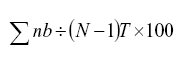
<body><![CDATA[<P><font face="Verdana, Arial, Helvetica, sans-serif" size="2">The following components    of resistance were evaluated separately in the third, second and first open    leaves of the inoculated plants: </font>     <P><font face="Verdana, Arial, Helvetica, sans-serif" size="2"><I>Incubation period    (IP)</I>: Defined as the time elapsed between inoculation and symptom appearance    in the inoculated plants of each genotype. IP was assessed daily by visual inspection    of symptom development starting at 7 days post-inoculation (DPI). </font>     <P><font face="Verdana, Arial, Helvetica, sans-serif" size="2"><I>Number of necrotic    lesions and area of necrotic lesions (NNL and ANL)</I> </font>     <P><font face="Verdana, Arial, Helvetica, sans-serif" size="2"><I>NNL</I> was    counted in each inoculated leaves at 63 DPI. ANL was estimated in each inoculated    leaves at 63 DPI by using the ellipse area formula (A = <SUP>a</SUP>/<SUB>2</SUB><SUP>.    b</SUP>/<SUB>2 </SUB><SUP>. </SUP>p), where <I>a</I> was the length and <I>b</I>    the width of the necrotic spot, and p=3.14. </font>     <P><font face="Verdana, Arial, Helvetica, sans-serif" size="2"><I>Infection index    (II)</I>: The percentage of leaflet area with necrotic tissue was estimated    using a seven degree diagrammatic scale (12) modified (13) for BLSD resistance    in <I>Musa</I> spp. The scale degrees were 0= no symptoms; 1= presence of stages    1, 2, or 3, but not more than 10 stage 4 symptoms; 2= more than 10 stage 4 but    less than 5% of the leaf affected; 3= from 6 to 15% of the leaf affected; 4=    from 16 to 33% of the leaf affected; 5= from 34 to 50% of the leaf affected;    and 6 = more than 50% of the leaf affected). </font>     <P><font face="Verdana, Arial, Helvetica, sans-serif" size="2">Disease severity    assessments were calculated at 63 DPI by the <a href="#e1">expression</a>: </font>      <P align="center"><img src="/img/revistas/rpv/v30n1/e0110115.gif" width="185" height="64">    <a name="e1"></a>     
<P><font face="Verdana, Arial, Helvetica, sans-serif" size="2">where n= number    of leaves at each level; b= value of severity according to the diagrammatic    scale, N= 7, corresponding with the number of stages in the scale and T= total    number of leaves evaluated per plant. </font>     <P><font face="Verdana, Arial, Helvetica, sans-serif" size="2">Three inoculated    leaves on each plant were evaluated. </font>     <P><font face="Verdana, Arial, Helvetica, sans-serif" size="2"><I>Area under the    disease progress curve</I> (AUDPC): AUDPC was calculated according to Shaner    and Finney`s (14) <a href="#e2">formula</a>: </font>      ]]></body>
<body><![CDATA[<P align="center"><img src="/img/revistas/rpv/v30n1/e0210115.gif" width="302" height="75">    <a name="e2"></a>      
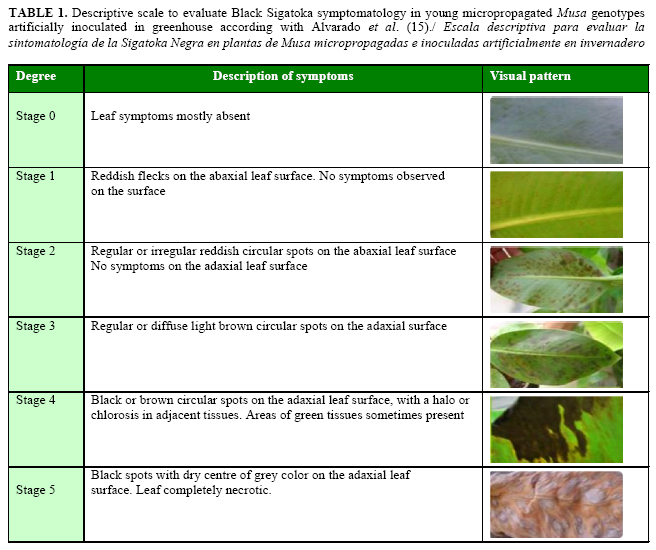
<P><font face="Verdana, Arial, Helvetica, sans-serif" size="2">where <I>Yi </I>=BLSD    severity (per unit), <I>Xi </I>=time (days) at the <I>i</I>th observation and    <I>n</I>=total number of observations, previously infection index was determined    by the evaluating scale (15) (<a href="/img/revistas/rpv/v30n1/t0110115.jpg">Table    1</a>). </font>      
<P><font face="Verdana, Arial, Helvetica, sans-serif" size="2"><I>Asexual latent    period </I>(<I>ALP</I>): ALP referred to the days elapsed from inoculation to    the occurrence of conidia sporulation. Detection of conidia was performed according    to Aguirre (16), and the evaluations were done weekly beginning at 35 DPI until    63 DPI. ALP was considered completed when sporulation was observed on at least    three lesions on each inoculated leaf. </font>     <P><font face="Verdana, Arial, Helvetica, sans-serif" size="2"><I>Number of spermogonia    </I> </font>     <P><font face="Verdana, Arial, Helvetica, sans-serif" size="2">Discs (1 cm of    diameter) from leaves with necrotic lesions (stage 4 and 5 in the evaluation    scale (15) were decolorized in 10% (<SUP>w</SUP>/<SUB>v</SUB>) KOH for 24h.    They were washed in deionized steril water three times. The discs were placed    on slides with lactophenol (phenol 20 g; lactic acid 20 g; glycerol 40 g; water    20 mL) and mounted for their further observation under the microscope (Olympus)    with 200x magnification. One hundred observations of each <I>Musa</I> genotype    were done under the microscope with 200x magnification and the total number    of spermogonia recorded. </font>     <P><font face="Verdana, Arial, Helvetica, sans-serif" size="2"><B>Statistical    analysis </B> </font>     <P><font face="Verdana, Arial, Helvetica, sans-serif" size="2">All statistical    analyses were performed using SPSS (Statistical Package for the Social Sciences    Version 15.0) software (SPSS Inc., Chicago, IL, USA). The number of necrotic    lesions, area of necrotic lesions, area under disease progress curve (AUDPC),    number of spermogonia and conidia were compared according to Kruskall-Wallis<I>    </I>non-parametric test<I>.</I> Infection index and asexual latent period were    processed by One-way ANOVA and the means compared by<I> Duncan`s </I>test. </font>     <P>&nbsp;     <P><font face="Verdana, Arial, Helvetica, sans-serif" size="2"><B><font size="3">RESULTS    AND DISCUSSION</font></B> </font>     <P><font face="Verdana, Arial, Helvetica, sans-serif" size="2"><I>Incubation period    (IP) </I> </font>     ]]></body>
<body><![CDATA[<P><font face="Verdana, Arial, Helvetica, sans-serif" size="2">The incubation    period in all the inoculated leaves of the same genotypes began at 14-21 DPI,    and significant differences were observed among the <I>Musa</I> genotype response    (<a href="#t2">Table 2</a>; <a href="/img/revistas/rpv/v30n1/f0110115.jpg">Fig    1</a>). FHIA-18 and FHIA-25 had the longest incubation period, followed by Pisang    lilin. Calcutta 4, Grande naine, Pisang Awak and Yangambi were the genotypes    with the shortest incubation period. </font>      
<P align="center"><img src="/img/revistas/rpv/v30n1/t0210115.jpg" width="317" height="276">    <a name="t2"></a>     
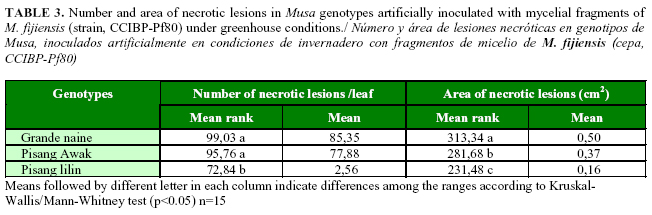
<P><font face="Verdana, Arial, Helvetica, sans-serif" size="2">IP was found to    be important because it showed significant differences among <I>Musa</I> artificially    inoculated genotypes with mycelial suspension in greenhouse assays. It was the    first time that incubation period has differentiated genotypes with differential    response to Black Sigatoka in greenhouse using mycelial fragments. Similar results    were obtained by Molina-Tirado and Casta&ntilde;o-Zapata (17), when they analyzed    the incubation period to discriminate the reaction of three FHIA genotypes to    Yellow and Black Sigatoka under natural infection. The incubation period was    also used by Alvarez <I>et al</I>. (18) in the successful evaluation of resistance    to Black Sigatoka of plantain and banana genotypes under greenhouse conditions.    </font>     <P><font face="Verdana, Arial, Helvetica, sans-serif" size="2">Similarly, Abadie    <I>et al</I>. (9) demonstrated that incubation period also varied significantly    in genotypes with different level of partial resistance in field and in detached    leaf assays. Pondering the literature quoted, the incubation period can be consider    useful for the early screening of <I>Musa</I> germplasm using mycelial suspensions    as infective inoculums under controlled conditions; this variable is also very    easy to evaluate, and it is not time consuming. </font>     <P><font face="Verdana, Arial, Helvetica, sans-serif" size="2">In our experimental    condition, it was used a reproductive protocol that described aspects related    to the cultural, morphological, molecular, and aggressiveness characteristics    of <I>M. fijiensis</I> strains. It also indicated how to use epidemiological    variables and components of resistance to characterize the infective cycle of    <I>M. fijiensis</I> in greenhouse. These reasons guaranteed incubation period    to be useful for discriminating the response of <I>Musa</I> genotypes. </font>     <P><font face="Verdana, Arial, Helvetica, sans-serif" size="2"><I>Number of necrotic    lesions and area of necrotic lesions (NNL and ANL)</I> </font>     <P><font face="Verdana, Arial, Helvetica, sans-serif" size="2">Mature necrotic    lesions were observed only in Grande naine, Pisang Awak and Pisang lilin. No    necrosis symptoms were observed in the rest of the genotypes until the final    evaluation. Significantly greater were the numbers of necrotic lesions observed    in Grande naine and Pisang Awak compared with those in Pisang lilin. The biggest    areas of necrotic lesions were measured in Grande naine with significant differences    with Pisang Awak and Pisang lilin. The size of necrotic lesions in Pisang Awak    was also bigger compared with those in Pisang lilin (<a href="/img/revistas/rpv/v30n1/t0310115.jpg">Table    3</a>). </font>      
<P><font face="Verdana, Arial, Helvetica, sans-serif" size="2">Differences regarding    the formation of mature necrotic lesions were observed only in the genotypes    Grande naine, Pisang Awak and Pisang lilin. This fact indicated that the number    and area of necrotic lesions were good quantitative variables to differentiate    inoculated <I>Musa</I> genotypes with a variable level of resistance to <I>M.    fijiensis </I>in an early stage. This finding reinforced the results of Abadie    <I>et al</I>. (9), where the resistant varieties Zebrina and Pisang ceylan had    lesser and smaller necrotic lesions and more reduced necrotic areas than other    resistant genotypes in the field and in detached leaf assays. </font>     <P><font face="Verdana, Arial, Helvetica, sans-serif" size="2">The use of the    number and area of necrotic lesions in <I>M. fijiensis</I> to evaluate the epidemiology    and ecology of Black Sigatoka on plantain and banana (<I>Musa</I> spp.) in Costa    Rica under field condition was first reported by Gauhl (13). However, counting    of total necrotic lesions on inoculated <I>Musa</I> leaves is a laborious, time    consuming and tedious task because of the great number of lesions and coalescences    that may be observed. Nevertheless, the number and area of necrotic lesions<B>    </B>may also contribute in studies related to <I>M. fijiensis</I> aggressiveness    variability, the efficacy of fungicide protection, and the infective capacity    of different inoculants. </font>     <P><font face="Verdana, Arial, Helvetica, sans-serif" size="2">The number of necrotic    lesions was used successfully by Seifbarghi<B> </B><I>et al</I>. (19) to determine    the host range of Septoria species in inoculation experiments under controlled    conditions of 27 genotypes of some cereals and wild grasses. Suffert <I>et al</I>.    (20), by using the area of necrotic lesions, provided a good measure of <I>M.    graminicola</I> fitness in estimating the quantitative resistance of wheat to    <I>Mycosphaerella graminicola</I> blotch and characterizing the differences    among isolates within a pathogen population. </font>     ]]></body>
<body><![CDATA[<P><font face="Verdana, Arial, Helvetica, sans-serif" size="2"><I>Infection index    (II) </I> </font>     <P><font face="Verdana, Arial, Helvetica, sans-serif" size="2">The infection index    was calculated only in Grande naine, Pisang Awak and Pisang lilin which showed    mature necrotic lesions at 63 DPI. Statically significant differences were determined    among the three genotypes, where Grande naine reached the highest percentage    (87.03) of leaflet area with necrotic tissue, followed by Pisang Awak (61.28)    and Pisang lilin (44.61). </font>     <P><font face="Verdana, Arial, Helvetica, sans-serif" size="2">Severity or Infection    intensity caused by <I>Mycosphaerella</I> spp. has been used in the evaluation    of <I>Musa</I> spp. response under natural infection conditions (21). However,    other authors, instead of using diagrammatic scales, have calculated infection    intensity according to the symptoms described by Meredith and Lawrence (22)    and Four&eacute; (10). Gauhl (13) determined the infection index by using the    function proposed by Lehmann Danziger (21) and carried out an epidemiological    and ecological study on Black Sigatoka disease in plantain and banana in Costa    Rica where the response among the natural infected genotypes were statistically    different. Orjeda (23) provides details on <I>Musa</I> spp. evaluation trials    carried out in nine sites worldwide in which the infection index was successfully    used to determine the response of the genotypes evaluated to Black Sigatoka.    </font>     <P><font face="Verdana, Arial, Helvetica, sans-serif" size="2">Likewise, Carlier    <I>et al</I>. (24) confirmed the usefulness of the infection index to follow    up <I>Mycosphaerella</I> spp leaf spot diseases throughout different phenological    development stages (six months, flowering, harvest) in <I>Musa</I> germplasm.    Krishnamoorthy <I>et al</I>. (25) differentiated the response of 11 banana hybrids    and their respective parents after natural infection of <I>M. fijiensis</I>    in field trials. Rocha <I>et al</I>. (26) used the infection index to develop    a temporal analysis to assess the aerobiology of <I>Mycosphaerella musicola</I>    spores and determine the evolution of the disease progression curve. </font>     <P><font face="Verdana, Arial, Helvetica, sans-serif" size="2">The infection index    was successfully used by Portal <I>et al</I>. (27) to characterize <I>Mycosphaerella    fijiensis</I> mutants transformed with a green fluorescent protein-carrying    construct by using a restriction enzyme-mediated integration methodology. These    authors observed that GFP-18 transformant showed increased aggressiveness in    susceptible Grande naine and resistant Yangambi km5 plants once infection index    was evaluated in a greenhouse. </font>     <P><font face="Verdana, Arial, Helvetica, sans-serif" size="2">Finally, the infection    index depends on the level of resistance of the inoculated genotypes, and in    the present study, it was calculated only in Grande naine, Pisang Awak and Pisang    lilin, where necrotic tissues were observed.<B> </B> </font>     <P><font face="Verdana, Arial, Helvetica, sans-serif" size="2"><I>Area under disease-progress    curve (AUDPC) </I> </font>     <P><font face="Verdana, Arial, Helvetica, sans-serif" size="2">The AUDPC values    calculated from the data in all the evaluations until day 56 showed statistically    significant differences among the inoculated genotypes respect to their quantitative    disease resistance. The greatest AUDPC values were reached by Grande naine and    Pisang Awak, while the lowest values were calculated in FHIA-18 and FHIA-25.    However, Pisang lilin, Yangambi Km 5 and Calcutta 4 revealed intermediate values.    </font>     <P><font face="Verdana, Arial, Helvetica, sans-serif" size="2">This paper shows    the first implementation of the AUDPC for the quantitative assessment of the    disease resistance of <I>Musa</I> genotypes artificially inoculated with the    causal agent of Black Sigatoka in greenhouse. Jeger <I>et al</I>. (28) used    AUDPC to evaluate disease resistance in different crop cultivars, and they concluded    that this variable was useful to measure the quantitative disease resistance    in repeated assessments of the disease. Commonly, AUDPC may be practical for    investigating the effectiveness of fungicide applications to control <I>Mycosphaerella</I>    leaf pathogen diseases in field condition (29) and the evaluation of plant disease    resistance (30). </font>     <P><font face="Verdana, Arial, Helvetica, sans-serif" size="2">Kablan <I>et al</I>.    (30) showed that the AUDPCs calculated in banana plants grown with silicon were    significantly lesser than those calculated for plants with no silicon. Thanks    to the use of this quantitative variable, they integrated pest management against    <I>M. fijiensis</I> by reducing the disease pressure on banana. </font>     ]]></body>
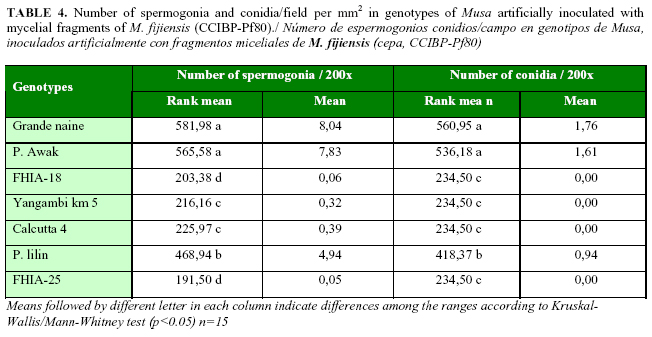
<body><![CDATA[<P><font face="Verdana, Arial, Helvetica, sans-serif" size="2">Otherwise, Cu&eacute;llar    <I>et al</I>. (31) determined that the AUDPC and the apparent infection rate    (r) were the only useful quantitative variables to differentiate resistance    of plantain and banana genotypes and aggresiveness of Black Sigatoka strains    during <I>Musa-M. fijiensis</I> interaction under controlled condition. </font>     <P><font face="Verdana, Arial, Helvetica, sans-serif" size="2">Significant differences    were obtained among the inoculated <I>Musa</I> genotypes, and it may be the    starting point for <I>Musa</I> breeders and epidemiologists to develop descriptive    and more precise growth model for the early screening of BLSD that could be    used in identifying resistant genotypes to <I>M. fijiensis</I>. </font>     <P><font face="Verdana, Arial, Helvetica, sans-serif" size="2"><I>Asexual latent    period (ALP) </I> </font>     <P><font face="Verdana, Arial, Helvetica, sans-serif" size="2">Asexual latent    period was detected only in Grande naine, Pisang Awak and Pisang lilin genotypes.    Grande naine (41,22 days) and Pisang Awak (44,72 days) had statistically significant    shorter (approximately 14 days) ALP than Pisang lilin (56,50 days). </font>     <P><font face="Verdana, Arial, Helvetica, sans-serif" size="2">The asexual latent    period clearly differentiated the response of Grande naine, Pisang Awak and    Pisang lilin from the rest of the inoculated genotypes. It was demonstrated    experimentally for the first time that <I>M. fijiensis</I> conidia could be    obtained with inoculation assays using mycelial fragments in greenhouse conditions.    Indeed, some <I>Musa</I> spp. were able to complete the asexual cycle within    the evaluated period (63 DPI), and there was correspondence between the asexual    latent period and the level of resistance among the genotypes. Browne <I>et    al</I>. (32) used the ALP as a component of partial disease resistance in wheat,    detected in a detached leaf assay with the inoculation of <I>Microdochium majus</I>,    and where cultivar responses were possible to be differentiated. Nevertheless,    Dita <I>et al</I>. (33) evaluated the ALP and the spore production in four potato    genotypes artificially inoculated with <I>Alternaria solani</I> Sorauer, but    the separation of cultivars according to resistance levels could not be obtained.    Similarly, no difference was found in the number of asexual spores observed    on seven partially resistant and susceptible <I>Musa</I> cultivars in the field    and ten cultivars under controlled conditions with detached leaf assays (9).    </font>     <P><font face="Verdana, Arial, Helvetica, sans-serif" size="2">Suffert <I>et al</I>.    (20) identified ALP, development rate of sporulating area, maximal sporulating    area, pycnidial density, and sporulation capacity traits as the most relevant    variables to describe aggressiveness in<I> Mycosphaerella graminicola </I>(<I>Septoria    tritici</I> blotch) population. They suggested that these variables could be    used to estimate the quantitative resistance of wheat to this fungal pathogen.    </font>     <P><font face="Verdana, Arial, Helvetica, sans-serif" size="2">Further studies    should be led to improve the control of experimental conditions, the quantification    methodology, and the inclusion of new <I>Musa</I> genotypes. </font>     <P><font face="Verdana, Arial, Helvetica, sans-serif" size="2"><I>Number of spermogonia    </I> </font>     <P><font face="Verdana, Arial, Helvetica, sans-serif" size="2">The greatest number    of spermogonia was observed in Grande naine and Pisang Awak, followed by Pisang    lilin. Few spermogonia were detected in Calcutta 4 and Yangambi Km 5 and the    lowest quantities were counted in FHIA-18 and FHIA-25 (<a href="/img/revistas/rpv/v30n1/t0410115.jpg">Table    4</a>). Spermogonia were only detected in Grande naine, Pisang Awak and, in    a significant less number, in Pisang lilin (<a href="/img/revistas/rpv/v30n1/t0410115.jpg">Table    4</a>). The rest of the genotypes did not produced conidia. </font>      
<P><font face="Verdana, Arial, Helvetica, sans-serif" size="2">In this work, the    number of spermogonia was used as a component of resistance for the early evaluation    of <I>Musa</I> genotypes artificially inoculated with Black Sigatoka in greenhouse.    Significant statistically differences were obtained among the inoculated genotypes,    and it was experimentally demonstrated that spermogonia of <I>M. fijiensis</I>    could be obtained by inculating <I>Musa</I> spp. with mycelial fragments in    greenhouse assays. </font>     ]]></body>
<body><![CDATA[<P><font face="Verdana, Arial, Helvetica, sans-serif" size="2">P&eacute;rez <I>et    al</I>. (34) used the number of spermogonia and pseudothecia for the first time    to compare Grande naine and FHIA-18 response to BLSD in two localities of Cuba,    and they differentiated the resistance level of both genotypes. Nevertheless,    this variable has not been used before under controlled conditions for the early    discrimination of resistance in <I>Musa</I> spp. </font>     <P><font face="Verdana, Arial, Helvetica, sans-serif" size="2">In our experience,    it was impossible to obtain pseudothecia of <I>M. fijiensis</I> because the    inoculation assay was performed with only one isolate (CCIBP-Pf80), and the    heterothaly nature of <I>M. fijiensis</I> is well known. The sexual cycle of    <I>M. fijensis</I> could be made possible under controlled conditions by inducing    pseudothecia in plants artificially inoculated with isolates of different mating    types in a greenhouse. The sexual latency period and the number of ascospores    could then be calculated to be used as other components of resistance in <I>Musa</I>    breeding programs.</font>     <P>&nbsp;     <P><font face="Verdana, Arial, Helvetica, sans-serif" size="2"><B><font size="3">CONCLUSIONS</font></B>    </font>     <P><font face="Verdana, Arial, Helvetica, sans-serif" size="2">Results indicated    that resistance to Black Sigatoka in artificially inoculated genotypes could    be evaluated by components of resistance to assess the response of <I>Musa</I>    spp. to <I>Mycosphaerella fijiensis</I> Morelet quantitatively, which would    make more efficient and precise the early evaluation process to support banana    and plantain breeding programs. Further genotypes with known resistance, partial    resistance and susceptible phenotypes in field conditions must be confirmed    in subsequent greenhouse tests. These results may be useful for screening BLSD    <I>Musa</I> resistant breeding material, evaluation of aggressiveness of <I>M.    fijiensis</I> isolates, studies related to molecular plant-pathogen interaction,    and management schemes of BLSD. Additionally, these findings will supply information    for guiding future studies on mechanisms involved in the BLSD resistance in    <I>Musa</I> spp by dissecting the infection cycle of <I>M. fijiensis</I> under    controlled condition. </font>      <P>&nbsp;     <P><font face="Verdana, Arial, Helvetica, sans-serif" size="2"><B><font size="3">ACKNOWLEDGEMENTS    </font> </B> </font>     <P><font face="Verdana, Arial, Helvetica, sans-serif" size="2">This research was    supported by Instituto de Biotecnolog&iacute;a de las Plantas, Universidad Central    de las Villas, Villa Clara, Cuba. We are also grateful to the International    Foundation for Science for the financial support to this investigation in the    framework of the IFS Research Grant Agreement NO.C/4296-1. We are really gratefull    to DrC. Eduardo Sistachs for his contribution with the editing process and English    revision. </font>     <P>&nbsp;     <P><font face="Verdana, Arial, Helvetica, sans-serif" size="2"><B> <font size="3">REFERENCES</font></B>    </font>         ]]></body>
<body><![CDATA[<!-- ref --><P><font face="Verdana, Arial, Helvetica, sans-serif" size="2">1. Churchill      CLA. <I>Mycosphaerella fijiensis</I>, the black leaf streak pathogen of banana:      progress towards understanding pathogen biology and detection, disease development,      and the challenges of control. Molecular Plant Pathology. 2011;12(4):307-328.          </font>        <!-- ref --><P><font face="Verdana, Arial, Helvetica, sans-serif" size="2">2. Cavalcante      MJB, Escalante J, Madeira JP, Romero RE, Nicole RM, Oliveira CL, et al. Reactive      oxygen species and cellular interactions between <I>M. fijiensis</I> and banana.      Tropical Plant Biol. 2011;4:134-143.     </font>        <!-- ref --><P><font face="Verdana, Arial, Helvetica, sans-serif" size="2">3. Castelan FP,      Abadie C, Hubert O, Chilin-Charles Y, de Lapeyre de Bellaire L, Chillet M.      Relation between the severity of Sigatoka disease and banana quality characterized      by pomological traits and fruit green life. Crop Protection. 2013;50:61-65.          </font>        <P><font face="Verdana, Arial, Helvetica, sans-serif" size="2">4. Pillary M.      Classical genetics and traditional breeding in <I>Musa. </I> In: Genetic,      genomics and breeding of bananas. Editors (Michael Pillary, George Ude, Chittaranjan      Kole). 2012; Pp 34-55. </font>        <!-- ref --><P><font face="Verdana, Arial, Helvetica, sans-serif" size="2">5. Ortiz R. Conventional      banana and plantain breeding. Acta Hort. (ISHS). 2013;986:177-194.     </font>        <!-- ref --><P><font face="Verdana, Arial, Helvetica, sans-serif" size="2">6. Robert S,      Ravigne V, Zapater MF, Abadie C, Carlier J. Contrasting introduction scenarios      among continents in the worldwide invasion of the banana fungal pathogen <I>Mycosphaerella      fijiensis</I>. Molecular Ecology. 2012;21(5):1098-1114.     </font>        <!-- ref --><P><font face="Verdana, Arial, Helvetica, sans-serif" size="2">7. Amorim EP,      Santos-Serejo D, Amorim VBO, Ferreira CF, Silva SO. Banana breeding at EMBRAPA      cassava and fruits. Acta Hort. (ISHS). 2013;986:171-176.     </font>        <!-- ref --><P><font face="Verdana, Arial, Helvetica, sans-serif" size="2">8. Mourichon      X, Peter D, Zapater M. Inoculation exp&eacute;rimentale de <I>Mycosphaerella      fijiensis</I> Morelet, sur jeunes plantules de bananier issues de culture      <I>in vitro</I>. Fruit. 1987;42(4):195-198.     </font>        <!-- ref --><P><font face="Verdana, Arial, Helvetica, sans-serif" size="2">9. Abadie C,      Elhadrami A, Leiva-Mora E, Carlier J. Efficiency and durability of partial      resistance against black leaf streak disease. In: <I>Mycosphaerella</I> leaf      spot disease of bananas, present status and outlook. Proceding of the Workshop      on <I>Mycosphaerella </I>leaf spot disease, San Jos&eacute;, Costa Rica, INIBAP.      2003.     </font>        <!-- ref --><P><font face="Verdana, Arial, Helvetica, sans-serif" size="2">10.Four&eacute;      E. Les cercosporioses du bananier et leurs traitements: Etude de la sensibilit&eacute;      vari&eacute;tale des bananiers et des plantains &aacute; <I>Mycosphaerella      fijiensis</I> Morelet au Gabon. Fruit. 1982;37:749-771.     </font>        <!-- ref --><P><font face="Verdana, Arial, Helvetica, sans-serif" size="2">11.Leiva-Mora      M, Alvarado-Cap&oacute; Yelenys, Acosta-Su&aacute;rez Mayra, Cruz-Mart&iacute;n      Mileidy, S&aacute;nchez Garc&iacute;a Cynthia, Roque Berkis. Protocolo para      la inoculaci&oacute;n artificial de <I>M. fijiensis</I> y evaluaci&oacute;n      de la respuesta de Musa spp. con variables epifitiol&oacute;gicas y componentes      de la resistencia. Biotecnolog&iacute;a Vegetal. 2010;10(2):79-88.     </font>        <!-- ref --><P><font face="Verdana, Arial, Helvetica, sans-serif" size="2">12.Stover RH.      Distribution and cultural characteristics of the pathogens causing banana      leaf spot. Tropical Agriculture Trinidad. 1976;53:111-114.     </font>        <!-- ref --><P><font face="Verdana, Arial, Helvetica, sans-serif" size="2">13.Gauhl F. Epidemiology      and Ecology of black Sigatoka (<I>Mycosphaerella fijiensis</I> Morelet) on      Plantain and Banana (<I>Musa</I> spp.) in Costa Rica, Central America. Montpellier,      Francia, INIBAP. 1994.     </font>        <!-- ref --><P><font face="Verdana, Arial, Helvetica, sans-serif" size="2">14.Shaner G,      Finney RE. The effect of Nitrogen fertilization on the expression of show-mildewing      resistance in Knox wheat. Phytopathology. 1977;67:1051-1056.     </font>         <!-- ref --><P><font face="Verdana, Arial, Helvetica, sans-serif" size="2">15.Alvarado Y,    Leiva M, Rodr&iacute;guez MA, Acosta M, Cruz M, Portal N, et al. Early evaluation    of Black leaf streak resistance by using mycelial suspension of <I>Mycosphaerella    fijiensis. </I>En: Jacome L, Leproive P, Martin D, Ortiz R, Romero R, Escalant    JV (eds). <I>Mycosphaerella</I> leaf spot diseases of bananas: present status    and outlook. 2003; 169-175. INIBAP, Montpellier. ISBN 2910810-57-7.     </font>      <!-- ref --><P><font face="Verdana, Arial, Helvetica, sans-serif" size="2">16.Aguirre-Gaviria      MC, Casta&ntilde;o-Zapata J, Zuluaga-Arias LE. Rapid diagnostic method of      <I>Mycosphaerella musicola</I> Leach and <I>Mycosphaerella fijiensis</I> Morelet,      causal agents of Yellow Sigatoka and Black Sigatoka. INFOMUSA. 1999;8(2):7-9.          </font>        <!-- ref --><P><font face="Verdana, Arial, Helvetica, sans-serif" size="2">17.Molina-Tirado      OI, Casta&ntilde;o-Zapata J. An&aacute;lisis de algunos componentes de la      resistencia en los h&iacute;bridos de banano y pl&aacute;tanos FHIA 01, FHIA      17 y FHIA 21 a la Sigatoka Negra (<I>Mycosphaerella fijiensis </I>Morelet)      y amarilla (<I>Mycosphaerella musicola</I> Leach). Rev Acad Coloma Cienc.      2003;27(103):181-190.     </font>         <!-- ref --><P><font face="Verdana, Arial, Helvetica, sans-serif" size="2">18.Alvarez E, Cuellar    A. Evaluating the resistance of plantain and banana genotypes to Black Sigatoka    (<I>Mycosphaerella fijiensis</I>) under greenhouse conditions. 2010; American    Phytopathology Society Annual Meeting. Celebrated in August 7-11. available    in <U><a href="http://www.apsnet.org/meetings/Documents/2010_Meeting_Abstracts%20/a10ma27.htm">http://www.apsnet.org/meetings/Documents/2010_Meeting_Abstracts    /a10ma27.htm</a></U>.     </font>      <!-- ref --><P><font face="Verdana, Arial, Helvetica, sans-serif" size="2">19.Seifbarghi      S, Razavi M, Aminian H, Zare R, Etebarian H.<I> </I>Studies on the host range      of <I>Septoria</I> species on cereals and some wild grasses in Iran. Phytopathologia      Mediterranea. 2009;48(3):422-429.     </font>         <!-- ref --><P><font face="Verdana, Arial, Helvetica, sans-serif" size="2">20.Suffert F, Sache    I, Lannou C. Assessment of quantitative traits of aggressiveness in <I>Mycosphaerella    graminicola</I> on adult wheat plants. Plant pathology. 2013.     </font>      <!-- ref --><P><font face="Verdana, Arial, Helvetica, sans-serif" size="2">21.Lehmann-Danziger    H. Ausbreitung, Bewertung und Strategien zur Bekampfung der Schwarzen Sigatoka-Krankheit:    Untersuchungen an Kochbananen in Mittel- und Sudamerika. Der Tropenlandwirt    Beiheft. 1988;34:133-177.     </font>      <!-- ref --><P><font face="Verdana, Arial, Helvetica, sans-serif" size="2">22.Meredith DS,      Lawrence JS. Black leaf streak disease of bananas (<I>Mycosphaerella fijiensis</I>):      Symptoms of disease in Hawaii, and notes on the conidial state of the causal      fungus. Transaction British Mycology Society. 1969;52:459-476.     </font>        <P><font face="Verdana, Arial, Helvetica, sans-serif" size="2">23.Orjeda G.      Evaluating bananas: a global partnership. Results of IMTP Phase II (G. Orjeda      ed). International Network for the Improvement of banana and plantain, Montpellier,      Francia. 2000. </font>         <!-- ref --><P><font face="Verdana, Arial, Helvetica, sans-serif" size="2">24.Carlier J, Waele    D, Escalant JV. Evaluaci&oacute;n global de la resistencia de los bananos al    marchitamiento por <I>Fusarium</I>, enfermedades de las manchas foliares causadas    por <I>Mycosphaerella</I> y nematodos. Evaluaci&oacute;n del comportamiento.    (A. V&eacute;zima y C. Picq, eds). Guias t&eacute;cnicas INIBAP 6. Red para    el mejoramiento del banano y el pl&aacute;tano, Montpellier, Francia. 2002.        </font>      <!-- ref --><P><font face="Verdana, Arial, Helvetica, sans-serif" size="2">25.Krishnamoorthy      V, Kumar N, Angappan K, Soorianathasundaram K. Evaluation of new banana hybrids      against black leaf streak disease. InfoMusa. 2004;13(1):25-27.     </font>        <!-- ref --><P><font face="Verdana, Arial, Helvetica, sans-serif" size="2">26.Rocha SH,      Pozza AE, Uch&ocirc;a DNC, Cordeiro ZJM, De Souza<SUP> </SUP>EP, et al. Temporal      Progress of Yellow Sigatoka and Aerobiology of <I>Mycosphaerella musicola</I>      Spores. Jour Phytopathol. 2012;160(6):277-285.     </font>        ]]></body>
<body><![CDATA[<!-- ref --><P><font face="Verdana, Arial, Helvetica, sans-serif" size="2">27.Portal O,      Acosta-Su&aacute;rez M, Oca&ntilde;a B, Sch&auml;fer W, Jim&eacute;nez E,      H&ouml;fte M. A green fluorescent protein transformed <I>Mycosphaerella fijiensis</I>      strain shows increased aggressiveness on banana. Australasian Plant Pathology.      2012;41(6):645-647.     </font>        <!-- ref --><P><font face="Verdana, Arial, Helvetica, sans-serif" size="2">28.Jeger MJ,      Viljanen-Rollinson SLH. The use of the area under the disease-progress curve      (AUDPC) to assess quantitative disease resistance in crop cultivars. Theoretical      and Applied Genetics. 2001;102(1):32-40.     </font>        <!-- ref --><P><font face="Verdana, Arial, Helvetica, sans-serif" size="2">29.Burke JJ,      Dunne B.<SUP> </SUP>Investigating the effectiveness of the Thies Clima &#171;<I>Septoria</I>      Timer&#187; to schedule fungicide applications to control <I>Mycosphaerella      graminicola</I> on winter wheat in Ireland. Crop protection. 2008;27(3):710-718.          </font>        <!-- ref --><P><font face="Verdana, Arial, Helvetica, sans-serif" size="2">30.Kablan L,      Lagauche AE, Delvaux BE, Legr&egrave;ve A. Silicon Reduces Black Sigatoka      Development in Banana. Plant Diseases. 2012;96(2):273-278.     </font>        <!-- ref --><P><font face="Verdana, Arial, Helvetica, sans-serif" size="2">31.Cu&eacute;llar      QA, &Aacute;lvarez CE, Casta&ntilde;o ZJ. Evaluaci&oacute;n de Resistencia      de Genotipos de Pl&aacute;tano y Banano a la Sigatoka Negra (<I>Mycosphaerella      fijiensis</I> Morelet). Rev Fac Nal Agr Medell&iacute;n. 2011;64(1):5853-5865.          </font>        ]]></body>
<body><![CDATA[<!-- ref --><P><font face="Verdana, Arial, Helvetica, sans-serif" size="2">32.Browne RA,      Mascher F, Golebiowska G, Hofgaard IS. Components of Partial Disease Resistance      in Wheat detected in a detached leaf assay inoculated with <I>Microdochium      majus</I> using First, Second and Third Expanding Seedling Leaves. Journal      of Phytopathology. 2006;154(4):204-208.     </font>        <!-- ref --><P><font face="Verdana, Arial, Helvetica, sans-serif" size="2">33.Dita RMA,      Brommonschenkel SH, Matsuoka K, Mizubuti ESG. Components of Resistance to      Early Blight in Four Potato Cultivars: Effect of Leaf Position. Jour Phytopathol.      2006;154:230-235.     </font>         <!-- ref --><P><font face="Verdana, Arial, Helvetica, sans-serif" size="2">34.P&eacute;rez-Miranda    M, P&eacute;rez VL, Trujillo R, Betancourt DM. Variability of <I>Mycosphaerella    fijiensis</I> Morelet. Durability of the Resistance to Black Sigatoka in the    FHIA hybrids cultivars. FITOSANIDAD. 2006;10(1):37-47.     </font>      <P>&nbsp;     <P>&nbsp;     <P><font face="Verdana, Arial, Helvetica, sans-serif" size="2">Recibido: 24-11-2013.    <br>   </font><font face="Verdana, Arial, Helvetica, sans-serif" size="2">Aceptado:    4-9-2014.</font>     ]]></body>
<body><![CDATA[<P>&nbsp;     <P>&nbsp;     <P><font face="Verdana, Arial, Helvetica, sans-serif" size="2"><B><a href="#pie">*</a><a name="autor"></a></B>    Correspondence:<I> Michel Leiva-Mora.</I> E-mail: <U><a href="mailto:michel@ibp.co.cu">michel@ibp.co.cu</a></U>.    </font>       ]]></body><back>
<ref-list>
<ref id="B1">
<label>1</label><nlm-citation citation-type="journal">
<person-group person-group-type="author">
<name>
<surname><![CDATA[Churchill]]></surname>
<given-names><![CDATA[CLA]]></given-names>
</name>
</person-group>
<article-title xml:lang="en"><![CDATA[Mycosphaerella fijiensis, the black leaf streak pathogen of banana: progress towards understanding pathogen biology and detection, disease development, and the challenges of control]]></article-title>
<source><![CDATA[Molecular Plant Pathology]]></source>
<year>2011</year>
<volume>12</volume>
<numero>4</numero>
<issue>4</issue>
<page-range>307-328</page-range></nlm-citation>
</ref>
<ref id="B2">
<label>2</label><nlm-citation citation-type="journal">
<person-group person-group-type="author">
<name>
<surname><![CDATA[Cavalcante]]></surname>
<given-names><![CDATA[MJB]]></given-names>
</name>
<name>
<surname><![CDATA[Escalante]]></surname>
<given-names><![CDATA[J]]></given-names>
</name>
<name>
<surname><![CDATA[Madeira]]></surname>
<given-names><![CDATA[JP]]></given-names>
</name>
<name>
<surname><![CDATA[Romero]]></surname>
<given-names><![CDATA[RE]]></given-names>
</name>
<name>
<surname><![CDATA[Nicole]]></surname>
<given-names><![CDATA[RM]]></given-names>
</name>
<name>
<surname><![CDATA[Oliveira]]></surname>
<given-names><![CDATA[CL]]></given-names>
</name>
<name>
<surname><![CDATA[et]]></surname>
<given-names><![CDATA[al]]></given-names>
</name>
</person-group>
<article-title xml:lang="en"><![CDATA[Reactive oxygen species and cellular interactions between M. fijiensis and banana]]></article-title>
<source><![CDATA[Tropical Plant Biol]]></source>
<year>2011</year>
<volume>4</volume>
<page-range>134-143</page-range></nlm-citation>
</ref>
<ref id="B3">
<label>3</label><nlm-citation citation-type="journal">
<person-group person-group-type="author">
<name>
<surname><![CDATA[Castelan]]></surname>
<given-names><![CDATA[FP]]></given-names>
</name>
<name>
<surname><![CDATA[Abadie]]></surname>
<given-names><![CDATA[C]]></given-names>
</name>
<name>
<surname><![CDATA[Hubert]]></surname>
<given-names><![CDATA[O]]></given-names>
</name>
<name>
<surname><![CDATA[Chilin-Charles]]></surname>
<given-names><![CDATA[Y]]></given-names>
</name>
<name>
<surname><![CDATA[de Lapeyre de Bellaire]]></surname>
<given-names><![CDATA[L]]></given-names>
</name>
<name>
<surname><![CDATA[Chillet]]></surname>
<given-names><![CDATA[M]]></given-names>
</name>
</person-group>
<article-title xml:lang="en"><![CDATA[Relation between the severity of Sigatoka disease and banana quality characterized by pomological traits and fruit green life]]></article-title>
<source><![CDATA[Crop Protection]]></source>
<year>2013</year>
<volume>50</volume>
<page-range>61-65</page-range></nlm-citation>
</ref>
<ref id="B4">
<label>4</label><nlm-citation citation-type="">
<person-group person-group-type="author">
<name>
<surname><![CDATA[Pillary]]></surname>
<given-names><![CDATA[M]]></given-names>
</name>
</person-group>
<article-title xml:lang="en"><![CDATA[Classical genetics and traditional breeding in Musa]]></article-title>
<person-group person-group-type="editor">
<name>
<surname><![CDATA[Pillary]]></surname>
<given-names><![CDATA[Michael]]></given-names>
</name>
<name>
<surname><![CDATA[Ude]]></surname>
<given-names><![CDATA[George]]></given-names>
</name>
<name>
<surname><![CDATA[Kole]]></surname>
<given-names><![CDATA[Chittaranjan]]></given-names>
</name>
</person-group>
<source><![CDATA[Genetic, genomics and breeding of bananas]]></source>
<year>2012</year>
<page-range>34-55</page-range></nlm-citation>
</ref>
<ref id="B5">
<label>5</label><nlm-citation citation-type="journal">
<person-group person-group-type="author">
<name>
<surname><![CDATA[Ortiz]]></surname>
<given-names><![CDATA[R]]></given-names>
</name>
</person-group>
<article-title xml:lang="en"><![CDATA[Conventional banana and plantain breeding]]></article-title>
<source><![CDATA[Acta Hort]]></source>
<year>2013</year>
<volume>986</volume>
<page-range>177-194</page-range></nlm-citation>
</ref>
<ref id="B6">
<label>6</label><nlm-citation citation-type="journal">
<person-group person-group-type="author">
<name>
<surname><![CDATA[Robert]]></surname>
<given-names><![CDATA[S]]></given-names>
</name>
<name>
<surname><![CDATA[Ravigne]]></surname>
<given-names><![CDATA[V]]></given-names>
</name>
<name>
<surname><![CDATA[Zapater]]></surname>
<given-names><![CDATA[MF]]></given-names>
</name>
<name>
<surname><![CDATA[Abadie]]></surname>
<given-names><![CDATA[C]]></given-names>
</name>
<name>
<surname><![CDATA[Carlier]]></surname>
<given-names><![CDATA[J]]></given-names>
</name>
</person-group>
<article-title xml:lang="en"><![CDATA[Contrasting introduction scenarios among continents in the worldwide invasion of the banana fungal pathogen Mycosphaerella fijiensis]]></article-title>
<source><![CDATA[Molecular Ecology]]></source>
<year>2012</year>
<volume>21</volume>
<numero>5</numero>
<issue>5</issue>
<page-range>1098-1114</page-range></nlm-citation>
</ref>
<ref id="B7">
<label>7</label><nlm-citation citation-type="journal">
<person-group person-group-type="author">
<name>
<surname><![CDATA[Amorim]]></surname>
<given-names><![CDATA[EP]]></given-names>
</name>
<name>
<surname><![CDATA[Santos-Serejo]]></surname>
<given-names><![CDATA[D]]></given-names>
</name>
<name>
<surname><![CDATA[Amorim]]></surname>
<given-names><![CDATA[VBO]]></given-names>
</name>
<name>
<surname><![CDATA[Ferreira]]></surname>
<given-names><![CDATA[CF]]></given-names>
</name>
<name>
<surname><![CDATA[Silva]]></surname>
<given-names><![CDATA[SO]]></given-names>
</name>
</person-group>
<article-title xml:lang="en"><![CDATA[Banana breeding at EMBRAPA cassava and fruits]]></article-title>
<source><![CDATA[Acta Hort]]></source>
<year>2013</year>
<volume>986</volume>
<page-range>171-176</page-range></nlm-citation>
</ref>
<ref id="B8">
<label>8</label><nlm-citation citation-type="journal">
<person-group person-group-type="author">
<name>
<surname><![CDATA[Mourichon]]></surname>
<given-names><![CDATA[X]]></given-names>
</name>
<name>
<surname><![CDATA[Peter]]></surname>
<given-names><![CDATA[D]]></given-names>
</name>
<name>
<surname><![CDATA[Zapater]]></surname>
<given-names><![CDATA[M]]></given-names>
</name>
</person-group>
<article-title xml:lang="en"><![CDATA[Inoculation expérimentale de Mycosphaerella fijiensis Morelet, sur jeunes plantules de bananier issues de culture in vitro]]></article-title>
<source><![CDATA[Fruit]]></source>
<year>1987</year>
<volume>42</volume>
<numero>4</numero>
<issue>4</issue>
<page-range>195-198</page-range></nlm-citation>
</ref>
<ref id="B9">
<label>9</label><nlm-citation citation-type="book">
<person-group person-group-type="author">
<name>
<surname><![CDATA[Abadie]]></surname>
<given-names><![CDATA[C]]></given-names>
</name>
<name>
<surname><![CDATA[Elhadrami]]></surname>
<given-names><![CDATA[A]]></given-names>
</name>
<name>
<surname><![CDATA[Leiva-Mora]]></surname>
<given-names><![CDATA[E]]></given-names>
</name>
<name>
<surname><![CDATA[Carlier]]></surname>
<given-names><![CDATA[J]]></given-names>
</name>
</person-group>
<article-title xml:lang="en"><![CDATA[Efficiency and durability of partial resistance against black leaf streak disease]]></article-title>
<source><![CDATA[Mycosphaerella leaf spot disease of bananas, present status and outlook: Proceding of the Workshop on Mycosphaerella leaf spot disease]]></source>
<year>2003</year>
<publisher-loc><![CDATA[San José^eCosta Rica Costa Rica]]></publisher-loc>
<publisher-name><![CDATA[INIBAP]]></publisher-name>
</nlm-citation>
</ref>
<ref id="B10">
<label>10</label><nlm-citation citation-type="journal">
<person-group person-group-type="author">
<name>
<surname><![CDATA[Fouré]]></surname>
<given-names><![CDATA[E]]></given-names>
</name>
</person-group>
<article-title xml:lang="fr"><![CDATA[Les cercosporioses du bananier et leurs traitements: Etude de la sensibilité variétale des bananiers et des plantains á Mycosphaerella fijiensis Morelet au Gabon]]></article-title>
<source><![CDATA[Fruit]]></source>
<year>1982</year>
<volume>37</volume>
<page-range>749-771</page-range></nlm-citation>
</ref>
<ref id="B11">
<label>11</label><nlm-citation citation-type="journal">
<person-group person-group-type="author">
<name>
<surname><![CDATA[Leiva-Mora]]></surname>
<given-names><![CDATA[M]]></given-names>
</name>
<name>
<surname><![CDATA[Alvarado-Capó]]></surname>
<given-names><![CDATA[Yelenys]]></given-names>
</name>
<name>
<surname><![CDATA[Acosta-Suárez]]></surname>
<given-names><![CDATA[Mayra]]></given-names>
</name>
<name>
<surname><![CDATA[Cruz-Martín]]></surname>
<given-names><![CDATA[Mileidy]]></given-names>
</name>
<name>
<surname><![CDATA[Sánchez García]]></surname>
<given-names><![CDATA[Cynthia]]></given-names>
</name>
<name>
<surname><![CDATA[Roque]]></surname>
<given-names><![CDATA[Berkis]]></given-names>
</name>
</person-group>
<article-title xml:lang="es"><![CDATA[Protocolo para la inoculación artificial de M . fijiensis y evaluación de la respuesta de Musa spp. con variables epifitiológicas y componentes de la resistencia]]></article-title>
<source><![CDATA[Biotecnología Vegetal]]></source>
<year>2010</year>
<volume>10</volume>
<numero>2</numero>
<issue>2</issue>
<page-range>79-88</page-range></nlm-citation>
</ref>
<ref id="B12">
<label>12</label><nlm-citation citation-type="journal">
<person-group person-group-type="author">
<name>
<surname><![CDATA[Stover]]></surname>
<given-names><![CDATA[RH]]></given-names>
</name>
</person-group>
<article-title xml:lang="en"><![CDATA[Distribution and cultural characteristics of the pathogens causing banana leaf spot]]></article-title>
<source><![CDATA[Tropical Agriculture Trinidad]]></source>
<year>1976</year>
<volume>53</volume>
<page-range>111-114</page-range></nlm-citation>
</ref>
<ref id="B13">
<label>13</label><nlm-citation citation-type="book">
<person-group person-group-type="author">
<name>
<surname><![CDATA[Gauhl]]></surname>
<given-names><![CDATA[F]]></given-names>
</name>
</person-group>
<source><![CDATA[Epidemiology and Ecology of black Sigatoka (Mycosphaerella fijiensis Morelet) on Plantain and Banana (Musa spp.) in Costa Rica, Central America]]></source>
<year>1994</year>
<publisher-loc><![CDATA[Montpellier^eFrancia Francia]]></publisher-loc>
<publisher-name><![CDATA[INIBAP]]></publisher-name>
</nlm-citation>
</ref>
<ref id="B14">
<label>14</label><nlm-citation citation-type="journal">
<person-group person-group-type="author">
<name>
<surname><![CDATA[Shaner]]></surname>
<given-names><![CDATA[G]]></given-names>
</name>
<name>
<surname><![CDATA[Finney]]></surname>
<given-names><![CDATA[RE]]></given-names>
</name>
</person-group>
<article-title xml:lang="en"><![CDATA[The effect of Nitrogen fertilization on the expression of show-mildewing resistance in Knox wheat]]></article-title>
<source><![CDATA[Phytopathology]]></source>
<year>1977</year>
<volume>67</volume>
<page-range>1051-1056</page-range></nlm-citation>
</ref>
<ref id="B15">
<label>15</label><nlm-citation citation-type="book">
<person-group person-group-type="author">
<name>
<surname><![CDATA[Alvarado]]></surname>
<given-names><![CDATA[Y]]></given-names>
</name>
<name>
<surname><![CDATA[Leiva]]></surname>
<given-names><![CDATA[M]]></given-names>
</name>
<name>
<surname><![CDATA[Rodríguez]]></surname>
<given-names><![CDATA[MA]]></given-names>
</name>
<name>
<surname><![CDATA[Acosta]]></surname>
<given-names><![CDATA[M]]></given-names>
</name>
<name>
<surname><![CDATA[Cruz]]></surname>
<given-names><![CDATA[M]]></given-names>
</name>
<name>
<surname><![CDATA[Portal]]></surname>
<given-names><![CDATA[N]]></given-names>
</name>
</person-group>
<article-title xml:lang="en"><![CDATA[Early evaluation of Black leaf streak resistance by using mycelial suspension of Mycosphaerella fijiensis]]></article-title>
<person-group person-group-type="editor">
<name>
<surname><![CDATA[Jacome]]></surname>
<given-names><![CDATA[L]]></given-names>
</name>
<name>
<surname><![CDATA[Leproive]]></surname>
<given-names><![CDATA[P]]></given-names>
</name>
<name>
<surname><![CDATA[Martin]]></surname>
<given-names><![CDATA[D]]></given-names>
</name>
<name>
<surname><![CDATA[Ortiz]]></surname>
<given-names><![CDATA[R]]></given-names>
</name>
<name>
<surname><![CDATA[Romero]]></surname>
<given-names><![CDATA[R]]></given-names>
</name>
<name>
<surname><![CDATA[Escalant]]></surname>
<given-names><![CDATA[JV]]></given-names>
</name>
</person-group>
<source><![CDATA[Mycosphaerella leaf spot diseases of bananas: present status and outlook]]></source>
<year>2003</year>
<page-range>169-175</page-range><publisher-loc><![CDATA[Montpellier ]]></publisher-loc>
<publisher-name><![CDATA[INIBAP]]></publisher-name>
</nlm-citation>
</ref>
<ref id="B16">
<label>16</label><nlm-citation citation-type="journal">
<person-group person-group-type="author">
<name>
<surname><![CDATA[Aguirre-Gaviria]]></surname>
<given-names><![CDATA[MC]]></given-names>
</name>
<name>
<surname><![CDATA[Castaño-Zapata]]></surname>
<given-names><![CDATA[J]]></given-names>
</name>
<name>
<surname><![CDATA[Zuluaga-Arias]]></surname>
<given-names><![CDATA[LE]]></given-names>
</name>
</person-group>
<article-title xml:lang="en"><![CDATA[Rapid diagnostic method of Mycosphaerella musicola Leach and Mycosphaerella fijiensis Morelet, causal agents of Yellow Sigatoka and Black Sigatoka]]></article-title>
<source><![CDATA[INFOMUSA]]></source>
<year>1999</year>
<volume>8</volume>
<numero>2</numero>
<issue>2</issue>
<page-range>7-9</page-range></nlm-citation>
</ref>
<ref id="B17">
<label>17</label><nlm-citation citation-type="journal">
<person-group person-group-type="author">
<name>
<surname><![CDATA[Molina-Tirado]]></surname>
<given-names><![CDATA[OI]]></given-names>
</name>
<name>
<surname><![CDATA[Castaño-Zapata]]></surname>
<given-names><![CDATA[J]]></given-names>
</name>
</person-group>
<article-title xml:lang="es"><![CDATA[Análisis de algunos componentes de la resistencia en los híbridos de banano y plátanos FHIA 01, FHIA 17 y FHIA 21 a la Sigatoka Negra (Mycosphaerella fijiensis Morelet) y amarilla (Mycosphaerella musicola Leach)]]></article-title>
<source><![CDATA[Rev Acad Coloma Cienc]]></source>
<year>2003</year>
<volume>27</volume>
<numero>103</numero>
<issue>103</issue>
<page-range>181-190</page-range></nlm-citation>
</ref>
<ref id="B18">
<label>18</label><nlm-citation citation-type="book">
<person-group person-group-type="author">
<name>
<surname><![CDATA[Alvarez]]></surname>
<given-names><![CDATA[E]]></given-names>
</name>
<name>
<surname><![CDATA[Cuellar]]></surname>
<given-names><![CDATA[A]]></given-names>
</name>
</person-group>
<article-title xml:lang="en"><![CDATA[Evaluating the resistance of plantain and banana genotypes to Black Sigatoka (Mycosphaerella fijiensis) under greenhouse conditions]]></article-title>
<source><![CDATA[]]></source>
<year>2010</year>
<publisher-name><![CDATA[American Phytopathology Society Annual Meeting]]></publisher-name>
</nlm-citation>
</ref>
<ref id="B19">
<label>19</label><nlm-citation citation-type="journal">
<person-group person-group-type="author">
<name>
<surname><![CDATA[Seifbarghi]]></surname>
<given-names><![CDATA[S]]></given-names>
</name>
<name>
<surname><![CDATA[Razavi]]></surname>
<given-names><![CDATA[M]]></given-names>
</name>
<name>
<surname><![CDATA[Aminian]]></surname>
<given-names><![CDATA[H]]></given-names>
</name>
<name>
<surname><![CDATA[Zare]]></surname>
<given-names><![CDATA[R]]></given-names>
</name>
<name>
<surname><![CDATA[Etebarian]]></surname>
<given-names><![CDATA[H]]></given-names>
</name>
</person-group>
<article-title xml:lang="en"><![CDATA[Studies on the host range of Septoria species on cereals and some wild grasses in Iran]]></article-title>
<source><![CDATA[Phytopathologia Mediterranea]]></source>
<year>2009</year>
<volume>48</volume>
<numero>3</numero>
<issue>3</issue>
<page-range>422-429</page-range></nlm-citation>
</ref>
<ref id="B20">
<label>20</label><nlm-citation citation-type="journal">
<person-group person-group-type="author">
<name>
<surname><![CDATA[Suffert]]></surname>
<given-names><![CDATA[F]]></given-names>
</name>
<name>
<surname><![CDATA[Sache]]></surname>
<given-names><![CDATA[I]]></given-names>
</name>
<name>
<surname><![CDATA[Lannou]]></surname>
<given-names><![CDATA[C]]></given-names>
</name>
</person-group>
<article-title xml:lang="en"><![CDATA[Assessment of quantitative traits of aggressiveness in Mycosphaerella graminicola on adult wheat plants]]></article-title>
<source><![CDATA[Plant pathology]]></source>
<year>2013</year>
</nlm-citation>
</ref>
<ref id="B21">
<label>21</label><nlm-citation citation-type="journal">
<person-group person-group-type="author">
<name>
<surname><![CDATA[Lehmann-Danziger]]></surname>
<given-names><![CDATA[H]]></given-names>
</name>
</person-group>
<article-title xml:lang="de"><![CDATA[Ausbreitung, Bewertung und Strategien zur Bekampfung der Schwarzen Sigatoka-Krankheit: Untersuchungen an Kochbananen in Mittel- und Sudamerika]]></article-title>
<source><![CDATA[Der Tropenlandwirt Beiheft]]></source>
<year>1988</year>
<volume>34</volume>
<page-range>133-177</page-range></nlm-citation>
</ref>
<ref id="B22">
<label>22</label><nlm-citation citation-type="journal">
<person-group person-group-type="author">
<name>
<surname><![CDATA[Meredith]]></surname>
<given-names><![CDATA[DS]]></given-names>
</name>
<name>
<surname><![CDATA[Lawrence]]></surname>
<given-names><![CDATA[JS]]></given-names>
</name>
</person-group>
<article-title xml:lang="en"><![CDATA[Black leaf streak disease of bananas (Mycosphaerella fijiensis): Symptoms of disease in Hawaii, and notes on the conidial state of the causal fungus]]></article-title>
<source><![CDATA[Transaction British Mycology Society]]></source>
<year>1969</year>
<volume>52</volume>
<page-range>459-476</page-range></nlm-citation>
</ref>
<ref id="B23">
<label>23</label><nlm-citation citation-type="">
<person-group person-group-type="author">
<name>
<surname><![CDATA[Orjeda]]></surname>
<given-names><![CDATA[G]]></given-names>
</name>
</person-group>
<article-title xml:lang="en"><![CDATA[Evaluating bananas: a global partnership]]></article-title>
<person-group person-group-type="editor">
<name>
<surname><![CDATA[Orjeda]]></surname>
<given-names><![CDATA[G]]></given-names>
</name>
</person-group>
<source><![CDATA[Results of IMTP Phase II: International Network for the Improvement of banana and plantain]]></source>
<year>2000</year>
<publisher-loc><![CDATA[Montpellier^eFrancia Francia]]></publisher-loc>
</nlm-citation>
</ref>
<ref id="B24">
<label>24</label><nlm-citation citation-type="">
<person-group person-group-type="author">
<name>
<surname><![CDATA[Carlier]]></surname>
<given-names><![CDATA[J]]></given-names>
</name>
<name>
<surname><![CDATA[Waele]]></surname>
<given-names><![CDATA[D]]></given-names>
</name>
<name>
<surname><![CDATA[Escalant]]></surname>
<given-names><![CDATA[JV]]></given-names>
</name>
</person-group>
<article-title xml:lang="es"><![CDATA[Evaluación global de la resistencia de los bananos al marchitamiento por Fusarium, enfermedades de las manchas foliares causadas por Mycosphaerella y nematodos: Evaluación del comportamiento]]></article-title>
<person-group person-group-type="editor">
<name>
<surname><![CDATA[Vézima]]></surname>
<given-names><![CDATA[A]]></given-names>
</name>
<name>
<surname><![CDATA[Picq]]></surname>
<given-names><![CDATA[C]]></given-names>
</name>
</person-group>
<source><![CDATA[Guias técnicas INIBAP 6: Red para el mejoramiento del banano y el plátano]]></source>
<year>2002</year>
<publisher-loc><![CDATA[Montpellier^eFrancia Francia]]></publisher-loc>
</nlm-citation>
</ref>
<ref id="B25">
<label>25</label><nlm-citation citation-type="journal">
<person-group person-group-type="author">
<name>
<surname><![CDATA[Krishnamoorthy]]></surname>
<given-names><![CDATA[V]]></given-names>
</name>
<name>
<surname><![CDATA[Kumar]]></surname>
<given-names><![CDATA[N]]></given-names>
</name>
<name>
<surname><![CDATA[Angappan]]></surname>
<given-names><![CDATA[K]]></given-names>
</name>
<name>
<surname><![CDATA[Soorianathasundaram]]></surname>
<given-names><![CDATA[K]]></given-names>
</name>
</person-group>
<article-title xml:lang="en"><![CDATA[Evaluation of new banana hybrids against black leaf streak disease]]></article-title>
<source><![CDATA[InfoMusa]]></source>
<year>2004</year>
<volume>13</volume>
<numero>1</numero>
<issue>1</issue>
<page-range>25-27</page-range></nlm-citation>
</ref>
<ref id="B26">
<label>26</label><nlm-citation citation-type="journal">
<person-group person-group-type="author">
<name>
<surname><![CDATA[Rocha]]></surname>
<given-names><![CDATA[SH]]></given-names>
</name>
<name>
<surname><![CDATA[Pozza]]></surname>
<given-names><![CDATA[AE]]></given-names>
</name>
<name>
<surname><![CDATA[Uchôa]]></surname>
<given-names><![CDATA[DNC]]></given-names>
</name>
<name>
<surname><![CDATA[Cordeiro]]></surname>
<given-names><![CDATA[ZJM]]></given-names>
</name>
<name>
<surname><![CDATA[De Souza]]></surname>
<given-names><![CDATA[EP]]></given-names>
</name>
</person-group>
<article-title xml:lang="en"><![CDATA[Temporal Progress of Yellow Sigatoka and Aerobiology of Mycosphaerella musicola Spores]]></article-title>
<source><![CDATA[Jour Phytopathol]]></source>
<year>2012</year>
<volume>160</volume>
<numero>6</numero>
<issue>6</issue>
<page-range>277-285</page-range></nlm-citation>
</ref>
<ref id="B27">
<label>27</label><nlm-citation citation-type="journal">
<person-group person-group-type="author">
<name>
<surname><![CDATA[Portal]]></surname>
<given-names><![CDATA[O]]></given-names>
</name>
<name>
<surname><![CDATA[Acosta-Suárez]]></surname>
<given-names><![CDATA[M]]></given-names>
</name>
<name>
<surname><![CDATA[Ocaña]]></surname>
<given-names><![CDATA[B]]></given-names>
</name>
<name>
<surname><![CDATA[Schäfer]]></surname>
<given-names><![CDATA[W]]></given-names>
</name>
<name>
<surname><![CDATA[Jiménez]]></surname>
<given-names><![CDATA[E]]></given-names>
</name>
<name>
<surname><![CDATA[Höfte]]></surname>
<given-names><![CDATA[M]]></given-names>
</name>
</person-group>
<article-title xml:lang="en"><![CDATA[A green fluorescent protein transformed Mycosphaerella fijiensis strain shows increased aggressiveness on banana]]></article-title>
<source><![CDATA[Australasian Plant Pathology]]></source>
<year>2012</year>
<volume>41</volume>
<numero>6</numero>
<issue>6</issue>
<page-range>645-647</page-range></nlm-citation>
</ref>
<ref id="B28">
<label>28</label><nlm-citation citation-type="journal">
<person-group person-group-type="author">
<name>
<surname><![CDATA[Jeger]]></surname>
<given-names><![CDATA[MJ]]></given-names>
</name>
<name>
<surname><![CDATA[Viljanen-Rollinson]]></surname>
<given-names><![CDATA[SLH]]></given-names>
</name>
</person-group>
<article-title xml:lang="en"><![CDATA[The use of the area under the disease-progress curve (AUDPC) to assess quantitative disease resistance in crop cultivars]]></article-title>
<source><![CDATA[Theoretical and Applied Genetics]]></source>
<year>2001</year>
<volume>102</volume>
<numero>1</numero>
<issue>1</issue>
<page-range>32-40</page-range></nlm-citation>
</ref>
<ref id="B29">
<label>29</label><nlm-citation citation-type="journal">
<person-group person-group-type="author">
<name>
<surname><![CDATA[Burke]]></surname>
<given-names><![CDATA[JJ]]></given-names>
</name>
<name>
<surname><![CDATA[Dunne]]></surname>
<given-names><![CDATA[B]]></given-names>
</name>
</person-group>
<article-title xml:lang="en"><![CDATA[Investigating the effectiveness of the Thies Clima «Septoria Timer» to schedule fungicide applications to control Mycosphaerella graminicola on winter wheat in Ireland]]></article-title>
<source><![CDATA[Crop protection]]></source>
<year>2008</year>
<volume>27</volume>
<numero>3</numero>
<issue>3</issue>
<page-range>710-718</page-range></nlm-citation>
</ref>
<ref id="B30">
<label>30</label><nlm-citation citation-type="journal">
<person-group person-group-type="author">
<name>
<surname><![CDATA[Kablan]]></surname>
<given-names><![CDATA[L]]></given-names>
</name>
<name>
<surname><![CDATA[Lagauche]]></surname>
<given-names><![CDATA[AE]]></given-names>
</name>
<name>
<surname><![CDATA[Delvaux]]></surname>
<given-names><![CDATA[BE]]></given-names>
</name>
<name>
<surname><![CDATA[Legrève]]></surname>
<given-names><![CDATA[A]]></given-names>
</name>
</person-group>
<article-title xml:lang="en"><![CDATA[Silicon Reduces Black Sigatoka Development in Banana]]></article-title>
<source><![CDATA[Plant Diseases]]></source>
<year>2012</year>
<volume>96</volume>
<numero>2</numero>
<issue>2</issue>
<page-range>273-278</page-range></nlm-citation>
</ref>
<ref id="B31">
<label>31</label><nlm-citation citation-type="journal">
<person-group person-group-type="author">
<name>
<surname><![CDATA[Cuéllar]]></surname>
<given-names><![CDATA[QA]]></given-names>
</name>
<name>
<surname><![CDATA[Álvarez]]></surname>
<given-names><![CDATA[CE]]></given-names>
</name>
<name>
<surname><![CDATA[Castaño]]></surname>
<given-names><![CDATA[ZJ]]></given-names>
</name>
</person-group>
<article-title xml:lang="es"><![CDATA[Evaluación de Resistencia de Genotipos de Plátano y Banano a la Sigatoka Negra (Mycosphaerella fijiensis Morelet)]]></article-title>
<source><![CDATA[Rev Fac Nal Agr Medellín]]></source>
<year>2011</year>
<volume>64</volume>
<numero>1</numero>
<issue>1</issue>
<page-range>5853-5865</page-range></nlm-citation>
</ref>
<ref id="B32">
<label>32</label><nlm-citation citation-type="journal">
<person-group person-group-type="author">
<name>
<surname><![CDATA[Browne]]></surname>
<given-names><![CDATA[RA]]></given-names>
</name>
<name>
<surname><![CDATA[Mascher]]></surname>
<given-names><![CDATA[F]]></given-names>
</name>
<name>
<surname><![CDATA[Golebiowska]]></surname>
<given-names><![CDATA[G]]></given-names>
</name>
<name>
<surname><![CDATA[Hofgaard]]></surname>
<given-names><![CDATA[IS]]></given-names>
</name>
</person-group>
<article-title xml:lang="en"><![CDATA[Components of Partial Disease Resistance in Wheat detected in a detached leaf assay inoculated with Microdochium majus using First, Second and Third Expanding Seedling Leaves]]></article-title>
<source><![CDATA[Journal of Phytopathology]]></source>
<year>2006</year>
<volume>154</volume>
<numero>4</numero>
<issue>4</issue>
<page-range>204-208</page-range></nlm-citation>
</ref>
<ref id="B33">
<label>33</label><nlm-citation citation-type="journal">
<person-group person-group-type="author">
<name>
<surname><![CDATA[Dita]]></surname>
<given-names><![CDATA[RMA]]></given-names>
</name>
<name>
<surname><![CDATA[Brommonschenkel]]></surname>
<given-names><![CDATA[SH]]></given-names>
</name>
<name>
<surname><![CDATA[Matsuoka]]></surname>
<given-names><![CDATA[K]]></given-names>
</name>
<name>
<surname><![CDATA[Mizubuti]]></surname>
<given-names><![CDATA[ESG]]></given-names>
</name>
</person-group>
<article-title xml:lang="en"><![CDATA[Components of Resistance to Early Blight in Four Potato Cultivars: Effect of Leaf Position]]></article-title>
<source><![CDATA[Jour Phytopathol]]></source>
<year>2006</year>
<volume>154</volume>
<page-range>230-235</page-range></nlm-citation>
</ref>
<ref id="B34">
<label>34</label><nlm-citation citation-type="journal">
<person-group person-group-type="author">
<name>
<surname><![CDATA[Pérez-Miranda]]></surname>
<given-names><![CDATA[M]]></given-names>
</name>
<name>
<surname><![CDATA[Pérez]]></surname>
<given-names><![CDATA[VL]]></given-names>
</name>
<name>
<surname><![CDATA[Trujillo]]></surname>
<given-names><![CDATA[R]]></given-names>
</name>
<name>
<surname><![CDATA[Betancourt]]></surname>
<given-names><![CDATA[DM]]></given-names>
</name>
</person-group>
<article-title xml:lang="en"><![CDATA[Variability of Mycosphaerella fijiensis Morelet: Durability of the Resistance to Black Sigatoka in the FHIA hybrids cultivars]]></article-title>
<source><![CDATA[FITOSANIDAD]]></source>
<year>2006</year>
<volume>10</volume>
<numero>1</numero>
<issue>1</issue>
<page-range>37-47</page-range></nlm-citation>
</ref>
</ref-list>
</back>
</article>