<?xml version="1.0" encoding="ISO-8859-1"?><article xmlns:mml="http://www.w3.org/1998/Math/MathML" xmlns:xlink="http://www.w3.org/1999/xlink" xmlns:xsi="http://www.w3.org/2001/XMLSchema-instance">
<front>
<journal-meta>
<journal-id>1025-028X</journal-id>
<journal-title><![CDATA[Vaccimonitor]]></journal-title>
<abbrev-journal-title><![CDATA[Vaccimonitor]]></abbrev-journal-title>
<issn>1025-028X</issn>
<publisher>
<publisher-name><![CDATA[Finlay Ediciones]]></publisher-name>
</publisher>
</journal-meta>
<article-meta>
<article-id>S1025-028X2009000200011</article-id>
<title-group>
<article-title xml:lang="es"><![CDATA[Los complejos Chaperonina(MSP63)inducen anticuerpos de reacciones cruzadas, bactericidas y opsonofagocítica]]></article-title>
<article-title xml:lang="en"><![CDATA[Chaperonin (MSP63) complexes induce bactericidal and opsonophagocytic cross-reactive antibodies]]></article-title>
</title-group>
<contrib-group>
<contrib contrib-type="author">
<name>
<surname><![CDATA[Marzoa]]></surname>
<given-names><![CDATA[Juan]]></given-names>
</name>
<xref ref-type="aff" rid="A01"/>
</contrib>
<contrib contrib-type="author">
<name>
<surname><![CDATA[Sánchez]]></surname>
<given-names><![CDATA[Sandra]]></given-names>
</name>
<xref ref-type="aff" rid="A01"/>
</contrib>
<contrib contrib-type="author">
<name>
<surname><![CDATA[Brookes]]></surname>
<given-names><![CDATA[Charlotte]]></given-names>
</name>
<xref ref-type="aff" rid="A02"/>
</contrib>
<contrib contrib-type="author">
<name>
<surname><![CDATA[Taylor]]></surname>
<given-names><![CDATA[Stephen]]></given-names>
</name>
<xref ref-type="aff" rid="A02"/>
</contrib>
<contrib contrib-type="author">
<name>
<surname><![CDATA[Gorringe]]></surname>
<given-names><![CDATA[Andrew]]></given-names>
</name>
<xref ref-type="aff" rid="A02"/>
</contrib>
<contrib contrib-type="author">
<name>
<surname><![CDATA[Criado]]></surname>
<given-names><![CDATA[M. Teresa]]></given-names>
</name>
<xref ref-type="aff" rid="A01"/>
</contrib>
<contrib contrib-type="author">
<name>
<surname><![CDATA[Ferreirós]]></surname>
<given-names><![CDATA[Carlos M.]]></given-names>
</name>
<xref ref-type="aff" rid="A01"/>
</contrib>
</contrib-group>
<aff id="A01">
<institution><![CDATA[,University of Santiago de Compostela  ]]></institution>
<addr-line><![CDATA[Santiago de Compostela ]]></addr-line>
<country>Spain</country>
</aff>
<aff id="A02">
<institution><![CDATA[,Health Protection Agency  ]]></institution>
<addr-line><![CDATA[Salisbury ]]></addr-line>
<country>UK</country>
</aff>
<pub-date pub-type="pub">
<day>00</day>
<month>08</month>
<year>2009</year>
</pub-date>
<pub-date pub-type="epub">
<day>00</day>
<month>08</month>
<year>2009</year>
</pub-date>
<volume>18</volume>
<numero>2</numero>
<fpage>87</fpage>
<lpage>89</lpage>
<copyright-statement/>
<copyright-year/>
<self-uri xlink:href="http://scielo.sld.cu/scielo.php?script=sci_arttext&amp;pid=S1025-028X2009000200011&amp;lng=en&amp;nrm=iso"></self-uri><self-uri xlink:href="http://scielo.sld.cu/scielo.php?script=sci_abstract&amp;pid=S1025-028X2009000200011&amp;lng=en&amp;nrm=iso"></self-uri><self-uri xlink:href="http://scielo.sld.cu/scielo.php?script=sci_pdf&amp;pid=S1025-028X2009000200011&amp;lng=en&amp;nrm=iso"></self-uri><abstract abstract-type="short" xml:lang="en"><p><![CDATA[Alteration of the native structure of antigens can lead to the loss of protective epitopes. Our previous results showed that separation of the meningococcal outer membrane proteins in native conditions revealed the existence of protein complexes that could be relevant for the development of new vaccine formulations. The aim of this work was to analyse the immunogenic characteristics of a highly conserved 700 kDa chaperonin complex (CxChap) detected and purified by using high resolution clear native electrophoresis. Analysis of the anti-CxChap serum by Western-blotting revealed the presence of antibodies against the MSP63 but also against the macrophage infectivity potentiator-like protein (MIP), which is coopurified with the chaperonin complex. Antibodies raised by immunisation with CxChap chaperonin complex show bactericidal and opsonophagocytic activity.]]></p></abstract>
<kwd-group>
<kwd lng="en"><![CDATA[Neisseria meningitidis complexes]]></kwd>
<kwd lng="en"><![CDATA[MSP63]]></kwd>
<kwd lng="en"><![CDATA[MIP]]></kwd>
<kwd lng="en"><![CDATA[hrCNE]]></kwd>
<kwd lng="en"><![CDATA[bactericidal activity]]></kwd>
<kwd lng="en"><![CDATA[opsonophagocytosis]]></kwd>
</kwd-group>
</article-meta>
</front><body><![CDATA[ <p align="right"><font face="Verdana, Arial, Helvetica, sans-serif" size="2">ARTICULOS    ORIGINALES</font></p>     <p><font face="Verdana, Arial, Helvetica, sans-serif" size="2">    <br>   </font></p>     <p><font face="Verdana, Arial, Helvetica, sans-serif" size="2"><b><font size="4">Los    complejos Chaperonina(MSP63)inducen anticuerpos de reacciones cruzadas, bactericidas    y opsonofagoc&iacute;tica.</font><font size="3">    <br>   </font></b></font></p>     <p><font face="Verdana, Arial, Helvetica, sans-serif" size="2"><b><font size="3">Chaperonin    (MSP63) complexes induce bactericidal and opsonophagocytic cross-reactive antibodies.</font></b></font></p>     <p><font face="Verdana, Arial, Helvetica, sans-serif" size="2"><b>Juan Marzoa1,    Sandra S&aacute;nchez1, Charlotte Brookes2, Stephen Taylor2, Andrew Gorringe2,    M. Teresa Criado1 and Carlos M. Ferreir&oacute;s1     <br>   </b>    <br>   1University of Santiago de Compostela, Departamento de Microbiolog&iacute;a    y Parasitolog&iacute;a, Facultad de Farmacia, Campus Sur, Universidad de Santiago    de Compostela, 1782 Santiago de Compostela, Spain. </font></p>     <p><font face="Verdana, Arial, Helvetica, sans-serif" size="2">2Health Protection    Agency, Centre for Emergency Preparedness and Response, Porton Down, Salisbury,    UK. </font></p>     ]]></body>
<body><![CDATA[<p><font face="Verdana, Arial, Helvetica, sans-serif" size="2">email: <a href="emailto:carlos.ferreiros@usc.es">carlos.ferreiros@usc.es</a>      <br>       <br> </font></p> <hr>     <p><font face="Verdana, Arial, Helvetica, sans-serif" size="2"><b><font size="3">Abstract</font></b></font></p>     <p><font face="Verdana, Arial, Helvetica, sans-serif" size="2">Alteration of the    native structure of antigens can lead to the loss of protective epitopes. Our    previous results showed that separation of the meningococcal outer membrane    proteins in native conditions revealed the existence of protein complexes that    could be relevant for the development of new vaccine formulations. The aim of    this work was to analyse the immunogenic characteristics of a highly conserved    700 kDa chaperonin complex (CxChap) detected and purified by using high resolution    clear native electrophoresis. Analysis of the anti-CxChap serum by Western-blotting    revealed the presence of antibodies against the MSP63 but also against the macrophage    infectivity potentiator-like protein (MIP), which is coopurified with the chaperonin    complex. Antibodies raised by immunisation with CxChap chaperonin complex show    bactericidal and opsonophagocytic activity. </font></p>     <p><font face="Verdana, Arial, Helvetica, sans-serif" size="2"><b>Keywords</b>:    Neisseria meningitidis complexes, MSP63, MIP,hrCNE, bactericidal activity, opsonophagocytosis.        <br>       <br>   </font></p> <hr>     <p><font face="Verdana, Arial, Helvetica, sans-serif" size="2"> <font size="3"><b>Introduction    </b></font></font></p>     <p><font face="Verdana, Arial, Helvetica, sans-serif" size="2">The association    of outer membrane proteins to form complexes may produce epitopes that contribute    to the effective immune response elicited by outer membrane vesicle vaccines.    </font></p>     ]]></body>
<body><![CDATA[<p><font face="Verdana, Arial, Helvetica, sans-serif" size="2">Methods to identify    intact multi-protein complexes can help to achieve more effective formulations    but their application to OMVs can be difficult due to the hydrophobicity of    membrane proteins. Our previous studies of the meningococcal porin complexes    using blue native polyacrylamide gel electrophoresis (BNE) (1) allowed the detection    of a 700 kDa major complex. Analysis by LC/MS-MS revealed that it is a homomeric    association of meningococcal stress protein MSP63 units, a protein that was    found to be expressed and immunogenic during natural meningococcal infection    (2). </font></p>     <p><font face="Verdana, Arial, Helvetica, sans-serif" size="2">A new technique    named high resolution clear native electrophoresis (hrCNE) (3), in which the    resolution of complexes attained in BNE is combined with excellent preservation    of the structure and function of complexes. The technique removes the interferences    produced by the Coomassie dye, resulting in an excellent separation of membrane    complexes in native conditions, making it optimal for functional proteomic analysis.    </font></p>     <p><font face="Verdana, Arial, Helvetica, sans-serif" size="2">This technique    allowed the purification of the CxChap complex which was used to raise specific    serum in mice (anti-chapCx). This study analyses the immune response generated    by CxChap complex by Western blotting, bactericidal and opsonophagocytic assays    against the homologous (H44/76) and a heterologous N. meningitidis strain (NZ98/254).        <br>       <br>   <b><font size="3">Material and Methods </font></b></font></p>     <p><font face="Verdana, Arial, Helvetica, sans-serif" size="2"><b>1. Strains and    culture conditions </b></font></p>     <p><font face="Verdana, Arial, Helvetica, sans-serif" size="2">Neisseria meningitidis    H44/76 and its homologous mutant lacking PorA were kindly provided by Dr. Ian    Feavers (National Institute for Biological Standards and Control, Great Britain).    Strain NZ98/245 was kindly provided by Dr D.Martin (Institute of Environmental    Science and Research, Porirua, New Zealand). All cultures were performed under    iron restriction in Mueller-Hinton broth with addition of 100 &micro;M Desferal.    </font></p>     <p><font face="Verdana, Arial, Helvetica, sans-serif" size="2"><b>2. 2-D hrCNE/SDS-PAGE</b>    </font></p>     <p><font face="Verdana, Arial, Helvetica, sans-serif" size="2">hrCNE was carried    out following a modification of the protocol described by Wittig et al. (3).    Complexes were separated in 5-15% native polyacrylamide gradient gels in a Mini-Protean    3 Cell&reg; (Bio-Rad). OMVs were solubilised by adding 50 mM Bis-Tris HCl and    1M 6-aminohexanoic acid (pH 7.0) and 10% (w/v) DDM at a 4.5:1 DDM/protein final    ratio. </font></p>     <p><font face="Verdana, Arial, Helvetica, sans-serif" size="2">Power was set to    50 V constant voltage for the first hour and 100 V constant voltage for about    six hours. Gels were stained Coomassie blue G-250. The CxChap complex from a    mutant lacking PorA was purified from the gel by electroelution and then used    to obtain an anti-Cxchap serum in mice. Bidimensional analyses to identify the    components of membrane complexes were done using SDS-PAGE in the second dimension.    Lanes cut from hrCNE gels were incubated in SDS sample buffer for 10 min at    95&ordm;C and placed on top of 12% polyacrylamide gels for separation.     ]]></body>
<body><![CDATA[<br>       <br>   <b>3. Image analysis and protein identification </b></font></p>     <p><font face="Verdana, Arial, Helvetica, sans-serif" size="2">The analysis of    complexes in 1-D separations and proteins in 2-D maps, and calculation of their    molecular weights were carried out using the Quantity One&reg; and PD Quest&reg;    software (BioRad Chemicals S.A., Spain). Components of the complex resolved    by 1-D hrCNE were identified by LC/MS-MS </font></p>     <p><font face="Verdana, Arial, Helvetica, sans-serif" size="2"><b>4. Western blotting</b>    </font></p>     <p><font face="Verdana, Arial, Helvetica, sans-serif" size="2">Proteins from OMVs    were transferred from 12% SDS-PAGE gels to PVDF membranes using a Bio-Rad Mini-Trans    Blot Electrophoretic Transfer Cell (Bio-Rad Chemical S.A., Spain) according    to the manufacturer's instructions. Anti-CxChap serum was used at 1/1 000 working    dilution. </font></p>     <p><font face="Verdana, Arial, Helvetica, sans-serif" size="2"><b>5. Bactericidal    assays (SBA) </b></font></p>     <p><font face="Verdana, Arial, Helvetica, sans-serif" size="2">SBA was performed    by using baby rabbit serum (CEDARLANE, Canada) as complement source. SBA titres    were expressed as the reciprocal of the final serum dilution yielding =50% killing    at 60 min. </font></p>     <p><font face="Verdana, Arial, Helvetica, sans-serif" size="2"><b>6.Opsonophagocytic    assay (OPA) </b></font></p>     <p><font face="Verdana, Arial, Helvetica, sans-serif" size="2">Opsonophagocytic    assays were performed against the H44/76 and NZ98/254 strains using flow cytometry    (4), except that Trypan Blue was added immediately before flow cytometric analysis    to quench the fluorescence of non-internalised fluorescent bacteria. </font></p>     <p><font face="Verdana, Arial, Helvetica, sans-serif" size="3"><b>Results and    Discussion </b> </font></p>     ]]></body>
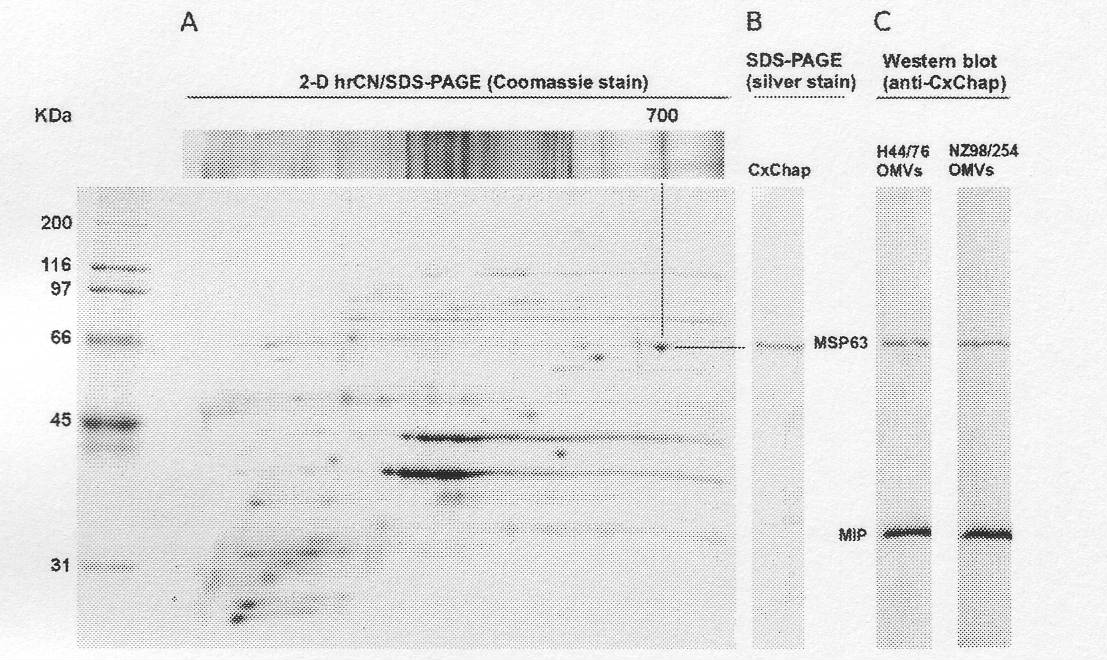
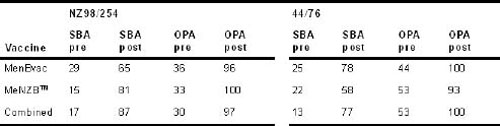
<body><![CDATA[<p><font face="Verdana, Arial, Helvetica, sans-serif" size="2">The 2-D electrophoretic    analysis of OMVs using hrCNE in the first dimension and SDS-PAGE in the second    allowed to obtain proteomic maps in which, theoretically, the spots aligned    vertically correspond to the individual proteins forming each complex. OMVs    complexes from the strain H44/76 are shown in Figure. 1A. </font></p>     <p><font face="Verdana, Arial, Helvetica, sans-serif" size="2">The CxChap complex    was purified using OMVs from a mutant lacking PorA to avoid contamination with    this protein, as this produced horizontal streaking in native electrophoresis    when the wild type H44/76 was used. Although the characterisation of the purified    complex by SDS-PAGE and silver stain (Figure 1B) showed a highly pure complex    formed by a 63 kDa protein (MSP63) alone, Western-blots (Figure 1C) showed that    anti-CxChap serum reacted with the MSP63 but, surprisingly, also with a 33 kDa    protein not detected previously by LC-MS/MS in BNE. LC-MS/MS identification    of the purified complex also revealed the presence of a homologue of the macrophage    infectivity potentiator (MIP). MSP63 forms two superimposed heptameric rings    in other bacteria (5), which is consistent with the molecular mass of the CxChap.    Although chaperonins are theoretically cytoplasmic, they have been found associated    with the outer membrane in some species (6). This is consistent with the presence    of chaperonin complexes in the outer membrane of N. meningitidis and with the    need for OM proteins to be correctly folded after transportation. It is also    consistent with meningococcal chaperonins being immunogenic during infection,    suggesting that they are expressed at the cell surface (7). </font></p>     <p><font face="Verdana, Arial, Helvetica, sans-serif" size="2">The MIP is considered    an important virulence factor involved in the initiation of the macrophage infection    in Legionella pneumophila and Neisseria gonorrhoeae. Our results showed that    this protein is highly immunogenic in N. meningitidis even when it is present    at low concentration. It is not clear if the MSP63 and the MIP are components    from the same complex or if both proteins are present in two different complexes    with a similar mobility in hrCNE electrophoresis. The cross reactivity observed    with the heterologous strain is in agreement with the high sequence homology    of both proteins among N. meningitidis strains and between N.meningitidis and    N.gonorrhoeae strains. </font></p>     <p><font face="Verdana, Arial, Helvetica, sans-serif" size="2">Results from serum    bactericidal (SBA) and opsonophagocityc (OPA) assays are shown in Table 1. </font></p>     <p><font face="Verdana, Arial, Helvetica, sans-serif" size="2">It can be seen    that the anti-CxChap serum is bactericidal against the homologous strain and    mediates opsonophagocytosis against both the homologous and the heterologous    strains. Further studies using knock-out mutants are being carried out to determine    which of both proteins is the responsible of the bactericidal and/or opsonophagocytic    antibodies in the anti-CxChap serum and, if both proteins are components from    the same complex. Although the implication of the N. gonorrhoeae MIP in pathogenicity    is clear (8), it's role in the pathogenesis of N. meningitidis disease is unknown    and should be the subject of further investigation.     <br>       <br>   <a href="/img/revistas/vac/v18n2/t0111209.jpg">Table 1</a>. Results from serum bactericidal and    opsonophagocytic assays     
<br>       <br>   <a href="/img/revistas/vac/v18n2/f0111209.jpg">Figure 1</a>. (A) 2-D hrCN/SDS-PAGE of OMVs from    strain H44/76; (B) Silver stained SDS-PAGE of purified CxChap; (C) Western blots    of OMVs from strains H44/76 and NZ98/254 separated by SDS-PAGE and revealed    with anti-CxChap.     
<br>       ]]></body>
<body><![CDATA[<br>   </font></p>     <p><font face="Verdana, Arial, Helvetica, sans-serif" size="2"><b><font size="3">Acknowledgments    </font> </b> </font></p>     <p><font face="Verdana, Arial, Helvetica, sans-serif" size="2">This work was supported    by grants PI050178 from the Fondo de Investigaci&oacute;n Sanitaria (FIS, Ministerio    de Sanidad y Consumo), and 2007/XAD63 from the Xunta de Galicia Spain. </font></p>     <p><font face="Verdana, Arial, Helvetica, sans-serif" size="3"><b>References</b></font><font face="Verdana, Arial, Helvetica, sans-serif" size="2">    </font></p>     <!-- ref --><p><font face="Verdana, Arial, Helvetica, sans-serif" size="2">1. Marzoa J, Abel    A, Sanchez S, Chan H, Feavers I, Criado MT, et al. Analysis of outer membrane    porin complexes of Neisseria meningitidis in wild-type and specific knock-out    mutant strains. Proteomics 2009 Feb 9(3):648-56. </font><!-- ref --><p><font face="Verdana, Arial, Helvetica, sans-serif" size="2">2. Pannekoek Y,    Schuurman IG, Dankert J, van Putten JP. Immunogenicity of the meningococcal    stress protein MSP63 during natural infection. Clin Exp Immunol 1993 Sep 93(3):377-81.    </font><!-- ref --><p><font face="Verdana, Arial, Helvetica, sans-serif" size="2">3. Wittig I, Karas    M, Sch&auml;gger H. High resolution clear native electrophoresis for in-gel    functional assays and fluorescence studies of membrane protein complexes. Mol    Cell Proteomics 2007 Jul 6(7):1215-25. </font><!-- ref --><p><font face="Verdana, Arial, Helvetica, sans-serif" size="2">4. Findlow J, Taylor    S, Aase A, Horton R, Heyderman R, Southern J, et al. Comparison and correlation    of Neisseria meningitidis serogroup B immunologic assay results and human antibody    responses following three doses of the Norwegian meningococcal outer membrane    vesicles vaccine MenBvac. Infect Immun 2006 Aug 74(8):4557-65. </font><!-- ref --><p><font face="Verdana, Arial, Helvetica, sans-serif" size="2">5. Arakere G, Kessel    M, Nguyen N, Frasch CE. Characterization of a stress protein from group B Neisseria    meningitidis. J Bacteriol 1993 Jun 175(11):3664-8. </font><!-- ref --><p><font face="Verdana, Arial, Helvetica, sans-serif" size="2">6. Qu J, Mayer    C, Behrens S, Holst O, et al. The trimeric periplasmic chaperone Skp of Escherichia    coli forms 1:1 complexes with outer membrane proteins via hydrophobic and electrostatic    interactions. J Mol Biol 2007 Nov 374(1):91-105. </font><!-- ref --><p><font face="Verdana, Arial, Helvetica, sans-serif" size="2">7. Pannekoek Y,    Dankert J, van Putten JP. Construction of recombinant neisserial Hsp60 proteins    and mapping of antigenic domains. Mol Microbiol 1995 Jan 15(2):277-85. </font><!-- ref --><p><font face="Verdana, Arial, Helvetica, sans-serif" size="2">8. Leuzzi R, Serino    L, Scarselli M, Savino S, Fontana MR, Monaci E, et al. Ng-MIP, a surface exposed    lipoprotein of Neisseria gonorrhoeae, has a peptidyl-prolyl cis/trans isomerase    (PPIase) activity and is involved in persistence in macrophages. Mol Microbiol    2005 Nov 58(3):669-81.    <br>       <br>       <br>       <br>       <br>   </font></p>      ]]></body><back>
<ref-list>
<ref id="B1">
<label>1</label><nlm-citation citation-type="journal">
<person-group person-group-type="author">
<name>
<surname><![CDATA[Marzoa]]></surname>
<given-names><![CDATA[J]]></given-names>
</name>
<name>
<surname><![CDATA[A]]></surname>
<given-names><![CDATA[Abel]]></given-names>
</name>
<name>
<surname><![CDATA[Sanchez]]></surname>
<given-names><![CDATA[S]]></given-names>
</name>
<name>
<surname><![CDATA[Chan]]></surname>
<given-names><![CDATA[H]]></given-names>
</name>
<name>
<surname><![CDATA[Feavers]]></surname>
<given-names><![CDATA[I]]></given-names>
</name>
<name>
<surname><![CDATA[Criado]]></surname>
<given-names><![CDATA[MT]]></given-names>
</name>
</person-group>
<article-title xml:lang="en"><![CDATA[Analysis of outer membrane porin complexes of Neisseria meningitidis in wild-type and specific knock-out mutant strains]]></article-title>
<source><![CDATA[Proteomics]]></source>
<year>2009</year>
<volume>3</volume>
<page-range>648-56</page-range></nlm-citation>
</ref>
<ref id="B2">
<label>2</label><nlm-citation citation-type="journal">
<person-group person-group-type="author">
<name>
<surname><![CDATA[Pannekoek]]></surname>
<given-names><![CDATA[Y]]></given-names>
</name>
<name>
<surname><![CDATA[Schuurman]]></surname>
<given-names><![CDATA[IG]]></given-names>
</name>
<name>
<surname><![CDATA[Dankert]]></surname>
<given-names><![CDATA[J]]></given-names>
</name>
<name>
<surname><![CDATA[van Putten]]></surname>
<given-names><![CDATA[JP]]></given-names>
</name>
</person-group>
<article-title xml:lang="en"><![CDATA[Immunogenicity of the meningococcal stress protein MSP63 during natural infection]]></article-title>
<source><![CDATA[Clin Exp Immunol]]></source>
<year>1993</year>
<volume>3</volume>
<page-range>377-81</page-range></nlm-citation>
</ref>
<ref id="B3">
<label>3</label><nlm-citation citation-type="journal">
<person-group person-group-type="author">
<name>
<surname><![CDATA[Wittig]]></surname>
<given-names><![CDATA[I]]></given-names>
</name>
<name>
<surname><![CDATA[Karas]]></surname>
<given-names><![CDATA[M]]></given-names>
</name>
<name>
<surname><![CDATA[Schägger]]></surname>
<given-names><![CDATA[H]]></given-names>
</name>
</person-group>
<article-title xml:lang="en"><![CDATA[High resolution clear native electrophoresis for in-gel functional assays and fluorescence studies of membrane protein complexes]]></article-title>
<source><![CDATA[Mol Cell Proteomics]]></source>
<year>2007</year>
<numero>^s7</numero>
<issue>^s7</issue>
<supplement>7</supplement>
<page-range>1215-25</page-range></nlm-citation>
</ref>
<ref id="B4">
<label>4</label><nlm-citation citation-type="journal">
<person-group person-group-type="author">
<name>
<surname><![CDATA[Findlow]]></surname>
<given-names><![CDATA[J]]></given-names>
</name>
<name>
<surname><![CDATA[Taylor]]></surname>
<given-names><![CDATA[S]]></given-names>
</name>
<name>
<surname><![CDATA[Aase]]></surname>
<given-names><![CDATA[A]]></given-names>
</name>
<name>
<surname><![CDATA[Horton]]></surname>
<given-names><![CDATA[R]]></given-names>
</name>
<name>
<surname><![CDATA[Heyderman]]></surname>
<given-names><![CDATA[R]]></given-names>
</name>
<name>
<surname><![CDATA[Southern]]></surname>
<given-names><![CDATA[J]]></given-names>
</name>
</person-group>
<article-title xml:lang="en"><![CDATA[Comparison and correlation of Neisseria meningitidis serogroup B immunologic assay results and human antibody responses following three doses of the Norwegian meningococcal outer membrane vesicles vaccine MenBvac]]></article-title>
<source><![CDATA[Infect Immun]]></source>
<year>2006</year>
<numero>^s74</numero>
<issue>^s74</issue>
<supplement>74</supplement>
<page-range>4557-65</page-range></nlm-citation>
</ref>
<ref id="B5">
<label>5</label><nlm-citation citation-type="journal">
<person-group person-group-type="author">
<name>
<surname><![CDATA[Arakere]]></surname>
<given-names><![CDATA[G]]></given-names>
</name>
<name>
<surname><![CDATA[Kessel]]></surname>
<given-names><![CDATA[M]]></given-names>
</name>
<name>
<surname><![CDATA[Nguyen]]></surname>
<given-names><![CDATA[N]]></given-names>
</name>
<name>
<surname><![CDATA[Frasch]]></surname>
<given-names><![CDATA[CE]]></given-names>
</name>
</person-group>
<article-title xml:lang="en"><![CDATA[Characterization of a stress protein from group B Neisseria meningitidis]]></article-title>
<source><![CDATA[J Bacteriol]]></source>
<year>1993</year>
<volume>175</volume>
<page-range>3664-8</page-range></nlm-citation>
</ref>
<ref id="B6">
<label>6</label><nlm-citation citation-type="journal">
<person-group person-group-type="author">
<name>
<surname><![CDATA[Qu]]></surname>
<given-names><![CDATA[J]]></given-names>
</name>
<name>
<surname><![CDATA[Mayer]]></surname>
<given-names><![CDATA[C]]></given-names>
</name>
<name>
<surname><![CDATA[Behrens]]></surname>
<given-names><![CDATA[S]]></given-names>
</name>
<name>
<surname><![CDATA[Holst]]></surname>
<given-names><![CDATA[O]]></given-names>
</name>
</person-group>
<article-title xml:lang="en"><![CDATA[The trimeric periplasmic chaperone Skp of Escherichia coli forms 1:1 complexes with outer membrane proteins via hydrophobic and electrostatic interactions]]></article-title>
<source><![CDATA[J Mol Biol]]></source>
<year>2007</year>
<volume>374</volume>
<page-range>91-105</page-range></nlm-citation>
</ref>
<ref id="B7">
<label>7</label><nlm-citation citation-type="journal">
<person-group person-group-type="author">
<name>
<surname><![CDATA[Pannekoek]]></surname>
<given-names><![CDATA[Y]]></given-names>
</name>
<name>
<surname><![CDATA[Dankert]]></surname>
<given-names><![CDATA[J]]></given-names>
</name>
<name>
<surname><![CDATA[van Putten]]></surname>
<given-names><![CDATA[JP]]></given-names>
</name>
</person-group>
<article-title xml:lang="en"><![CDATA[Construction of recombinant neisserial Hsp60 proteins and mapping of antigenic domains]]></article-title>
<source><![CDATA[Mol Microbiol]]></source>
<year>1995</year>
<volume>15</volume>
<page-range>277-85</page-range></nlm-citation>
</ref>
<ref id="B8">
<label>8</label><nlm-citation citation-type="journal">
<person-group person-group-type="author">
<name>
<surname><![CDATA[Leuzzi]]></surname>
<given-names><![CDATA[R]]></given-names>
</name>
<name>
<surname><![CDATA[Serino]]></surname>
<given-names><![CDATA[L]]></given-names>
</name>
<name>
<surname><![CDATA[Scarselli]]></surname>
<given-names><![CDATA[M]]></given-names>
</name>
<name>
<surname><![CDATA[Savino]]></surname>
<given-names><![CDATA[S]]></given-names>
</name>
<name>
<surname><![CDATA[Fontana]]></surname>
<given-names><![CDATA[MR]]></given-names>
</name>
<name>
<surname><![CDATA[Monaci]]></surname>
<given-names><![CDATA[E]]></given-names>
</name>
</person-group>
<article-title xml:lang="en"><![CDATA[Ng-MIP, a surface exposed lipoprotein of Neisseria gonorrhoeae, has a peptidyl-prolyl cis/trans isomerase (PPIase) activity and is involved in persistence in macrophages]]></article-title>
<source><![CDATA[Microbiol]]></source>
<year>2005</year>
<volume>58</volume>
<page-range>669-81</page-range></nlm-citation>
</ref>
</ref-list>
</back>
</article>