<?xml version="1.0" encoding="ISO-8859-1"?><article xmlns:mml="http://www.w3.org/1998/Math/MathML" xmlns:xlink="http://www.w3.org/1999/xlink" xmlns:xsi="http://www.w3.org/2001/XMLSchema-instance">
<front>
<journal-meta>
<journal-id>1025-028X</journal-id>
<journal-title><![CDATA[Vaccimonitor]]></journal-title>
<abbrev-journal-title><![CDATA[Vaccimonitor]]></abbrev-journal-title>
<issn>1025-028X</issn>
<publisher>
<publisher-name><![CDATA[Finlay Ediciones]]></publisher-name>
</publisher>
</journal-meta>
<article-meta>
<article-id>S1025-028X2009000200012</article-id>
<title-group>
<article-title xml:lang="es"><![CDATA[Dinámicas de las interacciones de Neisseria meningitidis con las barreras celulares y los efectores inmunes]]></article-title>
<article-title xml:lang="en"><![CDATA[Dynamics of Neisseria meningitidis interactions with human cellular barriers and immune effectors]]></article-title>
</title-group>
<contrib-group>
<contrib contrib-type="author">
<name>
<surname><![CDATA[Griffiths]]></surname>
<given-names><![CDATA[Natalie J.]]></given-names>
</name>
<xref ref-type="aff" rid="A01"/>
</contrib>
<contrib contrib-type="author">
<name>
<surname><![CDATA[Sa E Cunha]]></surname>
<given-names><![CDATA[Claudia]]></given-names>
</name>
<xref ref-type="aff" rid="A01"/>
</contrib>
<contrib contrib-type="author">
<name>
<surname><![CDATA[Murillo]]></surname>
<given-names><![CDATA[Isabel]]></given-names>
</name>
<xref ref-type="aff" rid="A01"/>
</contrib>
<contrib contrib-type="author">
<name>
<surname><![CDATA[Youssef]]></surname>
<given-names><![CDATA[Abdel-Rahman]]></given-names>
</name>
<xref ref-type="aff" rid="A01"/>
</contrib>
<contrib contrib-type="author">
<name>
<surname><![CDATA[Borodina]]></surname>
<given-names><![CDATA[Elena]]></given-names>
</name>
<xref ref-type="aff" rid="A01"/>
</contrib>
<contrib contrib-type="author">
<name>
<surname><![CDATA[Hill]]></surname>
<given-names><![CDATA[Darryl J]]></given-names>
</name>
<xref ref-type="aff" rid="A01"/>
</contrib>
<contrib contrib-type="author">
<name>
<surname><![CDATA[Virji]]></surname>
<given-names><![CDATA[Mumtaz]]></given-names>
</name>
<xref ref-type="aff" rid="A01"/>
</contrib>
</contrib-group>
<aff id="A01">
<institution><![CDATA[,School of Medical Sciences, University of Bristol  ]]></institution>
<addr-line><![CDATA[Bristo ]]></addr-line>
<country>UK</country>
</aff>
<pub-date pub-type="pub">
<day>00</day>
<month>08</month>
<year>2009</year>
</pub-date>
<pub-date pub-type="epub">
<day>00</day>
<month>08</month>
<year>2009</year>
</pub-date>
<volume>18</volume>
<numero>2</numero>
<fpage>90</fpage>
<lpage>92</lpage>
<copyright-statement/>
<copyright-year/>
<self-uri xlink:href="http://scielo.sld.cu/scielo.php?script=sci_arttext&amp;pid=S1025-028X2009000200012&amp;lng=en&amp;nrm=iso"></self-uri><self-uri xlink:href="http://scielo.sld.cu/scielo.php?script=sci_abstract&amp;pid=S1025-028X2009000200012&amp;lng=en&amp;nrm=iso"></self-uri><self-uri xlink:href="http://scielo.sld.cu/scielo.php?script=sci_pdf&amp;pid=S1025-028X2009000200012&amp;lng=en&amp;nrm=iso"></self-uri><abstract abstract-type="short" xml:lang="en"><p><![CDATA[Neisseria meningitidis outer membrane (OM) adhesins, Opa and Opc are known to exert significant influence on bacterial adhesion and invasion properties. They are also likely to affect the dynamics of cellular barrier penetration as they target human receptors that are subject to upregulation under inflammatory conditions. As some of the targeted receptors are also expressed on immune cells, it is possible that the OM proteins, when presented on bacteria or in OM vesicle vaccines, have the additional capacity to modulate host immune responses. In our recent studies, in vitro model systems were used to further explore these possibilities. The studies illustrated that the major human receptors targeted by Opa and Opc, i.e. CEACAMs and integrins, when upregulated by inflammatory cytokines, encourage enhanced cellular adhesion, invasion and barrier traversal. Tissue infiltration by fully capsulate bacteria via Opa proteins was also observed for piliated Opa+ meningococci. Other studies indicate that Opc increases meningococcal resistance to serum-mediated killing by binding to the complement regulatory molecule vitronectin. In addition, although adverse immunomodulatory effects have been reported for Opa-expressing gonococci and meningococcal OMVs, our studies indicate that interactions with CD4+ T cell expressed CEACAM1 does not offer immunomodulatory properties to meningococci.]]></p></abstract>
<kwd-group>
<kwd lng="en"><![CDATA[Neisseria meningitidis]]></kwd>
<kwd lng="en"><![CDATA[Opa]]></kwd>
<kwd lng="en"><![CDATA[Opc]]></kwd>
</kwd-group>
</article-meta>
</front><body><![CDATA[ <p align="right"><font size="2" face="Verdana, Arial, Helvetica, sans-serif"><b>ARTICULOS    ORIGINALES</b></font></p>     <p><font size="2" face="Verdana, Arial, Helvetica, sans-serif">    <br>   </font></p>     <p><font size="2" face="Verdana, Arial, Helvetica, sans-serif"><b><font size="4">Din&aacute;micas    de las interacciones de Neisseria meningitidis con las barreras celulares y    los efectores inmunes.</font><font size="4">    <br>   </font></b></font></p>     <p><font size="2" face="Verdana, Arial, Helvetica, sans-serif"><b><font size="3">Dynamics    of Neisseria meningitidis interactions with human cellular barriers and immune    effectors.</font></b></font></p>     <p><font size="2" face="Verdana, Arial, Helvetica, sans-serif"><b>Natalie J. Griffiths,    Claudia Sa E Cunha, Isabel Murillo, Abdel-Rahman Youssef, Elena Borodina, Darryl    J. Hill and Mumtaz Virji     <br>   </b>    <br>   Department of Cellular and Molecular Medicine, School of Medical Sciences, </font></p>     <p><font size="2" face="Verdana, Arial, Helvetica, sans-serif">University of Bristol,    Bristol BS8 1TD, UK     ]]></body>
<body><![CDATA[<br>   </font></p> <hr>     <p><font size="3" face="Verdana, Arial, Helvetica, sans-serif"><b>Abstract</b></font></p>     <p><font size="2" face="Verdana, Arial, Helvetica, sans-serif">Neisseria meningitidis    outer membrane (OM) adhesins, Opa and Opc are known to exert significant influence    on bacterial adhesion and invasion properties. They are also likely to affect    the dynamics of cellular barrier penetration as they target human receptors    that are subject to upregulation under inflammatory conditions. As some of the    targeted receptors are also expressed on immune cells, it is possible that the    OM proteins, when presented on bacteria or in OM vesicle vaccines, have the    additional capacity to modulate host immune responses. In our recent studies,    in vitro model systems were used to further explore these possibilities. The    studies illustrated that the major human receptors targeted by Opa and Opc,    i.e. CEACAMs and integrins, when upregulated by inflammatory cytokines, encourage    enhanced cellular adhesion, invasion and barrier traversal. Tissue infiltration    by fully capsulate bacteria via Opa proteins was also observed for piliated    Opa+ meningococci. Other studies indicate that Opc increases meningococcal resistance    to serum-mediated killing by binding to the complement regulatory molecule vitronectin.    In addition, although adverse immunomodulatory effects have been reported for    Opa-expressing gonococci and meningococcal OMVs, our studies indicate that interactions    with CD4+ T cell expressed CEACAM1 does not offer immunomodulatory properties    to meningococci. </font></p>     <p><font size="2" face="Verdana, Arial, Helvetica, sans-serif"><b>Keywords</b>:    Neisseria meningitidis, Opa, Opc</font></p> <hr>     <p><font size="2" face="Verdana, Arial, Helvetica, sans-serif"><b><font size="3">Introduction    </font></b></font></p>     <p><font size="2" face="Verdana, Arial, Helvetica, sans-serif">It is now well    established that the major receptors targeted by neisserial Opa proteins belong    to the CEACAM (carcinoembryonic antigen-related cell adhesion molecule) family    of receptors, of which CEACAM1 is the most widely targeted by distinct Opa types.    CEACAM1 is one of several related molecules expressed on human epithelial cells,    endothelial cells and leukocytes but it is the only member of the family expressed    on T cells. </font></p>     <p><font size="2" face="Verdana, Arial, Helvetica, sans-serif">One of our interests    has been to assess how neisserial Opa targeting of CEACAM1, expressed on human    barrier cells as well as immune cells, might alter host susceptibility to infections    by the pathogens. In recent studies, we have examined the potential role of    CEACAM1 in increasing target cell susceptibility to meningococcal infiltration.    In vitro transfected cellular model systems and human respiratory epithelial    cells exposed to IFNg demonstrated the importance of the receptor upregulation    in increased cellular invasion by meningococci. The data imply that cell-surface    remodelling by virally-induced cytokines could be one factor that increases    host susceptibility to bacterial infection (1). </font></p>     <p><font size="2" face="Verdana, Arial, Helvetica, sans-serif">Further, it is    noteworthy that polymorphisms in CEACAM structure have been associated with    changes in meningococcal interactions and virulence as demonstrated by in vitro    mutagenesis studies of CEACAM1 (2) and in surveys of meningococcal case versus    control samples (3). In addition to the association of certain CEACAM haplotypes    with increased host susceptibility, certain meningococcal Opa repertoires were    correlated with hyper-invasiveness and disease (3, 4). Association of limited    numbers of Opa repertoires with disease also suggests that Opa proteins could    be candidate vaccine antigens in their own right. Therefore, understanding their    full potential as virulence factors is important for future approaches to control    meningococcal infection. </font></p>     <p><font size="2" face="Verdana, Arial, Helvetica, sans-serif">In addition, Opc,    another opacity protein, unique to N. meningitidis is an effective invasin for    human endothelial cells (5). Meningococcal entry into the meninges may also    involve entry via brain endothelial cells (6). Our recent studies have assessed    how integrin targeting enables meningococci to interact with endothelial cells    at diverse vascular sites at which integrin profiles may vary considerably (7).    Opc has also been shown to interact with intracellular alpha-actinin, a modulator    of several receptor and cytoskeletal functions, whether this enables meningococci    to influence cellular functions to facilitate their passage across human barrier    cells remains to be shown (8). In addition, we have analysed how Opc targeting    of serum factors such as vitronectin may enhance its serum resistance properties.    Below we provide some data from studies on potential immunomodulatory properties    of meningococcal opacity proteins. </font></p>     <p><font size="2" face="Verdana, Arial, Helvetica, sans-serif"><b>A. Opc interactions    with activated vitronectin lead to increased serum resistance of meningococci    </b></font></p>     ]]></body>
<body><![CDATA[<p><font size="2" face="Verdana, Arial, Helvetica, sans-serif">The major serum    protein targeted by Opc is vitronectin, a well known modulator of complement    action. We have analysed the molecular structural requirement for Opc targeting    of human vitronectin and the resultant effect on serum resistance. Although    Opc may bind to several serum proteins, vitronectin was found to be the major    target for Opc; and it is the activated/unfolded form of vitronectin that is    particularly targeted. We have identified the binding region for Opc on vitronectin,    which becomes exposed only in the activated form of the protein. In addition,    binding to vitronectin which is observed for Opc+ but not Opc- bacteria, leads    to increased serum resistance (Fig.1). Depletion of activated serum vitronectin    by anti-vitronectin antibodies decreased such serum resistance (Figure. 1C).        <br>       <br>   <a href="/img/revistas/vac/v18n2/f0112209.jpg">Figure 1.</a> Serum killing of acapsulate Opc+    and Opc- N. meningitidis isolates (NHS: normal human serum; endogenous complement).    Opc-expressing meningococci are inherently more serum resistant (A). The addition    of activated vitronectin to NHS inhibits killing and saturable inhibition of    killing in the presence of 10% NHS with additional activated vitronectin is    observed only with Opc+ bacteria (B). The monoclonal anti-vitronectin antibody    (8E6) depletes activated vitronectin available for Opc interactions, and restores    serum killing of Opc+ N. meningitidis (C). Similar observations were made using    capsulate bacteria (not shown). </font></p>     
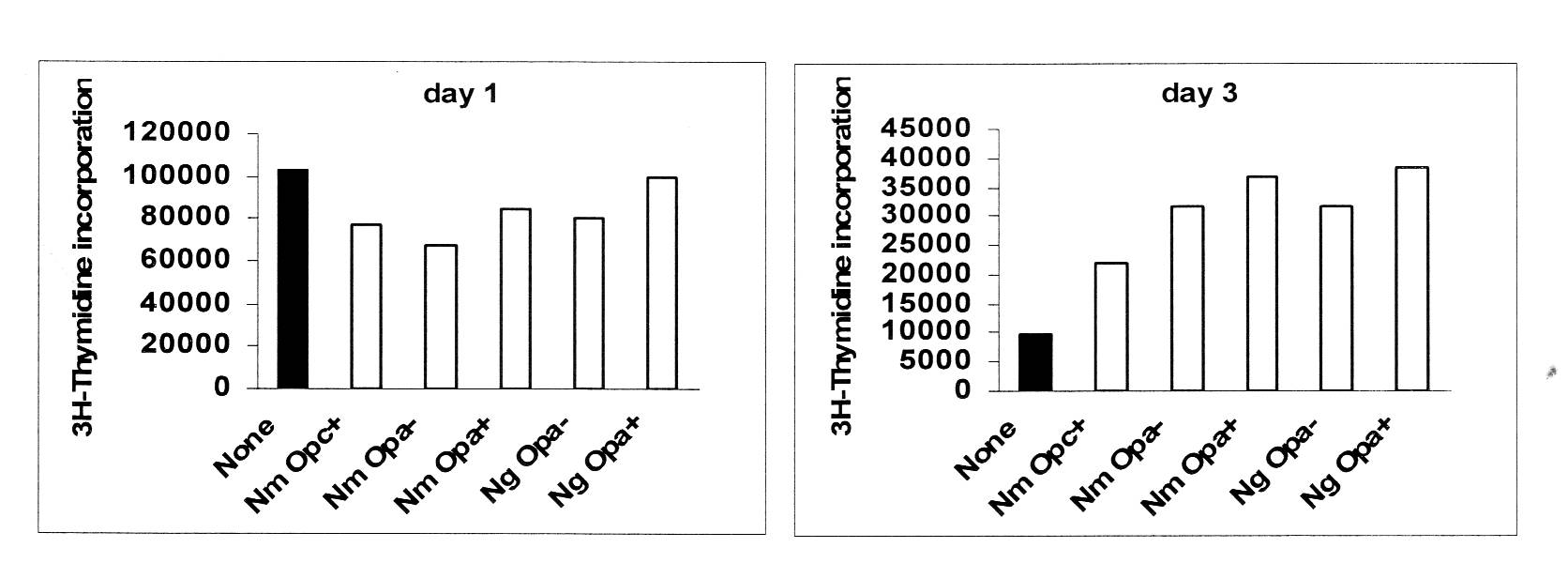
<p><font size="3" face="Verdana, Arial, Helvetica, sans-serif"><b><font size="2">Conclusions</font></b></font></p>     <p><font size="2" face="Verdana, Arial, Helvetica, sans-serif"> Opc is a multifunctional    protein. Its binding to vitronectin has been shown to enhance cellular interactions.    Current studies have shown that vitronectin targeting also leads to increased    serum resistance: the addition of activated vitronectin increases Opc-expressing    meningococcal survival in normal adult serum whereas its depletion results in    restoration of serum bactericidal activity.     <br>       <br>       <br>   <b>B. Direct adhesion to human CD4+ T cells by meningococcal opacity proteins    does not affect T cell responses to other neisserial antigens.</b> </font></p>     <p><font size="2" face="Verdana, Arial, Helvetica, sans-serif">Several neisserial    antigens have been shown to induce proliferative response in T cells (e.g. reference    (9)). In contrast, interactions of Opa+ N. gonorrhoeae and N. meningitidis OMV    with CEACAM1 inhibited CD4+ T cell responses (10, 11). Whether Opa-expressing    live meningococci exert similar effects is not known. In view of this and of    the notion that N. meningitidis carriage itself may be an immunising event that    may induce lasting T cell memory (12), further studies were conducted to define    the consequences of meningocococcal interactions with human CD4+ T cells. </font></p>     <p><font size="2" face="Verdana, Arial, Helvetica, sans-serif">For this purpose,    live and killed N. meningitidis of distinct serogroups either expressing or    lacking Opa and Opc proteins, were added to isolated CD4+ T cells prestimulated    to induce CEACAM1 expression. An early Opa-independent transient decrease in    T cell proliferation was observed under some conditions which was followed by    a strong stimulatory effect on T cell immune functions as assessed by 3H-thymidine    incorporation assays (Fig. 2) and cytokine responses (not shown). Importantly,    despite increased adhesion mediated by the opacity proteins, no Opa-dependent    inhibitory effect on T cell proliferation was seen using a variety of assay    conditions.     ]]></body>
<body><![CDATA[<br>       <br>   <a href="/img/revistas/vac/v18n2/f0212209.jpg">Figure 2</a>. Effect of neisserial infection on    proliferation of activated CD4+ T cells. CD4+ T cells were stimulated with anti-CD3    and anti-CD28 for 48 h, washed and incubated with IL-2 for further 48 h. After    washing, the cells were left uninfected (filled bars) or infected with neisserial    strains in the presence of soluble anti-CD3. Three hours after infection, gentamicin    (50mg/ml) was added. At daily intervals after infection, cells were pulsed with    3H-thymidine. Average cpm incorporated in duplicate samples at day 1 and day    3 are shown (SE +/- 15%). Corroborating data were also obtained using the CFSE    dilution method. Note: Opc+ and Opa+ meningococci (Nm) and Opa+ gonococci (Ng)    adhere in greater numbers to stimulated CD4+ T cells than bacteria not expressing    the proteins (not shown).     
<br>       <br>   <b>Conclusions</b></font></p>     <p><font size="2" face="Verdana, Arial, Helvetica, sans-serif"> Overall, these    data suggest that certain surface components of the pathogenic Neisseria can    exert early mild inhibitory effects but these are rapidly followed by longer    lasting, stronger stimulatory effects on CD4+ T cells. Most importantly, the    opacity proteins have no influence on T cell proliferation. Although unexpected,    these observations suggest that human CD4+ T cells respond positively to one    or more neisserial antigens to overcome any inhibition that could be induced    via the engagement of CEACAM1. </font></p>     <p><font size="2" face="Verdana, Arial, Helvetica, sans-serif">As stated above,    certain meningococcal Opa repertoires have been correlated with hyper-invasiveness    and disease, however, they do not correlate with the severity of meningococcal    disease (3). Although at present the molecular and cellular basis for such disease    association is not entirely clear, in view of the current studies, it would    seem premature to assign any disease association of meningococcal Opa proteins    to their effects on T cell functions (11); perhaps the consequences of Opa/CEACAM    interactions are engendered with a greater impact at other cellular interfaces    (1, 13). </font></p>     <p><font size="2" face="Verdana, Arial, Helvetica, sans-serif"><b><font size="3">References    </font></b></font></p>     <!-- ref --><p><font size="2" face="Verdana, Arial, Helvetica, sans-serif">1. Griffiths NJ,    Bradley, CJ, Heyderman RS, and Virji M. IFN-gamma amplifies NFkappaB-dependent    Neisseria meningitidis invasion of epithelial cells via specific upregulation    of CEA-related cell adhesion molecule 1. Cell Microbiol 2007; 9:2968. </font><!-- ref --><p><font size="2" face="Verdana, Arial, Helvetica, sans-serif">2. Villullas S,    Hill DJ, Sessions RB, Rea J, and Virji M. Mutational analysis of human CEACAM1:    the potential of receptor polymorphism in increasing host susceptibility to    bacterial infection. Cell Microbiol 2007; 9:329. </font><!-- ref --><p><font size="2" face="Verdana, Arial, Helvetica, sans-serif">3. Callaghan, MJ,    Rockett K, Banner C, Haralambous E, Betts H, Faust S, Maiden MC, Kroll JS, Levin    M, Kwiatkowski DP, and Pollard AJ. Haplotypic diversity in human CEACAM genes:    effects on susceptibility to meningococcal disease. Genes Immun 2008; 9:30.    </font><!-- ref --><p><font size="2" face="Verdana, Arial, Helvetica, sans-serif">4. Callaghan MJ,    Jolley KA, and Maiden MC. Opacity-associated adhesin repertoire in hyperinvasive    Neisseria meningitidis. Infect Immun 2006;74:5085. </font><!-- ref --><p><font size="2" face="Verdana, Arial, Helvetica, sans-serif">5. Virji M, Makepeace    K, Peak IR, Ferguson DJ, Jennings MP, and Moxon ER. Opc- and pilus-dependent    interactions of meningococci with human endothelial cells: molecular mechanisms    and modulation by surface polysaccharides. Mol Microbiol 1995;18:741. </font><!-- ref --><p><font size="2" face="Verdana, Arial, Helvetica, sans-serif">6. Unkmeir A, Latsch    K, Dietrich G, Wintermeyer E, Schinke B, Schwender S, Kim KS, Eigenthaler M,    and Frosch M. Fibronectin mediates Opc-dependent internalization of Neisseria    meningitidis in human brain microvascular endothelial cells. Mol Microbiol 2002;46:    933. </font><!-- ref --><p><font size="2" face="Verdana, Arial, Helvetica, sans-serif">7. Virji M, Griffiths,    NJ and Cunha CS. Opc and its multifarious receptors: identification of novel    mechanisms that may operate for attachment and traversal of human endothelial    cells. </font><font size="2" face="Verdana, Arial, Helvetica, sans-serif"><a href="http://neisseria.org/ipnc/2008/Abstracts_oral_presentations_IPNC_2008.pdf">http://neisseria.org/ipnc/2008/Abstracts_oral_presentations_IPNC_2008.pdf</a>    (Abstract #055).    <br>   </font></p>     <!-- ref --><p><font size="2" face="Verdana, Arial, Helvetica, sans-serif">8. Cunha CS, Griffiths    NJ, Murillo I, and Virji M. Neisseria meningitidis Opc invasin binds to the    cytoskeletal protein alpha-actinin. Cell Microbiol 2009; 11: 389. </font><!-- ref --><p><font size="2" face="Verdana, Arial, Helvetica, sans-serif">9. Robinson K,    Wooldridge KG, Wells DB, Hasan A, Todd I, Robins A, James R, and Ala'Aldeen    DA. T-cell-stimulating protein A elicits immune responses during meningococcal    carriage and human disease. Infect Immun 2005;73: 4684. </font><!-- ref --><p><font size="2" face="Verdana, Arial, Helvetica, sans-serif">10. Boulton IC,    and Gray-Owen SD. Neisserial binding to CEACAM1 arrests the activation and proliferation    of CD4+ T lymphocytes. Nat Immunol 2002;3: 229. </font><!-- ref --><p><font size="2" face="Verdana, Arial, Helvetica, sans-serif">11. Lee HS, Boulton    IC, Reddin K, Wong H, Halliwell D, Mandelboim O, Gorringe AR, and Gray-Owen    SD. Neisserial outer membrane vesicles bind the coinhibitory receptor carcinoembryonic    antigen-related cellular adhesion molecule 1 and suppress CD4+ T lymphocyte    function. Infect Immun 2007;75: 4449. </font><!-- ref --><p><font size="2" face="Verdana, Arial, Helvetica, sans-serif">12. Davenport V,    Guthrie T, Findlow J, Borrow R, Williams NA, and Heyderman RS. Evidence for    naturally acquired T cell-mediated mucosal immunity to Neisseria meningitidis.    J Immunol 2003;171: 4263. </font><p><font size="2" face="Verdana, Arial, Helvetica, sans-serif">13. Muenzner P,    Dehio C, Fujiwara T, Achtman M, Meyer TF, and Gray-Owen SD.. Carcinoembryonic    antigen family receptor specificity of Neisseria meningitidis Opa variants influences    adherence to and invasion of proinflammatory cytokine-activated endothelial    cells. Infect Immun 20006;8: 3601.     <br>       <br>       <br>       <br>       <br>       <br>       <br>       <br>       <br>   </font></p>     ]]></body>
<body><![CDATA[ ]]></body><back>
<ref-list>
<ref id="B1">
<label>1</label><nlm-citation citation-type="journal">
<person-group person-group-type="author">
<name>
<surname><![CDATA[Griffiths]]></surname>
<given-names><![CDATA[NJ]]></given-names>
</name>
<name>
<surname><![CDATA[Bradley]]></surname>
<given-names><![CDATA[CJ]]></given-names>
</name>
<name>
<surname><![CDATA[Heyderman]]></surname>
<given-names><![CDATA[RS]]></given-names>
</name>
<name>
<surname><![CDATA[Virji]]></surname>
<given-names><![CDATA[M]]></given-names>
</name>
</person-group>
<article-title xml:lang="en"><![CDATA[IFN-gamma amplifies NFkappaB-dependent Neisseria meningitidis invasion of epithelial cells via specific upregulation of CEA-related cell adhesion molecule 1]]></article-title>
<source><![CDATA[Cell Microbiol]]></source>
<year>2007</year>
<volume>9</volume>
<page-range>29-68</page-range></nlm-citation>
</ref>
<ref id="B2">
<label>2</label><nlm-citation citation-type="journal">
<person-group person-group-type="author">
<name>
<surname><![CDATA[Villullas]]></surname>
<given-names><![CDATA[S]]></given-names>
</name>
<name>
<surname><![CDATA[Hill]]></surname>
<given-names><![CDATA[DJ]]></given-names>
</name>
<name>
<surname><![CDATA[Sessions]]></surname>
<given-names><![CDATA[RB]]></given-names>
</name>
<name>
<surname><![CDATA[Rea]]></surname>
<given-names><![CDATA[J]]></given-names>
</name>
<name>
<surname><![CDATA[Virji]]></surname>
<given-names><![CDATA[M]]></given-names>
</name>
</person-group>
<article-title xml:lang="en"><![CDATA[Mutational analysis of human CEACAM1: the potential of receptor polymorphism in increasing host susceptibility to bacterial infection]]></article-title>
<source><![CDATA[Cell Microbiol]]></source>
<year>2007</year>
<volume>9</volume>
<page-range>329</page-range></nlm-citation>
</ref>
<ref id="B3">
<label>3</label><nlm-citation citation-type="journal">
<person-group person-group-type="author">
<name>
<surname><![CDATA[Callaghan]]></surname>
<given-names><![CDATA[MJ]]></given-names>
</name>
<name>
<surname><![CDATA[Rockett]]></surname>
<given-names><![CDATA[K]]></given-names>
</name>
<name>
<surname><![CDATA[Banner]]></surname>
<given-names><![CDATA[C]]></given-names>
</name>
<name>
<surname><![CDATA[Haralambous]]></surname>
<given-names><![CDATA[E]]></given-names>
</name>
<name>
<surname><![CDATA[Betts]]></surname>
<given-names><![CDATA[H]]></given-names>
</name>
<name>
<surname><![CDATA[Faust]]></surname>
<given-names><![CDATA[S]]></given-names>
</name>
<name>
<surname><![CDATA[Maiden]]></surname>
<given-names><![CDATA[MC]]></given-names>
</name>
<name>
<surname><![CDATA[Kroll]]></surname>
<given-names><![CDATA[JS]]></given-names>
</name>
<name>
<surname><![CDATA[Levin]]></surname>
<given-names><![CDATA[M]]></given-names>
</name>
<name>
<surname><![CDATA[Kwiatkowski]]></surname>
<given-names><![CDATA[DP]]></given-names>
</name>
<name>
<surname><![CDATA[Pollard]]></surname>
<given-names><![CDATA[AJ]]></given-names>
</name>
</person-group>
<article-title xml:lang="en"><![CDATA[Haplotypic diversity in human CEACAM genes: effects on susceptibility to meningococcal disease]]></article-title>
<source><![CDATA[Genes Immun]]></source>
<year>2008</year>
<page-range>9-30</page-range></nlm-citation>
</ref>
<ref id="B4">
<label>4</label><nlm-citation citation-type="journal">
<person-group person-group-type="author">
<name>
<surname><![CDATA[Callaghan]]></surname>
<given-names><![CDATA[MJ]]></given-names>
</name>
<name>
<surname><![CDATA[Jolley]]></surname>
<given-names><![CDATA[KA]]></given-names>
</name>
<name>
<surname><![CDATA[Maiden]]></surname>
<given-names><![CDATA[MC]]></given-names>
</name>
</person-group>
<article-title xml:lang="en"><![CDATA[Opacity-associated adhesin repertoire in hyperinvasive Neisseria meningitidis]]></article-title>
<source><![CDATA[Infect Immun]]></source>
<year>2006</year>
<volume>74</volume>
<page-range>5085</page-range></nlm-citation>
</ref>
<ref id="B5">
<label>5</label><nlm-citation citation-type="journal">
<person-group person-group-type="author">
<name>
<surname><![CDATA[Virji]]></surname>
<given-names><![CDATA[M]]></given-names>
</name>
<name>
<surname><![CDATA[Makepeace]]></surname>
<given-names><![CDATA[K]]></given-names>
</name>
<name>
<surname><![CDATA[Peak]]></surname>
<given-names><![CDATA[IR]]></given-names>
</name>
<name>
<surname><![CDATA[Ferguson]]></surname>
<given-names><![CDATA[DJ]]></given-names>
</name>
<name>
<surname><![CDATA[Jennings]]></surname>
<given-names><![CDATA[MP]]></given-names>
</name>
<name>
<surname><![CDATA[Moxon]]></surname>
<given-names><![CDATA[ER]]></given-names>
</name>
</person-group>
<article-title xml:lang="en"><![CDATA[Opc- and pilus-dependent interactions of meningococci with human endothelial cells: molecular mechanisms and modulation by surface polysaccharides]]></article-title>
<source><![CDATA[Mol Microbiol]]></source>
<year>1995</year>
<volume>18</volume>
<page-range>741</page-range></nlm-citation>
</ref>
<ref id="B6">
<label>6</label><nlm-citation citation-type="journal">
<person-group person-group-type="author">
<name>
<surname><![CDATA[Unkmeir]]></surname>
<given-names><![CDATA[A]]></given-names>
</name>
<name>
<surname><![CDATA[Latsch]]></surname>
<given-names><![CDATA[K]]></given-names>
</name>
<name>
<surname><![CDATA[Dietrich]]></surname>
<given-names><![CDATA[G]]></given-names>
</name>
<name>
<surname><![CDATA[Wintermeyer]]></surname>
<given-names><![CDATA[E]]></given-names>
</name>
<name>
<surname><![CDATA[Schinke]]></surname>
<given-names><![CDATA[B]]></given-names>
</name>
<name>
<surname><![CDATA[Schwender]]></surname>
<given-names><![CDATA[S]]></given-names>
</name>
<name>
<surname><![CDATA[Kim]]></surname>
<given-names><![CDATA[KS]]></given-names>
</name>
<name>
<surname><![CDATA[Eigenthaler]]></surname>
<given-names><![CDATA[M]]></given-names>
</name>
<name>
<surname><![CDATA[Frosch]]></surname>
<given-names><![CDATA[M]]></given-names>
</name>
</person-group>
<article-title xml:lang="en"><![CDATA[Fibronectin mediates Opc-dependent internalization of Neisseria meningitidis in human brain microvascular endothelial cells]]></article-title>
<source><![CDATA[Mol Microbiol]]></source>
<year>2002</year>
<volume>46</volume>
<page-range>933</page-range></nlm-citation>
</ref>
<ref id="B7">
<label>7</label><nlm-citation citation-type="">
<person-group person-group-type="author">
<name>
<surname><![CDATA[Virji]]></surname>
<given-names><![CDATA[M]]></given-names>
</name>
<name>
<surname><![CDATA[Griffiths]]></surname>
<given-names><![CDATA[NJ]]></given-names>
</name>
<name>
<surname><![CDATA[Cunha]]></surname>
<given-names><![CDATA[CS]]></given-names>
</name>
</person-group>
<source><![CDATA[Opc and its multifarious receptors: identification of novel mechanisms that may operate for attachment and traversal of human endothelial cells]]></source>
<year></year>
</nlm-citation>
</ref>
<ref id="B8">
<label>8</label><nlm-citation citation-type="journal">
<person-group person-group-type="author">
<name>
<surname><![CDATA[Cunha]]></surname>
<given-names><![CDATA[CS]]></given-names>
</name>
<name>
<surname><![CDATA[Griffiths]]></surname>
<given-names><![CDATA[NJ]]></given-names>
</name>
<name>
<surname><![CDATA[Murillo]]></surname>
<given-names><![CDATA[I]]></given-names>
</name>
<name>
<surname><![CDATA[Virji]]></surname>
<given-names><![CDATA[M]]></given-names>
</name>
</person-group>
<article-title xml:lang="en"><![CDATA[Neisseria meningitidis Opc invasin binds to the cytoskeletal protein alpha-actinin]]></article-title>
<source><![CDATA[Cell Microbiol]]></source>
<year>2009</year>
<volume>11</volume>
<page-range>389</page-range></nlm-citation>
</ref>
<ref id="B9">
<label>9</label><nlm-citation citation-type="journal">
<person-group person-group-type="author">
<name>
<surname><![CDATA[Robinson]]></surname>
<given-names><![CDATA[K]]></given-names>
</name>
<name>
<surname><![CDATA[Wooldridge]]></surname>
<given-names><![CDATA[KG]]></given-names>
</name>
<name>
<surname><![CDATA[Wells]]></surname>
<given-names><![CDATA[DB]]></given-names>
</name>
<name>
<surname><![CDATA[Hasan]]></surname>
<given-names><![CDATA[A]]></given-names>
</name>
<name>
<surname><![CDATA[Todd]]></surname>
<given-names><![CDATA[I]]></given-names>
</name>
<name>
<surname><![CDATA[Robins]]></surname>
<given-names><![CDATA[A]]></given-names>
</name>
<name>
<surname><![CDATA[James]]></surname>
<given-names><![CDATA[R]]></given-names>
</name>
<name>
<surname><![CDATA[Ala'Aldeen]]></surname>
<given-names><![CDATA[DA]]></given-names>
</name>
</person-group>
<article-title xml:lang="en"><![CDATA[T-cell-stimulating protein A elicits immune responses during meningococcal carriage and human disease]]></article-title>
<source><![CDATA[Infect Immun]]></source>
<year>2005</year>
<volume>73</volume>
<page-range>4684</page-range></nlm-citation>
</ref>
<ref id="B10">
<label>10</label><nlm-citation citation-type="journal">
<person-group person-group-type="author">
<name>
<surname><![CDATA[Boulton]]></surname>
<given-names><![CDATA[IC]]></given-names>
</name>
<name>
<surname><![CDATA[Gray-Owen]]></surname>
<given-names><![CDATA[SD]]></given-names>
</name>
</person-group>
<article-title xml:lang="en"><![CDATA[Neisserial binding to CEACAM1 arrests the activation and proliferation of CD4+ T lymphocytes]]></article-title>
<source><![CDATA[Nat Immunol]]></source>
<year>2002</year>
<volume>3</volume>
<page-range>229</page-range></nlm-citation>
</ref>
<ref id="B11">
<label>11</label><nlm-citation citation-type="journal">
<person-group person-group-type="author">
<name>
<surname><![CDATA[Lee]]></surname>
<given-names><![CDATA[HS]]></given-names>
</name>
<name>
<surname><![CDATA[Boulton]]></surname>
<given-names><![CDATA[IC]]></given-names>
</name>
<name>
<surname><![CDATA[Reddin]]></surname>
<given-names><![CDATA[K]]></given-names>
</name>
<name>
<surname><![CDATA[Wong]]></surname>
<given-names><![CDATA[H]]></given-names>
</name>
<name>
<surname><![CDATA[Halliwell]]></surname>
<given-names><![CDATA[D]]></given-names>
</name>
<name>
<surname><![CDATA[Mandelboim]]></surname>
<given-names><![CDATA[O]]></given-names>
</name>
<name>
<surname><![CDATA[Gorringe]]></surname>
<given-names><![CDATA[AR]]></given-names>
</name>
<name>
<surname><![CDATA[Gray-Owen]]></surname>
<given-names><![CDATA[SD]]></given-names>
</name>
</person-group>
<article-title xml:lang="en"><![CDATA[Neisserial outer membrane vesicles bind the coinhibitory receptor carcinoembryonic antigen-related cellular adhesion molecule 1 and suppress CD4+ T lymphocyte function]]></article-title>
<source><![CDATA[Infect Immun]]></source>
<year>2007</year>
<volume>75</volume>
<page-range>4449</page-range></nlm-citation>
</ref>
<ref id="B12">
<label>12</label><nlm-citation citation-type="journal">
<person-group person-group-type="author">
<name>
<surname><![CDATA[Davenport]]></surname>
<given-names><![CDATA[V]]></given-names>
</name>
<name>
<surname><![CDATA[Guthrie]]></surname>
<given-names><![CDATA[T]]></given-names>
</name>
<name>
<surname><![CDATA[Findlow]]></surname>
<given-names><![CDATA[J]]></given-names>
</name>
<name>
<surname><![CDATA[Borrow]]></surname>
<given-names><![CDATA[R]]></given-names>
</name>
<name>
<surname><![CDATA[Williams]]></surname>
<given-names><![CDATA[NA]]></given-names>
</name>
<name>
<surname><![CDATA[Heyderman]]></surname>
<given-names><![CDATA[RS]]></given-names>
</name>
</person-group>
<article-title xml:lang="en"><![CDATA[Evidence for naturally acquired T cell-mediated mucosal immunity to Neisseria meningitidis]]></article-title>
<source><![CDATA[J Immunol]]></source>
<year>2003</year>
<volume>171</volume>
<page-range>4263</page-range></nlm-citation>
</ref>
<ref id="B13">
<label>13</label><nlm-citation citation-type="journal">
<person-group person-group-type="author">
<name>
<surname><![CDATA[Muenzner]]></surname>
<given-names><![CDATA[P]]></given-names>
</name>
<name>
<surname><![CDATA[Dehio]]></surname>
<given-names><![CDATA[C]]></given-names>
</name>
<name>
<surname><![CDATA[Fujiwara]]></surname>
<given-names><![CDATA[T]]></given-names>
</name>
<name>
<surname><![CDATA[Achtman]]></surname>
<given-names><![CDATA[M]]></given-names>
</name>
<name>
<surname><![CDATA[Meyer]]></surname>
<given-names><![CDATA[TF]]></given-names>
</name>
<name>
<surname><![CDATA[Gray-Owen]]></surname>
<given-names><![CDATA[SD]]></given-names>
</name>
</person-group>
<article-title xml:lang="en"><![CDATA[Carcinoembryonic antigen family receptor specificity of Neisseria meningitidis Opa variants influences adherence to and invasion of proinflammatory cytokine-activated endothelial cells]]></article-title>
<source><![CDATA[Infect Immun]]></source>
<year>2006</year>
<volume>8</volume>
<page-range>3601</page-range></nlm-citation>
</ref>
</ref-list>
</back>
</article>
