<?xml version="1.0" encoding="ISO-8859-1"?><article xmlns:mml="http://www.w3.org/1998/Math/MathML" xmlns:xlink="http://www.w3.org/1999/xlink" xmlns:xsi="http://www.w3.org/2001/XMLSchema-instance">
<front>
<journal-meta>
<journal-id>1027-2852</journal-id>
<journal-title><![CDATA[Biotecnología Aplicada]]></journal-title>
<abbrev-journal-title><![CDATA[Biotecnol Apl]]></abbrev-journal-title>
<issn>1027-2852</issn>
<publisher>
<publisher-name><![CDATA[Editorial Elfos Scientiae]]></publisher-name>
</publisher>
</journal-meta>
<article-meta>
<article-id>S1027-28522009000100007</article-id>
<title-group>
<article-title xml:lang="en"><![CDATA[Neuroprotective effect of the systemic administration of MK-801 on the pedunculopontine nucleus of hemiparkinsonian rats]]></article-title>
<article-title xml:lang="es"><![CDATA[Efecto neuroprotector de la administración sistémica de MK-801 en el núcleo pedunculopontino de ratas hemiparkinsonizadas]]></article-title>
</title-group>
<contrib-group>
<contrib contrib-type="author">
<name>
<surname><![CDATA[Blanco]]></surname>
<given-names><![CDATA[Lisette]]></given-names>
</name>
<xref ref-type="aff" rid="A01"/>
</contrib>
<contrib contrib-type="author">
<name>
<surname><![CDATA[Lorigados]]></surname>
<given-names><![CDATA[Lourdes]]></given-names>
</name>
<xref ref-type="aff" rid="A01"/>
</contrib>
<contrib contrib-type="author">
<name>
<surname><![CDATA[Martínez]]></surname>
<given-names><![CDATA[Lisis]]></given-names>
</name>
<xref ref-type="aff" rid="A01"/>
</contrib>
<contrib contrib-type="author">
<name>
<surname><![CDATA[Pavón]]></surname>
<given-names><![CDATA[Nancy]]></given-names>
</name>
<xref ref-type="aff" rid="A01"/>
</contrib>
<contrib contrib-type="author">
<name>
<surname><![CDATA[González]]></surname>
<given-names><![CDATA[María Elena]]></given-names>
</name>
<xref ref-type="aff" rid="A01"/>
</contrib>
<contrib contrib-type="author">
<name>
<surname><![CDATA[Serrano]]></surname>
<given-names><![CDATA[Teresa]]></given-names>
</name>
<xref ref-type="aff" rid="A01"/>
</contrib>
<contrib contrib-type="author">
<name>
<surname><![CDATA[Blanco]]></surname>
<given-names><![CDATA[Vivian]]></given-names>
</name>
<xref ref-type="aff" rid="A02"/>
</contrib>
</contrib-group>
<aff id="A02">
<institution><![CDATA[,Centro Comunitario de Salud Mental  ]]></institution>
<addr-line><![CDATA[Ciudad de La Habana ]]></addr-line>
<country>Cuba</country>
</aff>
<aff id="A01">
<institution><![CDATA[,Centro Internacional de Restauración Neurológica  ]]></institution>
<addr-line><![CDATA[Ciudad de La Habana ]]></addr-line>
<country>Cuba</country>
</aff>
<pub-date pub-type="pub">
<day>00</day>
<month>03</month>
<year>2009</year>
</pub-date>
<pub-date pub-type="epub">
<day>00</day>
<month>03</month>
<year>2009</year>
</pub-date>
<volume>26</volume>
<numero>1</numero>
<fpage>59</fpage>
<lpage>64</lpage>
<copyright-statement/>
<copyright-year/>
<self-uri xlink:href="http://scielo.sld.cu/scielo.php?script=sci_arttext&amp;pid=S1027-28522009000100007&amp;lng=en&amp;nrm=iso"></self-uri><self-uri xlink:href="http://scielo.sld.cu/scielo.php?script=sci_abstract&amp;pid=S1027-28522009000100007&amp;lng=en&amp;nrm=iso"></self-uri><self-uri xlink:href="http://scielo.sld.cu/scielo.php?script=sci_pdf&amp;pid=S1027-28522009000100007&amp;lng=en&amp;nrm=iso"></self-uri><abstract abstract-type="short" xml:lang="en"><p><![CDATA[Glutamatergic antagonists were administered in rats, as part of the current pharmacological therapies for neuroprotection of patients with Parkinson disease, due to glutamatergic hyperactivity and the deleterious effects of this condition. The effect of the systemic administration of MK-801, an antagonist of N-methyl-D-aspartate (NMDA) receptors, was evaluated on the extracellular concentrations of glutamate (Glu) and gamma amino butyric acid (GABA), loss of dopaminergic cells and cell death in the pedunculopontine nucleus (PPN) of hemiparkinsonian rats. Five treatments were studied in Wistar rats: lesion in the substantia nigra pars compacta (SNpc) with 6- hydroxydopamine (6-OHDA)(n = 15); 6-OHDA lesion plus the systemic administration of MK-801 (0.5 mg/kg; n = 17); false lesion in the SNpc (n = 10), false lesion in the SNpc plus false systemic treatment (n = 10) and no treatment (n = 22). The extracellular concentrations of Glu and GABA were analyzed by cerebral microdialysis and high performance liquid chromatography coupled to fluorometric detection. The loss of dopaminergic cells and cell death processes in the PPN were assessed by immunohistochemistry for tyrosine hydroxylase and the TUNEL technique, respectively. The extracellular concentrations of Glu and GABA significantly decreased in the PPN after the MK-801 treatment, compared to untreated hemiparkinsonian rats. This treatment caused a decreased loss of dopaminergic cellular bodies in the tegmental ventral area of rats and prevented cell death in the PPN of hemiparkinsonian rats. These results suggest a neuroprotective effect mediated by a decreased glutamatergic tone in hemiparkinsoninan rats systemically treated with an antagonist of NMDA receptors.]]></p></abstract>
<abstract abstract-type="short" xml:lang="es"><p><![CDATA[Como parte de las estrategias farmacológicas para la neuroprotección en pacientes con enfermedad de Parkinson se administraron antagonistas glutamatérgicos, ya que se conoce la hiperactividad glutamatérgica en esta afección y su consecuencia deletérea. Se evaluó el efecto de la administración sistémica de MK-801, un antagonista de los receptores N-metil-D-aspartato (NMDA), en las concentraciones extracelulares de glutamato (Glu) y ácido g-aminobutírico (GABA), la pérdida de células dopaminérgicas y el proceso de muerte celular en el núcleo pedunculopontino (NPP) de ratas hemiparkinsonizadas. Se evaluaron cinco grupos de ratas Wistar: ratas con lesión de la substantia nigra pars compacta (SNpc) con 6-hidroxidopamina (6-OHDA) (n = 15), lesionadas con 6-OHDA + administración sistémica de MK-801 (0.5 mg/kg de peso) (n = 17), con falsa lesión de la SNc (n = 10), lesionadas en SNc + falso tratamiento sistémico (n = 10) y ratas sanas (n = 22). Se estudió la concentración extracelular de Glu y GABA mediante microdiálisis cerebral y cromatografía líquida de alta resolución acoplada a detección fluorimétrica, así como la pérdida de células dopaminérgicas y el proceso de muerte celular en el NPP, mediante técnicas inmunohistoquímicas para tirosina hidroxilasa y TUNEL, respectivamente. Las concentraciones extracelulares de Glu y GABA en el NPP disminuyeron significativamente tras el tratamiento sistémico con MK-801, en comparación con las ratas hemiparkinsonizadas que no lo recibieron. La administración de este fármaco provocó menos pérdida de cuerpos celulares dopaminérgicos en el área tegmental ventral de las ratas tratadas, y previno el proceso de muerte celular en el NPP de las ratas hemiparkinsonizadas. Estos resultados sugieren un efecto neuroprotector por la disminución del tono glutamatérgico en ratas hemiparkinsonizadas tratadas sistémicamente con un antagonista de los receptores NMDA.]]></p></abstract>
<kwd-group>
<kwd lng="en"><![CDATA[MK-801]]></kwd>
<kwd lng="en"><![CDATA[pedunculopontine nucleus]]></kwd>
<kwd lng="en"><![CDATA[Parkinson disease]]></kwd>
<kwd lng="en"><![CDATA[6-OHDA]]></kwd>
<kwd lng="es"><![CDATA[MK-801]]></kwd>
<kwd lng="es"><![CDATA[núcleo pedunculopontino]]></kwd>
<kwd lng="es"><![CDATA[enfermedad de Parkinson]]></kwd>
<kwd lng="es"><![CDATA[6-OHDA]]></kwd>
</kwd-group>
</article-meta>
</front><body><![CDATA[ <div class=Section1>      <div>      <p align=right style='text-align:right'><b><span lang=EN-US style='font-size: 10.0pt;font-family:"Verdana","sans-serif";color:#211E1E'>RESEARCH </span></b></p>      <p><b><span lang=EN-US style='font-size:13.5pt;color:#211E1E'>&nbsp;</span></b></p>      <p><b><span lang=EN-US style='font-size:13.5pt;font-family:"Verdana","sans-serif"; color:#211E1E'>Neuroprotective effect of the systemic administration of MK-801 on the pedunculopontine nucleus of hemiparkinsonian rats </span></b></p>      <p><b><span lang=EN-US style='font-size:13.5pt;color:#211E1E'>&nbsp;</span></b></p>      <p><b><span style='font-family:"Verdana","sans-serif";color:#211E1E'>Efecto neuroprotector de la administración sistémica de MK-801 en el núcleo pedunculopontino de ratas hemiparkinsonizadas</span></b><span style='font-size:11.0pt; font-family:"Arial","sans-serif";color:red'> </span></p>      <p><b><span style='font-size:13.5pt;color:#211E1E'>&nbsp;</span></b></p>      <p><b><span style='font-size:13.5pt;color:#211E1E'>&nbsp;</span></b></p>      <p><b><span style='font-size:10.0pt;font-family:"Verdana","sans-serif"; color:#211E1E'>Lisette Blanco<sup>1</sup>, Lourdes Lorigados<sup>1</sup>, Lisis Martínez<sup>1</sup>, Nancy Pavón<sup>1</sup>, María Elena González<sup>1</sup>, Teresa Serrano<sup>1</sup>, Vivian Blanco<sup>2</sup></span></b></p>      ]]></body>
<body><![CDATA[<p><sup><span style='font-size:10.0pt;font-family:"Verdana","sans-serif"; color:#211E1E'>1</span></sup><span style='font-size:10.0pt;font-family:"Verdana","sans-serif"; color:#211E1E'>Centro Internacional de Restauración Neurológica , CIREN Ave. 25 No. 15 805 e/ 158 y 160, Playa, Ciudad de La Habana, Cuba</span><span style='font-size:13.5pt;color:#211E1E'>    <br> </span><sup><span style='font-size:10.0pt;font-family:"Verdana","sans-serif"; color:#211E1E'>2</span></sup><span style='font-size:10.0pt;font-family:"Verdana","sans-serif"; color:#211E1E'>Centro Comunitario de Salud Mental. Calle 1ra. No. 19 606 e/ 10 y 12, Boyeros, Ciudad de La Habana. Cuba</span><span style='font-size:11.0pt; font-family:"Arial","sans-serif";color:#FF6600'> </span></p>      <p><span style='font-size:13.5pt;color:#211E1E'>&nbsp;</span></p>      <p><span style='font-size:13.5pt;color:#211E1E'>&nbsp;</span></p>      <div class=MsoNormal align=center style='text-align:center'>  <hr size=2 width="100%" align=center>  </div>      <p><b><span lang=EN-US style='font-size:10.0pt;font-family:"Verdana","sans-serif"; color:#211E1E'>ABSTRACT </span></b></p>      <p><span lang=EN-US style='font-size:10.0pt;font-family:"Verdana","sans-serif"; color:#211E1E'>Glutamatergic antagonists were administered in rats, as part of the current pharmacological therapies for neuroprotection of patients with Parkinson disease, due to glutamatergic hyperactivity and the deleterious effects of this condition. The effect of the systemic administration of MK-801, an antagonist of N-methyl-D-aspartate (NMDA) receptors, was evaluated on the extracellular concentrations of glutamate (Glu) and gamma amino butyric acid (GABA), loss of dopaminergic cells and cell death in the pedunculopontine nucleus (PPN) of hemiparkinsonian rats. Five treatments were studied in Wistar rats: lesion in the <i>substantia nigra pars compacta </i>(SNpc) with 6- hydroxydopamine (6-OHDA)(n = 15); 6-OHDA lesion plus the systemic administration of MK-801 (0.5 mg/kg; n = 17); false lesion in the SNpc (n = 10), false lesion in the SNpc plus false systemic treatment (n = 10) and no treatment (n = 22). The extracellular concentrations of Glu and GABA were analyzed by cerebral microdialysis and high performance liquid chromatography coupled to fluorometric detection. The loss of dopaminergic cells and cell death processes in the PPN were assessed by immunohistochemistry for tyrosine hydroxylase and the TUNEL technique, respectively. The extracellular concentrations of Glu and GABA significantly decreased in the PPN after the MK-801 treatment, compared to untreated hemiparkinsonian rats. This treatment caused a decreased loss of dopaminergic cellular bodies in the tegmental ventral area of rats and prevented cell death in the PPN of hemiparkinsonian rats. These results suggest a neuroprotective effect mediated by a decreased glutamatergic tone in hemiparkinsoninan rats systemically treated with an antagonist of NMDA receptors. </span></p>      <p class=MsoNormal><b><span lang=EN-US style='font-size:10.0pt;font-family: "Verdana","sans-serif";color:#211E1E'>Keywords:</span></b><span lang=EN-US style='font-size:10.0pt;font-family:"Verdana","sans-serif";color:#211E1E'> MK-801, pedunculopontine nucleus, Parkinson disease, 6-OHDA.</span></p>      <div class=MsoNormal align=center style='text-align:center'>  <hr size=2 width="100%" align=center>  </div>      <p><b><span style='font-size:10.0pt;font-family:"Verdana","sans-serif"; color:#211E1E'>RESUMEN </span></b></p>      ]]></body>
<body><![CDATA[<p><span style='font-size:10.0pt;font-family:"Verdana","sans-serif";color:#211E1E'>Como parte de las estrategias farmacológicas para la neuroprotección en pacientes con enfermedad de Parkinson se administraron antagonistas glutamatérgicos, ya que se conoce la hiperactividad glutamatérgica en esta afección y su consecuencia deletérea. Se evaluó el efecto de la administración sistémica de MK-801, un antagonista de los receptores N-metil-D-aspartato (NMDA), en las concentraciones extracelulares de glutamato (Glu) y ácido g-aminobutírico (GABA), la pérdida de células dopaminérgicas y el proceso de muerte celular en el núcleo pedunculopontino (NPP) de ratas hemiparkinsonizadas. Se evaluaron cinco grupos de ratas Wistar: ratas con lesión de la substantia nigra pars compacta (SNpc) con 6-hidroxidopamina (6-OHDA) (n = 15), lesionadas con 6-OHDA + administración sistémica de MK-801 (0.5 mg/kg de peso) (n = 17), con falsa lesión de la SNc (n = 10), lesionadas en SNc + falso tratamiento sistémico (n = 10) y ratas sanas (n = 22). Se estudió la concentración extracelular de Glu y GABA mediante microdiálisis cerebral y cromatografía líquida de alta resolución acoplada a detección fluorimétrica, así como la pérdida de células dopaminérgicas y el proceso de muerte celular en el NPP, mediante técnicas inmunohistoquímicas para tirosina hidroxilasa y TUNEL, respectivamente. Las concentraciones extracelulares de Glu y GABA en el NPP disminuyeron significativamente tras el tratamiento sistémico con MK-801, en comparación con las ratas hemiparkinsonizadas que no lo recibieron. La administración de este fármaco provocó menos pérdida de cuerpos celulares dopaminérgicos en el área tegmental ventral de las ratas tratadas, y previno el proceso de muerte celular en el NPP de las ratas hemiparkinsonizadas. Estos resultados sugieren un efecto neuroprotector por la disminución del tono glutamatérgico en ratas hemiparkinsonizadas tratadas sistémicamente con un antagonista de los receptores NMDA. </span></p>      <p class=MsoNormal><b><span style='font-size:10.0pt;font-family:"Verdana","sans-serif"; color:#211E1E'>Palabras clave:</span></b><span style='font-size:10.0pt; font-family:"Verdana","sans-serif";color:#211E1E'> MK-801, núcleo pedunculopontino, enfermedad de Parkinson, 6-OHDA.</span><span style='font-size:11.0pt;font-family:"Arial","sans-serif";color:red'> </span></p>      <div class=MsoNormal align=center style='text-align:center'>  <hr size=2 width="100%" align=center>  </div>      <p><span lang=EN-US style='font-size:13.5pt'>&nbsp;</span></p>      <p><span lang=EN-US style='font-size:13.5pt'>&nbsp;</span></p>      <p><b><span lang=EN-US style='font-family:"Verdana","sans-serif";color:#211E1E'>INTRODUCTION </span></b></p>      <p><span lang=EN-US style='font-size:10.0pt;font-family:"Verdana","sans-serif"; color:#211E1E'>Parkinson disease (PD) is a disorder affecting dopaminergic and non-dopaminergic structures that progressively degenerate neurons (1). Although the death of the <i>substantia nigra pars compacta </i>(SNpc) dopaminergic cells is the neuropathological signature of PD, together with a subsequent dopaminergic deficiency, the function of other neurotransmitter systems (such as the glutamatergic system), the basal ganglion (BG) and other ganglia are also involved in this disease (2). </span></p>      <p><span lang=EN-US style='font-size:10.0pt;font-family:"Verdana","sans-serif"; color:#211E1E'>PD is currently treated with drugs intended to compensate dopaminergic deficiency, with L-dihydroxy- </span></p>      <p><span lang=EN-US style='font-size:10.0pt;font-family:"Verdana","sans-serif"; color:#211E1E'>phenylalanine (L-DOPA) being the most effective treatment administered (3). Nevertheless, its prolonged use leads to motor and psychiatric complications that have encouraged the search for, and the evaluation of, other neuroprotective pharmacological therapies (4). Those treatments are focused on protecting or preventing the death of the neurons susceptible to the degenerative processes (5, 6). </span></p>      <p><span lang=EN-US style='font-size:10.0pt;font-family:"Verdana","sans-serif"; color:#211E1E'>In this sense, glutamate (Glu) is an excitatory amino acid that activates different types of receptors that are widely distributed throughout BG nuclei (7). In PD, SNpc neuronal loss and the degenerated nigrostriatal network induce hyperactivity in efferent glutamatergic projections of the subtalamic nucleus (STN) towards the <i>globus pallidus medial </i>(GPm), <i>substantia nigra pars reticulata </i>(SNpr), the pedunculopontine nucleus (PPN), the SNpc and the tegmental ventral area (TVA)(8). Thus, Glu becomes an endogenous toxin, provoking the massive entry of calcium into the cells and generating a series of reactions that are detrimental for survival (8). </span></p>      ]]></body>
<body><![CDATA[<p><span lang=EN-US style='font-size:10.0pt;font-family:"Verdana","sans-serif"; color:#211E1E'>Experimental evidence show a neuroprotective effect of strategies limiting the action of Glu on its receptors, by administering glutamatergic antagonists, or by attenuating the exposure of SNpc cells to this neurotransmitter through an early lesion of the STN (7-10). Among them, the systemic administration of MK-801 (an N-methyl-D-aspartate receptor antagonist) prevents the toxicity of the direct injection of the 1-methyl-4-phenylpyridinium ion (MPP+) into the SNpc in rats (11). Other studies have documented the protection of SNpc dopaminergic neurons against degeneration, by the concomitant administration of MK-801 and 1-methyl-4-phenyl-1,2,3,6-tetrahydropyridine (MTHP) in non-human primates (12). </span></p>      <p><span lang=EN-US style='font-size:10.0pt;font-family:"Verdana","sans-serif"; color:#211E1E'>Most of the studies on neurotransmission and cell death processes in PD experimental models have targeted the defective functioning of the SNpc (8). However, PD-derived changes in other nuclei as the PPN, which is anatomically and functionally related to BG, have been insufficiently investigated (13, 14). PPN is reciprocally connected to the STN through a glutamatergic projection and to the SNpr through a gabaergic projection, both of them are hyperactive in PD (8, 15). Then, both excitatory and inhibitory stimuli converge at PPN from the motor circuitry network, underlying the relevance of studying the extracellular Glu and gamma-amino butyric acid (GABA) concentrations in this nucleus. </span></p>      <p><span lang=EN-US style='font-size:10.0pt;font-family:"Verdana","sans-serif"; color:#211E1E'>The aim of this study was to evaluate the effect of the systemic administration of MK-801 on the extracellular concentrations of Glu and GABA, cell death and loss of nigral dopaminergic cells. </span></p>      <p><b><span lang=EN-US style='font-family:"Verdana","sans-serif";color:#211E1E'>MATERIALS AND METHODS </span></b></p>      <p><b><span lang=EN-US style='font-size:10.0pt;font-family:"Verdana","sans-serif"; color:#211E1E'>Experimental subjects </span></b></p>      <p><span lang=EN-US style='font-size:10.0pt;font-family:"Verdana","sans-serif"; color:#211E1E'>The study used adult male Wistar rats weighing from 200 to 250 g, provided by the Center for the Production of Laboratory Animals (CENPALAB, Havana, Cuba). Three rats were alloted per cage throughout the experiment, with a 12 h/12 h cycle of light and darkness, and water and food were offered <i>ad libitum. </i>The experimental procedures followed the Guideli-nes for the Care, Use and Reproduction of Laboratory Animals. </span></p>      <p><b><span lang=EN-US style='font-size:10.0pt;font-family:"Verdana","sans-serif"; color:#211E1E'>The SNpc lesion </span></b></p>      <p><span lang=EN-US style='font-size:10.0pt;font-family:"Verdana","sans-serif"; color:#211E1E'>The animals were anesthetized by the intraperitoneal (i.p.) administration of a chloral hydrate solution (420 mg/kg of body weight) and placed on a stereotactic surgery device for rodents (Stoelting, U.S.A). Three microliters of a neurotoxic solution containing 8 mg of 6-OHDA in 3 µL of 0.9% physiological saline solution (PSS) plus 0.5 mg/mL of ascorbic acid were injected using a flow of 1 mL/min into the right SNpc, at the following stereotactic coordinates (mm) described in the Paxinos and Watson atlas (16): AP = -4.9, L = 1.7, DV = 8.1 (according to Bregma). A control group with false SNpc lesions was obtained by the administration of an identical volume of PSS at the same coordinates. </span></p>      <p><span lang=EN-US style='font-size:10.0pt;font-family:"Verdana","sans-serif"; color:#211E1E'>Animal groups were formed according to the experimental treatment: the SNpc lesion (n=15), the SNpc lesion and the systemic administration of MK- 801 (n=17), the SNpc lesion and the systemic administration of PSS, the false SNpc lesion (n=10) and healthy rats (n=22). </span></p>      <p><b><span lang=EN-US style='font-size:10.0pt;font-family:"Verdana","sans-serif"; color:#211E1E'>Rotational activity </span></b></p>      ]]></body>
<body><![CDATA[<p><span lang=EN-US style='font-size:10.0pt;font-family:"Verdana","sans-serif"; color:#211E1E'>One month after the injection of 6-OHDA, the rotational activity induced by D-amphetamine (5 mg/kg of body weight, i.p. route) was studied. Only the animals showing at least 7 turns per minute were included in the study. This variable was evaluated for 90 min using a LE 3806 electronic multicounter coupled to LE 902 sensors (PanLab, Barcelona, Spain) that detect the sense of rotation. </span></p>      <p><b><span lang=EN-US style='font-size:10.0pt;font-family:"Verdana","sans-serif"; color:#211E1E'>Systemic administration of MK-801 </span></b></p>      <p><span lang=EN-US style='font-size:10.0pt;font-family:"Verdana","sans-serif"; color:#211E1E'>The rats received 3 i.p., daily injections of MK-801 (Sigma, St. Louis, USA; 0.5 mg/kg body weight), the third injection was immediately followed by surgery and the injection of the 6-OHDA solution. This schedule was repeated on days 14 and 21 after 6- OHDA administration. MK-801 was dissolved in 0.9% PSS. Control rats received the same treatment, but with PSS instead of MK-801. </span></p>      <p><b><i><span lang=EN-US style='font-size:10.0pt;font-family:"Verdana","sans-serif"; color:#211E1E'>In vivo </span></i></b><b><span lang=EN-US style='font-size: 10.0pt;font-family:"Verdana","sans-serif";color:#211E1E'>microdialysis </span></b></p>      <p><span lang=EN-US style='font-size:10.0pt;font-family:"Verdana","sans-serif"; color:#211E1E'>Two weeks after the behavioral studies, a guide cannula was surgically implanted at the coordinates (mm) corresponding to the right PPN (AP = -8.00, L = 2.00, DV = 5.40; according to Bregma). The cerebral microdialysis experiments were performed 24 h after the implantation of this guide. Each rat was connected to a cerebral microdialysis infusion pump (CMA 100, CMA Microdialysis, Stockholm, Sweden) and the cannulae were then continuously perfused, at a flow of 2 µL/min, with a solution of artificial cerebrospinal fluid (aCSF) containing 125 mM NaCl, 2.5 mM KCl, 0.5 mM NaH<sub>2</sub>PO<sub>4</sub>, 5 mM Na<sub>2</sub>HPO<sub>4</sub>, 1 mM MgCl<sub>2</sub> x 6H<sub>2</sub>O, 1.2 mM CaCl<sub>2</sub> and 1.2 mM ascorbic acid, at a pH of 7.4 to 7.6. All the experiments were carried out while the animals were wide awake, as previously described (17). </span></p>      <p><b><span lang=EN-US style='font-size:10.0pt;font-family:"Verdana","sans-serif"; color:#211E1E'>Biochemical evaluation. Amino acid quantification </span></b></p>      <p><span lang=EN-US style='font-size:10.0pt;font-family:"Verdana","sans-serif"; color:#211E1E'>Amino acid concentrations in the dialysates were measured by High Performance Liquid Chromatography (HPLC) coupled to a fluorescence detector, via derivation with (OPA). Samples were analyzed in duplicates and procedures were carried out as previously described (17). </span></p>      <p><b><span lang=EN-US style='font-size:10.0pt;font-family:"Verdana","sans-serif"; color:#211E1E'>Evaluation of dopaminergic cell loss </span></b></p>      <p><span lang=EN-US style='font-size:10.0pt;font-family:"Verdana","sans-serif"; color:#211E1E'>After concluding the <i>in vivo </i>studies, the rats received a higher dose of chloral hydrate (480 mg/kg body weight, i.p.) and were then perfused via the ascending aorta with 500 mL of 0.9% NaCl and 500 mL of a fixing solution containing 4% paraformaldehyde, 0.1% glutaraldehyde and 15% picric acid in 0.1 M sodium phosphate, pH 7.4. The brains were then extracted, placed in fixing solution for 1 h, washed with 0.1 M sodium phosphate pH 7.4, cryoprotected in 7, 15 and 30% sucrose (24 h at each concentration), and frozen in liquid nitrogen. Coronal sections (20 mm) were obtained from the areas corresponding to the SNpc and placed on microscopy slides previously coated with gelatin-chrome alum. The immunohistochemical processing to visualize cells that are immunoreactive to the tyrosine hydroxylase (TH) enzyme was carried out as described elsewhere (18). </span></p>      <p><b><i><span lang=EN-US style='font-size:10.0pt;font-family:"Verdana","sans-serif"; color:#211E1E'>Methodology for the in situ detection of cell death (TUNEL) </span></i></b></p>      ]]></body>
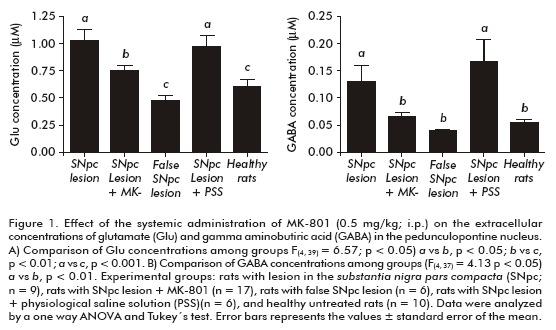
<body><![CDATA[<p><span lang=EN-US style='font-size:10.0pt;font-family:"Verdana","sans-serif"; color:#211E1E'>The <i>in situ </i>detection of DNA fragmentation was performed using a kit that contains terminal deoxynucleotidyl transferase (TdT) according to the instructions from the manufacturer (Roche Molecular Biochemicals, Mannheim, Germany). Experimental procedures were carried out as previously reported (17). </span></p>      <p><span lang=EN-US style='font-size:10.0pt;font-family:"Verdana","sans-serif"; color:#211E1E'>The occurrence of cell death was determined by contrasting sections with the pentahydrated Hoechst 33258, pentahydrate (bis-benzimide) - FluoroPure™ grade (Molecular Probes, USA). The sections were examined under a fluorescence microscope (excitation from 500 to 560 nm, detection from 515 to 565 nm; Leitz, Germany). </span></p>      <p><b><span lang=EN-US style='font-size:10.0pt;font-family:"Verdana","sans-serif"; color:#211E1E'>Data processing </span></b></p>      <p><span lang=EN-US style='font-size:10.0pt;font-family:"Verdana","sans-serif"; color:#211E1E'>The normal curve followed by the data was verified with the Kolmogorov-Smirnov test in every case. The homogeneity of variance was checked by the Levene test. Comparisons of Glu and GABA concentrations between experimental groups were done by a oneway ANOVA, followed by Tukey’s test. The level of statistical significance of 0.05 was chosen for all analyses. The statistical software package Statistica CSS version 6.1 was employed throughout the study. </span></p>      <p><b><span lang=EN-US style='font-family:"Verdana","sans-serif";color:#211E1E'>RESULTS </span></b></p>      <p><b><span lang=EN-US style='font-size:10.0pt;font-family:"Verdana","sans-serif"; color:#211E1E'>Extracellular Glu and GABA concentrations at PPN </span></b></p>      <p><span lang=EN-US style='font-size:10.0pt;font-family:"Verdana","sans-serif"; color:#211E1E'>The comparison of the extracellular Glu concentrations revealed statistically significant differences among the experimental groups (F<sub>(4, 39)</sub> = 6.57, p &lt; 0.05), with the highest levels in the untreated hemiparkinsonian rats. The animals systemically administered with MK-801 showed an intermediate and significantly different behavior (p &lt; 0.05), compared to untreated and SNpc-lesioned rats and to healthy control animals (</span><span style='font-size:10.0pt;font-family:"Verdana","sans-serif";color:#211E1E'><a href="#fig1"><span lang=EN-US>Figure 1A</span></a></span><span lang=EN-US style='font-size:10.0pt;font-family:"Verdana","sans-serif";color:#211E1E'>). </span></p>      <p align=center style='text-align:center'><span style='font-size:13.5pt; color:#211E1E'><img border=0 width=556 height=330 src="/img/revistas/bta/v26n1/f0110109.gif"></span><a name=fig1></a></p>      
<p><span lang=EN-US style='font-size:10.0pt;font-family:"Verdana","sans-serif"; color:#211E1E'>Similarly, extracellular GABA concentrations were significantly different among experimental groups (F<sub>(4, 37)</sub>=4.13, p&lt;0.05). Once again, the highest values were detected in untreated hemiparkinsonian rats. Animals systemically treated with MK-801 showed significantly lower GABA concentrations that were statistically similar to those of healthy and false SNpc-lesioned rats (</span><span style='font-size:10.0pt;font-family:"Verdana","sans-serif"; color:#211E1E'><a href="#fig1"><span lang=EN-US>Figure 1B</span></a></span><span lang=EN-US style='font-size:10.0pt;font-family:"Verdana","sans-serif"; color:#211E1E'>). </span></p>      <p><b><span lang=EN-US style='font-size:10.0pt;font-family:"Verdana","sans-serif"; color:#211E1E'>Presence of dopaminergic cells in the SNpc of hemiparkinsonian rats </span></b></p>      ]]></body>
<body><![CDATA[<p><span lang=EN-US style='font-size:10.0pt;font-family:"Verdana","sans-serif"; color:#211E1E'>The presence of cell bodies positive to the TH enzyme in the TVA of rats systemically administered with MK-801 demonstrates a decreased loss of dopaminergic cells in this zone, compared to untreated rats lesioned in the SNpc (</span><span style='font-size:10.0pt;font-family:"Verdana","sans-serif";color:#211E1E'><a href="#fig2"><span lang=EN-US>Figure 2A and B</span></a></span><span lang=EN-US style='font-size:10.0pt;font-family:"Verdana","sans-serif"; color:#211E1E'>). Nevertheless, the pharmacological treatment failed to protect them from loosing dopaminergic cells at the SNpc.</span></p>      <p align=center style='text-align:center'><span style='font-size:13.5pt; color:#211E1E'><img border=0 width=351 height=630 src="/img/revistas/bta/v26n1/f0210109.gif"></span><a name=fig2></a></p>      
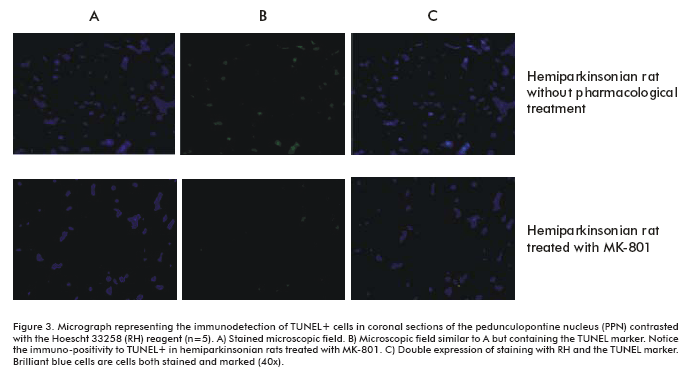
<p><b><span lang=EN-US style='font-size:10.0pt;font-family:"Verdana","sans-serif"; color:#211E1E'>Study of cell DNA fragmentation at PPN </span></b></p>          <p><span lang=EN-US style='font-size:10.0pt;font-family:"Verdana","sans-serif"; color:#211E1E'>The TUNEL cellular fragmentation study showed TUNEL+ cells in the        PPN of untreated hemiparkinsonian rats (</span><span style='font-size:10.0pt; font-family:"Verdana","sans-serif";color:#211E1E'><a href="/img/revistas/bta/v26n1/f0310109.gif"><span lang=EN-US>Figure 3</span></a></span><span lang=EN-US style='font-size:10.0pt; font-family:"Verdana","sans-serif";color:#211E1E'>). On the other hand, the PPN        of MK-801-treated hemiparkinsonian rats were weakly immunopositive to TUNEL,        suggesting that this treatment prevents the development of cell death processes,        but this effect is ipsilateral to the 6-OHDA injection (</span><span style='font-size:10.0pt;font-family:"Verdana","sans-serif";color:#211E1E'><a href="/img/revistas/bta/v26n1/f0310109.gif"><span lang=EN-US>Figure 3</span></a></span><span lang=EN-US style='font-size:10.0pt;font-family:"Verdana","sans-serif"; color:#211E1E'>). </span></p>      
<p><b><span lang=EN-US style='font-family:"Verdana","sans-serif";color:#211E1E'>DISCUSSION </span></b></p>      <p><b><span lang=EN-US style='font-size:10.0pt;font-family:"Verdana","sans-serif"; color:#211E1E'>Considerations on the MK-801 administration schedule used in this study </span></b></p>      <p><span lang=EN-US style='font-size:10.0pt;font-family:"Verdana","sans-serif"; color:#211E1E'>Our results indicate that the administration schedule followed for the systemic delivery of MK-801 modifies the parkinsonian characteristics generated after the intracerebral injection of 6-OHDA, in agreement with previous reports (19, 20). In general, hemiparkinsonian rats treated with MK-801 showed the poorest loss of dopaminergic cellular bodies in the TVA together with the lowest extracellular concentrations of Glu and GABA and cell death processes at the PPN. </span></p>      <p><span lang=EN-US style='font-size:10.0pt;font-family:"Verdana","sans-serif"; color:#211E1E'>This schedule corresponds to two effects reported for MK-801 in the literature: increased striatal expression of dinorphins (19) and modified discharge frequency of subthalamic glutamatergic neurons (20). </span></p>      <p><span lang=EN-US style='font-size:10.0pt;font-family:"Verdana","sans-serif"; color:#211E1E'>The administration of MK-801 prior to the 6-OHDA injection follows the principle of enhancing the striatal gene expression of dynorphins in neurons of the direct network of the motor circuitry (19). This effect would prevent the decreased striatal-nigral transmission that was established early in the 6-OHDA model (19, 21). </span></p>      <p><span lang=EN-US style='font-size:10.0pt;font-family:"Verdana","sans-serif"; color:#211E1E'>Nevertheless, the behavior during approximately 4 weeks described for the neurotoxic effect of 6-OHDA on nigral cells leads to the establishment of an irreversible motor asymmetry that characterizes this model (21). During that period of time, glutamatergic activity increases gradually, the subthalamic glutamatergic activity peaking at day fifteen and preceding the appearance of PD symptoms (22, 23). The second and third MK-801 administrations pursue the blockage of subthalamic hyperactivity in a critical period of subthalamic activation (24). </span></p>      ]]></body>
<body><![CDATA[<p><b><span lang=EN-US style='font-size:10.0pt;font-family:"Verdana","sans-serif"; color:#211E1E'>Effects of MK-801 administration on the loss of dopaminergic cells </span></b></p>      <p><span lang=EN-US style='font-size:10.0pt;font-family:"Verdana","sans-serif"; color:#211E1E'>Our results suggest that the MK-801 treatment can protect dopaminergic cell bodies in the TVA from neurotoxic damage. The TVA is part of the mesolimbocortical dopaminergic system and projects the <i>accumbens </i>nucleus (25). There are several reports in the literature showing that the injection of 6-OHDA in coordinates targeting the SNpc similarly compromises the survival of TVA dopaminergic cells (26). This contrasts with the effect of this neurotoxin when administered in the <i>striatum </i>(St) or in the nigral-striatal network where it produces its own retrograde transport, selectively killing SNpc dopaminergic cells and preserving TVA cells (27). </span></p>      <p><span lang=EN-US style='font-size:10.0pt;font-family:"Verdana","sans-serif"; color:#211E1E'>It is well known that at least some of the cascades of neurochemical changes triggered by dopaminergic denervation in BG are reverted by the administration of glutamatergic antagonists (28). Moreover, the expression of NMDA receptors in TVA cells is higher than in SNpc cells, being this difference the possible morphophysiological support for the neuroprotective effect of MK-801 in these cells (29). </span></p>      <p><span lang=EN-US style='font-size:10.0pt;font-family:"Verdana","sans-serif"; color:#211E1E'>The reduced loss of dopaminergic cellular bodies in the TVA of rats treated with MK-801 can significantly influence the maintenance of St under dopaminergic control, at least partially (28). This could attenuate synapse remodeling at St, ipsilateral to the lesion, and consequently decrease locomotor asymmetry in hemiparkinsonian rats (30, 31). </span></p>      <p><b><span lang=EN-US style='font-size:10.0pt;font-family:"Verdana","sans-serif"; color:#211E1E'>Extracellular Glu and GABA concentrations at the PPN </span></b></p>      <p><span lang=EN-US style='font-size:10.0pt;font-family:"Verdana","sans-serif"; color:#211E1E'>The decreased extracellular concentrations of Glu and GABA in rats treated with MK-801 after the 6-OHDA injection could result from the treatment by the attenuation of corticostriatal glutamatergic activity and the correction of misbalances of other neurotransmitters as dopamine. </span></p>      <p><span lang=EN-US style='font-size:10.0pt;font-family:"Verdana","sans-serif"; color:#211E1E'>The nigral dopaminergic network and cortical glutamatergic terminals converge at the striatal neuronal projection in a very fine synaptic interaction (32, 33). In PD, a misbalanced estriatal neurotransmission and an increased cortical-striatal glutamatergic transmission coexist (32, 34). Both effects convey, increasing the discharge of action potentials by striatal cells when depolarized after receiving the discharge through the presynaptic cortial-striatal terminal (35). </span></p>      <p><span lang=EN-US style='font-size:10.0pt;font-family:"Verdana","sans-serif"; color:#211E1E'>On the other hand, morphological studies show that dopaminergic denervation leads to structural changes at St, such as the remodeling of dendritic spines, which are able to interfere with cortical-striatal synaptic plasticity mechanisms (36, 37). The systemic administration of antagonists of the NMDA glutamatergic receptors have multiple effects on the functioning of the BG nuclei (38). However, there were no previous references on the effect of the MK-801 administration in the 6-OHDA model, specifically on Glu and GABA neurotransmission at PNN. Hence, our results are a contribution to this field of knowledge. </span></p>      <p><span lang=EN-US style='font-size:10.0pt;font-family:"Verdana","sans-serif"; color:#211E1E'>It was recently shown that the systemic administration of MK-801 reduces the rate of discharge and changes the pattern of electric activity of STN glutamatergic cells in hemiparkinsonian rats (22). It is known that when locally administered in St, MK-801 generates distinct effects depending on the location of the intrastriatal injections and the topological distribution of NMDA receptors within this structure (38). Subsequently, the perfusion of MK- 801 into projection neurons of the St-GP1 network could generate PD-like effects by inhibiting this circuit. In contrast, MK-801 produces marked anti-parkinsonian effects when injected in neurons that originate the St-SNpr network (38). </span></p>      <p><span lang=EN-US style='font-size:10.0pt;font-family:"Verdana","sans-serif"; color:#211E1E'>It has been also reported that the excess of gabaergic inhibition in the PPN in PD can explain the PDassociated hypokinesia, based on the PPN projections through the reticulospinal tract towards the spinal cord interneuronal network (39). </span></p>      ]]></body>
<body><![CDATA[<p><span lang=EN-US style='font-size:10.0pt;font-family:"Verdana","sans-serif"; color:#211E1E'>Based on these previous findings, we speculate that the systemic administration of MK-801 used in this study could correct some of the effects of dopaminergic denervation on the corticostriatal excitatory neurotransmission. This will compensate the misbalance among BG motor circuitry networks. Thus, decreased extracellular concentrations of Glu and GABA in the PPN, where both motor circuits converge, may be a functional expression of such a correction. </span></p>      <p><b><span lang=EN-US style='font-size:10.0pt;font-family:"Verdana","sans-serif"; color:#211E1E'>Cell death at PPN </span></b></p>      <p><span lang=EN-US style='font-size:10.0pt;font-family:"Verdana","sans-serif"; color:#211E1E'>It is established that approximately 40 to 50% of PPN cholinergic cells are lost in PD (40). In contrast, other authors have pointed out the absence of cell death processes in murine and non-human primate PD experimental models (41). These latter findings have suggested that those neurons are less sensitive than dopaminergic SNpc cells to the exotoxicity processes triggered by the subthalamic glutamatergic activation (38). Nevertheless, there are several, neurochemically different neuronal populations in the PPN. Besides, glutamatergic, gabaergic and peptidergic neurons have been identified at PPN in rats, in addition to the cholinergic ones (14, 42). </span></p>      <p><span lang=EN-US style='font-size:10.0pt;font-family:"Verdana","sans-serif"; color:#211E1E'>In previous studies, we demonstrated the occurrence of one cell death process at PPN, ipsilateral to the 6-OHDA injection (18). The PPN neurons are exposed to an increased subthalamic glutamatergic activity in PD, together with a decreased nigropontine dopaminergic influence (43). This misbalance could be associated to cell death-promoting events in some of these neuronal populations. </span></p>      <p><span lang=EN-US style='font-size:10.0pt;font-family:"Verdana","sans-serif"; color:#211E1E'>The results shown herein suggest that the treatment with MK-801 prevents cell death at PPN. This finding underline the relevance of therapeutic strategies intended to attenuate the glutamatergic hyperactivity on those nuclei innervated by such projections from the STN. Two main mechanisms are expressed in the literature as mediating this effect of MK-801: <i>i</i>) the direct blockage of the NMDA glutamatergic receptor; and <i>ii</i>) the inhibition of the tumor necrosis factor alpha, which enhances Glu toxicity and further inhibits recapture mechanisms of this neurotransmitter (10). </span></p>      <p><span lang=EN-US style='font-size:10.0pt;font-family:"Verdana","sans-serif"; color:#211E1E'>Due to the relevance of the PPN for controlling the voluntary movement of several parts of the body, the effect of the systemic blockage of the glutamatergic transmission on the cell death process is highly relevant. This control is exerted in close association with other brain nuclei (14). Other studies highlight the role of PPN glutamatergic neurons to initiate conscious movements, while the activity of cholinergic neurons is associated to a steady and uniform walking pattern (44, 45). </span></p>      <p><span lang=EN-US style='font-size:10.0pt;font-family:"Verdana","sans-serif"; color:#211E1E'>In a recent study, 36% of the cholinergic and 27% of the non-cholinergic neurons were found to be lost in the PPN of PD patients (46). Data also showed its highly significant negative correlation with the Hoehn and Yahr scores evaluating the axial symptoms of the disease, and its equilibrium and walking disorders. This means that the worse the handicap of the PD patient, the more profound the profile of cell death in the PPN (46). </span></p>      <p><span lang=EN-US style='font-size:10.0pt;font-family:"Verdana","sans-serif"; color:#211E1E'>Thus, cell death could be enhancing PPN malfunction in PD, being part of the morpho-physiological causes of motor disorders found in 6-OHDA-injected hemiparkinsonian rats. </span></p>      <p><span lang=EN-US style='font-size:13.5pt'>&nbsp;</span></p>      <p><span lang=EN-US style='font-size:11.0pt;font-family:"Arial","sans-serif"; color:red'> </span><b><span lang=EN-US style='font-family:"Verdana","sans-serif"; color:#211E1E'>REFERENCES</span></b><b><span lang=EN-US style='font-size:10.0pt; font-family:"Verdana","sans-serif";color:#211E1E'> </span></b></p>      ]]></body>
<body><![CDATA[<!-- ref --><p><span lang=EN-US style='font-size:10.0pt;font-family:"Verdana","sans-serif"; color:#211E1E'>1. Braak H, Ghebremedhin E, Rüb U, Bratzke H, Del Tredici K. Stages in the development of Parkinson’s disease-related pathology. Cell Tissue Res</span><span lang=EN-US style='font-size:11.0pt;font-family:"Arial","sans-serif";color:red'> </span><span lang=EN-US style='font-size:10.0pt;font-family:"Verdana","sans-serif"; color:#211E1E'>2004;318:121-34.</span><!-- ref --><p><span lang=EN-US style='font-size:10.0pt;font-family:"Verdana","sans-serif"; color:#211E1E'>2. Muller T, Funchs G, Hahne M, Klein W, Schawarz M. Diagnostic aspects of early Parkinson’s disease. J Neurol</span><span lang=EN-US style='font-size:11.0pt;font-family:"Arial","sans-serif";color:red'> </span><span lang=EN-US style='font-size:10.0pt;font-family:"Verdana","sans-serif"; color:#211E1E'>2006;253</span><span lang=EN-US style='font-size:11.0pt; font-family:"Arial","sans-serif";color:red'> </span><span lang=EN-US style='font-size:10.0pt;font-family:"Verdana","sans-serif";color:#211E1E'>Suppl 4:29-31.</span><!-- ref --><p><span lang=EN-US style='font-size:10.0pt;font-family:"Verdana","sans-serif"; color:#211E1E'>3. Singh N, Pillay V, Choonora YE. Advances in the treatment of Parkinson’s disease. Prog Neurobiol</span><span lang=EN-US style='font-size: 11.0pt;font-family:"Arial","sans-serif";color:red'> </span><span lang=EN-US style='font-size:10.0pt;font-family:"Verdana","sans-serif";color:#211E1E'>2007;81:29-44.</span><p><span lang=EN-US style='font-size:10.0pt;font-family:"Verdana","sans-serif"; color:#211E1E'>4. Van Laar</span><span lang=EN-US style='font-family:"Arial","sans-serif"; color:blue'> </span><span lang=EN-US style='font-size:10.0pt;font-family:"Verdana","sans-serif"; color:#211E1E'>T. Parkinson’s disease-related Pharmacotherapy. In: Wolters</span><span lang=EN-US style='font-family:"Arial","sans-serif";color:blue'> </span><span lang=EN-US style='font-size:10.0pt;font-family:"Verdana","sans-serif"; color:#211E1E'>EC, Van Laar</span><span lang=EN-US style='font-family:"Arial","sans-serif"; color:blue'> </span><span lang=EN-US style='font-size:10.0pt;font-family:"Verdana","sans-serif"; color:#211E1E'>T, Berendse</span><span lang=EN-US style='font-family:"Arial","sans-serif"; color:blue'> </span><span lang=EN-US style='font-size:10.0pt;font-family:"Verdana","sans-serif"; color:#211E1E'>HW</span><span lang=EN-US style='font-family:"Arial","sans-serif"; color:gray'> </span><span lang=EN-US style='font-size:10.0pt;font-family:"Verdana","sans-serif"; color:#211E1E'> (eds.). </span><span style='font-size:10.0pt;font-family:"Verdana","sans-serif"; color:#211E1E'>Parkinsonism and related disorders. Amsterdam: Ed. VU University Express 2007;</span><span style='font-family:"Arial","sans-serif";color:gray'> </span><span style='font-size:10.0pt;font-family:"Verdana","sans-serif";color:#211E1E'>p. 19-25</span><span lang=SV style='font-size:10.0pt;font-family:"Arial","sans-serif";color:windowtext'>.</span><span lang=SV style='font-family:"Arial","sans-serif";color:navy'> </span></p>      <p><span style='font-size:10.0pt;font-family:"Verdana","sans-serif";color:#211E1E'>5. López-Lozano</span><span style='font-family:"Arial","sans-serif";color:blue'> </span><span style='font-size:10.0pt;font-family:"Verdana","sans-serif";color:#211E1E'>JJ, Álvarez-Santullano</span><span style='font-family:"Arial","sans-serif";color:blue'> </span><span style='font-size:10.0pt;font-family:"Verdana","sans-serif";color:#211E1E'>M. Antiglutamatérgicos, anticolinérgicos y terapias neuroprotectoras en la enfermedad de Parkinson. En: Tolosa</span><span style='font-family:"Arial","sans-serif";color:blue'> </span><span style='font-size:10.0pt;font-family:"Verdana","sans-serif";color:#211E1E'>ES, Obeso</span><span style='font-family:"Arial","sans-serif";color:blue'> </span><span style='font-size:10.0pt;font-family:"Verdana","sans-serif";color:#211E1E'>JA, Grandas</span><span style='font-family:"Arial","sans-serif";color:blue'> </span><span style='font-size:10.0pt;font-family:"Verdana","sans-serif";color:#211E1E'>FJ</span><span style='font-family:"Arial","sans-serif";color:gray'> </span><span style='font-size:10.0pt;font-family:"Verdana","sans-serif";color:#211E1E'> (eds.). Tratado sobre la enfermedad de Parkinson. </span><span lang=EN-US style='font-size:10.0pt;font-family:"Verdana","sans-serif";color:#211E1E'>3ra. Edición. Madrid: Ed. Grupo Brystol-Myers Squibb 2004;</span><span lang=EN-US style='font-family:"Arial","sans-serif";color:gray'> </span><span lang=EN-US style='font-size:10.0pt;font-family:"Verdana","sans-serif";color:#211E1E'>85-412</span><span lang=SV style='font-size:10.0pt;font-family:"Arial","sans-serif";color:windowtext'>.</span><span lang=SV style='font-family:"Arial","sans-serif";color:navy'> </span></p>      <!-- ref --><p><span lang=EN-US style='font-size:10.0pt;font-family:"Verdana","sans-serif"; color:#211E1E'>6. Levi MS, Brimble MA. A review of neuroprotection agents. </span><span style='font-size:10.0pt;font-family:"Verdana","sans-serif";color:#211E1E'>Curr Med Chem</span><span style='font-size:11.0pt;font-family:"Arial","sans-serif"; color:red'> </span><span style='font-size:10.0pt;font-family:"Verdana","sans-serif"; color:#211E1E'>2004;11</span><span style='font-size:10.0pt;font-family:"Arial","sans-serif"; color:black'>(</span><span style='font-size:10.0pt;font-family:"Verdana","sans-serif"; color:#211E1E'>18):2383-97.</span><p><span style='font-size:10.0pt;font-family:"Verdana","sans-serif";color:#211E1E'>7. Alonso-Solís</span><span style='font-family:"Arial","sans-serif";color:blue'> </span><span style='font-size:10.0pt;font-family:"Verdana","sans-serif";color:#211E1E'>R. Neurotransmisores y neuromoduladores. In: Tresguerres</span><span style='font-family:"Arial","sans-serif"; color:blue'> </span><span style='font-size:10.0pt;font-family:"Verdana","sans-serif"; color:#211E1E'>JAF</span><span style='font-family:"Arial","sans-serif"; color:gray'> </span><span style='font-size:10.0pt;font-family:"Verdana","sans-serif"; color:#211E1E'>(ed.). Fisiología humana. Madrid: Ed. Interamericana McGraw-Hill 1992;</span><span style='font-family:"Arial","sans-serif";color:gray'> </span><span style='font-size:10.0pt;font-family:"Verdana","sans-serif";color:#211E1E'>3-73</span><span lang=SV style='font-family:"Arial","sans-serif";color:teal'>.</span><span lang=SV style='font-size:10.0pt;font-family:"Verdana","sans-serif";color:#211E1E'> </span></p>      <!-- ref --><p><span style='font-size:10.0pt;font-family:"Verdana","sans-serif";color:#211E1E'>8. Obeso JA, Rodríguez-Oroz MC, Rodríguez M, Lanciego JL, Artieda J, Gonzalo N, Olanow W. Pathophysiology of the basal ganglia in Parkinson’s Disease. </span><span lang=EN-US style='font-size:10.0pt;font-family:"Verdana","sans-serif"; color:#211E1E'>TINS</span><span lang=EN-US style='font-size:11.0pt;font-family: "Arial","sans-serif";color:red'> </span><span lang=EN-US style='font-size:10.0pt; font-family:"Verdana","sans-serif";color:#211E1E'>2000;23</span><span lang=EN-US style='font-size:10.0pt;font-family:"Arial","sans-serif";color:black'>(</span><span lang=EN-US style='font-size:10.0pt;font-family:"Verdana","sans-serif"; color:#211E1E'>10):3-18.</span><!-- ref --><p><span lang=EN-US style='font-size:10.0pt;font-family:"Verdana","sans-serif"; color:#211E1E'>9. Blandini F, Greenamyre JT, Fancellu R, Nappi G. Blockade of subthalamic glutamatergic activity corrects changes in neuronal metabolism and motor behavior in rats with nigrostriatal lesions. Neurol Sci</span><span lang=EN-US style='font-size:11.0pt;font-family:"Arial","sans-serif";color:red'> </span><span lang=EN-US style='font-size:10.0pt;font-family:"Verdana","sans-serif"; color:#211E1E'>2001;22:49-50.</span><!-- ref --><p><span lang=EN-US style='font-size:10.0pt;font-family:"Verdana","sans-serif"; color:#211E1E'>10. Youdim MBH, Geldenhuys WJ, Van der Schyf J. Why should we use multifunctional neuroprotective and neurorestorative drugs for Parkinson’s disease?</span><span lang=EN-US style='font-size:11.0pt;font-family:"Arial","sans-serif"; color:red'> </span><span lang=EN-US style='font-size:10.0pt;font-family:"Verdana","sans-serif"; color:#211E1E'>Parkinsonism Relat Disord</span><span lang=EN-US style='font-size:11.0pt;font-family:"Arial","sans-serif";color:red'> </span><span lang=EN-US style='font-size:10.0pt;font-family:"Verdana","sans-serif"; color:#211E1E'>2007;13:S281-S291.</span><!-- ref --><p><span lang=EN-US style='font-size:10.0pt;font-family:"Verdana","sans-serif"; color:#211E1E'>11. Turski L, Bressler K, Retting KJ, Lochsmann P, Watchel H. Protection of substantia nigra from MPP+ neurotoxicity by NMDA antagonist. Nature</span><span lang=EN-US style='font-size:11.0pt;font-family:"Arial","sans-serif";color:red'> </span><span lang=EN-US style='font-size:10.0pt;font-family:"Verdana","sans-serif"; color:#211E1E'>1991;349:414-8.</span><!-- ref --><p><span lang=EN-US style='font-size:10.0pt;font-family:"Verdana","sans-serif"; color:#211E1E'>12. Zuddas A, Oberto G, Vaglini F, Fascetti F, Formai F, Corsini G. MK-801 prevents MPTP-induced parkinsonism in primates. J Neurochem</span><span lang=EN-US style='font-size:11.0pt;font-family:"Arial","sans-serif";color:red'> </span><span lang=EN-US style='font-size:10.0pt;font-family:"Verdana","sans-serif"; color:#211E1E'>1992;59:733-9.</span><!-- ref --><p><span lang=EN-US style='font-size:10.0pt;font-family:"Verdana","sans-serif"; color:#211E1E'>13. Mena-Segovia J, Bolam JP, Magill PJ. Pedunculopontine nucleus and basal ganglia: distant relatives or part of the same family?</span><span lang=EN-US style='font-size:11.0pt;font-family:"Arial","sans-serif";color:red'> </span><span lang=EN-US style='font-size:10.0pt;font-family:"Verdana","sans-serif"; color:#211E1E'>TINS</span><span lang=EN-US style='font-size:11.0pt;font-family: "Arial","sans-serif";color:red'> </span><span lang=EN-US style='font-size:10.0pt; font-family:"Verdana","sans-serif";color:#211E1E'>2004;27</span><span lang=EN-US style='font-size:10.0pt;font-family:"Arial","sans-serif";color:black'>(</span><span lang=EN-US style='font-size:10.0pt;font-family:"Verdana","sans-serif"; color:#211E1E'>10):585-8.</span><!-- ref --><p><span lang=EN-US style='font-size:10.0pt;font-family:"Verdana","sans-serif"; color:#211E1E'>14. Hamani C, Stone S, Laxton A, Lozano M. The pedunculopontine nucleus and movement disorders: Anatomy and the role for deep brain stimulation. Parkinsonism Relat Disord</span><span lang=EN-US style='font-size:11.0pt; font-family:"Arial","sans-serif";color:red'> </span><span lang=EN-US style='font-size:10.0pt;font-family:"Verdana","sans-serif";color:#211E1E'>2007;13:S276-S280.</span><!-- ref --><p><span lang=EN-US style='font-size:10.0pt;font-family:"Verdana","sans-serif"; color:#211E1E'>15. Jenkinson N, Nandi D, Muthusamy K, Gregory R, Stein J, Aziz T. Anatomy, physiology and pathophysiology of the pedunculopontine nucleus. Mov Disord</span><span lang=EN-US style='font-size:11.0pt;font-family:"Arial","sans-serif"; color:red'> </span><span lang=EN-US style='font-size:10.0pt;font-family:"Verdana","sans-serif"; color:#211E1E'>2009;24</span><span lang=EN-US style='font-size:10.0pt; font-family:"Arial","sans-serif";color:black'>(</span><span lang=EN-US style='font-size:10.0pt;font-family:"Verdana","sans-serif";color:#211E1E'>3):319-28.</span><!-- ref --><p><span lang=EN-US style='font-size:10.0pt;font-family:"Verdana","sans-serif"; color:#211E1E'>16. Paxinos</span><span lang=EN-US style='font-size:10.0pt; font-family:"Verdana","sans-serif"'> </span><span lang=EN-US style='font-size: 10.0pt;font-family:"Verdana","sans-serif";color:#211E1E'>G</span><span lang=SV style='font-size:10.0pt;font-family:"Verdana","sans-serif"'>, </span><span lang=EN-US style='font-size:10.0pt;font-family:"Verdana","sans-serif"; color:#211E1E'>Watson</span><span lang=EN-US style='font-size:10.0pt; font-family:"Verdana","sans-serif"'> </span><span lang=EN-US style='font-size: 10.0pt;font-family:"Verdana","sans-serif";color:#211E1E'>C. The rat brain in stereotaic coordinates. </span><span style='font-size:10.0pt;font-family:"Verdana","sans-serif"; color:#211E1E'>Academic Press, NY</span><span lang=SV style='font-size:10.0pt; font-family:"Verdana","sans-serif";color:windowtext'>, </span><span style='font-size:10.0pt;font-family:"Verdana","sans-serif";color:#211E1E'>1998</span><span lang=SV style='font-size:10.0pt;font-family:"Verdana","sans-serif"'>.</span><span lang=SV style='font-family:"Arial","sans-serif";color:navy'> </span><!-- ref --><p><span style='font-size:10.0pt;font-family:"Verdana","sans-serif";color:#211E1E'>17. Blanco L, Lorigados L, Orozco S, Luisa LL, Pavón N, González ME, et al. Aumento de las concentraciones extracelulares de aminoácidos neurotransmisores y muerte celular en el núcleo pedunculopontino de ratas hemiparkinsonizadas por inyección de intracerebral de 6-hidroxidopamina. Biotecnol Apl</span><span style='font-size:11.0pt;font-family:"Arial","sans-serif";color:red'> </span><span style='font-size:10.0pt;font-family:"Verdana","sans-serif";color:#211E1E'>2007;24:33-40.</span><!-- ref --><p><span style='font-size:10.0pt;font-family:"Verdana","sans-serif";color:#211E1E'>18. Blanco L, Lorigados L, García R, Martínez L, Pavón N, González ME, et al. Efecto neuroprotector de la administración sistémica de (-) nicotina en ratas hemiparkinsonizadas. </span><span lang=EN-US style='font-size:10.0pt; font-family:"Verdana","sans-serif";color:#211E1E'>Biotecnol Apl</span><span lang=EN-US style='font-size:11.0pt;font-family:"Arial","sans-serif";color:red'> </span><span lang=EN-US style='font-size:10.0pt;font-family:"Verdana","sans-serif"; color:#211E1E'>2008;25:126-34.</span><!-- ref --><p><span lang=EN-US style='font-size:10.0pt;font-family:"Verdana","sans-serif"; color:#211E1E'>19. Campbell BM, Kreipke CW, Walker PD. Failure of MK-801 to suppress D1 receptor-mediated induction of locomotor activity and striatal preprotachylinin mRNA expression in the dopamine-depleted rat. Neurosci</span><span lang=EN-US style='font-size:11.0pt;font-family:"Arial","sans-serif";color:red'> </span><span lang=EN-US style='font-size:10.0pt;font-family:"Verdana","sans-serif"; color:#211E1E'>2006;137:505-17.</span><!-- ref --><p><span lang=EN-US style='font-size:10.0pt;font-family:"Verdana","sans-serif"; color:#211E1E'>20. Allers KA, Bergstrom DA, Ghazi LJ, Kreiss DS, Walters Jr<b>. </b>MK-801 and amantadine exert different effects on subthalamic neuronal activity in a rodent model of Parkinson’s Disease. Exp Neurol</span><span lang=EN-US style='font-size:11.0pt;font-family:"Arial","sans-serif";color:red'> </span><span lang=EN-US style='font-size:10.0pt;font-family:"Verdana","sans-serif"; color:#211E1E'>2005;191:104-18.</span><!-- ref --><p><span lang=EN-US style='font-size:10.0pt;font-family:"Verdana","sans-serif"; color:#211E1E'>21. Robinson TE, Mocsary Z, Camp DM, Whishaw IQ. Time course of recovery of extracellular dopamine following partial damage to the nigrostriatal dopamine system. J Neurosci</span><span lang=EN-US style='font-size:11.0pt;font-family:"Arial","sans-serif";color:red'> </span><span lang=EN-US style='font-size:10.0pt;font-family:"Verdana","sans-serif"; color:#211E1E'>1994;14</span><span lang=EN-US style='font-size:10.0pt; font-family:"Arial","sans-serif";color:black'>(</span><span lang=EN-US style='font-size:10.0pt;font-family:"Verdana","sans-serif";color:#211E1E'>5):2687-96.</span><!-- ref --><p><span lang=EN-US style='font-size:10.0pt;font-family:"Verdana","sans-serif"; color:#211E1E'>22. Bezard E, Boraud T, Bioulac B, Gross C. Involvement of the subthalamic nucleus in glutamatergic compensatory mechanisms. Eur J Neurosci</span><span lang=EN-US style='font-size:11.0pt;font-family:"Arial","sans-serif";color:red'> </span><span lang=EN-US style='font-size:10.0pt;font-family:"Verdana","sans-serif"; color:#211E1E'>1999;11:2167-70.</span><!-- ref --><p><span lang=EN-US style='font-size:10.0pt;font-family:"Verdana","sans-serif"; color:#211E1E'>23. Vila M, Périer C, Féger J, Yelnik J, Faucheux B, Ruberg M, et al. Evolution of changes in neuronal activity in the subthalamic nucleus of rats with unilateral lesion of the substantia nigra assessed by metabolic and electrophysiological measurements. Eur J Neurosci</span><span lang=EN-US style='font-size:11.0pt;font-family:"Arial","sans-serif";color:red'> </span><span lang=EN-US style='font-size:10.0pt;font-family:"Verdana","sans-serif"; color:#211E1E'>2000;12:337-44.</span><!-- ref --><p><span lang=EN-US style='font-size:10.0pt;font-family:"Verdana","sans-serif"; color:#211E1E'>24. Koutsilieri E, Riederer P. Excitoxicity and new antiglutamatergic strategies in Parkinson’s disease and Alzheimer’s disease. Parkinsonism Relat Disord</span><span lang=EN-US style='font-size:11.0pt;font-family:"Arial","sans-serif"; color:red'> </span><span lang=EN-US style='font-size:10.0pt;font-family:"Verdana","sans-serif"; color:#211E1E'>2007;13:S329-31.</span><p><span lang=EN-US style='font-size:10.0pt;font-family:"Verdana","sans-serif"; color:#211E1E'>25. Björklund</span><span lang=EN-US style='font-family:"Arial","sans-serif"; color:blue'> </span><span lang=EN-US style='font-size:10.0pt;font-family:"Verdana","sans-serif"; color:#211E1E'>A, Lindvall</span><span lang=EN-US style='font-family:"Arial","sans-serif"; color:blue'> </span><span lang=EN-US style='font-size:10.0pt;font-family:"Verdana","sans-serif"; color:#211E1E'>O. Dopamine-containing system in the CNS. In: Björklund</span><span lang=EN-US style='font-family:"Arial","sans-serif";color:blue'> </span><span lang=EN-US style='font-size:10.0pt;font-family:"Verdana","sans-serif"; color:#211E1E'>A, Hökfelt</span><span lang=EN-US style='font-family:"Arial","sans-serif"; color:blue'> </span><span lang=EN-US style='font-size:10.0pt;font-family:"Verdana","sans-serif"; color:#211E1E'>T</span><span lang=EN-US style='font-family:"Arial","sans-serif"; color:gray'> </span><span lang=EN-US style='font-size:10.0pt;font-family:"Verdana","sans-serif"; color:#211E1E'> (eds.). Handbook of chemical neuroanatomy. Vol. 2: Classical transmitter in the CNS. Amsterdam: Ed. Elsevier 1984;</span><span lang=EN-US style='font-family:"Arial","sans-serif";color:gray'> </span><span lang=EN-US style='font-size:10.0pt;font-family:"Verdana","sans-serif";color:#211E1E'>5-122</span><span lang=SV style='font-family:"Arial","sans-serif";color:teal'>.</span><span lang=EN-US style='font-size:10.0pt;font-family:"Verdana","sans-serif"; color:#211E1E'>  </span></p>      <!-- ref --><p><span lang=EN-US style='font-size:10.0pt;font-family:"Verdana","sans-serif"; color:#211E1E'>26. Blum D, Torch S, Lambeng N, Nissou M, Benabid A, Sadoul R, et al. Molecular pathways involved in the neurotoxicity of 6-OHDA, dopamine and MPTP: contribution to the apoptotic theory in Parkinson’s disease. Prog Neurobiol</span><span lang=EN-US style='font-size:11.0pt;font-family:"Arial","sans-serif"; color:red'> </span><span lang=EN-US style='font-size:10.0pt;font-family:"Verdana","sans-serif"; color:#211E1E'>2001;65:135-72.</span><!-- ref --><p><span lang=EN-US style='font-size:10.0pt;font-family:"Verdana","sans-serif"; color:#211E1E'>27. Schober A. Classic toxin-induced animal models of Parkinson’s disease: 6-hydroxydopamine and 1-methyl-4- phenyl-1,2,3,6-tetrahydropyridine. Cell Tissue Res</span><span lang=EN-US style='font-size:11.0pt;font-family:"Arial","sans-serif";color:red'> </span><span lang=EN-US style='font-size:10.0pt;font-family:"Verdana","sans-serif"; color:#211E1E'>2004;318:215-24.</span><!-- ref --><p><span lang=EN-US style='font-size:10.0pt;font-family:"Verdana","sans-serif"; color:#211E1E'>28. Vila M, Marín C, Ruberg M, Jiménez A, Raisman-Vozari R, Agid Y, et al. Systemic administration of NMDA and AMPA receptor antagonist reverses the neurochemical changes induced by nigrostriatal denervation in basal anglia. J Neurochem</span><span lang=EN-US style='font-size:11.0pt;font-family:"Arial","sans-serif"; color:red'> </span><span lang=EN-US style='font-size:10.0pt;font-family:"Verdana","sans-serif"; color:#211E1E'>1999;73:344-52.</span><!-- ref --><p><span lang=EN-US style='font-size:10.0pt;font-family:"Verdana","sans-serif"; color:#211E1E'>29. Mathé J, Nomikos G, Hygge K, Svensson T. Differential actions of dizocilpine (MK-801) on the mesolimbic and mesocortical dopamine system: role of neuronal activity. Neuropharmacology</span><span lang=EN-US style='font-size:11.0pt;font-family:"Arial","sans-serif";color:red'> </span><span lang=EN-US style='font-size:10.0pt;font-family:"Verdana","sans-serif"; color:#211E1E'>1999;38:121-8.</span><!-- ref --><p><span lang=EN-US style='font-size:10.0pt;font-family:"Verdana","sans-serif"; color:#211E1E'>30. Zigmond MJ, Stricker EM. Parkinson´s disease: studies with an animal model. Life Sci</span><span lang=EN-US style='font-size:11.0pt; font-family:"Arial","sans-serif";color:red'> </span><span lang=EN-US style='font-size:10.0pt;font-family:"Verdana","sans-serif";color:#211E1E'>1984;35:5-18.</span><!-- ref --><p><span lang=EN-US style='font-size:10.0pt;font-family:"Verdana","sans-serif"; color:#211E1E'>31. Metz GA, Whishaw IQ. Drug-Induced Rotation intensity in unilateral dopamine-depleted rats is not correlated with end point or qualitative measures of forelimb or hindlimb motor performance. Neurosci</span><span lang=EN-US style='font-size:11.0pt;font-family:"Arial","sans-serif";color:red'> </span><span lang=EN-US style='font-size:10.0pt;font-family:"Verdana","sans-serif"; color:#211E1E'>2002;111</span><span lang=EN-US style='font-size:10.0pt; font-family:"Arial","sans-serif";color:black'>(</span><span lang=EN-US style='font-size:10.0pt;font-family:"Verdana","sans-serif";color:#211E1E'>2):325-36.</span><!-- ref --><p><span lang=EN-US style='font-size:10.0pt;font-family:"Verdana","sans-serif"; color:#211E1E'>32. Calabresi P, Centonze D, Bernardi G. Electrophysiology of dopamine in normal and denervated striatal neurons. TINS</span><span lang=EN-US style='font-size:11.0pt;font-family:"Arial","sans-serif";color:red'> </span><span lang=EN-US style='font-size:10.0pt;font-family:"Verdana","sans-serif"; color:#211E1E'>2000;23</span><span lang=EN-US style='font-size:10.0pt; font-family:"Arial","sans-serif";color:black'>(</span><span lang=EN-US style='font-size:10.0pt;font-family:"Verdana","sans-serif";color:#211E1E'>10):S57-60.</span><!-- ref --><p><span lang=EN-US style='font-size:10.0pt;font-family:"Verdana","sans-serif"; color:#211E1E'>33. Smith Y, Bevan MD, Shink E, Bolam JP. Microcircuitry of the direct and indirect pathways of the basal ganglia. Neurosci</span><span lang=EN-US style='font-size:11.0pt;font-family:"Arial","sans-serif";color:red'> </span><span lang=EN-US style='font-size:10.0pt;font-family:"Verdana","sans-serif"; color:#211E1E'>1998;86</span><span lang=EN-US style='font-size:10.0pt; font-family:"Arial","sans-serif";color:black'>(</span><span lang=EN-US style='font-size:10.0pt;font-family:"Verdana","sans-serif";color:#211E1E'>2):353-87.</span><!-- ref --><p><span lang=EN-US style='font-size:10.0pt;font-family:"Verdana","sans-serif"; color:#211E1E'>34. Deutch AY. Striatal plasticity in parkinsonism: dystrophic changes in medium spiny neurons and progression in Parkinson´s disease. J Neural Transm Suppl</span><span lang=EN-US style='font-size:11.0pt;font-family: "Arial","sans-serif";color:red'> </span><span lang=EN-US style='font-size:10.0pt; font-family:"Verdana","sans-serif";color:#211E1E'>2006;70:67-70.</span><!-- ref --><p><span lang=EN-US style='font-size:10.0pt;font-family:"Verdana","sans-serif"; color:#211E1E'>35. Groenewen HJ. The basal ganglia and motor control. Neural Plast</span><span lang=EN-US style='font-size:11.0pt;font-family:"Arial","sans-serif"; color:red'> </span><span lang=EN-US style='font-size:10.0pt;font-family:"Verdana","sans-serif"; color:#211E1E'>2003;10</span><span lang=EN-US style='font-size:10.0pt; font-family:"Arial","sans-serif";color:black'>(</span><span lang=EN-US style='font-size:10.0pt;font-family:"Verdana","sans-serif";color:#211E1E'>1-2):107-20.</span><!-- ref --><p><span lang=EN-US style='font-size:10.0pt;font-family:"Verdana","sans-serif"; color:#211E1E'>36. Deutch AY, Colbran RJ, Winder DJ. Striatal plasticity and medium spiny neuron dendritic remodeling in parkinsonism. Parkinsonism Relat Disord</span><span lang=EN-US style='font-size:11.0pt;font-family:"Arial","sans-serif"; color:red'> </span><span lang=EN-US style='font-size:10.0pt;font-family:"Verdana","sans-serif"; color:#211E1E'>2007;13:S251-8.</span><!-- ref --><p><span lang=EN-US style='font-size:10.0pt;font-family:"Verdana","sans-serif"; color:#211E1E'>37. Chase Th, Justin D. Striatal dopamine and glutamate- mediated dysregulation in experimental parkinsonism. TINS</span><span lang=EN-US style='font-size:11.0pt;font-family:"Arial","sans-serif";color:red'> </span><span lang=EN-US style='font-size:10.0pt;font-family:"Verdana","sans-serif"; color:#211E1E'>2000;23</span><span lang=EN-US style='font-size:10.0pt; font-family:"Arial","sans-serif";color:black'>(</span><span lang=EN-US style='font-size:10.0pt;font-family:"Verdana","sans-serif";color:#211E1E'>10):86-90.</span><!-- ref --><p><span lang=EN-US style='font-size:10.0pt;font-family:"Verdana","sans-serif"; color:#211E1E'>38. Nash JE, Brotchie JM. Characterization of striatal NMDA receptors involved in the generation of parkinsonian symptoms: intrastriatal microinjection studies in the 6-OHDA-lesioned rats. Mov Disord</span><span lang=EN-US style='font-size:11.0pt;font-family:"Arial","sans-serif";color:red'> </span><span lang=EN-US style='font-size:10.0pt;font-family:"Verdana","sans-serif"; color:#211E1E'>2002;17:455-66.</span><!-- ref --><p><span lang=EN-US style='font-size:10.0pt;font-family:"Verdana","sans-serif"; color:#211E1E'>39. Stein J. Akinesia, motor oscillations and the pedunculopontine nucleus in rats and men. Exp Neurology</span><span lang=EN-US style='font-size:11.0pt;font-family:"Arial","sans-serif";color:red'> </span><span lang=EN-US style='font-size:10.0pt;font-family:"Verdana","sans-serif"; color:#211E1E'>2009;215:1-4.</span><!-- ref --><p><span lang=EN-US style='font-size:10.0pt;font-family:"Verdana","sans-serif"; color:#211E1E'>40. Hirsch EC, Graybiel AM, Duyckaerts C, Javoy-Agid F. Neuronal loss in the pedunculopontine tegmental nucleus in Parkinson disease and in progressive supranuclear palsy. Proc Natl Acad Sci USA</span><span lang=EN-US style='font-size:11.0pt;font-family:"Arial","sans-serif";color:red'> </span><span lang=EN-US style='font-size:10.0pt;font-family:"Verdana","sans-serif"; color:#211E1E'>1987;84:5976-80.</span><!-- ref --><p><span lang=EN-US style='font-size:10.0pt;font-family:"Verdana","sans-serif"; color:#211E1E'>41. Heise CE, Teo ZCh, Wallace BA, Ashkan K, Benabid AL, Mitrofanis J. Cell survival patterns in the pedunculopontine tegmental nucleus of MPTP monkeys and 6-OHDA-lesioned rats: evidence for differences to idiopathic Parkinson ´s disease patients?</span><span lang=EN-US style='font-size:11.0pt; font-family:"Arial","sans-serif";color:red'> </span><span lang=EN-US style='font-size:10.0pt;font-family:"Verdana","sans-serif";color:#211E1E'>Anat Embryol</span><span lang=EN-US style='font-size:11.0pt;font-family:"Arial","sans-serif"; color:red'> </span><span lang=EN-US style='font-size:10.0pt;font-family:"Verdana","sans-serif"; color:#211E1E'>2005;210:287-302.</span><!-- ref --><p><span lang=EN-US style='font-size:10.0pt;font-family:"Verdana","sans-serif"; color:#211E1E'>42. García-Rill E. The pedunculopontine nucleus. Prog Neurobiol</span><span lang=EN-US style='font-size:11.0pt;font-family:"Arial","sans-serif";color:red'> </span><span lang=EN-US style='font-size:10.0pt;font-family:"Verdana","sans-serif"; color:#211E1E'>1991;36:363-89.</span><!-- ref --><p><span lang=EN-US style='font-size:10.0pt;font-family:"Verdana","sans-serif"; color:#211E1E'>43. Schulz JB. Mechanisms of neurodegeneration in idiopathic Parkinson’s disease. Parkinsonism Relat Disord</span><span lang=EN-US style='font-size:11.0pt;font-family:"Arial","sans-serif";color:red'> </span><span lang=EN-US style='font-size:10.0pt;font-family:"Verdana","sans-serif"; color:#211E1E'>2007;13:S306-8.</span><!-- ref --><p><span lang=EN-US style='font-size:10.0pt;font-family:"Verdana","sans-serif"; color:#211E1E'>44. García-Rill E. The basal ganglia and the locomotor regions. Brain Res</span><span lang=EN-US style='font-size:11.0pt;font-family:"Arial","sans-serif"; color:red'> </span><span lang=EN-US style='font-size:10.0pt;font-family:"Verdana","sans-serif"; color:#211E1E'>1996;11:4763.</span><!-- ref --><p><span lang=EN-US style='font-size:10.0pt;font-family:"Verdana","sans-serif"; color:#211E1E'>45. Bhidayasiri R, Gasser H, Cohen SN, Tourtellote WW. Midbrain ataxia: possible role of the pedunculopontine nucleus in human locomotion. Cerebrovasc Dis</span><span lang=EN-US style='font-size:11.0pt;font-family:"Arial","sans-serif"; color:red'> </span><span lang=EN-US style='font-size:10.0pt;font-family:"Verdana","sans-serif"; color:#211E1E'>2002;234:1-6.</span><!-- ref --><p><span lang=EN-US style='font-size:10.0pt;font-family:"Verdana","sans-serif"; color:#211E1E'>46. Rinne JO, Yong Ma S, Sik M, Collan Y, Röytta M. Loss of cholinergic neurons in the pedunculopontine nucleus in Parkinson’s disease is related to disability of the patients. Parkinsonism Relat Disord</span><span lang=EN-US style='font-size:11.0pt;font-family:"Arial","sans-serif";color:red'> </span><span lang=EN-US style='font-size:10.0pt;font-family:"Verdana","sans-serif"; color:#211E1E'>2008;14</span><span lang=EN-US style='font-size:10.0pt; font-family:"Arial","sans-serif";color:black'>(</span><span lang=EN-US style='font-size:10.0pt;font-family:"Verdana","sans-serif";color:#211E1E'>7):553-7.</span><span lang=EN-US style='font-size:11.0pt;font-family:"Arial","sans-serif";color:green'> </span><p><span lang=EN-US style='font-size:10.0pt;font-family:"Verdana","sans-serif"; color:#211E1E'>Received in October, 2008.     <br> Accepted for publication in March, 2009.</span></p>      <p><span style='font-size:10.0pt;font-family:"Verdana","sans-serif";color:#211E1E'>Lisette Blanco. Centro Internacional de Restauración Neurológica, CIREN. Ave. 25 No. 15 805 e/ 158 y 160, Playa, Ciudad de La Habana. Cuba. </span><span lang=EN-US style='font-size:10.0pt;font-family:"Verdana","sans-serif";color:#211E1E'>E-mail: <a href="mailto:lisette.blanco@infomed.sld.cu">lisette.blanco@infomed.sld.cu</a> </span><span lang=EN-US style='font-size:11.0pt;font-family:"Arial","sans-serif"; color:#FF6600'> </span></p>  </div>  </div>       ]]></body><back>
<ref-list>
<ref id="B1">
<label>1</label><nlm-citation citation-type="journal">
<person-group person-group-type="author">
<name>
<surname><![CDATA[Braak]]></surname>
<given-names><![CDATA[H]]></given-names>
</name>
<name>
<surname><![CDATA[Ghebremedhin]]></surname>
<given-names><![CDATA[E]]></given-names>
</name>
<name>
<surname><![CDATA[Rüb]]></surname>
<given-names><![CDATA[U]]></given-names>
</name>
<name>
<surname><![CDATA[Bratzke]]></surname>
<given-names><![CDATA[H]]></given-names>
</name>
<name>
<surname><![CDATA[Del Tredici]]></surname>
<given-names><![CDATA[K]]></given-names>
</name>
</person-group>
<article-title xml:lang="en"><![CDATA[Stages in the development of Parkinson’s disease-related pathology]]></article-title>
<source><![CDATA[Cell Tissue Res]]></source>
<year>2004</year>
<volume>318</volume>
<page-range>121-34</page-range></nlm-citation>
</ref>
<ref id="B2">
<label>2</label><nlm-citation citation-type="journal">
<person-group person-group-type="author">
<name>
<surname><![CDATA[Muller]]></surname>
<given-names><![CDATA[T]]></given-names>
</name>
<name>
<surname><![CDATA[Funchs]]></surname>
<given-names><![CDATA[G]]></given-names>
</name>
<name>
<surname><![CDATA[Hahne]]></surname>
<given-names><![CDATA[M]]></given-names>
</name>
<name>
<surname><![CDATA[Klein]]></surname>
<given-names><![CDATA[W]]></given-names>
</name>
<name>
<surname><![CDATA[Schawarz]]></surname>
<given-names><![CDATA[M]]></given-names>
</name>
</person-group>
<article-title xml:lang="en"><![CDATA[Diagnostic aspects of early Parkinson’s disease]]></article-title>
<source><![CDATA[J Neurol]]></source>
<year>2006</year>
<volume>253</volume>
<numero>^s4</numero>
<issue>^s4</issue>
<supplement>4</supplement>
<page-range>29-31</page-range></nlm-citation>
</ref>
<ref id="B3">
<label>3</label><nlm-citation citation-type="journal">
<person-group person-group-type="author">
<name>
<surname><![CDATA[Singh]]></surname>
<given-names><![CDATA[N]]></given-names>
</name>
<name>
<surname><![CDATA[Pillay]]></surname>
<given-names><![CDATA[V]]></given-names>
</name>
<name>
<surname><![CDATA[Choonora]]></surname>
<given-names><![CDATA[YE]]></given-names>
</name>
</person-group>
<article-title xml:lang="en"><![CDATA[Advances in the treatment of Parkinson’s disease]]></article-title>
<source><![CDATA[Prog Neurobiol]]></source>
<year>2007</year>
<volume>81</volume>
<page-range>29-44</page-range></nlm-citation>
</ref>
<ref id="B4">
<label>4</label><nlm-citation citation-type="book">
<person-group person-group-type="author">
<name>
<surname><![CDATA[Van Laar]]></surname>
<given-names><![CDATA[T]]></given-names>
</name>
</person-group>
<article-title xml:lang="en"><![CDATA[Parkinson’s disease-related Pharmacotherapy]]></article-title>
<person-group person-group-type="editor">
<name>
<surname><![CDATA[Wolters]]></surname>
<given-names><![CDATA[EC]]></given-names>
</name>
<name>
<surname><![CDATA[Van Laar]]></surname>
<given-names><![CDATA[T]]></given-names>
</name>
<name>
<surname><![CDATA[Berendse]]></surname>
<given-names><![CDATA[HW]]></given-names>
</name>
</person-group>
<source><![CDATA[Parkinsonism and related disorders]]></source>
<year>2007</year>
<page-range>219-25</page-range><publisher-loc><![CDATA[Amsterdam ]]></publisher-loc>
<publisher-name><![CDATA[VU University Express]]></publisher-name>
</nlm-citation>
</ref>
<ref id="B5">
<label>5</label><nlm-citation citation-type="book">
<person-group person-group-type="author">
<name>
<surname><![CDATA[López-Lozano]]></surname>
<given-names><![CDATA[JJ]]></given-names>
</name>
<name>
<surname><![CDATA[Álvarez-Santullano]]></surname>
<given-names><![CDATA[M]]></given-names>
</name>
</person-group>
<article-title xml:lang="es"><![CDATA[Antiglutamatérgicos, anticolinérgicos y terapias neuroprotectoras en la enfermedad de Parkinson]]></article-title>
<person-group person-group-type="editor">
<name>
<surname><![CDATA[Tolosa]]></surname>
<given-names><![CDATA[ES]]></given-names>
</name>
<name>
<surname><![CDATA[Obeso]]></surname>
<given-names><![CDATA[JA]]></given-names>
</name>
<name>
<surname><![CDATA[Grandas]]></surname>
<given-names><![CDATA[FJ]]></given-names>
</name>
</person-group>
<source><![CDATA[Tratado sobre la enfermedad de Parkinson]]></source>
<year>2004</year>
<edition>3</edition>
<page-range>385-412</page-range><publisher-loc><![CDATA[Madrid ]]></publisher-loc>
<publisher-name><![CDATA[Ed. Grupo Brystol-Myers Squibb]]></publisher-name>
</nlm-citation>
</ref>
<ref id="B6">
<label>6</label><nlm-citation citation-type="journal">
<person-group person-group-type="author">
<name>
<surname><![CDATA[Levi]]></surname>
<given-names><![CDATA[MS]]></given-names>
</name>
<name>
<surname><![CDATA[Brimble]]></surname>
<given-names><![CDATA[MA]]></given-names>
</name>
</person-group>
<article-title xml:lang="en"><![CDATA[A review of neuroprotection agents]]></article-title>
<source><![CDATA[Curr Med Chem]]></source>
<year>2004</year>
<volume>11</volume>
<numero>18</numero>
<issue>18</issue>
<page-range>2383-97</page-range></nlm-citation>
</ref>
<ref id="B7">
<label>7</label><nlm-citation citation-type="book">
<person-group person-group-type="author">
<name>
<surname><![CDATA[Alonso-Solís]]></surname>
<given-names><![CDATA[R]]></given-names>
</name>
</person-group>
<article-title xml:lang="es"><![CDATA[Neurotransmisores y neuromoduladores]]></article-title>
<person-group person-group-type="editor">
<name>
<surname><![CDATA[Tresguerres]]></surname>
<given-names><![CDATA[JAF]]></given-names>
</name>
</person-group>
<source><![CDATA[Fisiología humana]]></source>
<year>1992</year>
<page-range>63-73</page-range><publisher-loc><![CDATA[Madrid ]]></publisher-loc>
<publisher-name><![CDATA[Ed. Interamericana McGraw-Hill]]></publisher-name>
</nlm-citation>
</ref>
<ref id="B8">
<label>8</label><nlm-citation citation-type="journal">
<person-group person-group-type="author">
<name>
<surname><![CDATA[Obeso]]></surname>
<given-names><![CDATA[JA]]></given-names>
</name>
<name>
<surname><![CDATA[Rodríguez-Oroz]]></surname>
<given-names><![CDATA[MC]]></given-names>
</name>
<name>
<surname><![CDATA[Rodríguez]]></surname>
<given-names><![CDATA[M]]></given-names>
</name>
<name>
<surname><![CDATA[Lanciego]]></surname>
<given-names><![CDATA[JL]]></given-names>
</name>
<name>
<surname><![CDATA[Artieda]]></surname>
<given-names><![CDATA[J]]></given-names>
</name>
<name>
<surname><![CDATA[Gonzalo]]></surname>
<given-names><![CDATA[N]]></given-names>
</name>
<name>
<surname><![CDATA[Olanow]]></surname>
<given-names><![CDATA[W]]></given-names>
</name>
</person-group>
<article-title xml:lang="en"><![CDATA[Pathophysiology of the basal ganglia in Parkinson’s Disease]]></article-title>
<source><![CDATA[TINS]]></source>
<year>2000</year>
<volume>23</volume>
<numero>10</numero>
<issue>10</issue>
<page-range>3-18</page-range></nlm-citation>
</ref>
<ref id="B9">
<label>9</label><nlm-citation citation-type="journal">
<person-group person-group-type="author">
<name>
<surname><![CDATA[Blandini]]></surname>
<given-names><![CDATA[F]]></given-names>
</name>
<name>
<surname><![CDATA[Greenamyre]]></surname>
<given-names><![CDATA[JT]]></given-names>
</name>
<name>
<surname><![CDATA[Fancellu]]></surname>
<given-names><![CDATA[R]]></given-names>
</name>
<name>
<surname><![CDATA[Nappi]]></surname>
<given-names><![CDATA[G]]></given-names>
</name>
</person-group>
<article-title xml:lang="en"><![CDATA[Blockade of subthalamic glutamatergic activity corrects changes in neuronal metabolism and motor behavior in rats with nigrostriatal lesions]]></article-title>
<source><![CDATA[Neurol Sci]]></source>
<year>2001</year>
<volume>22</volume>
<page-range>49-50</page-range></nlm-citation>
</ref>
<ref id="B10">
<label>10</label><nlm-citation citation-type="journal">
<person-group person-group-type="author">
<name>
<surname><![CDATA[Youdim]]></surname>
<given-names><![CDATA[MBH]]></given-names>
</name>
<name>
<surname><![CDATA[Geldenhuys]]></surname>
<given-names><![CDATA[WJ]]></given-names>
</name>
<name>
<surname><![CDATA[Van der Schyf]]></surname>
<given-names><![CDATA[J]]></given-names>
</name>
</person-group>
<article-title xml:lang="en"><![CDATA[Why should we use multifunctional neuroprotective and neurorestorative drugs for Parkinson’s disease?]]></article-title>
<source><![CDATA[Parkinsonism Relat Disord]]></source>
<year>2007</year>
<volume>13</volume>
<page-range>S281-S291</page-range></nlm-citation>
</ref>
<ref id="B11">
<label>11</label><nlm-citation citation-type="journal">
<person-group person-group-type="author">
<name>
<surname><![CDATA[Turski]]></surname>
<given-names><![CDATA[L]]></given-names>
</name>
<name>
<surname><![CDATA[Bressler]]></surname>
<given-names><![CDATA[K]]></given-names>
</name>
<name>
<surname><![CDATA[Retting]]></surname>
<given-names><![CDATA[KJ]]></given-names>
</name>
<name>
<surname><![CDATA[Lochsmann]]></surname>
<given-names><![CDATA[P]]></given-names>
</name>
<name>
<surname><![CDATA[Watchel]]></surname>
<given-names><![CDATA[H]]></given-names>
</name>
</person-group>
<article-title xml:lang="en"><![CDATA[Protection of substantia nigra from MPP+ neurotoxicity by NMDA antagonist]]></article-title>
<source><![CDATA[Nature]]></source>
<year>1991</year>
<volume>349</volume>
<page-range>414-8</page-range></nlm-citation>
</ref>
<ref id="B12">
<label>12</label><nlm-citation citation-type="journal">
<person-group person-group-type="author">
<name>
<surname><![CDATA[Zuddas]]></surname>
<given-names><![CDATA[A]]></given-names>
</name>
<name>
<surname><![CDATA[Oberto]]></surname>
<given-names><![CDATA[G]]></given-names>
</name>
<name>
<surname><![CDATA[Vaglini]]></surname>
<given-names><![CDATA[F]]></given-names>
</name>
<name>
<surname><![CDATA[Fascetti]]></surname>
<given-names><![CDATA[F]]></given-names>
</name>
<name>
<surname><![CDATA[Formai]]></surname>
<given-names><![CDATA[F]]></given-names>
</name>
<name>
<surname><![CDATA[Corsini]]></surname>
<given-names><![CDATA[G]]></given-names>
</name>
</person-group>
<article-title xml:lang="en"><![CDATA[MK-801 prevents MPTP-induced parkinsonism in primates]]></article-title>
<source><![CDATA[J Neurochem]]></source>
<year>1992</year>
<volume>59</volume>
<page-range>733-9</page-range></nlm-citation>
</ref>
<ref id="B13">
<label>13</label><nlm-citation citation-type="journal">
<person-group person-group-type="author">
<name>
<surname><![CDATA[Mena-Segovia]]></surname>
<given-names><![CDATA[J]]></given-names>
</name>
<name>
<surname><![CDATA[Bolam]]></surname>
<given-names><![CDATA[JP]]></given-names>
</name>
<name>
<surname><![CDATA[Magill]]></surname>
<given-names><![CDATA[PJ]]></given-names>
</name>
</person-group>
<article-title xml:lang="en"><![CDATA[Pedunculopontine nucleus and basal ganglia: distant relatives or part of the same family?]]></article-title>
<source><![CDATA[TINS]]></source>
<year>2004</year>
<volume>27</volume>
<numero>10</numero>
<issue>10</issue>
<page-range>585-8</page-range></nlm-citation>
</ref>
<ref id="B14">
<label>14</label><nlm-citation citation-type="journal">
<person-group person-group-type="author">
<name>
<surname><![CDATA[Hamani]]></surname>
<given-names><![CDATA[C]]></given-names>
</name>
<name>
<surname><![CDATA[Stone]]></surname>
<given-names><![CDATA[S]]></given-names>
</name>
<name>
<surname><![CDATA[Laxton]]></surname>
<given-names><![CDATA[A]]></given-names>
</name>
<name>
<surname><![CDATA[Lozano]]></surname>
<given-names><![CDATA[M]]></given-names>
</name>
</person-group>
<article-title xml:lang="en"><![CDATA[The pedunculopontine nucleus and movement disorders: Anatomy and the role for deep brain stimulation]]></article-title>
<source><![CDATA[Parkinsonism Relat Disord]]></source>
<year>2007</year>
<volume>13</volume>
<page-range>S276-S280</page-range></nlm-citation>
</ref>
<ref id="B15">
<label>15</label><nlm-citation citation-type="journal">
<person-group person-group-type="author">
<name>
<surname><![CDATA[Jenkinson]]></surname>
<given-names><![CDATA[N]]></given-names>
</name>
<name>
<surname><![CDATA[Nandi]]></surname>
<given-names><![CDATA[D]]></given-names>
</name>
<name>
<surname><![CDATA[Muthusamy]]></surname>
<given-names><![CDATA[K]]></given-names>
</name>
<name>
<surname><![CDATA[Gregory]]></surname>
<given-names><![CDATA[R]]></given-names>
</name>
<name>
<surname><![CDATA[Stein]]></surname>
<given-names><![CDATA[J]]></given-names>
</name>
<name>
<surname><![CDATA[Aziz]]></surname>
<given-names><![CDATA[T]]></given-names>
</name>
</person-group>
<article-title xml:lang="en"><![CDATA[Anatomy, physiology and pathophysiology of the pedunculopontine nucleus]]></article-title>
<source><![CDATA[Mov Disord]]></source>
<year>2009</year>
<volume>24</volume>
<numero>3</numero>
<issue>3</issue>
<page-range>319-28</page-range></nlm-citation>
</ref>
<ref id="B16">
<label>16</label><nlm-citation citation-type="book">
<person-group person-group-type="author">
<name>
<surname><![CDATA[Paxinos]]></surname>
<given-names><![CDATA[G]]></given-names>
</name>
<name>
<surname><![CDATA[Watson]]></surname>
<given-names><![CDATA[C]]></given-names>
</name>
</person-group>
<source><![CDATA[The rat brain in stereotaic coordinates]]></source>
<year>1998</year>
<publisher-loc><![CDATA[NY ]]></publisher-loc>
<publisher-name><![CDATA[Academic Press]]></publisher-name>
</nlm-citation>
</ref>
<ref id="B17">
<label>17</label><nlm-citation citation-type="journal">
<person-group person-group-type="author">
<name>
<surname><![CDATA[Blanco]]></surname>
<given-names><![CDATA[L]]></given-names>
</name>
<name>
<surname><![CDATA[Lorigados]]></surname>
<given-names><![CDATA[L]]></given-names>
</name>
<name>
<surname><![CDATA[Orozco]]></surname>
<given-names><![CDATA[S]]></given-names>
</name>
<name>
<surname><![CDATA[Luisa]]></surname>
<given-names><![CDATA[LL]]></given-names>
</name>
<name>
<surname><![CDATA[Pavón]]></surname>
<given-names><![CDATA[N]]></given-names>
</name>
<name>
<surname><![CDATA[González]]></surname>
<given-names><![CDATA[ME]]></given-names>
</name>
</person-group>
<article-title xml:lang="es"><![CDATA[Aumento de las concentraciones extracelulares de aminoácidos neurotransmisores y muerte celular en el núcleo pedunculopontino de ratas hemiparkinsonizadas por inyección de intracerebral de 6-hidroxidopamina]]></article-title>
<source><![CDATA[Biotecnol Apl]]></source>
<year>2007</year>
<volume>24</volume>
<page-range>33-40</page-range></nlm-citation>
</ref>
<ref id="B18">
<label>18</label><nlm-citation citation-type="journal">
<person-group person-group-type="author">
<name>
<surname><![CDATA[Blanco]]></surname>
<given-names><![CDATA[L]]></given-names>
</name>
<name>
<surname><![CDATA[Lorigados]]></surname>
<given-names><![CDATA[L]]></given-names>
</name>
<name>
<surname><![CDATA[García]]></surname>
<given-names><![CDATA[R]]></given-names>
</name>
<name>
<surname><![CDATA[Martínez]]></surname>
<given-names><![CDATA[L]]></given-names>
</name>
<name>
<surname><![CDATA[Pavón]]></surname>
<given-names><![CDATA[N]]></given-names>
</name>
<name>
<surname><![CDATA[González]]></surname>
<given-names><![CDATA[ME]]></given-names>
</name>
</person-group>
<article-title xml:lang="es"><![CDATA[Efecto neuroprotector de la administración sistémica de (-) nicotina en ratas hemiparkinsonizadas]]></article-title>
<source><![CDATA[Biotecnol Apl]]></source>
<year>2008</year>
<volume>25</volume>
<page-range>126-34</page-range></nlm-citation>
</ref>
<ref id="B19">
<label>19</label><nlm-citation citation-type="journal">
<person-group person-group-type="author">
<name>
<surname><![CDATA[Campbell]]></surname>
<given-names><![CDATA[BM]]></given-names>
</name>
<name>
<surname><![CDATA[Kreipke]]></surname>
<given-names><![CDATA[CW]]></given-names>
</name>
<name>
<surname><![CDATA[Walker]]></surname>
<given-names><![CDATA[PD]]></given-names>
</name>
</person-group>
<article-title xml:lang="en"><![CDATA[Failure of MK-801 to suppress D1 receptor-mediated induction of locomotor activity and striatal preprotachylinin mRNA expression in the dopamine-depleted rat]]></article-title>
<source><![CDATA[Neurosci]]></source>
<year>2006</year>
<volume>137</volume>
<page-range>505-17</page-range></nlm-citation>
</ref>
<ref id="B20">
<label>20</label><nlm-citation citation-type="journal">
<person-group person-group-type="author">
<name>
<surname><![CDATA[Allers]]></surname>
<given-names><![CDATA[KA]]></given-names>
</name>
<name>
<surname><![CDATA[Bergstrom]]></surname>
<given-names><![CDATA[DA]]></given-names>
</name>
<name>
<surname><![CDATA[Ghazi]]></surname>
<given-names><![CDATA[LJ]]></given-names>
</name>
<name>
<surname><![CDATA[Kreiss]]></surname>
<given-names><![CDATA[DS]]></given-names>
</name>
<name>
<surname><![CDATA[Walters]]></surname>
<given-names><![CDATA[Jr]]></given-names>
</name>
</person-group>
<article-title xml:lang="en"><![CDATA[MK-801 and amantadine exert different effects on subthalamic neuronal activity in a rodent model of Parkinson’s Disease]]></article-title>
<source><![CDATA[Exp Neurol]]></source>
<year>2005</year>
<volume>191</volume>
<page-range>104-18</page-range></nlm-citation>
</ref>
<ref id="B21">
<label>21</label><nlm-citation citation-type="journal">
<person-group person-group-type="author">
<name>
<surname><![CDATA[Robinson]]></surname>
<given-names><![CDATA[TE]]></given-names>
</name>
<name>
<surname><![CDATA[Mocsary]]></surname>
<given-names><![CDATA[Z]]></given-names>
</name>
<name>
<surname><![CDATA[Camp]]></surname>
<given-names><![CDATA[DM]]></given-names>
</name>
<name>
<surname><![CDATA[Whishaw]]></surname>
<given-names><![CDATA[IQ]]></given-names>
</name>
</person-group>
<article-title xml:lang="en"><![CDATA[Time course of recovery of extracellular dopamine following partial damage to the nigrostriatal dopamine system]]></article-title>
<source><![CDATA[J Neurosci]]></source>
<year>1994</year>
<volume>14</volume>
<numero>5</numero>
<issue>5</issue>
<page-range>2687-96</page-range></nlm-citation>
</ref>
<ref id="B22">
<label>22</label><nlm-citation citation-type="journal">
<person-group person-group-type="author">
<name>
<surname><![CDATA[Bezard]]></surname>
<given-names><![CDATA[E]]></given-names>
</name>
<name>
<surname><![CDATA[Boraud]]></surname>
<given-names><![CDATA[T]]></given-names>
</name>
<name>
<surname><![CDATA[Bioulac]]></surname>
<given-names><![CDATA[B]]></given-names>
</name>
<name>
<surname><![CDATA[Gross]]></surname>
<given-names><![CDATA[C]]></given-names>
</name>
</person-group>
<article-title xml:lang="en"><![CDATA[Involvement of the subthalamic nucleus in glutamatergic compensatory mechanisms]]></article-title>
<source><![CDATA[Eur J Neurosci]]></source>
<year>1999</year>
<volume>11</volume>
<page-range>2167-70</page-range></nlm-citation>
</ref>
<ref id="B23">
<label>23</label><nlm-citation citation-type="journal">
<person-group person-group-type="author">
<name>
<surname><![CDATA[Vila]]></surname>
<given-names><![CDATA[M]]></given-names>
</name>
<name>
<surname><![CDATA[Périer]]></surname>
<given-names><![CDATA[C]]></given-names>
</name>
<name>
<surname><![CDATA[Féger]]></surname>
<given-names><![CDATA[J]]></given-names>
</name>
<name>
<surname><![CDATA[Yelnik]]></surname>
<given-names><![CDATA[J]]></given-names>
</name>
<name>
<surname><![CDATA[Faucheux]]></surname>
<given-names><![CDATA[B]]></given-names>
</name>
<name>
<surname><![CDATA[Ruberg]]></surname>
<given-names><![CDATA[M]]></given-names>
</name>
</person-group>
<article-title xml:lang="en"><![CDATA[Evolution of changes in neuronal activity in the subthalamic nucleus of rats with unilateral lesion of the substantia nigra assessed by metabolic and electrophysiological measurements]]></article-title>
<source><![CDATA[Eur J Neurosci]]></source>
<year>2000</year>
<volume>12</volume>
<page-range>337-44</page-range></nlm-citation>
</ref>
<ref id="B24">
<label>24</label><nlm-citation citation-type="journal">
<person-group person-group-type="author">
<name>
<surname><![CDATA[Koutsilieri]]></surname>
<given-names><![CDATA[E]]></given-names>
</name>
<name>
<surname><![CDATA[Riederer]]></surname>
<given-names><![CDATA[P]]></given-names>
</name>
</person-group>
<article-title xml:lang="en"><![CDATA[Excitoxicity and new antiglutamatergic strategies in Parkinson’s disease and Alzheimer’s disease]]></article-title>
<source><![CDATA[Parkinsonism Relat Disord]]></source>
<year>2007</year>
<volume>13</volume>
<page-range>S329-31</page-range></nlm-citation>
</ref>
<ref id="B25">
<label>25</label><nlm-citation citation-type="book">
<person-group person-group-type="author">
<name>
<surname><![CDATA[Björklund]]></surname>
<given-names><![CDATA[A]]></given-names>
</name>
<name>
<surname><![CDATA[Lindvall]]></surname>
<given-names><![CDATA[O]]></given-names>
</name>
</person-group>
<article-title xml:lang="en"><![CDATA[Dopamine-containing system in the CNS]]></article-title>
<person-group person-group-type="editor">
<name>
<surname><![CDATA[Björklund]]></surname>
<given-names><![CDATA[A]]></given-names>
</name>
<name>
<surname><![CDATA[Hökfelt]]></surname>
<given-names><![CDATA[T]]></given-names>
</name>
</person-group>
<source><![CDATA[Handbook of chemical neuroanatomy. Vol. 2: Classical transmitter in the CNS]]></source>
<year>1984</year>
<page-range>55-122</page-range><publisher-loc><![CDATA[Amsterdam ]]></publisher-loc>
<publisher-name><![CDATA[Elsevier]]></publisher-name>
</nlm-citation>
</ref>
<ref id="B26">
<label>26</label><nlm-citation citation-type="journal">
<person-group person-group-type="author">
<name>
<surname><![CDATA[Blum]]></surname>
<given-names><![CDATA[D]]></given-names>
</name>
<name>
<surname><![CDATA[Torch]]></surname>
<given-names><![CDATA[S]]></given-names>
</name>
<name>
<surname><![CDATA[Lambeng]]></surname>
<given-names><![CDATA[N]]></given-names>
</name>
<name>
<surname><![CDATA[Nissou]]></surname>
<given-names><![CDATA[M]]></given-names>
</name>
<name>
<surname><![CDATA[Benabid]]></surname>
<given-names><![CDATA[A]]></given-names>
</name>
<name>
<surname><![CDATA[Sadoul]]></surname>
<given-names><![CDATA[R]]></given-names>
</name>
</person-group>
<article-title xml:lang="en"><![CDATA[Molecular pathways involved in the neurotoxicity of 6-OHDA, dopamine and MPTP: contribution to the apoptotic theory in Parkinson’s disease]]></article-title>
<source><![CDATA[Prog Neurobiol]]></source>
<year>2001</year>
<volume>65</volume>
<page-range>135-72</page-range></nlm-citation>
</ref>
<ref id="B27">
<label>27</label><nlm-citation citation-type="journal">
<person-group person-group-type="author">
<name>
<surname><![CDATA[Schober]]></surname>
<given-names><![CDATA[A]]></given-names>
</name>
</person-group>
<article-title xml:lang="en"><![CDATA[Classic toxin-induced animal models of Parkinson’s disease: 6-hydroxydopamine and 1-methyl-4- phenyl-1,2,3,6-tetrahydropyridine]]></article-title>
<source><![CDATA[Cell Tissue Res]]></source>
<year>2004</year>
<volume>318</volume>
<page-range>215-24</page-range></nlm-citation>
</ref>
<ref id="B28">
<label>28</label><nlm-citation citation-type="journal">
<person-group person-group-type="author">
<name>
<surname><![CDATA[Vila]]></surname>
<given-names><![CDATA[M]]></given-names>
</name>
<name>
<surname><![CDATA[Marín]]></surname>
<given-names><![CDATA[C]]></given-names>
</name>
<name>
<surname><![CDATA[Ruberg]]></surname>
<given-names><![CDATA[M]]></given-names>
</name>
<name>
<surname><![CDATA[Jiménez]]></surname>
<given-names><![CDATA[A]]></given-names>
</name>
<name>
<surname><![CDATA[Raisman-Vozari]]></surname>
<given-names><![CDATA[R]]></given-names>
</name>
<name>
<surname><![CDATA[Agid]]></surname>
<given-names><![CDATA[Y]]></given-names>
</name>
</person-group>
<article-title xml:lang="en"><![CDATA[Systemic administration of NMDA and AMPA receptor antagonist reverses the neurochemical changes induced by nigrostriatal denervation in basal anglia]]></article-title>
<source><![CDATA[J Neurochem]]></source>
<year>1999</year>
<volume>73</volume>
<page-range>344-52</page-range></nlm-citation>
</ref>
<ref id="B29">
<label>29</label><nlm-citation citation-type="journal">
<person-group person-group-type="author">
<name>
<surname><![CDATA[Mathé]]></surname>
<given-names><![CDATA[J]]></given-names>
</name>
<name>
<surname><![CDATA[Nomikos]]></surname>
<given-names><![CDATA[G]]></given-names>
</name>
<name>
<surname><![CDATA[Hygge]]></surname>
<given-names><![CDATA[K]]></given-names>
</name>
<name>
<surname><![CDATA[Svensson]]></surname>
<given-names><![CDATA[T]]></given-names>
</name>
</person-group>
<article-title xml:lang="en"><![CDATA[Differential actions of dizocilpine (MK-801) on the mesolimbic and mesocortical dopamine system: role of neuronal activity]]></article-title>
<source><![CDATA[Neuropharmacology]]></source>
<year>1999</year>
<volume>38</volume>
<page-range>121-8</page-range></nlm-citation>
</ref>
<ref id="B30">
<label>30</label><nlm-citation citation-type="journal">
<person-group person-group-type="author">
<name>
<surname><![CDATA[Zigmond]]></surname>
<given-names><![CDATA[MJ]]></given-names>
</name>
<name>
<surname><![CDATA[Stricker]]></surname>
<given-names><![CDATA[EM]]></given-names>
</name>
</person-group>
<article-title xml:lang="en"><![CDATA[Parkinson´s disease: studies with an animal model]]></article-title>
<source><![CDATA[Life Sci]]></source>
<year>1984</year>
<volume>35</volume>
<page-range>5-18</page-range></nlm-citation>
</ref>
<ref id="B31">
<label>31</label><nlm-citation citation-type="journal">
<person-group person-group-type="author">
<name>
<surname><![CDATA[Metz]]></surname>
<given-names><![CDATA[GA]]></given-names>
</name>
<name>
<surname><![CDATA[Whishaw]]></surname>
<given-names><![CDATA[IQ]]></given-names>
</name>
</person-group>
<article-title xml:lang="en"><![CDATA[Drug-Induced Rotation intensity in unilateral dopamine-depleted rats is not correlated with end point or qualitative measures of forelimb or hindlimb motor performance]]></article-title>
<source><![CDATA[Neurosci]]></source>
<year>2002</year>
<volume>111</volume>
<numero>2</numero>
<issue>2</issue>
<page-range>325-36</page-range></nlm-citation>
</ref>
<ref id="B32">
<label>32</label><nlm-citation citation-type="journal">
<person-group person-group-type="author">
<name>
<surname><![CDATA[Calabresi]]></surname>
<given-names><![CDATA[P]]></given-names>
</name>
<name>
<surname><![CDATA[Centonze]]></surname>
<given-names><![CDATA[D]]></given-names>
</name>
<name>
<surname><![CDATA[Bernardi]]></surname>
<given-names><![CDATA[G]]></given-names>
</name>
</person-group>
<article-title xml:lang="en"><![CDATA[Electrophysiology of dopamine in normal and denervated striatal neurons]]></article-title>
<source><![CDATA[TINS]]></source>
<year>2000</year>
<volume>23</volume>
<numero>10</numero>
<issue>10</issue>
<page-range>S57-60</page-range></nlm-citation>
</ref>
<ref id="B33">
<label>33</label><nlm-citation citation-type="journal">
<person-group person-group-type="author">
<name>
<surname><![CDATA[Smith]]></surname>
<given-names><![CDATA[Y]]></given-names>
</name>
<name>
<surname><![CDATA[Bevan]]></surname>
<given-names><![CDATA[MD]]></given-names>
</name>
<name>
<surname><![CDATA[Shink]]></surname>
<given-names><![CDATA[E]]></given-names>
</name>
<name>
<surname><![CDATA[Bolam]]></surname>
<given-names><![CDATA[JP]]></given-names>
</name>
</person-group>
<article-title xml:lang="en"><![CDATA[Microcircuitry of the direct and indirect pathways of the basal ganglia]]></article-title>
<source><![CDATA[Neurosci]]></source>
<year>1998</year>
<volume>86</volume>
<numero>2</numero>
<issue>2</issue>
<page-range>353-87</page-range></nlm-citation>
</ref>
<ref id="B34">
<label>34</label><nlm-citation citation-type="journal">
<person-group person-group-type="author">
<name>
<surname><![CDATA[Deutch]]></surname>
<given-names><![CDATA[AY]]></given-names>
</name>
</person-group>
<article-title xml:lang="en"><![CDATA[Striatal plasticity in parkinsonism: dystrophic changes in medium spiny neurons and progression in Parkinson´s disease]]></article-title>
<source><![CDATA[J Neural Transm Suppl]]></source>
<year>2006</year>
<volume>70</volume>
<page-range>67-70</page-range></nlm-citation>
</ref>
<ref id="B35">
<label>35</label><nlm-citation citation-type="journal">
<person-group person-group-type="author">
<name>
<surname><![CDATA[Groenewen]]></surname>
<given-names><![CDATA[HJ]]></given-names>
</name>
</person-group>
<article-title xml:lang="en"><![CDATA[The basal ganglia and motor control]]></article-title>
<source><![CDATA[Neural Plast]]></source>
<year>2003</year>
<volume>10</volume>
<numero>1-2</numero>
<issue>1-2</issue>
<page-range>107-20</page-range></nlm-citation>
</ref>
<ref id="B36">
<label>36</label><nlm-citation citation-type="journal">
<person-group person-group-type="author">
<name>
<surname><![CDATA[Deutch]]></surname>
<given-names><![CDATA[AY]]></given-names>
</name>
<name>
<surname><![CDATA[Colbran]]></surname>
<given-names><![CDATA[RJ]]></given-names>
</name>
<name>
<surname><![CDATA[Winder]]></surname>
<given-names><![CDATA[DJ]]></given-names>
</name>
</person-group>
<article-title xml:lang="en"><![CDATA[Striatal plasticity and medium spiny neuron dendritic remodeling in parkinsonism]]></article-title>
<source><![CDATA[Parkinsonism Relat Disord]]></source>
<year>2007</year>
<volume>13</volume>
<page-range>S251-8</page-range></nlm-citation>
</ref>
<ref id="B37">
<label>37</label><nlm-citation citation-type="journal">
<person-group person-group-type="author">
<name>
<surname><![CDATA[Chase]]></surname>
<given-names><![CDATA[Th]]></given-names>
</name>
<name>
<surname><![CDATA[Justin]]></surname>
<given-names><![CDATA[D]]></given-names>
</name>
</person-group>
<article-title xml:lang="en"><![CDATA[Striatal dopamine and glutamate- mediated dysregulation in experimental parkinsonism]]></article-title>
<source><![CDATA[TINS]]></source>
<year>2000</year>
<volume>23</volume>
<numero>10</numero>
<issue>10</issue>
<page-range>86-90</page-range></nlm-citation>
</ref>
<ref id="B38">
<label>38</label><nlm-citation citation-type="journal">
<person-group person-group-type="author">
<name>
<surname><![CDATA[Nash]]></surname>
<given-names><![CDATA[JE]]></given-names>
</name>
<name>
<surname><![CDATA[Brotchie]]></surname>
<given-names><![CDATA[JM]]></given-names>
</name>
</person-group>
<article-title xml:lang="en"><![CDATA[Characterization of striatal NMDA receptors involved in the generation of parkinsonian symptoms: intrastriatal microinjection studies in the 6-OHDA-lesioned rats]]></article-title>
<source><![CDATA[Mov Disord]]></source>
<year>2002</year>
<volume>17</volume>
<page-range>455-66</page-range></nlm-citation>
</ref>
<ref id="B39">
<label>39</label><nlm-citation citation-type="journal">
<person-group person-group-type="author">
<name>
<surname><![CDATA[Stein]]></surname>
<given-names><![CDATA[J]]></given-names>
</name>
</person-group>
<article-title xml:lang="en"><![CDATA[Akinesia, motor oscillations and the pedunculopontine nucleus in rats and men]]></article-title>
<source><![CDATA[Exp Neurology]]></source>
<year>2009</year>
<volume>215</volume>
<page-range>1-4</page-range></nlm-citation>
</ref>
<ref id="B40">
<label>40</label><nlm-citation citation-type="journal">
<person-group person-group-type="author">
<name>
<surname><![CDATA[Hirsch]]></surname>
<given-names><![CDATA[EC]]></given-names>
</name>
<name>
<surname><![CDATA[Graybiel]]></surname>
<given-names><![CDATA[AM]]></given-names>
</name>
<name>
<surname><![CDATA[Duyckaerts]]></surname>
<given-names><![CDATA[C]]></given-names>
</name>
<name>
<surname><![CDATA[Javoy-Agid]]></surname>
<given-names><![CDATA[F]]></given-names>
</name>
</person-group>
<article-title xml:lang="en"><![CDATA[Neuronal loss in the pedunculopontine tegmental nucleus in Parkinson disease and in progressive supranuclear palsy]]></article-title>
<source><![CDATA[Proc Natl Acad Sci USA]]></source>
<year>1987</year>
<volume>84</volume>
<page-range>5976-80</page-range></nlm-citation>
</ref>
<ref id="B41">
<label>41</label><nlm-citation citation-type="journal">
<person-group person-group-type="author">
<name>
<surname><![CDATA[Heise]]></surname>
<given-names><![CDATA[CE]]></given-names>
</name>
<name>
<surname><![CDATA[Teo]]></surname>
<given-names><![CDATA[ZCh]]></given-names>
</name>
<name>
<surname><![CDATA[Wallace]]></surname>
<given-names><![CDATA[BA]]></given-names>
</name>
<name>
<surname><![CDATA[Ashkan]]></surname>
<given-names><![CDATA[K]]></given-names>
</name>
<name>
<surname><![CDATA[Benabid]]></surname>
<given-names><![CDATA[AL]]></given-names>
</name>
<name>
<surname><![CDATA[Mitrofanis]]></surname>
<given-names><![CDATA[J]]></given-names>
</name>
</person-group>
<article-title xml:lang="en"><![CDATA[Cell survival patterns in the pedunculopontine tegmental nucleus of MPTP monkeys and 6-OHDA-lesioned rats: evidence for differences to idiopathic Parkinson ´s disease patients?]]></article-title>
<source><![CDATA[Anat Embryol]]></source>
<year>2005</year>
<volume>210</volume>
<page-range>287-302</page-range></nlm-citation>
</ref>
<ref id="B42">
<label>42</label><nlm-citation citation-type="journal">
<person-group person-group-type="author">
<name>
<surname><![CDATA[García-Rill]]></surname>
<given-names><![CDATA[E]]></given-names>
</name>
</person-group>
<article-title xml:lang="en"><![CDATA[The pedunculopontine nucleus]]></article-title>
<source><![CDATA[Prog Neurobiol]]></source>
<year>1991</year>
<volume>36</volume>
<page-range>363-89</page-range></nlm-citation>
</ref>
<ref id="B43">
<label>43</label><nlm-citation citation-type="journal">
<person-group person-group-type="author">
<name>
<surname><![CDATA[Schulz]]></surname>
<given-names><![CDATA[JB]]></given-names>
</name>
</person-group>
<article-title xml:lang="en"><![CDATA[Mechanisms of neurodegeneration in idiopathic Parkinson’s disease]]></article-title>
<source><![CDATA[Parkinsonism Relat Disord]]></source>
<year>2007</year>
<volume>13</volume>
<page-range>S306-8</page-range></nlm-citation>
</ref>
<ref id="B44">
<label>44</label><nlm-citation citation-type="journal">
<person-group person-group-type="author">
<name>
<surname><![CDATA[García-Rill]]></surname>
<given-names><![CDATA[E]]></given-names>
</name>
</person-group>
<article-title xml:lang="en"><![CDATA[The basal ganglia and the locomotor regions]]></article-title>
<source><![CDATA[Brain Res]]></source>
<year>1996</year>
<volume>11</volume>
<page-range>4763</page-range></nlm-citation>
</ref>
<ref id="B45">
<label>45</label><nlm-citation citation-type="journal">
<person-group person-group-type="author">
<name>
<surname><![CDATA[Bhidayasiri]]></surname>
<given-names><![CDATA[R]]></given-names>
</name>
<name>
<surname><![CDATA[Gasser]]></surname>
<given-names><![CDATA[H]]></given-names>
</name>
<name>
<surname><![CDATA[Cohen]]></surname>
<given-names><![CDATA[SN]]></given-names>
</name>
<name>
<surname><![CDATA[Tourtellote]]></surname>
<given-names><![CDATA[WW]]></given-names>
</name>
</person-group>
<article-title xml:lang="en"><![CDATA[Midbrain ataxia: possible role of the pedunculopontine nucleus in human locomotion]]></article-title>
<source><![CDATA[Cerebrovasc Dis]]></source>
<year>2002</year>
<volume>234</volume>
<page-range>1-6</page-range></nlm-citation>
</ref>
<ref id="B46">
<label>46</label><nlm-citation citation-type="journal">
<person-group person-group-type="author">
<name>
<surname><![CDATA[Rinne]]></surname>
<given-names><![CDATA[JO]]></given-names>
</name>
<name>
<surname><![CDATA[Yong]]></surname>
<given-names><![CDATA[Ma S]]></given-names>
</name>
<name>
<surname><![CDATA[Sik]]></surname>
<given-names><![CDATA[M]]></given-names>
</name>
<name>
<surname><![CDATA[Collan]]></surname>
<given-names><![CDATA[Y]]></given-names>
</name>
<name>
<surname><![CDATA[Röytta]]></surname>
<given-names><![CDATA[M]]></given-names>
</name>
</person-group>
<article-title xml:lang="en"><![CDATA[Loss of cholinergic neurons in the pedunculopontine nucleus in Parkinson’s disease is related to disability of the patients]]></article-title>
<source><![CDATA[Parkinsonism Relat Disord]]></source>
<year>2008</year>
<volume>14</volume>
<numero>7</numero>
<issue>7</issue>
<page-range>553-7</page-range></nlm-citation>
</ref>
</ref-list>
</back>
</article>