<?xml version="1.0" encoding="ISO-8859-1"?><article xmlns:mml="http://www.w3.org/1998/Math/MathML" xmlns:xlink="http://www.w3.org/1999/xlink" xmlns:xsi="http://www.w3.org/2001/XMLSchema-instance">
<front>
<journal-meta>
<journal-id>1027-2852</journal-id>
<journal-title><![CDATA[Biotecnología Aplicada]]></journal-title>
<abbrev-journal-title><![CDATA[Biotecnol Apl]]></abbrev-journal-title>
<issn>1027-2852</issn>
<publisher>
<publisher-name><![CDATA[Editorial Elfos Scientiae]]></publisher-name>
</publisher>
</journal-meta>
<article-meta>
<article-id>S1027-28522009000300007</article-id>
<title-group>
<article-title xml:lang="en"><![CDATA[Evaluating sterilizing filtration for API-HBsAg]]></article-title>
<article-title xml:lang="es"><![CDATA[Evaluación de la filtración esterilizante del IFA-HBsAg]]></article-title>
</title-group>
<contrib-group>
<contrib contrib-type="author">
<name>
<surname><![CDATA[Beldarraín]]></surname>
<given-names><![CDATA[Alejandro]]></given-names>
</name>
<xref ref-type="aff" rid="A01"/>
</contrib>
<contrib contrib-type="author">
<name>
<surname><![CDATA[Robainas]]></surname>
<given-names><![CDATA[Yanelis]]></given-names>
</name>
<xref ref-type="aff" rid="A01"/>
</contrib>
<contrib contrib-type="author">
<name>
<surname><![CDATA[Pentón]]></surname>
<given-names><![CDATA[Nancy]]></given-names>
</name>
<xref ref-type="aff" rid="A01"/>
</contrib>
<contrib contrib-type="author">
<name>
<surname><![CDATA[Hernández]]></surname>
<given-names><![CDATA[Francis]]></given-names>
</name>
<xref ref-type="aff" rid="A01"/>
</contrib>
<contrib contrib-type="author">
<name>
<surname><![CDATA[Mendoza]]></surname>
<given-names><![CDATA[Yamilé]]></given-names>
</name>
<xref ref-type="aff" rid="A01"/>
</contrib>
<contrib contrib-type="author">
<name>
<surname><![CDATA[Rodríguez]]></surname>
<given-names><![CDATA[Manuel]]></given-names>
</name>
<xref ref-type="aff" rid="A01"/>
</contrib>
<contrib contrib-type="author">
<name>
<surname><![CDATA[Hernández]]></surname>
<given-names><![CDATA[Juana M]]></given-names>
</name>
<xref ref-type="aff" rid="A02"/>
</contrib>
<contrib contrib-type="author">
<name>
<surname><![CDATA[Melo]]></surname>
<given-names><![CDATA[Lisbet]]></given-names>
</name>
<xref ref-type="aff" rid="A02"/>
</contrib>
<contrib contrib-type="author">
<name>
<surname><![CDATA[Díaz]]></surname>
<given-names><![CDATA[Yenay]]></given-names>
</name>
<xref ref-type="aff" rid="A02"/>
</contrib>
<contrib contrib-type="author">
<name>
<surname><![CDATA[Piloto]]></surname>
<given-names><![CDATA[Soraya]]></given-names>
</name>
<xref ref-type="aff" rid="A02"/>
</contrib>
<contrib contrib-type="author">
<name>
<surname><![CDATA[Quintero]]></surname>
<given-names><![CDATA[César]]></given-names>
</name>
<xref ref-type="aff" rid="A03"/>
</contrib>
<contrib contrib-type="author">
<name>
<surname><![CDATA[Pérez]]></surname>
<given-names><![CDATA[Daylon]]></given-names>
</name>
<xref ref-type="aff" rid="A01"/>
</contrib>
<contrib contrib-type="author">
<name>
<surname><![CDATA[Menéndez]]></surname>
<given-names><![CDATA[Boris]]></given-names>
</name>
<xref ref-type="aff" rid="A01"/>
</contrib>
<contrib contrib-type="author">
<name>
<surname><![CDATA[Vidal]]></surname>
<given-names><![CDATA[Ayankay]]></given-names>
</name>
<xref ref-type="aff" rid="A01"/>
</contrib>
</contrib-group>
<aff id="A02">
<institution><![CDATA[,Centro de Ingeniería Genética y Biotecnología Dirección de Calidad Laboratorio de Microbiología]]></institution>
<addr-line><![CDATA[Ciudad de La Habana ]]></addr-line>
<country>Cuba</country>
</aff>
<aff id="A03">
<institution><![CDATA[,Centro de Ingeniería Genética y Biotecnología Planta de Producción Departamento de Ingeniería]]></institution>
<addr-line><![CDATA[Ciudad de La Habana ]]></addr-line>
<country>Cuba</country>
</aff>
<aff id="A01">
<institution><![CDATA[,Centro de Ingeniería Genética y Biotecnología  ]]></institution>
<addr-line><![CDATA[Ciudad de La Habana ]]></addr-line>
<country>Cuba</country>
</aff>
<pub-date pub-type="pub">
<day>00</day>
<month>09</month>
<year>2009</year>
</pub-date>
<pub-date pub-type="epub">
<day>00</day>
<month>09</month>
<year>2009</year>
</pub-date>
<volume>26</volume>
<numero>3</numero>
<fpage>244</fpage>
<lpage>250</lpage>
<copyright-statement/>
<copyright-year/>
<self-uri xlink:href="http://scielo.sld.cu/scielo.php?script=sci_arttext&amp;pid=S1027-28522009000300007&amp;lng=en&amp;nrm=iso"></self-uri><self-uri xlink:href="http://scielo.sld.cu/scielo.php?script=sci_abstract&amp;pid=S1027-28522009000300007&amp;lng=en&amp;nrm=iso"></self-uri><self-uri xlink:href="http://scielo.sld.cu/scielo.php?script=sci_pdf&amp;pid=S1027-28522009000300007&amp;lng=en&amp;nrm=iso"></self-uri><abstract abstract-type="short" xml:lang="en"><p><![CDATA[The sterilizing filtration procedure for the active pharmaceutical ingredient of the Cuban anti-hepatitis B vaccine (HBsAg API) was evaluated by using cellulose nitrate type 113 membranes and Sartobran P capsules (Sartorius, Germany). The study of sterilization processes using saturated steam for two loads, one for the flat membranes within their respective carcasses and the other for auxiliary materials, demonstrated that the measuring points reached an F0 > 15 minutes, guaranteeing an appropriate sterilization. The physical integrity of both filtration media was maintained after the filtration process, indicating a successful operation. The extractables were studied by Fourier transformed infrared spectroscopy (FTIRS) and reverse phase high performance liquid chromatography (RP-HPLC), showing the lack of membrane-derived contaminants. The bacterial retention test was carried out at industrial scale simulating the operations used for the buffer and HBsAg API. Both filtration media were able to remove a microbiological load of &#8805; 10(7) c.f.u./cm² of Brevundimonas diminuta (ATCC 19146), ensuring filtrate sterility. These results indicate that the API HBsAg sterilization procedure is safe and reliable.]]></p></abstract>
<abstract abstract-type="short" xml:lang="es"><p><![CDATA[Se evaluó el procedimiento de filtración esterilizante del ingrediente farmacéutico activo de la vacuna cubana antihepatitis B recombinante (IFA-HBsAg), usando membranas planas 113 y cápsulas Sartobran P (Sartorius, Alemania) como medio filtrante. El estudio de los procesos de esterilización con vapor saturado para dos cargas: una para membranas planas en sus carcazas, y otra para materiales auxiliares, demostró que los puntos medidos alcanzan un F0 > 15 minutos, lo que garantizó una correcta esterilización. La integridad física de ambos medios filtrantes se mantuvo antes y después del proceso de filtración, lo que indicó una operación exitosa. El estudio de extractables por espectroscopia infrarroja con transformada de Fourier (EIRTF) y cromatografía líquida de alta resolución en fase inversa (CLAR-FI), mostró la ausencia de compuestos contaminantes provenientes de las membranas. La prueba de retención bacteriana a escala industrial, simulando las operaciones con tampón e IFA-HBsAg, reveló que ambos medios filtrantes pueden retener una carga microbiológica de &#8805; 10(7) u.f.c./cm² de Brevundimona diminuta, lo que garantiza la esterilidad del material filtrado. Estos resultados indican la garantía y seguridad del proceso de esterilización del IFA-HBsAg.]]></p></abstract>
<kwd-group>
<kwd lng="en"><![CDATA[Sterilizing filtration]]></kwd>
<kwd lng="en"><![CDATA[steam sterilization]]></kwd>
<kwd lng="en"><![CDATA[filtration simulation]]></kwd>
<kwd lng="en"><![CDATA[integrity testing]]></kwd>
<kwd lng="en"><![CDATA[extractable analysis]]></kwd>
<kwd lng="en"><![CDATA[microbiological challenge test]]></kwd>
<kwd lng="es"><![CDATA[filtración esterilizante]]></kwd>
<kwd lng="es"><![CDATA[esterilización por calor húmedo]]></kwd>
<kwd lng="es"><![CDATA[simulación de la filtración]]></kwd>
<kwd lng="es"><![CDATA[integridad de membranas]]></kwd>
<kwd lng="es"><![CDATA[análisis de extractables]]></kwd>
<kwd lng="es"><![CDATA[reto microbiológico]]></kwd>
</kwd-group>
</article-meta>
</front><body><![CDATA[ <div class=Section1>      <div>      <p align=right style='text-align:right'><b><span lang=EN-US style='font-size: 10.0pt;font-family:"Verdana","sans-serif";color:#211E1E'>TECHNIQUE </span></b></p>      <p><b><span lang=EN-US style='font-size:13.5pt;color:#211E1E'>&nbsp;</span></b></p>      <p><b><span lang=EN-US style='font-size:13.5pt;font-family:"Verdana","sans-serif"; color:#211E1E'>Evaluating sterilizing filtration for API-HBsAg</span></b></p>      <p><span lang=EN-US style='font-size:13.5pt;color:#211E1E'>&nbsp;</span></p>      <p><b><span style='font-family:"Verdana","sans-serif";color:#211E1E'>Evaluación de la filtración esterilizante del IFA-HBsAg</span></b><span style='font-size: 11.0pt;font-family:"Arial","sans-serif";color:red'> </span></p>      <p><span style='font-size:13.5pt;color:#211E1E'>&nbsp;</span></p>      <p><span style='font-size:13.5pt;color:#211E1E'>&nbsp;</span></p>      <p><b><span style='font-size:10.0pt;font-family:"Verdana","sans-serif"; color:#211E1E'>Alejandro Beldarraín<sup>1</sup>, Yanelis Robainas<sup>1</sup>, Nancy Pentón<sup>1</sup>, Francis Hernández<sup>1</sup>, Yamilé Mendoza<sup>1</sup>, Manuel Rodríguez<sup>1</sup>, Juana M Hernández<sup>2</sup>, Lisbet Melo<sup>2</sup>, Yenay Díaz<sup>2</sup>, Soraya Piloto<sup>2</sup>, César Quintero<sup>3</sup>, Daylon Pérez<sup>1</sup>, Boris Menéndez<sup>1</sup>, Ayankay Vidal<sup>1</sup></span></b></p>      ]]></body>
<body><![CDATA[<p><sup><span style='font-size:10.0pt;font-family:"Verdana","sans-serif"; color:#211E1E'>1</span></sup><span style='font-size:10.0pt;font-family:"Verdana","sans-serif"; color:#211E1E'>Departamento Hepatitis B. Planta de Producción    <br> <sup>2</sup>Laboratorio de Microbiología. Dirección de Calidad, Centro de Ingeniería Genética y Biotecnología, Ciudad de La Habana, Cuba</span><span style='font-size:11.0pt;font-family:"Arial","sans-serif";color:#FF6600'> </span><sup><span style='font-size:10.0pt;font-family:"Verdana","sans-serif";color:#211E1E'>    <br> 3</span></sup><span style='font-size:10.0pt;font-family:"Verdana","sans-serif"; color:#211E1E'>Grupo Calpis. Departamento de Ingeniería. Planta de Producción     <br> Centro de Ingeniería Genética y Biotecnología, CIGB Ave 31 e/ 158 y 190, Cubanacán, Playa, AP 6162, CP 10600, Ciudad de La Habana, Cuba</span><span style='font-size:11.0pt;font-family:"Arial","sans-serif";color:#FF6600'> </span></p>      <p><span style='font-size:13.5pt;color:#211E1E'>&nbsp;</span></p>      <p><span style='font-size:13.5pt;color:#211E1E'>&nbsp;</span></p>      <div class=MsoNormal align=center style='text-align:center'>  <hr size=2 width="100%" align=center>  </div>      <p><b><span lang=EN-US style='font-size:10.0pt;font-family:"Verdana","sans-serif"; color:#211E1E'>ABSTRACT </span></b></p>      <p><span lang=EN-US style='font-size:10.0pt;font-family:"Verdana","sans-serif"; color:#211E1E'>The sterilizing filtration procedure for the active pharmaceutical ingredient of the Cuban anti-hepatitis B vaccine (HBsAg API) was evaluated by using cellulose nitrate type 113 membranes and Sartobran P capsules (Sartorius, Germany). The study of sterilization processes using saturated steam for two loads, one for the flat membranes within their respective carcasses and the other for auxiliary materials, demonstrated that the measuring points reached an F<sub>0</sub> &gt; 15 minutes, guaranteeing an appropriate sterilization. The physical integrity of both filtration media was maintained after the filtration process, indicating a successful operation. The extractables were studied by Fourier transformed infrared spectroscopy (FTIRS) and reverse phase high performance liquid chromatography (RP-HPLC), showing the lack of membrane-derived contaminants. The bacterial retention test was carried out at industrial scale simulating the operations used for the buffer and HBsAg API. Both filtration media were able to remove a microbiological load of &#8805; 10<sup>7</sup> c.f.u./cm<sup>2 </sup>of <i>Brevundimonas diminuta </i>(ATCC 19146), ensuring filtrate sterility. These results indicate that the API HBsAg sterilization procedure is safe and reliable.</span></p>      <p class=MsoNormal><b><span lang=EN-US style='font-size:10.0pt;font-family: "Verdana","sans-serif";color:#211E1E'>Keywords:</span></b><span lang=EN-US style='font-size:10.0pt;font-family:"Verdana","sans-serif";color:#211E1E'> Sterilizing filtration, steam sterilization, filtration simulation, integrity testing, extractable analysis, microbiological challenge test.</span></p>      ]]></body>
<body><![CDATA[<div class=MsoNormal align=center style='text-align:center'>  <hr size=2 width="100%" align=center>  </div>      <p><b><span style='font-size:10.0pt;font-family:"Verdana","sans-serif"; color:#211E1E'>RESUMEN </span></b></p>      <p><span style='font-size:10.0pt;font-family:"Verdana","sans-serif";color:#211E1E'>Se evaluó el procedimiento de filtración esterilizante del ingrediente farmacéutico activo de la vacuna cubana antihepatitis B recombinante (IFA-HBsAg), usando membranas planas 113 y cápsulas Sartobran P (Sartorius, Alemania) como medio filtrante. El estudio de los procesos de esterilización con vapor saturado para dos cargas: una para membranas planas en sus carcazas, y otra para materiales auxiliares, demostró que los puntos medidos alcanzan un F<sub>0</sub> &gt; 15 minutos, lo que garantizó una correcta esterilización. La integridad física de ambos medios filtrantes se mantuvo antes y después del proceso de filtración, lo que indicó una operación exitosa. El estudio de extractables por espectroscopia infrarroja con transformada de Fourier (EIRTF) y cromatografía líquida de alta resolución en fase inversa (CLAR-FI), mostró la ausencia de compuestos contaminantes provenientes de las membranas. La prueba de retención bacteriana a escala industrial, simulando las operaciones con tampón e IFA-HBsAg, reveló que ambos medios filtrantes pueden retener una carga microbiológica de &#8805; 10<sup>7</sup> u.f.c./cm<sup>2 </sup>de <i>Brevundimona diminuta</i>, lo que garantiza la esterilidad del material filtrado. Estos resultados indican la garantía y seguridad del proceso de esterilización del IFA-HBsAg.</span></p>      <p class=MsoNormal><b><span style='font-size:10.0pt;font-family:"Verdana","sans-serif"; color:#211E1E'>Palabras clave:</span></b><span style='font-size:10.0pt; font-family:"Verdana","sans-serif";color:#211E1E'> filtración esterilizante, esterilización por calor húmedo, simulación de la filtración, integridad de membranas, análisis de extractables, reto microbiológico.</span><span style='font-size:11.0pt;font-family:"Arial","sans-serif";color:red'> </span></p>      <div class=MsoNormal align=center style='text-align:center'>  <hr size=2 width="100%" align=center>  </div>      <p><b><span lang=EN-US style='font-size:13.5pt;color:#211E1E'>&nbsp;</span></b></p>      <p><b><span lang=EN-US style='font-size:13.5pt;color:#211E1E'>&nbsp;</span></b></p>      <p><b><span lang=EN-US style='font-family:"Verdana","sans-serif";color:#211E1E'>INTRODUCTION </span></b></p>      <p><span lang=EN-US style='font-size:10.0pt;font-family:"Verdana","sans-serif"; color:#211E1E'>Standards and specifications that accurately describe the quality of pharmaceutical products are defined according to the good manufacturing practices (GMP) in force. Safety is one of the critical aspects that are normally regulated and controlled for a final product or an active pharmaceutical ingredient (API). For this, the absence of microbiological contamination that may compromise the specific action of the product is required. This is achieved through technologies ensure optimum lethality, removal or retention indices at those critical points where microorganisms may contaminate the product (1-4). </span></p>      <p><span lang=EN-US style='font-size:10.0pt;font-family:"Verdana","sans-serif"; color:#211E1E'>Generally, the final operation of the production process for an aqueous API involves filtration through a 0.2 µm membrane, which makes the product safe, although it has to be tested (1-4). To comply with GMP requirements the successful performance of sterilizing filtration systems must be demonstrated with the tests done for any filtration system that is declared aseptic. The most important ones are: effectiveness of sterilization cycles, the integrity determinations of the filtration media, a bacterial retention capacity of 107 c.f.u./cm2 of <i>Brevundimonas diminuta </i>(ATCC 19146) and the analysis of extractables from the filtration media. A filtration operation consists of several steps, beginning with the preparation of materials, moist heat sterilization, the filtration operation <i>per se</i>, process sampling and environmental control. Due to the complexity of these operations and their impact on the final product, this study was carried out to evaluate the final sterilizing filtration process for the recombinant anti-hepatitis B vaccine API (HBsAg API), using Cellulose nitrate type 113 membranes and SO Sartobran P type capsules (Sartorius, Germany) as the filtration media. </span></p>      ]]></body>
<body><![CDATA[<p><b><span lang=EN-US style='font-family:"Verdana","sans-serif";color:#211E1E'>MATERIALS AND METHODS </span></b></p>      <p><b><span lang=EN-US style='font-size:10.0pt;font-family:"Verdana","sans-serif"; color:#211E1E'>Materials </span></b></p>      <p><span lang=EN-US style='font-size:10.0pt;font-family:"Verdana","sans-serif"; color:#211E1E'>Cellulose nitrate type 113 membranes of 0.2 µm with their filter holders, and Sartobran P capsules with 0.45 µm and 0.2 µm cellulose nitrate membranes (Sartorius, Germany) were used. Glass bottles of 10, 15 or 20 L each and their accessories, their respective siphon caps, silicon tubing and 6 mm inner diameter connectors were supplied by known manufacturers. </span></p>      <p><span lang=EN-US style='font-size:10.0pt;font-family:"Verdana","sans-serif"; color:#211E1E'>The system (</span><span style='font-size:10.0pt;font-family: "Verdana","sans-serif";color:#211E1E'><a href="#fig1"><span lang=EN-US>Figure 1</span></a></span><span lang=EN-US style='font-size:10.0pt;font-family:"Verdana","sans-serif"; color:#211E1E'>) operates within an ISO Class 5 laminar air flow cabinet installed in a Class 7 area. </span></p>      <p align=center style='text-align:center'><span style='font-size:13.5pt; color:#211E1E'><img border=0 width=552 height=173 src="/img/revistas/bta/v26n3/f0112309.gif"></span><a name=fig1></a></p>      
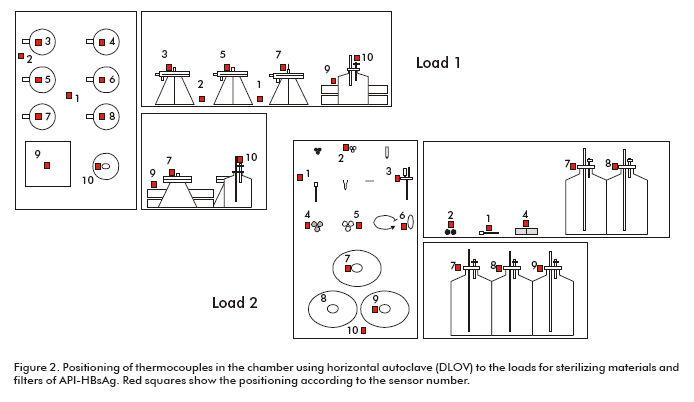
<p><span lang=EN-US style='font-size:10.0pt;font-family:"Verdana","sans-serif"; color:#211E1E'>The following media were also used: Sartocheck Junior, BP-Plus ST166903 (Sartorius, Germany); BIO72 horizontal laminar flow cabinet (ICEN, Cuba); Validator 2000 (Kaye Instruments Inc., USA), DLOV horizontal autoclave (De Lama, Italy), and a peristaltic pump 505 U (Watson Marlow). </span></p>      <p><span lang=EN-US style='font-size:10.0pt;font-family:"Verdana","sans-serif"; color:#211E1E'>Water for injection or phosphate buffer (Na<sub>2</sub>HPO<sub>4</sub> 8 mM, NaH2PO4 8 mM, 140 mM NaCl; pH 6.7) were used in the experiments. The test microorganism was <i>Brevundimona diminuta </i>ATCC 19146, Micro Biologics-CE, Lot 805323, exp 2005-10, and Ref 0805P; as authorized by the European representative Medi-Mark® Europe. </span></p>      <p><b><span lang=EN-US style='font-size:10.0pt;font-family:"Verdana","sans-serif"; color:#211E1E'>Moist heat sterilization processes were used to prepare materials for HBsAg API filtration </span></b></p>          <p><span lang=EN-US style='font-size:10.0pt;font-family:"Verdana","sans-serif"; color:#211E1E'>The moist heat sterilization was carried out in a horizontal DLOV        autoclave (De Lama, Italy) at 130 °C for 20 min. Two loads were studied:        load 1, basically including flat membrane filters, and load 2 to sterilize        auxiliary devices (siphons, tubing, pipette tips, bottles, unions, lids,        cap, etc.)(</span><span style='font-size:10.0pt;font-family:"Verdana","sans-serif"; color:#211E1E'><a href="/img/revistas/bta/v26n3/f0212309.gif"><span lang=EN-US>Figure        2</span></a></span><span lang=EN-US style='font-size:10.0pt;font-family:"Verdana","sans-serif"; color:#211E1E'>). </span></p>      
<p><span lang=EN-US style='font-size:10.0pt;font-family:"Verdana","sans-serif"; color:#211E1E'>The heat distribution within the autoclave chamber was studied to determine the effectiveness of the sterilization cycle, by using a thermal validation system Validator 2000 (Kaye Instruments Inc., USA) and 10 high precision temperature sensors were placed all along the chamber (</span><span style='font-size:10.0pt;font-family:"Verdana","sans-serif";color:#211E1E'><a href="#fig1"><span lang=EN-US>Figure 1</span></a></span><span lang=EN-US style='font-size:10.0pt;font-family:"Verdana","sans-serif";color:#211E1E'>). </span></p>      ]]></body>
<body><![CDATA[<p><span lang=EN-US style='font-size:10.0pt;font-family:"Verdana","sans-serif"; color:#211E1E'>The <i>F</i><sub>0</sub> values were calculated according to the equation (5): </span></p>      <p align=center style='text-align:center'><span style='font-size:13.5pt; color:#211E1E'><img border=0 width=120 height=57 src="/img/revistas/bta/v26n3/fr0112309.gif"></span></p>      
<p><span lang=EN-US style='font-size:10.0pt;font-family:"Verdana","sans-serif"; color:#211E1E'>Where: </span></p>      <p><i><span lang=EN-US style='font-size:10.0pt;font-family:"Verdana","sans-serif"; color:#211E1E'>t</span></i><sub><span lang=EN-US style='font-size:10.0pt; font-family:"Verdana","sans-serif";color:#211E1E'>0</span></sub><span lang=EN-US style='font-size:10.0pt;font-family:"Verdana","sans-serif"; color:#211E1E'> is the initial temperature; <i>t</i>f is the final temperature; and <i>t </i>is the specific heating temperature at a given time (5, 6). </span></p>      <p><b><span lang=EN-US style='font-size:10.0pt;font-family:"Verdana","sans-serif"; color:#211E1E'>Simulation of the sterilizing filtration process </span></b></p>      <p><span lang=EN-US style='font-size:10.0pt;font-family:"Verdana","sans-serif"; color:#211E1E'>Once the elements have been sterilized and assembled, the system was challenged using a rich tryptone soy broth (TSB) medium, for microbiological growth, prepared at 30 g/L and with a volume similar to that of the industrial process, which was pumped through the entire filtration system. The test was satisfactory when the broth collected complied with USP sterility criteria (5). </span></p>      <p><b><span lang=EN-US style='font-size:10.0pt;font-family:"Verdana","sans-serif"; color:#211E1E'>Growth promotion test </span></b></p>      <p><span lang=EN-US style='font-size:10.0pt;font-family:"Verdana","sans-serif"; color:#211E1E'>The ability to promote microbial growth of each TSB medium prepared for a sterility test was evaluated. </span></p>      <p><i><span lang=EN-US style='font-size:10.0pt;font-family:"Verdana","sans-serif"; color:#211E1E'>Bacillus subtilis </span></i><span lang=EN-US style='font-size: 10.0pt;font-family:"Verdana","sans-serif";color:#211E1E'>ATCC 6633, <i>Candida albicans </i>ATCC 10231 and <i>Aspergillus niger </i>ATCC 16404 were inoculated at 0.1 mL of the inoculum, with less than 1000 c.f.u./mL of each microorganism. The viability of the inoculum was confirmed by growing microorganisms on tryptic soy agar. Materials were incubated at 30 to 35 °C, bacteria for 24 h and fungi for 48 h; later the c.f.u./plate were counted. There was microbial growth and the presence of turbidity. </span></p>      <p><b><span lang=EN-US style='font-size:10.0pt;font-family:"Verdana","sans-serif"; color:#211E1E'>Integrity testing of filtration media </span></b></p>      ]]></body>
<body><![CDATA[<p><span lang=EN-US style='font-size:10.0pt;font-family:"Verdana","sans-serif"; color:#211E1E'>The integrity test of the membrane or capsule, before and after filtering, was calculated by using the nondestructive bubble point determination method. The limit of this value could be determined by correlating the integrity data measured when it was dampened with the product and the physical minimum values for the filtering medium dampened with water, according to the equation (3): </span></p>      <p align=center style='text-align:center'><span style='font-size:13.5pt; color:#211E1E'><img border=0 width=225 height=50 src="/img/revistas/bta/v26n3/fr0212309.gif"></span></p>      
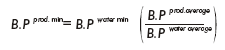
<p><span lang=EN-US style='font-size:10.0pt;font-family:"Verdana","sans-serif"; color:#211E1E'>Where: </span></p>      <p><i><span lang=EN-US style='font-size:10.0pt;font-family:"Verdana","sans-serif"; color:#211E1E'>B.P.</span></i><sub><span lang=EN-US style='font-size:10.0pt; font-family:"Verdana","sans-serif";color:#211E1E'>min. prod.:</span></sub><span lang=EN-US style='font-size:10.0pt;font-family:"Verdana","sans-serif"; color:#211E1E'> the minimum bubble point for the product. </span><span lang=EN-US style='font-size:13.5pt;color:#211E1E'>    <br> </span><i><span lang=EN-US style='font-size:10.0pt;font-family:"Verdana","sans-serif"; color:#211E1E'>B.P.</span></i><sub><span lang=EN-US style='font-size:10.0pt; font-family:"Verdana","sans-serif";color:#211E1E'>min. water</span></sub><span lang=EN-US style='font-size:10.0pt;font-family:"Verdana","sans-serif"; color:#211E1E'>: minimum bubble point for membranes dampened with water </span><span lang=EN-US style='font-size:13.5pt;color:#211E1E'>    <br> </span><i><span lang=EN-US style='font-size:10.0pt;font-family:"Verdana","sans-serif"; color:#211E1E'>B.P.</span></i><sub><span lang=EN-US style='font-size:10.0pt; font-family:"Verdana","sans-serif";color:#211E1E'>mean prod.:</span></sub><span lang=EN-US style='font-size:10.0pt;font-family:"Verdana","sans-serif"; color:#211E1E'> Mean bubble point determined for the product after filtration </span><span lang=EN-US style='font-size:13.5pt;color:#211E1E'>    <br> </span><i><span lang=EN-US style='font-size:10.0pt;font-family:"Verdana","sans-serif"; color:#211E1E'>B.P.</span></i><sub><span lang=EN-US style='font-size:10.0pt; font-family:"Verdana","sans-serif";color:#211E1E'>mean water</span></sub><span lang=EN-US style='font-size:10.0pt;font-family:"Verdana","sans-serif"; color:#211E1E'>: Mean bubble point for membranes dampened with water. </span></p>      <p><span lang=EN-US style='font-size:10.0pt;font-family:"Verdana","sans-serif"; color:#211E1E'>The working range for the bubble point must be established between the minimum value determined for the product and 1000 mBar above it (3). </span></p>      <p><b><span lang=EN-US style='font-size:10.0pt;font-family:"Verdana","sans-serif"; color:#211E1E'>Analysis of extractables </span></b></p>      <p><span lang=EN-US style='font-size:10.0pt;font-family:"Verdana","sans-serif"; color:#211E1E'>Tests were carried out using the solvent extraction method (5). Three filter media of each type, membranes 113 or Sartobran P capsules were put in containers filled with phosphate buffer covering the entire filter surface for 2 h and then sterilized in an autoclave with the cycle described for material loads. After sterilization both filter media were kept at 70 °C for 24 h in contact with phosphate buffer at a rate of 6000 cm<sup>2</sup>/L. This was analyzed every 12 h by Fourier’s transform infrared spectroscopy (FTIRS) and high performan ce liquid chromatography (RP-HPLC). The FTIRS was carried out with a Nicolet FT-IR 200 spectrometer (Thermo Electron Scientific Instrument Co., USA) using detection by attenuated total reflection (ATR). Scans were made from 4000 cm<sup>-1</sup> to 675 cm<sup>-1</sup>, at a rate of 6.25 cm<sup>-1</sup>/min on a cell covered with a glass plate of Ge (germanium) at room temperature. Two hundred microliters of liquid samples or the solid membranes were placed on the glass of the cell for their measurement. The spectra were recorded as transmittance after correcting H<sub>2</sub>O and CO<sub>2</sub> contributions using the EZ Omnic software (Thermo Electron Scientific Instrument Co., USA). RP-HPLC was performed on a Uptishere 120 A column, 5 </span><span style='font-size:10.0pt;font-family:"Verdana","sans-serif";color:#211E1E'>&#956;</span><span lang=EN-US style='font-size:10.0pt;font-family:"Verdana","sans-serif"; color:#211E1E'>m ODB C18 (3.9 mm x 250 mm, Interchim, France) under the following conditions: flow rate, f = 1 mL / min; mobile phase, AcN -H<sub>2</sub>O 10:90 v / v at 35 °C; with detection at 220 nm. For the separation we used an AcN gradient of 10 to 90% for 60 min. The signals obtained were compared against a phosphate buffer baseline. </span></p>      ]]></body>
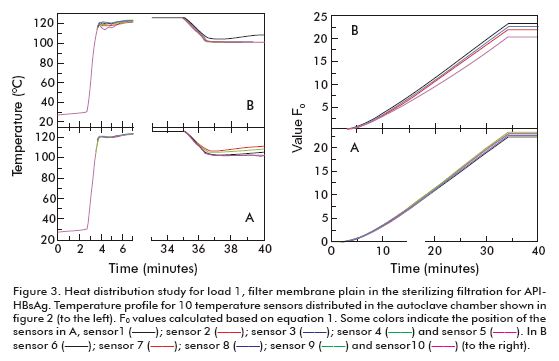
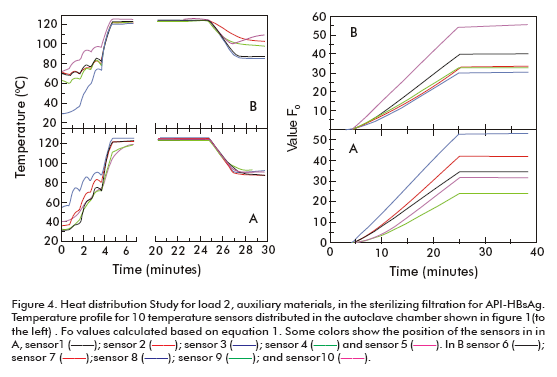
<body><![CDATA[<p><b><span lang=EN-US style='font-size:10.0pt;font-family:"Verdana","sans-serif"; color:#211E1E'>Microbiological challenge </span></b></p>      <p><span lang=EN-US style='font-size:10.0pt;font-family:"Verdana","sans-serif"; color:#211E1E'>The challenged microorganism was identified by an API test, and later the appropriate cell size and the absence of aggregates were demonstrated. For these purposes, two aliquots of approximately 2 mL of <i>B. diminuta </i>cell suspension were taken and filtered through 0.45 and 0.2 µm, respectively. Each one of the filtrates was inoculated into a culture tube containing TSB 20 mL and incubated at 30 to 35 °C for 5 d. Observations were made for the presence of turbidity in the tubes during and after incubation, indicating microorganism growth by its passage through the membrane. </span></p>      <p><span lang=EN-US style='font-size:10.0pt;font-family:"Verdana","sans-serif"; color:#211E1E'>Challenge experiments were carried out in an ISO 5 laminar air flow cabinet on different days, by comparing three lots of membranes or capsules. <i>B.diminuta </i>cells were added to 15 L of buffer phosphate and HBsAg API for a concentration of &#8805; 10<sup>7</sup> c.f.u./cm<sup>2</sup> on the surface of the medium. The lots were filtered after stirring the mixture for 5 min. Tests were considered successful if the filtered material was able to pass the sterility test (6). </span></p>      <p><b><span lang=EN-US style='font-family:"Verdana","sans-serif";color:#211E1E'>RESULTS AND DISCUSSION </span></b></p>      <p><b><span lang=EN-US style='font-size:10.0pt;font-family:"Verdana","sans-serif"; color:#211E1E'>Moist heat sterilization of HBsAg API filtration</span></b><span lang=EN-US style='font-size:10.0pt;font-family:"Verdana","sans-serif"; color:#211E1E'> <b>materials</b> </span></p>          <p><span lang=EN-US style='font-size:10.0pt;font-family:"Verdana","sans-serif"; color:#211E1E'>The first operation and one of the key elements for good sterilizing        filtration is the appropriate sterilization of the materials. To determine        the effectiveness of the sterilization cycle, a heat distribution study        was carried out in the autoclave chamber by distributing temperature sensors        (</span><span style='font-size:10.0pt;font-family:"Verdana","sans-serif"; color:#211E1E'><a href="#fig1"><span lang=EN-US>Figure 1</span></a></span><span lang=EN-US style='font-size:10.0pt;font-family:"Verdana","sans-serif"; color:#211E1E'>). Both loads are required when working on the membranes; but load        2 is only required when operating on the capsules, since these filtering        media are independent, sterile and ready to use cartridges. The sterilization        results of loads 1 and 2, as defined in </span><span style='font-size:10.0pt; font-family:"Verdana","sans-serif";color:#211E1E'><a href="/img/revistas/bta/v26n3/f0212309.gif"><span lang=EN-US>figure 2</span></a></span><span lang=EN-US style='font-size:10.0pt; font-family:"Verdana","sans-serif";color:#211E1E'>, are shown in </span><span style='font-size:10.0pt;font-family:"Verdana","sans-serif";color:#211E1E'><a href="#fig3"><span lang=EN-US>figures 3 and 4</span></a></span><span lang=EN-US style='font-size:10.0pt;font-family:"Verdana","sans-serif"; color:#211E1E'>. </span></p>      
<p align=center style='text-align:center'><span style='font-size:13.5pt; color:#211E1E'><img border=0 width=559 height=361 src="/img/revistas/bta/v26n3/f0312309.gif"></span><a name=fig3></a></p>      
<p>&nbsp;</p>      <p align=center style='text-align:center'><img border=0 width=557 height=377 src="/img/revistas/bta/v26n3/f0412309.gif"><a name=fig4></a></p>          
<p><span lang=EN-US style='font-size:10.0pt;font-family:"Verdana","sans-serif"; color:#211E1E'>The profile of the sterilization cycle of load 1 was that of a        solid load using a first stage of preheating by the injection of saturated        steam at a rate of 200 kg/h until displacing, by venting, all the cold air        that is found in the chamber. The second stage is that of sterilization        until completing the set time period of approximately 35 minutes, which        ends with a cooling stage until the sterile materials are removed to prepare        for the next cycle (</span><span style='font-size:10.0pt;font-family:"Verdana","sans-serif"; color:#211E1E'><a href="/img/revistas/bta/v26n3/f0212309.gif"><span lang=EN-US>Figure        2, left</span></a></span><span lang=EN-US style='font-size:10.0pt;font-family:"Verdana","sans-serif"; color:#211E1E'>). <i>F</i><sub>0</sub> values measured by 10 temperature sensors        distributed inside the chamber surpassed 15 min at 121.1 ºC, which is considered        appropriate for a saturated steam sterilization process (</span><span style='font-size:10.0pt;font-family:"Verdana","sans-serif";color:#211E1E'><a href="#fig3"><span lang=EN-US>Figure 3</span></a></span><span lang=EN-US style='font-size:10.0pt;font-family:"Verdana","sans-serif";color:#211E1E'>, right)        (7-9). </span></p>      
]]></body>
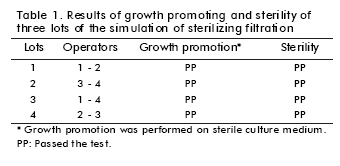
<body><![CDATA[<p><span lang=EN-US style='font-size:10.0pt;font-family:"Verdana","sans-serif"; color:#211E1E'>For load 2, comprising auxiliary materials for the sterilizing filtration of HBsAg API, the profile of the sterilization cycle was that used in porous loads, in which the initial heating is combined with several prevacuum cycles for a more effective penetration of the saturated steam in the unsterilized materials (</span><span style='font-size:10.0pt;font-family:"Verdana","sans-serif"; color:#211E1E'><a href="#fig4"><span lang=EN-US>Figure 4</span></a></span><span lang=EN-US style='font-size:10.0pt;font-family:"Verdana","sans-serif"; color:#211E1E'>, left). As in the previous cycle, it has a first preheating stage by injecting saturated steam at 200 kg/h, followed by the sterilization stage until completing the fixed time period of approximately 25 min. This ends with a cooling stage, and the sterile materials are removed to prepare for the next cycle. All <i>F</i><sub>0</sub> values measured by the 10 temperature sensors distributed inside the chamber surpassed 15 min at 121.1 °C, which is considered to be satisfactory for a saturated steam sterilization process (</span><span style='font-size:10.0pt;font-family:"Verdana","sans-serif";color:#211E1E'><a href="#fig4"><span lang=EN-US>Figure 4</span></a></span><span lang=EN-US style='font-size:10.0pt;font-family:"Verdana","sans-serif";color:#211E1E'>, right) (7, 8). </span></p>      <p><span lang=EN-US style='font-size:10.0pt;font-family:"Verdana","sans-serif"; color:#211E1E'>In both cycles, the time take to reach <i>F</i><sub>0</sub> were longer than those required for a sterilization cycle with saturated steam (</span><span style='font-size:10.0pt;font-family:"Verdana","sans-serif";color:#211E1E'><a href="#fig3"><span lang=EN-US>Figures 3 and 4</span></a></span><span lang=EN-US style='font-size:10.0pt;font-family:"Verdana","sans-serif"; color:#211E1E'>, right). Time, temperature and pressure are the physical parameters ruling the efficiency of a sterilization cycle. The latter two parameters show a directly proportional variation. Therefore, the temperature accepted for sterilization ranges from 118 to 134 °C. The USP refers to <i>an autoclave cycle of 15 minutes at 121 °C </i>(9), <i>specified in the compendia for materials, media or reagents</i>. However, the European Pharmacopeia (EP) and the British Pharmacopeia (BP) recommend a heating process at 121 °C for at least 15 min as the reference condition for aqueous preparations (10, 11). Both Pharmacopeia express that <i>other conditions of time and temperature can be used provided the process chosen is shown to have an adequate and reproducible level of lethality</i>. The mathematical approach to calculate the lethality level, also known as the Anglo-Saxon, uses <i>F</i>0 values as a reference unit. The <i>F</i><sub>0</sub> can be calculated by equation 1, showing the temperature data accumulated during the sterilization process, becoming an equivalent of lethality at 121.1 °C (7, 8). </span></p>      <p><span lang=EN-US style='font-size:10.0pt;font-family:"Verdana","sans-serif"; color:#211E1E'>It has been shown that <i>F</i><sub>0</sub> values of at least 8 minutes, equivalent to different sterilization temperatures, are able to reach a maximum lethality rate (7, 8). In our study, and for both sterilization cycles, <i>F</i><sub>0</sub> values were longer than 15 min, being reached in some specific areas of the chamber depending on the load and the location of the thermocouple; these values were up to three times higher than the ideal value. These results demonstrate the efficiency of the sterilization cycles, at least for these two loads, in that they provide the potential but do not ensure sterility since the handling of the materials afterwards can prevent it during the filtration process <i>per se</i>. </span></p>      <p><span lang=EN-US style='font-size:10.0pt;font-family:"Verdana","sans-serif"; color:#211E1E'>According to the filtration process employing ready to use capsules, the sterilization cycle in load 1 was not necessary. This means that besides decreasing the handling of the filtration medium, thereby simplifying the operation, the causes of a possible contamination after assembling the filtration system decreases. </span></p>      <p><b><span lang=EN-US style='font-size:10.0pt;font-family:"Verdana","sans-serif"; color:#211E1E'>Simulation of the sterilizing filtration </span></b></p>      <p><span lang=EN-US style='font-size:10.0pt;font-family:"Verdana","sans-serif"; color:#211E1E'>The purpose of this test is to demonstrate whether the assembly of the system, under an ISO 5 laminar air flow, does not affect the sterility of the materials that were prepared in an autoclave. This test was performed with all elements of the filtration system (</span><span style='font-size:10.0pt; font-family:"Verdana","sans-serif";color:#211E1E'><a href="#fig1"><span lang=EN-US>Figure 1</span></a></span><span lang=EN-US style='font-size:10.0pt; font-family:"Verdana","sans-serif";color:#211E1E'>), using 15 L of TSB. The results evidenced that in the simulations for specific operators in this stage, the sterile culture medium maintained the capacity to promote growth, besides maintaining its sterility after flowing through the system in an interval that was similar to that expected for the industrial processing, from 30 to 60 minutes (</span><span style='font-size:10.0pt;font-family:"Verdana","sans-serif"; color:#211E1E'><a href="#tab1"><span lang=EN-US>Table 1</span></a></span><span lang=EN-US style='font-size:10.0pt;font-family:"Verdana","sans-serif"; color:#211E1E'>). </span></p>      <p align=center style='text-align:center'><span style='font-size:13.5pt; color:#211E1E'><img border=0 width=340 height=166 src="/img/revistas/bta/v26n3/t0112309.gif"></span><a name=tab1></a></p>      
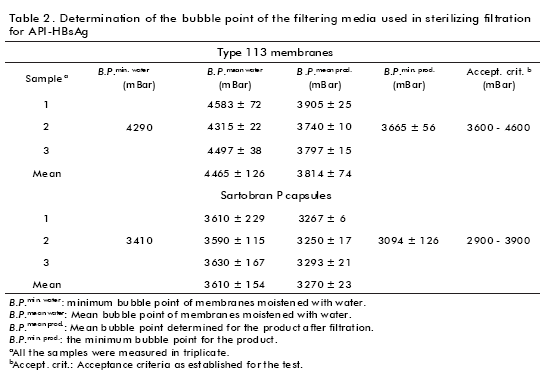
<p><span lang=EN-US style='font-size:10.0pt;font-family:"Verdana","sans-serif"; color:#211E1E'>Although this test is not included in any regulatory document, it provides important information on the correct handling of the system during the aseptic process of sterilization using an autoclave and the assembly of its components. The use of the filtering medium is not indispensable, particularly because of its specific challenge with <i>B. diminuta </i>according to the current regulations (see more information below) (1-4). </span></p>      <p><b><span lang=EN-US style='font-size:10.0pt;font-family:"Verdana","sans-serif"; color:#211E1E'>Filter integrity test </span></b></p>      <p><span lang=EN-US style='font-size:10.0pt;font-family:"Verdana","sans-serif"; color:#211E1E'>As stated in the experimental methodology, the bubble points were determined as proof of the integrity of membranes and capsules, in order to establish a criterion that may become the parameter of acceptance of the test made for all the filtration operations (</span><span style='font-size: 10.0pt;font-family:"Verdana","sans-serif";color:#211E1E'><a href="#tab2"><span lang=EN-US>Table 2</span></a></span><span lang=EN-US style='font-size:10.0pt; font-family:"Verdana","sans-serif";color:#211E1E'>). </span></p>      ]]></body>
<body><![CDATA[<p align=center style='text-align:center'><span style='font-size:13.5pt; color:#211E1E'><img border=0 width=549 height=380 src="/img/revistas/bta/v26n3/t0212309.gif"></span><a name=tab2></a></p>      
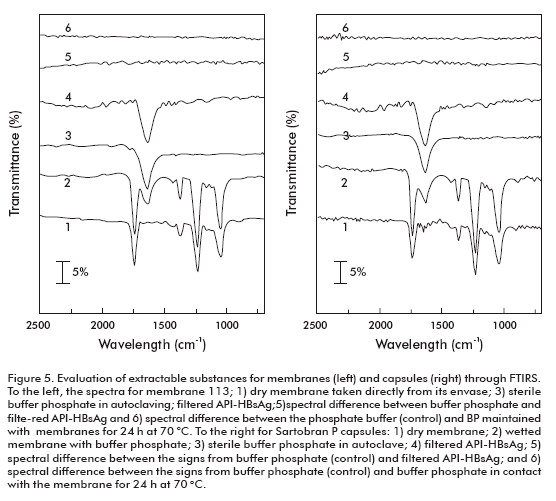
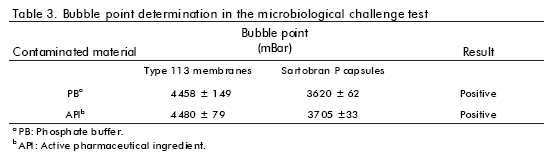
<p><span lang=EN-US style='font-size:10.0pt;font-family:"Verdana","sans-serif"; color:#211E1E'>According to the manufacturer's specifications, the minimum bubble point of type 113 membranes should be above 4200 mBar, and between 3200 and 4200 mBar for Sartobran P capsules. This is a starting point to establish the specifications under the specific operating conditions (12). The minimum bubble points for the HBsAg API were calculated in three samples of each filtering device in three replicates using equation 2, rating 3665 ± 56 mBar for membranes, and 3094 ± 126 mBar for capsules. Therefore, as an acceptance criterion to demonstrate the integrity of both filtering media, a working range was established from 3600 to 4600 mBar for the membranes, and from 2900 to 3900 Bar for the capsules, after the sterilizing filtration process. </span></p>      <p><span lang=EN-US style='font-size:10.0pt;font-family:"Verdana","sans-serif"; color:#211E1E'>Although in practice, the minimum bubble point is set by the manufacturer for a filter medium moisten with water, regulatory requirements state that it must be established during the actual operating conditions before and after its use to guarantee safety (1-4). In more than 200 production lots, where the sterilizing filtration of the HBsAg API has been made with membranes, values of bubble points have be of 4588 ± 162 and 3935 ± 217 mBar, before and after the sterilizing filtration process. For nine sterilization processes using capsules, values are of 3616 ± 114 Bar and 3274 ± 55 before and after filtration, respectively. </span></p>      <p><span lang=EN-US style='font-size:10.0pt;font-family:"Verdana","sans-serif"; color:#211E1E'>According to our results, the relationship of bubble points before and after filtering is nearly 90%, indicating the predictable influence of phosphate buffer and the concentration of HBsAg API on the pore size of the filtering medium (1, 3). As the bubble point presumably represents the largest pore present in the filtering medium, its value is not absolute. This, together with the influence on the filtering medium, the intrinsic characteristics of the material to be filtered, the protein concentration, and viscosity and composition of the phosphate buffer, lead to reasonable bubble point variances of between 10 and 15% for a specific filtration process, which was verified in our study (1, 13). </span></p>      <p><span lang=EN-US style='font-size:10.0pt;font-family:"Verdana","sans-serif"; color:#211E1E'>The above results demonstrate how the procedures for preparation, sterilization and use of the filtering media ensure physical and chemical stability during the filtration process. This integrity test fulfilled the current regulatory requirements and also showed that any tested media could be specifically used in the sterilizing filtration process for the HBsAg API, because the results are similar (1-3). </span></p>      <p><b><span lang=EN-US style='font-size:10.0pt;font-family:"Verdana","sans-serif"; color:#211E1E'>Analysis of extractables </span></b></p>      <p><span lang=EN-US style='font-size:10.0pt;font-family:"Verdana","sans-serif"; color:#211E1E'>For the extraction process, a worst case scenario was simulated, since the filtration systems after sterilization take no more than 6 hours to e used, adding the hour of the filtration process <i>per se</i>, which is always operated at room temperature. The analysis of extractables using FTIRS is simplified after knowing the initial spectral contribution of the materials used to make the filtering media without any treatment (</span><span style='font-size:10.0pt;font-family:"Verdana","sans-serif";color:#211E1E'><a href="#fig5"><span lang=EN-US>Figure 5</span></a></span><span lang=EN-US style='font-size:10.0pt;font-family:"Verdana","sans-serif";color:#211E1E'>, signal 1 left and right). Several intense spikes at wavelengths of 1045 cm<sup>-1</sup>, 1120 cm<sup>-1</sup>, 1235 cm<sup>-1</sup>, 1375 cm<sup>-1</sup>, 1640 cm<sup>-1</sup>and 1740 cm<sup>-1</sup>, identified the different functional groups characterizing the particular structure of membranes and capsules (12). None of the filtering media had a significant spectral contribution at between 2000 and 4000 cm<sup>-1</sup>, except for the -OH groups of environmental humidity after 3000 cm<sup>-1</sup> (data not shown). It is important to notice that the spectra for both filtering media were virtually identical, due to the structural similarity of their chemical composition (12). </span></p>      <p align=center style='text-align:center'><span style='font-size:13.5pt; color:#211E1E'><img border=0 width=556 height=501 src="/img/revistas/bta/v26n3/f0512309.gif"></span><a name=fig5></a></p>      
<p><span lang=EN-US style='font-size:10.0pt;font-family:"Verdana","sans-serif"; color:#211E1E'>By moistening the filtering media with phosphate buffer at room temperature for 20 min, a new spectral contribution appeared at 1670 cm<sup>-1</sup>, in addition to those already seen (</span><span style='font-size:10.0pt; font-family:"Verdana","sans-serif";color:#211E1E'><a href="#fig5"><span lang=EN-US>Figure 5</span></a></span><span lang=EN-US style='font-size:10.0pt; font-family:"Verdana","sans-serif";color:#211E1E'>, signal 2 left and right). These spectra were used as reference to identify contaminants that could appear in the filtering material. </span></p>      <p><span lang=EN-US style='font-size:10.0pt;font-family:"Verdana","sans-serif"; color:#211E1E'>All the buffer phosphate and HBsAg API spectra were characterized by a wide peak with the maximum at 1670 cm<sup>-1</sup> whose position did not correspond to the functional groups present in the filtering media (</span><span style='font-size:10.0pt;font-family:"Verdana","sans-serif"; color:#211E1E'><a href="#fig5"><span lang=EN-US>Figure 5</span></a></span><span lang=EN-US style='font-size:10.0pt;font-family:"Verdana","sans-serif"; color:#211E1E'>, signals 3 and 4 left and right). This peak remained virtually unchanged, without any others appearing for 24 hours at 70 °C after sterilization (data not shown). </span></p>      ]]></body>
<body><![CDATA[<p><span lang=EN-US style='font-size:10.0pt;font-family:"Verdana","sans-serif"; color:#211E1E'>The most significant result of this study is that of the subtraction of the spectra obtained for phosphate buffer, baseline, and those of the filtered HBsAg APIs (</span><span style='font-size:10.0pt;font-family: "Verdana","sans-serif";color:#211E1E'><a href="#fig5"><span lang=EN-US>Figure 5</span></a></span><span lang=EN-US style='font-size:10.0pt;font-family:"Verdana","sans-serif"; color:#211E1E'>, spectrum 5 left and right) and phosphate buffer at different times of contact with the filtering media after the treatment (</span><span style='font-size:10.0pt;font-family:"Verdana","sans-serif";color:#211E1E'><a href="#fig5"><span lang=EN-US>Figure 5</span></a></span><span lang=EN-US style='font-size:10.0pt;font-family:"Verdana","sans-serif";color:#211E1E'>, spectrum 6 left and right). The absence of any peak with a threshold higher than 0.05% transmittance in these spectra showed that the filtering media did not provide contaminants which could interfere with the filter quality under the specific conditions of sterilizing filtration for the API-HBsAg. This even occurred for a worst case scenario in which the extraction conditions were at a rate of 6000 cm<sup>2</sup>/L, although the true conditions of the process were 8.7 and 333.3 cm<sup>2</sup>/L per volume of API filtered through type 133 membranes and Sartobran P capsules, respectively. Both, the extraction procedure of this study and the infrared spectra shown in </span><span style='font-size:10.0pt;font-family:"Verdana","sans-serif";color:#211E1E'><a href="#fig5"><span lang=EN-US>Figure 5</span></a></span><span lang=EN-US style='font-size:10.0pt;font-family:"Verdana","sans-serif";color:#211E1E'>, were very similar to those reported by the manufacturer for Sartobran P capsules in contact with water regardless of the measuring method (14). </span></p>      <p><span lang=EN-US style='font-size:10.0pt;font-family:"Verdana","sans-serif"; color:#211E1E'>The buffer in contact with the filtering media was also studied by RP-HPLC (</span><span style='font-size:10.0pt;font-family:"Verdana","sans-serif"; color:#211E1E'><a href="#fig6"><span lang=EN-US>Figure 6</span></a></span><span lang=EN-US style='font-size:10.0pt;font-family:"Verdana","sans-serif"; color:#211E1E'>). Signals obtained for the baseline and buffer in contact with the membrane at different storage times at 70 °C were in the range of milliabsorbance units (mAU), equivalent to the noise level of the detector itself with small drifts in the running time. Once again, components of the filtering media were not detected, which could not be compared with the HBsAg API signal due to the irreversible interaction of the biological material with the stationary phase of the chromatographic column (15). Nevertheless, considering that these signals were in the range of the detection limit, and knowing the extraction conditions, levels lower than 10 ppm could be achieved for both filtering media. </span></p>      <p align=center style='text-align:center'><span style='font-size:13.5pt; color:#211E1E'><img border=0 width=345 height=308 src="/img/revistas/bta/v26n3/f0612309.gif"></span><a name=fig6></a></p>      
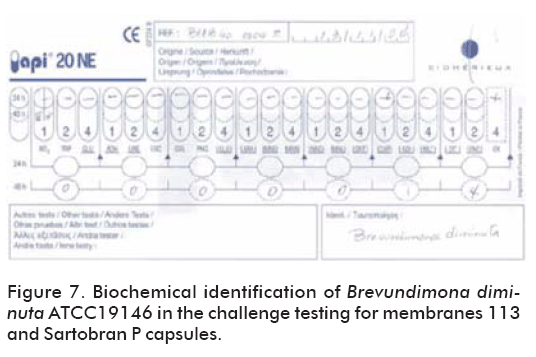
<p><span lang=EN-US style='font-size:10.0pt;font-family:"Verdana","sans-serif"; color:#211E1E'>While demonstrating the suitability of a filtering medium for a particular application, knowledge on the probability of generating extractable substances which could be introduced into the processing stream during filtration should be considered (1-4). According to the requirements of the Regulatory organizations, different tests and guidelines have been proposed for evaluating extractables from plastics, including the American Pharmacopeia (USP) which proposed an extraction methodology to evaluate extractable substances from plastics and possible analytical techniques. They also emphasized that a single method of analysis is not enough to give a reliable result, taking into account the complexity of the individual substances to be identified (16-19). In this study, we used two of the most recommended techniques because of their high level of identification: FTIRS and RP-HPLC; thus, the results showed the absence of extractable substances from the filter media, because there were no signs of them. It is very important to ensure that the filtering medium does not release components that may contaminate the filtered material, which must be demonstrated regardless of the considerations of the manufacturers, even knowing the low level of extractable substances for many of the filtering systems currently available, including the ones used in the production of the HBsAg API (12). The assessment under the specific operating conditions provides valuable information on system performance. </span></p>      <p><b><span lang=EN-US style='font-size:10.0pt;font-family:"Verdana","sans-serif"; color:#211E1E'>Microbiological challenge </span></b></p>      <p><b><i><span lang=EN-US style='font-size:10.0pt;font-family:"Verdana","sans-serif"; color:#211E1E'>Microorganism characterization </span></i></b></p>      <p><span lang=EN-US style='font-size:10.0pt;font-family:"Verdana","sans-serif"; color:#211E1E'>Prior to the challenge test, <i>B. diminuta </i>ATCC 19146 was identified, with a viability of 6 x 10<sup>10</sup> c.f.u./mL, and its purity corresponded to the standard defined using an API test which was positive for <i>Brevundimonas </i>(</span><span style='font-size:10.0pt;font-family:"Verdana","sans-serif"; color:#211E1E'><a href="#fig7"><span lang=EN-US>Figure 7</span></a></span><span lang=EN-US style='font-size:10.0pt;font-family:"Verdana","sans-serif"; color:#211E1E'>). </span></p>      <p align=center style='text-align:center'><span style='font-size:13.5pt; color:#211E1E'><img border=0 width=536 height=357 src="/img/revistas/bta/v26n3/f0712309.gif"></span><a name=fig7></a></p>      
<p><span lang=EN-US style='font-size:10.0pt;font-family:"Verdana","sans-serif"; color:#211E1E'>Moreover, it was demonstrated that there was no aggregation by filtration through 0.45 µm and 0.2 µm membranes. There was only growth and turbidity in the broth inoculated with filtrates from the 0.45 </span><span style='font-size:10.0pt;font-family:"Verdana","sans-serif";color:#211E1E'>&#956;</span><span lang=EN-US style='font-size:10.0pt;font-family:"Verdana","sans-serif"; color:#211E1E'>m membrane. These results demonstrate that cell diameter was larger than 0.2 </span><span style='font-size:10.0pt;font-family:"Verdana","sans-serif"; color:#211E1E'>&#956;</span><span lang=EN-US style='font-size:10.0pt; font-family:"Verdana","sans-serif";color:#211E1E'>m and lower than 0.45 </span><span style='font-size:10.0pt;font-family:"Verdana","sans-serif";color:#211E1E'>&#956;</span><span lang=EN-US style='font-size:10.0pt;font-family:"Verdana","sans-serif"; color:#211E1E'>m, in agreement with the selection criteria for the microorganism used (1-3). </span></p>      <p><b><i><span lang=EN-US style='font-size:10.0pt;font-family:"Verdana","sans-serif"; color:#211E1E'>Assessment of membrane integrity by the bubble point test prior to filtration </span></i></b></p>      ]]></body>
<body><![CDATA[<p><span lang=EN-US style='font-size:10.0pt;font-family:"Verdana","sans-serif"; color:#211E1E'>The Bubble point determination, a non-destructive method to assess the integrity of a filtering membrane is recommended prior to microbiological challenge testing (</span><span style='font-size:10.0pt; font-family:"Verdana","sans-serif";color:#211E1E'><a href="#tab3"><span lang=EN-US>Table 3</span></a></span><span lang=EN-US style='font-size:10.0pt; font-family:"Verdana","sans-serif";color:#211E1E'>) (1-3). The filters were well prepared, with bubble point values being within the defined ranges for the specific operation, depending on the type of membrane used (section 3.3). </span></p>      <p align=center style='text-align:center'><span style='font-size:13.5pt; color:#211E1E'><img border=0 width=553 height=160 src="/img/revistas/bta/v26n3/t0312309.gif"></span><a name=tab3></a></p>      
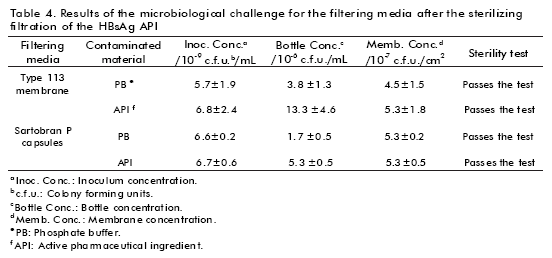
<p><b><i><span lang=EN-US style='font-size:10.0pt;font-family:"Verdana","sans-serif"; color:#211E1E'>Bacterial retention tests </span></i></b></p>      <p><span lang=EN-US style='font-size:10.0pt;font-family:"Verdana","sans-serif"; color:#211E1E'>The bacterial retention tests were carried out on different days, and contaminated phosphate buffer and HBsAg API were challenged, as described in the experimental methodology. The sterility of the filtered material was satisfactory since there was no contamination, demonstrating the effectiveness of both filtering media to retain a high microbial load, and to sterilize effluents under the conditions of the process for obtaining the API of the Cuban anti-hepatitis B vaccine (</span><span style='font-size:10.0pt; font-family:"Verdana","sans-serif";color:#211E1E'><a href="#tab4"><span lang=EN-US>Table 4</span></a></span><span lang=EN-US style='font-size:10.0pt; font-family:"Verdana","sans-serif";color:#211E1E'>). </span></p>      <p align=center style='text-align:center'><span style='font-size:13.5pt; color:#211E1E'><img border=0 width=552 height=258 src="/img/revistas/bta/v26n3/t0412309.gif"></span><a name=tab4></a></p>      
<p><span lang=EN-US style='font-size:10.0pt;font-family:"Verdana","sans-serif"; color:#211E1E'>These results demonstrate the sterility assurance of the filtering process of the HBsAg API with both filtering media. However, from the technological and regulatory points of view, the reduction of processing time by eliminating a sterilization cycle, the decrease in handling prior to filtration and the operating time <i>per se</i>, make the filtration using Sartobran P capsules more attractive. </span></p>      <p><b><i><span lang=EN-US style='font-size:10.0pt;font-family:"Verdana","sans-serif"; color:#211E1E'>Other operation parameters </span></i></b></p>      <p><span lang=EN-US style='font-size:10.0pt;font-family:"Verdana","sans-serif"; color:#211E1E'>The results of this study answer important questions regarding a filtration process. The chemical compatibility of the filtering media was demonstrated during the measurements of bubble points before and after the filtering process. Compliance with the acceptance criterion for this test indicated that both filter media remained unaltered in structure when interacting with the process stream. Another relevant aspect is the percentage of recovery in terms of HBsAg, which was maintained above 99% in more than 200 lots produced to date. This indicates a low protein adsorption on to the filtering media, based on a correct selection of operational parameters, the pressure of approximately 1 bar, temperature at 22 ± 2 °C, an ionic strength of phosphate buffer of 16 ± 3 mS/cm and an HBsAg concentration of 1 mg/mL. </span></p>      <p><b><span lang=EN-US style='font-family:"Verdana","sans-serif";color:#211E1E'>CONCLUSIONS </span></b></p>      <p><span lang=EN-US style='font-size:10.0pt;font-family:"Verdana","sans-serif"; color:#211E1E'>Any API producer, regardless of the considerations of the manufacturer, must comply with the numerous regulations that validate aseptic filtration processes (1-4). In the API-HBsAg sterilizing filtration using type 113 membranes and Sartobran P capsules (Sartorius, Germany), it was demonstrated that: 1) the processes of moist heat sterilization, for the defined loads, reached <i>F</i><sub>0 </sub>values above 15 min, indicating a correct sterilization; 2) the safe assembly of system elements by the operators; 3) the physical integrity of both filtering media was conserved before and after the filtration process; 4) there were no extractable substances that could be incorporated into the process stream; and 5) both filtering media could retain bacterial contamination under true process conditions. These results demonstrate that the sterilizing filtration operation of HBsAg API is safe.</span></p>      ]]></body>
<body><![CDATA[<p><span lang=EN-US style='font-size:13.5pt;color:#211E1E'>&nbsp;</span></p>      <p><b><span lang=EN-US style='font-family:"Verdana","sans-serif";color:#211E1E'>REFERENCES </span></b></p>      <!-- ref --><p><span lang=EN-US style='font-size:10.0pt;font-family:"Verdana","sans-serif"; color:#211E1E'>1</span><span lang=SV style='font-size:10.0pt;font-family:"Verdana","sans-serif"'>. </span><span lang=EN-US style='font-size:10.0pt;font-family:"Verdana","sans-serif"; color:#211E1E'>Meltzer</span><span lang=EN-US style='font-size:10.0pt; font-family:"Verdana","sans-serif"'> </span><span lang=EN-US style='font-size: 10.0pt;font-family:"Verdana","sans-serif";color:#211E1E'>TH, Jornitz</span><span lang=EN-US style='font-size:10.0pt;font-family:"Verdana","sans-serif"'> </span><span lang=EN-US style='font-size:10.0pt;font-family:"Verdana","sans-serif"; color:#211E1E'>MW. Filtration in the pharmaceutical Industry. Marcel Dekker Inc., New York;1998.</span><span lang=EN-US style='font-family:"Arial","sans-serif"; color:navy'> </span><p><span lang=EN-US style='font-size:10.0pt;font-family:"Verdana","sans-serif"; color:#211E1E'>2. International Organization for Standardization. Aseptic processing of health care products. Part 2: Filtration. ISO 13408-2:2003(E). ISO Copyright Office. Geneva, Switzerland;2003.</span><span lang=EN-US style='font-family: "Arial","sans-serif";color:navy'> </span></p>      <!-- ref --><p><span lang=EN-US style='font-size:10.0pt;font-family:"Verdana","sans-serif"; color:#211E1E'>3. PDA Technical Report. Sterilizing filtration of liquids. PDA J Pharm Sci Technol</span><span lang=EN-US style='font-size:11.0pt;font-family: "Arial","sans-serif";color:red'> </span><span lang=EN-US style='font-size:10.0pt; font-family:"Verdana","sans-serif";color:#211E1E'>1998;51:1-36. </span><!-- ref --><p><span lang=EN-US style='font-size:10.0pt;font-family:"Verdana","sans-serif"; color:#211E1E'>4. Mills GJ, Bardo B. Biopharmaceutical Filtration Validation. Bioprocess Int</span><span lang=EN-US style='font-size:11.0pt;font-family:"Arial","sans-serif"; color:red'> </span><span lang=EN-US style='font-size:10.0pt;font-family:"Verdana","sans-serif"; color:#211E1E'>2006;4</span><span lang=EN-US style='font-family:"Arial","sans-serif"; color:red'> </span><span lang=EN-US style='font-size:10.0pt;font-family:"Arial","sans-serif"'>(</span><span lang=EN-US style='font-size:10.0pt;font-family:"Verdana","sans-serif"; color:#211E1E'>5</span><span lang=EN-US style='font-family:"Arial","sans-serif"; color:windowtext'>)</span><span lang=EN-US style='font-size:10.0pt;font-family: "Verdana","sans-serif";color:#211E1E'>:30-8.</span><!-- ref --><p><span lang=EN-US style='font-size:10.0pt;font-family:"Verdana","sans-serif"; color:#211E1E'>5. United States Pharmacopeia XXX-NF 25. </span><span style='font-size:10.0pt;font-family:"Verdana","sans-serif";color:#211E1E'>&lt;88&gt; Pruebas de reactividad biológica, <i>in vivo</i>. </span><span lang=EN-US style='font-size:10.0pt;font-family:"Verdana","sans-serif";color:#211E1E'>United States Pharmacopeial Convention. Rockville, MD;2007:</span><span lang=EN-US style='font-family:"Arial","sans-serif";color:gray'> </span><span lang=EN-US style='font-size:10.0pt;font-family:"Verdana","sans-serif";color:#211E1E'>124-8</span><span lang=SV style='font-family:"Arial","sans-serif";color:teal'>.</span><span lang=SV style='font-size:10.0pt;font-family:"Verdana","sans-serif";color:#211E1E'> </span><!-- ref --><p><span lang=EN-US style='font-size:10.0pt;font-family:"Verdana","sans-serif"; color:#211E1E'>6. United States Pharmacopeia XXX-NF 25. </span><span style='font-size:10.0pt;font-family:"Verdana","sans-serif";color:#211E1E'>&lt;71&gt; Pruebas de esterilidad. United States Pharmacopeial Convention. </span><span lang=EN-US style='font-size:10.0pt;font-family:"Verdana","sans-serif"; color:#211E1E'>Rockville, MD;2007:105-11</span><span lang=SV style='font-family: "Arial","sans-serif";color:teal'>.</span><span lang=SV style='font-size:10.0pt; font-family:"Verdana","sans-serif";color:#211E1E'> </span><!-- ref --><p><span lang=EN-US style='font-size:10.0pt;font-family:"Verdana","sans-serif"; color:#211E1E'>7. Boca BM, Pretorius E, Gochin R, Chapoullie R, Apostolides Z. An overview of the validation approach for moist heat sterilization, Part I. Pharm Techn</span><span lang=EN-US style='font-size:11.0pt;font-family:"Arial","sans-serif"; color:red'> </span><span lang=EN-US style='font-size:10.0pt;font-family:"Verdana","sans-serif"; color:#211E1E'>2002;4:62-70.</span><span lang=EN-US style='font-size:11.0pt; font-family:"Arial","sans-serif";color:blue'> </span><!-- ref --><p><span lang=EN-US style='font-size:10.0pt;font-family:"Verdana","sans-serif"; color:#211E1E'>8. Boca BM, Pretorius E, Gochin R, Chapoullie R, Apostolides Z. An Overview of the Validation Approach for Moist Heat Sterilization, Part II. </span><span style='font-size:10.0pt;font-family:"Verdana","sans-serif";color:#211E1E'>Pharm Techn</span><span style='font-size:11.0pt;font-family:"Arial","sans-serif"; color:red'> </span><span style='font-size:10.0pt;font-family:"Verdana","sans-serif"; color:#211E1E'>2002;2:96-110.</span><!-- ref --><p><span style='font-size:10.0pt;font-family:"Verdana","sans-serif";color:#211E1E'>9. United States Pharmacopeia XXX-NF 25. &lt;1211&gt; Esterilidad y garantía de esterilidad de artículos farmacopeicos. </span><span lang=EN-US style='font-size:10.0pt;font-family:"Verdana","sans-serif";color:#211E1E'>United States Pharmacopeial Convention. Rockville, MD;2007:736-42</span><span lang=SV style='font-family:"Arial","sans-serif";color:teal'>.</span><span lang=SV style='font-size:10.0pt;font-family:"Verdana","sans-serif";color:#211E1E'> </span><!-- ref --><p><span lang=EN-US style='font-size:10.0pt;font-family:"Verdana","sans-serif"; color:#211E1E'>10. British Pharmacopeia 2007. Appendix XVIII Methods of sterilization </span><span lang=EN-US style='font-size:10.0pt;font-family:"Verdana","sans-serif"; color:windowtext'>(</span><span lang=EN-US style='font-size:10.0pt;font-family: "Verdana","sans-serif";color:#211E1E'>Methods of preparation of sterile products). The Stationary Office, London;2007</span><span lang=SV style='font-size:10.0pt; font-family:"Verdana","sans-serif";color:windowtext'>.</span><span lang=EN-US style='font-size:10.0pt;font-family:"Verdana","sans-serif";color:#211E1E'>&nbsp; </span><p><span lang=EN-US style='font-size:10.0pt;font-family:"Verdana","sans-serif"; color:#211E1E'>11. European Pharmacopeia. Council of Europe, Strasbourg, 5<sup>th</sup> ed.;2005:</span><span lang=EN-US style='font-family:"Arial","sans-serif"; color:gray'> </span><span lang=EN-US style='font-size:10.0pt;font-family:"Verdana","sans-serif"; color:#211E1E'>83-5</span><span lang=SV style='font-size:10.0pt;font-family: "Verdana","sans-serif";color:windowtext'>.</span><span lang=SV style='font-size:10.0pt;font-family:"Verdana","sans-serif";color:#211E1E'> </span></p>      <!-- ref --><p><span lang=EN-US style='font-size:10.0pt;font-family:"Verdana","sans-serif"; color:#211E1E'>12. Sartorius Microfilters. Product Overview</span><span lang=EN-US style='font-family:"Arial","sans-serif";color:gray'> </span><span lang=EN-US style='font-size:10.0pt;font-family:"Verdana","sans-serif"; color:#211E1E'>&nbsp;</span><span lang=EN-US style='font-size:10.0pt; font-family:"Verdana","sans-serif";color:windowtext'>(</span><span lang=EN-US style='font-size:10.0pt;font-family:"Verdana","sans-serif";color:#211E1E'>monografía online). </span><span style='font-size:10.0pt;font-family:"Verdana","sans-serif"; color:#211E1E'>URL: </span><span style='font-size:10.0pt;font-family:"Verdana","sans-serif"'><a href="http://www.sartorius.com/BRO-Microfilters_SM-1503-e.pdf">http://www.sartorius.com/BRO-Microfilters_SM-1503-e.pdf</a> </span><span style='font-size:10.0pt;font-family:"Verdana","sans-serif"; color:windowtext'>(</span><span style='font-size:10.0pt;font-family:"Verdana","sans-serif"; color:#211E1E'>7 enero 2008)</span><span lang=SV style='font-size:10.0pt; font-family:"Verdana","sans-serif";color:windowtext'>.</span><span style='font-size:10.0pt;font-family:"Verdana","sans-serif";color:#211E1E'>&nbsp; </span><!-- ref --><p><span lang=EN-US style='font-size:10.0pt;font-family:"Verdana","sans-serif"; color:#211E1E'>13. Jornitz MW, Agalloco JP, Akers RE, Madsen RE, Meltzer TH. Filter Integrity testing in liquid Application, revisited, Part 1. Pharm Techn</span><span lang=EN-US style='font-size:11.0pt;font-family:"Arial","sans-serif";color:red'> </span><span lang=EN-US style='font-size:10.0pt;font-family:"Verdana","sans-serif"; color:#211E1E'>2001;2:34-50.</span><!-- ref --><p><span lang=EN-US style='font-size:10.0pt;font-family:"Verdana","sans-serif"; color:#211E1E'>14. Sartorius AG. Sartobran P®. Extractables Analysis. Publication No. SPK 5720-e02062;2002</span><span lang=SV style='font-size:10.0pt; font-family:"Verdana","sans-serif";color:windowtext'>.</span><span lang=EN-US style='font-size:10.0pt;font-family:"Verdana","sans-serif";color:#211E1E'>&nbsp;&nbsp; </span><!-- ref --><p><span lang=EN-US style='font-size:10.0pt;font-family:"Verdana","sans-serif"; color:#211E1E'>15. Tleugabulova D, Falcón V, Sewer M. Pentón E. Aggregation of recombinant hepatitis B surface antigen in <i>Pichia pastoris</i>. J Chromat B</span><span lang=EN-US style='font-size:11.0pt;font-family:"Arial","sans-serif";color:red'> </span><span lang=EN-US style='font-size:10.0pt;font-family:"Verdana","sans-serif"; color:#211E1E'>1998;716:209-19.</span><span lang=EN-US style='font-size:11.0pt; font-family:"Arial","sans-serif";color:blue'> </span><!-- ref --><p><span lang=EN-US style='font-size:10.0pt;font-family:"Verdana","sans-serif"; color:#211E1E'>16. Yu X, Wood D, Ding X. Extractable and leachables study approach for disposables material used in bioprocessing. Two case studies illustrate a systematic approach. Biopharm</span><span lang=EN-US style='font-size:11.0pt;font-family:"Arial","sans-serif";color:red'> </span><span lang=EN-US style='font-size:10.0pt;font-family:"Verdana","sans-serif"; color:#211E1E'>2008;1:42-8.</span><span lang=EN-US style='font-size:11.0pt; font-family:"Arial","sans-serif";color:blue'> </span><!-- ref --><p><span lang=EN-US style='font-size:10.0pt;font-family:"Verdana","sans-serif"; color:#211E1E'>17. Bennan J, Bing F, Boone H, Fernández J, Seely H, van Deinse H. Evaluation of extractable from product-contact surfaces. Biopharm</span><span lang=EN-US style='font-size:11.0pt;font-family:"Arial","sans-serif";color:red'> </span><span lang=EN-US style='font-size:10.0pt;font-family:"Verdana","sans-serif"; color:#211E1E'>2002;3:22-34.</span><!-- ref --><p><span lang=EN-US style='font-size:10.0pt;font-family:"Verdana","sans-serif"; color:#211E1E'>18. Weitzmann CJ. The use of model solvent for evaluating extractable from filters used to process pharmaceutical products, part 1. Practical considerations. Biopharm</span><span lang=EN-US style='font-size: 11.0pt;font-family:"Arial","sans-serif";color:red'> </span><span lang=EN-US style='font-size:10.0pt;font-family:"Verdana","sans-serif";color:#211E1E'>1997;6:44-59.</span><!-- ref --><p><span lang=EN-US style='font-size:10.0pt;font-family:"Verdana","sans-serif"; color:#211E1E'>19. Weitzmann CJ. The use of model solvent for evaluating extractable from filters used to process pharmaceutical products, part 2. Assigning a model solvent. Biopharm</span><span lang=EN-US style='font-size: 11.0pt;font-family:"Arial","sans-serif";color:red'> </span><span lang=EN-US style='font-size:10.0pt;font-family:"Verdana","sans-serif";color:#211E1E'>1997;6:72-9.</span><span lang=EN-US style='font-size:13.5pt;color:#211E1E'>&nbsp;</span><p><span lang=EN-US style='font-size:13.5pt;color:#211E1E'>&nbsp;</span></p>      <p><span lang=EN-US style='font-size:10.0pt;font-family:"Verdana","sans-serif"; color:#211E1E'>Received in December, 2008.    <br> Accepted for publication in June, 2009..</span></p>      <p><span style='font-size:10.0pt;font-family:"Verdana","sans-serif";color:#211E1E'>Alejandro Beldarraín. Departamento Hepatitis B. Planta de Producción. Centro de Ingeniería Genética y Biotecnología, CIGB. Ave 31 e/ 158 y 190, Cubanacán, Playa, AP 6162, CP 10600, Ciudad de La Habana, Cuba. E-mail: <a href="mailto:alejandro.beldarrain@cigb.edu.cu">alejandro.beldarrain@cigb.edu.cu</a></span><span style='font-size:11.0pt;font-family:"Arial","sans-serif";color:#FF6600'> </span></p>      <p><span style='font-size:13.5pt;color:#211E1E'>&nbsp;</span></p>  </div>  </div>       ]]></body><back>
<ref-list>
<ref id="B1">
<label>1</label><nlm-citation citation-type="">
<person-group person-group-type="author">
<name>
<surname><![CDATA[Meltzer]]></surname>
<given-names><![CDATA[TH]]></given-names>
</name>
<name>
<surname><![CDATA[Jornitz]]></surname>
<given-names><![CDATA[MW]]></given-names>
</name>
</person-group>
<source><![CDATA[Filtration in the pharmaceutical Industry]]></source>
<year></year>
</nlm-citation>
</ref>
<ref id="B2">
<label>2</label><nlm-citation citation-type="book">
<source><![CDATA[]]></source>
<year>2003</year>
<publisher-loc><![CDATA[Geneva ]]></publisher-loc>
<publisher-name><![CDATA[ISO Copyright Office]]></publisher-name>
</nlm-citation>
</ref>
<ref id="B3">
<label>3</label><nlm-citation citation-type="journal">
<article-title xml:lang="en"><![CDATA[PDA Technical Report: Sterilizing filtration of liquids]]></article-title>
<source><![CDATA[PDA J Pharm Sci Technol]]></source>
<year>1998</year>
<volume>51</volume>
<page-range>1-36</page-range></nlm-citation>
</ref>
<ref id="B4">
<label>4</label><nlm-citation citation-type="journal">
<person-group person-group-type="author">
<name>
<surname><![CDATA[Mills]]></surname>
<given-names><![CDATA[GJ]]></given-names>
</name>
<name>
<surname><![CDATA[Bardo]]></surname>
<given-names><![CDATA[B]]></given-names>
</name>
</person-group>
<article-title xml:lang="en"><![CDATA[Biopharmaceutical Filtration Validation]]></article-title>
<source><![CDATA[Bioprocess Int]]></source>
<year>2006</year>
<volume>4</volume>
<numero>5</numero>
<issue>5</issue>
<page-range>30-8</page-range></nlm-citation>
</ref>
<ref id="B5">
<label>5</label><nlm-citation citation-type="book">
<source><![CDATA[United States Pharmacopeia XXX-NF 25: &lt;88> Pruebas de reactividad biológica, in vivo]]></source>
<year>2007</year>
<page-range>124-8</page-range><publisher-loc><![CDATA[Rockville ]]></publisher-loc>
<publisher-name><![CDATA[United States Pharmacopeial Convention]]></publisher-name>
</nlm-citation>
</ref>
<ref id="B6">
<label>6</label><nlm-citation citation-type="book">
<source><![CDATA[United States Pharmacopeia XXX-NF 25: &lt;71> Pruebas de esterilidad]]></source>
<year>2007</year>
<page-range>105-11</page-range><publisher-loc><![CDATA[Rockville ]]></publisher-loc>
<publisher-name><![CDATA[United States Pharmacopeial Convention]]></publisher-name>
</nlm-citation>
</ref>
<ref id="B7">
<label>7</label><nlm-citation citation-type="journal">
<person-group person-group-type="author">
<name>
<surname><![CDATA[Boca]]></surname>
<given-names><![CDATA[BM]]></given-names>
</name>
<name>
<surname><![CDATA[Pretorius]]></surname>
<given-names><![CDATA[E]]></given-names>
</name>
<name>
<surname><![CDATA[Gochin]]></surname>
<given-names><![CDATA[R]]></given-names>
</name>
<name>
<surname><![CDATA[Chapoullie]]></surname>
<given-names><![CDATA[R]]></given-names>
</name>
<name>
<surname><![CDATA[Apostolides]]></surname>
<given-names><![CDATA[Z]]></given-names>
</name>
</person-group>
<article-title xml:lang="en"><![CDATA[An overview of the validation approach for moist heat sterilization, Part I]]></article-title>
<source><![CDATA[Pharm Techn]]></source>
<year>2002</year>
<volume>4</volume>
<page-range>62-70</page-range></nlm-citation>
</ref>
<ref id="B8">
<label>8</label><nlm-citation citation-type="journal">
<person-group person-group-type="author">
<name>
<surname><![CDATA[Boca]]></surname>
<given-names><![CDATA[BM]]></given-names>
</name>
<name>
<surname><![CDATA[Pretorius]]></surname>
<given-names><![CDATA[E]]></given-names>
</name>
<name>
<surname><![CDATA[Gochin]]></surname>
<given-names><![CDATA[R]]></given-names>
</name>
<name>
<surname><![CDATA[Chapoullie]]></surname>
<given-names><![CDATA[R]]></given-names>
</name>
<name>
<surname><![CDATA[Apostolides]]></surname>
<given-names><![CDATA[Z]]></given-names>
</name>
</person-group>
<article-title xml:lang="en"><![CDATA[An Overview of the Validation Approach for Moist Heat Sterilization, Part II]]></article-title>
<source><![CDATA[Pharm Techn]]></source>
<year>2002</year>
<volume>2</volume>
<page-range>96-110</page-range></nlm-citation>
</ref>
<ref id="B9">
<label>9</label><nlm-citation citation-type="book">
<source><![CDATA[United States Pharmacopeia XXX-NF 25: &lt;1211> Esterilidad y garantía de esterilidad de artículos farmacopeicos]]></source>
<year>2007</year>
<page-range>736-42</page-range><publisher-loc><![CDATA[Rockville ]]></publisher-loc>
<publisher-name><![CDATA[United States Pharmacopeial Convention]]></publisher-name>
</nlm-citation>
</ref>
<ref id="B10">
<label>10</label><nlm-citation citation-type="book">
<source><![CDATA[British Pharmacopeia 2007: Appendix XVIII Methods of sterilization (Methods of preparation of sterile products)]]></source>
<year>2007</year>
<publisher-loc><![CDATA[London ]]></publisher-loc>
<publisher-name><![CDATA[The Stationary Office]]></publisher-name>
</nlm-citation>
</ref>
<ref id="B11">
<label>11</label><nlm-citation citation-type="book">
<source><![CDATA[European Pharmacopeia]]></source>
<year>2005</year>
<edition>5</edition>
<page-range>283-5</page-range><publisher-loc><![CDATA[Strasbourg ]]></publisher-loc>
<publisher-name><![CDATA[Council of Europe]]></publisher-name>
</nlm-citation>
</ref>
<ref id="B12">
<label>12</label><nlm-citation citation-type="">
<source><![CDATA[Sartorius Microfilters: Product Overview]]></source>
<year></year>
</nlm-citation>
</ref>
<ref id="B13">
<label>13</label><nlm-citation citation-type="journal">
<person-group person-group-type="author">
<name>
<surname><![CDATA[Jornitz]]></surname>
<given-names><![CDATA[MW]]></given-names>
</name>
<name>
<surname><![CDATA[Agalloco]]></surname>
<given-names><![CDATA[JP]]></given-names>
</name>
<name>
<surname><![CDATA[Akers]]></surname>
<given-names><![CDATA[RE]]></given-names>
</name>
<name>
<surname><![CDATA[Madsen]]></surname>
<given-names><![CDATA[RE]]></given-names>
</name>
<name>
<surname><![CDATA[Meltzer]]></surname>
<given-names><![CDATA[TH]]></given-names>
</name>
</person-group>
<article-title xml:lang="en"><![CDATA[Filter Integrity testing in liquid Application, revisited, Part 1]]></article-title>
<source><![CDATA[Pharm Techn]]></source>
<year>2001</year>
<volume>2</volume>
<page-range>34-50</page-range></nlm-citation>
</ref>
<ref id="B14">
<label>14</label><nlm-citation citation-type="">
<collab>Sartorius AG</collab>
<source><![CDATA[Sartobran P®: Extractables Analysis]]></source>
<year></year>
</nlm-citation>
</ref>
<ref id="B15">
<label>15</label><nlm-citation citation-type="journal">
<person-group person-group-type="author">
<name>
<surname><![CDATA[Tleugabulova]]></surname>
<given-names><![CDATA[D]]></given-names>
</name>
<name>
<surname><![CDATA[Falcón]]></surname>
<given-names><![CDATA[V]]></given-names>
</name>
<name>
<surname><![CDATA[Sewer]]></surname>
<given-names><![CDATA[M]]></given-names>
</name>
</person-group>
<article-title xml:lang="en"><![CDATA[Pentón E: Aggregation of recombinant hepatitis B surface antigen in Pichia pastoris]]></article-title>
<source><![CDATA[J Chromat B]]></source>
<year>1998</year>
<volume>716</volume>
<page-range>209-19</page-range></nlm-citation>
</ref>
<ref id="B16">
<label>16</label><nlm-citation citation-type="journal">
<person-group person-group-type="author">
<name>
<surname><![CDATA[Yu]]></surname>
<given-names><![CDATA[X]]></given-names>
</name>
<name>
<surname><![CDATA[Wood]]></surname>
<given-names><![CDATA[D]]></given-names>
</name>
<name>
<surname><![CDATA[Ding]]></surname>
<given-names><![CDATA[X]]></given-names>
</name>
</person-group>
<article-title xml:lang="en"><![CDATA[Extractable and leachables study approach for disposables material used in bioprocessing: Two case studies illustrate a systematic approach]]></article-title>
<source><![CDATA[Biopharm]]></source>
<year>2008</year>
<volume>1</volume>
<page-range>42-8</page-range></nlm-citation>
</ref>
<ref id="B17">
<label>17</label><nlm-citation citation-type="journal">
<person-group person-group-type="author">
<name>
<surname><![CDATA[Bennan]]></surname>
<given-names><![CDATA[J]]></given-names>
</name>
<name>
<surname><![CDATA[Bing]]></surname>
<given-names><![CDATA[F]]></given-names>
</name>
<name>
<surname><![CDATA[Boone]]></surname>
<given-names><![CDATA[H]]></given-names>
</name>
<name>
<surname><![CDATA[Fernández]]></surname>
<given-names><![CDATA[J]]></given-names>
</name>
<name>
<surname><![CDATA[Seely]]></surname>
<given-names><![CDATA[H]]></given-names>
</name>
<name>
<surname><![CDATA[van Deinse]]></surname>
<given-names><![CDATA[H]]></given-names>
</name>
</person-group>
<article-title xml:lang="en"><![CDATA[Evaluation of extractable from product-contact surfaces]]></article-title>
<source><![CDATA[Biopharm]]></source>
<year>2002</year>
<volume>3</volume>
<page-range>22-34</page-range></nlm-citation>
</ref>
<ref id="B18">
<label>18</label><nlm-citation citation-type="journal">
<person-group person-group-type="author">
<name>
<surname><![CDATA[Weitzmann]]></surname>
<given-names><![CDATA[CJ]]></given-names>
</name>
</person-group>
<article-title xml:lang="en"><![CDATA[The use of model solvent for evaluating extractable from filters used to process pharmaceutical products, part 1: Practical considerations]]></article-title>
<source><![CDATA[Biopharm]]></source>
<year>1997</year>
<volume>6</volume>
<page-range>44-59</page-range></nlm-citation>
</ref>
<ref id="B19">
<label>19</label><nlm-citation citation-type="journal">
<person-group person-group-type="author">
<name>
<surname><![CDATA[Weitzmann]]></surname>
<given-names><![CDATA[CJ]]></given-names>
</name>
</person-group>
<article-title xml:lang="en"><![CDATA[The use of model solvent for evaluating extractable from filters used to process pharmaceutical products, part 2: Assigning a model solvent]]></article-title>
<source><![CDATA[Biopharm]]></source>
<year>1997</year>
<volume>6</volume>
<page-range>72-9</page-range></nlm-citation>
</ref>
</ref-list>
</back>
</article>