<?xml version="1.0" encoding="ISO-8859-1"?><article xmlns:mml="http://www.w3.org/1998/Math/MathML" xmlns:xlink="http://www.w3.org/1999/xlink" xmlns:xsi="http://www.w3.org/2001/XMLSchema-instance">
<front>
<journal-meta>
<journal-id>1027-2852</journal-id>
<journal-title><![CDATA[Biotecnología Aplicada]]></journal-title>
<abbrev-journal-title><![CDATA[Biotecnol Apl]]></abbrev-journal-title>
<issn>1027-2852</issn>
<publisher>
<publisher-name><![CDATA[Editorial Elfos Scientiae]]></publisher-name>
</publisher>
</journal-meta>
<article-meta>
<article-id>S1027-28522009000300010</article-id>
<title-group>
<article-title xml:lang="en"><![CDATA[Virus-like particles of the Rabbit Hemorrhagic Disease Virus obtained in yeast are able to induce protective immunity against “classical” strains and a viral subtype circulating in Cuba]]></article-title>
</title-group>
<contrib-group>
<contrib contrib-type="author">
<name>
<surname><![CDATA[Farnós]]></surname>
<given-names><![CDATA[Omar]]></given-names>
</name>
<xref ref-type="aff" rid="A01"/>
</contrib>
<contrib contrib-type="author">
<name>
<surname><![CDATA[Fernández]]></surname>
<given-names><![CDATA[Erlinda]]></given-names>
</name>
<xref ref-type="aff" rid="A01"/>
</contrib>
<contrib contrib-type="author">
<name>
<surname><![CDATA[Chiong]]></surname>
<given-names><![CDATA[Maylin]]></given-names>
</name>
<xref ref-type="aff" rid="A01"/>
</contrib>
<contrib contrib-type="author">
<name>
<surname><![CDATA[Joglar]]></surname>
<given-names><![CDATA[Marisdania]]></given-names>
</name>
<xref ref-type="aff" rid="A01"/>
</contrib>
<contrib contrib-type="author">
<name>
<surname><![CDATA[Rodríguez]]></surname>
<given-names><![CDATA[Dalia]]></given-names>
</name>
<xref ref-type="aff" rid="A02"/>
</contrib>
<contrib contrib-type="author">
<name>
<surname><![CDATA[Rodríguez]]></surname>
<given-names><![CDATA[María P]]></given-names>
</name>
<xref ref-type="aff" rid="A01"/>
</contrib>
<contrib contrib-type="author">
<name>
<surname><![CDATA[Rodríguez]]></surname>
<given-names><![CDATA[Elsa]]></given-names>
</name>
<xref ref-type="aff" rid="A01"/>
</contrib>
<contrib contrib-type="author">
<name>
<surname><![CDATA[González]]></surname>
<given-names><![CDATA[Ernesto M]]></given-names>
</name>
<xref ref-type="aff" rid="A01"/>
</contrib>
<contrib contrib-type="author">
<name>
<surname><![CDATA[Valdés]]></surname>
<given-names><![CDATA[Odaysa]]></given-names>
</name>
<xref ref-type="aff" rid="A02"/>
</contrib>
<contrib contrib-type="author">
<name>
<surname><![CDATA[Suárez]]></surname>
<given-names><![CDATA[Marisela]]></given-names>
</name>
<xref ref-type="aff" rid="A01"/>
</contrib>
<contrib contrib-type="author">
<name>
<surname><![CDATA[Montero]]></surname>
<given-names><![CDATA[Carlos]]></given-names>
</name>
<xref ref-type="aff" rid="A01"/>
</contrib>
</contrib-group>
<aff id="A02">
<institution><![CDATA[,National Center for Epizootiology Diagnose and Investigation ]]></institution>
<addr-line><![CDATA[Havana ]]></addr-line>
<country>Cuba</country>
</aff>
<aff id="A01">
<institution><![CDATA[,Center for Genetic Engineering and Biotechnology Animal Biotechnology Division ]]></institution>
<addr-line><![CDATA[Havana ]]></addr-line>
<country>Cuba</country>
</aff>
<pub-date pub-type="pub">
<day>00</day>
<month>09</month>
<year>2009</year>
</pub-date>
<pub-date pub-type="epub">
<day>00</day>
<month>09</month>
<year>2009</year>
</pub-date>
<volume>26</volume>
<numero>3</numero>
<fpage>260</fpage>
<lpage>266</lpage>
<copyright-statement/>
<copyright-year/>
<self-uri xlink:href="http://scielo.sld.cu/scielo.php?script=sci_arttext&amp;pid=S1027-28522009000300010&amp;lng=en&amp;nrm=iso"></self-uri><self-uri xlink:href="http://scielo.sld.cu/scielo.php?script=sci_abstract&amp;pid=S1027-28522009000300010&amp;lng=en&amp;nrm=iso"></self-uri><self-uri xlink:href="http://scielo.sld.cu/scielo.php?script=sci_pdf&amp;pid=S1027-28522009000300010&amp;lng=en&amp;nrm=iso"></self-uri><abstract abstract-type="short" xml:lang="en"><p><![CDATA[Four epizootics caused by rabbit hemorrhagic disease virus (RHDV) have been recorded in Cuba from 1993 to 2005. Each time, thousands of animals have died or have been slaughtered to avoid the spread of the disease. Cell culture systems allowing the in vitro replication of RHDV are not available to date. Moreover, the amount of the recombinant capsid protein (VP60) obtained in heterologous expression systems does not commonly exceed a few tens of milligrams per liter of culture. In this paper, we report the expression of VP60 in two strains of the Pichia pastoris yeast with the highest expression levels obtained so far. VP60 was glycosylated, associated to the yeast cell disruption pellet at a concentration of 1.5 g/L in the first case, or soluble in the intracellular fraction at approximately 300 mg/L, following a different cloning strategy. These recombinant variants showed similar antigenic properties to those of the native protein, as determined by monoclonal antibodies. The soluble VP60 showed a higher number of protective epitopes, due to the formation of multimers that were similar in size and structure to the native RHDV capsids. Both antigens induced potent RHDV-specific immune responses in experimental animals. The antibodies produced were able to inhibit the in vitro hemagglutination of a viral strain isolated during the last outbreak in Cuba. A molecular and antigenic characterization of this strain was also carried out and led to its classification as a member of the highly pathogenic RHDVa subtype. Both recombinant antigens induced a specific, protective and long-lasting immune response against “classical” strains and also against the RHDVa subtype.]]></p></abstract>
</article-meta>
</front><body><![CDATA[ <div class=Section1>      <div>      <p align=right style='text-align:right'><b><span lang=EN-US style='font-size: 10.0pt;font-family:"Verdana","sans-serif"'>REPORT </span></b></p>      <p align=right style='text-align:right'><span lang=EN-US>&nbsp;</span></p>      <p><b><span lang=EN-US style='font-size:13.5pt;font-family:"Verdana","sans-serif"'>Virus-like particles of the Rabbit Hemorrhagic Disease Virus obtained in yeast are able to induce protective immunity against “classical” strains and a viral subtype circulating in Cuba &nbsp;</span></b><b><span style='font-size:13.5pt; font-family:"Verdana","sans-serif"'><a href="#award"><span lang=EN-US>*</span></a></span></b></p>      <p><b><span lang=EN-US style='font-size:13.5pt'>&nbsp;</span></b></p>      <p><b><span style='font-size:10.0pt;font-family:"Verdana","sans-serif"'>Omar Farnós<sup>1</sup>, Erlinda Fernández<sup>1</sup>, Maylin Chiong<sup>1</sup>, Marisdania Joglar<sup>1</sup>, Dalia Rodríguez<sup>2</sup>, María P Rodríguez<sup>1</sup>, Elsa Rodríguez<sup>1</sup>, Ernesto M González<sup>1</sup>, Odaysa Valdés<sup>2</sup>, Marisela Suárez<sup>1</sup>, Carlos Montero<sup>1</sup></span></b></p>      <p><sup><span lang=EN-US style='font-size:10.0pt;font-family:"Verdana","sans-serif"'>1</span></sup><span lang=EN-US style='font-size:10.0pt;font-family:"Verdana","sans-serif"'>Animal Biotechnology Division, Center for Genetic Engineering and Biotechnology, CIGB. Ave. 31 / 158 and 190, Cubanacán, &nbsp;Playa, PO Box 6162, CP 10600, Havana, Cuba    <br> <sup>2</sup>Diagnose and Investigation, National Center for Epizootiology Ave. 51 # 33212, Arroyo Arenas, Havana, Cuba</span><span lang=EN-US style='font-size:11.0pt;font-family:"Arial","sans-serif";color:#FF6600'> </span></p>      <p><span lang=EN-US style='font-size:13.5pt'>&nbsp;</span></p>      ]]></body>
<body><![CDATA[<p><span lang=EN-US style='font-size:13.5pt'>&nbsp;</span></p>      <div class=MsoNormal align=center style='text-align:center'>  <hr size=2 width="100%" align=center>  </div>      <p><b><span lang=EN-US style='font-size:10.0pt;font-family:"Verdana","sans-serif"'>ABSTRACT </span></b></p>      <p class=MsoNormal><span lang=EN-US style='font-size:10.0pt;font-family:"Verdana","sans-serif"'>Four epizootics caused by rabbit hemorrhagic disease virus </span><span lang=EN-US style='font-size:10.0pt;font-family:"Verdana","sans-serif";color:windowtext'>(</span><span lang=EN-US style='font-size:10.0pt;font-family:"Verdana","sans-serif"'>RHDV) have been recorded in Cuba from 1993 to 2005. Each time, thousands of animals have died or have been slaughtered to avoid the spread of the disease. Cell culture systems allowing the <i>in vitro </i>replication of RHDV are not available to date. Moreover, the amount of the recombinant capsid protein </span><span lang=EN-US style='font-size:10.0pt;font-family:"Verdana","sans-serif"; color:windowtext'>(</span><span lang=EN-US style='font-size:10.0pt;font-family: "Verdana","sans-serif"'>VP60) obtained in heterologous expression systems does not commonly exceed a few tens of milligrams per liter of culture. In this paper, we report the expression of VP60 in two strains of the <i>Pichia pastoris </i>yeast with the highest expression levels obtained so far. VP60 was glycosylated, associated to the yeast cell disruption pellet at a concentration of 1.5 g/L in the first case, or soluble in the intracellular fraction at approximately 300 mg/L, following a different cloning strategy. These recombinant variants showed similar antigenic properties to those of the native protein, as determined by monoclonal antibodies. The soluble VP60 showed a higher number of protective epitopes, due to the formation of multimers that were similar in size and structure to the native RHDV capsids. Both antigens induced potent RHDV-specific immune responses in experimental animals. The antibodies produced were able to inhibit the <i>in vitro </i>hemagglutination of a viral strain isolated during the last outbreak in Cuba. A molecular and antigenic characterization of this strain was also carried out and led to its classification as a member of the highly pathogenic RHDVa subtype. Both recombinant antigens induced a specific, protective and long-lasting immune response against </span><span lang=EN-US style='font-size:10.0pt;font-family: "Verdana","sans-serif";color:#211E1E'>“</span><span lang=EN-US style='font-size:10.0pt;font-family:"Verdana","sans-serif"'>classical” strains and also against the RHDVa subtype.</span><span lang=EN-US style='font-size: 11.0pt;font-family:"Arial","sans-serif";color:red'> </span></p>      <div class=MsoNormal align=center style='text-align:center'>  <hr size=2 width="100%" align=center>  </div>      <p><span lang=EN-US style='font-size:13.5pt'>&nbsp;</span></p>      <p><span lang=EN-US style='font-size:13.5pt'>&nbsp;</span></p>      <p><b><span lang=EN-US style='font-family:"Verdana","sans-serif"'>INTRODUCTION </span></b></p>      <p><span lang=EN-US style='font-size:10.0pt;font-family:"Verdana","sans-serif"'>Rabbit Hemorrhagic Disease is highly lethal and contagious and was first detected in China in 1984 </span><span lang=EN-US style='font-size:10.0pt;font-family:"Verdana","sans-serif"; color:windowtext'>(</span><span lang=EN-US style='font-size:10.0pt;font-family: "Verdana","sans-serif"'>1). Mortality rates in adult rabbits range from approximately 40 to 90%. Infected rabbits commonly die within the first 24-72 hours post-infection due to the occurrence of intravascular disseminated coagulation and hemorrhages in the liver, spleen, kidneys and lungs </span><span lang=EN-US style='font-size:10.0pt;font-family:"Verdana","sans-serif"; color:windowtext'>(</span><span lang=EN-US style='font-size:10.0pt;font-family: "Verdana","sans-serif"'>2, 3). Cell death caused by apoptosis has been observed in macrophages and in hepatic and vascular endothelial tissues </span><span lang=EN-US style='font-size:10.0pt;font-family:"Verdana","sans-serif"; color:windowtext'>(</span><span lang=EN-US style='font-size:10.0pt;font-family: "Verdana","sans-serif"'>4). The etiological agent, Rabbit Hemorrhagic Disease Virus </span><span lang=EN-US style='font-size:10.0pt;font-family:"Verdana","sans-serif"; color:windowtext'>(</span><span lang=EN-US style='font-size:10.0pt;font-family: "Verdana","sans-serif"'>RHDV) </span><span lang=EN-US style='font-size:10.0pt; font-family:"Verdana","sans-serif";color:windowtext'>(</span><span lang=EN-US style='font-size:10.0pt;font-family:"Verdana","sans-serif"'>5), is a member of the <i>Lagovirus </i>genus and belongs to the <i>Caliciviridae </i></span><span lang=EN-US style='font-size:10.0pt;font-family:"Verdana","sans-serif"; color:windowtext'>(</span><span lang=EN-US style='font-size:10.0pt;font-family: "Verdana","sans-serif"'>6) family. The virus is highly resistant to the environment, spreads rapidly and is transmissible by nasal, conjunctival and oral routes </span><span lang=EN-US style='font-size:10.0pt;font-family:"Verdana","sans-serif"; color:windowtext'>(</span><span lang=EN-US style='font-size:10.0pt;font-family: "Verdana","sans-serif"'>7). </span></p>      <p><span lang=EN-US style='font-size:10.0pt;font-family:"Verdana","sans-serif"'>At present, RHDV is considered endemic in Europe and East Asia </span><span lang=EN-US style='font-size:10.0pt;font-family:"Verdana","sans-serif"; color:windowtext'>(</span><span lang=EN-US style='font-size:10.0pt;font-family: "Verdana","sans-serif"'>8), in which viral outbreaks affect the productive sector and produce the instability of ecosystems that depend on wild rabbit populations </span><span lang=EN-US style='font-size:10.0pt;font-family:"Verdana","sans-serif"; color:windowtext'>(</span><span lang=EN-US style='font-size:10.0pt;font-family: "Verdana","sans-serif"'>9). Outbreaks have also occurred in Africa and in the Americas in countries such as Mexico, the United States, Cuba and Uruguay </span><span lang=EN-US style='font-size:10.0pt;font-family:"Verdana","sans-serif"; color:windowtext'>(</span><span lang=EN-US style='font-size:10.0pt;font-family: "Verdana","sans-serif"'>10-14). Cuba is considered the most strongly affected country in the American region, with four epizootics reported in the years 1993, 1997, 2000-2001 and 2004-2005. As consequence, thousands of rabbits have died or have been slaughtered each time. </span></p>      ]]></body>
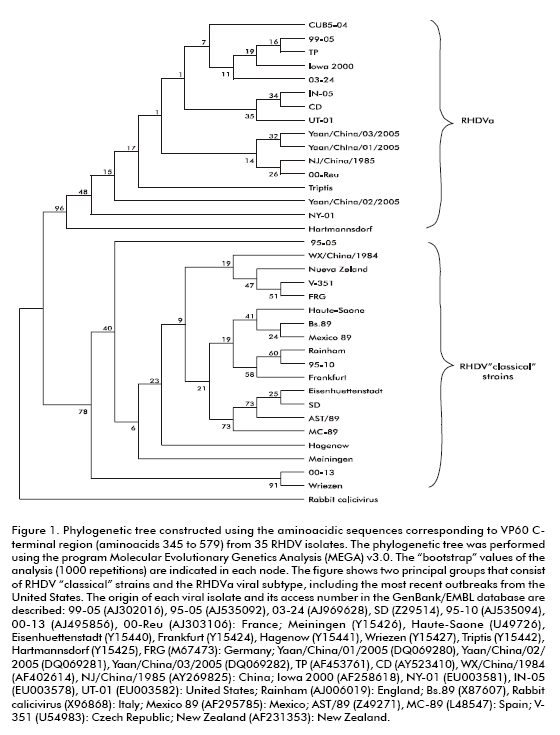
<body><![CDATA[<p><span lang=EN-US style='font-size:10.0pt;font-family:"Verdana","sans-serif"'>Culture systems for the <i>in vitro </i>replication of RHDV are not available to date. Therefore, commercial vaccines for its prevention consist exclusively of formulations prepared from the organs of rabbits infected with the virus </span><span lang=EN-US style='font-size:10.0pt;font-family:"Verdana","sans-serif"; color:windowtext'>(</span><span lang=EN-US style='font-size:10.0pt;font-family: "Verdana","sans-serif"'>15). As the use of these preparations for high-scale vaccination involves biosafety and epidemiological risks, there have been efforts to generate subunit vaccines based on the heterologous expression of the viral capsid protein. This protein has been obtained in a variety of systems such as <i>Escherichia coli </i></span><span lang=EN-US style='font-size:10.0pt;font-family:"Verdana","sans-serif";color:windowtext'>(</span><span lang=EN-US style='font-size:10.0pt;font-family:"Verdana","sans-serif"'>16), insect cell cultures </span><span lang=EN-US style='font-size:10.0pt; font-family:"Verdana","sans-serif";color:windowtext'>(</span><span lang=EN-US style='font-size:10.0pt;font-family:"Verdana","sans-serif"'>17-19), <i>Saccharomyces cerevisiae </i></span><span lang=EN-US style='font-size:10.0pt;font-family: "Verdana","sans-serif";color:windowtext'>(</span><span lang=EN-US style='font-size:10.0pt;font-family:"Verdana","sans-serif"'>20) and transgenic plants </span><span lang=EN-US style='font-size:10.0pt;font-family:"Verdana","sans-serif"; color:windowtext'>(</span><span lang=EN-US style='font-size:10.0pt;font-family: "Verdana","sans-serif"'>21, 22). However, the expression levels obtained in these systems have not exceeded tens of milligrams per liter of culture. At the same time, vaccine production based on replicative viral vectors has also been restricted due to regulatory issues </span><span lang=EN-US style='font-size: 10.0pt;font-family:"Verdana","sans-serif";color:windowtext'>(</span><span lang=EN-US style='font-size:10.0pt;font-family:"Verdana","sans-serif"'>23). </span></p>      <p><span lang=EN-US style='font-size:10.0pt;font-family:"Verdana","sans-serif"'>In this paper, we describe the molecular and antigenic characterization of a Cuban RHDV isolate and the construction of two recombinant <i>Pichia pastoris </i>strains, searching for a high expression level of VP60 from RHDV. The structural analysis and the corroboration of the antigenic determinants present in these two protein variants were also accomplished. An immunization trial was conducted using different preparations based on VP60 and several administration routes, to study the generation of the earliest IgG specific response, the time course of antibody titers and their persistence for two years. The protective titers were measured by ELISA and hemagglutination inhibition assays using a representative strain of the virus or the isolate characterized as RHDVa. The impact of these results in vaccine production issues and in the design of rational immunization strategies is discussed. </span></p>      <p><b><span lang=EN-US style='font-family:"Verdana","sans-serif"'>RESULTS AND DISCUSSION </span></b></p>      <p><b><span lang=EN-US style='font-size:10.0pt;font-family:"Verdana","sans-serif"'>Molecular and antigenic characterization of a Cuban isolate of the Rabbit Hemorrhagic Disease Virus </span></b></p>      <p><span lang=EN-US style='font-size:10.0pt;font-family:"Verdana","sans-serif"'>The RHDV Cuban strain CUB5-04 was isolated from liver samples of a rabbit that died in Havana province during the last epizootic, occurring in the years 2004- 2005. The 1740 bp coding region of the CUB5-04 VP60 capsid protein and its deduced amino acid sequence were included in the GenBank/EMBL database, under the access number DQ841708. The last 234 amino acids, corresponding to the C-terminal portion </span><span lang=EN-US style='font-size:10.0pt;font-family: "Verdana","sans-serif";color:windowtext'>(</span><span lang=EN-US style='font-size:10.0pt;font-family:"Verdana","sans-serif"'>that include the most variable region) of the protein, were compared with the VP60 analogous region from different international isolates. The sequence alignment showed the highest identity levels with viral strains that belong to an antigenic variant called RHDVa </span><span lang=EN-US style='font-size:10.0pt;font-family:"Verdana","sans-serif"; color:windowtext'>(</span><span lang=EN-US style='font-size:10.0pt;font-family: "Verdana","sans-serif"'>24). This subtype is characterized by a high pathogenicity and by antigenic variations compared to the RHDV with the monoclonal antibody 3B12 that recognizes a protective epitope that is only present in the RHDVa subtype. The phylogenetic analysis performed with the VP60 from CUB5-04 and other 32 RHDV strains, showed that the Cuban strain shared genetic variations with the “classical” strains that were also present in the RHDVa isolates </span><span lang=EN-US style='font-size:10.0pt;font-family: "Verdana","sans-serif";color:windowtext'>(</span><span style='font-size:10.0pt; font-family:"Verdana","sans-serif"'><a href="#fig1"><span lang=EN-US>Figure 1</span></a></span><span lang=EN-US style='font-size:10.0pt;font-family:"Verdana","sans-serif"'>). These results confirm that the viral strain isolated during the last Cuban epizootic of the Rabbit Hemorrhagic Disease belongs to the RHDVa subtype. </span></p>      <p align=center style='text-align:center'><span style='font-size:13.5pt'><img border=0 width=560 height=735 src="/img/revistas/bta/v26n3/f0115309.gif"></span><a name=fig1></a></p>      
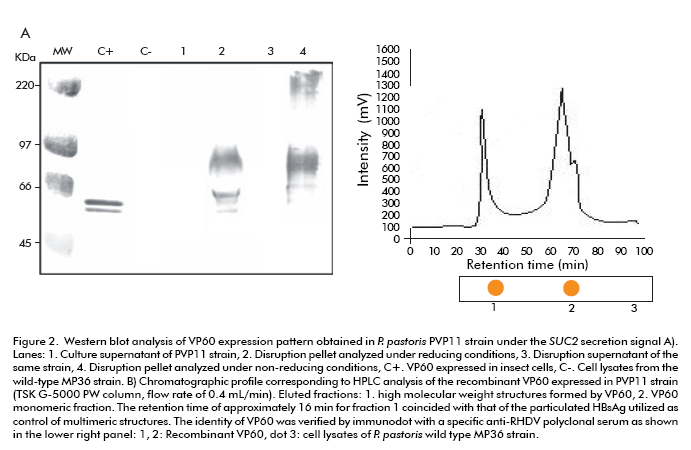
<p><b><span lang=EN-US style='font-size:10.0pt;font-family:"Verdana","sans-serif"'>Expression and characterization in <i>pichia pastoris </i>of the rabbit hemorrhagic disease virus VP60 capsid protein </span></b></p>      <p><span lang=EN-US style='font-size:10.0pt;font-family:"Verdana","sans-serif"'>Two different expression plasmids were constructed to obtain the secreted or intracellular expression of RHDV VP60 from the AST/89 Spanish strain in the <i>P. pastoris </i>yeast. The VP60 gene was cloned after the sucrose invertase secretion signal </span><span lang=EN-US style='font-size:10.0pt;font-family: "Verdana","sans-serif";color:windowtext'>(</span><i><span lang=EN-US style='font-size:10.0pt;font-family:"Verdana","sans-serif"'>SUC2</span></i><span lang=EN-US style='font-size:10.0pt;font-family:"Verdana","sans-serif"'>) of <i>S.</i> <i>cerevisiae </i>in the pPS7 vector to obtain the pPSVP60 expression plasmid. In a different approach, the VP60 gene was cloned without a secretion signal in the pNAO vector to generate the expression plasmid pNAOVP60. Both plasmids contained the VP60 gene under the transcriptional regulation of the <i>AOX1 </i>promoter. The <i>P. pastoris </i>MP36 strain was then transformed by electroporation with pPSVP60 or pNAOVP60 and the recombinant yeast strains PVP11 and PVP12 were obtained, respectively. Cells from both strains were grown in 5L bioreactors and VP60 expression was confirmed by SDS-PAGE and Western blot analyses. </span></p>          <p><span lang=EN-US style='font-size:10.0pt;font-family:"Verdana","sans-serif"'>The        PVP11 strain phenotype was identified as Mut<i><sup>+</sup> </i>by Southern        blot. The analysis of the PVP11 cell disruption pellet showed the expected        protein band of approximately 60 kDa as well as a broader band of about        90 kDa that corresponds to a VP60 glycosylated fraction. The study under        nonreducing conditions indicated the formation of VP60 multimeric structures        with a molecular weight of over 220 kDa. No recombinant proteins were detected        in the culture and cell disruption supernatants in this strain </span><span lang=EN-US style='font-size:10.0pt;font-family:"Verdana","sans-serif"; color:windowtext'>(</span><span style='font-size:10.0pt;font-family:"Verdana","sans-serif"'><a href="/img/revistas/bta/v26n3/f0215309.gif"><span lang=EN-US>Figure 2A</span></a></span><span lang=EN-US style='font-size:10.0pt;font-family:"Verdana","sans-serif"'>). The        characterization of the solubilized recombinant protein by size exclusion        high efficacy liquid chromatography </span><span lang=EN-US style='font-size:10.0pt; font-family:"Verdana","sans-serif";color:windowtext'>(</span><span lang=EN-US style='font-size:10.0pt;font-family:"Verdana","sans-serif"'>sec-HPLC) showed a        first maximum that eluted with a retention time of approximately 16 minutes.        This time was close to that of the recombinant particulate surface antigen        of the Hepatitis B virus studied under the same conditions </span><span lang=EN-US style='font-size:10.0pt;font-family:"Verdana","sans-serif"; color:windowtext'>(</span><span lang=EN-US style='font-size:10.0pt;font-family: "Verdana","sans-serif"'>TSK G-5000 PW column, equilibrated with PBS) at a flow        rate of 0.4 mL/min </span><span lang=EN-US style='font-size:10.0pt;font-family: "Verdana","sans-serif";color:windowtext'>(</span><span lang=EN-US style='font-size:10.0pt;font-family:"Verdana","sans-serif"'>26). A second fraction        eluted later with a retention time of about 29 minutes. VP60 was detected        in both fractions by immunodot using a hyperimmune serum to RHDV </span><span lang=EN-US style='font-size:10.0pt;font-family:"Verdana","sans-serif"; color:windowtext'>(</span><span style='font-size:10.0pt;font-family:"Verdana","sans-serif"'><a href="/img/revistas/bta/v26n3/f0215309.gif"><span lang=EN-US>Figure 2B</span></a></span><span lang=EN-US style='font-size:10.0pt;font-family:"Verdana","sans-serif"'>). </span></p>      
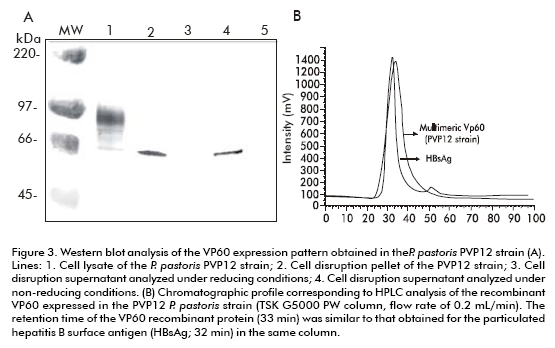
<p><span lang=EN-US style='font-size:10.0pt;font-family:"Verdana","sans-serif"'>The recombinant VP60 expressed by the PVP12 strain was obtained intracellularly and was soluble with a molecular weight of 60 kDa after 12 hours of induction with methanol. No recombinant protein was found to be associated to the cell disruption pellet of this strain. The analysis of the cell disruption supernatant under non-reducing conditions suggests the formation of high molecular weight structures that were unable to enter the gel </span><span lang=EN-US style='font-size:10.0pt;font-family:"Verdana","sans-serif"; color:windowtext'>(</span><span style='font-size:10.0pt;font-family:"Verdana","sans-serif"'><a href="#fig3"><span lang=EN-US>Figure 3A</span></a></span><span lang=EN-US style='font-size:10.0pt;font-family:"Verdana","sans-serif"'>). The protein eluted in a single, homogeneous, and well-defined peak with a retention time of 33 minutes, as shown by the chromatographic profile in a TSK G-5000 PW column, equilibrated with PBS. This retention time was also similar to that obtained for HBsAg </span><span lang=EN-US style='font-size:10.0pt;font-family:"Verdana","sans-serif"; color:windowtext'>(</span><span lang=EN-US style='font-size:10.0pt;font-family: "Verdana","sans-serif"'>&gt; 1500 kDa) in this column, with a flow of 0.2 mL/min. This protein, purified by size-exclusion chromatography, was characterized by ratezonal and equilibrium sucrose gradient ultracentrifugation </span><span lang=EN-US style='font-size:10.0pt;font-family:"Verdana","sans-serif"; color:windowtext'>(</span><span lang=EN-US style='font-size:10.0pt;font-family: "Verdana","sans-serif"'>10-30% for rate-zonal and 20- 70% for equilibrium gradient centrifugation). VP60 was detected in a predominant peak with an estimated sedimentation coefficient of 120S that was slightly lower than that obtained for native RHDV </span><span lang=EN-US style='font-size:10.0pt; font-family:"Verdana","sans-serif";color:windowtext'>(</span><span lang=EN-US style='font-size:10.0pt;font-family:"Verdana","sans-serif"'>153S for the Bs.89 Italian isolate). This sedimentation coefficient was similar to that described for the formation of virus-like particles </span><span lang=EN-US style='font-size:10.0pt;font-family:"Verdana","sans-serif";color:windowtext'>(</span><span lang=EN-US style='font-size:10.0pt;font-family:"Verdana","sans-serif"'>VLPs) in insect cell cultures </span><span lang=EN-US style='font-size:10.0pt; font-family:"Verdana","sans-serif";color:windowtext'>(</span><span lang=EN-US style='font-size:10.0pt;font-family:"Verdana","sans-serif"'>118S) </span><span lang=EN-US style='font-size:10.0pt;font-family:"Verdana","sans-serif"; color:windowtext'>(</span><span lang=EN-US style='font-size:10.0pt;font-family: "Verdana","sans-serif"'>27). The buoyant density of recombinant VP60 was estimated to be in the range of 1.30-1.32 g/mL, which agrees with the values previously described for VLPs obtained in insect cell cultures. These results suggest the formation of multimeric structures that are similar in mass and shape to native RHDV. </span></p>      ]]></body>
<body><![CDATA[<p align=center style='text-align:center'><span style='font-size:13.5pt'><img border=0 width=555 height=348 src="/img/revistas/bta/v26n3/f0315309.gif"></span><a name=fig3></a></p>          
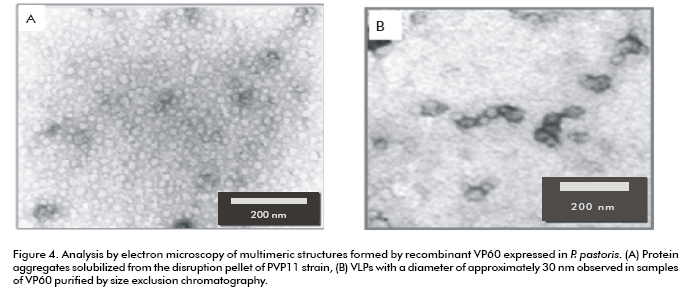
<p><span lang=EN-US style='font-size:10.0pt;font-family:"Verdana","sans-serif"'>The        formation of multimeric structures by the recombinant VP60 protein from        <i>P. pastoris </i>was confirmed by transmission electron microscopy. The        analysis of VP60 solubilized from the disruption pellet of the PVP11 strain        showed the presence of multimeric structures that resemble protein aggregates        rather than ordered capsids </span><span lang=EN-US style='font-size:10.0pt;font-family: "Verdana","sans-serif";color:windowtext'>(</span><span style='font-size:10.0pt; font-family:"Verdana","sans-serif"'><a href="/img/revistas/bta/v26n3/f0415309.gif"><span lang=EN-US>Figure 4A</span></a></span><span lang=EN-US style='font-size:10.0pt; font-family:"Verdana","sans-serif"'>). This has been previously described for        particulate antigens obtained at high levels associated with the cell debris        fraction in this <i>P. pastoris </i>strain </span><span lang=EN-US style='font-size:10.0pt;font-family:"Verdana","sans-serif";color:windowtext'>(</span><span lang=EN-US style='font-size:10.0pt;font-family:"Verdana","sans-serif"'>28, 29).        In contrast, the analysis of purified VP60 from the PVP12 strain evidenced        the formation of particles with an average diameter of 30- 35 nm, similar        to empty RHDV capsids </span><span lang=EN-US style='font-size:10.0pt;font-family:"Verdana","sans-serif"; color:windowtext'>(</span><span style='font-size:10.0pt;font-family:"Verdana","sans-serif"'><a href="/img/revistas/bta/v26n3/f0415309.gif"><span lang=EN-US>Figure 4B</span></a></span><span lang=EN-US style='font-size:10.0pt;font-family:"Verdana","sans-serif"'>). </span></p>      
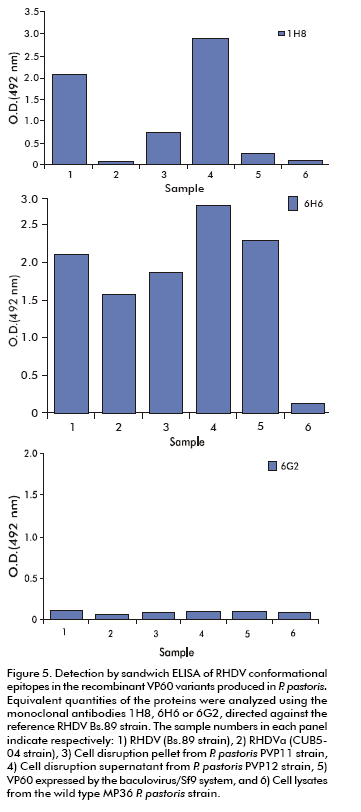
<p><span lang=EN-US style='font-size:10.0pt;font-family:"Verdana","sans-serif"'>The expression levels of VP60 in PVP11 and PVP12 strains were estimated by a sandwich ELISA in 1.5 g <i>per liter </i>of culture and 480 µg <i>per liter </i>of the disruption supernatant, respectively. These levels were quite higher than those obtained for this protein in expression systems as bacteria </span><span lang=EN-US style='font-size:10.0pt;font-family:"Verdana","sans-serif"; color:windowtext'>(</span><span lang=EN-US style='font-size:10.0pt;font-family: "Verdana","sans-serif"'>16), insect cells </span><span lang=EN-US style='font-size:10.0pt;font-family:"Verdana","sans-serif";color:windowtext'>(</span><span lang=EN-US style='font-size:10.0pt;font-family:"Verdana","sans-serif"'>17-19), <i>S. cerevisiae </i></span><span lang=EN-US style='font-size:10.0pt;font-family: "Verdana","sans-serif";color:windowtext'>(</span><span lang=EN-US style='font-size:10.0pt;font-family:"Verdana","sans-serif"'>20) and transgenic plants </span><span lang=EN-US style='font-size:10.0pt;font-family:"Verdana","sans-serif"; color:windowtext'>(</span><span lang=EN-US style='font-size:10.0pt;font-family: "Verdana","sans-serif"'>21, 22). </span></p>      <p><b><span lang=EN-US style='font-size:10.0pt;font-family:"Verdana","sans-serif"; color:#211E1E'>Analysis of conformational epitopes in the recombinant VP60 variants </span></b></p>      <p><span lang=EN-US style='font-size:10.0pt;font-family:"Verdana","sans-serif"'>The study of the antigenic profile was performed in the soluble and insoluble VP60 variants using a sandwich ELISA, immunodot, and monoclonal antibodies 1H8, 6H6, and 6G2 that recognize the conformational epitopes present in the RHDV native capsid </span><span lang=EN-US style='font-size:10.0pt;font-family:"Verdana","sans-serif"; color:windowtext'>(</span><span lang=EN-US style='font-size:10.0pt;font-family: "Verdana","sans-serif"'>30). As capture antibodies we used hyperimmune sera raised against the “classical” AST/89 strain or against the Cuban RHDVa subtype. In these assays, the epitope recognized by mAb 1H8 </span><span lang=EN-US style='font-size:10.0pt;font-family:"Verdana","sans-serif"; color:windowtext'>(</span><span lang=EN-US style='font-size:10.0pt;font-family: "Verdana","sans-serif"'>only present in assembled capsids) was detected in the RHDV Bs.89 “classical” strain and in the soluble VP60 purified by size exclusion chromatography from the PVP12 strain, with absorbance values of over 1.5 units. This epitope was also present in the VP60 obtained in insect cultured cells and was only slightly detected in multimers from the PVP11 <i>P. pastoris </i>strain. The epitope recognized by mAb 6H6 was detected in both recombinant proteins from <i>P. pastoris</i>. MAb 6G2 did not show reactivity in sandwich ELISA against these proteins due to the fact that it recognizes a buried epitope located at the N-terminus of VP60 in assembled capsids or protein aggregates. This epitope was only found in immunodot experiments. Similar results were obtained when using hyperimmune serum raised against CUB5-04 </span><span lang=EN-US style='font-size:10.0pt;font-family:"Verdana","sans-serif"; color:windowtext'>(</span><span style='font-size:10.0pt;font-family:"Verdana","sans-serif"'><a href="#fig5"><span lang=EN-US>Figure 5</span></a></span><span lang=EN-US style='font-size:10.0pt;font-family:"Verdana","sans-serif"'>). </span></p>      <p align=center style='text-align:center'><span style='font-size:13.5pt; color:#211E1E'><img border=0 width=361 height=812 src="/img/revistas/bta/v26n3/f0515309.gif"></span><a name=fig5></a></p>      
<p><b><span lang=EN-US style='font-size:10.0pt;font-family:"Verdana","sans-serif"'>Assessment of purification and recovery strategies of recombinant VP60 VLPs from the <i>Pichia pastoris </i>PVP12 strain </span></b></p>          <p><span lang=EN-US style='font-size:10.0pt;font-family:"Verdana","sans-serif"'>We        took into account that in our lab a significant amount of soluble, purified        VP60 is commonly lost after concentration, sterile filtration and/or freezing-thawing        procedures. In previous works with the recombinant Norwalk virus capsid        </span><span lang=EN-US style='font-size:10.0pt;font-family:"Verdana","sans-serif"; color:windowtext'>(</span><span lang=EN-US style='font-size:10.0pt;font-family: "Verdana","sans-serif"'>31), several attempts have led to the conclusion that        variations in the pH used for disruption or purification processes, as well        as the inclusion of preservatives such as sucrose, sorbitol and trehalose        in the final aqueous suspension may enhance VLPs stabilization, decrease        aggregation and achieve overall superior protein yields. We then tested        a wide range of pH </span><span lang=EN-US style='font-size:10.0pt;font-family:"Verdana","sans-serif"; color:windowtext'>(</span><span lang=EN-US style='font-size:10.0pt;font-family: "Verdana","sans-serif"'>from 3.0 to 8.0) and the excipients mentioned above to        test their ability to inhibit the aggregation of VP60-VLPs under conditions        known to induce aggregation and protein loss. In our experiment, the results        showed changes in the chromatographic pattern </span><span lang=EN-US style='font-size:10.0pt;font-family:"Verdana","sans-serif";color:windowtext'>(</span><span lang=EN-US style='font-size:10.0pt;font-family:"Verdana","sans-serif"'>in sec-HPLC,        using a TSK G-3000 column) in relation to the standard purification procedure        previously established at pH 7.0. These changes were recorded at pH 5.0        and partially at 6.0. At pH 5.0 the recovery of VP60 was also somehow affected.        At pH 8.0, following a 10-fold concentration and freezing/ thawing procedures,        the total amount of protein was noticeably reduced. Interestingly, although        recombinant multimers were recovered at pH 3.0, the experiment was discarded        because of disturbances detected in the purification column, possibly due        to aggregation. In contrast, an entire process conducted at pH 6.0 or 7.0        produced only moderate levels of protein loss, probably due to a reduction        in aggregation events and to the stabilization of VLPs, which is suspected        to be pH-dependent </span><span lang=EN-US style='font-size:10.0pt;font-family:"Verdana","sans-serif"; color:windowtext'>(</span><span style='font-size:10.0pt;font-family:"Verdana","sans-serif"'><a href="/img/revistas/bta/v26n3/f0615309.gif"><span lang=EN-US>Figure 6A</span></a></span><span lang=EN-US style='font-size:10.0pt;font-family:"Verdana","sans-serif"'>). In all        cases, the semiquantification of the VLPs was conducted by immunodot using        VP60 from <i>Sf</i>9 cells as the standard. Furthermore, although differences        found with the use of excipients were not specially marked, preliminary        findings suggest that the inclusion of trehalose as a stabilizing agent        is a useful tool in reducing protein loss </span><span lang=EN-US style='font-size: 10.0pt;font-family:"Verdana","sans-serif";color:windowtext'>(</span><span lang=EN-US style='font-size:10.0pt;font-family:"Verdana","sans-serif"'>data not        shown). VLPs integrity was evaluated with the use of monoclonal antibodies        after the purification and stressing steps. In all cases, with a range of        recognition degrees, the protein was detected by mAbs 1H8 and 6H6. Protein        recognition was slightly affected in the final samples corresponding to        pH 5.0, during the disruption and purification processes </span><span lang=EN-US style='font-size:10.0pt;font-family:"Verdana","sans-serif";color:windowtext'>(</span><span style='font-size:10.0pt;font-family:"Verdana","sans-serif"'><a href="/img/revistas/bta/v26n3/f0615309.gif"><span lang=EN-US>Figure 6B</span></a></span><span lang=EN-US style='font-size:10.0pt;font-family:"Verdana","sans-serif"'>). </span></p>      
<p><b><span lang=EN-US style='font-size:10.0pt;font-family:"Verdana","sans-serif"; color:#211E1E'>Evaluation of the protective capacity of antibodies generated by recombinant VP60 from PVP11/PVP12 strains against the “classical” RHDV and against the Cuban RHDVa subtype </span></b></p>      <p><span lang=EN-US style='font-size:10.0pt;font-family:"Verdana","sans-serif"'>We further investigated the immunogenicity in rabbits of the recombinant VP60 variants obtained from <i>P pastoris</i>. The protective capacity of antibodies elicited with these antigens was also evaluated <i>in vitro </i>by hemagglutination inhibition assays, against both the “classical” RHDV Bs.89 isolate and the subtype isolated in Cuba. New Zealand rabbits were randomly distributed into seven experimental groups of 3-5 animals each and then immunized with the recombinant VP60 insoluble/soluble variants obtained from the PVP11 and PVP12 strains, with VP60 from insect culture cells, with a RHDV-inactivated vaccine and with a placebo. The recombinant antigens were emulsified in Montanide 888 and subcutaneously administered in two doses of 50 </span><span style='font-size:10.0pt;font-family:"Verdana","sans-serif"'>&#956;</span><span lang=EN-US style='font-size:10.0pt;font-family:"Verdana","sans-serif"'>g each on days 0 and 21 of the experiment, except for an additional group orally immunized with VP60 contained in the disruption pellet of PVP11, with three doses of 0.5 µg on days 0, 21 and 40. The RHDV-inactivated vaccine was subcutaneously applied as a single dose on day 0 of the experiment according to the manufacturer’s instructions. Anti-RHDV humoral immune responses were evaluated by a competition ELISA that assesses the ability of the problem serum to compete in binding to the RHDV with a polyclonal hyperimmune specific serum absorbed onto the solid phase. </span></p>          ]]></body>
<body><![CDATA[<p><span lang=EN-US style='font-size:10.0pt;font-family:"Verdana","sans-serif"'>All        vaccinated rabbits elicited antibody levels that were able to compete in        binding to the “classical” RHDV. Groups immunized with purified VP60 from        the PVP12 strain or with the VP60 protein from insect cultured cells rapidly        developed inhibition percentages of over 85% on day 14 of the experiment.        Similar inhibition values were detected after day 40 post-immunization in        rabbits subcutaneously injected with the PVP12 raw disruption supernatant        or with the VP60 contained in the PVP11 cell debris fraction. These levels        were detected after day 60 in animals vaccinated with the inactivated Cunipravac-RHD<sup>TM</sup>        vaccine. The inhibition percentages were maintained until day 365 after        immunization in animals inoculated with the PVP12 raw disruption supernatant        and until day 638 </span><span lang=EN-US style='font-size:10.0pt;font-family: "Verdana","sans-serif";color:windowtext'>(</span><span lang=EN-US style='font-size:10.0pt;font-family:"Verdana","sans-serif"'>up to 21 months) in        the rest of the groups. In contrast, rabbits immunized with the PVP11 disruption        pellet by the oral route developed lower levels of specific antibodies,        which were maintained for a shorter period of time </span><span lang=EN-US style='font-size:10.0pt;font-family:"Verdana","sans-serif"; color:windowtext'>(</span><span style='font-size:10.0pt;font-family:"Verdana","sans-serif"'><a href="/img/revistas/bta/v26n3/t0115309.gif"><span lang=EN-US>Table 1</span></a></span><span lang=EN-US style='font-size:10.0pt;font-family:"Verdana","sans-serif"'>) although        the antibodies were able to inhibit the <i>in vitro </i>hemagglutination        of RHDV. Also, antibodies generated in vaccinated rabbits were able to compete        in binding to the Cuban viral isolate CUB5-04 </span><span lang=EN-US style='font-size:10.0pt;font-family:"Verdana","sans-serif";color:windowtext'>(</span><span lang=EN-US style='font-size:10.0pt;font-family:"Verdana","sans-serif"'>RHDVa subtype).        The inhibition values detected in these animals were above 85%, with the        exception of the rabbits orally immunized with the cell disruption pellet        from the PVP11 strain and with the Cunipravac-RHDTM inactivated vaccine        </span><span lang=EN-US style='font-size:10.0pt;font-family:"Verdana","sans-serif"; color:windowtext'>(</span><span style='font-size:10.0pt;font-family:"Verdana","sans-serif"'><a href="/img/revistas/bta/v26n3/t0215309.gif"><span lang=EN-US>Table 2</span></a></span><span lang=EN-US style='font-size:10.0pt;font-family:"Verdana","sans-serif"'>). </span></p>      
<p><span lang=EN-US style='font-size:10.0pt;font-family:"Verdana","sans-serif"'>The ability of these antibodies to inhibit the <i>in vitro </i>hemagglutinating activity of the Cuban RHDVa isolate was also demonstrated </span><span lang=EN-US style='font-size:10.0pt;font-family:"Verdana","sans-serif"; color:windowtext'>(</span><span lang=EN-US style='font-size:10.0pt;font-family: "Verdana","sans-serif"'>32). This is a key element that correlates with the <i>in vivo </i>protection against RHDV </span><span lang=EN-US style='font-size:10.0pt; font-family:"Verdana","sans-serif";color:windowtext'>(</span><span lang=EN-US style='font-size:10.0pt;font-family:"Verdana","sans-serif"'>21). All animals vaccinated with the recombinant variants of VP60 developed these high antibody levels. The highest hemagglutination inhibition titers </span><span lang=EN-US style='font-size:10.0pt;font-family:"Verdana","sans-serif";color:windowtext'>(</span><span lang=EN-US style='font-size:10.0pt;font-family:"Verdana","sans-serif"'>ranging from 1/2560 to 1/40960) were elicited in animals immunized with the purified VP60 from the PVP12 strain. In contrast, the sera of rabbits immunized with the viral inactivated Cunipravac-RHD<sup>TM</sup> vaccine, showed no hemmaglutination inhibition titers. This result agreed with previous reports showing variable degrees of efficacy against the RHDVa subtype </span><span lang=EN-US style='font-size:10.0pt;font-family:"Verdana","sans-serif"; color:windowtext'>(</span><span lang=EN-US style='font-size:10.0pt;font-family: "Verdana","sans-serif"'>24, 33, 34) and evidenced that antibodies generated against the “classical” RHDV strains may not be necessarily able to fully protect rabbits against the RHDVa subtype. This issue was overcome by using the recombinant variants expressed in the two strains of <i>P. pastoris</i>. </span></p>      <p><span lang=EN-US style='font-size:10.0pt;font-family:"Verdana","sans-serif"'>In general, this report presents the characterization of two different variants of the recombinant VP60 capsid protein from RHDV expressed at useful levels in the <i>P. pastoris </i>yeast. Our experiments support the conclusion that the VP60 obtained from the PVP12 strain as a soluble multimer is the most attractive candidate so far for a simple and inexpensive scaled up production and implementation of a recombinant subunit vaccine against RHDV. </span></p>      <p><b><span lang=EN-US style='font-family:"Verdana","sans-serif"'>ACKNOWLEDGMENTS </span></b></p>          <p><span lang=EN-US style='font-size:10.0pt;font-family:"Verdana","sans-serif"'>The        authors would like to acknowledge the assistance of Galina Moya Fajardo        from the Physical-Chemistry Division of CIGB. Viviana Falcón and Ivón Menéndez        from the Electron Microscopy department of the CIGB are also acknowledged        for excellent assistance. PastorAlfonso and the technical staff from the        National Center for Animal and Plant Health </span><span lang=EN-US style='font-size: 10.0pt;font-family:"Verdana","sans-serif";color:windowtext'>(</span><span lang=EN-US style='font-size:10.0pt;font-family:"Verdana","sans-serif"'>CENSA)        are recognized for their inestimable cooperation in the immunization experiments        in rabbits. We would especially like to thank Dr. Lorenzo Capucci and the        Institute Zooprofilattico Sperimentale della Lombardia e dell’ Emilia, Italy,        for kindly providing inactivated the RHDV </span><span lang=EN-US style='font-size:10.0pt;font-family:"Verdana","sans-serif";color:windowtext'>(</span><span lang=EN-US style='font-size:10.0pt;font-family:"Verdana","sans-serif"'>Bs.89 strain)        antigen and the monoclonal antibodies used. </span></p>      <p><b><span style='font-family:"Verdana","sans-serif"'>REFERENCES </span></b></p>      <!-- ref --><p><span style='font-size:10.0pt;font-family:"Verdana","sans-serif"'>1. Liu SJ, Xue HP, Pu BQ, Quian NH. </span><span lang=EN-US style='font-size:10.0pt; font-family:"Verdana","sans-serif"'>A new viral disease in rabbits. Anim Husb Vet Med</span><span lang=EN-US style='font-size:11.0pt;font-family:"Arial","sans-serif"; color:red'> </span><span lang=EN-US style='font-size:10.0pt;font-family:"Verdana","sans-serif"'>1984;16:253-5.</span><!-- ref --><p><span lang=EN-US style='font-size:10.0pt;font-family:"Verdana","sans-serif"'>2. Marcato PS, Benazzi C, Vecchi G, Galeotti M, Della Salda L, Sarli G, et al. Clinical and pathological features of viral haemorrhagic disease of rabbits and the European brown hare syndrome. </span><span style='font-size:10.0pt; font-family:"Verdana","sans-serif"'>Rev Sci Tech</span><span style='font-size: 11.0pt;font-family:"Arial","sans-serif";color:red'> </span><span style='font-size:10.0pt;font-family:"Verdana","sans-serif"'>1991;10:371-92.</span><!-- ref --><p><span style='font-size:10.0pt;font-family:"Verdana","sans-serif"'>3. Ferreira PG, Costa-e-Silva A, Oliveira MJ, Monteiro E, Cunha EM, Aguas AP. </span><span lang=EN-US style='font-size:10.0pt;font-family:"Verdana","sans-serif"'>Severe leukopenia and liver biochemistry changes in adult rabbits after calicivirus infection. Res Vet Sci</span><span lang=EN-US style='font-size:11.0pt; font-family:"Arial","sans-serif";color:red'> </span><span lang=EN-US style='font-size:10.0pt;font-family:"Verdana","sans-serif"'>2006;80:218-25.</span><!-- ref --><p><span lang=EN-US style='font-size:10.0pt;font-family:"Verdana","sans-serif"'>4. Alonso C, Oviedo JM, Martín-Alonso JM, Díaz E, Boga JA, Parra F. Programmed cell-death in the pathogenesis of rabbit hemorrhagic disease. Arch Virol</span><span lang=EN-US style='font-size:11.0pt;font-family:"Arial","sans-serif";color:red'> </span><span lang=EN-US style='font-size:10.0pt;font-family:"Verdana","sans-serif"'>1998;143:321-32.</span><!-- ref --><p><span lang=EN-US style='font-size:10.0pt;font-family:"Verdana","sans-serif"'>5. Parra F, Prieto M. Purification of a calicivirus as the causative agent of a lethal hemorrhagic disease in rabbits. J Virol</span><span lang=EN-US style='font-size:11.0pt;font-family:"Arial","sans-serif";color:red'> </span><span lang=EN-US style='font-size:10.0pt;font-family:"Verdana","sans-serif"'>1990;64:4013-5.</span><!-- ref --><p><span lang=EN-US style='font-size:10.0pt;font-family:"Verdana","sans-serif"'>6. Green KY, Ando T, Balayan MS, Berke T, Clarke IN, Estes MK, et al. Taxonomy of the caliciviruses. J Infect Dis</span><span lang=EN-US style='font-size:11.0pt; font-family:"Arial","sans-serif";color:red'> </span><span lang=EN-US style='font-size:10.0pt;font-family:"Verdana","sans-serif"'>2000;181:322-30.</span><!-- ref --><p><span lang=EN-US style='font-size:10.0pt;font-family:"Verdana","sans-serif"'>7. Xu ZJ, Chen WX. Viral haemorrhagic disease in rabbits: a review. Vet Res Commun</span><span lang=EN-US style='font-size:11.0pt;font-family:"Arial","sans-serif";color:red'> </span><span lang=EN-US style='font-size:10.0pt;font-family:"Verdana","sans-serif"'>1989;13:205-12.</span><!-- ref --><p><span lang=EN-US style='font-size:10.0pt;font-family:"Verdana","sans-serif"'>8. Cooke BD. Rabbit hemorrhagic disease: field epidemiology and the management of wild rabbit populations. Rev Sci Tech</span><span lang=EN-US style='font-size: 11.0pt;font-family:"Arial","sans-serif";color:red'> </span><span lang=EN-US style='font-size:10.0pt;font-family:"Verdana","sans-serif"'>2002;21:347-58.</span><!-- ref --><p><span lang=EN-US style='font-size:10.0pt;font-family:"Verdana","sans-serif"'>9. Calvete C. Modeling the effect of population dynamics on the impact of rabbit hemorrhagic disease. Conserv Biol</span><span lang=EN-US style='font-size:11.0pt; font-family:"Arial","sans-serif";color:red'> </span><span lang=EN-US style='font-size:10.0pt;font-family:"Verdana","sans-serif"'>2006;20:1232-41.</span><p><span lang=EN-US style='font-size:10.0pt;font-family:"Verdana","sans-serif"'>10. Gregg DA, House C, Meyer R, Berninger M. Viral haemorrhagic disease of rabbits in Mexico: epidemiology and viral characterization. </span><span style='font-size:10.0pt;font-family:"Verdana","sans-serif"'>Rev Sci Tech</span><span style='font-size:11.0pt;font-family:"Arial","sans-serif";color:red'> </span><span style='font-size:10.0pt;font-family:"Verdana","sans-serif"'>1991;10:</span><span style='font-size:11.0pt;font-family:"Arial","sans-serif";color:blue'> </span><span style='font-size:10.0pt;font-family:"Verdana","sans-serif"'>35-451.</span></p>      <p><span style='font-size:10.0pt;font-family:"Verdana","sans-serif"'>11. Toledo M, Seoane G, Serrano E, Encinosa A, Delgado C, González S, et al. Estudio epizootiológico y control de la enfermedad hemorrágica viral del conejo en la República de Cuba. </span><span lang=EN-US style='font-size:10.0pt;font-family: "Verdana","sans-serif"'>Rev Cub Cienc Vet</span><span lang=EN-US style='font-size:11.0pt;font-family:"Arial","sans-serif";color:red'> </span><span lang=EN-US style='font-size:10.0pt;font-family:"Verdana","sans-serif"'>1995;24:5-9.</span></p>      <p><span lang=EN-US style='font-size:10.0pt;font-family:"Verdana","sans-serif"'>12. Neilan JG, Lu Z, Ward G, Lubroth J, Rock DL, Kutish GF. The genome of rabbit hemorrhagic disease virus (Iowa 2000) from North America. EMBL/GenBank/ DDBJ databases direct submission 2000. </span></p>      <!-- ref --><p><span lang=EN-US style='font-size:10.0pt;font-family:"Verdana","sans-serif"'>13. Campagnolo ER, Ernst MJ, Berninger ML, Gregg DA, Shumaker TJ, Boghossian AM. Outbreak of rabbit hemorrhagic disease in domestic lagomorphs. J Am Vet Med Assoc</span><span lang=EN-US style='font-size:11.0pt;font-family:"Arial","sans-serif"; color:red'> </span><span lang=EN-US style='font-size:10.0pt;font-family:"Verdana","sans-serif"'>2003;223:1151-5.</span><!-- ref --><p><span lang=EN-US style='font-size:10.0pt;font-family:"Verdana","sans-serif"'>14. McIntosh MT, Behan SC, Mohamed FM, Lu Z, Moran KE, Burrage TG, et al. A pandemic strain of calicivirus threatens rabbit industries in the Americas. J Virol</span><span lang=EN-US style='font-size:11.0pt;font-family:"Arial","sans-serif"; color:red'> </span><span lang=EN-US style='font-size:10.0pt;font-family:"Verdana","sans-serif"'>2007;4:96.</span><!-- ref --><p><span lang=EN-US style='font-size:10.0pt;font-family:"Verdana","sans-serif"'>15. Argüello-Villares JL. Viral haemorrhagic disease of rabbits: vaccination and immune response. Rev Sci Tech</span><span lang=EN-US style='font-size:11.0pt; font-family:"Arial","sans-serif";color:red'> </span><span lang=EN-US style='font-size:10.0pt;font-family:"Verdana","sans-serif"'>1991;10:459-80.</span><p><span lang=EN-US style='font-size:10.0pt;font-family:"Verdana","sans-serif"'>16. Boga JA, Casais R, Marin MS, Martin- Alonso JM, Carmenes RS, Prieto M, et al. Molecular cloning, sequencing and expression in Escherichia coli of the capsid protein gene from rabbit haemorrhagic disease virus </span><span lang=EN-US style='font-size:10.0pt;font-family:"Verdana","sans-serif";color:windowtext'>(</span><span lang=EN-US style='font-size:10.0pt;font-family:"Verdana","sans-serif"'>Spanish isolate <i>AST/89</i>). J Gen Virol</span><span lang=EN-US style='font-size: 11.0pt;font-family:"Arial","sans-serif";color:red'> </span><span lang=EN-US style='font-size:10.0pt;font-family:"Verdana","sans-serif"'>1994;75:2409-13.</span></p>      <!-- ref --><p><span lang=EN-US style='font-size:10.0pt;font-family:"Verdana","sans-serif"'>17. Laurent S, Vautherot JF, Madelaine MA, Le Gall G, Rasschaert D. Recombinant rabbit hemorrhagic disease virus capsid protein expressed in baculovirus self-assembles into virus like particles and induces protection. </span><span style='font-size:10.0pt;font-family:"Verdana","sans-serif"'>J Virol</span><span style='font-size:11.0pt;font-family:"Arial","sans-serif";color:red'> </span><span style='font-size:10.0pt;font-family:"Verdana","sans-serif"'>1994;68:6794-8.</span><p><span style='font-size:10.0pt;font-family:"Verdana","sans-serif"'>18. Marín MS, Martín-Alonso JM, Pérez- Ordoyo García LI, Argüello-Villares JL, Casais R, Venugopal K, et al. </span><span lang=EN-US style='font-size:10.0pt;font-family: "Verdana","sans-serif"'>Immunogenic properties of rabbit haemorrhagic disease virus structural protein VP60 expressed by a recombinant baculovirus: an efficient vaccine. Virus Res</span><span lang=EN-US style='font-size:11.0pt; font-family:"Arial","sans-serif";color:red'> </span><span lang=EN-US style='font-size:10.0pt;font-family:"Verdana","sans-serif"'>1995;39:119-28.</span></p>      <!-- ref --><p><span lang=EN-US style='font-size:10.0pt;font-family:"Verdana","sans-serif"'>19. Gromadzka B, Szewczyk B, Konopa G, Fitzner A, Kesy A. Recombinant VP60 in the form of virion-like particles as a potential vaccine against rabbit hemorrhagic disease virus. Acta Biochim Pol</span><span lang=EN-US style='font-size:11.0pt; font-family:"Arial","sans-serif";color:red'> </span><span lang=EN-US style='font-size:10.0pt;font-family:"Verdana","sans-serif"'>2006;53:371-6.</span><!-- ref --><p><span lang=EN-US style='font-size:10.0pt;font-family:"Verdana","sans-serif"'>20. Boga JA, Martín-Alonso JM, Casais R, Parra F. A single dose immunization with rabbit haemorrhagic disease virus major capsid protein produced in <i>Saccharomyces cerevisiae </i>induces protection. </span><span style='font-size:10.0pt; font-family:"Verdana","sans-serif"'>J Gen Virol</span><span style='font-size: 11.0pt;font-family:"Arial","sans-serif";color:red'> </span><span style='font-size:10.0pt;font-family:"Verdana","sans-serif"'>1997;78:2315-18.</span><!-- ref --><p><span style='font-size:10.0pt;font-family:"Verdana","sans-serif"'>21. Fernández-Fernández MR, Mourino M, Rivera J, Rodríguez F, Plana-Duran J, García JA. </span><span lang=EN-US style='font-size:10.0pt;font-family:"Verdana","sans-serif"'>Protection of rabbits against rabbit hemorrhagic disease virus by immunization with the VP60 protein expressed in plants with a potyvirus based vector. </span><span style='font-size:10.0pt;font-family:"Verdana","sans-serif"'>Virology</span><span style='font-size:11.0pt;font-family:"Arial","sans-serif";color:red'> </span><span style='font-size:10.0pt;font-family:"Verdana","sans-serif"'>2001;280:283-91.</span><!-- ref --><p><span style='font-size:10.0pt;font-family:"Verdana","sans-serif"'>22. Gil F, Titarenko E, Terrada E, Arcalis E, Escribano JM. </span><span lang=EN-US style='font-size:10.0pt;font-family:"Verdana","sans-serif"'>Successful oral prime-immunization with VP60 from rabbit haemorrhagic disease virus produced in transgenic &nbsp;plants using different fusion strategies. Plant Biotechnol</span><span lang=EN-US style='font-size:11.0pt;font-family:"Arial","sans-serif";color:red'> </span><span lang=EN-US style='font-size:10.0pt;font-family:"Verdana","sans-serif"'>2006;4:135-43.</span><!-- ref --><p><span lang=EN-US style='font-size:10.0pt;font-family:"Verdana","sans-serif"'>23. Morenweiser R. Downstream processing of viral vectors and vaccines. Gene Ther</span><span lang=EN-US style='font-size:11.0pt;font-family:"Arial","sans-serif";color:red'> </span><span lang=EN-US style='font-size:10.0pt;font-family:"Verdana","sans-serif"'>2005;12:S103-10.</span><!-- ref --><p><span lang=EN-US style='font-size:10.0pt;font-family:"Verdana","sans-serif"'>24. Capucci L, Fallacara F, Grazioli S, Lavazza A, Pacciarini ML, Brocchi E. A further step in the evolution of rabbit hemorrhagic disease virus: the appearance of the first consistent antigenic variant. </span><span style='font-size:10.0pt;font-family:"Verdana","sans-serif"'>Virus Res</span><span style='font-size:11.0pt;font-family:"Arial","sans-serif";color:red'> </span><span style='font-size:10.0pt;font-family:"Verdana","sans-serif"'>1998;58:115-26.</span><p><span style='font-size:10.0pt;font-family:"Verdana","sans-serif"'>25. Grazioli S, Agnoletti F, Scicluna MT, Masoero N, Guercio A, Fallacara F, et al. </span><span lang=EN-US style='font-size:10.0pt;font-family:"Verdana","sans-serif"'>Rabbit haemorrhagic disease virus </span><span lang=EN-US style='font-size:10.0pt; font-family:"Verdana","sans-serif";color:windowtext'>(</span><span lang=EN-US style='font-size:10.0pt;font-family:"Verdana","sans-serif"'>RHDV) subtype “A” </span><span lang=EN-US style='font-size:10.0pt;font-family:"Verdana","sans-serif"; color:windowtext'>(</span><span lang=EN-US style='font-size:10.0pt;font-family: "Verdana","sans-serif"'>RHDVa) is replacing the original strain in some Italian regions. In: Brocchi E, Lavazza A. </span><span lang=EN-US style='font-size: 10.0pt;font-family:"Verdana","sans-serif";color:windowtext'>(</span><span lang=EN-US style='font-size:10.0pt;font-family:"Verdana","sans-serif"'>eds), Fifth International Congress of the European Society for Veterinary Virology, Brescia, Italy, p. 202-3</span><span lang=SV style='font-size:10.0pt; font-family:"Verdana","sans-serif";color:windowtext'>.</span><span lang=SV style='font-size:10.0pt;font-family:"Verdana","sans-serif"'> </span></p>      <!-- ref --><p><span lang=EN-US style='font-size:10.0pt;font-family:"Verdana","sans-serif"'>26. Hardy E, Martinez E, Diago D, Diaz R, Gonzalez D, Herrera L. Large-scale production of recombinant hepatitis B surface antigen from <i>Pichia pastoris</i>. J Biotechnol</span><span lang=EN-US style='font-size:11.0pt;font-family:"Arial","sans-serif"; color:red'> </span><span lang=EN-US style='font-size:10.0pt;font-family:"Verdana","sans-serif"'>2000;77:157-67.</span><!-- ref --><p><span lang=EN-US style='font-size:10.0pt;font-family:"Verdana","sans-serif"'>27. Sibilia M, Boniotti MB, Angoscin P, Capucci L, Rossi C. Two independent pathways of expression lead to self-assembly of the rabbit hemorrhagic disease virus capsid protein. J Virol</span><span lang=EN-US style='font-size:11.0pt; font-family:"Arial","sans-serif";color:red'> </span><span lang=EN-US style='font-size:10.0pt;font-family:"Verdana","sans-serif"'>1995;69:5812-5.</span><!-- ref --><p><span lang=EN-US style='font-size:10.0pt;font-family:"Verdana","sans-serif"'>28. Rodríguez M, Rubiera R, Penichet M, Montesinos R, Cremata J, De la Fuente J. High level expression of the B. microplus Bm86 antigen in the yeast <i>Pichia pastoris </i>forming highly immunogenic particles for cattle. </span><span style='font-size:10.0pt;font-family:"Verdana","sans-serif"'>J Biotechnol</span><span style='font-size:11.0pt;font-family:"Arial","sans-serif";color:red'> </span><span style='font-size:10.0pt;font-family:"Verdana","sans-serif"'>1994;33:135-46.</span><!-- ref --><p><span style='font-size:10.0pt;font-family:"Verdana","sans-serif"'>29. García-García JC, Montero C, Redondo M, Vargas M, Canales M, Boué O, et al. </span><span lang=EN-US style='font-size:10.0pt;font-family:"Verdana","sans-serif"'>Control of ticks resistant to the immunization with Bm86 in cattle vaccinated with the recombinant antigen Bm95 isolated from the cattle tick, <i>Boophilus microplus</i>. Vaccine</span><span lang=EN-US style='font-size:11.0pt;font-family:"Arial","sans-serif"; color:red'> </span><span lang=EN-US style='font-size:10.0pt;font-family:"Verdana","sans-serif"'>2000;18:2275–87.</span><!-- ref --><p><span lang=EN-US style='font-size:10.0pt;font-family:"Verdana","sans-serif"'>30. Capucci L, Frigoli G, Roenshold L, Lavazza A, Brocchi E, Rossi C. Antigenicity of the rabbit hemorrhagic disease virus studied by its reactivity with monoclonal antibodies. Virus Res</span><span lang=EN-US style='font-size:11.0pt; font-family:"Arial","sans-serif";color:red'> </span><span lang=EN-US style='font-size:10.0pt;font-family:"Verdana","sans-serif"'>1995;37:221-38.</span><!-- ref --><p><span lang=EN-US style='font-size:10.0pt;font-family:"Verdana","sans-serif"'>31. Kismann J, Ausar SF, Foubert TR, Brock J, Switzer M, Detzi ED, et al. Physical Stabilization of Norwalk virus-like particles. J Pharm Sci</span><span lang=EN-US style='font-size:11.0pt;font-family:"Arial","sans-serif";color:red'> </span><span lang=EN-US style='font-size:10.0pt;font-family:"Verdana","sans-serif"'>2008;7:4208-18.</span><!-- ref --><p><span style='font-size:10.0pt;font-family:"Verdana","sans-serif"'>32. Farnós O, Fernández E, Chiong, M, Parra F, Joglar M, Méndez L, et al. </span><span lang=EN-US style='font-size:10.0pt;font-family:"Verdana","sans-serif"'>Biochemical and structural characterization of RHDV capsid protein variants produced in <i>Pichia pastoris: </i>Advantages for immunization strategies and vaccine implementation. Antiviral Res</span><span lang=EN-US style='font-size:11.0pt; font-family:"Arial","sans-serif";color:red'> </span><span lang=EN-US style='font-size:10.0pt;font-family:"Verdana","sans-serif"'>2009;81:25-36.</span><!-- ref --><p><span lang=EN-US style='font-size:10.0pt;font-family:"Verdana","sans-serif"'>33. Schirrmeier H, Reimann I, Kollner B, Granzow H. Pathogenic, antigenic and molecular properties of rabbit haemorrhagic disease virus </span><span lang=EN-US style='font-size:10.0pt;font-family:"Verdana","sans-serif"; color:windowtext'>(</span><span lang=EN-US style='font-size:10.0pt;font-family: "Verdana","sans-serif"'>RHDV) isolated from vaccinated rabbits: detection and characterization of antigenic variants. Arch Virol</span><span lang=EN-US style='font-size:11.0pt;font-family:"Arial","sans-serif";color:red'> </span><span lang=EN-US style='font-size:10.0pt;font-family:"Verdana","sans-serif"'>1999;144:719-35.</span><!-- ref --><p><span lang=EN-US style='font-size:10.0pt;font-family:"Verdana","sans-serif"'>34. Lavazza A, Cerrone A, Agnoletti F, Perugini G, Fioretti A, Botti G, et al. An update on the presence and spreading in Italy of rabbit haemorrhagic disease virus and of its antigenic variant RHDVa. In: Proc., 8th World Rabbit Congress2004 September 7-10, Mexico, Puebla City, p. 62-68.</span><span lang=EN-US style='font-size:11.0pt;font-family:"Arial","sans-serif";color:blue'> </span><p><span lang=EN-US style='font-size:13.5pt'>&nbsp;</span></p>      <p><b><i><span lang=EN-US style='font-size:10.0pt;font-family:"Verdana","sans-serif"'>*This work received the Award of the National Academy of Sciences of Cuba for the year 2008.</span></i></b></p>      <p><span lang=EN-US style='font-size:13.5pt'>&nbsp;</span></p>      <p><span lang=EN-US style='font-size:10.0pt;font-family:"Verdana","sans-serif"'>Omar Farnós. Animal Biotechnology Division, Center for Genetic Engineering and Biotechnology, CIGB. Ave. 31 / 158 and 190, Cubanacán, Playa, PO Box 6162, CP 10600, Havana, Cuba. E-mail: </span><span style='font-size:10.0pt;font-family: "Verdana","sans-serif"'><a href="mailto:omar.farnos@cigb.edu.cu"><span lang=EN-US>omar.farnos@cigb.edu.cu</span></a></span><span style='font-size: 11.0pt;font-family:"Arial","sans-serif";color:#FF6600'> </span></p>      <p><span lang=EN-US style='font-size:13.5pt'>&nbsp;</span></p>  </div>  </div>       ]]></body><back>
<ref-list>
<ref id="B1">
<label>1</label><nlm-citation citation-type="journal">
<person-group person-group-type="author">
<name>
<surname><![CDATA[Liu]]></surname>
<given-names><![CDATA[SJ]]></given-names>
</name>
<name>
<surname><![CDATA[Xue]]></surname>
<given-names><![CDATA[HP]]></given-names>
</name>
<name>
<surname><![CDATA[Pu]]></surname>
<given-names><![CDATA[BQ]]></given-names>
</name>
<name>
<surname><![CDATA[Quian]]></surname>
<given-names><![CDATA[NH]]></given-names>
</name>
</person-group>
<article-title xml:lang="en"><![CDATA[A new viral disease in rabbits]]></article-title>
<source><![CDATA[Anim Husb Vet Med]]></source>
<year>1984</year>
<volume>16</volume>
<page-range>253-5</page-range></nlm-citation>
</ref>
<ref id="B2">
<label>2</label><nlm-citation citation-type="journal">
<person-group person-group-type="author">
<name>
<surname><![CDATA[Marcato]]></surname>
<given-names><![CDATA[PS]]></given-names>
</name>
<name>
<surname><![CDATA[Benazzi]]></surname>
<given-names><![CDATA[C]]></given-names>
</name>
<name>
<surname><![CDATA[Vecchi]]></surname>
<given-names><![CDATA[G]]></given-names>
</name>
<name>
<surname><![CDATA[Galeotti]]></surname>
<given-names><![CDATA[M]]></given-names>
</name>
<name>
<surname><![CDATA[Della Salda]]></surname>
<given-names><![CDATA[L]]></given-names>
</name>
<name>
<surname><![CDATA[Sarli]]></surname>
<given-names><![CDATA[G]]></given-names>
</name>
</person-group>
<article-title xml:lang="en"><![CDATA[Clinical and pathological features of viral haemorrhagic disease of rabbits and the European brown hare syndrome]]></article-title>
<source><![CDATA[Rev Sci Tech]]></source>
<year>1991</year>
<volume>10</volume>
<page-range>371-92</page-range></nlm-citation>
</ref>
<ref id="B3">
<label>3</label><nlm-citation citation-type="journal">
<person-group person-group-type="author">
<name>
<surname><![CDATA[Ferreira]]></surname>
<given-names><![CDATA[PG]]></given-names>
</name>
<name>
<surname><![CDATA[Costa-e-Silva]]></surname>
<given-names><![CDATA[A]]></given-names>
</name>
<name>
<surname><![CDATA[Oliveira]]></surname>
<given-names><![CDATA[MJ]]></given-names>
</name>
<name>
<surname><![CDATA[Monteiro]]></surname>
<given-names><![CDATA[E]]></given-names>
</name>
<name>
<surname><![CDATA[Cunha]]></surname>
<given-names><![CDATA[EM]]></given-names>
</name>
<name>
<surname><![CDATA[Aguas]]></surname>
<given-names><![CDATA[AP]]></given-names>
</name>
</person-group>
<article-title xml:lang="en"><![CDATA[Severe leukopenia and liver biochemistry changes in adult rabbits after calicivirus infection]]></article-title>
<source><![CDATA[Res Vet Sci]]></source>
<year>2006</year>
<volume>80</volume>
<page-range>218-25</page-range></nlm-citation>
</ref>
<ref id="B4">
<label>4</label><nlm-citation citation-type="journal">
<person-group person-group-type="author">
<name>
<surname><![CDATA[Alonso]]></surname>
<given-names><![CDATA[C]]></given-names>
</name>
<name>
<surname><![CDATA[Oviedo]]></surname>
<given-names><![CDATA[JM]]></given-names>
</name>
<name>
<surname><![CDATA[Martín-Alonso]]></surname>
<given-names><![CDATA[JM]]></given-names>
</name>
<name>
<surname><![CDATA[Díaz]]></surname>
<given-names><![CDATA[E]]></given-names>
</name>
<name>
<surname><![CDATA[Boga]]></surname>
<given-names><![CDATA[JA]]></given-names>
</name>
<name>
<surname><![CDATA[Parra]]></surname>
<given-names><![CDATA[F]]></given-names>
</name>
</person-group>
<article-title xml:lang="en"><![CDATA[Programmed cell-death in the pathogenesis of rabbit hemorrhagic disease]]></article-title>
<source><![CDATA[Arch Virol]]></source>
<year>1998</year>
<volume>143</volume>
<page-range>321-32</page-range></nlm-citation>
</ref>
<ref id="B5">
<label>5</label><nlm-citation citation-type="journal">
<person-group person-group-type="author">
<name>
<surname><![CDATA[Parra]]></surname>
<given-names><![CDATA[F]]></given-names>
</name>
<name>
<surname><![CDATA[Prieto]]></surname>
<given-names><![CDATA[M]]></given-names>
</name>
</person-group>
<article-title xml:lang="en"><![CDATA[Purification of a calicivirus as the causative agent of a lethal hemorrhagic disease in rabbits]]></article-title>
<source><![CDATA[J Virol]]></source>
<year>1990</year>
<volume>64</volume>
<page-range>4013-5</page-range></nlm-citation>
</ref>
<ref id="B6">
<label>6</label><nlm-citation citation-type="journal">
<person-group person-group-type="author">
<name>
<surname><![CDATA[Green]]></surname>
<given-names><![CDATA[KY]]></given-names>
</name>
<name>
<surname><![CDATA[Ando]]></surname>
<given-names><![CDATA[T]]></given-names>
</name>
<name>
<surname><![CDATA[Balayan]]></surname>
<given-names><![CDATA[MS]]></given-names>
</name>
<name>
<surname><![CDATA[Berke]]></surname>
<given-names><![CDATA[T]]></given-names>
</name>
<name>
<surname><![CDATA[Clarke]]></surname>
<given-names><![CDATA[IN]]></given-names>
</name>
<name>
<surname><![CDATA[Estes]]></surname>
<given-names><![CDATA[MK]]></given-names>
</name>
</person-group>
<article-title xml:lang="en"><![CDATA[Taxonomy of the caliciviruses]]></article-title>
<source><![CDATA[J Infect Dis]]></source>
<year>2000</year>
<volume>181</volume>
<page-range>322-30</page-range></nlm-citation>
</ref>
<ref id="B7">
<label>7</label><nlm-citation citation-type="journal">
<person-group person-group-type="author">
<name>
<surname><![CDATA[Xu]]></surname>
<given-names><![CDATA[ZJ]]></given-names>
</name>
<name>
<surname><![CDATA[Chen]]></surname>
<given-names><![CDATA[WX]]></given-names>
</name>
</person-group>
<article-title xml:lang="en"><![CDATA[Viral haemorrhagic disease in rabbits: a review]]></article-title>
<source><![CDATA[Vet Res Commun]]></source>
<year>1989</year>
<volume>13</volume>
<page-range>205-12</page-range></nlm-citation>
</ref>
<ref id="B8">
<label>8</label><nlm-citation citation-type="journal">
<person-group person-group-type="author">
<name>
<surname><![CDATA[Cooke]]></surname>
<given-names><![CDATA[BD]]></given-names>
</name>
</person-group>
<article-title xml:lang="en"><![CDATA[Rabbit hemorrhagic disease: field epidemiology and the management of wild rabbit populations]]></article-title>
<source><![CDATA[Rev Sci Tech]]></source>
<year>2002</year>
<volume>21</volume>
<page-range>347-58</page-range></nlm-citation>
</ref>
<ref id="B9">
<label>9</label><nlm-citation citation-type="journal">
<person-group person-group-type="author">
<name>
<surname><![CDATA[Calvete]]></surname>
<given-names><![CDATA[C]]></given-names>
</name>
</person-group>
<article-title xml:lang="en"><![CDATA[Modeling the effect of population dynamics on the impact of rabbit hemorrhagic disease]]></article-title>
<source><![CDATA[Conserv Biol]]></source>
<year>2006</year>
<volume>20</volume>
<page-range>1232-41</page-range></nlm-citation>
</ref>
<ref id="B10">
<label>10</label><nlm-citation citation-type="journal">
<person-group person-group-type="author">
<name>
<surname><![CDATA[Gregg]]></surname>
<given-names><![CDATA[DA]]></given-names>
</name>
<name>
<surname><![CDATA[House]]></surname>
<given-names><![CDATA[C]]></given-names>
</name>
<name>
<surname><![CDATA[Meyer]]></surname>
<given-names><![CDATA[R]]></given-names>
</name>
<name>
<surname><![CDATA[Berninger]]></surname>
</name>
</person-group>
<source><![CDATA[Rev Sci Tech]]></source>
<year>1991</year>
<volume>10</volume>
<page-range>435-451</page-range></nlm-citation>
</ref>
<ref id="B11">
<label>11</label><nlm-citation citation-type="journal">
<person-group person-group-type="author">
<name>
<surname><![CDATA[Toledo]]></surname>
<given-names><![CDATA[M]]></given-names>
</name>
<name>
<surname><![CDATA[Seoane]]></surname>
<given-names><![CDATA[G]]></given-names>
</name>
<name>
<surname><![CDATA[Serrano]]></surname>
<given-names><![CDATA[E]]></given-names>
</name>
<name>
<surname><![CDATA[Encinosa]]></surname>
<given-names><![CDATA[A]]></given-names>
</name>
<name>
<surname><![CDATA[Delgado]]></surname>
<given-names><![CDATA[C]]></given-names>
</name>
<name>
<surname><![CDATA[González]]></surname>
<given-names><![CDATA[S]]></given-names>
</name>
</person-group>
<article-title xml:lang="es"><![CDATA[Estudio epizootiológico y control de la enfermedad hemorrágica viral del conejo en la República de Cuba]]></article-title>
<source><![CDATA[Rvta Cub Cienc Vet]]></source>
<year>1995</year>
<volume>24</volume>
<page-range>5-9</page-range></nlm-citation>
</ref>
<ref id="B12">
<label>13</label><nlm-citation citation-type="journal">
<person-group person-group-type="author">
<name>
<surname><![CDATA[Campagnolo]]></surname>
<given-names><![CDATA[ER]]></given-names>
</name>
<name>
<surname><![CDATA[Ernst]]></surname>
<given-names><![CDATA[MJ]]></given-names>
</name>
<name>
<surname><![CDATA[Berninger]]></surname>
<given-names><![CDATA[ML]]></given-names>
</name>
<name>
<surname><![CDATA[Gregg]]></surname>
<given-names><![CDATA[DA]]></given-names>
</name>
<name>
<surname><![CDATA[Shumaker]]></surname>
<given-names><![CDATA[TJ]]></given-names>
</name>
<name>
<surname><![CDATA[Boghossian]]></surname>
<given-names><![CDATA[AM]]></given-names>
</name>
</person-group>
<article-title xml:lang="en"><![CDATA[Outbreak of rabbit hemorrhagic disease in domestic lagomorphs]]></article-title>
<source><![CDATA[J Am Vet Med Assoc]]></source>
<year>2003</year>
<volume>223</volume>
<page-range>1151-5</page-range></nlm-citation>
</ref>
<ref id="B13">
<label>14</label><nlm-citation citation-type="journal">
<person-group person-group-type="author">
<name>
<surname><![CDATA[McIntosh]]></surname>
<given-names><![CDATA[MT]]></given-names>
</name>
<name>
<surname><![CDATA[Behan]]></surname>
<given-names><![CDATA[SC]]></given-names>
</name>
<name>
<surname><![CDATA[Mohamed]]></surname>
<given-names><![CDATA[FM]]></given-names>
</name>
<name>
<surname><![CDATA[Lu]]></surname>
<given-names><![CDATA[Z]]></given-names>
</name>
<name>
<surname><![CDATA[Moran]]></surname>
<given-names><![CDATA[KE]]></given-names>
</name>
<name>
<surname><![CDATA[Burrage]]></surname>
<given-names><![CDATA[TG]]></given-names>
</name>
</person-group>
<article-title xml:lang="en"><![CDATA[A pandemic strain of calicivirus threatens rabbit industries in the Americas]]></article-title>
<source><![CDATA[J Virol]]></source>
<year>2007</year>
<volume>4</volume>
<page-range>96</page-range></nlm-citation>
</ref>
<ref id="B14">
<label>15</label><nlm-citation citation-type="journal">
<person-group person-group-type="author">
<name>
<surname><![CDATA[Argüello-Villares]]></surname>
<given-names><![CDATA[JL]]></given-names>
</name>
</person-group>
<article-title xml:lang="en"><![CDATA[Viral haemorrhagic disease of rabbits: vaccination and immune response]]></article-title>
<source><![CDATA[Rev Sci Tech]]></source>
<year>1991</year>
<volume>10</volume>
<page-range>459-80</page-range></nlm-citation>
</ref>
<ref id="B15">
<label>16</label><nlm-citation citation-type="journal">
<person-group person-group-type="author">
<name>
<surname><![CDATA[Boga]]></surname>
<given-names><![CDATA[JA]]></given-names>
</name>
<name>
<surname><![CDATA[Casais]]></surname>
<given-names><![CDATA[R]]></given-names>
</name>
<name>
<surname><![CDATA[Marin]]></surname>
<given-names><![CDATA[MS]]></given-names>
</name>
<name>
<surname><![CDATA[Martin-]]></surname>
<given-names><![CDATA[Alonso]]></given-names>
</name>
<name>
<surname><![CDATA[Carmenes]]></surname>
<given-names><![CDATA[RS]]></given-names>
</name>
<name>
<surname><![CDATA[Prieto]]></surname>
<given-names><![CDATA[M]]></given-names>
</name>
</person-group>
<article-title xml:lang="en"><![CDATA[Molecular cloning, sequencing and expression in Escherichia coli of the capsid protein gene from rabbit haemorrhagic disease virus (Spanish isolate AST/89)]]></article-title>
<source><![CDATA[J Gen Virol]]></source>
<year>1994</year>
<volume>75</volume>
<page-range>2409-13</page-range></nlm-citation>
</ref>
<ref id="B16">
<label>17</label><nlm-citation citation-type="journal">
<person-group person-group-type="author">
<name>
<surname><![CDATA[Laurent]]></surname>
<given-names><![CDATA[S]]></given-names>
</name>
<name>
<surname><![CDATA[Vautherot]]></surname>
<given-names><![CDATA[JF]]></given-names>
</name>
<name>
<surname><![CDATA[Madelaine]]></surname>
<given-names><![CDATA[MA]]></given-names>
</name>
<name>
<surname><![CDATA[Le Gall]]></surname>
<given-names><![CDATA[G]]></given-names>
</name>
<name>
<surname><![CDATA[Rasschaert]]></surname>
<given-names><![CDATA[D]]></given-names>
</name>
</person-group>
<article-title xml:lang="en"><![CDATA[Recombinant rabbit hemorrhagic disease virus capsid protein expressed in baculovirus self-assembles into virus like particles and induces protection]]></article-title>
<source><![CDATA[J Virol]]></source>
<year>1994</year>
<volume>68</volume>
<page-range>6794-8</page-range></nlm-citation>
</ref>
<ref id="B17">
<label>18</label><nlm-citation citation-type="journal">
<person-group person-group-type="author">
<name>
<surname><![CDATA[Marín]]></surname>
<given-names><![CDATA[MS]]></given-names>
</name>
<name>
<surname><![CDATA[Martín-Alonso]]></surname>
<given-names><![CDATA[JM]]></given-names>
</name>
<name>
<surname><![CDATA[Pérez-]]></surname>
<given-names><![CDATA[Ordoyo]]></given-names>
</name>
<name>
<surname><![CDATA[Argüello-Villares]]></surname>
<given-names><![CDATA[JL]]></given-names>
</name>
<name>
<surname><![CDATA[Casais]]></surname>
<given-names><![CDATA[R]]></given-names>
</name>
<name>
<surname><![CDATA[Venugopal]]></surname>
<given-names><![CDATA[K]]></given-names>
</name>
</person-group>
<article-title xml:lang="en"><![CDATA[Immunogenic properties of rabbit haemorrhagic disease virus structural protein VP60 expressed by a recombinant baculovirus: an efficient vaccine]]></article-title>
<source><![CDATA[Virus Res]]></source>
<year>1995</year>
<volume>39</volume>
<page-range>119-28</page-range></nlm-citation>
</ref>
<ref id="B18">
<label>19</label><nlm-citation citation-type="journal">
<person-group person-group-type="author">
<name>
<surname><![CDATA[Gromadzka]]></surname>
<given-names><![CDATA[B]]></given-names>
</name>
<name>
<surname><![CDATA[Szewczyk]]></surname>
<given-names><![CDATA[B]]></given-names>
</name>
<name>
<surname><![CDATA[Konopa]]></surname>
<given-names><![CDATA[G]]></given-names>
</name>
<name>
<surname><![CDATA[Fitzner]]></surname>
<given-names><![CDATA[A]]></given-names>
</name>
<name>
<surname><![CDATA[Kesy]]></surname>
<given-names><![CDATA[A]]></given-names>
</name>
</person-group>
<article-title xml:lang="en"><![CDATA[Recombinant VP60 in the form of virion-like particles as a potential vaccine against rabbit hemorrhagic disease virus]]></article-title>
<source><![CDATA[Acta Biochim Pol]]></source>
<year>2006</year>
<volume>53</volume>
<page-range>371-6</page-range></nlm-citation>
</ref>
<ref id="B19">
<label>20</label><nlm-citation citation-type="journal">
<person-group person-group-type="author">
<name>
<surname><![CDATA[Boga]]></surname>
<given-names><![CDATA[JA]]></given-names>
</name>
<name>
<surname><![CDATA[Martín-Alonso]]></surname>
<given-names><![CDATA[JM]]></given-names>
</name>
<name>
<surname><![CDATA[Casais]]></surname>
<given-names><![CDATA[R]]></given-names>
</name>
<name>
<surname><![CDATA[Parra]]></surname>
<given-names><![CDATA[F]]></given-names>
</name>
</person-group>
<article-title xml:lang="en"><![CDATA[A single dose immunization with rabbit haemorrhagic disease virus major capsid protein produced in Saccharomyces cerevisiae induces protection]]></article-title>
<source><![CDATA[J Gen Virol]]></source>
<year>1997</year>
<volume>78</volume>
<page-range>2315-18</page-range></nlm-citation>
</ref>
<ref id="B20">
<label>21</label><nlm-citation citation-type="journal">
<person-group person-group-type="author">
<name>
<surname><![CDATA[Fernández-Fernández]]></surname>
<given-names><![CDATA[MR]]></given-names>
</name>
<name>
<surname><![CDATA[Mourino]]></surname>
<given-names><![CDATA[M]]></given-names>
</name>
<name>
<surname><![CDATA[Rivera]]></surname>
<given-names><![CDATA[J]]></given-names>
</name>
<name>
<surname><![CDATA[Rodríguez]]></surname>
<given-names><![CDATA[F]]></given-names>
</name>
<name>
<surname><![CDATA[Plana-Duran]]></surname>
<given-names><![CDATA[J]]></given-names>
</name>
<name>
<surname><![CDATA[García]]></surname>
<given-names><![CDATA[JA]]></given-names>
</name>
</person-group>
<article-title xml:lang="en"><![CDATA[Protection of rabbits against rabbit hemorrhagic disease virus by immunization with the VP60 protein expressed in plants with a potyvirus based vector]]></article-title>
<source><![CDATA[Virology]]></source>
<year>2001</year>
<volume>280</volume>
<page-range>283-91</page-range></nlm-citation>
</ref>
<ref id="B21">
<label>22</label><nlm-citation citation-type="journal">
<person-group person-group-type="author">
<name>
<surname><![CDATA[Gil]]></surname>
<given-names><![CDATA[F]]></given-names>
</name>
<name>
<surname><![CDATA[Titarenko]]></surname>
<given-names><![CDATA[E]]></given-names>
</name>
<name>
<surname><![CDATA[Terrada]]></surname>
<given-names><![CDATA[E]]></given-names>
</name>
<name>
<surname><![CDATA[Arcalis]]></surname>
<given-names><![CDATA[E]]></given-names>
</name>
<name>
<surname><![CDATA[Escribano]]></surname>
<given-names><![CDATA[JM]]></given-names>
</name>
</person-group>
<article-title xml:lang="en"><![CDATA[Successful oral prime-immunization with VP60 from rabbit haemorrhagic disease virus produced in transgenic plants using different fusion strategies]]></article-title>
<source><![CDATA[Plant Biotechnol]]></source>
<year>2006</year>
<volume>4</volume>
<page-range>135-43</page-range></nlm-citation>
</ref>
<ref id="B22">
<label>23</label><nlm-citation citation-type="journal">
<person-group person-group-type="author">
<name>
<surname><![CDATA[Morenweiser]]></surname>
<given-names><![CDATA[R]]></given-names>
</name>
</person-group>
<article-title xml:lang="en"><![CDATA[Downstream processing of viral vectors and vaccines]]></article-title>
<source><![CDATA[Gene Ther]]></source>
<year>2005</year>
<volume>12</volume>
<page-range>S103-10</page-range></nlm-citation>
</ref>
<ref id="B23">
<label>24</label><nlm-citation citation-type="journal">
<person-group person-group-type="author">
<name>
<surname><![CDATA[Capucci]]></surname>
<given-names><![CDATA[L]]></given-names>
</name>
<name>
<surname><![CDATA[Fallacara]]></surname>
<given-names><![CDATA[F]]></given-names>
</name>
<name>
<surname><![CDATA[Grazioli]]></surname>
<given-names><![CDATA[S]]></given-names>
</name>
<name>
<surname><![CDATA[Lavazza]]></surname>
<given-names><![CDATA[A]]></given-names>
</name>
<name>
<surname><![CDATA[Pacciarini]]></surname>
<given-names><![CDATA[ML]]></given-names>
</name>
<name>
<surname><![CDATA[Brocchi]]></surname>
<given-names><![CDATA[E]]></given-names>
</name>
</person-group>
<article-title xml:lang="en"><![CDATA[A further step in the evolution of rabbit hemorrhagic disease virus: the appearance of the first consistent antigenic variant]]></article-title>
<source><![CDATA[Virus Res]]></source>
<year>1998</year>
<volume>58</volume>
<page-range>115-26</page-range></nlm-citation>
</ref>
<ref id="B24">
<label>25</label><nlm-citation citation-type="">
<person-group person-group-type="author">
<name>
<surname><![CDATA[Grazioli]]></surname>
<given-names><![CDATA[S]]></given-names>
</name>
<name>
<surname><![CDATA[Agnoletti]]></surname>
<given-names><![CDATA[F]]></given-names>
</name>
<name>
<surname><![CDATA[Scicluna]]></surname>
<given-names><![CDATA[MT]]></given-names>
</name>
<name>
<surname><![CDATA[Masoero]]></surname>
<given-names><![CDATA[N]]></given-names>
</name>
<name>
<surname><![CDATA[Guercio]]></surname>
<given-names><![CDATA[A]]></given-names>
</name>
<name>
<surname><![CDATA[Fallacara]]></surname>
<given-names><![CDATA[F]]></given-names>
</name>
</person-group>
<article-title xml:lang="en"><![CDATA[Rabbit haemorrhagic disease virus (RHDV) subtype “A” (RHDVa) is replacing the original strain in some Italian regions]]></article-title>
<person-group person-group-type="editor">
<name>
<surname><![CDATA[Brocchi]]></surname>
<given-names><![CDATA[E]]></given-names>
</name>
<name>
<surname><![CDATA[Lavazza]]></surname>
<given-names><![CDATA[A]]></given-names>
</name>
</person-group>
<source><![CDATA[Fifth International Congress of the European Society for Veterinary Virology]]></source>
<year></year>
<page-range>202-3</page-range><publisher-loc><![CDATA[Brescia ]]></publisher-loc>
</nlm-citation>
</ref>
<ref id="B25">
<label>26</label><nlm-citation citation-type="journal">
<person-group person-group-type="author">
<name>
<surname><![CDATA[Hardy]]></surname>
<given-names><![CDATA[E]]></given-names>
</name>
<name>
<surname><![CDATA[Martinez]]></surname>
<given-names><![CDATA[E]]></given-names>
</name>
<name>
<surname><![CDATA[Diago]]></surname>
<given-names><![CDATA[D]]></given-names>
</name>
<name>
<surname><![CDATA[Diaz]]></surname>
<given-names><![CDATA[R]]></given-names>
</name>
<name>
<surname><![CDATA[Gonzalez]]></surname>
<given-names><![CDATA[D]]></given-names>
</name>
<name>
<surname><![CDATA[Herrera]]></surname>
<given-names><![CDATA[L]]></given-names>
</name>
</person-group>
<article-title xml:lang="en"><![CDATA[Large-scale production of recombinant hepatitis B surface antigen from Pichia pastoris]]></article-title>
<source><![CDATA[J Biotechnol]]></source>
<year>2000</year>
<volume>77</volume>
<page-range>157-67</page-range></nlm-citation>
</ref>
<ref id="B26">
<label>27</label><nlm-citation citation-type="journal">
<person-group person-group-type="author">
<name>
<surname><![CDATA[Sibilia]]></surname>
<given-names><![CDATA[M]]></given-names>
</name>
<name>
<surname><![CDATA[Boniotti]]></surname>
<given-names><![CDATA[MB]]></given-names>
</name>
<name>
<surname><![CDATA[Angoscin]]></surname>
<given-names><![CDATA[P]]></given-names>
</name>
<name>
<surname><![CDATA[Capucci]]></surname>
<given-names><![CDATA[L]]></given-names>
</name>
<name>
<surname><![CDATA[Rossi]]></surname>
<given-names><![CDATA[C]]></given-names>
</name>
</person-group>
<article-title xml:lang="en"><![CDATA[Two independent pathways of expression lead to self-assembly of the rabbit hemorrhagic disease virus capsid protein]]></article-title>
<source><![CDATA[J Virol]]></source>
<year>1995</year>
<volume>69</volume>
<page-range>5812-5</page-range></nlm-citation>
</ref>
<ref id="B27">
<label>28</label><nlm-citation citation-type="journal">
<person-group person-group-type="author">
<name>
<surname><![CDATA[Rodríguez]]></surname>
<given-names><![CDATA[M]]></given-names>
</name>
<name>
<surname><![CDATA[Rubiera]]></surname>
<given-names><![CDATA[R]]></given-names>
</name>
<name>
<surname><![CDATA[Penichet]]></surname>
<given-names><![CDATA[M]]></given-names>
</name>
<name>
<surname><![CDATA[Montesinos]]></surname>
<given-names><![CDATA[R]]></given-names>
</name>
<name>
<surname><![CDATA[Cremata]]></surname>
<given-names><![CDATA[J]]></given-names>
</name>
<name>
<surname><![CDATA[De la Fuente]]></surname>
<given-names><![CDATA[J]]></given-names>
</name>
</person-group>
<article-title xml:lang="en"><![CDATA[High level expression of the B: microplus Bm86 antigen in the yeast Pichia pastoris forming highly immunogenic particles for cattle]]></article-title>
<source><![CDATA[J Biotechnol]]></source>
<year>1994</year>
<volume>33</volume>
<page-range>135-46</page-range></nlm-citation>
</ref>
<ref id="B28">
<label>29</label><nlm-citation citation-type="journal">
<person-group person-group-type="author">
<name>
<surname><![CDATA[García-García]]></surname>
<given-names><![CDATA[JC]]></given-names>
</name>
<name>
<surname><![CDATA[Montero]]></surname>
<given-names><![CDATA[C]]></given-names>
</name>
<name>
<surname><![CDATA[Redondo]]></surname>
<given-names><![CDATA[M]]></given-names>
</name>
<name>
<surname><![CDATA[Vargas]]></surname>
<given-names><![CDATA[M]]></given-names>
</name>
<name>
<surname><![CDATA[Canales]]></surname>
<given-names><![CDATA[M]]></given-names>
</name>
<name>
<surname><![CDATA[Boué]]></surname>
<given-names><![CDATA[O]]></given-names>
</name>
</person-group>
<article-title xml:lang="en"><![CDATA[Control of ticks resistant to the immunization with Bm86 in cattle vaccinated with the recombinant antigen Bm95 isolated from the cattle tick, Boophilus microplus]]></article-title>
<source><![CDATA[Vaccine]]></source>
<year>2000</year>
<volume>18</volume>
<page-range>2275–87</page-range></nlm-citation>
</ref>
<ref id="B29">
<label>30</label><nlm-citation citation-type="journal">
<person-group person-group-type="author">
<name>
<surname><![CDATA[Capucci]]></surname>
<given-names><![CDATA[L]]></given-names>
</name>
<name>
<surname><![CDATA[Frigoli]]></surname>
<given-names><![CDATA[G]]></given-names>
</name>
<name>
<surname><![CDATA[Roenshold]]></surname>
<given-names><![CDATA[L]]></given-names>
</name>
<name>
<surname><![CDATA[Lavazza]]></surname>
<given-names><![CDATA[A]]></given-names>
</name>
<name>
<surname><![CDATA[Brocchi]]></surname>
<given-names><![CDATA[E]]></given-names>
</name>
<name>
<surname><![CDATA[Rossi]]></surname>
<given-names><![CDATA[C]]></given-names>
</name>
</person-group>
<article-title xml:lang="en"><![CDATA[Antigenicity of the rabbit hemorrhagic disease virus studied by its reactivity with monoclonal antibodies]]></article-title>
<source><![CDATA[Virus Res]]></source>
<year>1995</year>
<volume>37</volume>
<page-range>221-38</page-range></nlm-citation>
</ref>
<ref id="B30">
<label>31</label><nlm-citation citation-type="journal">
<person-group person-group-type="author">
<name>
<surname><![CDATA[Kismann]]></surname>
<given-names><![CDATA[J]]></given-names>
</name>
<name>
<surname><![CDATA[Ausar]]></surname>
<given-names><![CDATA[SF]]></given-names>
</name>
<name>
<surname><![CDATA[Foubert]]></surname>
<given-names><![CDATA[TR]]></given-names>
</name>
<name>
<surname><![CDATA[Brock]]></surname>
<given-names><![CDATA[J]]></given-names>
</name>
<name>
<surname><![CDATA[Switzer]]></surname>
<given-names><![CDATA[M]]></given-names>
</name>
<name>
<surname><![CDATA[Detzi]]></surname>
<given-names><![CDATA[ED]]></given-names>
</name>
</person-group>
<article-title xml:lang="en"><![CDATA[Physical Stabilization of Norwalk virus-like particles]]></article-title>
<source><![CDATA[J Pharm Sci]]></source>
<year>2008</year>
<volume>7</volume>
<page-range>4208-18</page-range></nlm-citation>
</ref>
<ref id="B31">
<label>32</label><nlm-citation citation-type="journal">
<person-group person-group-type="author">
<name>
<surname><![CDATA[Farnós]]></surname>
<given-names><![CDATA[O]]></given-names>
</name>
<name>
<surname><![CDATA[Fernández]]></surname>
<given-names><![CDATA[E]]></given-names>
</name>
<name>
<surname><![CDATA[Chiong]]></surname>
</name>
<name>
<surname><![CDATA[M]]></surname>
</name>
<name>
<surname><![CDATA[Parra]]></surname>
<given-names><![CDATA[F]]></given-names>
</name>
<name>
<surname><![CDATA[Joglar]]></surname>
<given-names><![CDATA[M]]></given-names>
</name>
<name>
<surname><![CDATA[Méndez]]></surname>
<given-names><![CDATA[L]]></given-names>
</name>
</person-group>
<article-title xml:lang="en"><![CDATA[Biochemical and structural characterization of RHDV capsid protein variants produced in Pichia pastoris: Advantages for immunization strategies and vaccine implementation]]></article-title>
<source><![CDATA[Antiviral Res]]></source>
<year>2009</year>
<volume>81</volume>
<page-range>25-36</page-range></nlm-citation>
</ref>
<ref id="B32">
<label>33</label><nlm-citation citation-type="journal">
<person-group person-group-type="author">
<name>
<surname><![CDATA[Schirrmeier]]></surname>
<given-names><![CDATA[H]]></given-names>
</name>
<name>
<surname><![CDATA[Reimann]]></surname>
<given-names><![CDATA[I]]></given-names>
</name>
<name>
<surname><![CDATA[Kollner]]></surname>
<given-names><![CDATA[B]]></given-names>
</name>
<name>
<surname><![CDATA[Granzow]]></surname>
<given-names><![CDATA[H]]></given-names>
</name>
</person-group>
<article-title xml:lang="en"><![CDATA[Pathogenic, antigenic and molecular properties of rabbit haemorrhagic disease virus (RHDV) isolated from vaccinated rabbits: detection and characterization of antigenic variants]]></article-title>
<source><![CDATA[Arch Virol]]></source>
<year>1999</year>
<volume>144</volume>
<page-range>719-35</page-range></nlm-citation>
</ref>
<ref id="B33">
<label>34</label><nlm-citation citation-type="confpro">
<person-group person-group-type="author">
<name>
<surname><![CDATA[Lavazza]]></surname>
<given-names><![CDATA[A]]></given-names>
</name>
<name>
<surname><![CDATA[Cerrone]]></surname>
<given-names><![CDATA[A]]></given-names>
</name>
<name>
<surname><![CDATA[Agnoletti]]></surname>
<given-names><![CDATA[F]]></given-names>
</name>
<name>
<surname><![CDATA[Perugini]]></surname>
<given-names><![CDATA[G]]></given-names>
</name>
<name>
<surname><![CDATA[Fioretti]]></surname>
<given-names><![CDATA[A]]></given-names>
</name>
<name>
<surname><![CDATA[Botti]]></surname>
<given-names><![CDATA[G]]></given-names>
</name>
</person-group>
<source><![CDATA[An update on the presence and spreading in Italy of rabbit haemorrhagic disease virus and of its antigenic variant RHDVa]]></source>
<year></year>
<conf-name><![CDATA[ 8th World Rabbit Congress]]></conf-name>
<conf-date>2004 September 7</conf-date>
<conf-loc>Puebla </conf-loc>
</nlm-citation>
</ref>
</ref-list>
</back>
</article>