<?xml version="1.0" encoding="ISO-8859-1"?><article xmlns:mml="http://www.w3.org/1998/Math/MathML" xmlns:xlink="http://www.w3.org/1999/xlink" xmlns:xsi="http://www.w3.org/2001/XMLSchema-instance">
<front>
<journal-meta>
<journal-id>1027-2852</journal-id>
<journal-title><![CDATA[Biotecnología Aplicada]]></journal-title>
<abbrev-journal-title><![CDATA[Biotecnol Apl]]></abbrev-journal-title>
<issn>1027-2852</issn>
<publisher>
<publisher-name><![CDATA[Editorial Elfos Scientiae]]></publisher-name>
</publisher>
</journal-meta>
<article-meta>
<article-id>S1027-28522009000300011</article-id>
<title-group>
<article-title xml:lang="en"><![CDATA[Tilapia somatotropin polypeptides: potent enhancers of fish growth and innate immunity]]></article-title>
</title-group>
<contrib-group>
<contrib contrib-type="author">
<name>
<surname><![CDATA[Acosta]]></surname>
<given-names><![CDATA[Jannel]]></given-names>
</name>
<xref ref-type="aff" rid="A01"/>
</contrib>
<contrib contrib-type="author">
<name>
<surname><![CDATA[Estrada]]></surname>
</name>
<xref ref-type="aff" rid="A01"/>
</contrib>
<contrib contrib-type="author">
<name>
<surname><![CDATA[Carpio]]></surname>
<given-names><![CDATA[Yamila]]></given-names>
</name>
<xref ref-type="aff" rid="A01"/>
</contrib>
<contrib contrib-type="author">
<name>
<surname><![CDATA[Ruiz]]></surname>
<given-names><![CDATA[Odalys]]></given-names>
</name>
<xref ref-type="aff" rid="A02"/>
</contrib>
<contrib contrib-type="author">
<name>
<surname><![CDATA[Morales]]></surname>
<given-names><![CDATA[Reynold]]></given-names>
</name>
<xref ref-type="aff" rid="A01"/>
</contrib>
<contrib contrib-type="author">
<name>
<surname><![CDATA[Martínez]]></surname>
<given-names><![CDATA[Eduardo]]></given-names>
</name>
<xref ref-type="aff" rid="A02"/>
</contrib>
<contrib contrib-type="author">
<name>
<surname><![CDATA[Valdés]]></surname>
<given-names><![CDATA[Jorge]]></given-names>
</name>
<xref ref-type="aff" rid="A02"/>
</contrib>
<contrib contrib-type="author">
<name>
<surname><![CDATA[Borroto]]></surname>
<given-names><![CDATA[Carlos]]></given-names>
</name>
<xref ref-type="aff" rid="A01"/>
</contrib>
<contrib contrib-type="author">
<name>
<surname><![CDATA[Besada]]></surname>
<given-names><![CDATA[Vladimir]]></given-names>
</name>
<xref ref-type="aff" rid="A03"/>
</contrib>
<contrib contrib-type="author">
<name>
<surname><![CDATA[Sánchez]]></surname>
<given-names><![CDATA[Aniel]]></given-names>
</name>
<xref ref-type="aff" rid="A03"/>
</contrib>
<contrib contrib-type="author">
<name>
<surname><![CDATA[Herrera]]></surname>
<given-names><![CDATA[Fidel]]></given-names>
</name>
<xref ref-type="aff" rid="A01"/>
</contrib>
</contrib-group>
<aff id="A02">
<institution><![CDATA[,Center for Genetic Engineering and Biotechnology Development Division ]]></institution>
<addr-line><![CDATA[Havana ]]></addr-line>
<country>Cuba</country>
</aff>
<aff id="A03">
<institution><![CDATA[,Center for Genetic Engineering and Biotechnology Chemical-Physical Division ]]></institution>
<addr-line><![CDATA[Havana ]]></addr-line>
<country>Cuba</country>
</aff>
<aff id="A01">
<institution><![CDATA[,Center for Genetic Engineering and Biotechnology Division of Animal Biotechnology Aquatic Biotechnology Project]]></institution>
<addr-line><![CDATA[Havana ]]></addr-line>
<country>Cuba</country>
</aff>
<pub-date pub-type="pub">
<day>00</day>
<month>09</month>
<year>2009</year>
</pub-date>
<pub-date pub-type="epub">
<day>00</day>
<month>09</month>
<year>2009</year>
</pub-date>
<volume>26</volume>
<numero>3</numero>
<fpage>267</fpage>
<lpage>272</lpage>
<copyright-statement/>
<copyright-year/>
<self-uri xlink:href="http://scielo.sld.cu/scielo.php?script=sci_arttext&amp;pid=S1027-28522009000300011&amp;lng=en&amp;nrm=iso"></self-uri><self-uri xlink:href="http://scielo.sld.cu/scielo.php?script=sci_abstract&amp;pid=S1027-28522009000300011&amp;lng=en&amp;nrm=iso"></self-uri><self-uri xlink:href="http://scielo.sld.cu/scielo.php?script=sci_pdf&amp;pid=S1027-28522009000300011&amp;lng=en&amp;nrm=iso"></self-uri><abstract abstract-type="short" xml:lang="en"><p><![CDATA[Growth hormone (GH) is a single chain polypeptide of approximately 22 kDa, produced by the pituitary gland and with pleiotropic functions among vertebrates. It mainly regulates body growth, being also involved in reproduction, immunity and osmoregulation in teleost fish. In order to obtain the tilapia (Oreochromis hornorum) growth hormone (tiGH) in Pichia pastoris cells, its gene was cloned into expression vectors in both with and without a heterologous secretion signal. The tiGH, obtained either intracellularly or extracellularly in P. pastoris cells, was characterized showing its production as associated to the cellular rupture precipitate with an approximate molecular weight of 22 kDa; or being secreted with an approximate molecular weight of 18 kDa, respectively. The mass spectrometry analysis of the recombinant protein obtained in the culture supernatant corroborated the identity of the protein as tiGH but lacking 46 aminoacids of its carboxyl terminal sequence. The tiGH biological activity of P. pastoris intact cells producing this protein was carried out in tilapia larvae (Oreochromis sp.), showing, for the first time, that it is possible to stimulate fish growth by immersion baths with recombinant tiGH-producing yeast. On the contrary what was previously postulated for mammals, the evaluation of P. pastoris cells expressing the truncated variant of tiGH demonstrated that this protein is also able to stimulate growth and immune system in fish. This is the first report of a biologically active, truncated GH variant in fish.]]></p></abstract>
</article-meta>
</front><body><![CDATA[ <div class=Section1>      <div>      <p align=right style='text-align:right'><b><span lang=EN-US style='font-size: 10.0pt;font-family:"Verdana","sans-serif"'>REPORT </span></b></p>      <p align=right style='text-align:right'><span lang=EN-US>&nbsp;</span></p>      <p><b><span lang=EN-US style='font-size:13.5pt;font-family:"Verdana","sans-serif"'>Tilapia somatotropin polypeptides: potent enhancers of fish growth and innate immunity </span></b><b><span style='font-size:13.5pt;font-family:"Verdana","sans-serif"'><a href="#award"><span lang=EN-US>*</span></a></span></b></p>      <p><span lang=EN-US style='font-size:13.5pt'>&nbsp;</span></p>      <p><b><span style='font-size:10.0pt;font-family:"Verdana","sans-serif"'>Jannel Acosta<sup>1</sup>, Mario P Estrada<sup>1</sup>, Yamila Carpio<sup>1</sup>, Odalys Ruiz<sup>2</sup>, Reynold Morales<sup>1</sup>, Eduardo Martínez<sup>2</sup>, Jorge Valdés<sup>2</sup>, Carlos Borroto<sup>1</sup>, Vladimir Besada<sup>3</sup>, Aniel Sánchez<sup>3</sup>, Fidel Herrera<sup>1</sup></span></b></p>      <p><sup><span lang=EN-US style='font-size:10.0pt;font-family:"Verdana","sans-serif"'>1</span></sup><span lang=EN-US style='font-size:10.0pt;font-family:"Verdana","sans-serif"'>Aquatic Biotechnology Project. Division of Animal Biotechnology    <br> <sup>2</sup>Development Division, Center for Genetic Engineering and Biotechnology, Havana, Cuba</span><span lang=EN-US style='font-size:11.0pt; font-family:"Arial","sans-serif";color:#FF6600'> </span><span lang=EN-US style='font-size:10.0pt;font-family:"Verdana","sans-serif"'>    <br> <sup>3</sup>Chemical-Physical Division    ]]></body>
<body><![CDATA[<br> Center for Genetic Engineering and Biotechnology, CIGB Ave. 31 / 158 and 190, Playa, PO Box 6162, Havana, Cuba</span><span lang=EN-US style='font-size:11.0pt; font-family:"Arial","sans-serif";color:#FF6600'> </span></p>      <p><span lang=EN-US style='font-size:13.5pt'>&nbsp;</span></p>      <p><span lang=EN-US style='font-size:13.5pt'>&nbsp;</span></p>      <div class=MsoNormal align=center style='text-align:center'>  <hr size=2 width="100%" align=center>  </div>      <p><b><span lang=EN-US style='font-size:10.0pt;font-family:"Verdana","sans-serif"'>ABSTRACT </span></b></p>      <p class=MsoNormal><span lang=EN-US style='font-size:10.0pt;font-family:"Verdana","sans-serif"'>Growth hormone </span><span lang=EN-US style='font-size:10.0pt;font-family:"Verdana","sans-serif"; color:windowtext'>(</span><span lang=EN-US style='font-size:10.0pt;font-family: "Verdana","sans-serif"'>GH) is a single chain polypeptide of approximately 22 kDa, produced by the pituitary gland and with pleiotropic functions among vertebrates. It mainly regulates body growth, being also involved in reproduction, immunity and osmoregulation in teleost fish. In order to obtain the tilapia </span><span lang=EN-US style='font-size:10.0pt;font-family:"Verdana","sans-serif"; color:windowtext'>(</span><i><span lang=EN-US style='font-size:10.0pt; font-family:"Verdana","sans-serif"'>Oreochromis hornorum</span></i><span lang=EN-US style='font-size:10.0pt;font-family:"Verdana","sans-serif"'>) growth hormone </span><span lang=EN-US style='font-size:10.0pt;font-family:"Verdana","sans-serif"; color:windowtext'>(</span><span lang=EN-US style='font-size:10.0pt;font-family: "Verdana","sans-serif"'>tiGH) in <i>Pichia pastoris </i>cells, its gene was cloned into expression vectors in both with and without a heterologous secretion signal. The tiGH, obtained either intracellularly or extracellularly in <i>P. pastoris </i>cells, was characterized showing its production as associated to the cellular rupture precipitate with an approximate molecular weight of 22 kDa; or being secreted with an approximate molecular weight of 18 kDa, respectively. The mass spectrometry analysis of the recombinant protein obtained in the culture supernatant corroborated the identity of the protein as tiGH but lacking 46 aminoacids of its carboxyl terminal sequence. The tiGH biological activity of <i>P. pastoris </i>intact cells producing this protein was carried out in tilapia larvae </span><span lang=EN-US style='font-size: 10.0pt;font-family:"Verdana","sans-serif";color:windowtext'>(</span><i><span lang=EN-US style='font-size:10.0pt;font-family:"Verdana","sans-serif"'>Oreochromis </span></i><span lang=EN-US style='font-size:10.0pt;font-family:"Verdana","sans-serif"'>sp<i>.</i>), showing, for the first time, that it is possible to stimulate fish growth by immersion baths with recombinant tiGH-producing yeast. On the contrary what was previously postulated for mammals, the evaluation of <i>P. pastoris </i>cells expressing the truncated variant of tiGH demonstrated that this protein is also able to stimulate growth and immune system in fish. This is the first report of a biologically active, truncated GH variant in fish. </span></p>      <div class=MsoNormal align=center style='text-align:center'>  <hr size=2 width="100%" align=center>  </div>      <p><span lang=EN-US style='font-size:13.5pt'>&nbsp;</span></p>      <p><span lang=EN-US style='font-size:13.5pt'>&nbsp;</span></p>      <p><b><span lang=EN-US style='font-family:"Verdana","sans-serif"'>INTRODUCTION </span></b></p>      ]]></body>
<body><![CDATA[<p><span lang=EN-US style='font-size:10.0pt;font-family:"Verdana","sans-serif"'>The development of Aquatic Biotechnology has supported the application of experimental techniques to manipulate fish growth, as diets enriched in specific proteic nutrients and administrating hormones like: prolactin, insulin and growth hormone </span><span lang=EN-US style='font-size:10.0pt;font-family: "Verdana","sans-serif";color:windowtext'>(</span><span lang=EN-US style='font-size:10.0pt;font-family:"Verdana","sans-serif"'>GH) </span><span lang=EN-US style='font-size:10.0pt;font-family:"Verdana","sans-serif"; color:windowtext'>(</span><span lang=EN-US style='font-size:10.0pt;font-family: "Verdana","sans-serif"'>1). </span></p>      <p><span lang=EN-US style='font-size:10.0pt;font-family:"Verdana","sans-serif"'>GH is a single chain polypeptide of approximately 22 kDa, produced by the pituitary gland and with pleiotropic functions among vertebrates. It mainly regulates body growth, being also involved in reproduction, immunity and osmosis regulation in teleost fish, and in metabolism regulation through its lipolytic activity and protein anabolism in vertebrates </span><span lang=EN-US style='font-size:10.0pt;font-family:"Verdana","sans-serif"; color:windowtext'>(</span><span lang=EN-US style='font-size:10.0pt;font-family: "Verdana","sans-serif"'>2). </span></p>      <p><span lang=EN-US style='font-size:10.0pt;font-family:"Verdana","sans-serif"'>The structure of fish GH molecule remains unknown. Otherwise, it has been suggested based on aminoacid sequence alignments that it bears functional epitopes similar to the human GH </span><span lang=EN-US style='font-size:10.0pt; font-family:"Verdana","sans-serif";color:windowtext'>(</span><span lang=EN-US style='font-size:10.0pt;font-family:"Verdana","sans-serif"'>3) which comprises four anti-parallel ahelixes separated by connecting loops as well as four Cys residues located at positions 53, 165, 182 and 189 loops and with four cystein residues </span><span lang=EN-US style='font-size:10.0pt;font-family:"Verdana","sans-serif"; color:windowtext'>(</span><span lang=EN-US style='font-size:10.0pt;font-family: "Verdana","sans-serif"'>4). These residues are highly conserved between GH molecules from fish to mammals </span><span lang=EN-US style='font-size:10.0pt; font-family:"Verdana","sans-serif";color:windowtext'>(</span><span lang=EN-US style='font-size:10.0pt;font-family:"Verdana","sans-serif"'>5, 6), suggesting that they may be involved in structural integrity and/or biological activity of the hormone </span><span lang=EN-US style='font-size:10.0pt;font-family:"Verdana","sans-serif"; color:windowtext'>(</span><span lang=EN-US style='font-size:10.0pt;font-family: "Verdana","sans-serif"'>7). The information about the interaction of GH with its receptor</span><span lang=EN-US style='font-size:10.0pt;font-family:"Verdana","sans-serif"; color:windowtext'>(</span><span lang=EN-US style='font-size:10.0pt;font-family: "Verdana","sans-serif"'>s) in fish is scarce, and there are discrepancies on receptors identity. Only one study has proposed that a one-hormone-two-receptors model applies in fish and possibly to all the vertebrates </span><span lang=EN-US style='font-size:10.0pt;font-family:"Verdana","sans-serif"; color:windowtext'>(</span><span lang=EN-US style='font-size:10.0pt;font-family: "Verdana","sans-serif"'>8). That study has also postulated the presence of receptor binding site 1 in the goldfish GH-II molecule, comprising three discontinuous regions located in helix 1, together with residues of the middle portion of the molecule and helix 4, and that receptor binding site 2 is located in the middle part of the molecule </span><span lang=EN-US style='font-size:10.0pt;font-family:"Verdana","sans-serif";color:windowtext'>(</span><span lang=EN-US style='font-size:10.0pt;font-family:"Verdana","sans-serif"'>8). </span></p>      <p><span lang=EN-US style='font-size:10.0pt;font-family:"Verdana","sans-serif"'>GH has also been recognized as relevant for the aquatic industry due to its role on growth and as immune stimulator </span><span lang=EN-US style='font-size: 10.0pt;font-family:"Verdana","sans-serif";color:windowtext'>(</span><span lang=EN-US style='font-size:10.0pt;font-family:"Verdana","sans-serif"'>9-12). Hence, the genes coding for GH in different fish species have been cloned and expressed in yeasts and <i>Escherichia coli </i>cells </span><span lang=EN-US style='font-size:10.0pt;font-family:"Verdana","sans-serif";color:windowtext'>(</span><span lang=EN-US style='font-size:10.0pt;font-family:"Verdana","sans-serif"'>13-15). </span></p>      <p><span lang=EN-US style='font-size:10.0pt;font-family:"Verdana","sans-serif"'>Several studies have been conducted to show the growth-stimulating effect of recombinant GH administered by several routes including injection </span><span lang=EN-US style='font-size:10.0pt;font-family:"Verdana","sans-serif";color:windowtext'>(</span><span lang=EN-US style='font-size:10.0pt;font-family:"Verdana","sans-serif"'>14-16), oral incubation </span><span lang=EN-US style='font-size:10.0pt;font-family: "Verdana","sans-serif";color:windowtext'>(</span><span lang=EN-US style='font-size:10.0pt;font-family:"Verdana","sans-serif"'>17), immersion baths </span><span lang=EN-US style='font-size:10.0pt;font-family:"Verdana","sans-serif"; color:windowtext'>(</span><span lang=EN-US style='font-size:10.0pt;font-family: "Verdana","sans-serif"'>18-20) and dietary delivery </span><span lang=EN-US style='font-size:10.0pt;font-family:"Verdana","sans-serif";color:windowtext'>(</span><span lang=EN-US style='font-size:10.0pt;font-family:"Verdana","sans-serif"'>21-23). Among these methods, oral incubation and immersion bath are the most feasible for aquaculture avoiding individual manipulation of fish </span><span lang=EN-US style='font-size:10.0pt;font-family:"Verdana","sans-serif"; color:windowtext'>(</span><span lang=EN-US style='font-size:10.0pt;font-family: "Verdana","sans-serif"'>10, 20, 24). There are several works demonstrating growth stimulation by feeding fish with diets enriched of GH-producing yeasts </span><span lang=EN-US style='font-size:10.0pt;font-family:"Verdana","sans-serif"; color:windowtext'>(</span><span lang=EN-US style='font-size:10.0pt;font-family: "Verdana","sans-serif"'>25-27). However, none of them evaluated the possible effects of GH by supplying GH-producing cells without any other additive and by using immersion procedures. The previous purification GH is the main factor making its use more expensive and prohibitive to be used in aquaculture. The aim of this work was to evaluate for the first time the effect of administering by immersion baths tilapia GH </span><span lang=EN-US style='font-size:10.0pt; font-family:"Verdana","sans-serif";color:windowtext'>(</span><span lang=EN-US style='font-size:10.0pt;font-family:"Verdana","sans-serif"'>tiGH)-producing yeast cells or their culture supernatants containing secreted tiGH, to stimulate growth and immune functions in larval and juvenile fish. </span></p>      <p><b><span lang=EN-US style='font-family:"Verdana","sans-serif"'>RESULTS AND DISCUSSION </span></b></p>      <p><b><span lang=EN-US style='font-size:10.0pt;font-family:"Verdana","sans-serif"'>Obtaining the tilapia growth hormone intracellularly in <i>Pichia pastoris </i>cells </span></b></p>      <p><span lang=EN-US style='font-size:10.0pt;font-family:"Verdana","sans-serif"'>The DNA fragment coding for tiGH was PCR-amplified from the pTTI plasmid, lacking its signal peptide for intracellular expression </span><span lang=EN-US style='font-size:10.0pt;font-family:"Verdana","sans-serif";color:windowtext'>(</span><span lang=EN-US style='font-size:10.0pt;font-family:"Verdana","sans-serif"'>14), and was inserted into the pNAO vector to obtain the pP-tiGH plasmid with the aim of obtaining a <i>P. pastoris </i>strain producing tiGH intracellularly. It bears an integration unit composed of homologous regions to the AOX1 locus of <i>P. pastoris </i>genome </span><span lang=EN-US style='font-size:10.0pt;font-family: "Verdana","sans-serif";color:windowtext'>(</span><span lang=EN-US style='font-size:10.0pt;font-family:"Verdana","sans-serif"'>5’AOX1 and 3’AOX1) for its integration by homologous recombination. The pP-tiGH was digested with the <i>Cla </i>I endonuclease and used for transforming of <i>P. pastoris </i>cells strain MP36 by electroporation. Southern-blot analyses of three genomic DNA, isolated from three transformants showed a 2.8 kb band in two of them, indicative of double crossovers between the expression cassette and the endogenous AOX1 gene in the host genomes </span><span lang=EN-US style='font-size:10.0pt;font-family:"Verdana","sans-serif";color:windowtext'>(</span><span lang=EN-US style='font-size:10.0pt;font-family:"Verdana","sans-serif"'>gene replacement integration)</span><span lang=EN-US style='font-size:10.0pt; font-family:"Verdana","sans-serif";color:windowtext'>(</span><span lang=EN-US style='font-size:10.0pt;font-family:"Verdana","sans-serif"'>See Figure 2 in reference </span><span lang=EN-US style='font-size:10.0pt;font-family:"Verdana","sans-serif"; color:windowtext'>(</span><span lang=EN-US style='font-size:10.0pt;font-family: "Verdana","sans-serif"'>28)). This event generates clones of slow methanol consumption </span><span lang=EN-US style='font-size:10.0pt;font-family:"Verdana","sans-serif"; color:windowtext'>(</span><span lang=EN-US style='font-size:10.0pt;font-family: "Verdana","sans-serif"'>MutS) </span><span lang=EN-US style='font-size:10.0pt; font-family:"Verdana","sans-serif";color:windowtext'>(</span><span lang=EN-US style='font-size:10.0pt;font-family:"Verdana","sans-serif"'>29). The genomic DNA of the untransformed <i>P. pastoris </i>strain MP36 was used as negative control of the assay, being detected the 5.5 kb-band corresponding to the native AOX1 gene. Trans-formant C9 was denominated MP36/pPtiGH and selected for further expression studies. </span></p>      <p><span lang=EN-US style='font-size:10.0pt;font-family:"Verdana","sans-serif"'>The expression of tiGH from the MP36/pP-tiGH strain was analyzed in the intracellular fraction under reducing conditions by 15% SDS-PAGE, showing a protein band of an approximate molecular weight between 21 and 31 kDa </span><span lang=EN-US style='font-size:10.0pt;font-family:"Verdana","sans-serif"; color:windowtext'>(</span><span lang=EN-US style='font-size:10.0pt;font-family: "Verdana","sans-serif"'>Figure 3 in reference </span><span lang=EN-US style='font-size:10.0pt;font-family:"Verdana","sans-serif";color:windowtext'>(</span><span lang=EN-US style='font-size:10.0pt;font-family:"Verdana","sans-serif"'>28)). Its molecular weight was similar to the 22 kDa of the tiGH molecule previously obtained in <i>E. coli </i>cells. Protein identity was corroborated by Western blot analyses with the aid of an anti-tiGH-HRP monoclonal antibody </span><span lang=EN-US style='font-size:10.0pt;font-family:"Verdana","sans-serif"; color:windowtext'>(</span><span lang=EN-US style='font-size:10.0pt;font-family: "Verdana","sans-serif"'>Figure 2B in reference </span><span lang=EN-US style='font-size:10.0pt;font-family:"Verdana","sans-serif";color:windowtext'>(</span><span lang=EN-US style='font-size:10.0pt;font-family:"Verdana","sans-serif"'>28)). This recombinant protein was absent in analyzed samples of the native MP36 strain. </span></p>      <p><span lang=EN-US style='font-size:10.0pt;font-family:"Verdana","sans-serif"'>The intracellular tiGH obtained in <i>P. pastoris </i>cells reached approximately 4.3% of the total protein content. This value was determined by optical densitometry from 15% SDS-PAGE gels </span><span lang=EN-US style='font-size: 10.0pt;font-family:"Verdana","sans-serif";color:windowtext'>(</span><span lang=EN-US style='font-size:10.0pt;font-family:"Verdana","sans-serif"'>Figure 2A in reference </span><span lang=EN-US style='font-size:10.0pt;font-family: "Verdana","sans-serif";color:windowtext'>(</span><span lang=EN-US style='font-size:10.0pt;font-family:"Verdana","sans-serif"'>28)). Moreover, the cellular density at the end of culture was approximately of 300 g/L as determined from the wet biomass weight. Recombinant tiGH expression levels were estimated by protein Dot blot, with the aid of a tiGH standard obtained in <i>E. coli </i>of known concentration </span><span lang=EN-US style='font-size:10.0pt; font-family:"Verdana","sans-serif";color:windowtext'>(</span><span lang=EN-US style='font-size:10.0pt;font-family:"Verdana","sans-serif"'>14), reaching approximately 1.5 g/L of culture </span><span lang=EN-US style='font-size:10.0pt; font-family:"Verdana","sans-serif";color:windowtext'>(</span><span lang=EN-US style='font-size:10.0pt;font-family:"Verdana","sans-serif"'>data not shown). </span></p>      ]]></body>
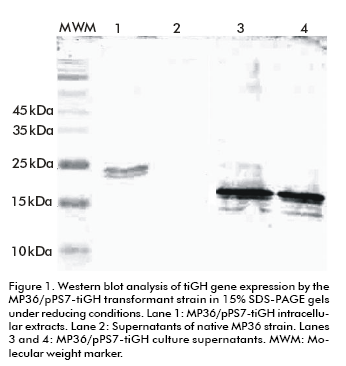
<body><![CDATA[<p><b><span lang=EN-US style='font-size:10.0pt;font-family:"Verdana","sans-serif"'>Effect of tiGH from the MP36/pP-tiGH strain on growth of red tilapia </span></b><b><span lang=EN-US style='font-size:10.0pt;font-family:"Verdana","sans-serif"; color:windowtext'>(</span></b><b><i><span lang=EN-US style='font-size:10.0pt; font-family:"Verdana","sans-serif"'>Oreochromis sp.</span></i></b><b><span lang=EN-US style='font-size:10.0pt;font-family:"Verdana","sans-serif"'>) larvae </span></b></p>      <p><span lang=EN-US style='font-size:10.0pt;font-family:"Verdana","sans-serif"'>An experiment was carried out to evaluate the biological activity of tiGH produced by the MP36/pP-tiGH <i>P. pastoris </i>strain on stimulating growth of 3-days posthatching tilapia larvae. Intact yeast cells containing tiGH were administered by immersion baths, thrice a week for 6 weeks. Larvae body weight increased significantly four weeks after starting treatment with <i>P. pastoris </i>tiGH-producing cells, compared to the negative control group treated with untransformed <i>P. pastoris </i>cells </span><span lang=EN-US style='font-size:10.0pt;font-family:"Verdana","sans-serif";color:windowtext'>(</span><span lang=EN-US style='font-size:10.0pt;font-family:"Verdana","sans-serif"'>p &lt; 0.0001) </span><span lang=EN-US style='font-size:10.0pt;font-family:"Verdana","sans-serif"; color:windowtext'>(</span><span lang=EN-US style='font-size:10.0pt;font-family: "Verdana","sans-serif"'>Figure 4 in reference </span><span lang=EN-US style='font-size:10.0pt;font-family:"Verdana","sans-serif";color:windowtext'>(</span><span lang=EN-US style='font-size:10.0pt;font-family:"Verdana","sans-serif"'>28)). Although the stimulatory effect of recombinant GH being administered by immersion baths has been previously demonstrated in fish </span><span lang=EN-US style='font-size:10.0pt;font-family:"Verdana","sans-serif"; color:windowtext'>(</span><span lang=EN-US style='font-size:10.0pt;font-family: "Verdana","sans-serif"'>18, 20), this is the first report using <i>P. pastoris </i>cells expressing a fish GH for that purpose. Previous demonstrations have only used diets enriched with GH-expressing yeast </span><span lang=EN-US style='font-size:10.0pt;font-family:"Verdana","sans-serif";color:windowtext'>(</span><span lang=EN-US style='font-size:10.0pt;font-family:"Verdana","sans-serif"'>25-27). </span></p>      <p><b><span lang=EN-US style='font-size:10.0pt;font-family:"Verdana","sans-serif"'>Obtaining an extracellular variant of tiGH in <i>P. pastoris </i>cells </span></b></p>      <p><span lang=EN-US style='font-size:10.0pt;font-family:"Verdana","sans-serif"'>The PCR-amplified 0.8 kb DNA fragment from the pTTI plasmid </span><span lang=EN-US style='font-size:10.0pt;font-family:"Verdana","sans-serif"; color:windowtext'>(</span><span lang=EN-US style='font-size:10.0pt;font-family: "Verdana","sans-serif"'>14) that codes for tiGH was cloned into the pPS7 vector in frame between the <i>Saccharomyces cerevisiae </i>suc signal peptide sequence and the GAP terminator, generating the construct pPS7-tiGH. This vector bears an AOX1 homologous integration unit similar to that described above for the pP-tiGH construct. </span></p>          <p><span lang=EN-US style='font-size:10.0pt;font-family:"Verdana","sans-serif"'>The        pPS7-tiGH construct was digested with the <i>Sph </i>I restriction endonuclease        and used for transforming of <i>P. pastoris </i>cells strain MP36 by electroporation.        Southern blot analysis of genomic DNA showed four out of five transformants        with a DNA band of 28.7 kb indicating the homologous integration by double        crossover of the expression cassette </span><span lang=EN-US style='font-size:10.0pt;font-family:"Verdana","sans-serif";color:windowtext'>(</span><span lang=EN-US style='font-size:10.0pt;font-family:"Verdana","sans-serif"'>integration        by AOX1 gene replacement) </span><span lang=EN-US style='font-size:10.0pt; font-family:"Verdana","sans-serif";color:windowtext'>(</span><span lang=EN-US style='font-size:10.0pt;font-family:"Verdana","sans-serif"'>Figure 1 in reference        </span><span lang=EN-US style='font-size:10.0pt;font-family:"Verdana","sans-serif"; color:windowtext'>(</span><span lang=EN-US style='font-size:10.0pt;font-family: "Verdana","sans-serif"'>30)). These clones showed the slow methanol consumption        </span><span lang=EN-US style='font-size:10.0pt;font-family:"Verdana","sans-serif"; color:windowtext'>(</span><span lang=EN-US style='font-size:10.0pt;font-family: "Verdana","sans-serif"'>MutS) phenotype </span><span lang=EN-US style='font-size:10.0pt;font-family:"Verdana","sans-serif";color:windowtext'>(</span><span lang=EN-US style='font-size:10.0pt;font-family:"Verdana","sans-serif"'>29). The        5.5 kb band corresponding to the native host AOX1 gene was observed in the        genomic DNA of the control, untransformed <i>P. pastoris </i>MP36 strain.        The transformant corresponding to lane 1 in </span><span style='font-size:10.0pt; font-family:"Verdana","sans-serif"'><a href="#fig1"><span lang=EN-US>Figure 1        </span></a></span><span lang=EN-US style='font-size:10.0pt;font-family:"Verdana","sans-serif"; color:windowtext'>(</span><span lang=EN-US style='font-size:10.0pt;font-family: "Verdana","sans-serif"'>30) was selected for expression studies, being denominated        MP36/ pPS7-tiGH.</span></p>      <p align=center style='text-align:center'><span style='font-size:13.5pt'><img border=0 width=346 height=366 src="/img/revistas/bta/v26n3/f0116309.gif"></span><a name=fig1></a></p>          
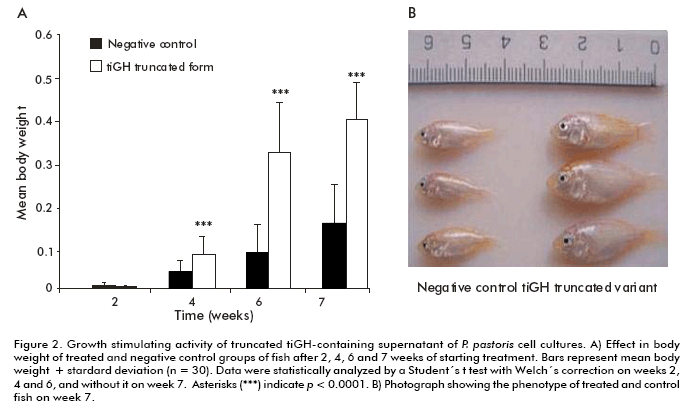
<p><span lang=EN-US style='font-size:10.0pt;font-family:"Verdana","sans-serif"'>The        Western blot analysis of culture supernatants from 15% SDS-PAGE under reducing        conditions showed a protein band immunoreactive to an anti-tiGH monoclonal        antibody. Its molecular weight was between 15 and 25 kDa </span><span lang=EN-US style='font-size:10.0pt;font-family:"Verdana","sans-serif"; color:windowtext'>(</span><span style='font-size:10.0pt;font-family:"Verdana","sans-serif"'><a href="#fig1"><span lang=EN-US>Figure 1</span></a></span><span lang=EN-US style='font-size:10.0pt;font-family:"Verdana","sans-serif"'>), lower than both        the 22 kDa native tiGH </span><span lang=EN-US style='font-size:10.0pt; font-family:"Verdana","sans-serif";color:windowtext'>(</span><span lang=EN-US style='font-size:10.0pt;font-family:"Verdana","sans-serif"'>14) and the intracellular        tiGH produced in <i>P. pastoris </i>cells </span><span lang=EN-US style='font-size:10.0pt;font-family:"Verdana","sans-serif"; color:windowtext'>(</span><span lang=EN-US style='font-size:10.0pt;font-family: "Verdana","sans-serif"'>28). The recombinant protein was absent in culture supernatants        of the native untransformed MP36 strain. Its expression levels were estimated        by Dot blot, comparing the previously mentioned tiGH standard obtained in        <i>E. coli </i></span><span lang=EN-US style='font-size:10.0pt; font-family:"Verdana","sans-serif";color:windowtext'>(</span><span lang=EN-US style='font-size:10.0pt;font-family:"Verdana","sans-serif"'>14), reaching 40 and        80 mg/L </span><span lang=EN-US style='font-size:10.0pt;font-family:"Verdana","sans-serif"; color:windowtext'>(</span><span lang=EN-US style='font-size:10.0pt;font-family: "Verdana","sans-serif"'>data not shown). Mass spectrometry analyses corroborated        the identity of the protein as tiGH but lacking the 46 carboxyl A similar        experiment to evaluate the intracellular tiGH effect on growth of tilapia        larvae was carried out, but using this time culture supernatants from the        MP36/pPS7-tiGH strain containing the truncated tigGH to stimulate growth        of 3-days post-hatching tilapia larvae. Treatment was applied by immersion        baths thrice a week for 7 weeks. As for the intracellular variant, larvae        body weight increased significantly four weeks after starting treatment        with culture supernatants from MP36/pPS7-tiGH cells, compared to the negative        control group treated with supernatants from untransformed <i>P. pastoris        </i>cells </span><span lang=EN-US style='font-size:10.0pt;font-family:"Verdana","sans-serif"; color:windowtext'>(</span><span lang=EN-US style='font-size:10.0pt;font-family: "Verdana","sans-serif"'>p &lt; 0.0001) </span><span lang=EN-US style='font-size:10.0pt;font-family:"Verdana","sans-serif";color:windowtext'>(</span><span style='font-size:10.0pt;font-family:"Verdana","sans-serif"'><a href="/img/revistas/bta/v26n3/f0216309.gif"><span lang=EN-US>Figure 2</span></a></span><span lang=EN-US style='font-size:10.0pt;font-family:"Verdana","sans-serif"'>), reaching        a 2.2-fold increase after 7 weeks </span><span lang=EN-US style='font-size:10.0pt;font-family:"Verdana","sans-serif";color:windowtext'>(</span><span lang=EN-US style='font-size:10.0pt;font-family:"Verdana","sans-serif"'>p &lt;        0.0001) </span><span lang=EN-US style='font-size:10.0pt;font-family:"Verdana","sans-serif"; color:windowtext'>(</span><span style='font-size:10.0pt;font-family:"Verdana","sans-serif"'><a href="/img/revistas/bta/v26n3/f0216309.gif"><span lang=EN-US>Figure 2</span></a></span><span lang=EN-US style='font-size:10.0pt;font-family:"Verdana","sans-serif"'>). These        results demonstrated that the truncated tiGH variant lacking the 46 carboxyl        terminal aminoacids from the native tiGH is biologically active. </span></p>      
<p><b><span lang=EN-US style='font-size:10.0pt;font-family:"Verdana","sans-serif"'>Comparison of biological activities of the cellular lysate and culture supernatant from the respective intracellular and truncated tiGH variants-expressing cells </span></b></p>      <p><span lang=EN-US style='font-size:10.0pt;font-family:"Verdana","sans-serif"; color:#211E1E'>The stimulatory biological effects of both tiGH variants </span><span lang=EN-US style='font-size:10.0pt;font-family:"Verdana","sans-serif"; color:windowtext'>(</span><span lang=EN-US style='font-size:10.0pt;font-family: "Verdana","sans-serif";color:#211E1E'>intracellular complete tiGH or secreted truncated tiGH) on the innate immunity and growth of tilapia larvae were evaluated in of 3-days post-hatching larvae. Treatment was applied by immersion baths thrice a week for 45 days. Larvae were analyzed at 21 and 45 days after the start of the experiment for growing parameters and innate immune functions </span><span lang=EN-US style='font-size:10.0pt;font-family:"Verdana","sans-serif"; color:windowtext'>(</span><span lang=EN-US style='font-size:10.0pt;font-family: "Verdana","sans-serif";color:#211E1E'>lysozyme and hemmaglutination activities). </span></p>      <p><b><i><span lang=EN-US style='font-size:10.0pt;font-family:"Verdana","sans-serif"'>Growth stimulating activity </span></i></b></p>      ]]></body>
<body><![CDATA[<p><span lang=EN-US style='font-size:10.0pt;font-family:"Verdana","sans-serif"'>A significant increase in body weight was observed in day 21 for tilapia larvae treated with culture supernatants containing the truncated tiGH, compared to both the larvae control group </span><span lang=EN-US style='font-size:10.0pt; font-family:"Verdana","sans-serif";color:windowtext'>(</span><i><span lang=EN-US style='font-size:10.0pt;font-family:"Verdana","sans-serif"'>p </span></i><span lang=EN-US style='font-size:10.0pt;font-family:"Verdana","sans-serif"'>&lt; 0.001) and the group treated with lysates of the untransformed native <i>P. pastoris </i>strain </span><span lang=EN-US style='font-size:10.0pt;font-family: "Verdana","sans-serif";color:windowtext'>(</span><i><span lang=EN-US style='font-size:10.0pt;font-family:"Verdana","sans-serif"'>p </span></i><span lang=EN-US style='font-size:10.0pt;font-family:"Verdana","sans-serif"'>&lt; 0.05) </span><span lang=EN-US style='font-size:10.0pt;font-family:"Verdana","sans-serif"; color:windowtext'>(</span><span lang=EN-US style='font-size:10.0pt;font-family: "Verdana","sans-serif"'>Figure 4 in reference </span><span lang=EN-US style='font-size:10.0pt;font-family:"Verdana","sans-serif";color:windowtext'>(</span><span lang=EN-US style='font-size:10.0pt;font-family:"Verdana","sans-serif"'>30)). Moreover, larvae treated with intracellular tiGH-containing <i>P. pastoris </i>cell lysates also significantly increased body weight compared to the untreated control group </span><span lang=EN-US style='font-size:10.0pt;font-family:"Verdana","sans-serif"; color:windowtext'>(</span><i><span lang=EN-US style='font-size:10.0pt; font-family:"Verdana","sans-serif"'>p </span></i><span lang=EN-US style='font-size:10.0pt;font-family:"Verdana","sans-serif"'>&lt; 0.001) </span><span lang=EN-US style='font-size:10.0pt;font-family:"Verdana","sans-serif"; color:windowtext'>(</span><span lang=EN-US style='font-size:10.0pt;font-family: "Verdana","sans-serif"'>Figure 4 in reference </span><span lang=EN-US style='font-size:10.0pt;font-family:"Verdana","sans-serif";color:windowtext'>(</span><span lang=EN-US style='font-size:10.0pt;font-family:"Verdana","sans-serif"'>30)). </span></p>      <p><span lang=EN-US style='font-size:10.0pt;font-family:"Verdana","sans-serif"'>Larvae treated with supernatants containing the truncated tiGH showed the best growing results 45 days after treatment. They had a 3.6-fold increase of body weight compared to the untreated group </span><span lang=EN-US style='font-size:10.0pt; font-family:"Verdana","sans-serif";color:windowtext'>(</span><i><span lang=EN-US style='font-size:10.0pt;font-family:"Verdana","sans-serif"'>p </span></i><span lang=EN-US style='font-size:10.0pt;font-family:"Verdana","sans-serif"'>&lt; 0.001), a 2.1-fold increase treated with untransformed <i>P. pastoris </i>culture supernatants </span><span lang=EN-US style='font-size:10.0pt;font-family:"Verdana","sans-serif"; color:windowtext'>(</span><i><span lang=EN-US style='font-size:10.0pt; font-family:"Verdana","sans-serif"'>p </span></i><span lang=EN-US style='font-size:10.0pt;font-family:"Verdana","sans-serif"'>&lt; 0.001), 2.9- fold in the group treated with untransformed <i>P. pastoris </i>cell lysates </span><span lang=EN-US style='font-size:10.0pt;font-family:"Verdana","sans-serif"; color:windowtext'>(</span><i><span lang=EN-US style='font-size:10.0pt; font-family:"Verdana","sans-serif"'>p </span></i><span lang=EN-US style='font-size:10.0pt;font-family:"Verdana","sans-serif"'>&lt; 0.001) and 1.6-fold in the group treated with intracellular tiGH-containing cell lysates </span><span lang=EN-US style='font-size:10.0pt;font-family:"Verdana","sans-serif"; color:windowtext'>(</span><i><span lang=EN-US style='font-size:10.0pt; font-family:"Verdana","sans-serif"'>p </span></i><span lang=EN-US style='font-size:10.0pt;font-family:"Verdana","sans-serif"'>&lt; 0.05) </span><span lang=EN-US style='font-size:10.0pt;font-family:"Verdana","sans-serif"; color:windowtext'>(</span><span lang=EN-US style='font-size:10.0pt;font-family: "Verdana","sans-serif"'>Figure 4 in reference </span><span lang=EN-US style='font-size:10.0pt;font-family:"Verdana","sans-serif";color:windowtext'>(</span><span lang=EN-US style='font-size:10.0pt;font-family:"Verdana","sans-serif"'>30)). Likewise, the group treated with the intracellular tiGH-containing lysates showed a 2.2- and 1.8-fold increase in body weight compared to the untreated control group </span><span lang=EN-US style='font-size:10.0pt;font-family:"Verdana","sans-serif"; color:windowtext'>(</span><i><span lang=EN-US style='font-size:10.0pt; font-family:"Verdana","sans-serif"'>p </span></i><span lang=EN-US style='font-size:10.0pt;font-family:"Verdana","sans-serif"'>&lt; 0.001) and the group treated with untransformed <i>P. pastoris </i>cell lysates </span><span lang=EN-US style='font-size:10.0pt;font-family:"Verdana","sans-serif"; color:windowtext'>(</span><i><span lang=EN-US style='font-size:10.0pt; font-family:"Verdana","sans-serif"'>p </span></i><span lang=EN-US style='font-size:10.0pt;font-family:"Verdana","sans-serif"'>&lt; 0.001), respectively </span><span lang=EN-US style='font-size:10.0pt;font-family:"Verdana","sans-serif"; color:windowtext'>(</span><span lang=EN-US style='font-size:10.0pt;font-family: "Verdana","sans-serif"'>Figure 4 in reference </span><span lang=EN-US style='font-size:10.0pt;font-family:"Verdana","sans-serif";color:windowtext'>(</span><span lang=EN-US style='font-size:10.0pt;font-family:"Verdana","sans-serif"'>30)). </span></p>      <p><b><i><span lang=EN-US style='font-size:10.0pt;font-family:"Verdana","sans-serif"'>Effects of tiGH variants on innate immunity </span></i></b></p>      <p><i><span lang=EN-US style='font-size:10.0pt;font-family:"Verdana","sans-serif"'>Lysozyme activity </span></i></p>      <p><span lang=EN-US style='font-size:10.0pt;font-family:"Verdana","sans-serif"'>Lysozyme activity was undetectable in larvae homogenates 21 days after starting treatment. There were statistically significant differences at day 45 only between the group treated with culture supernatants containing truncated tiGH compared to the untreated control group </span><span lang=EN-US style='font-size:10.0pt;font-family:"Verdana","sans-serif";color:windowtext'>(</span><i><span lang=EN-US style='font-size:10.0pt;font-family:"Verdana","sans-serif"'>p </span></i><span lang=EN-US style='font-size:10.0pt;font-family:"Verdana","sans-serif"'>&lt; 0.05) </span><span lang=EN-US style='font-size:10.0pt;font-family:"Verdana","sans-serif"; color:windowtext'>(</span><span lang=EN-US style='font-size:10.0pt;font-family: "Verdana","sans-serif"'>Table 1 in reference </span><span lang=EN-US style='font-size:10.0pt;font-family:"Verdana","sans-serif";color:windowtext'>(</span><span lang=EN-US style='font-size:10.0pt;font-family:"Verdana","sans-serif"'>30)). </span></p>      <p><i><span lang=EN-US style='font-size:10.0pt;font-family:"Verdana","sans-serif"'>Hemagglutinating activity </span></i></p>      <p><span lang=EN-US style='font-size:10.0pt;font-family:"Verdana","sans-serif"'>There were no statistically significant differences 21 days after beginning treatment. Consistently, after 45 days, the highest hemagglutinating activity was obtained in the group treated with truncated tiGH-containing supernatants </span><span lang=EN-US style='font-size:10.0pt;font-family:"Verdana","sans-serif"; color:windowtext'>(</span><span lang=EN-US style='font-size:10.0pt;font-family: "Verdana","sans-serif"'>1024 ± 1), statistically significant when compared to the untreated control group </span><span lang=EN-US style='font-size:10.0pt; font-family:"Verdana","sans-serif";color:windowtext'>(</span><span lang=EN-US style='font-size:10.0pt;font-family:"Verdana","sans-serif"'>128 ± 1; <i>p </i>&lt; 0.001) and groups treated either with untransformed <i>P. pastoris </i>culture supernatants </span><span lang=EN-US style='font-size:10.0pt;font-family:"Verdana","sans-serif"; color:windowtext'>(</span><span lang=EN-US style='font-size:10.0pt;font-family: "Verdana","sans-serif"'>512 ± 1; <i>p </i>&lt; 0.01), untransformed <i>P. pastoris </i>cell lysates </span><span lang=EN-US style='font-size:10.0pt; font-family:"Verdana","sans-serif";color:windowtext'>(</span><span lang=EN-US style='font-size:10.0pt;font-family:"Verdana","sans-serif"'>256 ± 1; <i>p </i>&lt; 0.001) or intracellular tiGH-containing cell lysates </span><span lang=EN-US style='font-size:10.0pt;font-family:"Verdana","sans-serif";color:windowtext'>(</span><span lang=EN-US style='font-size:10.0pt;font-family:"Verdana","sans-serif"'>323 ± 2.5; <i>p </i>&lt; 0.001) </span><span lang=EN-US style='font-size:10.0pt; font-family:"Verdana","sans-serif";color:windowtext'>(</span><span lang=EN-US style='font-size:10.0pt;font-family:"Verdana","sans-serif"'>Figure 5 in reference </span><span lang=EN-US style='font-size:10.0pt;font-family:"Verdana","sans-serif"; color:windowtext'>(</span><span lang=EN-US style='font-size:10.0pt;font-family: "Verdana","sans-serif"'>30)). All the treatments stimulate haemagglutinin activity compared to non-treated group </span><span lang=EN-US style='font-size:10.0pt;font-family:"Verdana","sans-serif";color:windowtext'>(</span><span lang=EN-US style='font-size:10.0pt;font-family:"Verdana","sans-serif"'>Figure 5 in reference </span><span lang=EN-US style='font-size:10.0pt;font-family:"Verdana","sans-serif"; color:windowtext'>(</span><span lang=EN-US style='font-size:10.0pt;font-family: "Verdana","sans-serif"'>30)). No differences among groups were found at day 21 </span><span lang=EN-US style='font-size:10.0pt;font-family:"Verdana","sans-serif"; color:windowtext'>(</span><span lang=EN-US style='font-size:10.0pt;font-family: "Verdana","sans-serif"'>data not shown). This was the first report linking GH administration to lectin activation. In this sense, we cannot exclude a synergic or individual influence on this parameter of some factors present in culture supernatants activating innate immunity in fish, coming either from <i>P. pastoris </i>cells </span><span lang=EN-US style='font-size:10.0pt;font-family: "Verdana","sans-serif";color:windowtext'>(</span><span lang=EN-US style='font-size:10.0pt;font-family:"Verdana","sans-serif"'>intracellular and/ or secreted) or even from culture medium components. As far as we know, there are no reports on this matter. Nevertheless, it has been reported that <i>S. cerevisiae </i>cell wall components such as </span><span style='font-size:10.0pt; font-family:"Verdana","sans-serif"'>&#946;</span><span lang=EN-US style='font-size:10.0pt;font-family:"Verdana","sans-serif"'>-1,3-D-glucan, B-1,6- D-glucan, mannoproteins and chitin </span><span lang=EN-US style='font-size:10.0pt;font-family:"Verdana","sans-serif";color:windowtext'>(</span><span lang=EN-US style='font-size:10.0pt;font-family:"Verdana","sans-serif"'>31) individually increase innate defense mechanisms and/or disease resistance when purified ad administered to vertebrates </span><span lang=EN-US style='font-size:10.0pt;font-family:"Verdana","sans-serif";color:windowtext'>(</span><span lang=EN-US style='font-size:10.0pt;font-family:"Verdana","sans-serif"'>32-34). B-glucans and mannoproteins are the main yeast cell wall components. The former enhance fish humoral </span><span lang=EN-US style='font-size:10.0pt; font-family:"Verdana","sans-serif";color:windowtext'>(</span><span lang=EN-US style='font-size:10.0pt;font-family:"Verdana","sans-serif"'>lysozyme and complement activity) and cellular </span><span lang=EN-US style='font-size: 10.0pt;font-family:"Verdana","sans-serif";color:windowtext'>(</span><span lang=EN-US style='font-size:10.0pt;font-family:"Verdana","sans-serif"'>phagocytic and respiratory burst activities and bacterial killing) immune responses both <i>in vitro </i>and <i>in vivo </i></span><span lang=EN-US style='font-size:10.0pt; font-family:"Verdana","sans-serif";color:windowtext'>(</span><span lang=EN-US style='font-size:10.0pt;font-family:"Verdana","sans-serif"'>35, 36). The least abundant yeast cell wall compound, but one that is very important, is chitin. Some studies have shown that chitin and its derivatives modulate the immune system in mammals as well as in fish </span><span lang=EN-US style='font-size: 10.0pt;font-family:"Verdana","sans-serif";color:windowtext'>(</span><span lang=EN-US style='font-size:10.0pt;font-family:"Verdana","sans-serif"'>33, 34, 37). Finally, the combination of all the yeast cell compounds, not only cell wall sugars but also vitamins and genetic material, might produce an optimum physiological status in fish due to multiple interactions, particularly with regard to the immune system </span><span lang=EN-US style='font-size:10.0pt; font-family:"Verdana","sans-serif";color:windowtext'>(</span><span lang=EN-US style='font-size:10.0pt;font-family:"Verdana","sans-serif"'>38-40). In addition, the effect of GH by itself can be either direct by interacting with hormone regulators of the immune response or indirect by just accelerating the development of larval immune cell populations. All these require further investigation. </span></p>      <p><span lang=EN-US style='font-size:10.0pt;font-family:"Verdana","sans-serif"'>This is the first report of a tiGH polypeptide fragment lacking the last 46 aminoacids of the native tiGH which shows <i>in vivo </i>biological activity for stimulating growth and being involved in innate immune stimulation of tilapia larvae. Differences observed between the truncated and the intracellular tiGH variants cannot be attributed to the tiGH molecule itself, since both variants were tested coming from complex samples subjected to different procedures and none of them included tiGH purification. Moreover, they were supplied at different tiGH molar concentrations and without knowing the possible influence of their different tiGH molecular tertiary structures. </span></p>      <p><span lang=EN-US style='font-size:10.0pt;font-family:"Verdana","sans-serif"'>Based on these facts, we decided to use the culture supernatant containing the truncated tiGH molecule for further studies of its industrial application in aquaculture. </span></p>      <p><b><span lang=EN-US style='font-size:10.0pt;font-family:"Verdana","sans-serif"'>Effect of truncated tiGH-containing supernatant of <i>P. pastoris </i>cells in ornamental fish </span></b></p>      ]]></body>
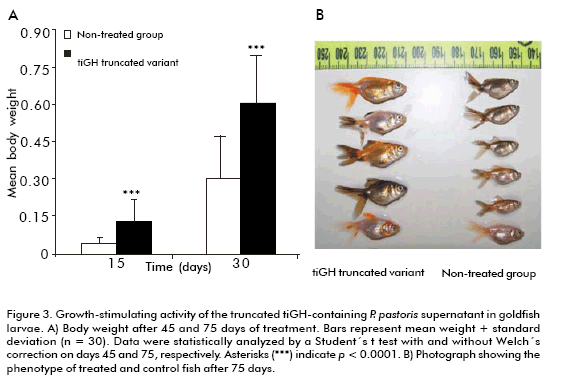
<body><![CDATA[<p><b><i><span lang=EN-US style='font-size:10.0pt;font-family:"Verdana","sans-serif"'>Effect on growth and survival of goldfish larvae </span></i></b><b><i><span lang=EN-US style='font-size:10.0pt;font-family:"Verdana","sans-serif"; color:windowtext'>(</span></i></b><b><span lang=EN-US style='font-size:10.0pt; font-family:"Verdana","sans-serif"'>Carassius auratus<i>) </i></span></b></p>      <p><span lang=EN-US style='font-size:10.0pt;font-family:"Verdana","sans-serif"'>The effect of truncated tiGH-containing supernatant on growth and survival of goldfish larvae was evaluated from 5-days post-hatching larvae. Treatment was applied by immersion baths thrice a week for 75 days. Treated larvae showed a 3.1-fold increase in body weight compared to the untreated group </span><span lang=EN-US style='font-size:10.0pt;font-family:"Verdana","sans-serif"; color:windowtext'>(</span><i><span lang=EN-US style='font-size:10.0pt; font-family:"Verdana","sans-serif"'>p </span></i><span lang=EN-US style='font-size:10.0pt;font-family:"Verdana","sans-serif"'>&lt; 0.0001; </span><span style='font-size:10.0pt;font-family:"Verdana","sans-serif"'><a href="#fig3"><span lang=EN-US>Figure 3</span></a></span><span lang=EN-US style='font-size:10.0pt; font-family:"Verdana","sans-serif"'>) after 45 days of started treatment, that remained two-fold after 75 days </span><span lang=EN-US style='font-size:10.0pt; font-family:"Verdana","sans-serif";color:windowtext'>(</span><i><span lang=EN-US style='font-size:10.0pt;font-family:"Verdana","sans-serif"'>p </span></i><span lang=EN-US style='font-size:10.0pt;font-family:"Verdana","sans-serif"'>&lt; 0.0001; </span><span style='font-size:10.0pt;font-family:"Verdana","sans-serif"'><a href="#fig3"><span lang=EN-US>Figure 3</span></a></span><span lang=EN-US style='font-size:10.0pt;font-family:"Verdana","sans-serif"'>), also showing increased coloration </span><span lang=EN-US style='font-size:10.0pt; font-family:"Verdana","sans-serif";color:windowtext'>(</span><span style='font-size:10.0pt;font-family:"Verdana","sans-serif"'><a href="#fig3"><span lang=EN-US>Figure 3B</span></a></span><span lang=EN-US style='font-size:10.0pt; font-family:"Verdana","sans-serif"'>). Besides, truncated tiGH-containing supernatant also enhanced survival 22% after 75 days, compared to the animals of the control group. </span></p>      <p align=center style='text-align:center'><span style='font-size:13.5pt'><img border=0 width=562 height=389 src="/img/revistas/bta/v26n3/f0316309.gif"></span><a name=fig3></a></p>      
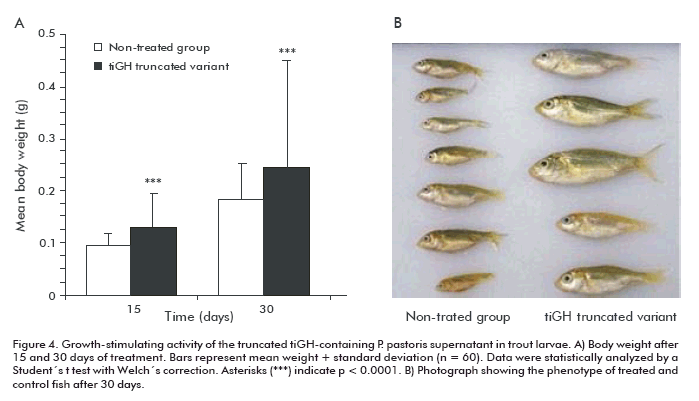
<p><b><span lang=EN-US style='font-size:10.0pt;font-family:"Verdana","sans-serif"'>Effect on growth of larvae and juvenile carp </span></b><b><span lang=EN-US style='font-size:10.0pt;font-family:"Verdana","sans-serif";color:windowtext'>(</span></b><b><span lang=EN-US style='font-size:10.0pt;font-family:"Verdana","sans-serif"'>Cyprinus carpio) </span></b></p>          <p><span lang=EN-US style='font-size:10.0pt;font-family:"Verdana","sans-serif"'>The        truncated tiGH-containing supernatant was also evaluated in different developmental        stages of trout </span><span lang=EN-US style='font-size:10.0pt; font-family:"Verdana","sans-serif";color:windowtext'>(</span><i><span lang=EN-US style='font-size:10.0pt;font-family:"Verdana","sans-serif"'>Cyprinus        carpio</span></i><span lang=EN-US style='font-size:10.0pt;font-family:"Verdana","sans-serif"'>).        For this purpose, 5 days post-hatching larvae and juveniles </span><span lang=EN-US style='font-size:10.0pt;font-family:"Verdana","sans-serif"; color:windowtext'>(</span><span lang=EN-US style='font-size:10.0pt;font-family: "Verdana","sans-serif"'>1.2 ± 0.2 g) were treated by immersion baths thrice a        week. Larvae were sampled from 15 to 30 days after starting the experiment,        showing a 3.5-fold body weight increase compared to the control group </span><span lang=EN-US style='font-size:10.0pt;font-family:"Verdana","sans-serif"; color:windowtext'>(</span><i><span lang=EN-US style='font-size:10.0pt; font-family:"Verdana","sans-serif"'>p </span></i><span lang=EN-US style='font-size:10.0pt;font-family:"Verdana","sans-serif"'>&lt; 0.0001) at day        15, which remained 2.2-fold </span><span lang=EN-US style='font-size:10.0pt; font-family:"Verdana","sans-serif";color:windowtext'>(</span><i><span lang=EN-US style='font-size:10.0pt;font-family:"Verdana","sans-serif"'>p </span></i><span lang=EN-US style='font-size:10.0pt;font-family:"Verdana","sans-serif"'>&lt; 0.0001)        after 30 days </span><span lang=EN-US style='font-size:10.0pt; font-family:"Verdana","sans-serif";color:windowtext'>(</span><span style='font-size:10.0pt;font-family:"Verdana","sans-serif"'><a href="/img/revistas/bta/v26n3/f0416309.gif"><span lang=EN-US>Figure 4</span></a></span><span lang=EN-US style='font-size:10.0pt;font-family:"Verdana","sans-serif"'>). </span></p>      
<p><span lang=EN-US style='font-size:10.0pt;font-family:"Verdana","sans-serif"'>Trout juveniles were sampled 0, 15 and 28 days showing significant increased body weight compared to the control group </span><span lang=EN-US style='font-size: 10.0pt;font-family:"Verdana","sans-serif";color:windowtext'>(</span><i><span lang=EN-US style='font-size:10.0pt;font-family:"Verdana","sans-serif"'>p </span></i><span lang=EN-US style='font-size:10.0pt;font-family:"Verdana","sans-serif"'>&lt; 0.05), which was 1.5-fold after 28 days </span><span lang=EN-US style='font-size:10.0pt;font-family:"Verdana","sans-serif";color:windowtext'>(</span><i><span lang=EN-US style='font-size:10.0pt;font-family:"Verdana","sans-serif"'>p </span></i><span lang=EN-US style='font-size:10.0pt;font-family:"Verdana","sans-serif"'>&lt; 0.0001) </span><span lang=EN-US style='font-size:10.0pt;font-family:"Verdana","sans-serif"; color:windowtext'>(</span><span style='font-size:10.0pt;font-family:"Verdana","sans-serif"'><a href="#fig5"><span lang=EN-US>Figure 5</span></a></span><span lang=EN-US style='font-size:10.0pt;font-family:"Verdana","sans-serif"'>). </span></p>      <p align=center style='text-align:center'><span style='font-size:13.5pt'><img border=0 width=339 height=387 src="/img/revistas/bta/v26n3/f0516309.gif"></span><a name=fig5></a></p>      
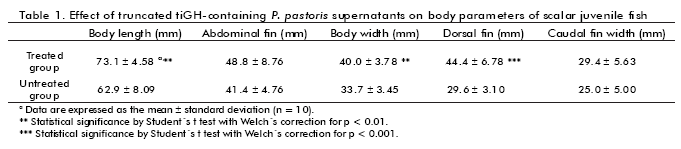
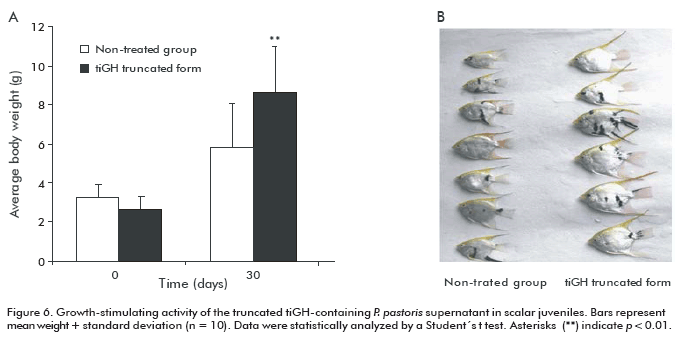
<p><b><i><span lang=EN-US style='font-size:10.0pt;font-family:"Verdana","sans-serif"'>Effect on growth and anatomical parameters of angelfish </span></i></b><b><i><span lang=EN-US style='font-size:10.0pt;font-family:"Verdana","sans-serif"; color:windowtext'>(</span></i></b><b><span lang=EN-US style='font-size:10.0pt; font-family:"Verdana","sans-serif"'>Pterophyllum scalare<i>) juveniles </i></span></b></p>          <p><span lang=EN-US style='font-size:10.0pt;font-family:"Verdana","sans-serif"'>The        effect of truncated tiGH-containing supernatant on growth and quality-related        parameters of ornamental fish was also evaluated in angelfish juveniles        </span><span lang=EN-US style='font-size:10.0pt;font-family:"Verdana","sans-serif"; color:windowtext'>(</span><span lang=EN-US style='font-size:10.0pt;font-family: "Verdana","sans-serif"'>3.1 ± 0.6 g) receiving immersion baths thrice a week.        Fish showed gained weight 1.6-fold after 30 days than those of the untreated        group </span><span lang=EN-US style='font-size:10.0pt;font-family:"Verdana","sans-serif"; color:windowtext'>(</span><span lang=EN-US style='font-size:10.0pt;font-family: "Verdana","sans-serif"'>p &lt; 0.01, </span><span style='font-size:10.0pt; font-family:"Verdana","sans-serif"'><a href="/img/revistas/bta/v26n3/f0616309.gif"><span lang=EN-US>Figure 6</span></a></span><span lang=EN-US style='font-size:10.0pt; font-family:"Verdana","sans-serif"'>). Besides, their body length </span><span lang=EN-US style='font-size:10.0pt;font-family:"Verdana","sans-serif"; color:windowtext'>(</span><span lang=EN-US style='font-size:10.0pt;font-family: "Verdana","sans-serif"'>p &lt; 0.01), width </span><span lang=EN-US style='font-size:10.0pt;font-family:"Verdana","sans-serif";color:windowtext'>(</span><span lang=EN-US style='font-size:10.0pt;font-family:"Verdana","sans-serif"'>p &lt;        0.01) and length of the dorsal fin </span><span lang=EN-US style='font-size: 10.0pt;font-family:"Verdana","sans-serif";color:windowtext'>(</span><i><span lang=EN-US style='font-size:10.0pt;font-family:"Verdana","sans-serif"'>p </span></i><span lang=EN-US style='font-size:10.0pt;font-family:"Verdana","sans-serif"'>&lt; 0.001)        significantly increased in the treated group </span><span lang=EN-US style='font-size:10.0pt;font-family:"Verdana","sans-serif";color:windowtext'>(</span><span style='font-size:10.0pt;font-family:"Verdana","sans-serif"'><a href="/img/revistas/bta/v26n3/t0116309.gif"><span lang=EN-US>Table 1</span></a></span><span lang=EN-US style='font-size:10.0pt;font-family:"Verdana","sans-serif"'>). These        results demonstrate that treatment with truncated tiGH-containing supernatants        not only increases growth, but also stimulates quality-related body parameters        in ornamental fish. It was also demonstrated its action in larvae and juvenile        fish developmental stages. </span></p>      
<p><b><span lang=EN-US style='font-family:"Verdana","sans-serif"'>CONCLUSIONS </span></b></p>      ]]></body>
<body><![CDATA[<p><span lang=EN-US style='font-size:10.0pt;font-family:"Verdana","sans-serif"'>For the first time, these findings provide differences of the hormone receptor interaction and the structurefunction relationship between fish and mammals, as well contribute to understand the interactions of GH with its receptors in fish. Moreover, because the truncated tiGH variant being supplied in <i>P. pastoris </i>culture supernatants showed to be a potent enhancer for growth, survival, quality of larvae and immune parameters, it can be used in aquaculture mainly for ornamental fish production. It allows to have treated fish of increased growing rates and more resistant to stress conditions and infections, and reducing production costs. </span></p>      <p><b><span lang=EN-US style='font-family:"Verdana","sans-serif"'>REFERENCES </span></b></p>      <!-- ref --><p><span lang=EN-US style='font-size:10.0pt;font-family:"Verdana","sans-serif"'>1. Pullin</span><span lang=EN-US style='font-family:"Arial","sans-serif"; color:blue'> </span><span lang=EN-US style='font-size:10.0pt;font-family:"Verdana","sans-serif"'>RS, McConell</span><span lang=EN-US style='font-family:"Arial","sans-serif"; color:blue'> </span><span lang=EN-US style='font-size:10.0pt;font-family:"Verdana","sans-serif"'>RH. The biology and culture of tilapias. Conference Proceeding, 1982; International Center for living Aquatic Resources Management.</span><span lang=EN-US style='font-family:"Arial","sans-serif";color:navy'> </span><!-- ref --><p><span lang=EN-US style='font-size:10.0pt;font-family:"Verdana","sans-serif"'>2. Rousseau K, Dufour S. Comparative aspects of GH and metabolic regulation in lower vertebrates. Neuroendocrinology</span><span lang=EN-US style='font-size: 11.0pt;font-family:"Arial","sans-serif";color:red'> </span><span lang=EN-US style='font-size:10.0pt;font-family:"Verdana","sans-serif"'>2007;86:165-74.</span><!-- ref --><p><span lang=EN-US style='font-size:10.0pt;font-family:"Verdana","sans-serif"'>3. Chen</span><span lang=EN-US style='font-family:"Arial","sans-serif";color:blue'> </span><span lang=EN-US style='font-size:10.0pt;font-family:"Verdana","sans-serif"'>TT, Marsh</span><span lang=EN-US style='font-family:"Arial","sans-serif"; color:blue'> </span><span lang=EN-US style='font-size:10.0pt;font-family:"Verdana","sans-serif"'>A, Shamblott</span><span lang=EN-US style='font-family:"Arial","sans-serif"; color:blue'> </span><span lang=EN-US style='font-size:10.0pt;font-family:"Verdana","sans-serif"'>M, Chan</span><span lang=EN-US style='font-family:"Arial","sans-serif";color:blue'> </span><span lang=EN-US style='font-size:10.0pt;font-family:"Verdana","sans-serif"'>KM, Tang</span><span lang=EN-US style='font-family:"Arial","sans-serif";color:blue'> </span><span lang=EN-US style='font-size:10.0pt;font-family:"Verdana","sans-serif"'>YL, Cheng</span><span lang=EN-US style='font-family:"Arial","sans-serif"; color:blue'> </span><span lang=EN-US style='font-size:10.0pt;font-family:"Verdana","sans-serif"'>CM, et al. Structure and evolution of fish growth hormone and insulin-like growth factors genes. In: Sherwood</span><span lang=EN-US style='font-family:"Arial","sans-serif"; color:blue'> </span><span lang=EN-US style='font-size:10.0pt;font-family:"Verdana","sans-serif"'>NM, and Hew</span><span lang=EN-US style='font-family:"Arial","sans-serif"; color:blue'> </span><span lang=EN-US style='font-size:10.0pt;font-family:"Verdana","sans-serif"'>CL</span><span lang=EN-US style='font-family:"Arial","sans-serif";color:gray'> </span><span lang=EN-US style='font-size:10.0pt;font-family:"Verdana","sans-serif"; color:windowtext'>(</span><span lang=EN-US style='font-size:10.0pt;font-family: "Verdana","sans-serif"'>Eds.), Fish Physiology. Molecular Endocrinology of fish, Academic Press, San Diego,1994; pp. 79-209.</span><span lang=EN-US style='font-family:"Arial","sans-serif";color:navy'> </span><!-- ref --><p><span lang=EN-US style='font-size:10.0pt;font-family:"Verdana","sans-serif"'>4. de Vos AM, Ultsch M, Kossiakoff AA. Human growth hormone and extracellular domain of its receptor: crystal structure of the complex. Science</span><span lang=EN-US style='font-size:11.0pt;font-family:"Arial","sans-serif";color:red'> </span><span lang=EN-US style='font-size:10.0pt;font-family:"Verdana","sans-serif"'>1992;255:306-12.</span><!-- ref --><p><span lang=EN-US style='font-size:10.0pt;font-family:"Verdana","sans-serif"'>5. Nicoll CS, Mayer GL, Russell SM. Structural features of prolactins and growth hormones that can be related to their biological properties. Endocr Rev</span><span lang=EN-US style='font-size:11.0pt;font-family:"Arial","sans-serif";color:red'> </span><span lang=EN-US style='font-size:10.0pt;font-family:"Verdana","sans-serif"'>1986;7:169-203.</span><!-- ref --><p><span lang=EN-US style='font-size:10.0pt;font-family:"Verdana","sans-serif"'>6. Watahiki M, Yamamoto M, Yamakawa M, Tanaka M, Nakashima K. Conserved and unique amino acid residues in the domains of the growth hormones. Flounder growth hormone deduced from the cDNA sequence has the minimal size in the growth hormone prolactin gene family. J Biol Chem</span><span lang=EN-US style='font-size:11.0pt;font-family:"Arial","sans-serif";color:red'> </span><span lang=EN-US style='font-size:10.0pt;font-family:"Verdana","sans-serif"'>1989;264:312-6.</span><p><span lang=EN-US style='font-size:10.0pt;font-family:"Verdana","sans-serif"'>7. Kopchick</span><span lang=EN-US style='font-family:"Arial","sans-serif"; color:blue'> </span><span lang=EN-US style='font-size:10.0pt;font-family:"Verdana","sans-serif"'>JJ. Growth and maturation. In: Melmed</span><span lang=EN-US style='font-family: "Arial","sans-serif";color:blue'> </span><span lang=EN-US style='font-size: 10.0pt;font-family:"Verdana","sans-serif"'>S</span><span lang=EN-US style='font-family:"Arial","sans-serif";color:gray'> </span><span lang=EN-US style='font-size:10.0pt;font-family:"Verdana","sans-serif";color:windowtext'>(</span><span lang=EN-US style='font-size:10.0pt;font-family:"Verdana","sans-serif"'>Ed.), Endocrinology. WB Saunders Co., Philadelphia, 2001; pp. 89-404.</span><span lang=EN-US style='font-family:"Arial","sans-serif";color:navy'> </span></p>      <!-- ref --><p><span lang=EN-US style='font-size:10.0pt;font-family:"Verdana","sans-serif"'>8. Chan YH, Cheng CH, Chan KM. Study of goldfish </span><span lang=EN-US style='font-size:10.0pt;font-family:"Verdana","sans-serif";color:windowtext'>(</span><i><span lang=EN-US style='font-size:10.0pt;font-family:"Verdana","sans-serif"'>Carassius auratus</span></i><span lang=EN-US style='font-size:10.0pt;font-family:"Verdana","sans-serif"'>) growth hormone structure-function relationship by domain swapping. Comp Biochem Physiol B Biochem Mol Biol</span><span lang=EN-US style='font-size:11.0pt; font-family:"Arial","sans-serif";color:red'> </span><span lang=EN-US style='font-size:10.0pt;font-family:"Verdana","sans-serif"'>2007;146:384-94.</span><!-- ref --><p><span lang=EN-US style='font-size:10.0pt;font-family:"Verdana","sans-serif"'>9. Sakai M, Kajita Y, Kobayashi M, Kawauchi H. Immunostimulating effect of growth hormone: <i>in vivo </i>administration of growth hormone in rainbow trout enhances resistance to <i>vibrio anguillarum </i>infection. Vet Immunol Immunopathol</span><span lang=EN-US style='font-size:11.0pt;font-family:"Arial","sans-serif"; color:red'> </span><span lang=EN-US style='font-size:10.0pt;font-family:"Verdana","sans-serif"'>1997;57:147-52.</span><!-- ref --><p><span lang=EN-US style='font-size:10.0pt;font-family:"Verdana","sans-serif"'>10. Jeh HS, Kim CH, Lee HK, Han K. Recombinant flounder growth hormone from <i>Escherichia coli: </i>overexpression, efficient recovery, and growth-promoting effect on juvenile flounder by oral administration. J Biotechnol</span><span lang=EN-US style='font-size:11.0pt;font-family:"Arial","sans-serif";color:red'> </span><span lang=EN-US style='font-size:10.0pt;font-family:"Verdana","sans-serif"'>1998;60:183-93.</span><!-- ref --><p><span lang=EN-US style='font-size:10.0pt;font-family:"Verdana","sans-serif"'>11. Farmanfarmaian A, Sun LZ. Growth hormone effects on essential amino acid absorption, muscle amino acid profile, N-retention and nutritional requirements of striped bass hybrids. Genet Anal</span><span lang=EN-US style='font-size: 11.0pt;font-family:"Arial","sans-serif";color:red'> </span><span lang=EN-US style='font-size:10.0pt;font-family:"Verdana","sans-serif"'>1999;15:107-13.</span><!-- ref --><p><span lang=EN-US style='font-size:10.0pt;font-family:"Verdana","sans-serif"'>12. Yada T, Muto K, Azuma T, Ikuta K. Effects of prolactin and growth hormone on &nbsp;plasma levels of lysozyme and ceruloplasmin in rainbow trout. Comp Biochem Physiol C Toxicol Pharmacol</span><span lang=EN-US style='font-size: 11.0pt;font-family:"Arial","sans-serif";color:red'> </span><span lang=EN-US style='font-size:10.0pt;font-family:"Verdana","sans-serif"'>2004;139:57-63.</span><!-- ref --><p><span lang=EN-US style='font-size:10.0pt;font-family:"Verdana","sans-serif"'>13. Tsai HJ, Tseng CF, Kuo TT. Expression of rainbow trout growth hormone cDNA in yeast. </span><span style='font-size:10.0pt;font-family:"Verdana","sans-serif"'>Bull Inst Zool Acad Sin</span><span style='font-size:11.0pt;font-family:"Arial","sans-serif"; color:red'> </span><span style='font-size:10.0pt;font-family:"Verdana","sans-serif"'>1993;32:162-70.</span><!-- ref --><p><span style='font-size:10.0pt;font-family:"Verdana","sans-serif"'>14. Guillén II, Lleonart R, Agramonte A, Morales R, Hernández CA, Vázquez MA, et al. </span><span lang=EN-US style='font-size:10.0pt;font-family:"Verdana","sans-serif"'>Physiological changes in the juvenile euryhaline teleost, the tilapia <i>Oreochromis hornorum</i>, injected with <i>E. coli</i>-derived homologous growth hormone. </span><span style='font-size:10.0pt;font-family:"Verdana","sans-serif"'>J Mar Biotechnol</span><span style='font-size:11.0pt;font-family:"Arial","sans-serif";color:red'> </span><span style='font-size:10.0pt;font-family:"Verdana","sans-serif"'>1998;6:142-51.</span><!-- ref --><p><span style='font-size:10.0pt;font-family:"Verdana","sans-serif"'>15. Li Y, Bai J, Jian Q, et al. </span><span lang=EN-US style='font-size:10.0pt; font-family:"Verdana","sans-serif"'>Expression of common carp growth hormone in the yeast <i>Pichia pastoris </i>and growth stimulation of juvenile tilapia </span><span lang=EN-US style='font-size:10.0pt;font-family:"Verdana","sans-serif"; color:windowtext'>(</span><i><span lang=EN-US style='font-size:10.0pt; font-family:"Verdana","sans-serif"'>Oreochromis niloticus</span></i><span lang=EN-US style='font-size:10.0pt;font-family:"Verdana","sans-serif"'>). Aquaculture</span><span lang=EN-US style='font-size:11.0pt;font-family:"Arial","sans-serif"; color:red'> </span><span lang=EN-US style='font-size:10.0pt;font-family:"Verdana","sans-serif"'>2003;216:329-41.</span><!-- ref --><p><span lang=EN-US style='font-size:10.0pt;font-family:"Verdana","sans-serif"'>16. Baile CA, la-Fera MA, McLaughlin CL. Performance and carcass quality of swine injected daily with bacterially-synthesized human growth hormone. Growth 1983;47:225.</span><!-- ref --><p><span lang=EN-US style='font-size:10.0pt;font-family:"Verdana","sans-serif"'>17. Hertz Y, Tchelet A, Madar Z, Gertler A. Absorption of bioactive human growth hormone after oral administration in the common carp </span><span lang=EN-US style='font-size:10.0pt;font-family:"Verdana","sans-serif";color:windowtext'>(</span><i><span lang=EN-US style='font-size:10.0pt;font-family:"Verdana","sans-serif"'>Cyprinus carpio</span></i><span lang=EN-US style='font-size:10.0pt;font-family:"Verdana","sans-serif"'>) and its enhancement by deoxycholate. J Comp Physiol B</span><span lang=EN-US style='font-size:11.0pt;font-family:"Arial","sans-serif";color:red'> </span><span lang=EN-US style='font-size:10.0pt;font-family:"Verdana","sans-serif"'>1991;161:159-63.</span><!-- ref --><p><span lang=EN-US style='font-size:10.0pt;font-family:"Verdana","sans-serif"'>18. Agellon LB, Emery CJ, Jones JM, Davies SL, Dingle AD, Chen TT. Promotion of rapid growth of rainbow trout </span><span lang=EN-US style='font-size:10.0pt; font-family:"Verdana","sans-serif";color:windowtext'>(</span><i><span lang=EN-US style='font-size:10.0pt;font-family:"Verdana","sans-serif"'>Salmo gairdneri</span></i><span lang=EN-US style='font-size:10.0pt;font-family:"Verdana","sans-serif"'>) by a recombinant fish growth hormone. Can J Fish Aquat Sci</span><span lang=EN-US style='font-size:11.0pt;font-family:"Arial","sans-serif";color:red'> </span><span lang=EN-US style='font-size:10.0pt;font-family:"Verdana","sans-serif"'>1988;45:146-51.</span><!-- ref --><p><span lang=EN-US style='font-size:10.0pt;font-family:"Verdana","sans-serif"'>19. Schulte PM, Down N, Donaldson EM, Souza LM. Experimental administration of recombinant bovine growth hormone to juvenile rainbow trout </span><span lang=EN-US style='font-size:10.0pt;font-family:"Verdana","sans-serif"; color:windowtext'>(</span><i><span lang=EN-US style='font-size:10.0pt; font-family:"Verdana","sans-serif"'>Salmo gairdneri</span></i><span lang=EN-US style='font-size:10.0pt;font-family:"Verdana","sans-serif"'>) by injection or by immersion. Aquaculture</span><span lang=EN-US style='font-size:10.0pt; font-family:"Verdana","sans-serif";color:windowtext'>(</span><span lang=EN-US style='font-size:10.0pt;font-family:"Verdana","sans-serif"'>Amsterdam)</span><span lang=EN-US style='font-size:11.0pt;font-family:"Arial","sans-serif";color:red'> </span><span lang=EN-US style='font-size:10.0pt;font-family:"Verdana","sans-serif"'>1989;76:145-56.</span><!-- ref --><p><span lang=EN-US style='font-size:10.0pt;font-family:"Verdana","sans-serif"'>20. Moriyama S, Kawauchi H. Growth stimulation of juvenile salmonids by immersion in recombinant salmon growth hormone. Nippon Suisan Gakkaishi</span><span lang=EN-US style='font-size:11.0pt;font-family:"Arial","sans-serif";color:red'> </span><span lang=EN-US style='font-size:10.0pt;font-family:"Verdana","sans-serif"'>1990;56:31-4.</span><!-- ref --><p><span lang=EN-US style='font-size:10.0pt;font-family:"Verdana","sans-serif"'>21. McLean E, Donaldson EM, Teskeredzic E, Souza LM. Growth enhancement following dietary delivery of recombinant porcine somatotropin to diploid and triploid coho salmon </span><span lang=EN-US style='font-size:10.0pt;font-family:"Verdana","sans-serif"; color:windowtext'>(</span><i><span lang=EN-US style='font-size:10.0pt; font-family:"Verdana","sans-serif"'>Oncorhynchus kisutch</span></i><span lang=EN-US style='font-size:10.0pt;font-family:"Verdana","sans-serif"'>). Fish Physiol Biochem</span><span lang=EN-US style='font-size:11.0pt;font-family: "Arial","sans-serif";color:red'> </span><span lang=EN-US style='font-size:10.0pt; font-family:"Verdana","sans-serif"'>1993;11:363-69.</span><!-- ref --><p><span lang=EN-US style='font-size:10.0pt;font-family:"Verdana","sans-serif"'>22. Tsai HJ, Hsih MH, Kuo JC. <i>Escherichia coli</i>-produced fish growth hormone as a feed additive to enhance the growth of juvenile black seabream </span><span lang=EN-US style='font-size:10.0pt;font-family:"Verdana","sans-serif"; color:windowtext'>(</span><i><span lang=EN-US style='font-size:10.0pt; font-family:"Verdana","sans-serif"'>Acanthopagrus schlegeli</span></i><span lang=EN-US style='font-size:10.0pt;font-family:"Verdana","sans-serif"'>). J Appl Ichthyol</span><span lang=EN-US style='font-size:11.0pt;font-family:"Arial","sans-serif"; color:red'> </span><span lang=EN-US style='font-size:10.0pt;font-family:"Verdana","sans-serif"'>1997;13:79-82.</span><!-- ref --><p><span lang=EN-US style='font-size:10.0pt;font-family:"Verdana","sans-serif"'>23. Ben-Atia I, Fine M, Tandler A, Funkensteinb B, Mauricec S, Cavarib B, et al. Preparation of recombinant gilthead seabream </span><span lang=EN-US style='font-size:10.0pt;font-family:"Verdana","sans-serif";color:windowtext'>(</span><i><span lang=EN-US style='font-size:10.0pt;font-family:"Verdana","sans-serif"'>Sparus aurata</span></i><span lang=EN-US style='font-size:10.0pt;font-family:"Verdana","sans-serif"'>) growth hormone and its use for stimulation of larvae growth by oral administration. Gen Comp Endocrinol</span><span lang=EN-US style='font-size: 11.0pt;font-family:"Arial","sans-serif";color:red'> </span><span lang=EN-US style='font-size:10.0pt;font-family:"Verdana","sans-serif"'>1999;113:155-64.</span><!-- ref --><p><span lang=EN-US style='font-size:10.0pt;font-family:"Verdana","sans-serif"'>24. Moriyama S, Yamamoto H, Sugimoto S, Abe T, Hirano T, Kawauchi H. Oral administration of recombinant salmon growth hormone to rainbow trout, <i>Oncorhynchus mykiss</i>. Aquaculture </span><span lang=EN-US style='font-size:10.0pt; font-family:"Verdana","sans-serif";color:windowtext'>(</span><span lang=EN-US style='font-size:10.0pt;font-family:"Verdana","sans-serif"'>Amsterdam)</span><span lang=EN-US style='font-size:11.0pt;font-family:"Arial","sans-serif";color:red'> </span><span lang=EN-US style='font-size:10.0pt;font-family:"Verdana","sans-serif"'>1993;112:99-106.</span><!-- ref --><p><span lang=EN-US style='font-size:10.0pt;font-family:"Verdana","sans-serif"'>25. Tsai HJ, Wei KC, Ching CC. Enhancement of tilapia growth by dietary administration of recombinant yeast lysates as a &nbsp;supplement. J Fish Soc Taiwan</span><span lang=EN-US style='font-size:11.0pt;font-family:"Arial","sans-serif"; color:red'> </span><span lang=EN-US style='font-size:10.0pt;font-family:"Verdana","sans-serif"'>1993;20:339-45.</span><!-- ref --><p><span lang=EN-US style='font-size:10.0pt;font-family:"Verdana","sans-serif"'>26. Tsai H, Kuo J, Lou S, Kuo T. Growth enhancement of juvenile striped mullet by feeding recombinant yeasts containing fish growth hormone. Prog Fish Cult</span><span lang=EN-US style='font-size:11.0pt;font-family:"Arial","sans-serif";color:red'> </span><span lang=EN-US style='font-size:10.0pt;font-family:"Verdana","sans-serif"'>1994;56:7-12.</span><!-- ref --><p><span lang=EN-US style='font-size:10.0pt;font-family:"Verdana","sans-serif"'>27. Li Y, Bai J, Li X, Ye X, Jian Q, Luo &nbsp;JR, et al. Expression of common carp growth hormone in yeast <i>P. pastoris</i>. </span><span style='font-size:10.0pt; font-family:"Verdana","sans-serif"'>Chin J Biochem Mol Biol</span><span style='font-size:11.0pt;font-family:"Arial","sans-serif";color:red'> </span><span style='font-size:10.0pt;font-family:"Verdana","sans-serif"'>2001;17:488-91.</span><!-- ref --><p><span style='font-size:10.0pt;font-family:"Verdana","sans-serif"'>28. Acosta J, Morales R, Morales A, Alonso M, Estrada MP. </span><i><span lang=EN-US style='font-size:10.0pt;font-family:"Verdana","sans-serif"'>Pichia pastoris </span></i><span lang=EN-US style='font-size:10.0pt;font-family:"Verdana","sans-serif"'>expressing recombinant tilapia growth hormone accelerates the growth of tilapia. Biotechnol Lett</span><span lang=EN-US style='font-size:11.0pt;font-family: "Arial","sans-serif";color:red'> </span><span lang=EN-US style='font-size:10.0pt; font-family:"Verdana","sans-serif"'>2007;29:1671-6.</span><!-- ref --><p><span lang=EN-US style='font-size:10.0pt;font-family:"Verdana","sans-serif"'>29. Cregg</span><span lang=EN-US style='font-family:"Arial","sans-serif"; color:blue'> </span><span lang=EN-US style='font-size:10.0pt;font-family:"Verdana","sans-serif"'>JM</span><span lang=EN-US style='font-family:"Arial","sans-serif";color:gray'> </span><span lang=EN-US style='font-size:10.0pt;font-family:"Verdana","sans-serif"'>&nbsp;and Malden</span><span lang=EN-US style='font-family:"Arial","sans-serif"; color:blue'> </span><span lang=EN-US style='font-size:10.0pt;font-family:"Verdana","sans-serif"'>KR. Development of yeast transformation system and construction of methanol utilization defective mutants of <i>Pichia pastoris </i>by disruption. In: Stewart</span><span lang=EN-US style='font-family:"Arial","sans-serif"; color:blue'> </span><span lang=EN-US style='font-size:10.0pt;font-family:"Verdana","sans-serif"'>GG, Rusel</span><span lang=EN-US style='font-family:"Arial","sans-serif"; color:blue'> </span><span lang=EN-US style='font-size:10.0pt;font-family:"Verdana","sans-serif"'>I, Klein</span><span lang=EN-US style='font-family:"Arial","sans-serif"; color:blue'> </span><span lang=EN-US style='font-size:10.0pt;font-family:"Verdana","sans-serif"'>RD, RR. </span><span lang=EN-US style='font-size:10.0pt;font-family:"Verdana","sans-serif"; color:windowtext'>(</span><span lang=EN-US style='font-size:10.0pt;font-family: "Verdana","sans-serif"'>Eds), Biological Research on Industrial yeast. </span><span style='font-size:10.0pt;font-family:"Verdana","sans-serif"'>CRC Press, Boca Raton, FL, 1987; pp. 1-18.</span><span style='font-family:"Arial","sans-serif"; color:navy'> </span><!-- ref --><p><span style='font-size:10.0pt;font-family:"Verdana","sans-serif"'>30. Acosta J, Carpio Y, Besada V, Morales R, Sánchez A, Curbelo Y, et al. </span><span lang=EN-US style='font-size:10.0pt;font-family:"Verdana","sans-serif"'>Recombinant truncated tilapia growth hormone enhances growth and innate immunity in tilapia fry </span><span lang=EN-US style='font-size:10.0pt;font-family:"Verdana","sans-serif"; color:windowtext'>(</span><i><span lang=EN-US style='font-size:10.0pt; font-family:"Verdana","sans-serif"'>Oreochromis sp.</span></i><span lang=EN-US style='font-size:10.0pt;font-family:"Verdana","sans-serif"'>). Gen Comp Endocrinol</span><span lang=EN-US style='font-size:11.0pt;font-family:"Arial","sans-serif"; color:red'> </span><span lang=EN-US style='font-size:10.0pt;font-family:"Verdana","sans-serif"'>2008;157:49-57.</span><!-- ref --><p><span lang=EN-US style='font-size:10.0pt;font-family:"Verdana","sans-serif"'>31. Cabib E, Roberts R, Bowers B. Synthesis of the yeast cell wall and its regulation. Annu Rev Biochem</span><span lang=EN-US style='font-size:11.0pt; font-family:"Arial","sans-serif";color:red'> </span><span lang=EN-US style='font-size:10.0pt;font-family:"Verdana","sans-serif"'>1982;51:763-93.</span><!-- ref --><p><span lang=EN-US style='font-size:10.0pt;font-family:"Verdana","sans-serif"'>32. Engstad RE, Robertsen B. Specificity of a beta-glucan receptor on macrophages from Atlantic salmon </span><span lang=EN-US style='font-size:10.0pt; font-family:"Verdana","sans-serif";color:windowtext'>(</span><i><span lang=EN-US style='font-size:10.0pt;font-family:"Verdana","sans-serif"'>Salmo salar L.</span></i><span lang=EN-US style='font-size:10.0pt;font-family:"Verdana","sans-serif"'>). Dev Comp Immunol</span><span lang=EN-US style='font-size:11.0pt;font-family: "Arial","sans-serif";color:red'> </span><span lang=EN-US style='font-size:10.0pt; font-family:"Verdana","sans-serif"'>1994;18:397-408.</span><!-- ref --><p><span lang=EN-US style='font-size:10.0pt;font-family:"Verdana","sans-serif"'>33. Esteban MA, Mulero V, Cuesta A, Ortuno J, Meseguer J. Effects of injecting chitin particles on the innate immune response of gilthead seabream </span><span lang=EN-US style='font-size:10.0pt;font-family:"Verdana","sans-serif"; color:windowtext'>(</span><i><span lang=EN-US style='font-size:10.0pt; font-family:"Verdana","sans-serif"'>Sparus aurata L.</span></i><span lang=EN-US style='font-size:10.0pt;font-family:"Verdana","sans-serif"'>). Fish Shellfish Immunol 2000;10:543-554.</span><!-- ref --><p><span lang=EN-US style='font-size:10.0pt;font-family:"Verdana","sans-serif"'>34. Esteban MA, Cuesta A, Ortuno J, Meseguer J. Immunomodulatory effects of dietary intake of chitin on gilthead seabream </span><span lang=EN-US style='font-size: 10.0pt;font-family:"Verdana","sans-serif";color:windowtext'>(</span><i><span lang=EN-US style='font-size:10.0pt;font-family:"Verdana","sans-serif"'>Sparus aurata L.</span></i><span lang=EN-US style='font-size:10.0pt;font-family:"Verdana","sans-serif"'>) innate immune system. Fish Shellfish Immunol</span><span lang=EN-US style='font-size:11.0pt;font-family:"Arial","sans-serif";color:red'> </span><span lang=EN-US style='font-size:10.0pt;font-family:"Verdana","sans-serif"'>2001;11:303-315.</span><!-- ref --><p><span lang=EN-US style='font-size:10.0pt;font-family:"Verdana","sans-serif"'>35. Thompson I, Choubert G, Houlihan DF, Secombes CJ. The effect of dietary vitamin A and astaxanthin on the immunocompetence of rainbow trout. Aquaculture</span><span lang=EN-US style='font-size:11.0pt;font-family:"Arial","sans-serif";color:red'> </span><span lang=EN-US style='font-size:10.0pt;font-family:"Verdana","sans-serif"'>1995;133:91-102.</span><!-- ref --><p><span lang=EN-US style='font-size:10.0pt;font-family:"Verdana","sans-serif"'>36. Duncan PL, Klesius PH. Dietary immunostimulants enhance nonspecific immune responses in channel catfish but not resistance to <i>Edwardsiella ictaluri</i>. J Aquat Anim Health</span><span lang=EN-US style='font-size:11.0pt;font-family: "Arial","sans-serif";color:red'> </span><span lang=EN-US style='font-size:10.0pt; font-family:"Verdana","sans-serif"'>1996;8:241-248.</span><!-- ref --><p><span lang=EN-US style='font-size:10.0pt;font-family:"Verdana","sans-serif"'>37. Cuesta A, Esteban M, Meseguer J. <i>In vitro </i>effect of chitin particles on the innate cellular immune system of gilthead sea bream </span><span lang=EN-US style='font-size:10.0pt;font-family:"Verdana","sans-serif"; color:windowtext'>(</span><i><span lang=EN-US style='font-size:10.0pt; font-family:"Verdana","sans-serif"'>Sparus aurata L.</span></i><span lang=EN-US style='font-size:10.0pt;font-family:"Verdana","sans-serif"'>). Fish Shellfish Immunol</span><span lang=EN-US style='font-size:11.0pt;font-family: "Arial","sans-serif";color:red'> </span><span lang=EN-US style='font-size:10.0pt; font-family:"Verdana","sans-serif"'>2003;15:1-11.</span><!-- ref --><p><span lang=EN-US style='font-size:10.0pt;font-family:"Verdana","sans-serif"'>38. Kulkarni AD, Fanslow WC, Rudolph FB, Van Buren CT. Modulation of delayed hypersensitivity in mice by dietary nucleotide restriction. Transplantation</span><span lang=EN-US style='font-size:11.0pt;font-family:"Arial","sans-serif";color:red'> </span><span lang=EN-US style='font-size:10.0pt;font-family:"Verdana","sans-serif"'>1987;44:847-849.</span><p><span lang=EN-US style='font-size:10.0pt;font-family:"Verdana","sans-serif"'>39. Rudolph FB, Kulkarni AD, Fanslow WC, Pizzini RP, Kumar S, Van Buren CT. Role of RNA as a dietary source of pyrimidines and purines in immune function. Nutrition</span><span lang=EN-US style='font-size:11.0pt;font-family:"Arial","sans-serif";color:red'> </span><span lang=EN-US style='font-size:10.0pt;font-family:"Verdana","sans-serif"'>1990;6:45-52.</span></p>      <!-- ref --><p><span lang=EN-US style='font-size:10.0pt;font-family:"Verdana","sans-serif"'>40. Cerra FB, Lehmann S, Konstantinides N, Dzik J, Fish J, Konstantinides F, et al. Improvement in immune function in ICU patients by enteral nutrition supplemented with arginine, RNA, and menhaden oil is independent of nitrogen balance. Nutrition</span><span lang=EN-US style='font-size:11.0pt;font-family: "Arial","sans-serif";color:red'> </span><span lang=EN-US style='font-size:10.0pt; font-family:"Verdana","sans-serif"'>1991;7:193-199.</span><span lang=EN-US style='font-size:11.0pt;font-family:"Arial","sans-serif";color:green'> </span><p><span lang=EN-US style='font-size:13.5pt'>&nbsp;</span></p>      <p><a name=award></a><b><i><span lang=EN-US style='font-size:10.0pt;font-family: "Verdana","sans-serif"'>*This work received the Award of the National Academy of Sciences of Cuba for the year 2008.</span></i></b></p>      <p><span lang=EN-US style='font-size:13.5pt'>&nbsp;</span></p>      <p><span lang=EN-US style='font-size:10.0pt;font-family:"Verdana","sans-serif"'>Jannel Acosta. Aquatic Biotechnology Project. Division of Animal Biotechnology. Center for Genetic Engineering and Biotechnology, CIGB. Ave. 31 / 158 and 190, Playa, PO Box 6162, Havana, Cuba. E-mail: </span><span style='font-size:10.0pt; font-family:"Verdana","sans-serif"'><a href="mailto:jannel.acosta@cigb.edu.cu"><span lang=EN-US>jannel.acosta@cigb.edu.cu</span></a></span><span style='font-size: 11.0pt;font-family:"Arial","sans-serif";color:#FF6600'> </span></p>      <p><span lang=EN-US style='font-size:13.5pt'>&nbsp;</span></p>  </div>  </div>       ]]></body>
<back>
<ref-list>
<ref id="B1">
<label>1</label><nlm-citation citation-type="book">
<person-group person-group-type="author">
<name>
<surname><![CDATA[Pullin]]></surname>
<given-names><![CDATA[RS]]></given-names>
</name>
<name>
<surname><![CDATA[McConell]]></surname>
<given-names><![CDATA[RH]]></given-names>
</name>
</person-group>
<source><![CDATA[The biology and culture of tilapias]]></source>
<year>1982</year>
<publisher-name><![CDATA[International Center for living Aquatic Resources Management]]></publisher-name>
</nlm-citation>
</ref>
<ref id="B2">
<label>2</label><nlm-citation citation-type="journal">
<person-group person-group-type="author">
<name>
<surname><![CDATA[Rousseau]]></surname>
<given-names><![CDATA[K]]></given-names>
</name>
<name>
<surname><![CDATA[Dufour]]></surname>
<given-names><![CDATA[S]]></given-names>
</name>
</person-group>
<article-title xml:lang="en"><![CDATA[Comparative aspects of GH and metabolic regulation in lower vertebrates]]></article-title>
<source><![CDATA[Neuroendocrinology]]></source>
<year>2007</year>
<volume>86</volume>
<page-range>165-74</page-range></nlm-citation>
</ref>
<ref id="B3">
<label>3</label><nlm-citation citation-type="">
<person-group person-group-type="author">
<name>
<surname><![CDATA[Chen]]></surname>
<given-names><![CDATA[TT]]></given-names>
</name>
<name>
<surname><![CDATA[Marsh]]></surname>
<given-names><![CDATA[A]]></given-names>
</name>
<name>
<surname><![CDATA[Shamblott]]></surname>
<given-names><![CDATA[M]]></given-names>
</name>
<name>
<surname><![CDATA[Chan]]></surname>
<given-names><![CDATA[KM]]></given-names>
</name>
<name>
<surname><![CDATA[Tang]]></surname>
<given-names><![CDATA[YL]]></given-names>
</name>
<name>
<surname><![CDATA[Cheng]]></surname>
<given-names><![CDATA[CM]]></given-names>
</name>
</person-group>
<article-title xml:lang="en"><![CDATA[Structure and evolution of fish growth hormone and insulin-like growth factors genes]]></article-title>
<source><![CDATA[]]></source>
<year></year>
</nlm-citation>
</ref>
<ref id="B4">
<label>4</label><nlm-citation citation-type="journal">
<person-group person-group-type="author">
<name>
<surname><![CDATA[de Vos]]></surname>
<given-names><![CDATA[AM]]></given-names>
</name>
<name>
<surname><![CDATA[Ultsch]]></surname>
<given-names><![CDATA[M]]></given-names>
</name>
<name>
<surname><![CDATA[Kossiakoff]]></surname>
<given-names><![CDATA[AA]]></given-names>
</name>
</person-group>
<article-title xml:lang="en"><![CDATA[Human growth hormone and extracellular domain of its receptor: crystal structure of the complex]]></article-title>
<source><![CDATA[Science]]></source>
<year>1992</year>
<volume>255</volume>
<page-range>306-12</page-range></nlm-citation>
</ref>
<ref id="B5">
<label>5</label><nlm-citation citation-type="journal">
<person-group person-group-type="author">
<name>
<surname><![CDATA[Nicoll]]></surname>
<given-names><![CDATA[CS]]></given-names>
</name>
<name>
<surname><![CDATA[Mayer]]></surname>
<given-names><![CDATA[GL]]></given-names>
</name>
<name>
<surname><![CDATA[Russell]]></surname>
<given-names><![CDATA[SM]]></given-names>
</name>
</person-group>
<article-title xml:lang="en"><![CDATA[Structural features of prolactins and growth hormones that can be related to their biological properties]]></article-title>
<source><![CDATA[Endocr Rev]]></source>
<year>1986</year>
<volume>7</volume>
<page-range>169-203</page-range></nlm-citation>
</ref>
<ref id="B6">
<label>6</label><nlm-citation citation-type="journal">
<person-group person-group-type="author">
<name>
<surname><![CDATA[Watahiki]]></surname>
<given-names><![CDATA[M]]></given-names>
</name>
<name>
<surname><![CDATA[Yamamoto]]></surname>
<given-names><![CDATA[M]]></given-names>
</name>
<name>
<surname><![CDATA[Yamakawa]]></surname>
<given-names><![CDATA[M]]></given-names>
</name>
<name>
<surname><![CDATA[Tanaka]]></surname>
<given-names><![CDATA[M]]></given-names>
</name>
<name>
<surname><![CDATA[Nakashima]]></surname>
<given-names><![CDATA[K]]></given-names>
</name>
</person-group>
<article-title xml:lang="en"><![CDATA[Conserved and unique amino acid residues in the domains of the growth hormones: Flounder growth hormone deduced from the cDNA sequence has the minimal size in the growth hormone prolactin gene family]]></article-title>
<source><![CDATA[J Biol Chem]]></source>
<year>1989</year>
<volume>264</volume>
<page-range>312-6</page-range></nlm-citation>
</ref>
<ref id="B7">
<label>7</label><nlm-citation citation-type="">
<person-group person-group-type="author">
<name>
<surname><![CDATA[Kopchick]]></surname>
<given-names><![CDATA[JJ]]></given-names>
</name>
<name>
<surname><![CDATA[Melmed]]></surname>
<given-names><![CDATA[S]]></given-names>
</name>
</person-group>
<article-title xml:lang="enen"><![CDATA[Growth and maturationEndocrinology]]></article-title>
<source><![CDATA[]]></source>
<year></year>
</nlm-citation>
</ref>
<ref id="B8">
<label>8</label><nlm-citation citation-type="journal">
<person-group person-group-type="author">
<name>
<surname><![CDATA[Chan]]></surname>
<given-names><![CDATA[YH]]></given-names>
</name>
<name>
<surname><![CDATA[Cheng]]></surname>
<given-names><![CDATA[CH]]></given-names>
</name>
<name>
<surname><![CDATA[Chan]]></surname>
<given-names><![CDATA[KM]]></given-names>
</name>
</person-group>
<article-title xml:lang="en"><![CDATA[Study of goldfish (Carassius auratus) growth hormone structure-function relationship by domain swapping]]></article-title>
<source><![CDATA[Comp Biochem Physiol B Biochem Mol Biol]]></source>
<year>2007</year>
<volume>146</volume>
<page-range>384-94</page-range></nlm-citation>
</ref>
<ref id="B9">
<label>9</label><nlm-citation citation-type="journal">
<person-group person-group-type="author">
<name>
<surname><![CDATA[Sakai]]></surname>
<given-names><![CDATA[M]]></given-names>
</name>
<name>
<surname><![CDATA[Kajita]]></surname>
<given-names><![CDATA[Y]]></given-names>
</name>
<name>
<surname><![CDATA[Kobayashi]]></surname>
<given-names><![CDATA[M]]></given-names>
</name>
<name>
<surname><![CDATA[Kawauchi]]></surname>
<given-names><![CDATA[H]]></given-names>
</name>
</person-group>
<article-title xml:lang="en"><![CDATA[Immunostimulating effect of growth hormone: in vivo administration of growth hormone in rainbow trout enhances resistance to vibrio anguillarum infection]]></article-title>
<source><![CDATA[Vet Immunol Immunopathol]]></source>
<year>1997</year>
<volume>57</volume>
<page-range>147-52</page-range></nlm-citation>
</ref>
<ref id="B10">
<label>10</label><nlm-citation citation-type="journal">
<person-group person-group-type="author">
<name>
<surname><![CDATA[Jeh]]></surname>
<given-names><![CDATA[HS]]></given-names>
</name>
<name>
<surname><![CDATA[Kim]]></surname>
<given-names><![CDATA[CH]]></given-names>
</name>
<name>
<surname><![CDATA[Lee]]></surname>
<given-names><![CDATA[HK]]></given-names>
</name>
<name>
<surname><![CDATA[Han]]></surname>
<given-names><![CDATA[K]]></given-names>
</name>
</person-group>
<article-title xml:lang="en"><![CDATA[Recombinant flounder growth hormone from Escherichia coli: overexpression, efficient recovery, and growth-promoting effect on juvenile flounder by oral administration]]></article-title>
<source><![CDATA[J Biotechnol]]></source>
<year>1998</year>
<volume>60</volume>
<page-range>183-93</page-range></nlm-citation>
</ref>
<ref id="B11">
<label>11</label><nlm-citation citation-type="journal">
<person-group person-group-type="author">
<name>
<surname><![CDATA[Farmanfarmaian]]></surname>
<given-names><![CDATA[A]]></given-names>
</name>
<name>
<surname><![CDATA[Sun]]></surname>
<given-names><![CDATA[LZ]]></given-names>
</name>
</person-group>
<article-title xml:lang="en"><![CDATA[Growth hormone effects on essential amino acid absorption, muscle amino acid profile, N-retention and nutritional requirements of striped bass hybrids]]></article-title>
<source><![CDATA[Genet Anal]]></source>
<year>1999</year>
<volume>15</volume>
<page-range>107-13</page-range></nlm-citation>
</ref>
<ref id="B12">
<label>12</label><nlm-citation citation-type="journal">
<person-group person-group-type="author">
<name>
<surname><![CDATA[Yada]]></surname>
<given-names><![CDATA[T]]></given-names>
</name>
<name>
<surname><![CDATA[Muto]]></surname>
<given-names><![CDATA[K]]></given-names>
</name>
<name>
<surname><![CDATA[Azuma]]></surname>
<given-names><![CDATA[T]]></given-names>
</name>
<name>
<surname><![CDATA[Ikuta]]></surname>
<given-names><![CDATA[K]]></given-names>
</name>
</person-group>
<article-title xml:lang="en"><![CDATA[Effects of prolactin and growth hormone on plasma levels of lysozyme and ceruloplasmin in rainbow trout]]></article-title>
<source><![CDATA[Comp Biochem Physiol C Toxicol Pharmacol]]></source>
<year>2004</year>
<volume>139</volume>
<page-range>57-63</page-range></nlm-citation>
</ref>
<ref id="B13">
<label>13</label><nlm-citation citation-type="journal">
<person-group person-group-type="author">
<name>
<surname><![CDATA[Tsai]]></surname>
<given-names><![CDATA[HJ]]></given-names>
</name>
<name>
<surname><![CDATA[Tseng]]></surname>
<given-names><![CDATA[CF]]></given-names>
</name>
<name>
<surname><![CDATA[Kuo]]></surname>
<given-names><![CDATA[TT]]></given-names>
</name>
</person-group>
<article-title xml:lang="en"><![CDATA[Expression of rainbow trout growth hormone cDNA in yeast]]></article-title>
<source><![CDATA[Bull Inst Zool Acad Sin]]></source>
<year>1993</year>
<volume>32</volume>
<page-range>162-70</page-range></nlm-citation>
</ref>
<ref id="B14">
<label>14</label><nlm-citation citation-type="journal">
<person-group person-group-type="author">
<name>
<surname><![CDATA[Guillén]]></surname>
<given-names><![CDATA[II]]></given-names>
</name>
<name>
<surname><![CDATA[Lleonart]]></surname>
<given-names><![CDATA[R]]></given-names>
</name>
<name>
<surname><![CDATA[Agramonte]]></surname>
<given-names><![CDATA[A]]></given-names>
</name>
<name>
<surname><![CDATA[Morales]]></surname>
<given-names><![CDATA[R]]></given-names>
</name>
<name>
<surname><![CDATA[Hernández]]></surname>
<given-names><![CDATA[CA]]></given-names>
</name>
<name>
<surname><![CDATA[Vázquez]]></surname>
<given-names><![CDATA[MA]]></given-names>
</name>
</person-group>
<article-title xml:lang="en"><![CDATA[Physiological changes in the juvenile euryhaline teleost, the tilapia Oreochromis hornorum, injected with E: coli-derived homologous growth hormone]]></article-title>
<source><![CDATA[J Mar Biotechnol]]></source>
<year>1998</year>
<volume>6</volume>
<page-range>142-51</page-range></nlm-citation>
</ref>
<ref id="B15">
<label>15</label><nlm-citation citation-type="journal">
<person-group person-group-type="author">
<name>
<surname><![CDATA[Li]]></surname>
<given-names><![CDATA[Y]]></given-names>
</name>
<name>
<surname><![CDATA[Bai]]></surname>
<given-names><![CDATA[J]]></given-names>
</name>
<name>
<surname><![CDATA[Jian]]></surname>
<given-names><![CDATA[Q]]></given-names>
</name>
</person-group>
<article-title xml:lang="en"><![CDATA[Expression of common carp growth hormone in the yeast Pichia pastoris and growth stimulation of juvenile tilapia (Oreochromis niloticus)]]></article-title>
<source><![CDATA[Aquaculture]]></source>
<year>2003</year>
<volume>216</volume>
<page-range>329-41</page-range></nlm-citation>
</ref>
<ref id="B16">
<label>16</label><nlm-citation citation-type="journal">
<person-group person-group-type="author">
<name>
<surname><![CDATA[Baile]]></surname>
<given-names><![CDATA[CA]]></given-names>
</name>
<name>
<surname><![CDATA[la-Fera]]></surname>
<given-names><![CDATA[MA]]></given-names>
</name>
<name>
<surname><![CDATA[McLaughlin]]></surname>
<given-names><![CDATA[CL]]></given-names>
</name>
</person-group>
<article-title xml:lang="en"><![CDATA[Performance and carcass quality of swine injected daily with bacterially-synthesized human growth hormone]]></article-title>
<source><![CDATA[Growth]]></source>
<year>1983</year>
<volume>47</volume>
<page-range>225</page-range></nlm-citation>
</ref>
<ref id="B17">
<label>17</label><nlm-citation citation-type="journal">
<person-group person-group-type="author">
<name>
<surname><![CDATA[Hertz]]></surname>
<given-names><![CDATA[Y]]></given-names>
</name>
<name>
<surname><![CDATA[Tchelet]]></surname>
<given-names><![CDATA[A]]></given-names>
</name>
<name>
<surname><![CDATA[Madar]]></surname>
<given-names><![CDATA[Z]]></given-names>
</name>
<name>
<surname><![CDATA[Gertler]]></surname>
<given-names><![CDATA[A]]></given-names>
</name>
</person-group>
<article-title xml:lang="en"><![CDATA[Absorption of bioactive human growth hormone after oral administration in the common carp (Cyprinus carpio) and its enhancement by deoxycholate]]></article-title>
<source><![CDATA[J Comp Physiol B]]></source>
<year>1991</year>
<volume>161</volume>
<page-range>159-63</page-range></nlm-citation>
</ref>
<ref id="B18">
<label>18</label><nlm-citation citation-type="journal">
<person-group person-group-type="author">
<name>
<surname><![CDATA[Agellon]]></surname>
<given-names><![CDATA[LB]]></given-names>
</name>
<name>
<surname><![CDATA[Emery]]></surname>
<given-names><![CDATA[CJ]]></given-names>
</name>
<name>
<surname><![CDATA[Jones]]></surname>
<given-names><![CDATA[JM]]></given-names>
</name>
<name>
<surname><![CDATA[Davies]]></surname>
<given-names><![CDATA[SL]]></given-names>
</name>
<name>
<surname><![CDATA[Dingle]]></surname>
<given-names><![CDATA[AD]]></given-names>
</name>
<name>
<surname><![CDATA[Chen]]></surname>
<given-names><![CDATA[TT]]></given-names>
</name>
</person-group>
<article-title xml:lang="en"><![CDATA[Promotion of rapid growth of rainbow trout (Salmo gairdneri) by a recombinant fish growth hormone]]></article-title>
<source><![CDATA[Can J Fish Aquat Sci]]></source>
<year>1988</year>
<volume>45</volume>
<page-range>146-51</page-range></nlm-citation>
</ref>
<ref id="B19">
<label>19</label><nlm-citation citation-type="journal">
<person-group person-group-type="author">
<name>
<surname><![CDATA[Schulte]]></surname>
<given-names><![CDATA[PM]]></given-names>
</name>
<name>
<surname><![CDATA[Down]]></surname>
<given-names><![CDATA[N]]></given-names>
</name>
<name>
<surname><![CDATA[Donaldson]]></surname>
<given-names><![CDATA[EM]]></given-names>
</name>
<name>
<surname><![CDATA[Souza]]></surname>
<given-names><![CDATA[LM]]></given-names>
</name>
</person-group>
<article-title xml:lang="en"><![CDATA[Experimental administration of recombinant bovine growth hormone to juvenile rainbow trout (Salmo gairdneri) by injection or by immersion]]></article-title>
<source><![CDATA[Aquaculture( Amsterdam)]]></source>
<year>1989</year>
<volume>76</volume>
<page-range>145-56</page-range></nlm-citation>
</ref>
<ref id="B20">
<label>20</label><nlm-citation citation-type="journal">
<person-group person-group-type="author">
<name>
<surname><![CDATA[Moriyama]]></surname>
<given-names><![CDATA[S]]></given-names>
</name>
<name>
<surname><![CDATA[Kawauchi]]></surname>
<given-names><![CDATA[H]]></given-names>
</name>
</person-group>
<article-title xml:lang="en"><![CDATA[Growth stimulation of juvenile salmonids by immersion in recombinant salmon growth hormone]]></article-title>
<source><![CDATA[Nippon Suisan Gakkaishi]]></source>
<year>1990</year>
<volume>56</volume>
<page-range>31-4</page-range></nlm-citation>
</ref>
<ref id="B21">
<label>21</label><nlm-citation citation-type="journal">
<person-group person-group-type="author">
<name>
<surname><![CDATA[McLean]]></surname>
<given-names><![CDATA[E]]></given-names>
</name>
<name>
<surname><![CDATA[Donaldson]]></surname>
<given-names><![CDATA[EM]]></given-names>
</name>
<name>
<surname><![CDATA[Teskeredzic]]></surname>
<given-names><![CDATA[E]]></given-names>
</name>
<name>
<surname><![CDATA[Souza]]></surname>
<given-names><![CDATA[LM]]></given-names>
</name>
</person-group>
<article-title xml:lang="en"><![CDATA[Growth enhancement following dietary delivery of recombinant porcine somatotropin to diploid and triploid coho salmon (Oncorhynchus kisutch)]]></article-title>
<source><![CDATA[Fish Physiol Biochem]]></source>
<year>1993</year>
<volume>11</volume>
<page-range>363-69</page-range></nlm-citation>
</ref>
<ref id="B22">
<label>22</label><nlm-citation citation-type="journal">
<person-group person-group-type="author">
<name>
<surname><![CDATA[Tsai]]></surname>
<given-names><![CDATA[HJ]]></given-names>
</name>
<name>
<surname><![CDATA[Hsih]]></surname>
<given-names><![CDATA[MH]]></given-names>
</name>
<name>
<surname><![CDATA[Kuo]]></surname>
<given-names><![CDATA[JC]]></given-names>
</name>
</person-group>
<article-title xml:lang="en"><![CDATA[Escherichia coli-produced fish growth hormone as a feed additive to enhance the growth of juvenile black seabream (Acanthopagrus schlegeli)]]></article-title>
<source><![CDATA[J Appl Ichthyol]]></source>
<year>1997</year>
<volume>13</volume>
<page-range>79-82</page-range></nlm-citation>
</ref>
<ref id="B23">
<label>23</label><nlm-citation citation-type="journal">
<person-group person-group-type="author">
<name>
<surname><![CDATA[Ben-Atia]]></surname>
<given-names><![CDATA[I]]></given-names>
</name>
<name>
<surname><![CDATA[Fine]]></surname>
<given-names><![CDATA[M]]></given-names>
</name>
<name>
<surname><![CDATA[Tandler]]></surname>
<given-names><![CDATA[A]]></given-names>
</name>
<name>
<surname><![CDATA[Funkensteinb]]></surname>
<given-names><![CDATA[B]]></given-names>
</name>
<name>
<surname><![CDATA[Mauricec]]></surname>
<given-names><![CDATA[S]]></given-names>
</name>
<name>
<surname><![CDATA[Cavarib]]></surname>
<given-names><![CDATA[B]]></given-names>
</name>
</person-group>
<article-title xml:lang="en"><![CDATA[Preparation of recombinant gilthead seabream (Sparus aurata) growth hormone and its use for stimulation of larvae growth by oral administration]]></article-title>
<source><![CDATA[Gen Comp Endocrinol]]></source>
<year>1999</year>
<volume>113</volume>
<page-range>155-64</page-range></nlm-citation>
</ref>
<ref id="B24">
<label>24</label><nlm-citation citation-type="journal">
<person-group person-group-type="author">
<name>
<surname><![CDATA[Moriyama]]></surname>
<given-names><![CDATA[S]]></given-names>
</name>
<name>
<surname><![CDATA[Yamamoto]]></surname>
<given-names><![CDATA[H]]></given-names>
</name>
<name>
<surname><![CDATA[Sugimoto]]></surname>
<given-names><![CDATA[S]]></given-names>
</name>
<name>
<surname><![CDATA[Abe]]></surname>
<given-names><![CDATA[T]]></given-names>
</name>
<name>
<surname><![CDATA[Hirano]]></surname>
<given-names><![CDATA[T]]></given-names>
</name>
<name>
<surname><![CDATA[Kawauchi]]></surname>
<given-names><![CDATA[H]]></given-names>
</name>
</person-group>
<article-title xml:lang="en"><![CDATA[Oral administration of recombinant salmon growth hormone to rainbow trout, Oncorhynchus mykiss]]></article-title>
<source><![CDATA[Aquaculture (Amsterdam)]]></source>
<year>1993</year>
<volume>112</volume>
<page-range>99-106</page-range></nlm-citation>
</ref>
<ref id="B25">
<label>25</label><nlm-citation citation-type="journal">
<person-group person-group-type="author">
<name>
<surname><![CDATA[Tsai]]></surname>
<given-names><![CDATA[HJ]]></given-names>
</name>
<name>
<surname><![CDATA[Wei]]></surname>
<given-names><![CDATA[KC]]></given-names>
</name>
<name>
<surname><![CDATA[Ching]]></surname>
<given-names><![CDATA[CC]]></given-names>
</name>
</person-group>
<article-title xml:lang="en"><![CDATA[Enhancement of tilapia growth by dietary administration of recombinant yeast lysates as a supplement]]></article-title>
<source><![CDATA[J Fish Soc Taiwan]]></source>
<year>1993</year>
<volume>20</volume>
<page-range>339-45</page-range></nlm-citation>
</ref>
<ref id="B26">
<label>26</label><nlm-citation citation-type="journal">
<person-group person-group-type="author">
<name>
<surname><![CDATA[Tsai]]></surname>
<given-names><![CDATA[H]]></given-names>
</name>
<name>
<surname><![CDATA[Kuo]]></surname>
<given-names><![CDATA[J]]></given-names>
</name>
<name>
<surname><![CDATA[Lou]]></surname>
<given-names><![CDATA[S]]></given-names>
</name>
<name>
<surname><![CDATA[Kuo]]></surname>
<given-names><![CDATA[T]]></given-names>
</name>
</person-group>
<article-title xml:lang="en"><![CDATA[Growth enhancement of juvenile striped mullet by feeding recombinant yeasts containing fish growth hormone]]></article-title>
<source><![CDATA[Prog Fish Cult]]></source>
<year>1994</year>
<volume>56</volume>
<page-range>7-12</page-range></nlm-citation>
</ref>
<ref id="B27">
<label>27</label><nlm-citation citation-type="journal">
<person-group person-group-type="author">
<name>
<surname><![CDATA[Li]]></surname>
<given-names><![CDATA[Y]]></given-names>
</name>
<name>
<surname><![CDATA[Bai]]></surname>
<given-names><![CDATA[J]]></given-names>
</name>
<name>
<surname><![CDATA[Li]]></surname>
<given-names><![CDATA[X]]></given-names>
</name>
<name>
<surname><![CDATA[Ye]]></surname>
<given-names><![CDATA[X]]></given-names>
</name>
<name>
<surname><![CDATA[Jian]]></surname>
<given-names><![CDATA[Q]]></given-names>
</name>
<name>
<surname><![CDATA[Luo]]></surname>
<given-names><![CDATA[JR]]></given-names>
</name>
</person-group>
<article-title xml:lang="en"><![CDATA[Expression of common carp growth hormone in yeast P: pastoris]]></article-title>
<source><![CDATA[Chin J Biochem Mol Biol]]></source>
<year>2001</year>
<volume>17</volume>
<page-range>488-91</page-range></nlm-citation>
</ref>
<ref id="B28">
<label>28</label><nlm-citation citation-type="journal">
<person-group person-group-type="author">
<name>
<surname><![CDATA[Acosta]]></surname>
<given-names><![CDATA[J]]></given-names>
</name>
<name>
<surname><![CDATA[Morales]]></surname>
<given-names><![CDATA[R]]></given-names>
</name>
<name>
<surname><![CDATA[Morales]]></surname>
<given-names><![CDATA[A]]></given-names>
</name>
<name>
<surname><![CDATA[Alonso]]></surname>
<given-names><![CDATA[M]]></given-names>
</name>
<name>
<surname><![CDATA[Estrada]]></surname>
<given-names><![CDATA[MP]]></given-names>
</name>
</person-group>
<article-title xml:lang="en"><![CDATA[Pichia pastoris expressing recombinant tilapia growth hormone accelerates the growth of tilapia]]></article-title>
<source><![CDATA[Biotechnol Lett]]></source>
<year>2007</year>
<volume>29</volume>
<page-range>1671-6</page-range></nlm-citation>
</ref>
<ref id="B29">
<label>29</label><nlm-citation citation-type="book">
<person-group person-group-type="author">
<name>
<surname><![CDATA[Cregg]]></surname>
<given-names><![CDATA[JM]]></given-names>
</name>
<name>
<surname><![CDATA[Malden]]></surname>
<given-names><![CDATA[KR]]></given-names>
</name>
</person-group>
<article-title xml:lang="en"><![CDATA[Development of yeast transformation system and construction of methanol utilization defective mutants of Pichia pastoris by disruption]]></article-title>
<person-group person-group-type="editor">
<name>
<surname><![CDATA[Stewart]]></surname>
<given-names><![CDATA[GG]]></given-names>
</name>
<name>
<surname><![CDATA[Rusel]]></surname>
<given-names><![CDATA[I]]></given-names>
</name>
<name>
<surname><![CDATA[Klein]]></surname>
<given-names><![CDATA[RD]]></given-names>
</name>
<name>
<given-names><![CDATA[RR]]></given-names>
</name>
</person-group>
<source><![CDATA[Biological Research on Industrial yeast]]></source>
<year>1987</year>
<page-range>1-18</page-range><publisher-loc><![CDATA[Boca Raton ]]></publisher-loc>
<publisher-name><![CDATA[CRC Press]]></publisher-name>
</nlm-citation>
</ref>
<ref id="B30">
<label>30</label><nlm-citation citation-type="journal">
<person-group person-group-type="author">
<name>
<surname><![CDATA[Acosta]]></surname>
<given-names><![CDATA[J]]></given-names>
</name>
<name>
<surname><![CDATA[Carpio]]></surname>
<given-names><![CDATA[Y]]></given-names>
</name>
<name>
<surname><![CDATA[Besada]]></surname>
<given-names><![CDATA[V]]></given-names>
</name>
<name>
<surname><![CDATA[Morales]]></surname>
<given-names><![CDATA[R]]></given-names>
</name>
<name>
<surname><![CDATA[Sánchez]]></surname>
<given-names><![CDATA[A]]></given-names>
</name>
<name>
<surname><![CDATA[Curbelo]]></surname>
<given-names><![CDATA[Y]]></given-names>
</name>
</person-group>
<article-title xml:lang="en"><![CDATA[Recombinant truncated tilapia growth hormone enhances growth and innate immunity in tilapia fry (Oreochromis sp.)]]></article-title>
<source><![CDATA[Gen Comp Endocrinol]]></source>
<year>2008</year>
<volume>157</volume>
<page-range>49-57</page-range></nlm-citation>
</ref>
<ref id="B31">
<label>31</label><nlm-citation citation-type="journal">
<person-group person-group-type="author">
<name>
<surname><![CDATA[Cabib]]></surname>
<given-names><![CDATA[E]]></given-names>
</name>
<name>
<surname><![CDATA[Roberts]]></surname>
<given-names><![CDATA[R]]></given-names>
</name>
<name>
<surname><![CDATA[Bowers]]></surname>
<given-names><![CDATA[B]]></given-names>
</name>
</person-group>
<article-title xml:lang="en"><![CDATA[Synthesis of the yeast cell wall and its regulation]]></article-title>
<source><![CDATA[Annu Rev Biochem]]></source>
<year>1982</year>
<volume>51</volume>
<page-range>763-93</page-range></nlm-citation>
</ref>
<ref id="B32">
<label>32</label><nlm-citation citation-type="journal">
<person-group person-group-type="author">
<name>
<surname><![CDATA[Engstad]]></surname>
<given-names><![CDATA[RE]]></given-names>
</name>
<name>
<surname><![CDATA[Robertsen]]></surname>
<given-names><![CDATA[B]]></given-names>
</name>
</person-group>
<article-title xml:lang="en"><![CDATA[Specificity of a beta-glucan receptor on macrophages from Atlantic salmon (Salmo salar L.)]]></article-title>
<source><![CDATA[Dev Comp Immunol]]></source>
<year>1994</year>
<volume>18</volume>
<page-range>397-408</page-range></nlm-citation>
</ref>
<ref id="B33">
<label>33</label><nlm-citation citation-type="journal">
<person-group person-group-type="author">
<name>
<surname><![CDATA[Esteban]]></surname>
<given-names><![CDATA[MA]]></given-names>
</name>
<name>
<surname><![CDATA[Mulero]]></surname>
<given-names><![CDATA[V]]></given-names>
</name>
<name>
<surname><![CDATA[Cuesta]]></surname>
<given-names><![CDATA[A]]></given-names>
</name>
<name>
<surname><![CDATA[Ortuno]]></surname>
<given-names><![CDATA[J]]></given-names>
</name>
<name>
<surname><![CDATA[Meseguer]]></surname>
<given-names><![CDATA[J]]></given-names>
</name>
</person-group>
<article-title xml:lang="en"><![CDATA[Effects of injecting chitin particles on the innate immune response of gilthead seabream (Sparus aurata L.)]]></article-title>
<source><![CDATA[Fish Shellfish Immunol]]></source>
<year>2000</year>
<volume>10</volume>
<page-range>543-554</page-range></nlm-citation>
</ref>
<ref id="B34">
<label>34</label><nlm-citation citation-type="journal">
<person-group person-group-type="author">
<name>
<surname><![CDATA[Esteban]]></surname>
<given-names><![CDATA[MA]]></given-names>
</name>
<name>
<surname><![CDATA[Cuesta]]></surname>
<given-names><![CDATA[A]]></given-names>
</name>
<name>
<surname><![CDATA[Ortuno]]></surname>
<given-names><![CDATA[J]]></given-names>
</name>
<name>
<surname><![CDATA[Meseguer]]></surname>
<given-names><![CDATA[J]]></given-names>
</name>
</person-group>
<article-title xml:lang="en"><![CDATA[Immunomodulatory effects of dietary intake of chitin on gilthead seabream (Sparus aurata L.) innate immune system]]></article-title>
<source><![CDATA[Fish Shellfish Immunol]]></source>
<year>2001</year>
<volume>11</volume>
<page-range>303-315</page-range></nlm-citation>
</ref>
<ref id="B35">
<label>35</label><nlm-citation citation-type="journal">
<person-group person-group-type="author">
<name>
<surname><![CDATA[Thompson]]></surname>
<given-names><![CDATA[I]]></given-names>
</name>
<name>
<surname><![CDATA[Choubert]]></surname>
<given-names><![CDATA[G]]></given-names>
</name>
<name>
<surname><![CDATA[Houlihan]]></surname>
<given-names><![CDATA[DF]]></given-names>
</name>
<name>
<surname><![CDATA[Secombes]]></surname>
<given-names><![CDATA[CJ]]></given-names>
</name>
</person-group>
<article-title xml:lang="en"><![CDATA[The effect of dietary vitamin A and astaxanthin on the immunocompetence of rainbow trout]]></article-title>
<source><![CDATA[Aquaculture]]></source>
<year>1995</year>
<volume>133</volume>
<page-range>91-102</page-range></nlm-citation>
</ref>
<ref id="B36">
<label>36</label><nlm-citation citation-type="journal">
<person-group person-group-type="author">
<name>
<surname><![CDATA[Duncan]]></surname>
<given-names><![CDATA[PL]]></given-names>
</name>
<name>
<surname><![CDATA[Klesius]]></surname>
<given-names><![CDATA[PH]]></given-names>
</name>
</person-group>
<article-title xml:lang="en"><![CDATA[Dietary immunostimulants enhance nonspecific immune responses in channel catfish but not resistance to Edwardsiella ictaluri]]></article-title>
<source><![CDATA[J Aquat Anim Health]]></source>
<year>1996</year>
<volume>8</volume>
<page-range>241-248</page-range></nlm-citation>
</ref>
<ref id="B37">
<label>37</label><nlm-citation citation-type="journal">
<person-group person-group-type="author">
<name>
<surname><![CDATA[Cuesta]]></surname>
<given-names><![CDATA[A]]></given-names>
</name>
<name>
<surname><![CDATA[Esteban]]></surname>
<given-names><![CDATA[M]]></given-names>
</name>
<name>
<surname><![CDATA[Meseguer]]></surname>
<given-names><![CDATA[J]]></given-names>
</name>
</person-group>
<article-title xml:lang="en"><![CDATA[In vitro effect of chitin particles on the innate cellular immune system of gilthead sea bream (Sparus aurata L.)]]></article-title>
<source><![CDATA[Fish Shellfish Immunol]]></source>
<year>2003</year>
<volume>15</volume>
<page-range>1-11</page-range></nlm-citation>
</ref>
<ref id="B38">
<label>38</label><nlm-citation citation-type="journal">
<person-group person-group-type="author">
<name>
<surname><![CDATA[Kulkarni]]></surname>
<given-names><![CDATA[AD]]></given-names>
</name>
<name>
<surname><![CDATA[Fanslow]]></surname>
<given-names><![CDATA[WC]]></given-names>
</name>
<name>
<surname><![CDATA[Rudolph]]></surname>
<given-names><![CDATA[FB]]></given-names>
</name>
<name>
<surname><![CDATA[Van Buren]]></surname>
<given-names><![CDATA[CT]]></given-names>
</name>
</person-group>
<article-title xml:lang="en"><![CDATA[Modulation of delayed hypersensitivity in mice by dietary nucleotide restriction]]></article-title>
<source><![CDATA[Transplantation]]></source>
<year>1987</year>
<volume>44</volume>
<page-range>847-849</page-range></nlm-citation>
</ref>
<ref id="B39">
<label>39</label><nlm-citation citation-type="journal">
<person-group person-group-type="author">
<name>
<surname><![CDATA[Rudolph]]></surname>
<given-names><![CDATA[FB]]></given-names>
</name>
<name>
<surname><![CDATA[Kulkarni]]></surname>
<given-names><![CDATA[AD]]></given-names>
</name>
<name>
<surname><![CDATA[Fanslow]]></surname>
<given-names><![CDATA[WC]]></given-names>
</name>
<name>
<surname><![CDATA[Pizzini]]></surname>
<given-names><![CDATA[RP]]></given-names>
</name>
<name>
<surname><![CDATA[Kumar]]></surname>
<given-names><![CDATA[S]]></given-names>
</name>
<name>
<surname><![CDATA[Van]]></surname>
<given-names><![CDATA[Buren]]></given-names>
</name>
</person-group>
<article-title xml:lang="en"><![CDATA[Role of RNA as a dietary source of pyrimidines and purines in immune function]]></article-title>
<source><![CDATA[Nutrition]]></source>
<year>1990</year>
<volume>6</volume>
<page-range>45-52</page-range></nlm-citation>
</ref>
<ref id="B40">
<label>40</label><nlm-citation citation-type="journal">
<person-group person-group-type="author">
<name>
<surname><![CDATA[Cerra]]></surname>
<given-names><![CDATA[FB]]></given-names>
</name>
<name>
<surname><![CDATA[Lehmann]]></surname>
<given-names><![CDATA[S]]></given-names>
</name>
<name>
<surname><![CDATA[Konstantinides]]></surname>
<given-names><![CDATA[N]]></given-names>
</name>
<name>
<surname><![CDATA[Dzik]]></surname>
<given-names><![CDATA[J]]></given-names>
</name>
<name>
<surname><![CDATA[Fish]]></surname>
<given-names><![CDATA[J]]></given-names>
</name>
<name>
<surname><![CDATA[Konstantinides]]></surname>
<given-names><![CDATA[F]]></given-names>
</name>
</person-group>
<article-title xml:lang="en"><![CDATA[Improvement in immune function in ICU patients by enteral nutrition supplemented with arginine, RNA, and menhaden oil is independent of nitrogen balance]]></article-title>
<source><![CDATA[Nutrition]]></source>
<year>1991</year>
<volume>7</volume>
<page-range>193-199</page-range></nlm-citation>
</ref>
</ref-list>
</back>
</article>