<?xml version="1.0" encoding="ISO-8859-1"?><article xmlns:mml="http://www.w3.org/1998/Math/MathML" xmlns:xlink="http://www.w3.org/1999/xlink" xmlns:xsi="http://www.w3.org/2001/XMLSchema-instance">
<front>
<journal-meta>
<journal-id>1027-2852</journal-id>
<journal-title><![CDATA[Biotecnología Aplicada]]></journal-title>
<abbrev-journal-title><![CDATA[Biotecnol Apl]]></abbrev-journal-title>
<issn>1027-2852</issn>
<publisher>
<publisher-name><![CDATA[Editorial Elfos Scientiae]]></publisher-name>
</publisher>
</journal-meta>
<article-meta>
<article-id>S1027-28522010000400007</article-id>
<title-group>
<article-title xml:lang="en"><![CDATA[Influence of sample quality on phenylalanine and 17-hydroxyprogesterone levels in neonatal screening]]></article-title>
<article-title xml:lang="es"><![CDATA[Calidad de la muestra y niveles de fenilalanina y 17-hidroxiprogesterona en pesquisa neonatal]]></article-title>
</title-group>
<contrib-group>
<contrib contrib-type="author">
<name>
<surname><![CDATA[del Río Fabre]]></surname>
<given-names><![CDATA[Lesley]]></given-names>
</name>
<xref ref-type="aff" rid="A01"/>
</contrib>
<contrib contrib-type="author">
<name>
<surname><![CDATA[González]]></surname>
<given-names><![CDATA[Ernesto C]]></given-names>
</name>
<xref ref-type="aff" rid="A01"/>
</contrib>
<contrib contrib-type="author">
<name>
<surname><![CDATA[Frómeta]]></surname>
<given-names><![CDATA[Amarilys]]></given-names>
</name>
<xref ref-type="aff" rid="A01"/>
</contrib>
<contrib contrib-type="author">
<name>
<surname><![CDATA[Castells]]></surname>
<given-names><![CDATA[Elisa M]]></given-names>
</name>
<xref ref-type="aff" rid="A01"/>
</contrib>
<contrib contrib-type="author">
<name>
<surname><![CDATA[Tejeda]]></surname>
<given-names><![CDATA[Yileidis]]></given-names>
</name>
<xref ref-type="aff" rid="A01"/>
</contrib>
</contrib-group>
<aff id="A01">
<institution><![CDATA[,Centro de Inmunoensayo, CI Laboratorio de Pesquisa Neonatal ]]></institution>
<addr-line><![CDATA[Ciudad de La Habana ]]></addr-line>
<country>Cuba</country>
</aff>
<pub-date pub-type="pub">
<day>00</day>
<month>12</month>
<year>2010</year>
</pub-date>
<pub-date pub-type="epub">
<day>00</day>
<month>12</month>
<year>2010</year>
</pub-date>
<volume>27</volume>
<numero>4</numero>
<fpage>299</fpage>
<lpage>303</lpage>
<copyright-statement/>
<copyright-year/>
<self-uri xlink:href="http://scielo.sld.cu/scielo.php?script=sci_arttext&amp;pid=S1027-28522010000400007&amp;lng=en&amp;nrm=iso"></self-uri><self-uri xlink:href="http://scielo.sld.cu/scielo.php?script=sci_abstract&amp;pid=S1027-28522010000400007&amp;lng=en&amp;nrm=iso"></self-uri><self-uri xlink:href="http://scielo.sld.cu/scielo.php?script=sci_pdf&amp;pid=S1027-28522010000400007&amp;lng=en&amp;nrm=iso"></self-uri><abstract abstract-type="short" xml:lang="en"><p><![CDATA[Quality of the sample and phenylalanine and 17-hydroxyprogesterone levels in neonatal screening. In the programs for neonatal screening many different analytes are quantified from dried blood on filter paper cards. Several factors affect the quality of the samples invalidating their employment in the laboratory: inadequate collection procedures, quality of the filter paper, the drying, storage and transportation under extreme environmental conditions. This article aims to show how the quality of the sample collection influences the phenylalanine (Phe) and 17-hydroxyprogesterone (17-OHP) levels. As such, samples of newborns on filter paper from Ramon Gonzalez Coro Hospital were collected and analyzed.The blood spots from a sample were classified according to their appearance, satisfactory spot (MV) or unsatisfactory spot (MNV). Phe and 17OHP levels were determinated by UMTEST PKU and UMELISA 17OH Progesterone NEONATAL, respectively. 19.5% of 3043 newborns samples exhibited unsatisfactory spots. Concordance correlations studies between MV y MNV showed the precision and accuracy were affected by quality of the samples. False positive and negative values (with concerning control sample) were detected from samples with MNV. The correct application of collection procedures for samples is essential in obtaining reliable results in screening neonatal laboratories.]]></p></abstract>
<abstract abstract-type="short" xml:lang="es"><p><![CDATA[En los programas de pesquisa neonatal, diferentes analitos son cuantificados en muestras de sangre de recién nacidos, impregnadas sobre papel de filtro. Varios factores pueden afectar la calidad de las muestras e invalidar su empleo en el laboratorio: procedimientos inadecuados en la colecta, calidad del papel de filtro y procesos de secado, almacenamiento y transportación bajo condiciones ambientales extremas. Para documentar la influencia de la calidad de la muestra sobre los niveles de fenilalanina y 17-hidroxiprogesterona en manchas de sangre seca sobre papel de filtro, se analizaron muestras de recién nacidos provenientes del Hospital Materno-Infantil "Ramón González Coro". Las manchas provenientes de una misma muestra se clasificaron según su apariencia, en válidas o "no válidas". Los niveles de fenilalanina y 17- hidroxiprogesterona se determinaron mediante el empleo de UMTEST PKU y UMELISA 17OH Progesterona NEONATAL, respectivamente. De 3 043 muestras analizadas, el 19.5% presentó manchas con características "no válidas". Los estudios de concordancia de la correlación entre ellas, mostraron que la calidad de la muestra afectó la precisión y la exactitud de los niveles de fenilalanina y 17-hidroxiprogesterona en sangre seca. En las muestras con características "no válidas" fueron detectados resultados discordantes, con valores falsos positivos o negativos con respecto a la muestra control. La aplicación correcta de los procedimientos de colecta de las muestras de pesquisa neonatal es esencial para la obtención de resultados confiables en los laboratorios.]]></p></abstract>
<kwd-group>
<kwd lng="en"><![CDATA[dried blood spots]]></kwd>
<kwd lng="en"><![CDATA[filter paper]]></kwd>
<kwd lng="en"><![CDATA[neonatal screening]]></kwd>
<kwd lng="en"><![CDATA[quality]]></kwd>
<kwd lng="en"><![CDATA[phe]]></kwd>
<kwd lng="en"><![CDATA[17-OHP]]></kwd>
<kwd lng="es"><![CDATA[sangre seca]]></kwd>
<kwd lng="es"><![CDATA[papel de filtro]]></kwd>
<kwd lng="es"><![CDATA[pesquisa neonatal]]></kwd>
<kwd lng="es"><![CDATA[calidad]]></kwd>
<kwd lng="es"><![CDATA[fenilalanina]]></kwd>
<kwd lng="es"><![CDATA[17-hidroxiprogesterona]]></kwd>
</kwd-group>
</article-meta>
</front><body><![CDATA[ <DIV class="Sect"   >        <P   align="right" ><font size="2" color="#000000" face="Verdana, Arial, Helvetica, sans-serif"><b>TECHNIQUE</b>      </font></P >   <FONT size="+1" color="#000000">        <P   align="left" >&nbsp;</P >       <P   align="left" ><font size="4" face="Verdana, Arial, Helvetica, sans-serif" color="#000000"><b>Influence      of sample quality on phenylalanine and 17-hydroxyprogesterone levels in neonatal      screening</b></font><font size="2" face="Verdana, Arial, Helvetica, sans-serif" color="#000000"><b><I>      </I></b></font></P >   <FONT size="+1"><B>        <P   align="left" >&nbsp;</P >       <P   align="left" ><font size="3" face="Verdana, Arial, Helvetica, sans-serif" color="#000000">Calidad      de la muestra y niveles de fenilalanina y 17-hidroxiprogesterona en pesquisa      neonatal</font><font size="2" face="Verdana, Arial, Helvetica, sans-serif" color="#000000"><I>      </I></font></P >   </B>        <P   align="left" >&nbsp;</P >       <P   align="left" >&nbsp;</P >       <P   align="left" ><font size="2" face="Verdana, Arial, Helvetica, sans-serif" color="#000000"><b>Lesley      del R&iacute;o Fabre, Ernesto C Gonz&aacute;lez, Amarilys Fr&oacute;meta,      Elisa M Castells, Yileidis Tejeda</b> </font></P >   <FONT size="+1"><FONT size="+1"><FONT size="+1">        <P   align="left" ><font size="2" face="Verdana, Arial, Helvetica, sans-serif" color="#000000">Laboratorio      de Pesquisa Neonatal, Centro de Inmunoensayo, CI Calle 134 y Ave. 25, AP 6653,      Cubanac&aacute;n, Playa, Ciudad de La Habana, Cuba</font></P >   </font></font></font></font></font>       ]]></body>
<body><![CDATA[<p>&nbsp;</p><hr>   <FONT size="+1" color="#000000"><FONT size="+1"><FONT size="+1"><FONT size="+1"><FONT size="+1"><FONT size="+1"><FONT color="#0000FF"><FONT color="#000000">        <P   align="left" ><font face="Verdana, Arial, Helvetica, sans-serif" color="#000000" size="2"><B>ABSTRACT<I>      </I></b></font></P >       <P   align="left" ><font face="Verdana, Arial, Helvetica, sans-serif" color="#000000" size="2">Quality      of the sample and phenylalanine and 17-hydroxyprogesterone levels in neonatal      screening. In the programs for neonatal screening many different analytes      are quantified from dried blood on filter paper cards. Several factors affect      the quality of the samples invalidating their employment in the laboratory:      inadequate collection procedures, quality of the filter paper, the drying,      storage and transportation under extreme environmental conditions. This article      aims to show how the quality of the sample collection influences the phenylalanine      (Phe) and 17-hydroxyprogesterone (17-OHP) levels. As such, samples of newborns      on filter paper from Ramon Gonzalez Coro Hospital were collected and analyzed.The      blood spots from a sample were classified according to their appearance, satisfactory      spot (MV) or unsatisfactory spot (MNV). Phe and 17OHP levels were determinated      by UMTEST PKU and UMELISA 17OH Progesterone NEONATAL, respectively. 19.5%      of 3043 newborns samples exhibited unsatisfactory spots. Concordance correlations      studies between MV y MNV showed the precision and accuracy were affected by      quality of the samples. False positive and negative values (with concerning      control sample) were detected from samples with MNV. The correct application      of collection procedures for samples is essential in obtaining reliable results      in screening neonatal laboratories. </font></P >       <P   align="left" ><font face="Verdana, Arial, Helvetica, sans-serif" color="#000000" size="2"><b>Keywords</b>:<i>      </i>dried blood spots, filter paper, neonatal screening, quality, phe, 17-OHP.      </font></P >   </font></font></font></font></font></font></font></font>   <hr>   <FONT size="+1" color="#000000"><FONT size="+1"><FONT size="+1"><FONT size="+1"><FONT size="+1"><FONT size="+1"><FONT color="#0000FF"><FONT color="#000000">        <P   align="left" ><font face="Verdana, Arial, Helvetica, sans-serif" color="#000000" size="2">      </font></P >       <P   align="left" ><font size="2" face="Verdana, Arial, Helvetica, sans-serif" color="#000000"><b>RESUMEN</b>      </font></P >   <FONT size="+1">        <P   align="left" ><font size="2" face="Verdana, Arial, Helvetica, sans-serif" color="#000000">En      los programas de pesquisa neonatal, diferentes analitos son cuantificados      en muestras de sangre de reci&eacute;n nacidos, impregnadas sobre papel de      filtro. Varios factores pueden afectar la calidad de las muestras e invalidar      su empleo en el laboratorio: procedimientos inadecuados en la colecta, calidad      del papel de filtro y procesos de secado, almacenamiento y transportaci&oacute;n      bajo condiciones ambientales extremas. Para documentar la influencia de la      calidad de la muestra sobre los niveles de fenilalanina y 17-hidroxiprogesterona      en manchas de sangre seca sobre papel de filtro, se analizaron muestras de      reci&eacute;n nacidos provenientes del Hospital Materno-Infantil &quot;Ram&oacute;n      Gonz&aacute;lez Coro&quot;. Las manchas provenientes de una misma muestra      se clasificaron seg&uacute;n su apariencia, en v&aacute;lidas o &quot;no v&aacute;lidas&quot;.      Los niveles de fenilalanina y 17- hidroxiprogesterona se determinaron mediante      el empleo de UMTEST PKU y UMELISA 17OH Progesterona NEONATAL, respectivamente.      De 3 043 muestras analizadas, el 19.5% present&oacute; manchas con caracter&iacute;sticas      &quot;no v&aacute;lidas&quot;. Los estudios de concordancia de la correlaci&oacute;n      entre ellas, mostraron que la calidad de la muestra afect&oacute; la precisi&oacute;n      y la exactitud de los niveles de fenilalanina y 17-hidroxiprogesterona en      sangre seca. En las muestras con caracter&iacute;sticas &quot;no v&aacute;lidas&quot;      fueron detectados resultados discordantes, con valores falsos positivos o      negativos con respecto a la muestra control. La aplicaci&oacute;n correcta      de los procedimientos de colecta de las muestras de pesquisa neonatal es esencial      para la obtenci&oacute;n de resultados confiables en los laboratorios. </font></P >   <FONT size="+1">        <P   align="left" ><font face="Verdana, Arial, Helvetica, sans-serif" color="#000000" size="2"><b>Palabras      clave</b>: sangre seca, papel de filtro, pesquisa neonatal, calidad, fenilalanina,      17-hidroxiprogesterona. </font></P >   </font></font></font></font></font></font></font></font></font></font>   <hr>   <FONT size="+1" color="#000000"><FONT size="+1"><FONT size="+1"><FONT size="+1"><FONT size="+1"><FONT size="+1"><FONT color="#0000FF"><FONT color="#000000"><FONT size="+1"><FONT size="+1">        <P   align="left" >&nbsp;</P >       <P   align="left" >&nbsp;</P >       ]]></body>
<body><![CDATA[<P   align="left" ><font size="3" face="Verdana, Arial, Helvetica, sans-serif" color="#000000"><b>INTRODUCTION</b></font><font size="2" face="Verdana, Arial, Helvetica, sans-serif" color="#000000">      </font></P >   <FONT size="+1">        <P   align="left" ><font size="2" face="Verdana, Arial, Helvetica, sans-serif" color="#000000">Inborn      metabolic disorders comprise a wide set of diseases commonly appearing at      pediatric ages. The lack of early diagnosis may lead to patient death, or      bring about severe neurological sequelae with a pessimistic prognosis for      learning and social behavior (1). </font></P >   <FONT size="+1">        <P   align="left" ><font face="Verdana, Arial, Helvetica, sans-serif" color="#000000" size="2">Neonatal      screening (NS) of inherited metabolic disorders is an essentially preventive      procedure aimed at detecting and unequivocally identifying a condition which      could potentially lead to a serious illness (2). Therefore, NS is applied      to apparently healthy newborns before symptoms of the disease develop, which      allows start treatment appropriately prior to irreversible effects. </font></P >       <P   align="left" ><font face="Verdana, Arial, Helvetica, sans-serif" color="#000000" size="2">Blood      collected on filter paper cards is the routine method used for sampling due      to its easy transportation from distant places to the central laboratory for      testing, not needing refrigeration or special care (3). Besides, samples can      be properly stored and preserved by using this procedure, without decreasing      their stability and facilitating laboratory processing and handling. This      method for sample collection implies a minor biological risk and requires      a very small amount of blood (4). </font></P >       <P   align="left" ><font face="Verdana, Arial, Helvetica, sans-serif" color="#000000" size="2">However,      several factors may affect sample quality and invalidate its laboratory processing      like: inadequate sampling procedures, filter paper card quality and the drying      process, storage and transportation under extreme environmental conditions      (4, 5), among others. Samples can be classified into satisfactory or unsatisfactory      depending on the compliance or not with these procedures. A sample whose blood      spot is approximately a centimeter in diameter is regarded as valid and distributed      homogeneously in both paper sides, enough to perform various 3mm cuts at its      central zone (6). In general, the unsatisfactory or invalid specimens is inappropriately      taken, handled or transported to the laboratory, showing scratches, inadequate      color, visible contamination or incomplete identification data. Invalid samples      can be classified according to their appearance in: </font></P >       <P   align="left" ><font face="Verdana, Arial, Helvetica, sans-serif" color="#000000" size="2">&#149;      Insufficient sample (IS): A sample having insufficient blood amount, caused      by removing the filter paper card before being absorbed to the opposite side.      </font></P >       <P   align="left" ><font face="Verdana, Arial, Helvetica, sans-serif" color="#000000" size="2">&#149;      Scratched or abraded sample (SS): A sample presenting scratches or appearing      wearied due to applying blood with a capillary tube or another device. </font></P >       <P   align="left" ><font face="Verdana, Arial, Helvetica, sans-serif" color="#000000" size="2">&#149;      Supersaturated sample (SSS): A sample showing stains of excessive dry blood      on the filter paper card, probably caused by the device used or applying blood      in both sides of the card. </font></P >       <P   align="left" ><font face="Verdana, Arial, Helvetica, sans-serif" color="#000000" size="2">&#149;      Apparently diluted, faded or contaminated sample (CS): probably before or      after being obtained, filter paper got in contact with the hands or with substances      like alcohol, antiseptic solutions, water, powder or others. Sample could      be exposed to heat or the punction area also be excessively compressed. </font></P >       <P   align="left" ><font face="Verdana, Arial, Helvetica, sans-serif" color="#000000" size="2">&#149;      Sample with serum rings (RS). These rings are spotted due to alcohol was not      thoroughly removed from the punction area at the heel or the area resulted      excessively compressed. </font></P >       ]]></body>
<body><![CDATA[<P   align="left" ><font face="Verdana, Arial, Helvetica, sans-serif" color="#000000" size="2">&#149;      Clot-bearing Sample (CBS): The same paper circle got in contact with blood      drops more than once. </font></P >       <P   align="left" ><font face="Verdana, Arial, Helvetica, sans-serif" color="#000000" size="2">Phenylketonuria      (PKU) is an inherited autosomal recessive disorder affecting phenylalanine      (Phe) catabolism. This disorder is produced by a deficiency of the phenylalanine-hydroxylase      enzymatic complex which catalyzes Phe conversion in tyrosine (7). Such complex      originates the accumulation of Phe in blood, in other liquids and in organic      tissues, as well as a slight diminishing in tyrosine levels in blood. Phe      concentration in the newborn carrier may be normal till the fourth day of      living, but rapidly augments while protein feeding starts (7). If treatment      at the newborn period is not applied, clinical signals of the disease, -among      which: irreversible mental retardation, neurological abnormalities and skin      defects and its pigmentation-, appear. Hence, early diagnostics and the application      of a diet Phe steadily scarce, with enough quantity of such aminoacid for      the normal growth of the child are highly important (8, 9). </font></P >       <P   align="left" ><font face="Verdana, Arial, Helvetica, sans-serif" color="#000000" size="2">Congenital      adrenal hyperplasia, the most common of genital ambiguity is caused by the      deficiency of one of the five enzymes involved in the biosynthesis of corticosteroids      at the adrenal cortex and leading to different manifestations of the disease,      in which in 90- 95% of cases the cause is deficiency of 21-hydroxilase enzyme      (10). Such deficiency is originated by the accumulation of high levels of      17<font face="Symbol">a</font>-hydroxiprogesterone (17-OHP), main biochemical      marker for the detection of the disease (10). The common feature of these      defects is the presence of low levels of cortisol with the consequent hyperplasia      of the adrenal cortex, due to the hyper-secretion of corticotropine at the      hypophysis. Among associated symptoms to the disease severe dehydration, feminine      external genitalia virilization and the premature development of secondary      male sexual characteristics are found, preventable with the early diagnostics      of the disease and the beginning of a replacement therapy with steroids (11).      </font></P >   <FONT color="#FF00FF"><FONT color="#000000">        <P   align="left" ><font face="Verdana, Arial, Helvetica, sans-serif" color="#000000" size="2">Documenting      the influence of sample quality upon phenylalanine levels (Phe) and 17-hydroxiprogesterone      (17-OHP) in newborn dry blood stains on filter paper used at the NS programs      was the objective of this work. </font></P >       <P   align="left" ><font size="3" face="Verdana, Arial, Helvetica, sans-serif" color="#000000"><b>MATERIALS      AND METHODS</b></font><font size="2" face="Verdana, Arial, Helvetica, sans-serif" color="#000000">      </font></P >   <FONT size="+1">        <P   align="left" ><font size="2" face="Verdana, Arial, Helvetica, sans-serif" color="#000000">Samples      of 3043 newborns on filter paper from &quot;Ram&oacute;n Gonz&aacute;lez Coro&quot;      Hospital were collected and analyzed. Samples were classified according to      simultaneous presence of satisfactory or valid spots (VS) and unsatisfactory      or invalid spots (IVS) and were evaluated in duplicate. Phe and 17-OHP levels      were determined by the use of the UMTEST PKU and UMELISA 17OH Progesterone      Neonatal, respectively. Both kits were produced by the Immunoassay Center,      Havana, Cuba (12, 13). </font></P >   <FONT size="+1">        <P   align="left" ><font face="Verdana, Arial, Helvetica, sans-serif" color="#000000" size="2">SUMA&reg;      technology equipment was used for quantification, validation and interpretation      of results: manual punch device P-51, automated plate washer MAS 301, fluorometer-photometer      reader PR-521 and the Strip Reader software (Version 9). </font></P >   <FONT color="#FF00FF"><FONT size="+1" color="#000000"><FONT size="+1">        <P   align="left" ><font face="Verdana, Arial, Helvetica, sans-serif" color="#000000" size="2">Phe      levels were quantified by UMTEST PKU, a fluorescent test based on the McCaman      &amp; Robins method (12). For the measurement of Phe concentrations, 3 mm      blood discs of calibrators, control and samples were punched out into each      well of the elution microplates, and incubated with 70 <font face="Symbol">m</font>l      ethanol 70% (v/v) in a humid chamber for 30 min at 20 -25 &deg;C. Afterwards,      10 <font face="Symbol">m</font>L of eluate was transferred to white opaque      polystyrene ultramicroplates containing 10 <font face="Symbol">m</font>l of      reaction mixture (ninhydrin and L-leucyl-L-alanine). </font></P >   <FONT color="#FF00FF"><FONT color="#000000"><FONT color="#FF00FF"><FONT color="#000000"><FONT color="#FF00FF"><FONT color="#000000"><FONT color="#FF00FF"><FONT color="#000000">        <P   align="left" ><font face="Verdana, Arial, Helvetica, sans-serif" color="#000000" size="2">Plates      were incubated at 60 &deg;C for 1 h in a humid chamber. A fluorescent complex      was obtained by adding 10 <font face="Symbol">m</font>l of copper reagent      to the reaction ultramicroplate, and 5 - 15 min; later, fluorescence was automatically      measured in the fluorometer-photometer reader. </font></P >   <FONT color="#FF00FF"><FONT color="#000000"><FONT color="#FF00FF"><FONT color="#000000">        <P   align="left" ><font face="Verdana, Arial, Helvetica, sans-serif" color="#000000" size="2">17OHP      levels were determined by using UMELISA 17OH Progesterone Neonatal kit, a      simple and rapid competitive ultramicro ELISA assay based on competition between      17-OHP alkaline phosphatase conjugate and 17-OHP in blood specimens for a      limited number of binding sites on specific polyclonal rabbit anti-17-OHP      antibodies (13). For the measurement of 17-OHP concentrations, 3 mm blood      discs of standards, controls and samples were punched out of the filter paper      and placed into each well of the elution microplates, followed by the addition      of 40 <font face="Symbol">m</font>l of the diluted 17-OHP-alkaline phosphatase      conjugate. After the elution in a humid chamber for 30 min, at 20-25 &deg;C,      10 <font face="Symbol">m</font>l of eluate were transferred into the well      of the reaction&acute;s opaque polystyrene ultramicroplates, coated with the      specific polyclonal rabbit anti-17-OHP antibodies. The competitive reaction      occurred for 2 hrs at 20-25 &deg;C in a humid chamber and then, the plates      were washed 6 times by adding 28 <font face="Symbol">m</font>L of washing      solution using the automated plate washer MAS 301. The fluorogenic reaction      was performed by adding 10 <font face="Symbol">m</font>l of 4-methylumberipherylphosphate      substrate. The ultramicroplates remained at 20-25 &deg;C in a humid chamber      for 30 min. Finally, the fluorescence was measured automatically in the fluorimeter-photometer      reader. Automatic validation and interpretation of the results were done using      specific-assay software. </font></P >   <FONT color="#FF00FF"><FONT color="#000000"><FONT color="#FF00FF"><FONT color="#000000"><FONT color="#FF00FF"><FONT color="#000000"><FONT color="#FF00FF"><FONT color="#000000"><FONT color="#FF00FF"><FONT color="#000000"><FONT color="#FF00FF"><FONT color="#000000"><FONT color="#FF00FF"><FONT color="#000000">        ]]></body>
<body><![CDATA[<P   align="left" ><font face="Verdana, Arial, Helvetica, sans-serif" color="#000000" size="2"><B>Statistical      analyses </b></font></P >       <P   align="left" ><font face="Verdana, Arial, Helvetica, sans-serif" color="#000000" size="2">Data      were stored and processed through a Microsoft Excel 2007 spread sheet. Phe      concentration mean values and 17-OHP from VS and IVS were calculated. We assessed      the quantitative differences between VS and IVS using 2 methods: the Pearson      correlation and the concordance correlation coefficient (<font face="Symbol">r</font>c).      Statistical parameters, <font face="Symbol">r</font>12 and <font face="Symbol">c</font>12,      were calculated as a measure of precision and accuracy indicators between      these variables, respectively (14). The concordance correlation coefficient      was calculated as a measure of agreement between the analytes levels from      VS and IVS. Values 0.2 - 0.7 indicate minor concordance; values 0.7 - 0.85      indicate moderate concordance, and values higher than 0.85 indicate clear      to high concordance (14). The slope, y-intercept of the line-ofbest- fit,      and regression coefficient were calculated. Groups were compared by the Mann-Whitney      U test with a probability of 95% using the Statgraphics, version 5.1. </font></P >   <FONT color="#FF00FF"><FONT color="#000000"><FONT color="#FF00FF"><FONT color="#000000"><FONT color="#FF00FF"><FONT color="#000000">        <P   align="left" ><font size="3" face="Verdana, Arial, Helvetica, sans-serif" color="#000000"><b>RESULTS      AND DISCUSSION</b></font><font size="2" face="Verdana, Arial, Helvetica, sans-serif" color="#000000">      </font></P >   <FONT size="+1">        <P   align="left" ><font size="2" face="Verdana, Arial, Helvetica, sans-serif" color="#000000">From      the 3 043 newborn samples analyzed, 19.5% (592) showed stains with certain      invalid characteristics. Phe concentrations and 17-OHP in each IVS and VS      from a same sample were determined. The stain complying with the standard      requisites established by the guidelines issued by the National Committee      for Clinical Laboratory Standards of the United States (NCCLS) was considered      as control spot (6). Phe mean concentration value for both groups was determined.      The mean value obtained for IVS was 87.7 <font face="Symbol">m</font>mol Phe/L      whole blood, being slightly higher than the total of VS, 82.4 <font face="Symbol">m</font>mol/L.      </font></P >   <FONT size="+1"><FONT color="#FF00FF"><FONT color="#000000"><FONT color="#FF00FF"><FONT color="#000000">        <P   align="left" ><font face="Verdana, Arial, Helvetica, sans-serif" color="#000000" size="2">Correlation      study and the equation of the straight line, where the slope, y-intercept      and the lineal correlation coefficient are shown in <a href="#fig1">figure      1</a>, whose values were 0.270, 58.66, and 0.147 respectively. A low correlation      was obtained between both data sets (r = 0.38) and the calculation of the      concordance correlation coefficient which similarly showed a low concordance      between Phe levels for IVS and VS (<font face="Symbol">r</font>c = 0.36).      Values <font face="Symbol">r</font>12 and <font face="Symbol">c</font>12 obtained      were 0.40 and 0.95, which evidences that the poor quality of samples affects      more value precision rather than its accuracy. Mann Whitney&acute;s U Test      application showed that no meaningful statistical differences existed when      IVS compared to VS (p = 0.12). </font></P >       <P   align="center" ><img src="/img/revistas/bta/v27n4/f0107410.gif"><a name="fig1"></a></P >   <FONT color="#FF00FF"><FONT color="#000000"><FONT color="#FF00FF"><FONT color="#000000"><FONT color="#FF00FF"><FONT color="#000000">        
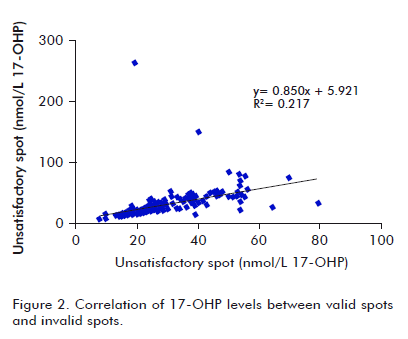
<P   align="left" ><font face="Verdana, Arial, Helvetica, sans-serif" color="#000000" size="2">A      similar evaluation was made for 17-OHP levels. Mean concentration values were      28.6 and 30.5 nmol/L for VS and IVS, respectively. The regression curve was      y = 0.850x + 5.921, for a lineal correlation coefficient of 0.217, showing      a low correlation between both sets of data (r = 0.47), as shown in <a href="#fig2">figure      2</a>. There was a low correlation concordance for 17-OHP levels to VS and      IVS (<font face="Symbol">r</font>c = 0.39). <font face="Symbol">r</font>12      and <font face="Symbol">c</font>12 were 0.46 and 0.84, respectively, supporting      the higher incidence of low sample quality on precision of values, and accuracy      to a lower extent. </font></P >       <P   align="center" ><img src="/img/revistas/bta/v27n4/f0207410.gif"><a name="fig2"></a></P >   <FONT color="#FF00FF"><FONT color="#000000"><FONT color="#FF00FF"><FONT color="#000000"><FONT color="#FF00FF"><FONT color="#000000"><FONT color="#FF00FF"><FONT color="#000000">        
<P   align="left" ><font face="Verdana, Arial, Helvetica, sans-serif" color="#000000" size="2">P      value obtained at the mean comparison study between IVS and VS was 0.84, which      corroborates that no meaningful statistical differences existed for a 95%      trustability interval. </font></P >       <P   align="left" ><font face="Verdana, Arial, Helvetica, sans-serif" color="#000000" size="2">Newborn      samples presenting stains somewhat invalid (n = 592) were simultaneously classified      as to their appearance in: IS (27%), CS (26%), RS (23%), CBS (16%) and SSS      (8%). </font></P >       ]]></body>
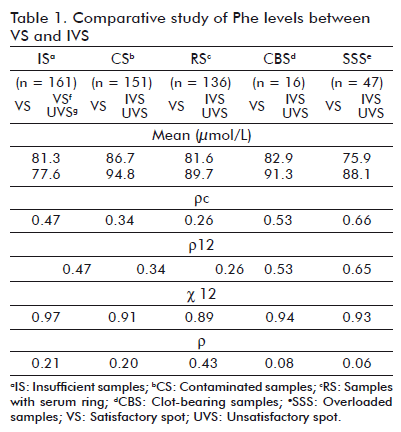
<body><![CDATA[<P   align="left" ><font face="Verdana, Arial, Helvetica, sans-serif" color="#000000" size="2">Phe      mean concentration values and 17-OHP for VS and IVS were calculated separately      in each group. Similarly was conducted for the calculation of stadigraphs      <font face="Symbol">r</font>12 and <font face="Symbol">c</font>12 and for      Pearson correlation coefficient and correlation concordance. <a href="#tab1">Tables      1</a> and <a href="#tab2">2</a> show the corresponding values for each of      the studied analytes. </font></P >       <P   align="center" ><img src="/img/revistas/bta/v27n4/t0107410.gif"><a name="tab1"></a></P >       
<P   align="center" ><img src="/img/revistas/bta/v27n4/t0207410.gif"><a name="tab2"></a></P >   <FONT color="#FF00FF"><FONT color="#000000"><FONT color="#FF00FF"><FONT color="#000000"><FONT color="#FF00FF"><FONT color="#000000">        
<P   align="left" ><font face="Verdana, Arial, Helvetica, sans-serif" color="#000000" size="2">Is      exhibited a decrease in mean concentration values for both analytes in IVS      compared to VS from the same sample; meanwhile CBS, SSS and RS showed higher      mean levels and control stains. In CS, Phe mean values increased 9% and those      of 17-OHP were similar to control stains. </font></P >       <P   align="left" ><font face="Verdana, Arial, Helvetica, sans-serif" color="#000000" size="2">Is      presence relates with the extraction and an incorrect blood drop formation      when collected in filter paper. To avoid such phenomena, an increase in venous      pressure and working with lancets with a depth less than, or equal to 2 mm      should be favored (4), the application of blood with a capillary tube or any      other device, or removing the filter paper before blood thoroughly fills up      the circle, or before it could be absorbed on the other side of the paper      should be avoided. Finally, before or after sample obtainment, touching filter      paper straight with the hands or leaving it in close contact with substances      like hand lotion, powder or any other should be impeded. </font></P >       <P   align="left" ><font face="Verdana, Arial, Helvetica, sans-serif" color="#000000" size="2">Phe      levels and 17-OHP in SSS and CBS augment as a consequence of filter paper      contact with blood drops more than once, which is conditioned by the application      of an excess of blood (probably with a device) or by adding blood to both      sides of the filter paper. Likewise, in RS an increase in both analytes&acute;      levels was observed. A splitting of serum and erythrocytes was spotted which      could relate to the presence of an excess of the disinfectant agent and precipitate      blood components affecting the homogeneous migration on filter paper, On these      cases, the area should entirely be dried before cutaneous punction, not excessively      compressing the zone surrounding the punction area and avoid the use of capillary      tubes for the application of blood and the contact of filter paper with contaminant      substances. This invalidation cause has also been associated to incorrect      sample drying procedures. Besides, in the case of CS, sample exposure to heat      should be avoided. </font></P >       <P   align="left" ><font face="Verdana, Arial, Helvetica, sans-serif" color="#000000" size="2">Discordant      results were detected among some IVS with false positive and negative values      in respect to control stains. In Cuba, a 240 <font face="Symbol">m</font>mol      Phe/L whole blood limit value is accepted for the diagnostics of phenylketonuria      at early ages. Samples presenting an equal or superior concentration are considered      as elevated. Similarly, for the diagnostic of congenital adrenal hyperplasia      a 55 nmol per L of whole blood value is recognized. In four samples, Phe concentration      values from IVS were higher than 240 <font face="Symbol">m</font>mol Phe/L,      while Phe concentration value from VS were less than the cut-off level. A      similar result was observed for 17- OHP levels in two samples. </font></P >   <FONT color="#FF00FF"><FONT color="#000000"><FONT color="#FF00FF"><FONT color="#000000">        <P   align="left" ><font face="Verdana, Arial, Helvetica, sans-serif" color="#000000" size="2">From      the methodological point of view, false positive results lead to sample re-testing      and in most of cases, sample re-collection. A high rate of false positive      values not only increases the real cost of the NS, but also promotes psychological      stress among parents of the affected children (15). Therefore, NS programs      need to control all possible sources of incorrect results. </font></P >       <P   align="left" ><font face="Verdana, Arial, Helvetica, sans-serif" color="#000000" size="2">Additionally,      in two samples, Phe levels from IVS were less than the cut-off level, while      the values in control spots were out of range. For 17-OHP levels, three samples      with similar parameters were found. </font></P >       <P   align="left" ><font face="Verdana, Arial, Helvetica, sans-serif" color="#000000" size="2">Obtaining      false negative results in laboratories avoid an early diagnostic and if treatment      at the neonatal period is not applied, clinical signals of the disease appear.      </font></P >       ]]></body>
<body><![CDATA[<P   align="left" ><font face="Verdana, Arial, Helvetica, sans-serif" color="#000000" size="2">Filter      paper samples are a valuable source of information; nevertheless their reliability      depends on the stability of analytes in the stored samples (16, 17). </font></P >       <P   align="left" ><font face="Verdana, Arial, Helvetica, sans-serif" color="#000000" size="2">Our      results confirm that assays using filter paper dried blood samples are susceptible      to be affected due to several factors (16, 17). The sample quality is one      of these factors, therefore, is essential to evaluate and guarantee adequate      procedures starting at sample collection until laboratory analyses. Other      studies have also shown the correct application of sample collection procedures      which have proved being fundamental to obtain reliable results in NS laboratories      (18-20). </font></P >       <P   align="left" ><font face="Verdana, Arial, Helvetica, sans-serif" color="#000000" size="2">Sample      collection must be properly conducted to avoid an insufficient or &quot;non-useful&quot;      sample. Quality control rules require rejecting the samples unfulfilled with      the established requirements. The sample can be rejected during the receipt      process due to unsatisfactory properties in the spots, or while carrying out      the test due to partial sample elution or no elution at all; the eluate shows      colorless or pale color depending to the denaturalization of hemoglobin and      even the blood disc shows dark color. </font></P >       <P   align="left" ><font face="Verdana, Arial, Helvetica, sans-serif" color="#000000" size="2">An      unsatisfactory sample will be rejected by the laboratory, needing a second      collection of the sample. This procedure generates discomfort to the newborn,      distress to the parents and delay of the diagnostics. That is the reason why      increasing precautions is necessary during sample drying, storage and transportation.      </font></P >       <P   align="left" ><font face="Verdana, Arial, Helvetica, sans-serif" color="#000000" size="2">U.S&acute;s      NCCLS described a methodology for collecting, drying and preserving blood      samples on filter paper (6). Among the main procedures for adequate collection      are: writing the identification of the patient without omitting information,      avoiding touching the clean circle in the filter paper before the sampling;      cleaning the heel with 70% alcohol and removing the excess of solvent with      cotton or others; using of sterile material during the procedure; removing      the first drop of blood and applying the next one on the filter paper; assuring      the blood be applied on a single side of the paper and reach the other side      (4, 6). </font></P >       <P   align="left" ><font face="Verdana, Arial, Helvetica, sans-serif" color="#000000" size="2">Once      the blood drops are collected, the filter paper cards must be placed in a      device allowing the drying, horizontally suspended to avoid contact with other      surfaces and promoting a homogeneous diffusion of the blood drop. Filter paper      cards must be dried at 20- 25 &deg;C during three hours without exposure to      sunlight and avoiding the contact with antiseptic solutions or any other materials      and stored in clean places. Cards would never be dried in microwave ovens,      stoves or by any other source of artificial energy. </font></P >   <FONT color="#FF00FF"><FONT color="#000000">        <P   align="left" ><font face="Verdana, Arial, Helvetica, sans-serif" color="#000000" size="2">The      correct drying procedure is important due to moisture may damage sample quality      and induce bacterial growth o alter the sample elution time. </font></P >       <P   align="left" ><font face="Verdana, Arial, Helvetica, sans-serif" color="#000000" size="2">Once      dried, the cards must be placed at a 180&ordm; relative position from each      other, to avoid cross-contamination among the blood spots from different samples.      They must be stored properly identified in paper envelopes. It is advisable      that samples are protected with desiccant in plastic bags during their transportation      and storage in freezers (2 - 8 &ordm;C), to avoid they could humidify in case      of freezing malfunction or by accident during transportation. </font></P >   <FONT color="#FF00FF"><FONT color="#000000"><FONT color="#FF00FF"><FONT color="#000000">        <P   align="left" ><font face="Verdana, Arial, Helvetica, sans-serif" color="#000000" size="2">Filter      paper of the ones established by the NS program must be used (17), which own      special physicalchemical properties, and support adequate absorption, retention      and homogeneity. These parameters are essential to obtain reliable results.      Unused cards must be stored at a clean place and protected free from dust      to avoid contamination. </font></P >       <P   align="left" ><font face="Verdana, Arial, Helvetica, sans-serif" color="#000000" size="2">Finally,      once dried, samples must be sent as fast as possible to the laboratories under      the recommended packing conditions. Packages must avoid heat or water exposure      and guarantee their integrity (17). </font></P >       ]]></body>
<body><![CDATA[<P   align="left" ><font face="Verdana, Arial, Helvetica, sans-serif" color="#000000" size="2">The      quality of the dried blood samples on filter paper is a key step for NS; therefore,      the normalization of procedure and the integral training of the personal are      of extreme importance to guarantee the effectiveness of the programs (16).      Knowing how the properties of the sample, their preservation, transportation      and distribution affect the analytical assay is a must to obtain reliable      results in NS laboratories (16). </font></P >       <P   align="left" ><font face="Verdana, Arial, Helvetica, sans-serif" color="#000000" size="2">Knowing      the properties of the sample, its preservation, transportation and distribution,      determines the outcome of the analytical assay, because are key elements to      obtain reliable laboratory results. </font></P >       <P   align="left" > </P >       <P   align="left" ><font face="Verdana, Arial, Helvetica, sans-serif" color="#000000" size="3"><b>REFERENCES</b></font><font face="Verdana, Arial, Helvetica, sans-serif" color="#000000" size="2">      </font></P >       <!-- ref --><P   align="left" ><font face="Verdana, Arial, Helvetica, sans-serif" size="2">1. Raimann BE, Cornejo      EV. Una primera aproximaci&oacute;n al diagn&oacute;stico y tratamiento de      errores innatos del metabolismo. En: Colombo CM, Cornejo EV, Raimann BE, eds.      Errores innatos en el metabolismo del ni&ntilde;o. 1a ed. Santiago de Chile:      Editorial Universitaria; 1999, p.45-56.</font></P >   <FONT size="+1">       <!-- ref --><P   align="left" ><font face="Verdana, Arial, Helvetica, sans-serif" color="#000000" size="2">2.      Wilcken B, Wiley V. Newborn screening. Pathology 2008; 40(2): 104-15. </font></P >       <!-- ref --><P   align="left" ><font face="Verdana, Arial, Helvetica, sans-serif" size="2">3. Waite KV, Maberly      GF, Eastman CJ. Storage conditions and stability of thyrotropin and thyroid      hormones on filter paper. Clin Chem 1967;33(6):853-5.</font></P >       <!-- ref --><P   align="left" ><font face="Verdana, Arial, Helvetica, sans-serif" color="#000000" size="2">4.      Mei JV, Alexander JR, Adam BW, Hannon WH. Use of filter paper for the collection      and analysis of human whole blood specimens. J Nutr 2001; 131: 1631S-6S. </font></P >       <P   align="left" ><font face="Verdana, Arial, Helvetica, sans-serif" size="2">5. Tor&ouml;k D,      M&uuml;hl A, Votava F, Heinze G, S&oacute;lyom J, Crone J, <i>et al</i>. Stability      of 17<font face="Symbol">a</font>-hydroxyprogesterone in dried blood spots      after autoclaving and prolonged storage. Clin Chem 2002;48(2):370-2.</font></P >       <!-- ref --><P   align="left" ><font face="Verdana, Arial, Helvetica, sans-serif" size="2">6. Hannon WH, Boyle      J, Davin B, Marsden A, McCabe ERB, Schwartz M <i>et al</i>. Blood collection      on filter paper for neonatal screening programs, 3rd ed, approved standard,      NCCLS Document A4-A3. Wayne, PA: NCCLS, 1997.</font></P >       <!-- ref --><P   align="left" ><font face="Verdana, Arial, Helvetica, sans-serif" color="#000000" size="2">7.      Kaye CL and the Committee on Genetics. Newborn screening fact sheets. Pediatrics      2006;118:934-63. </font></P >       <!-- ref --><P   align="left" ><font face="Verdana, Arial, Helvetica, sans-serif" size="2">8. Heredero L, Atencio      G, Vega JL, Guti&eacute;rrez E, Damiani A. Early diagnosis of phenylketonuria      in Cuba: preliminary report. Rev Cubana Pediatr 1986;58:27-33. </font></P >   </font></font></font></font></font></font></font></font></font></font></font></font></font></font></font></font></font></font></font></font></font></font></font></font></font></font></font></font></font></font></font></font></font></font></font></font></font></font></font></font></font></font></font></font></font></font></font></font></font></font></font></font></font></font></font></font></font></font></font></font></font></font></font></font></font></font></font></font></font></font></font></font></font></font></font></font></font></font></font></font></font></font></font></font></font></font></font></font>        <!-- ref --><p><font face="Verdana, Arial, Helvetica, sans-serif" size="2">9. Mart&iacute;nez      L, Robaina Z, Garc&iacute;a S, Guti&eacute;rrez E. The Cuban program for neonatal      screening of phenylketonuria. Twenty years of experience: the clinical and      social attention. Rev Cubana Genet Comunit 2008;2:45-51.    <br>     </font></p>   <FONT size="+1" color="#000000"><FONT size="+1"><FONT size="+1"><FONT size="+1"><FONT size="+1"><FONT size="+1"><FONT color="#0000FF"><FONT color="#000000"><FONT size="+1"><FONT size="+1"><FONT size="+1"><FONT size="+1"><FONT color="#FF00FF"><FONT color="#000000"><FONT size="+1"><FONT size="+1"><FONT color="#FF00FF"><FONT size="+1" color="#000000"><FONT size="+1"><FONT color="#FF00FF"><FONT color="#000000"><FONT color="#FF00FF"><FONT color="#000000"><FONT color="#FF00FF"><FONT color="#000000"><FONT color="#FF00FF"><FONT color="#000000"><FONT color="#FF00FF"><FONT color="#000000"><FONT color="#FF00FF"><FONT color="#000000"><FONT color="#FF00FF"><FONT color="#000000"><FONT color="#FF00FF"><FONT color="#000000"><FONT color="#FF00FF"><FONT color="#000000"><FONT color="#FF00FF"><FONT color="#000000"><FONT color="#FF00FF"><FONT color="#000000"><FONT color="#FF00FF"><FONT color="#000000"><FONT color="#FF00FF"><FONT color="#000000"><FONT color="#FF00FF"><FONT color="#000000"><FONT color="#FF00FF"><FONT color="#000000"><FONT color="#FF00FF"><FONT color="#000000"><FONT size="+1"><FONT size="+1"><FONT color="#FF00FF"><FONT color="#000000"><FONT color="#FF00FF"><FONT color="#000000"><FONT color="#FF00FF"><FONT color="#000000"><FONT color="#FF00FF"><FONT color="#000000"><FONT color="#FF00FF"><FONT color="#000000"><FONT color="#FF00FF"><FONT color="#000000"><FONT color="#FF00FF"><FONT color="#000000"><FONT color="#FF00FF"><FONT color="#000000"><FONT color="#FF00FF"><FONT color="#000000"><FONT color="#FF00FF"><FONT color="#000000"><FONT color="#FF00FF"><FONT color="#000000"><FONT color="#FF00FF"><FONT color="#000000"><FONT color="#FF00FF"><FONT color="#000000"><FONT color="#FF00FF"><FONT color="#000000"><FONT color="#FF00FF"><FONT color="#000000"><FONT color="#FF00FF"><FONT color="#000000"><FONT color="#FF00FF"><FONT color="#000000"><FONT size="+1">       <!-- ref --><P   align="left" ><font face="Verdana, Arial, Helvetica, sans-serif" color="#000000" size="2">10.      Antal Z, Zhou P. Congenital adrenal hyperplasia: Diagnosis, evaluation, and      management. Pediatr Rev 2009;30: e49-e57. </font></P >       <!-- ref --><P   align="left" ><font face="Verdana, Arial, Helvetica, sans-serif" color="#000000" size="2">11.      White PC, Speiser PW. Congenital adrenal hyperplasia due to 21-Hydroxylase      deficiency. Endocr Rev 2000; 21(3): 245-91. </font></P >       <!-- ref --><P   align="left" ><font face="Verdana, Arial, Helvetica, sans-serif" size="2">12. Gonz&aacute;lez      EC, Fr&oacute;meta A, del R&iacute;o L, Castells E, Robaina MS, Garc&iacute;a      SM, <i>et al</i>. Cuban neonatal screening of phenylketonuria using an ultramicro-fluorometric      test. Clin Chim Acta 2009;396:129-32. </font></P >   </font></font></font></font></font></font></font></font></font></font></font></font></font></font></font></font></font></font></font></font></font></font></font></font></font></font></font></font></font></font></font></font></font></font></font></font></font></font></font></font></font></font></font></font></font></font></font></font></font></font></font></font></font></font></font></font></font></font></font></font></font></font></font></font></font></font></font></font></font></font></font></font></font></font></font></font></font></font></font></font></font></font></font></font></font></font></font></font>        <p><font face="Verdana, Arial, Helvetica, sans-serif" size="2">13. Gonz&aacute;lez      EC, Marrero N, P&eacute;rez PL, Fr&oacute;meta A, Zulueta O, Herrera D <i>et      al</i>. An enzyme immunoassay for determining 17<font face="Symbol">a</font>-hydroxyprogesterone      in dried blood spots on filter paper using an ultramicroanalytical system.      Clin Chim Acta 2008; 396:63-6.    <br>     </font></p>   <FONT size="+1" color="#000000"><FONT size="+1"><FONT size="+1"><FONT size="+1"><FONT size="+1"><FONT size="+1"><FONT color="#0000FF"><FONT color="#000000"><FONT size="+1"><FONT size="+1"><FONT size="+1"><FONT size="+1"><FONT color="#FF00FF"><FONT color="#000000"><FONT size="+1"><FONT size="+1"><FONT color="#FF00FF"><FONT size="+1" color="#000000"><FONT size="+1"><FONT color="#FF00FF"><FONT color="#000000"><FONT color="#FF00FF"><FONT color="#000000"><FONT color="#FF00FF"><FONT color="#000000"><FONT color="#FF00FF"><FONT color="#000000"><FONT color="#FF00FF"><FONT color="#000000"><FONT color="#FF00FF"><FONT color="#000000"><FONT color="#FF00FF"><FONT color="#000000"><FONT color="#FF00FF"><FONT color="#000000"><FONT color="#FF00FF"><FONT color="#000000"><FONT color="#FF00FF"><FONT color="#000000"><FONT color="#FF00FF"><FONT color="#000000"><FONT color="#FF00FF"><FONT color="#000000"><FONT color="#FF00FF"><FONT color="#000000"><FONT color="#FF00FF"><FONT color="#000000"><FONT color="#FF00FF"><FONT color="#000000"><FONT color="#FF00FF"><FONT color="#000000"><FONT size="+1"><FONT size="+1"><FONT color="#FF00FF"><FONT color="#000000"><FONT color="#FF00FF"><FONT color="#000000"><FONT color="#FF00FF"><FONT color="#000000"><FONT color="#FF00FF"><FONT color="#000000"><FONT color="#FF00FF"><FONT color="#000000"><FONT color="#FF00FF"><FONT color="#000000"><FONT color="#FF00FF"><FONT color="#000000"><FONT color="#FF00FF"><FONT color="#000000"><FONT color="#FF00FF"><FONT color="#000000"><FONT color="#FF00FF"><FONT color="#000000"><FONT color="#FF00FF"><FONT color="#000000"><FONT color="#FF00FF"><FONT color="#000000"><FONT color="#FF00FF"><FONT color="#000000"><FONT color="#FF00FF"><FONT color="#000000"><FONT color="#FF00FF"><FONT color="#000000"><FONT color="#FF00FF"><FONT color="#000000"><FONT color="#FF00FF"><FONT color="#000000"><FONT size="+1">       <!-- ref --><P   align="left" ><font face="Verdana, Arial, Helvetica, sans-serif" color="#000000" size="2">14.      Lin LI. A concordance correlation coefficient to evaluate reproducibility.      Biometrics 1989;45:255-68. </font></P >       <!-- ref --><P   align="left" ><font face="Verdana, Arial, Helvetica, sans-serif" color="#000000" size="2">15.      Olgem&ouml;ller B, Roscher A, Liebl B, Fingerhut R. Screening for congenital      adrenal hyperplasia: adjustment of 17- hydroxyprogesterone cut-off values      to both age and birth weight markedly improves the predictive value. J Clin      Endocrinol Metab 2003;88(12):5790-4. </font></P >       <!-- ref --><P   align="left" ><font face="Verdana, Arial, Helvetica, sans-serif" size="2">16. Cedillo B, Estrada      RA, Jonguitud V, Parra I. Factores que afectan algunas de las pruebas del      tamiz neonatal. Med Univer 2007;9(34):3-6.</font></P >       <!-- ref --><P   align="left" ><font face="Verdana, Arial, Helvetica, sans-serif" color="#000000" size="2">17.      Fr&oacute;meta A, Marrero N, Gonz&aacute;lez E, Lugo E, Fern&aacute;ndez L,      Dom&eacute;nech M. Estudio comparativo de los tres papeles de filtro en los      ensayos UMELISA para el tamizaje neonatal de hipotiroidismo cong&eacute;nito      y fenilcetonuria. Rev Biomed 2002; 13:241-7. </font></P >       <!-- ref --><P   align="left" ><font face="Verdana, Arial, Helvetica, sans-serif" color="#000000" size="2">18.      Dezateux C. Evaluating newborn screening programmers based on dried blood      spots: future challenges. Br Med Bull 1998;54:877-90. </font></P >       <!-- ref --><P   align="left" ><font face="Verdana, Arial, Helvetica, sans-serif" color="#000000" size="2">19.      Pappaioanou M, Kashamuka M, Behets F, Mbala S, Biyela K, Davachi F, <I>et      al</I>. Accurate detection of maternal antibodies to HIV in newborn whole      blood dried on filter paper. AIDS 1993;7(4):483-8. </font></P >       <!-- ref --><P   align="left" ><font face="Verdana, Arial, Helvetica, sans-serif" color="#000000" size="2">20.      Meites S, Glassco KM. Studies on the quality of specimens obtained by skinpuncture      of children. 2. An analysis of blood collecting practices in a pediatric hospital.      Clin Chem 1985;31(10):1669-72. </font></P >       <P   align="left" ><font size="2" face="Verdana, Arial, Helvetica, sans-serif" color="#000000">Received      in April, 2010. </font><font color="#000000" size="2">    <br>     <font face="Verdana, Arial, Helvetica, sans-serif">Accepted for publication      in December, 2010. </font></font></P >   <font size="2" face="Verdana, Arial, Helvetica, sans-serif" color="#000000">Lesley    del R&iacute;o Fabre, Laboratorio de Pesquisa Neonatal, Centro de Inmunoensayo,    CI Calle 134 y Ave. 25, AP 6653, Cubanac&aacute;n, Playa, Ciudad de La Habana,    Cuba. E-mail: <a href="mailto:iqtsh7@cie.sld.cu">iqtsh7@cie.sld.cu</a></font></font></font></font></font></font></font></font></font></font></font></font></font></font></font></font></font></font></font></font></font></font></font></font></font></font></font></font></font></font></font></font></font></font></font></font></font></font></font></font></font></font></font></font></font></font></font></font></font></font></font></font></font></font></font></font></font></font></font></font></font></font></font></font></font></font></font></font></font></font></font></font></font></font></font></font></font></font></font></font></font></font></font></font></font></font></font></font></font></DIV >      ]]></body><back>
<ref-list>
<ref id="B1">
<label>1</label><nlm-citation citation-type="book">
<person-group person-group-type="author">
<name>
<surname><![CDATA[Raimann]]></surname>
<given-names><![CDATA[BE]]></given-names>
</name>
<name>
<surname><![CDATA[Cornejo]]></surname>
<given-names><![CDATA[EV]]></given-names>
</name>
</person-group>
<article-title xml:lang="es"><![CDATA[Una primera aproximación al diagnóstico y tratamiento de errores innatos del metabolismo]]></article-title>
<person-group person-group-type="editor">
<name>
<surname><![CDATA[Colombo]]></surname>
<given-names><![CDATA[CM]]></given-names>
</name>
<name>
<surname><![CDATA[Cornejo]]></surname>
<given-names><![CDATA[EV]]></given-names>
</name>
<name>
<surname><![CDATA[Raimann]]></surname>
<given-names><![CDATA[BE]]></given-names>
</name>
</person-group>
<source><![CDATA[Errores innatos en el metabolismo del niño]]></source>
<year>1999</year>
<edition>1</edition>
<page-range>45-56</page-range><publisher-loc><![CDATA[Santiago de Chile ]]></publisher-loc>
<publisher-name><![CDATA[Editorial Universitaria]]></publisher-name>
</nlm-citation>
</ref>
<ref id="B2">
<label>2</label><nlm-citation citation-type="journal">
<person-group person-group-type="author">
<name>
<surname><![CDATA[Wilcken]]></surname>
<given-names><![CDATA[B]]></given-names>
</name>
<name>
<surname><![CDATA[Wiley]]></surname>
<given-names><![CDATA[V]]></given-names>
</name>
</person-group>
<article-title xml:lang="en"><![CDATA[Newborn screening]]></article-title>
<source><![CDATA[Pathology]]></source>
<year>2008</year>
<volume>40</volume>
<numero>2</numero>
<issue>2</issue>
<page-range>104-15</page-range></nlm-citation>
</ref>
<ref id="B3">
<label>3</label><nlm-citation citation-type="journal">
<person-group person-group-type="author">
<name>
<surname><![CDATA[Waite]]></surname>
<given-names><![CDATA[KV]]></given-names>
</name>
<name>
<surname><![CDATA[Maberly]]></surname>
<given-names><![CDATA[GF]]></given-names>
</name>
<name>
<surname><![CDATA[Eastman]]></surname>
<given-names><![CDATA[CJ]]></given-names>
</name>
</person-group>
<article-title xml:lang="en"><![CDATA[Storage conditions and stability of thyrotropin and thyroid hormones on filter paper]]></article-title>
<source><![CDATA[Clin Chem]]></source>
<year>1967</year>
<volume>33</volume>
<numero>6</numero>
<issue>6</issue>
<page-range>853-5</page-range></nlm-citation>
</ref>
<ref id="B4">
<label>4</label><nlm-citation citation-type="journal">
<person-group person-group-type="author">
<name>
<surname><![CDATA[Mei]]></surname>
<given-names><![CDATA[JV]]></given-names>
</name>
<name>
<surname><![CDATA[Alexander]]></surname>
<given-names><![CDATA[JR]]></given-names>
</name>
<name>
<surname><![CDATA[Adam]]></surname>
<given-names><![CDATA[BW]]></given-names>
</name>
<name>
<surname><![CDATA[Hannon]]></surname>
<given-names><![CDATA[WH]]></given-names>
</name>
</person-group>
<article-title xml:lang="en"><![CDATA[Use of filter paper for the collection and analysis of human whole blood specimens]]></article-title>
<source><![CDATA[J Nutr]]></source>
<year>2001</year>
<volume>131</volume>
<page-range>1631S-6S</page-range></nlm-citation>
</ref>
<ref id="B5">
<label>5</label><nlm-citation citation-type="journal">
<person-group person-group-type="author">
<name>
<surname><![CDATA[Torök]]></surname>
<given-names><![CDATA[D]]></given-names>
</name>
<name>
<surname><![CDATA[Mühl]]></surname>
<given-names><![CDATA[A]]></given-names>
</name>
<name>
<surname><![CDATA[Votava]]></surname>
<given-names><![CDATA[F]]></given-names>
</name>
<name>
<surname><![CDATA[Heinze]]></surname>
<given-names><![CDATA[G]]></given-names>
</name>
<name>
<surname><![CDATA[Sólyom]]></surname>
<given-names><![CDATA[J]]></given-names>
</name>
<name>
<surname><![CDATA[Crone]]></surname>
<given-names><![CDATA[J]]></given-names>
</name>
</person-group>
<article-title xml:lang="en"><![CDATA[Stability of 17a- hydroxyprogesterone in dried blood spots after autoclaving and prolonged storage]]></article-title>
<source><![CDATA[Clin Chem]]></source>
<year>2002</year>
<volume>48</volume>
<numero>2</numero>
<issue>2</issue>
<page-range>370-2</page-range></nlm-citation>
</ref>
<ref id="B6">
<label>6</label><nlm-citation citation-type="book">
<person-group person-group-type="author">
<name>
<surname><![CDATA[Hannon]]></surname>
<given-names><![CDATA[WH]]></given-names>
</name>
<name>
<surname><![CDATA[Boyle]]></surname>
<given-names><![CDATA[J]]></given-names>
</name>
<name>
<surname><![CDATA[Davin]]></surname>
<given-names><![CDATA[B]]></given-names>
</name>
<name>
<surname><![CDATA[Marsden]]></surname>
<given-names><![CDATA[A]]></given-names>
</name>
<name>
<surname><![CDATA[McCabe]]></surname>
<given-names><![CDATA[ERB]]></given-names>
</name>
<name>
<surname><![CDATA[Schwartz]]></surname>
<given-names><![CDATA[M]]></given-names>
</name>
</person-group>
<source><![CDATA[Blood collection on filter paper for neonatal screening programs]]></source>
<year>1997</year>
<edition>3</edition>
<publisher-loc><![CDATA[Wayne ]]></publisher-loc>
<publisher-name><![CDATA[NCCLS]]></publisher-name>
</nlm-citation>
</ref>
<ref id="B7">
<label>7</label><nlm-citation citation-type="journal">
<person-group person-group-type="author">
<name>
<surname><![CDATA[Kaye]]></surname>
<given-names><![CDATA[CL]]></given-names>
</name>
</person-group>
<collab>Committee on Genetics</collab>
<article-title xml:lang="en"><![CDATA[Newborn screening fact sheets]]></article-title>
<source><![CDATA[Pediatrics]]></source>
<year>2006</year>
<volume>118</volume>
<page-range>934-63</page-range></nlm-citation>
</ref>
<ref id="B8">
<label>8</label><nlm-citation citation-type="journal">
<person-group person-group-type="author">
<name>
<surname><![CDATA[Heredero]]></surname>
<given-names><![CDATA[L]]></given-names>
</name>
<name>
<surname><![CDATA[Atencio]]></surname>
<given-names><![CDATA[G]]></given-names>
</name>
<name>
<surname><![CDATA[Vega]]></surname>
<given-names><![CDATA[JL]]></given-names>
</name>
<name>
<surname><![CDATA[Gutiérrez]]></surname>
<given-names><![CDATA[E]]></given-names>
</name>
<name>
<surname><![CDATA[Damiani]]></surname>
<given-names><![CDATA[A]]></given-names>
</name>
</person-group>
<article-title xml:lang="en"><![CDATA[Early diagnosis of phenylketonuria in Cuba: preliminary report]]></article-title>
<source><![CDATA[Rev Cubana Pediatr]]></source>
<year>1986</year>
<volume>58</volume>
<page-range>27-33</page-range></nlm-citation>
</ref>
<ref id="B9">
<label>9</label><nlm-citation citation-type="journal">
<person-group person-group-type="author">
<name>
<surname><![CDATA[Martínez]]></surname>
<given-names><![CDATA[L]]></given-names>
</name>
<name>
<surname><![CDATA[Robaina]]></surname>
<given-names><![CDATA[Z]]></given-names>
</name>
<name>
<surname><![CDATA[García]]></surname>
<given-names><![CDATA[S]]></given-names>
</name>
<name>
<surname><![CDATA[Gutiérrez]]></surname>
<given-names><![CDATA[E]]></given-names>
</name>
</person-group>
<article-title xml:lang="en"><![CDATA[The Cuban program for neonatal screening of phenylketonuria. Twenty years of experience: the clinical and social attention]]></article-title>
<source><![CDATA[Rev Cubana Genet Comunit]]></source>
<year>2008</year>
<volume>2</volume>
<page-range>45-51</page-range></nlm-citation>
</ref>
<ref id="B10">
<label>10</label><nlm-citation citation-type="journal">
<person-group person-group-type="author">
<name>
<surname><![CDATA[Antal]]></surname>
<given-names><![CDATA[Z]]></given-names>
</name>
<name>
<surname><![CDATA[Zhou]]></surname>
<given-names><![CDATA[P]]></given-names>
</name>
</person-group>
<article-title xml:lang="en"><![CDATA[Congenital adrenal hyperplasia: Diagnosis, evaluation, and management]]></article-title>
<source><![CDATA[Pediatr Rev]]></source>
<year>2009</year>
<volume>30</volume>
<page-range>e49-e57</page-range></nlm-citation>
</ref>
<ref id="B11">
<label>11</label><nlm-citation citation-type="journal">
<person-group person-group-type="author">
<name>
<surname><![CDATA[White]]></surname>
<given-names><![CDATA[PC]]></given-names>
</name>
<name>
<surname><![CDATA[Speiser]]></surname>
<given-names><![CDATA[PW]]></given-names>
</name>
</person-group>
<article-title xml:lang="en"><![CDATA[Congenital adrenal hyperplasia due to 21-Hydroxylase deficiency]]></article-title>
<source><![CDATA[Endocr Rev]]></source>
<year>2000</year>
<volume>21</volume>
<numero>3</numero>
<issue>3</issue>
<page-range>245-91</page-range></nlm-citation>
</ref>
<ref id="B12">
<label>12</label><nlm-citation citation-type="journal">
<person-group person-group-type="author">
<name>
<surname><![CDATA[González]]></surname>
<given-names><![CDATA[EC]]></given-names>
</name>
<name>
<surname><![CDATA[Frómeta]]></surname>
<given-names><![CDATA[A]]></given-names>
</name>
<name>
<surname><![CDATA[del Río]]></surname>
<given-names><![CDATA[L]]></given-names>
</name>
<name>
<surname><![CDATA[Castells]]></surname>
<given-names><![CDATA[E]]></given-names>
</name>
<name>
<surname><![CDATA[Robaina]]></surname>
<given-names><![CDATA[MS]]></given-names>
</name>
<name>
<surname><![CDATA[García]]></surname>
<given-names><![CDATA[SM]]></given-names>
</name>
</person-group>
<article-title xml:lang="en"><![CDATA[Cuban neonatal screening of phenylketonuria using an ultramicro-fluorometric test]]></article-title>
<source><![CDATA[Clin Chim Acta]]></source>
<year>2009</year>
<volume>396</volume>
<page-range>129-32</page-range></nlm-citation>
</ref>
<ref id="B13">
<label>13</label><nlm-citation citation-type="journal">
<person-group person-group-type="author">
<name>
<surname><![CDATA[González]]></surname>
<given-names><![CDATA[EC]]></given-names>
</name>
<name>
<surname><![CDATA[Marrero]]></surname>
<given-names><![CDATA[N]]></given-names>
</name>
<name>
<surname><![CDATA[Pérez]]></surname>
<given-names><![CDATA[PL]]></given-names>
</name>
<name>
<surname><![CDATA[Frómeta]]></surname>
<given-names><![CDATA[A]]></given-names>
</name>
<name>
<surname><![CDATA[Zulueta]]></surname>
<given-names><![CDATA[O]]></given-names>
</name>
<name>
<surname><![CDATA[Herrera]]></surname>
<given-names><![CDATA[D]]></given-names>
</name>
</person-group>
<article-title xml:lang="en"><![CDATA[An enzyme immunoassay for determining 17a-hydroxyprogesterone in dried blood spots on filter paper using an ultramicroanalytical system]]></article-title>
<source><![CDATA[Clin Chim Acta]]></source>
<year>2008</year>
<volume>396</volume>
<page-range>63-6</page-range></nlm-citation>
</ref>
<ref id="B14">
<label>14</label><nlm-citation citation-type="journal">
<person-group person-group-type="author">
<name>
<surname><![CDATA[Lin]]></surname>
<given-names><![CDATA[LI]]></given-names>
</name>
</person-group>
<article-title xml:lang="en"><![CDATA[A concordance correlation coefficient to evaluate reproducibility]]></article-title>
<source><![CDATA[Biometrics]]></source>
<year>1989</year>
<volume>45</volume>
<page-range>255-68</page-range></nlm-citation>
</ref>
<ref id="B15">
<label>15</label><nlm-citation citation-type="journal">
<person-group person-group-type="author">
<name>
<surname><![CDATA[Olgemöller]]></surname>
<given-names><![CDATA[B]]></given-names>
</name>
<name>
<surname><![CDATA[Roscher]]></surname>
<given-names><![CDATA[A]]></given-names>
</name>
<name>
<surname><![CDATA[Liebl]]></surname>
<given-names><![CDATA[B]]></given-names>
</name>
<name>
<surname><![CDATA[Fingerhut]]></surname>
<given-names><![CDATA[R]]></given-names>
</name>
</person-group>
<article-title xml:lang="en"><![CDATA[Screening for congenital adrenal hyperplasia: adjustment of 17- hydroxyprogesterone cut-off values to both age and birth weight markedly improves the predictive value]]></article-title>
<source><![CDATA[J Clin Endocrinol Metab]]></source>
<year>2003</year>
<volume>88</volume>
<numero>12</numero>
<issue>12</issue>
<page-range>5790-4</page-range></nlm-citation>
</ref>
<ref id="B16">
<label>16</label><nlm-citation citation-type="journal">
<person-group person-group-type="author">
<name>
<surname><![CDATA[Cedillo]]></surname>
<given-names><![CDATA[B]]></given-names>
</name>
<name>
<surname><![CDATA[Estrada]]></surname>
<given-names><![CDATA[RA]]></given-names>
</name>
<name>
<surname><![CDATA[Jonguitud]]></surname>
<given-names><![CDATA[V]]></given-names>
</name>
<name>
<surname><![CDATA[Parra]]></surname>
<given-names><![CDATA[I]]></given-names>
</name>
</person-group>
<article-title xml:lang="es"><![CDATA[Factores que afectan algunas de las pruebas del tamiz neonatal]]></article-title>
<source><![CDATA[Med Univer]]></source>
<year>2007</year>
<volume>9</volume>
<numero>34</numero>
<issue>34</issue>
<page-range>3-6</page-range></nlm-citation>
</ref>
<ref id="B17">
<label>17</label><nlm-citation citation-type="journal">
<person-group person-group-type="author">
<name>
<surname><![CDATA[Frómeta]]></surname>
<given-names><![CDATA[A]]></given-names>
</name>
<name>
<surname><![CDATA[Marrero]]></surname>
<given-names><![CDATA[N]]></given-names>
</name>
<name>
<surname><![CDATA[González]]></surname>
<given-names><![CDATA[E]]></given-names>
</name>
<name>
<surname><![CDATA[Lugo]]></surname>
<given-names><![CDATA[E]]></given-names>
</name>
<name>
<surname><![CDATA[Fernández]]></surname>
<given-names><![CDATA[L]]></given-names>
</name>
<name>
<surname><![CDATA[Doménech]]></surname>
<given-names><![CDATA[M]]></given-names>
</name>
</person-group>
<article-title xml:lang="es"><![CDATA[Estudio comparativo de los tres papeles de filtro en los ensayos UMELISA para el tamizaje neonatal de hipotiroidismo congénito y fenilcetonuria]]></article-title>
<source><![CDATA[Rev Biomed]]></source>
<year>2002</year>
<volume>13</volume>
<page-range>241-7</page-range></nlm-citation>
</ref>
<ref id="B18">
<label>18</label><nlm-citation citation-type="journal">
<person-group person-group-type="author">
<name>
<surname><![CDATA[Dezateux]]></surname>
<given-names><![CDATA[C]]></given-names>
</name>
</person-group>
<article-title xml:lang="en"><![CDATA[Evaluating newborn screening programmers based on dried blood spots: future challenges]]></article-title>
<source><![CDATA[Br Med Bull]]></source>
<year>1998</year>
<volume>54</volume>
<page-range>877-90</page-range></nlm-citation>
</ref>
<ref id="B19">
<label>19</label><nlm-citation citation-type="journal">
<person-group person-group-type="author">
<name>
<surname><![CDATA[Pappaioanou]]></surname>
<given-names><![CDATA[M]]></given-names>
</name>
<name>
<surname><![CDATA[Kashamuka]]></surname>
<given-names><![CDATA[M]]></given-names>
</name>
<name>
<surname><![CDATA[Behets]]></surname>
<given-names><![CDATA[F]]></given-names>
</name>
<name>
<surname><![CDATA[Mbala]]></surname>
<given-names><![CDATA[S]]></given-names>
</name>
<name>
<surname><![CDATA[Biyela]]></surname>
<given-names><![CDATA[K]]></given-names>
</name>
<name>
<surname><![CDATA[Davachi]]></surname>
<given-names><![CDATA[F]]></given-names>
</name>
</person-group>
<article-title xml:lang="en"><![CDATA[Accurate detection of maternal antibodies to HIV in newborn whole blood dried on filter paper]]></article-title>
<source><![CDATA[AIDS]]></source>
<year>1993</year>
<volume>7</volume>
<numero>4</numero>
<issue>4</issue>
<page-range>483-8</page-range></nlm-citation>
</ref>
<ref id="B20">
<label>20</label><nlm-citation citation-type="journal">
<person-group person-group-type="author">
<name>
<surname><![CDATA[Meites]]></surname>
<given-names><![CDATA[S]]></given-names>
</name>
<name>
<surname><![CDATA[Glassco]]></surname>
<given-names><![CDATA[KM]]></given-names>
</name>
</person-group>
<article-title xml:lang="en"><![CDATA[Studies on the quality of specimens obtained by skinpuncture of children: 2. An analysis of blood collecting practices in a pediatric hospital]]></article-title>
<source><![CDATA[Clin Chem]]></source>
<year>1985</year>
<volume>31</volume>
<numero>10</numero>
<issue>10</issue>
<page-range>1669-72</page-range></nlm-citation>
</ref>
</ref-list>
</back>
</article>