<?xml version="1.0" encoding="ISO-8859-1"?><article xmlns:mml="http://www.w3.org/1998/Math/MathML" xmlns:xlink="http://www.w3.org/1999/xlink" xmlns:xsi="http://www.w3.org/2001/XMLSchema-instance">
<front>
<journal-meta>
<journal-id>1027-2852</journal-id>
<journal-title><![CDATA[Biotecnología Aplicada]]></journal-title>
<abbrev-journal-title><![CDATA[Biotecnol Apl]]></abbrev-journal-title>
<issn>1027-2852</issn>
<publisher>
<publisher-name><![CDATA[Editorial Elfos Scientiae]]></publisher-name>
</publisher>
</journal-meta>
<article-meta>
<article-id>S1027-28522011000200002</article-id>
<title-group>
<article-title xml:lang="en"><![CDATA[Bioremediation: a tool for the management of oil pollution in marine ecosystems]]></article-title>
<article-title xml:lang="es"><![CDATA[Biorremediación: una herramienta para el saneamiento de ecosistemas marinos contaminados con petróleo]]></article-title>
</title-group>
<contrib-group>
<contrib contrib-type="author">
<name>
<surname><![CDATA[Barrios San Martín]]></surname>
<given-names><![CDATA[Yaima]]></given-names>
</name>
<xref ref-type="aff" rid="A01"/>
</contrib>
</contrib-group>
<aff id="A01">
<institution><![CDATA[,Centro de Investigación del Petróleo CEINPET Laboratorio de Química y Biotecnología ]]></institution>
<addr-line><![CDATA[La Habana ]]></addr-line>
<country>Cuba</country>
</aff>
<pub-date pub-type="pub">
<day>00</day>
<month>06</month>
<year>2011</year>
</pub-date>
<pub-date pub-type="epub">
<day>00</day>
<month>06</month>
<year>2011</year>
</pub-date>
<volume>28</volume>
<numero>2</numero>
<fpage>69</fpage>
<lpage>76</lpage>
<copyright-statement/>
<copyright-year/>
<self-uri xlink:href="http://scielo.sld.cu/scielo.php?script=sci_arttext&amp;pid=S1027-28522011000200002&amp;lng=en&amp;nrm=iso"></self-uri><self-uri xlink:href="http://scielo.sld.cu/scielo.php?script=sci_abstract&amp;pid=S1027-28522011000200002&amp;lng=en&amp;nrm=iso"></self-uri><self-uri xlink:href="http://scielo.sld.cu/scielo.php?script=sci_pdf&amp;pid=S1027-28522011000200002&amp;lng=en&amp;nrm=iso"></self-uri><abstract abstract-type="short" xml:lang="en"><p><![CDATA[During the last decades the course of the anthropogenic contamination of marine ecosystems has paralleled that of the oil industry. Spills of crude oil and its derivatives can have short, medium and long-term negative consequences, and the elimination of pollutants by natural means may take years or even longer. Bioremediation is an emergent branch of environmental biotechnology that is often used to accelerate this process and guarantees the reparation of damaged ecosystems, based on harnessing the metabolic capabilities of bacteria, fungi, yeast, algae and microbial mats to degrade oil hydrocarbons. Bioremediation follows two main strategies: the stimulation of indigenous microbial populations, known as biostimulation, and bioaugmentation, the introduction of viable microbial populations. Choosing one or another depends on the analysis of abiotic and biotic factors influencing the biodegradation process; the former refers to factors related with the pollutant and environmental conditions, while the latter encompasses all factors that have to do with microbial populations. The development of bioremediation has led to the appearance of commercially available products for spill cleanup: fertilizers containing biostimulating nutrients, bioproducts based on microorganisms, and chemical products to stimulate the growth of the microbial populations involved in the process of biodegradation.]]></p></abstract>
<abstract abstract-type="short" xml:lang="es"><p><![CDATA[En las últimas décadas, paralela al desarrollo de la industria petrolera, ha aumentado la contaminación en los ecosistemas marinos. El vertimiento de petróleo crudo y sus derivados provocan efectos negativos a corto, mediano y largo plazo. La eliminación natural de los contaminantes puede tardar años, e incluso no ocurrir. Para acelerar este proceso y garantizar la reparación del ecosistema dañado, se emplean técnicas de biorremediación. Esta variante emergente de la biotecnología ambiental, se basa en el empleo de la actividad metabólica microbiana (bacterias, hongos, levaduras, algas y tapetes microbianos) para degradar los hidrocarburos del petróleo. Su aplicación tiene dos propósitos esenciales: la bioestimulación de la población autóctona viable, y la bioaumentación (introducción de poblaciones microbianas viables). Su selección requiere el análisis de factores abióticos y bióticos, que influyen en el proceso de biodegradación. Los primeros incluyen los relacionados con el contaminante y las condiciones medioambientales; y los bióticos, lo referente a la población microbiana. En el desarrollo de esta tecnología, se han formulado varios productos comercializables para la limpieza de desastres: fertilizantes construidos por nutrientes con funciones bioestimuladoras; bioproductos conformados por microorganismos; y productos químicos con la función de aumentar o estimular la población microbiana que interviene en el proceso de biodegradación.]]></p></abstract>
<kwd-group>
<kwd lng="en"><![CDATA[bioremediation]]></kwd>
<kwd lng="en"><![CDATA[marine ecosystem]]></kwd>
<kwd lng="en"><![CDATA[biodegradation of hydrocarbons]]></kwd>
<kwd lng="en"><![CDATA[bioproducts]]></kwd>
<kwd lng="es"><![CDATA[biorremediación]]></kwd>
<kwd lng="es"><![CDATA[ecosistemas marinos]]></kwd>
<kwd lng="es"><![CDATA[biodegradación de hidrocarburos]]></kwd>
<kwd lng="es"><![CDATA[bioproductos]]></kwd>
</kwd-group>
</article-meta>
</front><body><![CDATA[ <DIV class="Sect"   >        <P   align="left" > </P >       <P   align="right" ><font face="Verdana, Arial, Helvetica, sans-serif" size="2"><b>REVIEW</b></font></P >       <P   align="right" >&nbsp;</P >       <P   align="left" ><font size="2" color="#000000" face="Verdana, Arial, Helvetica, sans-serif"><b><font size="4">Bioremediation:      a tool for the management of oil pollution in marine ecosystems</font></b></font></P >       <P   align="left" >&nbsp;</P >       <P   align="left" > </P >       <P   align="left" ><font size="2" color="#000000" face="Verdana, Arial, Helvetica, sans-serif"><b><font size="3">Biorremediaci&oacute;n:      una herramienta para el saneamiento de ecosistemas marinos contaminados con      petr&oacute;leo</font></b></font></P >       <P   align="left" >&nbsp;</P >       <P   align="left" >&nbsp;</P >       ]]></body>
<body><![CDATA[<P   align="left" ><font size="2" color="#000000" face="Verdana, Arial, Helvetica, sans-serif"><b>Yaima      Barrios San Mart&iacute;n</b></font></P >       <P   align="left" ><font size="2" color="#000000" face="Verdana, Arial, Helvetica, sans-serif">Laboratorio      de Qu&iacute;mica y Biotecnolog&iacute;a, Centro de Investigaci&oacute;n del      Petr&oacute;leo CEINPET, Washington #63, esq. Churruca, Cerro, CP 12 600,      La Habana, Cuba</font>.</P >       <P   align="left" >&nbsp;</P >   <hr>   <font size="2" color="#000000" face="Verdana, Arial, Helvetica, sans-serif"><B>ABSTRACT</b></font>     <p><font face="Verdana, Arial, Helvetica, sans-serif" size="2"><font color="#000000">During      the last decades the course of the anthropogenic contamination of marine ecosystems      has paralleled that of the oil industry. Spills of crude oil and its derivatives      can have short, medium and long-term negative consequences, and the elimination      of pollutants by natural means may take years or even longer. Bioremediation      is an emergent branch of environmental biotechnology that is often used to      accelerate this process and guarantees the reparation of damaged ecosystems,      based on harnessing the metabolic capabilities of bacteria, fungi, yeast,      algae and microbial mats to degrade oil hydrocarbons. Bioremediation follows      two main strategies: the stimulation of indigenous microbial populations,      known as biostimulation, and bioaugmentation, the introduction of viable microbial      populations. Choosing one or another depends on the analysis of abiotic and      biotic factors influencing the biodegradation process; the former refers to      factors related with the pollutant and environmental conditions, while the      latter encompasses all factors that have to do with microbial populations.      The development of bioremediation has led to the appearance of commercially      available products for spill cleanup: fertilizers containing biostimulating      nutrients, bioproducts based on microorganisms, and chemical products to stimulate      the growth of the microbial populations involved in the process of biodegradation.      </font></font> </p>       <P   align="left" ><font face="Verdana, Arial, Helvetica, sans-serif" size="2"><font color="#000000"><b>Keywords</b>:      bioremediation, marine ecosystem, biodegradation of hydrocarbons, bioproducts.</font></font></P >   <hr>   <font face="Verdana, Arial, Helvetica, sans-serif" size="2"><b><font color="#000000">RESUMEN</font></b></font>        <p> <FONT size="+1" color="#000000"><FONT size="+1"><font face="Verdana, Arial, Helvetica, sans-serif" size="2">En      las &uacute;ltimas d&eacute;cadas, paralela al desarrollo de la industria      petrolera, ha aumentado la contaminaci&oacute;n en los ecosistemas marinos.      El vertimiento de petr&oacute;leo crudo y sus derivados provocan efectos negativos      a corto, mediano y largo plazo. La eliminaci&oacute;n natural de los contaminantes      puede tardar a&ntilde;os, e incluso no ocurrir. Para acelerar este proceso      y garantizar la reparaci&oacute;n del ecosistema da&ntilde;ado, se emplean      t&eacute;cnicas de biorremediaci&oacute;n. Esta variante emergente de la biotecnolog&iacute;a      ambiental, se basa en el empleo de la actividad metab&oacute;lica microbiana      (bacterias, hongos, levaduras, algas y tapetes microbianos) para degradar      los hidrocarburos del petr&oacute;leo. Su aplicaci&oacute;n tiene dos prop&oacute;sitos      esenciales: la bioestimulaci&oacute;n de la poblaci&oacute;n aut&oacute;ctona      viable, y la bioaumentaci&oacute;n (introducci&oacute;n de poblaciones microbianas      viables). Su selecci&oacute;n requiere el an&aacute;lisis de factores abi&oacute;ticos      y bi&oacute;ticos, que influyen en el proceso de biodegradaci&oacute;n. Los      primeros incluyen los relacionados con el contaminante y las condiciones medioambientales;      y los bi&oacute;ticos, lo referente a la poblaci&oacute;n microbiana. En el      desarrollo de esta tecnolog&iacute;a, se han formulado varios productos comercializables      para la limpieza de desastres: fertilizantes construidos por nutrientes con      funciones bioestimuladoras; bioproductos conformados por microorganismos;      y productos qu&iacute;micos con la funci&oacute;n de aumentar o estimular      la poblaci&oacute;n microbiana que interviene en el proceso de biodegradaci&oacute;n.      </font> </font></font></p>   <FONT size="+1" color="#000000"><FONT size="+1">       <P   align="justify" ><font face="Verdana, Arial, Helvetica, sans-serif" size="2"><b>Palabras clave</b>:      biorremediaci&oacute;n, ecosistemas marinos, biodegradaci&oacute;n de hidrocarburos,      bioproductos.</font></P >   </font></font>    <hr>   <FONT size="+1" color="#000000"><FONT size="+1">       <P   align="justify" >&nbsp;</P >       <P   align="justify" >&nbsp;</P >       <P   align="justify" ><font size="2" face="Verdana, Arial, Helvetica, sans-serif"><B><font size="3">INTRODUCTION</font>      </b></font></P >   <FONT size="+1">        ]]></body>
<body><![CDATA[<P   align="justify" ><font face="Verdana, Arial, Helvetica, sans-serif" color="#000000" size="2">Maritime      transportation currently moves close to two billion tons of crude oil. Not      surprisingly, accidental large-scale oil spills have become a major source      of marine pollution. Most of the responsibility for oil spills falls on large      oil tankers (22% of the total); although spills from other vessels and offshore      drilling rigs and platforms also account for a significant portion. It is      estimated that one out of every million tons of oil transported in ships ends      up in the ocean; of those, only 10% are due to maritime accidents. The atmosphere,      natural leaks, rivers, urban runoff water, coastal oil refineries and operative      discharges from oil tankers also constitute sources of hydrocarbon pollutants,      including the spills into the Persian Gulf during the Persian Gulf War of      1991, which dumped as much as 460 000 tons of oil on the sea (1). Operative      discharges are caused by oil tankers washing their tanks while offshore, or      by contaminated water pumped out of ballast tanks. </font></P >   <FONT size="+1">        <P   align="justify" ><font face="Verdana, Arial, Helvetica, sans-serif" color="#000000" size="2">The      oil slicks produced by accidental spills take a considerable economic toll,      as they interrupt fishing and navigation and, importantly, damage severely      the ecosystem by killing birds, fish and sea mammals, among others. The slick      caused in 1989 by the collision of the <I>Exxon Valdez</I> with Bligh Reef      and the consequent spill of 40 to 50 thousand tons of oil into Prince William      Sound was considered, until 2010, as the largest ecological catastrophe of      its type. Part of the strategy followed in the aftermath of the disaster was      the use of an oleophilic fertilizer (Inipol EAP22) to stimulate the biodegradation      of crude oil, with the result that only two weeks later a considerable portion      of the oil coating the shoreline had been removed. Another large oil slick      was caused by the spillage of 227 thousand tons of oil when tanker <I>Amoco      C&aacute;diz</I> ran aground on the French coast in 1978. Approximately 63      thousand tons of oil were again spilled into the Mediterranean, coating 1900      km of Spanish and French shorelines, when the tanker <I>Prestige </I>sunk      in what is still considered one of the largest ecological disasters caused      by oil spills; the largest ornithological tragedy of the European Atlantic      was caused by more than 37 thousand tons of heavy fuel spilled by tanker <I>Erika      </I>on the Breton coast (1). Bioremediation and the application of bioproducts      were among the alternatives considered for the management of the consequences      from all these accidents. </font></P >   <FONT color="#FF00FF"><FONT color="#000000"><FONT color="#FF00FF"><FONT color="#000000"><FONT color="#FF00FF"><FONT color="#000000"><FONT color="#FF00FF"><FONT color="#000000">        <P   align="justify" ><font face="Verdana, Arial, Helvetica, sans-serif" color="#000000" size="2">The      largest ecological disaster caused by oil spills, however, began when the      <I>Deepwater Horizon </I>drilling rig exploded and sunk in April 2010, uncontrollably      pouring oil for more than 60 days into the Gulf of Mexico. According to Richard      Harris (2), almost 300 thousand tons of crude had been spilled by May 15,      2010, posing a severe threat to hundreds of marine species and birds. Once      the well is sealed and mechanical cleanup concludes, the application of a      bioproduct named Oilzapper, produced by The Energy and Resources Institute      (TERI) from India, consisting on a consortium of 5 bacterial strains capable      of degrading saturated and aromatic hydrocarbons, nitrogenated and sulfur      benzene compounds and tar, seems to be a good choice from an ecological point      of view. </font></P >   <FONT color="#FF00FF"><FONT color="#000000">        <P   align="justify" ><font face="Verdana, Arial, Helvetica, sans-serif" color="#000000" size="2">The      geographic characteristics of the continental shelf of the island of Cuba      (narrow and elongated) make it highly vulnerable to water pollution accidents.      Fortunately, only 5 oil-related accidents have had a measurable impact on      marine ecosystems during the last 20 years: three from accidental oil pipeline      leaks (Jibacoa beach in 2001, Arroyo Blanco cove in 2002 and Bacunayagua cove      in 2008), one in the bay of Matanzas (1998) after the collision of the vessels      <I>Sharadar</I> and <I>Bravo,</I> and another in the bay of Cienfuegos (1992)      when tanker <I>Aida </I>ruptured its hull against a rock. </font></P >   <FONT color="#FF00FF"><FONT color="#000000"><FONT color="#FF00FF"><FONT color="#000000"><FONT color="#FF00FF"><FONT color="#000000">        <P   align="justify" ><font face="Verdana, Arial, Helvetica, sans-serif" color="#000000" size="2">Accidental      oil spills can have short, medium and long term negative consequences. Oil      may undergo natural dispersal and degradation during the course of several      years. Research, however, has shown that oil elimination by natural means      is a slow process, implying that the recovery of affected ecosystems takes      a long time (3). Recent studies in Alaska (4), where the <I>Exxon Valdez </I>spill      took place, have measured annual hydrocarbon concentrations of 62258 mg/g      (wet weight) in sedimentary samples from the area. Additional proof for the      persistence of these pollutants has come from the study of oil concentration      profiles in sediment cores, during the course of research on historical anthropogenic      discharges (5). This persistence has to be considered when evaluating the      success of recent measures for the control of hydrocarbon pollution, and has      triggered the development of several strategies to ameliorate the effects      of oil spills and accelerate the recovery of damaged ecosystems. The present      review examines the concepts of bioremediation as a tool of environmental      biotechnology and its different branches, analyzing the factors that contribute      to the biodegradation of oil in marine ecosystems and listing hydrocarbon-degrading      microorganisms together with different bioproducts for the bioremediation      of this ecosystem. </font></P >   <FONT color="#FF00FF"><FONT color="#000000">        <P   align="left" ><font size="2" face="Verdana, Arial, Helvetica, sans-serif" color="#000000"><B><font size="3">ENVIRONMENTAL      BIOTECHNOLOGY: BIOREMEDIATION </font></b></font></P >   <FONT size="+1">        <P   align="justify" ><font face="Verdana, Arial, Helvetica, sans-serif" color="#000000" size="2">Environmental      biotechnology first appeared between the 19<sup>th</sup> and 20<sup>th</sup>      century, prompted by the need to treat urban wastewaters. It was extended,      during the second half of the 20<sup>th</sup> century, to soil remediation,      the purification of gases, cleansing of surface and underground water bodies,      purification of industrial wastewater, treatment of waste in sanitary landfills      and the composting of bio-organic residuals (6). </font></P >   <FONT size="+1"><FONT size="+1" color="#FF0000"><FONT size="+1" color="#000000"><FONT size="+1" color="#FF0000"><FONT size="+1" color="#000000"><FONT size="+1" color="#FF0000"><FONT size="+1" color="#000000">        <P   align="justify" ><font face="Verdana, Arial, Helvetica, sans-serif" color="#000000" size="2">Environmental      biotechnology employs modern biological processes to protect and restore the      quality of the environment. It appeared as an attempt to solve many of today&rsquo;s      environmental problems, as it can be used to evaluate the status of different      ecosystems, transform pollutants into harmless compounds, generate biodegradable      material from renewable resources and develop environmentally sound manufacturing      and waste management processes (7). This applied scientific discipline encompasses      an application aimed at dealing with pollution that is based on the use of      microorganisms to generate fuels and genetically modified plants to absorb      toxic compounds. </font></P >       <P   align="justify" ><font face="Verdana, Arial, Helvetica, sans-serif" color="#000000" size="2">A      growing number of industrial companies are currently pursuing the development      of preventive biotechnological processes to reduce their environmental footprint      in the current context of international efforts towards a sustainable society.      Environmental biotechnology is, doubtless, a welcome aid to manufacture new      products with a smaller impact on the ecosystem (7). </font></P >       <P   align="justify" ><font face="Verdana, Arial, Helvetica, sans-serif" color="#000000" size="2">Bioremediation,      currently regarded as an emergent technology, has become the main application      of environmental biotechnology. The term denotes any treatment based on the      use of biological systems for the restoration or sanitation of soils, underground      waters and atmospheric air contaminated with xenobiotics. It may be defined      as a technology for the bio-restoration of natural environments previously      polluted with xenobiotics through the elimination, attenuation or transformation      of such compounds (8, 9), taking advantage of the metabolic capabilities of      microorganisms (bacteria, fungi, yeast and algae) (8, 10) and some plants,      together with nutrients and oxygen, to accelerate natural processes of biodegradation.      Bioremediation may partially transform the pollutant into a less hazardous      form, or may achieve its mineralization, totally degrading it into carbon      dioxide aerobically or water and methane under anaerobiosis. It is important      to note that bioremediation is restricted to biodegradable pollutants (8).      </font></P >       ]]></body>
<body><![CDATA[<P   align="justify" ><font face="Verdana, Arial, Helvetica, sans-serif" color="#000000" size="2">The      first patent for a biological agent to be used in remediation processes was      granted in 1974, protecting an oil-degrading strain of <I>Pseudomonas putida</I>      (11). By 1991 there were already more than 70 oil-degrading microbial genera      in literature; a figure that almost doubled in the two successive decades.      These microorganisms belong to at least 11 different prokaryotic divisions      (12). </font></P >   <FONT color="#FF00FF"><FONT color="#000000">        <P   align="justify" ><font face="Verdana, Arial, Helvetica, sans-serif" color="#000000" size="2">Interest      for the use of microorganisms in aquatic ecosystems contaminated with oil      pollutants is reflected in recent publications and patents dealing with the      study and development of processes for the biodegradation of contaminants.      Biological decontamination must be applicable under field conditions; it must      respect the natural environment in which it takes place and must be economically      competitive. These requirements are met by the microorganisms typically found      in polluted areas, which naturally degrade xenobiotics. They can be grown      using low-cost substrates (13) and inocula containing them can be manufactured      through conventional industrial techniques, turning them into ideal candidates      for application in bioremediation processes. </font></P >       <P   align="justify" ><font face="Verdana, Arial, Helvetica, sans-serif" color="#000000" size="2">Microorganisms      (mainly bacteria and fungi) can degrade a vast array of structurally dissimilar      environmental pollutants. Recalcitrant contaminants, such as the polychlorinated      biphenyls produced by oil refineries, polycyclic aromatic hydrocarbons, resins      and asphaltenes as well as complex mixtures containing them (14), can be mineralized      into carbon dioxide by several ligninolytic fungi and bacteria. </font></P >       <P   align="justify" ><font face="Verdana, Arial, Helvetica, sans-serif" color="#000000" size="2">According      to the need to transport or not the contaminated matrix, bioremediation techniques      can be classified as <I>in situ </I>or <I>ex situ</I> (15). <I>In situ </I>techniques      allow for the on-site treatment of contaminated soil and waters without further      transformation. <I>Ex situ </I>techniques, as the name implies, require excavating      and then transporting contaminated soils or, in the case of contaminated water      bodies, pumping-treating-discharging or transferring into reactors. </font></P >   <FONT color="#FF00FF"><FONT color="#000000"><FONT color="#FF00FF"><FONT color="#000000"><FONT color="#FF00FF"><FONT color="#000000"><FONT color="#FF00FF"><FONT color="#000000">        <P   align="justify" ><font face="Verdana, Arial, Helvetica, sans-serif" color="#000000" size="2">Selecting      a specific technique depends on three basic factors: the biochemistry of the      degradation, <I>i.e., </I>the possibility of biologically degrading the pollutant;      the bioavailability of the pollutant, meaning how accessible the toxic compound      is to the microorganism; and third, bioactivity, the opportunity to optimize      the biological activity (15). </font></P >   <FONT color="#FF00FF"><FONT color="#000000">        <P   align="justify" ><font face="Verdana, Arial, Helvetica, sans-serif" color="#000000" size="2">The      bioremediation of aquifers is performed by a pumping-treating-recharging scheme,      consisting of extracting ground water, biodegrading the pollutants in reactors      installed on the surface and then pumping the treated water back. Another      alternative is the injection of nutrients and bacteria, establishing a recirculation      that converts the aquifer itself into a bioreactor (16). </font></P >       <P   align="justify" ><font face="Verdana, Arial, Helvetica, sans-serif" color="#000000" size="2">The      versatility of bioremediation lies on its ability to be tailored to the needs      of each site. Bioremediation is classified into biostimulation (the addition      of nutrients to facilitate the metabolic activity of the indigenous degrading      microbiota); bioaugmentation (the addition of exogenous degrading microorganisms      when the native microbiota is insufficient or overwhelmed) (9); and bioaugmentation      with genetically modified microorganism, a practice almost exclusive to developed      countries so far. Recombinant DNA techniques can also be harnessed to obtain      products that can potentiate specific degradation pathways for bioremediation      purposes; an alternative that is very efficient, but expensive. </font></P >       <P   align="justify" ><font face="Verdana, Arial, Helvetica, sans-serif" color="#000000" size="2">Bioremediation,      as every technological process, has advantages and disadvantages. Low cost      (especially compared to the alternatives) is one of its assets. Although an      accurate comparison is difficult due to variations from site to site, bioremediation      is, in general terms, at least ten times less costly than incineration, and      three times cheaper than some physico-chemical immobilization technologies.      Factors such as its low energy consumption, the low price of the nutrients      and its operation under environmental conditions combine together to turn      bioremediation into a very attractive proposition for developing countries      (15). Bioremediation, in addition, is a clean technology that transforms pollutants      into harmless compounds such as carbon dioxide. </font></P >       <P   align="justify" ><font face="Verdana, Arial, Helvetica, sans-serif" color="#000000" size="2">By      definition, however, bioremediation is circumscribed to biodegradable compounds,      and cannot therefore be used in certain cases. It is useless, for example,      for the management of radioactive contamination, fails with highly halogenated      organic compounds, and is inhibited in the presence of heavy metals or by      unfavorable microenvironmental conditions. Every microorganism presents a      different tolerance profile, and there can also be cases of inhibition of      microbial activity at high concentrations of organic pollutants (16). </font></P >       <P   align="left" ><font size="2" face="Verdana, Arial, Helvetica, sans-serif" color="#000000"><B><font size="3">BIODEGRADATION      OF HYDROCARBONS</font> </b></font></P >   <FONT size="+1">        ]]></body>
<body><![CDATA[<P   align="justify" ><font face="Verdana, Arial, Helvetica, sans-serif" color="#000000" size="2">Oil      biodegradation is a natural process (17-19) that takes months or years, according      to prevailing conditions (20), the molecular complexity of oil components      and the volume of the pollutant. Biodegradation depends on abiotic, or physico-chemical      factors, comprising those related to the structure of the pollutant (chemical      structure, concentration and bioavailability) and environmental conditions      (oxygen and nutrient availability, pH, temperature, pressure, salinity, presence      of heavy metals); as well as biotic factors, dependent on the specific microorganism      (microbial population: concentration and interactions). </font></P >   <FONT size="+1">        <P   align="left" ><font face="Verdana, Arial, Helvetica, sans-serif" color="#000000" size="2"><B>Physico-chemical      processes </b></font></P >       <P   align="justify" ><font face="Verdana, Arial, Helvetica, sans-serif" color="#000000" size="2">When      crude oil or distilled oil products are dumped into the marine environment,      they undergo immediate physical and chemical changes. Some of the abiotic      processes that take place in this situation are evaporation, dissolution,      dispersal, photochemical oxidation, oil-water emulsification, adsorption to      suspended particulate matter, sinking and sedimentation. These processes take      place concurrently, altering the chemical composition and physical properties      of the original pollutant and, therefore, significantly influencing the efficacy      of biodegradation. Evaporation is generally the most important process during      the first 48 hours after a spill, volatilizing low- and medium-molecular weight      compounds into the atmosphere. It is estimated that one to two thirds of a      spill are thus eliminated during this period (one third of the spill from      <I>Amoco C&aacute;diz </I>evaporated during the first 3 days, for instance),      although evaporation rate decreases with time. Evaporation depends on oil      composition, surface area, the physical properties of the slick, wind speed,      temperature of both air and water, waves and the intensity of solar radiation.      The remaining material is enriched in metals (mainly nickel and vanadium),      waxes and asphaltenes rather than the original oil. Specific weight and viscosity      also increase with evaporation. From the perspective of mass loss, dissolution      into the water column is much less important than evaporation, as the dissolution      of a significant portion of the spill into this medium is highly unlikely.      Its importance stems, instead, from the fact that some water-soluble fractions      (light aromatic compounds) are toxic to marine organisms (including the degrading      microorganisms), and their impact on the marine environment thus goes beyond      considerations of mass balance (21). </font></P >   <FONT color="#FF00FF"><FONT color="#000000">        <P   align="left" ><font face="Verdana, Arial, Helvetica, sans-serif" color="#000000" size="2"><B>Characteristics      of contaminating hydrocarbons </b></font></P >       <P   align="justify" ><font face="Verdana, Arial, Helvetica, sans-serif" color="#000000" size="2">The      characteristics of the pollutant are one of the main factors to consider when      choosing a course of action for decontamination. Hydrocarbons are composed      of hydrophobic, poorly water soluble compounds where the number of carbons      in aliphatic chains or the presence of conjugations, in the case of aromatic      molecules, are inversely correlated with solubility in water; substitutions      with polar groups (alcohols, acids, etc.), on the other hand, tend to have      the opposite effect (22). Solubility is an important property from the perspective      of bioremediation, as it affects the bioavailability of hydrocarbons. Bioavailability      may also be limited by physical or chemical barriers obstructing the passage      of the molecule into the cell to undergo metabolic degradation (23), and viscosity      also hampers the pollutant-nutrient-bacterium-electron acceptor interaction      (24). The presence of toxic components or microbial growth inhibitors is obviously      an additional factor to take into account, while volatility seems to have      no effect on biodegradation. </font></P >       <P   align="left" ><font face="Verdana, Arial, Helvetica, sans-serif" color="#000000" size="2"><B>Carbon      source </b></font></P >       <P   align="justify" ><font face="Verdana, Arial, Helvetica, sans-serif" color="#000000" size="2">Different      bioremediation microorganisms show varying specificities for different oil      components. If the binding site of the degrading enzyme is obstructed (due      <I>e.g. </I>to isoprenoids or molecules substituted with bulky groups such      as COOH, or CH<sub>3</sub>), the reaction will not take place, and biodegradation      will slow down or stop altogether (25). In general, hydrocarbon biodegradation      follows a structural hierarchy, whereby saturated molecules are the easiest      to degrade, followed by aromatic hydrocarbons (26-28) and these in turn by      resins and asphaltenes (26, 28). N-alkanes are most prone to oxidation (27,      29), followed by iso-alkanes, although highly branched structures with quaternary      carbons are seldom degraded. Olefins are less frequently employed as carbon      sources than their corresponding alkanes, followed by aromatic hydrocarbons      which, if their molecular weight is small enough, can be metabolized when      present at low concentrations. Cycloalkanes are highly toxic, and are used      as substrates only under exceptional circumstances (29). Paraffins are easily      degradable. Isomers, cyclic and long-chain hydrocarbons degrade slowly, and      therefore require a specific microbiota. Polycyclic aromatic hydrocarbons      can also be used as carbon source by different microorganism species (27,      30). </font></P >   <FONT color="#FF00FF"><FONT color="#000000"><FONT size="+1" color="#3163FF"><FONT size="+1" color="#000000">        <P   align="justify" ><font face="Verdana, Arial, Helvetica, sans-serif" color="#000000" size="2">High      hydrocarbon concentrations may inhibit microbial activity through a mechanism      called carbon source toxicity (23, 31, 32). There are field reports of effective      biodegradation at pollutant concentrations as high as 30%, although the process      usually slows down dramatically beyond this point (25). The specific composition      of xenobiotic compounds changes with time due to the action of environmental      agents, microbial agents and physico-chemical processes; as a result, the      pollutant gets enriched in heavy compounds which are harder to degrade, producing      a decrease in biodegradation rate as the pollutant ages (23, 32-34) </font></P >       <P   align="left" ><font face="Verdana, Arial, Helvetica, sans-serif" color="#000000" size="2"><B>Nutrient      availability and microorganism growth </b></font></P >       <P   align="justify" ><font face="Verdana, Arial, Helvetica, sans-serif" color="#000000" size="2">Whenever      oil spills into an environment poor in inorganic nutrients, the resulting      skewed carbon/nitrogen and/or carbon/phosphorous ratios are unfavorable for      microbial growth (3). Nitrogen is important for the synthesis of aminoacids      and enzymes. Natural sources of nitrogen for microorganisms include ammonia,      nitrate, nitrites and organic nitrogenated compounds, in addition to the amino      groups in organic detritus (35). Almost all microorganisms are able to use      ammonia as a nitrogen source, as it can be directly shunted into metabolic      pathways (36); however, even if reduced nitrogen groups (ammonia-like) are      preferable from the standpoint of energy balance, oxidized forms (nitrate-like)      do play an important part in the degradation of organic compounds despite      being unable to substitute for oxygen during respiration. There is, in addition,      ample evidence from the field of hydrocarbon-based production of unicellular      protein that demonstrates the fundamental role played by the oxygen of nitrogenated      compounds in the process of biodegradation, as hydrocarbons often create a      highly reducing and hydrophobic environment that may be highly refractory      to oxygen transfer (37). </font></P >       ]]></body>
<body><![CDATA[<P   align="justify" ><font face="Verdana, Arial, Helvetica, sans-serif" color="#000000" size="2">Accordingly,      and despite the abundance of ammoniacal supplements in bioremediation studies,      the convenience of oxidized nitrogen sources cannot be ignored. Even when      using biostimulation on the indigenous microbiota, it is better to favor species      that thrive on oxidized nitrogen sources, as they will have an edge in conditions      under which oxygen transfer may be severely restricted (37). </font></P >       <P   align="justify" ><font face="Verdana, Arial, Helvetica, sans-serif" color="#000000" size="2">Phosphorous      is also needed for the formation of cellular enzymatic compounds used in the      processes of synthesis and degradation. The most common sources of phosphorous      in bacterial sources are K<sub>2</sub>HPO<sub>4</sub>, KH<sub>2</sub>PO<sub>4</sub>,      NaH<sub>2</sub>PO<sub>4</sub>, Na<sub>2</sub>HPO<sub>4</sub> or mixtures thereof      (38). </font></P >   <FONT size="+1" color="#3163FF"><FONT size="+1" color="#000000"><FONT size="+1" color="#3163FF"><FONT size="+1" color="#000000"><FONT size="+1" color="#3163FF"><FONT size="+1" color="#000000"><FONT size="+1" color="#3163FF"><FONT size="+1" color="#000000"><FONT size="+1" color="#3163FF"><FONT size="+1" color="#000000"><FONT size="+1" color="#3163FF"><FONT size="+1" color="#000000"><FONT size="+1" color="#3163FF"><FONT size="+1" color="#000000"><FONT size="+1" color="#3163FF"><FONT size="+1" color="#000000">        <P   align="justify" ><font face="Verdana, Arial, Helvetica, sans-serif" color="#000000" size="2">In      general, it is considered that the addition of nitrogen and phosphorous has      a positive outcome, increasing microbial populations and pollutant degradation      rates (23). The concentrations of nitrogen and phosphorous directly depend      on carbon concentration, with a C:N:P ratio of 100:10:1 (31, 39). </font></P >       <P   align="justify" ><font face="Verdana, Arial, Helvetica, sans-serif" color="#000000" size="2">Brid&eacute;      and Bos (40) demonstrated how, in specific circumstances, phosphorous may      exert a larger influence than nitrogen even though the latter is always required      in larger absolute amounts. Additionally, although it is sometimes assumed      that nitrogen requirements may be partially met by the nitrogen compounds      of crude oil, it is well known that many microorganisms are slow to utilize      many of these organic sources of nitrogen, and those present in oil slicks      usually fall into the latter case (37). It must not be forgotten that research      into the nutritional demands of microorganisms is often performed with natural      substrates, where phosphorous may be the limiting nutrient; therefore, the      conclusions from this type of studies, while true under laboratory conditions,      are rarely categorical. </font></P >       <P   align="left" ><font face="Verdana, Arial, Helvetica, sans-serif" color="#000000" size="2"><B>pH      </b></font></P >       <P   align="justify" ><font face="Verdana, Arial, Helvetica, sans-serif" color="#000000" size="2">Hydrocarbon      mineralization is favored at near-neutral pH (3). There is a pH optimum for      each microorganism, also near neutrality in most occasions (41). Any change      in pH will have an effect into the biodegradative activity of microbial populations,      as well as on the solubilization and absorption/desorption of ions and pollutants.      Cations, such as NH<sup>4+</sup>, Mg<sup>2+</sup>, Ca<sup>2+</sup>, are more      soluble at acid pH, whereas anionic forms (NO<sup>3-</sup>, NO<sup>2-</sup>,      PO<sub>4</sub><sup>3-</sup>, Cl<sup>-</sup>) are better solubilized at alkaline      pH (23, 25). Optimum pH for most bacteria is between 6 and 8, between 4 and      6 for yeast, and between 3 and 7 for filamentous fungi. </font></P >   <FONT size="+1" color="#FF0000"><FONT size="+1" color="#000000"><FONT size="+1" color="#FF0000"><FONT size="+1" color="#000000"><FONT size="+1" color="#FF0000"><FONT size="+1" color="#000000"><FONT size="+1" color="#FF0000"><FONT size="+1" color="#000000"><FONT size="+1" color="#FF0000"><FONT size="+1" color="#000000"><FONT size="+1" color="#3163FF"><FONT color="#FF0000"><FONT size="+1" color="#000000"><FONT size="+1" color="#FF0000"><FONT size="+1" color="#000000">        <P   align="left" ><font face="Verdana, Arial, Helvetica, sans-serif" color="#000000" size="2"><B>Temperature      </b></font></P >       <P   align="justify" ><font face="Verdana, Arial, Helvetica, sans-serif" color="#000000" size="2">Temperature      is an important determinant for biodegradation, as each microorganism has      an optimal temperature range. Microbial activity slows down at low temperatures      due to decreases in the rate of nutrient and waste transport through the membrane      (42), with a threshold for the presence of detectable degradation around 0      &deg;C (43). However, there are microorganisms adapted to cold temperatures      that can degrade hydrocarbons (41, 43-47) and on the other extreme, even though      microbial activity decreases above 40 &deg;C due to enzyme denaturation (48),      some of the thermophile microorganisms found in semiarid shorelines have shown      potential for this application (3, 49). Temperature also affects the viscosity      and solubility of hydrocarbons, influencing the volatilization of low molecular      weight compounds. For the purposes of biodegradation, temperatures may range      from 15 to 45 &deg;C (coinciding with the optimal temperature range for mesophile      microorganisms) (50); however, the optimum is at 30-40 &deg;C. Clearly, daily      or seasonal variations make it difficult to stay within this optimum, although      the technology to minimize their effect is available (51). In any case, bioremediation      efforts are more effective during spring and summer, and the number of bioremediation      projects in low-temperature sites is scarce compared with those targeting      mesophilic ecosystems (52). </font></P >       <P   align="left" ><font face="Verdana, Arial, Helvetica, sans-serif" color="#000000" size="2"><B>Electron      acceptors. Oxygen availability </b></font></P >       <P   align="justify" ><font face="Verdana, Arial, Helvetica, sans-serif" color="#000000" size="2">The      redox reactions of the respiratory chain constitute the biochemical foundation      of bioremediation (53). The electron acceptors most commonly employed by microorganisms      are oxygen (aerobic degradation), nitrate, ferric iron, sulphate and carbon      dioxide (anaerobic degradation). </font></P >       ]]></body>
<body><![CDATA[<P   align="justify" ><font face="Verdana, Arial, Helvetica, sans-serif" color="#000000" size="2">In      aerobic degradation, oxidation most commonly takes place through oxygenases      or intermediates that easily enter the Krebs cycle, such as catechol, protocatechuate      and gentisate (aromatic rings) or fatty acids in the case of linear chains.      Anaerobic degradation on the other hand is a three-stage process that starts      with substrate activation (carboxylations, anaerobic hydroxylations or formation      of thioesters of the corresponding aromatic acid with acetyl-CoA), followed      by an enzymatic attack (through reductases) on the activated intermediaries      and the conversion of non-cyclical compounds (by opening the ring) into central      metabolites (23). </font></P >       <P   align="justify" ><font face="Verdana, Arial, Helvetica, sans-serif" color="#000000" size="2">The      efficiency of aerobic biodegradation depends, to a large extent, on oxygen      solubility. The starting steps of the catabolism of aliphatic, cyclical and      aromatic hydrocarbons by bacteria and fungi require the oxygenation of the      substrate with oxygenases consuming molecular oxygen. Stoichiometrically,      approximately 3 pounds of oxygen are required to convert 1 pound of hydrocarbons      into carbon dioxide and water. This explains why first approximations to estimate      oxygen consumption typically use a 3:1 ratio. Oxygen is seldom limiting in      the surface of the water or in superficial layers of water bodies, and marine      ecosystems become anoxic only at large depths. Yet, oxygen availability generally      is a limiting factor for hydrocarbon biodegradation (54, 55), due to the much      lower efficiency of anaerobic degradation (55, 56). Anaerobic degradation      is so slow that it has long been considered ecologically irrelevant, although      recent research has evidenced that it is important for catabolic biodegradation      pathways (3, 57, 58). </font></P >       <P   align="left" ><font face="Verdana, Arial, Helvetica, sans-serif" color="#000000" size="2"><B>Pressure      </b></font></P >       <P   align="justify" ><font face="Verdana, Arial, Helvetica, sans-serif" color="#000000" size="2">If      the pollutant is denser than seawater, it will sink to the sea floor where      it will be subjected to large hydrostatic pressures. The high pressure/low      temperature combination of deep oceanic environments is not favorable for      microbial activity, as illustrated by the fact that a biodegrading microbial      consortium isolated from the bottom of the sea was tenfold more active at      surface than under deep ocean conditions (3). </font></P >       <P   align="left" ><font face="Verdana, Arial, Helvetica, sans-serif" color="#000000" size="2"><B>Salinity      </b></font></P >       <P   align="justify" ><font face="Verdana, Arial, Helvetica, sans-serif" color="#000000" size="2">The      rate of hydrocarbon degradation is inversely proportional to salinity. Biodegradation      studies at sodium chloride concentrations above 2.4% (w/v) have revealed that      this inhibition is more pronounced for aromatic and polar than for saturated      fractions (59, 60). Regardless, there are microorganisms that can oxidize      hydrocarbons at salt concentrations as high as 30% (w/v) sodium chloride (3).      </font></P >       <P   align="left" ><font face="Verdana, Arial, Helvetica, sans-serif" color="#000000" size="2"><B>Heavy      metals </b></font></P >       <P   align="justify" ><font face="Verdana, Arial, Helvetica, sans-serif" color="#000000" size="2">High      concentrations of heavy metals are inhibitory to microbial populations, perturbing      metabolism and cell division, denaturing proteins and promoting cell membrane      damage. Microorganisms, however, may develop resistance or tolerance to high      levels of heavy metals (9). Removing heavy metals from contaminated ecosystems      is a difficult task, as these pollutants are generally not amenable to biological      degradation. Zinc, copper, nickel and chromium are essential metals or micronutrients      required by microorganisms, plants and animals (60), whereas cadmium, mercury      and lead have no known biological or physiological roles (61). </font></P >       <P   align="left" ><font face="Verdana, Arial, Helvetica, sans-serif" size="2"><B>Microbial population:      interactions and concentration </b></font></P >       <P   align="justify" ><font face="Verdana, Arial, Helvetica, sans-serif" size="2">The most important      factor determining the outcome of biodegradation is the composition of the      microbial population itself, which must be adapted for the utilization of      the pollutant and be endowed with an enzyme repertoire fitting the required      degradation steps (23, 34, 62). As oil is composed of a wide range of dissimilar      chemical compounds, no microorganism can single-handedly degrade all of its      fractions, and oil biodegradation in nature is performed instead by mixed      populations known as microbial consortia. The biodegradative power of consortia      is understandably wider, as their enzyme repertoire is larger and, therefore,      better adapted to degrading complex hydrocarbon mixtures (32, 62). In addition,      the division of labor established inside a microbial consortium, where one      species performs the initial oxidation steps of a compound while another finishes      the process is demonstrably more efficient than the action of pure cultures      (24, 29). The species initiating the process of degradation are known as primary      consumers, whereas those degrading intermediate products to completion are      denominated secondary consumers. Secondary consumers may also facilitate the      growth of primary consumers by secreting metabolic products (growth factors),      eliminating toxic compounds by co-metabolism and exchanging genetic material      (23, 63, 64). A microbial community adapts to the utilization of a specific      contaminant by three different mechanisms: the induction or repression of      specific enzymes, genetic changes resulting in the appearance of new metabolic      capabilities, and the selective enrichment of a specific sub-population with      the ability to transform the target compound (23). </font></P >       ]]></body>
<body><![CDATA[<P   align="justify" ><font face="Verdana, Arial, Helvetica, sans-serif" size="2">Determining the optimal      microbial concentration to maximize the rate of degradation depends, therefore,      on the type of contaminating hydrocarbon and the specific degradation rate      of the microorganism (24). </font></P >       <P   align="left" ><font size="2" face="Verdana, Arial, Helvetica, sans-serif"><B><font size="3">COMPETENT      MICROORGANISMS</font> </b></font></P >   <FONT size="+1">        <P   align="justify" ><font face="Verdana, Arial, Helvetica, sans-serif" size="2">There is a large      number of microorganisms scattered throughout different ecological niches      that utilize hydrocarbons as their sole carbon source. They, however, are      found only at low concentration in non-contaminated areas, where their populations      increase only in response to chronic pollution (65). Of all living organisms      used in bioremediation technology, aerobic heterotrophic bacteria constitute      the best-studied group, since anaerobic microorganisms are generally less      flexible about the nature of the substrate and much more sensitive to the      presence of heavy metals and, therefore, play a smaller role in biodegradation      (51). Bacteria constitute the most important group from a taxonomic standpoint,      not only due to the extensive number of existing biodegrading species and      genera, but to their metabolic versatility. There is a large number of bacterial      species that can use xenobiotic compounds as carbon sources in pure cultures      (66). </font></P >   <FONT size="+1">        <P   align="justify" ><font face="Verdana, Arial, Helvetica, sans-serif" size="2">Starting with the      pioneering studies of ZoBell in marine environments (67), numerous bacterial      strains capable of degrading different hydrocarbons have been isolated from      coastal and oceanic ecosystems (20, 57, 68, 69). Many of these, such as <I>Alcalinivorax</I>      or <I>Planococcus</I>, use a limited number of carbon sources, preferably      oil hydrocarbons; being generally considered as specialists (70-74). Much      less specialized bacteria have been also isolated, however, as exemplified      by <I>Marinobacter</I>, <I>Staphylococcus</I>, <I>Micrococcus</I>, <I>Sphingomonas      </I>or <I>Geobacillus </I>(75-78).<FONT color="#FF00FF"><FONT color="#000000"><FONT color="#FF00FF"><FONT color="#000000"><FONT color="#FF00FF"><FONT color="#000000"><FONT color="#FF00FF"><FONT color="#000000"><FONT color="#FF00FF"><FONT color="#000000"><FONT color="#FF00FF"><FONT color="#000000"><FONT color="#FF00FF"><FONT color="#000000">      <a href="#tab1">Table 1</a> lists microorganisms reported to be able to degrade      different oil hydrocarbons.</font></font></font></font></font></font></font></font></font></font></font></font></font></font></font></P >       <P   align="center" ><font face="Verdana, Arial, Helvetica, sans-serif" size="2"><a name="tab1"></a><img src="/img/revistas/bta/v28n2/t0101211.gif"></font></P >   <FONT color="#FF00FF"><FONT color="#000000"><FONT color="#FF00FF"><FONT color="#000000"><FONT color="#FF00FF"><FONT color="#000000"><FONT color="#FF00FF"><FONT color="#000000"><FONT color="#FF00FF"><FONT color="#000000"><FONT color="#FF00FF"><FONT color="#000000"><FONT color="#FF00FF"><FONT color="#000000">        
<P   align="justify" ><font face="Verdana, Arial, Helvetica, sans-serif" size="2">Metabolic capabilities      are not the only criteria for selecting bioremediating species, however. It      is also recommended to select indigenous species from the polluted areas when      undertaking marine bioremediation projects, as these are much more resistant      to the washing action of tides on coastal surfaces (57). </font></P >       <P   align="justify" ><font face="Verdana, Arial, Helvetica, sans-serif" size="2">The available literature      on bacterial species goes back to 1946, and far outnumbers that on bioremediating      fungi (79). While this may be taken to imply that direct hydrocarbon assimilation      is not frequent in the latter, a number of reports have demonstrated that      fungi can also utilize hydrocarbons as their sole carbon and energy source      (79, 80). </font></P >       <P   align="left" ><font face="Verdana, Arial, Helvetica, sans-serif" size="2"><B>Stratified benthonic      systems </b></font></P >       <P   align="justify" ><font face="Verdana, Arial, Helvetica, sans-serif" size="2">Microbial mats are      natural ecosystems where microorganisms belonging to different physiological      groups cluster together in a mat a few millimeters thick. Mats constitute      complex microbial communities stratified by depth, due to the abrupt gradients      of light, oxygen, hydrogen sulfide and redox potential they generate, combined      with the metabolic capacities of the microorganisms themselves. These layers      can be macroscopically observed as differently colored strata, each having      a particular taxonomic composition (81-83); the most superficial layers are      usually composed of oxygenic phototrophic cyanobacterial populations and eukaryotic      algae, with heterotrophic bacteria consuming organic matter and oxygen. The      layers underneath are most frequently formed by anaerobic phototrophic and      heterotrophic organisms, if conditions are adequate (3). </font></P >       <P   align="justify" ><font face="Verdana, Arial, Helvetica, sans-serif" size="2">The physical structure      of these communities allows them to withstand the perturbations represented      by oil spills. A number of studies have demonstrated that microbial mats appear      and thrive not only in non-contaminated marine environments, but in chronically      polluted environments as well. </font></P >       ]]></body>
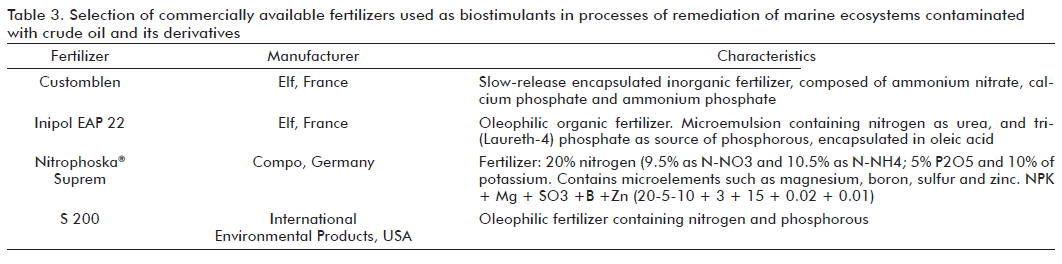
<body><![CDATA[<P   align="justify" ><font face="Verdana, Arial, Helvetica, sans-serif" size="2">Microbial mats were      first identified as a potential tool for the bioremediation of shorelines      with the 1991 Gulf War, when these structures covered, in a surprisingly short      time, extensive coastal areas contaminated by oil spills, after which the      hydrocarbons were degraded in a few months both aerobically and anaerobically.      Different reports have described the degradation of hydrocarbons by cyanobacteria      (84), and it has been demonstrated that the mats of coastal areas can degrade      oil, although the species responsible for metabolizing oil compounds have      not been identified (85, 86). Undoubtedly, cyanobacteria play a fundamental      role in the physiology of mats, as they are responsible for the formation      of oxygen gradients and the synthesis of the organic matter consumed by heterotrophic      bacteria. It is still unclear, however, whether the degradation of hydrocarbons      in mats is mediated by cyanobacteria or by heterotrophic species. As noted      above, cyanobacteria can oxidize hydrocarbons, as demonstrated by Al-Hasan      <I>et al</I>. (87) for n-alkanes with non-axenic cultures of <I>Microcoleus      chthonoplastes </I>and <I>Phormidium corium, </I>isolated from polluted sediments      in the Gulf of Arabia. Studies with <I>Oscillatoria </I>sp. and <I>Agmenellum      quadruplicatum </I>demonstrated that these strains could oxidize naphthalene      (88, 89), and many other reports demonstrate the capacities of other strains      for the degradation of diverse oil components (84, 90-92). However, most of      the studies performed with cyanobacteria forget to mention whether the cultures      were axenic, and some research suggests that the heterotrophic bacteria associated      to cyanobacteria are indeed responsible for the biodegradation (3). According      to the latter authors, cyanobacteria by themselves would not be responsible      for directly oxidizing oil components, but would indirectly play an essential      role by supporting the growth and activity of degrading microorganisms (93).      </font></P >   <FONT color="#FF00FF"><FONT color="#000000"><FONT color="#FF00FF"><FONT color="#000000"><FONT color="#FF00FF"><FONT color="#000000"><FONT color="#FF00FF"><FONT color="#000000"><FONT color="#FF00FF"><FONT color="#000000">        <P   align="left" ><font size="2" face="Verdana, Arial, Helvetica, sans-serif" color="#000000"><B><font size="3">BIOPRODUCTS      AND FERTILIZERS</font> </b></font></P >   <FONT size="+1">        <P   align="justify" ><font face="Verdana, Arial, Helvetica, sans-serif" color="#000000" size="2">A      number of bioproducts and fertilizers of varying origin and composition have      been developed for the bioremediation of marine ecosystems. Fertilizers, containing      microbial nutrients (nitrogen and phosphorous, essentially) are employed for      the bio-stimulation of the indigenous microbiota; their use is recommended      only after confirming that local microorganisms possess the necessary enzymes      to degrade the pollutant. Bioproducts, on the other hand, are composed of      microorganisms and nutrients, and are employed in ecosystems where the endogenous      microbiota cannot degrade all hydrocarbons and, therefore, may need a bio-reinforcement.      Nutrients are seldom omitted from bioproducts, as the latter must stimulate      the growth of both the indigenous microbiota and the introduced microbial      population; some bioproducts, in addition, are formulated with a microbial      bio-surfactant to decrease the surface tension of the water-oil interface      and increase the bioavailability of the pollutant. These products have capabilities      for bio-augmentation and/or bio-stimulation. <a href="/img/revistas/bta/v28n2/t0201211.gif">Tables      2</a> and <a href="/img/revistas/bta/v28n2/t0301211.gif">3</a> contain      a selection of bioproducts and fertilizers of varied origin and composition.      </font></P >   <FONT size="+1">        
<P   align="justify" ><font face="Verdana, Arial, Helvetica, sans-serif" color="#000000" size="2">The      application of these products does not introduce additional contaminations,      as the microorganisms consume them completely (including the contaminating      carbon source) and die later. </font></P >       <P   align="justify" ><font face="Verdana, Arial, Helvetica, sans-serif" color="#000000" size="2">The      formulation of bioproducts has been pioneered in Cuba by a group from the      Institute for Oceanology from CITMA which, starting in October 2004, branched      out into the Center for Marine Bioproducts (CEBIMAR). In 1994 they patented      a product denominated BIOIL (94) (<a href="/img/revistas/bta/v28n2/t0201211.gif">table      2</a>). BIOIL was first used in 1992 in the bay of Cienfuegos, achieving an      oil removal rate of 80%. The product was later applied to a spill in the bay      of Matanzas in 1998, where it exhibited an efficacy of 92% (35), and in 2001      and 2002 was used for spills in Jibacoa beach (North of Mayabeque province)      and Arroyo Blanco cove (Holgu&iacute;n) respectively, with an efficacy of      99% (95). BIOIL-FC was used in 2008 at the Bacunayagua cove (North coast,      at the Mayabeque-Matanzas border) for a 98% efficacy. </font></P >       
<P   align="left" ><font size="2" face="Verdana, Arial, Helvetica, sans-serif" color="#000000"><B><font size="3">CONCLUSIONS</font>      </b></font></P >   <FONT size="+1">        <P   align="justify" ><font face="Verdana, Arial, Helvetica, sans-serif" color="#000000" size="2">No      technique for the removal of oil from marine ecosystems is 100% effective.      Bioremediation, to be feasible, is best preceded by physical removal methods.      With the exception of few scenarios, this technology makes the remediation      of contaminated ecosystems possible. Favoring <I>in situ </I>over <I>ex situ      </I>processes is advantageous from both ecological and economical points of      view, as the latter requires transferring contaminated matter to the treatment      site. </font></P >   <FONT size="+1"><FONT color="#FF00FF"><FONT color="#000000"><FONT color="#FF00FF"><FONT color="#000000">        <P   align="justify" ><font face="Verdana, Arial, Helvetica, sans-serif" color="#000000" size="2">The      biodegradation of contaminants depends on abiotic factors, including those      related to the pollutant (solubility, viscosity, toxicity, volatility and      bioavailability) and environmental conditions (pH, temperature, salinity,      pressure, presence of heavy metals, oxygen and nutrient availability), as      well as biotic factors, which comprise those related to the microorganism      (microbial population: concentration and interactions). Although all these      factors must be analyzed and taken into account for a bioremediation process,      special attention must be devoted to the availability of nitrogen and phosphorous      as well as the enzymatic composition of the microbial population. </font></P >       <P   align="justify" ><font face="Verdana, Arial, Helvetica, sans-serif" color="#000000" size="2">More      than 100 genera and twice as many species from 11 different prokaryotic divisions      have been reported to degrade hydrocarbons, demonstrating the versatility      and genetic/enzymatic variability of microorganisms. The use of microbial      mats for bioremediation has yet to be exploited to its full potential, a situation      arising, in part, from the complexity of their microbial populations. </font></P >       <P   align="left" ><font face="Verdana, Arial, Helvetica, sans-serif" color="#000000" size="2">The      commercial availability of more than fifty bioproducts and fertilizers produced      by companies and research institutions from around the world signals the existence      of an attractive and effective alternative for dealing with the negative effects      produced by oil spills on marine and coastal ecosystems. Bioremediation, despite      its advantages, cannot be used indiscriminately, requiring previous analyses      of ecological and economic feasibility that must take into account the conditions      of the damaged ecosystem in order to best select between bioaugmentation,      biostimulation, or both.</font><font face="Verdana, Arial, Helvetica, sans-serif" size="2">      </font></P >   <FONT size="+1"><FONT size="+1">        ]]></body>
<body><![CDATA[<P   align="left" > </P >       <P   align="left" ><font face="Verdana, Arial, Helvetica, sans-serif" size="3"><b>REFERENCES</b></font></P >       <P   align="left" > </P >       <!-- ref --><P   align="left" ><font size="2" face="Verdana, Arial, Helvetica, sans-serif">1. Borr&aacute;s      G. Mareas Negras: cat&aacute;strofes y accidentes (cited 2010 july 17). Available      from: <A href="http://www.cetmar.org/documentacion/mareas_negras_catastrofes.htm">      <FONT color="#0000FF">http://www.cetmar.org/documentacion/mareas_negras_catastrofes.htm</font></A>      </font></P >   <FONT size="+1"><FONT color="#0000FF"><FONT color="#0000DD"><FONT color="#000000">        <!-- ref --><P   align="left" ><font face="Verdana, Arial, Helvetica, sans-serif" size="2">2. Harris R. Gulf      spill may far exceed official estimates. National Public Radio. 2010 May 14.      Available from <A href="http://www.npr.org/templates/story/story.php?storyId=126809525">      <FONT color="#0000FF">http://www.npr.org/templates/story/story.php?storyId=126809525</font></A>      </font></P >   <FONT color="#0000FF"><FONT color="#0000DD"><FONT color="#000000">        <!-- ref --><P   align="left" ><font face="Verdana, Arial, Helvetica, sans-serif" size="2">3. Mart&iacute;nez-Alonso      M, Gaju N. El papel de los tapetes microbianos en la biorrecuperaci&oacute;n      de zonas litorales sometidas a la contaminaci&oacute;n por vertidos de petr&oacute;leo.      Ecosistemas. 2005;14(2):79-91.     </font></P >       <!-- ref --><P   align="left" ><font face="Verdana, Arial, Helvetica, sans-serif" size="2">4. Carls MG, Rice      SD, Hose JE. Sensitivity of fish embryos to weathered crude oil: Part I. Low-level      exposure during incubation causes malformations, genetic damage, and mortality      in larval pacific herring (Clupea pallasi). Environ Toxicol Chem. 2001;18:481-93.          </font></P >       <!-- ref --><P   align="left" ><font face="Verdana, Arial, Helvetica, sans-serif" size="2">5. Santschi PH, Presley      BJ, Wade TL, Garcia-Romero B, Baskaran M. Historical contamination of PAHs,      PCBs, DDTs, and heavy metals in Mississippi River Delta, Galveston Bay and      Tampa Bay sediment cores. Mar Environ Res. 2001;52(1):51-79.     </font></P >       <P   align="left" ><font face="Verdana, Arial, Helvetica, sans-serif" size="2">6. Hartmann L. Historical      development of wastewater treatment processes. In: J Winter, editor. Biotechnology-Environmental      processes I. Weinheim:Wiley-VCH; 1999. </font></P >       <P   align="left" ><font face="Verdana, Arial, Helvetica, sans-serif" size="2">7. Zylstraa GJ, Kukor      JJ. What is environmental biotechnology? Curr Opin Biotech 2005;16(3):243-5.      </font></P >       <P   align="left" ><font face="Verdana, Arial, Helvetica, sans-serif" size="2">8. Maier R. Microorganims      and organic pollutants. In: Maier R, Pepper IL and CP Gerba, editors. Environmental      Microbiology. San Diego, CA: Academic Press; 2000. p. 363-400. </font></P >       <!-- ref --><P   align="left" ><font face="Verdana, Arial, Helvetica, sans-serif" size="2">9. Prasad KS, Kumar      NS, Sharma S. Bioremediation: Developments, current practices and perspectives.      Genet Eng Biotechnol J. 2010:1-20.     </font></P >       <!-- ref --><P   align="left" ><font face="Verdana, Arial, Helvetica, sans-serif" size="2">10. Strong PJ, Burgess      JE. Treatment methods for wine-related ad distillery wastewaters: a review.      Bioremediat J. 2008;12:70-87.     </font></P >       <P   align="left" ><font face="Verdana, Arial, Helvetica, sans-serif" size="2">11. Prescott LM,      Harley JP, Klein DA. Microbiology. Fundamentals of applied microbiology 2002;2:1012-4.      </font></P >       <P   align="left" ><font face="Verdana, Arial, Helvetica, sans-serif" size="2">12. Glazer AN, Nikaido      H. Microbial biotechnology: Fundamentals of applied microbiology 2007;8:510-28.      </font></P >       ]]></body>
<body><![CDATA[<!-- ref --><P   align="left" ><font face="Verdana, Arial, Helvetica, sans-serif" size="2">13. Rodr&iacute;guez      S, Fern&aacute;ndez M, Berm&uacute;dez RC, Morris H. Tratamiento de efluentes      industriales coloreados con Pleurotus sp. Rev Iberoamer Micol. 2003;20(4):164-8.          </font></P >       <P   align="left" ><font face="Verdana, Arial, Helvetica, sans-serif" size="2">14. Field JA, E Jong,      G Feijoo-Costa, de Bont JAM. Screening for ligninolytic fungi applicable to      the biodegradation of xenobiotics. Trends Biotechnol. 1993;11:44-9. </font></P >       <!-- ref --><P   align="left" ><font face="Verdana, Arial, Helvetica, sans-serif" size="2">15. Dua M, Singh      A, Sethunathan N, Johri AK. Biotechnology and bioremediation: successes and      limitations. Appl Microbiol Biotechnol. 2002;59(2-3):143-52.     </font></P >       <P   align="left" ><font face="Verdana, Arial, Helvetica, sans-serif" size="2">16. Saval S. La biorremediaci&oacute;n      como alternativa para la limpieza de suelos y acu&iacute;feros. Ing Cienc      Ambient. 1998;34:6-9. </font></P >       <!-- ref --><P   align="left" ><font face="Verdana, Arial, Helvetica, sans-serif" size="2">17. Santiesteban,      A. Qu&eacute; es el petr&oacute;leo. La Habana: Instituto del Libro; 1969.          </font></P >       <!-- ref --><P   align="left" ><font face="Verdana, Arial, Helvetica, sans-serif" size="2">18. Atlas RM, Bartha      R. Stimulated biodegradation of oil slicks using oleophilic fertilizers. Environ      Sci Technol. 1973;7: 538-41.     </font></P >       ]]></body>
<body><![CDATA[<!-- ref --><P   align="left" ><font face="Verdana, Arial, Helvetica, sans-serif" size="2">19. Blackburn JW,      Hafker WR. The impact of biochemistry, bioavailability and bioactivity on      the selection of bioremediation techniques. Trends Biotechnol. 1993; 11:328-33.          </font></P >       <!-- ref --><P   align="left" ><font face="Verdana, Arial, Helvetica, sans-serif" size="2">20. Atlas RM. Microbial      degradation of petroleum hydrocarbons: an environmental perspective. Microbial      Rev. 1981; 45:180-209.     </font></P >       <!-- ref --><P   align="left" ><font face="Verdana, Arial, Helvetica, sans-serif" size="2">21. Otremba Z, Toczek      H. Degradation of crude oil film on the surface of seawater: the role of luminous,      biological and aquatorial factors. Polish J Environ Stud. 2002; 11(5):555-9.          </font></P >       <!-- ref --><P   align="left" ><font face="Verdana, Arial, Helvetica, sans-serif" size="2">22. Proskuriakoz      VA, Drabkin AE. Qu&iacute;mica del petr&oacute;leo y del gas. Mosc&uacute;:      Mir; 1984.     </font></P >       <!-- ref --><P   align="left" ><font face="Verdana, Arial, Helvetica, sans-serif" size="2">23. N&aacute;poles      J, &Aacute;valos A. Biorremediaci&oacute;n de ecosistemas contaminados con      xenobi&oacute;ticos (Internet). Monografias de la Universidad de Oriente,      2008 (cited 13 Jun 2010). Available from: <A href="http://monografias.uo.edu.cu/index.php/monografias/article/view/4/6">      <FONT color="#0000FF">http://monografias.uo.edu.cu/index.php/monografias/article/view/4/6</font></A>      </font></P >   <FONT color="#0000FF"><FONT color="#0000DD">        <P   align="left" ><font color="#000000" face="Verdana, Arial, Helvetica, sans-serif" size="2">24.      Gruiz K, Kriston E. In situ bioremediation of hydrocarbon in soil. J Soil      Contam. 1995;4:163-73. </font></P >   <FONT color="#000000">        ]]></body>
<body><![CDATA[<P   align="left" ><font face="Verdana, Arial, Helvetica, sans-serif" size="2">25. Ercoli G, G&aacute;lvez      J, Di Paola P, Cantero J, Videla S, Medaura M, <I>et al</I>. An&aacute;lisis      y evaluaci&oacute;n de par&aacute;metros cr&iacute;ticos en la biodegradaci&oacute;n      de hidrocarburos en suelo. Apuntes. Estudio realizado en laboratorio de Bioprocesos,      Facultad de Ingenier&iacute;a. Universidad Nacional de Cuyo, Mendoza, Argentina.      </font></P >       <!-- ref --><P   align="left" ><font face="Verdana, Arial, Helvetica, sans-serif" size="2">26. Song HG, Wang      X, Bartha R. Bioremediation potential of terrestrial fuel spill. Appl Environ      Microbiol. 1990;56:652-6.     </font></P >       <!-- ref --><P   align="left" ><font face="Verdana, Arial, Helvetica, sans-serif" size="2">27. Whyte LG, Bourboni&eacute;re      L, Greer CW. Biodegradation of petroleum hydrocarbons by psychrotrophic Pseudomonas      strains possessing both alkane (alk) and naphthalene (nah) catabolic pathways.      Appl Environ Microbiol. 1997;63:3719-23.     </font></P >       <P   align="left" ><font face="Verdana, Arial, Helvetica, sans-serif" size="2">28. Le&oacute;n N,      Infante C, Arias M, Marquez M, Gorr&iacute;n A. Biodegradability of Venezuela      crude oils. SPE International conference on health, safety, and environment      in oil and gas exploration and production, 1998 June 7-10, Caracas, Venezuela.      </font></P >       <P   align="left" ><font face="Verdana, Arial, Helvetica, sans-serif" size="2">29. Joseph IN, Capo      MC, Bellota M, Ramos Y, Ramos I, Fuentes M. Aislamiento y selecci&oacute;n      de microorganismos degradadores de hidrocarburos en la plataforma cubana.      Ciencias Biol&oacute;gicas. 1994;27:137-48. </font></P >       <!-- ref --><P   align="left" ><font face="Verdana, Arial, Helvetica, sans-serif" size="2">30. Grifoll M, Selifonov      SA, Gatlin CV, Chapman PJ. Actions of a versatile fluorene-degrading bacterial      isolate on polycyclic aromatic compounds. Appl Environ Microbiol. 1995;61:3711-23.          </font></P >       <!-- ref --><P   align="left" ><font face="Verdana, Arial, Helvetica, sans-serif" size="2">31. Sabater J, Vi&ntilde;as      M, V&aacute;zquez A, Solanas AM, Gandarillas C, V&aacute;zquez V, <I>et al</I>.      Ensayos de tratabilidad en la recuperaci&oacute;n de suelos contaminados por      la tecnolog&iacute;a de la biorremediaci&oacute;n. Residuos. Revista t&eacute;cnica.      2001;59:78-82.     </font></P >       <!-- ref --><P   align="left" ><font face="Verdana, Arial, Helvetica, sans-serif" size="2">32. N&aacute;poles      J. Ensayos de tratabilidad en suelos contaminados con petr&oacute;leo. Tesis      en opci&oacute;n al t&iacute;tulo de M&aacute;ster en Biotecnolog&iacute;a.      Menci&oacute;n Ambiental. Universidad de Oriente, Cuba; 2005.     </font></P >       <!-- ref --><P   align="left" ><font face="Verdana, Arial, Helvetica, sans-serif" size="2">33. Young L, Cerniglia      C, editors. Microbial transformation and degradation of toxic organic chemicals.      1st ed. New York: John Wiley &amp; Sons; 1995. p. 629.     </font></P >       <!-- ref --><P   align="left" ><font face="Verdana, Arial, Helvetica, sans-serif" size="2">34. Fonseca F. Bioil:      Bioproducto para combatir derrames de petr&oacute;leo en el mar. Tesis en      opci&oacute;n al t&iacute;tulo de M&aacute;ster. Universidad de la Habana,      Cuba; 1995.     </font></P >       <!-- ref --><P   align="left" ><font face="Verdana, Arial, Helvetica, sans-serif" size="2">35. N&uacute;&ntilde;ez      R. Obtenci&oacute;n, caracterizaci&oacute;n y aplicaci&oacute;n de un bioproducto      bacteriano para la biorremediaci&oacute;n de derrames de hidrocarburos. Tesis      Doctoral. Universidad de La Habana, Cuba, 2003.     </font></P >       <!-- ref --><P   align="left" ><font face="Verdana, Arial, Helvetica, sans-serif" size="2">36. Moat AG, Foster      JW. Microbial Physiology. 3rd ed. New York: John Wiley; 1995.     </font></P >       <!-- ref --><P   align="left" ><font face="Verdana, Arial, Helvetica, sans-serif" size="2">37. Murado MA, Mir&oacute;n      J, Gonz&aacute;lez MP. Tratamiento microbiol&oacute;gico de la contaminaci&oacute;n      por petr&oacute;leo en ambientes marinos. Estudio de su posible optimizaci&oacute;n.      En: Seguimiento de la contaminaci&oacute;n producida por el accidente del      buque Aegean Sea. Centro de Publicaciones, Ministerio de Medio Ambiente. Madrid.      1996. p. 168-85.     </font></P >       <!-- ref --><P   align="left" ><font face="Verdana, Arial, Helvetica, sans-serif" size="2">38. Robert M, Mercad&eacute;      E, Andr&eacute;s C, Espuny MJ, Manresa MA, Guinea J. Optimizaci&oacute;n de      la producci&oacute;n de biotensoactivos por Pseudomonas aeruginosa 44T1. Grasas      aceites. 1991;42:1-7.     </font></P >       <!-- ref --><P   align="left" ><font face="Verdana, Arial, Helvetica, sans-serif" size="2">39. Juteau P, Bisaillon      JG, L&eacute;pine F, Ratheau V, Beaudet R, Villemur R. Improving the biotreatment      of hydrocarbons-contaminated soils by addition of activated sludge taken from      the wastewater treatment facilities of an oil refinery. Biodegradation. 2003;14:31-40.          </font></P >       <P   align="left" ><font face="Verdana, Arial, Helvetica, sans-serif" size="2">40. Bridie A, Bos      J. Biological degradation of mineral oil in sea w&aacute;ter. J Inst Petrol.      1971;57:270-7. </font></P >       <!-- ref --><P   align="left" ><font face="Verdana, Arial, Helvetica, sans-serif" size="2">41. Hunkeler D, H&ouml;hener      P, Zeyer J. Engineered and subsequent intrinsic in situ bioremediation of      a diesel fuel contaminated aquifer. J Contam Hydrol. 2002; 59(3-4):231-45.          </font></P >       ]]></body>
<body><![CDATA[<!-- ref --><P   align="left" ><font face="Verdana, Arial, Helvetica, sans-serif" size="2">42. Whyte LG, Hawari      J, Zhou E, Bourbonni&egrave;re L, Inniss WE, Greer CW. Biodegradation of variable-chain-length      alkanes at low temperatures by a psychrotrophic Rhodococcus sp. Appl Environ      Microbiol. 1998;64(7):2578-84.     </font></P >       <!-- ref --><P   align="left" ><font face="Verdana, Arial, Helvetica, sans-serif" size="2">43. Siron R, Pelletier      E, Brochu C. Environmental factors influencing the biodegradation of petroleum      hydrocarbons in cold sea water. Arch Environ Contamin Toxicol. 1995;28:406-16.          </font></P >       <!-- ref --><P   align="left" ><font face="Verdana, Arial, Helvetica, sans-serif" size="2">44. MacCormack WP,      Fraile ER. Characterization of a hydrocarbon degrading psychrophilic Antarctic      bacterium. Antarct Sci. 1997;9:150-5.     </font></P >       <!-- ref --><P   align="left" ><font face="Verdana, Arial, Helvetica, sans-serif" size="2">45. Margesin R, Schinner      F. Biological decontamination of oil spills in cold environments. J Chem Technol      Biotechnol. 1999;74:381-9.     </font></P >       <!-- ref --><P   align="left" ><font face="Verdana, Arial, Helvetica, sans-serif" size="2">46. Bordenave S,      Goni-Urriza MS, Caumette P, Duran R. Effects of heavy fuel oil on the bacterial      community structure of a pristine microbial mat. Appl Environ Microbiol. 2007;      73:6089-97.     </font></P >       ]]></body>
<body><![CDATA[<!-- ref --><P   align="left" ><font face="Verdana, Arial, Helvetica, sans-serif" size="2">47. Kim JS, Crowley      DE. Microbial diversity in natural asphalts of the Rancho La Brea Tar Pits.      Appl Environ Microbiol. 2007;73:4579-91.     </font></P >       <!-- ref --><P   align="left" ><font face="Verdana, Arial, Helvetica, sans-serif" size="2">48. Semple KT, Reid      BJ, Fermor TR. Impact of composting strategies on the treatment of soils contaminated      with organic pollutants. Environ Pollut. 2001;112:269-83.     </font></P >       <!-- ref --><P   align="left" ><font face="Verdana, Arial, Helvetica, sans-serif" size="2">49. Chen CI, Taylor      RT. Batch and fed-batch bioreactor cultivations of a Thermus species with      thermophilic BTEX-degrading activity. Appl Microbiol Biotechnol. 1997;47:726-33.          </font></P >       <!-- ref --><P   align="left" ><font face="Verdana, Arial, Helvetica, sans-serif" size="2">50. Feitkenhauer      H, M&uuml;ller R, M&auml;rkl H. Degradation of polycyclic aromatic hydrocarbons      and long chain alkanes at 60-70 degrees C by Thermus and Bacillus spp. Biodegradation.      2003;14:367-72.     </font></P >       <!-- ref --><P   align="left" ><font face="Verdana, Arial, Helvetica, sans-serif" size="2">51. Pollard SJT,      Heneday SE, Fedorak PM. Bioremediation of petroleum- and creosote-contaminated      soils: a review of constraints. Waste Manage Res. 1994;12: 173-94.     </font></P >       ]]></body>
<body><![CDATA[<P   align="left" ><font face="Verdana, Arial, Helvetica, sans-serif" size="2">52. Schultz, H. Using      bioremediation to help clean-up the Exxon Valdez oil spill. 1996 Dec 2 (cited      2009 Apr 14). Available from: <A href="http://gwyn.tux.org/pub/tux/hschultz/paper.doc">      <FONT color="#0000FF">http://gwyn.tux.org/pub/tux/hschultz/paper.doc</font></A><FONT color="#0000FF">      <FONT color="#000000">. </font></font></font></P >   <FONT color="#0000FF"><FONT color="#000000"><FONT color="#0000DD"><FONT color="#000000">        <!-- ref --><P   align="left" ><font face="Verdana, Arial, Helvetica, sans-serif" size="2">53. H&auml;ggblom      M, Valo R. Biorremediation of chlorophenol wastes. In: Young L, Cerniglia      C, editors. Microbial transformation and degradation of toxic organic chemicals.      New York: John Wiley &amp; Sons; 1995. p. 389-434.     </font></P >       <!-- ref --><P   align="left" ><font face="Verdana, Arial, Helvetica, sans-serif" size="2">54. Davis JB. Petroleum      Microbiology. 1st ed. Amsterdam: Elsevier; 1967. p. 34-536.     </font></P >       <!-- ref --><P   align="left" ><font face="Verdana, Arial, Helvetica, sans-serif" size="2">55. Sarubbi AJ. Biorremediaci&oacute;n.      Aspectos de importancia (cited 2004 Nov 23). Available from: <a href="http://www.aidisar.org/index.html">http://www.aidisar.org/index.html</a>.          </font></P >       <P   align="left" ><font face="Verdana, Arial, Helvetica, sans-serif" size="2">56. OLIZYM. Productos      de biotecnolog&iacute;a de &uacute;ltima generaci&oacute;n para la biorremediaci&oacute;n      acelerada de los derivados del petr&oacute;leo. 2004 Sep (cited 2010 Sep 7)      Available from: <a href="http://ecobiotec.com/Spainintro.html">http://ecobiotec.com/Spainintro.html</a>.      </font></P >       <!-- ref --><P   align="left" ><font face="Verdana, Arial, Helvetica, sans-serif" size="2">57. Van Hamme JD,      Singh A, Ward OP. Recent advances in petroleum microbiology. Microbiol Mol      Biol Rev. 2003;67(4):503-49.     </font></P >       ]]></body>
<body><![CDATA[<!-- ref --><P   align="left" ><font face="Verdana, Arial, Helvetica, sans-serif" size="2">58. Harayama S, Kasai      Y, Hara A. Microbial communities in oil-contaminated seawater. Curr Opin Biotechnol.      2004;15(3):205-14.     </font></P >       <!-- ref --><P   align="left" ><font face="Verdana, Arial, Helvetica, sans-serif" size="2">59. Mille G, Almallah      M, Bianchi M, van Wambeke F, Bertrand JC. Effect of salinity on petroleum      biodegradation. Fresenius J Anal Chem. 1991;339:788-91.     </font></P >       <!-- ref --><P   align="left" ><font face="Verdana, Arial, Helvetica, sans-serif" size="2">60. Olson JW, Mehta      NS, Maier RJ. Requirement of nickel metabolism protein HypA and HypB for full      activity of both hydrogenase and urease in Helicobacter pylori. Mol Microbiol.      2001:39:176-82.     </font></P >       <!-- ref --><P   align="left" ><font face="Verdana, Arial, Helvetica, sans-serif" size="2">61. Gadd GM. Metals      and microorganisms: a problem of definition. FEMS Microbiol Lett. 1992;100:197-204.          </font></P >       <!-- ref --><P   align="left" ><font face="Verdana, Arial, Helvetica, sans-serif" size="2">62. Vi&ntilde;as      M, Sabat&eacute; J, Espuny MJ, Solanas AM. Bacterial community dinamics and      polycyclic aromatic hydrocarbon degradation during bioremediation of heavily      creosote-contaminated soil. Appl Environ Microbiol. 2005;71:7008-18.     </font></P >       ]]></body>
<body><![CDATA[<!-- ref --><P   align="left" ><font face="Verdana, Arial, Helvetica, sans-serif" size="2">63. Alexander M.      Biodegradation and bioremediation. 2nd ed. New York: Academic Press; 1999.          </font></P >       <!-- ref --><P   align="left" ><font face="Verdana, Arial, Helvetica, sans-serif" size="2">64. LaGrega MD, Buckingham      PL, Evans JC, Environmental Resources Management group. Hazardous waste management.      2nd ed. Boston: McGraw-Hill; 2001. p. 7-23.     </font></P >       <P   align="left" ><font face="Verdana, Arial, Helvetica, sans-serif" size="2">65. Madigan M, Martinko      J, Parker J Brock. Biolog&iacute;a de los microorganismos. 10 ed. Madrid:      Prentice Hall Iberia (Madrid); 2004. p. 986. </font></P >       <!-- ref --><P   align="left" ><font face="Verdana, Arial, Helvetica, sans-serif" size="2">66. Abalos A, Vi&ntilde;as      M, Sabat&eacute; J, Manresa MA, Solanas AM. Enhanced biodegradation of Casablanca      crude oil by a microbial consortium in presence of a rhamnolipid produced      by Pseudomonas aeruginosa AT10. Biodegradation. 2004;15(4):249-60.     </font></P >       <P   align="left" ><font face="Verdana, Arial, Helvetica, sans-serif" size="2">67. Zobell CE. Action      of microorganisms on hydrocarbons. Bacteriol Rev. 1946;10:1-49. </font></P >       <!-- ref --><P   align="left" ><font face="Verdana, Arial, Helvetica, sans-serif" size="2">68. Leahy JG, Colwell      RR. Microbial degradation of hydrocarbons in the environment. Microbiol Rev.      1990;54(3):305-15.     </font></P >       ]]></body>
<body><![CDATA[<!-- ref --><P   align="left" ><font face="Verdana, Arial, Helvetica, sans-serif" size="2">69. Watanabe K. Microorganisms      relevant to bioremediation. Curr Opin Biotechnol. 2001;12(3):237-41.     </font></P >       <!-- ref --><P   align="left" ><font face="Verdana, Arial, Helvetica, sans-serif" size="2">70. Dyksterhouse      SE, Gray JP, Herwig RP, Lara JC, Staley JT. <I>Cycloclasticus pugetii</I>      gen. nov., sp. nov., an aromatic hydrocarbon-degrading bacterium from marine      sediments. Int J Syst Bacteriol. 1995;45(1):116-23.     </font></P >       <!-- ref --><P   align="left" ><font face="Verdana, Arial, Helvetica, sans-serif" size="2">71. Engelhardt MA,      Daly K, Swannell RP, Head IM. Isolation and characterization of a novel hydrocarbon-degrading,      Gram-positive bacterium, isolated from intertidal beach sediment, and description      of Planococcus alkanoclasticus sp. nov. J Appl Microbiol. 2001;90(2):237-47.          </font></P >       <!-- ref --><P   align="left" ><font face="Verdana, Arial, Helvetica, sans-serif" size="2">72. Golyshin PN,      Chernikova TN, Abraham WR, L&uuml;nsdorf H, Timmis KN, Yakimov MM. <I>Oleiphilaceae      fam.</I> nov., to include <I>Oleiphilus messinensis</I> gen. nov., sp. nov.,      a novel marine bacterium that obligately utilizes hydrocarbons. Int J Syst      Evol Microbiol. 2002;52(Pt 3):901-11.     </font></P >       <!-- ref --><P   align="left" ><font face="Verdana, Arial, Helvetica, sans-serif" size="2">73. Yakimov MM, Giuliano      L, Gentile G, Crisafi E, Chernikova TN, Abraham WR, <I>et al</I>. <I>Oleispira      antarctica</I> gen. nov., sp. nov., a novel hydrocarbonoclastic marine bacterium      isolated from Antarctic coastal sea water. Int J Syst Evol Microbiol. 2003;      53(Pt 3):779-85.     </font></P >       ]]></body>
<body><![CDATA[<!-- ref --><P   align="left" ><font face="Verdana, Arial, Helvetica, sans-serif" size="2">74. Yakimov MM, Golyshin      PN, Lang S, Moore ER, Abraham WR, L&uuml;nsdorf H, <I>et al</I>. <I>Alcanivorax      borkumensis</I> gen. nov., sp. nov., a new, hydrocarbon-degrading and surfactant-producing      marine bacterium. Int J Syst Bacteriol. 1998;48 Pt 2:339-48.     </font></P >       <!-- ref --><P   align="left" ><font face="Verdana, Arial, Helvetica, sans-serif" size="2">75. Gauthier MJ,      Lafay B, Christen R, Fernandez L, Acquaviva M, Bonin P, <I>et al</I>. <I>Marinobacter      hydrocarbonoclasticus</I> gen. nov., sp. nov., a new, extremely halotolerant,      hydrocarbon-degrading marine bacterium. Int J Syst Bacteriol. 1992; 42(4):568-76.          </font></P >       <P   align="left" ><font face="Verdana, Arial, Helvetica, sans-serif" size="2">76. Gilewicz M, Ni&rsquo;matuzahroh,      Nadalig T, Budzinski H, Doumenq P, Michotey V, <I>et al</I>. Isolation and      characterization of a marine bacterium capable of utilizing 2-methylphenanthrene.      Appl Microbiol Biotechnol. 1997;48(4):528-33. </font></P >       <!-- ref --><P   align="left" ><font face="Verdana, Arial, Helvetica, sans-serif" size="2">77. Maugeri TL, Gugliandolo      C, Caccamo D, Stackebrandt E. Three novel halotolerant and thermophilic Geobacillus      strains from shallow marine vents. Syst Appl Microbiol. 2002;25(3):450-5.          </font></P >       <!-- ref --><P   align="left" ><font face="Verdana, Arial, Helvetica, sans-serif" size="2">78. Zhuang WQ, Tay      JH, Maszenan AM, Tay ST. Isolation of naphthalene-degrading bacteria from      tropical marine sediments. Water Sci Technol. 2003;47(1):303-8.     </font></P >       <!-- ref --><P   align="left" ><font face="Verdana, Arial, Helvetica, sans-serif" size="2">79. Vigueras JG.      Estudio de la respuesta fisiol&oacute;gica de hongos filamentosos al crecer      con sustratos gaseosos de diferentes grados de hidrofobicidad. Tesis para      la obtenci&oacute;n del grado de Master en Biotecnolog&iacute;a. Universidad      Aut&oacute;noma Metropolitana. M&eacute;xico, 2007.     </font></P >       <P   align="left" ><font face="Verdana, Arial, Helvetica, sans-serif" size="2">80. Prenafeta-Bold&uacute;      FX, Summerbell R, Sybren de Hoog G. Fungi growing on aromatic hydrocarbons:      biotechnology&rsquo;s unexpected encounter with biohazard? FEMS Microbiol      Rev. 2006;30(1):109-30. </font></P >       <!-- ref --><P   align="left" ><font face="Verdana, Arial, Helvetica, sans-serif" size="2">81. Cohen Y, Rosenberg      E, editors. Microbial mats: Physiological ecology of benthic microbial communities.      Washington DC: American Society for Microbiology; 1989.     </font></P >       <!-- ref --><P   align="left" ><font face="Verdana, Arial, Helvetica, sans-serif" size="2">82. Cohen Y, Castenholz      RW, Halvorson HO, editors. Microbial mats: stromatolites. New York: Alan R      Liss Inc.; 1984.     </font></P >       <!-- ref --><P   align="left" ><font face="Verdana, Arial, Helvetica, sans-serif" size="2">83. Stal LJ, Caumette      P, editors. Microbial mats: structure, development and environmental significance      (NATO ASI Series/ Ecological Sciences). Berlin: Springer-Verlag; 1994.     </font></P >       <!-- ref --><P   align="left" ><font face="Verdana, Arial, Helvetica, sans-serif" size="2">84. Raghukumar C,      Vipparty V, David JJ, Chandramohan D. Degradation of crude oil by marine cyanobacteria.      Appl Microbiol Biotechnol. 2001;57(3):433-6.     </font></P >       ]]></body>
<body><![CDATA[<P   align="left" ><font face="Verdana, Arial, Helvetica, sans-serif" size="2">85. Abed RM, Safi      NM, K&ouml;ster J, de Beer D, El-Nahhal Y, Rullk&ouml;tter J, <I>et al</I>.      Microbial diversity of near alkylbenzene sulfonate from different cultures      with <I>Anabaena</I> sp. HB 1017. Bull Environ Contam Toxicol. 1998;60(2):329-34.      </font></P >       <!-- ref --><P   align="left" ><font face="Verdana, Arial, Helvetica, sans-serif" size="2">86. Gr&ouml;tzschel      S, K&ouml;ster J, Abed RM, de Beer D. Degradation of petroleum model compounds      immobilized on clay by a hypersaline microbial mat. Biodegradation. 2002;13(4):273-83.          </font></P >       <!-- ref --><P   align="left" ><font face="Verdana, Arial, Helvetica, sans-serif" size="2">87. Al-Hasan RH,      Al-Bader DA, Sorkhoh NA, Radwan SS. Evidence for n-alkane consumption and      oxidation by filamentous cyanobacteria from oil-contaminated coasts of the      Arabian Gulf. Mar Biol. 1998; 130:521-7.     </font></P >       <!-- ref --><P   align="left" ><font face="Verdana, Arial, Helvetica, sans-serif" size="2">88. Cerniglia CE,      Gibson DT, Van Baalen C. Algal oxidation of aromatic hydrocarbons: formation      of 1-naphthol from naphthalene by <I>Agmenellum quadruplicatum</I>, strain      PR-6. Biochem Biophys Res Commun. 1979;88(1):50-8.     </font></P >       <!-- ref --><P   align="left" ><font face="Verdana, Arial, Helvetica, sans-serif" size="2">89. Cerniglia CE,      Gibson DT, van Baalen C. Oxidation of naphthalene by cyanobacteria and microalgae.      J Gen Microbiol. 1980;116:495-500.     </font></P >       <!-- ref --><P   align="left" ><font face="Verdana, Arial, Helvetica, sans-serif" size="2">90. Yan GA, Jiang      JW, Wu G, Yan X. Disappearance of linear alkylbenzene sulfonate from different      cultures with Anabaena sp. HB 1017. Bull Environ Contam Toxicol. 1998;60(2):329-34.          </font></P >       <!-- ref --><P   align="left" ><font face="Verdana, Arial, Helvetica, sans-serif" size="2">91. Radwan SS, Al-Hasan      RH. Oil pollution and cianobacteria. In: Whitton BA, Potts M, editors. The      ecology of cyanobacteria. Dordrecht: Kluwer Academic Publishers; 2000. p 307-19.          </font></P >       <!-- ref --><P   align="left" ><font face="Verdana, Arial, Helvetica, sans-serif" size="2">92. Mansy AE, El-Bestawy      E. Toxicity and biodegradation of fluometuron by selected cyanobacterial species.      World J Microbiol Biotechnol. 2002;18:125-31.     </font></P >       <!-- ref --><P   align="left" ><font face="Verdana, Arial, Helvetica, sans-serif" size="2">93. Abed RMM, K&ouml;ster      J. The direct role of aerobic heterotrophic bacteria associated with cyanobacteria      in the degradation of oil compounds. Int Biodeterior Biodegr. 2005;55:29-37      </font></P >       <!-- ref --><P   align="left" ><font face="Verdana, Arial, Helvetica, sans-serif" size="2">94. Mart&iacute;nez      J, Fonseca EL, Villaverde MJ, Ramos IF, Fuentes M, Joseph IN, <I>et al</I>.,      inventors; Instituto de Oceanolog&iacute;a, assignee. Bioproducto para combatir      la contaminaci&oacute;n por hidrocarburos del petr&oacute;leo y sus derivados.      Cuba patent CU 22323 A1. 1995 Jan 31.     </font></P >       <!-- ref --><P   align="left" ><font face="Verdana, Arial, Helvetica, sans-serif" size="2">95. Rodr&iacute;guez      F. Demuestra producto cubano efectividad para combatir derrames de petr&oacute;leo.      Peri&oacute;dico Trabajadores, 7 julio 2004. Disponible en <A href="http://www.trabajadores.co.cu/">      <FONT color="#0000FF">http://www.trabajadores.co.cu<FONT color="#0000DD">      </font></font></A> </font></P >       <P   align="left" >&nbsp;</P >       ]]></body>
<body><![CDATA[<P   align="left" ><font color="#000000" face="Verdana, Arial, Helvetica, sans-serif" size="2">Received      in October, 2010. </font><font face="Verdana, Arial, Helvetica, sans-serif" size="2">    <br>     <font color="#000000">Accepted for publication in April, 2011.</font></font></P >   <FONT color="#0000FF"><FONT color="#0000DD">       <P   align="justify" ><font color="#000000" face="Verdana, Arial, Helvetica, sans-serif" size="2">Yaima      Barrios San Mart&iacute;n, Laboratorio de Qu&iacute;mica y Biotecnolog&iacute;a,      Centro de Investigaci&oacute;n del Petr&oacute;leo CEINPET, Washington #63,      esq. Churruca, Cerro, CP 12 600, La Habana, Cuba, E-mail: <a href="mailto:yy@ceinpet.cupet.cu">yy@ceinpet.cupet.cu</a></font></P >   </font></font></font></font></font></font></font></font></font></font></font></font></font></font></font></font></font></font></font></font></font></font></font></font></font></font></font></font></font></font></font></font></font></font></font></font></font></font></font></font></font></font></font></font></font></font></font></font></font></font></font></font></font></font></font></font></font></font></font></font></font></font></font></font></font></font></font></font></font></font></font></font></font></font></font></font></font></font></font></font></font></font></font></font></font></font></font></font></font></font></font></font></font></font></font></font></font></font></font></font></font></font></font></font></font></font></font></font></font></font></font></font></font></font></font></font></font></font></font></font></font></font></font></font></font></font></font></font></font></font></font></font></font></DIV >      ]]></body><back>
<ref-list>
<ref id="B1">
<label>1</label><nlm-citation citation-type="">
<person-group person-group-type="author">
<name>
<surname><![CDATA[Borrás]]></surname>
<given-names><![CDATA[G]]></given-names>
</name>
</person-group>
<source><![CDATA[Mareas Negras: catástrofes y accidentes]]></source>
<year></year>
</nlm-citation>
</ref>
<ref id="B2">
<label>2</label><nlm-citation citation-type="book">
<person-group person-group-type="author">
<name>
<surname><![CDATA[Harris]]></surname>
<given-names><![CDATA[R]]></given-names>
</name>
</person-group>
<source><![CDATA[Gulf spill may far exceed official estimates]]></source>
<year>2010</year>
<month> M</month>
<day>ay</day>
<publisher-name><![CDATA[National Public Radio]]></publisher-name>
</nlm-citation>
</ref>
<ref id="B3">
<label>3</label><nlm-citation citation-type="journal">
<person-group person-group-type="author">
<name>
<surname><![CDATA[Martínez-Alonso]]></surname>
<given-names><![CDATA[M]]></given-names>
</name>
<name>
<surname><![CDATA[Gaju]]></surname>
<given-names><![CDATA[N]]></given-names>
</name>
</person-group>
<article-title xml:lang="en"><![CDATA[El papel de los tapetes microbianos en la biorrecuperación de zonas litorales sometidas a la contaminación por vertidos de petróleo]]></article-title>
<source><![CDATA[Ecosistemas]]></source>
<year>2005</year>
<volume>14</volume>
<numero>2</numero>
<issue>2</issue>
<page-range>79-91</page-range></nlm-citation>
</ref>
<ref id="B4">
<label>4</label><nlm-citation citation-type="journal">
<person-group person-group-type="author">
<name>
<surname><![CDATA[Carls]]></surname>
<given-names><![CDATA[MG]]></given-names>
</name>
<name>
<surname><![CDATA[Rice]]></surname>
<given-names><![CDATA[SD]]></given-names>
</name>
<name>
<surname><![CDATA[Hose]]></surname>
<given-names><![CDATA[JE]]></given-names>
</name>
</person-group>
<article-title xml:lang="en"><![CDATA[Sensitivity of fish embryos to weathered crude oil: Part I. Low-level exposure during incubation causes malformations, genetic damage, and mortality in larval pacific herring (Clupea pallasi)]]></article-title>
<source><![CDATA[Environ Toxicol Chem]]></source>
<year>2001</year>
<volume>18</volume>
<page-range>481-93</page-range></nlm-citation>
</ref>
<ref id="B5">
<label>5</label><nlm-citation citation-type="journal">
<person-group person-group-type="author">
<name>
<surname><![CDATA[Santschi]]></surname>
<given-names><![CDATA[PH]]></given-names>
</name>
<name>
<surname><![CDATA[Presley]]></surname>
<given-names><![CDATA[BJ]]></given-names>
</name>
<name>
<surname><![CDATA[Wade]]></surname>
<given-names><![CDATA[TL]]></given-names>
</name>
<name>
<surname><![CDATA[Garcia-Romero]]></surname>
<given-names><![CDATA[B]]></given-names>
</name>
<name>
<surname><![CDATA[Baskaran]]></surname>
<given-names><![CDATA[M]]></given-names>
</name>
</person-group>
<article-title xml:lang="en"><![CDATA[Historical contamination of PAHs, PCBs, DDTs, and heavy metals in Mississippi River Delta, Galveston Bay and Tampa Bay sediment cores]]></article-title>
<source><![CDATA[Mar Environ Res]]></source>
<year>2001</year>
<volume>52</volume>
<numero>1</numero>
<issue>1</issue>
<page-range>51-79</page-range></nlm-citation>
</ref>
<ref id="B6">
<label>6</label><nlm-citation citation-type="book">
<person-group person-group-type="author">
<name>
<surname><![CDATA[Hartmann]]></surname>
<given-names><![CDATA[L]]></given-names>
</name>
</person-group>
<article-title xml:lang="en"><![CDATA[Historical development of wastewater treatment processes]]></article-title>
<person-group person-group-type="editor">
<name>
<surname><![CDATA[Winter]]></surname>
<given-names><![CDATA[J]]></given-names>
</name>
</person-group>
<source><![CDATA[Biotechnology-Environmental processes I]]></source>
<year>1999</year>
<publisher-loc><![CDATA[Weinheim ]]></publisher-loc>
<publisher-name><![CDATA[Wiley-VCH]]></publisher-name>
</nlm-citation>
</ref>
<ref id="B7">
<label>7</label><nlm-citation citation-type="journal">
<person-group person-group-type="author">
<name>
<surname><![CDATA[Zylstraa]]></surname>
<given-names><![CDATA[GJ]]></given-names>
</name>
<name>
<surname><![CDATA[Kukor]]></surname>
<given-names><![CDATA[JJ]]></given-names>
</name>
</person-group>
<article-title xml:lang="en"><![CDATA[What is environmental biotechnology?]]></article-title>
<source><![CDATA[Curr Opin Biotech]]></source>
<year>2005</year>
<volume>16</volume>
<numero>3</numero>
<issue>3</issue>
<page-range>243-245</page-range></nlm-citation>
</ref>
<ref id="B8">
<label>8</label><nlm-citation citation-type="book">
<person-group person-group-type="author">
<name>
<surname><![CDATA[Maier]]></surname>
<given-names><![CDATA[R]]></given-names>
</name>
</person-group>
<article-title xml:lang="en"><![CDATA[Microorganims and organic pollutants]]></article-title>
<person-group person-group-type="editor">
<name>
<surname><![CDATA[Maier]]></surname>
<given-names><![CDATA[R]]></given-names>
</name>
<name>
<surname><![CDATA[Pepper]]></surname>
<given-names><![CDATA[IL]]></given-names>
</name>
<name>
<surname><![CDATA[Gerba]]></surname>
<given-names><![CDATA[CP]]></given-names>
</name>
</person-group>
<source><![CDATA[Environmental Microbiology]]></source>
<year>2000</year>
<page-range>363-400</page-range><publisher-loc><![CDATA[San Diego ]]></publisher-loc>
<publisher-name><![CDATA[Academic Press]]></publisher-name>
</nlm-citation>
</ref>
<ref id="B9">
<label>9</label><nlm-citation citation-type="journal">
<person-group person-group-type="author">
<name>
<surname><![CDATA[Prasad]]></surname>
<given-names><![CDATA[KS]]></given-names>
</name>
<name>
<surname><![CDATA[Kumar]]></surname>
<given-names><![CDATA[NS]]></given-names>
</name>
<name>
<surname><![CDATA[Sharma]]></surname>
<given-names><![CDATA[S]]></given-names>
</name>
</person-group>
<article-title xml:lang="en"><![CDATA[Bioremediation: Developments, current practices and perspectives]]></article-title>
<source><![CDATA[Genet Eng Biotechnol J]]></source>
<year>2010</year>
<page-range>1- 20</page-range></nlm-citation>
</ref>
<ref id="B10">
<label>10</label><nlm-citation citation-type="journal">
<person-group person-group-type="author">
<name>
<surname><![CDATA[Strong]]></surname>
<given-names><![CDATA[PJ]]></given-names>
</name>
<name>
<surname><![CDATA[Burgess]]></surname>
<given-names><![CDATA[JE]]></given-names>
</name>
</person-group>
<article-title xml:lang="en"><![CDATA[Treatment methods for wine-related ad distillery wastewaters: a review]]></article-title>
<source><![CDATA[Bioremediat J]]></source>
<year>2008</year>
<volume>12</volume>
<page-range>70-87</page-range></nlm-citation>
</ref>
<ref id="B11">
<label>11</label><nlm-citation citation-type="book">
<person-group person-group-type="author">
<name>
<surname><![CDATA[Prescott]]></surname>
<given-names><![CDATA[LM]]></given-names>
</name>
<name>
<surname><![CDATA[Harley]]></surname>
<given-names><![CDATA[JP]]></given-names>
</name>
<name>
<surname><![CDATA[Klein]]></surname>
<given-names><![CDATA[DA]]></given-names>
</name>
</person-group>
<source><![CDATA[Microbiology: Fundamentals of applied microbiology]]></source>
<year>2002</year>
<edition>5</edition>
<page-range>1012-4</page-range><publisher-loc><![CDATA[Boston ]]></publisher-loc>
<publisher-name><![CDATA[McGraw-Hill]]></publisher-name>
</nlm-citation>
</ref>
<ref id="B12">
<label>12</label><nlm-citation citation-type="book">
<person-group person-group-type="author">
<name>
<surname><![CDATA[Glazer]]></surname>
<given-names><![CDATA[AN]]></given-names>
</name>
<name>
<surname><![CDATA[Nikaido]]></surname>
<given-names><![CDATA[H]]></given-names>
</name>
</person-group>
<source><![CDATA[Microbial biotechnology: Fundamentals of applied microbiology]]></source>
<year>2007</year>
<edition>2</edition>
<page-range>510-28</page-range><publisher-loc><![CDATA[New York ]]></publisher-loc>
<publisher-name><![CDATA[Cambridge University Press]]></publisher-name>
</nlm-citation>
</ref>
<ref id="B13">
<label>13</label><nlm-citation citation-type="journal">
<person-group person-group-type="author">
<name>
<surname><![CDATA[Rodríguez]]></surname>
<given-names><![CDATA[S]]></given-names>
</name>
<name>
<surname><![CDATA[Fernández]]></surname>
<given-names><![CDATA[M]]></given-names>
</name>
<name>
<surname><![CDATA[Bermúdez]]></surname>
<given-names><![CDATA[RC]]></given-names>
</name>
<name>
<surname><![CDATA[Morris]]></surname>
<given-names><![CDATA[H]]></given-names>
</name>
</person-group>
<article-title xml:lang="es"><![CDATA[Tratamiento de efluentes industriales coloreados con Pleurotus sp]]></article-title>
<source><![CDATA[Rev Iberoamer Micol]]></source>
<year>2003</year>
<volume>20</volume>
<numero>4</numero>
<issue>4</issue>
<page-range>164-8</page-range></nlm-citation>
</ref>
<ref id="B14">
<label>14</label><nlm-citation citation-type="journal">
<person-group person-group-type="author">
<name>
<surname><![CDATA[Field]]></surname>
<given-names><![CDATA[JA]]></given-names>
</name>
<name>
<surname><![CDATA[E]]></surname>
<given-names><![CDATA[Jong]]></given-names>
</name>
<name>
<surname><![CDATA[G]]></surname>
<given-names><![CDATA[Feijoo-Costa]]></given-names>
</name>
<name>
<surname><![CDATA[de Bont]]></surname>
<given-names><![CDATA[JAM]]></given-names>
</name>
</person-group>
<article-title xml:lang="en"><![CDATA[Screening for ligninolytic fungi applicable to the biodegradation of xenobiotics]]></article-title>
<source><![CDATA[Trends Biotechnol]]></source>
<year>1993</year>
<volume>11</volume>
<page-range>44-49</page-range></nlm-citation>
</ref>
<ref id="B15">
<label>15</label><nlm-citation citation-type="journal">
<person-group person-group-type="author">
<name>
<surname><![CDATA[Dua]]></surname>
<given-names><![CDATA[M]]></given-names>
</name>
<name>
<surname><![CDATA[Singh]]></surname>
<given-names><![CDATA[A]]></given-names>
</name>
<name>
<surname><![CDATA[Sethunathan]]></surname>
<given-names><![CDATA[N]]></given-names>
</name>
<name>
<surname><![CDATA[Johri]]></surname>
<given-names><![CDATA[AK]]></given-names>
</name>
</person-group>
<article-title xml:lang="en"><![CDATA[Biotechnology and bioremediation: successes and limitations]]></article-title>
<source><![CDATA[Appl Microbiol Biotechnol]]></source>
<year>2002</year>
<volume>59</volume>
<numero>2-3</numero>
<issue>2-3</issue>
<page-range>143-52</page-range></nlm-citation>
</ref>
<ref id="B16">
<label>16</label><nlm-citation citation-type="journal">
<person-group person-group-type="author">
<name>
<surname><![CDATA[Saval]]></surname>
<given-names><![CDATA[S]]></given-names>
</name>
</person-group>
<article-title xml:lang="es"><![CDATA[La biorremediación como alternativa para la limpieza de suelos y acuíferos]]></article-title>
<source><![CDATA[Ingeniería y Ciencias Ambientales]]></source>
<year>1998</year>
<volume>34</volume>
<page-range>6-9</page-range></nlm-citation>
</ref>
<ref id="B17">
<label>17</label><nlm-citation citation-type="book">
<person-group person-group-type="author">
<name>
<surname><![CDATA[Santiesteban]]></surname>
<given-names><![CDATA[A]]></given-names>
</name>
</person-group>
<source><![CDATA[Qué es el petróleo]]></source>
<year>1969</year>
<publisher-loc><![CDATA[La Habana ]]></publisher-loc>
<publisher-name><![CDATA[Instituto del Libro]]></publisher-name>
</nlm-citation>
</ref>
<ref id="B18">
<label>18</label><nlm-citation citation-type="journal">
<person-group person-group-type="author">
<name>
<surname><![CDATA[Atlas]]></surname>
<given-names><![CDATA[RM]]></given-names>
</name>
<name>
<surname><![CDATA[Bartha]]></surname>
<given-names><![CDATA[R]]></given-names>
</name>
</person-group>
<article-title xml:lang="en"><![CDATA[Stimulated biodegradation of oil slicks using oleophilic fertilizers]]></article-title>
<source><![CDATA[Environ Sci Technol]]></source>
<year>1973</year>
<volume>7</volume>
<page-range>538-41</page-range></nlm-citation>
</ref>
<ref id="B19">
<label>19</label><nlm-citation citation-type="journal">
<person-group person-group-type="author">
<name>
<surname><![CDATA[Blackburn]]></surname>
<given-names><![CDATA[JW]]></given-names>
</name>
<name>
<surname><![CDATA[Hafker]]></surname>
<given-names><![CDATA[WR]]></given-names>
</name>
</person-group>
<article-title xml:lang="en"><![CDATA[The impact of biochemistry, bioavailability and bioactivity on the selection of bioremediation techniques]]></article-title>
<source><![CDATA[Trends Biotechnol]]></source>
<year>1993</year>
<volume>11</volume>
<page-range>328-33</page-range></nlm-citation>
</ref>
<ref id="B20">
<label>20</label><nlm-citation citation-type="journal">
<person-group person-group-type="author">
<name>
<surname><![CDATA[Atlas]]></surname>
<given-names><![CDATA[RM]]></given-names>
</name>
</person-group>
<article-title xml:lang="en"><![CDATA[Microbial degradation of petroleum hydrocarbons: an environmental perspective]]></article-title>
<source><![CDATA[Microbial Rev]]></source>
<year>1981</year>
<volume>45</volume>
<page-range>180-209</page-range></nlm-citation>
</ref>
<ref id="B21">
<label>21</label><nlm-citation citation-type="journal">
<person-group person-group-type="author">
<name>
<surname><![CDATA[Otremba]]></surname>
<given-names><![CDATA[Z]]></given-names>
</name>
<name>
<surname><![CDATA[Toczek]]></surname>
<given-names><![CDATA[H]]></given-names>
</name>
</person-group>
<article-title xml:lang="en"><![CDATA[Degradation of crude oil film on the surface of seawater: the role of luminous, biological and aquatorial factors]]></article-title>
<source><![CDATA[Polish J Environ Stud]]></source>
<year>2002</year>
<volume>11</volume>
<numero>5</numero>
<issue>5</issue>
<page-range>555-9</page-range></nlm-citation>
</ref>
<ref id="B22">
<label>22</label><nlm-citation citation-type="book">
<person-group person-group-type="author">
<name>
<surname><![CDATA[Proskuriakoz]]></surname>
<given-names><![CDATA[VA]]></given-names>
</name>
<name>
<surname><![CDATA[Drabkin]]></surname>
<given-names><![CDATA[AE]]></given-names>
</name>
</person-group>
<source><![CDATA[Química del petróleo y del gas]]></source>
<year>1984</year>
<publisher-loc><![CDATA[Moscú ]]></publisher-loc>
<publisher-name><![CDATA[Mir]]></publisher-name>
</nlm-citation>
</ref>
<ref id="B23">
<label>23</label><nlm-citation citation-type="book">
<person-group person-group-type="author">
<name>
<surname><![CDATA[Nápoles]]></surname>
<given-names><![CDATA[J]]></given-names>
</name>
<name>
<surname><![CDATA[Ávalos]]></surname>
<given-names><![CDATA[A]]></given-names>
</name>
</person-group>
<source><![CDATA[Biorremediación de ecosistemas contaminados con xenobióticos]]></source>
<year>2008</year>
<month>13</month>
<day> J</day>
<publisher-name><![CDATA[Universidad de Oriente]]></publisher-name>
</nlm-citation>
</ref>
<ref id="B24">
<label>24</label><nlm-citation citation-type="journal">
<person-group person-group-type="author">
<name>
<surname><![CDATA[Gruiz]]></surname>
<given-names><![CDATA[K]]></given-names>
</name>
<name>
<surname><![CDATA[Kriston]]></surname>
<given-names><![CDATA[E]]></given-names>
</name>
</person-group>
<article-title xml:lang="en"><![CDATA[In situ bioremediation of hydrocarbon in soil]]></article-title>
<source><![CDATA[J Soil Contam]]></source>
<year>1995</year>
<volume>4</volume>
<page-range>163-173</page-range></nlm-citation>
</ref>
<ref id="B25">
<label>25</label><nlm-citation citation-type="">
<person-group person-group-type="author">
<name>
<surname><![CDATA[Ercoli]]></surname>
<given-names><![CDATA[G]]></given-names>
</name>
<name>
<surname><![CDATA[Gálvez]]></surname>
<given-names><![CDATA[J]]></given-names>
</name>
<name>
<surname><![CDATA[Di Paola]]></surname>
<given-names><![CDATA[P]]></given-names>
</name>
<name>
<surname><![CDATA[Cantero]]></surname>
<given-names><![CDATA[J]]></given-names>
</name>
<name>
<surname><![CDATA[Videla]]></surname>
<given-names><![CDATA[S]]></given-names>
</name>
<name>
<surname><![CDATA[Medaura]]></surname>
<given-names><![CDATA[M]]></given-names>
</name>
</person-group>
<source><![CDATA[Análisis y evaluación de parámetros críticos en la biodegradación de hidrocarburos en suelo: Apuntes]]></source>
<year></year>
</nlm-citation>
</ref>
<ref id="B26">
<label>26</label><nlm-citation citation-type="journal">
<person-group person-group-type="author">
<name>
<surname><![CDATA[Song]]></surname>
<given-names><![CDATA[HG]]></given-names>
</name>
<name>
<surname><![CDATA[Wang]]></surname>
<given-names><![CDATA[X]]></given-names>
</name>
<name>
<surname><![CDATA[Bartha]]></surname>
<given-names><![CDATA[R]]></given-names>
</name>
</person-group>
<article-title xml:lang="en"><![CDATA[Bioremediation potential of terrestrial fuel spill]]></article-title>
<source><![CDATA[Appl Environ Microbiol]]></source>
<year>1990</year>
<volume>56</volume>
<page-range>652-6</page-range></nlm-citation>
</ref>
<ref id="B27">
<label>27</label><nlm-citation citation-type="journal">
<person-group person-group-type="author">
<name>
<surname><![CDATA[Whyte]]></surname>
<given-names><![CDATA[LG]]></given-names>
</name>
<name>
<surname><![CDATA[Bourboniére]]></surname>
<given-names><![CDATA[L]]></given-names>
</name>
<name>
<surname><![CDATA[Greer]]></surname>
<given-names><![CDATA[CW]]></given-names>
</name>
</person-group>
<article-title xml:lang="en"><![CDATA[Biodegradation of petroleum hydrocarbons by psychrotrophic Pseudomonas strains possessing both alkane (alk) and naphthalene (nah) catabolic pathways]]></article-title>
<source><![CDATA[Appl Environ Microbiol]]></source>
<year>1997</year>
<volume>63</volume>
<page-range>3719-23</page-range></nlm-citation>
</ref>
<ref id="B28">
<label>28</label><nlm-citation citation-type="confpro">
<person-group person-group-type="author">
<name>
<surname><![CDATA[León]]></surname>
<given-names><![CDATA[N]]></given-names>
</name>
<name>
<surname><![CDATA[Infante]]></surname>
<given-names><![CDATA[C]]></given-names>
</name>
<name>
<surname><![CDATA[Arias]]></surname>
<given-names><![CDATA[M]]></given-names>
</name>
<name>
<surname><![CDATA[Marquez]]></surname>
<given-names><![CDATA[M]]></given-names>
</name>
<name>
<surname><![CDATA[Gorrín]]></surname>
<given-names><![CDATA[A]]></given-names>
</name>
</person-group>
<source><![CDATA[Biodegradability of Venezuela crude oils]]></source>
<year></year>
<conf-name><![CDATA[ SPE International conference on health, safety, and environment in oil and gas exploration and production]]></conf-name>
<conf-date>7-10 June 1998</conf-date>
<conf-loc>Caracas </conf-loc>
</nlm-citation>
</ref>
<ref id="B29">
<label>29</label><nlm-citation citation-type="journal">
<person-group person-group-type="author">
<name>
<surname><![CDATA[Joseph]]></surname>
<given-names><![CDATA[IN]]></given-names>
</name>
<name>
<surname><![CDATA[Capo]]></surname>
<given-names><![CDATA[MC]]></given-names>
</name>
<name>
<surname><![CDATA[Bellota]]></surname>
<given-names><![CDATA[M]]></given-names>
</name>
<name>
<surname><![CDATA[Ramos]]></surname>
<given-names><![CDATA[Y]]></given-names>
</name>
<name>
<surname><![CDATA[Ramos]]></surname>
<given-names><![CDATA[I]]></given-names>
</name>
<name>
<surname><![CDATA[Fuentes]]></surname>
<given-names><![CDATA[M]]></given-names>
</name>
</person-group>
<article-title xml:lang="es"><![CDATA[Aislamiento y selección de microorganismos degradadores de hidrocarburos en la plataforma cubana]]></article-title>
<source><![CDATA[Ciencias Biológicas]]></source>
<year>1994</year>
<volume>27</volume>
<page-range>137-148</page-range></nlm-citation>
</ref>
<ref id="B30">
<label>30</label><nlm-citation citation-type="journal">
<person-group person-group-type="author">
<name>
<surname><![CDATA[Grifoll]]></surname>
<given-names><![CDATA[M]]></given-names>
</name>
<name>
<surname><![CDATA[Selifonov]]></surname>
<given-names><![CDATA[SA]]></given-names>
</name>
<name>
<surname><![CDATA[Gatlin]]></surname>
<given-names><![CDATA[CV]]></given-names>
</name>
<name>
<surname><![CDATA[Chapman]]></surname>
<given-names><![CDATA[PJ]]></given-names>
</name>
</person-group>
<article-title xml:lang="en"><![CDATA[Actions of a versatile fluorene-degrading bacterial isolate on polycyclic aromatic compounds]]></article-title>
<source><![CDATA[Appl Environ Microbiol]]></source>
<year>1995</year>
<volume>61</volume>
<page-range>3711-23</page-range></nlm-citation>
</ref>
<ref id="B31">
<label>31</label><nlm-citation citation-type="journal">
<person-group person-group-type="author">
<name>
<surname><![CDATA[Sabater]]></surname>
<given-names><![CDATA[J]]></given-names>
</name>
<name>
<surname><![CDATA[Viñas]]></surname>
<given-names><![CDATA[M]]></given-names>
</name>
<name>
<surname><![CDATA[Vázquez]]></surname>
<given-names><![CDATA[A]]></given-names>
</name>
<name>
<surname><![CDATA[Solanas]]></surname>
<given-names><![CDATA[AM]]></given-names>
</name>
<name>
<surname><![CDATA[Gandarillas]]></surname>
<given-names><![CDATA[C]]></given-names>
</name>
<name>
<surname><![CDATA[Vázquez]]></surname>
<given-names><![CDATA[V]]></given-names>
</name>
</person-group>
<article-title xml:lang="es"><![CDATA[Ensayos de tratabilidad en la recuperación de suelos contaminados por la tecnología de la biorremediación]]></article-title>
<source><![CDATA[Residuos. Revista técnica]]></source>
<year>2001</year>
<volume>59</volume>
<page-range>78-82</page-range></nlm-citation>
</ref>
<ref id="B32">
<label>32</label><nlm-citation citation-type="">
<person-group person-group-type="author">
<name>
<surname><![CDATA[Nápoles]]></surname>
<given-names><![CDATA[J]]></given-names>
</name>
</person-group>
<source><![CDATA[Ensayos de tratabilidad en suelos contaminados con petróleo]]></source>
<year></year>
</nlm-citation>
</ref>
<ref id="B33">
<label>33</label><nlm-citation citation-type="book">
<person-group person-group-type="author">
<name>
<surname><![CDATA[Young]]></surname>
<given-names><![CDATA[L]]></given-names>
</name>
<name>
<surname><![CDATA[Cerniglia]]></surname>
<given-names><![CDATA[C]]></given-names>
</name>
</person-group>
<source><![CDATA[Microbial transformation and degradation of toxic organic chemicals]]></source>
<year>1995</year>
<edition>1</edition>
<page-range>629</page-range><publisher-loc><![CDATA[New York ]]></publisher-loc>
<publisher-name><![CDATA[John Wiley & Sons]]></publisher-name>
</nlm-citation>
</ref>
<ref id="B34">
<label>34</label><nlm-citation citation-type="">
<person-group person-group-type="author">
<name>
<surname><![CDATA[Fonseca]]></surname>
<given-names><![CDATA[F]]></given-names>
</name>
</person-group>
<source><![CDATA[Bioil: Bioproducto para combatir derrames de petróleo en el mar]]></source>
<year></year>
</nlm-citation>
</ref>
<ref id="B35">
<label>35</label><nlm-citation citation-type="">
<person-group person-group-type="author">
<name>
<surname><![CDATA[Núñez]]></surname>
<given-names><![CDATA[R]]></given-names>
</name>
</person-group>
<source><![CDATA[Obtención, caracterización y aplicación de un bioproducto bacteriano para la biorremediación de derrames de hidrocarburos]]></source>
<year></year>
</nlm-citation>
</ref>
<ref id="B36">
<label>36</label><nlm-citation citation-type="book">
<person-group person-group-type="author">
<name>
<surname><![CDATA[Moat]]></surname>
<given-names><![CDATA[AG]]></given-names>
</name>
<name>
<surname><![CDATA[Foster]]></surname>
<given-names><![CDATA[JW]]></given-names>
</name>
</person-group>
<source><![CDATA[Microbial Physiology]]></source>
<year>1995</year>
<edition>3</edition>
<publisher-loc><![CDATA[New York ]]></publisher-loc>
<publisher-name><![CDATA[John Wiley]]></publisher-name>
</nlm-citation>
</ref>
<ref id="B37">
<label>37</label><nlm-citation citation-type="book">
<person-group person-group-type="author">
<name>
<surname><![CDATA[Murado]]></surname>
<given-names><![CDATA[MA]]></given-names>
</name>
<name>
<surname><![CDATA[Mirón]]></surname>
<given-names><![CDATA[J]]></given-names>
</name>
<name>
<surname><![CDATA[González]]></surname>
<given-names><![CDATA[MP]]></given-names>
</name>
</person-group>
<article-title xml:lang="es"><![CDATA[Tratamiento microbiológico de la contaminación por petróleo en ambientes marinos: Estudio de su posible optimización]]></article-title>
<source><![CDATA[Seguimiento de la contaminación producida por el accidente del buque Aegean Sea]]></source>
<year>1996</year>
<page-range>168-85</page-range><publisher-loc><![CDATA[Madrid ]]></publisher-loc>
<publisher-name><![CDATA[Centro de Publicaciones, Ministerio de Medio Ambiente]]></publisher-name>
</nlm-citation>
</ref>
<ref id="B38">
<label>38</label><nlm-citation citation-type="journal">
<person-group person-group-type="author">
<name>
<surname><![CDATA[Robert]]></surname>
<given-names><![CDATA[M]]></given-names>
</name>
<name>
<surname><![CDATA[Mercadé]]></surname>
<given-names><![CDATA[E]]></given-names>
</name>
<name>
<surname><![CDATA[Andrés]]></surname>
<given-names><![CDATA[C]]></given-names>
</name>
<name>
<surname><![CDATA[Espuny]]></surname>
<given-names><![CDATA[MJ]]></given-names>
</name>
<name>
<surname><![CDATA[Manresa]]></surname>
<given-names><![CDATA[MA]]></given-names>
</name>
<name>
<surname><![CDATA[Guinea]]></surname>
<given-names><![CDATA[J]]></given-names>
</name>
</person-group>
<article-title xml:lang="es"><![CDATA[Optimización de la producción de biotensoactivos por Pseudomonas aeruginosa 44T1]]></article-title>
<source><![CDATA[Grasas aceites]]></source>
<year>1991</year>
<volume>42</volume>
<page-range>1-7</page-range></nlm-citation>
</ref>
<ref id="B39">
<label>39</label><nlm-citation citation-type="journal">
<person-group person-group-type="author">
<name>
<surname><![CDATA[Juteau]]></surname>
<given-names><![CDATA[P]]></given-names>
</name>
<name>
<surname><![CDATA[Bisaillon]]></surname>
<given-names><![CDATA[JG]]></given-names>
</name>
<name>
<surname><![CDATA[Lépine]]></surname>
<given-names><![CDATA[F]]></given-names>
</name>
<name>
<surname><![CDATA[Ratheau]]></surname>
<given-names><![CDATA[V]]></given-names>
</name>
<name>
<surname><![CDATA[Beaudet]]></surname>
<given-names><![CDATA[R]]></given-names>
</name>
<name>
<surname><![CDATA[Villemur]]></surname>
<given-names><![CDATA[R]]></given-names>
</name>
</person-group>
<article-title xml:lang="en"><![CDATA[Improving the biotreatment of hydrocarbons-contaminated soils by addition of activated sludge taken from the wastewater treatment facilities of an oil refinery]]></article-title>
<source><![CDATA[Biodegradation]]></source>
<year>2003</year>
<volume>14</volume>
<page-range>31-40</page-range></nlm-citation>
</ref>
<ref id="B40">
<label>40</label><nlm-citation citation-type="journal">
<person-group person-group-type="author">
<name>
<surname><![CDATA[Bridie]]></surname>
<given-names><![CDATA[A]]></given-names>
</name>
<name>
<surname><![CDATA[Bos]]></surname>
<given-names><![CDATA[J]]></given-names>
</name>
</person-group>
<article-title xml:lang="en"><![CDATA[Biological degradation of mineral oil in sea water]]></article-title>
<source><![CDATA[J Inst Petrol]]></source>
<year>1971</year>
<volume>57</volume>
<page-range>270-77</page-range></nlm-citation>
</ref>
<ref id="B41">
<label>41</label><nlm-citation citation-type="journal">
<person-group person-group-type="author">
<name>
<surname><![CDATA[Hunkeler]]></surname>
<given-names><![CDATA[D]]></given-names>
</name>
<name>
<surname><![CDATA[Höhener]]></surname>
<given-names><![CDATA[P]]></given-names>
</name>
<name>
<surname><![CDATA[Zeyer]]></surname>
<given-names><![CDATA[J]]></given-names>
</name>
</person-group>
<article-title xml:lang="en"><![CDATA[Engineered and subsequent intrinsic in situ bioremediation of a diesel fuel contaminated aquifer]]></article-title>
<source><![CDATA[J Contam Hydrol]]></source>
<year>2002</year>
<volume>59</volume>
<numero>3-4</numero>
<issue>3-4</issue>
<page-range>231-45</page-range></nlm-citation>
</ref>
<ref id="B42">
<label>42</label><nlm-citation citation-type="journal">
<person-group person-group-type="author">
<name>
<surname><![CDATA[Whyte]]></surname>
<given-names><![CDATA[LG]]></given-names>
</name>
<name>
<surname><![CDATA[Hawari]]></surname>
<given-names><![CDATA[J]]></given-names>
</name>
<name>
<surname><![CDATA[Zhou]]></surname>
<given-names><![CDATA[E]]></given-names>
</name>
<name>
<surname><![CDATA[Bourbonnière]]></surname>
<given-names><![CDATA[L]]></given-names>
</name>
<name>
<surname><![CDATA[Inniss]]></surname>
<given-names><![CDATA[WE]]></given-names>
</name>
<name>
<surname><![CDATA[Greer]]></surname>
<given-names><![CDATA[CW]]></given-names>
</name>
</person-group>
<article-title xml:lang="en"><![CDATA[Biodegradation of variable-chain-length alkanes at low temperatures by a psychrotrophic Rhodococcus sp]]></article-title>
<source><![CDATA[Appl Environ Microbiol]]></source>
<year>1998</year>
<volume>64</volume>
<numero>7</numero>
<issue>7</issue>
<page-range>2578-84</page-range></nlm-citation>
</ref>
<ref id="B43">
<label>43</label><nlm-citation citation-type="journal">
<person-group person-group-type="author">
<name>
<surname><![CDATA[Siron]]></surname>
<given-names><![CDATA[R]]></given-names>
</name>
<name>
<surname><![CDATA[Pelletier]]></surname>
<given-names><![CDATA[E]]></given-names>
</name>
<name>
<surname><![CDATA[Brochu]]></surname>
<given-names><![CDATA[C]]></given-names>
</name>
</person-group>
<article-title xml:lang="en"><![CDATA[Environmental factors influencing the biodegradation of petroleum hydrocarbons in cold sea water]]></article-title>
<source><![CDATA[Arch Environ Contamin Toxicol]]></source>
<year>1995</year>
<volume>28</volume>
<page-range>406-16</page-range></nlm-citation>
</ref>
<ref id="B44">
<label>44</label><nlm-citation citation-type="journal">
<person-group person-group-type="author">
<name>
<surname><![CDATA[MacCormack]]></surname>
<given-names><![CDATA[WP]]></given-names>
</name>
<name>
<surname><![CDATA[Fraile]]></surname>
<given-names><![CDATA[ER]]></given-names>
</name>
</person-group>
<article-title xml:lang="en"><![CDATA[Characterization of a hydrocarbon degrading psychrophilic Antarctic bacterium]]></article-title>
<source><![CDATA[Antarct Sci]]></source>
<year>1997</year>
<volume>9</volume>
<page-range>150-5</page-range></nlm-citation>
</ref>
<ref id="B45">
<label>45</label><nlm-citation citation-type="journal">
<person-group person-group-type="author">
<name>
<surname><![CDATA[Margesin]]></surname>
<given-names><![CDATA[R]]></given-names>
</name>
<name>
<surname><![CDATA[Schinner]]></surname>
<given-names><![CDATA[F]]></given-names>
</name>
</person-group>
<article-title xml:lang="en"><![CDATA[Biological decontamination of oil spills in cold environments]]></article-title>
<source><![CDATA[J Chem Technol Biotechnol]]></source>
<year>1999</year>
<volume>74</volume>
<page-range>381-9</page-range></nlm-citation>
</ref>
<ref id="B46">
<label>46</label><nlm-citation citation-type="journal">
<person-group person-group-type="author">
<name>
<surname><![CDATA[Bordenave]]></surname>
<given-names><![CDATA[S]]></given-names>
</name>
<name>
<surname><![CDATA[Goni-Urriza]]></surname>
<given-names><![CDATA[MS]]></given-names>
</name>
<name>
<surname><![CDATA[Caumette]]></surname>
<given-names><![CDATA[P]]></given-names>
</name>
<name>
<surname><![CDATA[Duran]]></surname>
<given-names><![CDATA[R]]></given-names>
</name>
</person-group>
<article-title xml:lang="en"><![CDATA[Effects of heavy fuel oil on the bacterial community structure of a pristine microbial mat]]></article-title>
<source><![CDATA[Appl Environ Microbiol]]></source>
<year>2007</year>
<volume>73</volume>
<page-range>6089-97</page-range></nlm-citation>
</ref>
<ref id="B47">
<label>47</label><nlm-citation citation-type="journal">
<person-group person-group-type="author">
<name>
<surname><![CDATA[Kim]]></surname>
<given-names><![CDATA[JS]]></given-names>
</name>
<name>
<surname><![CDATA[Crowley]]></surname>
<given-names><![CDATA[DE]]></given-names>
</name>
</person-group>
<article-title xml:lang="en"><![CDATA[Microbial diversity in natural asphalts of the Rancho La Brea Tar Pits]]></article-title>
<source><![CDATA[Appl Environ Microbiol]]></source>
<year>2007</year>
<volume>73</volume>
<page-range>4579-91</page-range></nlm-citation>
</ref>
<ref id="B48">
<label>48</label><nlm-citation citation-type="journal">
<person-group person-group-type="author">
<name>
<surname><![CDATA[Semple]]></surname>
<given-names><![CDATA[KT]]></given-names>
</name>
<name>
<surname><![CDATA[Reid]]></surname>
<given-names><![CDATA[BJ]]></given-names>
</name>
<name>
<surname><![CDATA[Fermor]]></surname>
<given-names><![CDATA[TR]]></given-names>
</name>
</person-group>
<article-title xml:lang="en"><![CDATA[Impact of composting strategies on the treatment of soils contaminated with organic pollutants]]></article-title>
<source><![CDATA[Environ Pollut]]></source>
<year>2001</year>
<volume>112</volume>
<page-range>269-83</page-range></nlm-citation>
</ref>
<ref id="B49">
<label>49</label><nlm-citation citation-type="journal">
<person-group person-group-type="author">
<name>
<surname><![CDATA[Chen]]></surname>
<given-names><![CDATA[CI]]></given-names>
</name>
<name>
<surname><![CDATA[Taylor]]></surname>
<given-names><![CDATA[RT]]></given-names>
</name>
</person-group>
<article-title xml:lang="en"><![CDATA[Batch and fed-batch bioreactor cultivations of a Thermus species with thermophilic BTEX-degrading activity]]></article-title>
<source><![CDATA[Appl Microbiol Biotechnol]]></source>
<year>1997</year>
<volume>47</volume>
<page-range>726-33</page-range></nlm-citation>
</ref>
<ref id="B50">
<label>50</label><nlm-citation citation-type="journal">
<person-group person-group-type="author">
<name>
<surname><![CDATA[Feitkenhauer]]></surname>
<given-names><![CDATA[H]]></given-names>
</name>
<name>
<surname><![CDATA[Müller]]></surname>
<given-names><![CDATA[R]]></given-names>
</name>
<name>
<surname><![CDATA[Märkl]]></surname>
<given-names><![CDATA[H]]></given-names>
</name>
</person-group>
<article-title xml:lang="en"><![CDATA[Degradation of polycyclic aromatic hydrocarbons and long chain alkanes at 60-70 degrees C by Thermus and Bacillus spp]]></article-title>
<source><![CDATA[Biodegradation]]></source>
<year>2003</year>
<volume>14</volume>
<page-range>367-72</page-range></nlm-citation>
</ref>
<ref id="B51">
<label>51</label><nlm-citation citation-type="journal">
<person-group person-group-type="author">
<name>
<surname><![CDATA[Pollard]]></surname>
<given-names><![CDATA[SJT]]></given-names>
</name>
<name>
<surname><![CDATA[Heneday]]></surname>
<given-names><![CDATA[SE]]></given-names>
</name>
<name>
<surname><![CDATA[Fedorak]]></surname>
<given-names><![CDATA[PM]]></given-names>
</name>
</person-group>
<article-title xml:lang="en"><![CDATA[Bioremediation of petroleum- and creosote-contaminated soils: a review of constraints]]></article-title>
<source><![CDATA[Waste Manage Res]]></source>
<year>1994</year>
<volume>12</volume>
<page-range>173-94</page-range></nlm-citation>
</ref>
<ref id="B52">
<label>52</label><nlm-citation citation-type="">
<person-group person-group-type="author">
<name>
<surname><![CDATA[Schultz]]></surname>
<given-names><![CDATA[H]]></given-names>
</name>
</person-group>
<source><![CDATA[Using bioremediation to help clean-up the Exxon Valdez oil spill]]></source>
<year>1996</year>
<month> D</month>
<day>ec</day>
</nlm-citation>
</ref>
<ref id="B53">
<label>53</label><nlm-citation citation-type="book">
<person-group person-group-type="author">
<name>
<surname><![CDATA[Häggblom]]></surname>
<given-names><![CDATA[M]]></given-names>
</name>
<name>
<surname><![CDATA[Valo]]></surname>
<given-names><![CDATA[R]]></given-names>
</name>
</person-group>
<article-title xml:lang="en"><![CDATA[Biorremediation of chlorophenol wastes]]></article-title>
<person-group person-group-type="editor">
<name>
<surname><![CDATA[Young]]></surname>
<given-names><![CDATA[L]]></given-names>
</name>
<name>
<surname><![CDATA[Cerniglia]]></surname>
<given-names><![CDATA[C]]></given-names>
</name>
</person-group>
<source><![CDATA[Microbial transformation and degradation of toxic organic chemicals]]></source>
<year>1995</year>
<page-range>389-434</page-range><publisher-loc><![CDATA[New York ]]></publisher-loc>
<publisher-name><![CDATA[John Wiley & Sons]]></publisher-name>
</nlm-citation>
</ref>
<ref id="B54">
<label>54</label><nlm-citation citation-type="book">
<person-group person-group-type="author">
<name>
<surname><![CDATA[Davis]]></surname>
<given-names><![CDATA[JB]]></given-names>
</name>
</person-group>
<source><![CDATA[Petroleum Microbiology]]></source>
<year>1967</year>
<edition>1</edition>
<page-range>34-536</page-range><publisher-loc><![CDATA[Amsterdam ]]></publisher-loc>
<publisher-name><![CDATA[Elsevier]]></publisher-name>
</nlm-citation>
</ref>
<ref id="B55">
<label>55</label><nlm-citation citation-type="">
<person-group person-group-type="author">
<name>
<surname><![CDATA[Sarubbi]]></surname>
<given-names><![CDATA[AJ]]></given-names>
</name>
</person-group>
<source><![CDATA[Biorremediación: Aspectos de importancia]]></source>
<year></year>
</nlm-citation>
</ref>
<ref id="B56">
<label>56</label><nlm-citation citation-type="">
<source><![CDATA[OLIZYM: Productos de biotecnología de última generación para la biorremediación acelerada de los derivados del petróleo]]></source>
<year>Sept</year>
<month>ie</month>
<day>mb</day>
</nlm-citation>
</ref>
<ref id="B57">
<label>57</label><nlm-citation citation-type="journal">
<person-group person-group-type="author">
<name>
<surname><![CDATA[Van Hamme]]></surname>
<given-names><![CDATA[JD]]></given-names>
</name>
<name>
<surname><![CDATA[Singh]]></surname>
<given-names><![CDATA[A]]></given-names>
</name>
<name>
<surname><![CDATA[Ward]]></surname>
<given-names><![CDATA[OP]]></given-names>
</name>
</person-group>
<article-title xml:lang="en"><![CDATA[Recent advances in petroleum microbiology]]></article-title>
<source><![CDATA[Microbiol Mol Biol Rev]]></source>
<year>2003</year>
<volume>67</volume>
<numero>4</numero>
<issue>4</issue>
<page-range>503-49</page-range></nlm-citation>
</ref>
<ref id="B58">
<label>58</label><nlm-citation citation-type="journal">
<person-group person-group-type="author">
<name>
<surname><![CDATA[Harayama]]></surname>
<given-names><![CDATA[S]]></given-names>
</name>
<name>
<surname><![CDATA[Kasai]]></surname>
<given-names><![CDATA[Y]]></given-names>
</name>
<name>
<surname><![CDATA[Hara]]></surname>
<given-names><![CDATA[A]]></given-names>
</name>
</person-group>
<article-title xml:lang="en"><![CDATA[Microbial communities in oil-contaminated seawater]]></article-title>
<source><![CDATA[Curr Opin Biotechnol]]></source>
<year>2004</year>
<volume>15</volume>
<numero>3</numero>
<issue>3</issue>
<page-range>205-14</page-range></nlm-citation>
</ref>
<ref id="B59">
<label>59</label><nlm-citation citation-type="journal">
<person-group person-group-type="author">
<name>
<surname><![CDATA[Mille]]></surname>
<given-names><![CDATA[G]]></given-names>
</name>
<name>
<surname><![CDATA[Almallah]]></surname>
<given-names><![CDATA[M]]></given-names>
</name>
<name>
<surname><![CDATA[Bianchi]]></surname>
<given-names><![CDATA[M]]></given-names>
</name>
<name>
<surname><![CDATA[van Wambeke]]></surname>
<given-names><![CDATA[F]]></given-names>
</name>
<name>
<surname><![CDATA[Bertrand]]></surname>
<given-names><![CDATA[JC]]></given-names>
</name>
</person-group>
<article-title xml:lang="en"><![CDATA[Effect of salinity on petroleum biodegradation]]></article-title>
<source><![CDATA[Fresenius J Anal Chem]]></source>
<year>1991</year>
<volume>339</volume>
<page-range>788-91</page-range></nlm-citation>
</ref>
<ref id="B60">
<label>60</label><nlm-citation citation-type="journal">
<person-group person-group-type="author">
<name>
<surname><![CDATA[Olson]]></surname>
<given-names><![CDATA[JW]]></given-names>
</name>
<name>
<surname><![CDATA[Mehta]]></surname>
<given-names><![CDATA[NS]]></given-names>
</name>
<name>
<surname><![CDATA[Maier]]></surname>
<given-names><![CDATA[RJ]]></given-names>
</name>
</person-group>
<article-title xml:lang="en"><![CDATA[Requirement of nickel metabolism protein HypA and HypB for full activity of both hydrogenase and urease in Helicobacter pylori]]></article-title>
<source><![CDATA[Mol Microbiol]]></source>
<year>2001</year>
<volume>39</volume>
<page-range>176-82</page-range></nlm-citation>
</ref>
<ref id="B61">
<label>61</label><nlm-citation citation-type="journal">
<person-group person-group-type="author">
<name>
<surname><![CDATA[Gadd]]></surname>
<given-names><![CDATA[GM]]></given-names>
</name>
</person-group>
<article-title xml:lang="en"><![CDATA[Metals and microorganisms: a problem of definition]]></article-title>
<source><![CDATA[FEMS Microbiol Lett]]></source>
<year>1992</year>
<volume>100</volume>
<page-range>197-204</page-range></nlm-citation>
</ref>
<ref id="B62">
<label>62</label><nlm-citation citation-type="journal">
<person-group person-group-type="author">
<name>
<surname><![CDATA[Viñas]]></surname>
<given-names><![CDATA[M]]></given-names>
</name>
<name>
<surname><![CDATA[Sabaté]]></surname>
<given-names><![CDATA[J]]></given-names>
</name>
<name>
<surname><![CDATA[Espuny]]></surname>
<given-names><![CDATA[MJ]]></given-names>
</name>
<name>
<surname><![CDATA[Solanas]]></surname>
<given-names><![CDATA[AM]]></given-names>
</name>
</person-group>
<article-title xml:lang="en"><![CDATA[Bacterial community dinamics and polycyclic aromatic hydrocarbon degradation during bioremediation of heavily creosote-contaminated soil]]></article-title>
<source><![CDATA[Appl Environ Microbiol]]></source>
<year>2005</year>
<volume>71</volume>
<page-range>7008-18</page-range></nlm-citation>
</ref>
<ref id="B63">
<label>63</label><nlm-citation citation-type="book">
<person-group person-group-type="author">
<name>
<surname><![CDATA[Alexander]]></surname>
<given-names><![CDATA[M]]></given-names>
</name>
</person-group>
<source><![CDATA[Biodegradation and bioremediation]]></source>
<year>1999</year>
<edition>2</edition>
<publisher-loc><![CDATA[New York ]]></publisher-loc>
<publisher-name><![CDATA[Academic Press]]></publisher-name>
</nlm-citation>
</ref>
<ref id="B64">
<label>64</label><nlm-citation citation-type="book">
<person-group person-group-type="author">
<name>
<surname><![CDATA[LaGrega]]></surname>
<given-names><![CDATA[MD]]></given-names>
</name>
<name>
<surname><![CDATA[Buckingham]]></surname>
<given-names><![CDATA[PL]]></given-names>
</name>
<name>
<surname><![CDATA[Evans]]></surname>
<given-names><![CDATA[JC]]></given-names>
</name>
</person-group>
<collab>Environmental Resources Management group</collab>
<source><![CDATA[Hazardous waste management]]></source>
<year>2001</year>
<edition>2</edition>
<page-range>7-23</page-range><publisher-loc><![CDATA[Boston ]]></publisher-loc>
<publisher-name><![CDATA[McGraw-Hill]]></publisher-name>
</nlm-citation>
</ref>
<ref id="B65">
<label>65</label><nlm-citation citation-type="book">
<person-group person-group-type="author">
<name>
<surname><![CDATA[Madigan]]></surname>
<given-names><![CDATA[M]]></given-names>
</name>
<name>
<surname><![CDATA[Martinko]]></surname>
<given-names><![CDATA[J]]></given-names>
</name>
<name>
<surname><![CDATA[Brock]]></surname>
<given-names><![CDATA[PJ]]></given-names>
</name>
</person-group>
<source><![CDATA[Biología de los microorganismos]]></source>
<year>2004</year>
<edition>10</edition>
<page-range>986</page-range><publisher-loc><![CDATA[Madrid ]]></publisher-loc>
<publisher-name><![CDATA[Prentice Hall Iberia (Madrid)]]></publisher-name>
</nlm-citation>
</ref>
<ref id="B66">
<label>66</label><nlm-citation citation-type="journal">
<person-group person-group-type="author">
<name>
<surname><![CDATA[Abalos]]></surname>
<given-names><![CDATA[A]]></given-names>
</name>
<name>
<surname><![CDATA[Viñas]]></surname>
<given-names><![CDATA[M]]></given-names>
</name>
<name>
<surname><![CDATA[Sabaté]]></surname>
<given-names><![CDATA[J]]></given-names>
</name>
<name>
<surname><![CDATA[Manresa]]></surname>
<given-names><![CDATA[MA]]></given-names>
</name>
<name>
<surname><![CDATA[Solanas]]></surname>
<given-names><![CDATA[AM]]></given-names>
</name>
</person-group>
<article-title xml:lang="en"><![CDATA[Enhanced biodegradation of Casablanca crude oil by a microbial consortium in presence of a rhamnolipid produced by Pseudomonas aeruginosa AT10]]></article-title>
<source><![CDATA[Biodegradation]]></source>
<year>2004</year>
<volume>15</volume>
<numero>4</numero>
<issue>4</issue>
<page-range>249-60</page-range></nlm-citation>
</ref>
<ref id="B67">
<label>67</label><nlm-citation citation-type="journal">
<person-group person-group-type="author">
<name>
<surname><![CDATA[Zobell]]></surname>
<given-names><![CDATA[CE]]></given-names>
</name>
</person-group>
<article-title xml:lang="en"><![CDATA[Action of microörganisms on hydrocarbons]]></article-title>
<source><![CDATA[Bacteriol Rev]]></source>
<year>1946</year>
<volume>10</volume>
<page-range>1-49</page-range></nlm-citation>
</ref>
<ref id="B68">
<label>68</label><nlm-citation citation-type="journal">
<person-group person-group-type="author">
<name>
<surname><![CDATA[Leahy]]></surname>
<given-names><![CDATA[JG]]></given-names>
</name>
<name>
<surname><![CDATA[Colwell]]></surname>
<given-names><![CDATA[RR]]></given-names>
</name>
</person-group>
<article-title xml:lang="en"><![CDATA[Microbial degradation of hydrocarbons in the environment]]></article-title>
<source><![CDATA[Microbiol Rev]]></source>
<year>1990</year>
<volume>54</volume>
<numero>3</numero>
<issue>3</issue>
<page-range>305-15</page-range></nlm-citation>
</ref>
<ref id="B69">
<label>69</label><nlm-citation citation-type="journal">
<person-group person-group-type="author">
<name>
<surname><![CDATA[Watanabe]]></surname>
<given-names><![CDATA[K]]></given-names>
</name>
</person-group>
<article-title xml:lang="en"><![CDATA[Microorganisms relevant to bioremediation]]></article-title>
<source><![CDATA[Curr Opin Biotechnol]]></source>
<year>2001</year>
<volume>12</volume>
<numero>3</numero>
<issue>3</issue>
<page-range>237-41</page-range></nlm-citation>
</ref>
<ref id="B70">
<label>70</label><nlm-citation citation-type="journal">
<person-group person-group-type="author">
<name>
<surname><![CDATA[Dyksterhouse]]></surname>
<given-names><![CDATA[SE]]></given-names>
</name>
<name>
<surname><![CDATA[Gray]]></surname>
<given-names><![CDATA[JP]]></given-names>
</name>
<name>
<surname><![CDATA[Herwig]]></surname>
<given-names><![CDATA[RP]]></given-names>
</name>
<name>
<surname><![CDATA[Lara]]></surname>
<given-names><![CDATA[JC]]></given-names>
</name>
<name>
<surname><![CDATA[Staley]]></surname>
<given-names><![CDATA[JT]]></given-names>
</name>
</person-group>
<article-title xml:lang="en"><![CDATA[Cycloclasticus pugetii gen. nov., sp. nov., an aromatic hydrocarbon-degrading bacterium from marine sediments]]></article-title>
<source><![CDATA[Int J Syst Bacteriol]]></source>
<year>1995</year>
<volume>45</volume>
<numero>1</numero>
<issue>1</issue>
<page-range>116-23</page-range></nlm-citation>
</ref>
<ref id="B71">
<label>71</label><nlm-citation citation-type="journal">
<person-group person-group-type="author">
<name>
<surname><![CDATA[Engelhardt]]></surname>
<given-names><![CDATA[MA]]></given-names>
</name>
<name>
<surname><![CDATA[Daly]]></surname>
<given-names><![CDATA[K]]></given-names>
</name>
<name>
<surname><![CDATA[Swannell]]></surname>
<given-names><![CDATA[RP]]></given-names>
</name>
<name>
<surname><![CDATA[Head]]></surname>
<given-names><![CDATA[IM]]></given-names>
</name>
</person-group>
<article-title xml:lang="en"><![CDATA[Isolation and characterization of a novel hydrocarbon-degrading, Gram-positive bacterium, isolated from intertidal beach sediment, and description of Planococcus alkanoclasticus sp. nov]]></article-title>
<source><![CDATA[J Appl Microbiol]]></source>
<year>2001</year>
<volume>90</volume>
<numero>2</numero>
<issue>2</issue>
<page-range>237-47</page-range></nlm-citation>
</ref>
<ref id="B72">
<label>72</label><nlm-citation citation-type="journal">
<person-group person-group-type="author">
<name>
<surname><![CDATA[Golyshin]]></surname>
<given-names><![CDATA[PN]]></given-names>
</name>
<name>
<surname><![CDATA[Chernikova]]></surname>
<given-names><![CDATA[TN]]></given-names>
</name>
<name>
<surname><![CDATA[Abraham]]></surname>
<given-names><![CDATA[WR]]></given-names>
</name>
<name>
<surname><![CDATA[Lünsdorf]]></surname>
<given-names><![CDATA[H]]></given-names>
</name>
<name>
<surname><![CDATA[Timmis]]></surname>
<given-names><![CDATA[KN]]></given-names>
</name>
<name>
<surname><![CDATA[Yakimov]]></surname>
<given-names><![CDATA[MM]]></given-names>
</name>
</person-group>
<article-title xml:lang="en"><![CDATA[Oleiphilaceae fam. nov., to include Oleiphilus messinensis gen. nov., sp. Nov., a novel marine bacterium that obligately utilizes hydrocarbons]]></article-title>
<source><![CDATA[Int J Syst Evol Microbiol]]></source>
<year>2002</year>
<volume>52</volume>
<numero>3</numero>
<issue>3</issue>
<page-range>901-11</page-range></nlm-citation>
</ref>
<ref id="B73">
<label>73</label><nlm-citation citation-type="journal">
<person-group person-group-type="author">
<name>
<surname><![CDATA[Yakimov]]></surname>
<given-names><![CDATA[MM]]></given-names>
</name>
<name>
<surname><![CDATA[Giuliano]]></surname>
<given-names><![CDATA[L]]></given-names>
</name>
<name>
<surname><![CDATA[Gentile]]></surname>
<given-names><![CDATA[G]]></given-names>
</name>
<name>
<surname><![CDATA[Crisafi]]></surname>
<given-names><![CDATA[E]]></given-names>
</name>
<name>
<surname><![CDATA[Chernikova]]></surname>
<given-names><![CDATA[TN]]></given-names>
</name>
<name>
<surname><![CDATA[Abraham]]></surname>
<given-names><![CDATA[WR]]></given-names>
</name>
</person-group>
<article-title xml:lang="en"><![CDATA[Oleispira antarctica gen. nov., sp. nov., a novel hydrocarbonoclastic marine bacterium isolated from Antarctic coastal sea water]]></article-title>
<source><![CDATA[Int J Syst Evol Microbiol]]></source>
<year>2003</year>
<volume>53</volume>
<numero>3</numero>
<issue>3</issue>
<page-range>779-85</page-range></nlm-citation>
</ref>
<ref id="B74">
<label>74</label><nlm-citation citation-type="journal">
<person-group person-group-type="author">
<name>
<surname><![CDATA[Yakimov]]></surname>
<given-names><![CDATA[MM]]></given-names>
</name>
<name>
<surname><![CDATA[Golyshin]]></surname>
<given-names><![CDATA[PN]]></given-names>
</name>
<name>
<surname><![CDATA[Lang]]></surname>
<given-names><![CDATA[S]]></given-names>
</name>
<name>
<surname><![CDATA[Moore]]></surname>
<given-names><![CDATA[ER]]></given-names>
</name>
<name>
<surname><![CDATA[Abraham]]></surname>
<given-names><![CDATA[WR]]></given-names>
</name>
<name>
<surname><![CDATA[Lünsdorf]]></surname>
<given-names><![CDATA[H]]></given-names>
</name>
</person-group>
<article-title xml:lang="en"><![CDATA[Alcanivorax borkumensis gen. nov., sp. nov., a new, hydrocarbon-degrading and surfactant-producing marine bacterium]]></article-title>
<source><![CDATA[Int J Syst Bacteriol]]></source>
<year>1998</year>
<volume>48</volume>
<numero>2</numero>
<issue>2</issue>
<page-range>339-48</page-range></nlm-citation>
</ref>
<ref id="B75">
<label>75</label><nlm-citation citation-type="journal">
<person-group person-group-type="author">
<name>
<surname><![CDATA[Gauthier]]></surname>
<given-names><![CDATA[MJ]]></given-names>
</name>
<name>
<surname><![CDATA[Lafay]]></surname>
<given-names><![CDATA[B]]></given-names>
</name>
<name>
<surname><![CDATA[Christen]]></surname>
<given-names><![CDATA[R]]></given-names>
</name>
<name>
<surname><![CDATA[Fernandez]]></surname>
<given-names><![CDATA[L]]></given-names>
</name>
<name>
<surname><![CDATA[Acquaviva]]></surname>
<given-names><![CDATA[M]]></given-names>
</name>
<name>
<surname><![CDATA[Bonin]]></surname>
<given-names><![CDATA[P]]></given-names>
</name>
</person-group>
<article-title xml:lang="en"><![CDATA[Marinobacter hydrocarbonoclasticus gen. nov., sp. nov., a new, extremely halotolerant, hydrocarbon-degrading marine bacterium]]></article-title>
<source><![CDATA[Int J Syst Bacteriol]]></source>
<year>1992</year>
<volume>42</volume>
<numero>4</numero>
<issue>4</issue>
<page-range>568-76</page-range></nlm-citation>
</ref>
<ref id="B76">
<label>76</label><nlm-citation citation-type="journal">
<person-group person-group-type="author">
<name>
<surname><![CDATA[Gilewicz]]></surname>
<given-names><![CDATA[M]]></given-names>
</name>
<name>
<surname><![CDATA[Ni'matuzahroh]]></surname>
</name>
<name>
<surname><![CDATA[Nadalig]]></surname>
<given-names><![CDATA[H]]></given-names>
</name>
<name>
<surname><![CDATA[Budzinski]]></surname>
<given-names><![CDATA[H]]></given-names>
</name>
<name>
<surname><![CDATA[Doumenq]]></surname>
<given-names><![CDATA[P]]></given-names>
</name>
<name>
<surname><![CDATA[Michotey]]></surname>
<given-names><![CDATA[V]]></given-names>
</name>
</person-group>
<article-title xml:lang="en"><![CDATA[Isolation and characterization of a marine bacterium capable of utilizing 2-methylphenanthrene]]></article-title>
<source><![CDATA[Appl Microbiol Biotechnol]]></source>
<year>1997</year>
<volume>48</volume>
<numero>4</numero>
<issue>4</issue>
<page-range>528-33</page-range></nlm-citation>
</ref>
<ref id="B77">
<label>77</label><nlm-citation citation-type="journal">
<person-group person-group-type="author">
<name>
<surname><![CDATA[Maugeri]]></surname>
<given-names><![CDATA[TL]]></given-names>
</name>
<name>
<surname><![CDATA[Gugliandolo]]></surname>
<given-names><![CDATA[C]]></given-names>
</name>
<name>
<surname><![CDATA[Caccamo]]></surname>
<given-names><![CDATA[D]]></given-names>
</name>
<name>
<surname><![CDATA[Stackebrandt]]></surname>
<given-names><![CDATA[E]]></given-names>
</name>
</person-group>
<article-title xml:lang="en"><![CDATA[Three novel halotolerant and thermophilic Geobacillus strains from shallow marine vents]]></article-title>
<source><![CDATA[Syst Appl Microbiol]]></source>
<year>2002</year>
<volume>25</volume>
<numero>3</numero>
<issue>3</issue>
<page-range>450-5</page-range></nlm-citation>
</ref>
<ref id="B78">
<label>78</label><nlm-citation citation-type="journal">
<person-group person-group-type="author">
<name>
<surname><![CDATA[Zhuang]]></surname>
<given-names><![CDATA[WQ]]></given-names>
</name>
<name>
<surname><![CDATA[Tay]]></surname>
<given-names><![CDATA[JH]]></given-names>
</name>
<name>
<surname><![CDATA[Maszenan]]></surname>
<given-names><![CDATA[AM]]></given-names>
</name>
<name>
<surname><![CDATA[Tay]]></surname>
<given-names><![CDATA[ST]]></given-names>
</name>
</person-group>
<article-title xml:lang="en"><![CDATA[Isolation of naphthalene-degrading bacteria from tropical marine sediments]]></article-title>
<source><![CDATA[Water Sci Technol]]></source>
<year>2003</year>
<volume>47</volume>
<numero>1</numero>
<issue>1</issue>
<page-range>303-8</page-range></nlm-citation>
</ref>
<ref id="B79">
<label>79</label><nlm-citation citation-type="">
<person-group person-group-type="author">
<name>
<surname><![CDATA[Vigueras]]></surname>
<given-names><![CDATA[JG]]></given-names>
</name>
</person-group>
<source><![CDATA[Estudio de la respuesta fisiológica de hongos filamentosos al crecer con sustratos gaseosos de diferentes grados de hidrofobicidad]]></source>
<year></year>
</nlm-citation>
</ref>
<ref id="B80">
<label>80</label><nlm-citation citation-type="journal">
<person-group person-group-type="author">
<name>
<surname><![CDATA[Prenafeta-Boldú]]></surname>
<given-names><![CDATA[FX]]></given-names>
</name>
<name>
<surname><![CDATA[Summerbell]]></surname>
<given-names><![CDATA[R]]></given-names>
</name>
<name>
<surname><![CDATA[Sybren de Hoog]]></surname>
<given-names><![CDATA[G]]></given-names>
</name>
</person-group>
<article-title xml:lang="en"><![CDATA[Fungi growing on aromatic hydrocarbons: biotechnology's unexpected encounter with biohazard?]]></article-title>
<source><![CDATA[FEMS Microbiol Rev]]></source>
<year>2006</year>
<volume>30</volume>
<numero>1</numero>
<issue>1</issue>
<page-range>109-30</page-range></nlm-citation>
</ref>
<ref id="B81">
<label>81</label><nlm-citation citation-type="book">
<person-group person-group-type="author">
<name>
<surname><![CDATA[Cohen]]></surname>
<given-names><![CDATA[Y]]></given-names>
</name>
<name>
<surname><![CDATA[Rosenberg]]></surname>
<given-names><![CDATA[E]]></given-names>
</name>
</person-group>
<source><![CDATA[Microbial mats: Physiological ecology of benthic microbial communities]]></source>
<year>1989</year>
<publisher-loc><![CDATA[Washington DC ]]></publisher-loc>
<publisher-name><![CDATA[American Society for Microbiology]]></publisher-name>
</nlm-citation>
</ref>
<ref id="B82">
<label>82</label><nlm-citation citation-type="book">
<person-group person-group-type="author">
<name>
<surname><![CDATA[Cohen]]></surname>
<given-names><![CDATA[Y]]></given-names>
</name>
<name>
<surname><![CDATA[Castenholz]]></surname>
<given-names><![CDATA[RW]]></given-names>
</name>
<name>
<surname><![CDATA[Halvorson]]></surname>
<given-names><![CDATA[HO]]></given-names>
</name>
</person-group>
<source><![CDATA[Microbial mats: stromatolites]]></source>
<year>1984</year>
<publisher-loc><![CDATA[New York ]]></publisher-loc>
<publisher-name><![CDATA[Alan R Liss Inc.]]></publisher-name>
</nlm-citation>
</ref>
<ref id="B83">
<label>83</label><nlm-citation citation-type="book">
<person-group person-group-type="author">
<name>
<surname><![CDATA[Stal]]></surname>
<given-names><![CDATA[LJ]]></given-names>
</name>
<name>
<surname><![CDATA[Caumette]]></surname>
<given-names><![CDATA[P]]></given-names>
</name>
</person-group>
<source><![CDATA[Microbial mats: structure, development and environmental significance (NATO ASI Series/ Ecological Sciences)]]></source>
<year>1994</year>
<publisher-loc><![CDATA[Berlin ]]></publisher-loc>
<publisher-name><![CDATA[Springer-Verlag]]></publisher-name>
</nlm-citation>
</ref>
<ref id="B84">
<label>84</label><nlm-citation citation-type="journal">
<person-group person-group-type="author">
<name>
<surname><![CDATA[Raghukumar]]></surname>
<given-names><![CDATA[C]]></given-names>
</name>
<name>
<surname><![CDATA[Vipparty]]></surname>
<given-names><![CDATA[V]]></given-names>
</name>
<name>
<surname><![CDATA[David]]></surname>
<given-names><![CDATA[JJ]]></given-names>
</name>
<name>
<surname><![CDATA[Chandramohan]]></surname>
<given-names><![CDATA[D]]></given-names>
</name>
</person-group>
<article-title xml:lang="en"><![CDATA[Degradation of crude oil by marine cyanobacteria]]></article-title>
<source><![CDATA[Appl Microbiol Biotechnol]]></source>
<year>2001</year>
<volume>57</volume>
<numero>3</numero>
<issue>3</issue>
<page-range>433-6</page-range></nlm-citation>
</ref>
<ref id="B85">
<label>85</label><nlm-citation citation-type="journal">
<person-group person-group-type="author">
<name>
<surname><![CDATA[Abed]]></surname>
<given-names><![CDATA[RM]]></given-names>
</name>
<name>
<surname><![CDATA[Safi]]></surname>
<given-names><![CDATA[NM]]></given-names>
</name>
<name>
<surname><![CDATA[Köster]]></surname>
<given-names><![CDATA[J]]></given-names>
</name>
<name>
<surname><![CDATA[de Beer]]></surname>
<given-names><![CDATA[D]]></given-names>
</name>
<name>
<surname><![CDATA[El-Nahhal]]></surname>
<given-names><![CDATA[Y]]></given-names>
</name>
<name>
<surname><![CDATA[Rullkötter]]></surname>
<given-names><![CDATA[J]]></given-names>
</name>
</person-group>
<article-title xml:lang="en"><![CDATA[Microbial diversity of a heavily polluted microbial mat and its community changes following degradation of petroleum compounds]]></article-title>
<source><![CDATA[Appl Environ Microbiol]]></source>
<year>2002</year>
<volume>68</volume>
<numero>4</numero>
<issue>4</issue>
<page-range>1674-83</page-range></nlm-citation>
</ref>
<ref id="B86">
<label>86</label><nlm-citation citation-type="journal">
<person-group person-group-type="author">
<name>
<surname><![CDATA[Grötzschel]]></surname>
<given-names><![CDATA[S]]></given-names>
</name>
<name>
<surname><![CDATA[Köster]]></surname>
<given-names><![CDATA[J]]></given-names>
</name>
<name>
<surname><![CDATA[Abed]]></surname>
<given-names><![CDATA[RM]]></given-names>
</name>
<name>
<surname><![CDATA[de Beer]]></surname>
<given-names><![CDATA[D]]></given-names>
</name>
</person-group>
<article-title xml:lang="en"><![CDATA[Degradation of petroleum model compounds immobilized on clay by a hypersaline microbial mat]]></article-title>
<source><![CDATA[Biodegradation]]></source>
<year>2002</year>
<volume>13</volume>
<numero>4</numero>
<issue>4</issue>
<page-range>273-83</page-range></nlm-citation>
</ref>
<ref id="B87">
<label>87</label><nlm-citation citation-type="journal">
<person-group person-group-type="author">
<name>
<surname><![CDATA[Al-Hasan]]></surname>
<given-names><![CDATA[RH]]></given-names>
</name>
<name>
<surname><![CDATA[Al-Bader]]></surname>
<given-names><![CDATA[DA]]></given-names>
</name>
<name>
<surname><![CDATA[Sorkhoh]]></surname>
<given-names><![CDATA[NA]]></given-names>
</name>
<name>
<surname><![CDATA[Radwan]]></surname>
<given-names><![CDATA[SS]]></given-names>
</name>
</person-group>
<article-title xml:lang="en"><![CDATA[Evidence for n -alkane consumption and oxidation by filamentous cyanobacteria from oil-contaminated coasts of the Arabian Gulf]]></article-title>
<source><![CDATA[Mar Biol]]></source>
<year>1998</year>
<volume>130</volume>
<page-range>521-7</page-range></nlm-citation>
</ref>
<ref id="B88">
<label>88</label><nlm-citation citation-type="journal">
<person-group person-group-type="author">
<name>
<surname><![CDATA[Cerniglia]]></surname>
<given-names><![CDATA[CE]]></given-names>
</name>
<name>
<surname><![CDATA[Gibson]]></surname>
<given-names><![CDATA[DT]]></given-names>
</name>
<name>
<surname><![CDATA[Van Baalen]]></surname>
<given-names><![CDATA[C]]></given-names>
</name>
</person-group>
<article-title xml:lang="en"><![CDATA[Algal oxidation of aromatic hydrocarbons: formation of 1-naphthol from naphthalene by Agmenellum quadruplicatum, strain PR-6]]></article-title>
<source><![CDATA[Biochem Biophys Res Commun]]></source>
<year>1979</year>
<volume>88</volume>
<numero>1</numero>
<issue>1</issue>
<page-range>50-8</page-range></nlm-citation>
</ref>
<ref id="B89">
<label>89</label><nlm-citation citation-type="journal">
<person-group person-group-type="author">
<name>
<surname><![CDATA[Cerniglia]]></surname>
<given-names><![CDATA[CE]]></given-names>
</name>
<name>
<surname><![CDATA[Gibson]]></surname>
<given-names><![CDATA[DT]]></given-names>
</name>
<name>
<surname><![CDATA[van Baalen]]></surname>
<given-names><![CDATA[C]]></given-names>
</name>
</person-group>
<article-title xml:lang="en"><![CDATA[Oxidation of naphthalene by cyanobacteria and microalgae]]></article-title>
<source><![CDATA[J Gen Microbiol]]></source>
<year>1980</year>
<volume>116</volume>
<page-range>495-500</page-range></nlm-citation>
</ref>
<ref id="B90">
<label>90</label><nlm-citation citation-type="journal">
<person-group person-group-type="author">
<name>
<surname><![CDATA[Yan]]></surname>
<given-names><![CDATA[GA]]></given-names>
</name>
<name>
<surname><![CDATA[Jiang]]></surname>
<given-names><![CDATA[JW]]></given-names>
</name>
<name>
<surname><![CDATA[Wu]]></surname>
<given-names><![CDATA[G]]></given-names>
</name>
<name>
<surname><![CDATA[Yan]]></surname>
<given-names><![CDATA[X]]></given-names>
</name>
</person-group>
<article-title xml:lang="en"><![CDATA[Disappearance of linear alkylbenzene sulfonate from different cultures with Anabaena sp: HB 1017]]></article-title>
<source><![CDATA[Bull Environ Contam Toxicol]]></source>
<year>1998</year>
<volume>60</volume>
<numero>2</numero>
<issue>2</issue>
<page-range>329-34</page-range></nlm-citation>
</ref>
<ref id="B91">
<label>91</label><nlm-citation citation-type="book">
<person-group person-group-type="author">
<name>
<surname><![CDATA[Radwan]]></surname>
<given-names><![CDATA[SS]]></given-names>
</name>
<name>
<surname><![CDATA[Al-Hasan]]></surname>
<given-names><![CDATA[RH]]></given-names>
</name>
</person-group>
<article-title xml:lang="en"><![CDATA[Oil pollution and cianobacteria]]></article-title>
<person-group person-group-type="editor">
<name>
<surname><![CDATA[Whitton]]></surname>
<given-names><![CDATA[BA]]></given-names>
</name>
<name>
<surname><![CDATA[Potts]]></surname>
<given-names><![CDATA[M]]></given-names>
</name>
</person-group>
<source><![CDATA[The ecology of cyanobacteria]]></source>
<year>2000</year>
<page-range>307-19</page-range><publisher-loc><![CDATA[Dordrecht ]]></publisher-loc>
<publisher-name><![CDATA[Kluwer Academic Publishers]]></publisher-name>
</nlm-citation>
</ref>
<ref id="B92">
<label>92</label><nlm-citation citation-type="journal">
<person-group person-group-type="author">
<name>
<surname><![CDATA[Mansy]]></surname>
<given-names><![CDATA[AE]]></given-names>
</name>
<name>
<surname><![CDATA[El-Bestawy]]></surname>
<given-names><![CDATA[E]]></given-names>
</name>
</person-group>
<article-title xml:lang="en"><![CDATA[Toxicity and biodegradation of fluometuron by selected cyanobacterial species]]></article-title>
<source><![CDATA[World J Microbiol Biotechnol]]></source>
<year>2002</year>
<volume>18</volume>
<page-range>125-31</page-range></nlm-citation>
</ref>
<ref id="B93">
<label>93</label><nlm-citation citation-type="journal">
<person-group person-group-type="author">
<name>
<surname><![CDATA[Abed]]></surname>
<given-names><![CDATA[RMM]]></given-names>
</name>
<name>
<surname><![CDATA[Köster]]></surname>
<given-names><![CDATA[J]]></given-names>
</name>
</person-group>
<article-title xml:lang="en"><![CDATA[The direct role of aerobic heterotrophic bacteria associated with cyanobacteria in the degradation of oil compounds]]></article-title>
<source><![CDATA[Int Biodeterior Biodegr]]></source>
<year>2005</year>
<volume>55</volume>
<page-range>29-37</page-range></nlm-citation>
</ref>
<ref id="B94">
<label>94</label><nlm-citation citation-type="">
<person-group person-group-type="author">
<name>
<surname><![CDATA[Martínez]]></surname>
<given-names><![CDATA[J]]></given-names>
</name>
<name>
<surname><![CDATA[Fonseca]]></surname>
<given-names><![CDATA[EL]]></given-names>
</name>
<name>
<surname><![CDATA[Villaverde]]></surname>
<given-names><![CDATA[MJ]]></given-names>
</name>
<name>
<surname><![CDATA[Ramos]]></surname>
<given-names><![CDATA[IF]]></given-names>
</name>
<name>
<surname><![CDATA[Fuentes]]></surname>
<given-names><![CDATA[M]]></given-names>
</name>
<name>
<surname><![CDATA[Joseph]]></surname>
<given-names><![CDATA[IN]]></given-names>
</name>
</person-group>
<source><![CDATA[Bioproducto para combatir la contaminación por hidrocarburos del petróleo y sus derivados]]></source>
<year>1995</year>
<month> J</month>
<day>an</day>
</nlm-citation>
</ref>
<ref id="B95">
<label>95</label><nlm-citation citation-type="book">
<person-group person-group-type="author">
<name>
<surname><![CDATA[Rodríguez]]></surname>
<given-names><![CDATA[F]]></given-names>
</name>
</person-group>
<source><![CDATA[Demuestra producto cubano efectividad para combatir derrames de petróleo]]></source>
<year>7 ju</year>
<month>li</month>
<day>o </day>
<publisher-name><![CDATA[Periódico Trabajadores]]></publisher-name>
</nlm-citation>
</ref>
</ref-list>
</back>
</article>