<?xml version="1.0" encoding="ISO-8859-1"?><article xmlns:mml="http://www.w3.org/1998/Math/MathML" xmlns:xlink="http://www.w3.org/1999/xlink" xmlns:xsi="http://www.w3.org/2001/XMLSchema-instance">
<front>
<journal-meta>
<journal-id>1027-2852</journal-id>
<journal-title><![CDATA[Biotecnología Aplicada]]></journal-title>
<abbrev-journal-title><![CDATA[Biotecnol Apl]]></abbrev-journal-title>
<issn>1027-2852</issn>
<publisher>
<publisher-name><![CDATA[Editorial Elfos Scientiae]]></publisher-name>
</publisher>
</journal-meta>
<article-meta>
<article-id>S1027-28522011000200005</article-id>
<title-group>
<article-title xml:lang="en"><![CDATA[Association analysis of COMT polymorphisms and Schizophrenia in a Cuban family sample. Preliminary results]]></article-title>
<article-title xml:lang="es"><![CDATA[Análisis de asociación de polimorfismos del gen COMT y la esquizofrenia en una muestra familiar cubana. Resultados preliminares]]></article-title>
</title-group>
<contrib-group>
<contrib contrib-type="author">
<name>
<surname><![CDATA[Camacho]]></surname>
<given-names><![CDATA[Hanlet]]></given-names>
</name>
<xref ref-type="aff" rid="A01"/>
</contrib>
<contrib contrib-type="author">
<name>
<surname><![CDATA[Nazabal]]></surname>
<given-names><![CDATA[Marcelo]]></given-names>
</name>
<xref ref-type="aff" rid="A01"/>
</contrib>
<contrib contrib-type="author">
<name>
<surname><![CDATA[Domínguez]]></surname>
<given-names><![CDATA[Mayelín]]></given-names>
</name>
<xref ref-type="aff" rid="A02"/>
</contrib>
<contrib contrib-type="author">
<name>
<surname><![CDATA[Mendoza]]></surname>
<given-names><![CDATA[Raúl]]></given-names>
</name>
<xref ref-type="aff" rid="A02"/>
</contrib>
<contrib contrib-type="author">
<name>
<surname><![CDATA[Leal]]></surname>
<given-names><![CDATA[Lester]]></given-names>
</name>
<xref ref-type="aff" rid="A01"/>
</contrib>
<contrib contrib-type="author">
<name>
<surname><![CDATA[Roca]]></surname>
<given-names><![CDATA[Juan]]></given-names>
</name>
<xref ref-type="aff" rid="A01"/>
</contrib>
<contrib contrib-type="author">
<name>
<surname><![CDATA[García]]></surname>
<given-names><![CDATA[Alexander]]></given-names>
</name>
<xref ref-type="aff" rid="A02"/>
</contrib>
<contrib contrib-type="author">
<name>
<surname><![CDATA[Benítez]]></surname>
<given-names><![CDATA[Jesús]]></given-names>
</name>
<xref ref-type="aff" rid="A01"/>
</contrib>
<contrib contrib-type="author">
<name>
<surname><![CDATA[Fernández de Cossío]]></surname>
<given-names><![CDATA[María E]]></given-names>
</name>
<xref ref-type="aff" rid="A01"/>
</contrib>
<contrib contrib-type="author">
<name>
<surname><![CDATA[Villarreal]]></surname>
<given-names><![CDATA[Adelaida]]></given-names>
</name>
<xref ref-type="aff" rid="A01"/>
</contrib>
<contrib contrib-type="author">
<name>
<surname><![CDATA[Cintado]]></surname>
<given-names><![CDATA[Alberto]]></given-names>
</name>
<xref ref-type="aff" rid="A01"/>
</contrib>
<contrib contrib-type="author">
<name>
<surname><![CDATA[Ferrer]]></surname>
<given-names><![CDATA[Annia]]></given-names>
</name>
<xref ref-type="aff" rid="A01"/>
</contrib>
<contrib contrib-type="author">
<name>
<surname><![CDATA[Dueñas]]></surname>
<given-names><![CDATA[Marta]]></given-names>
</name>
<xref ref-type="aff" rid="A01"/>
</contrib>
<contrib contrib-type="author">
<name>
<surname><![CDATA[Díaz]]></surname>
<given-names><![CDATA[Tamara]]></given-names>
</name>
<xref ref-type="aff" rid="A01"/>
</contrib>
<contrib contrib-type="author">
<name>
<surname><![CDATA[Casalvilla]]></surname>
<given-names><![CDATA[Racmar]]></given-names>
</name>
<xref ref-type="aff" rid="A01"/>
</contrib>
<contrib contrib-type="author">
<name>
<surname><![CDATA[Martín]]></surname>
<given-names><![CDATA[Migdyrai]]></given-names>
</name>
<xref ref-type="aff" rid="A02"/>
</contrib>
<contrib contrib-type="author">
<name>
<surname><![CDATA[Novoa]]></surname>
<given-names><![CDATA[Lidia I]]></given-names>
</name>
<xref ref-type="aff" rid="A01"/>
</contrib>
</contrib-group>
<aff id="A02">
<institution><![CDATA[,Cuban Neurosciences Center, CNEURO  ]]></institution>
<addr-line><![CDATA[ ]]></addr-line>
</aff>
<aff id="A01">
<institution><![CDATA[,Centro de Ingeniería Genética y Biotecnología, CIGB  ]]></institution>
<addr-line><![CDATA[La Habana ]]></addr-line>
<country>Cuba</country>
</aff>
<pub-date pub-type="pub">
<day>00</day>
<month>06</month>
<year>2011</year>
</pub-date>
<pub-date pub-type="epub">
<day>00</day>
<month>06</month>
<year>2011</year>
</pub-date>
<volume>28</volume>
<numero>2</numero>
<fpage>91</fpage>
<lpage>95</lpage>
<copyright-statement/>
<copyright-year/>
<self-uri xlink:href="http://scielo.sld.cu/scielo.php?script=sci_arttext&amp;pid=S1027-28522011000200005&amp;lng=en&amp;nrm=iso"></self-uri><self-uri xlink:href="http://scielo.sld.cu/scielo.php?script=sci_abstract&amp;pid=S1027-28522011000200005&amp;lng=en&amp;nrm=iso"></self-uri><self-uri xlink:href="http://scielo.sld.cu/scielo.php?script=sci_pdf&amp;pid=S1027-28522011000200005&amp;lng=en&amp;nrm=iso"></self-uri><abstract abstract-type="short" xml:lang="en"><p><![CDATA[Schizophrenia is a complex disease affecting as much as 1% of the global population, constituting the target of considerable effort to identify disease susceptibility genes. Several lines of evidence point to the catechol-O-methyltransferase (COMT) gene as a schizophrenia susceptibility candidate, not only because it encodes a key dopamine catabolic enzyme but also because it maps to the velocardiofacial syndrome region of chromosome 22q11, which has long been associated with predisposition to the disease. Several case-control and family-based studies have been conducted to examine the possible association of COMT with this disorder; however, these studies have produced conflicting results. To further assess the genetic contribution of COMT variants to schizophrenia susceptibility, three single-nucleotide polymorphisms (rs2075507, rs4680 and rs362204) were investigated in a sample of 74 family trios from the Cuban population. Restriction fragment length polymorphism was used to identify the allelic variants, employing statistical tools based on transmission disequilibrium tests to find possible associations. In this study, the first of its type performed in the Cuban population, we found an association of rs2075507 and rs362204 at allelic levels with a p < 0.05; also finding an association of haplotype 1-2-1 with the disease.]]></p></abstract>
<abstract abstract-type="short" xml:lang="es"><p><![CDATA[La esquizofrenia es una enfermedad común y compleja que afecta cerca del 1% de la población mundial, por lo que grandes esfuerzos se llevan a cabo para identificar los genes de susceptibilidad a padecer la misma. Varias líneas de evidencias implican al gen que codifica para la catecol-O-metiltransferasa (COMT), como uno de los genes candidatos que confieren susceptibilidad, no solo porque codifica para una enzima clave en el proceso de degradación de la dopamina, sino también porque está ubicado en la región cromosómica 22q11 implicada en el síndrome de velocardio facial, el cual ha sido ampliamente asociado con la predisposición a padecer la enfermedad. Varios estudios de caso-control y basados en familias han sido realizados para determinar la posible asociación de este gen con la esquizofrenia, pero desafortunadamente los resultados de los mismos han sido contradictorios. Para comprobar la relación del gen COMT con la esquizofrenia, 3 polimorfismos de simples nucleótidos presentes en el gen (rs2075507, rs4680, rs362204), fueron estudiados en una muestra de 74 tríos familiares de la población cubana. Se empleo la técnica de polimorfismos por fragmentos de restricción para el genotipaje y la estadística basada en las pruebas de desequilibrio en la transmisión de alelos para la búsqueda de asociación. En este estudio, el primero de su tipo reportado en la población cubana, encontramos asociación de los marcadores rs2075507 y rs362204 a nivel alélico con un valor de p < 0.05 y de igual forma encontramos una asociación a nivel haplotípico del haplotipo 1-2-1 con la entidad patológica.]]></p></abstract>
<kwd-group>
<kwd lng="en"><![CDATA[candidate genes]]></kwd>
<kwd lng="en"><![CDATA[single nucleotide polymorphism (SNP)]]></kwd>
<kwd lng="en"><![CDATA[family-based association study]]></kwd>
<kwd lng="en"><![CDATA[family trios]]></kwd>
<kwd lng="es"><![CDATA[Genes candidatos]]></kwd>
<kwd lng="es"><![CDATA[polimorfismos de simple nucleótidos]]></kwd>
<kwd lng="es"><![CDATA[estudios de asociación basados en familias]]></kwd>
<kwd lng="es"><![CDATA[tríos familiares]]></kwd>
</kwd-group>
</article-meta>
</front><body><![CDATA[ <DIV class="Sect"   >        <P   align="right" ><font face="Verdana, Arial, Helvetica, sans-serif" size="2"><b>RESEARCH</b></font></P >       <P   align="right" >&nbsp;</P >       <P   align="left" ><font size="2" color="#000000" face="Verdana, Arial, Helvetica, sans-serif"><B><font size="4">Association      analysis of COMT polymorphisms and Schizophrenia in a Cuban family sample.      Preliminary results</font> </b></font></P >       <P   align="left" >&nbsp;</P >   <FONT size="+1" color="#000000">        <P   align="left" ><font face="Verdana, Arial, Helvetica, sans-serif" color="#000000" size="2"><B><font size="3">An&aacute;lisis      de asociaci&oacute;n de polimorfismos del gen COMT y la esquizofrenia en una      muestra familiar cubana. Resultados preliminares</font></b></font></P >       <P   align="left" >&nbsp;</P >       <P   align="left" >&nbsp;</P >       <P   align="left" ><font face="Verdana, Arial, Helvetica, sans-serif" color="#000000" size="2"><b>Hanlet      Camacho<sup>1</sup>, Marcelo Nazabal<sup>1</sup>, Mayel&iacute;n Dom&iacute;nguez<sup>2</sup>,      Ra&uacute;l Mendoza<sup>2</sup>, Lester Leal<sup>1</sup>, Juan Roca<sup>1</sup>,      Alexander Garc&iacute;a<sup>2</sup>, Jes&uacute;s Ben&iacute;tez<sup>1</sup>,      Mar&iacute;a E Fern&aacute;ndez de Coss&iacute;o<sup>1</sup>, Adelaida Villarreal<sup>1</sup>,      Alberto Cintado<sup>1</sup>, Annia Ferrer<sup>1</sup>, Marta Due&ntilde;as<sup>1</sup>,      Tamara D&iacute;az<sup>1</sup>, Racmar Casalvilla<sup>1</sup>, Migdyrai Mart&iacute;n<sup>2</sup>,      Lidia I Novoa<sup>1</sup></b> </font></P >   <FONT size="+1"><FONT size="+1"><FONT size="+1"><FONT size="+1"><FONT size="+1"><FONT size="+1"><FONT size="+1"><FONT size="+1"><FONT size="+1"><FONT size="+1"><FONT size="+1"><FONT size="+1"><FONT size="+1"><FONT size="+1"><FONT size="+1"><FONT size="+1"><FONT size="+1"><FONT size="+1"><FONT size="+1"><FONT size="+1"><FONT size="+1"><FONT size="+1"><FONT size="+1"><FONT size="+1"><FONT size="+1"><FONT size="+1"><FONT size="+1"><FONT size="+1"><FONT size="+1"><FONT size="+1"><FONT size="+1"><FONT size="+1"><FONT size="+1"><FONT size="+1">        <P   align="left" ><font size="2" face="Verdana, Arial, Helvetica, sans-serif" color="#000000"><sup>1</sup>Centro      de Ingenier&iacute;a Gen&eacute;tica y Biotecnolog&iacute;a, CIGB Ave. 31      e/ 158 y 190, PO Box 6162, Cubanac&aacute;n, Playa, La Habana, Cuba.     ]]></body>
<body><![CDATA[<br>     <sup>2</sup>Cuban Neurosciences Center, CNEURO. </font></P >       <P   align="left" >&nbsp;</P >   </font></font></font></font></font></font></font></font></font></font></font></font></font></font></font></font></font></font></font></font></font></font></font></font></font></font></font></font></font></font></font></font></font></font></font>   <hr>   <FONT size="+1" color="#000000"><FONT size="+1"><FONT size="+1"><FONT size="+1"><FONT size="+1"><FONT size="+1"><FONT size="+1"><FONT size="+1"><FONT size="+1"><FONT size="+1"><FONT size="+1"><FONT size="+1"><FONT size="+1"><FONT size="+1"><FONT size="+1"><FONT size="+1"><FONT size="+1"><FONT size="+1"><FONT size="+1"><FONT size="+1"><FONT size="+1"><FONT size="+1"><FONT size="+1"><FONT size="+1"><FONT size="+1"><FONT size="+1"><FONT size="+1"><FONT size="+1"><FONT size="+1"><FONT size="+1"><FONT size="+1"><FONT size="+1"><FONT size="+1"><FONT size="+1"><FONT size="+1"><FONT size="+1"><FONT size="+1"><FONT size="+1"><FONT size="+1">        <P   align="left" ><font face="Verdana, Arial, Helvetica, sans-serif" color="#000000" size="2"><B>ABSTRACT<I>      </I></b></font></P >       <P   align="justify" ><font face="Verdana, Arial, Helvetica, sans-serif" color="#000000" size="2">Schizophrenia      is a complex disease affecting as much as 1% of the global population, constituting      the target of considerable effort to identify disease susceptibility genes.      Several lines of evidence point to the catechol-O-methyltransferase (COMT)      gene as a schizophrenia susceptibility candidate, not only because it encodes      a key dopamine catabolic enzyme but also because it maps to the velocardiofacial      syndrome region of chromosome 22q11, which has long been associated with predisposition      to the disease. Several case-control and family-based studies have been conducted      to examine the possible association of COMT with this disorder; however, these      studies have produced conflicting results. To further assess the genetic contribution      of COMT variants to schizophrenia susceptibility, three single-nucleotide      polymorphisms (rs2075507, rs4680 and rs362204) were investigated in a sample      of 74 family trios from the Cuban population. Restriction fragment length      polymorphism was used to identify the allelic variants, employing statistical      tools based on transmission disequilibrium tests to find possible associations.      In this study, the first of its type performed in the Cuban population, we      found an association of rs2075507 and rs362204 at allelic levels with a p      &lt; 0.05; also finding an association of haplotype 1-2-1 with the disease.      </font></P >       <P   align="left" ><font face="Verdana, Arial, Helvetica, sans-serif" color="#000000" size="2"><b>Keywords</b>:      candidate genes; single nucleotide polymorphism (SNP); family-based association      study, family trios. </font></P >   </font></font></font></font></font></font></font></font></font></font></font></font></font></font></font></font></font></font></font></font></font></font></font></font></font></font></font></font></font></font></font></font></font></font></font></font></font></font></font>    <hr>   <FONT size="+1" color="#000000"><FONT size="+1"><FONT size="+1"><FONT size="+1"><FONT size="+1"><FONT size="+1"><FONT size="+1"><FONT size="+1"><FONT size="+1"><FONT size="+1"><FONT size="+1"><FONT size="+1"><FONT size="+1"><FONT size="+1"><FONT size="+1"><FONT size="+1"><FONT size="+1"><FONT size="+1"><FONT size="+1"><FONT size="+1"><FONT size="+1"><FONT size="+1"><FONT size="+1"><FONT size="+1"><FONT size="+1"><FONT size="+1"><FONT size="+1"><FONT size="+1"><FONT size="+1"><FONT size="+1"><FONT size="+1"><FONT size="+1"><FONT size="+1"><FONT size="+1"><FONT size="+1"><FONT size="+1"><FONT size="+1"><FONT size="+1"><FONT size="+1">       <P   align="left" ><font face="Verdana, Arial, Helvetica, sans-serif" color="#000000" size="2"><B>RESUMEN<I>      </I></b></font></P >       <P   align="justify" ><font face="Verdana, Arial, Helvetica, sans-serif" color="#000000" size="2">La      esquizofrenia es una enfermedad com&uacute;n y compleja que afecta cerca del      1% de la poblaci&oacute;n mundial, por lo que grandes esfuerzos se llevan      a cabo para identificar los genes de susceptibilidad a padecer la misma. Varias      l&iacute;neas de evidencias implican al gen que codifica para la catecol-O-metiltransferasa      (COMT), como uno de los genes candidatos que confieren susceptibilidad, no      solo porque codifica para una enzima clave en el proceso de degradaci&oacute;n      de la dopamina, sino tambi&eacute;n porque est&aacute; ubicado en la regi&oacute;n      cromos&oacute;mica 22q11 implicada en el s&iacute;ndrome de velocardio facial,      el cual ha sido ampliamente asociado con la predisposici&oacute;n a padecer      la enfermedad. Varios estudios de caso-control y basados en familias han sido      realizados para determinar la posible asociaci&oacute;n de este gen con la      esquizofrenia, pero desafortunadamente los resultados de los mismos han sido      contradictorios. Para comprobar la relaci&oacute;n del gen COMT con la esquizofrenia,      3 polimorfismos de simples nucle&oacute;tidos presentes en el gen (rs2075507,      rs4680, rs362204), fueron estudiados en una muestra de 74 tr&iacute;os familiares      de la poblaci&oacute;n cubana. Se empleo la t&eacute;cnica de polimorfismos      por fragmentos de restricci&oacute;n para el genotipaje y la estad&iacute;stica      basada en las pruebas de desequilibrio en la transmisi&oacute;n de alelos      para la b&uacute;squeda de asociaci&oacute;n. En este estudio, el primero      de su tipo reportado en la poblaci&oacute;n cubana, encontramos asociaci&oacute;n      de los marcadores rs2075507 y rs362204 a nivel al&eacute;lico con un valor      de p &lt; 0.05 y de igual forma encontramos una asociaci&oacute;n a nivel      haplot&iacute;pico del haplotipo 1-2-1 con la entidad patol&oacute;gica. </font></P >       <P   align="left" ><font face="Verdana, Arial, Helvetica, sans-serif" color="#000000" size="2"><b>Palabras      clave</b>: Genes candidatos, polimorfismos de simple nucle&oacute;tidos, estudios      de asociaci&oacute;n basados en familias, tr&iacute;os familiares.</font></P >   </font></font></font></font></font></font></font></font></font></font></font></font></font></font></font></font></font></font></font></font></font></font></font></font></font></font></font></font></font></font></font></font></font></font></font></font></font></font></font>    <hr>       <p>&nbsp;</p>       <p>&nbsp;</p>       ]]></body>
<body><![CDATA[<p><FONT size="+1" color="#000000"><FONT size="+1"><FONT size="+1"><FONT size="+1"><FONT size="+1"><FONT size="+1"><FONT size="+1"><FONT size="+1"><FONT size="+1"><FONT size="+1"><FONT size="+1"><FONT size="+1"><FONT size="+1"><FONT size="+1"><FONT size="+1"><FONT size="+1"><FONT size="+1"><FONT size="+1"><FONT size="+1"><FONT size="+1"><FONT size="+1"><FONT size="+1"><FONT size="+1"><FONT size="+1"><FONT size="+1"><FONT size="+1"><FONT size="+1"><FONT size="+1"><FONT size="+1"><FONT size="+1"><FONT size="+1"><FONT size="+1"><FONT size="+1"><FONT size="+1"><FONT size="+1"><FONT size="+1"><FONT size="+1"><FONT size="+1"><FONT size="+1">      <font size="2" face="Verdana, Arial, Helvetica, sans-serif" color="#000000"><B><font size="3">INTRODUCTION</font>      </b></font></font></font></font></font></font></font></font></font></font></font></font></font></font></font></font></font></font></font></font></font></font></font></font></font></font></font></font></font></font></font></font></font></font></font></font></font></font></font></font></p>   <FONT size="+1" color="#000000"><FONT size="+1"><FONT size="+1"><FONT size="+1"><FONT size="+1"><FONT size="+1"><FONT size="+1"><FONT size="+1"><FONT size="+1"><FONT size="+1"><FONT size="+1"><FONT size="+1"><FONT size="+1"><FONT size="+1"><FONT size="+1"><FONT size="+1"><FONT size="+1"><FONT size="+1"><FONT size="+1"><FONT size="+1"><FONT size="+1"><FONT size="+1"><FONT size="+1"><FONT size="+1"><FONT size="+1"><FONT size="+1"><FONT size="+1"><FONT size="+1"><FONT size="+1"><FONT size="+1"><FONT size="+1"><FONT size="+1"><FONT size="+1"><FONT size="+1"><FONT size="+1"><FONT size="+1"><FONT size="+1"><FONT size="+1"><FONT size="+1"><FONT size="+1">    <P   align="justify" ><font face="Verdana, Arial, Helvetica, sans-serif" color="#000000" size="2">Schizophrenia      is a severe mental illness with a global incidence close to 1%. Convergent      data have shown that both genetic and environmental factors are involved in      the development of this disorder (1, 2). </font></P >   <FONT size="+1">        <P   align="justify" ><font face="Verdana, Arial, Helvetica, sans-serif" color="#000000" size="2">Several      key neurotransmitters, especially dopamine and serotonin, have become the      focal point of schizophrenia research along the quest to understand the causes      of the disease. This situation arises, to a large extent, from the fact that      most drugs used for the treatment of schizophrenia interfere with the function      of a neurotransmitter(s) or its receptor(s) (2). Neurotransmitters have been      implicated in the etiology of schizophrenia since the time the dopamine hypothesis      was conceived, postulating that the symptoms of the disease were caused by      excess dopaminergic neurotransmission, particularly in mesolimbic and striatal      brain regions, that led to positive symptoms and dopaminergic deficits in      prefrontal brain regions that, in turn, are responsible for the negative symptoms      (3). </font></P >       <P   align="justify" ><font face="Verdana, Arial, Helvetica, sans-serif" color="#000000" size="2">One      of the most studied genetic loci in the context of the dopaminergic hypothesis      has been the gene coding for catechol-O-methyltransferase (COMT), the enzyme      catalyzing the first step in one of the major degradative pathways of the      catecholamine neurotransmitters, dopamine, epinephrine, and norepinephrine      (4, 5). Dopamine is degraded mainly by monoamine oxidase in most brain regions,      aided by COMT and phenosulfotransferase activities. COMT, however, becomes      much more preponderant in the prefrontal cortex, where it is responsible for      more than 60% of dopamine degradation (6-8). There are two major isoforms      of the COMT protein; the soluble cytoplasmic type (S-COMT), transcribed by      promoter p1 and common in the peripheral nervous system, and the membrane-binding      type (MB-COMT), transcribed by promoter p2 and predominant in the central      nervous system (9). </font></P >       <P   align="justify" ><font face="Verdana, Arial, Helvetica, sans-serif" color="#000000" size="2">The      <I>COMT </I>gene has constituted an intriguing target for neuropsychiatric      genetic studies, not only for its pharmacological properties but for its genomic      location on 22q11. The deletion of the region containing <I>COMT </I>(22q11)      is associated with velocardiofacial syndrome, and since patients suffering      from this syndrome have an elevated rate of psychosis, this region has consequently      also been tagged as a possible &ldquo;schizophrenia locus&rdquo; by several      linkage and association studies (10, 11). </font></P >   <FONT color="#FF00FF"><FONT color="#000000"><FONT color="#FF00FF"><FONT color="#000000">        <P   align="justify" ><font face="Verdana, Arial, Helvetica, sans-serif" color="#000000" size="2">In      our study, the first of its type conducted in our country, we genotyped three      restriction site polymorphisms (RSP) reported by DeMille (12) in the <I>COMT</I>      gene: the P2 promoter region <I>Hin</I>dIII RSP at &ndash;1217 (rs2075507),      a useful marker located in the estrogen-sensitive portion of <I>COMT </I>(13);      the exon 4 <I>Nla</I> III RSP (rs4680), a functional variation that has been      studied in a large number of populations (14); and the single-base deletion/insertion      immediately 3&prime; to the stop codon in exon 6, which is also detected as      the <I>Bgl</I>I RSP (rs362204) (15). </font></P >   <FONT color="#FF00FF"><FONT color="#000000"><FONT color="#FF00FF"><FONT color="#000000"><FONT color="#FF00FF"><FONT color="#000000"><FONT color="#FF00FF"><FONT color="#000000"><FONT color="#FF00FF"><FONT color="#000000">        <P   align="justify" ><font face="Verdana, Arial, Helvetica, sans-serif" color="#000000" size="2">This      genetic family study was conducted as previously reported for other populations      (16, 17) and forms part of ongoing research to examine the association of      these polymorphisms to schizophrenia in our population sample. In addition,      it is intended to establish a methodological foundation for examining other      candidate genes for this disorder in the Cuban population. The analysis will      be relevant to further understanding of the genetic basis of this disease      in our sample, finding differences or commonalities with populations in other      parts of the world. </font></P >       <P   align="left" ><font size="2" face="Verdana, Arial, Helvetica, sans-serif" color="#000000"><B><font size="3">MATERIALS      AND METHODS</font> </b></font></P >   <FONT size="+1"><B>        <P   align="left" ><font size="2" face="Verdana, Arial, Helvetica, sans-serif" color="#000000">Family      selection </font></P >   </B>        <P   align="justify" ><font size="2" face="Verdana, Arial, Helvetica, sans-serif" color="#000000">Parent-offspring      trios consisting of well characterized paranoid schizophrenic probands and      their biological parents were selected in Havana city. Patients and parents      were contacted through the Mental Health Community Centers of each municipality,      using a group of psychiatrists to confirm, in every case, the diagnosis of      Paranoid Schizophrenia following the criteria of the Diagnostic and Statistical      Manual of Mental Disorders (DSM IV) (18) and the International Classification      of Illnesses (CIE-10) (19). In addition, the Scale for the Assessment of Positive      (SAPS) and Negative (SANS) Symptoms was used to characterize the predominant      clinical symptoms (20, 21). All patients had a positive family history defined      as first- or second-degree relative with schizophrenia or paranoid personality      disorder (multiplex family). </font></P >   <FONT size="+1">        ]]></body>
<body><![CDATA[<P   align="justify" ><font face="Verdana, Arial, Helvetica, sans-serif" color="#000000" size="2">All      interviews and samples were collected with the informed consent of the participants      and approved by the appropriate institutional review boards. </font></P >       <P   align="left" ><font face="Verdana, Arial, Helvetica, sans-serif" color="#000000" size="2"><B>Collection      and processing of blood samples </b></font></P >       <P   align="justify" ><font face="Verdana, Arial, Helvetica, sans-serif" color="#000000" size="2">Blood      samples were collected in two 8 mL vacutainers per sample with sodium citrate      as anticoagulant (Beckton and Dickinson, Franklin Lakes, NJ, 07417-1885).      Genomic DNA was extracted from whole blood as starting material using the      Promega Wizard DNA Purification Kit (Promega Corporation, Madison, WI, USA).      </font></P >       <P   align="justify" ><font face="Verdana, Arial, Helvetica, sans-serif" color="#000000" size="2">DNA      integrity was analyzed in 0.8% agarose gel electrophoresis, visualizing the      fluorescence of ethidium bromide under 320 nm ultraviolet light. The concentration      of the genomic DNA was determined in an Ultrospec 2000 Pharmacia Biotec spectrophotometer.      </font></P >       <P   align="left" ><font face="Verdana, Arial, Helvetica, sans-serif" color="#000000" size="2"><B>Genotyping      </b></font></P >       <P   align="justify" ><font face="Verdana, Arial, Helvetica, sans-serif" color="#000000" size="2">Three      polymorphisms of the <I>COMT</I> gene were genotyped using the primer pairs      previously designed by DeMille <I>et al</I>. 2002, taking into account the      characteristics described for this RSP at the Allele Frequency Database (ALFRED)      site (12, 22). </font></P >   <FONT color="#FF00FF"><FONT color="#000000"><FONT color="#FF00FF"><FONT color="#000000">        <P   align="justify" ><font face="Verdana, Arial, Helvetica, sans-serif" color="#000000" size="2">Polymerase      chain reaction (PCR) amplifications contained 1U GoTaq DNA Polymerase (Promega),      GoTaq Buffer, 1.5 mM MgCl<sub>2</sub>, 50 ng of each primer, 200 ng genomic      DNA, 0.2 mM dNTPs, in 20 &micro;L of final volume, and were subjected to the      following cycling protocol: 95 &deg;C for 10 min; then 94 &deg;C for 30 s,      54 &deg;C for rs2075507 or 60 &deg;C for rs4680 and rs362204 for 30 s, and      72 &deg;C for 30 s, for 35 cycles; followed by 72 &deg;C for 10 min. </font></P >   <FONT size="+1" color="#3163FF"><FONT size="+1" color="#000000">        <P   align="justify" ><font face="Verdana, Arial, Helvetica, sans-serif" color="#000000" size="2">The      examination of restriction fragment length polymorphisms (RFLP) at each of      three polymorphic sites was performed according to the manufacturer&rsquo;s      protocol for each enzyme, analyzing the resulting fragments in agarose gels      visualized with ethidium bromide. </font></P >       <P   align="justify" ><font face="Verdana, Arial, Helvetica, sans-serif" color="#000000" size="2">The      size of the bands obtained by PCR and RFLP was determined with Kodac 1D Image      Analysis Software Version 3.6, comparing the results with the expected values      according to the available sequences of the <I>COMT</I> gene in the databases      of the National Center for Biotechnology Information (NCBI, USA) (23). </font></P >   <FONT color="#FF00FF"><FONT color="#000000">        <P   align="justify" ><font face="Verdana, Arial, Helvetica, sans-serif" color="#000000" size="2">The      expected allelic variants were: 1 = A (absence of restriction site) and 2      = G (presence of restriction site) for rs2075507, 1 = G (absence of restriction      site) and 2 = A (presence of restriction site) for rs4680 and 1 = C insertion      (absence of restriction site) and 2 = No C insertion (presence of restriction      site) for rs362204. </font></P >       ]]></body>
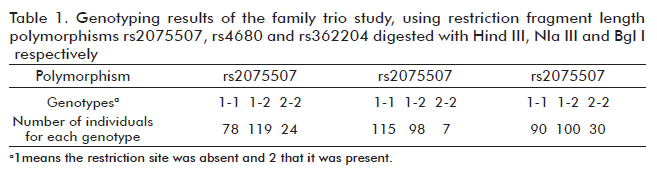
<body><![CDATA[<P   align="left" ><font face="Verdana, Arial, Helvetica, sans-serif" color="#000000" size="2"><B>Statistical      analysis </b></font></P >       <P   align="justify" ><font face="Verdana, Arial, Helvetica, sans-serif" color="#000000" size="2">Hardy-Weinberg      ratios were calculated for each of the three polymorphic sites through chi-squared      tests to determine if they were in equilibrium. </font></P >       <P   align="justify" ><font face="Verdana, Arial, Helvetica, sans-serif" color="#000000" size="2">Haplotype      frequency estimates were calculated using HAPLO (24), which implements the      expectation maximization (EM) algorithm. </font></P >       <P   align="justify" ><font face="Verdana, Arial, Helvetica, sans-serif" color="#000000" size="2">In      our study, the first of its type conducted in our country, we used a family      trios-based association design (25, 26). </font></P >       <P   align="justify" ><font face="Verdana, Arial, Helvetica, sans-serif" color="#000000" size="2">The      family trios association was analyzed with the Family-Based Association Test      (FBAT), introduced by Rabinowitz and Laird (26), and Laird <I>et al.</I> (25);      based on the transmission disequilibrium test (TDT) (25-27). FBAT analysis      was applied under two main hypotheses (Ho: Non-association, non-linkage and      Ho: Non-association in the presence of linkage), at allelic, genotype and      haplotype levels, always assuming an incidence of 1% for the disease in the      population. </font></P >   <FONT color="#FF00FF"><FONT color="#000000">        <P   align="justify" ><font face="Verdana, Arial, Helvetica, sans-serif" color="#000000" size="2">A      precise correction method for multiple comparisons was applied using the formula      alpha = 1-0.95 <sup>1/N</sup> where N is the number of comparisons, one or      more of which shows a significant result (28). </font></P >   <FONT size="+1" color="#FF0000"><FONT size="+1" color="#000000">        <P   align="left" ><font size="2" face="Verdana, Arial, Helvetica, sans-serif" color="#000000"><B><font size="3">RESULTS</font>      </b></font></P >   <FONT size="+1">        <P   align="justify" ><font face="Verdana, Arial, Helvetica, sans-serif" color="#000000" size="2">We      selected a total of 74 family trios (222 samples) after interviewing approximately      700 families, for an 89.45% rejection rate. The DNA obtained from the 222      samples matched the expected quality according to the kit manufacturer. </font></P >   <FONT size="+1">        <P   align="left" ><font face="Verdana, Arial, Helvetica, sans-serif" color="#000000" size="2"><B>Genotyping      </b></font></P >       <P   align="justify" ><font face="Verdana, Arial, Helvetica, sans-serif" color="#000000" size="2"><a href="/img/revistas/bta/v28n2/t0104211.gif">Table      1</a> contains the results obtained after genotyping the three selected polymorphisms      in the 74 family trios. The genotype proportions did not deviated significantly      from those expected under conditions of HW equilibrium p &gt; 0.05 (p = 0.664      for rs2075507; p = 0.4715 for rs4680 and p = 0.0993 for rs362204), and allele      transmission from parents to descendents followed Mendel&rsquo;s laws in every      tested family. </font></P >       
]]></body>
<body><![CDATA[<P   align="justify" ><font face="Verdana, Arial, Helvetica, sans-serif" color="#000000" size="2">The      frequencies of the eight possible haplotypes that could be derived from the      combination of all three polymorphisms, determined using the EM method, appear      in <a href="/img/revistas/bta/v28n2/t0204211.gif">table 2</a>. </font></P >       
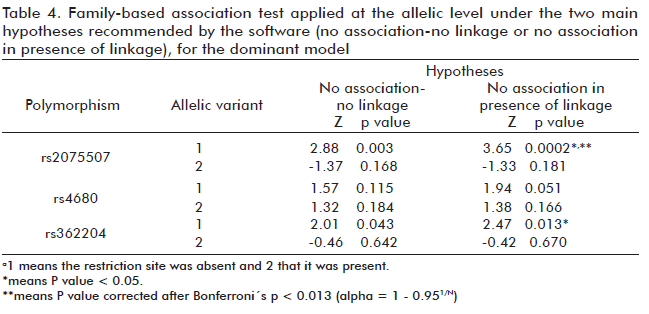
<P   align="left" ><font face="Verdana, Arial, Helvetica, sans-serif" color="#000000" size="2"><B>Family-Based      Association Test </b></font></P >       <P   align="justify" ><font face="Verdana, Arial, Helvetica, sans-serif" color="#000000" size="2">Under      the two main null hypotheses (no association-no linkage and no association      in presence of linkage), FBAT finds a positive allelic level association of      rs2075507 and rs362204 with the disease (p &lt; 0.05; <a href="/img/revistas/bta/v28n2/t0304211.gif">tables      3</a> and <a href="/img/revistas/bta/v28n2/t0404211.gif">4</a>). In consequence,      the results were similar under the additive and dominant model analyses, although      statistical significance was lost for marker rs362204 after applying the Bonferroni      correction. </font></P >       
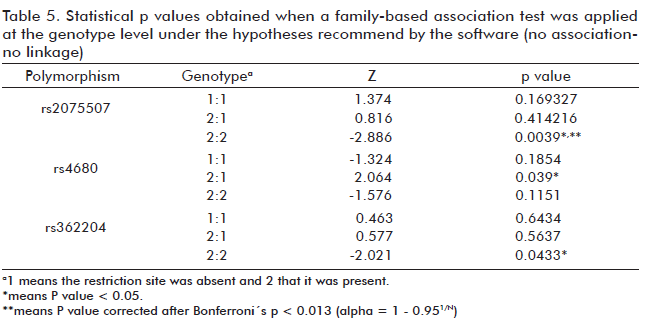
<P   align="justify" ><font face="Verdana, Arial, Helvetica, sans-serif" color="#000000" size="2">The      no association-no linkage hypothesis was used to analyze association at the      genotype level, obtaining a possible association of different genotypes with      different effects on the disease. Genotype 2-2 for markers rs2075507 and rs362204      has shown a positive association, which was different from the negative association      displayed by genotype 1-2 of marker rs4680 (<a href="/img/revistas/bta/v28n2/t0504211.gif">Table      5</a>). The only association still showing statistical significance after      the application of Bonferroni correction to this analysis was that of genotype      2-2 for rs2075507. </font></P >       
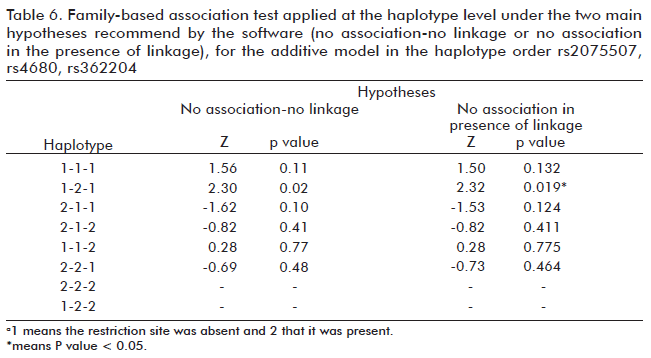
<P   align="justify" ><font face="Verdana, Arial, Helvetica, sans-serif" color="#000000" size="2">Haplotype      analysis was conducted under the two hypotheses mentioned above, and the positive      associations obtained for the 1-2-1 haplotype were equal under the additive      model for two hypotheses (<a href="/img/revistas/bta/v28n2/t0604211.gif">Table      6</a>). After the corrections for multiplex test, these associations at the      haplotype level were lost. </font></P >       
<P   align="left" ><font size="2" face="Verdana, Arial, Helvetica, sans-serif" color="#000000"><B><font size="3">DISCUSSION</font>      </b></font></P >   <FONT size="+1">        <P   align="justify" ><font face="Verdana, Arial, Helvetica, sans-serif" color="#000000" size="2">Different      genetic studies have been carried out with the aim at finding genes associated      to schizophrenia. These are mostly linkage analyses, case-control association      studies and linkage disequilibrium studies (29). </font></P >   <FONT size="+1">        <P   align="justify" ><font face="Verdana, Arial, Helvetica, sans-serif" color="#000000" size="2">Family      trio sampling was applied in this case to avoid the effect of co-founding      events, the admixture phenomenon and population stratification, according      to Rabinowitz and Laird (26) and Laird <I>et al</I>. (25). The high percentage      of rejected families in our case is due to failure to comply with the inclusion      criteria described in Materials and methods. </font></P >   <FONT color="#FF00FF"><FONT color="#000000">        <P   align="left" ><font face="Verdana, Arial, Helvetica, sans-serif" color="#000000" size="2"><B>Family-based      association test at allelic level </b></font></P >       <P   align="justify" ><font face="Verdana, Arial, Helvetica, sans-serif" color="#000000" size="2">Statistical      variable Z provides a measure of the association status of the marker variant.      If Z &gt; 0 with a significant p value, the possible association will then      be positive, implying that the presence of the marker variant could confer      susceptibility to the disease. If, on the other hand, Z &lt; 0, then the possible      association will be negative, meaning that the presence of the marker could      protect against the disease. </font></P >       ]]></body>
<body><![CDATA[<P   align="justify" ><font face="Verdana, Arial, Helvetica, sans-serif" color="#000000" size="2">When      performing an allelic-level analysis under the hypothesis No association-No      linkage, we found a statistically significant linkage (p &lt; 0.05) with the      disease for allele A in the rs2075507 polymorphism and non-insertion of C      in the rs362204 polymorphism (<a href="/img/revistas/bta/v28n2/t0304211.gif">Tables      3</a> and <a href="/img/revistas/bta/v28n2/t0404211.gif">4</a>). Then,      under the hypothesis No association in presence of linkage, we confirmed a      significant difference in the transmission of allele A for the rs2075507 polymorphism      and not insertion of C allele for the rs362204 polymorphism, with p &lt; 0.05.      This represents an association with schizophrenia for these two alleles in      our sample. After the application of the Bonferroni correction (p &lt; 0.013),      however, statistical significance was lost for rs362204. This may imply that      statistical significance may be regained with larger sample sizes or, alternatively,      that there is simply no association in this case. </font></P >       
<P   align="justify" ><font face="Verdana, Arial, Helvetica, sans-serif" color="#000000" size="2">The      associations obtained for allele A in the case of rs2075507 were maintained      after the corrections for multiplex tests. In this case, according to the      Z value (Z &gt; 0), the presence of this allele increases susceptibility to      the disease, a finding that matches those of Palmatier <I>et al.</I> (14)      when analyzing these polymorphisms as part of a haplotypic study in 38 populations      distributed worldwide (14). Our finding also concurs with the results of Chen      <I>et al. </I>during the study of Irish families (30) and differs with family      based association tests results obtained by Fan <I>et al</I>. (16), and Kremer      <I>et al.</I> (31) when analyzed Chinese and Palestinian Arabs populations,      respectively. </font></P >   <FONT color="#FF00FF"><FONT color="#000000"><FONT color="#FF00FF"><FONT color="#000000"><FONT color="#FF00FF"><FONT color="#000000"><FONT color="#FF00FF"><FONT color="#000000">        <P   align="justify" ><font face="Verdana, Arial, Helvetica, sans-serif" color="#000000" size="2">The      association effect of these polymorphisms may have a direct cause in variations      in gene transcription, protein synthesis or biological activity mediated by      the polymorphism itself, or may actually be traced to the effects of other      markers in linkage disequilibrium with the target polymorphism, as reported      <I>e.g. </I>by Shifman <I>et al</I>. (32) when studying a population of Ashkenazi      Jews. </font></P >   <FONT color="#FF00FF"><FONT color="#000000"><FONT color="#FF00FF"><FONT color="#000000">        <P   align="justify" ><font face="Verdana, Arial, Helvetica, sans-serif" color="#000000" size="2">On      the other hand, the location of the rs2075507 polymorphism is very close to      the estrogen binding site, and an identical change in that position has been      shown to alter the estrogenic regulation of gene transcription at this locus      (13). </font></P >       <P   align="left" ><font face="Verdana, Arial, Helvetica, sans-serif" color="#000000" size="2"><B>FBAT      at genotype level </b></font></P >       <P   align="justify" ><font face="Verdana, Arial, Helvetica, sans-serif" color="#000000" size="2">At      the genotype level only non-association, non-linkage can be used as null hypothesis      by the software. In this case, we observed a linkage and possible association      of homozygous genotypes for the presence of the restriction site in polymorphisms      rs2075507 and rs362204 (p &lt; 0.05), with Z &lt; 0. This would indicate that      these genotypes, if indeed associated, would be protective (<a href="/img/revistas/bta/v28n2/t0504211.gif">Table      5</a>). </font></P >       
<P   align="justify" ><font face="Verdana, Arial, Helvetica, sans-serif" color="#000000" size="2">The      results for these two polymorphisms at the genotype level were congruent with      those at the allelic level. The presence of genotype 2-2 for both polymorphisms      had shown a possible negative association with the disease. Additionally,      the presence of allelic variant 1 at the allelic level in our study showed      a possible positive association with the illness. </font></P >       <P   align="justify" ><font face="Verdana, Arial, Helvetica, sans-serif" color="#000000" size="2">We      also found a positive linkage and a possible association among a heterozygous      genotype for the rs4680 marker and the disease during the trio study (p &lt;      0.05). The possible linkage or associations, however, were lost for genotypes      2-2 and 1-2 of rs362204 and rs4680 respectively after the application of the      Bonferroni correction (p &lt; 0.013). </font></P >       <P   align="justify" ><font face="Verdana, Arial, Helvetica, sans-serif" color="#000000" size="2">In      the future, it would be interesting to confirm the association of the rs4680      polymorphism for our population, since other published studies have already      shown an association of this polymorphism with the disorder (33, 34). </font></P >       <P   align="left" ><font face="Verdana, Arial, Helvetica, sans-serif" color="#000000" size="2"><B>FBAT      at haplotype level </b></font></P >       ]]></body>
<body><![CDATA[<P   align="justify" ><font face="Verdana, Arial, Helvetica, sans-serif" color="#000000" size="2">When      we analyzed the possible association of the haplotypes formed by the three      markers, we found, under the first null hypothesis, a positive (Z &gt; 0)      linkage for haplotype 1-2-1 (<a href="/img/revistas/bta/v28n2/t0604211.gif">Table      6</a>). Although the possible association of this haplotype was confirmed      under the second hypothesis, the associations were lost in both cases after      applying the corrections for multiplex tests. </font></P >       
<P   align="justify" ><font face="Verdana, Arial, Helvetica, sans-serif" color="#000000" size="2">The      results achieved before the corrections confirm those obtained at the allelic      level and coincide with those reported by Palmatier <I>et al</I>. (14), reinforcing      the theory of the effect of the three polymorphisms on the susceptibility      to the disease, whether by themselves of through some other polymorphism with      which they are in linkage disequilibrium (14,32). Such a polymorphism might      be, for instance, the 67 bp insertion-deletion polymorphism or the tetranucleotide      repeats (STR) located to the right of marker rs2075507 within the <I>COMT      </I>coding sequence. While these markers do not constitute single base-pair      changes (SNP) but longer sequence variations (Macro satellites), their study      is becoming relevant due to the statistical power conferred to haplotype analysis      by the combination of SNP with STR, according to the 2006 report by Komura      <I>et al.</I> (35). </font></P >   <FONT color="#FF00FF"><FONT color="#000000"><FONT color="#FF00FF"><FONT color="#000000"><FONT color="#FF00FF"><FONT color="#000000">        <P   align="justify" ><font face="Verdana, Arial, Helvetica, sans-serif" color="#000000" size="2">Despite      the sample size of our study, we have been able to replicate some of the findings      made by other association studies examining the association of the <I>COMT</I>      gene with schizophrenia in several populations worldwide. We found possible      associations for the rs2075507 and rs362204 markers that would confer susceptibility      to the disease at the allelic level, and also found a possible association      of the haplotype rs2075507-rs4680-rs362204 with the pathology. </font></P >   <FONT color="#FF00FF"><FONT color="#000000">        <P   align="left" ><font face="Verdana, Arial, Helvetica, sans-serif" color="#000000" size="2">Our      results provide a preliminary characterization of the association of these      markers with schizophrenia in a Cuban sample, in addition validate the employed      sampling and genotyping procedures with a focus on their application for futures      studies. </font></P >   <FONT size="+1">        <P   align="left" > </P >       <P   align="left" ><font face="Verdana, Arial, Helvetica, sans-serif" color="#000000" size="2"><B><font size="3">REFERENCES</font>      </b></font></P >       <!-- ref --><P   align="justify" ><font face="Verdana, Arial, Helvetica, sans-serif" color="#000000" size="2">1.      Gejman PV, Sanders AR, Duan J. The role of genetics in the etiology of schizophrenia.      Psychiatr Clin North Am. 2010; 33(1):35-66.     </font></P >   <FONT size="+1">        <!-- ref --><P   align="justify" ><font face="Verdana, Arial, Helvetica, sans-serif" color="#000000" size="2">2.      Shin JK, Malone DT, Crosby IT, Capuano B. Schizophrenia: a systematic review      of the disease state, current therapeutics and their molecular mechanisms      of action. Curr Med Chem. 2011;18(9):1380-404.     </font></P >       ]]></body>
<body><![CDATA[<!-- ref --><P   align="justify" ><font face="Verdana, Arial, Helvetica, sans-serif" color="#000000" size="2">3.      Miyamoto S, LaMantia AS, Duncan GE, Sullivan P, Gilmore JH, Lieberman JA,      <I>et al</I>. Recent advances in the neurobiology of schizophrenia. Mol Interv.      2003;3:27-39.     </font></P >   <FONT color="#FF00FF"><FONT color="#000000">        <!-- ref --><P   align="justify" ><font face="Verdana, Arial, Helvetica, sans-serif" color="#000000" size="2">4.      Sagud M, M&uuml;ck-Seler D, Mihaljevi&#263;-Peles A, Vuksan-Cusa B, Zivkovi&#263;      M, Jakovljevi&#263; M, <I>et al</I>. Catechol-O-methyl transferase and schizophrenia.      Psychiatr Danub. 2010;22(2):270-4.     </font></P >   <FONT color="#FF00FF"><FONT color="#000000">        <!-- ref --><P   align="justify" ><font face="Verdana, Arial, Helvetica, sans-serif" color="#000000" size="2">5.      Kvetnansky R, Sabban EL, Palkovits M. Catecholaminergic systems in stress:      structural and molecular genetic approaches. Physiol Rev. 2009;89(2):535-606.          </font></P >       <!-- ref --><P   align="justify" ><font face="Verdana, Arial, Helvetica, sans-serif" color="#000000" size="2">6.      Volk DW, Lewis DA. Prefrontal cortical circuits in schizophrenia. Curr Top      Behav Neurosci. 2010;4:485-508.     </font></P >       <P   align="justify" ><font face="Verdana, Arial, Helvetica, sans-serif" color="#000000" size="2">7.      Murray RM, Lappin J, Di Forti M. Schizophrenia: from developmental deviance      to dopamine dysregulation. Eur Neuropsychopharmacol. 2008;18 Suppl 3:S129-34.      </font></P >       <!-- ref --><P   align="justify" ><font face="Verdana, Arial, Helvetica, sans-serif" color="#000000" size="2">8.      Remington G. Alterations of dopamine and serotonin transmission in schizophrenia.      Prog Brain Res. 2008;172:117-40.     </font></P >       <!-- ref --><P   align="justify" ><font face="Verdana, Arial, Helvetica, sans-serif" color="#000000" size="2">9.      Lundstr&ouml;m K, Tenhunen J, Tilgmann C, Karhunen T, Panula P, Ulmanen I.      Cloning, expression and structure of catechol-O-methyltransferase. Biochim      Biophys Acta. 1995;1251(1):1-10.     </font></P >       <P   align="justify" ><font face="Verdana, Arial, Helvetica, sans-serif" color="#000000" size="2">10.      Lajiness-O&rsquo;Neill R, Beaulieu I, Asamoah A, Titus JB, Bawle E, Ahmad      S, <I>et al</I>. The neuropsychological phenotype of velocardiofacial syndrome      (VCFS): relationship to psychopathology. Arch Clin Neuropsychol. 2006;21(2):175-84.      </font></P >   <FONT color="#FF00FF"><FONT color="#000000">        <!-- ref --><P   align="justify" ><font face="Verdana, Arial, Helvetica, sans-serif" color="#000000" size="2">11.      Murphy KC, Owen MJ. Velo-cardio-facial syndrome: a model for understanding      the genetics and pathogenesis of schizophrenia. Br J Psychiatry. 2001;179:      397-402.     </font></P >       <!-- ref --><P   align="justify" ><font face="Verdana, Arial, Helvetica, sans-serif" color="#000000" size="2">12.      DeMille MM, Kidd JR, Ruggeri V, Palmatier MA, Goldman D, Odunsi A, <I>et al</I>.      Population variation in linkage disequilibrium across the COMT gene considering      promoter region and coding region variation. Hum Genet. 2002;111(6):521-37.          </font></P >   <FONT color="#FF00FF"><FONT color="#000000">        <!-- ref --><P   align="justify" ><font face="Verdana, Arial, Helvetica, sans-serif" color="#000000" size="2">13.      Xie T, Ho SL, Ramsden D. Characterization and implications of estrogenic down-regulation      of human catechol-O-methyltransferase gene transcription. Mol Pharmacol. 1999;56(1):31-8.          </font></P >       ]]></body>
<body><![CDATA[<!-- ref --><P   align="justify" ><font face="Verdana, Arial, Helvetica, sans-serif" color="#000000" size="2">14.      Palmatier MA, Pakstis AJ, Speed W, Paschou P, Goldman D, Odunsi A, <I>et al</I>.      COMT haplotypes suggest P2 promoter region relevance for schizophrenia. Mol      Psychiatry. 2004;9(9):859-70.     </font></P >   <FONT color="#FF00FF"><FONT color="#000000">        <!-- ref --><P   align="justify" ><font face="Verdana, Arial, Helvetica, sans-serif" color="#000000" size="2">15.      Chen CH, Lee YR, Liu MY, Wei FC, Koong FJ, Hwu HG, <I>et al</I>. Identification      of a BglI polymorphism of catechol-O-methyltransferase (COMT) gene, and association      study with schizophrenia. Am J Med Genet. 1996;67(6):556-9.     </font></P >   <FONT color="#FF00FF"><FONT color="#000000">        <!-- ref --><P   align="justify" ><font face="Verdana, Arial, Helvetica, sans-serif" color="#000000" size="2">16.      Fan JB, Chen WY, Tang JX, Li S, Gu NF, Feng GY, <I>et al</I>. Family-based      association studies of COMT gene polymorphisms and schizophrenia in the Chinese      population. Mol Psychiatry. 2002;7(5):446-7.     </font></P >   <FONT color="#FF00FF"><FONT color="#000000">        <P   align="justify" ><font face="Verdana, Arial, Helvetica, sans-serif" color="#000000" size="2">17.      Pawe&#322; K, Hauser J, Skibinska M, Szczepankiewicz A, Dmitrzak-Weglarz M,      Gorzkowska K, <I>et al</I>. Family based association study of DRD1, DRD2,      DRD3, DRD4, DAT, COMT gene polymorphism in schizophrenia. Psychiatr Pol. 2010;44(3):405-13.      Polish. </font></P >   <FONT color="#FF00FF"><FONT color="#000000">        <!-- ref --><P   align="justify" ><font face="Verdana, Arial, Helvetica, sans-serif" color="#000000" size="2">18.      Fuller AK. Diagnostic and Statistical Manual of Mental Disorders; DSM-IV Sourcebook;      Study Guide to DSM-IV; DSM-IV Casebook: A Learning Companion to the Diagnostic      and Statistical Manual of Mental Disorders, Fourth Edition; The Clinical Interview:      Using DSM-IV. N Engl J Med. 1994; 331:1163-6.     </font></P >       <!-- ref --><P   align="justify" ><font face="Verdana, Arial, Helvetica, sans-serif" color="#000000" size="2">19.      Organizaci&oacute;n Mundial de la Salud. Trastornos mentales y del comportamiento.      Clasificaci&oacute;n Internacional de Enfermedades. 10ma ed. Madrid: Meditor;      1993.     </font></P >       <!-- ref --><P   align="justify" ><font face="Verdana, Arial, Helvetica, sans-serif" color="#000000" size="2">20.      Andreasen NC. Improvement of negative symptoms: Concepts, definition and assessment.      Int Clin Psychopharmacol. 1997;12 Suppl 2:S7-10.     </font></P >       <!-- ref --><P   align="justify" ><font face="Verdana, Arial, Helvetica, sans-serif" color="#000000" size="2">21.      Jablensky A. The diagnostic concept of schizophrenia: its history, evolution,      and future prospects. Dialogues Clin Neurosci. 2010;12(3):271-87.     </font></P >       <!-- ref --><P   align="justify" ><font face="Verdana, Arial, Helvetica, sans-serif" color="#000000" size="2">22.      Rajeevan H, Osier MV, Cheung KH, Deng H, Druskin L, Heinzen R, <I>et al</I>.      ALFRED: the ALelle FREquency Database. Nucleic Acids Res. 2003;31:270-1.     </font></P >   <FONT color="#FF00FF"><FONT color="#000000">        <!-- ref --><P   align="justify" ><font face="Verdana, Arial, Helvetica, sans-serif" color="#000000" size="2">23.      Pruitt KD, Tatusova T, Maglott DR. NCBI Reference Sequence (RefSeq): a curated      non-redundant sequence database of genomes, transcripts and proteins. Nucleic      Acids Res. 2005;33(Database issue):D501-4.     </font></P >       <!-- ref --><P   align="justify" ><font face="Verdana, Arial, Helvetica, sans-serif" color="#000000" size="2">24.      Hawley ME, Kidd KK. HAPLO: a program using the EM algorithm to estimate the      frequencies of multi-site haplotypes. J Hered. 1995;86(5):409-11.     </font></P >       <!-- ref --><P   align="justify" ><font face="Verdana, Arial, Helvetica, sans-serif" color="#000000" size="2">25.      Laird NM, Horvath S, Xu X. Implementing a unified approach to family-based      tests of association. Genet Epidemiol. 2000;19 Suppl 1:S36-42.     </font></P >       <!-- ref --><P   align="justify" ><font face="Verdana, Arial, Helvetica, sans-serif" color="#000000" size="2">26.      Rabinowitz D, Laird N. A unified approach to adjusting association tests for      population admixture with arbitrary pedigree structure and arbitrary missing      marker information. Hum Hered. 2000;50(4):211-23.     </font></P >       <!-- ref --><P   align="justify" ><font face="Verdana, Arial, Helvetica, sans-serif" color="#000000" size="2">27.      Spielman RS, McGinnis RE, Ewens WJ. Transmission test for linkage disequilibrium:      the insulin gene region and insulin-dependent diabetes mellitus (IDDM). Am      J Hum Genet. 1993;52(3):506-16.     </font></P >       <!-- ref --><P   align="justify" ><font face="Verdana, Arial, Helvetica, sans-serif" color="#000000" size="2">28.      Sham PC. Statistical methods in psychiatric genetics. Stat Methods Med Res.      1998;7(3):279-300.     </font></P >       <!-- ref --><P   align="justify" ><font face="Verdana, Arial, Helvetica, sans-serif" color="#000000" size="2">29.      Duan J, Sanders AR, Gejman PV. Genome-wide approaches to schizophrenia. Brain      Res Bull. 2010;83(3-4):93-102.     </font></P >       <P   align="justify" ><font face="Verdana, Arial, Helvetica, sans-serif" color="#000000" size="2">30.      Chen X, Wang X, O&rsquo;Neill AF, Walsh D, Kendler KS. Variants in the catechol-o-methyltransferase      (COMT) gene are associated with schizophrenia in Irish high-density families.      Mol Psychiatry. 2004;9(10):962-7. </font></P >       <!-- ref --><P   align="justify" ><font face="Verdana, Arial, Helvetica, sans-serif" color="#000000" size="2">31.      Kremer I, Pinto M, Murad I, Muhaheed M, Bannoura I, Muller DJ, <I>et al</I>.      Family-based and case-control study of catechol-O-methyltransferase in schizophrenia      among Palestinian Arabs. Am J Med Genet B Neuropsychiatr Genet. 2003;119B(1):35-9.          </font></P >   <FONT color="#FF00FF"><FONT color="#000000">        <!-- ref --><P   align="justify" ><font face="Verdana, Arial, Helvetica, sans-serif" color="#000000" size="2">32.      Shifman S, Bronstein M, Sternfeld M, Pisant&eacute;-Shalom A, Lev-Lehman E,      Weizman A, <I>et al</I>. A highly significant association between a COMT haplotype      and schizophrenia. Am J Hum Genet. 2002;71(6):1296-302.     </font></P >   <FONT color="#FF00FF"><FONT color="#000000">        <!-- ref --><P   align="justify" ><font face="Verdana, Arial, Helvetica, sans-serif" color="#000000" size="2">33.      Costas J, Sanju&aacute;n J, Ramos-R&iacute;os R, Paz E, Agra S, Ivorra JL,      <I>et al</I>. Heterozygosity at catechol-O-methyltransferase Val158Met and      schizophrenia: new data and meta-analysis. J Psychiatr Res. 2011;45(1):7-14.          </font></P >   <FONT color="#FF00FF"><FONT color="#000000">        <P   align="justify" ><font face="Verdana, Arial, Helvetica, sans-serif" color="#000000" size="2">34.      Hoenicka J, Garrido E, Mart&iacute;nez I, Ponce G, Arag&uuml;&eacute;s M,      Rodr&iacute;guez-Jim&eacute;nez R, <I>et al</I>.; PARGPARG. Gender-specific      COMT Val158Met polymorphism association in Spanish schizophrenic patients.      Am J Med Genet B Neuropsychiatr Genet. 2010;153B(1):79-85. </font></P >   <FONT color="#FF00FF"><FONT color="#000000">        <!-- ref --><P   align="left" ><font face="Verdana, Arial, Helvetica, sans-serif" color="#000000" size="2">35.      Komura D, Shen F, Ishikawa S, Fitch KR, Chen W, Zhang J, et al. Genome-wide      detection of human copy number variations using high-density DNA oligonucleotide      arrays. Genome Res. 2006;16(12):1575-84 </font></P >       <P   align="left" >&nbsp;</P >       <P   align="left" > </P >       <P   align="left" > </P >       <P   align="left" ><font face="Verdana, Arial, Helvetica, sans-serif" color="#000000" size="2">Received      in December, 2010.    <br>     Accepted      for publication in June, 2011. </font></P >       <P   align="left" ><font face="Verdana, Arial, Helvetica, sans-serif" size="2">Hanlet Camacho, Centro      de Ingenier&iacute;a Gen&eacute;tica y Biotecnolog&iacute;a, CIGB Ave. 31      e/ 158 y 190, PO Box 6162, Cubanac&aacute;n, Playa, La Habana, Cuba, E-mail:      <a href="mailto:hamlet.camacho@cigb.edu.cu">hamlet.camacho@cigb.edu.cu</a></font></P >   </font></font></font></font></font></font></font></font></font></font></font></font></font></font></font></font></font></font></font></font></font></font></font></font></font></font></font></font></font></font></font></font></font></font></font></font></font></font></font></font></font></font></font></font></font></font></font></font></font></font></font></font></font></font></font></font></font></font></font></font></font></font></font></font></font></font></font></font></font></font></font></font></font></font></font></font></font></font></font></font></font></font></font></font></font></font></font></font></font></font></font></font></font></font></font></font></font></font></font></font></font></font></font></font></font></font></font></font></font></font></font></font></font></font></font></font></font></font></font></font></font></font></font></DIV >      ]]></body><back>
<ref-list>
<ref id="B1">
<label>1</label><nlm-citation citation-type="journal">
<person-group person-group-type="author">
<name>
<surname><![CDATA[Gejman]]></surname>
<given-names><![CDATA[PV]]></given-names>
</name>
<name>
<surname><![CDATA[Sanders]]></surname>
<given-names><![CDATA[AR]]></given-names>
</name>
<name>
<surname><![CDATA[Duan]]></surname>
<given-names><![CDATA[J]]></given-names>
</name>
</person-group>
<article-title xml:lang="en"><![CDATA[The role of genetics in the etiology of schizophrenia]]></article-title>
<source><![CDATA[Psychiatr Clin North Am]]></source>
<year>2010</year>
<volume>33</volume>
<numero>1</numero>
<issue>1</issue>
<page-range>35-66</page-range></nlm-citation>
</ref>
<ref id="B2">
<label>2</label><nlm-citation citation-type="journal">
<person-group person-group-type="author">
<name>
<surname><![CDATA[Shin]]></surname>
<given-names><![CDATA[JK]]></given-names>
</name>
<name>
<surname><![CDATA[Malone]]></surname>
<given-names><![CDATA[DT]]></given-names>
</name>
<name>
<surname><![CDATA[Crosby]]></surname>
<given-names><![CDATA[IT]]></given-names>
</name>
<name>
<surname><![CDATA[Capuano]]></surname>
<given-names><![CDATA[B]]></given-names>
</name>
</person-group>
<article-title xml:lang="en"><![CDATA[Schizophrenia: a systematic review of the disease state, current therapeutics and their molecular mechanisms of action]]></article-title>
<source><![CDATA[Curr Med Chem]]></source>
<year>2011</year>
<volume>18</volume>
<numero>9</numero>
<issue>9</issue>
<page-range>1380-404</page-range></nlm-citation>
</ref>
<ref id="B3">
<label>3</label><nlm-citation citation-type="journal">
<person-group person-group-type="author">
<name>
<surname><![CDATA[Miyamoto]]></surname>
<given-names><![CDATA[S]]></given-names>
</name>
<name>
<surname><![CDATA[LaMantia]]></surname>
<given-names><![CDATA[AS]]></given-names>
</name>
<name>
<surname><![CDATA[Duncan]]></surname>
<given-names><![CDATA[GE]]></given-names>
</name>
<name>
<surname><![CDATA[Sullivan]]></surname>
<given-names><![CDATA[P]]></given-names>
</name>
<name>
<surname><![CDATA[Gilmore]]></surname>
<given-names><![CDATA[JH]]></given-names>
</name>
<name>
<surname><![CDATA[Lieberman]]></surname>
<given-names><![CDATA[JA]]></given-names>
</name>
</person-group>
<article-title xml:lang="en"><![CDATA[Recent advances in the neurobiology of schizophrenia]]></article-title>
<source><![CDATA[Mol Interv]]></source>
<year>2003</year>
<volume>3</volume>
<page-range>27-39</page-range></nlm-citation>
</ref>
<ref id="B4">
<label>4</label><nlm-citation citation-type="journal">
<person-group person-group-type="author">
<name>
<surname><![CDATA[Sagud]]></surname>
<given-names><![CDATA[M]]></given-names>
</name>
<name>
<surname><![CDATA[Mück-Seler]]></surname>
<given-names><![CDATA[D]]></given-names>
</name>
<name>
<surname><![CDATA[Mihaljevi&#263;-Peles]]></surname>
<given-names><![CDATA[A]]></given-names>
</name>
<name>
<surname><![CDATA[Vuksan-Cusa]]></surname>
<given-names><![CDATA[B]]></given-names>
</name>
<name>
<surname><![CDATA[Zivkovi&#263;]]></surname>
<given-names><![CDATA[M]]></given-names>
</name>
<name>
<surname><![CDATA[Jakovljevi&#263;]]></surname>
<given-names><![CDATA[M]]></given-names>
</name>
</person-group>
<article-title xml:lang="en"><![CDATA[Catechol-O-methyl transferase and schizophrenia]]></article-title>
<source><![CDATA[Psychiatr Danub]]></source>
<year>2010</year>
<volume>22</volume>
<numero>2</numero>
<issue>2</issue>
<page-range>270-4</page-range></nlm-citation>
</ref>
<ref id="B5">
<label>5</label><nlm-citation citation-type="journal">
<person-group person-group-type="author">
<name>
<surname><![CDATA[Kvetnansky]]></surname>
<given-names><![CDATA[R]]></given-names>
</name>
<name>
<surname><![CDATA[Sabban]]></surname>
<given-names><![CDATA[EL]]></given-names>
</name>
<name>
<surname><![CDATA[Palkovits]]></surname>
<given-names><![CDATA[M]]></given-names>
</name>
</person-group>
<article-title xml:lang="en"><![CDATA[Catecholaminergic systems in stress: structural and molecular genetic approaches]]></article-title>
<source><![CDATA[Physiol Rev]]></source>
<year>2009</year>
<volume>89</volume>
<numero>2</numero>
<issue>2</issue>
<page-range>535-606</page-range></nlm-citation>
</ref>
<ref id="B6">
<label>6</label><nlm-citation citation-type="journal">
<person-group person-group-type="author">
<name>
<surname><![CDATA[Volk]]></surname>
<given-names><![CDATA[DW]]></given-names>
</name>
<name>
<surname><![CDATA[Lewis]]></surname>
<given-names><![CDATA[DA]]></given-names>
</name>
</person-group>
<article-title xml:lang="en"><![CDATA[Prefrontal cortical circuits in schizophrenia]]></article-title>
<source><![CDATA[Curr Top Behav Neurosci]]></source>
<year>2010</year>
<volume>4</volume>
<page-range>485-508</page-range></nlm-citation>
</ref>
<ref id="B7">
<label>7</label><nlm-citation citation-type="journal">
<person-group person-group-type="author">
<name>
<surname><![CDATA[Murray]]></surname>
<given-names><![CDATA[RM]]></given-names>
</name>
<name>
<surname><![CDATA[Lappin]]></surname>
<given-names><![CDATA[J]]></given-names>
</name>
<name>
<surname><![CDATA[Di Forti]]></surname>
<given-names><![CDATA[M]]></given-names>
</name>
</person-group>
<article-title xml:lang="en"><![CDATA[Schizophrenia: from developmental deviance to dopamine dysregulation]]></article-title>
<source><![CDATA[Eur Neuropsychopharmacol]]></source>
<year>2008</year>
<volume>18</volume>
<page-range>S129-34</page-range></nlm-citation>
</ref>
<ref id="B8">
<label>8</label><nlm-citation citation-type="journal">
<person-group person-group-type="author">
<name>
<surname><![CDATA[Remington]]></surname>
<given-names><![CDATA[G]]></given-names>
</name>
</person-group>
<article-title xml:lang="en"><![CDATA[Alterations of dopamine and serotonin transmission in schizophrenia]]></article-title>
<source><![CDATA[Prog Brain Res]]></source>
<year>2008</year>
<volume>172</volume>
<page-range>117-40</page-range></nlm-citation>
</ref>
<ref id="B9">
<label>9</label><nlm-citation citation-type="journal">
<person-group person-group-type="author">
<name>
<surname><![CDATA[Lundström]]></surname>
<given-names><![CDATA[K]]></given-names>
</name>
<name>
<surname><![CDATA[Tenhunen]]></surname>
<given-names><![CDATA[J]]></given-names>
</name>
<name>
<surname><![CDATA[Tilgmann]]></surname>
<given-names><![CDATA[C]]></given-names>
</name>
<name>
<surname><![CDATA[Karhunen]]></surname>
<given-names><![CDATA[T]]></given-names>
</name>
<name>
<surname><![CDATA[Panula]]></surname>
<given-names><![CDATA[P]]></given-names>
</name>
<name>
<surname><![CDATA[Ulmanen]]></surname>
<given-names><![CDATA[I]]></given-names>
</name>
</person-group>
<article-title xml:lang="en"><![CDATA[Cloning, expression and structure of catechol-O-methyltransferase]]></article-title>
<source><![CDATA[Biochim Biophys Acta]]></source>
<year>1995</year>
<volume>1251</volume>
<numero>1</numero>
<issue>1</issue>
<page-range>1-10</page-range></nlm-citation>
</ref>
<ref id="B10">
<label>10</label><nlm-citation citation-type="journal">
<person-group person-group-type="author">
<name>
<surname><![CDATA[Lajiness-O'Neill]]></surname>
<given-names><![CDATA[R]]></given-names>
</name>
<name>
<surname><![CDATA[Beaulieu]]></surname>
<given-names><![CDATA[I]]></given-names>
</name>
<name>
<surname><![CDATA[Asamoah]]></surname>
<given-names><![CDATA[A]]></given-names>
</name>
<name>
<surname><![CDATA[Titus]]></surname>
<given-names><![CDATA[JB]]></given-names>
</name>
<name>
<surname><![CDATA[Bawle]]></surname>
<given-names><![CDATA[E]]></given-names>
</name>
<name>
<surname><![CDATA[Ahmad]]></surname>
<given-names><![CDATA[S]]></given-names>
</name>
</person-group>
<article-title xml:lang="en"><![CDATA[The neuropsychological phenotype of velocardiofacial syndrome (VCFS): relationship to psychopathology]]></article-title>
<source><![CDATA[Arch Clin Neuropsychol]]></source>
<year>2006</year>
<volume>21</volume>
<numero>2</numero>
<issue>2</issue>
<page-range>175-84</page-range></nlm-citation>
</ref>
<ref id="B11">
<label>11</label><nlm-citation citation-type="journal">
<person-group person-group-type="author">
<name>
<surname><![CDATA[Murphy]]></surname>
<given-names><![CDATA[KC]]></given-names>
</name>
<name>
<surname><![CDATA[Owen]]></surname>
<given-names><![CDATA[MJ]]></given-names>
</name>
</person-group>
<article-title xml:lang="en"><![CDATA[Velo-cardio-facial syndrome: a model for understanding the genetics and pathogenesis of schizophrenia]]></article-title>
<source><![CDATA[Br J Psychiatry]]></source>
<year>2001</year>
<volume>179</volume>
<page-range>397-402</page-range></nlm-citation>
</ref>
<ref id="B12">
<label>12</label><nlm-citation citation-type="journal">
<person-group person-group-type="author">
<name>
<surname><![CDATA[DeMille]]></surname>
<given-names><![CDATA[MM]]></given-names>
</name>
<name>
<surname><![CDATA[Kidd]]></surname>
<given-names><![CDATA[JR]]></given-names>
</name>
<name>
<surname><![CDATA[Ruggeri]]></surname>
<given-names><![CDATA[V]]></given-names>
</name>
<name>
<surname><![CDATA[Palmatier]]></surname>
<given-names><![CDATA[MA]]></given-names>
</name>
<name>
<surname><![CDATA[Goldman]]></surname>
<given-names><![CDATA[D]]></given-names>
</name>
<name>
<surname><![CDATA[Odunsi]]></surname>
<given-names><![CDATA[A]]></given-names>
</name>
</person-group>
<article-title xml:lang="en"><![CDATA[Population variation in linkage disequilibrium across the COMT gene considering promoter region and coding region variation]]></article-title>
<source><![CDATA[Hum Genet]]></source>
<year>2002</year>
<volume>111</volume>
<numero>6</numero>
<issue>6</issue>
<page-range>521-37</page-range></nlm-citation>
</ref>
<ref id="B13">
<label>13</label><nlm-citation citation-type="journal">
<person-group person-group-type="author">
<name>
<surname><![CDATA[Xie]]></surname>
<given-names><![CDATA[T]]></given-names>
</name>
<name>
<surname><![CDATA[Ho]]></surname>
<given-names><![CDATA[SL]]></given-names>
</name>
<name>
<surname><![CDATA[Ramsden]]></surname>
<given-names><![CDATA[D]]></given-names>
</name>
</person-group>
<article-title xml:lang="en"><![CDATA[Characterization and implications of estrogenic down-regulation of human catechol-O-methyltransferase gene transcription]]></article-title>
<source><![CDATA[Mol Pharmacol]]></source>
<year>1999</year>
<volume>56</volume>
<numero>1</numero>
<issue>1</issue>
<page-range>31-8</page-range></nlm-citation>
</ref>
<ref id="B14">
<label>14</label><nlm-citation citation-type="journal">
<person-group person-group-type="author">
<name>
<surname><![CDATA[Palmatier]]></surname>
<given-names><![CDATA[MA]]></given-names>
</name>
<name>
<surname><![CDATA[Pakstis]]></surname>
<given-names><![CDATA[AJ]]></given-names>
</name>
<name>
<surname><![CDATA[Speed]]></surname>
<given-names><![CDATA[W]]></given-names>
</name>
<name>
<surname><![CDATA[Paschou]]></surname>
<given-names><![CDATA[P]]></given-names>
</name>
<name>
<surname><![CDATA[Goldman]]></surname>
<given-names><![CDATA[D]]></given-names>
</name>
<name>
<surname><![CDATA[Odunsi]]></surname>
<given-names><![CDATA[A]]></given-names>
</name>
</person-group>
<article-title xml:lang="en"><![CDATA[COMT haplotypes suggest P2 promoter region relevance for schizophrenia]]></article-title>
<source><![CDATA[Mol Psychiatry]]></source>
<year>2004</year>
<volume>9</volume>
<numero>9</numero>
<issue>9</issue>
<page-range>859-70</page-range></nlm-citation>
</ref>
<ref id="B15">
<label>15</label><nlm-citation citation-type="journal">
<person-group person-group-type="author">
<name>
<surname><![CDATA[Chen]]></surname>
<given-names><![CDATA[CH]]></given-names>
</name>
<name>
<surname><![CDATA[Lee]]></surname>
<given-names><![CDATA[YR]]></given-names>
</name>
<name>
<surname><![CDATA[Liu]]></surname>
<given-names><![CDATA[MY]]></given-names>
</name>
<name>
<surname><![CDATA[Wei]]></surname>
<given-names><![CDATA[FC]]></given-names>
</name>
<name>
<surname><![CDATA[Koong]]></surname>
<given-names><![CDATA[FJ]]></given-names>
</name>
<name>
<surname><![CDATA[Hwu]]></surname>
<given-names><![CDATA[HG]]></given-names>
</name>
</person-group>
<article-title xml:lang="en"><![CDATA[Identification of a BglI polymorphism of catechol-O-methyltransferase (COMT) gene, and association study with schizophrenia]]></article-title>
<source><![CDATA[Am J Med Genet]]></source>
<year>1996</year>
<volume>67</volume>
<numero>6</numero>
<issue>6</issue>
<page-range>556-9</page-range></nlm-citation>
</ref>
<ref id="B16">
<label>16</label><nlm-citation citation-type="journal">
<person-group person-group-type="author">
<name>
<surname><![CDATA[Fan]]></surname>
<given-names><![CDATA[JB]]></given-names>
</name>
<name>
<surname><![CDATA[Chen]]></surname>
<given-names><![CDATA[WY]]></given-names>
</name>
<name>
<surname><![CDATA[Tang]]></surname>
<given-names><![CDATA[JX]]></given-names>
</name>
<name>
<surname><![CDATA[Li]]></surname>
<given-names><![CDATA[S]]></given-names>
</name>
<name>
<surname><![CDATA[Gu]]></surname>
<given-names><![CDATA[NF]]></given-names>
</name>
<name>
<surname><![CDATA[Feng]]></surname>
<given-names><![CDATA[GY]]></given-names>
</name>
</person-group>
<article-title xml:lang="en"><![CDATA[Family-based association studies of COMT gene polymorphisms and schizophrenia in the Chinese population]]></article-title>
<source><![CDATA[Mol Psychiatry]]></source>
<year>2002</year>
<volume>7</volume>
<numero>5</numero>
<issue>5</issue>
<page-range>446-7</page-range></nlm-citation>
</ref>
<ref id="B17">
<label>17</label><nlm-citation citation-type="journal">
<person-group person-group-type="author">
<name>
<surname><![CDATA[Pawe&#322;]]></surname>
<given-names><![CDATA[K]]></given-names>
</name>
<name>
<surname><![CDATA[Hauser]]></surname>
<given-names><![CDATA[J]]></given-names>
</name>
<name>
<surname><![CDATA[Skibi&#324;ska]]></surname>
<given-names><![CDATA[M]]></given-names>
</name>
<name>
<surname><![CDATA[Szczepankiewicz]]></surname>
<given-names><![CDATA[A]]></given-names>
</name>
<name>
<surname><![CDATA[Dmitrzak-Weglarz]]></surname>
<given-names><![CDATA[M]]></given-names>
</name>
<name>
<surname><![CDATA[Gorzkowska]]></surname>
<given-names><![CDATA[K]]></given-names>
</name>
</person-group>
<article-title xml:lang="en"><![CDATA[Family based association study of DRD1, DRD2, DRD3, DRD4, DAT, COMT gene polymorphism in schizophrenia]]></article-title>
<source><![CDATA[Psychiatr Pol]]></source>
<year>2010</year>
<volume>44</volume>
<numero>3</numero>
<issue>3</issue>
<page-range>405-13</page-range></nlm-citation>
</ref>
<ref id="B18">
<label>18</label><nlm-citation citation-type="journal">
<person-group person-group-type="author">
<name>
<surname><![CDATA[Fuller]]></surname>
<given-names><![CDATA[AK]]></given-names>
</name>
</person-group>
<article-title xml:lang="en"><![CDATA[Diagnostic and Statistical Manual of Mental Disorders: DSM-IV Sourcebook; Study Guide to DSM-IV; DSM-IV Casebook: A Learning Companion to the Diagnostic and Statistical Manual of Mental Disorders, Fourth Edition; The Clinical Interview: Using DSM-IV]]></article-title>
<source><![CDATA[N Engl J Med]]></source>
<year>1994</year>
<volume>331</volume>
<page-range>1163-6</page-range></nlm-citation>
</ref>
<ref id="B19">
<label>19</label><nlm-citation citation-type="book">
<collab>Organización Mundial de la Salud</collab>
<source><![CDATA[Trastornos mentales y del comportamiento: Clasificación Internacional de Enfermedades]]></source>
<year>1993</year>
<edition>10</edition>
<publisher-loc><![CDATA[Madrid ]]></publisher-loc>
<publisher-name><![CDATA[Meditor]]></publisher-name>
</nlm-citation>
</ref>
<ref id="B20">
<label>20</label><nlm-citation citation-type="journal">
<person-group person-group-type="author">
<name>
<surname><![CDATA[Andreasen]]></surname>
<given-names><![CDATA[NC]]></given-names>
</name>
</person-group>
<article-title xml:lang="en"><![CDATA[Improvement of negative symptoms: Concepts, definition and assessment]]></article-title>
<source><![CDATA[Int Clin Psychopharmacol]]></source>
<year>1997</year>
<volume>12</volume>
<numero>^s2</numero>
<issue>^s2</issue>
<supplement>2</supplement>
<page-range>S7-10</page-range></nlm-citation>
</ref>
<ref id="B21">
<label>21</label><nlm-citation citation-type="journal">
<person-group person-group-type="author">
<name>
<surname><![CDATA[Jablensky]]></surname>
<given-names><![CDATA[A]]></given-names>
</name>
</person-group>
<article-title xml:lang="en"><![CDATA[The diagnostic concept of schizophrenia: its history, evolution, and future prospects]]></article-title>
<source><![CDATA[Dialogues Clin Neurosci]]></source>
<year>2010</year>
<volume>12</volume>
<numero>3</numero>
<issue>3</issue>
<page-range>271-87</page-range></nlm-citation>
</ref>
<ref id="B22">
<label>22</label><nlm-citation citation-type="journal">
<person-group person-group-type="author">
<name>
<surname><![CDATA[Rajeevan]]></surname>
<given-names><![CDATA[H]]></given-names>
</name>
<name>
<surname><![CDATA[Osier]]></surname>
<given-names><![CDATA[MV]]></given-names>
</name>
<name>
<surname><![CDATA[Cheung]]></surname>
<given-names><![CDATA[KH]]></given-names>
</name>
<name>
<surname><![CDATA[Deng]]></surname>
<given-names><![CDATA[H]]></given-names>
</name>
<name>
<surname><![CDATA[Druskin]]></surname>
<given-names><![CDATA[L]]></given-names>
</name>
<name>
<surname><![CDATA[Heinzen]]></surname>
<given-names><![CDATA[R]]></given-names>
</name>
</person-group>
<article-title xml:lang="en"><![CDATA[ALFRED: the ALelle FREquency Database]]></article-title>
<source><![CDATA[Nucleic Acids Res]]></source>
<year>2003</year>
<volume>31</volume>
<page-range>270-1</page-range></nlm-citation>
</ref>
<ref id="B23">
<label>23</label><nlm-citation citation-type="journal">
<person-group person-group-type="author">
<name>
<surname><![CDATA[Pruitt]]></surname>
<given-names><![CDATA[KD]]></given-names>
</name>
<name>
<surname><![CDATA[Tatusova]]></surname>
<given-names><![CDATA[T]]></given-names>
</name>
<name>
<surname><![CDATA[Maglott]]></surname>
<given-names><![CDATA[DR]]></given-names>
</name>
</person-group>
<article-title xml:lang="en"><![CDATA[NCBI Reference Sequence (RefSeq): a curated non-redundant sequence database of genomes, transcripts and proteins]]></article-title>
<source><![CDATA[Nucleic Acids Res]]></source>
<year>2005</year>
<volume>33</volume>
<numero>Database issue</numero>
<issue>Database issue</issue>
<page-range>D501-4</page-range></nlm-citation>
</ref>
<ref id="B24">
<label>24</label><nlm-citation citation-type="journal">
<person-group person-group-type="author">
<name>
<surname><![CDATA[Hawley]]></surname>
<given-names><![CDATA[ME]]></given-names>
</name>
<name>
<surname><![CDATA[Kidd]]></surname>
<given-names><![CDATA[KK]]></given-names>
</name>
</person-group>
<article-title xml:lang="en"><![CDATA[HAPLO: a program using the EM algorithm to estimate the frequencies of multi-site haplotypes]]></article-title>
<source><![CDATA[J Hered]]></source>
<year>1995</year>
<volume>86</volume>
<numero>5</numero>
<issue>5</issue>
<page-range>409-11</page-range></nlm-citation>
</ref>
<ref id="B25">
<label>25</label><nlm-citation citation-type="journal">
<person-group person-group-type="author">
<name>
<surname><![CDATA[Laird]]></surname>
<given-names><![CDATA[NM]]></given-names>
</name>
<name>
<surname><![CDATA[Horvath]]></surname>
<given-names><![CDATA[S]]></given-names>
</name>
<name>
<surname><![CDATA[Xu]]></surname>
<given-names><![CDATA[X]]></given-names>
</name>
</person-group>
<article-title xml:lang="en"><![CDATA[Implementing a unified approach to family-based tests of association]]></article-title>
<source><![CDATA[Genet Epidemiol]]></source>
<year>2000</year>
<volume>19</volume>
<numero>^s1</numero>
<issue>^s1</issue>
<supplement>1</supplement>
<page-range>S36-42</page-range></nlm-citation>
</ref>
<ref id="B26">
<label>26</label><nlm-citation citation-type="journal">
<person-group person-group-type="author">
<name>
<surname><![CDATA[Rabinowitz]]></surname>
<given-names><![CDATA[D]]></given-names>
</name>
<name>
<surname><![CDATA[Laird]]></surname>
<given-names><![CDATA[N]]></given-names>
</name>
</person-group>
<article-title xml:lang="en"><![CDATA[A unified approach to adjusting association tests for population admixture with arbitrary pedigree structure and arbitrary missing marker information]]></article-title>
<source><![CDATA[Hum Hered]]></source>
<year>2000</year>
<volume>50</volume>
<numero>4</numero>
<issue>4</issue>
<page-range>211-23</page-range></nlm-citation>
</ref>
<ref id="B27">
<label>27</label><nlm-citation citation-type="journal">
<person-group person-group-type="author">
<name>
<surname><![CDATA[Spielman]]></surname>
<given-names><![CDATA[RS]]></given-names>
</name>
<name>
<surname><![CDATA[McGinnis]]></surname>
<given-names><![CDATA[RE]]></given-names>
</name>
<name>
<surname><![CDATA[Ewens]]></surname>
<given-names><![CDATA[WJ]]></given-names>
</name>
</person-group>
<article-title xml:lang="en"><![CDATA[Transmission test for linkage disequilibrium: the insulin gene region and insulin-dependent diabetes mellitus (IDDM)]]></article-title>
<source><![CDATA[Am J Hum Genet]]></source>
<year>1993</year>
<volume>52</volume>
<numero>3</numero>
<issue>3</issue>
<page-range>506-16</page-range></nlm-citation>
</ref>
<ref id="B28">
<label>28</label><nlm-citation citation-type="journal">
<person-group person-group-type="author">
<name>
<surname><![CDATA[Sham]]></surname>
<given-names><![CDATA[PC]]></given-names>
</name>
</person-group>
<article-title xml:lang="en"><![CDATA[Statistical methods in psychiatric genetics]]></article-title>
<source><![CDATA[Stat Methods Med Res]]></source>
<year>1998</year>
<volume>7</volume>
<numero>3</numero>
<issue>3</issue>
<page-range>279-300</page-range></nlm-citation>
</ref>
<ref id="B29">
<label>29</label><nlm-citation citation-type="journal">
<person-group person-group-type="author">
<name>
<surname><![CDATA[Duan]]></surname>
<given-names><![CDATA[J]]></given-names>
</name>
<name>
<surname><![CDATA[Sanders]]></surname>
<given-names><![CDATA[AR]]></given-names>
</name>
<name>
<surname><![CDATA[Gejman]]></surname>
<given-names><![CDATA[PV]]></given-names>
</name>
</person-group>
<article-title xml:lang="en"><![CDATA[Genome-wide approaches to schizophrenia]]></article-title>
<source><![CDATA[Brain Res Bull]]></source>
<year>2010</year>
<volume>83</volume>
<numero>3-4</numero>
<issue>3-4</issue>
<page-range>93-102</page-range></nlm-citation>
</ref>
<ref id="B30">
<label>30</label><nlm-citation citation-type="journal">
<person-group person-group-type="author">
<name>
<surname><![CDATA[Chen]]></surname>
<given-names><![CDATA[X]]></given-names>
</name>
<name>
<surname><![CDATA[Wang]]></surname>
<given-names><![CDATA[X]]></given-names>
</name>
<name>
<surname><![CDATA[O'Neill]]></surname>
<given-names><![CDATA[AF]]></given-names>
</name>
<name>
<surname><![CDATA[Walsh]]></surname>
<given-names><![CDATA[D]]></given-names>
</name>
<name>
<surname><![CDATA[Kendler]]></surname>
<given-names><![CDATA[KS]]></given-names>
</name>
</person-group>
<article-title xml:lang="en"><![CDATA[Variants in the catechol-o-methyltransferase (COMT) gene are associated with schizophrenia in Irish high-density families]]></article-title>
<source><![CDATA[Mol Psychiatry]]></source>
<year>2004</year>
<volume>9</volume>
<numero>10</numero>
<issue>10</issue>
<page-range>962-7</page-range></nlm-citation>
</ref>
<ref id="B31">
<label>31</label><nlm-citation citation-type="journal">
<person-group person-group-type="author">
<name>
<surname><![CDATA[Kremer]]></surname>
<given-names><![CDATA[I]]></given-names>
</name>
<name>
<surname><![CDATA[Pinto]]></surname>
<given-names><![CDATA[M]]></given-names>
</name>
<name>
<surname><![CDATA[Murad]]></surname>
<given-names><![CDATA[I]]></given-names>
</name>
<name>
<surname><![CDATA[Muhaheed]]></surname>
<given-names><![CDATA[M]]></given-names>
</name>
<name>
<surname><![CDATA[Bannoura]]></surname>
<given-names><![CDATA[I]]></given-names>
</name>
<name>
<surname><![CDATA[Muller]]></surname>
<given-names><![CDATA[DJ]]></given-names>
</name>
</person-group>
<article-title xml:lang="en"><![CDATA[Family-based and case-control study of catechol-O-methyltransferase in schizophrenia among Palestinian Arabs]]></article-title>
<source><![CDATA[Am J Med Genet B Neuropsychiatr Genet]]></source>
<year>2003</year>
<volume>119B</volume>
<numero>1</numero>
<issue>1</issue>
<page-range>35-9</page-range></nlm-citation>
</ref>
<ref id="B32">
<label>32</label><nlm-citation citation-type="journal">
<person-group person-group-type="author">
<name>
<surname><![CDATA[Shifman]]></surname>
<given-names><![CDATA[S]]></given-names>
</name>
<name>
<surname><![CDATA[Bronstein]]></surname>
<given-names><![CDATA[M]]></given-names>
</name>
<name>
<surname><![CDATA[Sternfeld]]></surname>
<given-names><![CDATA[M]]></given-names>
</name>
<name>
<surname><![CDATA[Pisanté-Shalom]]></surname>
<given-names><![CDATA[A]]></given-names>
</name>
<name>
<surname><![CDATA[Lev-Lehman]]></surname>
<given-names><![CDATA[E]]></given-names>
</name>
<name>
<surname><![CDATA[Weizman]]></surname>
<given-names><![CDATA[A]]></given-names>
</name>
</person-group>
<article-title xml:lang="en"><![CDATA[A highly significant association between a COMT haplotype and schizophrenia]]></article-title>
<source><![CDATA[Am J Hum Genet]]></source>
<year>2002</year>
<volume>71</volume>
<numero>6</numero>
<issue>6</issue>
<page-range>1296-302</page-range></nlm-citation>
</ref>
<ref id="B33">
<label>33</label><nlm-citation citation-type="journal">
<person-group person-group-type="author">
<name>
<surname><![CDATA[Costas]]></surname>
<given-names><![CDATA[J]]></given-names>
</name>
<name>
<surname><![CDATA[Sanjuán]]></surname>
<given-names><![CDATA[J]]></given-names>
</name>
<name>
<surname><![CDATA[Ramos-Ríos]]></surname>
<given-names><![CDATA[R]]></given-names>
</name>
<name>
<surname><![CDATA[Paz]]></surname>
<given-names><![CDATA[E]]></given-names>
</name>
<name>
<surname><![CDATA[Agra]]></surname>
<given-names><![CDATA[S]]></given-names>
</name>
<name>
<surname><![CDATA[Ivorra]]></surname>
<given-names><![CDATA[JL]]></given-names>
</name>
</person-group>
<article-title xml:lang="en"><![CDATA[Heterozygosity at catechol-O-methyltransferase Val158Met and schizophrenia: new data and meta-analysis]]></article-title>
<source><![CDATA[J Psychiatr Res]]></source>
<year>2011</year>
<volume>45</volume>
<numero>1</numero>
<issue>1</issue>
<page-range>7-14</page-range></nlm-citation>
</ref>
<ref id="B34">
<label>34</label><nlm-citation citation-type="journal">
<person-group person-group-type="author">
<name>
<surname><![CDATA[Hoenicka]]></surname>
<given-names><![CDATA[J]]></given-names>
</name>
<name>
<surname><![CDATA[Garrido]]></surname>
<given-names><![CDATA[E]]></given-names>
</name>
<name>
<surname><![CDATA[Martínez]]></surname>
<given-names><![CDATA[I]]></given-names>
</name>
<name>
<surname><![CDATA[Ponce]]></surname>
<given-names><![CDATA[G]]></given-names>
</name>
<name>
<surname><![CDATA[Aragüés]]></surname>
<given-names><![CDATA[M]]></given-names>
</name>
<name>
<surname><![CDATA[Rodríguez-Jiménez]]></surname>
<given-names><![CDATA[R]]></given-names>
</name>
<name>
<surname><![CDATA[España-Serrano]]></surname>
<given-names><![CDATA[L]]></given-names>
</name>
<name>
<surname><![CDATA[Alvira-Botero]]></surname>
<given-names><![CDATA[X]]></given-names>
</name>
<name>
<surname><![CDATA[Santos]]></surname>
<given-names><![CDATA[JL]]></given-names>
</name>
<name>
<surname><![CDATA[Rubio]]></surname>
<given-names><![CDATA[G]]></given-names>
</name>
<name>
<surname><![CDATA[Jiménez-Arriero]]></surname>
<given-names><![CDATA[MA]]></given-names>
</name>
<name>
<surname><![CDATA[Palomo]]></surname>
<given-names><![CDATA[T]]></given-names>
</name>
</person-group>
<collab>PARGPARG</collab>
<article-title xml:lang="en"><![CDATA[Gender-specific COMT Val158Met polymorphism association in Spanish schizophrenic patients]]></article-title>
<source><![CDATA[Am J Med Genet B Neuropsychiatr Genet]]></source>
<year>2010</year>
<volume>153B</volume>
<numero>1</numero>
<issue>1</issue>
<page-range>79-85</page-range></nlm-citation>
</ref>
<ref id="B35">
<label>35</label><nlm-citation citation-type="journal">
<person-group person-group-type="author">
<name>
<surname><![CDATA[Komura]]></surname>
<given-names><![CDATA[D]]></given-names>
</name>
<name>
<surname><![CDATA[Shen]]></surname>
<given-names><![CDATA[F]]></given-names>
</name>
<name>
<surname><![CDATA[Ishikawa]]></surname>
<given-names><![CDATA[S]]></given-names>
</name>
<name>
<surname><![CDATA[Fitch]]></surname>
<given-names><![CDATA[KR]]></given-names>
</name>
<name>
<surname><![CDATA[Chen]]></surname>
<given-names><![CDATA[W]]></given-names>
</name>
<name>
<surname><![CDATA[Zhang]]></surname>
<given-names><![CDATA[J]]></given-names>
</name>
</person-group>
<article-title xml:lang="en"><![CDATA[Genome-wide detection of human copy number variations using high-density DNA oligonucleotide arrays]]></article-title>
<source><![CDATA[Genome Res]]></source>
<year>2006</year>
<volume>16</volume>
<numero>12</numero>
<issue>12</issue>
<page-range>1575-84</page-range></nlm-citation>
</ref>
</ref-list>
</back>
</article>