<?xml version="1.0" encoding="ISO-8859-1"?><article xmlns:mml="http://www.w3.org/1998/Math/MathML" xmlns:xlink="http://www.w3.org/1999/xlink" xmlns:xsi="http://www.w3.org/2001/XMLSchema-instance">
<front>
<journal-meta>
<journal-id>1027-2852</journal-id>
<journal-title><![CDATA[Biotecnología Aplicada]]></journal-title>
<abbrev-journal-title><![CDATA[Biotecnol Apl]]></abbrev-journal-title>
<issn>1027-2852</issn>
<publisher>
<publisher-name><![CDATA[Editorial Elfos Scientiae]]></publisher-name>
</publisher>
</journal-meta>
<article-meta>
<article-id>S1027-28522011000200009</article-id>
<title-group>
<article-title xml:lang="en"><![CDATA[Protective immune response against Neisseria meningitidis serogroup B after immunization with peptides mimicking a capsular polysaccharide epitope]]></article-title>
</title-group>
<contrib-group>
<contrib contrib-type="author">
<name>
<surname><![CDATA[Menéndez]]></surname>
<given-names><![CDATA[Tamara]]></given-names>
</name>
<xref ref-type="aff" rid="A01"/>
</contrib>
<contrib contrib-type="author">
<name>
<surname><![CDATA[Garay]]></surname>
<given-names><![CDATA[Hilda E]]></given-names>
</name>
<xref ref-type="aff" rid="A01"/>
</contrib>
<contrib contrib-type="author">
<name>
<surname><![CDATA[Reyes]]></surname>
<given-names><![CDATA[Osvaldo]]></given-names>
</name>
<xref ref-type="aff" rid="A01"/>
</contrib>
<contrib contrib-type="author">
<name>
<surname><![CDATA[Cruz]]></surname>
<given-names><![CDATA[Yoelys]]></given-names>
</name>
<xref ref-type="aff" rid="A01"/>
</contrib>
<contrib contrib-type="author">
<name>
<surname><![CDATA[Coizeau]]></surname>
<given-names><![CDATA[Edelgis]]></given-names>
</name>
<xref ref-type="aff" rid="A01"/>
</contrib>
<contrib contrib-type="author">
<name>
<surname><![CDATA[Santiago]]></surname>
<given-names><![CDATA[Nelson F]]></given-names>
</name>
<xref ref-type="aff" rid="A01"/>
</contrib>
<contrib contrib-type="author">
<name>
<surname><![CDATA[Chinea]]></surname>
<given-names><![CDATA[Glay]]></given-names>
</name>
<xref ref-type="aff" rid="A01"/>
</contrib>
<contrib contrib-type="author">
<name>
<surname><![CDATA[Cobas]]></surname>
<given-names><![CDATA[Karem]]></given-names>
</name>
<xref ref-type="aff" rid="A01"/>
</contrib>
<contrib contrib-type="author">
<name>
<surname><![CDATA[Caballero]]></surname>
<given-names><![CDATA[Evelyn]]></given-names>
</name>
<xref ref-type="aff" rid="A01"/>
</contrib>
<contrib contrib-type="author">
<name>
<surname><![CDATA[Morera]]></surname>
<given-names><![CDATA[Vivian]]></given-names>
</name>
<xref ref-type="aff" rid="A01"/>
</contrib>
<contrib contrib-type="author">
<name>
<surname><![CDATA[Noda]]></surname>
<given-names><![CDATA[Jesús]]></given-names>
</name>
<xref ref-type="aff" rid="A01"/>
</contrib>
<contrib contrib-type="author">
<name>
<surname><![CDATA[Carmenate]]></surname>
<given-names><![CDATA[Tania]]></given-names>
</name>
<xref ref-type="aff" rid="A01"/>
</contrib>
<contrib contrib-type="author">
<name>
<surname><![CDATA[Soria]]></surname>
<given-names><![CDATA[Yordanka]]></given-names>
</name>
<xref ref-type="aff" rid="A01"/>
</contrib>
<contrib contrib-type="author">
<name>
<surname><![CDATA[Brown]]></surname>
<given-names><![CDATA[Emma]]></given-names>
</name>
<xref ref-type="aff" rid="A01"/>
</contrib>
<contrib contrib-type="author">
<name>
<surname><![CDATA[Martín]]></surname>
<given-names><![CDATA[Alejandro]]></given-names>
</name>
<xref ref-type="aff" rid="A01"/>
</contrib>
<contrib contrib-type="author">
<name>
<surname><![CDATA[Yero]]></surname>
<given-names><![CDATA[Daniel]]></given-names>
</name>
<xref ref-type="aff" rid="A01"/>
</contrib>
<contrib contrib-type="author">
<name>
<surname><![CDATA[González]]></surname>
<given-names><![CDATA[Sonia]]></given-names>
</name>
<xref ref-type="aff" rid="A01"/>
</contrib>
<contrib contrib-type="author">
<name>
<surname><![CDATA[Guillén]]></surname>
<given-names><![CDATA[Gerardo E]]></given-names>
</name>
<xref ref-type="aff" rid="A01"/>
</contrib>
</contrib-group>
<aff id="A01">
<institution><![CDATA[,Centro de Ingeniería Genética y Biotecnología, CIGB  ]]></institution>
<addr-line><![CDATA[La Habana ]]></addr-line>
<country>Cuba</country>
</aff>
<pub-date pub-type="pub">
<day>00</day>
<month>06</month>
<year>2011</year>
</pub-date>
<pub-date pub-type="epub">
<day>00</day>
<month>06</month>
<year>2011</year>
</pub-date>
<volume>28</volume>
<numero>2</numero>
<fpage>113</fpage>
<lpage>115</lpage>
<copyright-statement/>
<copyright-year/>
<self-uri xlink:href="http://scielo.sld.cu/scielo.php?script=sci_arttext&amp;pid=S1027-28522011000200009&amp;lng=en&amp;nrm=iso"></self-uri><self-uri xlink:href="http://scielo.sld.cu/scielo.php?script=sci_abstract&amp;pid=S1027-28522011000200009&amp;lng=en&amp;nrm=iso"></self-uri><self-uri xlink:href="http://scielo.sld.cu/scielo.php?script=sci_pdf&amp;pid=S1027-28522011000200009&amp;lng=en&amp;nrm=iso"></self-uri></article-meta>
</front><body><![CDATA[ <DIV class=Sect>        <P align=right><font face="Verdana, Arial, Helvetica, sans-serif" color="#000000" size="2"><b>REPORT</b></font></P>       <P align=right>&nbsp;</P>       <P align=left><font color="#000000" size="2" face="Verdana, Arial, Helvetica, sans-serif"><b><font size="4">Protective      immune response against Neisseria meningitidis serogroup B after immunization      with peptides mimicking a capsular polysaccharide epitope</font></b> </font></P>       <P align=left>&nbsp;</P>       <P align=left>&nbsp;</P>   <FONT color=#000000 size=+1>        <P align=left><font size="2" face="Verdana, Arial, Helvetica, sans-serif" color="#000000"><b>Tamara      Menéndez, Hilda E Garay, Osvaldo Reyes, Yoelys Cruz, Edelgis Coizeau, Nelson      F Santiago, Glay Chinea, Karem Cobas, Evelyn Caballero, Vivian Morera, Jesús      Noda, Tania Carmenate, Yordanka Soria, Emma Brown, Alejandro Martín, Daniel      Yero, Sonia González, Gerardo E Guillén</b> </font></P>   <FONT size=+1>        <P align=left><font size="2" face="Verdana, Arial, Helvetica, sans-serif" color="#000000">Centro      de Ingeniería Genética y Biotecnología, CIGB Ave. 31 e/ 158 y 190, Cubanacan,      Playa, AP 6162, La Habana, Cuba.</font></P>   </font></font>       <p>&nbsp;</p><hr>   <FONT color=#000000 size=+1><FONT size=+1>        <P align=left>&nbsp;</P>       ]]></body>
<body><![CDATA[<P align=left>&nbsp;</P>       <P align=left><font size="2" face="Verdana, Arial, Helvetica, sans-serif" color="#000000"><B><font size="3">INTRODUCTION</font>      </b></font></P>   <FONT size=+1><FONT size=+1>        <P align=justify> <font face="Verdana, Arial, Helvetica, sans-serif" color="#000000" size="2">The      Gram-negative bacterium <I>Neisseria meningitidis </I>is an important cause      of meningitis and septicemia worldwide. Meningococcal disease is a life threatening      illness that may progress to death even after medical intervention. Approximately      500 000 - 1 000 000 cases of invasive meningococcal disease occur annually      worldwide with a 10% mortality rate. Significant sequelae, including neurological      damage, limb loss and hearing loss, occur in up to 20% of survivors. Meningococcal      disease is more common among infants and young children (1). Prevention through      vaccination remains the most effective approach to control invasive meningococcal      disease. </font></P>   <FONT size=+1><FONT  color=#ff00ff><FONT color=#000000>        <P align=justify><font face="Verdana, Arial, Helvetica, sans-serif" color="#000000" size="2">The      most relevant mechanism for antibody-mediated protection against <I>N. meningitidis</I>      seems to be the antibody-mediated direct complement lysis (2). The <I>in vitro</I>      measurement of complement-dependent serum bactericidal activity (SBA) is currently      considered the immunological surrogate of protection against meningococcal      disease (3). </font></P>   <FONT color=#ff00ff><FONT color=#000000><FONT  color=#ff00ff><FONT color=#000000><FONT size=+1>        <P align=justify><font color="#000000" size="2" face="Verdana, Arial, Helvetica, sans-serif"><I>N.      meningitidis</I> is classified in 13 serogroups, based on chemical composition      and antigenic differences of the capsular polysaccharide (CPS). Serogroups      A, B, C, Y and W-135 strains account for most cases of meningococcal infections      (1). Effective plain or conjugated CPS-based vaccines are available against      serogroups A, C, Y and W-135 (1). However, a vaccine inducing protection against      most of the circulating variants of serogroup B meningococcal strains is not      yet available. </font></P>   <FONT color=#ff00ff size=+1><FONT  color=#000000>        <P align=justify><font face="Verdana, Arial, Helvetica, sans-serif" color="#000000" size="2">Up      to now, all field-applied anti-B vaccines have been based on outer membrane      vesicles (OMV), which vary in composition among strains. Therefore, OMV-based      vaccines induce an immune response mainly protective against the strain used      for vaccine production and control the disease in specific regions with similar      circulating strains. The vaccine VA-MENGOC-BC<sup>®</sup>, developed at the      Finlay Institute (Havana, Cuba), is an OMV-based vaccine that uses the Cuban      type strain CU385 (B:4:P1.19,15; ST=33). The vaccine showed an efficacy of      83 % in clinical trials and its introduction into the Cuban Immunization Program      keeps low the incidence of meningoccoccal disease in Cuba (4). </font></P>   <FONT  color=#ff0000 size=+1><FONT color=#000000 size=+1><FONT color=#00ff00><FONT color=#000000>        <P align=justify><font face="Verdana, Arial, Helvetica, sans-serif" color="#000000" size="2">The      poor immunogenicity of purified MenB CPS, even after conjugation (5) has precluded      the formulation of vaccines based on this compound. MenB CPS is a linear homopolymer      of <font face="Symbol">a</font>(2-8)-linked N-acetyl neuraminic acid (polysialic      acid, PSA) (6). The mammalian neural cell adhesion molecule (NCAM) is glycosylated      with identical sialic acid residues (7). The replacement of N-propionyl (Npr)      groups for N-acetyl (NAc) moieties in MenB CPS greatly increases immunogenicity      and allowed the discovery of two classes of antigenic determinants in the      MenB CPS, which can be found on the intact bacterial surface: human non-cross-reactive      and human cross-reactive determinants (8-10). </font></P>   <FONT color=#00ff00><FONT  color=#000000>        <P align=justify><font face="Verdana, Arial, Helvetica, sans-serif" color="#000000" size="2">The      identification of peptide mimetics of MenB CPS-specific antigenic determinants      is a strategy aimed to further the development of vaccine formulations to      cover all meningococcal serogroup B strains. In the present work we investigated      the possibility to identify peptides able to mimic the properties of a unique      capsular polysaccharide epitope in MenB that could be proposed as meningococcal      serogroup B vaccine candidates. </font></P>       <P align=left><font size="2" face="Verdana, Arial, Helvetica, sans-serif" color="#000000"><B><font size="3">RESULTS</font>      </b></font></P>   <FONT size=+1>        <P align=justify> <font face="Verdana, Arial, Helvetica, sans-serif" color="#000000" size="2">To      identify mimetic peptides of meningococcal serogroup B capsular polysaccharide,      a collection of random peptides was screened, exposed in the surface of filamentous      phages (11) using the bactericidal and protective IgG<sub>2a</sub> mAb 13D9      (10) as bait. Four peptides, able to bind mAb 13D9 in competition with MenB      CPS, were identified and named 4L-5, 2L-4, 2L-17 and 2L-27. </font></P>   <FONT size=+1><FONT color=#3163ff size=+1><FONT color=#000000  size=+1>        ]]></body>
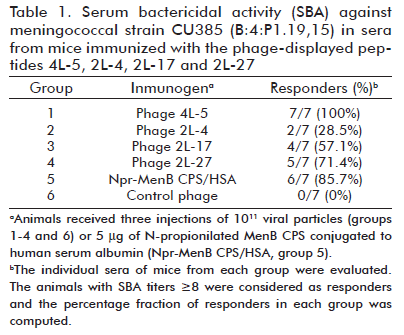
<body><![CDATA[<P align=justify><font face="Verdana, Arial, Helvetica, sans-serif" color="#000000" size="2">The      alignment and comparison of the four sequences (<a href="#fig1">Figure 1</a>)      revealed the presence of a 7-residue stretch in each of them displaying some      of the common residues found in other carbohydrate-mimicking peptides, with      coinciding relative positions (12, 13). One of these features is the presence      of W (tryptophan) residues. Here a W residue was found in 3 out of the 4 peptides      in a very similar sequence context. W, and aromatic amino-acids in general,      are hypothesized to mimic monosaccharide moieties due to similarities in cyclic      shape and volume. Another signature of carbohydrate-mimicking peptides is      the presence of P (proline) residues, which are thought to function by introducing      turns in the peptide backbone that allow the adoption of an adequate spatial      disposition by the voluminous side chains of aromatic residues, resembling      the carbohydrate they mimic. There is more than one P residue in all of the      sequences identified here, and in three cases a P residue appears in a very      similar sequence context. E (glutamic acid) is also present in the four peptides.      An E residue in the same sequence context can be found for peptides 4L-5,      2L-4 and 2L-17, but is apparently missing in peptide 2L-27. However, even      in this case the C-terminal E might be considered to be present in a similar      sequence context, since it is preceded by a turn-inducing sequence (TNE) that      should bring the E into close spatial proximity to the consensus stretch.      Generally, the presence of acid residues in carbohydrate-mimicking peptides      guarantees charge similarity with negatively charged polysaccharides, as is      the present case with PSA.</font></P>       <P align=center><font size="2"><a name="fig1"></a><img src="/img/revistas/bta/v28n2/f0108211.gif" width="400" height="227"></font></P>       
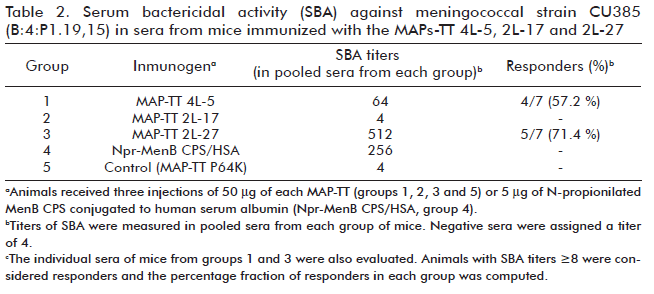
<P align=justify><font face="Verdana, Arial, Helvetica, sans-serif" color="#000000" size="2">It      was hypothesized that this 7-residue region in each peptide could be the target      for mAb binding, and that probably the E plays a role in such binding. The      4L-5 sequence was selected as a model to test this hypothesis. Using collections      of overlapping peptides covering the 4L-5 sequence it was defined that the      sequence WYVE, contained in the afore mentioned 7-amino-acid-residue stretch,      sufficed for mAb binding. A synthetic peptide containing three copies in tandem      of the minimal sequence necessary for mAb 13D9 binding in peptide 4L-5 inhibited      mAb 13D9 binding to MenB CPS. The importance of the E residue for mAb binding      was studied with synthetic peptide libraries containing amino acid changes      in the 4L-5 sequence. It was found that the E residue is essential for mAb      binding since its replacement by other amino acids abolished the reactivity      with the mAb. These experiments also revealed the role of the two prolines      located at positions -3 and -2 counting from W in WYVE, because their presence      increased the reactivity of peptide 4L-5 with mAb 13D9, even though they are      not directly involved in binding. </font></P>       <P align=justify><font face="Verdana, Arial, Helvetica, sans-serif" color="#000000" size="2">To      assess the potential of the identified peptides as vaccine candidates, we      started immunizing groups of mice directly with the viral particles displaying      such sequences. For three of the phage-displayed peptides (4L-5, 2L-17 and      2L-27), more than half of the mice from the corresponding group elicited bactericidal      specific anti-peptide IgG antibodies (<a href="#tab1">Table 1</a>). The highest      bactericidal titers were measured in the group immunized with phage-displayed      4L-5 and passive transfer of pooled sera from this group conferred protection      to infant rats challenged with live MenB.</font></P>       <P align=center><font size="2"><a name="tab1"></a><img src="/img/revistas/bta/v28n2/t0108211.gif" width="404" height="335"></font></P>       
<P align=justify><font face="Verdana, Arial, Helvetica, sans-serif" color="#000000" size="2">The      4L-5 sequence was selected as a model to develop vaccine formulations, based      on synthetic peptides, that could be used in humans. Various forms of sequence      presentation to the immune system were evaluated (<a href="/img/revistas/bta/v28n2/f0208211.gif">Figure      2</a>). The structures L/4L-5; MAP 4L-5 and D/MAP 4L-5 were conjugated to      the carrier protein P64K. Three conjugation methodologies were assayed for      MAP 4L-5. The antigens were characterized by chromatography, spectrometry      and amino acid analysis. All antigens reacted in ELISA with mAb 13D9. Plain      antigens and antigens coupled to P64K were used to immunize BALB/c mice. Of      those variants giving immunogenic results, MAP-TT 4L-5 rendered the highest      levels of specific antipeptide IgG antibodies and serum bactericidal activity.      The structure MAP-TT was selected as the platform structure for further studies.      </font></P>       
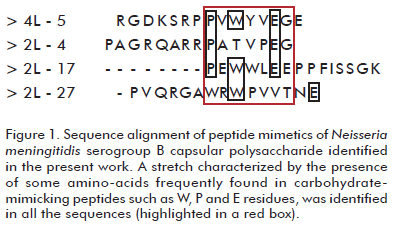
<P align=justify><font face="Verdana, Arial, Helvetica, sans-serif" color="#000000" size="2">Similar      structures called MAP-TT 2L-17 and MAP-TT 2L-27, with sequences 2L-17 and      2L-27 respectively, were also synthesized and simultaneously with MAP-TT 4L-5,      their antigenicity and immunogenicity in mice were studied. The three structures      reacted in ELISA with mAb 13D9 and inhibited binding of mAb 13D9 to purified      Npr-MenB CPS. MAP-TT 4L-5 and MAP-TT 2L-27 inhibited 80% of binding, while      MAP-TT 2L-17 caused approximately 50% of inhibition. The structures were immunogenic      in mice. Protective SBA titers against MenB were measured in groups of mice      immunized with MAP-TT 4L-5 and MAP-TT 2L-27, in group pooled sera and in more      than half of the individual mice from these two groups (<a href="/img/revistas/bta/v28n2/t0208211.gif">Table      2</a>). The serum antibodies elicited against both antigens adsorbed to MenB      CPS. Additionally, pooled sera from mice group immunized with MAP-TT 2L-27      passively protected from bacterial challenge in the infant rat model. The      assessment of serum bactericidal activity of anti-MAP-TT-2L-27 sera against      two other strains of serogroup B, yielded positive results. Pooled sera from      mice immunized with MAP-TT 4L-5 and MAP-TT 2L-27 did not react with a homogenate      of brain from neonatal BALB/c mice in an ELISA performed to evaluate the reactivity      of anti-peptide antibodies with mammalian NCAM. </font></P>       
<P align=left><font size="2" face="Verdana, Arial, Helvetica, sans-serif" color="#000000"><B><font size="3">CONCLUSIONS</font>      </b></font></P>   <FONT size=+1>        <P align=justify> <font face="Verdana, Arial, Helvetica, sans-serif" color="#000000" size="2">The      peptide sequences 4L-5 and 2L-27 mimic the properties of a unique epitope      of meningococcal serogroup B capsular polysaccharide. They induce antibodies      with bactericidal activity against <I>N. meningitidis</I> B after mouse immunization.      </font></P>   <FONT size=+1><FONT  color=#ff00ff><FONT color=#000000>        <P align=justify><font face="Verdana, Arial, Helvetica, sans-serif" color="#000000" size="2">The      peptides identified in this study could be considered for the design of immunogenic,      safe and universal vaccines against <I>N. meningitidis</I> serogroup B. This      work has also contributed to the knowledge of properties of peptides reacting      with an anti-carbohydrate antibody (14). The studies of immunization with      synthetic peptides emphasized the paramount importance of the presentation      form of a peptide sequence to the immune system (15). </font></P>   <FONT  color=#ff00ff><FONT color=#000000>        ]]></body>
<body><![CDATA[<P align=left><font size="2" face="Verdana, Arial, Helvetica, sans-serif" color="#000000"><B><font size="3">ACKNOWLEDGEMENTS</font>      </b></font></P>   <FONT size=+1>        <P align=justify> <font face="Verdana, Arial, Helvetica, sans-serif" color="#000000" size="2">The      authors thank Dr. Harold Jennings from the National Research Council of Canada      for providing mAb 13D9 as well as purified MenB CPS and HSA-conjugated Npr-MenB      CPS. The authors like specially to thank the following collaborators of this      work for fruitful discussions, technical or logistical support: Yaima Batista,      Tania Cárdenas, Anabel Álvarez, Yanet García, Daniel Bello, Maite Ale, Clara      Y Taylor, José A Silva, Alfredo Zambrano, Carmen Téllez and María de los Ángeles      Fernández. We are also grateful to Mariela Vázquez and Manuel Selman-Houssein      from the patent’s office at the CIGB, and to our colleagues from the Animal      Care Unit of the CIGB for animal care and handling. Special thanks to the      colleagues from the Synthetic Peptide Laboratory for peptide synthesis, purification      and analysis; to those who provided us with meningococcal strains: Dr. Mark      Achtman from the Environmental Research Institute, University College Cork      (Cork, Ireland), Dr. Einar Rosenqvist from the National Institute of Public      Health (Oslo, Norway) and the colleagues from the Finlay Institute (Havana,      Cuba); and to Dr. Juan G. Arrieta for the critical reading of all literature      concerning the results presented here. </font></P>   <FONT size=+1>        <P align=left></P>   <FONT size=+1>        <P align=left><font face="Verdana, Arial, Helvetica, sans-serif" color="#000000" size="2"><B><font size="3">REFERENCES</font>      </b></font></P>       <!-- ref --><P align=justify> <font face="Verdana, Arial, Helvetica, sans-serif" color="#000000" size="2">1.      Khatami A, Pollard AJ. The epidemiology of meningococcal disease and the impact      of vaccines. Expert Rev Vaccines. 2010;9:285-98.     </font></P>   <FONT size=+1>        <!-- ref --><P align=justify><font face="Verdana, Arial, Helvetica, sans-serif" color="#000000" size="2">2.      Goldschneider I, Gotschlich EC, Artenstein MS. Human immunity to the meningococcus.      I. The role of humoral antibodies. J Exp Med. 1969;129:1307-26.     </font></P>       <!-- ref --><P align=justify><font face="Verdana, Arial, Helvetica, sans-serif" color="#000000" size="2">3.      Frasch CE, Borrow R, Donnelly J. Bactericidal antibody is the immunologic      surrogate of protection against meningococcal disease. Vaccine. 2009;27 Suppl      2:B112-B116.     </font></P>       ]]></body>
<body><![CDATA[<!-- ref --><P align=justify><font face="Verdana, Arial, Helvetica, sans-serif" color="#000000" size="2">4.      Sierra GV, Campa HC, Varcacel NM, Garcia IL, Izquierdo PL, Sotolongo PF, <i>et      al</i>. Vaccine against group B Neisseria meningitidis: protection trial and      mass vaccination results in Cuba. NIPH Ann. 1991;14:195-207.     </font></P>       <!-- ref --><P align=justify><font face="Verdana, Arial, Helvetica, sans-serif" color="#000000" size="2">5.      Jennings HJ, Lugowski C. Immunochemistry of groups A, B, and C meningococcal      polysaccharide-tetanus toxoid conjugates. J Immunol. 1981;127:1011-8.     </font></P>       <!-- ref --><P align=justify><font face="Verdana, Arial, Helvetica, sans-serif" color="#000000" size="2">6.      Bhattacharjee AK, Jennings HJ, Kenny CP, Martin A, Smith IC. Structural determination      of the sialic acid polysaccharide antigens of Neisseria meningitidis serogroups      B and C with carbon 13 nuclear magnetic resonance. J Biol Chem. 1975; 250:1926-32.          </font></P>       <!-- ref --><P align=justify><font face="Verdana, Arial, Helvetica, sans-serif" color="#000000" size="2">7.      Finne J, Leinonen M, Makela PH. Antigenic similarities between brain components      and bacteria causing meningitis. Implications for vaccine development and      pathogenesis. Lancet 1983;2:355-7.     </font></P>       <!-- ref --><P align=justify><font face="Verdana, Arial, Helvetica, sans-serif" color="#000000" size="2">8.      Shin JS, Lin JS, Anderson PW, Insel RA, Nahm MH. Monoclonal antibodies specific      for Neisseria meningitidis group B polysaccharide and their peptide mimotopes.      Infect Immun. 2001;69:3335-42.     </font></P>       ]]></body>
<body><![CDATA[<!-- ref --><P align=justify><font face="Verdana, Arial, Helvetica, sans-serif" color="#000000" size="2">9.      Granoff DM, Bartoloni A, Ricci S, Gallo E, Rosa D, Ravenscroft N, <i>et al</i>.      Bactericidal monoclonal antibodies that define unique meningococcal B polysaccharide      epitopes that do not cross-react with human polysialic acid. J Immunol. 1998;160:5028-36.          </font></P>       <!-- ref --><P align=justify><font face="Verdana, Arial, Helvetica, sans-serif" color="#000000" size="2">10.      Pon RA, Lussier M, Yang QL, Jennings HJ. N-Propionylated group B meningococcal      polysaccharide mimics a unique bactericidal capsular epitope in group B <I>Neisseria      meningitidis</I>. J Exp Med.1997; 185:1929-38.     </font></P>   <FONT color=#ff00ff><FONT  color=#000000>        <!-- ref --><P align=justify><font face="Verdana, Arial, Helvetica, sans-serif" color="#000000" size="2">11.      Felici F, Castagnoli L, Musacchio A, Jappelli R, Cesareni G. Selection of      antibody ligands from a large library of oligopeptides expressed on a multivalent      exposition vector. J Mol Biol. 1991;222:301-10.     </font></P>       <!-- ref --><P align=justify><font face="Verdana, Arial, Helvetica, sans-serif" color="#000000" size="2">12.      Hoess R, Brinkmann U, Handel T, Pastan I. Identification of a peptide which      binds to the carbohydrate-specific monoclonal antibody B3. Gene. 1993;128:43-9.          </font></P>       <!-- ref --><P align=justify><font face="Verdana, Arial, Helvetica, sans-serif" color="#000000" size="2">13.      Moe GR, Granoff DM. Molecular mimetics of <I>Neisseria meningitidis</I> serogroup      B polysaccharide. Int Rev Immunol. 2001;20:201-20.     </font></P>   <FONT  color=#ff00ff><FONT color=#000000>        ]]></body>
<body><![CDATA[<P align=justify><font face="Verdana, Arial, Helvetica, sans-serif" color="#000000" size="2">14.      Menéndez T, Santiago-Vispo NF, Cruz-Leal Y, Coizeau E, Garay H, Reyes O, <I>et      al</I>. Identification and characterization of phage-displayed peptide mimetics      of <I>Neisseria meningitidis</I> serogroup B capsular polysaccharide. Int      J Med Microbiol. 2011;301:16-25. </font></P>   <FONT color=#ff00ff><FONT color=#000000><FONT  color=#ff00ff><FONT color=#000000>        <!-- ref --><P align=left><font size="2" face="Verdana, Arial, Helvetica, sans-serif" color="#000000">15.      Garay H, Menendez T, Cruz-Leal Y, Coizeau E, Noda J, Morera V, <I>et al</I>.      Study of various presentation forms for a peptide mimetic of <I>Neisseria      meningitidis </I>serogroup B capsular polysaccharide. Bioconjug Chem. 2011;22:33-41.    </font></P>       <P align=left>&nbsp;</P>       <P align=left><font face="Verdana, Arial, Helvetica, sans-serif" size="2">Tamara      Men&eacute;ndez, Centro de Ingenier&iacute;a Gen&eacute;tica y Biotecnolog&iacute;a,      CIGB Ave. 31 e/ 158 y 190, Cubanacan, Playa, AP 6162, La Habana, Cuba, E-mail:      <a href="mailto:tamara.menendez@cigb.edu.cu">tamara.menendez@cigb.edu.cu</a></font></P>   </font></font></font></font></font></font></font></font></font></font></font></font></font></font></font></font></font></font></font></font></font></font></font></font></font></font></font></font></font></font></font></font></font></font></font></font></font></font></font></font></font></font></DIV>      ]]></body><back>
<ref-list>
<ref id="B1">
<label>1</label><nlm-citation citation-type="journal">
<person-group person-group-type="author">
<name>
<surname><![CDATA[. Khatami]]></surname>
<given-names><![CDATA[A]]></given-names>
</name>
<name>
<surname><![CDATA[Pollard]]></surname>
<given-names><![CDATA[AJ]]></given-names>
</name>
</person-group>
<article-title xml:lang="en"><![CDATA[The epidemiology of meningococcal disease and the impact of vaccines]]></article-title>
<source><![CDATA[Expert Rev Vaccines]]></source>
<year>2010</year>
<volume>9</volume>
<page-range>285-98</page-range></nlm-citation>
</ref>
<ref id="B2">
<label>2</label><nlm-citation citation-type="journal">
<person-group person-group-type="author">
<name>
<surname><![CDATA[. Goldschneider]]></surname>
<given-names><![CDATA[I]]></given-names>
</name>
<name>
<surname><![CDATA[Gotschlich]]></surname>
<given-names><![CDATA[EC]]></given-names>
</name>
<name>
<surname><![CDATA[Artenstein]]></surname>
<given-names><![CDATA[MS]]></given-names>
</name>
</person-group>
<article-title xml:lang="en"><![CDATA[Human immunity to the meningococcus: I. The role of humoral antibodies]]></article-title>
<source><![CDATA[J Exp Med]]></source>
<year>1969</year>
<volume>129</volume>
<page-range>1307-26</page-range></nlm-citation>
</ref>
<ref id="B3">
<label>3</label><nlm-citation citation-type="journal">
<person-group person-group-type="author">
<name>
<surname><![CDATA[. Frasch]]></surname>
<given-names><![CDATA[CE]]></given-names>
</name>
<name>
<surname><![CDATA[Borrow]]></surname>
<given-names><![CDATA[R]]></given-names>
</name>
<name>
<surname><![CDATA[Donnelly]]></surname>
<given-names><![CDATA[J]]></given-names>
</name>
</person-group>
<article-title xml:lang="en"><![CDATA[Bactericidal antibody is the immunologic surrogate of protection against meningococcal disease]]></article-title>
<source><![CDATA[Vaccine]]></source>
<year>2009</year>
<volume>27</volume>
<numero>^s2</numero>
<issue>^s2</issue>
<supplement>2</supplement>
<page-range>B112-B116</page-range></nlm-citation>
</ref>
<ref id="B4">
<label>4</label><nlm-citation citation-type="journal">
<person-group person-group-type="author">
<name>
<surname><![CDATA[. Sierra]]></surname>
<given-names><![CDATA[GV]]></given-names>
</name>
<name>
<surname><![CDATA[Campa]]></surname>
<given-names><![CDATA[HC]]></given-names>
</name>
<name>
<surname><![CDATA[Varcacel]]></surname>
<given-names><![CDATA[NM]]></given-names>
</name>
<name>
<surname><![CDATA[Garcia]]></surname>
<given-names><![CDATA[IL]]></given-names>
</name>
<name>
<surname><![CDATA[Izquierdo]]></surname>
<given-names><![CDATA[PL]]></given-names>
</name>
<name>
<surname><![CDATA[Sotolongo]]></surname>
<given-names><![CDATA[PF]]></given-names>
</name>
</person-group>
<article-title xml:lang="en"><![CDATA[Vaccine against group B Neisseria meningitidis: protection trial and mass vaccination results in Cuba]]></article-title>
<source><![CDATA[NIPH Ann]]></source>
<year>1991</year>
<volume>14</volume>
<page-range>195-207</page-range></nlm-citation>
</ref>
<ref id="B5">
<label>5</label><nlm-citation citation-type="journal">
<person-group person-group-type="author">
<name>
<surname><![CDATA[. Jennings]]></surname>
<given-names><![CDATA[HJ]]></given-names>
</name>
<name>
<surname><![CDATA[Lugowski]]></surname>
<given-names><![CDATA[C]]></given-names>
</name>
</person-group>
<article-title xml:lang="en"><![CDATA[Immunochemistry of groups A, B, and C meningococcal polysaccharide-tetanus toxoid conjugates]]></article-title>
<source><![CDATA[J Immunol]]></source>
<year>1981</year>
<volume>127</volume>
<page-range>1011-8</page-range></nlm-citation>
</ref>
<ref id="B6">
<label>6</label><nlm-citation citation-type="journal">
<person-group person-group-type="author">
<name>
<surname><![CDATA[. Bhattacharjee]]></surname>
<given-names><![CDATA[AK]]></given-names>
</name>
<name>
<surname><![CDATA[Jennings]]></surname>
<given-names><![CDATA[HJ]]></given-names>
</name>
<name>
<surname><![CDATA[Kenny]]></surname>
<given-names><![CDATA[CP]]></given-names>
</name>
<name>
<surname><![CDATA[Martin]]></surname>
<given-names><![CDATA[A]]></given-names>
</name>
<name>
<surname><![CDATA[Smith]]></surname>
<given-names><![CDATA[IC]]></given-names>
</name>
</person-group>
<article-title xml:lang="en"><![CDATA[Structural determination of the sialic acid polysaccharide antigens of Neisseria meningitidis serogroups B and C with carbon 13 nuclear magnetic resonance]]></article-title>
<source><![CDATA[J Biol Chem]]></source>
<year>1975</year>
<volume>250</volume>
<page-range>1926-32</page-range></nlm-citation>
</ref>
<ref id="B7">
<label>7</label><nlm-citation citation-type="journal">
<person-group person-group-type="author">
<name>
<surname><![CDATA[. Finne]]></surname>
<given-names><![CDATA[J]]></given-names>
</name>
<name>
<surname><![CDATA[Leinonen]]></surname>
<given-names><![CDATA[M]]></given-names>
</name>
<name>
<surname><![CDATA[Makela]]></surname>
<given-names><![CDATA[PH]]></given-names>
</name>
</person-group>
<article-title xml:lang="en"><![CDATA[Antigenic similarities between brain components and bacteria causing meningitis]]></article-title>
<source><![CDATA[Implications for vaccine development and pathogenesis. Lance]]></source>
<year>1983</year>
<volume>2</volume>
<page-range>355-7</page-range></nlm-citation>
</ref>
<ref id="B8">
<label>8</label><nlm-citation citation-type="journal">
<person-group person-group-type="author">
<name>
<surname><![CDATA[. Shin]]></surname>
<given-names><![CDATA[JS]]></given-names>
</name>
<name>
<surname><![CDATA[Lin]]></surname>
<given-names><![CDATA[JS]]></given-names>
</name>
<name>
<surname><![CDATA[Anderson]]></surname>
<given-names><![CDATA[PW]]></given-names>
</name>
<name>
<surname><![CDATA[Insel]]></surname>
<given-names><![CDATA[RA]]></given-names>
</name>
<name>
<surname><![CDATA[Nahm]]></surname>
<given-names><![CDATA[MH]]></given-names>
</name>
</person-group>
<article-title xml:lang="en"><![CDATA[Monoclonal antibodies specific for Neisseria meningitidis group B polysaccharide and their peptide mimotopes]]></article-title>
<source><![CDATA[Infect Immun]]></source>
<year>2001</year>
<volume>69</volume>
<page-range>3335-42</page-range></nlm-citation>
</ref>
<ref id="B9">
<label>9</label><nlm-citation citation-type="journal">
<person-group person-group-type="author">
<name>
<surname><![CDATA[. Granoff]]></surname>
<given-names><![CDATA[DM]]></given-names>
</name>
<name>
<surname><![CDATA[Bartoloni]]></surname>
<given-names><![CDATA[A]]></given-names>
</name>
<name>
<surname><![CDATA[Ricci]]></surname>
<given-names><![CDATA[S]]></given-names>
</name>
<name>
<surname><![CDATA[Gallo]]></surname>
<given-names><![CDATA[E]]></given-names>
</name>
<name>
<surname><![CDATA[Rosa]]></surname>
<given-names><![CDATA[D]]></given-names>
</name>
<name>
<surname><![CDATA[Ravenscroft]]></surname>
<given-names><![CDATA[N]]></given-names>
</name>
</person-group>
<article-title xml:lang="en"><![CDATA[Bactericidal monoclonal antibodies that define unique meningococcal B polysaccharide epitopes that do not cross-react with human polysialic acid]]></article-title>
<source><![CDATA[J Immunol]]></source>
<year>1998</year>
<volume>160</volume>
<page-range>5028-36</page-range></nlm-citation>
</ref>
<ref id="B10">
<label>10</label><nlm-citation citation-type="journal">
<person-group person-group-type="author">
<name>
<surname><![CDATA[. Pon]]></surname>
<given-names><![CDATA[RA]]></given-names>
</name>
<name>
<surname><![CDATA[Lussier]]></surname>
<given-names><![CDATA[M]]></given-names>
</name>
<name>
<surname><![CDATA[Yang]]></surname>
<given-names><![CDATA[QL]]></given-names>
</name>
<name>
<surname><![CDATA[Jennings]]></surname>
<given-names><![CDATA[HJ]]></given-names>
</name>
</person-group>
<article-title xml:lang="en"><![CDATA[N-Propionylated group B meningococcal polysaccharide mimics a unique bactericidal capsular epitope in group B Neisseria meningitidis]]></article-title>
<source><![CDATA[J Exp Med]]></source>
<year>1997</year>
<volume>185</volume>
<page-range>1929-38</page-range></nlm-citation>
</ref>
<ref id="B11">
<label>11</label><nlm-citation citation-type="journal">
<person-group person-group-type="author">
<name>
<surname><![CDATA[. Felici]]></surname>
<given-names><![CDATA[F]]></given-names>
</name>
<name>
<surname><![CDATA[Castagnoli]]></surname>
<given-names><![CDATA[L]]></given-names>
</name>
<name>
<surname><![CDATA[Musacchio]]></surname>
<given-names><![CDATA[A]]></given-names>
</name>
<name>
<surname><![CDATA[Jappelli]]></surname>
<given-names><![CDATA[R]]></given-names>
</name>
<name>
<surname><![CDATA[Cesareni]]></surname>
<given-names><![CDATA[G]]></given-names>
</name>
</person-group>
<article-title xml:lang="en"><![CDATA[Selection of antibody ligands from a large library of oligopeptides expressed on a multivalent exposition vector]]></article-title>
<source><![CDATA[J Mol Biol]]></source>
<year>1991</year>
<volume>222</volume>
<page-range>301-10</page-range></nlm-citation>
</ref>
<ref id="B12">
<label>12</label><nlm-citation citation-type="journal">
<person-group person-group-type="author">
<name>
<surname><![CDATA[. Hoess]]></surname>
<given-names><![CDATA[R]]></given-names>
</name>
<name>
<surname><![CDATA[Brinkmann]]></surname>
<given-names><![CDATA[U]]></given-names>
</name>
<name>
<surname><![CDATA[Handel]]></surname>
<given-names><![CDATA[T]]></given-names>
</name>
<name>
<surname><![CDATA[Pastan]]></surname>
<given-names><![CDATA[I]]></given-names>
</name>
</person-group>
<article-title xml:lang="en"><![CDATA[Identification of a peptide which binds to the carbohydrate-specific monoclonal antibody B3]]></article-title>
<source><![CDATA[Gene]]></source>
<year>1993</year>
<volume>128</volume>
<page-range>43-9</page-range></nlm-citation>
</ref>
<ref id="B13">
<label>13</label><nlm-citation citation-type="journal">
<person-group person-group-type="author">
<name>
<surname><![CDATA[. Moe]]></surname>
<given-names><![CDATA[GR]]></given-names>
</name>
<name>
<surname><![CDATA[Granoff]]></surname>
<given-names><![CDATA[DM]]></given-names>
</name>
</person-group>
<article-title xml:lang="en"><![CDATA[Molecular mimetics of Neisseria meningitidis serogroup B polysaccharide]]></article-title>
<source><![CDATA[Int Rev Immunol]]></source>
<year>2001</year>
<volume>20</volume>
<page-range>201-20</page-range></nlm-citation>
</ref>
<ref id="B14">
<label>14</label><nlm-citation citation-type="journal">
<person-group person-group-type="author">
<name>
<surname><![CDATA[. Menendez]]></surname>
<given-names><![CDATA[T]]></given-names>
</name>
<name>
<surname><![CDATA[Santiago-Vispo]]></surname>
<given-names><![CDATA[NF]]></given-names>
</name>
<name>
<surname><![CDATA[Cruz-Leal]]></surname>
<given-names><![CDATA[Y]]></given-names>
</name>
<name>
<surname><![CDATA[Coizeau]]></surname>
<given-names><![CDATA[E]]></given-names>
</name>
<name>
<surname><![CDATA[Garay]]></surname>
<given-names><![CDATA[H]]></given-names>
</name>
<name>
<surname><![CDATA[Reyes]]></surname>
<given-names><![CDATA[O]]></given-names>
</name>
</person-group>
<article-title xml:lang="en"><![CDATA[Identification and characterization of phage-displayed peptide mimetics of Neisseria meningitidis serogroup B capsular polysaccharide]]></article-title>
<source><![CDATA[Int J Med Microbiol]]></source>
<year>2011</year>
<volume>301</volume>
<page-range>16-25</page-range></nlm-citation>
</ref>
<ref id="B15">
<label>15</label><nlm-citation citation-type="journal">
<person-group person-group-type="author">
<name>
<surname><![CDATA[. Garay]]></surname>
<given-names><![CDATA[H]]></given-names>
</name>
<name>
<surname><![CDATA[Menendez]]></surname>
<given-names><![CDATA[T]]></given-names>
</name>
<name>
<surname><![CDATA[Cruz-Leal]]></surname>
<given-names><![CDATA[Y]]></given-names>
</name>
<name>
<surname><![CDATA[Coizeau]]></surname>
<given-names><![CDATA[E]]></given-names>
</name>
<name>
<surname><![CDATA[Noda]]></surname>
<given-names><![CDATA[J]]></given-names>
</name>
<name>
<surname><![CDATA[Morera]]></surname>
<given-names><![CDATA[V]]></given-names>
</name>
</person-group>
<article-title xml:lang="en"><![CDATA[Study of various presentation forms for a peptide mimetic of Neisseria meningitidis serogroup B capsular polysaccharide]]></article-title>
<source><![CDATA[Bioconjug Chem]]></source>
<year>2011</year>
<volume>22</volume>
<page-range>33-41</page-range></nlm-citation>
</ref>
</ref-list>
</back>
</article>