<?xml version="1.0" encoding="ISO-8859-1"?><article xmlns:mml="http://www.w3.org/1998/Math/MathML" xmlns:xlink="http://www.w3.org/1999/xlink" xmlns:xsi="http://www.w3.org/2001/XMLSchema-instance">
<front>
<journal-meta>
<journal-id>1027-2852</journal-id>
<journal-title><![CDATA[Biotecnología Aplicada]]></journal-title>
<abbrev-journal-title><![CDATA[Biotecnol Apl]]></abbrev-journal-title>
<issn>1027-2852</issn>
<publisher>
<publisher-name><![CDATA[Editorial Elfos Scientiae]]></publisher-name>
</publisher>
</journal-meta>
<article-meta>
<article-id>S1027-28522011000400002</article-id>
<title-group>
<article-title xml:lang="en"><![CDATA[Levansucrase activity but not fructan accumulation in transgenic lsdA-expressing sugarcane recovered by optimized microprojectile bombardment of embryogenic calli]]></article-title>
<article-title xml:lang="es"><![CDATA[Actividad levanasacarasa pero ausencia de acumulación de fructanos en plantas transgénicas de caña de azúcar obtenidas mediante un procedimiento optimizado de bombardeo de callos embriogénicos]]></article-title>
</title-group>
<contrib-group>
<contrib contrib-type="author">
<name>
<surname><![CDATA[Banguela]]></surname>
<given-names><![CDATA[Alexander]]></given-names>
</name>
<xref ref-type="aff" rid="A01"/>
</contrib>
<contrib contrib-type="author">
<name>
<surname><![CDATA[Rodríguez]]></surname>
<given-names><![CDATA[Raisa]]></given-names>
</name>
<xref ref-type="aff" rid="A02"/>
</contrib>
<contrib contrib-type="author">
<name>
<surname><![CDATA[Arrieta]]></surname>
<given-names><![CDATA[Juan G]]></given-names>
</name>
<xref ref-type="aff" rid="A01"/>
</contrib>
<contrib contrib-type="author">
<name>
<surname><![CDATA[Menéndez]]></surname>
<given-names><![CDATA[Carmen]]></given-names>
</name>
<xref ref-type="aff" rid="A01"/>
</contrib>
<contrib contrib-type="author">
<name>
<surname><![CDATA[Kairúz]]></surname>
<given-names><![CDATA[Elizabeth]]></given-names>
</name>
<xref ref-type="aff" rid="A03"/>
</contrib>
<contrib contrib-type="author">
<name>
<surname><![CDATA[Trujillo]]></surname>
<given-names><![CDATA[Luis E]]></given-names>
</name>
<xref ref-type="aff" rid="A01"/>
</contrib>
<contrib contrib-type="author">
<name>
<surname><![CDATA[Hernández]]></surname>
<given-names><![CDATA[Lázaro]]></given-names>
</name>
<xref ref-type="aff" rid="A01"/>
</contrib>
</contrib-group>
<aff id="A02">
<institution><![CDATA[,Instituto de Investigaciones en Fruticultura Tropical  ]]></institution>
<addr-line><![CDATA[La Habana ]]></addr-line>
<country>Cuba</country>
</aff>
<aff id="A03">
<institution><![CDATA[,Universidad Central Marta Abreu de Las Villas Departamento de Biología ]]></institution>
<addr-line><![CDATA[Santa Clara ]]></addr-line>
<country>Cuba</country>
</aff>
<aff id="A01">
<institution><![CDATA[,Centro de Ingeniería Genética y Biotecnología  ]]></institution>
<addr-line><![CDATA[La Habana ]]></addr-line>
<country>Cuba</country>
</aff>
<pub-date pub-type="pub">
<day>00</day>
<month>12</month>
<year>2011</year>
</pub-date>
<pub-date pub-type="epub">
<day>00</day>
<month>12</month>
<year>2011</year>
</pub-date>
<volume>28</volume>
<numero>4</numero>
<fpage>216</fpage>
<lpage>220</lpage>
<copyright-statement/>
<copyright-year/>
<self-uri xlink:href="http://scielo.sld.cu/scielo.php?script=sci_arttext&amp;pid=S1027-28522011000400002&amp;lng=en&amp;nrm=iso"></self-uri><self-uri xlink:href="http://scielo.sld.cu/scielo.php?script=sci_abstract&amp;pid=S1027-28522011000400002&amp;lng=en&amp;nrm=iso"></self-uri><self-uri xlink:href="http://scielo.sld.cu/scielo.php?script=sci_pdf&amp;pid=S1027-28522011000400002&amp;lng=en&amp;nrm=iso"></self-uri><abstract abstract-type="short" xml:lang="en"><p><![CDATA[Sugarcane (Saccharum spp. hybrid) emerges as an ideal crop for the cost-effective transgenic production of fructans due to its high efficiency for fixing carbon and storing the substrate sucrose. As other gramineous species, sugarcane is recalcitrant to genetic transformation. In this work, we optimized conditions for the transformation of sugarcane cv. C1051-73 via microprojectile bombardment of embryogenic calli. The genes encoding the enhanced green-fluorescent protein (eGFP) and the neomycin phosphotransferase (nptII), both under the control of the maize ubiquitin 1 (Ubi-1) promoter, were used for the early detection of transient transformation events and for the selection of stable transformants, respectively. DNA was efficiently delivered into the cell without causing drastic damages in calli bombarded at the distance of 11 cm and the argon pressure of 90 PSI. Non-mosaic transgenic plantlets were recovered by increasing the geneticin concentration from 20 mg/L during callus growth to 25 mg/L for the shooting and rooting steps. Moreover, using the optimized transformation procedure, we recovered twenty transgenic sugarcane lines carrying the diazotrophicus levansucrase gene (lsdA) modified for vacuolar targeting of the enzyme, as a strategy for fructan production. Southern blot and PCR analysis revealed the stable presence of the chimaeric in the primary stalk and sprouts of plants grown under field conditions. None of the transgenic lines accumulated levan in mature stems or leaves, although one of them showed evident levansucrase activity in leaf extracts.]]></p></abstract>
<abstract abstract-type="short" xml:lang="es"><p><![CDATA[La caña de azúcar (Saccharum spp. hybrid) es un cultivo ideal para la producción transgénica de fructanos a altos niveles debido a su marcada eficiencia en fijar el carbono atmosférico y almacenar sacarosa. Como otras gramíneas, es recalcitrante a la transformación genética. En este trabajo se optimizó la transformación de caña de azúcar cv. C1051-73 por la vía del bombardeo de callos embriogénicos. El empleo de los genes de la proteína verde fluorescente potenciada (eGFP) y la neomicina fosfotransferasa II (nptII), ambos bajo el control del promotor Ubi-1 de maíz, permitió la detección temprana de los eventos de transformación y la selección de transformantes estables, respectivamente. La entrada del ADN a la célula fue más eficiente en los callos bombardeados a 11 cm de distancia y presión de argón de 90 PSI, y no presentaron daños drásticos. El incremento de la concentración de geneticina de 20 mg/L en el estadio de callos, a 25 mg/L en los pasos de formación de brotes previno la generación de plantas falsas positivas o mosaicos. Con el objetivo de producir fructanos en caña de azúcar, se obtuvieron 20 líneas transgénicas portadoras del gen de la levanasacarasa de Gluconacetobacter diazotrophicus (lsdA) fusionado a señales de localización vacuolar. Experimentos de Southern blot y reacción en cadena de la polimerasa confirmaron la presencia del gen quimérico en el genoma de plantas crecidas y ahijadas en el campo. Ninguna planta acumuló levana en las hojas o los tallos maduros, a pesar la detección de actividad levanasacarasa en los extractos foliares de una de las líneas.]]></p></abstract>
<kwd-group>
<kwd lng="en"><![CDATA[Sugarcane]]></kwd>
<kwd lng="en"><![CDATA[genetic transformation]]></kwd>
<kwd lng="en"><![CDATA[eGFP]]></kwd>
<kwd lng="en"><![CDATA[levansucrase]]></kwd>
<kwd lng="en"><![CDATA[fructan]]></kwd>
<kwd lng="en"><![CDATA[levan]]></kwd>
<kwd lng="en"><![CDATA[lsdA]]></kwd>
<kwd lng="es"><![CDATA[Caña de azúcar]]></kwd>
<kwd lng="es"><![CDATA[transformación genética]]></kwd>
<kwd lng="es"><![CDATA[eGFP]]></kwd>
<kwd lng="es"><![CDATA[levanasacarasa]]></kwd>
<kwd lng="es"><![CDATA[fructano]]></kwd>
<kwd lng="es"><![CDATA[levana]]></kwd>
<kwd lng="es"><![CDATA[lsdA]]></kwd>
</kwd-group>
</article-meta>
</front><body><![CDATA[ <DIV class="Sect"   >        <P align="right"   ><font size="2" color="#000000" face="Verdana, Arial, Helvetica, sans-serif"><b>RESEARCH      </b></font></P >       <P align="right"   >&nbsp;</P >   <FONT size="+1" color="#000000">        <P   ><font face="Verdana, Arial, Helvetica, sans-serif" size="4"><b>Levansucrase activity      but not fructan accumulation in transgenic lsdA-expressing sugarcane recovered      by optimized microprojectile bombardment of embryogenic calli</b></font></P >       <P   >&nbsp;</P >       <P   ><font face="Verdana, Arial, Helvetica, sans-serif" size="3"><b>Actividad levanasacarasa      pero ausencia de acumulaci&oacute;n de fructanos en plantas transg&eacute;nicas      de ca&ntilde;a de az&uacute;car obtenidas mediante un procedimiento optimizado      de bombardeo de callos embriog&eacute;nicos</b></font></P >       <P   >&nbsp;</P >       <P   >&nbsp;</P >       <P   > </P >       <P   ><b><font face="Verdana, Arial, Helvetica, sans-serif" size="2">Alexander Banguela<Sup>1,2</Sup>,      Raisa Rodr&iacute;guez<Sup>1,2</Sup>, Juan G Arrieta<Sup>1</Sup>, Carmen Men&eacute;ndez<Sup>1</Sup>,      Elizabeth Kair&uacute;z<Sup>1,3</Sup>, Luis E Trujillo<Sup>1</Sup>, L&aacute;zaro      Hern&aacute;ndez<Sup>1</Sup></font></b></P >   <FONT size="+1"><FONT size="+1"><FONT size="+1"><FONT size="+1"><FONT size="+1"><FONT size="+1"><FONT size="+1"><FONT size="+1"><FONT size="+1"><FONT size="+1"><FONT size="+1"><FONT size="+1"><FONT size="+1"><FONT size="+1">        ]]></body>
<body><![CDATA[<P   ><font face="Verdana, Arial, Helvetica, sans-serif" size="2"><Sup>1</Sup>Centro      de Ingenier&iacute;a Gen&eacute;tica y Biotecnolog&iacute;a, CIGB. AP 6162,      La Habana, Cuba.    <br>     </font><font face="Verdana, Arial, Helvetica, sans-serif" size="2"><Sup>2</Sup>Instituto      de Investigaciones en Fruticultura Tropical, IIFT. La Habana, Cuba.    <br>     </font><font face="Verdana, Arial, Helvetica, sans-serif" size="2"><Sup>3</Sup>Departamento      de Biolog&iacute;a, Universidad Central Marta Abreu de Las Villas, UCLV. Santa      Clara, Villa Clara, Cuba.</font></P >   </font></font></font></font></font></font></font></font></font></font></font></font></font></font></font>   <hr>   <FONT size="+1" color="#000000"><FONT size="+1"><FONT size="+1"><FONT size="+1"><FONT size="+1"><FONT size="+1"><FONT size="+1"><FONT size="+1"><FONT size="+1"><FONT size="+1"><FONT size="+1"><FONT size="+1"><FONT size="+1"><FONT size="+1"><FONT size="+1">        <P   ><font face="Verdana, Arial, Helvetica, sans-serif" size="2"><b>ABSTRACT </b></font></P >   <FONT size="+1"><FONT size="+1"><FONT size="+1"><FONT size="+1"><FONT size="+1"><FONT size="+1">        <P   ><font face="Verdana, Arial, Helvetica, sans-serif" size="2">Sugarcane (<i>Saccharum</i>      spp. hybrid) emerges as an ideal crop for the cost-effective transgenic production      of fructans due to its high efficiency for fixing carbon and storing the substrate      sucrose. As other gramineous species, sugarcane is recalcitrant to genetic      transformation. In this work, we optimized conditions for the transformation      of sugarcane cv. C1051-73 via microprojectile bombardment of embryogenic calli.      The genes encoding the enhanced green-fluorescent protein (eGFP) and the neomycin      phosphotransferase (<i>nptII</i>), both under the control of the maize ubiquitin      1 (Ubi-1) promoter, were used for the early detection of transient transformation      events and for the selection of stable transformants, respectively. DNA was      efficiently delivered into the cell without causing drastic damages in calli      bombarded at the distance of 11 cm and the argon pressure of 90 PSI. Non-mosaic      transgenic plantlets were recovered by increasing the geneticin concentration      from 20 mg/L during callus growth to 25 mg/L for the shooting and rooting      steps. Moreover, using the optimized transformation procedure, we recovered      twenty transgenic sugarcane lines carrying the diazotrophicus levansucrase      gene (<i>lsdA</i>) modified for vacuolar targeting of the enzyme, as a strategy      for fructan production. Southern blot and PCR analysis revealed the stable      presence of the chimaeric in the primary stalk and sprouts of plants grown      under field conditions. None of the transgenic lines accumulated levan in      mature stems or leaves, although one of them showed evident levansucrase activity      in leaf extracts. </font></P >       <P   ><font size="2" face="Verdana, Arial, Helvetica, sans-serif"><b>Keywords: </b>Sugarcane,      genetic transformation, eGFP, levansucrase, fructan, levan, lsdA.</font></P >   </font></font></font></font></font></font></font></font></font></font></font></font></font></font></font></font></font></font></font></font></font>    <hr>   <FONT size="+1" color="#000000"><FONT size="+1"><FONT size="+1"><FONT size="+1"><FONT size="+1"><FONT size="+1"><FONT size="+1"><FONT size="+1"><FONT size="+1"><FONT size="+1"><FONT size="+1"><FONT size="+1"><FONT size="+1"><FONT size="+1"><FONT size="+1"><FONT size="+1"><FONT size="+1"><FONT size="+1"><FONT size="+1"><FONT size="+1"><FONT size="+1"><FONT size="+1"><FONT size="+1">        <P   ><font face="Verdana, Arial, Helvetica, sans-serif" size="2"><b>RESUMEN </b></font></P >       <P   ><font face="Verdana, Arial, Helvetica, sans-serif" size="2">La ca&ntilde;a de      az&uacute;car (</font><font size="+1" color="#000000"><font size="+1"><font size="+1"><font size="+1"><font size="+1"><font size="+1"><font size="+1"><font size="+1"><font size="+1"><font size="+1"><font size="+1"><font size="+1"><font size="+1"><font size="+1"><font size="+1"><font size="+1"><font size="+1"><font size="+1"><font size="+1"><font size="+1"><font size="+1"><font face="Verdana, Arial, Helvetica, sans-serif" size="2"><i>Saccharum</i></font></font></font></font></font></font></font></font></font></font></font></font></font></font></font></font></font></font></font></font></font></font><font face="Verdana, Arial, Helvetica, sans-serif" size="2">      spp. hybrid) es un cultivo ideal para la producci&oacute;n transg&eacute;nica      de fructanos a altos niveles debido a su marcada eficiencia en fijar el carbono      atmosf&eacute;rico y almacenar sacarosa. Como otras gram&iacute;neas, es recalcitrante      a la transformaci&oacute;n gen&eacute;tica. En este trabajo se optimiz&oacute;      la transformaci&oacute;n de ca&ntilde;a de az&uacute;car cv. C1051-73 por      la v&iacute;a del bombardeo de callos embriog&eacute;nicos. El empleo de los      genes de la prote&iacute;na verde fluorescente potenciada (</font><font size="+1" color="#000000"><font size="+1"><font size="+1"><font size="+1"><font size="+1"><font size="+1"><font size="+1"><font size="+1"><font size="+1"><font size="+1"><font size="+1"><font size="+1"><font size="+1"><font size="+1"><font size="+1"><font size="+1"><font size="+1"><font size="+1"><font size="+1"><font size="+1"><font size="+1"><font face="Verdana, Arial, Helvetica, sans-serif" size="2">eGFP</font></font></font></font></font></font></font></font></font></font></font></font></font></font></font></font></font></font></font></font></font></font><font face="Verdana, Arial, Helvetica, sans-serif" size="2">)      y la neomicina fosfotransferasa II (</font><font size="+1" color="#000000"><font size="+1"><font size="+1"><font size="+1"><font size="+1"><font size="+1"><font size="+1"><font size="+1"><font size="+1"><font size="+1"><font size="+1"><font size="+1"><font size="+1"><font size="+1"><font size="+1"><font size="+1"><font size="+1"><font size="+1"><font size="+1"><font size="+1"><font size="+1"><font face="Verdana, Arial, Helvetica, sans-serif" size="2"><i>nptII</i></font></font></font></font></font></font></font></font></font></font></font></font></font></font></font></font></font></font></font></font></font></font><font face="Verdana, Arial, Helvetica, sans-serif" size="2">),      ambos bajo el control del promotor Ubi-1 de ma&iacute;z, permiti&oacute; la      detecci&oacute;n temprana de los eventos de transformaci&oacute;n y la selecci&oacute;n      de transformantes estables, respectivamente. La entrada del ADN a la c&eacute;lula      fue m&aacute;s eficiente en los callos bombardeados a </font><font size="+1" color="#000000"><font size="+1"><font size="+1"><font size="+1"><font size="+1"><font size="+1"><font size="+1"><font size="+1"><font size="+1"><font size="+1"><font size="+1"><font size="+1"><font size="+1"><font size="+1"><font size="+1"><font size="+1"><font size="+1"><font size="+1"><font size="+1"><font size="+1"><font size="+1"><font size="+1"><font size="+1"><font face="Verdana, Arial, Helvetica, sans-serif" size="2">11      cm</font></font></font></font></font></font></font></font></font></font></font></font></font></font></font></font></font></font></font></font></font></font></font></font><font face="Verdana, Arial, Helvetica, sans-serif" size="2">      </font><font size="+1" color="#000000"><font size="+1"><font size="+1"><font size="+1"><font size="+1"><font size="+1"><font size="+1"><font size="+1"><font size="+1"><font size="+1"><font size="+1"><font size="+1"><font size="+1"><font size="+1"><font size="+1"><font size="+1"><font size="+1"><font size="+1"><font size="+1"><font size="+1"><font size="+1"><font size="+1"><font size="+1"><font face="Verdana, Arial, Helvetica, sans-serif" size="2">      de </font></font></font></font></font></font></font></font></font></font></font></font></font></font></font></font></font></font></font></font></font></font></font></font><font face="Verdana, Arial, Helvetica, sans-serif" size="2">distancia      y presi&oacute;n de arg&oacute;n de 90 PSI, y no presentaron da&ntilde;os      dr&aacute;sticos. El incremento de la concentraci&oacute;n de geneticina de      20 mg/L en el estadio de callos, a 25 mg/L en los pasos de formaci&oacute;n      de brotes previno la generaci&oacute;n de plantas falsas positivas o mosaicos.      Con el objetivo de producir fructanos en ca&ntilde;a de az&uacute;car, se      obtuvieron 20 l&iacute;neas transg&eacute;nicas portadoras del gen de la levanasacarasa      de <i>Gluconacetobacter diazotrophicus</i> (</font><font size="+1" color="#000000"><font size="+1"><font size="+1"><font size="+1"><font size="+1"><font size="+1"><font size="+1"><font size="+1"><font size="+1"><font size="+1"><font size="+1"><font size="+1"><font size="+1"><font size="+1"><font size="+1"><font size="+1"><font size="+1"><font size="+1"><font size="+1"><font size="+1"><font size="+1"><font face="Verdana, Arial, Helvetica, sans-serif" size="2"><i>lsdA</i></font></font></font></font></font></font></font></font></font></font></font></font></font></font></font></font></font></font></font></font></font></font><font face="Verdana, Arial, Helvetica, sans-serif" size="2">)      fusionado a se&ntilde;ales de localizaci&oacute;n vacuolar. Experimentos de      Southern blot y reacci&oacute;n en cadena de la polimerasa confirmaron la      presencia del gen quim&eacute;rico en el genoma de plantas crecidas y ahijadas      en el campo. Ninguna planta acumul&oacute; levana en las hojas o los tallos      maduros, a pesar la detecci&oacute;n de actividad levanasacarasa en los extractos      foliares de una de las l&iacute;neas. </font></P >       <P   ><font size="2" face="Verdana, Arial, Helvetica, sans-serif"><b>Palabras claves:      </b>Ca&ntilde;a de az&uacute;car, transformaci&oacute;n gen&eacute;tica, eGFP,      levanasacarasa, fructano, levana, lsdA<I>.</I></font></P >   </font></font></font></font></font></font></font></font></font></font></font></font></font></font></font></font></font></font></font></font></font></font></font>    <hr>   <FONT size="+1" color="#000000"><FONT size="+1"><FONT size="+1"><FONT size="+1"><FONT size="+1"><FONT size="+1"><FONT size="+1"><FONT size="+1"><FONT size="+1"><FONT size="+1"><FONT size="+1"><FONT size="+1"><FONT size="+1"><FONT size="+1"><FONT size="+1"><FONT size="+1"><FONT size="+1"><FONT size="+1"><FONT size="+1"><FONT size="+1"><FONT size="+1"><FONT size="+1"><FONT size="+1">        <P   >&nbsp;</P >       ]]></body>
<body><![CDATA[<P   >&nbsp;</P >   <FONT size="+1">        <P   > </P >   <FONT size="+1">        <P   ><b><font face="Verdana, Arial, Helvetica, sans-serif" size="3">INTRODUCTION </font></b></P >       <P   align="justify" ><font size="2" face="Verdana, Arial, Helvetica, sans-serif">Sugarcane (<I>Saccharum</I>      spp. hybrids) is a highly polyploid plant widely cultivated in tropical and      subtropical countries for sugar and alcohol production, animal feed, and other      important applications. The plant stores high sucrose concentration in stems      to reach an average carbohydrate yield of 10 ton / hectare / year [1]. In      this sense, sugarcane emerges as an ideal crop for the transgenic conversion      of the substrate sucrose into commercially attractive fructans by the action      of microbial or plant fructosyltransferases. </font></P >   <FONT size="+1">        <P   align="justify" ><font face="Verdana, Arial, Helvetica, sans-serif" size="2">The endophytic bacterium      <I>Gluconacetobacter diazotrophicus</I> secretes a constitutively expressed      levansucrase (LsdA, EC 2.4.1.10). The enzyme transfructosylation reaction      on sucrose releases glucose while yielding the &beta;-2,6-linked polyfructan      levan with degree of polymerization (DP) above 10<Sup>4</Sup>, in addition      to the &beta;-2,1-linked fructooligosaccharides (FOS) 1-kestose (G1&harr;2F1&larr;2F)      and nystose (G1&harr;2F1&harr;2F1&larr;2F) [2]. Recombinant LsdA expressed      in yeast kept the catalytic performance of the natural enzyme despite the      occurrence of posttranslational modifications, such as glycosylation [3, 4].      Tobacco plants constitutively expressing a vacuolar-driven LsdA yielded high      contents of polymerized levan in mature leaves and stem. FOS, however, were      not detected in the transgenic organs despite the fact that leaf extracts      did synthesize 1-kestose after sucrose incubation [5]. </font></P >   <FONT size="+1"><FONT size="+1">        <P   align="justify" ><font face="Verdana, Arial, Helvetica, sans-serif" size="2">As many gramineous      crop, sugarcane is recalcitrant to genetic transformation. Embryogenic callus      is the most suitable target tissue for sugarcane transformation [6]. Though      there are reports on gene transferring into sugarcane via <I>Agrobacterium      tumefaciens</I> [7- 9], biolistics has been used more frequently [10]. In      both methods, the efficiency of generating transgenic plants varies among      the cane varieties. </font></P >       <P   align="justify" ><font face="Verdana, Arial, Helvetica, sans-serif" size="2">Here, we show a procedure      with conditions optimized for sugarcane cv. C1051-73 transformation by microprojectile      bombardment using embryogenic calli as the starting material. The use of the      enhanced green-fluorescent protein (eGFP) as a reporter marker allowed early      detection of transient transformation events and the optimization of the bombardment      conditions. The neomycin phosphotransferase gene (<I>nptII</I>) under the      control of the maize ubiquitin 1 (Ubi-1) promoter [11] was successfully used      to select stable, non-mosaic plants genetically modified for fructan production.      Southern blot and PCR analysis confirmed the integration of the <I>G. diazotrophicus</I>      levansucrase gene (<I>lsdA</I>) in the genome of field-grown plants, both      in the primary stalk and the sprouts. LsdA activity was detected in leaf extracts      but no levan accumulated in either leaves or mature stems of the transgenic      lines. </font></P >       <P   ><font face="Verdana, Arial, Helvetica, sans-serif" size="3"><b>MATERIALS AND      METHODS</b></font></P >   <FONT size="+1">        <P   ><font size="2" face="Verdana, Arial, Helvetica, sans-serif"><b>Plant material,      genetic transformation and growth conditions </b></font></P >   <FONT size="+1">        <P   align="justify" ><font face="Verdana, Arial, Helvetica, sans-serif" size="2">Plant tissue culture      experiments were conducted on Medium H consisting of Murashige and Skoog [12]      salts and vitamins, sucrose 20 g/L, coconut water 10% (v/v) and agar 6 g/L.      The growth medium was supplemented with 2,4 dichlorophenoxy acetic acid (2,4      D) at 3 mg/L for calli growth or geneticin (G418) when needed. The incubation      temperature was of 28&deg;C. The lighting condition chose was of 75 &micro;moles/m/s      of cool-daylight fluorescent 6200 K light at a 16:8 h light: dark photoperiod.      Spindle sections were taken from 6-8 month old field-grown sugarcane cv. C1051-73      plants. The outer old leaf-base coverings were removed carefully; the inner      segments were immersed in ethanol 70% (v/v) for 5 min and flamed for surface      disinfection. After removal of the outer sheaths, the innermost undifferentiated      tissue was cut into 2.5 cm-long pieces, placed on Medium H supplemented with      2,4 D, and kept in the dark for 8 weeks to obtain friable embryogenic calli.      Various concentrations of the selection marker geneticin (0, 5, 10, 15, 20,      25, 50 mg/L) were tested to determine the minimal inhibitory concentrations      for the following steps: calli growth on Medium H with 2,4 D in the dark,      shoots formation in Medium H in the light, and plantlets growth to 3-cm high      in Medium H in the light. Three replicates of each concentration were tested      with 15 explants per replicate. Calli were bombarded with DNA-coated gold      micro-projectiles using an inflow gun [13] with Argon pressure, 90 PSI; without      pre-chamber; target distance, 11 cm; chamber vacuum, -28 PSI. Particles were      prepared as described by Franks and Birch [14]. Following bombardment, calli      were cultured for 2 days in Medium H with 2,4 D for cells recuperation and      posteriorly divided into portions of approximately 3 mm in diameter, placed      on Medium H with 2,4 D and geneticin 20 mg/L, and kept in the dark during      30 days with subculture at the 15th day. Actively growing calli were placed      on Medium H with geneticin 25 mg/L and incubated for tissue differentiation      under the above-mentioned lighting regime during 30 days. Regenerated shoots      were individualized, transferred to fresh Medium H with geneticin 25 mg/L      and kept in the light for rooting and growth during one extra month. </font></P >       ]]></body>
<body><![CDATA[<P   align="justify" ><font face="Verdana, Arial, Helvetica, sans-serif" size="2">The geneticin-resistant      plantlets were planted in pots containing an equal-rate mixture of soil and      organic matter and grown under greenhouse conditions to the average height      of 60 cm. Each plant was transferred to the field for sprouting and grown      for one year until stems maturation. After harvesting, twenty selected lines      were propagated for second vegetative generation. </font></P >       <P   ><font face="Verdana, Arial, Helvetica, sans-serif" size="2"><b>Genetic constructs      </b></font></P >       <P   align="justify" ><font face="Verdana, Arial, Helvetica, sans-serif" size="2">Standard methods      were used for recombinant DNA procedures [15]. The binary vector pKUBI carrying      the neomycin phosphotransferase II gene (<I>nptII</I>) as the selection marker      was constructed by replacing the original CaMV 35S promoter from pCAMBIA 2300      (CAMBIA) by the maize Ubi-1 promoter from pUBI1, a derivative of pAHC25 [11].      Chimaeric levansucrase for plant vacuolar targeting was constructed by fusing      the coding sequence for the mature part of <I>Glucona-cetobacter diazotrophicus      </I>levansucrase (LsdA) to the first 219 nucleotides of the onion 1-sucrose:sucrose      fructosyltransferase gene [5]. Plasmid pCMV2-EGFP (Invitrogene) was the source      of the gene encoding the enhanced green fluorescent protein (eGFP) [16]. The      coding region of <I>eGFP</I> and the chimaeric <I>lsdA</I> was placed under      the transcriptional control of the constitutive Ubi-1 promoter and the nopaline-synthetase      terminator (tNos). The expression cassettes were independently inserted in      the <I>Hind</I>III site of the binary vector pKUBI to create the plasmids      pKUBI-eGFP and pKUBI-LsdA. </font></P >       <P   ><font face="Verdana, Arial, Helvetica, sans-serif" size="2"><b>Southern blot      and PCR analysis of transgenic plants</b> </font></P >       <P   align="justify" ><font face="Verdana, Arial, Helvetica, sans-serif" size="2">Genomic DNA was extracted      from 2 g of leaf tissue using the CTAB extraction method [17]. For Southern      blot analysis, the genomic DNA (20 &micro;g) was digested with <I>Eco</I>R      I, electrophoresed through a 0.8% (w/v) agarose gel at 6 V/cm in TBE buffer,      transferred to a nylon membrane (Hybond N, Amersham) by capillarity, and cross-linked      to the membrane by UV. High-specific-activity DNA probe was generated by using      a Prime-a-Gene labelling kit (Promega) with [&alpha;<Sup>32</Sup>P]dATP (      &gt; 3000 Ci mmol<Sup>-1</Sup>; Amersham Pharmacia Bio tech) using as template      the 821-bp <I>Sma</I>I-<I>Sac</I>I fragment in the coding region of the <I>lsdA</I>      gene in plasmid pALS5 [18]. Prehybridization for 4 h and hybridization for      16 h were performed at 65 &deg;C in a solution of 7% (w/v) SDS, 1 mM EDTA,      1% (w/v) BSA in 10 mM sodium phosphate pH 7.2. High stringency washing was      performed at 65 &deg;C as follows: first wash in 2x SSC, 0.1% (w/v) SDS for      10 min; second and third washes in 1x SSC, 0.1% (w/v) SDS for 15 min, fourth      and fifth washes in 0.1x SSC, 0.1% (w/v) SDS for 15 min. Membranes were then      autoradiographed using Kodak X-OMAT X-K1 film at -70 <Sup>o</Sup>C<I>, </I>with      intensifying screens. </font></P >   <FONT size="+1"><FONT size="+1"><FONT size="+1"><FONT size="+1"><FONT size="+1"><FONT size="+1">        <P   align="justify" ><font face="Verdana, Arial, Helvetica, sans-serif" size="2">The presence of the      <I>nptII</I> gene in the transgenic lines was detected by PCR in 50-&micro;L      reactions containing undigested genomic DNA (100 ng) as template and the primers      5&acute;AGACAATCGGCTGCTCTGAT 3&acute;and 5&acute;CATGTGTCACGACGAGATCC 3&acute;.      PCR conditions were 94 <Sup>o</Sup>C for 2 min, 35 cycles of cycling at 94      <Sup>o</Sup>C for 45 s, 55 <Sup>o</Sup>C for 45 sec and 72 <Sup>o</Sup>C for      1 min followed by incubation at 72 <Sup>o</Sup>C for 5 min. </font></P >   <FONT size="+1"><FONT size="+1"><FONT size="+1"><FONT size="+1"><FONT size="+1"><FONT size="+1"><FONT size="+1"><FONT size="+1"><FONT size="+1"><FONT size="+1">        <P   ><font face="Verdana, Arial, Helvetica, sans-serif" size="2"><I><b>LsdA</b></I><b>      activity and carbohydrate analysis in plant samples</b> </font></P >       <P   align="justify" ><font face="Verdana, Arial, Helvetica, sans-serif" size="2">Levansucrase (LsdA)      activity was assayed in leaf extracts. Leaf samples (5 g) were ground with      liquid nitrogen in a mortar, and soluble proteins were recovered in 3 mL of      the extraction solution consisting of 0.5 mM EDTA, 1 mM PMSF, 0.1% (w/v) TWEEN      20, 0.5% (w/v) soluble PVP, 50 mM Tris-HCl (pH 7.4) and 0.01% (w/v) NaAz.      Cell debris was removed by centrifugation and the sample supernatant was reacted      for 24 h, 48 h and one week with 30% (w/v) sucrose in 100 mM sodium acetate      buffer (pH 5.5) at 30&ordm;C. </font></P >       <P   align="justify" ><font face="Verdana, Arial, Helvetica, sans-serif" size="2">Levan accumulation      was assayed in mature leaves and stems. Plant leaf samples (3 g) were ground      with liquid nitrogen in a mortar, and recovered in 3 mL of water. The homogenate      was transferred to 15 mL corning tubes, mixed by vortex, and incubated for      15 min at 90 &deg;C. After removal of cell debris by centrifugation at 10      000 &times; <I>g</I> for 15 min, the supernatant (designed as plant extract)      was directly assayed for total fructan content. Stem slides were peeled out      and squeezed for carbohydrate analysis. High-DP polysaccharides in cane juice      and leaf extracts were 20x concentrated by ethanol (60% v/v) precipitation      at -20 &ordm;Cand dissolved in deionised water. </font></P >       <P   align="justify" ><font face="Verdana, Arial, Helvetica, sans-serif" size="2">Carbohydrates samples      (1 mL of LsdA reaction products, plant extracts or concentrated polysaccharides)      were spotted and separated by thin-layer chromatography (TLC) on silica-gel      60 plates (Merck KGaA, Darmstadt, Germany) using acetone-water (9:1) as the      mobile phase. After three runs, the fructose-containing sugars were visualized      by spraying the plates with a solution of 3% (w/v) urea, 1 M phosphoric acid      in water-saturated butanol, and heating at 120 <sup>o</sup>C for about 5 min      [19].</font>    ]]></body>
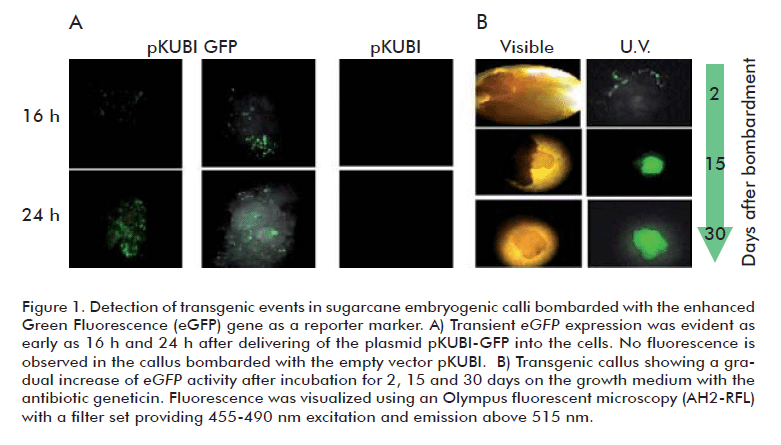
<body><![CDATA[<br>   </P >       <P   ><font size="2" face="Verdana, Arial, Helvetica, sans-serif"><B><font size="3">RESULTS      AND DISCUSSION</font><I> </I></B></font></P >   <FONT size="+1">        <P   ><font size="2" face="Verdana, Arial, Helvetica, sans-serif"><b>Optimized conditions      for genetic transformation of sugarcane cv. C1051-73 by microprojectile bombardment      of embryogenic callus </b></font></P >   <FONT size="+1">        <P   align="justify" ><font face="Verdana, Arial, Helvetica, sans-serif" size="2">The green fluorescent      protein (GFP) has been successfully used as a reporter for <I>Agrobacterium</I>-mediated      transformation of sugarcane [20]. In this work, we used the enhanced GFP (eGFP)      as the screening marker for early identification of transient transformation      events in embryogenic calli subjected to microprojectile bombardment, aiming      to establish an optimized transformation procedure for sugarcane cv. C1051-73.      Conditions for efficient DNA delivery into the cells were established using      the plasmid pKUBI-eGFP constructed for constitutive co&ndash;expression of      the marker genes <I>eGFP</I> (reporter) and <I>nptII</I> (selection) in monocots.      Fluorescence of eGFP in the transformed calli was observed as soon as 16 h      after the bombardment (<a href="/img/revistas/bta/v28n4/f0102411.gif">Figure 1A</a>). The target distance      and argon pressure for microprojectile bombardment were established to be      optimal at 11 cm and 90 PSI, respectively. Under this condition, cell fluorescence      was maximal while damages in the bombarded tissues remained to be rather slight.      Other parameters such as chamber vacuum at -28 PSI, DNA concentration above      20 &micro;g, and gold microparticules size below 6 &micro;m were found to      be important for efficient cell transformation, as it was previously reported      [14]. The eGFP-positive calli grew without showing necrosis under geneticin      selection, but failed to regenerate plantlets. As a fluorescent molecule,      GFP is expected to generate free radicals upon excitation causing toxicity      of the transformed plant cell [21]. Nevertheless, the early detection of the      fluorescent cells and their successful multiplication in the presence of the      selection antibiotic during callus growth (<a href="/img/revistas/bta/v28n4/f0102411.gif">Figure 1B</a>)      supports the convenience of using <I>eGFP</I> as a reporter gene to monitor      transient transformation events in sugarcane. </font></P >       
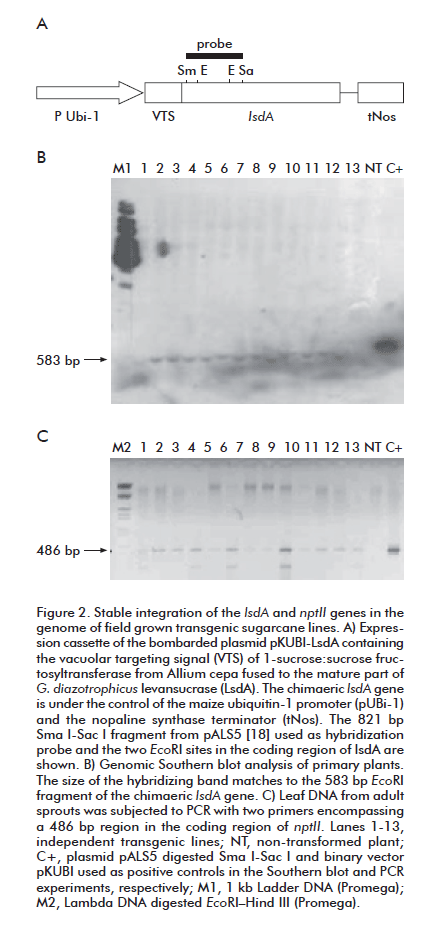
<P   align="justify" ><font face="Verdana, Arial, Helvetica, sans-serif" size="2">The sensitivity of      sugarcane cv. C1051-73 to geneticin was examined in the range 0-50 mg/L at      different stages during tissue culture. Calli reduced growth and became necrotic      after 15 days in the presence of geneticin at 20 mg/L, while the minimal antibiotic      concentration required for total inhibition of the shooting and rooting processes      was 25 mg/L. Raza <I>et al</I>. [22] reported variations in the geneticin      concentration required for regeneration inhibition of non-transformed calli      in five sugarcane cultivars with values ranging between 25 and 60 mg/L. </font></P >       <P   align="justify" ><font face="Verdana, Arial, Helvetica, sans-serif" size="2">The conditions for      embryogenic calli bombardment, selection, and regeneration here optimized      for sugarcane cv. C1051-73 were combined in a trans formation procedure that      follows essentially the steps described by Frank and Birch [14]. The established      procedure was effectively used to generate transgenic plants without the occurrence      of escapes or mosaicism. The acquired resistance to geneticin remained stable      in soil-grown plants, either in the primary stalk or the sprouts, after two      years of vegetative propagation (see next epigraph). </font></P >       <P   ><font face="Verdana, Arial, Helvetica, sans-serif" size="2"><b>Levansucrase activity      but no levan accumulation in transgenic sugarcane plants carrying the <I>Gluconacetobacter      diazotrophicus</I> levansucrase gene (<I>lsdA</I>) </b></font></P >       <P   align="justify" ><font face="Verdana, Arial, Helvetica, sans-serif" size="2">After having established      an efficient procedure for the genetic transformation of sugarcane cv. C1021-73,      we proceeded to investigate the feasibility of producing the polyfructan levan      in transgenic plants. To this aim, the vacuolar targeting pre-pro-peptide      of onion sucrose:sucrose 1-fructosyltransferase (1-SST) was fused to the mature      part of <I>G. diazotrophicus</I> levansucrase (LsdA) [5] under the transcriptional      control of the maize ubiquitin-1 promoter and the tNos terminator (plasmid      pKUBI-LsdA). The functionally of the chimaeric expression cassette was first      demonstrated in transient transformation experiments. Embryogenic sugarcane      calli was bombarded with plasmid pKUBI-LsdA and evaluated for levansucrase      activity after 48 h of gene delivery. The incubation of cell extracts with      the substrate sucrose resulted in the synthesis of fructan of DP higher than10      and FOS, as determined by TLC analysis (not shown). </font></P >       <P   align="justify" ><font face="Verdana, Arial, Helvetica, sans-serif" size="2">In stable transformation      experiments, only two percent of the overall number (above 1000) of the calli      bombarded with pKUBI-LsdA succeeded to grow smoothly when cultured in the      dark during one month on Medium H supplemented with 2,4 D and geneticin 20      mg/L. The non-treated calli failed to multiply and completely necrotized after      incubation on the selection medium. The transgenic calli regenerated into      normal plantlets after subculturing on Medium H with geneticin 25 mg/L in      the light. Southern blot analysis demonstrated the integration of the target      gene (<I>lsdA</I>) in the genome of adult plants from thirteen independent      clones grown in the absence of the selection antibiotic (<a href="#fig2">Figure      2A</a>). All the evaluated plants, except the non-transformed control, showed      the hybridization band of 583 bp corresponding to the internal <I>Eco</I>RI      fragment of <I>lsdA</I>. The persistence of the selection gene (<I>npt II</I>)      in sprouts of field-grown sugarcane lines was confirmed by PCR analysis (<a href="#fig2">Figure      2B</a>). The twenty tested lines remained to carry both transgenes after two      complete cycles of vegetative propagation, indicating that no mosaic plants      were recovered after transformation. </font></P >       <P   align="center" ><img src="/img/revistas/bta/v28n4/f0202411.gif" width="433" height="934"><a name="fig2"></a></P >       
]]></body>
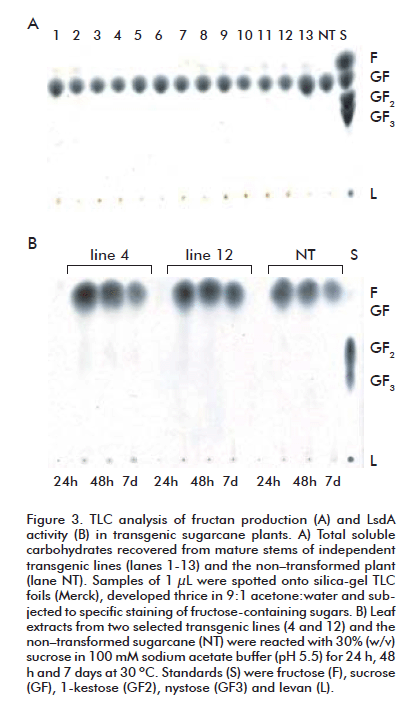
<body><![CDATA[<P   align="justify" ><font face="Verdana, Arial, Helvetica, sans-serif" size="2">We failed to detect      <I>in</I> <I>vivo</I> production of fructans in leaves and stems of transgenic      plants grown under field conditions until the harvesting period (<a href="#fig3">Figure      3A</a>). Remarkably, the reaction of the leaf extracts from clone 4 on sucrose      (30%, w/v) resulted in levan formation but there was no evident accumulation      of the &beta;-2,1-linked FOS, as determined by TLC analysis (<a href="#fig3">Figure      3B</a>). This result confirms the expression of active LsdA in at least one      transgenic plant. We cannot exclude the existence of levansucrase activity      in the other transgenic clones, although undetectable in our experimental      conditions. The strong endogenous invertase activity in the sugarcane leaf      extracts could have caused the hydrolysis of not only the substrate sucrose      but also the potentially synthesized FOS, preventing the<I> in vitro</I> formation      of levan in lines expressing low <I>lsdA</I> levels. </font></P >       <P   align="center" ><img src="/img/revistas/bta/v28n4/f0302411.gif" width="414" height="716"><a name="fig3"></a></P >       
<P   align="justify" ><font face="Verdana, Arial, Helvetica, sans-serif" size="2">The sucrose-rich      vacuole that occupies the majority of the volume of the sugarcane stem parenchyma      is the most adequate cell compartment for transgenic levan synthesis and accumulation.      In this compartment the synthesized polymer would remain sequestered, minimizing      its potential disruptive effects. By using the maize Ubi-1 promoter, Wu and      Birch [23] succeeded to express a bacterial sucrose isomerase tailored for      vacuolar compartmentation in transgenic sugarcane at levels sufficient to      permit the <I>in vivo </I>synthesis of isomaltulose in mature leaves and stems.      </font></P >       <P   align="justify" ><font face="Verdana, Arial, Helvetica, sans-serif" size="2">In our experiments,      we used the same promoter but a distinct vacuolar targeting signal for <I>lsdA</I>      expression in sugarcane. The low expression level of LsdA in the transgenic      lines impeded to evaluate whether the pre-pro-peptide of onion 1SST targeted      the recombinant enzyme to the sugarcane vacuoles. In transgenic tobacco, the      constitutive expression of the chimaeric <I>1sst</I>-<I>lsdA</I> gene did      allow high levan accumulation in mature leaves and stem, suggesting the proper      localization of LsdA in the cell vacuole [5]. </font></P >       <P   align="justify" ><font face="Verdana, Arial, Helvetica, sans-serif" size="2">There are no reports      of levan production in transgenic sugarcane. Levan accumulation has been reported      in the cell vacuole of other transgenic crops even without <I>in vitro </I>detection      of the levansucrase activity [24]. In our experiments we tested levan formation      in 20 adult transgenic plants corresponding to at least 13 independent transformation      events, which is the number of bombarded calli that regenerated geneticin-resistant      plantlets. Only one clone showed evident LsdA activity, while none of them      accumulated levan. </font></P >       <P   align="justify" ><font face="Verdana, Arial, Helvetica, sans-serif" size="2">Gene silencing, low      <I>lsdA</I> expression, non-vacuolar localization of the recombinant enzyme,      substrate competition with endogenous invertases, and even the putative presence      of inducible fructan 6-exohydrolases (6-FEH) activity are possible explanations      for the lack of levan accumulation in the transgenic sugarcane plants. Surprisingly,      a functional 6-FEH gene was identified in sugar beet, a sucrose rich, non-fructan      producer plant [25]. Despite this finding, other authors reported the accumulation      of levan to low levels (maximum 0.5% of dry weight) in leaves, storage roots      and fibrous roots of transgenic sugar beet constitutively expressing the <I>Bacillus      subtilis</I> levansucrase fused to the CPY yeast vacuolar targeting sequence      [26]. </font></P >       <P   align="justify" ><font face="Verdana, Arial, Helvetica, sans-serif" size="2">The generation of      new lines transformed with the here described construct pKUBI-LsdA, the use      of other promoters and vacuolar-driving signals, as well as the modification      of the tissue culture conditions aiming to avoid potential counterselection      of high <I>lsdA</I>-expressing transformants during early steps of calli multiplication,      may conduct to the achievement of levan production in transgenic sugarcane.      </font></P >       <P   align="justify" > </P >       <P   align="justify" ><b><font face="Verdana, Arial, Helvetica, sans-serif" size="3">REFERENCES </font></b></P >       <P   align="justify" > </P >       ]]></body>
<body><![CDATA[<!-- ref --><P   align="justify" ><font size="2" face="Verdana, Arial, Helvetica, sans-serif">1. Rae AL, Grof CPL,      Casu RE, Bonnett GD. Sucrose accumulation in the sugarcane stem: pathways      and control points for transport and compartmentation. Field Crop Res. 2005;92(2-3):159-68.          </font></P >   <FONT size="+1">        <!-- ref --><P   align="justify" ><font face="Verdana, Arial, Helvetica, sans-serif" size="2">2. Hern&aacute;ndez      L, Arrieta J, Men&eacute;ndez C, V&aacute;zquez R, Coego A, Su&aacute;rez      V, et al. Isolation and enzymic properties of levansucrase secreted by Acetobacter      diazotrophicus SRT4, a bacterium associated with sugar cane. Biochem J. 1995;309(Pt      1):113-8.     </font></P >       <!-- ref --><P   align="justify" ><font face="Verdana, Arial, Helvetica, sans-serif" size="2">3. Trujillo LE, Arrieta      JG, Dafhnis F, Garcia J, Valdes J, Tambara Y, et al. Fructo-oligosaccharides      production by the Gluconacetobacter diazotrophicus levansucrase expressed      in the methylotrophic yeast Pichia pastoris. Enzyme Microb Technol. 2001;28(2-3):139-44.          </font></P >       <P   align="justify" ><font face="Verdana, Arial, Helvetica, sans-serif" size="2">4. Trujillo LE, G&oacute;mez      R, Banguela A, Soto M, Arrieta JG, Hern&aacute;ndez L. Catalytic properties      of N&ndash;glycosylated Gluconacetobacter diazotrophicus levansucrase produced      in yeast. Electr J Biotechnol. 2004;7(2):115-23. </font></P >       <!-- ref --><P   align="justify" ><font face="Verdana, Arial, Helvetica, sans-serif" size="2">5. Banguela A, Arrieta      JG, Rodr&iacute;guez R, Trujillo LE, Men&eacute;ndez C, Hern&aacute;ndez L.      High levan accumulation in transgenic tobacco plants expressing the Gluconacetobacter      diazotrophicus levansucrase gene. J Biotechnol. 2011;154(1):93-8.     </font></P >       <P   align="justify" ><font face="Verdana, Arial, Helvetica, sans-serif" size="2">6. Snyman SJ, Watt      MP, Huckett BI, Botha FC. Direct somatic embryogenesis for rapid, cost&ndash;effective      production of transgenic sugarcane (Saccharum spp. hybrids). Proc S Afr Sug      Technol Ass. 2000;74:186-7. </font></P >       ]]></body>
<body><![CDATA[<!-- ref --><P   align="justify" ><font face="Verdana, Arial, Helvetica, sans-serif" size="2">7. Arencibia AD,      Carmona ER, Tellez P, Chan M, Yu S, Trujillo LE, et al. An efficient protocol      for sugarcane (Saccharum spp. L.) transformation mediated by Agrobacterium      tumefaciens. Transgenic Res. 1998;7(3):213-22.     </font></P >       <P   align="justify" ><font face="Verdana, Arial, Helvetica, sans-serif" size="2">8. Enr&iacute;quez      GA, V&aacute;zquez-Padr&oacute;n RI, Prieto-Sams&oacute;nov DL, de la Riva      G, Selman&ndash;Housein G. Herbicide-resistant sugarcane (Saccharum officinarum      L.) plants by Agrobacterium&ndash;mediated transformation. Planta. 1998;206(1):20-7.      </font></P >       <!-- ref --><P   align="justify" ><font face="Verdana, Arial, Helvetica, sans-serif" size="2">9. Santosa DA, Hendroko      R, Farouk A, Greiner R. A rapid and highly efficient method for transformation      of sugarcane callus. Mol Biotechnol. 2004;28(2):113-9.     </font></P >       <!-- ref --><P   align="justify" ><font face="Verdana, Arial, Helvetica, sans-serif" size="2">10. Birch RG. Plant      Transformation: Problems and strategies for practical application. Annu Rev      Plant Physiol Plant Mol Biol. 1997;48:297-326.     </font></P >       <!-- ref --><P   align="justify" ><font face="Verdana, Arial, Helvetica, sans-serif" size="2">11. Christensen AH,      Quail PH. Ubiquitin promoter-based vectors for high-level expression of selectable      and/or screenable marker genes in monocotyledonous plants. Transgenic Res.      1996;5(3):213-8.     </font></P >       <!-- ref --><P   align="justify" ><font face="Verdana, Arial, Helvetica, sans-serif" size="2">12. Murashige T,      Skoog F. A revised medium for rapid growth and bioassays with tobacco tissue      cultures. Physiol Plantarum. 1962;15(3):473-97.     </font></P >       <!-- ref --><P   align="justify" ><font face="Verdana, Arial, Helvetica, sans-serif" size="2">13. Finer JJ, Vain      P, Jones MW, McMullen MD. Development of the particle inflow gun for DNA delivery      to plant cells. Plant Cell Rep. 1992;11:323-8.     </font></P >       <!-- ref --><P   align="justify" ><font face="Verdana, Arial, Helvetica, sans-serif" size="2">14. Franks T, Birch      RG. Development and optimization of microprojectile systems for plant genetic      transformation. Aust J Plant Physiol. 1991;18(5):453-69.     </font></P >       <!-- ref --><P   align="justify" ><font face="Verdana, Arial, Helvetica, sans-serif" size="2">15. Sambrook J, Fritsch      EF, Maniatis T. Molecular cloning, a laboratory manual. New York: Cold Spring      Harbor Laboratory Press; 1989. p.1659.     </font></P >       <!-- ref --><P   align="justify" ><font face="Verdana, Arial, Helvetica, sans-serif" size="2">16. Cormack BP, Valdivia      RH, Falkow S. FACS-optimized mutants of the green fluorescent protein (GFP).      Gene. 1996;173(1 Spec No):33-8.     </font></P >       <!-- ref --><P   align="justify" ><font face="Verdana, Arial, Helvetica, sans-serif" size="2">17. Doyle JJ, Doyle      JL. Isolation of plant DNA from fresh tissue. Focus. 1990;12: 13-5.     </font></P >       <!-- ref --><P   align="justify" ><font face="Verdana, Arial, Helvetica, sans-serif" size="2">18. Arrieta J, Hernandez      L, Coego A, Suarez V, Balmori E, Menendez C, et al. Molecular characterization      of the levansucrase gene from the endophytic sugarcane bacterium Acetobacter      diazotrophicus SRT4. Microbiology. 1996;142 (Pt 5):1077-85.     </font></P >       <!-- ref --><P   align="justify" ><font face="Verdana, Arial, Helvetica, sans-serif" size="2">19. Wise CS, Dimier      RJ, Davis HA, Rist CE. Determination of easily hydrolyzable fructose units      in dextran preparations. Anal Chem. 1955;27(1):33-6.     </font></P >       <P   align="justify" ><font face="Verdana, Arial, Helvetica, sans-serif" size="2">20. Elliott AR, Campbell      JA, Brettell RIS, Grof CPL. Agrobacterium-mediated transformation of sugarcane      using GFP as a screenable marker. Aust J Plant Physiol. 1998;25(6):739-43.      </font></P >       <!-- ref --><P   align="justify" ><font face="Verdana, Arial, Helvetica, sans-serif" size="2">21. de Ruijter NCA,      Verhees J, van Leeuwen W, van der Krol AR. Evaluation and Comparison of the      GUS, LUC and GFP Reporter System for gene expression studies in plants. Plant      Biol. 2003;5(2):103-15.     </font></P >       <!-- ref --><P   align="justify" ><font face="Verdana, Arial, Helvetica, sans-serif" size="2">22. Raza G, Ali K,      Mukhtar Z, Mansoor S, Arshad M, Asad S. The response of sugarcane (Saccharum      officinarum L.) genotypes to callus induction, regeneration and different      concentrations of the selective agent (geneticin-418). Afr J Biotechnol. 2010;9(51):8739-47.          </font></P >       ]]></body>
<body><![CDATA[<!-- ref --><P   align="justify" ><font face="Verdana, Arial, Helvetica, sans-serif" size="2">23. Wu L, Birch RG.      Doubled sugar content in sugarcane plants modified to produce a sucrose isomer.      Plant Biotech J. 2007; 5(1):109-17.     </font></P >       <!-- ref --><P   align="justify" ><font face="Verdana, Arial, Helvetica, sans-serif" size="2">24. Cairns AJ. Fructan      biosynthesis in transgenic plants. J Exp Bot. 2003;54(382):549-67.     </font></P >       <P   align="justify" ><font face="Verdana, Arial, Helvetica, sans-serif" size="2">25. Van den Ende      W, De Coninck B, Clerens S, Vergauwen R, Van Laere A. Unexpected presence      of fructan 6-exohydrolases (6-FEHs) in non-fructan plants: characterization,      cloning, mass mapping and functional analysis of a novel &lsquo;cell-wall      invertase-like&rsquo; specific 6-FEH from sugar beet (Beta vulgaris L.). Plant      J. 2003;36(5):697-710. </font></P >       <!-- ref --><P   align="justify" ><font face="Verdana, Arial, Helvetica, sans-serif" size="2">26. Pilon-Smits EAH,      Terry N, Sears T, van Dun K. Enhanced drought resistance in fructan-producing      sugar beet. Plant Physiol Biochem. 1999;37(4):313-17.     </font></P >       <P   align="justify" >&nbsp;</P >   <FONT size="+1">        <P   > </P >   <FONT size="+1">        <P   ><font face="Verdana, Arial, Helvetica, sans-serif" size="2">Received in September,      2011.    ]]></body>
<body><![CDATA[<br>     </font><font face="Verdana, Arial, Helvetica, sans-serif" size="2">Accepted      for publication in November, 2011. </font></P >       <P   >&nbsp;</P >       <P   ><font face="Verdana, Arial, Helvetica, sans-serif" size="2">L&aacute;zaro Hern&aacute;ndez.      Centro de Ingenier&iacute;a Gen&eacute;tica y Biotecnolog&iacute;a, CIGB.      AP 6162, La Habana, Cuba. E-mail: <a href="mailto:lazaro.hernandez@cigb.edu.cu">      <U><U><FONT color="#0000FF">lazaro.hernandez@cigb.edu.cu</font></U></U></A>      </font></P >   </font></font></font></font></font></font></font></font></font></font></font></font></font></font></font></font></font></font></font></font></font></font></font></font></font></font></font></font></font></font></font></font></font></font></font></font></font></font></font></font></font></font></font></font></font></font></font></font></font></font></font></DIV >      ]]></body><back>
<ref-list>
<ref id="B1">
<label>1</label><nlm-citation citation-type="journal">
<person-group person-group-type="author">
<name>
<surname><![CDATA[Rae]]></surname>
<given-names><![CDATA[AL]]></given-names>
</name>
<name>
<surname><![CDATA[Grof]]></surname>
<given-names><![CDATA[CPL]]></given-names>
</name>
<name>
<surname><![CDATA[Casu]]></surname>
<given-names><![CDATA[RE]]></given-names>
</name>
<name>
<surname><![CDATA[Bonnett]]></surname>
<given-names><![CDATA[GD]]></given-names>
</name>
</person-group>
<article-title xml:lang="en"><![CDATA[Sucrose accumulation in the sugarcane stem: pathways and control points for transport and compartmentation]]></article-title>
<source><![CDATA[Field Crop Res]]></source>
<year>2005</year>
<volume>92</volume>
<numero>2-3</numero>
<issue>2-3</issue>
<page-range>159-68</page-range></nlm-citation>
</ref>
<ref id="B2">
<label>2</label><nlm-citation citation-type="journal">
<person-group person-group-type="author">
<name>
<surname><![CDATA[Hernández]]></surname>
<given-names><![CDATA[L]]></given-names>
</name>
<name>
<surname><![CDATA[Arrieta]]></surname>
<given-names><![CDATA[J]]></given-names>
</name>
<name>
<surname><![CDATA[Menéndez]]></surname>
<given-names><![CDATA[C]]></given-names>
</name>
<name>
<surname><![CDATA[Vázquez]]></surname>
<given-names><![CDATA[R]]></given-names>
</name>
<name>
<surname><![CDATA[Coego]]></surname>
<given-names><![CDATA[A]]></given-names>
</name>
<name>
<surname><![CDATA[Suárez]]></surname>
<given-names><![CDATA[V]]></given-names>
</name>
</person-group>
<article-title xml:lang="en"><![CDATA[Isolation and enzymic properties of levansucrase secreted by Acetobacter diazotrophicus SRT4, a bacterium associated with sugar cane]]></article-title>
<source><![CDATA[Biochem J]]></source>
<year>1995</year>
<volume>309</volume>
<numero>1</numero>
<issue>1</issue>
<page-range>113-8</page-range></nlm-citation>
</ref>
<ref id="B3">
<label>3</label><nlm-citation citation-type="journal">
<person-group person-group-type="author">
<name>
<surname><![CDATA[Trujillo]]></surname>
<given-names><![CDATA[LE]]></given-names>
</name>
<name>
<surname><![CDATA[Arrieta]]></surname>
<given-names><![CDATA[JG]]></given-names>
</name>
<name>
<surname><![CDATA[Dafhnis]]></surname>
<given-names><![CDATA[F]]></given-names>
</name>
<name>
<surname><![CDATA[Garcia]]></surname>
<given-names><![CDATA[J]]></given-names>
</name>
<name>
<surname><![CDATA[Valdes]]></surname>
<given-names><![CDATA[J]]></given-names>
</name>
<name>
<surname><![CDATA[Tambara]]></surname>
<given-names><![CDATA[Y]]></given-names>
</name>
</person-group>
<article-title xml:lang="en"><![CDATA[Fructo-oligosaccharides production by the Gluconacetobacter diazotrophicus levansucrase expressed in the methylotrophic yeast Pichia pastoris]]></article-title>
<source><![CDATA[Enzyme Microb Technol]]></source>
<year>2001</year>
<volume>28</volume>
<numero>2-3</numero>
<issue>2-3</issue>
<page-range>139-44</page-range></nlm-citation>
</ref>
<ref id="B4">
<label>4</label><nlm-citation citation-type="journal">
<person-group person-group-type="author">
<name>
<surname><![CDATA[Trujillo]]></surname>
<given-names><![CDATA[LE]]></given-names>
</name>
<name>
<surname><![CDATA[Gómez]]></surname>
<given-names><![CDATA[R]]></given-names>
</name>
<name>
<surname><![CDATA[Banguela]]></surname>
<given-names><![CDATA[A]]></given-names>
</name>
<name>
<surname><![CDATA[Soto]]></surname>
<given-names><![CDATA[M]]></given-names>
</name>
<name>
<surname><![CDATA[Arrieta]]></surname>
<given-names><![CDATA[JG]]></given-names>
</name>
<name>
<surname><![CDATA[Hernández]]></surname>
<given-names><![CDATA[L]]></given-names>
</name>
</person-group>
<article-title xml:lang="en"><![CDATA[Catalytic properties of N-glycosylated Gluconacetobacter diazotrophicus levansucrase produced in yeast]]></article-title>
<source><![CDATA[Electr J Biotechnol]]></source>
<year>2004</year>
<volume>7</volume>
<numero>2</numero>
<issue>2</issue>
<page-range>115-23</page-range></nlm-citation>
</ref>
<ref id="B5">
<label>5</label><nlm-citation citation-type="journal">
<person-group person-group-type="author">
<name>
<surname><![CDATA[Banguela]]></surname>
<given-names><![CDATA[A]]></given-names>
</name>
<name>
<surname><![CDATA[Arrieta]]></surname>
<given-names><![CDATA[JG]]></given-names>
</name>
<name>
<surname><![CDATA[Rodríguez]]></surname>
<given-names><![CDATA[R]]></given-names>
</name>
<name>
<surname><![CDATA[Trujillo]]></surname>
<given-names><![CDATA[LE]]></given-names>
</name>
<name>
<surname><![CDATA[Menéndez]]></surname>
<given-names><![CDATA[C]]></given-names>
</name>
<name>
<surname><![CDATA[Hernández]]></surname>
<given-names><![CDATA[L]]></given-names>
</name>
</person-group>
<article-title xml:lang="en"><![CDATA[High levan accumulation in transgenic tobacco plants expressing the Gluconacetobacter diazotrophicus levansucrase gene]]></article-title>
<source><![CDATA[J Biotechnol]]></source>
<year>2011</year>
<volume>154</volume>
<numero>1</numero>
<issue>1</issue>
<page-range>93-8</page-range></nlm-citation>
</ref>
<ref id="B6">
<label>6</label><nlm-citation citation-type="journal">
<person-group person-group-type="author">
<name>
<surname><![CDATA[Snyman]]></surname>
<given-names><![CDATA[SJ]]></given-names>
</name>
<name>
<surname><![CDATA[Watt]]></surname>
<given-names><![CDATA[MP]]></given-names>
</name>
<name>
<surname><![CDATA[Huckett]]></surname>
<given-names><![CDATA[BI]]></given-names>
</name>
<name>
<surname><![CDATA[Botha]]></surname>
<given-names><![CDATA[FC]]></given-names>
</name>
</person-group>
<article-title xml:lang="en"><![CDATA[Direct somatic embryogenesis for rapid, cost-effective production of transgenic sugarcane (Saccharum spp. hybrids)]]></article-title>
<source><![CDATA[Proc S Afr Sug Technol Ass]]></source>
<year>2000</year>
<volume>74</volume>
<page-range>186-7</page-range></nlm-citation>
</ref>
<ref id="B7">
<label>7</label><nlm-citation citation-type="journal">
<person-group person-group-type="author">
<name>
<surname><![CDATA[Arencibia]]></surname>
<given-names><![CDATA[AD]]></given-names>
</name>
<name>
<surname><![CDATA[Carmona]]></surname>
<given-names><![CDATA[ER]]></given-names>
</name>
<name>
<surname><![CDATA[Tellez]]></surname>
<given-names><![CDATA[P]]></given-names>
</name>
<name>
<surname><![CDATA[Chan]]></surname>
<given-names><![CDATA[M]]></given-names>
</name>
<name>
<surname><![CDATA[Yu]]></surname>
<given-names><![CDATA[S]]></given-names>
</name>
<name>
<surname><![CDATA[Trujillo]]></surname>
<given-names><![CDATA[LE]]></given-names>
</name>
</person-group>
<article-title xml:lang="en"><![CDATA[An efficient protocol for sugarcane (Saccharum spp. L.) transformation mediated by Agrobacterium tumefaciens]]></article-title>
<source><![CDATA[Transgenic Res]]></source>
<year>1998</year>
<volume>7</volume>
<numero>3</numero>
<issue>3</issue>
<page-range>213-22</page-range></nlm-citation>
</ref>
<ref id="B8">
<label>8</label><nlm-citation citation-type="journal">
<person-group person-group-type="author">
<name>
<surname><![CDATA[Enríquez]]></surname>
<given-names><![CDATA[GA]]></given-names>
</name>
<name>
<surname><![CDATA[Vázquez-Padrón]]></surname>
<given-names><![CDATA[RI]]></given-names>
</name>
<name>
<surname><![CDATA[Prieto-Samsónov]]></surname>
<given-names><![CDATA[DL]]></given-names>
</name>
<name>
<surname><![CDATA[de la Riva]]></surname>
<given-names><![CDATA[G]]></given-names>
</name>
<name>
<surname><![CDATA[Selman-Housein]]></surname>
<given-names><![CDATA[G]]></given-names>
</name>
</person-group>
<article-title xml:lang="en"><![CDATA[Herbicide-resistant sugarcane (Saccharum officinarum L.) plants by Agrobacterium-mediated transformation]]></article-title>
<source><![CDATA[Planta]]></source>
<year>1998</year>
<volume>206</volume>
<numero>1</numero>
<issue>1</issue>
<page-range>20-7</page-range></nlm-citation>
</ref>
<ref id="B9">
<label>9</label><nlm-citation citation-type="journal">
<person-group person-group-type="author">
<name>
<surname><![CDATA[Santosa]]></surname>
<given-names><![CDATA[DA]]></given-names>
</name>
<name>
<surname><![CDATA[Hendroko]]></surname>
<given-names><![CDATA[R]]></given-names>
</name>
<name>
<surname><![CDATA[Farouk]]></surname>
<given-names><![CDATA[A]]></given-names>
</name>
<name>
<surname><![CDATA[Greiner]]></surname>
<given-names><![CDATA[R]]></given-names>
</name>
</person-group>
<article-title xml:lang="en"><![CDATA[A rapid and highly efficient method for transformation of sugarcane callus]]></article-title>
<source><![CDATA[Mol Biotechnol]]></source>
<year>2004</year>
<volume>28</volume>
<numero>2</numero>
<issue>2</issue>
<page-range>113-9</page-range></nlm-citation>
</ref>
<ref id="B10">
<label>10</label><nlm-citation citation-type="journal">
<person-group person-group-type="author">
<name>
<surname><![CDATA[Birch]]></surname>
<given-names><![CDATA[RG]]></given-names>
</name>
</person-group>
<article-title xml:lang="en"><![CDATA[Plant Transformation: Problems and strategies for practical application]]></article-title>
<source><![CDATA[Annu Rev Plant Physiol Plant Mol Biol]]></source>
<year>1997</year>
<volume>48</volume>
<page-range>297-326</page-range></nlm-citation>
</ref>
<ref id="B11">
<label>11</label><nlm-citation citation-type="journal">
<person-group person-group-type="author">
<name>
<surname><![CDATA[Christensen]]></surname>
<given-names><![CDATA[AH]]></given-names>
</name>
<name>
<surname><![CDATA[Quail]]></surname>
<given-names><![CDATA[PH]]></given-names>
</name>
</person-group>
<article-title xml:lang="en"><![CDATA[Ubiquitin promoter-based vectors for high-level expression of selectable and/or screenable marker genes in monocotyledonous plants]]></article-title>
<source><![CDATA[Transgenic Res]]></source>
<year>1996</year>
<volume>5</volume>
<numero>3</numero>
<issue>3</issue>
<page-range>213-8</page-range></nlm-citation>
</ref>
<ref id="B12">
<label>12</label><nlm-citation citation-type="journal">
<person-group person-group-type="author">
<name>
<surname><![CDATA[Murashige]]></surname>
<given-names><![CDATA[T]]></given-names>
</name>
<name>
<surname><![CDATA[Skoog]]></surname>
<given-names><![CDATA[F]]></given-names>
</name>
</person-group>
<article-title xml:lang="en"><![CDATA[A revised medium for rapid growth and bioassays with tobacco tissue cultures]]></article-title>
<source><![CDATA[Physiol Plantarum]]></source>
<year>1962</year>
<volume>15</volume>
<numero>3</numero>
<issue>3</issue>
<page-range>473-97</page-range></nlm-citation>
</ref>
<ref id="B13">
<label>13</label><nlm-citation citation-type="journal">
<person-group person-group-type="author">
<name>
<surname><![CDATA[Finer]]></surname>
<given-names><![CDATA[JJ]]></given-names>
</name>
<name>
<surname><![CDATA[Vain]]></surname>
<given-names><![CDATA[P]]></given-names>
</name>
<name>
<surname><![CDATA[Jones]]></surname>
<given-names><![CDATA[MW]]></given-names>
</name>
<name>
<surname><![CDATA[McMullen]]></surname>
<given-names><![CDATA[MD]]></given-names>
</name>
</person-group>
<article-title xml:lang="en"><![CDATA[Development of the particle inflow gun for DNA delivery to plant cells]]></article-title>
<source><![CDATA[Plant Cell Rep]]></source>
<year>1992</year>
<volume>11</volume>
<page-range>323-8</page-range></nlm-citation>
</ref>
<ref id="B14">
<label>14</label><nlm-citation citation-type="journal">
<person-group person-group-type="author">
<name>
<surname><![CDATA[Franks]]></surname>
<given-names><![CDATA[T]]></given-names>
</name>
<name>
<surname><![CDATA[Birch]]></surname>
<given-names><![CDATA[RG]]></given-names>
</name>
</person-group>
<article-title xml:lang="en"><![CDATA[Development and optimization of microprojectile systems for plant genetic transformation]]></article-title>
<source><![CDATA[Aust J Plant Physiol]]></source>
<year>1991</year>
<volume>18</volume>
<numero>5</numero>
<issue>5</issue>
<page-range>453-69</page-range></nlm-citation>
</ref>
<ref id="B15">
<label>15</label><nlm-citation citation-type="book">
<person-group person-group-type="author">
<name>
<surname><![CDATA[Sambrook]]></surname>
<given-names><![CDATA[J]]></given-names>
</name>
<name>
<surname><![CDATA[Fritsch]]></surname>
<given-names><![CDATA[EF]]></given-names>
</name>
<name>
<surname><![CDATA[Maniatis]]></surname>
<given-names><![CDATA[T]]></given-names>
</name>
</person-group>
<source><![CDATA[Molecular cloning, a laboratory manual]]></source>
<year>1989</year>
<page-range>1659</page-range><publisher-loc><![CDATA[New York ]]></publisher-loc>
<publisher-name><![CDATA[Cold Spring Harbor Laboratory Press]]></publisher-name>
</nlm-citation>
</ref>
<ref id="B16">
<label>16</label><nlm-citation citation-type="journal">
<person-group person-group-type="author">
<name>
<surname><![CDATA[Cormack]]></surname>
<given-names><![CDATA[BP]]></given-names>
</name>
<name>
<surname><![CDATA[Valdivia]]></surname>
<given-names><![CDATA[RH]]></given-names>
</name>
<name>
<surname><![CDATA[Falkow]]></surname>
<given-names><![CDATA[S]]></given-names>
</name>
</person-group>
<article-title xml:lang="en"><![CDATA[FACS-optimized mutants of the green fluorescent protein (GFP)]]></article-title>
<source><![CDATA[Gene]]></source>
<year>1996</year>
<volume>173</volume>
<numero>1 Spec No</numero>
<issue>1 Spec No</issue>
<page-range>33-8</page-range></nlm-citation>
</ref>
<ref id="B17">
<label>17</label><nlm-citation citation-type="journal">
<person-group person-group-type="author">
<name>
<surname><![CDATA[Doyle]]></surname>
<given-names><![CDATA[JJ]]></given-names>
</name>
<name>
<surname><![CDATA[Doyle]]></surname>
<given-names><![CDATA[JL]]></given-names>
</name>
</person-group>
<article-title xml:lang="en"><![CDATA[Isolation of plant DNA from fresh tissue]]></article-title>
<source><![CDATA[Focus]]></source>
<year>1990</year>
<volume>12</volume>
<page-range>13-5</page-range></nlm-citation>
</ref>
<ref id="B18">
<label>18</label><nlm-citation citation-type="journal">
<person-group person-group-type="author">
<name>
<surname><![CDATA[Arrieta]]></surname>
<given-names><![CDATA[J]]></given-names>
</name>
<name>
<surname><![CDATA[Hernandez]]></surname>
<given-names><![CDATA[L]]></given-names>
</name>
<name>
<surname><![CDATA[Coego]]></surname>
<given-names><![CDATA[A]]></given-names>
</name>
<name>
<surname><![CDATA[Suarez]]></surname>
<given-names><![CDATA[V]]></given-names>
</name>
<name>
<surname><![CDATA[Balmori]]></surname>
<given-names><![CDATA[E]]></given-names>
</name>
<name>
<surname><![CDATA[Menendez]]></surname>
<given-names><![CDATA[C]]></given-names>
</name>
</person-group>
<article-title xml:lang="en"><![CDATA[Molecular characterization of the levansucrase gene from the endophytic sugarcane bacterium Acetobacter diazotrophicus SRT4]]></article-title>
<source><![CDATA[Microbiology]]></source>
<year>1996</year>
<volume>142</volume>
<numero>5</numero>
<issue>5</issue>
<page-range>1077-85</page-range></nlm-citation>
</ref>
<ref id="B19">
<label>19</label><nlm-citation citation-type="journal">
<person-group person-group-type="author">
<name>
<surname><![CDATA[Wise]]></surname>
<given-names><![CDATA[CS]]></given-names>
</name>
<name>
<surname><![CDATA[Dimier]]></surname>
<given-names><![CDATA[RJ]]></given-names>
</name>
<name>
<surname><![CDATA[Davis]]></surname>
<given-names><![CDATA[HA]]></given-names>
</name>
<name>
<surname><![CDATA[Rist]]></surname>
<given-names><![CDATA[CE]]></given-names>
</name>
</person-group>
<article-title xml:lang="en"><![CDATA[Determination of easily hydrolyzable fructose units in dextran preparations]]></article-title>
<source><![CDATA[Anal Chem]]></source>
<year>1955</year>
<volume>27</volume>
<numero>1</numero>
<issue>1</issue>
<page-range>33-6</page-range></nlm-citation>
</ref>
<ref id="B20">
<label>20</label><nlm-citation citation-type="journal">
<person-group person-group-type="author">
<name>
<surname><![CDATA[Elliott]]></surname>
<given-names><![CDATA[AR]]></given-names>
</name>
<name>
<surname><![CDATA[Campbell]]></surname>
<given-names><![CDATA[JA]]></given-names>
</name>
<name>
<surname><![CDATA[Brettell]]></surname>
<given-names><![CDATA[RIS]]></given-names>
</name>
<name>
<surname><![CDATA[Grof]]></surname>
<given-names><![CDATA[CPL]]></given-names>
</name>
</person-group>
<article-title xml:lang="en"><![CDATA[Agrobacterium-mediated transformation of sugarcane using GFP as a screenable marker]]></article-title>
<source><![CDATA[Aust J Plant Physiol]]></source>
<year>1998</year>
<numero>6</numero>
<issue>6</issue>
<page-range>25</page-range></nlm-citation>
</ref>
<ref id="B21">
<label>21</label><nlm-citation citation-type="journal">
<person-group person-group-type="author">
<name>
<surname><![CDATA[de Ruijter]]></surname>
<given-names><![CDATA[NCA]]></given-names>
</name>
<name>
<surname><![CDATA[Verhees]]></surname>
<given-names><![CDATA[J]]></given-names>
</name>
<name>
<surname><![CDATA[van Leeuwen]]></surname>
<given-names><![CDATA[W]]></given-names>
</name>
<name>
<surname><![CDATA[van der Krol]]></surname>
<given-names><![CDATA[AR]]></given-names>
</name>
</person-group>
<article-title xml:lang="en"><![CDATA[Evaluation and Comparison of the GUS, LUC and GFP Reporter System for gene expression studies in plants]]></article-title>
<source><![CDATA[Plant Biol]]></source>
<year>2003</year>
<volume>5</volume>
<numero>2</numero>
<issue>2</issue>
<page-range>103-15</page-range></nlm-citation>
</ref>
<ref id="B22">
<label>22</label><nlm-citation citation-type="journal">
<person-group person-group-type="author">
<name>
<surname><![CDATA[Raza]]></surname>
<given-names><![CDATA[G]]></given-names>
</name>
<name>
<surname><![CDATA[Ali]]></surname>
<given-names><![CDATA[K]]></given-names>
</name>
<name>
<surname><![CDATA[Mukhtar]]></surname>
<given-names><![CDATA[Z]]></given-names>
</name>
<name>
<surname><![CDATA[Mansoor]]></surname>
<given-names><![CDATA[S]]></given-names>
</name>
<name>
<surname><![CDATA[Arshad]]></surname>
<given-names><![CDATA[M]]></given-names>
</name>
<name>
<surname><![CDATA[Asad]]></surname>
<given-names><![CDATA[S]]></given-names>
</name>
</person-group>
<article-title xml:lang="en"><![CDATA[The response of sugarcane (Saccharum officinarum L.) genotypes to callus induction, regeneration and different concentrations of the selective agent (geneticin-418)]]></article-title>
<source><![CDATA[Afr J Biotechnol]]></source>
<year>2010</year>
<volume>9</volume>
<numero>51</numero>
<issue>51</issue>
<page-range>8739-47</page-range></nlm-citation>
</ref>
<ref id="B23">
<label>23</label><nlm-citation citation-type="journal">
<person-group person-group-type="author">
<name>
<surname><![CDATA[Wu]]></surname>
<given-names><![CDATA[L]]></given-names>
</name>
<name>
<surname><![CDATA[Birch]]></surname>
<given-names><![CDATA[RG]]></given-names>
</name>
</person-group>
<article-title xml:lang="en"><![CDATA[Doubled sugar content in sugarcane plants modified to produce a sucrose isomer]]></article-title>
<source><![CDATA[Plant Biotech J]]></source>
<year>2007</year>
<volume>5</volume>
<numero>1</numero>
<issue>1</issue>
<page-range>109-17</page-range></nlm-citation>
</ref>
<ref id="B24">
<label>24</label><nlm-citation citation-type="journal">
<person-group person-group-type="author">
<name>
<surname><![CDATA[Cairns]]></surname>
<given-names><![CDATA[AJ]]></given-names>
</name>
</person-group>
<article-title xml:lang="en"><![CDATA[Fructan biosynthesis in transgenic plants]]></article-title>
<source><![CDATA[J Exp Bot]]></source>
<year>2003</year>
<volume>54</volume>
<numero>382</numero>
<issue>382</issue>
<page-range>549-67</page-range></nlm-citation>
</ref>
<ref id="B25">
<label>25</label><nlm-citation citation-type="journal">
<person-group person-group-type="author">
<name>
<surname><![CDATA[Van den Ende]]></surname>
<given-names><![CDATA[W]]></given-names>
</name>
<name>
<surname><![CDATA[De Coninck]]></surname>
<given-names><![CDATA[B]]></given-names>
</name>
<name>
<surname><![CDATA[Clerens]]></surname>
<given-names><![CDATA[S]]></given-names>
</name>
<name>
<surname><![CDATA[Vergauwen]]></surname>
<given-names><![CDATA[R]]></given-names>
</name>
<name>
<surname><![CDATA[Van Laere]]></surname>
<given-names><![CDATA[A]]></given-names>
</name>
</person-group>
<article-title xml:lang="en"><![CDATA[Unexpected presence of fructan 6-exohydrolases (6-FEHs) in non-fructan plants: characterization, cloning, mass mapping and functional analysis of a novel 'cell-wall invertase-like' specific 6-FEH from sugar beet (Beta vulgaris L.)]]></article-title>
<source><![CDATA[Plant J]]></source>
<year>2003</year>
<volume>36</volume>
<numero>5</numero>
<issue>5</issue>
<page-range>697-710</page-range></nlm-citation>
</ref>
<ref id="B26">
<label>26</label><nlm-citation citation-type="journal">
<person-group person-group-type="author">
<name>
<surname><![CDATA[Pilon-Smits]]></surname>
<given-names><![CDATA[EAH]]></given-names>
</name>
<name>
<surname><![CDATA[Terry]]></surname>
<given-names><![CDATA[N]]></given-names>
</name>
<name>
<surname><![CDATA[Sears]]></surname>
<given-names><![CDATA[T]]></given-names>
</name>
<name>
<surname><![CDATA[van Dun]]></surname>
<given-names><![CDATA[K]]></given-names>
</name>
</person-group>
<article-title xml:lang="en"><![CDATA[Enhanced drought resistance in fructan-producing sugar beet]]></article-title>
<source><![CDATA[Plant Physiol Biochem]]></source>
<year>1999</year>
<volume>37</volume>
<numero>4</numero>
<issue>4</issue>
<page-range>313-17</page-range></nlm-citation>
</ref>
</ref-list>
</back>
</article>