<?xml version="1.0" encoding="ISO-8859-1"?><article xmlns:mml="http://www.w3.org/1998/Math/MathML" xmlns:xlink="http://www.w3.org/1999/xlink" xmlns:xsi="http://www.w3.org/2001/XMLSchema-instance">
<front>
<journal-meta>
<journal-id>1027-2852</journal-id>
<journal-title><![CDATA[Biotecnología Aplicada]]></journal-title>
<abbrev-journal-title><![CDATA[Biotecnol Apl]]></abbrev-journal-title>
<issn>1027-2852</issn>
<publisher>
<publisher-name><![CDATA[Editorial Elfos Scientiae]]></publisher-name>
</publisher>
</journal-meta>
<article-meta>
<article-id>S1027-28522012000100006</article-id>
<title-group>
<article-title xml:lang="en"><![CDATA[In vitro activity of Surfactant Protein A against Leishmania amazonensis]]></article-title>
<article-title xml:lang="es"><![CDATA[Actividad in vitro de la proteína A del surfactante pulmonar frente a Leishmania amazonensis]]></article-title>
</title-group>
<contrib-group>
<contrib contrib-type="author">
<name>
<surname><![CDATA[Lugones]]></surname>
<given-names><![CDATA[Yuliannis]]></given-names>
</name>
<xref ref-type="aff" rid="A01"/>
</contrib>
<contrib contrib-type="author">
<name>
<surname><![CDATA[Blanco]]></surname>
<given-names><![CDATA[Odalys]]></given-names>
</name>
<xref ref-type="aff" rid="A01"/>
</contrib>
<contrib contrib-type="author">
<name>
<surname><![CDATA[Faure]]></surname>
<given-names><![CDATA[Roberto]]></given-names>
</name>
<xref ref-type="aff" rid="A01"/>
</contrib>
<contrib contrib-type="author">
<name>
<surname><![CDATA[Monzote]]></surname>
<given-names><![CDATA[Lianet]]></given-names>
</name>
<xref ref-type="aff" rid="A02"/>
</contrib>
</contrib-group>
<aff id="A01">
<institution><![CDATA[,Centro Nacional de Sanidad Agropecuaria Grupo de Química-Farmacología-Toxicología ]]></institution>
<addr-line><![CDATA[ ]]></addr-line>
<country>Cuba</country>
</aff>
<aff id="A02">
<institution><![CDATA[,Instituto de Medicina Tropical Pedro Kourí Departamento de Parasitología Departamento de Fitopatología]]></institution>
<addr-line><![CDATA[La Habana ]]></addr-line>
<country>Cuba</country>
</aff>
<pub-date pub-type="pub">
<day>00</day>
<month>03</month>
<year>2012</year>
</pub-date>
<pub-date pub-type="epub">
<day>00</day>
<month>03</month>
<year>2012</year>
</pub-date>
<volume>29</volume>
<numero>1</numero>
<fpage>35</fpage>
<lpage>37</lpage>
<copyright-statement/>
<copyright-year/>
<self-uri xlink:href="http://scielo.sld.cu/scielo.php?script=sci_arttext&amp;pid=S1027-28522012000100006&amp;lng=en&amp;nrm=iso"></self-uri><self-uri xlink:href="http://scielo.sld.cu/scielo.php?script=sci_abstract&amp;pid=S1027-28522012000100006&amp;lng=en&amp;nrm=iso"></self-uri><self-uri xlink:href="http://scielo.sld.cu/scielo.php?script=sci_pdf&amp;pid=S1027-28522012000100006&amp;lng=en&amp;nrm=iso"></self-uri><abstract abstract-type="short" xml:lang="en"><p><![CDATA[Surfactant protein A (SP-A) is a hydrophilic pulmonary protein belonging to the collectin family, involved in lung homeostasis, the regulation of host defenses and inflammation. The present study addresses the activity of SP-A against promastigotes and amastigotes of Leishmania amazonensis and its cytotoxicity for host cells. SP-A exhibited similar activity against both parasite forms, with an IC50 of 34.0 ± 3.1 and 33.6 ± 1.1 µg/mL against promastigotes and amastigotes, respectively. It was moderately cytotoxic to peritoneal macrophages from BALB/c mice, exhibiting an IC50 value of 172.0 ± 6.1 µg/mL. This is the first report on the anti-leishmanial activity of SP-A.]]></p></abstract>
<abstract abstract-type="short" xml:lang="es"><p><![CDATA[La proteína surfactante A (SP-A), es una proteína pulmonar hidrofílica, de la familia de las colectinas, que contribuye al mantenimiento de la homeostasis en el pulmón y la regulación de los mecanismos de defensa e inflamación. En este estudio se reporta la actividad de la SP-A frente a Leishmania amazonensis en su forma promastigote y amastigote. La SP-A muestra actividad similar contra ambas formas del parásito, con un valor de CI50 de 34.0 ± 3.1 y 33.6 ± 1.1 µg/mL frente a promastigotes y amastigotes, respectivamente. La proteína causó una citotoxicidad moderada en macrófagos peritoneales procedentes de ratones BALB/c, con un valor de CI50 de 172.0 ± 6.1 µg/mL. Este es el primer reporte de la actividad anti-leishmanial de la SP-A.]]></p></abstract>
<kwd-group>
<kwd lng="en"><![CDATA[Leishmania amazonensis]]></kwd>
<kwd lng="en"><![CDATA[Pulmonary surfactant]]></kwd>
<kwd lng="en"><![CDATA[antimicrobial]]></kwd>
<kwd lng="en"><![CDATA[SP-A]]></kwd>
<kwd lng="es"><![CDATA[Leishmania amazonensis]]></kwd>
<kwd lng="es"><![CDATA[surfactante pulmonar]]></kwd>
<kwd lng="es"><![CDATA[antimicrobiano]]></kwd>
<kwd lng="es"><![CDATA[SP-A]]></kwd>
</kwd-group>
</article-meta>
</front><body><![CDATA[ <DIV class="Sect"   >        <P   align="right" ><font size="2" color="#000000" face="Verdana, Arial, Helvetica, sans-serif"><b>REPORT</b></font></P >       <P   align="right" >&nbsp;</P >   <FONT size="+1" color="#000000">        <P   > </P >       <P   ><font size="4" face="Verdana, Arial, Helvetica, sans-serif"><B><i>In vitro</i>      activity of Surfactant Protein A against Leishmania amazonensis </b></font></P >   <B>        <P   > </P >   </B>        <P   >&nbsp;</P >       <P   ><font size="3" face="Verdana, Arial, Helvetica, sans-serif"><b>Actividad <I>in      vitro</I> de la prote&iacute;na A del surfactante pulmonar frente a <I>Leishmania      amazonensis</I> </b> </font></P >       <P   > </P >   <B>        <P   > </P >   </B>        ]]></body>
<body><![CDATA[<P   >&nbsp;</P >       <P   >&nbsp;</P >       <P   ><font size="2" face="Verdana, Arial, Helvetica, sans-serif"><b>Yuliannis Lugones<Sup>1</Sup>,      Odalys Blanco<Sup>1</Sup>, Roberto Faure<Sup>1</Sup>, Lianet Monzote<Sup>2</Sup></b></font></P >   <FONT size="+1"><FONT size="+1"><FONT size="+1"><FONT size="+1"><FONT size="+1"><FONT size="+1"><FONT size="+1"><FONT size="+1">        <P   ><font size="2" face="Verdana, Arial, Helvetica, sans-serif"><Sup>1</Sup> Grupo      de Qu&iacute;mica-Farmacolog&iacute;a-Toxicolog&iacute;a, Centro Nacional      de Sanidad Agropecuaria (CENSA), Mayabeque, Cuba. <Sup>    <br>     2</Sup> Departamento de Parasitolog&iacute;a, Instituto de Medicina Tropical      Pedro Kour&iacute;, La Habana, Cuba. </font></P >       <P   >&nbsp;</P >   </font></font></font></font></font></font></font></font></font>   <hr>   <FONT size="+1" color="#000000"><FONT size="+1"><FONT size="+1"><FONT size="+1"><FONT size="+1"><FONT size="+1"><FONT size="+1"><FONT size="+1"><FONT size="+1">        <P   ><FONT size="+1"><FONT size="+1"><FONT size="+1"><FONT size="+1"></font></font></font></font><font size="2" face="Verdana, Arial, Helvetica, sans-serif"><B>ABSTRACT      </b></font></P >   <FONT size="+1"><FONT size="+1"><FONT size="+1"><FONT size="+1">        <P   ><font size="2" face="Verdana, Arial, Helvetica, sans-serif">Surfactant protein      A (SP-A) is a hydrophilic pulmonary protein belonging to the collectin family,      involved in lung homeostasis, the regulation of host defenses and inflammation.      The present study addresses the activity of SP-A against promastigotes and      amastigotes of <I>Leishmania amazonensis</I> and its cytotoxicity for host      cells. SP-A exhibited similar activity against both parasite forms, with an      IC<Sub>50</Sub> of 34.0 &plusmn; 3.1 and 33.6 &plusmn; 1.1 &micro;g/mL against      promastigotes and amastigotes, respectively. It was moderately cytotoxic to      peritoneal macrophages from BALB/c mice, exhibiting an IC<Sub>50</Sub> value      of 172.0 &plusmn; 6.1 &micro;g/mL. This is the first report on the anti-leishmanial      activity of SP-A. </font></P >   <FONT size="+1"><FONT size="+1"><FONT size="+1"><FONT size="+1">        <P   ><font size="2" face="Verdana, Arial, Helvetica, sans-serif"><B>Keywords: </B><I>Leishmania      amazonensis, </I>pulmonary surfactant, antimicrobial, SP-A. </font></P >   </font></font></font></font></font></font></font></font></font></font></font></font></font></font></font></font></font>   <hr>   <FONT size="+1" color="#000000"><FONT size="+1"><FONT size="+1"><FONT size="+1"><FONT size="+1"><FONT size="+1"><FONT size="+1"><FONT size="+1"><FONT size="+1"><FONT size="+1"><FONT size="+1"><FONT size="+1"><FONT size="+1"><FONT size="+1"><FONT size="+1"><FONT size="+1"><FONT size="+1">        <P   > </P >       ]]></body>
<body><![CDATA[<P   ><font size="2" face="Verdana, Arial, Helvetica, sans-serif"><B>RESUMEN </b></font></P >       <P   ><font size="2" face="Verdana, Arial, Helvetica, sans-serif">La prote&iacute;na      surfactante A (SP-A), es una prote&iacute;na pulmonar hidrof&iacute;lica,      de la familia de las colectinas, que contribuye al mantenimiento de la homeostasis      en el pulm&oacute;n y la regulaci&oacute;n de los mecanismos de defensa e      inflamaci&oacute;n. En este estudio se reporta la actividad de la SP-A frente      a <I>Leishmania amazonensis</I> en su forma promastigote y amastigote. La      SP-A muestra actividad similar contra ambas formas del par&aacute;sito, con      un valor de CI<Sub>50</Sub> de 34.0 &plusmn; 3.1 y 33.6 &plusmn; 1.1 &micro;g/mL      frente a promastigotes y amastigotes, respectivamente. La prote&iacute;na      caus&oacute; una citotoxicidad moderada en macr&oacute;fagos peritoneales      procedentes de ratones BALB/c, con un valor de CI<Sub>50</Sub> de 172.0 &plusmn;      6.1 &micro;g/mL. Este es el primer reporte de la actividad anti-leishmanial      de la SP-A.</font></P >   <FONT size="+1"><FONT size="+1"><FONT size="+1"><FONT size="+1">        <P   ><font size="2" face="Verdana, Arial, Helvetica, sans-serif"><B>Palabras clave:</B>      <I>Leishmania amazonensis, </I>surfactante pulmonar, antimicrobiano, SP-A.      </font></P >   </font></font></font></font></font></font></font></font></font></font></font></font></font></font></font></font></font></font></font></font></font>   <hr>   <FONT size="+1" color="#000000"><FONT size="+1"><FONT size="+1"><FONT size="+1"><FONT size="+1"><FONT size="+1"><FONT size="+1"><FONT size="+1"><FONT size="+1"><FONT size="+1"><FONT size="+1"><FONT size="+1"><FONT size="+1"><FONT size="+1"><FONT size="+1"><FONT size="+1"><FONT size="+1"><FONT size="+1"><FONT size="+1"><FONT size="+1"><FONT size="+1">       <P   >&nbsp;</P >       <P   ><font size="2" face="Verdana, Arial, Helvetica, sans-serif"> </font></P >       <P   > </P >       <P   > </P >       <P   ><b><font size="3" face="Verdana, Arial, Helvetica, sans-serif">INTRODUCTION </font></b></P >       <P   ><font size="2" face="Verdana, Arial, Helvetica, sans-serif">Pulmonary surfactant      is a mixture of phospholipids and proteins that reduces surface tension at      the air&ndash;liquid interface of the alveolus, preventing alveolar collapse      and reducing breathing work [1]. Four surfactant protein (SP) have been described      four classes: SP-A, SP-B, SP-C and SP-D [2, 3]. SP-B and SP-C are extremely      hydrophobic proteins largely responsible, together with phospholipids, for      the biophysical properties of pulmonary surfactant. Phospholipids and hydrophobic      proteins are constituents of all available exogenous surfactant preparations,      including Surfacen<Sup>&reg;</Sup>, a formulation developed in Cuba to treat      the Newborn Respiratory Distress Syndrome [4]. On the other hand, SP-A and      SP-D are hydrophilic, oligomeric glycoproteins belonging to the collectin      family that play a role in maintaining lung homeostasis and regulating host      defenses and inflammation. None of the existing exogenous surfactant preparations      developed for clinical use have SP-A or SP-D among its constituents [5]. </font></P >   <FONT size="+1"><FONT size="+1">        <P   ><font size="2" face="Verdana, Arial, Helvetica, sans-serif">Our group has been      conducting research on the antioxidant properties of porcine SP-A [6, 7].      This molecule is able to specifically bind many pathogens, aggregating and      opsonizing a variety of microorganisms (bacteria, fungi and virus). Moreover,      it is involved in the regulation of host defenses by modulating the production,      in macrophages, of cytokines and oxidant compounds, which enhance the intracellular      killing of <I>Mycobacteria</I> and other microbes [5, 8, 9]. The aim of the      present study, therefore, was to assess the potential anti-protozoal activity      of porcine SP-A, using the extracellular and intracellular forms of <I>Leishmania      </I>as model targets and evaluating, in addition, its cytotoxicity towards      host macrophages. </font></P >       ]]></body>
<body><![CDATA[<P   >&nbsp;</P >       <P   ><font size="2" face="Verdana, Arial, Helvetica, sans-serif"><B><font size="3">MATERIALS      AND METHODS </font></b></font></P >   <B>        <P   ><font size="2" face="Verdana, Arial, Helvetica, sans-serif">Strain, protein and      parasites </font></P >   </B>        <P   ><font size="2" face="Verdana, Arial, Helvetica, sans-serif">Strain MHOM/77BR/LTB0016      of<I> Leishmania amazonensis</I> was kindly provided by the Department of      Immunology, Oswaldo Cruz Foundation, Brazil. The parasites were routinely      isolated from mouse lesions and maintained as promastigotes at 26 &deg;C in      Schneider&rsquo;s medium (Sigma Chem Co, St. Louis, Mo, US), containing 10%      heat inactivated fetal bovine serum (Sigma), penicillin 200 U/mL and streptomycin      200 &micro;g/mL (Sigma). Parasites were not used after the fifth passage.      </font></P >       <P   ><font size="2" face="Verdana, Arial, Helvetica, sans-serif">SP-A was isolated      as reported by Blanco <I>et al</I>. [10], resuspending the lyophilized protein      at 20 mg/mL in distilled water. Meglumine antimoniate (Sb<Sup>V</Sup>) (Glucantime&reg;)      obtained from Rh&ocirc;ne-Poulenc Rorer, Mexico, was used as reference drug.      </font></P >   <FONT size="+1"><FONT size="+1">        <P   ><font size="2" face="Verdana, Arial, Helvetica, sans-serif"><B>Anti-promastigote      activity </b></font></P >       <P   ><font size="2" face="Verdana, Arial, Helvetica, sans-serif">Eleven different      concentrations of SP-A and Glucantime<Sup>&reg;</Sup> were assayed in quadruplicate.      Exponentially growing cells (promastigotes 10<Sup>5</Sup>/mL, 199 &micro;L/well)      were added to 96-well plates, then adding one microliter of each product concentration      to each well, to final concentrations ranging 0.2-200 &micro;g/mL in a final      volume of 200 &micro;L. Plates were incubated at 26 &deg;C during 72 h. A      distilled water control was included in each experiment. After 3 days of exposure,      the parasites were incubated for 3 h with p-nitrophenyl phosphate (20 mg/mL)      dissolved in 1 M Sodium acetate buffer (BDH, Poole, England), pH 5.5, with      1% Triton X-100 (BDH, Poole, England) at 37 &deg;C. Absorbance was determined      in an EMS Reader MF Version 2.4-0, at a wavelength of 405 nm [11], taking      as endpoint an absorbance below 3.0. </font></P >   <FONT size="+1"><FONT size="+1"><FONT size="+1"><FONT size="+1"><FONT size="+1">        <P   > </P >   <FONT size="+1">        <P   ><font size="2" face="Verdana, Arial, Helvetica, sans-serif"><B>Anti-amastigote      activity </b></font></P >       <P   ><font size="2" face="Verdana, Arial, Helvetica, sans-serif">Macrophages were      harvested from the peritoneal cavities of normal BALB/c mice in RPMI medium      (Sigma). A volume of 1 mL (10<Sup>6</Sup> cells) was plated and incubated      at 37 &ordm;C under a 5% CO<Sub>2</Sub> atmosphere for 2 h. After removing      non-adherent cells, stationary-phase <I>L.</I> <I>amazonensis </I>promastigotes      were added at a 4:1 parasite/macrophage ratio. The cultures were incubated      for 4 h, washed to remove free parasites, and then 10 &micro;L of different      drug concentrations were added to obtain final concentrations from 6.25 to      50 &micro;g/mL, in duplicate, for 48 h. Control cultures that were treated      only with 10 &micro;L of distilled water were also included. The cultures      were fixed afterwards with absolute methanol, stained with Giemsa, and examined      by light microscopy [12]. The number of intracellular amastigotes and the      percentage of infected macrophages every 100 macrophages were determined,      and infection rates by multiplying the percentage of infected macrophages      by the number of amastigotes per infected macrophage. Results were expressed      as percentage reductions of infection rate (% IR) compared to that of the      controls, estimating IC<Sub>50</Sub> by lineal regression [13]. </font></P >   <FONT size="+1"><FONT size="+1"><FONT size="+1"><FONT size="+1"><FONT size="+1"><FONT size="+1">        ]]></body>
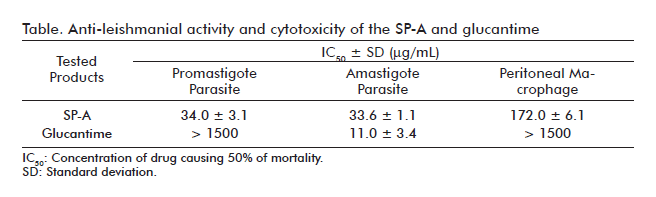
<body><![CDATA[<P   ><font size="2" face="Verdana, Arial, Helvetica, sans-serif"><B>Cytotoxicity assay      </b></font></P >       <P   ><font size="2" face="Verdana, Arial, Helvetica, sans-serif">The cytotoxicity      of the compound was determined on mouse peritoneal macrophages, as host cells      for the amastigote form of the parasite. Peritoneal macrophage monolayers      were treated with concentrations of 0.001 to 200 &micro;g/mL for 48 h, estimating      their viability afterwards with a colorimetric assay based on 3-[4,5-dimethylthiazol-2-yl]-2,5-diphenyltetrazolium      bromide (MTT; Sigma, St. Louis, MO, USA). MTT solutions were prepared at 5      mg/mL and added to each well, and after incubation for 3 h, the obtained formazan      crystals were dissolved by adding 100 &micro;L of DMSO. Viability was then      estimated by measuring the resulting optical density with an EMS Reader MF      Version 2.4-0, using test and reference wavelengths of 560 nm and 630 nm,      respectively [14]. </font></P >       <P   >&nbsp;</P >       <P   ><font size="2" face="Verdana, Arial, Helvetica, sans-serif"><B><font size="3">RESULTS      AND DISCUSSION </font> </b></font></P >       <P   ><font size="2" face="Verdana, Arial, Helvetica, sans-serif">Leishmaniasis is      caused by parasites of the <I>Leishmania </I>genus, affecting more than 12      million of persons in 88 countries [15]. This disease remains a serious problem.      As a zoonotic infection, transmission is difficult to interrupt, although      some attempts to reduce vector and mammalian reservoir populations have been      successful. In addition, there are currently no vaccines against leishmaniasis.      The available drugs are toxic, expensive and frequently ineffective [16].      These problems underscore the importance of developing new, effective drugs      against this pathogen [17]. </font></P >       <P   ><font size="2" face="Verdana, Arial, Helvetica, sans-serif">Previous experiments      have uncovered no evidence of anti-protozoal activity for SP-A. However, the      surfactant preparation Surfacen<Sup><Sup>&reg; </Sup></Sup>has earlier been      shown to have anti-leishmanial activity [18]; a result suggesting that surfactant      proteins might have some potential against protozoal parasites, and particularly      against <I>Leishmania</I>. The Tropical Diseases Program of the World Health      Organization currently places a high priority on research into natural products      for the treatment of <I>Leishmania</I>, as these offer an unlimited source      of chemical diversity with potential biological activities [19]. </font></P >   <FONT size="+1"><FONT size="+1">        <P   ><font size="2" face="Verdana, Arial, Helvetica, sans-serif">In this report, SP-A      showed activity against the promastigote and amastigote forms of <I>L. amazonensis</I>      and moderate cytotoxicity against host cells (<a href="/img/revistas/bta/v29n1/t0106112.gif">Table</a>),      requiring 5-fold higher concentrations in the latter case to reach the levels      of cell death it exhibited against parasites. SP-A was less active than glucantime.      It should be noted, however, that the anti-parasite toxicity of pentostam,      another first-line option derivative from pentavalent antimonial, is similar      to that of SP-A (IC<Sub>50</Sub> = 30 &micro;g/mL)[20]. </font></P >   <FONT size="+1"><FONT size="+1">        
<P   ><font size="2" face="Verdana, Arial, Helvetica, sans-serif">We do not know a      mechanism for SP-A-mediated death of <I>Leishmania </I>amastigotes and promastigotes,      as described here. SP-A is a very versatile molecule, first shown to be an      antimicrobial protein in 2003 in experiments where it directly inhibited the      proliferation of Gram-negative bacteria in a macrophage- and aggregation-independent      manner by increasing the permeability of the microbial cell membrane [21].      More recent reports have extended its anti-microbial range to <I>Mycoplasma      pneumonia</I> [22] and <I>Histoplasma capsulatum</I> [23]. Although nothing      is known about its permeabilization mechanism(s), the crystal structure of      SP-A reveals a hydrophobic cleft lined by charged residues which may play      a role in membrane perturbation [9]. The anti-inflammatory and antimicrobial      characteristics of SP-A [8, 21] turn this molecule into an attractive candidate      for designing therapeutic agents. </font></P >       <P   ><font size="2" face="Verdana, Arial, Helvetica, sans-serif">In summary, this      is the first report about the anti-leishmanial activity of SP-A. The results      described here suggest that SP-A can be applied to design new formulations      against the <I>Leishmania</I> parasite. </font></P >       <P   >&nbsp;</P >       ]]></body>
<body><![CDATA[<P   ><font size="3" face="Verdana, Arial, Helvetica, sans-serif"><b>REFERENCES </b></font></P >       <!-- ref --><P   ><font size="2" face="Verdana, Arial, Helvetica, sans-serif">1. Wright JR. Pulmonary      surfactant: a front line of lung host defense. J Clin Invest. 2003;111(10):1453-5.          </font></P >       <!-- ref --><P   ><font size="2" face="Verdana, Arial, Helvetica, sans-serif">2. Creuwels LA, van      Golde LM, Haagsman HP. The pulmonary surfactant system: biochemical and clinical      aspects. Lung. 1997;175(1):1-39.     </font></P >       <!-- ref --><P   ><font size="2" face="Verdana, Arial, Helvetica, sans-serif">3. Possmayer F. A      proposed nomenclature for pulmonary surfactant-associated proteins. Am Rev      Respir Dis. 1988;138(4):990-8.     </font></P >       <P   ><font size="2" face="Verdana, Arial, Helvetica, sans-serif">4. Manzanares DA,      D&iacute;az E, Alfonso WC, Escobar AC, Colom&eacute; H, Mu&ntilde;oz MC, et      al., inventors; Centro Nacional de Sanidad Agropecuaria, assignee. Surfactante      Pulmonar Natural Porcino. Cuban Patent; CU 22479 A1. 1994 Dec 29. </font></P >       <!-- ref --><P   ><font size="2" face="Verdana, Arial, Helvetica, sans-serif">5. Awasthi S. Surfactant      protein (SP)-A and SP-D as antimicrobial and immunotherapeutic agents. Recent      Pat Antiinfect Drug Discov. 2010;5(2):115-23.     </font></P >       ]]></body>
<body><![CDATA[<!-- ref --><P   ><font size="2" face="Verdana, Arial, Helvetica, sans-serif">6. Blanco O, Catala      A. Surfactant protein A inhibits the non-enzymatic lipid peroxidation of porcine      lung surfactant. Prostaglandins Leukot Essent Fatty Acids. 2001;65(4):185-90.          </font></P >       <!-- ref --><P   ><font size="2" face="Verdana, Arial, Helvetica, sans-serif">7. Sanchez J, Blanco      O, Mart&iacute;nez G, De Armas E, Fern&aacute;ndez O, Faure R. La prote&iacute;na      A del surfactante porcino (SP-A) exhibe propiedades antioxidantes en el sistema      Fenton. Rev Mex Cienc Farm. 2003;34(3):19-23.     </font></P >       <!-- ref --><P   ><font size="2" face="Verdana, Arial, Helvetica, sans-serif">8. Sano H, Kuroki      Y. The lung collectins, SP-A and SP-D, modulate pulmonary innate immunity.      Mol Immunol. 2005;42(3):279-87.     </font></P >       <!-- ref --><P   ><font size="2" face="Verdana, Arial, Helvetica, sans-serif">9. McCormack FX.      New concepts in collectin-mediated host defense at the air-liquid interface      of the lung. Respirology. 2006;11 Suppl 1:S7-10.     </font></P >       <!-- ref --><P   ><font size="2" face="Verdana, Arial, Helvetica, sans-serif">10. Blanco O, Sanchez      Y, Manzanares D, Fern&aacute;ndez O. Isolation of surfactant protein A, SP-A,      from bronchoalveolar porcine lavage. Rev Salud Animal. 2000;22(3):180-2.     </font></P >       ]]></body>
<body><![CDATA[<!-- ref --><P   ><font size="2" face="Verdana, Arial, Helvetica, sans-serif">11. Bodley AL, McGarry      MW, Shapiro TA. Drug cytotoxicity assay for African trypanosomes and Leishmania      species. J Infect Dis. 1995;172(4):1157-9.     </font></P >       <!-- ref --><P   ><font size="2" face="Verdana, Arial, Helvetica, sans-serif">12. Torres-Santos      EC, Moreira DL, Kaplan MA, Meirelles MN, Rossi-Bergmann B. Selective effect      of 2',6'-dihydroxy-4'-methoxychalcone isolated from Piper aduncum on Leishmania      amazonensis. Antimicrob Agents Chemother. 1999;43(5):1234-41.     </font></P >       <!-- ref --><P   ><font size="2" face="Verdana, Arial, Helvetica, sans-serif">13. Delorenzi JC,      Attias M, Gattass CR, Andrade M, Rezende C, da Cunha Pinto A, et al. Antileishmanial      activity of an indole alkaloid from Peschiera australis. Antimicrob Agents      Chemother. 2001;45(5):1349-54.     </font></P >       <!-- ref --><P   ><font size="2" face="Verdana, Arial, Helvetica, sans-serif">14. Sladowski D,      Steer SJ, Clothier RH, Balls M. An improved MTT assay. J Immunol Methods.      1993;157(1-2):203-7.     </font></P >       <!-- ref --><P   ><font size="2" face="Verdana, Arial, Helvetica, sans-serif">15. Desjeux P. The      increase in risk factors for leishmaniasis worldwide. Trans R Soc Trop Med      Hyg. 2001;95(3):239-43.     </font></P >       ]]></body>
<body><![CDATA[<!-- ref --><P   ><font size="2" face="Verdana, Arial, Helvetica, sans-serif">16. Herwaldt BL.      Leishmaniasis. Lancet. 1999;354(9185):1191-9.     </font></P >       <!-- ref --><P   ><font size="2" face="Verdana, Arial, Helvetica, sans-serif">17. Croft SL, Yardley      V. Chemotherapy of leishmaniasis. Curr Pharm Des. 2002;8(4):319-42.     </font></P >       <!-- ref --><P   ><font size="2" face="Verdana, Arial, Helvetica, sans-serif">18. Blanco O, Lugones      Y, Diaz E, Monzote L. In vitro activity of the clinical pulmonary surfactant      Surfacen(R) against Leishmania amazonensis. Rev Inst Med Trop Sao Paulo. 2011;53(4):235-8.          </font></P >       <!-- ref --><P   ><font size="2" face="Verdana, Arial, Helvetica, sans-serif">19. Chan-Bacab MJ,      Pena-Rodriguez LM. Plant natural products with leishmanicidal activity. Nat      Prod Rep. 2001;18(6):674-88.     </font></P >       <!-- ref --><P   ><font size="2" face="Verdana, Arial, Helvetica, sans-serif">20. Callahan HL,      Portal AC, Devereaux R, Grogl M. An axenic amastigote system for drug screening.      Antimicrob Agents Chemother. 1997;41(4):818-22.     </font></P >       ]]></body>
<body><![CDATA[<!-- ref --><P   ><font size="2" face="Verdana, Arial, Helvetica, sans-serif">21. Wu H, Kuzmenko      A, Wan S, Schaffer L, Weiss A, Fisher JH, et al. Surfactant proteins A and      D inhibit the growth of Gram-negative bacteria by increasing membrane permeability.      J Clin Invest. 2003;111(10):1589-602.     </font></P >       <!-- ref --><P   ><font size="2" face="Verdana, Arial, Helvetica, sans-serif">22. Ledford JG, Goto      H, Potts EN, Degan S, Chu HW, Voelker DR, et al. SP-A preserves airway homeostasis      during Mycoplasma pneumoniae infection in mice. J Immunol. 2009;182(12):7818-27.          </font></P >       <!-- ref --><P   ><font size="2" face="Verdana, Arial, Helvetica, sans-serif">23. McCormack FX,      Gibbons R, Ward SR, Kuzmenko A, Wu H, Deepe GS, Jr. Macrophage-independent      fungicidal action of the pulmonary collectins. J Biol Chem. 2003;278(38):36250-6.    </font></P >       <P   >&nbsp;</P >       <P   > </P >       <P   ><font size="2" face="Verdana, Arial, Helvetica, sans-serif">Lianet Monzote. Departamento      de Parasitolog&iacute;a, Instituto de Medicina Tropical Pedro Kour&iacute;,      La Habana, Cuba. E-mail:<a href="mailto:monzote@ipk.sld.cu"><U><U><FONT color="#0000FF">monzote@ipk.sld.cu</font></U></U></A><FONT color="#0000FF"><FONT color="#000000">.      </font></font></font></P >   </font></font></font></font></font></font></font></font></font></font></font></font></font></font></font></font></font></font></font></font></font></font></font></font></font></font></font></font></font></font></font></font></font></font></font></font></font></font></font></font></font></DIV >      ]]></body><back>
<ref-list>
<ref id="B1">
<label>1</label><nlm-citation citation-type="journal">
<person-group person-group-type="author">
<name>
<surname><![CDATA[Wright]]></surname>
<given-names><![CDATA[JR]]></given-names>
</name>
</person-group>
<article-title xml:lang="en"><![CDATA[Pulmonary surfactant: a front line of lung host defense]]></article-title>
<source><![CDATA[J Clin Invest]]></source>
<year>2003</year>
<volume>111</volume>
<numero>10</numero>
<issue>10</issue>
<page-range>1453-5</page-range></nlm-citation>
</ref>
<ref id="B2">
<label>2</label><nlm-citation citation-type="journal">
<person-group person-group-type="author">
<name>
<surname><![CDATA[Creuwels]]></surname>
<given-names><![CDATA[LA]]></given-names>
</name>
<name>
<surname><![CDATA[van Golde]]></surname>
<given-names><![CDATA[LM]]></given-names>
</name>
<name>
<surname><![CDATA[Haagsman]]></surname>
<given-names><![CDATA[HP]]></given-names>
</name>
</person-group>
<article-title xml:lang="en"><![CDATA[The pulmonary surfactant system: biochemical and clinical aspects]]></article-title>
<source><![CDATA[Lung]]></source>
<year>1997</year>
<volume>175</volume>
<numero>1</numero>
<issue>1</issue>
<page-range>1-39</page-range></nlm-citation>
</ref>
<ref id="B3">
<label>3</label><nlm-citation citation-type="journal">
<person-group person-group-type="author">
<name>
<surname><![CDATA[Possmayer]]></surname>
<given-names><![CDATA[F]]></given-names>
</name>
</person-group>
<article-title xml:lang="en"><![CDATA[A proposed nomenclature for pulmonary surfactant-associated proteins]]></article-title>
<source><![CDATA[Am Rev Respir Dis]]></source>
<year>1988</year>
<volume>138</volume>
<numero>4</numero>
<issue>4</issue>
<page-range>990-8</page-range></nlm-citation>
</ref>
<ref id="B4">
<label>4</label><nlm-citation citation-type="">
<person-group person-group-type="author">
<name>
<surname><![CDATA[Manzanares]]></surname>
<given-names><![CDATA[DA]]></given-names>
</name>
<name>
<surname><![CDATA[Díaz]]></surname>
<given-names><![CDATA[E]]></given-names>
</name>
<name>
<surname><![CDATA[Alfonso]]></surname>
<given-names><![CDATA[WC]]></given-names>
</name>
<name>
<surname><![CDATA[Escobar]]></surname>
<given-names><![CDATA[AC]]></given-names>
</name>
<name>
<surname><![CDATA[Colomé]]></surname>
<given-names><![CDATA[H]]></given-names>
</name>
<name>
<surname><![CDATA[Muñoz]]></surname>
<given-names><![CDATA[MC]]></given-names>
</name>
</person-group>
<source><![CDATA[Surfactante Pulmonar Natural Porcino]]></source>
<year></year>
</nlm-citation>
</ref>
<ref id="B5">
<label>5</label><nlm-citation citation-type="journal">
<person-group person-group-type="author">
<name>
<surname><![CDATA[Awasthi]]></surname>
<given-names><![CDATA[S]]></given-names>
</name>
</person-group>
<article-title xml:lang="en"><![CDATA[Surfactant protein (SP)-A and SP-D as antimicrobial and immunotherapeutic agents]]></article-title>
<source><![CDATA[Recent Pat Antiinfect Drug Discov]]></source>
<year>2010</year>
<volume>5</volume>
<numero>2</numero>
<issue>2</issue>
<page-range>115-23</page-range></nlm-citation>
</ref>
<ref id="B6">
<label>6</label><nlm-citation citation-type="journal">
<person-group person-group-type="author">
<name>
<surname><![CDATA[Blanco]]></surname>
<given-names><![CDATA[O]]></given-names>
</name>
<name>
<surname><![CDATA[Catala]]></surname>
<given-names><![CDATA[A]]></given-names>
</name>
</person-group>
<article-title xml:lang="en"><![CDATA[Surfactant protein A inhibits the non-enzymatic lipid peroxidation of porcine lung surfactant]]></article-title>
<source><![CDATA[Prostaglandins Leukot Essent Fatty Acids]]></source>
<year>2001</year>
<volume>65</volume>
<numero>4</numero>
<issue>4</issue>
<page-range>185-90</page-range></nlm-citation>
</ref>
<ref id="B7">
<label>7</label><nlm-citation citation-type="journal">
<person-group person-group-type="author">
<name>
<surname><![CDATA[Sanchez]]></surname>
<given-names><![CDATA[J]]></given-names>
</name>
<name>
<surname><![CDATA[Blanco]]></surname>
<given-names><![CDATA[O]]></given-names>
</name>
<name>
<surname><![CDATA[Martínez]]></surname>
<given-names><![CDATA[G]]></given-names>
</name>
<name>
<surname><![CDATA[De Armas]]></surname>
<given-names><![CDATA[E]]></given-names>
</name>
<name>
<surname><![CDATA[Fernández]]></surname>
<given-names><![CDATA[O]]></given-names>
</name>
<name>
<surname><![CDATA[Faure]]></surname>
<given-names><![CDATA[R]]></given-names>
</name>
</person-group>
<article-title xml:lang="es"><![CDATA[La proteína A del surfactante porcino (SP-A) exhibe propiedades antioxidantes en el sistema Fenton]]></article-title>
<source><![CDATA[Rev Mex Cienc Farm]]></source>
<year>2003</year>
<volume>34</volume>
<numero>3</numero>
<issue>3</issue>
<page-range>19-23</page-range></nlm-citation>
</ref>
<ref id="B8">
<label>8</label><nlm-citation citation-type="journal">
<person-group person-group-type="author">
<name>
<surname><![CDATA[Sano]]></surname>
<given-names><![CDATA[H]]></given-names>
</name>
<name>
<surname><![CDATA[Kuroki]]></surname>
<given-names><![CDATA[Y]]></given-names>
</name>
</person-group>
<article-title xml:lang="en"><![CDATA[The lung collectins, SP-A and SP-D, modulate pulmonary innate immunity]]></article-title>
<source><![CDATA[Mol Immunol]]></source>
<year>2005</year>
<volume>42</volume>
<numero>3</numero>
<issue>3</issue>
<page-range>279-87</page-range></nlm-citation>
</ref>
<ref id="B9">
<label>9</label><nlm-citation citation-type="journal">
<person-group person-group-type="author">
<name>
<surname><![CDATA[McCormack]]></surname>
<given-names><![CDATA[FX]]></given-names>
</name>
</person-group>
<article-title xml:lang="en"><![CDATA[New concepts in collectin-mediated host defense at the air-liquid interface of the lung]]></article-title>
<source><![CDATA[Respirology]]></source>
<year>2006</year>
<volume>11</volume>
<numero>^s1</numero>
<issue>^s1</issue>
<supplement>1</supplement>
<page-range>S7-10</page-range></nlm-citation>
</ref>
<ref id="B10">
<label>10</label><nlm-citation citation-type="journal">
<person-group person-group-type="author">
<name>
<surname><![CDATA[Blanco]]></surname>
<given-names><![CDATA[O]]></given-names>
</name>
<name>
<surname><![CDATA[Sanchez]]></surname>
<given-names><![CDATA[Y]]></given-names>
</name>
<name>
<surname><![CDATA[Manzanares]]></surname>
<given-names><![CDATA[D]]></given-names>
</name>
<name>
<surname><![CDATA[Fernández]]></surname>
<given-names><![CDATA[O]]></given-names>
</name>
</person-group>
<article-title xml:lang="en"><![CDATA[Isolation of surfactant protein A, SP-A, from bronchoalveolar porcine lavage]]></article-title>
<source><![CDATA[Rev Salud Animal]]></source>
<year>2000</year>
<volume>22</volume>
<numero>3</numero>
<issue>3</issue>
<page-range>180-2</page-range></nlm-citation>
</ref>
<ref id="B11">
<label>11</label><nlm-citation citation-type="journal">
<person-group person-group-type="author">
<name>
<surname><![CDATA[Bodley]]></surname>
<given-names><![CDATA[AL]]></given-names>
</name>
<name>
<surname><![CDATA[McGarry]]></surname>
<given-names><![CDATA[MW]]></given-names>
</name>
<name>
<surname><![CDATA[Shapiro]]></surname>
<given-names><![CDATA[TA]]></given-names>
</name>
</person-group>
<article-title xml:lang="en"><![CDATA[Drug cytotoxicity assay for African trypanosomes and Leishmania species]]></article-title>
<source><![CDATA[J Infect Dis]]></source>
<year>1995</year>
<volume>172</volume>
<numero>4</numero>
<issue>4</issue>
<page-range>1157-9</page-range></nlm-citation>
</ref>
<ref id="B12">
<label>12</label><nlm-citation citation-type="journal">
<person-group person-group-type="author">
<name>
<surname><![CDATA[Torres-Santos]]></surname>
<given-names><![CDATA[EC]]></given-names>
</name>
<name>
<surname><![CDATA[Moreira]]></surname>
<given-names><![CDATA[DL]]></given-names>
</name>
<name>
<surname><![CDATA[Kaplan]]></surname>
<given-names><![CDATA[MA]]></given-names>
</name>
<name>
<surname><![CDATA[Meirelles]]></surname>
<given-names><![CDATA[MN]]></given-names>
</name>
<name>
<surname><![CDATA[Rossi-Bergmann]]></surname>
<given-names><![CDATA[B]]></given-names>
</name>
</person-group>
<article-title xml:lang="en"><![CDATA[Selective effect of 2',6'-dihydroxy-4'-methoxychalcone isolated from Piper aduncum on Leishmania amazonensis]]></article-title>
<source><![CDATA[Antimicrob Agents Chemother]]></source>
<year>1999</year>
<volume>43</volume>
<numero>5</numero>
<issue>5</issue>
<page-range>1234-41</page-range></nlm-citation>
</ref>
<ref id="B13">
<label>13</label><nlm-citation citation-type="journal">
<person-group person-group-type="author">
<name>
<surname><![CDATA[Delorenzi]]></surname>
<given-names><![CDATA[JC]]></given-names>
</name>
<name>
<surname><![CDATA[Attias]]></surname>
<given-names><![CDATA[M]]></given-names>
</name>
<name>
<surname><![CDATA[Gattass]]></surname>
<given-names><![CDATA[CR]]></given-names>
</name>
<name>
<surname><![CDATA[Andrade]]></surname>
<given-names><![CDATA[M]]></given-names>
</name>
<name>
<surname><![CDATA[Rezende]]></surname>
<given-names><![CDATA[C]]></given-names>
</name>
<name>
<surname><![CDATA[da Cunha Pinto]]></surname>
<given-names><![CDATA[A]]></given-names>
</name>
</person-group>
<article-title xml:lang="en"><![CDATA[Antileishmanial activity of an indole alkaloid from Peschiera australis]]></article-title>
<source><![CDATA[Antimicrob Agents Chemother]]></source>
<year>2001</year>
<volume>45</volume>
<numero>5</numero>
<issue>5</issue>
<page-range>1349-54</page-range></nlm-citation>
</ref>
<ref id="B14">
<label>14</label><nlm-citation citation-type="journal">
<person-group person-group-type="author">
<name>
<surname><![CDATA[Sladowski]]></surname>
<given-names><![CDATA[D]]></given-names>
</name>
<name>
<surname><![CDATA[Steer]]></surname>
<given-names><![CDATA[SJ]]></given-names>
</name>
<name>
<surname><![CDATA[Clothier]]></surname>
<given-names><![CDATA[RH]]></given-names>
</name>
<name>
<surname><![CDATA[Balls]]></surname>
<given-names><![CDATA[M]]></given-names>
</name>
</person-group>
<article-title xml:lang="en"><![CDATA[An improved MTT assay]]></article-title>
<source><![CDATA[J Immunol Methods]]></source>
<year>1993</year>
<volume>157</volume>
<numero>1-2</numero>
<issue>1-2</issue>
<page-range>203-7</page-range></nlm-citation>
</ref>
<ref id="B15">
<label>15</label><nlm-citation citation-type="journal">
<person-group person-group-type="author">
<name>
<surname><![CDATA[Desjeux]]></surname>
<given-names><![CDATA[P]]></given-names>
</name>
</person-group>
<article-title xml:lang="en"><![CDATA[The increase in risk factors for leishmaniasis worldwide]]></article-title>
<source><![CDATA[Trans R Soc Trop Med Hyg]]></source>
<year>2001</year>
<volume>95</volume>
<numero>3</numero>
<issue>3</issue>
<page-range>239-43</page-range></nlm-citation>
</ref>
<ref id="B16">
<label>16</label><nlm-citation citation-type="journal">
<person-group person-group-type="author">
<name>
<surname><![CDATA[Herwaldt]]></surname>
<given-names><![CDATA[BL]]></given-names>
</name>
</person-group>
<article-title xml:lang="en"><![CDATA[Leishmaniasis]]></article-title>
<source><![CDATA[Lancet]]></source>
<year>1999</year>
<volume>354</volume>
<numero>9185</numero>
<issue>9185</issue>
<page-range>1191-9</page-range></nlm-citation>
</ref>
<ref id="B17">
<label>17</label><nlm-citation citation-type="journal">
<person-group person-group-type="author">
<name>
<surname><![CDATA[Croft]]></surname>
<given-names><![CDATA[SL]]></given-names>
</name>
<name>
<surname><![CDATA[Yardley]]></surname>
<given-names><![CDATA[V]]></given-names>
</name>
</person-group>
<article-title xml:lang="en"><![CDATA[Chemotherapy of leishmaniasis]]></article-title>
<source><![CDATA[Curr Pharm Des]]></source>
<year>2002</year>
<volume>8</volume>
<numero>4</numero>
<issue>4</issue>
<page-range>319-42</page-range></nlm-citation>
</ref>
<ref id="B18">
<label>18</label><nlm-citation citation-type="journal">
<person-group person-group-type="author">
<name>
<surname><![CDATA[Blanco]]></surname>
<given-names><![CDATA[O]]></given-names>
</name>
<name>
<surname><![CDATA[Lugones]]></surname>
<given-names><![CDATA[Y]]></given-names>
</name>
<name>
<surname><![CDATA[Diaz]]></surname>
<given-names><![CDATA[E]]></given-names>
</name>
<name>
<surname><![CDATA[Monzote]]></surname>
<given-names><![CDATA[L]]></given-names>
</name>
</person-group>
<article-title xml:lang="en"><![CDATA[In vitro activity of the clinical pulmonary surfactant Surfacen(R) against Leishmania amazonensis]]></article-title>
<source><![CDATA[Rev Inst Med Trop Sao Paulo]]></source>
<year>2011</year>
<volume>53</volume>
<numero>4</numero>
<issue>4</issue>
<page-range>235-8</page-range></nlm-citation>
</ref>
<ref id="B19">
<label>19</label><nlm-citation citation-type="journal">
<person-group person-group-type="author">
<name>
<surname><![CDATA[Chan-Bacab]]></surname>
<given-names><![CDATA[MJ]]></given-names>
</name>
<name>
<surname><![CDATA[Pena-Rodriguez]]></surname>
<given-names><![CDATA[LM]]></given-names>
</name>
</person-group>
<article-title xml:lang="en"><![CDATA[Plant natural products with leishmanicidal activity]]></article-title>
<source><![CDATA[Nat Prod Rep]]></source>
<year>2001</year>
<volume>18</volume>
<numero>6</numero>
<issue>6</issue>
<page-range>674-88</page-range></nlm-citation>
</ref>
<ref id="B20">
<label>20</label><nlm-citation citation-type="journal">
<person-group person-group-type="author">
<name>
<surname><![CDATA[Callahan]]></surname>
<given-names><![CDATA[HL]]></given-names>
</name>
<name>
<surname><![CDATA[Portal]]></surname>
<given-names><![CDATA[AC]]></given-names>
</name>
<name>
<surname><![CDATA[Devereaux]]></surname>
<given-names><![CDATA[R]]></given-names>
</name>
<name>
<surname><![CDATA[Grogl]]></surname>
<given-names><![CDATA[M]]></given-names>
</name>
</person-group>
<article-title xml:lang="en"><![CDATA[An axenic amastigote system for drug screening]]></article-title>
<source><![CDATA[Antimicrob Agents Chemother]]></source>
<year>1997</year>
<volume>41</volume>
<numero>4</numero>
<issue>4</issue>
<page-range>818-22</page-range></nlm-citation>
</ref>
<ref id="B21">
<label>21</label><nlm-citation citation-type="journal">
<person-group person-group-type="author">
<name>
<surname><![CDATA[Wu]]></surname>
<given-names><![CDATA[H]]></given-names>
</name>
<name>
<surname><![CDATA[Kuzmenko]]></surname>
<given-names><![CDATA[A]]></given-names>
</name>
<name>
<surname><![CDATA[Wan]]></surname>
<given-names><![CDATA[S]]></given-names>
</name>
<name>
<surname><![CDATA[Schaffer]]></surname>
<given-names><![CDATA[L]]></given-names>
</name>
<name>
<surname><![CDATA[Weiss]]></surname>
<given-names><![CDATA[A]]></given-names>
</name>
<name>
<surname><![CDATA[Fisher]]></surname>
<given-names><![CDATA[JH]]></given-names>
</name>
</person-group>
<article-title xml:lang="en"><![CDATA[Surfactant proteins A and D inhibit the growth of Gram-negative bacteria by increasing membrane permeability]]></article-title>
<source><![CDATA[J Clin Invest]]></source>
<year>2003</year>
<volume>111</volume>
<numero>10</numero>
<issue>10</issue>
<page-range>1589-602</page-range></nlm-citation>
</ref>
<ref id="B22">
<label>22</label><nlm-citation citation-type="journal">
<person-group person-group-type="author">
<name>
<surname><![CDATA[Ledford]]></surname>
<given-names><![CDATA[JG]]></given-names>
</name>
<name>
<surname><![CDATA[Goto]]></surname>
<given-names><![CDATA[H]]></given-names>
</name>
<name>
<surname><![CDATA[Potts]]></surname>
<given-names><![CDATA[EN]]></given-names>
</name>
<name>
<surname><![CDATA[Degan]]></surname>
<given-names><![CDATA[S]]></given-names>
</name>
<name>
<surname><![CDATA[Chu]]></surname>
<given-names><![CDATA[HW]]></given-names>
</name>
<name>
<surname><![CDATA[Voelker]]></surname>
<given-names><![CDATA[DR]]></given-names>
</name>
</person-group>
<article-title xml:lang="en"><![CDATA[SP-A preserves airway homeostasis during Mycoplasma pneumoniae infection in mice]]></article-title>
<source><![CDATA[J Immunol]]></source>
<year>2009</year>
<volume>182</volume>
<numero>12</numero>
<issue>12</issue>
<page-range>7818-27</page-range></nlm-citation>
</ref>
<ref id="B23">
<label>23</label><nlm-citation citation-type="journal">
<person-group person-group-type="author">
<name>
<surname><![CDATA[McCormack]]></surname>
<given-names><![CDATA[FX]]></given-names>
</name>
<name>
<surname><![CDATA[Gibbons]]></surname>
<given-names><![CDATA[R]]></given-names>
</name>
<name>
<surname><![CDATA[Ward]]></surname>
<given-names><![CDATA[SR]]></given-names>
</name>
<name>
<surname><![CDATA[Kuzmenko]]></surname>
<given-names><![CDATA[A]]></given-names>
</name>
<name>
<surname><![CDATA[Wu]]></surname>
<given-names><![CDATA[H]]></given-names>
</name>
<name>
<surname><![CDATA[Deepe]]></surname>
<given-names><![CDATA[GS Jr]]></given-names>
</name>
</person-group>
<article-title xml:lang="en"><![CDATA[Macrophage-independent fungicidal action of the pulmonary collectins]]></article-title>
<source><![CDATA[J Biol Chem]]></source>
<year>2003</year>
<volume>278</volume>
<numero>38</numero>
<issue>38</issue>
<page-range>36250-6</page-range></nlm-citation>
</ref>
</ref-list>
</back>
</article>