<?xml version="1.0" encoding="ISO-8859-1"?><article xmlns:mml="http://www.w3.org/1998/Math/MathML" xmlns:xlink="http://www.w3.org/1999/xlink" xmlns:xsi="http://www.w3.org/2001/XMLSchema-instance">
<front>
<journal-meta>
<journal-id>1027-2852</journal-id>
<journal-title><![CDATA[Biotecnología Aplicada]]></journal-title>
<abbrev-journal-title><![CDATA[Biotecnol Apl]]></abbrev-journal-title>
<issn>1027-2852</issn>
<publisher>
<publisher-name><![CDATA[Editorial Elfos Scientiae]]></publisher-name>
</publisher>
</journal-meta>
<article-meta>
<article-id>S1027-28522012000300002</article-id>
<title-group>
<article-title xml:lang="en"><![CDATA[Effect of human epidermal growth factor on the tumor cell line A431: in vivo analysis of tumor growth inhibition and gene expression]]></article-title>
<article-title xml:lang="es"><![CDATA[Efecto del factor de crecimiento epidérmico humano en la línea celular tumoral A431: análisis de la inhibición del crecimiento tumoral y la expresión génica in vivo]]></article-title>
</title-group>
<contrib-group>
<contrib contrib-type="author">
<name>
<surname><![CDATA[Guillén]]></surname>
<given-names><![CDATA[Isabel A]]></given-names>
</name>
<xref ref-type="aff" rid="A01"/>
</contrib>
<contrib contrib-type="author">
<name>
<surname><![CDATA[Camacho]]></surname>
<given-names><![CDATA[Hanlet]]></given-names>
</name>
<xref ref-type="aff" rid="A01"/>
</contrib>
<contrib contrib-type="author">
<name>
<surname><![CDATA[Fernández]]></surname>
<given-names><![CDATA[Maria E]]></given-names>
</name>
<xref ref-type="aff" rid="A01"/>
</contrib>
<contrib contrib-type="author">
<name>
<surname><![CDATA[Palenzuela]]></surname>
<given-names><![CDATA[Daniel O]]></given-names>
</name>
<xref ref-type="aff" rid="A01"/>
</contrib>
<contrib contrib-type="author">
<name>
<surname><![CDATA[Pérez]]></surname>
<given-names><![CDATA[Lincidio]]></given-names>
</name>
<xref ref-type="aff" rid="A02"/>
</contrib>
<contrib contrib-type="author">
<name>
<surname><![CDATA[Ochagavia]]></surname>
<given-names><![CDATA[Maria E]]></given-names>
</name>
<xref ref-type="aff" rid="A03"/>
</contrib>
<contrib contrib-type="author">
<name>
<surname><![CDATA[Ancizar]]></surname>
<given-names><![CDATA[Julio]]></given-names>
</name>
<xref ref-type="aff" rid="A04"/>
</contrib>
<contrib contrib-type="author">
<name>
<surname><![CDATA[Tuero]]></surname>
<given-names><![CDATA[Angela]]></given-names>
</name>
<xref ref-type="aff" rid="A05"/>
</contrib>
<contrib contrib-type="author">
<name>
<surname><![CDATA[Gorovaya]]></surname>
<given-names><![CDATA[Laritza]]></given-names>
</name>
<xref ref-type="aff" rid="A04"/>
</contrib>
<contrib contrib-type="author">
<name>
<surname><![CDATA[Mendoza]]></surname>
<given-names><![CDATA[Osmani]]></given-names>
</name>
<xref ref-type="aff" rid="A04"/>
</contrib>
<contrib contrib-type="author">
<name>
<surname><![CDATA[Díaz]]></surname>
<given-names><![CDATA[Tamara]]></given-names>
</name>
<xref ref-type="aff" rid="A01"/>
</contrib>
<contrib contrib-type="author">
<name>
<surname><![CDATA[Fernández]]></surname>
<given-names><![CDATA[Julio R]]></given-names>
</name>
<xref ref-type="aff" rid="A01"/>
</contrib>
<contrib contrib-type="author">
<name>
<surname><![CDATA[Roca]]></surname>
<given-names><![CDATA[Juan]]></given-names>
</name>
<xref ref-type="aff" rid="A01"/>
</contrib>
<contrib contrib-type="author">
<name>
<surname><![CDATA[Cosme]]></surname>
<given-names><![CDATA[Karelia]]></given-names>
</name>
<xref ref-type="aff" rid="A04"/>
</contrib>
<contrib contrib-type="author">
<name>
<surname><![CDATA[Guillén-Nieto]]></surname>
<given-names><![CDATA[Gerardo E]]></given-names>
</name>
<xref ref-type="aff" rid="A06"/>
</contrib>
<contrib contrib-type="author">
<name>
<surname><![CDATA[Herrera]]></surname>
<given-names><![CDATA[Luis]]></given-names>
</name>
<xref ref-type="aff" rid="A07"/>
</contrib>
<contrib contrib-type="author">
<name>
<surname><![CDATA[Berlanga]]></surname>
<given-names><![CDATA[Jorge]]></given-names>
</name>
<xref ref-type="aff" rid="A08"/>
</contrib>
<contrib contrib-type="author">
<name>
<surname><![CDATA[Novoa]]></surname>
<given-names><![CDATA[Lidia I]]></given-names>
</name>
<xref ref-type="aff" rid="A01"/>
</contrib>
</contrib-group>
<aff id="A02">
<institution><![CDATA[,Centro de Ingeniería Genética y Biotecnología Dirección de Investigaciones Biomédicas Departamento de Cáncer]]></institution>
<addr-line><![CDATA[La Habana ]]></addr-line>
<country>Cuba</country>
</aff>
<aff id="A03">
<institution><![CDATA[,Centro de Ingeniería Genética y Biotecnología Dirección de Investigaciones Biomédicas Departamento de Bioinformática]]></institution>
<addr-line><![CDATA[La Habana ]]></addr-line>
<country>Cuba</country>
</aff>
<aff id="A04">
<institution><![CDATA[,Centro de Ingeniería Genética y Biotecnología Bioterio ]]></institution>
<addr-line><![CDATA[La Habana ]]></addr-line>
<country>Cuba</country>
</aff>
<aff id="A05">
<institution><![CDATA[,Centro de Ingeniería Genética y Biotecnología Dirección de Ensayos Clínicos Departamento de Estadísticas]]></institution>
<addr-line><![CDATA[La Habana ]]></addr-line>
<country>Cuba</country>
</aff>
<aff id="A06">
<institution><![CDATA[,Centro de Ingeniería Genética y Biotecnología Dirección de Investigaciones Biomédicas Departamento de Vacunas]]></institution>
<addr-line><![CDATA[La Habana ]]></addr-line>
<country>Cuba</country>
</aff>
<aff id="A07">
<institution><![CDATA[,Centro de Ingeniería Genética y Biotecnología Dirección General ]]></institution>
<addr-line><![CDATA[La Habana ]]></addr-line>
<country>Cuba</country>
</aff>
<aff id="A08">
<institution><![CDATA[,Centro de Ingeniería Genética y Biotecnología Dirección de Investigaciones Biomédicas Departamento de Cicatrización y Citoprotección]]></institution>
<addr-line><![CDATA[La Habana ]]></addr-line>
<country>Cuba</country>
</aff>
<aff id="A01">
<institution><![CDATA[,Centro de Ingeniería Genética y Biotecnología Dirección de Investigaciones Biomédicas Departamento de Farmacogenómica]]></institution>
<addr-line><![CDATA[La Habana ]]></addr-line>
<country>Cuba</country>
</aff>
<pub-date pub-type="pub">
<day>00</day>
<month>09</month>
<year>2012</year>
</pub-date>
<pub-date pub-type="epub">
<day>00</day>
<month>09</month>
<year>2012</year>
</pub-date>
<volume>29</volume>
<numero>3</numero>
<fpage>155</fpage>
<lpage>161</lpage>
<copyright-statement/>
<copyright-year/>
<self-uri xlink:href="http://scielo.sld.cu/scielo.php?script=sci_arttext&amp;pid=S1027-28522012000300002&amp;lng=en&amp;nrm=iso"></self-uri><self-uri xlink:href="http://scielo.sld.cu/scielo.php?script=sci_abstract&amp;pid=S1027-28522012000300002&amp;lng=en&amp;nrm=iso"></self-uri><self-uri xlink:href="http://scielo.sld.cu/scielo.php?script=sci_pdf&amp;pid=S1027-28522012000300002&amp;lng=en&amp;nrm=iso"></self-uri><abstract abstract-type="short" xml:lang="en"><p><![CDATA[The historical tag of the epidermal growth factor (EGF) as carcinogenesis promoter has not been uniformly reproduced, since, in some experiments, malignant cells are bound to growth inhibition and apoptosis. The present study intends to obtain additional data on the interaction of EGF with cancer cells by analyzing its effect in vitro on the growth of cultured A431 cells, and in vivo on nude mice xenotransplanted with this cell line; identifying, in addition, the gene expression patterns for a selected group of genes related to EGF and cancer pathways in the solid tumor. EGF-treated animals showed significantly smaller tumor volumes than controls, suggesting cellular growth inhibition mediated by this factor. Similar results were obtained regarding the proliferation of cultured A431 when treated with 2.2, 33 and 165 nM of EGF. These results may imply a common mechanism for the EGF-mediated growth inhibition of A431 cells in both biological conditions (in vivo and in vitro). The action of EGF at nanomolar concentrations may trigger a transient recovery of the tumor suppressor ability of tumor cells through the reduction of the biological action of mutated TP53, cell cycle arrest due to a decrease in Cdk4 expression levels and the initiation of caspase through the activation of CASP9.]]></p></abstract>
<abstract abstract-type="short" xml:lang="es"><p><![CDATA[El carácter de promotor de la carcinogénesis atribuido al factor de crecimiento epidérmico (FCE) no se ha reproducido uniformemente, pues las células malignas tratadas con esta molécula en algunos experimentos han mostrado inhibición del crecimiento y apoptosis. Se ofrecen datos adicionales de la interacción del FCE con células cancerosas, mediante el análisis de su efecto en el crecimiento de la línea celular A431 in vitro y en ratones atímicos xenotrasplantados con esta línea. Se estudiaron además los patrones de expresión de un grupo de genes relacionados con el FCE y el cáncer en los tumores sólidos de A431. Este estudio reveló que los animales tratados con FCE humano recombinante (FCEhr) desarrollaron volúmenes tumorales inferiores que los animales controles. Ello sugiere una inhibición del crecimiento celular mediada por el FCE. Resultados similares se obtuvieron in vitro al tratar las células A431 con FCEhr a 2.2, 33 y 165 nM. A estas concentraciones, el FCE recobra la propiedad supresora tumoral en las células cancerosas, posiblemente por la reducción de la acción biológica de la TP53 mutada, la inhibición del ciclo celular al disminuir la expresión del gen cdk4, y la iniciación de la vía de las caspasas mediante la activación de la expresión del gen CASP9. Tales hallazgos sugieren mecanismos comunes de inhibición del crecimiento de las células A431 in vitro e in vivo, mediados por el FCE.]]></p></abstract>
<kwd-group>
<kwd lng="en"><![CDATA[epidermal growth factor]]></kwd>
<kwd lng="en"><![CDATA[cancer]]></kwd>
<kwd lng="en"><![CDATA[A431 cells]]></kwd>
<kwd lng="en"><![CDATA[nude mice]]></kwd>
<kwd lng="es"><![CDATA[factor de crecimiento epidérmico]]></kwd>
<kwd lng="es"><![CDATA[cáncer]]></kwd>
<kwd lng="es"><![CDATA[células A431]]></kwd>
<kwd lng="es"><![CDATA[ratones atímicos]]></kwd>
</kwd-group>
</article-meta>
</front><body><![CDATA[ <DIV class="Sect"   >        <P   align="right" ><font size="2" color="#000000" face="Verdana, Arial, Helvetica, sans-serif"><b>RESEARCH      </b></font></P >       <P   align="right" >&nbsp;</P >   <FONT size="+1" color="#000000">        <P   ><font size="4" face="Verdana, Arial, Helvetica, sans-serif"><b>Effect of human      epidermal growth factor on the tumor cell line A431: <I>in vivo</I> analysis      of tumor growth inhibition and gene expression </b></font></P >       <P   >&nbsp;</P >       <P   ><font size="3" face="Verdana, Arial, Helvetica, sans-serif"><b>Efecto del factor      de crecimiento epid&eacute;rmico humano en la l&iacute;nea celular tumoral      A431: an&aacute;lisis de la inhibici&oacute;n del crecimiento tumoral y la      expresi&oacute;n g&eacute;nica <I>in vivo</I> </b></font></P >       <P   >&nbsp;</P >       <P   >&nbsp;</P >       <P   ><font size="2" face="Verdana, Arial, Helvetica, sans-serif"><b>Isabel A Guill&eacute;n<Sup>1</Sup>,      Hanlet Camacho<Sup>1</Sup>, Maria E Fern&aacute;ndez<Sup>1</Sup>, Daniel O      Palenzuela<Sup>1</Sup>, Lincidio P&eacute;rez<Sup>2</Sup>, Maria E Ochagavia<Sup>3</Sup>,      Julio A Ancizar<Sup>4</Sup>, Angela D Tuero<Sup>5</Sup>, Laritza Gorovaya<Sup>4</Sup>,      Osmani Mendoza<Sup>4</Sup>, Tamara D&iacute;az<Sup>1</Sup>, Julio R Fern&aacute;ndez<Sup>1</Sup>,      Juan Roca<Sup>1</Sup>, Karelia Cosme<Sup>4</Sup>, Gerardo E Guill&eacute;n-Nieto<Sup>6</Sup>,      Luis Herrera<Sup>7</Sup>, Jorge Berlanga<Sup>8</Sup>, Lidia I Novoa<Sup>1</Sup></b></font></P >   <FONT size="+1"><FONT size="+1"><FONT size="+1"><FONT size="+1"><FONT size="+1"><FONT size="+1"><FONT size="+1"><FONT size="+1"><FONT size="+1"><FONT size="+1"><FONT size="+1"><FONT size="+1"><FONT size="+1"><FONT size="+1"><FONT size="+1"><FONT size="+1"><FONT size="+1"><FONT size="+1"><FONT size="+1"><FONT size="+1"><FONT size="+1"><FONT size="+1"><FONT size="+1"><FONT size="+1"><FONT size="+1"><FONT size="+1"><FONT size="+1"><FONT size="+1"><FONT size="+1"><FONT size="+1"><FONT size="+1"><FONT size="+1"><FONT size="+1"><FONT size="+1"><FONT size="+1"><FONT size="+1">        <P   ><font size="2" face="Verdana, Arial, Helvetica, sans-serif"><Sup>1</Sup> Departamento      de Farmacogen&oacute;mica, Direcci&oacute;n de Investigaciones Biom&eacute;dicas.      Centro de Ingenier&iacute;a Gen&eacute;tica y Biotecnolog&iacute;a, CIGB.      Ave. 31 e/ 158 y 190, Playa, CP 10 600, La Habana, Cuba.</font><FONT size="+1"><FONT size="+1"></font></font>    ]]></body>
<body><![CDATA[<br>     <font size="2" face="Verdana, Arial, Helvetica, sans-serif"><Sup>2</Sup> Departamento      de C&aacute;ncer, Direcci&oacute;n de Investigaciones Biom&eacute;dicas, Centro      de Ingenier&iacute;a Gen&eacute;tica y Biotecnolog&iacute;a. La Habana, Cuba.    <br>     </font><font size="2" face="Verdana, Arial, Helvetica, sans-serif"><Sup>3</Sup>      Departamento de Bioinform&aacute;tica, Direcci&oacute;n de Investigaciones      Biom&eacute;dicas. Centro de Ingenier&iacute;a Gen&eacute;tica y Biotecnolog&iacute;a.      La Habana, Cuba.    <br>     </font><font size="2" face="Verdana, Arial, Helvetica, sans-serif"><Sup>4</Sup>      Bioterio. Centro de Ingenier&iacute;a Gen&eacute;tica y Biotecnolog&iacute;a.      La Habana, Cuba.    <br>     </font><font size="2" face="Verdana, Arial, Helvetica, sans-serif"><Sup>5</Sup>      Departamento de Estad&iacute;sticas, Direcci&oacute;n de Ensayos Cl&iacute;nicos.      Centro de Ingenier&iacute;a Gen&eacute;tica y Biotecnolog&iacute;a. La Habana,      Cuba.    <br>     </font><font size="2" face="Verdana, Arial, Helvetica, sans-serif"><Sup>6</Sup>      Departamento de Vacunas, Direcci&oacute;n de Investigaciones Biom&eacute;dicas.      Centro de Ingenier&iacute;a Gen&eacute;tica y Biotecnolog&iacute;a. La Habana,      Cuba.    <br>     </font><font size="2" face="Verdana, Arial, Helvetica, sans-serif"><Sup>7</Sup>      Direcci&oacute;n General. Centro de Ingenier&iacute;a Gen&eacute;tica y Biotecnolog&iacute;a.      La Habana, Cuba.    <br>     </font><font size="2" face="Verdana, Arial, Helvetica, sans-serif"><Sup>8</Sup>      Departamento de Cicatrizaci&oacute;n y Citoprotecci&oacute;n. Direcci&oacute;n      de Investigaciones Biom&eacute;dicas. Centro de Ingenier&iacute;a Gen&eacute;tica      y Biotecnolog&iacute;a. La Habana, Cuba. </font></P >   <FONT size="+1"><FONT size="+1"><FONT size="+1"><FONT size="+1"><FONT size="+1"><FONT size="+1"><FONT size="+1"><FONT size="+1"><FONT size="+1"><FONT size="+1"><FONT size="+1"><FONT size="+1"><FONT size="+1"><FONT size="+1"><FONT size="+1"><FONT size="+1">        <P   > </P >       <P   >&nbsp;</P >       <P   >&nbsp;</P >   </font></font></font></font></font></font></font></font></font></font></font></font></font></font></font></font></font></font></font></font></font></font></font></font></font></font></font></font></font></font></font></font></font></font></font></font></font></font></font></font></font></font></font></font></font></font></font></font></font></font></font></font></font>   <hr>   <FONT size="+1" color="#000000"><FONT size="+1"><FONT size="+1"><FONT size="+1"><FONT size="+1"><FONT size="+1"><FONT size="+1"><FONT size="+1"><FONT size="+1"><FONT size="+1"><FONT size="+1"><FONT size="+1"><FONT size="+1"><FONT size="+1"><FONT size="+1"><FONT size="+1"><FONT size="+1"><FONT size="+1"><FONT size="+1"><FONT size="+1"><FONT size="+1"><FONT size="+1"><FONT size="+1"><FONT size="+1"><FONT size="+1"><FONT size="+1"><FONT size="+1"><FONT size="+1"><FONT size="+1"><FONT size="+1"><FONT size="+1"><FONT size="+1"><FONT size="+1"><FONT size="+1"><FONT size="+1"><FONT size="+1"><FONT size="+1"><FONT size="+1"><FONT size="+1"><FONT size="+1"><FONT size="+1"><FONT size="+1"><FONT size="+1"><FONT size="+1"><FONT size="+1"><FONT size="+1"><FONT size="+1"><FONT size="+1"><FONT size="+1"><FONT size="+1"><FONT size="+1"><FONT size="+1"><FONT size="+1">    <font size="2" face="Verdana, Arial, Helvetica, sans-serif"><B>ABSTRACT<I> </I></b></font><FONT size="+1">        ]]></body>
<body><![CDATA[<P   align="justify" ><font size="2" face="Verdana, Arial, Helvetica, sans-serif">The historical tag      of the epidermal growth factor (EGF) as carcinogenesis promoter has not been      uniformly reproduced, since, in some experiments, malignant cells are bound      to growth inhibition and apoptosis. The present study intends to obtain additional      data on the interaction of EGF with cancer cells by analyzing its effect <I>in      vitro</I> on the growth of cultured A431 cells, and <I>in vivo</I> on nude      mice xenotransplanted with this cell line; identifying, in addition, the gene      expression patterns for a selected group of genes related to EGF and cancer      pathways in the solid tumor. EGF-treated animals showed significantly smaller      tumor volumes than controls, suggesting cellular growth inhibition mediated      by this factor. Similar results were obtained regarding the proliferation      of cultured A431 when treated with 2.2, 33 and 165 nM of EGF. These results      may imply a common mechanism for the EGF-mediated growth inhibition of A431      cells in both biological conditions (<I>in vivo</I> and <I>in vitro</I>).      The action of EGF at nanomolar concentrations may trigger a transient recovery      of the tumor suppressor ability of tumor cells through the reduction of the      biological action of mutated TP53, cell cycle arrest due to a decrease in      Cdk4 expression levels and the initiation of caspase through the activation      of CASP9. </font></P >       <P   ><font size="2" face="Verdana, Arial, Helvetica, sans-serif"><b>Keywords: </b>epidermal      growth factor, cancer, A431 cells, nude mice. </font></P >   </font></font></font></font></font></font></font></font></font></font></font></font></font></font></font></font></font></font></font></font></font></font></font></font></font></font></font></font></font></font></font></font></font></font></font></font></font></font></font></font></font></font></font></font></font></font></font></font></font></font></font></font></font></font>   <hr>   <FONT size="+1" color="#000000"><FONT size="+1"><FONT size="+1"><FONT size="+1"><FONT size="+1"><FONT size="+1"><FONT size="+1"><FONT size="+1"><FONT size="+1"><FONT size="+1"><FONT size="+1"><FONT size="+1"><FONT size="+1"><FONT size="+1"><FONT size="+1"><FONT size="+1"><FONT size="+1"><FONT size="+1"><FONT size="+1"><FONT size="+1"><FONT size="+1"><FONT size="+1"><FONT size="+1"><FONT size="+1"><FONT size="+1"><FONT size="+1"><FONT size="+1"><FONT size="+1"><FONT size="+1"><FONT size="+1"><FONT size="+1"><FONT size="+1"><FONT size="+1"><FONT size="+1"><FONT size="+1"><FONT size="+1"><FONT size="+1"><FONT size="+1"><FONT size="+1"><FONT size="+1"><FONT size="+1"><FONT size="+1"><FONT size="+1"><FONT size="+1"><FONT size="+1"><FONT size="+1"><FONT size="+1"><FONT size="+1"><FONT size="+1"><FONT size="+1"><FONT size="+1"><FONT size="+1"><FONT size="+1"><FONT size="+1">        <P   align="justify" > </P >       <P   align="justify" > </P >       <P   align="justify" ><b><font face="Verdana, Arial, Helvetica, sans-serif" size="2">RESUMEN</font></b></P >       <P   align="justify" ><font size="2" face="Verdana, Arial, Helvetica, sans-serif">El car&aacute;cter      de promotor de la carcinog&eacute;nesis atribuido al factor de crecimiento      epid&eacute;rmico (FCE) no se ha reproducido uniformemente, pues las c&eacute;lulas      malignas tratadas con esta mol&eacute;cula en algunos experimentos han mostrado      inhibici&oacute;n del crecimiento y apoptosis. Se ofrecen datos adicionales      de la interacci&oacute;n del FCE con c&eacute;lulas cancerosas, mediante el      an&aacute;lisis de su efecto en el crecimiento de la l&iacute;nea celular      A431 <I>in vitro</I> y en ratones at&iacute;micos xenotrasplantados con esta      l&iacute;nea. Se estudiaron adem&aacute;s los patrones de expresi&oacute;n      de un grupo de genes relacionados con el FCE y el c&aacute;ncer en los tumores      s&oacute;lidos de A431. Este estudio revel&oacute; que los animales tratados      con FCE humano recombinante (FCEhr) desarrollaron vol&uacute;menes tumorales      inferiores que los animales controles. Ello sugiere una inhibici&oacute;n      del crecimiento celular mediada por el FCE. Resultados similares se obtuvieron      <I>in vitro</I> al tratar las c&eacute;lulas A431 con FCEhr a 2.2, 33 y 165      nM. A estas concentraciones, el FCE recobra la propiedad supresora tumoral      en las c&eacute;lulas cancerosas, posiblemente por la reducci&oacute;n de      la acci&oacute;n biol&oacute;gica de la TP53 mutada, la inhibici&oacute;n      del ciclo celular al disminuir la expresi&oacute;n del gen <I>cdk4</I>, y      la iniciaci&oacute;n de la v&iacute;a de las caspasas mediante la activaci&oacute;n      de la expresi&oacute;n del gen CASP9. Tales hallazgos sugieren mecanismos      comunes de inhibici&oacute;n del crecimiento de las c&eacute;lulas A431 <I>in      vitro</I> e <I>in vivo</I>, mediados por el FCE. </font></P >       <P   ><font size="2" face="Verdana, Arial, Helvetica, sans-serif"><b>Palabras clave:      </b>factor de crecimiento epid&eacute;rmico, c&aacute;ncer, c&eacute;lulas      A431, ratones at&iacute;micos.</font></P >   </font></font></font></font></font></font></font></font></font></font></font></font></font></font></font></font></font></font></font></font></font></font></font></font></font></font></font></font></font></font></font></font></font></font></font></font></font></font></font></font></font></font></font></font></font></font></font></font></font></font></font></font></font></font>   <hr>   <FONT size="+1" color="#000000"><FONT size="+1"><FONT size="+1"><FONT size="+1"><FONT size="+1"><FONT size="+1"><FONT size="+1"><FONT size="+1"><FONT size="+1"><FONT size="+1"><FONT size="+1"><FONT size="+1"><FONT size="+1"><FONT size="+1"><FONT size="+1"><FONT size="+1"><FONT size="+1"><FONT size="+1"><FONT size="+1"><FONT size="+1"><FONT size="+1"><FONT size="+1"><FONT size="+1"><FONT size="+1"><FONT size="+1"><FONT size="+1"><FONT size="+1"><FONT size="+1"><FONT size="+1"><FONT size="+1"><FONT size="+1"><FONT size="+1"><FONT size="+1"><FONT size="+1"><FONT size="+1"><FONT size="+1"><FONT size="+1"><FONT size="+1"><FONT size="+1"><FONT size="+1"><FONT size="+1"><FONT size="+1"><FONT size="+1"><FONT size="+1"><FONT size="+1"><FONT size="+1"><FONT size="+1"><FONT size="+1"><FONT size="+1"><FONT size="+1"><FONT size="+1"><FONT size="+1"><FONT size="+1"><FONT size="+1">        <P   >&nbsp;</P >       <P   >&nbsp;</P >       <P   > </P >       ]]></body>
<body><![CDATA[<P   ><font size="3"><b><font face="Verdana, Arial, Helvetica, sans-serif">INTRODUCTION      </font></b></font></P >   <FONT size="+1">        <P   align="justify" ><font size="2" face="Verdana, Arial, Helvetica, sans-serif">The epidermal growth      factor (EGF) is a 53-amino acids polypeptide originally isolated from mouse      salivary glands. EGF discovery was presided by its ability to stimulate epithelial      growth and differentiation upon its injection to newborn mice. In extraembryonic      life, the homeostatic preservation of epithelial cell populations by controlling      cell growth, proliferation, and differentiation is one of its most remarkable      physiological roles [1, 2]. </font></P >   <FONT size="+1">        <P   align="justify" ><font size="2" face="Verdana, Arial, Helvetica, sans-serif">It is likely that      Stanley Cohen was the first to exogenously administer EGF in pharmacological      concentrations to an animal model, thus evoking an expected clinical response      while healing corneal burns in rabbits. This opened up the first pharmacological      attempt to improve the healing process using the exogenous administration      of a growth factor [3]. </font></P >       <P   align="justify" ><font size="2" face="Verdana, Arial, Helvetica, sans-serif">According to years      of research in different biological systems, the exogenous administration      of EGF at supra-physiological concentrations triggers two major pharmacological      actions: cyto-protective and trophic-reparative [4];<B> </B>which are critical      for the survival and repair process of internal and external organs. However,      the fact that some growth factors were identified in the conditioned medium      of different cancer cell lines and the existing homology between some growth      factors and/or their receptors and viral oncogenes engendered an early concern      within the medical community. Accordingly, the events whereby EGF and other      growth factors stimulate tissue repair are similar to those involved in tumorigenesis:      cell proliferation, migration, survival, and <I>de novo</I> angiogenesis<B>      </B>[5]. </font></P >       <P   align="justify" ><font size="2" face="Verdana, Arial, Helvetica, sans-serif">In contrast to other      ligand family members, EGF itself is not an oncogene-derived product but its      specific receptor is encoded by an oncogene (EGFR, ERBB1) endowed with tyrosine      kinase activity. Several EGFR mutations correlate with tumor aggressiveness      and patient&rsquo;s poor prognosis. Nowadays, EGFR constitutes a therapeutic      target of central importance for most epithelial cancers [6, 7]. </font></P >       <P   align="justify" ><font size="2" face="Verdana, Arial, Helvetica, sans-serif">In contrast to the      tumorigenic role of a deregulated EGFR, the co-carcinogenic effect of EGF      appears controversial so far [7-9]. The EGF mediated-carcinogenic promotion      has not proved reproducibility <I>in vivo</I> through different experimental      settings and some data reveal an EGF-induced inhibition of several cancer      cell lines of epithelial origin [10-13]. Parallely to the above basic findings,      EGF emerged and progressed in the clinical arena. The yeast-made recombinant      human molecule stands as a major therapeutic tool within the clinical possibilities      of hard-to-heal lower extremity wounds in diabetics [14-16]. Within this realm,      its intralesional administration has been demonstrated to trigger and sustain      the healing process of poor-prognosis diabetic ulcers, which can reduce the      rate of lower extremity amputations [14-16]. </font></P >       <P   align="justify" ><font size="2" face="Verdana, Arial, Helvetica, sans-serif">The present study      is, therefore, aimed at providing further data on the impact of recombinant      human EGF (rhEGF) in a broadly used human carcinoma line, examining the A431      cells proliferative response <I>in vitro </I>as the changes in tumor size      <I>in vivo.</I> In addition, we studied the gene expression patterns of a      selected group of genes related to EGF and cancer pathways in the solid xenografted      tumors. </font></P >       <P   align="justify" >&nbsp;</P >       <P   ><font size="2" face="Verdana, Arial, Helvetica, sans-serif"><B><font size="3">MATERIALS      AND METHODS </font></B></font></P >   <FONT size="+1">        <P   ><font size="2" face="Verdana, Arial, Helvetica, sans-serif"><b>Cell culture </b></font></P >   <FONT size="+1">        ]]></body>
<body><![CDATA[<P   align="justify" ><font size="2" face="Verdana, Arial, Helvetica, sans-serif">The A431 human epithelial      carcinoma cell line (donated by Dr. Belinda S&aacute;nchez from the Center      of Molecular Immunology, Cuba) is a model cancer cell line over-expressing      EGFR, often used in biomedical research to explore cancer pathways [10]. Cells      were cultured in RPMI 1640 (Gibco-BRL&reg;, Gaithersburg, MD, USA), supplemented      with 10% fetal calf serum (PAA Laboratories, Germany), 1% L-glutamine, 50      &micro;g/mL gentamycin (Sigma-Aldrich Corp, St Louis, MO, USA) at 37 &deg;C      in a 5% CO<Sub>2</Sub> atmosphere with 95% relative humidity. The cells were      expanded up to 20 &times; 10<Sup>6</Sup> cells for flow cytometry experiments      and for the inoculation of nude mice. </font></P >   <FONT size="+1"><FONT size="+1"><FONT size="+1"><FONT size="+1">        <P   ><font size="2" face="Verdana, Arial, Helvetica, sans-serif"><b>Flow cytometry      in A431 cells </b></font></P >       <P   align="justify" ><font size="2" face="Verdana, Arial, Helvetica, sans-serif">The expression of      EGF receptor (EGFR) in cells was quantified by flow cytometry. The cells were      removed from the culture flasks using a trypsin-EDTA solution and centrifuged      at 1000 x <I>g</I> for 5 min; the pellet was washed then with phosphate-buffered      saline (PBS) and suspended at a final concentration of 3 &times; 10<Sup>6</Sup>      cells/mL in PBS containing 3% Bovine serum albumin and 10 &micro;g/mL of the      humanized anti-EGFR monoclonal antibody hR3 (Center of Molecular Immunology,      Cuba) [17]. Samples without the antibody were included as controls. The mixture      was incubated at 22 &deg;C for 1 h with occasional gentle agitation, after      which the cells were further washed three times with PBS by centrifugation.      Then, they were incubated for 30 min in the dark with goat anti-human IgG      antibodies labeled with fluorescein isothiocyanate (Sigma-Aldrich Corp, St      Louis, MO, USA) diluted 1:60. Following three washes with PBS by centrifugation,      the samples were resuspended in 1.5 mL of PBS and analyzed in a PAS III fluorescence-activated      cell sorter (FACS) machine and using the program Flomax version 2.60 (Partec;      Munster, Germany). </font></P >   <FONT size="+1"><FONT size="+1">        <P   ><font size="2" face="Verdana, Arial, Helvetica, sans-serif"><b>Effects of rhEGF      on the growth of A431 cells <I>in vitro</I> </b></font></P >       <P   align="justify" ><font size="2" face="Verdana, Arial, Helvetica, sans-serif">The rhEGF was obtained      from a transformed <I>Saccharomyces cerevisiae</I> strain at the Center for      Genetic Engineering and Biotechnology (CIGB), in Havana, Cuba<B> [</B>18].      This rhEGF preparation, composed of a mixture of the 52 and 51 aminoacid species,      has been subjected to diverse preclinical studies [19]<B> </B>and is the active      pharmaceutical ingredient of registered healing medications for topical use      in acute lesions (Hebermin&reg;) and for intralesional infiltration in chronic      diabetic foot ulcers (Heberprot-P&reg;). The A431 cells were seeded in 24-well      plates at 25 000 cells/well using RPMI 1640 (Gibco-BRL&reg;, Gaithersburg,      MD, USA), supplemented with 10% Fetal Calf Serum (PAA), 1% L-glutamine and      50 &micro;g/mL gentamycin (Sigma-Aldrich Corp, St Louis, MO, USA) and cultured      at 37 &deg;C in a 5% CO<Sub>2</Sub> atmosphere for 24 hours. After this time,      the cells were washed with PBS and incubated with the same culture medium      supplemented with different rhEGF concentrations (2.2, 33 and 165 nM) or EGF-free      preparation (control composition: sucrose, dextran 40, disodium phosphate,      sodium dihydrogen phosphate dehydrated, and water for injection). The cells      were then cultured at 37 &deg;C in a 5% CO<Sub>2</Sub> atmos-phere for 72      h, after which they were removed from the wells using a trypsin-EDTA solution      and counted using a hematocytometer. </font></P >   <FONT size="+1"><FONT size="+1"><FONT size="+1"><FONT size="+1">        <P   ><font size="2" face="Verdana, Arial, Helvetica, sans-serif"><b>Xenografts of      human tumor cells into nude mice and evaluation of rhEGF administration effect      </b></font></P >       <P   align="justify" ><font size="2" face="Verdana, Arial, Helvetica, sans-serif">Twelve NIH nude mice      (CIGB) were subcutaneously inoculated on the right dorsal region with 300      &micro;L of RPMI 1640 medium containing 3 &times; 10<Sup>6 </Sup>of A431 cells      per animal. Once the tumor became visible and palpable (approximately 1-cm      diameter) the mice were randomized (six animals for the rhEGF treatment group,      the remaining six for control treatment). Both groups were injected near the      tumor twice a week (approximately dose per kg and frequency to that used in      rhEGF treatment of diabetic foot ulcers), using either 1 &micro;g rhEGF or      the equivalent volume of control solution per kg of bodyweight (in this case      20 ng of rhEGF (2.2 nM) or 100 &micro;L of EGF-free preparation per 20 g of      mice bodyweight), during 17 days. The results presented reflect the tumor      growth and survival events from three experiments ex-temporarily and independently      made. </font></P >   <FONT size="+1"><FONT size="+1">        <P   align="justify" ><font size="2" face="Verdana, Arial, Helvetica, sans-serif">The nude mice experiments      were conducted under the observation of ethical procedures and the experimental      protocol was reviewed and approved by the animal welfare committee of the      CIGB.</font></P >       <P   align="justify" ><font size="2" face="Verdana, Arial, Helvetica, sans-serif">Tumor size (length      and width) was measured every other day, and its diameter and ratio was calculated.      The volume (V) of subcutaneous tumor was estimated using the following formula      V = (4/3) &pi;r<Sup>3 </Sup>[20]. Once the administration scheme concluded,      the animals were terminated and autopsied. Tumor samples were harvested for      both: histopathology studies and to compare the gene expression profiles from      the rhEGF-treated and control groups. </font></P >   <FONT size="+1"><FONT size="+1">        <P   ><font size="2" face="Verdana, Arial, Helvetica, sans-serif"><b>Histopathology      </b></font></P >       ]]></body>
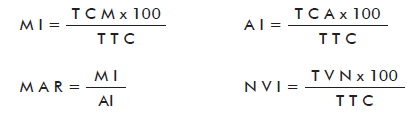
<body><![CDATA[<P   align="justify" ><font size="2" face="Verdana, Arial, Helvetica, sans-serif">The specimens from      the tumors (4 samples from treated animals and 3 samples from controls) were      processed for histopathological study following routine techniques. Briefly,      the samples were fixed in 10% buffered formalin, paraffin embedded, 5-&micro;m      sectioned and hematoxylin and eosin stained. Tumors were evaluated based on      the following parameters: total cells in mitosis (TCM), tumor total cells      (TTC), mitotic index (MI), total cells in apoptosis (TCA), apoptotic index      (AI), mitosis-apoptosis ratio (MAR), total vessels neoformation (TVN) and      neoformation vessels index (NVI). Ten randomly-selected fields with 100-cells      each were used for quantifying all these parameters using 100x magnifications      [21]. For the evaluation of these parameters the software Madip, version 4.0,      and the following equations, as described Rodr&iacute;guez <I>et al</I>. [22]      were employed: </font></P >       <P   align="center" ><img src="/img/revistas/bta/v29n3/fr0102312.gif" width="411" height="114"></P >       
<P   align="justify" ></P >       <P   align="justify" > </P >       <P   ><b><font size="2" face="Verdana, Arial, Helvetica, sans-serif">Isolation of RNA      </font></b></P >       <P   align="justify" ><font size="2" face="Verdana, Arial, Helvetica, sans-serif">Tumor biopsies were      collected into RNAlater&reg; (Ambion, AB applied Biosystem, USA) and stored      at -20 &deg;C for up to 2 weeks. The samples were then processed on a TissueLyser      (Qiagen, Hilden, Germany); extracting total RNA with the TriReagent method      (Ambion, AB applied Biosystem, USA). RNA purity and yield were determined      using a NanoDrop Spectrophotometer (NanoDrop Technologies, USA), and RNA integrity      number (RIN) was obtained on a Bioanalyzer analysis (Agilent, 2100, USA).      </font></P >       <P   ><font size="2" face="Verdana, Arial, Helvetica, sans-serif"><b>cDNA synthesis      </b></font></P >       <P   align="justify" ><font size="2" face="Verdana, Arial, Helvetica, sans-serif">Total RNA was treated      with RQ1 RNase-Free DNase (Promega corporation, Fitchburg, Wisconsin, USA)      in order to remove any DNA contaminants from the preparation. First strand      complementary DNA (cDNA) was synthesized from 1 &micro;g of total RNA using      SuperScript&trade; II reverse transcriptase (Invitrogen technologies, Carlsbad,      California, USA) and oligo-dT primers following fabricant&acute;s instructions.      </font></P >       <P   ><font size="2" face="Verdana, Arial, Helvetica, sans-serif"><b>Selection of the      gene set for Real-time-quantitative-PCR analysis </b></font></P >       <P   align="justify" ><font size="2" face="Verdana, Arial, Helvetica, sans-serif">Gene expression of      49 genes selected from the EGF signaling cascade and cancer pathway (<a href="#tsuppl">supplementary      table</a><B> </B>for gene names, symbols and NCBI reference sequence transcript      accession numbers) were analyzed, following the recommended signaling pathway      in SABiosciences (Qiagen Company, Hilden, Germany). In order to characterize      the selected set of genes on a genomic scale, software for generating molecular      interaction networks and gene enrichment tools were used. The protein interaction      network, composed of the direct interactions between the genes of the selected      set, was generated with Cytoscape [23] using the BisoGenet plugin [24], using      the whole set of databases available at the BisoGenet as primary source of      protein interactions. This network was augmented by adding edges between genes      coding for transcription factors and their target genes. This was done by      compiling transcription regulation data from TRANSFAC&reg; [25] (version 7.0,      2005) using its web interface [26], employing then this information to generate      a Cytoscape .sif file. This file was imported into Cytoscape and merged with      the protein interaction network created by using BisoGenet. Significant biological      processes of Gene Ontology (GO)<B> </B>[27], were investigated with Cytoscape&rsquo;s      plugin BiNGO [28], and significant pathways were identified with DAVID [29],      KEGG [30]<Sup><B> </b></Sup>and BioCarta [31] databases as primary data sources      on pathways. In both cases, a p-value of 0.05 was chosen as threshold for      statistical significance. </font></P >   <FONT size="+1"><FONT size="+1">        ]]></body>
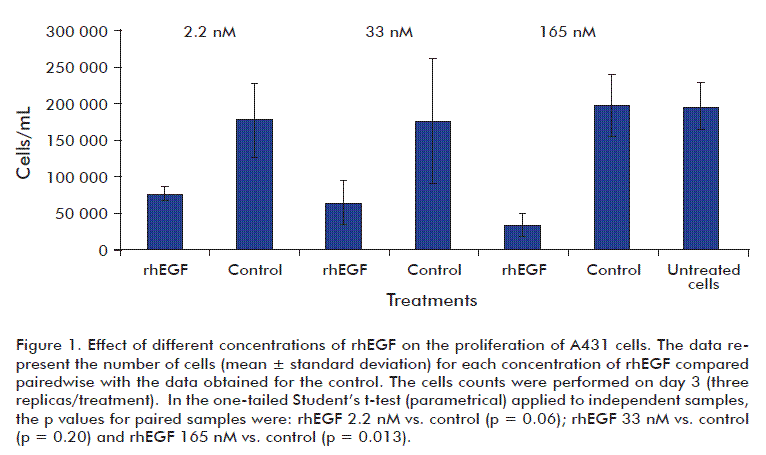
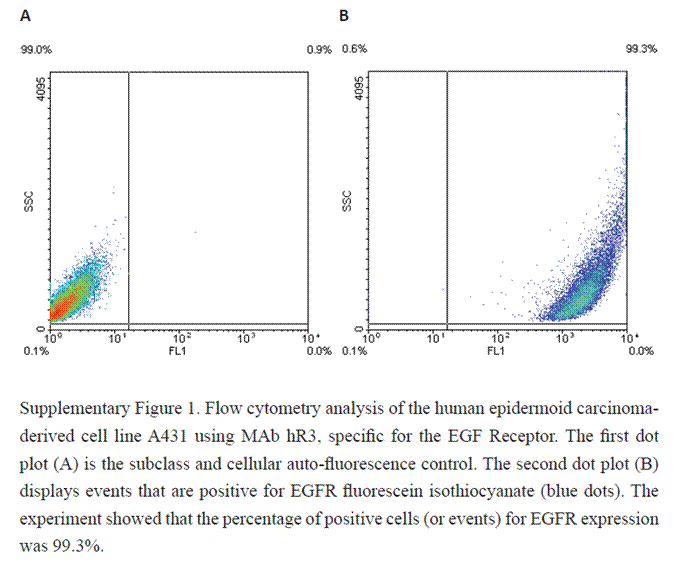
<body><![CDATA[<P   ><font size="2" face="Verdana, Arial, Helvetica, sans-serif"><b>Real-time-quantitative-PCR      </b> </font></P >       <P   align="justify" ><font size="2" face="Verdana, Arial, Helvetica, sans-serif">A primer3 web application      [32] was used to design Real-time-quantitative-PCR (qPCR) primers with a length      of 22 bases and an average GC content of 50%. GAPDH, HMBS and YWHAZ were selected      and tested as reference genes, due to the stability of their transcription      levels across the sample set. We employed real-time PCR to analyze gene expression      in the solid tumors of nude mice xenografted with A431 cells. A total of 4      animals from the rhEGF-treated group and three from the control were included,      using two technical replicates per gene. The reactions were performed in a      volume of 20 &mu;L, including 10 &micro;L of PCR Absolute<Sup>TM</Sup> QPCR      SYBR Green Mix (Thermo Scientific), 6 &mu;L of primers (70 nM) and 4 &micro;L      of cDNA diluted by a factor of 20. The reactions were performed in an optical      detection rotor for 36 tubes at 95 &deg;C for 15 min, followed by 40 cycles      of 95 &deg;C for 15 s, 60 &deg;C for 30 s and 72 &deg;C for 30 s. qPCR data      analysis was performed with CapitalBio RT-Cycler series analysis software      (version 2.001, CapitalBio Co, Ltd, Beijing, China). Relative quantification      to untreated control and normalization with the reference genes were performed      with REST 2009 version 2.0.13 (Qiagen GmbH) [33]. The LinRegPCR program (version      11.3, 2009; Amsterdam, the Netherlands) was used to estimate PCR efficiencies      [34] and geNorm was used for the selection of the most stable reference genes      from a set of tested genes in a given cDNA sample panel [35]. </font></P >   <FONT size="+1"><FONT size="+1">        <P   ><font size="2" face="Verdana, Arial, Helvetica, sans-serif"><b>Statistical analysis      </b> </font></P >       <P   align="justify" ><font size="2" face="Verdana, Arial, Helvetica, sans-serif">To study if significant      differences existed in the tumor volume, A431 cell proliferation, and histophatological      analysis between rhEGF-treated group and control, a normality analysis (Shapiro      Wilk&rsquo;s test) and homogeneity of variance test (Levene&rsquo;s test)      were carried out. Groups were compared using the Student&rsquo;s t-test (parametrical)      or Mann-Whitney&rsquo;s U test (non-parametrical) applied to independent samples      in the <I>in vivo</I> study, and Student&rsquo;s <I>t</I> test applied to      independent samples in the <I>in vitro </I>study. In order to corroborate      the results, due to small size of samples in each group, mean comparison by      estimating confidence intervals or credibility to 95% and 90% by Bayesian      Inference methods applied to independent samples were also done. The significance      level chosen was 0.05. Statistical analyses were done using SPSS for Windows      version 15.0, and EPIDAT for Windows version 3.1, Bayesian Module [36]. </font></P >       <P   align="justify" >&nbsp;</P >       <P   ><font size="2" face="Verdana, Arial, Helvetica, sans-serif"><B><font size="3">RESULTS      </font></B></font></P >   <FONT size="+1">        <P   ><font size="2" face="Verdana, Arial, Helvetica, sans-serif"><b>Flow cytometry      </b></font></P >   <FONT size="+1">        <P   align="justify" ><font size="2" face="Verdana, Arial, Helvetica, sans-serif">In the FACS experiments,      A431 human tumor cells were incubated with the hR3 monoclonal antibody against      EGFR. Mab hR3 bound to 99.3% of the cells after subtracting the signal of      the negative control, thus showing the high density of EGF receptors expressed      by this cell line (<a href="#fsuppl1">Supplementary figure 1</a>). This observation      confirms previous reports that the A431 cell line expresses about 2.6 &times;      10<Sup>6</Sup> molecules of EGFR per cell [10]. </font></P >   <FONT size="+1"><FONT size="+1">        <P   ><font size="2" face="Verdana, Arial, Helvetica, sans-serif"><b>Effect of different      concentrations of rhEGF on the proliferation of A431 cells </b></font></P >       <P   align="justify" ><font size="2" face="Verdana, Arial, Helvetica, sans-serif">In order to examine      the effect of rhEGF on the inhibition of A431 proliferation, cells were exposed      to different EGF concentrations, being 2.2 nM, the dose used in the treatment      of diabetic foot ulcers. Cells were exposed to a range of doses of 2.2, 33      and 165 nM of rhEGF during 72 h; also including rhEGF-free preparation (control)      and untreated cells controls. All the assayed rhEGF concentrations inhibited      A431 cells proliferation. Graphical representation of cell proliferation and      the results of statistical analysis are shown in <a href="/img/revistas/bta/v29n3/f0102312.gif">figure      1</a>.<B> </B>Growth of EGF-free preparation treated cells did not differ      from untreated ones. </font></P >       
]]></body>
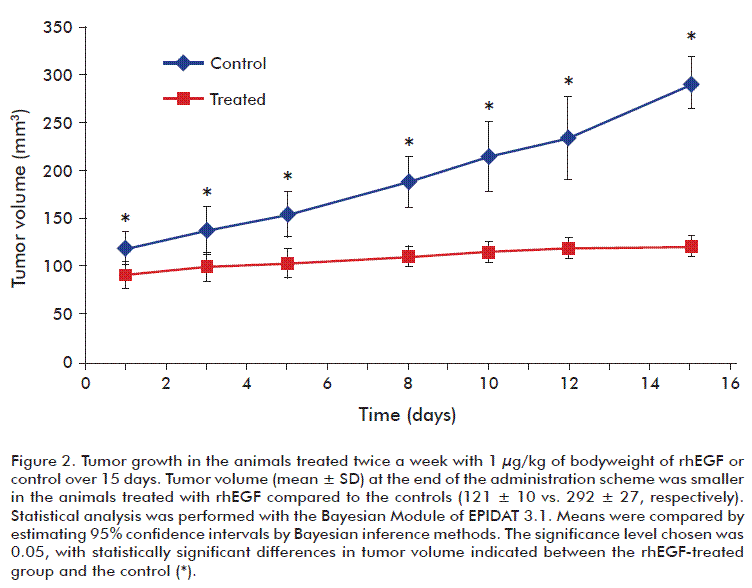
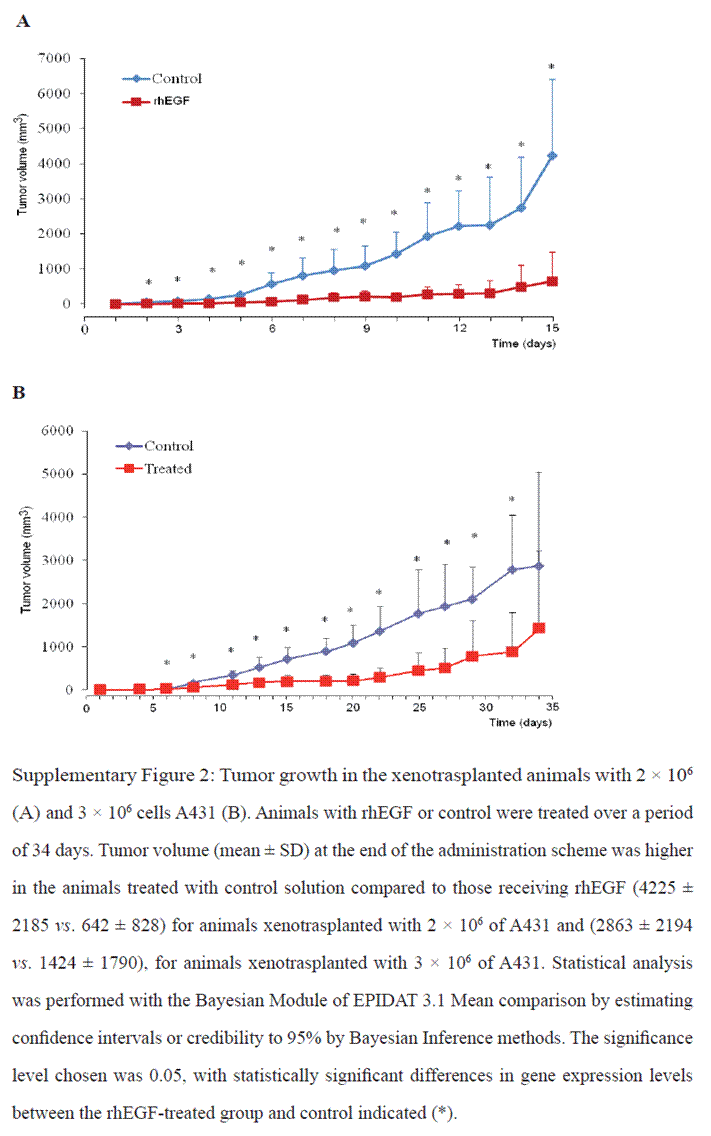
<body><![CDATA[<P   ><font size="2" face="Verdana, Arial, Helvetica, sans-serif"><b>Tumor growth in      mice </b> </font></P >       <P   align="justify" ><font size="2" face="Verdana, Arial, Helvetica, sans-serif">Changes in the subcutaneous      solid tumor mass volumes were observed between rhEGF and control treated mice.      On day 15, the control-treated group had an average tumor volume of 292 &plusmn;      27 mm<Sup>3</Sup>, compared to 121 &plusmn; 10 mm<Sup>3</Sup> for the rhEGF-treated      group. Tumor growth curves revealed the existence of large significant differences      between the groups treated with control and rhEGF (<a href="/img/revistas/bta/v29n3/f0202312.gif">Figure      2</a>). Similar results of tumor growth between animals treated with rhEGF      (1 &micro;g/kg of animal body weight) and the control group were observed      in two replication of this study using a larger number of animals and time-course      treatment (<a href="#fsuppl2">Supplementary figure 2</a>). </font></P >   <FONT size="+1"><FONT size="+1"><FONT size="+1"><FONT size="+1">        
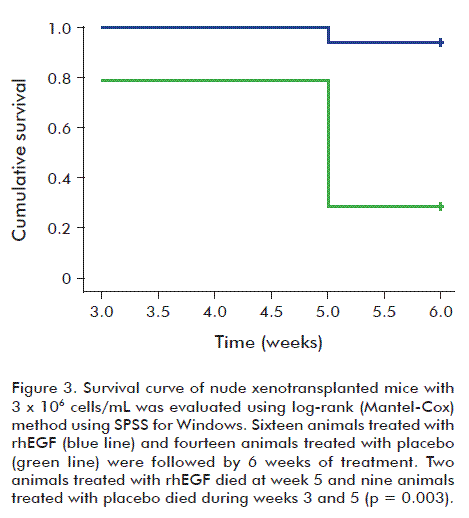
<P   ><font size="2" face="Verdana, Arial, Helvetica, sans-serif"><b>Epidermal growth      factor prolongs survival time of tumor-bearing mice </b></font></P >       <P   align="justify" ><font size="2" face="Verdana, Arial, Helvetica, sans-serif">It was observed that      rhEGF prolonged the survival time of mice bearing A431 tumor xenografts vs.      controls. <a href="#fig3">Figure 3</a> and <a href="/img/revistas/bta/v29n3/t0102312.gif">table      1</a> show the result of log-rank (Mantel-Cox) analysis in a study made using      3 &times; 10<Sup>6</Sup> cells xenotrasplanted/animal and treated with 20      ng of rhEGF or control. As shown inxenotrasplanted/animal and treated with      20 ng of rhEGF or control. As shown inxenotrasplanted/animal and treated with      20 ng of rhEGF or control. As shown in <a href="/img/revistas/bta/v29n3/t0102312.gif">table      1</a>, rhEGF-treated animals lived 5.87 weeks, but control animals lived 4.9      weeks, which was significantly different (p = 0.003). In this animal model,      the 2.2 nM concentration of rhEGF prolonged the survival of animals one week      with respect to the controls. </font></P >       
<P   align="center" ><font size="2" face="Verdana, Arial, Helvetica, sans-serif"><img src="/img/revistas/bta/v29n3/f0302312.gif" width="467" height="512"><a name="fig3"></a>    
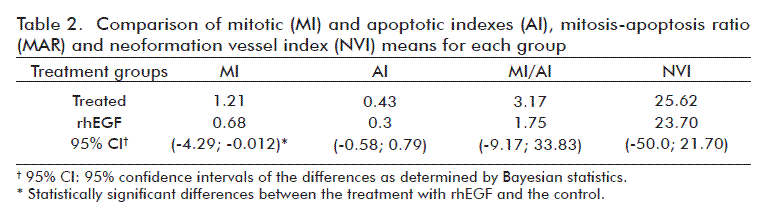
<br>     </font></P >   <FONT size="+1"><FONT size="+1">        <P   ><font size="2" face="Verdana, Arial, Helvetica, sans-serif"><b>Histopathological      study </b></font></P >       <P   align="justify" ><font size="2" face="Verdana, Arial, Helvetica, sans-serif">The histopathological      examination of the primary tumors, together with the calculation of the corresponding      mitotic and mitotic/apoptotic indexes revealed the existence of significant      differences in cell division between the groups. The mitotic index at 16 days      showed that the proliferation status of cells sampled at these times had less      number of cells in mitosis in relation to the total number of cells (<a href="/img/revistas/bta/v29n3/t0202312.gif">Table      2</a>). These indexes for the implanted tumors in the EGF-treated group were      lower than in the control group. </font></P >       
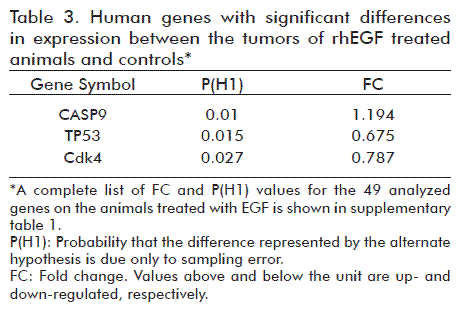
<P   align="justify" ><font size="2" face="Verdana, Arial, Helvetica, sans-serif"><b>Gene expression      analysis in xenotrasplanted tumors (A431 cells) in nude mice </b></font></P >       <P   align="justify" ><font size="2" face="Verdana, Arial, Helvetica, sans-serif">The isolated RNA      appeared to meet the quality standard for further use in differential gene      expression analyses by qPCR (data not shown). All the samples had RIN larger      than 7. The qPCR technique was validated to demonstrate the absence of genomic      DNA in the RNA preparations and the absence of inhibitors in the cDNA synthesized      for the PCR reactions. A similar observation was found after the evaluation      of references genes with the least variation in their expression levels between      samples of rhEGF-treated group and the control. The use of qPCR addressed      the identification of genes that could be involved in the observed cell proliferation      inhibition in vitro and in vivo after the application of rhEGF. According      to the results, 6% of the analyzed genes had significantly different expression      levels between both treatment groups. Compared to the control animals, two      of the three genes with significant differences had lower expression levels      but the expression of the third was increased (<a href="#tab3">Table 3</a>).      A molecular interaction network was designed using, as input, some of the      most relevant genes that interact directly with Cdk4, TP53 and CASP9, genes      that varied significantly their expression (<a href="/img/revistas/bta/v29n3/f0402312.gif">Figure      4</a>).</font></P >       
]]></body>
<body><![CDATA[<P   align="center" ><img src="/img/revistas/bta/v29n3/t0302312.gif" width="460" height="312"><a name="tab3"></a></P >       
<P   align="center" >&nbsp;</P >       <P   align="justify" ></P >       <P   align="justify" > </P >   <B>        <P   align="justify" ><font size="3" face="Verdana, Arial, Helvetica, sans-serif">DISCUSSION </font></P >   </B>        <P   align="justify" ><font size="2" face="Verdana, Arial, Helvetica, sans-serif">EGF is endowed with      proliferative and cytoprotective abilities, promoting cell survival and tissue      repair. There is a controversy about the role of EGF in cancer development      because: its specific receptor is encoded by an oncogene, the EGFR is mutated      in most epithelial cancers and the signals, produced by the interaction of      EGF and its receptor to stimulate tissue repair such as proliferation, migration      and angiogenesis, are the same signals that promote tumorigenesis [37]. </font></P >       <P   align="justify" ><font size="2" face="Verdana, Arial, Helvetica, sans-serif">Although an obvious      concern still survives before the clinical use of EGF, a thorough examination      of the international reported clinical interventions suggest that EGF treatments      have been well tolerated (including systemic exposure) and safe within temporary      biological windows enough for malignant processes&rsquo; onset (4 to 15 years      of follow up) [37]. </font></P >       <P   align="justify" ><font size="2" face="Verdana, Arial, Helvetica, sans-serif">Our study has shed      further light on the safety profile of EGF, which at the effective clinically      concentrations does not favor the development of tumors in A431 cells. We      developed an A431 tumor-bearing nude mice model and it was validated through      phenotypical and histological tests. A431 is a highly tumorigenic squamous      carcinoma cell line that was chosen due to its large levels of EGFR expression,      which provide a large dynamic range for testing the effect of different EGF      concentrations on the activation of the EGFR and cancer signaling pathways      [10]. </font></P >       <P   align="justify" ><font size="2" face="Verdana, Arial, Helvetica, sans-serif">In this study, we      found that concentrations of rhEGF of 2.2, 33 and 165 nM produced cell proliferative      inhibition of A431 during cultivation. In other words, rhEGF concentrations      up to 16-fold higher than those reported by other authors produced an inhibitory      effect on growth, similar to EGF at 0.1-10 nM </font></P >       <P   align="justify" ><font size="2" face="Verdana, Arial, Helvetica, sans-serif">[38-41]. For the      in vitro study, the experimental point of 2.2 nM of rhEGF matches with the      concentration used in the clinics during the therapy of chronic ulcers [14-16].      The results as a whole, suggest that rhEGF does not promote the proliferation      of the A431 cell line and, therefore, may not assist in tumorigenesis in these      cells. </font></P >       ]]></body>
<body><![CDATA[<P   align="justify" ><font size="2" face="Verdana, Arial, Helvetica, sans-serif">The high levels of      EGFR in A431 cells appears to facilitate tumor growth <I>in vivo</I>, compared      other tumor lines expressing lower levels of EGFR. These observations are      consistent with the results of Barnes in 1982 [40] and Santon <I>et al</I>.      in 1986<B> </B>[41],<B> </B>which demonstrated that the concentration of EGFRs      in A431 cells is directly proportional to their ability to grow as solid tumors      in host animals. In line with this, the rhEGF-treated animal group showed      significantly smaller tumor volumes than the control group, suggesting an      inhibition of tumor growth mediated by rhEGF. We observed a similar behavior      for A431 cells growing <I>in vitro </I>under the influence of nanomolar concentrations      of rhEGF. These results might suggest that EGF promotes similar mechanisms      in both biological scenarios (<I>in vivo </I>and <I>in vitro</I>), resulting      in the growth inhibition of A431 cell line. </font></P >       <P   align="justify" ><font size="2" face="Verdana, Arial, Helvetica, sans-serif">In addition to the      tumor growth data, the histological analysis also suggests that rhEGF exerts      an inhibitory, rather than stimulatory mitotic action on A431 tumor cells.      The mitotic index, a critical parameter for cancer prevention and control,      was lower in rhEGF-treated animals compared to the control, possibly due to      cell cycle arrest arising from the repair of genetic material and the promotion      of tumor cell death. These could be transient events that should be promoted      by the rhEGF action on A431 tumors in athymic mice [42]. </font></P >       <P   align="justify" ><font size="2" face="Verdana, Arial, Helvetica, sans-serif">The rhEGF also favored      the survival of animals inoculated with 3 million A431 cells, perhaps providing      protective properties against tumor aggressiveness and invasiveness. As proposed      by Amagase <I>et al</I>., EGF may play a role in preventing the metastasis      of certain malignant neoplasms, thus prolonging the survival time of athymic      nude mice bearing human xenografts [43]. </font></P >       <P   align="justify" ><font size="2" face="Verdana, Arial, Helvetica, sans-serif">Tumor phenotypic      descriptions are accompanied by changes produced by EGF`s molecular mechanisms      of action, which generate a cascade of intracellular signals that justify      its biological effect and cellular response. The gene expression profile that      characterized the treated group supports the above statement through genes      that varied significantly their expression under the action of rhEGF (<a href="/img/revistas/bta/v29n3/f0402312.gif">Figure      4</a>). </font></P >       
<P   align="justify" ><font size="2" face="Verdana, Arial, Helvetica, sans-serif">Three genes (TP53,      Cdk4 and CASP9) with relevance in cell cycle regulation and apoptosis showed      significant differences in expression in the tumors of EGF-treated animals      vs. Control. These genes with subtle changes in their expression levels (fold-change      lower than 2) could be indicating that they are more tightly regulated in      its effect on the tumor biology formation [44]. </font></P >       <P   align="justify" ><font size="2" face="Verdana, Arial, Helvetica, sans-serif">The results showed      that rhEGF at nanomolar concentrations inhibited the proliferation of A431      tumor cells both <I>in vitro</I> and <I>in vivo</I>. This cell line has a      point mutation in the TP53<Sup>273.His</Sup> that contributes to malignant      progression through genomic unstability due to the inhibition at the G1 arrest      point [45]. TP53<Sup>273.His</Sup> is considered as a type I missense mutation,      since it affects residues of the DNA-binding surface and disrupts the contact      points between protein and DNA [46]. Some of the phenotypic effects of TP53<Sup>273.His</Sup>      are: increase cell proliferation, increase growth density and induction of      antiapoptotic activity [47]. The down-regulation of TP53 mRNA levels in tumors      cells treated with rhEGF may be related with a reversible cell cycle arrest      at the G1-S boundary. In this study, we observed a possible link between the      effect of rhEGF and the down-regulation of two important cell cycle regulator      genes, the TP53<Sup>273.His</Sup> and Cdk4, and their implication in the lengthening      of the G1 to S phase transition, therefore inhibiting tumor growth. The results      are not enough to further dissect and identify what genes or protein interactions      lead to decrease gene expression levels for Cdk4, but the decrease in TP53      levels due to EGF may suggests a reduction of the oncogenic gain-of-function      of the TP53 gene and a reprogramming of the activity of genes controlling      the cell cycle, such as Cdk4. </font></P >   <FONT size="+1"><FONT size="+1"><FONT size="+1"><FONT size="+1"><FONT size="+1"><FONT size="+1"><FONT size="+1"><FONT size="+1">        <P   align="justify" ><font size="2" face="Verdana, Arial, Helvetica, sans-serif">Another downstream      component of the EGF regulatory cascade is Caspase-9, a gene for a member      of the cysteine-aspartic acid protease (caspase) family. Sequential activation      of caspases plays a central role in the execution phase of cell apoptosis      and therefore, the restoration of some cell pathways through the action of      EGF in tumor cells may drive them directly to cell death (apoptosis) [48].      </font></P >       <P   align="justify" ><font size="2" face="Verdana, Arial, Helvetica, sans-serif">Preliminarily, in      the <I>in vivo</I> scenario, the action of rhEGF led to a transient recovery      of tumor suppressor ability in tumor cells through the reduction of the biological      action of mutated TP53, the arrest of cell cycle due to decreased levels of      Cdk4 and the promotion of apoptosis through the activation of CASP9. </font></P >       <P   align="justify" ><font size="2" face="Verdana, Arial, Helvetica, sans-serif">Our findings are      not surprising. They rather support previous evidences documenting an EGF-mediated      anti-tumorigenic effect at certain supraphysiological concentrations in A431      cells [38-40]. Other malignant cell lines as MX-1, UM-1 of mammary origin      as the ES-4 derived from esophageal cancer are also inhibited by EGF in proportion      to the concentrations injected, when transplanted to athymic recipients [42].      More recent studies have shown that EGF failed to enhance <I>in vitro</I>      proliferation of three human gastric adenocarcinoma lines, as there were no      effect on tumor growth when these cells were implanted in nude mice [49].      Curiously, for both the <I>in vitro</I> and <I>in vivo</I> approaches, the      experimental protocols and the EGF doses have been largely used and known      to facilitate proliferation of non-transformed cells. Lately, according to      recent <I>in vitro</I> findings EGF induced more noticeable changes in A431      cells proliferation and death than cetuximab or gefitinib. Both, cells&rsquo;      arrest and death appeared far more prolonged and irreversible by EGF than      that of the conventional anti-tumor drugs [50]. </font></P >       <P   align="justify" >&nbsp;</P >       ]]></body>
<body><![CDATA[<P   ><font size="2" face="Verdana, Arial, Helvetica, sans-serif"><font size="3"><b>C</b></font><b><font size="3">ONCLUSIONS      </font></b> </font></P >   <FONT size="+1">        <P   align="justify" ><font size="2" face="Verdana, Arial, Helvetica, sans-serif">These results provide      evidences in favor of the safe use of EGF in clinical practice, which at nanomolar      concentrations prolongs the animal survival time and inhibited the proliferation      of tumor in animal&rsquo;s xenotrasplanted with A431 cells. The findings of      differential gene expression <I>in vivo</I> analysis reinforce these phenotypic      observations. Important genes for the cell cycle regulation, as TP53, Cdk4      and CASP9 varied significantly their expression levels favoring cell cycle      inhibition and apoptosis. </font></P >       <P   align="justify" >&nbsp;</P >   <FONT size="+1">        <P   ><font size="2" face="Verdana, Arial, Helvetica, sans-serif"><B><font size="3">ACKNOWLEDGEMENTS      </font> </b> </font></P >   <FONT size="+1">        <P   align="justify" ><font size="2" face="Verdana, Arial, Helvetica, sans-serif">The authors would      like to thank Dr. Jorge Gavilondo for his scientific contribution to the planning      and development of this research. We also want to thank Dr. Jos&eacute; Angel      Silva for his excellent dedication to the synthesis of real time PCR primers.      </font></P >       <P   align="justify" >&nbsp;</P >   <FONT size="+1">        <P   align="justify" > </P >       <P   align="justify" ><font size="3"><b><font face="Verdana, Arial, Helvetica, sans-serif">REFERENCES      </font></b></font></P >       <!-- ref --><P   align="justify" ><font size="2" face="Verdana, Arial, Helvetica, sans-serif">1. Carpenter G, Cohen      S. Epidermal growth factor. J Biol Chem. 1990;265(14):7709-12.     </font></P >   <FONT size="+1">        ]]></body>
<body><![CDATA[<!-- ref --><P   align="justify" ><font size="2" face="Verdana, Arial, Helvetica, sans-serif">2. Venturi S, Venturi      M. Iodine in evolution of salivary glands and in oral health. Nutr Health.      2009;20(2):119-34.     </font></P >       <!-- ref --><P   align="justify" ><font size="2" face="Verdana, Arial, Helvetica, sans-serif">3. Kresge N, Simoni      RD, Hill RL. Precocious Newborn Mice and Epidermal Growth Factor: the Work      of Stanley Cohen. J Biol Chem. 2006;281(10):e10.     </font></P >       <!-- ref --><P   align="justify" ><font size="2" face="Verdana, Arial, Helvetica, sans-serif">4. Berlanga J. Heberprot-P:      experimental background and pharmacological bases. Biotecnol Apl. 2010;27(2):88-94.          </font></P >       <!-- ref --><P   align="justify" ><font size="2" face="Verdana, Arial, Helvetica, sans-serif">5. Cross M, Dexter      TM. Growth factors in development, transformation, and tumorigenesis. Cell.      1991;64(2):271-80.     </font></P >       <!-- ref --><P   align="justify" ><font size="2" face="Verdana, Arial, Helvetica, sans-serif">6. Gazdar AF. Personalized      medicine and inhibition of EGFR signaling in lung cancer. N Engl J Med. 2009;361(10):1018-20.          </font></P >       ]]></body>
<body><![CDATA[<P   align="justify" ><font size="2" face="Verdana, Arial, Helvetica, sans-serif">7. Berlanga J, Gavilondo      J, Garc&iacute;a del Barco D, Mart&iacute;n J, Guill&eacute;n G. Epidermal      Growth Factor (EGF) and Platelet-Derived Growth Factor (PDGF) as Tissue Healing      Agents: Clarifying Concerns about their Possible Role in Malignant Transformation      and Tumor Progression. J Carcinogenesis Mutagenesis. 2011;2(1):115. Available      from: <a href="http://www.omicsonline.org/2157-2518/2157-2518-2-115.php?aid=294" target="_blank">http://www.omicsonline.org/2157-2518/2157-2518-2-115.php?aid=294</a>.      </font></P >       <P   align="justify" ><font size="2" face="Verdana, Arial, Helvetica, sans-serif">8. Berlanga J, &Aacute;lvarez      S, de la Fuente J, L&oacute;pez P. Considerations on the transforming potential      of the epidermal growth factor. Biotecnol Apl. 1998;15(2):65-9. </font></P >       <P   align="justify" ><font size="2" face="Verdana, Arial, Helvetica, sans-serif">9. Berlanga-Acosta      J, Gavilondo-Cowley J, L&oacute;pez-Saura P, Gonz&aacute;lez-L&oacute;pez      T, Castro-Santana MD, Lopez-Mola E, et al. Epidermal growth factor in clinical      practice - a review of its biological actions, clinical indications and safety      implications. Int Wound J. 2009;6(5):331-46. </font></P >       <!-- ref --><P   align="justify" ><font size="2" face="Verdana, Arial, Helvetica, sans-serif">10. Stoscheck CM,      Carpenter G. Biology of the A-431 cell: a useful organism for hormone research.      J Cell Biochem. 1983;23(1-4):191-202.     </font></P >       <!-- ref --><P   align="justify" ><font size="2" face="Verdana, Arial, Helvetica, sans-serif">11. Masui H, Castro      L, Mendelsohn J. Consumption of EGF by A431 cells: evidence for receptor recycling.      J Cell Biol. 1993;120(1):85-93.     </font></P >       <!-- ref --><P   align="justify" ><font size="2" face="Verdana, Arial, Helvetica, sans-serif">12. Jakus J, Yeudall      WA. Growth inhibitory concentrations of EGF induce p21 (WAF1/Cip1) and alter      cell cycle control in squamous carcinoma cells. Oncogene. 1996; 12(11):2369-76.          </font></P >       <!-- ref --><P   align="justify" ><font size="2" face="Verdana, Arial, Helvetica, sans-serif">13. Sonoke S, Ueda      T, Fujiwara K, Sato Y, Takagaki K, Hirabayashi K, et al. Tumor regression      in mice by delivery of Bcl-2 small interfering RNA with pegylated cationic      liposomes. Cancer Res. 2008;68(21):8843-51.     </font></P >       <P   align="justify" ><font size="2" face="Verdana, Arial, Helvetica, sans-serif">14. Acosta JB, Savigne      W, Valdez C, Franco N, Alba JS, del R&iacute;o A, et al. Epidermal growth      factor intralesional infiltrations can prevent amputation in patients with      advanced diabetic foot wounds. Int Wound J. 2006;3(3):232-9. </font></P >       <P   align="justify" ><font size="2" face="Verdana, Arial, Helvetica, sans-serif">15. Fern&aacute;ndez-Montequ&iacute;n      JI, Infante-Cristia E, Valenzuela-Silva C, Franco-P&eacute;rez N, Savigne-Guti&eacute;rrez      W, Artaza-Sanz H, et al. Intralesional injections of Citoprot-P (recombinant      human epidermal growth factor) in advanced diabetic foot ulcers with risk      of amputation. Int Wound J. 2007;4(4):333-43. </font></P >       <P   align="justify" ><font size="2" face="Verdana, Arial, Helvetica, sans-serif">16. Fern&aacute;ndez-Montequ&iacute;n      JI, Valenzuela-Silva CM, D&iacute;az OG, Savigne W, Sancho-Soutelo N, Rivero-Fern&aacute;ndez      F, et al. Intra-lesional injections of recombinant human epidermal growth      factor promote granulation and healing in advanced diabetic foot ulcers: multicenter,      randomised, placebo-controlled, double-blind study. Int Wound J. 2009;6(6):432-43.      </font></P >       <P   align="justify" ><font size="2" face="Verdana, Arial, Helvetica, sans-serif">17. Talavera A, Friemann      R, G&oacute;mez-Puerta S, Mart&iacute;nez-Fleites C, Garrido G, Rabasa A,      et al. Nimotuzumab, an antitumor antibody that targets the epidermal growth      factor receptor, blocks ligand binding while permitting the active receptor      conformation. Cancer Res. 2009;69(14):5851-9. </font></P >       <P   align="justify" ><font size="2" face="Verdana, Arial, Helvetica, sans-serif">18. Cinza AM, Quintana      M, Lombardero J, Poutou R, P&eacute;rez E, P&eacute;rez LC, et al. Establecimiento      de un cultivo discontinuo para la producci&oacute;n del factor de crecimiento      epid&eacute;rmico humano en levaduras. Caracterizaci&oacute;n del producto.      Biotecnol Apl. 1991;8(2):166-74. </font></P >       <!-- ref --><P   align="justify" ><font size="2" face="Verdana, Arial, Helvetica, sans-serif">19. Berlanga-Acosta      J, Playford RJ, Mandir N, Goodlad RA. Gastrointestinal cell proliferation      and crypt fission are separate but complementary means of increasing tissue      mass following infusion of epidermal growth factor in rats. Gut. 2001;48(6):803-7.          </font></P >       <!-- ref --><P   align="justify" ><font size="2" face="Verdana, Arial, Helvetica, sans-serif">20. Toso C, Trotter      J, Wei A, Bigam DL, Shah S, Lancaster J, et al. Total tumor volume predicts      risk of recurrence following liver transplantation in patients with hepatocellular      carcinoma. Liver Transpl. 2008;14(8):1107-15.     </font></P >       ]]></body>
<body><![CDATA[<!-- ref --><P   align="justify" ><font size="2" face="Verdana, Arial, Helvetica, sans-serif">21. Leung TW, Xue      WC, Cheung AN, Khoo US, Ngan HY. Proliferation to apoptosis ratio as a prognostic      marker in adenocarcinoma of uterine cervix. Gynecol Oncol. 2004;92(3):866-72.          </font></P >       <!-- ref --><P   align="justify" ><font size="2" face="Verdana, Arial, Helvetica, sans-serif">22. Rodr&iacute;guez      R, Alarc&oacute;n TE, S&aacute;chez LB. MADIP: Morphometrical Analysis by      Digital Processing. In: S&aacute;nchez JS, Pla F. Proceedings of the IX Spanish      Symposium on Pattern Recognition and Image Analysis: Benicasim (Castell&oacute;n),      Spain, 16-18 May 2001. Vol. I. Castell&oacute;n de la Plana: Publicaciones      de la Universitat Jaume; 2001. p. 291-8.     </font></P >       <!-- ref --><P   align="justify" ><font size="2" face="Verdana, Arial, Helvetica, sans-serif">23. Shannon P, Markiel      A, Ozier O, Baliga NS, Wang JT, Ramage D, et al. Cytoscape: a software environment      for integrated models of biomolecular interaction networks. Genome Res. 2003;13(11):2498-504.          </font></P >       <P   align="justify" ><font size="2" face="Verdana, Arial, Helvetica, sans-serif">24. Mart&iacute;n      A, Ochagav&iacute;a ME, Rabasa LC, Miranda J, Fern&aacute;ndez-de-Cossio J,      Bringas R. BisoGenet: a new tool for gene network building, visualization      and analysis. BMC Bioinformatics. 2010;11:91. </font></P >       <!-- ref --><P   align="justify" ><font size="2" face="Verdana, Arial, Helvetica, sans-serif">25. Matys V, Fricke      E, Geffers R, Gossling E, Haubrock M, Hehl R, et al. TRANSFAC: transcriptional      regulation, from patterns to profiles. Nucleic Acids Res. 2003;31(1):374-8.          </font></P >       <!-- ref --><P   align="justify" ><font size="2" face="Verdana, Arial, Helvetica, sans-serif">26. Public Databases      for Academic and Non-profit Organizations [Internet]. Wolfenb&uuml;ttel: BIOBASE      Biological Databases. c2000-2001 - [cited 2011 Oct 14]. Available from: <a href="http://www.gene-regulation.com/pub/databases.html" target="_blank">http://www.gene-regulation.com/pub/databases.html</a>.          </font></P >       <!-- ref --><P   align="justify" ><font size="2" face="Verdana, Arial, Helvetica, sans-serif">27. Ashburner M,      Ball CA, Blake JA, Botstein D, Butler H, Cherry JM, et al. Gene ontology:      tool for the unification of biology. The Gene Ontology Consortium. Nat Genet.      2000;25(1):25-9.     </font></P >       <!-- ref --><P   align="justify" ><font size="2" face="Verdana, Arial, Helvetica, sans-serif">28. Maere S, Heymans      K, Kuiper M. BiNGO: a Cytoscape plugin to assess overrepresentation of gene      ontology categories in biological networks. Bioinformatics. 2005; 21(16):3448-9.          </font></P >       <!-- ref --><P   align="justify" ><font size="2" face="Verdana, Arial, Helvetica, sans-serif">29. Dennis G, Jr,      Sherman BT, Hosack DA, Yang J, Gao W, Lane HC, et al. DAVID: Database for      Annotation, Visualization, and Integrated Discovery. Genome Biol. 2003;4(5):P3.          </font></P >       <!-- ref --><P   align="justify" ><font size="2" face="Verdana, Arial, Helvetica, sans-serif">30. Kanehisa M, Goto      S, Kawashima S, Nakaya A. The KEGG databases at GenomeNet. Nucleic Acids Res.      2002;30(1):42-6.     </font></P >       <!-- ref --><P   align="justify" ><font size="2" face="Verdana, Arial, Helvetica, sans-serif">31. BioCarta [Internet].      San Diego: BioCarta LLC; c2012 - [cited 2011 Oct 14]. Available from: <a href="http://www.biocarta.com" target="_blank">http://www.biocarta.com</a>.          </font></P >       <!-- ref --><P   align="justify" ><font size="2" face="Verdana, Arial, Helvetica, sans-serif">32. Rozen S, Skaletsky      H. Primer3 on the WWW for general users and for biologist programmers. Methods      Mol Biol. 2000;132:365-86.     </font></P >       <!-- ref --><P   align="justify" ><font size="2" face="Verdana, Arial, Helvetica, sans-serif">33. Pfaffl MW, Horgan      GW, Dempfle L. Relative expression software tool (REST) for group-wise comparison      and statistical analysis of relative expression results in real-time PCR.      Nucleic Acids Res. 2002;30(9):e36.     </font></P >       <!-- ref --><P   align="justify" ><font size="2" face="Verdana, Arial, Helvetica, sans-serif">34. Ruijter JM, Ramakers      C, Hoogaars WM, Karlen Y, Bakker O, van den Hoff MJ, et al. Amplification      efficiency: linking baseline and bias in the analysis of quantitative PCR      data. Nucleic Acids Res. 2009;37(6):e45.     </font></P >       <!-- ref --><P   align="justify" ><font size="2" face="Verdana, Arial, Helvetica, sans-serif">35. Vandesompele      J, De Preter K, Pattyn F, Poppe B, Van Roy N, De Paepe A, et al. Accurate      normalization of real-time quantitative RT-PCR data by geometric averaging      of multiple internal control genes. Genome Biol. 2002;3(7):RESEARCH0034.     </font></P >       <!-- ref --><P   align="justify" ><font size="2" face="Verdana, Arial, Helvetica, sans-serif">36. Bernardo JM,      Smith AFM. Bayesian Theory. Chichester: Wiley; 1994.     </font></P >       <!-- ref --><P   align="justify" ><font size="2" face="Verdana, Arial, Helvetica, sans-serif">37. Zhang H, Berezov      A, Wang Q, Zhang G, Drebin J, Murali R, et al. ErbB receptors: from oncogenes      to targeted cancer therapies. J Clin Invest. 2007;117(8):2051-8.     </font></P >       <!-- ref --><P   align="justify" ><font size="2" face="Verdana, Arial, Helvetica, sans-serif">38. Gill GN, Lazar      CS. Increased phosphotyrosine content and inhibition of proliferation in EGF-treated      A431 cells. Nature. 1981;293(5830):305-7.     </font></P >       <!-- ref --><P   align="justify" ><font size="2" face="Verdana, Arial, Helvetica, sans-serif">39. Gill GN, Buss      JE, Lazar CS, Lifshitz A, Cooper JA. Role of epidermal growth factor-stimulated      protein kinase in control of proliferation of A431 cells. J Cell Biochem.      1982;19(3):249-57.     </font></P >       <!-- ref --><P   align="justify" ><font size="2" face="Verdana, Arial, Helvetica, sans-serif">40. Barnes DW. Epidermal      growth factor inhibits growth of A431 human epidermoid carcinoma in serum-free      cell culture. J Cell Biol. 1982;93(1):1-4.     </font></P >       <!-- ref --><P   align="justify" ><font size="2" face="Verdana, Arial, Helvetica, sans-serif">41. Santon JB, Cronin      MT, MacLeod CL, Mendelsohn J, Masui H, Gill GN. Effects of epidermal growth      factor receptor concentration on tumorigenicity of A431 cells in nude mice.      Cancer Res. 1986;46(9):4701-5.     </font></P >       <!-- ref --><P   align="justify" ><font size="2" face="Verdana, Arial, Helvetica, sans-serif">42. Murayama Y. Growth-inhibitory      effects of epidermal growth factor on human breast cancer and carcinoma of      the esophagus transplanted into nude mice. Ann Surg. 1990;211(3):263-8.     </font></P >       <!-- ref --><P   align="justify" ><font size="2" face="Verdana, Arial, Helvetica, sans-serif">43. Amagase H, Tamura      K, Okuhira M, Kakimoto M, Amano H, Hashimoto K, et al. Epidermal growth factor      prolongs survival time of tumor-bearing mice. Jpn J Cancer Res. 1990;81(5):495-500.          </font></P >       <!-- ref --><P   align="justify" ><font size="2" face="Verdana, Arial, Helvetica, sans-serif">44. Jones LB, Bean      R, McLachlan GJ, Zhu JX. Mixture models for detecting differentially expressed      genes in microarrays. Int J Neural Syst. 2006;16(5):353-62.     </font></P >       <!-- ref --><P   align="justify" ><font size="2" face="Verdana, Arial, Helvetica, sans-serif">45. Williams AC,      Miller JC, Collard TJ, Bracey TS, Cosulich S, Paraskeva C. Mutant p53 is not      fully dominant over endogenous wild type p53 in a colorectal adenoma cell      line as demonstrated by induction of MDM2 protein and retention of a p53 dependent      G1 arrest after gamma irradiation. Oncogene. 1995;11(1):141-9.     </font></P >       <!-- ref --><P   align="justify" ><font size="2" face="Verdana, Arial, Helvetica, sans-serif">46. van Oijen MG,      Slootweg PJ. Gain-of-function mutations in the tumor suppressor gene p53.      Clin Cancer Res. 2000; 6(6):2138-45.     </font></P >       <!-- ref --><P   align="justify" ><font size="2" face="Verdana, Arial, Helvetica, sans-serif">47. Prasad KA, Church      JG. EGF effects on p53 in MDA-468 human breast cancer cells: implications      for G1 arrest. Cell Prolif. 1997;30(2):81-94.     </font></P >       <!-- ref --><P   align="justify" ><font size="2" face="Verdana, Arial, Helvetica, sans-serif">48. Shinoura N, Sakurai      S, Asai A, Kirino T, Hamada H. Caspase-9 transduction overrides the resistance      mechanism against p53-mediated apoptosis in U-87MG glioma cells. Neurosurgery.      2001;49(1):177-86.     </font></P >       <!-- ref --><P   align="justify" ><font size="2" face="Verdana, Arial, Helvetica, sans-serif">49. Xia L, Yuan YZ,      Xu CD, Zhang YP, Qiao MM, Xu JX. Effects of epidermal growth factor on the      growth of human gastric cancer cell and the implanted tumor of nude mice.      World J Gastroenterol. 2002;8(3):455-8.     </font></P >       <!-- ref --><P   align="justify" ><font size="2" face="Verdana, Arial, Helvetica, sans-serif">50. Song JY, Lee      SW, Hong JP, Chang SE, Choe H, Choi J. Epidermal growth factor competes with      EGF receptor inhibitors to induce cell death in EGFR-overexpressing tumor      cells. Cancer Lett. 2009;283(2):</font><font size="2" face="Verdana, Arial, Helvetica, sans-serif">135-42.          </font></P >   <FONT size="+1">        <P   align="justify" > </P >       ]]></body>
<body><![CDATA[<P   > </P >       <P   > </P >       <P   >&nbsp;</P >       <P   >&nbsp;</P >       <P   ><font size="2" face="Verdana, Arial, Helvetica, sans-serif">Received in November,      2011.     <br>     Accepted in April, 2012.</font></P >       <P   >&nbsp;</P >       <P   >&nbsp;</P >       <P   align="justify" > </P >       <P   > </P >       ]]></body>
<body><![CDATA[<P   align="justify" > </P >       <P   ><font size="2" face="Verdana, Arial, Helvetica, sans-serif"><I>Isabel A Guill&eacute;n.</I>      Departamento de Farmacogen&oacute;mica, Direcci&oacute;n de Investigaciones      Biom&eacute;dicas. Centro de Ingenier&iacute;a Gen&eacute;tica y Biotecnolog&iacute;a,      CIGB. Ave. 31 e/ 158 y 190, Playa, CP 10 600, La Habana, Cuba. E-mail: <A href="mailto:isabel.guillen@cigb.edu.cu"><U><U><FONT color="#0000FF">isabel.guillen@cigb.edu.cu</font></U></U></A><FONT color="#0000FF"><FONT color="#000000">.      </font></font></font></P >   </font></font></font></font></font></font></font></font></font></font></font></font></font></font></font></font></font></font></font></font></font></font></font></font></font></font></font></font></font></font></font></font></font></font></font></font></font></font></font></font></font></font></font></font></font></font></font></font></font></font></font></font></font></font></font></font></font></font></font></font></font></font></font></font></font></font></font></font></font></font></font></font></font></font></font></font></font></font></font></font></font></font></font></font></font></font></font></font></font></font></font></font></font></font></font></font></font></font></font></font>    <hr>   <FONT size="+1" color="#000000"><FONT size="+1"><FONT size="+1"><FONT size="+1"><FONT size="+1"><FONT size="+1"><FONT size="+1"><FONT size="+1"><FONT size="+1"><FONT size="+1"><FONT size="+1"><FONT size="+1"><FONT size="+1"><FONT size="+1"><FONT size="+1"><FONT size="+1"><FONT size="+1"><FONT size="+1"><FONT size="+1"><FONT size="+1"><FONT size="+1"><FONT size="+1"><FONT size="+1"><FONT size="+1"><FONT size="+1"><FONT size="+1"><FONT size="+1"><FONT size="+1"><FONT size="+1"><FONT size="+1"><FONT size="+1"><FONT size="+1"><FONT size="+1"><FONT size="+1"><FONT size="+1"><FONT size="+1"><FONT size="+1"><FONT size="+1"><FONT size="+1"><FONT size="+1"><FONT size="+1"><FONT size="+1"><FONT size="+1"><FONT size="+1"><FONT size="+1"><FONT size="+1"><FONT size="+1"><FONT size="+1"><FONT size="+1"><FONT size="+1"><FONT size="+1"><FONT size="+1"><FONT size="+1"><FONT size="+1"><FONT size="+1"><FONT size="+1"><FONT size="+1"><FONT size="+1"><FONT size="+1"><FONT size="+1"><FONT size="+1"><FONT size="+1"><FONT size="+1"><FONT size="+1"><FONT size="+1"><FONT size="+1"><FONT size="+1"><FONT size="+1"><FONT size="+1"><FONT size="+1"><FONT size="+1"><FONT size="+1"><FONT size="+1"><FONT size="+1"><FONT size="+1"><FONT size="+1"><FONT size="+1"><FONT size="+1"><FONT size="+1"><FONT size="+1"><FONT size="+1"><FONT size="+1"><FONT size="+1"><FONT size="+1"><FONT size="+1"><FONT size="+1"><FONT size="+1"><FONT size="+1"><FONT size="+1"><FONT size="+1"><FONT size="+1"><FONT size="+1"><FONT size="+1"><FONT size="+1"><FONT size="+1"><FONT size="+1"><FONT size="+1"><FONT size="+1"><FONT size="+1"><FONT size="+1">        <P   ><font size="3" face="Verdana, Arial, Helvetica, sans-serif"><b>SUPPLEMENTARY      MATERIAL</b></font></P >       <P   ><font face="Verdana, Arial, Helvetica, sans-serif" size="2"><a href="/img/revistas/bta/v29n3/t0402312.gif">Supplementary      table</a><a name="tsuppl"></a></font></P >       
<P   ><font face="Verdana, Arial, Helvetica, sans-serif" size="2"><a href="/img/revistas/bta/v29n3/f0502312.gif">Supplementary      figure 1</a><a name="fsuppl1"></a></font></P >       
<P   ><font size="2" color="#000000" face="Verdana, Arial, Helvetica, sans-serif"><a href="/img/revistas/bta/v29n3/f0602312.gif">Supplementary      figure 2</a><a name="fsuppl2"></a></font></P >   </font></font></font></font></font></font></font></font></font></font></font></font></font></font></font></font></font></font></font></font></font></font></font></font></font></font></font></font></font></font></font></font></font></font></font></font></font></font></font></font></font></font></font></font></font></font></font></font></font></font></font></font></font></font></font></font></font></font></font></font></font></font></font></font></font></font></font></font></font></font></font></font></font></font></font></font></font></font></font></font></font></font></font></font></font></font></font></font></font></font></font></font></font></font></font></font></font></font></font></font></DIV >     
 ]]></body><back>
<ref-list>
<ref id="B1">
<label>1</label><nlm-citation citation-type="journal">
<person-group person-group-type="author">
<name>
<surname><![CDATA[Carpenter]]></surname>
<given-names><![CDATA[G]]></given-names>
</name>
<name>
<surname><![CDATA[Cohen]]></surname>
<given-names><![CDATA[S]]></given-names>
</name>
</person-group>
<article-title xml:lang="en"><![CDATA[Epidermal growth factor]]></article-title>
<source><![CDATA[J Biol Chem]]></source>
<year>1990</year>
<volume>265</volume>
<numero>14</numero>
<issue>14</issue>
<page-range>7709-12</page-range></nlm-citation>
</ref>
<ref id="B2">
<label>2</label><nlm-citation citation-type="journal">
<person-group person-group-type="author">
<name>
<surname><![CDATA[Venturi]]></surname>
<given-names><![CDATA[S]]></given-names>
</name>
<name>
<surname><![CDATA[Venturi]]></surname>
<given-names><![CDATA[M]]></given-names>
</name>
</person-group>
<article-title xml:lang="en"><![CDATA[Iodine in evolution of salivary glands and in oral health]]></article-title>
<source><![CDATA[Nutr Health]]></source>
<year>2009</year>
<volume>20</volume>
<numero>2</numero>
<issue>2</issue>
<page-range>119-34</page-range></nlm-citation>
</ref>
<ref id="B3">
<label>3</label><nlm-citation citation-type="journal">
<person-group person-group-type="author">
<name>
<surname><![CDATA[Kresge]]></surname>
<given-names><![CDATA[N]]></given-names>
</name>
<name>
<surname><![CDATA[Simoni]]></surname>
<given-names><![CDATA[RD]]></given-names>
</name>
<name>
<surname><![CDATA[Hill]]></surname>
<given-names><![CDATA[RL]]></given-names>
</name>
</person-group>
<article-title xml:lang="en"><![CDATA[Precocious Newborn Mice and Epidermal Growth Factor: the Work of Stanley Cohen]]></article-title>
<source><![CDATA[J Biol Chem]]></source>
<year>2006</year>
<volume>281</volume>
<numero>10</numero>
<issue>10</issue>
<page-range>e10</page-range></nlm-citation>
</ref>
<ref id="B4">
<label>4</label><nlm-citation citation-type="journal">
<person-group person-group-type="author">
<name>
<surname><![CDATA[Berlanga]]></surname>
<given-names><![CDATA[J]]></given-names>
</name>
</person-group>
<article-title xml:lang="en"><![CDATA[Heberprot-P: experimental background and pharmacological bases]]></article-title>
<source><![CDATA[Biotecnol Apl]]></source>
<year>2010</year>
<volume>27</volume>
<numero>2</numero>
<issue>2</issue>
<page-range>88-94</page-range></nlm-citation>
</ref>
<ref id="B5">
<label>5</label><nlm-citation citation-type="journal">
<person-group person-group-type="author">
<name>
<surname><![CDATA[Cross]]></surname>
<given-names><![CDATA[M]]></given-names>
</name>
<name>
<surname><![CDATA[Dexter]]></surname>
<given-names><![CDATA[TM]]></given-names>
</name>
</person-group>
<article-title xml:lang="en"><![CDATA[Growth factors in development, transformation, and tumorigenesis]]></article-title>
<source><![CDATA[Cell]]></source>
<year>1991</year>
<volume>64</volume>
<numero>2</numero>
<issue>2</issue>
<page-range>271-80</page-range></nlm-citation>
</ref>
<ref id="B6">
<label>6</label><nlm-citation citation-type="journal">
<person-group person-group-type="author">
<name>
<surname><![CDATA[Gazdar]]></surname>
<given-names><![CDATA[AF]]></given-names>
</name>
</person-group>
<article-title xml:lang="en"><![CDATA[Personalized medicine and inhibition of EGFR signaling in lung cancer]]></article-title>
<source><![CDATA[N Engl J Med]]></source>
<year>2009</year>
<volume>361</volume>
<numero>10</numero>
<issue>10</issue>
<page-range>1018-20</page-range></nlm-citation>
</ref>
<ref id="B7">
<label>7</label><nlm-citation citation-type="journal">
<person-group person-group-type="author">
<name>
<surname><![CDATA[Berlanga]]></surname>
<given-names><![CDATA[J]]></given-names>
</name>
<name>
<surname><![CDATA[Gavilondo]]></surname>
<given-names><![CDATA[J]]></given-names>
</name>
<name>
<surname><![CDATA[Garcia del Barco]]></surname>
<given-names><![CDATA[D]]></given-names>
</name>
<name>
<surname><![CDATA[Martín]]></surname>
<given-names><![CDATA[J]]></given-names>
</name>
<name>
<surname><![CDATA[Guillen]]></surname>
<given-names><![CDATA[G]]></given-names>
</name>
</person-group>
<article-title xml:lang="en"><![CDATA[Epidermal Growth Factor (EGF) and Platelet-Derived Growth Factor (PDGF) as Tissue Healing Agents: Clarifying Concerns about their Possible Role in Malignant Transformation and Tumor Progression]]></article-title>
<source><![CDATA[J Carcinogenesis Mutagenesis]]></source>
<year>2011</year>
<volume>2</volume>
<numero>1</numero>
<issue>1</issue>
<page-range>115</page-range></nlm-citation>
</ref>
<ref id="B8">
<label>8</label><nlm-citation citation-type="journal">
<person-group person-group-type="author">
<name>
<surname><![CDATA[Berlanga]]></surname>
<given-names><![CDATA[J]]></given-names>
</name>
<name>
<surname><![CDATA[Alvarez]]></surname>
<given-names><![CDATA[S]]></given-names>
</name>
<name>
<surname><![CDATA[de la Fuente]]></surname>
<given-names><![CDATA[J]]></given-names>
</name>
<name>
<surname><![CDATA[López]]></surname>
<given-names><![CDATA[P]]></given-names>
</name>
</person-group>
<article-title xml:lang="en"><![CDATA[Considerations on the transforming potential of the epidermal growth factor]]></article-title>
<source><![CDATA[Biotecnol Apl]]></source>
<year>1998</year>
<volume>15</volume>
<numero>2</numero>
<issue>2</issue>
<page-range>65-9</page-range></nlm-citation>
</ref>
<ref id="B9">
<label>9</label><nlm-citation citation-type="journal">
<person-group person-group-type="author">
<name>
<surname><![CDATA[Berlanga-Acosta]]></surname>
<given-names><![CDATA[J]]></given-names>
</name>
<name>
<surname><![CDATA[Gavilondo-Cowley]]></surname>
<given-names><![CDATA[J]]></given-names>
</name>
<name>
<surname><![CDATA[Lopez-Saura]]></surname>
<given-names><![CDATA[P]]></given-names>
</name>
<name>
<surname><![CDATA[Gonzalez-Lopez]]></surname>
<given-names><![CDATA[T]]></given-names>
</name>
<name>
<surname><![CDATA[Castro-Santana]]></surname>
<given-names><![CDATA[MD]]></given-names>
</name>
<name>
<surname><![CDATA[Lopez-Mola]]></surname>
<given-names><![CDATA[E]]></given-names>
</name>
</person-group>
<article-title xml:lang="en"><![CDATA[Epidermal growth factor in clinical practice: a review of its biological actions, clinical indications and safety implications]]></article-title>
<source><![CDATA[Int Wound J]]></source>
<year>2009</year>
<volume>6</volume>
<numero>5</numero>
<issue>5</issue>
<page-range>331-46</page-range></nlm-citation>
</ref>
<ref id="B10">
<label>10</label><nlm-citation citation-type="journal">
<person-group person-group-type="author">
<name>
<surname><![CDATA[Stoscheck]]></surname>
<given-names><![CDATA[CM]]></given-names>
</name>
<name>
<surname><![CDATA[Carpenter]]></surname>
<given-names><![CDATA[G]]></given-names>
</name>
</person-group>
<article-title xml:lang="en"><![CDATA[Biology of the A-431 cell: a useful organism for hormone research]]></article-title>
<source><![CDATA[J Cell Biochem]]></source>
<year>1983</year>
<volume>23</volume>
<numero>1-4</numero>
<issue>1-4</issue>
<page-range>191-202</page-range></nlm-citation>
</ref>
<ref id="B11">
<label>11</label><nlm-citation citation-type="journal">
<person-group person-group-type="author">
<name>
<surname><![CDATA[Masui]]></surname>
<given-names><![CDATA[H]]></given-names>
</name>
<name>
<surname><![CDATA[Castro]]></surname>
<given-names><![CDATA[L]]></given-names>
</name>
<name>
<surname><![CDATA[Mendelsohn]]></surname>
<given-names><![CDATA[J]]></given-names>
</name>
</person-group>
<article-title xml:lang="en"><![CDATA[Consumption of EGF by A431 cells: evidence for receptor recycling]]></article-title>
<source><![CDATA[J Cell Biol]]></source>
<year>1993</year>
<volume>120</volume>
<numero>1</numero>
<issue>1</issue>
<page-range>85-93</page-range></nlm-citation>
</ref>
<ref id="B12">
<label>12</label><nlm-citation citation-type="journal">
<person-group person-group-type="author">
<name>
<surname><![CDATA[Jakus]]></surname>
<given-names><![CDATA[J]]></given-names>
</name>
<name>
<surname><![CDATA[Yeudall]]></surname>
<given-names><![CDATA[WA]]></given-names>
</name>
</person-group>
<article-title xml:lang="en"><![CDATA[Growth inhibitory concentrations of EGF induce p21 (WAF1/Cip1) and alter cell cycle control in squamous carcinoma cells]]></article-title>
<source><![CDATA[Oncogene]]></source>
<year>1996</year>
<volume>12</volume>
<numero>11</numero>
<issue>11</issue>
<page-range>2369-76</page-range></nlm-citation>
</ref>
<ref id="B13">
<label>13</label><nlm-citation citation-type="journal">
<person-group person-group-type="author">
<name>
<surname><![CDATA[Sonoke]]></surname>
<given-names><![CDATA[S]]></given-names>
</name>
<name>
<surname><![CDATA[Ueda]]></surname>
<given-names><![CDATA[T]]></given-names>
</name>
<name>
<surname><![CDATA[Fujiwara]]></surname>
<given-names><![CDATA[K]]></given-names>
</name>
<name>
<surname><![CDATA[Sato]]></surname>
<given-names><![CDATA[Y]]></given-names>
</name>
<name>
<surname><![CDATA[Takagaki]]></surname>
<given-names><![CDATA[K]]></given-names>
</name>
<name>
<surname><![CDATA[Hirabayashi]]></surname>
<given-names><![CDATA[K]]></given-names>
</name>
</person-group>
<article-title xml:lang="en"><![CDATA[Tumor regression in mice by delivery of Bcl-2 small interfering RNA with pegylated cationic liposomes]]></article-title>
<source><![CDATA[Cancer Res]]></source>
<year>2008</year>
<volume>68</volume>
<numero>21</numero>
<issue>21</issue>
<page-range>8843-51</page-range></nlm-citation>
</ref>
<ref id="B14">
<label>14</label><nlm-citation citation-type="journal">
<person-group person-group-type="author">
<name>
<surname><![CDATA[Acosta]]></surname>
<given-names><![CDATA[JB]]></given-names>
</name>
<name>
<surname><![CDATA[Savigne]]></surname>
<given-names><![CDATA[W]]></given-names>
</name>
<name>
<surname><![CDATA[Valdez]]></surname>
<given-names><![CDATA[C]]></given-names>
</name>
<name>
<surname><![CDATA[Franco]]></surname>
<given-names><![CDATA[N]]></given-names>
</name>
<name>
<surname><![CDATA[Alba]]></surname>
<given-names><![CDATA[JS]]></given-names>
</name>
<name>
<surname><![CDATA[del Rio]]></surname>
<given-names><![CDATA[A]]></given-names>
</name>
</person-group>
<article-title xml:lang="en"><![CDATA[Epidermal growth factor intralesional infiltrations can prevent amputation in patients with advanced diabetic foot wounds]]></article-title>
<source><![CDATA[Int Wound J]]></source>
<year>2006</year>
<volume>3</volume>
<numero>3</numero>
<issue>3</issue>
<page-range>232-9</page-range></nlm-citation>
</ref>
<ref id="B15">
<label>15</label><nlm-citation citation-type="journal">
<person-group person-group-type="author">
<name>
<surname><![CDATA[Fernandez-Montequin]]></surname>
<given-names><![CDATA[JI]]></given-names>
</name>
<name>
<surname><![CDATA[Infante-Cristia]]></surname>
<given-names><![CDATA[E]]></given-names>
</name>
<name>
<surname><![CDATA[Valenzuela-Silva]]></surname>
<given-names><![CDATA[C]]></given-names>
</name>
<name>
<surname><![CDATA[Franco-Perez]]></surname>
<given-names><![CDATA[N]]></given-names>
</name>
<name>
<surname><![CDATA[Savigne-Gutierrez]]></surname>
<given-names><![CDATA[W]]></given-names>
</name>
<name>
<surname><![CDATA[Artaza-Sanz]]></surname>
<given-names><![CDATA[H]]></given-names>
</name>
</person-group>
<article-title xml:lang="en"><![CDATA[Intralesional injections of Citoprot-P (recombinant human epidermal growth factor) in advanced diabetic foot ulcers with risk of amputation]]></article-title>
<source><![CDATA[Int Wound J]]></source>
<year>2007</year>
<volume>4</volume>
<numero>4</numero>
<issue>4</issue>
<page-range>333-43</page-range></nlm-citation>
</ref>
<ref id="B16">
<label>16</label><nlm-citation citation-type="journal">
<person-group person-group-type="author">
<name>
<surname><![CDATA[Fernandez-Montequin]]></surname>
<given-names><![CDATA[JI]]></given-names>
</name>
<name>
<surname><![CDATA[Valenzuela-Silva]]></surname>
<given-names><![CDATA[CM]]></given-names>
</name>
<name>
<surname><![CDATA[Diaz]]></surname>
<given-names><![CDATA[OG]]></given-names>
</name>
<name>
<surname><![CDATA[Savigne]]></surname>
<given-names><![CDATA[W]]></given-names>
</name>
<name>
<surname><![CDATA[Sancho-Soutelo]]></surname>
<given-names><![CDATA[N]]></given-names>
</name>
<name>
<surname><![CDATA[Rivero-Fernandez]]></surname>
<given-names><![CDATA[F]]></given-names>
</name>
</person-group>
<article-title xml:lang="en"><![CDATA[Intra-lesional injections of recombinant human epidermal growth factor promote granulation and healing in advanced diabetic foot ulcers: multicenter, randomised, placebo-controlled, double-blind study]]></article-title>
<source><![CDATA[Int Wound J]]></source>
<year>2009</year>
<volume>6</volume>
<numero>6</numero>
<issue>6</issue>
<page-range>432-43</page-range></nlm-citation>
</ref>
<ref id="B17">
<label>17</label><nlm-citation citation-type="journal">
<person-group person-group-type="author">
<name>
<surname><![CDATA[Talavera]]></surname>
<given-names><![CDATA[A]]></given-names>
</name>
<name>
<surname><![CDATA[Friemann]]></surname>
<given-names><![CDATA[R]]></given-names>
</name>
<name>
<surname><![CDATA[Gomez-Puerta]]></surname>
<given-names><![CDATA[S]]></given-names>
</name>
<name>
<surname><![CDATA[Martinez-Fleites]]></surname>
<given-names><![CDATA[C]]></given-names>
</name>
<name>
<surname><![CDATA[Garrido]]></surname>
<given-names><![CDATA[G]]></given-names>
</name>
<name>
<surname><![CDATA[Rabasa]]></surname>
<given-names><![CDATA[A]]></given-names>
</name>
</person-group>
<article-title xml:lang="en"><![CDATA[Nimotuzumab, an antitumor antibody that targets the epidermal growth factor receptor, blocks ligand binding while permitting the active receptor conformation]]></article-title>
<source><![CDATA[Cancer Res]]></source>
<year>2009</year>
<volume>69</volume>
<numero>14</numero>
<issue>14</issue>
<page-range>5851-9</page-range></nlm-citation>
</ref>
<ref id="B18">
<label>18</label><nlm-citation citation-type="journal">
<person-group person-group-type="author">
<name>
<surname><![CDATA[Cinza]]></surname>
<given-names><![CDATA[AM]]></given-names>
</name>
<name>
<surname><![CDATA[Quintana]]></surname>
<given-names><![CDATA[M]]></given-names>
</name>
<name>
<surname><![CDATA[Lombardero]]></surname>
<given-names><![CDATA[J]]></given-names>
</name>
<name>
<surname><![CDATA[Poutou]]></surname>
<given-names><![CDATA[R]]></given-names>
</name>
<name>
<surname><![CDATA[Pérez]]></surname>
<given-names><![CDATA[E]]></given-names>
</name>
<name>
<surname><![CDATA[Pérez]]></surname>
<given-names><![CDATA[LC]]></given-names>
</name>
</person-group>
<article-title xml:lang="es"><![CDATA[Establecimiento de un cultivo discontinuo para la producción del factor de crecimiento epidérmico humano en levaduras: Caracterización del producto]]></article-title>
<source><![CDATA[Biotecnol Apl]]></source>
<year>1991</year>
<volume>8</volume>
<page-range>166-174</page-range></nlm-citation>
</ref>
<ref id="B19">
<label>19</label><nlm-citation citation-type="journal">
<person-group person-group-type="author">
<name>
<surname><![CDATA[Berlanga-Acosta]]></surname>
<given-names><![CDATA[J]]></given-names>
</name>
<name>
<surname><![CDATA[Playford]]></surname>
<given-names><![CDATA[RJ]]></given-names>
</name>
<name>
<surname><![CDATA[Mandir]]></surname>
<given-names><![CDATA[N]]></given-names>
</name>
<name>
<surname><![CDATA[Goodlad]]></surname>
<given-names><![CDATA[RA]]></given-names>
</name>
</person-group>
<article-title xml:lang="en"><![CDATA[Gastrointestinal cell proliferation and crypt fission are separate but complementary means of increasing tissue mass following infusion of epidermal growth factor in rats]]></article-title>
<source><![CDATA[Gut]]></source>
<year>2001</year>
<volume>48</volume>
<numero>6</numero>
<issue>6</issue>
<page-range>803-7</page-range></nlm-citation>
</ref>
<ref id="B20">
<label>20</label><nlm-citation citation-type="journal">
<person-group person-group-type="author">
<name>
<surname><![CDATA[Toso]]></surname>
<given-names><![CDATA[C]]></given-names>
</name>
<name>
<surname><![CDATA[Trotter]]></surname>
<given-names><![CDATA[J]]></given-names>
</name>
<name>
<surname><![CDATA[Wei]]></surname>
<given-names><![CDATA[A]]></given-names>
</name>
<name>
<surname><![CDATA[Bigam]]></surname>
<given-names><![CDATA[DL]]></given-names>
</name>
<name>
<surname><![CDATA[Shah]]></surname>
<given-names><![CDATA[S]]></given-names>
</name>
<name>
<surname><![CDATA[Lancaster]]></surname>
<given-names><![CDATA[J]]></given-names>
</name>
</person-group>
<article-title xml:lang="en"><![CDATA[Total tumor volume predicts risk of recurrence following liver transplantation in patients with hepatocellular carcinoma]]></article-title>
<source><![CDATA[Liver Transpl]]></source>
<year>2008</year>
<volume>14</volume>
<numero>8</numero>
<issue>8</issue>
<page-range>1107-15</page-range></nlm-citation>
</ref>
<ref id="B21">
<label>21</label><nlm-citation citation-type="journal">
<person-group person-group-type="author">
<name>
<surname><![CDATA[Leung]]></surname>
<given-names><![CDATA[TW]]></given-names>
</name>
<name>
<surname><![CDATA[Xue]]></surname>
<given-names><![CDATA[WC]]></given-names>
</name>
<name>
<surname><![CDATA[Cheung]]></surname>
<given-names><![CDATA[AN]]></given-names>
</name>
<name>
<surname><![CDATA[Khoo]]></surname>
<given-names><![CDATA[US]]></given-names>
</name>
<name>
<surname><![CDATA[Ngan]]></surname>
<given-names><![CDATA[HY]]></given-names>
</name>
</person-group>
<article-title xml:lang="en"><![CDATA[Proliferation to apoptosis ratio as a prognostic marker in adenocarcinoma of uterine cervix]]></article-title>
<source><![CDATA[Gynecol Oncol]]></source>
<year>2004</year>
<volume>92</volume>
<numero>3</numero>
<issue>3</issue>
<page-range>866-72</page-range></nlm-citation>
</ref>
<ref id="B22">
<label>22</label><nlm-citation citation-type="confpro">
<person-group person-group-type="author">
<name>
<surname><![CDATA[Rodríguez]]></surname>
<given-names><![CDATA[R]]></given-names>
</name>
<name>
<surname><![CDATA[Alarcón]]></surname>
<given-names><![CDATA[TE]]></given-names>
</name>
<name>
<surname><![CDATA[Sáchez]]></surname>
<given-names><![CDATA[LB]]></given-names>
</name>
</person-group>
<article-title xml:lang="en"><![CDATA[MADIP: Morphometrical Analysis by Digital Processing]]></article-title>
<person-group person-group-type="editor">
<name>
<surname><![CDATA[Sánchez]]></surname>
<given-names><![CDATA[JS]]></given-names>
</name>
<name>
<surname><![CDATA[Pla]]></surname>
<given-names><![CDATA[F]]></given-names>
</name>
</person-group>
<source><![CDATA[]]></source>
<year>2001</year>
<conf-name><![CDATA[ Proceedings of the IX Spanish Symposium on Pattern Recognition and Image Analysis: Benicasim (Castellón), Spain, 16-18 May 2001. Vol. I.]]></conf-name>
<conf-loc> </conf-loc>
<page-range>291-8</page-range><publisher-loc><![CDATA[Castellón de la Plana ]]></publisher-loc>
<publisher-name><![CDATA[Publicaciones de la Universitat Jaume]]></publisher-name>
</nlm-citation>
</ref>
<ref id="B23">
<label>23</label><nlm-citation citation-type="journal">
<person-group person-group-type="author">
<name>
<surname><![CDATA[Shannon]]></surname>
<given-names><![CDATA[P]]></given-names>
</name>
<name>
<surname><![CDATA[Markiel]]></surname>
<given-names><![CDATA[A]]></given-names>
</name>
<name>
<surname><![CDATA[Ozier]]></surname>
<given-names><![CDATA[O]]></given-names>
</name>
<name>
<surname><![CDATA[Baliga]]></surname>
<given-names><![CDATA[NS]]></given-names>
</name>
<name>
<surname><![CDATA[Wang]]></surname>
<given-names><![CDATA[JT]]></given-names>
</name>
<name>
<surname><![CDATA[Ramage]]></surname>
<given-names><![CDATA[D]]></given-names>
</name>
</person-group>
<article-title xml:lang="en"><![CDATA[Cytoscape: a software environment for integrated models of biomolecular interaction networks]]></article-title>
<source><![CDATA[Genome Res]]></source>
<year>2003</year>
<volume>13</volume>
<numero>11</numero>
<issue>11</issue>
<page-range>2498-504</page-range></nlm-citation>
</ref>
<ref id="B24">
<label>24</label><nlm-citation citation-type="journal">
<person-group person-group-type="author">
<name>
<surname><![CDATA[Martin]]></surname>
<given-names><![CDATA[A]]></given-names>
</name>
<name>
<surname><![CDATA[Ochagavia]]></surname>
<given-names><![CDATA[ME]]></given-names>
</name>
<name>
<surname><![CDATA[Rabasa]]></surname>
<given-names><![CDATA[LC]]></given-names>
</name>
<name>
<surname><![CDATA[Miranda]]></surname>
<given-names><![CDATA[J]]></given-names>
</name>
<name>
<surname><![CDATA[Fernandez-de-Cossio]]></surname>
<given-names><![CDATA[J]]></given-names>
</name>
<name>
<surname><![CDATA[Bringas]]></surname>
<given-names><![CDATA[R]]></given-names>
</name>
</person-group>
<article-title xml:lang="en"><![CDATA[BisoGenet: a new tool for gene network building, visualization and analysis]]></article-title>
<source><![CDATA[BMC Bioinformatics]]></source>
<year>2010</year>
<volume>11</volume>
<page-range>91</page-range></nlm-citation>
</ref>
<ref id="B25">
<label>25</label><nlm-citation citation-type="journal">
<person-group person-group-type="author">
<name>
<surname><![CDATA[Matys]]></surname>
<given-names><![CDATA[V]]></given-names>
</name>
<name>
<surname><![CDATA[Fricke]]></surname>
<given-names><![CDATA[E]]></given-names>
</name>
<name>
<surname><![CDATA[Geffers]]></surname>
<given-names><![CDATA[R]]></given-names>
</name>
<name>
<surname><![CDATA[Gossling]]></surname>
<given-names><![CDATA[E]]></given-names>
</name>
<name>
<surname><![CDATA[Haubrock]]></surname>
<given-names><![CDATA[M]]></given-names>
</name>
<name>
<surname><![CDATA[Hehl]]></surname>
<given-names><![CDATA[R]]></given-names>
</name>
</person-group>
<article-title xml:lang="en"><![CDATA[TRANSFAC: transcriptional regulation, from patterns to profiles]]></article-title>
<source><![CDATA[Nucleic Acids Res]]></source>
<year>2003</year>
<volume>31</volume>
<numero>1</numero>
<issue>1</issue>
<page-range>374-8</page-range></nlm-citation>
</ref>
<ref id="B26">
<label>26</label><nlm-citation citation-type="book">
<source><![CDATA[Public Databases for Academic and Non-profit Organizations]]></source>
<year>2000</year>
<publisher-loc><![CDATA[Wolfenbüttel ]]></publisher-loc>
<publisher-name><![CDATA[BIOBASE Biological Databases]]></publisher-name>
</nlm-citation>
</ref>
<ref id="B27">
<label>27</label><nlm-citation citation-type="journal">
<person-group person-group-type="author">
<name>
<surname><![CDATA[Ashburner]]></surname>
<given-names><![CDATA[M]]></given-names>
</name>
<name>
<surname><![CDATA[Ball]]></surname>
<given-names><![CDATA[CA]]></given-names>
</name>
<name>
<surname><![CDATA[Blake]]></surname>
<given-names><![CDATA[JA]]></given-names>
</name>
<name>
<surname><![CDATA[Botstein]]></surname>
<given-names><![CDATA[D]]></given-names>
</name>
<name>
<surname><![CDATA[Butler]]></surname>
<given-names><![CDATA[H]]></given-names>
</name>
<name>
<surname><![CDATA[Cherry]]></surname>
<given-names><![CDATA[JM]]></given-names>
</name>
</person-group>
<article-title xml:lang="en"><![CDATA[Gene ontology: tool for the unification of biology: The Gene Ontology Consortium]]></article-title>
<source><![CDATA[Nat Genet]]></source>
<year>2000</year>
<volume>25</volume>
<numero>1</numero>
<issue>1</issue>
<page-range>25-9</page-range></nlm-citation>
</ref>
<ref id="B28">
<label>28</label><nlm-citation citation-type="journal">
<person-group person-group-type="author">
<name>
<surname><![CDATA[Maere]]></surname>
<given-names><![CDATA[S]]></given-names>
</name>
<name>
<surname><![CDATA[Heymans]]></surname>
<given-names><![CDATA[K]]></given-names>
</name>
<name>
<surname><![CDATA[Kuiper]]></surname>
<given-names><![CDATA[M]]></given-names>
</name>
</person-group>
<article-title xml:lang="en"><![CDATA[BiNGO: a Cytoscape plugin to assess overrepresentation of gene ontology categories in biological networks]]></article-title>
<source><![CDATA[Bioinformatics]]></source>
<year>2005</year>
<volume>21</volume>
<numero>16</numero>
<issue>16</issue>
<page-range>3448-9</page-range></nlm-citation>
</ref>
<ref id="B29">
<label>29</label><nlm-citation citation-type="journal">
<person-group person-group-type="author">
<name>
<surname><![CDATA[Dennis]]></surname>
<given-names><![CDATA[G Jr]]></given-names>
</name>
<name>
<surname><![CDATA[Sherman]]></surname>
<given-names><![CDATA[BT]]></given-names>
</name>
<name>
<surname><![CDATA[Hosack]]></surname>
<given-names><![CDATA[DA]]></given-names>
</name>
<name>
<surname><![CDATA[Yang]]></surname>
<given-names><![CDATA[J]]></given-names>
</name>
<name>
<surname><![CDATA[Gao]]></surname>
<given-names><![CDATA[W]]></given-names>
</name>
<name>
<surname><![CDATA[Lane]]></surname>
<given-names><![CDATA[HC]]></given-names>
</name>
</person-group>
<article-title xml:lang="en"><![CDATA[DAVID: Database for Annotation, Visualization, and Integrated Discovery]]></article-title>
<source><![CDATA[Genome Biol]]></source>
<year>2003</year>
<volume>4</volume>
<numero>5</numero>
<issue>5</issue>
<page-range>P3</page-range></nlm-citation>
</ref>
<ref id="B30">
<label>30</label><nlm-citation citation-type="journal">
<person-group person-group-type="author">
<name>
<surname><![CDATA[Kanehisa]]></surname>
<given-names><![CDATA[M]]></given-names>
</name>
<name>
<surname><![CDATA[Goto]]></surname>
<given-names><![CDATA[S]]></given-names>
</name>
<name>
<surname><![CDATA[Kawashima]]></surname>
<given-names><![CDATA[S]]></given-names>
</name>
<name>
<surname><![CDATA[Nakaya]]></surname>
<given-names><![CDATA[A]]></given-names>
</name>
</person-group>
<article-title xml:lang="en"><![CDATA[The KEGG databases at GenomeNet]]></article-title>
<source><![CDATA[Nucleic Acids Res]]></source>
<year>2002</year>
<volume>30</volume>
<numero>1</numero>
<issue>1</issue>
<page-range>42-6</page-range></nlm-citation>
</ref>
<ref id="B31">
<label>31</label><nlm-citation citation-type="book">
<source><![CDATA[BioCarta]]></source>
<year>2012</year>
<publisher-loc><![CDATA[San Diego ]]></publisher-loc>
<publisher-name><![CDATA[BioCarta LLC]]></publisher-name>
</nlm-citation>
</ref>
<ref id="B32">
<label>32</label><nlm-citation citation-type="journal">
<person-group person-group-type="author">
<name>
<surname><![CDATA[Rozen]]></surname>
<given-names><![CDATA[S]]></given-names>
</name>
<name>
<surname><![CDATA[Skaletsky]]></surname>
<given-names><![CDATA[H]]></given-names>
</name>
</person-group>
<article-title xml:lang="en"><![CDATA[Primer3 on the WWW for general users and for biologist programmers]]></article-title>
<source><![CDATA[Methods Mol Biol]]></source>
<year>2000</year>
<volume>132</volume>
<page-range>365-86</page-range></nlm-citation>
</ref>
<ref id="B33">
<label>33</label><nlm-citation citation-type="journal">
<person-group person-group-type="author">
<name>
<surname><![CDATA[Pfaffl]]></surname>
<given-names><![CDATA[MW]]></given-names>
</name>
<name>
<surname><![CDATA[Horgan]]></surname>
<given-names><![CDATA[GW]]></given-names>
</name>
<name>
<surname><![CDATA[Dempfle]]></surname>
<given-names><![CDATA[L]]></given-names>
</name>
</person-group>
<article-title xml:lang="en"><![CDATA[Relative expression software tool (REST) for group-wise comparison and statistical analysis of relative expression results in real-time PCR]]></article-title>
<source><![CDATA[Nucleic Acids Res]]></source>
<year>2002</year>
<volume>30</volume>
<numero>9</numero>
<issue>9</issue>
<page-range>e36</page-range></nlm-citation>
</ref>
<ref id="B34">
<label>34</label><nlm-citation citation-type="journal">
<person-group person-group-type="author">
<name>
<surname><![CDATA[Ruijter]]></surname>
<given-names><![CDATA[JM]]></given-names>
</name>
<name>
<surname><![CDATA[Ramakers]]></surname>
<given-names><![CDATA[C]]></given-names>
</name>
<name>
<surname><![CDATA[Hoogaars]]></surname>
<given-names><![CDATA[WM]]></given-names>
</name>
<name>
<surname><![CDATA[Karlen]]></surname>
<given-names><![CDATA[Y]]></given-names>
</name>
<name>
<surname><![CDATA[Bakker]]></surname>
<given-names><![CDATA[O]]></given-names>
</name>
<name>
<surname><![CDATA[van den Hoff]]></surname>
<given-names><![CDATA[MJ]]></given-names>
</name>
</person-group>
<article-title xml:lang="en"><![CDATA[Amplification efficiency: linking baseline and bias in the analysis of quantitative PCR data]]></article-title>
<source><![CDATA[Nucleic Acids Res]]></source>
<year>2009</year>
<volume>37</volume>
<numero>6</numero>
<issue>6</issue>
<page-range>e45</page-range></nlm-citation>
</ref>
<ref id="B35">
<label>35</label><nlm-citation citation-type="journal">
<person-group person-group-type="author">
<name>
<surname><![CDATA[Vandesompele]]></surname>
<given-names><![CDATA[J]]></given-names>
</name>
<name>
<surname><![CDATA[De Preter]]></surname>
<given-names><![CDATA[K]]></given-names>
</name>
<name>
<surname><![CDATA[Pattyn]]></surname>
<given-names><![CDATA[F]]></given-names>
</name>
<name>
<surname><![CDATA[Poppe]]></surname>
<given-names><![CDATA[B]]></given-names>
</name>
<name>
<surname><![CDATA[Van Roy]]></surname>
<given-names><![CDATA[N]]></given-names>
</name>
<name>
<surname><![CDATA[De Paepe]]></surname>
<given-names><![CDATA[A]]></given-names>
</name>
</person-group>
<article-title xml:lang="en"><![CDATA[Accurate normalization of real-time quantitative RT-PCR data by geometric averaging of multiple internal control genes]]></article-title>
<source><![CDATA[Genome Biol]]></source>
<year>2002</year>
<volume>3</volume>
<numero>7</numero>
<issue>7</issue>
<page-range>RESEARCH0034</page-range></nlm-citation>
</ref>
<ref id="B36">
<label>36</label><nlm-citation citation-type="book">
<person-group person-group-type="author">
<name>
<surname><![CDATA[Bernardo]]></surname>
<given-names><![CDATA[JM]]></given-names>
</name>
<name>
<surname><![CDATA[Smith]]></surname>
<given-names><![CDATA[AFM]]></given-names>
</name>
</person-group>
<source><![CDATA[Bayesian Theory]]></source>
<year>1994</year>
<publisher-loc><![CDATA[Chichester ]]></publisher-loc>
<publisher-name><![CDATA[Wiley]]></publisher-name>
</nlm-citation>
</ref>
<ref id="B37">
<label>37</label><nlm-citation citation-type="journal">
<person-group person-group-type="author">
<name>
<surname><![CDATA[Zhang]]></surname>
<given-names><![CDATA[H]]></given-names>
</name>
<name>
<surname><![CDATA[Berezov]]></surname>
<given-names><![CDATA[A]]></given-names>
</name>
<name>
<surname><![CDATA[Wang]]></surname>
<given-names><![CDATA[Q]]></given-names>
</name>
<name>
<surname><![CDATA[Zhang]]></surname>
<given-names><![CDATA[G]]></given-names>
</name>
<name>
<surname><![CDATA[Drebin]]></surname>
<given-names><![CDATA[J]]></given-names>
</name>
<name>
<surname><![CDATA[Murali]]></surname>
<given-names><![CDATA[R]]></given-names>
</name>
</person-group>
<article-title xml:lang="en"><![CDATA[ErbB receptors: from oncogenes to targeted cancer therapies]]></article-title>
<source><![CDATA[J Clin Invest]]></source>
<year>2007</year>
<volume>117</volume>
<numero>8</numero>
<issue>8</issue>
<page-range>2051-8</page-range></nlm-citation>
</ref>
<ref id="B38">
<label>38</label><nlm-citation citation-type="journal">
<person-group person-group-type="author">
<name>
<surname><![CDATA[Gill]]></surname>
<given-names><![CDATA[GN]]></given-names>
</name>
<name>
<surname><![CDATA[Lazar]]></surname>
<given-names><![CDATA[CS]]></given-names>
</name>
</person-group>
<article-title xml:lang="en"><![CDATA[Increased phosphotyrosine content and inhibition of proliferation in EGF-treated A431 cells]]></article-title>
<source><![CDATA[Nature]]></source>
<year>1981</year>
<volume>293</volume>
<numero>5830</numero>
<issue>5830</issue>
<page-range>305-7</page-range></nlm-citation>
</ref>
<ref id="B39">
<label>39</label><nlm-citation citation-type="journal">
<person-group person-group-type="author">
<name>
<surname><![CDATA[Gill]]></surname>
<given-names><![CDATA[GN]]></given-names>
</name>
<name>
<surname><![CDATA[Buss]]></surname>
<given-names><![CDATA[JE]]></given-names>
</name>
<name>
<surname><![CDATA[Lazar]]></surname>
<given-names><![CDATA[CS]]></given-names>
</name>
<name>
<surname><![CDATA[Lifshitz]]></surname>
<given-names><![CDATA[A]]></given-names>
</name>
<name>
<surname><![CDATA[Cooper]]></surname>
<given-names><![CDATA[JA]]></given-names>
</name>
</person-group>
<article-title xml:lang="en"><![CDATA[Role of epidermal growth factor-stimulated protein kinase in control of proliferation of A431 cells]]></article-title>
<source><![CDATA[J Cell Biochem]]></source>
<year>1982</year>
<volume>19</volume>
<numero>3</numero>
<issue>3</issue>
<page-range>249-57</page-range></nlm-citation>
</ref>
<ref id="B40">
<label>40</label><nlm-citation citation-type="journal">
<person-group person-group-type="author">
<name>
<surname><![CDATA[Barnes]]></surname>
<given-names><![CDATA[DW]]></given-names>
</name>
</person-group>
<article-title xml:lang="en"><![CDATA[Epidermal growth factor inhibits growth of A431 human epidermoid carcinoma in serum-free cell culture]]></article-title>
<source><![CDATA[J Cell Biol]]></source>
<year>1982</year>
<volume>93</volume>
<numero>1</numero>
<issue>1</issue>
<page-range>1-4</page-range></nlm-citation>
</ref>
<ref id="B41">
<label>41</label><nlm-citation citation-type="journal">
<person-group person-group-type="author">
<name>
<surname><![CDATA[Santon]]></surname>
<given-names><![CDATA[JB]]></given-names>
</name>
<name>
<surname><![CDATA[Cronin]]></surname>
<given-names><![CDATA[MT]]></given-names>
</name>
<name>
<surname><![CDATA[MacLeod]]></surname>
<given-names><![CDATA[CL]]></given-names>
</name>
<name>
<surname><![CDATA[Mendelsohn]]></surname>
<given-names><![CDATA[J]]></given-names>
</name>
<name>
<surname><![CDATA[Masui]]></surname>
<given-names><![CDATA[H]]></given-names>
</name>
<name>
<surname><![CDATA[Gill]]></surname>
<given-names><![CDATA[GN]]></given-names>
</name>
</person-group>
<article-title xml:lang="en"><![CDATA[Effects of epidermal growth factor receptor concentration on tumorigenicity of A431 cells in nude mice]]></article-title>
<source><![CDATA[Cancer Res]]></source>
<year>1986</year>
<volume>46</volume>
<numero>9</numero>
<issue>9</issue>
<page-range>4701-5</page-range></nlm-citation>
</ref>
<ref id="B42">
<label>42</label><nlm-citation citation-type="journal">
<person-group person-group-type="author">
<name>
<surname><![CDATA[Murayama]]></surname>
<given-names><![CDATA[Y]]></given-names>
</name>
</person-group>
<article-title xml:lang="en"><![CDATA[Growth-inhibitory effects of epidermal growth factor on human breast cancer and carcinoma of the esophagus transplanted into nude mice]]></article-title>
<source><![CDATA[Ann Surg]]></source>
<year>1990</year>
<volume>211</volume>
<numero>3</numero>
<issue>3</issue>
<page-range>263-8</page-range></nlm-citation>
</ref>
<ref id="B43">
<label>43</label><nlm-citation citation-type="journal">
<person-group person-group-type="author">
<name>
<surname><![CDATA[Amagase]]></surname>
<given-names><![CDATA[H]]></given-names>
</name>
<name>
<surname><![CDATA[Tamura]]></surname>
<given-names><![CDATA[K]]></given-names>
</name>
<name>
<surname><![CDATA[Okuhira]]></surname>
<given-names><![CDATA[M]]></given-names>
</name>
<name>
<surname><![CDATA[Kakimoto]]></surname>
<given-names><![CDATA[M]]></given-names>
</name>
<name>
<surname><![CDATA[Amano]]></surname>
<given-names><![CDATA[H]]></given-names>
</name>
<name>
<surname><![CDATA[Hashimoto]]></surname>
<given-names><![CDATA[K]]></given-names>
</name>
</person-group>
<article-title xml:lang="en"><![CDATA[Epidermal growth factor prolongs survival time of tumor-bearing mice]]></article-title>
<source><![CDATA[Jpn J Cancer Res]]></source>
<year>1990</year>
<volume>81</volume>
<numero>5</numero>
<issue>5</issue>
<page-range>495-500</page-range></nlm-citation>
</ref>
<ref id="B44">
<label>44</label><nlm-citation citation-type="journal">
<person-group person-group-type="author">
<name>
<surname><![CDATA[Jones]]></surname>
<given-names><![CDATA[LB]]></given-names>
</name>
<name>
<surname><![CDATA[Bean]]></surname>
<given-names><![CDATA[R]]></given-names>
</name>
<name>
<surname><![CDATA[McLachlan]]></surname>
<given-names><![CDATA[GJ]]></given-names>
</name>
<name>
<surname><![CDATA[Zhu]]></surname>
<given-names><![CDATA[JX]]></given-names>
</name>
</person-group>
<article-title xml:lang="en"><![CDATA[Mixture models for detecting differentially expressed genes in microarrays]]></article-title>
<source><![CDATA[Int J Neural Syst]]></source>
<year>2006</year>
<volume>16</volume>
<numero>5</numero>
<issue>5</issue>
<page-range>353-62</page-range></nlm-citation>
</ref>
<ref id="B45">
<label>45</label><nlm-citation citation-type="journal">
<person-group person-group-type="author">
<name>
<surname><![CDATA[Williams]]></surname>
<given-names><![CDATA[AC]]></given-names>
</name>
<name>
<surname><![CDATA[Miller]]></surname>
<given-names><![CDATA[JC]]></given-names>
</name>
<name>
<surname><![CDATA[Collard]]></surname>
<given-names><![CDATA[TJ]]></given-names>
</name>
<name>
<surname><![CDATA[Bracey]]></surname>
<given-names><![CDATA[TS]]></given-names>
</name>
<name>
<surname><![CDATA[Cosulich]]></surname>
<given-names><![CDATA[S]]></given-names>
</name>
<name>
<surname><![CDATA[Paraskeva]]></surname>
<given-names><![CDATA[C]]></given-names>
</name>
</person-group>
<article-title xml:lang="en"><![CDATA[Mutant p53 is not fully dominant over endogenous wild type p53 in a colorectal adenoma cell line as demonstrated by induction of MDM2 protein and retention of a p53 dependent G1 arrest after gamma irradiation]]></article-title>
<source><![CDATA[Oncogene]]></source>
<year>1995</year>
<volume>11</volume>
<numero>1</numero>
<issue>1</issue>
<page-range>141-9</page-range></nlm-citation>
</ref>
<ref id="B46">
<label>46</label><nlm-citation citation-type="journal">
<person-group person-group-type="author">
<name>
<surname><![CDATA[van Oijen]]></surname>
<given-names><![CDATA[MG]]></given-names>
</name>
<name>
<surname><![CDATA[Slootweg]]></surname>
<given-names><![CDATA[PJ]]></given-names>
</name>
</person-group>
<article-title xml:lang="en"><![CDATA[Gain-of-function mutations in the tumor suppressor gene p53]]></article-title>
<source><![CDATA[Clin Cancer Res]]></source>
<year>2000</year>
<volume>6</volume>
<numero>6</numero>
<issue>6</issue>
<page-range>2138-45</page-range></nlm-citation>
</ref>
<ref id="B47">
<label>47</label><nlm-citation citation-type="journal">
<person-group person-group-type="author">
<name>
<surname><![CDATA[Prasad]]></surname>
<given-names><![CDATA[KA]]></given-names>
</name>
<name>
<surname><![CDATA[Church]]></surname>
<given-names><![CDATA[JG]]></given-names>
</name>
</person-group>
<article-title xml:lang="en"><![CDATA[EGF effects on p53 in MDA-468 human breast cancer cells: implications for G1 arrest]]></article-title>
<source><![CDATA[Cell Prolif]]></source>
<year>1997</year>
<volume>30</volume>
<numero>2</numero>
<issue>2</issue>
<page-range>81-94</page-range></nlm-citation>
</ref>
<ref id="B48">
<label>48</label><nlm-citation citation-type="journal">
<person-group person-group-type="author">
<name>
<surname><![CDATA[Shinoura]]></surname>
<given-names><![CDATA[N]]></given-names>
</name>
<name>
<surname><![CDATA[Sakurai]]></surname>
<given-names><![CDATA[S]]></given-names>
</name>
<name>
<surname><![CDATA[Asai]]></surname>
<given-names><![CDATA[A]]></given-names>
</name>
<name>
<surname><![CDATA[Kirino]]></surname>
<given-names><![CDATA[T]]></given-names>
</name>
<name>
<surname><![CDATA[Hamada]]></surname>
<given-names><![CDATA[H]]></given-names>
</name>
</person-group>
<article-title xml:lang="en"><![CDATA[Caspase-9 transduction overrides the resistance mechanism against p53-mediated apoptosis in U-87MG glioma cells]]></article-title>
<source><![CDATA[Neurosurgery]]></source>
<year>2001</year>
<volume>49</volume>
<numero>1</numero>
<issue>1</issue>
<page-range>177-86</page-range></nlm-citation>
</ref>
<ref id="B49">
<label>49</label><nlm-citation citation-type="journal">
<person-group person-group-type="author">
<name>
<surname><![CDATA[Xia]]></surname>
<given-names><![CDATA[L]]></given-names>
</name>
<name>
<surname><![CDATA[Yuan]]></surname>
<given-names><![CDATA[YZ]]></given-names>
</name>
<name>
<surname><![CDATA[Xu]]></surname>
<given-names><![CDATA[CD]]></given-names>
</name>
<name>
<surname><![CDATA[Zhang]]></surname>
<given-names><![CDATA[YP]]></given-names>
</name>
<name>
<surname><![CDATA[Qiao]]></surname>
<given-names><![CDATA[MM]]></given-names>
</name>
<name>
<surname><![CDATA[Xu]]></surname>
<given-names><![CDATA[JX]]></given-names>
</name>
</person-group>
<article-title xml:lang="en"><![CDATA[Effects of epidermal growth factor on the growth of human gastric cancer cell and the implanted tumor of nude mice]]></article-title>
<source><![CDATA[World J Gastroenterol]]></source>
<year>2002</year>
<volume>8</volume>
<numero>3</numero>
<issue>3</issue>
<page-range>455-8</page-range></nlm-citation>
</ref>
<ref id="B50">
<label>50</label><nlm-citation citation-type="journal">
<person-group person-group-type="author">
<name>
<surname><![CDATA[Song]]></surname>
<given-names><![CDATA[JY]]></given-names>
</name>
<name>
<surname><![CDATA[Lee]]></surname>
<given-names><![CDATA[SW]]></given-names>
</name>
<name>
<surname><![CDATA[Hong]]></surname>
<given-names><![CDATA[JP]]></given-names>
</name>
<name>
<surname><![CDATA[Chang]]></surname>
<given-names><![CDATA[SE]]></given-names>
</name>
<name>
<surname><![CDATA[Choe]]></surname>
<given-names><![CDATA[H]]></given-names>
</name>
<name>
<surname><![CDATA[Choi]]></surname>
<given-names><![CDATA[J]]></given-names>
</name>
</person-group>
<article-title xml:lang="en"><![CDATA[Epidermal growth factor competes with EGF receptor inhibitors to induce cell death in EGFR-overexpressing tumor cells]]></article-title>
<source><![CDATA[Cancer Lett]]></source>
<year>2009</year>
<volume>283</volume>
<numero>2</numero>
<issue>2</issue>
<page-range>135-42</page-range></nlm-citation>
</ref>
</ref-list>
</back>
</article>