<?xml version="1.0" encoding="ISO-8859-1"?><article xmlns:mml="http://www.w3.org/1998/Math/MathML" xmlns:xlink="http://www.w3.org/1999/xlink" xmlns:xsi="http://www.w3.org/2001/XMLSchema-instance">
<front>
<journal-meta>
<journal-id>1027-2852</journal-id>
<journal-title><![CDATA[Biotecnología Aplicada]]></journal-title>
<abbrev-journal-title><![CDATA[Biotecnol Apl]]></abbrev-journal-title>
<issn>1027-2852</issn>
<publisher>
<publisher-name><![CDATA[Editorial Elfos Scientiae]]></publisher-name>
</publisher>
</journal-meta>
<article-meta>
<article-id>S1027-28522012000300006</article-id>
<title-group>
<article-title xml:lang="en"><![CDATA[Evidences of autochthonous infection by Borrelia burgdorferi sensu lato in Cuba]]></article-title>
<article-title xml:lang="es"><![CDATA[Evidencias de infección autóctona por Borrelia burgdorferi sensu lato en Cuba]]></article-title>
</title-group>
<contrib-group>
<contrib contrib-type="author">
<name>
<surname><![CDATA[Rodríguez]]></surname>
<given-names><![CDATA[Islay]]></given-names>
</name>
<xref ref-type="aff" rid="A01"/>
</contrib>
<contrib contrib-type="author">
<name>
<surname><![CDATA[Fernández]]></surname>
<given-names><![CDATA[Carmen]]></given-names>
</name>
<xref ref-type="aff" rid="A01"/>
</contrib>
<contrib contrib-type="author">
<name>
<surname><![CDATA[Fuentes]]></surname>
<given-names><![CDATA[Omar]]></given-names>
</name>
<xref ref-type="aff" rid="A01"/>
</contrib>
<contrib contrib-type="author">
<name>
<surname><![CDATA[González]]></surname>
<given-names><![CDATA[Roberto A]]></given-names>
</name>
<xref ref-type="aff" rid="A02"/>
</contrib>
<contrib contrib-type="author">
<name>
<surname><![CDATA[Martínez]]></surname>
<given-names><![CDATA[Bárbara]]></given-names>
</name>
<xref ref-type="aff" rid="A03"/>
</contrib>
<contrib contrib-type="author">
<name>
<surname><![CDATA[Echevarría]]></surname>
<given-names><![CDATA[Eduardo]]></given-names>
</name>
<xref ref-type="aff" rid="A01"/>
</contrib>
<contrib contrib-type="author">
<name>
<surname><![CDATA[Noda]]></surname>
<given-names><![CDATA[Ángel A]]></given-names>
</name>
<xref ref-type="aff" rid="A01"/>
</contrib>
<contrib contrib-type="author">
<name>
<surname><![CDATA[Obregón]]></surname>
<given-names><![CDATA[Ana M]]></given-names>
</name>
<xref ref-type="aff" rid="A01"/>
</contrib>
</contrib-group>
<aff id="A02">
<institution><![CDATA[,Unidad de Control de Vectores, Sierra del Rosario  ]]></institution>
<addr-line><![CDATA[ ]]></addr-line>
<country>Cuba</country>
</aff>
<aff id="A03">
<institution><![CDATA[,Centro de Asistencia Médica, Sierra del Rosario  ]]></institution>
<addr-line><![CDATA[ ]]></addr-line>
<country>Cuba</country>
</aff>
<aff id="A01">
<institution><![CDATA[,Instituto de Medicina Tropical Pedro Kourí  ]]></institution>
<addr-line><![CDATA[La Habana ]]></addr-line>
<country>Cuba</country>
</aff>
<pub-date pub-type="pub">
<day>00</day>
<month>09</month>
<year>2012</year>
</pub-date>
<pub-date pub-type="epub">
<day>00</day>
<month>09</month>
<year>2012</year>
</pub-date>
<volume>29</volume>
<numero>3</numero>
<fpage>190</fpage>
<lpage>193</lpage>
<copyright-statement/>
<copyright-year/>
<self-uri xlink:href="http://scielo.sld.cu/scielo.php?script=sci_arttext&amp;pid=S1027-28522012000300006&amp;lng=en&amp;nrm=iso"></self-uri><self-uri xlink:href="http://scielo.sld.cu/scielo.php?script=sci_abstract&amp;pid=S1027-28522012000300006&amp;lng=en&amp;nrm=iso"></self-uri><self-uri xlink:href="http://scielo.sld.cu/scielo.php?script=sci_pdf&amp;pid=S1027-28522012000300006&amp;lng=en&amp;nrm=iso"></self-uri><abstract abstract-type="short" xml:lang="en"><p><![CDATA[Borrelia burgdorferi sensu lato is the causative agent of Lyme disease, borreliosis not reported in Cuba but clinical and epidemiological suspicions exist since the 1980's, and there were no microbiological testing for confirmation. This led to perform a series of researches to provide scientific evidences about the presence of this agent in the country, including the evaluation and implementation of microbiological methods for the detection of this spirochete, confirmation of infection in clinical samples from patients with clinical and epidemiological suspicions, the estimated seroprevalence of antibodies against this agent in a population at risk and the molecular detection of borrelia in ticks of veterinary and medical importance. The microbiological tools evaluated (culture medium modified, methods of extracting genetic material from ticks for subsequent detection of B. burgdorferi sensu lato by molecular testing, and analytical sensitivity of two sets of primers) and implemented (specific serological tests) strengthened the IPK analytical capacity with novel methods for future researches. We found specific serological evidences of autochthonous infection by this organism in samples of individuals with clinical and epidemiological suspicion, and those exposed to tick bites. Genetic material of B. burgdorferi sensu lato was undetected in the analyzed ticks, what does not rule them out as potential carriers of the agent. In this paper we show evidence highly suggestive of infection with B. burgdorferi sensu lato and it is the first of its kind in the country.]]></p></abstract>
<abstract abstract-type="short" xml:lang="es"><p><![CDATA[Borrelia burgdorferi sensu lato causa la enfermedad de Lyme, una borreliosis no reportada en Cuba. Desde la década de 1980 se tenían sospechas clínicas y epidemiológicas, pero no había pruebas microbiológicas que lo confirmaran. Las investigaciones científicas sobre su presencia en el país incluyeron la evaluación e implementación de métodos microbiológicos para su detección, la confirmación de la infección en muestras clínicas de pacientes con sospechas clínico-epidemiológicas de esta enfermedad, la estimación de la seroprevalencia de anticuerpos contra este agente en una población de riesgo y la detección molecular de borrelias en garrapatas de importancia médico-veterinaria. Las herramientas microbiológicas evaluadas (medio de cultivo modificado, métodos de extracción de material genético de garrapatas para la posterior detección de B. burgdorferi sensu lato por pruebas moleculares, y la sensibilidad analítica de dos juegos de cebadores) e implementadas (pruebas serológicas específicas) fortalecieron la capacidad analítica del Instituto de Medicina Tropical Pedro Kourí, en Cuba, con nuevos métodos para futuras investigaciones. En las muestras de individuos con sospechas clínico-epidemiológicas y en los expuestos a mordeduras por garrapatas, se encontraron evidencias serológicas específicas de la infección autóctona por este microorganismo. No se detectó material genético de B. burgdorferi sensu lato en las garrapatas analizadas, lo que no descarta que sean posibles vectores del agente. Las evidencias de este estudio son altamente sugestivas y constituye el primero de su tipo en Cuba.]]></p></abstract>
<kwd-group>
<kwd lng="en"><![CDATA[Borrelia burgdorferi]]></kwd>
<kwd lng="en"><![CDATA[Borrelia]]></kwd>
<kwd lng="en"><![CDATA[infection]]></kwd>
<kwd lng="en"><![CDATA[tick]]></kwd>
<kwd lng="en"><![CDATA[Cuba]]></kwd>
<kwd lng="es"><![CDATA[Borrelia burgdorferi]]></kwd>
<kwd lng="es"><![CDATA[Borrelia]]></kwd>
<kwd lng="es"><![CDATA[infección]]></kwd>
<kwd lng="es"><![CDATA[garrapata]]></kwd>
<kwd lng="es"><![CDATA[Cuba]]></kwd>
</kwd-group>
</article-meta>
</front><body><![CDATA[ <DIV class="Sect"   >        <P   align="right" ><font size="2" color="#000000" face="Verdana, Arial, Helvetica, sans-serif"><b>REPORT</b>      </font></P >       <P   align="right" >&nbsp;</P >   <FONT size="+1" color="#000000">        <P   ><font size="4" face="Verdana, Arial, Helvetica, sans-serif"><b>Evidences of autochthonous      infection by <I>Borrelia burgdorferi</I> sensu lato in Cuba </b></font></P >       <P   >&nbsp;</P >       <P   ><font size="3" face="Verdana, Arial, Helvetica, sans-serif"><b>Evidencias de      infecci&oacute;n aut&oacute;ctona por <I>Borrelia burgdorferi</I> sensu lato      en Cuba </b></font></P >       <P   >&nbsp;</P >       <P   >&nbsp;</P >       <P   > </P >       <P   ><font size="2" face="Verdana, Arial, Helvetica, sans-serif"><b>Islay Rodr&iacute;guez<Sup>1</Sup>,      Carmen Fern&aacute;ndez<Sup>1</Sup>, Omar Fuentes<Sup>1</Sup>, Roberto A Gonz&aacute;lez<Sup>2</Sup>, B&aacute;rbara Mart&iacute;nez<Sup>3</Sup>, Eduardo Echevarr&iacute;a<Sup>1</Sup>,      &Aacute;ngel A Noda<Sup>1</Sup>, Ana M Obreg&oacute;n<Sup>1</Sup></b></font></P >   <FONT size="+1"><FONT size="+1"><FONT size="+1"><FONT size="+1"><FONT size="+1"><FONT size="+1"><FONT size="+1"><FONT size="+1"><FONT size="+1"><FONT size="+1"><FONT size="+1"><FONT size="+1"><FONT size="+1"><FONT size="+1"><FONT size="+1"><FONT size="+1">        ]]></body>
<body><![CDATA[<P   > </P >       <P   ><font size="2" face="Verdana, Arial, Helvetica, sans-serif"><Sup>1</Sup> Instituto      de Medicina Tropical Pedro Kour&iacute;, IPK. Autopista Novia del Mediod&iacute;a,      Km 6&frac12;, La Lisa, CP 11 400, La Habana, Cuba.    <br>     </font><font size="2" face="Verdana, Arial, Helvetica, sans-serif"><Sup>2</Sup>      Unidad de Control de Vectores, Sierra del Rosario, Artemisa, Cuba.    <br>     </font><font size="2" face="Verdana, Arial, Helvetica, sans-serif"><Sup>3</Sup>      Centro de Asistencia M&eacute;dica, Sierra del Rosario, Artemisa, Cuba. </font></P >   <FONT size="+1"><FONT size="+1"><FONT size="+1"><FONT size="+1">        <P   >&nbsp;</P >       <P   >&nbsp;</P >   </font></font></font></font></font></font></font></font></font></font></font></font></font></font></font></font></font></font></font></font></font>    <hr>   <FONT size="+1" color="#000000"><FONT size="+1"><FONT size="+1"><FONT size="+1"><FONT size="+1"><FONT size="+1"><FONT size="+1"><FONT size="+1"><FONT size="+1"><FONT size="+1"><FONT size="+1"><FONT size="+1"><FONT size="+1"><FONT size="+1"><FONT size="+1"><FONT size="+1"><FONT size="+1"><FONT size="+1"><FONT size="+1"><FONT size="+1"><FONT size="+1">       <P   ><FONT size="+1"><FONT size="+1"></font></font><b><font size="2" face="Verdana, Arial, Helvetica, sans-serif">ABSTRACT      </font></b></P >   <FONT size="+1"><FONT size="+1"><FONT size="+1">        <P   ><font size="2" face="Verdana, Arial, Helvetica, sans-serif">Borrelia burgdorferi      sensu lato is the causative agent of Lyme disease, borreliosis not reported      in Cuba but clinical and epidemiological suspicions exist since the 1980&rsquo;s,      and there were no microbiological testing for confirmation. This led to perform      a series of researches to provide scientific evidences about the presence      of this agent in the country, including the evaluation and implementation      of microbiological methods for the detection of this spirochete, confirmation      of infection in clinical samples from patients with clinical and epidemiological      suspicions, the estimated seroprevalence of antibodies against this agent      in a population at risk and the molecular detection of borrelia in ticks of      veterinary and medical importance. The microbiological tools evaluated (culture      medium modified, methods of extracting genetic material from ticks for subsequent      detection of B. burgdorferi sensu lato by molecular testing, and analytical      sensitivity of two sets of primers) and implemented (specific serological      tests) strengthened the IPK analytical capacity with novel methods for future      researches. We found specific serological evidences of autochthonous infection      by this organism in samples of individuals with clinical and epidemiological      suspicion, and those exposed to tick bites. Genetic material of B. burgdorferi      sensu lato was undetected in the analyzed ticks, what does not rule them out      as potential carriers of the agent. In this paper we show evidence highly      suggestive of infection with B. burgdorferi sensu lato and it is the first      of its kind in the country. </font></P >       <P   ><font size="2" face="Verdana, Arial, Helvetica, sans-serif"><b>Keywords:</b>      Borrelia burgdorferi, Borrelia, infection, tick, Cuba. </font></P >   </font></font></font></font></font></font></font></font></font></font></font></font></font></font></font></font></font></font></font></font></font></font></font></font>    <hr>   <FONT size="+1" color="#000000"><FONT size="+1"><FONT size="+1"><FONT size="+1"><FONT size="+1"><FONT size="+1"><FONT size="+1"><FONT size="+1"><FONT size="+1"><FONT size="+1"><FONT size="+1"><FONT size="+1"><FONT size="+1"><FONT size="+1"><FONT size="+1"><FONT size="+1"><FONT size="+1"><FONT size="+1"><FONT size="+1"><FONT size="+1"><FONT size="+1"><FONT size="+1"><FONT size="+1"><FONT size="+1">       <P   > </P >       ]]></body>
<body><![CDATA[<P   > </P >       <P   ><b><font size="2" face="Verdana, Arial, Helvetica, sans-serif">RESUMEN </font></b></P >       <P   ><font size="2" face="Verdana, Arial, Helvetica, sans-serif">Borrelia burgdorferi      sensu lato causa la enfermedad de Lyme, una borreliosis no reportada en Cuba.      Desde la d&eacute;cada de 1980 se ten&iacute;an sospechas cl&iacute;nicas      y epidemiol&oacute;gicas, pero no hab&iacute;a pruebas microbiol&oacute;gicas      que lo confirmaran. Las investigaciones cient&iacute;ficas sobre su presencia      en el pa&iacute;s incluyeron la evaluaci&oacute;n e implementaci&oacute;n      de m&eacute;todos microbiol&oacute;gicos para su detecci&oacute;n, la confirmaci&oacute;n      de la infecci&oacute;n en muestras cl&iacute;nicas de pacientes con sospechas      cl&iacute;nico-epidemiol&oacute;gicas de esta enfermedad, la estimaci&oacute;n      de la seroprevalencia de anticuerpos contra este agente en una poblaci&oacute;n      de riesgo y la detecci&oacute;n molecular de borrelias en garrapatas de importancia      m&eacute;dico-veterinaria. Las herramientas microbiol&oacute;gicas evaluadas      (medio de cultivo modificado, m&eacute;todos de extracci&oacute;n de material      gen&eacute;tico de garrapatas para la posterior detecci&oacute;n de B. burgdorferi      sensu lato por pruebas moleculares, y la sensibilidad anal&iacute;tica de      dos juegos de cebadores) e implementadas (pruebas serol&oacute;gicas espec&iacute;ficas)      fortalecieron la capacidad anal&iacute;tica del Instituto de Medicina Tropical      Pedro Kour&iacute;, en Cuba, con nuevos m&eacute;todos para futuras investigaciones.      En las muestras de individuos con sospechas cl&iacute;nico-epidemiol&oacute;gicas      y en los expuestos a mordeduras por garrapatas, se encontraron evidencias      serol&oacute;gicas espec&iacute;ficas de la infecci&oacute;n aut&oacute;ctona      por este microorganismo. No se detect&oacute; material gen&eacute;tico de      B. burgdorferi sensu lato en las garrapatas analizadas, lo que no descarta      que sean posibles vectores del agente. Las evidencias de este estudio son      altamente sugestivas y constituye el primero de su tipo en Cuba. </font></P >       <P   ><font size="2" face="Verdana, Arial, Helvetica, sans-serif"><b>Palabras clave:</b>      Borrelia burgdorferi, Borrelia, infecci&oacute;n, garrapata, Cuba. </font></P >   </font></font></font></font></font></font></font></font></font></font></font></font></font></font></font></font></font></font></font></font></font></font></font></font>    <hr>   <FONT size="+1" color="#000000"><FONT size="+1"><FONT size="+1"><FONT size="+1"><FONT size="+1"><FONT size="+1"><FONT size="+1"><FONT size="+1"><FONT size="+1"><FONT size="+1"><FONT size="+1"><FONT size="+1"><FONT size="+1"><FONT size="+1"><FONT size="+1"><FONT size="+1"><FONT size="+1"><FONT size="+1"><FONT size="+1"><FONT size="+1"><FONT size="+1"><FONT size="+1"><FONT size="+1"><FONT size="+1">       <P   >&nbsp;</P >       <P   >&nbsp;</P >       <P   ><font face="Verdana, Arial, Helvetica, sans-serif" size="3"><b>INTRODUCTION</b></font></P >   <FONT size="+1">        <P   align="justify" ><font size="2" face="Verdana, Arial, Helvetica, sans-serif"><I>Borrelia burgdorferi</I>      sensu lato is a complex of spirochetes [1], which cause Lyme disease, zoonosis      for which small and large mammals are the main reservoirs of <I>Borrelia</I>,      which is spread mainly by hard ticks of the genus <I>Ixodes</I> [2]. By the      late twentieth century, this entity was recognized as an important emerging      disease by severe consequences to human health and the difficulties for its      prevention and control [3]. This disease has only been described in the northern      hemisphere and is the most common vector-borne illness in the United States      of America and Eurasia regions [2]. </font></P >   <FONT size="+1">        <P   align="justify" ><font size="2" face="Verdana, Arial, Helvetica, sans-serif">In Cuba, since the      1980&rsquo;s, it is suspected the occurrence of infection with <I>B. burgdorferi</I>      sensu lato in a community located in Sierra del Rosario, Candelaria, Artemisa      province. The tick infestation in this place is high, mainly due to <I>Amblyomma      cajennense</I>, and among the human population are reported historically idiopathic      syndromes with a clinical and epidemiological background that mimics Lyme      disease, but could not be confirmed by absence of laboratory diagnosis [4].      </font></P >       <P   align="justify" ><font size="2" face="Verdana, Arial, Helvetica, sans-serif">The first evidence      of a probable case of infection with <I>B. burgdorferi </I>sensu lato also      dates from the 1980s, an individual who was diagnosed retrospectively by a      screening test as neuroborreliosis in a foreign country [5]. </font></P >       ]]></body>
<body><![CDATA[<P   align="justify" ><font size="2" face="Verdana, Arial, Helvetica, sans-serif">This serological      finding in a Cuban individual reinforced the suspicion of the existence of      infection with <I>B. burgdorferi</I> sensu lato in Cuba; so that it became      necessary to initiate microbiological investigations to provide scientific      evidence about it. </font></P >       <P   align="justify" ><font size="2" face="Verdana, Arial, Helvetica, sans-serif">For that, it was      combined a group of studies with different epidemiological designs. Three      experimental studies were conducted to evaluate microbiological methods of      detection of <I>B. burgdorferi</I> sensu lato: a) evaluation of a modified      culture medium for multiplication of <I>B. burgdorferi</I> sensu lato, b)      evaluation of methods for extracting genetic material from ticks, for later      use in the detection of this agent by PCR, and c) evaluation of the analytical      sensitivity of PCR for detection of this spirochete. Two case-series studies      were conducted using clinical samples of individuals with clinical and epidemiologic      suspicion, divided into two periods (1998-2002 and 2003-2010) for confirmation      of infection with <I>B. burgdorferi</I> sensu lato in humans. A cross-sectional      observational study was performed from January to May 2006 to estimate the      seroprevalence of antibodies against <I>B. burgdorferi</I> sensu stricto in      a population at risk. In addition, two observational studies were conducted      in different reservoirs: a) ticks collected from cattle and horses, and b)      ticks collected from cattle, dogs and a house for the detection of <I>Borrelia</I>      in ticks. </font></P >       <P   align="justify" >&nbsp;</P >       <P   ><font size="3" face="Verdana, Arial, Helvetica, sans-serif"><b>RESULTS AND DISCUSSION</b></font></P >   <FONT size="+1">        <P   ><font size="2" face="Verdana, Arial, Helvetica, sans-serif"><b>Microbiological      evaluation of methods for the detection of <I>B. burgdorferi</I> sensu lato      </b></font></P >   <FONT size="+1">        <P   ><font size="2" face="Verdana, Arial, Helvetica, sans-serif"><I><b>Evaluation      of a modified culture medium for </b></I><b>B. burgdorferi<I> sensu lato </I></b></font></P >       <P   align="justify" ><font size="2" face="Verdana, Arial, Helvetica, sans-serif">The modified medium      was prepared according to the composition of BSK-II (commercial name: BSK-H)      [6] replacing the medium CMRL 1066 by the medium 199 for not having it. </font></P >       <P   align="justify" ><font size="2" face="Verdana, Arial, Helvetica, sans-serif">Strains NE4546 and      NE83 of <I>B. garinii</I>, NE4502 of <I>B. burgdorferi</I> sensu stricto,      NE4505 of <I>B. afzelii</I> and NE4555 of <I>B. valaisiana</I> were used to      conduct a qualitative and quantitative evaluation of it. The commercial medium      was used as control. </font></P >       <P   align="justify" ><font size="2" face="Verdana, Arial, Helvetica, sans-serif">In the qualitative      evaluation, we observed a color change from pink to orange in both media due      to a decrease of pH as a consequence of the onset and increased the concentration      of the final products of fermentation in media. Using the dark field microscopy,      uniformly refractile and mobile spirochetes in both media were observed. </font></P >       <P   align="justify" ><font size="2" face="Verdana, Arial, Helvetica, sans-serif">The quantitative      evaluation yielded the growth of <I>B. burgdorferi</I> sensu stricto and <I>B.      garinii</I> strains in both media. The multiplication of <I>B. afzelii</I>      strain in the modified medium was not possible, only some borrelies with reduced      motility were observed. It is reported that different strains of <I>Borrelia</I>      species grow unevenly [7]. </font></P >       ]]></body>
<body><![CDATA[<P   align="justify" ><font size="2" face="Verdana, Arial, Helvetica, sans-serif">In addition, the      analysis of the protein profile of the strain NE83 of <I>B. garinii</I> grown      in these media and their antigenic properties of proteins was performed, which      revealed the expression of the main proteins, both specific and nonspecific,      and that a large number of these were antigenic, whatever the medium used.      These results suggest that the modified medium evaluated can be used as an      alternative to the cultivation of <I>Borrelia</I> strains in countries with      few resources, taking into account its limitations for the growth of certain      strains. </font></P >       <P   ><font size="2" face="Verdana, Arial, Helvetica, sans-serif"><I><b>Evaluation      of the efficacy of extraction methods for nucleic acids from hard ticks </b></I></font></P >       <P   align="justify" ><font size="2" face="Verdana, Arial, Helvetica, sans-serif">From May to October      2007, the following protocols for DNA extraction were evaluated using the      tick <I>Rhipicephalus (Boophilus) microplus</I>: the phenol-chloroform extraction      proposed by Weng <I>et al</I>. [8], Halos <I>et al</I>. [9] and Fraga <I>et      al</I>. [10] with modifications; the potassium acetate method reported by      Gaillard and Strauss [11] with some modifications and the protocol of extraction      using ammonium hydroxide and heat modified by Humair <I>et al</I>. [12]. </font></P >       <P   align="justify" ><font size="2" face="Verdana, Arial, Helvetica, sans-serif">Genomic DNA was only      observed in extracts of adult female ticks obtained by Halos <I>et al</I>.      [9] and Fraga <I>et al</I>. [10] procedures. RNA was confirmed in all of them,      regardless of life stage and gender. PCR amplification of a gene fragment      coding for the 16S subunit of mitochondrial RNA ticks allowed the identification      of the DNA fragment in all cases except for the extracts obtained by the method      of ammonium hydroxide and heat [10] in engorged female ticks. These results      demonstrated the effectiveness of each procedure. This work constitutes the      first report worldwide of the nucleic acid extraction using the potassium      acetate method in ticks. </font></P >       <P   ><font size="2" face="Verdana, Arial, Helvetica, sans-serif"><b>Evaluation of      the analytical sensitivity of PCR to amplify DNA fragments of <I>B. burgdorferi</I>      sensu lato </b></font></P >       <P   align="justify" ><font size="2" face="Verdana, Arial, Helvetica, sans-serif">The evaluation by      PCR of the 5S-23S intergenic region [13] and 16S subunit sequence [14] of      <I>B. burgdorferi</I> sensu lato rRNA was done with reference DNA from <I>B.      burgdorferi</I> sensu stricto (B31), <I>B. afzelii</I> (NE632), <I>B. garinii</I>      (NE110 and <I>B. lusitaniae</I> (Poti-B1). The expected fragments for each      of them were amplified. PCR of the 5S-23S intergenic region was able to detect      0.21 pg of DNA (84 copies of the genome), while PCR of the 16S sequence detected      only 2.1 ng (8400 copies of the genome). Based on these results, it is proposed      the PCR of 5S-23S for the detection of <I>B. burgdorferi </I>sensu lato. </font></P >       <P   ><font size="2" face="Verdana, Arial, Helvetica, sans-serif"><I><b>Technology      transfer of serological tests </b></I></font></P >       <P   align="justify" ><font size="2" face="Verdana, Arial, Helvetica, sans-serif">The commercial system      ELISA-C6 (IgM/IgG) (Immunetics, USA) and a Western blot-IgG (home-made) were      established at the National Microbiology Laboratory of the Institute of Tropical      Medicine Pedro Kour&iacute; (IPK) as screening and confirmatory tests, respectively.      </font></P >       <P   ><font size="2" face="Verdana, Arial, Helvetica, sans-serif"><b>Microbiological      diagnosis of infection with <I>B. burgdorferi</I> sensu lato in clinical samples      of individuals with clinical and epidemiological suspicion </b></font></P >       <P   ><font size="2" face="Verdana, Arial, Helvetica, sans-serif"><I><b>Case-series      study 1 </b></I></font></P >       ]]></body>
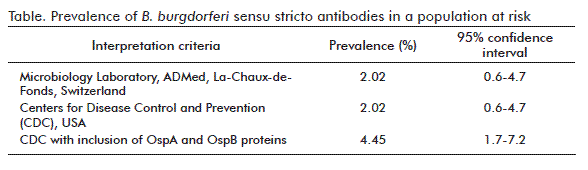
<body><![CDATA[<P   align="justify" ><font size="2" face="Verdana, Arial, Helvetica, sans-serif">During the period      1998-2002, 14 serum samples were studied, from an equal number of individuals      with clinical and epidemiological suspicion of Lyme disease from a community      of Sierra del Rosario, Artemisa. It was used Enzignost Borreliosis ELISA IgM/IgG      (Behring, Margurg, Germany) as screening method and Western blot IgM and IgG      as confirmatory test (University of Trieste, Italy). </font></P >       <P   align="justify" ><font size="2" face="Verdana, Arial, Helvetica, sans-serif">Five of the samples      had positive values of IgM antibodies and one, limit values of both IgM and      IgG antibodies by ELISA. Two of the six samples were positive to IgM by Western      blot, and one of them showed a low titer of IgM antibodies to leptospirosis,      which reaffirms the antigenic similarity between <I>Leptospira</I> spp. and      the causative agent of infection in this patient. </font></P >       <P   align="justify" ><font size="2" face="Verdana, Arial, Helvetica, sans-serif">One positive case      was retrospectively investigated; being a male patient aged 16 with no previous      history of travel outside the country, being suspected for Lyme disease from      the age of five due to clinical manifestations and tick bite history. </font></P >       <P   ><font size="2" face="Verdana, Arial, Helvetica, sans-serif"><I><b>Case-series      study 2 </b></I></font></P >       <P   align="justify" ><font size="2" face="Verdana, Arial, Helvetica, sans-serif">It was conducted      during 2003-2010 in collaboration with the Laboratory of Microbiology, ADMed,      La-Chaux-de-Fonds, Switzerland. We studied 27 serum, 11 cerebrospinal fluids,      one peripheral blood and one plasma samples from 30 individuals with clinical      and epidemiological suspicions of this borreliosis from different provinces      of Cuba. As serological screening tests were used the IgM/IgG ELISA VIDAS      (BioM&eacute;rieux, France), IgM-capture ELISA (IDEIA<Sup>TM</Sup> Borrelia      IgM; Dako Cytomation, USA) and IgM/IgG ELISA-C6 (C6 Lyme ELISA<Sup>TM</Sup>) (Immunetics,      USA). As confirmatory tests were used in-house IgM (<I>B. garinii</I> (NE83)      as antigen) and IgG (B<I>. burgdorferi</I> sensu stricto (B31) and <I>B. garinii</I>      (NE83) as antigens) Western blot procedures, and also the Western blot-IgG      (Bioline Diagnostic, Italy). The blood sample was studied by culture in BSK-H      and BSK modified medium and by PCR 5S-23S. </font></P >   <FONT size="+1"><FONT size="+1"><FONT size="+1"><FONT size="+1">        <P   align="justify" ><font size="2" face="Verdana, Arial, Helvetica, sans-serif">Specific IgM antibodies      were detected in 10% (3/30) of the individuals, confirming the presence of      infection in early stages, while in 6.6% (2/30) of individuals the detection      of specific IgG confirmed the presence of infection in disseminated or advanced      stage. The positive samples were subjected to serological tests for leptospirosis      and syphilis, being negative. </font></P >       <P   align="justify" ><font size="2" face="Verdana, Arial, Helvetica, sans-serif">These results corroborated      serological findings reported in the previous series, and confirmed the presence      of this infection in Cuba based on serological evidence. The lack of previous      history of travels abroad demonstrated the autochthonous nature of infection      cases. </font></P >       <P   ><font size="2" face="Verdana, Arial, Helvetica, sans-serif"><b>Prevalence of      antibodies to <I>B. burgdorferi</I> sensu stricto in individuals from a population      exposed to tick bites</b> </font></P >       <P   align="justify" ><font size="2" face="Verdana, Arial, Helvetica, sans-serif">This study was conducted      from January to May 2006 in a community of Sierra del Rosario. The population      at risk comprised 980 individuals, a representative sample of 247 of them      selected through simple random sampling. Serum was collected for each individual      and performed by Western blot-IgG analysis, (Ag: B31 strain of <I>B. burgdorferi</I>      sensu stricto). For the interpretation, we used three different criteria:      a) Criteria from the Microbiology Laboratory, ADMed of La-Chaux-de-Fonds,      Switzerland: scoring system in accordance to band&rsquo;s specificity, b)      Criteria of the Centers for Disease Control and Prevention (CDC, USA) [15]      and c) Criteria of the CDC with the inclusion of OspA (31 kDa) and OspB (34      kDa) proteins [16]. </font></P >       <P   align="justify" ><font size="2" face="Verdana, Arial, Helvetica, sans-serif">The <a href="/img/revistas/bta/v29n3/t0106312.gif">table</a>      below shows results on the prevalence of antibodies using different interpretation      criteria. There is an overlap among the confidence intervals, so it was estimated      a seroprevalence of 0.6-7.2% of specific antibodies against <I>B. burgdorferi</I>      sensu stricto as a result of getting together the three intervals. In this      study, there were no cross-reactivity with antibodies against <I>Leptospira</I>      sp. and <I>Treponema </I>sp., and there are no other reports of <I>Borrelia</I>      in the country. </font></P >       
]]></body>
<body><![CDATA[<P   align="justify" ><font size="2" face="Verdana, Arial, Helvetica, sans-serif">The bands corresponding      to 72, 60, 47 and 41 kDa proteins were revealed in more than 50% of the samples,      although of weak intensity. In the samples identified as positive it was observed      that 90/93, 72, 65/66, 60, 58, 56, 47 and 41 kDa proteins were significantly      revealed and they corresponded to both highly specific and non-specific <I>B.      burgdorferi</I> sensu lato proteins. Other revealed highly specific proteins      were the 30 and 22/24 (OspC) kDa proteins, but few sera reacted with them.      </font></P >       <P   align="justify" ><font size="2" face="Verdana, Arial, Helvetica, sans-serif">Specific serological      evidences of infection with <I>B. burgdorferi</I> sensu lato in samples of      individuals from different provinces (Artemisa, Havana, Sancti Sp&iacute;ritus      and Holgu&iacute;n) found in previous case-series studies and in this one      latter suggest the circulation of the bacteria in the western, central and      eastern regions of Cuba. </font></P >       <P   ><font size="2" face="Verdana, Arial, Helvetica, sans-serif"><b>Molecular detection      of <I>B. burgdorferi</I> sensu lato in ticks of medial and veterinary relevance      </b> </font></P >       <P   align="justify" ><font size="2" face="Verdana, Arial, Helvetica, sans-serif">There were two observational      studies, in which ticks were collected from different reservoirs (horses,      cattle, dogs and a house) in the provinces of Artemisa and Havana by purposive      sampling. The first was held in collaboration with the Laboratory of Ecoepidemiology      of Parasites, Institute of Biology, University of Neuch&acirc;tel, Switzerland.      </font></P >       <P   align="justify" ><font size="2" face="Verdana, Arial, Helvetica, sans-serif">Taxonomic identification      of ticks collected for the observational study 1 identified three species.      In horses, 60% (57/95) of ticks were identified as <I>Dermacentor (Anocentor)      nitens</I>, 37.9% (36/95) as <I>A. cajennense</I> and 2.1% (5/95) as <I>R.      microplus</I>. This last specie corresponded the 100% (3/3) of the ticks captured      in cattle. The observational study 2 showed that cattle were infected by <I>R.      microplus</I> and dogs by <I>R. sanguineus</I> (100% in both cases). Ticks      collected in the house were classified as <I>R. sanguineus</I>. Tick species      identified in these studies did not correspond to known vectors for Lyme disease.      </font></P >       <P   align="justify" ><font size="2" face="Verdana, Arial, Helvetica, sans-serif">Genetic material      of <I>B. burgdorferi</I> sensu lato was not detected in the extracts of any      of them, by PCR amplification and reverse-line hybridization (study 1) [17]      and PCR 5S-23S (study 2) [13]. </font></P >       <P   align="justify" ><font size="2" face="Verdana, Arial, Helvetica, sans-serif">Given that the number      of ticks tested in this study is limited and not representative of the country,      it is necessary to collect more ticks from pets, wild animals, migratory birds      and vegetation in the area of </font><font size="2" face="Verdana, Arial, Helvetica, sans-serif">Sierra      del Rosario and to extend the research to other regions. </font></P >       <P   align="justify" >&nbsp;</P >       <P   ><font size="2" face="Verdana, Arial, Helvetica, sans-serif"><b><font size="3">RELEVANCE      OF THE STUDY </font></b></font></P >   <FONT size="+1">        <P   align="justify" ><font size="2" face="Verdana, Arial, Helvetica, sans-serif">In this study, a      modified culture medium was suggested as an alternative for the growth of      <I>B. burgdorferi</I> sensu lato and a new internationally recognized methodology      for the extraction of nucleic acids in ticks. </font></P >   <FONT size="+1">        ]]></body>
<body><![CDATA[<P   align="justify" ><font size="2" face="Verdana, Arial, Helvetica, sans-serif">For the first time      in Cuba, the microbiological tools required for the microbiological (bacteriological,      serological and molecular) detection of infections with <I>B. burgdorferi</I>      sensu lato have been implemented for human clinical specimens and the possible      vectors, at the National Reference Laboratory of Microbiology of the IPK.      </font></P >       <P   align="justify" ><font size="2" face="Verdana, Arial, Helvetica, sans-serif">The first specific      serological evidences of infection with <I>B. burgdorferi</I> sensu lato in      individuals with clinical or epidemiological suspicion of Lyme disease in      Cuba have been also shown. This investigation also demonstrated that the infection      with <I>B. burgdorferi</I> sensu lato is not a local situation (western Cuba),      having a wider geographical distribution. </font></P >       <P   align="justify" ><font size="2" face="Verdana, Arial, Helvetica, sans-serif">The body of evidences      about <I>B. burgdorferi</I> sensu lato infection suggests its autochthonous      transmission in Cuba, which is an epidemiological alert for national authorities      of veterinary and public health. </font></P >       <P   align="justify" >&nbsp;</P >       <P   ><font size="2" face="Verdana, Arial, Helvetica, sans-serif"><b><font size="3">ACKNOWLEDGEMENTS</font></b></font></P >   <FONT size="+1">        <P   align="justify" ><font size="2" face="Verdana, Arial, Helvetica, sans-serif">Special thanks to      everyone who contributed to the completion of this work. To my collaborators:      Hans H Siegrist, Reto Lienhard and Cloe Scheurer, fron the Microbiology Laboratory,      ADMed of La-Chaux-de-Fonds, Switzerland; Lise Gern and Olivier Rais from the      Laboratory of Ecoepidemiology of Parasites, Institute of Biology, University      of Neuch&acirc;tel, Switzerland; Marina Cinco from the University of Trieste,      Italy; Rodobaldo Pedroso from the Medical Assistant Center of Sierra del Rosario,      Artemisa, Cuba; and Lizet S&aacute;nchez, Lilia M Ortega, Mar&iacute;a E Rodr&iacute;guez,      Rodobaldo Pedroso, Jos&eacute; E Rodr&iacute;guez, Brian A Mondeja, Jorge      Fraga, Milagro Mayet, Yanisia Duarte, Gilda Tora&ntilde;o, Yaindrys Rodr&iacute;guez,      Yanais Vald&eacute;s, Nadia M Rodr&iacute;guez and Armando Fern&aacute;ndez<Sup>&dagger;</Sup>      from the IPK. We also thank the Swiss Confederation by the financial supports      (fellowships) offered to the first author for the training and execution of      a part of the investigations comprised by this Award of the Cuban Academy      of Sciences 2011. </font></P >       <P   align="justify" >&nbsp;</P >   <FONT size="+1"><FONT size="+1"><FONT size="+1"><FONT size="+1">        <P   align="justify" > </P >   <FONT size="+1">        <P   align="justify" ><font size="3"><b><font face="Verdana, Arial, Helvetica, sans-serif">REFERENCES</font></b></font><font size="2" face="Verdana, Arial, Helvetica, sans-serif">      </font></P >       <!-- ref --><P   align="justify" ><font size="2" face="Verdana, Arial, Helvetica, sans-serif">1. Stanek G, Reiter      M. The expanding Lyme Borrelia complex--clinical significance of genomic species?      Clin Microbiol Infect. 2011;17(4):487-93.     </font></P >   <FONT size="+1">        <!-- ref --><P   align="justify" ><font size="2" face="Verdana, Arial, Helvetica, sans-serif">2. Gern L. Tiques      et borr&eacute;liose de Lyme en Suisse occidentale. Bull Soc Neuchateloise      Scie Nat. 2004;127(1):5-21.     </font></P >       <!-- ref --><P   align="justify" ><font size="2" face="Verdana, Arial, Helvetica, sans-serif">3. Steere AC. Lyme      disease. N Engl J Med. 2001;345(2):115-25.     </font></P >       <P   align="justify" ><font size="2" face="Verdana, Arial, Helvetica, sans-serif">4. Grand&iacute;o      O, Fern&aacute;ndez A, Fern&aacute;ndez M, Valera R, Fuentes O, Pelegrino      J. Informe preliminar sobre investigaciones realizadas en el poblado &ldquo;Las      Terrazas&rdquo;, Sierra del Rosario, sobre la existencia de la enfermedad      de Lyme. Rev Cubana Pediatr. 1988;60(5):773. </font></P >       <!-- ref --><P   align="justify" ><font size="2" face="Verdana, Arial, Helvetica, sans-serif">5. Dickinson F, Fuentes      O, Fern&aacute;ndez A. &iquest;Borreliosis de Lyme en Cuba? In: Comit&eacute;      Organizador, editores. Abstracts of the V Congreso Latinoamericano de Medicina      Tropical; 1997 Mar 3-7. La Habana: Instituto de Medicina Tropical Pedro Kour&iacute;.      p. 172-3.     </font></P >       <!-- ref --><P   align="justify" ><font size="2" face="Verdana, Arial, Helvetica, sans-serif">6. Barbour AG. Isolation      and cultivation of Lyme disease spirochetes. Yale J Biol Med. 1984;57(4):521-5.          </font></P >       ]]></body>
<body><![CDATA[<!-- ref --><P   align="justify" ><font size="2" face="Verdana, Arial, Helvetica, sans-serif">7. Ruzic-Sabljic      E, Strle F. Comparison of growth of Borrelia afzelii, B. garinii, and B. burgdorferi      sensu stricto in MKP and BSK-II medium. Int J Med Microbiol. 2004;294(6):407-12.          </font></P >       <!-- ref --><P   align="justify" ><font size="2" face="Verdana, Arial, Helvetica, sans-serif">8. Wen B, Jian R,      Zhang Y, Chen R. Simultaneous detection of Anaplasma marginale and a new Ehrlichia      species closely related to Ehrlichia chaffeensis by sequence analyses of 16S      ribosomal DNA in Boophilus microplus ticks from Tibet. J Clin Microbiol. 2002;40(9):3286-90.          </font></P >       <!-- ref --><P   align="justify" ><font size="2" face="Verdana, Arial, Helvetica, sans-serif">9. Halos L, Jamal      T, Vial L, Maillard R, Suau A, Le Menach A, et al. Determination of an efficient      and reliable method for DNA extraction from ticks. Vet Res. 2004;35(6):709-13.          </font></P >       <!-- ref --><P   align="justify" ><font size="2" face="Verdana, Arial, Helvetica, sans-serif">10. Fraga J, Rodr&iacute;guez      J, Fuentes O, Castex M, Fern&aacute;ndez-Calienes A. Comparaci&oacute;n entre      5 m&eacute;todos para la extracci&oacute;n de ADN de triatom&iacute;neos:      su utilizaci&oacute;n en la t&eacute;cnica de ADN polim&oacute;rfico amplificado      al azar. Rev Cubana Med Trop. 2004;56(3):208-13.     </font></P >       <!-- ref --><P   align="justify" ><font size="2" face="Verdana, Arial, Helvetica, sans-serif">11. Gaillard C, Strauss      F. Ethanol precipitation of DNA with linear polyacrylamide as carrier. Nucleic      Acids Res. 1990;18(2):378.     </font></P >       ]]></body>
<body><![CDATA[<!-- ref --><P   align="justify" ><font size="2" face="Verdana, Arial, Helvetica, sans-serif">12. Humair PF, Douet      V, Moran Cadenas F, Schouls LM, Van De Pol I, Gern L. Molecular identification      of bloodmeal source in Ixodes ricinus ticks using 12S rDNA as a genetic marker.      J Med Entomol. 2007;44(5):869-80.     </font></P >       <!-- ref --><P   align="justify" ><font size="2" face="Verdana, Arial, Helvetica, sans-serif">13. Postic D, Assous      MV, Grimont PA, Baranton G. Diversity of Borrelia burgdorferi sensu lato evidenced      by restriction fragment length polymorphism of rrf (5S)-rrl (23S) intergenic      spacer amplicons. Int J Syst Bacteriol. 1994;44(4):743-52.     </font></P >       <!-- ref --><P   align="justify" ><font size="2" face="Verdana, Arial, Helvetica, sans-serif">14. Marconi RT, Garon      CF. Development of polymerase chain reaction primer sets for diagnosis of      Lyme disease and for species-specific identification of Lyme disease isolates      by 16S rRNA signature nucleotide analysis. J Clin Microbiol. 1992;30(11):2830-4.          </font></P >       <P   align="justify" ><font size="2" face="Verdana, Arial, Helvetica, sans-serif">15. Recommendations      for test performance and interpretation from the Second National Conference      on Serologic Diagnosis of Lyme Disease. MMWR Morb Mortal Wkly Rep. 1995;44(31):590-1.      </font></P >       <!-- ref --><P   align="justify" ><font size="2" face="Verdana, Arial, Helvetica, sans-serif">16. Hilton E, Devoti      J, Sood S. Recommendation to include OspA and OspB in the new immunoblotting      criteria for serodiagnosis of Lyme disease. J Clin Microbiol. 1996;34(6):1353-4.          </font></P >       <!-- ref --><P   align="justify" ><font size="2" face="Verdana, Arial, Helvetica, sans-serif">17. Poupon MA, Lommano      E, Humair PF, Douet V, Rais O, Schaad M, et al. Prevalence of Borrelia burgdorferi      sensu lato in ticks collected from migratory birds in Switzerland. Appl Environ      Microbiol. 2006;72(1):976-9.     </font></P >       <P   align="justify" >&nbsp;</P >       <P   align="justify" >&nbsp;</P >       <P   align="justify" > </P >   <FONT size="+1">       <P   align="justify" ><i><font size="2" face="Verdana, Arial, Helvetica, sans-serif">Islay Rodr&iacute;guez</font></i><font size="2" face="Verdana, Arial, Helvetica, sans-serif">.      Instituto de Medicina Tropical Pedro Kour&iacute;, IPK. Autopista Novia del      Mediod&iacute;a, Km 6&frac12;, La Lisa, CP 11 400, La Habana, Cuba. E-mail:      <A href="mailto:islay@ipk.sld.cu"><U><U><FONT color="#0000FF">islay@ipk.sld.cu</font></U></U></A><FONT color="#0000FF"><FONT color="#000000">.      </font></font></font></P >   <FONT color="#0000FF"><FONT color="#000000">        <P   align="justify" > </P >   </font></font></font></font></font></font></font></font></font></font></font></font></font></font></font></font></font></font></font></font></font></font></font></font></font></font></font></font></font></font></font></font></font></font></font></font></font></font></font></font></font></font></font></font></DIV >      ]]></body><back>
<ref-list>
<ref id="B1">
<label>1</label><nlm-citation citation-type="journal">
<person-group person-group-type="author">
<name>
<surname><![CDATA[Stanek]]></surname>
<given-names><![CDATA[G]]></given-names>
</name>
<name>
<surname><![CDATA[Reiter]]></surname>
<given-names><![CDATA[M]]></given-names>
</name>
</person-group>
<article-title xml:lang="en"><![CDATA[The expanding Lyme Borrelia complex: clinical significance of genomic species?]]></article-title>
<source><![CDATA[Clin Microbiol Infect]]></source>
<year>2011</year>
<volume>17</volume>
<numero>4</numero>
<issue>4</issue>
<page-range>487-93</page-range></nlm-citation>
</ref>
<ref id="B2">
<label>2</label><nlm-citation citation-type="journal">
<person-group person-group-type="author">
<name>
<surname><![CDATA[Gern]]></surname>
<given-names><![CDATA[L]]></given-names>
</name>
</person-group>
<article-title xml:lang="fr"><![CDATA[Tiques et borréliose de Lyme en Suisse occidentale]]></article-title>
<source><![CDATA[Bull Soc Neuchateloise Scie Nat]]></source>
<year>2004</year>
<volume>127</volume>
<numero>1</numero>
<issue>1</issue>
<page-range>5-21</page-range></nlm-citation>
</ref>
<ref id="B3">
<label>3</label><nlm-citation citation-type="journal">
<person-group person-group-type="author">
<name>
<surname><![CDATA[Steere]]></surname>
<given-names><![CDATA[AC]]></given-names>
</name>
</person-group>
<article-title xml:lang="en"><![CDATA[Lyme disease]]></article-title>
<source><![CDATA[N Engl J Med]]></source>
<year>2001</year>
<volume>345</volume>
<numero>2</numero>
<issue>2</issue>
<page-range>115-25</page-range></nlm-citation>
</ref>
<ref id="B4">
<label>4</label><nlm-citation citation-type="journal">
<person-group person-group-type="author">
<name>
<surname><![CDATA[Grandío]]></surname>
<given-names><![CDATA[O]]></given-names>
</name>
<name>
<surname><![CDATA[Fernández]]></surname>
<given-names><![CDATA[A]]></given-names>
</name>
<name>
<surname><![CDATA[Fernández]]></surname>
<given-names><![CDATA[M]]></given-names>
</name>
<name>
<surname><![CDATA[Valera]]></surname>
<given-names><![CDATA[R]]></given-names>
</name>
<name>
<surname><![CDATA[Fuentes]]></surname>
<given-names><![CDATA[O]]></given-names>
</name>
<name>
<surname><![CDATA[Pelegrino]]></surname>
<given-names><![CDATA[J]]></given-names>
</name>
</person-group>
<article-title xml:lang="es"><![CDATA[Informe preliminar sobre investigaciones realizadas en el poblado "Las Terrazas", Sierra del Rosario, sobre la existencia de la enfermedad de Lyme]]></article-title>
<source><![CDATA[Rev Cubana Pediatr]]></source>
<year>1988</year>
<volume>60</volume>
<numero>5</numero>
<issue>5</issue>
<page-range>773</page-range></nlm-citation>
</ref>
<ref id="B5">
<label>5</label><nlm-citation citation-type="confpro">
<person-group person-group-type="author">
<name>
<surname><![CDATA[Dickinson]]></surname>
<given-names><![CDATA[F]]></given-names>
</name>
<name>
<surname><![CDATA[Fuentes]]></surname>
<given-names><![CDATA[O]]></given-names>
</name>
<name>
<surname><![CDATA[Fernández]]></surname>
<given-names><![CDATA[A]]></given-names>
</name>
</person-group>
<article-title xml:lang="en"><![CDATA[¿Borreliosis de Lyme en Cuba?]]></article-title>
<collab>Comité Organizador</collab>
<source><![CDATA[]]></source>
<year>1997</year>
<month> M</month>
<day>ar</day>
<conf-name><![CDATA[ Abstracts of the V Congreso Latinoamericano de Medicina Tropical]]></conf-name>
<conf-loc> </conf-loc>
<page-range>172-3</page-range><publisher-loc><![CDATA[La Habana ]]></publisher-loc>
<publisher-name><![CDATA[Instituto de Medicina Tropical Pedro Kourí]]></publisher-name>
</nlm-citation>
</ref>
<ref id="B6">
<label>6</label><nlm-citation citation-type="journal">
<person-group person-group-type="author">
<name>
<surname><![CDATA[Barbour]]></surname>
<given-names><![CDATA[AG]]></given-names>
</name>
</person-group>
<article-title xml:lang="en"><![CDATA[Isolation and cultivation of Lyme disease spirochetes]]></article-title>
<source><![CDATA[Yale J Biol Med]]></source>
<year>1984</year>
<volume>57</volume>
<numero>4</numero>
<issue>4</issue>
<page-range>521-5</page-range></nlm-citation>
</ref>
<ref id="B7">
<label>7</label><nlm-citation citation-type="journal">
<person-group person-group-type="author">
<name>
<surname><![CDATA[Ruzic-Sabljic]]></surname>
<given-names><![CDATA[E]]></given-names>
</name>
<name>
<surname><![CDATA[Strle]]></surname>
<given-names><![CDATA[F]]></given-names>
</name>
</person-group>
<article-title xml:lang="en"><![CDATA[Comparison of growth of Borrelia afzelii, B. garinii, and B. burgdorferi sensu stricto in MKP and BSK-II medium]]></article-title>
<source><![CDATA[Int J Med Microbiol]]></source>
<year>2004</year>
<volume>294</volume>
<numero>6</numero>
<issue>6</issue>
<page-range>407-12</page-range></nlm-citation>
</ref>
<ref id="B8">
<label>8</label><nlm-citation citation-type="journal">
<person-group person-group-type="author">
<name>
<surname><![CDATA[Wen]]></surname>
<given-names><![CDATA[B]]></given-names>
</name>
<name>
<surname><![CDATA[Jian]]></surname>
<given-names><![CDATA[R]]></given-names>
</name>
<name>
<surname><![CDATA[Zhang]]></surname>
<given-names><![CDATA[Y]]></given-names>
</name>
<name>
<surname><![CDATA[Chen]]></surname>
<given-names><![CDATA[R]]></given-names>
</name>
</person-group>
<article-title xml:lang="en"><![CDATA[Simultaneous detection of Anaplasma marginale and a new Ehrlichia species closely related to Ehrlichia chaffeensis by sequence analyses of 16S ribosomal DNA in Boophilus microplus ticks from Tibet]]></article-title>
<source><![CDATA[J Clin Microbiol]]></source>
<year>2002</year>
<volume>40</volume>
<numero>9</numero>
<issue>9</issue>
<page-range>3286-90</page-range></nlm-citation>
</ref>
<ref id="B9">
<label>9</label><nlm-citation citation-type="journal">
<person-group person-group-type="author">
<name>
<surname><![CDATA[Halos]]></surname>
<given-names><![CDATA[L]]></given-names>
</name>
<name>
<surname><![CDATA[Jamal]]></surname>
<given-names><![CDATA[T]]></given-names>
</name>
<name>
<surname><![CDATA[Vial]]></surname>
<given-names><![CDATA[L]]></given-names>
</name>
<name>
<surname><![CDATA[Maillard]]></surname>
<given-names><![CDATA[R]]></given-names>
</name>
<name>
<surname><![CDATA[Suau]]></surname>
<given-names><![CDATA[A]]></given-names>
</name>
<name>
<surname><![CDATA[Le Menach]]></surname>
<given-names><![CDATA[A]]></given-names>
</name>
</person-group>
<article-title xml:lang="en"><![CDATA[Determination of an efficient and reliable method for DNA extraction from ticks]]></article-title>
<source><![CDATA[Vet Res]]></source>
<year>2004</year>
<volume>35</volume>
<numero>6</numero>
<issue>6</issue>
<page-range>709-13</page-range></nlm-citation>
</ref>
<ref id="B10">
<label>10</label><nlm-citation citation-type="journal">
<person-group person-group-type="author">
<name>
<surname><![CDATA[Fraga]]></surname>
<given-names><![CDATA[J]]></given-names>
</name>
<name>
<surname><![CDATA[Rodríguez]]></surname>
<given-names><![CDATA[J]]></given-names>
</name>
<name>
<surname><![CDATA[Fuentes]]></surname>
<given-names><![CDATA[O]]></given-names>
</name>
<name>
<surname><![CDATA[Castex]]></surname>
<given-names><![CDATA[M]]></given-names>
</name>
<name>
<surname><![CDATA[Fernández-Calienes]]></surname>
<given-names><![CDATA[A]]></given-names>
</name>
</person-group>
<article-title xml:lang="es"><![CDATA[Comparación entre 5 métodos para la extracción de ADN de triatomíneos: su utilización en la técnica de ADN polimórfico amplificado al azar]]></article-title>
<source><![CDATA[Rev Cubana Med Trop]]></source>
<year>2004</year>
<volume>56</volume>
<numero>3</numero>
<issue>3</issue>
<page-range>208-13</page-range></nlm-citation>
</ref>
<ref id="B11">
<label>11</label><nlm-citation citation-type="journal">
<person-group person-group-type="author">
<name>
<surname><![CDATA[Gaillard]]></surname>
<given-names><![CDATA[C]]></given-names>
</name>
<name>
<surname><![CDATA[Strauss]]></surname>
<given-names><![CDATA[F]]></given-names>
</name>
</person-group>
<article-title xml:lang="en"><![CDATA[Ethanol precipitation of DNA with linear polyacrylamide as carrier]]></article-title>
<source><![CDATA[Nucleic Acids Res]]></source>
<year>1990</year>
<volume>18</volume>
<numero>2</numero>
<issue>2</issue>
<page-range>378</page-range></nlm-citation>
</ref>
<ref id="B12">
<label>12</label><nlm-citation citation-type="journal">
<person-group person-group-type="author">
<name>
<surname><![CDATA[Humair]]></surname>
<given-names><![CDATA[PF]]></given-names>
</name>
<name>
<surname><![CDATA[Douet]]></surname>
<given-names><![CDATA[V]]></given-names>
</name>
<name>
<surname><![CDATA[Moran Cadenas]]></surname>
<given-names><![CDATA[F]]></given-names>
</name>
<name>
<surname><![CDATA[Schouls]]></surname>
<given-names><![CDATA[LM]]></given-names>
</name>
<name>
<surname><![CDATA[Van De Pol]]></surname>
<given-names><![CDATA[I]]></given-names>
</name>
<name>
<surname><![CDATA[Gern]]></surname>
<given-names><![CDATA[L]]></given-names>
</name>
</person-group>
<article-title xml:lang="en"><![CDATA[Molecular identification of bloodmeal source in Ixodes ricinus ticks using 12S rDNA as a genetic marker]]></article-title>
<source><![CDATA[J Med Entomol]]></source>
<year>2007</year>
<volume>44</volume>
<numero>5</numero>
<issue>5</issue>
<page-range>869-80</page-range></nlm-citation>
</ref>
<ref id="B13">
<label>13</label><nlm-citation citation-type="journal">
<person-group person-group-type="author">
<name>
<surname><![CDATA[Postic]]></surname>
<given-names><![CDATA[D]]></given-names>
</name>
<name>
<surname><![CDATA[Assous]]></surname>
<given-names><![CDATA[MV]]></given-names>
</name>
<name>
<surname><![CDATA[Grimont]]></surname>
<given-names><![CDATA[PA]]></given-names>
</name>
<name>
<surname><![CDATA[Baranton]]></surname>
<given-names><![CDATA[G]]></given-names>
</name>
</person-group>
<article-title xml:lang="en"><![CDATA[Diversity of Borrelia burgdorferi sensu lato evidenced by restriction fragment length polymorphism of rrf (5S)-rrl (23S) intergenic spacer amplicons]]></article-title>
<source><![CDATA[Int J Syst Bacteriol]]></source>
<year>1994</year>
<volume>44</volume>
<numero>4</numero>
<issue>4</issue>
<page-range>743-52</page-range></nlm-citation>
</ref>
<ref id="B14">
<label>14</label><nlm-citation citation-type="journal">
<person-group person-group-type="author">
<name>
<surname><![CDATA[Marconi]]></surname>
<given-names><![CDATA[RT]]></given-names>
</name>
<name>
<surname><![CDATA[Garon]]></surname>
<given-names><![CDATA[CF]]></given-names>
</name>
</person-group>
<article-title xml:lang="en"><![CDATA[Development of polymerase chain reaction primer sets for diagnosis of Lyme disease and for species-specific identification of Lyme disease isolates by 16S rRNA signature nucleotide analysis]]></article-title>
<source><![CDATA[J Clin Microbiol]]></source>
<year>1992</year>
<volume>30</volume>
<numero>11</numero>
<issue>11</issue>
<page-range>2830-4</page-range></nlm-citation>
</ref>
<ref id="B15">
<label>15</label><nlm-citation citation-type="journal">
<article-title xml:lang="en"><![CDATA[Recommendations for test performance and interpretation from the Second National Conference on Serologic Diagnosis of Lyme Disease]]></article-title>
<source><![CDATA[ecommendations for test performance and interpretation from the Second National Conference on Serologic Diagnosis of Lyme Disease MMWR Morb Mortal Wkly Rep]]></source>
<year>1995</year>
<volume>44</volume>
<numero>31</numero>
<issue>31</issue>
<page-range>590-1</page-range></nlm-citation>
</ref>
<ref id="B16">
<label>16</label><nlm-citation citation-type="journal">
<person-group person-group-type="author">
<name>
<surname><![CDATA[Hilton]]></surname>
<given-names><![CDATA[E]]></given-names>
</name>
<name>
<surname><![CDATA[Devoti]]></surname>
<given-names><![CDATA[J]]></given-names>
</name>
<name>
<surname><![CDATA[Sood]]></surname>
<given-names><![CDATA[S]]></given-names>
</name>
</person-group>
<article-title xml:lang="en"><![CDATA[Recommendation to include OspA and OspB in the new immunoblotting criteria for serodiagnosis of Lyme disease]]></article-title>
<source><![CDATA[J Clin Microbiol]]></source>
<year>1996</year>
<volume>34</volume>
<numero>6</numero>
<issue>6</issue>
<page-range>1353-4</page-range></nlm-citation>
</ref>
<ref id="B17">
<label>17</label><nlm-citation citation-type="journal">
<person-group person-group-type="author">
<name>
<surname><![CDATA[Poupon]]></surname>
<given-names><![CDATA[MA]]></given-names>
</name>
<name>
<surname><![CDATA[Lommano]]></surname>
<given-names><![CDATA[E]]></given-names>
</name>
<name>
<surname><![CDATA[Humair]]></surname>
<given-names><![CDATA[PF]]></given-names>
</name>
<name>
<surname><![CDATA[Douet]]></surname>
<given-names><![CDATA[V]]></given-names>
</name>
<name>
<surname><![CDATA[Rais]]></surname>
<given-names><![CDATA[O]]></given-names>
</name>
<name>
<surname><![CDATA[Schaad]]></surname>
<given-names><![CDATA[M]]></given-names>
</name>
</person-group>
<article-title xml:lang="en"><![CDATA[Prevalence of Borrelia burgdorferi sensu lato in ticks collected from migratory birds in Switzerland]]></article-title>
<source><![CDATA[Appl Environ Microbiol]]></source>
<year>2006</year>
<volume>72</volume>
<numero>1</numero>
<issue>1</issue>
<page-range>976-9</page-range></nlm-citation>
</ref>
</ref-list>
</back>
</article>