<?xml version="1.0" encoding="ISO-8859-1"?><article xmlns:mml="http://www.w3.org/1998/Math/MathML" xmlns:xlink="http://www.w3.org/1999/xlink" xmlns:xsi="http://www.w3.org/2001/XMLSchema-instance">
<front>
<journal-meta>
<journal-id>1027-2852</journal-id>
<journal-title><![CDATA[Biotecnología Aplicada]]></journal-title>
<abbrev-journal-title><![CDATA[Biotecnol Apl]]></abbrev-journal-title>
<issn>1027-2852</issn>
<publisher>
<publisher-name><![CDATA[Editorial Elfos Scientiae]]></publisher-name>
</publisher>
</journal-meta>
<article-meta>
<article-id>S1027-28522012000400004</article-id>
<title-group>
<article-title xml:lang="en"><![CDATA[Mathematical model for the application of Metabolic Flux Analysis to CHO cells producing recombinant human erythropoietin]]></article-title>
<article-title xml:lang="es"><![CDATA[Modelo matemático del metabolismo de las células CHO en la síntesis de eritropoyetina humana para aplicar la técnica de análisis de flujos metabólicos]]></article-title>
</title-group>
<contrib-group>
<contrib contrib-type="author">
<name>
<surname><![CDATA[Fernández]]></surname>
<given-names><![CDATA[Osmán]]></given-names>
</name>
<xref ref-type="aff" rid="A01"/>
</contrib>
<contrib contrib-type="author">
<name>
<surname><![CDATA[Dustet]]></surname>
<given-names><![CDATA[Julio C]]></given-names>
</name>
<xref ref-type="aff" rid="A02"/>
</contrib>
<contrib contrib-type="author">
<name>
<surname><![CDATA[Chico]]></surname>
<given-names><![CDATA[Ernesto]]></given-names>
</name>
<xref ref-type="aff" rid="A01"/>
</contrib>
</contrib-group>
<aff id="A02">
<institution><![CDATA[,Instituto Superior Politécnico José Antonio Echeverría Facultad de Ingeniería Química Grupo de Biotecnología Aplicada]]></institution>
<addr-line><![CDATA[La Habana ]]></addr-line>
<country>Cuba</country>
</aff>
<aff id="A01">
<institution><![CDATA[,Centro de Inmunología Molecular Desarrollo de Plataformas Tecnológicas ]]></institution>
<addr-line><![CDATA[La Habana ]]></addr-line>
<country>Cuba</country>
</aff>
<pub-date pub-type="pub">
<day>00</day>
<month>12</month>
<year>2012</year>
</pub-date>
<pub-date pub-type="epub">
<day>00</day>
<month>12</month>
<year>2012</year>
</pub-date>
<volume>29</volume>
<numero>4</numero>
<fpage>246</fpage>
<lpage>252</lpage>
<copyright-statement/>
<copyright-year/>
<self-uri xlink:href="http://scielo.sld.cu/scielo.php?script=sci_arttext&amp;pid=S1027-28522012000400004&amp;lng=en&amp;nrm=iso"></self-uri><self-uri xlink:href="http://scielo.sld.cu/scielo.php?script=sci_abstract&amp;pid=S1027-28522012000400004&amp;lng=en&amp;nrm=iso"></self-uri><self-uri xlink:href="http://scielo.sld.cu/scielo.php?script=sci_pdf&amp;pid=S1027-28522012000400004&amp;lng=en&amp;nrm=iso"></self-uri><abstract abstract-type="short" xml:lang="en"><p><![CDATA[Mathematical modeling of metabolism meets several important applications in the context of bioprocess engineering, such as the interpretation of cell physiology. Metabolic Flux Analysis, one of the tools of this discipline, was used in the present work to characterize the biosynthesis of recombinant human erythropoietin in CHO cells. In order to apply this method, we built a matrix of stoichiometric numbers representing the major metabolic pathways for the generation of energy and the synthesis of essential precursors for product and biomass accumulation. Equations representing the biosynthesis of recombinant human erythropoietin and the growth of CHO were also derived, conferring an advantage to the proposed model over other existing designs. The dimensions of the obtained matrix were 47 Ã&#151; 44, with a rank of 44 and a condition number of 83; therefore, the model has a unique solution and is not sensitive. The metabolic flux map obtained by solving the mathematical model using experimental data showed results consistent with the known biochemistry of CHO cells and with the findings of other reports on this and other mammalian cell lines. The general steps of the methodology used to obtain the proposed mathematical model are also outlined.]]></p></abstract>
<abstract abstract-type="short" xml:lang="es"><p><![CDATA[Mathematical modeling of metabolism meets several important applications in the context of bioprocess engineering, such as the interpretation of cell physiology. Metabolic Flux Analysis, one of the tools of this discipline, was used in the present work to characterize the biosynthesis of recombinant human erythropoietin in CHO cells. In order to apply this method, we built a matrix of stoichiometric numbers representing the major metabolic pathways for the generation of energy and the synthesis of essential precursors for product and biomass accumulation. Equations representing the biosynthesis of recombinant human erythropoietin and the growth of CHO were also derived, conferring an advantage to the proposed model over other existing designs. The dimensions of the obtained matrix were 47 x 44, with a rank of 44 and a condition number of 83; therefore, the model has a unique solution and is not sensitive. The metabolic flux map obtained by solving the mathematical model using experimental data showed results consistent with the known biochemistry of CHO cells and with the findings of other reports on this and other mammalian cell lines. The general steps of the methodology used to obtain the proposed mathematical model are also outlined.]]></p></abstract>
<kwd-group>
<kwd lng="en"><![CDATA[metabolic flux analysis]]></kwd>
<kwd lng="en"><![CDATA[metabolism]]></kwd>
<kwd lng="en"><![CDATA[mathematical model]]></kwd>
<kwd lng="en"><![CDATA[CHO]]></kwd>
<kwd lng="en"><![CDATA[EPO]]></kwd>
<kwd lng="es"><![CDATA[análisis de flujos metabólicos]]></kwd>
<kwd lng="es"><![CDATA[metabolismo]]></kwd>
<kwd lng="es"><![CDATA[modelo matemático]]></kwd>
<kwd lng="es"><![CDATA[CHO]]></kwd>
<kwd lng="es"><![CDATA[EPO]]></kwd>
</kwd-group>
</article-meta>
</front><body><![CDATA[ <DIV class="Sect"   >        <P   align="right" ><font size="2" face="Verdana, Arial, Helvetica, sans-serif"><b>RESEARCH</b></font></P >       <P   align="right" >&nbsp;</P >       <P   align="justify" ><font size="2" color="#000000" face="Verdana, Arial, Helvetica, sans-serif"><B><font size="+1" color="#000000"><b><font size="4" face="Verdana, Arial, Helvetica, sans-serif">Mathematical      model for the application of Metabolic Flux Analysis to CHO cells producing      recombinant human erythropoietin </font></b></font></b></font></P >       <P   align="justify" >&nbsp;</P >       <P   align="justify" ><font size="2" color="#000000" face="Verdana, Arial, Helvetica, sans-serif"><B><font size="3">Modelo      matem&aacute;tico del metabolismo de las c&eacute;lulas CHO en la s&iacute;ntesis      de eritropoyetina humana para aplicar la t&eacute;cnica de an&aacute;lisis      de flujos metab&oacute;licos </font></b></font></P >   <FONT size="+1" color="#000000"><B>        <P   align="justify" > </P >   </B>        <P   align="justify" >&nbsp;</P >       <P   align="justify" >&nbsp;</P >       <P   align="justify" ><b><font size="2" face="Verdana, Arial, Helvetica, sans-serif">Osm&aacute;n Fern&aacute;ndez<Sup>1,      2</Sup>, Julio C Dustet <Sup>2</Sup>, Ernesto Chico<Sup>1</Sup></font></b></P >   <FONT size="+1"><FONT size="+1"><FONT size="+1"><FONT size="+1"><FONT size="+1"><FONT size="+1">        ]]></body>
<body><![CDATA[<P   align="justify" ><font size="2" face="Verdana, Arial, Helvetica, sans-serif"><A href="mailto:osman@cim.sld.cu">      <U><U></U></U></A><FONT color="#0000FF"> <FONT color="#000000"> <Sup>1</Sup>      Desarrollo de Plataformas Tecnol&oacute;gicas, Centro de Inmunolog&iacute;a      Molecular. Calle 216, esq. 15, Atabey, Playa, CP 16 040, La Habana 11 600,      La Habana, Cuba.    <br>     </font></font></font><font size="2" face="Verdana, Arial, Helvetica, sans-serif"><Sup>2</Sup>      Grupo de Biotecnolog&iacute;a Aplicada, Facultad de Ingenier&iacute;a Qu&iacute;mica,      Instituto Superior Polit&eacute;cnico Jos&eacute; Antonio Echeverr&iacute;a.      Calle 114, No. 11901 e/ 119 y 127, Marianao, La Habana, Cuba. </font></P >       <P   align="justify" >&nbsp;</P >       <P   align="justify" >&nbsp;</P >   <FONT color="#0000FF"><FONT color="#000000"><FONT size="+1"><FONT size="+1"><FONT size="+1"><FONT size="+1">        <P   align="justify" ></P >   </font></font></font></font></font></font></font></font></font></font></font></font></font>   <hr>   <FONT size="+1" color="#000000"><FONT size="+1"><FONT size="+1"><FONT size="+1"><FONT size="+1"><FONT size="+1"><FONT size="+1"><FONT color="#0000FF"><FONT color="#000000"><FONT size="+1"><FONT size="+1"><FONT size="+1"><FONT size="+1">        <P   ><b><font face="Verdana, Arial, Helvetica, sans-serif" size="2">ABSTRACT</font></b></P >       <P   ><font size="2" face="Verdana, Arial, Helvetica, sans-serif">Mathematical modeling      of metabolism meets several important applications in the context of bioprocess      engineering, such as the interpretation of cell physiology. Metabolic Flux      Analysis, one of the tools of this discipline, was used in the present work      to characterize the biosynthesis of recombinant human erythropoietin in CHO      cells. In order to apply this method, we built a matrix of stoichiometric      numbers representing the major metabolic pathways for the generation of energy      and the synthesis of essential precursors for product and biomass accumulation.      Equations representing the biosynthesis of recombinant human erythropoietin      and the growth of CHO were also derived, conferring an advantage to the proposed      model over other existing designs. The dimensions of the obtained matrix were      47 &times; 44, with a rank of 44 and a condition number of 83; therefore,      the model has a unique solution and is not sensitive. The metabolic flux map      obtained by solving the mathematical model using experimental data showed      results consistent with the known biochemistry of CHO cells and with the findings      of other reports on this and other mammalian cell lines. The general steps      of the methodology used to obtain the proposed mathematical model are also      outlined. </font></P >   </font><font size="+1" color="#000000"><font size="+1"><font size="+1"><font size="+1"><font size="+1"><font size="+1"><font size="+1"><font color="#0000FF"><font color="#000000"><font size="+1"><font size="+1"><font size="+1"><font size="+1"><font size="2" face="Verdana, Arial, Helvetica, sans-serif"><b>Keywords:</b>    metabolic flux analysis, metabolism, mathematical model, CHO, EPO<i>.</i></font></font></font></font></font></font></font></font></font></font></font></font></font></font><FONT size="+1">    </font></font></font></font></font></font></font></font></font></font></font></font></font>   <hr>   <FONT size="+1" color="#000000"><FONT size="+1"><FONT size="+1"><FONT size="+1"><FONT size="+1"><FONT size="+1"><FONT size="+1"><FONT color="#0000FF"><FONT color="#000000"><FONT size="+1"><FONT size="+1"><FONT size="+1"><FONT size="+1">        <P   ><font face="Verdana, Arial, Helvetica, sans-serif" size="2"><b>RESUMEN</b></font></P >   <B></B>        <P   ><font size="2" face="Verdana, Arial, Helvetica, sans-serif">La modelaci&oacute;n      matem&aacute;tica del metabolismo tiene importantes aplicaciones relacionadas      con la ingenier&iacute;a de bioprocesos; entre ellas, la interpretaci&oacute;n      de estados fisiol&oacute;gicos de la c&eacute;lula. El an&aacute;lisis de      flujos metab&oacute;licos es una herramienta &uacute;til en la modelaci&oacute;n      matem&aacute;tica del metabolismo. Para aplicar esta t&eacute;cnica a la s&iacute;ntesis      de eritropoyetina humana recombinante en c&eacute;lulas CHO, se construy&oacute;      la matriz con los n&uacute;meros estequiom&eacute;tricos de las reacciones      de las principales rutas que generan energ&iacute;a y forman los precursores      fundamentales para la s&iacute;ntesis del producto y de la biomasa. Se incluyeron      tambi&eacute;n las ecuaciones que representan las bios&iacute;ntesis de la      eritropoyetina humana recombinante y el crecimiento de las c&eacute;lulas      CHO, lo cual ofrece ventajas al modelo con respecto a otros. La matriz obtenida      tiene una dimensi&oacute;n de 47 &times; 44, con un rango igual a 44 y un      n&uacute;mero de condici&oacute;n de 83, por lo que el modelo tiene soluci&oacute;n      &uacute;nica y es poco sensible. El mapa de flujos metab&oacute;licos a partir      de la soluci&oacute;n del modelo usando datos experimentales, muestra resultados      consistentes desde el punto de vista bioqu&iacute;mico, que coinciden con      resultados de otros investigadores, en c&eacute;lulas CHO y otras de mam&iacute;feros.      Con la propuesta de este modelo matem&aacute;tico se ofrecen elementos generales      de la metodolog&iacute;a para su construcci&oacute;n. </font></P >   </font></font></font></font></font></font></font></font></font></font></font></font></font>     <p   align="justify" ></p >       ]]></body>
<body><![CDATA[<p   align="justify" > </p >       <p   ><font size="2" face="Verdana, Arial, Helvetica, sans-serif" color="#000000"><b>Palabras      clave:</b> an&aacute;lisis de flujos metab&oacute;licos, metabolismo, modelo      matem&aacute;tico, CHO, EPO.</font></p >   <hr>       <p   >&nbsp;</p >       <p   >&nbsp;</p >   <FONT size="+1" color="#000000"><FONT size="+1"><FONT size="+1"><FONT size="+1"><FONT size="+1"><FONT size="+1"><FONT size="+1"><FONT color="#0000FF"><FONT color="#000000"><FONT size="+1"><FONT size="+1"><FONT size="+1"><FONT size="+1">        <P   ><b><font face="Verdana, Arial, Helvetica, sans-serif" size="3">INTRODUCTION</font></b></P >       <P   ><font size="2" face="Verdana, Arial, Helvetica, sans-serif">Mammalian cell lines      have been extensively used for the production of complex therapeutic proteins      and monoclonal antibodies due to their ability to properly glycosylate recombinant      proteins of human or mammalian origin. Choosing the right host, however, is      only part of a complex process to optimize the yield and quality of recombinant      proteins; a process where understanding how protein synthesis relates to cell      growth, housekeeping and, ultimately, metabolism, plays a fundamental role      [1]. Mathematical modeling of metabolic processes, a fundamental tool of metabolic      engineering, can be applied for this purpose, as it is a uniquely powerful      methodology for interpreting the physiological status of the cell, formulating      culture media and designing operational strategies. </font></P >       <P   ><font size="2" face="Verdana, Arial, Helvetica, sans-serif">Most metabolic mathematical      modeling is performed with stoichiometric models, using Flux Balance Analysis      (FBA) and Metabolic Flux Analysis (MFA) as main analytical techniques. FBA      is often applied with an optimization criterion in order to reduce the solution      space of the model until a unique solution is found [2], while MFA yields      a metabolic flux map diagrammatically depicting biochemical reactions together      with their metabolic fluxes. The main advantage of the latter resides, therefore,      on its applicability to determining metabolic fluxes <I>in vivo, </I>especially      whenever maximizing the conversion of substrates into useful product is the      ultimate objective [3]. MFA has been increasingly used to provide a quantitative      characterization of mammalian cell lines [4-8], obtaining the map of metabolic      network fluxes through the method of metabolite balancing combined with experimental      data on specific production or metabolite utilization rates. The equation      system is solved using techniques from linear algebra or running carbon 13-labeling      experiments. The cost of the latter and their dependence on experimental scale      have turned metabolite balancing into the preferred, most adequate routine      method for process development and metabolic profiling [9], with an accuracy      and exactitude matching those of carbon-13-based methods in a variety of experimental      systems, such as hybridomas [10], <I>Aspergillus oryzae</I> [11]<B> </B>and,      more recently, Chinese hamster ovary (CHO) cells in perfusion culture [9].      </font></P >       <P   ><font size="2" face="Verdana, Arial, Helvetica, sans-serif">Separate mathematical      models developed to analyze the metabolism of the same cell line may vary      in their specificity, depending on the information each one provides based      on the number of balanced metabolites, observed number of network nodes and      even research objectives. There are models for applying the MFA technique      in CHO cells that offer considerable flexibility regarding the redistribution      of internal metabolic fluxes. These models can be used, for instance, to examine      metabolic changes in the cell in response to variations of starting glucose      concentration in continuous cultures [4] or to validate the metabolite balancing      method. They are generally regarded as useful tools for studying cell metabolism      without recurring to costly or time-consuming methodologies such as carbon-13      labeling [9] or comparing model predictions with experimental data [12]. Although      the results obtained by finding solutions to these models have so far been      consistent with current knowledge on the biochemistry of this line, none of      the existing models have been devised for CHO cells producing human recombinant      erythropoietin, a highly glycosylated protein. </font></P >       <P   ><font size="2" face="Verdana, Arial, Helvetica, sans-serif">The objective of      the present work, therefore, was to implement a mathematical model to apply      the MFA technique in CHO cells producing rh-EPO, including into the model      an equation for the synthesis of the target product that is based on an analysis      of its chemical composition and can be used with models for other cell lines      synthesizing the rh-EPO protein. </font></P >       <P   >&nbsp;</P >       ]]></body>
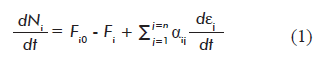
<body><![CDATA[<P   ><font size="2"><b><font face="Verdana, Arial, Helvetica, sans-serif" size="3">MATERIALS      AND METHODS</font></b></font></P >   <B>        <P   ><font size="2" face="Verdana, Arial, Helvetica, sans-serif">Metabolic flux analysis      and method for solving the mathematical model </font></P >   </B>        <P   ><font size="2" face="Verdana, Arial, Helvetica, sans-serif">The general expression      of the law of conservation of mass was used to derive a mass balance equation      for each balanced metabolite in a network. We propose the following mathematical      formula: </font></P >       <P align="center"   ><img src="/img/revistas/bta/v29n4/fr0104412.gif" width="359" height="75"></P >       
<P   ></P >       <P   ></P >       <P   ></P >       <P   align="justify" ><font size="2" face="Verdana, Arial, Helvetica, sans-serif">Where: </font></P >       <P   align="justify" ><font size="2" face="Verdana, Arial, Helvetica, sans-serif">dN<Sub>i</Sub>/dt      is the variation of the amount of metabolite <I>i </I>with time <I>t</I>;      </font></P >   <FONT size="+1"><FONT size="+1">        <P   align="justify" ><font size="2" face="Verdana, Arial, Helvetica, sans-serif">F<Sub><I>io</I></Sub>      and F<Sub><I>i</I></Sub> are the input (F<Sub><I>io</I></Sub>) and output      (F<Sub><I>i</I></Sub> ) flows of metabolite <I>i </I>into/out of the system      (cell), respectively; </font></P >   <FONT size="+1"><FONT size="+1"><FONT size="+1"><FONT size="+1"><FONT size="+1"><FONT size="+1"><FONT size="+1"><FONT size="+1">        ]]></body>
<body><![CDATA[<P   align="justify" ><font size="+1" color="#000000"><font size="+1"><font size="+1"><font size="+1"><font size="+1"><font size="+1"><font size="+1"><font color="#0000FF"><font color="#000000"><font size="+1"><font size="+1"><font size="+1"><font size="+1"><font size="+1"><font size="+1"><font size="+1"><font size="+1"><font size="+1"><font size="+1"><font size="+1"><font size="+1"><font size="+1"><font size="+1"><font size="+1"><font size="+1"><font size="3" face="Times New Roman, Times, serif">&alpha;</font></font></font></font></font></font></font></font></font></font></font></font></font></font></font></font></font></font></font></font></font></font></font></font></font></font><font size="2" face="Verdana, Arial, Helvetica, sans-serif"><sub>ij</sub>      is the stoichiometric number of metabolite <I>i</I> in reaction <I>j</I>.      </font><font size="+1" color="#000000"><font size="+1"><font size="+1"><font size="+1"><font size="+1"><font size="+1"><font size="+1"><font color="#0000FF"><font color="#000000"><font size="+1"><font size="+1"><font size="+1"><font size="+1"><font size="+1"><font size="+1"><font size="+1"><font size="+1"><font size="+1"><font size="+1"><font size="+1"><font size="+1"><font size="+1"><font size="+1"><font size="+1" color="#000000"><font size="+1"><font size="+1"><font size="+1"><font size="+1"><font size="+1"><font size="+1"><font color="#0000FF"><font color="#000000"><font size="+1"><font size="+1"><font size="+1"><font size="+1"><font size="+1"><font size="+1"><font size="+1"><font size="+1"><font size="+1"><font size="+1"><font size="+1"><font size="+1"><font size="+1"><font size="+1"><font size="+1"><font size="+1"><font size="3" face="Times New Roman, Times, serif">&alpha;</font></font></font></font></font></font></font></font></font></font></font></font></font></font></font></font></font></font></font></font></font></font></font></font></font></font><font size="2" face="Verdana, Arial, Helvetica, sans-serif"><sub>ij</sub></font></font></font></font></font></font></font></font></font></font></font></font></font></font></font></font></font></font></font></font></font></font></font></font>      <font size="2" face="Verdana, Arial, Helvetica, sans-serif">is positive when      metabolite <I>i</I> is a reaction product, and a negative number when it is      a reactant; </font></P >       <P   align="justify" ><font size="2" face="Verdana, Arial, Helvetica, sans-serif">d&epsilon;<Sub>j</Sub>/dt      is the reaction rate (progression of reaction <I>j </I>with time); </font></P >   <FONT size="+1"><FONT size="+1">        <P   align="justify" > </P >       <P   align="justify" ><font size="2" face="Verdana, Arial, Helvetica, sans-serif">Equation 1 is a novel      contribution of the present work, as it combines both thermodynamic and kinetic      approaches, providing independent definitions for the progression of the reaction      (&epsilon;<Sub>j</Sub>)<B> </B>and reaction rate (d&epsilon;<Sub>j</Sub>/dt).      This equation can be applied not only to mathematical modeling of metabolic      networks, but to any multi-reactant system in the fields of basic chemistry      and chemical engineering. </font></P >   <FONT size="+1"><FONT size="+1"><FONT size="+1"><FONT size="+1">        <P   ><font size="2" face="Verdana, Arial, Helvetica, sans-serif">The mathematical      model obtained for the steady state (variation of the amount of each metabolite:      dN<Sub>i</Sub>/dt = 0) based on the balance of mass for each metabolite or      network node, including the equations for biomass and target product, is a      system of linear equations represented in matrix form as: </font></P >   <FONT size="+1"><FONT size="+1">        <P align="center"   ><font size="2" face="Verdana, Arial, Helvetica, sans-serif"> <img src="/img/revistas/bta/v29n4/fr0204412.gif" width="203" height="62"></font></P >       
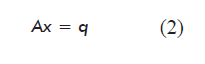
<P   ><font size="2" face="Verdana, Arial, Helvetica, sans-serif">where: </font></P >       <P   ><font size="2" face="Verdana, Arial, Helvetica, sans-serif"><I>A</I> is a matrix      of dimensions m &times; n containing the stoichiometric numbers (&alpha;<Sub>ij</Sub>)      for each metabolite in each reaction of the network; </font></P >   <FONT size="+1"><FONT size="+1">        <P   ><font size="2" face="Verdana, Arial, Helvetica, sans-serif"><I>x</I> is a vector      containing the internal metabolic fluxes (reaction rates, d&epsilon;<Sub>j</Sub>/dt),      constituting the unknown variables of the model; </font></P >   <FONT size="+1"><FONT size="+1">        <P   ><font size="2" face="Verdana, Arial, Helvetica, sans-serif"><I>q</I> is a vector      containing the net flow of the metabolites exchanged by the cell with the      culture medium (q<Sub>i</Sub> = F<Sub>i</Sub> - F<Sub>io</Sub>). </font></P >   <FONT size="+1"><FONT size="+1"><FONT size="+1"><FONT size="+1"><FONT size="+1"><FONT size="+1">        ]]></body>
<body><![CDATA[<P   > </P >       <P   ><font size="2" face="Verdana, Arial, Helvetica, sans-serif">In the case of intermediate      metabolites not secreted to the medium, q<Sub>i</Sub> equals zero. Metabolites      exchanged with the culture medium will have a negative value in the case of      nutrients, and positive in the case of secreted metabolic products. </font></P >   <FONT size="+1"><FONT size="+1">        <P   ><font size="2" face="Verdana, Arial, Helvetica, sans-serif">There are more metabolite      balancing equations than reactions in the proposed model. The system is therefore      over-dimensioned, and has a mathematical solution according to equation 3,      using the least squares method [3] as implemented in the MATLAB 7.11 R2010b      package: </font></P >       <P align="center"   ><img src="/img/revistas/bta/v29n4/fr0304412.gif" width="252" height="49"></P >       
<P   ><font size="2" face="Verdana, Arial, Helvetica, sans-serif">Where <I>A</I><Sup><I>T</I></Sup>      is the transpose of matrix <I>A</I> </font></P >   <FONT size="+1"><FONT size="+1">        <P   > </P >       <P   ><font size="2" face="Verdana, Arial, Helvetica, sans-serif">The degree of propagation      of matrix errors and the reliability of the calculated metabolic fluxes were      verified by subjecting the matrix to a sensitivity analysis based on its condition      number, using the criterion from Stephanopoulos <I>et al</I>. [3]. </font></P >       <P   ><b><font size="2" face="Verdana, Arial, Helvetica, sans-serif">Matrix of stoichiometric      numbers for the synthesis of rh-EPO in CHO cells </font></b></P >   <B></B>        <P   ><font size="2" face="Verdana, Arial, Helvetica, sans-serif">The matrix of stoichiometric      numbers was based on the glycolysis and pentose phosphate pathways, the tricarboxylic      acid cycle and the reaction catalyzed by malic enzyme, oxidative phosphorylation      and aminoacid catabolic reactions. These are all held as important reactions      in mammalian cell metabolism [1, 3, 4, 9, 10, 12-16]. Other reactions used      for this purpose included those of the synthesis of precursors for the formation      of biomass and the target product, as well as stoichiometric reactions for      both biomass and product. It is the last two that confer the model its specificity      for CHO cells synthesizing rh-EPO, as the remaining reactions are shared with      most existing mammalian cell lines. </font></P >       <P   ><font size="2" face="Verdana, Arial, Helvetica, sans-serif"><b>Stoichiometric      equation for biomass formation </b></font></P >       ]]></body>
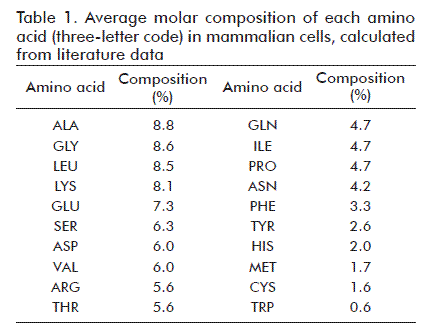
<body><![CDATA[<P   ><font size="2" face="Verdana, Arial, Helvetica, sans-serif">The stoichiometric      equation for biomass production is obtained from the equations for the biosynthesis      of the main macromolecule types of mammalian cells (nucleic acids, proteins,      lipids and carbohydrates). These reactions were formulated from precursors      generated during central carbon metabolism, following the methodology proposed      by Zupke and Stephanopoulos<B> </B>[10]. </font></P >       <P   ><font size="2" face="Verdana, Arial, Helvetica, sans-serif">The reactions for      the synthesis of the nitrogenated bases of RNA (ATP, CTP, GTP and UTP) and      DNA (dATP, dCTP, dGTP and dTTP) molecules were taken from Nelson and Cox [17].      Molar base ratios for RNA and DNA molecules in mammalian cells were taken      from Zubay <I>et al</I>. [18]. </font></P >   <FONT size="+1">        <P   ><font size="2" face="Verdana, Arial, Helvetica, sans-serif">Molar average compositions      for each aminoacid in total cell protein were calculated from literature data      [4, 13, 14, 19] (<a href="#tab1">Table 1</a>). Each aminoacid incorporated      into cell protein requires 4 ATP molecules [10, 13]. </font></P >       <P align="center"   ><img src="/img/revistas/bta/v29n4/t0104412.gif" width="464" height="368"><a name="tab1"></a></P >   <FONT size="+1">        
<P   align="justify" ><font size="2" face="Verdana, Arial, Helvetica, sans-serif">Erythrocyte membranes      were used as a reference to derive lipid mass compositions [10, 20]. The averages      used in the model were: 63.0% for phospholipids, 13.0% for glycolipids and      26.5% for cholesterol. </font></P >       <P   ><font size="2" face="Verdana, Arial, Helvetica, sans-serif">The reaction for      the synthesis of phosphatidylcholine (PC), the most abundant phospholipid      in cell membranes [17, 20-22], is: </font></P >       <P   > </P >       <P   ><font size="2" face="Verdana, Arial, Helvetica, sans-serif">18AcCoA + GAP + COL      + NADH + 30NADPH + 31H<Sup>+</Sup> + 2O<Sub>2</Sub> + CTP + 37ATP + 3H<Sub>2</Sub>O      = FC + 18CoA + 30NADP<Sup>+</Sup> + NAD<Sup>+</Sup> + 2AMP + CMP + 35ADP +      41P<Sub>i</Sub> + 2CO<Sub>2 </Sub></font></P >   <FONT size="+1"><FONT size="+1"><FONT size="+1"><FONT size="+1"><FONT size="+1"><FONT size="+1"><FONT size="+1"><FONT size="+1"><FONT size="+1"><FONT size="+1"><FONT size="+1"><FONT size="+1"><FONT size="+1">        <P   > </P >   <FONT size="+1">        <P   ><font size="2" face="Verdana, Arial, Helvetica, sans-serif">Where AcCoA: acetyl      Coenzyme A; AMP, ADP and ATP: adenosine mono-, di- and trip-phosphate, respectively;      CMP and CTP: cytidine mono- and tri-phosphate, respectively; CoA: Coenzyme      A; PC: phosphatidylcholine; GAP: glyceraldehyde-3-phosphate; COL: choline;      NADH and NADCoenzyme A; PC: phosphatidylcholine; GAP: glyceraldehyde-3-phosphate;      COL: choline; NADH and NADCoenzyme A; PC: phosphatidylcholine; GAP: glyceraldehyde-3-phosphate;      COL: choline; NADH and NADCoenzyme A; PC: phosphatidylcholine; GAP: glyceraldehyde-3-phosphate;      COL: choline; NADH and NADCoenzyme A; PC: phosphatidylcholine; GAP: glyceraldehyde-3-phosphate;      COL: choline; NADH and NADCoenzyme A; PC: phosphatidylcholine; GAP: glyceraldehyde-3-phosphate;      COL: choline; NADH and NADCoenzyme A; PC: phosphatidylcholine; GAP: glyceraldehyde-3-phosphate;      COL: choline; NADH and NAD</font></P >       ]]></body>
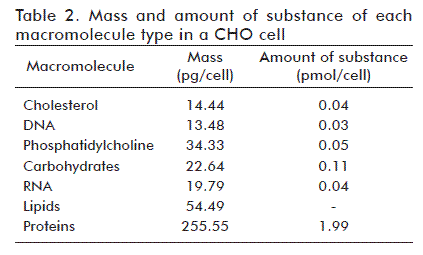
<body><![CDATA[<P   > </P >       <P   ><font size="2" face="Verdana, Arial, Helvetica, sans-serif">This reaction was      obtained starting from oleic acid as precursor fatty acid, chosen on the basis      of its abundance in mammalian cells [14, 17], and also took into account the      reaction for the synthesis of cholesterol, another important constituent of      mammalian cell membranes [20, 22]. </font></P >       <P   ><font size="2" face="Verdana, Arial, Helvetica, sans-serif">Carbohydrate (CH)      synthesis was modeled based on the general equation of Altamirano <I>et al.</I>      [4]: </font></P >       <P   > </P >       <P   ><font size="2" face="Verdana, Arial, Helvetica, sans-serif">G6P + 3.5ATP = CH<B>      </B>+ 3.5ADP + 3.5P<Sub>i </Sub></font></P >   <FONT size="+1">        <P   ><font size="2" face="Verdana, Arial, Helvetica, sans-serif">Where G6P: glucose-6-phosphate      </font></P >   <FONT size="+1">        <P   > </P >       <P   ><font size="2" face="Verdana, Arial, Helvetica, sans-serif">In order to calculate      the mass of each of the five macromolecule types of a CHO cell, mass composition      averages [10, 13, 14, 16, 23] and dry weight [1, 4, 24] were calculated, obtaining      69.4% of total dry weight mass for cellular protein, 5.4% for RNA, 3.7% for      DNA, 14.8% for lipids and 6.1% for carbohydrates, and estimating the dry weight      of a single cell as 368 pg. These averages were multiplied to obtain the mass      of each macromolecule per CHO cell. </font></P >       <P   ><font size="2" face="Verdana, Arial, Helvetica, sans-serif">The molar mass of      each macromolecule was then used to calculate the corresponding amount of      substance per cell. In the case of total cell protein, molar mass was estimated      by calculating the sum of the product of the average molar composition of      each aminoacid (<a href="#tab1">Table 1</a>) and its corresponding molar mass,      which yielded a value of 129 g/mol. The molar mass of RNA and DNA molecules      was calculated as the sum of the product of the molar composition of each      nitrogenated base [18] times its molar mass, yielding molar masses of 307      and 295 g/mol, respectively. The molar masses of phosphatidyl choline and      cholesterol are 760 and 387 g/mol, respectively, and an average molar mass      of 215 g/mol was used for carbohydrates. </font></P >       <P   ><font size="2" face="Verdana, Arial, Helvetica, sans-serif">The amount of substance      of each aminoacid was calculated by multiplying the fractional abundance of      each aminoacid (<a href="#tab1">Table 1</a>) times the amount of substance      of total cell protein (1.99 pmol). </font></P >       ]]></body>
<body><![CDATA[<P   ><font size="2" face="Verdana, Arial, Helvetica, sans-serif">Last, the global      reaction of biomass synthesis was formulated as the sum of the amount of substance      of each macromolecule type, calculated from the amount of substance of each      of the five macromolecule type and the reactions for their synthesis. </font></P >       <P   ><font size="2" face="Verdana, Arial, Helvetica, sans-serif"><b>Stoichiometric      equation for product (rh-EPO) formation </b></font></P >       <P   ><font size="2" face="Verdana, Arial, Helvetica, sans-serif">In order to derive      an equation for product (rh-EPO) formation, its chemical composition was first      determined in terms of fractional aminoacid and carbohydrate contents [25,      26]. </font></P >       <P   ><font size="2" face="Verdana, Arial, Helvetica, sans-serif">The rh-EPO synthesis      reaction depends in turn on the reactions for synthesizing the oligosaccharide      chains attached to the glycosylation sites of this molecule (which represent      a significant fraction of its mass) from metabolites produced by the pathways      of central carbon metabolism. The required amounts of aminoacids and oligosaccharide      precursors were used to calculate their composition by dividing the number      of units of each metabolite by the sum of all units, taking into account that      each incorporated aminoacid requires the hydrolysis of four ATP molecules      [10, 13]. </font></P >       <P   ><b><font size="2" face="Verdana, Arial, Helvetica, sans-serif">Experimental information      analyzed with the proposed model </font></b></P >   <B></B>        <P   ><font size="2" face="Verdana, Arial, Helvetica, sans-serif">The cells were cultured      in a Minifors model bioreactor (Infors HT, Switzerland)<FONT color="#FF0000">      <FONT color="#000000">of 3.2 L effective volume, operating in continuous mode      and steady state, with a dilution rate of 0.026 h<Sup>-1</Sup>, an agitation      of 130 min<Sup>-1</Sup> and an air flow of 0.02 vvm. </font></font></font></P >   <FONT color="#FF0000"><FONT color="#000000"><FONT size="+1"><FONT size="+1"><FONT size="+1"><FONT size="+1">        <P   align="justify" ><b><font size="2" face="Verdana, Arial, Helvetica, sans-serif">Analytical techniques      </font></b></P >   <B></B>        <P   align="justify" ><font size="2" face="Verdana, Arial, Helvetica, sans-serif">Aminoacid concentrations      were determined by derivatization with phenyl-isothiocyanate according to      Elkin and Wasynczuk [27], followed by analysis in an HPLC system (Shimadzu,      Japan) with a 5 &micro;m ZORBAX Eclipse XDB-C18 reversed-phase column (Agilent      Technologies, USA) fitted with a Vydac C-18 pre-column. Glucose, lactate and      glutamine concentrations were determined in a YSI Model 2700 SELECT biochemical      analyzer (YSI Life Sciences, USA). </font></P >       <P   align="justify" ><font size="2" face="Verdana, Arial, Helvetica, sans-serif">EPO concentration      in samples of culture supernatants was determined in a reversed phase 150      &times; 4.6 mm C-8 column with a particle size of 5 &micro;m (Vydac, USA),      using a non-lineal gradient with organic solvents (mobile phase A: 0.1% trifluoroacetic      acid in water; mobile phase B: 90% acetonitrile + 0.09% trifluoroacetic acid      in water). </font></P >       <P   align="justify" ><b><font size="2" face="Verdana, Arial, Helvetica, sans-serif">Calculation of      net metabolite output rates from experimental data </font></b></P >   <B></B>        ]]></body>
<body><![CDATA[<P   ><font size="2" face="Verdana, Arial, Helvetica, sans-serif">The information required      for forming vector <I>q </I>of the model is calculated from experimental data      for metabolite concentrations, using the mass balance equation for the reactor      at the steady state [4]. </font></P >       <P align="center"   ><font size="2" face="Verdana, Arial, Helvetica, sans-serif"> <img src="/img/revistas/bta/v29n4/fr0404412.gif" width="236" height="70"></font></P >       
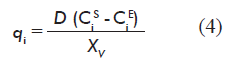
<P   ><font size="2" face="Verdana, Arial, Helvetica, sans-serif">Where: </font></P >       <P   ><font size="2" face="Verdana, Arial, Helvetica, sans-serif">D is the rate of      dilution; </font></P >       <P   ><font size="2" face="Verdana, Arial, Helvetica, sans-serif">C<Sub>i</Sub><Sup>E</Sup>      and C<Sub>i</Sub><Sup>S </Sup>are the concentration (mg/L) of the metabolite      at the reactor inlet and outlet, respectively; </font></P >   <FONT size="+1"><FONT size="+1"><FONT size="+1"><FONT size="+1">        <P   ><font size="2" face="Verdana, Arial, Helvetica, sans-serif">X<Sub>V</Sub> is      the concentration of viable cells at the reactor (cells/mL). </font></P >   <FONT size="+1"><FONT size="+1">        <P   > </P >       <P   ><font size="2" face="Verdana, Arial, Helvetica, sans-serif">Net oxygen output      flow was determined experimentally, employing the dynamic method for determining      the volumetric coefficient of oxygen transfer [28]. </font></P >       <P   ><b><font size="2" face="Verdana, Arial, Helvetica, sans-serif">Verification of      the quality of experimental data </font></b></P >   <B></B>        <P   ><font size="2" face="Verdana, Arial, Helvetica, sans-serif">Consistence analyses      were performed following the method proposed by van der Heijden <I>et al.</I>      [29, 30], based in the balance of materials per elements and the redundancy      of experimental data. </font></P >       ]]></body>
<body><![CDATA[<P   ><font size="2" face="Verdana, Arial, Helvetica, sans-serif">This method calculates      a test function or consistency index (h) that follows the &chi;<Sup>2</Sup>      probability distribution, where the rank of the R redundancy matrix represents      the degrees of freedom [30]. The degrees of freedom and a confidence level      of 95% are used to calculate a critical &chi; value for hypothesis testing,      in order to determine the significance of experimental error.</font></P >       <P   >&nbsp;</P >       <P   ><font face="Verdana, Arial, Helvetica, sans-serif" size="2"><b><font size="3">RESULTS      AND DISCUSSION</font></b></font></P >   <FONT size="+1"><FONT size="+1">        <P   ></P >       <P   ></P >       <P   ></P >   <B>        <P   ><font size="2" face="Verdana, Arial, Helvetica, sans-serif">Equation of the model      for biomass production and normalized chemical formula of the biomass </font></P >   </B>        <P   ><font size="2" face="Verdana, Arial, Helvetica, sans-serif"><a href="#tab2">Table      2</a> shows the mass and amount of substance of all macromolecules in a CHO      cell, as calculated following the methodology described above. </font></P >       <P align="center"   ><img src="/img/revistas/bta/v29n4/t0204412.gif" width="464" height="285"><a name="tab2"></a></P >       
<P   >&nbsp;</P >       ]]></body>
<body><![CDATA[<P   ><font size="2" face="Verdana, Arial, Helvetica, sans-serif">The equation for      the formation of a CHO cell in our model is represented by: </font></P >       <P   align="justify" ><font size="2" face="Verdana, Arial, Helvetica, sans-serif">0.067R5P + 11.100ATP      + 0.229GLN + 0.203GLY + 0.205ASP + 0.077NAD<Sup>+</Sup> + 0.067 N<Sup>10</Sup>-Formyl-THF      + 0.067HCO<Sub>3</Sub><Sup>-</Sup> + 0.008N<Sup>5</Sup>,N<Sup>10</Sup>-Methylene-THF      + 0.175ALA + 0.110ARG + 0.083ASN + 0.032CYS + 0.040HIS + 0.093ILE + 0.168LEU      + 0.160LYS + 0.033MET + 0.066PHE + 0.093PRO + 0.126SER + 0.112THR + 0.013TRP      + 0.051TYR + 0.119VAL + 1.485AcCoA + 1.875H<Sup>+</Sup> + 2.451NADPH + 0.501O<Sub>2</Sub>      + 0.105G6P + 0.020GTP + 0.045GAP + 0.045COL + 0.045CTP + 0.031H<Sub>2</Sub>O      + 0.008GLU = CHO + 2.918ADP + 3.354P<Sub>i</Sub> + 0.422CO<Sub>2 </Sub>+ 0.008DHF      + 0.067THF + 0.053FUM + 0.002NADH + 1.485CoA + 1.891NADP<Sup>+</Sup> + 0.171AMP      + 0.020GDP + 0.045CMP </font></P >   <FONT size="+1"><FONT size="+1"><FONT size="+1"><FONT size="+1"><FONT size="+1"><FONT size="+1"><FONT size="+1"><FONT size="+1"><FONT size="+1"><FONT size="+1"><FONT size="+1"><FONT size="+1"><FONT size="+1"><FONT size="+1"><FONT size="+1"><FONT size="+1"><FONT size="+1"><FONT size="+1"><FONT size="+1"><FONT size="+1"><FONT size="+1"><FONT size="+1">        <P   align="justify" > </P >       <P   ><font size="2" face="Verdana, Arial, Helvetica, sans-serif">Where DHF: dihydrofolate;      FUM: fumarate; GDP and GTP: guanosine di- and tri-phosphate; GLU: glutamate;      R5P: ribose-5-phosphate and THF- tetrahydrofolate. Aminoacids are represented      using standard three-letter codes. </font></P >   <FONT size="+1"><FONT size="+1">        <P   > </P >       <P   ><font size="2" face="Verdana, Arial, Helvetica, sans-serif">The equation above      contains a larger amount of information than the one described by Altamirano      <I>et al.</I> [4], who represented the formation of a cell by using five equations      (one for each main macromolecule type), making it difficult to identify the      main metabolic pathways contributing to cell formation. In addition, lipid      biosynthesis modeling in the present work was based on more recent publications,      which use erythrocyte membranes as the standard for characterizing this cellular      structure in mammalians [10, 20]. </font></P >       <P   ><font size="2" face="Verdana, Arial, Helvetica, sans-serif">Starting from the      amount of substance and the composition per chemical element of each macromolecule      type, we derived chemical compositions normalized to one carbon atom of CH<Sub>1.95      </Sub>N<Sub>0.23 </Sub>O<Sub>0.50</Sub> for biomass and CH<Sub>2.01</Sub>N<Sub>0.29      </Sub>O<Sub>0.52</Sub> for total cell protein. These two formulations are      required for assessing the quality of the experimental data used to solve      the mathematical model. </font></P >   <FONT size="+1"><FONT size="+1"><FONT size="+1"><FONT size="+1"><FONT size="+1"><FONT size="+1"><FONT size="+1"><FONT size="+1"><FONT size="+1"><FONT size="+1"><FONT size="+1"><FONT size="+1">        <P   > </P >       <P   ><font size="2" face="Verdana, Arial, Helvetica, sans-serif"><B>Equation of the      model for rh-EPO production and normalized chemical formula of rh-EPO </B>      </font></P >       <P   ><font size="2" face="Verdana, Arial, Helvetica, sans-serif">Starting from a compositional      analysis of an EPO molecule and using precursors from central carbon metabolism      as reactants for its formation, the formation of EPO in the model can be expressed      as: </font></P >       ]]></body>
<body><![CDATA[<P   > </P >       <P   align="justify" ><font size="2" face="Verdana, Arial, Helvetica, sans-serif">0.045ALA + 0.029ARG      + 0.014ASN + 0.014ASP + 0.010CYS + 0.088GLN + 0.021GLY + 0.005HIS + 0.012ILE      + 0.055LEU + 0.019LYS + 0.002MET + 0.010PHE + 0.019PRO + 0.024SER + 0.026THR      + 0.007TRP + 0.010TYR + 0.026VAL + 0.143F6P + 0.052G6P + 0.071AcCoA + 0.124UTP      + 0.026CTP + 0.026H<Sub>2</Sub>O + 0.071GTP + 1.480ATP + 0.026PEP = EPO +      0.030ADP + 0.452P<Sub>i</Sub> + 0.043MAN + 0.021GLC + 0.116UDP + 0.071GDP      + 0.026CMP + 0.007UMP + 0.071CoA + 0.043GLU </font></P >   <FONT size="+1"><FONT size="+1"><FONT size="+1"><FONT size="+1">        <P   > </P >       <P   ><font size="2" face="Verdana, Arial, Helvetica, sans-serif">Where F6P: fructose-6-phosphate;      GLC: glucose; GLU: glutamate.; MAN: mannose; PEP: phosphoenolpyruvate; UMP,      UDP and UTP: uridine mono-, di- and tri-phosphate, respectively. Standard      three-letter codes are used for aminoacids. </font></P >   <FONT size="+1"><FONT size="+1">        <P   > </P >       <P   ><font size="2" face="Verdana, Arial, Helvetica, sans-serif">Not many authors      have derived an equation symbolizing the biosynthesis of a specific extracellular      product [3, 31]. One exception is that of Stephanopoulos <I>et al.</I> [3]      who worked out an equation modeling the production of an IgG antibody by the      ATCC CRL 1606 murine hybridoma. In that case, having a product-specific equation      allowed them to use metabolic engineering techniques to implement a number      of metabolic modifications, based on the relationship between the distribution      of metabolic fluxes in the cell and the amount of formed product. Another      advantage of product-specific equations is the possibility they afford of      calculating metabolic fluxes by solving the model, should their experimental      determination prove exceedingly difficult. </font></P >       <P   ><font size="2" face="Verdana, Arial, Helvetica, sans-serif">Although Calik and      Ozdamar [31] have already proposed an equation for the production of rh-EPO,      they used <I>Bacillus</I> <I>licheniformis</I> as the host. Their model, therefore,      does not take glycosylation into account, and can only be applied to systems      where EPO is produced in non-glycosylated form. In addition, the stoichiometric      matrix of their model uses a large condition number, increasing the uncertainty      of the final result due to error propagation. </font></P >       <P   ><font size="2" face="Verdana, Arial, Helvetica, sans-serif">The equation proposed      here for the synthesis of rh-EPO is, to the best of our knowledge, the first      to account for target product glycosylation, expressing stoichiometry as a      function of molar compositions without compromising the estimation of metabolic      fluxes [10]. In addition, it has reduced the condition number of the stoichiometric      number matrix. </font></P >       <P   ><font size="2" face="Verdana, Arial, Helvetica, sans-serif">Taking C<Sub>809</Sub>H<Sub>1305</Sub>N<Sub>229</Sub>O<Sub>240</Sub>S<Sub>5</Sub>      as the chemical formula of the aminoacid sequence of EPO, C<Sub>387</Sub>H<Sub>627</Sub>N<Sub>27</Sub>O<Sub>279</Sub>      as that of the three N-glycosyl moieties, and C<Sub>36</Sub>H<Sub>57</Sub>N<Sub>3</Sub>O<Sub>26</Sub>      as that of the single O-glycosyl moiety, the chemical formula of rh-EPO would      be C<Sub>1232</Sub>H<Sub>1989</Sub>N<Sub>259</Sub>O<Sub>545</Sub> which, normalized      to one carbon atom, is expressed as CH<Sub>1.61</Sub>N<Sub>0.21</Sub>O<Sub>0.44</Sub>.      </font></P >   <FONT size="+1"><FONT size="+1"><FONT size="+1"><FONT size="+1"><FONT size="+1"><FONT size="+1"><FONT size="+1"><FONT size="+1"><FONT size="+1"><FONT size="+1"><FONT size="+1"><FONT size="+1"><FONT size="+1"><FONT size="+1"><FONT size="+1"><FONT size="+1"><FONT size="+1"><FONT size="+1"><FONT size="+1"><FONT size="+1"><FONT size="+1"><FONT size="+1"><FONT size="+1"><FONT size="+1"><FONT size="+1"><FONT size="+1"><FONT size="+1"><FONT size="+1"><FONT size="+1"><FONT size="+1"><FONT size="+1"><FONT size="+1"><FONT size="+1"><FONT size="+1"><FONT size="+1"><FONT size="+1"><FONT size="+1"><FONT size="+1"><FONT size="+1"><FONT size="+1">        <P   ><font size="2" face="Verdana, Arial, Helvetica, sans-serif"><b>Mathematical model      of the production of rh-EPO in CHO cells </b></font></P >       ]]></body>
<body><![CDATA[<P   ><font size="2" face="Verdana, Arial, Helvetica, sans-serif"><a href="/img/revistas/bta/v29n4/t0304412.gif">Table      3</a> shows all the reactions used to construct the mathematical model. Among      them are important nodes of central carbon metabolism, such as G6P, F6P and      pyruvate (PYR), as well as the final equations for the growth of CHO cells      and the synthesis of rh-EPO. Compared to previous CHO models [4, 9, 12], ours      includes a larger number of central carbon metabolism nodes. This facilitates      its application as a metabolic engineering tool whenever it becomes necessary      to identify the main nodes of a metabolic network and their rigidity, in order      to redirect metabolic fluxes towards the formation of the target product [3].      </font></P >       
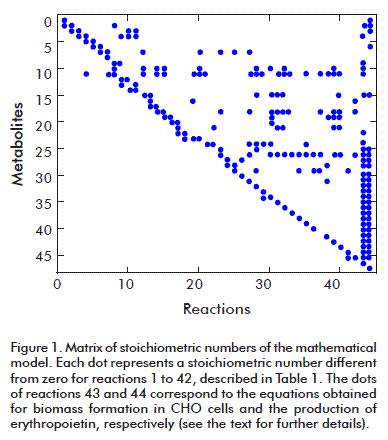
<P   ><font size="2" face="Verdana, Arial, Helvetica, sans-serif">The resulting stoichiometric      number matrix has dimensions 47 x 44 with a rank of 44; it therefore complies      with the mathematical condition for solving the model, and can be used to      apply the MFA technique (<a href="#fig1">Figure 1</a>). Its condition number      is 83 which, being smaller than 100, means that the matrix is mathematically      functional, is not sensitive, and will produce reliable results for the calculated      metabolic fluxes. The dots in the figure represent stoichiometric numbers      different from zero. </font></P >       <P align="center"   ><img src="/img/revistas/bta/v29n4/f0104412.gif" width="462" height="524"><a name="fig1"></a></P >       
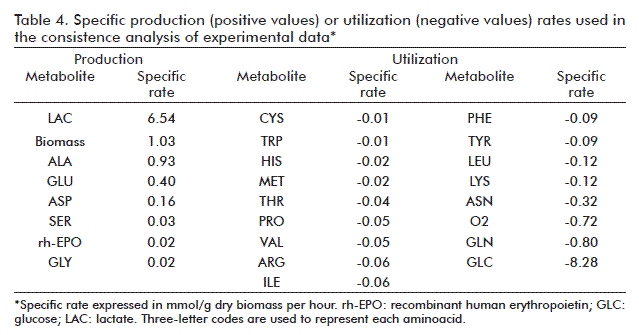
<P   ><font size="2" face="Verdana, Arial, Helvetica, sans-serif"><B>Verification of      the quality of experimental data </b></font></P >       <P   ><font size="2" face="Verdana, Arial, Helvetica, sans-serif">A consistency analysis      was performed on the external metabolic fluxes (net outflow rates from the      cell, <a href="/img/revistas/bta/v29n4/t0404412.gif">Table 4</a>), which      were then used as specific rates to calculate those of CO<Sub>2</Sub> and      NH<Sub>3</Sub>. Test function <I>h</I> yielded a value of 4.718; smaller than      the critical &chi;<Sup>2</Sup> value of 5.991 for two degrees of freedom and      a 95% confidence level. The experimental data are, therefore, consistent,      and the specific rates of CO<Sub>2</Sub> and NH<Sub>3</Sub> can be estimated      as 0.80 and 0.09 mmol/g of dry biomass, respectively. The experimental data      set can be used to calculate internal metabolic fluxes by solving the mathematical      model. </font></P >   <FONT size="+1"><FONT size="+1"><FONT size="+1"><FONT size="+1"><FONT size="+1"><FONT size="+1"><FONT size="+1"><FONT size="+1"><FONT size="+1"><FONT size="+1">        
<P   ><b><font size="2" face="Verdana, Arial, Helvetica, sans-serif">Solution of the      mathematical model </font></b></P >   <B></B>        <P   ><font size="2" face="Verdana, Arial, Helvetica, sans-serif"><a href="#fig2">Figure      2</a> contains the map of calculated metabolic fluxes, although only the largest      fluxes are shown. These corresponded to glycolysis, the formation of lactate,      the tricarboxylic acid cycle, oxidative phosphorylation, glutamine use, the      malate-aspartate shuttle and the reaction catalyzed by the mitochondrial malic      enzyme, as also observed by Ahn <I>et al.</I> [32]. This behavior corresponds      to an inefficient metabolic phenotype, characterized by high rates of glucose      utilization and high rates of lactate formation even in the presence of oxygen      (Warburg effect) as described by Goudar <I>et al.</I> [9]<B> </B>and Mulukutla      <I>et al.</I> [33]<B> </B>for mammalian cells, caused by the fact that glycolytic      flux is related to the speed at which NAD<sup>+</sup> is regenerated through      the conversion to pyruvate and the NADH shuttle.</font></P >       <P align="center"   ><img src="/img/revistas/bta/v29n4/f0204412.gif" width="473" height="1022"><a name="fig2"></a></P >       
<P   ><font size="2" face="Verdana, Arial, Helvetica, sans-serif">MFA shows that glucose      consumption is not coupled to the tricarboxylic acid cycle. An analysis of      the distribution of metabolic fluxes around the pyruvate node (the metabolite      linking glycolysis with the tricarboxylic acid cycle) reveals that 82% of      cytoplasmic pyruvate is converted to lactate and just 15% is transported into      the mitochondria; in turn, only 41% of the latter enters the tricarboxylic      acid cycle (representing 8.8% of cytoplasmic pyruvate); the remaining 56%      is converted to alanine by alanine-aminotransferase and eventually secreted      to the culture medium. In turn, almost all glutamine transported into the      cell is converted to glutamate by the mitochondrial phosphate glutaminase-dependent      enzyme. This phenomenon (high glycolytic rates together with partial glutamine      oxidation and formation of alanine) has previously been observed in CHO cells      by Altamirano <I>et al.</I> [4] and Goudar <I>et al.</I> [9]. </font></P >       <P   ><font size="2" face="Verdana, Arial, Helvetica, sans-serif">The pyruvate flux      entering the mitochondria is similar to the transport flux of malate from      the cytoplasm. This finding coincides with that of Mulukutla <I>et al.</I>      [33], who observed that pyruvate inflow into the mitochondria in the steady      state is approximately equal to the flow of reducing equivalents transported      across the mitochondrial membrane by the NADH shuttles. Aspartate formed in      the mitochondria contributes to electron transfer reactions as it reaches      the cytoplasm through the malate-aspartate shuttle, and is then converted      to oxaloacetate by the cytoplasmic aspartate-aminotransferase. Oxaloacetate      is in turn reduced to malate using electrons donated by the NADH generated      during glycolysis, and this malate enters the mitochondria and donates electrons      to complex I of the electron transport chain. Thus, the shuttle drives ATP      production in the mitochondria (via oxidative phosphorylation) and the cytoplasm      (by resupplying needed NAD<Sup>+</Sup> to glycolysis). </font></P >   <FONT size="+1"><FONT size="+1">        ]]></body>
<body><![CDATA[<P   ><font size="2" face="Verdana, Arial, Helvetica, sans-serif">An important metabolic      parameter is the O<Sub>2</Sub>/ATP ratio. If all NADH and FADH<Sub>2</Sub>      molecules are used to synthesize ATP via oxidative phosphorylation, this ratio      must be close to 0.17 [15]. NADH and FADH<Sub>2</Sub> generated in the mitochondria      donate electrons to complexes I and II of the electron transport chain, respectively.      In our case, the O<Sub>2</Sub>/ATP ratio is 0.20, indicating that the tricarboxylic      acid cycle is only loosely coupled to energy generation via phosphorylative      oxidation. </font></P >   <FONT size="+1"><FONT size="+1"><FONT size="+1"><FONT size="+1"><FONT size="+1"><FONT size="+1"><FONT size="+1"><FONT size="+1">        <P   ><font size="2" face="Verdana, Arial, Helvetica, sans-serif">Another parameter      describing the metabolic status of the cell is the respiratory quotient, defined      as the ratio of the specific rates of CO<Sub>2</Sub> production and O<Sub>2</Sub>      uptake (CO<Sub>2</Sub>/O<Sub>2</Sub>). In our case, the respiratory quotient      is 1.11, which is similar to previously published values for this parameter      in mammalian cell lines [14]. </font></P >       <P   >&nbsp;</P >   <FONT size="+1"><FONT size="+1"><FONT size="+1"><FONT size="+1"><FONT size="+1"><FONT size="+1"><FONT size="+1"><FONT size="+1">        <P   ><b><font face="Verdana, Arial, Helvetica, sans-serif" size="3">CONCLUSIONS</font></b></P >       <P   ><font size="2" face="Verdana, Arial, Helvetica, sans-serif">The results produced      by applying the MFA methodology are biochemically coherent and consistent      with the findings of previous authors studying CHO cells. The mathematical      model proposed in the present work can, therefore, be applied to characterize      the metabolism of this cell line when producing the recombinant protein rh-EPO.      One of the advantages of the proposed model in comparison with previous CHO      models is the fact that its metabolic network includes a considerable number      of central carbon metabolism nodes, hence providing finer resolution when      interpreting the network and facilitating its use for metabolic engineering      purposes. The equation presented here for the formation of rh-EPO has no equivalents      in the published literature, and can be used for any other cell line producing      the same protein. In addition, the methodology used to construct the model      can be applied to derive other models [34]. </font></P >       <P   > </P >   <B>        <P   >&nbsp;</P >   </B>        <P   ><b><font size="3" face="Verdana, Arial, Helvetica, sans-serif">REFERENCES</font></b></P >       <!-- ref --><P   ><font size="2" face="Verdana, Arial, Helvetica, sans-serif">1. Nyberg GB, Balcarcel      RR, Follstad BD, Stephanopoulos G, Wang DI. Metabolism of peptide amino acids      by Chinese hamster ovary cells grown in a complex medium. Biotechnol Bioeng.      1999;62(3):324-35.    <br>     </font></P >       ]]></body>
<body><![CDATA[<!-- ref --><P   ><font size="2" face="Verdana, Arial, Helvetica, sans-serif">2. Kauffman KJ, Prakash      P, Edwards JS. Advances in flux balance analysis. Curr Opin Biotechnol. 2003;14(5):491-6.    <br>     </font></P >       <P   ><font size="2" face="Verdana, Arial, Helvetica, sans-serif">3. Stephanopoulos      GN, Aristidou AA, Nielsen J. Metabolic Flux Analysis. In: Metabolic Engineering:      Principles and methodologies. California: Academic Press; 1998:309-51.    <br>     </font></P >       <!-- ref --><P   ><font size="2" face="Verdana, Arial, Helvetica, sans-serif">4. Altamirano C,      Illanes A, Casablancas A, Gamez X, Cairo JJ, Godia C. Analysis of CHO cells      metabolic redistribution in a glutamate-based defined medium in continuous      culture. Biotechnol Prog. 2001;17(6):1032-41.    <br>     </font></P >       <!-- ref --><P   ><font size="2" face="Verdana, Arial, Helvetica, sans-serif">5. Forbes NS, Clark      DS, Blanch HW. Using isotopomer path tracing to quantify metabolic fluxes      in pathway models containing reversible reactions. Biotechnol Bioeng. 2001;74(3):196-211.    <br>     </font></P >       <!-- ref --><P   ><font size="2" face="Verdana, Arial, Helvetica, sans-serif">6. G&ograve;dia C,      Cair&oacute; JJ. Metabolic engineering of animal cells. Bioprocess Eng. 2002;24(5):289-98.    <br>     </font></P >       ]]></body>
<body><![CDATA[<!-- ref --><P   ><font size="2" face="Verdana, Arial, Helvetica, sans-serif">7. Srivastava S,      Chan C. Application of metabolic flux analysis to identify the mechanisms      of free fatty acid toxicity to human hepatoma cell line. Biotechnol Bioeng.      2008;99(2):399-410.    <br>     </font></P >       <!-- ref --><P   ><font size="2" face="Verdana, Arial, Helvetica, sans-serif">8. Wahl A, Sidorenko      Y, Dauner M, Genzel Y, Reichl U. Metabolic flux model for an anchorage-dependent      MDCK cell line: characteristic growth phases and minimum substrate consumption      flux distribution. Biotechnol Bioeng. 2008;101(1):135-52.    <br>     </font></P >       <!-- ref --><P   ><font size="2" face="Verdana, Arial, Helvetica, sans-serif">9. Goudar C, Biener      R, Boisart C, Heidemann R, Piret J, de Graaf A, et al. Metabolic flux analysis      of CHO cells in perfusion culture by metabolite balancing and 2D [13C, 1H]      COSY NMR spectroscopy. Metab Eng. 2010;12(2):138-49.    <br>     </font></P >       <!-- ref --><P   ><font size="2" face="Verdana, Arial, Helvetica, sans-serif">10. Zupke C, Stephanopoulos      G. Intracellular flux analysis in hybridomas using mass balances and in vitro      (13)C nmr. Biotechnol Bioeng. 1995;45(4):292-303.    <br>     </font></P >       <!-- ref --><P   ><font size="2" face="Verdana, Arial, Helvetica, sans-serif">11. Schmidt K, Marx      A, de Graaf AA, Wiechert W, Sahm H, Nielsen J, et al. 13C tracer experiments      and metabolite balancing for metabolic flux analysis: comparing two approaches.      Biotechnol Bioeng. 1998;58(2-3):254-7.    <br>     </font></P >       ]]></body>
<body><![CDATA[<!-- ref --><P   ><font size="2" face="Verdana, Arial, Helvetica, sans-serif">12. Deshpande RR.      Mammalian Cell Culture: High throughput applications of oxygen sensor plates      and cellular physiological studies using 13C-labeling [dissertation]. Saarbr&uuml;cken:      Universit&auml;t des Saarlandes; 2008.    <br>     </font></P >       <!-- ref --><P   ><font size="2" face="Verdana, Arial, Helvetica, sans-serif">13. Savinell JM,      Palsson BO. Optimal selection of metabolic fluxes for in vivo measurement.      II. Application to Escherichia coli and hybridoma cell metabolism. J Theor      Biol. 1992;155(2):215-42.    <br>     </font></P >       <!-- ref --><P   ><font size="2" face="Verdana, Arial, Helvetica, sans-serif">14. Bonarius H, Hatzimanikatis      V, Meesters K, Gooijer C, Schmid G, Tramper J. Metabolic Flux Analysis of      Hybridoma Cells in Different Culture Media Using Mass Balances. Biotechnol      Bioeng. 1996;50:299-318.    <br>     </font></P >       <!-- ref --><P   ><font size="2" face="Verdana, Arial, Helvetica, sans-serif">15. Gambhir A, Korke      R, Lee J, Fu PC, Europa A, Hu WS. Analysis of cellular metabolism of hybridoma      cells at distinct physiological states. J Biosci Bioeng. 2003;95(4):317-27.    <br>     </font></P >       <!-- ref --><P   ><font size="2" face="Verdana, Arial, Helvetica, sans-serif">16. Europa AF, Gambhir      A, Fu PC, Hu WS. Multiple steady states with distinct cellular metabolism      in continuous culture of mammalian cells. Biotechnol Bioeng. 2000;67(1):25-34.    </font></P >       ]]></body>
<body><![CDATA[<!-- ref --><P   ><font size="2" face="Verdana, Arial, Helvetica, sans-serif">17. Nelson DL, Cox      MM. Lehninger. Principios de Bioqu&iacute;mica. 4th ed. Barcelona: Ediciones      Omega S.A.; 2005.    </font></P >       <!-- ref --><P   ><font size="2" face="Verdana, Arial, Helvetica, sans-serif">18. Zubay GL, Parson      WW, Vance DE. Principles of Biochemistry. New York: William C Brown; 1995.    </font></P >       <!-- ref --><P   ><font size="2" face="Verdana, Arial, Helvetica, sans-serif">19. Okayasu T, Ikeda      M. The amino acids composition of mammalian and bacterial cells. Amino Acids.      1997;13:379-91.    </font></P >       <!-- ref --><P   ><font size="2" face="Verdana, Arial, Helvetica, sans-serif">20. Voet D, Voet      JG. Bioqu&iacute;mica. 3rd ed. Buenos Aires: M&eacute;dica Panamericana; 2006.    </font></P >       <!-- ref --><P   ><font size="2" face="Verdana, Arial, Helvetica, sans-serif">21. Metzler DE, Metzler      CM. Biochemistry. The chemical reactions of living cells. 2nd ed. San Diego:      Academic Press; 2003.    </font></P >       ]]></body>
<body><![CDATA[<!-- ref --><P   ><font size="2" face="Verdana, Arial, Helvetica, sans-serif">22. Koolman J, Roehm      KH. Color Atlas of Biochemistry. 2nd ed. Stuttgart: Thieme; 2005.    </font></P >       <!-- ref --><P   ><font size="2" face="Verdana, Arial, Helvetica, sans-serif">23. Xie L, Wang DI.      Material balance studies on animal cell metabolism using a stoichiometrically      based reaction network. Biotechnol Bioeng. 1996;52(5):579-90.    </font></P >       <!-- ref --><P   ><font size="2" face="Verdana, Arial, Helvetica, sans-serif">24. Xie L, Nyberg      G, Gu X, Li H, Mollborn F, Wang DI. Gamma-interferon production and quality      in stoichiometric fed-batch cultures of Chinese hamster ovary (CHO) cells      under serum-free conditions. Biotechnol Bioeng. 1997;56(5):577-82.    </font></P >       <!-- ref --><P   ><font size="2" face="Verdana, Arial, Helvetica, sans-serif">25. Lee DE, Ha BJ,      Kim SJ, Park JS. Carbohydrate structure of N - and O - linked oligosaccharides      of human erythropoietin expressed in Chinese hamster ovary cells. J Biochem      Mol Biol. 1996;29:266-71.    </font></P >       <!-- ref --><P   ><font size="2" face="Verdana, Arial, Helvetica, sans-serif">26. Sasaki H, Bothner      B, Dell A, Fukuda M. Carbohydrate structure of erythropoietin expressed in      Chinese hamster ovary cells by a human erythropoietin cDNA. J Biol Chem. 1987;262(25):12059-76.    </font></P >       ]]></body>
<body><![CDATA[<!-- ref --><P   ><font size="2" face="Verdana, Arial, Helvetica, sans-serif">27. Elkin RG, Wasynczuk      AM. Amino acid analysis of feedstuff hydrolysates by precolumn derivatization      with phenylisothiocyanate and reversed-phase high-performance liquid chromatography.      Cereal Chem. 1987;64(4):226-9.    </font></P >       <!-- ref --><P   ><font size="2" face="Verdana, Arial, Helvetica, sans-serif">28. Doran PM. Bioprocess      Engineering Principles. London: Academic Press; 1995.    </font></P >       <!-- ref --><P   ><font size="2" face="Verdana, Arial, Helvetica, sans-serif">29. van der Heijden      RT, Heijnen JJ, Hellinga C, Romein B, Luyben KC. Linear constraint relations      in biochemical reaction systems: I. Classification of the calculability and      the balanceability of conversion rates. Biotechnol Bioeng. 1994;43(1):3-10.    </font></P >       <!-- ref --><P   ><font size="2" face="Verdana, Arial, Helvetica, sans-serif">30. van der Heijden      RT, Romein B, Heijnen JJ, Hellinga C, Luyben KC. Linear constraint relations      in biochemical reaction systems: II. Diagnosis and estimation of gross errors.      Biotechnol Bioeng. 1994;43(1):11-20.    </font></P >       <!-- ref --><P   ><font size="2" face="Verdana, Arial, Helvetica, sans-serif">31. Calik P, Ozdamar      T. Metabolic flux analysis for human therapeutic protein productions and hypothesis      for new therapeutical strategies in medicine. Biochem Eng J. 2002;11(1):49-68.    </font></P >       ]]></body>
<body><![CDATA[<!-- ref --><P   ><font size="2" face="Verdana, Arial, Helvetica, sans-serif">32. Ahn WS, Antoniewicz      MR. Metabolic flux analysis of CHO cells at growth and non-growth phases using      isotopic tracers and mass spectrometry. Metab Eng. 2011;13(5):598-609.    </font></P >       <!-- ref --><P   ><font size="2" face="Verdana, Arial, Helvetica, sans-serif">33. Mulukutla BC,      Khan S, Lange A, Hu WS. Glucose metabolism in mammalian cell culture: new      insights for tweaking vintage pathways. Trends Biotechnol. 2010;28(9):476-84.    </font></P >       <!-- ref --><P   ><font size="2" face="Verdana, Arial, Helvetica, sans-serif">34. Fern&aacute;ndez-Oliva      O, Dustet-Mendoza JC, Chico-V&eacute;liz E. Dos aplicaciones de la t&eacute;cnica      de an&aacute;lisis de flujos metab&oacute;licos. Rev Cubana Qu&iacute;m. 2012;24(1):70-82.    <br>     </font></P >       <P   >&nbsp;</P >       <P   >&nbsp;</P >       <P   ><font size="2" face="Verdana, Arial, Helvetica, sans-serif">Received in April,      2010.    <br>     Accepted in June, 2012.</font></P >       ]]></body>
<body><![CDATA[<P   >&nbsp;</P >       <P      >&nbsp;</P     >       </font><font size="+1" color="#000000"><font size="2" face="Verdana, Arial, Helvetica, sans-serif"><i>Osm&aacute;n        Fern&aacute;ndez</i></font></font><i>.</i><FONT size="+1"><FONT size="+1"><FONT size="+1"><FONT size="+1"><FONT size="+1"><FONT size="+1"><FONT size="+1"><FONT size="+1"><FONT size="+1"><FONT size="+1"><FONT size="+1"><FONT size="+1"><FONT size="+1"><FONT size="+1">        </font><font size="+1" color="#000000"><font size="+1"><font size="+1"><font size="+1"><font size="+1"><font size="+1"><font size="+1"><font size="2" face="Verdana, Arial, Helvetica, sans-serif"><font color="#0000FF"><font color="#000000">Desarrollo        de Plataformas Tecnol&oacute;gicas, Centro de Inmunolog&iacute;a Molecular.        Calle 216, esq. 15, Atabey, Playa, CP 16 040, La Habana 11 600, La Habana, Cuba.</font></font></font></font></font></font></font></font></font></font><font size="2" face="Verdana, Arial, Helvetica, sans-serif">        E-mail:</font><font face="Verdana, Arial, Helvetica, sans-serif"> </font><font size="+1" color="#000000"><font size="+1"><font size="+1"><font size="+1"><font size="+1"><font size="+1"><font size="+1"><font size="2" face="Verdana, Arial, Helvetica, sans-serif"><a href="mailto:osman@cim.sld.cu"><u><u><font color="#0000FF">osman@cim.sld.cu</font></u></u></a></font><font size="+1" color="#000000"><font size="+1"><font size="+1"><font size="+1"><font size="+1"><font size="+1"><font size="+1"><font color="#0000FF"><font color="#000000"><font size="+1"><font size="+1"><font size="+1"><font size="+1"><font size="+1"><font size="+1"><font size="+1"><font size="+1"><font size="+1"><font size="+1"><font size="+1"><font size="+1"><font size="+1"><font size="+1"><font size="+1"><font size="+1"><font size="+1"><font size="+1"><font size="+1"><font size="+1"><font size="+1"><font size="+1"><font size="+1"><font size="+1"><font size="+1"><font size="+1"><font size="+1"><font size="+1"><font size="+1"><font size="+1"><font size="+1"><font size="+1"><font size="+1"><font size="+1"><font size="+1"><font size="+1"><font size="+1"><font size="+1"><font size="+1"><font size="+1"><font size="+1"><font size="+1"><font size="+1"><font size="+1"><font size="+1"><font size="+1"><font size="+1"><font size="+1"><font size="+1"><font size="+1"><font size="+1"><font size="+1"><font size="+1"><font size="+1"><font color="#FF0000"><font color="#000000"><font size="+1"><font size="+1"><font size="+1"><font size="+1"><font size="+1"><font size="+1"><font size="+1"><font size="+1"><font size="+1"><font size="+1"><font size="+1"><font size="+1"><font size="+1"><font size="+1"><font size="+1"><font size="+1"><font size="+1"><font size="+1"><font size="+1"><font size="+1"><font size="+1"><font size="+1"><font size="+1"><font size="+1"><font size="+1"><font size="+1"><font size="+1"><font size="+1"><font size="+1"><font size="+1"><font size="+1"><font size="+1"><font size="+1"><font size="+1"><font size="+1"><font size="+1"><font size="+1"><font size="+1"><font size="+1"><font size="+1"><font size="+1"><font size="+1"><font size="+1"><font size="+1"><font size="+1"><font size="+1"><font size="+1"><font size="+1"><font size="+1"><font size="+1"><font size="+1"><font size="+1"><font size="+1"><font size="+1"><font size="+1"><font size="+1"><font size="+1"><font size="+1"><font size="+1"><font size="+1"><font size="+1"><font size="+1"><font size="+1"><font size="+1"><font size="+1"><font size="+1"><font size="+1"><font size="+1"><font size="+1"><font size="+1"><font size="+1"><font size="+1"><font size="+1"><font size="+1"><font size="+1"><font size="+1"><font size="+1"><font size="+1"><font size="+1"><font size="+1"><font size="+1"><font size="+1"><font size="+1"><font size="+1"><font size="+1"><font size="+1"><font size="+1"><font size="+1"><font size="+1"><font size="+1"><font size="+1"><font size="+1"><font size="+1"><font size="+1"><font size="+1"><font size="+1"><font size="+1"><font size="+1"><font size="+1"><font size="+1"><font size="+1"><font size="+1"><font size="+1"><font size="+1"><font size="+1"><font size="+1"><font size="+1"><font size="+1"><font size="+1"><font size="+1"><font size="+1"><font size="+1"><font size="+1"><font size="+1"><font size="+1"><font size="+1"><font size="+1"><font size="+1"><font size="+1"><font size="+1"><font size="+1"><font size="+1"><font size="+1"><font size="+1"><font size="+1"><font size="+1"><font size="+1"><font size="+1"><font size="+1"><font size="+1"><font size="+1"><font size="+1"><font size="+1"><font size="+1"><font size="+1" color="#000000"><font size="+1"><font size="+1"><font size="+1"><font size="+1"><font size="+1"><font size="+1"><font size="2" face="Verdana, Arial, Helvetica, sans-serif"><font color="#0000FF"><font color="#000000">.</font></font></font></font></font></font></font></font></font></font></font></font></font></font></font></font></font></font></font></font></font></font></font></font></font></font></font></font></font></font></font></font></font></font></font></font></font></font></font></font></font></font></font></font></font></font></font></font></font></font></font></font></font></font></font></font></font></font></font></font></font></font></font></font></font></font></font></font></font></font></font></font></font></font></font></font></font></font></font></font></font></font></font></font></font></font></font></font></font></font></font></font></font></font></font></font></font></font></font></font></font></font></font></font></font></font></font></font></font></font></font></font></font></font></font></font></font></font></font></font></font></font></font></font></font></font></font></font></font></font></font></font></font></font></font></font></font></font></font></font></font></font></font></font></font></font></font></font></font></font></font></font></font></font></font></font></font></font></font></font></font></font></font></font></font></font></font></font></font></font></font></font></font></font></font></font></font></font></font></font></font></font></font></font></font></font></font></font></font></font></font></font></font></font></font></font></font></font></font></font></font></font></font></font></font></font></font></font></font></font></font></font></font></font></font></font></font></font></font></font></font></font></font></font></font></font></font></font></font></font></font></font></font></font></font></font></font></font></font></font></font></font></font></font></font></font></font></font></font></font></font></font></font></font></font></font></font></font></font></font></font></font></font></font></font></font></font></font></font></font></font></font></font></font></font></font></font></font></font></font></font></font></font></font></font></font></font></font></font></font></font></font></font></font></font></font></font></font></font></font></font></font></font></font></font></font></font></font></font></font></font></font></font></font></font></font></font></font></font></font></font></font></font></font></font></font></font></font></font></font></font></font></font></font></font></font></font></font></font></font></font></font></font></font></font></font></font></font></font></font></font></font></font></font></font></font></font></font></font></font></font></font></font></font></font></font></font></font></font></font></font></font></font></font></font></font></font></font></font></font></font></font></font></font></font></font></font></font></font></font></font></font></font></font></font></font></font></font></font></font></font></font></font></font></font></font></font></font></font></font></font></font></font></font></font></DIV     ]]></body>
<body><![CDATA[>      ]]></body><back>
<ref-list>
<ref id="B1">
<label>1</label><nlm-citation citation-type="journal">
<person-group person-group-type="author">
<name>
<surname><![CDATA[Nyberg]]></surname>
<given-names><![CDATA[GB]]></given-names>
</name>
<name>
<surname><![CDATA[Balcarcel]]></surname>
<given-names><![CDATA[RR]]></given-names>
</name>
<name>
<surname><![CDATA[Follstad]]></surname>
<given-names><![CDATA[BD]]></given-names>
</name>
<name>
<surname><![CDATA[Stephanopoulos]]></surname>
<given-names><![CDATA[G]]></given-names>
</name>
<name>
<surname><![CDATA[Wang]]></surname>
<given-names><![CDATA[DI]]></given-names>
</name>
</person-group>
<article-title xml:lang="en"><![CDATA[Metabolism of peptide amino acids by Chinese hamster ovary cells grown in a complex medium]]></article-title>
<source><![CDATA[Biotechnol Bioeng]]></source>
<year>1999</year>
<volume>62</volume>
<numero>3</numero>
<issue>3</issue>
<page-range>324-35</page-range></nlm-citation>
</ref>
<ref id="B2">
<label>2</label><nlm-citation citation-type="journal">
<person-group person-group-type="author">
<name>
<surname><![CDATA[Kauffman]]></surname>
<given-names><![CDATA[KJ]]></given-names>
</name>
<name>
<surname><![CDATA[Prakash]]></surname>
<given-names><![CDATA[P]]></given-names>
</name>
<name>
<surname><![CDATA[Edwards]]></surname>
<given-names><![CDATA[JS]]></given-names>
</name>
</person-group>
<article-title xml:lang="en"><![CDATA[Advances in flux balance analysis]]></article-title>
<source><![CDATA[Curr Opin Biotechnol]]></source>
<year>2003</year>
<volume>14</volume>
<numero>5</numero>
<issue>5</issue>
<page-range>491-6</page-range></nlm-citation>
</ref>
<ref id="B3">
<label>3</label><nlm-citation citation-type="book">
<person-group person-group-type="author">
<name>
<surname><![CDATA[Stephanopoulos]]></surname>
<given-names><![CDATA[GN]]></given-names>
</name>
<name>
<surname><![CDATA[Aristidou]]></surname>
<given-names><![CDATA[AA]]></given-names>
</name>
<name>
<surname><![CDATA[Nielsen]]></surname>
<given-names><![CDATA[J]]></given-names>
</name>
</person-group>
<article-title xml:lang="en"><![CDATA[Metabolic Flux Analysis]]></article-title>
<source><![CDATA[Metabolic Engineering: Principles and methodologies]]></source>
<year>1998</year>
<page-range>309-51</page-range><publisher-loc><![CDATA[California ]]></publisher-loc>
<publisher-name><![CDATA[Academic Press]]></publisher-name>
</nlm-citation>
</ref>
<ref id="B4">
<label>4</label><nlm-citation citation-type="journal">
<person-group person-group-type="author">
<name>
<surname><![CDATA[Altamirano]]></surname>
<given-names><![CDATA[C]]></given-names>
</name>
<name>
<surname><![CDATA[Illanes]]></surname>
<given-names><![CDATA[A]]></given-names>
</name>
<name>
<surname><![CDATA[Casablancas]]></surname>
<given-names><![CDATA[A]]></given-names>
</name>
<name>
<surname><![CDATA[Gamez]]></surname>
<given-names><![CDATA[X]]></given-names>
</name>
<name>
<surname><![CDATA[Cairo]]></surname>
<given-names><![CDATA[JJ]]></given-names>
</name>
<name>
<surname><![CDATA[Godia]]></surname>
<given-names><![CDATA[C]]></given-names>
</name>
</person-group>
<article-title xml:lang="en"><![CDATA[Analysis of CHO cells metabolic redistribution in a glutamate-based defined medium in continuous culture]]></article-title>
<source><![CDATA[Biotechnol Prog]]></source>
<year>2001</year>
<volume>17</volume>
<numero>6</numero>
<issue>6</issue>
<page-range>1032-41</page-range></nlm-citation>
</ref>
<ref id="B5">
<label>5</label><nlm-citation citation-type="journal">
<person-group person-group-type="author">
<name>
<surname><![CDATA[Forbes]]></surname>
<given-names><![CDATA[NS]]></given-names>
</name>
<name>
<surname><![CDATA[Clark]]></surname>
<given-names><![CDATA[DS]]></given-names>
</name>
<name>
<surname><![CDATA[Blanch]]></surname>
<given-names><![CDATA[HW]]></given-names>
</name>
</person-group>
<article-title xml:lang="en"><![CDATA[Using isotopomer path tracing to quantify metabolic fluxes in pathway models containing reversible reactions]]></article-title>
<source><![CDATA[Biotechnol Bioeng]]></source>
<year>2001</year>
<volume>74</volume>
<numero>3</numero>
<issue>3</issue>
<page-range>196-211</page-range></nlm-citation>
</ref>
<ref id="B6">
<label>6</label><nlm-citation citation-type="journal">
<person-group person-group-type="author">
<name>
<surname><![CDATA[GÃ²dia]]></surname>
<given-names><![CDATA[C]]></given-names>
</name>
<name>
<surname><![CDATA[Cairó]]></surname>
<given-names><![CDATA[JJ]]></given-names>
</name>
</person-group>
<article-title xml:lang="en"><![CDATA[Metabolic engineering of animal cells]]></article-title>
<source><![CDATA[Bioprocess Eng]]></source>
<year>2002</year>
<volume>24</volume>
<numero>5</numero>
<issue>5</issue>
<page-range>289-98</page-range></nlm-citation>
</ref>
<ref id="B7">
<label>7</label><nlm-citation citation-type="journal">
<person-group person-group-type="author">
<name>
<surname><![CDATA[Srivastava]]></surname>
<given-names><![CDATA[S]]></given-names>
</name>
<name>
<surname><![CDATA[Chan]]></surname>
<given-names><![CDATA[C]]></given-names>
</name>
</person-group>
<article-title xml:lang="en"><![CDATA[Application of metabolic flux analysis to identify the mechanisms of free fatty acid toxicity to human hepatoma cell line]]></article-title>
<source><![CDATA[Biotechnol Bioeng]]></source>
<year>2008</year>
<volume>99</volume>
<numero>2</numero>
<issue>2</issue>
<page-range>399-410</page-range></nlm-citation>
</ref>
<ref id="B8">
<label>8</label><nlm-citation citation-type="journal">
<person-group person-group-type="author">
<name>
<surname><![CDATA[Wahl]]></surname>
<given-names><![CDATA[A]]></given-names>
</name>
<name>
<surname><![CDATA[Sidorenko]]></surname>
<given-names><![CDATA[Y]]></given-names>
</name>
<name>
<surname><![CDATA[Dauner]]></surname>
<given-names><![CDATA[M]]></given-names>
</name>
<name>
<surname><![CDATA[Genzel]]></surname>
<given-names><![CDATA[Y]]></given-names>
</name>
<name>
<surname><![CDATA[Reichl]]></surname>
<given-names><![CDATA[U]]></given-names>
</name>
</person-group>
<article-title xml:lang="en"><![CDATA[Metabolic flux model for an anchorage-dependent MDCK cell line: characteristic growth phases and minimum substrate consumption flux distribution]]></article-title>
<source><![CDATA[Biotechnol Bioeng]]></source>
<year>2008</year>
<volume>101</volume>
<numero>1</numero>
<issue>1</issue>
<page-range>135-52</page-range></nlm-citation>
</ref>
<ref id="B9">
<label>9</label><nlm-citation citation-type="journal">
<person-group person-group-type="author">
<name>
<surname><![CDATA[Goudar]]></surname>
<given-names><![CDATA[C]]></given-names>
</name>
<name>
<surname><![CDATA[Biener]]></surname>
<given-names><![CDATA[R]]></given-names>
</name>
<name>
<surname><![CDATA[Boisart]]></surname>
<given-names><![CDATA[C]]></given-names>
</name>
<name>
<surname><![CDATA[Heidemann]]></surname>
<given-names><![CDATA[R]]></given-names>
</name>
<name>
<surname><![CDATA[Piret]]></surname>
<given-names><![CDATA[J]]></given-names>
</name>
<name>
<surname><![CDATA[de Graaf]]></surname>
<given-names><![CDATA[A]]></given-names>
</name>
</person-group>
<article-title xml:lang="en"><![CDATA[Metabolic flux analysis of CHO cells in perfusion culture by metabolite balancing and 2D &#91;13C, 1H&#93; COSY NMR spectroscopy]]></article-title>
<source><![CDATA[Metab Eng]]></source>
<year>2010</year>
<volume>12</volume>
<numero>2</numero>
<issue>2</issue>
<page-range>138-49</page-range></nlm-citation>
</ref>
<ref id="B10">
<label>10</label><nlm-citation citation-type="journal">
<person-group person-group-type="author">
<name>
<surname><![CDATA[Zupke]]></surname>
<given-names><![CDATA[C]]></given-names>
</name>
<name>
<surname><![CDATA[Stephanopoulos]]></surname>
<given-names><![CDATA[G]]></given-names>
</name>
</person-group>
<article-title xml:lang="en"><![CDATA[Intracellular flux analysis in hybridomas using mass balances and in vitro (13)C nmr]]></article-title>
<source><![CDATA[Biotechnol Bioeng]]></source>
<year>1995</year>
<volume>45</volume>
<numero>4</numero>
<issue>4</issue>
<page-range>292-303</page-range></nlm-citation>
</ref>
<ref id="B11">
<label>11</label><nlm-citation citation-type="journal">
<person-group person-group-type="author">
<name>
<surname><![CDATA[Schmidt]]></surname>
<given-names><![CDATA[K]]></given-names>
</name>
<name>
<surname><![CDATA[Marx]]></surname>
<given-names><![CDATA[A]]></given-names>
</name>
<name>
<surname><![CDATA[de Graaf]]></surname>
<given-names><![CDATA[AA]]></given-names>
</name>
<name>
<surname><![CDATA[Wiechert]]></surname>
<given-names><![CDATA[W]]></given-names>
</name>
<name>
<surname><![CDATA[Sahm]]></surname>
<given-names><![CDATA[H]]></given-names>
</name>
<name>
<surname><![CDATA[Nielsen]]></surname>
<given-names><![CDATA[J]]></given-names>
</name>
</person-group>
<article-title xml:lang="en"><![CDATA[13C tracer experiments and metabolite balancing for metabolic flux analysis: comparing two approaches]]></article-title>
<source><![CDATA[Biotechnol Bioeng]]></source>
<year>1998</year>
<volume>58</volume>
<numero>2-3</numero>
<issue>2-3</issue>
<page-range>254-7</page-range></nlm-citation>
</ref>
<ref id="B12">
<label>12</label><nlm-citation citation-type="book">
<person-group person-group-type="author">
<name>
<surname><![CDATA[Deshpande]]></surname>
<given-names><![CDATA[RR]]></given-names>
</name>
</person-group>
<source><![CDATA[Mammalian Cell Culture: High throughput applications of oxygen sensor plates and cellular physiological studies using 13C-labeling]]></source>
<year>2008</year>
<publisher-loc><![CDATA[SaarbrÃ¼cken ]]></publisher-loc>
<publisher-name><![CDATA[UniversitÃ¤t des Saarlandes]]></publisher-name>
</nlm-citation>
</ref>
<ref id="B13">
<label>13</label><nlm-citation citation-type="journal">
<person-group person-group-type="author">
<name>
<surname><![CDATA[Savinell]]></surname>
<given-names><![CDATA[JM]]></given-names>
</name>
<name>
<surname><![CDATA[Palsson]]></surname>
<given-names><![CDATA[BO]]></given-names>
</name>
</person-group>
<article-title xml:lang="en"><![CDATA[Optimal selection of metabolic fluxes for in vivo measurement: II. Application to Escherichia coli and hybridoma cell metabolism]]></article-title>
<source><![CDATA[J Theor Biol]]></source>
<year>1992</year>
<volume>155</volume>
<numero>2</numero>
<issue>2</issue>
<page-range>215-42</page-range></nlm-citation>
</ref>
<ref id="B14">
<label>14</label><nlm-citation citation-type="journal">
<person-group person-group-type="author">
<name>
<surname><![CDATA[Bonarius]]></surname>
<given-names><![CDATA[H]]></given-names>
</name>
<name>
<surname><![CDATA[Hatzimanikatis]]></surname>
<given-names><![CDATA[V]]></given-names>
</name>
<name>
<surname><![CDATA[Meesters]]></surname>
<given-names><![CDATA[K]]></given-names>
</name>
<name>
<surname><![CDATA[Gooijer]]></surname>
<given-names><![CDATA[C]]></given-names>
</name>
<name>
<surname><![CDATA[Schmid]]></surname>
<given-names><![CDATA[G]]></given-names>
</name>
<name>
<surname><![CDATA[Tramper]]></surname>
<given-names><![CDATA[J]]></given-names>
</name>
</person-group>
<article-title xml:lang="en"><![CDATA[Metabolic Flux Analysis of Hybridoma Cells in Different Culture Media Using Mass Balances]]></article-title>
<source><![CDATA[Biotechnol Bioeng]]></source>
<year>1996</year>
<volume>50</volume>
<page-range>299-318</page-range></nlm-citation>
</ref>
<ref id="B15">
<label>15</label><nlm-citation citation-type="journal">
<person-group person-group-type="author">
<name>
<surname><![CDATA[Gambhir]]></surname>
<given-names><![CDATA[A]]></given-names>
</name>
<name>
<surname><![CDATA[Korke]]></surname>
<given-names><![CDATA[R]]></given-names>
</name>
<name>
<surname><![CDATA[Lee]]></surname>
<given-names><![CDATA[J]]></given-names>
</name>
<name>
<surname><![CDATA[Fu]]></surname>
<given-names><![CDATA[PC]]></given-names>
</name>
<name>
<surname><![CDATA[Europa]]></surname>
<given-names><![CDATA[A]]></given-names>
</name>
<name>
<surname><![CDATA[Hu]]></surname>
<given-names><![CDATA[WS]]></given-names>
</name>
</person-group>
<article-title xml:lang="en"><![CDATA[Analysis of cellular metabolism of hybridoma cells at distinct physiological states]]></article-title>
<source><![CDATA[J Biosci Bioeng]]></source>
<year>2003</year>
<volume>95</volume>
<numero>4</numero>
<issue>4</issue>
<page-range>317-27</page-range></nlm-citation>
</ref>
<ref id="B16">
<label>16</label><nlm-citation citation-type="journal">
<person-group person-group-type="author">
<name>
<surname><![CDATA[Europa]]></surname>
<given-names><![CDATA[AF]]></given-names>
</name>
<name>
<surname><![CDATA[Gambhir]]></surname>
<given-names><![CDATA[A]]></given-names>
</name>
<name>
<surname><![CDATA[Fu]]></surname>
<given-names><![CDATA[PC]]></given-names>
</name>
<name>
<surname><![CDATA[Hu]]></surname>
<given-names><![CDATA[WS]]></given-names>
</name>
</person-group>
<article-title xml:lang="en"><![CDATA[Multiple steady states with distinct cellular metabolism in continuous culture of mammalian cells]]></article-title>
<source><![CDATA[Biotechnol Bioeng]]></source>
<year>2000</year>
<volume>67</volume>
<numero>1</numero>
<issue>1</issue>
<page-range>25-34</page-range></nlm-citation>
</ref>
<ref id="B17">
<label>17</label><nlm-citation citation-type="book">
<person-group person-group-type="author">
<name>
<surname><![CDATA[Nelson]]></surname>
<given-names><![CDATA[DL]]></given-names>
</name>
<name>
<surname><![CDATA[Cox]]></surname>
<given-names><![CDATA[MM]]></given-names>
</name>
</person-group>
<source><![CDATA[Lehninger: Principios de Bioquímica]]></source>
<year>2005</year>
<edition>4</edition>
<publisher-loc><![CDATA[Barcelona ]]></publisher-loc>
<publisher-name><![CDATA[Ediciones Omega S.A.]]></publisher-name>
</nlm-citation>
</ref>
<ref id="B18">
<label>18</label><nlm-citation citation-type="book">
<person-group person-group-type="author">
<name>
<surname><![CDATA[Zubay]]></surname>
<given-names><![CDATA[GL]]></given-names>
</name>
<name>
<surname><![CDATA[Parson]]></surname>
<given-names><![CDATA[WW]]></given-names>
</name>
<name>
<surname><![CDATA[Vance]]></surname>
<given-names><![CDATA[DE]]></given-names>
</name>
</person-group>
<source><![CDATA[Principles of Biochemistry]]></source>
<year>1995</year>
<publisher-loc><![CDATA[New York ]]></publisher-loc>
<publisher-name><![CDATA[William C Brown]]></publisher-name>
</nlm-citation>
</ref>
<ref id="B19">
<label>19</label><nlm-citation citation-type="journal">
<person-group person-group-type="author">
<name>
<surname><![CDATA[Okayasu]]></surname>
<given-names><![CDATA[T]]></given-names>
</name>
<name>
<surname><![CDATA[Ikeda]]></surname>
<given-names><![CDATA[M]]></given-names>
</name>
</person-group>
<article-title xml:lang="en"><![CDATA[The amino acids composition of mammalian and bacterial cells]]></article-title>
<source><![CDATA[Amino Acids]]></source>
<year>1997</year>
<volume>13</volume>
<page-range>379-91</page-range></nlm-citation>
</ref>
<ref id="B20">
<label>20</label><nlm-citation citation-type="book">
<person-group person-group-type="author">
<name>
<surname><![CDATA[Voet]]></surname>
<given-names><![CDATA[D]]></given-names>
</name>
<name>
<surname><![CDATA[Voet]]></surname>
<given-names><![CDATA[JG]]></given-names>
</name>
</person-group>
<source><![CDATA[Bioquímica]]></source>
<year>2006</year>
<edition>3</edition>
<publisher-loc><![CDATA[Buenos Aires ]]></publisher-loc>
<publisher-name><![CDATA[Médica Panamericana]]></publisher-name>
</nlm-citation>
</ref>
<ref id="B21">
<label>21</label><nlm-citation citation-type="book">
<person-group person-group-type="author">
<name>
<surname><![CDATA[Metzler]]></surname>
<given-names><![CDATA[DE]]></given-names>
</name>
<name>
<surname><![CDATA[Metzler]]></surname>
<given-names><![CDATA[CM]]></given-names>
</name>
</person-group>
<source><![CDATA[Biochemistry: The chemical reactions of living cells]]></source>
<year>2003</year>
<edition>2</edition>
<publisher-loc><![CDATA[San Diego ]]></publisher-loc>
<publisher-name><![CDATA[Academic Press]]></publisher-name>
</nlm-citation>
</ref>
<ref id="B22">
<label>22</label><nlm-citation citation-type="book">
<person-group person-group-type="author">
<name>
<surname><![CDATA[Koolman]]></surname>
<given-names><![CDATA[J]]></given-names>
</name>
<name>
<surname><![CDATA[Roehm]]></surname>
<given-names><![CDATA[KH]]></given-names>
</name>
</person-group>
<source><![CDATA[Color Atlas of Biochemistry]]></source>
<year>2005</year>
<edition>2</edition>
<publisher-loc><![CDATA[Stuttgart ]]></publisher-loc>
<publisher-name><![CDATA[Thieme]]></publisher-name>
</nlm-citation>
</ref>
<ref id="B23">
<label>23</label><nlm-citation citation-type="journal">
<person-group person-group-type="author">
<name>
<surname><![CDATA[Xie]]></surname>
<given-names><![CDATA[L]]></given-names>
</name>
<name>
<surname><![CDATA[Wang]]></surname>
<given-names><![CDATA[DI]]></given-names>
</name>
</person-group>
<article-title xml:lang="en"><![CDATA[Material balance studies on animal cell metabolism using a stoichiometrically based reaction network]]></article-title>
<source><![CDATA[Biotechnol Bioeng]]></source>
<year>1996</year>
<volume>52</volume>
<numero>5</numero>
<issue>5</issue>
<page-range>579-90</page-range></nlm-citation>
</ref>
<ref id="B24">
<label>24</label><nlm-citation citation-type="journal">
<person-group person-group-type="author">
<name>
<surname><![CDATA[Xie]]></surname>
<given-names><![CDATA[L]]></given-names>
</name>
<name>
<surname><![CDATA[Nyberg]]></surname>
<given-names><![CDATA[G]]></given-names>
</name>
<name>
<surname><![CDATA[Gu]]></surname>
<given-names><![CDATA[X]]></given-names>
</name>
<name>
<surname><![CDATA[Li]]></surname>
<given-names><![CDATA[H]]></given-names>
</name>
<name>
<surname><![CDATA[Mollborn]]></surname>
<given-names><![CDATA[F]]></given-names>
</name>
<name>
<surname><![CDATA[Wang]]></surname>
<given-names><![CDATA[DI]]></given-names>
</name>
</person-group>
<article-title xml:lang="en"><![CDATA[Gamma-interferon production and quality in stoichiometric fed-batch cultures of Chinese hamster ovary (CHO) cells under serum-free conditions]]></article-title>
<source><![CDATA[Biotechnol Bioeng]]></source>
<year>1997</year>
<volume>56</volume>
<numero>5</numero>
<issue>5</issue>
<page-range>577-82</page-range></nlm-citation>
</ref>
<ref id="B25">
<label>25</label><nlm-citation citation-type="journal">
<person-group person-group-type="author">
<name>
<surname><![CDATA[Lee]]></surname>
<given-names><![CDATA[DE]]></given-names>
</name>
<name>
<surname><![CDATA[Ha]]></surname>
<given-names><![CDATA[BJ]]></given-names>
</name>
<name>
<surname><![CDATA[Kim]]></surname>
<given-names><![CDATA[SJ]]></given-names>
</name>
<name>
<surname><![CDATA[Park]]></surname>
<given-names><![CDATA[JS]]></given-names>
</name>
</person-group>
<article-title xml:lang="en"><![CDATA[Carbohydrate structure of N - and O - linked oligosaccharides of human erythropoietin expressed in Chinese hamster ovary cells]]></article-title>
<source><![CDATA[J Biochem Mol Biol]]></source>
<year>1996</year>
<volume>29</volume>
<page-range>266-71</page-range></nlm-citation>
</ref>
<ref id="B26">
<label>26</label><nlm-citation citation-type="journal">
<person-group person-group-type="author">
<name>
<surname><![CDATA[Sasaki]]></surname>
<given-names><![CDATA[H]]></given-names>
</name>
<name>
<surname><![CDATA[Bothner]]></surname>
<given-names><![CDATA[B]]></given-names>
</name>
<name>
<surname><![CDATA[Dell]]></surname>
<given-names><![CDATA[A]]></given-names>
</name>
<name>
<surname><![CDATA[Fukuda]]></surname>
<given-names><![CDATA[M]]></given-names>
</name>
</person-group>
<article-title xml:lang="en"><![CDATA[Carbohydrate structure of erythropoietin expressed in Chinese hamster ovary cells by a human erythropoietin cDNA]]></article-title>
<source><![CDATA[J Biol Chem]]></source>
<year>1987</year>
<volume>262</volume>
<numero>25</numero>
<issue>25</issue>
<page-range>12059-76</page-range></nlm-citation>
</ref>
<ref id="B27">
<label>27</label><nlm-citation citation-type="journal">
<person-group person-group-type="author">
<name>
<surname><![CDATA[Elkin]]></surname>
<given-names><![CDATA[RG]]></given-names>
</name>
<name>
<surname><![CDATA[Wasynczuk]]></surname>
<given-names><![CDATA[AM]]></given-names>
</name>
</person-group>
<article-title xml:lang="en"><![CDATA[Amino acid analysis of feedstuff hydrolysates by precolumn derivatization with phenylisothiocyanate and reversed-phase high-performance liquid chromatography]]></article-title>
<source><![CDATA[Cereal Chem]]></source>
<year>1987</year>
<volume>64</volume>
<numero>4</numero>
<issue>4</issue>
<page-range>226-9</page-range></nlm-citation>
</ref>
<ref id="B28">
<label>28</label><nlm-citation citation-type="book">
<person-group person-group-type="author">
<name>
<surname><![CDATA[Doran]]></surname>
<given-names><![CDATA[PM]]></given-names>
</name>
</person-group>
<source><![CDATA[Bioprocess Engineering Principles]]></source>
<year>1995</year>
<publisher-loc><![CDATA[London ]]></publisher-loc>
<publisher-name><![CDATA[Academic Press]]></publisher-name>
</nlm-citation>
</ref>
<ref id="B29">
<label>29</label><nlm-citation citation-type="journal">
<person-group person-group-type="author">
<name>
<surname><![CDATA[van der Heijden]]></surname>
<given-names><![CDATA[RT]]></given-names>
</name>
<name>
<surname><![CDATA[Heijnen]]></surname>
<given-names><![CDATA[JJ]]></given-names>
</name>
<name>
<surname><![CDATA[Hellinga]]></surname>
<given-names><![CDATA[C]]></given-names>
</name>
<name>
<surname><![CDATA[Romein]]></surname>
<given-names><![CDATA[B]]></given-names>
</name>
<name>
<surname><![CDATA[Luyben]]></surname>
<given-names><![CDATA[KC]]></given-names>
</name>
</person-group>
<article-title xml:lang="en"><![CDATA[Linear constraint relations in biochemical reaction systems: I. Classification of the calculability and the balanceability of conversion rates]]></article-title>
<source><![CDATA[Biotechnol Bioeng]]></source>
<year>1994</year>
<volume>43</volume>
<numero>1</numero>
<issue>1</issue>
<page-range>3-10</page-range></nlm-citation>
</ref>
<ref id="B30">
<label>30</label><nlm-citation citation-type="journal">
<person-group person-group-type="author">
<name>
<surname><![CDATA[van der Heijden]]></surname>
<given-names><![CDATA[RT]]></given-names>
</name>
<name>
<surname><![CDATA[Romein]]></surname>
<given-names><![CDATA[B]]></given-names>
</name>
<name>
<surname><![CDATA[Heijnen]]></surname>
<given-names><![CDATA[JJ]]></given-names>
</name>
<name>
<surname><![CDATA[Hellinga]]></surname>
<given-names><![CDATA[C]]></given-names>
</name>
<name>
<surname><![CDATA[Luyben]]></surname>
<given-names><![CDATA[KC]]></given-names>
</name>
</person-group>
<article-title xml:lang="en"><![CDATA[Linear constraint relations in biochemical reaction systems: II. Diagnosis and estimation of gross errors]]></article-title>
<source><![CDATA[Biotechnol Bioeng]]></source>
<year>1994</year>
<volume>43</volume>
<numero>1</numero>
<issue>1</issue>
<page-range>11-20</page-range></nlm-citation>
</ref>
<ref id="B31">
<label>31</label><nlm-citation citation-type="journal">
<person-group person-group-type="author">
<name>
<surname><![CDATA[Calik]]></surname>
<given-names><![CDATA[P]]></given-names>
</name>
<name>
<surname><![CDATA[Ozdamar]]></surname>
<given-names><![CDATA[T]]></given-names>
</name>
</person-group>
<article-title xml:lang="en"><![CDATA[Metabolic flux analysis for human therapeutic protein productions and hypothesis for new therapeutical strategies in medicine]]></article-title>
<source><![CDATA[Biochem Eng J]]></source>
<year>2002</year>
<volume>11</volume>
<numero>1</numero>
<issue>1</issue>
<page-range>49-68</page-range></nlm-citation>
</ref>
<ref id="B32">
<label>32</label><nlm-citation citation-type="journal">
<person-group person-group-type="author">
<name>
<surname><![CDATA[Ahn]]></surname>
<given-names><![CDATA[WS]]></given-names>
</name>
<name>
<surname><![CDATA[Antoniewicz]]></surname>
<given-names><![CDATA[MR]]></given-names>
</name>
</person-group>
<article-title xml:lang="en"><![CDATA[Metabolic flux analysis of CHO cells at growth and non-growth phases using isotopic tracers and mass spectrometry]]></article-title>
<source><![CDATA[Metab Eng]]></source>
<year>2011</year>
<volume>13</volume>
<numero>5</numero>
<issue>5</issue>
<page-range>598-609</page-range></nlm-citation>
</ref>
<ref id="B33">
<label>33</label><nlm-citation citation-type="journal">
<person-group person-group-type="author">
<name>
<surname><![CDATA[Mulukutla]]></surname>
<given-names><![CDATA[BC]]></given-names>
</name>
<name>
<surname><![CDATA[Khan]]></surname>
<given-names><![CDATA[S]]></given-names>
</name>
<name>
<surname><![CDATA[Lange]]></surname>
<given-names><![CDATA[A]]></given-names>
</name>
<name>
<surname><![CDATA[Hu]]></surname>
<given-names><![CDATA[WS]]></given-names>
</name>
</person-group>
<article-title xml:lang="en"><![CDATA[Glucose metabolism in mammalian cell culture: new insights for tweaking vintage pathways]]></article-title>
<source><![CDATA[Trends Biotechnol]]></source>
<year>2010</year>
<volume>28</volume>
<numero>9</numero>
<issue>9</issue>
<page-range>476-84</page-range></nlm-citation>
</ref>
<ref id="B34">
<label>34</label><nlm-citation citation-type="journal">
<person-group person-group-type="author">
<name>
<surname><![CDATA[Fernández-Oliva]]></surname>
<given-names><![CDATA[O]]></given-names>
</name>
<name>
<surname><![CDATA[Dustet-Mendoza]]></surname>
<given-names><![CDATA[JC]]></given-names>
</name>
<name>
<surname><![CDATA[Chico-Véliz]]></surname>
<given-names><![CDATA[E]]></given-names>
</name>
</person-group>
<article-title xml:lang="es"><![CDATA[Dos aplicaciones de la técnica de análisis de flujos metabólicos]]></article-title>
<source><![CDATA[Rev Cubana Quím]]></source>
<year>2012</year>
<volume>24</volume>
<numero>1</numero>
<issue>1</issue>
<page-range>70-82</page-range></nlm-citation>
</ref>
</ref-list>
</back>
</article>