<?xml version="1.0" encoding="ISO-8859-1"?><article xmlns:mml="http://www.w3.org/1998/Math/MathML" xmlns:xlink="http://www.w3.org/1999/xlink" xmlns:xsi="http://www.w3.org/2001/XMLSchema-instance">
<front>
<journal-meta>
<journal-id>1027-2852</journal-id>
<journal-title><![CDATA[Biotecnología Aplicada]]></journal-title>
<abbrev-journal-title><![CDATA[Biotecnol Apl]]></abbrev-journal-title>
<issn>1027-2852</issn>
<publisher>
<publisher-name><![CDATA[Editorial Elfos Scientiae]]></publisher-name>
</publisher>
</journal-meta>
<article-meta>
<article-id>S1027-28522012000400009</article-id>
<title-group>
<article-title xml:lang="en"><![CDATA[New antigen against avian influenza virus based on the fusion of the exposed domains of the H5 subtype hemagglutinin and the Gallus gallus CD154 protein]]></article-title>
<article-title xml:lang="es"><![CDATA[Desarrollo de un nuevo antígeno contra el virus de la influenza aviar basado en la fusión de dominios expuestos de la hemaglutinina viral del subtipo H5 y la proteína CD154 de Gallus gallus]]></article-title>
</title-group>
<contrib-group>
<contrib contrib-type="author">
<name>
<surname><![CDATA[González]]></surname>
<given-names><![CDATA[Alaín]]></given-names>
</name>
<xref ref-type="aff" rid="A01"/>
</contrib>
<contrib contrib-type="author">
<name>
<surname><![CDATA[Noda]]></surname>
<given-names><![CDATA[Julia]]></given-names>
</name>
<xref ref-type="aff" rid="A02"/>
</contrib>
<contrib contrib-type="author">
<name>
<surname><![CDATA[Vega]]></surname>
<given-names><![CDATA[Armando]]></given-names>
</name>
<xref ref-type="aff" rid="A02"/>
</contrib>
<contrib contrib-type="author">
<name>
<surname><![CDATA[Venereo]]></surname>
<given-names><![CDATA[Alina]]></given-names>
</name>
<xref ref-type="aff" rid="A01"/>
</contrib>
<contrib contrib-type="author">
<name>
<surname><![CDATA[Rodríguez]]></surname>
<given-names><![CDATA[Elsa]]></given-names>
</name>
<xref ref-type="aff" rid="A01"/>
</contrib>
<contrib contrib-type="author">
<name>
<surname><![CDATA[Rodríguez]]></surname>
<given-names><![CDATA[María P]]></given-names>
</name>
<xref ref-type="aff" rid="A01"/>
</contrib>
<contrib contrib-type="author">
<name>
<surname><![CDATA[González]]></surname>
<given-names><![CDATA[Ernesto M]]></given-names>
</name>
<xref ref-type="aff" rid="A01"/>
</contrib>
<contrib contrib-type="author">
<name>
<surname><![CDATA[Díaz]]></surname>
<given-names><![CDATA[Damarys]]></given-names>
</name>
<xref ref-type="aff" rid="A01"/>
</contrib>
<contrib contrib-type="author">
<name>
<surname><![CDATA[Montesino]]></surname>
<given-names><![CDATA[Raquel]]></given-names>
</name>
<xref ref-type="aff" rid="A03"/>
</contrib>
<contrib contrib-type="author">
<name>
<surname><![CDATA[Santana]]></surname>
<given-names><![CDATA[Elaine]]></given-names>
</name>
<xref ref-type="aff" rid="A01"/>
</contrib>
<contrib contrib-type="author">
<name>
<surname><![CDATA[Montero]]></surname>
<given-names><![CDATA[Carlos]]></given-names>
</name>
<xref ref-type="aff" rid="A01"/>
</contrib>
<contrib contrib-type="author">
<name>
<surname><![CDATA[Rodríguez]]></surname>
<given-names><![CDATA[Alina]]></given-names>
</name>
<xref ref-type="aff" rid="A01"/>
</contrib>
<contrib contrib-type="author">
<name>
<surname><![CDATA[Estrada]]></surname>
<given-names><![CDATA[Mario P]]></given-names>
</name>
<xref ref-type="aff" rid="A01"/>
</contrib>
<contrib contrib-type="author">
<name>
<surname><![CDATA[Borroto]]></surname>
<given-names><![CDATA[Carlos]]></given-names>
</name>
<xref ref-type="aff" rid="A01"/>
</contrib>
</contrib-group>
<aff id="A02">
<institution><![CDATA[,Centro Nacional de Sanidad Agropecuaria, CENSA Departamento de Virología ]]></institution>
<addr-line><![CDATA[San José de las Lajas ]]></addr-line>
<country>Cuba</country>
</aff>
<aff id="A03">
<institution><![CDATA[,CIGB Departamento de Química de Carbohidratos ]]></institution>
<addr-line><![CDATA[ ]]></addr-line>
</aff>
<aff id="A01">
<institution><![CDATA[,Centro de Ingeniería Genética y Biotecnología, CIGB Departamento de Biotecnología Animal ]]></institution>
<addr-line><![CDATA[La Habana ]]></addr-line>
<country>Cuba</country>
</aff>
<pub-date pub-type="pub">
<day>00</day>
<month>12</month>
<year>2012</year>
</pub-date>
<pub-date pub-type="epub">
<day>00</day>
<month>12</month>
<year>2012</year>
</pub-date>
<volume>29</volume>
<numero>4</numero>
<fpage>275</fpage>
<lpage>278</lpage>
<copyright-statement/>
<copyright-year/>
<self-uri xlink:href="http://scielo.sld.cu/scielo.php?script=sci_arttext&amp;pid=S1027-28522012000400009&amp;lng=en&amp;nrm=iso"></self-uri><self-uri xlink:href="http://scielo.sld.cu/scielo.php?script=sci_abstract&amp;pid=S1027-28522012000400009&amp;lng=en&amp;nrm=iso"></self-uri><self-uri xlink:href="http://scielo.sld.cu/scielo.php?script=sci_pdf&amp;pid=S1027-28522012000400009&amp;lng=en&amp;nrm=iso"></self-uri><abstract abstract-type="short" xml:lang="en"><p><![CDATA[The highly pathogenic H5N1 avian influenza virus (AIV) has caused important economic losses and public health problems, mainly in Asia, Africa and Europe. Counteracting this virus by vaccination of poultry is crucial. In our study, recombinant antigens based on the fusion of the extracellular segments of both molecules, hemagglutinin H5 of AIV and the chicken CD154, were tested to enhance the immune response in chickens. For this purpose, chickens were immunized with recombinant adenoviral vectors carrying the nucleotide sequence of the hemagglutinin H5 alone (AdHA) or fused to the CD154 recombinant protein (AdHACD). Also, these two proteins (rHA and rHACD) were produced and assayed as antigens. Both, the adenoviral vector AdHACD and the recombinant protein rHACD, induced hemagglutination-inhibiting antibody titers significantly higher than their counterparts carrying HA alone. Similar results were observed when the cellular response was measured by real time PCR. AdHACD and rHACD significantly increased the production of IFN-? transcripts, which were lower when AdHA or rHA were used. To obtain a higher quality antigen, rHACD was purified by size exclusion chromatography, resulting in the preservation of its immunogenic properties. However, rHACD did not work as immunogen when an immunoaffinity chromatography was performed by eluting at acidic pH or with a chaotropic agent. These results demonstrate that chicken CD154 can significantly enhance humoral and cellular responses against hemagglutinin H5 of AIV when both molecules are administered as a fusion protein in chickens. Therefore, AdHACD or rHACD could become promising vaccine candidates against H5N1 virus.]]></p></abstract>
<abstract abstract-type="short" xml:lang="es"><p><![CDATA[El virus de la influenza aviar (AIV) H5N1 ha causado serios problemas económicos y de salud pública en Asia, África y Europa. Por este motivo, la protección de la masa avícola contra este virus es fundamental. En este estudio se desarrollaron dos antígenos basados en la fusión del segmento expuesto de la hemaglutinina H5 del AIV con el segmento expuesto del CD154 de pollo. Estos se inmunizaron como vectores adenovirales recombinantes que contenían la hemaglutinina H5 simple (AdHA) o la proteína de fusión (AdHACD), o como antígenos proteicos recombinantes rHA y rHACD. Tanto el AdHACD como la rHACD indujeron títulos de anticuerpos inhibidores de la hemaglutinación significativamente superiores a los obtenidos con el AdHA y la rHA. Al medir la respuesta celular por PCR en tiempo real, los resultados fueron similares. El AdHACD y la rHACD incrementaron significativamente la producción de transcritos de IFN-?. Estos fueron menores con el AdHA y la rHA. Para obtener un antígeno de mayor calidad, se purificó la rHACD por cromatografía de exclusión molecular. Este método mantuvo la inmunogenicidad de la rHACD. Sin embargo, cuando se realizó una cromatografía de inmunoafinidad mediante elución a pH ácido o con un agente caotrópico, la rHACD no funcionó como inmunógeno. Estos resultados demuestran que el CD154 de pollo puede incrementar significativamente la inmunidad humoral y celular contra la hemaglutinina H5 del AIV, cuando ambas moléculas se administran fusionadas en pollos. Por tanto, el AdHACD y la rHACD podrían convertirse en candidatos vacunales prometedores contra el virus H5N1.]]></p></abstract>
<kwd-group>
<kwd lng="en"><![CDATA[avian influenza virus]]></kwd>
<kwd lng="en"><![CDATA[hemagglutinin]]></kwd>
<kwd lng="en"><![CDATA[CD154]]></kwd>
<kwd lng="en"><![CDATA[influenza vaccine]]></kwd>
<kwd lng="en"><![CDATA[immune response]]></kwd>
<kwd lng="en"><![CDATA[adenoviral vector]]></kwd>
<kwd lng="es"><![CDATA[virus de influenza aviar]]></kwd>
<kwd lng="es"><![CDATA[hemaglutinina]]></kwd>
<kwd lng="es"><![CDATA[CD154]]></kwd>
<kwd lng="es"><![CDATA[vacunas contra influenza]]></kwd>
<kwd lng="es"><![CDATA[respuesta inmune]]></kwd>
<kwd lng="es"><![CDATA[vector de adenovirus]]></kwd>
</kwd-group>
</article-meta>
</front><body><![CDATA[ <DIV class="Sect"   >        <P align="right"   ><font size="2" color="#000000" face="Verdana, Arial, Helvetica, sans-serif"><b>REPORT      </b> </font></P >   <FONT size="+1" color="#000000">        <P   >&nbsp;</P >       <P   ><font size="4" face="Verdana, Arial, Helvetica, sans-serif"><b>New antigen against      avian influenza virus based on the fusion of the exposed domains of the H5      subtype hemagglutinin and the <I>Gallus gallus</I> CD154 protein </b></font></P >       <P   > </P >       <P   >&nbsp;</P >       <P   ><font size="3" face="Verdana, Arial, Helvetica, sans-serif"><b>Desarrollo de      un nuevo ant&iacute;geno contra el virus de la influenza aviar basado en la      fusi&oacute;n de dominios expuestos de la hemaglutinina viral del subtipo      H5 y la prote&iacute;na CD154 de <I>Gallus gallus</I> </b></font></P >       <P   > </P >       <P   >&nbsp;</P >       <P   >&nbsp;</P >       ]]></body>
<body><![CDATA[<P   ><font size="2" face="Verdana, Arial, Helvetica, sans-serif"><b>Ala&iacute;n Gonz&aacute;lez<Sup>1</Sup>,      Julia Noda<Sup>2</Sup>, Armando Vega<Sup>2</Sup>, Alina Venereo<Sup>1</Sup>,      Elsa Rodr&iacute;guez<Sup>1</Sup>, Mar&iacute;a P Rodr&iacute;guez<Sup>1</Sup>,      Ernesto M Gonz&aacute;lez<Sup>1</Sup>, Damarys D&iacute;az<Sup>1</Sup>, Raquel      Montesino<Sup>3</Sup>, Elaine Santana<Sup>1</Sup>, Carlos Montero<Sup>1</Sup>,      Alina Rodr&iacute;guez<Sup>1</Sup>, Mario P Estrada<Sup>1</Sup>, Carlos Borroto<Sup><Sup>1      </Sup></Sup></b></font></P >   <FONT size="+1"><FONT size="+1"><FONT size="+1"><FONT size="+1"><FONT size="+1"><FONT size="+1"><FONT size="+1"><FONT size="+1"><FONT size="+1"><FONT size="+1"><FONT size="+1"><FONT size="+1"><FONT size="+1"><FONT size="+1"><FONT size="+1"><FONT size="+1"><FONT size="+1"><FONT size="+1"><FONT size="+1"><FONT size="+1"><FONT size="+1"><FONT size="+1"><FONT size="+1"><FONT size="+1"><FONT size="+1"><FONT size="+1"><FONT size="+1"><FONT size="+1"><FONT size="+1">        <P   > </P >       <P   ><font size="2" face="Verdana, Arial, Helvetica, sans-serif"><Sup>1 </Sup>Departamento      de Biotecnolog&iacute;a Animal, Centro de Ingenier&iacute;a Gen&eacute;tica      y Biotecnolog&iacute;a, CIGB. Ave. 31 e/ 158 y 190, Cubanac&aacute;n, Playa,      CP 11 600, La Habana, Cuba.</font><FONT size="+1"><FONT size="+1"></font></font>    <br>     <font face="Verdana, Arial, Helvetica, sans-serif" size="2">2 Departamento      de Virolog&iacute;a, Centro Nacional de Sanidad Agropecuaria, Censa. AP 10,      CP 32700, San Jos&eacute; de las Lajas, Mayabeque, Cuba.    <br>     </font><font size="+1" color="#000000"><font size="+1"><font size="+1"><font size="+1"><font size="+1"><font size="+1"><font size="+1"><font size="+1"><font size="+1"><font size="+1"><font size="+1"><font size="+1"><font size="+1"><font size="+1"><font size="+1"><font size="+1"><font size="+1"><font size="+1"><font size="+1"><font size="+1"><font size="+1"><font size="+1"><font size="+1"><font size="+1"><font size="+1"><font size="+1"><font size="+1"><font size="+1"><font size="+1"><font size="+1"><font size="2" face="Verdana, Arial, Helvetica, sans-serif"><sup>3      </sup>Departamento de Qu&iacute;mica de Carbohidratos, CIGB, La Habana, Cuba.</font></font></font></font></font></font></font></font></font></font></font></font></font></font></font></font></font></font></font></font></font></font></font></font></font></font></font></font></font></font></font></P >       <P   >&nbsp;</P >       <P   >&nbsp;</P >   <FONT size="+1"><FONT size="+1"><FONT size="+1"><FONT size="+1"></font></font></font></font></font></font></font></font></font></font></font></font></font></font></font></font></font></font></font></font></font></font></font></font></font></font></font></font></font></font></font></font></font></font>    <hr>   <FONT size="+1" color="#000000"><FONT size="+1"><FONT size="+1"><FONT size="+1"><FONT size="+1"><FONT size="+1"><FONT size="+1"><FONT size="+1"><FONT size="+1"><FONT size="+1"><FONT size="+1"><FONT size="+1"><FONT size="+1"><FONT size="+1"><FONT size="+1"><FONT size="+1"><FONT size="+1"><FONT size="+1"><FONT size="+1"><FONT size="+1"><FONT size="+1"><FONT size="+1"><FONT size="+1"><FONT size="+1"><FONT size="+1"><FONT size="+1"><FONT size="+1"><FONT size="+1"><FONT size="+1"><FONT size="+1"><FONT size="+1"><FONT size="+1"><FONT size="+1"><FONT size="+1">       <P   ><FONT size="+1"><FONT size="+1"></font></font><font size="2" color="#000000" face="Verdana, Arial, Helvetica, sans-serif"><B>ABSTRACT<I>      </I></b></font></P >   <FONT size="+1"><FONT size="+1"><FONT size="+1" color="#D70000"><FONT size="+1" color="#000000">        <P   align="justify" ><font size="2" face="Verdana, Arial, Helvetica, sans-serif">The highly pathogenic      H5N1 avian influenza virus (AIV) has caused important economic losses and      public health problems, mainly in Asia, Africa and Europe. Counteracting this      virus by vaccination of poultry is crucial. In our study, recombinant antigens      based on the fusion of the extracellular segments of both molecules, hemagglutinin      H5 of AIV and the chicken CD154, were tested to enhance the immune response      in chickens. For this purpose, chickens were immunized with recombinant adenoviral      vectors carrying the nucleotide sequence of the hemagglutinin H5 alone (AdHA)      or fused to the CD154 recombinant protein (AdHACD). Also, these two proteins      (rHA and rHACD) were produced and assayed as antigens. Both, the adenoviral      vector AdHACD and the recombinant protein rHACD, induced hemagglutination-inhibiting      antibody titers significantly higher than their counterparts carrying HA alone.      Similar results were observed when the cellular response was measured by real      time PCR. AdHACD and rHACD significantly increased the production of IFN-&gamma;      transcripts, which were lower when AdHA or rHA were used. To obtain a higher      quality antigen, rHACD was purified by size exclusion chromatography, resulting      in the preservation of its immunogenic properties. However, rHACD did not      work as immunogen when an immunoaffinity chromatography was performed by eluting      at acidic pH or with a chaotropic agent. These results demonstrate that chicken      CD154 can significantly enhance humoral and cellular responses against hemagglutinin      H5 of AIV when both molecules are administered as a fusion protein in chickens.      Therefore, AdHACD or rHACD could become promising vaccine candidates against      H5N1 virus. </font></P >       <P   ><font size="2" face="Verdana, Arial, Helvetica, sans-serif"><b>Keywords:</b>      avian influenza virus, hemagglutinin, CD154, influenza vaccine, immune response,      adenoviral vector. </font></P >   </font></font></font></font></font></font></font></font></font></font></font></font></font></font></font></font></font></font></font></font></font></font></font></font></font></font></font></font></font></font></font></font></font></font></font></font></font></font>    <hr>   <FONT size="+1" color="#000000"><FONT size="+1"><FONT size="+1"><FONT size="+1"><FONT size="+1"><FONT size="+1"><FONT size="+1"><FONT size="+1"><FONT size="+1"><FONT size="+1"><FONT size="+1"><FONT size="+1"><FONT size="+1"><FONT size="+1"><FONT size="+1"><FONT size="+1"><FONT size="+1"><FONT size="+1"><FONT size="+1"><FONT size="+1"><FONT size="+1"><FONT size="+1"><FONT size="+1"><FONT size="+1"><FONT size="+1"><FONT size="+1"><FONT size="+1"><FONT size="+1"><FONT size="+1"><FONT size="+1"><FONT size="+1"><FONT size="+1"><FONT size="+1"><FONT size="+1"><FONT size="+1"><FONT size="+1"><FONT size="+1" color="#D70000"><FONT size="+1" color="#000000">    <b><font face="Verdana, Arial, Helvetica, sans-serif" size="2">RESUMEN </font></b>     ]]></body>
<body><![CDATA[<P   align="justify" ><font size="2" face="Verdana, Arial, Helvetica, sans-serif">El virus de la influenza      aviar (AIV) H5N1 ha causado serios problemas econ&oacute;micos y de salud      p&uacute;blica en Asia, &Aacute;frica y Europa. Por este motivo, la protecci&oacute;n      de la masa av&iacute;cola contra este virus es fundamental. En este estudio      se desarrollaron dos ant&iacute;genos basados en la fusi&oacute;n del segmento      expuesto de la hemaglutinina H5 del AIV con el segmento expuesto del CD154      de pollo. Estos se inmunizaron como vectores adenovirales recombinantes que      conten&iacute;an la hemaglutinina H5 simple (AdHA) o la prote&iacute;na de      fusi&oacute;n (AdHACD), o como ant&iacute;genos proteicos recombinantes rHA      y rHACD. Tanto el AdHACD como la rHACD indujeron t&iacute;tulos de anticuerpos      inhibidores de la hemaglutinaci&oacute;n significativamente superiores a los      obtenidos con el AdHA y la rHA. Al medir la respuesta celular por PCR en tiempo      real, los resultados fueron similares. El AdHACD y la rHACD incrementaron      significativamente la producci&oacute;n de transcritos de IFN-&gamma;. Estos      fueron menores con el AdHA y la rHA. Para obtener un ant&iacute;geno de mayor      calidad, se purific&oacute; la rHACD por cromatograf&iacute;a de exclusi&oacute;n      molecular. Este m&eacute;todo mantuvo la inmunogenicidad de la rHACD. Sin      embargo, cuando se realiz&oacute; una cromatograf&iacute;a de inmunoafinidad      mediante eluci&oacute;n a pH &aacute;cido o con un agente caotr&oacute;pico,      la rHACD no funcion&oacute; como inmun&oacute;geno. Estos resultados demuestran      que el CD154 de pollo puede incrementar significativamente la inmunidad humoral      y celular contra la hemaglutinina H5 del AIV, cuando ambas mol&eacute;culas      se administran fusionadas en pollos. Por tanto, el AdHACD y la rHACD podr&iacute;an      convertirse en candidatos vacunales prometedores contra el virus H5N1. </font></P >       <P   ><font size="2" face="Verdana, Arial, Helvetica, sans-serif"><b>Palabras clave:      </b>virus de influenza aviar, hemaglutinina, CD154, vacunas contra influenza,      respuesta inmune, vector de adenovirus. </font></P >       <P   > </P >       <P   > </P >   </font></font></font></font></font></font></font></font></font></font></font></font></font></font></font></font></font></font></font></font></font></font></font></font></font></font></font></font></font></font></font></font></font></font></font></font></font></font>    <hr>   <FONT size="+1" color="#000000"><FONT size="+1"><FONT size="+1"><FONT size="+1"><FONT size="+1"><FONT size="+1"><FONT size="+1"><FONT size="+1"><FONT size="+1"><FONT size="+1"><FONT size="+1"><FONT size="+1"><FONT size="+1"><FONT size="+1"><FONT size="+1"><FONT size="+1"><FONT size="+1"><FONT size="+1"><FONT size="+1"><FONT size="+1"><FONT size="+1"><FONT size="+1"><FONT size="+1"><FONT size="+1"><FONT size="+1"><FONT size="+1"><FONT size="+1"><FONT size="+1"><FONT size="+1"><FONT size="+1"><FONT size="+1"><FONT size="+1"><FONT size="+1"><FONT size="+1"><FONT size="+1"><FONT size="+1"><FONT size="+1" color="#D70000"><FONT size="+1" color="#000000">       <P   >&nbsp;</P >       <P   >&nbsp;</P >       <P   ><font size="2" face="Verdana, Arial, Helvetica, sans-serif"><b><font size="3">INTRODUCTION      </font></b></font></P >       <P   align="justify" ><font size="2" face="Verdana, Arial, Helvetica, sans-serif">Avian influenza is      a highly contagious, systemic viral disease affecting chickens, turkeys and      other poultry [1]. Its causative agent, the avian influenza virus (AIV), attacks      several organs causing 100% of mortality rate. The rapid spread of AIV, beyond      its natural barriers, may hinder international trade of birds and their products,      also causing economic loses and serious public health problems. </font></P >       <P   align="justify" ><font size="2" face="Verdana, Arial, Helvetica, sans-serif">During the twentieth      century, there were three influenza pandemics with millions of deaths worldwide.      In the last two pandemics, the infectious agent was a chimeric virus which      carried genes from human and avian strain. Therefore, AIV is considered a      key contributor for human influenza pandemics. In 2009, a pandemic strain      originated in Mexico from subtype, H1N1 was identified as a reassortant of      one avian, two swine and one human strains. That virus affected several countries      in America and Europe. Due to the increased severity and magnitude of AIV      outbreaks, the World Health Organization (WHO) has warned on the emergence      of a new pandemic caused by a highly pathogenic AIV strain, with devastating      effects [2]. </font></P >       <P   align="justify" ><font size="2" face="Verdana, Arial, Helvetica, sans-serif">Since 2003, the highly      pathogenic AIV H5N1 has caused outbreaks in Southeast Asia and has spread      across Africa and Europe, with losses of millions of birds and the subsequent      negative economic impact. This viral subtype has also been able to infect      humans who get into close contact with infected birds or contaminated water      [3]. So far, the main transmission pathway is from animals to humans, and      the continued presence of the infection in poultry may increase the risk of      the emergence of a new viral subtype with potential to spread among humans.      Therefore, the protection and control of poultry are critical. </font></P >       ]]></body>
<body><![CDATA[<P   align="justify" ><font size="2" face="Verdana, Arial, Helvetica, sans-serif">WHO recommended vaccination      combined with biosecurity measures to prevent possible outbreaks of the H5N1      virus. Although conventional vaccines currently used are considered effective      in the protection against clinical symptoms and decreased the viral excretion      to the environment, processing under emergency conditions may be limited by      the use of the egg-dependent production systems [4]. </font></P >       <P   align="justify" ><font size="2" face="Verdana, Arial, Helvetica, sans-serif">Subunit vaccines      could reverse this scenario, due to its simple, fast and secure manufacturing.      They could also allow differentiation between infected and vaccinated animals.      In this sense, hemagglutinin (HA) has been the IAV protein most widely used      to develop candidate vaccines, as the major antigenic determinant, and was      obtained in insect cells using baculovirus vectors as expression system [5].      However, the immunogenicity of subunit vaccines is lower than that of conventional      vaccines. The use of molecular adjuvants is one of the strategies used to      circumvent the limited immunogenicity of subunit vaccines. </font></P >       <P   align="justify" ><font size="2" face="Verdana, Arial, Helvetica, sans-serif">One of the molecules      used for this purpose is the glycoprotein CD154, the ligand of the CD40 co-stimulatory      receptor, which is expressed as a type II integral membrane protein and belongs      to the superfamily of tumor necrosis factors. The interaction of CD154 with      CD40 is essential both for humoral and cellular immune responses [6]. It also      provides signals for the activation and maturation of dendritic cells. Moreover,      this interaction promotes B cell activation and their clonal expansion, the      formation of germinal centers, isotype switching and the generation of memory      B cells [7]. </font></P >       <P   align="justify" ><font size="2" face="Verdana, Arial, Helvetica, sans-serif">A number of studies      have shown that murine CD154 may act as molecular adjuvant by enhancing the      immune response [8, 9]. Recently, duck and chicken CD154 were cloned and sequenced.      Furthermore, it was demonstrated that their functions are equivalent to the      mammalian CD154 [10]. </font></P >       <P   align="justify" ><font size="2" face="Verdana, Arial, Helvetica, sans-serif">So far, studies of      HA-based vaccine candidates have focused on obtaining better expression and      purification systems of the molecule. A plausible strategy to increase its      immunogenicity comprises generating fusion proteins of HA to molecular adjuvants      (for example, C3d, used as DNA vaccine [11]). This study was aimed at developing      a new antigen against AIV based on the fusion of the exposed domains of both,      the viral hemagglutinin subtype H5 and the chicken CD154 molecules. For this      purpose, two adenoviral vectors were generated expressing in cell culture      the exposed domain of the viral HA subtype H5 alone or fused to the exposed      domain of the chicken CD154. The two glycoproteins were purified after been      expressed by recombinant adenoviral vectors (HA and HACD), and their immunogenicity      evaluated in chickens by detecting hemagglutination-inhibiting antibodies      (HIA), and the cellular immune response by measuring IFN-&gamma; expression      by transcript real-time PCR. This research was granted the 2011 Award of the      Cuban National Academy of Sciences. </font></P >       <P   align="justify" >&nbsp;</P >       <P   align="justify" > </P >       <P   ><b><font size="3" face="Verdana, Arial, Helvetica, sans-serif">RESULTS AND DISCUSSION      </font></b></P >   <FONT size="+1">        <P   ><font size="2" face="Verdana, Arial, Helvetica, sans-serif"><b>Expression and      characterization of HA and HACD molecules </b></font></P >   <FONT size="+1">        <P   align="justify" ><font size="2" face="Verdana, Arial, Helvetica, sans-serif">The ability of the      adenoviral vectors AdHA and AdHACD to produce HA and HACD proteins, respectively,      was assessed by the transduction of the murine mammary epithelial cell line      HC11. Transduction efficiency was evaluated by direct observation at the fluorescence      microscope 24 hours after adenoviral transduction. All the cells were successfully      transduced with both adenoviral vectors at a multiplicity of infection (MOI)      of 25, and showed an intense fluorescence level under the assayed conditions      (<a href="/img/revistas/bta/v29n4/f0109412.gif">Figure 1A</a>). </font></P >       
]]></body>
<body><![CDATA[<P   align="justify" ><font size="2" face="Verdana, Arial, Helvetica, sans-serif">SDS-PAGE and Western      blot analyses of transduced mammalian cells showed that HA and HACD proteins      were secreted to the culture medium [13]. In the case of HA, multimers were      barely detected. Under reducing conditions, the HA protein generated three      bands, the upper one corresponding to the native precursor protein HA0 and      the other two to the HA1 and HA2 subunits resulting from the partial cleavage      of HA0 by endogenous cellular proteases. In the case of HACD, intense multimeric      bands were observed, with only two immunoreactive bands present after SDS-PAGE.      These results were in agreement both with the cleavage pattern of HA and CD154      multimerization, the latter being essential for the biological function of      CD154 [14]. </font></P >       <P   align="justify" ><font size="2" face="Verdana, Arial, Helvetica, sans-serif">For a better characterization,      HA and HACD proteins were N-deglycosylated by PNGase-F treatment [12]. The      size of the N-deglycosylated precursor protein and its subunits were lower      than that observed in the untreated proteins. There was a three-band pattern      both for the HA and HACD molecules, consistent with the predicted molecular      sizes. This result demonstrated that glycosylation was responsible for the      increased sizes of the native proteins. It also altered the migration pattern      of HACD, in which the faster of the two migrating bands actually contained      the fusions of HA1 and HA2 subunits to CD154, which co-migrate together. </font></P >       <P   ><font size="2" face="Verdana, Arial, Helvetica, sans-serif"><b>Immunogenicity      evaluation of the adenoviral vectors AdHA and AdHACD in chickens </b></font></P >       <P   align="justify" ><font size="2" face="Verdana, Arial, Helvetica, sans-serif">Both adenoviral constructs      were assayed for immunogenicity in chickens. Primary immunization with the      adenoviral vectors AdHA or AdHACD induced low titers of HIA [12]. However,      the booster immunization on day 35 produced a rapid increase in HIA titers      a week later, which began to decrease on days 49 and 56 for AdHA and AdHACD,      respectively. HIA titers induced by AdHACD were significantly higher than      those obtained with AdHA (<I>p</I> &lt; 0.01 and<I> p</I> &lt; 0.05, respectively).      </font></P >       <P   align="justify" ><font size="2" face="Verdana, Arial, Helvetica, sans-serif">The cellular response      was determined by measuring the relative level of IFN-&gamma; transcripts      in peripheral blood mononuclear cells (PBMCs) of chickens immunized with 1      &times; 10<Sup>7</Sup> virus particles of either AdHA or AdHACD, by real-time      PCR (<a href="/img/revistas/bta/v29n4/f0109412.gif">Figure 1B</a>) [12]. The expression of IFN-&gamma;      in PBMCs was induced in both groups. The levels of IFN-&gamma; transcripts      of chickens vaccinated with AdHACD were significantly higher than those obtained      with AdHA (<I>p</I> &lt; 0.01). This is consistent with a potentially better      activation of CD4+ T cells and B cell cooperation in the group immunized with      AdHACD than in animals only receiving HA, also resulting in an increased humoral      response [8]. Moreover, CD154 has been demonstrated to induce CD8+ T cell      responses in its soluble form [9], also contributing to viral clearance. These      results demonstrate that CD154 can act as a molecular adjuvant by significantly      increasing the humoral and cellular immune responses. </font></P >   <FONT size="+1"><FONT size="+1">        
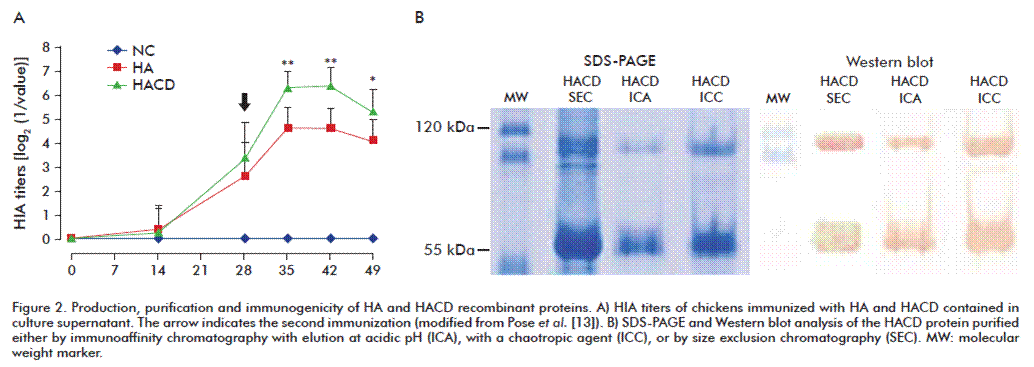
<P   ><font size="2" face="Verdana, Arial, Helvetica, sans-serif"><b>Establishing an      HACD expression system and evaluation of its immunogenicity </b></font></P >       <P   align="justify" ><font size="2" face="Verdana, Arial, Helvetica, sans-serif">Since the immunogenicity      of the HACD protein was higher compared to that of HA molecule alone in the      previous experiment, the HACD protein was selected for optimizing its expression      system in cell lines of different species and at a range of viral concentrations.      As determined by ELISA, the highest HACD concentration was obtained in the      SiHa cell line, which was able to produce more than 4.5 mg/mL of the protein      [13]. This value was significantly higher than those obtained in the other      cell lines (<I>p</I> &lt; 0.001), with HACD concentrations in the MDBK and      HC11 cell lines about 2 mg/mL each. Subsequently, the SiHa cell line was subjected      to several viral concentrations (MOI) in the range of 25 to 800. It was shown      that the amount of HACD produced under these conditions was not proportional      to MOI augmentation, increasing from MOI 25 to 200 and decaying at 400 and      800 [13]. During medium harvesting, dead cells started to appear at MOI 200.      This phenomenon was more evident at MOIs 400 and 800. Therefore, MOI 100 was      selected to produce the HACD protein, since it rendered the highest HACD concentration      in the absence of short term cytopathic effects in host cells. </font></P >       <P   align="justify" ><font size="2" face="Verdana, Arial, Helvetica, sans-serif">Then, the effect      of HA and HACD proteins produced in cell culture on the immune system in chickens      was evaluated, by administering the culture supernatant of either protein      formulated in Montanide 888. The observed HIA kinetics was similar to that      obtained after immunizing with the recombinant adenoviral vectors. Low HIA      titers were induced for both proteins after the first immunization (<a href="/img/revistas/bta/v29n4/f0209412.gif">Figure      2A</a>), followed by increased titers after the booster dose for both proteins      until day 42, which began to decline on day 49. Nevertheless, HIA antibody      titers in animals immunized with HACD were significantly higher than those      obtained with HA for all the determinations after the booster immunization      (<I>p</I> &lt; 0.01 vs.<I> p </I>&lt; 0.05, respectively). </font></P >       
<P   ><font size="2" face="Verdana, Arial, Helvetica, sans-serif"><b>Purification of      the HACD protein </b></font></P >       <P   align="justify" ><font size="2" face="Verdana, Arial, Helvetica, sans-serif">In order to obtain      a highly pure and cell culture impurity-free antigen, the HACD protein was      subjected to three independent purification processes: immunoaffinity chromatography      using elution 1) at acidic pH (ICA) or 2) with a chaotropic agent (ICC), and      3) size exclusion chromatography (SEC) (<a href="/img/revistas/bta/v29n4/f0209412.gif">Figure      2B</a>). SDS-PAGE protein fractionation and immunoidentification by Western      blot confirmed the presence of the HACD protein after its purification by      each of the three methods. The immunoaffinity chromatography, regardless the      solutions used for the elution, yielded about 98% of purity. In the SEC method,      HACD protein purity ranged 75-80%. </font></P >       
]]></body>
<body><![CDATA[<P   ><font size="2" face="Verdana, Arial, Helvetica, sans-serif"><b>Immunogenicity      evaluation of the HACD protein purified by different methods </b></font></P >       <P   align="justify" ><font size="2" face="Verdana, Arial, Helvetica, sans-serif">The first immunization      with the SEC-purified HACD antigen generated HIA titers in 40% of immunized      chickens on day 28. The second immunization induced an immune response in      80% of immunized chickens on day 35. All chicks of this experimental group      induced a humoral immune response on days 42 and 49. Although the HACD purified      by ICA and ICC was about 98% pure, they did not induce antibody responses.      </font></P >       <P   align="justify" ><font size="2" face="Verdana, Arial, Helvetica, sans-serif">During the infection      of the host cell by AIV, the HA protein undergoes conformational changes induced      by the low pH at the endosomal compartment, which facilitates the fusion of      the viral membrane and the escape of the virus to the cytoplasm [15]. Furthermore,      chaotropic agents tend to distort the molecules by interfering with the non-covalent      intramolecular interactions, further increasing entropy and unfolding the      proteins on their primary structures. This total loss of native configuration      caused by the acidic conditions or the chaotropic agent during immunoaffinity      chromatography may hinder the HACD protein from gaining its native structure      during renaturation. This issue could constitute an obstacle for the recovery      of haemagglutinating epitopes. Otherwise, only the HACD protein obtained by      SEC induced a humoral response in vaccinated chickens (4 out of 10 on day      28, 8/10 on day 35 and all the animals seroconverted on day 49). HACD separation      by molecular weight does not damage its structure and helps to preserve the      native configuration, which is responsible of inducing HIA. The results of      cellular responses developed in the groups immunized with culture supernatants      containing the antigens HA and HACD, the HACD purified by SEC or the negative      control, showed a significantly higher level of stimulation in the groups      immunized with HACD compared to the group immunized with HA or the control      group (<I>p</I> &lt; 0.01). However, no significant differences were observed      between the groups immunized with culture supernatants or purified HACD. Although      purity levels of HACD showed no differences in PBMC secretion of IFN-&gamma;,      both were significantly higher than the levels observed for the HA protein      alone, which, at the same time, showed no significant differences compared      to the negative control [13]. In summary, the presence of the chicken CD154      domain in the chimeric protein demonstrates its potential as molecular adjuvant      in the induction of a superior cellular response against the antigen HA. </font></P >       <P   align="justify" >&nbsp;</P >       <P   align="justify" > </P >       <P   ><b><font size="3" face="Verdana, Arial, Helvetica, sans-serif">RELEVANCE OF THE      STUDY </font></b></P >   <FONT size="+1">        <P   align="justify" ><font size="2" face="Verdana, Arial, Helvetica, sans-serif">The experiments with      adenoviral vectors and recombinant proteins shown herein demonstrated that      the fusion of the exposed segment of the viral hemagglutinin subtype H5 to      the exposed domain of the chicken CD154 allows an increased humoral and cellular      immunity against the hemagglutinin of avian influenza virus. Moreover, the      versatility of the recombinant adenoviral vectors enables the production of      the vaccine antigen in tissue culture or the use of these adenoviral vectors      as antigens for immunization of chickens in emergency conditions. This adenoviral      platform also allows the replacement of the hemagglutinin nucleotide sequence      in an easy and quick way. Hence, a new adenoviral construction with the HA      of the circulating strain can always be obtained. In addition, the presence      of the exposed segment of the chicken CD154 assures an increased cellular      response with preserved T epitopes of HA, which might confer some protection      against heterologous strains. Also, the ability of the fused antigen to increase      the adaptive immune response could reduce the cost of a recombinant vaccine,      based on the induction of a protective immune response with a lower antigen      amount. </font></P >       <P   align="justify" >&nbsp;</P >   <FONT size="+1">        <P   align="justify" > </P >       <P   ><b><font size="3" face="Verdana, Arial, Helvetica, sans-serif">CONCLUSIONS </font></b></P >   <FONT size="+1">        ]]></body>
<body><![CDATA[<P   align="justify" ><font size="2" face="Verdana, Arial, Helvetica, sans-serif">Our study demonstrates      increased humoral and cellular immune responses of the HACD molecule, which      could be used as a potential subunit vaccine candidate against the highly      pathogenic AIV subtype H5N1. This could avoid several limitations of conventional      vaccines, such as the limited production capacity due to the use of embryonated      eggs and costs associated to high contention facilities. Although competent      systems for protein expression and purification are needed for manufacturing      an efficient subunit vaccine, and protection by challenging vaccinated chickens      with an H5 highly pathogenic avian influenza strain has to be demonstrated,      the strategy of enhancing antigen immunogenicity by its fusion to the molecular      adjuvant CD154 could lower vaccine production costs and the administered dose      per chicken. Moreover, as the efficacy of unpurified antigen was also demonstrated,      it could be used for chicken vaccination in an emergency situation if its      safety is demonstrated. </font></P >       <P   align="justify" >&nbsp;</P >   <FONT size="+1">        <P   align="justify" > </P >       <P   ><b><font size="3" face="Verdana, Arial, Helvetica, sans-serif">ACKNOWLEDGEMENTS      </font></b></P >   <FONT size="+1">        <P   align="justify" ><font size="2" face="Verdana, Arial, Helvetica, sans-serif">The authors thank      the colleagues from the Center for Genetic Engineering and Biotechnology of      Sancti-Sp&iacute;ritus for providing the immunochemicals for antigen detection.      They are also grateful for their contribution to this study to Enrique P&eacute;rez      and Consuelo P&eacute;rez from Censa, and Sonia Gonz&aacute;lez, Yanaysi Ceballos      and Anays &Aacute;lvarez from the CIGB. </font></P >       <P   align="justify" >&nbsp;</P >   <FONT size="+1">        <P   align="justify" > </P >       <P   align="justify" ><font size="3"><b><font face="Verdana, Arial, Helvetica, sans-serif">REFERENCES      </font></b></font></P >       <!-- ref --><P   align="justify" ><font size="2" face="Verdana, Arial, Helvetica, sans-serif">1. Buscaglia C. Influenza      Aviar. InVet. 2004;6(1):71-84.     </font></P >   <FONT size="+1">        ]]></body>
<body><![CDATA[<!-- ref --><P   align="justify" ><font size="2" face="Verdana, Arial, Helvetica, sans-serif">2. Suguitan AL, Jr,      Cheng X, Wang W, Wang S, Jin H, Lu S. Influenza H5 hemagglutinin DNA primes      the antibody response elicited by the live attenuated influenza A/Vietnam/1203/2004      vaccine in ferrets. PLoS One. 2011;6(7):e21942.     </font></P >       <!-- ref --><P   align="justify" ><font size="2" face="Verdana, Arial, Helvetica, sans-serif">3. Horimoto T, Kawaoka      Y. Pandemic threat posed by avian influenza A viruses. Clin Microbiol Rev.      2001;14(1):129-49.     </font></P >       <!-- ref --><P   align="justify" ><font size="2" face="Verdana, Arial, Helvetica, sans-serif">4. Hoffmann E, Krauss      S, Perez D, Webby R, Webster RG. Eight-plasmid system for rapid generation      of influenza virus vaccines. Vaccine. 2002;20(25-26):3165-70.     </font></P >       <!-- ref --><P   align="justify" ><font size="2" face="Verdana, Arial, Helvetica, sans-serif">5. McPherson CE.      Development of a novel recombinant influenza vaccine in insect cells. Biologicals.      2008;36(6):350-3.     </font></P >       <!-- ref --><P   align="justify" ><font size="2" face="Verdana, Arial, Helvetica, sans-serif">6. Pentcheva-Hoang      T, Corse E, Allison JP. Negative regulators of T-cell activation: potential      targets for therapeutic intervention in cancer, autoimmune disease, and persistent      infections. Immunol Rev. 2009;229(1):67-87.     </font></P >       ]]></body>
<body><![CDATA[<!-- ref --><P   align="justify" ><font size="2" face="Verdana, Arial, Helvetica, sans-serif">7. Gray D, Siepmann      K, Wohlleben G. CD40 ligation in B cell activation, isotype switching and      memory development. Semin Immunol. 1994;6(5):303-10.     </font></P >       <!-- ref --><P   align="justify" ><font size="2" face="Verdana, Arial, Helvetica, sans-serif">8. Li W. Synergistic      antibody induction by antigen-CD40 ligand fusion protein as improved immunogen.      Immunology. 2005;115(2):215-22.     </font></P >       <!-- ref --><P   align="justify" ><font size="2" face="Verdana, Arial, Helvetica, sans-serif">9. Stone GW, Barzee      S, Snarsky V, Kee K, Spina CA, Yu XF, et al. Multimeric soluble CD40 ligand      and GITR ligand as adjuvants for human immunodeficiency virus DNA vaccines.      J Virol. 2006;80(4):1762-72.     </font></P >       <!-- ref --><P   align="justify" ><font size="2" face="Verdana, Arial, Helvetica, sans-serif">10. Fischer KP, Gares      SL, Wang D, Lorne Tyrrell D, Gutfreund KS. Identification and characterization      of functional CD154 (CD40 ligand) in the Pekin duck. Dev Comp Immunol. 2007;31(1):61-71.          </font></P >       <!-- ref --><P   align="justify" ><font size="2" face="Verdana, Arial, Helvetica, sans-serif">11. Ross TM, Xu Y,      Bright RA, Robinson HL. C3d enhancement of antibodies to hemagglutinin accelerates      protection against influenza virus challenge. Nat Immunol. 2000;1(2):127-31.          </font></P >       ]]></body>
<body><![CDATA[<P   align="justify" ><font size="2" face="Verdana, Arial, Helvetica, sans-serif">12. Sanchez Ramos      O, Gonzalez Pose A, Gomez-Puerta S, Noda Gomez J, Vega Redondo A, Aguila Benites      JC, et al. Avian CD154 enhances humoral and cellular immune responses induced      by an adenovirus vector-based vaccine in chickens. Comp Immunol Microbiol      Infect Dis. 2011;34(3):259-65. </font></P >       <P   align="justify" ><font size="2" face="Verdana, Arial, Helvetica, sans-serif">13. Pose AG, Gomez      JN, Sanchez AV, Redondo AV, Rodriguez ER, Segui RM, et al. Subunit influenza      vaccine candidate based on CD154 fused to HAH5 increases the antibody titers      and cellular immune response in chickens. Vet Microbiol. 2011;152(3-4):328-37.      </font></P >       <P   align="justify" ><font size="2" face="Verdana, Arial, Helvetica, sans-serif">14. Peitsch MC, Jongeneel      CV. A 3-D model for the CD40 ligand predicts that it is a compact trimer similar      to the tumor necrosis factors. Int Immunol. 1993;5(2):233-8. </font></P >       <!-- ref --><P   align="justify" ><font size="2" face="Verdana, Arial, Helvetica, sans-serif">15. Gaudin Y, Ruigrok      RW, Brunner J. Low-pH induced conformational changes in viral fusion proteins:      implications for the fusion mechanism. J Gen Virol. 1995;76(Pt 7):1541-56.          </font></P >       <P   align="justify" >&nbsp;</P >       <P   align="justify" >&nbsp;</P >       <P   align="justify" > </P >       <P   align="justify" > </P >   <FONT size="+1">        <P   align="justify" ><font size="2" face="Verdana, Arial, Helvetica, sans-serif"><I>Ala&iacute;n Gonz&aacute;lez</I>.      Departamento de Biotecnolog&iacute;a Animal, Centro de Ingenier&iacute;a Gen&eacute;tica      y Biotecnolog&iacute;a, CIGB. Ave. 31 e/ 158 y 190, Cubanac&aacute;n, Playa,      CP 11 600, La Habana, Cuba. E-mail: <A href="mailto:alain.pose@cigb.edu.cu">      <U><U><FONT color="#0000FF">alain.pose@cigb.edu.cu</font></U></U></A><FONT color="#0000FF"><FONT color="#000000">.      </font></font></font></P >   </font></font></font></font></font></font></font></font></font></font></font></font></font></font></font></font></font></font></font></font></font></font></font></font></font></font></font></font></font></font></font></font></font></font></font></font></font></font></font></font></font></font></font></font></font></font></font></font></font></font></DIV >     ]]></body>
<body><![CDATA[ ]]></body><back>
<ref-list>
<ref id="B1">
<label>1</label><nlm-citation citation-type="journal">
<person-group person-group-type="author">
<name>
<surname><![CDATA[Buscaglia]]></surname>
<given-names><![CDATA[C]]></given-names>
</name>
</person-group>
<article-title xml:lang="en"><![CDATA[Influenza Aviar]]></article-title>
<source><![CDATA[InVet]]></source>
<year>2004</year>
<volume>6</volume>
<numero>1</numero>
<issue>1</issue>
<page-range>71-84</page-range></nlm-citation>
</ref>
<ref id="B2">
<label>2</label><nlm-citation citation-type="journal">
<person-group person-group-type="author">
<name>
<surname><![CDATA[Suguitan]]></surname>
<given-names><![CDATA[AL Jr]]></given-names>
</name>
<name>
<surname><![CDATA[Cheng]]></surname>
<given-names><![CDATA[X]]></given-names>
</name>
<name>
<surname><![CDATA[Wang]]></surname>
<given-names><![CDATA[W]]></given-names>
</name>
<name>
<surname><![CDATA[Wang]]></surname>
<given-names><![CDATA[S]]></given-names>
</name>
<name>
<surname><![CDATA[Jin]]></surname>
<given-names><![CDATA[H]]></given-names>
</name>
<name>
<surname><![CDATA[Lu]]></surname>
<given-names><![CDATA[S]]></given-names>
</name>
</person-group>
<article-title xml:lang="en"><![CDATA[Influenza H5 hemagglutinin DNA primes the antibody response elicited by the live attenuated influenza A/Vietnam/1203/2004 vaccine in ferrets]]></article-title>
<source><![CDATA[PLoS One]]></source>
<year>2011</year>
<volume>6</volume>
<numero>7</numero>
<issue>7</issue>
<page-range>e21942</page-range></nlm-citation>
</ref>
<ref id="B3">
<label>3</label><nlm-citation citation-type="journal">
<person-group person-group-type="author">
<name>
<surname><![CDATA[Horimoto]]></surname>
<given-names><![CDATA[T]]></given-names>
</name>
<name>
<surname><![CDATA[Kawaoka]]></surname>
<given-names><![CDATA[Y]]></given-names>
</name>
</person-group>
<article-title xml:lang="en"><![CDATA[Pandemic threat posed by avian influenza A viruses]]></article-title>
<source><![CDATA[Clin Microbiol Rev]]></source>
<year>2001</year>
<volume>14</volume>
<numero>1</numero>
<issue>1</issue>
<page-range>129-49</page-range></nlm-citation>
</ref>
<ref id="B4">
<label>4</label><nlm-citation citation-type="journal">
<person-group person-group-type="author">
<name>
<surname><![CDATA[Hoffmann]]></surname>
<given-names><![CDATA[E]]></given-names>
</name>
<name>
<surname><![CDATA[Krauss]]></surname>
<given-names><![CDATA[S]]></given-names>
</name>
<name>
<surname><![CDATA[Perez]]></surname>
<given-names><![CDATA[D]]></given-names>
</name>
<name>
<surname><![CDATA[Webby]]></surname>
<given-names><![CDATA[R]]></given-names>
</name>
<name>
<surname><![CDATA[Webster]]></surname>
<given-names><![CDATA[RG]]></given-names>
</name>
</person-group>
<article-title xml:lang="en"><![CDATA[Eight-plasmid system for rapid generation of influenza virus vaccines]]></article-title>
<source><![CDATA[Vaccine]]></source>
<year>2002</year>
<volume>20</volume>
<numero>25-26</numero>
<issue>25-26</issue>
<page-range>3165-70</page-range></nlm-citation>
</ref>
<ref id="B5">
<label>5</label><nlm-citation citation-type="journal">
<person-group person-group-type="author">
<name>
<surname><![CDATA[McPherson]]></surname>
<given-names><![CDATA[CE]]></given-names>
</name>
</person-group>
<article-title xml:lang="en"><![CDATA[Development of a novel recombinant influenza vaccine in insect cells]]></article-title>
<source><![CDATA[Biologicals]]></source>
<year>2008</year>
<volume>36</volume>
<numero>6</numero>
<issue>6</issue>
<page-range>350-3</page-range></nlm-citation>
</ref>
<ref id="B6">
<label>6</label><nlm-citation citation-type="journal">
<person-group person-group-type="author">
<name>
<surname><![CDATA[Pentcheva-Hoang]]></surname>
<given-names><![CDATA[T]]></given-names>
</name>
<name>
<surname><![CDATA[Corse]]></surname>
<given-names><![CDATA[E]]></given-names>
</name>
<name>
<surname><![CDATA[Allison]]></surname>
<given-names><![CDATA[JP]]></given-names>
</name>
</person-group>
<article-title xml:lang="en"><![CDATA[Negative regulators of T-cell activation: potential targets for therapeutic intervention in cancer, autoimmune disease, and persistent infections]]></article-title>
<source><![CDATA[Immunol Rev]]></source>
<year>2009</year>
<volume>229</volume>
<numero>1</numero>
<issue>1</issue>
<page-range>67-87</page-range></nlm-citation>
</ref>
<ref id="B7">
<label>7</label><nlm-citation citation-type="journal">
<person-group person-group-type="author">
<name>
<surname><![CDATA[Gray]]></surname>
<given-names><![CDATA[D]]></given-names>
</name>
<name>
<surname><![CDATA[Siepmann]]></surname>
<given-names><![CDATA[K]]></given-names>
</name>
<name>
<surname><![CDATA[Wohlleben]]></surname>
<given-names><![CDATA[G]]></given-names>
</name>
</person-group>
<article-title xml:lang="en"><![CDATA[CD40 ligation in B cell activation, isotype switching and memory development]]></article-title>
<source><![CDATA[Semin Immunol]]></source>
<year>1994</year>
<volume>6</volume>
<numero>5</numero>
<issue>5</issue>
<page-range>303-10</page-range></nlm-citation>
</ref>
<ref id="B8">
<label>8</label><nlm-citation citation-type="journal">
<person-group person-group-type="author">
<name>
<surname><![CDATA[Li]]></surname>
<given-names><![CDATA[W]]></given-names>
</name>
</person-group>
<article-title xml:lang="en"><![CDATA[Synergistic antibody induction by antigen-CD40 ligand fusion protein as improved immunogen]]></article-title>
<source><![CDATA[Immunology]]></source>
<year>2005</year>
<volume>115</volume>
<numero>2</numero>
<issue>2</issue>
<page-range>215-22</page-range></nlm-citation>
</ref>
<ref id="B9">
<label>9</label><nlm-citation citation-type="journal">
<person-group person-group-type="author">
<name>
<surname><![CDATA[Stone]]></surname>
<given-names><![CDATA[GW]]></given-names>
</name>
<name>
<surname><![CDATA[Barzee]]></surname>
<given-names><![CDATA[S]]></given-names>
</name>
<name>
<surname><![CDATA[Snarsky]]></surname>
<given-names><![CDATA[V]]></given-names>
</name>
<name>
<surname><![CDATA[Kee]]></surname>
<given-names><![CDATA[K]]></given-names>
</name>
<name>
<surname><![CDATA[Spina]]></surname>
<given-names><![CDATA[CA]]></given-names>
</name>
<name>
<surname><![CDATA[Yu]]></surname>
<given-names><![CDATA[XF]]></given-names>
</name>
</person-group>
<article-title xml:lang="en"><![CDATA[Multimeric soluble CD40 ligand and GITR ligand as adjuvants for human immunodeficiency virus DNA vaccines]]></article-title>
<source><![CDATA[J Virol]]></source>
<year>2006</year>
<volume>80</volume>
<numero>4</numero>
<issue>4</issue>
<page-range>1762-72</page-range></nlm-citation>
</ref>
<ref id="B10">
<label>10</label><nlm-citation citation-type="journal">
<person-group person-group-type="author">
<name>
<surname><![CDATA[Fischer]]></surname>
<given-names><![CDATA[KP]]></given-names>
</name>
<name>
<surname><![CDATA[Gares]]></surname>
<given-names><![CDATA[SL]]></given-names>
</name>
<name>
<surname><![CDATA[Wang]]></surname>
<given-names><![CDATA[D]]></given-names>
</name>
<name>
<surname><![CDATA[Lorne Tyrrell]]></surname>
<given-names><![CDATA[D]]></given-names>
</name>
<name>
<surname><![CDATA[Gutfreund]]></surname>
<given-names><![CDATA[KS]]></given-names>
</name>
</person-group>
<article-title xml:lang="en"><![CDATA[Identification and characterization of functional CD154 (CD40 ligand) in the Pekin duck]]></article-title>
<source><![CDATA[Dev Comp Immunol]]></source>
<year>2007</year>
<volume>31</volume>
<numero>1</numero>
<issue>1</issue>
<page-range>61-71</page-range></nlm-citation>
</ref>
<ref id="B11">
<label>11</label><nlm-citation citation-type="journal">
<person-group person-group-type="author">
<name>
<surname><![CDATA[Ross]]></surname>
<given-names><![CDATA[TM]]></given-names>
</name>
<name>
<surname><![CDATA[Xu]]></surname>
<given-names><![CDATA[Y]]></given-names>
</name>
<name>
<surname><![CDATA[Bright]]></surname>
<given-names><![CDATA[RA]]></given-names>
</name>
<name>
<surname><![CDATA[Robinson]]></surname>
<given-names><![CDATA[HL]]></given-names>
</name>
</person-group>
<article-title xml:lang="en"><![CDATA[C3d enhancement of antibodies to hemagglutinin accelerates protection against influenza virus challenge]]></article-title>
<source><![CDATA[Nat Immunol]]></source>
<year>2000</year>
<volume>1</volume>
<numero>2</numero>
<issue>2</issue>
<page-range>127-31</page-range></nlm-citation>
</ref>
<ref id="B12">
<label>12</label><nlm-citation citation-type="journal">
<person-group person-group-type="author">
<name>
<surname><![CDATA[Pose]]></surname>
<given-names><![CDATA[AG]]></given-names>
</name>
<name>
<surname><![CDATA[Gomez]]></surname>
<given-names><![CDATA[JN]]></given-names>
</name>
<name>
<surname><![CDATA[Sanchez]]></surname>
<given-names><![CDATA[AV]]></given-names>
</name>
<name>
<surname><![CDATA[Redondo]]></surname>
<given-names><![CDATA[AV]]></given-names>
</name>
<name>
<surname><![CDATA[Rodriguez]]></surname>
<given-names><![CDATA[ER]]></given-names>
</name>
<name>
<surname><![CDATA[Segui]]></surname>
<given-names><![CDATA[RM]]></given-names>
</name>
</person-group>
<article-title xml:lang="en"><![CDATA[Subunit influenza vaccine candidate based on CD154 fused to HAH5 increases the antibody titers and cellular immune response in chickens]]></article-title>
<source><![CDATA[Vet Microbiol]]></source>
<year>2011</year>
<volume>152</volume>
<numero>3-4</numero>
<issue>3-4</issue>
<page-range>328-37</page-range></nlm-citation>
</ref>
<ref id="B13">
<label>13</label><nlm-citation citation-type="journal">
<person-group person-group-type="author">
<name>
<surname><![CDATA[Peitsch]]></surname>
<given-names><![CDATA[MC]]></given-names>
</name>
<name>
<surname><![CDATA[Jongeneel]]></surname>
<given-names><![CDATA[CV]]></given-names>
</name>
</person-group>
<article-title xml:lang="en"><![CDATA[A 3-D model for the CD40 ligand predicts that it is a compact trimer similar to the tumor necrosis factors]]></article-title>
<source><![CDATA[Int Immunol]]></source>
<year>1993</year>
<volume>5</volume>
<numero>2</numero>
<issue>2</issue>
<page-range>233-8</page-range></nlm-citation>
</ref>
<ref id="B14">
<label>14</label><nlm-citation citation-type="journal">
<person-group person-group-type="author">
<name>
<surname><![CDATA[Sanchez Ramos]]></surname>
<given-names><![CDATA[O]]></given-names>
</name>
<name>
<surname><![CDATA[Gonzalez Pose]]></surname>
<given-names><![CDATA[A]]></given-names>
</name>
<name>
<surname><![CDATA[Gomez-Puerta]]></surname>
<given-names><![CDATA[S]]></given-names>
</name>
<name>
<surname><![CDATA[Noda Gomez]]></surname>
<given-names><![CDATA[J]]></given-names>
</name>
<name>
<surname><![CDATA[Vega Redondo]]></surname>
<given-names><![CDATA[A]]></given-names>
</name>
<name>
<surname><![CDATA[Aguila Benites]]></surname>
<given-names><![CDATA[JC]]></given-names>
</name>
</person-group>
<article-title xml:lang="en"><![CDATA[Avian CD154 enhances humoral and cellular immune responses induced by an adenovirus vector-based vaccine in chickens]]></article-title>
<source><![CDATA[Comp Immunol Microbiol Infect Dis]]></source>
<year>2011</year>
<volume>34</volume>
<numero>3</numero>
<issue>3</issue>
<page-range>259-65</page-range></nlm-citation>
</ref>
<ref id="B15">
<label>15</label><nlm-citation citation-type="journal">
<person-group person-group-type="author">
<name>
<surname><![CDATA[Gaudin]]></surname>
<given-names><![CDATA[Y]]></given-names>
</name>
<name>
<surname><![CDATA[Ruigrok]]></surname>
<given-names><![CDATA[RW]]></given-names>
</name>
<name>
<surname><![CDATA[Brunner]]></surname>
<given-names><![CDATA[J]]></given-names>
</name>
</person-group>
<article-title xml:lang="en"><![CDATA[Low-pH induced conformational changes in viral fusion proteins: implications for the fusion mechanism]]></article-title>
<source><![CDATA[J Gen Virol]]></source>
<year>1995</year>
<volume>76</volume>
<numero>7</numero>
<issue>7</issue>
<page-range>1541-56</page-range></nlm-citation>
</ref>
</ref-list>
</back>
</article>