<?xml version="1.0" encoding="ISO-8859-1"?><article xmlns:mml="http://www.w3.org/1998/Math/MathML" xmlns:xlink="http://www.w3.org/1999/xlink" xmlns:xsi="http://www.w3.org/2001/XMLSchema-instance">
<front>
<journal-meta>
<journal-id>1027-2852</journal-id>
<journal-title><![CDATA[Biotecnología Aplicada]]></journal-title>
<abbrev-journal-title><![CDATA[Biotecnol Apl]]></abbrev-journal-title>
<issn>1027-2852</issn>
<publisher>
<publisher-name><![CDATA[Editorial Elfos Scientiae]]></publisher-name>
</publisher>
</journal-meta>
<article-meta>
<article-id>S1027-28522013000200006</article-id>
<title-group>
<article-title xml:lang="en"><![CDATA[Evaluation of four viroid RNA extraction methods for the molecular diagnosis of CEVd in Citrus lemon using RT-PCR, Dot blot and Northern blot]]></article-title>
<article-title xml:lang="es"><![CDATA[Evaluación de cuatro métodos de extracción de ARN viroide para el diagnóstico molecular de CEVd en Citrus limon mediante RT-PCR, Dot blot y Northern blot]]></article-title>
</title-group>
<contrib-group>
<contrib contrib-type="author">
<name>
<surname><![CDATA[Umaña]]></surname>
<given-names><![CDATA[Rodolfo]]></given-names>
</name>
<xref ref-type="aff" rid="A01"/>
</contrib>
<contrib contrib-type="author">
<name>
<surname><![CDATA[Pritsch]]></surname>
<given-names><![CDATA[Clara]]></given-names>
</name>
<xref ref-type="aff" rid="A01"/>
</contrib>
<contrib contrib-type="author">
<name>
<surname><![CDATA[Arbiza]]></surname>
<given-names><![CDATA[Juan R]]></given-names>
</name>
<xref ref-type="aff" rid="A02"/>
</contrib>
<contrib contrib-type="author">
<name>
<surname><![CDATA[Rivas]]></surname>
<given-names><![CDATA[Fernando]]></given-names>
</name>
<xref ref-type="aff" rid="A03"/>
</contrib>
<contrib contrib-type="author">
<name>
<surname><![CDATA[Pagliano]]></surname>
<given-names><![CDATA[Gabriela]]></given-names>
</name>
<xref ref-type="aff" rid="A01"/>
</contrib>
</contrib-group>
<aff id="A02">
<institution><![CDATA[,Universidad de la República Facultad de Ciencias Sección Virología]]></institution>
<addr-line><![CDATA[Montevideo ]]></addr-line>
<country>Uruguay</country>
</aff>
<aff id="A03">
<institution><![CDATA[,Instituto Nacional de Investigación Agropecuaria, INIA  ]]></institution>
<addr-line><![CDATA[Salto ]]></addr-line>
<country>Uruguay</country>
</aff>
<aff id="A01">
<institution><![CDATA[,Universidad de la República Facultad de Agronomía Departamento de Biología Vegetal]]></institution>
<addr-line><![CDATA[Montevideo ]]></addr-line>
<country>Uruguay</country>
</aff>
<pub-date pub-type="pub">
<day>00</day>
<month>06</month>
<year>2013</year>
</pub-date>
<pub-date pub-type="epub">
<day>00</day>
<month>06</month>
<year>2013</year>
</pub-date>
<volume>30</volume>
<numero>2</numero>
<fpage>131</fpage>
<lpage>136</lpage>
<copyright-statement/>
<copyright-year/>
<self-uri xlink:href="http://scielo.sld.cu/scielo.php?script=sci_arttext&amp;pid=S1027-28522013000200006&amp;lng=en&amp;nrm=iso"></self-uri><self-uri xlink:href="http://scielo.sld.cu/scielo.php?script=sci_abstract&amp;pid=S1027-28522013000200006&amp;lng=en&amp;nrm=iso"></self-uri><self-uri xlink:href="http://scielo.sld.cu/scielo.php?script=sci_pdf&amp;pid=S1027-28522013000200006&amp;lng=en&amp;nrm=iso"></self-uri><abstract abstract-type="short" xml:lang="en"><p><![CDATA[An efficient method for RNA extraction that leads to RNA high yield and purity is a technical issue relevant for development and optimization of molecular diagnostic methods aimed to detect viroid infections in citrus varieties. Residual contaminants may affect RNA detection depending on the molecular diagnosis approaches. This condition can be evaluated through RNA absorption spectrum analysis. Functionally, it is assessed through observation of RT-PCR amplification products and Northern blot and Dot-blot signal intensities, displaying levels of analytical response/sensitivity. Four RNA extraction methods were evaluated to determine their effects on the capacity to detect viroid CEVd presence/absence in Citrus limon through four molecular diagnostic approaches: 1) conventional viroid extraction (CVE); 2) phenol/guanidine thiocyanate (PGT), 3) SDS/potassium acetate (SPA); and 4) formaldehyde/ SSC (FS). Phloem tissue quantifications showed values between 7500 ng/µL and 1200 ng/µL and ranged 1.3-2.0 OD260/280. Evaluations through RT-PCR showed the expected amplifications of the entire CEVd genome, but erratic scenarios still remained. Non-radioactive probe hybridization techniques revealed high intensity signals (132 RU) for infected tissue, by using the CVE method, and a positivity cut-off for the presence of infection was established (78 RU). Nevertheless, molecular hybridization tools can jeopardize the diagnosis due to the thoroughness of the protocol and the RNA template conditions. The diagnostic ability of the association of Northern blot with CVE viroid extraction analyses as starting point was evidenced for successful detection, among the molecular methods tested.]]></p></abstract>
<abstract abstract-type="short" xml:lang="es"><p><![CDATA[En el desarrollo de metodologías moleculares diagnósticas en variedades cítricas propensas a infección viroide, se precisa la extracción eficiente de ARN, siguiendo criterios de concentración y pureza. Los contaminantes remanentes pueden afectar la detección según la herramienta molecular escogida. Esta condición se analiza a partir del espectro de absorción del ARN; mediante la reacción en cadena de la polimerasa con transcriptasa inversa (RT-PCR) y por los niveles de intensidad de las señales de Northern blot y Dot blot, en términos de respuesta analítica/sensibilidad. Se evaluaron cuatro métodos de extracción de ARN, por sus efectos sobre la detección de presencia/ausencia del Citrus Exocortis Viroid (CEVd) en Citrus limon mediante análisis moleculares diagnósticos: 1) extracción viroide convencional (EVC); 2) fenol/tiocianato de guanidina (FTG); 3) SDS/acetato de potasio (SAP); y 4) formaldehído/SSC (FS). Los valores del tejido de floema estuvieron entre 7500 ng/µL y 1200 ng/µL y los rangos entre 1.3 y 2.]]></p></abstract>
<kwd-group>
<kwd lng="en"><![CDATA[CEVd]]></kwd>
<kwd lng="en"><![CDATA[diagnostic]]></kwd>
<kwd lng="en"><![CDATA[non-radiactive Northern blot]]></kwd>
<kwd lng="en"><![CDATA[RT-PCR]]></kwd>
<kwd lng="en"><![CDATA[citrus viroids]]></kwd>
<kwd lng="es"><![CDATA[CEVd]]></kwd>
<kwd lng="es"><![CDATA[diagnóstico]]></kwd>
<kwd lng="es"><![CDATA[Northern blot no radiactivo]]></kwd>
<kwd lng="es"><![CDATA[RT-PCR]]></kwd>
<kwd lng="es"><![CDATA[viroides cítrico]]></kwd>
</kwd-group>
</article-meta>
</front><body><![CDATA[ <DIV class="Sect"   >        <P   align="right" ><font size="2" color="#000000" face="Verdana, Arial, Helvetica, sans-serif"><b>TECHNIQUE</b>      </font></P >       <P   align="right" >&nbsp;</P >   <FONT size="+1" color="#000000">       <P   ><b><font size="4" face="Verdana, Arial, Helvetica, sans-serif">Evaluation of      four viroid RNA extraction methods for the molecular diagnosis of CEVd in      <I>Citrus lemon</I> using RT-PCR, Dot blot and Northern blot </font></b></P >       <P   >&nbsp;</P >       <P   > </P >       <P   ><font size="3"><b><font face="Verdana, Arial, Helvetica, sans-serif">Evaluaci&oacute;n      de cuatro m&eacute;todos de extracci&oacute;n de ARN viroide para el diagn&oacute;stico      molecular de CEVd en <I>Citrus limon</I> mediante RT-PCR, Dot blot y Northern      blot </font></b></font></P >       <P   >&nbsp;</P >       <P   >&nbsp;</P >       <P   ></P >       ]]></body>
<body><![CDATA[<P   > </P >       <P   > </P >       <P   ><b><font size="2" face="Verdana, Arial, Helvetica, sans-serif">Rodolfo Uma&ntilde;a<Sup>1</Sup>,      Clara Pritsch<Sup>1</Sup>, Juan R Arbiza<Sup>2</Sup>, Fernando Rivas<Sup>3</Sup>,      Gabriela Pagliano<Sup>1</Sup></font></b></P >   <FONT size="+1"><FONT size="+1"><FONT size="+1"><FONT size="+1"><FONT size="+1"><FONT size="+1"><FONT size="+1"><FONT size="+1"><FONT size="+1"><FONT size="+1">        <P   ><font size="2" face="Verdana, Arial, Helvetica, sans-serif"><Sup>1</Sup> Departamento      de Biolog&iacute;a Vegetal, Facultad de Agronom&iacute;a, Universidad de la      Rep&uacute;blica. Garz&oacute;n 780, Montevideo, Uruguay.</font><FONT size="+1"><FONT size="+1"></font></font>    <br>     <font size="2" face="Verdana, Arial, Helvetica, sans-serif"><Sup>2</Sup> Secci&oacute;n      Virolog&iacute;a, Facultad de Ciencias, Universidad de la Rep&uacute;blica.      Igu&aacute; 4225, Montevideo, Uruguay. </font>    <br>     <font size="2" face="Verdana, Arial, Helvetica, sans-serif"><Sup>3</Sup> Instituto      Nacional de Investigaci&oacute;n Agropecuaria, INIA. Ruta 3 Camino al Terrible.      Salto, Uruguay. </font></P >   <FONT size="+1"><FONT size="+1"><FONT size="+1"><FONT size="+1">        <P   >&nbsp;</P >       <P   >&nbsp;</P >   </font></font></font></font></font></font></font></font></font></font></font></font></font></font></font>    <hr>   <FONT size="+1" color="#000000"><FONT size="+1"><FONT size="+1"><FONT size="+1"><FONT size="+1"><FONT size="+1"><FONT size="+1"><FONT size="+1"><FONT size="+1"><FONT size="+1"><FONT size="+1"><FONT size="+1"><FONT size="+1"><FONT size="+1"><FONT size="+1">       <P   ><FONT size="+1"><FONT size="+1"></font></font><b><font size="2" face="Verdana, Arial, Helvetica, sans-serif">ABSTRACT      </font></b></P >   <FONT size="+1"><FONT size="+1"><FONT size="+1">        <P   ><font size="2" face="Verdana, Arial, Helvetica, sans-serif">An efficient method      for RNA extraction that leads to RNA high yield and purity is a technical      issue relevant for development and optimization of molecular diagnostic methods      aimed to detect viroid infections in citrus varieties. Residual contaminants      may affect RNA detection depending on the molecular diagnosis approaches.      This condition can be evaluated through RNA absorption spectrum analysis.      Functionally, it is assessed through observation of RT-PCR amplification products      and Northern blot and Dot-blot signal intensities, displaying levels of analytical      response/sensitivity. Four RNA extraction methods were evaluated to determine      their effects on the capacity to detect viroid <I>CEVd</I> presence/absence      in <I>Citrus limon</I> through four molecular diagnostic approaches: 1) conventional      viroid extraction (CVE); 2) phenol/guanidine thiocyanate (PGT), 3) SDS/potassium      acetate (SPA); and 4) formaldehyde/ SSC (FS). Phloem tissue quantifications      showed values between 7500 ng/&micro;L and 1200 ng/&micro;L and ranged 1.3-2.0      OD<Sub>260/280</Sub>. Evaluations through RT-PCR showed the expected amplifications      of the entire CEVd genome, but erratic scenarios still remained. Non-radioactive      probe hybridization techniques revealed high intensity signals (132 RU) for      infected tissue, by using the CVE method, and a positivity cut-off for the      presence of infection was established (78 RU). Nevertheless, molecular hybridization      tools can jeopardize the diagnosis due to the thoroughness of the protocol      and the RNA template conditions. The diagnostic ability of the association      of Northern blot with CVE viroid extraction analyses as starting point was      evidenced for successful detection, among the molecular methods tested. </font></P >   <FONT size="+1"><FONT size="+1">        ]]></body>
<body><![CDATA[<P   ><font size="2" face="Verdana, Arial, Helvetica, sans-serif"><b>Keywords:</b>      <I>CEVd</I>, diagnostic, non-radiactive Northern blot, RT-PCR, citrus viroids.      </font></P >   </font></font></font></font></font></font></font></font></font></font></font></font></font></font></font></font></font></font></font></font>    <hr>   <FONT size="+1" color="#000000"><FONT size="+1"><FONT size="+1"><FONT size="+1"><FONT size="+1"><FONT size="+1"><FONT size="+1"><FONT size="+1"><FONT size="+1"><FONT size="+1"><FONT size="+1"><FONT size="+1"><FONT size="+1"><FONT size="+1"><FONT size="+1"><FONT size="+1"><FONT size="+1"><FONT size="+1"><FONT size="+1"><FONT size="+1">       <P   > </P >       <P   ><b><font size="2" face="Verdana, Arial, Helvetica, sans-serif">RESUMEN</font></b><font size="2" face="Verdana, Arial, Helvetica, sans-serif">      </font></P >       <P   align="justify" ><font size="2" face="Verdana, Arial, Helvetica, sans-serif">En el desarrollo      de metodolog&iacute;as moleculares diagn&oacute;sticas en variedades c&iacute;tricas      propensas a infecci&oacute;n viroide, se precisa la extracci&oacute;n eficiente      de ARN, siguiendo criterios de concentraci&oacute;n y pureza. Los contaminantes      remanentes pueden afectar la detecci&oacute;n seg&uacute;n la herramienta      molecular escogida. Esta condici&oacute;n se analiza a partir del espectro      de absorci&oacute;n del ARN; mediante la reacci&oacute;n en cadena de la polimerasa      con transcriptasa inversa (RT-PCR) y por los niveles de intensidad de las      se&ntilde;ales de <I>Northern blot</I> y <I>Dot blot</I>, en t&eacute;rminos      de respuesta anal&iacute;tica/sensibilidad. Se evaluaron cuatro m&eacute;todos      de extracci&oacute;n de ARN, por sus efectos sobre la detecci&oacute;n de      presencia/ausencia del <I>Citrus Exocortis Viroid</I> (<I>CEVd</I>) en <I>Citrus      limon</I> mediante an&aacute;lisis moleculares diagn&oacute;sticos: 1) extracci&oacute;n      viroide convencional (EVC); 2) fenol/tiocianato de guanidina (FTG); 3) SDS/acetato      de potasio (SAP); y 4) formaldeh&iacute;do/SSC (FS). Los valores del tejido      de floema estuvieron entre 7500 ng/&micro;L y 1200 ng/&micro;L y los rangos      entre 1.3 y 2.0 DO</font></P >       <P   ><font size="2" face="Verdana, Arial, Helvetica, sans-serif"><b>Palabras clave:</b>      <I>CEVd</I>, diagn&oacute;stico, <I>Northern blot</I> no radiactivo, RT-PCR,      viroides c&iacute;tricos. </font></P >   </font></font></font></font></font></font></font></font></font></font></font></font></font></font></font></font></font></font></font></font>    <hr>   <FONT size="+1" color="#000000"><FONT size="+1"><FONT size="+1"><FONT size="+1"><FONT size="+1"><FONT size="+1"><FONT size="+1"><FONT size="+1"><FONT size="+1"><FONT size="+1"><FONT size="+1"><FONT size="+1"><FONT size="+1"><FONT size="+1"><FONT size="+1"><FONT size="+1"><FONT size="+1"><FONT size="+1"><FONT size="+1"><FONT size="+1">        <P   ><font size="2" face="Verdana, Arial, Helvetica, sans-serif"> </font></P >       <P   >&nbsp;</P >       <P   >&nbsp;</P >       <P   ><font size="2" face="Verdana, Arial, Helvetica, sans-serif"><B><font size="3">INTRODUCTION</font></b></font></P >   <FONT size="+1">        <P   align="justify" ><font size="2" face="Verdana, Arial, Helvetica, sans-serif">Citrus viroids<I>      </I>(CVd) are subviral pathogenic entities of the Pospiviroidae family. They      lack the capsid protein and are formed solely by circular RNA (284-375 nucleotides),      a covalently closed non-coding single strand with regions of high intramolecular      complementarity [1]. </font></P >   <FONT size="+1">        ]]></body>
<body><![CDATA[<P   align="justify" ><font size="2" face="Verdana, Arial, Helvetica, sans-serif">According to the      classification suggested by Flores <I>et al. </I>[2] with the modifications      of the Viroid Study Group of the International Committee on Taxonomy of Viruses      (ICTV) (<A href="http://www.ictvonline.org/virusTaxonomy.asp" target="_blank"><U><U><FONT color="#0000FF">www.ictvonline.org/virusTaxonomy.asp</font></U></U></A><FONT color="#0000FF"><FONT color="#000000">),      the CVd are formed by the following species: <I>CEVd</I>, <I>CBLVd</I>, <I>HSVd</I>,      <I>CDVd</I>, <I>CBCVd</I>, <I>CVd-V </I>and <I>CVd-VI</I>.<B><I> </I></b></font></font></font></P >   <FONT color="#0000FF"><FONT color="#000000">        <P   align="justify" ><font size="2" face="Verdana, Arial, Helvetica, sans-serif">In general, the diagnosis      of CVd infections involves important limitations. The methods based on biological      assays are cumbersome, hardly specific, comprise the amplification of the      viroid in indicator plants and are time-consuming. On the other hand, molecular      diagnosis methods based on the detection of complete viroid genomes are affected      by CVd secondary structure as well as by CVd interactions with various molecules      of the infected tissue. </font></P >       <P   align="justify" ><font size="2" face="Verdana, Arial, Helvetica, sans-serif">The absence of capsid      has prevented the use of immunological techniques, while the strong intramolecular      pairing and the low and irregular titers of viroid particles in infected tissues      have led to mistaken molecular diagnoses [3, 4]. </font></P >       <P   align="justify" ><font size="2" face="Verdana, Arial, Helvetica, sans-serif">Several molecular      detection methods of CVd have been developed in order to increase sensitivity,      specificity and precision of results, decrease diagnostic time and optimize      the use of low toxic, non-radioactive products. These methods are based on      either the enzymatic amplification of the viroid genome (by reverse transcriptase-polymerase      chain reaction; RT-PCR) or on RNA-RNA or RNA-DNA hybridizations. They also      share the requirement for simple and inexpensive RNA extraction protocols      to obtain plant nucleic acids preparations enriched with viroid RNA (vdRNA),      and with levels of contaminants as low as possible within the RNA preparation      to avoid interferences on the detection process [5-7]. </font></P >       <P   align="justify" ><font size="2" face="Verdana, Arial, Helvetica, sans-serif">The RNA extraction      protocols for the detection of viroids [8-11] differ on the type of plant      (field-grown or bioindicator) or tissue sampled, chemical treatment of the      sample, length of handling period, level of vdRNA recovery and the amount      of residual contaminants. As a consequence, the RNA extraction method must      be chosen and adjusted according to which detection method will be followed.      The polymerase chain reaction (PCR) is widely used for the diagnosis of citrus      viroids [12-14]. Although the reverse transcriptase-PCR (RT-PCR) of the viroid      genome has been successfully used for cloning and sequencing viroids [15],      specificity and efficiency limitations have been described. These include      the great similarity of sequences with the viroid genomes of other genera,      making the design of specific probes difficult [16, 17]. Moreover, the secondary      structure determines the presence of amplicons of unexpected sizes having      the potential for renaturing and restructuring the viroid sequence at the      lower temperatures of the RT-PCR [18]. The permanence of inhibitors derived      from RNA extraction, such as phenol compounds and polysaccharides, may produce      false negatives. The unspecific amplification of high and low molecular weight      PCR products from field samples is frequent, with confusing results affecting      the reliability of the diagnosis [15, 19]. As a consequence, the inclusion      of RT-PCR as a routine tool in certification and quarantine programs has been      questioned [6, 20]. </font></P >       <P   align="justify" ><font size="2" face="Verdana, Arial, Helvetica, sans-serif">Molecular hybridization      is another strategy for the detection of viroids, which depends on a successful      association of the probe with the vdRNA used. Hence, the treatment of vdRNA      with heat and denaturing reagents is important in performing the technique      [7]. The probes of complementary DNA (cDNA) marked with digoxygenin (DIG-11-UTP)      are frequently used because they are easy to handle, of rapid synthesis, non-radioactive,      do not require special equipment or protection, and are non-contaminants.      The Dot blot hybridization technique is a rapid diagnostic tool that allows      to handle massive samples, being an attractive diagnostic choice for sanitation      and certification programs in citrus [5, 9]. However, the use of Dot Blot      for direct viroid detection in field-grown plants (without a first amplification      passage in Etrog citron) has produced errors and false positive results. For      example, under low astringency conditions and in the abscense of denaturing      agents, false positives as well as confusing results associated to visual      detection are frequently present [21, 22]. The observations of WenXing <I>et      al</I>. [23] revealed the possible interactions of viroid DNA probes with      host ribonucleoprotein complexes, producing erratic signals in Dot blot molecular      hybridizations. G&oacute;mez and Pa-ll&aacute;s [24] demonstrated the formation      of <I>in vivo </I>RNA-protein complexes between the <I>HSVd </I>and the lectin      protein 2 in cucumber phloem (the most abundant protein in phloem). These      proteins may produce the interference or binding of the probes in uninfected      samples that are analyzed using RNA Dot blot. The viroids may suffer modifications      in the molecular geometry of their structural motifs and potentiate interactions      with plant proteins [25]. This complex may obstruct the pairing of the marked      probe with the genome of the pathogen. Hence, the Dot Blot diagnostic technique      is not recommended to be applied as the sole diagnostic method of viroids      when studying field-grown citrus plants [11, 23]. </font></P >       <P   align="justify" ><font size="2" face="Verdana, Arial, Helvetica, sans-serif">According to Murcia      <I>et al</I>. [7], diagnostics by Dot blot hybridization can detect small      amounts of vdRNA in the infected plant material. Using the appropriate cDNA      probes (DIGcDNA), the technique enables the discrimination of known CVd species      and the generation of reliable and consistent results. These authors proposed      this molecular hybridization strategy for sanitation programs, phytosanitation      improvement, quarantine and certification, because of its high sensitivity      and efficiency. In this work, four vdRNA extraction protocols were compared      on their efficiency to recover citrus viroid particles and their effect on      viroid particles detection by three molecular diagnostic tools. </font></P >       <P   align="justify" >&nbsp;</P >       <P   ><font size="2" face="Verdana, Arial, Helvetica, sans-serif"><B><font size="3">MATERIALS      AND METHODS </font></b></font></P >   <FONT size="+1">        <P   ><font size="2" face="Verdana, Arial, Helvetica, sans-serif"><b>RNA extraction      methods </b> </font></P >   <FONT size="+1">        ]]></body>
<body><![CDATA[<P   align="justify" ><font size="2" face="Verdana, Arial, Helvetica, sans-serif">Tissue samples from<I>      Citrus limon (L.) </I>Burm<I>. </I>(Lisbon variety) with accession numbers      K395 and CDL384 were used as positive and negative controls of the infection      with <I>Citrus Exocortis Viroid </I>(<I>CEVd</I>), respectively, according      to previous studies [26]. Control plants were grown in a commercial orchard      in Uruguay. Two other positive and negative controls were included, comprising      tissue sampled from Etrog citron infected with <I>CEVd</I> isolate 17 (<I>CEVd</I>-17)      and Etrog citron without infection, respectively. Citron plants were grown      under controlled conditions in a growth chamber of the Biotechnology Laboratory      of the Agronomy Faculty, Universidad de la Rep&uacute;blica. </font></P >       <P   align="justify" ><font size="2" face="Verdana, Arial, Helvetica, sans-serif">For RNA extraction,      the bark of branches 0.1 to 1 cm in diameter (where the phloem tissue is locat-ed)      were pulverized with liquid nitrogen using a modified domestic grinder (Ufesa<Sup>TM</Sup>).      The amount of pulverized tissue in all extraction methods was standardized      at 5 g and nucleic acids were resuspended in 300 &mu;L of double-deionized      sterile water. The extraction methods of vdRNA assessed for lemon tissue samples      were: </font></P >   <FONT size="+1"><FONT size="+1">        <P   ><font size="2" face="Verdana, Arial, Helvetica, sans-serif"><I><b>CVE </b></I></font></P >       <P   align="justify" ><font size="2" face="Verdana, Arial, Helvetica, sans-serif">Conventional viroid      extraction method (CVE), designed to obtain a high viroid titers from the      specific plant material [27]. The pulverized tissue was homogenized with extraction      buffer (0.4 M Tris-HCl, pH 8.9; 1 % (w/v) SDS; 5 mM EDTA, pH 7.0; 2 % (v/v)      mercaptoethanol) containing phenol saturated in water at a neutral pH and      facilitated by shaking in a vortex. Following centrifugation at 8000 &times;      <I>g</I>, for 20 min (at 4 &deg;C), the aqueous phase was recovered and treated      with one tenth of the volume of 3 M sodium acetate pH 5.5, and 3 volumes of      cold absolute ethanol. It was incubated for 1 h at -20 &deg;C (the precipitation      of total nucleic acids was evident by the flocculation of the solution) and      centrifuged at 8000 &times; <I>g</I>, for 20 min (at 4 &deg;C). Total nucleic      acids were dialyzed using dialysis tubes (Sigma-Aldrich; 33 mm, cellulose      membrane with retention of molecules of more than 12 400 MW) in a TKM 1&times;      solution (10 mM Tris-HCl, pH 7.4; 10 mM KCl; 0.1 mM MgCl<Sub>2</Sub>). The      dialyzed preparation was partitioned in 2 M LiCl and the soluble fraction      was concentrated by precipitation with absolute ethanol. </font></P >   <FONT size="+1"><FONT size="+1">        <P   ><font size="2" face="Verdana, Arial, Helvetica, sans-serif"><I><b>PGT</b></I><b><FONT color="#00FFFF"><I>      </I></font></b></font></P >   <FONT color="#00FFFF">        <P   align="justify" ><font color="#000000" size="2" face="Verdana, Arial, Helvetica, sans-serif">The      phenol/guanidine thiocyanate method (PGT) is based on the steps described      by Chomczynski and Sacchi [28]. First, the pulverized tissue was homogenized      in 15 mL of the TriPure&reg; reagent (Roche&trade;). The homogenate was then      clarified through centrifugation, the supernatant was collected and phases      were separated with 0.2 mL of chloroform per milliliter of TriPure&reg;. Finally,      RNA was isolated from the aqueous phase through precipitation with 0.5 mL      of isopropanol per milliliter of TriPure&reg; and washed with 75 % ethanol.      </font></P >   <FONT color="#000000">        <P   ><font size="2" face="Verdana, Arial, Helvetica, sans-serif"><I><b>SPA </b></I></font></P >       <P   align="justify" ><font size="2" face="Verdana, Arial, Helvetica, sans-serif">The Sodium Dodecyl      Sulfate (SDS)/potassium acetate method (SPA), reported by Ca&ntilde;izares      <I>et al</I>. [29], was used with certain modifications. First, five grams      of tissue were homogenized in the extraction buffer (0.1 M Tris-HCl, pH 8.9;      50 mM EDTA; 0.5 M NaCl; 25 mM mercaptoethanol). Next, the resulting solution      was treated with 20 % SDS (pH 7.2) and incubated at 65 &deg;C for 20 min,      and 5 M potassium acetate (pH 7.5) was further added, followed by incubation      for 30 min on ice. After that, the phases were separated by centrifugation      (15 min at 12 000 &times; <I>g</I>, 4 &deg;C); the supernatant was collected      and equal volumes of a 20 % polyethylenglycol solution and 1 M NaCl were added.      This was left to stand for 1 h at 4 &deg;C, and was subsequently centrifuged      at 12 000 &times; <I>g </I>for 15 min at 4 &deg;C, in order to isolate the      high molecular weight RNA and recover small RNAs in the supernatant. Finally,      a precipitation step was carried out with absolute ethanol. </font></P >       <P   ><font size="2" face="Verdana, Arial, Helvetica, sans-serif"><I><b>FS </b></I></font></P >       <P   align="justify" ><font size="2" face="Verdana, Arial, Helvetica, sans-serif">The formaldehyde/saline      sodium citrate (SSC) buffer method (FS) was originally implemented for the      molecular diagnosis of the PSTVd viroid [30]. Two mL of the extraction buffer      (5&times; SSC / 18.5 % formaldehyde) were added per gram of pulverized tissue.      The solution was homogenized using a vortex shaker with 0.5 volumes of saturated      phenol in water (pH 7.0) and 0.5 volumes of chloroform, followed by centrifugation      at 5000 &times; <I>g </I>for 5 min, at 4 &deg;C. The supernatant was then      collected and nucleic acids were precipitated with isopropanol through incubation      at -20 &deg;C for 1 h. It was later centrifuged at 3000 &times; <I>g</I>,      for 30 min at 4 &deg;C, and washed with 75 % ethanol. RNA was extracted from      infected and uninfected citron control tissues by using the CVE method. </font></P >       ]]></body>
<body><![CDATA[<P   ><font size="2" face="Verdana, Arial, Helvetica, sans-serif"><b>Nucleic acid quantification      </b> </font></P >       <P   align="justify" ><font size="2" face="Verdana, Arial, Helvetica, sans-serif">Concentrations of      plasmid DNA (pDNA), probes-DNA:DIG, total RNA of citron leaves and RNA from      the phloem tissue of <I>C. limon </I>were measured by UV-visible spectrophotometry      (NanoDrop 1000, Thermo Scientific), and data on concentration were obtained      in nanograms per microliter. Samples purity was estimated by the OD<Sub>260/280</Sub>      coefficient, regarded as optimal for values higher than 1.9 for RNA and 1.8      for DNA [31]. </font></P >   <FONT size="+1"><FONT size="+1">        <P   ><font size="2" face="Verdana, Arial, Helvetica, sans-serif"><b>RT-PCR </b></font></P >       <P   align="justify" ><font size="2" face="Verdana, Arial, Helvetica, sans-serif">The reactions were      carried out in a PALM PCR cycler (Corbett Research). The synthesis of the      first strand of the <I>CEVd </I>viroid was done with the complementary primer      (<I>CEVd</I>-R1) 5&rsquo;-CCGGGGATCCCTGAAGGA- 3&rsquo; [32]. The RNA template      (~ 200 ng) obtained from each extraction method was denatured in a first step      at 85 &deg;C for 5 min; later at 55 &deg;C, for 1 min in 1.25 &mu;M of the      <I>CEVd</I>-R1 primer (final volume of 8 &mu;L), followed by an incubation      on ice for 3 min. In the second step of the reaction, the first strand of      the viroid cDNA was synthesized by using 50 U of RevertAid&trade; reverse      transcriptase M-MuLV RNase H-(Fermentas) in a reaction mixture (50 mM Tris-HCl,      pH 8.3; 4 mM MgCl<Sub>2</Sub>; 50 mM KCl; 10 mM DTT (Fermentas); 0.4 mM of      each dNTP) with a final volume of 13 &mu;L, and incubated at 42 &deg;C for      1 h, followed by a 3-min enzymatic inactivation at 90 &deg;C. The second strand      of viroid cDNA was synthesized in a mixture with a final volume of 25 &mu;L      (4 &mu;L of the reaction of the first strand, 0.5 U of <I>Taq</I>DNA polymerase      (Invitrogen&reg;); 20 mM Tris-HCl, pH 8.4; 50 mM KCl, 1.6 mM MgCl<Sub>2</Sub>;      0.2 mM dNTP and 0.5 &mu;M of primers <I>CEVd</I>-R1 5&rsquo;-CCGGGGATCCCTGAAGGA-3&rsquo;      and <I>CEVd</I>-F1 5&rsquo;-GGAAACCTGGAGGAAGTCG-3&rsquo; [32]. Amplification      conditions were: denaturing at 94 &deg;C for 5 min, followed by 36 cycles      (at 94 &deg;C for 30 s, at 55 &deg;C for 30 s and 72 &deg;C for 1 min) and      a final cycle at 72 &deg;C for 5 min. </font></P >   <FONT size="+1"><FONT size="+1"><FONT size="+1"><FONT size="+1">        <P   ><font size="2" face="Verdana, Arial, Helvetica, sans-serif"><b>Preparation of      PCR-labeled probes </b></font></P >       <P   align="justify" ><font size="2" face="Verdana, Arial, Helvetica, sans-serif">The cDNA corresponding      to the complete genome of the <I>CEVd </I>viroid was labeled through PCR by      incorporating digoxigenin (DIG-11-dUTP; Roche Molecular Biochemicals) [33].      The reaction mixture included 225 pg of the recombinant plasmid pGEM&reg;-T-Easy-<I>CEVd      </I>clone 054.11 in a solution composed of 20 mM Tris-HCl (pH 8.4), 50 mM      KCl, 1.6 mM MgCl<Sub>2</Sub>, a mixture of 0.2 mM dNTPs (GTP, CTP, ATP), 0.14      mM TTP, 0.5 U of <I>Taq</I>DNA polymerase (Invitrogen&reg;), 1 nmol of alkaline-stable      DIG-11-dUTP, and each one of the complementary primers <I>CEVd</I>-R1 and      the hom-ologue <I>CEVd</I>-F1 at 0.5 &mu;M [34]. The amplification conditions      are the same as described in the synthesis of the second strand of the cDNA.      </font></P >   <FONT size="+1"><FONT size="+1">        <P   ><font size="2" face="Verdana, Arial, Helvetica, sans-serif"><b>Non-isotopic molecular      hybridization </b></font></P >       <P   align="justify" ><font size="2" face="Verdana, Arial, Helvetica, sans-serif">For the Northern      blot analysis, the RNA extracted by each of the methods (aliquots of 20 &mu;L      corresponding to 333 mg of fresh tissue weight) was separated by electrophoresis      (a vertical structure with glass sheets 10 &times; 17 cm) in 5 % polyacrylamide      gels, buff-er TAE 1&times;, under non-denaturing conditions, for 3 h at 60      mA. The complex of total nucleic acids was visualized in an ultraviolet transilluminator      (UV) after ethidium bromide staining. In order to approximately identify the      gel region containing the vdRNA, a fragment of the gel was recovered that      included the 5S ribosomal RNA (5S rRNA) and the signal recognition particle      7S RNA, considering an upper margin of 1 cm and a lower margin of 2 cm, vertically.      The gel segment was subjected to electrotransference (400 mA, buffer TBE 1&times;      for 1.5 h) to positively-charged Nylon membranes (Roche Applied Science) [33].      </font></P >       <P   align="justify" ><font size="2" face="Verdana, Arial, Helvetica, sans-serif">For the Dot blot      assays, the RNA of each one of the extraction methods (6 &mu;L equivalent      to 100 mg of fresh tissue weight) were pre-treated with 6 &mu;L of formamide,      1.5 &mu;L of 20&times; SSC and incubated for 15 min at 68 &deg;C [34]. The      sample was dotted in Nylon<Sup>+</Sup> membranes (Roche Applied Science) and      dried at room temperature (RT). In all hybridization trials, membranes were      exposed to a treatment consisting of 70 000 &mu;J/cm<Sup>2</Sup> for UV crosslinking      in a hybridization oven (Hoefer-Uvc500, Amersham Biosciences Corp.) to fix      the nucleic acids. The pre-hybridization (42 &deg;C, 2 h) and hybridization      (60 &deg;C over night) steps were carried out in a solution containing 50      % formamide, 5&times; SSC buffer (150 mM NaCl, 15 mM sodium citrate; pH 7.0)      with 0.02 % SDS, 0.1 % N-laurylsarcosin and 2 % of a blocking solution (w/w;      Roche Applied Science) [7], to destabilize the hydrogen bonds of the immobilized      nucleic acid strands, and therefore, to avoid the typical intra-molecular      pairing of CVd. Before hybridization, the marked probes were denatured (690      ng) for 5 min at 95 &deg;C and immediately placed on ice. After hybridization,      the membranes were washed twice in SSC 2&times;, 0.1 % SDS at RT for 15 min      and then incubated at 60 &deg;C for 1 h in SSC 0.1&times;, 0.1 % SDS. Finally,      they were washed with washing buffer (0.1 M maleic acid, 0.15 M NaCl, pH 7.5      and 0.3 % (v/v) Tween 20), for 5 min at RT. The membrane was blocked with      1&times; blocking reagent (Roche Applied Science) for 40 min at RT. The probe-DIG:vdRNA      hybrids were detected with a anti-DIG Fab fragment-alkaline phosphatase conjugate,      at 0.3 U of antibody per milliliter of the 1&times; blocking solution. The      nonspecifically-bound antibody was washed out of the membrane twice with a      washing buffer solution, for 15 min at RT, followed by stabilization with      the detection buffer (0.1 M Tris-HCl, 0.1 M NaCl; pH 9.5) for 30 min. Finally,      the vdRNA-DIG-Fab-alcaline phosphatase hybrids were visualized by including      the chemiluminescent substrate CSPD at 0.35 mM (Roche Applied Science) through      incubation for 30 min, and X-ray films were exposed for 20 min, at 37 &deg;C.      The visible light emitted by CSPD dephosphorylation was retained by the films,      which were developed by autoradiography. The hybridization signals produced      were quantified by densitometry analysis of the developed plate using the      1 DScanEX program version 3.1 Demo (Scanalytics, Inc.). An image-estimated      background correction method was used (automatic correction with minimum pixels).      The intensities of the signals were reported in relative units (RU). The graphic      representation of columns was done with the InfoStat&copy; program version      2008 <I>student. </I></font></P >       <P   align="justify" >&nbsp;</P >   <FONT size="+1"><FONT size="+1"><FONT size="+1"><FONT size="+1">        ]]></body>
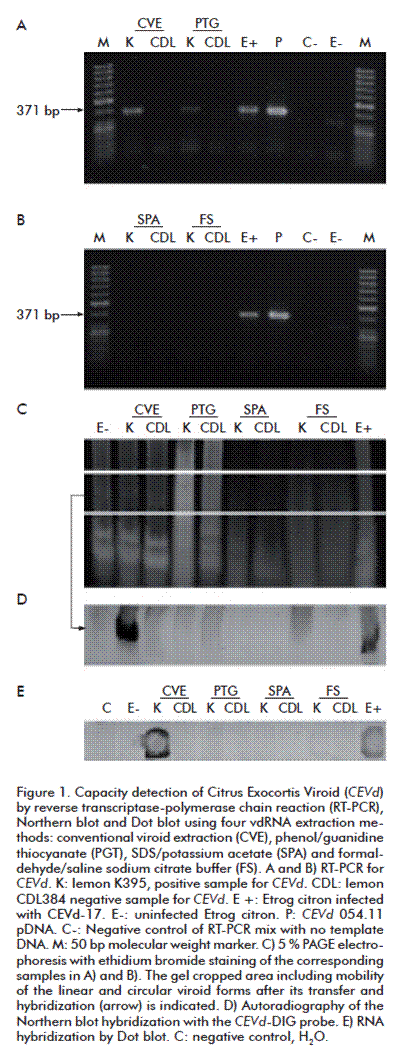
<body><![CDATA[<P   ><font size="2" face="Verdana, Arial, Helvetica, sans-serif"><B><font size="3">RESULTS      AND DISCUSSION </font> </b></font></P >   <FONT size="+1">        <P   align="justify" ><font size="2" face="Verdana, Arial, Helvetica, sans-serif">At first, four RNA      extraction protocols were compared in terms of values for RNA concentration      and purity, based on bark tissues sampled from <I>C. limon</I> plants collected      in the field. The CVE and PGT methods produced RNA samples with the highest      purity levels (DO<Sub>260/280</Sub> ranging from 1.9 to 2.0), with low levels      of contaminants sensitive to UV as proteins and phenol. These two methods      also showed the highest mean total RNA concentrations: 2330 ng/&mu;L and 7650      ng/&mu;L, respectively. In contrast, the SPA and FS extractions recovered      low purity RNA (DO<Sub>260/280 </Sub>ranging from 1.3 to 1.5), with RNA concentrations      of 1217 ng/&mu;L and 2400 ng/&mu;L, respectively. In general, good RNA yield      recovery has been reported when phloem tissue is sampled, since viroids are      mostly transported by the phloem [35]. Similar results reported for Etrog      citron indicate that the concentration of the <I>CEVd </I>viroid in the bark      is 10 times higher than in the leaves [36]. Nevertheless, the high viroid      titer detected in the foliar tissue of Etrog citron is explained by the high      bio-amplification of the pathogenic genome in this sensitive host. </font></P >   <FONT size="+1"><FONT size="+1"><FONT size="+1"><FONT size="+1"><FONT size="+1">        <P   align="justify" ><font size="2" face="Verdana, Arial, Helvetica, sans-serif">The high values of      RNA concentration observed with CVE, PGT and FS methods may be due to the      fact that these methods included a phenol treatment that led to an efficient      disruption of cell membranes as well as removal of proteins in the organic      phase. Nevertheless, it is likely that the high RNA yield with PGT may be      related to the absence of steps to recover mostly low molecular weight RNA      rather than total host RNA derives in an overestimation of RNA in the sample      analyzed. It must be pointed out that the purity of RNA obtained by FS was      much lower than that obtained by CVE. This may be caused by the absence in      the FS method of differential purification steps such as: dialysis and LiCl      precipitation. Finally, the low concentration and purity of the RNA recovered      through the SPA method is possibly due to losses in the recovery of the RNA      in the differential polyethylene glycol precipitation steps, the absence of      steps to capture or discriminate contaminants released in the pulverization      of the material with liquid nitrogen, or both. </font></P >       <P   align="justify" ><font size="2" face="Verdana, Arial, Helvetica, sans-serif">Subsequently, the      possible detrimental effect of the RNA extraction method on the amount of      detectable <I>CEVd </I>was analyzed by three diagnostic techniques: RT-PCR,      Northern blot and Dot blot. For this, we analyzed positive (K395) and negative      samples (CDL384) for <I>CEVd</I>, of <I>C. limon </I>(v. Lisbon) plants collected      in the field, according to the preceding results [36]. </font></P >       <P   align="justify" ><font size="2" face="Verdana, Arial, Helvetica, sans-serif">In RNAs obtained      by the CVE and PGT methods, evidences were observed of total genome amplification      of <I>CEVd </I>(371 pb) by RT-PCR from the K395 lemon plant (<a href="#fig1">Figure      1A</a>). This is probably due to the high level of purity in the sample, which      relates to reduced concentrations of RT-PCR inhibitors such as polysaccharides      and polyphenols, which are typical of the cell wall of citrus tissues. However,      because the RNA analyzed by RT-PCR was highly diluted (approximate amounts      of 200 ng) it could also be possible that the effect of sample&rsquo;s dilution      would have decreased the concentration of potential contaminants which interfere      in viroid detection. The extractions with the SPA and FS methods did not show      amplicons in the RT-PCR assay (<a href="#fig1">Figure 1B</a>), which would      be due to an excess of enzymatic activity inhibitors in the sample. These      findings are in contrast to observations by Bernard and Duran-Vila [6], who      indicated that the quality of the RNA obtained from the SPA extractions without      modifications made the analysis by RT-PCR feasible. Perhaps, the differences      in the extraction protocol, reaction conditions, primers, and enzymes used      may explain this discrepancy [6, 37]. </font></P >       <P   align="center" ><img src="/img/revistas/bta/v30n2/f0106213.gif" width="398" height="1056"><a name="fig1"></a></P >       
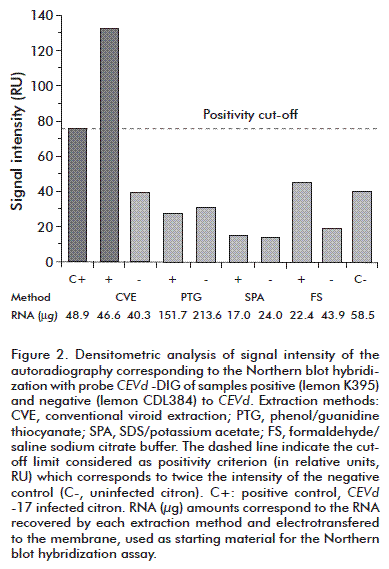
<P   align="justify" ><font size="2" face="Verdana, Arial, Helvetica, sans-serif">In the negative control,      the uninfected Etrog citron showed amplicons with lower than expected molecular      weights (371 bp; <a href="#fig1">Figures 1A</a> and <a href="#fig1">B</a>,      lane E-). Mixed populations of high and low molecular weight amplicons would      be produced by unspecific hybridization, which occurs during the interaction      of the reverse transcriptase with host RNA templates bearing thermostable      hairpins or by the effect of native RNAs that fold back on themselves generating      a primer for the reverse transcriptase [38]. Finally, the formation of secondary      structures in the viroid genome at low reaction temperatures may limit the      access of the enzyme and produce smaller amplicons than those expected [15].      </font></P >       <P   align="justify" ><font size="2" face="Verdana, Arial, Helvetica, sans-serif">The molecular hybridization      of viroid RNA by Dot blot clearly detected the <I>CEVd </I>viroid in the K395      positive sample obtained through the CVE method, while no clear signals were      detected when using other extraction methods (<a href="#fig1">Figure 1E</a>).      The negative control samples showed no signals. These results would indicate      that the ability to detect the RNA sequence of the viroid genome by hybridization      with the double-stranded DNA-DIG probe is affected by the extraction method      used. </font></P >       <P   align="justify" ><font size="2" face="Verdana, Arial, Helvetica, sans-serif">The detection of      the <I>CEVd </I>in <I>C. limon </I>using Northern blot-<I>CEVd</I>-DIG showed      a clear (high level of saturation, 132 RU) and compact signal on a radiographic      plate (<a href="#fig1">Figure 1D</a>) solely for the RNA extracted by the      CVE method (lane K of CVE). In contrast, we did not observe clear evidence      of the presence of <I>CEVd </I>when this infected tissue was processed by      the PGT, SPA or FS (~ 30 RU) extraction methods. The high signal intensity      observed only for CVE extractions up to a saturation point may be explained      because there was an increase in the titer of the viroid fixed on the membrane      and paired with the <I>CEVd</I>-DIG probe (<a href="#fig1">Figures 1D</a>      and <a href="#fig1">E</a>, and <a href="#fig2">Figure 2</a>). </font></P >       <P   align="center" ><img src="/img/revistas/bta/v30n2/f0206213.gif" width="387" height="567"><a name="fig2"></a></P >       
]]></body>
<body><![CDATA[<P   align="justify" ><font size="2" face="Verdana, Arial, Helvetica, sans-serif">The low intensity      of molecular hybridizations with the other three RNA extraction methods may      originate from reduced efficiency of probe labeling. In this case, the pairing      kinetics between the probe and the vdRNA would be limited by the high number      of copies of the homologous sequence of RNA-<I>CEVd </I>paired with unlabeled      complementary probes. However, in this study the labeling efficiency was high,      since saturation was observed in the intensity of the Northern blot signal      with a minimum amount of the labeled probe (690 ng). These results are in      agreement with those of Murcia <I>et al</I>. [7], since the CVE followed by      Northern blot detection was described as reliable and robust to detect viroids      in field material. </font></P >       <P   align="justify" ><font size="2" face="Verdana, Arial, Helvetica, sans-serif">The lower sensitivity      of the molecular hybridization compared to RT-PCR is highlighted, since the      PGT extraction does not produce compact signals in the ra-diographic plate      (<a href="#fig1">Figure 1D</a> and <a href="#fig1">E</a>), but reveals the      presence of the viroid in the RT-PCR (<a href="#fig1">Figure 1A</a> and <a href="#fig1">B</a>).      </font></P >       <P   align="justify" ><font size="2" face="Verdana, Arial, Helvetica, sans-serif">Similar to results      using RNA Dot blot, the extractions using SPA, PGT and FS showed significantly      lower signal intensities than those obtained with CVE in Northern blot hybridizations,      in infected lemon RNA and the citron <I>CEVd</I>-17 positive control (<a href="#fig2">Figure      2</a>). The quantification of these signals with the specific probe <I>CEVd</I>-DIG      in phloem tissue from <I>C. limon </I>shows a possitivity cut-off signal (78      RU) and infection (according to the parameters for background correction estimated      by the image). This is based on the strict criterion that an infected sample      must have a signal twice the highest intensity value of the negative control      sample (39 RU), in order to establish an acceptance interval for a positive      signal and to provide certainty on the presence of a detectable viroid titer      in the sample [39]. </font></P >       <P   align="justify" ><font size="2" face="Verdana, Arial, Helvetica, sans-serif">Overall, the results      of this study showed that the differences in concentration and purity of the      RNA obtained through the four extraction methods affected the levels of vdRNA      detectable through three molecular diagnostic techniques. Using molecular      detection tools based on enzymatic amplification reactions (RT-PCR) and hybridization      with labeled cDNA probes, we demonstrated that under our experimental conditions      using infected tissues of citrus varieties in the field, the CVE method recovered      the largest amount of copies of vdRNA with high levels of purity. </font></P >       <P   align="justify" ><font size="2" face="Verdana, Arial, Helvetica, sans-serif">Previous reports      had recommended the use of Northern blot analysis in the detection of CVd      in citrus varieties growing in commercial orchards, which avoids the need      of recurring to a previous bio-amplification passage of the viroid in indicator      plants [7, 33]. Based on our results, we claim the CVE extraction method followed      by Northern blot approach as the most appropriate test for systematic screening      of citrus plants including propagation materials within sanitation programs,      and in eventual prospective sanitations for the control and eradiation of      the citrus viroids described. </font></P >       <P   >&nbsp;</P >       <P   ><font size="2" face="Verdana, Arial, Helvetica, sans-serif"><B><font size="3">ACKNOWLEDGEMENTS      </font> </b></font></P >   <FONT size="+1">        <P   align="justify" ><font size="2" face="Verdana, Arial, Helvetica, sans-serif">We would like to      thank BID-CONICYT for the funding project PDT 74/19; Dr. Nuria Duran-Vila      for her support and recommendations in this study; Agr. Eng. Jacques Borde      and Agr. Eng. Ana Bertalm&iacute;o for providing the plant tissues used as      controls for this study; MSc. Paola Gaiero for critically reviewing the manuscript.      </font></P >       <P   align="justify" >&nbsp;</P >   <FONT size="+1">        <P   align="justify" > </P >       ]]></body>
<body><![CDATA[<P   align="justify" ><font size="3"><b><font face="Verdana, Arial, Helvetica, sans-serif">REFERENCES      </font></b></font></P >       <!-- ref --><P   align="justify" ><font size="2" face="Verdana, Arial, Helvetica, sans-serif">1. Flores R. A naked      plant-specific RNA ten-fold smaller than the smallest known viral RNA: the      viroid. C R Acad Sci III. 2001;324(10):943-52.     </font></P >       <!-- ref --><P   align="justify" ><font size="2" face="Verdana, Arial, Helvetica, sans-serif">2. Flores R, Randles      JW, Bar-Joseph M, Diener TO. Viroids. In: van Regenmortel MHV, Fauquet CM,      Bishop DHL, Carsten EB, Estes MK, Lemon SM, et al., editors. Virus taxonomy.      Seventh Report of the International Committee on Taxonomy of Viruses. San      Diego: Academic Press; 2000. p. 1009-24.     </font></P >       <!-- ref --><P   align="justify" ><font size="2" face="Verdana, Arial, Helvetica, sans-serif">3. Palacio A, Foissac      X, Duran-Vila N. Indexing of citrus viroids by imprint hybridisation. Eur      J Plant Pathol. 1999;105(9):897-903.     </font></P >       <!-- ref --><P   align="justify" ><font size="2" face="Verdana, Arial, Helvetica, sans-serif">4. Barbosa CJ, Pina      JA, Navarro L, Duran-Vila N. Replication/accumulation and symptom expression      of citrus viroids on some species of citrus and related genera. In: Duran-Vila      N, Milne RG, Da Gra&ccedil;a JV, editors. Proceedings XV International Conference      of the Organization of Citrus Virologists (IOCV). Riverside, CA: International      Organization of Citrus Virologists; 2002. p. 264-71.     </font></P >       <!-- ref --><P   align="justify" ><font size="2" face="Verdana, Arial, Helvetica, sans-serif">5. Cohen O, Batuman      O, Stanbekova G, Sano T, Mawassi W, Bar-Joseph M. Construction of a multiprobe      for the simultaneous detection of viroids infecting citrus trees. Virus Genes.      2006;33(3):287-92.     </font></P >       <!-- ref --><P   align="justify" ><font size="2" face="Verdana, Arial, Helvetica, sans-serif">6. Bernard L, Duran-Vila      N. A novel RT-PCR approach for detection and characterization of citrus viroids.      Mol Cell Probes. 2006;20(2):105-13.     </font></P >       <!-- ref --><P   align="justify" ><font size="2" face="Verdana, Arial, Helvetica, sans-serif">7. Murcia N, Serra      P, Olmos A, Duran-Vila N. A novel hybridization approach for detection of      citrus viroids. Mol Cell Probes. 2009;23(2):95-102.     </font></P >       <!-- ref --><P   align="justify" ><font size="2" face="Verdana, Arial, Helvetica, sans-serif">8. Nakahara K, Hataya      T, Uyeda I. A simple rapid method of nucleic acid extraction without tissue      homogenization for detecting viroids by hybridisation and RT-PCR. J Virol      Methods. 1999;77(1):47-58.     </font></P >       <!-- ref --><P   align="justify" ><font size="2" face="Verdana, Arial, Helvetica, sans-serif">9. Noronha-Fonseca      ME, Marcellino LH, Gander E. A rapid and sensitive dot-blot hybridization      assay for the detection of citrus exocortis viroid in Citrus medica with digoxigenin-labelled      RNA probes. J Virol Methods. 1996;57(2):203-7.     </font></P >       <!-- ref --><P   align="justify" ><font size="2" face="Verdana, Arial, Helvetica, sans-serif">10. Palacio A, Foissac      X, Duran-Vila N. Indexing of citrus viroids by imprint hybridization: comparation      with other detection methods. In: Da Gra&ccedil;a JV, Lee RF, Yokomi RK, editors.      Proceedings XIV Conference of the Internacional Organization of Citrus Virologist      (IOCV). Riverside, CA: Internacional Organization of Citrus Virologist; 2000.      p. 294-301.     </font></P >       <!-- ref --><P   align="justify" ><font size="2" face="Verdana, Arial, Helvetica, sans-serif">11. Ito T, Ieki H,      Ozaki K. Simultaneous detection of six citrus viroids and Apple stem grooving      virus from citrus plants by multiplex reverse transcription polymerase chain      reaction. J Virol Methods. 2002;106(2):235-9.     </font></P >       <!-- ref --><P   align="justify" ><font size="2" face="Verdana, Arial, Helvetica, sans-serif">12. Ragozzino E,      Faggioli F, Barba M. Development of a one tube-one step RT PCR protocol for      the detection of seven viroids in four genera: apscaviroid, hostuviroid, pelamoviroid.      J Virol Methods. 2004;121(1):25-9.     </font></P >       <!-- ref --><P   align="justify" ><font size="2" face="Verdana, Arial, Helvetica, sans-serif">13. Wang X, Zhou      C, Tang K, Zhou Y, Li Z. A rapid one-step multiplex RT-PCR assay for the simultaneous      detection of five citrus viroids in China. Eur J Plant Pathol. 2009;124(1):175-80.          </font></P >       <P   align="justify" ><font size="2" face="Verdana, Arial, Helvetica, sans-serif">14. Tessitori M,      Rizza S, Reina A, La Rosa R. Development of a real-time assay for the simultaneous      detection of citrus viroids [abstract]. J Plant Pathol. 2004;86(4 Special      issue):336. </font></P >       <!-- ref --><P   align="justify" ><font size="2" face="Verdana, Arial, Helvetica, sans-serif">15. Navarro B, Dar&oacute;s      JA, Flores R. Reverse transcription polymerase chain reaction protocols for      cloning small circular RNAs. J Virol Methods. 1998;73(1):1-9.     </font></P >       ]]></body>
<body><![CDATA[<!-- ref --><P   align="justify" ><font size="2" face="Verdana, Arial, Helvetica, sans-serif">16. Puchta H, Ramm      K, Luckinger R, Hadas R, Bar-Joseph M, S&auml;nger HL. Primary and secondary      structure of citrus viroid IV (CVd IV), a new chimeric viroid present in dwarfed      grapefruit in Israel. Nucleic Acids Res. 1991;19(23):6640.     </font></P >       <!-- ref --><P   align="justify" ><font size="2" face="Verdana, Arial, Helvetica, sans-serif">17. Rakowski AG,      Szychowski JA, Avena ZS, Semancik JS. Nucleotide sequence and structural features      of the group III citrus viroids. J Gen Virol. 1994;75(Pt 12):3581-4.     </font></P >       <P   align="justify" ><font size="2" face="Verdana, Arial, Helvetica, sans-serif">18. Nakahara K, Hataya      T, Uyeda I. Inosine 5&rsquo;-triphosphate can dramatically increase the yield      of NASBA products targeting GC-rich and intramolecular base-paired viroid      RNA. Nucleic Acids Res. 1998;26(7):1854-6. </font></P >       <!-- ref --><P   align="justify" ><font size="2" face="Verdana, Arial, Helvetica, sans-serif">19. Eiras M, Rodrigues-Silva      S, Sanches-Stuchi E, Penteado-Natividade Targon ML, Alves-Carvalho S. Viroides      em citros. Trop Plant Pathol. 2009;34(5):275-96.     </font></P >       <!-- ref --><P   align="justify" ><font size="2" face="Verdana, Arial, Helvetica, sans-serif">20. Sieburth PJ,      Irey M, Garnsey SM, Owens RA. The use of RT-PCR in the Florida citrus viroid      indexing program. In: Duran-Vila N, Milne RG, Da Gra&ccedil;a JV, editors.      Proceedings XV Conference of the Internacional Organization of Citrus Virologist      (IOCV). Riverside, CA; 2002. pp. 230-9.     </font></P >       <!-- ref --><P   align="justify" ><font size="2" face="Verdana, Arial, Helvetica, sans-serif">21. Ito T, Ieki H,      Ozaki K, Iwanami T, Nakahara K, Hataya T, et al. Multiple citrus viroids in      citrus from Japan and their ability to produce exocortis-like symptoms in      citron. Phytopathology. 2002;92(5):542-7.     </font></P >       <!-- ref --><P   align="justify" ><font size="2" face="Verdana, Arial, Helvetica, sans-serif">22. Ca&ntilde;izares      M, Marcos J, Pall&aacute;s V. Molecular characterization of an almond isolate      of hop stunt viroid (HSVd) and conditions for eliminating spurious hybridization      in its diagnostics in almond samples. Eur J Plant Pathol. 1999;105(6):553-8.          </font></P >       <!-- ref --><P   align="justify" ><font size="2" face="Verdana, Arial, Helvetica, sans-serif">23. WenXing X, Ni      H, QiuTing J, Farooq AB, ZeQiong W, YanSu S, et al. Probe binding to host      proteins: A cause for false positive signals in viroid detection by tissue      hybridization. Virus Res. 2009;145(1):26-30.     </font></P >       <!-- ref --><P   align="justify" ><font size="2" face="Verdana, Arial, Helvetica, sans-serif">24. G&oacute;mez      G, Pall&aacute;s V. A long-distance translocatable phloem protein from cucumber      forms a ribonucleoprotein complex in vivo with hop stunt viroid RNA. J Virol.      2004;78(18):10104-10.     </font></P >       <!-- ref --><P   align="justify" ><font size="2" face="Verdana, Arial, Helvetica, sans-serif">25. Rodio ME, Delgado      S, Flores R, Di Serio F. Variants of peach latent mosaic viroid inducing peach      calico: Uneven distribution in infected plants and requirements of the insertion      containing the pathogenicity determinant. J Gen Virol. 2006;87(Pt 1):231-40.          </font></P >       <P   align="justify" ><font size="2" face="Verdana, Arial, Helvetica, sans-serif">26. Uma&ntilde;a      R. Diagn&oacute;stico de CBCVd (Cocadviroide) y CVd-VI (Apscaviroide) en plantaciones      citr&iacute;colas del Uruguay mediante t&eacute;cnicas de detecci&oacute;n      basadas en hibridaci&oacute;n molecular no isot&oacute;pica. Tesis de Maestr&iacute;a      en Biotecnolog&iacute;a. Facultad de Ciencias, Universidad de la Rep&uacute;blica,      Montevideo, Uruguay; 2010. </font></P >       ]]></body>
<body><![CDATA[<!-- ref --><P   align="justify" ><font size="2" face="Verdana, Arial, Helvetica, sans-serif">27. Semancik JS,      Morris TJ, Weathers LG, Rordorf GF, Kearns DR. Physical properties of a minimal      infectious RNA (viroid) associated with the exocortis disease. Virology. 1975;63(1):160-7.          </font></P >       <!-- ref --><P   align="justify" ><font size="2" face="Verdana, Arial, Helvetica, sans-serif">28. Chomczynski P,      Sacchi N. Single-step method of RNA isolation by acid guanidinium thiocyanate-phenol-chloroform      extraction. Anal Biochem. 1987;162(1):156-9.     </font></P >       <!-- ref --><P   align="justify" ><font size="2" face="Verdana, Arial, Helvetica, sans-serif">29. Ca&ntilde;izares      MC, Marcos JF, Pall&aacute;s V. Studies on the incidence of hop stunt viroid      in apricot trees (Prunus armeniaca) by using an easy and short extraction      method to analyze a large number of samples. Acta Hort. 1998;472(1):581-7.          </font></P >       <!-- ref --><P   align="justify" ><font size="2" face="Verdana, Arial, Helvetica, sans-serif">30. International      Potato Center (CIP). Preparation of 32P-labeled probes by RNA transcription.      In: Salazar LF, Jayasinghe U, editors. Techniques in Plant Virology. Training      Manual. Sections 3, 4, 5. Lima: International Potato Center (CIP); 1997.     </font></P >       <!-- ref --><P   align="justify" ><font size="2" face="Verdana, Arial, Helvetica, sans-serif">31. Manchester KL.      Value of A260/A280 ratios for measurement of purity of nucleic acids. Bio-Techniques.      1995;19(2):208-12.     </font></P >       ]]></body>
<body><![CDATA[<!-- ref --><P   align="justify" ><font size="2" face="Verdana, Arial, Helvetica, sans-serif">32. Pagliano G, Orlando      L, Gravina A. Detecci&oacute;n y caracterizaci&oacute;n del complejo de viroides      de c&iacute;tricos en Uruguay. Agrociencia. 1998;1(2):74-83.     </font></P >       <!-- ref --><P   align="justify" ><font size="2" face="Verdana, Arial, Helvetica, sans-serif">33. Mohamed ME, Hashemian      SMB, Dafalla G, Bov&eacute; JM, Duran-Vila N. Occurrence and identification      of citrus viroids from Sudan. J Plant Pathol. 2009;91(1):185-90.     </font></P >       <!-- ref --><P   align="justify" ><font size="2" face="Verdana, Arial, Helvetica, sans-serif">34. Sambrook J, Fritsch      EF, Maniatis T. Molecular cloning: a laboratory manual. 2nd ed. New York:      Cold Spring Harbor Laboratory Press; 1989.     </font></P >       <!-- ref --><P   align="justify" ><font size="2" face="Verdana, Arial, Helvetica, sans-serif">35. Semancik JS,      Tsuruda D, Zaner LJ, Geelen LMC, Weathers LG. Exocortis Disease: Subcellular      distribution of pathogenic (viroid) RNA. Virology. 1976;69(2):669-76.     </font></P >       <!-- ref --><P   align="justify" ><font size="2" face="Verdana, Arial, Helvetica, sans-serif">36. Li SF, Onodera      S, Sano T, Yoshida K, Wang GP, Shikata E. Gene diagnosis of viroids: Comparisons      of return-PAGE and hybridization using DIG-labeled DNA and RNA probes for      practical diagnosis of hop stunt, citrus exocortis and apple scar skin viroids      in their natural host plants. Ann Phytopathol Soc Jpn. 1995;61(4):381-90.          </font></P >       ]]></body>
<body><![CDATA[<!-- ref --><P   align="justify" ><font size="2" face="Verdana, Arial, Helvetica, sans-serif">37. Wang X, Zhou      C, Tang K, Lan J, Zhou Y, Li Z. Preliminary Studies on Species and Distribution      of Citrus Viroids in China. Agric Sci China. 2008;7(9):1097-103.     </font></P >       <!-- ref --><P   align="justify" ><font size="2" face="Verdana, Arial, Helvetica, sans-serif">38. Tuiskunen A,      Leparc-Goffart I, Boubis L, Monteil V, Klingstrom J, Tolou HJ, et al. Self-priming      of reverse transcriptase impairs strand-specific detection of dengue virus      RNA. J Gen Virol. 2010;91(4):1019-27.     </font></P >       <!-- ref --><P   align="justify" ><font size="2" face="Verdana, Arial, Helvetica, sans-serif">39. Rodr&iacute;guez      R, Ramos PL, Dorestes V, Vel&aacute;zquez K, Peral R, Fuentes A, et al. Establishment      of a non-radioactive nucleic acid hybridization technique for Begomovirus      detection. Biotecnol Apl. 2003;20(3):164-9.     </font></P >       <P   align="justify" >&nbsp;</P >       <P   align="justify" >&nbsp;</P >       <P   align="justify" > </P >       <P   align="justify" > </P >       ]]></body>
<body><![CDATA[<P   align="justify" ><font size="2" face="Verdana, Arial, Helvetica, sans-serif">Received in October,      2012.     <br>     </font><font size="2" face="Verdana, Arial, Helvetica, sans-serif">Accepted      in December, 2012. </font></P >       <P   align="justify" >&nbsp;</P >       <P   align="justify" >&nbsp;</P >       <P   align="justify" > </P >       <P   align="justify" > </P >       <P   ><font size="2" face="Verdana, Arial, Helvetica, sans-serif"><I>Rodolfo Uma&ntilde;a</I>.      Departamento de Biolog&iacute;a Vegetal, Facultad de Agronom&iacute;a, Universidad      de la Rep&uacute;blica, Garz&oacute;n 780, Montevideo, Uruguay. E-mail: <A href="mailto:rumana@fagro.edu.uy">      <U><U><FONT color="#0000FF">rumana@fagro.edu.uy</font></U></U></A><FONT color="#0000FF"><FONT color="#000000">.      </font></font></font></P >   </font></font></font></font></font></font></font></font></font></font></font></font></font></font></font></font></font></font></font></font></font></font></font></font></font></font></font></font></font></font></font></font></font></font></font></font></font></font></font></font></font></font></font></font></font></font></font></font></font></font></font></font></DIV >      ]]></body><back>
<ref-list>
<ref id="B1">
<label>1</label><nlm-citation citation-type="journal">
<person-group person-group-type="author">
<name>
<surname><![CDATA[Flores]]></surname>
<given-names><![CDATA[R]]></given-names>
</name>
</person-group>
<article-title xml:lang="en"><![CDATA[A naked plant-specific RNA ten-fold smaller than the smallest known viral RNA: the viroid]]></article-title>
<source><![CDATA[C R Acad Sci III]]></source>
<year>2001</year>
<volume>324</volume>
<numero>10</numero>
<issue>10</issue>
<page-range>943-52</page-range></nlm-citation>
</ref>
<ref id="B2">
<label>2</label><nlm-citation citation-type="book">
<person-group person-group-type="author">
<name>
<surname><![CDATA[Flores]]></surname>
<given-names><![CDATA[R]]></given-names>
</name>
<name>
<surname><![CDATA[Randles]]></surname>
<given-names><![CDATA[JW]]></given-names>
</name>
<name>
<surname><![CDATA[Bar-Joseph]]></surname>
<given-names><![CDATA[M]]></given-names>
</name>
<name>
<surname><![CDATA[Diener]]></surname>
<given-names><![CDATA[TO]]></given-names>
</name>
</person-group>
<article-title xml:lang="en"><![CDATA[Viroids]]></article-title>
<person-group person-group-type="editor">
<name>
<surname><![CDATA[van Regenmortel]]></surname>
<given-names><![CDATA[MHV]]></given-names>
</name>
<name>
<surname><![CDATA[Fauquet]]></surname>
<given-names><![CDATA[CM]]></given-names>
</name>
<name>
<surname><![CDATA[Bishop]]></surname>
<given-names><![CDATA[DHL]]></given-names>
</name>
<name>
<surname><![CDATA[Carsten]]></surname>
<given-names><![CDATA[EB]]></given-names>
</name>
<name>
<surname><![CDATA[Estes]]></surname>
<given-names><![CDATA[MK]]></given-names>
</name>
<name>
<surname><![CDATA[Lemon]]></surname>
<given-names><![CDATA[SM]]></given-names>
</name>
</person-group>
<source><![CDATA[Virus taxonomy: Seventh Report of the International Committee on Taxonomy of Viruses]]></source>
<year>2000</year>
<page-range>1009-24</page-range><publisher-loc><![CDATA[San Diego ]]></publisher-loc>
<publisher-name><![CDATA[Academic Press]]></publisher-name>
</nlm-citation>
</ref>
<ref id="B3">
<label>3</label><nlm-citation citation-type="journal">
<person-group person-group-type="author">
<name>
<surname><![CDATA[Palacio]]></surname>
<given-names><![CDATA[A]]></given-names>
</name>
<name>
<surname><![CDATA[Foissac]]></surname>
<given-names><![CDATA[X]]></given-names>
</name>
<name>
<surname><![CDATA[Duran-Vila]]></surname>
<given-names><![CDATA[N]]></given-names>
</name>
</person-group>
<article-title xml:lang="en"><![CDATA[Indexing of citrus viroids by imprint hybridisation]]></article-title>
<source><![CDATA[Eur J Plant Pathol]]></source>
<year>1999</year>
<volume>105</volume>
<numero>9</numero>
<issue>9</issue>
<page-range>897-903</page-range></nlm-citation>
</ref>
<ref id="B4">
<label>4</label><nlm-citation citation-type="book">
<person-group person-group-type="author">
<name>
<surname><![CDATA[Barbosa]]></surname>
<given-names><![CDATA[CJ]]></given-names>
</name>
<name>
<surname><![CDATA[Pina]]></surname>
<given-names><![CDATA[JA]]></given-names>
</name>
<name>
<surname><![CDATA[Navarro]]></surname>
<given-names><![CDATA[L]]></given-names>
</name>
<name>
<surname><![CDATA[Duran-Vila]]></surname>
<given-names><![CDATA[N]]></given-names>
</name>
</person-group>
<article-title xml:lang="en"><![CDATA[Replication/accumulation and symptom expression of citrus viroids on some species of citrus and related genera]]></article-title>
<person-group person-group-type="editor">
<name>
<surname><![CDATA[Duran-Vila]]></surname>
<given-names><![CDATA[N]]></given-names>
</name>
<name>
<surname><![CDATA[Milne]]></surname>
<given-names><![CDATA[RG]]></given-names>
</name>
<name>
<surname><![CDATA[Da Graça]]></surname>
<given-names><![CDATA[JV]]></given-names>
</name>
</person-group>
<source><![CDATA[Proceedings XV International Conference of the Organization of Citrus Virologists (IOCV)]]></source>
<year>2002</year>
<page-range>264-71</page-range><publisher-loc><![CDATA[Riverside ]]></publisher-loc>
<publisher-name><![CDATA[International Organization of Citrus Virologists]]></publisher-name>
</nlm-citation>
</ref>
<ref id="B5">
<label>5</label><nlm-citation citation-type="journal">
<person-group person-group-type="author">
<name>
<surname><![CDATA[Cohen]]></surname>
<given-names><![CDATA[O]]></given-names>
</name>
<name>
<surname><![CDATA[Batuman]]></surname>
<given-names><![CDATA[O]]></given-names>
</name>
<name>
<surname><![CDATA[Stanbekova]]></surname>
<given-names><![CDATA[G]]></given-names>
</name>
<name>
<surname><![CDATA[Sano]]></surname>
<given-names><![CDATA[T]]></given-names>
</name>
<name>
<surname><![CDATA[Mawassi]]></surname>
<given-names><![CDATA[W]]></given-names>
</name>
<name>
<surname><![CDATA[Bar-Joseph]]></surname>
<given-names><![CDATA[M]]></given-names>
</name>
</person-group>
<article-title xml:lang="en"><![CDATA[Construction of a multiprobe for the simultaneous detection of viroids infecting citrus trees]]></article-title>
<source><![CDATA[Virus Genes]]></source>
<year>2006</year>
<volume>33</volume>
<numero>3</numero>
<issue>3</issue>
<page-range>287-92</page-range></nlm-citation>
</ref>
<ref id="B6">
<label>6</label><nlm-citation citation-type="journal">
<person-group person-group-type="author">
<name>
<surname><![CDATA[Bernard]]></surname>
<given-names><![CDATA[L]]></given-names>
</name>
<name>
<surname><![CDATA[Duran-Vila]]></surname>
<given-names><![CDATA[N]]></given-names>
</name>
</person-group>
<article-title xml:lang="en"><![CDATA[A novel RT-PCR approach for detection and characterization of citrus viroids]]></article-title>
<source><![CDATA[Mol Cell Probes]]></source>
<year>2006</year>
<volume>20</volume>
<numero>2</numero>
<issue>2</issue>
<page-range>105-13</page-range></nlm-citation>
</ref>
<ref id="B7">
<label>7</label><nlm-citation citation-type="journal">
<person-group person-group-type="author">
<name>
<surname><![CDATA[Murcia]]></surname>
<given-names><![CDATA[N]]></given-names>
</name>
<name>
<surname><![CDATA[Serra]]></surname>
<given-names><![CDATA[P]]></given-names>
</name>
<name>
<surname><![CDATA[Olmos]]></surname>
<given-names><![CDATA[A]]></given-names>
</name>
<name>
<surname><![CDATA[Duran-Vila]]></surname>
<given-names><![CDATA[N]]></given-names>
</name>
</person-group>
<article-title xml:lang="en"><![CDATA[A novel hybridization approach for detection of citrus viroids]]></article-title>
<source><![CDATA[Mol Cell Probes]]></source>
<year>2009</year>
<volume>23</volume>
<numero>2</numero>
<issue>2</issue>
<page-range>95-102</page-range></nlm-citation>
</ref>
<ref id="B8">
<label>8</label><nlm-citation citation-type="journal">
<person-group person-group-type="author">
<name>
<surname><![CDATA[Nakahara]]></surname>
<given-names><![CDATA[K]]></given-names>
</name>
<name>
<surname><![CDATA[Hataya]]></surname>
<given-names><![CDATA[T]]></given-names>
</name>
<name>
<surname><![CDATA[Uyeda]]></surname>
<given-names><![CDATA[I]]></given-names>
</name>
</person-group>
<article-title xml:lang="en"><![CDATA[A simple rapid method of nucleic acid extraction without tissue homogenization for detecting viroids by hybridisation and RT-PCR]]></article-title>
<source><![CDATA[J Virol Methods]]></source>
<year>1999</year>
<volume>77</volume>
<numero>1</numero>
<issue>1</issue>
<page-range>47-58</page-range></nlm-citation>
</ref>
<ref id="B9">
<label>9</label><nlm-citation citation-type="journal">
<person-group person-group-type="author">
<name>
<surname><![CDATA[Noronha-Fonseca]]></surname>
<given-names><![CDATA[ME]]></given-names>
</name>
<name>
<surname><![CDATA[Marcellino]]></surname>
<given-names><![CDATA[LH]]></given-names>
</name>
<name>
<surname><![CDATA[Gander]]></surname>
<given-names><![CDATA[E]]></given-names>
</name>
</person-group>
<article-title xml:lang="en"><![CDATA[A rapid and sensitive dot-blot hybridization assay for the detection of citrus exocortis viroid in Citrus medica with digoxigenin-labelled RNA probes]]></article-title>
<source><![CDATA[J Virol Methods]]></source>
<year>1996</year>
<volume>57</volume>
<numero>2</numero>
<issue>2</issue>
<page-range>203-7</page-range></nlm-citation>
</ref>
<ref id="B10">
<label>10</label><nlm-citation citation-type="book">
<person-group person-group-type="author">
<name>
<surname><![CDATA[Palacio]]></surname>
<given-names><![CDATA[A]]></given-names>
</name>
<name>
<surname><![CDATA[Foissac]]></surname>
<given-names><![CDATA[X]]></given-names>
</name>
<name>
<surname><![CDATA[Duran-Vila]]></surname>
<given-names><![CDATA[N]]></given-names>
</name>
</person-group>
<article-title xml:lang="en"><![CDATA[Indexing of citrus viroids by imprint hybridization: comparation with other detection methods]]></article-title>
<person-group person-group-type="editor">
<name>
<surname><![CDATA[Da Graça]]></surname>
<given-names><![CDATA[JV]]></given-names>
</name>
<name>
<surname><![CDATA[Lee]]></surname>
<given-names><![CDATA[RF]]></given-names>
</name>
<name>
<surname><![CDATA[Yokomi]]></surname>
<given-names><![CDATA[RK]]></given-names>
</name>
</person-group>
<source><![CDATA[Proceedings XIV Conference of the Internacional Organization of Citrus Virologist (IOCV)]]></source>
<year>2000</year>
<page-range>294-301</page-range><publisher-loc><![CDATA[Riverside, CA ]]></publisher-loc>
<publisher-name><![CDATA[Internacional Organization of Citrus Virologist]]></publisher-name>
</nlm-citation>
</ref>
<ref id="B11">
<label>11</label><nlm-citation citation-type="journal">
<person-group person-group-type="author">
<name>
<surname><![CDATA[Ito]]></surname>
<given-names><![CDATA[T]]></given-names>
</name>
<name>
<surname><![CDATA[Ieki]]></surname>
<given-names><![CDATA[H]]></given-names>
</name>
<name>
<surname><![CDATA[Ozaki]]></surname>
<given-names><![CDATA[K]]></given-names>
</name>
</person-group>
<article-title xml:lang="en"><![CDATA[Simultaneous detection of six citrus viroids and Apple stem grooving virus from citrus plants by multiplex reverse transcription polymerase chain reaction]]></article-title>
<source><![CDATA[J Virol Methods]]></source>
<year>2002</year>
<volume>106</volume>
<numero>2</numero>
<issue>2</issue>
<page-range>235-9</page-range></nlm-citation>
</ref>
<ref id="B12">
<label>12</label><nlm-citation citation-type="journal">
<person-group person-group-type="author">
<name>
<surname><![CDATA[Ragozzino]]></surname>
<given-names><![CDATA[E]]></given-names>
</name>
<name>
<surname><![CDATA[Faggioli]]></surname>
<given-names><![CDATA[F]]></given-names>
</name>
<name>
<surname><![CDATA[Barba]]></surname>
<given-names><![CDATA[M]]></given-names>
</name>
</person-group>
<article-title xml:lang="en"><![CDATA[Development of a one tube-one step RT PCR protocol for the detection of seven viroids in four genera: apscaviroid, hostuviroid, pelamoviroid]]></article-title>
<source><![CDATA[J Virol Methods]]></source>
<year>2004</year>
<volume>121</volume>
<numero>1</numero>
<issue>1</issue>
<page-range>25-9</page-range></nlm-citation>
</ref>
<ref id="B13">
<label>13</label><nlm-citation citation-type="journal">
<person-group person-group-type="author">
<name>
<surname><![CDATA[Wang]]></surname>
<given-names><![CDATA[X]]></given-names>
</name>
<name>
<surname><![CDATA[Zhou]]></surname>
<given-names><![CDATA[C]]></given-names>
</name>
<name>
<surname><![CDATA[Tang]]></surname>
<given-names><![CDATA[K]]></given-names>
</name>
<name>
<surname><![CDATA[Zhou]]></surname>
<given-names><![CDATA[Y]]></given-names>
</name>
<name>
<surname><![CDATA[Li]]></surname>
<given-names><![CDATA[Z]]></given-names>
</name>
</person-group>
<article-title xml:lang="en"><![CDATA[A rapid one-step multiplex RT-PCR assay for the simultaneous detection of five citrus viroids in China]]></article-title>
<source><![CDATA[Eur J Plant Pathol]]></source>
<year>2009</year>
<volume>124</volume>
<numero>1</numero>
<issue>1</issue>
<page-range>175-80</page-range></nlm-citation>
</ref>
<ref id="B14">
<label>14</label><nlm-citation citation-type="journal">
<person-group person-group-type="author">
<name>
<surname><![CDATA[Tessitori]]></surname>
<given-names><![CDATA[M]]></given-names>
</name>
<name>
<surname><![CDATA[Rizza]]></surname>
<given-names><![CDATA[S]]></given-names>
</name>
<name>
<surname><![CDATA[Reina]]></surname>
<given-names><![CDATA[A]]></given-names>
</name>
<name>
<surname><![CDATA[La Rosa]]></surname>
<given-names><![CDATA[R]]></given-names>
</name>
</person-group>
<article-title xml:lang="en"><![CDATA[Development of a real-time assay for the simultaneous detection of citrus viroids]]></article-title>
<source><![CDATA[J Plant Pathol]]></source>
<year>2004</year>
<volume>86</volume>
<numero>4Specialissue</numero>
<issue>4Specialissue</issue>
<page-range>336</page-range></nlm-citation>
</ref>
<ref id="B15">
<label>15</label><nlm-citation citation-type="journal">
<person-group person-group-type="author">
<name>
<surname><![CDATA[Navarro]]></surname>
<given-names><![CDATA[B]]></given-names>
</name>
<name>
<surname><![CDATA[Darós]]></surname>
<given-names><![CDATA[JA]]></given-names>
</name>
<name>
<surname><![CDATA[Flores]]></surname>
<given-names><![CDATA[R]]></given-names>
</name>
</person-group>
<article-title xml:lang="en"><![CDATA[Reverse transcription polymerase chain reaction protocols for cloning small circular RNAs]]></article-title>
<source><![CDATA[J Virol Methods]]></source>
<year>1998</year>
<volume>73</volume>
<numero>1</numero>
<issue>1</issue>
<page-range>1-9</page-range></nlm-citation>
</ref>
<ref id="B16">
<label>16</label><nlm-citation citation-type="journal">
<person-group person-group-type="author">
<name>
<surname><![CDATA[Puchta]]></surname>
<given-names><![CDATA[H]]></given-names>
</name>
<name>
<surname><![CDATA[Ramm]]></surname>
<given-names><![CDATA[K]]></given-names>
</name>
<name>
<surname><![CDATA[Luckinger]]></surname>
<given-names><![CDATA[R]]></given-names>
</name>
<name>
<surname><![CDATA[Hadas]]></surname>
<given-names><![CDATA[R]]></given-names>
</name>
<name>
<surname><![CDATA[Bar-Joseph]]></surname>
<given-names><![CDATA[M]]></given-names>
</name>
<name>
<surname><![CDATA[Sänger]]></surname>
<given-names><![CDATA[HL]]></given-names>
</name>
</person-group>
<article-title xml:lang="en"><![CDATA[Primary and secondary structure of citrus viroid IV (CVd IV), a new chimeric viroid present in dwarfed grapefruit in Israel]]></article-title>
<source><![CDATA[Nucleic Acids Res]]></source>
<year>1991</year>
<volume>19</volume>
<numero>23</numero>
<issue>23</issue>
<page-range>6640</page-range></nlm-citation>
</ref>
<ref id="B17">
<label>17</label><nlm-citation citation-type="journal">
<person-group person-group-type="author">
<name>
<surname><![CDATA[Rakowski]]></surname>
<given-names><![CDATA[AG]]></given-names>
</name>
<name>
<surname><![CDATA[Szychowski]]></surname>
<given-names><![CDATA[JA]]></given-names>
</name>
<name>
<surname><![CDATA[Avena]]></surname>
<given-names><![CDATA[ZS]]></given-names>
</name>
<name>
<surname><![CDATA[Semancik]]></surname>
<given-names><![CDATA[JS]]></given-names>
</name>
</person-group>
<article-title xml:lang="en"><![CDATA[Nucleotide sequence and structural features of the group III citrus viroids]]></article-title>
<source><![CDATA[J Gen Virol]]></source>
<year>1994</year>
<volume>75</volume>
<numero>12</numero>
<issue>12</issue>
<page-range>3581-4</page-range></nlm-citation>
</ref>
<ref id="B18">
<label>18</label><nlm-citation citation-type="journal">
<person-group person-group-type="author">
<name>
<surname><![CDATA[Nakahara]]></surname>
<given-names><![CDATA[K]]></given-names>
</name>
<name>
<surname><![CDATA[Hataya]]></surname>
<given-names><![CDATA[T]]></given-names>
</name>
<name>
<surname><![CDATA[Uyeda]]></surname>
<given-names><![CDATA[I]]></given-names>
</name>
</person-group>
<article-title xml:lang="en"><![CDATA[Inosine 5'-triphosphate can dramatically increase the yield of NASBA products targeting GC-rich and intramolecular base-paired viroid RNA]]></article-title>
<source><![CDATA[Nucleic Acids Res]]></source>
<year>1998</year>
<volume>26</volume>
<numero>7</numero>
<issue>7</issue>
<page-range>1854-6</page-range></nlm-citation>
</ref>
<ref id="B19">
<label>19</label><nlm-citation citation-type="journal">
<person-group person-group-type="author">
<name>
<surname><![CDATA[Eiras]]></surname>
<given-names><![CDATA[M]]></given-names>
</name>
<name>
<surname><![CDATA[Rodrigues-Silva]]></surname>
<given-names><![CDATA[S]]></given-names>
</name>
<name>
<surname><![CDATA[Sanches-Stuchi]]></surname>
<given-names><![CDATA[E]]></given-names>
</name>
<name>
<surname><![CDATA[Penteado-Natividade Targon]]></surname>
<given-names><![CDATA[ML]]></given-names>
</name>
<name>
<surname><![CDATA[Alves-Carvalho]]></surname>
<given-names><![CDATA[S]]></given-names>
</name>
</person-group>
<article-title xml:lang="pt"><![CDATA[Viroides em citros]]></article-title>
<source><![CDATA[Trop Plant Pathol]]></source>
<year>2009</year>
<volume>34</volume>
<numero>5</numero>
<issue>5</issue>
<page-range>275-96</page-range></nlm-citation>
</ref>
<ref id="B20">
<label>20</label><nlm-citation citation-type="">
<person-group person-group-type="author">
<name>
<surname><![CDATA[Sieburth]]></surname>
<given-names><![CDATA[PJ]]></given-names>
</name>
<name>
<surname><![CDATA[Irey]]></surname>
<given-names><![CDATA[M]]></given-names>
</name>
<name>
<surname><![CDATA[Garnsey]]></surname>
<given-names><![CDATA[SM]]></given-names>
</name>
<name>
<surname><![CDATA[Owens]]></surname>
<given-names><![CDATA[RA]]></given-names>
</name>
</person-group>
<article-title xml:lang="en"><![CDATA[The use of RT-PCR in the Florida citrus viroid indexing program]]></article-title>
<person-group person-group-type="editor">
<name>
<surname><![CDATA[Duran-Vila]]></surname>
<given-names><![CDATA[N]]></given-names>
</name>
<name>
<surname><![CDATA[Milne]]></surname>
<given-names><![CDATA[RG]]></given-names>
</name>
<name>
<surname><![CDATA[Da Graça]]></surname>
<given-names><![CDATA[JV]]></given-names>
</name>
</person-group>
<source><![CDATA[Proceedings XV Conference of the Internacional Organization of Citrus Virologist (IOCV)]]></source>
<year>2002</year>
<page-range>230-9</page-range><publisher-loc><![CDATA[Riverside, CA ]]></publisher-loc>
</nlm-citation>
</ref>
<ref id="B21">
<label>21</label><nlm-citation citation-type="journal">
<person-group person-group-type="author">
<name>
<surname><![CDATA[Ito]]></surname>
<given-names><![CDATA[T]]></given-names>
</name>
<name>
<surname><![CDATA[Ieki]]></surname>
<given-names><![CDATA[H]]></given-names>
</name>
<name>
<surname><![CDATA[Ozaki]]></surname>
<given-names><![CDATA[K]]></given-names>
</name>
<name>
<surname><![CDATA[Iwanami]]></surname>
<given-names><![CDATA[T]]></given-names>
</name>
<name>
<surname><![CDATA[Nakahara]]></surname>
<given-names><![CDATA[K]]></given-names>
</name>
<name>
<surname><![CDATA[Hataya]]></surname>
<given-names><![CDATA[T]]></given-names>
</name>
</person-group>
<article-title xml:lang="en"><![CDATA[Multiple citrus viroids in citrus from Japan and their ability to produce exocortis-like symptoms in citron]]></article-title>
<source><![CDATA[Phytopathology]]></source>
<year>2002</year>
<volume>92</volume>
<numero>5</numero>
<issue>5</issue>
<page-range>542-7</page-range></nlm-citation>
</ref>
<ref id="B22">
<label>22</label><nlm-citation citation-type="journal">
<person-group person-group-type="author">
<name>
<surname><![CDATA[Cañizares]]></surname>
<given-names><![CDATA[M]]></given-names>
</name>
<name>
<surname><![CDATA[Marcos]]></surname>
<given-names><![CDATA[J]]></given-names>
</name>
<name>
<surname><![CDATA[Pallás]]></surname>
<given-names><![CDATA[V]]></given-names>
</name>
</person-group>
<article-title xml:lang="en"><![CDATA[Molecular characterization of an almond isolate of hop stunt viroid (HSVd) and conditions for eliminating spurious hybridization in its diagnostics in almond samples]]></article-title>
<source><![CDATA[Eur J Plant Pathol]]></source>
<year>1999</year>
<volume>105</volume>
<numero>6</numero>
<issue>6</issue>
<page-range>553-8</page-range></nlm-citation>
</ref>
<ref id="B23">
<label>23</label><nlm-citation citation-type="journal">
<person-group person-group-type="author">
<name>
<surname><![CDATA[WenXing]]></surname>
<given-names><![CDATA[X]]></given-names>
</name>
<name>
<surname><![CDATA[Ni]]></surname>
<given-names><![CDATA[H]]></given-names>
</name>
<name>
<surname><![CDATA[QiuTing]]></surname>
<given-names><![CDATA[J]]></given-names>
</name>
<name>
<surname><![CDATA[Farooq]]></surname>
<given-names><![CDATA[AB]]></given-names>
</name>
<name>
<surname><![CDATA[ZeQiong]]></surname>
<given-names><![CDATA[W]]></given-names>
</name>
<name>
<surname><![CDATA[YanSu]]></surname>
<given-names><![CDATA[S]]></given-names>
</name>
</person-group>
<article-title xml:lang="en"><![CDATA[Probe binding to host proteins: A cause for false positive signals in viroid detection by tissue hybridization]]></article-title>
<source><![CDATA[Virus Res]]></source>
<year>2009</year>
<volume>145</volume>
<numero>1</numero>
<issue>1</issue>
<page-range>26-30</page-range></nlm-citation>
</ref>
<ref id="B24">
<label>24</label><nlm-citation citation-type="journal">
<person-group person-group-type="author">
<name>
<surname><![CDATA[Gómez]]></surname>
<given-names><![CDATA[G]]></given-names>
</name>
<name>
<surname><![CDATA[Pallás]]></surname>
<given-names><![CDATA[V]]></given-names>
</name>
</person-group>
<article-title xml:lang="en"><![CDATA[A long-distance translocatable phloem protein from cucumber forms a ribonucleoprotein complex in vivo with hop stunt viroid RNA]]></article-title>
<source><![CDATA[J Virol]]></source>
<year>2004</year>
<volume>78</volume>
<numero>18</numero>
<issue>18</issue>
<page-range>10104-10</page-range></nlm-citation>
</ref>
<ref id="B25">
<label>25</label><nlm-citation citation-type="journal">
<person-group person-group-type="author">
<name>
<surname><![CDATA[Rodio]]></surname>
<given-names><![CDATA[ME]]></given-names>
</name>
<name>
<surname><![CDATA[Delgado]]></surname>
<given-names><![CDATA[S]]></given-names>
</name>
<name>
<surname><![CDATA[Flores]]></surname>
<given-names><![CDATA[R]]></given-names>
</name>
<name>
<surname><![CDATA[Di Serio]]></surname>
<given-names><![CDATA[F]]></given-names>
</name>
</person-group>
<article-title xml:lang="en"><![CDATA[Variants of peach latent mosaic viroid inducing peach calico: Uneven distribution in infected plants and requirements of the insertion containing the pathogenicity determinant]]></article-title>
<source><![CDATA[J Gen Virol]]></source>
<year>2006</year>
<volume>87</volume>
<numero>1</numero>
<issue>1</issue>
<page-range>231-40</page-range></nlm-citation>
</ref>
<ref id="B26">
<label>26</label><nlm-citation citation-type="">
<person-group person-group-type="author">
<name>
<surname><![CDATA[Umaña]]></surname>
<given-names><![CDATA[R]]></given-names>
</name>
</person-group>
<source><![CDATA[Diagnóstico de CBCVd (Cocadviroide) y CVd-VI (Apscaviroide) en plantaciones citrícolas del Uruguay mediante técnicas de detección basadas en hibridación molecular no isotópica]]></source>
<year>2010</year>
</nlm-citation>
</ref>
<ref id="B27">
<label>27</label><nlm-citation citation-type="journal">
<person-group person-group-type="author">
<name>
<surname><![CDATA[Semancik]]></surname>
<given-names><![CDATA[JS]]></given-names>
</name>
<name>
<surname><![CDATA[Morris]]></surname>
<given-names><![CDATA[TJ]]></given-names>
</name>
<name>
<surname><![CDATA[Weathers]]></surname>
<given-names><![CDATA[LG]]></given-names>
</name>
<name>
<surname><![CDATA[Rordorf]]></surname>
<given-names><![CDATA[GF]]></given-names>
</name>
<name>
<surname><![CDATA[Kearns]]></surname>
<given-names><![CDATA[DR]]></given-names>
</name>
</person-group>
<article-title xml:lang="en"><![CDATA[Physical properties of a minimal infectious RNA (viroid) associated with the exocortis disease]]></article-title>
<source><![CDATA[Virology]]></source>
<year>1975</year>
<volume>63</volume>
<numero>1</numero>
<issue>1</issue>
<page-range>160-7</page-range></nlm-citation>
</ref>
<ref id="B28">
<label>28</label><nlm-citation citation-type="journal">
<person-group person-group-type="author">
<name>
<surname><![CDATA[Chomczynski]]></surname>
<given-names><![CDATA[P]]></given-names>
</name>
<name>
<surname><![CDATA[Sacchi]]></surname>
<given-names><![CDATA[N]]></given-names>
</name>
</person-group>
<article-title xml:lang="en"><![CDATA[Single-step method of RNA isolation by acid guanidinium thiocyanate-phenol-chloroform extraction]]></article-title>
<source><![CDATA[Anal Biochem]]></source>
<year>1987</year>
<volume>162</volume>
<numero>1</numero>
<issue>1</issue>
<page-range>156-9</page-range></nlm-citation>
</ref>
<ref id="B29">
<label>29</label><nlm-citation citation-type="journal">
<person-group person-group-type="author">
<name>
<surname><![CDATA[Cañizares]]></surname>
<given-names><![CDATA[MC]]></given-names>
</name>
<name>
<surname><![CDATA[Marcos]]></surname>
<given-names><![CDATA[JF]]></given-names>
</name>
<name>
<surname><![CDATA[Pallás]]></surname>
<given-names><![CDATA[V]]></given-names>
</name>
</person-group>
<article-title xml:lang="en"><![CDATA[Studies on the incidence of hop stunt viroid in apricot trees (Prunus armeniaca) by using an easy and short extraction method to analyze a large number of samples]]></article-title>
<source><![CDATA[Acta Hort]]></source>
<year>1998</year>
<volume>472</volume>
<numero>1</numero>
<issue>1</issue>
<page-range>581-7</page-range></nlm-citation>
</ref>
<ref id="B30">
<label>30</label><nlm-citation citation-type="book">
<collab>International Potato Center (CIP)</collab>
<article-title xml:lang="en"><![CDATA[Preparation of 32P-labeled probes by RNA transcription]]></article-title>
<person-group person-group-type="author">
<name>
<surname><![CDATA[Salazar]]></surname>
<given-names><![CDATA[LF]]></given-names>
</name>
<name>
<surname><![CDATA[Jayasinghe]]></surname>
<given-names><![CDATA[U]]></given-names>
</name>
</person-group>
<source><![CDATA[Techniques in Plant Virology: Training Manual. Sections 3, 4, 5]]></source>
<year>1997</year>
<publisher-loc><![CDATA[Lima ]]></publisher-loc>
<publisher-name><![CDATA[International Potato Center (CIP)]]></publisher-name>
</nlm-citation>
</ref>
<ref id="B31">
<label>31</label><nlm-citation citation-type="journal">
<person-group person-group-type="author">
<name>
<surname><![CDATA[Manchester]]></surname>
<given-names><![CDATA[KL]]></given-names>
</name>
</person-group>
<article-title xml:lang="en"><![CDATA[Value of A260/A280 ratios for measurement of purity of nucleic acids]]></article-title>
<source><![CDATA[Bio-Techniques]]></source>
<year>1995</year>
<volume>19</volume>
<numero>2</numero>
<issue>2</issue>
<page-range>208-12</page-range></nlm-citation>
</ref>
<ref id="B32">
<label>32</label><nlm-citation citation-type="journal">
<person-group person-group-type="author">
<name>
<surname><![CDATA[Pagliano]]></surname>
<given-names><![CDATA[G]]></given-names>
</name>
<name>
<surname><![CDATA[Orlando]]></surname>
<given-names><![CDATA[L]]></given-names>
</name>
<name>
<surname><![CDATA[Gravina]]></surname>
<given-names><![CDATA[A]]></given-names>
</name>
</person-group>
<article-title xml:lang="es"><![CDATA[Detección y caracterización del complejo de viroides de cítricos en Uruguay]]></article-title>
<source><![CDATA[Agrociencia]]></source>
<year>1998</year>
<volume>1</volume>
<numero>2</numero>
<issue>2</issue>
<page-range>74-83</page-range></nlm-citation>
</ref>
<ref id="B33">
<label>33</label><nlm-citation citation-type="journal">
<person-group person-group-type="author">
<name>
<surname><![CDATA[Mohamed]]></surname>
<given-names><![CDATA[ME]]></given-names>
</name>
<name>
<surname><![CDATA[Hashemian]]></surname>
<given-names><![CDATA[SMB]]></given-names>
</name>
<name>
<surname><![CDATA[Dafalla]]></surname>
<given-names><![CDATA[G]]></given-names>
</name>
<name>
<surname><![CDATA[Bové]]></surname>
<given-names><![CDATA[JM]]></given-names>
</name>
<name>
<surname><![CDATA[Duran-Vila]]></surname>
<given-names><![CDATA[N]]></given-names>
</name>
</person-group>
<article-title xml:lang="en"><![CDATA[Occurrence and identification of citrus viroids from Sudan]]></article-title>
<source><![CDATA[J Plant Pathol]]></source>
<year>2009</year>
<volume>91</volume>
<numero>1</numero>
<issue>1</issue>
<page-range>185-90</page-range></nlm-citation>
</ref>
<ref id="B34">
<label>34</label><nlm-citation citation-type="book">
<person-group person-group-type="author">
<name>
<surname><![CDATA[Sambrook]]></surname>
<given-names><![CDATA[J]]></given-names>
</name>
<name>
<surname><![CDATA[Fritsch]]></surname>
<given-names><![CDATA[EF]]></given-names>
</name>
<name>
<surname><![CDATA[Maniatis]]></surname>
<given-names><![CDATA[T]]></given-names>
</name>
</person-group>
<source><![CDATA[Molecular cloning: a laboratory manual]]></source>
<year>1989</year>
<edition>2</edition>
<publisher-loc><![CDATA[New York ]]></publisher-loc>
<publisher-name><![CDATA[Cold Spring Harbor Laboratory Press]]></publisher-name>
</nlm-citation>
</ref>
<ref id="B35">
<label>35</label><nlm-citation citation-type="journal">
<person-group person-group-type="author">
<name>
<surname><![CDATA[Semancik]]></surname>
<given-names><![CDATA[JS]]></given-names>
</name>
<name>
<surname><![CDATA[Tsuruda]]></surname>
<given-names><![CDATA[D]]></given-names>
</name>
<name>
<surname><![CDATA[Zaner]]></surname>
<given-names><![CDATA[LJ]]></given-names>
</name>
<name>
<surname><![CDATA[Geelen]]></surname>
<given-names><![CDATA[LMC]]></given-names>
</name>
<name>
<surname><![CDATA[Weathers]]></surname>
<given-names><![CDATA[LG]]></given-names>
</name>
</person-group>
<article-title xml:lang="en"><![CDATA[Exocortis Disease: Subcellular distribution of pathogenic (viroid) RNA]]></article-title>
<source><![CDATA[Virology]]></source>
<year>1976</year>
<volume>69</volume>
<numero>2</numero>
<issue>2</issue>
<page-range>669-76</page-range></nlm-citation>
</ref>
<ref id="B36">
<label>36</label><nlm-citation citation-type="journal">
<person-group person-group-type="author">
<name>
<surname><![CDATA[Li]]></surname>
<given-names><![CDATA[SF]]></given-names>
</name>
<name>
<surname><![CDATA[Onodera]]></surname>
<given-names><![CDATA[S]]></given-names>
</name>
<name>
<surname><![CDATA[Sano]]></surname>
<given-names><![CDATA[T]]></given-names>
</name>
<name>
<surname><![CDATA[Yoshida]]></surname>
<given-names><![CDATA[K]]></given-names>
</name>
<name>
<surname><![CDATA[Wang]]></surname>
<given-names><![CDATA[GP]]></given-names>
</name>
<name>
<surname><![CDATA[Shikata]]></surname>
<given-names><![CDATA[E]]></given-names>
</name>
</person-group>
<article-title xml:lang="en"><![CDATA[Gene diagnosis of viroids: Comparisons of return-PAGE and hybridization using DIG-labeled DNA and RNA probes for practical diagnosis of hop stunt, citrus exocortis and apple scar skin viroids in their natural host plants]]></article-title>
<source><![CDATA[Ann Phytopathol Soc Jpn]]></source>
<year>1995</year>
<volume>61</volume>
<numero>4</numero>
<issue>4</issue>
<page-range>381-90</page-range></nlm-citation>
</ref>
<ref id="B37">
<label>37</label><nlm-citation citation-type="journal">
<person-group person-group-type="author">
<name>
<surname><![CDATA[Wang]]></surname>
<given-names><![CDATA[X]]></given-names>
</name>
<name>
<surname><![CDATA[Zhou]]></surname>
<given-names><![CDATA[C]]></given-names>
</name>
<name>
<surname><![CDATA[Tang]]></surname>
<given-names><![CDATA[K]]></given-names>
</name>
<name>
<surname><![CDATA[Lan]]></surname>
<given-names><![CDATA[J]]></given-names>
</name>
<name>
<surname><![CDATA[Zhou]]></surname>
<given-names><![CDATA[Y]]></given-names>
</name>
<name>
<surname><![CDATA[Li]]></surname>
<given-names><![CDATA[Z]]></given-names>
</name>
</person-group>
<article-title xml:lang="en"><![CDATA[Preliminary Studies on Species and Distribution of Citrus Viroids in China]]></article-title>
<source><![CDATA[Agric Sci China]]></source>
<year>2008</year>
<volume>7</volume>
<numero>9</numero>
<issue>9</issue>
<page-range>1097-103</page-range></nlm-citation>
</ref>
<ref id="B38">
<label>38</label><nlm-citation citation-type="journal">
<person-group person-group-type="author">
<name>
<surname><![CDATA[Tuiskunen]]></surname>
<given-names><![CDATA[A]]></given-names>
</name>
<name>
<surname><![CDATA[Leparc-Goffart]]></surname>
<given-names><![CDATA[I]]></given-names>
</name>
<name>
<surname><![CDATA[Boubis]]></surname>
<given-names><![CDATA[L]]></given-names>
</name>
<name>
<surname><![CDATA[Monteil]]></surname>
<given-names><![CDATA[V]]></given-names>
</name>
<name>
<surname><![CDATA[Klingstrom]]></surname>
<given-names><![CDATA[J]]></given-names>
</name>
<name>
<surname><![CDATA[Tolou]]></surname>
<given-names><![CDATA[HJ]]></given-names>
</name>
</person-group>
<article-title xml:lang="en"><![CDATA[Self-priming of reverse transcriptase impairs strand-specific detection of dengue virus RNA]]></article-title>
<source><![CDATA[J Gen Virol]]></source>
<year>2010</year>
<volume>91</volume>
<numero>4</numero>
<issue>4</issue>
<page-range>1019-27</page-range></nlm-citation>
</ref>
<ref id="B39">
<label>39</label><nlm-citation citation-type="journal">
<person-group person-group-type="author">
<name>
<surname><![CDATA[Rodríguez]]></surname>
<given-names><![CDATA[R]]></given-names>
</name>
<name>
<surname><![CDATA[Ramos]]></surname>
<given-names><![CDATA[PL]]></given-names>
</name>
<name>
<surname><![CDATA[Dorestes]]></surname>
<given-names><![CDATA[V]]></given-names>
</name>
<name>
<surname><![CDATA[Velázquez]]></surname>
<given-names><![CDATA[K]]></given-names>
</name>
<name>
<surname><![CDATA[Peral]]></surname>
<given-names><![CDATA[R]]></given-names>
</name>
<name>
<surname><![CDATA[Fuentes]]></surname>
<given-names><![CDATA[A]]></given-names>
</name>
</person-group>
<article-title xml:lang="en"><![CDATA[Establishment of a non-radioactive nucleic acid hybridization technique for Begomovirus detection]]></article-title>
<source><![CDATA[Biotecnol Apl]]></source>
<year>2003</year>
<volume>20</volume>
<numero>3</numero>
<issue>3</issue>
<page-range>164-9</page-range></nlm-citation>
</ref>
</ref-list>
</back>
</article>