<?xml version="1.0" encoding="ISO-8859-1"?><article xmlns:mml="http://www.w3.org/1998/Math/MathML" xmlns:xlink="http://www.w3.org/1999/xlink" xmlns:xsi="http://www.w3.org/2001/XMLSchema-instance">
<front>
<journal-meta>
<journal-id>1027-2852</journal-id>
<journal-title><![CDATA[Biotecnología Aplicada]]></journal-title>
<abbrev-journal-title><![CDATA[Biotecnol Apl]]></abbrev-journal-title>
<issn>1027-2852</issn>
<publisher>
<publisher-name><![CDATA[Editorial Elfos Scientiae]]></publisher-name>
</publisher>
</journal-meta>
<article-meta>
<article-id>S1027-28522013000200007</article-id>
<title-group>
<article-title xml:lang="en"><![CDATA[Modified T4 Neonatal UMELISA(r) to 3 mm discs for a more rational use of dried blood newborn samples on filter paper]]></article-title>
<article-title xml:lang="es"><![CDATA[UMELISA T4 Neonatal(r) modificado a discos de 3 mm, para un uso más racional de las muestras de sangre seca sobre papel de filtro de recién nacidos]]></article-title>
</title-group>
<contrib-group>
<contrib contrib-type="author">
<name>
<surname><![CDATA[Castells]]></surname>
<given-names><![CDATA[Elisa]]></given-names>
</name>
<xref ref-type="aff" rid="A01"/>
</contrib>
<contrib contrib-type="author">
<name>
<surname><![CDATA[González]]></surname>
<given-names><![CDATA[Ernesto C]]></given-names>
</name>
<xref ref-type="aff" rid="A01"/>
</contrib>
<contrib contrib-type="author">
<name>
<surname><![CDATA[Frómeta]]></surname>
<given-names><![CDATA[Amarilys]]></given-names>
</name>
<xref ref-type="aff" rid="A01"/>
</contrib>
<contrib contrib-type="author">
<name>
<surname><![CDATA[Pérez]]></surname>
<given-names><![CDATA[Pedro L]]></given-names>
</name>
<xref ref-type="aff" rid="A01"/>
</contrib>
<contrib contrib-type="author">
<name>
<surname><![CDATA[Almenares]]></surname>
<given-names><![CDATA[Pedro]]></given-names>
</name>
<xref ref-type="aff" rid="A01"/>
</contrib>
<contrib contrib-type="author">
<name>
<surname><![CDATA[del Río]]></surname>
<given-names><![CDATA[Lesley]]></given-names>
</name>
<xref ref-type="aff" rid="A01"/>
</contrib>
<contrib contrib-type="author">
<name>
<surname><![CDATA[Tejeda]]></surname>
<given-names><![CDATA[Yileidis]]></given-names>
</name>
<xref ref-type="aff" rid="A01"/>
</contrib>
<contrib contrib-type="author">
<name>
<surname><![CDATA[Segura]]></surname>
<given-names><![CDATA[Mary T]]></given-names>
</name>
<xref ref-type="aff" rid="A01"/>
</contrib>
</contrib-group>
<aff id="A01">
<institution><![CDATA[,Centro de Inmunoensayo, CIE Laboratorio de Pesquisa Neonatal ]]></institution>
<addr-line><![CDATA[La Habana ]]></addr-line>
<country>Cuba</country>
</aff>
<pub-date pub-type="pub">
<day>00</day>
<month>06</month>
<year>2013</year>
</pub-date>
<pub-date pub-type="epub">
<day>00</day>
<month>06</month>
<year>2013</year>
</pub-date>
<volume>30</volume>
<numero>2</numero>
<fpage>137</fpage>
<lpage>141</lpage>
<copyright-statement/>
<copyright-year/>
<self-uri xlink:href="http://scielo.sld.cu/scielo.php?script=sci_arttext&amp;pid=S1027-28522013000200007&amp;lng=en&amp;nrm=iso"></self-uri><self-uri xlink:href="http://scielo.sld.cu/scielo.php?script=sci_abstract&amp;pid=S1027-28522013000200007&amp;lng=en&amp;nrm=iso"></self-uri><self-uri xlink:href="http://scielo.sld.cu/scielo.php?script=sci_pdf&amp;pid=S1027-28522013000200007&amp;lng=en&amp;nrm=iso"></self-uri><abstract abstract-type="short" xml:lang="en"><p><![CDATA[Congenital hypothyroidism (CH) is one of the most common preventable causes of mental retardation. Newborn screening and thyroid therapy started within 2 weeks of age can normalize the cognitive and motor impairment caused by lack of thyroid hormone during the early postnatal phase of brain development. The availability of assays to determine thyroxin (T4) and thyroid stimulating hormone has allowed the establishment of newborn screening programs for CH. The Immunoassay Center (Cuba) developed the T4 Neonatal UMELISA(r) to determine neonatal T4 levels in dried blood on filter paper using 5 mm discs of samples, standards and controls. The number of diseases which can be diagnosed in Neonatal Screening Programs has increased, so it is necessary to make the maximum use of blood samples collected on filter paper. This work shows the standardization of the T4 Neonatal UMELISA(r) modified in order to use 3 mm discs. The assay was completed in 3 1/2 hours, with a measuring range of 25-400 nmol/L. The intra- and inter-assay coefficients of variation (CV) were 6-10 % and 7-12 % respectively, depending on the T4 concentrations. The recovery ranged from 91.8-115.1 %. The modified assay showed high Pearson correlation (r = 0.877) and concordance correlation (?c = 0.867) with the T4 Neonatal UMELISA(r). The performed modifications do not affect the sensitivity, precision and accuracy of the assay, permitting a more rational use of newborn blood samples and the possibility to increase the number of diseases included in the newborn screening programs.]]></p></abstract>
<abstract abstract-type="short" xml:lang="es"><p><![CDATA[El hipotiroidismo congénito (HC) es una de las causas más frecuentes de retraso mental prevenible en la infancia. La pesquisa neonatal (PN), su diagnóstico y tratamiento, podrían normalizar la discapacidad cognitiva y motora por la falta de hormonas tiroideas durante la etapa temprana de desarrollo del cerebro. Los ensayos para determinar la tiroxina total (T4) y la hormona estimulante del tiroides han permitido establecer programas de PN del HC. El Centro de Inmunoensayo, de La Habana, desarrolló el ensayo inmunoenzimático competitivo UMELISA T4 Neonatal(r) para determinar los niveles de T4 en neonatos, utilizando discos de 5 mm de muestras, calibradores y controles de sangre seca sobre papel de filtro. Las enfermedades que se pueden diagnosticar mediante esos programas han aumentado, por lo que se deben optimizar los estudios con las muestras de sangre de recién nacidos tomadas en papel de filtro. Este trabajo consistió en la estandarización de un UMELISA T4 Neonatal(r) modificado para emplear discos de 3 mm. El ensayo dura 3 1/2 h, y el análisis abarca entre 25 y 400 nmol/L. Los coeficientes de variación intra e interensayo estuvieron en los rangos 6-10 % y 7-12 %, respectivamente. La recuperación fue de 91.8 y 115.1 %. La correlación de Pearson fue elevada (r = 0.877) y hubo concordancia de la correlación (?c = 0. 867) con el UMELISA T4 Neonatal.]]></p></abstract>
<kwd-group>
<kwd lng="en"><![CDATA[UMELISA]]></kwd>
<kwd lng="en"><![CDATA[T4]]></kwd>
<kwd lng="en"><![CDATA[congenital hypothyroidism]]></kwd>
<kwd lng="en"><![CDATA[dried blood spots]]></kwd>
<kwd lng="en"><![CDATA[neonatal screening]]></kwd>
<kwd lng="es"><![CDATA[UMELISA]]></kwd>
<kwd lng="es"><![CDATA[T4]]></kwd>
<kwd lng="es"><![CDATA[hipotiroidismo congénito]]></kwd>
<kwd lng="es"><![CDATA[sangre seca]]></kwd>
<kwd lng="es"><![CDATA[pesquisa neonatal]]></kwd>
</kwd-group>
</article-meta>
</front><body><![CDATA[ <DIV class="Sect"   >        <P   align="right" ><font size="2" color="#000000" face="Verdana, Arial, Helvetica, sans-serif"><b>TECHNIQUE</b>      </font></P >       <P   align="right" >&nbsp;</P >   <FONT size="+1" color="#000000">        <P   > </P >       <P   ><font size="4"><b><font face="Verdana, Arial, Helvetica, sans-serif">Modified      T4 Neonatal UMELISA<sup>&reg;</sup> to 3 mm discs for a more rational use      of dried blood newborn samples on filter paper </font></b></font></P >       <P   >&nbsp;</P >       <P   > </P >       <P   ><font size="3"><b><font face="Verdana, Arial, Helvetica, sans-serif">UMELISA      T4 Neonatal<sup>&reg;</sup> modificado a discos de 3 mm, para un uso m&aacute;s      racional de las muestras de sangre seca sobre papel de filtro de reci&eacute;n      nacidos</font></b></font><font size="2" face="Verdana, Arial, Helvetica, sans-serif">      </font></P >       <P   >&nbsp;</P >       <P   >&nbsp;</P >       ]]></body>
<body><![CDATA[<P   > </P >       <P   > </P >       <P   ><b><font size="2" face="Verdana, Arial, Helvetica, sans-serif">Elisa Castells,      Ernesto C Gonz&aacute;lez, Amarilys Fr&oacute;meta, Pedro L P&eacute;rez,      Pedro Almenares, Lesley del R&iacute;o, Yileidis Tejeda, Mary T Segura </font></b></P >       <P   ><font size="2" face="Verdana, Arial, Helvetica, sans-serif">Laboratorio de Pesquisa      Neonatal, Centro de Inmunoensayo, CIE. Calle 134 y Ave. 25, AP 6653, Cubanac&aacute;n,      Playa, La Habana, Cuba. </font></P >       <P   >&nbsp;</P >       <P   >&nbsp;</P >   </font>   <hr>   <FONT size="+1" color="#000000">       <P   > </P >       <P   ><b><font size="2" face="Verdana, Arial, Helvetica, sans-serif">ABSTRACT </font></b></P >   <FONT size="+1">        <P   align="justify" ><font size="2" face="Verdana, Arial, Helvetica, sans-serif">Congenital hypothyroidism      (CH) is one of the most common preventable causes of mental retardation. Newborn      screening and thyroid therapy started within 2 weeks of age can normalize      the cognitive and motor impairment caused by lack of thyroid hormone during      the early postnatal phase of brain development. The availability of assays      to determine thyroxin (T4) and thyroid stimulating hormone has allowed the      establishment of newborn screening programs for CH. The Immunoassay Center      (Cuba) developed the T4 Neonatal UMELISA<sup>&reg;</sup> to determine neonatal      T4 levels in dried blood on filter paper using 5 mm discs of samples, standards      and controls. The number of diseases which can be diagnosed in Neonatal Screening      Programs has increased, so it is necessary to make the maximum use of blood      samples collected on filter paper. This work shows the standardization of      the T4 Neonatal UMELISA<sup>&reg;</sup> modified in order to use 3 mm discs.      The assay was completed in 3 &frac12; hours, with a measuring range of 25-400      nmol/L. The intra- and inter-assay coefficients of variation (CV) were 6-10      % and 7-12 % respectively, depending on the T4 concentrations. The recovery      ranged from 91.8-115.1 %. The modified assay showed high Pearson correlation      (r = 0.877) and concordance correlation (&rho;c = 0.867) with the T4 Neonatal      UMELISA<Sup>&reg;</Sup>. The performed modifications do not affect      the sensitivity, precision and accuracy of the assay, permitting a more rational      use of newborn blood samples and the possibility to increase the number of      diseases included in the newborn screening programs. </font></P >   <FONT size="+1"><FONT size="+1"><FONT size="+1"><FONT size="+1"><FONT size="+1"><FONT size="+1"><FONT size="+1"><FONT size="+1">        <P   ><font size="2" face="Verdana, Arial, Helvetica, sans-serif"><b>Keywords:</b>      UMELISA, T4, congenital hypothyroidism, dried blood spots, neonatal screening.      </font></P >   </font></font></font></font></font></font></font></font></font></font>    <hr>   <FONT size="+1" color="#000000"><FONT size="+1"><FONT size="+1"><FONT size="+1"><FONT size="+1"><FONT size="+1"><FONT size="+1"><FONT size="+1"><FONT size="+1"><FONT size="+1">    <b><font size="2" face="Verdana, Arial, Helvetica, sans-serif">RESUMEN</font></b><font size="2" face="Verdana, Arial, Helvetica, sans-serif">    </font>     ]]></body>
<body><![CDATA[<P   align="justify" ><font size="2" face="Verdana, Arial, Helvetica, sans-serif">El hipotiroidismo      cong&eacute;nito (HC) es una de las causas m&aacute;s frecuentes de retraso      mental prevenible en la infancia. La pesquisa neonatal (PN), su diagn&oacute;stico      y tratamiento, podr&iacute;an normalizar la discapacidad cognitiva y motora      por la falta de hormonas tiroideas durante la etapa temprana de desarrollo      del cerebro. Los ensayos para determinar la tiroxina total (T4) y la hormona      estimulante del tiroides han permitido establecer programas de PN del HC.      El Centro de Inmunoensayo, de La Habana, desarroll&oacute; el ensayo inmunoenzim&aacute;tico      competitivo UMELISA T4 Neonatal<Sup>&reg;</Sup> para determinar los niveles      de T4 en neonatos, utilizando discos de 5 mm de muestras, calibradores y controles      de sangre seca sobre papel de filtro. Las enfermedades que se pueden diagnosticar      mediante esos programas han aumentado, por lo que se deben optimizar los estudios      con las muestras de sangre de reci&eacute;n nacidos tomadas en papel de filtro.      Este trabajo consisti&oacute; en la estandarizaci&oacute;n de un UMELISA T4      Neonatal<Sup>&reg;</Sup> modificado para emplear discos de 3 mm. El ensayo      dura 3 &frac12; h, y el an&aacute;lisis abarca entre 25 y 400 nmol/L. Los      coeficientes de variaci&oacute;n intra e interensayo estuvieron en los rangos      6-10 % y 7-12 %, respectivamente. La recuperaci&oacute;n fue de 91.8 y 115.1      %. La correlaci&oacute;n de Pearson fue elevada (r = 0.877) y hubo concordancia      de la correlaci&oacute;n (&rho;c = 0.867) con el UMELISA T4 Neonatal</font></P >   <FONT size="+1"><FONT size="+1"><FONT size="+1"><FONT size="+1">        <P   ><font size="2" face="Verdana, Arial, Helvetica, sans-serif"><b>Palabras clave:</b>      UMELISA, T4, hipotiroidismo cong&eacute;nito, sangre seca, pesquisa neonatal.      </font></P >   </font></font></font></font></font></font></font></font></font></font></font></font></font></font>    <hr>   <FONT size="+1" color="#000000"><FONT size="+1"><FONT size="+1"><FONT size="+1"><FONT size="+1"><FONT size="+1"><FONT size="+1"><FONT size="+1"><FONT size="+1"><FONT size="+1"><FONT size="+1"><FONT size="+1"><FONT size="+1"><FONT size="+1">        <P   > </P >       <P   >&nbsp;</P >       <P   >&nbsp;</P >       <P   ><font size="2" face="Verdana, Arial, Helvetica, sans-serif"><B><font size="3">INTRODUCTION      </font></b></font></P >   <FONT size="+1">        <P   align="justify" ><font size="2" face="Verdana, Arial, Helvetica, sans-serif">Congenital hypothyroidism      (CH) is an inherited metabolic disorder, known as the most common preventable      cause of mental retardation in children, with a worldwide incidence of 1:3000      to 1:4000 newborns [1, 2]. In Cuba, the estimated incidence is 1:3000 live      births [3, 4]. </font></P >   <FONT size="+1">        <P   align="justify" ><font size="2" face="Verdana, Arial, Helvetica, sans-serif">The clinical features      of CH are often subtle and many newborn infants remain undiagnosed at birth      [5]. The main purpose of neonatal mass screening for CH is early detection      and treatment of this disease. All infants with CH should be rendered euthyroid      as promptly as possible by replacement therapy with thyroid hormone. An initial      dosage of 10 to 15 &micro;g/kg levothyroxin is recommended [6]. The first      American Academy of Pediatrics recommendations for newborn screening for CH      were published in 1993 [7]. During the past three decades, this screening      has been very successful with the vast majority of patients with CH achieving      normal neurological outcome [1, 2, 8]. </font></P >       <P   align="justify" ><font size="2" face="Verdana, Arial, Helvetica, sans-serif">Ideally, universal      screening at 3-4 days of age should be done for detecting CH. Two screening      strategies for the detection of CH have evolved: a primary thyroid stimulating      hormone (TSH)/backup thyroxine (T4) method and a primary T4/backup TSH method.      In addition, an increasing number of programs use a combined primary TSH plus      T4 approach [6, 9]. </font></P >       <P   align="justify" ><font size="2" face="Verdana, Arial, Helvetica, sans-serif">In this sense, the      T4 neonatal ultramicro enzyme-linked immunosorbent assay (UMELISA<Sup>&reg;</Sup>)      technique was designed for the determination of T4 in newborns dried blood      samples using 5 mm discs [10]. This is a fluorescent enzyme immunoassay that      keeps up the sensitivity of the traditional ELISA methods but requires less      volume which reduces significantly the cost for determination. Nowadays, with      the increase of tests done in neonatal screening programs, it&rsquo;s necessary      to use smaller blood punches in order to make a more rational use of the samples.      </font></P >   <FONT size="+1"><FONT size="+1">        ]]></body>
<body><![CDATA[<P   align="justify" ><font size="2" face="Verdana, Arial, Helvetica, sans-serif">The aim of this work      was to standardize a high quality assay for T4 determinations in dried blood      samples using 3-mm filter paper discs, comparable to the T4 Neonatal UMELISA<Sup>&reg;      </Sup>used at present in various Latin American countries. </font></P >       <P   align="justify" >&nbsp;</P >   <FONT size="+1"><FONT size="+1">        <P   ><font size="2" face="Verdana, Arial, Helvetica, sans-serif"><B><font size="3">MATERIALS      AND METHODS </font></b></font></P >   <FONT size="+1">        <P   ><font size="2" face="Verdana, Arial, Helvetica, sans-serif"><b>Chemicals </b></font></P >   <FONT size="+1">        <P   align="justify" ><font size="2" face="Verdana, Arial, Helvetica, sans-serif">All the reagents      were analytical grade and solutions were prepared in distilled water. Sodium      carbonate, sodium bicarbonate, sodium azide, sodium chloride, disodium hydrogen      phosphate, potassium chloride, potassium dihydrogen phosphate, magnesium chloride,      zinc chloride, Tris-HCl, Tween 20, saccharose, activated charcoal and 5,5-diethylbarbituric      acid sodium salt were from Merck. Bovine serum albumin (BSA) and alkaline      phosphatase were from Roche. T4 antiserum and glutaraldehyde were from Sigma.      </font></P >       <P   ><font size="2" face="Verdana, Arial, Helvetica, sans-serif"><b>Equipment and      accessories </b> </font></P >       <P   align="justify" ><font size="2" face="Verdana, Arial, Helvetica, sans-serif">The Ultra Micro Analytic      System (SUMA<Sup>&reg;</Sup>) technology is a complete system of reagents      and instrumentation which comprises a fully computerized spectrofluorimeter      (PR-621) for automatic reading, validation, interpretation and quantification      of results, a plate washer (MW-2001), a manual punch and reagent kits designed      to perform ultramicrotests (10 &mu;L volumes of samples and reagents). The      system is manufactured by the Immunoassay Center (Havana, Cuba). </font></P >   <FONT size="+1"><FONT size="+1">        <P   ><font size="2" face="Verdana, Arial, Helvetica, sans-serif"><b>T4-free human      plasma </b> </font></P >       <P   align="justify" ><font size="2" face="Verdana, Arial, Helvetica, sans-serif">T4 hormone-free plasma      was prepared by treating pooled human plasma with 20 % (w/v) of activated      charcoal. The plasma was incubated for 4 h at room temperature with stirring      followed by repose during 18 h at 2-8 &deg;C. Subsequently, the plasma was      centrifuged at 12 000 &times; <I>g</I> for 1 h, filtered to remove the charcoal,      re-centrifuged at 69 700 &times; <I>g</I> during 4 h at 2-8 &deg;C and re-filtered.      The absence of T4 was confirmed by the T4 Neonatal UMELISA<sup>&reg;</Sup>      test. </font></P >   <FONT size="+1"><FONT size="+1">        <P   ><font size="2" face="Verdana, Arial, Helvetica, sans-serif"><b>Purification of      polyclonal rabbit anti-T4 antibodies </b></font></P >       ]]></body>
<body><![CDATA[<P   align="justify" ><font size="2" face="Verdana, Arial, Helvetica, sans-serif">Polyclonal rabbit      anti-T4 antibodies were obtained by ion exchange chromatography using a DEAE-Sephacel<Sup>&reg;</Sup>      matrix (Pharmacia Biotech). The purified rabbit antiserum was stored in aliquots      at -20 &deg;C until use. </font></P >   <FONT size="+1"><FONT size="+1">        <P   ><font size="2" face="Verdana, Arial, Helvetica, sans-serif"><b>Immobilization      of polyclonal rabbit anti-T4 antibodies </b></font></P >       <P   align="justify" ><font size="2" face="Verdana, Arial, Helvetica, sans-serif">White opaque 96-well      polystyrene UMELISA<Sup>&reg;</Sup> plates (Tecnosuma International S.A.,      Havana, Cuba) were coated with 17 &mu;L/well of anti-T4 rabbit polyclonal      antibodies at concentrations ranging from 6 &mu;g/mL in 0.05 mol/L sodium      carbonate/ bicarbonate buffer (pH 9.6) containing 3 mmol/L of NaN<Sub>3</Sub>.      The plates were placed for 4 h in a humid chamber at 37 &deg;C and washed      with 25 &mu;L/well of 0.15 mol/L of phosphate-buffered saline (PBS) solution      containing 1.9 mol/L NaN<Sub>3</Sub> and 1.1 mmol/L Tween 20. The buffer was      removed and the plates were treated with 18 &mu;L of a solution containing      14.5 &mu;mol/L of BSA, 0.15 mol/L of saccharose and 0.45 mmol/L of Tween 20      for 18 h at room temperature (23-25 &ordm;C) to increase their stability.      Finally, the UMELISA<Sup>&reg; </Sup>plates were dried and preserved with      desiccant in polyvinyl sealed bags at 2-8 &deg;C, where they are stable for      at least 12 months. </font></P >   <FONT size="+1"><FONT size="+1"><FONT size="+1"><FONT size="+1"><FONT size="+1"><FONT size="+1"><FONT size="+1"><FONT size="+1">        <P   ><font size="2" face="Verdana, Arial, Helvetica, sans-serif"><b>Enzyme conjugate      </b> </font></P >       <P   align="justify" ><font size="2" face="Verdana, Arial, Helvetica, sans-serif">The T4-alkaline phosphatase      conjugate was prepared by a modification of the glutaraldehyde method, as      previously described [11]. </font></P >       <P   ><font size="2" face="Verdana, Arial, Helvetica, sans-serif"><b>Standards, controls      and samples</b> </font></P >       <P   align="justify" ><font size="2" face="Verdana, Arial, Helvetica, sans-serif">Erythrocytes from      healthy subjects were washed three times with saline solution and then mixed      with T4-free human plasma to adjust the hematocrit to 55 %. A T4 sodium hydroxide      solution at a concentration of 1 mg/mL was used to prepare blood calibrators      with whole blood concentrations between 25 and 400 nmol of T4/L. T4 standards      were spotted on filter paper cards Whatman 903 (Whatman 903, Whatman, Maidstone,      UK) and dried 24 h at room temperature. Finally, the standards were preserved      with desiccant in polyvinyl sealed bags at 2-8 &deg;C, where they are stable      for at least 12 months. </font></P >       <P   align="justify" ><font size="2" face="Verdana, Arial, Helvetica, sans-serif">Controls with a well      known T4 concentration covering a wide range of standard curve activity were      used for the assay evaluation. Controls were prepared from whole human blood      with a 55 % hematocrit value and dried on filter paper from Whatman 903. One      hundred and sixty-six dried blood samples from the National Neonatal Screening      Program were evaluated using the T4 Neonatal UMELISA<Sup>&reg;</Sup> and the      3 mm discs modified assay. Correlation between both assays was established.      Additionally, other 410 dried blood samples were evaluated using the 3 mm      discs modified assay. The mean and standard deviation (SD) of T4 concentrations      were calculated. The samples were routinely obtained by heel puncture and      collected on filter paper cards. Prior to participating in the study, the      patient identification of samples was removed. Moreover, six controls from      the Centers for Disease Control and Prevention (CDC; USA) were evaluated by      both methods. </font></P >   <FONT size="+1"><FONT size="+1">        <P   ><font size="2" face="Verdana, Arial, Helvetica, sans-serif"><b>UMELISA<Sup>&reg;      </Sup></b></font></P >   <FONT size="+1"><FONT size="+1">        <P   ><font size="2" face="Verdana, Arial, Helvetica, sans-serif"><I><b>T4 Neonatal      UMELISA</b></I><b><Sup><I>&reg;</I></Sup><I> </I></b></font></P >   <FONT size="+1"><FONT size="+1">        ]]></body>
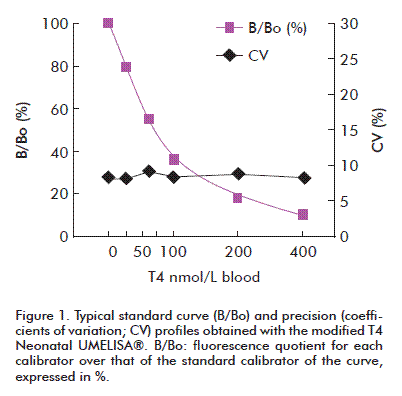
<body><![CDATA[<P   align="justify" ><font size="2" face="Verdana, Arial, Helvetica, sans-serif">For the measurement      of T4 concentrations, 5 mm blood discs of standards, controls and samples      were punched out of the filter paper and placed into each well of the elution      microplates, followed by the addition of 70 &mu;L of the diluted T4-alkaline      phosphatase conjugate in PBS solution with 0.12 mol/L of barbituric acid sodium      salt, 0.45 mmol/L Tween 20 and 0.15 mmol/L BSA. </font></P >       <P   align="justify" ><font size="2" face="Verdana, Arial, Helvetica, sans-serif">After the elution      in a humid chamber for 1 h at room temperature, 10 &mu;L of each eluate were      transferred into the well of the reaction opaque polystyrene UMELISA<Sup>&reg;</Sup>      plates previously coated with the specific polyclonal rabbit anti-T4 antibodies.      The competitive reaction was developed for 2 h at room temperature in a humid      chamber and then, the plates were washed 6 times with 0.37 mol/L of Tris-HCl      solution (pH 8.0) containing 3.76 mol/L NaCl, 1.1 mmol/L Tween 20 and 76.9      mmol/L NaN<Sub>3</Sub>. The fluorogenic reaction was performed by adding 10      &mu;L of the substrate solution (pH 9.6) containing 5.07 mmol/L 4-methylumbelliferil      phosphate, 0.92 mol/L diethanolamine-HCl, 0.7 mmol/L MgCl<Sub>2</Sub> and      7 mmol/L NaN<Sub>3</Sub>. UMELISA<Sup>&reg;</Sup> plates were further incubated      at room temperature in a humid chamber for 30 min. Finally, the fluorescence      was measured automatically in the fluorimeterpho-tometer reader. Automatic      validation and interpretation of the results were done using specific assay      software. </font></P >   <FONT size="+1"><FONT size="+1"><FONT size="+1"><FONT size="+1"><FONT size="+1"><FONT size="+1"><FONT size="+1"><FONT size="+1"><FONT size="+1"><FONT size="+1">        <P   ><font size="2" face="Verdana, Arial, Helvetica, sans-serif"><I><b>Modified T4      Neonatal UMELISA</b></I><b><Sup><I>&reg;</I></Sup><I> using 3 mm discs </I></b></font></P >   <FONT size="+1"><FONT size="+1">        <P   align="justify" ><font size="2" face="Verdana, Arial, Helvetica, sans-serif">For the measurement      of T4 concentrations, 3 mm blood discs of standards, controls and samples      were punched out of the filter paper and placed into each well of the elution      microplates, followed by the addition of 60 &mu;L of the diluted T4-alkaline      phosphatase conjugate in phosphate-buffered saline solution with 0.12 mol/L      of barbituric acid sodium salt, 0.45 mmol/L of Tween 20 and 0.15 mmol/L of      BSA. From this step on, the same procedure of the T4 Neonatal UMELISA<Sup>&reg;</Sup>      was followed. </font></P >   <FONT size="+1"><FONT size="+1">        <P   ><font size="2" face="Verdana, Arial, Helvetica, sans-serif"><I><b>Correlation      with the T4 Neonatal UMELISA</b></I><b><Sup><I>&reg;</I></Sup></b></font></P >   <FONT size="+1"><FONT size="+1">        <P   align="justify" ><font size="2" face="Verdana, Arial, Helvetica, sans-serif">The quantitative      differences between the modified assay and the T4 Neonatal UMELISA<Sup>&reg;</Sup>      were assessed using two approaches: the Pearson correlation and the concordance      correlation coefficient (&rho;c). The slope, ordinate intercept of the line-of-best-fit,      and regression statistics were obtained using the Microsoft Excel 2000 software,      to compare our modified assay results versus those obtained on the same dried      blood samples using T4 Neonatal UMELISA<Sup>&reg;</Sup>. The concordance correlation      coefficient was calculated as a measure of agreement between assays [12].      Concordance was classified as minor (values ranging 0.2-0.7), moderate (0.7-0.85)      or high (above 0.85). </font></P >       <P   align="justify" >&nbsp;</P >   <FONT size="+1"><FONT size="+1"><FONT size="+1"><FONT size="+1">        <P   ><font size="2" face="Verdana, Arial, Helvetica, sans-serif"><B><font size="3">RESULTS      </font></b></font></P >   <FONT size="+1">        <P   ><font size="2" face="Verdana, Arial, Helvetica, sans-serif"><b>Standard curve      of the modified T4 Neonatal UMELISA<Sup>&reg;</Sup></b></font></P >   <FONT size="+1"><FONT size="+1"><FONT size="+1">        <P   align="justify" ><font size="2" face="Verdana, Arial, Helvetica, sans-serif">A typical standard      curve and a precision profile obtained with the modified T4 Neonatal UMELISA<Sup>&reg;</Sup>      are shown in <a href="#fig1">figure 1</a>. The adjustment of the standard      curve was automatically fitted to a linear function. The calculated values      of the samples were interpolated in a graphic of the fluorescence quotient      B/Bo (fluorescence for each calibrator over that of the standard calibrator      of the curve; expressed in %) versus the T4 concentration, corresponding to      the standard curve, getting the concentration values in nmol of T4/L of blood.      In the resulting quotient, B/Bo was inversely proportional to the amount of      T4 in the sample. </font></P >       ]]></body>
<body><![CDATA[<P   align="center" ><img src="/img/revistas/bta/v30n2/f0107213.gif" width="400" height="394"><a name="fig1"></a></P >   <FONT size="+1"><FONT size="+1">        
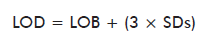
<P   align="justify" ><font size="2" face="Verdana, Arial, Helvetica, sans-serif">Limit of detection      (LOD) and limit of quantitation (LOQ) were determined according to CLSI guidelines      [13]. The zero standard and 3 spiked dried blood samples (15, 20 and 25 nmol/L)      were analyzed 20 times to estimate LOD and LOQ. Means, SDs, CVs and slope      were calculated. LOD was 13 nmol/L, defined as the lowest amount of T4 in      a sample that can be detected with a probability of 95 %, and calculated by      the formula: </font></P >       <P   align="center" ><img src="/img/revistas/bta/v30n2/fr0107213.gif" width="205" height="41"></P >       
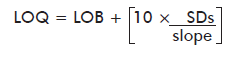
<P   align="justify" > </P >       <P   align="justify" ><font size="2" face="Verdana, Arial, Helvetica, sans-serif">where: </font></P >       <P   align="justify" ><font size="2" face="Verdana, Arial, Helvetica, sans-serif">LOB was the 95 percentile      of zero standard measurements; SDs = Pooled SD (estimated from measurements      on spiked samples). LOQ was 19 nmol/L; the lowest amount of T4 in a sample      that can be quantitatively determined in our UMELISA<Sup>&reg;</Sup> with      an acceptable precision and a suitable accuracy. </font></P >   <FONT size="+1"><FONT size="+1">        <P   align="justify" ><font size="2" face="Verdana, Arial, Helvetica, sans-serif">The spiked samples      were studied to select the lowest concentration in the assay for which the      CV is less than 20 % and the measured value is within 20 % (80-120 %) of true      value, calculated by the formula: </font></P >       <P   align="center" ><img src="/img/revistas/bta/v30n2/fr0207213.gif" width="239" height="56"></P >       
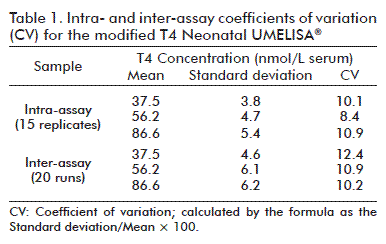
<P   ><font size="2" face="Verdana, Arial, Helvetica, sans-serif"><b>Precision and      recovery of the modified T4 Neonatal UMELISA<Sup>&reg;</Sup></b></font></P >   <FONT size="+1"><FONT size="+1">        <P   align="justify" ><font size="2" face="Verdana, Arial, Helvetica, sans-serif">The precision of      the modified T4 Neonatal UMELISA<Sup>&reg;</Sup> is shown in <a href="#tab1">table      1</a>. Samples representing 3 different levels of T4 concentrations were assayed.      The intra-assay variability was calculated with 15 replicates of each sample,      equidistantly distributed on the same plate. The inter-assay precision was      calculated from estimating T4 in the above samples in 10 independent assays.      The intra- and inter-assay CVs ranges were 6-10 % and 7-12 %, respectively,      depending on T4 concentrations.</font></P >       ]]></body>
<body><![CDATA[<P   align="center" ><img src="/img/revistas/bta/v30n2/t0107213.gif" width="384" height="242"><a name="tab1"></a></P >   <FONT size="+1"><FONT size="+1">        
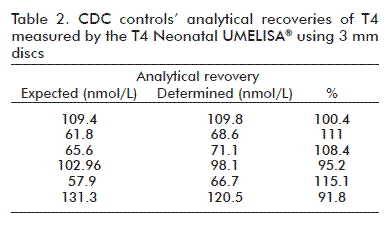
<P   align="justify" ><font size="2" face="Verdana, Arial, Helvetica, sans-serif">Analytical recovery      was evaluated using six CDC controls. Percentage recovery ranged 91-115 %      with a mean value of 103 % (<a href="#tab2">Table 2</a>). </font></P >       <P   align="center" ><img src="/img/revistas/bta/v30n2/t0207213.gif" width="383" height="223"><a name="tab2"></a></P >       
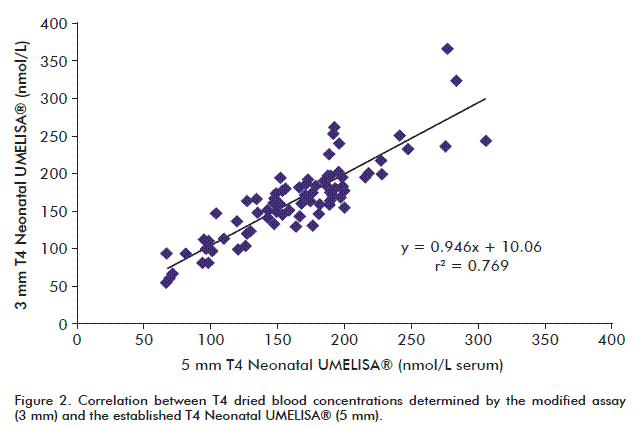
<P   ><font size="2" face="Verdana, Arial, Helvetica, sans-serif"><b>Comparison of      both methods </b></font></P >       <P   align="justify" ><font size="2" face="Verdana, Arial, Helvetica, sans-serif">Using our modified      assay and the T4 Neonatal UMELISA<Sup>&reg;</Sup>, we evaluated 83 dried blood      samples in duplicates. Results of correlation analyses are shown in <a href="/img/revistas/bta/v30n2/f0207213.gif">figure      2</a>. Additionally, six CDC controls were also evaluated with both methods.      The outcomes of these assays highly correlated by the Pearson correlation      (r = 0.877) where the slope, ordinate-intercept and linear correlation coefficient      were 0.946, 10.06 and 0.769, respectively. The absolute agreement between      assays was quantified using the concordance correlation. There was a high      overall concordance between the modified assay and the T4 Neonatal UMELISA<Sup>&reg;</Sup>      (&rho;c = 0.867). </font></P >   <FONT size="+1"><FONT size="+1"><FONT size="+1"><FONT size="+1"><FONT size="+1">        
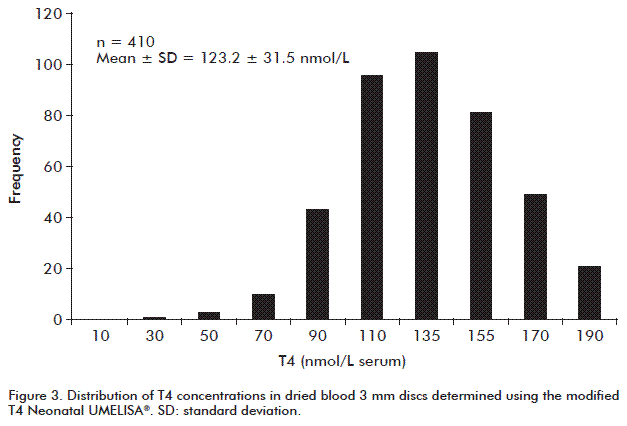
<P   ><font size="2" face="Verdana, Arial, Helvetica, sans-serif"><b>Analysis of dried      blood samples using the modified T4 Neonatal UMELISA<Sup>&reg;</Sup></b></font></P >   <FONT size="+1"><FONT size="+1">        <P   align="justify" ><font size="2" face="Verdana, Arial, Helvetica, sans-serif">The distribution      of the T4 concentrations using the modified method is shown in <a href="/img/revistas/bta/v30n2/f0307213.gif">figure      3</a>. T4 mean concentration in dried blood samples from 410 healthy neonates      (5-to-7 days-old) was 123.2 (SD 31.5), ranging 24.2-220.5 nmol/L. All samples      were obtained from apparently healthy full term neonates with birth weights      above 2500 g. The modified assay cut-off value (10<Sup>th</Sup> percentile)      was 100 nmol/L, similar to the one used in the T4 Neonatal UMELISA<Sup>&reg;</Sup>.      </font></P >       
<P   align="justify" >&nbsp;</P >   <FONT size="+1"><FONT size="+1"><FONT size="+1"><FONT size="+1">        <P   ><font size="2" face="Verdana, Arial, Helvetica, sans-serif"><B><font size="3">DISCUSSION      </font></b></font></P >   <FONT size="+1">        <P   align="justify" ><font size="2" face="Verdana, Arial, Helvetica, sans-serif">Unrecognized CH leads      to severe and irreversible mental retardation. Because signs and symptoms      of this disease are often scarce and not easily recognizable, newborns are      screened at birth for early CH detection. </font></P >   <FONT size="+1">        ]]></body>
<body><![CDATA[<P   align="justify" ><font size="2" face="Verdana, Arial, Helvetica, sans-serif">Pilot screening programs      for CH were developed in Quebec, Canada, and Pittsburgh, Pennsylvania, in      1974 and have now been established in Western Europe, North America, Japan,      Australia, and parts of Eastern Europe, Asia, South America, and Central America      [14-16]. In North America, more than 5 million newborns are screened and approximately      1400 infants with CH are detected annually. Certainly the main objective of      screening, the eradication of mental retardation after CH, has been achieved.      In addition to the profound clinical benefit, it has been estimated that the      cost of screening for CH is much lower than the cost of diagnosing CH at an      older age [6]. </font></P >       <P   align="justify" ><font size="2" face="Verdana, Arial, Helvetica, sans-serif">At the present time,      there are a lot of methods for the diagnosis of CH, either by determining      T4 (positive cases are confirmed by TSH quantification) or TSH (positive cases      are confirmed by T4 quantification). Both hormones can be detected in human      serum or dried blood on filter paper, being this way the most common method      used worldwide in the neonatal screening [17]. </font></P >       <P   align="justify" ><font size="2" face="Verdana, Arial, Helvetica, sans-serif">Early in the experience      of screening, most programs undertook an initial T4 test, with a follow-up      TSH test on infants below a specified T4 cut-off [2]. With increasing accuracy      of TSH measurement, many screening programs now carry out an initial TSH test      to detect CH. Each program must develop its own T4 and TSH cut-off for recall      of infants with abnormal test results. As there are rapid changes in TSH and      T4 in the first few days of life, many programs have developed age-related      cutoffs [5]. </font></P >       <P   align="justify" ><font size="2" face="Verdana, Arial, Helvetica, sans-serif">T4 levels in the      neonatal period and brain function of early treated hypothyroid children show      the great importance of neonatal screening programs. With screening and neonatal      diagnosis, the majority of children who are treated early experience normal      growth and neurologic development and normal-range intelligent coefficient      values [18-20]. CH treatment involves thyroid hormone replacement with L-levothyroxine.      The goals of early thyroid hormone therapy should be to maintain the total      or free T4 levels in the upper half of the reference range during the first      3 years of life and to normalize TSH concentrations [6, 7]. </font></P >       <P   align="justify" ><font size="2" face="Verdana, Arial, Helvetica, sans-serif">This work shows the      standardization of a modified T4 Neonatal UMELISA<Sup>&reg; </Sup>which has      as advantages the use of 3 mm dried blood discs and a 10 &micro;L decrease      in the elution volume. With the increment of the number of disorders included      in the newborn screening programs, it is necessary the efficient use of newborn      dried blood samples. For that reason, the majority of current in-house or      commercial assays for detecting inborn errors of metabolism in the neonatal      period use smaller blood punches (3 mm in diameter or lower) [21]. Currently,      the SUMA<Sup>&reg;</Sup> technology ultramicroassays for newborn screening      purposes are designed to be performed on 3 mm dried blood discs [22-26]. </font></P >   <FONT size="+1"><FONT size="+1"><FONT size="+1"><FONT size="+1">        <P   align="justify" ><font size="2" face="Verdana, Arial, Helvetica, sans-serif">Overall evaluation      of the results shows that the modified T4 Neonatal UMELISA<Sup>&reg;</Sup>      has similar characteristics to other assays commercially available in terms      of precision, accuracy and clinical utility, thus, making it potentially useful      in the neonatal screening for CH. The total time required by the new assay      using 3 mm discs is about 3 &frac12; h, similar to T4 Neonatal UMELISA&reg;      using 5 mm discs. The assay exhibited good within-run and between-run reproducibilities      in the concentration range from 25 to 400 nmol/L, and the results obtained      following the evaluation of CDC controls demonstrated its accuracy.</font></P >   <FONT size="+1"><FONT size="+1">        <P   align="justify" ><font size="2" face="Verdana, Arial, Helvetica, sans-serif">The modified T4 Neonatal      UMELISA<Sup>&reg;</Sup> is intended for the quantitative measurement of T4      in blood spots dried on filter paper and for the detection of children with      CH, where T4 levels are below 80 nmol/L. That is why the LOD and LOQ are more      than adequate for population screening. </font></P >   <FONT size="+1"><FONT size="+1">        <P   align="justify" ><font size="2" face="Verdana, Arial, Helvetica, sans-serif">The modified assay      presented a high correlation with the T4 Neonatal UMELISA<Sup>&reg;</Sup>      (&rho;c = 0.876) when evaluating 83 newborn dried blood samples and six CDC      controls. Additionally, the frequency distribution obtained with the modified      assay using 3 mm discs, was similar to other populations [27-29]. For instance,<B>      </B>Gru&ntilde;eiro-Papendieck <I>et al</I>. reported comparable T4 levels      measured by fluorimmunoassay (Wallac Inc Turku, Finland) in preterm (117 nmol/L      and full term (181 nmol/L) babies [27]. Larsson <I>et al</I>. reported a T4      mean of 142 nmol/L in 19 289 dried blood samples collected on the 5<Sup>th      </Sup>day as average [28], while Gonz&aacute;lez <I>et al</I>., using an ultramicroanalytical      fluorescent enzyme immunoassay, obtained a T4 mean concentration of 107 nmol/L      (SD 28.0 in 255 healthy euthyroid subjects serum samples and 105 nmol/L (SD      29.0) in 200 cord blood specimens [29]. </font></P >   <FONT size="+1"><FONT size="+1"><FONT size="+1"><FONT size="+1">        <P   align="justify" ><font size="2" face="Verdana, Arial, Helvetica, sans-serif">In summary, the modified      T4 Neonatal UMELISA<Sup>&reg;</Sup>, as part of SUMA technology, is a simple,      precise, accurate and rapid assay that can be used to carry out screening      programs in newborns. Modifying the T4 Neonatal UMELISA<Sup>&reg;</Sup> to      3 mm discs of dried blood on filter paper permits to make a more rational      use of newborn samples and it makes possible to increase the number of diseases      included in the newborn screening programs. </font></P >       <P   align="justify" >&nbsp;</P >   <FONT size="+1"><FONT size="+1"><FONT size="+1"><FONT size="+1">        ]]></body>
<body><![CDATA[<P   align="justify" > </P >       <P   ><font size="3" face="Verdana, Arial, Helvetica, sans-serif"><B>ACKNOWLEDGEMENTS</b></font><font size="2" face="Verdana, Arial, Helvetica, sans-serif"><B>      </b></font></P >   <FONT size="+1">        <P   align="justify" ><font size="2" face="Verdana, Arial, Helvetica, sans-serif">We thank B.A.Ed.      Senia Berm&uacute;dez for her valuable help in the final language revision      of the manuscript. </font></P >       <P   align="justify" >&nbsp;</P >   <FONT size="+1">        <P   align="justify" > </P >       <P   align="justify" ><b><font size="3" face="Verdana, Arial, Helvetica, sans-serif">REFERENCES </font></b></P >       <!-- ref --><P   align="justify" ><font size="2" face="Verdana, Arial, Helvetica, sans-serif">1. Fisher DA, Dussault      JH, Foley TP, Jr., Klein AH, LaFranchi S, Larsen PR, et al. Screening for      congenital hypothyroidism: results of screening one million North American      infants. J Pediatr. 1979;94(5):700-5.     </font></P >       <!-- ref --><P   align="justify" ><font size="2" face="Verdana, Arial, Helvetica, sans-serif">2. Fisher DA. Second      International Conference on Neonatal Thyroid Screening: progress report. J      Pediatr. 1983;102(5):653-4.     </font></P >       ]]></body>
<body><![CDATA[<!-- ref --><P   align="justify" ><font size="2" face="Verdana, Arial, Helvetica, sans-serif">3. Ali&ntilde;o M.      El programa de pesquisa neonatal en Cuba. In: I Congreso Latinoamericano de      Pesquisa Neonatal y Enfermedades Heredometab&oacute;licas. Ciudad de La Habana,      Cuba; 1997. p. 28.     </font></P >       <!-- ref --><P   align="justify" ><font size="2" face="Verdana, Arial, Helvetica, sans-serif">4. Guell R, Robaina      R, &Aacute;lvarez MA, Fern&aacute;ndez JL. M&aacute;s de 10 a&ntilde;os de      pesquisaje neonatal de hipotiroidismo cong&eacute;nito. In: I Congreso Latinoamericano      de Pesquisa Neonatal y Enfermedades Heredo metab&oacute;licas. Ciudad de La      Habana, Cuba, 1997. p. 41.     </font></P >       <!-- ref --><P   align="justify" ><font size="2" face="Verdana, Arial, Helvetica, sans-serif">5. Rastogi MV, LaFranchi      SH. Congenital hypothyroidism. Orphanet J Rare Dis. 2010;5:17.     </font></P >       <!-- ref --><P   align="justify" ><font size="2" face="Verdana, Arial, Helvetica, sans-serif">6. Rose SR, Brown      RS, Foley T, Kaplowitz PB, Kaye CI, Sundararajan S, et al. Update of newborn      screening and therapy for congenital hypothyroidism. Pediatrics. 2006;117(6):2290-303.          </font></P >       <!-- ref --><P   align="justify" ><font size="2" face="Verdana, Arial, Helvetica, sans-serif">7. American Academy      of Pediatrics AAP Section on Endocrinology and Committee on Genetics, and      American Thyroid Association Committee on Public Health: Newborn screening      for congenital hypothyroidism: recommended guidelines. Pediatrics. 1993;91(6):1203-9.          </font></P >       ]]></body>
<body><![CDATA[<!-- ref --><P   align="justify" ><font size="2" face="Verdana, Arial, Helvetica, sans-serif">8. Fisher DA. Congenital      hypothyroidism. Thyroid Int. 2002;3:3-10.     </font></P >       <!-- ref --><P   align="justify" ><font size="2" face="Verdana, Arial, Helvetica, sans-serif">9. van Tijn DA, de      Vijlder JJ, Verbeeten B, Jr., Verkerk PH, Vulsma T. Neonatal detection of      congenital hypothyroidism of central origin. J Clin Endocrinol Metab. 2005;90(6):3350-9.          </font></P >       <P   align="justify" ><font size="2" face="Verdana, Arial, Helvetica, sans-serif">10. Almenares P,      Lechuga MF, Marrero N, Sol&iacute;s RL, Fr&oacute;meta A, Robaina R, et al.      Development of UMELISA T4 Neonatal for the early diagnosis of congenital hypothyroidism.      In: Levy HL, Hermos RJ, Grady GF, editors. Proceedings of third meeting of      the international society for neonatal screening; 1996 Oct 20-23; Boston,      EUA. Massachusetts: IKON/MAP; 1996. p. 240-1. </font></P >       <P   align="justify" ><font size="2" face="Verdana, Arial, Helvetica, sans-serif">11. Marrero N, Zulueta      O, Gonz&aacute;lez EC, Montalvo G, P&eacute;rez PL, Melchor A. Obtention of      17&#61537;-hydroxyprogesterone/alkaline phosphatase conjugates for use in      the diagnosis of congenital adrenal hyperplasia. Rev CENIC Cienc Biol. 2003;34(1):23-8.      </font></P >       <!-- ref --><P   align="justify" ><font size="2" face="Verdana, Arial, Helvetica, sans-serif">12. Lin LI. A concordance      correlation coefficient to evaluate reproducibility. Biometrics. 1989;45(1):255-68.          </font></P >       <!-- ref --><P   align="justify" ><font size="2" face="Verdana, Arial, Helvetica, sans-serif">13. Clinical and      Laboratory Standards Institute (CLSI). Protocols for determination of limits      of detection and limits of quantitation; approved guideline. CLSI document      EP17-A. Wayne, PA: CLSI; 2004.     </font></P >       ]]></body>
<body><![CDATA[<!-- ref --><P   align="justify" ><font size="2" face="Verdana, Arial, Helvetica, sans-serif">14. Dussault JH,      Coulombe P, Laberge C, Letarte J, Guyda H, Khoury K. Preliminary report on      a mass screening program for neonatal hypothyroidism. J Pediatr. 1975;86(5):670-4.          </font></P >       <!-- ref --><P   align="justify" ><font size="2" face="Verdana, Arial, Helvetica, sans-serif">15. Revised guidelines      for neonatal screening programmes for primary congenital hypothyroidism. Working      Group on Neonatal Screening of the European Society for Paediatric Endocrinology.      Horm Res. 1999;52(1):49-52.     </font></P >       <!-- ref --><P   align="justify" ><font size="2" face="Verdana, Arial, Helvetica, sans-serif">16. Lafranchi SH,      Snyder DB, Sesser DE, Skeels MR, Singh N, Brent GA, et al. Follow-up of newborns      with elevated screening T4 concentrations. J Pediatr. 2003;143(3):296-301.          </font></P >       <!-- ref --><P   align="justify" ><font size="2" face="Verdana, Arial, Helvetica, sans-serif">17. Prieto L, Gru&ntilde;eiro      de Papendieck L, Chiesa A, Bergad&aacute; C. Screening of congenital hypothyroidism      (CH): experience in cord blood. In: Levy HL, Hermos RJ, Grady GF, editors.      Proceedings of the third meeting of the international society for neonatal      screening; 1996 Oct 22-23; Boston, EUA. Massachusetts: IKON/MAP; 1996. p.      271-2.     </font></P >       <!-- ref --><P   align="justify" ><font size="2" face="Verdana, Arial, Helvetica, sans-serif">18. Derksen-Lubsen      G, Verkerk PH. Neuropsychologic development in early treated congenital hypothyroidism:      analysis of literature data. Pediatr Res. 1996;39(3):561-6.     </font></P >       ]]></body>
<body><![CDATA[<!-- ref --><P   align="justify" ><font size="2" face="Verdana, Arial, Helvetica, sans-serif">19. &Aacute;lvarez      MA, Carvajal-Mart&iacute;nez F, P&eacute;rez-Ges&eacute;n C, Olivares-Torres      A, Fern&aacute;ndez-Yero JL, Robaina-&Aacute;lvarez R, et al. Pron&oacute;stico      de la cognici&oacute;n en el hipotiroidismo cong&eacute;nito tra-tado precozmente.      Hip&oacute;tesis del doble efecto. Rev Neurol. 2004;38(6):513-7.     </font></P >       <!-- ref --><P   align="justify" ><font size="2" face="Verdana, Arial, Helvetica, sans-serif">20. LaFranchi SH,      Austin J. How should we be treating children with congenital hypothyroidism?      J Pediatr Endocrinol Metab. 2007;20(5):559-78.     </font></P >       <!-- ref --><P   align="justify" ><font size="2" face="Verdana, Arial, Helvetica, sans-serif">21. Mei JV, Alexander      JR, Adam BW, Hannon WH. Use of filter paper for the collection and analysis      of human whole blood specimens. J Nutr. 2001;131(5):1631S-6S.     </font></P >       <!-- ref --><P   align="justify" ><font size="2" face="Verdana, Arial, Helvetica, sans-serif">22. Gonzalez EC,      Marrero N, Frometa A, Herrera D, Castells E, Perez PL. Qualitative colorimetric      ultramicroassay for the detection of biotinidase deficiency in newborns. Clin      Chim Acta. 2006;369(1):35-9.     </font></P >       <P   align="justify" ><font size="2" face="Verdana, Arial, Helvetica, sans-serif">23. Herrera D, Gonz&aacute;lez      EC, P&eacute;rez PL, Fr&oacute;meta A. Normalizaci&oacute;n del UMELISA TSH      NEONATAL&reg; a discos de 3 mm. Rev CENIC Cienc Biol. 2006;37(2):119-24. </font></P >       <!-- ref --><P   align="justify" ><font size="2" face="Verdana, Arial, Helvetica, sans-serif">24. Gonzalez EC,      Marrero N, Perez PL, Frometa A, Zulueta O, Herrera D, et al. An enzyme immunoassay      for determining 17alpha-hydroxyprogesterone in dried blood spots on filter      paper using an ultramicroanalytical system. Clin Chim Acta. 2008;394(1-2):63-6.          </font></P >       <!-- ref --><P   align="justify" ><font size="2" face="Verdana, Arial, Helvetica, sans-serif">25. Gonzalez EC,      Frometa A, del Rio L, Castells E, Robaina MS, Garcia SM, et al. Cuban neonatal      screening of phenylketonuria using an ultramicro-fluorometric test. Clin Chim      Acta. 2009;402(1-2):129-32.     </font></P >       <!-- ref --><P   align="justify" ><font size="2" face="Verdana, Arial, Helvetica, sans-serif">26. Frometa A, Reyes      EC, Castells E, Tejeda Y, Almenares P, Perez PL. Quantitative ultramicrotest      for newborn screening of galactosemia in Cuba. J Perinat Med. 2011;39(1):77-81.          </font></P >       <!-- ref --><P   align="justify" ><font size="2" face="Verdana, Arial, Helvetica, sans-serif">27. Gruneiro-Papendieck      L, Prieto L, Chiesa A, Bengolea S, Bossi G, Bergada C. Usefulness of thyroxine      and free thyroxine filter paper measurements in neonatal screening for congenital      hypothyroidism of preterm babies. J Med Screen. 2000;7(2):78-81.     </font></P >       <!-- ref --><P   align="justify" ><font size="2" face="Verdana, Arial, Helvetica, sans-serif">28. Larsson A, Ljunggren      JG, Ekman K, Nilsson A, Olin P. Screening for congenital hypothyroidism. I.      Laboratory results of a pilot study based on dried blood samples collected      for PKU screening. Acta Paediatr Scand.1981;70(2):141-6.     </font></P >       <!-- ref --><P   align="justify" ><font size="2" face="Verdana, Arial, Helvetica, sans-serif">29. Gonzalez RR,      Robaina R, Rodriguez ME, Blanca S. An enzyme immunoassay for determining total      thyroxine in human serum using an ultramicroanalytical system. Clin Chim Acta.      1991;197(3):159-70.     </font></P >       <P   align="justify" >&nbsp;</P >       <P   align="justify" >&nbsp;</P >       <P   align="justify" > </P >       <P   align="justify" > </P >       <P   align="justify" ><font size="2" face="Verdana, Arial, Helvetica, sans-serif">Received in June,      2012.     <br>     </font><font size="2" face="Verdana, Arial, Helvetica, sans-serif">Accepted      in January, 2013. </font></P >       <P   align="justify" >&nbsp;</P >       <P   align="justify" >&nbsp;</P >       <P   align="justify" > </P >       ]]></body>
<body><![CDATA[<P   align="justify" > </P >       <P   align="justify" ><font size="2" face="Verdana, Arial, Helvetica, sans-serif"><I>Elisa Castells</I>.      Laboratorio de Pesquisa Neonatal, Centro de Inmunoensayo, CIE. Calle 134 y      Ave. 25, AP 6653, Cubanac&aacute;n, Playa, La Habana, Cuba. E-mail: <A href="mailto:iqtsh1@cie.sld.cu">      <U><U><FONT color="#0000FF">iqtsh1@cie.sld.cu</font></U></U></A><FONT color="#0000FF"><FONT color="#000000">.      </font></font></font></P >   </font></font></font></font></font></font></font></font></font></font></font></font></font></font></font></font></font></font></font></font></font></font></font></font></font></font></font></font></font></font></font></font></font></font></font></font></font></font></font></font></font></font></font></font></font></font></font></font></font></font></font></font></font></font></font></font></font></font></font></font></font></font></font></font></font></font></font></font></font></font></font></font></font></font></font></font></font></font></font></font></font></font></font></font></font></font></font></font></font></font></font></font></font></font></font></font></font></font></font></font></font></font></font></font></font></DIV >      ]]></body><back>
<ref-list>
<ref id="B1">
<label>1</label><nlm-citation citation-type="journal">
<person-group person-group-type="author">
<name>
<surname><![CDATA[Fisher]]></surname>
<given-names><![CDATA[DA]]></given-names>
</name>
<name>
<surname><![CDATA[Dussault]]></surname>
<given-names><![CDATA[JH]]></given-names>
</name>
<name>
<surname><![CDATA[Foley]]></surname>
<given-names><![CDATA[TP Jr]]></given-names>
</name>
<name>
<surname><![CDATA[Klein]]></surname>
<given-names><![CDATA[AH]]></given-names>
</name>
<name>
<surname><![CDATA[LaFranchi]]></surname>
<given-names><![CDATA[S]]></given-names>
</name>
<name>
<surname><![CDATA[Larsen]]></surname>
<given-names><![CDATA[PR]]></given-names>
</name>
</person-group>
<article-title xml:lang="en"><![CDATA[Screening for congenital hypothyroidism: results of screening one million North American infants]]></article-title>
<source><![CDATA[J Pediatr]]></source>
<year>1979</year>
<volume>94</volume>
<numero>5</numero>
<issue>5</issue>
<page-range>700-5</page-range></nlm-citation>
</ref>
<ref id="B2">
<label>2</label><nlm-citation citation-type="journal">
<person-group person-group-type="author">
<name>
<surname><![CDATA[Fisher]]></surname>
<given-names><![CDATA[DA]]></given-names>
</name>
</person-group>
<article-title xml:lang="en"><![CDATA[Second International Conference on Neonatal Thyroid Screening: progress report]]></article-title>
<source><![CDATA[J Pediatr]]></source>
<year>1983</year>
<volume>102</volume>
<numero>5</numero>
<issue>5</issue>
<page-range>653-4</page-range></nlm-citation>
</ref>
<ref id="B3">
<label>3</label><nlm-citation citation-type="">
<person-group person-group-type="author">
<name>
<surname><![CDATA[Aliño]]></surname>
<given-names><![CDATA[M]]></given-names>
</name>
</person-group>
<article-title xml:lang="es"><![CDATA[El programa de pesquisa neonatal en Cuba]]></article-title>
<source><![CDATA[I Congreso Latinoamericano de Pesquisa Neonatal y Enfermedades Heredometabólicas]]></source>
<year>1997</year>
<page-range>28</page-range><publisher-loc><![CDATA[Ciudad de La Habana ]]></publisher-loc>
</nlm-citation>
</ref>
<ref id="B4">
<label>4</label><nlm-citation citation-type="">
<person-group person-group-type="author">
<name>
<surname><![CDATA[Guell]]></surname>
<given-names><![CDATA[R]]></given-names>
</name>
<name>
<surname><![CDATA[Robaina]]></surname>
<given-names><![CDATA[R]]></given-names>
</name>
<name>
<surname><![CDATA[Álvarez]]></surname>
<given-names><![CDATA[MA]]></given-names>
</name>
<name>
<surname><![CDATA[Fernández]]></surname>
<given-names><![CDATA[JL]]></given-names>
</name>
</person-group>
<article-title xml:lang="es"><![CDATA[Más de 10 años de pesquisaje neonatal de hipotiroidismo congénito]]></article-title>
<source><![CDATA[I Congreso Latinoamericano de Pesquisa Neonatal y Enfermedades Heredo metabólicas]]></source>
<year>1997</year>
<page-range>41</page-range><publisher-loc><![CDATA[Ciudad de La Habana ]]></publisher-loc>
</nlm-citation>
</ref>
<ref id="B5">
<label>5</label><nlm-citation citation-type="journal">
<person-group person-group-type="author">
<name>
<surname><![CDATA[Rastogi]]></surname>
<given-names><![CDATA[MV]]></given-names>
</name>
<name>
<surname><![CDATA[LaFranchi]]></surname>
<given-names><![CDATA[SH]]></given-names>
</name>
</person-group>
<article-title xml:lang="en"><![CDATA[Congenital hypothyroidism]]></article-title>
<source><![CDATA[Orphanet J Rare Dis]]></source>
<year>2010</year>
<volume>5</volume>
<page-range>17</page-range></nlm-citation>
</ref>
<ref id="B6">
<label>6</label><nlm-citation citation-type="journal">
<person-group person-group-type="author">
<name>
<surname><![CDATA[Rose]]></surname>
<given-names><![CDATA[SR]]></given-names>
</name>
<name>
<surname><![CDATA[Brown]]></surname>
<given-names><![CDATA[RS]]></given-names>
</name>
<name>
<surname><![CDATA[Foley]]></surname>
<given-names><![CDATA[T]]></given-names>
</name>
<name>
<surname><![CDATA[Kaplowitz]]></surname>
<given-names><![CDATA[PB]]></given-names>
</name>
<name>
<surname><![CDATA[Kaye]]></surname>
<given-names><![CDATA[CI]]></given-names>
</name>
<name>
<surname><![CDATA[Sundararajan]]></surname>
<given-names><![CDATA[S]]></given-names>
</name>
</person-group>
<article-title xml:lang="en"><![CDATA[Update of newborn screening and therapy for congenital hypothyroidism]]></article-title>
<source><![CDATA[Pediatrics]]></source>
<year>2006</year>
<volume>117</volume>
<numero>6</numero>
<issue>6</issue>
<page-range>2290-303</page-range></nlm-citation>
</ref>
<ref id="B7">
<label>7</label><nlm-citation citation-type="journal">
<collab>American Academy of Pediatrics AAP Section on Endocrinology and Committee on Genetics, and American Thyroid Association Committee on Public Health</collab>
<article-title xml:lang="en"><![CDATA[Newborn screening for congenital hypothyroidism: recommended guidelines]]></article-title>
<source><![CDATA[Pediatrics]]></source>
<year>1993</year>
<volume>91</volume>
<numero>6</numero>
<issue>6</issue>
<page-range>1203-9</page-range></nlm-citation>
</ref>
<ref id="B8">
<label>8</label><nlm-citation citation-type="journal">
<person-group person-group-type="author">
<name>
<surname><![CDATA[Fisher]]></surname>
<given-names><![CDATA[DA]]></given-names>
</name>
</person-group>
<article-title xml:lang="en"><![CDATA[Congenital hypothyroidism]]></article-title>
<source><![CDATA[Thyroid Int]]></source>
<year>2002</year>
<volume>3</volume>
<page-range>3-10</page-range></nlm-citation>
</ref>
<ref id="B9">
<label>9</label><nlm-citation citation-type="journal">
<person-group person-group-type="author">
<name>
<surname><![CDATA[van Tijn]]></surname>
<given-names><![CDATA[DA]]></given-names>
</name>
<name>
<surname><![CDATA[de Vijlder]]></surname>
<given-names><![CDATA[JJ]]></given-names>
</name>
<name>
<surname><![CDATA[Verbeeten]]></surname>
<given-names><![CDATA[B Jr]]></given-names>
</name>
<name>
<surname><![CDATA[Verkerk]]></surname>
<given-names><![CDATA[PH]]></given-names>
</name>
<name>
<surname><![CDATA[Vulsma]]></surname>
<given-names><![CDATA[T]]></given-names>
</name>
</person-group>
<article-title xml:lang="en"><![CDATA[Neonatal detection of congenital hypothyroidism of central origin]]></article-title>
<source><![CDATA[J Clin Endocrinol Metab]]></source>
<year>2005</year>
<volume>90</volume>
<numero>6</numero>
<issue>6</issue>
<page-range>3350-9</page-range></nlm-citation>
</ref>
<ref id="B10">
<label>10</label><nlm-citation citation-type="book">
<person-group person-group-type="author">
<name>
<surname><![CDATA[Almenares]]></surname>
<given-names><![CDATA[P]]></given-names>
</name>
<name>
<surname><![CDATA[Lechuga]]></surname>
<given-names><![CDATA[MF]]></given-names>
</name>
<name>
<surname><![CDATA[Marrero]]></surname>
<given-names><![CDATA[N]]></given-names>
</name>
<name>
<surname><![CDATA[Solís]]></surname>
<given-names><![CDATA[RL]]></given-names>
</name>
<name>
<surname><![CDATA[Frómeta]]></surname>
<given-names><![CDATA[A]]></given-names>
</name>
<name>
<surname><![CDATA[Robaina]]></surname>
<given-names><![CDATA[R]]></given-names>
</name>
</person-group>
<article-title xml:lang="en"><![CDATA[Development of UMELISA T4 Neonatal for the early diagnosis of congenital hypothyroidism]]></article-title>
<person-group person-group-type="editor">
<name>
<surname><![CDATA[Levy]]></surname>
<given-names><![CDATA[HL]]></given-names>
</name>
<name>
<surname><![CDATA[Hermos]]></surname>
<given-names><![CDATA[RJ]]></given-names>
</name>
<name>
<surname><![CDATA[Grady]]></surname>
<given-names><![CDATA[GF]]></given-names>
</name>
</person-group>
<source><![CDATA[Proceedings of the third meeting of the international society for neonatal screening: 1996 Oct 22-23]]></source>
<year>1996</year>
<page-range>240-1</page-range><publisher-loc><![CDATA[Boston ]]></publisher-loc>
<publisher-name><![CDATA[IKON/MAP]]></publisher-name>
</nlm-citation>
</ref>
<ref id="B11">
<label>11</label><nlm-citation citation-type="journal">
<person-group person-group-type="author">
<name>
<surname><![CDATA[Marrero]]></surname>
<given-names><![CDATA[N]]></given-names>
</name>
<name>
<surname><![CDATA[Zulueta]]></surname>
<given-names><![CDATA[O]]></given-names>
</name>
<name>
<surname><![CDATA[González]]></surname>
<given-names><![CDATA[EC]]></given-names>
</name>
<name>
<surname><![CDATA[Montalvo]]></surname>
<given-names><![CDATA[G]]></given-names>
</name>
<name>
<surname><![CDATA[Pérez]]></surname>
<given-names><![CDATA[PL]]></given-names>
</name>
<name>
<surname><![CDATA[Melchor]]></surname>
<given-names><![CDATA[A]]></given-names>
</name>
</person-group>
<article-title xml:lang="en"><![CDATA[Obtention of 17a-hydroxyprogesterone/alkaline phosphatase conjugates for use in the diagnosis of congenital adrenal hyperplasia]]></article-title>
<source><![CDATA[Rev CENIC Cienc Biol]]></source>
<year>2003</year>
<volume>34</volume>
<numero>1</numero>
<issue>1</issue>
<page-range>23-8</page-range></nlm-citation>
</ref>
<ref id="B12">
<label>12</label><nlm-citation citation-type="journal">
<person-group person-group-type="author">
<name>
<surname><![CDATA[Lin]]></surname>
<given-names><![CDATA[LI]]></given-names>
</name>
</person-group>
<article-title xml:lang="en"><![CDATA[A concordance correlation coefficient to evaluate reproducibility]]></article-title>
<source><![CDATA[Biometrics]]></source>
<year>1989</year>
<volume>45</volume>
<numero>1</numero>
<issue>1</issue>
<page-range>255-68</page-range></nlm-citation>
</ref>
<ref id="B13">
<label>13</label><nlm-citation citation-type="book">
<collab>Clinical and Laboratory Standards Institute (CLSI)</collab>
<source><![CDATA[Protocols for determination of limits of detection and limits of quantitation: approved guideline. CLSI document EP17-A]]></source>
<year>2004</year>
<publisher-loc><![CDATA[Wayne ]]></publisher-loc>
<publisher-name><![CDATA[CLSI]]></publisher-name>
</nlm-citation>
</ref>
<ref id="B14">
<label>14</label><nlm-citation citation-type="journal">
<person-group person-group-type="author">
<name>
<surname><![CDATA[Dussault]]></surname>
<given-names><![CDATA[JH]]></given-names>
</name>
<name>
<surname><![CDATA[Coulombe]]></surname>
<given-names><![CDATA[P]]></given-names>
</name>
<name>
<surname><![CDATA[Laberge]]></surname>
<given-names><![CDATA[C]]></given-names>
</name>
<name>
<surname><![CDATA[Letarte]]></surname>
<given-names><![CDATA[J]]></given-names>
</name>
<name>
<surname><![CDATA[Guyda]]></surname>
<given-names><![CDATA[H]]></given-names>
</name>
<name>
<surname><![CDATA[Khoury]]></surname>
<given-names><![CDATA[K]]></given-names>
</name>
</person-group>
<article-title xml:lang="en"><![CDATA[Preliminary report on a mass screening program for neonatal hypothyroidism]]></article-title>
<source><![CDATA[J Pediatr]]></source>
<year>1975</year>
<volume>86</volume>
<numero>5</numero>
<issue>5</issue>
<page-range>670-4</page-range></nlm-citation>
</ref>
<ref id="B15">
<label>15</label><nlm-citation citation-type="journal">
<article-title xml:lang="en"><![CDATA[Revised guidelines for neonatal screening programmes for primary congenital hypothyroidism: Working Group on Neonatal Screening of the European Society for Paediatric Endocrinology]]></article-title>
<source><![CDATA[Horm Res]]></source>
<year>1999</year>
<volume>52</volume>
<numero>1</numero>
<issue>1</issue>
<page-range>49-52</page-range></nlm-citation>
</ref>
<ref id="B16">
<label>16</label><nlm-citation citation-type="journal">
<person-group person-group-type="author">
<name>
<surname><![CDATA[Lafranchi]]></surname>
<given-names><![CDATA[SH]]></given-names>
</name>
<name>
<surname><![CDATA[Snyder]]></surname>
<given-names><![CDATA[DB]]></given-names>
</name>
<name>
<surname><![CDATA[Sesser]]></surname>
<given-names><![CDATA[DE]]></given-names>
</name>
<name>
<surname><![CDATA[Skeels]]></surname>
<given-names><![CDATA[MR]]></given-names>
</name>
<name>
<surname><![CDATA[Singh]]></surname>
<given-names><![CDATA[N]]></given-names>
</name>
<name>
<surname><![CDATA[Brent]]></surname>
<given-names><![CDATA[GA]]></given-names>
</name>
</person-group>
<article-title xml:lang="en"><![CDATA[Follow-up of newborns with elevated screening T4 concentrations]]></article-title>
<source><![CDATA[J Pediatr]]></source>
<year>2003</year>
<volume>143</volume>
<numero>3</numero>
<issue>3</issue>
<page-range>296-301</page-range></nlm-citation>
</ref>
<ref id="B17">
<label>17</label><nlm-citation citation-type="book">
<person-group person-group-type="author">
<name>
<surname><![CDATA[Prieto]]></surname>
<given-names><![CDATA[L]]></given-names>
</name>
<name>
<surname><![CDATA[Gruñeiro de Papendieck]]></surname>
<given-names><![CDATA[L]]></given-names>
</name>
<name>
<surname><![CDATA[Chiesa]]></surname>
<given-names><![CDATA[A]]></given-names>
</name>
<name>
<surname><![CDATA[Bergadá]]></surname>
<given-names><![CDATA[C]]></given-names>
</name>
</person-group>
<article-title xml:lang="en"><![CDATA[Screening of congenital hypothyroidism (CH): experience in cord blood]]></article-title>
<person-group person-group-type="editor">
<name>
<surname><![CDATA[Levy]]></surname>
<given-names><![CDATA[HL]]></given-names>
</name>
<name>
<surname><![CDATA[Hermos]]></surname>
<given-names><![CDATA[RJ]]></given-names>
</name>
<name>
<surname><![CDATA[Grady]]></surname>
<given-names><![CDATA[GF]]></given-names>
</name>
</person-group>
<source><![CDATA[Proceedings of the third meeting of the international society for neonatal screening: 1996 Oct 22-23]]></source>
<year>1996</year>
<page-range>271-2</page-range><publisher-loc><![CDATA[Boston ]]></publisher-loc>
<publisher-name><![CDATA[IKON/MAP]]></publisher-name>
</nlm-citation>
</ref>
<ref id="B18">
<label>18</label><nlm-citation citation-type="journal">
<person-group person-group-type="author">
<name>
<surname><![CDATA[Derksen-Lubsen]]></surname>
<given-names><![CDATA[G]]></given-names>
</name>
<name>
<surname><![CDATA[Verkerk]]></surname>
<given-names><![CDATA[PH]]></given-names>
</name>
</person-group>
<article-title xml:lang="en"><![CDATA[Neuropsychologic development in early treated congenital hypothyroidism: analysis of literature data]]></article-title>
<source><![CDATA[Pediatr Res]]></source>
<year>1996</year>
<volume>39</volume>
<numero>3</numero>
<issue>3</issue>
<page-range>561-6</page-range></nlm-citation>
</ref>
<ref id="B19">
<label>19</label><nlm-citation citation-type="journal">
<person-group person-group-type="author">
<name>
<surname><![CDATA[Álvarez]]></surname>
<given-names><![CDATA[MA]]></given-names>
</name>
<name>
<surname><![CDATA[Carvajal-Martínez]]></surname>
<given-names><![CDATA[F]]></given-names>
</name>
<name>
<surname><![CDATA[Pérez-Gesén]]></surname>
<given-names><![CDATA[C]]></given-names>
</name>
<name>
<surname><![CDATA[Olivares-Torres]]></surname>
<given-names><![CDATA[A]]></given-names>
</name>
<name>
<surname><![CDATA[Fernández-Yero]]></surname>
<given-names><![CDATA[JL]]></given-names>
</name>
<name>
<surname><![CDATA[Robaina-Álvarez]]></surname>
<given-names><![CDATA[R]]></given-names>
</name>
</person-group>
<article-title xml:lang="es"><![CDATA[Pronóstico de la cognición en el hipotiroidismo congénito tratado precozmente: Hipótesis del doble efecto]]></article-title>
<source><![CDATA[Rev Neurol]]></source>
<year>2004</year>
<volume>38</volume>
<numero>6</numero>
<issue>6</issue>
<page-range>513-7</page-range></nlm-citation>
</ref>
<ref id="B20">
<label>20</label><nlm-citation citation-type="journal">
<person-group person-group-type="author">
<name>
<surname><![CDATA[LaFranchi]]></surname>
<given-names><![CDATA[SH]]></given-names>
</name>
<name>
<surname><![CDATA[Austin]]></surname>
<given-names><![CDATA[J]]></given-names>
</name>
</person-group>
<article-title xml:lang="en"><![CDATA[How should we be treating children with congenital hypothyroidism?]]></article-title>
<source><![CDATA[J Pediatr Endocrinol Metab]]></source>
<year>2007</year>
<volume>20</volume>
<numero>5</numero>
<issue>5</issue>
<page-range>559-78</page-range></nlm-citation>
</ref>
<ref id="B21">
<label>21</label><nlm-citation citation-type="journal">
<person-group person-group-type="author">
<name>
<surname><![CDATA[Mei]]></surname>
<given-names><![CDATA[JV]]></given-names>
</name>
<name>
<surname><![CDATA[Alexander]]></surname>
<given-names><![CDATA[JR]]></given-names>
</name>
<name>
<surname><![CDATA[Adam]]></surname>
<given-names><![CDATA[BW]]></given-names>
</name>
<name>
<surname><![CDATA[Hannon]]></surname>
<given-names><![CDATA[WH]]></given-names>
</name>
</person-group>
<article-title xml:lang="en"><![CDATA[Use of filter paper for the collection and analysis of human whole blood specimens]]></article-title>
<source><![CDATA[J Nutr]]></source>
<year>2001</year>
<volume>131</volume>
<numero>5</numero>
<issue>5</issue>
<page-range>1631S-6S</page-range></nlm-citation>
</ref>
<ref id="B22">
<label>22</label><nlm-citation citation-type="journal">
<person-group person-group-type="author">
<name>
<surname><![CDATA[Gonzalez]]></surname>
<given-names><![CDATA[EC]]></given-names>
</name>
<name>
<surname><![CDATA[Marrero]]></surname>
<given-names><![CDATA[N]]></given-names>
</name>
<name>
<surname><![CDATA[Frometa]]></surname>
<given-names><![CDATA[A]]></given-names>
</name>
<name>
<surname><![CDATA[Herrera]]></surname>
<given-names><![CDATA[D]]></given-names>
</name>
<name>
<surname><![CDATA[Castells]]></surname>
<given-names><![CDATA[E]]></given-names>
</name>
<name>
<surname><![CDATA[Perez]]></surname>
<given-names><![CDATA[PL]]></given-names>
</name>
</person-group>
<article-title xml:lang="en"><![CDATA[Qualitative colorimetric ultramicroassay for the detection of biotinidase deficiency in newborns]]></article-title>
<source><![CDATA[Clin Chim Acta]]></source>
<year>2006</year>
<volume>369</volume>
<numero>1</numero>
<issue>1</issue>
<page-range>35-9</page-range></nlm-citation>
</ref>
<ref id="B23">
<label>23</label><nlm-citation citation-type="journal">
<person-group person-group-type="author">
<name>
<surname><![CDATA[Herrera]]></surname>
<given-names><![CDATA[D]]></given-names>
</name>
<name>
<surname><![CDATA[González]]></surname>
<given-names><![CDATA[EC]]></given-names>
</name>
<name>
<surname><![CDATA[Pérez]]></surname>
<given-names><![CDATA[PL]]></given-names>
</name>
<name>
<surname><![CDATA[Frómeta]]></surname>
<given-names><![CDATA[A]]></given-names>
</name>
</person-group>
<article-title xml:lang="es"><![CDATA[Normalización del UMELISA TSH NEONATAL(r) a discos de 3 mm]]></article-title>
<source><![CDATA[Rev CENIC Cienc Biol]]></source>
<year>2006</year>
<volume>37</volume>
<numero>2</numero>
<issue>2</issue>
<page-range>119-24</page-range></nlm-citation>
</ref>
<ref id="B24">
<label>24</label><nlm-citation citation-type="journal">
<person-group person-group-type="author">
<name>
<surname><![CDATA[Gonzalez]]></surname>
<given-names><![CDATA[EC]]></given-names>
</name>
<name>
<surname><![CDATA[Marrero]]></surname>
<given-names><![CDATA[N]]></given-names>
</name>
<name>
<surname><![CDATA[Perez]]></surname>
<given-names><![CDATA[PL]]></given-names>
</name>
<name>
<surname><![CDATA[Frometa]]></surname>
<given-names><![CDATA[A]]></given-names>
</name>
<name>
<surname><![CDATA[Zulueta]]></surname>
<given-names><![CDATA[O]]></given-names>
</name>
<name>
<surname><![CDATA[Herrera]]></surname>
<given-names><![CDATA[D]]></given-names>
</name>
</person-group>
<article-title xml:lang="en"><![CDATA[An enzyme immunoassay for determining 17alpha-hydroxyprogesterone in dried blood spots on filter paper using an ultramicroanalytical system]]></article-title>
<source><![CDATA[Clin Chim Acta]]></source>
<year>2008</year>
<volume>394</volume>
<numero>1-2</numero>
<issue>1-2</issue>
<page-range>63-6</page-range></nlm-citation>
</ref>
<ref id="B25">
<label>25</label><nlm-citation citation-type="journal">
<person-group person-group-type="author">
<name>
<surname><![CDATA[Gonzalez]]></surname>
<given-names><![CDATA[EC]]></given-names>
</name>
<name>
<surname><![CDATA[Frometa]]></surname>
<given-names><![CDATA[A]]></given-names>
</name>
<name>
<surname><![CDATA[del Rio]]></surname>
<given-names><![CDATA[L]]></given-names>
</name>
<name>
<surname><![CDATA[Castells]]></surname>
<given-names><![CDATA[E]]></given-names>
</name>
<name>
<surname><![CDATA[Robaina]]></surname>
<given-names><![CDATA[MS]]></given-names>
</name>
<name>
<surname><![CDATA[Garcia]]></surname>
<given-names><![CDATA[SM]]></given-names>
</name>
</person-group>
<article-title xml:lang="en"><![CDATA[Cuban neonatal screening of phenylketonuria using an ultramicro-fluorometric test]]></article-title>
<source><![CDATA[Clin Chim Acta]]></source>
<year>2009</year>
<volume>402</volume>
<numero>1-2</numero>
<issue>1-2</issue>
<page-range>129-32</page-range></nlm-citation>
</ref>
<ref id="B26">
<label>26</label><nlm-citation citation-type="journal">
<person-group person-group-type="author">
<name>
<surname><![CDATA[Frometa]]></surname>
<given-names><![CDATA[A]]></given-names>
</name>
<name>
<surname><![CDATA[Reyes]]></surname>
<given-names><![CDATA[EC]]></given-names>
</name>
<name>
<surname><![CDATA[Castells]]></surname>
<given-names><![CDATA[E]]></given-names>
</name>
<name>
<surname><![CDATA[Tejeda]]></surname>
<given-names><![CDATA[Y]]></given-names>
</name>
<name>
<surname><![CDATA[Almenares]]></surname>
<given-names><![CDATA[P]]></given-names>
</name>
<name>
<surname><![CDATA[Perez]]></surname>
<given-names><![CDATA[PL]]></given-names>
</name>
</person-group>
<article-title xml:lang="en"><![CDATA[Quantitative ultramicrotest for newborn screening of galactosemia in Cuba]]></article-title>
<source><![CDATA[J Perinat Med]]></source>
<year>2011</year>
<volume>39</volume>
<numero>1</numero>
<issue>1</issue>
<page-range>77-81</page-range></nlm-citation>
</ref>
<ref id="B27">
<label>27</label><nlm-citation citation-type="journal">
<person-group person-group-type="author">
<name>
<surname><![CDATA[Gruneiro-Papendieck]]></surname>
<given-names><![CDATA[L]]></given-names>
</name>
<name>
<surname><![CDATA[Prieto]]></surname>
<given-names><![CDATA[L]]></given-names>
</name>
<name>
<surname><![CDATA[Chiesa]]></surname>
<given-names><![CDATA[A]]></given-names>
</name>
<name>
<surname><![CDATA[Bengolea]]></surname>
<given-names><![CDATA[S]]></given-names>
</name>
<name>
<surname><![CDATA[Bossi]]></surname>
<given-names><![CDATA[G]]></given-names>
</name>
<name>
<surname><![CDATA[Bergada]]></surname>
<given-names><![CDATA[C]]></given-names>
</name>
</person-group>
<article-title xml:lang="en"><![CDATA[Usefulness of thyroxine and free thyroxine filter paper measurements in neonatal screening for congenital hypothyroidism of preterm babies]]></article-title>
<source><![CDATA[J Med Screen]]></source>
<year>2000</year>
<volume>7</volume>
<numero>2</numero>
<issue>2</issue>
<page-range>78-81</page-range></nlm-citation>
</ref>
<ref id="B28">
<label>28</label><nlm-citation citation-type="journal">
<person-group person-group-type="author">
<name>
<surname><![CDATA[Larsson]]></surname>
<given-names><![CDATA[A]]></given-names>
</name>
<name>
<surname><![CDATA[Ljunggren]]></surname>
<given-names><![CDATA[JG]]></given-names>
</name>
<name>
<surname><![CDATA[Ekman]]></surname>
<given-names><![CDATA[K]]></given-names>
</name>
<name>
<surname><![CDATA[Nilsson]]></surname>
<given-names><![CDATA[A]]></given-names>
</name>
<name>
<surname><![CDATA[Olin]]></surname>
<given-names><![CDATA[P]]></given-names>
</name>
</person-group>
<article-title xml:lang="en"><![CDATA[Screening for congenital hypothyroidism: I. Laboratory results of a pilot study based on dried blood samples collected for PKU screening]]></article-title>
<source><![CDATA[Acta Paediatr Scand]]></source>
<year>1981</year>
<volume>70</volume>
<numero>2</numero>
<issue>2</issue>
<page-range>141-6</page-range></nlm-citation>
</ref>
<ref id="B29">
<label>29</label><nlm-citation citation-type="journal">
<person-group person-group-type="author">
<name>
<surname><![CDATA[Gonzalez]]></surname>
<given-names><![CDATA[RR]]></given-names>
</name>
<name>
<surname><![CDATA[Robaina]]></surname>
<given-names><![CDATA[R]]></given-names>
</name>
<name>
<surname><![CDATA[Rodriguez]]></surname>
<given-names><![CDATA[ME]]></given-names>
</name>
<name>
<surname><![CDATA[Blanca]]></surname>
<given-names><![CDATA[S]]></given-names>
</name>
</person-group>
<article-title xml:lang="en"><![CDATA[An enzyme immunoassay for determining total thyroxine in human serum using an ultramicroanalytical system]]></article-title>
<source><![CDATA[Clin Chim Acta]]></source>
<year>1991</year>
<volume>197</volume>
<numero>3</numero>
<issue>3</issue>
<page-range>159-70</page-range></nlm-citation>
</ref>
</ref-list>
</back>
</article>