<?xml version="1.0" encoding="ISO-8859-1"?><article xmlns:mml="http://www.w3.org/1998/Math/MathML" xmlns:xlink="http://www.w3.org/1999/xlink" xmlns:xsi="http://www.w3.org/2001/XMLSchema-instance">
<front>
<journal-meta>
<journal-id>1027-2852</journal-id>
<journal-title><![CDATA[Biotecnología Aplicada]]></journal-title>
<abbrev-journal-title><![CDATA[Biotecnol Apl]]></abbrev-journal-title>
<issn>1027-2852</issn>
<publisher>
<publisher-name><![CDATA[Editorial Elfos Scientiae]]></publisher-name>
</publisher>
</journal-meta>
<article-meta>
<article-id>S1027-28522013000200009</article-id>
<title-group>
<article-title xml:lang="en"><![CDATA[Highlights from Barcelona 2012 International Liver Congress and EASL meeting]]></article-title>
<article-title xml:lang="es"><![CDATA[Destaques del Congreso Internacional del Hígado y reunión de la EASL, Barcelona 2012]]></article-title>
</title-group>
<contrib-group>
<contrib contrib-type="author">
<name>
<surname><![CDATA[Aguilar]]></surname>
<given-names><![CDATA[Julio C]]></given-names>
</name>
<xref ref-type="aff" rid="A01"/>
</contrib>
</contrib-group>
<aff id="A01">
<institution><![CDATA[,Centro de Ingeniería Genética y Biotecnología, CIGB Dirección de Investigaciones Biomédicas Departamento de Vacunas]]></institution>
<addr-line><![CDATA[La Habana ]]></addr-line>
<country>Cuba</country>
</aff>
<pub-date pub-type="pub">
<day>00</day>
<month>06</month>
<year>2013</year>
</pub-date>
<pub-date pub-type="epub">
<day>00</day>
<month>06</month>
<year>2013</year>
</pub-date>
<volume>30</volume>
<numero>2</numero>
<fpage>145</fpage>
<lpage>148</lpage>
<copyright-statement/>
<copyright-year/>
<self-uri xlink:href="http://scielo.sld.cu/scielo.php?script=sci_arttext&amp;pid=S1027-28522013000200009&amp;lng=en&amp;nrm=iso"></self-uri><self-uri xlink:href="http://scielo.sld.cu/scielo.php?script=sci_abstract&amp;pid=S1027-28522013000200009&amp;lng=en&amp;nrm=iso"></self-uri><self-uri xlink:href="http://scielo.sld.cu/scielo.php?script=sci_pdf&amp;pid=S1027-28522013000200009&amp;lng=en&amp;nrm=iso"></self-uri><abstract abstract-type="short" xml:lang="en"><p><![CDATA[The International Liver Congress 2012 took place at the Centre de Convencions Internacional de Barcelona (CCIB), Spain, on April 18-22. This venue was the 47th annual meeting of the European Association for the Study of the Liver (EASL). The most important novelties of these two events are summarized in the present report.]]></p></abstract>
<abstract abstract-type="short" xml:lang="es"><p><![CDATA[El Congreso Internacional del Hígado del año 2012 se celebró en el Centro de Convenciones Internacional de Barcelona (CCIB), España, del 18 al 22 de abril. En esta ocasión coincidió con la 47 Convención Anual de la Asociación Europea para el Estudio del Hígado (EASL). Se describen en este reporte las novedades más relevantes de estos dos importantes eventos.]]></p></abstract>
<kwd-group>
<kwd lng="en"><![CDATA[International Liver Congress 2012]]></kwd>
<kwd lng="en"><![CDATA[EASL]]></kwd>
<kwd lng="en"><![CDATA[hepatitis C virus]]></kwd>
<kwd lng="en"><![CDATA[hepatitis therapy]]></kwd>
<kwd lng="en"><![CDATA[diabetes]]></kwd>
<kwd lng="en"><![CDATA[gut microbiota]]></kwd>
<kwd lng="es"><![CDATA[Congreso Internacional del Hígado 2012]]></kwd>
<kwd lng="es"><![CDATA[EASL]]></kwd>
<kwd lng="es"><![CDATA[virus de la hepatitis C]]></kwd>
<kwd lng="es"><![CDATA[terapia de la hepatitis]]></kwd>
<kwd lng="es"><![CDATA[diabetes]]></kwd>
<kwd lng="es"><![CDATA[flora microbiana]]></kwd>
</kwd-group>
</article-meta>
</front><body><![CDATA[ <DIV class="Sect"   >        <P   align="right" ><font size="2" color="#000000" face="Verdana, Arial, Helvetica, sans-serif"><b>REPORT</b>      </font></P >       <P   align="right" >&nbsp;</P >   <FONT size="+1" color="#000000">        <P   > </P >       <P   ><font size="4"><b><font face="Verdana, Arial, Helvetica, sans-serif">Highlights      from Barcelona 2012 International Liver Congress and EASL meeting </font></b></font></P >       <P   >&nbsp;</P >       <P   > </P >       <P   ><font size="3"><b><font face="Verdana, Arial, Helvetica, sans-serif">Destaques      del Congreso Internacional del H&iacute;gado y reuni&oacute;n de la EASL,      Barcelona 2012 </font></b></font></P >       <P   >&nbsp;</P >       <P   >&nbsp;</P >       ]]></body>
<body><![CDATA[<P   > </P >       <P   > </P >       <P   ><b><font size="2" face="Verdana, Arial, Helvetica, sans-serif">Julio C Aguilar      </font></b></P >       <P   ><font size="2" face="Verdana, Arial, Helvetica, sans-serif">Departamento de Vacunas,      Direcci&oacute;n de Investigaciones Biom&eacute;dicas, Centro de Ingenier&iacute;a      Gen&eacute;tica y Biotecnolog&iacute;a, CIGB. Ave. 31 e/ 158 y 190, Cubanac&aacute;n,      Playa, CP 11600, La Habana, Cuba. </font></P >       <P   > </P >       <P   >&nbsp;</P >       <P   >&nbsp;</P >   </font>   <hr>   <FONT size="+1" color="#000000"> <font size="2" face="Verdana, Arial, Helvetica, sans-serif"><B>ABSTRACT    </b></font>     <P   ><font size="2" face="Verdana, Arial, Helvetica, sans-serif">The International      Liver Congress 2012 took place at the Centre de Convencions Internacional      de Barcelona (CCIB), Spain, on April 18-22. This venue was the 47th annual      meeting of the European Association for the Study of the Liver (EASL). The      most important novelties of these two events are summarized in the present      report. </font></P >       <P   ><font size="2" face="Verdana, Arial, Helvetica, sans-serif"><b>Keywords:</b>      International Liver Congress 2012, EASL, hepatitis C virus, hepatitis therapy,      diabetes, gut microbiota. </font></P >   </font>    <hr>   <FONT size="+1" color="#000000">       <P   > </P >       ]]></body>
<body><![CDATA[<P   ><font size="2" face="Verdana, Arial, Helvetica, sans-serif"><B>RESUMEN </b></font></P >       <P   ><font size="2" face="Verdana, Arial, Helvetica, sans-serif">El Congreso Internacional      del H&iacute;gado del a&ntilde;o 2012 se celebr&oacute; en el Centro de Convenciones      Internacional de Barcelona (CCIB), Espa&ntilde;a, del 18 al 22 de abril. En      esta ocasi&oacute;n coincidi&oacute; con la 47 Convenci&oacute;n Anual de      la Asociaci&oacute;n Europea para el Estudio del H&iacute;gado (EASL). Se      describen en este reporte las novedades m&aacute;s relevantes de estos dos      importantes eventos. </font></P >   <FONT size="+1">        <P   ><font size="2" face="Verdana, Arial, Helvetica, sans-serif"><b>Palabras clave:</b>      Congreso Internacional del H&iacute;gado 2012, EASL, virus de la hepatitis      C, terapia de la hepatitis, diabetes, flora microbiana. </font></P >   </font></font>    <hr>       <p>&nbsp;</p>       <p>&nbsp;</p>       <p><font size="3" face="Verdana, Arial, Helvetica, sans-serif"><B>INTRODUCTION      </b></font></p>   <FONT size="+1" color="#000000"><FONT size="+1"><FONT size="+1">        <P   align="justify" ><font size="2" face="Verdana, Arial, Helvetica, sans-serif">The International      Liver Congress 2012 organized by the European Association for the Study of      the Liver (EASL) was held in Barcelona, Spain, at the Centre de Convencions      Internacional de Barcelona (CCIB), on April 18-22, 2012. </font></P >   <FONT size="+1">        <P   align="justify" ><font size="2" face="Verdana, Arial, Helvetica, sans-serif">The meeting evidenced      the consolidation of the interferon-free revolution in hepatitis C virus (HCV)      treatment as most outstanding topic. The studies related to the true impact      that liver disease has across Europe in terms of mortality and costs were      also highlighted. At preclinical level, studies in mice significantly evidenced      that gut microbiota transplantation may prevent the development of diabetes      and fatty liver disease. </font></P >       <P   align="justify" >&nbsp;</P >       <P   ><font size="2" face="Verdana, Arial, Helvetica, sans-serif"><B><font size="3">NEW      DATA SUGGESTS INTERFERON-FREE THERAPY AROUND THE CORNER FOR HEPATITIS C PATIENTS      </font></b></font></P >   <FONT size="+1">        ]]></body>
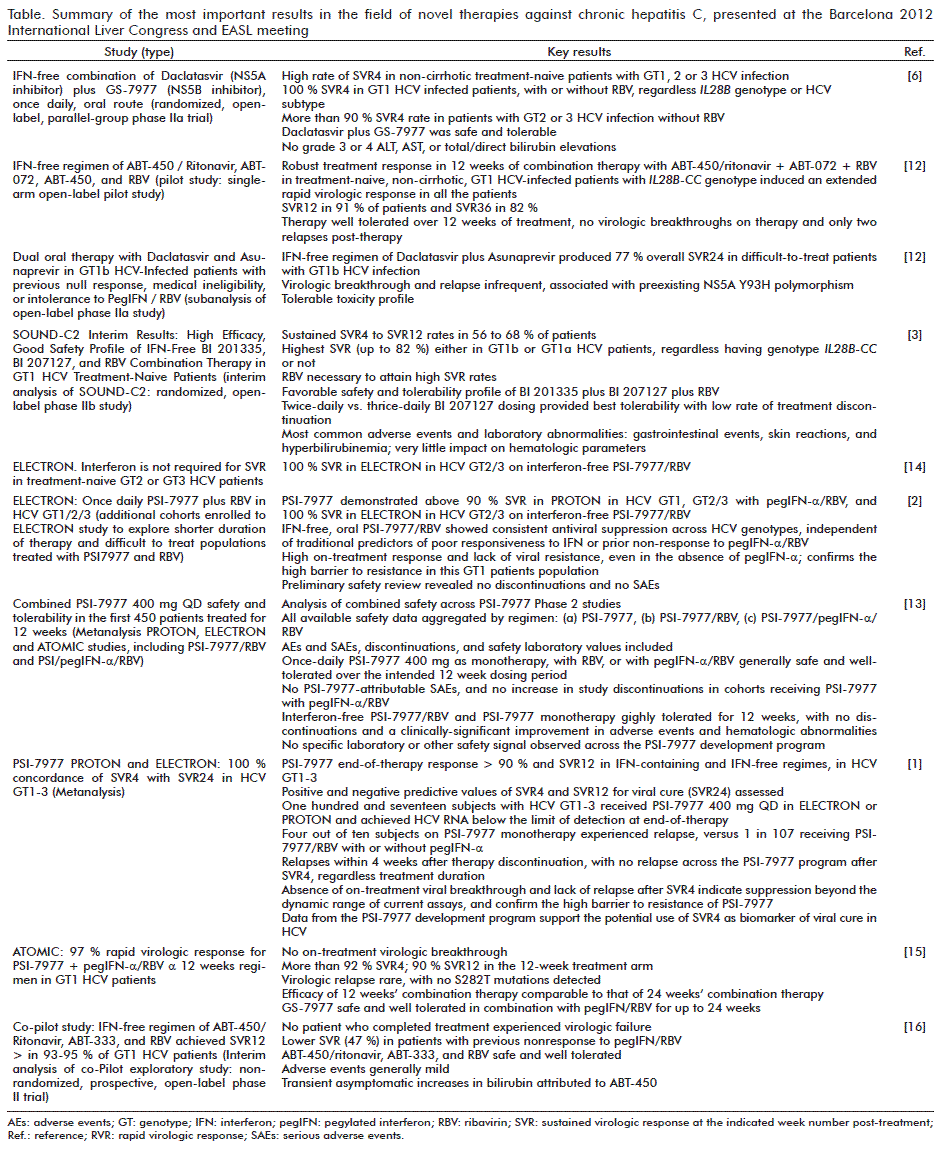
<body><![CDATA[<P   align="justify" ><font size="2" face="Verdana, Arial, Helvetica, sans-serif">The much anticipated      data from a number of clinical trials [1-6] confirmed that combinations of      antivirals offer the hope of shorter, more effective treatment with fewer      side effects compared to the 2012 standard of care using interferon. </font></P >   <FONT size="+1">        <P   align="justify" ><font size="2" face="Verdana, Arial, Helvetica, sans-serif">The new studies cover      the treatment of patients infected with hepatitis C virus (HCV) genotypes      (GT) 1 to 3, who were administered ribavirin (RBV) without interferon (IFN)      and either one or two other drugs: direct-acting antivirals, such as HCV nucleotide      analogues, HCV protease inhibitors, non-nucleoside RNA polymerase inhibitors,      or host-targeting antivirals like the inhibitor cyclophilin A. </font></P >       <P   align="justify" ><font size="2" face="Verdana, Arial, Helvetica, sans-serif">The combination of      pegylated interferon alpha (PegIFN-&alpha;) and RBV is the current standard      of care for chronic HCV [7], but it is associated with a number of side effects      - including flu-like symptoms, psychiatric manifestations, autoimmune reactions,      and hematologic toxicities [8, 9]. Between 20-40 % of patients require a dose      reduction or temporary interruption in their PegIFN-&alpha; and RBV treatment      [10], and in 10-14 % the side effects are so severe that treatment must be      interrupted [8, 9]. </font></P >       <P   align="justify" ><font size="2" face="Verdana, Arial, Helvetica, sans-serif">Studies have shown      that PegIFN-&alpha; free therapy is highly anticipated by healthcare professionals      and patients alike. The EASL&rsquo;s Secretary General, Professor Mark Thursz      commented on the exciting new data being showcased at the congress: &ldquo;In      the future, patients can look forward to all oral treatment regimens with      high success rates and low side effects. Furthermore, there is a large cohort      of patients with more advanced liver disease who will now be able to access      treatment that was previously impossible due to the side effects of Interferon-alpha.      Over the last five years we have seen an evolution in HCV treatment, with      direct antivirals used in combination with Pegylated Interferon and Ribavirin.      Interferon-free regimes truly represent a revolution in treatment.&rdquo;      </font></P >       <P   align="justify" ><font size="2" face="Verdana, Arial, Helvetica, sans-serif">Separate data presented      at the congress may provide a further option. New results from a phase IIb      study show a different form of interferon: PegIFN-&lambda;, administered with      RBV for 24 weeks in HCV GT2 &amp; 3 patients give comparable undetectable      HCV RNA levels 24 weeks after treatment as those treated with PegIFN-&alpha;-2a      and RBV, but with fewer side effects (musculoskeletal and flu-like symptoms,      hematologic toxicity) and dose modifications for PegIFN or RBV. Professor      Thursz commented: &ldquo;It remains possible that a number of patients will      still need interferon based therapy for their HCV infection. Interferon-lambda,      with a better side effect profile, looks like an excellent option in this      group of patients, who are likely to have more advanced disease.&rdquo; </font></P >       <P   ><font size="2" face="Verdana, Arial, Helvetica, sans-serif">Some of the above      studies, together with the most relevant works on this topic presented in      the meeting are summarized in the <a href="/img/revistas/bta/v30n2/t0109213.gif">table</a>      [1-3, 6, 11-16]. </font></P >       
<P   align="justify" ><font size="2" face="Verdana, Arial, Helvetica, sans-serif">Definitively, the      development of interferon free therapies will impact in the currently established      guidelines for chronic hepatitis C therapy in the next two or three years.      </font></P >       <P   align="justify" >&nbsp;</P >   <B>        <P   ><font size="3" face="Verdana, Arial, Helvetica, sans-serif">GUT MICROBIOTA TRANSPLANTATION      PREVENTS DEVELOPMENT OF DIABETES AND FATTY LIVER DISEASE IN PRECLINICAL STUDIES      </font></P >   </B>        <P   align="justify" ><font size="2" face="Verdana, Arial, Helvetica, sans-serif">The factors leading      to non-alcoholic fatty liver disease (NAFLD) are poorly understood, but it      is known that NAFLD and type 2 diabetes are characterized by liver inflammation      and metabolic disorders like insulin resistance, respectively. New data presented      at the meeting showed the gut microbiota as having a causal role in the development      of diabetes and NAFLD, independent of obesity [17]. </font></P >   <FONT size="+1"><FONT size="+1">        ]]></body>
<body><![CDATA[<P   align="justify" ><font size="2" face="Verdana, Arial, Helvetica, sans-serif">Though at an early      stage of animal model development, a French study highlights the possibility      of preventing diabetes and NAFLD with gut microbiota transplantation, the      engrafting of new microbiota, usually through administering faecal material      from a healthy donor into the colon of a diseased recipient [18]. </font></P >       <P   align="justify" ><font size="2" face="Verdana, Arial, Helvetica, sans-serif">In the 16 weeks of      the study, two groups of germ free mice received gut microbiota transplants;      one set from donor mice displaying symptoms of insulin resistance and liver      steatosis (responders), and the other from normal mice (non responders). The      donor mice were selected due to their response to feeding with a high fat      diet. The germ free group that received microbiota from symptomatic mice showed      higher levels of fat concentrations in the liver and was insulin resistant.      The germ-free group that received microbiota from healthy mice maintained      normal glucose levels and sensitivity to insulin. This study showed that different      microbiota cause different metabolic responses in animals. It was possible      to prevent development of liver inflammation and insulin resistance by implanting      microbiota from healthy mice, both indications of liver disease and diabetes,      respectively. This type of treatment could have a therapeutic outcome in the      future. At present, the intestinal microbiota is considered to be a &ldquo;microbial      organ&rdquo;, with pivotal roles in the body&rsquo;s metabolism and immune      functions. Therefore gut transplantation aims to restore gut functionality      and re-establish the state of intestinal flora to certain extent.</font></P >       <P   align="justify" >&nbsp;</P >   <B>        <P   ><font size="3" face="Verdana, Arial, Helvetica, sans-serif">CHRONIC HEPATIC DISEASES      GENERATE HIGH COSTS TO EUROPE </font></P >   </B>        <P   align="justify" ><font size="2" face="Verdana, Arial, Helvetica, sans-serif">Two studies presented      at the International Liver Congress 2012 showed the true impact that liver      disease has across Europe, one the financial cost of liver disease and the      other the high mortality rates associated with cirrhosis. </font></P >   <FONT size="+1"><FONT size="+1">        <P   align="justify" ><font size="2" face="Verdana, Arial, Helvetica, sans-serif">The former comprised      a multicenter, retrospective cost of illness study (COME), to assess costs      occurring in 1088 patients over six months. Patients enrolled had liver diseases      including hepatitis C, cirrhosis, hepatitis B, hepatic carcinoma and other      hepatic diseases (cholestasis, nonalcoholic steatohepatitis, etc.). The study      found that liver disease costs in the European Union on average at least &euro;644.77      per patient per month [19]. Hospitalizations account for 50.6 % of the overall      mean direct costs per month, with treatment accounting for 41.2 % of costs.      In addition, patients and family caregivers lost an average of 1.15 days per      patient per month of productivity, an important indirect cost. </font></P >       <P   align="justify" ><font size="2" face="Verdana, Arial, Helvetica, sans-serif">The study concluded      that although treatment costs account for just over 40 % of direct costs,      the use of efficient treatments is required to reduce worsening of patients&rsquo;      health, and the increase of direct and indirect costs. These results demonstrate      the real life costs of the treatment and ongoing management of patients with      liver disease, a condition increasingly frequent and requiring impact estimates      to aid on planning more effective treatment strategies. This might engage      health authorities more on investing in preventive actions like reducing harmful      alcohol consumption and fighting obesity. </font></P >       <P   align="justify" ><font size="2" face="Verdana, Arial, Helvetica, sans-serif">In a separate study,      the EASL-CLIF consortium reported that mortality for Acute-on-Chronic liver      failure (ACLF) was 35.5 % on day 28 [20]. The consortium set out to address      questions around ACLF, a poorly defined syndrome characterized by acute deterioration      of cirrhosis, representing a main cause of hospitalization and death. At present,      no diagnostic criteria and information on prevalence, pathogenesis or prognosis      are available. </font></P >       <P   ><font size="2" face="Verdana, Arial, Helvetica, sans-serif">Overall, the meeting      was useful on discussing emerging approaches for treating hepatitis viruses-related      conditions and liver diseases such as diabetes and hepatic fat depot-related      diseases, and the impact of current and emerging therapies on a population-wide      perspective of the occurrence of hepatic diseases. </font></P >       <P   >&nbsp;</P >       ]]></body>
<body><![CDATA[<P   > </P >       <P   ><b><font size="3" face="Verdana, Arial, Helvetica, sans-serif">REFERENCES </font></b></P >       <!-- ref --><P   align="justify" ><font size="2" face="Verdana, Arial, Helvetica, sans-serif">1. Lawitz E, Gane      E, Stedman C, Lalezari JP, Hassanein T, Kowdley KV, <I>et al</I>. 7 PSI-7977      PROTON and ELECTRON: 100 % concordance of SVR4 with SVR24 in HCV GT1, GT2      &amp; GT3. J Hepatol. 2012;56(Suppl 2):S4.     </font></P >   <FONT size="+1">        <!-- ref --><P   align="justify" ><font size="2" face="Verdana, Arial, Helvetica, sans-serif">2. Gane EJ, Stedman      CA, Hyland RH, Sorensen RD, Symonds WT, Hindes RG, <I>et al</I>. ELECTRON:      once daily PSI-7977 plus RBV in HCV GT1/2/3. J Hepatol. 2012;56(Suppl 2):S438-9.          </font></P >       <!-- ref --><P   align="justify" ><font size="2" face="Verdana, Arial, Helvetica, sans-serif">3. Zeuzem S, Soriano      V, Asselah T, Bronowicki JP, Lohse A, Muellhaupt B, <I>et al</I>. SVR4 and      SVR12 with an interferon-free regimen of BI201335 and BI207127, +/- Ribavirin,      in treatment-naive patients with chronic genotype-1 HCV infection: Interim      results of SOUND-C2. J Hepatol. 2012;56(Suppl 2):S45.     </font></P >       <!-- ref --><P   align="justify" ><font size="2" face="Verdana, Arial, Helvetica, sans-serif">4. Pawlotsky JM,      Sarin SK, Foster G, Peng CY, Rasenack J, Flisiak R, <I>et al</I>. Alisporivir      plus Ribavirin is highly effective as interferon-free or interferon-add-on      regimen in previously untreated HCV-GT2 OR GT3 patients: SVR12 RESULTS FROM      VITAL-1 PHASE 2B STUDY. J Hepatol. 2012;56(Suppl 2):S553.     </font></P >       ]]></body>
<body><![CDATA[<!-- ref --><P   align="justify" ><font size="2" face="Verdana, Arial, Helvetica, sans-serif">5. Alberti A, Chuang      WL, Flisiak R, Mazzella G, Horban A, Goeser T, <I>et al</I>. ALISPORIVIR (ALV)      plus PEG-Interferon/Ribavirin (PR) IN HCV G1 treatment-experienced patients      achieves primary endpoint with superior efficacy at treatment week 12 compared      to retreatment with PR. J Hepatol. 2012;56(Suppl 2):S553-4.     </font></P >       <!-- ref --><P   align="justify" ><font size="2" face="Verdana, Arial, Helvetica, sans-serif">6. Sulkowski M, Gardiner      D, Lawitz E, Hinestrosa F, Nelson D, Thuluvath P, <I>et al</I>. Potent viral      suppression with all-oral combination of DACLATASVIR (NS5A inhibitor) and      GS-7977 (NS5B inhibitor), +/- Ribavirin, in treatment-naive patients with      chronic HCV GT1, 2, OR 3. J Hepatol. 2012;56(Suppl 2):S560.     </font></P >       <!-- ref --><P   align="justify" ><font size="2" face="Verdana, Arial, Helvetica, sans-serif">7. EASL Clinical      Practice Guidelines: management of hepatitis C virus infection. J Hepatol.      2011;55(2):245-64.     </font></P >       <!-- ref --><P   align="justify" ><font size="2" face="Verdana, Arial, Helvetica, sans-serif">8. Fried MW, Shiffman      ML, Reddy KR, Smith C, Marinos G, Goncales FL, Jr., <I>et al</I>. Peginterferon      alfa-2a plus ribavirin for chronic hepatitis C virus infection. N Engl J Med.      2002;347(13):975-82.     </font></P >       <!-- ref --><P   align="justify" ><font size="2" face="Verdana, Arial, Helvetica, sans-serif">9. Manns MP, McHutchison      JG, Gordon SC, Rustgi VK, Shiffman M, Reindollar R, <I>et al</I>. Peginterferon      alfa-2b plus ribavirin compared with interferon alfa-2b plus ribavirin for      initial treatment of chronic hepatitis C: a randomised trial. Lancet. 2001;358(9286):958-65.          </font></P >       ]]></body>
<body><![CDATA[<!-- ref --><P   align="justify" ><font size="2" face="Verdana, Arial, Helvetica, sans-serif">10. Zeuzem S, Arora      S, Bacon B, Box T, Charlton M, Diago M, <I>et al</I>. Peginterferon Lambda-1A      (LAMBDA) compared to peginterferon Alfa-2A (ALFA) In treatment-naive patients      with HCV genotypes (G) 2 OR 3: first SVR24 results from EMERGE phase IIB.      J Hepatol. 2012;56(Suppl 2):S5-S6.     </font></P >       <!-- ref --><P   align="justify" ><font size="2" face="Verdana, Arial, Helvetica, sans-serif">11. Lawitz E, Poordad      F, Kowdley KV, Jensen D, Cohen DE, Siggelkow S, <I>et al</I>. A 12-week interferon-free      regimen of ABT-450/R, ABT-072, and Ribavirin was well tolerated and achieved      sustained virologic response in 91 % treatment-naive HCV IL28B-CC genotype-1-infected      subjects. J Hepatol. 2012;56(Suppl 2):S7-S7.     </font></P >       <!-- ref --><P   align="justify" ><font size="2" face="Verdana, Arial, Helvetica, sans-serif">12. Suzuki F, Ikeda      K, Toyota J, Karino Y, Ohmura T, Chayama K, <I>et al</I>. Dual oral therapy      with the NS5A inhibitor Daclatasvir (BMS-790052) and NS3 protease inhibitor      Asunaprevir (BMS-650032) in HCV genotype 1B-INFected null responders or ineligible/intolerant      to peginterferon/Ribavirin. J Hepatol. 2012;56(Suppl 2):S7-S8.     </font></P >       <!-- ref --><P   align="justify" ><font size="2" face="Verdana, Arial, Helvetica, sans-serif">13. Jacobson I, Lawitz      E, Lalezari J, Crespo I, Davis M, Hassanein T, <I>et al</I>. PSI-7977 400      MG QD safety and tolerability in the first 450 patients treated for 12 weeks.      J Hepatol. 2012; 56(Suppl 2):S441-S41.     </font></P >       <P   align="justify" ><font size="2" face="Verdana, Arial, Helvetica, sans-serif">14. Gane EJ, Stedman      CA, Hyland RH, <I>et al</I>. PSI-7977: ELECTRON. Interferon is not required      for sustained virologic response in treatment-naive patients with HCV GT2      or GT3. Program and abstracts of the 62nd Annual Meeting of the American Association      for the Study of Liver Diseases; November 5-8, 2011; San Francisco, California.      Abstract 34. </font></P >       <!-- ref --><P   align="justify" ><font size="2" face="Verdana, Arial, Helvetica, sans-serif">15. Kowdley KV, Lawitz      E, Crespo I, Hassanein T, Davis M, DeMicco M, <I>et al</I>. ATOMIC: 97 % RVR      for PSI-7977+PEG/RBV x 12 week regimen in HCV GT1: an end to response-guided      therapy? J Hepatol. 2012;56(Suppl 2):S1.     </font></P >       <!-- ref --><P   align="justify" ><font size="2" face="Verdana, Arial, Helvetica, sans-serif">16. Poordad F, Lawitz      E, Kowdley KV, Everson GT, Freilich B, Cohen D, <I>et al</I>. 12-week interferon-free      regimen of ABT-450/R +ABT-333+Ribavirin achieved SVR12 in more than 90 % of      treatment-naive HCV genotype-1-infected subjects and 47 % of previous non-responders.      J Hepatol. 2012;56(Suppl 2):S549-50.     </font></P >       <!-- ref --><P   align="justify" ><font size="2" face="Verdana, Arial, Helvetica, sans-serif">17. Le Roy T, Llopis      M, Bruneau A, Rabot S, Bevilacqua C, Martin P, <I>et al</I>. Gut microbiota      transplantation demonstrates its causal role in the development of type 2      diabetes and fatty liver. J Hepatol. 2012;56(Suppl 2):s23.     </font></P >       <!-- ref --><P   align="justify" ><font size="2" face="Verdana, Arial, Helvetica, sans-serif">18. Khoruts A, Sadowsky      MJ. Therapeutic transplantation of the distal gut microbiota. Mucosal Immunol.      2011;4(1):4-7.     </font></P >       <!-- ref --><P   align="justify" ><font size="2" face="Verdana, Arial, Helvetica, sans-serif">19. Fagiuoli S, Scalone      L, Ciampichini R, Fusco F, Gaeta L, Del Prete A, <I>et al</I>. Societal burden      in patients with chronic hepatic diseases: the COME study results. J Hepatol.      2012;56(Suppl 2):s11-2.     </font></P >       <!-- ref --><P   align="justify" ><font size="2" face="Verdana, Arial, Helvetica, sans-serif">20. Moreau R, Gines      P, Jalan R, Pavesi M, Durand F, Angeli P, <I>et al</I>. Diagnosis, prevalence,      and prognosis of acute-on-chronic liver failure (ACLF): results of the EASL-chronic      liver failure (CLIF) consortium canonic study. J Hepatol. 2012;56(Suppl 2):S552-S53.          </font></P >       <P   align="justify" >&nbsp;</P >       <P   align="justify" >&nbsp;</P >       <P   > </P >   <FONT size="+1">        <P   ><font size="2" face="Verdana, Arial, Helvetica, sans-serif"><I>Julio C Aguilar</I>.      Departamento de Vacunas, Direcci&oacute;n de Investigaciones Biom&eacute;dicas,      Centro de Ingenier&iacute;a Gen&eacute;tica y Biotecnolog&iacute;a, CIGB.      Ave. 31 e/ 158 y 190, Cubanac&aacute;n, Playa, CP 11600, La Habana, Cuba.      E-mail: <A href="mailto:julio.aguilar@cigb.edu.cu"> <U><U><FONT color="#0000FF">julio.aguilar@cigb.edu.cu</font></U></U></A><FONT color="#0000FF"><FONT color="#000000">.      </font></font></font></P >   </font></font></font></font></font></font></font></font></font></font></font></font></DIV >      ]]></body><back>
<ref-list>
<ref id="B1">
<label>1</label><nlm-citation citation-type="journal">
<person-group person-group-type="author">
<name>
<surname><![CDATA[Lawitz]]></surname>
<given-names><![CDATA[E]]></given-names>
</name>
<name>
<surname><![CDATA[Gane]]></surname>
<given-names><![CDATA[E]]></given-names>
</name>
<name>
<surname><![CDATA[Stedman]]></surname>
<given-names><![CDATA[C]]></given-names>
</name>
<name>
<surname><![CDATA[Lalezari]]></surname>
<given-names><![CDATA[JP]]></given-names>
</name>
<name>
<surname><![CDATA[Hassanein]]></surname>
<given-names><![CDATA[T]]></given-names>
</name>
<name>
<surname><![CDATA[Kowdley]]></surname>
<given-names><![CDATA[KV]]></given-names>
</name>
</person-group>
<article-title xml:lang="en"><![CDATA[7 PSI-7977 PROTON and ELECTRON: 100 % concordance of SVR4 with SVR24 in HCV GT1, GT2 & GT3]]></article-title>
<source><![CDATA[J Hepatol]]></source>
<year>2012</year>
<volume>56</volume>
<numero>^s2</numero>
<issue>^s2</issue>
<supplement>2</supplement>
<page-range>S4</page-range></nlm-citation>
</ref>
<ref id="B2">
<label>2</label><nlm-citation citation-type="journal">
<person-group person-group-type="author">
<name>
<surname><![CDATA[Gane]]></surname>
<given-names><![CDATA[EJ]]></given-names>
</name>
<name>
<surname><![CDATA[Stedman]]></surname>
<given-names><![CDATA[CA]]></given-names>
</name>
<name>
<surname><![CDATA[Hyland]]></surname>
<given-names><![CDATA[RH]]></given-names>
</name>
<name>
<surname><![CDATA[Sorensen]]></surname>
<given-names><![CDATA[RD]]></given-names>
</name>
<name>
<surname><![CDATA[Symonds]]></surname>
<given-names><![CDATA[WT]]></given-names>
</name>
<name>
<surname><![CDATA[Hindes]]></surname>
<given-names><![CDATA[RG]]></given-names>
</name>
</person-group>
<article-title xml:lang="en"><![CDATA[ELECTRON: once daily PSI-7977 plus RBV in HCV GT1/2/3]]></article-title>
<source><![CDATA[J Hepatol]]></source>
<year>2012</year>
<volume>56</volume>
<numero>^s2</numero>
<issue>^s2</issue>
<supplement>2</supplement>
<page-range>S438-9</page-range></nlm-citation>
</ref>
<ref id="B3">
<label>3</label><nlm-citation citation-type="journal">
<person-group person-group-type="author">
<name>
<surname><![CDATA[Zeuzem]]></surname>
<given-names><![CDATA[S]]></given-names>
</name>
<name>
<surname><![CDATA[Soriano]]></surname>
<given-names><![CDATA[V]]></given-names>
</name>
<name>
<surname><![CDATA[Asselah]]></surname>
<given-names><![CDATA[T]]></given-names>
</name>
<name>
<surname><![CDATA[Bronowicki]]></surname>
<given-names><![CDATA[JP]]></given-names>
</name>
<name>
<surname><![CDATA[Lohse]]></surname>
<given-names><![CDATA[A]]></given-names>
</name>
<name>
<surname><![CDATA[Muellhaupt]]></surname>
<given-names><![CDATA[B]]></given-names>
</name>
</person-group>
<article-title xml:lang="en"><![CDATA[SVR4 and SVR12 with an interferon-free regimen of BI201335 and BI207127, +/- Ribavirin, in treatment-naive patients with chronic genotype-1 HCV infection: Interim results of SOUND-C2]]></article-title>
<source><![CDATA[J Hepatol]]></source>
<year>2012</year>
<volume>56</volume>
<numero>^s2</numero>
<issue>^s2</issue>
<supplement>2</supplement>
<page-range>S45</page-range></nlm-citation>
</ref>
<ref id="B4">
<label>4</label><nlm-citation citation-type="journal">
<person-group person-group-type="author">
<name>
<surname><![CDATA[Pawlotsky]]></surname>
<given-names><![CDATA[JM]]></given-names>
</name>
<name>
<surname><![CDATA[Sarin]]></surname>
<given-names><![CDATA[SK]]></given-names>
</name>
<name>
<surname><![CDATA[Foster]]></surname>
<given-names><![CDATA[G]]></given-names>
</name>
<name>
<surname><![CDATA[Peng]]></surname>
<given-names><![CDATA[CY]]></given-names>
</name>
<name>
<surname><![CDATA[Rasenack]]></surname>
<given-names><![CDATA[J]]></given-names>
</name>
<name>
<surname><![CDATA[Flisiak]]></surname>
<given-names><![CDATA[R]]></given-names>
</name>
</person-group>
<article-title xml:lang="en"><![CDATA[Alisporivir plus Ribavirin is highly effective as interferon-free or interferon-add-on regimen in previously untreated HCV-GT2 OR GT3 patients: SVR12 RESULTS FROM VITAL-1 PHASE 2B STUDY]]></article-title>
<source><![CDATA[J Hepatol]]></source>
<year>2012</year>
<volume>56</volume>
<numero>^s2</numero>
<issue>^s2</issue>
<supplement>2</supplement>
<page-range>S553</page-range></nlm-citation>
</ref>
<ref id="B5">
<label>5</label><nlm-citation citation-type="journal">
<person-group person-group-type="author">
<name>
<surname><![CDATA[Alberti]]></surname>
<given-names><![CDATA[A]]></given-names>
</name>
<name>
<surname><![CDATA[Chuang]]></surname>
<given-names><![CDATA[WL]]></given-names>
</name>
<name>
<surname><![CDATA[Flisiak]]></surname>
<given-names><![CDATA[R]]></given-names>
</name>
<name>
<surname><![CDATA[Mazzella]]></surname>
<given-names><![CDATA[G]]></given-names>
</name>
<name>
<surname><![CDATA[Horban]]></surname>
<given-names><![CDATA[A]]></given-names>
</name>
<name>
<surname><![CDATA[Goeser]]></surname>
<given-names><![CDATA[T]]></given-names>
</name>
</person-group>
<article-title xml:lang="en"><![CDATA[ALISPORIVIR (ALV) plus PEG-Interferon/Ribavirin (PR) IN HCV G1 treatment-experienced patients achieves primary endpoint with superior efficacy at treatment week 12 compared to retreatment with PR]]></article-title>
<source><![CDATA[J Hepatol]]></source>
<year>2012</year>
<volume>56</volume>
<numero>^s2</numero>
<issue>^s2</issue>
<supplement>2</supplement>
<page-range>S553-4</page-range></nlm-citation>
</ref>
<ref id="B6">
<label>6</label><nlm-citation citation-type="journal">
<person-group person-group-type="author">
<name>
<surname><![CDATA[Sulkowski]]></surname>
<given-names><![CDATA[M]]></given-names>
</name>
<name>
<surname><![CDATA[Gardiner]]></surname>
<given-names><![CDATA[D]]></given-names>
</name>
<name>
<surname><![CDATA[Lawitz]]></surname>
<given-names><![CDATA[E]]></given-names>
</name>
<name>
<surname><![CDATA[Hinestrosa]]></surname>
<given-names><![CDATA[F]]></given-names>
</name>
<name>
<surname><![CDATA[Nelson]]></surname>
<given-names><![CDATA[D]]></given-names>
</name>
<name>
<surname><![CDATA[Thuluvath]]></surname>
<given-names><![CDATA[P]]></given-names>
</name>
</person-group>
<article-title xml:lang="en"><![CDATA[Potent viral suppression with all-oral combination of DACLATASVIR (NS5A inhibitor) and GS-7977 (NS5B inhibitor), +/- Ribavirin, in treatment-naive patients with chronic HCV GT1, 2, OR 3]]></article-title>
<source><![CDATA[J Hepatol]]></source>
<year>2012</year>
<volume>56</volume>
<numero>^s2</numero>
<issue>^s2</issue>
<supplement>2</supplement>
<page-range>S560</page-range></nlm-citation>
</ref>
<ref id="B7">
<label>7</label><nlm-citation citation-type="journal">
<article-title xml:lang="en"><![CDATA[EASL Clinical Practice Guidelines: management of hepatitis C virus infection]]></article-title>
<source><![CDATA[J Hepatol]]></source>
<year>2011</year>
<volume>55</volume>
<numero>2</numero>
<issue>2</issue>
<page-range>245-64</page-range></nlm-citation>
</ref>
<ref id="B8">
<label>8</label><nlm-citation citation-type="journal">
<person-group person-group-type="author">
<name>
<surname><![CDATA[Fried]]></surname>
<given-names><![CDATA[MW]]></given-names>
</name>
<name>
<surname><![CDATA[Shiffman]]></surname>
<given-names><![CDATA[ML]]></given-names>
</name>
<name>
<surname><![CDATA[Reddy]]></surname>
<given-names><![CDATA[KR]]></given-names>
</name>
<name>
<surname><![CDATA[Smith]]></surname>
<given-names><![CDATA[C]]></given-names>
</name>
<name>
<surname><![CDATA[Marinos]]></surname>
<given-names><![CDATA[G]]></given-names>
</name>
<name>
<surname><![CDATA[Goncales]]></surname>
<given-names><![CDATA[FL Jr]]></given-names>
</name>
</person-group>
<article-title xml:lang="en"><![CDATA[Peginterferon alfa-2a plus ribavirin for chronic hepatitis C virus infection]]></article-title>
<source><![CDATA[N Engl J Med]]></source>
<year>2002</year>
<volume>347</volume>
<numero>13</numero>
<issue>13</issue>
<page-range>975-82</page-range></nlm-citation>
</ref>
<ref id="B9">
<label>9</label><nlm-citation citation-type="journal">
<person-group person-group-type="author">
<name>
<surname><![CDATA[Manns]]></surname>
<given-names><![CDATA[MP]]></given-names>
</name>
<name>
<surname><![CDATA[McHutchison]]></surname>
<given-names><![CDATA[JG]]></given-names>
</name>
<name>
<surname><![CDATA[Gordon]]></surname>
<given-names><![CDATA[SC]]></given-names>
</name>
<name>
<surname><![CDATA[Rustgi]]></surname>
<given-names><![CDATA[VK]]></given-names>
</name>
<name>
<surname><![CDATA[Shiffman]]></surname>
<given-names><![CDATA[M]]></given-names>
</name>
<name>
<surname><![CDATA[Reindollar]]></surname>
<given-names><![CDATA[R]]></given-names>
</name>
</person-group>
<article-title xml:lang="en"><![CDATA[Peginterferon alfa-2b plus ribavirin compared with interferon alfa-2b plus ribavirin for initial treatment of chronic hepatitis C: a randomised trial]]></article-title>
<source><![CDATA[Lancet]]></source>
<year>2001</year>
<volume>358</volume>
<numero>9286</numero>
<issue>9286</issue>
<page-range>958-65</page-range></nlm-citation>
</ref>
<ref id="B10">
<label>10</label><nlm-citation citation-type="journal">
<person-group person-group-type="author">
<name>
<surname><![CDATA[Zeuzem]]></surname>
<given-names><![CDATA[S]]></given-names>
</name>
<name>
<surname><![CDATA[Arora]]></surname>
<given-names><![CDATA[S]]></given-names>
</name>
<name>
<surname><![CDATA[Bacon]]></surname>
<given-names><![CDATA[B]]></given-names>
</name>
<name>
<surname><![CDATA[Box]]></surname>
<given-names><![CDATA[T]]></given-names>
</name>
<name>
<surname><![CDATA[Charlton]]></surname>
<given-names><![CDATA[M]]></given-names>
</name>
<name>
<surname><![CDATA[Diago]]></surname>
<given-names><![CDATA[M]]></given-names>
</name>
</person-group>
<article-title xml:lang="en"><![CDATA[Peginterferon Lambda-1A (LAMBDA) compared to peginterferon Alfa-2A (ALFA) In treatment-naive patients with HCV genotypes (G) 2 OR 3: first SVR24 results from EMERGE phase IIB]]></article-title>
<source><![CDATA[J Hepatol]]></source>
<year>2012</year>
<volume>56</volume>
<numero>^s2</numero>
<issue>^s2</issue>
<supplement>2</supplement>
<page-range>S5-S6</page-range></nlm-citation>
</ref>
<ref id="B11">
<label>11</label><nlm-citation citation-type="journal">
<person-group person-group-type="author">
<name>
<surname><![CDATA[Lawitz]]></surname>
<given-names><![CDATA[E]]></given-names>
</name>
<name>
<surname><![CDATA[Poordad]]></surname>
<given-names><![CDATA[F]]></given-names>
</name>
<name>
<surname><![CDATA[Kowdley]]></surname>
<given-names><![CDATA[KV]]></given-names>
</name>
<name>
<surname><![CDATA[Jensen]]></surname>
<given-names><![CDATA[D]]></given-names>
</name>
<name>
<surname><![CDATA[Cohen]]></surname>
<given-names><![CDATA[DE]]></given-names>
</name>
<name>
<surname><![CDATA[Siggelkow]]></surname>
<given-names><![CDATA[S]]></given-names>
</name>
</person-group>
<article-title xml:lang="en"><![CDATA[A 12-week interferon-free regimen of ABT-450/R, ABT-072, and Ribavirin was well tolerated and achieved sustained virologic response in 91 % treatment-naive HCV IL28B-CC genotype-1-infected subjects]]></article-title>
<source><![CDATA[J Hepatol]]></source>
<year>2012</year>
<volume>56</volume>
<numero>^s2</numero>
<issue>^s2</issue>
<supplement>2</supplement>
<page-range>S7-S7</page-range></nlm-citation>
</ref>
<ref id="B12">
<label>12</label><nlm-citation citation-type="journal">
<person-group person-group-type="author">
<name>
<surname><![CDATA[Suzuki]]></surname>
<given-names><![CDATA[F]]></given-names>
</name>
<name>
<surname><![CDATA[Ikeda]]></surname>
<given-names><![CDATA[K]]></given-names>
</name>
<name>
<surname><![CDATA[Toyota]]></surname>
<given-names><![CDATA[J]]></given-names>
</name>
<name>
<surname><![CDATA[Karino]]></surname>
<given-names><![CDATA[Y]]></given-names>
</name>
<name>
<surname><![CDATA[Ohmura]]></surname>
<given-names><![CDATA[T]]></given-names>
</name>
<name>
<surname><![CDATA[Chayama]]></surname>
<given-names><![CDATA[K]]></given-names>
</name>
</person-group>
<article-title xml:lang="en"><![CDATA[Dual oral therapy with the NS5A inhibitor Daclatasvir (BMS-790052) and NS3 protease inhibitor Asunaprevir (BMS-650032) in HCV genotype 1B-INFected null responders or ineligible/intolerant to peginterferon/Ribavirin]]></article-title>
<source><![CDATA[J Hepatol]]></source>
<year>2012</year>
<volume>56</volume>
<numero>^s2</numero>
<issue>^s2</issue>
<supplement>2</supplement>
<page-range>S7-S8</page-range></nlm-citation>
</ref>
<ref id="B13">
<label>13</label><nlm-citation citation-type="journal">
<person-group person-group-type="author">
<name>
<surname><![CDATA[Jacobson]]></surname>
<given-names><![CDATA[I]]></given-names>
</name>
<name>
<surname><![CDATA[Lawitz]]></surname>
<given-names><![CDATA[E]]></given-names>
</name>
<name>
<surname><![CDATA[Lalezari]]></surname>
<given-names><![CDATA[J]]></given-names>
</name>
<name>
<surname><![CDATA[Crespo]]></surname>
<given-names><![CDATA[I]]></given-names>
</name>
<name>
<surname><![CDATA[Davis]]></surname>
<given-names><![CDATA[M]]></given-names>
</name>
<name>
<surname><![CDATA[Hassanein]]></surname>
<given-names><![CDATA[T]]></given-names>
</name>
</person-group>
<article-title xml:lang="en"><![CDATA[PSI-7977 400 MG QD safety and tolerability in the first 450 patients treated for 12 weeks]]></article-title>
<source><![CDATA[J Hepatol]]></source>
<year>2012</year>
<volume>56</volume>
<numero>^s2</numero>
<issue>^s2</issue>
<supplement>2</supplement>
<page-range>S441-S41</page-range></nlm-citation>
</ref>
<ref id="B14">
<label>14</label><nlm-citation citation-type="">
<person-group person-group-type="author">
<name>
<surname><![CDATA[Gane]]></surname>
<given-names><![CDATA[EJ]]></given-names>
</name>
<name>
<surname><![CDATA[Stedman]]></surname>
<given-names><![CDATA[CA]]></given-names>
</name>
<name>
<surname><![CDATA[Hyland]]></surname>
<given-names><![CDATA[RH]]></given-names>
</name>
</person-group>
<article-title xml:lang="en"><![CDATA[PSI-7977: ELECTRON. Interferon is not required for sustained virologic response in treatment-naive patients with HCV GT2 or GT3]]></article-title>
<source><![CDATA[Program and abstracts of the 62nd Annual Meeting of the American Association for the Study of Liver Diseases]]></source>
<year>Nove</year>
<month>mb</month>
<day>er</day>
<publisher-loc><![CDATA[San Francisco ]]></publisher-loc>
</nlm-citation>
</ref>
<ref id="B15">
<label>15</label><nlm-citation citation-type="journal">
<person-group person-group-type="author">
<name>
<surname><![CDATA[Kowdley]]></surname>
<given-names><![CDATA[KV]]></given-names>
</name>
<name>
<surname><![CDATA[Lawitz]]></surname>
<given-names><![CDATA[E]]></given-names>
</name>
<name>
<surname><![CDATA[Crespo]]></surname>
<given-names><![CDATA[I]]></given-names>
</name>
<name>
<surname><![CDATA[Hassanein]]></surname>
<given-names><![CDATA[T]]></given-names>
</name>
<name>
<surname><![CDATA[Davis]]></surname>
<given-names><![CDATA[M]]></given-names>
</name>
<name>
<surname><![CDATA[DeMicco]]></surname>
<given-names><![CDATA[M]]></given-names>
</name>
</person-group>
<article-title xml:lang="en"><![CDATA[ATOMIC: 97 % RVR for PSI-7977+PEG/RBV x 12 week regimen in HCV GT1: an end to response-guided therapy]]></article-title>
<source><![CDATA[J Hepatol]]></source>
<year>2012</year>
<volume>56</volume>
<numero>^s2</numero>
<issue>^s2</issue>
<supplement>2</supplement>
<page-range>S1</page-range></nlm-citation>
</ref>
<ref id="B16">
<label>16</label><nlm-citation citation-type="journal">
<person-group person-group-type="author">
<name>
<surname><![CDATA[Poordad]]></surname>
<given-names><![CDATA[F]]></given-names>
</name>
<name>
<surname><![CDATA[Lawitz]]></surname>
<given-names><![CDATA[E]]></given-names>
</name>
<name>
<surname><![CDATA[Kowdley]]></surname>
<given-names><![CDATA[KV]]></given-names>
</name>
<name>
<surname><![CDATA[Everson]]></surname>
<given-names><![CDATA[GT]]></given-names>
</name>
<name>
<surname><![CDATA[Freilich]]></surname>
<given-names><![CDATA[B]]></given-names>
</name>
<name>
<surname><![CDATA[Cohen]]></surname>
<given-names><![CDATA[D]]></given-names>
</name>
</person-group>
<article-title xml:lang="en"><![CDATA[12-week interferon-free regimen of ABT-450/R +ABT-333+Ribavirin achieved SVR12 in more than 90 % of treatment-naive HCV genotype-1-infected subjects and 47 % of previous non-responders]]></article-title>
<source><![CDATA[J Hepatol]]></source>
<year>2012</year>
<volume>56</volume>
<numero>^s2</numero>
<issue>^s2</issue>
<supplement>2</supplement>
<page-range>S549-50</page-range></nlm-citation>
</ref>
<ref id="B17">
<label>17</label><nlm-citation citation-type="journal">
<person-group person-group-type="author">
<name>
<surname><![CDATA[Le Roy]]></surname>
<given-names><![CDATA[T]]></given-names>
</name>
<name>
<surname><![CDATA[Llopis]]></surname>
<given-names><![CDATA[M]]></given-names>
</name>
<name>
<surname><![CDATA[Bruneau]]></surname>
<given-names><![CDATA[A]]></given-names>
</name>
<name>
<surname><![CDATA[Rabot]]></surname>
<given-names><![CDATA[S]]></given-names>
</name>
<name>
<surname><![CDATA[Bevilacqua]]></surname>
<given-names><![CDATA[C]]></given-names>
</name>
<name>
<surname><![CDATA[Martin]]></surname>
<given-names><![CDATA[P]]></given-names>
</name>
</person-group>
<article-title xml:lang="en"><![CDATA[Gut microbiota transplantation demonstrates its causal role in the development of type 2 diabetes and fatty liver]]></article-title>
<source><![CDATA[J Hepatol]]></source>
<year>2012</year>
<volume>56</volume>
<numero>^s2</numero>
<issue>^s2</issue>
<supplement>2</supplement>
<page-range>s23</page-range></nlm-citation>
</ref>
<ref id="B18">
<label>18</label><nlm-citation citation-type="journal">
<person-group person-group-type="author">
<name>
<surname><![CDATA[Khoruts]]></surname>
<given-names><![CDATA[A]]></given-names>
</name>
<name>
<surname><![CDATA[Sadowsky]]></surname>
<given-names><![CDATA[MJ]]></given-names>
</name>
</person-group>
<article-title xml:lang="en"><![CDATA[Therapeutic transplantation of the distal gut microbiota]]></article-title>
<source><![CDATA[Mucosal Immunol]]></source>
<year>2011</year>
<volume>4</volume>
<numero>1</numero>
<issue>1</issue>
<page-range>4-7</page-range></nlm-citation>
</ref>
<ref id="B19">
<label>19</label><nlm-citation citation-type="journal">
<person-group person-group-type="author">
<name>
<surname><![CDATA[Fagiuoli]]></surname>
<given-names><![CDATA[S]]></given-names>
</name>
<name>
<surname><![CDATA[Scalone]]></surname>
<given-names><![CDATA[L]]></given-names>
</name>
<name>
<surname><![CDATA[Ciampichini]]></surname>
<given-names><![CDATA[R]]></given-names>
</name>
<name>
<surname><![CDATA[Fusco]]></surname>
<given-names><![CDATA[F]]></given-names>
</name>
<name>
<surname><![CDATA[Gaeta]]></surname>
<given-names><![CDATA[L]]></given-names>
</name>
<name>
<surname><![CDATA[Del Prete]]></surname>
<given-names><![CDATA[A]]></given-names>
</name>
</person-group>
<article-title xml:lang="en"><![CDATA[Societal burden in patients with chronic hepatic diseases: the COME study results]]></article-title>
<source><![CDATA[J Hepatol]]></source>
<year>2012</year>
<volume>56</volume>
<numero>^s2</numero>
<issue>^s2</issue>
<supplement>2</supplement>
<page-range>s11-2</page-range></nlm-citation>
</ref>
<ref id="B20">
<label>20</label><nlm-citation citation-type="journal">
<person-group person-group-type="author">
<name>
<surname><![CDATA[Moreau]]></surname>
<given-names><![CDATA[R]]></given-names>
</name>
<name>
<surname><![CDATA[Gines]]></surname>
<given-names><![CDATA[P]]></given-names>
</name>
<name>
<surname><![CDATA[Jalan]]></surname>
<given-names><![CDATA[R]]></given-names>
</name>
<name>
<surname><![CDATA[Pavesi]]></surname>
<given-names><![CDATA[M]]></given-names>
</name>
<name>
<surname><![CDATA[Durand]]></surname>
<given-names><![CDATA[F]]></given-names>
</name>
<name>
<surname><![CDATA[Angeli]]></surname>
<given-names><![CDATA[P]]></given-names>
</name>
</person-group>
<article-title xml:lang="en"><![CDATA[Diagnosis, prevalence, and prognosis of acute-on-chronic liver failure (ACLF): results of the EASL-chronic liver failure (CLIF) consortium canonic study]]></article-title>
<source><![CDATA[J Hepatol]]></source>
<year>2012</year>
<volume>56</volume>
<numero>^s2</numero>
<issue>^s2</issue>
<supplement>2</supplement>
<page-range>S552-S53</page-range></nlm-citation>
</ref>
</ref-list>
</back>
</article>