<?xml version="1.0" encoding="ISO-8859-1"?><article xmlns:mml="http://www.w3.org/1998/Math/MathML" xmlns:xlink="http://www.w3.org/1999/xlink" xmlns:xsi="http://www.w3.org/2001/XMLSchema-instance">
<front>
<journal-meta>
<journal-id>1027-2852</journal-id>
<journal-title><![CDATA[Biotecnología Aplicada]]></journal-title>
<abbrev-journal-title><![CDATA[Biotecnol Apl]]></abbrev-journal-title>
<issn>1027-2852</issn>
<publisher>
<publisher-name><![CDATA[Editorial Elfos Scientiae]]></publisher-name>
</publisher>
</journal-meta>
<article-meta>
<article-id>S1027-28522013000400002</article-id>
<title-group>
<article-title xml:lang="en"><![CDATA[Characterization of the IVS17bTA microsatellite marker and six CTFR gene mutations in 21 Cuban families with cystic fibrosis]]></article-title>
<article-title xml:lang="es"><![CDATA[Caracterización del marcador microsatélite IVS17bTA y seis mutaciones del gen CFTR en 21 familias cubanas con fibrosis quística]]></article-title>
</title-group>
<contrib-group>
<contrib contrib-type="author">
<name>
<surname><![CDATA[González]]></surname>
<given-names><![CDATA[Laura]]></given-names>
</name>
<xref ref-type="aff" rid="A01"/>
</contrib>
<contrib contrib-type="author">
<name>
<surname><![CDATA[Collazo]]></surname>
<given-names><![CDATA[Teresa]]></given-names>
</name>
<xref ref-type="aff" rid="A01"/>
</contrib>
<contrib contrib-type="author">
<name>
<surname><![CDATA[Clark]]></surname>
<given-names><![CDATA[Yulia]]></given-names>
</name>
<xref ref-type="aff" rid="A01"/>
</contrib>
<contrib contrib-type="author">
<name>
<surname><![CDATA[Gómez]]></surname>
<given-names><![CDATA[Manuel]]></given-names>
</name>
<xref ref-type="aff" rid="A01"/>
</contrib>
<contrib contrib-type="author">
<name>
<surname><![CDATA[Reyes]]></surname>
<given-names><![CDATA[Lídice]]></given-names>
</name>
<xref ref-type="aff" rid="A01"/>
</contrib>
</contrib-group>
<aff id="A01">
<institution><![CDATA[,Centro Nacional de Genética Médica, CNGM Laboratorio de Biología Molecular ]]></institution>
<addr-line><![CDATA[La Habana ]]></addr-line>
<country>Cuba</country>
</aff>
<pub-date pub-type="pub">
<day>00</day>
<month>12</month>
<year>2013</year>
</pub-date>
<pub-date pub-type="epub">
<day>00</day>
<month>12</month>
<year>2013</year>
</pub-date>
<volume>30</volume>
<numero>4</numero>
<fpage>262</fpage>
<lpage>266</lpage>
<copyright-statement/>
<copyright-year/>
<self-uri xlink:href="http://scielo.sld.cu/scielo.php?script=sci_arttext&amp;pid=S1027-28522013000400002&amp;lng=en&amp;nrm=iso"></self-uri><self-uri xlink:href="http://scielo.sld.cu/scielo.php?script=sci_abstract&amp;pid=S1027-28522013000400002&amp;lng=en&amp;nrm=iso"></self-uri><self-uri xlink:href="http://scielo.sld.cu/scielo.php?script=sci_pdf&amp;pid=S1027-28522013000400002&amp;lng=en&amp;nrm=iso"></self-uri><abstract abstract-type="short" xml:lang="en"><p><![CDATA[Cystic fibrosis is an autosomal recessive disease. Its incidence in Cuba is 1 in 5000 live births. The molecular cause underlying this disease is related to mutations in the regulatory gene encoding the cystic fibrosis transmembrane regulator (CFTR). In this study, the techniques for the study of IVS17bTA microsatellite marker were standardized, and the most frequent mutations in the CFTR gene were also detected for 21 Cuban families. Polymerase chain reaction, agarose and polyacrylamide (plus silver staining) gel electrophoresis techniques were used for both, identification of mutations and microsatellite standardization. Among the 22 Cuban patients, seven were found homozygous, four compound heterozygous and 11 with a single mutation so, 33 chromosomes were molecularly characterized for the 75 %. Twelve allelic variants were found for the IVS17bTA microsatellite; alleles 31 and 7 the most frequent ones. Alleles 31 and 46 were associated to the F508del and R334W mutations, respectively. Among the 21 families, 18 were completely informative for the IVS17bTA microsatellite marker, accounting for 85.7 %. This study helped to complete the diagnosis in those patients in which the responsible mutations in one or both chromosomes had not yet been identified. Besides, we were also able to identify mutations associated with different alleles of the marker without gene sequencing, also helping to decrease the cost of screening.]]></p></abstract>
<abstract abstract-type="short" xml:lang="es"><p><![CDATA[La fibrosis quística es una enfermedad autosómica recesiva. Su incidencia en Cuba es de 1 de cada 5000 recién nacidos vivos. La causa molecular que provoca esta enfermedad son las mutaciones en el gen regulador transmembranal de la fibrosis quística (CFTR). En este estudio se detectaron las mutaciones más frecuentes en 21 familias cubanas y se estandarizaron las técnicas para el estudio del marcador microsatélite IVS17bTA, lo cual constituyó nuestro objetivo principal. Para la identificación de estas mutaciones y la estandarización del microsatélite, se emplearon las técnicas de reacción en cadena de la polimerasa y electroforesis en geles de agarosa y poliacrilamida (tinción con plata). De los 22 pacientes, se encontraron 7 homocigóticos, 4 heterocigóticos compuestos y 11 con una sola mutación, por lo que se caracterizaron molecularmente 33 cromosomas, lo que representa el 75 %. En el estudio del microsatélite IVS17bTA se encontraron 12 variantes alélicas, los alelos más frecuentes fueron el 31 y el 7. El alelo asociado a la mutación F508del fue el 31 y a la mutación R334W fue el 46. De las 21 familias analizadas, 18 resultaron completamente informativas para el marcador, lo que representa el 85.7 % Este estudio ha ayudado a completar aún más el diagnóstico en los pacientes en los que aún no se han identificado las mutaciones responsables en ambos cromosomas o en uno de ellos. Además se han podido identificar mutaciones asociadas a diferentes alelos del marcador, sin necesidad de secuenciar el gen, lo que aumentaría el costo.]]></p></abstract>
<kwd-group>
<kwd lng="en"><![CDATA[IVS17bTA microsatellite marker]]></kwd>
<kwd lng="en"><![CDATA[cystic fibrosis]]></kwd>
<kwd lng="en"><![CDATA[polymerase chain reaction]]></kwd>
<kwd lng="es"><![CDATA[marcador microsatélite IVS17bTA]]></kwd>
<kwd lng="es"><![CDATA[fibrosis quística]]></kwd>
<kwd lng="es"><![CDATA[reacción en cadena de la polimerasa]]></kwd>
</kwd-group>
</article-meta>
</front><body><![CDATA[ <DIV class="Sect"   >        <P align="right"   ><font size="2" color="#000000" face="Verdana, Arial, Helvetica, sans-serif"><b>RESEARCH</b>      </font></P >   <FONT size="+1" color="#000000">        <P   > </P >       <P   >&nbsp;</P >       <P   ><font size="4" face="Verdana, Arial, Helvetica, sans-serif"><b>Characterization      of the IVS17bTA microsatellite marker and six CTFR gene mutations in 21 Cuban      families with cystic fibrosis </b></font></P >       <P   >&nbsp;</P >       <P   > </P >       <P   ><b><font size="3" face="Verdana, Arial, Helvetica, sans-serif">Caracterizaci&oacute;n      del marcador microsat&eacute;lite IVS17bTA y seis mutaciones del gen CFTR      en 21 familias cubanas con fibrosis qu&iacute;stica </font></b></P >       <P   >&nbsp;</P >       <P   >&nbsp;</P >       ]]></body>
<body><![CDATA[<P   > </P >       <P   ><b><font size="2" face="Verdana, Arial, Helvetica, sans-serif">Laura Gonz&aacute;lez,      Teresa Collazo, Yulia Clark, Manuel G&oacute;mez, L&iacute;dice Reyes </font></b></P >       <P   ><font size="2" face="Verdana, Arial, Helvetica, sans-serif">Laboratorio de Biolog&iacute;a      Molecular, Centro Nacional de Gen&eacute;tica M&eacute;dica, CNGM. Ave. 31      Esq. 146 No. 3102, Reparto Cubanac&aacute;n, Playa, CP 11400, La Habana, Cuba.</font></P >   </font>       <p>&nbsp;</p>       <p>&nbsp;</p>   <hr>   <FONT size="+1" color="#000000">        <P   ><b><font size="2" face="Verdana, Arial, Helvetica, sans-serif">ABSTRACT </font></b></P >   <FONT size="+1">        <P   ><font size="2" face="Verdana, Arial, Helvetica, sans-serif">Cystic fibrosis is      an autosomal recessive disease. Its incidence in Cuba is 1 in 5000 live births.      The molecular cause underlying this disease is related to mutations in the      regulatory gene encoding the cystic fibrosis transmembrane regulator (CFTR).      In this study, the techniques for the study of IVS17bTA microsatellite marker      were standardized, and the most frequent mutations in the CFTR gene were also      detected for 21 Cuban families. Polymerase chain reaction, agarose and polyacrylamide      (plus silver staining) gel electrophoresis techniques were used for both,      identification of mutations and microsatellite standardization. Among the      22 Cuban patients, seven were found homozygous, four compound heterozygous      and 11 with a single mutation so, 33 chromosomes were molecularly characterized      for the 75 %. Twelve allelic variants were found for the IVS17bTA microsatellite;      alleles 31 and 7 the most frequent ones. Alleles 31 and 46 were associated      to the F508del and R334W mutations, respectively. Among the 21 families, 18      were completely informative for the IVS17bTA microsatellite marker, accounting      for 85.7 %. This study helped to complete the diagnosis in those patients      in which the responsible mutations in one or both chromosomes had not yet      been identified. Besides, we were also able to identify mutations associated      with different alleles of the marker without gene sequencing, also helping      to decrease the cost of screening. </font></P >       <P   ><font size="2" face="Verdana, Arial, Helvetica, sans-serif"><b>Keywords:</b>      IVS17bTA microsatellite marker, cystic fibrosis, polymerase chain reaction.      </font></P >   </font></font>   <hr>   <FONT size="+1" color="#000000"><FONT size="+1">        <P   ><font size="2" face="Verdana, Arial, Helvetica, sans-serif"><B>RESUMEN </b></font></P >       <P   ><font size="2" face="Verdana, Arial, Helvetica, sans-serif">La fibrosis qu&iacute;stica      es una enfermedad autos&oacute;mica recesiva. Su incidencia en Cuba es de      1 de cada 5000 reci&eacute;n nacidos vivos. La causa molecular que provoca      esta enfermedad son las mutaciones en el gen regulador transmembranal de la      fibrosis qu&iacute;stica (CFTR). En este estudio se detectaron las mutaciones      m&aacute;s frecuentes en 21 familias cubanas y se estandarizaron las t&eacute;cnicas      para el estudio del marcador microsat&eacute;lite IVS17bTA, lo cual constituy&oacute;      nuestro objetivo principal. Para la identificaci&oacute;n de estas mutaciones      y la estandarizaci&oacute;n del microsat&eacute;lite, se emplearon las t&eacute;cnicas      de reacci&oacute;n en cadena de la polimerasa y electroforesis en geles de      agarosa y poliacrilamida (tinci&oacute;n con plata). De los 22 pacientes,      se encontraron 7 homocig&oacute;ticos, 4 heterocig&oacute;ticos compuestos      y 11 con una sola mutaci&oacute;n, por lo que se caracterizaron molecularmente      33 cromosomas, lo que representa el 75 %. En el estudio del microsat&eacute;lite      IVS17bTA se encontraron 12 variantes al&eacute;licas, los alelos m&aacute;s      frecuentes fueron el 31 y el 7. El alelo asociado a la mutaci&oacute;n F508del      fue el 31 y a la mutaci&oacute;n R334W fue el 46. De las 21 familias analizadas,      18 resultaron completamente informativas para el marcador, lo que representa      el 85.7 % Este estudio ha ayudado a completar a&uacute;n m&aacute;s el diagn&oacute;stico      en los pacientes en los que a&uacute;n no se han identificado las mutaciones      responsables en ambos cromosomas o en uno de ellos. Adem&aacute;s se han podido      identificar mutaciones asociadas a diferentes alelos del marcador, sin necesidad      de secuenciar el gen, lo que aumentar&iacute;a el costo. </font></P >       ]]></body>
<body><![CDATA[<P   ><font size="2" face="Verdana, Arial, Helvetica, sans-serif"><b>Palabras clave:</b>      marcador microsat&eacute;lite IVS17bTA, fibrosis qu&iacute;stica, reacci&oacute;n      en cadena de la polimerasa. </font></P >   </font></font>   <hr>   <FONT size="+1" color="#000000"><FONT size="+1">        <P   >&nbsp;</P >       <P   >&nbsp;</P >   <FONT size="+1"><B>        <P   ></P >   </B> <FONT size="+1">        <P   > </P >       <P   ><font size="3" face="Verdana, Arial, Helvetica, sans-serif"><B>INTRODUCTION </b></font></P >   <FONT size="+1">        <P   ><font size="2" face="Verdana, Arial, Helvetica, sans-serif">Cystic fibrosis (CF)      is one of the most common genetic diseases in Caucasian populations, becoming      a worldwide health problem. Cuba has reported an incidence of approximately      one per 5000 live births [1].This multisystemic disease is clinically characterized      by pancreatic insufficiency, progressive lung disease and high concentration      of electrolytes in sweat. CF patients suffer from physical and psychological      limitations. The clinical treatment to overcome this disease is often lengthy      and costly, because of the required antibiotics and pancreatic enzyme replacement,      proper nutrition and long-term hospitalization. </font></P >   <FONT size="+1">        <P   ><font size="2" face="Verdana, Arial, Helvetica, sans-serif">The inheritance pattern      of CF is autosomal recessive, caused by mutations in the Cystic Fibrosis Transmembrane      Regulator (CFTR) gene, which is located on chromosome 7 region 7q31. This      gene of approximately 250 kDa contains 27 exons encoding for a 1480 amino      acids protein with a molecular weight of approximately 170 kDa. [2]. More      than 1800 mutations in the CFTR gene have been detected [3]. </font></P >       <P   ><font size="2" face="Verdana, Arial, Helvetica, sans-serif">In Cuba, CF diagnosis      is done based on the patient&rsquo;s clinical picture, joined to the positive      result of electrolytes test in sweat. Besides, six mutations are detected      frequently in our country [4, 5]: F508del (37.9 %), G542X (6.9 %), R334W (5.2      %), R553X (2.2 %), R1162X (2.0 %) and 3120+1G&rarr;A (1.3 %). However, the      coverage of the affected chromosome reaches only 55 % with the detection of      these six mutations. Therefore, a broader range of diagnostic, molecular markers      like IVS17bTA, IVS8CA and IVS17bCA microsatellites are required. </font></P >       <P   ><font size="2" face="Verdana, Arial, Helvetica, sans-serif">Microsatellites are      DNA sequences containing variable mononucleotide, dinucleotide (TG) or trinucleotide      (CAA)n repeats, with alleles constituted by different numbers of units [6].      They are used to screen and characterize mutations, in gene evolutionary studies      and indirect disease diagnosis [7]. </font></P >       ]]></body>
<body><![CDATA[<P   ><font size="2" face="Verdana, Arial, Helvetica, sans-serif">CFTR microsatellites      are located in intronic regions (<a href="/img/revistas/bta/v30n4/f0102413.gif">Figure 1</a>).      Particularly, the IVS17bTA microsatellite is located in intron CFTR 17b, of      which 30 alleles have been identified bearing 7 to 56 TA repeat units [8].      The most common alleles bear 7, 30 and 31 dinucleotide units, for 0.22, 0.19      and 0.12 frequencies, respectively, among non-fibrocystic chromosomes [9].      This microsatellite is highly heterozygous and allows reaching information      close to 99 % when combined with the most common mutations, according to studies      in Caucasian populations [8]. </font></P >       
<P   ><font size="2" face="Verdana, Arial, Helvetica, sans-serif">VS17bTA is globally      reported as the most informative among the three microsatellite markers mentioned,      due to a high number of alleles. For this reason, our work was based on standardization      and the analysis of this particular microsatellite in Cuban fibrocystic patients.      </font></P >       <P   >&nbsp;</P >       <P   > </P >       <P   ><font size="3" face="Verdana, Arial, Helvetica, sans-serif"><B>MATERIALS AND      METHODS </b></font></P >   <FONT size="+1">        <P   ><font size="2" face="Verdana, Arial, Helvetica, sans-serif"><b>Study subjects      </b></font></P >   <FONT size="+1">        <P   ><font size="2" face="Verdana, Arial, Helvetica, sans-serif">Sixty-four individuals      from 21 families were studied, 22 suffering from CF. Diagnoses were made according      to patients&rsquo; clinical features and the sweat electrolyte test results.      The patients were diagnosed by the National Cystic Fibrosis Cuban Commission      (Cuban Ministry of Health, MINSAP). </font></P >       <P   ><font size="2" face="Verdana, Arial, Helvetica, sans-serif">Mutations F508del,      G542X, R1162X, R553X, 3120+1G&rarr;A and R334W were evaluated in all the individuals.      </font></P >       <P   ><font size="2" face="Verdana, Arial, Helvetica, sans-serif"><b>DNA extraction      </b></font></P >       <P   ><font size="2" face="Verdana, Arial, Helvetica, sans-serif">DNA was obtained      from a 10-mL peripheral blood sample using 56 mg/mL ethylenediaminetetraacetic      acid (EDTA) as anticoagulant. DNA extraction was carried out by the salting-out      method described by Miller <I>et al</I>. in 1988 [10]. Once the DNA was isolated,      samples were coded and stored until further use. </font></P >       ]]></body>
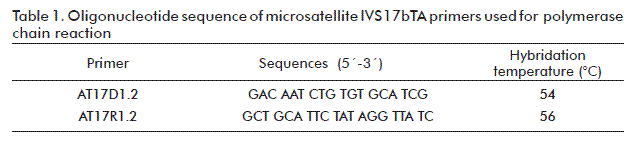
<body><![CDATA[<P   ><font size="2" face="Verdana, Arial, Helvetica, sans-serif"><b>Detection of mutations      </b> </font></P >       <P   ><font size="2" face="Verdana, Arial, Helvetica, sans-serif">F508del, G542X and      R1162X mutations were detected by the amplification refractory mutation specific      (ARMS) method described by Newton <I>et al</I>.[11]. Each reaction contained:      100 ng of DNA, 1 U of <I>Taq</I> DNA polymerase (Invitrogen, USA), 0.85 pmol/L      of each primer (Biosource, USA), 0.1 mM dNTP, 1.0 mM MgCl<sub>2</sub> in a      final volume of 25 &micro;L. In all cases, internal amplification controls      were also used. The amplification reaction was carried out according to the      following steps: denaturing at 94 &deg;C for 5 min and thereafter <I>Taq</I>      DNA polymerase (Promega, USA) was added, followed by 29 cycles of denaturating      at 94 &deg;C for 1 min, annealing at 60 &deg;C for 1 min, and extension at      72 &deg;C for 90 s, followed by a final extension cycle at 72 &deg;C for 5      min. The DNA fragments obtained were run at 250 V for 25 min in a 2 % agarose      gel containing ethidium bromide and visualized on an UV light transilluminator.      </font></P >   <FONT size="+1"><FONT size="+1">        <P   ><font size="2" face="Verdana, Arial, Helvetica, sans-serif">Mutations 3120+1G&rarr;A,      R553X and R334W, were detected by polymerase chain reaction (PCR), followed      by enzyme restriction analysis specific for each mutation and agarose gel      electrophoresis. </font></P >       <P   ><font size="2" face="Verdana, Arial, Helvetica, sans-serif">To detect 3120+1G&rarr;A,      the following conditions were established per reaction: 100 ng DNA, 1 U of      <I>Taq</I> DNA polymerase (Invitrogen, USA), each primer at 6.5 pmol/&micro;L      (Biosource, USA), 0.1 mM dNTP, 2.5 mM MgCl2 in a final reaction volume of      25 &micro;L. The amplification reaction consisted of denaturing at 94 &ordm;C      for 5 min, followed by 35 cycles of denaturing at 94 &deg;C for 1 min, annealing      at 57 &deg;C for 1 min, extension at 67 &deg;C for 1 min; and a final extension      cycle at 67 &deg;C for 5 min. The amplified product was further digested with      20 U of<I> Bst</I>N I (Bio Labs, USA) per sample in a final volume of 35 &micro;L,      at 60 &deg;C for 4 h. </font></P >   <FONT size="+1"><FONT size="+1">        <P   ><font size="2" face="Verdana, Arial, Helvetica, sans-serif">The R334W mutation      was analyzed under the following conditions per reaction: 100 ng DNA, 1 U      <I>Taq</I> DNA polymerase (Invitrogen, USA), 6.5 pmol/&micro;L (Biosource,      USA) for each primer, 0.1 mM dNTP, 1.5 mM MgCl<sub>2</sub>, in a reaction      volume of 25 &micro;L. The amplification reaction consisted of denaturing      for 3 min, followed by 35 cycles of repetitions consisting of 20 s of denaturing      at 94 &deg;C, annealing at 55 &deg;C for 30 s, extension at 74 &deg;C for      30 s and a </font><font size="2" face="Verdana, Arial, Helvetica, sans-serif">final      extension cycle at 74 &deg;C for 5 min. The amplified product was digested      with 25 U of the restriction enzyme <I>Hpa</I> II (Promega, USA) in a final      volume of 35 &micro;L, at 37 &deg;C for 3 h. </font></P >   <FONT size="+1"><FONT size="+1">        <P   ><font size="2" face="Verdana, Arial, Helvetica, sans-serif">The digested amplification      products for the 3120+1G&rarr;A and R334W mutations were electrophoresed in      2 % agarose gels containing ethidium bromide and bands were visualized under      UV light. </font></P >       <P   ><font size="2" face="Verdana, Arial, Helvetica, sans-serif">In the case of the      R553X mutation, amplification reaction conditions were: 100 ng DNA, 1 U <I>Taq      </I>DNA polymerase (Invitrogen, USA), each primer at 6.5 pmol/&micro;L (Biosource,      USA), 0.1 mM dNTP, 1.5 mM MgCl<sub>2</sub> in a final volume of 25 &micro;L.      The reaction mixtures were denatured at 94 &ordm;C for 5 min, followed by      30 cycles of denaturing at 94 &deg;C for 30 s, annealing at 55 &deg;C for      30 s, extension at 72 &deg;C for 1 min, and a final extension cycle at 72      &deg;C for 5 min. The amplified product was digested with 25 U of <I>Hin</I>c      II (Bio Labs, USA) to a final volume of 35 &micro;L, at 37 &deg;C for 3 h.      The digested product was subsequently run on a 3 % agarose gel and visualized      on a UV light transilluminator. </font></P >   <FONT size="+1"><FONT size="+1">        <P   ><font size="2" face="Verdana, Arial, Helvetica, sans-serif"><b>Microsatellite      marker analysis </b></font></P >       <P   ><font size="2" face="Verdana, Arial, Helvetica, sans-serif">The microsatellite      IVS17bTA was amplified by PCR under the following conditions per reaction:      100 ng DNA, 1 U of <I>Taq</I> DNA polymerase (Invitrogen, USA), 5 pmol/L of      each primer (Biosource, USA), 0.1 mM dNTP, 1.5 mM MgCl<sub>2</sub> in a final      volume of 25 &micro;L. The amplification reaction was carried out by an initial      denaturing step at 94 &ordm;C for 4 min, followed by 30 cycles with the following      steps: denaturing at 94 &deg;C for 30 s, annealing at 50 &deg;C for 30 s,      extension at 72 &deg;C for 30 s; and a final cycle of extension at 72 &deg;C      for 7 min. PCR primer sequences are shown in <a href="/img/revistas/bta/v30n4/t0102413.gif">table      1</a>. Amplification products were verified by electrophoresis in a 2 % agarose      gel, with bands ranging 202-294 bp, according to the obtained allelic variants.      </font></P >   <FONT size="+1"><FONT size="+1">        
<P   ><font size="2" face="Verdana, Arial, Helvetica, sans-serif">The products were      further subjected to 12.5 % polyacrylamide gel electrophoresis, with a migration      time from 4 to 5 h at 150 V and a temperature of 15 &deg;C. Subsequently,      DNA was visualized through gel silver staining with the PlusOne DNA Silver      Staining Kit (Amersham Biosciences, USA, 2002) according to manufacturers&rsquo;      instructions. </font></P >       ]]></body>
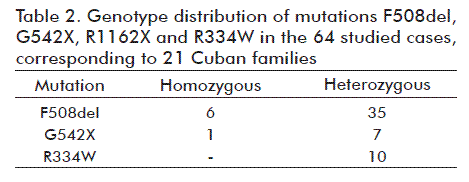
<body><![CDATA[<P   >&nbsp;</P >       <P   > </P >   <FONT size="+1"><B>        <P   ><font size="3" face="Verdana, Arial, Helvetica, sans-serif">RESULTS </font></P >   </B>        <P   ><font size="2" face="Verdana, Arial, Helvetica, sans-serif">Among the 64 tested      people, 22 were suffering from CF and 42 were carriers. From these last, only      33 carried the identified mutations. </font></P >   <FONT size="+1">        <P   ><font size="2" face="Verdana, Arial, Helvetica, sans-serif">In 11 patients two      mutated alleles were present, with the other 11 carrying only one mutated      allele. In total, heterozygous, homozygous and heterozygous compound alleles      were carried by 55 people. </font></P >       <P   ><font size="2" face="Verdana, Arial, Helvetica, sans-serif"><a href="#tab2">Table      2</a> shows the results of detected mutations in the 21 families under study.      Mutations R1162X, R553X and 3120+1G&rarr;A were not present in the analyzed      families.</font></P >       <P align="center"   ><img src="/img/revistas/bta/v30n4/t0202413.gif" width="467" height="180"><a name="tab2"></a></P >       
<P   ><font size="2" face="Verdana, Arial, Helvetica, sans-serif">Among the 22 studied      patients, seven were homozygous (six with F508del and one with G542X), four      were compound heterozygous (two with F508del/R334W, one with F508del/G542X      and one with G542X/R334W) and 11 carried a single mutation (F508del or R334W),      accounting for 33 molecularly characterized chromosomes (75 %). <a href="/img/revistas/bta/v30n4/f0202413.gif">Figure      2</a> shows the frequencies of the IVS17bTA marker alleles identified in the      64 individuals; 12 out of the 30 allelic variants described in other Caucasian      populations were found [8]. </font></P >       
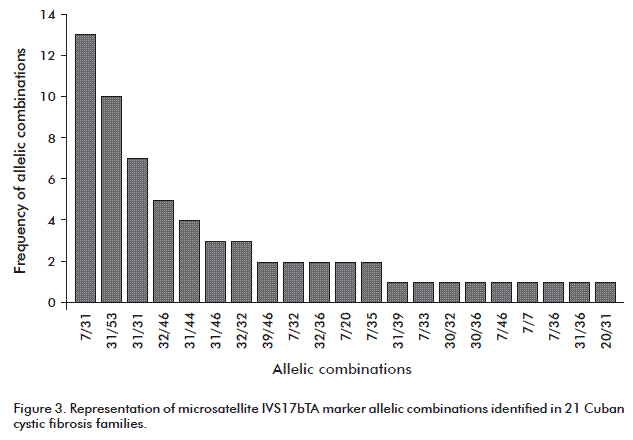
<P   ><font size="2" face="Verdana, Arial, Helvetica, sans-serif">The most frequent      alleles in descending order in the 64 studied individuals were 31, 7, 46,      32 and 53. The less frequent ones were 33, 35, 20 and 30. </font></P >       <P   ><font size="2" face="Verdana, Arial, Helvetica, sans-serif">The IVS17bTA microsatellite      marker frequencies for the allelic combinations identified in the study are      shown in <a href="/img/revistas/bta/v30n4/f0302413.gif">figure 3</a>. The most common allelic      combinations in descending order were: 7/31, 31/53, 31/31 and 32/46. It was      found that the IVS17bTA microsatellite marker allele 31 is the most common      in the Cuban population, as in Spain and other Caucasian populations [12].      These data are taken as reference because of the genetic background contribution      of the Spanish population to the Cuban genome. </font></P >       
]]></body>
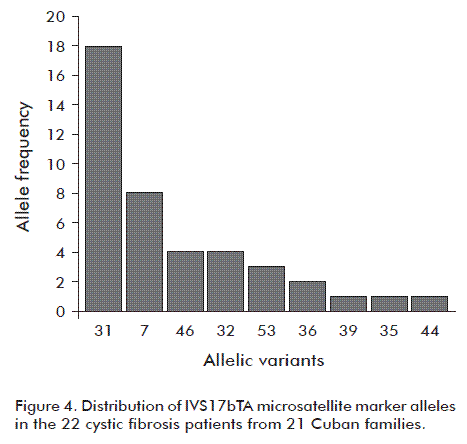
<body><![CDATA[<P   ><font size="2" face="Verdana, Arial, Helvetica, sans-serif"><a href="#fig4">Figure      4</a> shows the frequency of the IVS17bTA microsatellite marker alleles found      in the 22 CF patients; the most frequent in descending order were 31, 7, 46,      32 and 53. The less frequent ones were 35, 39 and 44.</font></P >       <P align="center"   ><img src="/img/revistas/bta/v30n4/f0402413.gif" width="465" height="442"><a name="fig4"></a></P >       
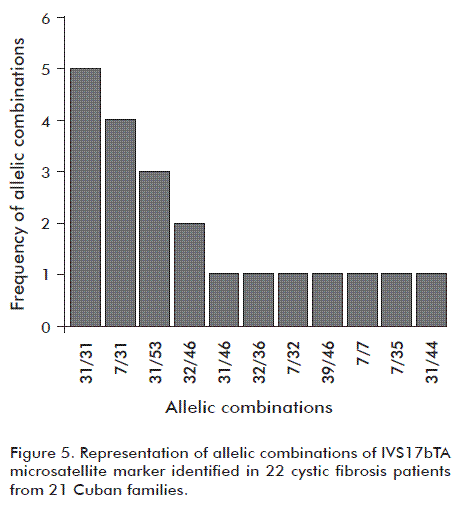
<P   ><font size="2" face="Verdana, Arial, Helvetica, sans-serif">Similar to European      populations [12], it was observed that the IVS17bTA microsatellite marker      alleles 31 and 32 were the most common in the Cuban CF patients. </font></P >       <P   ><font size="2" face="Verdana, Arial, Helvetica, sans-serif">The allelic combinations      of the IVS17bTA microsatellite marker identified in the 22 CF patients are      shown in <a href="#fig5">figure 5</a>, the most common: 31/31, 7/31, 31/53      and 32/46. Conversely, the less frequent combinations were 31/46, 32/36, 7/32,      39/46, 7/7, 7/35 and 31/44.</font></P >       <P align="center"   ><img src="/img/revistas/bta/v30n4/f0502413.gif" width="465" height="505"><a name="fig5"></a></P >       
<P   ><font size="2" face="Verdana, Arial, Helvetica, sans-serif">An association analysis      of identified CTFR mutations and the IVS17bTA microsatellite allele marker      showed that allele 31 was associated to mutation F508del, as found in 34 individuals.      For the G542X mutation, there were six individuals carrying it together with      IVS17bTA allele 32. These results are in agreement with those reported worldwide      and open the search for these mutations in the Cuban population. </font></P >       <P   ><font size="2" face="Verdana, Arial, Helvetica, sans-serif">In addition, we studied      the heterozygosity of the IVS17bTA microsatellite marker in the 64 individuals.      There were 55 heterozygous and 9 homozygous individuals for the marker alleles,      for 85.93 % heterozygosity. This pointed out this microsatellite as highly      informative. The informativeness analysis performed in the 21 families found      that 18 (85.7 %) were completely informative and only three semi-informative.      </font></P >       <P   >&nbsp;</P >       <P   ><font size="2" face="Verdana, Arial, Helvetica, sans-serif"><B><font size="3">DISCUSSION      </font></b></font></P >   <FONT size="+1">        <P   ><font size="2" face="Verdana, Arial, Helvetica, sans-serif">The use of genetic      markers is an alternative to detect the transmission of mutated alleles in      population groups, despite the knowledge on point mutations responsible for      the disease. The discovery of the polymorphic markers aim of the present study,      closely linked to the CFTR gene within the affected gene, is a major breakthrough      to provide indirectly prenatal and carriers CF diagnosis. Additionally, presymptomatic      screenings can be run in newborns, providing the opportunity to implement      prevention, to apply a more specific treatment and to improve the quality      of life of these patients. </font></P >   <FONT size="+1">        ]]></body>
<body><![CDATA[<P   ><font size="2" face="Verdana, Arial, Helvetica, sans-serif">Considering the origin      of the Cuban population, the most common mutations reported for the CFTR gene      in Spain (F508del, G542X, R1162X, R334W and R553X) and Africa (3120+1G&rarr;A)      were searched in Cuban patients. As in most populations around the world,      the F508del mutation was found as the predominant cause for CF in patients      showing severe clinical symptoms. </font></P >       <P   ><font size="2" face="Verdana, Arial, Helvetica, sans-serif">Sixty-nine percentage      of the subjects and seventy-five percentage of CF chromosomes were genotyped,      demonstrating a high molecular heterogeneity of the disease in the analyzed      sample. </font></P >       <P   ><font size="2" face="Verdana, Arial, Helvetica, sans-serif">The knowledge on      the association of the IVS17bTA microsatellite marker alleles to the most      frequent CFTR mutations can extend the diagnostic possibilities. Studies carried      out in the Spanish population showed that allele 31 of this microsatellite      marker is associated with F508del mutation, and alleles 46 and 47 with R334W      [12]. Also in other countries near the Mediterranean and the British Isles,      the F508del mutation appears associated with allele 31 of the same microsatellite      marker [10]. </font></P >       <P   ><font size="2" face="Verdana, Arial, Helvetica, sans-serif">Noteworthy, this      is the first study in Cuba standardizing PCR, and agarose or polyacrylamide      gels electrophoresis conditions for the VS17bTA microsatellite marker. With      the identification of VS17bTA alleles and its high heterozygosity in the 64      individuals tested, 85.7 % families were informative. This result highlights      the informativeness of IVS17bTA, described as the most informative of the      three micro satellite markers located in the CFTR gene. <a href="#fig6">Figure      6</a> shows a family regarded as informative for the marker and an example      of prenatal diagnosis. </font></P >       <P align="center"   ><img src="/img/revistas/bta/v30n4/f0602413.gif" width="462" height="401"><a name="fig6"></a></P >       
<P   ><font size="2" face="Verdana, Arial, Helvetica, sans-serif">A family is fully      informative when parents are heterozygous for those marker alleles, since      in each parent it is possible to determine which allele segregates with the      disease and so, this allows further study of the linkage. This analysis is      only relevant if the family has at least one affected member. In the example,      the marker alleles that segregate with the disease are 31 in the mother and      53 in the father. It was previously known from the family history that alleles      31/53 were associated with the disease. In this way, the prenatal diagnosis      can be established to identify the fixed possible outcomes (<a href="#fig6">Figure      6</a>). </font></P >       <P   ><font size="2" face="Verdana, Arial, Helvetica, sans-serif">In summary, the IVS17bTA      microsatellite marker is an excellent indicator for genetic linkage studies      in families with CF, both for carrier detection and prenatal diagnosis. The      implementation of IVS17bTA studies widens the molecular diagnostic possibilities      in fibrocystic Cuban families. </font></P >       <P   >&nbsp;</P >       <P   > </P >   <FONT size="+1">        <P   ><font size="3"><b><font face="Verdana, Arial, Helvetica, sans-serif">REFERENCES      </font></b></font></P >       ]]></body>
<body><![CDATA[<!-- ref --><P   ><font size="2" face="Verdana, Arial, Helvetica, sans-serif">1. Collazo T, Piloto      Y, Clark Y, Boffil AM, G&oacute;mez M, Hern&aacute;ndez Y. Detecci&oacute;n      de mutaciones en pacientes cubanos con fibrosis qu&iacute;stica. Biotecnol      Apl. 2008;25(4):345-9.     </font></P >   <FONT size="+1">        <!-- ref --><P   ><font size="2" face="Verdana, Arial, Helvetica, sans-serif">2. Scriver CR, Beaudet      AL, Sly GW, Valle D, editors. The metabolic and molecular bases of inherited      diseases. 7th ed. Vol. 3. New York; Mc Graw-Hill; 1995.     </font></P >       <!-- ref --><P   ><font size="2" face="Verdana, Arial, Helvetica, sans-serif">3. Cystic Fibrosis      Mutation Database (CFMDB) [Internet]. Ontario: Cystic Fibrosis Consortium.      c2011 [cited 2013 May 9]; Available from: <FONT color="#0000FF"><a href="http://www.genet.sickkids.on.ca/cftr/StatisticsPage.html"  	target="_blank">http://www.genet.sickkids.on.ca/cftr/StatisticsPage.html</a>      </font></font></P >   <FONT color="#0000FF"><FONT color="#000000">        <!-- ref --><P   ><font size="2" face="Verdana, Arial, Helvetica, sans-serif">4. Collazo T, Bofill      AM, Clark Y, Hernandez Y, Gomez M, Rodriguez F, <I>et al</I>. Common mutations      in Cuban cystic fibrosis patients. J Cyst Fibros. 2009;8(1):47-9.     </font></P >       <!-- ref --><P   ><font size="2" face="Verdana, Arial, Helvetica, sans-serif">5. Collazo T, L&oacute;pez      I, Gonz&aacute;lez L, Clark Y, Piloto Y, G&oacute;mez M, <I>et al.</I> Estudio      molecular de la fibrosis qu&iacute;stica en Cuba. In: Memorias Convenci&oacute;n      Internacional de Salud P&uacute;blica. Cuba Salud 2012. La Habana 3-7 de diciembre      de 2012, Cuba. La Habana: Ministerio de Salud P&uacute;blica; 2002.     </font></P >       <!-- ref --><P   ><font size="2" face="Verdana, Arial, Helvetica, sans-serif">6. Weber JL, May      PE. Abundant class of human DNA polymorphisms which can be typed using the      polymerase chain reaction. Am J Hum Genet. 1989;44(3):388-96.     </font></P >       <!-- ref --><P   ><font size="2" face="Verdana, Arial, Helvetica, sans-serif">7. Estivill X, Morral      N, Casals T, Nunes V. Prenatal diagnosis of cystic fibrosis by multiplex PCR      of mutation and microsatellite alleles. Lancet. 1991;338(8764):458.     </font></P >       <!-- ref --><P   ><font size="2" face="Verdana, Arial, Helvetica, sans-serif">8. Visich AA, Barreiro      CZ, Chertkoff LP. Caracterizaci&oacute;n de tres microsat&eacute;lites del      gen de fibrosis qu&iacute;stica en familias argentinas. Medicina (Buenos Aires).      2001;61(1):23-7.     </font></P >       <!-- ref --><P   ><font size="2" face="Verdana, Arial, Helvetica, sans-serif">9. Zielenski J, Rozmahel      R, Bozon D, Kerem B, Grzelczak Z, Riordan JR, <I>et al.</I> Genomic DNA sequence      of the cystic fibrosis transmembrane conductance regulator (CFTR) gene. Genomics.      1991;10(1):214-28.     </font></P >       <!-- ref --><P   ><font size="2" face="Verdana, Arial, Helvetica, sans-serif">10. Miller SA, Dykes      DD, Polesky HF. A simple salting out procedure for extracting DNA from human      nucleated cells. Nucleic Acids Res. 1988;16(3):1215-8.     </font></P >       <!-- ref --><P   ><font size="2" face="Verdana, Arial, Helvetica, sans-serif">11. Newton CR, Graham      A, Heptinstall LE, Powell SJ, Summers C, Kalsheker N, <I>et al</I>. Analysis      of any point mutation in DNA. The amplification refractory mutation system      (ARMS). Nucleic Acids Res. 1989;17(7):2503-16.     </font></P >       <!-- ref --><P   ><font size="2" face="Verdana, Arial, Helvetica, sans-serif">12. Morral N, Bertranpetit      J, Estivill X, Nunes V, Casals T, Gimenez J, <I>et al</I>. The origin of the      major cystic fibrosis mutation (delta F508) in European populations. Nat Genet.      1994;7(2):169-75.     </font></P >       <P   >&nbsp;</P >       <P   >&nbsp;</P >       <P   > </P >   <FONT size="+1">        <P   > </P >       <P   ><font size="2" face="Verdana, Arial, Helvetica, sans-serif">Received in October,      2012.    <br>     </font><font size="2" face="Verdana, Arial, Helvetica, sans-serif">Accepted      in May, 2013. </font></P >       <P   >&nbsp;</P >       ]]></body>
<body><![CDATA[<P   >&nbsp;</P >       <P   > </P >       <P   > </P >       <P   ><i><font size="2" face="Verdana, Arial, Helvetica, sans-serif">Teresa Collazo</font></i><font size="2" face="Verdana, Arial, Helvetica, sans-serif">.      Laboratorio de Biolog&iacute;a Molecular, Centro Nacional de Gen&eacute;tica      M&eacute;dica, CNGM. Ave. 31 Esq. 146 No. 3102, Reparto Cubanac&aacute;n,      Playa, CP 11400, La Habana, Cuba. E-mail: <a href="mailto:tcollazo@infomed.sld.cu">tcollazo@infomed.sld.cu</a>.      </font></P >   </font></font></font></font></font></font></font></font></font></font></font></font></font></font></font></font></font></font></font></font></font></font></font></font></font></font></font></DIV >      ]]></body><back>
<ref-list>
<ref id="B1">
<label>1</label><nlm-citation citation-type="journal">
<person-group person-group-type="author">
<name>
<surname><![CDATA[Collazo]]></surname>
<given-names><![CDATA[T]]></given-names>
</name>
<name>
<surname><![CDATA[Piloto]]></surname>
<given-names><![CDATA[Y]]></given-names>
</name>
<name>
<surname><![CDATA[Clark]]></surname>
<given-names><![CDATA[Y]]></given-names>
</name>
<name>
<surname><![CDATA[Boffil]]></surname>
<given-names><![CDATA[AM]]></given-names>
</name>
<name>
<surname><![CDATA[Gómez]]></surname>
<given-names><![CDATA[M]]></given-names>
</name>
<name>
<surname><![CDATA[Hernández]]></surname>
<given-names><![CDATA[Y]]></given-names>
</name>
</person-group>
<article-title xml:lang="es"><![CDATA[Detección de mutaciones en pacientes cubanos con fibrosis quística]]></article-title>
<source><![CDATA[Biotecnol Apl]]></source>
<year>2008</year>
<volume>25</volume>
<numero>4</numero>
<issue>4</issue>
<page-range>345-9</page-range></nlm-citation>
</ref>
<ref id="B2">
<label>2</label><nlm-citation citation-type="book">
<person-group person-group-type="author">
<name>
<surname><![CDATA[Scriver]]></surname>
<given-names><![CDATA[CR]]></given-names>
</name>
<name>
<surname><![CDATA[Beaudet]]></surname>
<given-names><![CDATA[AL]]></given-names>
</name>
<name>
<surname><![CDATA[Sly]]></surname>
<given-names><![CDATA[GW]]></given-names>
</name>
<name>
<surname><![CDATA[Valle]]></surname>
<given-names><![CDATA[D]]></given-names>
</name>
</person-group>
<source><![CDATA[The metabolic and molecular bases of inherited diseases]]></source>
<year>1995</year>
<edition>7</edition>
<publisher-loc><![CDATA[New York ]]></publisher-loc>
<publisher-name><![CDATA[Mc Graw-Hill]]></publisher-name>
</nlm-citation>
</ref>
<ref id="B3">
<label>3</label><nlm-citation citation-type="book">
<source><![CDATA[Cystic Fibrosis Mutation Database (CFMDB)]]></source>
<year>2011</year>
<publisher-loc><![CDATA[Ontario ]]></publisher-loc>
<publisher-name><![CDATA[Cystic Fibrosis Consortium]]></publisher-name>
</nlm-citation>
</ref>
<ref id="B4">
<label>4</label><nlm-citation citation-type="journal">
<person-group person-group-type="author">
<name>
<surname><![CDATA[Collazo]]></surname>
<given-names><![CDATA[T]]></given-names>
</name>
<name>
<surname><![CDATA[Bofill]]></surname>
<given-names><![CDATA[AM]]></given-names>
</name>
<name>
<surname><![CDATA[Clark]]></surname>
<given-names><![CDATA[Y]]></given-names>
</name>
<name>
<surname><![CDATA[Hernandez]]></surname>
<given-names><![CDATA[Y]]></given-names>
</name>
<name>
<surname><![CDATA[Gomez]]></surname>
<given-names><![CDATA[M]]></given-names>
</name>
<name>
<surname><![CDATA[Rodriguez]]></surname>
<given-names><![CDATA[F]]></given-names>
</name>
</person-group>
<article-title xml:lang="en"><![CDATA[Common mutations in Cuban cystic fibrosis patients]]></article-title>
<source><![CDATA[J Cyst Fibros]]></source>
<year>2009</year>
<volume>8</volume>
<numero>1</numero>
<issue>1</issue>
<page-range>47-9</page-range></nlm-citation>
</ref>
<ref id="B5">
<label>5</label><nlm-citation citation-type="book">
<person-group person-group-type="author">
<name>
<surname><![CDATA[Collazo]]></surname>
<given-names><![CDATA[T]]></given-names>
</name>
<name>
<surname><![CDATA[López]]></surname>
<given-names><![CDATA[I]]></given-names>
</name>
<name>
<surname><![CDATA[González]]></surname>
<given-names><![CDATA[L]]></given-names>
</name>
<name>
<surname><![CDATA[Clark]]></surname>
<given-names><![CDATA[Y]]></given-names>
</name>
<name>
<surname><![CDATA[Piloto]]></surname>
<given-names><![CDATA[Y]]></given-names>
</name>
<name>
<surname><![CDATA[Gómez]]></surname>
<given-names><![CDATA[M]]></given-names>
</name>
</person-group>
<article-title xml:lang="es"><![CDATA[Estudio molecular de la fibrosis quística en Cuba]]></article-title>
<source><![CDATA[Memorias Convención Internacional de Salud Pública. Cuba Salud 2012. La Habana 3-7 de diciembre de 2012, Cuba]]></source>
<year>2002</year>
<publisher-loc><![CDATA[La Habana ]]></publisher-loc>
<publisher-name><![CDATA[Ministerio de Salud Pública]]></publisher-name>
</nlm-citation>
</ref>
<ref id="B6">
<label>6</label><nlm-citation citation-type="journal">
<person-group person-group-type="author">
<name>
<surname><![CDATA[Weber]]></surname>
<given-names><![CDATA[JL]]></given-names>
</name>
<name>
<surname><![CDATA[May]]></surname>
<given-names><![CDATA[PE]]></given-names>
</name>
</person-group>
<article-title xml:lang="en"><![CDATA[Abundant class of human DNA polymorphisms which can be typed using the polymerase chain reaction]]></article-title>
<source><![CDATA[Am J Hum Genet]]></source>
<year>1989</year>
<volume>44</volume>
<numero>3</numero>
<issue>3</issue>
<page-range>388-96</page-range></nlm-citation>
</ref>
<ref id="B7">
<label>7</label><nlm-citation citation-type="journal">
<person-group person-group-type="author">
<name>
<surname><![CDATA[Estivill]]></surname>
<given-names><![CDATA[X]]></given-names>
</name>
<name>
<surname><![CDATA[Morral]]></surname>
<given-names><![CDATA[N]]></given-names>
</name>
<name>
<surname><![CDATA[Casals]]></surname>
<given-names><![CDATA[T]]></given-names>
</name>
<name>
<surname><![CDATA[Nunes]]></surname>
<given-names><![CDATA[V]]></given-names>
</name>
</person-group>
<article-title xml:lang="en"><![CDATA[Prenatal diagnosis of cystic fibrosis by multiplex PCR of mutation and microsatellite alleles]]></article-title>
<source><![CDATA[Lancet]]></source>
<year>1991</year>
<volume>338</volume>
<numero>8764</numero>
<issue>8764</issue>
<page-range>458</page-range></nlm-citation>
</ref>
<ref id="B8">
<label>8</label><nlm-citation citation-type="journal">
<person-group person-group-type="author">
<name>
<surname><![CDATA[Visich]]></surname>
<given-names><![CDATA[AA]]></given-names>
</name>
<name>
<surname><![CDATA[Barreiro]]></surname>
<given-names><![CDATA[CZ]]></given-names>
</name>
<name>
<surname><![CDATA[Chertkoff]]></surname>
<given-names><![CDATA[LP]]></given-names>
</name>
</person-group>
<article-title xml:lang="es"><![CDATA[Caracterización de tres microsatélites del gen de fibrosis quística en familias argentinas]]></article-title>
<source><![CDATA[Medicina (Buenos Aires)]]></source>
<year>2001</year>
<volume>61</volume>
<numero>1</numero>
<issue>1</issue>
<page-range>23-7</page-range></nlm-citation>
</ref>
<ref id="B9">
<label>9</label><nlm-citation citation-type="journal">
<person-group person-group-type="author">
<name>
<surname><![CDATA[Zielenski]]></surname>
<given-names><![CDATA[J]]></given-names>
</name>
<name>
<surname><![CDATA[Rozmahel]]></surname>
<given-names><![CDATA[R]]></given-names>
</name>
<name>
<surname><![CDATA[Bozon]]></surname>
<given-names><![CDATA[D]]></given-names>
</name>
<name>
<surname><![CDATA[Kerem]]></surname>
<given-names><![CDATA[B]]></given-names>
</name>
<name>
<surname><![CDATA[Grzelczak]]></surname>
<given-names><![CDATA[Z]]></given-names>
</name>
<name>
<surname><![CDATA[Riordan]]></surname>
<given-names><![CDATA[JR]]></given-names>
</name>
</person-group>
<article-title xml:lang="en"><![CDATA[Genomic DNA sequence of the cystic fibrosis transmembrane conductance regulator (CFTR) gene]]></article-title>
<source><![CDATA[Genomics]]></source>
<year>1991</year>
<volume>10</volume>
<numero>1</numero>
<issue>1</issue>
<page-range>214-28</page-range></nlm-citation>
</ref>
<ref id="B10">
<label>10</label><nlm-citation citation-type="journal">
<person-group person-group-type="author">
<name>
<surname><![CDATA[Miller]]></surname>
<given-names><![CDATA[SA]]></given-names>
</name>
<name>
<surname><![CDATA[Dykes]]></surname>
<given-names><![CDATA[DD]]></given-names>
</name>
<name>
<surname><![CDATA[Polesky]]></surname>
<given-names><![CDATA[HF]]></given-names>
</name>
</person-group>
<article-title xml:lang="en"><![CDATA[A simple salting out procedure for extracting DNA from human nucleated cells]]></article-title>
<source><![CDATA[Nucleic Acids Res]]></source>
<year>1988</year>
<volume>16</volume>
<numero>3</numero>
<issue>3</issue>
<page-range>1215-8</page-range></nlm-citation>
</ref>
<ref id="B11">
<label>11</label><nlm-citation citation-type="journal">
<person-group person-group-type="author">
<name>
<surname><![CDATA[Newton]]></surname>
<given-names><![CDATA[CR]]></given-names>
</name>
<name>
<surname><![CDATA[Graham]]></surname>
<given-names><![CDATA[A]]></given-names>
</name>
<name>
<surname><![CDATA[Heptinstall]]></surname>
<given-names><![CDATA[LE]]></given-names>
</name>
<name>
<surname><![CDATA[Powell]]></surname>
<given-names><![CDATA[SJ]]></given-names>
</name>
<name>
<surname><![CDATA[Summers]]></surname>
<given-names><![CDATA[C]]></given-names>
</name>
<name>
<surname><![CDATA[Kalsheker]]></surname>
<given-names><![CDATA[N]]></given-names>
</name>
</person-group>
<article-title xml:lang="en"><![CDATA[Analysis of any point mutation in DNA. The amplification refractory mutation system (ARMS)]]></article-title>
<source><![CDATA[Nucleic Acids Res]]></source>
<year>1989</year>
<volume>17</volume>
<numero>7</numero>
<issue>7</issue>
<page-range>2503-16</page-range></nlm-citation>
</ref>
<ref id="B12">
<label>12</label><nlm-citation citation-type="journal">
<person-group person-group-type="author">
<name>
<surname><![CDATA[Morral]]></surname>
<given-names><![CDATA[N]]></given-names>
</name>
<name>
<surname><![CDATA[Bertranpetit]]></surname>
<given-names><![CDATA[J]]></given-names>
</name>
<name>
<surname><![CDATA[Estivill]]></surname>
<given-names><![CDATA[X]]></given-names>
</name>
<name>
<surname><![CDATA[Nunes]]></surname>
<given-names><![CDATA[V]]></given-names>
</name>
<name>
<surname><![CDATA[Casals]]></surname>
<given-names><![CDATA[T]]></given-names>
</name>
<name>
<surname><![CDATA[Gimenez]]></surname>
<given-names><![CDATA[J]]></given-names>
</name>
</person-group>
<article-title xml:lang="en"><![CDATA[The origin of the major cystic fibrosis mutation (delta F508) in European populations]]></article-title>
<source><![CDATA[Nat Genet]]></source>
<year>1994</year>
<volume>7</volume>
<numero>2</numero>
<issue>2</issue>
<page-range>169-75</page-range></nlm-citation>
</ref>
</ref-list>
</back>
</article>