<?xml version="1.0" encoding="ISO-8859-1"?><article xmlns:mml="http://www.w3.org/1998/Math/MathML" xmlns:xlink="http://www.w3.org/1999/xlink" xmlns:xsi="http://www.w3.org/2001/XMLSchema-instance">
<front>
<journal-meta>
<journal-id>1027-2852</journal-id>
<journal-title><![CDATA[Biotecnología Aplicada]]></journal-title>
<abbrev-journal-title><![CDATA[Biotecnol Apl]]></abbrev-journal-title>
<issn>1027-2852</issn>
<publisher>
<publisher-name><![CDATA[Editorial Elfos Scientiae]]></publisher-name>
</publisher>
</journal-meta>
<article-meta>
<article-id>S1027-28522014000100007</article-id>
<title-group>
<article-title xml:lang="en"><![CDATA[Isolation and partial purification of a hemolytic sphingomyelin-inhibitable fraction from the sea anemone Anthopleura nigrescens]]></article-title>
<article-title xml:lang="en"><![CDATA[Aislamiento y purificación parcial de una fracción hemolítica inhibida por esfingomielina de la anémona marina Anthopleura nigrescens]]></article-title>
</title-group>
<contrib-group>
<contrib contrib-type="author">
<name>
<surname><![CDATA[Alvarado]]></surname>
<given-names><![CDATA[Javier]]></given-names>
</name>
<xref ref-type="aff" rid="A01"/>
</contrib>
<contrib contrib-type="author">
<name>
<surname><![CDATA[Álvarez]]></surname>
<given-names><![CDATA[Yeney]]></given-names>
</name>
<xref ref-type="aff" rid="A02"/>
</contrib>
<contrib contrib-type="author">
<name>
<surname><![CDATA[Pedrera]]></surname>
<given-names><![CDATA[Lohans]]></given-names>
</name>
<xref ref-type="aff" rid="A02"/>
</contrib>
<contrib contrib-type="author">
<name>
<surname><![CDATA[Ros]]></surname>
<given-names><![CDATA[Uris]]></given-names>
</name>
<xref ref-type="aff" rid="A02"/>
</contrib>
<contrib contrib-type="author">
<name>
<surname><![CDATA[Lanio]]></surname>
<given-names><![CDATA[María E]]></given-names>
</name>
<xref ref-type="aff" rid="A02"/>
</contrib>
<contrib contrib-type="author">
<name>
<surname><![CDATA[Valle]]></surname>
<given-names><![CDATA[Aisel]]></given-names>
</name>
<xref ref-type="aff" rid="A02"/>
</contrib>
<contrib contrib-type="author">
<name>
<surname><![CDATA[Álvarez]]></surname>
<given-names><![CDATA[Carlos]]></given-names>
</name>
<xref ref-type="aff" rid="A02"/>
</contrib>
</contrib-group>
<aff id="A01">
<institution><![CDATA[,Universidad Nacional Facultad de Ciencias Exactas y Naturales Escuela de Ciencias Biológicas]]></institution>
<addr-line><![CDATA[Heredia ]]></addr-line>
<country>Costa Rica</country>
</aff>
<aff id="A02">
<institution><![CDATA[,Universidad de La Habana, UH Facultad de Biología Centro de Estudio de Proteínas]]></institution>
<addr-line><![CDATA[La Habana ]]></addr-line>
<country>Cuba</country>
</aff>
<pub-date pub-type="pub">
<day>00</day>
<month>03</month>
<year>2014</year>
</pub-date>
<pub-date pub-type="epub">
<day>00</day>
<month>03</month>
<year>2014</year>
</pub-date>
<volume>31</volume>
<numero>1</numero>
<fpage>53</fpage>
<lpage>56</lpage>
<copyright-statement/>
<copyright-year/>
<self-uri xlink:href="http://scielo.sld.cu/scielo.php?script=sci_arttext&amp;pid=S1027-28522014000100007&amp;lng=en&amp;nrm=iso"></self-uri><self-uri xlink:href="http://scielo.sld.cu/scielo.php?script=sci_abstract&amp;pid=S1027-28522014000100007&amp;lng=en&amp;nrm=iso"></self-uri><self-uri xlink:href="http://scielo.sld.cu/scielo.php?script=sci_pdf&amp;pid=S1027-28522014000100007&amp;lng=en&amp;nrm=iso"></self-uri><abstract abstract-type="short" xml:lang="en"><p><![CDATA[Actinoporins are highly hemolytic pore-forming proteins with a molecular mass of around 20 kDa and high affinity for sphingomyelin-containing membranes. On the crude extract of the sea anemone Anthopleura nigrescens, hemolytic activity (HA) was detected. In order to identify the presence of pore-forming proteins similar to actinoporins in this anemone, the fractionation and analysis of its crude extract was carried out. The aqueous extract of the whole body was subjected to gel filtration chromatography on Sephadex G50 medium rendering three resolved peaks (P-I, P-II, and P-III) as measured by their absorbance at 280 nm. Functional characterization of the crude extract and chromatographic fractions was evaluated by HA against human red blood cells. The crude extract and two peaks (P-II and P-III) showed HA. Interestingly, the HA of the crude extract and P-II were specifically inhibited by small unilamellar vesicles of phosphatidylcholine: sphingomyelin (1:1). Both the crude extract and P-II revealed the existence of at least one protein band around 20 kDa by SDS-PAGE. The inhibition by sphingomyelin of the whole body extract HA and the localization of this property in P-II that could be associated with a protein of around 20 kDa suggest the presence of at least one novel actinoporin in A. nigrescens. Furthermore, this is the first report of a biochemical activity for this sea anemone. Work is in progress in order to purify and characterize the molecular entities responsible for this HA inhibited by sphingomyelin.]]></p></abstract>
<abstract abstract-type="short" xml:lang="es"><p><![CDATA[Las actinoporinas son proteínas formadoras de poro, altamente hemolíticas, de aproximadamente 20 kDa, con una elevada afinidad por las membranas que contienen esfingomielina. En el extracto crudo de la anémona marina Anthopleura nigrescens se detectó actividad hemolítica (AH). Con el fin de identificar la presencia de proteínas formadoras de poros, similares a las actinoporinas, se fraccionó y analizó este extracto crudo. Se sometió a cromatografía de filtración en gel de Sephadex G50 medio, y se obtuvieron tres picos resueltos (P-I, P-II y P-III), según su absorbancia a 280 nm. La caracterización funcional del extracto y las fracciones cromatográficas se evaluaron por la AH frente a eritrocitos humanos. El extracto crudo y los picos II y III mostraron AH. Curiosamente la AH del extracto crudo y del pico II fueron inhibidas por vesículas unilamelares pequeñas de fosfatidilcolina: esfingomielina (1:1). Tanto el extracto crudo como P-II revelaron al menos una banda proteica de alrededor de 20 kDa, en SDS-PAGE. La inhibición por esfingomielina de la AH del extracto y la localización de esta propiedad en P-II, podría asociarse con una banda proteica de alrededor de 20 kDa, lo que sugiere la presencia de al menos una actinoporina en A. nigrescens. Este es el primer informe de una actividad bioquímica para esta anémona marina. Se continúa trabajando para purificar y caracterizar las entidades moleculares responsables de esta AH inhibida por esfingomielina.]]></p></abstract>
<kwd-group>
<kwd lng="en"><![CDATA[actinoporin]]></kwd>
<kwd lng="en"><![CDATA[Anthopleura nigrescens]]></kwd>
<kwd lng="en"><![CDATA[sphingomyelin]]></kwd>
<kwd lng="en"><![CDATA[hemolytic activity]]></kwd>
<kwd lng="es"><![CDATA[actinoporina]]></kwd>
<kwd lng="es"><![CDATA[Anthopleura nigrescens]]></kwd>
<kwd lng="es"><![CDATA[esfingomielina]]></kwd>
<kwd lng="es"><![CDATA[actividad hemolítica]]></kwd>
</kwd-group>
</article-meta>
</front><body><![CDATA[ <DIV class="Sect"   >        <P   align="right" ><font size="2" color="#000000" face="Verdana, Arial, Helvetica, sans-serif"><b>REPORT      </b> </font></P >       <P   align="right" >&nbsp;</P >   <FONT size="+1" color="#000000">        <P   > </P >       <P   ><font size="4"><b><font face="Verdana, Arial, Helvetica, sans-serif">Isolation      and partial purification of a hemolytic sphingomyelin-inhibitable fraction      from the sea anemone <I>Anthopleura nigrescens </I></font></b></font></P >       <P   >&nbsp;</P >       <P   > </P >       <P   > </P >   <FONT size="+1">       <P   ><b><font size="3" color="#201D1E" face="Verdana, Arial, Helvetica, sans-serif">Aislamiento      y purificaci&oacute;n parcial de una fracci&oacute;n hemol&iacute;tica inhibida      por esfingomielina de la an&eacute;mona marina <I>Anthopleura nigrescens</I>      </font></b></P >       <P   >&nbsp;</P >       ]]></body>
<body><![CDATA[<P   >&nbsp;</P >   <FONT size="+1" color="#201D1E">        <P   > </P >   <FONT size="+1">       <P   > </P >       <P   ><b><font size="2" face="Verdana, Arial, Helvetica, sans-serif"><FONT color="#000000">Javier      Alvarado<Sup>1</Sup>, Yeney &Aacute;lvarez<Sup>2</Sup>, Lohans Pedrera<Sup>2</Sup>,      Uris Ros<Sup>2</Sup>, Mar&iacute;a E Lanio<Sup>2</Sup>, Aisel Valle<Sup>2</Sup>,      Carlos &Aacute;lvarez<Sup>2</Sup></font></font></b><font size="2" face="Verdana, Arial, Helvetica, sans-serif"><FONT color="#000000"><Sup><Sup></Sup></Sup></font></font></P >   <FONT size="+1" color="#000000"><FONT size="+1"><FONT size="+1"><FONT size="+1"><FONT size="+1"><FONT size="+1"><FONT size="+1"><FONT size="+1"><FONT size="+1"><FONT size="+1"><FONT size="+1"><FONT size="+1"><FONT size="+1"><FONT size="+1"><FONT size="+1">        <P   ><font size="2" face="Verdana, Arial, Helvetica, sans-serif"><Sup>1</Sup> Escuela      de Ciencias Biol&oacute;gicas, Facultad de Ciencias Exactas y Naturales, Universidad      Nacional. Apartado 86-300, Heredia, Costa Rica.</font><FONT size="+1"><FONT size="+1"></font></font>    <br>     <font size="2" face="Verdana, Arial, Helvetica, sans-serif"><Sup>2</Sup> Centro      de Estudio de Prote&iacute;nas, Facultad de Biolog&iacute;a, Universidad de      La Habana, UH. Calle 25 No. 455 entre I y J, Vedado, CP 10400, La Habana,      Cuba. </font></P >   <FONT size="+1"><FONT size="+1">        <P   >&nbsp;</P >       <P   >&nbsp;</P >   </font></font></font></font></font></font></font></font></font></font></font></font></font></font></font></font></font></font></font></font></font>    <hr>   <FONT size="+1" color="#000000"><FONT size="+1"><FONT size="+1" color="#201D1E"><FONT size="+1"><FONT size="+1" color="#000000"><FONT size="+1"><FONT size="+1"><FONT size="+1"><FONT size="+1"><FONT size="+1"><FONT size="+1"><FONT size="+1"><FONT size="+1"><FONT size="+1"><FONT size="+1"><FONT size="+1"><FONT size="+1"><FONT size="+1"><FONT size="+1"><FONT size="+1"><FONT size="+1">       <P   ><font size="2" face="Verdana, Arial, Helvetica, sans-serif"><b>ABSTRACT </b></font></P >   <FONT size="+1"><FONT size="+1">     <P   > </P >   <FONT size="+1">        ]]></body>
<body><![CDATA[<P   ><font size="2" color="#201D1E" face="Verdana, Arial, Helvetica, sans-serif">Actinoporins      are highly hemolytic pore-forming proteins with a molecular mass of around      20 kDa and high affinity for sphingomyelin-containing membranes. On the crude      extract of the sea anemone <I>Anthopleura nigrescens</I>, hemolytic activity      (HA) was detected. In order to identify the presence of pore-forming proteins      similar to actinoporins in this anemone, the fractionation and analysis of      its crude extract was carried out. The aqueous extract of the whole body was      subjected to gel filtration chromatography on Sephadex G50 medium rendering      three resolved peaks (P-I, P-II, and P-III) as measured by their absorbance      at 280 nm. Functional characterization of the crude extract and chromatographic      fractions was evaluated by HA against human red blood cells. The crude extract      and two peaks (P-II and P-III) showed HA. Interestingly, the HA of the crude      extract and P-II were specifically inhibited by small unilamellar vesicles      of phosphatidylcholine: sphingomyelin (1:1). Both the crude extract and P-II      revealed the existence of at least one protein band around 20 kDa by SDS-PAGE.      The inhibition by sphingomyelin of the whole body extract HA and the localization      of this property in P-II that could be associated with a protein of around      20 kDa suggest the presence of at least one novel actinoporin in <I>A. nigrescens</I>.      Furthermore, this is the first report of a biochemical activity for this sea      anemone. Work is in progress in order to purify and characterize the molecular      entities responsible for this HA inhibited by sphingomyelin. </font></P >   <FONT size="+1" color="#201D1E"><FONT size="+1" color="#000000">        <P   ><font size="2" color="#201D1E" face="Verdana, Arial, Helvetica, sans-serif"><b>Keywords:</b>      actinoporin, <I>Anthopleura nigrescens</I>, sphingomyelin, hemolytic activity.      </font></P >   </font></font></font></font></font></font></font></font></font></font></font></font></font></font></font></font></font></font></font></font></font></font></font></font></font></font>    <hr>   <FONT size="+1" color="#000000"><FONT size="+1"><FONT size="+1" color="#201D1E"><FONT size="+1"><FONT size="+1" color="#000000"><FONT size="+1"><FONT size="+1"><FONT size="+1"><FONT size="+1"><FONT size="+1"><FONT size="+1"><FONT size="+1"><FONT size="+1"><FONT size="+1"><FONT size="+1"><FONT size="+1"><FONT size="+1"><FONT size="+1"><FONT size="+1"><FONT size="+1"><FONT size="+1"><FONT size="+1"><FONT size="+1"><FONT size="+1"><FONT size="+1" color="#201D1E"><FONT size="+1" color="#000000">       <P   ><font size="2" face="Verdana, Arial, Helvetica, sans-serif"><b>RESUMEN </b></font></P >   <FONT size="+1" color="#201D1E"><FONT size="+1" color="#000000">     <P   > <font size="2" color="#201D1E" face="Verdana, Arial, Helvetica, sans-serif">Las      actinoporinas son prote&iacute;nas formadoras de poro, altamente hemol&iacute;ticas,      de aproximadamente 20 kDa, con una elevada afinidad por las membranas que      contienen esfingomielina. En el extracto crudo de la an&eacute;mona marina      <I>Anthopleura nigrescens </I>se detect&oacute; actividad hemol&iacute;tica      (AH). Con el fin de identificar la presencia de prote&iacute;nas formadoras      de poros, similares a las actinoporinas, se fraccion&oacute; y analiz&oacute;      este extracto crudo. Se someti&oacute; a cromatograf&iacute;a de filtraci&oacute;n      en gel de Sephadex G50 medio, y se obtuvieron tres picos resueltos (P-I, P-II      y P-III), seg&uacute;n su absorbancia a 280 nm. La caracterizaci&oacute;n      funcional del extracto y las fracciones cromatogr&aacute;ficas se evaluaron      por la AH frente a eritrocitos humanos. El extracto crudo y los picos II y      III mostraron AH. Curiosamente la AH del extracto crudo y del pico II fueron      inhibidas por ves&iacute;culas unilamelares peque&ntilde;as de fosfatidilcolina:      esfingomielina (1:1). Tanto el extracto crudo como P-II revelaron al menos      una banda proteica de alrededor de 20 kDa, en SDS-PAGE. La inhibici&oacute;n      por esfingomielina de la AH del extracto y la localizaci&oacute;n de esta      propiedad en P-II, podr&iacute;a asociarse con una banda proteica de alrededor      de 20 kDa, lo que sugiere la presencia de al menos una actinoporina en <I>A.      nigrescens</I>. Este es el primer informe de una actividad bioqu&iacute;mica      para esta an&eacute;mona marina. Se contin&uacute;a trabajando para purificar      y caracterizar las entidades moleculares responsables de esta AH inhibida      por esfingomielina. </font></P >   <FONT size="+1" color="#201D1E">        <P   ><font size="2" face="Verdana, Arial, Helvetica, sans-serif"><b>Palabras clave:</b>      actinoporina, <I>Anthopleura nigrescens</I>, esfingomielina, actividad hemol&iacute;tica.      </font></P >   </font></font></font></font></font></font></font></font></font></font></font></font></font></font></font></font></font></font></font></font></font></font></font></font></font></font></font></font></font>    <hr>   <FONT size="+1" color="#000000"><FONT size="+1"><FONT size="+1" color="#201D1E"><FONT size="+1"><FONT size="+1" color="#000000"><FONT size="+1"><FONT size="+1"><FONT size="+1"><FONT size="+1"><FONT size="+1"><FONT size="+1"><FONT size="+1"><FONT size="+1"><FONT size="+1"><FONT size="+1"><FONT size="+1"><FONT size="+1"><FONT size="+1"><FONT size="+1"><FONT size="+1"><FONT size="+1"><FONT size="+1"><FONT size="+1"><FONT size="+1"><FONT size="+1" color="#201D1E"><FONT size="+1" color="#000000"><FONT size="+1" color="#201D1E"><FONT size="+1" color="#000000"><FONT size="+1" color="#201D1E">        <P   >&nbsp;</P >       <P   ><font size="2" face="Verdana, Arial, Helvetica, sans-serif"> </font></P >   <FONT size="+1" color="#000000">        <P   > </P >       <P   >&nbsp;</P >       <P   ><b><font size="3" face="Verdana, Arial, Helvetica, sans-serif">INTRODUCTION </font></b></P >       ]]></body>
<body><![CDATA[<P   align="justify" ><font size="2" color="#201D1E" face="Verdana, Arial, Helvetica, sans-serif">Sea      anemones are sessile animals that produce venom for defense from predators      and capture of their preys. This secretion consists of an ensemble of molecules      including phospholipases [1-4], sodium channel blockers [5], protease inhibitors      [6], and pore-forming toxins called actinoporins [7-13]. Actinoporins are      highly hemolytic, basic cysteine-less proteins with molecular weight around      20 kDa showing high affinity for membranes containing sphingomyelin; therefore,      their hemolytic activity (HA) is characteristically inhibited when the toxin      is pre-incubated with liposomes containing this phospholipid [11, 14-16].      These toxins have attracted the attention for their potential use in biomedicine      and biotechnology, for instance, in the construction of immunotoxins against      cancer cells [17, 18] or as a tool for protein-membrane interaction studies      [19, 20]. </font></P >   <FONT size="+1" color="#201D1E">        <P   ><font size="2" face="Verdana, Arial, Helvetica, sans-serif">Recently, we described      the presence of the sea anemone <I>Anthopleura nigrescens </I>on the Pacific      coast of Costa Rica [21]. Here, we report the HA against human red blood cells      (RBC) of the crude extract and two fractions obtained by molecular exclusion      chromatography. The HA detected in the crude extract and in one partially      purified fraction were inhibited by sphingomyelin, suggesting the presence      of at least one novel actinoporin in <I>A. nigrescens</I>. </font></P >       <P   ><font size="2" face="Verdana, Arial, Helvetica, sans-serif">Recently, we described      the presence of the sea anemone <I>A. nigrescens </I>on the Pacific coast      of Costa Rica [21]. Here, we report the HA against human red blood cells (RBC)      of the crude extract and two fractions obtained by molecular exclusion chromatography.      The HA detected in the crude extract and in one partially purified fraction      were inhibited by sphingomyelin, suggesting the presence of at least one novel      actinoporin in <I>A. nigrescens</I>. </font></P >       <P   >&nbsp;</P >       <P   ><font size="3" face="Verdana, Arial, Helvetica, sans-serif"><b>MATERIALS AND      METHODS </b> </font></P >       <P   align="justify" ><font size="2" face="Verdana, Arial, Helvetica, sans-serif">Specimens were collected      during low tide in a rocky area on the Pacific coast of Costa Rica (9&ordm;55&prime;01.99&prime;&prime;N-84&ordm;      42&prime;49.50&prime;&prime;W). Sea anemones were carefully detached from      the rock, placed in plastic sample containers, and transported at 4 &ordm;C      &plusmn; 2 &ordm;C to the laboratory. Crude extracts were obtained by mincing      and homogenizing the whole animal body in distilled water (1:2, w/v). Protein      concentration was determined according to Bradford [22] by 0.01 % (w/v) Coomassie      Brilliant Blue G-250. </font></P >   <FONT size="+1">        <P   ><font size="2" face="Verdana, Arial, Helvetica, sans-serif">The crude extract      (4.5 mg of protein) was applied onto a Sephadex G-50 medium (GE-Healthcare)      column, equilibrated with 0.02 mol/L sodium phosphate buffer pH 7 at a flow      rate of 27.5 cm/h. Fractions of 1 mL were collected and monitored at 280 nm      for protein content estimation and HA determination. </font></P >   <FONT size="+1">        <P   ><font size="2" face="Verdana, Arial, Helvetica, sans-serif">The crude extract      and fractions homogeneity were checked by sodium dodecyl sulfate-polyacrylamide      gel electrophoresis (SDS-PAGE) using a 15 % polyacrylamide gel. Samples were      dissolved in Laemmli buffer (10 % SDS, 0.02 M 2-mercaptoethanol, pH 6.8) [23]      and heated at 100 &deg;C for 10 min. Protein staining was carried out with      Coomassie blue dye at 0.05 % (m/v). Molecular weight markers (8 to 220 kDa)      ColorBurst&trade; (Sigma Aldrich) were used. </font></P >       <P   ><font size="2" face="Verdana, Arial, Helvetica, sans-serif">HA on RBC was evaluated      turbidimetrically at 600 nm at room temperature (25 &deg;C &plusmn; 2 &deg;C)      as previously described by Mart&iacute;nez <I>et al.</I> [24]. Briefly, the      erythrocyte suspension was prepared using pooled fresh RBC, washed by centrifugation      and resuspended in Tris-buffered saline (TBS; 145 mM NaCl, 10 mM Tris-HCl,      pH 7.4). The cell suspension was diluted with TBS to an absorbance of 0.1      at 600 nm and the decrease in absorbance was followed in a microplate reader      (MultiSkan FC, Thermo Scientific). The samples were two-fold serially diluted      with TBS and the reaction started by adding the same volume of cell suspension      to each well (200 &mu;L final volume). The loss of turbidity was quantitatively      related to the HA. Negative and positive controls were also run in parallel      using RBC without the extract or fractions, and RBC with the actinoporin sticholysin      II (St II) from <I>Stichodactyla helianthus </I>[9], respectively. HA was      quantitatively calculated from a St II standard curve and expressed as protein      nanogram equivalents. </font></P >       <P   align="justify" ><font size="2" face="Verdana, Arial, Helvetica, sans-serif">Small unilamellar      vesicles (SUV) of phosphatidyl-choline: sphingomyelin (PC:SM; 1:1) were used      for the HA inhibition experiments. The crude extract and fractions that showed      HA were incubated at room temperature for 30 min with SUV at different lipid:      protein mass ratio (5, 2.5, 1.25, 0.6, 0.3) and in the absence of lipids.      HA in incubated samples was determined as described above. </font></P >       ]]></body>
<body><![CDATA[<P   ><font size="2" face="Verdana, Arial, Helvetica, sans-serif">The small unilamellar      vesicles (SUV) of 1,2-dioleoyl-<I>sn</I>-glycero-3-phosphocholine (PC): egg      SM (Avanti Polar Lipids), at 1:1 molar ratio, were prepared by thorough sonication      of a multilamellar liposome suspension. For multilamellar vesicle preparation,      the appropriate amounts of both lipids dissolved in chloroform: methanol solution      2:1 (v/v) were mixed and evaporated thoroughly at 40 &deg;C. SUV were prepared      by sonicating the multillamelar vesicle suspension in buffer (10 mM Tris-HCl,      pH 7.4) with a probe ultrasonicator (Branson 450, Danbury, USA) as previously      described [25]. Titanium particles released from the probe were removed by      further centrifugation at 10 000 <I>g </I>for10 min at 22 &deg;C. Phospholipid      concentration was measured by determining inorganic phosphate according to      Rouser <I>et al.</I> [26].</font></P >       <P   >&nbsp;</P >       <P   > </P >       <P   ><b><font size="3" face="Verdana, Arial, Helvetica, sans-serif">RESULTS AND DISCUSSION      </font></b></P >       <P   ><font size="2" face="Verdana, Arial, Helvetica, sans-serif">The body total aqueous      extract (1.5 mg/mL estimated on protein grounds) showed HA against RBC in      the ng/mL concentration range (HC<sub>50</sub> &asymp; 100 ng/mL) similarly      to <I>Stichodactyla helianthus</I>&rsquo;s StI and StII (HC<sub>50</sub> &asymp;      30-45 ng/mL pure fractions) as reported by Lanio <I>et al.</I> [9]. </font></P >   <FONT size="+1"><FONT size="+1"><FONT size="+1"><FONT size="+1">        <P   ><font size="2" face="Verdana, Arial, Helvetica, sans-serif">In order to gain      some insight into the nature of the proteins responsible for the HA, the effect      of incubation with liposomes containing SM on their HA was studied. The HA      of the crude extract was partiality inhibited upon incubation for 30 min with      PC:SM (1:1) SUV (<a href="/img/revistas/bta/v31n1/f0107114.gif">Figure 1A</a>). Two orders of magnitude      of protein concentration were necessary to recover the HA of the incubated      fraction with SM in respect to the non-incubated fraction (<a href="/img/revistas/bta/v31n1/f0107114.gif">Figure      1B</a>). This suggested that the crude extract HA could be caused by at least      one novel actinoporin. </font></P >       
<P   ><font size="2" face="Verdana, Arial, Helvetica, sans-serif">The gel filtration      chromatographic step of the total body extract rendered two defined peaks      of HA (P-II and P-III) while peak I (P-I) was devoid of HA (<a href="/img/revistas/bta/v31n1/f0207114.gif">Figure      2A</a>). As evidenced by SDS-PAGE, P-II showed a band with a molecular weight      of around 20 kDa (<a href="/img/revistas/bta/v31n1/f0207114.gif">Figure 2B</a>), a characteristic      of the actinoporin family [16, 19, 20]. Peak III showed two bands with molecular      weights between 60-100 kDa (<a href="/img/revistas/bta/v31n1/f0207114.gif">Figure 2B</a>). This result      is surprising because these bands arise from the last fraction of the gel      filtration chromatography (<a href="/img/revistas/bta/v31n1/f0207114.gif">Figure 2A</a>), where small      molecules are expected to be found. Probably, such relatively high molecular      weight proteins are somehow retained by the Sephadex matrix, and consequently      are not properly resolved by gel filtration. </font></P >       
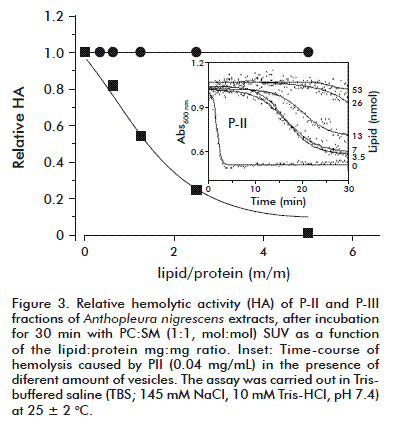
<P   ><font size="2" face="Verdana, Arial, Helvetica, sans-serif">Upon incubation with      sphingomyelin-containing vesicles, P-II showed a reduction of its HA that      was dependent on the proportion of vesicle: protein assayed (<a href="#fig3">Figure      3</a>) and the time elapsed (inset to <a href="#fig3">Figure 3</a>). In fact,      P-II HA inhibition was observed from a very low lipid: protein mass ratio      (0.3) and it was completed when a ratio of 5 was achieved. Conversely, P-III      HA was not affected by incubation with the same liposomes.</font></P >       <P align="center"   ><img src="/img/revistas/bta/v31n1/f0307114.gif" width="395" height="424"><a name="fig3"></a></P >       
<P   ><font size="2" face="Verdana, Arial, Helvetica, sans-serif">Altogether, the hemolytic      activity, the inhibition by sphingomyelin of the whole body extract HA, and      the localization of this property in P-II that could be associated with a      protein of around 20 kDa, strongly suggests the presence of at least one novel      actinoporin in the sea anemone <I>A. nigrescens</I>. Furthermore, this is      the first report of a biochemical activity for this anemone. Work is in progress      in order to purify and characterize the molecular entities responsible for      this HA inhibited by sphingomyelin. </font></P >       ]]></body>
<body><![CDATA[<P   >&nbsp;</P >       <P   > </P >       <P   ><font size="3" color="#000000" face="Verdana, Arial, Helvetica, sans-serif"><b>ACKNOWLEDGEMENTS      </b> </font></P >   <FONT size="+1" color="#000000">        <P   ><font size="2" color="#201D1E" face="Verdana, Arial, Helvetica, sans-serif">This      work was supported by International Foundation for Science: IFS Grant F/5205-1,      National University of Costa Rica: Project SIA 0279-10 -Ley de Pesca and Red      Iberoamericana CYTED: BIOTOX-212RT0467. </font></P >       <P   >&nbsp;</P >   <FONT size="+1" color="#201D1E">        <P   > </P >       <P   ><font size="3"><b><font face="Verdana, Arial, Helvetica, sans-serif">REFERENCES      </font></b></font></P >       <!-- ref --><P   ><font size="2" face="Verdana, Arial, Helvetica, sans-serif">1. Pazos IF, &Aacute;lvarez      C, G&oacute;mez T, Lanio M. Caracterizaci&oacute;n enzim&aacute;tica de una      fracci&oacute;n con actividad fosfolipas&iacute;dica aislada de la an&eacute;mona      marina <I>Stichodactyla helianthus</I>. Revista Biolog&iacute;a. 1993;7(2):90-6.          </font></P >   <FONT size="+1">        <!-- ref --><P   ><font size="2" face="Verdana, Arial, Helvetica, sans-serif">2. Romero L, Marcussi      S, Marchi-Salvador DP, Silva FP Jr, Fuly AL, Stabeli RG, <I>et al.</I> Enzymatic      and structural characterization of a basic phospholipase A(2) from the sea      anemone <I>Condylactis gigantea</I>. Biochimie. 2010;92(8):1063-71.     </font></P >       <!-- ref --><P   ><font size="2" face="Verdana, Arial, Helvetica, sans-serif">3. Moran Y, Genikhovich      G, Gordon D, Wienkoop S, Zenkert C, Ozbek S, <I>et al.</I> Neurotoxin localization      to ectodermal gland cells uncovers an alternative mechanism of venom delivery      in sea anemones. Proc Biol Sci. 2012;279(1732):1351-8.     </font></P >       <!-- ref --><P   ><font size="2" face="Verdana, Arial, Helvetica, sans-serif">4. Diochot S, Lazdunski      M. Sea anemone toxins affecting potassium channels. Prog Mol Subcell Biol.      2009;46:99-122.     </font></P >       <!-- ref --><P   ><font size="2" face="Verdana, Arial, Helvetica, sans-serif">5. Honma T, Shiomi      K. Peptide toxins in sea anemones: structural and functional aspects. Mar      Biotechnol (NY). 2006;8(1):1-10.     </font></P >       <!-- ref --><P   ><font size="2" face="Verdana, Arial, Helvetica, sans-serif">6. Delfin J, Gonzalez      Y, Diaz J, Chavez M. Proteinase inhibitor from Stichodactyla helianthus: purification,      characterization and immobilization. Arch Med Res. 1994; 25(2):199-204.     </font></P >       <P   ><font size="2" face="Verdana, Arial, Helvetica, sans-serif">7. Bernheimer AW,      Avigad LS. Properties of a toxin from the sea anemone <I>Stoichactis helianthus</I>,      including specific binding to sphingomyelin. Proc Natl Acad Sci USA. 1976;73(2):467-71.      </font></P >       ]]></body>
<body><![CDATA[<!-- ref --><P   ><font size="2" face="Verdana, Arial, Helvetica, sans-serif">8. Kem WR, Dunn BM.      Separation and characterization of four different amino acid sequence variants      of a sea anemone (<I>Stichodactyla helianthus</I>) protein cytolysin. Toxicon.      1988;26(11):997-1008.     </font></P >       <!-- ref --><P   ><font size="2" face="Verdana, Arial, Helvetica, sans-serif">9. Lanio ME, Morera      V, Alvarez C, Tejuca M, Gomez T, Pazos F, <I>et al.</I> Purification and characterization      of two hemolysins from <I>Stichodactyla helianthus</I>. Toxicon. 2001; 39(2-3):187-94.          </font></P >       <!-- ref --><P   ><font size="2" face="Verdana, Arial, Helvetica, sans-serif">10. Bellomio A, Morante      K, Barlic A, Gutierrez-Aguirre I, Viguera AR, Gonzalez-Manas JM. Purification,      cloning and characterization of fragaceatoxin C, a novel actinoporin from      the sea anemone <I>Actinia fragacea</I>. Toxicon. 2009;54(6):869-80.     </font></P >       <!-- ref --><P   ><font size="2" face="Verdana, Arial, Helvetica, sans-serif">11. Kohno Y, Satoh      H, Iguchi A, Nagai H. Characterization of a new hemolytic protein toxin from      the sea anemone <I>Anthopleu-ra asiatica</I>. Fish Sci. 2009;75(4):1049-54.          </font></P >       <!-- ref --><P   ><font size="2" face="Verdana, Arial, Helvetica, sans-serif">12. Monastyrnaya      M, Leychenko E, Isaeva M, Likhatskaya G, Zelepuga E, Kostina E, <I>et al.</I>      Actinoporins from the sea anemones, tropical <I>Radianthus macrodactylus </I>and      northern <I>Oulactis orientalis</I>: Comparative analysis of structure-function      relationships. Toxicon. 2010;56(8):1299-314.     </font></P >       ]]></body>
<body><![CDATA[<P   ><font size="2" face="Verdana, Arial, Helvetica, sans-serif">13. Anderluh G, Sep&#269;ic      K, Turk T, Ma&#269;ek P. Cytolytic proteins from Cnidarians- an Overview.      Acta Chim Slov. 2011;58(4):724-29. </font></P >       <!-- ref --><P   ><font size="2" face="Verdana, Arial, Helvetica, sans-serif">14. Belmonte G, Pederzolli      C, Macek P, Menestrina G. Pore formation by the sea anemone cytolysin equinatoxin      II in red blood cells and model lipid membranes. J Membr Biol. 1993;131(1):11-22.          </font></P >       <!-- ref --><P   ><font size="2" face="Verdana, Arial, Helvetica, sans-serif">15. Valcarcel CA,      Dalla Serra M, Potrich C, Bernhart I, Tejuca M, Martinez D, <I>et al.</I>      Effects of lipid composition on membrane permeabilization by sticholysin I      and II, two cytolysins of the sea anemone <I>Stichodactyla helianthus</I>.      Biophys J. 2001;80(6):2761-74.     </font></P >       <P   ><font size="2" face="Verdana, Arial, Helvetica, sans-serif">16. Anderluh G, Ma&#269;ek      P. Cytolytic peptide and protein toxins from sea anemones (Anthozoa: Actiniaria).      Toxicon. 2002;40(2):111-24. </font></P >       <!-- ref --><P   ><font size="2" face="Verdana, Arial, Helvetica, sans-serif">17. Potrich C, Tomazzolli      R, Dalla Serra M, Anderluh G, Malovrh P, Macek P, <I>et al.</I> Cytotoxic      activity of a tumor protease-activated pore-forming toxin. Bioconjug Chem.      2005; 16(2):369-76.     </font></P >       <!-- ref --><P   ><font size="2" face="Verdana, Arial, Helvetica, sans-serif">18. Tejuca M, Anderluh      G, Dalla Serra M. Sea anemone cytolysins as toxic components of immunotoxins.      Toxicon. 2009;54(8):1206-14.     </font></P >       ]]></body>
<body><![CDATA[<!-- ref --><P   ><font size="2" face="Verdana, Arial, Helvetica, sans-serif">19. Alvarez C, Manche&ntilde;o      JM, Martinez D, Tejuca M, Pazos F, Lanio ME. Sticholysins, two pore-forming      toxins produced by the Caribbean Sea anemone <I>Stichodactyla helianthus</I>:      their interaction with membranes. Toxicon. 2009;54(8):1135-47.     </font></P >       <!-- ref --><P   ><font size="2" face="Verdana, Arial, Helvetica, sans-serif">20. Alegre-Cebollada      J, Onaderra M, Gavilanes JG, del Pozo AM. Sea anemone actinoporins: the transition      from a folded soluble state to a functionally active membrane-bound oligo-meric      pore. Curr Protein Pept Sci. 2007;8(6):558-72.     </font></P >       <!-- ref --><P   ><font size="2" face="Verdana, Arial, Helvetica, sans-serif">21. Acu&ntilde;a      FH, Alvarado J, Garase A, Cort&eacute;s J. First record of the sea anemone      <I>Anthopleura nigrescens </I>(Cnidaria: Actiniaria: Actiniidae) on the Pacific      coast of Central America. Mar Biodiv Rec. 2012;24(5):1-3.     </font></P >       <!-- ref --><P   ><font size="2" face="Verdana, Arial, Helvetica, sans-serif">22. Bradford MM.      A rapid and sensitive method for the quantitation of microgram quantities      of protein utilizing the principle of protein-dye binding. Anal Biochem. 1976;72:248-54.          </font></P >       <!-- ref --><P   ><font size="2" face="Verdana, Arial, Helvetica, sans-serif">23. Laemmli UK. Cleavage      of structural proteins during the assembly of the head of bacteriophage T4.      Nature. 1970;227(5259):680-5.     </font></P >       ]]></body>
<body><![CDATA[<!-- ref --><P   ><font size="2" face="Verdana, Arial, Helvetica, sans-serif">24. Martinez D, Campos      AM, Pazos F, Alvarez C, Lanio ME, Casallanovo F, <I>et al.</I> Properties      of St I and St II, two isotoxins isolated from <I>Stichodactyla helianthus</I>:      a comparison. Toxicon. 2001;39(10):1547-60.     </font></P >       <!-- ref --><P   ><font size="2" face="Verdana, Arial, Helvetica, sans-serif">25. Pazos IF, Alvarez      C, Lanio ME, Martinez D, Morera V, Lissi EA, <I>et al.</I> Modification of      sticholysin II hemolytic activity by free radicals. Toxicon. 1998;36(10):1383-93.          </font></P >       <!-- ref --><P   ><font size="2" face="Verdana, Arial, Helvetica, sans-serif">26. Rouser G, Fkeischer      S, Yamamoto A. Two dimensional then layer chromatographic separation of polar      lipids and determination of phospholipids by phosphorus analysis of spots.      Lipids. 1970;5(5):494-6.     </font></P >       <P   >&nbsp;</P >       <P   >&nbsp;</P >       <P   > </P >       <P   > </P >       ]]></body>
<body><![CDATA[<P   ><font size="2" color="#000000" face="Verdana, Arial, Helvetica, sans-serif"><i>Carlos      &Aacute;lvarez</i>. <FONT color="#201D1E">Centro de Estudio de Prote&iacute;nas,      Facultad de Biolog&iacute;a, Universidad de La Habana, UH. Calle 25 No. 455      entre I y J, Vedado, CP 10400, La Habana, Cuba. E-mail: <A href="mailto:calvarez@fbio.uh.cu">      <U><U><FONT color="#0000FF">calvarez@fbio.uh.cu</font></U></U></A><FONT color="#0000FF"><FONT color="#201D1E">.      </font></font></font></font></P >   </font></font></font></font></font></font></font></font></font></font></font></font></font></font></font></font></font></font></font></font></font></font></font></font></font></font></font></font></font></font></font></font></font></font></font></font></font></font></font></font></DIV >      ]]></body><back>
<ref-list>
<ref id="B1">
<label>1</label><nlm-citation citation-type="journal">
<person-group person-group-type="author">
<name>
<surname><![CDATA[Pazos]]></surname>
<given-names><![CDATA[IF]]></given-names>
</name>
<name>
<surname><![CDATA[Álvarez]]></surname>
<given-names><![CDATA[C]]></given-names>
</name>
<name>
<surname><![CDATA[Gómez]]></surname>
<given-names><![CDATA[T]]></given-names>
</name>
<name>
<surname><![CDATA[Lanio]]></surname>
<given-names><![CDATA[M]]></given-names>
</name>
</person-group>
<article-title xml:lang="en"><![CDATA[Caracterización enzimática de una fracción con actividad fosfolipasídica aislada de la anémona marina Stichodactyla helianthus]]></article-title>
<source><![CDATA[Revista Biología]]></source>
<year>1993</year>
<volume>7</volume>
<numero>2</numero>
<issue>2</issue>
<page-range>90-6</page-range></nlm-citation>
</ref>
<ref id="B2">
<label>2</label><nlm-citation citation-type="journal">
<person-group person-group-type="author">
<name>
<surname><![CDATA[Romero]]></surname>
<given-names><![CDATA[L]]></given-names>
</name>
<name>
<surname><![CDATA[Marcussi]]></surname>
<given-names><![CDATA[S]]></given-names>
</name>
<name>
<surname><![CDATA[Marchi-Salvador]]></surname>
<given-names><![CDATA[DP]]></given-names>
</name>
<name>
<surname><![CDATA[Silva]]></surname>
<given-names><![CDATA[FP Jr]]></given-names>
</name>
<name>
<surname><![CDATA[Fuly]]></surname>
<given-names><![CDATA[AL]]></given-names>
</name>
<name>
<surname><![CDATA[Stabeli]]></surname>
<given-names><![CDATA[RG]]></given-names>
</name>
</person-group>
<article-title xml:lang="en"><![CDATA[Enzymatic and structural characterization of a basic phospholipase A(2) from the sea anemone Condylactis gigantea]]></article-title>
<source><![CDATA[Biochimie]]></source>
<year>2010</year>
<volume>92</volume>
<numero>8</numero>
<issue>8</issue>
<page-range>1063-71</page-range></nlm-citation>
</ref>
<ref id="B3">
<label>3</label><nlm-citation citation-type="journal">
<person-group person-group-type="author">
<name>
<surname><![CDATA[Moran]]></surname>
<given-names><![CDATA[Y]]></given-names>
</name>
<name>
<surname><![CDATA[Genikhovich]]></surname>
<given-names><![CDATA[G]]></given-names>
</name>
<name>
<surname><![CDATA[Gordon]]></surname>
<given-names><![CDATA[D]]></given-names>
</name>
<name>
<surname><![CDATA[Wienkoop]]></surname>
<given-names><![CDATA[S]]></given-names>
</name>
<name>
<surname><![CDATA[Zenkert]]></surname>
<given-names><![CDATA[C]]></given-names>
</name>
<name>
<surname><![CDATA[Ozbek]]></surname>
<given-names><![CDATA[S]]></given-names>
</name>
</person-group>
<article-title xml:lang="en"><![CDATA[Neurotoxin localization to ectodermal gland cells uncovers an alternative mechanism of venom delivery in sea anemones]]></article-title>
<source><![CDATA[Proc Biol Sci]]></source>
<year>2012</year>
<volume>279</volume>
<numero>1732</numero>
<issue>1732</issue>
<page-range>1351-8</page-range></nlm-citation>
</ref>
<ref id="B4">
<label>4</label><nlm-citation citation-type="journal">
<person-group person-group-type="author">
<name>
<surname><![CDATA[Diochot]]></surname>
<given-names><![CDATA[S]]></given-names>
</name>
<name>
<surname><![CDATA[Lazdunski]]></surname>
<given-names><![CDATA[M]]></given-names>
</name>
</person-group>
<article-title xml:lang="en"><![CDATA[Sea anemone toxins affecting potassium channels]]></article-title>
<source><![CDATA[Prog Mol Subcell Biol]]></source>
<year>2009</year>
<volume>46</volume>
<page-range>99-122</page-range></nlm-citation>
</ref>
<ref id="B5">
<label>5</label><nlm-citation citation-type="journal">
<person-group person-group-type="author">
<name>
<surname><![CDATA[Honma]]></surname>
<given-names><![CDATA[T]]></given-names>
</name>
<name>
<surname><![CDATA[Shiomi]]></surname>
<given-names><![CDATA[K]]></given-names>
</name>
</person-group>
<article-title xml:lang="en"><![CDATA[Peptide toxins in sea anemones: structural and functional aspects]]></article-title>
<source><![CDATA[Mar Biotechnol (NY)]]></source>
<year>2006</year>
<volume>8</volume>
<numero>1</numero>
<issue>1</issue>
<page-range>1-10</page-range></nlm-citation>
</ref>
<ref id="B6">
<label>6</label><nlm-citation citation-type="journal">
<person-group person-group-type="author">
<name>
<surname><![CDATA[Delfin]]></surname>
<given-names><![CDATA[J]]></given-names>
</name>
<name>
<surname><![CDATA[Gonzalez]]></surname>
<given-names><![CDATA[Y]]></given-names>
</name>
<name>
<surname><![CDATA[Diaz]]></surname>
<given-names><![CDATA[J]]></given-names>
</name>
<name>
<surname><![CDATA[Chavez]]></surname>
<given-names><![CDATA[M]]></given-names>
</name>
</person-group>
<article-title xml:lang="en"><![CDATA[Proteinase inhibitor from Stichodactyla helianthus: purification, characterization and immobilization]]></article-title>
<source><![CDATA[Arch Med Res]]></source>
<year>1994</year>
<volume>25</volume>
<numero>2</numero>
<issue>2</issue>
<page-range>199-204</page-range></nlm-citation>
</ref>
<ref id="B7">
<label>7</label><nlm-citation citation-type="journal">
<person-group person-group-type="author">
<name>
<surname><![CDATA[Bernheimer]]></surname>
<given-names><![CDATA[AW]]></given-names>
</name>
<name>
<surname><![CDATA[Avigad]]></surname>
<given-names><![CDATA[LS]]></given-names>
</name>
</person-group>
<article-title xml:lang="en"><![CDATA[Properties of a toxin from the sea anemone Stoichacis helianthus, including specific binding to sphingomyelin]]></article-title>
<source><![CDATA[Proc Natl Acad Sci USA]]></source>
<year>1976</year>
<volume>73</volume>
<numero>2</numero>
<issue>2</issue>
<page-range>467-71</page-range></nlm-citation>
</ref>
<ref id="B8">
<label>8</label><nlm-citation citation-type="journal">
<person-group person-group-type="author">
<name>
<surname><![CDATA[Kem]]></surname>
<given-names><![CDATA[WR]]></given-names>
</name>
<name>
<surname><![CDATA[Dunn]]></surname>
<given-names><![CDATA[BM]]></given-names>
</name>
</person-group>
<article-title xml:lang="en"><![CDATA[Separation and characterization of four different amino acid sequence variants of a sea anemone (Stichodactyla helianthus) protein cytolysin]]></article-title>
<source><![CDATA[Toxicon]]></source>
<year>1988</year>
<volume>26</volume>
<numero>11</numero>
<issue>11</issue>
<page-range>997-1008</page-range></nlm-citation>
</ref>
<ref id="B9">
<label>9</label><nlm-citation citation-type="journal">
<person-group person-group-type="author">
<name>
<surname><![CDATA[Lanio]]></surname>
<given-names><![CDATA[ME]]></given-names>
</name>
<name>
<surname><![CDATA[Morera]]></surname>
<given-names><![CDATA[V]]></given-names>
</name>
<name>
<surname><![CDATA[Alvarez]]></surname>
<given-names><![CDATA[C]]></given-names>
</name>
<name>
<surname><![CDATA[Tejuca]]></surname>
<given-names><![CDATA[M]]></given-names>
</name>
<name>
<surname><![CDATA[Gomez]]></surname>
<given-names><![CDATA[T]]></given-names>
</name>
<name>
<surname><![CDATA[Pazos]]></surname>
<given-names><![CDATA[F]]></given-names>
</name>
</person-group>
<article-title xml:lang="en"><![CDATA[Purification and characterization of two hemolysins from Stichodactyla helianthus]]></article-title>
<source><![CDATA[Toxicon]]></source>
<year>2001</year>
<volume>39</volume>
<numero>2-3</numero>
<issue>2-3</issue>
<page-range>187-94</page-range></nlm-citation>
</ref>
<ref id="B10">
<label>10</label><nlm-citation citation-type="journal">
<person-group person-group-type="author">
<name>
<surname><![CDATA[Bellomio]]></surname>
<given-names><![CDATA[A]]></given-names>
</name>
<name>
<surname><![CDATA[Morante]]></surname>
<given-names><![CDATA[K]]></given-names>
</name>
<name>
<surname><![CDATA[Barlic]]></surname>
<given-names><![CDATA[A]]></given-names>
</name>
<name>
<surname><![CDATA[Gutierrez-Aguirre]]></surname>
<given-names><![CDATA[I]]></given-names>
</name>
<name>
<surname><![CDATA[Viguera]]></surname>
<given-names><![CDATA[AR]]></given-names>
</name>
<name>
<surname><![CDATA[Gonzalez-Manas]]></surname>
<given-names><![CDATA[JM]]></given-names>
</name>
</person-group>
<article-title xml:lang="en"><![CDATA[Purification, cloning and characterization of fragaceatoxin C, a novel actinoporin from the sea anemone Actinia fragacea]]></article-title>
<source><![CDATA[Toxicon]]></source>
<year>2009</year>
<volume>54</volume>
<numero>6</numero>
<issue>6</issue>
<page-range>869-80</page-range></nlm-citation>
</ref>
<ref id="B11">
<label>11</label><nlm-citation citation-type="journal">
<person-group person-group-type="author">
<name>
<surname><![CDATA[Kohno]]></surname>
<given-names><![CDATA[Y]]></given-names>
</name>
<name>
<surname><![CDATA[Satoh]]></surname>
<given-names><![CDATA[H]]></given-names>
</name>
<name>
<surname><![CDATA[Iguchi]]></surname>
<given-names><![CDATA[A]]></given-names>
</name>
<name>
<surname><![CDATA[Nagai]]></surname>
<given-names><![CDATA[H]]></given-names>
</name>
</person-group>
<article-title xml:lang="en"><![CDATA[Characterization of a new hemolytic protein toxin from the sea anemone Anthopleura asiatica]]></article-title>
<source><![CDATA[Fish Sci]]></source>
<year>2009</year>
<volume>75</volume>
<numero>4</numero>
<issue>4</issue>
<page-range>1049-54</page-range></nlm-citation>
</ref>
<ref id="B12">
<label>12</label><nlm-citation citation-type="journal">
<person-group person-group-type="author">
<name>
<surname><![CDATA[Monastyrnaya]]></surname>
<given-names><![CDATA[M]]></given-names>
</name>
<name>
<surname><![CDATA[Leychenko]]></surname>
<given-names><![CDATA[E]]></given-names>
</name>
<name>
<surname><![CDATA[Isaeva]]></surname>
<given-names><![CDATA[M]]></given-names>
</name>
<name>
<surname><![CDATA[Likhatskaya]]></surname>
<given-names><![CDATA[G]]></given-names>
</name>
<name>
<surname><![CDATA[Zelepuga]]></surname>
<given-names><![CDATA[E]]></given-names>
</name>
<name>
<surname><![CDATA[Kostina]]></surname>
<given-names><![CDATA[E]]></given-names>
</name>
</person-group>
<article-title xml:lang="en"><![CDATA[Actinoporins from the sea anemones, tropical Radianthus macrodactylus and northern Oulactis orientalis: Comparative analysis of structure-function relationships]]></article-title>
<source><![CDATA[Toxicon]]></source>
<year>2010</year>
<volume>56</volume>
<numero>8</numero>
<issue>8</issue>
<page-range>1299-314</page-range></nlm-citation>
</ref>
<ref id="B13">
<label>13</label><nlm-citation citation-type="journal">
<person-group person-group-type="author">
<name>
<surname><![CDATA[Anderluh]]></surname>
<given-names><![CDATA[G]]></given-names>
</name>
<name>
<surname><![CDATA[Sepcic]]></surname>
<given-names><![CDATA[K]]></given-names>
</name>
<name>
<surname><![CDATA[Turk]]></surname>
<given-names><![CDATA[T]]></given-names>
</name>
<name>
<surname><![CDATA[Macek]]></surname>
<given-names><![CDATA[P]]></given-names>
</name>
</person-group>
<article-title xml:lang="en"><![CDATA[Cytolytic proteins from Cnidarians - an Overview]]></article-title>
<source><![CDATA[Acta Chim Slov]]></source>
<year>2011</year>
<volume>58</volume>
<numero>4</numero>
<issue>4</issue>
<page-range>724-29</page-range></nlm-citation>
</ref>
<ref id="B14">
<label>14</label><nlm-citation citation-type="journal">
<person-group person-group-type="author">
<name>
<surname><![CDATA[Belmonte]]></surname>
<given-names><![CDATA[G]]></given-names>
</name>
<name>
<surname><![CDATA[Pederzolli]]></surname>
<given-names><![CDATA[C]]></given-names>
</name>
<name>
<surname><![CDATA[Macek]]></surname>
<given-names><![CDATA[P]]></given-names>
</name>
<name>
<surname><![CDATA[Menestrina]]></surname>
<given-names><![CDATA[G]]></given-names>
</name>
</person-group>
<article-title xml:lang="en"><![CDATA[Pore formation by the sea anemone cytolysin equinatoxin II in red blood cells and model lipid membranes]]></article-title>
<source><![CDATA[J Membr Biol]]></source>
<year>1993</year>
<volume>131</volume>
<numero>1</numero>
<issue>1</issue>
<page-range>11-22</page-range></nlm-citation>
</ref>
<ref id="B15">
<label>15</label><nlm-citation citation-type="journal">
<person-group person-group-type="author">
<name>
<surname><![CDATA[Valcarcel]]></surname>
<given-names><![CDATA[CA]]></given-names>
</name>
<name>
<surname><![CDATA[Dalla Serra]]></surname>
<given-names><![CDATA[M]]></given-names>
</name>
<name>
<surname><![CDATA[Potrich]]></surname>
<given-names><![CDATA[C]]></given-names>
</name>
<name>
<surname><![CDATA[Bernhart]]></surname>
<given-names><![CDATA[I]]></given-names>
</name>
<name>
<surname><![CDATA[Tejuca]]></surname>
<given-names><![CDATA[M]]></given-names>
</name>
<name>
<surname><![CDATA[Martinez]]></surname>
<given-names><![CDATA[D]]></given-names>
</name>
</person-group>
<article-title xml:lang="en"><![CDATA[Effects of lipid composition on membrane permeabilization by sticholysin I and II, two cytolysins of the sea anemone Stichodactyla helianthus]]></article-title>
<source><![CDATA[Biophys J]]></source>
<year>2001</year>
<volume>80</volume>
<numero>6</numero>
<issue>6</issue>
<page-range>2761-74</page-range></nlm-citation>
</ref>
<ref id="B16">
<label>16</label><nlm-citation citation-type="journal">
<person-group person-group-type="author">
<name>
<surname><![CDATA[Anderluh]]></surname>
<given-names><![CDATA[G]]></given-names>
</name>
<name>
<surname><![CDATA[Macek]]></surname>
<given-names><![CDATA[P]]></given-names>
</name>
</person-group>
<article-title xml:lang="en"><![CDATA[Cytolytic peptide and protein toxins from sea anemones (Anthozoa: Actiniaria)]]></article-title>
<source><![CDATA[Toxicon]]></source>
<year>2002</year>
<volume>40</volume>
<numero>2</numero>
<issue>2</issue>
<page-range>111-24</page-range></nlm-citation>
</ref>
<ref id="B17">
<label>17</label><nlm-citation citation-type="journal">
<person-group person-group-type="author">
<name>
<surname><![CDATA[Potrich]]></surname>
<given-names><![CDATA[C]]></given-names>
</name>
<name>
<surname><![CDATA[Tomazzolli]]></surname>
<given-names><![CDATA[R]]></given-names>
</name>
<name>
<surname><![CDATA[Dalla Serra]]></surname>
<given-names><![CDATA[M]]></given-names>
</name>
<name>
<surname><![CDATA[Anderluh]]></surname>
<given-names><![CDATA[G]]></given-names>
</name>
<name>
<surname><![CDATA[Malovrh]]></surname>
<given-names><![CDATA[P]]></given-names>
</name>
<name>
<surname><![CDATA[Macek]]></surname>
<given-names><![CDATA[P]]></given-names>
</name>
</person-group>
<article-title xml:lang="en"><![CDATA[Cytotoxic activity of a tumor protease-activated pore-forming toxin]]></article-title>
<source><![CDATA[Bioconjug Chem]]></source>
<year>2005</year>
<volume>16</volume>
<numero>2</numero>
<issue>2</issue>
<page-range>369-76</page-range></nlm-citation>
</ref>
<ref id="B18">
<label>18</label><nlm-citation citation-type="journal">
<person-group person-group-type="author">
<name>
<surname><![CDATA[Tejuca]]></surname>
<given-names><![CDATA[M]]></given-names>
</name>
<name>
<surname><![CDATA[Anderluh]]></surname>
<given-names><![CDATA[G]]></given-names>
</name>
<name>
<surname><![CDATA[Dalla Serra]]></surname>
<given-names><![CDATA[M]]></given-names>
</name>
</person-group>
<article-title xml:lang="en"><![CDATA[Sea anemone cytolysins as toxic components of immunotoxins]]></article-title>
<source><![CDATA[Toxicon]]></source>
<year>2009</year>
<volume>54</volume>
<numero>8</numero>
<issue>8</issue>
<page-range>1206-14</page-range></nlm-citation>
</ref>
<ref id="B19">
<label>19</label><nlm-citation citation-type="journal">
<person-group person-group-type="author">
<name>
<surname><![CDATA[Alvarez]]></surname>
<given-names><![CDATA[C]]></given-names>
</name>
<name>
<surname><![CDATA[Mancheño]]></surname>
<given-names><![CDATA[JM]]></given-names>
</name>
<name>
<surname><![CDATA[Martinez]]></surname>
<given-names><![CDATA[D]]></given-names>
</name>
<name>
<surname><![CDATA[Tejuca]]></surname>
<given-names><![CDATA[M]]></given-names>
</name>
<name>
<surname><![CDATA[Pazos]]></surname>
<given-names><![CDATA[F]]></given-names>
</name>
<name>
<surname><![CDATA[Lanio]]></surname>
<given-names><![CDATA[ME]]></given-names>
</name>
</person-group>
<article-title xml:lang="en"><![CDATA[Sticholysins, two pore-forming toxins produced by the Caribbean Sea anemone Stichodactyla helianthus: their interaction with membranes]]></article-title>
<source><![CDATA[Toxicon]]></source>
<year>2009</year>
<volume>54</volume>
<numero>8</numero>
<issue>8</issue>
<page-range>1135-47</page-range></nlm-citation>
</ref>
<ref id="B20">
<label>20</label><nlm-citation citation-type="journal">
<person-group person-group-type="author">
<name>
<surname><![CDATA[Alegre-Cebollada]]></surname>
<given-names><![CDATA[J]]></given-names>
</name>
<name>
<surname><![CDATA[Onaderra]]></surname>
<given-names><![CDATA[M]]></given-names>
</name>
<name>
<surname><![CDATA[Gavilanes]]></surname>
<given-names><![CDATA[JG]]></given-names>
</name>
<name>
<surname><![CDATA[del Pozo]]></surname>
<given-names><![CDATA[AM]]></given-names>
</name>
</person-group>
<article-title xml:lang="en"><![CDATA[Sea anemone actinoporins: the transition from a folded soluble state to a functionally active membrane-bound oligomeric pore]]></article-title>
<source><![CDATA[Curr Protein Pept Sci]]></source>
<year>2007</year>
<volume>8</volume>
<numero>6</numero>
<issue>6</issue>
<page-range>558-72</page-range></nlm-citation>
</ref>
<ref id="B21">
<label>21</label><nlm-citation citation-type="journal">
<person-group person-group-type="author">
<name>
<surname><![CDATA[Acuña]]></surname>
<given-names><![CDATA[FH]]></given-names>
</name>
<name>
<surname><![CDATA[Alvarado]]></surname>
<given-names><![CDATA[J]]></given-names>
</name>
<name>
<surname><![CDATA[Garase]]></surname>
<given-names><![CDATA[A]]></given-names>
</name>
<name>
<surname><![CDATA[Cortés]]></surname>
<given-names><![CDATA[J]]></given-names>
</name>
</person-group>
<article-title xml:lang="en"><![CDATA[First record of the sea anemone Anthopleura nigrescens (Cnidaria: Actiniaria: Actiniidae) on the Pacific coast of Central America]]></article-title>
<source><![CDATA[Mar Biodiv Rec]]></source>
<year>2012</year>
<volume>24</volume>
<numero>5</numero>
<issue>5</issue>
<page-range>1-3</page-range></nlm-citation>
</ref>
<ref id="B22">
<label>22</label><nlm-citation citation-type="journal">
<person-group person-group-type="author">
<name>
<surname><![CDATA[Bradford]]></surname>
<given-names><![CDATA[MM]]></given-names>
</name>
</person-group>
<article-title xml:lang="en"><![CDATA[A rapid and sensitive method for the quantitation of microgram quantities of protein utilizing the principle of protein-dye binding]]></article-title>
<source><![CDATA[Anal Biochem]]></source>
<year>1976</year>
<volume>72</volume>
<page-range>248-54</page-range></nlm-citation>
</ref>
<ref id="B23">
<label>23</label><nlm-citation citation-type="journal">
<person-group person-group-type="author">
<name>
<surname><![CDATA[Laemmli]]></surname>
<given-names><![CDATA[UK]]></given-names>
</name>
</person-group>
<article-title xml:lang="en"><![CDATA[Cleavage of structural proteins during the assembly of the head of bacteriophage T4]]></article-title>
<source><![CDATA[Nature]]></source>
<year>1970</year>
<volume>227</volume>
<numero>5259</numero>
<issue>5259</issue>
<page-range>680-5</page-range></nlm-citation>
</ref>
<ref id="B24">
<label>24</label><nlm-citation citation-type="journal">
<person-group person-group-type="author">
<name>
<surname><![CDATA[Martinez]]></surname>
<given-names><![CDATA[D]]></given-names>
</name>
<name>
<surname><![CDATA[Campos]]></surname>
<given-names><![CDATA[AM]]></given-names>
</name>
<name>
<surname><![CDATA[Pazos]]></surname>
<given-names><![CDATA[F]]></given-names>
</name>
<name>
<surname><![CDATA[Alvarez]]></surname>
<given-names><![CDATA[C]]></given-names>
</name>
<name>
<surname><![CDATA[Lanio]]></surname>
<given-names><![CDATA[ME]]></given-names>
</name>
<name>
<surname><![CDATA[Casallanovo]]></surname>
<given-names><![CDATA[F]]></given-names>
</name>
</person-group>
<article-title xml:lang="en"><![CDATA[Properties of St I and St II, two isotoxins isolated from Stichodactyla helianthus: a comparison]]></article-title>
<source><![CDATA[Toxicon]]></source>
<year>2001</year>
<volume>39</volume>
<numero>10</numero>
<issue>10</issue>
<page-range>1547-60</page-range></nlm-citation>
</ref>
<ref id="B25">
<label>25</label><nlm-citation citation-type="journal">
<person-group person-group-type="author">
<name>
<surname><![CDATA[Pazos]]></surname>
<given-names><![CDATA[IF]]></given-names>
</name>
<name>
<surname><![CDATA[Alvarez]]></surname>
<given-names><![CDATA[C]]></given-names>
</name>
<name>
<surname><![CDATA[Lanio]]></surname>
<given-names><![CDATA[ME]]></given-names>
</name>
<name>
<surname><![CDATA[Martinez]]></surname>
<given-names><![CDATA[D]]></given-names>
</name>
<name>
<surname><![CDATA[Morera]]></surname>
<given-names><![CDATA[V]]></given-names>
</name>
<name>
<surname><![CDATA[Lissi]]></surname>
<given-names><![CDATA[EA]]></given-names>
</name>
</person-group>
<article-title xml:lang="en"><![CDATA[Modification of sticholysin II hemolytic activity by free radicals]]></article-title>
<source><![CDATA[Toxicon]]></source>
<year>1998</year>
<volume>36</volume>
<numero>10</numero>
<issue>10</issue>
<page-range>1383-93</page-range></nlm-citation>
</ref>
<ref id="B26">
<label>26</label><nlm-citation citation-type="journal">
<person-group person-group-type="author">
<name>
<surname><![CDATA[Rouser]]></surname>
<given-names><![CDATA[G]]></given-names>
</name>
<name>
<surname><![CDATA[Fkeischer]]></surname>
<given-names><![CDATA[S]]></given-names>
</name>
<name>
<surname><![CDATA[Yamamoto]]></surname>
<given-names><![CDATA[A]]></given-names>
</name>
</person-group>
<article-title xml:lang="en"><![CDATA[Two dimensional then layer chromatographic separation of polar lipids and determination of phospholipids by phosphorus analysis of spots]]></article-title>
<source><![CDATA[Lipids]]></source>
<year>1970</year>
<volume>5</volume>
<numero>5</numero>
<issue>5</issue>
<page-range>494-6</page-range></nlm-citation>
</ref>
</ref-list>
</back>
</article>
