<?xml version="1.0" encoding="ISO-8859-1"?><article xmlns:mml="http://www.w3.org/1998/Math/MathML" xmlns:xlink="http://www.w3.org/1999/xlink" xmlns:xsi="http://www.w3.org/2001/XMLSchema-instance">
<front>
<journal-meta>
<journal-id>1027-2852</journal-id>
<journal-title><![CDATA[Biotecnología Aplicada]]></journal-title>
<abbrev-journal-title><![CDATA[Biotecnol Apl]]></abbrev-journal-title>
<issn>1027-2852</issn>
<publisher>
<publisher-name><![CDATA[Editorial Elfos Scientiae]]></publisher-name>
</publisher>
</journal-meta>
<article-meta>
<article-id>S1027-28522014000100008</article-id>
<title-group>
<article-title xml:lang="en"><![CDATA[Isolation and cloning of the Phytolacca americana anti-viral protein PAP-I gene]]></article-title>
<article-title xml:lang="en"><![CDATA[Aislamiento y clonaje del gen de la proteína antiviral PAP-I de Phytolacca americana]]></article-title>
</title-group>
<contrib-group>
<contrib contrib-type="author">
<name>
<surname><![CDATA[Mahfouze]]></surname>
<given-names><![CDATA[Heba A]]></given-names>
</name>
<xref ref-type="aff" rid="A01"/>
</contrib>
<contrib contrib-type="author">
<name>
<surname><![CDATA[El-Dougdoug]]></surname>
<given-names><![CDATA[Khalid A]]></given-names>
</name>
<xref ref-type="aff" rid="A02"/>
</contrib>
<contrib contrib-type="author">
<name>
<surname><![CDATA[Othman]]></surname>
<given-names><![CDATA[Badawi A]]></given-names>
</name>
<xref ref-type="aff" rid="A02"/>
</contrib>
<contrib contrib-type="author">
<name>
<surname><![CDATA[Gomaa]]></surname>
<given-names><![CDATA[Mostafa A]]></given-names>
</name>
<xref ref-type="aff" rid="A01"/>
</contrib>
</contrib-group>
<aff id="A02">
<institution><![CDATA[,University of Ain Shams Faculty of Agriculture Virology Laboratory, Department of Agriculture Microbiology]]></institution>
<addr-line><![CDATA[Cairo ]]></addr-line>
<country>Egypt</country>
</aff>
<aff id="A01">
<institution><![CDATA[,National Research Center Genetics and Cytology Department Genetic Engineering and Biotechnology Division]]></institution>
<addr-line><![CDATA[Dokki ]]></addr-line>
<country>Egypt</country>
</aff>
<pub-date pub-type="pub">
<day>00</day>
<month>03</month>
<year>2014</year>
</pub-date>
<pub-date pub-type="epub">
<day>00</day>
<month>03</month>
<year>2014</year>
</pub-date>
<volume>31</volume>
<numero>1</numero>
<fpage>57</fpage>
<lpage>61</lpage>
<copyright-statement/>
<copyright-year/>
<self-uri xlink:href="http://scielo.sld.cu/scielo.php?script=sci_arttext&amp;pid=S1027-28522014000100008&amp;lng=en&amp;nrm=iso"></self-uri><self-uri xlink:href="http://scielo.sld.cu/scielo.php?script=sci_abstract&amp;pid=S1027-28522014000100008&amp;lng=en&amp;nrm=iso"></self-uri><self-uri xlink:href="http://scielo.sld.cu/scielo.php?script=sci_pdf&amp;pid=S1027-28522014000100008&amp;lng=en&amp;nrm=iso"></self-uri><abstract abstract-type="short" xml:lang="en"><p><![CDATA[The pokeweed antiviral protein (PAP) isolated from Phytolacca americana and Phytolacca acinosa plants, inhibits protein translation by catalytically removing a specific adenine residue from the large rRNA of the 60S subunit of eukaryotic ribosomes. In this study, the P. americana PAP-I gene was isolated and sequenced, and further compared to other ribosome-inactivating proteins (RIPs) genes previously reported in GenBank(r). Total DNA was extracted from the late summer leaves of P. americana. A polymerase chain reaction (PCR) 868 bp-long DNA product was obtained, using gene specific primers, based on the expected gene size. The eluted product was purified and cloned into the pTZ57R/T vector, and mobilized into the Escherichia coli strain DH5a. After sequencing, the analysis of the PAP-I PCR product showed 98 to 82 % nucleotide and amino acid 94 to 26 % homologies, respectively, compared to previously reported RIPs. A phylogenetic analysis confirmed that the amplified PAP-I gene corresponds to the single chain Type-I RIP (PAP-I).]]></p></abstract>
<abstract abstract-type="short" xml:lang="es"><p><![CDATA[La proteína antiviral del ginseng (PAP), aislada de plantas de Phytolacca americana y Phytolacca acinosa, inhibe la traducción proteica mediante la remoción catalítica de un residuo de adenina específico, en la cadena mayor de la subunidad 60S del ARN ribosomal eucariótico. En este estudio se aisló y secuenció el gen PAP-I de P. americana, y posteriormente se comparó con los genes de otras proteínas inactivadoras de ribosomas (RIP), reportadas en GenBank(r). Se extrajo el ADN total de las hojas tardías del verano de las plantas de P. americana y el fragmento de 868 pb correspondiente al ADN del gen se amplificó con el uso de cebadores específicos, mediante reacción en cadena de la polimerasa (PCR). El producto de la PCR eluido se purificó, se clonó en el vector pTZ57R/T, y se movilizó en células de Escherichia coli cepa DH5a. Tras la secuenciación del producto de la PCR del gen PAP-I, la secuencia mostró una homología nucleotídica de 98 a 82 % y aminoacídica de 94 a 26 %, con las RIP reportadas. El análisis filogenético confirmó que el gen amplificado corresponde a la RIP tipo I de simple cadena (PAP-I).]]></p></abstract>
<kwd-group>
<kwd lng="en"><![CDATA[pokeweed antiviral protein]]></kwd>
<kwd lng="en"><![CDATA[cloning]]></kwd>
<kwd lng="en"><![CDATA[PCR]]></kwd>
<kwd lng="en"><![CDATA[DNA sequencing]]></kwd>
<kwd lng="en"><![CDATA[phylogenetic alignment]]></kwd>
<kwd lng="es"><![CDATA[proteína antiviral del ginseng]]></kwd>
<kwd lng="es"><![CDATA[clonaje]]></kwd>
<kwd lng="es"><![CDATA[reacción en cadena de la polimerasa]]></kwd>
<kwd lng="es"><![CDATA[secuenciación de ADN]]></kwd>
<kwd lng="es"><![CDATA[alineamiento filogenético]]></kwd>
</kwd-group>
</article-meta>
</front><body><![CDATA[ <DIV class="Sect"   >        <P   align="right" ><font size="2" color="#000000" face="Verdana, Arial, Helvetica, sans-serif"><b>REPORT      </b> </font></P >   <FONT size="+1" color="#000000">        <P   > </P >       <P   > </P >   <FONT size="+1">        <P   >&nbsp;</P >       <P   ><font size="2" face="Verdana, Arial, Helvetica, sans-serif"><FONT color="#201D1E"><B><font size="4">Isolation      and cloning of the <I>Phytolacca americana</I> anti-viral protein PAP-I gene      </font> </b></font></font></P >       <P   >&nbsp;</P >   <FONT size="+1"><FONT size="+1" color="#201D1E"><B>        <P   ></P >   </B> <FONT size="+1" color="#000000">        <P   ><font size="3" color="#201D1E" face="Verdana, Arial, Helvetica, sans-serif"><B>Aislamiento      y clonaje del gen de la prote&iacute;na antiviral PAP-I de <I>Phytolacca americana      </I></b></font></P >       <P   >&nbsp;</P >       ]]></body>
<body><![CDATA[<P   >&nbsp;</P >   <FONT size="+1" color="#201D1E">        <P   ></P >   <FONT size="+1" color="#000000">        <P   > </P >       <P   ><b><font size="2" face="Verdana, Arial, Helvetica, sans-serif">Heba A Mahfouze<Sup>1</Sup>,      Khalid A El-Dougdoug<Sup>2</Sup>, Badawi A Othman<Sup>2</Sup>, Mostafa A Gomaa<Sup>1</Sup></font></b><FONT size="+1"><FONT size="+1"><FONT size="+1"><FONT size="+1"><FONT size="+1"><FONT size="+1"><FONT size="+1"></font></font></font></font></font></font></font></P >   <FONT size="+1"><FONT size="+1"><FONT size="+1"><FONT size="+1"><FONT size="+1"><FONT size="+1"><FONT size="+1">        <P   > </P >   <FONT size="+1">        <P   ><font size="2" face="Verdana, Arial, Helvetica, sans-serif"><Sup>1</Sup> Genetic      Engineering and Biotechnology Division, Genetics and Cytology Department,      </font><font size="2" face="Verdana, Arial, Helvetica, sans-serif">National      Research Center. Dokki, 12622, Egypt.    <br>     </font><font size="2" face="Verdana, Arial, Helvetica, sans-serif"><Sup>2</Sup>      Virology Laboratory, Department of Agriculture Microbiology. Faculty of Agriculture,      University of Ain Shams, Cairo, Egypt. </font></P >   <FONT size="+1"><FONT size="+1">        <P   >&nbsp;</P >       <P   >&nbsp;</P >   </font></font></font></font></font></font></font></font></font></font></font></font></font></font></font></font></font>    <hr>   <FONT size="+1" color="#000000"><FONT size="+1"><FONT size="+1"><FONT size="+1" color="#201D1E"><FONT size="+1" color="#000000"><FONT size="+1" color="#201D1E"><FONT size="+1" color="#000000"><FONT size="+1"><FONT size="+1"><FONT size="+1"><FONT size="+1"><FONT size="+1"><FONT size="+1"><FONT size="+1"><FONT size="+1"><FONT size="+1"><FONT size="+1">       <P   ><font size="2" face="Verdana, Arial, Helvetica, sans-serif"><b>ABSTRACT </b></font></P >   <FONT size="+1"><FONT size="+1">     ]]></body>
<body><![CDATA[<P   ><font size="2" color="#201D1E" face="Verdana, Arial, Helvetica, sans-serif">The      pokeweed antiviral protein (PAP) isolated from <I>Phytolacca americana </I>and      <I>Phytolacca acinosa </I>plants, inhibits protein translation by catalytically      removing a specific adenine residue from the large rRNA of the 60S subunit      of eukaryotic ribosomes. In this study, the <I>P. americana </I>PAP-I gene      was isolated and sequenced, and further compared to other ribosome-inactivating      proteins (RIPs) genes previously reported in GenBank&reg;. Total DNA was extracted      from the late summer leaves of <I>P. americana</I>. A polymerase chain reaction      (PCR) 868 bp-long DNA product was obtained, using gene specific primers, based      on the expected gene size. The eluted product was purified and cloned into      the pTZ57R/T vector, and mobilized into the <I>Escherichia coli </I>strain      DH5a. After sequencing, the analysis of the PAP-I PCR product showed 98 to      82 % nucleotide and amino acid 94 to 26 % homologies, respectively, compared      to previously reported RIPs. A phylogenetic analysis confirmed that the amplified      PAP-I gene corresponds to the single chain Type-I RIP (PAP-I). </font></P >   <FONT size="+1" color="#201D1E">        <P   ><font size="2" face="Verdana, Arial, Helvetica, sans-serif"><b>Keywords:</b>      pokeweed antiviral protein, cloning, PCR, DNA sequencing, phylogenetic alignment.      </font></P >   </font></font></font></font></font></font></font></font></font></font></font></font></font></font></font></font></font></font></font></font>    <hr>   <FONT size="+1" color="#000000"><FONT size="+1"><FONT size="+1"><FONT size="+1" color="#201D1E"><FONT size="+1" color="#000000"><FONT size="+1" color="#201D1E"><FONT size="+1" color="#000000"><FONT size="+1"><FONT size="+1"><FONT size="+1"><FONT size="+1"><FONT size="+1"><FONT size="+1"><FONT size="+1"><FONT size="+1"><FONT size="+1"><FONT size="+1"><FONT size="+1"><FONT size="+1"><FONT size="+1" color="#201D1E">        <P   > </P >       <P   ><b><font size="2" face="Verdana, Arial, Helvetica, sans-serif">RESUMEN </font></b></P >       <P   ><font size="2" face="Verdana, Arial, Helvetica, sans-serif">La prote&iacute;na      antiviral del ginseng (PAP), aislada de plantas de <I>Phytolacca americana      </I>y <I>Phytolacca acinosa</I>, inhibe la traducci&oacute;n proteica mediante      la remoci&oacute;n catal&iacute;tica de un residuo de adenina espec&iacute;fico,      en la cadena mayor de la subunidad 60S del ARN ribosomal eucari&oacute;tico.      En este estudio se aisl&oacute; y secuenci&oacute; el gen PAP-I de <I>P. americana</I>,      y posteriormente se compar&oacute; con los genes de otras prote&iacute;nas      inactivadoras de ribosomas (RIP), reportadas en GenBank&reg;. Se extrajo el      ADN total de las hojas tard&iacute;as del verano de las plantas de <I>P. americana      </I>y el fragmento de 868 pb correspondiente al ADN del gen se amplific&oacute;      con el uso de cebadores espec&iacute;ficos, mediante reacci&oacute;n en cadena      de la polimerasa (PCR). El producto de la PCR eluido se purific&oacute;, se      clon&oacute; en el vector pTZ57R/T, y se moviliz&oacute; en c&eacute;lulas      de <I>Escherichia coli </I>cepa DH5a. Tras la secuenciaci&oacute;n del producto      de la PCR del gen PAP-I, la secuencia mostr&oacute; una homolog&iacute;a nucleot&iacute;dica      de 98 a 82 % y aminoac&iacute;dica de 94 a 26 %, con las RIP reportadas. El      an&aacute;lisis filogen&eacute;tico confirm&oacute; que el gen amplificado      corresponde a la RIP tipo I de simple cadena (PAP-I). </font></P >       <P   ><font size="2" face="Verdana, Arial, Helvetica, sans-serif"><b>Palabras clave:</b>      prote&iacute;na antiviral del ginseng, clonaje, reacci&oacute;n en cadena      de la polimerasa, secuenciaci&oacute;n de ADN, alineamiento filogen&eacute;tico.      </font></P >   </font></font></font></font></font></font></font></font></font></font></font></font></font></font></font></font></font></font></font></font>    <hr>   <FONT size="+1" color="#000000"><FONT size="+1"><FONT size="+1"><FONT size="+1" color="#201D1E"><FONT size="+1" color="#000000"><FONT size="+1" color="#201D1E"><FONT size="+1" color="#000000"><FONT size="+1"><FONT size="+1"><FONT size="+1"><FONT size="+1"><FONT size="+1"><FONT size="+1"><FONT size="+1"><FONT size="+1"><FONT size="+1"><FONT size="+1"><FONT size="+1"><FONT size="+1"><FONT size="+1" color="#201D1E">        <P   >&nbsp;</P >       <P   >&nbsp;</P >       <P   > </P >   <FONT size="+1" color="#000000">        <P   ><b><font size="3" face="Verdana, Arial, Helvetica, sans-serif">INTRODUCTION </font></b></P >       ]]></body>
<body><![CDATA[<P   > </P >   <FONT size="+1">        <P   align="justify" ><font size="2" color="#201D1E" face="Verdana, Arial, Helvetica, sans-serif">Many      plants produce proteins that inactivate ribosomes by depurinating a highly      conserved stem-loop structure in the 28S rRNA [1-4]. Single-chain ribosome-inactivating      proteins (RIPs) such as PAP and the A chains of two-chain RIPs such as ricin      remove an adenine base by specific cleavage of the N-glycosidic bond in the      28S rRNA. Ribosomes depurinated in this manner are unable to bind the EF-2/GTP      complex and protein synthesis is blocked at the translocation step [5]. Three      different kinds of RIPs, PAP-I, PAP-II, and PAP-S, have been previously purified      from pokeweed (<I>Phytolacca americana</I>) plants. These proteins are similar      in molecular mass (29, 30, and 29.5 kDa, respectively), but are expressed      at different developmental stages and in different pokeweed tissues [6]. </font></P >   <FONT size="+1" color="#201D1E">        <P   ><font size="2" face="Verdana, Arial, Helvetica, sans-serif">PAP protein has shown      depurinating activity not only on pokeweed ribosomes, but also on other plants      [7], mammalian, yeast, and bacterial ribosomes. In addition, PAP effectively      inhibits infection by a number of different plant [8] and animal viruses,      including the human immunodeficiency virus [9], and also inhibits growth of      tumor cells [1, 10]. The exogenous application of small amounts of PAP to      the surface of plant leaves completely prevents mechanical transmission of      unrelated viruses to several different host plants. </font></P >       <P   align="justify" ><font size="2" face="Verdana, Arial, Helvetica, sans-serif">PAP is stored in      the cell wall matrix of leaf mesophyll cells and can readily be obtained from      water extracts of macerated leaf tissue. In a previous study, a cDNA clone      for PAP was isolated and introduced into potato plants by transformation with      <I>Agrobacterium tumefaciens</I>, providing resistance against both mechanically-      and aphid-transmitted potato viruses [11]<B>. </B>Recently, the nucleotidic      and amino acid sequences of PAP-I, PAP-&alpha;, PAP-II and PAP-S were determined.      An amino acid sequence comparison between PAP-I and PAP-S revealed 76 % homology      [12]. It has been determined by N-terminus protein sequencing that PAP-II      is less homologous. There are also evidence of isozyme forms of various PAP-S      proteins displaying different properties, which would make one isoform more      valuable than others for therapeutic applications, what motivated researchers      to clone and sequence the cDNA of PAP-II protein [13]. </font></P >       <P   ><font size="2" face="Verdana, Arial, Helvetica, sans-serif">In order to have      a PAP-I clone able to be manipulated for research purposes, in the present      study we isolated and cloned the full length cDNA of PAP-I from pokeweed leafs.      Its homology with other reported antiviral proteins was also analyzed. </font></P >       <P   >&nbsp;</P >   <FONT size="+1" color="#000000">        <P   > </P >       <P   ><b><font size="3" face="Verdana, Arial, Helvetica, sans-serif">MATERIALS AND      METHODS </font></b><font size="2" face="Verdana, Arial, Helvetica, sans-serif">      </font></P >       <P   ><font size="2" face="Verdana, Arial, Helvetica, sans-serif"><b>Materials </b></font></P >       <P   ><font size="2" color="#201D1E" face="Verdana, Arial, Helvetica, sans-serif"><I>P.      americana and P. acinosa </I>seeds were obtained from the Leibniz Institute      of Plant Science and Crop Plant Research (IPK), Gatersleben, Germany. Seeds      were sowed in 14 cm pots and kept in a greenhouse for approximately three      weeks at 21-25 &deg;C until germination. </font></P >   <FONT size="+1" color="#201D1E">        ]]></body>
<body><![CDATA[<P   ><font size="2" color="#000000" face="Verdana, Arial, Helvetica, sans-serif"><b>Preparation      of genomic DNA </b></font></P >   <FONT size="+1" color="#000000">        <P   ><font size="2" color="#201D1E" face="Verdana, Arial, Helvetica, sans-serif">Genomic      DNA was extracted from spring leaves of <I>P. americana </I>and <I>P. acinosa.      </I>Harvested leaves were frozen with liquid nitrogen and ground to a fine      powder in a mortar with pestle. Two hundred microliters of a solution containing      0.5 M Tris-HCl (pH 8), 0.25 M EDTA and 5 % SDS was added to 100 mg of leaf      powder, and the mixture was extracted with phenol saturated with 45 mM sodium      citrate and 0.45 M NaCl. The isolated aqueous phase was extracted with phenol/chloroform      (1:1), and then with chloroform/isoamyl alcohol (24:1) three times. The genomic      DNA in aqueous phase was ethanol-precipitated with 0.3 M ammonium acetate,      washed with 70 % ethanol, and dissolved in distilled water [14]. </font></P >   <FONT size="+1" color="#201D1E">        <P   ><font size="2" face="Verdana, Arial, Helvetica, sans-serif"><b>PCR amplification      </b> </font></P >       <P   ><font size="2" face="Verdana, Arial, Helvetica, sans-serif">Two specific sets      of primers specific for full-length PAP-I gene were designed based on the      sequences available in the GenBank&reg; database (<FONT color="#0000FF"><a href="http://www.ncbi.nlm.nih.gov/genbank" target="_blank">http://www.ncbi.nlm.nih.gov/genbank</a><FONT color="#201D1E">):      A (Forward 5&acute;-AAGAG AGTGGAAGGGCAGCCT-3&acute; and Reverse 5&acute;-AGTACCCATTGGCACGGCCT-3&acute;)      and B (Forward 5-ATAAATACAATCACCTTCGATGTTG-3&acute; and Reverse 5&acute;-      AGAATCCTTCAAATAGAGTCACCAA-3&acute;). The reaction mixture contained 50 ng      of genomic DNA, 2.5 mM Tris-HCl (pH 8.3), 50 mM KCl, 1.5 mM MgCland Reverse      5&acute;-AGTACCCATTGGCACGGCCT-3&acute;) and B (Forward 5-ATAAATACAATCACCTTCGATGTTG-3&acute;      and Reverse 5&acute;- AGAATCCTTCAAATAGAGTCACCAA-3&acute;). The reaction mixture      contained 50 ng of genomic DNA, 2.5 mM Tris-HCl (pH 8.3), 50 mM KCl, 1.5 mM      MgCland Reverse 5&acute;-AGTACCCATTGGCACGGCCT-3&acute;) and B (Forward 5-ATAAATACAATCACCTTCGATGTTG-3&acute;      and Reverse 5&acute;- AGAATCCTTCAAATAGAGTCACCAA-3&acute;). The reaction mixture      contained 50 ng of genomic DNA, 2.5 mM Tris-HCl (pH 8.3), 50 mM KCl, 1.5 mM      MgCl</font></font></font></P >   <FONT color="#0000FF"><FONT color="#201D1E">        <P   ><font size="2" face="Verdana, Arial, Helvetica, sans-serif"><b>Cloning of PAP-I      DNA </b></font></P >       <P   align="justify" ><font size="2" face="Verdana, Arial, Helvetica, sans-serif">The amplified products      were analyzed on a 1 % agarose gel. Products of approximately 868 bp were      eluted separately and reamplified. The resulting bands were further eluted,      purified and cloned into linearized pTZ57R/T Easy vector. The <I>Escherichia      coli </I>strain DH5&alpha; was transformed by pTZ57R/T Easy vector bearing      a PAP-DNA insert. Transformants were grown at 37 &deg;C in LB broth containing      ampicillin (100 &mu;g/mL) to a 0.4 optical density at 600 nm. Recombinants      were isolated by alkali minipreparation from a group of viable transformants      and the presence of the insert was confirmed by restriction digestion with      <I>Bam</I>H I and <I>Sac </I>I compared to control vector, and PCR amplification      [15]. </font></P >       <P   ><font size="2" face="Verdana, Arial, Helvetica, sans-serif"><b>Sequencing and      homology analyses </b></font></P >       <P   ><font size="2" face="Verdana, Arial, Helvetica, sans-serif">The full length nucleotide      sequences of the PAP-I gene were aligned with other PAP proteins available      at GenBank&reg; database using the BLAST algorithm (<FONT color="#0000FF"><a href="http://blast.ncbi.nlm.nih.gov/Blast.cgi" target="_blank">http://blast.ncbi.nlm.nih.gov/Blast.cgi</a><FONT color="#201D1E">).      Multiple alignments and phylogenetic analysis of PAP-I sequencing were carried      out using the program CLC sequence viewer v. 6.8.1 (CLC bio, Denmark) and      the DNAMAN v. 5.2.9 software (Madison, Wisconsin, USA), respectively. Homology      trees were set up with the distance matrix using the Unweighted Pair Group      Method with Arithmetic Mean (UPGMA) method [16]. </font></font></font></P >       <P   >&nbsp;</P >   <FONT color="#0000FF"><FONT color="#201D1E">        <P   ><font size="3" color="#000000" face="Verdana, Arial, Helvetica, sans-serif"><b>RESULTS      AND DISCUSSION </b></font></P >   <FONT size="+1" color="#000000">        ]]></body>
<body><![CDATA[<P   ><font size="2" color="#201D1E" face="Verdana, Arial, Helvetica, sans-serif"><b>Cloning,      sequencing and sequence alignment of the PAP-I gene </b></font></P >   <FONT size="+1" color="#201D1E">        <P   ><font size="2" face="Verdana, Arial, Helvetica, sans-serif">The PAP-I gene was      isolated from <I>P</I>. <I>americana </I>and <I>P</I>. <I>acinosa </I>leaves      using specific primer sets A and B. The fragments of PAP-I gene from both      <I>P</I>. <I>americana </I>and <I>P</I>. <I>acinosa </I>plants, were 1188      and 868-bp long using primers A and B, respectively (<a href="/img/revistas/bta/v31n1/f0108114.gif">Figure      1</a>). These results were in an agreement with those of Honjo <I>et al</I>.      [14]. The isolation of the DNA fragment (868 bp) from genomic DNA of <I>P</I>.      <I>americana </I>leaves by PCR used two specific primers based on the known      DNA sequence of the PAP-I gene [17], and subsequently, the PCR product of      the PAP-I gene was obtained by using the specific primer set B. </font></P >       
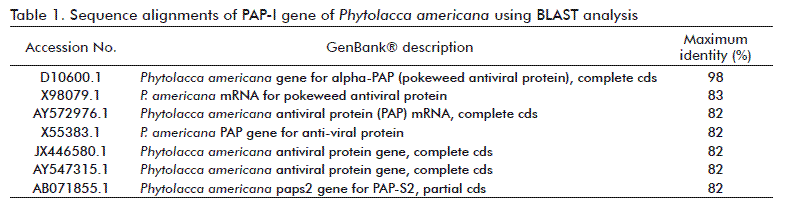
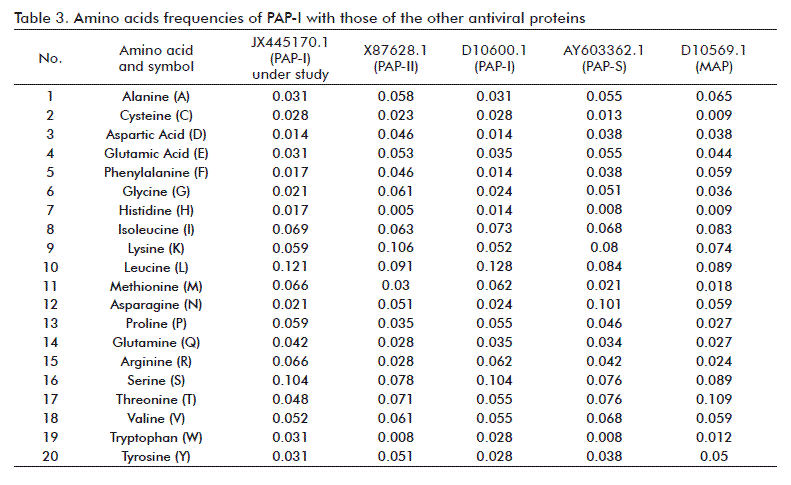
<P   align="justify" ><font size="2" face="Verdana, Arial, Helvetica, sans-serif">The product of the      expected size (approximately 868 bp) was first eluted from the agarose gel,      purified and further amplified, and verified by agarose gel electrophoresis.      An aliquot of the amplified product was cloned into the pTZ57R/T vector and      mobilized into <I>E. coli </I>DH5&alpha; competent cells. White ampicillin      colonies were selected for plasmid minipreparation using the plasmid minipreparation      techniques. A recombinant plasmid bearing the correct insert of the PAP-I      gene (868 bp) was validated using PCR and restriction analysis, followed by      agarose electrophoresis. The fragment was shown to be excised from the plasmid      backbone by <I>Bam</I>H I and <I>Sac </I>I restriction. Similar results were      reported by Chen <I>et al</I>. [18], when constructing by PCR two DNA fragments      coding for PAP, with or without signal peptide, which were cloned into the      pKK233-2 expression vector and transformed into <I>E. coli </I>JM109 cells.      Similarly, Lodge and Kaniewski [11] used PCR to engineer convenient restriction      sites (<I>Bgl </I>II at the 5&acute; end and <I>Sma </I>I at the 3&acute;      end) into the full-length cDNA encoding PAP for inserting it into the plant      transformation vectors pMON8443, carrying the PAP gene under the control of      the enhanced 35S RNA promoter from the <I>cauliflower mosaic virus </I>(CaMV      E35S), and pMON8442 and pMON8484 under the 35S RNA promoter from the figwort      mosaic virus (FMV), respectively. Three other groups [19-21] extracted total      RNA from the leaves of pokeweed (<I>P. americana</I>) plants which had been      subcultured for 8 weeks for the same purpose. The first strand of cDNA was      synthesized from the total RNA template with oligo (dT) 15 primers using MMLV      reverse transcriptase. A 0.96 kb cDNA fragment was obtained after 30 PCR amplification      cycles with two specific primers. The cDNA fragment was sequenced from two      directions after cloning it into the pGEM-T Easy vector. The plant expression      vector with the PAP cDNA was constructed for transferring the PAP cDNA into      tobacco and rape to obtain transgenic plants resistant to a broad spectrum      of viruses. </font></P >       <P   ><font size="2" face="Verdana, Arial, Helvetica, sans-serif">The resulting full      length nucleotide sequence of the PAP-I DNA isolated from <I>P. americana      </I>was submitted to GenBank&reg; under the JX445170.1 accession number. Multiple      alignment of PAP-I gene under study with seven sequences from GenBank&reg;      using the BLAST algorithm showed a 98 % homology with alpha-PAP (Accession      No. D10600.1) [22], followed by 83 % with sequence X98079.1, while the lowest      identity was 82 % for sequences with Accession Nos. AY572976.1, X55383.1,      JX446580.1, AY547315.1 and AB071855.1 (<a href="/img/revistas/bta/v31n1/t0108114.gif">Table 1</a>).      High homology (94-26 %) was shown in amino acid sequences to other RIPs. Multiple      alignment of the PAP-I sequence obtained with antiviral proteins PAP-I, PAP-II,      PAP-S and MAP, and statistical analysis of the DNA fragment PAP-I showed that      PAP-I differ from other RIPs in base composition (A: 282, C:172, G:177 and      T: 237), and nucleotides frequency (A: 0.325, C: 0.198, G: 0.204 and T: 0.273).      The PAP-I gene contains on one open reading frame from nucleotide 57 to 812,      coding for a 289 amino acids protein with an 33.761 kDa molecular weight and      theoretical isoelectric point of 10.15. The amino acid composition data of      PAP-I showed different compositions and frequencies of amino acids between      isolates (<a href="/img/revistas/bta/v31n1/t0208114.gif">Table 2</a> and <a href="/img/revistas/bta/v31n1/t0308114.gif">Table      3</a>). Twenty amino acids were detected on PAP-I starting with Alanine (A)      and ending with Tyrosine (Y). Leucine (L) was found to be the major amino      acid in PAP-I (35) for a 0.121 frequency, followed by Serine (S) (30; 0.104).      Aspartic acid (D) was the less frequent aminoacid (4; 0.014). These results      were comparable to those of Honjo <I>et al</I>. [14], who found that PAP genomic      DNA sequence amplified from <I>P. americana </I>encoded a protein of 262 amino      acids with a c-terminal 29 amino acids extrapeptide. </font></P >   <FONT size="+1" color="#000000">        
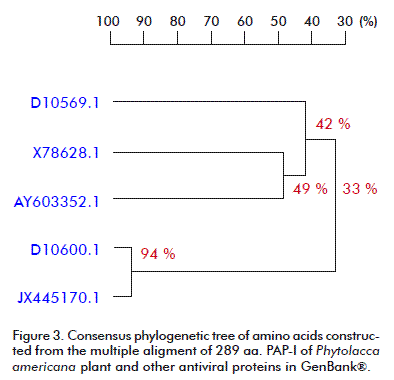
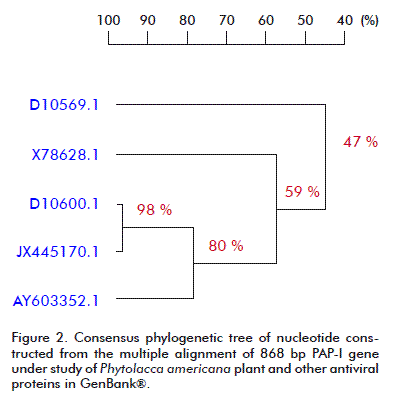
<P   ><font size="2" color="#201D1E" face="Verdana, Arial, Helvetica, sans-serif">The      phylogenetic analysis carried out for the nucleotide and amino acid sequences      of PAP-I, and other RIPs available at the GenBank&reg; database, by using      the DNAMAN V 5.2.9 package (Madison, Wisconsin, USA) with the UPGMA method      is presented in <a href="#fig2">Figure 2</a> and <a href="#fig3">Figure 3</a>.      A close relationship was found between our PAP-I isolate and D10600.1 (bootstrap      value 98 % in nucleotide sequence and 94 % in amino acid homology) (<a href="#fig2">Figure      2</a> and <a href="#fig3">Figure 3</a>). Poyet and Hoeveler [12] isolated      and sequenced the PAP-I gene from <I>P. americana</I>, and characterized for      the first time a com-plete cDNA encoding a pokeweed antiviral protein expressed      in seeds. The PAP-S cDNA consisted of 1249 bp and codes for a mature protein      of 262 amino acids. Its predicted amino acid sequence was more similar to      PAP-I (76 %) than to PAP-II (31 %). </font></P >       <P align="center"   ><img src="/img/revistas/bta/v31n1/f0208114.gif" width="398" height="401"><a name="fig2"></a></P >   <FONT size="+1" color="#201D1E">        
<P   align="center" ><img src="/img/revistas/bta/v31n1/f0308114.gif" width="392" height="378"><a name="fig3"></a></P >       
<P   align="justify" ><font size="2" face="Verdana, Arial, Helvetica, sans-serif">It is known from      literature that PAP-S is more active in inhibiting protein synthesis than      other members of the PAP family. For example, Zeng <I>et al. </I>[23] found      that sequence similarities among these PAP-S, &alpha;-PAP and PAP-I with known      three-dimensional structures are about 75-80 %. Wang <I>et al</I>. [24] isolated      a 30 kDa PAP-II protein from leaves of <I>P. americana</I>, which inhibits      translation by catalytically removing a specific adenine residue from the      large rRNA of the 60S subunit of eukaryotic ribosomes. The protein sequence      of PAP-II shows only 41 % identity to PAP and PAP-S, two other antiviral proteins      isolated from pokeweed. Their isolated cDNA corresponding to PAP-II were introduced      into tobacco plants, and transgenic tobacco plants correctly processed PAP      II to its mature form as in pokeweed, and accumulated it to at least 10-fold      higher levels than the wild-type PAP. </font></P >       <P   align="justify" >&nbsp;</P >       <P   align="justify" > </P >       ]]></body>
<body><![CDATA[<P   align="justify" ><font size="3"><b><font face="Verdana, Arial, Helvetica, sans-serif">CONCLUSIONS      </font></b></font></P >   <FONT size="+1">        <P   ><font size="2" face="Verdana, Arial, Helvetica, sans-serif">Many plants contain      proteins that are capable of inactivating ribosomes and accordingly are called      RIPs. These typical plant proteins currently receive a lot of attention in      biological and biomedical research because of their unique biological activities      toward plant, animal and human cells. In addition, evidence is accumulating      that some RIPs play a role in plant defense and hence can be exploited in      plant protection. The present study provided a characterized clone of the      PAP gene sequence to be expressed for antiviral applications. Further research      on the isolation of PAP full length DNA will be useful in constructing plant      transformation vectors, to obtain transgenic plants resistant to relevant      viral diseases. </font></P >       <P   >&nbsp;</P >   <FONT size="+1"><FONT size="+1" color="#000000">        <P   > </P >       <P   ><font size="3"><b><font face="Verdana, Arial, Helvetica, sans-serif">REFERENCES      </font></b></font></P >       <!-- ref --><P   ><font size="2" color="#201D1E" face="Verdana, Arial, Helvetica, sans-serif">1.      Stirpe F, Barbieri L, Battelli MG, Soris M, Lappi DA. Ribosome-inactivating      proteins from plants: present status and future prospects. Biotechnology.      1992;10(4):405-12.     </font></P >   <FONT size="+1" color="#201D1E">        <!-- ref --><P   ><font size="2" face="Verdana, Arial, Helvetica, sans-serif">2. Salehzadeh A,      Arasteh A. Expressing of rice ribosome inactivating protein as tool for treatment      of cancer cells. Sci Res Essays. 2012;7(1):61-5.     </font></P >       <!-- ref --><P   ><font size="2" face="Verdana, Arial, Helvetica, sans-serif">3. Yang J, Jin GH,      Wang R, Luo ZP, Yin QS, Jin LF, et al. <I>Spinacia oleracea</I> proteins with      antiviral activity against Tobacco mosaic virus. Afr J Biotechnol. 2012; 11(26):6802-8.          </font></P >       <!-- ref --><P   ><font size="2" face="Verdana, Arial, Helvetica, sans-serif">4. Kataoka J, Miyano      M, Habuka N, Masuta C, Koiwai A. A genomic gene for MAP, a ribosome-inactivating      protein from <I>Mirabilis jalapa</I>, contains an intron. Nucleic Acids Res.      1993;21(4):1035.     </font></P >       <!-- ref --><P   ><font size="2" face="Verdana, Arial, Helvetica, sans-serif">5. Osborn RW, Hartley      MR, Tumer NE. Dual effects of the ricin A chain on protein synthesis in rabbit      reticulocyte lysate. Inhibition of initiation and translocation. Eur J Biochem.      1990;193(2):401-7.     </font></P >       <!-- ref --><P   ><font size="2" face="Verdana, Arial, Helvetica, sans-serif">6. Barbieri L, Aron      GM, Irvin JD, Stirpe F. Purification and partia1 characterization of another      form of the antiviral protein from seeds of <I>Phytolacca americana</I> L.      (pokeweed). Biochem J. 1982;203(1):55-9.     </font></P >       <!-- ref --><P   ><font size="2" face="Verdana, Arial, Helvetica, sans-serif">7. Bonness MS, Ready      MP, Irvin JD, Mabry TJ. Pokeweed antiviral protein inactivates pokeweed ribosomes;      implications for the antiviral mechanism. Plant J. 1994;5(2):173-83.     </font></P >       <!-- ref --><P   ><font size="2" face="Verdana, Arial, Helvetica, sans-serif">8. Chen ZC, White      RF, Antoniw JF, Lin Q. Effect of pokeweed antiviral protein (PAP) on the infection      of plant viruses. Plant Pathol. 1991;40(4):612-20.     </font></P >       <!-- ref --><P   ><font size="2" face="Verdana, Arial, Helvetica, sans-serif">9. Zarling JM, Moran      PA, Haffar O, Sias J, Richman DD, Spina CA, et al. Inhibition of HIV replication      by pokeweed antiviral protein targeted CD4+ cell by monoclonal antibodies.      Nature. 1990;347:92-95.     </font></P >       <!-- ref --><P   ><font size="2" face="Verdana, Arial, Helvetica, sans-serif">10. Smirnov S, Shulaev      V, Tumer NE. Expression of pokeweed antiviral protein in transgenic plants      induces virus resistance in grafted wild-type plants independently of salicylic      acid accumulation and pathogenesis-related protein synthesis. Plant Physiol.      1997;114(3):1113-21.     </font></P >       <!-- ref --><P   ><font size="2" face="Verdana, Arial, Helvetica, sans-serif">11. Lodge JK, Kaniewski      WK, Tumer NE. Broad spectrum virus resistance in transgenic plants expression      pokeweed antiviral protein. Proc Natl Acad Sci USA. 1993;90(15):7089-93.     </font></P >       <!-- ref --><P   ><font size="2" face="Verdana, Arial, Helvetica, sans-serif">12. Poyet JL, Hoeveler      A. cDNA cloning and expression of pokeweed antiviral protein from seeds in      <I>Escherichia coli</I> and its inhibition of protein synthesis in vitro.      FEBS lett. 1997;406(1-2):97-100.     </font></P >       <!-- ref --><P   ><font size="2" face="Verdana, Arial, Helvetica, sans-serif">13. Poyet JL, Radom      J, Hoeveler A. Isolation and characterization of a cDNA clone encoding the      pokeweed antiviral protein II from <I>Phytolacca americana</I> and its expression      in <I>E. coli</I>. FEBS Lett. 1994;347(2-3):268-72.     </font></P >       <!-- ref --><P   ><font size="2" face="Verdana, Arial, Helvetica, sans-serif">14. Honjo E, Watanabe      K, Tsukamoto T. Study on the expression of pokeweed antiviral protein in Escherichia      coli as a fusion with maltose-binding protein. Bull Fac Agr Saga Univ. 1997;(82):83-90.          </font></P >       <P   ><font size="2" face="Verdana, Arial, Helvetica, sans-serif">15. Sambrook E, Fritsch      F, Maniatis T. Molecular cloning. A laboratory manual. 2nd Ed. New York: Cold      spring Harbor Laboratory Press; 1989. </font></P >       <!-- ref --><P   ><font size="2" face="Verdana, Arial, Helvetica, sans-serif">16. Sneath PHA, Sokal      RR. Numerical taxonomy. San Francisco: W.H. Freeman and Company; 1973.     p.      230-4. </font></P >       <!-- ref --><P   ><font size="2" face="Verdana, Arial, Helvetica, sans-serif">17. Lin Q, Chen ZC,      Antoniw JF, White RF. Isolation and characterization of a cDNA clone encoding      the anti-viral protein from <I>Phytolacca americana</I>. Plant Mol Biol. 1991;17(4):609-14.          </font></P >       <!-- ref --><P   ><font size="2" face="Verdana, Arial, Helvetica, sans-serif">18. Chen ZC, Antoniw      JF, Lin Q, White RF. Expression of pokeweed (<I>Phytolacca americana</I>)      antiviral protein cDNA in <I>Escherichia coli</I> and its antiviral activity.      Physiol Mol Plant Pathol. 1993;42(4):237-47.     </font></P >       ]]></body>
<body><![CDATA[<!-- ref --><P   ><font size="2" face="Verdana, Arial, Helvetica, sans-serif">19. Zhang H, Tian      Y, Zhou Y, Dang B, Lan H, Song G, et al. Introduction of poke-weed antiviral      protein cDNA into Bra-ssica napus and acquisition of transgenic plants resistant      to viruses. Chin Sci Bull. 1999;44(8):701-04.     </font></P >       <!-- ref --><P   ><font size="2" face="Verdana, Arial, Helvetica, sans-serif">20. Chen GJ, Li S,      Jian LJ, Bi CH, Guo ZP. Cloning of Pokeweed antiviral protein gene from <I>Phytolacca      acinosa</I> and its transfer to pepper (<I>Capsicum annuum</I> L). Acta Hort      Sin. 2008;35(6):847-52.     </font></P >       <!-- ref --><P   ><font size="2" face="Verdana, Arial, Helvetica, sans-serif">21. Cao B, Lei J,      Chen G, Cao P, Liu X, Chen Q, et al. Testing of disease-resistance of pokeweed      antiviral protein gene (PacPAP) in transgenic cucumber (Cucumis sativus).      Afr J Biotechnol. 2011;10(36):6883-90.     </font></P >       <!-- ref --><P   ><font size="2" face="Verdana, Arial, Helvetica, sans-serif">22. Kataoka J, Habuka      N, Masuta C, Miyano M, Koiwai A. Isolation and analysis of a genomic clone      encoding a pokeweed antiviral protein. Plant Mol Biol.1992;20(5):879-86.     </font></P >       <!-- ref --><P   ><font size="2" face="Verdana, Arial, Helvetica, sans-serif">23. Zeng ZH, He XL,      Li HM, Hu Z, Wang DC. Crystal structure of pokeweed antiviral protein with      well-defined sugars from seeds at 1.8A resolution. J Struct Biol. 2003;141(2):171-8.          </font></P >       ]]></body>
<body><![CDATA[<!-- ref --><P   ><font size="2" face="Verdana, Arial, Helvetica, sans-serif">24. Wang P, Zoubenko      O, Tumer NE. Reduced toxicity and broad spectrum resistance to viral and fungal      infection in transgenic plants expressing pokeweed antiviral protein II. Plant      Mol Biol. 1998;38(6):957-64.     </font></P >       <P   >&nbsp;</P >       <P   >&nbsp;</P >   <FONT size="+1" color="#000000">        <P   > </P >       <P   > </P >       <P   ><font size="2" face="Verdana, Arial, Helvetica, sans-serif"><i>Heba A Mahfouze</i>.      Genetic Engineering and Biotechnology Division, Genetics and Cytology Department,      National Research Center. Dokki, 12622, Egypt. E-mail: <A href="mailto:hebaamn@yahoo.com">      <U><U><FONT color="#0000FF">hebaamn@yahoo.com</font></U></U></A><FONT color="#0000FF"><FONT color="#000000">.      </font></font></font></P >   </font></font></font></font></font></font></font></font></font></font></font></font></font></font></font></font></font></font></font></font></font></font></font></font></font></font></font></font></font></font></font></font></font></font></font></font></font></font></font></font></DIV >      ]]></body><back>
<ref-list>
<ref id="B1">
<label>1</label><nlm-citation citation-type="journal">
<person-group person-group-type="author">
<name>
<surname><![CDATA[Stirpe]]></surname>
<given-names><![CDATA[F]]></given-names>
</name>
<name>
<surname><![CDATA[Barbieri]]></surname>
<given-names><![CDATA[L]]></given-names>
</name>
<name>
<surname><![CDATA[Battelli]]></surname>
<given-names><![CDATA[MG]]></given-names>
</name>
<name>
<surname><![CDATA[Soris]]></surname>
<given-names><![CDATA[M]]></given-names>
</name>
<name>
<surname><![CDATA[Lappi]]></surname>
<given-names><![CDATA[DA]]></given-names>
</name>
</person-group>
<article-title xml:lang="en"><![CDATA[Ribosome-inactivating proteins from plants: present status and future prospects]]></article-title>
<source><![CDATA[Biotechnology]]></source>
<year>1992</year>
<volume>10</volume>
<numero>4</numero>
<issue>4</issue>
<page-range>405-12</page-range></nlm-citation>
</ref>
<ref id="B2">
<label>2</label><nlm-citation citation-type="journal">
<person-group person-group-type="author">
<name>
<surname><![CDATA[Salehzadeh]]></surname>
<given-names><![CDATA[A]]></given-names>
</name>
<name>
<surname><![CDATA[Arasteh]]></surname>
<given-names><![CDATA[A]]></given-names>
</name>
</person-group>
<article-title xml:lang="en"><![CDATA[Expressing of rice ribosome inactivating protein as tool for treatment of cancer cells]]></article-title>
<source><![CDATA[Sci Res Essays]]></source>
<year>2012</year>
<volume>7</volume>
<numero>1</numero>
<issue>1</issue>
<page-range>61-5</page-range></nlm-citation>
</ref>
<ref id="B3">
<label>3</label><nlm-citation citation-type="journal">
<person-group person-group-type="author">
<name>
<surname><![CDATA[Yang]]></surname>
<given-names><![CDATA[J]]></given-names>
</name>
<name>
<surname><![CDATA[Jin]]></surname>
<given-names><![CDATA[GH]]></given-names>
</name>
<name>
<surname><![CDATA[Wang]]></surname>
<given-names><![CDATA[R]]></given-names>
</name>
<name>
<surname><![CDATA[Luo]]></surname>
<given-names><![CDATA[ZP]]></given-names>
</name>
<name>
<surname><![CDATA[Yin]]></surname>
<given-names><![CDATA[QS]]></given-names>
</name>
<name>
<surname><![CDATA[Jin]]></surname>
<given-names><![CDATA[LF]]></given-names>
</name>
</person-group>
<article-title xml:lang="en"><![CDATA[Spinacia oleracea proteins with antiviral activity against Tobacco mosaic virus]]></article-title>
<source><![CDATA[Afr J Biotechnol]]></source>
<year>2012</year>
<volume>11</volume>
<numero>26</numero>
<issue>26</issue>
<page-range>6802-8</page-range></nlm-citation>
</ref>
<ref id="B4">
<label>4</label><nlm-citation citation-type="journal">
<person-group person-group-type="author">
<name>
<surname><![CDATA[Kataoka]]></surname>
<given-names><![CDATA[J]]></given-names>
</name>
<name>
<surname><![CDATA[Miyano]]></surname>
<given-names><![CDATA[M]]></given-names>
</name>
<name>
<surname><![CDATA[Habuka]]></surname>
<given-names><![CDATA[N]]></given-names>
</name>
<name>
<surname><![CDATA[Masuta]]></surname>
<given-names><![CDATA[C]]></given-names>
</name>
<name>
<surname><![CDATA[Koiwai]]></surname>
<given-names><![CDATA[A]]></given-names>
</name>
</person-group>
<article-title xml:lang="en"><![CDATA[A genomic gene for MAP, a ribosome-inactivating protein from Mirabilis jalapa, contains an intron]]></article-title>
<source><![CDATA[Nucleic Acids Res]]></source>
<year>1993</year>
<volume>21</volume>
<numero>4</numero>
<issue>4</issue>
<page-range>1035</page-range></nlm-citation>
</ref>
<ref id="B5">
<label>5</label><nlm-citation citation-type="journal">
<person-group person-group-type="author">
<name>
<surname><![CDATA[Osborn]]></surname>
<given-names><![CDATA[RW]]></given-names>
</name>
<name>
<surname><![CDATA[Hartley]]></surname>
<given-names><![CDATA[MR]]></given-names>
</name>
<name>
<surname><![CDATA[Tumer]]></surname>
<given-names><![CDATA[NE]]></given-names>
</name>
</person-group>
<article-title xml:lang="en"><![CDATA[Dual effects of the ricin A chain on protein synthesis in rabbit reticulocyte lysate. Inhibition of initiation and translocation]]></article-title>
<source><![CDATA[Eur J Biochem]]></source>
<year>1990</year>
<volume>193</volume>
<numero>2</numero>
<issue>2</issue>
<page-range>401-7</page-range></nlm-citation>
</ref>
<ref id="B6">
<label>6</label><nlm-citation citation-type="journal">
<person-group person-group-type="author">
<name>
<surname><![CDATA[Barbieri]]></surname>
<given-names><![CDATA[L]]></given-names>
</name>
<name>
<surname><![CDATA[Aron]]></surname>
<given-names><![CDATA[GM]]></given-names>
</name>
<name>
<surname><![CDATA[Irvin]]></surname>
<given-names><![CDATA[JD]]></given-names>
</name>
<name>
<surname><![CDATA[Stirpe]]></surname>
<given-names><![CDATA[F]]></given-names>
</name>
</person-group>
<article-title xml:lang="en"><![CDATA[Purifi cation and partia1 characterization of another form of the antiviral protein from seeds of Phytolacca americana L. (pokeweed)]]></article-title>
<source><![CDATA[Biochem J]]></source>
<year>1982</year>
<volume>203</volume>
<numero>1</numero>
<issue>1</issue>
<page-range>55-9</page-range></nlm-citation>
</ref>
<ref id="B7">
<label>7</label><nlm-citation citation-type="journal">
<person-group person-group-type="author">
<name>
<surname><![CDATA[Bonness]]></surname>
<given-names><![CDATA[MS]]></given-names>
</name>
<name>
<surname><![CDATA[Ready]]></surname>
<given-names><![CDATA[MP]]></given-names>
</name>
<name>
<surname><![CDATA[Irvin]]></surname>
<given-names><![CDATA[JD]]></given-names>
</name>
<name>
<surname><![CDATA[Mabry]]></surname>
<given-names><![CDATA[TJ]]></given-names>
</name>
</person-group>
<article-title xml:lang="en"><![CDATA[Pokeweed antiviral protein inactivates pokeweed ribosomes; implications for the antiviral mechanism]]></article-title>
<source><![CDATA[Plant J]]></source>
<year>1994</year>
<volume>5</volume>
<numero>2</numero>
<issue>2</issue>
<page-range>173-83</page-range></nlm-citation>
</ref>
<ref id="B8">
<label>8</label><nlm-citation citation-type="journal">
<person-group person-group-type="author">
<name>
<surname><![CDATA[Chen]]></surname>
<given-names><![CDATA[ZC]]></given-names>
</name>
<name>
<surname><![CDATA[White]]></surname>
<given-names><![CDATA[RF]]></given-names>
</name>
<name>
<surname><![CDATA[Antoniw]]></surname>
<given-names><![CDATA[JF]]></given-names>
</name>
<name>
<surname><![CDATA[Lin]]></surname>
<given-names><![CDATA[Q]]></given-names>
</name>
</person-group>
<article-title xml:lang="en"><![CDATA[Effect of pokeweed antiviral protein (PAP) on the infection of plant viruses]]></article-title>
<source><![CDATA[Plant Pathol]]></source>
<year>1991</year>
<volume>40</volume>
<numero>4</numero>
<issue>4</issue>
<page-range>612-20</page-range></nlm-citation>
</ref>
<ref id="B9">
<label>9</label><nlm-citation citation-type="journal">
<person-group person-group-type="author">
<name>
<surname><![CDATA[Zarling]]></surname>
<given-names><![CDATA[JM]]></given-names>
</name>
<name>
<surname><![CDATA[Moran]]></surname>
<given-names><![CDATA[PA]]></given-names>
</name>
<name>
<surname><![CDATA[Haffar]]></surname>
<given-names><![CDATA[O]]></given-names>
</name>
<name>
<surname><![CDATA[Sias]]></surname>
<given-names><![CDATA[J]]></given-names>
</name>
<name>
<surname><![CDATA[Richman]]></surname>
<given-names><![CDATA[DD]]></given-names>
</name>
<name>
<surname><![CDATA[Spina]]></surname>
<given-names><![CDATA[CA]]></given-names>
</name>
</person-group>
<article-title xml:lang="en"><![CDATA[Inhibition of HIV replication by pokeweed antiviral protein targeted CD4+ cell by monoclonal antibodies]]></article-title>
<source><![CDATA[Nature]]></source>
<year>1990</year>
<volume>347</volume>
<page-range>92-95</page-range></nlm-citation>
</ref>
<ref id="B10">
<label>10</label><nlm-citation citation-type="journal">
<person-group person-group-type="author">
<name>
<surname><![CDATA[Smirnov]]></surname>
<given-names><![CDATA[S]]></given-names>
</name>
<name>
<surname><![CDATA[Shulaev]]></surname>
<given-names><![CDATA[V]]></given-names>
</name>
<name>
<surname><![CDATA[Tumer]]></surname>
<given-names><![CDATA[NE]]></given-names>
</name>
</person-group>
<article-title xml:lang="en"><![CDATA[Expression of pokeweed antiviral protein in transgenic plants induces virus resistance in grafted wild-type plants independently of salicylic acid accumulation and pathogenesis-related protein synthesis]]></article-title>
<source><![CDATA[Plant Physiol]]></source>
<year>1997</year>
<volume>114</volume>
<numero>3</numero>
<issue>3</issue>
<page-range>1113-21</page-range></nlm-citation>
</ref>
<ref id="B11">
<label>11</label><nlm-citation citation-type="journal">
<person-group person-group-type="author">
<name>
<surname><![CDATA[Lodge]]></surname>
<given-names><![CDATA[JK]]></given-names>
</name>
<name>
<surname><![CDATA[Kaniewski]]></surname>
<given-names><![CDATA[WK]]></given-names>
</name>
<name>
<surname><![CDATA[Tumer]]></surname>
<given-names><![CDATA[NE]]></given-names>
</name>
</person-group>
<article-title xml:lang="en"><![CDATA[Broad spectrum virus resistance in transgenic plants expression pokeweed antiviral protein]]></article-title>
<source><![CDATA[Proc Natl Acad Sci USA]]></source>
<year>1993</year>
<volume>90</volume>
<numero>15</numero>
<issue>15</issue>
<page-range>7089-93</page-range></nlm-citation>
</ref>
<ref id="B12">
<label>12</label><nlm-citation citation-type="journal">
<person-group person-group-type="author">
<name>
<surname><![CDATA[Poyet]]></surname>
<given-names><![CDATA[JL]]></given-names>
</name>
<name>
<surname><![CDATA[Hoeveler]]></surname>
<given-names><![CDATA[A]]></given-names>
</name>
</person-group>
<article-title xml:lang="en"><![CDATA[cDNA cloning and expression of pokeweed antiviral protein from seeds in Escherichia coli and its inhibition of protein synthesis in vitro]]></article-title>
<source><![CDATA[FEBS Lett]]></source>
<year>1997</year>
<volume>406</volume>
<numero>1-2</numero>
<issue>1-2</issue>
<page-range>97-100</page-range></nlm-citation>
</ref>
<ref id="B13">
<label>13</label><nlm-citation citation-type="journal">
<person-group person-group-type="author">
<name>
<surname><![CDATA[Poyet]]></surname>
<given-names><![CDATA[JL]]></given-names>
</name>
<name>
<surname><![CDATA[Radom]]></surname>
<given-names><![CDATA[J]]></given-names>
</name>
<name>
<surname><![CDATA[Hoeveler]]></surname>
<given-names><![CDATA[A]]></given-names>
</name>
</person-group>
<article-title xml:lang="en"><![CDATA[Isolation and characterization of a cDNA clone encoding the pokeweed antiviral protein II from Phytolacca americana and its expression in E. coli]]></article-title>
<source><![CDATA[FEBS Lett]]></source>
<year>1994</year>
<volume>347</volume>
<numero>2-3</numero>
<issue>2-3</issue>
<page-range>268-72</page-range></nlm-citation>
</ref>
<ref id="B14">
<label>14</label><nlm-citation citation-type="journal">
<person-group person-group-type="author">
<name>
<surname><![CDATA[Honjo]]></surname>
<given-names><![CDATA[E]]></given-names>
</name>
<name>
<surname><![CDATA[Watanabe]]></surname>
<given-names><![CDATA[K]]></given-names>
</name>
<name>
<surname><![CDATA[Tsukamoto]]></surname>
<given-names><![CDATA[T]]></given-names>
</name>
</person-group>
<article-title xml:lang="en"><![CDATA[Study on the expression of pokeweed antiviral protein in Escherichia coli as a fusion with maltose-binding protein]]></article-title>
<source><![CDATA[Bull Fac Agr Saga Univ]]></source>
<year>1997</year>
<numero>82</numero>
<issue>82</issue>
<page-range>83-90</page-range></nlm-citation>
</ref>
<ref id="B15">
<label>15</label><nlm-citation citation-type="book">
<person-group person-group-type="author">
<name>
<surname><![CDATA[Sambrook]]></surname>
<given-names><![CDATA[E]]></given-names>
</name>
<name>
<surname><![CDATA[Fritsch]]></surname>
<given-names><![CDATA[F]]></given-names>
</name>
<name>
<surname><![CDATA[Maniatis]]></surname>
<given-names><![CDATA[T]]></given-names>
</name>
</person-group>
<source><![CDATA[Molecular cloning. A laboratory manual]]></source>
<year>1989</year>
<edition>2</edition>
<publisher-loc><![CDATA[New York ]]></publisher-loc>
<publisher-name><![CDATA[Cold spring Harbor Laboratory Press]]></publisher-name>
</nlm-citation>
</ref>
<ref id="B16">
<label>16</label><nlm-citation citation-type="book">
<person-group person-group-type="author">
<name>
<surname><![CDATA[Sneath]]></surname>
<given-names><![CDATA[PHA]]></given-names>
</name>
<name>
<surname><![CDATA[Sokal]]></surname>
<given-names><![CDATA[RR]]></given-names>
</name>
</person-group>
<source><![CDATA[Numerical taxonomy]]></source>
<year>1973</year>
<publisher-loc><![CDATA[San Francisco ]]></publisher-loc>
<publisher-name><![CDATA[W.H Freeman and Company]]></publisher-name>
</nlm-citation>
</ref>
<ref id="B17">
<label>17</label><nlm-citation citation-type="journal">
<person-group person-group-type="author">
<name>
<surname><![CDATA[Lin]]></surname>
<given-names><![CDATA[Q]]></given-names>
</name>
<name>
<surname><![CDATA[Chen]]></surname>
<given-names><![CDATA[ZC]]></given-names>
</name>
<name>
<surname><![CDATA[Antoniw]]></surname>
<given-names><![CDATA[JF]]></given-names>
</name>
<name>
<surname><![CDATA[White]]></surname>
<given-names><![CDATA[RF]]></given-names>
</name>
</person-group>
<article-title xml:lang="en"><![CDATA[Isolation and characterization of a cDNA clone encoding the anti-viral protein from Phytolacca americana]]></article-title>
<source><![CDATA[Plant Mol Biol]]></source>
<year>1991</year>
<volume>17</volume>
<numero>4</numero>
<issue>4</issue>
<page-range>609-14</page-range></nlm-citation>
</ref>
<ref id="B18">
<label>18</label><nlm-citation citation-type="journal">
<person-group person-group-type="author">
<name>
<surname><![CDATA[Chen]]></surname>
<given-names><![CDATA[ZC]]></given-names>
</name>
<name>
<surname><![CDATA[Antoniw]]></surname>
<given-names><![CDATA[JF]]></given-names>
</name>
<name>
<surname><![CDATA[Lin]]></surname>
<given-names><![CDATA[Q]]></given-names>
</name>
<name>
<surname><![CDATA[White]]></surname>
<given-names><![CDATA[RF]]></given-names>
</name>
</person-group>
<article-title xml:lang="en"><![CDATA[Expression of pokeweed (Phytolacca americana) antiviral protein cDNA in Escherichia coli and its antiviral activity]]></article-title>
<source><![CDATA[Physiol Mol Plant Pathol]]></source>
<year>1993</year>
<volume>42</volume>
<numero>4</numero>
<issue>4</issue>
<page-range>237-47</page-range></nlm-citation>
</ref>
<ref id="B19">
<label>19</label><nlm-citation citation-type="journal">
<person-group person-group-type="author">
<name>
<surname><![CDATA[Zhang]]></surname>
<given-names><![CDATA[H]]></given-names>
</name>
<name>
<surname><![CDATA[Tian]]></surname>
<given-names><![CDATA[Y]]></given-names>
</name>
<name>
<surname><![CDATA[Zhou]]></surname>
<given-names><![CDATA[Y]]></given-names>
</name>
<name>
<surname><![CDATA[Dang]]></surname>
<given-names><![CDATA[B]]></given-names>
</name>
<name>
<surname><![CDATA[Lan]]></surname>
<given-names><![CDATA[H]]></given-names>
</name>
<name>
<surname><![CDATA[Song]]></surname>
<given-names><![CDATA[G]]></given-names>
</name>
</person-group>
<article-title xml:lang="en"><![CDATA[Introduction of pokeweed antiviral protein cDNA into Brassica napus and acquisition of transgenic plants resistant to viruses]]></article-title>
<source><![CDATA[Chin Sci Bull]]></source>
<year>1999</year>
<volume>44</volume>
<numero>8</numero>
<issue>8</issue>
<page-range>701-04</page-range></nlm-citation>
</ref>
<ref id="B20">
<label>20</label><nlm-citation citation-type="journal">
<person-group person-group-type="author">
<name>
<surname><![CDATA[Chen]]></surname>
<given-names><![CDATA[GJ]]></given-names>
</name>
<name>
<surname><![CDATA[Li]]></surname>
<given-names><![CDATA[S]]></given-names>
</name>
<name>
<surname><![CDATA[Jian]]></surname>
<given-names><![CDATA[LJ]]></given-names>
</name>
<name>
<surname><![CDATA[Bi]]></surname>
<given-names><![CDATA[CH]]></given-names>
</name>
<name>
<surname><![CDATA[Guo]]></surname>
<given-names><![CDATA[ZP]]></given-names>
</name>
</person-group>
<article-title xml:lang="en"><![CDATA[Cloning of Pokeweed antiviral protein gene from Phytolacca acinosa and its transfer to pepper (Capsicum annuum L)]]></article-title>
<source><![CDATA[Acta Hort Sin]]></source>
<year>2008</year>
<volume>35</volume>
<numero>6</numero>
<issue>6</issue>
<page-range>847-52</page-range></nlm-citation>
</ref>
<ref id="B21">
<label>21</label><nlm-citation citation-type="journal">
<person-group person-group-type="author">
<name>
<surname><![CDATA[Cao]]></surname>
<given-names><![CDATA[B]]></given-names>
</name>
<name>
<surname><![CDATA[Lei]]></surname>
<given-names><![CDATA[J]]></given-names>
</name>
<name>
<surname><![CDATA[Chen]]></surname>
<given-names><![CDATA[G]]></given-names>
</name>
<name>
<surname><![CDATA[Cao]]></surname>
<given-names><![CDATA[P]]></given-names>
</name>
<name>
<surname><![CDATA[Liu]]></surname>
<given-names><![CDATA[X]]></given-names>
</name>
<name>
<surname><![CDATA[Chen]]></surname>
<given-names><![CDATA[Q]]></given-names>
</name>
</person-group>
<article-title xml:lang="en"><![CDATA[Testing of disease-resistance of pokeweed antiviral protein gene (PacPAP) in transgenic cucumber (Cucumis sativus)]]></article-title>
<source><![CDATA[Afr J Biotechnol]]></source>
<year>2011</year>
<volume>10</volume>
<numero>36</numero>
<issue>36</issue>
<page-range>6883-90</page-range></nlm-citation>
</ref>
<ref id="B22">
<label>22</label><nlm-citation citation-type="journal">
<person-group person-group-type="author">
<name>
<surname><![CDATA[Kataoka]]></surname>
<given-names><![CDATA[J]]></given-names>
</name>
<name>
<surname><![CDATA[Habuka]]></surname>
<given-names><![CDATA[N]]></given-names>
</name>
<name>
<surname><![CDATA[Masuta]]></surname>
<given-names><![CDATA[C]]></given-names>
</name>
<name>
<surname><![CDATA[Miyano]]></surname>
<given-names><![CDATA[M]]></given-names>
</name>
<name>
<surname><![CDATA[Koiwai]]></surname>
<given-names><![CDATA[A]]></given-names>
</name>
</person-group>
<article-title xml:lang="en"><![CDATA[Isolation and analysis of a genomic clone encoding a pokeweed antiviral protein]]></article-title>
<source><![CDATA[Plant Mol Biol]]></source>
<year>1992</year>
<volume>20</volume>
<numero>5</numero>
<issue>5</issue>
<page-range>879-86</page-range></nlm-citation>
</ref>
<ref id="B23">
<label>23</label><nlm-citation citation-type="journal">
<person-group person-group-type="author">
<name>
<surname><![CDATA[Zeng]]></surname>
<given-names><![CDATA[ZH]]></given-names>
</name>
<name>
<surname><![CDATA[He]]></surname>
<given-names><![CDATA[XL]]></given-names>
</name>
<name>
<surname><![CDATA[Li]]></surname>
<given-names><![CDATA[HM]]></given-names>
</name>
<name>
<surname><![CDATA[Hu]]></surname>
<given-names><![CDATA[Z]]></given-names>
</name>
<name>
<surname><![CDATA[Wang]]></surname>
<given-names><![CDATA[DC]]></given-names>
</name>
</person-group>
<article-title xml:lang="en"><![CDATA[Crystal structure of pokeweed antiviral protein with well-defined sugars from seeds at 1.8A resolution]]></article-title>
<source><![CDATA[J Struct Biol]]></source>
<year>2003</year>
<volume>141</volume>
<numero>2</numero>
<issue>2</issue>
<page-range>171-8</page-range></nlm-citation>
</ref>
<ref id="B24">
<label>24</label><nlm-citation citation-type="journal">
<person-group person-group-type="author">
<name>
<surname><![CDATA[Wang]]></surname>
<given-names><![CDATA[P]]></given-names>
</name>
<name>
<surname><![CDATA[Zoubenko]]></surname>
<given-names><![CDATA[O]]></given-names>
</name>
<name>
<surname><![CDATA[Tumer]]></surname>
<given-names><![CDATA[NE]]></given-names>
</name>
</person-group>
<article-title xml:lang="en"><![CDATA[Reduced toxicity and broad spectrum resistance to viral and fungal infection in transgenic plants expressing pokeweed antiviral protein II]]></article-title>
<source><![CDATA[Plant Mol Biol]]></source>
<year>1998</year>
<volume>38</volume>
<numero>6</numero>
<issue>6</issue>
<page-range>957-64</page-range></nlm-citation>
</ref>
</ref-list>
</back>
</article>