<?xml version="1.0" encoding="ISO-8859-1"?><article xmlns:mml="http://www.w3.org/1998/Math/MathML" xmlns:xlink="http://www.w3.org/1999/xlink" xmlns:xsi="http://www.w3.org/2001/XMLSchema-instance">
<front>
<journal-meta>
<journal-id>1027-2852</journal-id>
<journal-title><![CDATA[Biotecnología Aplicada]]></journal-title>
<abbrev-journal-title><![CDATA[Biotecnol Apl]]></abbrev-journal-title>
<issn>1027-2852</issn>
<publisher>
<publisher-name><![CDATA[Editorial Elfos Scientiae]]></publisher-name>
</publisher>
</journal-meta>
<article-meta>
<article-id>S1027-28522014000200007</article-id>
<title-group>
<article-title xml:lang="en"><![CDATA[Nimotuzumab, effective immunotherapy for the treatment of malignant epithelial tumors]]></article-title>
<article-title xml:lang="es"><![CDATA[Nimotuzumab, inmunoterapia eficaz para el tratamiento de tumores epiteliales malignos]]></article-title>
</title-group>
<contrib-group>
<contrib contrib-type="author">
<name>
<surname><![CDATA[Saurez-Martínez]]></surname>
<given-names><![CDATA[Giselle]]></given-names>
</name>
<xref ref-type="aff" rid="A01"/>
</contrib>
<contrib contrib-type="author">
<name>
<surname><![CDATA[Bencomo-Yanes]]></surname>
<given-names><![CDATA[Anamary]]></given-names>
</name>
<xref ref-type="aff" rid="A01"/>
</contrib>
</contrib-group>
<aff id="A01">
<institution><![CDATA[,Centro de Inmunología Molecular, CIM Departamento de Gerencia Médica y Asuntos Regulatorios ]]></institution>
<addr-line><![CDATA[La Habana ]]></addr-line>
<country>Cuba</country>
</aff>
<pub-date pub-type="pub">
<day>00</day>
<month>06</month>
<year>2014</year>
</pub-date>
<pub-date pub-type="epub">
<day>00</day>
<month>06</month>
<year>2014</year>
</pub-date>
<volume>31</volume>
<numero>2</numero>
<fpage>159</fpage>
<lpage>167</lpage>
<copyright-statement/>
<copyright-year/>
<self-uri xlink:href="http://scielo.sld.cu/scielo.php?script=sci_arttext&amp;pid=S1027-28522014000200007&amp;lng=en&amp;nrm=iso"></self-uri><self-uri xlink:href="http://scielo.sld.cu/scielo.php?script=sci_abstract&amp;pid=S1027-28522014000200007&amp;lng=en&amp;nrm=iso"></self-uri><self-uri xlink:href="http://scielo.sld.cu/scielo.php?script=sci_pdf&amp;pid=S1027-28522014000200007&amp;lng=en&amp;nrm=iso"></self-uri><abstract abstract-type="short" xml:lang="en"><p><![CDATA[Nimotuzumab, a humanized monoclonal antibody, is a novel drug against the epidermal growth factor receptor, which is a protein that is highly expressed in malignant tumors of epithelial origin. This paper presents its physicochemical and pharmaceutical characteristics, the results of pre-clinical and clinical research, and the international regulations for the diseases for which its use has been indicated: in advanced head and neck tumors, malignant brain tumors in adults and children, and advanced esophagus tumors. Its safety profile, efficacy and effectiveness studied before and after its regulatory approval are also described. Finally, recommendations are given for its dosage according to clinical evidence, for the appropriate therapeutic use of this medication.]]></p></abstract>
<abstract abstract-type="short" xml:lang="es"><p><![CDATA[Nimotuzumab, anticuerpo monoclonal humanizado, es un novedoso fármaco contra el receptor del factor de crecimiento epidérmico: proteína altamente expresada en tumores malignos de origen epitelial. En este artículo se exponen sus características físico-químicas y farmacéuticas, los resultados de investigaciones preclínicas y clínicas, y las regulaciones internacionales para las enfermedades en las que se ha indicado su uso: en tumores avanzados de cabeza y cuello, tumores cerebrales malignos en adultos y niños, y tumores avanzados de esófago. Se describen su perfil de seguridad, eficacia y efectividad, antes y después de su aprobación. Por último se ofrecen recomendaciones posológicas según las evidencias clínicas, para el uso terapéutico adecuado de este medicamento.]]></p></abstract>
<kwd-group>
<kwd lng="en"><![CDATA[epidermal growth factor receptor]]></kwd>
<kwd lng="en"><![CDATA[nimotuzumab]]></kwd>
<kwd lng="en"><![CDATA[cancer treatment]]></kwd>
<kwd lng="en"><![CDATA[targeted therapy]]></kwd>
<kwd lng="en"><![CDATA[biological therapy]]></kwd>
<kwd lng="es"><![CDATA[receptor del factor de crecimiento epidérmico]]></kwd>
<kwd lng="es"><![CDATA[nimotuzumab]]></kwd>
<kwd lng="es"><![CDATA[tratamiento de cáncer]]></kwd>
<kwd lng="es"><![CDATA[terapia blanco]]></kwd>
<kwd lng="es"><![CDATA[terapia biológica]]></kwd>
</kwd-group>
</article-meta>
</front><body><![CDATA[ <DIV class="Sect"   >        <P align="right"   ><font size="2" color="#000000" face="Verdana, Arial, Helvetica, sans-serif"><b>FOCUS</b>      </font></P >       <P align="right"   >&nbsp;</P >   <FONT size="+1" color="#000000">        <P   ><font size="4" face="Verdana, Arial, Helvetica, sans-serif"><b>Nimotuzumab, effective      immunotherapy for the treatment of malignant epithelial tumors </b></font></P >       <P   >&nbsp;</P >       <P   ><font size="3" face="Verdana, Arial, Helvetica, sans-serif"><b>Nimotuzumab, inmunoterapia      eficaz para el tratamiento de tumores epiteliales malignos </b></font></P >       <P   >&nbsp;</P >       <P   >&nbsp;</P >       <P   > </P >       <P   ><b><font size="2" face="Verdana, Arial, Helvetica, sans-serif">Giselle Saurez-Mart&iacute;nez,      Anamary Bencomo-Yanes </font></b></P >   <FONT size="+1">        ]]></body>
<body><![CDATA[<P   ><font size="2" face="Verdana, Arial, Helvetica, sans-serif">Departamento de Gerencia      M&eacute;dica y Asuntos Regulatorios, Centro de Inmunolog&iacute;a Molecular,      CIM. Calle 206 No. 1926 e/ 19 y 21, Atabey, Playa, CP 11600, La Habana, Cuba.</font></P >   </font></font>       <p>&nbsp;</p>       <p>&nbsp;</p>   <hr>   <b><font size="2" face="Verdana, Arial, Helvetica, sans-serif">ABSTRACT </font></b><FONT size="+1" color="#000000"><FONT size="+1"><FONT size="+1"><FONT color="#0000FF"><FONT color="#000000"><FONT size="+1"><FONT size="+1">        <P   ><font size="2" face="Verdana, Arial, Helvetica, sans-serif">Nimotuzumab, a humanized      monoclonal antibody, is a novel drug against the epidermal growth factor receptor,      which is a protein that is highly expressed in malignant tumors of epithelial      origin. This paper presents its physicochemical and pharmaceutical characteristics,      the results of pre-clinical and clinical research, and the international regulations      for the diseases for which its use has been indicated: in advanced head and      neck tumors, malignant brain tumors in adults and children, and advanced esophagus      tumors. Its safety profile, efficacy and effectiveness studied before and      after its regulatory approval are also described. Finally, recommendations      are given for its dosage according to clinical evidence, for the appropriate      therapeutic use of this medication. </font></P >       <P   ><font size="2" face="Verdana, Arial, Helvetica, sans-serif"><b>Keywords:</b>      epidermal growth factor receptor, nimotuzumab, cancer treatment, targeted      therapy, biological therapy. </font></P >   </font></font></font></font></font></font></font>   <hr>   <FONT size="+1" color="#000000"><FONT size="+1"><FONT size="+1"><FONT color="#0000FF"><FONT color="#000000"><FONT size="+1"><FONT size="+1">       <P   ><b><font size="2" face="Verdana, Arial, Helvetica, sans-serif">RESUMEN </font></b></P >       <P   ><font size="2" face="Verdana, Arial, Helvetica, sans-serif">Nimotuzumab, anticuerpo      monoclonal humanizado, es un novedoso f&aacute;rmaco contra el receptor del      factor de crecimiento epid&eacute;rmico: prote&iacute;na altamente expresada      en tumores malignos de origen epitelial. En este art&iacute;culo se exponen      sus caracter&iacute;sticas f&iacute;sico-qu&iacute;micas y farmac&eacute;uticas,      los resultados de investigaciones precl&iacute;nicas y cl&iacute;nicas, y      las regulaciones internacionales para las enfermedades en las que se ha indicado      su uso: en tumores avanzados de cabeza y cuello, tumores cerebrales malignos      en adultos y ni&ntilde;os, y tumores avanzados de es&oacute;fago. Se describen      su perfil de seguridad, eficacia y efectividad, antes y despu&eacute;s de      su aprobaci&oacute;n. Por &uacute;ltimo se ofrecen recomendaciones posol&oacute;gicas      seg&uacute;n las evidencias cl&iacute;nicas, para el uso terap&eacute;utico      adecuado de este medicamento. </font></P >       <P   ><font size="2" face="Verdana, Arial, Helvetica, sans-serif"><b>Palabras clave:</b>      receptor del factor de crecimiento epid&eacute;rmico, nimotuzumab, tratamiento      de c&aacute;ncer, terapia blanco, terapia biol&oacute;gica. </font></P >   </font></font></font></font></font></font></font>    <hr>       <p>&nbsp;</p>       <p>&nbsp;</p>       ]]></body>
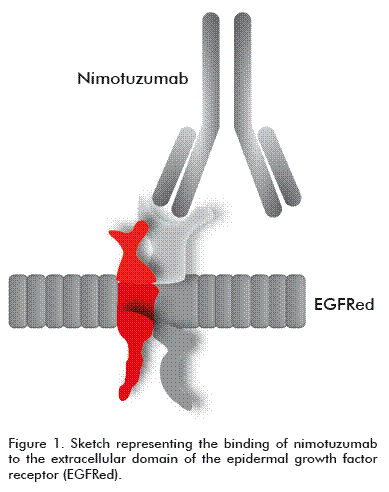
<body><![CDATA[<p> <font size="3" face="Verdana, Arial, Helvetica, sans-serif"><b>INTRODUCTION</b></font><FONT size="+1" color="#000000"><FONT size="+1"><FONT size="+1"><FONT color="#0000FF"><FONT color="#000000"><FONT size="+1"><FONT size="+1"><FONT size="+1">      </font></font></font></font></font></font></font></font></p>   <FONT size="+1" color="#000000"><FONT size="+1"><FONT size="+1"><FONT color="#0000FF"><FONT color="#000000"><FONT size="+1"><FONT size="+1"><FONT size="+1">        <P   ><font size="2" face="Verdana, Arial, Helvetica, sans-serif">The receptor of the      epidermal growth factor (EGFR) is a transmembrane protein related to proliferation      and maturation of cells that are basically of epithelial origin: skin, intestinal      mucosa and the liver [1]. Essentially, its activation depends on two ligands:      the epidermal growth factor (EGF) and the tumor growth factor alpha (TGF-&alpha;),      leading to the activation of the signaling cascade of the EGF-EGFR system      after phosphorylation and the dimeric formation of that receptor.    <br>     This system has been widely studied and is very attractive as a tumoral therapeutic      target. It is associated to anarchical proliferation, cellular immortalization,      inhibition of apoptosis, neo-angiogenesis and metastasis; all signs of a bad      prognosis that provokes resistance to conventional oncologic treatments, such      as radiotherapy, chemotherapy and hormonal therapy [2-4].    <br>     Passive immunotherapy with MAbs is one of the most effective treatments against      the EGFR [5]. There are currently several MAbs against this receptor that      have been registered for the treatment of some solid epithelial tumors: Cetuximab&reg;      (chimeric MAb), nimotuzumab (humanized MAb) and Panitumumab&reg; (human MAb)      [6].    <br>     Nimotuzumab is an international generic denomination that is alternatively      known worldwide by the brands Theraloc&reg; (registered trademark for the      European Union), TheraCIM&reg; (registered trademark for Canada, Indonesia      and other Asian countries), CIMAher&reg; (registered trademark for Cuba and      Latin America) and BIOMAb-EGFR&reg; (registered trademark of the product produced      in India).    <br>     This paper summarizes its pharmacotherapeutic characteristics as an anti-EGFR      agent, as well as the most recent pre-clinical and clinical evidence endorsing      its use.</font></P >   <FONT size="+1">        <P   >&nbsp;</P >       <P   ><font size="3" face="Verdana, Arial, Helvetica, sans-serif"><b>MECHANISMS OF      ACTION AND CLINICAL PHARMACOLOGY</b></font></P >   <FONT size="+1">        <P   ><font size="2" face="Verdana, Arial, Helvetica, sans-serif">Nimotuzumab is a      humanized MAb, an IgG1 isotype immunoglobulin obtained by recombinant DNA      technology and produced in mammalian cell lines (murine myeloma NSO) [7, 8].      It recognizes the EGFR with an intermediate affinity of 10<sup>-9</sup> M      [7]; it contains the hypervariable regions (CDR) of murine origin (ior egf/r3)      and the frames of the variable regions and of the constant regions of the      heavy and light chains of human origin (<a href="#fig1">Figure 1</a>) [7].      </font></P >       <P align="center"   ><img src="/img/revistas/bta/v31n2/f0107214.gif" width="387" height="490"><a name="fig1"></a></P >   <FONT size="+1"><FONT size="+1"><FONT size="+1">        
]]></body>
<body><![CDATA[<P   ><font size="2" face="Verdana, Arial, Helvetica, sans-serif">Its binding will      block the interaction of the two main ligands of the EGFR: the EGF and the      TGF-&alpha;. This inhibits the tyrosine kinase activity of the receptor      and arrests the cellular cycle at phase G1-S, with a marked anti-proliferative      effect [7, 9, 10]. Moreover, it exerts anti-angiogenic and pro-apoptotic effects      in tumors that over-express EGFR (<a href="/img/revistas/bta/v31n2/f0207214.gif">Figure      2</a>) [9-12], and reduces the number of CD133+ cells (tumor stem cells in      charge of radio-resistance) [13]. </font></P >       
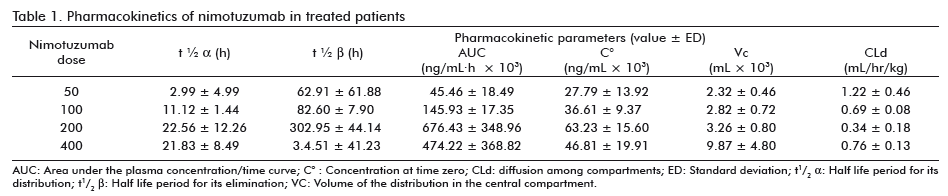
<P   >&nbsp;</P >       <P   ><font face="Verdana, Arial, Helvetica, sans-serif" size="3"><b>PHARMACODYNAMICS</b></font></P >   <FONT size="+1">        <P   ><font size="2" face="Verdana, Arial, Helvetica, sans-serif">Several <i>in vitro</i>      and <i>in vivo</i> studies demonstrated that nimotuzumab inhibits growth and      survival of tumor cells expressing EGFR [9, 12, 14]. In clinical trials it      was also observed that it prevents phosphorylation of EGFR and the activation      of the ERK protein (MAPK), and reduces tumor cell proliferation: a more significant      effect in tumor tissues over expressing the EGFR in the skin [15-17]. Other      clinical findings demonstrate the synergy of this MAb when combined with radiotherapy      and chemotherapy [10, 16, 18-22].</font></P >       <P   >&nbsp;</P >   <FONT size="+1">        <P   ><font size="3"><b><font face="Verdana, Arial, Helvetica, sans-serif">PHARMACOKINETICS</font></b></font></P >   <FONT size="+1">        <P   ><font size="2" face="Verdana, Arial, Helvetica, sans-serif">Pharmacokinetics      covers processes related to absorption, biodistribution, biotransformation      and the elimination of drugs in the body. In this sense, the half life period      of nimotuzumab, administered in doses of 50 and 100 mg, ranged between 2 and      3 days; while in larger doses of 200 and 400 mg it lasted longer, ranging      between 10 and 14 days (<a href="/img/revistas/bta/v31n2/t0107214.gif">Table      1</a>) [23]. </font></P >   <FONT size="+1">        
<P   ><font size="2" face="Verdana, Arial, Helvetica, sans-serif">With greater volumes      of the MAb there was an increase in the half life of its distribution, elimination      and of the distribution volume of the steady state. At the same time, growing      concentrations of the MAb provoked a decrease of the plasmatic clearance values,      up to the dose level of 200 mg, which corresponds to non-linear pharmacokinetics      [23]. </font></P >       <P   ><font size="2" face="Verdana, Arial, Helvetica, sans-serif">In most of the pediatric      patient populations evaluated, the maximum half life period was obtained as      of the third dose, on increasing the maximum concentration after many dosages,      compared to a first administration in which there was no variation of the      half life period. The plasmatic clearance and the distribution volume in the      steady state decreased after multiple doses, compared to a single dose [24].      </font></P >       <P   ><font size="2" face="Verdana, Arial, Helvetica, sans-serif">These results led      to the proposal that the therapeutic advantage of nimotuzumab, defined as      the optimum biological dose, is in the range of 200 to 400 mg for adult patients,      and 150 mg/m<sup>2</sup> of body surface for pediatric patients. And the MAb      application interval should not be of more than 2 weeks [23, 24]. </font></P >   <FONT size="+1"><FONT size="+1"><FONT size="+1">        ]]></body>
<body><![CDATA[<P   ><font size="2" face="Verdana, Arial, Helvetica, sans-serif">To determine its      biodistribution, we made gammagraphic studies using nimotuzumab marked with      Technetium-99 (mTc<sup>99</sup>). As target organs we identified the liver,      heart, spleen, kidneys and urinary bladder. There was a significant capture      in the liver, while its incorporation into the other organs was from slight      to moderate (<a href="/img/revistas/bta/v31n2/f0307214.gif">Figure 3</a>)      [10, 23]. </font></P >       
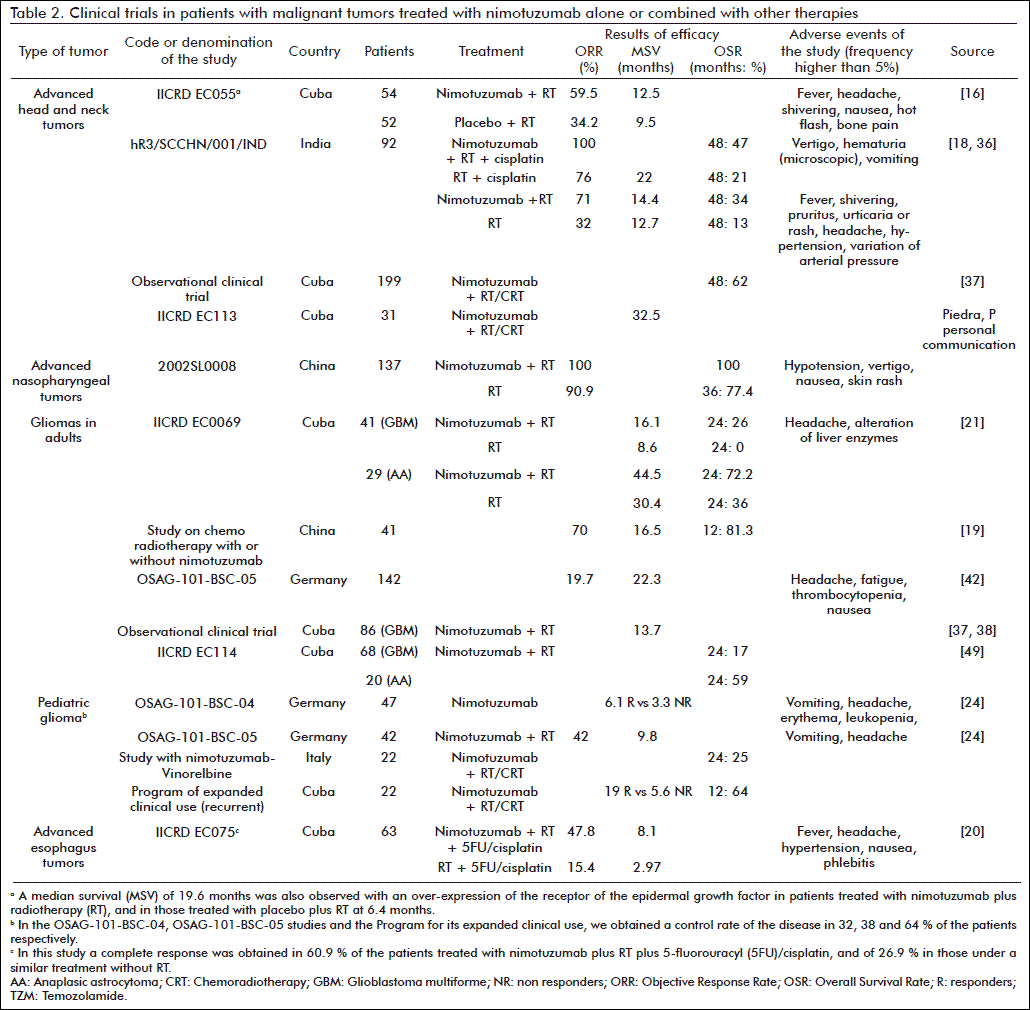
<P   >&nbsp;</P >   <FONT size="+1"><FONT size="+1">        <P   ><font face="Verdana, Arial, Helvetica, sans-serif" size="3"><b>CLINICAL EFFICACY</b></font></P >   <FONT size="+1">        <P   ><font size="2" face="Verdana, Arial, Helvetica, sans-serif">More than 20 clinical      trials have concluded for their assessment in several tumors, as proof of      concept, efficacy tests and therapeutic efficacy that endorsed their sanitary      registration, which include: </font></P >   <FONT size="+1">        <P   ><font size="2" face="Verdana, Arial, Helvetica, sans-serif">- Treatment of head      and neck tumors at advanced stages, combined with radiotherapy, chemotherapy      or both. </font></P >       <P   ><font size="2" face="Verdana, Arial, Helvetica, sans-serif">- As a monotherapy      for highly malignant astrocytoma in children receiving onco-specific treatments      with a refractory response. </font></P >       <P   ><font size="2" face="Verdana, Arial, Helvetica, sans-serif">- Treatment of Glioblastoma      multiforme (GBM) combined with radiotherapy in adult patients. </font></P >       <P   ><font size="2" face="Verdana, Arial, Helvetica, sans-serif">- Treatment of carriers      of non-operable malignant esophagus tumors of epithelial origin combined with      chemoradiotherapy (CRT) [25]. </font></P >       <P   ><font size="2" face="Verdana, Arial, Helvetica, sans-serif">The use of nimotuzumab      has been evaluated when combined with cytostatics, with alkylating agents      (cyclophosphamide, cisplatin, carboplatin), vinca alkaloids (vinblastin, vinorelbin,      etoposide), topoisomerase inhibitors (irinotecan), cytostatic antibiotics      (adriamycin, mitoxantrone), anti-metabolites (methotrexate, 5-fluorouracil)      and taxans (docetaxel), among others [18-20, 22, 24, 26-33]. The patients      treated with these combinations have tolerated them very well, without showing      exacerbation of adverse reactions to these medications. We must point out      that there is no knowledge on nimotuzumab possible antagonic interactions      with other medications. Below are details of the main clinical results in      the diseases for which it has been registered. </font></P >       <P   ><font size="2" face="Verdana, Arial, Helvetica, sans-serif"><b>Advanced head      and neck tumors </b></font></P >       ]]></body>
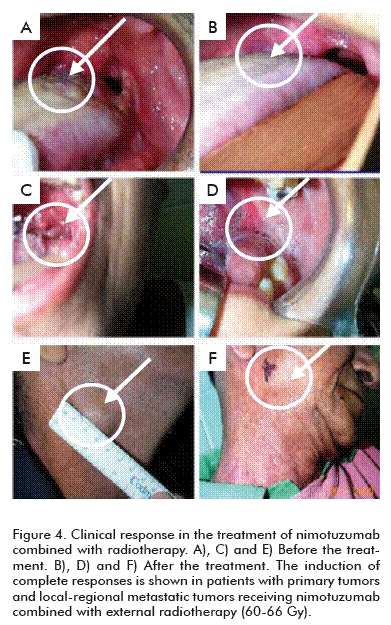
<body><![CDATA[<P   ><font size="2" face="Verdana, Arial, Helvetica, sans-serif">Phase I and II trials      to assess the dose and therapeutic effect of nimotuzumab in advanced head      and neck tumors, carried out in Cuba and Canada, demonstrated that when it      is combined with radiotherapy there is an increase in the percentage of objective      response of between 70 and 100 %, compared to the objective response of the      radioactive therapy, which is in the range of 30 to 40 % (<a href="#fig4">Figure      4</a>) [10, 34]. </font></P >       <P align="center"   ><img src="/img/revistas/bta/v31n2/f0407214.gif" width="389" height="622"><a name="fig4"></a></P >       
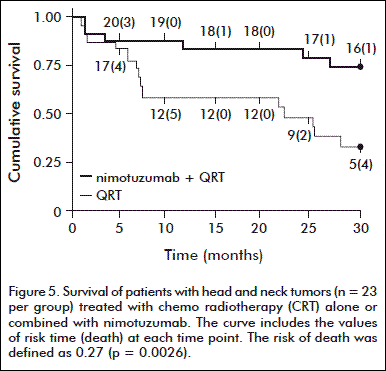
<P   ><font size="2" face="Verdana, Arial, Helvetica, sans-serif">To confirm the efficacy      of the nimotuzumab in patients with newly diagnosed non-resectable advanced      head and neck tumors, three controlled and randomized comparative studies      were carried out [16, 18, 35]. </font></P >       <P   ><font size="2" face="Verdana, Arial, Helvetica, sans-serif">An initial trial      in Cuba assessed the combination of nimotuzumab with radiotherapy, against      radiotherapy plus placebo. The response rate in patients receiving nimotuzumab      and radiotherapy was of 59.5 %, which is significantly higher than the value      of those receiving the radiotherapy and placebo that was of 34.2 % (Fisher      test, p = 0.038). There was a significant increase of survival in the subjects      treated with nimotuzumab (median: 12.5 months), compared with the group receiving      placebo (median: 9.5 months), according to the Harrington-Fleming statistical      test (p &lt; 0.05). In the subgroup of patients with a high expression of      EGFR (3+), having the worse prognosis, there was an even greater benefit in      those receiving nimotuzumab: 19.6 months of survival, compared to the group      receiving radiotherapy alone: 6.4 months (p &lt; 0.05) [16]. </font></P >       <P   ><font size="2" face="Verdana, Arial, Helvetica, sans-serif">A second randomized      trial, carried out in India, evaluated the effect of nimotuzumab combined      with radiotherapy and CRT. The objective response rate in groups receiving      nimotuzumab combined with radiotherapy was of 76 %, and 100 % in those receiving      nimotuzumab combined with CRT. In the other two groups of patients receiving      radiotherapy or CRT alone, the objective rate of response was of 40 and 76      %, respectively. These differences were statistically significant. The inclusion      of MAbs in radiotherapy and in CRT also significantly increased survival,      which was estimated at a mean of 49.4 months compared to 16.4 months, in those      only receiving radiotherapy and conventional CRT (risk of death, HR: 0.517)      [18]. </font></P >       <P   ><font size="2" face="Verdana, Arial, Helvetica, sans-serif">The survival rate      at 48 months was significantly higher in the two groups of patients: 47 %      in those receiving nimotuzumab and CRT, against 21 % in the group receiving      CRT. At the same time, the survival rate in the group receiving nimotuzumab      and radiotherapy was of 34 %, compared with the group of patients treated      with conventional radiotherapy, which was of 13 % (<a href="#fig5">Figure      5</a>) [36]. </font></P >       <P align="center"   ><img src="/img/revistas/bta/v31n2/f0507214.gif" width="384" height="369"><a name="fig5"></a></P >       
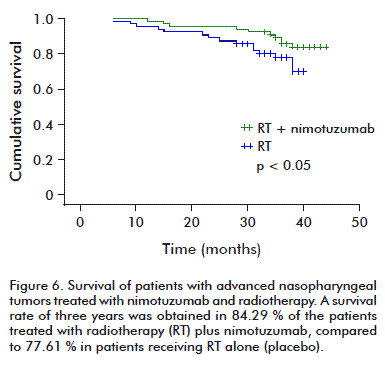
<P   ><font size="2" face="Verdana, Arial, Helvetica, sans-serif">A third trial in      patients with advanced nasopharynx tumors, in China, evaluated the use of      nimotuzumab combined with radiotherapy. The objective response rate after      treating for 17 weeks was of 90.6 %; and it was 51.5 %, in the group treated      with radiotherapy alone. The evolution of the patients was later studied,      showing that the group of patients receiving the combined treatment of nimotuzumab      and radiotherapy had a 3-year survival of 84.3 %; compared to the group treated      with radiotherapy alone, in which it was 77.6 % (p &lt; 0.05 %) (<a href="#fig6">Figure      6</a>) [35]. </font></P >       <P align="center"   ><img src="/img/revistas/bta/v31n2/f0607214.gif" width="383" height="363"><a name="fig6"></a></P >       
<P   ><font size="2" face="Verdana, Arial, Helvetica, sans-serif"><b>Post-marketing      experience in the indication of advanced head and neck tumors </b></font></P >       ]]></body>
<body><![CDATA[<P   ><font size="2" face="Verdana, Arial, Helvetica, sans-serif">An observational      clinical trial was carried out in Cuba to evaluate the combined treatment      of nimotuzumab and radiotherapy, and of nimotuzumab and CRT, in patients with      advanced head and neck tumors. In this study a survival rate at 48 months      of 62 % was estimated [37]. In an analysis of survival according to the number      of doses of nimotuzumab received, it was found that the patients receiving      the induction treatment alone (6 doses) reached a mean survival of 12.3 months      [38]. That time was equivalent to that described in studies before its registration      in which an identical therapeutic regime was applied of only 6 doses combined      with radiotherapy (12.5 months and 14.4 months) [16, 18]. In patients who      continued the monoclonal treatment as maintenance beyond the 6 doses, this      median was not achieved [38]. This result serves as the basis for the proposal      of the extension of the nimotuzumab treatment as maintenance. </font></P >       <P   ><font size="2" face="Verdana, Arial, Helvetica, sans-serif">A study made after      registration (phase IV), ongoing now in Cuba, assesses the combined therapy      of MAb with radiotherapy and chemotherapy, as well as the maintenance therapy.      In a partial analysis, the estimation of the median for survival for the nimotuzumab      and radiotherapy group was of 14.6 months, while the combination of the MAb      together with CRT was of 32.5 months (Piedra P, Nimomeeting 2012; personal      communication). </font></P >       <P   ><font size="2" face="Verdana, Arial, Helvetica, sans-serif">In terms of survival,      these studies in an open population confirm the effectiveness of the combination      of nimotuzumab with conventional radiotherapy in patients with advanced head      and neck tumors and they uphold the clinical benefit of their use in maintenance      therapy. </font></P >       <P   ><font size="2" face="Verdana, Arial, Helvetica, sans-serif"><b>Therapy for high      malignancy grade gliomas </b></font></P >       <P   ><font size="2" face="Verdana, Arial, Helvetica, sans-serif">The World Health      Organization classifies the gliomas of high malignancy grade as anaplastic      astrocytomas (AA or degree III) and multiform glioblastomas (GBM or degree      IV) [39]. </font></P >       <P   ><font size="2" face="Verdana, Arial, Helvetica, sans-serif">The life expectancy      of patients with GBM alone in a support treatment is of 3 months, and the      survival rate after one year is of 3 %. The inclusion of radiotherapy after      the surgical resection of the tumor increases survival in 8 months, with a      rate of survival after one year of 24 % [40]. </font></P >       <P   ><font size="2" face="Verdana, Arial, Helvetica, sans-serif">The proof of concept      study, combining nimotuzumab and radiotherapy after surgery, achieved objective      responses of 37.9 % in patients and the stabilization of 41.4 %, with an overall      survival of 22.17 months. However, in patients who were MGB carriers it was      of 17.47 months, and it did not reach the median of those with AA [41]. Three      controlled and randomized studies for the evaluation and confirmation of efficacy      were later carried out [19, 21, 24]. </font></P >       <P   ><font size="2" face="Verdana, Arial, Helvetica, sans-serif">The first trial (phase      II/III) in Cuba, evaluated the combination of nimotuzumab and radiotherapy.      Overall survival of 44.5 months was significantly higher in the experimental      group compared to 30.4 months in the control group that only received radiotherapy      [21]. The group of patients with GBM treated with the MAb and radiotherapy,      which followed the treatment schedule programmed in the protocol, doubled      the median survival, compared to the control group treated with radiotherapy      and placebo, i.e., 16.1 versus 8.6 months. At the same time, the survival      rate at two years was higher in patients with GBM or AA treated with nimotuzumab      compared to those untreated: 26 versus 0 %, and 72.2 versus 36 %, respectively      [21]. </font></P >       <P   ><font size="2" face="Verdana, Arial, Helvetica, sans-serif">As the conventional      therapy in patients with <i>de novo</i> GBM is surgery, followed by radiotherapy      and chemotherapy with temozolamide (TMZ), we also evaluated the combination      of nimotuzumab with radiotherapy and TMZ [19, 24]. </font></P >       <P   ><font size="2" face="Verdana, Arial, Helvetica, sans-serif">One of these studies      (phases I/II) in China, described an objective response rate of 70.0 %, in      the group receiving nimotuzumab, and of 52.4 % in the control group. The median      survival of these groups was 16.5 and 10.5 months, respectively. The survival      rate after one year was 81.3 % (for the group receiving nimotuzumab) and 69.1      % (for the control group). Although these differences were not significant,      there is a trend toward a better performance of the combination of MAb with      conventional therapy [19]. </font></P >       ]]></body>
<body><![CDATA[<P   ><font size="2" face="Verdana, Arial, Helvetica, sans-serif">The following study      (phase III) was in Germany. The result of survival between groups was of 22.3      months (confidence interval, CI, was 17.2-26.5) in the group receiving nimotuzumab      plus radiotherapy and TMZ, and of 19.6 months (CI of 14.8-24.0) in the group      receiving radiotherapy and TMZ. An analysis of the poor prognosis factors,      where patients are grouped according to whether there was a post-surgery tumor,      tumoral necrosis of 10 % and a non-methylated state of the methylguanine methyltransferase      enzyme (MGMT), showed a significant difference in survival in favor of patients      receiving nimotuzumab compared to the control group (23.8 versus 13.8 months,      p = 0.03) [42]. </font></P >       <P   ><font size="2" face="Verdana, Arial, Helvetica, sans-serif">This finding indicated      that there is a subpopulation of patients who, in spite of their poor prognosis,      even when disfavored with TMZ, can benefit from the combination with this      new therapeutic alternative. Therefore, future studies must investigate the      efficacy in this type of patient. </font></P >       <P   ><font size="2" face="Verdana, Arial, Helvetica, sans-serif"><b>Post-marketing      experience in the indication of malignant gliomas </b></font></P >       <P   ><font size="2" face="Verdana, Arial, Helvetica, sans-serif">To confirm the effectiveness      of the combination of nimotuzumab with radiotherapy after surgery in patients      with recently diagnosed malignant gliomas (AA and GBM), an observational post-marketing      clinical trial was carried out in Cuba. All patients received nimotuzumab      at the dose and schedule for induction and maintenance recommended in the      leaflet, and they were followed-up for three years. At the end of the study      the median survival was estimated in 13.7 months for the patients with MGB,      and the median was not reached in patients with AA [37]. </font></P >       <P   ><font size="2" face="Verdana, Arial, Helvetica, sans-serif">A partial analysis      of another phase IV trial in progress in Cuba describes a progression-free      survival (PFS) rate at 24 months of 18 % in patients with GBM and of 65 %      in patients with AA, with a survival rate at 24 months of 17 and 59 %, respectively      [43]. </font></P >       <P   ><font size="2" face="Verdana, Arial, Helvetica, sans-serif">All studies carried      out before and after the registration of nimotuzumab confirm the therapeutic      efficacy of the combination of the MAb with radiotherapy and potentially with      CRT. At the same time, there is evidence that the prolonged maintenance with      this drug also increases survival when it is used to treat these conditions.      </font></P >       <P   ><font size="2" face="Verdana, Arial, Helvetica, sans-serif"><b>Treatment of pediatric      patients with high malignancy grade astrocytomas: recurrent, refractory or      both </b></font></P >       <P   ><font size="2" face="Verdana, Arial, Helvetica, sans-serif">Life expectancy in      pediatric patients with recurrent brain tumors that are refractory to conventional      treatments such as surgery, radiation and chemotherapy, is of approximately      one month. Besides its bad prognosis, there is no standard treatment for this      condition [44]. </font></P >       <P   ><font size="2" face="Verdana, Arial, Helvetica, sans-serif">Taking into account      this urgent medical need and the therapeutic potential of nimotuzumab in neuroepithelial      tumors, an open uncontrolled clinical trial was carried out in Germany in      pediatric patients with high malignancy grade astrocytic tumors that were      recurrent or refractory to conventional treatments [24]. For 12 weeks, they      received 150 mg of nimotuzumab -per m2 of body surface as a monotherapy, with      maintenance every 15 days, left to the discretion of the researcher, in responders.      A total of 37.8 % of the patients treated perceived objective responses, particularly      in the subgroup of patients with brain stem tumors. </font></P >   <FONT size="+1"><FONT size="+1">        <P   ><font size="2" face="Verdana, Arial, Helvetica, sans-serif">In relation to PFS,      a median of 50 days was estimated (one day standard deviation, range: 12-637      days, CI: 48-52 days). The median survival of all patients was of 140 days;      approximately 5 months (standard deviation of 18 days, range: 12-1180 days,      CI: 104-176 days). It was significantly different between responders and non-responders:      6.1 versus 3.6 months (p = 0.001) [24]. </font></P >       ]]></body>
<body><![CDATA[<P   ><font size="2" face="Verdana, Arial, Helvetica, sans-serif"><b>Post-marketing      experience in the treatment of pediatric patients with high malignancy grade      astrocytomas: recurrent, refractory or showing both types of behavior </b></font></P >       <P   ><font size="2" face="Verdana, Arial, Helvetica, sans-serif">As a consequence      of the previous study, a program was developed for its expanded clinical use      in pediatric patients with recurrent brain tumors, in Cuba. Nimotuzumab was      administered in doses of 100 mg and 150 mg/m<sup>2</sup> as a monotherapy      and combined with chemotherapy. The disease control rate and the survival      rate after one year reached 64 %. The most important findings include the      recovery of neurologic functions and the improvement of the general condition      of the patients during the treatment, especially in those where the disease      was controlled [45]. <a href="/img/revistas/bta/v31n2/f0707214.gif">Figure      7</a> shows the response to the treatment with nimotuzumab in a patient included      in this study. </font></P >   <FONT size="+1"><FONT size="+1"><FONT size="+1">        
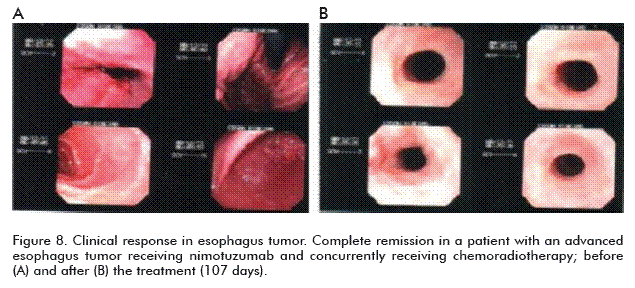
<P   ><font size="2" face="Verdana, Arial, Helvetica, sans-serif"><b>Other studies      in pediatric glioma </b></font></P >       <P   ><font size="2" face="Verdana, Arial, Helvetica, sans-serif">A recent multinational      (Germany, Italy and Russia) phase III uncontrolled clinical trial evaluated      the efficacy of the combination of nimotuzumab with radiotherapy in pediatric      patients with newly diagnosed diffuse brain stem gliomas. The survival median      was of 9.4 months and the PFS rate was of 33.3 %. These results demonstrate      that the combination of nimotuzumab with radiotherapy did not surpass the      efficacy of chemotherapy in this disease, although nimotuzumab was less toxic      [24]. </font></P >       <P   ><font size="2" face="Verdana, Arial, Helvetica, sans-serif">In Italy, we evaluated      another therapeutic alternative in pediatric patients with diffuse brain stem      gliomas, consisting of the combination of nimotuzumab with radiotherapy and      vinorelbin [24, 46]. The PFS rate was of 20 % after one year; the general      rate of survival was of 73 %; and of 25 % at one and two years.</font></P >       <P   ><font size="2" face="Verdana, Arial, Helvetica, sans-serif">In agreement with      the latter, it has been demonstrated that nimotuzumab is effective when administered      alone and combined with radiotherapy and chemotherapy for newly diagnosed      and recurrent pediatric glial tumors. </font></P >       <P   ><font size="2" face="Verdana, Arial, Helvetica, sans-serif"><b>Patients with      malignant inoperable esophagus tumors of epithelial origin </b></font></P >       <P   ><font size="2" face="Verdana, Arial, Helvetica, sans-serif">Advanced esophagus      tumors, essentially those of the upper one third of the esophagus have histological      adenosquamous similarities with the malignant head and neck tumors, and also      overexpress the EGFR. The normal treatment for advanced and non resectable      tumors is the CRT, based on cisplatin with fluoruracyl. With this therapeutic      regime, the rate of objective response is of 30 to 60 %, and the survival      median is of less than one year [47]. In a controlled and randomized clinical      trial the treatment with nimotuzumab used to counteract the EGFR in patients      with esophagus malignant tumors, was higher when combined with CRT [20]; the      control rate of the disease was significantly increased in 60.9 % compared      to CRT alone (26.9 %). The survival median was higher in the MAb group compared      to the control group: 8.1 months vs 3 months [20]. </font></P >       <P   ><font size="2" face="Verdana, Arial, Helvetica, sans-serif">The preliminary analysis      of a second controlled and random study in progress in Brazil has verified      the antitumor effect of the nimotuzumab combined with CRT in patients with      advanced esophagus cancer (<a href="/img/revistas/bta/v31n2/f0807214.gif">Figure      8</a>) [48]. </font></P >       
<P   ><font size="2" face="Verdana, Arial, Helvetica, sans-serif"><a href="/img/revistas/bta/v31n2/t0207214.gif">Table      2</a> summarizes the main results of its clinical efficacy for the conditions      for which it was registered. </font></P >       
]]></body>
<body><![CDATA[<P   >&nbsp;</P >       <P   ><font size="3" face="Verdana, Arial, Helvetica, sans-serif"><b>CLINICAL EVALUATION      IN OTHER ONCOLOGICAL INDICATIONS</b></font></P >   <FONT size="+1">        <P   ><font size="2" face="Verdana, Arial, Helvetica, sans-serif">Due to the therapeutic      potential of Nimotuzumab in malignant tumors of epithelial origin, we are      evaluating it in other oncological conditions, such as advanced non-small      cell lung tumors, gastric tumors, colorectal tumors, liver carcinoma, pancreas      carcinoma, breast cancer, cervix and prostate cancers and malignant meningiomas      [50-52]. </font></P >       <P   >&nbsp;</P >   <FONT size="+1">        <P   ><font size="3" face="Verdana, Arial, Helvetica, sans-serif"><b>TOXICOLOGY</b></font></P >   <FONT size="+1">        <P   ><font size="2" face="Verdana, Arial, Helvetica, sans-serif"><b>Immunogenicity      studies </b> </font></P >   <FONT size="+1">        <P   ><font size="2" face="Verdana, Arial, Helvetica, sans-serif">A high monkey (<i>Cercopithecus      aethiops</i>) anti-mouse antibody response (MAMA), was obtained with the murine      antibody ior egf/r3. However, with the humanized version (nimotuzumab), the      response was not measurable after two immunizations, and low titers were obtained      after four subcutaneous administrations of the antibody coupled to the adjuvant.      This experiment demonstrated the low immunogenicity of the humanized version      [53, 54]. </font></P >       <P   ><font size="2" face="Verdana, Arial, Helvetica, sans-serif"><b>Single dose toxicity      studies </b></font></P >       <P   ><font size="2" face="Verdana, Arial, Helvetica, sans-serif">Increasing dosages      of Nimotuzumab of up to 10 times the equivalent dose established for humans,      400 mg (5.71 mg/kg), were used to evaluate the toxicity of a single dose in      Sprague Dawley rats. No significant signs of toxicity were observed, which      could be attributed to the administration of any of the doses of the product,      not even when assessing the highest dose [7]. </font></P >       <P   ><font size="2" face="Verdana, Arial, Helvetica, sans-serif"><b>Pharmacotoxicology      study at repeated doses </b></font></P >       ]]></body>
<body><![CDATA[<P   ><font size="2" face="Verdana, Arial, Helvetica, sans-serif">Repeated daily dosages      of Nimotuzumab were supplied by the intravenous route to green monkeys (<I>Cercopithecus      aethiops sabaeus</I>) for 14 days in proportions of 2.85 or 11.4 mg/kg of      body weight. This corresponded approximately to one and four times the effective      dose at 50 % (ED50) for human beings: 200 mg (total dose). This study demonstrated      that the administration of up to 11.4 mg/kg of nimotuzumab did not produce      alterations that could be interpreted as signs of toxicity or undesirable      pharmacological side effects [54]. </font></P >       <P   ><font size="2" face="Verdana, Arial, Helvetica, sans-serif"><b>Local tolerance      </b></font></P >       <P   ><font size="2" face="Verdana, Arial, Helvetica, sans-serif">An experiment in      rabbits was also carried out to assess local tolerance, in which nimotuzumab      was administered by the intravenous route while using a control group. A microscopic      erythema was observed near the injection site in two animals; one of them      had been treated with nimotuzumab and the other belonged to the control group.      Inflammation was not observed after the administration of the product in any      animal. The histopathological studies did not show any intravenous irritation      produced by the administration of the medication [43]. </font></P >       <P   ><font size="2" face="Verdana, Arial, Helvetica, sans-serif">In skin biopsies      of patients submitted to the intravenous administration of 200 mg of nimotuzumab,      the perivascular lymphocytic inflammatory infiltrate, which is detected when      using other EGFR inhibitors [17], was confirmed to be lacking in the superficial      dermis. </font></P >       <P   >&nbsp;</P >       <P   ><font size="2" face="Verdana, Arial, Helvetica, sans-serif"><B><font size="3">SAFETY      PROFILE OF NIMOTUZUMAB IN HUMANS</font></B></font></P >   <FONT size="+1">        <P   ><font size="2" face="Verdana, Arial, Helvetica, sans-serif"><b>Adverse reactions      in clinical trials</b> </font></P >   <FONT size="+1">        <P   ><font size="2" face="Verdana, Arial, Helvetica, sans-serif">The adverse reactions      in clinical trials before registration, most of which were shivering, nausea,      headache, vomiting, anemia, arterial hypotension or hypertension, fever, increased      liver enzymes (alkaline phosphatase and oxalacetic and glutamic-pyruvic transaminases).      </font></P >       <P   ><font size="2" face="Verdana, Arial, Helvetica, sans-serif">Other less frequent      adverse reactions were sleepiness, disorientation, myalgia, motor dysphasia,      incoherent language, buccal dryness, face reddening, weakening of lower limbs,      phlebitis, increase of creatinine, leukopenia, hematuria, thoracic pain and      peribuccal cyanosis [55]. Because of their intensity, these reactions are      classified as mild or moderate, according to the common toxicity criteria      (CTCAE, version 3) and they disappeared with conventional treatments. </font></P >       <P   ><font size="2" face="Verdana, Arial, Helvetica, sans-serif">It should be stressed      that nimotuzumab has been used in vulnerable populations such as the elderly      and children, with good tolerance and an identical safety profile to that      of the rest of the population [27, 37, 45]. This biopharmaceutical can be      administered as a prolonged maintenance treatment, without any evidence of      cumulative toxicity or the exacerbation of toxicity by other concomitant therapies      [27, 37, 45]. </font></P >       ]]></body>
<body><![CDATA[<P   ><font size="2" face="Verdana, Arial, Helvetica, sans-serif"><b>Adverse criteria      described in the post-marketing experience </b></font></P >       <P   ><font size="2" face="Verdana, Arial, Helvetica, sans-serif">After registering      the nimotuzumab, an observational, prospective, multicenter and open clinical      trial was carried out with the treatment of 577 patients with advanced tumors      of epithelial origin; 89 of them were of pediatric ages and 488 adults. In      19.1 and 22.5 %, of them respectively, there was at least one adverse event      observed during the treatment. The association between the exposure time to      the monoclonal antibody, the number of doses applied and the frequency of      the presence of adverse events was not proven. There was no influence in the      intensity of the events either, regardless the causal relationship. Most of      the events were classified as mild or moderate. Very few severe adverse events      were notified, <i>i.e</i>., one patient with anaphylaxis, one with venous      thrombosis, one with lipothymia and another one with tumoral lysis syndrome      [37]. </font></P >       <P   ><font size="2" face="Verdana, Arial, Helvetica, sans-serif">The overall report      on nimotuzumab safety (issued in 2012) shows that out of a total of 38 629      patients, 10 % of them were treated in clinical trials and the other 90 %      were treated following the doctor's prescription. There were 36 severe adverse      events related to nimotuzumab; 16.7 % of them showed a definitive causal effect,      25 % were probable and 58.3 % were possible (Sierra P, 2012, personal communication).      Those included within the adverse events having an incidence of 5 % or more      were: vomiting (16.7 %), nausea (11.1 %), gastrointestinal hemorrhage (5.6      %); or an allergic/immunological cause such as infusion reaction (8.3 %) and      anaphylaxis (5.6 %). </font></P >       <P   ><font size="2" face="Verdana, Arial, Helvetica, sans-serif"><a href="/img/revistas/bta/v31n2/t0207214.gif">Table      2</a> and <a href="/img/revistas/bta/v31n2/t0307214.gif">table 3</a>      summarize the most frequent adverse events reported in clinical trials before      and after the registration of nimotuzumab. </font></P >       
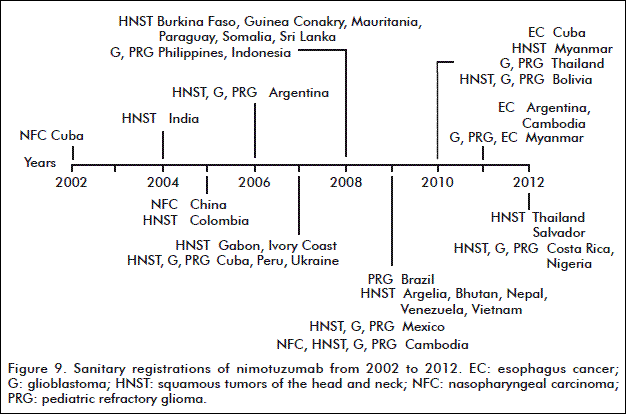
<P   ><font size="2" face="Verdana, Arial, Helvetica, sans-serif">This demonstrates      that the product is well tolerated as a single treatment or combined with      the conventional oncological therapies, without any exacerbation of toxicity.      Furthermore, it is distinguished by its infrequent dermatological toxicity,      compared to other anti-EGFR [56]. This differential toxicity profile can be      explained, above all, because nimotuzumab has an intermediate affinity for      EGFR, which favors the binding of the MAb with cells having a higher density      of receptors, such as malignant cells, compared to the normal cells with less      density. Therefore, its affinity is optimized for the tumors, precisely where      it achieves a bivalent binding that is an effector of the blocking of the      signaling cascade for cellular proliferation, and it does not produce damage      to normal epithelial cells [17, 57]. </font></P >       <P   >&nbsp;</P >       <P   ><font size="3" face="Verdana, Arial, Helvetica, sans-serif"><b>REGULATORY CONDITION</b></font></P >   <FONT size="+1">        <P   ><font size="2" face="Verdana, Arial, Helvetica, sans-serif">Since 2004, The European      Medicine Agency (EMA) and the Food and Drug Administration (FDA) of the United      States classified nimotuzumab as an &quot;orphan drug&quot; for pediatric      gliomas. And since 2008, it is so for pancreas cancer, as defined by EMA [17].      This medication has a sanitary registration in 31 countries (until March of      2013) (<a href="/img/revistas/bta/v31n2/f0907214.gif">Figure 9</a>).      </font></P >       
<P   >&nbsp;</P >   <FONT size="+1">        <P   ><font size="3"><b><font face="Verdana, Arial, Helvetica, sans-serif">CONCLUSIONS</font></b></font></P >   <FONT size="+1">        ]]></body>
<body><![CDATA[<P   ><font size="2" face="Verdana, Arial, Helvetica, sans-serif">Nimotuzumab is a      novel humanized MAb with an antitumor effect that is noted by the increase      of the survival of patients with advanced head and neck tumors, malignant      glial tumors and advanced esophagus tumors, demonstrated by controlled studies      and in medical practice. Its safety profile surpasses that of other monoclonal      antibodies anti-EGFR, thereby favoring its combined use with other conventional      therapies, its utilization as a prolonged maintenance medication, and in vulnerable      populations as of the elderly and children. </font></P >   <FONT size="+1">        <P   ><font size="2" face="Verdana, Arial, Helvetica, sans-serif">Its therapeutic potential      in tumors of epithelial origin ensures the continuity of the ongoing studies      on its safety and efficacy in several diseases. </font></P >       <P   >&nbsp;</P >       <P   ><b><font face="Verdana, Arial, Helvetica, sans-serif" size="3">REFERENCES</font></b></P >       <!-- ref --><P   ><font face="Verdana, Arial, Helvetica, sans-serif" size="2">1. Cohen S. Isolation      of a mouse submaxillary gland protein accelerating incisor eruption and eyelid      opening in the new-born animal. J Biol Chem. 1962;237:1555-62.    </font></P >       <!-- ref --><P   ><font face="Verdana, Arial, Helvetica, sans-serif" size="2">2. Cowley GP, Smith      JA, Gusterson BA. Increased EGF receptors on human squamous carcinoma cell      lines. Br J Cancer. 1986;53(2):223-9.    </font></P >       <!-- ref --><P   ><font face="Verdana, Arial, Helvetica, sans-serif" size="2">3. Ciardiello F,      Tortora G. Epidermal growth factor receptor (EGFR) as a target in cancer therapy:      understanding the role of receptor expression and other molecular determinants      that could influence the response to anti-EGFR drugs. Eur J Cancer. 2003;39(10):1348-54.    </font></P >       ]]></body>
<body><![CDATA[<!-- ref --><P   ><font face="Verdana, Arial, Helvetica, sans-serif" size="2">4. Mendelsohn J,      Baselga J. The EGF receptor family as targets for cancer therapy. Oncogene.      2000;19(56):6550-65.    </font></P >       <!-- ref --><P   ><font face="Verdana, Arial, Helvetica, sans-serif" size="2">5. Cohen EE. Role      of epidermal growth factor receptor pathway-targeted therapy in patients with      recurrent and/or metastatic squamous cell carcinoma of the head and neck.      J Clin Oncol. 2006;24(17):2659-65.    </font></P >       <!-- ref --><P   ><font face="Verdana, Arial, Helvetica, sans-serif" size="2">6. Agulnik M. New      approaches to EGFR inhibition for locally advanced or metastatic squamous      cell carcinoma of the head and neck (SCCHN). Med Oncol. 2012;29(4):2481-91.    </font></P >       <!-- ref --><P   ><font face="Verdana, Arial, Helvetica, sans-serif" size="2">7. Mateo C, Moreno      E, Amour K, Lombardero J, Harris W, Perez R. Humanization of a mouse monoclonal      antibody that blocks the epidermal growth factor receptor: recovery of antagonistic      activity. Immunotechnology. 1997;3(1):71-81.    </font></P >       <!-- ref --><P   ><font face="Verdana, Arial, Helvetica, sans-serif" size="2">8. Prieto Y, Rojas      L, Hinojosa L, Gonzalez I, Aguiar D, de la Luz K, et al. Towards the molecular      characterization of the stable producer phenotype of recombinant antibody-producing      NS0 myeloma cells. Cytotechnology. 2011;63(4):351-62.    </font></P >       ]]></body>
<body><![CDATA[<!-- ref --><P   ><font face="Verdana, Arial, Helvetica, sans-serif" size="2">9. Crombet-Ramos      T, Rak J, Perez R, Viloria-Petit A. Antiproliferative, antiangiogenic and      proapoptotic activity of h-R3: A humanized anti-EGFR antibody. Int J Cancer.      2002;101(6):567-75.    </font></P >       <!-- ref --><P   ><font face="Verdana, Arial, Helvetica, sans-serif" size="2">10. Crombet T, Osorio      M, Cruz T, Roca C, del Castillo R, Mon R, et al. Use of the humanized anti-epidermal      growth factor receptor monoclonal antibody h-R3 in combination with radiotherapy      in the treatment of locally advanced head and neck cancer patients. J Clin      Oncol. 2004;22(9):1646-54.    </font></P >       <!-- ref --><P   ><font face="Verdana, Arial, Helvetica, sans-serif" size="2">11. Crombet T, P&eacute;rez      R, Lage A, Osorio M, Cruz T. Anticuerpo monoclonal humanizado h-R3: un nuevo      concepto terap&eacute;utico para el tratamiento del c&aacute;ncer avanzado.      Biotecnol Apl. 2003;20(1):33-51.    </font></P >       <!-- ref --><P   ><font face="Verdana, Arial, Helvetica, sans-serif" size="2">12. Diaz Miqueli      A, Blanco R, Garcia B, Badia T, Batista AE, Alonso R, et al. Biological activity      in vitro of anti-epidermal growth factor receptor monoclonal antibodies with      different affinities. Hybridoma. 2007;26(6):423-31.    </font></P >       <!-- ref --><P   ><font face="Verdana, Arial, Helvetica, sans-serif" size="2">13. Diaz Miqueli      A, Rolff J, Lemm M, Fichtner I, Perez R, Montero E. Radiosensitisation of      U87MG brain tumours by anti-epidermal growth factor receptor monoclonal antibodies.      Br J Cancer. 2009;100(6):950-8.    </font></P >       ]]></body>
<body><![CDATA[<!-- ref --><P   ><font face="Verdana, Arial, Helvetica, sans-serif" size="2">14. Akashi Y, Okamoto      I, Iwasa T, Yoshida T, Suzuki M, Hatashita E, et al. Enhancement of the antitumor      activity of ionising radiation by nimotuzumab, a humanised monoclonal antibody      to the epidermal growth factor receptor, in non-small cell lung cancer cell      lines of differing epidermal growth factor receptor status. Br J Cancer. 2008;98(4):749-55.    </font></P >       <!-- ref --><P   ><font face="Verdana, Arial, Helvetica, sans-serif" size="2">15. Basavaraj C,      Sierra P, Shivu J, Melarkode R, Montero E, Nair P. Nimotuzumab with chemoradiation      confers a survival advantage in treatment-naive head and neck tumors over      expressing EGFR. Cancer Biol Ther. 2010;10(7):673-81.    </font></P >       <!-- ref --><P   ><font face="Verdana, Arial, Helvetica, sans-serif" size="2">16. Rodriguez MO,      Rivero TC, del Castillo Bahi R, Muchuli CR, Bilbao MA, Vinageras EN, et al.      Nimotuzumab plus radiotherapy for unresectable squamous-cell carcinoma of      the head and neck. Cancer Biol Ther. 2010;9(5):343-9.    </font></P >       <!-- ref --><P   ><font face="Verdana, Arial, Helvetica, sans-serif" size="2">17. Rojo F, Gracias      E, Villena N, Cruz T, Corominas JM, Corradino I, et al. Pharmacodynamic trial      of nimotuzumab in unresectable squamous cell carcinoma of the head and neck:      a SENDO Foundation study. Clin Cancer Res. 2010;16(8):2474-82.    </font></P >       <!-- ref --><P   ><font face="Verdana, Arial, Helvetica, sans-serif" size="2">18. Ramakrishnan      MS, Eswaraiah A, Crombet T, Piedra P, Saurez G, Iyer H, et al. Nimotuzumab,      a promising therapeutic monoclonal for treatment of tumors of epithelial origin.      mAbs. 2009;1(1):41-8.    </font></P >       ]]></body>
<body><![CDATA[<!-- ref --><P   ><font face="Verdana, Arial, Helvetica, sans-serif" size="2">19. Hong J, Peng      Y, Liao Y, Jiang W, Wei R, Huo L, et al. Nimotuzumab prolongs survival in      patients with malignant gliomas: A phase I/II clinical study of concomitant      radiochemotherapy with or without nimotuzumab. Exp Ther Med. 2012;4(1):151-7.    </font></P >       <!-- ref --><P   ><font face="Verdana, Arial, Helvetica, sans-serif" size="2">20. Ramos-Suzarte      M, Lorenzo-Luaces P, Lazo NG, Perez ML, Soriano JL, Gonzalez CE, et al. Treatment      of malignant, non-resectable, epithelial origin esophageal tumours with the      humanized anti-epidermal growth factor antibody nimotuzumab combined with      radiation therapy and chemotherapy. Cancer Biol Ther. 2012;13(8):600-5.    </font></P >       <P   ><font face="Verdana, Arial, Helvetica, sans-serif" size="2">21. Solomon MT, Selva      JC, Figueredo J, Vaquer J, Toledo C, Quintanal N, et al. Radiotherapy plus      the anti-EGFR mAb nimotuzumab or placebo for the treatment of high-grade glioma      patients [Abstract]. J Clin Oncol. 2012;30(suppl):2515.</font></P >       <!-- ref --><P   ><font face="Verdana, Arial, Helvetica, sans-serif" size="2">22. Zhao XY, Guo      Y, Zhu YX, Wang Y, Zhu GP, Hu CS, et al. Clinical analysis of nimotuzumab      plus cisplatin and fluorouracil regimen as induction treatment in resectable      head and neck squamous cell carcinoma. Chinese J Otorhinolaryngol Head Neck      Surg. 2012;47(7):536-9.    </font></P >       <!-- ref --><P   ><font face="Verdana, Arial, Helvetica, sans-serif" size="2">23. Crombet T, Torres      L, Neninger E, Catala M, Solano ME, Perera A, et al. Pharmacological evaluation      of humanized anti-epidermal growth factor receptor, monoclonal antibody h-R3,      in patients with advanced epithelial-derived cancer. J Immunother. 2003;26(2):139-48.    </font></P >       <!-- ref --><P   ><font face="Verdana, Arial, Helvetica, sans-serif" size="2">24. Bode U, Massimino      M, Bach F, Zimmermann M, Khuhlaeva E, Westphal M, et al. Nimotuzumab treatment      of malignant gliomas. Expert Opin Biol Ther. 2012;12(12):1649-59.    </font></P >       <!-- ref --><P   ><font face="Verdana, Arial, Helvetica, sans-serif" size="2">25. Centro para el      Control Estatal de Medicamentos, Equipos y Dispositivos M&eacute;dicos. Registro      sanitario de medicamentos. La Habana: Cecmed. c2012[cited 2013 Dec 4]. Available      from: <a href="http://www.cecmed.cu/Pages/RegSan.htm" target="_blank">http://www.cecmed.cu/Pages/RegSan.htm</a>.    </font></P >       <!-- ref --><P   ><font face="Verdana, Arial, Helvetica, sans-serif" size="2">26. Meng J, Gu QP,      Meng QF, Zhang J, Li ZP, Si YM, et al. Efficacy of nimotuzumab combined with      docetaxel-cisplatin-fluorouracil regimen in treatment of advanced oral carcinoma.      Cell Biochem Biophys. 2014;68(1):181-4.    </font></P >       <!-- ref --><P   ><font face="Verdana, Arial, Helvetica, sans-serif" size="2">27. Cabanas R, Saurez      G, Rios M, Alert J, Reyes A, Valdes J, et al. Treatment of children with high      grade glioma with nimotuzumab: a 5-year institutional experience. mAbs. 2013;5(2):202-7.    </font></P >       <!-- ref --><P   ><font face="Verdana, Arial, Helvetica, sans-serif" size="2">28. Yan S, Jiang      X, Yang J, Yan D, Wang YX. Radiotherapy for nasopharyngeal carcinoma and combined      capecitabine and nimotuzumab treatment for lung metastases in a liver transplantation      recipient: a case experience of sustained complete response. Cancer Biother      Radiopharm. 2012;27(8):519-23.    </font></P >       <P   ><font face="Verdana, Arial, Helvetica, sans-serif" size="2">29. Qi DL, Wang HQ,      Li Y, Huang CB, Wang QS, Xu L, et al. [fficacy and adverse effets of nimotuzumab      plus palitaxel liposome and carboplatin in the treatment for advanced non-small      cell lung cancer. Chinese J Oncol. 2012;34(2):152-5.</font></P >       ]]></body>
<body><![CDATA[<!-- ref --><P   ><font face="Verdana, Arial, Helvetica, sans-serif" size="2">30. Li LF, Wang HQ,      Liu XM, Zhang HL, Qiu LH, Qian ZZ, et al. Nimotuzumab in combination with      chemotherapy in patients with advanced non-small cell lung cancer. Chinese      J Oncol. 2011;33(8):626-8.    </font></P >       <!-- ref --><P   ><font face="Verdana, Arial, Helvetica, sans-serif" size="2">31. Ling Y, Chen      J, Tao M, Chu X, Zhang X. A pilot study of nimotuzumab combined with cisplatin      and 5-FU in patients with advanced esophageal squamous cell carcinoma. J Thorac      Dis. 2012;4(1):58-62.    </font></P >       <!-- ref --><P   ><font face="Verdana, Arial, Helvetica, sans-serif" size="2">32. Verduzco-Rodriguez      L, Aguirre-Gonzalez EH, Verduzco-Aguirre HC. Durable complete response induced      by paclitaxel-nimotuzumab-methotrexate chemotherapy in a patient with metastatic      head and neck squamous cell carcinoma. Hematol Oncol Stem Cell Ther. 2011;4(4):182-4.    </font></P >       <!-- ref --><P   ><font face="Verdana, Arial, Helvetica, sans-serif" size="2">33. Zhao KL, Hu XC,      Wu XH, Fu XL, Fan M, Jiang GL. A phase I dose escalation study of Nimotuzumab      in combination with concurrent chemoradiation for patients with locally advanced      squamous cell carcinoma of esophagus. Invest New Drugs. 2012;30(4):1585-90.    </font></P >       <!-- ref --><P   ><font face="Verdana, Arial, Helvetica, sans-serif" size="2">34. Winquist E, Nabid      A, Sicheri D, Ganguly P, Venkatesan V, Schneider K, et al. A phase I dose      escalation study of a humanized monoclonal antibody to EGFR (hR3) in patients      with locally advanced squamous cell cancer of the head and neck (SCCHN) treated      with radiotherapy (RT) [Abstract]. Proc Am Soc Clin Oncol. 2002;21:91a.    </font></P >       ]]></body>
<body><![CDATA[<!-- ref --><P   ><font face="Verdana, Arial, Helvetica, sans-serif" size="2">35. Huang XD, Yi      JL, Gao L, Xu GZ, Jin J, Yang WZ, et al. Multi-center phase II clinical trial      of humanized anti-epidermal factor receptor monoclonal antibody h-R3 combined      with radiotherapy for locoregionally advanced nasopharyngeal carcinoma. Chinese      J Oncol. 2007;29(3):197-201.    </font></P >       <P   ><font face="Verdana, Arial, Helvetica, sans-serif" size="2">36. Babu K, Joseph      B, Vidyasagar MS, Bonanthaya R, Pasha CT, Bapsy PP et al: An open-label, randomized,      study of h-R3mAb (nimotuzumab) in patients with advanced (stage III or IVa)      squamous cell carcinoma of head and neck (SCCHN): Four-year survival results      from a phase IIb study [Abstract]. J Clin Oncol 2010;28(15 Suppl):428s.</font></P >       <!-- ref --><P   ><font face="Verdana, Arial, Helvetica, sans-serif" size="2">37. Piedra P, Morej&oacute;n      O. Report of the Fifth Nimotuzumab Global Meeting. Biotecnol Apl. 2010;27(1):56-61.    </font></P >       <P   ><font face="Verdana, Arial, Helvetica, sans-serif" size="2">38. Piedra P, Saurez      G, Barroso M, Led&oacute;n N. Observational clinical study in patients with      advanced stage epithelial tumors treated with nimotuzumab [Abstract]. Can      J Clin Pharmacol. 2010;17(1):e234.</font></P >       <!-- ref --><P   ><font face="Verdana, Arial, Helvetica, sans-serif" size="2">39. Fuller GN, Scheithauer      BW. The 2007 Revised World Health Organization (WHO) Classification of Tumours      of the Central Nervous System: newly codified entities. Brain Pathol. 2007;17(3):304-7.    </font></P >       <!-- ref --><P   ><font face="Verdana, Arial, Helvetica, sans-serif" size="2">40. Lorenzoni J,      Torrico A, Villanueva P, Gederlini A, Torrealba G. Surgery for high-grade      gliomas in a developing country: survival estimation using a simple stratification      system. Surg Neurol. 2008;70(6):591-7; discussion 7.    </font></P >       ]]></body>
<body><![CDATA[<!-- ref --><P   ><font face="Verdana, Arial, Helvetica, sans-serif" size="2">41. Ramos TC, Figueredo      J, Catala M, Gonzalez S, Selva JC, Cruz TM, et al. Treatment of high-grade      glioma patients with the humanized anti-epidermal growth factor receptor (EGFR)      antibody h-R3: report from a phase I/II trial. Cancer Biol Ther. 2006;5(4):375-9.    </font></P >       <P   ><font face="Verdana, Arial, Helvetica, sans-serif" size="2">42. Westphal M, Bach      F. Final results of a randomized phase III trial of nimotuzumab for the treatment      of newly diagnosed glioblastoma in addition to standard radiation and chemotherapy      with temozolomide versus standard radiation and temoziolamide. J Clin Oncol.      2012;30(15 suppl 1):2033.</font></P >       <!-- ref --><P   ><font face="Verdana, Arial, Helvetica, sans-serif" size="2">43. Centro de Inmunolog&iacute;a      Molecular. Estudio de toxicidad local de nimotuzumab en conejos. La Habana:      Centro de Investigaci&oacute;n de Evaluaciones Biol&oacute;gicas (CIEB); 1997.    </font></P >       <!-- ref --><P   ><font face="Verdana, Arial, Helvetica, sans-serif" size="2">44. Packer RJ. Progress      and challenges in childhood brain tumors. J Neurooncol. 2005;75(3):239-42.    </font></P >       <!-- ref --><P   ><font face="Verdana, Arial, Helvetica, sans-serif" size="2">45. Saurez G, Cabanas      R, Zaldivar M, Garnier T, Iglesias B, Piedra P, et al. Clinical experience      with nimotuzumab in cuban pediatric patients with brain tumors, 2005 to 2007.      MEDICC Rev. 2009;11(3):27-33.    </font></P >       <!-- ref --><P   ><font face="Verdana, Arial, Helvetica, sans-serif" size="2">46. Massimino M,      Bode U, Biassoni V, Fleischhack G. Nimotuzumab for pediatric diffuse intrinsic      pontine gliomas. Expert Opin Biol Ther. 2011;11(2):247-56.    </font></P >       <!-- ref --><P   ><font face="Verdana, Arial, Helvetica, sans-serif" size="2">47. Wong RK, Malthaner      RA, Zuraw L, Rumble RB, Cancer Care Ontario Practice Guidelines Initiative      Gastrointestinal Cancer Disease Site G. Combined modality radiotherapy and      chemotherapy in nonsurgical management of localized carcinoma of the esophagus:      a practice guideline. Int J Radiat Oncol Biol Phys. 2003;55(4):930-42.    </font></P >       <P   ><font face="Verdana, Arial, Helvetica, sans-serif" size="2">48. Castro G, Segalla      J, St&uuml;moller C, Schmerling R, Andrade CJ, Pinczowski H, et al. Complete      response (CR) to nimotuzumab plus chemoradiation in locally advanced esophageal      cancer: Preliminary results of an ongoing randomized trial. Ann Oncol. 2010;21      Suppl. 8: viii260.</font></P >       <!-- ref --><P   ><font face="Verdana, Arial, Helvetica, sans-serif" size="2">49. Saurez G. Reporte      del S&eacute;ptimo encuentro cient&iacute;fico internacional: Nimo-meeting      2012 en la sesi&oacute;n de tumores cerebrales. Rev Cubana Neurol Neurocir.      2012;2(2):171-6.    </font></P >       <!-- ref --><P   ><font face="Verdana, Arial, Helvetica, sans-serif" size="2">50. Boland W, Bebb      G. The emerging role of nimotuzumab in the treatment of non-small cell lung      cancer. Biologics. 2010;4:289-98.    </font></P >       <!-- ref --><P   ><font face="Verdana, Arial, Helvetica, sans-serif" size="2">51. Kim SH, Shim      HS, Cho J, Jeong JH, Kim SM, Hong YK, et al. A phase I trial of gefitinib      and nimotuzumab in patients with advanced non-small cell lung cancer (NSCLC).      Lung Cancer. 2013;79(3):270-5.    </font></P >       ]]></body>
<body><![CDATA[<!-- ref --><P   ><font face="Verdana, Arial, Helvetica, sans-serif" size="2">52. World Health      Organization. International Clinical Trials Registry Platform (ICTRP). Geneva:      WHO. </font><font size="+1" color="#000000"><font size="+1"><font size="+1"><font color="#0000FF"><font color="#000000"><font size="+1"><font size="+1"><font size="+1"><font size="+1"><font size="+1"><font size="+1"><font size="+1"><font size="+1"><font size="+1"><font size="+1"><font size="+1"><font size="+1"><font size="+1"><font size="+1"><font size="+1"><font size="+1"><font size="+1"><font size="+1"><font size="+1"><font size="+1"><font size="+1"><font size="+1"><font size="+1"><font size="+1"><font size="+1"><font size="+1"><font size="+1"><font size="+1"><font size="+1"><font size="+1"><font size="+1"><font size="+1"><font size="+1"><font size="+1"><font face="Verdana, Arial, Helvetica, sans-serif" size="2">c2013</font></font></font></font></font></font></font></font></font></font></font></font></font></font></font></font></font></font></font></font></font></font></font></font></font></font></font></font></font></font></font></font></font></font></font></font></font></font></font></font><font face="Verdana, Arial, Helvetica, sans-serif" size="2">[cited      2013 Dec 4]. Available from: <a href="http://apps.who.int/ictrp/search/en/" target="_blank">http://apps.who.int/ictrp/search/en/</a>.    </font></P >       <!-- ref --><P   ><font face="Verdana, Arial, Helvetica, sans-serif" size="2">53. Arteaga ME, Ledon      N, Casaco A, Pardo B, Garcia M, Boleda M, et al. Systemic and skin toxicity      in Cercopithecus aethiops sabaeus monkeys treated during 26 weeks with a high      intravenous dose of the anti- epidermal growth factor receptor monoclonal      antibody Nimotuzumab. Cancer Biol Ther. 2007;6(9):1390-5.    </font></P >       <!-- ref --><P   ><font face="Verdana, Arial, Helvetica, sans-serif" size="2">54. Arteaga-Perez      ME, Maceira M, Casaco A, Hernandez-Sosa O, Bada-Barro AM, Leon-Goni A, et      al. Multiple dose toxicity study of the humanized anti-epidermal growth factor      receptor monoclonal antibody h-R3 intravenously administered to Cercopithecus      aethiops sabaeus monkeys. Hum Exp Toxicol. 2004;23(5):219-27.    </font></P >       <!-- ref --><P   ><font face="Verdana, Arial, Helvetica, sans-serif" size="2">55. Cimaher (nimotuzumab).      Resumen de las caracter&iacute;sticas del producto. Habana: CIMAB S. A. c2013      [cited 2013 Dec 4]. Available from: <a href="http://www.cecmed.cu/Pages/RCP_Med.htm" target="_blank">http://www.cecmed.cu/Pages/RCP_Med.htm</a>.    </font></P >       <!-- ref --><P   ><font face="Verdana, Arial, Helvetica, sans-serif" size="2">56. Boland WK, Bebb      G. Nimotuzumab: a novel anti-EGFR monoclonal antibody that retains anti-EGFR      activity while minimizing skin toxicity. Expert Opin Biol Ther. 2009;9(9):1199-206.    </font></P >       ]]></body>
<body><![CDATA[<!-- ref --><P   ><font face="Verdana, Arial, Helvetica, sans-serif" size="2">57. Garrido G, Tikhomirov      IA, Rabasa A, Yang E, Gracia E, Iznaga N, et al. Bivalent binding by intermediate      affinity of nimotuzumab: a contribution to explain antibody clinical profile.      Cancer Biol Ther. 2011;11(4):373-82.    </font></P >       <P   >&nbsp; </P >       <P   >&nbsp;</P >       <P   > </P >       <P   ><font size="2" face="Verdana, Arial, Helvetica, sans-serif">Received in November,      2013.     <br>     Accepted in May, 2014. </font></P >       <P   >&nbsp;</P >       <P   >&nbsp;</P >       <P   ><font size="+1" color="#000000"><font size="2" face="Verdana, Arial, Helvetica, sans-serif"><i>Giselle      Saurez-Mart&iacute;nez</i></font></font>. <font size="+1" color="#000000"><font size="+1"><font size="2" face="Verdana, Arial, Helvetica, sans-serif">Departamento      de Gerencia M&eacute;dica y Asuntos Regulatorios, Centro de Inmunolog&iacute;a      Molecular, CIM. Calle 206 No. 1926 e/ 19 y 21, Atabey, Playa, CP 11600, La      Habana, Cuba.</font></font></font> <font face="Verdana, Arial, Helvetica, sans-serif" size="2">E-mail:</font>      <font size="+1" face="Verdana, Arial, Helvetica, sans-serif" color="#000000"><a href="mailto:giselle@cim.sld.cu"><font size="2">giselle@cim.sld.cu</font></a></font>.</P >   </font></font></font></font></font></font></font></font></font></font></font></font></font></font></font></font></font></font></font></font></font></font></font></font></font></font></font></font></font></font></font></font></font></font></font></font></font></font></font></DIV >     ]]></body>
<body><![CDATA[ ]]></body><back>
<ref-list>
<ref id="B1">
<label>1</label><nlm-citation citation-type="journal">
<person-group person-group-type="author">
<name>
<surname><![CDATA[Cohen]]></surname>
<given-names><![CDATA[S]]></given-names>
</name>
</person-group>
<article-title xml:lang="en"><![CDATA[Isolation of a mouse submaxillary gland protein accelerating incisor eruption and eyelid opening in the new-born animal]]></article-title>
<source><![CDATA[J Biol Chem]]></source>
<year>1962</year>
<volume>237</volume>
<page-range>1555-62</page-range></nlm-citation>
</ref>
<ref id="B2">
<label>2</label><nlm-citation citation-type="journal">
<person-group person-group-type="author">
<name>
<surname><![CDATA[Cowley]]></surname>
<given-names><![CDATA[GP]]></given-names>
</name>
<name>
<surname><![CDATA[Smith]]></surname>
<given-names><![CDATA[JA]]></given-names>
</name>
<name>
<surname><![CDATA[Gusterson]]></surname>
<given-names><![CDATA[BA]]></given-names>
</name>
</person-group>
<article-title xml:lang="en"><![CDATA[Increased EGF receptors on human squamous carcinoma cell lines]]></article-title>
<source><![CDATA[Br J Cancer]]></source>
<year>1986</year>
<volume>53</volume>
<numero>2</numero>
<issue>2</issue>
<page-range>223-9</page-range></nlm-citation>
</ref>
<ref id="B3">
<label>3</label><nlm-citation citation-type="journal">
<person-group person-group-type="author">
<name>
<surname><![CDATA[Ciardiello]]></surname>
<given-names><![CDATA[F]]></given-names>
</name>
<name>
<surname><![CDATA[Tortora]]></surname>
<given-names><![CDATA[G]]></given-names>
</name>
</person-group>
<article-title xml:lang="en"><![CDATA[Epidermal growth factor receptor (EGFR) as a target in cancer therapy: understanding the role of receptor expression and other molecular determinants that could influence the response to anti-EGFR drugs]]></article-title>
<source><![CDATA[Eur J Cancer]]></source>
<year>2003</year>
<volume>39</volume>
<numero>10</numero>
<issue>10</issue>
<page-range>1348-54</page-range></nlm-citation>
</ref>
<ref id="B4">
<label>4</label><nlm-citation citation-type="journal">
<person-group person-group-type="author">
<name>
<surname><![CDATA[Mendelsohn]]></surname>
<given-names><![CDATA[J]]></given-names>
</name>
<name>
<surname><![CDATA[Baselga]]></surname>
<given-names><![CDATA[J]]></given-names>
</name>
</person-group>
<article-title xml:lang="en"><![CDATA[The EGF receptor family as targets for cancer therapy]]></article-title>
<source><![CDATA[Oncogene]]></source>
<year>2000</year>
<volume>19</volume>
<numero>56</numero>
<issue>56</issue>
<page-range>6550-65</page-range></nlm-citation>
</ref>
<ref id="B5">
<label>5</label><nlm-citation citation-type="journal">
<person-group person-group-type="author">
<name>
<surname><![CDATA[Cohen]]></surname>
<given-names><![CDATA[EE]]></given-names>
</name>
</person-group>
<article-title xml:lang="en"><![CDATA[Role of epidermal growth factor receptor pathway-targeted therapy in patients with recurrent and/or metastatic squamous cell carcinoma of the head and neck]]></article-title>
<source><![CDATA[J Clin Oncol]]></source>
<year>2006</year>
<volume>24</volume>
<numero>17</numero>
<issue>17</issue>
<page-range>2659-65</page-range></nlm-citation>
</ref>
<ref id="B6">
<label>6</label><nlm-citation citation-type="journal">
<person-group person-group-type="author">
<name>
<surname><![CDATA[Agulnik]]></surname>
<given-names><![CDATA[M]]></given-names>
</name>
</person-group>
<article-title xml:lang="en"><![CDATA[New approaches to EGFR inhibition for locally advanced or metastatic squamous cell carcinoma of the head and neck (SCCHN)]]></article-title>
<source><![CDATA[Med Oncol]]></source>
<year>2012</year>
<volume>29</volume>
<numero>4</numero>
<issue>4</issue>
<page-range>2481-91</page-range></nlm-citation>
</ref>
<ref id="B7">
<label>7</label><nlm-citation citation-type="journal">
<person-group person-group-type="author">
<name>
<surname><![CDATA[Mateo]]></surname>
<given-names><![CDATA[C]]></given-names>
</name>
<name>
<surname><![CDATA[Moreno]]></surname>
<given-names><![CDATA[E]]></given-names>
</name>
<name>
<surname><![CDATA[Amour]]></surname>
<given-names><![CDATA[K]]></given-names>
</name>
<name>
<surname><![CDATA[Lombardero]]></surname>
<given-names><![CDATA[J]]></given-names>
</name>
<name>
<surname><![CDATA[Harris]]></surname>
<given-names><![CDATA[W]]></given-names>
</name>
<name>
<surname><![CDATA[Perez]]></surname>
<given-names><![CDATA[R]]></given-names>
</name>
</person-group>
<article-title xml:lang="en"><![CDATA[Humanization of a mouse monoclonal antibody that blocks the epidermal growth factor receptor: recovery of antagonistic activity]]></article-title>
<source><![CDATA[Immunotechnology]]></source>
<year>1997</year>
<volume>3</volume>
<numero>1</numero>
<issue>1</issue>
<page-range>71-81</page-range></nlm-citation>
</ref>
<ref id="B8">
<label>8</label><nlm-citation citation-type="journal">
<person-group person-group-type="author">
<name>
<surname><![CDATA[Prieto]]></surname>
<given-names><![CDATA[Y]]></given-names>
</name>
<name>
<surname><![CDATA[Rojas]]></surname>
<given-names><![CDATA[L]]></given-names>
</name>
<name>
<surname><![CDATA[Hinojosa]]></surname>
<given-names><![CDATA[L]]></given-names>
</name>
<name>
<surname><![CDATA[Gonzalez]]></surname>
<given-names><![CDATA[I]]></given-names>
</name>
<name>
<surname><![CDATA[Aguiar]]></surname>
<given-names><![CDATA[D]]></given-names>
</name>
<name>
<surname><![CDATA[de la Luz]]></surname>
<given-names><![CDATA[K]]></given-names>
</name>
</person-group>
<article-title xml:lang="en"><![CDATA[Towards the molecular characterization of the stable producer phenotype of recombinant antibody-producing NS0 myeloma cells]]></article-title>
<source><![CDATA[Cytotechnology]]></source>
<year>2011</year>
<volume>63</volume>
<numero>4</numero>
<issue>4</issue>
<page-range>351-62</page-range></nlm-citation>
</ref>
<ref id="B9">
<label>9</label><nlm-citation citation-type="journal">
<person-group person-group-type="author">
<name>
<surname><![CDATA[Crombet-Ramos]]></surname>
<given-names><![CDATA[T]]></given-names>
</name>
<name>
<surname><![CDATA[Rak]]></surname>
<given-names><![CDATA[J]]></given-names>
</name>
<name>
<surname><![CDATA[Perez]]></surname>
<given-names><![CDATA[R]]></given-names>
</name>
<name>
<surname><![CDATA[Viloria-Petit]]></surname>
<given-names><![CDATA[A]]></given-names>
</name>
</person-group>
<article-title xml:lang="en"><![CDATA[Antiproliferative, antiangiogenic and proapoptotic activity of h-R3: A humanized anti-EGFR antibody]]></article-title>
<source><![CDATA[Int J Cancer]]></source>
<year>2002</year>
<volume>101</volume>
<numero>6</numero>
<issue>6</issue>
<page-range>567-75</page-range></nlm-citation>
</ref>
<ref id="B10">
<label>10</label><nlm-citation citation-type="journal">
<person-group person-group-type="author">
<name>
<surname><![CDATA[Crombet]]></surname>
<given-names><![CDATA[T]]></given-names>
</name>
<name>
<surname><![CDATA[Osorio]]></surname>
<given-names><![CDATA[M]]></given-names>
</name>
<name>
<surname><![CDATA[Cruz]]></surname>
<given-names><![CDATA[T]]></given-names>
</name>
<name>
<surname><![CDATA[Roca]]></surname>
<given-names><![CDATA[C]]></given-names>
</name>
<name>
<surname><![CDATA[del Castillo]]></surname>
<given-names><![CDATA[R]]></given-names>
</name>
<name>
<surname><![CDATA[Mon]]></surname>
<given-names><![CDATA[R]]></given-names>
</name>
</person-group>
<article-title xml:lang="en"><![CDATA[Use of the humanized anti-epidermal growth factor receptor monoclonal antibody h-R3 in combination with radiotherapy in the treatment of locally advanced head and neck cancer patients]]></article-title>
<source><![CDATA[J Clin Oncol]]></source>
<year>2004</year>
<volume>22</volume>
<numero>9</numero>
<issue>9</issue>
<page-range>1646-54</page-range></nlm-citation>
</ref>
<ref id="B11">
<label>11</label><nlm-citation citation-type="journal">
<person-group person-group-type="author">
<name>
<surname><![CDATA[Crombet]]></surname>
<given-names><![CDATA[T]]></given-names>
</name>
<name>
<surname><![CDATA[Pérez]]></surname>
<given-names><![CDATA[R]]></given-names>
</name>
<name>
<surname><![CDATA[Lage]]></surname>
<given-names><![CDATA[A]]></given-names>
</name>
<name>
<surname><![CDATA[Osorio]]></surname>
<given-names><![CDATA[M]]></given-names>
</name>
<name>
<surname><![CDATA[Cruz]]></surname>
<given-names><![CDATA[T]]></given-names>
</name>
</person-group>
<article-title xml:lang="es"><![CDATA[Anticuerpo monoclonal humanizado h-R3: un nuevo concepto terapéutico para el tratamiento del cáncer avanzado]]></article-title>
<source><![CDATA[Biotecnol Apl]]></source>
<year>2003</year>
<volume>20</volume>
<numero>1</numero>
<issue>1</issue>
<page-range>33-51</page-range></nlm-citation>
</ref>
<ref id="B12">
<label>12</label><nlm-citation citation-type="journal">
<person-group person-group-type="author">
<name>
<surname><![CDATA[Diaz Miqueli]]></surname>
<given-names><![CDATA[A]]></given-names>
</name>
<name>
<surname><![CDATA[Blanco]]></surname>
<given-names><![CDATA[R]]></given-names>
</name>
<name>
<surname><![CDATA[Garcia]]></surname>
<given-names><![CDATA[B]]></given-names>
</name>
<name>
<surname><![CDATA[Badia]]></surname>
<given-names><![CDATA[T]]></given-names>
</name>
<name>
<surname><![CDATA[Batista]]></surname>
<given-names><![CDATA[AE]]></given-names>
</name>
<name>
<surname><![CDATA[Alonso]]></surname>
<given-names><![CDATA[R]]></given-names>
</name>
</person-group>
<article-title xml:lang="en"><![CDATA[Biological activity in vitro of anti-epidermal growth factor receptor monoclonal antibodies with different affinities]]></article-title>
<source><![CDATA[Hybridoma]]></source>
<year>2007</year>
<volume>26</volume>
<numero>6</numero>
<issue>6</issue>
<page-range>423-31</page-range></nlm-citation>
</ref>
<ref id="B13">
<label>13</label><nlm-citation citation-type="journal">
<person-group person-group-type="author">
<name>
<surname><![CDATA[Diaz Miqueli]]></surname>
<given-names><![CDATA[A]]></given-names>
</name>
<name>
<surname><![CDATA[Rolff]]></surname>
<given-names><![CDATA[J]]></given-names>
</name>
<name>
<surname><![CDATA[Lemm]]></surname>
<given-names><![CDATA[M]]></given-names>
</name>
<name>
<surname><![CDATA[Fichtner]]></surname>
<given-names><![CDATA[I]]></given-names>
</name>
<name>
<surname><![CDATA[Perez]]></surname>
<given-names><![CDATA[R]]></given-names>
</name>
<name>
<surname><![CDATA[Montero]]></surname>
<given-names><![CDATA[E]]></given-names>
</name>
</person-group>
<article-title xml:lang="en"><![CDATA[Radiosensitisation of U87MG brain tumours by anti-epidermal growth factor receptor monoclonal antibodies]]></article-title>
<source><![CDATA[Br J Cancer]]></source>
<year>2009</year>
<volume>100</volume>
<numero>6</numero>
<issue>6</issue>
<page-range>950-8</page-range></nlm-citation>
</ref>
<ref id="B14">
<label>14</label><nlm-citation citation-type="journal">
<person-group person-group-type="author">
<name>
<surname><![CDATA[Akashi]]></surname>
<given-names><![CDATA[Y]]></given-names>
</name>
<name>
<surname><![CDATA[Okamoto]]></surname>
<given-names><![CDATA[I]]></given-names>
</name>
<name>
<surname><![CDATA[Iwasa]]></surname>
<given-names><![CDATA[T]]></given-names>
</name>
<name>
<surname><![CDATA[Yoshida]]></surname>
<given-names><![CDATA[T]]></given-names>
</name>
<name>
<surname><![CDATA[Suzuki]]></surname>
<given-names><![CDATA[M]]></given-names>
</name>
<name>
<surname><![CDATA[Hatashita]]></surname>
<given-names><![CDATA[E]]></given-names>
</name>
</person-group>
<article-title xml:lang="en"><![CDATA[Enhancement of the antitumor activity of ionising radiation by nimotuzumab, a humanised monoclonal antibody to the epidermal growth factor receptor, in non-small cell lung cancer cell lines of differing epidermal growth factor receptor status]]></article-title>
<source><![CDATA[Br J Cancer]]></source>
<year>2008</year>
<volume>98</volume>
<numero>4</numero>
<issue>4</issue>
<page-range>749-55</page-range></nlm-citation>
</ref>
<ref id="B15">
<label>15</label><nlm-citation citation-type="journal">
<person-group person-group-type="author">
<name>
<surname><![CDATA[Basavaraj]]></surname>
<given-names><![CDATA[C]]></given-names>
</name>
<name>
<surname><![CDATA[Sierra]]></surname>
<given-names><![CDATA[P]]></given-names>
</name>
<name>
<surname><![CDATA[Shivu]]></surname>
<given-names><![CDATA[J]]></given-names>
</name>
<name>
<surname><![CDATA[Melarkode]]></surname>
<given-names><![CDATA[R]]></given-names>
</name>
<name>
<surname><![CDATA[Montero]]></surname>
<given-names><![CDATA[E]]></given-names>
</name>
<name>
<surname><![CDATA[Nair]]></surname>
<given-names><![CDATA[P]]></given-names>
</name>
</person-group>
<article-title xml:lang="en"><![CDATA[Nimotuzumab with chemoradiation confers a survival advantage in treatment-naive head and neck tumors over expressing EGFR]]></article-title>
<source><![CDATA[Cancer Biol Ther]]></source>
<year>2010</year>
<volume>10</volume>
<numero>7</numero>
<issue>7</issue>
<page-range>673-81</page-range></nlm-citation>
</ref>
<ref id="B16">
<label>16</label><nlm-citation citation-type="journal">
<person-group person-group-type="author">
<name>
<surname><![CDATA[Rodriguez]]></surname>
<given-names><![CDATA[MO]]></given-names>
</name>
<name>
<surname><![CDATA[Rivero]]></surname>
<given-names><![CDATA[TC]]></given-names>
</name>
<name>
<surname><![CDATA[del Castillo Bahi]]></surname>
<given-names><![CDATA[R]]></given-names>
</name>
<name>
<surname><![CDATA[Muchuli]]></surname>
<given-names><![CDATA[CR]]></given-names>
</name>
<name>
<surname><![CDATA[Bilbao]]></surname>
<given-names><![CDATA[MA]]></given-names>
</name>
<name>
<surname><![CDATA[Vinageras]]></surname>
<given-names><![CDATA[EN]]></given-names>
</name>
</person-group>
<article-title xml:lang="en"><![CDATA[Nimotuzumab plus radiotherapy for unresectable squamous-cell carcinoma of the head and neck]]></article-title>
<source><![CDATA[Cancer Biol Ther]]></source>
<year>2010</year>
<volume>9</volume>
<numero>5</numero>
<issue>5</issue>
<page-range>343-9</page-range></nlm-citation>
</ref>
<ref id="B17">
<label>17</label><nlm-citation citation-type="journal">
<person-group person-group-type="author">
<name>
<surname><![CDATA[Rojo]]></surname>
<given-names><![CDATA[F]]></given-names>
</name>
<name>
<surname><![CDATA[Gracias]]></surname>
<given-names><![CDATA[E]]></given-names>
</name>
<name>
<surname><![CDATA[Villena]]></surname>
<given-names><![CDATA[N]]></given-names>
</name>
<name>
<surname><![CDATA[Cruz]]></surname>
<given-names><![CDATA[T]]></given-names>
</name>
<name>
<surname><![CDATA[Corominas]]></surname>
<given-names><![CDATA[JM]]></given-names>
</name>
<name>
<surname><![CDATA[Corradino]]></surname>
<given-names><![CDATA[I]]></given-names>
</name>
</person-group>
<article-title xml:lang="en"><![CDATA[Pharmacodynamic trial of nimotuzumab in unresectable squamous cell carcinoma of the head and neck: a SENDO Foundation study]]></article-title>
<source><![CDATA[Clin Cancer Res]]></source>
<year>2010</year>
<volume>16</volume>
<numero>8</numero>
<issue>8</issue>
<page-range>2474-82</page-range></nlm-citation>
</ref>
<ref id="B18">
<label>18</label><nlm-citation citation-type="journal">
<person-group person-group-type="author">
<name>
<surname><![CDATA[Ramakrishnan]]></surname>
<given-names><![CDATA[MS]]></given-names>
</name>
<name>
<surname><![CDATA[Eswaraiah]]></surname>
<given-names><![CDATA[A]]></given-names>
</name>
<name>
<surname><![CDATA[Crombet]]></surname>
<given-names><![CDATA[T]]></given-names>
</name>
<name>
<surname><![CDATA[Piedra]]></surname>
<given-names><![CDATA[P]]></given-names>
</name>
<name>
<surname><![CDATA[Saurez]]></surname>
<given-names><![CDATA[G]]></given-names>
</name>
<name>
<surname><![CDATA[Iyer]]></surname>
<given-names><![CDATA[H]]></given-names>
</name>
</person-group>
<article-title xml:lang="en"><![CDATA[Nimotuzumab, a promising therapeutic monoclonal for treatment of tumors of epithelial origin]]></article-title>
<source><![CDATA[mAbs]]></source>
<year>2009</year>
<volume>1</volume>
<numero>1</numero>
<issue>1</issue>
<page-range>41-8</page-range></nlm-citation>
</ref>
<ref id="B19">
<label>19</label><nlm-citation citation-type="journal">
<person-group person-group-type="author">
<name>
<surname><![CDATA[Hong]]></surname>
<given-names><![CDATA[J]]></given-names>
</name>
<name>
<surname><![CDATA[Peng]]></surname>
<given-names><![CDATA[Y]]></given-names>
</name>
<name>
<surname><![CDATA[Liao]]></surname>
<given-names><![CDATA[Y]]></given-names>
</name>
<name>
<surname><![CDATA[Jiang]]></surname>
<given-names><![CDATA[W]]></given-names>
</name>
<name>
<surname><![CDATA[Wei]]></surname>
<given-names><![CDATA[R]]></given-names>
</name>
<name>
<surname><![CDATA[Huo]]></surname>
<given-names><![CDATA[L]]></given-names>
</name>
</person-group>
<article-title xml:lang="en"><![CDATA[Nimotuzumab prolongs survival in patients with malignant gliomas: A phase I/II clinical study of concomitant radiochemotherapy with or without nimotuzumab]]></article-title>
<source><![CDATA[Exp Ther Med]]></source>
<year>2012</year>
<volume>4</volume>
<numero>1</numero>
<issue>1</issue>
<page-range>151-7</page-range></nlm-citation>
</ref>
<ref id="B20">
<label>20</label><nlm-citation citation-type="journal">
<person-group person-group-type="author">
<name>
<surname><![CDATA[Ramos-Suzarte]]></surname>
<given-names><![CDATA[M]]></given-names>
</name>
<name>
<surname><![CDATA[Lorenzo-Luaces]]></surname>
<given-names><![CDATA[P]]></given-names>
</name>
<name>
<surname><![CDATA[Lazo]]></surname>
<given-names><![CDATA[NG]]></given-names>
</name>
<name>
<surname><![CDATA[Perez]]></surname>
<given-names><![CDATA[ML]]></given-names>
</name>
<name>
<surname><![CDATA[Soriano]]></surname>
<given-names><![CDATA[JL]]></given-names>
</name>
<name>
<surname><![CDATA[Gonzalez]]></surname>
<given-names><![CDATA[CE]]></given-names>
</name>
</person-group>
<article-title xml:lang="en"><![CDATA[Treatment of malignant, non-resectable, epithelial origin esophageal tumours with the humanized anti-epidermal growth factor antibody nimotuzumab combined with radiation therapy and chemotherapy]]></article-title>
<source><![CDATA[Cancer Biol Ther]]></source>
<year>2012</year>
<volume>13</volume>
<numero>8</numero>
<issue>8</issue>
<page-range>600-5</page-range></nlm-citation>
</ref>
<ref id="B21">
<label>21</label><nlm-citation citation-type="journal">
<person-group person-group-type="author">
<name>
<surname><![CDATA[Solomon]]></surname>
<given-names><![CDATA[MT]]></given-names>
</name>
<name>
<surname><![CDATA[Selva]]></surname>
<given-names><![CDATA[JC]]></given-names>
</name>
<name>
<surname><![CDATA[Figueredo]]></surname>
<given-names><![CDATA[J]]></given-names>
</name>
<name>
<surname><![CDATA[Vaquer]]></surname>
<given-names><![CDATA[J]]></given-names>
</name>
<name>
<surname><![CDATA[Toledo]]></surname>
<given-names><![CDATA[C]]></given-names>
</name>
<name>
<surname><![CDATA[Quintanal]]></surname>
<given-names><![CDATA[N]]></given-names>
</name>
</person-group>
<article-title xml:lang="en"><![CDATA[Radiotherapy plus the anti-EGFR mAb nimotuzumab or placebo for the treatment of high-grade glioma patients (Abstract)]]></article-title>
<source><![CDATA[J Clin Oncol]]></source>
<year>2012</year>
<volume>30</volume>
<numero>2515</numero>
<issue>2515</issue>
<page-range>(suppl):</page-range></nlm-citation>
</ref>
<ref id="B22">
<label>22</label><nlm-citation citation-type="journal">
<person-group person-group-type="author">
<name>
<surname><![CDATA[Zhao]]></surname>
<given-names><![CDATA[XY]]></given-names>
</name>
<name>
<surname><![CDATA[Guo]]></surname>
<given-names><![CDATA[Y]]></given-names>
</name>
<name>
<surname><![CDATA[Zhu]]></surname>
<given-names><![CDATA[YX]]></given-names>
</name>
<name>
<surname><![CDATA[Wang]]></surname>
<given-names><![CDATA[Y]]></given-names>
</name>
<name>
<surname><![CDATA[Zhu]]></surname>
<given-names><![CDATA[GP]]></given-names>
</name>
<name>
<surname><![CDATA[Hu]]></surname>
<given-names><![CDATA[CS]]></given-names>
</name>
</person-group>
<article-title xml:lang="en"><![CDATA[Clinical analysis of nimotuzumab plus cisplatin and fluorouracil regimen as induction treatment in resectable head and neck squamous cell carcinoma]]></article-title>
<source><![CDATA[Chinese J Otorhinolaryngol Head Neck Surg]]></source>
<year>2012</year>
<volume>47</volume>
<numero>7</numero>
<issue>7</issue>
<page-range>536-9</page-range></nlm-citation>
</ref>
<ref id="B23">
<label>23</label><nlm-citation citation-type="journal">
<person-group person-group-type="author">
<name>
<surname><![CDATA[Crombet]]></surname>
<given-names><![CDATA[T]]></given-names>
</name>
<name>
<surname><![CDATA[Torres]]></surname>
<given-names><![CDATA[L]]></given-names>
</name>
<name>
<surname><![CDATA[Neninger]]></surname>
<given-names><![CDATA[E]]></given-names>
</name>
<name>
<surname><![CDATA[Catala]]></surname>
<given-names><![CDATA[M]]></given-names>
</name>
<name>
<surname><![CDATA[Solano]]></surname>
<given-names><![CDATA[ME]]></given-names>
</name>
<name>
<surname><![CDATA[Perera]]></surname>
<given-names><![CDATA[A]]></given-names>
</name>
</person-group>
<article-title xml:lang="en"><![CDATA[Pharmacological evaluation of humanized anti-epidermal growth factor receptor, monoclonal antibody h-R3, in patients with advanced epithelial-derived cancer]]></article-title>
<source><![CDATA[J Immunother]]></source>
<year>2003</year>
<volume>26</volume>
<numero>2</numero>
<issue>2</issue>
<page-range>139-48</page-range></nlm-citation>
</ref>
<ref id="B24">
<label>24</label><nlm-citation citation-type="journal">
<person-group person-group-type="author">
<name>
<surname><![CDATA[Bode]]></surname>
<given-names><![CDATA[U]]></given-names>
</name>
<name>
<surname><![CDATA[Massimino]]></surname>
<given-names><![CDATA[M]]></given-names>
</name>
<name>
<surname><![CDATA[Bach]]></surname>
<given-names><![CDATA[F]]></given-names>
</name>
<name>
<surname><![CDATA[Zimmermann]]></surname>
<given-names><![CDATA[M]]></given-names>
</name>
<name>
<surname><![CDATA[Khuhlaeva]]></surname>
<given-names><![CDATA[E]]></given-names>
</name>
<name>
<surname><![CDATA[Westphal]]></surname>
<given-names><![CDATA[M]]></given-names>
</name>
</person-group>
<article-title xml:lang="en"><![CDATA[Nimotuzumab treatment of malignant gliomas]]></article-title>
<source><![CDATA[Expert Opin Biol Ther]]></source>
<year>2012</year>
<volume>12</volume>
<numero>12</numero>
<issue>12</issue>
<page-range>1649-59</page-range></nlm-citation>
</ref>
<ref id="B25">
<label>25</label><nlm-citation citation-type="book">
<collab>Centro para el Control Estatal de Medicamentos, Equipos y Dispositivos Médicos</collab>
<source><![CDATA[Registro sanitario de medica¬mentos]]></source>
<year>2012</year>
<publisher-loc><![CDATA[La Habana ]]></publisher-loc>
<publisher-name><![CDATA[Cecmed]]></publisher-name>
</nlm-citation>
</ref>
<ref id="B26">
<label>26</label><nlm-citation citation-type="journal">
<person-group person-group-type="author">
<name>
<surname><![CDATA[Meng]]></surname>
<given-names><![CDATA[J]]></given-names>
</name>
<name>
<surname><![CDATA[Gu]]></surname>
<given-names><![CDATA[QP]]></given-names>
</name>
<name>
<surname><![CDATA[Meng]]></surname>
<given-names><![CDATA[QF]]></given-names>
</name>
<name>
<surname><![CDATA[Zhang]]></surname>
<given-names><![CDATA[J]]></given-names>
</name>
<name>
<surname><![CDATA[Li]]></surname>
<given-names><![CDATA[ZP]]></given-names>
</name>
<name>
<surname><![CDATA[Si]]></surname>
<given-names><![CDATA[YM]]></given-names>
</name>
</person-group>
<article-title xml:lang="en"><![CDATA[Efficacy of nimotuzumab combined with docetaxel-cisplatin-fluorouracil regimen in treatment of advanced oral carcinoma]]></article-title>
<source><![CDATA[Cell Biochem Biophys]]></source>
<year>2014</year>
<volume>68</volume>
<numero>1</numero>
<issue>1</issue>
<page-range>181-4</page-range></nlm-citation>
</ref>
<ref id="B27">
<label>27</label><nlm-citation citation-type="journal">
<person-group person-group-type="author">
<name>
<surname><![CDATA[Cabanas]]></surname>
<given-names><![CDATA[R]]></given-names>
</name>
<name>
<surname><![CDATA[Saurez]]></surname>
<given-names><![CDATA[G]]></given-names>
</name>
<name>
<surname><![CDATA[Rios]]></surname>
<given-names><![CDATA[M]]></given-names>
</name>
<name>
<surname><![CDATA[Alert]]></surname>
<given-names><![CDATA[J]]></given-names>
</name>
<name>
<surname><![CDATA[Reyes]]></surname>
<given-names><![CDATA[A]]></given-names>
</name>
<name>
<surname><![CDATA[Valdes]]></surname>
<given-names><![CDATA[J]]></given-names>
</name>
</person-group>
<article-title xml:lang="en"><![CDATA[Treatment of children with high grade glioma with nimotuzumab: a 5-year institutional experience]]></article-title>
<source><![CDATA[mAbs]]></source>
<year>2013</year>
<volume>5</volume>
<numero>2</numero>
<issue>2</issue>
<page-range>202-7</page-range></nlm-citation>
</ref>
<ref id="B28">
<label>28</label><nlm-citation citation-type="journal">
<person-group person-group-type="author">
<name>
<surname><![CDATA[Yan]]></surname>
<given-names><![CDATA[S]]></given-names>
</name>
<name>
<surname><![CDATA[Jiang]]></surname>
<given-names><![CDATA[X]]></given-names>
</name>
<name>
<surname><![CDATA[Yang]]></surname>
<given-names><![CDATA[J]]></given-names>
</name>
<name>
<surname><![CDATA[Yan]]></surname>
<given-names><![CDATA[D]]></given-names>
</name>
<name>
<surname><![CDATA[Wang]]></surname>
<given-names><![CDATA[YX]]></given-names>
</name>
</person-group>
<article-title xml:lang="en"><![CDATA[Radiotherapy for nasopharyngeal carcinoma and combined capecitabine and nimotuzumab treatment for lung metastases in a liver transplantation recipient: a case experience of sustained complete response]]></article-title>
<source><![CDATA[Cancer Biother Radiopharm]]></source>
<year>2012</year>
<volume>27</volume>
<numero>8</numero>
<issue>8</issue>
<page-range>519-23</page-range></nlm-citation>
</ref>
<ref id="B29">
<label>29</label><nlm-citation citation-type="journal">
<person-group person-group-type="author">
<name>
<surname><![CDATA[Qi]]></surname>
<given-names><![CDATA[DL]]></given-names>
</name>
<name>
<surname><![CDATA[Wang]]></surname>
<given-names><![CDATA[HQ]]></given-names>
</name>
<name>
<surname><![CDATA[Li]]></surname>
<given-names><![CDATA[Y]]></given-names>
</name>
<name>
<surname><![CDATA[Huang]]></surname>
<given-names><![CDATA[CB]]></given-names>
</name>
<name>
<surname><![CDATA[Wang]]></surname>
<given-names><![CDATA[QS]]></given-names>
</name>
<name>
<surname><![CDATA[Xu]]></surname>
<given-names><![CDATA[L]]></given-names>
</name>
</person-group>
<article-title xml:lang="en"><![CDATA[Efficacy and adverse effects of nimotuzumab plus palitaxel liposome and carboplatin in the treatment for advanced non-small cell lung cancer]]></article-title>
<source><![CDATA[Chinese J Oncol]]></source>
<year>2012</year>
<volume>34</volume>
<numero>2</numero>
<issue>2</issue>
<page-range>152-5</page-range></nlm-citation>
</ref>
<ref id="B30">
<label>30</label><nlm-citation citation-type="journal">
<person-group person-group-type="author">
<name>
<surname><![CDATA[Li]]></surname>
<given-names><![CDATA[LF]]></given-names>
</name>
<name>
<surname><![CDATA[Wang]]></surname>
<given-names><![CDATA[HQ]]></given-names>
</name>
<name>
<surname><![CDATA[Liu]]></surname>
<given-names><![CDATA[XM]]></given-names>
</name>
<name>
<surname><![CDATA[Zhang]]></surname>
<given-names><![CDATA[HL]]></given-names>
</name>
<name>
<surname><![CDATA[Qiu]]></surname>
<given-names><![CDATA[LH]]></given-names>
</name>
<name>
<surname><![CDATA[Qian]]></surname>
<given-names><![CDATA[ZZ]]></given-names>
</name>
</person-group>
<article-title xml:lang="en"><![CDATA[Nimotuzumab in combination with chemotherapy in patients with advanced non-small cell lung cancer]]></article-title>
<source><![CDATA[Chinese J Oncol]]></source>
<year>2011</year>
<volume>33</volume>
<numero>8</numero>
<issue>8</issue>
<page-range>626-8</page-range></nlm-citation>
</ref>
<ref id="B31">
<label>31</label><nlm-citation citation-type="journal">
<person-group person-group-type="author">
<name>
<surname><![CDATA[Ling]]></surname>
<given-names><![CDATA[Y]]></given-names>
</name>
<name>
<surname><![CDATA[Chen]]></surname>
<given-names><![CDATA[J]]></given-names>
</name>
<name>
<surname><![CDATA[Tao]]></surname>
<given-names><![CDATA[M]]></given-names>
</name>
<name>
<surname><![CDATA[Chu]]></surname>
<given-names><![CDATA[X]]></given-names>
</name>
<name>
<surname><![CDATA[Zhang]]></surname>
<given-names><![CDATA[X]]></given-names>
</name>
</person-group>
<article-title xml:lang="en"><![CDATA[A pilot study of nimotuzumab combined with cisplatin and 5-FU in patients with advanced esophageal squamous cell carcinoma]]></article-title>
<source><![CDATA[J Thorac Dis]]></source>
<year>2012</year>
<volume>4</volume>
<numero>1</numero>
<issue>1</issue>
<page-range>58-62</page-range></nlm-citation>
</ref>
<ref id="B32">
<label>32</label><nlm-citation citation-type="journal">
<person-group person-group-type="author">
<name>
<surname><![CDATA[Verduzco-Rodriguez]]></surname>
<given-names><![CDATA[L]]></given-names>
</name>
<name>
<surname><![CDATA[Aguirre-Gonzalez]]></surname>
<given-names><![CDATA[EH]]></given-names>
</name>
<name>
<surname><![CDATA[Verduzco-Aguirre]]></surname>
<given-names><![CDATA[HC]]></given-names>
</name>
</person-group>
<article-title xml:lang="en"><![CDATA[Durable complete response induced by paclitaxel-nimotuzumab-methotrexate chemotherapy in a patient with metastatic head and neck squamous cell carcinoma]]></article-title>
<source><![CDATA[Hematol Oncol Stem Cell Ther]]></source>
<year>2011</year>
<volume>4</volume>
<numero>4</numero>
<issue>4</issue>
<page-range>182-4</page-range></nlm-citation>
</ref>
<ref id="B33">
<label>33</label><nlm-citation citation-type="journal">
<person-group person-group-type="author">
<name>
<surname><![CDATA[Zhao]]></surname>
<given-names><![CDATA[KL]]></given-names>
</name>
<name>
<surname><![CDATA[Hu]]></surname>
<given-names><![CDATA[XC]]></given-names>
</name>
<name>
<surname><![CDATA[Wu]]></surname>
<given-names><![CDATA[XH]]></given-names>
</name>
<name>
<surname><![CDATA[Fu]]></surname>
<given-names><![CDATA[XL]]></given-names>
</name>
<name>
<surname><![CDATA[Fan]]></surname>
<given-names><![CDATA[M]]></given-names>
</name>
<name>
<surname><![CDATA[Jiang]]></surname>
<given-names><![CDATA[GL]]></given-names>
</name>
</person-group>
<article-title xml:lang="en"><![CDATA[A phase I dose escalation study of Nimotuzumab in combination with concurrent chemoradiation for patients with locally advanced squamous cell carcinoma of esophagus]]></article-title>
<source><![CDATA[Invest New Drugs]]></source>
<year>2012</year>
<volume>30</volume>
<numero>4</numero>
<issue>4</issue>
<page-range>1585-90</page-range></nlm-citation>
</ref>
<ref id="B34">
<label>34</label><nlm-citation citation-type="journal">
<person-group person-group-type="author">
<name>
<surname><![CDATA[Winquist]]></surname>
<given-names><![CDATA[E]]></given-names>
</name>
<name>
<surname><![CDATA[Nabid]]></surname>
<given-names><![CDATA[A]]></given-names>
</name>
<name>
<surname><![CDATA[Sicheri]]></surname>
<given-names><![CDATA[D]]></given-names>
</name>
<name>
<surname><![CDATA[Ganguly]]></surname>
<given-names><![CDATA[P]]></given-names>
</name>
<name>
<surname><![CDATA[Venkatesan]]></surname>
<given-names><![CDATA[V]]></given-names>
</name>
<name>
<surname><![CDATA[Schneider]]></surname>
<given-names><![CDATA[K]]></given-names>
</name>
</person-group>
<article-title xml:lang="en"><![CDATA[A phase I dose escalation study of a humanized monoclonal antibody to EGFR (hR3) in patients with locally advanced squamous cell cancer of the head and neck (SCCHN) treated with radiotherapy (RT) (Abstract)]]></article-title>
<source><![CDATA[Proc Am Soc Clin Oncol]]></source>
<year>2002</year>
<volume>21</volume>
<page-range>91a</page-range></nlm-citation>
</ref>
<ref id="B35">
<label>35</label><nlm-citation citation-type="journal">
<person-group person-group-type="author">
<name>
<surname><![CDATA[Huang]]></surname>
<given-names><![CDATA[XD]]></given-names>
</name>
<name>
<surname><![CDATA[Yi]]></surname>
<given-names><![CDATA[JL]]></given-names>
</name>
<name>
<surname><![CDATA[Gao]]></surname>
<given-names><![CDATA[L]]></given-names>
</name>
<name>
<surname><![CDATA[Xu]]></surname>
<given-names><![CDATA[GZ]]></given-names>
</name>
<name>
<surname><![CDATA[Jin]]></surname>
<given-names><![CDATA[J]]></given-names>
</name>
<name>
<surname><![CDATA[Yang]]></surname>
<given-names><![CDATA[WZ]]></given-names>
</name>
</person-group>
<article-title xml:lang="en"><![CDATA[Multi-center phase II clinical trial of humanized anti-epidermal factor receptor monoclonal antibody h-R3 combined with radiotherapy for locoregionally advanced nasopharyngeal carcinoma]]></article-title>
<source><![CDATA[Chinese J Oncol]]></source>
<year>2007</year>
<volume>29</volume>
<numero>3</numero>
<issue>3</issue>
<page-range>197-201</page-range></nlm-citation>
</ref>
<ref id="B36">
<label>36</label><nlm-citation citation-type="journal">
<person-group person-group-type="author">
<name>
<surname><![CDATA[Babu]]></surname>
<given-names><![CDATA[K]]></given-names>
</name>
<name>
<surname><![CDATA[Joseph]]></surname>
<given-names><![CDATA[B]]></given-names>
</name>
<name>
<surname><![CDATA[Vidyasagar]]></surname>
<given-names><![CDATA[MS]]></given-names>
</name>
<name>
<surname><![CDATA[Bonanthaya]]></surname>
<given-names><![CDATA[R]]></given-names>
</name>
<name>
<surname><![CDATA[Pasha]]></surname>
<given-names><![CDATA[CT]]></given-names>
</name>
<name>
<surname><![CDATA[Bapsy]]></surname>
<given-names><![CDATA[PP]]></given-names>
</name>
</person-group>
<article-title xml:lang="en"><![CDATA[An open-label, randomized, study of h-R3mAb (nimotuzumab) in patients with advanced (stage III or IVa) squamous cell carcinoma of head and neck (SCCHN): Four-year survival results from a phase IIb study (Abstract)]]></article-title>
<source><![CDATA[J Clin Oncol]]></source>
<year>2010</year>
<volume>28</volume>
<numero>15428s</numero>
<issue>15428s</issue>
<page-range>(</page-range></nlm-citation>
</ref>
<ref id="B37">
<label>37</label><nlm-citation citation-type="journal">
<person-group person-group-type="author">
<name>
<surname><![CDATA[Piedra]]></surname>
<given-names><![CDATA[P]]></given-names>
</name>
<name>
<surname><![CDATA[Morejón]]></surname>
<given-names><![CDATA[O]]></given-names>
</name>
</person-group>
<article-title xml:lang="en"><![CDATA[Report of the Fifth Nimotuzumab Global Meeting]]></article-title>
<source><![CDATA[Biotecnol Apl]]></source>
<year>2010</year>
<volume>27</volume>
<numero>1</numero>
<issue>1</issue>
<page-range>56-61</page-range></nlm-citation>
</ref>
<ref id="B38">
<label>38</label><nlm-citation citation-type="journal">
<person-group person-group-type="author">
<name>
<surname><![CDATA[Piedra]]></surname>
<given-names><![CDATA[P]]></given-names>
</name>
<name>
<surname><![CDATA[Saurez]]></surname>
<given-names><![CDATA[G]]></given-names>
</name>
<name>
<surname><![CDATA[Barroso]]></surname>
<given-names><![CDATA[M]]></given-names>
</name>
<name>
<surname><![CDATA[Ledón]]></surname>
<given-names><![CDATA[N]]></given-names>
</name>
</person-group>
<article-title xml:lang="en"><![CDATA[Observational clinical study in patients with advanced stage epithelial tumors treated with nimotuzumab (Abstract)]]></article-title>
<source><![CDATA[Can J Clin Pharmacol]]></source>
<year>2010</year>
<volume>17</volume>
<numero>1</numero>
<issue>1</issue>
<page-range>234</page-range></nlm-citation>
</ref>
<ref id="B39">
<label>39</label><nlm-citation citation-type="journal">
<person-group person-group-type="author">
<name>
<surname><![CDATA[Fuller]]></surname>
<given-names><![CDATA[GN]]></given-names>
</name>
<name>
<surname><![CDATA[Scheithauer]]></surname>
<given-names><![CDATA[BW]]></given-names>
</name>
</person-group>
<article-title xml:lang="en"><![CDATA[The 2007 Revised World Health Organization (WHO) Classification of Tumours of the Central Nervous System: newly codified entities]]></article-title>
<source><![CDATA[Brain Pathol]]></source>
<year>2007</year>
<volume>17</volume>
<numero>3</numero>
<issue>3</issue>
<page-range>304-7</page-range></nlm-citation>
</ref>
<ref id="B40">
<label>40</label><nlm-citation citation-type="journal">
<person-group person-group-type="author">
<name>
<surname><![CDATA[Lorenzoni]]></surname>
<given-names><![CDATA[J]]></given-names>
</name>
<name>
<surname><![CDATA[Torrico]]></surname>
<given-names><![CDATA[A]]></given-names>
</name>
<name>
<surname><![CDATA[Villanueva]]></surname>
<given-names><![CDATA[P]]></given-names>
</name>
<name>
<surname><![CDATA[Gederlini]]></surname>
<given-names><![CDATA[A]]></given-names>
</name>
<name>
<surname><![CDATA[Torrealba]]></surname>
<given-names><![CDATA[G]]></given-names>
</name>
</person-group>
<article-title xml:lang="en"><![CDATA[Surgery for high-grade gliomas in a developing country: survival estimation using a simple stratification system]]></article-title>
<source><![CDATA[Surg Neurol]]></source>
<year>2008</year>
<volume>70</volume>
<numero>6</numero>
<issue>6</issue>
<page-range>591-7; discussion 7</page-range></nlm-citation>
</ref>
<ref id="B41">
<label>41</label><nlm-citation citation-type="journal">
<person-group person-group-type="author">
<name>
<surname><![CDATA[Ramos]]></surname>
<given-names><![CDATA[TC]]></given-names>
</name>
<name>
<surname><![CDATA[Figueredo]]></surname>
<given-names><![CDATA[J]]></given-names>
</name>
<name>
<surname><![CDATA[Catala]]></surname>
<given-names><![CDATA[M]]></given-names>
</name>
<name>
<surname><![CDATA[Gonzalez]]></surname>
<given-names><![CDATA[S]]></given-names>
</name>
<name>
<surname><![CDATA[Selva]]></surname>
<given-names><![CDATA[JC]]></given-names>
</name>
<name>
<surname><![CDATA[Cruz]]></surname>
<given-names><![CDATA[TM]]></given-names>
</name>
</person-group>
<article-title xml:lang="en"><![CDATA[Treatment of high-grade glioma patients with the humanized anti-epidermal growth factor receptor (EGFR) antibody h-R3: report from a phase I/II trial]]></article-title>
<source><![CDATA[Cancer Biol Ther]]></source>
<year>2006</year>
<volume>5</volume>
<numero>4</numero>
<issue>4</issue>
<page-range>375-9</page-range></nlm-citation>
</ref>
<ref id="B42">
<label>42</label><nlm-citation citation-type="journal">
<person-group person-group-type="author">
<name>
<surname><![CDATA[Westphal]]></surname>
<given-names><![CDATA[M]]></given-names>
</name>
<name>
<surname><![CDATA[Bach]]></surname>
<given-names><![CDATA[F]]></given-names>
</name>
</person-group>
<article-title xml:lang="en"><![CDATA[Final results of a randomized phase III trial of nimotuzumab for the treatment of newly diagnosed glioblastoma in addition to standard radiation and chemotherapy with temozolomide versus standard radiation and temoziolamide]]></article-title>
<source><![CDATA[J Clin Oncol]]></source>
<year>2012</year>
<volume>30</volume>
<numero>15</numero>
<issue>15</issue>
<page-range>1):2033</page-range></nlm-citation>
</ref>
<ref id="B43">
<label>43</label><nlm-citation citation-type="book">
<collab>Centro de Inmunología Molecular</collab>
<source><![CDATA[Estudio de toxicidad local de nimotuzumab en conejos]]></source>
<year>1997</year>
<publisher-loc><![CDATA[La Habana ]]></publisher-loc>
<publisher-name><![CDATA[Centro de Investigación de Evaluaciones Biológicas (CIEB)]]></publisher-name>
</nlm-citation>
</ref>
<ref id="B44">
<label>44</label><nlm-citation citation-type="journal">
<person-group person-group-type="author">
<name>
<surname><![CDATA[Packer]]></surname>
<given-names><![CDATA[RJ]]></given-names>
</name>
</person-group>
<article-title xml:lang="en"><![CDATA[Progress and challenges in childhood brain tumors]]></article-title>
<source><![CDATA[J Neurooncol]]></source>
<year>2005</year>
<volume>75</volume>
<numero>3</numero>
<issue>3</issue>
<page-range>239-42</page-range></nlm-citation>
</ref>
<ref id="B45">
<label>45</label><nlm-citation citation-type="journal">
<person-group person-group-type="author">
<name>
<surname><![CDATA[Saurez]]></surname>
<given-names><![CDATA[G]]></given-names>
</name>
<name>
<surname><![CDATA[Cabanas]]></surname>
<given-names><![CDATA[R]]></given-names>
</name>
<name>
<surname><![CDATA[Zaldivar]]></surname>
<given-names><![CDATA[M]]></given-names>
</name>
<name>
<surname><![CDATA[Garnier]]></surname>
<given-names><![CDATA[T]]></given-names>
</name>
<name>
<surname><![CDATA[Iglesias]]></surname>
<given-names><![CDATA[B]]></given-names>
</name>
<name>
<surname><![CDATA[Piedra]]></surname>
<given-names><![CDATA[P]]></given-names>
</name>
</person-group>
<article-title xml:lang="en"><![CDATA[Clinical experience with nimotuzumab in cuban pediatric patients with brain tumors, 2005 to 2007]]></article-title>
<source><![CDATA[MEDICC Rev]]></source>
<year>2009</year>
<volume>11</volume>
<numero>3</numero>
<issue>3</issue>
<page-range>27-33</page-range></nlm-citation>
</ref>
<ref id="B46">
<label>46</label><nlm-citation citation-type="journal">
<person-group person-group-type="author">
<name>
<surname><![CDATA[Massimino]]></surname>
<given-names><![CDATA[M]]></given-names>
</name>
<name>
<surname><![CDATA[Bode]]></surname>
<given-names><![CDATA[U]]></given-names>
</name>
<name>
<surname><![CDATA[Biassoni]]></surname>
<given-names><![CDATA[V]]></given-names>
</name>
<name>
<surname><![CDATA[Fleischhack]]></surname>
<given-names><![CDATA[G]]></given-names>
</name>
</person-group>
<article-title xml:lang="en"><![CDATA[Nimotuzumab for pediatric diffuse intrinsic pontine gliomas]]></article-title>
<source><![CDATA[Expert Opin Biol Ther]]></source>
<year>2011</year>
<volume>11</volume>
<numero>2</numero>
<issue>2</issue>
<page-range>247-56</page-range></nlm-citation>
</ref>
<ref id="B47">
<label>47</label><nlm-citation citation-type="journal">
<person-group person-group-type="author">
<name>
<surname><![CDATA[Wong]]></surname>
<given-names><![CDATA[RK]]></given-names>
</name>
<name>
<surname><![CDATA[Malthaner]]></surname>
<given-names><![CDATA[RA]]></given-names>
</name>
<name>
<surname><![CDATA[Zuraw]]></surname>
<given-names><![CDATA[L]]></given-names>
</name>
<name>
<surname><![CDATA[Rumble]]></surname>
<given-names><![CDATA[RB]]></given-names>
</name>
<name>
<surname><![CDATA[Cancer Care Ontario Practice Guidelines Initiative Gastrointestinal Cancer Disease Site]]></surname>
<given-names><![CDATA[G]]></given-names>
</name>
</person-group>
<article-title xml:lang="en"><![CDATA[Combined modality radiotherapy and chemotherapy in nonsurgical management of localized carcinoma of the esophagus: a practice guideline]]></article-title>
<source><![CDATA[Int J Radiat Oncol Biol Phys]]></source>
<year>2003</year>
<volume>55</volume>
<numero>4</numero>
<issue>4</issue>
<page-range>930-42</page-range></nlm-citation>
</ref>
<ref id="B48">
<label>48</label><nlm-citation citation-type="journal">
<person-group person-group-type="author">
<name>
<surname><![CDATA[Castro]]></surname>
<given-names><![CDATA[G]]></given-names>
</name>
<name>
<surname><![CDATA[Segalla]]></surname>
<given-names><![CDATA[J]]></given-names>
</name>
<name>
<surname><![CDATA[Stümoller]]></surname>
<given-names><![CDATA[C]]></given-names>
</name>
<name>
<surname><![CDATA[Schmerling]]></surname>
<given-names><![CDATA[R]]></given-names>
</name>
<name>
<surname><![CDATA[Andrade]]></surname>
<given-names><![CDATA[CJ]]></given-names>
</name>
<name>
<surname><![CDATA[Pinczowski]]></surname>
<given-names><![CDATA[H]]></given-names>
</name>
</person-group>
<article-title xml:lang="en"><![CDATA[Complete response (CR) to nimotuzumab plus chemoradiation in locally advanced esophageal cancer: Preliminary results of an ongoing randomized trial]]></article-title>
<source><![CDATA[Ann Oncol]]></source>
<year>2010</year>
<volume>218</volume>
<page-range>260</page-range></nlm-citation>
</ref>
<ref id="B49">
<label>49</label><nlm-citation citation-type="journal">
<person-group person-group-type="author">
<name>
<surname><![CDATA[Saurez]]></surname>
<given-names><![CDATA[G]]></given-names>
</name>
</person-group>
<article-title xml:lang="es"><![CDATA[Reporte del Séptimo encuentro científico internacional: Nimo-meeting 2012 en la sesión de tumores cerebrales]]></article-title>
<source><![CDATA[Rev Cubana Neurol Neurocir]]></source>
<year>2012</year>
<volume>2</volume>
<numero>2</numero>
<issue>2</issue>
<page-range>171-6</page-range></nlm-citation>
</ref>
<ref id="B50">
<label>50</label><nlm-citation citation-type="journal">
<person-group person-group-type="author">
<name>
<surname><![CDATA[Boland]]></surname>
<given-names><![CDATA[W]]></given-names>
</name>
<name>
<surname><![CDATA[Bebb]]></surname>
<given-names><![CDATA[G]]></given-names>
</name>
</person-group>
<article-title xml:lang="en"><![CDATA[The emerging role of nimotuzumab in the treatment of non-small cell lung cancer]]></article-title>
<source><![CDATA[Biologics]]></source>
<year>2010</year>
<volume>4</volume>
<page-range>289-98</page-range></nlm-citation>
</ref>
<ref id="B51">
<label>51</label><nlm-citation citation-type="journal">
<person-group person-group-type="author">
<name>
<surname><![CDATA[Kim]]></surname>
<given-names><![CDATA[SH]]></given-names>
</name>
<name>
<surname><![CDATA[Shim]]></surname>
<given-names><![CDATA[HS]]></given-names>
</name>
<name>
<surname><![CDATA[Cho]]></surname>
<given-names><![CDATA[J]]></given-names>
</name>
<name>
<surname><![CDATA[Jeong]]></surname>
<given-names><![CDATA[JH]]></given-names>
</name>
<name>
<surname><![CDATA[Kim]]></surname>
<given-names><![CDATA[SM]]></given-names>
</name>
<name>
<surname><![CDATA[Hong]]></surname>
<given-names><![CDATA[YK]]></given-names>
</name>
</person-group>
<article-title xml:lang="en"><![CDATA[A phase I trial of gefitinib and nimotuzumab in patients with advanced non-small cell lung cancer (NSCLC)]]></article-title>
<source><![CDATA[Lung Cancer]]></source>
<year>2013</year>
<volume>79</volume>
<numero>3</numero>
<issue>3</issue>
<page-range>270-5</page-range></nlm-citation>
</ref>
<ref id="B52">
<label>52</label><nlm-citation citation-type="book">
<collab>World Health Organization</collab>
<source><![CDATA[International Clinical Trials Registry Platform (ICTRP)]]></source>
<year>2013</year>
<publisher-loc><![CDATA[Geneva ]]></publisher-loc>
<publisher-name><![CDATA[WHO]]></publisher-name>
</nlm-citation>
</ref>
<ref id="B53">
<label>53</label><nlm-citation citation-type="journal">
<person-group person-group-type="author">
<name>
<surname><![CDATA[Arteaga]]></surname>
<given-names><![CDATA[ME]]></given-names>
</name>
<name>
<surname><![CDATA[Ledon]]></surname>
<given-names><![CDATA[N]]></given-names>
</name>
<name>
<surname><![CDATA[Casaco]]></surname>
<given-names><![CDATA[A]]></given-names>
</name>
<name>
<surname><![CDATA[Pardo]]></surname>
<given-names><![CDATA[B]]></given-names>
</name>
<name>
<surname><![CDATA[Garcia]]></surname>
<given-names><![CDATA[M]]></given-names>
</name>
<name>
<surname><![CDATA[Boleda]]></surname>
<given-names><![CDATA[M]]></given-names>
</name>
</person-group>
<article-title xml:lang="en"><![CDATA[Systemic and skin toxicity in Cercopithecus aethiops sabaeus monkeys treated during 26 weeks with a high intravenous dose of the anti- epidermal growth factor receptor monoclonal antibody Nimotuzumab]]></article-title>
<source><![CDATA[Cancer Biol Ther]]></source>
<year>2007</year>
<volume>6</volume>
<numero>9</numero>
<issue>9</issue>
<page-range>1390-5</page-range></nlm-citation>
</ref>
<ref id="B54">
<label>54</label><nlm-citation citation-type="journal">
<person-group person-group-type="author">
<name>
<surname><![CDATA[Arteaga-Perez]]></surname>
<given-names><![CDATA[ME]]></given-names>
</name>
<name>
<surname><![CDATA[Maceira]]></surname>
<given-names><![CDATA[M]]></given-names>
</name>
<name>
<surname><![CDATA[Casaco]]></surname>
<given-names><![CDATA[A]]></given-names>
</name>
<name>
<surname><![CDATA[Hernandez-Sosa]]></surname>
<given-names><![CDATA[O]]></given-names>
</name>
<name>
<surname><![CDATA[Bada-Barro]]></surname>
<given-names><![CDATA[AM]]></given-names>
</name>
<name>
<surname><![CDATA[Leon-Goni]]></surname>
<given-names><![CDATA[A]]></given-names>
</name>
</person-group>
<article-title xml:lang="en"><![CDATA[Multiple dose toxicity study of the humanized anti-epidermal growth factor receptor monoclonal antibody h-R3 intravenously administered to Cercopithecus aethiops sabaeus monkeys]]></article-title>
<source><![CDATA[Hum Exp Toxicol]]></source>
<year>2004</year>
<volume>23</volume>
<numero>5</numero>
<issue>5</issue>
<page-range>219-27</page-range></nlm-citation>
</ref>
<ref id="B55">
<label>55</label><nlm-citation citation-type="book">
<source><![CDATA[Cimaher (nimotuzumab), Resumen de las características del producto]]></source>
<year>2013</year>
<publisher-loc><![CDATA[Habana ]]></publisher-loc>
<publisher-name><![CDATA[CIMAB S. A.]]></publisher-name>
</nlm-citation>
</ref>
<ref id="B56">
<label>56</label><nlm-citation citation-type="journal">
<person-group person-group-type="author">
<name>
<surname><![CDATA[Boland]]></surname>
<given-names><![CDATA[WK]]></given-names>
</name>
<name>
<surname><![CDATA[Bebb]]></surname>
<given-names><![CDATA[G]]></given-names>
</name>
</person-group>
<article-title xml:lang="en"><![CDATA[Nimotuzumab: a novel anti-EGFR monoclonal antibody that retains anti-EGFR activity while minimizing skin toxicity]]></article-title>
<source><![CDATA[Expert Opin Biol Ther]]></source>
<year>2009</year>
<volume>9</volume>
<numero>9</numero>
<issue>9</issue>
<page-range>1199-206</page-range></nlm-citation>
</ref>
<ref id="B57">
<label>57</label><nlm-citation citation-type="journal">
<person-group person-group-type="author">
<name>
<surname><![CDATA[Garrido]]></surname>
<given-names><![CDATA[G]]></given-names>
</name>
<name>
<surname><![CDATA[Tikhomirov]]></surname>
<given-names><![CDATA[IA]]></given-names>
</name>
<name>
<surname><![CDATA[Rabasa]]></surname>
<given-names><![CDATA[A]]></given-names>
</name>
<name>
<surname><![CDATA[Yang]]></surname>
<given-names><![CDATA[E]]></given-names>
</name>
<name>
<surname><![CDATA[Gracia]]></surname>
<given-names><![CDATA[E]]></given-names>
</name>
<name>
<surname><![CDATA[Iznaga]]></surname>
<given-names><![CDATA[N]]></given-names>
</name>
</person-group>
<article-title xml:lang="en"><![CDATA[Bivalent binding by intermediate affinity of nimotuzumab: a contribution to explain antibody clinical profile]]></article-title>
<source><![CDATA[Cancer Biol Ther]]></source>
<year>2011</year>
<volume>11</volume>
<numero>4</numero>
<issue>4</issue>
<page-range>373-82</page-range></nlm-citation>
</ref>
</ref-list>
</back>
</article>