<?xml version="1.0" encoding="ISO-8859-1"?><article xmlns:mml="http://www.w3.org/1998/Math/MathML" xmlns:xlink="http://www.w3.org/1999/xlink" xmlns:xsi="http://www.w3.org/2001/XMLSchema-instance">
<front>
<journal-meta>
<journal-id>1027-2852</journal-id>
<journal-title><![CDATA[Biotecnología Aplicada]]></journal-title>
<abbrev-journal-title><![CDATA[Biotecnol Apl]]></abbrev-journal-title>
<issn>1027-2852</issn>
<publisher>
<publisher-name><![CDATA[Editorial Elfos Scientiae]]></publisher-name>
</publisher>
</journal-meta>
<article-meta>
<article-id>S1027-28522014000300003</article-id>
<title-group>
<article-title xml:lang="en"><![CDATA[Microbiological evaluation and pathogenicity of a liquid bioformulation of the fungus Purpureocillium sp. (strain UdeA 0109) on Meloidogyne incognita-javanica stages]]></article-title>
<article-title xml:lang="es"><![CDATA[Microbiological evaluation and pathogenicity of a liquid bioformulation of the fungus Purpureocillium sp. (strain UdeA 0109) on Meloidogyne incognita-javanica stages]]></article-title>
</title-group>
<contrib-group>
<contrib contrib-type="author">
<name>
<surname><![CDATA[Lorena Cardona]]></surname>
<given-names><![CDATA[Nadya]]></given-names>
</name>
<xref ref-type="aff" rid="A01"/>
</contrib>
<contrib contrib-type="author">
<name>
<surname><![CDATA[Andrés Borrego]]></surname>
<given-names><![CDATA[David]]></given-names>
</name>
<xref ref-type="aff" rid="A01"/>
</contrib>
<contrib contrib-type="author">
<name>
<surname><![CDATA[Pamela Fernández]]></surname>
<given-names><![CDATA[Erika]]></given-names>
</name>
<xref ref-type="aff" rid="A01"/>
</contrib>
<contrib contrib-type="author">
<name>
<surname><![CDATA[Sánchez]]></surname>
<given-names><![CDATA[Jessika]]></given-names>
</name>
<xref ref-type="aff" rid="A01"/>
</contrib>
<contrib contrib-type="author">
<name>
<surname><![CDATA[Cardona]]></surname>
<given-names><![CDATA[Valentina]]></given-names>
</name>
<xref ref-type="aff" rid="A01"/>
</contrib>
<contrib contrib-type="author">
<name>
<surname><![CDATA[Montoya]]></surname>
<given-names><![CDATA[Gabriel]]></given-names>
</name>
<xref ref-type="aff" rid="A01"/>
</contrib>
</contrib-group>
<aff id="A01">
<institution><![CDATA[,Universidad de Antioquia Instituto de Biología Grupo de Biocontrol y Microbiología Ambiental, BIOMA, Facultad de Ciencias Exactas y Naturales]]></institution>
<addr-line><![CDATA[Medellín ]]></addr-line>
<country>Colombia</country>
</aff>
<pub-date pub-type="pub">
<day>00</day>
<month>09</month>
<year>2014</year>
</pub-date>
<pub-date pub-type="epub">
<day>00</day>
<month>09</month>
<year>2014</year>
</pub-date>
<volume>31</volume>
<numero>3</numero>
<fpage>210</fpage>
<lpage>215</lpage>
<copyright-statement/>
<copyright-year/>
<self-uri xlink:href="http://scielo.sld.cu/scielo.php?script=sci_arttext&amp;pid=S1027-28522014000300003&amp;lng=en&amp;nrm=iso"></self-uri><self-uri xlink:href="http://scielo.sld.cu/scielo.php?script=sci_abstract&amp;pid=S1027-28522014000300003&amp;lng=en&amp;nrm=iso"></self-uri><self-uri xlink:href="http://scielo.sld.cu/scielo.php?script=sci_pdf&amp;pid=S1027-28522014000300003&amp;lng=en&amp;nrm=iso"></self-uri><abstract abstract-type="short" xml:lang="en"><p><![CDATA[The BIOMA research group (Biocontrol and environmental microbiology) has an industrial liquid formulation based on Purpureocillium sp. (UdeA 0109 strain), developed with the collaboration of Laverlam S.A, a Colombian (Cali) commercial house. In the present study the researchers tested the viability and the purity at different storage temperatures as well as its biological potential both in vitro and under greenhouse conditions. The results of viability showed how the infective structures were affected neither by the evaluation time nor by the storage temperatures. Studies also showed that the purity of the bioformulation in the same conditions was over 99 %, and its pathogenicity in vitro with an LC50 of 104 conidia/mL was corroborated. The greenhouse tests showed the ability to produce damages in eggs of the Meloidogyne incognita-javanica complex, and a decreasing of the J2 stages at a concentration of 108 conidia/mL in three tests performed with a different number of applications and at different times each.]]></p></abstract>
<abstract abstract-type="short" xml:lang="es"><p><![CDATA[El Grupo de Biocontrol y Microbiología Ambiental (BIOMA) cuenta con una formulación industrial líquida del hongo Purpureocillium sp. (cepa UdeA 0109), desarrollada de conjunto con la casa comercial Laverlam S.A. (Cali, Colombia). En la presente investigación se evaluaron la viabilidad y la pureza del producto a diferentes temperaturas de almacenamiento, así como el potencial biocontrolador in vitro y en condiciones de invernadero. Los resultados de viabilidad mostraron cómo las estructuras infectivas no se afectaron por los tiempos de evaluación ni por las temperaturas de almacenamiento. Los estudios también mostraron cómo la pureza del bioformulado bajo las mismas condiciones, se mantuvo por encima del 99 %, y además se corroboró su patogenicidad in vitro con una CL50 de 104 conidias/mL. Las evaluaciones en invernadero demostraron la propiedad de afectación de los huevos del complejo Meloidogyne incognita-javanica así como la disminución de los estadios jóvenes con una concentración de 108 conidias/mL en tres pruebas, con distintas aplicaciones y tiempos de aplicación.]]></p></abstract>
<kwd-group>
<kwd lng="en"><![CDATA[biocontrol fungus]]></kwd>
<kwd lng="en"><![CDATA[Purpureocillium sp.]]></kwd>
<kwd lng="en"><![CDATA[Meloidogyne incognita-javanica]]></kwd>
<kwd lng="es"><![CDATA[hongos biocontroladores]]></kwd>
<kwd lng="es"><![CDATA[Purpureocillium sp.]]></kwd>
<kwd lng="es"><![CDATA[Meloidogyne incognita-javanica]]></kwd>
</kwd-group>
</article-meta>
</front><body><![CDATA[ <DIV class="Part"   >        <P align="right"   ><font size="2" color="#000000" face="Verdana, Arial, Helvetica, sans-serif"><b>RESEARCH</b>      </font></P >       <P align="right"   >&nbsp;</P >   <FONT size="+1" color="#000000">        <P   ><font face="Verdana, Arial, Helvetica, sans-serif" size="4"><b>Microbiological      evaluation and pathogenicity of a liquid bioformulation of the fungus <I>Purpureocillium</I>      sp. (strain UdeA 0109) on <I>Meloidogyne incognita-javanica</I> stages</b></font><font face="Verdana, Arial, Helvetica, sans-serif" size="2">      </font></P >       <P   >&nbsp;</P >       <P   ><font face="Verdana, Arial, Helvetica, sans-serif" size="2"><b><font size="3">Microbiological      evaluation and pathogenicity of a liquid bioformulation of the fungus <I>Purpureocillium</I>      sp. (strain UdeA 0109) on <I>Meloidogyne incognita-javanica</I> stages</font></b>      </font></P >       <P   >&nbsp;</P >       <P   >&nbsp;</P >       <P   > </P >       <P   ><font face="Verdana, Arial, Helvetica, sans-serif" size="2"><b>Nadya Lorena Cardona,      David Andr&eacute;s Borrego, Erika Pamela Fern&aacute;ndez, Jessika S&aacute;nchez,      Valentina Cardona, Gabriel Montoya </b></font></P >       ]]></body>
<body><![CDATA[<P   ><font size="2" face="Verdana, Arial, Helvetica, sans-serif">Grupo de Biocontrol      y Microbiolog&iacute;a Ambiental, BIOMA, Facultad de Ciencias Exactas y Naturales,      Instituto de Biolog&iacute;a, Universidad de Antioquia, Calle 67 No. 53-108,      Medell&iacute;n, Colombia. </font></P >       <P   >&nbsp;</P >       <P   >&nbsp;</P >   <FONT size="+1"> </font></font>   <hr>   <FONT size="+1" color="#000000"><FONT size="+1">        <P   > </P >   <FONT size="+1">        <P   ><b><font face="Verdana, Arial, Helvetica, sans-serif" size="2">ABSTRACT </font></b></P >       <P   ><font size="2" face="Verdana, Arial, Helvetica, sans-serif">The BIOMA research      group (Biocontrol and environmental microbiology) has an industrial liquid      formulation based on <I>Purpureocillium</I> sp. (UdeA 0109 strain), developed      with the collaboration of Laverlam S.A, a Colombian (Cali) commercial house.      In the present study the researchers tested the viability and the purity at      different storage temperatures as well as its biological potential both in      vitro and under greenhouse conditions. The results of viability showed how      the infective structures were affected neither by the evaluation time nor      by the storage temperatures. Studies also showed that the purity of the bioformulation      in the same conditions was over 99 %, and its pathogenicity in vitro with      an LC<sub>50</sub> of 10<sup>4</sup> conidia/mL was corroborated. The greenhouse      tests showed the ability to produce damages in eggs of the <I>Meloidogyne      incognita-javanica</I> complex, and a decreasing of the J2 stages at a concentration      of 10<sup>8</sup> conidia/mL in three tests performed with a different number      of applications and at different times each. </font></P >   <FONT size="+1"><FONT size="+1"><FONT size="+1"><FONT size="+1"><FONT size="+1"><FONT size="+1"><FONT size="+1">        <P   ><font face="Verdana, Arial, Helvetica, sans-serif" size="2"><b>Keywords:</b>      biocontrol fungus, <I>Purpureocillium</I> sp., <I>Meloidogyne incognita-javanica</I>.      </font></P >   </font></font></font></font></font></font></font></font></font></font>   <hr>   <FONT size="+1" color="#000000"><FONT size="+1"><FONT size="+1"><FONT size="+1"><FONT size="+1"><FONT size="+1"><FONT size="+1"><FONT size="+1"><FONT size="+1"><FONT size="+1">    <b><font face="Verdana, Arial, Helvetica, sans-serif" size="2">RESUMEN </font></b>        <P   ><font face="Verdana, Arial, Helvetica, sans-serif" size="2">El Grupo de Biocontrol      y Microbiolog&iacute;a Ambiental (BIOMA) cuenta con una formulaci&oacute;n      industrial l&iacute;quida del hongo <I>Purpureocillium</I> sp. (cepa UdeA      0109), desarrollada de conjunto con la casa comercial Laverlam S.A. (Cali,      Colombia). En la presente investigaci&oacute;n se evaluaron la viabilidad      y la pureza del producto a diferentes temperaturas de almacenamiento, as&iacute;      como el potencial biocontrolador in vitro y en condiciones de invernadero.      Los resultados de viabilidad mostraron c&oacute;mo las estructuras infectivas      no se afectaron por los tiempos de evaluaci&oacute;n ni por las temperaturas      de almacenamiento. Los estudios tambi&eacute;n mostraron c&oacute;mo la pureza      del bioformulado bajo las mismas condiciones, se mantuvo por encima del 99      %, y adem&aacute;s se corrobor&oacute; su patogenicidad in vitro con una CL<sub>50</sub>      de 10<sup>4</sup> conidias/mL. Las evaluaciones en invernadero demostraron      la propiedad de afectaci&oacute;n de los huevos del complejo <I>Meloidogyne      incognita-javanica</I> as&iacute; como la disminuci&oacute;n de los estadios      j&oacute;venes con una concentraci&oacute;n de 10<sup>8</sup> conidias/mL      en tres pruebas, con distintas aplicaciones y tiempos de aplicaci&oacute;n.      </font></P >   <FONT size="+1"><FONT size="+1"><FONT size="+1"><FONT size="+1"><FONT size="+1"><FONT size="+1">        <P   ><font face="Verdana, Arial, Helvetica, sans-serif" size="2"><b>Palabras clave:</b>      hongos biocontroladores, <I>Purpureocillium </I>sp., <I>Meloidogyne incognita-javanica</I>.      </font></P >   </font></font></font></font></font></font></font></font></font></font></font></font></font></font></font></font>   <hr>   <FONT size="+1" color="#000000"><FONT size="+1"><FONT size="+1"><FONT size="+1"><FONT size="+1"><FONT size="+1"><FONT size="+1"><FONT size="+1"><FONT size="+1"><FONT size="+1"><FONT size="+1"><FONT size="+1"><FONT size="+1"><FONT size="+1"><FONT size="+1"><FONT size="+1">        <P   >&nbsp;</P >       ]]></body>
<body><![CDATA[<P   >&nbsp;</P >       <P   ><b><font size="3" face="Verdana, Arial, Helvetica, sans-serif">INTRODUCTION </font></b></P >   <FONT size="+1"><FONT color="#0018E4">        <P   ><font size="2" color="#000000" face="Verdana, Arial, Helvetica, sans-serif">One      of the most damaging pests to crops and the economy is the root-knot nematode      <I>Meloidogyne</I> spp. It infests more than 3000 species of vegetable, fruits,      cereals and ornamental plants [1], impairs its roots development, reducing      the plant nutrients intake and causes significant economic losses in crops.      It is usually controlled by treatments with chemicals, which increase production      costs due to its purchase and also lead to water and soil pollution. Current      strategies to circumvent these limitations include the integrated pest management      (IPM), with alternative methods to the use of chemicals, such as the use of      fungi as biocontrol agents. They have been formulated in different presentations      to boost its action in the field and to facilitate their use and application      by the farmers. </font></P >   <FONT size="+1" color="#000000">        <P   ><font face="Verdana, Arial, Helvetica, sans-serif" size="2">The fungal formulations      are prepared by mixing the fungi infective structures or metabolites with      certain compounds, to provide stability to the active ingredient. Proper formulation      should allow its prolonged storage, and a minimum loss of product qualities      such as pathogenicity, viability and stability over time [2, 3]. There are      several biocontrol fungi with nematicide properties that affect eggs and juvenile      stages (J2) of nematodes. Among them is <I>Purpureocillium lilacinum</I> [4,      5]. </font></P >       <P   ><font face="Verdana, Arial, Helvetica, sans-serif" size="2">In the group of Biocontrol      and Environmental Microbiology (BIOMA), University of Antioquia, Medellin,      Colombia, a biocontrol fungus against nematodes was isolated from the soil,      belonging to the Purpureocillium genus which species are under study. Due      to its biocontrol potential, an industrial bioformulation process was developed      for a liquid presentation containing the <i>Purpureocillium</i> sp. strain      UdeA 0109 as active ingredient. This work is part of a joint research of the      BIOMA group and the Laverlam SA enterprise (Cali, Colombia). The aim was to      determine the viability of the fungus <i>Purpureocillium</i> sp., strain UdeA      0109 on the <i>Meloidogyne incognita-javanica</i> complex at different times      and temperatures of storage, as well as its pathogenicity in vitro and under      greenhouse conditions [6, 7]<I>. </I></font></P >       <P   >&nbsp;</P >       <P   ><font size="3" face="Verdana, Arial, Helvetica, sans-serif"><b>MATERIALS AND      METHODS</b></font><font size="2" face="Verdana, Arial, Helvetica, sans-serif">      </font></P >   <FONT size="+1">        <P   ><font size="2" face="Verdana, Arial, Helvetica, sans-serif">The work was developed      in two phases. First, the effect the <I>Purpureocillium</I> sp. strain 0109      UdeA on the <I>Meloidogyne incognita-javanica</I> complex was evaluated under      laboratory conditions. And second, the formulation was assessed for the protection      it could confer to tomato seedlings against the action of the nematode under      greenhouse conditions. The project was implemented in the facilities of the      BIOMA group at the Institute of Biology and the Laboratory of Biology, East      Division of the University of Antioquia (Rionegro, Colombia). For the experimental      process, a commercial liquid formulation was used, supplied by BIOMA laboratory      to the Laverlam S.A. enterprise (Cali, Colombia), containing the UdeA 0109      strain as active ingredient. The bioreactor was scaled up in the commercial      house with the information provided by the BIOMA group and signed by the two      entities on the confidential agreement No. 8802-03-2010. </font></P >   <FONT size="+1">        <P   ><font face="Verdana, Arial, Helvetica, sans-serif" size="2"><b>Laboratory assessment      </b></font></P >   <FONT color="#FF00FF">        <P   ><font color="#000000" face="Verdana, Arial, Helvetica, sans-serif" size="2"><I><b>Determination      of germination and purity percentages</b></I><FONT color="#00FFFF"><I> </I></font></font></P >   <FONT color="#000000"><FONT color="#00FFFF">        ]]></body>
<body><![CDATA[<P   ><font color="#000000" face="Verdana, Arial, Helvetica, sans-serif" size="2">The      structural behavior of the fungal formulation was determined by germination      and purity conservation tests under different conditions and on different      times [3]. The formulation was evaluated at four temperatures 4-8, 14, 23-25      and 30 &ordm;C, on days 8, 15, 30 and 90. The initial concentration of the      structures (conidia/mL) was determined; the formulation was dispensed into      1.5 mL tubes and stored in duplicate under the conditions described. After      the evaluation times, serial dilutions were made and 5-&micro;L aliquots from      the 1/1000 dilution were seeded in Petri dishes containing water-agar. Two      Petri dishes were used for each tube and incubated for 24 hours at 23-25 &deg;C.      Then, fragments of agar inoculated with the formulation were stained with      lactophenol blue solution and observed under a light microscope with a 40&times;      magnification. Fungi germination was estimated as the ratio of germinated      and nongerminated conidia, with germinated ones established as those which      germ tube length exceeded twice the conidia diameter. </font></P >   <FONT color="#000000">        <P   ><font face="Verdana, Arial, Helvetica, sans-serif" size="2">The purity percentage      was evaluated on the same times and under the same conditions as for the germination      tests. One hundred microliters of the 10<sup>-3</sup> and 10<sup>-4</sup>      conidia/mL dilutions were plated in potato dextrose agar (PDA) medium (Merck<sup>&reg;</sup>)      in duplicate. After one week of incubation, the purity percentage (% P) was      calculated as a ratio of colony forming units (c.f.u.): % P = c.f.u. of the      evaluated fungus / total c.f.u. &times; 100. </font></P >   <FONT size="+1"><FONT size="+1"><FONT size="+1"><FONT size="+1">        <P   ><font face="Verdana, Arial, Helvetica, sans-serif" size="2">The experimental      unit consisted on tubes containing the formulation, each with five replicates      per experimental condition. A nonformulated fungal suspension in distilled      water was used as control and subjected to the same test conditions than the      formulation. Differences between the treatments were established by an ANOVA      test (p = 0.05) followed by the Tukey&rsquo;s multiple comparison test. In      those cases where the data did not meet statistical assumptions, sine and      arcsine transformations were made and the Wilcoxon test was applied. Because      of there was no variability among treatments under the conditions evaluated,      in purity tests only descriptive analyses were made. </font></P >       <P   ><font face="Verdana, Arial, Helvetica, sans-serif" size="2"><I><b>Evaluation      of pathogenicity in vitro on Meloidogyne spp. eggs complex</b></I><FONT color="#00FFFF"><I>      </I></font></font></P >   <FONT color="#00FFFF">        <P   ><font color="#000000" face="Verdana, Arial, Helvetica, sans-serif" size="2">Pathogenicity      tests were done with the formulation stored at the average room temperature      (23-25 &ordm;C) for two months in the BIOMA laboratory at the University of      Antioquia. </font></P >   <FONT color="#000000">        <P   ><font face="Verdana, Arial, Helvetica, sans-serif" size="2">The eggs of the <I>Meloidogyne</I>      spp. complex were obtained from nematodes multiplied under greenhouse conditions.      They were extracted by the NaOCl technique (5 %) [6], further washed with      5 % oxitetracycline for 10 min, rinsed with sterile running water and stored      at 4-8 &deg;C until testing. Eggs suspensions were prepared to 200 eggs/mL      for the test. </font></P >       <P   ><font face="Verdana, Arial, Helvetica, sans-serif" size="2">Aliquots of 1 mL      of eggs and 4 mL of fungus at the concentrations to be evaluated were taken,      which were collected in Petri dishes of 5 cm diameter, incubated at room temperature      (25-28 &deg;C) and evaluated after 5 days. Eggs suspended in sterile distilled      water and in fungus without bioformulation were used as controls. The experimental      unit was the Petri dish, and five treatments were evaluated (10<sup>2</sup>,      10<sup>3</sup>, 10<sup>5</sup>, 10<sup>7</sup> and 10<sup>8</sup> conidias/mL)      of the bioformulation stored at room temperature (23-25 &deg;C) after 90 days,      each with five repetitions. The evaluated variable was the percentage of morphological      variation of eggs per experimental unit. A completely randomized design was      used. Significant differences were determined by ANOVA (p = 0.05), followed      by the Tukey&rsquo;s multiple comparison test. Affected eggs were stained      with lactophenol blue and photographed under the microscope (Olympus Model      BX 60-F5), with a 40&times; magnification. </font></P >   <FONT size="+1"><FONT size="+1"><FONT size="+1"><FONT size="+1"><FONT size="+1"><FONT size="+1"><FONT size="+1"><FONT size="+1"><FONT size="+1"><FONT size="+1">        <P   ><font face="Verdana, Arial, Helvetica, sans-serif" size="2"><b>Evaluation under      greenhouse conditions</b> </font></P >       <P   ><font face="Verdana, Arial, Helvetica, sans-serif" size="2"><I><b>Determination      of fungal persistence in soil</b></I><b><FONT color="#00FFFF"><I> </I></font></b></font></P >   <FONT color="#00FFFF">        <P   ><font color="#000000" face="Verdana, Arial, Helvetica, sans-serif" size="2">The      persistence over time of the <I>Purpureocillium</I> sp. strain UdeA 0109 strain      on the soil was investigated to establish the optimal application frequency      of the fungal bioformulation. Nine 300-mL plastic cups were used, containing      114.5 g of sterile dry soil each and distributed at three cups per concentration      tested (10<sup>3</sup>, 10<sup>5</sup> and 10<sup>8</sup> conidias/mL). </font></P >   <FONT color="#000000"><FONT size="+1"><FONT size="+1"><FONT size="+1"><FONT size="+1"><FONT size="+1"><FONT size="+1">        ]]></body>
<body><![CDATA[<P   ><font face="Verdana, Arial, Helvetica, sans-serif" size="2">Samples of 5 g of      soil were taken from each cup at 5-days intervals on days 5, 10, 15 and 20      days after incubation. On each time, serial dilutions were made, and 100 &mu;L      of each 10-4 conidias/mL dilutions were plated on Petri dishes </font><font face="Verdana, Arial, Helvetica, sans-serif" size="2">containing      acidified PDA medium, in duplicates, and further incubated for 7 days at 25-28      &deg;C to determine the number of c.f.u./g. The results obtained were subjected      to a descriptive analysis and the application time of the fungus was established      for the pathogenicity test under greenhouse conditions. </font></P >   <FONT size="+1"><FONT size="+1">        <P   ><font face="Verdana, Arial, Helvetica, sans-serif" size="2">Moisture conditions,      required for both the establishment of the fungus and the survival of nematode      (70 %), were established by calculating the maximum moisture retention capacity      of the soil [8]. </font></P >       <P   > </P >       <P   ><b><font face="Verdana, Arial, Helvetica, sans-serif" size="2"><I>Determination      of the optimal concentration of the formulation to reduce the number of juvenile      stages of </I>Meloidogyne spp<I>. on greenhouses</I><FONT color="#00FFFF"><I>      </I></font></font></b></P >   <FONT color="#00FFFF">        <P   ><font color="#000000" face="Verdana, Arial, Helvetica, sans-serif" size="2">The      test was performed in the greenhouse at the University of Antioquia, Medellin,      Colombia, at an average temperature of 26 &ordm;C. The soil was sterilized      by autoclaving and subsequently dried inside the greenhouse to humidity levels      below 50 %. For the first inoculation of the formulation provided by the commercial      house, 840 mL of the spore solution was applied to 16.8 kg of soil, equivalent      to the substrate for cultivation of 21 plants, in a 100-L plastic container      to final moisture of 70 %. The initial inoculum of treatments was further      applied, manually mixed and incubated for 24 h until fungus establishment.      Subsequently, 30 &times; 25 cm plastic bags were filled with 800 g of the      fungus-inoculated soil, incubated for another 24 h, and tomato seedlings were      planted on them prior to its inoculation around the stem with 5 mL containing      3000 eggs of <I>Meloidogyne</I> spp. per plant. </font></P >   <FONT color="#000000">        <P   ><font face="Verdana, Arial, Helvetica, sans-serif" size="2"><I><b>Extraction      of eggs and juvenile stages of Meloidogyne spp. for density estimations </b></I></font></P >   <FONT color="#00FFFF">        <P   ><font color="#000000" face="Verdana, Arial, Helvetica, sans-serif" size="2">Juvenile      stage nematodes were extracted by the pie-pan method [9], by using sieves      10 cm high and 17 cm in diameter (Kleenex<sup>&reg;</sup>), and a plastic      mesh of 0.4 cm pore size. Soil was homogenized and 100 g taken, which were      added on each sieves containing double tissue paper. The sieves were placed      on disposable plates containing running water, assuring the soil remained      wet. After 48 h, juvenile stage nematodes were recovered and concentrated      in 100 mL for subsequent counting with the aid of an inverted optical microscope      (Nikon Eclipse TS 100). Nematode eggs were extracted from the roots of each      plant. Roots were finely chopped and placed in glass vials containing 50 mL      of 3 % NaOCl. The suspensions were stirred at 180 rpm for 15 min, and filtered      through a monofilament mesh fabric and then sieved by a 0.125 and 0.025 mm      sieve set. Then, the eggs collected were washed thoroughly with water to remove      the excess hypochlorite and counted as previously described for juvenile stages.      </font></P >   <FONT color="#000000"><FONT size="+1"><FONT size="+1">        <P   ><font face="Verdana, Arial, Helvetica, sans-serif" size="2">The assay consisted      of three tests, each with six treatments corresponding to the concentrations      of the formulation (10<sup>2</sup>, 10<sup>3</sup>, 10<sup>5</sup>, 10<sup>7</sup>      and 10<sup>8</sup> conidia/mL and the control group). Control plants were      grown in non-inoculated soil and further inoculated with nematode eggs. Each      treatment had seven replicates, for up to 42 plants per test. After the initial      inoculum, applications were made every 15 days with 40 mL at the given concentration.      Thereby, the first test included three applications, with the study of J2      nematode populations and eggs at 45 days (1.5 months); the second, five applications      and evaluation after 75 days (2.5 months); and the third, seven applications      of the formulation and evaluation after 105 days (3.5 months). Treatments      were arranged inside the greenhouse. Each test was separated with a random      distribution of plants. During the study, the moisture was adjusted to 70      % every 48 h. </font></P >   <FONT size="+1"><FONT size="+1"><FONT size="+1"><FONT size="+1"><FONT size="+1"><FONT size="+1"><FONT size="+1"><FONT size="+1"><FONT size="+1"><FONT size="+1">        <P   ><font face="Verdana, Arial, Helvetica, sans-serif" size="2">The experimental      unit was the plant treated with the bioformulation of <I>Purpureocillium</I>      sp. under evaluation and the eggs solution of <I>Meloidogyne</I> spp. Assessed      variables were the expressed as the juvenile stages/100 g of soil and eggs/100      g of roots. The differences between treatments and their controls were determined      by the Wilcoxon signed-rank non-parametric test (p = 0.05), using the statistic      package R (R Project, version 2.12.2).</font></P >       <P   ><font size="3" face="Verdana, Arial, Helvetica, sans-serif"><b>RESULTS AND DISCUSION      </b> </font></P >   <FONT size="+1">        ]]></body>
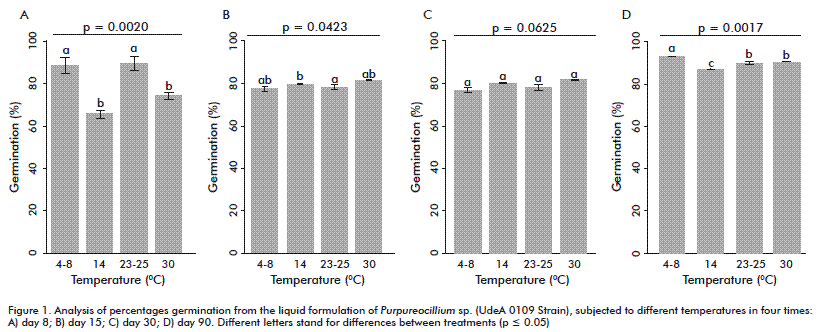
<body><![CDATA[<P   ><font size="2" face="Verdana, Arial, Helvetica, sans-serif"><b>Laboratory evaluation      </b> </font></P >   <FONT size="+1">        <P   ><font face="Verdana, Arial, Helvetica, sans-serif" size="2"><I><b>Germination      and purity at different temperatures and times of storage</b></I><b><FONT color="#00FFFF"><I>      </I></font></b></font></P >   <FONT color="#00FFFF">        <P   ><font color="#000000" face="Verdana, Arial, Helvetica, sans-serif" size="2">The      formulation concentration corresponded to 3.6 &times; 10<sup>8</sup> conidia/mL.      No significant differences were found between controls and treatments (p &ge;      0.05) on days 0, 8 and 15, according to the Wilcoxon test. However, on day      8 significant differences between treatments were observed, as determined      by the Kruskal-Wallis test. The best germination percentages (90 %) corresponded      to room temperature (23-25 &deg;C) and to greenhouse temperature (4-8 &deg;C)      (<a href="/img/revistas/bta/v31n3/f0103314.gif">Figure 1A</a>). There were differences between treatments      at room temperature (75 % of germination) and at the temperature of Eastern      Antioquia (80 % of germination) on day 15 (<a href="/img/revistas/bta/v31n3/f0103314.gif">Figure 1B</a>).      But on 30, differences between treatments were unapparent and germination      was kept between 75 and 80 % (<a href="/img/revistas/bta/v31n3/f0103314.gif">Figure 1C</a>). At the      final determination (day 90), germination was kept between 85 and 90 % at      all temperatures, a high standard for a commercial formulation (<a href="/img/revistas/bta/v31n3/f0103314.gif">Figure      1D</a>). This has been reported for other fungi, such as Beauveria bassiana      in an oil surfactant formulation which showed increased tolerance at high      temperatures, preserving its virulence and maintaining conidia viability over      time [9]. </font></P >   <FONT color="#000000"><FONT size="+1"><FONT size="+1">        
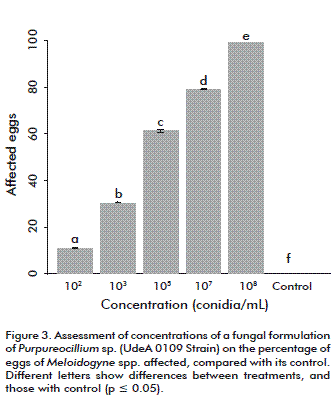
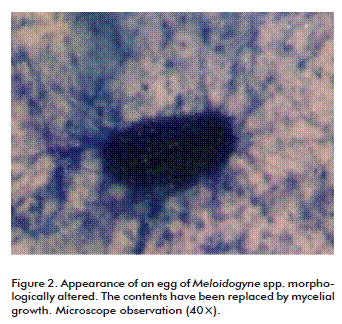
<P   ><font face="Verdana, Arial, Helvetica, sans-serif" size="2">It is important to      add that the formulation was presented as a homogeneous suspension without      mycelial growth on the surface during the entire study, which was observed      in the controls. Similarly, several authors have described that there are      formulation processes which do not affect the spores, and, to the contrary,      improve the stability and useful lifespan during storage of these structures      [3, 10-13]. </font></P >       <P   ><font face="Verdana, Arial, Helvetica, sans-serif" size="2">Purity ranged 99-100      % for all the treatments and conditions, above the 90 % recommended by quality      control standards for entomopathogenic fungi [3, 10]. It indicated an adequate      formulation quality management by the trading house (Laverlam). </font></P >       <P   ><font face="Verdana, Arial, Helvetica, sans-serif" size="2">According to these      results, the liquid commercial formulation displayed no adverse effect on      germination or in purity for the structures of the UdeA 0109 strain at times      and temperatures evaluated. </font></P >       <P   ><font face="Verdana, Arial, Helvetica, sans-serif" size="2"><b>In vitro<I> pathogenicity      testing </I></b></font></P >   <FONT color="#00FFFF">        <P   ><font color="#000000" face="Verdana, Arial, Helvetica, sans-serif" size="2">The      analyses showed that the 10<sup>4</sup> conidia/mL concentration may affect      50 % of nematode population, according to the mean lethal concentration (LC<sub>50</sub>)      after 5 days. Hence, it was decided to assess lower and higher concentrations      under greenhouse conditions. The LC<sub>50</sub> exceeds that of comercial      nematicides bioformulations of <I>P. lilacinum</I> and <I>Prochonia chlamydospora</I>      used in vitro, which achieve nematicidal effects at concentrations of 1.03      &times; 10<sup>8</sup> spores/mL on developmental stages of <I>Radopholus      similis</I> [14]. This implies the possibility that the product could be used      at lower concentrations in the field, an aspect that should be further addressed.      The dosage effect was evaluated by determining the morphological alteration      of nematode eggs. Such alteration was attained in 10 % of the eggs at a concentration      of 10<sup>2</sup> conidia/mL and up to 99 % at 10<sup>8</sup> conidia/mL (<a href="#fig2">Figure      2</a> and <a href="#fig3">Figure 3</a>). Moreover, the formulation was able      to affect the eggs after two months of storage at room temperature, although      qualitative evaluation continued and showed viability after seventh months      (data not shown), another aspect recommended for this type of formulations.      </font></P >       <P align="center"   ><img src="/img/revistas/bta/v31n3/f0203314.gif" width="340" height="322"><a name="fig2"></a></P >       
<P align="center"   ><img src="/img/revistas/bta/v31n3/f0303314.gif" width="334" height="398"><a name="fig3"></a></P >   <FONT color="#000000"><FONT size="+1"><FONT size="+1"><FONT size="+1"><FONT size="+1"><FONT size="+1"><FONT size="+1"><FONT size="+1"><FONT size="+1"><FONT size="+1"><FONT size="+1"><FONT size="+1"><FONT size="+1">        
]]></body>
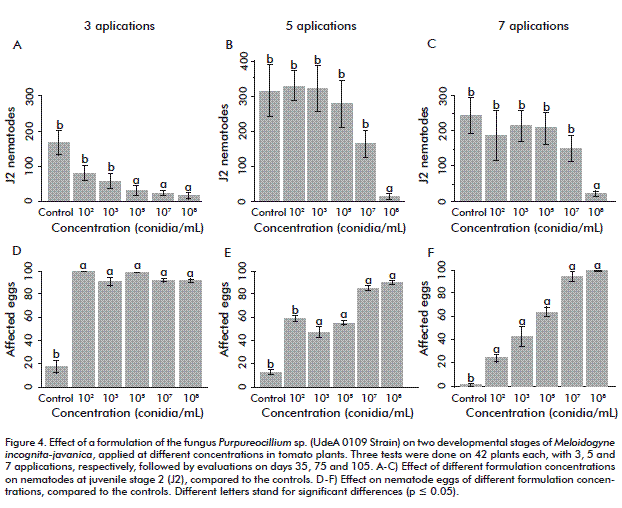
<body><![CDATA[<P   ><font face="Verdana, Arial, Helvetica, sans-serif" size="2"><b>Evaluation under      greenhouse conditions </b></font></P >   <FONT color="#FF00FF">        <P   ><font color="#000000" face="Verdana, Arial, Helvetica, sans-serif" size="2"><I><b>Determination      of fungal persistence in soil</b></I><b><FONT color="#00FFFF"><I> </I></font></b></font></P >   <FONT color="#000000"><FONT color="#00FFFF">        <P   ><font color="#000000" face="Verdana, Arial, Helvetica, sans-serif" size="2">At      start, the inoculation time, conidia concentration decreased from initial      levels applied for all the three concentrations evaluated. Fungal c.f.u. counts      were found increased on day 5, remained steady on days 10 and 15, and further      declined on day 20. Based on these results, the time interval to apply the      bioformulation was set to 15 days, to keep constant the spore density in soil      for an effective long term control of <I>Meloidogyne </I>spp. and also to      reduce the amount of bioformulation used. Other groups [15] found that <I>P.      lilacinum</I> u.f.c. counts decreased from those added at the start of the      experiment, as well as other teams have reported that c.f.u. decrease from      two to three weeks after the initial application [16, 17]. </font></P >   <FONT color="#000000">        <P   ><font face="Verdana, Arial, Helvetica, sans-serif" size="2"><I><b>J2 juvenile      stage population assessment</b></I><FONT color="#00FFFF"><I> </I></font></font></P >   <FONT color="#00FFFF">        <P   ><font color="#000000" face="Verdana, Arial, Helvetica, sans-serif" size="2">The      J2 juvenile stage nematode populations in 100 g of soil were significantly      reduced (p &le; 0.05) by three applications of the bioformulation at 10<sup>5</sup>,      10<sup>7</sup> and 10<sup>8</sup> conidia/mL, compared to the control and      the other treatments (<a href="#fig3">Figure 3</a>). The highest numbers      of J2 individuals were found at 10<sup>2</sup> and 10<sup>3</sup> conidia/mL      (79 and 57 nematodes, respectively), with as few as 14 nematodes with the      10<sup>2</sup> concentration (<a href="/img/revistas/bta/v31n3/f0403314.gif">Figure 4A</a>). </font></P >   <FONT color="#000000"><FONT size="+1"><FONT size="+1"><FONT size="+1"><FONT size="+1"><FONT size="+1"><FONT size="+1"><FONT size="+1"><FONT size="+1"><FONT size="+1"><FONT size="+1"><FONT size="+1"><FONT size="+1">        
<P   ><font face="Verdana, Arial, Helvetica, sans-serif" size="2">More than 90 % of      the eggs were affected at any concentration, with significant differences      for all the treatments compared to the control (p &le; 0.05) (<a href="/img/revistas/bta/v31n3/f0403314.gif">Figure      4D</a>). </font></P >       
<P   ><font face="Verdana, Arial, Helvetica, sans-serif" size="2">After five applications,      there were no significant decrease in nematode populations for the 10<sup>2</sup>,      10<sup>3</sup>, 10<sup>5</sup> and 10<sup>7</sup> conidia/mL concentrations      compared to the control, with <I>Meloidogyne</I> spp. J2 individuals counts      ranging 164-329 nematodes/100 g of soil. There were only 14 nematodes for      the 10<sup>8</sup> concentration (<a href="/img/revistas/bta/v31n3/f0403314.gif">Figure 4B</a>). Otherwise,      all the concentrations significantly affected the eggs (p &le; 0.05), from      50 to 90 %. The highest effect was found at the 10<sup>8</sup> concentration      (<a href="/img/revistas/bta/v31n3/f0403314.gif">Figure 4E</a>), regardless the lack of differences      with results achieved at 10<sup>7</sup> conidia/mL. Increased J2 nematode      populations were found for treatments at the lowest concentrations (10<sup>2</sup>      and 10<sup>3</sup>) and also the control, with five applications of the bioformulation.      This result could derive from successful plant root colonization from the      start of the experiment by those populations which ended their reproductive      cycle, in spite of being the second evaluation. In fact, root knots were present      in the analyzed material. In previous studies, we showed that the UdeA 0109      strain did not display an endophytic behavior, only attacking exposed nematode      populations. In this sense, it was reported the high susceptibility of tomato      against <I>Meloidogyne</I> spp. and, depending on the variety, gall formation      could appear, further increasing eggs production, some of them occluded in      inner tissues what probably protect them from fungal infection [18]. All these      makes essential to determine the preventive effect of the product, which should      have to be studied in field experiments, since some authors have reported      that other <I>P. lilacinum</I> strains have to be applied before trasplantation      to reduce the inoculum of nematodes in soil, their reproduction and the associated      root damage [16, 19]. </font></P >   <FONT size="+1"><FONT size="+1"><FONT size="+1"><FONT size="+1"><FONT size="+1"><FONT size="+1"><FONT size="+1"><FONT size="+1"><FONT size="+1"><FONT size="+1"><FONT size="+1"><FONT size="+1"><FONT size="+1"><FONT size="+1">        
<P   ><font face="Verdana, Arial, Helvetica, sans-serif" size="2">Another aspect that      could have influenced on the increase of J2 nematode population was the procedure      used to inoculate the bioformulation in soil. According to the methodology      used, the fungus was directly mixed with the soil during the first inoculation,      while the rest of the inoculations were done by aggregating the strain on      the surface around the seedling stem, without mixing it with soil. Other authors      found that the root system and the depth of fungus inoculation could be relevant      for its biocontrol properties on <I>Meloidogyne</I> sp. populations [15].      These aspects require careful assessment in future studies. </font></P >       <P   ><font face="Verdana, Arial, Helvetica, sans-serif" size="2">In the treatment      with seven inoculations of the bioformulation, significant differences were      found for J2 nematodes at 10<sup>8</sup> conidia/mL compared to the control      (p &le; 0.05) (<a href="/img/revistas/bta/v31n3/f0403314.gif">Figure 4C</a>), account for 21 J2 nematodes      per 100 g of soil. The rest of concentrations did not show differences compared      to the control. Conversely, there were significant differences in eggs counts      (p &le; 0.05) for all the concentrations tested in respect to the control,      with a 100 % effect on eggs at 10<sup>7</sup> and 10<sup>8</sup> conidia/mL.      Once again, the 10<sup>8</sup> conidia/mL concentration was considered optimal      since it kept the lowest populations of J2 nematodes. Noteworthy, some fungi      strains could vary, requiring concentrations higher than 1 &times; 10<sup>7</sup>      spores/mL to establish effective infection, as described [20]. It has also      been reported that a <I>P. lilacinum</I> concentration of 10<sup>6</sup> or      higher has to be maintained in soil [19, 21], a result confirmed in the present      study with the 10<sup>7</sup> and 10<sup>8</sup> as the best effect concentrations.      </font></P >       
<P   >&nbsp;</P >   <FONT size="+1"><FONT size="+1"><FONT size="+1"><FONT size="+1"><FONT size="+1"><FONT size="+1"><FONT size="+1"><FONT size="+1"><FONT size="+1"><FONT size="+1"><FONT size="+1"><FONT size="+1"><FONT size="+1"><FONT size="+1"><FONT size="+1"><FONT size="+1">        ]]></body>
<body><![CDATA[<P   ><font size="3" face="Verdana, Arial, Helvetica, sans-serif"><b>CONCLUSIONS</b></font><font size="2" face="Verdana, Arial, Helvetica, sans-serif">      </font></P >   <FONT size="+1"><FONT color="#0018E4">        <P   ><font size="2" color="#000000" face="Verdana, Arial, Helvetica, sans-serif">The      microbiological quality of a liquid formulation of the <I>Purpureocillium</I>      sp. UdeA0109 strain and its pathogenicity on developmental stages of the <I>Meloidogyne      incognita-javanica</I> complex were verified. Further research should elucidate      if the 10<sup>7</sup> conidia/mL concentration registered as the most effective      in this study exerts better control on nematode populations than other biological      nematicides available in the market with effective concentrations ranging      10<sup>8</sup>-10<sup>12</sup> conidia/mL [22]. Noteworthy, the results provide      information on the application frequency of the </font><font face="Verdana, Arial, Helvetica, sans-serif" size="2" color="#000000">bioformulation      to decrease nematode eggs and J2 juvenile stage populations under greenhouse      conditions, useful to validate the results under field conditions. </font></P >   <FONT size="+1" color="#000000"><FONT size="+1"><FONT size="+1"><FONT size="+1"><FONT size="+1"><FONT size="+1"><FONT size="+1">        <P   >&nbsp;</P >       <P   ><font size="2" face="Verdana, Arial, Helvetica, sans-serif"><b><font size="3">ACKNOWLEDGEMENTS      </font> </b> </font></P >   <FONT size="+1">        <P   ><font size="2" face="Verdana, Arial, Helvetica, sans-serif">The authors thank      to the members of BIOMA group for their contributions to the development of      the research. This work was funded by the Committee for the Development of      Research (CODI) of the University of Antioquia (Medellin, Colombia) and the      company Laverlam SA (Cali, Colombia) under the Code E01568. </font></P >       <P   >&nbsp;</P >   <FONT size="+1">        <P   > </P >       <P   ><b><font size="3" face="Verdana, Arial, Helvetica, sans-serif">REFERENCES </font></b></P >       <!-- ref --><P   ><font face="Verdana, Arial, Helvetica, sans-serif" size="2">1. Abad P, Favery      B, Rosso MN, Castagnone-Sereno P. Root-knot nematode parasitism and host response:      molecular basis of a sophisticated interaction. Mol Plant Pathol. 2003;4(4):217-24.          </font></P >       ]]></body>
<body><![CDATA[<P   ><font face="Verdana, Arial, Helvetica, sans-serif" size="2">2. Batista FA, Alves      SB, Alves LFA, Pereira RM, Augusto NT. Formul&ccedil;&atilde;o de entomopatogenos.      In: Controle Microbiano de Insetos. 2 ed. S&atilde;o Paulo: FEALQ; 1998. p.      917-66. </font></P >       <!-- ref --><P   ><font face="Verdana, Arial, Helvetica, sans-serif" size="2">3. V&eacute;lez A,      Posada F, Mar&iacute;n P, Gonz&aacute;lez G, Osorio VE, Bustillo P. T&eacute;cnicas      para el control de calidad de formulaciones de hongos entomopat&oacute;genos.      Bol T&eacute;c Cenicaf&eacute;. 1997;17:1-37.     </font></P >       <!-- ref --><P   ><font face="Verdana, Arial, Helvetica, sans-serif" size="2">4. Luangsa-Ard J,      Houbraken J, van Doorn T, Hong SB, Borman AM, Hywel-Jones NL, <I>et al</I>.      <I>Purpureocillium</I>, a new genus for the medically important <I>Paecilomyces      lilacinus</I>. FEMS Microbiol Lett. 2011;321(2):141-9.     </font></P >       <!-- ref --><P   ><font face="Verdana, Arial, Helvetica, sans-serif" size="2">5. Hewlett TE, Dickson      DW, Mitchell DJ, Kannwischer-Mitchell ME. Evaluation of <I>Paecilomyces lilacinus</I>      as a biocontrol agent of <I>Meloidogyne</I> javanica on Tobacco. J Nematol.      1988;20(4):578-84.     </font></P >       <!-- ref --><P   ><font face="Verdana, Arial, Helvetica, sans-serif" size="2">6. S&aacute;nchez      JY. Estudio de viabilidad de las estructuras del hongo <I>Purpureocillium</I>      sp. cepa UdeA0109 formulado en un ingrediente inerte bajo diferentes condiciones      de tiempo y temperatura. Trabajo de grado para optar por el T&iacute;tulo      de Bi&oacute;logo. Universidad de Antioquia. Facultad de Ciencias Exactas      y Naturales. Seccional oriente - Carmen de Viboral. Grupo BIOMA. Universidad      de Antioquia; 2013.     </font></P >       <!-- ref --><P   ><font face="Verdana, Arial, Helvetica, sans-serif" size="2">7. Cardona HV, Montoya      TGJ. Evaluaci&oacute;n de la patogenicidad del bioformulado de esporas de      <I>Purpureocillium</I> spp. (Cepa UdeA 0109) sobre poblaciones de <I>Meloidogyne</I>      spp. en plantas de tomate (Solanum lycopersicum) bajo condiciones de invernadero.      Trabajo de pregrado para optar por el t&iacute;tulo de Bi&oacute;logo. Medell&iacute;n      (Colombia). Grupo BIOMA. Universidad de Antioquia; 2013.     </font></P >       <!-- ref --><P   ><font face="Verdana, Arial, Helvetica, sans-serif" size="2">8. Margesin R, Schinner      F. Manual for soil analysis - Monitoring and assessing soil bioremediation.      Soil Biology Vol. 5. Berlin: Springer; 2005.     </font></P >       <!-- ref --><P   ><font face="Verdana, Arial, Helvetica, sans-serif" size="2">9. Coyne DL, Nicol      JM, Claudius-Cole B. Practical plant nematology: a field and laboratory guide.      SP-IPM Secretariat. Cotonou: International Institute of Tropical Agriculture      (IITA); 2007.     </font></P >       <!-- ref --><P   ><font face="Verdana, Arial, Helvetica, sans-serif" size="2">10. Bastidas A, Vel&aacute;squez      SE, Mar&iacute;n P, Benavides P, Bustillo AE, Orozco FJ. Evaluaci&oacute;n      de preformulados de Beauveria bassiana (b&aacute;lsamo) Vuillemin, para el      control de la broca del caf&eacute;. Agron. 2009;17(1):44-61.     </font></P >       <!-- ref --><P   ><font face="Verdana, Arial, Helvetica, sans-serif" size="2">11. Hong TD, Edgington      S, Ellis RH, de Muro MA, Moore D. Saturated salt solutions for humidity control      and the survival of dry powder and oil formulations of Beauveria bassiana      conidia. J Invertebr Pathol. 2005;89(2):136-43.     </font></P >       <!-- ref --><P   ><font face="Verdana, Arial, Helvetica, sans-serif" size="2">12. Gato CY. M&eacute;todos      de conservaci&oacute;n y formulaci&oacute;n de Trichoderma harzianum rifai.      Fitosanidad. 2010;14(3):189-95.     </font></P >       <P   ><font face="Verdana, Arial, Helvetica, sans-serif" size="2">13. Urtuvia UH, France      A. Formulaciones de hongos entomopat&oacute;genos para control de plagas.      Inia Tierra Adentro. 2007;(nov.-dic.):46-9. </font></P >       <!-- ref --><P   ><font face="Verdana, Arial, Helvetica, sans-serif" size="2">14. Alzate D, Guzm&aacute;n      OA, Leguizam&oacute;n Caycedo J. Efecto <I>in vitro</I> de <I>Purpureocillium</I>      lilacinum (Thom) Luangsa, Ard <I>et al</I>. y Pochonia chlamydosporia (Goddard)      Zare y Gams sobre el nematodo barrenador Radopholus similis (Cobb) Thorne.      Agron. 2012;20(2):25-36.     </font></P >       <!-- ref --><P   ><font face="Verdana, Arial, Helvetica, sans-serif" size="2">15. Anastasiadis      IA, Giannakou IO, Prophetou-Athanasiadou DA, Gowen SR. The combined effect      of the application of a biocontrol agent Paecilomyces lilacinus, with various      practices for the control of root-knot nematodes. Crop Protect. 2008;27:352-61.          </font></P >       <!-- ref --><P   ><font face="Verdana, Arial, Helvetica, sans-serif" size="2">16. Kiewnick S, Mendoza      A, Sikora RA. Efficacy of Paecilomyces lilacinus strain 251 for biological      control of the burrowing nematode Radopholus similis [Abstract]. J Nematol.      2004;36:326-7.     </font></P >       <!-- ref --><P   ><font face="Verdana, Arial, Helvetica, sans-serif" size="2">17. Kiewnick S, Sikora      RA. Biological control of the root-knot nematode <I>Meloidogyne</I> incognita      by <I>Paecilomyces lilacinus</I> strain 251. Biol Control. 2006;38(2):179-87.          </font></P >       ]]></body>
<body><![CDATA[<!-- ref --><P   ><font face="Verdana, Arial, Helvetica, sans-serif" size="2">18. L&oacute;pez-Llorca      LV, Jansson HB. Biodiversidad del suelo: control biol&oacute;gico de nem&aacute;todos      fitopat&oacute;genos por hongos nemat&oacute;fagos. Cuadernos de Biodiversidad.      2001;(6):12-5.     </font></P >       <!-- ref --><P   ><font face="Verdana, Arial, Helvetica, sans-serif" size="2">19. Stirling GR.      Biological control of plant parasitic nematodes: soil ecosystem management      in sustainable agriculture. 2ed. Wallingford: CABI; 2014.     </font></P >       <!-- ref --><P   ><font face="Verdana, Arial, Helvetica, sans-serif" size="2">20. Sahebani N, Hadavi      N. Biological control of the root-knot nematode <I>Meloidogyne</I> javanica      by Trichoderma harzianum. Soil Biol Biochem. 2008;40(8):2016-20.     </font></P >       <!-- ref --><P   ><font face="Verdana, Arial, Helvetica, sans-serif" size="2">21. Mendoza AR, Sikora      RA, Kiewnick S. Influencia de la dosis y el tiempo de aplicaci&oacute;n de      Paecilomyces lilacinus cepa 251 sobre el control biol&oacute;gico del nematodo      barrenador <I>Radopholus similis </I>en banano. Nematropica. 2007;37(2):203-13.          </font></P >       <P   ><font face="Verdana, Arial, Helvetica, sans-serif" size="2">22. Corporaci&oacute;n      Colombiana de Investigaci&oacute;n agropecuaria CORPOICA. Listado de empresas      de bioinsumos registradas. 2013 [cited 2013 Oct 2]. Available from: <A href="http://www.ica.gov.co/Areas/Agricola/Servicios/Fertilizantes-y-Bio-insumos-Agricolas/Listado-de-Bioinsumos/2009/EMPRESAS-REGISTRADAS-BIOINSUMOS-JULIO-8-DE-2008.aspx" target="_blank">      <FONT color="#0000FF">http://www.ica.gov.co/Areas/Agricola/Servicios/Fertilizantes-y-Bio-insumos-Agricolas/Listado-de-Bioinsumos/2009/EMPRESAS-REGISTRADAS-BIOINSUMOS-JULIO-8-DE-2008.aspx</font></A><FONT color="#0000FF"><FONT color="#000000">.      </font></font></font></P >   <FONT size="+1"><FONT size="+1"><FONT color="#0000FF"><FONT color="#000000">        <P   > </P >   <FONT size="+1">        ]]></body>
<body><![CDATA[<P   >&nbsp;</P >       <P   >&nbsp;</P >       <P   ><font face="Verdana, Arial, Helvetica, sans-serif" size="2">Received in November      2013.    <br>     </font><font face="Verdana, Arial, Helvetica, sans-serif" size="2">Accepted      in October 2014. </font></P >       <P   >&nbsp;</P >       <P   >&nbsp;</P >       <P   > </P >       <P   >&nbsp; </P >   </font></font></font></font></font></font></font></font></font></font></font></font></font></font></font></font></font></font></font></font></font></font></font></font></font></font></font></font></font></font></font></font></font></font></font></font></font></font></font></font></font></font></font></font></font></font></font></font></font></font></font></font></font></font></font></font></font></font></font></font></font></font></font></font></font></font></font></font></font></font></font></font></font></font></font></font></font></font></font></font></font></font></font></font></font></font></font></font></font></font></font></font></font></font></font></font></font></font></font></font></font></font></font></font></font></font></font></font></font></font></font></font></font></font></font></font></font></font></font></font></font></font></font></font></font></font></font></font></font></font></font></font></font></font></font></font></font></font></font></font></font></font></font></font></font></font></font></font></font></font></font>        <p   ><font face="Verdana, Arial, Helvetica, sans-serif" size="+1" color="#000000"><font size="2"><i>Nadya      Lorena Cardona.</i></font></font><font face="Verdana, Arial, Helvetica, sans-serif" size="2" color="#000000">      </font><font face="Verdana, Arial, Helvetica, sans-serif" size="2">Grupo de      Biocontrol y Microbiolog&iacute;a Ambiental, BIOMA, Facultad de Ciencias Exactas      y Naturales, Instituto de Biolog&iacute;a, Universidad de Antioquia, Calle      67 No. 53-108, Medell&iacute;n, Colombia. E-mail: <A href="mailto:nadya.cardona@udea.edu.co">      <FONT color="#0000FF">nadya.cardona@udea.edu.co</font></A><FONT color="#0000FF"><FONT color="#000000">;      <A href="mailto:nadyaloren@gmail.com"> <FONT color="#0000FF">nadyaloren@gmail.com</font></A><FONT color="#0000FF"><FONT color="#000000">.      </font></font></font></font></font></p >   <FONT size="+1" color="#000000"><FONT size="+1"><FONT size="+1"><FONT size="+1"><FONT size="+1"><FONT size="+1"><FONT size="+1"><FONT size="+1"><FONT size="+1"><FONT size="+1"><FONT size="+1"><FONT size="+1"><FONT size="+1"><FONT size="+1"><FONT size="+1"><FONT size="+1"><FONT size="+1"><FONT color="#0018E4"><FONT size="+1" color="#000000"><FONT size="+1"><FONT size="+1"><FONT color="#FF00FF"><FONT color="#000000"><FONT color="#00FFFF"><FONT color="#000000"><FONT size="+1"><FONT size="+1"><FONT size="+1"><FONT size="+1"><FONT color="#00FFFF"><FONT color="#000000"><FONT size="+1"><FONT size="+1"><FONT size="+1"><FONT size="+1"><FONT size="+1"><FONT size="+1"><FONT size="+1"><FONT size="+1"><FONT size="+1"><FONT size="+1"><FONT color="#00FFFF"><FONT color="#000000"><FONT size="+1"><FONT size="+1"><FONT size="+1"><FONT size="+1"><FONT size="+1"><FONT size="+1"><FONT size="+1"><FONT size="+1"><FONT color="#00FFFF"><FONT color="#000000"><FONT color="#00FFFF"><FONT color="#000000"><FONT size="+1"><FONT size="+1"><FONT size="+1"><FONT size="+1"><FONT size="+1"><FONT size="+1"><FONT size="+1"><FONT size="+1"><FONT size="+1"><FONT size="+1"><FONT size="+1"><FONT size="+1"><FONT size="+1"><FONT size="+1"><FONT color="#00FFFF"><FONT color="#000000"><FONT size="+1"><FONT size="+1"><FONT color="#00FFFF"><FONT color="#000000"><FONT size="+1"><FONT size="+1"><FONT size="+1"><FONT size="+1"><FONT size="+1"><FONT size="+1"><FONT size="+1"><FONT size="+1"><FONT size="+1"><FONT size="+1"><FONT size="+1"><FONT size="+1"><FONT color="#FF00FF"><FONT color="#000000"><FONT color="#00FFFF"><FONT color="#000000"><FONT color="#00FFFF"><FONT color="#000000"><FONT size="+1"><FONT size="+1"><FONT size="+1"><FONT size="+1"><FONT size="+1"><FONT size="+1"><FONT size="+1"><FONT size="+1"><FONT size="+1"><FONT size="+1"><FONT size="+1"><FONT size="+1"><FONT size="+1"><FONT size="+1"><FONT size="+1"><FONT size="+1"><FONT size="+1"><FONT size="+1"><FONT size="+1"><FONT size="+1"><FONT size="+1"><FONT size="+1"><FONT size="+1"><FONT size="+1"><FONT size="+1"><FONT size="+1"><FONT size="+1"><FONT size="+1"><FONT size="+1"><FONT size="+1"><FONT size="+1"><FONT size="+1"><FONT size="+1"><FONT size="+1"><FONT size="+1"><FONT size="+1"><FONT size="+1"><FONT size="+1"><FONT size="+1"><FONT size="+1"><FONT size="+1"><FONT size="+1"><FONT size="+1"><FONT color="#0018E4"><FONT size="+1" color="#000000"><FONT size="+1"><FONT size="+1"><FONT size="+1"><FONT size="+1"><FONT size="+1"><FONT size="+1"><FONT size="+1"><FONT size="+1"><FONT size="+1"><FONT size="+1"><FONT color="#0000FF"><FONT color="#000000"><FONT size="+1"><FONT size="+1"><FONT color="#0000FF"><FONT color="#000000"><FONT color="#0000FF"><FONT color="#000000">        <P   > </P >   </font></font></font></font></font></font></font></font></font></font></font></font></font></font></font></font></font></font></font></font></font></font></font></font></font></font></font></font></font></font></font></font></font></font></font></font></font></font></font></font></font></font></font></font></font></font></font></font></font></font></font></font></font></font></font></font></font></font></font></font></font></font></font></font></font></font></font></font></font></font></font></font></font></font></font></font></font></font></font></font></font></font></font></font></font></font></font></font></font></font></font></font></font></font></font></font></font></font></font></font></font></font></font></font></font></font></font></font></font></font></font></font></font></font></font></font></font></font></font></font></font></font></font></font></font></font></font></font></font></font></font></font></font></font></font></font></font></font></font></font></font></font></font></font></font></font></font></font></font></font></font></font></font></font></font></font></DIV >     ]]></body>
<body><![CDATA[ ]]></body><back>
<ref-list>
<ref id="B1">
<label>1</label><nlm-citation citation-type="journal">
<person-group person-group-type="author">
<name>
<surname><![CDATA[Abad]]></surname>
<given-names><![CDATA[P]]></given-names>
</name>
<name>
<surname><![CDATA[Favery]]></surname>
<given-names><![CDATA[B]]></given-names>
</name>
<name>
<surname><![CDATA[Rosso]]></surname>
<given-names><![CDATA[MN]]></given-names>
</name>
<name>
<surname><![CDATA[Castagnone-Sereno]]></surname>
<given-names><![CDATA[P]]></given-names>
</name>
</person-group>
<article-title xml:lang="en"><![CDATA[Root-knot nematode parasitism and host response: molecular basis of a sophisticated interaction]]></article-title>
<source><![CDATA[Mol Plant Pathol]]></source>
<year>2003</year>
<volume>4</volume>
<numero>4</numero>
<issue>4</issue>
<page-range>217-24</page-range></nlm-citation>
</ref>
<ref id="B2">
<label>2</label><nlm-citation citation-type="book">
<person-group person-group-type="author">
<name>
<surname><![CDATA[Batista]]></surname>
<given-names><![CDATA[FA]]></given-names>
</name>
<name>
<surname><![CDATA[Alves]]></surname>
<given-names><![CDATA[SB]]></given-names>
</name>
<name>
<surname><![CDATA[Alves]]></surname>
<given-names><![CDATA[LFA]]></given-names>
</name>
<name>
<surname><![CDATA[Pereira]]></surname>
<given-names><![CDATA[RM]]></given-names>
</name>
<name>
<surname><![CDATA[Augusto]]></surname>
<given-names><![CDATA[NT]]></given-names>
</name>
</person-group>
<article-title xml:lang="pt"><![CDATA[Formulção de entomopatogenos]]></article-title>
<source><![CDATA[Controle Microbiano de Insetos]]></source>
<year>1998</year>
<edition>2</edition>
<page-range>917-66</page-range><publisher-loc><![CDATA[São Paulo ]]></publisher-loc>
<publisher-name><![CDATA[FEALQ]]></publisher-name>
</nlm-citation>
</ref>
<ref id="B3">
<label>3</label><nlm-citation citation-type="journal">
<person-group person-group-type="author">
<name>
<surname><![CDATA[Vélez]]></surname>
<given-names><![CDATA[A]]></given-names>
</name>
<name>
<surname><![CDATA[Posada]]></surname>
<given-names><![CDATA[F]]></given-names>
</name>
<name>
<surname><![CDATA[Marín]]></surname>
<given-names><![CDATA[P]]></given-names>
</name>
<name>
<surname><![CDATA[González]]></surname>
<given-names><![CDATA[G]]></given-names>
</name>
<name>
<surname><![CDATA[Osorio]]></surname>
<given-names><![CDATA[VE]]></given-names>
</name>
<name>
<surname><![CDATA[Bustillo]]></surname>
<given-names><![CDATA[P]]></given-names>
</name>
</person-group>
<article-title xml:lang="es"><![CDATA[Técnicas para el control de calidad de formulaciones de hongos entomopatógenos]]></article-title>
<source><![CDATA[Bol Téc Cenicafé]]></source>
<year>1997</year>
<volume>17</volume>
<page-range>1-37</page-range></nlm-citation>
</ref>
<ref id="B4">
<label>4</label><nlm-citation citation-type="journal">
<person-group person-group-type="author">
<name>
<surname><![CDATA[Luangsa-Ard]]></surname>
<given-names><![CDATA[J]]></given-names>
</name>
<name>
<surname><![CDATA[Houbraken]]></surname>
<given-names><![CDATA[J]]></given-names>
</name>
<name>
<surname><![CDATA[van Doorn]]></surname>
<given-names><![CDATA[T]]></given-names>
</name>
<name>
<surname><![CDATA[Hong]]></surname>
<given-names><![CDATA[SB]]></given-names>
</name>
<name>
<surname><![CDATA[Borman]]></surname>
<given-names><![CDATA[AM]]></given-names>
</name>
<name>
<surname><![CDATA[Hywel-Jones]]></surname>
<given-names><![CDATA[NL]]></given-names>
</name>
</person-group>
<article-title xml:lang="en"><![CDATA[Purpureocillium, a new genus for the medically important Paecilomyces lilacinus]]></article-title>
<source><![CDATA[FEMS Microbiol Lett]]></source>
<year>2011</year>
<volume>321</volume>
<numero>2</numero>
<issue>2</issue>
<page-range>141-9</page-range></nlm-citation>
</ref>
<ref id="B5">
<label>5</label><nlm-citation citation-type="journal">
<person-group person-group-type="author">
<name>
<surname><![CDATA[Hewlett]]></surname>
<given-names><![CDATA[TE]]></given-names>
</name>
<name>
<surname><![CDATA[Dickson]]></surname>
<given-names><![CDATA[DW]]></given-names>
</name>
<name>
<surname><![CDATA[Mitchell]]></surname>
<given-names><![CDATA[DJ]]></given-names>
</name>
<name>
<surname><![CDATA[Kannwischer-Mitchell]]></surname>
<given-names><![CDATA[ME]]></given-names>
</name>
</person-group>
<article-title xml:lang="en"><![CDATA[Evaluation of Paecilomyces lilacinus as a biocontrol agent of Meloidogyne javanica on Tobacco]]></article-title>
<source><![CDATA[J Nematol]]></source>
<year>1988</year>
<volume>20</volume>
<numero>4</numero>
<issue>4</issue>
<page-range>578-84</page-range></nlm-citation>
</ref>
<ref id="B6">
<label>6</label><nlm-citation citation-type="">
<person-group person-group-type="author">
<name>
<surname><![CDATA[Sánchez]]></surname>
<given-names><![CDATA[JY]]></given-names>
</name>
</person-group>
<source><![CDATA[Estudio de viabilidad de las estructuras del hongo Purpureocillium sp. cepa UdeA0109 formulado en un ingrediente inerte bajo diferentes condiciones de tiempo y temperatura]]></source>
<year>2013</year>
</nlm-citation>
</ref>
<ref id="B7">
<label>7</label><nlm-citation citation-type="">
<person-group person-group-type="author">
<name>
<surname><![CDATA[Cardona]]></surname>
<given-names><![CDATA[HV]]></given-names>
</name>
<name>
<surname><![CDATA[Montoya]]></surname>
<given-names><![CDATA[TGJ]]></given-names>
</name>
</person-group>
<source><![CDATA[Evaluación de la patogenicidad del bioformulado de esporas de Purpureocillium spp. (Cepa UdeA 0109) sobre poblaciones de Meloidogyne spp. en plantas de tomate (Solanum lycopersicum) bajo condiciones de invernadero]]></source>
<year>2013</year>
</nlm-citation>
</ref>
<ref id="B8">
<label>8</label><nlm-citation citation-type="book">
<person-group person-group-type="author">
<name>
<surname><![CDATA[Margesin]]></surname>
<given-names><![CDATA[R]]></given-names>
</name>
<name>
<surname><![CDATA[Schinner]]></surname>
<given-names><![CDATA[F]]></given-names>
</name>
</person-group>
<source><![CDATA[Manual for soil analysis - Monitoring and assessing soil bioremediation. Soil Biology Vol. 5]]></source>
<year>2005</year>
<publisher-loc><![CDATA[Berlin ]]></publisher-loc>
<publisher-name><![CDATA[Springer]]></publisher-name>
</nlm-citation>
</ref>
<ref id="B9">
<label>9</label><nlm-citation citation-type="book">
<person-group person-group-type="author">
<name>
<surname><![CDATA[Coyne]]></surname>
<given-names><![CDATA[DL]]></given-names>
</name>
<name>
<surname><![CDATA[Nicol]]></surname>
<given-names><![CDATA[JM]]></given-names>
</name>
<name>
<surname><![CDATA[Claudius-Cole]]></surname>
<given-names><![CDATA[B]]></given-names>
</name>
</person-group>
<source><![CDATA[Practical plant nematology: a field and laboratory guide. SP-IPM Secretariat]]></source>
<year>2007</year>
<publisher-loc><![CDATA[Cotonou ]]></publisher-loc>
<publisher-name><![CDATA[International Institute of Tropical Agriculture (IITA)]]></publisher-name>
</nlm-citation>
</ref>
<ref id="B10">
<label>10</label><nlm-citation citation-type="journal">
<person-group person-group-type="author">
<name>
<surname><![CDATA[Bastidas]]></surname>
<given-names><![CDATA[A]]></given-names>
</name>
<name>
<surname><![CDATA[Velásquez]]></surname>
<given-names><![CDATA[SE]]></given-names>
</name>
<name>
<surname><![CDATA[Marín]]></surname>
<given-names><![CDATA[P]]></given-names>
</name>
<name>
<surname><![CDATA[Benavides]]></surname>
<given-names><![CDATA[P]]></given-names>
</name>
<name>
<surname><![CDATA[Bustillo]]></surname>
<given-names><![CDATA[AE]]></given-names>
</name>
<name>
<surname><![CDATA[Orozco]]></surname>
<given-names><![CDATA[FJ]]></given-names>
</name>
</person-group>
<article-title xml:lang="es"><![CDATA[Evaluación de preformulados de Beauveria bassiana (bálsamo) Vuillemin, para el control de la broca del café]]></article-title>
<source><![CDATA[Agron]]></source>
<year>2009</year>
<volume>17</volume>
<numero>1</numero>
<issue>1</issue>
<page-range>44-61</page-range></nlm-citation>
</ref>
<ref id="B11">
<label>11</label><nlm-citation citation-type="journal">
<person-group person-group-type="author">
<name>
<surname><![CDATA[Hong]]></surname>
<given-names><![CDATA[TD]]></given-names>
</name>
<name>
<surname><![CDATA[Edgington]]></surname>
<given-names><![CDATA[S]]></given-names>
</name>
<name>
<surname><![CDATA[Ellis]]></surname>
<given-names><![CDATA[RH]]></given-names>
</name>
<name>
<surname><![CDATA[de Muro]]></surname>
<given-names><![CDATA[MA]]></given-names>
</name>
<name>
<surname><![CDATA[Moore]]></surname>
<given-names><![CDATA[D]]></given-names>
</name>
</person-group>
<article-title xml:lang="en"><![CDATA[Saturated salt solutions for humidity control and the survival of dry powder and oil formulations of Beauveria bassiana conidia]]></article-title>
<source><![CDATA[J Invertebr Pathol]]></source>
<year>2005</year>
<volume>89</volume>
<numero>2</numero>
<issue>2</issue>
<page-range>136-43</page-range></nlm-citation>
</ref>
<ref id="B12">
<label>12</label><nlm-citation citation-type="journal">
<person-group person-group-type="author">
<name>
<surname><![CDATA[Gato]]></surname>
<given-names><![CDATA[CY]]></given-names>
</name>
</person-group>
<article-title xml:lang="es"><![CDATA[Métodos de conservación y formulación de Trichoderma harzianum rifai]]></article-title>
<source><![CDATA[Fitosanidad]]></source>
<year>2010</year>
<volume>14</volume>
<numero>3</numero>
<issue>3</issue>
<page-range>189-95</page-range></nlm-citation>
</ref>
<ref id="B13">
<label>13</label><nlm-citation citation-type="journal">
<person-group person-group-type="author">
<name>
<surname><![CDATA[Urtuvia]]></surname>
<given-names><![CDATA[UH]]></given-names>
</name>
<name>
<surname><![CDATA[France]]></surname>
<given-names><![CDATA[A]]></given-names>
</name>
</person-group>
<article-title xml:lang="es"><![CDATA[Formulaciones de hongos entomopatógenos para control de plagas]]></article-title>
<source><![CDATA[Inia Tierra Adentro]]></source>
<year>2007</year>
<numero>46</numero>
<issue>46</issue>
<page-range>9</page-range></nlm-citation>
</ref>
<ref id="B14">
<label>14</label><nlm-citation citation-type="journal">
<person-group person-group-type="author">
<name>
<surname><![CDATA[Alzate]]></surname>
<given-names><![CDATA[D]]></given-names>
</name>
<name>
<surname><![CDATA[Guzmán]]></surname>
<given-names><![CDATA[OA]]></given-names>
</name>
<name>
<surname><![CDATA[Leguizamón Caycedo]]></surname>
<given-names><![CDATA[J]]></given-names>
</name>
</person-group>
<article-title xml:lang="en"><![CDATA[Efecto in vitro de Purpureocillium lilacinum (Thom) Luangsa, Ard et al. y Pochonia chlamydosporia (Goddard) Zare y Gams sobre el nematodo barrenador Radopholus similis (Cobb) Thorne]]></article-title>
<source><![CDATA[Agron]]></source>
<year>2012</year>
<volume>20</volume>
<numero>2</numero>
<issue>2</issue>
<page-range>25-36</page-range></nlm-citation>
</ref>
<ref id="B15">
<label>15</label><nlm-citation citation-type="journal">
<person-group person-group-type="author">
<name>
<surname><![CDATA[Anastasiadis]]></surname>
<given-names><![CDATA[IA]]></given-names>
</name>
<name>
<surname><![CDATA[Giannakou]]></surname>
<given-names><![CDATA[IO]]></given-names>
</name>
<name>
<surname><![CDATA[Prophetou-Athanasiadou]]></surname>
<given-names><![CDATA[DA]]></given-names>
</name>
<name>
<surname><![CDATA[Gowen]]></surname>
<given-names><![CDATA[SR]]></given-names>
</name>
</person-group>
<article-title xml:lang="en"><![CDATA[The combined effect of the application of a biocontrol agent Paecilomyces lilacinus, with various practices for the control of root-knot nematodes]]></article-title>
<source><![CDATA[Crop Protect]]></source>
<year>2008</year>
<volume>27</volume>
<page-range>352-61</page-range></nlm-citation>
</ref>
<ref id="B16">
<label>16</label><nlm-citation citation-type="journal">
<person-group person-group-type="author">
<name>
<surname><![CDATA[Kiewnick]]></surname>
<given-names><![CDATA[S]]></given-names>
</name>
<name>
<surname><![CDATA[Mendoza]]></surname>
<given-names><![CDATA[A]]></given-names>
</name>
<name>
<surname><![CDATA[Sikora]]></surname>
<given-names><![CDATA[RA]]></given-names>
</name>
</person-group>
<article-title xml:lang="en"><![CDATA[Efficacy of Paecilomyces lilacinus strain 251 for biological control of the burrowing nematode Radopholus similis (Abstract)]]></article-title>
<source><![CDATA[J Nematol]]></source>
<year>2004</year>
<volume>36</volume>
<page-range>326-7</page-range></nlm-citation>
</ref>
<ref id="B17">
<label>17</label><nlm-citation citation-type="journal">
<person-group person-group-type="author">
<name>
<surname><![CDATA[Kiewnick]]></surname>
<given-names><![CDATA[S]]></given-names>
</name>
<name>
<surname><![CDATA[Sikora]]></surname>
<given-names><![CDATA[RA]]></given-names>
</name>
</person-group>
<article-title xml:lang="en"><![CDATA[Biological control of the root-knot nematode Meloidogyne incognita by Paecilomyces lilacinus strain 251]]></article-title>
<source><![CDATA[Biol Control]]></source>
<year>2006</year>
<volume>38</volume>
<numero>2</numero>
<issue>2</issue>
<page-range>179-87</page-range></nlm-citation>
</ref>
<ref id="B18">
<label>18</label><nlm-citation citation-type="journal">
<person-group person-group-type="author">
<name>
<surname><![CDATA[López-Llorca]]></surname>
<given-names><![CDATA[LV]]></given-names>
</name>
<name>
<surname><![CDATA[Jansson]]></surname>
<given-names><![CDATA[HB]]></given-names>
</name>
</person-group>
<article-title xml:lang="es"><![CDATA[Biodiversidad del suelo: control biológico de nemátodos fitopatógenos por hongos nematófagos]]></article-title>
<source><![CDATA[Cuadernos de Biodiversidad]]></source>
<year>2001</year>
<numero>6</numero>
<issue>6</issue>
<page-range>12-5</page-range></nlm-citation>
</ref>
<ref id="B19">
<label>19</label><nlm-citation citation-type="book">
<person-group person-group-type="author">
<name>
<surname><![CDATA[Stirling]]></surname>
<given-names><![CDATA[GR]]></given-names>
</name>
</person-group>
<source><![CDATA[Biological control of plant parasitic nematodes: soil ecosystem management in sustainable agriculture. 2ed]]></source>
<year>2014</year>
<publisher-loc><![CDATA[Wallingford ]]></publisher-loc>
<publisher-name><![CDATA[CABI]]></publisher-name>
</nlm-citation>
</ref>
<ref id="B20">
<label>20</label><nlm-citation citation-type="journal">
<person-group person-group-type="author">
<name>
<surname><![CDATA[Sahebani]]></surname>
<given-names><![CDATA[N]]></given-names>
</name>
<name>
<surname><![CDATA[Hadavi]]></surname>
<given-names><![CDATA[N]]></given-names>
</name>
</person-group>
<article-title xml:lang="en"><![CDATA[Biological control of the root-knot nematode Meloidogyne javanica by Trichoderma harzianum]]></article-title>
<source><![CDATA[Soil Biol Biochem]]></source>
<year>2008</year>
<volume>40</volume>
<numero>8</numero>
<issue>8</issue>
<page-range>2016-20</page-range></nlm-citation>
</ref>
<ref id="B21">
<label>21</label><nlm-citation citation-type="journal">
<person-group person-group-type="author">
<name>
<surname><![CDATA[Mendoza]]></surname>
<given-names><![CDATA[AR]]></given-names>
</name>
<name>
<surname><![CDATA[Sikora]]></surname>
<given-names><![CDATA[RA]]></given-names>
</name>
<name>
<surname><![CDATA[Kiewnick]]></surname>
<given-names><![CDATA[S]]></given-names>
</name>
</person-group>
<article-title xml:lang="es"><![CDATA[Influencia de la dosis y el tiempo de aplicación de Paecilomyces lilacinus cepa 251 sobre el control biológico del nematodo barrenador Radopholus similis en banano]]></article-title>
<source><![CDATA[Nematropica]]></source>
<year>2007</year>
<volume>37</volume>
<numero>2</numero>
<issue>2</issue>
<page-range>203-13</page-range></nlm-citation>
</ref>
<ref id="B22">
<label>22</label><nlm-citation citation-type="">
<collab>Corporación Colombiana de Investigación agropecuaria CORPOICA</collab>
<source><![CDATA[Listado de empresas de bioinsumos registradas]]></source>
<year>2013</year>
</nlm-citation>
</ref>
</ref-list>
</back>
</article>