<?xml version="1.0" encoding="ISO-8859-1"?><article xmlns:mml="http://www.w3.org/1998/Math/MathML" xmlns:xlink="http://www.w3.org/1999/xlink" xmlns:xsi="http://www.w3.org/2001/XMLSchema-instance">
<front>
<journal-meta>
<journal-id>1027-2852</journal-id>
<journal-title><![CDATA[Biotecnología Aplicada]]></journal-title>
<abbrev-journal-title><![CDATA[Biotecnol Apl]]></abbrev-journal-title>
<issn>1027-2852</issn>
<publisher>
<publisher-name><![CDATA[Editorial Elfos Scientiae]]></publisher-name>
</publisher>
</journal-meta>
<article-meta>
<article-id>S1027-28522014000300007</article-id>
<title-group>
<article-title xml:lang="en"><![CDATA[The evolution of negotiations of intangible assets apart from industrial property protection in biotechnology]]></article-title>
<article-title xml:lang="es"><![CDATA[La evolución de la negociación de los activos intangibles más allá de la protección de la propiedad industrial en biotecnología]]></article-title>
</title-group>
<contrib-group>
<contrib contrib-type="author">
<name>
<surname><![CDATA[García-Delgado]]></surname>
<given-names><![CDATA[Dora]]></given-names>
</name>
<xref ref-type="aff" rid="A01"/>
</contrib>
</contrib-group>
<aff id="A01">
<institution><![CDATA[,Centro de Ingeniería Genética y Biotecnología, CIGB  ]]></institution>
<addr-line><![CDATA[La Habana ]]></addr-line>
<country>Cuba</country>
</aff>
<pub-date pub-type="pub">
<day>00</day>
<month>09</month>
<year>2014</year>
</pub-date>
<pub-date pub-type="epub">
<day>00</day>
<month>09</month>
<year>2014</year>
</pub-date>
<volume>31</volume>
<numero>3</numero>
<fpage>243</fpage>
<lpage>248</lpage>
<copyright-statement/>
<copyright-year/>
<self-uri xlink:href="http://scielo.sld.cu/scielo.php?script=sci_arttext&amp;pid=S1027-28522014000300007&amp;lng=en&amp;nrm=iso"></self-uri><self-uri xlink:href="http://scielo.sld.cu/scielo.php?script=sci_abstract&amp;pid=S1027-28522014000300007&amp;lng=en&amp;nrm=iso"></self-uri><self-uri xlink:href="http://scielo.sld.cu/scielo.php?script=sci_pdf&amp;pid=S1027-28522014000300007&amp;lng=en&amp;nrm=iso"></self-uri><abstract abstract-type="short" xml:lang="en"><p><![CDATA[Intangible assets may involve more than 2/3 of the value of enterprises and even higher, as in the case of high tech enterprises where knowledge is the main asset. Almost 70 % of the intangibles assets are not identified or they are negotiated as a whole or as a value of goodwill with the consequences that they are either overvalued or undervalued, bringing about enterprise profits or losses. This paper shows the behavior of negotiations of intangible assets, particularly in the international biopharmaceutical industry. The experience of Great Britain and France is given, since these countries have achieved the highest intangible assets identification (37 %), followed by the United States. Among the developing countries, only South Africa and China have identified a representative percentage of intangible assets. The most highly negotiated contracts are those of research and development, followed by licensing agreements and acquisitions. Manufacturing agreements prevail in south-south cooperation. In Cuba the biotechnology sector, as a model of high tech enterprises, shows great strength in novel technologies and unique patented products, which must not only be protected as intellectual property, but they must also be valued and appropriately negotiated. Therefore, a diagnostic study on the negotiation of intangible assets in the biotechnology sector is required, and therefore, a proposal of a strategy for their negotiation.]]></p></abstract>
<abstract abstract-type="short" xml:lang="es"><p><![CDATA[Los activos intangibles representan más de las dos terceras partes del valor de las empresas; más aún en las empresas de alta tecnología, donde el conocimiento es el activo fundamental. Cerca del 70 % de esos activos intangibles no se identifican o se negocian como un todo o como buena voluntad (goodwill), lo que trae como consecuencia su sobrevaloración o subvaloración, y a su vez, la ganancia o pérdida de las empresas. En este artículo se presenta cómo se está comportando la negociación de los activos intangibles a escala internacional, específicamente en la industria biofarmacéutica. Se muestran experiencias de Gran Bretaña y Francia como los países que han logrado mayor identificación de los activos intangibles (37 %), seguidos por los Estados Unidos. Solo Sudáfrica y China (entre los países en desarrollo) tienen un porcentaje representativo de activos intangibles identificados. Los contratos de investigación y desarrollo son los que más se negocian, seguidos por los acuerdos de licencia y las adquisiciones. En la colaboración Sur-Sur predominan los acuerdos de manufactura. En Cuba, el sector biotecnológico, como ex-ponente de las empresas de alta tecnología, cuenta con una gran fortaleza en tecnologías novedosas y productos únicos con patentes, que deben ser protegidos, no solo como propiedad intelectual, sino que deben ser valorizados y debidamente negociados. Por tanto, debe hacerse un diagnóstico sobre la negociación de los activos intangibles en el sector biotecnológico, y sobre esa base, proponer una estrategia para su negociación.]]></p></abstract>
<kwd-group>
<kwd lng="en"><![CDATA[intangible assets]]></kwd>
<kwd lng="en"><![CDATA[goodwill]]></kwd>
<kwd lng="en"><![CDATA[negotiation]]></kwd>
<kwd lng="en"><![CDATA[BioCubaFarma]]></kwd>
<kwd lng="en"><![CDATA[biopharmaceuticals]]></kwd>
<kwd lng="en"><![CDATA[Cuban biotechnology industry]]></kwd>
<kwd lng="es"><![CDATA[activos intangibles]]></kwd>
<kwd lng="es"><![CDATA[goodwill]]></kwd>
<kwd lng="es"><![CDATA[negociación]]></kwd>
<kwd lng="es"><![CDATA[BioCubaFarma]]></kwd>
<kwd lng="es"><![CDATA[producto biofarmacéutico]]></kwd>
<kwd lng="es"><![CDATA[industria biofarmacéutica cubana]]></kwd>
</kwd-group>
</article-meta>
</front><body><![CDATA[ <DIV class="Part"   >        <P align="right"   ><font size="2" color="#000000" face="Verdana, Arial, Helvetica, sans-serif"><b>FOCUS</b>      </font></P >       <P align="right"   >&nbsp;</P >   <FONT size="+1" color="#000000">        <P   ><font size="4" face="Verdana, Arial, Helvetica, sans-serif"><b>The evolution      of negotiations of intangible assets apart from industrial property protection      in biotechnology </b></font></P >       <P   >&nbsp;</P >       <P   ><font size="2" face="Verdana, Arial, Helvetica, sans-serif"><b><font size="3">La      evoluci&oacute;n de la negociaci&oacute;n de los activos intangibles m&aacute;s      all&aacute; de la protecci&oacute;n de la propiedad industrial en biotecnolog&iacute;a      </font> </b> </font></P >   <FONT size="+1">        <P   ></P >   <FONT size="+1">        <P   >&nbsp;</P >       <P   >&nbsp;</P >       <P   ><font size="2" face="Verdana, Arial, Helvetica, sans-serif"><b>Dora Garc&iacute;a-Delgado      </b> </font></P >   <FONT size="+1">        ]]></body>
<body><![CDATA[<P   ><font size="2" face="Verdana, Arial, Helvetica, sans-serif">Centro de Ingenier&iacute;a      Gen&eacute;tica y Biotecnolog&iacute;a, CIGB. Ave. 31 entre 158 y 190, Cubanac&aacute;n,      Playa, CP 11600, La Habana, Cuba.</font><FONT size="+1"></font>    <br>     <font size="2" face="Verdana, Arial, Helvetica, sans-serif">Heber Biotec S.A.      Calle 186 esq. Ave 31, Cubanac&aacute;n, Playa, CP 11600, La Habana, Cuba.</font></P >   </font></font></font></font>       <p>&nbsp;</p>       <p>&nbsp;</p>   <hr>   <FONT size="+1" color="#000000"><FONT size="+1"><FONT size="+1"><FONT size="+1"><FONT size="+1">        <P   > </P >   <FONT size="+1">        <P   ><b><font size="2" face="Verdana, Arial, Helvetica, sans-serif">ABSTRACT </font></b></P >   <FONT size="+1">        <P   ><font size="2" face="Verdana, Arial, Helvetica, sans-serif">Intangible assets      may involve more than 2/3 of the value of enterprises and even higher, as      in the case of high tech enterprises where knowledge is the main asset. Almost      70 % of the intangibles assets are not identified or they are negotiated as      a whole or as a value of goodwill with the consequences that they are either      overvalued or undervalued, bringing about enterprise profits or losses. This      paper shows the behavior of negotiations of intangible assets, particularly      in the international biopharmaceutical industry. The experience of Great Britain      and France is given, since these countries have achieved the highest intangible      assets identification (37 %), followed by the United States. Among the developing      countries, only South Africa and China have identified a representative percentage      of intangible assets. The most highly negotiated contracts are those of research      and development, followed by licensing agreements and acquisitions. Manufacturing      agreements prevail in south-south cooperation. In Cuba the biotechnology sector,      as a model of high tech enterprises, shows great strength in novel technologies      and unique patented products, which must not only be protected as intellectual      property, but they must also be valued and appropriately negotiated. Therefore,      a diagnostic study on the negotiation of intangible assets in the biotechnology      sector is required, and therefore, a proposal of a strategy for their negotiation.      </font></P >       <P   ><font size="2" face="Verdana, Arial, Helvetica, sans-serif"><b>Keywords:</b><I>      </I>intangible assets, goodwill, negotiation, BioCubaFarma, biopharmaceuticals,      Cuban biotechnology industry. </font></P >   </font></font></font></font></font></font></font>   <hr>   <FONT size="+1" color="#000000"><FONT size="+1"><FONT size="+1"><FONT size="+1"><FONT size="+1"><FONT size="+1"><FONT size="+1">        <P   > </P >       <P   > </P >       ]]></body>
<body><![CDATA[<P   ><b><font size="2" face="Verdana, Arial, Helvetica, sans-serif">RESUMEN</font></b><font size="2" face="Verdana, Arial, Helvetica, sans-serif">      </font></P >       <P   ><font size="2" face="Verdana, Arial, Helvetica, sans-serif">Los activos intangibles      representan m&aacute;s de las dos terceras partes del valor de las empresas;      m&aacute;s a&uacute;n en las empresas de alta tecnolog&iacute;a, donde el      conocimiento es el activo fundamental. Cerca del 70 % de esos activos intangibles      no se identifican o se negocian como un todo o como buena voluntad (goodwill),      lo que trae como consecuencia su sobrevaloraci&oacute;n o subvaloraci&oacute;n,      y a su vez, la ganancia o p&eacute;rdida de las empresas. En este art&iacute;culo      se presenta c&oacute;mo se est&aacute; comportando la negociaci&oacute;n de      los activos intangibles a escala internacional, espec&iacute;ficamente en      la industria biofarmac&eacute;utica. Se muestran experiencias de Gran Breta&ntilde;a      y Francia como los pa&iacute;ses que han logrado mayor identificaci&oacute;n      de los activos intangibles (37 %), seguidos por los Estados Unidos. Solo Sud&aacute;frica      y China (entre los pa&iacute;ses en desarrollo) tienen un porcentaje representativo      de activos intangibles identificados. Los contratos de investigaci&oacute;n      y desarrollo son los que m&aacute;s se negocian, seguidos por los acuerdos      de licencia y las adquisiciones. En la colaboraci&oacute;n Sur-Sur predominan      los acuerdos de manufactura. En Cuba, el sector biotecnol&oacute;gico, como      ex-ponente de las empresas de alta tecnolog&iacute;a, cuenta con una gran      fortaleza en tecnolog&iacute;as novedosas y productos &uacute;nicos con patentes,      que deben ser protegidos, no solo como propiedad intelectual, sino que deben      ser valorizados y debidamente negociados. Por tanto, debe hacerse un diagn&oacute;stico      sobre la negociaci&oacute;n de los activos intangibles en el sector biotecnol&oacute;gico,      y sobre esa base, proponer una estrategia para su negociaci&oacute;n. </font></P >       <P   ><font size="2" face="Verdana, Arial, Helvetica, sans-serif"><b>Palabras clave:</b><I>      </I>activos intangibles,<I> goodwill</I>, negociaci&oacute;n, BioCubaFarma,      producto biofarmac&eacute;utico, industria biofarmac&eacute;utica cubana.      </font></P >   </font></font></font></font></font></font></font>   <hr>   <FONT size="+1" color="#000000"><FONT size="+1"><FONT size="+1"><FONT size="+1"><FONT size="+1"><FONT size="+1"><FONT size="+1">        <P   > </P >       <P   >&nbsp;</P >       <P   >&nbsp;</P >       <P   ><font size="3" face="Verdana, Arial, Helvetica, sans-serif"><b>INTRODUCTION </b></font></P >   <FONT size="+1">        <P   ><font size="2" face="Verdana, Arial, Helvetica, sans-serif">Drucker in 1994 expressed      that the industries that have become the center of world economy in the last      40 years are those whose business is the production and distribution of knowledge      [1]; the creative industries that distribute intangible goods. </font></P >   <FONT size="+1">        <P   ><font size="2" face="Verdana, Arial, Helvetica, sans-serif">The enterprises in      the industrial, commercial and services sectors are not only valued because      of their facilities, machineries or buildings (the tangible assets with values      kept on the books of the enterprise), but by immaterial aspects, such as the      know-how, intellectual property and intellectual capital; just to give a few      examples of intangible assets that lead to the true value of an enterprise.      In this respect Edward Karstetter, director of Valuation Services in Grant      Thornton LLP in Los Angeles, who has made more than 100 valuations of enterprises      for over four billion dollars, where intangible assets have been widely negotiated,      pointed out that when you define a sale price for your company, the intangible      assets such as the people, knowledge and the company&rsquo;s position in the      market may be even more important than the tangible property [2]. </font></P >       <P   ><font size="2" face="Verdana, Arial, Helvetica, sans-serif">The aim of this paper      is to show the evolution of the valuation and negotiation of intangible assets,      considering their importance and potential in the biotechnology sector and      in the pharmaceutical industry, particularly in Cuba. The analysis demonstrates      the importance of the appropriate valuation and negotiation of these resources.      </font></P >       ]]></body>
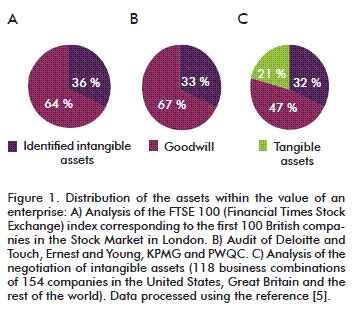
<body><![CDATA[<P   >&nbsp;</P >       <P   ><font size="3" face="Verdana, Arial, Helvetica, sans-serif"><b>STATE OF NEGOTIATIONS      OF INTANGIBLE ASSETS IN THE WORLD </b></font></P >   <FONT size="+1">        <P   ><font size="2" face="Verdana, Arial, Helvetica, sans-serif">The tangible value      of an enterprise is estimated in very low percentages, i.e. about 20 % (<a href="#fig1">Figure      1</a>); the rest lies in intangible assets that are difficult to measure or      estimate as a whole under the goodwill concept, which hampers the negotiation      leading to their overvaluation or undervaluation during the negotiating processes.      </font></P >       <P align="center"   ><img src="/img/revistas/bta/v31n3/f0107314.gif" width="355" height="310"><a name="fig1"></a></P >   <FONT size="+1">        
<P   ><font size="2" face="Verdana, Arial, Helvetica, sans-serif">Goodwill is the immaterial      value derived from factors such as the customers, efficiency, organization,      credits, prestige, experience, and the position of the enterprise or business      before third parties, a good location, quality merchandise or services, good      relationships with the workers, labor stability, and the trust achieved in      the financial sector because of good management. It is a highly valued asset      since it enhances the possibility to obtain new clients, suppliers, credits      and places the enterprise in an advantageous position in relation to competitors.      </font></P >       <P   ><font size="2" face="Verdana, Arial, Helvetica, sans-serif">The enterprise merging      and acquisition processes cover the negotiation of all of its assets, where      the intangible assets prevail. In fact, the boom in merging and acquisition      that took place in the 1990&rsquo;s was due to a boom in the negotiations      of intangible assets giving rise to consulting groups such as Cambridge Partners,      Ernest and Young, Appraisal Economics, Intangible Business, devoted to the      valuation of these assets: brands, stocks, customer relationships, copyrights,      patents, goodwill agreements, development and implementation of licensing      agreements, brand and business sales, enterprise merging and acquisition,      using the IFRS3 [3] and FASB 141 [4] standards as guidelines for their valuation.      The former standard points out the following restrictions: </font></P >   <DL   >      <DD   ><font size="2" face="Verdana, Arial, Helvetica, sans-serif">1. Only acquired        intangibles are valued: those generated by the organization are not taken        into account; although the companies acknowledge the new intangible assets        that are being generated, it is difficult to evaluate them and they end        off ignoring them. </font></DD >     <DD   ><font size="2" face="Verdana, Arial, Helvetica, sans-serif">2. Goodwill is often        not identified. </font></DD >     <DD   ><font size="2" face="Verdana, Arial, Helvetica, sans-serif">3. Intangibles are        undervalued: the standards applied stimulate the establishment of low values        for the intangible assets. </font></DD >     <DD   ><font size="2" face="Verdana, Arial, Helvetica, sans-serif">4. The increased        value of the intangible assets is not acknowledged: while prices of goods        rise or fall and trends and behavior can be defined, the value of intangible        assets does not increase with time, which is known as the historical cost.        </font></DD >   </DL >       <P   ><font size="2" face="Verdana, Arial, Helvetica, sans-serif">Results of the studies      of several companies on the identification and classification of intangible      assets, published in the Intangible Business web platform are summarized in      <a href="#fig1">figure 1</a> [5]. These are derived from the analysis of the      FTSE 100 (Financial Times Stock Exchange) index corresponding to the first      100 British companies in the London Stock Exchange (<a href="#fig1">Figure      1A</a>) from an audit to four large companies: Deloitte and Touch, Ernest      and Young, KPMG and PWQC (<a href="#fig1">Figure 1B</a>), and from the analysis      of the negotiation of intangible assets in which 118 business combinations      of 154 American companies, British companies and those of the rest of the      world, are included (<a href="#fig1">Figure 1C</a>). </font></P >       <P   ><font size="2" face="Verdana, Arial, Helvetica, sans-serif">In studies A and      B no tangible assets are represented since they are practically considered      negligible within the value of the enterprise. Study C is the most proportionate      one because it analyzes a larger and more representative sample. </font></P >       <P   ><font size="2" face="Verdana, Arial, Helvetica, sans-serif">The same review demonstrated      that 31 % of the goodwill assets had a good description, 16 % had a limited      description and 53 % showed no description [5]. When analyzed by categories      linked to their position in the market, the contracts in the United States      are located in first place, with a classification almost 35 %, followed by      marketing in the rest of the world with 28 %, and the clients in Great Britain      with 27 %. When examined according to each country it was found that Great      Britain and France had the highest identification of intangible assets with      37 %, followed by China, South Africa and the United States with 36 % each.      Out of the 13 countries considered in the analysis, only South Africa and      China are developing countries. </font></P >       <P   ><font size="2" face="Verdana, Arial, Helvetica, sans-serif">Some examples of      negotiations of intangible assets are listed below [6]: </font></P >   <DL   >      <DD   ><font size="2" face="Verdana, Arial, Helvetica, sans-serif">- When Proctor and        Gamble purchased Gillette in 63 billion dollars in 2005, the intangible        assets were valued in 55 trillion dollars, of which 35 billion corresponded        to goodwill, representing 63.6 % of the intangible value. Hence, there was        an overestimation of the intangible goodwill assets and an underestimation        of the identified intangible assets. </font></DD >     <DD   ><font size="2" face="Verdana, Arial, Helvetica, sans-serif">- Walt Disney paid        7.5 billion dollars for the Pixar digital animation studio. The intangible        assets, brand and commercial names were valued in only 200 million dollars        while the goodwill assets were valued in 5.6 billion dollars. This is another        example of overestimation of goodwill assets and underestimation of the        identified intangible assets. </font></DD >     <DD   ><font size="2" face="Verdana, Arial, Helvetica, sans-serif">- In 2006,</font><font color="#D70000" size="2" face="Verdana, Arial, Helvetica, sans-serif"><FONT color="#000000">        Google purchased YouTube for 1.2 billion dollars, which reached the headlines        of the brand stock exchange. Out of the entire purchase, only 200 million        were attributed to the identified intangible assets and 83.4 % to goodwill.        It is known that the success of YouTube is due to the expertise of the brand        to attract subscribers, and therefore, the valuation made for the brand        is extremely low. </font></font></DD >   </DL >   <FONT color="#D70000"><FONT color="#000000"><FONT color="#D70000">        ]]></body>
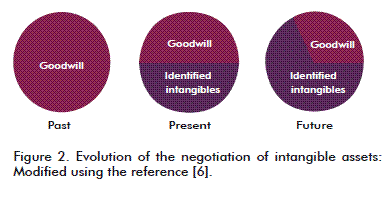
<body><![CDATA[<P   ><font color="#000000" size="2" face="Verdana, Arial, Helvetica, sans-serif">These      examples demonstrate that the lack of knowledge for valuing intangible assets,      separating goodwill assets, as well the fact that a calculation method has      not been standardized, leads to a potential risk in its appropriate identification,      and then they are overestimated or undervalued. </font></P >   <FONT color="#000000">        <P   ><font size="2" face="Verdana, Arial, Helvetica, sans-serif"><a href="#fig2">Figure      2</a> illustrates the evolution of the goodwill assets and the identification      of the intangible assets [6]. Before 2002, goodwill assets covered the entire      pyramid, indicating that the enterprises negotiated on the basis of that parameter,      while from 2002 to 2011 there has been a progression in the identification      of intangible assets that has grown in an important proportion in relation      to goodwill. This is due to the growing weight of the high tech center in      the economy, generating patents and technologies: negotiations of intangible      assets are growing in the current globalization framework. The increase of      those negotiations and the merging and acquisition of enterprises have led      the consulting groups and the negotiators to try to growingly identify the      intangible assets involved. </font></P >       <P align="center"   ><img src="/img/revistas/bta/v31n3/f0207314.gif" width="389" height="195"><a name="fig2"></a></P >       
<P   ><font size="2" face="Verdana, Arial, Helvetica, sans-serif">It is challenging      that the identified intangible assets are predominant, with only a small portion      negotiated as goodwill. </font></P >       <P   ><font size="2" face="Verdana, Arial, Helvetica, sans-serif">An overview is given      below because of the importance of the process of merging and acquisition      of enterprises in the negotiations of intangible assets. </font></P >       <P   ><font size="2" face="Verdana, Arial, Helvetica, sans-serif">According to Danzon,      Epstein and Nicholson, the biotech-pharmaceutical industry has become a growingly      concentrated industry in the last 15 years; in 1985 the 10 largest companies      covered 20 % of all the world sales, while in 2002 the 10 largest companies      covered 48 % of the sales. This concentration is mainly due to the merging      process [8]. </font></P >       <P   ><font size="2" face="Verdana, Arial, Helvetica, sans-serif">For biotech companies,      the partnerships and other forms of association became more and more important      as a source of capital; and for the pharmaceutical companies, they were sources      of new products. According to the research carried out by professors Sean      Nicholson and Patricia Danzon of Wharton University in Pennsylvania, if biotech      and pharmaceutical companies join their efforts, they can increase the probabilities      of achieving the approval of the regulating authorities to introduce new drugs      in the market. </font></P >       <P   ><font size="2" face="Verdana, Arial, Helvetica, sans-serif">Therefore, the merging      and acquisition of small companies by big ones is frequently found in the      pharmaceutical and biotechnological industry [9]. </font></P >       <P   ><font size="2" face="Verdana, Arial, Helvetica, sans-serif">The research appearing      in the paper &ldquo;Biotech-Pharma Alliances as a Signal of Asset and Firm      Quality&rdquo;, is partly based on the analysis of 539 licensing agreements      that had been signed between the years 1988 and 2000 [10]. The agreements      showed that the medications produced between associated companies had a higher      probability of success in getting their approval by the regulating authorities      of the United States (Food and Drug Administration, FDA), than drugs developed      by only one company. </font></P >       <P   ><font size="2" face="Verdana, Arial, Helvetica, sans-serif">The authors report      that out of the 691 new drugs approved by the FDA between 1963 and 1999, some      38 % were produced by partnerships. The biotech-pharmaceutical partnerships      grew at an average rate of 1.4 % a year during the period of 1988-1990 and      increased its growth to a rate of 5.7 % between the years 1997 and 1998. They      also expressed that the biotech-pharmaceutical agreements market seems to      be working well and the agreements seem to be taking place when there are      mutual benefits and there is an increase in productivity of both companies      because of this [10]. </font></P >       ]]></body>
<body><![CDATA[<P   ><font size="2" face="Verdana, Arial, Helvetica, sans-serif">In the year 2000,      Garnier, who was at the time Vice-president of the Belgium company GlaxoSmithKline,      expressed that he believed that size is very important, since there can be      no success in the final development of a drug unless there is a world infrastructure      for this. He said that this can be verified every day with the biotech companies      and that ImClone is proof of it. Later in 2008 ImClone was purchased by Eli      Lilly who paid 6.5 billion dollars for including it in their project portfolio.      </font></P >       <P   ><font size="2" face="Verdana, Arial, Helvetica, sans-serif">Mark Edwards, managing      director of Recombinant Capital, an advisory company specialized in biotech      partnerships from San Francisco, expressed that the agreements are mainly      demonstrating success and that the partnerships may and should be profitable      for all, but it is sometimes difficult to achieve it [10]. </font></P >       <P   ><font size="2" face="Verdana, Arial, Helvetica, sans-serif">Sean Nicholson stated      that the biotech-pharmaceutical partnerships have a role in the financial      field on assigning an appropriate valuation to the small biotech enterprises.      An example of this is that in 1998, the biotech companies received 6200 million      dollars in pharmaceutical partnerships, which is three times more than what      the received in the public and private capital markets [10]. </font></P >       <P   ><font size="2" face="Verdana, Arial, Helvetica, sans-serif">The biotech companies      tend to license their product at the final stages, when there is less risk      and a higher reward. This happens when they have received enough capital to      finance the expensive drug development processes. </font></P >       <P   ><font size="2" face="Verdana, Arial, Helvetica, sans-serif">According to Agust&iacute;n      Lage in his book &ldquo;La Econom&iacute;a del Conocimiento y el Socialismo&rdquo;      (The Economy of Knowledge and Socialism) [11], in spite of the high development      costs of a product, the strategy of Cuban biotechnology is to achieve the      complete development of the product. This makes it possible to negotiate products      of high added value. These negotiations only search for the commercial representation      of foreign partners. Patents and technologies are also patented and developing      products are negotiated for alliances with foreign partners. </font></P >       <P   ><font size="2" face="Verdana, Arial, Helvetica, sans-serif">These alliances offer      less profit to the Cuban party than if the entire development is carried out      without foreign participation, since a part of the value of the product (depending      on their participation in its development) is transferred to the foreign party.      This happens when the participation is absolutely necessary to obtain something      required at that time to complete the drug&rsquo;s development, which may      cover productive facilities, productive standards or regulators, or both,      or just the funding needed to complete the development of the drug to be able      to place it in the market at the proper time. On taking advantage of the opportunity      of a partnership to complete the development of the product at the right time,      this will mean arriving first at the market and receiving incomes and recovering      the investments earlier. </font></P >       <P   ><font size="2" face="Verdana, Arial, Helvetica, sans-serif">In joint development      contracts, the foreign partner supplies the risk capital for the continuation      and completion of the project; pre-marketing payments are made, which include      the valuation of the intangible assets created by the Cuban party. In exchange,      the foreign partner receives marketing rights in certain regions, which will      be effective if the project finally generates a marketable product. </font></P >       <P   ><font size="2" face="Verdana, Arial, Helvetica, sans-serif">This can be seen      when data on transactions with intangible assets are analyzed, such as those      registered in the biotech and pharmaceutical industry from 2006 to 2010, which      are available at the Biopharmaceutiques web platform [12] (<a href="#fig3">Figure      3</a>). </font></P >       <P align="center"   ><img src="/img/revistas/bta/v31n3/f0307314.gif" width="390" height="327"><a name="fig3"></a></P >       
<P   ><font size="2" face="Verdana, Arial, Helvetica, sans-serif">Most transactions      were recorded in the year 2008. The research and development contracts are      those most highly negotiated, followed by licensing and acquisition agreements.      The agreements for manufacturing are of much less importance between first      world companies, and in agreements between companies of the first world and      developing countries (<a href="/img/revistas/bta/v31n3/f0407314.gif">Figure      4</a>). </font></P >       
]]></body>
<body><![CDATA[<P   ><font size="2" face="Verdana, Arial, Helvetica, sans-serif">The table summarizes      three out of ten business examples with intangible assets of products from      the pharmaceutical industry, according to Biopharmaceutiques [12]. </font></P >       <P   ><font size="2" face="Verdana, Arial, Helvetica, sans-serif">The differentiation      of the intangible assets by type of agreement in the biopharmaceutical industry      is shown, where the terms of the negotiations reviews show the pre-marketing      payments before meeting the milestones or goals. </font></P >       <P   ><font size="2" face="Verdana, Arial, Helvetica, sans-serif">Finally, it must      be stressed that there are two aspects in the negotiation of intangible assets      that also offer value, although they are hardly ever considered, these are      the brand name and the intellectual capital. </font></P >       <P   ><font size="2" face="Verdana, Arial, Helvetica, sans-serif">After the publication      of the book &ldquo;Brand Name&rdquo; by David Aaker in 2001, several documents      have been disseminated that propose methods to determine the value of the      brand name, the most important commercial and institutional assets in many      company sectors. However, the exact determination of its value is far from      being achieved. Some authors express that it is impossible to assign values      to these brand names, regardless the companies creating them, and that the      values are negotiated in companies having a strong representativeness, and      this includes the entire intangible value of the company [7]. </font></P >       <P   ><font size="2" face="Verdana, Arial, Helvetica, sans-serif">In relation to intellectual      capital, mainly patents, only a fraction of the technologies stated are negotiated,      and most of them have a value that is lower than its registration and maintenance      rate. </font></P >       <P   ><font size="2" face="Verdana, Arial, Helvetica, sans-serif">Almost all studies      on intellectual capital are very descriptive and are far from calculating      its true value. Johan and Goram Ross established an index for its measurement,      which was a breakthrough in relation to assuming that intellectual capital      is the difference between the market value and the book value of company stocks.      However, the use of the formula has never been evidenced [7]. </font></P >       <P   >&nbsp;</P >       <P   ><font size="2" face="Verdana, Arial, Helvetica, sans-serif"><b><font size="3">THE      INTANGIBLE STRENGTH OF THE CUBAN BIOTECHNOLOGY INDUSTRY </font></b></font></P >   <FONT size="+1">        <P   ><font size="2" face="Verdana, Arial, Helvetica, sans-serif">Modern biotechnology,      which arose and was developed through the 1970&rsquo;s and 1980&rsquo;s, has      been normally established as coming from industrialized countries. </font></P >   <FONT size="+1">        <P   ><font size="2" face="Verdana, Arial, Helvetica, sans-serif">The use of the recombinant      DNA technology, genetic therapy, biosafety and the creation of new research      institutes to develop these new technologies, were among the first goals of      these developed countries. Progress in molecular biology generated important      applications in the fields of health, agriculture, industry and the environment,      which still today remain as a goal for emerging economies. Such is the case      of Brazil, Russia, India, China and South Africa (BRICS), countries that have      become active in the use of genetic engineering to develop products for human      health. </font></P >       ]]></body>
<body><![CDATA[<P   ><font size="2" face="Verdana, Arial, Helvetica, sans-serif">The creation, development      and success of the Cuban biotechnology industry has its roots in the policy      established with the triumph of the Revolution when Commander in Chief Fidel      Castro Ruz announce that &ldquo;Cuba&rsquo;s future has to be necessarily      one of men of science, of men of thought&rdquo; [13]. The training of human      resources now existing in the country was started with the literacy campaign      of 1961. </font></P >       <P   ><font size="2" face="Verdana, Arial, Helvetica, sans-serif">The National Center      for Scientific Research (Centro Nacional de Investigaciones Cient&iacute;ficas,      CNIC) was created in 1965. It was the pioneer center for what would become      the Scientific Pole of Western Havana. The Biological Front was created in      1980, which had an inter-disciplinary professional structure, and worked in      close connection to governmental authorities, developing the potential for      the application of this emerging science. The dengue and hemorrhagic conjunctivitis      epidemics of 1981 leveraged the decision to invest in biotechnology. Hence      the Center for Biological Research was created in 1983; this was where the      recombinant alpha interferon, the homologue of human leukocyte interferon,      which was the first Cuban biotechnology product, was initially obtained. Afterwards,      in 1986, the Center for Genetic Engineering and Biotechnology was inaugurated,      and after that, from 1986 to 1996 an investment program for the construction      of the 53 institutions now forming the Cuban group of biotechnology and pharmaceutical      industries, was developed as a Higher Organization of Entrepreneurial Administration      (BioCubaFarma), estimated in a billion dollars [14]. </font></P >       <P   ><font size="2" face="Verdana, Arial, Helvetica, sans-serif">The Cuban biotechnology      sector is characterized by: a) having the Cuban state as its main investor;      b) the fact that biotechnology is part of the National Health System, and      it prioritizes the national needs; c) having a human capital that is 100 %      Cuban, which is also very highly trained; d) operating in a closed cycle strategy:      from research to marketing; e) lacking the competition between centers that      are integrated in the sector; it is characterized by the close collaboration      between the institutions forming it; and f) the fact that the marketing companies      arise from the centers themselves, which contributes to the professionalism      of the managers of the commercial activity, through the knowledge they have      of this sector. </font></P >       <P   ><font size="2" face="Verdana, Arial, Helvetica, sans-serif">This made it possible      to design a portfolio of high-tech biotechnology products, more than 60 product      that cover vaccines, diagnostic systems, medical equipment, generic drugs      that include retroviral drugs for the treatment of the human immunodeficiency      virus and others. These products of Cuban biotechnology are registered in      66 countries, exported to more than 50 countries today, and generate positive      cash-flow that enables the financing of the system&rsquo;s own growth [8].      </font></P >       <P   ><font size="2" face="Verdana, Arial, Helvetica, sans-serif">Me too, and novel      products are developed, which include: </font></P >   <DL   >      <DD   ><font size="2" face="Verdana, Arial, Helvetica, sans-serif">- The preventive        vaccine against <I>Neisseria meningitidis </I>type b, with patents granted        in several countries, is the only one with a demonstrated efficacy against        the main causes of child death due to meningitis; </font></DD >     <DD   ><font size="2" face="Verdana, Arial, Helvetica, sans-serif">- PPG, a unique product        with three patents granted: one, as a product producing cholesterol reduction;        another one, for the procedure; and the third patent that combines the product        with the procedure. The patent has been granted in more than 12 countries        through the European Patent Office (EPO). </font></DD >     <dd><font size="2" face="Verdana, Arial, Helvetica, sans-serif">- The vaccine        against <I>Haemophilus influenzae</I> type b, the only commercial vaccine        obtained by chemical synthesis. </font></dd>     <dd><font size="2" face="Verdana, Arial, Helvetica, sans-serif">- Heberprot-P&reg;,        a unique product with a patent, with a demonstrated high effectiveness in        the treatment of diabetic foot ulcers. A high percentage of patients using        it have not needed amputation. Its clinical use has been of over 140 000        patients treated in Cuba and other countries. The product received the Gold        Medal of the World Organization of Industrial Property in the year 2010,        and the main researcher of the group received the Award to the Best Young        Inventor. </font></dd>   </DL >       <P   ><font size="2" face="Verdana, Arial, Helvetica, sans-serif">Furthermore, there      is a project portfolio with the potential of novel biopharmaceutical products      having high added values. In the last five years, the requests for patents      and those granted have grown. </font></P >       <P   ><font size="2" face="Verdana, Arial, Helvetica, sans-serif">The productive facilities      of the enterprises belonging to BioCubaFarma have been inspected by prestigious      regulatory authorities from different countries: </font></P >   <DL   >      <DD   ><font size="2" face="Verdana, Arial, Helvetica, sans-serif">- World Health Organization        (since 2001), </font></DD >     <DD   ><font size="2" face="Verdana, Arial, Helvetica, sans-serif">- Brazil: Anvisa        (September 2008), </font></DD >     <DD   ><font size="2" face="Verdana, Arial, Helvetica, sans-serif">- Biotik: access        to regulations of the European Medicines Agency (EMA; May 4-5, 2008), </font></DD >     <DD   ><font size="2" face="Verdana, Arial, Helvetica, sans-serif">- Ukraine regulating        authority (July 15-24, 2008), </font></DD >     <DD   ><font size="2" face="Verdana, Arial, Helvetica, sans-serif">- ICON Mexico, S.A.        of C.V. to access the Good Clinical Practices of EMA (September 17-18, 2008),        </font></DD >     <DD   ><font size="2" face="Verdana, Arial, Helvetica, sans-serif">- Good Manufacturing        Practices in Critical Water Systems, by the Barcelona Systems Validation        Society, Spain (October 13-17, 2008), </font></DD >     <DD   ><font size="2" face="Verdana, Arial, Helvetica, sans-serif">- Dr. Erik D&rsquo;Hondt;        Qualified person from Bioven, to access regulations of EMA (April 8, 2009),        </font></DD >     <DD   ><font size="2" face="Verdana, Arial, Helvetica, sans-serif">- South African regulatory        authority (May 2009), </font></DD >     <DD   ><font color="#D70000" size="2" face="Verdana, Arial, Helvetica, sans-serif">-        <FONT color="#000000">CESIF-Praxis S.A. to access regulations of EMA (September        2009). </font></font></DD >   </DL >   <FONT color="#D70000"><FONT color="#000000"><FONT color="#D70000">        <P   > </P >   <FONT color="#000000">        <P   ><font size="2" face="Verdana, Arial, Helvetica, sans-serif">Having the endorsement      of these institutions is a demonstration of the quality of the Cuban biotech      products and promotes their introduction into the market. </font></P >       <P   ><font size="2" face="Verdana, Arial, Helvetica, sans-serif">Just considering      the enterprises that form part of BioCubaFarma, the country has a treasure      in intellectual property, in intangible assets that must be protected, valuated      and well negotiated, since we live in a globalized world where companies are      merged every day and acquire the assets of others. Licensing agreements are      signed, giving the rights to exploit someone else&rsquo;s knowledge, while      also the system of intellectual property ensures the participation of foreign      capital in research and development. This system is the most visible form      of privatization of knowledge. Hence, the importance of having a negotiating      system for these assets in the most representative sectors of intellectual      property in the country. </font></P >       ]]></body>
<body><![CDATA[<P   >&nbsp;</P >       <P   ><font size="3" face="Verdana, Arial, Helvetica, sans-serif"><b>ECONOMIC IMPACT      </b></font></P >   <FONT size="+1">        <P   ><font size="2" face="Verdana, Arial, Helvetica, sans-serif">Identifying the importance      of the negotiation of intangible assets in sectors with a potential in intellectual      property leads to the proposal of the design of a strategy enabling the maximum      benefits in the negotiations. Here the intangible assets are not always negotiated,      and large sums of money are lost because of this. </font></P >   <FONT size="+1">        <P   ><font size="2" face="Verdana, Arial, Helvetica, sans-serif">An example of this      is the Center for Genetic Engineering and Biotechnology, one of the enterprises      of BioCubaFarma, which through the negotiation of intangible assets (projects      and pre-marketing payments) has earned millions of dollars in the last 6 years.      Through the negotiation of Heberprot-P&reg;, a unique product with a strong      patent position that has made it possible to fix a price on the basis of the      value of intellectual property and not on the basis of its production cost,      the center has received incomes rising to over hundreds of million dollars      in the last 6 years. The intangible assets are a substantial part of the economical      benefits that a biotech enterprise can receive, even before a product is placed      in the market. </font></P >       <P   >&nbsp;</P >       <P   ><font size="3" face="Verdana, Arial, Helvetica, sans-serif"><b>CONCLUSIONS </b></font></P >   <FONT size="+1">        <P   ><font size="2" face="Verdana, Arial, Helvetica, sans-serif">The tangible assets      only represent 21% of the assets of the companies. The difference corresponds      to the intangible assets, which are not highly differentiated and are negotiated      as goodwill. Ignoring the valuation of the intangible assets, as well as the      lack of a standardized method for their calculation, leads to a potential      risk in their identification and they are then over or under estimated, with      the consequent returns or losses to the enterprises. </font></P >   <FONT size="+1">        <P   ><font size="2" face="Verdana, Arial, Helvetica, sans-serif">The strength of intellectual      property of the biopharmaceutical industry inserted in a globalized world,      where the trend is the merging and acquisition of enterprises, makes it necessary      to consider the need of an appropriate diagnostic of intangible assets in      negotiations taking place in the group of Cuban biotech and pharmaceutical      industries (BioCubaFarma), and to work in the design of a strategy for the      negotiation of their intangible assets, which will have a multiplying effect      on current returns. </font></P >       <P   >&nbsp;</P >       <P   > </P >       ]]></body>
<body><![CDATA[<P   ><b><font size="3" face="Verdana, Arial, Helvetica, sans-serif">REFERENCES</font></b><font size="2" face="Verdana, Arial, Helvetica, sans-serif">      </font></P >       <!-- ref --><P   > <font size="2" face="Verdana, Arial, Helvetica, sans-serif">1. Drucker P. La      sociedad postcapitalista. Bogot&aacute;, Editorial Norma; 1994.     </font></P >       <!-- ref --><P   ><font face="Verdana, Arial, Helvetica, sans-serif" size="2">2. K</font><font face="Verdana, Arial, Helvetica, sans-serif" size="2" color="#0018E4"><FONT color="#000000">arstetter      E. How intangible assets affect business value. Enterpreneur [Internet]. 2002      May 6. [cited 2013 Aug 14]. Available from: <a href="http://www.entrepreneur.com/article/51628" target="_blank">http://www.entrepreneur.com/article/51628      </a> </font></font></P >       <P   ><font size="2" face="Verdana, Arial, Helvetica, sans-serif" color="#000000">3.      </font><font size="2" face="Verdana, Arial, Helvetica, sans-serif"><FONT color="#000000">IFRS      3 &mdash; Business Combinations [Internet]. London: Deloitte Touche Tohmatsu      Limited. c. 2013 [cited 2013 Aug 14]. Available from: <FONT color="#0018E4"><a href="http://www.iasplus.com/en/standards/ifrs/ifrs3" target="_blank">http://www.iasplus.com/en/standards/ifrs/ifrs3</a>      </font></font></font></P >       <!-- ref --><P   ><font size="2" face="Verdana, Arial, Helvetica, sans-serif" color="#000000">4.</font><font size="2" face="Verdana, Arial, Helvetica, sans-serif">      <FONT color="#000000">Financial Accounting Standard Board. Statement of Financial      Accounting Standard N&ordm; 141 (revised 2007). Business combinations [Internet];      Norwalk: Financial Accounting Standards Board ; 2010 [cited 2013 Aug 14].      Available from: </font></font><font color="#0018E4" size="2" face="Verdana, Arial, Helvetica, sans-serif"><a href="http://www.fasb.org/cs/BlobServer?blobkey=id&blobwhere=1175823288072&blobheader=application/pdf&blobcol=urldata&blobtable=MungoBlobs" target="_blank">http://www.fasb.org/cs/BlobServer?blobkey=id&amp;blobwhere=1175823288072&amp;blobheader=application%2Fpdf&amp;blobcol=urldata&amp;blobtable=MungoBlobs      </a> </font></P >       <P   ><font face="Verdana, Arial, Helvetica, sans-serif" size="2">5. <FONT color="#000000">Intangible      Business [Internet]. London: Intangible Business Limited. c. 2003-2013 [cited      2013 Aug 14]. Available from: <FONT color="#0018E4"><a href="http://www.intangiblebusiness.com/" target="_blank">http://www.intangiblebusiness.com/      </a> </font></font></font></P >       <!-- ref --><P   ><font face="Verdana, Arial, Helvetica, sans-serif" size="2">6. <FONT color="#000000">Forbes      T. Shareholders None the Wiser as SFAS 141 has a minimal impact. Intangible      Assets Manage. 2008 Feb [cited 2013 Aug 14]:8-12. Available from: <FONT color="#0018E4"><a href="http://www.intangiblebusiness.com/uploads/2013/02/11/358-Stakeholders_none_the_wiser_as_SFAS141_has_minimal_impact_IAM_February_2008.pdf" target="_blank">http://www.intangiblebusiness.com/uploads/2013/02/11/358-Stakeholders_none_the_wiser_as_SFAS141_has_minimal_impact_IAM_February_2008.pdf      </a> </font></font></font></P >       <P   ><font color="#000000" size="2" face="Verdana, Arial, Helvetica, sans-serif">7.      Fern&aacute;ndez P. Valoraci&oacute;n de marcas e intangibles. Universidad      de Navarra, Espa&ntilde;a; 2007. </font></P >       <!-- ref --><P   ><font face="Verdana, Arial, Helvetica, sans-serif" size="2">8. Danzon P, Epstein      A, Nicholson S. Mergers and acquisitions in the pharmaceutical and biotech      industries. Manage Decis Econ. 2007;28(4-5):307-28.     </font></P >       <!-- ref --><P   ><font face="Verdana, Arial, Helvetica, sans-serif" size="2">9. Nichols</font><font face="Verdana, Arial, Helvetica, sans-serif" size="2" color="#0018E4"><FONT color="#000000">on      S, Danzon P, McCullough JS. Biotech-pharmaceutical alliances as a signal of      asset and firm quality [Internet]. Massachusetts: National Bureau of Economic      Research, Working Paper Series, Working Paper 9007; 2002 [cited 2013 Aug 14].      Available from: <a href="http://www.nber.org/papers/w9007.pdf" target="_blank">http://www.nber.org/papers/w9007.pdf      </a></font></font></P >       <!-- ref --><P   ><font face="Verdana, Arial, Helvetica, sans-serif" size="2">10. <FONT color="#000000">Los      beneficios son mutuos en la nueva Ola de alianzas biotecnol&oacute;gico-farmac&eacute;uticas.      [Internet]. Philadelphia: Universia Knowledge@Wharton; 2003 [cited 2013 Aug      14]. Available from: <FONT color="#0018E4"><a href="http://knowledge.wharton.upenn.edu/article/the-benefits-are-mutual-in-new-wave-of-biotechpharma-alliances/" target="_blank">http://knowledge.wharton.upenn.edu/article/the-benefits-are-mutual-in-new-wave-of-biotechpharma-alliances/</a>      </font></font></font></P >       <!-- ref --><P   ><font color="#000000" size="2" face="Verdana, Arial, Helvetica, sans-serif">11.      Lage A. La Econom&iacute;a del Conocimiento y el Socialismo. La Habana: Editorial      Academia; 2013.     </font></P >       <!-- ref --><P   ><font face="Verdana, Arial, Helvetica, sans-serif" size="2">12. Biop</font><font face="Verdana, Arial, Helvetica, sans-serif" size="2" color="#0018E4"><FONT color="#000000">harmaceutiques      Internet. Puteaux Cedex: PR Editions; c2009 [cited 2013 Aug 14]. Available      from: <a href="http://www.biopharmaceutiques.com/en/tables/agreements/index.html" target="_blank">http://www.biopharmaceutiques.com/en/tables/agreements/index.html      </a></font></font></P >       <!-- ref --><P   ><font face="Verdana, Arial, Helvetica, sans-serif" size="2">13. <FONT color="#000000">Castro      Ruz F. Discurso pronunciado por el comandante Fidel Castro Ruz, primer ministro      del gobierno revolucionario, en el acto celebrado por la Sociedad Espeleol&oacute;gica      de Cuba, en la Academia de Ciencias, el 15 de enero de 1960. Versiones taquigr&aacute;ficas.      La Habana: Consejo de Estado; 1960 [cited 2013 Jan 5]. Available from: <FONT color="#0018E4"><a href="http://www.cuba.cu/gobierno/discursos/1960/esp/f150160e.html" target="_blank">www.cuba.cu/gobierno/discursos/1960/esp/f150160e.html</a>      </font></font></font></P >       <!-- ref --><P   ><font color="#000000" size="2" face="Verdana, Arial, Helvetica, sans-serif">14.      L&oacute;pez E, Silva R, Acevedo B, Buxad&oacute; JA, Aguilera A, Herrera      L. Biotechnology in Cuba: 20 years of scientific social and economic progress.      J Commer Biotechnol. 2006;13(1):1-11.     </font></P >   <FONT size="+1"><FONT color="#0018E4"><FONT color="#000000"><FONT color="#0018E4"><FONT color="#000000"><FONT color="#0018E4"><FONT color="#000000"><FONT color="#0018E4"><FONT color="#000000"><FONT color="#0018E4"><FONT color="#000000"><FONT color="#0018E4"><FONT color="#000000"><FONT color="#0018E4"><FONT color="#000000"><FONT color="#0018E4"><FONT color="#000000"><FONT color="#0018E4"><FONT color="#000000"><FONT color="#0018E4"><FONT color="#000000"><FONT color="#0018E4"><FONT color="#000000"><FONT color="#0018E4"><FONT color="#000000">        <P   > </P >   <FONT size="+1">        ]]></body>
<body><![CDATA[<P   >&nbsp;</P >       <P   >&nbsp;</P >       <P   ><font size="2" face="Verdana, Arial, Helvetica, sans-serif">Received in September,      2013.    <br>     </font><font size="2" face="Verdana, Arial, Helvetica, sans-serif">Accepted      in May, 2014. </font></P >       <P   >&nbsp;</P >       <P   >&nbsp;</P >       <P   ></P >       <P   > </P >       <P   ><font size="2" face="Verdana, Arial, Helvetica, sans-serif"><i>Dora Garc&iacute;a-Delgado</i>.      Centro de Ingenier&iacute;a Gen&eacute;tica y Biotecnolog&iacute;a, CIGB.      Ave. 31 entre 158 y 190, Cubanac&aacute;n, Playa, CP 11600, La Habana, Cuba.      E-mail: <A href="mailto:dora.garcia@heber-biotec.com"> <FONT color="#0000FF">dora.garcia@heber-biotec.com</font></A><FONT color="#0000FF"><FONT color="#000000">.      </font></font></font></P >   </font></font></font></font></font></font></font></font></font></font></font></font></font></font></font></font></font></font></font></font></font></font></font></font></font></font></font></font></font></font></font></font></font></font></font></font></font></font></font></font></font></font></font></font></font></font></font></font></font></font></font></DIV >      ]]></body><back>
<ref-list>
<ref id="B1">
<label>1</label><nlm-citation citation-type="book">
<person-group person-group-type="author">
<name>
<surname><![CDATA[Drucker]]></surname>
<given-names><![CDATA[P]]></given-names>
</name>
</person-group>
<source><![CDATA[La sociedad postcapitalista]]></source>
<year>1994</year>
<publisher-loc><![CDATA[Bogotá ]]></publisher-loc>
<publisher-name><![CDATA[Editorial Norma]]></publisher-name>
</nlm-citation>
</ref>
<ref id="B2">
<label>2</label><nlm-citation citation-type="">
<person-group person-group-type="author">
<name>
<surname><![CDATA[Karstetter]]></surname>
<given-names><![CDATA[E]]></given-names>
</name>
</person-group>
<source><![CDATA[How intangible assets affect business value]]></source>
<year>2002</year>
<month> M</month>
<day>ay</day>
</nlm-citation>
</ref>
<ref id="B3">
<label>3</label><nlm-citation citation-type="book">
<source><![CDATA[IFRS 3 - Business Combinations]]></source>
<year>2013</year>
<publisher-loc><![CDATA[London ]]></publisher-loc>
<publisher-name><![CDATA[Deloitte Touche Tohmatsu Limited]]></publisher-name>
</nlm-citation>
</ref>
<ref id="B4">
<label>4</label><nlm-citation citation-type="book">
<collab>Financial Accounting Standard Board</collab>
<source><![CDATA[Statement of Financial Accounting Standard Nº 141 (revised 2007). Business combinations]]></source>
<year>2010</year>
<publisher-loc><![CDATA[Norwalk ]]></publisher-loc>
<publisher-name><![CDATA[Financial Accounting Standards Board]]></publisher-name>
</nlm-citation>
</ref>
<ref id="B5">
<label>5</label><nlm-citation citation-type="book">
<source><![CDATA[Intangible Business]]></source>
<year>2003</year>
<publisher-loc><![CDATA[London ]]></publisher-loc>
<publisher-name><![CDATA[Intangible Business Limited]]></publisher-name>
</nlm-citation>
</ref>
<ref id="B6">
<label>6</label><nlm-citation citation-type="journal">
<person-group person-group-type="author">
<name>
<surname><![CDATA[Forbes]]></surname>
<given-names><![CDATA[T]]></given-names>
</name>
</person-group>
<article-title xml:lang="en"><![CDATA[Shareholders None the Wiser as SFAS 141 has a minimal impact]]></article-title>
<source><![CDATA[Intangible Assets Manage]]></source>
<year>2008</year>
<month> F</month>
<day>eb</day>
<page-range>8-12</page-range></nlm-citation>
</ref>
<ref id="B7">
<label>7</label><nlm-citation citation-type="book">
<person-group person-group-type="author">
<name>
<surname><![CDATA[Fernández]]></surname>
<given-names><![CDATA[P]]></given-names>
</name>
</person-group>
<source><![CDATA[Valoración de marcas e intangibles]]></source>
<year>2007</year>
<publisher-loc><![CDATA[España ]]></publisher-loc>
<publisher-name><![CDATA[Universidad de Navarra]]></publisher-name>
</nlm-citation>
</ref>
<ref id="B8">
<label>8</label><nlm-citation citation-type="journal">
<person-group person-group-type="author">
<name>
<surname><![CDATA[Danzon]]></surname>
<given-names><![CDATA[P]]></given-names>
</name>
<name>
<surname><![CDATA[Epstein]]></surname>
<given-names><![CDATA[A]]></given-names>
</name>
<name>
<surname><![CDATA[Nicholson]]></surname>
<given-names><![CDATA[S]]></given-names>
</name>
</person-group>
<article-title xml:lang="en"><![CDATA[Mergers and acquisitions in the pharmaceutical and biotech industries]]></article-title>
<source><![CDATA[Manage Decis Econ]]></source>
<year>2007</year>
<volume>28</volume>
<numero>4</numero>
<issue>4</issue>
<page-range>5):307-28</page-range></nlm-citation>
</ref>
<ref id="B9">
<label>9</label><nlm-citation citation-type="book">
<person-group person-group-type="author">
<name>
<surname><![CDATA[Nicholson]]></surname>
<given-names><![CDATA[S]]></given-names>
</name>
<name>
<surname><![CDATA[Danzon]]></surname>
<given-names><![CDATA[P]]></given-names>
</name>
<name>
<surname><![CDATA[McCullough]]></surname>
<given-names><![CDATA[JS]]></given-names>
</name>
</person-group>
<source><![CDATA[Biotech-pharmaceutical alliances as a signal of asset and firm quality]]></source>
<year>2002</year>
<publisher-loc><![CDATA[Massachusetts ]]></publisher-loc>
<publisher-name><![CDATA[National Bureau of Economic Research]]></publisher-name>
</nlm-citation>
</ref>
<ref id="B10">
<label>10</label><nlm-citation citation-type="book">
<source><![CDATA[Los beneficios son mutuos en la nueva Ola de alianzas biotecnológico-farmacéuticas]]></source>
<year>2003</year>
<publisher-loc><![CDATA[Philadelphia ]]></publisher-loc>
<publisher-name><![CDATA[Universia Knowledge@Wharton]]></publisher-name>
</nlm-citation>
</ref>
<ref id="B11">
<label>11</label><nlm-citation citation-type="book">
<person-group person-group-type="author">
<name>
<surname><![CDATA[Lage]]></surname>
<given-names><![CDATA[A]]></given-names>
</name>
</person-group>
<source><![CDATA[La Economía del Conocimiento y el Socialismo]]></source>
<year>2013</year>
<publisher-loc><![CDATA[La Habana ]]></publisher-loc>
<publisher-name><![CDATA[Editorial Academia]]></publisher-name>
</nlm-citation>
</ref>
<ref id="B12">
<label>12</label><nlm-citation citation-type="book">
<source><![CDATA[Biopharmaceutiques]]></source>
<year>2009</year>
<publisher-loc><![CDATA[Puteaux Cedex ]]></publisher-loc>
<publisher-name><![CDATA[PR Editions]]></publisher-name>
</nlm-citation>
</ref>
<ref id="B13">
<label>13</label><nlm-citation citation-type="book">
<person-group person-group-type="author">
<name>
<surname><![CDATA[Castro Ruz]]></surname>
<given-names><![CDATA[F]]></given-names>
</name>
</person-group>
<source><![CDATA[Discurso pronunciado por el comandante Fidel Castro Ruz, primer ministro del gobierno revolucionario, en el acto celebrado por la Sociedad Espeleológica de Cuba, en la Academia de Ciencias, el 15 de enero de 1960]]></source>
<year>1960</year>
<publisher-loc><![CDATA[La Habana ]]></publisher-loc>
<publisher-name><![CDATA[Consejo de Estado]]></publisher-name>
</nlm-citation>
</ref>
<ref id="B14">
<label>14</label><nlm-citation citation-type="journal">
<person-group person-group-type="author">
<name>
<surname><![CDATA[López]]></surname>
<given-names><![CDATA[E]]></given-names>
</name>
<name>
<surname><![CDATA[Silva]]></surname>
<given-names><![CDATA[R]]></given-names>
</name>
<name>
<surname><![CDATA[Acevedo]]></surname>
<given-names><![CDATA[B]]></given-names>
</name>
<name>
<surname><![CDATA[Buxadó]]></surname>
<given-names><![CDATA[JA]]></given-names>
</name>
<name>
<surname><![CDATA[Aguilera]]></surname>
<given-names><![CDATA[A]]></given-names>
</name>
<name>
<surname><![CDATA[Herrera]]></surname>
<given-names><![CDATA[L]]></given-names>
</name>
</person-group>
<article-title xml:lang="en"><![CDATA[Biotechnology in Cuba: 20 years of scientific social and economic progress]]></article-title>
<source><![CDATA[J Commer Biotechnol]]></source>
<year>2006</year>
<volume>13</volume>
<numero>1</numero>
<issue>1</issue>
<page-range>1-11</page-range></nlm-citation>
</ref>
</ref-list>
</back>
</article>