<?xml version="1.0" encoding="ISO-8859-1"?><article xmlns:mml="http://www.w3.org/1998/Math/MathML" xmlns:xlink="http://www.w3.org/1999/xlink" xmlns:xsi="http://www.w3.org/2001/XMLSchema-instance">
<front>
<journal-meta>
<journal-id>1027-2852</journal-id>
<journal-title><![CDATA[Biotecnología Aplicada]]></journal-title>
<abbrev-journal-title><![CDATA[Biotecnol Apl]]></abbrev-journal-title>
<issn>1027-2852</issn>
<publisher>
<publisher-name><![CDATA[Editorial Elfos Scientiae]]></publisher-name>
</publisher>
</journal-meta>
<article-meta>
<article-id>S1027-28522014000300008</article-id>
<title-group>
<article-title xml:lang="en"><![CDATA[Development of soluble and immobilized biocatalysts based on a recombinant thermostable ß-fructosidase enabling complete sucrose inversion at pasteurization temperatures]]></article-title>
<article-title xml:lang="es"><![CDATA[Desarrollo de biocatalizadores solubles e inmovilizados basados en una ß-fructosidasa recombinante termoestable que permite la inversión total de la sacarosa a temperaturas de pasteurización]]></article-title>
</title-group>
<contrib-group>
<contrib contrib-type="author">
<name>
<surname><![CDATA[Menéndez]]></surname>
<given-names><![CDATA[Carmen]]></given-names>
</name>
<xref ref-type="aff" rid="A01"/>
</contrib>
<contrib contrib-type="author">
<name>
<surname><![CDATA[Martínez]]></surname>
<given-names><![CDATA[Duniesky]]></given-names>
</name>
<xref ref-type="aff" rid="A02"/>
</contrib>
<contrib contrib-type="author">
<name>
<surname><![CDATA[Trujillo]]></surname>
<given-names><![CDATA[Luis E]]></given-names>
</name>
<xref ref-type="aff" rid="A01"/>
</contrib>
<contrib contrib-type="author">
<name>
<surname><![CDATA[Ramírez]]></surname>
<given-names><![CDATA[Ricardo]]></given-names>
</name>
<xref ref-type="aff" rid="A01"/>
</contrib>
<contrib contrib-type="author">
<name>
<surname><![CDATA[Sobrino]]></surname>
<given-names><![CDATA[Alina]]></given-names>
</name>
<xref ref-type="aff" rid="A02"/>
</contrib>
<contrib contrib-type="author">
<name>
<surname><![CDATA[Cutiño-Ávila]]></surname>
<given-names><![CDATA[Bessy V]]></given-names>
</name>
<xref ref-type="aff" rid="A03"/>
</contrib>
<contrib contrib-type="author">
<name>
<surname><![CDATA[Basabe]]></surname>
<given-names><![CDATA[Liliana]]></given-names>
</name>
<xref ref-type="aff" rid="A04"/>
</contrib>
<contrib contrib-type="author">
<name>
<surname><![CDATA[del Monte-Martínez]]></surname>
<given-names><![CDATA[Alberto]]></given-names>
</name>
<xref ref-type="aff" rid="A03"/>
</contrib>
<contrib contrib-type="author">
<name>
<surname><![CDATA[Pérez]]></surname>
<given-names><![CDATA[Enrique R]]></given-names>
</name>
<xref ref-type="aff" rid="A02"/>
</contrib>
<contrib contrib-type="author">
<name>
<surname><![CDATA[Hernández]]></surname>
<given-names><![CDATA[Lázaro]]></given-names>
</name>
<xref ref-type="aff" rid="A01"/>
</contrib>
</contrib-group>
<aff id="A02">
<institution><![CDATA[,Centro de Ingeniería Genética y Biotecnología de S. Spíritus Laboratorio de Fermentaciones ]]></institution>
<addr-line><![CDATA[Sancti Spíritus ]]></addr-line>
<country>Cuba</country>
</aff>
<aff id="A03">
<institution><![CDATA[,Universidad de La Habana, UH Centro de Estudio de Proteínas, Facultad de Biología Laboratorio de Tecnología de Enzimas]]></institution>
<addr-line><![CDATA[ ]]></addr-line>
</aff>
<aff id="A04">
<institution><![CDATA[,CIGB Dirección de Investigaciones Agropecuarias Laboratorio de Biotecnología Acuática]]></institution>
<addr-line><![CDATA[La Habana ]]></addr-line>
<country>Cuba</country>
</aff>
<aff id="A01">
<institution><![CDATA[,Centro de Ingeniería Genética y Biotecnología, CIGB Dirección de Investigaciones Agropecuarias Laboratorio de Interacciones Planta-Microorganismo]]></institution>
<addr-line><![CDATA[La Habana ]]></addr-line>
<country>Cuba</country>
</aff>
<pub-date pub-type="pub">
<day>00</day>
<month>09</month>
<year>2014</year>
</pub-date>
<pub-date pub-type="epub">
<day>00</day>
<month>09</month>
<year>2014</year>
</pub-date>
<volume>31</volume>
<numero>3</numero>
<fpage>249</fpage>
<lpage>253</lpage>
<copyright-statement/>
<copyright-year/>
<self-uri xlink:href="http://scielo.sld.cu/scielo.php?script=sci_arttext&amp;pid=S1027-28522014000300008&amp;lng=en&amp;nrm=iso"></self-uri><self-uri xlink:href="http://scielo.sld.cu/scielo.php?script=sci_abstract&amp;pid=S1027-28522014000300008&amp;lng=en&amp;nrm=iso"></self-uri><self-uri xlink:href="http://scielo.sld.cu/scielo.php?script=sci_pdf&amp;pid=S1027-28522014000300008&amp;lng=en&amp;nrm=iso"></self-uri><abstract abstract-type="short" xml:lang="en"><p><![CDATA[Biocatalysts for the industrial production of invert sugar are preferred to stably operate at high sucrose concentrations and pasteurization temperatures. Thermotoga maritima ß-fructosidase (BfrA) is more thermostable and less susceptible to substrate inhibition than the current commercial invertase from Saccharomyces cerevisiae. In this research, the non-saccharolytic host Pichia pastoris was engineered for BfrA production. Fed-batch fermentation of the recombinant yeast for 72 h using cane sugar as a non-expensive energy source yielded cultures of cell densities over 100 g/L (dry biomass) with invertase activity exceeding 300 U/mL. BfrA was secreted to the cell periplasmic space and the culture medium as a fully active glycoprotein with unaltered thermostability. The extracellularly-released BfrA representing 85 % of the total proteins in the culture supernatant was either dried into powder to generate a soluble free enzyme biocatalyst (specific activity 15 000 U per gram of powder) or covalently immobilized on Glyoxyl-Sepharose CL 4B to generate an insoluble enzyme biocatalyst (specific activity 9249 U per gram of dry support) for reuse. As a third approach, the biomass bearing the periplasmic BfrA was submitted to a killing heat treatment and entrapped in calcium alginate beads to generate a reusable non-viable cell biocatalyst (specific activity 103 U per gram of dry beads). The three biocatalysts completely hydrolyzed cane sugar (70 %, w/v) in batchwise or continuous operation at 60 ºC, offering alternative cost-effective options for the industrial manufacture of food-grade inverted sugar syrup. This research granted the 2013 Award of the Cuban National Academy of Sciences.]]></p></abstract>
<abstract abstract-type="short" xml:lang="es"><p><![CDATA[El empleo de biocatalizadores termoestables en la producción industrial de sirope invertido es aún una meta por lograr. La enzima b-fructosidasa (BfrA) de Thermotoga maritima es más termoestable y menos susceptible a la inhibición por sustrato que la invertasa comercial de Saccharomyces cerevisiae. En esta investigación, Pichia pastoris se modificó genéticamente para producir BfrA. La levadura recombinante alcanzó densidad celular superior a 100 g/L (biomasa seca) y actividad invertasa por encima de 300 U/mL en fermentaciones de 72 h con el empleo de sacarosa como fuente barata de carbono. BfrA se secretó al periplasma celular y al medio de cultivo en forma de una glicoproteína totalmente activa y termoestable. BfrA con pureza de 85 % en el sobrenadante de cultivo se secó hasta polvo para generar un biocatalizador de enzima soluble (actividad específica 15 000 U/g peso seco) o se inmovilizó de forma covalente al soporte Glioxil-Sepharosa CL 4B para generar un biocatalizador insoluble (actividad específica 9249 U/g peso seco) que permita reuso. En un tercer enfoque, la biomasa celular fue sometida a un tratamiento térmico y encapsulada en esferas de alginato de calcio para generar un biocatalizador reusable de células muertas (actividad específica 103 U/g peso seco). Los tres biocatalizadores hidrolizaron completamente el azúcar de caña (70 % p/v) en operación continua o discontinua a 60 ºC, y ofrecen opciones alternativas rentables para la inversión enzimática del azúcar a escala industrial. Este trabajo mereció el Premio Anual de la Academia de Ciencias de Cuba para el año 2013.]]></p></abstract>
<kwd-group>
<kwd lng="en"><![CDATA[invertase]]></kwd>
<kwd lng="en"><![CDATA[invert syrup]]></kwd>
<kwd lng="en"><![CDATA[immobilization]]></kwd>
<kwd lng="en"><![CDATA[Thermotoga maritima]]></kwd>
<kwd lng="en"><![CDATA[Pichia pastoris]]></kwd>
<kwd lng="es"><![CDATA[invertasa]]></kwd>
<kwd lng="es"><![CDATA[sirope invertido]]></kwd>
<kwd lng="es"><![CDATA[inmovilización]]></kwd>
<kwd lng="es"><![CDATA[Thermotoga maritima]]></kwd>
<kwd lng="es"><![CDATA[Pichia pastoris]]></kwd>
</kwd-group>
</article-meta>
</front><body><![CDATA[ <DIV class="Part"   >        <P align="right"   ><font size="2" color="#000000" face="Verdana, Arial, Helvetica, sans-serif"><b>REPORT</b>      </font></P >       <P   >&nbsp;</P >   <FONT size="+1" color="#000000">        <P   ><font size="2" face="Verdana, Arial, Helvetica, sans-serif"><b><font size="4">Development      of soluble and immobilized biocatalysts based on a recombinant thermostable      &beta;-fructosidase enabling complete sucrose inversion at pasteurization      temperatures </font></b></font></P >       <P   >&nbsp;</P >       <P   ><b><font size="3" face="Verdana, Arial, Helvetica, sans-serif">Desarrollo de      biocatalizadores solubles e inmovilizados basados en una &beta;-fructosidasa      recombinante termoestable que permite la inversi&oacute;n total de la sacarosa      a temperaturas de pasteurizaci&oacute;n </font></b></P >       <P   >&nbsp;</P >       <P   >&nbsp;</P >   <FONT size="+1">        <P   > </P >   <FONT size="+1">       <P   ><b><font size="2" face="Verdana, Arial, Helvetica, sans-serif">Carmen Men&eacute;ndez<sup>1</sup>,      Duniesky Mart&iacute;nez<sup>2</sup>, Luis E Trujillo<sup>1</sup>, Ricardo      Ram&iacute;rez<sup>1</sup>, Alina Sobrino<sup>2</sup>, Bessy V Cuti&ntilde;o-&Aacute;vila<sup>3</sup>,      Liliana Basabe<sup>4</sup>, Alberto del Monte-Mart&iacute;nez<sup>3</sup>,      Enrique R P&eacute;rez<sup>2</sup>, L&aacute;zaro Hern&aacute;ndez<sup>1</sup>      </font></b></P >       ]]></body>
<body><![CDATA[<P   ><font size="2" face="Verdana, Arial, Helvetica, sans-serif"><sup>1</sup> Laboratorio      de Interacciones Planta-Microorganismo, Direcci&oacute;n de Investigaciones      Agropecuarias,</font><font size="+1" color="#000000"><font size="+1"><font size="+1"><font size="2" face="Verdana, Arial, Helvetica, sans-serif">      Centro de Ingenier&iacute;a Gen&eacute;tica y Biotecnolog&iacute;a, CIGB.      Ave. 31 e/ 158 y 190, Cubanac&aacute;n, Playa, CP 11600, La Habana, Cuba.</font></font></font></font><font size="2" face="Verdana, Arial, Helvetica, sans-serif">    <br>     <sup>2</sup> Laboratorio de Fermentaciones, </font><font size="+1" color="#000000"><font size="+1"><font size="+1"><font size="2" face="Verdana, Arial, Helvetica, sans-serif">Centro      de Ingenier&iacute;a Gen&eacute;tica y Biotecnolog&iacute;a de S. Sp&iacute;ritus.      </font></font></font></font><font size="2" face="Verdana, Arial, Helvetica, sans-serif">Circunvalante      Norte S/N, Olivos 3, CP 60200, Sancti Sp&iacute;ritus, Cuba.    <br>     <sup>3</sup> Laboratorio de Tecnolog&iacute;a de Enzimas, Centro de Estudio      de Prote&iacute;nas, Facultad de Biolog&iacute;a, Universidad de La Habana,      UH. Calle 25 entre J e I, Vedado, La Habana, CP 10400, Cuba.    <br>     <sup>4</sup> Laboratorio de Biotecnolog&iacute;a Acu&aacute;tica, Direcci&oacute;n      de Investigaciones Agropecuarias, CIGB, La Habana, Cuba.</font></P >       <P   >&nbsp;</P >       <P   >&nbsp;</P >   <FONT size="+1"><FONT size="+1"><FONT size="+1"><FONT size="+1"><FONT size="+1"><FONT size="+1"><FONT size="+1"><FONT size="+1"><FONT size="+1"><FONT size="+1"><FONT size="+1"><FONT size="+1"><FONT size="+1"><FONT size="+1"><FONT size="+1"><FONT size="+1"><FONT size="+1"><FONT size="+1"><FONT size="+1"><FONT size="+1">    </font></font></font></font></font></font></font></font></font></font></font></font></font></font></font></font></font></font></font></font></font></font></font>    <hr>   <FONT size="+1" color="#000000"><FONT size="+1"><FONT size="+1"><FONT size="+1"><FONT size="+1"><FONT size="+1"><FONT size="+1"><FONT size="+1"><FONT size="+1"><FONT size="+1"><FONT size="+1"><FONT size="+1"><FONT size="+1"><FONT size="+1"><FONT size="+1"><FONT size="+1"><FONT size="+1"><FONT size="+1"><FONT size="+1"><FONT size="+1"><FONT size="+1"><FONT size="+1"><FONT size="+1">       <P   > </P >   <FONT size="+1">       <P   ><b><font size="2" face="Verdana, Arial, Helvetica, sans-serif">ABSTRACT </font></b></P >   <FONT size="+1">        <P   ><font size="2" face="Verdana, Arial, Helvetica, sans-serif">Biocatalysts for      the industrial production of invert sugar are preferred to stably operate      at high sucrose concentrations and pasteurization temperatures. Thermotoga      maritima &beta;<FONT color="#000000">-fructosidase (BfrA) is more thermostable      and less susceptible to substrate inhibition than the current commercial invertase      from <I>Saccharomyces cerevisiae</I>. In this research, the non-saccharolytic      host <I>Pichia pastoris</I> was engineered for BfrA production. Fed-batch      fermentation of the recombinant yeast for 72 h using cane sugar as a non-expensive      energy source yielded cultures of cell densities over 100 g/L (dry biomass)      with invertase activity exceeding 300 U/mL. BfrA was secreted to the cell      periplasmic space and the culture medium as a fully active glycoprotein with      unaltered thermostability. The extracellularly-released BfrA representing      85 % of the total proteins in the culture supernatant was either dried into      powder to generate a soluble free enzyme biocatalyst (specific activity 15      000 U per gram of powder) or covalently immobilized on Glyoxyl-Sepharose CL      4B to generate an insoluble enzyme biocatalyst (specific activity 9249 U per      gram of dry support) for reuse. As a third approach, the biomass bearing the      periplasmic BfrA was submitted to a killing heat treatment and entrapped in      calcium alginate beads to generate a reusable non-viable cell biocatalyst      (specific activity 103 U per gram of dry beads). The three biocatalysts completely      hydrolyzed cane sugar (70 %, w/v) in batchwise or continuous operation at      60 &ordm;C, offering alternative cost-effective options for the industrial      manufacture of food-grade inverted sugar syrup. This research granted the      2013 Award of the Cuban National Academy of Sciences. </font></font></P >   <FONT size="+1" color="#000000">        <P   ><font size="2" face="Verdana, Arial, Helvetica, sans-serif"><b>Keywords:</b>      invertase, invert syrup, immobilization, <I>Thermotoga maritima</I>, <I>Pichia      pastoris. </I></font></P >   </font></font></font></font></font></font></font></font></font></font></font></font></font></font></font></font></font></font></font></font></font></font></font></font></font></font>    <hr>   <FONT size="+1" color="#000000"><FONT size="+1"><FONT size="+1"><FONT size="+1"><FONT size="+1"><FONT size="+1"><FONT size="+1"><FONT size="+1"><FONT size="+1"><FONT size="+1"><FONT size="+1"><FONT size="+1"><FONT size="+1"><FONT size="+1"><FONT size="+1"><FONT size="+1"><FONT size="+1"><FONT size="+1"><FONT size="+1"><FONT size="+1"><FONT size="+1"><FONT size="+1"><FONT size="+1"><FONT size="+1"><FONT size="+1"><FONT size="+1" color="#000000">       ]]></body>
<body><![CDATA[<P   ><font size="2" face="Verdana, Arial, Helvetica, sans-serif"><b>RESUMEN </b></font></P >       <P   ><font size="2" face="Verdana, Arial, Helvetica, sans-serif">El empleo de biocatalizadores      termoestables en la producci&oacute;n industrial de sirope invertido es a&uacute;n      una meta por lograr. La enzima b-fructosidasa (BfrA) de <I>Thermotoga maritima</I>      es m&aacute;s termoestable y menos susceptible a la inhibici&oacute;n por      sustrato que la invertasa comercial de <I>Saccharomyces cerevisiae</I>. En      esta investigaci&oacute;n, <I>Pichia pastoris</I> se modific&oacute; gen&eacute;ticamente      para producir BfrA. La levadura recombinante alcanz&oacute; densidad celular      superior a 100 g/L (biomasa seca) y actividad invertasa por encima de 300      U/mL en fermentaciones de 72 h con el empleo de sacarosa como fuente barata      de carbono. BfrA se secret&oacute; al periplasma celular y al medio de cultivo      en forma de una glicoprote&iacute;na totalmente activa y termoestable. BfrA      con pureza de 85 % en el sobrenadante de cultivo se sec&oacute; hasta polvo      para generar un biocatalizador de enzima soluble (actividad espec&iacute;fica      15 000 U/g peso seco) o se inmoviliz&oacute; de forma covalente al soporte      Glioxil-Sepharosa CL 4B para generar un biocatalizador insoluble (actividad      espec&iacute;fica 9249 U/g peso seco) que permita reuso. En un tercer enfoque,      la biomasa celular fue sometida a un tratamiento t&eacute;rmico y encapsulada      en esferas de alginato de calcio para generar un biocatalizador reusable de      c&eacute;lulas muertas (actividad espec&iacute;fica 103 U/g peso seco). Los      tres biocatalizadores hidrolizaron completamente el az&uacute;car de ca&ntilde;a      (70 % p/v) en operaci&oacute;n continua o discontinua a 60 &ordm;C, y ofrecen      opciones alternativas rentables para la inversi&oacute;n enzim&aacute;tica      del az&uacute;car a escala industrial. Este trabajo mereci&oacute; el Premio      Anual de la Academia de Ciencias de Cuba para el a&ntilde;o 2013. </font></P >       <P   ><font size="2" face="Verdana, Arial, Helvetica, sans-serif"><b>Palabras clave:</b>      invertasa, sirope invertido, inmovilizaci&oacute;n, <I>Thermotoga maritima</I>,      <I>Pichia pastoris</I>. </font></P >   </font></font></font></font></font></font></font></font></font></font></font></font></font></font></font></font></font></font></font></font></font></font></font></font></font></font>    <hr>   <FONT size="+1" color="#000000"><FONT size="+1"><FONT size="+1"><FONT size="+1"><FONT size="+1"><FONT size="+1"><FONT size="+1"><FONT size="+1"><FONT size="+1"><FONT size="+1"><FONT size="+1"><FONT size="+1"><FONT size="+1"><FONT size="+1"><FONT size="+1"><FONT size="+1"><FONT size="+1"><FONT size="+1"><FONT size="+1"><FONT size="+1"><FONT size="+1"><FONT size="+1"><FONT size="+1"><FONT size="+1"><FONT size="+1"><FONT size="+1" color="#000000">        <P   >&nbsp;</P >       <P   >&nbsp;</P >       <P   > </P >   <FONT size="+1">        <P   ><b><font size="3" face="Verdana, Arial, Helvetica, sans-serif">INTRODUCTION</font></b><font size="3" face="Verdana, Arial, Helvetica, sans-serif">      </font></P >   <FONT color="#0018E4">        <P   ><font size="2" color="#000000" face="Verdana, Arial, Helvetica, sans-serif">An      ideal biocatalyst for the enzymatic manufacture of invert sugar should optimally      operate in a highly concentrated sucrose solution (70 %, w/v) to minimize      the initial dilution and final concentration steps and at pasteurization temperatures      (60-70 &deg;C) to improve substrate diffusion and minimize microbial contamination.      <I>Saccharomyces cerevisiae</I> has been for years the source of commercial      invertase. The enzyme is secreted to the yeast periplasm but suffers from      substrate inhibition at sucrose levels above 20 % (w/v) and its operational      stability in soluble or immobilized biocatalysts is rather low at temperatures      exceeding 50-55 &deg;C [1, 2]. </font></P >   <FONT size="+1" color="#000000">        <P   ><font size="2" face="Verdana, Arial, Helvetica, sans-serif"><I>Thermotoga maritima</I>      &beta;-fructosidase (BfrA) is the most thermoactive and thermostable invertase      so far identified and it is less susceptible to substrate inhibition than      the <I>S. cerevisiae</I> enzyme. Due to these properties, BfrA constitutes      an attractive candidate for recombinant production and use in the manufacture      of invert sugar [3-5]. </font></P >       <P   ><font size="2" face="Verdana, Arial, Helvetica, sans-serif">Immobilized biocatalysts      offer advantages over soluble biocatalysts in terms of enzyme reuse, easier      separation of the enzyme from the products, and more flexible reactor configurations.      Glyoxyl-agarose beads have been successfully employed for the covalent immobilization      of different enzymes, resulting in high stabilization factors and high recovery      of enzyme activity after immobilization [6]. Entrapment in insoluble calcium      alginate gel is recognized as a simple, inexpensive and non-toxic method for      immobilization of cells and enzymes with applications in the food and pharmaceutical      industries [7]. The entrapment of whole cells bearing periplasmic invertase      activity prevents the enzyme from leaking out of the alginate beads, but may      cause operational troubles during sucrose inversion if the confined cells      remain alive. The release of the fermentation by-products ethanol and acetate      affects the syrup quality while the formation of CO<sub>2</sub> bubbles increases      the internal pressure of packed-bed columns which then tend to crack [8].      </font></P >   <FONT size="+1"><FONT size="+1">        ]]></body>
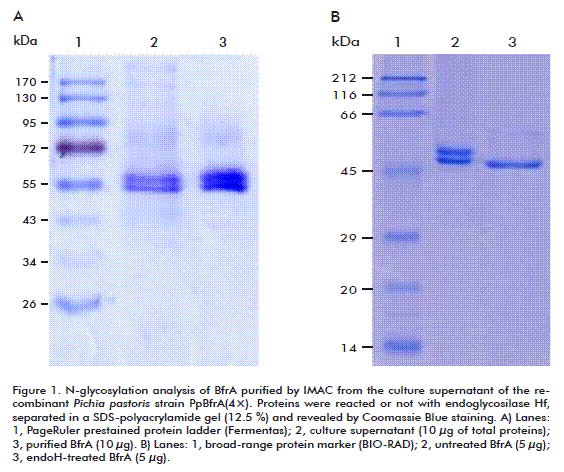
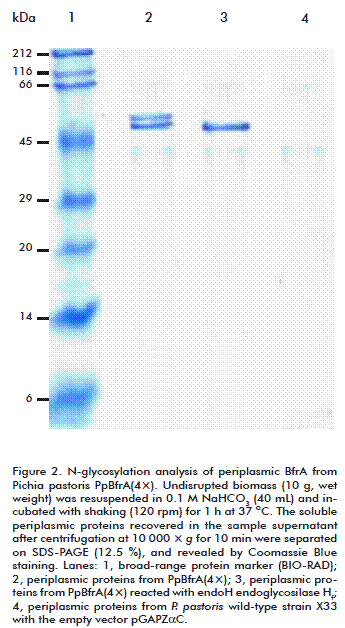
<body><![CDATA[<P   ><font size="2" face="Verdana, Arial, Helvetica, sans-serif">The yeast <I>Pichia      pastoris</I> has been widely used for heterologous protein production [9].      This non-saccharolytic host with the GRAS status is particularly appropriate      for the secretion of sucrose-modifying enzymes with applications in the food      and pharmaceutical industries [10-12]. In this study, <I>P. pastoris</I> was      engineered to secrete high levels of N-glycosylated BfrA. The extracellularly      released enzyme and the whole cells with periplasmic BfrA activity were used      to develop three types of thermostable biocatalysts that completely hydrolyzed      cane sugar (70 %, w/v) in batchwise and continuous operation at pasteurization      temperatures. Our results have both academic and applied relevance in the      field of industrial biotechnology. This research granted the 2013 Award of      the Cuban National Academy of Sciences. </font></P >       <P   >&nbsp;</P >       <P   ><font size="3" face="Verdana, Arial, Helvetica, sans-serif"><b>RESULTS AND DISCUSSION      </b> </font></P >   <FONT size="+1">        <P   ><font size="2" face="Verdana, Arial, Helvetica, sans-serif"><b>Production of      N-glycosylated <I>T. </I>maritima &beta;-fructosidase (BfrA) in recombinant      <I>P. pastoris</I> by fed-batch fermentation </b></font></P >   <FONT size="+1">        <P   ><font size="2" face="Verdana, Arial, Helvetica, sans-serif">A synthetic <I>bfrA      </I>gene with codon usage modified for optimal host translation was fused      to the alpha factor signal peptide of vector pGAPZaC (Invitrogen) and expressed      in <I>Pichia pastoris </I>under the control of the constitutive <I>GAP</I>      promoter and the <I>AOX1</I> terminator. The gradual increase of the transgene      dosage from one to four copies of the expression cassette had an additive      effect on BfrA yield without causing cell toxicity. The <I>bfrA</I> expression      levels in the multicopy <I>Pichia</I> clones remained stable for at least      100 generations during continuous growth in the absence of the selection antibiotic      zeocin. The four-copy<I> </I>strain PpBfrA(4&times;) showed high invertase      activity in the cell periplasmic space (approximately 2000 U/g of dry undisrupted      biomass) and the culture supernatant (approximately 150 U/mL) with a global      volumetric productivity around 5700 U/L/h in fed-batch fermentation using      cane sugar as the sole carbon source. The engineered yeast grew on sucrose      by a respiratory route achieving average yield coefficient of 0.60 g dry biomass      per gram of sucrose consumed. The average cell density after fermentation      for 72 h exceeded 100 g/L (dry biomass). </font></P >       <P   ><font size="2" face="Verdana, Arial, Helvetica, sans-serif">BfrA purified either      from the cell periplasm or the culture supernatant migrated as two bands on      SDS-PAGE with estimated molecular masses of 53 and 58 kDa (<a href="/img/revistas/bta/v31n3/f0108314.gif">Figure      1</a> and <a href="#fig2">Figure 2</a>). A treatment with endoglycosidase      Hf produced a single protein band with the expected size of 51 kDa. This result      indicates that BfrA is secreted to the periplasmic space as a glycoprotein      with two different glycosylation degrees and then it is released to the external      medium without further modification. The presence of N-linked oligosaccharides      did not alter the optimal activity, thermal stability, substrate specificity,      and kinetic properties of recombinant BfrA, which hydrolyzed sucrose with      a catalytic efficiency (<I>k</I>cat<I>/K</I><sub>M</sub>) of 5.6 &times; 10<sup>4</sup>      M<sup>-1</sup> s<sup>-1</sup> at pH 5.5 and 75 &ordm;C. This value is similar      to that reported for the unglycosylated enzyme produced in <I>Escherichia      coli</I> [3, 4]. </font></P >       
<P align="center"   ><img src="/img/revistas/bta/v31n3/f0208314.gif" width="343" height="626"><a name="fig2"></a></P >   <FONT size="+1"><FONT size="+1"><FONT size="+1"><FONT size="+1"><FONT size="+1"><FONT size="+1"><FONT size="+1"><FONT size="+1"><FONT size="+1"><FONT size="+1"><FONT size="+1"><FONT size="+1">        
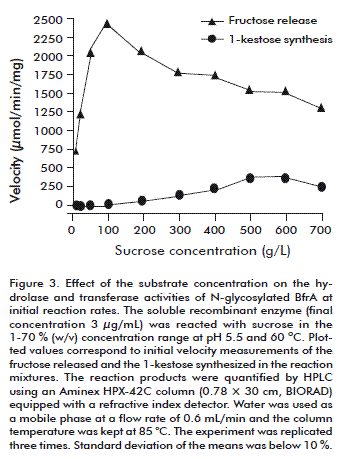
<P   ><font size="2" face="Verdana, Arial, Helvetica, sans-serif"><b>Development of      a soluble BfrA biocatalyst and batch hydrolysis of cane sugar </b></font></P >       <P   ><font size="2" face="Verdana, Arial, Helvetica, sans-serif">The fully active      N-glycosylated BfrA represented 85 % of the total amount of proteins released      to the external medium by PpBfrA(4&times;) at the end of the fed-batch fermentation.      Free BfrA was first used to develop a thermostable soluble biocatalyst following      the steps described below. The yeast cells remaining in the culture supernatant      after centrifugation were removed in two consecutive microfiltration steps      using filters with pore size of 0.45 and 0.2 mm, respectively. The cell-free      filtrate was concentrated with continuous dialysis against 50 mM sodium acetate      buffer (pH 5.5) by ultrafiltration using a 30 kDa cut-off membrane and submitted      to a drying rotoevaporation process at 50-60 &ordm;C. The resulting BfrA powder      with average specific invertase activity of 15 000 U/g and protein purity      above 90 % was fully stable at the assayed storage temperatures of 4 and 30      &ordm;C for at least 10 months. </font></P >       <P   ><font size="2" face="Verdana, Arial, Helvetica, sans-serif">Soluble BfrA was      reacted with sucrose in the 1-70 % (w/v) concentration range at pH 5.5 and      60 &ordm;C in a 1-L batch reactor with stirring at 250 rpm (<a href="#fig3">Figure      3</a>). Initial velocity measurements show that hydrolysis occurred gradually      faster as the substrate concentration was driven from 1 to 10 % (w/v). The      enzyme suffered from slight inhibition at sucrose levels above 20 % (w/v).      Under these conditions, the velocity of sucrose hydrolysis decreased and 1-kestose      [&alpha;glu(1,2)&beta;fru(1,2)bfru)] was synthesized as a result of the transfructosylating      side reaction of the enzyme. At the highest assayed substrate concentration      (70 %, w/v), the overall BfrA activity (hydrolase plus transferase) was 1.6-fold      reduced and 1-kestose represented 19 % of the total products at initial reaction      rates. As the reactions proceeded, sucrose and the synthesized trisaccharide      were completely hydrolyzed (data not shown). </font></P >       ]]></body>
<body><![CDATA[<P align="center"   ><img src="/img/revistas/bta/v31n3/f0308314.gif" width="340" height="457"><a name="fig3"></a></P >       
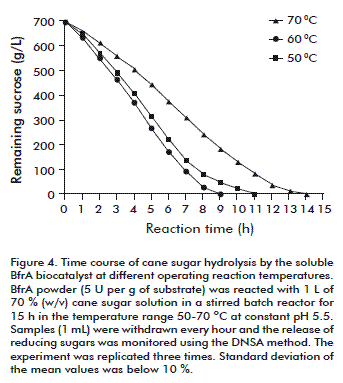
<P   ><font size="2" face="Verdana, Arial, Helvetica, sans-serif">Time-course analyses      of batch sucrose hydrolysis by the soluble BfrA biocatalyst were then conducted      in the temperature range of 50-70 &ordm;C using an enzyme dose of 5 U/g of      cane sugar at an initial concentration of 70 % (w/v) and constant pH 5.5 (<a href="#fig4">Figure      4</a>). Due to its high specific activity, the BfrA powder added negligible      mass (4.2 g; 3500 U) to the reaction volume (1 L). The complete substrate      inversion took 9, 11 and 14 h for the reactions at 70, 60 and </font><font size="2" face="Verdana, Arial, Helvetica, sans-serif">50      &ordm;C, respectively. The average productivity in the reaction at 70 &ordm;C      was 15.8 g of substrate hydrolysed/enzyme unit/hour. </font></P >       <P align="center"   ><img src="/img/revistas/bta/v31n3/f0408314.gif" width="341" height="381"><a name="fig4"></a></P >       
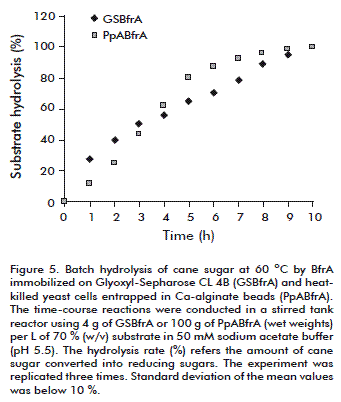
<P   ><font size="2" face="Verdana, Arial, Helvetica, sans-serif">The highest productivity      value of 20.3 was reached at the reaction time interval between 4 and 5 h      when half of the initial substrate content had been transformed. The incubation      at 70 &ordm;C promoted the occurrence of Maillard browning reactions, while      the products solution remained colourless in the experiments at 60 and 50      &ordm;C. </font></P >       <P   ><font size="2" face="Verdana, Arial, Helvetica, sans-serif">The thermostable      soluble BfrA biocatalyst can have a prolonged reuse in batch reactions at      60 &ordm;C if it is operated in a membrane bioreactor. For this purpose, the      tank output port is recommended to be coupled to a cartridge-type ultrafiltration      membrane with 30-kDa cutoff to retain the enzyme inside the reactor after      discharging the product solution. </font></P >       <P   ><font size="2" face="Verdana, Arial, Helvetica, sans-serif"><b>Rational immobilization      of BfrA on Glyoxyl-Sepharose CL 4B </b></font></P >       <P   ><font size="2" face="Verdana, Arial, Helvetica, sans-serif">Recombinant BfrA      containing the C-terminal polyhistidine tag was purified by Ni affinity chromatography      from the culture supernatant and optimally bound to Glyoxyl-Sepharose CL 4B      using the Rational Design of Immobilized Derivatives (RDID) strategy. Multipoint-covalent      attachment of the N-glycosylated BfrA onto the activated support at pH 10      allowed total recovery of the loaded enzyme and its activity. The immobilization      process caused no variation in the catalytic properties of the enzyme and      further enhanced the thermal stability. The immobilized enzyme biocatalyst      showed average specific activity around 9249 U/g (dry weight). </font></P >       <P   ><font size="2" face="Verdana, Arial, Helvetica, sans-serif">Complete inversion      of cane sugar (70 %, w/v) in a batch stirred tank reactor at 60 &deg;C was      achieved with a productivity of 22.2 g of substrate hydrolysed/g of biocatalyst/h      (<a href="#fig5">Figure 5</a>) [13]. </font></P >       <P align="center"   ><img src="/img/revistas/bta/v31n3/f0508314.gif" width="339" height="400"><a name="fig5"></a></P >       
<P   ><font size="2" face="Verdana, Arial, Helvetica, sans-serif"><b>Calcium alginate      entrapment of heat-killed cells with periplasmic BfrA activity </b></font></P >       ]]></body>
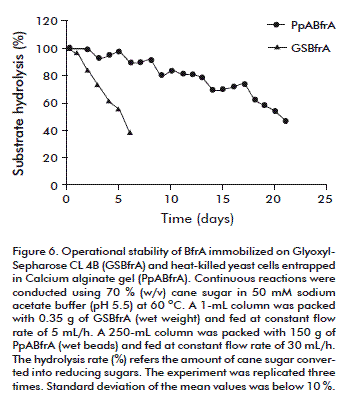
<body><![CDATA[<P   ><font size="2" face="Verdana, Arial, Helvetica, sans-serif"><I>P. pastoris</I>      PpBfrA(4&times;) cells bearing periplasmic BfrA activity were submitted to      a heat-killing treatment (30 min at 70 &ordm;C) prior to calcium alginate      entrapment to prevent the occurrence of sucrose fermentation, an undesirable      process which causes substrate loss and the formation of the by-products ethanol      and carbon dioxide. The invertase activity of the non-viable cells (3092 U/g,      dry weight) increased almost 1.2-fold in comparison to the untreated biomass      (2603 U/g, dry weight) due to an improved diffusion of the substrate and products      through the yeast cell wall. Maximal values of immobilization yield (99.6      %) and specific invertase activity (103 U/g of dry beads) were achieved with      biomass loading of 300 g/L (wet weight). The immobilization of more concentrated      biomass (400 g/L) restricted the internal diffusion of the substrate sucrose      resulting in calcium-alginate beads of lower specific activity (90.7 U/g dry      beads). </font></P >       <P   ><font size="2" face="Verdana, Arial, Helvetica, sans-serif">Batch hydrolysis      of cane sugar (70 %, w/v) by the entrapped cells was conducted in a laboratory-scale      stirred reactor operating at 60 &ordm;C. The complete sucrose inversion took      10 h with average productivity of 4.37 g of substrate hydrolysed/g of dry      beads/h (<a href="#fig5">Figure 5</a>). The beads retained 47 % of its original      invertase activity after recycling in a stirred tank reactor for 15 days.      The half-life of BfrA in the entrapped cells during batchwise operation at      60 &ordm;C was 14 days [14].</font></P >       <P   ><font size="2" face="Verdana, Arial, Helvetica, sans-serif"><b>Thermal stability      of the immobilized biocatalysts during continuous production of invert sugar      </b> </font></P >   </font><FONT size="+1"><FONT size="+1"><FONT size="+1">        <P   ><font size="2" face="Verdana, Arial, Helvetica, sans-serif">The operational stability      of BfrA immobilized on Glyoxyl-Sepharose CL 4B and the heat-killed yeast cells      entrapped in calcium alginate gel was evaluated for continuous hydrolysis      of sugar cane (70 %, w/v) at pH 5.5 and 60 &ordm;C (<a href="#fig6">Figure      6</a>). The conversion efficiency of the covalently immobilized enzyme dropped      to 96.7 % and 45.2 % after operation with constant feeding flow of 5 mL/h      for 1 and 6 days, respectively. The entrapped cells were fed at a higher constant      flow rate (30 mL/h) and retained 48 % of the initial BfrA activity after 21      days of reuse. The half-life values of the invertase activity of the immobilized      enzyme and the entrapped cells with continuous reuse in the fixed-bed reactors      at 60 &deg;C were estimated to be 5 and 20 days, respectively [13, 14]. </font></P >       <P align="center"   ><img src="/img/revistas/bta/v31n3/f0608314.gif" width="342" height="399"><a name="fig6"></a></P >       
<P   ><font size="2" face="Verdana, Arial, Helvetica, sans-serif">We do not exclude      the possibility that the support with the covalently bound enzyme may have      partially escaped through the column filter during operation. </font></P >       <P   >&nbsp;</P >       <P   ><font size="3" face="Verdana, Arial, Helvetica, sans-serif"><b>RELEVANCE OF THE      STUDY </b></font></P >   <FONT size="+1">        <P   ><font size="2" face="Verdana, Arial, Helvetica, sans-serif">An ideal immobilized      biocatalyst for the industrial scale production of invert sugar should allow      the complete hydrolysis of the substrate sucrose at high concentrations with      stable operation under pasteurization conditions. Current soluble or immobilized      biocatalysts based on the thermolabile invertase from <I>Saccharomyces cerevisiae</I>      are operated at temperatures not exceeding 50 &ordm;C and exhibit substrate      inhibition kinetics.<I> T. maritima</I> &beta;-fructosidase (BfrA) is the      most thermoactive and thermostable sucrose-hydrolysing enzyme so far identified      and it is less sensible to substrate inhibition than the commercial yeast      invertase. </font></P >   <FONT size="+1">        <P   ><font size="2" face="Verdana, Arial, Helvetica, sans-serif">In this research,      we have developed three thermostable biocatalysts using BfrA produced as a      fully active glycoprotein in a recombinant <I>P. pastoris</I> strain. The      biocatalysts consisting of a soluble enzyme powder, a covalently immobilized      enzyme, or heat-killed yeast cells entrapped in Ca-alginate beads fully hydrolyzed      cane sugar (70 %, w/v) to an equimolar mixture of glucose and fructose in      a resulting solution which was free of by-products and microbial contamination.      The highly concentrated and colorless invert syrup does not require downstream      processing prior to use in the food industry. The soluble BfrA powder adds      negligible volume to the stirred batch reactor and allows short-time reactions      due to its high specific activity and the absence of diffusional barriers      between the substrate and the free enzyme. The immobilized enzyme is most      appropriate for continuous sucrose hydrolysis in a fixed-bed reactor, while      the entrapped non-viable cells can be extensively reused either in batchwise      or continuous operation at 60 &ordm;C. The three thermostable biocatalysts      developed in this research offer alternative operational options for the cost-effective      manufacture of food-grade inverted sugar syrups at industrial scale. </font></P >       ]]></body>
<body><![CDATA[<P   >&nbsp;</P >       <P   > </P >       <P   ><b><font size="3" face="Verdana, Arial, Helvetica, sans-serif">REFERENCES </font></b></P >       <!-- ref --><P   ><font face="Verdana, Arial, Helvetica, sans-serif" size="2">1. Kotwal SM, Shankar      V. Immobilized invertase. Biotechnol Adv. 2009;27(4):311-22.     </font></P >       <P   ><font face="Verdana, Arial, Helvetica, sans-serif" size="2">2. Andjelkovi&#263;      U, Pi&#263;uri&#263; S, Vuj&#269;i&#263; Z. Purification and characterisation      of <I>Saccharomyces cerevisiae</I> external invertase isoforms. Food Chem.2010;120(3):799-804.      </font></P >       <!-- ref --><P   ><font face="Verdana, Arial, Helvetica, sans-serif" size="2">3. Liebl W, Brem      D, Gotschlich A. Analysis of the gene for beta-fructosidase (invertase, inulinase)      of the hyperthermophilic bacterium <I>Thermotoga maritima</I>, and characterisation      of the enzyme expressed in <I>Escherichia coli</I>. Appl Microbiol Biotechnol.      1998;50(1):55-64.     </font></P >       <!-- ref --><P   ><font face="Verdana, Arial, Helvetica, sans-serif" size="2">4. Mu&ntilde;oz-Guti&eacute;rrez      I, Rodr&iacute;guez-Alegr&iacute;a ME, L&oacute;pez-Mung&iacute;a A. Kinetic      behavior and specificity of b-fructosidases in the hydrolysis of plant and      microbial fructans. Proc Biochem. 2009;44(8):891-8.     </font></P >       ]]></body>
<body><![CDATA[<!-- ref --><P   ><font face="Verdana, Arial, Helvetica, sans-serif" size="2">5. Menendez C, Martinez      D, Trujillo LE, Mazola Y, Gonzalez E, Perez ER, <I>et al</I>. Constitutive      high-level expression of a codon-optimized beta-fructosidase gene from the      hyperthermophile <I>Thermotoga maritima</I> in <I>Pichia pastoris</I>. Appl      Microbiol Biotechnol. 2013;97(3):1201-12.     </font></P >       <!-- ref --><P   ><font face="Verdana, Arial, Helvetica, sans-serif" size="2">6. Pedroche J, Yust      MM, Mateo C, Fern&aacute;ndez-Lafuente R, Gir&oacute;n-Calle J, Alaiz M, <I>et      al</I>. Effect of the support and experimental conditions in the intensity      of the multipoint covalent attachment of proteins on glyoxyl-agarose supports:      correlation between enzyme-support linkages and thermal stability. Enzyme      Microb Technol. 2007;40(5):1160-6.     </font></P >       <!-- ref --><P   ><font face="Verdana, Arial, Helvetica, sans-serif" size="2">7. Strand BL, Morch      YA, Skjak-Braek G. Alginate as immobilization matrix for cells. Minerva Biotecnol.      2000;1(4)2:222-33.     </font></P >       <!-- ref --><P   ><font face="Verdana, Arial, Helvetica, sans-serif" size="2">8. Najafpour G, Younesi      H, Ismail KSK. Ethanol fermentation in an immobilized cell reactor using <I>Saccharomyces      cerevisiae</I>. Bioresour Technol. 2004;92(3):251-60.     </font></P >       <!-- ref --><P   ><font face="Verdana, Arial, Helvetica, sans-serif" size="2">9. Potvin G, Ahmad      A, Zisheng Z. Bioprocess engineering aspects of heterologous protein production      in <I>Pichia pastoris</I>: A review. Biochem Engineering J. 2012;64:91-105.          </font></P >       ]]></body>
<body><![CDATA[<!-- ref --><P   ><font face="Verdana, Arial, Helvetica, sans-serif" size="2">10. Men&eacute;ndez      C, Hern&aacute;ndez L, Banguela A, Pa&iacute;s J. Functional production and      secretion of the <I>Gluconacetobacter diazotrophicus</I> fructose-releasing      exo-levanase (LsdB) in <I>Pichia pastoris</I>. Enzyme Microb Technol. 2004;34(5):446-52.          </font></P >       <!-- ref --><P   ><font face="Verdana, Arial, Helvetica, sans-serif" size="2">11. Trujillo LE,      Arrieta JG, Dafhnis F, Garcia J, Valdes J, Tambara Y, <I>et al</I>. Fructo-oligosaccharides      production by the <I>Gluconacetobacter diazotrophicus</I> levansucrase expressed      in the methylotrophic yeast <I>Pichia pastoris</I>. Enzyme Microb Technol.      2001;28(2-3):139-44.     </font></P >       <!-- ref --><P   ><font face="Verdana, Arial, Helvetica, sans-serif" size="2">12. Trujillo LE,      G&oacute;mez R, Banguela A, Soto M, Arrieta JG, Hern&aacute;ndez L. Catalytical      properties of N-glycosylated <I>Gluconacetobacter diazotrophicus</I> levansucrase      produced in yeast. Electron J Biotechnol. 2004;7(2):5-23.     </font></P >       <!-- ref --><P   ><font face="Verdana, Arial, Helvetica, sans-serif" size="2">13. Mart&iacute;nez      D, Cuti&ntilde;o-Avila B, P&eacute;rez ER, Men&eacute;ndez C, Hern&aacute;ndez      L, del Monte-Mart&iacute;nez A. A thermostable exo-b-fructosidase immobilized      through rational design. Food Chem. 2014;145(5):826-31.     </font></P >       <!-- ref --><P   ><font face="Verdana, Arial, Helvetica, sans-serif" size="2">14. Martinez D, Menendez      C, Echemendia FM, Perez ER, Trujillo LE, Sobrino A, <I>et al</I>. Complete      sucrose hydrolysis by heat-killed recombinant <I>Pichia pastoris</I> cells      entrapped in calcium alginate. Microb Cell Fact. 2014;13:87.     </font></P >   <FONT size="+1">        ]]></body>
<body><![CDATA[<P   > </P >   <FONT size="+1">        <P   >&nbsp;</P >       <P   >&nbsp;</P >       <P   ><font size="2" face="Verdana, Arial, Helvetica, sans-serif">Received July, 2014.    <br>     </font><font size="2" face="Verdana, Arial, Helvetica, sans-serif">Accepted      December, 2014 </font></P >       <P   > </P >       <P   >&nbsp;</P >       <P   >&nbsp;</P >       <P   ><font size="2" face="Verdana, Arial, Helvetica, sans-serif"><i>L&aacute;zaro      Hern&aacute;ndez</i>. Laboratorio de Interacciones Planta-Microorganismo,      Direcci&oacute;n de Investigaciones Agropecuarias, Centro de Ingenier&iacute;a      Gen&eacute;tica y Biotecnolog&iacute;a, CIGB. Ave. 31 e/ 158 y 190, Cubanac&aacute;n,      Playa, CP 11600, La Habana, Cuba E-mail: <A href="mailto:lazaro.hernandez@cigb.edu.cu">      <FONT color="#0000FF">lazaro.hernandez@cigb.edu.cu</font></A><FONT color="#0000FF"><FONT color="#000000">.      </font></font></font></P >   <FONT color="#0000FF"><FONT color="#000000">        <P   > </P >       ]]></body>
<body><![CDATA[<P   > </P >   <FONT size="+1">        <P   > </P >   </font></font></font></font></font></font></font></font></font></font></font></font></font></font></font></font></font></font></font></font></font></font></font></font></font></font></font></font></font></font></font></font></font></font></font></font></font></font></font></font></font></font></font></font></font></font></font></font></font></font></font></font></font></font></DIV >      ]]></body><back>
<ref-list>
<ref id="B1">
<label>1</label><nlm-citation citation-type="journal">
<person-group person-group-type="author">
<name>
<surname><![CDATA[Kotwal]]></surname>
<given-names><![CDATA[SM]]></given-names>
</name>
<name>
<surname><![CDATA[Shankar]]></surname>
<given-names><![CDATA[V]]></given-names>
</name>
</person-group>
<article-title xml:lang="en"><![CDATA[Immobilized invertase]]></article-title>
<source><![CDATA[Biotechnol Adv]]></source>
<year>2009</year>
<volume>27</volume>
<numero>4</numero>
<issue>4</issue>
<page-range>311-22</page-range></nlm-citation>
</ref>
<ref id="B2">
<label>2</label><nlm-citation citation-type="journal">
<person-group person-group-type="author">
<name>
<surname><![CDATA[Andjelkovic]]></surname>
<given-names><![CDATA[U]]></given-names>
</name>
<name>
<surname><![CDATA[Picuric]]></surname>
<given-names><![CDATA[S]]></given-names>
</name>
<name>
<surname><![CDATA[Vujcic]]></surname>
<given-names><![CDATA[Z]]></given-names>
</name>
</person-group>
<article-title xml:lang="en"><![CDATA[Purification and characterisation of Saccharomyces cerevisiae external invertase isoforms]]></article-title>
<source><![CDATA[Food Chem]]></source>
<year>2010</year>
<volume>120</volume>
<numero>3</numero>
<issue>3</issue>
<page-range>799-804</page-range></nlm-citation>
</ref>
<ref id="B3">
<label>3</label><nlm-citation citation-type="journal">
<person-group person-group-type="author">
<name>
<surname><![CDATA[Liebl]]></surname>
<given-names><![CDATA[W]]></given-names>
</name>
<name>
<surname><![CDATA[Brem]]></surname>
<given-names><![CDATA[D]]></given-names>
</name>
<name>
<surname><![CDATA[Gotschlich]]></surname>
<given-names><![CDATA[A]]></given-names>
</name>
</person-group>
<article-title xml:lang="en"><![CDATA[Analysis of the gene for beta-fructosidase (invertase, inulinase) of the hyperthermophilic bacterium Thermotoga maritima, and characterisation of the enzyme expressed in Escherichia coli]]></article-title>
<source><![CDATA[Appl Microbiol Biotechnol]]></source>
<year>1998</year>
<volume>50</volume>
<numero>1</numero>
<issue>1</issue>
<page-range>55-64</page-range></nlm-citation>
</ref>
<ref id="B4">
<label>4</label><nlm-citation citation-type="journal">
<person-group person-group-type="author">
<name>
<surname><![CDATA[Muñoz-Gutiérrez]]></surname>
<given-names><![CDATA[I]]></given-names>
</name>
<name>
<surname><![CDATA[Rodríguez-Alegría]]></surname>
<given-names><![CDATA[ME]]></given-names>
</name>
<name>
<surname><![CDATA[López-Mungía]]></surname>
<given-names><![CDATA[A]]></given-names>
</name>
</person-group>
<article-title xml:lang="en"><![CDATA[Kinetic behavior and specificity of b-fructosidases in the hydrolysis of plant and microbial fructans]]></article-title>
<source><![CDATA[Proc Biochem]]></source>
<year>2009</year>
<volume>44</volume>
<numero>8</numero>
<issue>8</issue>
<page-range>891-8</page-range></nlm-citation>
</ref>
<ref id="B5">
<label>5</label><nlm-citation citation-type="journal">
<person-group person-group-type="author">
<name>
<surname><![CDATA[Menendez]]></surname>
<given-names><![CDATA[C]]></given-names>
</name>
<name>
<surname><![CDATA[Martinez]]></surname>
<given-names><![CDATA[D]]></given-names>
</name>
<name>
<surname><![CDATA[Trujillo]]></surname>
<given-names><![CDATA[LE]]></given-names>
</name>
<name>
<surname><![CDATA[Mazola]]></surname>
<given-names><![CDATA[Y]]></given-names>
</name>
<name>
<surname><![CDATA[Gonzalez]]></surname>
<given-names><![CDATA[E]]></given-names>
</name>
<name>
<surname><![CDATA[Perez]]></surname>
<given-names><![CDATA[ER]]></given-names>
</name>
</person-group>
<article-title xml:lang="en"><![CDATA[Constitutive high-level expression of a codon-optimized beta-fructosidase gene from the hyperthermophile Thermotoga maritima in Pichia pastoris]]></article-title>
<source><![CDATA[Appl Microbiol Biotechnol]]></source>
<year>2013</year>
<volume>97</volume>
<numero>3</numero>
<issue>3</issue>
<page-range>1201-12</page-range></nlm-citation>
</ref>
<ref id="B6">
<label>6</label><nlm-citation citation-type="journal">
<person-group person-group-type="author">
<name>
<surname><![CDATA[Pedroche]]></surname>
<given-names><![CDATA[J]]></given-names>
</name>
<name>
<surname><![CDATA[Yust]]></surname>
<given-names><![CDATA[MM]]></given-names>
</name>
<name>
<surname><![CDATA[Mateo]]></surname>
<given-names><![CDATA[C]]></given-names>
</name>
<name>
<surname><![CDATA[Fernández-Lafuente]]></surname>
<given-names><![CDATA[R]]></given-names>
</name>
<name>
<surname><![CDATA[Girón-Calle]]></surname>
<given-names><![CDATA[J]]></given-names>
</name>
<name>
<surname><![CDATA[Alaiz]]></surname>
<given-names><![CDATA[M]]></given-names>
</name>
</person-group>
<article-title xml:lang="en"><![CDATA[Effect of the support and experimental conditions in the intensity of the multipoint covalent attachment of proteins on glyoxyl-agarose supports: correlation between enzyme-support linkages and thermal stability]]></article-title>
<source><![CDATA[Enzyme Microb Technol]]></source>
<year>2007</year>
<volume>40</volume>
<numero>5</numero>
<issue>5</issue>
<page-range>1160-6</page-range></nlm-citation>
</ref>
<ref id="B7">
<label>7</label><nlm-citation citation-type="journal">
<person-group person-group-type="author">
<name>
<surname><![CDATA[Strand]]></surname>
<given-names><![CDATA[BL]]></given-names>
</name>
<name>
<surname><![CDATA[Morch]]></surname>
<given-names><![CDATA[YA]]></given-names>
</name>
<name>
<surname><![CDATA[Skjak-Braek]]></surname>
<given-names><![CDATA[G]]></given-names>
</name>
</person-group>
<article-title xml:lang="en"><![CDATA[Alginate as immobilization matrix for cells]]></article-title>
<source><![CDATA[Minerva Biotecnol]]></source>
<year>2000</year>
<volume>1</volume>
<numero>4</numero>
<issue>4</issue>
<page-range>2:222-33</page-range></nlm-citation>
</ref>
<ref id="B8">
<label>8</label><nlm-citation citation-type="journal">
<person-group person-group-type="author">
<name>
<surname><![CDATA[Najafpour]]></surname>
<given-names><![CDATA[G]]></given-names>
</name>
<name>
<surname><![CDATA[Younesi]]></surname>
<given-names><![CDATA[H]]></given-names>
</name>
<name>
<surname><![CDATA[Ismail]]></surname>
<given-names><![CDATA[KSK]]></given-names>
</name>
</person-group>
<article-title xml:lang="en"><![CDATA[Ethanol fermentation in an immobilized cell reactor using Saccharomyces cerevisiae]]></article-title>
<source><![CDATA[Bioresour Technol]]></source>
<year>2004</year>
<volume>92</volume>
<numero>3</numero>
<issue>3</issue>
<page-range>251-60</page-range></nlm-citation>
</ref>
<ref id="B9">
<label>9</label><nlm-citation citation-type="journal">
<person-group person-group-type="author">
<name>
<surname><![CDATA[Potvin]]></surname>
<given-names><![CDATA[G]]></given-names>
</name>
<name>
<surname><![CDATA[Ahmad]]></surname>
<given-names><![CDATA[A]]></given-names>
</name>
<name>
<surname><![CDATA[Zisheng]]></surname>
<given-names><![CDATA[Z]]></given-names>
</name>
</person-group>
<article-title xml:lang="en"><![CDATA[Bioprocess engineering aspects of heterologous protein production in Pichia pastoris: A review]]></article-title>
<source><![CDATA[Biochem Engineering J]]></source>
<year>2012</year>
<volume>64</volume>
<page-range>91-105</page-range></nlm-citation>
</ref>
<ref id="B10">
<label>10</label><nlm-citation citation-type="journal">
<person-group person-group-type="author">
<name>
<surname><![CDATA[Menéndez]]></surname>
<given-names><![CDATA[C]]></given-names>
</name>
<name>
<surname><![CDATA[Hernández]]></surname>
<given-names><![CDATA[L]]></given-names>
</name>
<name>
<surname><![CDATA[Banguela]]></surname>
<given-names><![CDATA[A]]></given-names>
</name>
<name>
<surname><![CDATA[País]]></surname>
<given-names><![CDATA[J]]></given-names>
</name>
</person-group>
<article-title xml:lang="en"><![CDATA[Functional production and secretion of the Gluconacetobacter diazotrophicus fructose-releasing exo-levanase (LsdB) in Pichia pastoris]]></article-title>
<source><![CDATA[Enzyme Microb Technol]]></source>
<year>2004</year>
<volume>34</volume>
<numero>5</numero>
<issue>5</issue>
<page-range>446-52</page-range></nlm-citation>
</ref>
<ref id="B11">
<label>11</label><nlm-citation citation-type="journal">
<person-group person-group-type="author">
<name>
<surname><![CDATA[Trujillo]]></surname>
<given-names><![CDATA[LE]]></given-names>
</name>
<name>
<surname><![CDATA[Arrieta]]></surname>
<given-names><![CDATA[JG]]></given-names>
</name>
<name>
<surname><![CDATA[Dafhnis]]></surname>
<given-names><![CDATA[F]]></given-names>
</name>
<name>
<surname><![CDATA[Garcia]]></surname>
<given-names><![CDATA[J]]></given-names>
</name>
<name>
<surname><![CDATA[Valdes]]></surname>
<given-names><![CDATA[J]]></given-names>
</name>
<name>
<surname><![CDATA[Tambara]]></surname>
<given-names><![CDATA[Y]]></given-names>
</name>
</person-group>
<article-title xml:lang="en"><![CDATA[Fructo-oligosaccharides production by the Gluconacetobacter diazotrophicus levansucrase expressed in the methylotrophic yeast Pichia pastoris]]></article-title>
<source><![CDATA[Enzyme Microb Technol]]></source>
<year>2001</year>
<volume>28</volume>
<numero>2</numero>
<issue>2</issue>
<page-range>3):139-44</page-range></nlm-citation>
</ref>
<ref id="B12">
<label>12</label><nlm-citation citation-type="journal">
<person-group person-group-type="author">
<name>
<surname><![CDATA[Trujillo]]></surname>
<given-names><![CDATA[LE]]></given-names>
</name>
<name>
<surname><![CDATA[Gómez]]></surname>
<given-names><![CDATA[R]]></given-names>
</name>
<name>
<surname><![CDATA[Banguela]]></surname>
<given-names><![CDATA[A]]></given-names>
</name>
<name>
<surname><![CDATA[Soto]]></surname>
<given-names><![CDATA[M]]></given-names>
</name>
<name>
<surname><![CDATA[Arrieta]]></surname>
<given-names><![CDATA[JG]]></given-names>
</name>
<name>
<surname><![CDATA[Hernández]]></surname>
<given-names><![CDATA[L]]></given-names>
</name>
</person-group>
<article-title xml:lang="en"><![CDATA[Catalytical properties of N-glycosylated Gluconacetobacter diazotrophicus levansucrase produced in yeast]]></article-title>
<source><![CDATA[Electron J Biotechnol]]></source>
<year>2004</year>
<volume>7</volume>
<numero>2</numero>
<issue>2</issue>
<page-range>5-23</page-range></nlm-citation>
</ref>
<ref id="B13">
<label>13</label><nlm-citation citation-type="journal">
<person-group person-group-type="author">
<name>
<surname><![CDATA[Martínez]]></surname>
<given-names><![CDATA[D]]></given-names>
</name>
<name>
<surname><![CDATA[Cutiño-Avila]]></surname>
<given-names><![CDATA[B]]></given-names>
</name>
<name>
<surname><![CDATA[Pérez]]></surname>
<given-names><![CDATA[ER]]></given-names>
</name>
<name>
<surname><![CDATA[Menéndez]]></surname>
<given-names><![CDATA[C]]></given-names>
</name>
<name>
<surname><![CDATA[Hernández]]></surname>
<given-names><![CDATA[L]]></given-names>
</name>
<name>
<surname><![CDATA[del Monte-Martínez]]></surname>
<given-names><![CDATA[A]]></given-names>
</name>
</person-group>
<article-title xml:lang="en"><![CDATA[A thermostable exo-b-fructosidase immobilized through rational design]]></article-title>
<source><![CDATA[Food Chem]]></source>
<year>2014</year>
<volume>145</volume>
<numero>5</numero>
<issue>5</issue>
<page-range>826-31</page-range></nlm-citation>
</ref>
<ref id="B14">
<label>14</label><nlm-citation citation-type="journal">
<person-group person-group-type="author">
<name>
<surname><![CDATA[Martinez]]></surname>
<given-names><![CDATA[D]]></given-names>
</name>
<name>
<surname><![CDATA[Menendez]]></surname>
<given-names><![CDATA[C]]></given-names>
</name>
<name>
<surname><![CDATA[Echemendia]]></surname>
<given-names><![CDATA[FM]]></given-names>
</name>
<name>
<surname><![CDATA[Perez]]></surname>
<given-names><![CDATA[ER]]></given-names>
</name>
<name>
<surname><![CDATA[Trujillo]]></surname>
<given-names><![CDATA[LE]]></given-names>
</name>
<name>
<surname><![CDATA[Sobrino]]></surname>
<given-names><![CDATA[A]]></given-names>
</name>
</person-group>
<article-title xml:lang="en"><![CDATA[Complete sucrose hydrolysis by heat-killed recombinant Pichia pastoris cells entrapped in calcium alginate]]></article-title>
<source><![CDATA[Microb Cell Fact]]></source>
<year>2014</year>
<volume>13</volume>
<page-range>87</page-range></nlm-citation>
</ref>
</ref-list>
</back>
</article>