<?xml version="1.0" encoding="ISO-8859-1"?><article xmlns:mml="http://www.w3.org/1998/Math/MathML" xmlns:xlink="http://www.w3.org/1999/xlink" xmlns:xsi="http://www.w3.org/2001/XMLSchema-instance">
<front>
<journal-meta>
<journal-id>1027-2852</journal-id>
<journal-title><![CDATA[Biotecnología Aplicada]]></journal-title>
<abbrev-journal-title><![CDATA[Biotecnol Apl]]></abbrev-journal-title>
<issn>1027-2852</issn>
<publisher>
<publisher-name><![CDATA[Editorial Elfos Scientiae]]></publisher-name>
</publisher>
</journal-meta>
<article-meta>
<article-id>S1027-28522014000400004</article-id>
<title-group>
<article-title xml:lang="en"><![CDATA[Application of a colorimetric CTLL-2 cell proliferation assay for the evaluation of IL-15 antagonists]]></article-title>
<article-title xml:lang="es"><![CDATA[Aplicación de un ensayo colorimétrico de proliferación celular en CTLL-2 para la evaluación de antagonistas de IL-15]]></article-title>
</title-group>
<contrib-group>
<contrib contrib-type="author">
<name>
<surname><![CDATA[Rodríguez-Álvarez]]></surname>
<given-names><![CDATA[Yunier]]></given-names>
</name>
<xref ref-type="aff" rid="A01"/>
</contrib>
<contrib contrib-type="author">
<name>
<surname><![CDATA[Gerónimo-Pérez]]></surname>
<given-names><![CDATA[Haydee]]></given-names>
</name>
<xref ref-type="aff" rid="A02"/>
</contrib>
<contrib contrib-type="author">
<name>
<surname><![CDATA[Garay-Pérez]]></surname>
<given-names><![CDATA[Hilda]]></given-names>
</name>
<xref ref-type="aff" rid="A03"/>
</contrib>
<contrib contrib-type="author">
<name>
<surname><![CDATA[Castro-Velazco]]></surname>
<given-names><![CDATA[Jorge]]></given-names>
</name>
<xref ref-type="aff" rid="A04"/>
</contrib>
<contrib contrib-type="author">
<name>
<surname><![CDATA[García-Illera]]></surname>
<given-names><![CDATA[Gerardo]]></given-names>
</name>
<xref ref-type="aff" rid="A02"/>
</contrib>
<contrib contrib-type="author">
<name>
<surname><![CDATA[Santos-Savio]]></surname>
<given-names><![CDATA[Alicia]]></given-names>
</name>
<xref ref-type="aff" rid="A01"/>
</contrib>
</contrib-group>
<aff id="A02">
<institution><![CDATA[,CIGB Dirección de Control de la Calidad ]]></institution>
<addr-line><![CDATA[La Habana ]]></addr-line>
<country>Cuba</country>
</aff>
<aff id="A03">
<institution><![CDATA[,CIGB Dirección de Investigaciones Biomédicas Departamento de Química-Física]]></institution>
<addr-line><![CDATA[La Habana ]]></addr-line>
<country>Cuba</country>
</aff>
<aff id="A04">
<institution><![CDATA[,CIGB Bioterio ]]></institution>
<addr-line><![CDATA[La Habana ]]></addr-line>
<country>Cuba</country>
</aff>
<aff id="A01">
<institution><![CDATA[,Centro de Ingeniería Genética y Biotecnología, CIGB Dirección de Investigaciones Biomédicas Departamento de Farmacéuticos]]></institution>
<addr-line><![CDATA[La Habana ]]></addr-line>
<country>Cuba</country>
</aff>
<pub-date pub-type="pub">
<day>00</day>
<month>12</month>
<year>2014</year>
</pub-date>
<pub-date pub-type="epub">
<day>00</day>
<month>12</month>
<year>2014</year>
</pub-date>
<volume>31</volume>
<numero>4</numero>
<fpage>291</fpage>
<lpage>296</lpage>
<copyright-statement/>
<copyright-year/>
<self-uri xlink:href="http://scielo.sld.cu/scielo.php?script=sci_arttext&amp;pid=S1027-28522014000400004&amp;lng=en&amp;nrm=iso"></self-uri><self-uri xlink:href="http://scielo.sld.cu/scielo.php?script=sci_abstract&amp;pid=S1027-28522014000400004&amp;lng=en&amp;nrm=iso"></self-uri><self-uri xlink:href="http://scielo.sld.cu/scielo.php?script=sci_pdf&amp;pid=S1027-28522014000400004&amp;lng=en&amp;nrm=iso"></self-uri><abstract abstract-type="short" xml:lang="en"><p><![CDATA[Dysregulated expression of Interleukin (IL)-15 has been associated to several autoimmune and inflammatory diseases. In this sense, some agents that inhibit IL-15 activity have been developed as possible drugs to treat these pathologies. We have been working in two strategies to inhibit IL-15 activity, a peptide (named P8) that binds to the alpha subunit of the IL-15 receptor (IL-15R) and a vaccine based on active immunization with human IL-15 (hIL-15). To measure the biological activity of the IL-15 antagonists we used the proliferation assay in CTLL-2, a cell line that depends on IL-2/IL-15 to proliferate. In the current work we defined the conditions of the assay to determine the half maximal inhibitory concentration (IC50) of the P8 peptide and the neutralizing titers of the sera from monkeys immunized with the anti-IL-15 vaccine. The specificity of the assay for IL-15 was documented using anti-IL-15 and anti-IL-2 specific antibodies. We also examined the specificity of the antagonists of IL-15 in presence of IL-2; neither the peptide nor the sera inhibited the cell proliferation induced by human IL-2. Finally, we evaluated the effect of commercial antibodies anti-hIL-15 and sera from mice immunized with hIL-15 on murine IL-15 (mIL-15). In this case, neither the antibodies nor the sera inhibited mIL-15; therefore, murine models are not useful to evaluate the effectiveness of anti-hIL-15 vaccine.]]></p></abstract>
<abstract abstract-type="short" xml:lang="es"><p><![CDATA[La expresión no regulada de la interleucina-15 (IL-15) se ha asociado con el desarrollo y patogénesis de varias enfermedades autoinmunes e inflamatorias. Se han desarrollado numerosos agentes que inhiben la actividad de la IL-15 como posibles fármacos para el tratamiento de estas patologías. Nosotros hemos trabajado en dos estrategias para inhibir la actividad de la IL-15, un péptido (llamado P8) que se une a la subunidad alfa del receptor de IL-15 y una vacuna basada en la inmunización activa con IL-15 humana (IL-15h). La actividad biológica de los antagonistas de IL-15 se midió mediante el ensayo de proliferación en CTLL-2, una línea celular que depende de IL-2/IL-15 para proliferar. En este trabajo se definieron las condiciones del ensayo para determinar la concentración inhibitoria media máxima (CI50) del péptido P8 y los títulos de neutralización de los sueros de monos inmunizados con la vacuna anti-IL-15. La especificidad del ensayo para la IL-15 se demostró usando anticuerpos específicos anti-IL-15 y anti-IL-2. También se examinó la especificidad de los antagonistas de IL-15 en presencia de IL-2, y se demostró que ni el péptido ni los sueros inhiben la proliferación celular inducida por IL-2 humana. Finalmente, se evaluó el efecto de anticuerpos comerciales anti-IL-15h y de sueros de ratones inmunizados con IL-15h sobre la IL-15 murina (IL-15m). Ni los anticuerpos ni los sueros inhiben la IL-15m, lo que indica que los modelos murinos no son útiles para evaluar la efectividad de la vacuna anti-IL-15h. Este ensayo permitió evaluar diferentes estrategias que inhiben la actividad de la IL-15 para su futuro desarrollo como fármacos.]]></p></abstract>
<kwd-group>
<kwd lng="en"><![CDATA[Interleukin-15]]></kwd>
<kwd lng="en"><![CDATA[antagonist]]></kwd>
<kwd lng="en"><![CDATA[peptide]]></kwd>
<kwd lng="en"><![CDATA[serum]]></kwd>
<kwd lng="en"><![CDATA[CTLL-2 cell line]]></kwd>
<kwd lng="en"><![CDATA[proliferation assay]]></kwd>
<kwd lng="es"><![CDATA[interleucina-15]]></kwd>
<kwd lng="es"><![CDATA[antagonista]]></kwd>
<kwd lng="es"><![CDATA[péptido]]></kwd>
<kwd lng="es"><![CDATA[suero]]></kwd>
<kwd lng="es"><![CDATA[línea celular CTLL-2]]></kwd>
<kwd lng="es"><![CDATA[ensayo de proliferación]]></kwd>
</kwd-group>
</article-meta>
</front><body><![CDATA[ <DIV class="Sect"   >        <P align="right"   ><font size="2" color="#000000" face="Verdana, Arial, Helvetica, sans-serif"><b>RESEARCH      </b></font></P >       <P align="right"   >&nbsp;</P >   <FONT size="+1" color="#000000">        <P   > </P >       <P   ><font size="4"><b><font face="Verdana, Arial, Helvetica, sans-serif">Application      of a colorimetric CTLL-2 cell proliferation assay for the evaluation of IL-15      antagonists </font></b></font></P >       <P   >&nbsp;</P >       <P   > </P >       <P   ><font size="3"><b><font face="Verdana, Arial, Helvetica, sans-serif">Aplicaci&oacute;n      de un ensayo colorim&eacute;trico de proliferaci&oacute;n celular en CTLL-2      para la evaluaci&oacute;n de antagonistas de IL-15 </font></b></font></P >       <P   >&nbsp;</P >       <P   >&nbsp;</P >       ]]></body>
<body><![CDATA[<P   > </P >       <P   ><font size="2" face="Verdana, Arial, Helvetica, sans-serif"><b>Yunier Rodr&iacute;guez-&Aacute;lvarez<sup>1</sup>,      Haydee Ger&oacute;nimo-P&eacute;rez<sup>2</sup>, Hilda Garay-P&eacute;rez<sup>3</sup>,      </b></font><b><font size="2" face="Verdana, Arial, Helvetica, sans-serif">Jorge      Castro-Velazco<sup>4</sup>, Gerardo Garc&iacute;a-Illera<sup>2</sup>, Alicia      Santos-Savio<sup>1</sup> </font></b></P >   <FONT size="+1"><FONT size="+1"><FONT size="+1"><FONT size="+1"><FONT size="+1"><FONT size="+1"><FONT size="+1"><FONT size="+1"><FONT size="+1"><FONT size="+1"><FONT size="+1"><FONT size="+1">        <P   > </P >       <P   ><font size="2" face="Verdana, Arial, Helvetica, sans-serif"><sup>1</sup> Departamento      de Farmac&eacute;uticos, Direcci&oacute;n de Investigaciones Biom&eacute;dicas,      Centro de Ingenier&iacute;a Gen&eacute;tica y Biotecnolog&iacute;a, CIGB.      Ave. 31 entre 158 y 190, Cubanac&aacute;n, Playa, CP 11600, La Habana, Cuba.    <br>     </font><font size="2" face="Verdana, Arial, Helvetica, sans-serif"><sup>2</sup>      Direcci&oacute;n de Control de la Calidad, CIGB. La Habana, Cuba.     <br>     </font><font size="2" face="Verdana, Arial, Helvetica, sans-serif"><sup>3</sup>      Departamento de Qu&iacute;mica-F&iacute;sica, Direcci&oacute;n de Investigaciones      Biom&eacute;dicas, CIGB. La Habana, Cuba.     <br>     </font><font size="2" face="Verdana, Arial, Helvetica, sans-serif"><sup>4</sup>      Bioterio, CIGB. La Habana, Cuba. </font></P >       <P   >&nbsp;</P >       <P   >&nbsp;</P >   <FONT size="+1"><FONT size="+1"><FONT size="+1"><FONT size="+1"><FONT size="+1"><FONT size="+1"><FONT size="+1"><FONT size="+1">    </font></font></font></font></font></font></font></font></font></font></font></font></font></font></font></font></font></font></font></font></font>   <hr>   <FONT size="+1" color="#000000"><FONT size="+1"><FONT size="+1"><FONT size="+1"><FONT size="+1"><FONT size="+1"><FONT size="+1"><FONT size="+1"><FONT size="+1"><FONT size="+1"><FONT size="+1"><FONT size="+1"><FONT size="+1"><FONT size="+1"><FONT size="+1"><FONT size="+1"><FONT size="+1"><FONT size="+1"><FONT size="+1"><FONT size="+1"><FONT size="+1">        <P   > </P >       ]]></body>
<body><![CDATA[<P   > </P >       <P   ><b><font size="2" face="Verdana, Arial, Helvetica, sans-serif">ABSTRACT </font></b></P >       <P   > </P >       <P   ><font color="#211E1F" size="2" face="Verdana, Arial, Helvetica, sans-serif">Dysregulated      expression of Interleukin (IL)-15 has been associated to several autoimmune      and inflammatory diseases. In this sense, some agents that inhibit IL-15 activity      have been developed as possible drugs to treat these pathologies. We have      been working in two strategies to inhibit IL-15 activity, a peptide (named      P8) that binds to the alpha subunit of the IL-15 receptor (IL-15R) and a vaccine      based on active immunization with human IL-15 (hIL-15). To measure the biological      activity of the IL-15 antagonists we used the proliferation assay in CTLL-2,      a cell line that depends on IL-2/IL-15 to proliferate. In the current work      we defined the conditions of the assay to determine the half maximal inhibitory      concentration (IC50) of the P8 peptide and the neutralizing titers of the      sera from monkeys immunized with the anti-IL-15 vaccine. </font><font size="2" face="Verdana, Arial, Helvetica, sans-serif">The      specificity of the assay for IL-15 was documented using anti-IL-15 and anti-IL-2      specific antibodies. We also examined the specificity of the antagonists of      IL-15 in presence of IL-2; neither the peptide nor the sera inhibited the      cell proliferation induced by human IL-2. Finally, we evaluated the effect      of commercial antibodies anti-hIL-15 and sera from mice immunized with hIL-15      on murine IL-15 (mIL-15). In this case, neither the antibodies nor the sera      inhibited mIL-15; therefore, murine models are not useful to evaluate the      effectiveness of anti-hIL-15 vaccine. The application of this assay allowed      us to evaluate different strategies to inhibit the activity of IL-15 for its      future development as drugs </font></P >   <FONT color="#211E1F">        <P   ><font size="2" face="Verdana, Arial, Helvetica, sans-serif"><B><I>Keywords</I>:</B>      Interleukin-15, antagonist, peptide, serum, CTLL-2 cell line, proliferation      assay. </font></P >   </font></font></font></font></font></font></font></font></font></font></font></font></font></font></font></font></font></font></font></font></font></font>   <hr>   <FONT size="+1" color="#000000"><FONT size="+1"><FONT size="+1"><FONT size="+1"><FONT size="+1"><FONT size="+1"><FONT size="+1"><FONT size="+1"><FONT size="+1"><FONT size="+1"><FONT size="+1"><FONT size="+1"><FONT size="+1"><FONT size="+1"><FONT size="+1"><FONT size="+1"><FONT size="+1"><FONT size="+1"><FONT size="+1"><FONT size="+1"><FONT size="+1"><FONT color="#211E1F">       <P   > </P >       <P   ><b><font color="#000000" size="2" face="Verdana, Arial, Helvetica, sans-serif">RESUMEN      </font></b></P >   <FONT color="#000000">        <P   > <font color="#211E1F" size="2" face="Verdana, Arial, Helvetica, sans-serif">La      expresi&oacute;n no regulada de la interleucina-15 (IL-15) se ha asociado      con el desarrollo y patog&eacute;nesis de varias enfermedades autoinmunes      e inflamatorias. Se han desarrollado numerosos agentes que inhiben la actividad      de la IL-15 como posibles f&aacute;rmacos para el tratamiento de estas patolog&iacute;as.      Nosotros hemos trabajado en dos estrategias para inhibir la actividad de la      IL-15, un p&eacute;ptido (llamado P8) que se une a la subunidad alfa del receptor      de IL-15 y una vacuna basada en la inmunizaci&oacute;n activa con IL-15 humana      (IL-15h). La actividad biol&oacute;gica de los antagonistas de IL-15 se midi&oacute;      mediante el ensayo de proliferaci&oacute;n en CTLL-2, una l&iacute;nea celular      que depende de IL-2/IL-15 para proliferar. En este trabajo se definieron las      condiciones del ensayo para determinar la concentraci&oacute;n inhibitoria      media m&aacute;xima (CI50) del p&eacute;ptido P8 y los t&iacute;tulos de neutralizaci&oacute;n      de los sueros de monos inmunizados con la vacuna anti-IL-15. La especificidad      del ensayo para la IL-15 se demostr&oacute; usando anticuerpos espec&iacute;ficos      anti-IL-15 y anti-IL-2. Tambi&eacute;n se examin&oacute; la especificidad      de los antagonistas de IL-15 en presencia de IL-2, y se demostr&oacute; que      ni el p&eacute;ptido ni los sueros inhiben la proliferaci&oacute;n celular      inducida por IL-2 humana. Finalmente, se evalu&oacute; el efecto de anticuerpos      comerciales anti-IL-15h y de sueros de ratones inmunizados con IL-15h sobre      la IL-15 murina (IL-15m). Ni los anticuerpos ni los sueros inhiben la IL-15m,      lo que indica que los modelos murinos no son &uacute;tiles para evaluar la      efectividad de la vacuna anti-IL-15h. Este ensayo permiti&oacute; evaluar      diferentes estrategias que inhiben la actividad de la IL-15 para su futuro      desarrollo como f&aacute;rmacos. </font></P >   <FONT color="#211E1F">        <P   ><font size="2" face="Verdana, Arial, Helvetica, sans-serif"><B><I>Palabras clave</I>:</B>      interleucina-15, antagonista, p&eacute;ptido, suero, l&iacute;nea celular      CTLL-2, ensayo de proliferaci&oacute;n. </font></P >   </font></font></font></font></font></font></font></font></font></font></font></font></font></font></font></font></font></font></font></font></font></font></font></font>    <hr>       <p>&nbsp;</p>    ]]></body>
<body><![CDATA[<p><FONT size="+1" color="#000000"><FONT size="+1"><FONT size="+1"><FONT size="+1"><FONT size="+1"><FONT size="+1"><FONT size="+1"><FONT size="+1"><FONT size="+1"><FONT size="+1"><FONT size="+1"><FONT size="+1"><FONT size="+1"><FONT size="+1"><FONT size="+1"><FONT size="+1"><FONT size="+1"><FONT size="+1"><FONT size="+1"><FONT size="+1"><FONT size="+1"><FONT color="#211E1F"><FONT color="#000000"><FONT color="#211E1F"><FONT color="#000000">    </font></font></font></font></font></font></font></font></font></font></font></font></font></font></font></font></font></font></font></font></font></font></font></font></font></p>   <FONT size="+1" color="#000000"><FONT size="+1"><FONT size="+1"><FONT size="+1"><FONT size="+1"><FONT size="+1"><FONT size="+1"><FONT size="+1"><FONT size="+1"><FONT size="+1"><FONT size="+1"><FONT size="+1"><FONT size="+1"><FONT size="+1"><FONT size="+1"><FONT size="+1"><FONT size="+1"><FONT size="+1"><FONT size="+1"><FONT size="+1"><FONT size="+1"><FONT color="#211E1F"><FONT color="#000000"><FONT color="#211E1F"><FONT color="#000000">        <P   > </P >       <P   > </P >       <P   ><font color="#211E1F" size="3" face="Verdana, Arial, Helvetica, sans-serif"><B>INTRODUCTION      </b></font></P >   <FONT color="#211E1F">        <P   ><font size="2" face="Verdana, Arial, Helvetica, sans-serif">Interleukin-15 (IL-15)      is a 14-15 kDa glycoprotein that belongs to the four-helix bundle cytokine      family and was first characterized by its ability to substitute IL-2. Indeed,      IL-15 shares with IL-2, &beta; and &gamma; subunits receptor but has a unique      private &alpha; subunit (IL-15R&alpha;) that is responsible for high-affinity      binding [1]. IL-15 is essential to the development, function and survival      of natural killer (NK) cells, NK T cells and memory CD8+ T cells [2, 3]. However,      deregulated IL-15 expression has been demonstrated in patients with autoimmune      inflammatory diseases, including rheumatoid arthritis, inflammatory bowel      diseases, celiac diseases, psoriasis and sarcoidosis [4-10]. Therefore, various      strategies were considered to target IL-15, its receptor or the molecules      involved in IL-15-induced signaling for the treatment of such autoimmune diseases.      In this sense, several agents that inhibit IL-15 activity have been developed,      including soluble IL-15R&alpha;, mutant IL-15 molecules, and antibodies specific      for IL-15 or IL-2/15R&beta; [11-14]. Also, we have been working in two strategies      to inhibit IL-15 activity, a peptide that binds IL-15R&alpha; [15] and a vaccine      based on active immunization with hIL-15. </font></P >       <P   ><font size="2" face="Verdana, Arial, Helvetica, sans-serif">Cell proliferation      assay is used to measure the biological activity for many cytokines and the      effect of its antagonists on susceptible cells. In particular, CTLL-2 is a      cell line dependent to IL-2/IL-15 to proliferate. This cell line expresses      all three receptor subunits for IL-2 and IL-15, which is advantageous to evaluate      approaches that target different receptor subunits for IL-15 [16]. Here we      used a colorimetric method based on redox sensitive formazan (3-(4-5) dimethylthiazol-2yl)-2,      5-diphenyl tetrazolium bromide; MTT) because it is a simple and rapid procedure      [17]. MTT is a tetrazolium salt that can be cleaved only by active mitochondria      in metabolically active cells, and is hence applicable to almost any survival      or proliferation assay in which living cells must be distinguished from the      dead ones. The assay, which could be carried out in multiwell plates, also      offers an advantage for testing a large number of drugs with good reproducibility      [18]. </font></P >       <P   ><font size="2" face="Verdana, Arial, Helvetica, sans-serif">To achieve our goal,      first, we adjusted the CTLL-2 cell proliferation assay to define the conditions      for evaluation of IL-15 antagonists using an international reference standard.      The specificity of the assay was demonstrated using a neutralizing anti-IL-15      or anti-IL-2 antibody and IL-2 in dependence of experimental samples. In addition,      the application of this assay allowed evaluating the neutralizing activity      antibodies or sera generated with hIL-15 on mIL-15. </font></P >       <P   >&nbsp;</P >       <P   > </P >       <P   ><font size="3" face="Verdana, Arial, Helvetica, sans-serif"><B>MATERIALS AND      METHODS </b></font></P >   <B>        ]]></body>
<body><![CDATA[<P   ><font size="2" face="Verdana, Arial, Helvetica, sans-serif">Cell line and reagents      </font></P >   </B>        <P   ><font size="2" face="Verdana, Arial, Helvetica, sans-serif">The CTLL-2 IL-2 dependent      cell line was grown in RPMI-1640 (Gibco-BRL) containing 2 mM L-glutamine (GIBCO-BRL),      50 &mu;g/mL gentamicin, 10 % heat-inactivated fetal bovine serum (PAA A21-701)      and 10 ng/mL recombinant human IL-2 (R&amp;D, 202-IL-010). Cells were incubated      at 37 &deg;C with 5 % CO<sub>2</sub>, 95 % humidity. CTLL-2 cells were harvested      and used in log phase growth (cell passage 5 after thawing; cell viability:      &ge; 95 %). Prior to use, the CTLL-2 cells were washed five times </font><font size="2" face="Verdana, Arial, Helvetica, sans-serif">with      RPMI-1640 medium (Gibco-BRL). The CTLL-2 cell bank was generated by the Biological      Assays Laboratories from cells obtained from ATCC (TIB-214). </font></P >       <P   ><font size="2" face="Verdana, Arial, Helvetica, sans-serif">The International      Standard reagent, Code: 86/504, was obtained from National Institute of Biological      Standards and Controls (NIBSC, UK). Recombinant hIL-15 (Cat#247-IL), recombinant      mouse IL-15 (Cat#447-ML), and anti-human IL-2 antibody (Cat#MAB202), anti-hIL-15      antibody (Cat#MAB647), anti-hIL-15 antibody (Cat#MAB247), anti-mIL-15 antibody      (Cat#AF447) were from R&amp;D systems, Inc. The Thiazolyl Blue Tetrazolium      Bromide (MTT) (Cat#M2128-1G) was from Sigma-Aldrich. </font></P >       <P   ><font size="2" face="Verdana, Arial, Helvetica, sans-serif"><B>Neutralizing sera      </b></font></P >       <P   ><font size="2" face="Verdana, Arial, Helvetica, sans-serif">Sera were obtained      after immunization with recombinant IL-15 using aluminium hydroxide or Montanide<sup>&reg;</sup>      ISA 51 as adjuvant. Monkeys and mice were immunized with 200 &mu;g or 10 &mu;g      of antigen respectively. Immunization scheme include 3 immunizations every      15 days and blood samples were collected at the beginning (preimmune) and      7 days after each immunization. Sera were decomplemented for incubation at      56 &deg;C for 30 min and were stored at -20 &ordm;C until use. </font></P >       <P   ><font size="2" face="Verdana, Arial, Helvetica, sans-serif"><B>Proliferation      assay in CTLL-2 cell line </b></font></P >       <P   ><font size="2" face="Verdana, Arial, Helvetica, sans-serif">The bioassay was      carried out in a 96-well cell culture cluster (Costar, Corning Inc., Corning,      NY USA) at 5 &times; 10<sup>3</sup> CTLL-2 cells per well, previously washed      five times with RPMI medium (Gibco, Invitrogen Corp., Carlsbad, CA, USA) without      serum, and incubated in presence of two-fold serial dilutions (starting dilution      1:1000) of recombinant hIL-15 international standard (NIBSC) and the IL-15      from R&amp;D in 100 &mu;L total volume at 37 &ordm;C and 5 % CO<sub>2</sub>.      After 72 h MTT was added [17] and the plates were further incubated for 4      h. Finally, 100 &mu;L of a solution containing 10 % SDS, 0.1 N HCL and 50      % isopropylalcohol were added per well. Plates were read at 578 nm on a Multiscan      (Sensident Scan, Merck, Germany). An International Standard of IL-15 (NIBSC)      was used as a reference. The potency (biological activity) was calculated      using a statistical program of parallel lines developed in the Quality Control      Direction of the CIGB, ParLin V.4.2 (register number: 1485-2004). One unit      of activity is defined as the concentration of IL-15 required to induce the      half maximal stimulation. This value is referred to as the effective dose      at 50 % (ED50) and it was calculated using the ParLin V.4.2 program. </font></P >       <P   ><font size="2" face="Verdana, Arial, Helvetica, sans-serif"><B>Effect of peptides      and serum on proliferation of CTLL-2 cell line </b></font></P >       <P   ><font size="2" face="Verdana, Arial, Helvetica, sans-serif">To evaluate the neutralizing      capacity of the P8 peptide or serum, two-fold serial dilutions of the peptide      (starting concentration 500 &mu;M) or heat inactivated sera (starting dilution      1:100) were performed in 96-well plates (Costar, Corning Inc., Corning, NY      USA) in a volume of 30 &mu;L of RPMI medium (Gibco, Invitrogen Corp., Carlsbad,      CA, USA) supplemented with 10 % fetal bovine serum (Gibco). Then, previously      washed CTLL-2 cells were added in amounts of 5 &times; 10<sup>3</sup> cells/      well in 50 &mu;L. Afterwards, 300 pg/mL of hIL-15 or 20 IU/mL of human IL-2      or 800 pg/mL of mIL-15 in a volume of 20 &mu;L was added to each well, and      the plate was incubated for 72 h at 5 % CO<sub>2</sub> and 37 &deg;C. Proliferation      was measured by MTT mitochondrial staining. Results are reported as a mean      of triplicate experiments. </font></P >       <P   ><font size="2" face="Verdana, Arial, Helvetica, sans-serif">The percent of inhibition      of IL-15 activity in the presence of P8 peptide was calculated by the equation:      </font></P >       ]]></body>
<body><![CDATA[<P align="center"   ><img src="/img/revistas/bta/v31n4/fr0104414.gif" width="302" height="46"></P >       
<P   > </P >       <P   ><font size="2" face="Verdana, Arial, Helvetica, sans-serif">Where: </font></P >       <P   ><font size="2" face="Verdana, Arial, Helvetica, sans-serif">OD sample: optical      density in presence of P8 peptide; OD control: optical density in presence      of non-related peptide. </font></P >       <P   ><font size="2" face="Verdana, Arial, Helvetica, sans-serif">The Curve Expert      Program V.1.3.80 (<FONT color="#3131FF"><a href="http://www.curveexpert.net/" target="_blank">http://www.curveexpert.net/</a><FONT color="#211E1F">)      was used to calculate the neutralizing titers of sera from monkeys immunized      with the anti-IL-15 vaccine. </font></font></font></P >       <P   >&nbsp;</P >   <FONT color="#3131FF"><FONT color="#211E1F">        <P   > </P >       <P   ><font size="3" face="Verdana, Arial, Helvetica, sans-serif"><B>RESULTS </b></font></P >   <B>        <P   ><font size="2" face="Verdana, Arial, Helvetica, sans-serif">Assay standardization      and specificity </font></P >   </B>        <P   ><font size="2" face="Verdana, Arial, Helvetica, sans-serif">To adjust the CTLL-2      cell proliferation assay, a series of experiments were performed to determine      the adequate cell seed density, the range concentration of IL-15 for a satisfactory      dose response curve and the incubation time. We used an international standard      from the NIBSC as reference and a commercial IL-15 from R&amp;D as laboratory      standard. The linearity ranges obtained were from 1 to 5 IU/mL for NIBSC standard      as reported (<a href="/img/revistas/bta/v31n4/f0104414.gif">Figure 1A</a>)      and 15-200 pg/mL for commercial hIL-15 (R&amp;D). An IL-15 neutralizing antibody      from R&amp;D (MAB647) was used to evaluate assay specificity for IL-15. This      antibody neutralized the IL-15 proliferation response in a concentration de-pendent      manner (<a href="/img/revistas/bta/v31n4/f0104414.gif">Figure 1B</a>).      </font></P >       
]]></body>
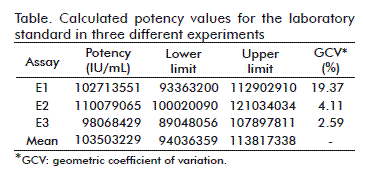
<body><![CDATA[<P   ><font size="2" face="Verdana, Arial, Helvetica, sans-serif">Three different experiments      were performed to determine the potency of IL-15 from R&amp;D using as reference,      an international standard from NIBSC. The obtained values showed a good repeatability      with a geometric coefficient of variation (GCV) lower than or equal to 20      % and these values were between the established limits (<a href="#tab1">Table</a>).      The calculated ED50 was 1.035 &times; 10<sup>8</sup> IU/mg which is very close      to 10<sup>8</sup> IU/mg, the value reported for the commercial IL-15 [19-21].      </font></P >       <P align="center"   ><img src="/img/revistas/bta/v31n4/t0104414.gif" width="363" height="173"><a name="tab1"></a></P >       
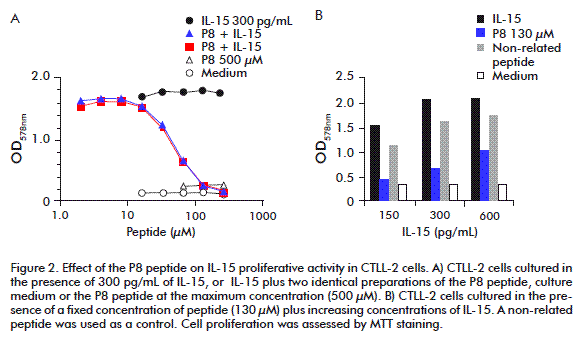
<P   ><font size="2" face="Verdana, Arial, Helvetica, sans-serif"><B>Evaluation of      IL-15 antagonist peptides </b></font></P >       <P   ><font size="2" face="Verdana, Arial, Helvetica, sans-serif">In order to evaluate      peptides that bind to IL-15R&alpha; as inhibitors of IL-15 activity, first,      we defined the experimental conditions. The volume was adjusted to 30 &mu;L      of peptide, 20 &mu;L of IL-15 and 50 &mu;L of cells at 5 &times; 10<sup>5</sup>      cell/well. Two-fold serial dilutions of the peptide were performed to determine      the dose range where the peptide is active. We chose 300 pg/mL as the set      IL-15 concentration, considering that this dose corresponds to a point near      to the proliferation curve plateau. Besides, 24, 48, and 72 h incubations      were evaluated, the best results obtained after 72 h (data not shown). A satisfactory      dose-response curve was obtained in a range from 500 to 2 &mu;M of P8 peptide      and the IC50 calculated was 130 &mu;M. Also a good reproducibility for duplicate      data was observed (<a href="#fig2">Figure 2A</a>). </font></P >       <P align="center"   ><img src="/img/revistas/bta/v31n4/f0204414.gif" width="578" height="337"><a name="fig2"></a></P >       
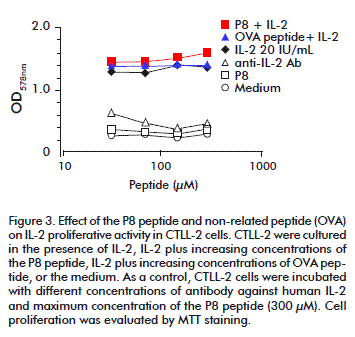
<P   ><font size="2" face="Verdana, Arial, Helvetica, sans-serif">Additionally, a fixed      concentration of peptide was also evaluated against different amounts of IL-15,      taking it as reference of a non-related peptide. An inhibitory effect of P8      peptide dependent of IL-15 concentration was observed in these experiments      (<a href="#fig2">Figure 2B</a>). The inhibition percent calculated was 63.9      %, 61.1 % and 39.5 % for 150 pg/mL, 300 pg/mL and 600 pg/mL of IL-15, respectively.      </font></P >       <P   ><font size="2" face="Verdana, Arial, Helvetica, sans-serif">The specificity of      inhibitory effect of this peptide was assessed in presence of IL-2. The P8      peptide and an ovalbumin peptide (OVA peptide) as non-related peptide showed      similar dose-response curve to IL-2 without inhibitory effect on IL-2 proliferative      activity in CTLL-2. In contrast an anti-IL-2 antibody used as experimental      control showed an inhibitory effect on the proliferation in dose dependent      manner (<a href="#fig3">Figure 3</a>). </font></P >       <P align="center"   ><img src="/img/revistas/bta/v31n4/f0304414.gif" width="353" height="335"><a name="fig3"></a></P >       
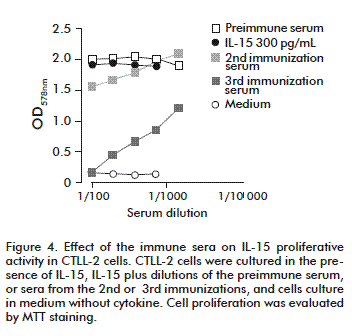
<P   ><font size="2" face="Verdana, Arial, Helvetica, sans-serif"><B>Evaluation of      serum from animals immunized with IL-15 </b></font></P >       <P   ><font size="2" face="Verdana, Arial, Helvetica, sans-serif">The CTLL-2 proliferation      assay was applied to evaluate the neutralizing activity of sera from monkeys      immunized with recombinant IL-15 obtained in our laboratory [22], which is      structurally different to native IL-15. To measure the effect of sera we used      the samples volume established for peptide evaluation, but in this case, the      sera were pre-incubated with cytokine (IL-15 or IL-2, in dependence of the      experiment) for 30 min before adding the cells. Sera from different times      of immunization scheme (pre-immune, after 2nd and 3rd immunizations, respectively)      were compared in order to know the number of immunization required to obtain      neutralizing antibody response. These experiments showed that at least three      immunizations are required as observed in <a href="#fig4">figure 4</a>. </font></P >       ]]></body>
<body><![CDATA[<P align="center"   ><img src="/img/revistas/bta/v31n4/f0404414.gif" width="350" height="334"><a name="fig4"></a></P >       
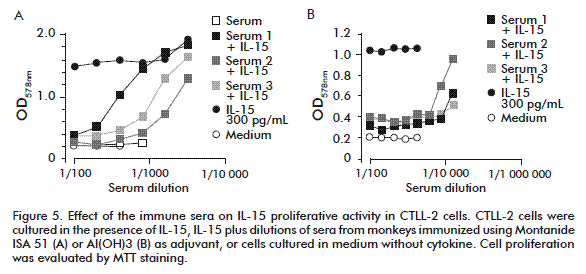
<P   ><font size="2" face="Verdana, Arial, Helvetica, sans-serif">CTLL-2 assays were      also used to compare the effectiveness of two adjuvants on the development      of a neutralizing anti-IL-15 response. In this case, different patterns were      observed in the neutralization curves of sera from animals immunized with      recombinant hIL-15 adjuvanted in Montanide<sup>&reg;</sup> ISA 51 as compared      to those of monkeys immunized with aluminum hydroxide as adjuvant (<a href="/img/revistas/bta/v31n4/f0504414.gif">Figure      5</a>). Specifically, animals immunized using Al(OH)<sub>3</sub> showed similar      neutralizing responses (<a href="/img/revistas/bta/v31n4/f0504414.gif">Figure      5B</a>). In correspondence, the values of neutralizing titers calculated by      this assay for each animal were: 1:1600, 1:1600 and 1:3200 for animals immunized      with Al(OH)<sub>3</sub> as adjuvant and 1:400, 1:800 and 1:600 for those immunized      with Montanide<sup><sup>&reg;</sup></sup> ISA 51. </font></P >   <FONT size="+1"><FONT size="+1">        
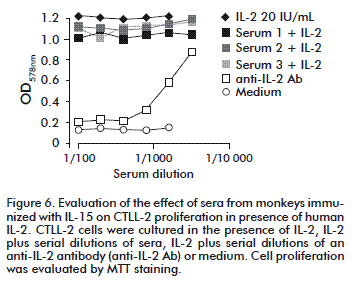
<P   ><font size="2" face="Verdana, Arial, Helvetica, sans-serif">The specificity of      inhibitory effect of serum to hIL- 15 was evaluated in presence of IL-2 (<a href="#fig6">Figure      6</a>). In this experiment only a specific antibody against IL-2 showed inhibitory      effect on CTLL-2 proliferation induced by IL-2, none of the serum evaluated      were able to neutralize IL-2 proliferative activity. </font></P >       <P align="center"   ><img src="/img/revistas/bta/v31n4/f0604414.gif" width="353" height="284"><a name="fig6"></a></P >       
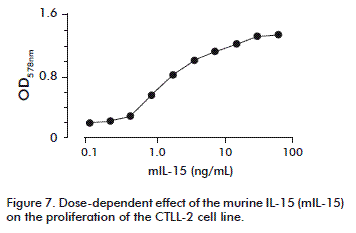
<P   ><font size="2" face="Verdana, Arial, Helvetica, sans-serif">Finally, CTLL-2 assay      allowed us to evaluate the neutralizing activity of antibodies or sera generated      to hIL-15 against mIL-15. For this, the range of concentration was determined      to get a satisfactory response curve for mIL-15. The linearity range was obtained      from 390 pg/mL to 6.25 ng/mL. The 800 pg/mL concentration was selected to      evaluate the neutralizing capacity of antibodies since it was near to the      proliferation curve plateau (<a href="#fig7">Figure 7</a>). </font></P >       <P align="center"   ><img src="/img/revistas/bta/v31n4/f0704414.gif" width="354" height="231"><a name="fig7"></a></P >       
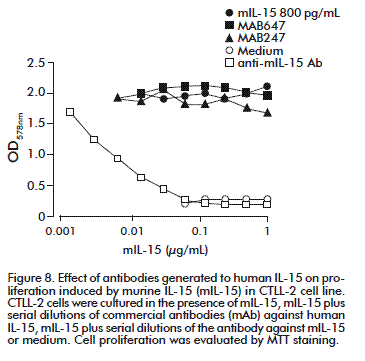
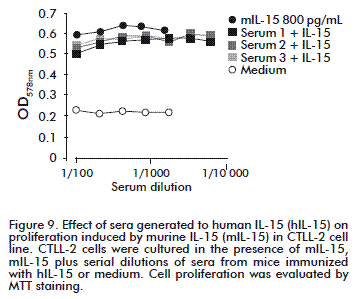
<P   ><font size="2" face="Verdana, Arial, Helvetica, sans-serif">Commercially available      neutralizing antibodies anti-hIL-15 (MAB247 and MAB647) and serum from mouse      immunized with hIL-15 were evaluated in the previously established conditions.      In this experiment, we observed that neither the commercial antibodies anti-hIL-15      nor sera from mice immunized with hIL-15 inhibited the mIL-15. An anti-mIL-15      antibody was used as experimental control to evaluate the specifici-ty of      the assay, which showed a dose-dependent inhibitory effect on mIL-15 (<a href="#fig8">Figure      8</a> and <a href="#fig9">Figure 9</a>). </font></P >       <P align="center"   ><img src="/img/revistas/bta/v31n4/f0804414.gif" width="363" height="359"><a name="fig8"></a></P >       
<P align="center"   ><img src="/img/revistas/bta/v31n4/f0904414.gif" width="355" height="297"><a name="fig9"></a></P >       
<P   >&nbsp;</P >       ]]></body>
<body><![CDATA[<P   ><font size="2" face="Verdana, Arial, Helvetica, sans-serif"><B><font size="3">DISCUSSION      </font></b></font></P >       <P   ><font size="2" face="Verdana, Arial, Helvetica, sans-serif">It is essential to      have optimized biological assays for preclinical studies of pharmaceutical      molecules using cytokines as targets, which often use established cell </font><font size="2" face="Verdana, Arial, Helvetica, sans-serif">lines      that depend on the presence of particular cytokines for their continued growth      and survival. </font></P >       <P   ><font size="2" face="Verdana, Arial, Helvetica, sans-serif">One of them, the      CTLL-2 cell proliferation assay using the redox sensitive formazan MTT [17],      is frequently used to determine IL-2 and IL-15 biological activity. In this      paper, the CTLL-2 assay was adjusted to evaluate IL-15 inhibitors developed      in our laboratory. We used a NIBSC standard to calibrate a laboratory standard      reference and we tested the specificity of the assay using a neutralizing      antibody against IL-15. CTLL-2 cells also proliferate in response to IL-2,      in fact, the cells were maintained in culture medium supplemented with IL-2      before the experiments and several washes were required prior to performing      the assay. The presence of neutralizing anti-IL-15 antibody in the assay showed      that the proliferation of CTLL-2 cells was induced by IL-15. Also, the assay      was demonstrated to have a good repeatability and reproducibility in a series      of experiments as shown in the <a href="#tab1">table</a>. </font></P >       <P   ><font size="2" face="Verdana, Arial, Helvetica, sans-serif">To evaluate IL-15      antagonists developed in our laboratory, conditions such as sample volume,      time of experiment and the order of samples application were established.      In the case of the antagonist peptide P8 capable of binding to IL-15R&alpha;      [15], cells were pre-viously incubated with this peptide in order to give      advantage to peptide/IL-15R&alpha; binding because the affinity of IL-15/IL-15R&alpha;      complex is very high (10<sup>-11</sup> M). This peptide exhibited an IC50      of 130 &mu;M and showed a weak affinity to the target protein IL-15R&alpha;      compared to the high affinity IL-15/IL-15R&alpha; complex. This is predictable      because short peptides usually cannot hold the conformation needed for high-affinity      biomolecular interaction. We chose an IL-15 dose of 300 pg/mL as set concentration,      corresponding to a point near the proliferation curve plateau, in order to      assess high-potency antagonists able to displace or inhibit IL-15/IL-15R&alpha;      binding. </font></P >       <P   ><font size="2" face="Verdana, Arial, Helvetica, sans-serif">The specificity of      the effect of this peptide on IL-15 activity was determined in the presence      of IL-2, a cytokine sharing certain functions with IL-15. It also has a similar      structure and shares receptor &beta; and &gamma; subunits with IL-15, but,      significantly, each cytokine has a specific alpha subunit [23]. This reason      supports the specificity of the peptide that binds IL-15R&alpha; for IL-15,      as it was demonstrated in this work using CTLL-2 cell proliferation assay      in the presence of IL-2. Furthermore, this result demonstrates that there      is no toxicity associated to the P8 peptide on this cell line. </font></P >       <P   ><font size="2" face="Verdana, Arial, Helvetica, sans-serif">Another point of      high interest was the applicability of this assay in the improvement and optimization      of molecules derived from the P8 peptide. As previously reported, a more active      peptide was identified with this assay, by studying specific single mutations      on the P8 peptide [24]. </font></P >       <P   ><font size="2" face="Verdana, Arial, Helvetica, sans-serif">In fact, the CTLL-2      proliferation assay was used to evaluate the sera from monkeys immunized with      IL-15, in order to compare the immune response for each animal during the      immunization scheme. A neutralizing response was only observed after the third      immunization, providing the number of immunizations required to get a neutralizing      response and its duration. These results are consistent to those previously      describing that 3 or 4 immunizations per year were necessary to maintain a      strong neutralizing antibody response [25]. </font></P >       <P   ><font size="2" face="Verdana, Arial, Helvetica, sans-serif">Since modern vaccines      based on recombinant antigens generally require adjuvants to generate adequate      immune responses, either aluminum hydroxide or Montanide<sup>&reg;</sup> ISA      51 were evaluated to induce a neutralizing antibody response to IL-15, to      select the most effective adjuvant for an anti-IL-15 vaccine. Immunization      with IL-15 formulated in each adjuvant generated antibodies neutralizing the      native IL-15. Specifically, neutralizing antibody titers were higher in the      group immunized with IL-15 on aluminum hydroxide, as shown in the CTLL-2 cell      proliferation assay. This is also favored by the long experience on the use      of aluminum hydroxide in humans, and its </font><font size="2" face="Verdana, Arial, Helvetica, sans-serif">enhanced      antibody responses [26]. Hence, we chose aluminum hydroxide as adjuvant for      further immunizations with IL-15. </font></P >       <P   ><font size="2" face="Verdana, Arial, Helvetica, sans-serif">Furthermore, the      specificity of sera from monkeys immunized with IL-15 in the presence of IL-2      was assessed. Both molecules are 43 % homologous in protein sequence but have      a high structural homology. Nevertheless, it was shown that evaluated sera      do not recognized human IL-2 and, therefore, do not inhibit the cytokine-induced      proliferation. This remarkable result demonstrates the specificity of the      antibodies for the immunized cytokine, in spite of both cytokines having the      same receptor &beta; and &gamma; subunits and sharing some biological functions      due to the redundant effect described for IL-15 and IL-2. The specificity      of the neutralizing sera is essential to develop a vaccine targeting IL-15,      since high titers of specific anti-cytokine antibodies induced by immunization      could neutralize the local cytokine overexpression and inhibit its pathological      effect [25, 27]. </font></P >       <P   ><font size="2" face="Verdana, Arial, Helvetica, sans-serif">Finally, we optimized      the conditions to evaluate the capacity of commercially available neutralizing      antibodies and sera developed in mice against hIL-15 for mIL-15 neutralization,      aimed to identify the possible use of murine models for preclinical evaluation      of these IL-15 antagonists. CTLL-2 is a murine cell line; however, it was      demonstrated by Eisenman <I>et al</I>. that these cells need more mIL-15 than      hIL-15 to proliferate [28]. For current experiments, it was necessary to determine      the range of doses to obtain a linear response. A dose of 800 pg/mL was set      because it produces cell proliferation levels that support the evaluation      of the effect of these antagonists. Neither the commercial neutralizing antibodies      anti-hIL-15 nor sera against hIL-15 inhibited mIL-15. This represents a technical      difficulty for the evaluation of neutralizing antibodies or the anti-hIL-15      vaccine in murine models. Any anti-cytokine vaccine requires antibodies generated      through immunization also displaying neutralizing activity against the specific      cytokine of the vaccinated animal species. </font></P >       ]]></body>
<body><![CDATA[<P   ><font size="2" face="Verdana, Arial, Helvetica, sans-serif">In summary, our results      demonstrate that the CTLL-2 cell proliferation assay is a very useful method      to evaluate IL-15 antagonists. This assay can provide relevant information      about antagonists&rsquo; activity, specificity and its possibility of evaluation      in different animal models. Nevertheless, it requires further validation prior      to its use as analytical tool on clinical trials. </font></P >       <P   >&nbsp;</P >       <P   > </P >       <P   > </P >       <P   ><font size="3" face="Verdana, Arial, Helvetica, sans-serif"><B>ACKNOWLEDGEMENTS      </b></font></P >       <P   ><font size="2" face="Verdana, Arial, Helvetica, sans-serif">The authors thank      Prof. Elizabeth D&iacute;az and Yolanda G&oacute;mez for their help in correcting      language. </font></P >       <P   >&nbsp;</P >       <P   > </P >       <P   ><font size="3" face="Verdana, Arial, Helvetica, sans-serif"><B>REFERENCES </b></font></P >       <!-- ref --><P   ><font size="2" face="Verdana, Arial, Helvetica, sans-serif"><FONT color="#000000">1.      Budagian V, Bulanova E, Paus R, Bulfone-Paus S. IL-15/IL-15 receptor biology:      a guided tour through an expanding universe. Cytokine Growth Factor Rev. 2006;17(4):259-80.          </font></font></P >   <FONT color="#000000">        <!-- ref --><P   ><font size="2" face="Verdana, Arial, Helvetica, sans-serif">2. Meazza R, Azzarone      B, Orengo AM, Ferrini S. Role of common-gamma chain cytokines in NK cell development      and function: perspectives for immunotherapy. J Biomed Biotechnol. 2011;2011:861920.          </font></P >       <!-- ref --><P   ><font size="2" face="Verdana, Arial, Helvetica, sans-serif">3. Kokaji AI, Hockley      DL, Kane KP. IL-15 transpresentation augments CD8+ T cell activation and is      required for optimal recall responses by central memory CD8+ T cells. J Immunol.      2008;180(7):4391-401.     </font></P >       <P   ><font size="2" face="Verdana, Arial, Helvetica, sans-serif">4. Magyari L, Varszegi      D, Kovesdi E, Sarlos P, Farago B, Javorhazy A, <I>et al</I>. Interleukins      and interleukin receptors in rheumatoid arthritis: Research, diagnostics and      clinical implications. World J Orthop. 2014;5(4):516-36. </font></P >       <!-- ref --><P   ><font size="2" face="Verdana, Arial, Helvetica, sans-serif">5. Burska A, Boissinot      M, Ponchel F. Cytokines as biomarkers in rheumatoid arthritis. Mediators of      inflammation. 2014;2014:545493.     </font></P >       <!-- ref --><P   ><font size="2" face="Verdana, Arial, Helvetica, sans-serif">6. Yadav PK, Chen      C, Liu Z. Potential role of NK cells in the pathogenesis of inflammatory bowel      disease. J Biomed Biotechnol. 2011;2011:348530.     </font></P >       ]]></body>
<body><![CDATA[<!-- ref --><P   ><font size="2" face="Verdana, Arial, Helvetica, sans-serif">7. Harris KM, Fasano      A, Mann DL. Monocytes differentiated with IL-15 support Th17 and Th1 responses      to wheat gliadin: implications for celiac disease. Clin Immunol. 2010;135(3):430-9.          </font></P >       <!-- ref --><P   ><font size="2" face="Verdana, Arial, Helvetica, sans-serif">8. Rashtak S, Murray      JA. Review article: coeliac disease, new approaches to therapy. Aliment Pharmacol      Ther. 2012;35(7):768-81.     </font></P >       <!-- ref --><P   ><font size="2" face="Verdana, Arial, Helvetica, sans-serif">9. McLInnes IB. Cytokine      targeting in psoriasis and psoriatic arthritis: beyond TNFalpha. Ernst Schering      Res Found Workshop. 2006(56):29-44.     </font></P >       <!-- ref --><P   ><font size="2" face="Verdana, Arial, Helvetica, sans-serif">10. Patterson KC,      Hogarth K, Husain AN, Sperling AI, Niewold TB. The clinical and immunologic      features of pulmonary fibrosis in sarcoidosis. Transl Res. 2012;160(5):321-31.          </font></P >       <!-- ref --><P   ><font size="2" face="Verdana, Arial, Helvetica, sans-serif">11. Waldmann TA,      Conlon KC, Stewart DM, Worthy TA, Janik JE, Fleisher TA, <I>et al</I>. Phase      1 trial of IL-15 trans presentation blockade using humanized Mikbeta1 mAb      in patients with T-cell large granular lymphocytic leukemia. Blood. 2013;121(3):476-84.          </font></P >       ]]></body>
<body><![CDATA[<!-- ref --><P   ><font size="2" face="Verdana, Arial, Helvetica, sans-serif">12. Ferrari-Lacraz      S, Zheng XX, Kim YS, Li Y, Maslinski W, Li XC, <I>et al</I>. An antagonist      IL-15/Fc protein prevents costimulation blockade-resistant rejection. J Immunol.      2001;167(6):3478-85.     </font></P >       <!-- ref --><P   ><font size="2" face="Verdana, Arial, Helvetica, sans-serif">13. Villadsen LS,      Schuurman J, Beurskens F, Dam TN, Dagnaes-Hansen F, Skov L, <I>et al</I>.      Resolution of psoriasis upon blockade of IL-15 biological activity in a xenograft      mouse model. J Clin Invest. 2003;112(10):1571-80.     </font></P >       <!-- ref --><P   ><font size="2" face="Verdana, Arial, Helvetica, sans-serif">14. Tinubu SA, Hakimi      J, Kondas JA, Bailon P, Familletti PC, Spence C, <I>et al</I>. Humanized antibody      directed to the IL-2 receptor beta-chain prolongs primate cardiac allograft      survival. J Immunol. 1994;153(9):4330-8.     </font></P >       <!-- ref --><P   ><font size="2" face="Verdana, Arial, Helvetica, sans-serif">15. Santos A, Cabrales      A, Reyes O, Ger&oacute;nimo H, Rodr&iacute;guez Y, Garay H, <I>et al</I>.      Identification of an interleukin-15 antagonist peptide that binds to IL-15Ra.      Biotecnol Apl. 2008; 25:320-24.     </font></P >       <!-- ref --><P   ><font size="2" face="Verdana, Arial, Helvetica, sans-serif">16. Giri JG, Ahdieh      M, Eisenman J, Shanebeck K, Grabstein K, Kumaki S, <I>et al</I>. Utilization      of the beta and gamma chains of the IL-2 receptor by the novel cytokine IL-15.      EMBO J. 1994;13(12):2822-30.     </font></P >       ]]></body>
<body><![CDATA[<!-- ref --><P   ><font size="2" face="Verdana, Arial, Helvetica, sans-serif">17. Mosmann T. Rapid      colorimetric assay for cellular growth and survival: application to proliferation      and cytotoxicity assays. J Immunol Methods. 1983;65(1-2):55-63.     </font></P >       <!-- ref --><P   ><font size="2" face="Verdana, Arial, Helvetica, sans-serif">18. Scherliess R.      The MTT assay as tool to evaluate and compare excipient toxicity in vitro      on respiratory epithelial cells. Int J Pharm. 2011;411(1-2):98-105.     </font></P >       <!-- ref --><P   ><font size="2" face="Verdana, Arial, Helvetica, sans-serif">19. Wright JF. Bioassays      and biological stability. Dev Biol Stand. 1999;97:73-80.     </font></P >       <!-- ref --><P   ><font size="2" face="Verdana, Arial, Helvetica, sans-serif">20. Mire-Sluis AR,      Gerrard T, Das RG, Padilla A, Thorpe R. Biological assays: their role in the      development and quality control of recombinant biological medicinal products.      Biologicals. 1996;24(4):351-62.     </font></P >       <!-- ref --><P   ><font size="2" face="Verdana, Arial, Helvetica, sans-serif">21. Mire-Sluis AR,      Page L, Thorpe R. Quantitative cell line based bioassays for human cytokines.      J Immunol Methods. 1995;187(2):191-9.     </font></P >       ]]></body>
<body><![CDATA[<!-- ref --><P   ><font size="2" face="Verdana, Arial, Helvetica, sans-serif">22. Santos A, Morera      Y, Ara&ntilde;a M, Ferrero J, Moro A, Garc&iacute;a J, <I>et al</I>. Obtaining      Biologically Active IL-15 in <I>Escherichia coli</I>. Biotecnol Apl. 2000;      17: 221-224.     </font></P >       <!-- ref --><P   ><font size="2" face="Verdana, Arial, Helvetica, sans-serif">23. Giri JG, Kumaki      S, Ahdieh M, Friend DJ, Loomis A, Shanebeck K, <I>et al</I>. Identification      and cloning of a novel IL-15 binding protein that is structurally related      to the alpha chain of the IL-2 receptor. EMBO J. 1995;14(15):3654-63.     </font></P >       <!-- ref --><P   ><font size="2" face="Verdana, Arial, Helvetica, sans-serif">24. Savio AS, Acosta      OR, Perez HG, Alvarez YR, Chico A, Perez HG, <I>et al</I>. Enhancement of      the inhibitory effect of an IL-15 antago&not;nist peptide by alanine scanning.      J Pept Sci. 2012;18(1):25-9.     </font></P >       <!-- ref --><P   ><font size="2" face="Verdana, Arial, Helvetica, sans-serif">25. Zagury D, Burny      A, Gallo RC. Toward a new generation of vaccines: the anti-cytokine therapeutic      vaccines. Proc Natl Acad Sci USA. 2001;98(14):8024-9.     </font></P >       <!-- ref --><P   ><font size="2" face="Verdana, Arial, Helvetica, sans-serif">26. Coffman RL, Sher      A, Seder RA. Vaccine adjuvants: putting innate immunity to work. Immunity.      2010;33(4):492-503.     </font></P >       ]]></body>
<body><![CDATA[<!-- ref --><P   ><font size="2" face="Verdana, Arial, Helvetica, sans-serif">27. Zagury D, Gallo      RC. Anti-cytokine Ab immune therapy: present status and perspectives. Drug      Discov Today. 2004;9(2):72-81.     </font></P >       <!-- ref --><P   ><font size="2" face="Verdana, Arial, Helvetica, sans-serif">28. Eisenman J, Ahdieh      M, Beers C, Brasel K, Kennedy MK, Le T, <I>et al</I>. Interleukin-15 interactions      with interleukin-15 receptor complexes: characterization and species specificity.      Cytokine. 2002;20(3):121-9.     </font></P >       <P   >&nbsp;</P >       <P   >&nbsp;</P >       <P   > </P >       <P   > </P >       <P   ><font size="2" color="#211E1F" face="Verdana, Arial, Helvetica, sans-serif">Received      in February, 2014.     <br>     </font><font size="2" face="Verdana, Arial, Helvetica, sans-serif">Accepted      in December 2014. </font></P >       ]]></body>
<body><![CDATA[<P   >&nbsp;</P >       <P   >&nbsp;</P >   <FONT size="+1" color="#211E1F">        <P   > </P >       <P   > </P >       <P   ><font size="2" color="#000000" face="Verdana, Arial, Helvetica, sans-serif"><I>Yunier      Rodr&iacute;guez-&Aacute;lvarez</I>. Departamento de Farmac&eacute;uticos,      Direcci&oacute;n de Investigaciones Biom&eacute;dicas, Centro de Ingenier&iacute;a      Gen&eacute;tica y Biotecnolog&iacute;a, CIGB. Ave. 31 entre 158 y 190, Cubanac&aacute;n,      Playa, CP 11600, La Habana, Cuba. E-mail: <A href="mailto:yunier.rodriguez@cigb.edu.cu">      <FONT color="#0000FF">yunier.rodriguez@cigb.edu.cu</font></A><FONT color="#0000FF">.      </font></font></P >   </font></font></font></font></font></font></font></font></font></font></font></font></font></font></font></font></font></font></font></font></font></font></font></font></font></font></font></font></font></font></font></font></DIV >      ]]></body><back>
<ref-list>
<ref id="B1">
<label>1</label><nlm-citation citation-type="journal">
<person-group person-group-type="author">
<name>
<surname><![CDATA[Budagian]]></surname>
<given-names><![CDATA[V]]></given-names>
</name>
<name>
<surname><![CDATA[Bulanova]]></surname>
<given-names><![CDATA[E]]></given-names>
</name>
<name>
<surname><![CDATA[Paus]]></surname>
<given-names><![CDATA[R]]></given-names>
</name>
<name>
<surname><![CDATA[Bulfone-Paus]]></surname>
<given-names><![CDATA[S]]></given-names>
</name>
</person-group>
<article-title xml:lang="en"><![CDATA[IL-15/IL-15 receptor biology: a guided tour through an expanding universe]]></article-title>
<source><![CDATA[Cytokine Growth Factor Rev]]></source>
<year>2006</year>
<volume>17</volume>
<numero>4</numero>
<issue>4</issue>
<page-range>259-80</page-range></nlm-citation>
</ref>
<ref id="B2">
<label>2</label><nlm-citation citation-type="journal">
<person-group person-group-type="author">
<name>
<surname><![CDATA[Meazza]]></surname>
<given-names><![CDATA[R]]></given-names>
</name>
<name>
<surname><![CDATA[Azzarone]]></surname>
<given-names><![CDATA[B]]></given-names>
</name>
<name>
<surname><![CDATA[Orengo]]></surname>
<given-names><![CDATA[AM]]></given-names>
</name>
<name>
<surname><![CDATA[Ferrini]]></surname>
<given-names><![CDATA[S]]></given-names>
</name>
</person-group>
<article-title xml:lang="en"><![CDATA[Role of common-gamma chain cytokines in NK cell development and function: perspectives for immunotherapy]]></article-title>
<source><![CDATA[J Biomed Biotechnol]]></source>
<year>2011</year>
<volume>2011</volume>
<page-range>861920</page-range></nlm-citation>
</ref>
<ref id="B3">
<label>3</label><nlm-citation citation-type="journal">
<person-group person-group-type="author">
<name>
<surname><![CDATA[Kokaji]]></surname>
<given-names><![CDATA[AI]]></given-names>
</name>
<name>
<surname><![CDATA[Hockley]]></surname>
<given-names><![CDATA[DL]]></given-names>
</name>
<name>
<surname><![CDATA[Kane]]></surname>
<given-names><![CDATA[KP]]></given-names>
</name>
</person-group>
<article-title xml:lang="en"><![CDATA[IL-15 transpresentation augments CD8+ T cell activation and is required for optimal recall responses by central memory CD8+ T cells]]></article-title>
<source><![CDATA[J Immunol]]></source>
<year>2008</year>
<volume>180</volume>
<numero>7</numero>
<issue>7</issue>
<page-range>4391-401</page-range></nlm-citation>
</ref>
<ref id="B4">
<label>4</label><nlm-citation citation-type="journal">
<person-group person-group-type="author">
<name>
<surname><![CDATA[Magyari]]></surname>
<given-names><![CDATA[L]]></given-names>
</name>
<name>
<surname><![CDATA[Varszegi]]></surname>
<given-names><![CDATA[D]]></given-names>
</name>
<name>
<surname><![CDATA[Kovesdi]]></surname>
<given-names><![CDATA[E]]></given-names>
</name>
<name>
<surname><![CDATA[Sarlos]]></surname>
<given-names><![CDATA[P]]></given-names>
</name>
<name>
<surname><![CDATA[Farago]]></surname>
<given-names><![CDATA[B]]></given-names>
</name>
<name>
<surname><![CDATA[Javorhazy]]></surname>
<given-names><![CDATA[A]]></given-names>
</name>
</person-group>
<article-title xml:lang="en"><![CDATA[Interleukins and interleukin receptors in rheumatoid arthritis: Research, diagnostics and clinical implications]]></article-title>
<source><![CDATA[World journal of orthopedics]]></source>
<year>2014</year>
<volume>5</volume>
<numero>4</numero>
<issue>4</issue>
<page-range>516-36</page-range></nlm-citation>
</ref>
<ref id="B5">
<label>5</label><nlm-citation citation-type="journal">
<person-group person-group-type="author">
<name>
<surname><![CDATA[Burska]]></surname>
<given-names><![CDATA[A]]></given-names>
</name>
<name>
<surname><![CDATA[Boissinot]]></surname>
<given-names><![CDATA[M]]></given-names>
</name>
<name>
<surname><![CDATA[Ponchel]]></surname>
<given-names><![CDATA[F]]></given-names>
</name>
</person-group>
<article-title xml:lang="en"><![CDATA[Cytokines as biomarkers in rheumatoid arthritis]]></article-title>
<source><![CDATA[Mediators of inflammation]]></source>
<year>2014</year>
<volume>2014</volume>
<page-range>545493</page-range></nlm-citation>
</ref>
<ref id="B6">
<label>6</label><nlm-citation citation-type="journal">
<person-group person-group-type="author">
<name>
<surname><![CDATA[Yadav]]></surname>
<given-names><![CDATA[PK]]></given-names>
</name>
<name>
<surname><![CDATA[Chen]]></surname>
<given-names><![CDATA[C]]></given-names>
</name>
<name>
<surname><![CDATA[Liu]]></surname>
<given-names><![CDATA[Z]]></given-names>
</name>
</person-group>
<article-title xml:lang="en"><![CDATA[Potential role of NK cells in the pathogenesis of inflammatory bowel disease]]></article-title>
<source><![CDATA[J Biomed Biotechnol]]></source>
<year>2011</year>
<volume>2011</volume>
<page-range>348530</page-range></nlm-citation>
</ref>
<ref id="B7">
<label>7</label><nlm-citation citation-type="journal">
<person-group person-group-type="author">
<name>
<surname><![CDATA[Harris]]></surname>
<given-names><![CDATA[KM]]></given-names>
</name>
<name>
<surname><![CDATA[Fasano]]></surname>
<given-names><![CDATA[A]]></given-names>
</name>
<name>
<surname><![CDATA[Mann]]></surname>
<given-names><![CDATA[DL]]></given-names>
</name>
</person-group>
<article-title xml:lang="en"><![CDATA[Monocytes differentiated with IL-15 support Th17 and Th1 responses to wheat gliadin: implications for celiac disease]]></article-title>
<source><![CDATA[Clin Immunol]]></source>
<year>2010</year>
<volume>135</volume>
<numero>3</numero>
<issue>3</issue>
<page-range>430-9</page-range></nlm-citation>
</ref>
<ref id="B8">
<label>8</label><nlm-citation citation-type="journal">
<person-group person-group-type="author">
<name>
<surname><![CDATA[Rashtak]]></surname>
<given-names><![CDATA[S]]></given-names>
</name>
<name>
<surname><![CDATA[Murray]]></surname>
<given-names><![CDATA[JA]]></given-names>
</name>
</person-group>
<article-title xml:lang="en"><![CDATA[Review article: coeliac disease, new approaches to therapy]]></article-title>
<source><![CDATA[Aliment Pharmacol Ther]]></source>
<year>2012</year>
<volume>35</volume>
<numero>7</numero>
<issue>7</issue>
<page-range>768-81</page-range></nlm-citation>
</ref>
<ref id="B9">
<label>9</label><nlm-citation citation-type="journal">
<person-group person-group-type="author">
<name>
<surname><![CDATA[McLInnes]]></surname>
<given-names><![CDATA[IB]]></given-names>
</name>
</person-group>
<article-title xml:lang="en"><![CDATA[Cytokine targeting in psoriasis and psoriatic arthritis: beyond TNFalpha]]></article-title>
<source><![CDATA[Ernst Schering Res Found Workshop]]></source>
<year>2006</year>
<numero>56</numero>
<issue>56</issue>
<page-range>29-44</page-range></nlm-citation>
</ref>
<ref id="B10">
<label>10</label><nlm-citation citation-type="journal">
<person-group person-group-type="author">
<name>
<surname><![CDATA[Patterson]]></surname>
<given-names><![CDATA[KC]]></given-names>
</name>
<name>
<surname><![CDATA[Hogarth]]></surname>
<given-names><![CDATA[K]]></given-names>
</name>
<name>
<surname><![CDATA[Husain]]></surname>
<given-names><![CDATA[AN]]></given-names>
</name>
<name>
<surname><![CDATA[Sperling]]></surname>
<given-names><![CDATA[AI]]></given-names>
</name>
<name>
<surname><![CDATA[Niewold]]></surname>
<given-names><![CDATA[TB]]></given-names>
</name>
</person-group>
<article-title xml:lang="en"><![CDATA[The clinical and immunologic features of pulmonary fibrosis in sarcoidosis]]></article-title>
<source><![CDATA[Transl Res]]></source>
<year>2012</year>
<volume>160</volume>
<numero>5</numero>
<issue>5</issue>
<page-range>321-31</page-range></nlm-citation>
</ref>
<ref id="B11">
<label>11</label><nlm-citation citation-type="journal">
<person-group person-group-type="author">
<name>
<surname><![CDATA[Waldmann]]></surname>
<given-names><![CDATA[TA]]></given-names>
</name>
<name>
<surname><![CDATA[Conlon]]></surname>
<given-names><![CDATA[KC]]></given-names>
</name>
<name>
<surname><![CDATA[Stewart]]></surname>
<given-names><![CDATA[DM]]></given-names>
</name>
<name>
<surname><![CDATA[Worthy]]></surname>
<given-names><![CDATA[TA]]></given-names>
</name>
<name>
<surname><![CDATA[Janik]]></surname>
<given-names><![CDATA[JE]]></given-names>
</name>
<name>
<surname><![CDATA[Fleisher]]></surname>
<given-names><![CDATA[TA]]></given-names>
</name>
</person-group>
<article-title xml:lang="en"><![CDATA[Phase 1 trial of IL-15 trans presentation blockade using humanized Mikbeta1 mAb in patients with T-cell large granular lymphocytic leukemia]]></article-title>
<source><![CDATA[Blood]]></source>
<year>2013</year>
<volume>121</volume>
<numero>3</numero>
<issue>3</issue>
<page-range>476-84</page-range></nlm-citation>
</ref>
<ref id="B12">
<label>12</label><nlm-citation citation-type="journal">
<person-group person-group-type="author">
<name>
<surname><![CDATA[Ferrari-Lacraz]]></surname>
<given-names><![CDATA[S]]></given-names>
</name>
<name>
<surname><![CDATA[Zheng]]></surname>
<given-names><![CDATA[XX]]></given-names>
</name>
<name>
<surname><![CDATA[Kim]]></surname>
<given-names><![CDATA[YS]]></given-names>
</name>
<name>
<surname><![CDATA[Li]]></surname>
<given-names><![CDATA[Y]]></given-names>
</name>
<name>
<surname><![CDATA[Maslinski]]></surname>
<given-names><![CDATA[W]]></given-names>
</name>
<name>
<surname><![CDATA[Li]]></surname>
<given-names><![CDATA[XC]]></given-names>
</name>
</person-group>
<article-title xml:lang="en"><![CDATA[An antagonist IL-15/Fc protein prevents costimulation blockade-resistant rejection]]></article-title>
<source><![CDATA[J Immunol]]></source>
<year>2001</year>
<volume>167</volume>
<numero>6</numero>
<issue>6</issue>
<page-range>3478-85</page-range></nlm-citation>
</ref>
<ref id="B13">
<label>13</label><nlm-citation citation-type="journal">
<person-group person-group-type="author">
<name>
<surname><![CDATA[Villadsen]]></surname>
<given-names><![CDATA[LS]]></given-names>
</name>
<name>
<surname><![CDATA[Schuurman]]></surname>
<given-names><![CDATA[J]]></given-names>
</name>
<name>
<surname><![CDATA[Beurskens]]></surname>
<given-names><![CDATA[F]]></given-names>
</name>
<name>
<surname><![CDATA[Dam]]></surname>
<given-names><![CDATA[TN]]></given-names>
</name>
<name>
<surname><![CDATA[Dagnaes-Hansen]]></surname>
<given-names><![CDATA[F]]></given-names>
</name>
<name>
<surname><![CDATA[Skov]]></surname>
<given-names><![CDATA[L]]></given-names>
</name>
</person-group>
<article-title xml:lang="en"><![CDATA[Resolution of psoriasis upon blockade of IL-15 biological activity in a xenograft mouse model]]></article-title>
<source><![CDATA[J Clin Invest]]></source>
<year>2003</year>
<volume>112</volume>
<numero>10</numero>
<issue>10</issue>
<page-range>1571-80</page-range></nlm-citation>
</ref>
<ref id="B14">
<label>14</label><nlm-citation citation-type="journal">
<person-group person-group-type="author">
<name>
<surname><![CDATA[Tinubu]]></surname>
<given-names><![CDATA[SA]]></given-names>
</name>
<name>
<surname><![CDATA[Hakimi]]></surname>
<given-names><![CDATA[J]]></given-names>
</name>
<name>
<surname><![CDATA[Kondas]]></surname>
<given-names><![CDATA[JA]]></given-names>
</name>
<name>
<surname><![CDATA[Bailon]]></surname>
<given-names><![CDATA[P]]></given-names>
</name>
<name>
<surname><![CDATA[Familletti]]></surname>
<given-names><![CDATA[PC]]></given-names>
</name>
<name>
<surname><![CDATA[Spence]]></surname>
<given-names><![CDATA[C]]></given-names>
</name>
</person-group>
<article-title xml:lang="en"><![CDATA[Humanized antibody directed to the IL-2 receptor beta-chain prolongs primate cardiac allograft survival]]></article-title>
<source><![CDATA[J Immunol]]></source>
<year>1994</year>
<volume>153</volume>
<numero>9</numero>
<issue>9</issue>
<page-range>4330-8</page-range></nlm-citation>
</ref>
<ref id="B15">
<label>15</label><nlm-citation citation-type="journal">
<person-group person-group-type="author">
<name>
<surname><![CDATA[Santos]]></surname>
<given-names><![CDATA[A]]></given-names>
</name>
<name>
<surname><![CDATA[Cabrales]]></surname>
<given-names><![CDATA[A]]></given-names>
</name>
<name>
<surname><![CDATA[Reyes]]></surname>
<given-names><![CDATA[O]]></given-names>
</name>
<name>
<surname><![CDATA[Gerónimo]]></surname>
<given-names><![CDATA[H]]></given-names>
</name>
<name>
<surname><![CDATA[Rodríguez]]></surname>
<given-names><![CDATA[Y]]></given-names>
</name>
<name>
<surname><![CDATA[Garay]]></surname>
<given-names><![CDATA[H]]></given-names>
</name>
</person-group>
<article-title xml:lang="en"><![CDATA[Identification of an interleukin-15 antagonist peptide that binds to IL-15Ra]]></article-title>
<source><![CDATA[Biotecnol Apl]]></source>
<year>2008</year>
<volume>25</volume>
<page-range>320-24</page-range></nlm-citation>
</ref>
<ref id="B16">
<label>16</label><nlm-citation citation-type="journal">
<person-group person-group-type="author">
<name>
<surname><![CDATA[Giri]]></surname>
<given-names><![CDATA[JG]]></given-names>
</name>
<name>
<surname><![CDATA[Ahdieh]]></surname>
<given-names><![CDATA[M]]></given-names>
</name>
<name>
<surname><![CDATA[Eisenman]]></surname>
<given-names><![CDATA[J]]></given-names>
</name>
<name>
<surname><![CDATA[Shanebeck]]></surname>
<given-names><![CDATA[K]]></given-names>
</name>
<name>
<surname><![CDATA[Grabstein]]></surname>
<given-names><![CDATA[K]]></given-names>
</name>
<name>
<surname><![CDATA[Kumaki]]></surname>
<given-names><![CDATA[S]]></given-names>
</name>
</person-group>
<article-title xml:lang="en"><![CDATA[Utilization of the beta and gamma chains of the IL-2 receptor by the novel cytokine IL-15]]></article-title>
<source><![CDATA[EMBO J]]></source>
<year>1994</year>
<volume>13</volume>
<numero>12</numero>
<issue>12</issue>
<page-range>2822-30</page-range></nlm-citation>
</ref>
<ref id="B17">
<label>17</label><nlm-citation citation-type="journal">
<person-group person-group-type="author">
<name>
<surname><![CDATA[Mosmann]]></surname>
<given-names><![CDATA[T]]></given-names>
</name>
</person-group>
<article-title xml:lang="en"><![CDATA[Rapid colorimetric assay for cellular growth and survival: application to proliferation and cytotoxicity assays]]></article-title>
<source><![CDATA[J Immunol Methods]]></source>
<year>1983</year>
<volume>65</volume>
<numero>1</numero>
<issue>1</issue>
<page-range>2):55-63</page-range></nlm-citation>
</ref>
<ref id="B18">
<label>18</label><nlm-citation citation-type="journal">
<person-group person-group-type="author">
<name>
<surname><![CDATA[Scherliess]]></surname>
<given-names><![CDATA[R]]></given-names>
</name>
</person-group>
<article-title xml:lang="en"><![CDATA[The MTT assay as tool to evaluate and compare excipient toxicity in vitro on respiratory epithelial cells]]></article-title>
<source><![CDATA[Int J Pharm]]></source>
<year>2011</year>
<volume>411</volume>
<numero>1</numero>
<issue>1</issue>
<page-range>2):98-105</page-range></nlm-citation>
</ref>
<ref id="B19">
<label>19</label><nlm-citation citation-type="journal">
<person-group person-group-type="author">
<name>
<surname><![CDATA[Wright]]></surname>
<given-names><![CDATA[JF]]></given-names>
</name>
</person-group>
<article-title xml:lang="en"><![CDATA[Bioassays and biological stability]]></article-title>
<source><![CDATA[Dev Biol Stand]]></source>
<year>1999</year>
<volume>97</volume>
<page-range>73-80</page-range></nlm-citation>
</ref>
<ref id="B20">
<label>20</label><nlm-citation citation-type="journal">
<person-group person-group-type="author">
<name>
<surname><![CDATA[Mire-Sluis]]></surname>
<given-names><![CDATA[AR]]></given-names>
</name>
<name>
<surname><![CDATA[Gerrard]]></surname>
<given-names><![CDATA[T]]></given-names>
</name>
<name>
<surname><![CDATA[Das]]></surname>
<given-names><![CDATA[RG]]></given-names>
</name>
<name>
<surname><![CDATA[Padilla]]></surname>
<given-names><![CDATA[A]]></given-names>
</name>
<name>
<surname><![CDATA[Thorpe]]></surname>
<given-names><![CDATA[R]]></given-names>
</name>
</person-group>
<article-title xml:lang="en"><![CDATA[Biological assays: their role in the development and quality control of recombinant biological medicinal products]]></article-title>
<source><![CDATA[Biologicals]]></source>
<year>1996</year>
<volume>24</volume>
<numero>4</numero>
<issue>4</issue>
<page-range>351-62</page-range></nlm-citation>
</ref>
<ref id="B21">
<label>21</label><nlm-citation citation-type="journal">
<person-group person-group-type="author">
<name>
<surname><![CDATA[Mire-Sluis]]></surname>
<given-names><![CDATA[AR]]></given-names>
</name>
<name>
<surname><![CDATA[Page]]></surname>
<given-names><![CDATA[L]]></given-names>
</name>
<name>
<surname><![CDATA[Thorpe]]></surname>
<given-names><![CDATA[R]]></given-names>
</name>
</person-group>
<article-title xml:lang="en"><![CDATA[Quantitative cell line based bioassays for human cytokines]]></article-title>
<source><![CDATA[J Immunol Methods]]></source>
<year>1995</year>
<volume>187</volume>
<numero>2</numero>
<issue>2</issue>
<page-range>191-9</page-range></nlm-citation>
</ref>
<ref id="B22">
<label>22</label><nlm-citation citation-type="journal">
<person-group person-group-type="author">
<name>
<surname><![CDATA[Santos]]></surname>
<given-names><![CDATA[A]]></given-names>
</name>
<name>
<surname><![CDATA[Morera]]></surname>
<given-names><![CDATA[Y]]></given-names>
</name>
<name>
<surname><![CDATA[Araña]]></surname>
<given-names><![CDATA[M]]></given-names>
</name>
<name>
<surname><![CDATA[Ferrero]]></surname>
<given-names><![CDATA[J]]></given-names>
</name>
<name>
<surname><![CDATA[Moro]]></surname>
<given-names><![CDATA[A]]></given-names>
</name>
<name>
<surname><![CDATA[García]]></surname>
<given-names><![CDATA[J]]></given-names>
</name>
</person-group>
<article-title xml:lang="en"><![CDATA[Obtaining Biologically Active IL-15 in Escherichia coli]]></article-title>
<source><![CDATA[Biotecnol Apl]]></source>
<year>2000</year>
<volume>17</volume>
<page-range>221-224</page-range></nlm-citation>
</ref>
<ref id="B23">
<label>23</label><nlm-citation citation-type="journal">
<person-group person-group-type="author">
<name>
<surname><![CDATA[Giri]]></surname>
<given-names><![CDATA[JG]]></given-names>
</name>
<name>
<surname><![CDATA[Kumaki]]></surname>
<given-names><![CDATA[S]]></given-names>
</name>
<name>
<surname><![CDATA[Ahdieh]]></surname>
<given-names><![CDATA[M]]></given-names>
</name>
<name>
<surname><![CDATA[Friend]]></surname>
<given-names><![CDATA[DJ]]></given-names>
</name>
<name>
<surname><![CDATA[Loomis]]></surname>
<given-names><![CDATA[A]]></given-names>
</name>
<name>
<surname><![CDATA[Shanebeck]]></surname>
<given-names><![CDATA[K]]></given-names>
</name>
</person-group>
<article-title xml:lang="en"><![CDATA[Identification and cloning of a novel IL-15 binding protein that is structurally related to the alpha chain of the IL-2 receptor]]></article-title>
<source><![CDATA[EMBO J]]></source>
<year>1995</year>
<volume>14</volume>
<numero>15</numero>
<issue>15</issue>
<page-range>3654-63</page-range></nlm-citation>
</ref>
<ref id="B24">
<label>24</label><nlm-citation citation-type="journal">
<person-group person-group-type="author">
<name>
<surname><![CDATA[Savio]]></surname>
<given-names><![CDATA[AS]]></given-names>
</name>
<name>
<surname><![CDATA[Acosta]]></surname>
<given-names><![CDATA[OR]]></given-names>
</name>
<name>
<surname><![CDATA[Perez]]></surname>
<given-names><![CDATA[HG]]></given-names>
</name>
<name>
<surname><![CDATA[Alvarez]]></surname>
<given-names><![CDATA[YR]]></given-names>
</name>
<name>
<surname><![CDATA[Chico]]></surname>
<given-names><![CDATA[A]]></given-names>
</name>
<name>
<surname><![CDATA[Perez]]></surname>
<given-names><![CDATA[HG]]></given-names>
</name>
</person-group>
<article-title xml:lang="en"><![CDATA[Enhancement of the inhibitory effect of an IL-15 antagonist peptide by alanine scanning]]></article-title>
<source><![CDATA[J Pept Sci]]></source>
<year>2012</year>
<volume>18</volume>
<numero>1</numero>
<issue>1</issue>
<page-range>25-9</page-range></nlm-citation>
</ref>
<ref id="B25">
<label>25</label><nlm-citation citation-type="journal">
<person-group person-group-type="author">
<name>
<surname><![CDATA[Zagury]]></surname>
<given-names><![CDATA[D]]></given-names>
</name>
<name>
<surname><![CDATA[Burny]]></surname>
<given-names><![CDATA[A]]></given-names>
</name>
<name>
<surname><![CDATA[Gallo]]></surname>
<given-names><![CDATA[RC]]></given-names>
</name>
</person-group>
<article-title xml:lang="en"><![CDATA[Toward a new generation of vaccines: the anti-cytokine therapeutic vaccines]]></article-title>
<source><![CDATA[Proc Natl Acad Sci USA]]></source>
<year>2001</year>
<volume>98</volume>
<numero>14</numero>
<issue>14</issue>
<page-range>8024-9</page-range></nlm-citation>
</ref>
<ref id="B26">
<label>26</label><nlm-citation citation-type="journal">
<person-group person-group-type="author">
<name>
<surname><![CDATA[Coffman]]></surname>
<given-names><![CDATA[RL]]></given-names>
</name>
<name>
<surname><![CDATA[Sher]]></surname>
<given-names><![CDATA[A]]></given-names>
</name>
<name>
<surname><![CDATA[Seder]]></surname>
<given-names><![CDATA[RA]]></given-names>
</name>
</person-group>
<article-title xml:lang="en"><![CDATA[Vaccine adjuvants: putting innate immunity to work]]></article-title>
<source><![CDATA[Immunity]]></source>
<year>2010</year>
<volume>33</volume>
<numero>4</numero>
<issue>4</issue>
<page-range>492-503</page-range></nlm-citation>
</ref>
<ref id="B27">
<label>27</label><nlm-citation citation-type="journal">
<person-group person-group-type="author">
<name>
<surname><![CDATA[Zagury]]></surname>
<given-names><![CDATA[D]]></given-names>
</name>
<name>
<surname><![CDATA[Gallo]]></surname>
<given-names><![CDATA[RC]]></given-names>
</name>
</person-group>
<article-title xml:lang="en"><![CDATA[Anti-cytokine Ab immune therapy: present status and perspectives]]></article-title>
<source><![CDATA[Drug Discov Today]]></source>
<year>2004</year>
<volume>9</volume>
<numero>2</numero>
<issue>2</issue>
<page-range>72-81</page-range></nlm-citation>
</ref>
<ref id="B28">
<label>28</label><nlm-citation citation-type="journal">
<person-group person-group-type="author">
<name>
<surname><![CDATA[Eisenman]]></surname>
<given-names><![CDATA[J]]></given-names>
</name>
<name>
<surname><![CDATA[Ahdieh]]></surname>
<given-names><![CDATA[M]]></given-names>
</name>
<name>
<surname><![CDATA[Beers]]></surname>
<given-names><![CDATA[C]]></given-names>
</name>
<name>
<surname><![CDATA[Brasel]]></surname>
<given-names><![CDATA[K]]></given-names>
</name>
<name>
<surname><![CDATA[Kennedy]]></surname>
<given-names><![CDATA[MK]]></given-names>
</name>
<name>
<surname><![CDATA[Le]]></surname>
<given-names><![CDATA[T]]></given-names>
</name>
</person-group>
<article-title xml:lang="en"><![CDATA[Interleukin-15 interactions with interleukin-15 receptor complexes: characterization and species specificity]]></article-title>
<source><![CDATA[Cytokine]]></source>
<year>2002</year>
<volume>20</volume>
<numero>3</numero>
<issue>3</issue>
<page-range>121-9</page-range></nlm-citation>
</ref>
</ref-list>
</back>
</article>