<?xml version="1.0" encoding="ISO-8859-1"?><article xmlns:mml="http://www.w3.org/1998/Math/MathML" xmlns:xlink="http://www.w3.org/1999/xlink" xmlns:xsi="http://www.w3.org/2001/XMLSchema-instance">
<front>
<journal-meta>
<journal-id>1027-2852</journal-id>
<journal-title><![CDATA[Biotecnología Aplicada]]></journal-title>
<abbrev-journal-title><![CDATA[Biotecnol Apl]]></abbrev-journal-title>
<issn>1027-2852</issn>
<publisher>
<publisher-name><![CDATA[Editorial Elfos Scientiae]]></publisher-name>
</publisher>
</journal-meta>
<article-meta>
<article-id>S1027-28522015000200005</article-id>
<title-group>
<article-title xml:lang="en"><![CDATA[Identification of putative receptor proteins in Cylas formicarius ssp. elegantulus midgut BBMVs for the Cry3Aa toxin of Bacillus thuringiensis ssp. tenebrionis]]></article-title>
<article-title xml:lang="es"><![CDATA[Identificación de proteínas de membrana intestinal de Cylas formicarius ssp. elegantulus con función receptora para la toxina Cry3Aa de Bacillus thuringiensis ssp. tenebrionis]]></article-title>
</title-group>
<contrib-group>
<contrib contrib-type="author">
<name>
<surname><![CDATA[Alvarez]]></surname>
<given-names><![CDATA[Irene María]]></given-names>
</name>
<xref ref-type="aff" rid="A01"/>
</contrib>
<contrib contrib-type="author">
<name>
<surname><![CDATA[Morán]]></surname>
<given-names><![CDATA[Rolando]]></given-names>
</name>
<xref ref-type="aff" rid="A01"/>
</contrib>
<contrib contrib-type="author">
<name>
<surname><![CDATA[González]]></surname>
<given-names><![CDATA[Luis Javier]]></given-names>
</name>
<xref ref-type="aff" rid="A02"/>
</contrib>
<contrib contrib-type="author">
<name>
<surname><![CDATA[Ramos]]></surname>
<given-names><![CDATA[Yassel]]></given-names>
</name>
<xref ref-type="aff" rid="A02"/>
</contrib>
<contrib contrib-type="author">
<name>
<surname><![CDATA[Rabassa]]></surname>
<given-names><![CDATA[Mauricio]]></given-names>
</name>
<xref ref-type="aff" rid="A01"/>
</contrib>
<contrib contrib-type="author">
<name>
<surname><![CDATA[de la Torre]]></surname>
<given-names><![CDATA[Dainier]]></given-names>
</name>
<xref ref-type="aff" rid="A01"/>
</contrib>
<contrib contrib-type="author">
<name>
<surname><![CDATA[Usatorres]]></surname>
<given-names><![CDATA[Bárbaro]]></given-names>
</name>
<xref ref-type="aff" rid="A01"/>
</contrib>
<contrib contrib-type="author">
<name>
<surname><![CDATA[Verde]]></surname>
<given-names><![CDATA[Yordanka]]></given-names>
</name>
<xref ref-type="aff" rid="A01"/>
</contrib>
<contrib contrib-type="author">
<name>
<surname><![CDATA[Somonte]]></surname>
<given-names><![CDATA[Danalay]]></given-names>
</name>
<xref ref-type="aff" rid="A01"/>
</contrib>
<contrib contrib-type="author">
<name>
<surname><![CDATA[Falcón]]></surname>
<given-names><![CDATA[Viviana]]></given-names>
</name>
<xref ref-type="aff" rid="A02"/>
</contrib>
<contrib contrib-type="author">
<name>
<surname><![CDATA[González]]></surname>
<given-names><![CDATA[Sirenia]]></given-names>
</name>
<xref ref-type="aff" rid="A03"/>
</contrib>
<contrib contrib-type="author">
<name>
<surname><![CDATA[Kourí]]></surname>
<given-names><![CDATA[Juan]]></given-names>
</name>
<xref ref-type="aff" rid="A03"/>
</contrib>
<contrib contrib-type="author">
<name>
<surname><![CDATA[Díaz]]></surname>
<given-names><![CDATA[Mario]]></given-names>
</name>
<xref ref-type="aff" rid="A04"/>
</contrib>
<contrib contrib-type="author">
<name>
<surname><![CDATA[Fandiño]]></surname>
<given-names><![CDATA[Yosbel]]></given-names>
</name>
<xref ref-type="aff" rid="A04"/>
</contrib>
</contrib-group>
<aff id="A02">
<institution><![CDATA[,Centro de Ingeniería Genética y Biotecnología Departamento de Química-Física ]]></institution>
<addr-line><![CDATA[La Habana ]]></addr-line>
<country>Cuba</country>
</aff>
<aff id="A03">
<institution><![CDATA[,CINVESTAV Departamento de Microscopía Electrónica ]]></institution>
<addr-line><![CDATA[ ]]></addr-line>
<country>México</country>
</aff>
<aff id="A04">
<institution><![CDATA[,Instituto Nacional de Investigaciones de Viandas Tropicales Departamento de Investigaciones ]]></institution>
<addr-line><![CDATA[Sabanilla ]]></addr-line>
<country>Cuba</country>
</aff>
<aff id="A01">
<institution><![CDATA[,Centro de Ingeniería Genética y Biotecnología Departamento de transgénesis en plantas ]]></institution>
<addr-line><![CDATA[Camagüey ]]></addr-line>
<country>Cuba</country>
</aff>
<pub-date pub-type="pub">
<day>00</day>
<month>06</month>
<year>2015</year>
</pub-date>
<pub-date pub-type="epub">
<day>00</day>
<month>06</month>
<year>2015</year>
</pub-date>
<volume>32</volume>
<numero>2</numero>
<fpage>2231</fpage>
<lpage>2238</lpage>
<copyright-statement/>
<copyright-year/>
<self-uri xlink:href="http://scielo.sld.cu/scielo.php?script=sci_arttext&amp;pid=S1027-28522015000200005&amp;lng=en&amp;nrm=iso"></self-uri><self-uri xlink:href="http://scielo.sld.cu/scielo.php?script=sci_abstract&amp;pid=S1027-28522015000200005&amp;lng=en&amp;nrm=iso"></self-uri><self-uri xlink:href="http://scielo.sld.cu/scielo.php?script=sci_pdf&amp;pid=S1027-28522015000200005&amp;lng=en&amp;nrm=iso"></self-uri><kwd-group>
<kwd lng="en"><![CDATA[sweet potato]]></kwd>
<kwd lng="en"><![CDATA[Bacillus thuringiensis ssp. tenebrionis]]></kwd>
<kwd lng="en"><![CDATA[Sweet potato weevil]]></kwd>
<kwd lng="en"><![CDATA[Cry3Aa toxin]]></kwd>
<kwd lng="en"><![CDATA[binding assays]]></kwd>
<kwd lng="es"><![CDATA[boniato]]></kwd>
<kwd lng="es"><![CDATA[Bacillus thuringiensis ssp. tenebrionis]]></kwd>
<kwd lng="es"><![CDATA[tetuán del boniato]]></kwd>
<kwd lng="es"><![CDATA[toxina Cry3Aa]]></kwd>
<kwd lng="es"><![CDATA[ensayos de unión]]></kwd>
</kwd-group>
</article-meta>
</front><body><![CDATA[ <DIV class="Part"   >        <P   ></P >       <P   ></P >       <div align="right"><b><font size="2" face="Verdana, Arial, Helvetica, sans-serif">RESEARCH</font></b></div>       <p><FONT size="+1" color="#000000">    </font></p><FONT size="+1" color="#000000">       <P   ><font size="2" color="#211E1F" face="Verdana, Arial, Helvetica, sans-serif"><B><font size="4">Identification      of putative receptor proteins in </font><font size="4"><i>Cylas formicarius</i>      ssp. elegantulus midgut BBMVs for the Cry3Aa toxin of <i>Bacillus thuringiensis</i>      ssp.<I> tenebrionis</I> </font></B></font></P >       <P   >&nbsp;</P >   <FONT size="+1" color="#211E1F">        <P   ></P >       <P   > </P >   <FONT size="+1" color="#000000">       <P   ><font size="3" color="#211E1F" face="Verdana, Arial, Helvetica, sans-serif"><B>Identificaci&oacute;n      de prote&iacute;nas de membrana intestinal de </B><I>Cylas formicarius </I><B>ssp.      </B><I>elegantulus </I><B>con funci&oacute;n receptora para la toxina Cry3Aa      de </B><I>Bacillus thuringiensis </I><B>ssp. </B><I>tenebrionis</I> </font></P >       ]]></body>
<body><![CDATA[<P   >&nbsp;</P >       <P   >&nbsp;</P >   <FONT size="+1" color="#211E1F"><FONT size="+1" color="#000000">        <P   > </P >   <FONT size="+1">       <P   ><b><font size="2" color="#211E1F" face="Verdana, Arial, Helvetica, sans-serif">Irene      Mar&iacute;a Alvarez<sup>1</sup>, Rolando Mor&aacute;n<sup>1</sup>, Luis Javier      Gonz&aacute;lez<sup>2</sup>, Yassel Ramos<sup>2</sup>, Mauricio Rabassa<sup>1</sup>,      Dainier de la Torre<sup>1</sup>, B&aacute;rbaro Usatorres<sup>1</sup>, Yordanka      Verde<sup>1</sup>, Danalay Somonte<sup>1</sup>, Viviana Falc&oacute;n<sup>2</sup>,      Sirenia Gonz&aacute;lez<sup>3</sup>, Juan Kour&iacute;3, Mario D&iacute;az<sup>4</sup>,      Yosbel Fandi&ntilde;o<sup>4</sup> </font></b></P >   <FONT size="+1" color="#211E1F"><FONT size="+1"><FONT size="+1"><FONT size="+1"><FONT size="+1"><FONT size="+1"><FONT size="+1"><FONT size="+1"><FONT size="+1"><FONT size="+1"><FONT size="+1"><FONT size="+1"><FONT size="+1"><FONT size="+1"><FONT size="+1"><FONT size="+1"><FONT size="+1"><FONT size="+1"><FONT size="+1"><FONT size="+1"><FONT size="+1"><FONT size="+1"><FONT size="+1"><FONT size="+1"><FONT size="+1"><FONT size="+1"><FONT size="+1"><FONT size="+1">        <P   > </P >   <FONT size="+1" color="#000000">        <P   ><font size="2" color="#211E1F" face="Verdana, Arial, Helvetica, sans-serif"><sup>1</sup>      Departamento de transg&eacute;nesis en plantas. Centro de Ingenier&iacute;a      Gen&eacute;tica y Biotecnolog&iacute;a. Circunvalaci&oacute;n Norte y Avenida      Finlay. CP 70 100. Camag&uuml;ey, Cuba.    <br>     </font><font size="2" face="Verdana, Arial, Helvetica, sans-serif"><sup>2</sup>      Departamento de Qu&iacute;mica-F&iacute;sica. Centro de Ingenier&iacute;a      Gen&eacute;tica y Biotecnolog&iacute;aAve. 31 e/158 y 190, Cubanac&aacute;n,      Playa, CP 6072, La Habana 6, La Habana, Cuba.    <br>     </font><font size="2" face="Verdana, Arial, Helvetica, sans-serif"><sup>3</sup>      Departamento de Microscop&iacute;a Electr&oacute;nica. CINVESTAV, M&eacute;xico.    <br>     </font><font size="2" face="Verdana, Arial, Helvetica, sans-serif"><sup>4</sup>      Departamento de Investigaciones. Instituto Nacional de Investigaciones de      Viandas Tropicales Sabanilla, Camag&uuml;ey, Cuba. </font></P >       <P   >&nbsp;</P >       ]]></body>
<body><![CDATA[<P   >&nbsp;</P >   <FONT size="+1" color="#211E1F"><FONT size="+1"><FONT size="+1"><FONT size="+1"><FONT size="+1"><FONT size="+1"></font></font></font></font></font></font></font></font></font></font></font></font></font></font></font></font></font></font></font></font></font></font></font></font></font></font></font></font></font></font></font></font></font></font></font></font></font></font></font></font></font>    <hr>   <FONT size="+1" color="#000000"><FONT size="+1" color="#211E1F"><FONT size="+1" color="#000000"><FONT size="+1" color="#211E1F"><FONT size="+1" color="#000000"><FONT size="+1"><FONT size="+1" color="#211E1F"><FONT size="+1"><FONT size="+1"><FONT size="+1"><FONT size="+1"><FONT size="+1"><FONT size="+1"><FONT size="+1"><FONT size="+1"><FONT size="+1"><FONT size="+1"><FONT size="+1"><FONT size="+1"><FONT size="+1"><FONT size="+1"><FONT size="+1"><FONT size="+1"><FONT size="+1"><FONT size="+1"><FONT size="+1"><FONT size="+1"><FONT size="+1"><FONT size="+1"><FONT size="+1"><FONT size="+1"><FONT size="+1"><FONT size="+1"><FONT size="+1"><FONT size="+1" color="#000000"><FONT size="+1" color="#211E1F"><FONT size="+1"><FONT size="+1"><FONT size="+1"><FONT size="+1"><FONT size="+1"><FONT size="+1"><FONT size="+1">        <P   > </P >       <P   ><b><font size="2" face="Verdana, Arial, Helvetica, sans-serif">ABSTRACT</font></b><font size="2" face="Verdana, Arial, Helvetica, sans-serif">      </font></P >       <P   > </P >   <FONT size="+1" color="#000000">        <P   ><font size="2" color="#211E1F" face="Verdana, Arial, Helvetica, sans-serif">The      use of <I>Bacillus thuringiensis </I>in biological pest control and to obtain      insect resistant transgenic plants commonly rely on basic studies of the action      mechanism of Cry toxins in the target insects. These studies are combined      with toxin insecticide bioassays in Brush Border Membrane Vesicles (BBMVs)      obtained from the insect epithelial gut tissues. One of the toxins, Cry3Aa      from <I>B. thuringiensis </I>ssp. <I>tenebrionis</I>, has shown activity against      sweet potato weevil (<I>Cylas formicarius </I>ssp. <I>elegantulus </I>Fabricius),      the main pest for this crop. Here is described for the first time the binding      capacity of Cry3Aa to BBMVs vesicles obtained from the midgut of second-third      instar larvae of this insect. BBMVs were purified and insecticide protein      labelling and binding assays performed according to standard procedures. Four      proteins (approximately 20, 30, 50 and 85 kDa, respectively) were detected      as mediating binding of the CryAa toxin to the insect gut, as putative receptors.      Peptides from these proteins were sequenced and aligned for homology detection      against database sequences, leading to their identification as previously      unreported proteins with this function. Additionally, storage roots from transgenic      sweet potato plants expressing high levels of the Cry3Aa toxin were used in      an in vivo bioassay to test insect control under lab conditions. The results      suggested that the toxic activity of Cry3Aa from <I>B. thuringiensis </I>ssp.      <I>tenebrionis </I>against sweet potato weevil could involve the toxin binding      to some of the detected proteins in the insect gut. </font></P >   <FONT size="+1" color="#211E1F">        <P   ><font size="2" face="Verdana, Arial, Helvetica, sans-serif"><I><b>Keywords</b></I><b>:</b>      sweet potato, Bacillus thuringiensis ssp. tenebrionis, Sweet potato weevil,      Cry3Aa toxin, binding assays. </font></P >   </font></font></font></font></font></font></font></font></font></font></font></font></font></font></font></font></font></font></font></font></font></font></font></font></font></font></font></font></font></font></font></font></font></font></font></font></font></font></font></font></font></font></font></font></font>    <hr>   <FONT size="+1" color="#000000"><FONT size="+1" color="#211E1F"><FONT size="+1" color="#000000"><FONT size="+1" color="#211E1F"><FONT size="+1" color="#000000"><FONT size="+1"><FONT size="+1" color="#211E1F"><FONT size="+1"><FONT size="+1"><FONT size="+1"><FONT size="+1"><FONT size="+1"><FONT size="+1"><FONT size="+1"><FONT size="+1"><FONT size="+1"><FONT size="+1"><FONT size="+1"><FONT size="+1"><FONT size="+1"><FONT size="+1"><FONT size="+1"><FONT size="+1"><FONT size="+1"><FONT size="+1"><FONT size="+1"><FONT size="+1"><FONT size="+1"><FONT size="+1"><FONT size="+1"><FONT size="+1"><FONT size="+1"><FONT size="+1"><FONT size="+1"><FONT size="+1" color="#000000"><FONT size="+1" color="#211E1F"><FONT size="+1"><FONT size="+1"><FONT size="+1"><FONT size="+1"><FONT size="+1"><FONT size="+1"><FONT size="+1"><FONT size="+1" color="#000000"><FONT size="+1" color="#211E1F">       <P   ><font size="2" face="Verdana, Arial, Helvetica, sans-serif"><b>RESUMEN </b></font></P >       <P   > </P >   <FONT size="+1" color="#000000">        <P   ><font size="2" face="Verdana, Arial, Helvetica, sans-serif"> <FONT color="#211E1F">El      uso de <I>Bacillus thuringiensis </I>como control biol&oacute;gico y para      la obtenci&oacute;n de plantas transg&eacute;nicas resistentes a insectos      se basa en estudios del mecanismo de acci&oacute;n de las toxinas Cry sobre      insectos blanco. En este trabajo se describe por primera vez la uni&oacute;n      de la toxina Cry3Aa a ves&iacute;culas de membrana de borde en cepillo del      epitelio intestinal del Tetu&aacute;n del boniato (<I>C. formicarius </I>sp.      <I>elegantulus </I>Fabricius), la principal plaga de ese cultivo. Para esto      se desarrollaron bioensayos con la toxina previamente marcada. Se confirm&oacute;      la presencia de cuatro prote&iacute;nas (alrededor de 20, 30, 50 y 85 kDa)      en el intestino del insecto mediante Western Blot, presuntamente con funci&oacute;n      </font></font><font size="2" face="Verdana, Arial, Helvetica, sans-serif">efectora.      P&eacute;ptidos de estas prote&iacute;nas se secuenciaron y sus secuencias      se compararon con las reportadas en bases de datos, lo que permiti&oacute;      su confirmaci&oacute;n como prote&iacute;nas no reportadas con esa funci&oacute;n.      Adem&aacute;s, se evalu&oacute; la actividad insecticida de la toxina Cry3Aa      en tub&eacute;rculos de plantas transg&eacute;nicas de boniato con la expresi&oacute;n      a altos niveles de la toxina, en un bioensayo in vivo bajo condiciones de      laboratorio. Los resultados sugieren que la toxicidad de la toxina Cry3Aa      de <I>B. thuringiensis </I>ssp. <I>tenebrionis </I>contra el tetu&aacute;n      del boniato pudiera estar mediada por su uni&oacute;n a algunas de las prote&iacute;nas      identificadas en el intestino del insecto. </font></P >   <FONT size="+1"><FONT size="+1" color="#211E1F">        <P   ><font size="2" face="Verdana, Arial, Helvetica, sans-serif"><I><b>Palabras clave</b></I><b>:</b>      boniato, <I>Bacillus thuringiensis </I>ssp. tenebrionis, tetu&aacute;n del      boniato, toxina Cry3Aa, ensayos de uni&oacute;n. </font></P >   </font></font></font></font></font></font></font></font></font></font></font></font></font></font></font></font></font></font></font></font></font></font></font></font></font></font></font></font></font></font></font></font></font></font></font></font></font></font></font></font></font></font></font></font></font></font></font></font>    <hr>   <FONT size="+1" color="#000000"><FONT size="+1" color="#211E1F"><FONT size="+1" color="#000000"><FONT size="+1" color="#211E1F"><FONT size="+1" color="#000000"><FONT size="+1"><FONT size="+1" color="#211E1F"><FONT size="+1"><FONT size="+1"><FONT size="+1"><FONT size="+1"><FONT size="+1"><FONT size="+1"><FONT size="+1"><FONT size="+1"><FONT size="+1"><FONT size="+1"><FONT size="+1"><FONT size="+1"><FONT size="+1"><FONT size="+1"><FONT size="+1"><FONT size="+1"><FONT size="+1"><FONT size="+1"><FONT size="+1"><FONT size="+1"><FONT size="+1"><FONT size="+1"><FONT size="+1"><FONT size="+1"><FONT size="+1"><FONT size="+1"><FONT size="+1"><FONT size="+1" color="#000000"><FONT size="+1" color="#211E1F"><FONT size="+1"><FONT size="+1"><FONT size="+1"><FONT size="+1"><FONT size="+1"><FONT size="+1"><FONT size="+1"><FONT size="+1" color="#000000"><FONT size="+1" color="#211E1F"><FONT size="+1" color="#000000"><FONT size="+1"><FONT size="+1" color="#211E1F">       ]]></body>
<body><![CDATA[<P   >&nbsp;</P >       <P   >&nbsp;</P >       <P   ><font size="3" face="Verdana, Arial, Helvetica, sans-serif"><b>INTRODUCTION </b></font></P >       <P   ><font size="2" face="Verdana, Arial, Helvetica, sans-serif">Insect infestations      cause approximately 15 % of the global economic losses in relevant crops [1],      with more than 9000 species affecting commercial crops [2]. Chemical insecticides      have certainly helped, but they are very expensive [3], pose serious treats      to the environment and induce insecticide resistance [4]. Among the alternatives,      biological control agents have become a priority for agriculture, particularly      the use of <I>Bacillus thuringiensis </I>toxins (Bt) [5-8]. Their use has      dramatically reduced the application of conventional chemical insecticides      [8]. </font></P >       <P   ><font size="2" face="Verdana, Arial, Helvetica, sans-serif">More than 350 Bt      toxins have been identified so far, and classified into 72 groups of Cry proteins      [9]. Some reported toxins with activity against coleopteran are Cry7Aa obtained      from BTS137J which belongs to the serovar H5 <I>galleriae </I>[10, 11] and      Cry8Ca from <I>B. thuringiensis japonensis </I>[12, 13]. Particularly, Cry3A,      Cry3B and Cry3C groups, produced by <I>B. thuringiensis tenebrionis </I>(Btt)      [14], <I>san diego</I>, <I>morrisoni</I>, <I>tolworthi </I>and <I>galleriae</I>,      [15-17] show specific activity against this insect order. </font></P >       <P   ><font size="2" face="Verdana, Arial, Helvetica, sans-serif">In fact, Cry3Aa was      the first &delta;-endotoxin discovered with coleopterocide activity [14],      its gene being cloned and characterized [17]. Besides, the Cry3Aa crystal      structure was the first ever elucidated for a Bt toxin [18]. Its simpler structure,      as compared with those of other Cry toxins, makes it a useful model to explore      the structure-function relationship of the toxin ligand-insect membrane receptor      molecular complex [19]. That interaction in involved in the triggering events      mediating the insect intoxication process [20]. Hence, the Cry3Aa action mechanism      (crystal solubilisation, toxin activation and receptor binding) was investigated      in coleopteran species, being described particularly in <I>Leptinotarsa decemliniata      </I>[21]. </font></P >       <P   ><font size="2" face="Verdana, Arial, Helvetica, sans-serif">But basic research      is required on Bt toxins mechanisms of action for its potential use against      the given target insects [22] as well as to identify their species&rsquo;      specific target receptors. Some mechanistic models have been developed using      various methodologies including <I>in vitro </I>testing in Brush Border Membrane      Vesicles (BBMVs). These are vesicles derived from insects&rsquo; intestinal      epithelial cells, which correspond to the plasma microvilli membranes of the      lumen. They have been used to study the electric and chemical ion transport      and binding of toxins to the receptor proteins [23], and are among the most      widely used techniques for studying the toxin-receptor binding [24] and to      de-termine its specificity [25]. </font></P >       <P   ><font size="2" face="Verdana, Arial, Helvetica, sans-serif">Notoriously, the      interactions Cry toxins-receptors and their downstream effects have been more      extensively studied in lepidopteran [26-28]. Many Cry toxin binding models      have been proposed [27]. Most of them involve three types of binding proteins      as receptors: a cadherin-like protein, a glycosylphosphatidylinositol anchored      aminopeptidase-N (APN) and an alkaline phosphatase (AP) [29]. In the case      of Cry3Aa toxin, it has been found binding to the midgut receptors of several      coleopteran insects such as <I>Leptinotarsa decemlineata </I>[21, 30-35],      <I>Diabrotica undecempunctata </I>[35], <I>Tenebrio molitor </I>[32, 36],      <I>Premnotrypes vorax </I>[22], <I>Diabrotica virgifera virgifera </I>[37],      <I>Hypothenemus hampei </I>[2], <I>Cylas puncticolis </I>[38] and <I>Anthonomus      grandis </I>[39]. </font></P >       <P   ><font size="2" face="Verdana, Arial, Helvetica, sans-serif">A modular transmembrane      protein (ADAM metalloprotease) was also identified in <I>Leptinotarsa decemlineata      </I>as a Cry3Aa binding receptor [29]. </font></P >       <P   ><font size="2" face="Verdana, Arial, Helvetica, sans-serif">However, in the case      of the major sweet potato pest, the sweet potato weevil (SPW; <I>Cylas formicarius      </I>ssp. <I>elegantulus</I>), no studies have been conducted resulting in      an effective pest control by using Cry toxins. In fact, increasing the production      of sweet potato is highly limited by the serious, difficult to avoid damages      caused by this phytophagous insect due to its cryptic feeding behavior, with      more than 40 % crop losses [40]. Moreover, no Bt-based coleopteran control      products have been used because around 90 % of emerging pest larvae life cycle      occurs inside the tubers, limiting the efficacy of the biological control.      For these reasons, the expression of Cry proteins specific against SPW in      transgenic plants could provide an alternative strategy to control this pest      [38]. </font></P >       ]]></body>
<body><![CDATA[<P   ><font size="2" face="Verdana, Arial, Helvetica, sans-serif">Noteworthy, a correspondence      between toxin expression and insecticide activity against SPW was observed      [41], in spite of the low Cry3Aa toxin expression levels in sweet potato plants      transgenic for the bacterial gene [42] or an optimized synthetic plant-like      version [43]. In vitro binding assays using BBMVs from SPW and a highly purified      Cry3Aa were standardized [44]. In vivo biological activity assays with transgenic      tubers against SPW adults were performed after useless attempts with artificial      diets in larval stages [41]. </font></P >       <P   ><font size="2" face="Verdana, Arial, Helvetica, sans-serif">Since the elucidation      of the Cry3Aa mechanism of action is paramount for establishing a successful      pest control strategy, this work was aimed to identify the putative Cry3Aa      receptor proteins at SPW gut level. The correspondence of the <I>in vitro      </I>binding assays with the toxicity to insects in transgenic Cry3Aa sweet      potato plants was also addressed. As far as we know, these binding assays      were not previously tested for this particular weevil. Potential advantages      includes assessing Bt proteins with different receptor binding properties,      Bt toxins combinations by gene stacking or pyramiding in transgenic plants      for increasing their toxicity or to delay the development of insect resistance      to toxins. </font></P >       <P   >&nbsp;</P >       <P   ><font size="2" face="Verdana, Arial, Helvetica, sans-serif"><b><font size="3">MATERIALS      AND METHODS </font></b> </font></P >       <P   ><font size="2" face="Verdana, Arial, Helvetica, sans-serif"><b>Insects and sweet      potato tubers </b></font></P >       <P   ><font size="2" face="Verdana, Arial, Helvetica, sans-serif"><I>C. formicarius      </I>ssp. <I>elegantulus </I>adults and larvae were collected from infected      sweet potato tubers, harvested at the Experimental Station of the National      Research Institute of Tropical Crops (INIVIT), Camag&uuml;ey, Cuba, as well      as all the vegetable material used in bioassays. Both adults and larvae were      directly taken from the tubers at the time of experimentation. </font></P >       <P   ><font size="2" face="Verdana, Arial, Helvetica, sans-serif"><b>Cry3Aa protoxin      purification </b> </font></P >       <P   ><font size="2" face="Verdana, Arial, Helvetica, sans-serif">Cry3Aa was purified      from the sporulated culture of a Bt-EG2158 strain (kindly donated from the      Bt stock of the Center for Genetic Engineering and Biotechnology, Havana,      Cuba [45]) following previously described methods [46, 47]. The procedures      included strain growing in SP medium (8 g/L Nutrient Broth, 1 mM MgSO<sub>4</sub>/H<sub>2</sub>O,      13.4 mM KCl, 0.01 mM MnCl<sub>2</sub>, 0.2 mM FeSO<sub>4</sub>&middot;7 H<sub>2</sub>O,      0.5 mM CaCl<sub>2</sub>, pH 7.0) at 30 &ordm;C for 72 h to complete sporulation      and autolysis. Cells and crystals were harvested by centrifugation and washed      with TET buffer (10 mM Tris-HCl, 1 mM EDTA, 0.05 % Triton X-100, pH 7.5).      Spores and crystals were suspended in TTN buffer (20 mM Tris-HCl, 300 mM NaCl,      0.1 % Triton X-100, pH 7.2), disrupted by sonication and separated in discontinuous      sucrose gradients. Crystals were solubilized in carbonate buffer (50 mM Na<sub>2</sub>CO<sub>3</sub>,      pH 10.2) plus 0.1 % &beta;-mercaptoethanol at 37 &ordm;C for 12 h. Purified      protoxin was quantified using the Bradford protein assay (Bio-Rad) with bovine      serum albumin (BSA) as standard. The protein purity was evaluated by densitometric      analysis of the Coomassie stained protoxin band with BSA reference resolved      by Sodium Dodecyl Sulfate-Polyacrylamide Gel Electrophoresis (SDS-PAGE) at      12.5 % [48]. </font></P >   <FONT size="+1"><FONT size="+1"><FONT size="+1"><FONT size="+1"><FONT size="+1"><FONT size="+1"><FONT size="+1"><FONT size="+1"><FONT size="+1"><FONT size="+1"><FONT size="+1"><FONT size="+1"><FONT size="+1"><FONT size="+1"><FONT size="+1"><FONT size="+1">        <P   ><font size="2" face="Verdana, Arial, Helvetica, sans-serif"><b>Toxin activation      </b> </font></P >       <P   ><font size="2" face="Verdana, Arial, Helvetica, sans-serif">The toxin was activated      by using the protocol described by Bollag and Edelstein [49]. The optimal      condition for soluble protoxin activation was trypsin (Sigma): protoxin molecular      ratio 1:1 at 37 &deg;C for 60 min. This process was followed by centrifugation      at 13 000 <I>g </I>for 10 min. The supernatant was used as the active toxin      preparation, quantified as abovementioned and checked by SDS-PAGE at 12.5      %. </font></P >       ]]></body>
<body><![CDATA[<P   ><font size="2" face="Verdana, Arial, Helvetica, sans-serif"><b>Toxin labelling      </b></font></P >       <P   ><font size="2" face="Verdana, Arial, Helvetica, sans-serif">Toxins were biotinylated      using a biotin labeling kit (Roche Applied Science) according to the manufacturer&rsquo;s      instructions, except for reactions being carried out in a NaCO<sub>3</sub>      (pH 10) buffer, due to the limited solubility of the Cry3Aa toxin trypsinized      form below pH 10 [33]. The non-reacted ester reagent was removed by gel filtration      on a Sephadex Q25 column, the sample eluted with phosphate buffer solution      (PBS; pH 7.4) and collected in 500 &mu;L aliquots. Protein integrity was checked      by SDS-PAGE 12.5 %. </font></P >   <FONT size="+1"><FONT size="+1">        <P   ><font size="2" face="Verdana, Arial, Helvetica, sans-serif"><b>BBMVs purification      </b> </font></P >       <P   ><font size="2" face="Verdana, Arial, Helvetica, sans-serif">BBMVs were isolated      starting from 20 g of second-third instar SPW larvae using the differential      magnesium precipitation method, as developed by Wolfersberg <I>et al</I>.      [50]. Total proteins were quantified as previously described for protoxin      quantification. </font></P >       <P   ><font size="2" face="Verdana, Arial, Helvetica, sans-serif">The presence, integrity      and purity of purified vesicles were confirmed by SDS-PAGE at 12.5 %, scanning      transmission electron microscopy and enzymatic assays, respectively. </font></P >       <P   ><font size="2" face="Verdana, Arial, Helvetica, sans-serif">The main bands detected      in SDS-PAGE reacting with the Cry3Aa toxin were dissected from the gel and      stored at &ndash;70 &deg;C for mass spectrometry analysis. </font></P >       <P   ><font size="2" face="Verdana, Arial, Helvetica, sans-serif">Samples of 20 &mu;L      of BBMVs preparations were fixed in cooper grills, processed with uranyl acetate      at 2 % and observed under a transmission electron microscope (MET-JEOL JEM      1400). </font></P >       <P   ><font size="2" face="Verdana, Arial, Helvetica, sans-serif">The aminopeptidase      (AP) activity was determined by the Leucine AP Sigma Assay in the BBMVs final      preparations and in the initial homogenates according to Wu <I>et al</I>.      [19]. The comparison between both AP values supported the evaluation of BBMVs      preparations purity. </font></P >       <P   ><font size="2" face="Verdana, Arial, Helvetica, sans-serif"><b>In-gel protein      digestion </b> </font></P >       <P   ><font size="2" face="Verdana, Arial, Helvetica, sans-serif">The Coomassie blue      stained bands were excised from SDS-PAGE gels, washed with milli-Q water (5      min) and incubated at 37 &ordm;C with 50 % acetonitrile in 1 % ammonium bicarbonate      (pH 8.3) until they become colorless. Gels were additionally cut in small      cubes, dried in a SpeedVac concentrator (Savant) and further rehydrated in      25 mM ammonium bicarbonate buffer containing sequencing-grade trypsin (Promega,      USA) at 12.5 ng/mL. The in-gel digestion proceeded overnight at 37 &ordm;C.      The resultant proteolytic peptides were eluted in 30 mL of ammonium bicarbonate      at room temperature (30 min) and absorbed onto C18 ZipTip (Millipore, USA),      previously equilibrated following the manufacturer instructions. The ZipTips      were washed with formic acid solution (5 %, v/v), and eluted in </font><font size="2" face="Verdana, Arial, Helvetica, sans-serif">3.0      &mu;L of 60 % acetonitrile, 0.1 % formic acid. The eluate was loaded into      gold-coated borosilicate nanotips (Micromass, UK) for protein identification      by mass spectrometry. </font></P >       ]]></body>
<body><![CDATA[<P   ><font size="2" face="Verdana, Arial, Helvetica, sans-serif"><b>Mass spectrometry      </b> </font></P >       <P   ><font size="2" face="Verdana, Arial, Helvetica, sans-serif">The low energy ESI-MS      and MS/MS spectra were acquired using a hybrid quadrupole orthogonal acceleration      tandem mass spectrometer Q-Tof 2 (Micromass; Manchester, UK) fitted with a      Z-spray nanoflow electrospray ion source. Other measuring conditions and data      processing were the same as reported previously [51]. </font></P >       <P   ><font size="2" face="Verdana, Arial, Helvetica, sans-serif"><b>Cross-species      protein identification </b></font></P >       <P   ><font size="2" face="Verdana, Arial, Helvetica, sans-serif">The most intense      signals observed in the ESI-MS spectra were further analyzed by ESI-MSMS and      these spectra were manually interpreted in order to obtain partial or complete      sequence information of the analyzed peptides. The resultant sequences were      directly loaded onto the MS BLAST program [52, 53] to perform the cross-species      protein identification in the sequence database. For each analyzed band the      sequences of all peptides were introduced into the MS BLAST program as a text      file separated by hyphens, as suggested by Shevchenko <I>et al</I>. [52, 53].      Cross-species protein identifications were considered as correct when the      alignment scores provided by the MS BLAST program were statistically significantly      considered as positive hits. Sequence alignments were performed at <FONT color="#0000FF"><a href="http://dove.embl-heidelberg.de/Blast2/" target="_blank">http://dove.embl-heidelberg.de/Blast2/</a>      <FONT color="#211E1F">using the default parameters [52, 53]. </font></font></font></P >   <FONT color="#0000FF"><FONT color="#211E1F">        <P   ><font size="2" face="Verdana, Arial, Helvetica, sans-serif"><b>Binding experiments      on intact BBMVs from SPW </b></font></P >       <P   ><font size="2" face="Verdana, Arial, Helvetica, sans-serif">For binding experiments,      seven BBMVs concentrations ranging from 5 to 35 &mu;g were mixed each with      5, 10, 15 and 20 ng of biotin-labeled toxin in 100 &mu;L of PBS/Tween buffer      (0.1 % Tween-20). After incubation for 1 h at room temperature, samples were      centrifuged at 13 000 <I>g </I>for 30 min. The pellet was washed with 50 mM      of NaCO<sub>3</sub> buffer (pH 10), centrifuged again and suspended in 30      &mu;L of same buffer. BBMVs proteins bound to labeled toxin were plotted on      nitrocellulose membrane slides (Hybond-C extra from Amersham Biosciences),      slides further incubated overnight in blocking buffer solution (maleic acid      100 mM, 150 mM NaCl, 1 % skim milk as blocking reagent, pH 7.5). The blocked      membrane was washed, incubated for 1 h with streptavidin-peroxidase conjugate      1:1000 in PBS and developed with ECL reagent (ECL Western blotting analysis      system from Amersham Life Science). As control, sample vesicles without biotin-labelled      toxin incubation were used at the same concentration and processed in the      same way as the test samples. </font></P >   <FONT size="+1"><FONT size="+1">        <P   ><font size="2" face="Verdana, Arial, Helvetica, sans-serif"><b>Separation of      BBMVs proteins of SPW and Western blotting analysis </b></font></P >       <P   ><font size="2" face="Verdana, Arial, Helvetica, sans-serif">BBMVs were suspended      at 5 mg/mL in a buffer containing 20 mM Tris-HCl, 100 mM NaCl, 5 mM EDTA,      pH 8.5 and stirred at 4 &ordm;C overnight for solubilization. Insoluble material      was removed by centrifugation at 13 000 <I>g </I>for 1 h at 4 &ordm;C. The      supernatant was five-fold diluted with 20 mM Tris-HCl, pH 8.5 and syringe-filtered      through a 0.2 &mu;m membrane. Filtered BBMVs (50 mg) were loaded on a Sephadex      G-75 ultrafine column and eluted in a phosphate buffer at a flow rate of 2      mL/min for 2 h. Seven fractions were collected, Amicon concentrated and quantified      as described in above sections. Then, 20 &mu;g of BBMVs proteins from each      fraction were mixed with SDS-PAGE sample buffer, heated for 5 min at 100 &ordm;C      and loaded onto a 12.5 % polyacrylamide gel. After electrophoresis, separated      proteins were transferred to nitrocellulose membrane according to Towbin <I>et      al</I>. [54] (30 min at 20 V) and incubated overnight in a blocking buffer      solution. The blocked membrane was washed, incubated for 1 h with 50 ng of      biotin-labeled Cry3Aa, washed again and incubated with streptavidin-peroxidase      conjugate 1:1000 in PBS. The signal was developed with ECL reagent (ECL Western      blotting analysis system from Amersham Life Science). Proteins in fractions      reactive to Cry3Aa toxin were processed by mass spectrometry. Sequences of      some peptides of these proteins were subjected to analysis by homology comparison      in databases according to Altschul <I>et al</I>. [55]. </font></P >       <P   ><font size="2" face="Verdana, Arial, Helvetica, sans-serif"><b>Bioassays </b></font></P >       <P   ><font size="2" face="Verdana, Arial, Helvetica, sans-serif">Bioassays were carried      out using storage roots of two lines of transgenic Cry3Aa sweet potato tubers,      regarded as high expression lines (with toxin levels ranging from 0.1-0.25      &mu;g/g of fresh storage roots) and storage roots of the wild type as a control.      Cry3Aa protein in storage roots was quantified using the commercial Agdia      Cry3Aa DAS-ELISA test System (Agdia Inc., Elkhart, USA). </font></P >       ]]></body>
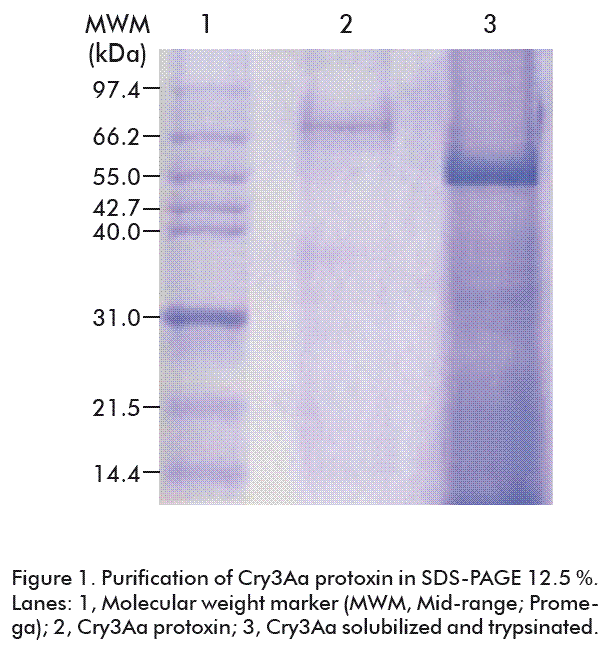
<body><![CDATA[<P   ><font size="2" face="Verdana, Arial, Helvetica, sans-serif">Four tubers were      placed in plastic cages according to their sizes in a completely randomized      design at 25 &ordm;C and 70 % of relative humidity, where they were infested      with two adult couples of SPW per tuber, accounting for eight females per      cage. Sexing of weevils was conducted using the size of the antennal segment      as reported by Cisneros and Alcazar [40]. After 48 h, adult couples were removed,      expecting oviposition rates of 4.3 eggs per female [40]. Cages were then bunged      and tubers were incubated until adult weevils emerged. </font></P >       <P   ><font size="2" face="Verdana, Arial, Helvetica, sans-serif">The toxic effect      of transgenic storage roots on <I>C. formicarius </I>insects was evaluated      by the number of emerged adults after 30 to 35 days of incubation. The bioassay      was replicated three times. The average values of adults for each treatment      and replicates were analyzed using a One way ANOVA assay and the differences      were statistically compared using the F test. Data were processed by using      Statgraphics Plus 5.1 for Windows. </font></P >       <P   >&nbsp;</P >       <P   ><font size="3" face="Verdana, Arial, Helvetica, sans-serif"><b>RESULTS AND DISCUSSION      </b> </font></P >       <P   ><font size="2" face="Verdana, Arial, Helvetica, sans-serif"><b>Cry3Aa protoxin      purification </b> </font></P >       <P   ><font size="2" face="Verdana, Arial, Helvetica, sans-serif">In this study, BBMVs      from <I>C. formicarius </I>ssp. <I>elegantulus </I>were tested for the ability      to bind the Cry3Aa from <I>B. thuringiensis </I>ssp. <I>tenebrionis</I>. Some      BBMVs proteins were identified as putative receptors to this Cry toxin. </font></P >   <FONT size="+1">        <P   ><font size="2" face="Verdana, Arial, Helvetica, sans-serif">Cry3Aa crystals prepared      from <I>B. thuringiensis </I>ssp. <I>tenebrionis </I>were composed of the      expected 67 and 73 kDa protoxin-sized proteins, this last predominant in the      preparation. This result was in agreement with previous reports on the predominance      of the 73 kDa form in inclusions when <I>B. thuringiensis</I>. ssp. <I>tenebrionis      </I>was grown in nutrient-rich broths, presumably due to a lower production      of bacterial proteases under those conditions [56]. The trypsinized Cry3Aa      toxin used in the binding assays migrated at 55 kDa (<a href="/img/revistas/bta/v32n2/f0105215.gif">Figure      1</a>), as expected [45]. The Cry3Aa was obtained at 1.3 mg/mL with a purity      of 96.7 %, its trypsinized form rendering 0.9 mg/mL. </font></P >   <FONT size="+1">        
<P   ><font size="2" face="Verdana, Arial, Helvetica, sans-serif">The presence of the      67 kDa form can be explained by the proteolytic process of the highest protein      to the fully toxic Cry3Aa N-terminus product, losing the 49-57 residues segment      during or after crystal formation. This modification has been extensively      described [57-59], as well as the crystal protein being only soluble at pH      values above 10 or below 4 [56]. The rich growing media and pH conditions      tested could have also favored the preponderance of the 73 kDa form in the      preparation. Moreover, the 55 kDa obtained after trypsin digestion can be      explained by a mechanism as mentioned in similar assays performed at pH 10.5      [57]. </font></P >   <FONT size="+1">        <P   ><font size="2" face="Verdana, Arial, Helvetica, sans-serif">The labeled toxin      integrity was confirmed by SDS-PAGE 12.5 %. No degradation pattern was observed      (data not shown). </font></P >   <FONT size="+1">        <P   ><font size="2" face="Verdana, Arial, Helvetica, sans-serif"><b>Isolation and      characterization of BBMVs from SPW </b></font></P >       ]]></body>
<body><![CDATA[<P   ><font size="2" face="Verdana, Arial, Helvetica, sans-serif">BBMVs yields, approximately      0.5 mg/mL, were very low considering the starting source of 20 g of entire      larvae. This situation seems to be common for all <I>Coleoptera </I>spp.,      due to the small larval size [60]. The second-third instar SPW larvae used      in the preparation reported in this work were between 4-6 mm long and 0.5-1      mm in diameter in the cephalic region (<a href="/img/revistas/bta/v32n2/f0205215.gif">Figure 2</a>).      However, higher yields around 1.52-1.83 mg/mL have been obtained from the      same starting material in small coleopteran larvae [61]. </font></P >       
<P   ><font size="2" face="Verdana, Arial, Helvetica, sans-serif">The vesicle preparation      was considered as pure according to its aminopeptidase activity, which is      a specific quality indicator to establish the purity of BBMVs. Final AP values      appear enriched almost 20 times as compared with the initial homogenate determination.      Similar values of aminopeptidase activity have been described for BBMVs isolated      from whole third instar of <I>C. scripta</I> larvae and midguts of <I>L. decemliniata      </I>[19]. </font></P >       <P   ><font size="2" face="Verdana, Arial, Helvetica, sans-serif">In BBMVs SDS-PAGE,      seven major bands were observed at approximate sizes of 15, 20, 30, 50, 85,      100 and 150 kDa, respectively, which were sliced from the gel for further      characterization (<a href="/img/revistas/bta/v32n2/f0305215.gif">Figure 3</a>). </font></P >       
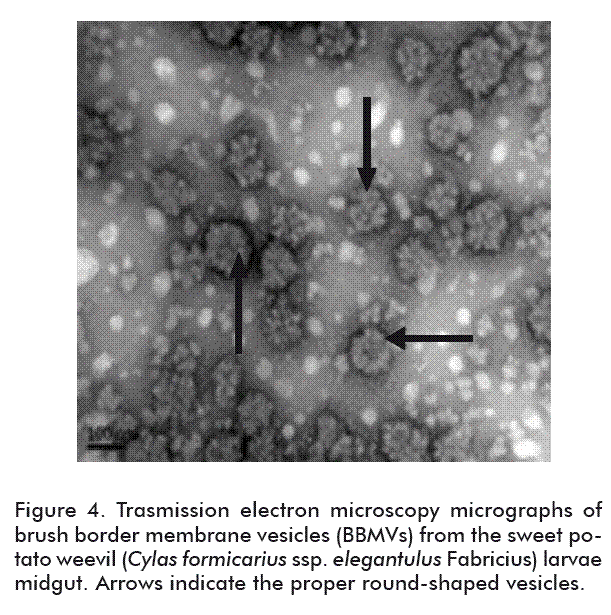
<P   ><font size="2" face="Verdana, Arial, Helvetica, sans-serif">Coinciding with this      wide size range, Mart&iacute;nez and Cer&oacute;n [61] reported on proteins      between 24 to 116 kDa in a similar preparation of BBMVs from <I>Premnotrypes      vorax</I>, the most intense bands with sizes 45, 60, 75 and 97 kDa. Only an      equivalent size could be established for the 100 kDa band, while the rest      are not perceptible in the preparation described in this work. Similar patterns      were originally described in <I>P. brassicae </I>[50] and later in <I>A. aegypti      </I>[62]. </font></P >       <P   ><font size="2" face="Verdana, Arial, Helvetica, sans-serif">There are other coincidences      in the SDS-PAGE of the SPW BBMVs with previous reports on protein bands molecular      sizes above 100 kDa. Proteins with molecular sizes of approximately 120 kDa      were described in <I>Manduca sexta </I>[63], 144 kDa in <I>T. molitor </I>[36],      148 kDa in <I>Spodoptera fhigiperda </I>and 103, 120 and 155 kDa in <I>Heliothis      virescens </I>and <I>Heliothis zea</I>, all of them identified as Cry toxins      receptors [22]. Other proteins of 120-170 kDa have been identified in some      <I>Lepidoptera </I>spp. [64-68]. </font></P >       <P   ><font size="2" face="Verdana, Arial, Helvetica, sans-serif">The fact that some      midgut membrane proteins obtained, mainly those below 100 kDa, show no coincidences      with the previously informed sizes in literature for other insects could be      conditioned by varied factors. A plausible explanation is the proteolytic      degradation of higher size proteins, rendering small signals. This situation      could be present when higher-size putative receptors were proteolytically-degraded      without affecting the toxin binding domain [69]. Though, the small bands could      be binding proteins of such sizes. BBMVs presence and integrity was corroborated      by transmission electron microscopy (<a href="/img/revistas/bta/v32n2/f0405215.gif">Figure 4</a>).      Vesicles showed round shapes with sizes around 100 nm in diameter, coinciding      with previous images of BBMVs obtained from <I>P. vorax </I>larvae midgut      [22]. </font></P >       
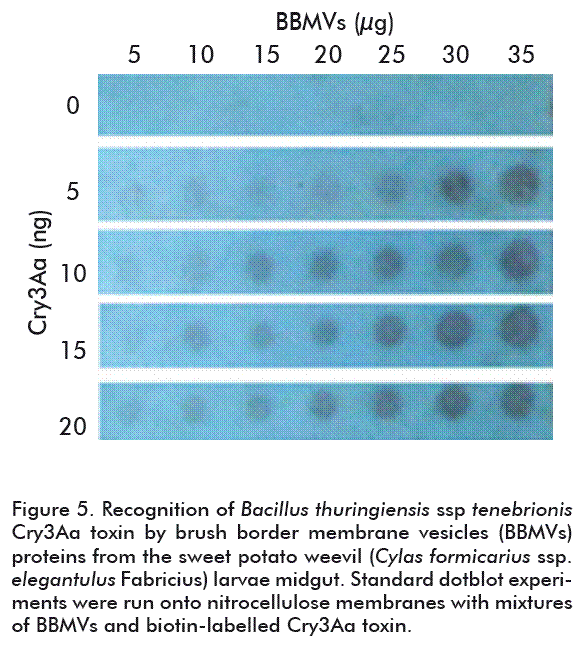
<P   ><font size="2" face="Verdana, Arial, Helvetica, sans-serif"><b>Binding experiments      of the Cry3Aa toxin to intact SPW BBMVs </b></font></P >       <P   ><font size="2" face="Verdana, Arial, Helvetica, sans-serif">The binding assays      with trypsinated-biotinylated Cry3Aa toxin confirmed its capacity to recognize      BBMVs from <I>C. formicarius </I>ssp. <I>elegantulus</I>. Chemoluminescent      signal detected in the immune-dot blot assay proportionally increased as the      protein amount attached to the nitrocellulose membrane, indicating the affinity      between the Cry3Aa toxin and certain proteins present in the purified vesicles      from <I>C. formicarius </I>ssp. <I>elegantulus </I>(<a href="/img/revistas/bta/v32n2/f0505215.gif">Figure      5</a>). This fact suggests a possible molecular interaction between the intestinal      proteins and the toxin structure. </font></P >       
<P   ><font size="2" face="Verdana, Arial, Helvetica, sans-serif">Even when Cry3Aa      was the first &delta;-endotoxin discovered with coleopterocide activity and      its affinity to coleopteran midgut proteins has been widely described, this      work is the first report of the binding of the Cry3Aa toxin to <I>C. formicarius      </I>BBMVs. </font></P >       <P   ><font size="2" face="Verdana, Arial, Helvetica, sans-serif">Remarking the relevance      of BBMVs binding assays, several studies have shown the direct correspondence      between toxicity and toxin binding to a receptor for lepidopterans control      [70]. Moreover, taking into account binding assays results, some products      have been developed based on Bt and satisfactorily used in coleopteran pest      control, such as: Trident&reg;, M-One&reg;, M-Trak&reg; and Novodor&reg;.      Also, transgenic plants carrying Bt genes against coleopterans, like the transgenic      Cry3Aa potato against Colorado Potato Beetle, commercialized since 1995 until      2000 were success-fully introduced [71]. </font></P >       ]]></body>
<body><![CDATA[<P   ><font size="2" face="Verdana, Arial, Helvetica, sans-serif"><b>Western blot analysis      </b> </font></P >       <P   ><font size="2" face="Verdana, Arial, Helvetica, sans-serif">The binding of <I>C.      formicarius </I>BBMVs to Cry3Aa was analyzed by Western blotting. From the      seven major protein bands detected on SDS-PAGE gels, the four most intense      corresponding to approximate molecular sizes of 20, 30, 50 and 85 kDa showed      a recognition signal as indication of immunoaffinity reaction (<a href="/img/revistas/bta/v32n2/f0605215.gif">Figure      6</a>). Except for the 30 kDa protein band, which was almost twice as intense,      signal intensity was similar for the other three. </font></P >       
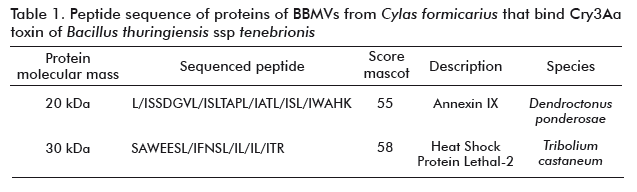
<P   ><font size="2" face="Verdana, Arial, Helvetica, sans-serif">These results could      indicate that all proteins are Cry3Aa putative receptors, but perhaps the      30 kDa protein could exhibit higher affinity or is present in amounts higher      than the others. In <I>Coleoptera </I>ssp. there are some reports of receptor      proteins at insect gut level. Belfiore <I>et al</I>. [36] informed on a 144-      kDa protein, present in the Yellow Meal Worm (<I>T. molitor</I>); Ochoa-Campuzano      <I>et al</I>. [29] described for the first time Cry3Aa receptors of 30, 53,      and 70 kDa in Colorado Potato Beetle (<I>Leptinotarsa decemliniata</I>); Martinez      and Cer&oacute;n [22] informed about a 70-kDa Cry3Aa-binding protein obtained      from a BBMVs preparation of <I>Premnotrypes vorax</I>. </font></P >       <P   ><font size="2" face="Verdana, Arial, Helvetica, sans-serif">Also, in a finding      regarding the Cry toxin-aphid gut interactions, Li <I>et al</I>. [72] confirmed      the specific binding of Cry3Aa to 25 and 37 kDa proteins in the pea aphid,      <I>Acyrthosiphon pisum</I>, by ligand blot analysis and competition assays.      </font></P >       <P   ><font size="2" face="Verdana, Arial, Helvetica, sans-serif">According to the      mass spectrometry results of the four proteins detected as recognizing Cry3Aa      in BBMVs of <I>C. formicarius </I>(<a href="/img/revistas/bta/v32n2/t0105215.gif">Table 1</a>), sequence      homology derived from peptide analysis indicated that the 30 kDa protein was      identified as an annexin IX isoform like protein, which has a conserved motive      in the annexin proteins family from the coleopteran <I>Dendroctonus ponderosae</I>.      In line with these results, there is a report regarding a 30.32 kDa peptide      identified as a Cry3Aa receptor in BBMVs of <I>Leptinotarsa decemliniata</I>,      which corresponds to a Prohibitin-1 like protein from the coleopteran <I>Tribolium      castaneum </I>[21]. </font></P >       
<P   ><font size="2" face="Verdana, Arial, Helvetica, sans-serif">The 20 kDa protein      showed homology with a heat shock protein (HSP) Letal-2, comprising a motif      conserved in the HSP family, which is also from <I>T. castaneum</I>. </font></P >       <P   ><font size="2" face="Verdana, Arial, Helvetica, sans-serif">Proteins of 60 and      85 kDa did not show similarity with any other reported proteins. The fact      that <I>C. formicarius </I>genome is not sequenced could partially explain      this situation. Nevertheless, it is interesting that in the case of the 85      kDa, Cry3Aa receptor proteins of 85.92 and 86.41 kDa found in BBMVs of <I>Leptinotarsa      decemliniata </I>have been described as aconitase similar proteins from <I>Tribolium      castaneum </I>[21]. </font></P >       <P   ><font size="2" face="Verdana, Arial, Helvetica, sans-serif">It is noticeable      that our finding did not coincide with the majority of Cry reported receptors,      which have been identified as cadherins and APN [31, 73]. A partial <I>Diabrotica      virgifera virgifera </I>cadherin fragment corresponding to cadherin repeat      domains 8-10 was reported to bind activated Cry3Aa and to enhance toxicity      in several beetles, suggesting that cadherin plays a functional role in Bt      intoxication [46]. The synergizing mode of action is described for the coleopteran      lesser mealworm (<I>Alphitobious diaperinus</I>). It is generally reported      as Cry receptor in the midgut of several lepidopteran, coleopteran and dipteran      insects [74-76]. In the particular case of <I>Aedes aegypti</I>, the role      of cadherin mediating the toxicity is described, however is assured that it      is not the main receptor [77]. A peptide containing the predicted toxin binding      region from <I>T. molitor </I>cadherin (TmCad) bound Cry3Aa specifically and      promoted toxin oligomerization in solution. Reduced levels of TmCad transcript      in actively feeding larvae correlate with a reduction in toxicity [20]. Studies      have demonstrated the involvement of Cry3Aa1 domain II loop 1 as the binding      site of CR12 cadherin repeat in this insect species [47]. Cadherin receptors      for Cry3Aa in <I>Leptinotarsa decemlineata </I>were also identified [46].      </font></P >       <P   ><font size="2" face="Verdana, Arial, Helvetica, sans-serif">On the other hand,      APN are considered one of the most important Bt receptors, over 140 cDNAs      have been cloned from more than 20 lepidopteran species [78, 79]. They are      the most abundant enzymes in the intestinal microvilli membranes, constituting      the 55 % of brush membrane intestinal epithelium proteins in coleopterans      [80]. Nevertheless, in this order of insects there is no description of any      APN as receptor of Bt Cry toxins [21]. Only two proteins of 62 and 65 kDa      in BBMVs of <I>Anthonomus grandis </I>have shown activity in binding experiments      with Cry1Ba6 [39]. </font></P >       <P   ><font size="2" face="Verdana, Arial, Helvetica, sans-serif">Nevertheless, in      spite of the abundance of APN as Cry toxins receptor, it has not been described      as a coleopteran receptor, while cadherins are the most widely distributed      and well-studied as Cry receptors in coleopterans. The variability in the      kind and abundance of the Cry receptors for different insects has been reported.      The work of Oppert <I>et al</I>. using transcriptome profiling of the response      of <I>T. molitor </I>to Cry3Aa revealed that only transcripts related to alkaline      phosphatase were induced, while the ones related to APN and cadherin had similar      numbers of reads in control and intoxicated larvae [81]. </font></P >       ]]></body>
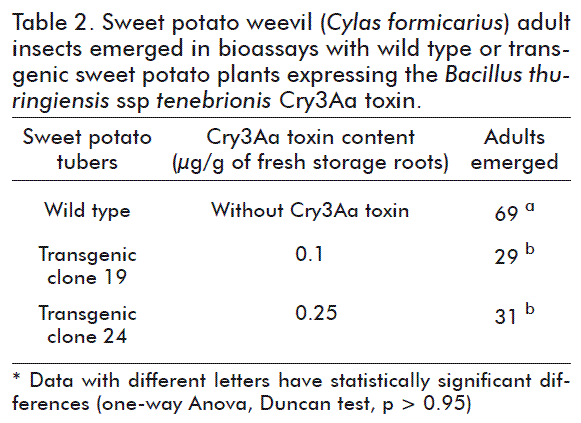
<body><![CDATA[<P   ><font size="2" face="Verdana, Arial, Helvetica, sans-serif"><b>Bioassays </b></font></P >       <P   ><font size="2" face="Verdana, Arial, Helvetica, sans-serif">Test for in vivo      Cry3Aa-insects assays using either fresh tuber discs or artificial diets supplemented      with toxin were useless. Weevil attracting terpenes could be lost during exposure      of tuber slices and fungal contamination interfered data analysis. Natural      conditions in tuber slides are very difficult to achieve due to the cryptic      feeding behavior of this insect during larval stages to adults. However, bioassays      were reported as successfully conducted with sweet potato weevils <I>C. puncticollis      </I>and <I>C. brunneus </I>in Africa [11, 38, 82]. </font></P >       <P   ><font size="2" face="Verdana, Arial, Helvetica, sans-serif">As an alternative,      transgenic sweet potato tubers carrying a cry3Aa plant-like gene and expressing      Cry3Aa toxin already obtained for plant-to-insect resistance purposes [41]      were used for <I>in vivo </I>insecticide activity evaluation against SPW under      lab conditions, higher expressing clones being selected (<a href="/img/revistas/bta/v32n2/t0205215.gif">Table      2</a>). </font></P >       
<P   ><font size="2" face="Verdana, Arial, Helvetica, sans-serif">New adult weevils      began to emerge at 31-35 days post-infestation. Adult emergence was recorded      at 40 days, the observations in agreement with previous reports as evidencing      that adult weevils fed in the same way either on transgenic or untransformed      storage roots [11]. </font></P >       <P   ><font size="2" face="Verdana, Arial, Helvetica, sans-serif">A smaller number      of insects obtained from transgenic storage roots, with differences statistically      significant, probably indicates loses in the larvae and pupae stages due to      the toxic effect of the Cry3Aa expressed in plants. Nevertheless, there was      not a total control of the SPW because there were insects emerging from transgenic      tubers. </font></P >       <P   ><font size="2" face="Verdana, Arial, Helvetica, sans-serif">It should be taken      into account that transgenic lines used of highest expression of the Cry toxin      do not produce more than 0.25 &mu;g/g of tuber tissue, which could be considered      low according to similar reports [11]. </font></P >       <P   ><font size="2" face="Verdana, Arial, Helvetica, sans-serif">Another plausible      explanation, coinciding with this supposed insect resistance, could be that      the chronology of Cry intoxication would be highly variable depending on the      target insect. Some larvae can demonstrate clear symptoms </font><font size="2" face="Verdana, Arial, Helvetica, sans-serif">within      hours after intoxication, but in the case of Cry3Aa and the coleopteran <I>T.      molitor</I>, larvae can survive for weeks without obvious signs of paralysis,      which ultimately occurs [81]. </font></P >       <P   ><font size="2" face="Verdana, Arial, Helvetica, sans-serif">Nevertheless, similar      amounts of Cry3Aa in transgenic sweet potato plants have been toxic for <I>C.      formicarius </I>under field conditions [42]. Even when an inverse correspondence      between tuber damages by insect feeding and toxin expression was detected,      no totally resistant clones were obtained. </font></P >       <P   >&nbsp;</P >       <P   ><font size="2" face="Verdana, Arial, Helvetica, sans-serif"><b><font size="3">CONCLUSIONS      </font></b></font></P >   <FONT size="+1">        ]]></body>
<body><![CDATA[<P   ><font size="2" face="Verdana, Arial, Helvetica, sans-serif">In summary, the direct      relation observed in this work between toxicity and binding experiments indicates      the presence of proteins at <I>C. formicarius </I>gut, acting as putative      receptors for Cry3Aa toxin and probably mediating a toxic mechanism. This      is the first report on the specific binding of a Cry toxin in <I>C. formicarius</I>,      as well as the detection of new proteins involved in such interaction. These      results could help to characterize the mechanism of action of the Cry3Aa used      in this work. Additionally, the same procedure could be used for some other      Bt toxins with potential SPW control activity. The combination of binding      assays with the identification by mass spectrometry of the proteins taking      part rendered both, the detection of the supposed receptors and the finding      of new proteins apparently related with the toxicity of the Cry3Aa on the      major sweet potato pest worldwide. </font></P >       <P   >&nbsp;</P >   <FONT size="+1">        <P   ><font size="3" face="Verdana, Arial, Helvetica, sans-serif"><b>ACKNOWLEDGEMENTS      </b> </font></P >   <FONT size="+1">        <P   ><font size="2" face="Verdana, Arial, Helvetica, sans-serif">This research was      partially supported by a project funded by IFS-OPCW (IFS Grant Agreement No.      C/3405-1). Thanks to translator Orestes Padr&oacute;n for checking the final      manuscript. </font></P >       <P   >&nbsp;</P >   <FONT size="+1">        <P   ><font size="3" face="Verdana, Arial, Helvetica, sans-serif"><b>REFERENCES </b></font></P >       <P   ><font size="2" face="Verdana, Arial, Helvetica, sans-serif">1. Maxmen A. Crop      pests: Under attack. Nature. 2013;501(7468):S15-7. </font></P >   <FONT size="+1">        <!-- ref --><P   ><font size="2" face="Verdana, Arial, Helvetica, sans-serif">2. Lopez-Pazos SA,      Martinez JW, Castillo AX, Ceron Salamanca JA. Presence and significance of      Bacillus thuringiensis Cry proteins associated with the Andean weevil Premnotrypes      vorax (Coleoptera: Curculionidae). Rev Biol Trop. 2009;57(4):1235-43.     </font></P >       <!-- ref --><P   ><font size="2" face="Verdana, Arial, Helvetica, sans-serif">3. Arrieta G, Espinoza      AM. Characterization of a Bacillus thuringiensis strain collection isolated      from diverse Costa Rican natural ecosystems. Rev Biol Trop. 2006;54(1):13-27.          </font></P >       <!-- ref --><P   ><font size="2" face="Verdana, Arial, Helvetica, sans-serif">4. Yudelman M, Ratta      A, Nygaard D. Pest management and food production looking to the future. Washington      DC: International Food Policy Research Institute; 1998.     </font></P >       <!-- ref --><P   ><font size="2" face="Verdana, Arial, Helvetica, sans-serif">5. Dent D. Insect      Pest Management. 2nd edition. Cambridge: CABI International; 2000.     </font></P >       <!-- ref --><P   ><font size="2" face="Verdana, Arial, Helvetica, sans-serif">6. Pardo-Lopez L,      Soberon M, Bravo A. Bacillus thuringiensis insecticidal three-domain Cry toxins:      mode of action, insect resistance and consequences for crop protec&not;tion.      FEMS Microbiol Rev. 2013;37(1):3-22.     </font></P >       <!-- ref --><P   ><font size="2" face="Verdana, Arial, Helvetica, sans-serif">7. Deist BR, Rausch      MA, Fernandez-Luna MT, Adang MJ, Bonning BC. Bt toxin modification for enhanced      efficacy. Toxins. 2014;6(10):3005-27.     </font></P >       <!-- ref --><P   ><font size="2" face="Verdana, Arial, Helvetica, sans-serif">8. Koch MS, Ward      JM, Levine SL, Baum JA, Vicini JL, Hammond BG. The food and environmental      safety of Bt crops. Front Plant Sci. 2015;6:283.     </font></P >       <P   ><font size="2" face="Verdana, Arial, Helvetica, sans-serif">9. Crickmore N, Zeigler      D, Schnepf E, Van Rie J, Lereclus D, Baum J, et al. B. thuringiensis toxin      nomenclature. 2008 [cited 2013 Aug 13]. Available from: <a href="http://www.lifesci.sussex.ac.uk/home/Neil_Crickmore/Bt/toxins2.html" target="_blank">http://www.lifesci.sussex.ac.uk/home/Neil_Crickmore/Bt/toxins2.html</a>.      </font></P >       <!-- ref --><P   ><font size="2" face="Verdana, Arial, Helvetica, sans-serif">10. Hernandez-Martinez      P, Vera-Velasco NM, Martinez-Solis M, Ghislain M, Ferre J, Escriche B. Shared      binding sites for the Bacillus thuringiensis proteins Cry3Bb, Cry3Ca, and      Cry7Aa in the African sweet potato pest Cylas puncticollis (Brentidae). Appl      Environ Microbiol. 2014;80(24):7545-50.     </font></P >       <!-- ref --><P   ><font size="2" face="Verdana, Arial, Helvetica, sans-serif">11. Rukarwa RJ, Prentice      K, Ormachea M, Kreuze JF, Tovar J, Mukasa G, et al. Evaluation of bioassays      for testing Bt sweet potato events against sweetpotato weevils. Afr Crop Sci      J. 2013;21(3):235-44.     </font></P >       <!-- ref --><P   ><font size="2" face="Verdana, Arial, Helvetica, sans-serif">12. Sato R, Takeuchi      K, Ogiwara K, Minami M, Kaji Y, Suzuki N, et al. Cloning, heterologous expression,      and localization of a novel crystal protein gene from Bacillus thuringiensis      serovar japonensis strain buibui toxic to scarabaeid insects. Curr Microbiol.      1994;28(1):15-9.     </font></P >       <!-- ref --><P   ><font size="2" face="Verdana, Arial, Helvetica, sans-serif">13. Hori H, Suzuki      N, Ogiwara K, Himejima M, Indrasith LS, Minami M, et al. Characterization      of larvicidal toxin protein from Bacillus thuringiensis serovar japonensis      strain Buibui specific for scarabaeid beetles. J Appl Bacteriol. 1994;76(4):307-13.          </font></P >       ]]></body>
<body><![CDATA[<!-- ref --><P   ><font size="2" face="Verdana, Arial, Helvetica, sans-serif">14. Krieg A, Huger      A, Langenbruch G, Schenetter W. Bacillus thuringiensis var. tenebriosis: a      new patothype effective against larvae of coleoptera. Z Angew Entomol. 1983;96:500-8.          </font></P >       <P   ><font size="2" face="Verdana, Arial, Helvetica, sans-serif">15. Donovan WP, Gonzalez      JM, Jr., Gilbert MP, Dankocsik C. Isolation and characterization of EG2158,      a new strain of Bacillus thuringiensis toxic to coleopteran larvae, and nucleotide      sequence of the toxin gene. Mol Gen Genet. 1988;214(3):365-72. </font></P >       <!-- ref --><P   ><font size="2" face="Verdana, Arial, Helvetica, sans-serif">16. Lambert B, Hofte      H, Annys K, Jansens S, Soetaert P, Peferoen M. Novel Bacillus thuringiensis      insecticidal crystal protein with a silent activity against coleopteran larvae.      Appl Environ Microbiol. 1992;58(8):2536-42.     </font></P >       <!-- ref --><P   ><font size="2" face="Verdana, Arial, Helvetica, sans-serif">17. Crickmore N,      Nicholls C, Earp DJ, Hodgman TC, Ellar DJ. The construction of Bacillus thuringiensis      strains expressing novel entomocidal delta-endotoxin combinations. Biochem      J. 1990;270(1):133-6.     </font></P >       <!-- ref --><P   ><font size="2" face="Verdana, Arial, Helvetica, sans-serif">18. Li J, Carroll      J, Ellar DJ. Crystal estructure of insecticidal delta-endotoxin from Bacillus      thuringiensis at 2.5 angstrom resolution. Nature. 1991;535(6347):815-21.     </font></P >       <!-- ref --><P   ><font size="2" face="Verdana, Arial, Helvetica, sans-serif">19. Wu SJ, Koller      CN, Miller DL, Bauer LS, Dean DH. Enhanced toxicity of Bacillus thuringiensis      Cry3A delta-endotoxin in coleopterans by mutagenesis in a receptor binding      loop. FEBS Lett. 2000;473(2):227-32.     </font></P >       <!-- ref --><P   ><font size="2" face="Verdana, Arial, Helvetica, sans-serif">20. Fabrick J, Oppert      C, Lorenzen MD, Morris K, Oppert B, Jurat-Fuentes JL. A novel Tenebrio molitor      cadherin is a functional receptor for Bacillus thuringiensis Cry3Aa toxin.      J Biol Chem. 2009;284(27):18401-10.     </font></P >       <!-- ref --><P   ><font size="2" face="Verdana, Arial, Helvetica, sans-serif">21. Ochoa-Campuzano      C. An&aacute;lisis de las interacciones moleculares de la toxina Cry3Aa de      Bacillus thuringiensis en la membrana del epitelio intestinal de Leptinotarsa      decemlineata (escarabajo de la patata). [dissertation]. Valencia: Universitat      de Val&egrave;ncia, Spain; 2011.     </font></P >       <!-- ref --><P   ><font size="2" face="Verdana, Arial, Helvetica, sans-serif">22. Mart&iacute;nez      W, Cer&oacute;n J. Uni&oacute;n de prote&iacute;nas de Bacillus thuringiensis      con ves&iacute;culas de las microvellosidades del tracto digestivo del gusano      blanco de la papa Premnotrypes vorax (Coleoptera: Curculionidae). Rev Colomb      Entomol. 2004;30(1):51-6.     </font></P >       <P   ><font size="2" face="Verdana, Arial, Helvetica, sans-serif">23. Schwab G, Culver      R. In vitro analysis of Bacillus thuringiensis delta-endotoxin action. In:      Hickle L, editors. Analytical chemistry of Bacillus thuringiensis. Washington:      American Chemical Society; 1990. p. 36-45. </font></P >       <!-- ref --><P   ><font size="2" face="Verdana, Arial, Helvetica, sans-serif">24. Schnepf E, Crickmore      N, Van Rie J, Lereclus D, Baum J, Feitelson J, et al. Bacillus thuringiensis      and its pesticidal crystal proteins. Microbiol Mol Biol Rev. 1998;62(3):775-806.          </font></P >       ]]></body>
<body><![CDATA[<!-- ref --><P   ><font size="2" face="Verdana, Arial, Helvetica, sans-serif">25. Carreras B, Bravo      A, S&aacute;nchez J. Uni&oacute;n in vitro de las delta endotoxinas de Bacillus      thuringiensis al epitelio intestinal medio de Manduca sexta. Rev Prot Veg.      2003;18(1):28-31.     </font></P >       <!-- ref --><P   ><font size="2" face="Verdana, Arial, Helvetica, sans-serif">26. Pigott CR, Ellar      DJ. Role of receptors in Bacillus thuringiensis crystal toxin activity. Microbiol      Mol Biol Rev. 2007;71(2):255-81.     </font></P >       <P   ><font size="2" face="Verdana, Arial, Helvetica, sans-serif">27. Jakka S, Ferr&eacute;      J, Jurat-Fuentes JL. Cry toxin binding site models and their use in strategies      to delay resistance evolution. In: Sober&oacute;n M, Gao A, Bravo A, editors.      Bt resistance: characterization and strategies for GM crops producing Bacillus      thuringiensis toxins. Wallinford: CABI; 2015. p. 138-49. </font></P >       <P   ><font size="2" face="Verdana, Arial, Helvetica, sans-serif">28. Bravo A, G&oacute;mez      I, Mendoza G, Gayt&aacute;n M, Sober&oacute;n M. Different models of the mode      of action of Bt 3d-Cry toxins. In: Bt resistance: characterization and strategies      for GM crops producing Bacillus thuringiensis toxins. Wallinford: CABI; 2015.      p 56-8. </font></P >       <!-- ref --><P   ><font size="2" face="Verdana, Arial, Helvetica, sans-serif">29. Ochoa-Campuzano      C, Real MD, Mart&iacute;nez-Ram&iacute;rez AC, Bravo A, Rausell C. An ADAM      metalloprotease is a Cry3Aa Bacillus thuringiensis toxin receptor. Biochem      Biophys Res Commun. 2007;362(2):437-42.     </font></P >       <!-- ref --><P   ><font size="2" face="Verdana, Arial, Helvetica, sans-serif">30. Rausell C, Garcia-Robles      I, Sanchez J, Munoz-Garay C, Martinez-Ramirez AC, Real MD, et al. Role of      toxin activation on binding and pore formation activity of the Bacillus thuringiensis      Cry3 toxins in membranes of Leptinotarsa decemlineata (Say). Biochim Biophys      Acta. 2004;1660(1-2):99-105.     </font></P >       ]]></body>
<body><![CDATA[<!-- ref --><P   ><font size="2" face="Verdana, Arial, Helvetica, sans-serif">31. Loseva O, Ibrahim      M, Candas M, Koller CN, Bauer LS, Bulla LA, Jr. Changes in protease activity      and Cry3Aa toxin binding in the Colorado potato beetle: implications for insect      resistance to Bacillus thuringiensis toxins. Insect Biochem Mol Biol. 2002;32(5):567-77.          </font></P >       <!-- ref --><P   ><font size="2" face="Verdana, Arial, Helvetica, sans-serif">32. Garc&iacute;a      I, S&aacute;nchez J, Rausell C, Mart&iacute;nez A, de Maag R, Real M, et al.      Specific binding and pore formation activity of Cry3A toxin in membranes isolated      from Leptinotarsa decemlineata and Tenebrio molitor. Book of Abstracts of      the XXXIII Meeting Society for Invertebrate Pathology. Guanajuato: Society      for Invertebrate Pathology. 2000. p. 33.     </font></P >       <!-- ref --><P   ><font size="2" face="Verdana, Arial, Helvetica, sans-serif">33. Carroll J, Convents      D, Van Damme J, Boets A, Van Rie J, Ellar DJ. Intramolecular proteolytic cleavage      of Bacillus thuringiensis Cry3A delta-endotoxin may facilitate its coleopteran      toxicity. J Invertebr Pathol. 1997;70(1):41-9.     </font></P >       <!-- ref --><P   ><font size="2" face="Verdana, Arial, Helvetica, sans-serif">34. Mart&iacute;nez-Ram&iacute;rez      AC, Real MD. Proteolytic processing of Bacillus thuringiensis CryIIIA toxin      and specific binding to brush-border membrane vesicles of Leptinotarsa decemlineata      (Colorado potato beetle). Pestic Biochem Physiol. 1996;54(2):115-22.     </font></P >       <!-- ref --><P   ><font size="2" face="Verdana, Arial, Helvetica, sans-serif">35. Slaney A, Robbins      H, Leigh E. Mode of action of Bacillus thuringiensis toxin Cry IIIA: An analysis      of toxicity in Leptinotarsa decemtineata (Say) and Diabrotica undecimpunctata      howardi Barber. Insect Biochem Mol Biol. 1992;22(1):9-18.     </font></P >       ]]></body>
<body><![CDATA[<P   ><font size="2" face="Verdana, Arial, Helvetica, sans-serif">36. Belfiore CJ,      Vadlamudi RK, Osman YA, Bulla LA, Jr. A specific binding protein from Tenebrio      molitor for the insecticidal toxin of Bacillus thuringiensis subsp. tenebrionis.      Biochem Biophys Res Commun. 1994;200(1):359-64. </font></P >       <!-- ref --><P   ><font size="2" face="Verdana, Arial, Helvetica, sans-serif">37. Sayed A, Nekl      ER, Siqueira HA, Wang HC, Ffrench-Constant RH, Bagley M, et al. A novel cadherin-like      gene from western corn rootworm, Diabrotica virgifera virgifera (Coleoptera:      Chrysomelidae), larval midgut tissue. Insect Mol Biol. 2007;16(5):591-600.          </font></P >       <!-- ref --><P   ><font size="2" face="Verdana, Arial, Helvetica, sans-serif">38. Ekobu M, Solera      M, Kyamanywa S, Mwanga RO, Odongo B, Ghislain M, et al. Toxicity of seven      Bacillus thuringiensis Cry proteins against Cylas puncticollis and Cylas brunneus      (Coleoptera: Brentidae) using a novel artificial diet. J Econ Entomol. 2010;103(4):1493-502.          </font></P >       <!-- ref --><P   ><font size="2" face="Verdana, Arial, Helvetica, sans-serif">39. Martins ES, Monnerat      RG, Queiroz PR, Dumas VF, Braz SV, de Souza Aguiar RW, et al. Midgut GPI-anchored      proteins with alkaline phosphatase activity from the cotton boll weevil (Anthonomus      grandis) are putative receptors for the Cry1B protein of Bacillus thuringiensis.      Insect Biochem Mol Biol. 2010;40(2):138-45.     </font></P >       <!-- ref --><P   ><font size="2" face="Verdana, Arial, Helvetica, sans-serif">40. Cisneros F, Alcazar      J. Manejo integrado del gorgojo del camote o tetu&aacute;n del boniato Cylas      formicarius (Fab.) en Cuba. Lima: Centro Internacional de la Papa; 2001.     </font></P >       <P   ><font size="2" face="Verdana, Arial, Helvetica, sans-serif">41. Alvarez I, Mor&aacute;n      R, Usatorres B, Verde Y, Somonte D. Binding of Cry3A d-endotoxin from B.t.t      to proteins of BBMVs of Cylas formicarius could be related to the insecticide      activity of transgenic sweet potato plants. In: Book of Abstracts of the VIII      International Workshop on Vegetal Biotechnology; 2008; Santa Clara, Cuba.      p. 69-91. </font></P >       ]]></body>
<body><![CDATA[<!-- ref --><P   ><font size="2" face="Verdana, Arial, Helvetica, sans-serif">42. Mor&aacute;n      R, Garcia R, Lopez A, Zald&uacute;a Z, Mena J, Garc&iacute;a M, et al. Transgenic      sweet potato plants carrying the delta-endotoxin gene from Bacillus thuringiensis      var. tenebrionis. Plant Sci. 1998;139(2):175-84.     </font></P >       <!-- ref --><P   ><font size="2" face="Verdana, Arial, Helvetica, sans-serif">43. Mor&aacute;n      R, Alvarez I, Zald&uacute;a Z, L&oacute;pez A, de la Riva G, Selman G. Synthetic      cry3A-like gene for high levels of expression in transgenic plants. Phytoparasitica.      1999;27(4):23-4.     </font></P >       <P   ><font size="2" face="Verdana, Arial, Helvetica, sans-serif">44. Alvarez I, Mor&aacute;n      R, Usatorres B, Amodia A. In vitro bioassays using Cylas formicarus Brush      Border Membrane Vesicles (BBMVs) and Cry 3A delta endotoxin from Bacillus      thuringiensis var tenebrionis. In: Book of Abstracts of the 6th International      Congress on Chemistry and Chemical Engineering. Havana: Cuban Chemical Society;      2006; p. 67. </font></P >       <!-- ref --><P   ><font size="2" face="Verdana, Arial, Helvetica, sans-serif">45. Sekar V, Thompson      DV, Maroney MJ, Bookland RG, Adang MJ. Molecular cloning and characterization      of the insecticidal crystal protein gene of Bacillus thuringiensis var. tenebrionis.      Proc Natl Acad Sci USA. 1987;84(20):7036-40.     </font></P >       <!-- ref --><P   ><font size="2" face="Verdana, Arial, Helvetica, sans-serif">46. Park Y, Abdullah      MA, Taylor MD, Rahman K, Adang MJ. Enhancement of Bacillus thuringiensis Cry3Aa      and Cry3Bb toxicities to coleopteran larvae by a toxin-binding fragment of      an insect cadherin. Appl Environ Microbiol. 2009;75(10):3086-92.     </font></P >       <!-- ref --><P   ><font size="2" face="Verdana, Arial, Helvetica, sans-serif">47. Zuniga-Navarrete      F, Gomez I, Pena G, Amaro I, Ortiz E, Becerril B, et al. Identification of      Bacillus thuringiensis Cry3Aa toxin domain II loop 1 as the binding site of      Tenebrio molitor cadherin repeat CR12. Insect Biochem Mol Biol. 2015;59:50-7.          </font></P >       <!-- ref --><P   ><font size="2" face="Verdana, Arial, Helvetica, sans-serif">48. Laemmli UK. Cleavage      of structural proteins during the assembly of the head of bacteriophage T4.      Nature. 1970;227(5259):680-5.     </font></P >       <!-- ref --><P   ><font size="2" face="Verdana, Arial, Helvetica, sans-serif">49. Bollag D, Edelstein      S. Protein methods. New York: Wiley and Sons Inc.; 1991.     </font></P >       <!-- ref --><P   ><font size="2" face="Verdana, Arial, Helvetica, sans-serif">50. Wolfersberger      MG. Preparation and partial characterization of amino acid transporting brush      border membrane vesicles from the larval midgut of the gypsy moth (Lymantria      dispar). Arch Insect Biochem Physiol. 1993;24(3):139-47.     </font></P >       <!-- ref --><P   ><font size="2" face="Verdana, Arial, Helvetica, sans-serif">51. Gonzalez LJ,      Shimizu T, Satomi Y, Betancourt L, Besada V, Padron G, et al. Differentiating      alpha- and beta-aspartic acids by electrospray ionization and low-energy tandem      mass spectrometry. Rapid Commun Mass Spectrom. 2000;14(22):2092-102.     </font></P >       <!-- ref --><P   ><font size="2" face="Verdana, Arial, Helvetica, sans-serif">52. Shevchenko A,      Sunyaev S, Loboda A, Shevchenko A, Bork P, Ens W, et al. Charting the proteomes      of organisms with unsequenced genomes by MALDI-quadrupole time-of-flight mass      spectrometry and BLAST homology searching. Anal Chem. 2001;73(9):1917-26.          </font></P >       <!-- ref --><P   ><font size="2" face="Verdana, Arial, Helvetica, sans-serif">53. Shevchenko A,      Sunyaev S, Liska A, Bork P, Shevchenko A. Nanoelectrospray tandem mass spectrometry      and sequence similarity searching for identification of proteins from organisms      with unknown genomes. Methods Mol Biol. 2003;211:221-34.     </font></P >       <!-- ref --><P   ><font size="2" face="Verdana, Arial, Helvetica, sans-serif">54. Towbin H, Staehelin      T, Gordon J. Electrophoretic transfer of proteins from polyacrylamide gels      to nitrocellulose sheets: procedure and some applications. Proc Natl Acad      Sci USA. 1979;76(9):4350-4.     </font></P >       <!-- ref --><P   ><font size="2" face="Verdana, Arial, Helvetica, sans-serif">55. Altschul SF,      Madden TL, Schaffer AA, Zhang J, Zhang Z, Miller W, et al. Gapped BLAST and      PSI-BLAST: a new generation of protein database search programs. Nucleic acids      research. 1997;25(17):3389-402.     </font></P >       <!-- ref --><P   ><font size="2" face="Verdana, Arial, Helvetica, sans-serif">56. Koller CN, Bauer      LS, Hollingworth RM. Characterization of the pH-mediated solubility of Bacillus      thuringiensis var. san diego native delta-endotoxin crystals. Biochem Biophys      Res Commun. 1992;184(2):692-9.     </font></P >       <!-- ref --><P   ><font size="2" face="Verdana, Arial, Helvetica, sans-serif">57. Carroll J, Li      J, Ellar DJ. Proteolytic processing of a coleopteran-specific delta-endotoxin      produced by Bacillus thuringiensis var. tenebrionis. Biochem J. 1989;261(1):99-105.          </font></P >       <!-- ref --><P   ><font size="2" face="Verdana, Arial, Helvetica, sans-serif">58. McPherson S,      Perlak FJ, Fuchs RL, Marrone PG, Lavrik PB, Fischoff DA. Characterization      of the coleopteran-specific protein gene of Bacillus thuringiensis var. tenebrionis.      Nat Biotechnol. 1988;6(1):61-6.     </font></P >       <!-- ref --><P   ><font size="2" face="Verdana, Arial, Helvetica, sans-serif">59. Hofte H, Seurinck      J, Van Houtven A, Vaeck M. Nucleotide sequence of a gene encoding an insecticidal      protein of Bacillus thuringiensis var. tenebrionis toxic against Coleoptera.      Nucleic Acids Res. 1987;15(17):7183.     </font></P >       <!-- ref --><P   ><font size="2" face="Verdana, Arial, Helvetica, sans-serif">60. Bravo A, Hendrickx      R, Jansens S, Peferoen M. Immunocytochemical analysis of specific binding      of Bacillus thuringiensis insecticidal crystal proteins to lepidopteran and      coleopteran midgut membranes. J Invertebr Pathol. 1992;60:247-53.     </font></P >       <!-- ref --><P   ><font size="2" face="Verdana, Arial, Helvetica, sans-serif">61. Mart&iacute;nez      W, Cer&oacute;n J. Evaluaci&oacute;n de la toxicidad de prote&iacute;nas de      Bacillus thuringiensis Berliner hacia el gusano blanco de la papa Premnotrypes      vorax Hustache. Agr Colomb. 2002;19(1-2):89-95.     </font></P >       <!-- ref --><P   ><font size="2" face="Verdana, Arial, Helvetica, sans-serif">62. Abdul-Rauf M,      Ellar DJ. Isolation and characterization of brush border membrane vesicles      from whole Aedes aegypti larvae. J Invertebr Pathol. 1999;73(1):45-51.     </font></P >       <!-- ref --><P   ><font size="2" face="Verdana, Arial, Helvetica, sans-serif">63. Garczynski SF,      Crim JW, Adang MJ. Identification of putative insect brush border membrane-binding      molecules specific to Bacillus thuringiensis delta-endotoxin by protein blot      analysis. Appl Environ Microbiol. 1991;57(10):2816-20.     </font></P >       <!-- ref --><P   ><font size="2" face="Verdana, Arial, Helvetica, sans-serif">64. Oltean DI, Pullikuth      AK, Lee HK, Gill SS. Partial purification and characterization of Bacillus      thuringiensis Cry1A toxin receptor A from Heliothis virescens and cloning      of the corresponding cDNA. Appl Environ Microbiol. 1999;65(11):4760-6.     </font></P >       <!-- ref --><P   ><font size="2" face="Verdana, Arial, Helvetica, sans-serif">65. Gill SS, Cowles      EA, Francis V. Identification, isolation, and cloning of a Bacillus thuringiensis      CryIAc toxin-binding protein from the midgut of the lepidopteran insect Heliothis      virescens. J Biol Chem. 1995;270(45):27277-82.     </font></P >       <!-- ref --><P   ><font size="2" face="Verdana, Arial, Helvetica, sans-serif">66. Knight PJ, Knowles      BH, Ellar DJ. Molecular cloning of an insect aminopeptidase N that serves      as a receptor for Bacillus thuringiensis CryIA(c) toxin. J Biol Chem. 1995;270(30):17765-70.          </font></P >       <!-- ref --><P   ><font size="2" face="Verdana, Arial, Helvetica, sans-serif">67. Valaitis AP,      Lee MK, Rajamohan F, Dean DH. Brush border membrane aminopeptidase-N in the      midgut of the gypsy moth serves as the receptor for the CryIA(c) delta-endotoxin      of Bacillus thuringiensis. Insect Biochem Mol Biol. 1995;25(10):1143-51.     </font></P >       <!-- ref --><P   ><font size="2" face="Verdana, Arial, Helvetica, sans-serif">68. Sangadala S,      Walters FS, English LH, Adang MJ. A mixture of Manduca sexta aminopeptidase      and phosphatase enhances Bacillus thuringiensis insecticidal CryIA(c) toxin      binding and 86Rb(+)-K+ efflux in vitro. J Biol Chem. 1994;269(13):10088-92.          </font></P >       <!-- ref --><P   ><font size="2" face="Verdana, Arial, Helvetica, sans-serif">69. Feldmann F, Dullemans      A, Waalwijk C. Binding of the CryIVD toxin of Bacillus thuringiensis subsp.      israelensis to larval dipteran midgut proteins. Appl Environ Microbiol. 1995;      61(7):2601-5.     </font></P >       <!-- ref --><P   ><font size="2" face="Verdana, Arial, Helvetica, sans-serif">70. Aranda E, Sanchez      J, Peferoen M, Guereca L, Bravo A. Interactions of Bacillus thuringiensis      crystal proteins with the midgut epithelial cells of Spodoptera frugiperda      (Lepidoptera: Noctuidae). J Invertebr Pathol. 1996;68(3):203-12.     </font></P >       <P   ><font size="2" face="Verdana, Arial, Helvetica, sans-serif">71. Feldman J, Stone      T. (1997). The development of a comprehensive resistance management plan for      potatoes expressing the Cry3A endotoxin. In: Carozzi N, Koziel M, editors.      Advances in insect control. The role of transgenic plants. London: Taylor      &amp; Francis Ltd.; 1997. p. 49-61. </font></P >       <!-- ref --><P   ><font size="2" face="Verdana, Arial, Helvetica, sans-serif">72. Li H, Chougule      NP, Bonning BC. Interaction of the Bacillus thuringiensis delta endotoxins      Cry1Ac and Cry3Aa with the gut of the pea aphid, Acyrthosiphon pisum (Harris).      J Invertebr Pathol. 2011;107(1):69-78.     </font></P >       ]]></body>
<body><![CDATA[<P   ><font size="2" face="Verdana, Arial, Helvetica, sans-serif">73. Angst BD, Marcozzi      C, Magee AI. The cadherin superfamily. J Cell Sci. 2001;114(Pt 4):625-6. </font></P >       <!-- ref --><P   ><font size="2" face="Verdana, Arial, Helvetica, sans-serif">74. Park Y, Hua G,      Taylor MD, Adang MJ. A coleopteran cadherin fragment synergizes toxicity of      Bacillus thuringiensis toxins Cry3Aa, Cry3Bb, and Cry8Ca against lesser mealworm,      Alphitobius diaperinus (Coleoptera: Tenebrionidae). J Invertebr Pathol. 2014;123:1-5.          </font></P >       <!-- ref --><P   ><font size="2" face="Verdana, Arial, Helvetica, sans-serif">75. Hua G, Park Y,      Adang MJ. Cadherin AdCad1 in Alphitobius diaperinus larvae is a receptor of      Cry3Bb toxin from Bacillus thuringiensis. Insect Biochem Mol Biol. 2014;45:11-7.          </font></P >       <!-- ref --><P   ><font size="2" face="Verdana, Arial, Helvetica, sans-serif">76. Chen Z, He F,      Xiao Y, Liu C, Li J, Yang Y, et al. Endogenous expression of a Bt toxin receptor      in the Cry1Ac-susceptible insect cell line and its synergistic effect with      cadherin on cytotoxicity of activated Cry1Ac. Insect Biochem Mol Biol. 2015;59:1-17.          </font></P >       <!-- ref --><P   ><font size="2" face="Verdana, Arial, Helvetica, sans-serif">77. Lee SB, Chen      J, Aimanova KG, Gill SS. Aedes cadherin mediates the in vivo toxicity of the      Cry11Aa toxin to Aedes aegypti. Peptides. 2015;68:140-7.     </font></P >       <!-- ref --><P   ><font size="2" face="Verdana, Arial, Helvetica, sans-serif">78. Xu L, Wang Z,      Zhang J, Ferry N, Edwards MG, Gatehouse AM, et al. Characterization of four      midgut aminopeptidase N isozymes from Ostrinia furnacalis strains with different      susceptibilities to Bacillus thuringiensis. J Invertebr Pathol. 2014;115:95-8.          </font></P >       <!-- ref --><P   ><font size="2" face="Verdana, Arial, Helvetica, sans-serif">79. Lin P, Cheng      T, Jin S, Jiang L, Wang C, Xia Q. Structural, evolutionary and functional      analysis of APN genes in the Lepidoptera Bombyx mori. Gene. 2014;535(2):303-11.          </font></P >       <!-- ref --><P   ><font size="2" face="Verdana, Arial, Helvetica, sans-serif">80. Cristofoletti      PT, Terra WR. The role of amino acid residues in the active site of a midgut      microvillar aminopeptidase from the beetle Tenebrio molitor. Biochim Biophys      Acta. 2000;1479(1-2):185-95.     </font></P >       <P   ><font size="2" face="Verdana, Arial, Helvetica, sans-serif">81. Oppert B, Dowd      SE, Bouffard P, Li L, Conesa A, Lorenzen MD, et al. Transcriptome profiling      of the intoxication response of Tenebrio molitor larvae to Bacillus thuringiensis      Cry3Aa protoxin. PLoS One. 2012;7(4):e34624. </font></P >       <P   ><font size="2" face="Verdana, Arial, Helvetica, sans-serif">82. Ghislain M, Moar      WJ, Mwanga ROM, Tovar J, Prentice K, Ormachea M, et al. Progress towards resistance      to African sweetpotato weevils using biotechnology. In: Book of Abstracts      of the First All Africa Biotechnology Congress. Nairobi: African Biotechnology      Stakeholders Forum and African Union&rsquo; Division of Agriculture and Food      Security; 2008; p. 26. </font></P >   <FONT size="+1">        <P   >&nbsp;</P >       <P   >&nbsp;</P >       <P   ><font size="2" face="Verdana, Arial, Helvetica, sans-serif">Received in January,      2015.     ]]></body>
<body><![CDATA[<br>     </font><font size="2" face="Verdana, Arial, Helvetica, sans-serif">Accepted      in June, 2015. </font></P >   <FONT size="+1">        <P   >&nbsp;</P >       <P   >&nbsp;</P >   <FONT size="+1">        <P   ><font size="2" face="Verdana, Arial, Helvetica, sans-serif"><i>Rolando Mor&aacute;n</i>.      Departamento de transg&eacute;nesis en plantas. Centro de Ingenier&iacute;a      Gen&eacute;tica y Biotecnolog&iacute;a. Circunvalaci&oacute;n Norte y Avenida      Finlay. CP 70 100. Camag&uuml;ey, Cuba.</font></P >   </font></font></font></font></font></font></font></font></font></font></font></font></font></font></font></font></font></font></font></font></font></font></font></font></font></font></font></font></font></font></font></font></font></font></font></font></font></font></font></font></font></font></font></font></font></font></font></font></font></font></font></font></font></font></font></font></font></font></font></font></font></font></font></font></font></font></font></font></font></font></font></font></font></font></font></font></font></font></font></font></font></font></DIV >      ]]></body><back>
<ref-list>
<ref id="B1">
<label>1</label><nlm-citation citation-type="journal">
<person-group person-group-type="author">
<name>
<surname><![CDATA[Maxmen]]></surname>
<given-names><![CDATA[A]]></given-names>
</name>
</person-group>
<article-title xml:lang="en"><![CDATA[Crop pests: Under attack]]></article-title>
<source><![CDATA[Nature]]></source>
<year>2013</year>
<volume>501</volume>
<numero>7468</numero>
<issue>7468</issue>
<page-range>15-7</page-range></nlm-citation>
</ref>
<ref id="B2">
<label>2</label><nlm-citation citation-type="journal">
<person-group person-group-type="author">
<name>
<surname><![CDATA[Lopez-Pazos]]></surname>
<given-names><![CDATA[SA]]></given-names>
</name>
<name>
<surname><![CDATA[Martinez]]></surname>
<given-names><![CDATA[JW]]></given-names>
</name>
<name>
<surname><![CDATA[Castillo]]></surname>
<given-names><![CDATA[AX]]></given-names>
</name>
<name>
<surname><![CDATA[Ceron Salamanca]]></surname>
<given-names><![CDATA[JA]]></given-names>
</name>
</person-group>
<article-title xml:lang="en"><![CDATA[Presence and significance of Bacillus thuringiensis Cry proteins associated with the Andean weevil Premnotrypes vorax (Coleoptera: Curculionidae)]]></article-title>
<source><![CDATA[Rev Biol Trop]]></source>
<year>2009</year>
<volume>57</volume>
<numero>4</numero>
<issue>4</issue>
<page-range>1235-43</page-range></nlm-citation>
</ref>
<ref id="B3">
<label>3</label><nlm-citation citation-type="journal">
<person-group person-group-type="author">
<name>
<surname><![CDATA[Arrieta]]></surname>
<given-names><![CDATA[G]]></given-names>
</name>
<name>
<surname><![CDATA[Espinoza]]></surname>
<given-names><![CDATA[AM]]></given-names>
</name>
</person-group>
<article-title xml:lang="en"><![CDATA[Characterization of a Bacillus thuringiensis strain collection isolated from diverse Costa Rican natural ecosystems]]></article-title>
<source><![CDATA[Rev Biol Trop]]></source>
<year>2006</year>
<volume>54</volume>
<numero>1</numero>
<issue>1</issue>
<page-range>13-27</page-range></nlm-citation>
</ref>
<ref id="B4">
<label>4</label><nlm-citation citation-type="book">
<person-group person-group-type="author">
<name>
<surname><![CDATA[Yudelman]]></surname>
<given-names><![CDATA[M]]></given-names>
</name>
<name>
<surname><![CDATA[Ratta]]></surname>
<given-names><![CDATA[A]]></given-names>
</name>
<name>
<surname><![CDATA[Nygaard]]></surname>
<given-names><![CDATA[D]]></given-names>
</name>
</person-group>
<source><![CDATA[Pest management and food production looking to the future]]></source>
<year>1998</year>
<publisher-loc><![CDATA[Washington DC ]]></publisher-loc>
<publisher-name><![CDATA[International Food Policy Research Institute]]></publisher-name>
</nlm-citation>
</ref>
<ref id="B5">
<label>5</label><nlm-citation citation-type="book">
<person-group person-group-type="author">
<name>
<surname><![CDATA[Dent]]></surname>
<given-names><![CDATA[D]]></given-names>
</name>
</person-group>
<source><![CDATA[Insect Pest Management. 2nd edition]]></source>
<year>2000</year>
<publisher-loc><![CDATA[Cambridge ]]></publisher-loc>
<publisher-name><![CDATA[CABI International]]></publisher-name>
</nlm-citation>
</ref>
<ref id="B6">
<label>6</label><nlm-citation citation-type="journal">
<person-group person-group-type="author">
<name>
<surname><![CDATA[Pardo-Lopez]]></surname>
<given-names><![CDATA[L]]></given-names>
</name>
<name>
<surname><![CDATA[Soberon]]></surname>
<given-names><![CDATA[M]]></given-names>
</name>
<name>
<surname><![CDATA[Bravo]]></surname>
<given-names><![CDATA[A]]></given-names>
</name>
</person-group>
<article-title xml:lang="en"><![CDATA[Bacillus thuringiensis insecticidal three-domain Cry toxins: mode of action, insect resistance and consequences for crop protection]]></article-title>
<source><![CDATA[FEMS Microbiol Rev]]></source>
<year>2013</year>
<volume>37</volume>
<numero>1</numero>
<issue>1</issue>
<page-range>3-22</page-range></nlm-citation>
</ref>
<ref id="B7">
<label>7</label><nlm-citation citation-type="journal">
<person-group person-group-type="author">
<name>
<surname><![CDATA[Deist]]></surname>
<given-names><![CDATA[BR]]></given-names>
</name>
<name>
<surname><![CDATA[Rausch]]></surname>
<given-names><![CDATA[MA]]></given-names>
</name>
<name>
<surname><![CDATA[Fernandez-Luna]]></surname>
<given-names><![CDATA[MT]]></given-names>
</name>
<name>
<surname><![CDATA[Adang]]></surname>
<given-names><![CDATA[MJ]]></given-names>
</name>
<name>
<surname><![CDATA[Bonning]]></surname>
<given-names><![CDATA[BC]]></given-names>
</name>
</person-group>
<article-title xml:lang="en"><![CDATA[Bt toxin modification for enhanced efficacy]]></article-title>
<source><![CDATA[Toxins]]></source>
<year>2014</year>
<volume>6</volume>
<numero>10</numero>
<issue>10</issue>
<page-range>3005-27</page-range></nlm-citation>
</ref>
<ref id="B8">
<label>8</label><nlm-citation citation-type="journal">
<person-group person-group-type="author">
<name>
<surname><![CDATA[Koch]]></surname>
<given-names><![CDATA[MS]]></given-names>
</name>
<name>
<surname><![CDATA[Ward]]></surname>
<given-names><![CDATA[JM]]></given-names>
</name>
<name>
<surname><![CDATA[Levine]]></surname>
<given-names><![CDATA[SL]]></given-names>
</name>
<name>
<surname><![CDATA[Baum]]></surname>
<given-names><![CDATA[JA]]></given-names>
</name>
<name>
<surname><![CDATA[Vicini]]></surname>
<given-names><![CDATA[JL]]></given-names>
</name>
<name>
<surname><![CDATA[Hammond]]></surname>
<given-names><![CDATA[BG]]></given-names>
</name>
</person-group>
<article-title xml:lang="en"><![CDATA[The food and environmental safety of Bt crops]]></article-title>
<source><![CDATA[Front Plant Sci]]></source>
<year>2015</year>
<volume>6</volume>
<page-range>283</page-range></nlm-citation>
</ref>
<ref id="B9">
<label>9</label><nlm-citation citation-type="">
<person-group person-group-type="author">
<name>
<surname><![CDATA[Crickmore]]></surname>
<given-names><![CDATA[N]]></given-names>
</name>
<name>
<surname><![CDATA[Zeigler]]></surname>
<given-names><![CDATA[D]]></given-names>
</name>
<name>
<surname><![CDATA[Schnepf]]></surname>
<given-names><![CDATA[E]]></given-names>
</name>
<name>
<surname><![CDATA[Van Rie]]></surname>
<given-names><![CDATA[J]]></given-names>
</name>
<name>
<surname><![CDATA[Lereclus]]></surname>
<given-names><![CDATA[D]]></given-names>
</name>
<name>
<surname><![CDATA[Baum]]></surname>
<given-names><![CDATA[J]]></given-names>
</name>
</person-group>
<source><![CDATA[B. thuringiensis toxin nomenclature]]></source>
<year>2008</year>
</nlm-citation>
</ref>
<ref id="B10">
<label>10</label><nlm-citation citation-type="journal">
<person-group person-group-type="author">
<name>
<surname><![CDATA[Hernandez-Martinez]]></surname>
<given-names><![CDATA[P]]></given-names>
</name>
<name>
<surname><![CDATA[Vera-Velasco]]></surname>
<given-names><![CDATA[NM]]></given-names>
</name>
<name>
<surname><![CDATA[Martinez-Solis]]></surname>
<given-names><![CDATA[M]]></given-names>
</name>
<name>
<surname><![CDATA[Ghislain]]></surname>
<given-names><![CDATA[M]]></given-names>
</name>
<name>
<surname><![CDATA[Ferre]]></surname>
<given-names><![CDATA[J]]></given-names>
</name>
<name>
<surname><![CDATA[Escriche]]></surname>
<given-names><![CDATA[B]]></given-names>
</name>
</person-group>
<article-title xml:lang="en"><![CDATA[Shared binding sites for the Bacillus thuringiensis proteins Cry3Bb, Cry3Ca, and Cry7Aa in the African sweet potato pest Cylas puncticollis (Brentidae)]]></article-title>
<source><![CDATA[Appl Environ Microbiol]]></source>
<year>2014</year>
<volume>80</volume>
<numero>24</numero>
<issue>24</issue>
<page-range>7545-50</page-range></nlm-citation>
</ref>
<ref id="B11">
<label>11</label><nlm-citation citation-type="journal">
<person-group person-group-type="author">
<name>
<surname><![CDATA[Rukarwa]]></surname>
<given-names><![CDATA[RJ]]></given-names>
</name>
<name>
<surname><![CDATA[Prentice]]></surname>
<given-names><![CDATA[K]]></given-names>
</name>
<name>
<surname><![CDATA[Ormachea]]></surname>
<given-names><![CDATA[M]]></given-names>
</name>
<name>
<surname><![CDATA[Kreuze]]></surname>
<given-names><![CDATA[JF]]></given-names>
</name>
<name>
<surname><![CDATA[Tovar]]></surname>
<given-names><![CDATA[J]]></given-names>
</name>
<name>
<surname><![CDATA[Mukasa]]></surname>
<given-names><![CDATA[G]]></given-names>
</name>
</person-group>
<article-title xml:lang="en"><![CDATA[Evaluation of bioassays for testing Bt sweet potato events against sweetpotato weevils]]></article-title>
<source><![CDATA[Afr Crop Sci J]]></source>
<year>2013</year>
<volume>21</volume>
<numero>3</numero>
<issue>3</issue>
<page-range>235-44</page-range></nlm-citation>
</ref>
<ref id="B12">
<label>12</label><nlm-citation citation-type="journal">
<person-group person-group-type="author">
<name>
<surname><![CDATA[Sato]]></surname>
<given-names><![CDATA[R]]></given-names>
</name>
<name>
<surname><![CDATA[Takeuchi]]></surname>
<given-names><![CDATA[K]]></given-names>
</name>
<name>
<surname><![CDATA[Ogiwara]]></surname>
<given-names><![CDATA[K]]></given-names>
</name>
<name>
<surname><![CDATA[Minami]]></surname>
<given-names><![CDATA[M]]></given-names>
</name>
<name>
<surname><![CDATA[Kaji]]></surname>
<given-names><![CDATA[Y]]></given-names>
</name>
<name>
<surname><![CDATA[Suzuki]]></surname>
<given-names><![CDATA[N]]></given-names>
</name>
</person-group>
<article-title xml:lang="en"><![CDATA[Cloning, heterologous expression, and localization of a novel crystal protein gene from Bacillus thuringiensis serovar japonensis strain buibui toxic to scarabaeid insects]]></article-title>
<source><![CDATA[Curr Microbiol]]></source>
<year>1994</year>
<volume>28</volume>
<numero>1</numero>
<issue>1</issue>
<page-range>15-9</page-range></nlm-citation>
</ref>
<ref id="B13">
<label>13</label><nlm-citation citation-type="journal">
<person-group person-group-type="author">
<name>
<surname><![CDATA[Hori]]></surname>
<given-names><![CDATA[H]]></given-names>
</name>
<name>
<surname><![CDATA[Suzuki]]></surname>
<given-names><![CDATA[N]]></given-names>
</name>
<name>
<surname><![CDATA[Ogiwara]]></surname>
<given-names><![CDATA[K]]></given-names>
</name>
<name>
<surname><![CDATA[Himejima]]></surname>
<given-names><![CDATA[M]]></given-names>
</name>
<name>
<surname><![CDATA[Indrasith]]></surname>
<given-names><![CDATA[LS]]></given-names>
</name>
<name>
<surname><![CDATA[Minami]]></surname>
<given-names><![CDATA[M]]></given-names>
</name>
</person-group>
<article-title xml:lang="en"><![CDATA[Characterization of larvicidal toxin protein from Bacillus thuringiensis serovar japonensis strain Buibui specific for scarabaeid beetles]]></article-title>
<source><![CDATA[J Appl Bacteriol]]></source>
<year>1994</year>
<volume>76</volume>
<numero>4</numero>
<issue>4</issue>
<page-range>307-13</page-range></nlm-citation>
</ref>
<ref id="B14">
<label>14</label><nlm-citation citation-type="journal">
<person-group person-group-type="author">
<name>
<surname><![CDATA[Krieg]]></surname>
<given-names><![CDATA[A]]></given-names>
</name>
<name>
<surname><![CDATA[Huger]]></surname>
<given-names><![CDATA[A]]></given-names>
</name>
<name>
<surname><![CDATA[Langenbruch]]></surname>
<given-names><![CDATA[G]]></given-names>
</name>
<name>
<surname><![CDATA[Schenetter]]></surname>
<given-names><![CDATA[W]]></given-names>
</name>
</person-group>
<article-title xml:lang="en"><![CDATA[Bacillus thuringiensis var. tenebriosis: a new patothype effective against larvae of coleoptera]]></article-title>
<source><![CDATA[Z Angew Entomol]]></source>
<year>1983</year>
<volume>96</volume>
<page-range>500-8</page-range></nlm-citation>
</ref>
<ref id="B15">
<label>15</label><nlm-citation citation-type="journal">
<person-group person-group-type="author">
<name>
<surname><![CDATA[Donovan]]></surname>
<given-names><![CDATA[WP]]></given-names>
</name>
<name>
<surname><![CDATA[Gonzalez]]></surname>
<given-names><![CDATA[JM]]></given-names>
</name>
<name>
<surname><![CDATA[Gilbert]]></surname>
<given-names><![CDATA[MP]]></given-names>
</name>
<name>
<surname><![CDATA[Dankocsik]]></surname>
<given-names><![CDATA[C]]></given-names>
</name>
</person-group>
<article-title xml:lang="en"><![CDATA[Isolation and characterization of EG2158, a new strain of Bacillus thuringiensis toxic to coleopteran larvae, and nucleotide sequence of the toxin gene]]></article-title>
<source><![CDATA[Mol Gen Genet]]></source>
<year>1988</year>
<volume>214</volume>
<numero>3</numero>
<issue>3</issue>
<page-range>365-72</page-range></nlm-citation>
</ref>
<ref id="B16">
<label>16</label><nlm-citation citation-type="journal">
<person-group person-group-type="author">
<name>
<surname><![CDATA[Lambert]]></surname>
<given-names><![CDATA[B]]></given-names>
</name>
<name>
<surname><![CDATA[Hofte]]></surname>
<given-names><![CDATA[H]]></given-names>
</name>
<name>
<surname><![CDATA[Annys]]></surname>
<given-names><![CDATA[K]]></given-names>
</name>
<name>
<surname><![CDATA[Jansens]]></surname>
<given-names><![CDATA[S]]></given-names>
</name>
<name>
<surname><![CDATA[Soetaert]]></surname>
<given-names><![CDATA[P]]></given-names>
</name>
<name>
<surname><![CDATA[Peferoen]]></surname>
<given-names><![CDATA[M]]></given-names>
</name>
</person-group>
<article-title xml:lang="en"><![CDATA[Novel Bacillus thuringiensis insecticidal crystal protein with a silent activity against coleopteran larvae]]></article-title>
<source><![CDATA[Appl Environ Microbiol]]></source>
<year>1992</year>
<volume>58</volume>
<numero>8</numero>
<issue>8</issue>
<page-range>2536-42</page-range></nlm-citation>
</ref>
<ref id="B17">
<label>17</label><nlm-citation citation-type="journal">
<person-group person-group-type="author">
<name>
<surname><![CDATA[Crickmore]]></surname>
<given-names><![CDATA[N]]></given-names>
</name>
<name>
<surname><![CDATA[Nicholls]]></surname>
<given-names><![CDATA[C]]></given-names>
</name>
<name>
<surname><![CDATA[Earp]]></surname>
<given-names><![CDATA[DJ]]></given-names>
</name>
<name>
<surname><![CDATA[Hodgman]]></surname>
<given-names><![CDATA[TC]]></given-names>
</name>
<name>
<surname><![CDATA[Ellar]]></surname>
<given-names><![CDATA[DJ]]></given-names>
</name>
</person-group>
<article-title xml:lang="en"><![CDATA[The construction of Bacillus thuringiensis strains expressing novel entomocidal delta-endotoxin combinations]]></article-title>
<source><![CDATA[Biochem J]]></source>
<year>1990</year>
<volume>270</volume>
<numero>1</numero>
<issue>1</issue>
<page-range>133-6</page-range></nlm-citation>
</ref>
<ref id="B18">
<label>18</label><nlm-citation citation-type="journal">
<person-group person-group-type="author">
<name>
<surname><![CDATA[Li]]></surname>
<given-names><![CDATA[J]]></given-names>
</name>
<name>
<surname><![CDATA[Carroll]]></surname>
<given-names><![CDATA[J]]></given-names>
</name>
<name>
<surname><![CDATA[Ellar]]></surname>
<given-names><![CDATA[DJ]]></given-names>
</name>
</person-group>
<article-title xml:lang="en"><![CDATA[Crystal estructure of insecticidal delta-endotoxin from Bacillus thuringiensis at 2.5 angstrom resolution]]></article-title>
<source><![CDATA[Nature]]></source>
<year>1991</year>
<volume>535</volume>
<numero>6347</numero>
<issue>6347</issue>
<page-range>815-21</page-range></nlm-citation>
</ref>
<ref id="B19">
<label>19</label><nlm-citation citation-type="journal">
<person-group person-group-type="author">
<name>
<surname><![CDATA[Wu]]></surname>
<given-names><![CDATA[SJ]]></given-names>
</name>
<name>
<surname><![CDATA[Koller]]></surname>
<given-names><![CDATA[CN]]></given-names>
</name>
<name>
<surname><![CDATA[Miller]]></surname>
<given-names><![CDATA[DL]]></given-names>
</name>
<name>
<surname><![CDATA[Bauer]]></surname>
<given-names><![CDATA[LS]]></given-names>
</name>
<name>
<surname><![CDATA[Dean]]></surname>
<given-names><![CDATA[DH]]></given-names>
</name>
</person-group>
<article-title xml:lang="en"><![CDATA[Enhanced toxicity of Bacillus thuringiensis Cry3A delta-endotoxin in coleopterans by mutagenesis in a receptor binding loop]]></article-title>
<source><![CDATA[FEBS Lett]]></source>
<year>2000</year>
<volume>473</volume>
<numero>2</numero>
<issue>2</issue>
<page-range>227-32</page-range></nlm-citation>
</ref>
<ref id="B20">
<label>20</label><nlm-citation citation-type="journal">
<person-group person-group-type="author">
<name>
<surname><![CDATA[Fabrick]]></surname>
<given-names><![CDATA[J]]></given-names>
</name>
<name>
<surname><![CDATA[Oppert]]></surname>
<given-names><![CDATA[C]]></given-names>
</name>
<name>
<surname><![CDATA[Lorenzen]]></surname>
<given-names><![CDATA[MD]]></given-names>
</name>
<name>
<surname><![CDATA[Morris]]></surname>
<given-names><![CDATA[K]]></given-names>
</name>
<name>
<surname><![CDATA[Oppert]]></surname>
<given-names><![CDATA[B]]></given-names>
</name>
<name>
<surname><![CDATA[Jurat-Fuentes]]></surname>
<given-names><![CDATA[JL]]></given-names>
</name>
</person-group>
<article-title xml:lang="en"><![CDATA[A novel Tenebrio molitor cadherin is a functional receptor for Bacillus thuringiensis Cry3Aa toxin]]></article-title>
<source><![CDATA[J Biol Chem]]></source>
<year>2009</year>
<volume>284</volume>
<numero>27</numero>
<issue>27</issue>
<page-range>18401-10</page-range></nlm-citation>
</ref>
<ref id="B21">
<label>21</label><nlm-citation citation-type="book">
<person-group person-group-type="author">
<name>
<surname><![CDATA[Ochoa-Campuzano]]></surname>
<given-names><![CDATA[C]]></given-names>
</name>
</person-group>
<source><![CDATA[Análisis de las interacciones moleculares de la toxina Cry3Aa de Bacillus thuringiensis en la membrana del epitelio intestinal de Leptinotarsa decemlineata (escarabajo de la patata). (dissertation)]]></source>
<year>2011</year>
<publisher-loc><![CDATA[Valencia ]]></publisher-loc>
<publisher-name><![CDATA[Universitat de València, Spain]]></publisher-name>
</nlm-citation>
</ref>
<ref id="B22">
<label>22</label><nlm-citation citation-type="journal">
<person-group person-group-type="author">
<name>
<surname><![CDATA[Martínez]]></surname>
<given-names><![CDATA[W]]></given-names>
</name>
<name>
<surname><![CDATA[Cerón]]></surname>
<given-names><![CDATA[J]]></given-names>
</name>
</person-group>
<article-title xml:lang="es"><![CDATA[Unión de proteínas de Bacillus thuringiensis con vesículas de las microvellosidades del tracto digestivo del gusano blanco de la papa Premnotrypes vorax (Coleoptera: Curculionidae)]]></article-title>
<source><![CDATA[Rev Colomb Entomol]]></source>
<year>2004</year>
<volume>30</volume>
<numero>1</numero>
<issue>1</issue>
<page-range>51-6</page-range></nlm-citation>
</ref>
<ref id="B23">
<label>23</label><nlm-citation citation-type="book">
<person-group person-group-type="author">
<name>
<surname><![CDATA[Schwab]]></surname>
<given-names><![CDATA[G]]></given-names>
</name>
<name>
<surname><![CDATA[Culver]]></surname>
<given-names><![CDATA[R]]></given-names>
</name>
</person-group>
<article-title xml:lang="en"><![CDATA[In vitro analysis of Bacillus thuringiensis delta-endotoxin action]]></article-title>
<person-group person-group-type="editor">
<name>
<surname><![CDATA[Hickle]]></surname>
<given-names><![CDATA[L]]></given-names>
</name>
</person-group>
<source><![CDATA[Analytical chemistry of Bacillus thuringiensis]]></source>
<year>1990</year>
<page-range>36-45</page-range><publisher-loc><![CDATA[Washington ]]></publisher-loc>
<publisher-name><![CDATA[American Chemical Society]]></publisher-name>
</nlm-citation>
</ref>
<ref id="B24">
<label>24</label><nlm-citation citation-type="journal">
<person-group person-group-type="author">
<name>
<surname><![CDATA[Schnepf]]></surname>
<given-names><![CDATA[E]]></given-names>
</name>
<name>
<surname><![CDATA[Crickmore]]></surname>
<given-names><![CDATA[N]]></given-names>
</name>
<name>
<surname><![CDATA[Van Rie]]></surname>
<given-names><![CDATA[J]]></given-names>
</name>
<name>
<surname><![CDATA[Lereclus]]></surname>
<given-names><![CDATA[D]]></given-names>
</name>
<name>
<surname><![CDATA[Baum]]></surname>
<given-names><![CDATA[J]]></given-names>
</name>
<name>
<surname><![CDATA[Feitelson]]></surname>
<given-names><![CDATA[J]]></given-names>
</name>
</person-group>
<article-title xml:lang="en"><![CDATA[Bacillus thuringiensis and its pesticidal crystal proteins]]></article-title>
<source><![CDATA[Microbiol Mol Biol Rev]]></source>
<year>1998</year>
<volume>62</volume>
<numero>3</numero>
<issue>3</issue>
<page-range>775-806</page-range></nlm-citation>
</ref>
<ref id="B25">
<label>25</label><nlm-citation citation-type="journal">
<person-group person-group-type="author">
<name>
<surname><![CDATA[Carreras]]></surname>
<given-names><![CDATA[B]]></given-names>
</name>
<name>
<surname><![CDATA[Bravo]]></surname>
<given-names><![CDATA[A]]></given-names>
</name>
<name>
<surname><![CDATA[Sánchez]]></surname>
<given-names><![CDATA[J]]></given-names>
</name>
</person-group>
<article-title xml:lang="es"><![CDATA[Unión in vitro de las delta endotoxinas de Bacillus thuringiensis al epitelio intestinal medio de Manduca sexta]]></article-title>
<source><![CDATA[Rev Prot Veg]]></source>
<year>2003</year>
<volume>18</volume>
<numero>1</numero>
<issue>1</issue>
<page-range>28-31</page-range></nlm-citation>
</ref>
<ref id="B26">
<label>26</label><nlm-citation citation-type="journal">
<person-group person-group-type="author">
<name>
<surname><![CDATA[Pigott]]></surname>
<given-names><![CDATA[CR]]></given-names>
</name>
<name>
<surname><![CDATA[Ellar]]></surname>
<given-names><![CDATA[DJ]]></given-names>
</name>
</person-group>
<article-title xml:lang="en"><![CDATA[Role of receptors in Bacillus thuringiensis crystal toxin activity]]></article-title>
<source><![CDATA[Microbiol Mol Biol Rev]]></source>
<year>2007</year>
<volume>71</volume>
<numero>2</numero>
<issue>2</issue>
<page-range>255-81</page-range></nlm-citation>
</ref>
<ref id="B27">
<label>27</label><nlm-citation citation-type="book">
<person-group person-group-type="author">
<name>
<surname><![CDATA[Jakka]]></surname>
<given-names><![CDATA[S]]></given-names>
</name>
<name>
<surname><![CDATA[Ferré]]></surname>
<given-names><![CDATA[J]]></given-names>
</name>
<name>
<surname><![CDATA[Jurat-Fuentes]]></surname>
<given-names><![CDATA[JL]]></given-names>
</name>
</person-group>
<article-title xml:lang="en"><![CDATA[Cry toxin binding site models and their use in strategies to delay resistance evolution]]></article-title>
<person-group person-group-type="editor">
<name>
<surname><![CDATA[Soberón]]></surname>
<given-names><![CDATA[M]]></given-names>
</name>
<name>
<surname><![CDATA[Gao]]></surname>
<given-names><![CDATA[A]]></given-names>
</name>
<name>
<surname><![CDATA[Bravo]]></surname>
<given-names><![CDATA[A]]></given-names>
</name>
</person-group>
<source><![CDATA[Role of receptors in Bacillus thuringiensis crystal toxin activity]]></source>
<year>2015</year>
<page-range>138-49</page-range><publisher-loc><![CDATA[Wallinford ]]></publisher-loc>
<publisher-name><![CDATA[CABI]]></publisher-name>
</nlm-citation>
</ref>
<ref id="B28">
<label>28</label><nlm-citation citation-type="book">
<person-group person-group-type="author">
<name>
<surname><![CDATA[Bravo]]></surname>
<given-names><![CDATA[A]]></given-names>
</name>
<name>
<surname><![CDATA[Gómez]]></surname>
<given-names><![CDATA[I]]></given-names>
</name>
<name>
<surname><![CDATA[Mendoza]]></surname>
<given-names><![CDATA[G]]></given-names>
</name>
<name>
<surname><![CDATA[Gaytán]]></surname>
<given-names><![CDATA[M]]></given-names>
</name>
<name>
<surname><![CDATA[Soberón]]></surname>
<given-names><![CDATA[M]]></given-names>
</name>
</person-group>
<article-title xml:lang="en"><![CDATA[Different models of the mode of action of Bt 3d-Cry toxins]]></article-title>
<source><![CDATA[Bt resistance: characterization and strategies for GM crops producing Bacillus thuringiensis toxins]]></source>
<year>2015</year>
<page-range>56-8</page-range><publisher-loc><![CDATA[Wallinford ]]></publisher-loc>
<publisher-name><![CDATA[CABI]]></publisher-name>
</nlm-citation>
</ref>
<ref id="B29">
<label>29</label><nlm-citation citation-type="journal">
<person-group person-group-type="author">
<name>
<surname><![CDATA[Ochoa-Campuzano]]></surname>
<given-names><![CDATA[C]]></given-names>
</name>
<name>
<surname><![CDATA[Real]]></surname>
<given-names><![CDATA[MD]]></given-names>
</name>
<name>
<surname><![CDATA[Martínez-Ramírez]]></surname>
<given-names><![CDATA[AC]]></given-names>
</name>
<name>
<surname><![CDATA[Bravo]]></surname>
<given-names><![CDATA[A]]></given-names>
</name>
<name>
<surname><![CDATA[Rausell]]></surname>
<given-names><![CDATA[C]]></given-names>
</name>
</person-group>
<article-title xml:lang="en"><![CDATA[An ADAM metalloprotease is a Cry3Aa Bacillus thuringiensis toxin receptor]]></article-title>
<source><![CDATA[Biochem Biophys Res Commun]]></source>
<year>2007</year>
<volume>362</volume>
<numero>2</numero>
<issue>2</issue>
<page-range>437-42</page-range></nlm-citation>
</ref>
<ref id="B30">
<label>30</label><nlm-citation citation-type="journal">
<person-group person-group-type="author">
<name>
<surname><![CDATA[Rausell]]></surname>
<given-names><![CDATA[C]]></given-names>
</name>
<name>
<surname><![CDATA[Garcia-Robles]]></surname>
<given-names><![CDATA[I]]></given-names>
</name>
<name>
<surname><![CDATA[Sanchez]]></surname>
<given-names><![CDATA[J]]></given-names>
</name>
<name>
<surname><![CDATA[Munoz-Garay]]></surname>
<given-names><![CDATA[C]]></given-names>
</name>
<name>
<surname><![CDATA[Martinez-Ramirez]]></surname>
<given-names><![CDATA[AC]]></given-names>
</name>
<name>
<surname><![CDATA[Real]]></surname>
<given-names><![CDATA[MD]]></given-names>
</name>
</person-group>
<article-title xml:lang="en"><![CDATA[Role of toxin activation on binding and pore formation activity of the Bacillus thuringiensis Cry3 toxins in membranes of Leptinotarsa decemlineata (Say)]]></article-title>
<source><![CDATA[Biochim Biophys Acta]]></source>
<year>2004</year>
<volume>1660</volume>
<numero>1-2</numero>
<issue>1-2</issue>
<page-range>99-105</page-range></nlm-citation>
</ref>
<ref id="B31">
<label>31</label><nlm-citation citation-type="journal">
<person-group person-group-type="author">
<name>
<surname><![CDATA[Loseva]]></surname>
<given-names><![CDATA[O]]></given-names>
</name>
<name>
<surname><![CDATA[Ibrahim]]></surname>
<given-names><![CDATA[M]]></given-names>
</name>
<name>
<surname><![CDATA[Candas]]></surname>
<given-names><![CDATA[M]]></given-names>
</name>
<name>
<surname><![CDATA[Koller]]></surname>
<given-names><![CDATA[CN]]></given-names>
</name>
<name>
<surname><![CDATA[Bauer]]></surname>
<given-names><![CDATA[LS]]></given-names>
</name>
<name>
<surname><![CDATA[Bulla]]></surname>
<given-names><![CDATA[LA]]></given-names>
</name>
</person-group>
<article-title xml:lang="en"><![CDATA[Changes in protease activity and Cry3Aa toxin binding in the Colorado potato beetle: implications for insect resistance to Bacillus thuringiensis toxins]]></article-title>
<source><![CDATA[Insect Biochem Mol Biol]]></source>
<year>2002</year>
<volume>32</volume>
<numero>5</numero>
<issue>5</issue>
<page-range>567-77</page-range></nlm-citation>
</ref>
<ref id="B32">
<label>32</label><nlm-citation citation-type="book">
<person-group person-group-type="author">
<name>
<surname><![CDATA[García]]></surname>
<given-names><![CDATA[I]]></given-names>
</name>
<name>
<surname><![CDATA[Sánchez]]></surname>
<given-names><![CDATA[J]]></given-names>
</name>
<name>
<surname><![CDATA[Rausell]]></surname>
<given-names><![CDATA[C]]></given-names>
</name>
<name>
<surname><![CDATA[Martínez]]></surname>
<given-names><![CDATA[A]]></given-names>
</name>
<name>
<surname><![CDATA[de Maag]]></surname>
<given-names><![CDATA[R]]></given-names>
</name>
<name>
<surname><![CDATA[Real]]></surname>
<given-names><![CDATA[M]]></given-names>
</name>
</person-group>
<article-title xml:lang="en"><![CDATA[Specific binding and pore formation activity of Cry3A toxin in membranes isolated from Leptinotarsa decemlineata and Tenebrio molitor]]></article-title>
<source><![CDATA[Book of Abstracts of the XXXIII Meeting Society for Invertebrate Pathology]]></source>
<year>2000</year>
<page-range>33</page-range><publisher-loc><![CDATA[Guanajuato ]]></publisher-loc>
<publisher-name><![CDATA[Society for Invertebrate Pathology]]></publisher-name>
</nlm-citation>
</ref>
<ref id="B33">
<label>33</label><nlm-citation citation-type="journal">
<person-group person-group-type="author">
<name>
<surname><![CDATA[Carroll]]></surname>
<given-names><![CDATA[J]]></given-names>
</name>
<name>
<surname><![CDATA[Convents]]></surname>
<given-names><![CDATA[D]]></given-names>
</name>
<name>
<surname><![CDATA[Van Damme]]></surname>
<given-names><![CDATA[J]]></given-names>
</name>
<name>
<surname><![CDATA[Boets]]></surname>
<given-names><![CDATA[A]]></given-names>
</name>
<name>
<surname><![CDATA[Van Rie]]></surname>
<given-names><![CDATA[J]]></given-names>
</name>
<name>
<surname><![CDATA[Ellar]]></surname>
<given-names><![CDATA[DJ]]></given-names>
</name>
</person-group>
<article-title xml:lang="en"><![CDATA[Intramolecular proteolytic cleavage of Bacillus thuringiensis Cry3A delta-endotoxin may facilitate its coleopteran toxicity]]></article-title>
<source><![CDATA[J Invertebr Pathol]]></source>
<year>1997</year>
<volume>70</volume>
<numero>1</numero>
<issue>1</issue>
<page-range>41-9</page-range></nlm-citation>
</ref>
<ref id="B34">
<label>34</label><nlm-citation citation-type="journal">
<person-group person-group-type="author">
<name>
<surname><![CDATA[Martínez-Ramírez]]></surname>
<given-names><![CDATA[AC]]></given-names>
</name>
<name>
<surname><![CDATA[Real]]></surname>
<given-names><![CDATA[MD]]></given-names>
</name>
</person-group>
<article-title xml:lang="en"><![CDATA[Proteolytic processing of Bacillus thuringiensis CryIIIA toxin and specific binding to brush-border membrane vesicles of Leptinotarsa decemlineata (Colorado potato beetle)]]></article-title>
<source><![CDATA[Pestic Biochem Physiol]]></source>
<year>1996</year>
<volume>54</volume>
<numero>2</numero>
<issue>2</issue>
<page-range>115-22</page-range></nlm-citation>
</ref>
<ref id="B35">
<label>35</label><nlm-citation citation-type="journal">
<person-group person-group-type="author">
<name>
<surname><![CDATA[Slaney]]></surname>
<given-names><![CDATA[A]]></given-names>
</name>
<name>
<surname><![CDATA[Robbins]]></surname>
<given-names><![CDATA[H]]></given-names>
</name>
<name>
<surname><![CDATA[Leigh]]></surname>
<given-names><![CDATA[E]]></given-names>
</name>
</person-group>
<article-title xml:lang="en"><![CDATA[Mode of action of Bacillus thuringiensis toxin Cry IIIA: An analysis of toxicity in Leptinotarsa decemtineata (Say) and Diabrotica undecimpunctata howardi Barber]]></article-title>
<source><![CDATA[Insect Biochem Mol Biol]]></source>
<year>1992</year>
<volume>22</volume>
<numero>1</numero>
<issue>1</issue>
<page-range>9-18</page-range></nlm-citation>
</ref>
<ref id="B36">
<label>36</label><nlm-citation citation-type="journal">
<person-group person-group-type="author">
<name>
<surname><![CDATA[Belfiore]]></surname>
<given-names><![CDATA[CJ]]></given-names>
</name>
<name>
<surname><![CDATA[Vadlamudi]]></surname>
<given-names><![CDATA[RK]]></given-names>
</name>
<name>
<surname><![CDATA[Osman]]></surname>
<given-names><![CDATA[YA]]></given-names>
</name>
<name>
<surname><![CDATA[Bulla]]></surname>
<given-names><![CDATA[LA]]></given-names>
</name>
</person-group>
<article-title xml:lang="en"><![CDATA[A specific binding protein from Tenebrio molitor for the insecticidal toxin of Bacillus thuringiensis subsp. tenebrionis]]></article-title>
<source><![CDATA[Biochem Biophys Res Commun]]></source>
<year>1994</year>
<volume>200</volume>
<numero>1</numero>
<issue>1</issue>
<page-range>359-64</page-range></nlm-citation>
</ref>
<ref id="B37">
<label>37</label><nlm-citation citation-type="journal">
<person-group person-group-type="author">
<name>
<surname><![CDATA[Sayed]]></surname>
<given-names><![CDATA[A]]></given-names>
</name>
<name>
<surname><![CDATA[Nekl]]></surname>
<given-names><![CDATA[ER]]></given-names>
</name>
<name>
<surname><![CDATA[Siqueira]]></surname>
<given-names><![CDATA[HA]]></given-names>
</name>
<name>
<surname><![CDATA[Wang]]></surname>
<given-names><![CDATA[HC]]></given-names>
</name>
<name>
<surname><![CDATA[Ffrench-Constant]]></surname>
<given-names><![CDATA[RH]]></given-names>
</name>
<name>
<surname><![CDATA[Bagley]]></surname>
<given-names><![CDATA[M]]></given-names>
</name>
</person-group>
<article-title xml:lang="en"><![CDATA[A novel cadherin-like gene from western corn rootworm, Diabrotica virgifera virgifera (Coleoptera: Chrysomelidae), larval midgut tissue]]></article-title>
<source><![CDATA[Insect Mol Biol]]></source>
<year>2007</year>
<volume>16</volume>
<numero>5</numero>
<issue>5</issue>
<page-range>591-600</page-range></nlm-citation>
</ref>
<ref id="B38">
<label>38</label><nlm-citation citation-type="journal">
<person-group person-group-type="author">
<name>
<surname><![CDATA[Ekobu]]></surname>
<given-names><![CDATA[M]]></given-names>
</name>
<name>
<surname><![CDATA[Solera]]></surname>
<given-names><![CDATA[M]]></given-names>
</name>
<name>
<surname><![CDATA[Kyamanywa]]></surname>
<given-names><![CDATA[S]]></given-names>
</name>
<name>
<surname><![CDATA[Mwanga]]></surname>
<given-names><![CDATA[RO]]></given-names>
</name>
<name>
<surname><![CDATA[Odongo]]></surname>
<given-names><![CDATA[B]]></given-names>
</name>
<name>
<surname><![CDATA[Ghislain]]></surname>
<given-names><![CDATA[M]]></given-names>
</name>
</person-group>
<article-title xml:lang="en"><![CDATA[Toxicity of seven Bacillus thuringiensis Cry proteins against Cylas puncticollis and Cylas brunneus (Coleoptera: Brentidae) using a novel artificial diet]]></article-title>
<source><![CDATA[J Econ Entomol]]></source>
<year>2010</year>
<volume>103</volume>
<numero>4</numero>
<issue>4</issue>
<page-range>1493-502</page-range></nlm-citation>
</ref>
<ref id="B39">
<label>39</label><nlm-citation citation-type="journal">
<person-group person-group-type="author">
<name>
<surname><![CDATA[Martins]]></surname>
<given-names><![CDATA[ES]]></given-names>
</name>
<name>
<surname><![CDATA[Monnerat]]></surname>
<given-names><![CDATA[RG]]></given-names>
</name>
<name>
<surname><![CDATA[Queiroz]]></surname>
<given-names><![CDATA[PR]]></given-names>
</name>
<name>
<surname><![CDATA[Dumas]]></surname>
<given-names><![CDATA[VF]]></given-names>
</name>
<name>
<surname><![CDATA[Braz]]></surname>
<given-names><![CDATA[SV]]></given-names>
</name>
<name>
<surname><![CDATA[de Souza Aguiar]]></surname>
<given-names><![CDATA[RW]]></given-names>
</name>
</person-group>
<article-title xml:lang="en"><![CDATA[Midgut GPI-anchored proteins with alkaline phosphatase activity from the cotton boll weevil (Anthonomus grandis) are putative receptors for the Cry1B protein of Bacillus thuringiensis]]></article-title>
<source><![CDATA[Insect Biochem Mol Biol]]></source>
<year>2010</year>
<volume>40</volume>
<numero>2</numero>
<issue>2</issue>
<page-range>138-45</page-range></nlm-citation>
</ref>
<ref id="B40">
<label>40</label><nlm-citation citation-type="book">
<person-group person-group-type="author">
<name>
<surname><![CDATA[Cisneros]]></surname>
<given-names><![CDATA[F]]></given-names>
</name>
<name>
<surname><![CDATA[Alcazar]]></surname>
<given-names><![CDATA[J]]></given-names>
</name>
</person-group>
<source><![CDATA[Manejo integrado del gorgojo del camote o tetuán del boniato Cylas formicarius (Fab.) en Cuba]]></source>
<year>2001</year>
<publisher-loc><![CDATA[Lima ]]></publisher-loc>
<publisher-name><![CDATA[Centro Internacional de la Papa]]></publisher-name>
</nlm-citation>
</ref>
<ref id="B41">
<label>41</label><nlm-citation citation-type="book">
<person-group person-group-type="author">
<name>
<surname><![CDATA[Alvarez]]></surname>
<given-names><![CDATA[I]]></given-names>
</name>
<name>
<surname><![CDATA[Morán]]></surname>
<given-names><![CDATA[R]]></given-names>
</name>
<name>
<surname><![CDATA[Usatorres]]></surname>
<given-names><![CDATA[B]]></given-names>
</name>
<name>
<surname><![CDATA[Verde]]></surname>
<given-names><![CDATA[Y]]></given-names>
</name>
<name>
<surname><![CDATA[Somonte]]></surname>
<given-names><![CDATA[D]]></given-names>
</name>
</person-group>
<article-title xml:lang="en"><![CDATA[Binding of Cry3A d-endotoxin from B.t.t to proteins of BBMVs of Cylas formicarius could be related to the insecticide activity of transgenic sweet potato plants]]></article-title>
<source><![CDATA[Book of Abstracts of the VIII International Workshop on Vegetal Biotechnology]]></source>
<year>2008</year>
<page-range>69-91</page-range><publisher-loc><![CDATA[Santa Clara ]]></publisher-loc>
<publisher-name><![CDATA[Centro Internacional de la Papa]]></publisher-name>
</nlm-citation>
</ref>
<ref id="B42">
<label>42</label><nlm-citation citation-type="journal">
<person-group person-group-type="author">
<name>
<surname><![CDATA[Morán]]></surname>
<given-names><![CDATA[R]]></given-names>
</name>
<name>
<surname><![CDATA[Garcia]]></surname>
<given-names><![CDATA[R]]></given-names>
</name>
<name>
<surname><![CDATA[Lopez]]></surname>
<given-names><![CDATA[A]]></given-names>
</name>
<name>
<surname><![CDATA[Zaldúa]]></surname>
<given-names><![CDATA[Z]]></given-names>
</name>
<name>
<surname><![CDATA[Mena]]></surname>
<given-names><![CDATA[J]]></given-names>
</name>
<name>
<surname><![CDATA[García]]></surname>
<given-names><![CDATA[M]]></given-names>
</name>
</person-group>
<article-title xml:lang="en"><![CDATA[Transgenic sweet potato plants carrying the delta-endotoxin gene from Bacillus thuringiensis var. tenebrionis]]></article-title>
<source><![CDATA[Plant Sci]]></source>
<year>1998</year>
<volume>139</volume>
<numero>2</numero>
<issue>2</issue>
<page-range>175-84</page-range></nlm-citation>
</ref>
<ref id="B43">
<label>43</label><nlm-citation citation-type="journal">
<person-group person-group-type="author">
<name>
<surname><![CDATA[Morán]]></surname>
<given-names><![CDATA[R]]></given-names>
</name>
<name>
<surname><![CDATA[Alvarez]]></surname>
<given-names><![CDATA[I]]></given-names>
</name>
<name>
<surname><![CDATA[Zaldúa]]></surname>
<given-names><![CDATA[Z]]></given-names>
</name>
<name>
<surname><![CDATA[López]]></surname>
<given-names><![CDATA[A]]></given-names>
</name>
<name>
<surname><![CDATA[de la Riva]]></surname>
<given-names><![CDATA[G]]></given-names>
</name>
<name>
<surname><![CDATA[Selman]]></surname>
<given-names><![CDATA[G]]></given-names>
</name>
</person-group>
<article-title xml:lang="en"><![CDATA[Synthetic cry3A-like gene for high levels of expression in transgenic plants]]></article-title>
<source><![CDATA[Phytoparasitica]]></source>
<year>1999</year>
<volume>27</volume>
<numero>4</numero>
<issue>4</issue>
<page-range>23-4</page-range></nlm-citation>
</ref>
<ref id="B44">
<label>44</label><nlm-citation citation-type="book">
<person-group person-group-type="author">
<name>
<surname><![CDATA[Alvarez]]></surname>
<given-names><![CDATA[I]]></given-names>
</name>
<name>
<surname><![CDATA[Morán]]></surname>
<given-names><![CDATA[R]]></given-names>
</name>
<name>
<surname><![CDATA[Usatorres]]></surname>
<given-names><![CDATA[B]]></given-names>
</name>
<name>
<surname><![CDATA[Amodia]]></surname>
<given-names><![CDATA[A]]></given-names>
</name>
</person-group>
<article-title xml:lang="en"><![CDATA[In vitro bioassays using Cylas formicarus Brush Border Membrane Vesicles (BBMVs) and Cry 3A delta endotoxin from Bacillus thuringiensis var tenebrionis]]></article-title>
<source><![CDATA[Book of Abstracts of the 6th International Congress on Chemistry and Chemical Engineering]]></source>
<year>1999</year>
<page-range>67</page-range><publisher-loc><![CDATA[Havana ]]></publisher-loc>
<publisher-name><![CDATA[Cuban Chemical Society]]></publisher-name>
</nlm-citation>
</ref>
<ref id="B45">
<label>45</label><nlm-citation citation-type="journal">
<person-group person-group-type="author">
<name>
<surname><![CDATA[Sekar]]></surname>
<given-names><![CDATA[V]]></given-names>
</name>
<name>
<surname><![CDATA[Thompson]]></surname>
<given-names><![CDATA[DV]]></given-names>
</name>
<name>
<surname><![CDATA[Maroney]]></surname>
<given-names><![CDATA[MJ]]></given-names>
</name>
<name>
<surname><![CDATA[Bookland]]></surname>
<given-names><![CDATA[RG]]></given-names>
</name>
<name>
<surname><![CDATA[Adang]]></surname>
<given-names><![CDATA[MJ]]></given-names>
</name>
</person-group>
<article-title xml:lang="en"><![CDATA[Molecular cloning and characterization of the insecticidal crystal protein gene of Bacillus thuringiensis var. tenebrionis]]></article-title>
<source><![CDATA[Proc Natl Acad Sci USA]]></source>
<year>1987</year>
<volume>84</volume>
<numero>20</numero>
<issue>20</issue>
<page-range>7036-40</page-range></nlm-citation>
</ref>
<ref id="B46">
<label>46</label><nlm-citation citation-type="journal">
<person-group person-group-type="author">
<name>
<surname><![CDATA[Park]]></surname>
<given-names><![CDATA[Y]]></given-names>
</name>
<name>
<surname><![CDATA[Abdullah]]></surname>
<given-names><![CDATA[MA]]></given-names>
</name>
<name>
<surname><![CDATA[Taylor]]></surname>
<given-names><![CDATA[MD]]></given-names>
</name>
<name>
<surname><![CDATA[Rahman]]></surname>
<given-names><![CDATA[K]]></given-names>
</name>
<name>
<surname><![CDATA[Adang]]></surname>
<given-names><![CDATA[MJ]]></given-names>
</name>
</person-group>
<article-title xml:lang="en"><![CDATA[Enhancement of Bacillus thuringiensis Cry3Aa and Cry3Bb toxicities to coleopteran larvae by a toxin-binding fragment of an insect cadherin]]></article-title>
<source><![CDATA[Appl Environ Microbiol]]></source>
<year>2009</year>
<volume>75</volume>
<numero>10</numero>
<issue>10</issue>
<page-range>3086-92</page-range></nlm-citation>
</ref>
<ref id="B47">
<label>47</label><nlm-citation citation-type="journal">
<person-group person-group-type="author">
<name>
<surname><![CDATA[Zuniga-Navarrete]]></surname>
<given-names><![CDATA[F]]></given-names>
</name>
<name>
<surname><![CDATA[Gomez]]></surname>
<given-names><![CDATA[I]]></given-names>
</name>
<name>
<surname><![CDATA[Pena]]></surname>
<given-names><![CDATA[G]]></given-names>
</name>
<name>
<surname><![CDATA[Amaro]]></surname>
<given-names><![CDATA[I]]></given-names>
</name>
<name>
<surname><![CDATA[Ortiz]]></surname>
<given-names><![CDATA[E]]></given-names>
</name>
<name>
<surname><![CDATA[Becerril]]></surname>
<given-names><![CDATA[B]]></given-names>
</name>
</person-group>
<article-title xml:lang="en"><![CDATA[Identification of Bacillus thuringiensis Cry3Aa toxin domain II loop 1 as the binding site of Tenebrio molitor cadherin repeat CR12]]></article-title>
<source><![CDATA[Insect Biochem Mol Biol]]></source>
<year>2015</year>
<volume>59</volume>
<page-range>50-7</page-range></nlm-citation>
</ref>
<ref id="B48">
<label>48</label><nlm-citation citation-type="journal">
<person-group person-group-type="author">
<name>
<surname><![CDATA[Laemmli]]></surname>
<given-names><![CDATA[UK]]></given-names>
</name>
</person-group>
<article-title xml:lang="en"><![CDATA[Cleavage of structural proteins during the assembly of the head of bacteriophage T4]]></article-title>
<source><![CDATA[Nature]]></source>
<year>1970</year>
<volume>227</volume>
<numero>5259</numero>
<issue>5259</issue>
<page-range>680-5</page-range></nlm-citation>
</ref>
<ref id="B49">
<label>49</label><nlm-citation citation-type="book">
<person-group person-group-type="author">
<name>
<surname><![CDATA[Bollag]]></surname>
<given-names><![CDATA[D]]></given-names>
</name>
<name>
<surname><![CDATA[Edelstein]]></surname>
<given-names><![CDATA[S]]></given-names>
</name>
</person-group>
<source><![CDATA[Protein methods]]></source>
<year>1991</year>
<publisher-loc><![CDATA[New York ]]></publisher-loc>
<publisher-name><![CDATA[Wiley and Sons Inc]]></publisher-name>
</nlm-citation>
</ref>
<ref id="B50">
<label>50</label><nlm-citation citation-type="journal">
<person-group person-group-type="author">
<name>
<surname><![CDATA[Wolfersberger]]></surname>
<given-names><![CDATA[MG]]></given-names>
</name>
</person-group>
<article-title xml:lang="en"><![CDATA[Preparation and partial characterization of amino acid transporting brush border membrane vesicles from the larval midgut of the gypsy moth (Lymantria dispar)]]></article-title>
<source><![CDATA[Arch Insect Biochem Physiol]]></source>
<year>1993</year>
<volume>24</volume>
<numero>3</numero>
<issue>3</issue>
<page-range>139-47</page-range></nlm-citation>
</ref>
<ref id="B51">
<label>51</label><nlm-citation citation-type="journal">
<person-group person-group-type="author">
<name>
<surname><![CDATA[Gonzalez]]></surname>
<given-names><![CDATA[LJ]]></given-names>
</name>
<name>
<surname><![CDATA[Shimizu]]></surname>
<given-names><![CDATA[T]]></given-names>
</name>
<name>
<surname><![CDATA[Satomi]]></surname>
<given-names><![CDATA[Y]]></given-names>
</name>
<name>
<surname><![CDATA[Betancourt]]></surname>
<given-names><![CDATA[L]]></given-names>
</name>
<name>
<surname><![CDATA[Besada]]></surname>
<given-names><![CDATA[V]]></given-names>
</name>
<name>
<surname><![CDATA[Padron]]></surname>
<given-names><![CDATA[G]]></given-names>
</name>
</person-group>
<article-title xml:lang="en"><![CDATA[Differentiating alpha- and beta-aspartic acids by electrospray ionization and low-energy tandem mass spectrometry]]></article-title>
<source><![CDATA[Rapid Commun Mass Spectrom]]></source>
<year>2000</year>
<volume>14</volume>
<numero>22</numero>
<issue>22</issue>
<page-range>2092-102</page-range></nlm-citation>
</ref>
<ref id="B52">
<label>52</label><nlm-citation citation-type="journal">
<person-group person-group-type="author">
<name>
<surname><![CDATA[Shevchenko]]></surname>
<given-names><![CDATA[A]]></given-names>
</name>
<name>
<surname><![CDATA[Sunyaev]]></surname>
<given-names><![CDATA[S]]></given-names>
</name>
<name>
<surname><![CDATA[Loboda]]></surname>
<given-names><![CDATA[A]]></given-names>
</name>
<name>
<surname><![CDATA[Shevchenko]]></surname>
<given-names><![CDATA[A]]></given-names>
</name>
<name>
<surname><![CDATA[Bork]]></surname>
<given-names><![CDATA[P]]></given-names>
</name>
<name>
<surname><![CDATA[Ens]]></surname>
<given-names><![CDATA[W]]></given-names>
</name>
</person-group>
<article-title xml:lang="en"><![CDATA[Charting the proteomes of organisms with unsequenced genomes by MALDI-quadrupole time-of-flight mass spectrometry and BLAST homology searching]]></article-title>
<source><![CDATA[Anal Chem]]></source>
<year>2001</year>
<volume>73</volume>
<numero>9</numero>
<issue>9</issue>
<page-range>1917-26</page-range></nlm-citation>
</ref>
<ref id="B53">
<label>53</label><nlm-citation citation-type="journal">
<person-group person-group-type="author">
<name>
<surname><![CDATA[Shevchenko]]></surname>
<given-names><![CDATA[A]]></given-names>
</name>
<name>
<surname><![CDATA[Sunyaev]]></surname>
<given-names><![CDATA[S]]></given-names>
</name>
<name>
<surname><![CDATA[Liska]]></surname>
<given-names><![CDATA[A]]></given-names>
</name>
<name>
<surname><![CDATA[Bork]]></surname>
<given-names><![CDATA[P]]></given-names>
</name>
<name>
<surname><![CDATA[Shevchenko]]></surname>
<given-names><![CDATA[A]]></given-names>
</name>
</person-group>
<article-title xml:lang="en"><![CDATA[Nanoelectrospray tandem mass spectrometry and sequence similarity searching for identification of proteins from organisms with unknown genomes]]></article-title>
<source><![CDATA[Methods Mol Biol]]></source>
<year>2003</year>
<volume>211</volume>
<page-range>221-34</page-range></nlm-citation>
</ref>
<ref id="B54">
<label>54</label><nlm-citation citation-type="journal">
<person-group person-group-type="author">
<name>
<surname><![CDATA[Towbin]]></surname>
<given-names><![CDATA[H]]></given-names>
</name>
<name>
<surname><![CDATA[Staehelin]]></surname>
<given-names><![CDATA[T]]></given-names>
</name>
<name>
<surname><![CDATA[Gordon]]></surname>
<given-names><![CDATA[J]]></given-names>
</name>
</person-group>
<article-title xml:lang="en"><![CDATA[Electrophoretic transfer of proteins from polyacrylamide gels to nitrocellulose sheets: procedure and some applications]]></article-title>
<source><![CDATA[Proc Natl Acad Sci USA]]></source>
<year>1979</year>
<volume>76</volume>
<numero>9</numero>
<issue>9</issue>
<page-range>4350-4</page-range></nlm-citation>
</ref>
<ref id="B55">
<label>55</label><nlm-citation citation-type="journal">
<person-group person-group-type="author">
<name>
<surname><![CDATA[Altschul]]></surname>
<given-names><![CDATA[SF]]></given-names>
</name>
<name>
<surname><![CDATA[Madden]]></surname>
<given-names><![CDATA[TL]]></given-names>
</name>
<name>
<surname><![CDATA[Schaffer]]></surname>
<given-names><![CDATA[AA]]></given-names>
</name>
<name>
<surname><![CDATA[Zhang]]></surname>
<given-names><![CDATA[J]]></given-names>
</name>
<name>
<surname><![CDATA[Zhang]]></surname>
<given-names><![CDATA[Z]]></given-names>
</name>
<name>
<surname><![CDATA[Miller]]></surname>
<given-names><![CDATA[W]]></given-names>
</name>
</person-group>
<article-title xml:lang="en"><![CDATA[Gapped BLAST and PSI-BLAST: a new generation of protein database search programs]]></article-title>
<source><![CDATA[Nucleic acids research]]></source>
<year>1997</year>
<volume>25</volume>
<numero>17</numero>
<issue>17</issue>
<page-range>3389-402</page-range></nlm-citation>
</ref>
<ref id="B56">
<label>56</label><nlm-citation citation-type="journal">
<person-group person-group-type="author">
<name>
<surname><![CDATA[Koller]]></surname>
<given-names><![CDATA[CN]]></given-names>
</name>
<name>
<surname><![CDATA[Bauer]]></surname>
<given-names><![CDATA[LS]]></given-names>
</name>
<name>
<surname><![CDATA[Hollingworth]]></surname>
<given-names><![CDATA[RM]]></given-names>
</name>
</person-group>
<article-title xml:lang="en"><![CDATA[Characterization of the pH-mediated solubility of Bacillus thuringiensis var. san diego native delta-endotoxin crystals]]></article-title>
<source><![CDATA[Biochem Biophys Res Commun]]></source>
<year>1992</year>
<volume>184</volume>
<numero>2</numero>
<issue>2</issue>
<page-range>692-9</page-range></nlm-citation>
</ref>
<ref id="B57">
<label>57</label><nlm-citation citation-type="journal">
<person-group person-group-type="author">
<name>
<surname><![CDATA[Carroll]]></surname>
<given-names><![CDATA[J]]></given-names>
</name>
<name>
<surname><![CDATA[Li]]></surname>
<given-names><![CDATA[J]]></given-names>
</name>
<name>
<surname><![CDATA[Ellar]]></surname>
<given-names><![CDATA[DJ]]></given-names>
</name>
</person-group>
<article-title xml:lang="en"><![CDATA[Proteolytic processing of a coleopteran-specific delta-endotoxin produced by Bacillus thuringiensis var. tenebrionis]]></article-title>
<source><![CDATA[Biochem J]]></source>
<year>1989</year>
<volume>261</volume>
<numero>1</numero>
<issue>1</issue>
<page-range>99-105</page-range></nlm-citation>
</ref>
<ref id="B58">
<label>58</label><nlm-citation citation-type="journal">
<person-group person-group-type="author">
<name>
<surname><![CDATA[McPherson]]></surname>
<given-names><![CDATA[S]]></given-names>
</name>
<name>
<surname><![CDATA[Perlak]]></surname>
<given-names><![CDATA[FJ]]></given-names>
</name>
<name>
<surname><![CDATA[Fuchs]]></surname>
<given-names><![CDATA[RL]]></given-names>
</name>
<name>
<surname><![CDATA[Marrone]]></surname>
<given-names><![CDATA[PG]]></given-names>
</name>
<name>
<surname><![CDATA[Lavrik]]></surname>
<given-names><![CDATA[PB]]></given-names>
</name>
<name>
<surname><![CDATA[Fischoff]]></surname>
<given-names><![CDATA[DA]]></given-names>
</name>
</person-group>
<article-title xml:lang="en"><![CDATA[Characterization of the coleopteran-specific protein gene of Bacillus thuringiensis var. tenebrionis]]></article-title>
<source><![CDATA[Nat Biotechnol]]></source>
<year>1988</year>
<volume>6</volume>
<numero>1</numero>
<issue>1</issue>
<page-range>61-6</page-range></nlm-citation>
</ref>
<ref id="B59">
<label>59</label><nlm-citation citation-type="journal">
<person-group person-group-type="author">
<name>
<surname><![CDATA[Hofte]]></surname>
<given-names><![CDATA[H]]></given-names>
</name>
<name>
<surname><![CDATA[Seurinck]]></surname>
<given-names><![CDATA[J]]></given-names>
</name>
<name>
<surname><![CDATA[Van Houtven]]></surname>
<given-names><![CDATA[A]]></given-names>
</name>
<name>
<surname><![CDATA[Vaeck]]></surname>
<given-names><![CDATA[M]]></given-names>
</name>
</person-group>
<article-title xml:lang="en"><![CDATA[Nucleotide sequence of a gene encoding an insecticidal protein of Bacillus thuringiensis var. tenebrionis toxic against Coleoptera]]></article-title>
<source><![CDATA[Nucleic Acids Res]]></source>
<year>1987</year>
<volume>15</volume>
<numero>17</numero>
<issue>17</issue>
<page-range>7183</page-range></nlm-citation>
</ref>
<ref id="B60">
<label>60</label><nlm-citation citation-type="journal">
<person-group person-group-type="author">
<name>
<surname><![CDATA[Bravo]]></surname>
<given-names><![CDATA[A]]></given-names>
</name>
<name>
<surname><![CDATA[Hendrickx]]></surname>
<given-names><![CDATA[R]]></given-names>
</name>
<name>
<surname><![CDATA[Jansens]]></surname>
<given-names><![CDATA[S]]></given-names>
</name>
<name>
<surname><![CDATA[Peferoen]]></surname>
<given-names><![CDATA[M]]></given-names>
</name>
</person-group>
<article-title xml:lang="en"><![CDATA[Immunocytochemical analysis of specific binding of Bacillus thuringiensis insecticidal crystal proteins to lepidopteran and coleopteran midgut membranes]]></article-title>
<source><![CDATA[J Invertebr Pathol]]></source>
<year>1992</year>
<volume>60</volume>
<page-range>247-53</page-range></nlm-citation>
</ref>
<ref id="B61">
<label>61</label><nlm-citation citation-type="journal">
<person-group person-group-type="author">
<name>
<surname><![CDATA[Martínez]]></surname>
<given-names><![CDATA[W]]></given-names>
</name>
<name>
<surname><![CDATA[Cerón]]></surname>
<given-names><![CDATA[J]]></given-names>
</name>
</person-group>
<article-title xml:lang="es"><![CDATA[Evaluación de la toxicidad de proteínas de Bacillus thuringiensis Berliner hacia el gusano blanco de la papa Premnotrypes vorax Hustache]]></article-title>
<source><![CDATA[Agr Colomb]]></source>
<year>2002</year>
<volume>19</volume>
<numero>1-2</numero>
<issue>1-2</issue>
<page-range>:89-95</page-range></nlm-citation>
</ref>
<ref id="B62">
<label>62</label><nlm-citation citation-type="journal">
<person-group person-group-type="author">
<name>
<surname><![CDATA[Abdul-Rauf]]></surname>
<given-names><![CDATA[M]]></given-names>
</name>
<name>
<surname><![CDATA[Ellar]]></surname>
<given-names><![CDATA[DJ]]></given-names>
</name>
</person-group>
<article-title xml:lang="en"><![CDATA[Isolation and characterization of brush border membrane vesicles from whole Aedes aegypti larvae]]></article-title>
<source><![CDATA[J Invertebr Pathol]]></source>
<year>1999</year>
<volume>73</volume>
<numero>1</numero>
<issue>1</issue>
<page-range>45-51</page-range></nlm-citation>
</ref>
<ref id="B63">
<label>63</label><nlm-citation citation-type="journal">
<person-group person-group-type="author">
<name>
<surname><![CDATA[Garczynski]]></surname>
<given-names><![CDATA[SF]]></given-names>
</name>
<name>
<surname><![CDATA[Crim]]></surname>
<given-names><![CDATA[JW]]></given-names>
</name>
<name>
<surname><![CDATA[Adang]]></surname>
<given-names><![CDATA[MJ]]></given-names>
</name>
</person-group>
<article-title xml:lang="en"><![CDATA[Identification of putative insect brush border membrane-binding molecules specific to Bacillus thuringiensis delta-endotoxin by protein blot analysis]]></article-title>
<source><![CDATA[Appl Environ Microbiol]]></source>
<year>1991</year>
<volume>57</volume>
<numero>10</numero>
<issue>10</issue>
<page-range>2816-20</page-range></nlm-citation>
</ref>
<ref id="B64">
<label>64</label><nlm-citation citation-type="journal">
<person-group person-group-type="author">
<name>
<surname><![CDATA[Oltean]]></surname>
<given-names><![CDATA[DI]]></given-names>
</name>
<name>
<surname><![CDATA[Pullikuth]]></surname>
<given-names><![CDATA[AK]]></given-names>
</name>
<name>
<surname><![CDATA[Lee]]></surname>
<given-names><![CDATA[HK]]></given-names>
</name>
<name>
<surname><![CDATA[Gill]]></surname>
<given-names><![CDATA[SS]]></given-names>
</name>
</person-group>
<article-title xml:lang="en"><![CDATA[Partial purification and characterization of Bacillus thuringiensis Cry1A toxin receptor A from Heliothis virescens and cloning of the corresponding cDNA]]></article-title>
<source><![CDATA[Appl Environ Microbiol]]></source>
<year>1999</year>
<volume>65</volume>
<numero>11</numero>
<issue>11</issue>
<page-range>4760-6</page-range></nlm-citation>
</ref>
<ref id="B65">
<label>65</label><nlm-citation citation-type="journal">
<person-group person-group-type="author">
<name>
<surname><![CDATA[Gill]]></surname>
<given-names><![CDATA[SS]]></given-names>
</name>
<name>
<surname><![CDATA[Cowles]]></surname>
<given-names><![CDATA[EA]]></given-names>
</name>
<name>
<surname><![CDATA[Francis]]></surname>
<given-names><![CDATA[V]]></given-names>
</name>
</person-group>
<article-title xml:lang="en"><![CDATA[Identification, isolation, and cloning of a Bacillus thuringiensis CryIAc toxin-binding protein from the midgut of the lepidopteran insect Heliothis virescens]]></article-title>
<source><![CDATA[J Biol Chem]]></source>
<year>1995</year>
<volume>270</volume>
<numero>45</numero>
<issue>45</issue>
<page-range>27277-82</page-range></nlm-citation>
</ref>
<ref id="B66">
<label>66</label><nlm-citation citation-type="journal">
<person-group person-group-type="author">
<name>
<surname><![CDATA[Knight]]></surname>
<given-names><![CDATA[PJ]]></given-names>
</name>
<name>
<surname><![CDATA[Knowles]]></surname>
<given-names><![CDATA[BH]]></given-names>
</name>
<name>
<surname><![CDATA[Ellar]]></surname>
<given-names><![CDATA[DJ]]></given-names>
</name>
</person-group>
<article-title xml:lang="en"><![CDATA[Molecular cloning of an insect aminopeptidase N that serves as a receptor for Bacillus thuringiensis CryIA(c) toxin]]></article-title>
<source><![CDATA[J Biol Chem]]></source>
<year>1995</year>
<volume>270</volume>
<numero>30</numero>
<issue>30</issue>
<page-range>17765-70</page-range></nlm-citation>
</ref>
<ref id="B67">
<label>67</label><nlm-citation citation-type="journal">
<person-group person-group-type="author">
<name>
<surname><![CDATA[Valaitis]]></surname>
<given-names><![CDATA[AP]]></given-names>
</name>
<name>
<surname><![CDATA[Lee]]></surname>
<given-names><![CDATA[MK]]></given-names>
</name>
<name>
<surname><![CDATA[Rajamohan]]></surname>
<given-names><![CDATA[F]]></given-names>
</name>
<name>
<surname><![CDATA[Dean]]></surname>
<given-names><![CDATA[DH]]></given-names>
</name>
</person-group>
<article-title xml:lang="en"><![CDATA[Brush border membrane aminopeptidase-N in the midgut of the gypsy moth serves as the receptor for the CryIA(c) delta-endotoxin of Bacillus thuringiensis]]></article-title>
<source><![CDATA[Insect Biochem Mol Biol]]></source>
<year>1995</year>
<volume>25</volume>
<numero>10</numero>
<issue>10</issue>
<page-range>1143-51</page-range></nlm-citation>
</ref>
<ref id="B68">
<label>68</label><nlm-citation citation-type="journal">
<person-group person-group-type="author">
<name>
<surname><![CDATA[Sangadala]]></surname>
<given-names><![CDATA[S]]></given-names>
</name>
<name>
<surname><![CDATA[Walters]]></surname>
<given-names><![CDATA[FS]]></given-names>
</name>
<name>
<surname><![CDATA[English]]></surname>
<given-names><![CDATA[LH]]></given-names>
</name>
<name>
<surname><![CDATA[Adang]]></surname>
<given-names><![CDATA[MJ]]></given-names>
</name>
</person-group>
<article-title xml:lang="en"><![CDATA[A mixture of Manduca sexta aminopeptidase and phosphatase enhances Bacillus thuringiensis insecticidal CryIA(c) toxin binding and 86Rb(+)-K+ efflux in vitro]]></article-title>
<source><![CDATA[J Biol Chem]]></source>
<year>1994</year>
<volume>269</volume>
<numero>13</numero>
<issue>13</issue>
<page-range>10088-92</page-range></nlm-citation>
</ref>
<ref id="B69">
<label>69</label><nlm-citation citation-type="journal">
<person-group person-group-type="author">
<name>
<surname><![CDATA[Feldmann]]></surname>
<given-names><![CDATA[F]]></given-names>
</name>
<name>
<surname><![CDATA[Dullemans]]></surname>
<given-names><![CDATA[A]]></given-names>
</name>
<name>
<surname><![CDATA[Waalwijk]]></surname>
<given-names><![CDATA[C]]></given-names>
</name>
</person-group>
<article-title xml:lang="en"><![CDATA[Binding of the CryIVD toxin of Bacillus thuringiensis subsp. israelensis to larval dipteran midgut proteins]]></article-title>
<source><![CDATA[Appl Environ Microbiol]]></source>
<year>1995</year>
<volume>61</volume>
<numero>7</numero>
<issue>7</issue>
<page-range>2601-5</page-range></nlm-citation>
</ref>
<ref id="B70">
<label>70</label><nlm-citation citation-type="journal">
<person-group person-group-type="author">
<name>
<surname><![CDATA[Aranda]]></surname>
<given-names><![CDATA[E]]></given-names>
</name>
<name>
<surname><![CDATA[Sanchez]]></surname>
<given-names><![CDATA[J]]></given-names>
</name>
<name>
<surname><![CDATA[Peferoen]]></surname>
<given-names><![CDATA[M]]></given-names>
</name>
<name>
<surname><![CDATA[Guereca]]></surname>
<given-names><![CDATA[L]]></given-names>
</name>
<name>
<surname><![CDATA[Bravo]]></surname>
<given-names><![CDATA[A]]></given-names>
</name>
</person-group>
<article-title xml:lang="en"><![CDATA[Interactions of Bacillus thuringiensis crystal proteins with the midgut epithelial cells of Spodoptera frugiperda (Lepidoptera: Noctuidae)]]></article-title>
<source><![CDATA[J Invertebr Pathol]]></source>
<year>1996</year>
<volume>68</volume>
<numero>3</numero>
<issue>3</issue>
<page-range>203-12</page-range></nlm-citation>
</ref>
<ref id="B71">
<label>71</label><nlm-citation citation-type="book">
<person-group person-group-type="author">
<name>
<surname><![CDATA[Feldman]]></surname>
<given-names><![CDATA[J]]></given-names>
</name>
<name>
<surname><![CDATA[Stone]]></surname>
<given-names><![CDATA[T]]></given-names>
</name>
</person-group>
<article-title xml:lang="en"><![CDATA[(1997). The development of a comprehensive resistance management plan for potatoes expressing the Cry3A endotoxin]]></article-title>
<person-group person-group-type="editor">
<name>
<surname><![CDATA[Carozzi]]></surname>
<given-names><![CDATA[N]]></given-names>
</name>
<name>
<surname><![CDATA[Koziel]]></surname>
<given-names><![CDATA[M]]></given-names>
</name>
</person-group>
<source><![CDATA[Advances in insect control. The role of transgenic plants]]></source>
<year>1997</year>
<page-range>49-61</page-range><publisher-loc><![CDATA[London ]]></publisher-loc>
<publisher-name><![CDATA[Taylor & Francis Ltd]]></publisher-name>
</nlm-citation>
</ref>
<ref id="B72">
<label>72</label><nlm-citation citation-type="journal">
<person-group person-group-type="author">
<name>
<surname><![CDATA[Li]]></surname>
<given-names><![CDATA[H]]></given-names>
</name>
<name>
<surname><![CDATA[Chougule]]></surname>
<given-names><![CDATA[NP]]></given-names>
</name>
<name>
<surname><![CDATA[Bonning]]></surname>
<given-names><![CDATA[BC]]></given-names>
</name>
</person-group>
<article-title xml:lang="en"><![CDATA[Interaction of the Bacillus thuringiensis delta endotoxins Cry1Ac and Cry3Aa with the gut of the pea aphid, Acyrthosiphon pisum (Harris)]]></article-title>
<source><![CDATA[J Invertebr Pathol]]></source>
<year>2011</year>
<volume>107</volume>
<numero>1</numero>
<issue>1</issue>
<page-range>69-78</page-range></nlm-citation>
</ref>
<ref id="B73">
<label>73</label><nlm-citation citation-type="journal">
<person-group person-group-type="author">
<name>
<surname><![CDATA[Angst]]></surname>
<given-names><![CDATA[BD]]></given-names>
</name>
<name>
<surname><![CDATA[Marcozzi]]></surname>
<given-names><![CDATA[C]]></given-names>
</name>
<name>
<surname><![CDATA[Magee]]></surname>
<given-names><![CDATA[AI]]></given-names>
</name>
</person-group>
<article-title xml:lang="en"><![CDATA[The cadherin superfamily]]></article-title>
<source><![CDATA[J Cell Sci]]></source>
<year>2001</year>
<volume>114</volume>
<numero>4</numero>
<issue>4</issue>
<page-range>625-6</page-range></nlm-citation>
</ref>
<ref id="B74">
<label>74</label><nlm-citation citation-type="journal">
<person-group person-group-type="author">
<name>
<surname><![CDATA[Park]]></surname>
<given-names><![CDATA[Y]]></given-names>
</name>
<name>
<surname><![CDATA[Hua]]></surname>
<given-names><![CDATA[G]]></given-names>
</name>
<name>
<surname><![CDATA[Taylor]]></surname>
<given-names><![CDATA[MD]]></given-names>
</name>
<name>
<surname><![CDATA[Adang]]></surname>
<given-names><![CDATA[MJ]]></given-names>
</name>
</person-group>
<article-title xml:lang="en"><![CDATA[A coleopteran cadherin fragment synergizes toxicity of Bacillus thuringiensis toxins Cry3Aa, Cry3Bb, and Cry8Ca against lesser mealworm, Alphitobius diaperinus (Coleoptera: Tenebrionidae)]]></article-title>
<source><![CDATA[J Invertebr Pathol]]></source>
<year>2014</year>
<volume>123</volume>
<page-range>1-5</page-range></nlm-citation>
</ref>
<ref id="B75">
<label>75</label><nlm-citation citation-type="journal">
<person-group person-group-type="author">
<name>
<surname><![CDATA[Hua]]></surname>
<given-names><![CDATA[G]]></given-names>
</name>
<name>
<surname><![CDATA[Park]]></surname>
<given-names><![CDATA[Y]]></given-names>
</name>
<name>
<surname><![CDATA[Adang]]></surname>
<given-names><![CDATA[MJ]]></given-names>
</name>
</person-group>
<article-title xml:lang="en"><![CDATA[Cadherin AdCad1 in Alphitobius diaperinus larvae is a receptor of Cry3Bb toxin from Bacillus thuringiensis]]></article-title>
<source><![CDATA[Insect Biochem Mol Biol]]></source>
<year>2014</year>
<volume>45</volume>
<page-range>11-7</page-range></nlm-citation>
</ref>
<ref id="B76">
<label>76</label><nlm-citation citation-type="journal">
<person-group person-group-type="author">
<name>
<surname><![CDATA[Chen]]></surname>
<given-names><![CDATA[Z]]></given-names>
</name>
<name>
<surname><![CDATA[He]]></surname>
<given-names><![CDATA[F]]></given-names>
</name>
<name>
<surname><![CDATA[Xiao]]></surname>
<given-names><![CDATA[Y]]></given-names>
</name>
<name>
<surname><![CDATA[Liu]]></surname>
<given-names><![CDATA[C]]></given-names>
</name>
<name>
<surname><![CDATA[Li]]></surname>
<given-names><![CDATA[J]]></given-names>
</name>
<name>
<surname><![CDATA[Yang]]></surname>
<given-names><![CDATA[Y]]></given-names>
</name>
</person-group>
<article-title xml:lang="en"><![CDATA[Endogenous expression of a Bt toxin receptor in the Cry1Ac-susceptible insect cell line and its synergistic effect with cadherin on cytotoxicity of activated Cry1Ac]]></article-title>
<source><![CDATA[Insect Biochem Mol Biol]]></source>
<year>2015</year>
<volume>59</volume>
<page-range>1-17</page-range></nlm-citation>
</ref>
<ref id="B77">
<label>77</label><nlm-citation citation-type="journal">
<person-group person-group-type="author">
<name>
<surname><![CDATA[Lee]]></surname>
<given-names><![CDATA[SB]]></given-names>
</name>
<name>
<surname><![CDATA[Chen]]></surname>
<given-names><![CDATA[J]]></given-names>
</name>
<name>
<surname><![CDATA[Aimanova]]></surname>
<given-names><![CDATA[KG]]></given-names>
</name>
<name>
<surname><![CDATA[Gill]]></surname>
<given-names><![CDATA[SS]]></given-names>
</name>
</person-group>
<article-title xml:lang="en"><![CDATA[Aedes cadherin mediates the in vivo toxicity of the Cry11Aa toxin to Aedes aegypti]]></article-title>
<source><![CDATA[Peptides]]></source>
<year>2015</year>
<volume>68</volume>
<page-range>140-7</page-range></nlm-citation>
</ref>
<ref id="B78">
<label>78</label><nlm-citation citation-type="journal">
<person-group person-group-type="author">
<name>
<surname><![CDATA[Xu]]></surname>
<given-names><![CDATA[L]]></given-names>
</name>
<name>
<surname><![CDATA[Wang]]></surname>
<given-names><![CDATA[Z]]></given-names>
</name>
<name>
<surname><![CDATA[Zhang]]></surname>
<given-names><![CDATA[J]]></given-names>
</name>
<name>
<surname><![CDATA[Ferry]]></surname>
<given-names><![CDATA[N]]></given-names>
</name>
<name>
<surname><![CDATA[Edwards]]></surname>
<given-names><![CDATA[MG]]></given-names>
</name>
<name>
<surname><![CDATA[Gatehouse]]></surname>
<given-names><![CDATA[AM]]></given-names>
</name>
</person-group>
<article-title xml:lang="en"><![CDATA[Characterization of four midgut aminopeptidase N isozymes from Ostrinia furnacalis strains with different susceptibilities to Bacillus thuringiensis]]></article-title>
<source><![CDATA[J Invertebr Pathol]]></source>
<year>2014</year>
<volume>115</volume>
<page-range>95-8</page-range></nlm-citation>
</ref>
<ref id="B79">
<label>79</label><nlm-citation citation-type="journal">
<person-group person-group-type="author">
<name>
<surname><![CDATA[Lin]]></surname>
<given-names><![CDATA[P]]></given-names>
</name>
<name>
<surname><![CDATA[Cheng]]></surname>
<given-names><![CDATA[T]]></given-names>
</name>
<name>
<surname><![CDATA[Jin]]></surname>
<given-names><![CDATA[S]]></given-names>
</name>
<name>
<surname><![CDATA[Jiang]]></surname>
<given-names><![CDATA[L]]></given-names>
</name>
<name>
<surname><![CDATA[Wang]]></surname>
<given-names><![CDATA[C]]></given-names>
</name>
<name>
<surname><![CDATA[Xia]]></surname>
<given-names><![CDATA[Q]]></given-names>
</name>
</person-group>
<article-title xml:lang="en"><![CDATA[Structural, evolutionary and functional analysis of APN genes in the Lepidoptera Bombyx mori]]></article-title>
<source><![CDATA[Gene]]></source>
<year>2014</year>
<volume>535</volume>
<numero>2</numero>
<issue>2</issue>
<page-range>303-11</page-range></nlm-citation>
</ref>
<ref id="B80">
<label>80</label><nlm-citation citation-type="journal">
<person-group person-group-type="author">
<name>
<surname><![CDATA[Cristofoletti]]></surname>
<given-names><![CDATA[PT]]></given-names>
</name>
<name>
<surname><![CDATA[Terra]]></surname>
<given-names><![CDATA[WR]]></given-names>
</name>
</person-group>
<article-title xml:lang="en"><![CDATA[The role of amino acid residues in the active site of a midgut microvillar aminopeptidase from the beetle Tenebrio molitor]]></article-title>
<source><![CDATA[Biochim Biophys Acta]]></source>
<year>2000</year>
<volume>1479</volume>
<numero>1</numero>
<issue>1</issue>
<page-range>2):185-95</page-range></nlm-citation>
</ref>
<ref id="B81">
<label>81</label><nlm-citation citation-type="journal">
<person-group person-group-type="author">
<name>
<surname><![CDATA[Oppert]]></surname>
<given-names><![CDATA[B]]></given-names>
</name>
<name>
<surname><![CDATA[Dowd]]></surname>
<given-names><![CDATA[SE]]></given-names>
</name>
<name>
<surname><![CDATA[Bouffard]]></surname>
<given-names><![CDATA[P]]></given-names>
</name>
<name>
<surname><![CDATA[Li]]></surname>
<given-names><![CDATA[L]]></given-names>
</name>
<name>
<surname><![CDATA[Conesa]]></surname>
<given-names><![CDATA[A]]></given-names>
</name>
<name>
<surname><![CDATA[Lorenzen]]></surname>
<given-names><![CDATA[MD]]></given-names>
</name>
</person-group>
<article-title xml:lang="en"><![CDATA[Transcriptome profiling of the intoxication response of Tenebrio molitor larvae to Bacillus thuringiensis Cry3Aa protoxin]]></article-title>
<source><![CDATA[PLoS One]]></source>
<year>2012</year>
<volume>7</volume>
<numero>4</numero>
<issue>4</issue>
<page-range>a34624</page-range></nlm-citation>
</ref>
<ref id="B82">
<label>82</label><nlm-citation citation-type="book">
<person-group person-group-type="author">
<name>
<surname><![CDATA[Ghislain]]></surname>
<given-names><![CDATA[M]]></given-names>
</name>
<name>
<surname><![CDATA[Moar]]></surname>
<given-names><![CDATA[WJ]]></given-names>
</name>
<name>
<surname><![CDATA[Mwanga]]></surname>
<given-names><![CDATA[ROM]]></given-names>
</name>
<name>
<surname><![CDATA[Tovar]]></surname>
<given-names><![CDATA[J]]></given-names>
</name>
<name>
<surname><![CDATA[Prentice]]></surname>
<given-names><![CDATA[K]]></given-names>
</name>
<name>
<surname><![CDATA[Ormachea]]></surname>
<given-names><![CDATA[M]]></given-names>
</name>
</person-group>
<article-title xml:lang="en"><![CDATA[Progress towards resistance to African sweetpotato weevils using biotechnology]]></article-title>
<source><![CDATA[Book of Abstracts of the First All Africa Biotechnology Congress]]></source>
<year>2012</year>
<page-range>26</page-range><publisher-loc><![CDATA[Nairobi ]]></publisher-loc>
<publisher-name><![CDATA[African Biotechnology Stakeholders Forum and African Union' Division of Agriculture and Food Security]]></publisher-name>
</nlm-citation>
</ref>
</ref-list>
</back>
</article>