<?xml version="1.0" encoding="ISO-8859-1"?><article xmlns:mml="http://www.w3.org/1998/Math/MathML" xmlns:xlink="http://www.w3.org/1999/xlink" xmlns:xsi="http://www.w3.org/2001/XMLSchema-instance">
<front>
<journal-meta>
<journal-id>1027-2852</journal-id>
<journal-title><![CDATA[Biotecnología Aplicada]]></journal-title>
<abbrev-journal-title><![CDATA[Biotecnol Apl]]></abbrev-journal-title>
<issn>1027-2852</issn>
<publisher>
<publisher-name><![CDATA[Editorial Elfos Scientiae]]></publisher-name>
</publisher>
</journal-meta>
<article-meta>
<article-id>S1027-28522015000300007</article-id>
<title-group>
<article-title xml:lang="en"><![CDATA[Demonstration of safety, immunogenicity and evidences of efficacy of the therapeutic vaccine candidate HeberNasvac and characterization of chronic hepatitis B patient populations]]></article-title>
<article-title xml:lang="es"><![CDATA[Demostración de la seguridad, inmunogenicidad y evidencias de la eficacia del candidato vacunal HeberNasvac y caracterización de las poblaciones de pacientes con hepatitis B crónica]]></article-title>
</title-group>
<contrib-group>
<contrib contrib-type="author">
<name>
<surname><![CDATA[Lobaina]]></surname>
<given-names><![CDATA[Yadira]]></given-names>
</name>
<xref ref-type="aff" rid="A01"/>
</contrib>
<contrib contrib-type="author">
<name>
<surname><![CDATA[Aguiar]]></surname>
<given-names><![CDATA[Jorge]]></given-names>
</name>
<xref ref-type="aff" rid="A01"/>
</contrib>
<contrib contrib-type="author">
<name>
<surname><![CDATA[Pentón]]></surname>
<given-names><![CDATA[Eduardo]]></given-names>
</name>
<xref ref-type="aff" rid="A01"/>
</contrib>
<contrib contrib-type="author">
<name>
<surname><![CDATA[Guillen]]></surname>
<given-names><![CDATA[Gerardo]]></given-names>
</name>
<xref ref-type="aff" rid="A01"/>
</contrib>
<contrib contrib-type="author">
<name>
<surname><![CDATA[Al Mahtab]]></surname>
<given-names><![CDATA[Mamun]]></given-names>
</name>
<xref ref-type="aff" rid="A02"/>
</contrib>
<contrib contrib-type="author">
<name>
<surname><![CDATA[Uddin]]></surname>
<given-names><![CDATA[Helal]]></given-names>
</name>
<xref ref-type="aff" rid="A02"/>
</contrib>
<contrib contrib-type="author">
<name>
<surname><![CDATA[Raihan]]></surname>
<given-names><![CDATA[Ruksana]]></given-names>
</name>
<xref ref-type="aff" rid="A02"/>
</contrib>
<contrib contrib-type="author">
<name>
<surname><![CDATA[Akbar]]></surname>
<given-names><![CDATA[Fazle]]></given-names>
</name>
<xref ref-type="aff" rid="A03"/>
</contrib>
<contrib contrib-type="author">
<name>
<surname><![CDATA[Pujol]]></surname>
<given-names><![CDATA[Flor]]></given-names>
</name>
<xref ref-type="aff" rid="A04"/>
</contrib>
<contrib contrib-type="author">
<name>
<surname><![CDATA[Loureiro]]></surname>
<given-names><![CDATA[Carmen L]]></given-names>
</name>
<xref ref-type="aff" rid="A04"/>
</contrib>
<contrib contrib-type="author">
<name>
<surname><![CDATA[Aguilar]]></surname>
<given-names><![CDATA[Julio Cesar]]></given-names>
</name>
<xref ref-type="aff" rid="A01"/>
</contrib>
</contrib-group>
<aff id="A02">
<institution><![CDATA[,Dhaka Sheikh Mujib Medical Sciences University, BSMMU  ]]></institution>
<addr-line><![CDATA[ ]]></addr-line>
<country>Bangladesh</country>
</aff>
<aff id="A03">
<institution><![CDATA[,Ehime University  ]]></institution>
<addr-line><![CDATA[Matsuyama ]]></addr-line>
<country>Japan</country>
</aff>
<aff id="A04">
<institution><![CDATA[,Venezuelan Institute of Scientific Research  ]]></institution>
<addr-line><![CDATA[Caracas ]]></addr-line>
<country>Venezuela</country>
</aff>
<aff id="A01">
<institution><![CDATA[,Centro de Ingeniería Genética y Biotecnología, CIGB  ]]></institution>
<addr-line><![CDATA[La Habana ]]></addr-line>
<country>Cuba</country>
</aff>
<pub-date pub-type="pub">
<day>00</day>
<month>09</month>
<year>2015</year>
</pub-date>
<pub-date pub-type="epub">
<day>00</day>
<month>09</month>
<year>2015</year>
</pub-date>
<volume>32</volume>
<numero>3</numero>
<fpage>3511</fpage>
<lpage>3513</lpage>
<copyright-statement/>
<copyright-year/>
<self-uri xlink:href="http://scielo.sld.cu/scielo.php?script=sci_arttext&amp;pid=S1027-28522015000300007&amp;lng=en&amp;nrm=iso"></self-uri><self-uri xlink:href="http://scielo.sld.cu/scielo.php?script=sci_abstract&amp;pid=S1027-28522015000300007&amp;lng=en&amp;nrm=iso"></self-uri><self-uri xlink:href="http://scielo.sld.cu/scielo.php?script=sci_pdf&amp;pid=S1027-28522015000300007&amp;lng=en&amp;nrm=iso"></self-uri><kwd-group>
<kwd lng="en"><![CDATA[hepatitis B]]></kwd>
<kwd lng="en"><![CDATA[chronic hepatitis B]]></kwd>
<kwd lng="en"><![CDATA[HeberNasvac]]></kwd>
<kwd lng="en"><![CDATA[hepatitis B vaccine]]></kwd>
<kwd lng="en"><![CDATA[clinical trial]]></kwd>
<kwd lng="es"><![CDATA[hepatitis B]]></kwd>
<kwd lng="es"><![CDATA[hepatitis B crónica]]></kwd>
<kwd lng="es"><![CDATA[HeberNasvac]]></kwd>
<kwd lng="es"><![CDATA[vacuna contra la hepatitis B]]></kwd>
<kwd lng="es"><![CDATA[ensayo clínico]]></kwd>
</kwd-group>
</article-meta>
</front><body><![CDATA[ <DIV class="Part"   >        <P align="right"   ><font size="2" color="#000000" face="Verdana, Arial, Helvetica, sans-serif"><b>REPORT      </b></font></P >       <P align="right"   >&nbsp;</P >   <FONT size="+1" color="#000000">       <P   > </P >   <FONT size="+1" color="#211E1F"><B>       <P   ><font face="Verdana, Arial, Helvetica, sans-serif" size="4">Demonstration of      safety, immunogenicity and evidences of efficacy of the therapeutic vaccine      candidate HeberNasvac and characterization of chronic hepatitis B patient      populations </font></P >       <P   >&nbsp;</P >       <P   ></P >   </B> <FONT size="+1" color="#000000">       <P   ><font size="3" color="#211E1F" face="Verdana, Arial, Helvetica, sans-serif"><B>Demostraci&oacute;n      de la seguridad, inmunogenicidad y evidencias de la eficacia del candidato      vacunal HeberNasvac y caracterizaci&oacute;n de las poblaciones de pacientes      con hepatitis B cr&oacute;nica </b></font></P >       <P   >&nbsp;</P >       <P   >&nbsp;</P >   <FONT size="+1" color="#211E1F">       ]]></body>
<body><![CDATA[<P   ></P >   <FONT size="+1" color="#000000">       <P   ><b><font size="2" color="#211E1F" face="Verdana, Arial, Helvetica, sans-serif">Yadira      Lobaina<sup>1</sup>*, Jorge Aguiar<sup>1</sup>, Eduardo Pent&oacute;n<sup>1</sup>,      Gerardo Guillen<sup>1</sup>, Mamun Al Mahtab<sup>2</sup>, Helal Uddin<sup>2</sup>,      Ruksana Raihan<sup>2</sup>, Fazle Akbar<sup>3</sup>, Flor Pujol<sup>4</sup>,      Carmen L Loureiro<sup>4</sup>, Julio Cesar Aguilar<sup>1</sup>* </font></b><font size="2" color="#211E1F" face="Verdana, Arial, Helvetica, sans-serif"></font></P >   <FONT size="+1" color="#211E1F"><FONT size="+1"><FONT size="+1"><FONT size="+1"><FONT size="+1"><FONT size="+1"><FONT size="+1"><FONT size="+1"><FONT size="+1"><FONT size="+1"><FONT size="+1"><FONT size="+1"><FONT size="+1"><FONT size="+1"><FONT size="+1"><FONT size="+1"><FONT size="+1"><FONT size="+1"><FONT size="+1"><FONT size="+1"><FONT size="+1"><FONT size="+1"><FONT size="+1">        <P   ><font size="2" face="Verdana, Arial, Helvetica, sans-serif"><sup>1</sup> Centro      de Ingenier&iacute;a Gen&eacute;tica y Biotecnolog&iacute;a, CIGB. Ave. 31      e/ 158 y 190, Cubanac&aacute;n, Playa, CP 11600, La Habana, Cuba. </font>    <br>     <font size="2" face="Verdana, Arial, Helvetica, sans-serif"><sup>2</sup> Dhaka      Sheikh Mujib Medical Sciences University, BSMMU, Bangladesh. </font>    <br>     <font size="2" face="Verdana, Arial, Helvetica, sans-serif"><sup>3</sup> Ehime      University, Matsuyama, Japan.    <br>     <sup>4</sup> Venezuelan Institute of Scientific Research, IVIC, Caracas, Venezuela.      </font></P >   <FONT size="+1"><FONT size="+1"><FONT size="+1"><FONT size="+1"><FONT size="+1"><FONT size="+1"><FONT size="+1"><FONT size="+1">        <P   ><font size="2" face="Verdana, Arial, Helvetica, sans-serif">* Both authors contributed      equally to this work </font></P >   <FONT size="+1">        <P   > </P >   <FONT size="+1"> </font></font></font></font></font></font></font></font></font></font></font></font></font></font></font></font></font></font></font></font></font></font></font></font></font></font></font></font></font></font></font></font></font></font></font></font></font></font>    <hr>   <FONT size="+1" color="#000000"><FONT size="+1" color="#211E1F"><FONT size="+1" color="#000000"><FONT size="+1" color="#211E1F"><FONT size="+1" color="#000000"><FONT size="+1" color="#211E1F"><FONT size="+1"><FONT size="+1"><FONT size="+1"><FONT size="+1"><FONT size="+1"><FONT size="+1"><FONT size="+1"><FONT size="+1"><FONT size="+1"><FONT size="+1"><FONT size="+1"><FONT size="+1"><FONT size="+1"><FONT size="+1"><FONT size="+1"><FONT size="+1"><FONT size="+1"><FONT size="+1"><FONT size="+1"><FONT size="+1"><FONT size="+1"><FONT size="+1"><FONT size="+1"><FONT size="+1"><FONT size="+1"><FONT size="+1"><FONT size="+1"><FONT size="+1"><FONT size="+1"><FONT size="+1"><FONT size="+1"><FONT size="+1">       <P   ><font face="Verdana, Arial, Helvetica, sans-serif" size="2"><b>ABSTRACT </b></font></P >       <P   > </P >   <FONT size="+1" color="#000000">        ]]></body>
<body><![CDATA[<P   ><font size="2" color="#211E1F" face="Verdana, Arial, Helvetica, sans-serif">Chronic      hepatitis B remains as a major public health problem, with more than 350 million      people infected world-wide. Available therapies have limited efficacy and      require long-term continuous treatments, further encouraging the development      of therapeutic vaccines as a promising approach. In this sense, a new vaccine      formulation called HeberNasvac was developed, which is based on the combined      administration of the HBV nucleocapsid (HBcAg) and surface (HBsAg) antigens      by the intranasal and the subcutaneous routes. In this work, we present some      of the achievements of HeberNasvac clinical development studies, particularly      summarized data from Phase I and II clinical trials. Altogether, our results      demonstrated the good safety and immunogenicity profiles of the HeberNasvac      vac-cine, providing it as a novel and competitive treatment against chronic      hepatitis B. In parallel, the chronic hepatitis B infected populations in      Cuba and Bangladesh were characterized, attending to virological, serological,      biochemical and histological parameters. This research granted the 2014 Award      of the Cuban National Academy of Sciences. </font></P >   <FONT size="+1" color="#211E1F">        <P   ><font face="Verdana, Arial, Helvetica, sans-serif" size="2"><I><b>Keywords:</b>      </I>hepatitis B, chronic hepatitis B, HeberNasvac, hepatitis B vaccine, clinical      trial. </font></P >   </font></font></font></font></font></font></font></font></font></font></font></font></font></font></font></font></font></font></font></font></font></font></font></font></font></font></font></font></font></font></font></font></font></font></font></font></font></font></font></font>    <hr>   <FONT size="+1" color="#000000"><FONT size="+1" color="#211E1F"><FONT size="+1" color="#000000"><FONT size="+1" color="#211E1F"><FONT size="+1" color="#000000"><FONT size="+1" color="#211E1F"><FONT size="+1"><FONT size="+1"><FONT size="+1"><FONT size="+1"><FONT size="+1"><FONT size="+1"><FONT size="+1"><FONT size="+1"><FONT size="+1"><FONT size="+1"><FONT size="+1"><FONT size="+1"><FONT size="+1"><FONT size="+1"><FONT size="+1"><FONT size="+1"><FONT size="+1"><FONT size="+1"><FONT size="+1"><FONT size="+1"><FONT size="+1"><FONT size="+1"><FONT size="+1"><FONT size="+1"><FONT size="+1"><FONT size="+1"><FONT size="+1"><FONT size="+1"><FONT size="+1"><FONT size="+1"><FONT size="+1"><FONT size="+1"><FONT size="+1" color="#000000"><FONT size="+1" color="#211E1F">       <P   ><font face="Verdana, Arial, Helvetica, sans-serif" size="2"><b>RESUMEN </b></font></P >       <P   > </P >   <FONT size="+1" color="#000000">        <P   ><font size="2" color="#211E1F" face="Verdana, Arial, Helvetica, sans-serif">La      hepatitis B cr&oacute;nica es un acuciante problema de salud mundial, con      m&aacute;s de 350 millones de personas infectadas. Las terapias disponibles      tienen una efectividad limitada e incluyen tratamientos de larga duraci&oacute;n,      lo que ha estimulado el desarrollo de las vacunas terap&eacute;uticas como      una alternativa prometedora. En este sentido, se desarroll&oacute; una nueva      formulaci&oacute;n nombrada HeberNasvac, que se basa en la administraci&oacute;n      combinada de los ant&iacute;genos de la nucleoc&aacute;psida (HBcAg) y de      superficie (HBsAg) del virus de la hepatitis B (HBV), y de forma simult&aacute;nea      por las v&iacute;as intranasal y subcut&aacute;nea. En este trabajo, se presentan      algunos de los logros de los estudios de desarrollo cl&iacute;nico de HeberNasvac,      en particular un resumen de los datos obtenidos en ensayos cl&iacute;nicos      fase I y II. De conjunto, nuestros resultados demuestran el buen perfil de      seguridad e inmunogenicidad de la vacuna HeberNasvac, lo que lo convierte      en un tratamiento novedoso y competitivo contra la hepatitis B cr&oacute;nica.      En paralelo, se pudo caracterizar las poblaciones de pacientes con infecci&oacute;n      cr&oacute;nica por el HBV en Cuba y Bangladesh, </font><font face="Verdana, Arial, Helvetica, sans-serif" size="2">seg&uacute;n      par&aacute;metros virol&oacute;gicos, serol&oacute;gicos, bioqu&iacute;micos      e histol&oacute;gicos. Este trabajo mereci&oacute; el Premio Anual de la Academia      de Ciencias de Cuba para el a&ntilde;o 2014. </font></P >   <FONT size="+1" color="#211E1F">        <P   > </P >   <FONT size="+1" color="#000000">        <P   ><b><font size="2" color="#211E1F" face="Verdana, Arial, Helvetica, sans-serif"><I>Palabras      clave:</I></font></b><font size="2" color="#211E1F" face="Verdana, Arial, Helvetica, sans-serif"><I>      </I>hepatitis B, hepatitis B cr&oacute;nica, HeberNasvac, vacuna contra la      hepatitis B, ensayo cl&iacute;nico. </font></P >   </font></font></font></font></font></font></font></font></font></font></font></font></font></font></font></font></font></font></font></font></font></font></font></font></font></font></font></font></font></font></font></font></font></font></font></font></font></font></font></font></font></font></font>    <hr>   <FONT size="+1" color="#000000"><FONT size="+1" color="#211E1F"><FONT size="+1" color="#000000"><FONT size="+1" color="#211E1F"><FONT size="+1" color="#000000"><FONT size="+1" color="#211E1F"><FONT size="+1"><FONT size="+1"><FONT size="+1"><FONT size="+1"><FONT size="+1"><FONT size="+1"><FONT size="+1"><FONT size="+1"><FONT size="+1"><FONT size="+1"><FONT size="+1"><FONT size="+1"><FONT size="+1"><FONT size="+1"><FONT size="+1"><FONT size="+1"><FONT size="+1"><FONT size="+1"><FONT size="+1"><FONT size="+1"><FONT size="+1"><FONT size="+1"><FONT size="+1"><FONT size="+1"><FONT size="+1"><FONT size="+1"><FONT size="+1"><FONT size="+1"><FONT size="+1"><FONT size="+1"><FONT size="+1"><FONT size="+1"><FONT size="+1" color="#000000"><FONT size="+1" color="#211E1F"><FONT size="+1" color="#000000"><FONT size="+1" color="#211E1F"><FONT size="+1" color="#000000"><FONT size="+1" color="#211E1F">        <P   > </P >       <P   >&nbsp;</P >       <P   >&nbsp;</P >       ]]></body>
<body><![CDATA[<P   ><font face="Verdana, Arial, Helvetica, sans-serif" size="3"><b>INTRODUCTION </b></font></P >       <P   > </P >   <FONT size="+1" color="#000000">        <P   ><font size="2" color="#211E1F" face="Verdana, Arial, Helvetica, sans-serif">Chronic      hepatitis B (CHB) remains as a major public health problem, with more than      350 million people infected worldwide, despite the existence of effective      prophylactic vaccines. Chronic infection increases the risk of serious liver      diseases such as cirrhosis and hepatocellular carcinoma (HCC). Among the viral      factors associated with the severity of chronic infection and increased risk      of HCC, the high viral load and the infecting genotypes C and B are the most      important ones [1]. </font></P >   <FONT size="+1" color="#211E1F">        <P   ><font face="Verdana, Arial, Helvetica, sans-serif" size="2">Available therapies      have limited efficacy and require long-term continuous and expensive treatments,      which often lead to the selection of resistant viral variants and rarely eliminate      the virus [2]. In this scenario, immunotherapies have been investigated as      a promising approach. Specific immunotherapeutic strategies targeting the      induction of CD4+ and CD8+ T-cell responses and the stimulation of pro-inflammatory      cytokines capable of controlling viral replication are under study. Several      vaccine formulations have been clinically tested in chronic patients, none      of which have clearly demonstrated their efficacy so far [3]. </font></P >       <P   ><font face="Verdana, Arial, Helvetica, sans-serif" size="2">Recently, a new formulation      of HBV therapeutic vaccine called HeberNasvac, based on the combination of      the HBV core or nucleocapsid (HBcAg) and surface (HBsAg) antigens, was developed      at the Center for Genetic Engineering and Biotechnology (CIGB). Several preclinical      and toxicological studies have been completed in mice and rats, respectively      [4, 5]. These studies demonstrated the safety and the high immunogenicity      of this vaccine candidate, which is simultaneously administered by the intranasal      and subcutaneous routes. Moreover, a group of studies carried out in HBsAg      transgenic mice, a hepatitis B chronic carrier model, suggested the potential      effect of the vaccination on CHB patients. </font></P >       <P   ><font face="Verdana, Arial, Helvetica, sans-serif" size="2">So far, several clinical      trials were concluded [6, 7]. In this work, the safety and efficacy of HeberNasvac      vaccine is demonstrated, further supporting it as a novel and competitive      treatment alternative for CHB. In parallel, we collected virological, serological,      biochemical and histological evidences characteristic of the CHB affected      population in Cuba and Bangladesh. </font></P >       <P   >&nbsp;</P >       <P   ><font face="Verdana, Arial, Helvetica, sans-serif" size="3"><b>RESULTS </b></font></P >       <P   ><font face="Verdana, Arial, Helvetica, sans-serif" size="2"><b>The HeberNasvac      vaccine candidate is safe and immunogenic in healthy volunteers immunized      by the intranasal route </b></font></P >       <P   ><font face="Verdana, Arial, Helvetica, sans-serif" size="2">First, a double blind,      randomized and placebo controlled clinical trial were carried out in 19 healthy      male adult volunteers [6]. One group received HeberNasvac using a dose of      50 &mu;g of each antigen (HBsAg and HBcAg), and the other group received placebo      (saline phosphate buffer). Both treatments were administered five times using      a nasal delivery device. The adverse events (AEs) were actively collected      at 1, 6, 12, 24, 48 and 72 h, and at 7 and 30 days after each immunization.      In general, the HeberNasvac vaccine candidate was well tolerated and safe.      All AEs reported were classified as slight in intensity and auto-limited (self      limited). The proportion of AEs observed was similar or lesser than those      reported for other commercial products intranasally administered like Nasal-flu,      and calcitonin spray [8- 10]. Additionally, full seroconversion was attained      against HBcAg and a 75 % against the surface antigen. These results are encouraging      but also suggested that the intranasal administered dose could be increased      to obtain a higher humoral immune response. This clinical trial with HeberNasvac      vaccine constituted the first demonstration of seroprotection in healthy adult      individuals against hepatitis B virus through the intranasal administration      route worldwide. </font></P >       ]]></body>
<body><![CDATA[<P   ><font face="Verdana, Arial, Helvetica, sans-serif" size="2"><b>Evidences of safety,      immunogenicity and efficacy of HeberNasvac in CHB patients from Cuba and Bangladesh.      Phase I and I/II clinical trials </b></font></P >       <P   ><font face="Verdana, Arial, Helvetica, sans-serif" size="2">Afterwards, two clinical      trials were done in CHB patients to evaluate the preliminary safety and efficacy      in Cuba and Bangladesh. The Cuban study enrolled six patients previously treated      with interferon-a, showing detectable levels of viral load at the start of      vaccination (unpublished data). The six patients received a vaccination schedule      of ten doses each, intranasally. A safe profile was demonstrated in all the      patients, with some signals of serological response against the HBeAg and      reduced viral load down to levels undetectable by the quantitative system      used. </font></P >       <P   ><font face="Verdana, Arial, Helvetica, sans-serif" size="2">The viral load was      stably reduced up to three years after the end of treatment. </font></P >       <P   ><font face="Verdana, Arial, Helvetica, sans-serif" size="2">The phase I/II trial      developed at Bangladesh enrolled 18 treatment-naive patients [7], the vaccination      schedule shown in the <a href="/img/revistas/bta/v32n3/f0107315.gif">figure</a>.      </font></P >       
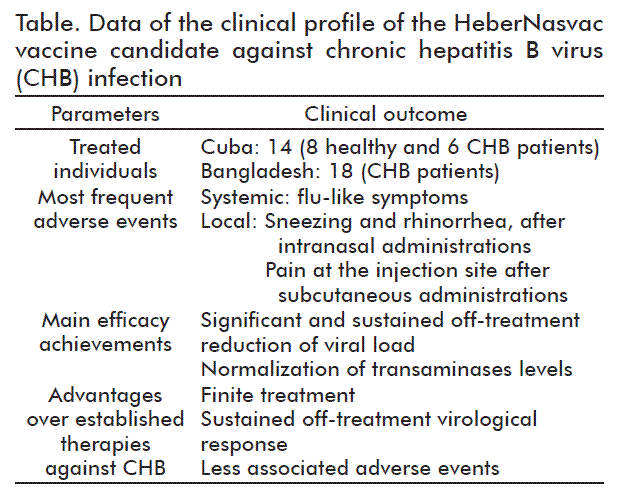
<P   ><font face="Verdana, Arial, Helvetica, sans-serif" size="2">The principal variables      of safety (adverse reactions and blood parameters) and efficacy (viral DNA,      presence of HBeAg and anti-HBeAg antibodies, and ALT levels) were periodically      evaluated during and after treatment, the viral load and biochemical and serological      parameters among them. This study further demonstrated the safety profile      of HeberNasvac administration in all the treated patients. No dangerous transaminases      exacerbations were detected. By the contrary, sustained transaminases normalization      was observed, followed by significant reduction of viral load down to undetectable      levels in 50 % of the treated patients. Moreover, an increment in the secretion      of pro-inflammatory cytokines was observed after the end of the first cycle      of treatment. Altogether, these results evidenced that vaccination with HeberNasvac      is safe and efficacious, suggesting that this could be an effective therapy      against CHB infection. This further supports the realization of other clinical      trials. Some relevant features of HeberNasvac&rsquo;s clinical development      are summarized in the <a href="/img/revistas/bta/v32n3/t0107315.gif">table</a>.      </font></P >       
<P   ><font face="Verdana, Arial, Helvetica, sans-serif" size="2"><b>Characterization      of CHB patient populations from Cuba and Bangladesh </b></font></P >       <P   ><font face="Verdana, Arial, Helvetica, sans-serif" size="2">During the HeberNasvac      clinical development, the phenotypic and genotypic aspects of the CHB patient      populations from Cuba [11] and Bangladesh [12] were characterized in a set      of studies. The proportion of patients HBeAg-positive and those bearing anti-HBeAg      antibodies was established through virological (viral load and viral genotype)      and serological (HBeAg and anti-HBeAg) parameters. In both countries, chronic      hepatitis B patients having negative HBeAg serology were predominant, reaching      levels of 80 % approximately. </font></P >       <P   ><font face="Verdana, Arial, Helvetica, sans-serif" size="2">Additionally, different      hepatitis B virus genotypes prevailed in both countries. According to the      present studies carried out by our group, in Cuba, genotype A is the most      frequent, followed by genotype D; while in Bangladesh genotypes C and D are      the most common, followed by genotype A at a minor proportion. In Bangladesh,      the levels of HBcAg expression in infected hepatocytes were also studied in      a group of CHB patients [12]. This variable was correlated with other serological,      virological and biochemical variables, resulting an interesting aspect for      the therapeutic vaccination. It is known that the induction of an HBcAg-specific      T cell response was targeted to hepatocytes carrying viral-derived peptides      on their HLA molecules. In general, all these studies increase our knowledge      on the hepatitis B chronic patient populations, which are the main targets      for the HeberNasvac vaccine treatment. </font></P >       <P   >&nbsp;</P >       <P   ><font face="Verdana, Arial, Helvetica, sans-serif" size="2"><b><font size="3">RELEVANCE      OF THE STUDY</font></b> </font></P >       ]]></body>
<body><![CDATA[<P   ><font face="Verdana, Arial, Helvetica, sans-serif" size="2">Altogether, the results      of the clinical trials shown in this work demonstrate the safety, immunogenicity,      and also evidences of efficacy of the HeberNasvac therapeutic vaccine. The      use of the intranasal administration route for this vaccine also was endorsed      as effective by the clinic data obtained. In general, these results suggest      the future successful introduction of this vaccine in the clinical practice.      Additionally, the patients&rsquo; features studied, which were developed while      enrolling the volunteers for the different clinical trials in Cuba and Bangladesh,      have allowed the in-depth characterization of the HBV chronic infected population      in both countries. Similarities were found regarding the proportion of HBeAg      negative patients, as well as differences in the main HBV circulating genotypes.      </font></P >       <P   >&nbsp;</P >       <P   ><font face="Verdana, Arial, Helvetica, sans-serif" size="3"><b>ACKNOWLEDGEMENTS      </b> </font></P >       <P   ><font face="Verdana, Arial, Helvetica, sans-serif" size="2">The authors would      like to thank all the patients who participated in the clinical trials in      Cuba and Bangladesh, and also the clinical researchers and medical staff for      their support to this research. </font></P >       <P   >&nbsp;</P >       <P   ><font face="Verdana, Arial, Helvetica, sans-serif" size="2"><b><font size="3">REFERENCES      </font></b></font></P >       <!-- ref --><P   ><font size="2" color="#000000" face="Verdana, Arial, Helvetica, sans-serif">1.      El-Serag HB. Epidemiology of viral hepatitis and hepatocellular carcinoma.      Gastroenterology. 2012;142(6):1264-73.     </font></P >   <FONT size="+1" color="#000000">        <!-- ref --><P   ><font face="Verdana, Arial, Helvetica, sans-serif" size="2">2. Lok ASF. The maze      of treatments for hepatitis B. N Engl J Med. 2005;352(26):2743-6.     </font></P >       ]]></body>
<body><![CDATA[<!-- ref --><P   ><font face="Verdana, Arial, Helvetica, sans-serif" size="2">3. Michel ML, Deng      Q, Mancini-Bourgine M. Therapeutic vaccines and immune-based therapies for      the treatment of chronic hepatitis B: Perspectives and challenges. J Hepatol.      2011;54:1286-96.     </font></P >       <!-- ref --><P   ><font face="Verdana, Arial, Helvetica, sans-serif" size="2">4. Aguilar JC, Lobaina      Y, Muzio V, Garcia D, Penton E, Iglesias E, <i>et al</i>. Development of a      nasal vaccine for chronic hepatitis B infection that uses the ability of hepatitis      B core antigen to stimulate a strong Th1 response against hepatitis B surface      antigen. Immunol Cell Biol. 2004;82:539-46.     </font></P >       <P   ><font face="Verdana, Arial, Helvetica, sans-serif" size="2">5. Lobaina Y, Trujillo      H, Garcia D, Gambe A, Chac&oacute;n Y, Blanco A, <i>et al</i>. The effect      of the parenteral route of administration on the immune response to simultaneous      nasal &ndash; parenteral immunizations using a new HBV therapeutic vaccine      candidate. Viral Immunol. 2010;23(5):521-9. </font></P >       <!-- ref --><P   ><font face="Verdana, Arial, Helvetica, sans-serif" size="2">6. Aguilar-Betancourt      A, Gonzalez CA, Cinza Z, Cabrera JM, Veliz G, Moreno SR, <i>et al</i>. Phase      I clinical trial in healthy adults of a nasal vaccine candidate containing      recombinant hepatitis B surface and core antigens. Int J Infect Dis. 2007;11:394-401.          </font></P >       <!-- ref --><P   ><font face="Verdana, Arial, Helvetica, sans-serif" size="2">7. Al-Mahtab M, Akbar      SM, Aguilar JC, Uddin H, Khan SI, Rahman S. Therapeutic potential of a combined      hepatitis B virus surface and core antigen vaccine in patients with chronic      hepatitis B. Hepatol Int. 2013;7:981-9.     </font></P >       <!-- ref --><P   ><font face="Verdana, Arial, Helvetica, sans-serif" size="2">8. Downs RW, Bell      NH, Ettinger MP, Walsh BW, Favus MJ, Mako B, <i>et al</i>. Comparison of Alendronate      and intranasal Calcitonin for treatment of osteoporosis in postmenopausal      women. J Clin Endocrinol Metab. 2000;85:1783-8.     </font></P >       <!-- ref --><P   ><font face="Verdana, Arial, Helvetica, sans-serif" size="2">9. Nichol KL, Mendelman      PM, Mallon KP, Jackson LA, Gorse GJ, Belshe RB, <i>et al</i>. Effectiveness      of live, attenuated intranasal Influenza virus vaccine in healthy, working      adults a randomized controlled trial. JAMA. 1999;282(2):137-44.     </font></P >       <!-- ref --><P   ><font face="Verdana, Arial, Helvetica, sans-serif" size="2">10. Belshe RB, Mendelman      PM, Treanor J, King J, Gruber WC, Piedra P, <i>et al</i>. The efficacy of      live attenuated, cold-adapted, trivalent, intranasal influenza virus vaccine      in children. N Engl J Med. 1998;338:1405-12.     </font></P >       <!-- ref --><P   ><font face="Verdana, Arial, Helvetica, sans-serif" size="2">11. Loureiro CL,      Aguilar JC, Aguiar J, Muzio V, Pent&oacute;n E, Garcia D, <i>et al</i>. HBV      Genotypic variability in Cuba. PLoS ONE. 2015;10(3):e0118959.     </font></P >       <!-- ref --><P   ><font face="Verdana, Arial, Helvetica, sans-serif" size="2">12. Raihan R, Tabassum      S, Nessa A, Jahan M, Al Mahtab M, Mohammad C, <i>et al</i>. High HBcAg expression      in hepatocytes of chronic hepatitis B patients in Bangladesh. Eursasian J      Hepatogastroenterol. 2012;2(2):63-9.     </font></P >       <P   >&nbsp;</P >       ]]></body>
<body><![CDATA[<P   >&nbsp;</P >       <P   > </P >   <FONT size="+1" color="#211E1F">        <P   ><font size="2" face="Verdana, Arial, Helvetica, sans-serif">Received in August,      2015.     <br>     </font><font face="Verdana, Arial, Helvetica, sans-serif" size="2">Accepted      in September, 2015. </font></P >       <P   >&nbsp;</P >       <P   >&nbsp;</P >   <FONT size="+1">        <P   > </P >   <FONT size="+1">        <P   ><i><font face="Verdana, Arial, Helvetica, sans-serif" size="2">Yadira Lobaina</font></i><font face="Verdana, Arial, Helvetica, sans-serif" size="2">.      Centro de Ingenier&iacute;a Gen&eacute;tica y Biotecnolog&iacute;a, CIGB.      Ave. 31 e/ 158 y 190, Cubanac&aacute;n, Playa, CP 11600, La Habana, Cuba.      E-mail: <a href="mailto:%20yadira.lobaina@cigb.edu.cu">yadira.lobaina@cigb.edu.cu</a>.</font></P >       <P   > </P >   </font></font></font></font></font></font></font></font></font></font></font></font></font></font></font></font></font></font></font></font></font></font></font></font></font></font></font></font></font></font></font></font></font></font></font></font></font></font></font></font></font></font></font></font></font></font></font></font></font></font></DIV >      ]]></body><back>
<ref-list>
<ref id="B1">
<label>1</label><nlm-citation citation-type="journal">
<person-group person-group-type="author">
<name>
<surname><![CDATA[El-Serag]]></surname>
<given-names><![CDATA[HB]]></given-names>
</name>
</person-group>
<article-title xml:lang="en"><![CDATA[Epidemiology of viral hepatitis and hepatocellular carcinoma]]></article-title>
<source><![CDATA[Gastroenterology]]></source>
<year>2012</year>
<volume>142</volume>
<numero>6</numero>
<issue>6</issue>
<page-range>1264-73</page-range></nlm-citation>
</ref>
<ref id="B2">
<label>2</label><nlm-citation citation-type="journal">
<person-group person-group-type="author">
<name>
<surname><![CDATA[Lok]]></surname>
<given-names><![CDATA[ASF]]></given-names>
</name>
</person-group>
<article-title xml:lang="en"><![CDATA[The maze of treatments for hepatitis B]]></article-title>
<source><![CDATA[N Engl J Med]]></source>
<year>2005</year>
<volume>352</volume>
<numero>26</numero>
<issue>26</issue>
<page-range>2743-6</page-range></nlm-citation>
</ref>
<ref id="B3">
<label>3</label><nlm-citation citation-type="journal">
<person-group person-group-type="author">
<name>
<surname><![CDATA[Michel]]></surname>
<given-names><![CDATA[ML]]></given-names>
</name>
<name>
<surname><![CDATA[Deng]]></surname>
<given-names><![CDATA[Q]]></given-names>
</name>
<name>
<surname><![CDATA[Mancini-Bourgine]]></surname>
<given-names><![CDATA[M]]></given-names>
</name>
</person-group>
<article-title xml:lang="en"><![CDATA[Therapeutic vaccines and immune-based therapies for the treatment of chronic hepatitis B: Perspectives and challenges]]></article-title>
<source><![CDATA[J Hepatol]]></source>
<year>2011</year>
<volume>54</volume>
<page-range>1286-96</page-range></nlm-citation>
</ref>
<ref id="B4">
<label>4</label><nlm-citation citation-type="journal">
<person-group person-group-type="author">
<name>
<surname><![CDATA[Aguilar]]></surname>
<given-names><![CDATA[JC]]></given-names>
</name>
<name>
<surname><![CDATA[Lobaina]]></surname>
<given-names><![CDATA[Y]]></given-names>
</name>
<name>
<surname><![CDATA[Muzio]]></surname>
<given-names><![CDATA[V]]></given-names>
</name>
<name>
<surname><![CDATA[Garcia]]></surname>
<given-names><![CDATA[D]]></given-names>
</name>
<name>
<surname><![CDATA[Penton]]></surname>
<given-names><![CDATA[E]]></given-names>
</name>
<name>
<surname><![CDATA[Iglesias]]></surname>
<given-names><![CDATA[E]]></given-names>
</name>
</person-group>
<article-title xml:lang="en"><![CDATA[Development of a nasal vaccine for chronic hepatitis B infection that uses the ability of hepatitis B core antigen to stimulate a strong Th1 response against hepatitis B surface antigen]]></article-title>
<source><![CDATA[Immunol Cell Biol]]></source>
<year>2004</year>
<volume>82</volume>
<page-range>539-46</page-range></nlm-citation>
</ref>
<ref id="B5">
<label>5</label><nlm-citation citation-type="journal">
<person-group person-group-type="author">
<name>
<surname><![CDATA[Lobaina]]></surname>
<given-names><![CDATA[Y]]></given-names>
</name>
<name>
<surname><![CDATA[Trujillo]]></surname>
<given-names><![CDATA[H]]></given-names>
</name>
<name>
<surname><![CDATA[Garcia]]></surname>
<given-names><![CDATA[D]]></given-names>
</name>
<name>
<surname><![CDATA[Gambe]]></surname>
<given-names><![CDATA[A]]></given-names>
</name>
<name>
<surname><![CDATA[Chacón]]></surname>
<given-names><![CDATA[Y]]></given-names>
</name>
<name>
<surname><![CDATA[Blanco]]></surname>
<given-names><![CDATA[A]]></given-names>
</name>
</person-group>
<article-title xml:lang="en"><![CDATA[The effect of the parenteral route of administration on the immune response to simultaneous nasal &#150; parenteral immunizations using a new HBV therapeutic vaccine candidate]]></article-title>
<source><![CDATA[Viral Immunol]]></source>
<year>2010</year>
<volume>23</volume>
<numero>5</numero>
<issue>5</issue>
<page-range>521-9</page-range></nlm-citation>
</ref>
<ref id="B6">
<label>6</label><nlm-citation citation-type="journal">
<person-group person-group-type="author">
<name>
<surname><![CDATA[Aguilar-Betancourt]]></surname>
<given-names><![CDATA[A]]></given-names>
</name>
<name>
<surname><![CDATA[Gonzalez]]></surname>
<given-names><![CDATA[CA]]></given-names>
</name>
<name>
<surname><![CDATA[Cinza]]></surname>
<given-names><![CDATA[Z]]></given-names>
</name>
<name>
<surname><![CDATA[Cabrera]]></surname>
<given-names><![CDATA[JM]]></given-names>
</name>
<name>
<surname><![CDATA[Veliz]]></surname>
<given-names><![CDATA[G]]></given-names>
</name>
<name>
<surname><![CDATA[Moreno]]></surname>
<given-names><![CDATA[SR]]></given-names>
</name>
</person-group>
<article-title xml:lang="en"><![CDATA[Phase I clinical trial in healthy adults of a nasal vaccine candidate containing recombinant hepatitis B surface and core antigens]]></article-title>
<source><![CDATA[Int J Infect Dis]]></source>
<year>2007</year>
<volume>11</volume>
<page-range>394-401</page-range></nlm-citation>
</ref>
<ref id="B7">
<label>7</label><nlm-citation citation-type="journal">
<person-group person-group-type="author">
<name>
<surname><![CDATA[Al-Mahtab]]></surname>
<given-names><![CDATA[M]]></given-names>
</name>
<name>
<surname><![CDATA[Akbar]]></surname>
<given-names><![CDATA[SM]]></given-names>
</name>
<name>
<surname><![CDATA[Aguilar]]></surname>
<given-names><![CDATA[JC]]></given-names>
</name>
<name>
<surname><![CDATA[Uddin]]></surname>
<given-names><![CDATA[H]]></given-names>
</name>
<name>
<surname><![CDATA[Khan]]></surname>
<given-names><![CDATA[SI]]></given-names>
</name>
<name>
<surname><![CDATA[Rahman]]></surname>
<given-names><![CDATA[S]]></given-names>
</name>
</person-group>
<article-title xml:lang="en"><![CDATA[Therapeutic potential of a combined hepatitis B virus surface and core antigen vaccine in patients with chronic hepatitis B]]></article-title>
<source><![CDATA[Hepatol Int]]></source>
<year>2013</year>
<volume>7</volume>
<page-range>981-9</page-range></nlm-citation>
</ref>
<ref id="B8">
<label>8</label><nlm-citation citation-type="journal">
<person-group person-group-type="author">
<name>
<surname><![CDATA[Downs]]></surname>
<given-names><![CDATA[RW]]></given-names>
</name>
<name>
<surname><![CDATA[Bell]]></surname>
<given-names><![CDATA[NH]]></given-names>
</name>
<name>
<surname><![CDATA[Ettinger]]></surname>
<given-names><![CDATA[MP]]></given-names>
</name>
<name>
<surname><![CDATA[Walsh]]></surname>
<given-names><![CDATA[BW]]></given-names>
</name>
<name>
<surname><![CDATA[Favus]]></surname>
<given-names><![CDATA[MJ]]></given-names>
</name>
<name>
<surname><![CDATA[Mako]]></surname>
<given-names><![CDATA[B]]></given-names>
</name>
</person-group>
<article-title xml:lang="en"><![CDATA[Comparison of Alendronate and intranasal Calcitonin for treatment of osteoporosis in postmenopausal women]]></article-title>
<source><![CDATA[J Clin Endocrinol Metab]]></source>
<year>2000</year>
<volume>85</volume>
<page-range>1783-8</page-range></nlm-citation>
</ref>
<ref id="B9">
<label>9</label><nlm-citation citation-type="journal">
<person-group person-group-type="author">
<name>
<surname><![CDATA[Nichol]]></surname>
<given-names><![CDATA[KL]]></given-names>
</name>
<name>
<surname><![CDATA[Mendelman]]></surname>
<given-names><![CDATA[PM]]></given-names>
</name>
<name>
<surname><![CDATA[Mallon]]></surname>
<given-names><![CDATA[KP]]></given-names>
</name>
<name>
<surname><![CDATA[Jackson]]></surname>
<given-names><![CDATA[LA]]></given-names>
</name>
<name>
<surname><![CDATA[Gorse]]></surname>
<given-names><![CDATA[GJ]]></given-names>
</name>
<name>
<surname><![CDATA[Belshe]]></surname>
<given-names><![CDATA[RB]]></given-names>
</name>
</person-group>
<article-title xml:lang="en"><![CDATA[Effectiveness of live, attenuated intranasal Influenza virus vaccine in healthy, working adults a randomized controlled trial]]></article-title>
<source><![CDATA[JAMA]]></source>
<year>1999</year>
<volume>282</volume>
<numero>2</numero>
<issue>2</issue>
<page-range>137-44</page-range></nlm-citation>
</ref>
<ref id="B10">
<label>10</label><nlm-citation citation-type="journal">
<person-group person-group-type="author">
<name>
<surname><![CDATA[Belshe]]></surname>
<given-names><![CDATA[RB]]></given-names>
</name>
<name>
<surname><![CDATA[Mendelman]]></surname>
<given-names><![CDATA[PM]]></given-names>
</name>
<name>
<surname><![CDATA[Treanor]]></surname>
<given-names><![CDATA[J]]></given-names>
</name>
<name>
<surname><![CDATA[King]]></surname>
<given-names><![CDATA[J]]></given-names>
</name>
<name>
<surname><![CDATA[Gruber]]></surname>
<given-names><![CDATA[WC]]></given-names>
</name>
<name>
<surname><![CDATA[Piedra]]></surname>
<given-names><![CDATA[P]]></given-names>
</name>
</person-group>
<article-title xml:lang="en"><![CDATA[The efficacy of live attenuated, cold-adapted, trivalent, intranasal influenza virus vaccine in children]]></article-title>
<source><![CDATA[N Engl J Med]]></source>
<year>1998</year>
<volume>338</volume>
<page-range>1405-12</page-range></nlm-citation>
</ref>
<ref id="B11">
<label>11</label><nlm-citation citation-type="journal">
<person-group person-group-type="author">
<name>
<surname><![CDATA[Loureiro]]></surname>
<given-names><![CDATA[CL]]></given-names>
</name>
<name>
<surname><![CDATA[Aguilar]]></surname>
<given-names><![CDATA[JC]]></given-names>
</name>
<name>
<surname><![CDATA[Aguiar]]></surname>
<given-names><![CDATA[J]]></given-names>
</name>
<name>
<surname><![CDATA[Muzio]]></surname>
<given-names><![CDATA[V]]></given-names>
</name>
<name>
<surname><![CDATA[Pentón]]></surname>
<given-names><![CDATA[E]]></given-names>
</name>
<name>
<surname><![CDATA[Garcia]]></surname>
<given-names><![CDATA[D]]></given-names>
</name>
</person-group>
<article-title xml:lang="en"><![CDATA[HBV Genotypic variability in Cuba]]></article-title>
<source><![CDATA[PLoS ONE]]></source>
<year>2015</year>
<volume>10</volume>
<numero>3</numero>
<issue>3</issue>
<page-range>e0118959</page-range></nlm-citation>
</ref>
<ref id="B12">
<label>12</label><nlm-citation citation-type="journal">
<person-group person-group-type="author">
<name>
<surname><![CDATA[Raihan]]></surname>
<given-names><![CDATA[R]]></given-names>
</name>
<name>
<surname><![CDATA[Tabassum]]></surname>
<given-names><![CDATA[S]]></given-names>
</name>
<name>
<surname><![CDATA[Nessa]]></surname>
<given-names><![CDATA[A]]></given-names>
</name>
<name>
<surname><![CDATA[Jahan]]></surname>
<given-names><![CDATA[M]]></given-names>
</name>
<name>
<surname><![CDATA[Al Mahtab]]></surname>
<given-names><![CDATA[M]]></given-names>
</name>
<name>
<surname><![CDATA[Mohammad]]></surname>
<given-names><![CDATA[C]]></given-names>
</name>
</person-group>
<article-title xml:lang="en"><![CDATA[High HBcAg expression in hepatocytes of chronic hepatitis B patients in Bangladesh]]></article-title>
<source><![CDATA[Eursasian J Hepatogastroenterol]]></source>
<year>2012</year>
<volume>2</volume>
<numero>2</numero>
<issue>2</issue>
<page-range>63-9</page-range></nlm-citation>
</ref>
</ref-list>
</back>
</article>